EP3030878B1 - Particle capture device - Google Patents
Particle capture device Download PDFInfo
- Publication number
- EP3030878B1 EP3030878B1 EP14745058.9A EP14745058A EP3030878B1 EP 3030878 B1 EP3030878 B1 EP 3030878B1 EP 14745058 A EP14745058 A EP 14745058A EP 3030878 B1 EP3030878 B1 EP 3030878B1
- Authority
- EP
- European Patent Office
- Prior art keywords
- particles
- particle
- capture device
- particle capture
- internal surface
- Prior art date
- Legal status (The legal status is an assumption and is not a legal conclusion. Google has not performed a legal analysis and makes no representation as to the accuracy of the status listed.)
- Active
Links
Images




Classifications
-
- G—PHYSICS
- G01—MEASURING; TESTING
- G01N—INVESTIGATING OR ANALYSING MATERIALS BY DETERMINING THEIR CHEMICAL OR PHYSICAL PROPERTIES
- G01N1/00—Sampling; Preparing specimens for investigation
- G01N1/28—Preparing specimens for investigation including physical details of (bio-)chemical methods covered elsewhere, e.g. G01N33/50, C12Q
- G01N1/44—Sample treatment involving radiation, e.g. heat
-
- G—PHYSICS
- G01—MEASURING; TESTING
- G01N—INVESTIGATING OR ANALYSING MATERIALS BY DETERMINING THEIR CHEMICAL OR PHYSICAL PROPERTIES
- G01N1/00—Sampling; Preparing specimens for investigation
- G01N1/02—Devices for withdrawing samples
- G01N1/22—Devices for withdrawing samples in the gaseous state
- G01N1/2202—Devices for withdrawing samples in the gaseous state involving separation of sample components during sampling
- G01N1/2208—Devices for withdrawing samples in the gaseous state involving separation of sample components during sampling with impactors
-
- G—PHYSICS
- G01—MEASURING; TESTING
- G01N—INVESTIGATING OR ANALYSING MATERIALS BY DETERMINING THEIR CHEMICAL OR PHYSICAL PROPERTIES
- G01N1/00—Sampling; Preparing specimens for investigation
- G01N1/28—Preparing specimens for investigation including physical details of (bio-)chemical methods covered elsewhere, e.g. G01N33/50, C12Q
-
- G—PHYSICS
- G01—MEASURING; TESTING
- G01N—INVESTIGATING OR ANALYSING MATERIALS BY DETERMINING THEIR CHEMICAL OR PHYSICAL PROPERTIES
- G01N15/00—Investigating characteristics of particles; Investigating permeability, pore-volume or surface-area of porous materials
- G01N15/02—Investigating particle size or size distribution
- G01N15/0255—Investigating particle size or size distribution with mechanical, e.g. inertial, classification, and investigation of sorted collections
-
- G—PHYSICS
- G01—MEASURING; TESTING
- G01N—INVESTIGATING OR ANALYSING MATERIALS BY DETERMINING THEIR CHEMICAL OR PHYSICAL PROPERTIES
- G01N15/00—Investigating characteristics of particles; Investigating permeability, pore-volume or surface-area of porous materials
- G01N15/02—Investigating particle size or size distribution
- G01N15/0266—Investigating particle size or size distribution with electrical classification
-
- G—PHYSICS
- G01—MEASURING; TESTING
- G01N—INVESTIGATING OR ANALYSING MATERIALS BY DETERMINING THEIR CHEMICAL OR PHYSICAL PROPERTIES
- G01N15/00—Investigating characteristics of particles; Investigating permeability, pore-volume or surface-area of porous materials
- G01N15/10—Investigating individual particles
- G01N15/1031—Investigating individual particles by measuring electrical or magnetic effects
-
- G—PHYSICS
- G01—MEASURING; TESTING
- G01N—INVESTIGATING OR ANALYSING MATERIALS BY DETERMINING THEIR CHEMICAL OR PHYSICAL PROPERTIES
- G01N15/00—Investigating characteristics of particles; Investigating permeability, pore-volume or surface-area of porous materials
- G01N2015/0038—Investigating nanoparticles
-
- G—PHYSICS
- G01—MEASURING; TESTING
- G01N—INVESTIGATING OR ANALYSING MATERIALS BY DETERMINING THEIR CHEMICAL OR PHYSICAL PROPERTIES
- G01N15/00—Investigating characteristics of particles; Investigating permeability, pore-volume or surface-area of porous materials
- G01N2015/0042—Investigating dispersion of solids
- G01N2015/0046—Investigating dispersion of solids in gas, e.g. smoke
-
- G—PHYSICS
- G01—MEASURING; TESTING
- G01N—INVESTIGATING OR ANALYSING MATERIALS BY DETERMINING THEIR CHEMICAL OR PHYSICAL PROPERTIES
- G01N15/00—Investigating characteristics of particles; Investigating permeability, pore-volume or surface-area of porous materials
- G01N15/10—Investigating individual particles
- G01N2015/1021—Measuring mass of individual particles
Definitions
- the present disclosure relates generally to aerosol analyzers and other particle measuring instruments, and more specifically to a particle capture device usable in aerosol analyzers and other particle measuring instruments.
- Fine atmospheric aerosols resulting from internal combustion engines, fossil fuel fired power plants, painting/stripping faculties, gas discharge boiler operations and other anthropogenic and biogenic sources, are known to have a serious impact on climate and human health.
- These aerosols are comprised of micron and sub micron sized particles, having various size distributions and chemical compositions. Such particles can influence climate directly by scattering or absorbing sunlight, and indirectly by altering cloud coverage. Further, such particles can contribute to health problems such as asthma, lung cancer, cardiovascular disease, respiratory disease, and other conditions. Given their impact on climate and human health, fine atmospheric aerosols composed of micron and sub micron sized particles are the subject to widespread study and monitoring.
- a variety of different types of aerosol analyzers and other particle measuring instruments have been developed to determine particle size distributions and chemical compositions of fine atmospheric aerosols.
- a focused particle beam is generated and directed towards a generally flat collection surface. The particles impact the collection surface, and a portion of them are retained. The retained particles are vaporized, and the resulting gaseous molecules are provided to a detector that produces results.
- White such an instrument may provide valuable information, typical designs have shortcomings.
- particle bounce is a complex phenomenon. A wide variety of factors, including size, chemical composition, phase (e.g., liquid or solid), impact velocity, and the like, may be in play. Given the complexities, modifying particle or impact surface properties to reduce particle bounce is challenging.
- particle collection efficiency in aerosol analyzers and other particle measuring instruments is improved by a particle capture device that employs multiple collisions to decrease momentum of particles until the particles are collected (e.g., vaporized or come to rest).
- the particle collection device includes an aperture through which a focused particle beam enters.
- a collection enclosure is coupled to the aperture and has one or more internal surfaces against which particles of the focused beam collide.
- One or more features are employed with the internal surfaces to promote particles to collide multiple times within the enclosure, and thereby be vaporized or come to rest, rather than escape through the aperture.
- a ratio of an internal collision area of the collection enclosure to an entrance area of the aperture may be maximized.
- a surface area of the internal surfaces of the collection enclosure defines the internal collision area.
- Boundaries of the aperture define the entrance area.
- the ratio should be greater than 1:1, and preferable should be greater than 20:1. In one implementation, the ratio is approximately 37:1.
- the ratio may be maximized by utilizing a special geometry for the internal surfaces of the collection enclosure.
- the ratio may also be maximized by altering surface properties of the internal surfaces of the collection enclosure. Further, a combination of the two approaches may be employed.
- an example aerosol analyzer 100 may include three main sections: an aerosol sampling chamber 110, a particle sizing chamber 120, and a particle composition detection chamber 130.
- the aerosol sampling chamber 110 draws in particle-laden gas (e.g., atmospheric air) having micron and/or sub-micron particles, and produces a focused particle beam 115.
- the aerosol sampling chamber 110 includes a series of orifice lenses under the pull of a vacuum system. The lenses serve to focus particles and to control supersonic gas expansion and particle acceleration, to form the focused particle beam 115.
- the focused particle beam 115 is passed to the particle sizing chamber 120. In the particle sizing chamber, particles are separated according to their size dependant velocity profile resulting from expansion into vacuum..
- the particle sizing chamber 120 includes a particle charging unit (not shown) that applies an electric charge to the particles, and a deflection section (not shown) where an electric field deflects the particles.
- the degree of deflection is related to particle size (size dependant velocity, size dependant charge and applied voltage). Particles within a narrow range of sizes are caused to pass through an off-axis slit and leave the particle sizing chamber and pass into the particle composition detection chamber 130.
- the particle sizing chamber 120 includes a beam chopper (not shown) that alternately blocks and passes the focused particle beam 115 to produce a succession of beam pulses. Particles undergo velocity dispersion where the velocities are inversely related to particle size. Accordingly, as each beam pulse travels, it spreads in the direction of travel, with smaller particles arriving before larger particles. Particles of sorted sizes are thereby be delivered to the particle composition detection chamber 130.
- the particle detection chamber 130 includes a particle capture device 140 and a detector 150.
- the focused particle beam enters the particle capture device 140 through an aperture 160.
- the focused particle beam 115 is then received into a collection enclosure 170 coupled to the aperture 160.
- a temperature change element 180 of the particle capture device 140 is arranged to heat and/or cool the collection enclosure 170, depending an the implementation.
- the temperature change element 180 may include a resistive heating element, a thermo eclectic cooling element (e.g., a Peltier cooler), a heating or cooling system that circulates hot or cold liquid through a closed loop circulation system, an irradiation heating source, such as a CO 2 laser, or another type of element that is capable of changing the temperature of the enclosure 170.
- Particles are substantially retained in the collection enclosure 170 of the particle capture device 140 until they are vaporized (e.g., as a result of heat from the temperature change element 180), or come to rest (e.g., for later vaporization in a controlled heating cycle).
- the particle capture device 140 may operate as a particle capture vaporizer or as a particle capture collector, depending on the implementation.
- the temperature change element 180 may continuously heat the collection enclosure 170 to vaporize collected particles substantially immediately (i.e., as soon as possible).
- the temperature change element 180 may perform controlled heating cycles, with periods of heat interspersed by periods of relative cool. Entering particles may encounter an initially cool collection enclosure 170, such that collected particles are not immediately vaporized. The collected particles may later be subjected to heating and be vaporized.
- the heating cycle may be precisely controlled to allow particle volatility to be studied providing further information on particle composition.
- Vaporized particles 190 are passed to the detector 150, which may be a mass spectrometer.
- the vaporized particles pass to the detector through the same aperture 160 that the focused particle beam originally entered. That is, the vaporized particles 190 exit the particle capture device 140 along the same axis upon which they entered as a focused particle beam 115.
- the aperture 160 is located within a detection region of the detector 150. In an implementation where the detector 150 includes a mass spectrometer, the aperture is within an ion formation chamber of the mass spectrometer.
- the collection enclosure 170 of the particle capture device 140 includes several internal surfaces upon which the particles collide multiple times. A surface area of the internal surfaces defines an internal collision area. Boundaries of the aperture 160 of the particle capture device 140 define an entrance area.
- a ratio of the internal collision area to the entrance area (referred to herein as the "capture efficiency ratio") is maximized within practical constraints.
- the capture efficiency ratio should be greater than 1:1, and preferable should be greater than 20:1. In one implementation, the capture efficiency ratio is approximately 37:1.
- the capture efficiency ratio may be increased somewhat by reducing the entrance area.
- the minimum size of the aperture 160 may be defined by the width of the focused particle beam to allow full entrance thereof.
- the capture efficiency ratio may be increased more significantly by maximizing the internal collision area.
- the internal collision area may be maximized through geometry of the internal surfaces of the collection enclosure 170 and/or through surface properties of the internal surfaces of the collection enclosure 170. Geometry may be used where specular reflections dominate. With substantially smooth internal surfaces, particles may bounce in a relatively predictable manner through specular reflection. Geometry of the internal surfaces can increase specular reflections, such that particles repeatedly collide with the internal surfaces until they are vaporized or come to rest.
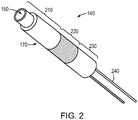
- the particle capture device 140 has a generally cylindrical configuration, and is largely symmetrical about its major axis J-J.
- a front portion 210 of the particle capture device 140 includes the aperture 160 and the collection enclosure 170.
- the front portion 210 may be constructed from a solid piece of material, for example, a refractory metal such as Molybdenum or Tungsten.
- a heater body portion 220 of the particle capture device 140 functions as the temperature change element, in this case, providing resistive heating as current is applied to wires 240.
- the heater body portion 220 may be constructed from a solid piece of material also, for example, Molybdenum or Tungsten.
- a thermal support portion 230 of the particle capture device 140 is a thin walled tube connected to the heater body 220 and encloses part of the wires 240.
- the particle capture device 140 may function as a particle capture vaporizer or as a particle capture collector, as discussed above.
- An embedded thermocouple (not shown) inside heater body 220 or at the front of heater body 220 allows for temperature measurement.
- a focused particle beam may enter the aperture 160 and be received into the collection enclosure 170.
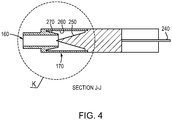
- the collection enclosure 170 includes several substantially smooth internal surfaces 250, 260, 270 upon which the particles of the focused particle beam collide, and a portion thereof bounce (e.g., rebound).
- the internal surfaces 250, 260, 270 are arranged to promote multiple collisions and minimize the possibility of particles escaping through the aperture 160, before the particles are vaporized or come to rest, as the case may be.
- the geometry may serve to substantially equally distribute the particles to all points on the internal surfaces 250, 260, 270, in a manner similar to an integrating sphere in the field of optics, which distributes light over all angles.
- a first internal surface 250 is positioned to receive the initial collision of the particles.
- the first internal surface 250 is oriented at an acute angle to the major axis J-J of the particle capture device 140 (and thereby at an acute angle to the trajectory of the focused particle beam), such that initial collisions (assuming spectral reflection) reduce momentum of the particles, but preserve the direction of the forward velocity vector components of the particles. That is, the orientation causes the particles to bounce (assuming spectral reflection) further into the collection enclosure 170 rather than towards that aperture 160.
- the angle between the major axis J-J (and the particle beam trajectory) and the first internal surface 250 is less than 30°. A shallower angle may lead to a more efficient but larger particle capture device 140.
- the angle between the major axis J-J (and the particle beam trajectory) and the first surface 250 is 16°.
- the first surface 250 may have a substantially conical shape, with a vertex angle of 16°.
- the second internal surface 260 is oriented at an acute angle to the first internal surface 250 and is configured to receive the next collision (assuming spectral reflection). The orientation again causes the particles to bounce (assuming spectral reflection) further into the collection enclosure 170 rather than towards that aperture 160.
- the second internal surface 260 is parallel to the major axis J-J such that an angle between the second internal surface 260 and the first internal surface is again 16°.
- the second internal surface 260 may have a substantially cylindrical shape.
- Particles may repeatedly bounce between the first internal surface 250 and the second internal surface 260 and may eventually encounter the third internal surface 270.
- the third internal surface 270 is oriented at an acute angle with respect to the second internal surface 260, and is configured to retain particles that are moving in a direction towards the aperture 160. In one implementation, an angle between the second internal surface 260 and the third internal surface is 270 is 14°.
- the third internal surface 270 may be shaped sustainably as a conical frustum, with the aperture 160 at its apex.
- spectral reflection is an idealized case, and even with substantially smooth surfaces, particles exhibit some variation in how they rebound.
- the example geometry of the example particle capture device 140 may minimize the number of particles that escape despite this variation. Referring to the ray trace model 600 of a single particle trajectory 610 shown in Fig. 6 , it can be seen that a particle is likely to undergo multiple collisions after it enters the collection enclosure 170, and finally be vaporized or come to rest.
- surface properties of one or more internal surfaces of the collection enclosure 170 may be used to promote multiple collisions.
- colliding particles may undergo more random reflections such that diffuse reflections dominate.
- Surface roughness may be introduced by adding wires entanglements (e.g., wire "birds nests"), constructing the surfaces from porous materials (e.g., which provide nooks and crevices), adding micro-scaled or nano-scaled grids produced from nano-technology processes or etching processes, or some other means of adding surface roughness.
- Surface roughness and the diffuse reflections resulting therefrom may be used together with special geometry to improve particle collection efficiency. However, diffuse reflections may also limit particle collection efficiency, and proved unwanted, in some cases.
- the particle device 140 may be used in an example aerosol analyzer 100 designed to measure fine atmospheric aerosols, it should be understood such the device 140 may also be used in a variety of other types of instruments, including other particle measuring instruments that measure particles from non-atmospheric sources. Such particle measuring instruments may lack some of the capabilities of the example aerosol analyzer 100, for instance the ability to produce results as function of particle size, and may have additional capabilities beyond those of the example aerosol analyzer 100.
- the particle capture device 140 and, specifically the collection enclosure 170 may be constructed from a variety of different materials, and be formed in a variety of different shapes suited for the goals discussed herein, within the scope of appended claims. In general, it should be understood that the above descriptions are meant to be taken only by way of example.
Landscapes
- Chemical & Material Sciences (AREA)
- Life Sciences & Earth Sciences (AREA)
- Health & Medical Sciences (AREA)
- General Health & Medical Sciences (AREA)
- Physics & Mathematics (AREA)
- Analytical Chemistry (AREA)
- Biochemistry (AREA)
- General Physics & Mathematics (AREA)
- Immunology (AREA)
- Pathology (AREA)
- Dispersion Chemistry (AREA)
- Molecular Biology (AREA)
- Biomedical Technology (AREA)
- Engineering & Computer Science (AREA)
- Sampling And Sample Adjustment (AREA)
Applications Claiming Priority (2)
| Application Number | Priority Date | Filing Date | Title |
|---|---|---|---|
| US13/961,469 US9267869B2 (en) | 2013-08-07 | 2013-08-07 | Particle capture device |
| PCT/US2014/046508 WO2015020758A1 (en) | 2013-08-07 | 2014-07-14 | Particle capture device |
Publications (2)
| Publication Number | Publication Date |
|---|---|
| EP3030878A1 EP3030878A1 (en) | 2016-06-15 |
| EP3030878B1 true EP3030878B1 (en) | 2020-12-09 |
Family
ID=51257633
Family Applications (1)
| Application Number | Title | Priority Date | Filing Date |
|---|---|---|---|
| EP14745058.9A Active EP3030878B1 (en) | 2013-08-07 | 2014-07-14 | Particle capture device |
Country Status (5)
| Country | Link |
|---|---|
| US (1) | US9267869B2 (https=) |
| EP (1) | EP3030878B1 (https=) |
| JP (1) | JP6302556B2 (https=) |
| CN (1) | CN105518435B (https=) |
| WO (1) | WO2015020758A1 (https=) |
Families Citing this family (5)
| Publication number | Priority date | Publication date | Assignee | Title |
|---|---|---|---|---|
| JP6686558B2 (ja) * | 2016-03-09 | 2020-04-22 | 富士電機株式会社 | 粒子分析装置および粒子分析方法 |
| EP3759464B1 (en) * | 2018-02-27 | 2026-03-18 | University Court of The University of St Andrews | Apparatus for analysing a liquid sample comprising particles |
| GB202001397D0 (en) | 2020-01-31 | 2020-03-18 | Odx Innovations Ltd | Apparatus, system and method for measuring properties of a sample |
| CA3214104A1 (en) * | 2021-04-09 | 2022-10-13 | Dominik Niederberger | Dealing with fog and contaminations in environmental sensor devices |
| KR102897660B1 (ko) * | 2022-04-01 | 2025-12-09 | 정경환 | 샘플링 기구, 이를 포함하는 공정 파티클 샘플링 장치 및 이를 포함하는 공정 파티클 모니터링 장치 |
Citations (5)
| Publication number | Priority date | Publication date | Assignee | Title |
|---|---|---|---|---|
| US4968885A (en) * | 1987-03-06 | 1990-11-06 | Extrel Corporation | Method and apparatus for introduction of liquid effluent into mass spectrometer and other gas-phase or particle detectors |
| DE3938194A1 (de) * | 1989-11-17 | 1991-05-23 | Steinmueller Gmbh L & C | Verfahren zum abscheiden von feststoffpartikeln aus einem gasstrom und fangrinnenabscheider zur durchfuehrung des verfahrens |
| US20040025604A1 (en) * | 1999-03-10 | 2004-02-12 | Mesosystems Technology, Inc. | Optimizing rotary impact collectors |
| US20120255375A1 (en) * | 2011-04-11 | 2012-10-11 | LMS Technologies, Inc. | Apparatuses and methods for capturing and retaining particles |
| US20130011930A1 (en) * | 2010-03-17 | 2013-01-10 | Fuji Electric Co., Ltd. | Method of analyzing microparticle composition and microparticle composition analyzing device |
Family Cites Families (11)
| Publication number | Priority date | Publication date | Assignee | Title |
|---|---|---|---|---|
| US2709222A (en) * | 1944-10-09 | 1955-05-24 | Ernest O Lawrence | Methods of and apparatus for separating materials |
| US4589843A (en) * | 1976-04-07 | 1986-05-20 | Smith Thomas M | Infra-red irradiation |
| US4814612A (en) * | 1983-08-30 | 1989-03-21 | Research Corporation | Method and means for vaporizing liquids for detection or analysis |
| US4730111A (en) * | 1983-08-30 | 1988-03-08 | Research Corporation | Ion vapor source for mass spectrometry of liquids |
| GB2203241B (en) * | 1987-03-06 | 1991-12-04 | Extrel Corp | Introduction of effluent into mass spectrometers and other gas-phase or particle detectors |
| US5538643A (en) * | 1991-08-01 | 1996-07-23 | The Dow Chemical Company | Continuous flow apparatus and method for interfacing liquid chromatograph and fourier transform infrared spectrometer |
| ATE170001T1 (de) * | 1993-10-21 | 1998-09-15 | Abbott Lab | Vorrichtung und verfahren zur überführung einer probe eines fluids |
| AUPM765994A0 (en) * | 1994-08-26 | 1994-09-15 | University Of Sydney, The | Nasal filters |
| US6040574A (en) | 1998-03-05 | 2000-03-21 | Aerodyne Research, Inc. | Atmospheric-particle analyzer |
| US7247495B2 (en) * | 1998-11-23 | 2007-07-24 | Aviv Amirav | Mass spectrometer method and apparatus for analyzing a sample in a solution |
| CN201063015Y (zh) * | 2007-06-27 | 2008-05-21 | 上海理工大学 | 透过率脉动法颗粒测量装置 |
-
2013
- 2013-08-07 US US13/961,469 patent/US9267869B2/en active Active
-
2014
- 2014-07-14 CN CN201480037453.XA patent/CN105518435B/zh active Active
- 2014-07-14 JP JP2016533304A patent/JP6302556B2/ja active Active
- 2014-07-14 WO PCT/US2014/046508 patent/WO2015020758A1/en not_active Ceased
- 2014-07-14 EP EP14745058.9A patent/EP3030878B1/en active Active
Patent Citations (5)
| Publication number | Priority date | Publication date | Assignee | Title |
|---|---|---|---|---|
| US4968885A (en) * | 1987-03-06 | 1990-11-06 | Extrel Corporation | Method and apparatus for introduction of liquid effluent into mass spectrometer and other gas-phase or particle detectors |
| DE3938194A1 (de) * | 1989-11-17 | 1991-05-23 | Steinmueller Gmbh L & C | Verfahren zum abscheiden von feststoffpartikeln aus einem gasstrom und fangrinnenabscheider zur durchfuehrung des verfahrens |
| US20040025604A1 (en) * | 1999-03-10 | 2004-02-12 | Mesosystems Technology, Inc. | Optimizing rotary impact collectors |
| US20130011930A1 (en) * | 2010-03-17 | 2013-01-10 | Fuji Electric Co., Ltd. | Method of analyzing microparticle composition and microparticle composition analyzing device |
| US20120255375A1 (en) * | 2011-04-11 | 2012-10-11 | LMS Technologies, Inc. | Apparatuses and methods for capturing and retaining particles |
Also Published As
| Publication number | Publication date |
|---|---|
| JP6302556B2 (ja) | 2018-03-28 |
| JP2016527522A (ja) | 2016-09-08 |
| WO2015020758A1 (en) | 2015-02-12 |
| US20150040689A1 (en) | 2015-02-12 |
| CN105518435A (zh) | 2016-04-20 |
| US9267869B2 (en) | 2016-02-23 |
| EP3030878A1 (en) | 2016-06-15 |
| CN105518435B (zh) | 2018-08-14 |
Similar Documents
| Publication | Publication Date | Title |
|---|---|---|
| EP3030878B1 (en) | Particle capture device | |
| Zweiback et al. | Detailed study of nuclear fusion from femtosecond laser-driven explosions of deuterium clusters | |
| US4383171A (en) | Particle analyzing method and apparatus | |
| US7260483B2 (en) | Real-time detection method and system for identifying individual aerosol particles | |
| US11963286B2 (en) | X-ray source and method for generating X-ray radiation | |
| Hinz et al. | Instrumentation, data evaluation and quantification in on‐line aerosol mass spectrometry | |
| JP4159252B2 (ja) | 大気中粒子の分析器 | |
| US20180247805A1 (en) | Spectrometry method and spectrometer device | |
| Clemen et al. | Optimizing the detection, ablation, and ion extraction efficiency of a single-particle laser ablation mass spectrometer for application in environments with low aerosol particle concentrations | |
| Weiss et al. | On the performance of an on-line time-of-flight mass spectrometer for aerosols | |
| Bogan et al. | Single-particle coherent diffractive imaging with a soft x-ray free electron laser: towards soot aerosol morphology | |
| Jayne et al. | Particle capture device | |
| Lee et al. | Development and experimental evaluation of aerodynamic lens as an aerosol inlet of single particle mass spectrometry | |
| JP2016527522A5 (https=) | ||
| KR101508146B1 (ko) | 기화-전자 이온화기 및 레이저 이온화기를 포함하는 에어로졸 질량분석기 | |
| Kievit et al. | The on-line chemical analysis of single particles using aerosol beams and time of flight mass spectrometry | |
| Pietsch | Effect of Knudsen‐layer formation on the initial expansion and angular distribution of a laser‐produced copper plasma at reduced pressure of air | |
| Worbs | Toward cryogenic beams of nanoparticles and proteins | |
| Kaplan et al. | Velocity correlated multifragmentation in C 60-surface impact: Energy distributions and incidence angle dependences | |
| Roth | Control of airborne nanoparticles | |
| Burke | Ice Particle Impact Phenomena and Hypervelocity Impact Ionization Mass Spectra | |
| Mäkinen | DEVELOPMENT OF AN AGGLOMERATION INLET FOR NANOPARTICLE CHEMICAL COMPOSITION ANALYSIS | |
| Stafe et al. | Laser-matter interaction above the plasma ignition threshold intensity | |
| Cho et al. | Understanding Nanoscale Phenomena Using Single Particle Mass Spectrometry and Improvement of Its Performance–a Review | |
| Andersen et al. | Characterization of a neutral helium beam for helium microscopy |
Legal Events
| Date | Code | Title | Description |
|---|---|---|---|
| PUAI | Public reference made under article 153(3) epc to a published international application that has entered the european phase |
Free format text: ORIGINAL CODE: 0009012 |
|
| 17P | Request for examination filed |
Effective date: 20151214 |
|
| AK | Designated contracting states |
Kind code of ref document: A1 Designated state(s): AL AT BE BG CH CY CZ DE DK EE ES FI FR GB GR HR HU IE IS IT LI LT LU LV MC MK MT NL NO PL PT RO RS SE SI SK SM TR |
|
| AX | Request for extension of the european patent |
Extension state: BA ME |
|
| DAX | Request for extension of the european patent (deleted) | ||
| STAA | Information on the status of an ep patent application or granted ep patent |
Free format text: STATUS: EXAMINATION IS IN PROGRESS |
|
| 17Q | First examination report despatched |
Effective date: 20190306 |
|
| GRAP | Despatch of communication of intention to grant a patent |
Free format text: ORIGINAL CODE: EPIDOSNIGR1 |
|
| RIC1 | Information provided on ipc code assigned before grant |
Ipc: G01N 15/10 20060101ALI20200130BHEP Ipc: G01N 15/02 20060101ALI20200130BHEP Ipc: G01N 15/00 20060101ALI20200130BHEP Ipc: G01N 1/22 20060101AFI20200130BHEP |
|
| STAA | Information on the status of an ep patent application or granted ep patent |
Free format text: STATUS: GRANT OF PATENT IS INTENDED |
|
| INTG | Intention to grant announced |
Effective date: 20200305 |
|
| GRAJ | Information related to disapproval of communication of intention to grant by the applicant or resumption of examination proceedings by the epo deleted |
Free format text: ORIGINAL CODE: EPIDOSDIGR1 |
|
| STAA | Information on the status of an ep patent application or granted ep patent |
Free format text: STATUS: EXAMINATION IS IN PROGRESS |
|
| INTC | Intention to grant announced (deleted) | ||
| GRAP | Despatch of communication of intention to grant a patent |
Free format text: ORIGINAL CODE: EPIDOSNIGR1 |
|
| STAA | Information on the status of an ep patent application or granted ep patent |
Free format text: STATUS: GRANT OF PATENT IS INTENDED |
|
| INTG | Intention to grant announced |
Effective date: 20200805 |
|
| GRAS | Grant fee paid |
Free format text: ORIGINAL CODE: EPIDOSNIGR3 |
|
| GRAA | (expected) grant |
Free format text: ORIGINAL CODE: 0009210 |
|
| STAA | Information on the status of an ep patent application or granted ep patent |
Free format text: STATUS: THE PATENT HAS BEEN GRANTED |
|
| AK | Designated contracting states |
Kind code of ref document: B1 Designated state(s): AL AT BE BG CH CY CZ DE DK EE ES FI FR GB GR HR HU IE IS IT LI LT LU LV MC MK MT NL NO PL PT RO RS SE SI SK SM TR |
|
| REG | Reference to a national code |
Ref country code: GB Ref legal event code: FG4D |
|
| REG | Reference to a national code |
Ref country code: AT Ref legal event code: REF Ref document number: 1343924 Country of ref document: AT Kind code of ref document: T Effective date: 20201215 Ref country code: CH Ref legal event code: EP |
|
| REG | Reference to a national code |
Ref country code: DE Ref legal event code: R096 Ref document number: 602014073173 Country of ref document: DE |
|
| REG | Reference to a national code |
Ref country code: IE Ref legal event code: FG4D |
|
| PG25 | Lapsed in a contracting state [announced via postgrant information from national office to epo] |
Ref country code: GR Free format text: LAPSE BECAUSE OF FAILURE TO SUBMIT A TRANSLATION OF THE DESCRIPTION OR TO PAY THE FEE WITHIN THE PRESCRIBED TIME-LIMIT Effective date: 20210310 Ref country code: RS Free format text: LAPSE BECAUSE OF FAILURE TO SUBMIT A TRANSLATION OF THE DESCRIPTION OR TO PAY THE FEE WITHIN THE PRESCRIBED TIME-LIMIT Effective date: 20201209 Ref country code: FI Free format text: LAPSE BECAUSE OF FAILURE TO SUBMIT A TRANSLATION OF THE DESCRIPTION OR TO PAY THE FEE WITHIN THE PRESCRIBED TIME-LIMIT Effective date: 20201209 Ref country code: NO Free format text: LAPSE BECAUSE OF FAILURE TO SUBMIT A TRANSLATION OF THE DESCRIPTION OR TO PAY THE FEE WITHIN THE PRESCRIBED TIME-LIMIT Effective date: 20210309 |
|
| REG | Reference to a national code |
Ref country code: AT Ref legal event code: MK05 Ref document number: 1343924 Country of ref document: AT Kind code of ref document: T Effective date: 20201209 |
|
| PG25 | Lapsed in a contracting state [announced via postgrant information from national office to epo] |
Ref country code: SE Free format text: LAPSE BECAUSE OF FAILURE TO SUBMIT A TRANSLATION OF THE DESCRIPTION OR TO PAY THE FEE WITHIN THE PRESCRIBED TIME-LIMIT Effective date: 20201209 Ref country code: LV Free format text: LAPSE BECAUSE OF FAILURE TO SUBMIT A TRANSLATION OF THE DESCRIPTION OR TO PAY THE FEE WITHIN THE PRESCRIBED TIME-LIMIT Effective date: 20201209 Ref country code: BG Free format text: LAPSE BECAUSE OF FAILURE TO SUBMIT A TRANSLATION OF THE DESCRIPTION OR TO PAY THE FEE WITHIN THE PRESCRIBED TIME-LIMIT Effective date: 20210309 |
|
| REG | Reference to a national code |
Ref country code: NL Ref legal event code: MP Effective date: 20201209 |
|
| PG25 | Lapsed in a contracting state [announced via postgrant information from national office to epo] |
Ref country code: NL Free format text: LAPSE BECAUSE OF FAILURE TO SUBMIT A TRANSLATION OF THE DESCRIPTION OR TO PAY THE FEE WITHIN THE PRESCRIBED TIME-LIMIT Effective date: 20201209 Ref country code: HR Free format text: LAPSE BECAUSE OF FAILURE TO SUBMIT A TRANSLATION OF THE DESCRIPTION OR TO PAY THE FEE WITHIN THE PRESCRIBED TIME-LIMIT Effective date: 20201209 |
|
| REG | Reference to a national code |
Ref country code: LT Ref legal event code: MG9D |
|
| PG25 | Lapsed in a contracting state [announced via postgrant information from national office to epo] |
Ref country code: PT Free format text: LAPSE BECAUSE OF FAILURE TO SUBMIT A TRANSLATION OF THE DESCRIPTION OR TO PAY THE FEE WITHIN THE PRESCRIBED TIME-LIMIT Effective date: 20210409 Ref country code: RO Free format text: LAPSE BECAUSE OF FAILURE TO SUBMIT A TRANSLATION OF THE DESCRIPTION OR TO PAY THE FEE WITHIN THE PRESCRIBED TIME-LIMIT Effective date: 20201209 Ref country code: SK Free format text: LAPSE BECAUSE OF FAILURE TO SUBMIT A TRANSLATION OF THE DESCRIPTION OR TO PAY THE FEE WITHIN THE PRESCRIBED TIME-LIMIT Effective date: 20201209 Ref country code: LT Free format text: LAPSE BECAUSE OF FAILURE TO SUBMIT A TRANSLATION OF THE DESCRIPTION OR TO PAY THE FEE WITHIN THE PRESCRIBED TIME-LIMIT Effective date: 20201209 Ref country code: CZ Free format text: LAPSE BECAUSE OF FAILURE TO SUBMIT A TRANSLATION OF THE DESCRIPTION OR TO PAY THE FEE WITHIN THE PRESCRIBED TIME-LIMIT Effective date: 20201209 Ref country code: EE Free format text: LAPSE BECAUSE OF FAILURE TO SUBMIT A TRANSLATION OF THE DESCRIPTION OR TO PAY THE FEE WITHIN THE PRESCRIBED TIME-LIMIT Effective date: 20201209 Ref country code: SM Free format text: LAPSE BECAUSE OF FAILURE TO SUBMIT A TRANSLATION OF THE DESCRIPTION OR TO PAY THE FEE WITHIN THE PRESCRIBED TIME-LIMIT Effective date: 20201209 |
|
| PG25 | Lapsed in a contracting state [announced via postgrant information from national office to epo] |
Ref country code: AT Free format text: LAPSE BECAUSE OF FAILURE TO SUBMIT A TRANSLATION OF THE DESCRIPTION OR TO PAY THE FEE WITHIN THE PRESCRIBED TIME-LIMIT Effective date: 20201209 Ref country code: PL Free format text: LAPSE BECAUSE OF FAILURE TO SUBMIT A TRANSLATION OF THE DESCRIPTION OR TO PAY THE FEE WITHIN THE PRESCRIBED TIME-LIMIT Effective date: 20201209 |
|
| REG | Reference to a national code |
Ref country code: DE Ref legal event code: R097 Ref document number: 602014073173 Country of ref document: DE |
|
| PG25 | Lapsed in a contracting state [announced via postgrant information from national office to epo] |
Ref country code: IS Free format text: LAPSE BECAUSE OF FAILURE TO SUBMIT A TRANSLATION OF THE DESCRIPTION OR TO PAY THE FEE WITHIN THE PRESCRIBED TIME-LIMIT Effective date: 20210409 |
|
| PLBE | No opposition filed within time limit |
Free format text: ORIGINAL CODE: 0009261 |
|
| STAA | Information on the status of an ep patent application or granted ep patent |
Free format text: STATUS: NO OPPOSITION FILED WITHIN TIME LIMIT |
|
| PG25 | Lapsed in a contracting state [announced via postgrant information from national office to epo] |
Ref country code: IT Free format text: LAPSE BECAUSE OF FAILURE TO SUBMIT A TRANSLATION OF THE DESCRIPTION OR TO PAY THE FEE WITHIN THE PRESCRIBED TIME-LIMIT Effective date: 20201209 Ref country code: AL Free format text: LAPSE BECAUSE OF FAILURE TO SUBMIT A TRANSLATION OF THE DESCRIPTION OR TO PAY THE FEE WITHIN THE PRESCRIBED TIME-LIMIT Effective date: 20201209 |
|
| 26N | No opposition filed |
Effective date: 20210910 |
|
| PG25 | Lapsed in a contracting state [announced via postgrant information from national office to epo] |
Ref country code: ES Free format text: LAPSE BECAUSE OF FAILURE TO SUBMIT A TRANSLATION OF THE DESCRIPTION OR TO PAY THE FEE WITHIN THE PRESCRIBED TIME-LIMIT Effective date: 20201209 Ref country code: DK Free format text: LAPSE BECAUSE OF FAILURE TO SUBMIT A TRANSLATION OF THE DESCRIPTION OR TO PAY THE FEE WITHIN THE PRESCRIBED TIME-LIMIT Effective date: 20201209 Ref country code: SI Free format text: LAPSE BECAUSE OF FAILURE TO SUBMIT A TRANSLATION OF THE DESCRIPTION OR TO PAY THE FEE WITHIN THE PRESCRIBED TIME-LIMIT Effective date: 20201209 |
|
| REG | Reference to a national code |
Ref country code: CH Ref legal event code: PL |
|
| PG25 | Lapsed in a contracting state [announced via postgrant information from national office to epo] |
Ref country code: MC Free format text: LAPSE BECAUSE OF FAILURE TO SUBMIT A TRANSLATION OF THE DESCRIPTION OR TO PAY THE FEE WITHIN THE PRESCRIBED TIME-LIMIT Effective date: 20201209 |
|
| REG | Reference to a national code |
Ref country code: BE Ref legal event code: MM Effective date: 20210731 |
|
| PG25 | Lapsed in a contracting state [announced via postgrant information from national office to epo] |
Ref country code: LI Free format text: LAPSE BECAUSE OF NON-PAYMENT OF DUE FEES Effective date: 20210731 Ref country code: CH Free format text: LAPSE BECAUSE OF NON-PAYMENT OF DUE FEES Effective date: 20210731 |
|
| PG25 | Lapsed in a contracting state [announced via postgrant information from national office to epo] |
Ref country code: IS Free format text: LAPSE BECAUSE OF FAILURE TO SUBMIT A TRANSLATION OF THE DESCRIPTION OR TO PAY THE FEE WITHIN THE PRESCRIBED TIME-LIMIT Effective date: 20210409 Ref country code: LU Free format text: LAPSE BECAUSE OF NON-PAYMENT OF DUE FEES Effective date: 20210714 |
|
| PG25 | Lapsed in a contracting state [announced via postgrant information from national office to epo] |
Ref country code: IE Free format text: LAPSE BECAUSE OF NON-PAYMENT OF DUE FEES Effective date: 20210714 Ref country code: BE Free format text: LAPSE BECAUSE OF NON-PAYMENT OF DUE FEES Effective date: 20210731 |
|
| PG25 | Lapsed in a contracting state [announced via postgrant information from national office to epo] |
Ref country code: HU Free format text: LAPSE BECAUSE OF FAILURE TO SUBMIT A TRANSLATION OF THE DESCRIPTION OR TO PAY THE FEE WITHIN THE PRESCRIBED TIME-LIMIT; INVALID AB INITIO Effective date: 20140714 |
|
| PG25 | Lapsed in a contracting state [announced via postgrant information from national office to epo] |
Ref country code: CY Free format text: LAPSE BECAUSE OF FAILURE TO SUBMIT A TRANSLATION OF THE DESCRIPTION OR TO PAY THE FEE WITHIN THE PRESCRIBED TIME-LIMIT Effective date: 20201209 |
|
| PG25 | Lapsed in a contracting state [announced via postgrant information from national office to epo] |
Ref country code: MK Free format text: LAPSE BECAUSE OF FAILURE TO SUBMIT A TRANSLATION OF THE DESCRIPTION OR TO PAY THE FEE WITHIN THE PRESCRIBED TIME-LIMIT Effective date: 20201209 |
|
| PG25 | Lapsed in a contracting state [announced via postgrant information from national office to epo] |
Ref country code: MT Free format text: LAPSE BECAUSE OF FAILURE TO SUBMIT A TRANSLATION OF THE DESCRIPTION OR TO PAY THE FEE WITHIN THE PRESCRIBED TIME-LIMIT Effective date: 20201209 |
|
| PGFP | Annual fee paid to national office [announced via postgrant information from national office to epo] |
Ref country code: DE Payment date: 20250729 Year of fee payment: 12 |
|
| PGFP | Annual fee paid to national office [announced via postgrant information from national office to epo] |
Ref country code: GB Payment date: 20250728 Year of fee payment: 12 |
|
| PGFP | Annual fee paid to national office [announced via postgrant information from national office to epo] |
Ref country code: FR Payment date: 20250725 Year of fee payment: 12 |
|
| PG25 | Lapsed in a contracting state [announced via postgrant information from national office to epo] |
Ref country code: TR Free format text: LAPSE BECAUSE OF FAILURE TO SUBMIT A TRANSLATION OF THE DESCRIPTION OR TO PAY THE FEE WITHIN THE PRESCRIBED TIME-LIMIT Effective date: 20201209 |