EP3026085A1 - Silicone rubber composition - Google Patents
Silicone rubber composition Download PDFInfo
- Publication number
- EP3026085A1 EP3026085A1 EP14830254.0A EP14830254A EP3026085A1 EP 3026085 A1 EP3026085 A1 EP 3026085A1 EP 14830254 A EP14830254 A EP 14830254A EP 3026085 A1 EP3026085 A1 EP 3026085A1
- Authority
- EP
- European Patent Office
- Prior art keywords
- silicone rubber
- rubber composition
- parts
- weight
- organopolysiloxane
- Prior art date
- Legal status (The legal status is an assumption and is not a legal conclusion. Google has not performed a legal analysis and makes no representation as to the accuracy of the status listed.)
- Granted
Links
Images
Classifications
-
- C—CHEMISTRY; METALLURGY
- C09—DYES; PAINTS; POLISHES; NATURAL RESINS; ADHESIVES; COMPOSITIONS NOT OTHERWISE PROVIDED FOR; APPLICATIONS OF MATERIALS NOT OTHERWISE PROVIDED FOR
- C09K—MATERIALS FOR MISCELLANEOUS APPLICATIONS, NOT PROVIDED FOR ELSEWHERE
- C09K3/00—Materials not provided for elsewhere
- C09K3/10—Materials in mouldable or extrudable form for sealing or packing joints or covers
- C09K3/1006—Materials in mouldable or extrudable form for sealing or packing joints or covers characterised by the chemical nature of one of its constituents
- C09K3/1018—Macromolecular compounds having one or more carbon-to-silicon linkages
-
- C—CHEMISTRY; METALLURGY
- C08—ORGANIC MACROMOLECULAR COMPOUNDS; THEIR PREPARATION OR CHEMICAL WORKING-UP; COMPOSITIONS BASED THEREON
- C08K—Use of inorganic or non-macromolecular organic substances as compounding ingredients
- C08K3/00—Use of inorganic substances as compounding ingredients
- C08K3/34—Silicon-containing compounds
-
- C—CHEMISTRY; METALLURGY
- C08—ORGANIC MACROMOLECULAR COMPOUNDS; THEIR PREPARATION OR CHEMICAL WORKING-UP; COMPOSITIONS BASED THEREON
- C08K—Use of inorganic or non-macromolecular organic substances as compounding ingredients
- C08K3/00—Use of inorganic substances as compounding ingredients
- C08K3/34—Silicon-containing compounds
- C08K3/36—Silica
-
- C—CHEMISTRY; METALLURGY
- C08—ORGANIC MACROMOLECULAR COMPOUNDS; THEIR PREPARATION OR CHEMICAL WORKING-UP; COMPOSITIONS BASED THEREON
- C08K—Use of inorganic or non-macromolecular organic substances as compounding ingredients
- C08K5/00—Use of organic ingredients
- C08K5/0008—Organic ingredients according to more than one of the "one dot" groups of C08K5/01 - C08K5/59
- C08K5/0025—Crosslinking or vulcanising agents; including accelerators
-
- C—CHEMISTRY; METALLURGY
- C08—ORGANIC MACROMOLECULAR COMPOUNDS; THEIR PREPARATION OR CHEMICAL WORKING-UP; COMPOSITIONS BASED THEREON
- C08K—Use of inorganic or non-macromolecular organic substances as compounding ingredients
- C08K5/00—Use of organic ingredients
- C08K5/04—Oxygen-containing compounds
- C08K5/14—Peroxides
-
- C—CHEMISTRY; METALLURGY
- C08—ORGANIC MACROMOLECULAR COMPOUNDS; THEIR PREPARATION OR CHEMICAL WORKING-UP; COMPOSITIONS BASED THEREON
- C08K—Use of inorganic or non-macromolecular organic substances as compounding ingredients
- C08K5/00—Use of organic ingredients
- C08K5/56—Organo-metallic compounds, i.e. organic compounds containing a metal-to-carbon bond
-
- C—CHEMISTRY; METALLURGY
- C09—DYES; PAINTS; POLISHES; NATURAL RESINS; ADHESIVES; COMPOSITIONS NOT OTHERWISE PROVIDED FOR; APPLICATIONS OF MATERIALS NOT OTHERWISE PROVIDED FOR
- C09D—COATING COMPOSITIONS, e.g. PAINTS, VARNISHES OR LACQUERS; FILLING PASTES; CHEMICAL PAINT OR INK REMOVERS; INKS; CORRECTING FLUIDS; WOODSTAINS; PASTES OR SOLIDS FOR COLOURING OR PRINTING; USE OF MATERIALS THEREFOR
- C09D183/00—Coating compositions based on macromolecular compounds obtained by reactions forming in the main chain of the macromolecule a linkage containing silicon, with or without sulfur, nitrogen, oxygen, or carbon only; Coating compositions based on derivatives of such polymers
- C09D183/04—Polysiloxanes
-
- F—MECHANICAL ENGINEERING; LIGHTING; HEATING; WEAPONS; BLASTING
- F16—ENGINEERING ELEMENTS AND UNITS; GENERAL MEASURES FOR PRODUCING AND MAINTAINING EFFECTIVE FUNCTIONING OF MACHINES OR INSTALLATIONS; THERMAL INSULATION IN GENERAL
- F16J—PISTONS; CYLINDERS; SEALINGS
- F16J15/00—Sealings
- F16J15/02—Sealings between relatively-stationary surfaces
- F16J15/021—Sealings between relatively-stationary surfaces with elastic packing
- F16J15/022—Sealings between relatively-stationary surfaces with elastic packing characterised by structure or material
-
- F—MECHANICAL ENGINEERING; LIGHTING; HEATING; WEAPONS; BLASTING
- F16—ENGINEERING ELEMENTS AND UNITS; GENERAL MEASURES FOR PRODUCING AND MAINTAINING EFFECTIVE FUNCTIONING OF MACHINES OR INSTALLATIONS; THERMAL INSULATION IN GENERAL
- F16J—PISTONS; CYLINDERS; SEALINGS
- F16J15/00—Sealings
- F16J15/02—Sealings between relatively-stationary surfaces
- F16J15/06—Sealings between relatively-stationary surfaces with solid packing compressed between sealing surfaces
- F16J15/10—Sealings between relatively-stationary surfaces with solid packing compressed between sealing surfaces with non-metallic packing
- F16J15/102—Sealings between relatively-stationary surfaces with solid packing compressed between sealing surfaces with non-metallic packing characterised by material
Definitions
- This invention relates to a silicone rubber composition which cures into a product exhibiting improved fire resistance (sinterability after burning) and has excellent roll workability during kneading.
- molded products of rubber materials such as chloroprene rubber and ethylene-propylene-diene rubber are used as refractory building material.
- rubber materials such as chloroprene rubber and ethylene-propylene-diene rubber
- these rubber materials no longer fully meet the requirements for improved weather resistance and creep resistance, and for better prevention of harmful gas emissions during burning.
- molded products of silicone rubber having improved heat resistance, weather resistance and creep resistance are recently used as the refractory building material.
- JP-A S63-191841 proposes the addition of a platinum-based compound as a refractory aid.
- a high-level fire test such as a 3-hour fire test
- the refractory product cracks and allows the fire to spread, and as its exposure to fire is prolonged, it burns, becoming brittle and spalling from the joint under slight external stresses.
- Known refractory gasket materials include a composition comprising an organopolysiloxane containing at least two silicon-bonded hydroxyl groups in the molecule and an organosilane or organopolysiloxane containing at least two silicon-bonded hydrolyzable groups in the molecule, to which zinc oxide and/or aluminum hydroxide and a platinum compound are added ( JP-A S60-141778 ) and a similar composition to which any one of manganese carbonate, mica and black iron oxide, zinc oxide and/or quartz powder, and a platinum compound are added ( JP-B H5-73158 ). It is also proposed to use magnesium hydroxide as a ceramic forming aid ( JP-A 2000-169706 ). However, since these silicone rubber compositions are heavily loaded with fillers, they are undesirably sticky to rolls and very difficult to knead.
- An object of the present invention is to provide a silicone rubber composition which when molded into a silicone rubber article, can retain the original molded shape even after prolonged exposure to fire because the ash of the burned article sinters (into a ceramic mass), and which moreover exhibits excellent roll processability (or workability) during a kneading step in its production process.
- the inventors have found that by combining an organopolysiloxane having a degree of polymerization of at least 100 and containing at least two silicon-bonded alkenyl groups, with reinforcing silica having a specific surface area (BET method) of at least 50 m 2 /g and a curing agent and further with calcined mica having a specific particle size, there is obtained a silicone rubber composition which has excellent roll processability (or workability) and cures into a silicone rubber part exhibiting improved sinterability (shape retention) after burning.
- BET method specific surface area
- the invention provides a silicone rubber composition as defined below.
- the silicone rubber composition of the invention has excellent roll workability during kneading and cures into a silicone rubber part exhibiting improved shape retention after burning (or sintering).
- the composition is especially useful as refractory material for building parts such as refractory gaskets.
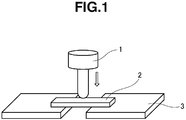
- FIG. 1 is a schematic view for illustrating a method of measuring fracture strength in Example.
- Component (A) used in the silicone rubber composition is an organopolysiloxane having a degree of polymerization (or the number of silicon atoms per molecule) of at least 100, preferably at least 1,000, and more preferably at least 1,200 and containing at least two silicon-bonded alkenyl groups, and serves as a main component (or base polymer) of the composition.
- the alkenyl-containing organopolysiloxane as component (A) is preferably gum-like (i.e., a non-self-flowing non-liquid mass having a high degree of polymerization and high viscosity) at room temperature (25°C).
- the silicone rubber composition comprising such a gum-like alkenyl-containing organopolysiloxane as a main component is generally of millable type in that it is gum-like and can be uniformly milled under shear stresses on a kneader such as a roll mill.
- the alkenyl-containing organopolysiloxane as component (A) is typically represented by the average compositional formula (I), for example. R a SiO (4-a)/2 (I)
- R which may be the same or different is a substituted or unsubstituted monovalent hydrocarbon group and a is a positive number of 1.95 to 2.05, preferably 1.98 to 2.02, and more preferably 1.99 to 2.01.
- R which may be the same or different is a substituted or unsubstituted monovalent hydrocarbon group of preferably 1 to 12 carbon atoms, more preferably 1 to 8 carbon atoms, examples of which includes alkyl groups such as methyl, ethyl, propyl, butyl, hexyl and octyl, cycloalkyl groups such as cyclopentyl and cyclohexyl, alkenyl groups such as vinyl, allyl and propenyl, cycloalkenyl groups, aryl groups such as phenyl and tolyl, aralkyl groups such as benzyl and 2-phenylethyl, and substituted forms of the foregoing groups in which some or all hydrogen atoms are substituted by halogen, cyano or the like, such as trifluoropropyl.
- alkyl groups such as methyl, ethyl, propyl, butyl, hexyl and octy
- methyl, vinyl, phenyl and trifluoropropyl groups are preferable, with methyl and vinyl being most preferred.
- Preferred examples of the alkenyl-containing organopolysiloxane (A) include organopolysiloxanes whose backbone consists of dimethylsiloxane units, or the foregoing organopolysiloxanes in which units having a phenyl, vinyl or 3,3,3-trifluoropropyl group such as diphenylsiloxane units, methylvinylsiloxane units or methyl-3,3,3-trifluoropropylsiloxane units are incorporated as some of backbone dimethylsiloxane units.
- the organopolysiloxane as component (A) should have at least two (typically about 2 to about 50, especially about 2 to about 20) alkenyl groups, specifically vinyl groups in the molecule. It is preferred that alkenyl groups account for 0.01 to 10 mol%, especially 0.02 to 5 mol% of the entire R groups in the average compositional formula (I).
- the alkenyl group may be bonded to a silicon atom at the end of the molecular chain or a silicon atom at an intermediate (or non-terminal) position of the molecular chain, or both. It is preferred that the alkenyl groups be bonded to at least silicon atoms at both ends of the molecular chain. Preferred are those organopolysiloxanes capped with dimethylvinylsilyl, methyldivinylsilyl, trivinylsilyl or the like at the end of the molecular chain.
- a is a positive number of 1.95 to 2.05.
- the molecular structure of the organopolysiloxane (A) is basically a linear structure constructed of repeating diorganosiloxane units (R 2 SiO 2/2 ) as the backbone and capped at either end of the molecular chain with a triorganosiloxy group (R 3 SiO 1/2 ) wherein R is as defined above. It may have a branched structure containing some branched units (RSiO 3/2 ) within its backbone as long as rubber elasticity is not compromised.
- the organopolysiloxane (A) has a degree of polymerization (or the number of silicon atoms per molecule) of at least 100, preferably at least 1,000, more preferably at least 1,200, even more preferably 3,000 to 100,000, and most preferably 4,000 to 20,000. With a degree of polymerization of less than 100, no sufficient rubber strength is obtainable. Notably, the degree of polymerization (or molecular weight) may be determined as weight average degree of polymerization (or weight average molecular weight) by GPC (gel permeation chromatography) versus polystyrene standards using toluene or the like as developing solvent.
- GPC gel permeation chromatography
- the organopolysiloxane alone or a blend of two or more organopolysiloxanes which are different in molecular structure and/or degree of polymerization may be used as component (A).
- the organopolysiloxane may be obtained from any well-known techniques, such as (co)hydrolytic condensation of one or more organohalogenosilanes, or ring-opening polymerization of a cyclic polysiloxane in the presence of an alkaline or acidic catalyst.
- Component (B) is reinforcing silica, exemplary of which is reinforcing silica fine powder commonly used in silicone rubber compositions, including dry silica such as fumed silica and pyrogenic silica and wet silica such as precipitated silica, with fumed silica being preferred for heat resistance.
- the silica should have a specific surface area (BET method) of at least 50 m 2 /g, preferably at least 100 m 2 /g, and more preferably 100 to 400 m 2 /g. Silica with a specific surface area (BET method) of less than 50 m 2 /g is insufficient to impart mechanical strength.
- the surface of the reinforcing silica may be treated to be hydrophobic with well-known treating agents including organosilane compounds such as methylchlorosilane and organosilazane compounds such as hexamethyldisilazane.
- organosilane compounds such as methylchlorosilane
- organosilazane compounds such as hexamethyldisilazane.
- the amount of reinforcing silica (B) added is 10 to 100 parts by weight, preferably 20 to 70 parts by weight, and more preferably 30 to 60 parts by weight per 100 parts by weight of the organopolysiloxane (A). Less than 10 parts by weight of component (B) is too small to achieve sufficient reinforcing effect whereas more than 100 parts by weight adversely affects processability and mechanical strength.
- Component (C) is calcined mica which is a characteristic component for the invention and serves to significantly improve the fire resistance performance (i.e., sinterability or shape retention after burning) of silicone rubber obtained by curing the silicone rubber composition.
- Wet mica and dry mica are commonly used and well known as a fire resistance enhancer for silicone rubber.
- calcined mica is prepared by heat treating (or calcining) mica at a temperature in excess of about 800°C, it is free of moisture and silica which are contained in the untreated mica.
- Calcined mica is preferably prepared by calcining ground muscovite.
- Exemplary of the calcined mica is calcined mica which is prepared by calcining ground muscovite and available from Repco Inc.
- the calcined mica should have an average particle size (d50) of up to 20 ⁇ m (specifically, about 0.5 to about 20 ⁇ m, especially about 1 to about 18 ⁇ m). If the particle size is beyond the range, the silicone rubber molded article is not fully sintered and converted to ceramic after high-temperature heating (burning or sintering), and the incinerated (sintered) silicone rubber molded article has poor shape retention.
- the average particle size is determined, for example, as a cumulative weight average particle size (or median diameter, d50) in particle size distribution measurement by the laser light diffraction method.
- the amount of component (C) added is 1 to 100 parts by weight, preferably 10 to 60 parts by weight per 100 parts by weight of the organopolysiloxane (A). Less than 1 part of component (C) is less effective for improving fire resistance performance whereas more than 100 parts has negative impact on the physical properties such as strength and elongation of silicone rubber.
- Component (D) is a curing agent, which is not particularly limited as long as it is effective for curing the silicone rubber composition.
- vulcanizers for silicone rubber such as organic peroxide vulcanizers (curing agents) or addition reaction vulcanizers (curing agents) may be used.
- organic peroxide used as the organic peroxide vulcanizer (curing agent) examples include benzoyl peroxide, 2,4-dichlorobenzoyl peroxide, p-methylbenzoyl peroxide, o-methylbenzoyl peroxide, 2,4-dicumyl peroxide, 2,5-dimethyl-bis(2,5-t-butylperoxy)hexane, di-t-butyl peroxide, t-butyl perbenzoate, and 1,6-hexanediol bis-t-butylperoxycarbonate, which may be used alone or in admixture.
- the organic peroxide may be added in a sufficient amount to cure the silicone rubber composition, and preferably in an amount of 0.1 to 10 parts by weight, more preferably 0.2 to 5 parts by weight per 100 parts by weight of component (A).
- composition When the composition is cured by addition reaction (hydrosilylation addition reaction), a combination of an organohydrogenpolysiloxane (curing agent or crosslinker) with a platinum group metal-based catalyst (curing catalyst) is used as the addition reaction vulcanizer (curing agent).
- platinum based catalysts are platinum group metal-based catalysts including elemental platinum, platinum compounds, platinum composites, chloroplatinic acid, and complexes of chloroplatinic acid with alcohol compounds, aldehyde compounds, ether compounds and various olefins as well as similar rhodium, palladium, and ruthenium compounds.
- the platinum group metal-based catalyst is preferably added in an amount of 1 to 2,000 ppm of platinum group metal based on the weight of the organopolysiloxane (A).
- the organohydrogenpolysiloxane used as a curing agent contains at least 2 (typically, about 2 to about 200), preferably at least 3 (for example, about 3 to about 150, preferably about 4 to about 100) silicon-bonded hydrogen atoms, i.e., SiH groups in the molecule.
- the organohydrogenpolysiloxane may have a linear, branched, cyclic or three-dimensional network structure.
- Examples of the organohydrogenpolysiloxane include
- the organohydrogenpolysiloxane as a curing agent is added in such an amount that a molar ratio of silicon-bonded hydrogen atoms, i.e., SiH groups in the organohydrogenpolysiloxane to alkenyl groups in the organopolysiloxane (A) may range from 0.5/1 to 5/1.
- the curing agent (D) may be of co-vulcanization type, i.e., a combination of an organic peroxide vulcanizer (curing agent) with an addition reaction vulcanizer (curing agent).
- the silicone rubber composition may further comprise well-known additives for silicone rubber compositions as optional components as long as the benefits of the invention are not impaired, examples of such additives including dispersants for the reinforcing silica filler (for example, ⁇ , ⁇ -silanol endcapped diorganosiloxane oligomers), platinum compounds (for example, compounds similar to the platinum based catalysts exemplified as one component of the addition reaction vulcanizer), flame retardants and heat resistance enhancers like iron oxides and halogen compounds, antidegradants, UV absorbers, colorants, and parting agents. Blowing agents may also be added to the composition, which may be molded as sponge.
- additives including dispersants for the reinforcing silica filler (for example, ⁇ , ⁇ -silanol endcapped diorganosiloxane oligomers), platinum compounds (for example, compounds similar to the platinum based catalysts exemplified as one component of the addition reaction vulcanizer), flame retardants and heat resistance
- the silicone rubber composition may be prepared by kneading the above-described components on a well-known milling machine such as a two-roll mill, kneader, or Banbury mixer, although the method is not limited thereto. If necessary, heat treatment (kneading while heating) may be performed. The recommended procedure is by premixing components (A) and (B), optionally heat treating the premix, and adding the component (D) thereto at room temperature. In this procedure, component (C) may be added either before or after heat treatment. When heat treatment is performed, the heat treatment is preferably at a temperature of 100 to 250°C, especially 140 to 180°C for about 30 minutes to about 5 hours although the temperature and time are not particularly limited.
- the silicone rubber composition may be molded by a method which is selected in accordance with the desired application (molded article). Suitable molding methods include compression molding, injection molding, transfer molding, atmospheric hot air vulcanization, and steam vulcanization.
- the curing conditions are not particularly limited and may be suitably selected based on the curing method and the molded article. Typical curing conditions include 80 to 600°C, especially 100 to 450°C and several seconds to several days, especially about 5 seconds to about one hour. If necessary, secondary vulcanization may be carried out, typically at 180 to 250°C for about 1 to about 10 hours.
- the silicone rubber composition is useful as refractory material to form building parts such as refractory gaskets.
- the degree of polymerization is a weight average degree of polymerization as measured versus polystyrene standards by GPC (gel permeation chromatography) using toluene as developing solvent.
- the average particle size is a cumulative weight average particle size (d50) determined in particle size distribution measurement by the laser light diffraction method.
- a linear dimethylpolysiloxane gum consisting of 99.825 mol% of dimethylsiloxane units, 0.15 mol% of methylvinylsiloxane units, and 0.025 mol% of dimethylvinylsiloxy units as siloxy units capping both ends of the molecular chain and having an average degree of polymerization of about 7,000, 45 parts of fumed silica having a specific surface area (BET method) of 200 m 2 /g (Aerosil 200, Nippon Aerosil Co., Ltd.), and 10 parts of a linear dimethylpolysiloxane capped with a silanol group at both ends of the molecular chain and having a degree of polymerization of 10 were compounded and heat treated at 150°C for 2 hours, forming a silicone rubber compound.
- BET method specific surface area
- the composition was press molded through primary vulcanization at 120°C for 10 minutes and secondary vulcanization at 200°C for 4 hours, forming a silicone rubber sheet of 2 mm thick.
- a rubber piece of 3.5 cm ⁇ 3.5 cm was cut out of the rubber sheet and heated at 800°C for 5 minutes in a sintering furnace.
- the sintered piece was set on a test machine equipped with a load cell which was measurable up to 10 kgf where it was broken to measure fracture strength (sinterability).
- FIG. 1 illustrates a load cell 1, a sintered piece 2, and a base plate 3. The results are shown in Table 1.
- a silicone rubber compound and silicone rubber composition were prepared as in Example 1 except that 40 parts of a commercially available wet ground muscovite (uncalcined, average particle size 22 ⁇ m) was used as mica instead of 40 parts of calcined mica (Repco Inc., average particle size 18 ⁇ m) in Example 1.
- a silicone rubber compound and silicone rubber composition were prepared as in Example 1 except that 40 parts of calcined mica which was manufactured by calcining ground muscovite and had an average particle size of 22 ⁇ m (Repco Inc.) was used instead of 40 parts of calcined mica (Repco Inc., average particle size 18 ⁇ m) in Example 1.
Landscapes
- Chemical & Material Sciences (AREA)
- Organic Chemistry (AREA)
- Chemical Kinetics & Catalysis (AREA)
- Engineering & Computer Science (AREA)
- Medicinal Chemistry (AREA)
- Health & Medical Sciences (AREA)
- Polymers & Plastics (AREA)
- General Engineering & Computer Science (AREA)
- Materials Engineering (AREA)
- Mechanical Engineering (AREA)
- Life Sciences & Earth Sciences (AREA)
- Wood Science & Technology (AREA)
- Compositions Of Macromolecular Compounds (AREA)
- Sealing Material Composition (AREA)
Abstract
Description
- This invention relates to a silicone rubber composition which cures into a product exhibiting improved fire resistance (sinterability after burning) and has excellent roll workability during kneading.
- In the prior art, molded products of rubber materials such as chloroprene rubber and ethylene-propylene-diene rubber are used as refractory building material. With the increasing longevity of buildings, these rubber materials no longer fully meet the requirements for improved weather resistance and creep resistance, and for better prevention of harmful gas emissions during burning. Under the circumstances, molded products of silicone rubber having improved heat resistance, weather resistance and creep resistance are recently used as the refractory building material.
- Conventional silicone-based gaskets, however, suffer from the problem that when exposed to high temperatures of fire for a long time, they burn down to ash, leaving no vestige of their original shape and losing the gasket function.
- To overcome these drawbacks of silicone rubber-based refractory products,
JP-A S63-191841 - Known refractory gasket materials include a composition comprising an organopolysiloxane containing at least two silicon-bonded hydroxyl groups in the molecule and an organosilane or organopolysiloxane containing at least two silicon-bonded hydrolyzable groups in the molecule, to which zinc oxide and/or aluminum hydroxide and a platinum compound are added (
JP-A S60-141778 JP-B H5-73158 JP-A 2000-169706 - An object of the present invention is to provide a silicone rubber composition which when molded into a silicone rubber article, can retain the original molded shape even after prolonged exposure to fire because the ash of the burned article sinters (into a ceramic mass), and which moreover exhibits excellent roll processability (or workability) during a kneading step in its production process.
- Making extensive investigations to attain the above object, the inventors have found that by combining an organopolysiloxane having a degree of polymerization of at least 100 and containing at least two silicon-bonded alkenyl groups, with reinforcing silica having a specific surface area (BET method) of at least 50 m2/g and a curing agent and further with calcined mica having a specific particle size, there is obtained a silicone rubber composition which has excellent roll processability (or workability) and cures into a silicone rubber part exhibiting improved sinterability (shape retention) after burning. The invention is predicated on this finding.
- Accordingly, the invention provides a silicone rubber composition as defined below.
- [1] A silicone rubber composition comprising
- (A) 100 parts by weight of an organopolysiloxane having a degree of polymerization of at least 100 and containing at least two silicon-bonded alkenyl groups in the molecule,
- (B) 10 to 100 parts by weight of reinforcing silica having a specific surface area (BET method) of at least 50 m2/g,
- (C) 1 to 100 parts by weight of calcined mica having an average particle size of up to 20 µm, and
- (D) an effective amount of a curing agent.
- [2] The silicone rubber composition of [1] wherein the calcined mica is obtained by calcining ground muscovite.
- [3] The silicone rubber composition of [1] or [2] wherein component (A) is an organopolysiloxane containing at least two alkenyl groups in the molecule, having a degree of polymerization of 3,000 to 100,000, and represented by the average compositional formula (I):
RaSiO(4-a)/2 (I)
wherein R is each independently a substituted or unsubstituted, monovalent hydrocarbon group, 0.01 to 10 mol% of the entire R groups being alkenyl groups, and a is a positive number of 1.95 to 2.05. - [4] The silicone rubber composition of any one of [1] to [3] wherein component (D) is an organic peroxide.
- [5] The silicone rubber composition of any one of [1] to [3] wherein component (D) is a combination of an organohydrogenpolysiloxane having at least two SiH groups in the molecule with a platinum group metal-based catalyst.
- [6] The silicone rubber composition of any one of [1] to [5] which is used to form a refractory gasket.
- The silicone rubber composition of the invention has excellent roll workability during kneading and cures into a silicone rubber part exhibiting improved shape retention after burning (or sintering). The composition is especially useful as refractory material for building parts such as refractory gaskets.
- [
Fig. 1] FIG. 1 is a schematic view for illustrating a method of measuring fracture strength in Example. - Now the invention is described in detail.
- Component (A) used in the silicone rubber composition is an organopolysiloxane having a degree of polymerization (or the number of silicon atoms per molecule) of at least 100, preferably at least 1,000, and more preferably at least 1,200 and containing at least two silicon-bonded alkenyl groups, and serves as a main component (or base polymer) of the composition. The alkenyl-containing organopolysiloxane as component (A) is preferably gum-like (i.e., a non-self-flowing non-liquid mass having a high degree of polymerization and high viscosity) at room temperature (25°C). The silicone rubber composition comprising such a gum-like alkenyl-containing organopolysiloxane as a main component is generally of millable type in that it is gum-like and can be uniformly milled under shear stresses on a kneader such as a roll mill. The alkenyl-containing organopolysiloxane as component (A) is typically represented by the average compositional formula (I), for example.
RaSiO(4-a)/2 (I)
Herein R which may be the same or different is a substituted or unsubstituted monovalent hydrocarbon group and a is a positive number of 1.95 to 2.05, preferably 1.98 to 2.02, and more preferably 1.99 to 2.01. - In the average compositional formula (I), R which may be the same or different is a substituted or unsubstituted monovalent hydrocarbon group of preferably 1 to 12 carbon atoms, more preferably 1 to 8 carbon atoms, examples of which includes alkyl groups such as methyl, ethyl, propyl, butyl, hexyl and octyl, cycloalkyl groups such as cyclopentyl and cyclohexyl, alkenyl groups such as vinyl, allyl and propenyl, cycloalkenyl groups, aryl groups such as phenyl and tolyl, aralkyl groups such as benzyl and 2-phenylethyl, and substituted forms of the foregoing groups in which some or all hydrogen atoms are substituted by halogen, cyano or the like, such as trifluoropropyl. Of these, methyl, vinyl, phenyl and trifluoropropyl groups are preferable, with methyl and vinyl being most preferred. Preferably at least 80 mol%, more preferably at least 90 mol% of R is methyl. Most preferably the entire R groups excluding alkenyl are methyl.
- Preferred examples of the alkenyl-containing organopolysiloxane (A) include organopolysiloxanes whose backbone consists of dimethylsiloxane units, or the foregoing organopolysiloxanes in which units having a phenyl, vinyl or 3,3,3-trifluoropropyl group such as diphenylsiloxane units, methylvinylsiloxane units or methyl-3,3,3-trifluoropropylsiloxane units are incorporated as some of backbone dimethylsiloxane units.
- The organopolysiloxane as component (A) should have at least two (typically about 2 to about 50, especially about 2 to about 20) alkenyl groups, specifically vinyl groups in the molecule. It is preferred that alkenyl groups account for 0.01 to 10 mol%, especially 0.02 to 5 mol% of the entire R groups in the average compositional formula (I). The alkenyl group may be bonded to a silicon atom at the end of the molecular chain or a silicon atom at an intermediate (or non-terminal) position of the molecular chain, or both. It is preferred that the alkenyl groups be bonded to at least silicon atoms at both ends of the molecular chain. Preferred are those organopolysiloxanes capped with dimethylvinylsilyl, methyldivinylsilyl, trivinylsilyl or the like at the end of the molecular chain.
- In the average compositional formula (I), a is a positive number of 1.95 to 2.05. The molecular structure of the organopolysiloxane (A) is basically a linear structure constructed of repeating diorganosiloxane units (R2SiO2/2) as the backbone and capped at either end of the molecular chain with a triorganosiloxy group (R3SiO1/2) wherein R is as defined above. It may have a branched structure containing some branched units (RSiO3/2) within its backbone as long as rubber elasticity is not compromised.
- The organopolysiloxane (A) has a degree of polymerization (or the number of silicon atoms per molecule) of at least 100, preferably at least 1,000, more preferably at least 1,200, even more preferably 3,000 to 100,000, and most preferably 4,000 to 20,000. With a degree of polymerization of less than 100, no sufficient rubber strength is obtainable. Notably, the degree of polymerization (or molecular weight) may be determined as weight average degree of polymerization (or weight average molecular weight) by GPC (gel permeation chromatography) versus polystyrene standards using toluene or the like as developing solvent.
- The organopolysiloxane alone or a blend of two or more organopolysiloxanes which are different in molecular structure and/or degree of polymerization may be used as component (A).
- The organopolysiloxane may be obtained from any well-known techniques, such as (co)hydrolytic condensation of one or more organohalogenosilanes, or ring-opening polymerization of a cyclic polysiloxane in the presence of an alkaline or acidic catalyst.
- Component (B) is reinforcing silica, exemplary of which is reinforcing silica fine powder commonly used in silicone rubber compositions, including dry silica such as fumed silica and pyrogenic silica and wet silica such as precipitated silica, with fumed silica being preferred for heat resistance. The silica should have a specific surface area (BET method) of at least 50 m2/g, preferably at least 100 m2/g, and more preferably 100 to 400 m2/g. Silica with a specific surface area (BET method) of less than 50 m2/g is insufficient to impart mechanical strength.
- Optionally, the surface of the reinforcing silica may be treated to be hydrophobic with well-known treating agents including organosilane compounds such as methylchlorosilane and organosilazane compounds such as hexamethyldisilazane.
- The amount of reinforcing silica (B) added is 10 to 100 parts by weight, preferably 20 to 70 parts by weight, and more preferably 30 to 60 parts by weight per 100 parts by weight of the organopolysiloxane (A). Less than 10 parts by weight of component (B) is too small to achieve sufficient reinforcing effect whereas more than 100 parts by weight adversely affects processability and mechanical strength.
- Component (C) is calcined mica which is a characteristic component for the invention and serves to significantly improve the fire resistance performance (i.e., sinterability or shape retention after burning) of silicone rubber obtained by curing the silicone rubber composition. Wet mica and dry mica are commonly used and well known as a fire resistance enhancer for silicone rubber. When these micas are compounded in a millable silicone rubber composition, the stickiness of the composition to rolls is increased to interfere with kneading operation during the production of the composition (e.g., kneading on a roll mill). Since calcined mica is prepared by heat treating (or calcining) mica at a temperature in excess of about 800°C, it is free of moisture and silica which are contained in the untreated mica. This contributes to least cleavage of the silicone polymer (for example, alkenyl-containing organopolysiloxane (A)) and reduces the adhesion to metal surfaces to mitigate the sticking to rolls. Calcined mica is preferably prepared by calcining ground muscovite. Exemplary of the calcined mica is calcined mica which is prepared by calcining ground muscovite and available from Repco Inc.
- The calcined mica should have an average particle size (d50) of up to 20 µm (specifically, about 0.5 to about 20 µm, especially about 1 to about 18 µm). If the particle size is beyond the range, the silicone rubber molded article is not fully sintered and converted to ceramic after high-temperature heating (burning or sintering), and the incinerated (sintered) silicone rubber molded article has poor shape retention.
- The average particle size is determined, for example, as a cumulative weight average particle size (or median diameter, d50) in particle size distribution measurement by the laser light diffraction method.
- The amount of component (C) added is 1 to 100 parts by weight, preferably 10 to 60 parts by weight per 100 parts by weight of the organopolysiloxane (A). Less than 1 part of component (C) is less effective for improving fire resistance performance whereas more than 100 parts has negative impact on the physical properties such as strength and elongation of silicone rubber.
- Component (D) is a curing agent, which is not particularly limited as long as it is effective for curing the silicone rubber composition. Thus any well-known vulcanizers (curing agents) for silicone rubber such as organic peroxide vulcanizers (curing agents) or addition reaction vulcanizers (curing agents) may be used.
- Examples of the organic peroxide used as the organic peroxide vulcanizer (curing agent) include benzoyl peroxide, 2,4-dichlorobenzoyl peroxide, p-methylbenzoyl peroxide, o-methylbenzoyl peroxide, 2,4-dicumyl peroxide, 2,5-dimethyl-bis(2,5-t-butylperoxy)hexane, di-t-butyl peroxide, t-butyl perbenzoate, and 1,6-hexanediol bis-t-butylperoxycarbonate, which may be used alone or in admixture.
- The organic peroxide may be added in a sufficient amount to cure the silicone rubber composition, and preferably in an amount of 0.1 to 10 parts by weight, more preferably 0.2 to 5 parts by weight per 100 parts by weight of component (A).
- When the composition is cured by addition reaction (hydrosilylation addition reaction), a combination of an organohydrogenpolysiloxane (curing agent or crosslinker) with a platinum group metal-based catalyst (curing catalyst) is used as the addition reaction vulcanizer (curing agent).
- Exemplary platinum based catalysts are platinum group metal-based catalysts including elemental platinum, platinum compounds, platinum composites, chloroplatinic acid, and complexes of chloroplatinic acid with alcohol compounds, aldehyde compounds, ether compounds and various olefins as well as similar rhodium, palladium, and ruthenium compounds.
- The platinum group metal-based catalyst is preferably added in an amount of 1 to 2,000 ppm of platinum group metal based on the weight of the organopolysiloxane (A).
- The organohydrogenpolysiloxane used as a curing agent (crosslinker) contains at least 2 (typically, about 2 to about 200), preferably at least 3 (for example, about 3 to about 150, preferably about 4 to about 100) silicon-bonded hydrogen atoms, i.e., SiH groups in the molecule. The organohydrogenpolysiloxane may have a linear, branched, cyclic or three-dimensional network structure. Preferred is an organohydrogenpolysiloxane having a degree of polymerization (i.e., number of silicon atoms per molecule) of up to 300 (for example, about 2 to about 300, especially about 3 to about 150). Examples of the organohydrogenpolysiloxane include
- 1,1,3,3-tetramethyldisiloxane,
- 1,3,5,7-tetramethylcyclotetrasiloxane,
- 1-propyl-3,5,7-trihydrogen-1,3,5,7-tetramethylcyclotetrasiloxane,
- 1,5-dihydrogen-3,7-dihexyl-1,3,5,7-tetramethylcyclotetrasiloxane,
- tris(hydrogendimethylsiloxy)methylsilane,
- tris(hydrogendimethylsiloxy)phenylsilane,
- methylhydrogencyclopolysiloxane,
- methylhydrogensiloxane/dimethylsiloxane cyclic copolymers,
- dual end trimethylsiloxy-capped methylhydrogenpolysiloxane,
- dual end trimethylsiloxy-capped dimethylsiloxane/- methylhydrogensiloxane copolymers,
- dual end dimethylhydrogensiloxy-capped dimethylpolysiloxane,
- dual end dimethylhydrogensiloxy-capped dimethylsiloxane/- methylhydrogensiloxane copolymers,
- dual end trimethylsiloxy-capped methylhydrogensiloxane/- diphenylsiloxane copolymers,
- dual end trimethylsiloxy-capped methylhydrogensiloxane/- diphenylsiloxane/dimethylsiloxane copolymers,
- dual end trimethylsiloxy-capped methylhydrogensiloxane/- methylphenylsiloxane/dimethylsiloxane copolymers,
- dual end dimethylhydrogensiloxy-capped methylhydrogensiloxane/dimethylsiloxane/diphenylsiloxane copolymers,
- dual end dimethylhydrogensiloxy-capped methylhydrogensiloxane/dimethylsiloxane/methylphenylsiloxane copolymers, copolymers consisting of (CH3) 2HSiO1/2 units, (CH3)3SiO1/2 units and SiO4/2 units,
- copolymers consisting of (CH3) 2HSiO1/2 units and SiO4/2 units, and
- copolymers consisting of (CH3) 2HSiO1/2 units, SiO4/2 units and (C6H5) 3SiO1/2 units.
- Preferably the organohydrogenpolysiloxane as a curing agent is added in such an amount that a molar ratio of silicon-bonded hydrogen atoms, i.e., SiH groups in the organohydrogenpolysiloxane to alkenyl groups in the organopolysiloxane (A) may range from 0.5/1 to 5/1. In curing the inventive composition, the curing agent (D) may be of co-vulcanization type, i.e., a combination of an organic peroxide vulcanizer (curing agent) with an addition reaction vulcanizer (curing agent).
- Besides the components described above, the silicone rubber composition may further comprise well-known additives for silicone rubber compositions as optional components as long as the benefits of the invention are not impaired, examples of such additives including dispersants for the reinforcing silica filler (for example, α,ω-silanol endcapped diorganosiloxane oligomers), platinum compounds (for example, compounds similar to the platinum based catalysts exemplified as one component of the addition reaction vulcanizer), flame retardants and heat resistance enhancers like iron oxides and halogen compounds, antidegradants, UV absorbers, colorants, and parting agents. Blowing agents may also be added to the composition, which may be molded as sponge.
- The silicone rubber composition may be prepared by kneading the above-described components on a well-known milling machine such as a two-roll mill, kneader, or Banbury mixer, although the method is not limited thereto. If necessary, heat treatment (kneading while heating) may be performed. The recommended procedure is by premixing components (A) and (B), optionally heat treating the premix, and adding the component (D) thereto at room temperature. In this procedure, component (C) may be added either before or after heat treatment. When heat treatment is performed, the heat treatment is preferably at a temperature of 100 to 250°C, especially 140 to 180°C for about 30 minutes to about 5 hours although the temperature and time are not particularly limited.
- The silicone rubber composition may be molded by a method which is selected in accordance with the desired application (molded article). Suitable molding methods include compression molding, injection molding, transfer molding, atmospheric hot air vulcanization, and steam vulcanization. The curing conditions are not particularly limited and may be suitably selected based on the curing method and the molded article. Typical curing conditions include 80 to 600°C, especially 100 to 450°C and several seconds to several days, especially about 5 seconds to about one hour. If necessary, secondary vulcanization may be carried out, typically at 180 to 250°C for about 1 to about 10 hours.
- The silicone rubber composition is useful as refractory material to form building parts such as refractory gaskets.
- Examples and Comparative Examples are given below for further illustrating the invention although the invention is not limited thereto. In Examples, all parts are by weight. The degree of polymerization is a weight average degree of polymerization as measured versus polystyrene standards by GPC (gel permeation chromatography) using toluene as developing solvent. The average particle size is a cumulative weight average particle size (d50) determined in particle size distribution measurement by the laser light diffraction method.
- On a kneader, 100 parts of a linear dimethylpolysiloxane gum consisting of 99.825 mol% of dimethylsiloxane units, 0.15 mol% of methylvinylsiloxane units, and 0.025 mol% of dimethylvinylsiloxy units as siloxy units capping both ends of the molecular chain and having an average degree of polymerization of about 7,000, 45 parts of fumed silica having a specific surface area (BET method) of 200 m2/g (Aerosil 200, Nippon Aerosil Co., Ltd.), and 10 parts of a linear dimethylpolysiloxane capped with a silanol group at both ends of the molecular chain and having a degree of polymerization of 10 were compounded and heat treated at 150°C for 2 hours, forming a silicone rubber compound.
- To the resulting rubber compound, on a two-roll mill, 40 parts of calcined mica which was manufactured by calcining ground muscovite (Repco Inc., average particle size 18 µm) and 0.1 part of an alcohol solution of chloroplatinic acid (
Pt concentration 2 wt%) were added. Then 1.3 parts of 50 wt% paste of p-methylbenzoyl peroxide was added thereto, yielding a silicone rubber composition. - During the kneading step on the two-roll mill, the stickiness (roll processability) of the composition was rated good (○), fair (Δ) or poor (×) as follows. The results are shown in Table 1.
-
- ○: smooth scraping/removal in a test using a 6-inch, hard chromium plated two-roll mill with a roll gap of 2 mm and a sample quantity of 200 g
- Δ: awkward scraping/removal in a test using a 6-inch, hard chromium plated two-roll mill with a roll gap of 2 mm and a sample quantity of 200 g
- ×: difficult scraping/removal, stuck to rolls in a test using a 6-inch, hard chromium plated two-roll mill with a roll gap of 2 mm and a sample quantity of 200 g
- The composition was press molded through primary vulcanization at 120°C for 10 minutes and secondary vulcanization at 200°C for 4 hours, forming a silicone rubber sheet of 2 mm thick. A rubber piece of 3.5 cm × 3.5 cm was cut out of the rubber sheet and heated at 800°C for 5 minutes in a sintering furnace. As shown in
FIG. 1 , the sintered piece was set on a test machine equipped with a load cell which was measurable up to 10 kgf where it was broken to measure fracture strength (sinterability). Notably,FIG. 1 illustrates aload cell 1, asintered piece 2, and abase plate 3. The results are shown in Table 1. - A silicone rubber compound and silicone rubber composition were prepared as in Example 1 except that 40 parts of a commercially available wet ground muscovite (uncalcined, average particle size 22 µm) was used as mica instead of 40 parts of calcined mica (Repco Inc., average particle size 18 µm) in Example 1.
- The resulting silicone rubber compound and silicone rubber composition were similarly tested and evaluated for roll processability and sinterability. The results are shown in Table 1.
- A silicone rubber compound and silicone rubber composition were prepared as in Example 1 except that 40 parts of calcined mica which was manufactured by calcining ground muscovite and had an average particle size of 22 µm (Repco Inc.) was used instead of 40 parts of calcined mica (Repco Inc., average particle size 18 µm) in Example 1.
- The resulting silicone rubber compound and silicone rubber composition were similarly tested and evaluated for roll processability and sinterability. The results are shown in Table 1.
[Table 1] Example 1 Comparative Example 1 Comparative Example 2 Mica calcined mica (d50 = 18 µm) wet ground muscovite (d50 = 22 µm) calcined mica (d50 = 22 µm) Roll processability ○ × ○ Sinterability (kgf) 2.0 1.8 0.5 -
- 1
- load cell
- 2
- sintered piece
- 3
- base plate
Claims (6)
- A silicone rubber composition comprising(A) 100 parts by weight of an organopolysiloxane having a degree of polymerization of at least 100 and containing at least two silicon-bonded alkenyl groups in the molecule,(B) 10 to 100 parts by weight of reinforcing silica having a specific surface area (BET method) of at least 50 m2/g,(C) 1 to 100 parts by weight of calcined mica having an average particle size of up to 20 µm, and(D) an effective amount of a curing agent.
- The silicone rubber composition of claim 1 wherein the calcined mica is obtained by calcining ground muscovite.
- The silicone rubber composition of claim 1 or 2 wherein component (A) is an organopolysiloxane containing at least two alkenyl groups in the molecule, having a degree of polymerization of 3,000 to 100,000, and represented by the average compositional formula (I):
RaSiO(4-a)/2 (I)
wherein R is each independently a substituted or unsubstituted, monovalent hydrocarbon group, 0.01 to 10 mol% of the entire R groups being alkenyl groups, and a is a positive number of 1.95 to 2.05. - The silicone rubber composition of any one of claims 1 to 3 wherein component (D) is an organic peroxide.
- The silicone rubber composition of any one of claims 1 to 3 wherein component (D) is a combination of an organohydrogenpolysiloxane having at least two SiH groups in the molecule with a platinum group metal-based catalyst.
- The silicone rubber composition of any one of claims 1 to 5 which is used to form a refractory gasket.
Applications Claiming Priority (2)
| Application Number | Priority Date | Filing Date | Title |
|---|---|---|---|
| JP2013151531 | 2013-07-22 | ||
| PCT/JP2014/063400 WO2015011971A1 (en) | 2013-07-22 | 2014-05-21 | Silicone rubber composition |
Publications (3)
| Publication Number | Publication Date |
|---|---|
| EP3026085A1 true EP3026085A1 (en) | 2016-06-01 |
| EP3026085A4 EP3026085A4 (en) | 2017-03-22 |
| EP3026085B1 EP3026085B1 (en) | 2020-08-12 |
Family
ID=52393028
Family Applications (1)
| Application Number | Title | Priority Date | Filing Date |
|---|---|---|---|
| EP14830254.0A Active EP3026085B1 (en) | 2013-07-22 | 2014-05-21 | Silicone rubber composition |
Country Status (6)
| Country | Link |
|---|---|
| US (1) | US20160369143A1 (en) |
| EP (1) | EP3026085B1 (en) |
| JP (1) | JP6020727B2 (en) |
| CN (1) | CN105452385B (en) |
| ES (1) | ES2820534T3 (en) |
| WO (1) | WO2015011971A1 (en) |
Families Citing this family (8)
| Publication number | Priority date | Publication date | Assignee | Title |
|---|---|---|---|---|
| CN105838075A (en) * | 2016-04-26 | 2016-08-10 | 重庆泰山电缆有限公司 | Silica gel formula capable of enhancing fire resistance |
| JP2018115242A (en) * | 2017-01-17 | 2018-07-26 | 株式会社アマデラスホールディングス | Polyolefin-based rubber composition |
| JP2019110140A (en) * | 2019-04-02 | 2019-07-04 | 三菱電線工業株式会社 | Battery holder and battery module using the same |
| US10954386B2 (en) * | 2019-05-29 | 2021-03-23 | Smp Technologies Inc. | Silicone admixture and cured product of the same |
| CN116547342A (en) * | 2020-11-17 | 2023-08-04 | 瓦克化学股份公司 | Silicone composition, method of preparing the same, and cable prepared therefrom |
| US20240006723A1 (en) * | 2021-04-22 | 2024-01-04 | Fuji Polymer Industries Co., Ltd. | Silicone laminate and battery |
| JP7527742B2 (en) | 2021-08-19 | 2024-08-05 | 信越化学工業株式会社 | Silicone rubber composition |
| CN117417638A (en) * | 2023-10-17 | 2024-01-19 | 合肥华城材料科技有限责任公司 | High-temperature-resistant flame-retardant mica composite organic silicon rubber and preparation method and application thereof |
Family Cites Families (12)
| Publication number | Priority date | Publication date | Assignee | Title |
|---|---|---|---|---|
| JPS5315901B2 (en) * | 1974-11-25 | 1978-05-27 | ||
| JPS60141778A (en) | 1983-12-28 | 1985-07-26 | Shin Etsu Chem Co Ltd | Fireproof waterproof sealing material |
| JPS6351495A (en) | 1986-08-20 | 1988-03-04 | Shin Etsu Chem Co Ltd | Fire-resisting, waterproof sealing material |
| JPS63191841A (en) | 1987-02-04 | 1988-08-09 | Toray Silicone Co Ltd | Joint sealant of definite form |
| DE69107672T2 (en) * | 1990-05-07 | 1995-07-27 | Shinetsu Chemical Co | Foamable silicone rubber composition. |
| JP3485387B2 (en) * | 1995-06-30 | 2004-01-13 | 信越ポリマー株式会社 | Fire resistant flame retardant silicone rubber composition |
| JP2000169706A (en) * | 1998-12-03 | 2000-06-20 | Shin Etsu Chem Co Ltd | Fire resistant silicone rubber composition |
| JP2002105317A (en) * | 2000-09-28 | 2002-04-10 | Dow Corning Toray Silicone Co Ltd | Composition for fire-resistant silicone rubber and fire-resistant silicone rubber |
| JP2004231865A (en) * | 2003-01-31 | 2004-08-19 | Tokai Rubber Ind Ltd | Heat resistant air hose |
| GB0808681D0 (en) * | 2008-05-14 | 2008-06-18 | Dow Corning | Silicone rubber compositions |
| JP2012124428A (en) * | 2010-12-10 | 2012-06-28 | Mitsubishi Chemicals Corp | Resin molding for semiconductor light-emitting device |
| CN102424725A (en) * | 2011-11-29 | 2012-04-25 | 四川大学 | High-temperature-resistant ablation-resistant rubber composition and preparation method thereof |
-
2014
- 2014-05-21 WO PCT/JP2014/063400 patent/WO2015011971A1/en not_active Ceased
- 2014-05-21 US US14/901,442 patent/US20160369143A1/en not_active Abandoned
- 2014-05-21 JP JP2015528172A patent/JP6020727B2/en active Active
- 2014-05-21 EP EP14830254.0A patent/EP3026085B1/en active Active
- 2014-05-21 CN CN201480041512.0A patent/CN105452385B/en active Active
- 2014-05-21 ES ES14830254T patent/ES2820534T3/en active Active
Also Published As
| Publication number | Publication date |
|---|---|
| EP3026085B1 (en) | 2020-08-12 |
| CN105452385B (en) | 2018-09-04 |
| JP6020727B2 (en) | 2016-11-02 |
| JPWO2015011971A1 (en) | 2017-03-02 |
| US20160369143A1 (en) | 2016-12-22 |
| ES2820534T3 (en) | 2021-04-21 |
| EP3026085A4 (en) | 2017-03-22 |
| WO2015011971A1 (en) | 2015-01-29 |
| CN105452385A (en) | 2016-03-30 |
Similar Documents
| Publication | Publication Date | Title |
|---|---|---|
| EP3026085B1 (en) | Silicone rubber composition | |
| EP3533838B1 (en) | Heat-resistant millable silicone rubber composition | |
| EP1788031B1 (en) | Thermally conductive silicone rubber composition | |
| JP5983566B2 (en) | Addition-curable liquid silicone rubber composition and cured silicone rubber | |
| CN105209531A (en) | Heat resistant silicone rubber composition | |
| EP0826734B1 (en) | Method for the preparation of silicone rubber | |
| KR930006362B1 (en) | Silicone rubber composition | |
| JP2013035890A (en) | Silicone rubber composition having excellent heat resistance | |
| JP5322689B2 (en) | Silicone rubber composition for high voltage electrical insulation | |
| EP1426413B1 (en) | Hydrophilic polyorganosiloxane composition | |
| EP3473661B1 (en) | Silicone composition, a cured silicone rubber product and a power cable | |
| JP2000169706A (en) | Fire resistant silicone rubber composition | |
| JP7156216B2 (en) | Millable type silicone rubber composition, cured product thereof, and silicone rubber compound for millable type silicone rubber composition | |
| JP2019026772A (en) | Silicone rubber composition | |
| JP2002105317A (en) | Composition for fire-resistant silicone rubber and fire-resistant silicone rubber | |
| JP4704987B2 (en) | Silicone rubber composition for extrusion molding | |
| JP3482834B2 (en) | Method for producing silicone rubber | |
| JP2008260790A (en) | Silicone rubber composition for fireproof building gasket | |
| JP6245119B2 (en) | Silicone rubber composition and method for improving tear strength of cured silicone rubber | |
| JP3029633B2 (en) | Silicone rubber composition and molded silicone rubber | |
| JP7527742B2 (en) | Silicone rubber composition | |
| JP4548559B2 (en) | Oil-bleedable silicone rubber molding method and oil-bleedable silicone rubber composition | |
| JP3611025B2 (en) | Silicone rubber composition | |
| JP7526115B2 (en) | Heat-resistant millable silicone rubber composition | |
| JP3989711B2 (en) | Silicone rubber composition for high voltage electrical insulation |
Legal Events
| Date | Code | Title | Description |
|---|---|---|---|
| PUAI | Public reference made under article 153(3) epc to a published international application that has entered the european phase |
Free format text: ORIGINAL CODE: 0009012 |
|
| 17P | Request for examination filed |
Effective date: 20160201 |
|
| AK | Designated contracting states |
Kind code of ref document: A1 Designated state(s): AL AT BE BG CH CY CZ DE DK EE ES FI FR GB GR HR HU IE IS IT LI LT LU LV MC MK MT NL NO PL PT RO RS SE SI SK SM TR |
|
| AX | Request for extension of the european patent |
Extension state: BA ME |
|
| RIN1 | Information on inventor provided before grant (corrected) |
Inventor name: KOIKE, YOSHIAKI Inventor name: HAYASHIDA, OSAMU Inventor name: KASHIMA, ATSUHITO Inventor name: HOTTA, MASAKATSU |
|
| DAX | Request for extension of the european patent (deleted) | ||
| RIC1 | Information provided on ipc code assigned before grant |
Ipc: C08K 5/56 20060101ALI20170209BHEP Ipc: F16J 15/02 20060101ALI20170209BHEP Ipc: C08K 3/34 20060101ALI20170209BHEP Ipc: C08K 3/36 20060101ALI20170209BHEP Ipc: C09K 3/10 20060101ALI20170209BHEP Ipc: C08K 5/14 20060101ALI20170209BHEP Ipc: C08L 83/07 20060101AFI20170209BHEP Ipc: C08K 5/00 20060101ALI20170209BHEP Ipc: F16J 15/00 20060101ALI20170209BHEP Ipc: E04B 1/94 20060101ALI20170209BHEP |
|
| A4 | Supplementary search report drawn up and despatched |
Effective date: 20170220 |
|
| GRAP | Despatch of communication of intention to grant a patent |
Free format text: ORIGINAL CODE: EPIDOSNIGR1 |
|
| STAA | Information on the status of an ep patent application or granted ep patent |
Free format text: STATUS: GRANT OF PATENT IS INTENDED |
|
| RIC1 | Information provided on ipc code assigned before grant |
Ipc: F16J 15/02 20060101ALI20200213BHEP Ipc: C08K 3/34 20060101ALI20200213BHEP Ipc: C09K 3/10 20060101ALI20200213BHEP Ipc: C08K 5/14 20060101ALI20200213BHEP Ipc: C08K 3/36 20060101ALI20200213BHEP Ipc: C08K 5/00 20060101ALI20200213BHEP Ipc: F16J 15/10 20060101ALI20200213BHEP Ipc: C08L 83/07 20060101AFI20200213BHEP Ipc: C09D 183/04 20060101ALI20200213BHEP Ipc: E04B 1/94 20060101ALI20200213BHEP Ipc: C08K 5/56 20060101ALI20200213BHEP Ipc: F16J 15/00 20060101ALI20200213BHEP |
|
| INTG | Intention to grant announced |
Effective date: 20200306 |
|
| GRAS | Grant fee paid |
Free format text: ORIGINAL CODE: EPIDOSNIGR3 |
|
| GRAA | (expected) grant |
Free format text: ORIGINAL CODE: 0009210 |
|
| STAA | Information on the status of an ep patent application or granted ep patent |
Free format text: STATUS: THE PATENT HAS BEEN GRANTED |
|
| AK | Designated contracting states |
Kind code of ref document: B1 Designated state(s): AL AT BE BG CH CY CZ DE DK EE ES FI FR GB GR HR HU IE IS IT LI LT LU LV MC MK MT NL NO PL PT RO RS SE SI SK SM TR |
|
| REG | Reference to a national code |
Ref country code: CH Ref legal event code: EP |
|
| REG | Reference to a national code |
Ref country code: IE Ref legal event code: FG4D |
|
| REG | Reference to a national code |
Ref country code: DE Ref legal event code: R096 Ref document number: 602014068970 Country of ref document: DE |
|
| REG | Reference to a national code |
Ref country code: AT Ref legal event code: REF Ref document number: 1301534 Country of ref document: AT Kind code of ref document: T Effective date: 20200915 |
|
| REG | Reference to a national code |
Ref country code: LT Ref legal event code: MG4D |
|
| REG | Reference to a national code |
Ref country code: NL Ref legal event code: MP Effective date: 20200812 |
|
| PG25 | Lapsed in a contracting state [announced via postgrant information from national office to epo] |
Ref country code: HR Free format text: LAPSE BECAUSE OF FAILURE TO SUBMIT A TRANSLATION OF THE DESCRIPTION OR TO PAY THE FEE WITHIN THE PRESCRIBED TIME-LIMIT Effective date: 20200812 Ref country code: LT Free format text: LAPSE BECAUSE OF FAILURE TO SUBMIT A TRANSLATION OF THE DESCRIPTION OR TO PAY THE FEE WITHIN THE PRESCRIBED TIME-LIMIT Effective date: 20200812 Ref country code: GR Free format text: LAPSE BECAUSE OF FAILURE TO SUBMIT A TRANSLATION OF THE DESCRIPTION OR TO PAY THE FEE WITHIN THE PRESCRIBED TIME-LIMIT Effective date: 20201113 Ref country code: NO Free format text: LAPSE BECAUSE OF FAILURE TO SUBMIT A TRANSLATION OF THE DESCRIPTION OR TO PAY THE FEE WITHIN THE PRESCRIBED TIME-LIMIT Effective date: 20201112 Ref country code: FI Free format text: LAPSE BECAUSE OF FAILURE TO SUBMIT A TRANSLATION OF THE DESCRIPTION OR TO PAY THE FEE WITHIN THE PRESCRIBED TIME-LIMIT Effective date: 20200812 Ref country code: SE Free format text: LAPSE BECAUSE OF FAILURE TO SUBMIT A TRANSLATION OF THE DESCRIPTION OR TO PAY THE FEE WITHIN THE PRESCRIBED TIME-LIMIT Effective date: 20200812 Ref country code: BG Free format text: LAPSE BECAUSE OF FAILURE TO SUBMIT A TRANSLATION OF THE DESCRIPTION OR TO PAY THE FEE WITHIN THE PRESCRIBED TIME-LIMIT Effective date: 20201112 |
|
| REG | Reference to a national code |
Ref country code: AT Ref legal event code: MK05 Ref document number: 1301534 Country of ref document: AT Kind code of ref document: T Effective date: 20200812 |
|
| PG25 | Lapsed in a contracting state [announced via postgrant information from national office to epo] |
Ref country code: LV Free format text: LAPSE BECAUSE OF FAILURE TO SUBMIT A TRANSLATION OF THE DESCRIPTION OR TO PAY THE FEE WITHIN THE PRESCRIBED TIME-LIMIT Effective date: 20200812 Ref country code: NL Free format text: LAPSE BECAUSE OF FAILURE TO SUBMIT A TRANSLATION OF THE DESCRIPTION OR TO PAY THE FEE WITHIN THE PRESCRIBED TIME-LIMIT Effective date: 20200812 Ref country code: PL Free format text: LAPSE BECAUSE OF FAILURE TO SUBMIT A TRANSLATION OF THE DESCRIPTION OR TO PAY THE FEE WITHIN THE PRESCRIBED TIME-LIMIT Effective date: 20200812 Ref country code: RS Free format text: LAPSE BECAUSE OF FAILURE TO SUBMIT A TRANSLATION OF THE DESCRIPTION OR TO PAY THE FEE WITHIN THE PRESCRIBED TIME-LIMIT Effective date: 20200812 Ref country code: IS Free format text: LAPSE BECAUSE OF FAILURE TO SUBMIT A TRANSLATION OF THE DESCRIPTION OR TO PAY THE FEE WITHIN THE PRESCRIBED TIME-LIMIT Effective date: 20201212 |
|
| REG | Reference to a national code |
Ref country code: ES Ref legal event code: FG2A Ref document number: 2820534 Country of ref document: ES Kind code of ref document: T3 Effective date: 20210421 |
|
| PG25 | Lapsed in a contracting state [announced via postgrant information from national office to epo] |
Ref country code: DK Free format text: LAPSE BECAUSE OF FAILURE TO SUBMIT A TRANSLATION OF THE DESCRIPTION OR TO PAY THE FEE WITHIN THE PRESCRIBED TIME-LIMIT Effective date: 20200812 Ref country code: CZ Free format text: LAPSE BECAUSE OF FAILURE TO SUBMIT A TRANSLATION OF THE DESCRIPTION OR TO PAY THE FEE WITHIN THE PRESCRIBED TIME-LIMIT Effective date: 20200812 Ref country code: EE Free format text: LAPSE BECAUSE OF FAILURE TO SUBMIT A TRANSLATION OF THE DESCRIPTION OR TO PAY THE FEE WITHIN THE PRESCRIBED TIME-LIMIT Effective date: 20200812 Ref country code: SM Free format text: LAPSE BECAUSE OF FAILURE TO SUBMIT A TRANSLATION OF THE DESCRIPTION OR TO PAY THE FEE WITHIN THE PRESCRIBED TIME-LIMIT Effective date: 20200812 Ref country code: RO Free format text: LAPSE BECAUSE OF FAILURE TO SUBMIT A TRANSLATION OF THE DESCRIPTION OR TO PAY THE FEE WITHIN THE PRESCRIBED TIME-LIMIT Effective date: 20200812 |
|
| REG | Reference to a national code |
Ref country code: DE Ref legal event code: R097 Ref document number: 602014068970 Country of ref document: DE |
|
| PG25 | Lapsed in a contracting state [announced via postgrant information from national office to epo] |
Ref country code: AL Free format text: LAPSE BECAUSE OF FAILURE TO SUBMIT A TRANSLATION OF THE DESCRIPTION OR TO PAY THE FEE WITHIN THE PRESCRIBED TIME-LIMIT Effective date: 20200812 Ref country code: AT Free format text: LAPSE BECAUSE OF FAILURE TO SUBMIT A TRANSLATION OF THE DESCRIPTION OR TO PAY THE FEE WITHIN THE PRESCRIBED TIME-LIMIT Effective date: 20200812 |
|
| PLBE | No opposition filed within time limit |
Free format text: ORIGINAL CODE: 0009261 |
|
| STAA | Information on the status of an ep patent application or granted ep patent |
Free format text: STATUS: NO OPPOSITION FILED WITHIN TIME LIMIT |
|
| PG25 | Lapsed in a contracting state [announced via postgrant information from national office to epo] |
Ref country code: SK Free format text: LAPSE BECAUSE OF FAILURE TO SUBMIT A TRANSLATION OF THE DESCRIPTION OR TO PAY THE FEE WITHIN THE PRESCRIBED TIME-LIMIT Effective date: 20200812 |
|
| 26N | No opposition filed |
Effective date: 20210514 |
|
| PG25 | Lapsed in a contracting state [announced via postgrant information from national office to epo] |
Ref country code: SI Free format text: LAPSE BECAUSE OF FAILURE TO SUBMIT A TRANSLATION OF THE DESCRIPTION OR TO PAY THE FEE WITHIN THE PRESCRIBED TIME-LIMIT Effective date: 20200812 |
|
| REG | Reference to a national code |
Ref country code: CH Ref legal event code: PL |
|
| PG25 | Lapsed in a contracting state [announced via postgrant information from national office to epo] |
Ref country code: CH Free format text: LAPSE BECAUSE OF NON-PAYMENT OF DUE FEES Effective date: 20210531 Ref country code: LU Free format text: LAPSE BECAUSE OF NON-PAYMENT OF DUE FEES Effective date: 20210521 Ref country code: MC Free format text: LAPSE BECAUSE OF FAILURE TO SUBMIT A TRANSLATION OF THE DESCRIPTION OR TO PAY THE FEE WITHIN THE PRESCRIBED TIME-LIMIT Effective date: 20200812 Ref country code: LI Free format text: LAPSE BECAUSE OF NON-PAYMENT OF DUE FEES Effective date: 20210531 |
|
| REG | Reference to a national code |
Ref country code: BE Ref legal event code: MM Effective date: 20210531 |
|
| PG25 | Lapsed in a contracting state [announced via postgrant information from national office to epo] |
Ref country code: IE Free format text: LAPSE BECAUSE OF NON-PAYMENT OF DUE FEES Effective date: 20210521 |
|
| PG25 | Lapsed in a contracting state [announced via postgrant information from national office to epo] |
Ref country code: BE Free format text: LAPSE BECAUSE OF NON-PAYMENT OF DUE FEES Effective date: 20210531 |
|
| REG | Reference to a national code |
Ref country code: FR Ref legal event code: PLFP Year of fee payment: 10 |
|
| PG25 | Lapsed in a contracting state [announced via postgrant information from national office to epo] |
Ref country code: PT Free format text: LAPSE BECAUSE OF FAILURE TO SUBMIT A TRANSLATION OF THE DESCRIPTION OR TO PAY THE FEE WITHIN THE PRESCRIBED TIME-LIMIT Effective date: 20201214 |
|
| PG25 | Lapsed in a contracting state [announced via postgrant information from national office to epo] |
Ref country code: HU Free format text: LAPSE BECAUSE OF FAILURE TO SUBMIT A TRANSLATION OF THE DESCRIPTION OR TO PAY THE FEE WITHIN THE PRESCRIBED TIME-LIMIT; INVALID AB INITIO Effective date: 20140521 |
|
| PG25 | Lapsed in a contracting state [announced via postgrant information from national office to epo] |
Ref country code: CY Free format text: LAPSE BECAUSE OF FAILURE TO SUBMIT A TRANSLATION OF THE DESCRIPTION OR TO PAY THE FEE WITHIN THE PRESCRIBED TIME-LIMIT Effective date: 20200812 |
|
| PG25 | Lapsed in a contracting state [announced via postgrant information from national office to epo] |
Ref country code: MK Free format text: LAPSE BECAUSE OF FAILURE TO SUBMIT A TRANSLATION OF THE DESCRIPTION OR TO PAY THE FEE WITHIN THE PRESCRIBED TIME-LIMIT Effective date: 20200812 |
|
| PG25 | Lapsed in a contracting state [announced via postgrant information from national office to epo] |
Ref country code: TR Free format text: LAPSE BECAUSE OF FAILURE TO SUBMIT A TRANSLATION OF THE DESCRIPTION OR TO PAY THE FEE WITHIN THE PRESCRIBED TIME-LIMIT Effective date: 20200812 |
|
| PG25 | Lapsed in a contracting state [announced via postgrant information from national office to epo] |
Ref country code: MT Free format text: LAPSE BECAUSE OF FAILURE TO SUBMIT A TRANSLATION OF THE DESCRIPTION OR TO PAY THE FEE WITHIN THE PRESCRIBED TIME-LIMIT Effective date: 20200812 |
|
| PGFP | Annual fee paid to national office [announced via postgrant information from national office to epo] |
Ref country code: DE Payment date: 20250402 Year of fee payment: 12 |
|
| PGFP | Annual fee paid to national office [announced via postgrant information from national office to epo] |
Ref country code: ES Payment date: 20250602 Year of fee payment: 12 |
|
| PGFP | Annual fee paid to national office [announced via postgrant information from national office to epo] |
Ref country code: IT Payment date: 20250422 Year of fee payment: 12 |
|
| PGFP | Annual fee paid to national office [announced via postgrant information from national office to epo] |
Ref country code: FR Payment date: 20250401 Year of fee payment: 12 |
|
| PGFP | Annual fee paid to national office [announced via postgrant information from national office to epo] |
Ref country code: GB Payment date: 20260323 Year of fee payment: 13 |