EP3022253B2 - Vereinzelung einer polyarylenetherlösung - Google Patents
Vereinzelung einer polyarylenetherlösung Download PDFInfo
- Publication number
- EP3022253B2 EP3022253B2 EP14739187.4A EP14739187A EP3022253B2 EP 3022253 B2 EP3022253 B2 EP 3022253B2 EP 14739187 A EP14739187 A EP 14739187A EP 3022253 B2 EP3022253 B2 EP 3022253B2
- Authority
- EP
- European Patent Office
- Prior art keywords
- precipitation bath
- polyarylene ether
- component
- weight
- beads
- Prior art date
- Legal status (The legal status is an assumption and is not a legal conclusion. Google has not performed a legal analysis and makes no representation as to the accuracy of the status listed.)
- Active
Links
Classifications
-
- C—CHEMISTRY; METALLURGY
- C08—ORGANIC MACROMOLECULAR COMPOUNDS; THEIR PREPARATION OR CHEMICAL WORKING-UP; COMPOSITIONS BASED THEREON
- C08J—WORKING-UP; GENERAL PROCESSES OF COMPOUNDING; AFTER-TREATMENT NOT COVERED BY SUBCLASSES C08B, C08C, C08F, C08G or C08H
- C08J3/00—Processes of treating or compounding macromolecular substances
- C08J3/12—Powdering or granulating
- C08J3/14—Powdering or granulating by precipitation from solutions
-
- C—CHEMISTRY; METALLURGY
- C08—ORGANIC MACROMOLECULAR COMPOUNDS; THEIR PREPARATION OR CHEMICAL WORKING-UP; COMPOSITIONS BASED THEREON
- C08G—MACROMOLECULAR COMPOUNDS OBTAINED OTHERWISE THAN BY REACTIONS ONLY INVOLVING UNSATURATED CARBON-TO-CARBON BONDS
- C08G65/00—Macromolecular compounds obtained by reactions forming an ether link in the main chain of the macromolecule
- C08G65/34—Macromolecular compounds obtained by reactions forming an ether link in the main chain of the macromolecule from hydroxy compounds or their metallic derivatives
- C08G65/46—Post-polymerisation treatment, e.g. recovery, purification, drying
-
- C—CHEMISTRY; METALLURGY
- C08—ORGANIC MACROMOLECULAR COMPOUNDS; THEIR PREPARATION OR CHEMICAL WORKING-UP; COMPOSITIONS BASED THEREON
- C08G—MACROMOLECULAR COMPOUNDS OBTAINED OTHERWISE THAN BY REACTIONS ONLY INVOLVING UNSATURATED CARBON-TO-CARBON BONDS
- C08G75/00—Macromolecular compounds obtained by reactions forming a linkage containing sulfur with or without nitrogen, oxygen, or carbon in the main chain of the macromolecule
- C08G75/20—Polysulfones
- C08G75/23—Polyethersulfones
-
- C—CHEMISTRY; METALLURGY
- C08—ORGANIC MACROMOLECULAR COMPOUNDS; THEIR PREPARATION OR CHEMICAL WORKING-UP; COMPOSITIONS BASED THEREON
- C08J—WORKING-UP; GENERAL PROCESSES OF COMPOUNDING; AFTER-TREATMENT NOT COVERED BY SUBCLASSES C08B, C08C, C08F, C08G or C08H
- C08J2371/00—Characterised by the use of polyethers obtained by reactions forming an ether link in the main chain; Derivatives of such polymers
- C08J2371/08—Polyethers derived from hydroxy compounds or from their metallic derivatives
- C08J2371/10—Polyethers derived from hydroxy compounds or from their metallic derivatives from phenols
-
- C—CHEMISTRY; METALLURGY
- C08—ORGANIC MACROMOLECULAR COMPOUNDS; THEIR PREPARATION OR CHEMICAL WORKING-UP; COMPOSITIONS BASED THEREON
- C08J—WORKING-UP; GENERAL PROCESSES OF COMPOUNDING; AFTER-TREATMENT NOT COVERED BY SUBCLASSES C08B, C08C, C08F, C08G or C08H
- C08J2381/00—Characterised by the use of macromolecular compounds obtained by reactions forming in the main chain of the macromolecule a linkage containing sulfur with or without nitrogen, oxygen, or carbon only; Polysulfones; Derivatives of such polymers
- C08J2381/06—Polysulfones; Polyethersulfones
Definitions
- the present invention also relates to the polyarylene ether beads from the process and their use for producing polyarylene ether products, wherein a capillary and/or perforated plate is used as the separating device and wherein the capillary and/or perforated plate has a diameter of 0.1 to 5.0 mm.
- the polymers When polymers are produced, the polymers often arise in the form of polymer solutions. These polymer solutions can arise directly during the production of the polymers, for example during the polycondensation of monomers in a solvent (solution polymerization). Even during the polycondensation of monomers in the absence of a solvent (bulk polymerization), the polymers obtained are often dissolved in a solvent for further processing.
- Various processes have been described in the prior art for converting the polymers contained in the polymer solution into the pure, solid state. A common process is to introduce the polymer solution into another solvent in which the polymer is not soluble. The other solvent in which the polymer is not soluble is generally referred to as a precipitation bath.
- the DE 3 644 464 describes a process for producing polyarylethersulfone beads with a particle size of 100 ⁇ m to 10 mm, in which a solution containing a polyarylethersulfone and N-methylpyrrolidone is added dropwise to a precipitation bath consisting of water.
- the precipitation bath has a temperature between room temperature and just below the boiling point of the precipitation agent.
- the EP2 305740 describes a process for producing polymer beads in which pure water is used as a precipitation bath.
- EP2305740 describes a preferred precipitation bath temperature of at least 80°C. The water used as a precipitation bath is constantly exchanged in order to keep the concentration of N-methylpyrrolidone as low as possible and to transport the polymer beads formed to downstream process stages.
- the object of the present invention was to develop a process in which polyarylene ether beads are made available that do not agglomerate in the precipitation bath and can therefore be processed without further processing steps.
- polyarylene ether beads In order for polyarylene ether beads to be easy to process, they should be as round as possible, i.e. have a sphericity value greater than 0.5.
- the beads obtained in this way should have a shape in which possible impurities in the polyarylene ether beads can be easily extracted.
- the process should run reliably.
- the polyarylene ether beads should also have lower amounts of fines than polyarylene ether beads that are accessible using state-of-the-art processes.
- the polyarylene ether beads should be easy to process and process further.
- the object according to the invention is achieved by the method described at the outset.
- precipitation baths that contain larger amounts of at least one aprotic solvent for the production of polyarylene ether beads.
- the precipitation bath used should contain as little solvent as possible in which the polymer is readily soluble, it was found that the formation of the undesirable fine fraction can be prevented or at least reduced by concentrations of at least 5% by weight, preferably at least 8% by weight, particularly preferably at least 12% by weight, of at least one aprotic solvent (component (1)) in the precipitation bath.
- fine fraction refers to polyarylene ether beads that have a particle size of ⁇ 1000 ⁇ m (less than or equal to 1000 ⁇ m). The particle size is determined by means of sieve analysis. The polyarylene ether beads dried at 60 °C are measured.
- the concentration of component (1) in the precipitation bath is already at least 12 wt.% at the beginning of the process.
- the lower limit of the concentration of component (1) in the precipitation bath is therefore at least 12% by weight.
- the % by weight is based on the sum of the % by weight of component (1) and component (2) in the precipitation bath.
- the upper limit of the concentration of component (1) in the precipitation bath is temperature dependent. It is also referred to as the critical concentration C c .
- the unit of C c is [wt.%].
- T is the temperature of the precipitation bath in [°C]. T therefore indicates the actual temperature of the precipitation bath.
- the critical concentration C c can be calculated in wt.%.
- the wt.% is based on the sum of components (1) and (2) in the precipitation bath.
- Polyarylene ethers are known to the person skilled in the art as a class of polymer. In principle, all polyarylene ethers known to the person skilled in the art and/or that can be produced using known methods are suitable. The relevant methods are explained below.
- Q, T and Y in formula I are independently selected from -O- and -SO 2 -, with the proviso that at least one of the group consisting of Q, T and Y is -SO 2 -.
- R a and R b each independently represent a hydrogen atom or a C 1 -C 12 alkyl, C 1 -C 12 alkoxy or C 6 -C 18 aryl group.
- C 1 -C 12 alkyl groups include linear and branched, saturated alkyl groups having from 1 to 12 carbon atoms.
- the following radicals are particularly suitable: C 1 -C 6 alkyl radicals such as methyl, ethyl, n-propyl, i-propyl, n-butyl, sec-butyl, 2- or 3-methylpentyl and longer-chain radicals such as unbranched heptyl, octyl, nonyl, decyl, undecyl, lauryl and the singly or multiply branched analogues thereof.
- Suitable alkyl radicals in the aforementioned usable C 1 -C 12 alkoxy groups are the alkyl groups defined above with from 1 to 12 carbon atoms.
- Preferably usable cycloalkyl radicals include in particular C 3 -C 12 cycloalkyl radicals, such as, for example, cyclopropyl, cyclobutyl, cyclopentyl, cyclohexyl, cycloheptyl, cyclooctyl, cyclopropylmethyl, cyclopropylethyl, cyclopropylpropyl, cyclobutylmethyl, cyclobutylethyl, cyclopentylethyl, -propyl, -butyl, -pentyl, -hexyl, cyclohexylmethyl, -dimethyl, and -trimethyl.
- Ar and Ar 1 independently represent a C 6 -C 18 arylene group.
- Ar is preferably derived from an electron-rich, easily electrophilically attackable aromatic substance, which is preferably selected from the group consisting of hydroquinone, resorcinol, dihydroxynaphthalene, in particular 2,7-dihydroxynaphthalene, and 4,4'-bisphenol.
- Ar 1 is preferably an unsubstituted C 6 or C 12 arylene group.
- Suitable C 6 -C 18 arylene groups Ar and Ar 1 are in particular phenylene groups, such as 1,2-, 1,3- and 1,4-phenylene, naphthylene groups, such as 1,6-, 1,7-, 2,6- and 2,7-naphthylene, and the arylene groups derived from anthracene, phenanthrene and naphthacene.
- Ar and Ar 1 are independently selected from the group consisting of 1,4-phenylene, 1,3-phenylene, naphthylene, in particular 2,7-dihydroxynaphthylene, and 4,4'-bisphenylene.
- Preferred polyarylene ethers are those which contain at least one of the following building blocks Ia to Io as repeating structural units:
- building blocks Ia to Io building blocks in which one or more 1,4-phenylene units derived from hydroquinone are replaced by 1,3-phenylene units derived from resorcinol or by naphthylene units derived from dihydroxynaphthalene are also preferred.
- Particularly preferred building blocks of the general formula I are the building blocks Ia, Ig and Ik. It is also particularly preferred if the polyarylene ethers of component (A) are constructed essentially from one type of building block of the general formula I, in particular from a building block selected from Ia, Ig and Ik.
- Ar 1,4-phenylene
- Y SO 2 .
- Particularly preferred polyarylene ether sulfones (A) constructed from the aforementioned repeat unit are referred to as polyphenylene sulfone (PPSU) (formula Ig).
- PESU polyether sulfone
- the polyarylene ethers preferably have weight-average molecular weights M w of 10,000 to 150,000 g/mol, in particular of 15,000 to 120,000 g/mol, particularly preferably of 18,000 to 100,000 g/mol, determined by means of gel permeation chromatography in the solvent dimethylacetamide against narrowly distributed polymethyl methacrylate as standard.
- polyarylene ethers preferably have an apparent melt viscosity at 350 °C/1150 s -1 of 150 to 300 Pa s, preferably 150 to 275 Pa s.
- the flowability was assessed based on the melt viscosity.
- the melt viscosity was determined using a capillary rheometer.
- the apparent viscosity at 350°C was determined as a function of the shear rate in a capillary viscometer (Göttfert Capillary Viscometer Rheograph 2003) with a circular capillary of 30 mm length, a radius of 0.5 mm, an inlet angle of the nozzle of 180°, a diameter of the melt reservoir vessel of 12 mm and a preheating time of 5 minutes.
- the values determined at 1150 s -1 are given.
- Particularly preferred is the reaction of at least one aromatic compound with two halogen substituents and at least one aromatic compound with two functional groups which are reactive towards the aforementioned halogen substituents in aprotic polar solvents in the presence of anhydrous alkali carbonate, in particular sodium, potassium, calcium carbonate or mixtures thereof, with potassium carbonate being very particularly preferred.
- a particularly suitable combination is N-methylpyrrolidone as solvent and potassium carbonate as base.
- the polyarylene ethers preferably have either halogen end groups, in particular chlorine end groups, or etherified end groups, in particular alkyl ether end groups, which are obtainable by reacting the OH or phenolate end groups with suitable etherifying agents.
- Suitable etherifying agents are, for example, monofunctional alkyl or aryl halide, for example C 1 -C 6 alkyl chloride, bromide or iodide, preferably methyl chloride, or benzyl chloride, bromide or iodide or mixtures thereof.
- Preferred end groups in the context of the polyarylene ethers of the component are halogen, in particular chlorine, alkoxy, in particular methoxy, aryloxy, in particular phenoxy, or benzyloxy.
- a polyarylene ether solution is understood to be a solution that can comprise one or more solvents, one or more polyarylene ethers.
- the polyarylene ether solution can also contain materials that originate from the manufacturing process. These include impurities as well as starting materials.
- the polyarylene ether solution can also comprise monomers and salts from the manufacturing process of the polyarylene ethers such as sodium carbonate, potassium carbonate, potassium chloride or sodium chloride. By-products and/or decomposition products can also be present in the polyarylene ether solution.
- One or more aprotic solvents can be used as solvents for the polyarylene ether solution.
- An aprotic solvent is a solvent that does not have a functional group from which one or more hydrogen atoms in the solvent molecule can be split off as a proton.
- the aprotic solvent is selected from the group of dimethyl sulfoxide, dimethylformamide, sulfolane, diphenyl sulfone, 1,2-dichlorobenzene, hexamethylphosphoric triamide or mixtures thereof. Sulfolane and/or dimethyl sulfoxide are preferred as aprotic solvents.
- the polyarylene ether solution contains the same aprotic solvent as the precipitation bath.
- the present invention therefore also relates to a process in which the polyarylene ether solution and the precipitation bath contain the same aprotic solvent.
- both the polyarylene ether solution and the precipitation bath contain sulfolane and/or dimethyl sulfoxide.
- the polyarylene ether solution has a concentration of 5 to 50% by weight of polyarylene ether in aprotic solvent, the % by weight being based on the sum of the % by weight of the polyarylene ether and the aprotic solvent.
- the polyarylene ether solution can have a concentration of 5 to 40% by weight, preferably 5 to 35% by weight, particularly preferably 5 to 34% by weight, for example 6 to 30% by weight of polyarylene ether in aprotic solvent, the % by weight being based on the sum of the % by weight of the polyarylene ether and the aprotic solvent.
- the polyarylene ether solution may have a viscosity of 0.05 to 1.30 Pa s, wherein the viscosity is measured in a shear stress-controlled rotational viscometer, for example with a Couette geometry (DIN 53019-1), at the temperature at which the separation is carried out and at a shear rate of 10 -1 s -1 .
- the polyarylene ether solution can have a temperature of 15 to 250 °C in the singulation step, in particular of 20 to 120 °C, for example of 20 to 110 °C, wherein the temperature can be measured with the aid of a thermometer, for example with a resistance thermometer PT100 on the singulation device, from which the polyarylene ether solution is fed to the singulation device to carry out the singulation. becomes.
- a polyarylene ether solution undergoes a separation step to form droplets. It is possible to use different types of separation devices.
- the polymer solution can be sprayed or dripped, for example.
- polymer solution is sprayed, single-component, two-component or multi-component nozzles can be used as the separating device. Two-component or multi-component nozzles can be used in particular if the polyarylene ether solution is to be brought into contact with the precipitation solution before it hits the precipitation solution in the precipitation bath.
- spray nozzles can be selected that produce the largest possible beads.
- spring cone nozzles can be used, i.e. pressure nozzles that are actuated by a spring.
- hollow cone nozzles can be used.
- a perforated plate is a plate made of metal, glass or plastic that has holes through which the polyarylene ether solution is separated.
- the diameter of a hole in the perforated plate can be from 0.1 to 5.0 mm.
- the diameter of the perforated plate can be from 0.5 to 4.0 mm.
- the diameter of the perforated plate is from 0.5 to 2.5 mm, in particular from 0.5 to 2.0 mm.
- a capillary can also be used as a separating device to drop the polyarylene ether solution.
- a capillary is an elongated hollow space surrounded by a boundary that can be made of metal, glass and/or plastic.
- the inner diameter of a capillary can be from 0.1 to 5.0 mm.
- the inner diameter of the capillary can be from 0.5 to 4.0 mm.
- the diameter of the capillary can be from 0.5 to 2.5 mm, in particular from 0.5 to 2.0 mm.
- the polyarylene ether solution is separated at overpressure.
- the polyarylene ether solution is separated at an overpressure of 0.1 to 50 bar, in particular from 1 to 40 bar, preferably from 1 to 10 bar, particularly preferably from 1 to 9 bar.
- the pressure is measured between the separation device and the storage container, which contains the polyarylene ether solution to be separated, using an overpressure measuring device (for example, a Bourdon tube overpressure measuring device may be suitable).
- the precipitation bath contains one or more aprotic solvents as component (1).
- An aprotic solvent is a solvent that does not have a functional group from which one or more hydrogen atoms in the solvent molecule can be split off as a proton. Dimethyl sulfoxide, dimethylformamide, sulfolane, diphenyl sulfone, 1,2-dichlorobenzene, hexamethylphosphoric triamide or mixtures thereof can be used as aprotic solvents.
- the precipitation bath also contains one or more protic solvents as component (2).
- the precipitation bath contains water and/or at least one alcohol as component (2).
- Mineralized or demineralized water can be used as water.
- Mono- and/or dihydric alcohols can be used as alcohol.
- Monohydric alcohols are preferably used.
- Methanol, ethanol, 1-propanol and/or 2-propanol can be used as monohydric alcohols.
- the precipitation bath comprises a mixture of an aprotic solvent as component (1) and water and/or an alcohol as component (2).
- the precipitation bath contains 12 to 70 wt.% of component (1), wherein the wt.% are each based on the sum of the wt.% of component (1) and component (2) in the precipitation bath.
- the precipitation bath generally has a temperature of at least 0°C, preferably at least 5°C.
- the upper limit of the temperature of the precipitation bath depends on the concentration c of component (1) in the precipitation bath.
- the upper limit of the temperature is also referred to as the critical temperature T c .
- the unit of T c is [°C].
- c is the concentration of component (1) in the precipitation bath in [wt.%].
- c therefore indicates the actual concentration of component (1) in the precipitation bath.
- the critical temperature T c in [°C] can be calculated.
- the wt.% are based on the sum of components (1) and (2) in the precipitation bath.
- the precipitation bath is agitated.
- the precipitation bath can be stirred.
- the separation step can also be carried out in a flowing precipitation bath.
- the separation step takes place in a closed precipitation bath, wherein the application for separation is mounted above the precipitation solution in or on the closed container.
- the polyarylene ether solution can travel a distance from the exit point to the precipitation bath surface of 0.10 m to 1.20 m.
- the polyarylene ether solution can travel a distance from the exit point to the precipitation bath surface of 0.15 m to 1.00 m.
- the invention further relates to polyarylene ether beads from the process for producing polyarylene ether beads, wherein a capillary and/or perforated plate is used as the separating device and wherein the capillary and/or perforated plate has a diameter of 0.1 to 5.0 mm.
- the beads are present in the precipitation bath solution after the separating step.
- the beads can be separated from the other components present in the precipitation bath by suitable means. For example, the beads can be separated by sieving.
- the beads have a residence time in the precipitation solution of 1 minute to 2 days.
- the beads can have a sphericity value (SPHT value) of 0.4 to 1.0, in particular 0.5 to 1.0.
- SPHT value sphericity value
- an image analysis can be carried out using a Camsizer after extracting the beads with hot water (95 °C) for 20 hours and then drying the beads under vacuum at 150 °C for two days.
- the application also relates to the use of the beads for producing polyarylene ether products.
- Polyarylene ether products are understood to be products that have been subjected to extraction, drying and/or a shaping process.
- the application also relates to products from the process that, after processing such as extraction and drying, are brought into a saleable form such as pellets, powder, granules, chips, grains or threads.
- Tests 1 to 36 were carried out one after the other, each with an exemplary polyarylene ether solution, whereby the failure behavior was optimized.
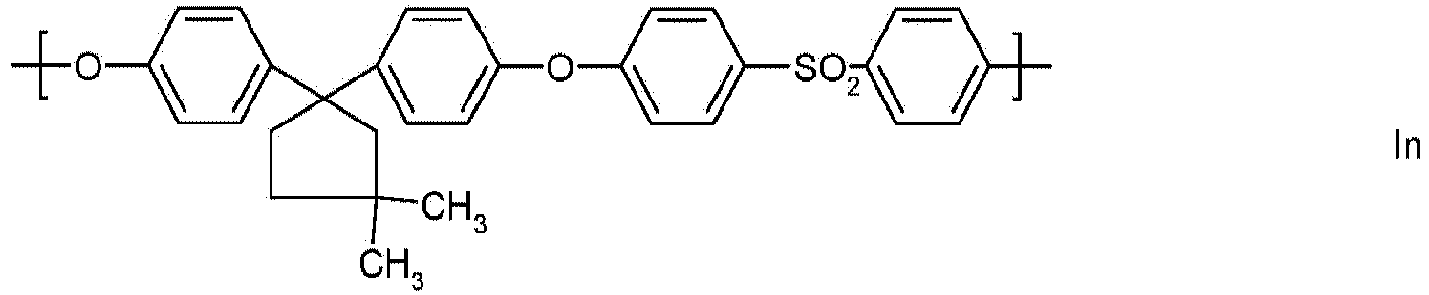
- Solution 1 A solution comprising a polyarylene ether with elements of structure I (formula II) was dissolved in sulfolane and the respective concentration was adjusted (see tables, polyarylene ether solution).
- the polyarylene ether used with elements of structure I had a viscosity number of 56 ml/g. The viscosity number was determined according to ISO1628 from a 0.01 g/ml solution in phenol/1,2-dichlorobenzene (1:1) at 25°C.
- Solution 1 the concentration of which was adjusted, was fed from a storage container at a constant flow rate of 1000 g/h through a capillary for separation and the formation of droplets.
- the tests were carried out using a capillary as a nozzle.
- the capillary diameter and the fall distance from the exit from the capillary to the precipitation bath surface are given in the tables below.
- the composition of the precipitation bath (component 1.1 sulfolane, component 1.2 DMSO; component 2.1 water) was varied as shown in the tables.
- the temperature of the precipitation bath was kept constant during the experiment.
- the beads formed during the process were separated using a sieve and examined further.
- the sulfolane content in the precipitation bath was checked using a refractometer at 25 °C.
- the measuring device used was an Abbe refractometer from Leo Riebler GmbH (model: Atago).
- a drop of the water/sulfolane mixture was taken from the precipitation medium to measure the refractive index.
- the precipitation bath composition could be checked or measured using a calibration curve of sulfolane/water composition vs. refractive index.
- Photographs of the samples of Examples 1 and 6 were taken for illustrative purposes and are shown below.
- Variation of the sulfolane content of the precipitation bath at 30°C precipitation bath temperature e.g. Polyarylene ether solution Nozzle diameter r[mm] Fall height [cm] Precipitation bath Failure behavior Solution number Conc. [wt.%] T [°C] T [°C] Sulfolane content [wt.%] 7 1 18 76 1 70 30 20 Single pearls 8 1 18 76 1 70 30 40 Single pearls 9 1 18 76 1 70 30 60 Single pearls 10 1 18 76 1 70 30 70 Single pearls 11* 1 18 76 1 70 30 75 Single pearls 12* 1 18 76 1 70 30 81 Pearls that agglomerate in the precipitation bath *for comparisonVariation of the sulfolane content of the precipitation bath at 40°C precipitation bath temperature: e.g.
- Variation of the sulfolane content of the precipitation bath at 60°C precipitation bath temperature e.g. Polyarylene ether solution Nozzle diameter [mm] Falling height [cm] Precipitation bath Failure behavior Solution number Conc. [wt.%] T [°C] T [°C] Sulfolane content [wt.%] 23 1 18 76 1 70 60 20 Single pearls 24 1 18 76 1 70 60 40 Single pearls 25 1 18 76 1 70 60 50 Single pearls 26 1 18 76 1 70 60 60 Single pearls 27* 1 18 76 1 70 60 65 Pearls that agglomerate in the precipitation bath *for comparison
- Variation of the sulfolane content of the precipitation bath at 80°C precipitation bath temperature e.g. Polyarylene ether solution Nozzle diameter [mm] Falling height [cm] Precipitation bath Failure behavior Solution number Conc. [wt.%] T [°C] T [°C] Sulfolane content [wt.%] 33 1 18 76 1 70 80 20 Single pearls 34 1 18 76 1 70 80 40 Single pearls 35 1 18 76 1 70 80 50 Single pearls 36* 1 18 76 1 70 80 53 Pearls that agglomerate in the precipitation bath *for comparison
- Solution 2 A solution comprising a polyarylene ether with elements of structure II (formula III) was dissolved in DMSO and the respective concentration was adjusted (see tables, polyarylene ether solution).
- the polyarylene ether with elements of structure II used had a viscosity number of 63 ml/g. The viscosity number determination was carried out according to ISO1628 from a 0.01 g/ml solution in phenol/1,2-dichlorobenzene (1:1) at 25°C.
- Solution 2 the concentration of which was adjusted, was fed from a storage container at a constant flow rate of 1000 g/h through a capillary for separation and the formation of droplets.
- the tests were carried out using a capillary as a nozzle.
- the capillary diameter and the fall distance from the exit from the capillary to the precipitation bath surface are given in the tables below.
- the drop of the respective polymer solution fell into a precipitation bath.
- the composition of the precipitation bath was varied as shown in the tables.
- the temperature of the precipitation bath was kept constant during the experiment.
- the beads formed during the process were separated using a sieve and examined further.
- the DMSO content in the precipitation bath was checked using a refractometer at 25 °C.
- the measuring device used was an Abbe refractometer from Leo kubler GmbH (model: Atago).
- a drop of the water/DMSO mixture was taken from the precipitation medium to measure the refractive index.
- the precipitation bath composition could be checked or measured using a calibration curve of DMSO/water composition vs. refractive index.
- DMSO content of the precipitation bath at 40°C precipitation bath temperature e.g. Polyarylene ether solution Nozzle diameter [mm] Falling height [cm] Precipitation bath Failure behavior Solution number Conc. [wt.%] T [°C] T [°C] DMSO content [wt.%] 48 2 18 75 1 70 40 20 Single pearls 49 2 18 75 1 70 40 40 Single pearls 50 2 18 75 1 70 40 60 Single pearls 51 2 18 75 1 70 40 70 Single pearls 52* 2 18 75 1 70 40 74 Single pearls 53* 2 18 75 1 70 40 78 Pearls that agglomerate in the precipitation bath *for comparison
- DMSO content of the precipitation bath at 50°C precipitation bath temperature e.g. Polyarylene ether solution Nozzle diameter [mm] Falling height [cm] Precipitation bath Failure behavior Solution number Conc. [wt.%] T [°C] T [°C] DMSO content [wt.%] 54 2 18 75 1 70 50 20 Single pearls 55 2 18 75 1 70 50 40 Single pearls 56 2 18 75 1 70 50 60 Single pearls 57 2 18 75 1 70 50 68 Single pearls 58* 2 18 75 1 70 50 73 Pearls that agglomerate in the precipitation bath *for comparison
- DMSO content of the precipitation bath at 80°C precipitation bath temperature e.g. Polyarylene ether solution Nozzle diameter [mm] Falling height [cm] Precipitation bath Failure behavior Solution number Conc. [wt.%] T [°C] T [°C] DMSO content [wt.%] 69 2 18 75 1 70 80 20 Single pearls 70 2 18 75 1 70 80 40 Single pearls 71 2 18 75 1 70 80 50 Single pearls 72* 2 18 75 1 70 80 55 Pearls that agglomerate in the precipitation bath *for comparison
- Examples 73 and 74 show the influence of the sulfolane concentration in the precipitation bath on the formation of fines.
- "Fine” refers to polyarylene ether beads with a particle size of ⁇ 1000 ⁇ m.
- a solution 3 of polyarylene ether in sulfolane was prepared.
- Ultrason ® E2020 from BASF SE was used as the polyarylene ether.
- the concentration of the polyarylene ether was 16.0 wt.%.
- the polyarylene ether was precipitated by dripping and then extracted.
- solution 3 was filled into the receiving container and heated to the desired temperature.
- Solution 3 was dripped through a capillary using a gear pump. Precipitation took place in a precipitation bath with overflow to a shaking sieve, which separated the beads.
- the precipitation bath solution was collected in a buffer vessel and then fed back into the precipitation bath.
- the concentration of sulfolane in the precipitation bath was monitored by means of the refractive index and balanced by adding deionized water. After the drop formation was complete, the beads/lenses were suctioned off, washed with deionized water and then extracted.
- the particle size distribution was determined as follows:
- Examples 73 and 74 show that in the concentration range of aprotic solvent in the precipitation bath according to the invention, polyarylene ether beads are obtained which have a significantly lower fines content.
Landscapes
- Chemical & Material Sciences (AREA)
- Health & Medical Sciences (AREA)
- Chemical Kinetics & Catalysis (AREA)
- Medicinal Chemistry (AREA)
- Polymers & Plastics (AREA)
- Organic Chemistry (AREA)
- Processes Of Treating Macromolecular Substances (AREA)
- Polyethers (AREA)
Description
- Die Erfindung betrifft ein Verfahren zur Herstellung von Polyarylenether-Perlen aus einer Polyarylenetherlösung umfassend die Schritte
- i) Vereinzelung der Polyarylenetherlösung zu Tropfen,
- ii) Überführen der Tropfen in ein Fällbad unter Ausbildung von Polyarylenether-Perlen in dem Fällbad, wobei das Fällbad
- (A) mindestens ein aprotisches Lösungsmittel (Komponente (1)) und mindestens ein protisches Lösungsmittel (Komponente (2)) enthält,
- (B) eine Temperatur von 0°C bis Tc aufweist, wobei die kritische Temperatur Tc in [°C] sich mit der Zahlenwertgleichung Tc = (99 - c) / 0,61 bestimmen lässt, in der c die Konzentration der Komponente (1) im Fällbad in [Gew.-%] ist und
- (C) die Komponente (1) in Konzentrationen von 12 Gew.-% bis 70 [Gew.-%] aufweist, wobei
- Auch betrifft die vorliegende Erfindung die Polyarylenether-Perlen aus dem Verfahren und deren Verwendung zur Herstellung von Polyarylenetherprodukten, wobei als Vereinzelungsvorrichtung eine Kapillare und/oder Lochplatte verwendet wird und wobei die Kapillare und/oder Lochplatte einen Durchmesser von 0,1 bis 5,0 mm aufweist.
- Bei der Herstellung von Polymeren fallen die Polymere häufig in Form von Polymerlösungen an. Diese Polymerlösungen können dabei direkt bei der Herstellung der Polymeren entstehen, beispielsweise bei der Polykondensation von Monomeren in einem Lösungsmittel (Lösungspolymerisation). Auch bei der Polykondensation von Monomeren in Abwesenheit eines Lösungsmittels (Massepolymerisation) werden die erhaltenen Polymere häufig zur weiteren Aufarbeitung in einem Lösungsmittel gelöst. Zur Überführung der in der Polymerlösung enthaltenen Polymere in den reinen, festen Zustand sind im Stand der Technik verschiedene Verfahren beschrieben worden. Ein gängiges Verfahren ist hierbei das Einbringen der Polymerlösung in ein weiteres Lösungsmittel, in dem das Polymer nicht löslich ist. Das weitere Lösungsmittel, in dem das Polymer nicht löslich ist, wird im Allgemeinen auch als Fällbad bezeichnet.
- Zur Herstellung von Polymer-Perlen sind im Stand der Technik darüber hinaus Verfahren beschrieben, bei denen die Polymerlösung zu Tropfen vereinzelt wird aus denen im Fällbad nachfolgend die Polymer-Perlen erhalten werden. Bei den im Stand der Technik beschriebenen Verfahren muss dabei das Fällbad hauptsächlich aus dem weiteren Lösungsmittel, in dem das Polymer nicht löslich ist, bestehen. Der Anteil des Lösungsmittels, in dem das Polymer löslich ist, im Fällbad wird dabei möglichst niedrig gehalten. Dies ist notwendig, um die Ausfällung sicher zu gewährleisten. Um den Anteil des Lösungsmittels, in dem das Polymer löslich ist, im Fällbad möglichst niedrig zu halten, werden im Allgemeinen entweder geringe Volumina der Polymerlösung in große Volumina des Fällbad eingetropft oder das Fällbad wird kontinuierlich ausgetauscht und durch frisches ersetzt.
- Verfahren zur Herstellung von Polymer-Perlen sind beispielsweise in der
DE 3644 464 und derEP 2 305740 beschrieben. DieDE 3 644 464 beschreibt ein Verfahren zur Herstellung von Polyarylethersulfon-Perlen einer Partikelgröße von 100 µm bis 10 mm, bei dem eine Lösung, die ein Polyarylethersulfon und N-Methylpyrrolidon enthält, in ein Fällbad eingetropft wird, das aus Wasser besteht. Das Fällbad weist eine Temperatur zwischen Raumtemperatur und dicht unter dem Siedepunkt des Fällmittels auf. Auch dieEP 2 305740 beschreibt ein Verfahren zur Herstellung von Polymer-Perlen, bei dem reines Wasser als Fällbad eingesetzt wird.EP 2305740 beschreibt eine bevorzugte Fällbadtemperatur von mindestens 80°C. Das als Fällbad eingesetzte Wasser wird dabei ständig ausgetauscht, um die Konzentration an N-Methylpyrrolidon möglichst niedrig zu halten und die gebildeten Polymer-Perlen zu nachgelagerten Prozessstufen weiter zu transportieren. - Bei den im Stand der Technik beschriebenen Verfahren zur Herstellung von Polymer-Perlen bestand noch Raum für Verbesserungen. Die nach den im Stand der Technik erhältlichen Polymer-Perlen neigen zur Agglomeration. Darüber hinaus sind die Sphärizitäts-Werte nicht immer zufriedenstellend. Bei den im Stand der Technik beschriebenen Verfahren entsteht zudem in größeren Mengen sogenannter Feinanteil. Hierbei handelt es sich um Polymer-Perlen, deren Teilchengröße sehr gering ist und die bei der weiteren Aufarbeitung bzw. Verarbeitung der Polymer-Perlen zu Problemen führen.
- Die Aufgabe der vorliegenden Erfindung bestand darin, ein Verfahren zu entwickeln, bei dem Polyarylenether-Perlen zur Verfügung gestellt werden, die im Fällbad nicht agglomerieren und somit ohne weitere Aufarbeitungsschritte weiterverarbeitet werden können. Damit Polyarylenether-Perlen gut weiterverarbeitbar sind, sollten sie möglichst rund sein, also einen Sphärizitäts-Wert größer 0,5 aufweisen. Insbesondere sollten die so erlangten Perlen eine Form aufweisen, in der mögliche Verunreinigungen der Polyarylenether-Perlen leicht extrahiert werden können. Darüber hinaus sollte das Verfahren zuverlässig laufen. Die Polyarlyenether-Perlen sollten darüber hinaus geringere Mengen an Feinanteil aufweisen, als Polyarylenether-Perlen, die nach den Verfahren aus dem Stand der Technik zugänglich sind. Die Polyarylenether-Perlen sollten sich gut auf- und weiterverarbeiten lassen.
- Die erfindungsgemäße Aufgabe wird durch das eingangs beschriebene Verfahren gelöst.
- Es wurde überraschend festgestellt, dass es zur Herstellung von Polyarylenether-Perlen vorteilhaft ist, Fällbäder einzusetzen, die größere Mengen mindestens eines aprotischen Lösungsmittels enthalten. Entgegen dem im Stand der Technik beschriebenen Vorurteil, dass das eingesetzte Fällbad möglichst wenig Lösungsmittel enthalten soll, in dem das Polymer gut löslich ist, wurde gefunden, dass durch Konzentrationen von mindestens 5 Gew.-%, bevorzugt mindestens 8 Gew.-%, besonders bevorzugt mindestens 12 Gew.-%, mindestens eines aprotischen Lösungsmittels (Komponente (1)) im Fällbad die Bildung des unerwünschten Feinanteils verhindert oder zumindest vermindert werden kann.
- Es wird vermutet, dass die Anwesenheit eines aprotischen Lösungsmittels die Oberflächenspannung des Fällbads herabsetzt, wodurch die Bildung von Feinanteil verringert wird.
- Unter "Feinanteil" werden im Rahmen der vorliegenden Erfindung Polyarylenether-Perlen verstanden, die eine Partikelgröße von ≤ 1000 µm (kleiner/gleich 1000 µm) aufweisen. Die Bestimmung der Partikelgröße erfolgt dabei mittels Siebanalyse. Vermessen werden die bei 60 °C getrockneten Polyarylenether-Perlen.
- Bei dem erfindungsgemäßen Verfahrens beträgt die Konzentration der Komponente (1) im Fällbad bereits zu Beginn des Verfahrens mindestens 12 Gew.-%.
- Die Untergrenze der Konzentration der Komponente (1) im Fällbad beträgt somit mindestens 12 Gew.-%. Die Gew.-% sind dabei jeweils bezogen auf die Summe der Gew.-% der Komponente (1) und der Komponente (2) im Fällbad.
- Die Obergrenze der Konzentration der Komponente (1) im Fällbad ist temperaturabhängig. Sie wird auch als kritische Konzentration Cc bezeichnet. Die Einheit von Cc ist [Gew.-%].
- Die kritische Konzentration Cc in [Gew.-%] lässt sich durch die Zahlenwertgleichung

- Darin ist T die Temperatur des Fällbads in [°C]. T gibt damit die tatsächliche Temperatur des Fällbads an. Ausgehend von der tatsächlichen Temperatur des Fällbads lässt sich die kritische Konzentration Cc in Gew.-% errechnen. Die Gew.-% sind dabei auf die Summe der Komponenten (1) und (2) im Fällbad bezogen.
- Innerhalb des erfindungsgemäßen Konzentrationsbereichs von 5 Gew.-% bis Cc wird die Bildung von Feinanteil sowie die Agglomeration der Polyarylenether-Perlen weitestgehend verhindert.
- Polyarylenether sind dem Fachmann als Polymerklasse bekannt. Im Prinzip kommen alle dem Fachmann bekannten und/oder nach bekannten Methoden herstellbaren Polyarylenether in Betracht. Entsprechende Methoden werden weiter unten erläutert.
- Bevorzugte Polyarylenether sind aus Bausteinen der allgemeinen Formel I aufgebaut:

- t, q:
- unabhängig voneinander 0, 1, 2 oder 3,
- Q, T, Y:
- unabhängig voneinander jeweils eine chemische Bindung oder Gruppe, ausgewählt aus -O-, -S-, -SO2-, S=O, C=O, -N=N- und -CRaRb-, wobei Ra und Rb unabhängig voneinander jeweils für ein Wasserstoffatom oder eine C1-C12-Alkyl-, C1-C12-Alkoxy- oder C6-C18-Arylgruppe stehen, und wobei wenigstens eines aus Q, T und Y für -SO2- steht und
- Ar, Ar1:
- unabhängig voneinander eine Arylengruppe mit von 6 bis 18 Kohlenstoffatomen.
- Falls Q, T oder Y unter den oben genannten Voraussetzungen eine chemischen Bindung ist, dann ist darunter zu verstehen, dass die links benachbarte und die rechts benachbarte Gruppe direkt miteinander über eine chemische Bindung verknüpft vorliegen.
- Vorzugsweise werden Q, T und Y in Formel I allerdings unabhängig voneinander ausgewählt aus -O- und -SO2-, mit der Maßgabe, dass wenigstens eines aus der Gruppe bestehend aus Q, T und Y für -SO2- steht.
- Sofern Q, T oder Y -CRaRb- sind, stehen Ra und Rb unabhängig voneinander jeweils für ein Wasserstoffatom oder eine C1-C12-Alkyl-, C1-C12-Alkoxy- oder C6-C18-Arylgruppe.
- Bevorzugte C1-C12-Alkylgruppen umfassen lineare und verzweigte, gesättigte Alkylgruppen mit von 1 bis 12 Kohlenstoffatomen. Insbesondere sind folgende Reste zu nennen: C1-C6-Alkylrest, wie Methyl, Ethyl, n-Propyl, i-Propyl, n-Butyl, sek-Butyl, 2- oder 3-Methyl-pentyl und längerkettige Reste wie unverzweigtes Heptyl, Octyl, Nonyl, Decyl, Undecyl, Lauryl und die ein- oder mehrfach verzweigten Analoga davon.
- Als Alkylreste in den vorgenannten einsetzbaren C1-C12-Alkoxygruppen kommen die weiter oben definierten Alkylgruppen mit von 1 bis 12 Kohlenstoffatomen in Betracht. Vorzugsweise verwendbare Cycloalkylreste umfassen insbesondere C3-C12-Cycloalkylreste, wie zum Beispiel Cyclopropyl, Cyclobutyl, Cyclopentyl, Cyclohexyl, Cycloheptyl, Cyclooctyl, Cyclopropylmethyl, Cyclopropylethyl, Cyclopropylpropyl, Cyclobutylmethyl, Cyclobutylethyl, Cyclpentylethyl, -propyl, -butyl, -pentyl, -hexyl, Cyclohexylmethyl, -dimethyl, und -trimethyl.
- Ar und Ar1 bedeuten unabhängig voneinander eine C6-C18-Arylengruppe. Ausgehend von den weiter unten beschriebenen Ausgangsprodukten ist Ar vorzugsweise abgeleitet von einer elektronenreichen, leicht elektrophil angreifbaren aromatischen Substanz, die bevorzugt aus der Gruppe bestehend aus Hydrochinon, Resorcin, Dihydroxynaphthalin, insbesondere 2,7-Dihydroxynaphthalin, und 4,4'-Bisphenol ausgewählt wird. Vorzugsweise ist Ar1 eine unsubstituierte C6- oder C12-Arylengruppe.
- Als C6-C18-Arylengruppen Ar und Ar1 kommen insbesondere Phenylengruppen, wie 1,2-, 1,3- und 1,4-Phenylen, Naphthylengruppen, wie beispielsweise 1,6-, 1,7-, 2,6- und 2,7-Naphthylen, sowie die von Anthracen, Phenanthren und Naphthacen abgeleiteten Arylengruppen in Betracht.
- Vorzugsweise werden Ar und Ar1 in der bevorzugten Ausführungsform gemäß Formel I unabhängig voneinander ausgewählt aus der Gruppe bestehend aus 1,4-Phenylen, 1,3-Phenylen, Naphthylen, insbesondere 2,7-Dihydroxynaphthylen, und 4,4'-Bisphenylen.
- Bevorzugte Polyarylenether sind solche, die mindestens eine der folgenden Bausteine Ia bis Io als wiederkehrende Struktureinheiten enthalten:












- Zusätzlich zu den bevorzugten Bausteinen Ia bis Io sind auch solche Bausteine bevorzugt, in denen eine oder mehrere 1,4-Phenyleneinheiten, die von Hydrochinon abstammen, durch 1,3-Phenyleneinheiten, die von Resorcin abstammen- oder durch Naphthyleneinheiten, die von Dihydroxynaphthalin abstammen, ersetzt sind.
- Als Bausteine der allgemeinen Formel I besonders bevorzugt sind die Bausteine Ia, Ig und Ik. Es ist außerdem besonders bevorzugt, wenn die Polyarylenether der Komponente (A) im Wesentlichen aus einer Sorte Bausteine der allgemeinen Formel I, insbesondere aus einem Baustein ausgewählt aus Ia, Ig und Ik aufgebaut sind.
- In einer besonders bevorzugten Ausführungsform ist Ar = 1,4-Phenylen, t = 1, q = 0, T ist eine chemische Bindung und Y = SO2. Aus der vorgenannten Wiederholungseinheit aufgebaute besonders bevorzugte Polyarylenethersulfone (A) werden als Polyphenylensulfon (PPSU) bezeichnet (Formel Ig).
- In einer weiteren besonders bevorzugten Ausführungsform ist Ar = 1,4-Phenylen, t = 1, q = 0, T = C(CH3)2 und Y = SO2. Aus der vorgenannten Wiederholungseinheit aufgebaute besonders bevorzugte Polyarylenethersulfone (A) werden als Polysulfon (PSU) bezeichnet (Formel Ia).
- In einer weiteren besonders bevorzugten Ausführungsform ist Ar = 1,4-Phenylen, t = 1, q = 0, T = Y = SO2. Aus der vorgenannten Wiederholungseinheit aufgebaute besonders bevorzugte Polyarylenethersulfone werden als Polyethersulfon (PESU) bezeichnet (Formel Ik).
- Abkürzungen wie PPSU, PESU und PSU entsprechen im Rahmen der vorliegenden Erfindung der DIN EN ISO 1043-1 (Kunststoffe - Kennbuchstaben und Kurzzeichen - Teil 1: Basis-Polymere und ihre besonderen Eigenschaften (ISO 1043-1:2001); Deutsche Fassung EN ISO 1043-1:2002).
- Die Polyarylenether weisen vorzugsweise gewichtsmittlere Molekulargewichte Mw von 10.000 bis 150.000 g/mol, insbesondere von 15.000 bis 120.000 g/mol, besonders bevorzugt von 18.000 bis 100.000 g/mol auf, bestimmt mittels Gelpermeationschromatographie im Lösungsmittel Dimethylacetamid gegen engverteiltes Polymethylmethacrylat als Standard.
- Darüber hinaus weisen die Polyarylenether vorzugsweise eine scheinbare Schmelzviskosität bei 350 °C/1150 s-1 von 150 bis 300 Pa s, bevorzugt von 150 bis 275 Pa s auf.
- Die Fließfähigkeit wurde anhand der Schmelzeviskosität beurteilt. Die Schmelzeviskosität wurde mittels eines Kapillarrheometers bestimmt. Dabei wurde die scheinbare Viskosität bei 350°C als Funktion der Scherrate in einem Kapillarviskosimeter (Göttfert Kapillarviskosimeter Rheograph 2003) mit einer Kreiskapillare der Länge 30 mm, einem Radius von 0,5 mm, einem Einlaufwinkel der Düse von 180°, einem Durchmesser des Reservoirgefäßes der Schmelze von 12 mm und mit einer Vorheizzeit von 5 Minuten bestimmt. Angegeben sind die bei 1150 s-1 bestimmten Werte.
- Herstellungsverfahren, die zu den vorgenannten Polyarylenethern führen, sind dem Fachmann an sich bekannt und beispielsweise in Herman F. Mark, "Encyclopedia of Polymer Science and Technology", third edition, Volume 4, 2003, Kapitel "Polysulfones" auf den Seiten 2 bis 8 sowie in Hans R. Kricheldorf, "Aromatic Polyethers" in: Handbook of Polymer Synthesis, second edition, 2005 auf den Seiten 427 bis 443 beschrieben.
- Besonders bevorzugt ist die Umsetzung mindestens einer aromatischen Verbindung mit zwei Halogensubstituenten und mindestens einer aromatischen Verbindung mit zwei funktionellen Gruppen, die gegenüber vorgenannten Halogensubstituenten reaktiv sind, in aprotischen polaren Lösungsmitteln in Gegenwart von wasserfreiem Alkalicarbonat, insbesondere Natrium-, Kalium-, Calciumcarbonat oder Mischungen davon, wobei Kaliumcarbonat ganz besonders bevorzugt ist. Eine besonders geeignete Kombination ist N-Methylpyrrolidon als Lösungsmittel und Kaliumcarbonat als Base. Vorzugsweise weisen die Polyarylenether entweder Halogenendgruppen, insbesondere Chlorendgruppen, oder veretherte Endgruppen, insbesondere Alkyletherendgruppen, auf, welche durch Umsetzung der OH- bzw. Phenolat-Endgruppen mit geeigneten Veretherungsmitteln erhältlich sind.
- Geeignete Veretherungsmittel sind beispielsweise monofunktionelles Alkyl- oder Arylhalogenid, beispielsweise C1-C6-Alkylchlorid, -bromid oder -iodid, bevorzugt Methylchlorid, oder Benzylchlorid, -bromid oder -iodid oder Mischungen davon. Bevorzugte Endgruppen im Rahmen der Polyarylenether der Komponente sind Halogen, insbesondere Chlor, Alkoxy, insbesondere Methoxy, Aryloxy, insbesondere Phenoxy, oder Benzyloxy.
- Unter einer Polyarylenetherlösung wird eine Lösung verstanden, die ein oder mehrere Lösungsmittel, einen oder mehrere Polyarylenether umfassen kann. Die Polyarylenetherlösung kann darüber hinaus Materialien enthalten, die aus dem Herstellungsprozess stammen. Hierzu zählen Verunreinigungen als auch Einsatzstoffe. Insbesondere kann die Polyarylenetherlösung auch Monomere sowie Salze aus dem Herstellungsprozess der Polyarylenether wie Natriumcarbonat, Kaliumcarbonat, Kaliumchlorid oder Natriumchlorid umfassen. Auch Nebenprodukte und/oder Zersetzungsprodukte können in der Polyarylenetherlösung vorhanden sein.
- Als Lösungsmittel für die Polyarlyenetherlösung können ein oder mehrere aprotische Lösungsmittel verwendet werden. Unter einem aprotischen Lösungsmittel ist ein Lösungsmittel zu verstehen, das nicht über eine funktionelle Gruppe verfügt, aus der ein oder mehrere Wasserstoffatome im Lösungsmittelmolekül als Proton abgespalten werden kann. Das aprotische Lösungsmittel ist ausgewählt aus der Gruppe Dimethylsulfoxid, Dimethylformamid, Sulfolan, Diphenylsulfon, 1,2-Dichlorbenzol, Hexamethylphosphorsäuretriamid oder deren Mischungen verwendet werden. Als aprotische Lösungsmittel sind Sulfolan und/oder Dimethylsulfoxid bevorzugt.
- In einer Ausführungsform der vorliegenden Erfindung enthält die Polyarylenetherlösung das gleiche aprotische Lösungsmittel wie das Fällbad. Gegenstand der vorliegenden Erfindung ist somit auch ein Verfahren, bei dem die Polyarylenetherlösung und das Fällbad das gleiche aprotische Lösungsmittel enthalten. In einer bevorzugten Ausführungsform enthalten sowohl die Polyarylenetherlösung als auch das Fällbad Sulfolan und/oder Dimethylsulfoxid.
- Die Polyarylenetherlösung hat eine Konzentration von 5 bis 50 Gew.-% Polyarylenether in aprotischem Lösungsmittel, wobei die Gew.-% bezogen sind auf die Summe der Gew.-% des Polyarylenethers und des aprotischen Lösungsmittels. Insbesondere kann die Polyarylenetherlösung eine Konzentration von 5 bis 40 Gew.-%, bevorzugt von 5 bis 35 Gew.-%, besonders bevorzugt von 5 bis 34 Gew.-%, zum Beispiel von 6 bis 30 Gew.-% Polyarylenether in aprotischem Lösungsmittel aufweisen, wobei die Gew.-% bezogen sind auf die Summe der Gew.-% des Polyarylenethers und des aprotischen Lösungsmittels.
- Die Polyarylenetherlösung kann eine Viskosität von 0,05 bis 1,30 Pa s aufweisen, wobei die Viskosität in einem schubspannungskontrollierten Rotationsviskosimeter zum Beispiel mit einer Couette Geometrie (DIN 53019-1), bei der Temperatur, bei der die Vereinzelung durchgeführt wird, und bei einem Scherrate von 10-1 s-1 gemessen wird.
- Die Polyarylenetherlösung kann bei dem Vereinzelungsschritt eine Temperatur von 15 bis 250 °C insbesondere von 20 bis 120 °C aufweisen, zum Beispiel von 20 bis 110 °C aufweisen, wobei die Temperatur mit Hilfe eines Thermometers, zum Beispiel mit einem Widerstandsthermometer PT100 an der Vereinzelungsvorrichtung gemessen werden kann, aus dem die Polyarylenetherlösung der Vereinzelungsgvorrichtung zur Durchführung der Vereinzelung zugeführt wird.
- Bei dem Verfahren zur Herstellung von Polyarylenether-Perlen aus einer Polyarylenetherlösung durchläuft eine Polyarylenetherlösung einen Vereinzelungsschritt zur Bildung von Tropfen. Dabei ist es möglich, unterschiedliche Arten von Vereinzelungsvorrichtungen einzusetzen. Die Polymerlösung kann beispielsweise versprüht oder vertropft werden.
- Wird die Polymerlösung versprüht, können als Vereinzelungsvorrichtung Einstoff-, Zweistoff- oder Mehrstoffdüsen verwendet werden. Zweistoff- oder Mehrstoffdüsen können insbesondere dann angewendet werden, wenn die Polyarylenetherlösung schon vor dem Auftreffen auf die Fälllösung im Fällbad mit der Fälllösung in Kontakt gebracht werden soll.
- Insbesondere können Sprühdüsen gewählt werden, die möglichst große Perlen erzielen. Zur Erzielung größerer Perlen können Federkegeldüsen verwendet werden, also Druckdüsen, die durch eine Feder betätigt werden. Zur Erzielung möglichst kleiner Perlen können Hohlkegeldüsen verwendet werden.
- Wird die Polyarylenetherlösung vereinzelt, bietet es sich an als Vereinzelungsvorrichtungen, eine oder mehrere Lochplatten zu verwenden. Unter einer Lochplatte wird eine Platte aus Metall, Glas oder Kunststoff verstanden, die Löcher aufweist, durch die die Polyarylenetherlösung vereinzelt wird.
- Der Durchmesser eines Loches der Lochplatte kann von 0,1 bis 5,0 mm betragen. Insbesondere kann der Durchmesser der Lochplatte von 0,5 bis 4,0 mm betragen. Bevorzugt beträgt der Durchmesser der Lochplatte 0,5 bis 2,5 mm, insbesondere von 0,5 bis 2,0 mm.
- Auch können als Vereinzelungsvorrichtung eine oder mehrere Kapillaren zur Vertropfung der Polyarylenetherlösung eingesetzt werden. Unter einer Kapillare wird ein langgestreckter Hohlraum verstanden, der von einer Begrenzung umgeben ist, die aus Metall, Glas und/oder Kunststoff sein kann.
- Der Innendurchmesser einer Kapillare kann von 0,1 bis 5,0 mm betragen. Insbesondere kann der Innendurchmesser der Kapillare von 0,5 bis 4,0 mm betragen. Bevorzugt kann der Durchmesser der Kapillare 0,5 bis 2,5 mm, insbesondere von 0,5 bis 2,0 mm betragen.
- In einer Ausführungsform bezüglich des Vereinzelungsverfahrens wird die Polyarylenetherlösung bei Überdruck vereinzelt. In einer Variante wird die Polyarylenetherlösung bei einem Überdruck von 0,1 bis 50 bar, insbesondere von 1 bis 40 bar, bevorzugt von 1 bis 10 bar, besonders bevorzugt von 1 bis 9 bar vereinzelt. Der Druck wird zwischen der Vereinzelungsvorrichtung und dem Vorratsbehälter, der die zu vereinzelnde Polyarylenetherlösung umfasst, mit Hilfe eines Überdruckmessgeräts (zum Beispiel kann ein Rohrfeder-Überdruckmessgerät geeignet sein) gemessen.
- Das Fällbad enthält ein oder mehrere aprotische Lösungsmittel als Komponente (1). Unter einem aprotischen Lösungsmittel ist ein Lösungsmittel zu verstehen, das nicht über eine funktionelle Gruppe verfügt, aus der ein oder mehrere Wasserstoffatome im Lösungsmittelmolekül als Proton abgespalten werden kann. Als aprotisches Lösungsmittel können Dimethylsulfoxid, Dimethylformamid, Sulfolan, Diphenylsulfon, 1,2-Dichlorbenzol, Hexamethylphosphorsäuretriamid oder deren Mischungen verwendet werden.
- Das Fällbad enthält außerdem ein oder mehrere protische Lösungsmittel als Komponente (2).
- Das Fällbad enthält Wasser und/oder mindestens einen Alkohol als Komponente (2) umfassen. Als Wasser kann mineralisiertes oder demineralisiertes Wasser verwendet werden. Als Alkohol können ein- und/oder zweiwertige Alkohole verwendet werden. Bevorzugt werden einwertige Alkohole verwendet. Als einwertige Alkohole können insbesondere Methanol, Ethanol, 1-Propanol und/oder 2-Propanol verwendet werden.
- Bevorzugt umfasst das Fällbad ein Gemisch aus einem aprotischen Lösungsmittel als Komponente (1) und Wasser und/oder einem Alkohol als Komponente (2).
- Das Fällbad enthält 12 bis 70 Gew.-% der Komponente (1), wobei die Gew.-% jeweils bezogen sind auf die Summe der Gew.-% der Komponente (1) und der Komponente (2) im Fällbad.
- Als Untergrenze weist das Fällbad im Allgemeinen eine Temperatur von mindestens 0°C, bevorzugt von mindestens 5 °C auf. Die Obergrenze der Temperatur des Fällbads ist abhängig von der Konzentration c der Komponente (1) im Fällbad. Die Obergrenze der Temperatur wird auch als kritische Temperatur Tc bezeichnet. Die Einheit von Tc ist [°C].
- Die kritische Temperatur Tc in [°C] lässt sich durch die Zahlenwertgleichung

- Darin ist c die Konzentration der Komponente (1) im Fällbad in [Gew.-%]. c gibt damit die tatsächliche Konzentration der Komponente (1) im Fällbad an. Ausgehend von der tatsächlichen Konzentration der Komponente (1) im Fällbad lässt sich die kritische Temperatur Tc in [°C] errechnen Die Gew.-% sind dabei auf die Summe der Komponenten (1) und (2) im Fällbad bezogen.
- Innerhalb des erfindungsgemäßen Temperaturbereichs von 0 °C bis Tc, bevorzugt von 5°C bis Tc, wird die Bildung von Feinanteil sowie die Agglomeration der Polyarylenether-Perlen weitestgehend verhindert.
- In einer Ausführungsform der Erfindung ist das Fällbad bewegt. Insbesondere kann das Fällbad gerührt werden. Auch kann der Vereinzelungsschritt in ein strömendes Fällbad durchgeführt werden.
- In einer Ausführungsform findet der Vereinzelungsschritt in einem geschlossenen Fällbad statt, wobei die Applikation zur Vereinzelung oberhalb der Fälllösung in oder an dem geschlossenen Behälter angebracht ist.
- In einem Verfahren zur Herstellung von Polyarylenether-Perlen kann die Polyarylenetherlösung eine Fallstrecke von der Austrittsstelle bis Fällbadoberfläche von 0,10 m bis 1,20 m zurücklegen. Zum Beispiel kann die Polyarylenetherlösung eine Fallstrecke von der Austrittsstelle bis Fällbadoberfläche von 0,15 m bis 1,00 m zurücklegen.
- Gegenstand der vorliegenden Erfindung ist des Weiteren ein Verfahren zur Herstellung von Polyarylenether-Perlen aus einer Polyarylenetherlösung, die ein aprotisches Lösungsmittel enthält und eine Konzentration von 5 bis 50 Gew.-% Polyarylenether im aprotischen Lösungsmittel aufweist, wobei die Gew.-% bezogen sind auf die Summe der Gew.-% des Polyarylenethers und des aprotischen Lösungsmittels, umfassend die Schritte
- i) Vereinzelung der Polyarylenetherlösung zu Tropfen, wobei die Polyarylenetherlösung eine Temperatur von 15 bis 250°C aufweist,
- ii) Überführen der Tropfen in ein Fällbad unter Ausbildung von Polyarylenether-Perlen in dem Fällbad, wobei das Fällbad
- (A) mindestens ein aprotisches Lösungsmittel (Komponente (1)) und mindestens ein protisches Lösungsmittel (Komponente (2)) enthält,
- (B) eine Temperatur von 0°C bis Tc aufweist, wobei die kritische Temperatur Tc in [°C] sich mit der Zahlenwertgleichung Tc = (99 - c) / 0,61 bestimmen lässt, in der c die Konzentration der Komponente (1) im Fällbad in [Gew.-%] ist und
- (C) die Komponente (1) in Konzentrationen von 5 bis 70 Gew.-% aufweist, wobei
- Des Weiteren bezieht sich die Erfindung auf Polyarylenether-Perlen aus dem Verfahren zur Herstellung von Polyarylenether-Perlen, wobei als Vereinzelungsvorrichtung eine Kapillare und/oder Lochplatte verwendet wird und wobei die Kapillare und/oder Lochplatte einen Durchmesser von 0,1 bis 5,0 mm aufweist. Die Perlen liegen nach dem Vereinzelungsschritt in der Fällbad Lösung vor. Die Perlen können von den weiteren Bestandteilen, die im Fällbad vorhanden sind, durch geeignete Mittel abgetrennt werden. Beispielsweise können die Perlen durch Sieben abgetrennt werden.
- In der Regel haben die Perlen eine Verweilzeit in der Fälllösung von 1 min bis 2 Tage.
- Untersuchung der Perlen mit Hilfe eines Camsizers zur Bildanalyse ergibt, dass die Perlen einen Sphärizität-Wert (SPHT-Wert) von 0,4 bis 1,0, insbesondere von 0,5 bis 1,0 aufweisen können. Zur Ermittlung des SPHT-Wertes kann nach Extraktion der Perlen mit heißem Wasser (95 °C) für 20 Stunden und anschließende Trocknung der Perlen unter Vakuum bei 150 °C für zwei Tage eine Bildanalyse mit Hilfe eines Camsizer durchgeführt werden.
- Die Anmeldung betrifft auch die Verwendung der Perlen zur Herstellung von Polyarylenetherprodukten. Unter Polyarylenetherprodukten werden Produkte verstanden, die einer Extraktion, Trocknung und/oder einem formgebenden Verfahren unterzogen wurden. So betrifft die Anmeldung auch Produkte aus dem Verfahren, die nach Aufarbeitung wie Extraktion und Trocknung in eine verkaufsfähige Form gebracht werden wie Pellets, Pulver, Granulate, Chips, Körner oder Fäden.
- Beispiele 1 bis 36: Variation Fällbadtemperatur und Fällbad Zusammensetzung in Wasser / Sulfolan
- Die Versuche 1 bis 36 wurden nacheinander mit jeweils einer exemplarischen Polyarylenetherlösung durchgeführt, wobei das Ausfallverhalten optimiert wurde. Lösung 1: Eine Lösung umfassend einen Polyarylenether mit Elementen der Struktur I (Formel II) wurde in Sulfolan gelöst und die jeweilige Konzentration eingestellt (siehe Tabellen, Polyarylenetherlösung). Der verwendete Polyarylenether mit Elementen der Struktur I wies eine Viskositätszahl von 56 ml/g auf. Die Viskositätszahlbestimmung wurde nach ISO1628 aus einer 0,01g/ml Lösung in Phenol/1,2-Dichlorbenzol (1:1) bei 25°C durchgeführt.

- Die Lösung 1, deren Konzentration eingestellt wurde, wurde aus einem Vorlagebehälter unter einer konstanten Förderarte von 1000 g/ h durch eine Kapillare zur Vereinzelung unter Bildung von Tropfen gefahren. Die Versuche wurden mit einer Kapillare als Düse durchgeführt. Der Kapillardurchmesser und die Fallstrecke von Austritt aus der Kapillare und Fällbadoberfläche sind in den nachstehenden Tabellen angegeben.
- Nach der Vereinzelung fiel der Tropfen der jeweiligen Polymerlösung in ein Fällbad. Die Zusammensetzung des Fällbades (Komponente 1.1 Sulfolan, Komponente 1.2 DMSO; Komponente 2.1 Wasser) wurde wie in den Tabellen angegeben variiert. Die Temperatur des Fällbades wurde während eines Versuchs konstant gehalten. Die bei dem Vorgang entstehenden Perlen wurden mit Hilfe eines Siebs abgetrennt und weitergehend untersucht.
- Der Versuch wurde bei verschiedenen Fällbad Temperaturen durchgeführt.
- Der Sulfolan-Gehalt im Fällbad wurde mit Hilfe eines Refraktometers bei 25 °C kontrolliert. Das eingesetzte Messgerät war ein Abbe-Refraktometer der Firma Leo Kübler GmbH (Model: Atago). Ein Tropfen des Wasser / Sulfolan Gemisches wurde zur Messung des Brechungsindexes aus dem Fällmedium entnommen. Anhand einer Eichkurve Sulfolan/Wasser-Zusammensetzung vs. Brechungsindex konnte die Fällbadzusammensetzung kontrolliert beziehungsweise gemessen werden.
- Variation des Sulfolan-Gehaltes des Fällbades bei 20°C Fällbadtemperatur:
Bsp. Polyarylenetherlösung Düsendurchmesse r [mm] Fällhöhe [cm] Fällbad Ausfallverhalten Lösungs nummer Konz. [Gew. %] T [°C] T [°C] Sulfolan Gehalt [Gew.%] 1 1 18 76 1 70 20 20 Einzelne Perlen 2 1 18 76 1 70 20 40 Einzelne Perlen 3 1 18 76 1 70 20 60 Einzelne Perlen 4* 1 18 76 1 70 20 80 Einzelne Perlen 5* 1 18 76 1 70 20 85 Einzelne Perlen 6* 1 18 76 1 70 20 90 Perlen, die im Fällbad agglomerieren *zum Vergleich - Fotos von den Proben der Beispiele 1 und 6 wurden zur Veranschaulichung aufgenommen und sind unten angegeben.

- Variation des Sulfolan-Gehaltes des Fällbades bei 30°C Fällbadtemperatur:
Bsp. Polyarylenetherlösung Düsendurchmesse r[mm] Fallhöhe [cm] Fällbad Ausfallverhalten Lösungsnummer Konz. [Gew.%] T [°C] T [°C] Sulfolan Gehalt [Gew.%] 7 1 18 76 1 70 30 20 Einzelne Perlen 8 1 18 76 1 70 30 40 Einzelne Perlen 9 1 18 76 1 70 30 60 Einzelne Perlen 10 1 18 76 1 70 30 70 Einzelne Perlen 11* 1 18 76 1 70 30 75 Einzelne Perlen 12* 1 18 76 1 70 30 81 Perlen, die im Fällbad agglomerieren *zum VergleichVariation des Sulfolan-Gehaltes des Fällbades bei 40°C Fällbadtemperatur: Bsp. Polyarylenetherlösung Düsendurchmess er [mm] Fällhöhe [cm] Fällbad Ausfallverhalten Lösungs nummer Konz. [Gew. %] T[°C] T [°C] Sulfolan Gehalt [Gew.%] 13 1 18 76 1 70 40 20 Einzelne Perlen 14 1 18 76 1 70 40 40 Einzelne Perlen 15 1 18 76 1 70 40 60 Einzelne Perlen 16 1 18 76 1 70 40 70 Einzelne Perlen 17* 1 18 76 1 70 40 75 Perlen, die im Fällbad agglomerieren *zum Vergleich - Variation des Sulfolan-Gehaltes des Fällbades bei 50°C Fällbadtemperatur:
Bsp. Polyarylenetherlösung Düsendurchmess er [mm] Fällhöhe [cm] Fällbad Ausfallverhalten sungsnummer Konz. [Gew.%] T [°C] T [°C] Sulfolan Gehalt [Gew.%] 18 1 18 76 1 70 50 20 Einzelne Perlen 19 1 18 76 1 70 50 40 Einzelne Perlen 20 1 18 76 1 70 50 60 Einzelne Perlen 21 1 18 76 1 70 50 65 Einzelne Perlen 22* 1 18 76 1 70 50 70 Perlen, die im Fällbad agglomerieren *zum Vergleich - Variation des Sulfolan-Gehaltes des Fällbades bei 60°C Fällbadtemperatur:
Bsp. Polyarylenetherlösung Düsendurchmess er [mm] Fällhöhe [cm] Fällbad Ausfallverhalten Lösungsnummer Konz. [Gew.%] T [°C] T [°C] Sulfolan Gehalt [Gew.%] 23 1 18 76 1 70 60 20 Einzelne Perlen 24 1 18 76 1 70 60 40 Einzelne Perlen 25 1 18 76 1 70 60 50 Einzelne Perlen 26 1 18 76 1 70 60 60 Einzelne Perlen 27* 1 18 76 1 70 60 65 Perlen, die im Fällbad agglomerieren *zum Vergleich - Variation des Sulfolan-Gehaltes des Fällbades bei 70°C Fällbadtemperatur:
Bsp. Polyarylenetherlösung Düsendurchmess er [mm] Fällhöhe [cm] Fällbad Ausfallverhalten sungsnummer Konz. [Gew.%] T [°C] T [°C] Sulfolan Gehalt [Gew.%] 28 1 18 76 1 70 70 20 Einzelne Perlen 29 1 18 76 1 70 70 40 Einzelne Perlen 30 1 18 76 1 70 70 50 Einzelne Perlen 31 1 18 76 1 70 70 55 Einzelne Perlen 32* 1 18 76 1 70 70 59 Perlen, die im Fällbad agglomerieren *zum Vergleich - Variation des Sulfolan-Gehaltes des Fällbades bei 80°C Fällbadtemperatur:
Bsp. Polyarylenetherlösung Düsendurchmess er [mm] Fällhöhe [cm] Fällbad Ausfallverhalten Lösungsnummer Konz. [Gew.%] T [°C] T [°C] Sulfolan Gehalt [Gew.%] 33 1 18 76 1 70 80 20 Einzelne Perlen 34 1 18 76 1 70 80 40 Einzelne Perlen 35 1 18 76 1 70 80 50 Einzelne Perlen 36* 1 18 76 1 70 80 53 Perlen, die im Fällbad agglomerieren *zum Vergleich - Beispiele 37 bis 72: Variation Fällbadtemperatur und Fällbadzusammensetzung in Wasser / DMSO
- Die Versuche 37 bis 72 wurden nacheinander mit einer exemplarischen Polyarylenetherlösung durchgeführt, wobei das Ausfallverhalten optimiert wurde.
- Lösung 2: Eine Lösung umfassend einen Polyarylenether mit Elementen der Struktur II (Formel III) wurde in DMSO gelöst und die jeweilige Konzentration eingestellt (siehe Tabellen, Polyarylenetherlösung). Der verwendete Polyarylenether mit Elementen der Struktur II wies eine Viskositätszahl von 63 ml/g auf. Die Viskositätszahlbestimmung wurde nach ISO1628 aus einer 0,01g/ml Lösung in Phenol/1,2-Dichlorbenzol (1:1) bei 25°C durchgeführt.

- Die Lösung 2, deren Konzentration eingestellt wurde, wurde aus einem Vorlagebehälter unter einer konstanten Förderarte von 1000 g/ h durch eine Kapillare zur Vereinzelung unter Bildung von Tropfen gefahren. Die Versuche wurden mit einer Kapillare als Düse durchgeführt. Der Kapillardurchmesser und die Fallstrecke von Austritt aus der Kapillare und Fällbadoberfläche sind in den nachstehenden Tabellen angegeben.
- Nach der Vereinzelung fiel der Tropfen der jeweiligen Polymerlösung in ein Fällbad. Die Zusammensetzung des Fällbades wurde wie in den Tabellen angegeben variiert. Die Temperatur des Fällbades wurde während eines Versuchs konstant gehalten. Die bei dem Vorgang entstehenden Perlen wurden mit Hilfe eines Siebs abgetrennt und weitergehend untersucht.
- Der Versuch wurde bei verschiedenen Fällbadtemperaturen durchgeführt.
- Der DMSO-Gehalt im Fällbad wurde mit Hilfe eines Refraktometers bei 25 °C kontrolliert. Das eingesetzte Messgerät war ein Abbe-Refraktometer der Firma Leo Kübler GmbH (Model: Atago). Ein Tropfen des Wasser / DMSO Gemisches wurde zur Messung des Brechungsindexes aus dem Fällmedium entnommen. Anhand einer Eichkurve DMSO / Wasser-Zusammensetzung vs. Brechungsindex konnte die Fällbad Zusammensetzung kontrolliert beziehungsweise gemessen werden.
- Variation des DMSO-Gehaltes des Fällbades bei 20°C Fällbadtemperatur:
Bsp. Polyarylenetherlösung Düsendurchmess er [mm] Fällhöhe [cm] Fällbad Ausfallverhalten Lösungsnummer Konz. [Gew.%] T [°C] T [°C] DMSO Gehalt [Gew.%] 37 2 18 75 1 70 20 20 Einzelne Perlen 38 2 18 75 1 70 20 40 Einzelne Perlen 39 2 18 75 1 70 20 60 Einzelne Perlen 40* 2 18 75 1 70 20 80 Einzelne Perlen 41* 2 18 75 1 70 20 85 Einzelne Perlen 42* 2 18 75 1 70 20 92 Perlen, die im Fällbad agglomerieren *zum Vergleich - Fotos von den Proben der Beispiele 37 und 42 wurden zur Veranschaulichung aufgenommen und sind unten angegeben.

- Variation des DMSO-Gehaltes des Fällbades bei 30°C Fällbadtemperatur:
Bsp. Polyarylenetherlösung Düsendurchmess er [mm] Fällhöhe [cm] Fällbad Ausfallverhalten sungsnummer Konz. [Gew.%] T [°C] T [°C] DMSO Gehalt [Gew.%] 43 2 18 75 1 70 30 20 Einzelne Perlen 44 2 18 75 1 70 30 40 Einzelne Perlen 45 2 18 75 1 70 30 60 Einzelne Perlen 46 2 18 75 1 70 30 80 Einzelne Perlen 47* 2 18 75 1 70 30 85 Perlen, die im Fällbad agglomerieren *zum Vergleich - Variation des DMSO-Gehaltes des Fällbades bei 40°C Fällbadtemperatur:
Bsp. Polyarylenetherlösung Düsendurchmess er [mm] Fällhöhe [cm] Fällbad Ausfallverhalten Lösungsnummer Konz. [Gew.%] T [°C] T [°C] DMSO Gehalt [Gew.%] 48 2 18 75 1 70 40 20 Einzelne Perlen 49 2 18 75 1 70 40 40 Einzelne Perlen 50 2 18 75 1 70 40 60 Einzelne Perlen 51 2 18 75 1 70 40 70 Einzelne Perlen 52* 2 18 75 1 70 40 74 Einzelne Perlen 53* 2 18 75 1 70 40 78 Perlen, die im Fällbad agglomerieren *zum Vergleich - Variation des DMSO-Gehaltes des Fällbades bei 50°C Fällbadtemperatur:
Bsp. Polyarylenetherlösung Düsendurchmess er [mm] Fällhöhe [cm] Fällbad Ausfallverhalten Lösungsnummer Konz. [Gew.%] T [°C] T [°C] DMSO Gehalt [Gew.%] 54 2 18 75 1 70 50 20 Einzelne Perlen 55 2 18 75 1 70 50 40 Einzelne Perlen 56 2 18 75 1 70 50 60 Einzelne Perlen 57 2 18 75 1 70 50 68 Einzelne Perlen 58* 2 18 75 1 70 50 73 Perlen, die im Fällbad agglomerieren *zum Vergleich - Variation des DMSO-Gehaltes des Fällbades bei 60°C Fällbadtemperatur:
Bsp. Polyarylenetherlösung Düsendurchmess er [mm] Fällhöhe [cm] Fällbad Ausfallverhalten sungsnummer Konz. [Gew.%] T [°C] T [°C] DMSO Gehalt [Gew.%] 59 2 18 75 1 70 60 20 Einzelne Perlen 60 2 18 75 1 70 60 40 Einzelne Perlen 61 2 18 75 1 70 60 60 Einzelne Perlen 62 2 18 75 1 70 60 62 Einzelne Perlen 63* 2 18 75 1 70 60 68 Perlen, die im Fällbad agglomerieren *zum Vergleich - Variation des DMSO-Gehaltes des Fällbades bei 70°C Fällbadtemperatur:
Bsp. Polyarylenetherlösung Düsendurchmess er [mm] Fällhöhe [cm] Fällbad Ausfallverhalten sungsnummer Konz. [Gew.%] T [°C] T [°C] DMSO Gehalt [Gew.%] 64 2 18 75 1 70 70 20 Einzelne Perlen 65 2 18 75 1 70 70 40 Einzelne Perlen 66 2 18 75 1 70 70 50 Einzelne Perlen 67 2 18 75 1 70 70 55 Einzelne Perlen 68* 2 18 75 1 70 70 61 Perlen, die im Fällbad agglomerieren *zum Vergleich - Variation des DMSO-Gehaltes des Fällbades bei 80°C Fällbadtemperatur:
Bsp. Polyarylenetherlösung Düsendurchmess er [mm] Fällhöhe [cm] Fällbad Ausfallverhalten Lösungsnummer Konz. [Gew.%] T [°C] T [°C] DMSO Gehalt [Gew.%] 69 2 18 75 1 70 80 20 Einzelne Perlen 70 2 18 75 1 70 80 40 Einzelne Perlen 71 2 18 75 1 70 80 50 Einzelne Perlen 72* 2 18 75 1 70 80 55 Perlen, die im Fällbad agglomerieren *zum Vergleich - Die Beispiele 73 und 74 zeigen den Einfluss der Sulfolankonzentration im Fällbad auf die Bildung von Feinanteil. Unter "Feinanteil" werden hierbei Polyarylenether-Perlen verstanden, die eine Partikelgröße von ≤ 1000 µm aufweisen.
- Hierzu wurde eine Lösung 3 von Polyarylenether in Sulfolan hergestellt. Als Polyarylenether wurde Ultrason® E2020 der BASF SE eingesetzt. Die Konzentration des Polyarylenethers betrug 16,0 Gew.-%.
- Der Polyarylenether wurde mittels Vertropfung gefällt und anschließend extrahiert. Für die Vertropfung wurde die Lösung 3 in den Vorlagebehälter eingefüllt und auf die gewünschte Temperatur temperiert. Mittels Zahnradpumpe wurde die Lösung 3 über eine Kapillare vertropft. Die Fällung erfolgte in einem Fällbad mit Überlauf zu einem Schüttelsieb, das die Perlen abtrennte. Die Fällbadlösung wurde in einem Puffergefäß aufgefangen und anschließend wieder dem Fällbad zugeführt.
- Die Konzentration von Sulfolan im Fällbad wurde mittels Brechzahl überwacht und durch Zugabe von VE-Wasser ausgeglichen. Nach Ende der Vertropfung wurden die Perlen/Linsen abgesaugt, mit VE-Wasser gewaschen und anschließend extrahiert.
- Die Bedingungen während der Vertropfung sind in der nachfolgenden Tabelle angegeben.
Vers. Lösungsmittel Konz. in Lösung 3 [Gew.-%] Konz. LM im Fällbad [%] Temp. Fällbad [°C] Temp. Lösung 3 beim Vertr. [°C] Fallhöhe [cm] 73 Sulfolan 16,0 < 1 40 80 60 74 Sulfolan 16,0 40 40 80 60 - Die Bedingungen bei der Extraktion mit Wasser waren wie folgt:
Temp. in der Extraktion: 95 °C Durchsatz Extraktionsmittel: 2000 ml Wasser / h Temp. Extraktionsmittel: 90-95 °C Dauer Extraktion: 24 h - Die Partikelgrößenverteilung wurde wie folgt bestimmt:
- Die extrahierten, feuchten Perlen/Linsen wurden im Trockenschrank bei 60 °C getrocknet und anschließend die Verteilung mittels Handsiebung im Siebturm ermittelt. Die Ergebnisse sind in der nachfolgenden Tabelle angegeben.
Partikelgröße [µm] 73 74 3150 99,16 100,0 2800 97,49 99,89 2500 92,48 99,21 2000 27,69 30,51 1600 8,88 2,94 1250 5,33 0,45 1000 4,28 0,23 650 3,87 0,45 Summe ≤ 1000 = Feinanteil 8,15 0,68 - Die Beispiele 73 und 74 zeigen, dass im erfindungsgemäßen Konzentrationsbereich an aprotischem Lösungsmittel im Fällbad Polyarylenether-Perlen erhalten werden, die einen deutlich geringeren Feinanteil aufweisen.
Claims (10)
- Verfahren zur Herstellung von Polyarylenether-Perlen aus einer Polyarylenetherlösung umfassend die Schrittei) Vereinzelung der Polyarylenetherlösung zu Tropfen,ii) Überführen der Tropfen in ein Fällbad unter Ausbildung von Polyarylenether-Perlen in dem Fällbad, wobei das Fällbaddie Gew.-% jeweils bezogen sind auf die Summe der Gew.-% der Komponente (1) und der Komponente (2) im Fällbad, und wobei das Fällbad als Komponente (2) Wasser und/oder Alkohol enthält, wobei die Polyarylenetherlösung eine Konzentration von 5 bis 50 Gew.-% Polyarylenether im aprotischen Lösungsmittel aufweist, wobei die Gew.-% bezogen sind auf die Summe der Gew.-% des Polyarylenethers und des aprotischen Lösungsmittels, wobei die Polyarylenetherlösung bei der Vereinzelung eine Temperatur von 15 bis 250 °C aufweist, wobei das aprotische Lösungsmittel ausgewählt ist aus der Gruppe bestehend aus Dimethylsulfoxid, Dimethylformamid, Sulfolan, Diphenylsulfon, 1,2-Dichlorbenzol, Hexamethylphosphorsäuretriamid und deren Mischungen.(A) mindestens ein aprotisches Lösungsmittel (Komponente (1)) und mindestens ein protisches Lösungsmittel (Komponente (2)) enthält,(B) eine Temperatur von 0°C bis Tc aufweist, wobei die kritische Temperatur Tc in [°C] sich mit der Zahlenwertgleichung Tc = (99 - c) / 0,61 bestimmen lässt, in der c die Konzentration der Komponente (1) im Fällbad in [Gew.-%] ist und(C) die Komponente (1) in Konzentrationen von 12 bis 70 Gew.-% aufweist, wobei
- Verfahren nach Anspruch 1, wobei das Fällbad bewegt ist.
- Verfahren nach mindestens einem der Ansprüche 1 oder 2, wobei die Polyarylenetherlösung bei der Vereinzelung eine Temperatur von 20 bis 120 °C aufweist.
- Verfahren nach mindestens einem der Ansprüche 1 bis 3, wobei die Polyarylenetherlösung nach Austritt aus der Vereinzelungsvorrichtung eine Fallstrecke von der Austrittsstelle bis zur Fällbadoberfläche von 0,10 m bis 1,20 m zurücklegt.
- Verfahren nach mindestens einem der Ansprüche 1 bis 4, wobei als Vereinzelungsvorrichtung eine Kapillare und/oder Lochplatte verwendet wird.
- Verfahren nach Anspruch 5, wobei die Kapillare und/oder Lochplatte einen Durchmesser von 0,1 bis 5,0 mm aufweist.
- Verfahren nach mindestens einem der Ansprüche 1 bis 6, wobei die Polyarylenetherlösung und das Fällbad das gleiche aprotische Lösungsmittel enthalten.
- Verfahren nach mindestens einem der Ansprüche 1 bis 7, wobei das Fällbad 12 bis 50 Gew.-% Komponente (1) enthält, wobei die Gew.-% jeweils bezogen sind auf die Summe der Gew.-% der Komponente (1) und der Komponente (2) im Fällbad.
- Polyarylenether-Perlen aus dem Verfahren nach einem der Ansprüche 1 bis 8, wobei als Vereinzelungsvorrichtung eine Kapillare und/oder Lochplatte verwendet wird und wobei die Kapillare und/oder Lochplatte einen Durchmesser von 0,1 bis 5,0 mm aufweist.
- Verwendung der Polyarylenether-Perlen nach Anspruch 9 zur Herstellung von Polyarylenetherprodukten.
Priority Applications (1)
| Application Number | Priority Date | Filing Date | Title |
|---|---|---|---|
| EP14739187.4A EP3022253B2 (de) | 2013-07-18 | 2014-07-16 | Vereinzelung einer polyarylenetherlösung |
Applications Claiming Priority (3)
| Application Number | Priority Date | Filing Date | Title |
|---|---|---|---|
| EP13176991 | 2013-07-18 | ||
| EP14739187.4A EP3022253B2 (de) | 2013-07-18 | 2014-07-16 | Vereinzelung einer polyarylenetherlösung |
| PCT/EP2014/065242 WO2015007776A1 (de) | 2013-07-18 | 2014-07-16 | Vereinzelung einer polyarylenetherlösung |
Publications (3)
| Publication Number | Publication Date |
|---|---|
| EP3022253A1 EP3022253A1 (de) | 2016-05-25 |
| EP3022253B1 EP3022253B1 (de) | 2021-05-19 |
| EP3022253B2 true EP3022253B2 (de) | 2024-08-14 |
Family
ID=48793111
Family Applications (1)
| Application Number | Title | Priority Date | Filing Date |
|---|---|---|---|
| EP14739187.4A Active EP3022253B2 (de) | 2013-07-18 | 2014-07-16 | Vereinzelung einer polyarylenetherlösung |
Country Status (7)
| Country | Link |
|---|---|
| US (1) | US9809685B2 (de) |
| EP (1) | EP3022253B2 (de) |
| JP (1) | JP6273005B2 (de) |
| KR (1) | KR102272136B1 (de) |
| CN (1) | CN105555842B (de) |
| HK (1) | HK1224318A1 (de) |
| WO (1) | WO2015007776A1 (de) |
Families Citing this family (14)
| Publication number | Priority date | Publication date | Assignee | Title |
|---|---|---|---|---|
| CN105308095B (zh) | 2013-05-02 | 2018-01-19 | 巴斯夫欧洲公司 | 聚芳醚砜共聚物 |
| US9809686B2 (en) * | 2013-07-18 | 2017-11-07 | Basf Se | Division of a polyarylene ether solution |
| US9828472B2 (en) * | 2013-07-18 | 2017-11-28 | Basf Se | Division of a polyarylene ether solution |
| US10106702B2 (en) * | 2016-06-06 | 2018-10-23 | Cymer-Dayton, Llc | PAI-based coating compositions |
| US20240157180A1 (en) | 2021-02-04 | 2024-05-16 | Mighty Fire Breaker Llc | Method of and kit for installing and operating a wildfire defense spraying system on a property parcel for proactively spraying environmentally-clean liquid fire inhibitor thereover to inhibit fire ignition and flame spread caused by wind-driven wildfire embers |
| US12594448B2 (en) | 2019-06-22 | 2026-04-07 | Mighty Fire Breaker Llc | Environmentally-clean aqueous-based fire extinguishing biochemical liquid concentrates for mixing with proportioned quantities of water to produce fire extinguishing water streams |
| US11865394B2 (en) | 2017-12-03 | 2024-01-09 | Mighty Fire Breaker Llc | Environmentally-clean biodegradable water-based concentrates for producing fire inhibiting and fire extinguishing liquids for fighting class A and class B fires |
| US11865390B2 (en) | 2017-12-03 | 2024-01-09 | Mighty Fire Breaker Llc | Environmentally-clean water-based fire inhibiting biochemical compositions, and methods of and apparatus for applying the same to protect property against wildfire |
| US10653904B2 (en) | 2017-12-02 | 2020-05-19 | M-Fire Holdings, Llc | Methods of suppressing wild fires raging across regions of land in the direction of prevailing winds by forming anti-fire (AF) chemical fire-breaking systems using environmentally clean anti-fire (AF) liquid spray applied using GPS-tracking techniques |
| US11826592B2 (en) | 2018-01-09 | 2023-11-28 | Mighty Fire Breaker Llc | Process of forming strategic chemical-type wildfire breaks on ground surfaces to proactively prevent fire ignition and flame spread, and reduce the production of smoke in the presence of a wild fire |
| US12599797B2 (en) | 2020-03-01 | 2026-04-14 | Mighty Fire Breaker Llc | Environmentally-clean fire inhibiting and extinguishing compositions and products for sorbing flammable liquids while inhibiting ignition and extinguishing fire |
| US11911643B2 (en) | 2021-02-04 | 2024-02-27 | Mighty Fire Breaker Llc | Environmentally-clean fire inhibiting and extinguishing compositions and products for sorbing flammable liquids while inhibiting ignition and extinguishing fire |
| US20240052087A1 (en) | 2020-12-21 | 2024-02-15 | Basf Se | Thermoplastic polyoxazolidinone having a high temperature stability |
| US12616859B2 (en) | 2021-02-04 | 2026-05-05 | Mighty Fire Breaker Llc | Method of and system for defending home building projects from wildfire during and after construction on property located within a wildfire urban interface (WUI) region |
Citations (9)
| Publication number | Priority date | Publication date | Assignee | Title |
|---|---|---|---|---|
| GB1153035A (en) † | 1965-09-24 | 1969-05-21 | Ici Ltd | Production of Aromatic Polymers and Intermediates therefor |
| GB1394983A (en) † | 1973-01-26 | 1975-05-21 | Inventa Ag | Process and apparatus for the isolation of aromatic polymers |
| US4108837A (en) † | 1963-07-16 | 1978-08-22 | Union Carbide Corporation | Polyarylene polyethers |
| US5013816A (en) † | 1986-12-24 | 1991-05-07 | Basf Aktiengesellschaft | Preparation of particulate polymers |
| US5015423A (en) † | 1986-10-29 | 1991-05-14 | Kanegafuchi Kagaku Kogyo Kabushiki Kaisha | Method of making uniform polymer particles |
| DE19816955A1 (de) † | 1998-04-17 | 1999-10-21 | Basf Ag | Verfahren zur Herstellung von Polyarylenethersulfon-Dispersionen |
| EP2305740A1 (de) † | 2009-09-30 | 2011-04-06 | Ems-Patent Ag | Verfahren zur Herstellung von Polymerpartikeln |
| US20110224386A1 (en) † | 2008-11-20 | 2011-09-15 | Martin Weber | Reactive polyarylene ether and method for the manufacture thereof |
| EP3013889A1 (de) † | 2013-06-28 | 2016-05-04 | Basf Se | Polyarylethersulfon-polymere (p) mit reduziertem lösungsmittelgehalt |
Family Cites Families (7)
| Publication number | Priority date | Publication date | Assignee | Title |
|---|---|---|---|---|
| US3923738A (en) | 1974-07-23 | 1975-12-02 | Gen Electric | Process for the formation of polyphenylene ethers of controlled particle size |
| DK0678109T3 (da) | 1993-01-08 | 1998-11-02 | Basf Ag | Mikropulver |
| DE102005002084A1 (de) * | 2005-01-14 | 2006-07-20 | Degussa Ag | Verfahren zur Herstellung von Polyarylenetherketonen |
| CN101848956A (zh) | 2007-08-10 | 2010-09-29 | 东丽株式会社 | 具有羟苯基端基的芳香族聚醚砜及其制造方法 |
| US8574669B2 (en) | 2008-05-21 | 2013-11-05 | Toray Industries, Inc. | Method for producing polymer fine particle comprising contacting an emulsion with a poor solvent |
| US9809686B2 (en) * | 2013-07-18 | 2017-11-07 | Basf Se | Division of a polyarylene ether solution |
| US9828472B2 (en) * | 2013-07-18 | 2017-11-28 | Basf Se | Division of a polyarylene ether solution |
-
2014
- 2014-07-16 WO PCT/EP2014/065242 patent/WO2015007776A1/de not_active Ceased
- 2014-07-16 JP JP2016526601A patent/JP6273005B2/ja not_active Expired - Fee Related
- 2014-07-16 US US14/904,610 patent/US9809685B2/en active Active
- 2014-07-16 HK HK16112702.6A patent/HK1224318A1/zh unknown
- 2014-07-16 EP EP14739187.4A patent/EP3022253B2/de active Active
- 2014-07-16 KR KR1020167004054A patent/KR102272136B1/ko not_active Expired - Fee Related
- 2014-07-16 CN CN201480051339.2A patent/CN105555842B/zh active Active
Patent Citations (9)
| Publication number | Priority date | Publication date | Assignee | Title |
|---|---|---|---|---|
| US4108837A (en) † | 1963-07-16 | 1978-08-22 | Union Carbide Corporation | Polyarylene polyethers |
| GB1153035A (en) † | 1965-09-24 | 1969-05-21 | Ici Ltd | Production of Aromatic Polymers and Intermediates therefor |
| GB1394983A (en) † | 1973-01-26 | 1975-05-21 | Inventa Ag | Process and apparatus for the isolation of aromatic polymers |
| US5015423A (en) † | 1986-10-29 | 1991-05-14 | Kanegafuchi Kagaku Kogyo Kabushiki Kaisha | Method of making uniform polymer particles |
| US5013816A (en) † | 1986-12-24 | 1991-05-07 | Basf Aktiengesellschaft | Preparation of particulate polymers |
| DE19816955A1 (de) † | 1998-04-17 | 1999-10-21 | Basf Ag | Verfahren zur Herstellung von Polyarylenethersulfon-Dispersionen |
| US20110224386A1 (en) † | 2008-11-20 | 2011-09-15 | Martin Weber | Reactive polyarylene ether and method for the manufacture thereof |
| EP2305740A1 (de) † | 2009-09-30 | 2011-04-06 | Ems-Patent Ag | Verfahren zur Herstellung von Polymerpartikeln |
| EP3013889A1 (de) † | 2013-06-28 | 2016-05-04 | Basf Se | Polyarylethersulfon-polymere (p) mit reduziertem lösungsmittelgehalt |
Also Published As
| Publication number | Publication date |
|---|---|
| US20160215105A1 (en) | 2016-07-28 |
| JP2016525599A (ja) | 2016-08-25 |
| CN105555842A (zh) | 2016-05-04 |
| JP6273005B2 (ja) | 2018-01-31 |
| EP3022253B1 (de) | 2021-05-19 |
| WO2015007776A1 (de) | 2015-01-22 |
| KR102272136B1 (ko) | 2021-07-05 |
| KR20160032217A (ko) | 2016-03-23 |
| CN105555842B (zh) | 2018-08-10 |
| US9809685B2 (en) | 2017-11-07 |
| EP3022253A1 (de) | 2016-05-25 |
| HK1224318A1 (zh) | 2017-08-18 |
Similar Documents
| Publication | Publication Date | Title |
|---|---|---|
| EP3022253B1 (de) | Vereinzelung einer polyarylenetherlösung | |
| EP3022254B1 (de) | Vereinzelung einer polyarylenetherlösung | |
| EP3013889B2 (de) | Polyarylethersulfon-polymere (p) mit reduziertem lösungsmittelgehalt | |
| DE112010003842B4 (de) | Aromatisches Polysulfonharz und Membranen daraus | |
| EP3044249B2 (de) | Polyarylenethersulfon-polymere für membrananwendungen | |
| EP3022252B1 (de) | Vereinzelung einer polyarylenetherlösung | |
| EP2992034B1 (de) | Verfahren zur aufreinigung von poly(arylenethern) | |
| EP2992033B1 (de) | Polyarylethersulfoncopolymere | |
| DE4422158A1 (de) | Homogene Polymerlegierungen auf der Basis von sulfonierten, aromatischen Polyetherketonen | |
| EP3247736A1 (de) | Entsalzung von polyarylethern aus einem schmelzpolymerisationsverfahren | |
| EP3247737B1 (de) | Entsalzung von polyarylethern mittels schmelzeextraktion | |
| EP3433300B1 (de) | Entsalzung von polyarylethern mittels schmelzeextraktion | |
| EP2992037A1 (de) | Polyarylethersulfoncopolymere | |
| EP1330485B1 (de) | Verfahren zur herstellung einer lösung von einem polymer enthaltend wiederkehrende azoleinheiten | |
| EP2855561B1 (de) | Verfahren zur herstellung von hochleistungsthermoplasten mit verbesserter eigenfarbe | |
| EP1681311B1 (de) | Verzweigte sulfonierte Polyarylether | |
| DE102023122545A1 (de) | Neues aromatisches Copolymer, welches Sulfonat-substituierte Naphthalin-Wiederholeinheiten sowie aromatische Phenyl-, Biphenyl- oder Terphenyl-Wiederholeinheiten umfasst, dessen Herstellung und Verwendung | |
| DE10149035A1 (de) | Verfahren zur Sulfonierung von aromatischen Polymeren, Polyelektrolyte sowie deren Verwendung | |
| DE112022003786T5 (de) | Verfahren zur herstellung von porösen vorrichtungen aus monodispersen populationen von polyarylketon- oder polyarylthioetherketon-partikeln | |
| DE112022003768T5 (de) | Verfahren zur herstellung von medium aus im wesentlichen monodispersen populationen von polyarylketon- oder polyarylthioetherketon-partikeln und diese umfassende behälter | |
| EP0294773A2 (de) | Polymermischungen auf der Basis von Polyarylethersulfonen | |
| WO2006089575A1 (de) | Fliessverhalten von polyphenylenoxidschmelzen während der verarbeitung ii |
Legal Events
| Date | Code | Title | Description |
|---|---|---|---|
| PUAI | Public reference made under article 153(3) epc to a published international application that has entered the european phase |
Free format text: ORIGINAL CODE: 0009012 |
|
| 17P | Request for examination filed |
Effective date: 20160218 |
|
| AK | Designated contracting states |
Kind code of ref document: A1 Designated state(s): AL AT BE BG CH CY CZ DE DK EE ES FI FR GB GR HR HU IE IS IT LI LT LU LV MC MK MT NL NO PL PT RO RS SE SI SK SM TR |
|
| AX | Request for extension of the european patent |
Extension state: BA ME |
|
| DAX | Request for extension of the european patent (deleted) | ||
| STAA | Information on the status of an ep patent application or granted ep patent |
Free format text: STATUS: EXAMINATION IS IN PROGRESS |
|
| 17Q | First examination report despatched |
Effective date: 20190425 |
|
| GRAP | Despatch of communication of intention to grant a patent |
Free format text: ORIGINAL CODE: EPIDOSNIGR1 |
|
| STAA | Information on the status of an ep patent application or granted ep patent |
Free format text: STATUS: GRANT OF PATENT IS INTENDED |
|
| INTG | Intention to grant announced |
Effective date: 20201215 |
|
| GRAS | Grant fee paid |
Free format text: ORIGINAL CODE: EPIDOSNIGR3 |
|
| GRAA | (expected) grant |
Free format text: ORIGINAL CODE: 0009210 |
|
| STAA | Information on the status of an ep patent application or granted ep patent |
Free format text: STATUS: THE PATENT HAS BEEN GRANTED |
|
| AK | Designated contracting states |
Kind code of ref document: B1 Designated state(s): AL AT BE BG CH CY CZ DE DK EE ES FI FR GB GR HR HU IE IS IT LI LT LU LV MC MK MT NL NO PL PT RO RS SE SI SK SM TR |
|
| REG | Reference to a national code |
Ref country code: GB Ref legal event code: FG4D Free format text: NOT ENGLISH |
|
| REG | Reference to a national code |
Ref country code: CH Ref legal event code: EP |
|
| REG | Reference to a national code |
Ref country code: DE Ref legal event code: R096 Ref document number: 502014015594 Country of ref document: DE |
|
| REG | Reference to a national code |
Ref country code: AT Ref legal event code: REF Ref document number: 1393919 Country of ref document: AT Kind code of ref document: T Effective date: 20210615 |
|
| REG | Reference to a national code |
Ref country code: IE Ref legal event code: FG4D Free format text: LANGUAGE OF EP DOCUMENT: GERMAN |
|
| REG | Reference to a national code |
Ref country code: LT Ref legal event code: MG9D |
|
| REG | Reference to a national code |
Ref country code: NL Ref legal event code: MP Effective date: 20210519 |
|
| PG25 | Lapsed in a contracting state [announced via postgrant information from national office to epo] |
Ref country code: HR Free format text: LAPSE BECAUSE OF FAILURE TO SUBMIT A TRANSLATION OF THE DESCRIPTION OR TO PAY THE FEE WITHIN THE PRESCRIBED TIME-LIMIT Effective date: 20210519 Ref country code: LT Free format text: LAPSE BECAUSE OF FAILURE TO SUBMIT A TRANSLATION OF THE DESCRIPTION OR TO PAY THE FEE WITHIN THE PRESCRIBED TIME-LIMIT Effective date: 20210519 Ref country code: FI Free format text: LAPSE BECAUSE OF FAILURE TO SUBMIT A TRANSLATION OF THE DESCRIPTION OR TO PAY THE FEE WITHIN THE PRESCRIBED TIME-LIMIT Effective date: 20210519 Ref country code: BG Free format text: LAPSE BECAUSE OF FAILURE TO SUBMIT A TRANSLATION OF THE DESCRIPTION OR TO PAY THE FEE WITHIN THE PRESCRIBED TIME-LIMIT Effective date: 20210819 |
|
| PG25 | Lapsed in a contracting state [announced via postgrant information from national office to epo] |
Ref country code: LV Free format text: LAPSE BECAUSE OF FAILURE TO SUBMIT A TRANSLATION OF THE DESCRIPTION OR TO PAY THE FEE WITHIN THE PRESCRIBED TIME-LIMIT Effective date: 20210519 Ref country code: IS Free format text: LAPSE BECAUSE OF FAILURE TO SUBMIT A TRANSLATION OF THE DESCRIPTION OR TO PAY THE FEE WITHIN THE PRESCRIBED TIME-LIMIT Effective date: 20210919 Ref country code: GR Free format text: LAPSE BECAUSE OF FAILURE TO SUBMIT A TRANSLATION OF THE DESCRIPTION OR TO PAY THE FEE WITHIN THE PRESCRIBED TIME-LIMIT Effective date: 20210820 Ref country code: ES Free format text: LAPSE BECAUSE OF FAILURE TO SUBMIT A TRANSLATION OF THE DESCRIPTION OR TO PAY THE FEE WITHIN THE PRESCRIBED TIME-LIMIT Effective date: 20210519 Ref country code: NO Free format text: LAPSE BECAUSE OF FAILURE TO SUBMIT A TRANSLATION OF THE DESCRIPTION OR TO PAY THE FEE WITHIN THE PRESCRIBED TIME-LIMIT Effective date: 20210819 Ref country code: PT Free format text: LAPSE BECAUSE OF FAILURE TO SUBMIT A TRANSLATION OF THE DESCRIPTION OR TO PAY THE FEE WITHIN THE PRESCRIBED TIME-LIMIT Effective date: 20210920 Ref country code: PL Free format text: LAPSE BECAUSE OF FAILURE TO SUBMIT A TRANSLATION OF THE DESCRIPTION OR TO PAY THE FEE WITHIN THE PRESCRIBED TIME-LIMIT Effective date: 20210519 Ref country code: SE Free format text: LAPSE BECAUSE OF FAILURE TO SUBMIT A TRANSLATION OF THE DESCRIPTION OR TO PAY THE FEE WITHIN THE PRESCRIBED TIME-LIMIT Effective date: 20210519 Ref country code: RS Free format text: LAPSE BECAUSE OF FAILURE TO SUBMIT A TRANSLATION OF THE DESCRIPTION OR TO PAY THE FEE WITHIN THE PRESCRIBED TIME-LIMIT Effective date: 20210519 |
|
| PG25 | Lapsed in a contracting state [announced via postgrant information from national office to epo] |
Ref country code: NL Free format text: LAPSE BECAUSE OF FAILURE TO SUBMIT A TRANSLATION OF THE DESCRIPTION OR TO PAY THE FEE WITHIN THE PRESCRIBED TIME-LIMIT Effective date: 20210519 |
|
| PG25 | Lapsed in a contracting state [announced via postgrant information from national office to epo] |
Ref country code: SK Free format text: LAPSE BECAUSE OF FAILURE TO SUBMIT A TRANSLATION OF THE DESCRIPTION OR TO PAY THE FEE WITHIN THE PRESCRIBED TIME-LIMIT Effective date: 20210519 Ref country code: SM Free format text: LAPSE BECAUSE OF FAILURE TO SUBMIT A TRANSLATION OF THE DESCRIPTION OR TO PAY THE FEE WITHIN THE PRESCRIBED TIME-LIMIT Effective date: 20210519 Ref country code: EE Free format text: LAPSE BECAUSE OF FAILURE TO SUBMIT A TRANSLATION OF THE DESCRIPTION OR TO PAY THE FEE WITHIN THE PRESCRIBED TIME-LIMIT Effective date: 20210519 Ref country code: CZ Free format text: LAPSE BECAUSE OF FAILURE TO SUBMIT A TRANSLATION OF THE DESCRIPTION OR TO PAY THE FEE WITHIN THE PRESCRIBED TIME-LIMIT Effective date: 20210519 Ref country code: DK Free format text: LAPSE BECAUSE OF FAILURE TO SUBMIT A TRANSLATION OF THE DESCRIPTION OR TO PAY THE FEE WITHIN THE PRESCRIBED TIME-LIMIT Effective date: 20210519 Ref country code: RO Free format text: LAPSE BECAUSE OF FAILURE TO SUBMIT A TRANSLATION OF THE DESCRIPTION OR TO PAY THE FEE WITHIN THE PRESCRIBED TIME-LIMIT Effective date: 20210519 |
|
| REG | Reference to a national code |
Ref country code: DE Ref legal event code: R026 Ref document number: 502014015594 Country of ref document: DE |
|
| PLBI | Opposition filed |
Free format text: ORIGINAL CODE: 0009260 |
|
| REG | Reference to a national code |
Ref country code: CH Ref legal event code: PL |
|
| PLAN | Information deleted related to communication of a notice of opposition and request to file observations + time limit |
Free format text: ORIGINAL CODE: EPIDOSDOBS2 |
|
| PLAX | Notice of opposition and request to file observation + time limit sent |
Free format text: ORIGINAL CODE: EPIDOSNOBS2 |
|
| PLAX | Notice of opposition and request to file observation + time limit sent |
Free format text: ORIGINAL CODE: EPIDOSNOBS2 |
|
| 26 | Opposition filed |
Opponent name: SOLVAY SPECIALTY POLYMERS USA, LLC Effective date: 20220218 |
|
| PG25 | Lapsed in a contracting state [announced via postgrant information from national office to epo] |
Ref country code: MC Free format text: LAPSE BECAUSE OF FAILURE TO SUBMIT A TRANSLATION OF THE DESCRIPTION OR TO PAY THE FEE WITHIN THE PRESCRIBED TIME-LIMIT Effective date: 20210519 |
|
| GBPC | Gb: european patent ceased through non-payment of renewal fee |
Effective date: 20210819 |
|
| PG25 | Lapsed in a contracting state [announced via postgrant information from national office to epo] |
Ref country code: LI Free format text: LAPSE BECAUSE OF NON-PAYMENT OF DUE FEES Effective date: 20210731 Ref country code: CH Free format text: LAPSE BECAUSE OF NON-PAYMENT OF DUE FEES Effective date: 20210731 |
|
| PG25 | Lapsed in a contracting state [announced via postgrant information from national office to epo] |
Ref country code: IS Free format text: LAPSE BECAUSE OF FAILURE TO SUBMIT A TRANSLATION OF THE DESCRIPTION OR TO PAY THE FEE WITHIN THE PRESCRIBED TIME-LIMIT Effective date: 20210919 Ref country code: LU Free format text: LAPSE BECAUSE OF NON-PAYMENT OF DUE FEES Effective date: 20210716 Ref country code: AL Free format text: LAPSE BECAUSE OF FAILURE TO SUBMIT A TRANSLATION OF THE DESCRIPTION OR TO PAY THE FEE WITHIN THE PRESCRIBED TIME-LIMIT Effective date: 20210519 |
|
| PLAF | Information modified related to communication of a notice of opposition and request to file observations + time limit |
Free format text: ORIGINAL CODE: EPIDOSCOBS2 |
|
| PG25 | Lapsed in a contracting state [announced via postgrant information from national office to epo] |
Ref country code: IE Free format text: LAPSE BECAUSE OF NON-PAYMENT OF DUE FEES Effective date: 20210716 Ref country code: GB Free format text: LAPSE BECAUSE OF NON-PAYMENT OF DUE FEES Effective date: 20210819 |
|
| PLBB | Reply of patent proprietor to notice(s) of opposition received |
Free format text: ORIGINAL CODE: EPIDOSNOBS3 |
|
| REG | Reference to a national code |
Ref country code: AT Ref legal event code: MM01 Ref document number: 1393919 Country of ref document: AT Kind code of ref document: T Effective date: 20210716 |
|
| PG25 | Lapsed in a contracting state [announced via postgrant information from national office to epo] |
Ref country code: AT Free format text: LAPSE BECAUSE OF NON-PAYMENT OF DUE FEES Effective date: 20210716 |
|
| PG25 | Lapsed in a contracting state [announced via postgrant information from national office to epo] |
Ref country code: HU Free format text: LAPSE BECAUSE OF FAILURE TO SUBMIT A TRANSLATION OF THE DESCRIPTION OR TO PAY THE FEE WITHIN THE PRESCRIBED TIME-LIMIT; INVALID AB INITIO Effective date: 20140716 |
|
| PG25 | Lapsed in a contracting state [announced via postgrant information from national office to epo] |
Ref country code: CY Free format text: LAPSE BECAUSE OF FAILURE TO SUBMIT A TRANSLATION OF THE DESCRIPTION OR TO PAY THE FEE WITHIN THE PRESCRIBED TIME-LIMIT Effective date: 20210519 |
|
| PLBP | Opposition withdrawn |
Free format text: ORIGINAL CODE: 0009264 |
|
| PG25 | Lapsed in a contracting state [announced via postgrant information from national office to epo] |
Ref country code: MK Free format text: LAPSE BECAUSE OF FAILURE TO SUBMIT A TRANSLATION OF THE DESCRIPTION OR TO PAY THE FEE WITHIN THE PRESCRIBED TIME-LIMIT Effective date: 20210519 |
|
| PG25 | Lapsed in a contracting state [announced via postgrant information from national office to epo] |
Ref country code: TR Free format text: LAPSE BECAUSE OF FAILURE TO SUBMIT A TRANSLATION OF THE DESCRIPTION OR TO PAY THE FEE WITHIN THE PRESCRIBED TIME-LIMIT Effective date: 20210519 |
|
| PUAH | Patent maintained in amended form |
Free format text: ORIGINAL CODE: 0009272 |
|
| STAA | Information on the status of an ep patent application or granted ep patent |
Free format text: STATUS: PATENT MAINTAINED AS AMENDED |
|
| 27A | Patent maintained in amended form |
Effective date: 20240814 |
|
| AK | Designated contracting states |
Kind code of ref document: B2 Designated state(s): AL AT BE BG CH CY CZ DE DK EE ES FI FR GB GR HR HU IE IS IT LI LT LU LV MC MK MT NL NO PL PT RO RS SE SI SK SM TR |
|
| REG | Reference to a national code |
Ref country code: DE Ref legal event code: R102 Ref document number: 502014015594 Country of ref document: DE |
|
| PG25 | Lapsed in a contracting state [announced via postgrant information from national office to epo] |
Ref country code: MT Free format text: LAPSE BECAUSE OF FAILURE TO SUBMIT A TRANSLATION OF THE DESCRIPTION OR TO PAY THE FEE WITHIN THE PRESCRIBED TIME-LIMIT Effective date: 20210519 |
|
| PGFP | Annual fee paid to national office [announced via postgrant information from national office to epo] |
Ref country code: DE Payment date: 20250728 Year of fee payment: 12 |
|
| PGFP | Annual fee paid to national office [announced via postgrant information from national office to epo] |
Ref country code: IT Payment date: 20250721 Year of fee payment: 12 |
|
| PGFP | Annual fee paid to national office [announced via postgrant information from national office to epo] |
Ref country code: BE Payment date: 20250724 Year of fee payment: 12 |
|
| PGFP | Annual fee paid to national office [announced via postgrant information from national office to epo] |
Ref country code: FR Payment date: 20250725 Year of fee payment: 12 |