EP3000994A1 - Organischer rankine prozess (orc) - turbogenerator - Google Patents
Organischer rankine prozess (orc) - turbogenerator Download PDFInfo
- Publication number
- EP3000994A1 EP3000994A1 EP15189987.9A EP15189987A EP3000994A1 EP 3000994 A1 EP3000994 A1 EP 3000994A1 EP 15189987 A EP15189987 A EP 15189987A EP 3000994 A1 EP3000994 A1 EP 3000994A1
- Authority
- EP
- European Patent Office
- Prior art keywords
- generator
- condensate
- working fluid
- orc
- stator
- Prior art date
- Legal status (The legal status is an assumption and is not a legal conclusion. Google has not performed a legal analysis and makes no representation as to the accuracy of the status listed.)
- Granted
Links
Images
Classifications
-
- F—MECHANICAL ENGINEERING; LIGHTING; HEATING; WEAPONS; BLASTING
- F01—MACHINES OR ENGINES IN GENERAL; ENGINE PLANTS IN GENERAL; STEAM ENGINES
- F01D—NON-POSITIVE DISPLACEMENT MACHINES OR ENGINES, e.g. STEAM TURBINES
- F01D25/00—Component parts, details, or accessories, not provided for in, or of interest apart from, other groups
- F01D25/18—Lubricating arrangements
- F01D25/22—Lubricating arrangements using working-fluid or other gaseous fluid as lubricant
-
- H—ELECTRICITY
- H02—GENERATION; CONVERSION OR DISTRIBUTION OF ELECTRIC POWER
- H02K—DYNAMO-ELECTRIC MACHINES
- H02K9/00—Arrangements for cooling or ventilating
- H02K9/19—Arrangements for cooling or ventilating for machines with closed casing and closed-circuit cooling using a liquid cooling medium, e.g. oil
- H02K9/20—Arrangements for cooling or ventilating for machines with closed casing and closed-circuit cooling using a liquid cooling medium, e.g. oil wherein the cooling medium vaporises within the machine casing
-
- F—MECHANICAL ENGINEERING; LIGHTING; HEATING; WEAPONS; BLASTING
- F01—MACHINES OR ENGINES IN GENERAL; ENGINE PLANTS IN GENERAL; STEAM ENGINES
- F01K—STEAM ENGINE PLANTS; STEAM ACCUMULATORS; ENGINE PLANTS NOT OTHERWISE PROVIDED FOR; ENGINES USING SPECIAL WORKING FLUIDS OR CYCLES
- F01K25/00—Plants or engines characterised by use of special working fluids, not otherwise provided for; Plants operating in closed cycles and not otherwise provided for
- F01K25/08—Plants or engines characterised by use of special working fluids, not otherwise provided for; Plants operating in closed cycles and not otherwise provided for using special vapours
-
- F—MECHANICAL ENGINEERING; LIGHTING; HEATING; WEAPONS; BLASTING
- F02—COMBUSTION ENGINES; HOT-GAS OR COMBUSTION-PRODUCT ENGINE PLANTS
- F02C—GAS-TURBINE PLANTS; AIR INTAKES FOR JET-PROPULSION PLANTS; CONTROLLING FUEL SUPPLY IN AIR-BREATHING JET-PROPULSION PLANTS
- F02C7/00—Features, components parts, details or accessories, not provided for in, or of interest apart form groups F02C1/00 - F02C6/00; Air intakes for jet-propulsion plants
- F02C7/12—Cooling of plants
-
- F—MECHANICAL ENGINEERING; LIGHTING; HEATING; WEAPONS; BLASTING
- F02—COMBUSTION ENGINES; HOT-GAS OR COMBUSTION-PRODUCT ENGINE PLANTS
- F02C—GAS-TURBINE PLANTS; AIR INTAKES FOR JET-PROPULSION PLANTS; CONTROLLING FUEL SUPPLY IN AIR-BREATHING JET-PROPULSION PLANTS
- F02C7/00—Features, components parts, details or accessories, not provided for in, or of interest apart form groups F02C1/00 - F02C6/00; Air intakes for jet-propulsion plants
- F02C7/12—Cooling of plants
- F02C7/16—Cooling of plants characterised by cooling medium
-
- H—ELECTRICITY
- H02—GENERATION; CONVERSION OR DISTRIBUTION OF ELECTRIC POWER
- H02K—DYNAMO-ELECTRIC MACHINES
- H02K1/00—Details of the magnetic circuit
- H02K1/06—Details of the magnetic circuit characterised by the shape, form or construction
- H02K1/22—Rotating parts of the magnetic circuit
- H02K1/32—Rotating parts of the magnetic circuit with channels or ducts for flow of cooling medium
-
- H—ELECTRICITY
- H02—GENERATION; CONVERSION OR DISTRIBUTION OF ELECTRIC POWER
- H02K—DYNAMO-ELECTRIC MACHINES
- H02K5/00—Casings; Enclosures; Supports
- H02K5/04—Casings or enclosures characterised by the shape, form or construction thereof
- H02K5/20—Casings or enclosures characterised by the shape, form or construction thereof with channels or ducts for flow of cooling medium
- H02K5/203—Casings or enclosures characterised by the shape, form or construction thereof with channels or ducts for flow of cooling medium specially adapted for liquids, e.g. cooling jackets
-
- H—ELECTRICITY
- H02—GENERATION; CONVERSION OR DISTRIBUTION OF ELECTRIC POWER
- H02K—DYNAMO-ELECTRIC MACHINES
- H02K9/00—Arrangements for cooling or ventilating
- H02K9/19—Arrangements for cooling or ventilating for machines with closed casing and closed-circuit cooling using a liquid cooling medium, e.g. oil
- H02K9/193—Arrangements for cooling or ventilating for machines with closed casing and closed-circuit cooling using a liquid cooling medium, e.g. oil with provision for replenishing the cooling medium; with means for preventing leakage of the cooling medium
-
- H—ELECTRICITY
- H02—GENERATION; CONVERSION OR DISTRIBUTION OF ELECTRIC POWER
- H02K—DYNAMO-ELECTRIC MACHINES
- H02K9/00—Arrangements for cooling or ventilating
- H02K9/19—Arrangements for cooling or ventilating for machines with closed casing and closed-circuit cooling using a liquid cooling medium, e.g. oil
- H02K9/197—Arrangements for cooling or ventilating for machines with closed casing and closed-circuit cooling using a liquid cooling medium, e.g. oil in which the rotor or stator space is fluid-tight, e.g. to provide for different cooling media for rotor and stator
Definitions
- the invention relates to an Organic Rankine cycle (ORC) turbogenerator in an axial arrangement between a turbine steam housing and a generator section according to the preamble of claim 1.
- ORC Organic Rankine cycle
- the Organic Rankine cycle is a thermodynamic process for operating steam turbines with a working fluid other than water or water vapor.
- ORC Organic Rankine cycle
- As a working medium in this cycle mostly organic liquids are used with a low evaporation temperature.
- Such a method is used especially when the available temperature gradient between the heat source and the heat sink is too low for a turbine driven by steam.
- Such a cycle is therefore used primarily for power generation by means of geothermal energy, combined heat and power, solar thermal power plants or marine thermal power plants.
- turbogenerator for use in an ORC cycle, which has a robust, low-maintenance and leak-proof even at very high speeds.
- the required turbogenerator should also have optimum internal cooling in a compact and space-saving design.
- the ORC turbogenerator is characterized in that the generator section has a stator housing that is dense and pressure-resistant to the environment in conjunction with a rotor space that is open in the direction of the exhaust-steam space of the turbine section.
- the stator of the generator section together with the outer shell of the turbine section a continuous and environmentally safe to the environment and absolutely dense shell, while the runner space in the interior of the stator is in communication with the Abdampfraum.
- the plain bearing seal whereby the sealing effort on the turbine shaft can be considerably reduced and higher speeds of the turbogenerator can be achieved.
- the air friction in the runner space between rotor and stator is minimized by the pressure prevailing in the exhaust space of the turbine section vacuum, which additionally increases the mileage of the turbogenerator.
- the storage of a generator shaft is expediently in the form of at least one lubricated by the condensate of the ORC working fluid bearing.
- the sliding bearing serves to support both the rotor in the generator section, as well as arranged in the turbine section turbine rotor.
- the cooling of the generator section is designed in the form of a flow through the condensate of the ORC working medium channel arrangement within the rotor and / or stator. As a result, a high-purity coolant circuit is additionally formed.
- the rotor has a centric bore introduced within the generator shaft with a cooling tube which is arranged inside the bore and introduces the condensate. This advantageous embodiment prevents overheating of the rotor due to heat dissipation by the ORC condensate flowing inside the rotor.
- At least one, the central bore in the rotor with the sliding surface of the sliding bearing connecting and the condensate from the central bore in the sliding bearing supplying sliding bearing bore provided.
- the lubrication of the sliding bearing is coupled by this training with the coolant circuit within the rotor, the rotor cooled and the slide bearing is lubricated targeted.
- a thermal decoupling at least between the stator and the steam housing of the turbine section in the form of at least one radially through which a coolant flows through, provided in the stator housing cavity is expedient.
- This configuration serves to cool the stator, in particular the stator sections located near the vapor space of the turbine section and to prevent thermal overloading of the stator and thus of the generator section.
- the coolant flowing through the cavity may also be the condensate of the ORC working fluid.
- the working fluid will be driven in the working fluid circuit for driving the turbine and in the coolant and lubricant circuit.
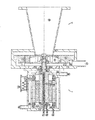
- ORC turbogenerator according to the invention will be explained in more detail below with reference to an embodiment in conjunction with a figure.
- the same reference numbers are used for identical or identically acting parts.
- turbo-generator is divided into a generator section A and a turbine section B in the following explanation.
- the entire turbogenerator has a compact and integrated construction, with sections A and B together forming a self-contained device.
- the turbine section consists of a turbine housing 1 with a rotatably mounted within the housing impeller.
- the impeller has an impeller base 2, a series of impeller blades 3 and an impeller cover 4.
- the impeller is exposed to the vaporous working medium via a nozzle.
- the nozzle consists of a nozzle main body 5, a stream of the working medium optimally conductive nozzle opening 6 and a nozzle spacer 7 for locking the nozzle in a convenient aerodynamic position to the impeller in the turbine section.
- a fastening bolt 8 ensures a secure fit of the impeller on a shaft 17, whose structure is shown in more detail below.
- the turbine impeller is driven tangentially, while the working fluid leaves the turbine section in the axial direction.
- the supply of the working medium via a Zudampfö réelle 9, which opens into a Zudampfkanal 10.
- the Zudampfkanal 10 passes the hot, vaporous working medium in the mentioned nozzle opening 6 on.
- the working fluid After leaving the turbine wheel, the working fluid enters a Abdampfdiffusor 11, which derives the working medium to the outside via a Abdampfö réelle 30.
- the generator section A connects via a bearing plate 12 to the turbine section B. Via a pressure equalization bore 13, the interior of the generator section A, in particular its runner space 22, with the interior of the turbine section B, in particular the space of the impeller connected. Both the impeller in the turbine section, as well as the rotor of the generator section are mounted in a common slide bearing 14 and sit on the generator shaft 17. The generator shaft 17 is guided into the turbine section B. The impeller of the turbine section is connected there via the already mentioned fastening bolt 8 with the shaft 17.
- the generator shaft 17 has one or more sliding bearing bores 15, which are in communication with a central bore 16 in the interior of the generator shaft. Via the central bore 16, the condensate of the ORC working medium is guided, wherein the generator shaft 17 is cooled and at the same time the running surface of the sliding bearing 14 is lubricated by the over the sliding bearing bore 15 pressed out condensate.
- the central bore 16 is charged via a standing within the bore cooling tube 27.
- the condensate therein passes under pressure both on the sliding bearing 14 on the drive side of the generator section, as well as on a comparable second bearing 14 b on the generator side.
- the condensate is discharged after passing through the sliding bearing 14 via the Abdampfdiffusor 11 to the outside with the flow of the working medium.
- the generator section is designed as a permanently excited synchronous generator.
- the rotor of the generator consists of a series of placed on the shaft 17 permanent magnet 18.
- the permanent magnets may for example be glued or secured with carbon fiber bands.
- the stator winding consists in the illustrated embodiment of a stator winding 19 which is provided with a potting 20.
- the stator and thus the entire generator section is housed in a stator housing 21, which connects directly to the turbine section B and the housing 1 and is sealed to this.
- the rotor chamber 22 is vented by the pressure equalization bore 13 continuously in the direction of the turbine section, in particular of the turbine interior. As a result of the prevailing fluid mechanics there is formed a partial negative pressure, which leads to a reduction of air friction in the runner space.
- the stator housing 21 is cooled for thermal decoupling of the generator section A from the turbine section B. As a result, the heads of the stator winding in the generator section are protected against overheating.
- the stator housing at least in the connection region to the turbine section, that is to say on the drive side of the generator, has an annular cavity 23 through which a coolant flows radially.
- the cavity 23 is followed in this embodiment, the actual stator cooling 24, which extends at least partially over the lateral surface of the stator housing and flows through the coolant in the axial direction.
- the components 23 and 24 are charged or emptied by a coolant flow 25 and a coolant return 26.
- the central bore 16 is as described by the cooling tube 27 fed.
- the coolant flowing therein is forced into the central bore and exits via the sliding bearing bores 15 and 15b in the sliding bearings 14 and 14b.
- the coolant, for which the condensate of the working medium is used as described emerges from the plain bearing 14 in the runner space 22 and is partially sucked from there into the turbine section B or removed from the runner space via a coolant outlet 29.
- the existing within the sliding bearing 14 b condensate leaves the area of the generator shaft 17 via a return line 28.
- the terminals 27, 28 and 28 form portions of an external, the turbo-generator associated coolant circuit to which also the inlets and outlets 25 and 26 may be connected.
- the generator also has the usual electrical cable connections. In the example shown, these are led out of the stator winding via a cable partition 31 into a terminal box 32 with a conventional electrical circuit, for example a rectifier circuit or the like, mounted therein.
- a conventional electrical circuit for example a rectifier circuit or the like
Landscapes
- Engineering & Computer Science (AREA)
- Power Engineering (AREA)
- Chemical & Material Sciences (AREA)
- Combustion & Propulsion (AREA)
- Mechanical Engineering (AREA)
- General Engineering & Computer Science (AREA)
- Motor Or Generator Cooling System (AREA)
- Connection Of Motors, Electrical Generators, Mechanical Devices, And The Like (AREA)
Abstract
Description
- Die Erfindung betrifft einen Organic Rankine Zyklus (ORC)-Turbogenerator in einer axialen Anordnung zwischen einem Turbinen-Dampfgehäuse und einem Generatorabschnitt nach dem Oberbegriff des Anspruchs 1.
- Der Organic Rankine Zyklus (ORC für engl. organic rankine cycle) ist ein thermodynamisches Verfahren zum Betrieb von Dampfturbinen mit einem anderen Arbeitsmittel als Wasser bzw. Wasserdampf. Als Arbeitsmedium werden bei diesem Kreisprozess meist organische Flüssigkeiten mit einer niedrigen Verdampfungstemperatur verwendet. Ein solches Verfahren wird vor allem dann eingesetzt, wenn das zur Verfügung stehende Temperaturgefälle zwischen Wärmequelle und Wärmesenke zu niedrig für eine mit Wasserdampf angetriebene Turbine ist. Ein derartiger Zyklus wird daher vorwiegend zur Stromerzeugung mit Hilfe der Geothermie, einer Kraft-Wärme-Kopplung, bei Solarteichkraftwerken oder Meereswärmekraftwerken eingesetzt.
- Bei kleinen Anlagen mit einer Leistung von weniger als 500 kW sind die spezifischen Kosten einer Turbinen-Generatoreinheit in einer herkömmlichen Bauform zu groß. Im Gegensatz zu Dampfturbinen laufen die entsprechenden thermodynamischen Kreisprozesse bei einer wesentlich niedrigeren Temperatur ab. Dadurch besteht die Möglichkeit, die Turbine und den Generator zu einer Einheit zusammen zufassen. Dazu wird in einer bekannten Ausführungsform auf eine axiale Anordnung aus Turbine und Generator zurückgegriffen. Dabei ist das Schaufelrad der Turbine direkt auf der Generatorwelle befestigt. Die Befestigung wird bevorzugt als eine sich selbst zentrierende Befestigung, z.B. eine Hirtverzahnung ausgeführt. Die Turbinenwelle wird hierbei mittels einer Gleitringdichtung nach außen hin abgedichtet und führt direkt in den dahinter angekoppelten Generator.
- Derartige Ausführungsformen weisen jedoch das Problem auf, dass das Arbeitsmedium vor allem bei hohen Drehzahlen der Turbine durch die Gleitringdichtung an der Verbindungsstelle zwischen Turbine und Generator infolge von Materialermüdungen und daraus resultierenden Lecks der Gleitringdichtung nach außen dringen kann. Derartige Turbogeneratoren erfordern somit einen erhöhten Wartungsaufwand und damit einhergehende größere Unterhaltungskosten.
- Es besteht somit die Aufgabe, einen Turbogenerator zum Einsatz in einem ORC-Kreisprozess anzugeben, der einen robusten, wartungsarmen und auch bei sehr hohen Drehzahlen leckagesicheren Aufbau aufweist. Der geforderte Turbogenerator soll außerdem eine optimale innere Kühlung bei einem möglichst kompakten und platzsparenden Aufbau aufweisen.
- Die Aufgabe wird mit einem ORC-Turbogenerator mit den Merkmalen des Anspruchs 1 gelöst, wobei die Unteransprüche zweckmäßige bzw. vorteilhafte Ausführungsformen enthalten.
- Erfindungsgemäß ist der ORC-Turbogenerator dadurch gekennzeichnet, dass der Generatorabschnitt ein zur Umgebung hin dichtes und druckfest ausgebildetes Statorgehäuse in Verbindung mit einem in Richtung des Abdampfraumes des Turbinenabschnittes offenen Läuferraum aufweist.
- Im Gegensatz zu den aus dem Stand der Technik bekannten Ausführungsformen, bei denen der Turbinenabschnitt und der Generatorabschnitt strikt voneinander getrennt sind, bildet bei dem erfindungsgemäßen ORC-Turbogenerator der Stator des Generatorabschnittes zusammen mit der Außenhülle des Turbinenabschnitts eine durchgängige und zur Umgebung hin drucksichere und absolut dichte Hülle, während der Läuferraum im Inneren des Stators mit dem Abdampfraum in Verbindung steht. Damit entfällt einerseits die Gleitlagerdichtung vollständig, wobei sich der Dichtungsaufwand an der Turbinenwelle beträchtlich verringert und höhere Drehzahlen des Turbogenerators erreicht werden können. Die Luftreibung im Läuferinnenraum zwischen Läufer und Stator wird durch den im Abdampfraum des Turbinenabschnitts herrschenden Unterdruck minimiert, wodurch sich die Laufleistung des Turbogenerators zusätzlich erhöht.
- Die Lagerung einer Generatorwelle ist zweckmäßigerweise in Form mindestens eines durch das Kondensat des ORC-Arbeitsmittels geschmierten Gleitlagers ausgebildet. Das Gleitlager dient zur Lagerung sowohl des Läufers im Generatorabschnitt, als auch des im Turbinenabschnitt angeordneten Turbinenläufers. Durch den Einsatz des kondensierten und sich in der Dampfphase wieder selbst von Verunreinigungen scheidenden ORC-Arbeitsmediums als Schmiermittel wird ein auch nach längeren Benutzungszeiten hochreiner und ein autark wirkender Schmiermittelkreislauf geschaffen.
- Die Kühlung des Generatorabschnittes ist in Form einer durch das Kondensat des ORC-Arbeitsmediums durchströmten Kanalanordnung innerhalb des Läufers und/oder Stators ausgebildet. Dadurch wird zusätzlich ein hochreiner Kühlmittelkreislauf gebildet.
- Der Läufer weist bei einer vorteilhaften Ausführungsform eine innerhalb der Generatorwelle eingebrachte zentrische Bohrung mit einem innerhalb der Bohrung stehenden, das Kondensat einleitenden Kühlrohr auf. Durch diese vorteilhafte Ausgestaltung wird ein Heißlaufen des Läufers durch eine Wärmeabfuhr durch das innerhalb des Läufers strömende ORC-Kondensat verhindert.
- Zusätzlich dazu ist bei einer vorteilhaften Ausgestaltung mindestens eine, die zentrische Bohrung im Läufer mit der Gleitfläche des Gleitlagers verbindende und das Kondensat von der zentrischen Bohrung in das Gleitlager zuführende Gleitlagerbohrung vorgesehen. Die Schmierung des Gleitlagers wird durch diese Ausbildung mit dem Kühlmittelkreislauf innerhalb des Läufers gekoppelt, wobei der Läufer gekühlt und das Gleitlager gezielt geschmiert wird.
- Zusätzlich dazu ist eine thermische Entkoppelung mindestens zwischen dem Stator und dem Dampfgehäuse des Turbinenabschnittes in Form mindestens eines radial von einem Kühlmittel durchströmten, im Statorgehäuse vorgesehenen Hohlraumes zweckmäßig. Diese Ausgestaltung dient der Kühlung des Stators, insbesondere der nahe dem Dampfraum des Turbinenabschnittes gelegenen Statorabschnitte und einer Verhinderung einer thermischen Überlastung des Stators und damit des Generatorabschnittes.
- Das den Hohlraum durchströmende Kühlmittel kann ebenfalls das Kondensat des ORC-Arbeitsmittels sein. In diesem Fall wird das Arbeitsmittel in dem Arbeitsmittelkreislauf zum Antreiben der Turbine und in dem Kühl- und Schmiermittelkreislauf ungetrieben werden.
- Der erfindungsgemäße ORC-Turbogenerator soll nachfolgend anhand eines Ausführungsbeispiels in Verbindung mit einer Figur näher erläutert werden. Es werden für gleiche bzw. gleich wirkende Teile die selben Bezugszeichen verwendet.
- Für eine verständlichere Darstellung wird der Turbogenerator bei der folgenden Erläuterung in einen Generatorabschnitt A und einen Turbinenabschnitt B unterteilt. Der gesamte Turbogenerator weist jedoch einen kompakten und integrierten Aufbau auf, wobei die Abschnitte A und B zusammen eine in sich geschlossene Vorrichtung bilden.
- Der Turbinenabschnitt besteht aus einem Turbinengehäuse 1 mit einem innerhalb des Gehäuses drehbar gelagerten Laufrad. Das Laufrad weist ein Laufradunterteil 2, eine Reihe von Laufradschaufeln 3 und ein Laufraddeckband 4 auf. Über eine Düse wird das Laufrad mit dem dampfförmigen Arbeitsmedium beaufschlagt. Die Düse besteht aus einem Düsengrundkörper 5, einer den Strom des Arbeitsmediums optimal leitenden Düsenöffnung 6 und einem Düsenabstandshalter 7 zum Arretieren der Düse in einer zweckmäßigen strömungsgünstigen Stellung zum Laufrad im Turbinenabschnitt. Ein Befestigungsbolzen 8 gewährleistet einen sicheren Sitz des Laufrades auf einer Welle 17, deren Aufbau weiter unten näher dargestellt wird.
- Bei dem hier gezeigten Beispiel wird das Turbinenlaufrad tangential angetrieben, während das Arbeitsmedium den Turbinenabschnitt in axialer Richtung verläßt. Die Zuführung des Arbeitsmediums erfolgt über eine Zudampföffnung 9, die in einen Zudampfkanal 10 mündet. Der Zudampfkanal 10 leitet das heiße, dampfförmige Arbeitsmedium in die erwähnte Düsenöffnung 6 weiter. Nach dem Verlassen des Turbinenlaufrades gelangt das Arbeitsmedium in einem Abdampfdiffusor 11, der über eine Abdampföffnung 30 das Arbeitsmedium nach außen ableitet.
- Der Generatorabschnitt A schließt sich über ein Lagerschild 12 an den Turbinenabschnitt B an. Über eine Druckausgleichsbohrung 13 ist das Innere des Generatorabschnittes A, insbesondere dessen Läuferraum 22, mit dem Inneren des Turbinenabschnittes B, insbesondere dem Raum des Laufrades, verbunden. Sowohl das Laufrad im Turbinenabschnitt, als auch der Läufer des Generatorabschnittes sind in einem gemeinsamen Gleitlager 14 gelagert und sitzen auf der Generatorwelle 17 auf. Die Generatorwelle 17 ist bis in den Turbinenabschnitt B geführt. Das Laufrad des Turbinenabschnittes ist dort über den bereits genannten Befestigungsbolzen 8 mit der Welle 17 verbunden.
- Die Generatorwelle 17 weist eine oder mehrere Gleitlagerbohrungen 15 auf, die mit einer zentrischen Bohrung 16 im Inneren der Generatorwelle in Verbindung stehen. Über die zentrische Bohrung 16 wird das Kondensat des ORC-Arbeitsmediums geführt, wobei die Generatorwelle 17 gekühlt und gleichzeitig die Lauffläche des Gleitlagers 14 durch das über die Gleitlagerbohrung 15 heraus gepresste Kondensat geschmiert wird. Die zentrische Bohrung 16 wird über ein innerhalb der Bohrung stehendes Kühlrohr 27 beschickt. Das darin befindliche Kondensat gelangt unter Druck sowohl auf das Gleitlager 14 auf der Antriebsseite des Generatorabschnittes, als auch auf ein vergleichbares zweites Lager 14b auf der Generatorseite.
- Das Kondensat wird nach dem Durchlaufen des Gleitlagers 14 über den Abdampfdiffusor 11 nach außen mit dem Strom des Arbeitsmediums abgeleitet.
- In dem hier dargestellten Ausführungsbeispiel ist der Generatorabschnitt als ein permanent erregter Synchrongenerator ausgebildet. Der Läufer des Generators besteht dabei aus einer Reihe von auf die Welle 17 aufgesetzten Permanentmagneten 18. Die Permanentmagnete können beispielsweise aufgeklebt oder mit Kohlefaserbandagen gesichert sein. Die Statorwicklung besteht in dem dargestellten Ausführungsbeispiel aus einer Ständerwicklung 19, die mit einem Verguss 20 versehen ist. Der Stator und damit der gesamte Generatorabschnitt ist in einem Ständergehäuse 21 untergebracht, das direkt an den Turbinenabschnitt B bzw. dessen Gehäuse 1 anschließt und mit diesem dicht verbunden ist. Wie erwähnt wird der Läuferraum 22 durch die Druckausgleichsbohrung 13 fortlaufend in Richtung des Turbinenabschnittes, insbesondere des Turbineninnenraums, entlüftet. Infolge der dort herrschenden Strömungsmechanik bildet sich ein teilweiser Unterdruck aus, der zu einer Verringerung der Luftreibung im Läuferraum führt.
- Das Ständergehäuse 21 ist für eine thermische Entkopplung des Generatorabschnitts A vom Turbinenabschnitt B gekühlt. Dadurch werden die Köpfe der Statorwicklung im Generatorabschnitt vor einer Überhitzung geschützt. Hierzu weist das Ständergehäuse mindestens im Anschlussbereich zum Turbinenabschnitt, also auf der Antriebsseite des Generators, einen ringförmigen, radial von einem Kühlmittel durchströmten Hohlraum 23 auf. Dem Hohlraum 23 schließt sich in diesem Ausführungsbeispiel die eigentliche Statorkühlung 24 an, die sich mindestens abschnittsweise über die Mantelfläche des Ständergehäuses erstreckt und von dem Kühlmittel in axialer Richtung durchflossen wird. Die Komponenten 23 und 24 werden von einem Kühlmittelvorlauf 25 und einem Kühlmittelrücklauf 26 beschickt bzw. entleert.
- Die zentrische Bohrung 16 wird wie beschrieben von dem Kühlrohr 27 beschickt. Das darin strömende Kühlmittel wird in die zentrische Bohrung gedrückt und tritt über die Gleitlagerbohrungen 15 und 15b in die Gleitlager 14 und 14b aus. Das Kühlmittel, für das wie beschrieben das Kondensat des Arbeitsmediums verwendet wird, tritt aus dem Gleitlager 14 in den Läuferraum 22 und wird von dort teilweise in den Turbinenabschnitt B abgesaugt oder über einen Kühlmittelablauf 29 aus dem Läuferraum entfernt. Das innerhalb des Gleitlagers 14b vorhandene Kondensat verlässt den Bereich der Generatorwelle 17 über einen Rücklauf 28. Die Anschlüsse 27, 28 und 28 bilden Abschnitte eines externen, dem Turbogenerator zugeordneten Kühlmittelkreislaufs, an den auch die Zu- und Abläufe 25 und 26 angeschlossen sein können. Bei der Verwendung des Kondensates des Arbeitsmediums als Kühl- und Schmiermittel des Turbogenerators liegt es nahe, die Anschlüsse für den Zu- und Rücklauf des Kühlmittels an den Vorratsbehälter des kondensierten Arbeitsmediums anzuschließen. Die für den thermodynamischen Kreisprozess notwendige Speisepumpe erzeugt in diesem Fall den für den Kühl- und Schmiermittelkreislauf erforderlichen Druck. Das Kondensat selbst ist weitgehend frei von Verunreinigungen, da es im thermodynamischen Kreisprozess eine Dampfphase durchläuft, bei dem sich das Arbeitsmedium von den eingetragenen Verunreinigungen durch Destillationsprozesse trennt.
- Der Generator weist weiterhin die üblichen elektrischen Kabelanschlüsse auf. In dem gezeigten Beispiel sind diese aus der Statorwicklung über eine Kabelsabschottung 31 in einen Klemmkasten 32 mit einer darin angebrachten üblichen elektrischen Schaltung, beispielsweise einer Gleichrichterschaltung oder dergleichen geführt.
- Es ist klar, dass im Rahmen fachmännischen Handelns an dem gezeigten Ausführungsbeispiel eine Reihe von Änderungen erfolgen können, ohne den erfindungsgemäßen Grundgedanken zu verlassen. Weitere Ausführungsformen ergeben sich aus den Unteransprüchen.
-
- A
- Generatorabschnitt
- B
- Turbinenabschnitt
- 1
- Turbinengehäuse
- 2
- Laufradunterteil
- 3
- Laufradschaufeln
- 4
- Laufraddeckband
- 5
- Düsengrundkörper
- 6
- Düsenöffnung
- 7
- Düsenabstandshalter
- 8
- Befestigungsbolzen
- 9
- Zudampföffnung
- 10
- Zudampfkanal
- 11
- Abdampfdiffusor
- 12
- Lagerschild
- 13
- Druckausgleichsbohrung
- 14
- Gleitlager
- 14b
- zweites Gleitlager
- 15
- Gleitlagerbohrung
- 15b
- zweite Gleitlagerbohrung
- 16
- zentrische Bohrung
- 17
- Generatorwelle
- 18
- Permanentmagnet
- 19
- Ständerwicklung
- 20
- Verguss
- 21
- Ständergehäuse
- 22
- Läuferraum
- 23
- Hohlraum
- 24
- Statorkühlung
- 25
- Kühlmittelvorlauf
- 26
- Kühlmittelrücklauf
- 27
- Kühlrohr
- 28
- Rücklauf
- 29
- Kühlmittelablauf
- 30
- Turbineabdampföffnung
- 31
- Kabelabschottung
- 32
- Klemmkasten
Claims (9)
- Organic Rankine Zyklus (ORC)-Turbogenerator für ein ORC-Arbeitsmittel und einem Kondensat dieses ORC-Arbeitsmittels in einer axialen Anordnung mit einem Generatorabschnitt (A) und Turbinenabschnitt (B), wobei der Generatorabschnitt (A) ein zur Umgebung hin dichtes und druckfest ausgebildetes Statorgehäuse (21) mit einem in Richtung des Abdampfraums (11) des Turbinenabschnitts offenen Läuferraum (22) aufweist,
dadurch gekennzeichnet, dass
mindestens ein durch das Kondensat des ORC-Arbeitsmittels geschmiertes Gleitlager (14) zur Lagerung der Generatorwelle (17) vorgesehen ist, wobei die Generatorwelle (17) mindestens eine Gleitlagerbohrung (15) aufweist, die mit einer zentrischen Bohrung (16) im Inneren der Generatorwelle (17) in Verbindung steht. - Turbogenerator nach Anspruch 1,
dadurch gekennzeichnet, dass
die mindestens eine Gleitlagerbohrung (15) die zentrische Bohrung (16) mit einer Gleitfläche des Gleitlagers (14) verbindet und das Kondensat von der zentrischen Bohrung (16) in das Gleitlager zuführt. - Turbogenerator nach Anspruch 1 oder 2,
dadurch gekennzeichnet, dass
das Kondensat nach dem Durchlaufen des Gleitlagers (14) über einen Abdampfdiffusor (11) nach außen mit einem Strom des ORC-Arbeitsmittels abgeleitet wird. - Turbogenerator nach Anspruch 1,
dadurch gekennzeichnet, dass
die Kühlung des Generatorabschnitts (A) in Form einer durch das Kondensat des ORC-Arbeitsmittels durchströmten Kanalanordnung innerhalb des Läufers und/oder Stators ausgebildet ist. - Turbogenerator nach Anspruch 4,
dadurch gekennzeichnet, dass
der Läufer die innerhalb der Generatorwelle (17) eingebrachte zentrische Bohrung (16) mit einem innerhalb der Bohrung (16) stehenden, das Kondensat einleitenden Kühlrohr (27) aufweist. - Turbogenerator nach einem der vorangegangenen Ansprüche,
gekennzeichnet durch
eine thermische Entkopplung zwischen mindestens einem Stator und einem Dampfgehäuse des Turbinenabschnitts (B) in Form mindestens eines radial von einem Kühlmittel durchströmten, im Statorgehäuse (21) vorgesehenen Hohlraums (23). - Turbogenerator nach Anspruch 6,
dadurch gekennzeichnet, dass
das den Hohlraum (23) durchströmende Kühlmittel das Kondensat des ORC-Arbeitsmittels ist. - Turbogenerator nach Anspruch 6 oder 7,
dadurch gekennzeichnet, dass
der Hohlraum (23) im Statorgehäuse (21) im Anschlussbereich zum Turbinenabschnitt ringförmig ist und radial vom Kühlmittel durchflossen wird. - Turbogenerator nach einem der Ansprüche 6 bis 8,
dadurch gekennzeichnet, dass
sich an den Hohlraum (23) eine Statorkühlung (24) anschließt, die sich mindestens abschnittsweise über die Mantelfläche des Statorgehäuses (21) erstreckt und vom Kühlmittel in axialer Richtung durchflossen wird.
Applications Claiming Priority (3)
| Application Number | Priority Date | Filing Date | Title |
|---|---|---|---|
| DE102006004836A DE102006004836A1 (de) | 2005-11-17 | 2006-02-02 | Organic Rankine Zyklus (ORC)- Turbogenerator |
| EP07726279.8A EP1984602B1 (de) | 2006-02-02 | 2007-02-02 | Organic rankine zyklus (orc) - turbogenerator |
| PCT/EP2007/051002 WO2007088194A2 (de) | 2006-02-02 | 2007-02-02 | Organic rankine zyklus (orc) - turbogenerator |
Related Parent Applications (1)
| Application Number | Title | Priority Date | Filing Date |
|---|---|---|---|
| EP07726279.8A Division EP1984602B1 (de) | 2006-02-02 | 2007-02-02 | Organic rankine zyklus (orc) - turbogenerator |
Publications (2)
| Publication Number | Publication Date |
|---|---|
| EP3000994A1 true EP3000994A1 (de) | 2016-03-30 |
| EP3000994B1 EP3000994B1 (de) | 2019-01-02 |
Family
ID=38327743
Family Applications (2)
| Application Number | Title | Priority Date | Filing Date |
|---|---|---|---|
| EP07726279.8A Active EP1984602B1 (de) | 2006-02-02 | 2007-02-02 | Organic rankine zyklus (orc) - turbogenerator |
| EP15189987.9A Active EP3000994B1 (de) | 2006-02-02 | 2007-02-02 | Organischer rankine prozess (orc) - turbogenerator |
Family Applications Before (1)
| Application Number | Title | Priority Date | Filing Date |
|---|---|---|---|
| EP07726279.8A Active EP1984602B1 (de) | 2006-02-02 | 2007-02-02 | Organic rankine zyklus (orc) - turbogenerator |
Country Status (3)
| Country | Link |
|---|---|
| EP (2) | EP1984602B1 (de) |
| DE (1) | DE202007018540U1 (de) |
| WO (1) | WO2007088194A2 (de) |
Cited By (1)
| Publication number | Priority date | Publication date | Assignee | Title |
|---|---|---|---|---|
| DE102017010966B4 (de) * | 2016-12-01 | 2021-03-25 | Fanuc Corporation | Motor |
Families Citing this family (20)
| Publication number | Priority date | Publication date | Assignee | Title |
|---|---|---|---|---|
| US8839622B2 (en) | 2007-04-16 | 2014-09-23 | General Electric Company | Fluid flow in a fluid expansion system |
| CN102804292B (zh) | 2009-06-24 | 2014-10-22 | 株式会社村田制作所 | 电子元器件及其制造方法 |
| US8400005B2 (en) | 2010-05-19 | 2013-03-19 | General Electric Company | Generating energy from fluid expansion |
| IT1400053B1 (it) | 2010-05-24 | 2013-05-17 | Nuovo Pignone Spa | Metodi e sistemi per ugelli di ingresso a geometria variabile per uso in turboespansori. |
| US8739538B2 (en) | 2010-05-28 | 2014-06-03 | General Electric Company | Generating energy from fluid expansion |
| DE102010056299A1 (de) * | 2010-12-24 | 2012-06-28 | Robert Bosch Gmbh | Abwärmenutzungsanlage |
| WO2013028088A1 (en) * | 2011-08-19 | 2013-02-28 | Siemens Aktiengesellschaft | Device for the production of electric current from waste heat |
| US9689281B2 (en) * | 2011-12-22 | 2017-06-27 | Nanjing Tica Air-Conditioning Co., Ltd. | Hermetic motor cooling for high temperature organic Rankine cycle system |
| GB2497943A (en) | 2011-12-22 | 2013-07-03 | Cummins Ltd | Internal combustion engine and waste heat recovery system |
| US9018778B2 (en) | 2012-01-04 | 2015-04-28 | General Electric Company | Waste heat recovery system generator varnishing |
| US8984884B2 (en) | 2012-01-04 | 2015-03-24 | General Electric Company | Waste heat recovery systems |
| US9024460B2 (en) | 2012-01-04 | 2015-05-05 | General Electric Company | Waste heat recovery system generator encapsulation |
| DE102012100646B4 (de) * | 2012-01-26 | 2017-03-16 | Saxess Holding Gmbh | Turbinen- und Generatorgehäuse |
| RU2555100C1 (ru) * | 2014-03-13 | 2015-07-10 | Федеральное государственное бюджетное образовательное учреждение высшего профессионального образования "Уфимский государственный авиационный технический университет" | Роторная система магнитоэлектрической машины |
| US20170373562A1 (en) * | 2015-02-11 | 2017-12-28 | Aqylon | Thermodynamic system |
| FR3032520A1 (fr) * | 2015-02-11 | 2016-08-12 | Aqylon | Systeme thermodynamique |
| DE102017215698A1 (de) | 2017-09-06 | 2019-03-07 | Mahle International Gmbh | Kühlsystem für ein Turbinenlager |
| DE102017219189A1 (de) | 2017-10-26 | 2019-05-02 | Mahle International Gmbh | Kühlsystem für Turbinenelemente |
| DE102019206120A1 (de) * | 2019-04-29 | 2020-10-29 | Audi Ag | Verdichtungseinheit für ein Brennstoffzellensystem und Brennstoffzellensystem |
| US12180960B2 (en) | 2023-05-15 | 2024-12-31 | Spherical Rotors Inc. | Rotary positive displacement device |
Citations (2)
| Publication number | Priority date | Publication date | Assignee | Title |
|---|---|---|---|---|
| US3393515A (en) * | 1965-09-16 | 1968-07-23 | Israel State | Power generating units |
| US3800174A (en) * | 1973-04-09 | 1974-03-26 | Gen Electric | Liquid transfer assembly for a liquid cooled dynamoelectric machine |
Family Cites Families (5)
| Publication number | Priority date | Publication date | Assignee | Title |
|---|---|---|---|---|
| US2173489A (en) * | 1936-10-09 | 1939-09-19 | Westinghouse Electric & Mfg Co | High temperature turbine |
| US3061733A (en) * | 1958-04-21 | 1962-10-30 | Thompson Ramo Wooidridge Inc | Hermetically sealed power generator |
| US4362020A (en) | 1981-02-11 | 1982-12-07 | Mechanical Technology Incorporated | Hermetic turbine generator |
| FI913367A0 (fi) * | 1991-07-11 | 1991-07-11 | High Speed Tech Ltd Oy | Foerfarande och anordning foer att foerbaettra nyttighetsfoerhaollande av en orc-process. |
| US6892522B2 (en) * | 2002-11-13 | 2005-05-17 | Carrier Corporation | Combined rankine and vapor compression cycles |
-
2007
- 2007-02-02 WO PCT/EP2007/051002 patent/WO2007088194A2/de not_active Ceased
- 2007-02-02 EP EP07726279.8A patent/EP1984602B1/de active Active
- 2007-02-02 EP EP15189987.9A patent/EP3000994B1/de active Active
- 2007-02-02 DE DE202007018540U patent/DE202007018540U1/de not_active Expired - Lifetime
Patent Citations (2)
| Publication number | Priority date | Publication date | Assignee | Title |
|---|---|---|---|---|
| US3393515A (en) * | 1965-09-16 | 1968-07-23 | Israel State | Power generating units |
| US3800174A (en) * | 1973-04-09 | 1974-03-26 | Gen Electric | Liquid transfer assembly for a liquid cooled dynamoelectric machine |
Cited By (1)
| Publication number | Priority date | Publication date | Assignee | Title |
|---|---|---|---|---|
| DE102017010966B4 (de) * | 2016-12-01 | 2021-03-25 | Fanuc Corporation | Motor |
Also Published As
| Publication number | Publication date |
|---|---|
| EP1984602B1 (de) | 2015-10-21 |
| WO2007088194A3 (de) | 2008-07-31 |
| DE202007018540U1 (de) | 2008-11-13 |
| EP1984602A2 (de) | 2008-10-29 |
| WO2007088194A2 (de) | 2007-08-09 |
| EP3000994B1 (de) | 2019-01-02 |
Similar Documents
| Publication | Publication Date | Title |
|---|---|---|
| EP1984602B1 (de) | Organic rankine zyklus (orc) - turbogenerator | |
| DE102006004836A1 (de) | Organic Rankine Zyklus (ORC)- Turbogenerator | |
| DE4121430C1 (de) | ||
| DE3910451C2 (de) | ||
| DE102017120039B4 (de) | Kühlmittelpumpe mit anwendungsoptimiertem Aufbau | |
| EP3262305B1 (de) | Lader, insbesondere abgasturbolader, für eine antriebseinrichtung sowie entsprechende antriebseinrichtung | |
| DE102007033457A1 (de) | Elektrische Maschine mit einem flüssigkeitsgekühlten Rotor | |
| EP2305981A1 (de) | Elektrischer Turbolader | |
| DE102011087602A1 (de) | Elektrische Maschine | |
| DE102012221298A1 (de) | Ladeeinrichtung eines Antriebsaggregats | |
| DE102011112250A1 (de) | Hilfsgerätegetriebeeinrichtung für ein Triebwerk | |
| DE102010064061A1 (de) | Turboverdichter und Verfahren zur Verdichtung von Gas | |
| DE102014205380A1 (de) | Kühlvorrichtung und -verfahren für eine rotorintegrierte Kupplung für Hybridmodule | |
| DE102019207325A1 (de) | Kühlanordnung für eine elektrische Maschine und elektrische Maschine | |
| DE102020129525A1 (de) | Abgasturbolader | |
| WO2019166311A1 (de) | Lagerung und antrieb für einen r718-verdichter | |
| DE112020007883T5 (de) | Elektromotor mit Kühlanordnung und Verfahren zur Steuerung einer Kühlanordnung | |
| DE102006045178A1 (de) | Elektrische Maschine | |
| EP1574714B1 (de) | Pumpenaggregat | |
| DE102018117939A1 (de) | Elektrischer Antrieb mit gekühlter Ölversorgungseinrichtung | |
| DE3247888A1 (de) | Antrieb eines langsam laufenden ringfoermigen rotors einer arbeitsmaschine durch einen elektrischen motor | |
| DE4330520C2 (de) | Bohrgerät mit Kühlung | |
| DE102021130563A1 (de) | Hohlwellenkühleinrichtung | |
| DE102006029888B3 (de) | Kompressoranlage | |
| DE887917C (de) | Kuehlung verbrennungselektrischer Fahrzeugantriebe, insbesondere von Kettenfahrzeugen |
Legal Events
| Date | Code | Title | Description |
|---|---|---|---|
| PUAI | Public reference made under article 153(3) epc to a published international application that has entered the european phase |
Free format text: ORIGINAL CODE: 0009012 |
|
| AC | Divisional application: reference to earlier application |
Ref document number: 1984602 Country of ref document: EP Kind code of ref document: P |
|
| AK | Designated contracting states |
Kind code of ref document: A1 Designated state(s): AT BE BG CH CY CZ DE DK EE ES FI FR GB GR HU IE IS IT LI LT LU LV MC NL PL PT RO SE SI SK TR |
|
| RAP1 | Party data changed (applicant data changed or rights of an application transferred) |
Owner name: DUERR CYPLAN LTD. Owner name: ECKERT, FRANK |
|
| 17P | Request for examination filed |
Effective date: 20160727 |
|
| RBV | Designated contracting states (corrected) |
Designated state(s): AT BE BG CH CY CZ DE DK EE ES FI FR GB GR HU IE IS IT LI LT LU LV MC NL PL PT RO SE SI SK TR |
|
| RAP1 | Party data changed (applicant data changed or rights of an application transferred) |
Owner name: DUERR CYPLAN LTD. |
|
| GRAP | Despatch of communication of intention to grant a patent |
Free format text: ORIGINAL CODE: EPIDOSNIGR1 |
|
| STAA | Information on the status of an ep patent application or granted ep patent |
Free format text: STATUS: GRANT OF PATENT IS INTENDED |
|
| INTG | Intention to grant announced |
Effective date: 20180723 |
|
| GRAS | Grant fee paid |
Free format text: ORIGINAL CODE: EPIDOSNIGR3 |
|
| GRAA | (expected) grant |
Free format text: ORIGINAL CODE: 0009210 |
|
| STAA | Information on the status of an ep patent application or granted ep patent |
Free format text: STATUS: THE PATENT HAS BEEN GRANTED |
|
| AC | Divisional application: reference to earlier application |
Ref document number: 1984602 Country of ref document: EP Kind code of ref document: P |
|
| AK | Designated contracting states |
Kind code of ref document: B1 Designated state(s): AT BE BG CH CY CZ DE DK EE ES FI FR GB GR HU IE IS IT LI LT LU LV MC NL PL PT RO SE SI SK TR |
|
| REG | Reference to a national code |
Ref country code: GB Ref legal event code: FG4D Free format text: NOT ENGLISH |
|
| REG | Reference to a national code |
Ref country code: CH Ref legal event code: EP Ref country code: AT Ref legal event code: REF Ref document number: 1084645 Country of ref document: AT Kind code of ref document: T Effective date: 20190115 |
|
| REG | Reference to a national code |
Ref country code: IE Ref legal event code: FG4D Free format text: LANGUAGE OF EP DOCUMENT: GERMAN |
|
| REG | Reference to a national code |
Ref country code: DE Ref legal event code: R096 Ref document number: 502007016552 Country of ref document: DE |
|
| REG | Reference to a national code |
Ref country code: CH Ref legal event code: NV Representative=s name: DENNEMEYER AG, CH |
|
| REG | Reference to a national code |
Ref country code: SE Ref legal event code: TRGR |
|
| REG | Reference to a national code |
Ref country code: NL Ref legal event code: FP |
|
| REG | Reference to a national code |
Ref country code: LT Ref legal event code: MG4D |
|
| PG25 | Lapsed in a contracting state [announced via postgrant information from national office to epo] |
Ref country code: PT Free format text: LAPSE BECAUSE OF FAILURE TO SUBMIT A TRANSLATION OF THE DESCRIPTION OR TO PAY THE FEE WITHIN THE PRESCRIBED TIME-LIMIT Effective date: 20190502 Ref country code: ES Free format text: LAPSE BECAUSE OF FAILURE TO SUBMIT A TRANSLATION OF THE DESCRIPTION OR TO PAY THE FEE WITHIN THE PRESCRIBED TIME-LIMIT Effective date: 20190102 Ref country code: LT Free format text: LAPSE BECAUSE OF FAILURE TO SUBMIT A TRANSLATION OF THE DESCRIPTION OR TO PAY THE FEE WITHIN THE PRESCRIBED TIME-LIMIT Effective date: 20190102 Ref country code: PL Free format text: LAPSE BECAUSE OF FAILURE TO SUBMIT A TRANSLATION OF THE DESCRIPTION OR TO PAY THE FEE WITHIN THE PRESCRIBED TIME-LIMIT Effective date: 20190102 |
|
| PG25 | Lapsed in a contracting state [announced via postgrant information from national office to epo] |
Ref country code: BG Free format text: LAPSE BECAUSE OF FAILURE TO SUBMIT A TRANSLATION OF THE DESCRIPTION OR TO PAY THE FEE WITHIN THE PRESCRIBED TIME-LIMIT Effective date: 20190402 Ref country code: IS Free format text: LAPSE BECAUSE OF FAILURE TO SUBMIT A TRANSLATION OF THE DESCRIPTION OR TO PAY THE FEE WITHIN THE PRESCRIBED TIME-LIMIT Effective date: 20190502 Ref country code: GR Free format text: LAPSE BECAUSE OF FAILURE TO SUBMIT A TRANSLATION OF THE DESCRIPTION OR TO PAY THE FEE WITHIN THE PRESCRIBED TIME-LIMIT Effective date: 20190403 Ref country code: LV Free format text: LAPSE BECAUSE OF FAILURE TO SUBMIT A TRANSLATION OF THE DESCRIPTION OR TO PAY THE FEE WITHIN THE PRESCRIBED TIME-LIMIT Effective date: 20190102 |
|
| REG | Reference to a national code |
Ref country code: DE Ref legal event code: R097 Ref document number: 502007016552 Country of ref document: DE |
|
| PG25 | Lapsed in a contracting state [announced via postgrant information from national office to epo] |
Ref country code: CZ Free format text: LAPSE BECAUSE OF FAILURE TO SUBMIT A TRANSLATION OF THE DESCRIPTION OR TO PAY THE FEE WITHIN THE PRESCRIBED TIME-LIMIT Effective date: 20190102 Ref country code: RO Free format text: LAPSE BECAUSE OF FAILURE TO SUBMIT A TRANSLATION OF THE DESCRIPTION OR TO PAY THE FEE WITHIN THE PRESCRIBED TIME-LIMIT Effective date: 20190102 Ref country code: SK Free format text: LAPSE BECAUSE OF FAILURE TO SUBMIT A TRANSLATION OF THE DESCRIPTION OR TO PAY THE FEE WITHIN THE PRESCRIBED TIME-LIMIT Effective date: 20190102 Ref country code: LU Free format text: LAPSE BECAUSE OF NON-PAYMENT OF DUE FEES Effective date: 20190202 Ref country code: MC Free format text: LAPSE BECAUSE OF FAILURE TO SUBMIT A TRANSLATION OF THE DESCRIPTION OR TO PAY THE FEE WITHIN THE PRESCRIBED TIME-LIMIT Effective date: 20190102 Ref country code: EE Free format text: LAPSE BECAUSE OF FAILURE TO SUBMIT A TRANSLATION OF THE DESCRIPTION OR TO PAY THE FEE WITHIN THE PRESCRIBED TIME-LIMIT Effective date: 20190102 Ref country code: DK Free format text: LAPSE BECAUSE OF FAILURE TO SUBMIT A TRANSLATION OF THE DESCRIPTION OR TO PAY THE FEE WITHIN THE PRESCRIBED TIME-LIMIT Effective date: 20190102 |
|
| PLBE | No opposition filed within time limit |
Free format text: ORIGINAL CODE: 0009261 |
|
| STAA | Information on the status of an ep patent application or granted ep patent |
Free format text: STATUS: NO OPPOSITION FILED WITHIN TIME LIMIT |
|
| REG | Reference to a national code |
Ref country code: BE Ref legal event code: MM Effective date: 20190228 |
|
| REG | Reference to a national code |
Ref country code: IE Ref legal event code: MM4A |
|
| 26N | No opposition filed |
Effective date: 20191003 |
|
| PG25 | Lapsed in a contracting state [announced via postgrant information from national office to epo] |
Ref country code: IE Free format text: LAPSE BECAUSE OF NON-PAYMENT OF DUE FEES Effective date: 20190202 |
|
| PG25 | Lapsed in a contracting state [announced via postgrant information from national office to epo] |
Ref country code: BE Free format text: LAPSE BECAUSE OF NON-PAYMENT OF DUE FEES Effective date: 20190228 Ref country code: SI Free format text: LAPSE BECAUSE OF FAILURE TO SUBMIT A TRANSLATION OF THE DESCRIPTION OR TO PAY THE FEE WITHIN THE PRESCRIBED TIME-LIMIT Effective date: 20190102 |
|
| PG25 | Lapsed in a contracting state [announced via postgrant information from national office to epo] |
Ref country code: TR Free format text: LAPSE BECAUSE OF FAILURE TO SUBMIT A TRANSLATION OF THE DESCRIPTION OR TO PAY THE FEE WITHIN THE PRESCRIBED TIME-LIMIT Effective date: 20190102 |
|
| REG | Reference to a national code |
Ref country code: DE Ref legal event code: R081 Ref document number: 502007016552 Country of ref document: DE Owner name: DUERR SYSTEMS AG, DE Free format text: FORMER OWNER: DUERR CYPLAN LTD., READING, BERKSHIRE, GB |
|
| PG25 | Lapsed in a contracting state [announced via postgrant information from national office to epo] |
Ref country code: CY Free format text: LAPSE BECAUSE OF FAILURE TO SUBMIT A TRANSLATION OF THE DESCRIPTION OR TO PAY THE FEE WITHIN THE PRESCRIBED TIME-LIMIT Effective date: 20190102 |
|
| PG25 | Lapsed in a contracting state [announced via postgrant information from national office to epo] |
Ref country code: HU Free format text: LAPSE BECAUSE OF FAILURE TO SUBMIT A TRANSLATION OF THE DESCRIPTION OR TO PAY THE FEE WITHIN THE PRESCRIBED TIME-LIMIT; INVALID AB INITIO Effective date: 20070202 |
|
| PGFP | Annual fee paid to national office [announced via postgrant information from national office to epo] |
Ref country code: NL Payment date: 20250218 Year of fee payment: 19 |
|
| PGFP | Annual fee paid to national office [announced via postgrant information from national office to epo] |
Ref country code: DE Payment date: 20250218 Year of fee payment: 19 |
|
| PGFP | Annual fee paid to national office [announced via postgrant information from national office to epo] |
Ref country code: FI Payment date: 20250220 Year of fee payment: 19 |
|
| PGFP | Annual fee paid to national office [announced via postgrant information from national office to epo] |
Ref country code: SE Payment date: 20250218 Year of fee payment: 19 |
|
| PGFP | Annual fee paid to national office [announced via postgrant information from national office to epo] |
Ref country code: AT Payment date: 20250219 Year of fee payment: 19 Ref country code: CH Payment date: 20250301 Year of fee payment: 19 |
|
| PGFP | Annual fee paid to national office [announced via postgrant information from national office to epo] |
Ref country code: FR Payment date: 20250221 Year of fee payment: 19 |
|
| PGFP | Annual fee paid to national office [announced via postgrant information from national office to epo] |
Ref country code: IT Payment date: 20250221 Year of fee payment: 19 Ref country code: GB Payment date: 20250219 Year of fee payment: 19 |
|
| REG | Reference to a national code |
Ref country code: CH Ref legal event code: R14 Free format text: ST27 STATUS EVENT CODE: U-0-0-R10-R14 (AS PROVIDED BY THE NATIONAL OFFICE) Effective date: 20251014 Ref country code: CH Ref legal event code: R17 Free format text: ST27 STATUS EVENT CODE: U-0-0-R10-R17 (AS PROVIDED BY THE NATIONAL OFFICE) Effective date: 20251014 |
|
| REG | Reference to a national code |
Ref country code: FI Ref legal event code: PCE Owner name: DUERR SYSTEMS AG |
|
| REG | Reference to a national code |
Ref country code: NL Ref legal event code: PD Owner name: DUERR SYSTEMS AG; DE Free format text: DETAILS ASSIGNMENT: CHANGE OF OWNER(S), ASSIGNMENT; FORMER OWNER NAME: DUERR CYPLAN LTD. Effective date: 20251015 |
|
| REG | Reference to a national code |
Ref country code: GB Ref legal event code: 732E Free format text: REGISTERED BETWEEN 20251023 AND 20251029 |
|
| REG | Reference to a national code |
Ref country code: AT Ref legal event code: PC Ref document number: 1084645 Country of ref document: AT Kind code of ref document: T Owner name: DUERR SYSTEMS AG, DE Effective date: 20260205 |