EP2998795B1 - Verfahren zur herstellung von tonern mittels verwaltung des zeta-potentials von partikeln - Google Patents
Verfahren zur herstellung von tonern mittels verwaltung des zeta-potentials von partikeln Download PDFInfo
- Publication number
- EP2998795B1 EP2998795B1 EP15184471.9A EP15184471A EP2998795B1 EP 2998795 B1 EP2998795 B1 EP 2998795B1 EP 15184471 A EP15184471 A EP 15184471A EP 2998795 B1 EP2998795 B1 EP 2998795B1
- Authority
- EP
- European Patent Office
- Prior art keywords
- particles
- zeta
- dispersion liquid
- potential
- colorant
- Prior art date
- Legal status (The legal status is an assumption and is not a legal conclusion. Google has not performed a legal analysis and makes no representation as to the accuracy of the status listed.)
- Not-in-force
Links
Images


Classifications
-
- G—PHYSICS
- G03—PHOTOGRAPHY; CINEMATOGRAPHY; ANALOGOUS TECHNIQUES USING WAVES OTHER THAN OPTICAL WAVES; ELECTROGRAPHY; HOLOGRAPHY
- G03G—ELECTROGRAPHY; ELECTROPHOTOGRAPHY; MAGNETOGRAPHY
- G03G9/00—Developers
- G03G9/08—Developers with toner particles
- G03G9/0802—Preparation methods
- G03G9/0804—Preparation methods whereby the components are brought together in a liquid dispersing medium
-
- G—PHYSICS
- G03—PHOTOGRAPHY; CINEMATOGRAPHY; ANALOGOUS TECHNIQUES USING WAVES OTHER THAN OPTICAL WAVES; ELECTROGRAPHY; HOLOGRAPHY
- G03G—ELECTROGRAPHY; ELECTROPHOTOGRAPHY; MAGNETOGRAPHY
- G03G9/00—Developers
- G03G9/08—Developers with toner particles
- G03G9/0821—Developers with toner particles characterised by physical parameters
-
- G—PHYSICS
- G03—PHOTOGRAPHY; CINEMATOGRAPHY; ANALOGOUS TECHNIQUES USING WAVES OTHER THAN OPTICAL WAVES; ELECTROGRAPHY; HOLOGRAPHY
- G03G—ELECTROGRAPHY; ELECTROPHOTOGRAPHY; MAGNETOGRAPHY
- G03G9/00—Developers
- G03G9/08—Developers with toner particles
- G03G9/0821—Developers with toner particles characterised by physical parameters
- G03G9/0823—Electric parameters
-
- G—PHYSICS
- G03—PHOTOGRAPHY; CINEMATOGRAPHY; ANALOGOUS TECHNIQUES USING WAVES OTHER THAN OPTICAL WAVES; ELECTROGRAPHY; HOLOGRAPHY
- G03G—ELECTROGRAPHY; ELECTROPHOTOGRAPHY; MAGNETOGRAPHY
- G03G9/00—Developers
- G03G9/08—Developers with toner particles
- G03G9/087—Binders for toner particles
- G03G9/08784—Macromolecular material not specially provided for in a single one of groups G03G9/08702 - G03G9/08775
- G03G9/08797—Macromolecular material not specially provided for in a single one of groups G03G9/08702 - G03G9/08775 characterised by their physical properties, e.g. viscosity, solubility, melting temperature, softening temperature, glass transition temperature
-
- G—PHYSICS
- G03—PHOTOGRAPHY; CINEMATOGRAPHY; ANALOGOUS TECHNIQUES USING WAVES OTHER THAN OPTICAL WAVES; ELECTROGRAPHY; HOLOGRAPHY
- G03G—ELECTROGRAPHY; ELECTROPHOTOGRAPHY; MAGNETOGRAPHY
- G03G9/00—Developers
- G03G9/08—Developers with toner particles
- G03G9/09—Colouring agents for toner particles
- G03G9/0926—Colouring agents for toner particles characterised by physical or chemical properties
Definitions
- Embodiments described herein relate generally to a method for producing toner, in particular, a method for producing toner by managing zeta-potentials of particles.
- toner is produced by pulverizing raw particles into smaller particles.
- the toner produced by the pulverizing method tends to include larger amount of colorant particles that are not covered with or covered very little by binder resin particles and resin particles not including the colorant particle. Such toner may cause toner scattering.
- toner is produced by aggregating colorant particles with binder resin particles in a liquid.
- the toner particles may become larger. Larger toner particles may degrade quality of an image, because the toner particles may not be properly aligned on a surface of a sheet.
- the size of the toner particles may be reduced by adjusting zeta-potentials of the colorant particles and the binder resin particles in the aggregating method.
- toner produced by this method may include larger amount of resin particles not including the colorant particle (homo-particles).
- the toner may not have sufficient coloring property and filming of the toner may occur.
- An embodiment provides a toner which has a sufficient coloring property and is less likely to cause filming, which is undesirable toner attaching on a photosensitive drum, and a manufacturing method thereof, a toner cartridge, and an image forming apparatus.
- a method for producing toner includes adding a liquid containing dispersed resin particles into a liquid containing dispersed colorant particles having a volume average particle size of equal to or greater than 6 ⁇ m and having a zeta-potential sign opposite to a zeta-potential sign of the resin particles, until a zeta-potential of aggregates of the colorant particle and the resin particles has a sign opposite to the zeta-potential sign of the colorant particles, adjusting the zeta-potential of the aggregates, such that an absolute value of the zeta-potential of the aggregates is smaller than an absolute value of the zeta-potential of the resin particles by more than 10 mv, and adding a liquid containing dispersed resin particles having a zeta-potential sign that is the same as the sign of the adjusted zeta-potential of the aggregates, into a liquid containing the aggregates.
- a volume average particle size of the colorant particles is equal to or greater than 6 ⁇ m and equal to or smaller than 100 ⁇ m.
- a mass concentration of the colorant particles is equal to or greater than 2% and equal to or smaller than 15%.
- a volume average particle size of the resin particles in the liquid added to the liquid containing the dispersed colorant particles is equal to or greater than 0.02 ⁇ m and equal to or smaller than 5 ⁇ m.
- a mass concentration of the resin particles in the liquid added to the liquid containing the dispersed colorant particles is equal to or greater than 20% and equal to or smaller than 40%.
- a ratio of a volume average particle size of the colorant particles with respect to a volume average particle size of the resin particles in the liquid added to the liquid containing the dispersed colorant particles is equal to or greater than 3 and equal to or smaller than 5000.
- the zeta-potential sign of the colorant particles is positive.
- the zeta-potential sign of the colorant particles is negative.
- the method further comprises: repeating the adjusting of the zeta-potential of the aggregates and the adding of the liquid containing the disposed resin into the liquid containing the aggregates.
- the method further comprises: heating the aggregates after the adding of the liquid containing the dispersed resin particles; and extracting the aggregates from the liquid.
- the zeta-potential of the aggregates is adjusted by adding a surfactant or a pH adjusting agent into the liquid containing the aggregates.
- the present invention also relates to a toner produced by a method comprising steps of: adding a liquid containing dispersed resin particles into a liquid containing dispersed colorant particles having a volume average particle size of equal to or greater than 6 ⁇ m and having a zeta-potential sign opposite to a zeta-potential sign of the resin particles, until a zeta-potential of aggregates of the colorant particle and the resin particles has a sign opposite to the zeta-potential sign of the colorant particles; adjusting the zeta-potential of the aggregates, such that an absolute value of the zeta-potential of the aggregates is smaller than an absolute value of the zeta-potential of the resin particles by more than 10 mv; and adding a liquid containing dispersed resin particles having a zeta-potential sign that is the same as the sign of the adjusted zeta-potential of the aggregates, into a liquid containing the aggregates.
- the present invention further relates to a toner cartridge, comprising: a container; and a toner included in the container, wherein the toner is produced by a method comprising steps of: adding a liquid containing dispersed resin particles into a liquid containing dispersed colorant particles having a volume average particle size of equal to or greater than 6 ⁇ m and having a zeta-potential sign opposite to a zeta-potential sign of the resin particles, until a zeta-potential of aggregates of the colorant particle and the resin particles has a sign opposite to the zeta-potential sign of the colorant particles; adjusting the zeta-potential of the aggregates, such that an absolute value of the zeta-potential of the aggregates is smaller than an absolute value of the zeta-potential of the resin particles by more than 10 mv; and adding a liquid containing dispersed resin particles having a zeta-potential sign that is the same as the sign of the adjusted zet
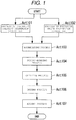
- FIG. 1 is a flow chart illustrating a manufacturing method of an electrophotographic toner according to the embodiment.
- the embodiment includes a process of preparing a colorant dispersion liquid (c) (Act101), a process of preparing a resin dispersion liquid (p) (Act102)', an aggregating process (Act103), a fusion-bonding process (Act104), a cleaning process (Act105), a drying process (Act106), and an external adding process (Act107).
- the colorant dispersion liquid (c) is a liquid in which particle groups of colorant particles are dispersed.
- the particle group of colorant particles has a volume average particle size of equal to or greater than 6 ⁇ m, preferably, 6 ⁇ m to 100 ⁇ m, and more preferably, 10 ⁇ m to 100 ⁇ m.
- the particle group of colorant particles When the particle group of colorant particles has a volume average particle size of equal to or greater than 6 ⁇ m, a coloring property is sufficiently obtained. A toner which allows easy control in electrophotographic processing is obtained. If the particle group of colorant particles has a volume average particle size of greater than 100 ⁇ m, control of developing, transferring, in the electrophotographic processing may be difficult. To control the electrophotographic processing and have the coloring property, the particle group of colorant particles further preferably has a volume average particle size of 10 ⁇ m to 60 ⁇ m.
- the volume average particle size of the particle group may be measured using a laser diffraction type particle size distribution measuring apparatus.
- the shape of the colorant particle is not particularly limited.
- Examples of the shape of the colorant particle include a plate shape, a cylindrical shape, a spherical shape, and among these shapes the preferable shape of the colorant particle is a plate shape.
- a toner tends to have an orientation parallel to a recording medium, and the coloring property is easily obtained.
- Examples of a colorant which constitutes the colorant particle include carbon black, an organic or inorganic pigment.
- Examples of the carbon black include acetylene black, furnace black, thermal black, channel black, ketjen black.
- organic or inorganic pigment examples include Fast yellow-G, Benzidine yellow, Indofast orange, Irgazin red, Carmine FB, Permanent Bordeaux FRR, Pigment Orange R, Lithol Red 2G, Lake Red C, Rhodamine FB, Rhodamine B Lake, phthalocyanine blue, Pigment Blue, Brilliant Green B, Phthalocyanine green, Quinacridone, a pearl gloss pigment.
- the pearl gloss pigment include a material in which scale-like mica is covered with a metallic oxide such as a titanium oxide and iron oxide.
- colorant only one type of colorant may be used, or two or more types of colorants may be used together.
- the organic or inorganic pigment is preferably in order to easily obtain the coloring property.
- a concentration of the colorant in the colorant dispersion liquid (c) is not particularly limited, and, for example, a ratio of 2 wt% to 15 wt% with respect to the total amount of the colorant dispersion liquid (c) is preferable.
- an aqueous medium is used as a dispersion medium in the colorant dispersion liquid (c).
- the aqueous medium include water, a mixed solvent of water and an organic solvent. Among these, the water is preferable.
- the colorant dispersion liquid (c) may contain components (optional component (c)) other than the colorant and the dispersion medium.
- the optional component (c) for example, a surfactant, a basic compound, are included.
- the surfactant acts as a dispersant in the colorant dispersion liquid (c).
- the surfactant include an anionic surfactant such as a sulfuric ester salt, sulfonate, a phosphoric ester salt, and soap; a cationic surfactant such as an amine salt, and a quarternary ammonium salt; and a nonionic surfactant of polyethylene glycols, alkylphenol ethylene oxide adducts, polyhydric alcohols. These surfactants may be polymer.
- the basic compound acts as a dispersion assistant in the colorant dispersion liquid (c).
- an amine compound are included.
- the amine compound include dimethylamine, trimethylamine, monoethylamine, diethylamine, triethylamine, propylamine, isopropylamine, dipropylamine, butylamine, isobutylamine, sec-butylamine, monoethanolamine, diethanolamine, triethanolamine, tri-isopropanolamine, isopropanolamine, dimethyl ethanolamine, diethyl ethanolamine, N-butyl diethanolamine, N,N-dimethyl-1,3-diamino propane, N,N-diethyl-1,3-diamino propane.
- the colorant dispersion liquid (c) is prepared by mixing the dispersion medium, the particle group of colorant particles, and the optional component (c) (which is as necessary) with each other, for example.
- the colorant particles in the colorant dispersion liquid (c) may have negative zeta-potential, or may have positive zeta-potential.
- the zeta-potential of the colorant particles is preferably adjusted so as to be negative.
- the zeta-potential of the colorant particles may be adjusted by the surfactants and the basic compound which are described above, for example.
- a type of the surfactant and a type of the basic compound are determined considering dispersibility of the colorant particles.
- the cationic surfactant is used so as to adjust the zeta-potential to be in a positive direction.
- the anionic surfactant is used so as to adjust the zeta-potential to be in a negative direction.
- the zeta-potential when the colorant particle in the colorant dispersion liquid (c) has both a positive charge and a negative charge may also be adjusted by adjusting pH of the dispersion liquid.
- the dispersion liquid may have pH which is adjusted by a pH adjusting agent.
- the pH adjusting agent include a basic compound such as sodium hydroxide, potassium hydroxide, and an amine compound; an acidic compound such as hydrochloric acid, nitric acid, and sulfuric acid.
- the basic compound allows the zeta-potential of the particle having both of the positive charge and the negative charge in the dispersion liquid to be adjusted to be negative.
- the acidic compound allows the zeta-potential of the particle in the dispersion liquid to be adjusted to be positive.
- the zeta-potential of the dispersed particles in the dispersion liquid is obtained through the following sequences.
- the dispersed particles in the dispersion liquid respectively correspond to colorant particles in the colorant dispersion liquid, resin particles in a resin dispersion liquid, and aggregates in an aggregate dispersion liquid.
- Sequence (1) a dispersion liquid having a solid concentration of 50 ppm (mass as a reference) is prepared as a sample by performing dilution with ion exchange water.
- Sequence (2) zeta-potential of 100 particles which are dispersed in the sample is measured by a zeta-potential measuring apparatus.
- Sequence (3) an average value of the zeta-potential of the 100 particles is obtained and is set as a value of zeta-potential of dispersed particles in the dispersion liquid.
- the resin dispersion liquid (p) is a liquid in which particle groups of resin particles are dispersed.
- the particle group of resin particles preferably has a volume average particle size of 0.02 ⁇ m to 5 ⁇ m, and more preferably, 0.05 ⁇ m to 2 ⁇ m.
- the particle group of resin particles has a volume average particle size of equal to or greater than the preferable lower limit value, it is difficult to form an aggregate (homo-particle) of toner materials other than the colorant.
- the particle group of resin particles has a volume average particle size of equal to or less than the upper limit value, a surface of the colorant particle is easily covered with the resin particle.
- a ratio (colorant particle/resin particle) of the volume average particle size of the particle group of colorant particles and the volume average particle size of the particle group of resin particles is preferably in a range of 3 to 5000, and more preferably 6 to 2000, further preferably 50 to 1000.
- the ratio (colorant particle/resin particle) of the volume average particle sizes is equal to or greater than the preferable lower limit value, a preferable coloring property is obtained.
- the ratio of the volume average particle sizes is equal to or less than the preferable upper limit value, filming is less likely to occur.
- the shape of the resin particle is not particularly limited.
- Examples of the shape of the resin particle include a spherical shape, a cylindrical shape, a plate shape, and the preferable shape of the resin particle among these shapes is a spherical shape because the spherical shape is likely to aggregate with the colorant particle.
- the volume average particle size of the particle group of resin particles, and the shape of the resin particle are controlled by a mechanical shearing device adjusting mechanical shearing power.
- Examples of resin which constitute the resin particle includes polyester resin, polystyrene resin.
- condensation polymer of polycarboxylic acid and polyalcohol is preferable, and condensation polymer of a dicarboxylic acid component and a diol component is more preferable.
- dicarboxylic acid component examples include aromatic dicarboxylic acid, aliphatic carboxylic acid.
- aromatic dicarboxylic acid include terephthalic acid, phthalic acid, isophthalic acid.
- aliphatic carboxylic acid examples include fumaric acid, maleic acid, succinic acid, adipic acid, sebacic acid, glutaric acid, pimelic acid, oxalic acid, malonic acid, citraconic acid, itaconic acid.
- diol component examples include aliphatic diol, alicyclic diol, ethylene oxide addition, propylene oxide adduct.
- aliphatic diol examples include ethylene glycol, propylene glycol, 1,4-butanediol, 1,3-butanediol, 1,5-pentanediol, 1,6-hexanediol, neo-pentyne glycol, trimethylene glycol, trimethylol propane, pentaerythritol.
- alicyclic diol examples include 1,4-cyclohexanediol, 1,4-cyclohexanedimethanol.
- ethylene oxide adduct examples include ethylene oxide adduct of bisphenol A.
- propylene oxide adduct examples include propylene oxide adduct of bisphenol A.
- polyester resin an amorphous substance may be used or a crystalline substance may be used.
- copolymer of an aromatic vinyl component and a (meth)acrylic acid ester component is preferable.
- the (meth)acrylic acid ester corresponds to at least one of acrylic acid ester and methacrylic acid ester.
- Examples of the aromatic vinyl component include styrene, ⁇ -methylstyrene, o-methylstyrene, p-chlorostyrene.
- Examples of the (meth)acrylic acid ester component include ethyl acrylate, propyl acrylate, butyl acrylate, 2-ethylhexyl acrylate, butylmethacrylate, ethyl methacrylate, methyl methacrylate. Among these, butyl acrylate is generally used.
- polystyrene resin is obtained by, for example, performing radical polymerization on monomers of components in an aqueous phase containing an emulsifier.
- a glass transition temperature of the polyester resin and a glass transition temperature of the polystyrene resin are appropriately selected considering a fixation temperature.
- a weight-average molecular weight (Mw) of the polyester resin is preferably in a range of 5000 to 30000.
- Mw of the polystyrene resin is preferably in a range of 10000 to 70000. If Mw of the polyester resin and Mw of the polystyrene resin are less than the preferable lower limit value, heat resistant preservability of the toner is easily degraded. As Mw of each of the resins becomes greater, the fixation temperature becomes higher. When Mw of each of the resins is equal to or less than the preferable upper limit value, an increase of a power consumption amount in fixing processing is easily suppressed.
- the weight-average molecular weight (Mw) of the resin has a value obtained by performing polystyrene conversion using gel permeation chromatography.
- resin only one type of resin may be used, or two or more types of resins may be used together.
- the polyester resin is preferable because of low glass transition temperature and low-temperature fixability.
- the concentration of the resin in the resin dispersion liquid (p) is appropriately set in accordance with the concentration of the colorant, and is preferably in a range of, for example, 20 wt% to 40 wt% with respect to the total amount of the resin dispersion liquid (p).
- an aqueous medium As the dispersion medium in the resin dispersion liquid (p), for example, an aqueous medium is used.
- the aqueous medium include water, a mixed solvent of water and an organic solvent, and water is preferable among these media.
- the resin dispersion liquid (p) may contain a component (optional component (p)) other than the resin and the dispersion medium.
- the optional component (p) include a surfactant, a basic compound, wax.
- the surfactant and the basic compound which are used as the optional component (p) substances similar to the surfactant and the basic compound, which are described as the optional component (c), are included.
- the wax used as the optional component (p) a wax which is used as an optional component which will be described below is included.
- the resin dispersion liquid (p) is prepared by mixing the dispersion medium, the particle group of resin particles, and the optional component (p) (which is as necessary) with each other, for example.
- the resin dispersion liquid (p) containing wax is prepared by mixing a liquid in which the particle groups of resin particles are dispersed, and a liquid (wax dispersion liquid (w)) in which particle groups of wax particles are dispersed.
- the resin particles in the resin dispersion liquid (p) may have negative zeta-potential, or may have positive zeta-potential.
- the zeta-potential of the resin particles is preferably adjusted so as to be negative.
- the zeta-potential of the resin particles may be adjusted using the surfactant, the basic compound, and the pH adjusting agent, for example.
- Types of the surfactant, the basic compound, and the pH adjusting agent are determined considering dispersibility of the resin particles.
- the mechanical shearing power is applied to disperse substances in the liquid mixture, and thereby the resin is pulverized.
- pulverization means that the mechanical shearing power is applied to the dispersed substances in the liquid mixture, and thus the particle size of the dispersed substances is smaller than the particle size before the mechanical shearing power is applied.
- a mechanical shearing device in which a medium is not used for example, a mechanical shearing device in which a medium is not used, or a mechanical shearing device in which a medium is used may be used.
- Examples of the mechanical shearing device in which a medium is not used include Ultra-Turrax (product manufactured by IKA Corporation), T.K. Auto Homo Mixer (product manufactured by Primix Corporation), T.K. Pipeline Homo Mixer (product manufactured by Primix Corporation), T.K.
- Filmix (product manufactured by Primix Corporation), Clearmix (product manufactured by M Technique Co., Ltd.), Clear-SS5 (product manufactured by M Technique Co., Ltd.), Cavitron (product manufactured by Eurotec Co., Ltd.), Fine flow mill (product manufactured by Pacific Machinery & Engineering Co.,Ltd), Microfluidizer (product manufactured by Mizuho Industrial CO., LTD.), Ultimaizer (product manufactured by Sugino Machine, LTD.), Nanomizer (product manufactured by Yoshida Kikai Co., Ltd.), Genus PY(product manufactured by Hakusui Tech Co., Ltd.), NANO 3000 (product manufactured by Beryu System Corporation).
- Visco Mill product manufactured by Aimex CO.,Ltd.
- Apex Mill product manufactured by Kotobuki Kogyou.CO.,LTD.
- Star Mill product manufactured by Ashizawa Finetech Ltd.
- DCP Super Flow product manufactured by Nippon Eirich Co., Ltd.
- MP Mill product manufactured by Inoue MFG., Inc.
- Spike Mill product manufactured by Inoue MFG., Inc.
- Mighty Mill product manufactured by Inoue MFG., Inc.
- SC Mill product manufactured by Nippon Coke & Engineering CO., LTD.
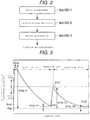
- FIG. 2 illustrates an embodiment of the aggregating process (Act103).
- the aggregating process according to the embodiment includes first aggregating (Act103-1), zeta-potential adjusting (Act103-2), and second aggregating (Act103-3).
- FIG. 3 is a graph illustrating a change of the zeta-potential of dispersed particles in the aggregating process (Act103).
- the dispersed particle refers to the colorant particle in the colorant dispersion liquid, the resin particle of the resin dispersion liquid, and the aggregate of the aggregate dispersion liquid.
- a horizontal axis in the graph of FIG. 3 indicates an elapsed time.
- an operation (I) refers to the first aggregating (Act103-1).
- An operation (II) refers to the zeta-potential adjusting (Act103-2).
- An operation (III) refers to the second aggregating (Act103-3).
- a vertical axis in the graph of FIG. 3 indicates the zeta-potential (mV) of the dispersed particles in the dispersion liquid.
- Vo(c) on the vertical axis indicates the zeta-potential of the colorant particles in the colorant dispersion liquid (c) after the preparation in the process (Act101).
- the zeta-potential V 0 (c) is preferably in a range of substantially -70 mV to -10 mV, more preferably, substantially -55 mV to -30 mV.
- the zeta-potential V 0 (c) is in the preferable range, the dispersion stability of the colorant particles is maintained well.
- V(p) on the vertical axis indicates the zeta-potential of the resin particles in the resin dispersion liquid (p).
- the zeta-potential V(p) is preferably in a range of substantially -70 mV to -10 mV, more preferably, substantially -55 mV to -30 mV.
- the zeta-potential V(p) is in the preferable range, the dispersion stability of the resin particles is maintained well.
- V(p) and V 0 (c) has negative potential (mV)
- V(p) and V 0 (c) have a relationship of V 0 (c)>V(p).
- V(c) indicates zeta-potential of the colorant particles in a colorant dispersion liquid (c') after the zeta-potential in the operation (I) is adjusted.
- V(I) indicates the zeta-potential of the aggregates (a1) in the aggregate dispersion liquid (d1) after the operation (I).
- V(II) indicates zeta-potential of aggregates (a'1) in an aggregate dispersion liquid (d'1) after the operation (II).
- V(III) indicates zeta-potential of aggregates (a2) in an aggregate dispersion liquid (d2) after the operation (III).
- ⁇ V(p-c) indicates an absolute value of a difference between V(p) and V(c).
- ⁇ V(p-I) indicates an absolute value of a difference between V(p) and V(I).
- a relationship of (an absolute value of V(p))>(an absolute value of V(I)) is satisfied.
- ⁇ V(p-II) indicates an absolute value of a difference between V(p) and V(II).
- ⁇ V(p-III) indicates an absolute value of a difference between V(p) and V(III).
- the zeta-potential of the colorant particles refers to zeta-potential of particles containing the colorant.
- the particles containing the colorant include particles which are formed from only the colorant, particles which are formed from the colorant, and a component other than the colorant.
- the component other than the colorant include a dispersant, a dispersion assistant.
- the zeta-potential of the resin particles refers to zeta-potential of particles containing the resin.
- the particles containing the resin include particles which are formed from only the resin, particles which are formed from the resin, and a component other than the resin.
- the component other than the resin include the dispersant, the dispersion assistant.
- the zeta-potential of the aggregates refers to zeta-potential of particles containing the aggregates.
- the particles containing the aggregates include particles which are formed from the colorant particle and the resin particle, particles which are formed from the colorant particle, the resin particle, and a component other than the colorant particle and the resin particle.
- the component other than the colorant particle and the resin particle include the dispersant, the dispersion assistant, the optional component (coagulant, electrification control agent, wax).
- the first aggregating (Act103-1) will be described below.
- the resin dispersion liquid (p) is added to the colorant dispersion liquid (c').
- the particle groups of colorant particles having a certain zeta-potential V(c) are dispersed.
- the particle groups of resin particles having a zeta-potential V(p) with a sign different from that of the zeta-potential V(c) are dispersed.
- the zeta-potential of the colorant particles is adjusted from negative potential (V 0 (c)) to positive potential (V(c)) such that the zeta-potential of the colorant particles has a sign different from that of the zeta-potential V(p).
- a method of adjusting the zeta-potential of the colorant particles from the negative potential (V 0 (c)) to the positive potential (V(c)) includes, for example, a method of adding a cationic compound in the colorant dispersion liquid (c).
- the cationic compound include a cationic surfactant, a pH adjusting agent.
- cationic surfactant examples include a quarternary ammonium salt such as polydiallyl dimethyl ammonium chloride and alkyl benzyl dimethyl ammonium chloride.
- Examples of the pH adjusting agent include an acidic compound such as hydrochloric acid, nitric acid, and sulfuric acid.
- ⁇ V(p-c) is preferably equal to or greater than a value obtained by adding 10 mv to the absolute value of the zeta-potential V(p), and more preferably, in a range from a value by adding 20 mv to the absolute value of the zeta-potential V(p) to a value by adding 50 mv to the absolute value of the zeta-potential V(p).
- ⁇ V(p-c) is equal to or greater than the preferable lower limit value, cohesion of the colorant particle and the resin particles is enhanced.
- V(c) is, for example, equal to or greater than +10 mV, and preferably, in a range substantially from +20 mV to +50mV.
- the resin dispersion liquid (p) is added to the colorant dispersion liquid (c') which is adjusted to have positive potential (V(c)).
- aggregates (a1) are generated by aggregating the colorant particles and the resin particles.
- the resin dispersion liquid (p) is added to the colorant dispersion liquid (c') until zeta-potential V(a1) of the aggregate (a1) becomes negative potential (that is, has the same sign as the zeta-potential V(p)).
- the aggregate dispersion liquid (d1) in which the aggregates (a1) having a zeta-potential with the same sign as the zeta-potential V(p) are dispersed is obtained.
- Amount of the resin dispersion liquid (p) added into the colorant dispersion liquid (c') has preferably a value which causes ⁇ V(p-I) to be equal to or less than 30 mv, more preferably, a value which causes ⁇ V(p-I) to be equal to or less than 15 mv, and further preferably, a value which causes ⁇ V(p-I) to be in a range of 1 to 15 mv.
- ⁇ V(p-I) is equal to or less than the preferable upper limit value, a surface of the colorant particle is easily covered with the resin particles.
- ⁇ V(p-I) is equal to or greater than the preferable lower limit value, generation of aggregates (homo-particle) of toner materials other than the colorant is easily suppressed.
- V(I) is, for example, equal to or less than -10 mV, and preferably, substantially in a range of -50 mV to -20 mV.
- the resin dispersion liquid (p) When the resin dispersion liquid (p) is added to the colorant dispersion liquid (c'), it is preferable that a small amount of the resin dispersion liquid (p) is added during a long period of time, with respect to the total amount of the colorant dispersion liquid (c').
- a predetermined amount of the resin dispersion liquid (p) may be continuously added or may be intermittently added. To completely cover the surface of the colorant particle with the resin particles, it is preferable that the predetermined amount of the resin dispersion liquid (p) is continuously added to the colorant dispersion liquid (c').
- the resin dispersion liquid (p) is preferably added to the colorant dispersion liquid (c') at a constant addition speed.
- the addition speed is appropriately determined in accordance with a blending amount.
- an optional component may be added as necessary.
- an optional component include the coagulant, the electrification control agent.
- the coagulant examples include a metal salt such as sodium chloride, calcium chloride, calcium nitrate, barium chloride, magnesium chloride, zinc chloride, magnesium sulfate, aluminum chloride, aluminum sulfate, and potassium aluminium sulfate; a non-metal salt such as ammonium chloride and ammonium sulfate; inorganic metal salt polymer such as polyaluminum chloride, polyhydroxide aluminum, and calcium polysulfide; a polymer coagulant such as polymeta acrylic ester, polyacrylic ester, polyacrylamide, and acrylamide-acrylic acid soda copolymer; a coagulant such as polyamine, polydiallyl ammonium halide, polydiallyl dialkyl ammonium halide, melanin formaldehyde condensate, and dicyandiamide; alcohols such as methanol, ethanol, 1-propanol, 2-propanol, 2-methyl-2-propanol, 2-methoxy
- Examples of the electrification control agent include an azo compound including metal, a salicylic acid derivative compound including metal.
- azo compounds including metal a complex or a complex salt of iron, cobalt, or chrome as the metal, or a mixture thereof is preferable.
- salicylic acid derivative compound including metal a complex or a complex salt obtained of zirconium, zinc, chrome or boron, or a mixture thereof is preferable.
- an absolute value of the zeta-potential V(a1) is reduced, such that the zeta-potential V(a1) has the same sign as the zeta-potential V(p).
- an absolute value of a difference between the zeta-potential V(a1) and the zeta-potential V(p) is caused to be equal to or greater than 10.
- the operation (II) causes the zeta-potential to be in a negative range, causes ⁇ V(p-II) to be equal to or greater than 10, and causes the zeta-potential of the aggregates (a1) in the aggregate dispersion liquid (d1) to be V(II).
- Reducing the absolute value of the zeta-potential V(a1) in the range of having the same sign as the zeta-potential V(p) causes generation of aggregates (homo-particle) of toner materials other than the colorant to be suppressed.
- the reducing causes toner particles which cause an exposure ratio of the colorant particles to be low, to be easily obtained.
- ⁇ V(p-II) is equal to or greater than 10, preferably, equal to or greater than 20, more preferably, equal to or greater than 25. That is, ⁇ V(p-II) becomes more preferable as ⁇ V(p-II) becomes greater in a range of causing V(p) and V(II) to have the same signs.
- ⁇ V(p-II) is equal to or greater than 10
- cohesion of the dispersed particle and the resin particles in the aggregate dispersion liquid (d'1) after the operation (II) is enhanced in the second aggregating.
- the dispersed particle in the aggregate dispersion liquid (d'1) include the aggregate (a'1), the colorant particle which is not aggregated with the resin particles.
- a method of performing adjustment from V(I) to V(II) is similar to the method of performing adjustment from V 0 (c) to V(c).
- V(II) is, for example, equal to or greater than -40 mV, preferably, equal to or greater than -20 mV, and more preferably, substantially -10 mV or more and less than 0 mV.
- An upper limit value of V(II) is more preferably 0 mV , because the cohesion of the dispersed particles and the resin particles in the aggregate dispersion liquid (d' 1) after the operation (II) increases during the second aggregating.
- the resin dispersion liquid (p) is added further to the aggregate dispersion liquid (d'1) after the zeta-potential adjusting.
- the aggregate (a2) is generated by aggregating the dispersed particles and the resin particles in the aggregate dispersion liquid (d'1).
- the aggregate dispersion liquid (d2) in which aggregates (a2) are dispersed is obtained.
- Amount of the resin dispersion liquid (p) added into the aggregate dispersion liquid (d'1) has preferably a value which causes ⁇ V(p-III) to be equal to or less than 30 mv, more preferably, a value which causes ⁇ V(p-III) to be equal to or less than 15 mv, and further preferably, a value which causes ⁇ V(p-III) to be in a range of 1 to 15 mv.
- ⁇ V(p-III) is equal to or less than the preferable upper limit value, a surface of the colorant particle is completely covered with the resin particles.
- ⁇ V(p-III) is equal to or greater than the preferable lower limit value, generation of the aggregates (homo-particle) of toner materials other than the colorant is easily suppressed.
- V(III) is, for example, equal to or less than -20 mV, and preferably, in a range of substantially -55 mV to -30 mV.
- the resin dispersion liquid (p) When the resin dispersion liquid (p) is further added to the aggregate dispersion liquid (d'1), it is preferable that a small amount of the resin dispersion liquid (p) is added during a long period of time, with respect to the total amount of the aggregate dispersion liquid (d'1).
- a predetermined amount of the resin dispersion liquid (p) may be continuously added or may be intermittently added. As a surface of the dispersed particle is completely covered with the resin particles in the aggregate dispersion liquid (d'1), it is preferable that the predetermined amount of the new resin dispersion liquid (p) is continuously added to the aggregate dispersion liquid (d'1).
- the resin dispersion liquid (p) is preferably added to the aggregate dispersion liquid (d'1) at a constant addition speed.
- the addition speed is appropriately determined in accordance with a blending amount.
- an optional component such as the coagulant and the electrification control agent may be added as necessary.
- the coagulant and the electrification control agent substances similar to the coagulant and the electrification control agent are included.
- the aggregates (a2) which are generated in the above-described aggregating process (Act103) are heated.
- fusion bonded particles are obtained by performing fusion bonding on the colorant particle and the resin particles which form the aggregate (a2).
- An operation in the fusion-bonding process may be performed simultaneously with the second aggregating in the above-described aggregating process.
- a heating temperature of the aggregates (a2) is appropriately set.
- the heating temperature is preferable, for example, in a range from a glass transition temperature (Tg) of the resin particles to a temperature of Tg plus 40°C.
- a heating period is preferably in a range of 2 hours to 10 hours.
- the fusion bonded particles after the fusion-bonding process has preferably a volume average particle size of 7 ⁇ m to 150 ⁇ m, and more preferably, 10 ⁇ m to 120 ⁇ m.
- the fusion bonded particles after the above-described fusion-bonding process (Act104) is cleaned.
- a known cleaning method is used as a cleaning method for the fusion bonded particles.
- the fusion bonded particles is cleaned by repeating washing and filtering with ion exchange water, and preferably, the process is repeated until conductivity of the liquid becomes equal to or less than 50 ⁇ S/cm.
- the toner particles are obtained by drying the fusion bonded particles after the above-described cleaning process.
- a known drying method is used as a drying method of the fusion bonded particles.
- An operation for drying the fusion bonded particles is performed using a vacuum dryer, for example.
- the drying process is performed until the moisture content of the fusion bonded particles is equal to less than 1.0 wt%.
- the toner particles which are obtained through the above-described drying process are mixed with an external additive, and thereby an electrophotographic toner is obtained.
- the external additive is added in order to apply liquidity to the toner or to adjust a charging property.
- the external additive include silica particles, particles of inorganic oxide such as titanium oxide, particles obtained by performing surface processing on these particles with a hydrophobing agent.
- colorant particle having a large particle size (volume average particle size of equal to or greater than 6 ⁇ m) is used. Using the colorant particle having a large particle size enables a decorated image to be easily obtained.
- the aggregating process in the present embodiment includes the first aggregating, the zeta-potential adjusting, and the second aggregating.
- the cohesion of the colorant particle and the resin particles increases, and thereby the aggregate (a1) in which the entirety of the colorant particle is covered with the resin particles is obtained.
- the aggregate (a1) and the resin particles become stronger through the zeta-potential adjusting, and thus the cohesion between the aggregate (a1) and the resin particles increases. Accordingly, the aggregate (a'1) and the resin particles are aggregated in the second aggregating, and thereby the aggregate (a2) (toner particle including the colorant particle having a low exposure ratio) in which the entirety of the colorant particle is densely covered with the resin particles is obtained. Further, an aggregate in which the colorant particle which is not aggregated with the resin particles in the first aggregating is covered with the resin particle is also obtained. Aggregation of the resin particles is suppressed, and generation of an aggregate (homo-particle) of the toner materials other than the colorant is suppressed.
- the absolute value of the zeta-potential V(a1) is reduced in the range of having the same sign as the zeta-potential V(p).
- generation of the homo-particle is also suppressed.
- the homo-particle is likely to be generated. The reason of this is not clear.
- the resin particle which covers the colorant particle in the aggregate (a1) is separated, and thus the separated resin particle easily exists individually.
- zeta-potential of the added resin particle fluctuates due to the excessive zeta-potential adjusting agent (surfactant, basic compound) in the system, and thus an interaction of the resin particles and the dispersed particle becomes weaker.
- such an aggregating process is included, and thereby a toner in which the particle size (volume average particle size of equal to or greater than 6 ⁇ m) and the shape of the colorant particle are held is manufactured.
- a toner in which the surface of the colorant particle is sufficiently covered with the resin particles is manufactured.
- a toner containing the homo-particle with a low content ratio is manufactured.
- the manufacturing method of the electrophotographic toner in the present embodiment when an image is formed, a toner which leads to sufficient coloring property and prevents the filming is manufactured.
- the aggregating process (Act103) may be carried out as illustrated in FIG. 4 .
- An aggregating process includes the first aggregating (Act103-1), first zeta-potential adjusting (Act103-2'), the second aggregating (Act103-3), second zeta-potential adjusting (Act103-4), and third aggregating (Act103-5).
- the first aggregating (Act103-1), the first zeta-potential adjusting (Act103-2'), and the second aggregating (Act103-3) are similar to the first aggregating (Act103-1), the zeta-potential adjusting (Act103-2), and the second aggregating (Act103-3) in the aggregating process of the above-described embodiment illustrated in FIG. 2 , respectively.
- the absolute value of the zeta-potential V(a2) is reduced in the range of having the same sign as the zeta-potential V(p).
- An absolute value of a difference between the zeta-potential V(a2) and the zeta-potential V(p) is equal to or greater than 10 mv.
- a method of adjusting the zeta-potential in the second zeta-potential adjusting is similar to the method of performing adjustment from V(I) to V(II) in the zeta-potential adjusting (Act103-2).
- the resin dispersion liquid (p) is further added to the aggregate dispersion liquid after the operation (IV).
- the dispersed particles in the aggregate dispersion liquid after the operation (IV) and the resin particles are aggregated, and thereby an aggregate (a3) is obtained.
- An aggregate dispersion liquid in which aggregates (a3) are dispersed is obtained.
- a method of adding the resin dispersion liquid (p) to the aggregate dispersion liquid is similar to the method in the second aggregating.
- a toner particle including the colorant particle with a low exposure ratio is easily obtained.
- Generation of the aggregate (homo-particle) of the toner materials other than the colorant is easily suppressed. For this reason, when an image is formed, the sufficient coloring property is easily obtained and the filming is less likely to occur.
- the same resin dispersion liquid (p) is used in the first aggregating and the second aggregating.
- different resin dispersion liquids may be used.
- the same resin dispersion liquid (p) is used in the first aggregating, the second aggregating, and the third aggregating.
- different resin dispersion liquids may be used.
- the resin dispersion liquids which respectively have different types of resin may be used.
- the zeta-potential of the colorant particles is adjusted from a negative value to a positive value in the first aggregating.
- the zeta-potential of the resin particles may be adjusted from a negative value to a positive value.
- all of the zeta-potential V 0 (c) of the colorant particles and the zeta-potential V(p) of the resin particles are negative.
- the zeta-potential V 0 (c) may be positive and the zeta-potential V(p) may be negative.
- the zeta-potential V 0 (c) may be negative and the zeta-potential V(p) may be positive.
- an operation of causing the zeta-potential of the colorant particles to have a sign different from the zeta-potential of the resin particles is omitted.
- the absolute value ( ⁇ V(p-c)) of the difference between the zeta-potential V(c) of the colorant particles and the zeta-potential V(p) of the resin particles is adjusted to have a value equal to or greater than the absolute value of the zeta-potential V(p) plus 10 mv.
- Both of the zeta-potential V 0 (c) and the zeta-potential V(p) may be positive.
- the zeta-potential of the colorant particles has a sign different from the zeta-potential of the resin particles.
- the absolute value ( ⁇ V(p-c)) of the difference between the zeta-potential V(c) of the colorant particles and the zeta-potential V(p) of the resin particles is adjusted to be equal to or greater than the absolute value of the zeta-potential V(p) plus 10 mv.
- V 0 (c)>V(p) is satisfied between both of V(p) and V 0 (c) which are negative potential (mV).
- V 0 (c) ⁇ V(p) may be satisfied.
- the wax may be blended as the optional component. Blending of the wax causes occurrence of offset due to expressed release properties to be difficult when an image is formed.
- the wax examples include an aliphatic hydrocarbon-based wax such as low molecular weight polyethylene, low molecular weight polypropylene, polyolefin copolymer, a polyolefin wax, a microcrystallin wax, a paraffin wax, and a Fischer Tropsch Wax; an oxide of aliphatic hydrocarbon-based wax such as an oxidized polyethylene wax, or block copolymer of these substances; a botanical wax such as a candelilla wax, a carnauba wax, a vegetable wax, a jojoba wax, and a rice wax; an animal wax such as a beeswax, a lanoline, and a spermaceti wax; a mineral wax such as ozokerite, ceresin, and petrolatum; waxes which contain fatty acid ester as a main component, such as a palmitate ester wax, a montanoic acid ester wax, and a caster wax; a substance obtained by de-oxid
- wax only one type of wax may be used, or two or more types of waxes may be used together.
- aliphatic hydrocarbon wax and waxes which contain fatty acid ester as a main component are preferable.
- aliphatic hydrocarbon waxes a paraffin wax is preferable.
- a fatty acid ester wax is preferable, and a fatty acid ester wax which contains a palmitic acid ester as a main component is more preferable.
- a wax dispersion liquid (w) in which particle groups of wax particles are dispersed is used for blending the wax.
- the particle group of wax particles has a volume average particle size of preferably 0.02 ⁇ m to 1 ⁇ m, and more preferably, 0.05 ⁇ m to 0.3 ⁇ m.
- volume average particle size of the particle group of wax particles is equal to or greater than the preferable lower limit value, it is difficult to form the aggregate (homo-particle) of the toner material other than the colorant.
- volume average particle size of the particle group of wax particles is equal to or less than the preferable upper limit value, the surface of the colorant particle tends to be covered with the wax particles.
- the shape of the wax particle is not particularly limited.
- Examples of the shape of the wax particle include a spherical shape, a cylindrical shape, a plate shape, and the preferable shape of the wax particle among these shapes is a spherical shape because the wax particles tend to aggregate with the colorant particles along with the resin particles.
- the volume average particle size of the particle group of wax particles, and the shape of the wax particle are controlled by the above-described mechanical shearing device adjusting the mechanical shearing power.
- the concentration of the wax in the wax dispersion liquid (w) is appropriately set in accordance with the concentration of the colorant, the type of resin, and is preferably in a range of, for example, 30 wt% to 50 wt% with respect to the total amount of the wax dispersion liquid (w).
- an aqueous medium As the dispersion medium in the wax dispersion liquid (w), for example, an aqueous medium is used.
- the aqueous medium include water, a mixed solvent of water and an organic solvent, and water is preferable among these media.
- the wax dispersion liquid (w) may contain a component (optional component (w)) other than the wax and the dispersion medium.
- a component (optional component (w) include a surfactant, a basic compound.
- the surfactant and the basic compound used as the optional component (w) may include, for example, substances similar to the surfactant and the basic compound which are described as the optional component (c).
- the wax dispersion liquid (w) is prepared by mixing the dispersion medium, the wax, and the optional component (w) (which is as necessary) with each other, for example. At this time, mechanical shearing power is applied to the dispersed substances in the liquid mixture, and thereby the wax is pulverized.
- Examples of a mechanical shearing device used when pulverization is performed include a device similar to the above-described mechanical shearing device used when the resin is pulverized.
- the wax is blended preferably in the first aggregating of the aggregating process.
- the wax dispersion liquid (w) and the resin dispersion liquid (p) are added to the colorant dispersion liquid (c').
- the resin dispersion liquid (p) containing the above-described wax is added to the colorant dispersion liquid (c').
- Zeta-potential V(w) of the wax particles in the wax dispersion liquid (w) may be adjusted using the surfactant, the basic compound, and the pH adjusting agent, for example.
- Types of the surfactant, the basic compound, and the pH adjusting agent are determined considering dispersibility of the wax particles.
- An absolute value of the zeta-potential V(w) is preferably greater than the absolute value of the zeta-potential V(p) of the resin particles.
- the absolute value of the zeta-potential V(w) is greater than the absolute value of the zeta-potential V(p)
- the wax particles tend to be more easily attached to the colorant particles.
- An absolute value ⁇ V(w-p) of a difference between the zeta-potential V(w) and the zeta-potential V(p) is preferably equal to or less than 30, and more preferably in a range of 0 to 20.
- ⁇ V(w-p) is equal to or less than the preferable upper limit value, the wax particles and the resin particle together are more likely to be attached to the colorant particle.
- ⁇ V(w-p) is equal to or greater than the preferable lower limit value, the wax particles are more likely to be attached to the colorant particle.
- the zeta-potential V(w) is preferably in a range of substantially -70 mV to -10 mV, and more preferably in a range of substantially -55 mV to -30mV.
- the zeta-potential V(w) is in the preferable range, dispersion stability of the wax particles is maintained well.
- the wax dispersion liquid (w) is added to the colorant dispersion liquid (c') at the same time as the resin dispersion liquid (p) and the wax dispersion liquid (w), or in this order. Adding the wax dispersion liquid (w) in this manner causes much more the resin particles and the wax particles to be attached to the colorant particle. Further, arrangement of the wax in the toner is controlled. Thus, an electrophotographic toner which is less likely to cause a fog or the offset is easily manufactured.
- the wax dispersion liquid (w) may be continuously added subsequently to completion of adding the resin dispersion liquid (p), or may be intermittently added.
- the wax dispersion liquid (w) When the wax dispersion liquid (w) is added to the colorant dispersion liquid (c'), it is preferable that a small amount of the wax dispersion liquid (w) is added for a long period of time, with respect to the total amount of the colorant dispersion liquid (c').
- a predetermined amount of the wax dispersion liquid (w) may be continuously added or may be intermittently added. To attach the wax particles to the surface of the colorant particles, it is preferable that the predetermined amount of the wax dispersion liquid (w) is continuously added.
- the wax dispersion liquid (w) is continuously added to the colorant dispersion liquid (c')
- the addition speed is appropriately determined in accordance with a blending amount.
- the electrophotographic toner according to the present embodiment is manufactured by the above-described manufacturing method.
- the volume average particle size of the electrophotographic toner according to the present embodiment is preferably in a range of 7 ⁇ m to 150 ⁇ m, more preferably in a range of 10 ⁇ m to 120 ⁇ m, and further preferably in a range of 20 ⁇ m to 120 ⁇ m.
- the volume average particle size of the toner is equal to or greater than the preferable lower limit value, the coloring property is more likely to be obtained.
- the volume average particle size of the toner is equal to or less than the preferable upper limit value, developing, transferring, in the electrophotographic processing can be easily controlled.
- the colorant content in the toner is preferably in a range of 5 wt% to 60 wt% with respect to the total amount of the toner particles (not including the external additive), more preferably in a range of 15 wt% to 55 wt%, and further preferably in a range of 20 wt% to 50 wt%. If the colorant content is less than the preferable lower limit value, the coloring property is less likely to be obtained. If the colorant content exceeds the preferable upper limit value, fixability of the toner and fastness of an image is more likely to be degraded.
- the resin content in the toner is preferably in a range of 30 wt% to 90 wt% with respect to the total amount of the toner particles, and more preferably in a range of 35 wt% to 80 wt%. If the resin content is less than the preferable lower limit value, the fixability of the toner and the fastness of an image are less likely to be obtained. If the resin content exceeds the preferable upper limit value, an amount of the colorant is insufficient and thus the coloring property is less likely to be obtained.
- the wax content in the toner is preferably in a range of 3 wt% to 30 wt% with respect to the total amount of the toner particles, and more preferably in a range of 5 wt% to 20 wt%. If the wax content is less than the preferable lower limit value, an offset property is insufficient and thus the fixability is less likely to be obtained. If the wax content exceeds the preferable upper limit value, filming tends to occur.
- the above-described electrophotographic toner according to the present embodiment is manufactured through the above-described manufacturing method, and thus the surface of the colorant particle is sufficiently covered with the resin particles.
- the electrophotographic toner has a content ratio of the aggregates (homo-particle) of the toner materials other than the colorant. Consequently, according to the electrophotographic toner of the present embodiment, an image with the sufficient coloring property and reduced occurrence of filming is formed.
- the toner according to the present embodiment is suitably used for a non-magnetic single-component developer or a two-component series developer.
- the toner is stored in, for example, an image forming apparatus such as a multi-function peripheral (MFP), and is used for forming an image on a recording medium using an electrophotographic method.
- MFP multi-function peripheral
- a carrier which is usable when the toner is used in the two-component series developer is not particularly limited, and may be appropriately set by an ordinary person skilled in the related art.
- a toner cartridge according to the present embodiment will be described below.
- the toner cartridge according to the present embodiment is a container in which the above-described electrophotographic toner according to the present embodiment is stored.
- a known container is used as the container.
- toner cartridge according to the present embodiment for the image forming apparatus enables to more reliably form an image which has the improved coloring property.
- the image forming apparatus has a main body in which above-described electrophotographic toner is stored.
- a general electrophotographic device is used as the main body of the apparatus.
- FIG. 5 illustrates a schematic structure of the image forming apparatus according to the present embodiment.
- the image forming apparatus 20 has the main body which includes an intermediate transfer belt 7, a first image forming unit 17A, a second image forming unit 17B, and a fixing device 21.
- the first image forming unit 17A and the second image forming unit 17B are provided above the intermediate transfer belt 7.
- the fixing device 21 is provided downstream with respect to the intermediate transfer belt 7 in a medium conveying direction.
- the first image forming unit 17A is provided downstream with respect to the second image forming unit 17B in a movement direction of the intermediate transfer belt 7, that is, in a proceeding direction of an image forming process.
- the fixing device 21 is provided downstream with respect to the first image forming unit 17A.
- the first image forming unit 17A includes a photoconductive drum 1a, a cleaning device 16a, a charging device 2a, an exposure device 3a, a first developing device 4a, and a primary transfer roller 8a.
- the cleaning device 16a, the charging device 2a, the exposure device 3a, and the first developing device 4a are provided around the photoconductive drum 1a in this order in a rotational direction of the photoconductive drum 1a.
- the primary transfer roller 8a is provided so as to face the photoconductive drum 1a across the intermediate transfer belt 7.
- the second image forming unit 17B includes a photoconductive drum 1b, a cleaning device 16b, a charging device 2b, an exposure device 3b, a second developing device 4b, and a primary transfer roller 8b.
- the cleaning device 16b, the charging device 2b, the exposure device 3b, and the second developing device 4b are provided around the photoconductive drum 1b in this order in a rotational direction of the photoconductive drum 1b.
- the primary transfer roller 8b is provided so as to face the photoconductive drum 1b across the intermediate transfer belt 7.
- the first developing device 4a and the second developing device 4b store a developer (single-component developer or two-component series developer) which contains the above-described electrophotographic toner.
- the toner may be supplied from the toner cartridge (not illustrated).
- a primary transfer power source 14a is connected to the primary transfer roller 8a.
- a primary transfer power source 14b is connected to the primary transfer roller 8b.
- a secondary transfer roller 9 and a backup roller 10 are disposed downstream with respect to the first image forming unit 17A so as to face each other across the intermediate transfer belt 7.
- a secondary transfer power source 15 is connected to the secondary transfer roller 9.
- the fixing device 21 includes a heat roller 11 and a pressing roller 12 which are disposed so as to face each other.
- An image may be formed in a manner as follows, for example, by the image forming apparatus 20.
- the charging device 2b charges the photoconductive drum 1b uniformly. Then, the exposure device 3b performs exposing and thereby an electrostatic latent image is formed. Then, developing is performed with the toner which is supplied from the second developing device 4b, and thereby a second toner image is obtained.
- the charging device 2a charges the photoconductive drum 1a uniformly. Then, the exposure device 3a performs exposing based on first image information (second toner image) and thereby an electrostatic latent image is formed. Then, developing is performed with the toner which is supplied from the first developing device 4a, and thereby a first toner image is obtained.
- first image information second toner image
- developing is performed with the toner which is supplied from the first developing device 4a, and thereby a first toner image is obtained.
- the second toner image and the first toner image are transferred to the intermediate transfer belt 7 in this order.
- the second toner image is transferred by the primary transfer roller 8b, and the first toner image is transferred by the primary transfer roller 8a.
- An image obtained by stacking the second toner image and the first toner image on the intermediate transfer belt 7 in this order is secondarily transferred to a recording medium (not illustrated) between the secondary transfer roller 9 and the backup roller 10.
- a recording medium not illustrated
- the type of colorant which is contained in the toner in the developing device 4a and the developing device 4b is freely selected.
- the image forming apparatus 20 illustrated in FIG. 5 includes two developing devices, but may include three developing devices or more in accordance with the type of toner which is used.
- the toner image is fixed.
- the image forming apparatus according to the present embodiment is not limited thereto, and may be an ink jet type.
- an image which has the improved coloring property and is good is stably formed.
- the toner is manufactured through the aggregation method with the controlled zeta-potential.
- a toner in which the particle size (volume average particle size of equal to or greater than 6 ⁇ m) and the shape of the colorant particles are held is manufactured.
- a toner in which the surface of the colorant particle having a large volume average particle size is sufficiently covered with the resin particles is manufactured.
- Zeta-potential of particles which were dispersed in a dispersion liquid was measured using ZEECOM ZC-3000 (product manufactured by Microtec Co., Ltd.) which was a zeta-potential measuring apparatus.
- a dispersion liquid was diluted with ion exchange water, and thus a dispersion liquid having a solid concentration of 50 ppm (mass as a reference) was prepared. Then, the zeta-potential of each of 100 particles which were dispersed in the sample is manually measured using the zeta-potential measuring apparatus. Then, an average value of the zeta-potential of these 100 particles was obtained and the obtained average value was set as the zeta-potential of particles which were dispersed in the sample.
- a polyester resin which was condensation polymer of terephthalic acid and ethylene glycols was used.
- the volume average particle size (50%D) of the resin dispersion liquid (p1) was measured using SALD-7000 (product manufactured by Shimadzu Corporation). As a result, the volume average particle size of particle groups of resin particles was 0.16 ⁇ m.
- the zeta-potential (V(p)) of the resin particles in the resin dispersion liquid (p1) was -48 mV.
- a fatty acid ester wax which contains a palmitate ester wax as a main component was used.
- the volume average particle size (50%D) of the wax dispersion liquid (w1) was measured using SALD-7000 (product manufactured by Shimadzu Corporation). As a result, the volume average particle size of particle groups of wax particles was 0.20 ⁇ m.
- the zeta-potential (V(w)) of the wax particles in the wax dispersion liquid (w1) was -54 mV.
- the volume average particle size (50%D) of the colorant dispersion liquid (c1) was measured using SALD-7000 (product manufactured by Shimadzu Corporation). As a result, the volume average particle size of particle groups of colorant particles was 95 ⁇ m.
- the zeta-potential (V 0 (c)) of the colorant particles in the colorant dispersion liquid (c1) was -40 mV.
- the zeta-potential (V(p)) of the resin particles in the resin dispersion liquid (p2) had a value between -48mV which is the zeta-potential of the resin particles in the resin dispersion liquid (p1), and -54mV which was the zeta-potential of the wax particles in the wax dispersion liquid (w1).
- the temperature of the aggregate dispersion liquid (d21) was increased up to 65°C.
- the aggregates (a21) in the aggregate dispersion liquid (d21) were fusion-bonded, and thereby fusion bonded particles were prepared.
- the volume average particle size (50%D) of the dispersion liquid in which the fusion bonded particles after the temperature was increased were dispersed was measured using SALD-7000 (product manufactured by Shimadzu Corporation). As a result, the volume average particle size of particle groups of the fusion bonded particles was 115 ⁇ m.
- the fusion bonded particles in the dispersion liquid which was subjected to the fusion-bonding process were repeatedly filtered and washed with ion exchange water.
- the particle group of toner particles, 2 parts by mass of hydrophobic silica, and 0.5 parts by mass of titanium oxide were mixed in a Henschel mixer, and thereby a toner (1) was manufactured.
- the volume average particle size (50%D) of the toner (1) was measured using SALD-7000 (product manufactured by Shimadzu Corporation). As a result, the volume average particle size of the particle group in the toner (1) was 115 ⁇ m.
- the temperature of the aggregate dispersion liquid (d22) was increased up to 65°C.
- the aggregates (a22) in the aggregate dispersion liquid (d22) were fusion-bonded, and thereby fusion bonded particles were prepared.
- the volume average particle size (50%D) of the dispersion liquid in which the fusion bonded particles after the temperature was increased were dispersed was measured using SALD-7000 (product manufactured by Shimadzu Corporation). As a result, the volume average particle size of particle groups of fusion bonded particles was 105 ⁇ m.
- the fusion bonded particles in the dispersion liquid which was subjected to the fusion-bonding process were repeatedly filtered and washed with ion exchange water.
- the particle group of toner particles, 2 parts by mass of hydrophobic silica, and 0.5 parts by mass of titanium oxide were mixed in a Henschel mixer, and thereby a toner (2) was manufactured.
- the volume average particle size (50%D) of the toner (2) was measured using SALD-7000 (product manufactured by Shimadzu Corporation). As a result, the volume average particle size of the particle group in the toner (2) was 105 ⁇ m.
- the temperature of the aggregate dispersion liquid (d23) was increased up to 65°C.
- the aggregates (a23) in the aggregate dispersion liquid (d23) were fusion-bonded, and thereby fusion bonded particles were prepared.
- the volume average particle size (50%D) of the dispersion liquid in which the fusion bonded particles after the temperature was increased were dispersed was measured using SALD-7000 (product manufactured by Shimadzu Corporation). As a result, the volume average particle size of particle groups of the fusion bonded particles was 40 ⁇ m.
- the fusion bonded particles in the dispersion liquid which was subjected to the fusion-bonding process were repeatedly filtered and washed with ion exchange water.
- the particle group of toner particles, 2 parts by mass of hydrophobic silica, and 0.5 parts by mass of titanium oxide were mixed in a Henschel mixer, and thereby a toner (3) was manufactured.
- the volume average particle size (50%D) of the toner (3) was measured using SALD-7000 (product manufactured by Shimadzu Corporation). As a result, the volume average particle size of the particle group in the toner (3) was 40 ⁇ m.
- the temperature of the aggregate dispersion liquid (d24) was increased up to 65°C.
- the aggregates (a24) in the aggregate dispersion liquid (d24) were fusion-bonded, and thereby fusion bonded particles were prepared.
- the volume average particle size (50%D) of the dispersion liquid in which the fusion bonded particles after the temperature was increased were dispersed was measured using SALD-7000 (product manufactured by Shimadzu Corporation). As a result, the volume average particle size of particle groups of fusion bonded particles was 20 ⁇ m.
- the fusion bonded particles in the dispersion liquid which was subjected to the fusion-bonding process were repeatedly filtered and washed with ion exchange water.
- the particle group of toner particles, 2 parts by mass of hydrophobic silica, and 0.5 parts by mass of titanium oxide were mixed in a Henschel mixer, and thereby a toner (4) was manufactured.
- the volume average particle size (50%D) of the toner (4) was measured using SALD-7000 (product manufactured by Shimadzu Corporation). As a result, the volume average particle size of the particle group in the toner (4) was 20 ⁇ m.
- a colorant dispersion liquid (c4) was prepared.
- the zeta-potential (V 0 (c)) of colorant particles in the colorant dispersion liquid (c4) was -29 mV.
- the temperature of the aggregate dispersion liquid (d35) was increased up to 65°C.
- the aggregates (a35) in the aggregate dispersion liquid (d35) were fusion-bonded, and thereby fusion bonded particles were prepared.
- the volume average particle size (50%D) of the dispersion liquid in which the fusion bonded particles after the temperature was increased were dispersed was measured using SALD-7000 (product manufactured by Shimadzu Corporation). As a result, the volume average particle size of particle groups of fusion bonded particles was 23 ⁇ m.
- the fusion bonded particles in the dispersion liquid which was subjected to the fusion-bonding process were repeatedly filtered and washed with ion exchange water.
- the particle group of toner particles, 2 parts by mass of hydrophobic silica, and 0.5 parts by mass of titanium oxide were mixed in a Henschel mixer, and thereby a toner (5) was manufactured.
- the volume average particle size (50%D) of the toner (5) was measured using SALD-7000 (product manufactured by Shimadzu Corporation). As a result, the volume average particle size of the particle group in the toner (5) was 23 ⁇ m.
- Example 2 The first aggregating in Example 1 was performed. Then, the second aggregating was performed without the zeta-potential adjusting.
- Example 2 The zeta-potential (V(I)) of the aggregates (a11) in the aggregate dispersion liquid (d11) which was obtained in this manner was -47 mV (first aggregating).
- the temperature of the aggregate dispersion liquid (d26) was increased up to 65°C.
- the aggregates in the aggregate dispersion liquid (d26) were fusion-bonded, and thereby fusion bonded particles were prepared.
- the volume average particle size (50%D) of the dispersion liquid in which the fusion bonded particles after the temperature was increased were dispersed was measured using SALD-7000 (product manufactured by Shimadzu Corporation). As a result, the volume average particle size of particle groups of fusion bonded particles was 107 ⁇ m.
- the dispersion liquid after the temperature was increased was observed by an optical microscope. As a result, it was found that many aggregates (homo-particles) of the toner materials other than the colorant existed.
- the dispersed particles in the dispersion liquid which was subjected to the fusion-bonding process were repeatedly filtered and washed with ion exchange water.
- the particle group of toner particles, 2 parts by mass of hydrophobic silica, and 0.5 parts by mass of titanium oxide were mixed in a Henschel mixer, and thereby a toner (6) was manufactured.
- the volume average particle size (50%D) of the toner (6) was measured using SALD-7000 (product manufactured by Shimadzu Corporation). As a result, the volume average particle size of the particle group in the toner (6) was 107 ⁇ m.
- the temperature of the aggregate dispersion liquid (d27) was increased up to 65°C.
- the aggregates in the aggregate dispersion liquid (d27) were fusion-bonded, and thereby fusion bonded particles were prepared.
- the volume average particle size (50%D) of the dispersion liquid in which the fusion bonded particles after the temperature was increased were dispersed was measured using SALD-7000 (product manufactured by Shimadzu Corporation). As a result, the volume average particle size of particle groups of fusion bonded particles was 103 ⁇ m.
- the dispersion liquid after the temperature was increased was observed by an optical microscope. As a result, it was found that many aggregates (homo-particles) of the toner materials other than the colorant existed.
- the dispersed particles in the dispersion liquid which was subjected to the fusion-bonding process were repeatedly filtered and washed with ion exchange water.
- the particle group of toner particles, 2 parts by mass of hydrophobic silica, and 0.5 parts by mass of titanium oxide were mixed in a Henschel mixer, and thereby a toner (7) was manufactured.
- the volume average particle size (50%D) of the toner (7) was measured using SALD-7000 (product manufactured by Shimadzu Corporation). As a result, the volume average particle size of the particle group in the toner (7) was 103 ⁇ m.
- An addition amount of the 0.5 wt% polydiallyl dimethyl ammonium chloride solution in the zeta-potential adjusting of Example 3 was changed to 1 part by mass (at this time, the zeta-potential (V(II)) of the dispersed particles in the aggregate dispersion liquid was -42 mV). Except for this change, processes similar to the first aggregating, the zeta-potential adjusting, and the second aggregating in Example 3 were performed. Thus, an aggregate dispersion liquid (d28) in which aggregates were dispersed was prepared.
- the temperature of the aggregate dispersion liquid (d28) was increased up to 65°C.
- the aggregates in the aggregate dispersion liquid (d28) were fusion-bonded, and thereby fusion bonded particles were prepared.
- the volume average particle size (50%D) of the dispersion liquid in which the fusion bonded particles after the temperature was increased were dispersed was measured using SALD-7000 (product manufactured by Shimadzu Corporation). As a result, the volume average particle size of particle groups of fusion bonded particles was 37 ⁇ m.
- the dispersion liquid after the temperature was increased was observed by an optical microscope. As a result, it was found that many aggregates (homo-particles) of the toner materials other than the colorant existed.
- the dispersed particles in the dispersion liquid which was subjected to the fusion-bonding process were repeatedly filtered and washed with ion exchange water.
- the particle group of toner particles, 2 parts by mass of hydrophobic silica, and 0.5 parts by mass of titanium oxide were mixed in a Henschel mixer, and thereby a toner (8) was manufactured.
- the volume average particle size (50%D) of the toner (8) was measured using SALD-7000 (product manufactured by Shimadzu Corporation). As a result, the volume average particle size of the particle group in the toner (8) was 37 ⁇ m.
- the temperature of the aggregate dispersion liquid (d29) was increased up to 65°C.
- the aggregates in the aggregate dispersion liquid (d29) were fusion-bonded, and thereby fusion bonded particles were prepared.
- the volume average particle size (50%D) of the dispersion liquid in which the fusion bonded particles after the temperature was increased were dispersed was measured using SALD-7000 (product manufactured by Shimadzu Corporation). As a result, the volume average particle size of particle groups of fusion bonded particles was 37 ⁇ m.
- the dispersion liquid after the temperature was increased was observed by an optical microscope. As a result, it was found that many aggregates (homo-particles) of the toner materials other than the colorant existed.
- the dispersed particles in the dispersion liquid which was subjected to the fusion-bonding process were repeatedly filtered and washed with ion exchange water.
- the particle group of toner particles, 2 parts by mass of hydrophobic silica, and 0.5 parts by mass of titanium oxide were mixed in a Henschel mixer, and thereby a toner (9) was manufactured.
- the volume average particle size (50%D) of the toner (9) was measured using SALD-7000 (product manufactured by Shimadzu Corporation). As a result, the volume average particle size of the particle group in the toner (9) was 37 ⁇ m.
- the zeta-potential adjusting of the colorant dispersion liquid (c1) in Example 1 was not performed (the zeta-potential of the colorant particles in the colorant dispersion liquid (c1) was held to be -40 mV).
- the zeta-potential adjusting an addition amount of the 0.5 wt% polydiallyl dimethyl ammonium chloride solution was changed to be 20 parts by mass. Except for these changes, processes were performed similarly to the first aggregating, the zeta-potential adjusting, and the second aggregating in Example 1. Thus, an aggregate dispersion liquid (d20) in which aggregates were dispersed was prepared.
- the zeta-potential (V(I)) of aggregate particles in the aggregate dispersion liquid which was obtained through the first aggregating was -48 mV.
- the zeta-potential (V(II)) of aggregate particles in the aggregate dispersion liquid which was subjected to the zeta-potential adjusting was -8 mV.
- the temperature of the aggregate dispersion liquid (d20) was increased up to 65°C.
- the aggregates in the aggregate dispersion liquid (d20) were fusion-bonded, and thereby fusion bonded particles were prepared.
- the volume average particle size (50%D) of the dispersion liquid in which the fusion bonded particles after the temperature was increased were dispersed was measured using SALD-7000 (product manufactured by Shimadzu Corporation). As a result, the volume average particle size of particle groups of fusion bonded particles was 37 ⁇ m.
- the dispersion liquid after the temperature was increased was observed by an optical microscope. As a result, it was found that many aggregates (homo-particles) of the toner materials other than the colorant, and many colorant particles which were not covered with the toner materials (resin particles and wax particles) existed.
- the dispersed particles in the dispersion liquid which was subjected to the fusion-bonding process were repeatedly filtered and washed with ion exchange water.
- the particle group of toner particles, 2 parts by mass of hydrophobic silica, and 0.5 parts by mass of titanium oxide were mixed in a Henschel mixer, and thereby a toner (10) was manufactured.
- the volume average particle size (50%D) of the toner (10) was measured using SALD-7000 (product manufactured by Shimadzu Corporation). As a result, the volume average particle size of the particle group in the toner (10) was 37 ⁇ m.
- Table 1 illustrates a composition of the toner which was manufactured in each example.
- Colarant Toner composition Toner particles External additive Colarant (part by mass) Resin (part by mass) Wax (part by mass) Hydrophobing silica (part by mass) Titanium oxide (part by mass)
- Example 1 Cyan pigment 33 57 10 2 0.5
- Example 2 Cyan pigment 52 43 5 2 0.5
- Example 3 Iriodin 305 46 40 14 2 0.5
- Example 4 Iriodin 323 49 37 14 2 0.5
- Example 5 Iriodin 120 25 71 4 2 0.5 Comparative Example 1 Cyan pigment 33 57 10 2 0.5 Comparative Example 2 Cyan pigment 33 57 10 2 0.5 Comparative Example 3 Iriodin 305 46 40 14 2 0.5 Comparative Example 4 Iriodin 323 46 40 14 2 0.5 Comparative Example 5 Cyan pigment 33 57 10 2 0.5
- the toner which was manufactured in each example, and a ferrite carrier which was covered with a silicone resin were mixed with each other, and thereby a developer was prepared.
- the concentration of the ferrite carrier in the developer was set such that the concentration with respect to the toner was 8 wt%.
- the fixation temperature was set to 150°C and a solid image was printed on black paper using an electrophotographic combined machine (product manufactured by Toshiba Tec Corporation, e-studio 2050c) in which the developer was stored. Then, the coloring property was evaluated with eyes.
- An evaluation reference of the coloring property is as follows.
- a developer similar to the developer which was prepared in the evaluation of the coloring property was prepared.
- Table 2 illustrates evaluation results of the coloring property, the offset property, and the filming regarding the toner which was manufactured in each example.
- Table 2 Zeta-potential (mV) of dispersed particles Volume average particle size of toner ( ⁇ m) Evaluation First aggregating After zeta-potential adjusting After second aggregating After second zeta-potential adjusting Coloring property Filming Offset property V 0 (c) V(c) V(I) V(II) ⁇ V (p-II) V(III) V(IV)
Landscapes
- Physics & Mathematics (AREA)
- General Physics & Mathematics (AREA)
- Spectroscopy & Molecular Physics (AREA)
- Developing Agents For Electrophotography (AREA)
- Liquid Developers In Electrophotography (AREA)
Claims (13)
- Verfahren zur Herstellung von Toner, umfassend:Hinzufügen einer Flüssigkeit, die dispergierte Harzpartikel enthält, zu einer Flüssigkeit, die dispergierte Farbstoffpartikel enthält und eine Volumendurchschnittspartikelgröße von gleich oder größer als 6 µm und ein Zeta-Potential-Vorzeichen aufweist, das einem Zeta-Potential-Vorzeichen der Harzpartikel entgegengesetzt ist, wenn diese Zeta-Potentiale gemäß der Beschreibung gemessen werden, bis ein Zeta-Potential von Aggregaten der Farbstoffpartikel und der Harzpartikel, wenn diese gemäß der Beschreibung gemessen werden, ein dem Zeta-Potential-Vorzeichen der Farbstoffpartikel entgegengesetztes Vorzeichen aufweist;Anpassen des Zeta-Potentials der Aggregate, so dass ein absoluter Wert des Zeta-Potentials der Aggregate um mehr als 10 mv kleiner ist als ein absoluter Wert des Zeta-Potentials der Harzpartikel;Hinzufügen einer Flüssigkeit, die dispergierte Harzpartikel enthält mit einem Zeta-Potential-Vorzeichen, das dasselbe wie das Vorzeichen des angepassten Zeta-Potentials der Aggregate ist, zu einer Flüssigkeit, die die Aggregate enthält.
- Verfahren nach Anspruch 1, wobei
eine Volumendurchschnittspartikelgröße der Farbstoffpartikel gleich oder größer als 6 µm und gleich oder kleiner als 100 µm ist. - Verfahren nach Anspruch 1 oder 2, wobei
eine Massenkonzentration der Farbstoffpartikel gleich oder größer als 2% und gleich oder kleiner als 15% ist. - Verfahren nach einem der Ansprüche 1 bis 3, wobei
eine Volumendurchschnittspartikelgröße der Harzpartikel in der Flüssigkeit, die der Flüssigkeit hinzugefügt wurde, die die dispergierten Farbstoffpartikel enthält, gleich oder größer als 0,02 µm und gleich oder kleiner als 5 µm ist. - Verfahren nach einem der Ansprüche 1 bis 4, wobei
eine Massenkonzentration der Harzpartikel in der Flüssigkeit, die der Flüssigkeit hinzugefügt wurde, die die dispergierten Farbstoffpartikel enthält, gleich oder größer als 20% und gleich oder kleiner als 40% ist. - Verfahren nach einem der Ansprüche 1 bis 5, wobei
ein Verhältnis einer Volumendurchschnittspartikelgröße der Farbstoffpartikel in Bezug auf eine Volumendurchschnittspartikelgröße der Harzpartikel in der Flüssigkeit, die der Flüssigkeit hinzugefügt wurde, die die dispergierten Farbstoffpartikel enthält, gleich oder größer als 3 und gleich oder kleiner als 5000 ist. - Verfahren nach einem der Ansprüche 1 bis 6, wobei das Zeta-Potential-Vorzeichen der Farbstoffpartikel positiv ist.
- Verfahren nach einem der Ansprüche 1 bis 6, wobei das Zeta-Potential-Vorzeichen der Farbstoffpartikel negativ ist.
- Verfahren nach einem der Ansprüche 1 bis 8, weiter umfassend:Wiederholen des Anpassens des Zeta-Potentials der Aggregate und des Hinzufügens der Flüssigkeit, die das verteilte Harz enthält, zu der Flüssigkeit, die die Aggregate enthält.
- Verfahren nach einem der Ansprüche 1 bis 9, weiter umfassend:Erwärmen der Aggregate nach dem Hinzufügen der Flüssigkeit, die die dispergierten Harzpartikel enthält; undExtrahieren der Aggregate aus der Flüssigkeit.
- Verfahren nach einem der Ansprüche 1 bis 10, wobei
das Zeta-Potential der Aggregate angepasst wird durch das Hinzufügen eines Tensids oder eines pH-Einstellungsmittels zu der Flüssigkeit, die die Aggregate enthält. - Toner, der nach einem Verfahren nach einem der Ansprüche 1 bis 11 hergestellt wurde.
- Tonerkartusche, umfassend:einen Behälter; undeinen Toner, der in dem Behälter beinhaltet ist, wobei der Toner nach einem Verfahren nach einem der Ansprüche 1 bis 11 hergestellt wurde.
Applications Claiming Priority (1)
| Application Number | Priority Date | Filing Date | Title |
|---|---|---|---|
| JP2014188288A JP6310827B2 (ja) | 2014-09-16 | 2014-09-16 | 電子写真用トナーの製造方法 |
Publications (2)
| Publication Number | Publication Date |
|---|---|
| EP2998795A1 EP2998795A1 (de) | 2016-03-23 |
| EP2998795B1 true EP2998795B1 (de) | 2017-10-25 |
Family
ID=54072751
Family Applications (1)
| Application Number | Title | Priority Date | Filing Date |
|---|---|---|---|
| EP15184471.9A Not-in-force EP2998795B1 (de) | 2014-09-16 | 2015-09-09 | Verfahren zur herstellung von tonern mittels verwaltung des zeta-potentials von partikeln |
Country Status (3)
| Country | Link |
|---|---|
| US (1) | US9684256B2 (de) |
| EP (1) | EP2998795B1 (de) |
| JP (1) | JP6310827B2 (de) |
Families Citing this family (1)
| Publication number | Priority date | Publication date | Assignee | Title |
|---|---|---|---|---|
| JP2022147741A (ja) * | 2021-03-23 | 2022-10-06 | 富士フイルムビジネスイノベーション株式会社 | 静電荷像現像用トナーの製造方法、及び、静電荷像現像用トナー |
Family Cites Families (11)
| Publication number | Priority date | Publication date | Assignee | Title |
|---|---|---|---|---|
| WO1993008510A1 (fr) * | 1991-10-22 | 1993-04-29 | Nippon Carbide Kogyo Kabushiki Kaisha | Toner colore de developpement d'image electrostatique |
| US5683849A (en) * | 1991-10-22 | 1997-11-04 | Nippon Carbide Kogyo Kabushiki Kaisha | Colored toner for developing electrostatic images |
| JP4820268B2 (ja) | 2006-10-24 | 2011-11-24 | 株式会社巴川製紙所 | 電子写真用銀色トナーの製造方法 |
| US20090155702A1 (en) * | 2007-12-13 | 2009-06-18 | Kabushiki Kaisha Toshiba | Method for producing developing agent |
| US20100209840A1 (en) * | 2008-12-22 | 2010-08-19 | Kabushiki Kaisha Toshiba | Developing agent and method for producing the same |
| JP2010256613A (ja) | 2009-04-24 | 2010-11-11 | Konica Minolta Business Technologies Inc | 電子写真用トナー |
| JP2011128575A (ja) * | 2009-12-15 | 2011-06-30 | Toshiba Corp | 現像剤の製造方法 |
| JP5834893B2 (ja) * | 2011-12-26 | 2015-12-24 | 富士ゼロックス株式会社 | 光輝性トナー、現像剤、トナーカートリッジ、プロセスカートリッジ、画像形成装置、及び、光輝性トナーの製造方法 |
| JP2014077929A (ja) * | 2012-10-11 | 2014-05-01 | Kyocera Document Solutions Inc | 静電潜像現像用トナーの製造方法 |
| JP2014157249A (ja) * | 2013-02-15 | 2014-08-28 | Fuji Xerox Co Ltd | 光輝性トナー、静電荷像現像剤、トナーカートリッジ、プロセスカートリッジ、画像形成装置及び画像形成方法 |
| US9354532B2 (en) * | 2014-06-19 | 2016-05-31 | Kabushiki Kaisha Toshiba | Method of producing electrophotographic toner, toner cartridge, and image forming apparatus |
-
2014
- 2014-09-16 JP JP2014188288A patent/JP6310827B2/ja not_active Expired - Fee Related
-
2015
- 2015-09-09 EP EP15184471.9A patent/EP2998795B1/de not_active Not-in-force
- 2015-09-15 US US14/854,300 patent/US9684256B2/en not_active Expired - Fee Related
Non-Patent Citations (1)
| Title |
|---|
| None * |
Also Published As
| Publication number | Publication date |
|---|---|
| EP2998795A1 (de) | 2016-03-23 |
| US9684256B2 (en) | 2017-06-20 |
| JP6310827B2 (ja) | 2018-04-11 |
| JP2016061863A (ja) | 2016-04-25 |
| US20160077453A1 (en) | 2016-03-17 |
Similar Documents
| Publication | Publication Date | Title |
|---|---|---|
| US7794912B2 (en) | Developing agent and method for manufacturing the same | |
| JP5497014B2 (ja) | 画像ブロッキング防止用トナー組成物 | |
| JP2009145885A (ja) | トナー、該トナーの製造方法、該トナーを利用した画像形成方法及び画像形成装置 | |
| US10048607B2 (en) | Toner having toner particles including a colorant and particles not including a colorant | |
| US8012661B2 (en) | Method for producing developing agent | |
| US20100209840A1 (en) | Developing agent and method for producing the same | |
| US9665022B2 (en) | Method of producing electrophotographic toner, electrophotographic toner, toner cartridge, and image forming apparatus | |
| EP2998795B1 (de) | Verfahren zur herstellung von tonern mittels verwaltung des zeta-potentials von partikeln | |
| US20090246682A1 (en) | Method for producing developing agent | |
| US7851120B2 (en) | Developing agent and method for producing the same | |
| JP2008176283A (ja) | 現像剤の製造方法、及び現像剤 | |
| US20100159386A1 (en) | Method for producing developing agent | |
| JP5473113B2 (ja) | 現像剤の製造方法 | |
| US20090155702A1 (en) | Method for producing developing agent | |
| US10353307B2 (en) | Bright toner, method for producing bright toner, and image-forming apparatus | |
| US20110014558A1 (en) | Developing agent and method for producing the same | |
| US20080261144A1 (en) | Method for producing developing agent | |
| US10474047B2 (en) | Toner set, image forming method, and image forming apparatus | |
| US20160349636A1 (en) | Electrophotographic toner and manufacturing method thereof, toner cartridge and image forming apparatus | |
| US9354532B2 (en) | Method of producing electrophotographic toner, toner cartridge, and image forming apparatus | |
| US20100310981A1 (en) | Developing agent and method for producing the same | |
| US20040234880A1 (en) | Magnetic toner composition having superior electrification homogeneity | |
| JP2013117648A (ja) | トナー | |
| JP2010276749A (ja) | トナーの製造法 |
Legal Events
| Date | Code | Title | Description |
|---|---|---|---|
| PUAI | Public reference made under article 153(3) epc to a published international application that has entered the european phase |
Free format text: ORIGINAL CODE: 0009012 |
|
| AK | Designated contracting states |
Kind code of ref document: A1 Designated state(s): AL AT BE BG CH CY CZ DE DK EE ES FI FR GB GR HR HU IE IS IT LI LT LU LV MC MK MT NL NO PL PT RO RS SE SI SK SM TR |
|
| AX | Request for extension of the european patent |
Extension state: BA ME |
|
| 17P | Request for examination filed |
Effective date: 20160923 |
|
| RBV | Designated contracting states (corrected) |
Designated state(s): AL AT BE BG CH CY CZ DE DK EE ES FI FR GB GR HR HU IE IS IT LI LT LU LV MC MK MT NL NO PL PT RO RS SE SI SK SM TR |
|
| STAA | Information on the status of an ep patent application or granted ep patent |
Free format text: STATUS: REQUEST FOR EXAMINATION WAS MADE |
|
| R17P | Request for examination filed (corrected) |
Effective date: 20160923 |
|
| RIC1 | Information provided on ipc code assigned before grant |
Ipc: G03G 9/08 20060101AFI20170403BHEP Ipc: G03G 9/087 20060101ALI20170403BHEP Ipc: G03G 9/09 20060101ALI20170403BHEP |
|
| GRAP | Despatch of communication of intention to grant a patent |
Free format text: ORIGINAL CODE: EPIDOSNIGR1 |
|
| STAA | Information on the status of an ep patent application or granted ep patent |
Free format text: STATUS: GRANT OF PATENT IS INTENDED |
|
| INTG | Intention to grant announced |
Effective date: 20170518 |
|
| GRAS | Grant fee paid |
Free format text: ORIGINAL CODE: EPIDOSNIGR3 |
|
| GRAA | (expected) grant |
Free format text: ORIGINAL CODE: 0009210 |
|
| STAA | Information on the status of an ep patent application or granted ep patent |
Free format text: STATUS: THE PATENT HAS BEEN GRANTED |
|
| AK | Designated contracting states |
Kind code of ref document: B1 Designated state(s): AL AT BE BG CH CY CZ DE DK EE ES FI FR GB GR HR HU IE IS IT LI LT LU LV MC MK MT NL NO PL PT RO RS SE SI SK SM TR |
|
| REG | Reference to a national code |
Ref country code: GB Ref legal event code: FG4D |
|
| REG | Reference to a national code |
Ref country code: CH Ref legal event code: EP |
|
| REG | Reference to a national code |
Ref country code: AT Ref legal event code: REF Ref document number: 940466 Country of ref document: AT Kind code of ref document: T Effective date: 20171115 |
|
| REG | Reference to a national code |
Ref country code: IE Ref legal event code: FG4D |
|
| REG | Reference to a national code |
Ref country code: DE Ref legal event code: R096 Ref document number: 602015005561 Country of ref document: DE |
|
| REG | Reference to a national code |
Ref country code: NL Ref legal event code: MP Effective date: 20171025 |
|
| REG | Reference to a national code |
Ref country code: LT Ref legal event code: MG4D |
|
| REG | Reference to a national code |
Ref country code: AT Ref legal event code: MK05 Ref document number: 940466 Country of ref document: AT Kind code of ref document: T Effective date: 20171025 |
|
| PG25 | Lapsed in a contracting state [announced via postgrant information from national office to epo] |
Ref country code: NL Free format text: LAPSE BECAUSE OF FAILURE TO SUBMIT A TRANSLATION OF THE DESCRIPTION OR TO PAY THE FEE WITHIN THE PRESCRIBED TIME-LIMIT Effective date: 20171025 |
|
| PG25 | Lapsed in a contracting state [announced via postgrant information from national office to epo] |
Ref country code: NO Free format text: LAPSE BECAUSE OF FAILURE TO SUBMIT A TRANSLATION OF THE DESCRIPTION OR TO PAY THE FEE WITHIN THE PRESCRIBED TIME-LIMIT Effective date: 20180125 Ref country code: FI Free format text: LAPSE BECAUSE OF FAILURE TO SUBMIT A TRANSLATION OF THE DESCRIPTION OR TO PAY THE FEE WITHIN THE PRESCRIBED TIME-LIMIT Effective date: 20171025 Ref country code: ES Free format text: LAPSE BECAUSE OF FAILURE TO SUBMIT A TRANSLATION OF THE DESCRIPTION OR TO PAY THE FEE WITHIN THE PRESCRIBED TIME-LIMIT Effective date: 20171025 Ref country code: LT Free format text: LAPSE BECAUSE OF FAILURE TO SUBMIT A TRANSLATION OF THE DESCRIPTION OR TO PAY THE FEE WITHIN THE PRESCRIBED TIME-LIMIT Effective date: 20171025 Ref country code: SE Free format text: LAPSE BECAUSE OF FAILURE TO SUBMIT A TRANSLATION OF THE DESCRIPTION OR TO PAY THE FEE WITHIN THE PRESCRIBED TIME-LIMIT Effective date: 20171025 |
|
| PG25 | Lapsed in a contracting state [announced via postgrant information from national office to epo] |
Ref country code: RS Free format text: LAPSE BECAUSE OF FAILURE TO SUBMIT A TRANSLATION OF THE DESCRIPTION OR TO PAY THE FEE WITHIN THE PRESCRIBED TIME-LIMIT Effective date: 20171025 Ref country code: AT Free format text: LAPSE BECAUSE OF FAILURE TO SUBMIT A TRANSLATION OF THE DESCRIPTION OR TO PAY THE FEE WITHIN THE PRESCRIBED TIME-LIMIT Effective date: 20171025 Ref country code: GR Free format text: LAPSE BECAUSE OF FAILURE TO SUBMIT A TRANSLATION OF THE DESCRIPTION OR TO PAY THE FEE WITHIN THE PRESCRIBED TIME-LIMIT Effective date: 20180126 Ref country code: LV Free format text: LAPSE BECAUSE OF FAILURE TO SUBMIT A TRANSLATION OF THE DESCRIPTION OR TO PAY THE FEE WITHIN THE PRESCRIBED TIME-LIMIT Effective date: 20171025 Ref country code: BG Free format text: LAPSE BECAUSE OF FAILURE TO SUBMIT A TRANSLATION OF THE DESCRIPTION OR TO PAY THE FEE WITHIN THE PRESCRIBED TIME-LIMIT Effective date: 20180125 Ref country code: IS Free format text: LAPSE BECAUSE OF FAILURE TO SUBMIT A TRANSLATION OF THE DESCRIPTION OR TO PAY THE FEE WITHIN THE PRESCRIBED TIME-LIMIT Effective date: 20180225 Ref country code: HR Free format text: LAPSE BECAUSE OF FAILURE TO SUBMIT A TRANSLATION OF THE DESCRIPTION OR TO PAY THE FEE WITHIN THE PRESCRIBED TIME-LIMIT Effective date: 20171025 |
|
| REG | Reference to a national code |
Ref country code: DE Ref legal event code: R097 Ref document number: 602015005561 Country of ref document: DE |
|
| PG25 | Lapsed in a contracting state [announced via postgrant information from national office to epo] |
Ref country code: SK Free format text: LAPSE BECAUSE OF FAILURE TO SUBMIT A TRANSLATION OF THE DESCRIPTION OR TO PAY THE FEE WITHIN THE PRESCRIBED TIME-LIMIT Effective date: 20171025 Ref country code: CZ Free format text: LAPSE BECAUSE OF FAILURE TO SUBMIT A TRANSLATION OF THE DESCRIPTION OR TO PAY THE FEE WITHIN THE PRESCRIBED TIME-LIMIT Effective date: 20171025 Ref country code: CY Free format text: LAPSE BECAUSE OF FAILURE TO SUBMIT A TRANSLATION OF THE DESCRIPTION OR TO PAY THE FEE WITHIN THE PRESCRIBED TIME-LIMIT Effective date: 20171025 Ref country code: DK Free format text: LAPSE BECAUSE OF FAILURE TO SUBMIT A TRANSLATION OF THE DESCRIPTION OR TO PAY THE FEE WITHIN THE PRESCRIBED TIME-LIMIT Effective date: 20171025 Ref country code: EE Free format text: LAPSE BECAUSE OF FAILURE TO SUBMIT A TRANSLATION OF THE DESCRIPTION OR TO PAY THE FEE WITHIN THE PRESCRIBED TIME-LIMIT Effective date: 20171025 |
|
| REG | Reference to a national code |
Ref country code: FR Ref legal event code: PLFP Year of fee payment: 4 |
|
| PG25 | Lapsed in a contracting state [announced via postgrant information from national office to epo] |
Ref country code: PL Free format text: LAPSE BECAUSE OF FAILURE TO SUBMIT A TRANSLATION OF THE DESCRIPTION OR TO PAY THE FEE WITHIN THE PRESCRIBED TIME-LIMIT Effective date: 20171025 Ref country code: RO Free format text: LAPSE BECAUSE OF FAILURE TO SUBMIT A TRANSLATION OF THE DESCRIPTION OR TO PAY THE FEE WITHIN THE PRESCRIBED TIME-LIMIT Effective date: 20171025 Ref country code: IT Free format text: LAPSE BECAUSE OF FAILURE TO SUBMIT A TRANSLATION OF THE DESCRIPTION OR TO PAY THE FEE WITHIN THE PRESCRIBED TIME-LIMIT Effective date: 20171025 Ref country code: SM Free format text: LAPSE BECAUSE OF FAILURE TO SUBMIT A TRANSLATION OF THE DESCRIPTION OR TO PAY THE FEE WITHIN THE PRESCRIBED TIME-LIMIT Effective date: 20171025 |
|
| PLBE | No opposition filed within time limit |
Free format text: ORIGINAL CODE: 0009261 |
|
| STAA | Information on the status of an ep patent application or granted ep patent |
Free format text: STATUS: NO OPPOSITION FILED WITHIN TIME LIMIT |
|
| 26N | No opposition filed |
Effective date: 20180726 |
|
| PG25 | Lapsed in a contracting state [announced via postgrant information from national office to epo] |
Ref country code: SI Free format text: LAPSE BECAUSE OF FAILURE TO SUBMIT A TRANSLATION OF THE DESCRIPTION OR TO PAY THE FEE WITHIN THE PRESCRIBED TIME-LIMIT Effective date: 20171025 |
|
| PG25 | Lapsed in a contracting state [announced via postgrant information from national office to epo] |
Ref country code: MC Free format text: LAPSE BECAUSE OF FAILURE TO SUBMIT A TRANSLATION OF THE DESCRIPTION OR TO PAY THE FEE WITHIN THE PRESCRIBED TIME-LIMIT Effective date: 20171025 |
|
| REG | Reference to a national code |
Ref country code: CH Ref legal event code: PL |
|
| REG | Reference to a national code |
Ref country code: BE Ref legal event code: MM Effective date: 20180930 |
|
| REG | Reference to a national code |
Ref country code: IE Ref legal event code: MM4A |
|
| PG25 | Lapsed in a contracting state [announced via postgrant information from national office to epo] |
Ref country code: LU Free format text: LAPSE BECAUSE OF NON-PAYMENT OF DUE FEES Effective date: 20180909 |
|
| PG25 | Lapsed in a contracting state [announced via postgrant information from national office to epo] |
Ref country code: IE Free format text: LAPSE BECAUSE OF NON-PAYMENT OF DUE FEES Effective date: 20180909 |
|
| PG25 | Lapsed in a contracting state [announced via postgrant information from national office to epo] |
Ref country code: LI Free format text: LAPSE BECAUSE OF NON-PAYMENT OF DUE FEES Effective date: 20180930 Ref country code: CH Free format text: LAPSE BECAUSE OF NON-PAYMENT OF DUE FEES Effective date: 20180930 Ref country code: BE Free format text: LAPSE BECAUSE OF NON-PAYMENT OF DUE FEES Effective date: 20180930 |
|
| PG25 | Lapsed in a contracting state [announced via postgrant information from national office to epo] |
Ref country code: MT Free format text: LAPSE BECAUSE OF NON-PAYMENT OF DUE FEES Effective date: 20180909 |
|
| PG25 | Lapsed in a contracting state [announced via postgrant information from national office to epo] |
Ref country code: TR Free format text: LAPSE BECAUSE OF FAILURE TO SUBMIT A TRANSLATION OF THE DESCRIPTION OR TO PAY THE FEE WITHIN THE PRESCRIBED TIME-LIMIT Effective date: 20171025 |
|
| PG25 | Lapsed in a contracting state [announced via postgrant information from national office to epo] |
Ref country code: PT Free format text: LAPSE BECAUSE OF FAILURE TO SUBMIT A TRANSLATION OF THE DESCRIPTION OR TO PAY THE FEE WITHIN THE PRESCRIBED TIME-LIMIT Effective date: 20171025 |
|
| PG25 | Lapsed in a contracting state [announced via postgrant information from national office to epo] |
Ref country code: HU Free format text: LAPSE BECAUSE OF FAILURE TO SUBMIT A TRANSLATION OF THE DESCRIPTION OR TO PAY THE FEE WITHIN THE PRESCRIBED TIME-LIMIT; INVALID AB INITIO Effective date: 20150909 Ref country code: MK Free format text: LAPSE BECAUSE OF NON-PAYMENT OF DUE FEES Effective date: 20171025 |
|
| PG25 | Lapsed in a contracting state [announced via postgrant information from national office to epo] |
Ref country code: AL Free format text: LAPSE BECAUSE OF FAILURE TO SUBMIT A TRANSLATION OF THE DESCRIPTION OR TO PAY THE FEE WITHIN THE PRESCRIBED TIME-LIMIT Effective date: 20171025 |
|
| PGFP | Annual fee paid to national office [announced via postgrant information from national office to epo] |
Ref country code: GB Payment date: 20200902 Year of fee payment: 6 Ref country code: FR Payment date: 20200812 Year of fee payment: 6 Ref country code: DE Payment date: 20200826 Year of fee payment: 6 |
|
| REG | Reference to a national code |
Ref country code: DE Ref legal event code: R119 Ref document number: 602015005561 Country of ref document: DE |
|
| GBPC | Gb: european patent ceased through non-payment of renewal fee |
Effective date: 20210909 |
|
| PG25 | Lapsed in a contracting state [announced via postgrant information from national office to epo] |
Ref country code: GB Free format text: LAPSE BECAUSE OF NON-PAYMENT OF DUE FEES Effective date: 20210909 Ref country code: FR Free format text: LAPSE BECAUSE OF NON-PAYMENT OF DUE FEES Effective date: 20210930 Ref country code: DE Free format text: LAPSE BECAUSE OF NON-PAYMENT OF DUE FEES Effective date: 20220401 |