EP2996670B1 - Transparente blondiermittel mit proteinen und/oder silikonölen - Google Patents
Transparente blondiermittel mit proteinen und/oder silikonölen Download PDFInfo
- Publication number
- EP2996670B1 EP2996670B1 EP14705993.5A EP14705993A EP2996670B1 EP 2996670 B1 EP2996670 B1 EP 2996670B1 EP 14705993 A EP14705993 A EP 14705993A EP 2996670 B1 EP2996670 B1 EP 2996670B1
- Authority
- EP
- European Patent Office
- Prior art keywords
- preparation
- silicone quaternium
- silicone
- particularly preferably
- weight
- Prior art date
- Legal status (The legal status is an assumption and is not a legal conclusion. Google has not performed a legal analysis and makes no representation as to the accuracy of the status listed.)
- Active
Links
- 0 CC(C)(*)N(*)* Chemical compound CC(C)(*)N(*)* 0.000 description 2
Classifications
-
- A—HUMAN NECESSITIES
- A61—MEDICAL OR VETERINARY SCIENCE; HYGIENE
- A61K—PREPARATIONS FOR MEDICAL, DENTAL OR TOILETRY PURPOSES
- A61K8/00—Cosmetics or similar toiletry preparations
- A61K8/18—Cosmetics or similar toiletry preparations characterised by the composition
- A61K8/72—Cosmetics or similar toiletry preparations characterised by the composition containing organic macromolecular compounds
- A61K8/84—Cosmetics or similar toiletry preparations characterised by the composition containing organic macromolecular compounds obtained by reactions otherwise than those involving only carbon-carbon unsaturated bonds
- A61K8/89—Polysiloxanes
- A61K8/891—Polysiloxanes saturated, e.g. dimethicone, phenyl trimethicone, C24-C28 methicone or stearyl dimethicone
-
- A—HUMAN NECESSITIES
- A61—MEDICAL OR VETERINARY SCIENCE; HYGIENE
- A61K—PREPARATIONS FOR MEDICAL, DENTAL OR TOILETRY PURPOSES
- A61K8/00—Cosmetics or similar toiletry preparations
- A61K8/18—Cosmetics or similar toiletry preparations characterised by the composition
- A61K8/19—Cosmetics or similar toiletry preparations characterised by the composition containing inorganic ingredients
- A61K8/22—Peroxides; Oxygen; Ozone
-
- A—HUMAN NECESSITIES
- A61—MEDICAL OR VETERINARY SCIENCE; HYGIENE
- A61K—PREPARATIONS FOR MEDICAL, DENTAL OR TOILETRY PURPOSES
- A61K8/00—Cosmetics or similar toiletry preparations
- A61K8/18—Cosmetics or similar toiletry preparations characterised by the composition
- A61K8/19—Cosmetics or similar toiletry preparations characterised by the composition containing inorganic ingredients
- A61K8/23—Sulfur; Selenium; Tellurium; Compounds thereof
-
- A—HUMAN NECESSITIES
- A61—MEDICAL OR VETERINARY SCIENCE; HYGIENE
- A61K—PREPARATIONS FOR MEDICAL, DENTAL OR TOILETRY PURPOSES
- A61K8/00—Cosmetics or similar toiletry preparations
- A61K8/18—Cosmetics or similar toiletry preparations characterised by the composition
- A61K8/30—Cosmetics or similar toiletry preparations characterised by the composition containing organic compounds
- A61K8/64—Proteins; Peptides; Derivatives or degradation products thereof
- A61K8/65—Collagen; Gelatin; Keratin; Derivatives or degradation products thereof
-
- A—HUMAN NECESSITIES
- A61—MEDICAL OR VETERINARY SCIENCE; HYGIENE
- A61K—PREPARATIONS FOR MEDICAL, DENTAL OR TOILETRY PURPOSES
- A61K8/00—Cosmetics or similar toiletry preparations
- A61K8/18—Cosmetics or similar toiletry preparations characterised by the composition
- A61K8/72—Cosmetics or similar toiletry preparations characterised by the composition containing organic macromolecular compounds
- A61K8/73—Polysaccharides
-
- A—HUMAN NECESSITIES
- A61—MEDICAL OR VETERINARY SCIENCE; HYGIENE
- A61K—PREPARATIONS FOR MEDICAL, DENTAL OR TOILETRY PURPOSES
- A61K8/00—Cosmetics or similar toiletry preparations
- A61K8/18—Cosmetics or similar toiletry preparations characterised by the composition
- A61K8/72—Cosmetics or similar toiletry preparations characterised by the composition containing organic macromolecular compounds
- A61K8/84—Cosmetics or similar toiletry preparations characterised by the composition containing organic macromolecular compounds obtained by reactions otherwise than those involving only carbon-carbon unsaturated bonds
- A61K8/89—Polysiloxanes
- A61K8/896—Polysiloxanes containing atoms other than silicon, carbon, oxygen and hydrogen, e.g. dimethicone copolyol phosphate
- A61K8/898—Polysiloxanes containing atoms other than silicon, carbon, oxygen and hydrogen, e.g. dimethicone copolyol phosphate containing nitrogen, e.g. amodimethicone, trimethyl silyl amodimethicone or dimethicone propyl PG-betaine
-
- A—HUMAN NECESSITIES
- A61—MEDICAL OR VETERINARY SCIENCE; HYGIENE
- A61Q—SPECIFIC USE OF COSMETICS OR SIMILAR TOILETRY PREPARATIONS
- A61Q5/00—Preparations for care of the hair
- A61Q5/08—Preparations for bleaching the hair
-
- A—HUMAN NECESSITIES
- A61—MEDICAL OR VETERINARY SCIENCE; HYGIENE
- A61K—PREPARATIONS FOR MEDICAL, DENTAL OR TOILETRY PURPOSES
- A61K2800/00—Properties of cosmetic compositions or active ingredients thereof or formulation aids used therein and process related aspects
- A61K2800/20—Chemical, physico-chemical or functional or structural properties of the composition as a whole
- A61K2800/26—Optical properties
- A61K2800/262—Transparent; Translucent
-
- A—HUMAN NECESSITIES
- A61—MEDICAL OR VETERINARY SCIENCE; HYGIENE
- A61K—PREPARATIONS FOR MEDICAL, DENTAL OR TOILETRY PURPOSES
- A61K2800/00—Properties of cosmetic compositions or active ingredients thereof or formulation aids used therein and process related aspects
- A61K2800/80—Process related aspects concerning the preparation of the cosmetic composition or the storage or application thereof
- A61K2800/88—Two- or multipart kits
- A61K2800/882—Mixing prior to application
Definitions
- the present invention relates to agents for the oxidative color change in the field of cosmetics, which are particularly suitable for lightening keratinic fibers, especially human hair.
- the oxidizing agents contained in Blondierstoffn are able to lighten the hair fiber by the oxidative destruction of the hair dye melanin.
- the use of hydrogen peroxide - optionally with the use of ammonia or other alkalizing agents - as the oxidant alone for the achievement of a stronger Blondier bines usually a mixture of hydrogen peroxide and Peroxodisulfatsalzen and / or Peroxomonosulfatsalzen is used.
- bleaching agents are usually offered in two separately packaged preparations, which are mixed immediately before use to a finished application preparation.
- Conventionally, commercial bleaching agents consist of a liquid oxidizing agent preparation and a powder containing solid oxidizing agents. Products with other components are also offered commercially.
- bleaching agents An important aspect of the use of bleaching agents is the control of the lightening process on the fiber. Usually, the de-staining process is controlled by the hairdresser at least once during the exposure time. Commercially available bleaching agents in the ready-to-use state are generally white to colored, cloudy gels or emulsions. In the application of these bleaching agents it is necessary to control the deinking process during the exposure time to remove the agent in one or more areas of the fibers. The progress of the color change can thus be assessed by the customer. If necessary, the application mixture must then be re-applied to the appropriate locations on the fiber to continue the lightening process. If necessary, the procedure must be repeated for further checks. The application of transparent application mixtures greatly simplifies this control step.
- the transparency of the application mixture allows a direct, visual assessment of the decolorization process at any time during the exposure time.
- the provision of transparent bleaching agents thus leads to improved handling of the bleaching agent and to a simplification of the application.
- the DE 10 2007 041 490 A1 discloses bleaching agents that enable observation of the progress of the whitening process without labor intensive steps and without the risk of interfering with the bleaching result.
- WO 2005/067874 A1 describes bleaching agents containing a mixture of an oxidizing agent, at least one stabilizer, at least one polymer thickener of synthetic polymers and alkali magnesium silicates and water or an aqueous solvent.
- the DE 10 2010 042 252 A1 discloses agents for brightening keratinic fibers which contain at least two separately packaged preparations (A) and (B) and optionally another preparation (C) separate from (A) and (B) which mixes into an application mixture immediately prior to use wherein the preparations (A) contain at least one persulfate and the preparations (B) are flowable and contain at least one oxidizing agent and wherein preparations (B) and / or preparations (C) further contain at least one natural polymer.
- the DE 10 2010 030337 A1 discloses means for lightening keratinic fibers in the form of a separately packaged multi-component packaging unit comprising a preparation (A) containing a persulfate, a preparation (B) containing an oxidizing agent and optionally a preparation (C).
- hair color changing agent delivery systems comprising at least two containers containing hydrogen peroxide, silicone oil, cationized protein hydrolysates, etc.
- mild bleaching compositions contain persulfates, an oxidizing agent, and optionally keratin hydrolyzate and silicone oil.
- the DE 103 15 421 A1 discloses agents for treating keratin-containing fibers containing hydrogen peroxide and persulfates, and also silicone oils and keratin hydrolysates having molecular weights in the range of 400 to 800 daltons.
- the US 2011/126361 A1 describes means for bleaching human hair containing at least two separate packaged preparations containing persulfates, hydrogen peroxide, cellulose gum and silicone.
- the object of the present invention was to improve the properties of transparent bleaching agents with regard to their care properties without impairing their performance or their transparency.
- oxidizing agent preparations thickened with a natural polymer can be blended with bleaching powders to form a flowable formulation which allows for good homogenization of the two components to a ready-mixed application mixture.
- certain proteins in combination with / without silicone oil result in permanent care effects without compromising transparency.
- the blonding performance is enhanced.
- compositions according to the invention are primarily suitable for whitening keratin fibers, in principle there is nothing to prevent their use in other fields as well.
- the preparations (A) are preferably in powder form.
- powders of solid constituents with different grain sizes can be used. It may usually be preferred, however, if the powders have as homogeneous a grain size as possible, in particular in order to facilitate a uniform dispersion or dissolution of the powders in the preparations (B).
- Formulations (A) may contain the active ingredients in a solid cosmetic carrier.
- a solid cosmetic carrier may contain salts of silicic acid, in particular salts of silicates and metasilicates with ammonium, alkali metals and alkaline earth metals.
- metasilicates which according to the formula (SiO 2 ) n (M 2 O) m , where M is an ammonium ion, an alkali metal or a half stoichiometric equivalent of an alkaline earth metal, are distinguished by the ratio between n and m of ⁇ 1 and are chainlike polymeric structures of the anion [SiO 3 ] 2- sense, can be preferably used.
- Sodium metasilicate of the formula [Na 2 SiO 3 ] ⁇ is particularly preferred.
- silicates which are formed from a silicate of the formula (SiO 2 ) n (Na 2 O) m (K 2 O) p , where n is a positive rational number and m and p are each independently a positive rational number Number or 0, with the provisos that at least one of the parameters m or p is different from 0 and the ratio between n and the sum of m and p is between 2: 1 and 4: 1.
- the solid cosmetic carrier may contain so-called flow aids, which are intended to prevent clumping or caking of the powder ingredients.
- flow aids Water-soluble, hydrophobicizing or moisture-adsorbing powders of kieselguhr, pyrogenic silicic acids, calcium phosphate, calcium silicates, aluminum oxide, magnesium oxide, magnesium carbonate, zinc oxide, stearates, fatty amines and the like are preferred as such flow aids.
- the solid cosmetic carrier may additionally contain a dedusting agent, which prevents the dust formation of the powdered ingredients.
- inert oils can be used for this purpose.
- the solid, cosmetic carriers preferably contain, as dedusting agents, ester oils or mineral oils, preferably hydrocarbon oils, such as liquid paraffin oil.
- the preparation (A) contains at least one persulfate.
- Persulfates suitable according to the invention are inorganic peroxo compounds. These are preferably selected from ammonium peroxodisulfate, alkali metal peroxodisulfates, ammonium peroxomonosulfate, alkali metal peroxomonosulfates, alkali metal peroxodiphosphates and / or alkaline earth metal peroxides. Particularly preferred are ammonium peroxodisulfate and / or alkali metal peroxodisulfates.
- preparation (A) contains as persulfate at least one peroxodisulfate salt, in particular selected from ammonium peroxodisulfate and / or potassium peroxodisulfate and / or sodium peroxodisulfate. Furthermore, it has proved to be particularly preferred in the work of the present invention, when the preparations (A) contain at least two different peroxodisulfates.
- Preferred peroxodisulfate salts are combinations of ammonium peroxodisulfate with potassium peroxodisulfate and / or sodium peroxodisulfate.
- the preparations (A) preferably contain persulfate salts in an amount of 0.1 to 80 wt .-%, preferably from 2 to 50 wt .-%, particularly preferably from 3 to 30 wt .-% and particularly preferably 5 to 15 % By weight explicitly 5, 6, 7, 8, 9, 10, 11, 12, 13, 14 or 15 wt .-% each based on the total weight of the composition.
- the preparation (B) and / or preparation (C) furthermore contain at least one natural polymer (see below).
- Formulation (A) is preferably free of xanthan as it has been found to improve whitening performance.
- compositions preferred according to the invention are characterized in that preparation (A) is free from xanthan and, based on their weight, 5 to 60 wt.%, Preferably 10 to 55 wt.%, Particularly preferably 15 to 50 wt in particular from 20 to 45% by weight of at least one persulfate selected from ammonium peroxodisulfate and / or potassium peroxodisulfate and / or sodium peroxodisulfate.
- compositions according to the invention can accordingly contain exclusively keratin hydrolyzate (s) in the preparation (A) - then in quantities of 0.1 to 3 wt.%, Or exclusively silicone oil (s) - then in quantities of 0.1 to 5 wt. % or both keratin hydrolyzate (s) and silicone oil (s) - then in total amounts of both ingredients from 0.1 to 6 wt .-%, each based on the weight of the preparation (A).
- Agents preferred according to the invention are characterized in that the preparation (A) contains 0.01 to 1% by weight, preferably 0.05 to 0.75% by weight, more preferably 0.1 to 0.5% by weight, particularly preferably 0.15 to 0.4 wt .-% and in particular 0.2 to 0.3 wt .-% hydrolyzate (s) having molecular weights of 400 to 1200 daltons, obtained from the cortex and / or the cuticle of keratinic fibers , contains.
- the preparation (A) contains 0.01 to 1% by weight, preferably 0.05 to 0.75% by weight, more preferably 0.1 to 0.5% by weight, particularly preferably 0.15 to 0.4 wt .-% and in particular 0.2 to 0.3 wt .-% hydrolyzate (s) having molecular weights of 400 to 1200 daltons, obtained from the cortex and / or the cuticle of keratinic fibers , contains.
- composition (A) 0.01 to 5 wt .-%, preferably 0.05 to 4 wt .-%, more preferably 0.1 to 2.5 wt .-%, especially preferably 0.25 to 2 wt .-% and in particular 0.5 to 1.5 wt .-% silicone oil (s) from the group of compounds with the INCI name Dimethicone contains.
- Dimethicones may be both linear and branched as well as cyclic or cyclic and branched.
- Linear dimethicones can be represented by the following structural formula (Si1): (SiR 1 3 ) -O- (SiR 2 2 -O-) x - (SiR 1 3 ) (Si 1 )
- Branched dimethicones can be represented by the structural formula (Si1.1):
- the radicals R 1 and R 2 are each independently hydrogen, a methyl radical, a C 2 to C 30 linear, saturated or unsaturated hydrocarbon radical, a phenyl radical and / or an aryl radical.
- the groups represented by R 1 and R 2 include alkyl groups such as methyl, ethyl, propyl, isopropyl, butyl, isobutyl, pentyl, isopentyl, neopentyl, amyl, isoamyl, hexyl, isohexyl and the like; Alkenyl radicals such as vinyl, halovinyl, alkylvinyl, allyl, haloallyl, alkylallyl; Cycloalkyl radicals such as cyclobutyl, cyclopentyl, cyclohexyl and the like; Phenyl radicals, benzyl radicals, halohydrocarbon radicals such as 3-chloropropyl, 4-
- R 1 examples include methylene, ethylene, propylene, hexamethylene, decamethylene, -CH 2 CH (CH 3 ) CH 2 -, phenylene, naphthylene, -CH 2 CH 2 SCH 2 CH 2 -, -CH 2 CH 2 OCH 2 - , -OCH 2 CH 2 -, -OCH 2 CH 2 CH 2 -, -CH 2 CH (CH 3 ) C (O) OCH 2 -, - (CH 2 ) 3 CC (O) OCH 2 CH 2 -, C 6 H 4 C 6 H 4 -, -C 6 H 4 CH 2 C 6 H 4 -; and - (CH 2 ) 3 C (O) SCH 2 CH 2 -.
- R 1 and R 2 are methyl, phenyl and C 2 to C 22 alkyl radicals. Of the C2 to C22 alkyl radicals, lauryl, stearyl and behenyl radicals are particularly preferred.
- the numbers x, y and z are integers and each run independently from 0 to 50,000.
- the molecular weights of the dimethicones are between 1000 D and 10,000,000 D.
- the viscosities are between 100 and 10,000,000 cPs measured at 25 ° C. with the aid of a glass capillary viscometer according to the Dow Corning Corporate Test Method CTM 0004 of 20 July 1970.
- Preferred viscosities are between 1,000 and 5,000,000 cPs, most preferred viscosities are between 10,000 and 3,000,000 cps. The most preferred range is between 50,000 and 2,000,000 cps. Most preferred are viscosities around the range of about 60,000 cps.
- the word "about” defines a deviation from the stated value following the word “about” which is customary in the art for technically manufactured products. As an example, reference is made to the product "Dow Corning 200 with 60000 cSt". Of course, the teaching of the invention also includes that the dimethicones may already be present as an emulsion.
- the droplet size of the emulsified particles according to the invention is 0.01 ⁇ m to 10,000 ⁇ m, preferably 0.01 to 100 ⁇ m, very particularly preferably 0.01 to 20 ⁇ m and most preferably 0.01 to 10 ⁇ m.
- the particle size is determined by the method of light scattering.
- Particularly preferred agents according to the invention are characterized in that the preparation (A) 0.01 to 5 wt .-%, preferably 0.05 to 4 wt .-%, more preferably 0.1 to 2.5 wt .-%, especially preferably 0.25 to 2 wt .-% and in particular 0.5 to 1.5 wt .-% of at least one silicone of the formula (Si-I) (CH 3 ) 3 Si- [O-Si (CH 3 ) 2 ] x -O-Si (CH 3 ) 3 (Si-I), in which x is a number from 0 to 100, preferably from 0 to 50, more preferably from 0 to 20 and in particular 0 to 10.
- Such preferred agents contain in the preparation (A) 0.01 to 5 wt .-%, preferably 0.05 to 4 wt .-%, more preferably 0.1 to 2.5 wt .-%, particularly preferably 0.25 to 2 wt .-% and in particular 0.5 to 1.5 wt .-% of at least one 4-morpholinomethyl-substituted silicone of the structural formula (I).
- the siloxane groups n and o do not necessarily have to be bound directly to an end grouping B or D, respectively. Rather, in preferred formulas (I) a> 0 or b> 0 and in particularly preferred formulas (I) a> 0 and b> 0, i. the terminal moiety B or D is preferably attached to a dimethylsiloxy moiety.
- the siloxane units a, b, c, n and o are preferably randomly distributed.
- These silicones lead to exorbitant improvements in the hair properties of the hairs treated with the agents according to the invention, in particular to a serious reduction in the contact angle.
- the structural units of the formulas (I), (II) and (III) can be present randomly distributed in the molecule, but the silicones used according to the invention can also be block copolymers of blocks of the individual structural units, wherein the blocks can again be present statistically distributed.
- the * at the free valences of the structural units (I), (II) or (III) stands for a bond to one of the structural units (I), (II) or (III) or for an end group B (Si-bonded) or D (O-linked).
- formula (I) is specified to one of the formulas (Ia), (Ib), (Ic), (Id), (Ie) or (If):
- the integers m, n and o for integers may be between 2 and 1000.
- the second case also covers oligomers or polymeric radicals, which contain at least two different structural units of the formulas (I), (II) or (III), as shown in formula (IIId): where a, b, and c are integers between 0 and 1000, with the proviso that a + b + c> 0 and n and o are integers between 1 and 1000.
- A represents half of a connecting O atom to a structural unit (III) (represented in the structural unit (IIIe) or -OH (represented in the structural unit (IIIf)
- the structural unit (III) or the siloxane units o in the formula (I) can form via the group A nest or partial cage structures, if A stands for a half of a connecting O atom to a structural unit (III).
- Hair treatment compositions according to the invention which contain silicones with corresponding 4-morpholinomethyl-substituted silsequioxane partial structures are preferred according to the invention since these silicones lead to enormously improved combabilities and drastically reduced contact angles.
- At least one of the radicals R 1, R 2, R 3 or R 4 is an oligomeric or polymeric radical containing structural units of the formulas (I), (II) or (III).
- At least one of the radicals R 1, R 2, R 3 or R 4 is an oligomeric or polymeric radical containing structural units of the formulas (I) and (II).
- at least one of the radicals R 1, R 2, R 3 or R 4 is an oligomeric or polymeric radical containing structural units of the formulas (I) and (II) and (III).
- At least one of the radicals R 1, R 2, R 3 or R 4 is a - [- Si (CH 3 ) 2 -O] m grouping, ie an oligo- or polymer of the structural unit (I).
- the structural unit (II) or an oligo- or polymer thereof is preferably never alone, but always bound in a random distribution with further structural units of the formula (I) as one of the radicals R 1, R 2, R 3 or R 4 in the molecule.
- agents according to the invention which contain in the preparation (A) a 4-morpholinomethyl-substituted silicone in which more than 50 mol% of the structural units Dimethylsiloxy units are, ie in which the structural unit (I) makes up at least half of all structural units of the silicone used.
- silicones are preferred in which m> (n + o) or (a + b + c)> (n + o).
- compositions (A) include a 4-morpholinomethyl substituted silicone in which more than 90 mole percent of the structural units are dimethylsiloxy units, i. in which the structural unit (I) makes up at least nine-tenths of all the structural units of the silicone used.
- silicones are preferred in which m> 10 (n + o) or (a + b + c)> 10 (n + o).
- Even more preferred cosmetic agents include a 4-morpholinomethyl substituted silicone in which more than 98 mole percent of the structural units are dimethylsiloxy units, i. in which the structural unit (I) makes up at least ninety-eight hundredths of all the structural units of the silicone used.
- silicones are preferred in which m> 50 (n + o) or (a + b + c)> 50 (n + o).
- Still more preferred cosmetic agents include a 4-morpholinomethyl substituted silicone in which more than 98.5 mole percent of the structural units are dimethylsiloxy units, i. in which the structural unit (I) makes up at least nine hundred and eighty-five thousandths of all the structural units of the silicone used.
- silicones are preferred in which m> 75 (n + o) or (a + b + c)> 75 (n + o).
- Even more preferred cosmetic agents include a 4-morpholinomethyl substituted silicone in which more than 99 mole percent of the structural units are dimethylsiloxy units, i. in which the structural unit (I) makes up at least nine-tenths of all the structural units of the silicone used.
- silicones are preferred in which m> 100 (n + o) or (a + b + c)> 100 (n + o).
- Nonionic components which are particularly suitable here are ethoxylates of decanol, undecanol, dodecanol, tridecanol, etc. Ethoxylated tridecanols have proven to be particularly suitable, which are incorporated with particular preference into the compositions according to the invention.
- compositions according to the invention contain, based on their weight, 0.00001 to 5% by weight, preferably 0.0001 to 3.5 wt .-%, particularly preferably 0.001 to 2 wt .-%, more preferably 0.01 to 1 wt .-% and in particular 0.1 to 0.5 wt .-% branched, ethoxylated Tridecanol (INCI name: Trideceth-5) or ⁇ -iso-tridecyl- ⁇ -hydroxypolyglycolether (INCI name: Trideceth-10) or mixtures thereof.
- Preferred morpholinomethyl-substituted silicone (s) according to the invention have both hydroxy and alkoxy groups.
- Agents particularly preferred according to the invention in the preparation (A) comprise hydroxy-terminated (s) 4-morpholinomethyl-substituted silicone (s) in which the molar ratio of hydroxy / alkoxy in the range from 0.2: 1 to 0.4: 1, preferably in the range of 1: 0.8 to 1: 1.1.
- the average molecular weight of the silicone is preferably from 2,000 to 200,000, and more preferably from 5,000 to 100,000, especially from 10,000 to 50,000 daltons.
- Cosmetic compositions in which the weight average molecular weight of the 4-morpholinomethyl-substituted silicone of formula (I) contained therein is in the range of 2,000 to 1,000,000 gmol -1 , preferably in the range of 5,000 to 200,000 gmol -1 are preferred.
- the average molecular weights of amino-substituted silicones can be measured, for example, by gel permeation chromatography (GPC) at room temperature in polystyrene.
- GPC gel permeation chromatography
- columns Styragel columns ⁇ , as eluent THF and as flow rate 1 ml / min can be selected.
- the detection preferably takes place by means of refractometry and UV meter.
- the first subject of the invention comprises agents for lightening keratinic fibers which contain at least two separately packaged preparations (A) and (B) and optionally one further preparation (C) separate from (A) and (B).
- the preparations (B) and optionally (C) contain the active ingredients in a flowable, cosmetic carrier.
- the basis of the flowable, cosmetic carrier is preferably aqueous or aqueous-alcoholic.
- Such carriers are for example transparent gels or surfactant-containing foaming solutions, such as shampoos, foam aerosols or other preparations which are suitable for use on the hair.
- a preferred, flowable carrier contains at least 40 wt .-%, in particular at least 50 wt .-% water in the context of the invention.
- aqueous-alcoholic carriers are to be understood as meaning water-containing compositions containing from 3 to 70% by weight of a C 1 -C 4 -alcohol, in particular ethanol or isopropanol.
- the compositions of the invention may additionally contain other organic solvents such as methoxybutanol, ethyldiglycol, 1,2-propylene glycol, n-propanol, n-butanol, n-butylene glycol, glycerol, diethylene glycol monoethyl ether, and diethylene glycol mono-n-butyl ether. Preference is given to all water-soluble organic solvents.
- the preparations (B) and / or the preparations (C) of the bleaching agent according to the invention comprise at least one natural polymer.
- preparation (B) according to the invention contains at least one natural polymer.
- the keratin fiber lightening agent comprises at least three separately packaged preparations (A), (B) and (C), which are mixed into an application mixture immediately prior to use, preparation (B) and / or preparation (C ) contain at least one natural polymer.
- cellulose derivatives which are used as thickening agents can be used.
- examples are agar-agar, carrageenan, alginates, xanthan gum, karaya gum, ghatti gum, tragacanth, scleroglucan gum or gum arabic, alginates, pectins, polyoses, guar gums, locust bean gum, linseed gums, dextrans, pectins, starch fractions and derivatives such as amylose, amylopectin and dextrins, gelatin and casein, and cellulose derivatives such as methyl cellulose, carboxyalkyl celluloses such as carboxymethyl cellulose and hydroxyalkyl celluloses such as hydroxyethyl cellulose.
- Natural polymers from the substance classes mentioned are commercially available and are described, for example, under the trade names Deuteron®-XG (anionic heteropolysaccharide based on ⁇ -D-glucose, D-mannose, D-glucuronic acid, Schoener GmbH), Deuteron®-XN (nonionic polysaccharide , Schoener GmbH), Protanal RF 6650 alginate (sodium alginate, FMC biopolymer), Cekol (cellulose Gum, Kelco), Kelzan (xanthan biopolymer, Kelco), xanthan FN (xanthan biopolymer, Jungbunzlauer), Keltrol, for example Keltrol CG-T (xanthan biopolymer, Kelco) or Keltrol CG-SFT (xanthan biopolymer, Kelco).
- Deuteron®-XG anionic heteropolysaccharide based on ⁇ -D-glucose, D-mannose, D-glucuronic acid,
- the preparations (B) and / or optionally (C) contain xanthan.
- Preferred xanthans according to the invention are those which give transparent preparations after swelling. Particularly preferred is the use of the xanthan biopolymer, which is sold under the trade name Keltrol CG-SFT Kelco.
- preparation (B) contains xanthan in amounts of from 0.1 to 10% by weight, preferably from 0.5 to 6% by weight, particularly preferably from 0.7 to 5% by weight, relative to its weight. % and more preferably from 1 to 4 wt .-%, explicitly 1, 2, 3 or 4 wt .-%, when the means for whitening keratinischer fibers, exactly two separately packaged preparations (A) and (B) contains are mixed to an application mixture immediately before use.
- the final compounded application formulations contain, based on their weight, xanthan in amounts of 0.6 to 5 wt .-%, particularly preferably from 1.0 to 3.5 wt .-% and particularly preferably from 1.5 to 2.5 % By weight explicitly 1.5; 1.6; 1.7; 1.8; 1.9; 2.0; 2.1; 2.2; 2.3; 2.4 or 2.5 wt .-%.
- the keratin fiber lightening agent comprises at least three separately packaged preparations (A), (B) and (C), which are mixed into an application mixture immediately prior to use, preparation (B) and / or preparation (C ) Contain xanthan gum.
- preparation (B) contains xanthan gum.
- preparation (B) contains xanthan gum.
- preparation (B) is free of xanthan.
- preparation (B) and / or preparation (C) contain xanthan
- those ready-mixed application preparations are preferred which, based on the weight of the finished application preparation, xanthan in amounts of 0.6 to 5 wt .-%, especially preferably from 1.0 to 3.5% by weight, and more preferably from 1.5 to 2.5% by weight, explicitly 1.5; 1.6; 1.7; 1.8; 1.9; 2.0; 2.1; 2.2; 2.3; 2.4 or 2.5 wt .-%.
- the preparations (B) according to the invention contain hydrogen peroxide as the oxidizing agent.
- the concentration of a hydrogen peroxide solution in the oxidizing agent preparation (B) is determined on the one hand by the legal requirements and on the other hand by the desired effect.
- the preparations (B) preferably contain hydrogen peroxide in amounts of from 0.5 to 30% by weight, preferably from 1 to 20% by weight, particularly preferably from 5 to 15% by weight and more preferably from 6, by weight to 12 wt .-%, explicitly 6, 7, 8, 9, 10, 11 or 12 wt .-%.
- ready-to-use agents are characterized in that, based on the total weight of the ready-to-use agent, 0.01 to 12 wt .-%, preferably 0.1 to 10 wt .-%, particularly preferably 1 to 8 wt .-% hydrogen peroxide contain.
- Particularly preferred agents according to the invention are characterized in that the preparation (B) - based on their weight - 0.1 to 10 wt .-%, preferably 0.25 to 7.5 wt .-%, more preferably 0.5 to 5 Wt .-%, particularly preferably 0.75 to 4 wt .-% and in particular 1 to 2.5 wt .-% xanthan and 0.5 to 30 wt .-%, preferably 1 to 20 wt .-%, particularly preferably 5 to 15 wt .-% and in particular 6 to 12 wt .-% hydrogen peroxide, calculated as 100% H 2 O 2 , contains.
- the pH of the preparation (B) can preferably be adjusted to pH 3 to 5, particularly preferably to pH 3.5 to 4.5 and particularly preferably to pH 3.8 to 4.2.
- the viscous properties of formulation (B) are important for their good miscibility and high stability.
- the preparations (B) of the present invention are characterized in that they have a viscosity of from 1000 mPa.s to 50,000 mPa.s, preferably from 5,000 mPa.s to 45,000 mPa.s and more preferably from 7,000 mPa.s s up to 40,000 mPa ⁇ s when measured with a Brookfield rotary viscometer, spindle size 4, at 25 ° C and 4 rpm.
- the ready-mixed and ready-to-use agents preferably have a viscosity of 10,000 mPa ⁇ s to 50,000 mPa ⁇ s and more preferably from 18,000 mPa ⁇ s to 30,000 mPa ⁇ s when measured with a Brookfield rotary viscometer, spindle size 5, at 25 ° C and 4 Upm up.
- the pH adjustment is important for good miscibility and stability.
- ready-mixed and ready-to-use agents whose pH is between 9 and 12 are preferred.
- preparation (B) contains at least one nonionic surfactant, preferably at least one ethoxylated fatty alcohol with 40 to 60 ethylene oxide units.
- this is to be understood as meaning an addition product of ethylene oxide onto a fatty alcohol.
- Fatty alcohols are saturated and unsaturated alcohols having 12 to 24 carbon atoms, which may be linear or branched.
- the molar amount of ethylene oxide used per mole of fatty alcohol is understood to mean the degree of ethoxylation.
- nonionic surfactant are ethylene oxide addition products of octyl alcohol (capryl alcohol), nonyl alcohol (pelargonyl alcohol), undecyl alcohol, undec-10-en-1-ol, dodecyl alcohol (lauryl alcohol), 2,6,8-trimethyl-4-nonanol ( isolauryl alcohol), tridecyl, tetradecyl (myristyl), pentadecyl, hexadecyl (cetyl / palmityl), heptadecyl, octadecyl (stearyl alcohol), isostearyl alcohol, (9 Z) -octadec-9-en-1-ol (oleyl alcohol), (9 e ) -octadec-9-en-1-ol (elaidyl alcohol), (9 Z, 12 Z) -Octadeca-9,12-dien-1-ol (linoleyl alcohol), (9 Z, 12 Z)
- mixtures of fatty alcohols which are obtained by specific mixing or by recovery processes as such.
- examples are coconut oil (mixture of C 8 -C 18 fatty alcohols) or cetearyl alcohol (1: 1 mixture of C 16 - and C 18 fatty alcohols). Ethoxylation degrees of from 20 to 60 are preferred.
- Nonionic surfactants of the ethoxylated fatty alcohol type preferred according to the invention are ceteareth-20 and ceteareth-50.
- the bleaching agents may contain alkalizing agents.
- alkalizing agents are, for example, ammonia, alkanolamines, basic amino acids, and inorganic alkalizing agents such as (alkaline) alkali metal hydroxides, (earth) alkali metal metasilicates, (alkaline) alkaline metal phosphates and (alkaline) alkali metal hydrogenphosphates.
- Lithium, sodium and / or potassium are preferably used as metal ions.
- Particularly preferred alkalizing agent is ammonia.
- Inorganic alkalizing agents which can be used according to the invention are preferably selected from sodium hydroxide, potassium hydroxide, calcium hydroxide, barium hydroxide, sodium phosphate, potassium phosphate, sodium silicate, potassium silicate, magnesium silicate, sodium carbonate and potassium carbonate. Particularly preferred are sodium hydroxide and / or potassium hydroxide.
- Alkaliating agents which can be used according to the invention are preferably selected from alkanolamines of primary, secondary or tertiary amines having a C 2 -C 6 -alkyl basic body which carries at least one hydroxyl group.
- alkanolamines are selected from the group formed from 2-aminoethan-1-ol (monoethanolamine), 3-aminopropan-1-ol, 4-aminobutan-1-ol, 5-aminopentan-1-ol, 1 Aminopropan-2-ol (monoisopropanolamine), 1-aminobutan-2-ol, 1-aminopentan-2-ol, 1-aminopentan-3-ol, 1-aminopentan-4-ol, 2-amino-2-methyl-propanol, 2-amino-2-methylbutanol, 3-amino-2-methylpropane 1-ol, 1-amino-2-methylpropan-2-ol, 3-aminopropane-1,2-diol, 2-amino-2-methylpropane-1,3-diol, 2-amino-2-ethyl 1,3-propanediol, N, N-dimethylethanolamine, methylglucamine, tri
- the basic amino acids which can be used as alkalizing agents according to the invention are preferably selected from the group consisting of L-arginine, D-arginine, D / L-arginine, L-lysine, D-lysine, D / L-lysine, L-ornithine, D-ornithine, D / L-ornithine, L-histidine, D-histidine and / or D / L-histidine.
- L-arginine, D-arginine and / or D / L-arginine as an alkalizing agent in the context of the invention.
- ammonia is a preferred alkalizing agent, therefore, ready-to-use preparations which are free of ammonia may be preferred according to the invention.
- Preferred alkalizing agents for preparations which are free of ammonia are monoethanolamine, 2-amino-2-methyl-propanol and triethanolamine.
- ready-to-use mixtures comprise alkalizing agents
- preparations which contain alkalizing agents in an amount of 0.05 to 20% by weight, in particular 0.5 to 10% by weight, based in each case on the total weight of the ready-to-use agent are preferred .
- preparations (A) and (B) can be mixed with further separately packaged preparations immediately before use to form an application mixture.
- the composition according to the invention additionally contains at least one further preparation (C) separate from preparations (A) and (B), preparation (C) containing at least one alkalizing agent and at least one natural polymer.
- preparation (C) contains natural polymers which have already been mentioned above in the text in connection with preparation (B).
- Preferred according to the invention are those alkalizing agents which have already been described above.
- preparations (C) comprise alkalizing agents
- preparations are preferred according to the invention, the alkalizing agent in an amount of 0.05 to 20 wt .-%, in particular from 0.5 to 10 wt .-%, each based on the total weight of the ready-to-use agent , contain.
- preparations (C) and / or preparation (B) and / or further preparations comprise alkalizing agents
- those preparations are preferred according to the invention when alkalizing agents are used, the alkalizing in one Amount of 0.05 to 20 wt .-%, in particular from 0.5 to 10 wt .-%, each based on the total weight of the ready-to-use agent included.
- preparation (C) may additionally be added as bleach booster a silicon-containing compound.
- a silicon-containing compound This is preferably selected from the group consisting of silicic acid, alkali metal silicates and alkaline earth metal silicates.
- the silicon-containing compounds in amounts of 0.05 wt .-% to 50 wt .-%, preferably in amounts of 0.5 wt. -% to 30 wt .-% and particularly preferably in amounts of 1.0 wt .-% to 25 wt .-%, in each case based on the total weight of the preparation (C) to use.
- the silicon-containing compounds used are in particular alkali metal silicates in the form of water glass.
- water glass is meant a compound which is formed from a silicate of the formula (SiO 2 ) n (Na 2 O) m (K 2 O) p , where n is a positive rational number and m and p independently of one another positive rational number or 0, with the provisos that at least one of the parameters m or p is different from 0 and the ratio between n and the sum of m and p is between 1: 1 and 4: 1.
- the water glasses in small amounts may contain other additives, such as phosphates or magnesium salts.
- Particularly preferred water glasses according to the invention are sold, inter alia, under the names Ferrosil® 119, soda waterglass 40/42, Portil® A, Portil® AW and Portil® W and Britesil® C20.
- silicas which are also sold as silica or silica gel can be used as silicon-containing compounds. Preference is given to a silica gel, which is marketed under the trade name Aerosil 200 (INCI name: Silica).
- the brightener or bleach may contain additional bleach boosters to enhance the Blondier Bonus.
- bleach amplifiers it is possible to use compounds which, under perhydrolysis conditions, give aliphatic peroxycarboxylic acids having preferably 1 to 10 C atoms, in particular 2 to 4 C atoms, and / or optionally substituted perbenzoic acid.
- polyacylated alkylenediamines in particular tetraacetylethylenediamine (TAED), acylated triazine derivatives, in particular 1,5-diacetyl-2,4-dioxohexahydro-1,3,5-triazine (DADHT), acylated glycolurils, in particular tetraacetylglycoluril (TAGU), N- Acylimides, in particular N-nonanoylsuccinimide (NOSI), acylated phenolsulfonates, in particular n-nonanoyl or isononanoyloxybenzenesulfonate (n- or i-NOBS), carboxylic anhydrides, in particular phthalic anhydride, acylated polyhydric alcohols, in particular triacetin, ethylene glycol diacetate and 2,5-diacetoxy- 2,5-dihydrofuran.
- TAED tetraacet
- carbonate salts or bicarbonate salts may preferably be used according to the invention. These are preferably selected from the group of the ammonium, alkali metal (in particular Na and K) and alkaline earth metal (in particular Mg and Ca), carbonate salts or bicarbonate salts.
- Especially preferred Carbonate or bicarbonate salts are ammonium bicarbonate, ammonium carbonate, sodium bicarbonate, sodium carbonate, potassium bicarbonate, potassium carbonate, magnesium carbonate and calcium carbonate. These particularly preferred salts can be used alone or in their mixtures of at least two representatives as bleaching amplifiers.
- alkyl carbonates, carbamates, silyl carbonates and carbamates are suitable bleach boosters.
- bleach boosters which can be used according to the invention can be selected from nitrogen-containing, optionally cationic heterocycles, in particular imidazole.
- nitrogen-containing heterocyclic bleach boosters are the quaternized cations of pyridines and 3,4-dihydroisoquinolines, such as salts of 4-acetyl-1-methylpyridinium, especially 4-acetyl-1-methylpyridinium p-toluenesulfonate, salts of 2-acetyl-1 -methylpyridiniums, in particular 2-acetyl-1-methylpyridinium p-toluenesulfonate, and salts of N-methyl-3,4-dihydroisoquinolinium, in particular N-methyl-3,4-dihydroisoquinolinium p-toluenesulfonate.
- Further inventively usable bleaching power booster is urea.
- Bleaching power intensifiers may be present in preparation (A) and / or preparation (B) and / or, if appropriate, preparation (C) and / or, if appropriate, further preparations.
- the bleach boosters may be contained either in only one of the formulations or in two or more of the preparations.
- Hydrolysis-sensitive bleach boosters may preferably be used in the powdery preparation (A). Irrespective of whether bleach boosters are used in preparation (A) and / or preparation (B) and / or preparation (C) and / or further preparations, these are preferably in amounts of from 0.5 to 30, when bleaching power boosters are used % By weight, in particular in amounts of from 2 to 20% by weight, in each case based on the total weight of the ready-mixed bleaching preparation.
- the whitening or bleaching agents for matting unwanted residual ink impressions may contain certain direct dyes of the complementary colors. These are dyes that are applied directly to the hair and do not require an oxidative process to form the color.
- Direct dyes are usually nitrophenylenediamines, nitroaminophenols, azo dyes, anthraquinones or indophenols.
- Direct dyes are known as anionic, cationic and nonionic substantive dyes.
- the substantive dyes are each preferably used in an amount of 0.001 to 2 wt .-%, based on the total application preparation.
- Preferred anionic substantive dyes are those under the international designations or trade names Acid Yellow 1, Yellow 10, Acid Yellow 23, Acid Yellow 36, Acid Orange 7, Acid Red 33, Acid Red 52, Pigment Red 57: 1, Acid Blue 7, Acid Green 50, Acid Violet 43, Acid Black 1, Acid Black 52, bromophenol blue and tetrabromophenol blue known compounds.
- Preferred cationic substantive dyes are cationic triphenylmethane dyes such as Basic Blue 7, Basic Blue 26, Basic Violet 2 and Basic Violet 14, aromatic systems substituted with a quaternary nitrogen group, such as Basic Yellow 57, Basic Red 76, Basic Blue 99, Basic Brown 16 and Basic Brown 17, cationic Anthraquinone dyes such as HC Blue 16 (Bluequat B) and substantive dyes containing a heterocycle having at least one quaternary nitrogen, in particular Basic Yellow 87, Basic Orange 31 and Basic Red 51.
- the cationic substantive dyes sold under the trademark Arianor are also preferred cationic substantive dyes according to the invention.
- Suitable nonionic substantive dyes are in particular nonionic nitro and quinone dyes and neutral azo dyes.
- Preferred nonionic substantive dyes are those under the international designations or trade names HC Yellow 2, HC Yellow 4, HC Yellow 5, HC Yellow 6, HC Yellow 12, HC Orange 1, Disperse Orange 3, HC Red 1, HC Red 3, HC HC Red 11, HC Red 11, HC Red 11, HC Blue 11, HC Blue 2, HC Blue 11, HC Blue 12, Disperse Blue 3, HC Violet 1, Disperse Violet 1, Disperse Violet 4, Disperse Black 9 well-known compounds, as well 1,4-diamino-2-nitrobenzene, 2-amino-4-nitrophenol, 1,4-bis (2-hydroxyethyl) amino-2-nitrobenzene, 3-nitro-4- (2-hydroxyethyl) aminophenol, 2 (2-hydroxyethyl) amino-4,6-dinitrophenol, 4 - [(2-hydroxyethyl) amino] -3-nitro-1-methylbenzene, 1-amino-4- (2-hydroxyethyl) amino-5-chloro 2-nitrobenzene, 4-amino-3-nitrophenol,
- the ready-to-use agents contain at least one stabilizer or complexing agent.
- stabilizers are phenacetin, alkali benzoates (sodium benzoate) and salicylic acid.
- all complexing agents of the prior art can be used. These can belong to different chemical groups. Preferably, used singly or in admixture with each other.
- Preferred complexing agents according to the invention are nitrogen-containing polycarboxylic acids, in particular EDTA, and phosphonates, preferably hydroxyalkane or aminoalkane phosphonates and in particular 1-hydroxyethane-1,1-diphosphonate (HEDP) or its di- or tetrasodium salt and / or ethylenediamine tetramethylenephosphonate (EDTMP) or its Hexasodium salt and / or Diethylentriaminpentamethylenphosphonat (DTPMP) or its hepta or Octosatriumsalz.
- HEDP 1-hydroxyethane-1,1-diphosphonate
- EDTMP ethylenediamine tetramethylenephosphonate
- DTPMP Diethylentriaminpentamethylenphosphonat
- the agents according to the invention may contain other active ingredients, auxiliaries and additives, for example nonionic polymers such as, for example, vinylpyrrolidinone / vinyl acrylate copolymers, polyvinylpyrrolidinone, vinylpyrrolidinone / vinyl acetate copolymers, polyethylene glycols and polysiloxanes; additional silicones, such as volatile or nonvolatile, straight-chain, branched or cyclic, crosslinked or uncrosslinked polyalkylsiloxanes (such as dimethicones or cyclomethicones), polyarylsiloxanes and / or polyalkylarylsiloxanes, in particular organofunctional polysiloxanes Groups such as substituted or unsubstituted amines (amodimethicones), carboxyl, alkoxy and / or hydroxyl groups (dimethicone copolyols), linear polysiloxane (A) polyoxyalkylene (B) block copoly,
- Particularly preferred according to the invention are those active ingredients, auxiliaries and additives which, in combination with the agent according to the invention, lead to a transparent application mixture.
- the ready-to-use agents are prepared immediately before use on the hair by mixing the two preparations (A) and (B) and optionally a third preparation (C) and / or other preparations.
- a third preparation C
- ready-to-use agents which are mixed from more than two preparations to a finished application mixture it may be irrelevant whether first two preparations are mixed together and then the third preparation is added and mixed in, or if all preparations are brought together and then mixed.
- the mixing can be done by stirring in a bowl or a cup or by shaking in a sealable container.
- immediate is to be understood as a period of a few seconds to one hour, preferably up to 30 minutes, in particular up to 15 minutes.
- compositions according to the invention are used in a process for lightening keratinic fibers, in particular human hair, in which the composition is applied to the keratin-containing fibers at a temperature of from room temperature to 45 ° C. for a period of from 10 to 60 minutes on the fiber and then rinsed with water or washed out with a shampoo.
- the exposure time of the ready-to-use brightening agents is preferably from 10 to 60 minutes, in particular from 15 to 50 minutes, particularly preferably from 20 to 45 minutes.
- the heat supply can be done by an external heat source, such as with the help of a hot air blower, as well as, especially in a hair lightening on the living subjects, by the body temperature of the subject. In the latter option, usually the brightening lot is covered with a hood.
- An exposure phase at room temperature is also according to the invention.
- the temperature during the exposure time is preferably between 20 ° C and 40 ° C, in particular between 25 ° C and 38 ° C.
- the brightening agents give good bleaching and brightening results even at physiologically compatible temperatures of below 45 ° C.
- the remaining whitening preparation is rinsed out of the hair with water or a cleaning agent.
- a cleaning agent may be used in particular commercial shampoo, in particular then can be dispensed with the detergent and the rinsing can be done with tap water when the brightening agent has a strong surfactant-containing carrier.
- a preferred method is characterized in that the control of the whitening degree of the keratinic fiber during the exposure time without visually removing the application mixture from the fiber.
- an application-ready, transparent agent of the first subject invention is applied to human hair, and the brightening process during the exposure time one or more times assessed by visual inspection, without removing the agent from the fiber.
- Transparent within the meaning of the invention are preparations that are clear when a uniform layer of these preparations of 1 to 3 mm thickness on a substrate and can be seen so that the human eye can detect and assess the color of the ground without turbidity. Transparency can still be measured by the skilled person by means of technical methods. "Transparent” in the context of the invention are therefore also preparations which reach at photometric measurements with a Methrom Photometer 662 at 25 ° C transmissions of at least 70%, in particular at least 80%.
- Processes which are preferred according to the invention are characterized in that the control of the degree of whitening of the keratinic fiber during the exposure time is effected visually without removing the application mixture from the fiber.
- the preferred embodiments of the first subject of the invention also apply mutatis mutandis for the second subject of the invention.
- a third object of the present invention is the use of keratin hydrolysates and / or silicone oils to increase the whitening and care performance of transparent Blondierstoff.
- the embodiments of the preceding subject matter of the invention apply mutatis mutandis.
- Example 1 Composition Composition (A) for bleaching agent from two preparations
- Example 2 Composition Composition (B) for bleaching agent from two preparations
Landscapes
- Health & Medical Sciences (AREA)
- Life Sciences & Earth Sciences (AREA)
- Public Health (AREA)
- Veterinary Medicine (AREA)
- Animal Behavior & Ethology (AREA)
- General Health & Medical Sciences (AREA)
- Epidemiology (AREA)
- Birds (AREA)
- Chemical & Material Sciences (AREA)
- Inorganic Chemistry (AREA)
- Emergency Medicine (AREA)
- Cosmetics (AREA)
- Compositions Of Macromolecular Compounds (AREA)
Description
- Die vorliegende Erfindung betrifft Mittel zur oxidativen Farbveränderung im Bereich der Kosmetik, die sich besonders zum Aufhellen keratinischer Fasern, insbesondere menschlicher Haare, eignen. Die in Blondiermitteln enthaltenen Oxidationsmittel sind in der Lage, die Haarfaser durch die oxidative Zerstörung des haareigenen Farbstoffes Melanin aufzuhellen. Für einen moderaten Blondiereffekt genügt der Einsatz von Wasserstoffperoxid - gegebenenfalls unter Einsatz von Ammoniak oder anderen Alkalisierungsmitteln - als Oxidationsmittel allein, für das Erzielen eines stärkeren Blondiereffektes wird üblicherweise eine Mischung aus Wasserstoffperoxid und Peroxodisulfatsalzen und/oder Peroxomonosulfatsalzen eingesetzt.
- Aus Stabilitätsgründen werden handelsübliche Blondiermittel gewöhnlich in zwei getrennt voneinander verpackten Zubereitungen angeboten, die unmittelbar vor der Anwendung zu einer fertigen Anwendungszubereitung vermischt werden. Üblicherweise bestehen handelsübliche Blondiermittel aus einer flüssigen Oxidationsmittelzubereitung und einem Pulver, das feste Oxidationsmittel enthält. Produkte mit weiteren Komponenten werden ebenfalls im Handel angeboten.
- Einen wichtigen Aspekt der Anwendung von Blondiermitteln stellt die Kontrolle des Aufhellvorgangs auf der Faser dar. Üblicherweise wird der Entfärbevorgang mindestens ein Mal während der Einwirkzeit vom Friseur kontrolliert. Handelsübliche Blondiermittel sind in anwendungsbereitem Zustand in der Regel weiße bis farbige, trübe Gele oder Emulsionen. Bei der Anwendung dieser Blondiermittel ist es zur Kontrolle des Entfärbevorgangs während der Einwirkzeit notwendig, das Mittel in einem oder mehreren Bereichen der Fasern abzutragen. Der Fortschritt der Farbveränderung kann so vom Kunden beurteilt werden. Wenn nötig muss die Anwendungsmischung anschließend wieder auf die entsprechenden Stellen auf der Faser aufgetragen werden, um den Aufhellprozess fortzusetzen. Der Vorgang muss gegebenenfalls für weitere Kontrollen wiederholt werden. Die Anwendung transparenter Anwendungsmischungen vereinfacht diesen Kontrollschritt erheblich. Ein Abtragen des Blondiermittels von der Faser ist nicht notwendig. Stattdessen ermöglicht die Transparenz der Anwendungsmischung eine direkte, visuelle Beurteilung des Entfärbevorgangs zu jedem beliebigen Zeitpunkt während der Einwirkzeit. Die Bereitstellung transparenter Blondiermittel führt folglich zu einer verbesserten Handhabung des Blondiermittels und zu einer Vereinfachung der Anwendung.
- Die
DE 10 2007 041 490 A1 offenbart Blondiermittel, die die Beobachtung des Forschritts des Aufhellungsprozesses ohne arbeitsintensive Schritte und ohne die Gefahr der Beeinträchtigung des Blondierergebnisses ermöglichen. -
WO 2005/067874 A1 beschreibt Blondiermittel, welche eine Mischung aus einem Oxidationsmittel, mindestens einem Stabilisator, mindestens einem Polymerverdicker aus synthetischen Polymeren und Alkalimagnesiumsilikaten und Wasser oder ein wässriges Lösungsmittel enthalten. Als wünschenswerte Eigenschaften des Mittels gemäß dieser Erfindung sind "Transparenz" und "angedickte Konsistenz" angegeben. - Die
DE 10 2010 042 252 A1 offenbart Mittel zum Aufhellen keratinischer Fasern, welche mindestens zwei getrennt voneinander verpackte Zubereitungen (A) und (B) sowie gegebenenfalls eine weitere getrennt von (A) und (B) verpackte Zubereitung (C) enthalten, die unmittelbar vor der Anwendung zu einer Anwendungsmischung vermischt werden, wobei die Zubereitungen (A) mindestens ein Persulfat enthalten und die Zubereitungen (B) fließfähig sind und mindestens ein Oxidationsmittel enthalten und wobei Zubereitungen (B) und/oder Zubereitungen (C) weiterhin mindestens ein natürliches Polymer enthalten. - Die
DE 10 2010 030337 A1 offenbart Mittel zum Aufhellen von keratinischen Fasern in Form einer getrennt voneinander verpackten Mehrkomponentenverpackungseinheit, umfassend eine Zubereitung (A), enthaltend ein Persulfat, eine Zubereitung (B), enthaltend ein Oxidationsmittel sowie ggf. eine Zubereitung (C). - In der
DE 10 2004 061 468 A1 werden Abgabesysteme für haarfarbverändernde Mittel offenbart, welche mindestens zwei Behälter umfassen, enthaltend Wasserstoffperoxid, Silikonöl, kationisierte Proteinhydrolysate usw.. - Nach der Lehre der
US 2006/210499 A1 enthalten milde Bleichmittelzusammensetzungen Persulfate, ein Oxidationsmittel, sowie optional Keratinhydrolysat und Silikonöl. - Die
DE 103 15 421 A1 offenbart Mittel zur Behandlung keratinhaltiger Fasern, enthaltend Wasserstoffperoxid und Persulfate sowie ferner Silikonöle und Keratinhydrolysate mit Molmassen im Bereich von 400 bis 800 Dalton. - In der
DE 10 2006 008 149 A1 werden Bleichmittel für Haare offenbart, welche ein Oxidationsmittel, Persulfat und Keratinhydrolysate mit Molmassen im Bereich von 400 bis 800 Dalton enthalten. - Die
US 2011/126361 A1 beschreibt Mittel zum Blondieren menschlicher Haare , enthaltend mindestens zwei getrennt voneinander verpackte Zubereitungen, welche Persulfate, Wasserstoffperoxid, Cellulose Gum sowie Silikon enthalten. - Die oxidative Behandlung keratinischer Fasern führt nicht nur zu dem gewünschten Aufhellergebnis, sie belastet die Fasern und kann die Faserstruktur im schlimmsten Falle schädigen. Um diese negativen Auswirkungen zu minimieren, werden in herkömmlichen nicht erfindungsgemäßen nicht transparenten Blondiermitteln Pflegestoffe eingesetzt, die reparierende und konditionierende Wirkungen besitzen. Viele der üblicherweise eingesetzten Pflegestoffe führen in transparenten Blondiermitteln aber zu einem Verlust oder zu einer deutlichen Beeinträchtigung der Transparenz, was den Anwendungsvorteil dieser Mittel konterkariert. Andere Pflegestoffe schwächen die Blondierleistung, weshalb deren Einsatz kontraindiziert ist.
- Aufgabe der vorliegenden Erfindung war es, die Eigenschaften transparenter Blondiermittel in Bezug auf ihre pflegenden Eigenschaften zu verbessern, ohne ihre Leistung oder ihre Transparenz zu beeinträchtigen.
- Es hat sich gezeigt, dass mit einem natürlichen Polymer verdickte Oxidationsmittelzubereitungen sich mit Blondierpulvern zu einer fließfähigen Zubereitung vermischen lassen, welche eine gute Homogenisierung der beiden Komponenten zu einer fertig vermischten Anwendungsmischung gestattet. In dieser speziellen Matrix führen bestimmte Proteine in Kombination mit/ohne Silikonöl zu permanenten Pflegeeffekten, ohne die Transparenz zu beeinträchtigen. Darüber hinaus wird die Blondierleistung verstärkt.
- Gegenstand der vorliegenden Erfindung sind in einer ersten Ausführungsform Mittel zum Aufhellen keratinischer Fasern, enthaltend mindestens zwei getrennt voneinander verpackte Zubereitungen (A) und (B) sowie gegebenenfalls eine weitere getrennt von (A) und (B) verpackte Zubereitung (C), die unmittelbar vor der Anwendung zu einer Anwendungsmischung vermischt werden, wobei
- i. Zubereitung (A) mindestens ein Persulfat enthält und
- ii. Zubereitung (B) fließfähig ist und mindestens ein Oxidationsmittel enthält,
- iii. Zubereitung (B) und/oder Zubereitung (C) weiterhin mindestens ein natürliches Polymer enthält/enthalten,
- a1) 0 bis 3 Gew.-% Keratinhydrolysat(e) und/oder
- a2) 0 bis 5 Gew.-% Silikonöl(e) enthält,
- Unter keratinischen Fasern oder auch Keratinfasern sind dabei Pelze, Wolle, Federn und insbesondere menschliche Haare zu verstehen. Obwohl die erfindungsgemäßen Mittel in erster Linie zum Aufhellen von Keratinfasern geeignet sind, steht prinzipiell einer Verwendung auch auf anderen Gebieten nichts entgegen.
- Die Zubereitungen (A) sind bevorzugt pulverförmig. Dabei können Pulver aus festen Bestandteilen mit unterschiedlichen Korngrößen eingesetzt werden. Üblicherweise kann es bevorzugt sein, wenn die Pulver jedoch eine möglichst homogene Korngröße aufweisen, insbesondere um eine einheitliche Dispersion bzw. Auflösung der Pulver in den Zubereitungen (B) zu erleichtern.
- Die Zubereitungen (A) können die Wirkstoffe in einem festen kosmetischen Träger enthalten. Ein fester kosmetischer Träger kann Salze der Kieselsäure, insbesondere Salze der Silicate und Metasilicate mit Ammonium, Alkalimetallen sowie Erdalkalimetallen enthalten. Insbesondere Metasilicate, die sich gemäß Formel (SiO2)n(M2O)m, wobei M für ein Ammoniumion, ein Alkalimetall oder ein halbes Stöchiometrieäquivalents eines Erdalkalimetalls steht, durch das Verhältnis zwischen n und m von ≤ 1 auszeichnen und sich als kettenförmige polymere Strukturen des Anions [SiO3]2- auffassen lassen, können bevorzugt eingesetzt werden. Natriummetasilicat der Formel [Na2SiO3]∞, ist dabei besonders bevorzugt. Erfindungsgemäß gleichfalls bevorzugt sind solche Silicate, die aus einem Silicat der Formel (SiO2)n(Na2O)m(K2O)p gebildet werden, wobei n für eine positive rationale Zahl und m und p unabhängig voneinander für eine positive rationale Zahl oder für 0 stehen, mit den Maßgaben, dass mindestens einer der Parameter m oder p von 0 verschieden ist und das Verhältnis zwischen n und der Summe aus m und p zwischen 2:1 und 4:1 liegt.
- Weiterhin können die festen kosmetischen Träger so genannte Rieselhilfen enthalten, die ein Verklumpen oder Verbacken der Pulver-Bestandteile verhindern sollen. Als solche Rieselhilfen kommen bevorzugt wasserunlösliche, hydrophobierende oder Feuchtigkeit adsorbierende Pulver von Kieselgur, pyrogenen Kieselsäuren, Calciumphosphat, Calciumsilicaten, Aluminiumoxid, Magnesiumoxid, Magnesiumcarbonat, Zinkoxid, Stearaten, Fettaminen und dergleichen in Frage. Schließlich können die festen kosmetischen Träger noch zusätzlich ein Entstaubungsmittel enthalten, die die Staubbildung der pulverförmigen Bestandteile verhindert. Hierzu können insbesondere inerte Öle eingesetzt werden. Bevorzugt enthalten die festen, kosmetischen Träger als Entstaubungsmittel Esteröle oder Mineralöle, bevorzugt Kohlenwasseröle, wie flüssiges Paraffinöl.
- Als ersten wesentlichen Inhaltsstoff enthält die Zubereitung (A) mindestens ein Persulfat. Erfindungsgemäß geeignete Persulfate sind anorganische Peroxoverbindungen. Diese sind bevorzugt ausgewählt aus Ammoniumperoxodisulfat, Alkalimetallperoxodisulfaten, Ammoniumperoxomonosulfat, Alkalimetallperoxomonosulfaten, Alkalimetallperoxodiphosphaten und/oder Erdalkalimetallperoxiden. Besonders bevorzugt sind Ammoniumperoxodisulfat und/oder Alkalimetallperoxodisulfate.
- In einer bevorzugten Ausführungsform der vorliegenden Erfindung enthält Zubereitung (A) als Persulfat mindestens ein Peroxodisulfat-Salz, insbesondere ausgewählt aus Ammoniumperoxodisulfat und/oder Kaliumperoxodisulfat und/oder Natriumperoxodisulfat. Weiterhin hat es sich bei den Arbeiten zur vorliegenden Erfindung als besonders bevorzugt erwiesen, wenn die Zubereitungen (A) mindestens zwei verschiedene Peroxodisulfate enthalten. Bevorzugte Peroxodisulfat-Salze sind dabei Kombinationen von Ammoniumperoxodisulfat mit Kaliumperoxodisulfat und/oder Natriumperoxodisulfat.
- Die Zubereitungen (A) enthalten vorzugsweise Persulfat-Salze in einer Menge von 0,1 bis 80 Gew.-%, bevorzugt von 2 bis 50 Gew.-%, besonders bevorzugt von 3 bis 30 Gew.-% und insbesondere bevorzugt 5 bis 15 Gew.-% explizit 5, 6, 7, 8, 9, 10, 11, 12, 13, 14 oder 15 Gew.-% jeweils bezogen auf das Gesamtgewicht des Mittels.
- Erfindungsgemäß enthalten die Zubereitung (B) und/oder Zubereitung (C) weiterhin mindestens ein natürliches Polymer (siehe unten). Zubereitung (A) ist vorzugsweise frei von Xanthan, da es sich gezeigt hat, dass dies die Aufhellungsleistung verbessert.
- Erfindungsgemäß bevorzugte Mittel sind dadurch gekennzeichnet, dass Zubereitung (A) frei von Xanthan ist und - bezogen auf ihr Gewicht - 5 bis 60 Gew.-%, vorzugsweise 10 bis 55 Gew.-%, besonders bevorzugt 15 bis 50 Gew.-% und insbesondere 20 bis 45 Gew.-% mindestens eines Persulfat, ausgewählt aus Ammoniumperoxodisulfat und/oder Kaliumperoxodisulfat und/oder Natriumperoxodisulfat, enthält.
- Erfindungsgemäß enthält Zubereitung (A) - bezogen auf ihr Gewicht -
- a1) 0 bis 3 Gew.-% Keratinhydrolysat(e) und/oder
- a2) 0 bis 5 Gew.-% Silikonöl(e),
- Erfindungsgemäße Mittel können demnach in der Zubereitung (A) ausschließlich Keratinhydrolysat(e) enthalten - dann in Mengen von 0,1 bis 3 Gew.-%, oder ausschließlich Silikonöl(e) - dann in Mengen von 0,1 bis 5 Gew.-% oder sowohl Keratinhydrolysat(e) als auch Silikonöl(e) - dann in Gesamtmengen beider Inhaltsstoffe von 0,1 bis 6 Gew.-%, jeweils bezogen auf das Gewicht der Zubereitung (A).
- Erfindungsgemäß bevorzugte Mittel sind dadurch gekennzeichnet, dass die Zubereitung (A) 0,01 bis 1 Gew.-%, vorzugsweise 0,05 bis 0,75 Gew.-%, weiter bevorzugt 0,1 bis 0,5 Gew.-%, besonders bevorzugt 0,15 bis 0,4 Gew.-% und insbesondere 0,2 bis 0,3 Gew.-% Hydrolysat(e) mit Molmassen von 400 bis 1200 Dalton, gewonnen aus dem Kortex und/oder der Cuticula von keratinischen Fasern, enthält.
- Weitere erfindungsgemäß bevorzugte Mittel sind dadurch gekennzeichnet, dass die Zubereitung (A) 0,01 bis 5 Gew.-%, vorzugsweise 0,05 bis 4 Gew.-%, weiter bevorzugt 0,1 bis 2,5 Gew.-%, besonders bevorzugt 0,25 bis 2 Gew.-% und insbesondere 0,5 bis 1,5 Gew.-% Silikonöl(e) aus der Gruppe der Verbindungen mit der INCI-Bezeichnung Dimethicone enthält.
- Dimethicone können sowohl linear als auch verzweigt als auch cyclisch oder cyclisch und verzweigt sein. Lineare Dimethicone können durch die folgende Strukturformel (Si1) dargestellt werden:
(SiR1 3)-O-(SiR2 2-O-)x-(SiR1 3) (Si1)
- Verzweigte Dimethicone können durch die Strukturformel (Si1.1) dargestellt werden:

- Die Reste R1 und R2 stehen unabhängig voneinander jeweils für Wasserstoff, einen Methylrest, einen C2 bis C30 linearen, gesättigten oder ungesättigten Kohlenwasserstoffrest, einen Phenylrest und/oder eine Arylrest. Nicht einschränkende Beispiele der durch R1 und R2 repräsentierten Reste schließen Alkylreste, wie Methyl, Ethyl, Propyl, Isopropyl, Butyl, Isobutyl, Pentyl, Isopentyl, Neopentyl, Amyl, Isoamyl, Hexyl, Isohexyl und ähnliche; Alkenylreste, wie Vinyl, Halogenvinyl, Alkylvinyl, Allyl, Halogenallyl, Alkylallyl; Cycloalkylreste, wie Cyclobutyl, Cyclopentyl, Cyclohexyl und ähnliche; Phenylreste, Benzylreste, Halogenkohlenwasserstoffreste, wie 3- Chlorpropyl, 4-Brombutyl, 3,3,3-Trifluorpropyl, Chlorcyclohexyl, Bromphenyl, Chlorphenyl und ähnliche sowie schwefelhaltige Reste, wie Mercaptoethyl, Mercaptopropyl, Mercaptohexyl, Mercaptophenyl und ähnliche ein; vorzugsweise ist R1 und R2 ein Alkylrest, der 1 bis etwa 6 Kohlenstoffatomen enthält, und am bevorzugtesten ist R1 und R2 Methyl. Beispiele von R1 schließen Methylen, Ethylen, Propylen, Hexamethylen, Decamethylen, -CH2CH(CH3)CH2-, Phenylen, Naphthylen, -CH2CH2SCH2CH2-, -CH2CH2OCH2-, -OCH2CH2-, -OCH2 CH2CH2-, -CH2CH(CH3)C(O)OCH2-, -(CH2)3 CC(O)OCH2CH2-, -C6H4C6H4-, -C6H4CH2C6H4-; und -(CH 2)3C(O)SCH2CH2- ein. Bevorzugt als R1 und R2 sind Methyl, Phenyl und C2 bis C22 - Alkylreste. Bei den C2 bis C22 Alkylresten sind ganz besonders Lauryl-, Stearyl-, und Behenylreste bevorzugt. Die Zahlen x, y und z sind ganze Zahlen und laufen jeweils unabhängig voneinander von 0 bis 50.000. Die Molgewichte der Dimethicone liegen zwischen 1000 D und 10000000 D. Die Viskositäten liegen zwischen 100 und 10000000 cPs gemessen bei 25 °C mit Hilfe eines Glaskapillarviskosimeters nach der Dow Corning Corporate Testmethode CTM 0004 vom 20. Juli 1970. Bevorzugte Viskositäten liegen zwischen 1000 und 5000000 cPs, ganz besonders bevorzugte Viskositäten liegen zwischen 10000 und 3000000 cPs. Der bevorzugteste Bereich liegt zwischen 50000 und 2000000 cPs. Höchst bevorzugt sind Viskositäten um den Bereich von etwa 60.000 cPs herum. Das Wort "etwa" definiert dabei eine dem Fachmann bei technisch hergestellten Produkten übliche Abweichung von dem genannten Wert im Anschluß an das Wort "etwa". Beispielhaft sei hier auf das Produkt "Dow Corning 200 mit 60000cSt" verwiesen. Selbstverständlich umfasst die erfindungsgemäße Lehre auch, dass die Dimethicone bereits als Emulsion vorliegen können.
- Wenn die Dimethicone als Emulsion verwendet werden, dann beträgt die Tröpfchengröße der emulgierten Teilchen erfindungsgemäß 0,01µm bis 10000 µm, bevorzugt 0,01 bis 100 µm, ganz besonders bevorzugt 0,01 bis 20 µm und am bevorzugtesten 0,01 bis 10 µm. Die Teilchengröße wird dabei nach der Methode der Lichtstreuung bestimmt.
- Besonders bevorzugte erfindungsgemäße Mittel sind dadurch gekennzeichnet, dass die Zubereitung (A) 0,01 bis 5 Gew.-%, vorzugsweise 0,05 bis 4 Gew.-%, weiter bevorzugt 0,1 bis 2,5 Gew.-%, besonders bevorzugt 0,25 bis 2 Gew.-% und insbesondere 0,5 bis 1,5 Gew.-% mindestens eines Silikons der Formel (Si-I)
(CH3)3Si-[O-Si(CH3)2]x-O-Si(CH3)3 (Si-I),
enthalten, in der x für eine Zahl von 0 bis 100, vorzugsweise von 0 bis 50, weiter bevorzugt von 0 bis 20 und insbesondere 0 bis 10, steht. - Weitere erfindungsgemäß bevorzugte Mittel sind dadurch gekennzeichnet, dass die Zubereitung (A) 0,01 bis 5 Gew.-%, vorzugsweise 0,05 bis 4 Gew.-%, weiter bevorzugt 0,1 bis 2,5 Gew.-%, besonders bevorzugt 0,25 bis 2 Gew.-% und insbesondere 0,5 bis 1,5 Gew.-% Silikonöl(e) aus der Gruppe der Verbindungen mit der INCI-Bezeichnung Amodimethicone enthält, wobei Verbindungen mit den INCI-Bezeichnungen Silicone Quaternium-1, Silicone Quaternium-2, Silicone Quaternium-3, Silicone Quaternium-4, Silicone Quaternium-5, Silicone Quaternium-6, Silicone Quaternium-7, Silicone Quaternium-8, Silicone Quaternium-9, Silicone Quaternium-10, Silicone Quaternium-11, Silicone Quaternium-12, Silicone Quaternium-15, Silicone Quaternium-16, Silicone Quaternium-17, Silicone Quaternium-18, Silicone Quaternium-20, Silicone Quaternium-21 oder Silicone Quaternium-22 bevorzugt sind.
- Es hat sich gezeigt, dass insbesondere 4-Morpholinomethyl-substituierte Silikone zu besonders guten Pflegeergebnissen führen, ohne die Transparenz der Mittel zu beeinträchtigen. Besonders bevorzugte erfindungsgemäße Mittel sind dadurch gekennzeichnet, dass die Zubereitung (A) 0,01 bis 5 Gew.-%, vorzugsweise 0,05 bis 4 Gew.-%, weiter bevorzugt 0,1 bis 2,5 Gew.-%, besonders bevorzugt 0,25 bis 2 Gew.-% und insbesondere 0,5 bis 1,5 Gew.-% Silikonöl(e) der Formel (I) enthält,

- A für eine über ein -O- gebundene Struktureinheit (I), (II) oder (III)


- * für eine Bindung zu einer der Struktureinheiten (I), (II) oder (III) oder für eine Endgruppe B (Si-gebunden) oder D (O-gebunden) steht,
- B für eine Gruppe -OH, -O-Si(CH3)3,-O-Si(CH3)2OH, -O-Si(CH3)2OCH3 steht,
- D für eine Gruppe -H, -Si(CH3)3,-Si(CH3)2OH, -Si(CH3)2OCH3 steht,
- a, b und c für ganze Zahlen zwischen 0 und 1000 stehen, mit der Maßgabe a + b + c > 0
- m, n und o für ganze Zahlen zwischen 1 und 1000 stehen.
- Solche bevorzugten Mittel enthalten in der Zubereitung (A) 0,01 bis 5 Gew.-%, vorzugsweise 0,05 bis 4 Gew.-%, weiter bevorzugt 0,1 bis 2,5 Gew.-%, besonders bevorzugt 0,25 bis 2 Gew.-% und insbesondere 0,5 bis 1,5 Gew.-% mindestens eines 4-morpholinomethyl-substituierten Silikons der Strukturformel (I). Diese verdeutlicht, dass die Siloxangruppen n und o nicht zwingend direkt an eine Endgruppierung B bzw. D gebunden sein müssen. Vielmehr gilt in bevorzugten Formeln (I) a > 0 oder b > 0 und in besonders bevorzugten Formeln (I) a > 0 und b > 0, d.h. die terminale Gruppierung B bzw. D ist vorzugsweise an eine Dimethylsiloxy-Gruppierung gebunden. Auch in Formel (I) sind die Siloxaneinheiten a, b, c, n und o vorzugsweise statistisch verteilt.
- Die durch Formel (I) dargestellten erfindungsgemäß eingesetzten Silikone können beidseitig trimethylsilyl-terminiert sein (D = -Si(CH3)3, B = -O-Si(CH3)3), sie können aber auch ein- oder zweiseitig dimethylsilylhydroxy- oder dimethylsilylmethoxy-terminiert sein. Im Rahmen der vorliegenden Erfindung besonders bevorzugt eingesetzte Silikone weisen mindestens eine endständige Dimethylsilylhydroxy-Gruppe auf, d.h. sind ausgewählt aus Silikonen, in denen
B = -O-Si(CH3)2OH und D = -Si(CH3)3
B = -O-Si(CH3)2OH und D = -Si(CH3)2OH
B = -O-Si(CH3)2OH und D = -Si(CH3)2OCH3
B = -O-Si(CH3)3 und D = -Si(CH3)2OH
B = -O-Si(CH3)2OCH3 und D = -Si(CH3)2OH bedeutet. Diese Silikone führen zu exorbitanten Verbesserungen der Haareigenschaften der mit den erfindungsgemäßen Mitteln behandelten Haare, insbesondere zu einer gravierenden Verringerung des Kontaktwinkels. - Die Struktureinheiten der Formeln (I), (II) und (III) können statistisch verteilt im Molekül vorliegen, die erfindungsgemäß eingesetzten Silikone können aber auch Blockcopolymere aus Blöcken der einzelnen Struktureinheiten sein, wobei die Blöcke wiederum statistisch verteilt vorliegen können. Der * an den freien Valenzen der Struktureinheiten (I), (II) oder (III) steht dabei für eine Bindung zu einer der Struktureinheiten (I), (II) oder (III) oder für eine Endgruppe B (Si-gebunden) oder D (O-gebunden).
- In Formel (I) kann der Rest A
- für eine über ein -O- gebundene Struktureinheit (I), (II) oder (III) oder
- einen über ein -O- gebundenen oligomeren oder polymeren Rest enthaltend Struktureinheiten der Formeln (I), (II) oder (III)
- oder die Hälfte eines verbindenden O-Atoms zu einer Struktureinheit (III) oder für -OH stehen.
- Damit wird Formel (I) präzisiert zu einer der Formeln (la), (Ib), (Ic), (Id), (Ie) oder (If):


- In der Struktureinheit (III) kann der Rest A
- für eine über ein -O- gebundene Struktureinheit (I), (II) oder (III) oder
- einen über ein -O- gebundenen oligomeren oder polymeren Rest enthaltend Struktureinheiten der Formeln (I), (II) oder (III)
- oder die Hälfte eines verbindenden O-Atoms zu einer Struktureinheit (III) oder für -OH stehen.
- Im erstgenannten Fall wird die Struktureinheit (III) zu einer der Struktureinheiten (lila), (IIIb) oder (IIIc):


- Im zweiten Fall können in den vorstehend genannten Formeln (lila), (IIIb) und (IIIc) die Indices m, n und o für ganze Zahlen zwischen 2 und 1000 stehen. Der zweite Fall deckt aber auch oligomere oder polymere Reste, ab, die mindestens zwei verschiedene Struktureinheiten der Formeln (I), (II) oder (III) enthalten, wie in Formel (IIId) dargestellt:

- Im dritten Fall steht A die Hälfte eines verbindenden O-Atoms zu einer Struktureinheit (III) (dargestellt in der Struktureinheit (IIIe) oder für -OH (dargestellt in der Struktureinheit (IIIf)

- Die Struktureinheit (III) bzw. die Siloxaneinheiten o in der Formel (I) können über die Gruppe A Nest- bzw. Teilkäfigstrukturen ausbilden, wenn A für die Hälfte eines verbindenden O-Atoms zu einer Struktureinheit (III) steht. Erfindungsgemäße Haarbehandlungsmittel, die Silikone mit entsprechenden 4-morpholinomethyl-substituierten Silsequioxan-Teilstrukturen beinhalten, sind erfindungsgemäß bevorzugt, da diese Silikone zu enorm verbesserten Kämmbarkeiten und drastisch reduzierten Kontaktwinkeln führen.
- Erfindungsgemäß bevorzugte Mittel sind demnach dadurch gekennzeichnet, dass die Zusammensetzung (A) mindestens ein 4-morpholinomethyl-substituiertes Silikon enthält, welches Struktureinheiten der Formel (II) aufweist

R1, R2, R3 und R4 unabhängig voneinander für -H, -CH3, eine Gruppe D, eine Struktureinheit (I), (II) oder (III) oder einen oligomeren oder polymeren Rest enthaltend Struktureinheiten der Formeln (I), (II) oder (III) stehen oder
zwei der Reste R1, R2, R3 und R4 für eine Struktureinheit -Si(R6)(R5)- mitR5 = -CH3 oder eine Struktureinheit der Formel (I) oder (II) oder (III) oder einen oligomeren oder polymeren Rest enthaltend Struktureinheiten der Formeln (I), (II) oder (III) R6 = -OH, -CH3, oder eine Struktureinheit der Formel (I) oder (II) oder (III) oder einen oligomeren oder polymeren Rest enthaltend Struktureinheiten der Formeln (I), (II) oder (III). - In bevorzugten Silikonen der Formel (II) steht mindestens einer der Reste R1, R2, R3 oder R4 für einen oligomeren oder polymeren Rest enthaltend Struktureinheiten der Formeln (I), (II) oder (III).
- In weiter bevorzugten Silikonen der Formel (II) steht mindestens einer der Reste R1, R2, R3 oder R4 für einen oligomeren oder polymeren Rest enthaltend Struktureinheiten der Formeln (I) und (II). In noch weiter bevorzugten Silikonen der Formel (II) steht mindestens einer der Reste R1, R2, R3 oder R4 für einen oligomeren oder polymeren Rest enthaltend Struktureinheiten der Formeln (I) und (II) und (III).
- Vorzugsweise steht mindestens einer der Reste R1, R2, R3 oder R4 für eine -[-Si(CH3)2-O]m-Gruppierung, d.h. ein Oligo- bzw. Polymeres der Struktureinheit (I). Vorzugsweise ist darüber hinaus die Struktureinheit (II) bzw. ein Oligo- oder Polymeres davon nie allein, sondern immer in statistischer Verteilung mit weiteren Struktureinheiten der Formel (I) als einer der Reste R1, R2, R3 oder R4 im Molekül gebunden.
- Unabhängig davon, welches spezielle 4-Morpholinomethyl-substituierte Silikon in der Zubereitung (A) eingesetzt wird, sind erfindungsgemäße Mittel bevorzugt, die in der Zubereitung (A) ein 4-Morpholinomethyl-substituiertes Silikon enthalten, in dem mehr als 50 Mol-% der Struktureinheiten Dimethylsiloxy-Einheiten sind, d.h. in denen die Struktureinheit (I) mindestens die Hälfte aller Struktureinheiten des eingesetzten Silikons ausmacht.
- In anderen Worten sind Silikone bevorzugt, bei denen m > (n + o) bzw. (a+b+c) > (n + o) gilt.
- Noch weiter bevorzugte Mittel enthalten in der Zubereitung (A) ein 4-Morpholinomethyl-substituiertes Silikon, in dem mehr als 90 Mol-% der Struktureinheiten Dimethylsiloxy-Einheiten sind, d.h. in denen die Struktureinheit (I) mindestens Neun Zehntel aller Struktureinheiten des eingesetzten Silikons ausmacht.
- In anderen Worten sind Silikone bevorzugt, bei denen m > 10(n + o) bzw. (a+b+c) > 10(n + o) gilt.
- Noch weiter bevorzugte Kosmetische Mittel enthalten ein 4-Morpholinomethyl-substituiertes Silikon, in dem mehr als 98 Mol-% der Struktureinheiten Dimethylsiloxy-Einheiten sind, d.h. in denen die Struktureinheit (I) mindestens Achtundneunzig Hundertstel aller Struktureinheiten des eingesetzten Silikons ausmacht.
- In anderen Worten sind Silikone bevorzugt, bei denen m > 50(n + o) bzw. (a+b+c) > 50(n + o) gilt. Noch weiter bevorzugte Kosmetische Mittel enthalten ein 4-Morpholinomethyl-substituiertes Silikon, in dem mehr als 98,5 Mol-% der Struktureinheiten Dimethylsiloxy-Einheiten sind, d.h. in denen die Struktureinheit (I) mindestens Neunhundertfünfundachtzig Tausendstel aller Struktureinheiten des eingesetzten Silikons ausmacht.
- In anderen Worten sind Silikone bevorzugt, bei denen m > 75(n + o) bzw. (a+b+c) > 75(n + o) gilt.
- Noch weiter bevorzugte Kosmetische Mittel enthalten ein 4-Morpholinomethyl-substituiertes Silikon, in dem mehr als 99 Mol-% der Struktureinheiten Dimethylsiloxy-Einheiten sind, d.h. in denen die Struktureinheit (I) mindestens Neun Zehntel aller Struktureinheiten des eingesetzten Silikons ausmacht.
- In anderen Worten sind Silikone bevorzugt, bei denen m > 100(n + o) bzw. (a+b+c) > 100(n + o) gilt.
- Zusammenfassend sind bevorzugte erfindungsgemäße Mittel dadurch gekennzeichnet, dass sie in der Zubereitung (A) mindestens ein 4-morpholinomethyl-substituiertes Silikon enthalten, bei dem
- m > (n + o) bzw. (a+b+c) > (n + o), vorzugsweise
- m > 10(n + o) bzw. (a+b+c) > 10(n + o), besonders bevorzugt
- m > 50(n + o) bzw. (a+b+c) > 50(n + o), weiter bevorzugt
- m > 75(n + o) bzw. (a+b+c) > 75(n + o) und insbesondere
- m > 100(n + o) bzw. (a+b+c) > 100(n + o) gilt.
- Es hat sich gezeigt, dass die Wirkung der erfindungsgemäß eingesetzten Silikone noch gesteigert werden kann, wenn bestimmte nichtionische Komponenten ebenfalls in den erfindungsgemäßen Mitteln eingesetzt werden. Zudem haben diese nichtionischen Komponenten positive Effekte auf die Lagerstabilität der erfindungsgemäßen Mittel. Nichtionische Komponenten, die hier besonders geeignet sind, sind Ethoxylate von Decanol, Undecanol, Dodecanol, Tridecanol usw.. Als besonders geeignet haben sich ethoxylierte Tridecanole erwiesen, die mit besonderem Vorzug in die erfindungsgemäßen Mittel inkorporiert werden. Erfindungsgemäß besonders bevorzugte kosmetische Zusammensetzungen enthalten - bezogen auf ihr Gewicht - 0,00001 bis 5 Gew.-%, vorzugsweise 0,0001 bis 3,5 Gew.-%, besonders bevorzugt 0,001 bis 2 Gew.-%, weiter bevorzugt 0,01 bis 1 Gew.-% und insbesondere 0,1 bis 0,5 Gew.-% verzweigtes, ethoxyliertes Tridecanol (INCI-Bezeichnung: Trideceth-5) oder α-iso-Tridecyl-ω-hydroxypolyglycolether (INCI-Bezeichnung: Trideceth-10) oder deren Mischungen.
- Erfindungsgemäß bevorzugte morpholinomethyl-substituierte(s) Silikon(e) weisen sowohl Hydroxyals auch Alkoxygruppen auf. Erfindungsgemäß besonders bevorzugte Mittel enthalten in der Zubereitung (A) hydroxy-terminierte(s) 4-morpholinomethyl-substituierte(s) Silikon(e), in denen das Molverhältnis Hydroxy/Alkoxy im Bereich von 0,2:1 bis 0,4:1, vorzugsweise im Bereich von 1:0,8 bis 1:1,1 liegt.
- Die mittleren Molekulargewicht des Silikons beträgt vorzugsweise von 2.000 bis 200.000 und noch mehr bevorzugt von 5.000 bis 100.000, insbesondere 10.000 bis 50.000 Dalton. Kosmetische Zusammensetzungen, bei denen die gewichtmittlere Molmasse des in ihnen enthaltenen 4-morpholinomethyl-substituierten Silikons der Formel (I) im Bereich von 2.000 bis 1.000.000 gmol-1, vorzugsweise im Bereich von 5.000 bis 200.000 gmol-1 liegt, sind bevorzugt.
- Die mittleren Molekulargewichte von aminosubstituierten Silikonen sind beispielsweise durch Gelpermeationschromatographie (GPC) bei Raumtemperatur in Polystyrol messbar. Als Säulen können Styragel Spalten µ, als Eluent THF und als Flussrate 1 ml / min gewählt werden. Die Detektion erfolgt vorzugsweise mittels Refraktometrie und UV-Meter.
- Der erste Gegenstand der Erfindung umfasst Mittel zum Aufhellen keratinischer Fasern, die mindestens zwei getrennt voneinander verpackte Zubereitungen (A) und (B) sowie gegebenenfalls eine weitere getrennt von (A) und (B) verpackte Zubereitung (C) enthalten. Die Zubereitungen (B) und gegebenenfalls (C) enthalten die Wirkstoffe in einem fließfähigen, kosmetischen Träger. Die Grundlage des fließfähigen, kosmetischen Trägers ist dabei bevorzugt wässrig oder wässrigalkoholisch. Zum Zwecke der Haarbleiche sind solche Träger beispielsweise transparente Gele oder auch tensidhaltige schäumende Lösungen, wie beispielsweise Shampoos, Schaumaerosole oder andere Zubereitungen, die für die Anwendung auf dem Haar geeignet sind. Ein bevorzugter, fließfähiger Träger enthält im Sinne der Erfindung mindestens 40 Gew.-%, insbesondere mindestens 50 Gew.-% Wasser. Unter wässrig-alkoholischen Trägern sind im Sinne der vorliegenden Erfindung wasserhaltige Zusammensetzungen, enthaltend 3 bis 70 Gew.-% eines C1-C4-Alkohols, insbesondere Ethanol bzw. Isopropanol, zu verstehen. Die erfindungsgemäßen Mittel können zusätzlich weitere organische Lösungsmittel, wie beispielsweise Methoxybutanol, Ethyldiglykol, 1,2-Propylenglykol, n-Propanol, n-Butanol, n-Butylenglykol, Glycerin, Diethylenglykolmonoethylether, und Diethylenglykolmono-n-butylether enthalten. Bevorzugt sind dabei alle wasserlöslichen organischen Lösungsmittel.
- Als wesentlichen Inhaltstoff enthalten die Zubereitungen (B) und/oder die Zubereitungen (C) des Blondiermittels gemäß der Erfindung mindestens ein natürliches Polymer.
- Wenn das Mittel zum Aufhellen keratinischer Fasern, genau zwei getrennt voneinander verpackte Zubereitungen (A) und (B) enthält, die unmittelbar vor der Anwendung zu einer Anwendungsmischung vermischt werden, so enthält Zubereitung (B) gemäß der Erfindung mindestens ein natürliches Polymer.
- Wenn das Mittel zum Aufhellen keratinischer Fasern, mindestens drei getrennt voneinander verpackte Zubereitungen (A), (B) und (C) enthält, die unmittelbar vor der Anwendung zu einer Anwendungsmischung vermischt werden, so können Zubereitung (B) und/oder Zubereitung (C) mindestens ein natürliches Polymer enthalten.
- Als natürliches Polymer können beispielsweise Cellulosederivate verwendet werden, die als Verdickungsmittel Verwendung finden. Beispiele sind Agar-Agar, Carrageen, Alginate, Xanthan-Gum, Karaya-Gummi, Ghatti-Gummi, Tragant, Skleroglucangums oder Gummi arabicum, Alginate, Pektine, Polyosen, Guar-Gums, Johannisbrotbaumkernmehl, Leinsamengummen, Dextrane, Pektine, Staerke-Fraktionen und Derivate wie Amylose, Amylopektin und Dextrine, Gelatine und Casein sowie Cellulosederivate, wie beispielsweise Methylcellulose, Carboxyalkylcellulosen wie Carboxymethylcellulose und Hydroxyalkylcellulosen wie Hydroxyethylcellulose.
- Natürliche Polymere aus den genannten Substanzklassen sind kommerziell erhältlich und werden beispielsweise unter den Handelsnamen Deuteron®-XG (anionisches Heteropolysaccharid auf Basis von β-D-Glucose, D-Manose, D-Glucuronsaeure, Schoener GmbH), Deuteron®-XN (nichtionogenes Polysaccharid, Schoener GmbH), Protanal RF 6650 alginate (Natriumalginat, FMC Biopolymer), Cekol (Cellulose Gum, Kelco), Kelzan (Xanthan-Biopolymer, Kelco), Xanthan FN (Xanthan-Biopolymer, Jungbunzlauer), Keltrol z.B. Keltrol CG-T (Xanthan-Biopolymer, Kelco) oder Keltrol CG-SFT (Xanthan-Biopolymer, Kelco) angeboten.
- In einer bevorzugten Ausführungsform der Erfindung enthalten die Zubereitungen (B) und/oder gegebenenfalls (C) Xanthan.
- Erfindungsgemäß bevorzugt sind solche Xanthane, die nach der Quellung transparente Zubereitungen ergeben. Insbesondere bevorzugt ist die Verwendung des Xanthan-Biopolymers, welches unter dem Handelsnamen Keltrol CG-SFT der Firma Kelco vertrieben wird.
- In einer bevorzugten Ausführungsform enthält Zubereitung (B) bezogen auf ihr Gewicht Xanthan in Mengen von 0,1 bis 10 Gew.-%, vorzugsweise von 0,5 bis 6 Gew.-%, besonders bevorzugt von 0,7 bis 5 Gew.-% und insbesondere bevorzugt von 1 bis 4 Gew.-%, explizit 1, 2, 3 oder 4 Gew.-%, wenn das Mittel zum Aufhellen keratinischer Fasern, genau zwei getrennt voneinander verpackte Zubereitungen (A) und (B) enthält, die unmittelbar vor der Anwendung zu einer Anwendungsmischung vermischt werden. Vorzugsweise enthalten die fertigen vermischten Anwendungszubereitungen bezogen auf ihr Gewicht, Xanthan in Mengen von 0,6 bis 5 Gew.-%, besonders bevorzugt von 1,0 bis 3,5 Gew.-% und insbesondere bevorzugt von 1,5 bis 2,5 Gew.-% explizit 1,5; 1,6; 1,7; 1,8; 1,9; 2,0; 2,1; 2,2; 2,3; 2,4 oder 2,5 Gew.-%.
- Wenn das Mittel zum Aufhellen keratinischer Fasern, mindestens drei getrennt voneinander verpackte Zubereitungen (A), (B) und (C) enthält, die unmittelbar vor der Anwendung zu einer Anwendungsmischung vermischt werden, so können Zubereitung (B) und/oder Zubereitung (C) Xanthan enthalten. Wenn das Mittel zum Aufhellen keratinischer Fasern, mindestens drei getrennt voneinander verpackte Zubereitungen (A), (B) und (C) enthält, die unmittelbar vor der Anwendung zu einer Anwendungsmischung vermischt werden, sind Zubereitungen bevorzugt, in denen Zubereitung (C) Xanthan enthält. Insbesondere bevorzugt sind Zubereitungen, in denen Zubereitung (C) Xanthan enthält und Zubereitung (B) frei von Xanthan ist.
- Unabhängig davon, ob Zubereitung (B) und/oder Zubereitung (C) Xanthan enthalten, sind solche fertig vermischten Anwendungszubereitungen bevorzugt, die, bezogen auf das Gewicht der fertigen Anwendungszubereitung, Xanthan in Mengen von 0,6 bis 5 Gew.-%, besonders bevorzugt von 1,0 bis 3,5 Gew.-% und insbesondere bevorzugt 1,5 bis 2,5 Gew.-% explizit 1,5; 1,6; 1,7; 1,8; 1,9; 2,0; 2,1; 2,2; 2,3; 2,4 oder 2,5 Gew.-%.
- In einer besonderen Ausführungsform enthalten die Zubereitungen (B) gemäß der Erfindung Wasserstoffperoxid als Oxidationsmittel.
- Die Konzentration einer Wasserstoffperoxid-Lösung in der Oxidationsmittelzubereitung (B) wird einerseits von den gesetzlichen Vorgaben und andererseits von dem gewünschten Effekt bestimmt. Vorzugsweise enthalten die Zubereitungen (B) bezogen auf ihr Gewicht Wasserstoffperoxid in Mengen von 0,5 bis 30 Gew.-%, bevorzugt von 1 bis 20 Gew.-%, besonders bevorzugt von 5 bis 15 Gew.-% und insbesondere bevorzugt von 6 bis 12 Gew.-%, explizit 6, 7, 8, 9, 10, 11 oder 12 Gew.-%.
- Erfindungsgemäß bevorzugte anwendungsbereite Mittel sind dadurch gekennzeichnet, dass sie, bezogen auf das Gesamtgewicht des anwendungsbereiten Mittels, 0,01 bis 12 Gew.-%, vorzugsweise 0,1 bis 10 Gew.-%, besonders bevorzugt 1 bis 8 Gew.-% Wasserstoffperoxid enthalten.
- Erfindungsgemäß besonders bevorzugte Mittel sind dadurch gekennzeichnet, daß die Zubereitung (B) - bezogen auf ihr Gewicht - 0,1 bis 10 Gew.-%, vorzugsweise 0,25 bis 7,5 Gew.-%, weiter bevorzugt 0,5 bis 5 Gew.-%, besonders bevorzugt 0,75 bis 4 Gew.-% und insbesondere 1 bis 2,5 Gew.-% Xanthan und 0,5 bis 30 Gew.-%, vorzugsweise 1 bis 20 Gew.-%, besonders bevorzugt 5 bis 15 Gew.-% und insbesondere 6 bis 12 Gew.-% Wasserstoffperoxid, berechnet als 100%iges H2O2, enthält.
- Zur Stabilisierung des Wasserstoffperoxid kann der pH-Wert der Zubereitung (B) bevorzugt auf pH 3 bis 5, besonders bevorzugt auf pH 3,5 bis 4,5 und insbesondere bevorzugt auf pH 3,8 bis 4,2 eingestellt werden.
- Die viskosen Eigenschaften von Zubereitung (B) sind von Bedeutung für ihre gute Mischbarkeit und hohe Stabilität. In einer bevorzugten Ausführungsform sind die Zubereitungen (B) der vorliegenden Erfindung dadurch gekennzeichnet, dass sie eine Viskosität von 1.000 mPa·s bis 50.000 mPa·s, vorzugsweise von von 5.000 mPa·s bis 45.000 mPa·s und besonders bevorzugt von 7.000 mPa·s bis 40.000 mPa·s bei Messungen mit einem Rotationsviskosimeter von Brookfield, Spindelgröße 4, bei 25°C und 4 Upm, aufweisen. Die fertig angemischten und anwendungsbereiten Mittel weisen vorzugsweise eine Viskosität von 10.000 mPa·s bis 50.000 mPa·s und besonders bevorzugt von 18.000 mPa·s bis 30.000 mPa·s bei Messungen mit einem Rotationsviskosimeter von Brookfield, Spindelgröße 5, bei 25°C und 4 Upm auf.
- Weiterhin ist die Einstellung des pH-Wertes von Bedeutung für gute Mischbarkeit und Stabilität. Erfindungsgemäß bevorzugt sind fertig angemischte und anwendungsbereite Mittel, deren pH-Wert zwischen 9 und 12 liegt.
- Weiterhin kann es erfindungsgemäß von Vorteil sein, wenn Zubereitung (B) mindestens ein nichtionisches Tensid, bevorzugt mindestens einen ethoxylierten Fettalkohol mit 40 bis 60 Ethylenoxideinheiten enthält. Erfindungsgemäß ist darunter ein Anlagerungsprodukt von Ethylenoxid an einen Fettalkohol zu verstehen. Fettalkohole sind dabei gesättigte und ungesättigte Alkohole mit 12 bis 24 C-Atomen, welche linear oder verzweigt sein können. Die Molmenge an Ethylenoxid, die pro Mol Fettalkohol eingesetzt wurde, bezeichnet dabei den Ethoxylierungsgrad verstanden. Als nichtionisches Tensid eignen sich dabei insbesondere Ethylenoxid-Anlagerungsprodukte an Octylalkohol (Caprylalkohol), Nonylalkohol (Pelargonylalkohol), Undecylalkohol, Undec-10-en-1-ol, Dodecylalkohol (Laurylalkohol), 2,6,8-Trimethyl-4-nonanol (Isolaurylalkohol), Tridecylalkohol, Tetradecylalkohol (Myristylalkohol), Pentadecylalkohol, Hexadecylalkohol (Cetyl-/ Palmitylalkohol), Heptadecylalkohol, Octadecylalkohol (Stearylalkohol), Isostearylalkohol, (9Z)-Octadec-9-en-1-ol (Oleylalkohol), (9E)-Octadec-9-en-1-ol (Elaidylalkohol), (9Z,12Z)-Octadeca-9,12-dien-1-ol (Linoleylalkohol), (9Z,12Z,15Z)-Octadeca-9,12,15-trien-1-ol (Linolenylalkohol), Nonadecan-1-ol (Nonadecylalkohol), Eicosan-1-ol (Eicosylalkohol / Arachylalkohol), (9Z)-Eicos-9-en-1-ol (Gadoleylalkohol), (5Z,8Z,11Z,14Z)-Eicosa-5,8,11,14-tetraen-1-ol (Arachidonalkohol), Heneicosylalkohol, Docosylalkohol (Behenylalkohol), (13Z)-Docos-13-en-1-ol (Erucylalkohol) oder (13E)-Docosen-1-ol (Brassidylalkohol). Es ist erfindungsgemäß ebenfalls möglich, Gemische von Fettalkoholen, die durch gezielte Mischung oder auch durch Gewinnungsverfahren als solche anfallen, einzusetzen. Beispiele sind Cocosalkohol (Mischung aus C8-C18-Fettalkoholen) oder Cetearylalkohol (1:1-Mischung aus C16- und C18-Fettalkoholen). Bevorzugt sind Ethoxylierungsgrade von 20 bis 60. Erfindungsgemäß bevorzugte nichtionische Tenside vom Typ ethoxylierter Fettalkohol sind Ceteareth-20 und Ceteareth-50.
- Weiterhin können die Blondiermittel Alkalisierungsmittel enthalten. Bevorzugte Alkalisierungsmittel sind beispielsweise Ammoniak, Alkanolamine, basischen Aminosäuren, sowie anorganischen Alkalisierungsmittel wie (Erd-)Alkalimetallhydroxide, (Erd-)Alkalimetallmetasilikate, (Erd-) Alkalimetallphosphate und (Erd-)Alkalimetallhydrogenphosphate. Als Metallionen dienen bevorzugt Lithium, Natrium und/oder Kalium. Insbesondere bevorzugtes Alkalisierungsmittel ist Ammoniak. Erfindungsgemäß einsetzbare, anorganische Alkalisierungsmittel sind bevorzugt ausgewählt aus Natriumhydroxid, Kaliumhydroxid, Calciumhydroxid, Bariumhydroxid, Natriumphosphat, Kaliumphosphat, Natriumsilicat, Kaliumsilicat, Magnesiumsilicat, Natriumcarbonat und Kaliumcarbonat. Besonders bevorzugt sind Natriumhydroxid und/oder Kaliumhydroxid.
- Erfindungsgemäß einsetzbare Alkalisierungsmittel werden bevorzugt ausgewählt aus Alkanolaminen aus primären, sekundären oder tertiären Aminen mit einem C2-C6-Alkylgrundkörper, der mindestens eine Hydroxylgruppe trägt. Besonders bevorzugte Alkanolamine werden aus der Gruppe ausgewählt, die gebildet wird, aus 2-Aminoethan-1-ol (Monoethanolamin), 3-Aminopropan-1-ol, 4-Aminobutan-1-ol, 5-Aminopentan-1-ol, 1-Aminopropan-2-ol (Monoisopropanolamin), 1-Aminobutan-2-ol, 1-Aminopentan-2-ol, 1-Aminopentan-3-ol, 1-Aminopentan-4-ol, 2-Amino-2-methyl-propanol, 2-Amino-2-methylbutanol, 3-Amino-2-methylpropan-1-ol, 1-Amino-2-methyl-propan-2-ol, 3-Aminopropan-1,2-diol, 2-Amino-2-methylpropan-1,3-diol, 2-Amino-2-ethyl-1,3-propandiol, N,N-Dimethyl-ethanolamin, Methylglucamin, Triethanolamin, Diethanolamin und Triisopropanolamin. Insbesondere bevorzugte Alkanolamine sind Monoethanolamin, 2-Amino-2-methyl-propanol und Triethanolamin.
- Die als erfindungsgemäßes Alkalisierungsmittel einsetzbaren basischen Aminosäuren werden bevorzugt ausgewählt aus der Gruppe, die gebildet wird aus L-Arginin, D-Arginin, D/L-Arginin, L-Lysin, D-Lysin, D/L-Lysin, L-Ornithin, D- Ornithin, D/L- Ornithin, L-Histidin, D-Histidin und/oder D/L-Histidin. Besonders bevorzugt werden L-Arginin, D-Arginin und/oder D/L-Arginin als ein Alkalisierungsmittel im Sinne der Erfindung eingesetzt.
- Manche Kunden empfinden die intensive Geruchsbildung von Ammoniak belästigend oder störend. Obwohl Ammoniak ein bevorzugtes Alkalisierungsmittel ist, können daher anwendungsbereite Zubereitungen erfindungsgemäß bevorzugt sein, die frei von Ammoniak sind. Bevorzugte Alkalisierungsmittel für Zubereitungen, die frei von Ammoniak sind, sind Monoethanolamin, 2-Amino-2-methyl-propanol und Triethanolamin.
- Wenn die anwendungsbereiten Mischungen Alkalisierungsmittel enthalten, sind Zubereitungen erfindungsgemäß bevorzugt, die Alkalisierungsmittel in einer Menge von 0,05 bis 20 Gew.-%, insbesondere von 0,5 bis 10 Gew.-%, jeweils bezogen auf das Gesamtgewicht des anwendungsbereiten Mittels, enthalten.
- In einer weiteren Ausführungsform der Erfindung, können Zubereitungen (A) und (B) mit weiteren separat verpackten Zubereitungen unmittelbar vor der Anwendung zu einer Anwendungsmischung vermischt werden.
- In einer bevorzugten Ausführungsform der Erfindung enthält das erfindungsgemäße Mittel zusätzlich mindestens eine weitere getrennt von Zubereitungen (A) und (B) verpackte Zubereitung (C), wobei Zubereitung (C) mindestens ein Alkalisierungsmittel und mindestens ein natürliches Polymer enthält.
- Bevorzugt enthält Zubereitung (C) natürliche Polymere, die bereits weiter oben im Text im Zusammenhang mit Zubereitung (B) genannt wurden.
- Erfindungsgemäß bevorzugt sind solche Alkalisierungsmittel, die bereits zuvor beschrieben wurden.
- Wenn die Zubereitungen (C) Alkalisierungsmittel enthalten, sind Zubereitungen erfindungsgemäß bevorzugt, die Alkalisierungsmittel in einer Menge von 0,05 bis 20 Gew.-%, insbesondere von 0,5 bis 10 Gew.-%, jeweils bezogen auf das Gesamtgewicht des anwendungsbereiten Mittels, enthalten.
- Unabhängig davon, ob Zubereitungen (C) und/oder Zubereitung (B) und/oder weitere Zubereitungen Alkalisierungsmittel enthalten, sind, wenn Alkalisierungsmittel zum Einsatz kommen, solche Zubereitungen erfindungsgemäß bevorzugt, die Alkalisierungsmittel in einer Menge von 0,05 bis 20 Gew.-%, insbesondere von 0,5 bis 10 Gew.-%, jeweils bezogen auf das Gesamtgewicht des anwendungsbereiten Mittels, enthalten.
- Zur weiteren Steigerung der Aufhellleistung kann Zubereitung (C) zusätzlich als Bleichverstärker eine Silicium-haltige Verbindung zugesetzt werden. Diese wird bevorzugt ausgewählt aus der Gruppe, die gebildet wird aus Kieselsäure, Alkalimetallsilicaten und Erdalkalimetallsilicaten. Obwohl bereits geringe Mengen der Silicium-haltigen Verbindungen die Aufhellleistung erhöhen, kann es erfindungsgemäß bevorzugt sein, die Silicium-haltigen Verbindungen in Mengen von 0,05 Gew.-% bis 50 Gew.-%, bevorzugt in Mengen von 0,5 Gew.-% bis 30 Gew.-% und besonders bevorzugt in Mengen von 1,0 Gew.-% bis 25 Gew.-%, jeweils bezogen auf das Gesamtgewicht der Zubereitung (C), einzusetzen.
- Als Silicium-haltige Verbindungen werden insbesondere Alkalimetallsilicate in Form von Wasserglas eingesetzt. Unter Wasserglas ist dabei eine Verbindung zu verstehen, die aus einem Silicat der Formel (SiO2)n(Na2O)m(K2O)p gebildet wird, wobei n für eine positive rationale Zahl und m und p unabhängig voneinander für eine positive rationale Zahl oder für 0 stehen, mit den Maßgaben, dass mindestens einer der Parameter m oder p von 0 verschieden ist und das Verhältnis zwischen n und der Summe aus m und p zwischen 1:1 und 4:1 liegt.
- Neben den durch die Summenformel beschriebenen Komponenten können die Wassergläser in geringen Mengen noch weitere Zusatzstoffe, wie Phosphate oder Magnesiumsalze, enthalten. Erfindungsgemäß besonders bevorzugte Wassergläser werden unter anderem unter den Bezeichnungen Ferrosil® 119, Natronwasserglas 40/42, Portil® A, Portil® AW und Portil® W und Britesil® C20 vertrieben.
- Weiterhin können als Silicium-haltige Verbindungen insbesondere Kieselsäuren eingesetzt werden, die auch als Silica oder Kieselgel vertrieben werden. Bevorzugt ist dabei ein Kieselgel, welches unter dem Handelsnamen Aerosil 200 (INCI-Bezeichnung: Silica) vertrieben wird.
- Weiterhin können die Aufhell- bzw. Blondiermittel zur Verstärkung der Blondierwirkung noch zusätzliche Bleichkraftverstärker enthalten. Als Bleichverstärker können Verbindungen, die unter Perhydrolysebedingungen aliphatische Peroxocarbonsäuren mit vorzugsweise 1 bis 10 C-Atomen, insbesondere 2 bis 4 C-Atomen, und/oder gegebenenfalls substituierte Perbenzoesäure ergeben, eingesetzt werden. Bevorzugt sind mehrfach acylierte Alkylendiamine, insbesondere Tetraacetylethylendiamin (TAED), acylierte Triazinderivate, insbesondere 1,5-Diacetyl-2,4-dioxohexahydro-1,3,5-triazin (DADHT), acylierte Glykolurile, insbesondere Tetraacetylglykoluril (TAGU), N-Acylimide, insbesondere N-Nonanoylsuccinimid (NOSI), acylierte Phenolsulfonate, insbesondere n-Nonanoyl- oder Isononanoyloxybenzolsulfonat (n- bzw. i-NOBS), Carbonsäureanhydride, insbesondere Phthalsäureanhydrid, acylierte mehrwertige Alkohole, insbesondere Triacetin, Ethylenglykoldiacetat und 2,5-Diacetoxy-2,5-dihydrofuran.
- Als Bleichverstärker vom Typ der Kohlensäurederivate können erfindungsgemäß bevorzugt Carbonatsalze bzw. Hydrogencarbonatsalze eingesetzt werden. Diese sind bevorzugt ausgewählt aus der Gruppe der Ammonium-, Alkalimetall- (insbesondere Na und K) sowie Erdalkalimetall-(insbesondere Mg und Ca), -carbonatsalze bzw. -hydrogencarbonatsalze. Besonders bevorzugte Carbonat- bzw. Hydrogencarbonatsalze sind Ammoniumhydrogencarbonat, Ammoniumcarbonat, Natriumhydrogencarbonat, Natriumcarbonat, Kaliumhydrogencarbonat, Kaliumcarbonat, Magnesiumcarbonat und Calciumcarbonat. Diese besonders bevorzugten Salze können allein oder in deren Mischungen von mindestens zwei Vertretern als Bleichverstärker verwendet werden. Weiterhin sind Alkylcarbonate, -carbamate, Silylcarbonate sowie -carbamate geeignete Bleichverstärker.
- Weiterhin erfindungsgemäß einsetzbare Bleichkraftverstärker können aus stickstoffhaltigen, gegebenenfalls kationischen Heterocyclen, insbesondere Imidazol, ausgewählt werden. Besonders bevorzugte stickstoffhaltige, heterocyclische Bleichkraftverstärker sind die quaternierten Kationen von Pyridinen und 3,4-Dihydroisochinolinen, wie Salze des 4-Acetyl-1-methylpyridiniums, insbesondere 4-Acetyl-1-methylpyridinium-p-toluolsulfonat, Salze des 2-Acetyl-1-methylpyridiniums, insbesondere 2-Acetyl-1-methylpyridinium-p-toluolsulfonat, sowie Salze des N-Methyl-3,4-dihydroisochinoliniums, insbesondere N-Methyl-3,4-dihydroisochinolinium-p-toluolsulfonat.
- Weiterhin erfindungsgemäß einsetzbarer Bleichkraftverstärker ist Harnstoff.
- Bleichkraftverstärker können in Zubereitung (A) und/oder Zubereitung (B) und/oder gegebenenfalls Zubereitung (C) und/oder gegebenenfalls weiteren Zubereitungen enthalten sein. Dabei können die Bleichkraftverstärker entweder in nur einer der Zubereitungen oder in zwei oder mehr der Zubereitungen enthalten sein. Hydrolyseempfindliche Bleichkraftverstärker können bevorzugt in der pulverförmigen Zubereitung (A) eingesetzt werden. Unabhängig davon, ob Bleichkraftverstärker in Zubereitung (A) und/oder Zubereitung (B) und/oder Zubereitung (C) und/oder weiteren Zubereitungen eingesetzt werden, sind diese, wenn Bleichkraftverstärker zum Einsatz kommen, bevorzugt in Mengen von 0,5 bis 30 Gew.-%, insbesondere in Mengen von 2 bis 20 Gew.-%, jeweils bezogen auf das Gesamtgewicht der fertig angemischten Blondierzubereitung, enthalten.
- Weiterhin können die Aufhell- bzw. Blondiermittel zur Mattierung von unerwünschten Restfarbeindrücken, insbesondere im rötlichen oder bläulichen Bereich, bestimmte, direktziehende Farbstoffe der komplementären Farben enthalten. Dabei handelt es sich um Farbstoffe, die direkt auf das Haar aufziehen und keinen oxidativen Prozess zur Ausbildung der Farbe benötigen. Direktziehende Farbstoffe sind üblicherweise Nitrophenylendiamine, Nitroaminophenole, Azofarbstoffe, Anthrachinone oder Indophenole. Direktziehende Farbstoffe sind als anionische, kationische und nichtionische direktziehende Farbstoffe bekannt. Die direktziehenden Farbstoffe werden jeweils bevorzugt in einer Menge von 0,001 bis 2 Gew.-%, bezogen auf die gesamte Anwendungszubereitung, eingesetzt.
- Bevorzugte anionische direktziehende Farbstoffe sind die unter den internationalen Bezeichnungen bzw. Handelsnamen Acid Yellow 1, Yellow 10, Acid Yellow 23, Acid Yellow 36, Acid Orange 7, Acid Red 33, Acid Red 52, Pigment Red 57:1, Acid Blue 7, Acid Green 50, Acid Violet 43, Acid Black 1, Acid Black 52, Bromphenolblau und Tetrabromphenolblau bekannten Verbindungen. Bevorzugte kationische direktziehende Farbstoffe sind kationische Triphenylmethanfarbstoffe, wie beispielsweise Basic Blue 7, Basic Blue 26, Basic Violet 2 und Basic Violet 14, aromatische Systeme, die mit einer quaternären Stickstoffgruppe substituiert sind, wie beispielsweise Basic Yellow 57, Basic Red 76, Basic Blue 99, Basic Brown 16 und Basic Brown 17, kationische Anthrachinonfarbstoffe, wie HC Blue 16 (Bluequat B) sowie direktziehende Farbstoffe, die einen Heterocyclus enthalten, der mindestens ein quaternäres Stickstoffatom aufweist, insbesondere Basic Yellow 87, Basic Orange 31 und Basic Red 51. Die kationischen direktziehenden Farbstoffe, die unter dem Warenzeichen Arianor vertrieben werden, sind erfindungsgemäß ebenfalls bevorzugte kationische direktziehende Farbstoffe. Als nichtionische direktziehende Farbstoffe eignen sich insbesondere nichtionische Nitro- und Chinonfarbstoffe und neutrale Azofarbstoffe. Bevorzugte nichtionische direktziehende Farbstoffe sind die unter den internationalen Bezeichnungen bzw. Handelsnamen HC Yellow 2, HC Yellow 4, HC Yellow 5, HC Yellow 6, HC Yellow 12, HC Orange 1, Disperse Orange 3, HC Red 1, HC Red 3, HC Red 10, HC Red 11, HC Red 13, HC Red BN, HC Blue 2, HC Blue 11, HC Blue 12, Disperse Blue 3, HC Violet 1, Disperse Violet 1, Disperse Violet 4, Disperse Black 9 bekannten Verbindungen, sowie 1,4-Diamino-2-nitrobenzol, 2-Amino-4-nitrophenol, 1,4-Bis-(2-hydroxyethyl)-amino-2-nitrobenzol, 3-Nitro-4-(2-hydroxyethyl)aminophenol, 2-(2-Hydroxyethyl)amino-4,6-dinitrophenol, 4-[(2-Hydroxyethyl)amino]-3-nitro-1-methylbenzol, 1-Amino-4-(2-hydroxyethyl)amino-5-chlor-2-nitrobenzol, 4-Amino-3-nitrophenol, 1-(2'-Ureidoethyl)amino-4-nitrobenzol, 2-[(4-Amino-2-nitrophenyl)amino]-benzoesäure, 6-Nitro-1,2,3,4-tetrahydrochinoxalin, 2-Hydroxy-1,4-naphthochinon, Pikraminsäure und deren Salze, 2-Amino-6-chloro-4-nitrophenol, 4-Ethylamino-3-nitrobenzoesäure und 2-Chlor-6-ethylamino-4-nitrophenol. Ganz besonders bevorzugt sind Mittel, die mindestens eine Kombination aus Tetrabromphenolblau und Acid Red 92 enthalten.
- Weiterhin hat es sich als vorteilhaft erweisen, wenn die anwendungsbereiten Mittel mindestens einen Stabilisator oder Komplexbildner enthalten. Besonders bevorzugte Stabilisatoren sind Phenacetin, Alkalibenzoate (Natriumbenzoat) und Salicylsäure. Weiterhin können alle Komplexbildner des Standes der Technik eingesetzt werden. Diese können unterschiedlichen chemischen Gruppen angehören. Vorzugsweise werden einzeln oder im Gemisch miteinander eingesetzt. Erfindungsgemäß bevorzugte Komplexbildner sind stickstoffhaltigen Polycarbonsäuren, insbesondere EDTA, und Phosphonate, vorzugsweise Hydroxyalkan- bzw. Aminoalkanphosphonate und insbesondere 1-Hydroxyethan-1,1-diphosphonat (HEDP) bzw. dessen Di- oder Tetranatriumsalz und/oder Ethylendiamintetramethylenphosphonat (EDTMP) bzw. dessen Hexanatriumsalz und/oder Diethylentriaminpentamethylenphosphonat (DTPMP) bzw. dessen Hepta- oder Octanatriumsalz.
- Ferner können die erfindungsgemäßen Mittel weitere Wirk-, Hilfs- und Zusatzstoffe enthalten, wie beispielsweise nichtionische Polymere wie beispielsweise Vinylpyrrolidinon/Vinylacrylat-Copolymere, Polyvinylpyrrolidinon, Vinylpyrrolidinon/Vinylacetat-Copolymere, Polyethylenglykole und Polysiloxane; zusätzliche Silikone wie flüchtige oder nicht flüchtige, geradkettige, verzweigte oder cyclische, vernetzte oder nicht vernetzte Polyalkylsiloxane (wie Dimethicone oder Cyclomethicone), Polyarylsiloxane und/oder Polyalkylarylsiloxane, insbesondere Polysiloxane mit organofunktionelle Gruppen, wie substituierten oder unsubstituierten Aminen (Amodimethicone), Carboxyl-, Alkoxy- und/oder Hydroxylgruppen (Dimethiconcopolyole), lineare Polysiloxan(A)-Polyoxyalkylen(B)-Blockcopolymere, gepfropften Silikonpolymere; kationische Polymere wie quaternisierte Celluloseether, Polysiloxane mit quaternären Gruppen, Dimethyldiallylammoniumchlorid-Polymere, Acrylamid-Dimethyldiallyl-ammoniumchlorid-Copolymere, mit Diethylsulfat quaternierte Dimethylamino-ethylmethacrylat-Vinylpyrrolidinon-Copolymere, Vinylpyrrolidinon-Imidazoliniummethochlorid-Copolymere und quaternierter Polyvinylalkohol; zwitterionische und amphotere Polymere; anionische Polymere wie beispielsweise Polyacrylsäuren oder vernetzte Polyacrylsäuren; Strukturanten wie Glucose, Maleinsäure und Milchsäure, haarkonditionierende Verbindungen wie Phospholipide, beispielsweise Lecitin und Kephaline; Parfümöle, Dimethylisosorbid und Cyclodextrine; faserstrukturverbessernde Wirkstoffe, insbesondere Mono-, Di- und Oligosaccharide wie beispielsweise Glucose, Galactose, Fructose, Fruchtzucker und Lactose; Farbstoffe zum Anfärben des Mittels; Antischuppenwirkstoffe wie Piroctone Olamine, Zink Omadine und Climbazol; Aminosäuren und Oligopeptide, insbesondere Arginin und/oder Serin; Proteinhydrolysate auf tierischer und/oder pflanzlicher Basis, wie beispielsweise Elastin-, Kollagen-, Keratin-, Seiden- und Milcheiweiß-Proteinhydrolysate, oder Mandel-, Reis-, Erbsen-, Kartoffel- und Weizenproteinhydrolysate, sowie in Form ihrer Fettsäure-Kondensationsprodukte oder gegebenenfalls anionisch oder kationisch modifizierten Derivate; Lichtschutzmittel, wie derivatisierte Benzophenone, Zimtsäure-Derivate und Triazine; Wirkstoffe wie Panthenol, Pantothensäure, Pantolacton, Allantoin, Pyrrolidinoncarbonsäuren und deren Salze sowie Bisabolol; Polyphenole, insbesondere Hydroxyzimtsäuren, 6,7-Dihydroxycumarine, Hydroxybenzoesäuren, Catechine, Tannine, Leukoanthocyanidine, Anthocyanidine, Flavanone, Flavone und Flavonole; Ceramide oder Pseudoceramide; Vitamine, Provitamine und Vitaminvorstufen, insbesondere der Gruppen A, B3, B5, B6, C, E, F und H; Pflanzenextrakte; Quell- und Penetrationsstoffe wie Glycerin, Propylenglykolmonoethylether, Carbonate, Hydrogencarbonate, Guanidine, Harnstoffe sowie primäre, sekundäre und tertiäre Phosphate; Perlglanzmittel wie Ethylenglykolmono- und -distearat sowie PEG-3-distearat; Pigmente sowie Treibmittel wie Propan-Butan-Gemische, N2O, Dimethylether, CO2 und Luft.
- Besonders bevorzugt gemäß der Erfindung sind solche Wirk-, Hilfs- und Zusatzstoffe, die in Kombination mit dem erfindungsgemäßen Mittel zu einer transparenten Anwendungsmischung führen.
- Die Auswahl dieser weiteren Stoffe wird der Fachmann gemäß der gewünschten Eigenschaften der Mittel treffen. Bezüglich weiterer fakultativer Komponenten sowie der eingesetzten Mengen dieser Komponenten wird ausdrücklich auf die dem Fachmann bekannten einschlägigen Handbücher, z. B. Kh. Schrader, Grundlagen und Rezepturen der Kosmetika, 2. Auflage, Hüthig Buch Verlag, Heidelberg, 1989, verwiesen. Die zusätzlichen Wirk- und Hilfsstoffe werden in den erfindungsgemäßen Mitteln bevorzugt in Mengen von jeweils 0,0001 bis 10 Gew.-%, insbesondere von 0,0005 bis 5 Gew.-%, bezogen auf das Gesamtgewicht der Anwendungsmischung, eingesetzt.
- Ein zweiter Gegenstand der Erfindung ist ein Verfahren zur Farbveränderung keratinischer Fasern, bei dem mindestens zwei getrennt voneinander verpackte Zubereitungen (A) und (B), von welchen Zubereitung (A) mindestens ein Persulfat und Zubereitung (B) mindestens ein Oxidationsmittel enthält, zu einer Anwendungsmischung vermischt werden, diese auf die Fasern aufgetragen wird und nach einer Einwirkungszeit wieder abgespült wird, dadurch gekennzeichnet, dass
- i. Zubereitung (B) und/oder eine ggf. vorhandene Zubereitung (C) mindestens ein natürliches Polymer enthält/enthalten,
- ii. Zubereitung (A) - bezogen auf ihr Gewicht -
- a1) 0 bis 3 Gew.-% Keratinhydrolysat(e) und/oder
- a2) 0 bis 5 Gew.-% Silikonöl(e) enthält,
- Die anwendungsbereiten Mittel werden unmittelbar vor der Anwendung auf dem Haar durch Mischen der zwei Zubereitungen (A) und (B) und gegebenenfalls einer dritten Zubereitung (C) und/oder weiteren Zubereitungen hergestellt. Bei anwendungsbereiten Mitteln, die aus mehr als zwei Zubereitungen zu einer fertigen Anwendungsmischung vermischt werden, kann es unerheblich sein, ob zunächst zwei Zubereitungen miteinander vermischt werden und anschließend die dritte Zubereitung zugegeben und untergemischt wird, oder ob alle Zubereitungen gemeinsam zusammengeführt und anschließend vermischt werden. Das Vermischen kann durch Verrühren in einer Schale oder einem Becher erfolgen oder durch Schütteln in einem verschließbaren Behälter.
- Der Begriff "unmittelbar" ist dabei als Zeitraum von wenigen Sekunden bis eine Stunde, vorzugsweise bis 30 min, insbesondere bis 15 min zu verstehen.
- Die erfindungsgemäßen Mittel werden in einem Verfahren zum Aufhellen von keratinischen Fasern, insbesondere menschlichen Haaren, angewendet, bei dem das Mittel auf die keratinhaltigen Fasern aufgebracht, bei einer Temperatur von Raumtemperatur bis 45 °C für eine Einwirkdauer von 10 bis 60 Minuten auf der Faser belassen und anschließend mit Wasser wieder ausgespült oder mit einem Shampoo ausgewaschen wird.
- Bevorzugt beträgt die Einwirkzeit der anwendungsbereiten Aufhellmittel 10 bis 60 min, insbesondere 15 bis 50 min, besonders bevorzugt 20 bis 45 min. Während der Einwirkzeit des Mittels auf der Faser kann es vorteilhaft sein, den Aufhellvorgang durch Wärmezufuhr zu unterstützen. Die Wärmezufuhr kann durch eine externe Wärmequelle, wie mit Hilfe eines Warmluftgebläses, als auch, insbesondere bei einer Haaraufhellung am lebenden Probanden, durch die Körpertemperatur des Probanden erfolgen. Bei letzterer Möglichkeit wird üblicherweise die aufzuhellende Partie mit einer Haube abgedeckt. Eine Einwirkphase bei Raumtemperatur ist ebenfalls erfindungsgemäß. Bevorzugt liegt die Temperatur während der Einwirkzeit zwischen 20°C und 40°C, insbesondere zwischen 25°C und 38°C. Die Aufhellmittel ergeben bereits bei physiologisch verträglichen Temperaturen von unter 45°C gute Blondier- und Aufhellergebnisse.
- Nach Ende der Einwirkzeit wird die verbleibende Aufhellzubereitung mit Wasser oder einem Reinigungsmittel aus dem Haar gespült. Als Reinigungsmittel kann dabei insbesondere handelsübliches Shampoo dienen, wobei insbesondere dann auf das Reinigungsmittel verzichtet werden kann und der Ausspülvorgang mit Leitungswasser erfolgen kann, wenn das Aufhellmittel einen stark tensid-haltigen Träger besitzt.
- Ein bevorzugtes Verfahren ist dadurch gekennzeichnet, dass die Kontrolle des Aufhellgrades der keratinischen Faser während der Einwirkzeit ohne Entfernen der Anwendungsmischung von der Faser visuell erfolgt. Dazu wird ein anwendungsbereites, transparentes Mittel des ersten Erfindungsgegenstands auf menschliches Haar aufgetragen, und der Aufhellprozess während der Einwirkzeit ein oder mehrmals durch visuelle Kontrolle, ohne Abtragen des Mittels von der Faser, beurteilt. Somit ist eine vereinfachte und permanente Kontrolle des Entfärbevorgangs gewährleistet.
- "Transparent" im Sinne der Erfindung sind Zubereitungen, die bei Auftragung einer gleichmäßigen Schicht dieser Zubereitungen von 1 bis 3 mm Dicke auf einen Untergrund klar sind und so durchblickt werden können, dass das menschliche Auge die Farbe des Untergrunds ohne Trübung erkennen und beurteilen kann. Transparenz kann vom Fachmann weiterhin durch technische Methoden gemessen werden. "Transparent" im Sinne der Erfindung sind daher auch Zubereitungen, die bei photometrischen Messungen mit einem Methrom Photometer 662 bei 25°C Transmissionen von mindestens 70%, insbesondere mindestens 80%, erreichen.
- Erfindungsgemäß bevorzugte Verfahren sind dadurch gekennzeichnet, daß die Kontrolle des Aufhellgrades der keratinischen Faser während der Einwirkzeit ohne Entfernen der Anwendungsmischung von der Faser visuell erfolgt.
- Die bevorzugten Ausführungsformen des ersten Erfindungsgegenstands gelten mutatis mutandis auch für den zweiten Erfindungsgegenstand.
- Ein dritter Gegenstand der vorliegenden Erfindung ist die Verwendung von Keratinhydrolysaten und/oder Silikonölen zur Steigerung der Aufhell- und Pflegeleistung transparenter Blondiermittel. Bezüglich bevorzugter Ausführungsformen der erfindungsgemäßen Verwendungen gelten mutatis mutandis die Ausführungsformen der vorangegangenen Erfindungsgegenstände.
-
Beschreibung A1 A2 A3 A4 A5 A6 A7 A8 EDTA Na2 1,51 1 1,51 1,51 1,51 1,51 1,51 1,51 Magnesiumcarbonat 8,0 7,5 7,0 8,5 9,0 8,0 8,0 8,0 Aerosil 200 3,02 1 3 3 3 3 3 3 Natriummetasilikat FE wasserfrei 4,7 5,0 5,5 4,0 4,5 4,7 4,7 4,7 Natriumdisilikat 31,05 30,0 31,0 30,5 31,5 31,05 31,0 31,0 Rohagit S hv 2,75 4,05 1 2,5 3,5 Cekol 50000 1,1 1,0 1,5 1,0 1,1 1,1 Ammoniumpersulfat + 0,5 % Kieselsäure 10,0 10,0 10,0 10,0 10,0 10,0 10,0 10,0 Kaliumpersulfat 30,0 30,0 30,0 30,0 30,0 30,0 30,0 30,0 Natriumpersulfat 4,0 4,0 4,0 4,0 4,0 4,0 4,0 4,0 Paraffinum Liquidum 3,6 3,6 3,6 3,6 3,6 3,6 3,6 3,6 Parfum 0,2 0,2 0,2 0,2 0,2 0,2 0,2 0,2 Dimethicone, 60.000 cSt 0,2 0,1 0,1 0,15 0,2 0,2 Keratinhydrolysat, pulverförmig 1,5 1,5 2,0 1,5 1,5 *eingesetzte Rohstoffe: Aerosil 200 (INCI Bezeichnung: Silica (Evonik Degussa)), Rohagit S hv (INCI Bezeichnung: Acrylates Copolymer (Evonik Röhm)), Cekol 50000 (INCI Bezeichnung: Cellulose Gummi (CP Kelco)), LAPONITE XLG (INCI Bezeichnung: Natrium-Magnesium-Silicat (Roockwood Additives)), LAPONITE XLS (INCI Bezeichnung: Natrium-Magnesium-Silicat und Tetranatriumpyrophosphat (Roockwood Additives)), -
Beschreibung B1 B2 B3 B4 B5 Wasser, vollentsalzt ad 100 ad 100 ad 100 ad 100 ad 100 Natronlauge 45 % techn. 0,73 0,73 0,73 0,73 0,73 Dipicolinsäure 0,1 0,1 0,1 0,1 0,1 Dinatrium pyrophosphat 0,03 0,03 0,03 0,03 0,03 HEDP 60% 1,5 1,5 1,5 1,5 1,5 Keltrol CG-SFT 2 1,5 1 0,5 Propandiol-1,2 4 2 4 4 4 Wasserstoffperoxid 50 % 18 18 18 18 18 *eingesetzte Rohstoffe: Keltrol CG-SFT (INCI Bezeichnung: Xanthan Gum (CP Kelco)), Bei den Zubereitungen B1 bis B5 handelt es sich um transparente Gele.
Claims (15)
- Mittel zum Aufhellen keratinischer Fasern, enthaltend mindestens zwei getrennt voneinander verpackte Zubereitungen (A) und (B) sowie gegebenenfalls eine weitere getrennt von (A) und (B) verpackte Zubereitung (C), die unmittelbar vor der Anwendung zu einer Anwendungsmischung vermischt werden, wobeiiii. Zubereitung (A) mindestens ein Persulfat enthält undiv. Zubereitung (B) fließfähig ist und mindestens ein Oxidationsmittel enthält,v. Zubereitung (B) und/oder Zubereitung (C) weiterhin mindestens ein natürliches Polymer enthält/enthalten,dadurch gekennzeichnet, dass Zubereitung (A) - bezogen auf ihr Gewicht -a1) 0 bis 3 Gew.-% Keratinhydrolysat(e) und/odera2) 0 bis 5 Gew.-% Silikonöl(e) enthält,mit der Maßgabe, daß die Zubereitung (A) - bezogen auf ihr Gewicht - 0,1 bis 6 Gew.-% Verbindung(en) aus den Gruppen a1) und a2) enthält.
- Mittel nach Anspruch 1, dadurch gekennzeichnet, dass die Zubereitung (A) 0,01 bis 1 Gew.-%, vorzugsweise 0,05 bis 0,75 Gew.-%, weiter bevorzugt 0,1 bis 0,5 Gew.-%, besonders bevorzugt 0,15 bis 0,4 Gew.-% und insbesondere 0,2 bis 0,3 Gew.-% Hydrolysat(e) mit Molmassen von 400 bis 1200 Dalton, gewonnen aus dem Kortex und/oder der Cuticula von keratinischen Fasern, enthält.
- Mittel nach einem der Ansprüche 1 oder 2, dadurch gekennzeichnet, daß die Zubereitung (A) 0,01 bis 5 Gew.-%, vorzugsweise 0,05 bis 4 Gew.-%, weiter bevorzugt 0,1 bis 2,5 Gew.-%, besonders bevorzugt 0,25 bis 2 Gew.-% und insbesondere 0,5 bis 1,5 Gew.-% Silikonöl(e) aus der Gruppe der Verbindungen mit der INCI-Bezeichnung Dimethicone enthält.
- Mittel nach einem der Ansprüche 1 bis 3, dadurch gekennzeichnet, dass die Zubereitung (A) 0,01 bis 5 Gew.-%, vorzugsweise 0,05 bis 4 Gew.-%, weiter bevorzugt 0,1 bis 2,5 Gew.-%, besonders bevorzugt 0,25 bis 2 Gew.-% und insbesondere 0,5 bis 1,5 Gew.-% Silikonöl(e) aus der Gruppe der Verbindungen mit der INCI-Bezeichnung Amodimethicone enthält, wobei Verbindungen mit den INCI-Bezeichnungen Silicone Quaternium-1, Silicone Quaternium-2, Silicone Quaternium-3, Silicone Quaternium-4, Silicone Quaternium-5, Silicone Quaternium-6, Silicone Quaternium-7, Silicone Quaternium-8, Silicone Quaternium-9, Silicone Quaternium-10, Silicone Quaternium-11, Silicone Quaternium-12, Silicone Quaternium-15, Silicone Quaternium-16, Silicone Quaternium-17, Silicone Quaternium-18, Silicone Quaternium-20, Silicone Quaternium-21 oder Silicone Quaternium-22 bevorzugt sind.
- Mittel nach einem der Ansprüche 1 bis 4, dadurch gekennzeichnet, dass die Zubereitung (A) 0,01 bis 5 Gew.-%, vorzugsweise 0,05 bis 4 Gew.-%, weiter bevorzugt 0,1 bis 2,5 Gew.-%, besonders bevorzugt 0,25 bis 2 Gew.-% und insbesondere 0,5 bis 1,5 Gew.-% Silikonöl(e) der Formel (I) enthält,
 A für eine über ein -O- gebundene Struktureinheit (I), (II) oder (III)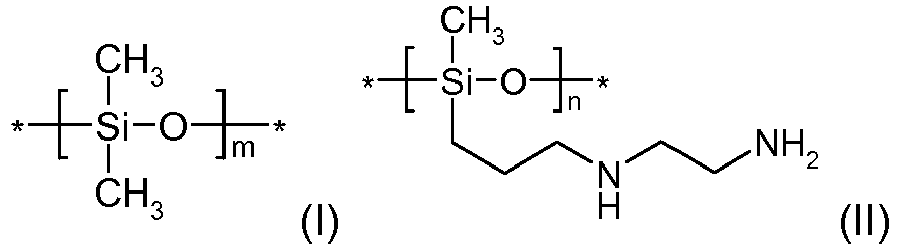
 * für eine Bindung zu einer der Struktureinheiten (I), (II) oder (III) oder für eine Endgruppe B (Si-gebunden) oder D (O-gebunden) steht,B für eine Gruppe -OH, -O-Si(CH3)3, -O-Si(CH3)2OH, -O-Si(CH3)2OCH3 steht,D für eine Gruppe -H, -Si(CH3)3, -Si(CH3)2OH, -Si(CH3)2OCH3 steht,a, b und c für ganze Zahlen zwischen 0 und 1000 stehen, mit der Maßgabe a + b + c > 0m, n und o für ganze Zahlen zwischen 1 und 1000 stehen.
 - Mittel nach einem der Ansprüche 1 bis 5, dadurch gekennzeichnet, dass Zubereitung (A) frei von Xanthan ist und - bezogen auf ihr Gewicht - 5 bis 60 Gew.-%, vorzugsweise 10 bis 55 Gew.-%, besonders bevorzugt 15 bis 50 Gew.-% und insbesondere 20 bis 45 Gew.-% mindestens eines Persulfat, ausgewählt aus Ammoniumperoxodisulfat und/oder Kaliumperoxodisulfat und/oder Natriumperoxodisulfat, enthält.
- Mittel nach einem der Ansprüche 1 bis 6, dadurch gekennzeichnet, dass Zubereitung (A) Persulfat-Salze in einer Menge von 0,1 bis 80 Gew.-%, bevorzugt von 2 bis 50 Gew.-%, besonders bevorzugt von 3 bis 30 Gew.-% und insbesondere bevorzugt 5 bis 15 Gew.-% explizit 5, 6, 7, 8, 9, 10, 11, 12, 13, 14 oder 15 Gew.-%, jeweils bezogen auf das Gesamtgewicht des Mittels, enthält.
- Mittel nach einem der Ansprüche 1 bis 7, dadurch gekennzeichnet, dass die Zubereitung (B) - bezogen auf ihr Gewicht - 0,1 bis 10 Gew.-%, vorzugsweise 0,25 bis 7,5 Gew.-%, weiter bevorzugt 0,5 bis 5 Gew.-%, besonders bevorzugt 0,75 bis 4 Gew.-% und insbesondere 1 bis 2,5 Gew.-% Xanthan und 0,5 bis 30 Gew.-%, vorzugsweise 1 bis 20 Gew.-%, besonders bevorzugt 5 bis 15 Gew.-% und insbesondere 6 bis 12 Gew.-% Wasserstoffperoxid, berechnet als 100%iges H2O2, enthält.
- Mittel nach einem der Ansprüche 1 bis 8, dadurch gekennzeichnet, dass die Zubereitung (B) einen pH-Wert von 3 bis 5, besonders bevorzugt von pH 3,5 bis 4,5 und insbesondere bevorzugt von pH 3,8 bis 4,2 aufweist.
- Mittel nach einem der Ansprüche 1 bis 9, dadurch gekennzeichnet, dass die Zubereitung (B) eine Viskosität von 1.000 mPa·s bis 50.000 mPa·s, vorzugsweise von von 5.000 mPa·s bis 45.000 mPa·s und besonders bevorzugt von 7.000 mPa·s bis 40.000 mPa·s bei Messungen mit einem Rotationsviskosimeter von Brookfield, Spindelgröße 4, bei 25°C und 4 Upm, aufweist.
- Mittel nach einem der Ansprüche 1 bis 10, dadurch gekennzeichnet, dass die fertig angemischten und anwendungsbereiten Mittel eine Viskosität von 10.000 mPa·s bis 50.000 mPa·s und besonders bevorzugt von 18.000 mPa·s bis 30.000 mPa·s bei Messungen mit einem Rotationsviskosimeter von Brookfield, Spindelgröße 5, bei 25°C und 4 Upm aufweisen.
- Mittel nach einem der Ansprüche 1 bis 11, dadurch gekennzeichnet, dass die fertig angemischten und anwendungsbereiten Mittel einen pH-Wert zwischen 9 und 12 aufweisen.
- Verfahren zur Farbveränderung keratinischer Fasern, bei dem mindestens zwei getrennt voneinander verpackte Zubereitungen (A) und (B), von welchen Zubereitung (A) mindestens ein Persulfat und Zubereitung (B) mindestens ein Oxidationsmittel enthält, zu einer Anwendungsmischung vermischt werden, diese auf die Fasern aufgetragen wird und nach einer Einwirkungszeit wieder abgespült wird, dadurch gekennzeichnet, dassi. Zubereitung (B) und/oder eine ggf. vorhandene Zubereitung (C) mindestens ein natürliches Polymer enthält/enthalten,ii. Zubereitung (A) - bezogen auf ihr Gewicht -mit der Maßgabe, dass die Zubereitung (A) - bezogen auf ihr Gewicht - 0,1 bis 6 Gew.-% Verbindung(en) aus den Gruppen a1) und a2) enthält.a1) 0 bis 3 Gew.-% Keratinhydrolysat(e) und/odera2) 0 bis 5 Gew.-% Silikonöl(e) enthält,
- Verfahren nach Anspruch 13, dadurch gekennzeichnet, dass die Kontrolle des Aufhellgrades der keratinischen Faser während der Einwirkzeit ohne Entfernen der Anwendungsmischung von der Faser visuell erfolgt.
- Verwendung von Keratinhydrolysaten und/oder Silikonölen zur Steigerung der Aufhell- und Pflegeleistung transparenter Blondiermittel.
Applications Claiming Priority (2)
| Application Number | Priority Date | Filing Date | Title |
|---|---|---|---|
| DE201310209098 DE102013209098A1 (de) | 2013-05-16 | 2013-05-16 | transparente Blondiermittel mit Proteinen und/oder Silikonölen |
| PCT/EP2014/052590 WO2014183882A1 (de) | 2013-05-16 | 2014-02-11 | Transparente blondiermittel mit proteinen und/oder silikonölen |
Publications (2)
| Publication Number | Publication Date |
|---|---|
| EP2996670A1 EP2996670A1 (de) | 2016-03-23 |
| EP2996670B1 true EP2996670B1 (de) | 2018-07-18 |
Family
ID=50156740
Family Applications (1)
| Application Number | Title | Priority Date | Filing Date |
|---|---|---|---|
| EP14705993.5A Active EP2996670B1 (de) | 2013-05-16 | 2014-02-11 | Transparente blondiermittel mit proteinen und/oder silikonölen |
Country Status (5)
| Country | Link |
|---|---|
| US (1) | US9789053B2 (de) |
| EP (1) | EP2996670B1 (de) |
| CN (1) | CN105209001B (de) |
| DE (1) | DE102013209098A1 (de) |
| WO (1) | WO2014183882A1 (de) |
Families Citing this family (15)
| Publication number | Priority date | Publication date | Assignee | Title |
|---|---|---|---|---|
| DE102015203820A1 (de) | 2015-03-04 | 2016-09-08 | Henkel Ag & Co. Kgaa | Blondiermittel mit einem Dipeptid |
| CN107847400A (zh) | 2015-05-01 | 2018-03-27 | 欧莱雅 | 活性剂在化学处理中的用途 |
| DE102015208788A1 (de) * | 2015-05-12 | 2016-11-17 | Henkel Ag & Co. Kgaa | Mittel zur schonenden oxidativen Aufhellung von keratinhaltigen Fasern |
| DE102015209739A1 (de) * | 2015-05-27 | 2016-12-01 | Henkel Ag & Co. Kgaa | Mittel zum Blondieren von Haaren mit roter oder rot-blonder Ausgangshaarfarbe |
| BR112018010344B1 (pt) | 2015-11-24 | 2021-08-10 | L'oreal | Composição para cabelo, sistema e método para tratamento do cabelo, métodos para alteração da cor do cabelo e do formato do cabelo, e, kits de multicompartimentos |
| US11213470B2 (en) | 2015-11-24 | 2022-01-04 | L'oreal | Compositions for treating the hair |
| WO2017091794A1 (en) | 2015-11-24 | 2017-06-01 | L'oreal | Compositions for treating the hair |
| US11135150B2 (en) * | 2016-11-21 | 2021-10-05 | L'oreal | Compositions and methods for improving the quality of chemically treated hair |
| US11433011B2 (en) | 2017-05-24 | 2022-09-06 | L'oreal | Methods for treating chemically relaxed hair |
| DE102017218967A1 (de) | 2017-10-24 | 2019-04-25 | Henkel Ag & Co. Kgaa | Blondiermittel mit Methionin |
| US11596588B2 (en) | 2017-12-29 | 2023-03-07 | L'oreal | Compositions for altering the color of hair |
| DE102018123507A1 (de) * | 2018-09-25 | 2020-03-26 | Henkel Ag & Co. Kgaa | Reduzierte Haarschädigung während der Blondierung durch Einsatz von einem biologisch abbaubaren Komplexbildner |
| DE102018123526A1 (de) * | 2018-09-25 | 2020-03-26 | Henkel Ag & Co. Kgaa | Reduzierte Haarschädigung während der Blondierung durch Einsatz von einem biologisch abbaubaren Komplexbildner |
| US11090249B2 (en) | 2018-10-31 | 2021-08-17 | L'oreal | Hair treatment compositions, methods, and kits for treating hair |
| US11419809B2 (en) | 2019-06-27 | 2022-08-23 | L'oreal | Hair treatment compositions and methods for treating hair |
Citations (13)
| Publication number | Priority date | Publication date | Assignee | Title |
|---|---|---|---|---|
| EP0684036A1 (de) | 1994-05-27 | 1995-11-29 | GOLDWELL GmbH | Mittel zum Blondieren von menschlichen Haaren |
| WO2000010515A1 (en) | 1998-08-21 | 2000-03-02 | Unilever Plc | A composition for lightening and highlighting hair |
| US6214576B1 (en) | 1996-12-17 | 2001-04-10 | Edward H. Burtt, Jr. | Bacteria useful for degrading keratin |
| JP2001247437A (ja) | 2000-03-06 | 2001-09-11 | Kanebo Ltd | 脱色剤組成物 |
| US6613311B2 (en) | 2001-02-01 | 2003-09-02 | Revlon Consumer Products Corporation | Silicone based hair bleach compositions and related methods |
| DE102005059936A1 (de) | 2005-12-13 | 2006-10-12 | Henkel Kgaa | Haarverformungsverfahren mit verbesserter Wirksamkeit |
| WO2009140076A1 (en) | 2008-05-16 | 2009-11-19 | The Procter & Gamble Company | Compositions and methods incorporating photocatalysts |
| EP2191812A1 (de) | 2008-11-27 | 2010-06-02 | KPSS-Kao Professional Salon Services GmbH | Zusammensetzung zum Bleichen/Strähnenfärben |
| EP2191867A1 (de) | 2008-11-27 | 2010-06-02 | KPSS-Kao Professional Salon Services GmbH | Zusammensetzung zum Bleichen/ zur Aufhellung |
| EP2338570A1 (de) | 2009-12-22 | 2011-06-29 | KPSS-Kao Professional Salon Services GmbH | Bleichzusammensetzung |
| WO2011160864A2 (de) | 2010-06-22 | 2011-12-29 | Henkel Ag & Co. Kgaa | Ammoniumsalz-haltige blondierpulver |
| US20120315236A1 (en) | 2010-10-11 | 2012-12-13 | Konstantin Goutsis | Agents for oxidatively changing the colour of keratin-containing fibres |
| WO2013145330A1 (en) | 2012-03-27 | 2013-10-03 | L'oreal | Process for treating keratin fibers |
Family Cites Families (8)
| Publication number | Priority date | Publication date | Assignee | Title |
|---|---|---|---|---|
| DE10315421A1 (de) * | 2003-04-03 | 2004-10-14 | Henkel Kgaa | Leistungsfähige oxidative Haarbehandlungsmittel mit Faserstrukturstabilisierung durch Radikalfänger |
| DE10339164A1 (de) * | 2003-08-26 | 2005-03-31 | Henkel Kgaa | Stabilisierung von Wasserstoffperoxid während der Auflösung alkalisierend wirkender Feststoffe in wasserstoffperoxidhaltigen Systemen |
| DE10339163A1 (de) * | 2003-08-26 | 2005-03-24 | Henkel Kgaa | Milde Bleichmittel mit erhöhter Aufhellleistung |
| DE102004002349A1 (de) | 2004-01-16 | 2005-08-11 | Wella Ag | Mittel zur oxidativen Behandlung, insbesondere in transparenter Gelform |
| DE102004061468A1 (de) * | 2004-12-17 | 2006-06-22 | Henkel Kgaa | Abgabesystem für farbverändernde Mittel |
| DE102006008149A1 (de) * | 2006-02-20 | 2007-08-23 | Henkel Kgaa | Bleichmittel |
| DE102007041490A1 (de) | 2007-08-31 | 2009-03-05 | Henkel Ag & Co. Kgaa | Blondiermittel und Blondierverfahren |
| DE102008036957A1 (de) * | 2008-08-08 | 2010-02-11 | Henkel Ag & Co. Kgaa | Mattierungsadditiv für Blondierungen |
-
2013
- 2013-05-16 DE DE201310209098 patent/DE102013209098A1/de not_active Withdrawn
-
2014
- 2014-02-11 CN CN201480027478.1A patent/CN105209001B/zh active Active
- 2014-02-11 WO PCT/EP2014/052590 patent/WO2014183882A1/de not_active Ceased
- 2014-02-11 EP EP14705993.5A patent/EP2996670B1/de active Active
-
2015
- 2015-11-11 US US14/937,997 patent/US9789053B2/en active Active
Patent Citations (13)
| Publication number | Priority date | Publication date | Assignee | Title |
|---|---|---|---|---|
| EP0684036A1 (de) | 1994-05-27 | 1995-11-29 | GOLDWELL GmbH | Mittel zum Blondieren von menschlichen Haaren |
| US6214576B1 (en) | 1996-12-17 | 2001-04-10 | Edward H. Burtt, Jr. | Bacteria useful for degrading keratin |
| WO2000010515A1 (en) | 1998-08-21 | 2000-03-02 | Unilever Plc | A composition for lightening and highlighting hair |
| JP2001247437A (ja) | 2000-03-06 | 2001-09-11 | Kanebo Ltd | 脱色剤組成物 |
| US6613311B2 (en) | 2001-02-01 | 2003-09-02 | Revlon Consumer Products Corporation | Silicone based hair bleach compositions and related methods |
| DE102005059936A1 (de) | 2005-12-13 | 2006-10-12 | Henkel Kgaa | Haarverformungsverfahren mit verbesserter Wirksamkeit |
| WO2009140076A1 (en) | 2008-05-16 | 2009-11-19 | The Procter & Gamble Company | Compositions and methods incorporating photocatalysts |
| EP2191812A1 (de) | 2008-11-27 | 2010-06-02 | KPSS-Kao Professional Salon Services GmbH | Zusammensetzung zum Bleichen/Strähnenfärben |
| EP2191867A1 (de) | 2008-11-27 | 2010-06-02 | KPSS-Kao Professional Salon Services GmbH | Zusammensetzung zum Bleichen/ zur Aufhellung |
| EP2338570A1 (de) | 2009-12-22 | 2011-06-29 | KPSS-Kao Professional Salon Services GmbH | Bleichzusammensetzung |
| WO2011160864A2 (de) | 2010-06-22 | 2011-12-29 | Henkel Ag & Co. Kgaa | Ammoniumsalz-haltige blondierpulver |
| US20120315236A1 (en) | 2010-10-11 | 2012-12-13 | Konstantin Goutsis | Agents for oxidatively changing the colour of keratin-containing fibres |
| WO2013145330A1 (en) | 2012-03-27 | 2013-10-03 | L'oreal | Process for treating keratin fibers |
Non-Patent Citations (2)
| Title |
|---|
| "Silicone Fluids : Stable, inert média", GELEST, pages 1 - 32 |
| DATABASE GNPD [O] September 2008 (2008-09-01), XP055584005, Database accession no. 973963 |
Also Published As
| Publication number | Publication date |
|---|---|
| CN105209001B (zh) | 2018-10-23 |
| DE102013209098A1 (de) | 2014-11-20 |
| CN105209001A (zh) | 2015-12-30 |
| EP2996670A1 (de) | 2016-03-23 |
| US9789053B2 (en) | 2017-10-17 |
| US20160058688A1 (en) | 2016-03-03 |
| WO2014183882A1 (de) | 2014-11-20 |
Similar Documents
| Publication | Publication Date | Title |
|---|---|---|
| EP2996776B1 (de) | Polymerhaltige transparente blondiermittel mit proteinen und/oder silikonölen | |
| WO2014183882A1 (de) | Transparente blondiermittel mit proteinen und/oder silikonölen | |
| EP2627413B1 (de) | Mittel zur oxidativen farbveränderung von keratinhaltigen fasern | |
| DE102014213325A1 (de) | Verbesserte Entfärbung von gefärbten keratinischen Fasern | |
| EP4034076A1 (de) | Mittel zum färben von keratinischem material mit aminosilikon, farbgebender verbindung und esteröl | |
| EP4034260B1 (de) | Verfahren zum färben von keratinischem material mit premix aus aminosilikon und farbgebender verbindung | |
| WO2014075861A2 (de) | Blondiermittel | |
| DE102019218234A1 (de) | Mittel zum Färben von keratinischem Material mit Aminosilikon, Pigment und Polysaccharid | |
| EP4167940B1 (de) | Mittel zum färben von keratinischen fasern enthaltend bestimmte nichtionische emulgatoren, pigmente und aminosilikone | |
| EP4034075B1 (de) | Verfahren zum färben von keratinischem material mit aminosilikon und farbgebender verbindung | |
| EP4065079A1 (de) | Verfahren zur verbesserung des farberhalts von gefärbtem keratinischem material, insbesondere menschlichen haaren | |
| WO2021058158A1 (de) | Mittel zum färben von keratinischem material mit aminosilikon, farbgebender verbindung und ethoxyliertem fettsäureester | |
| EP3873427A1 (de) | Bis(triethoxysilylpropyl)amine in kombination mit poysacchariden zur pflege und formgebung keratinischer fasern | |
| DE102015209739A1 (de) | Mittel zum Blondieren von Haaren mit roter oder rot-blonder Ausgangshaarfarbe | |
| DE102023205422A1 (de) | Verfahren zum Färben von keratinischen Fasern, umfassend die Färbung mit direktziehenden Farbstoffen und die Nachbehandlung mit C1-C6-Alkoxy-Silanen in einem Lösungsmittelsystem | |
| EP3038598B1 (de) | Schäumende blondiermittel | |
| DE102010030337A1 (de) | Ammoniumsalz-haltige Blondierpulver | |
| WO1997039724A1 (de) | Festes mittel zur behandlung keratinischer fasern | |
| DE102019218235A1 (de) | Mittel zum Färben von keratinischem Material mit Aminosilikon, Pigment, Polysaccharid und Fettbestandteil | |
| DE102015203820A1 (de) | Blondiermittel mit einem Dipeptid | |
| WO2021254804A1 (de) | Mittel zum färben von keratinischem material, insbesondere menschlichen haaren, enthaltend aminosilikone, pigmente und alkylpolyglycoside | |
| DE102020207604A1 (de) | Mittel zum Färben von keratinischen Fasern enthaltend Pigmente und C2-C30-Alkylmethicone |
Legal Events
| Date | Code | Title | Description |
|---|---|---|---|
| PUAI | Public reference made under article 153(3) epc to a published international application that has entered the european phase |
Free format text: ORIGINAL CODE: 0009012 |
|
| 17P | Request for examination filed |
Effective date: 20151026 |
|
| AK | Designated contracting states |
Kind code of ref document: A1 Designated state(s): AL AT BE BG CH CY CZ DE DK EE ES FI FR GB GR HR HU IE IS IT LI LT LU LV MC MK MT NL NO PL PT RO RS SE SI SK SM TR |
|
| AX | Request for extension of the european patent |
Extension state: BA ME |
|
| DAX | Request for extension of the european patent (deleted) | ||
| STAA | Information on the status of an ep patent application or granted ep patent |
Free format text: STATUS: EXAMINATION IS IN PROGRESS |
|
| 17Q | First examination report despatched |
Effective date: 20170214 |
|
| GRAP | Despatch of communication of intention to grant a patent |
Free format text: ORIGINAL CODE: EPIDOSNIGR1 |
|
| STAA | Information on the status of an ep patent application or granted ep patent |
Free format text: STATUS: GRANT OF PATENT IS INTENDED |
|
| RIC1 | Information provided on ipc code assigned before grant |
Ipc: A61Q 5/08 20060101ALI20180309BHEP Ipc: A61K 8/898 20060101ALI20180309BHEP Ipc: A61K 8/22 20060101ALI20180309BHEP Ipc: A61K 8/45 20060101AFI20180309BHEP Ipc: A61K 8/65 20060101ALI20180309BHEP Ipc: A61K 8/891 20060101ALI20180309BHEP Ipc: A61K 8/23 20060101ALI20180309BHEP Ipc: A61K 8/73 20060101ALI20180309BHEP |
|
| INTG | Intention to grant announced |
Effective date: 20180410 |
|
| GRAS | Grant fee paid |
Free format text: ORIGINAL CODE: EPIDOSNIGR3 |
|
| GRAA | (expected) grant |
Free format text: ORIGINAL CODE: 0009210 |
|
| STAA | Information on the status of an ep patent application or granted ep patent |
Free format text: STATUS: THE PATENT HAS BEEN GRANTED |
|
| AK | Designated contracting states |
Kind code of ref document: B1 Designated state(s): AL AT BE BG CH CY CZ DE DK EE ES FI FR GB GR HR HU IE IS IT LI LT LU LV MC MK MT NL NO PL PT RO RS SE SI SK SM TR |
|
| REG | Reference to a national code |
Ref country code: GB Ref legal event code: FG4D Free format text: NOT ENGLISH |
|
| REG | Reference to a national code |
Ref country code: CH Ref legal event code: EP |
|
| REG | Reference to a national code |
Ref country code: IE Ref legal event code: FG4D Free format text: LANGUAGE OF EP DOCUMENT: GERMAN |
|
| REG | Reference to a national code |
Ref country code: AT Ref legal event code: REF Ref document number: 1018592 Country of ref document: AT Kind code of ref document: T Effective date: 20180815 |
|
| REG | Reference to a national code |
Ref country code: DE Ref legal event code: R096 Ref document number: 502014008873 Country of ref document: DE |
|
| REG | Reference to a national code |
Ref country code: NL Ref legal event code: MP Effective date: 20180718 |
|
| REG | Reference to a national code |
Ref country code: LT Ref legal event code: MG4D |
|
| PG25 | Lapsed in a contracting state [announced via postgrant information from national office to epo] |
Ref country code: NL Free format text: LAPSE BECAUSE OF FAILURE TO SUBMIT A TRANSLATION OF THE DESCRIPTION OR TO PAY THE FEE WITHIN THE PRESCRIBED TIME-LIMIT Effective date: 20180718 |
|
| PG25 | Lapsed in a contracting state [announced via postgrant information from national office to epo] |
Ref country code: BG Free format text: LAPSE BECAUSE OF FAILURE TO SUBMIT A TRANSLATION OF THE DESCRIPTION OR TO PAY THE FEE WITHIN THE PRESCRIBED TIME-LIMIT Effective date: 20181018 Ref country code: LT Free format text: LAPSE BECAUSE OF FAILURE TO SUBMIT A TRANSLATION OF THE DESCRIPTION OR TO PAY THE FEE WITHIN THE PRESCRIBED TIME-LIMIT Effective date: 20180718 Ref country code: PL Free format text: LAPSE BECAUSE OF FAILURE TO SUBMIT A TRANSLATION OF THE DESCRIPTION OR TO PAY THE FEE WITHIN THE PRESCRIBED TIME-LIMIT Effective date: 20180718 Ref country code: IS Free format text: LAPSE BECAUSE OF FAILURE TO SUBMIT A TRANSLATION OF THE DESCRIPTION OR TO PAY THE FEE WITHIN THE PRESCRIBED TIME-LIMIT Effective date: 20181118 Ref country code: NO Free format text: LAPSE BECAUSE OF FAILURE TO SUBMIT A TRANSLATION OF THE DESCRIPTION OR TO PAY THE FEE WITHIN THE PRESCRIBED TIME-LIMIT Effective date: 20181018 Ref country code: SE Free format text: LAPSE BECAUSE OF FAILURE TO SUBMIT A TRANSLATION OF THE DESCRIPTION OR TO PAY THE FEE WITHIN THE PRESCRIBED TIME-LIMIT Effective date: 20180718 Ref country code: FI Free format text: LAPSE BECAUSE OF FAILURE TO SUBMIT A TRANSLATION OF THE DESCRIPTION OR TO PAY THE FEE WITHIN THE PRESCRIBED TIME-LIMIT Effective date: 20180718 Ref country code: GR Free format text: LAPSE BECAUSE OF FAILURE TO SUBMIT A TRANSLATION OF THE DESCRIPTION OR TO PAY THE FEE WITHIN THE PRESCRIBED TIME-LIMIT Effective date: 20181019 Ref country code: RS Free format text: LAPSE BECAUSE OF FAILURE TO SUBMIT A TRANSLATION OF THE DESCRIPTION OR TO PAY THE FEE WITHIN THE PRESCRIBED TIME-LIMIT Effective date: 20180718 |
|
| PG25 | Lapsed in a contracting state [announced via postgrant information from national office to epo] |
Ref country code: HR Free format text: LAPSE BECAUSE OF FAILURE TO SUBMIT A TRANSLATION OF THE DESCRIPTION OR TO PAY THE FEE WITHIN THE PRESCRIBED TIME-LIMIT Effective date: 20180718 Ref country code: AL Free format text: LAPSE BECAUSE OF FAILURE TO SUBMIT A TRANSLATION OF THE DESCRIPTION OR TO PAY THE FEE WITHIN THE PRESCRIBED TIME-LIMIT Effective date: 20180718 Ref country code: LV Free format text: LAPSE BECAUSE OF FAILURE TO SUBMIT A TRANSLATION OF THE DESCRIPTION OR TO PAY THE FEE WITHIN THE PRESCRIBED TIME-LIMIT Effective date: 20180718 |
|
| REG | Reference to a national code |
Ref country code: DE Ref legal event code: R026 Ref document number: 502014008873 Country of ref document: DE |
|
| PLBI | Opposition filed |
Free format text: ORIGINAL CODE: 0009260 |
|
| PLBI | Opposition filed |
Free format text: ORIGINAL CODE: 0009260 |
|
| PG25 | Lapsed in a contracting state [announced via postgrant information from national office to epo] |
Ref country code: EE Free format text: LAPSE BECAUSE OF FAILURE TO SUBMIT A TRANSLATION OF THE DESCRIPTION OR TO PAY THE FEE WITHIN THE PRESCRIBED TIME-LIMIT Effective date: 20180718 Ref country code: IT Free format text: LAPSE BECAUSE OF FAILURE TO SUBMIT A TRANSLATION OF THE DESCRIPTION OR TO PAY THE FEE WITHIN THE PRESCRIBED TIME-LIMIT Effective date: 20180718 Ref country code: CZ Free format text: LAPSE BECAUSE OF FAILURE TO SUBMIT A TRANSLATION OF THE DESCRIPTION OR TO PAY THE FEE WITHIN THE PRESCRIBED TIME-LIMIT Effective date: 20180718 Ref country code: RO Free format text: LAPSE BECAUSE OF FAILURE TO SUBMIT A TRANSLATION OF THE DESCRIPTION OR TO PAY THE FEE WITHIN THE PRESCRIBED TIME-LIMIT Effective date: 20180718 Ref country code: ES Free format text: LAPSE BECAUSE OF FAILURE TO SUBMIT A TRANSLATION OF THE DESCRIPTION OR TO PAY THE FEE WITHIN THE PRESCRIBED TIME-LIMIT Effective date: 20180718 |
|
| PLAX | Notice of opposition and request to file observation + time limit sent |
Free format text: ORIGINAL CODE: EPIDOSNOBS2 |
|
| 26 | Opposition filed |
Opponent name: KAO GERMANY GMBH Effective date: 20190416 |
|
| 26 | Opposition filed |
Opponent name: L'OREAL Effective date: 20190418 |
|
| PG25 | Lapsed in a contracting state [announced via postgrant information from national office to epo] |
Ref country code: SM Free format text: LAPSE BECAUSE OF FAILURE TO SUBMIT A TRANSLATION OF THE DESCRIPTION OR TO PAY THE FEE WITHIN THE PRESCRIBED TIME-LIMIT Effective date: 20180718 Ref country code: SK Free format text: LAPSE BECAUSE OF FAILURE TO SUBMIT A TRANSLATION OF THE DESCRIPTION OR TO PAY THE FEE WITHIN THE PRESCRIBED TIME-LIMIT Effective date: 20180718 Ref country code: DK Free format text: LAPSE BECAUSE OF FAILURE TO SUBMIT A TRANSLATION OF THE DESCRIPTION OR TO PAY THE FEE WITHIN THE PRESCRIBED TIME-LIMIT Effective date: 20180718 |
|
| PLAB | Opposition data, opponent's data or that of the opponent's representative modified |
Free format text: ORIGINAL CODE: 0009299OPPO |
|
| R26 | Opposition filed (corrected) |
Opponent name: L'OREAL Effective date: 20190418 |
|
| PG25 | Lapsed in a contracting state [announced via postgrant information from national office to epo] |
Ref country code: SI Free format text: LAPSE BECAUSE OF FAILURE TO SUBMIT A TRANSLATION OF THE DESCRIPTION OR TO PAY THE FEE WITHIN THE PRESCRIBED TIME-LIMIT Effective date: 20180718 |
|
| PLBB | Reply of patent proprietor to notice(s) of opposition received |
Free format text: ORIGINAL CODE: EPIDOSNOBS3 |
|
| REG | Reference to a national code |
Ref country code: CH Ref legal event code: PL |
|
| PG25 | Lapsed in a contracting state [announced via postgrant information from national office to epo] |
Ref country code: MC Free format text: LAPSE BECAUSE OF FAILURE TO SUBMIT A TRANSLATION OF THE DESCRIPTION OR TO PAY THE FEE WITHIN THE PRESCRIBED TIME-LIMIT Effective date: 20180718 Ref country code: LU Free format text: LAPSE BECAUSE OF NON-PAYMENT OF DUE FEES Effective date: 20190211 |
|
| REG | Reference to a national code |
Ref country code: BE Ref legal event code: MM Effective date: 20190228 |
|
| REG | Reference to a national code |
Ref country code: IE Ref legal event code: MM4A |
|
| PG25 | Lapsed in a contracting state [announced via postgrant information from national office to epo] |
Ref country code: LI Free format text: LAPSE BECAUSE OF NON-PAYMENT OF DUE FEES Effective date: 20190228 Ref country code: CH Free format text: LAPSE BECAUSE OF NON-PAYMENT OF DUE FEES Effective date: 20190228 |
|
| PG25 | Lapsed in a contracting state [announced via postgrant information from national office to epo] |
Ref country code: IE Free format text: LAPSE BECAUSE OF NON-PAYMENT OF DUE FEES Effective date: 20190211 |
|
| PG25 | Lapsed in a contracting state [announced via postgrant information from national office to epo] |
Ref country code: BE Free format text: LAPSE BECAUSE OF NON-PAYMENT OF DUE FEES Effective date: 20190228 |
|
| PG25 | Lapsed in a contracting state [announced via postgrant information from national office to epo] |
Ref country code: TR Free format text: LAPSE BECAUSE OF FAILURE TO SUBMIT A TRANSLATION OF THE DESCRIPTION OR TO PAY THE FEE WITHIN THE PRESCRIBED TIME-LIMIT Effective date: 20180718 |
|
| REG | Reference to a national code |
Ref country code: AT Ref legal event code: MM01 Ref document number: 1018592 Country of ref document: AT Kind code of ref document: T Effective date: 20190211 |
|
| PG25 | Lapsed in a contracting state [announced via postgrant information from national office to epo] |
Ref country code: AT Free format text: LAPSE BECAUSE OF NON-PAYMENT OF DUE FEES Effective date: 20190211 |
|
| PG25 | Lapsed in a contracting state [announced via postgrant information from national office to epo] |
Ref country code: MT Free format text: LAPSE BECAUSE OF FAILURE TO SUBMIT A TRANSLATION OF THE DESCRIPTION OR TO PAY THE FEE WITHIN THE PRESCRIBED TIME-LIMIT Effective date: 20180718 Ref country code: PT Free format text: LAPSE BECAUSE OF FAILURE TO SUBMIT A TRANSLATION OF THE DESCRIPTION OR TO PAY THE FEE WITHIN THE PRESCRIBED TIME-LIMIT Effective date: 20181118 |
|
| PLBP | Opposition withdrawn |
Free format text: ORIGINAL CODE: 0009264 |
|
| PG25 | Lapsed in a contracting state [announced via postgrant information from national office to epo] |
Ref country code: CY Free format text: LAPSE BECAUSE OF FAILURE TO SUBMIT A TRANSLATION OF THE DESCRIPTION OR TO PAY THE FEE WITHIN THE PRESCRIBED TIME-LIMIT Effective date: 20180718 |
|
| PG25 | Lapsed in a contracting state [announced via postgrant information from national office to epo] |
Ref country code: HU Free format text: LAPSE BECAUSE OF FAILURE TO SUBMIT A TRANSLATION OF THE DESCRIPTION OR TO PAY THE FEE WITHIN THE PRESCRIBED TIME-LIMIT; INVALID AB INITIO Effective date: 20140211 |
|
| APBM | Appeal reference recorded |
Free format text: ORIGINAL CODE: EPIDOSNREFNO |
|
| APBP | Date of receipt of notice of appeal recorded |
Free format text: ORIGINAL CODE: EPIDOSNNOA2O |
|
| APAH | Appeal reference modified |
Free format text: ORIGINAL CODE: EPIDOSCREFNO |
|
| APAW | Appeal reference deleted |
Free format text: ORIGINAL CODE: EPIDOSDREFNO |
|
| APAY | Date of receipt of notice of appeal deleted |
Free format text: ORIGINAL CODE: EPIDOSDNOA2O |
|
| APBM | Appeal reference recorded |
Free format text: ORIGINAL CODE: EPIDOSNREFNO |
|
| APBP | Date of receipt of notice of appeal recorded |
Free format text: ORIGINAL CODE: EPIDOSNNOA2O |
|
| APBQ | Date of receipt of statement of grounds of appeal recorded |
Free format text: ORIGINAL CODE: EPIDOSNNOA3O |
|
| PG25 | Lapsed in a contracting state [announced via postgrant information from national office to epo] |
Ref country code: MK Free format text: LAPSE BECAUSE OF FAILURE TO SUBMIT A TRANSLATION OF THE DESCRIPTION OR TO PAY THE FEE WITHIN THE PRESCRIBED TIME-LIMIT Effective date: 20180718 |
|
| PLAB | Opposition data, opponent's data or that of the opponent's representative modified |
Free format text: ORIGINAL CODE: 0009299OPPO |
|
| R26 | Opposition filed (corrected) |
Opponent name: L'OREAL Effective date: 20190418 |
|
| P01 | Opt-out of the competence of the unified patent court (upc) registered |
Effective date: 20230530 |
|
| APBU | Appeal procedure closed |
Free format text: ORIGINAL CODE: EPIDOSNNOA9O |
|
| PLAY | Examination report in opposition despatched + time limit |
Free format text: ORIGINAL CODE: EPIDOSNORE2 |
|
| PLBC | Reply to examination report in opposition received |
Free format text: ORIGINAL CODE: EPIDOSNORE3 |
|
| PLAY | Examination report in opposition despatched + time limit |
Free format text: ORIGINAL CODE: EPIDOSNORE2 |
|
| PLBC | Reply to examination report in opposition received |
Free format text: ORIGINAL CODE: EPIDOSNORE3 |
|
| PGFP | Annual fee paid to national office [announced via postgrant information from national office to epo] |
Ref country code: GB Payment date: 20260219 Year of fee payment: 13 |
|
| PGFP | Annual fee paid to national office [announced via postgrant information from national office to epo] |
Ref country code: DE Payment date: 20260218 Year of fee payment: 13 |
|
| PGFP | Annual fee paid to national office [announced via postgrant information from national office to epo] |
Ref country code: FR Payment date: 20260218 Year of fee payment: 13 |