EP2991291B1 - Überlastungskontrollverfahren und -vorrichtung - Google Patents
Überlastungskontrollverfahren und -vorrichtung Download PDFInfo
- Publication number
- EP2991291B1 EP2991291B1 EP13884741.3A EP13884741A EP2991291B1 EP 2991291 B1 EP2991291 B1 EP 2991291B1 EP 13884741 A EP13884741 A EP 13884741A EP 2991291 B1 EP2991291 B1 EP 2991291B1
- Authority
- EP
- European Patent Office
- Prior art keywords
- overload
- indication information
- mobility management
- gateway device
- management entity
- Prior art date
- Legal status (The legal status is an assumption and is not a legal conclusion. Google has not performed a legal analysis and makes no representation as to the accuracy of the status listed.)
- Active
Links
Images








Classifications
-
- H—ELECTRICITY
- H04—ELECTRIC COMMUNICATION TECHNIQUE
- H04W—WIRELESS COMMUNICATION NETWORKS
- H04W28/00—Network traffic management; Network resource management
- H04W28/02—Traffic management, e.g. flow control or congestion control
- H04W28/0289—Congestion control
-
- H—ELECTRICITY
- H04—ELECTRIC COMMUNICATION TECHNIQUE
- H04L—TRANSMISSION OF DIGITAL INFORMATION, e.g. TELEGRAPHIC COMMUNICATION
- H04L12/00—Data switching networks
Definitions
- the present invention relates to the communications field, and more specifically, to an overload control method, a gateway device, a mobility management entity, and a packet data network gateway (Packet Data Network Gateway, PGW).
- PGW Packet Data Network Gateway
- each network device may be connected to multiple other node devices.
- a serving gateway (Serving Gateway, SGW) is connected to multiple mobility management entities or connected to multiple PGWs.
- SGW Serving Gateway
- a process in which a terminal device accesses a network and uses a communications network to perform communication is complex. First, a process in which the terminal accesses the network upon power-on is an attach process, and after the attach process is successfully completed, the terminal accesses the network. Then, when the terminal uses a network resource to perform communication, a bearer resource needs to be established, so as to implement data transmission. Then, a process of establishing a bearer needs to be performed.
- QoS Quality of Service
- the terminal may switch to an idle state, and if the user re-initiates a service, such as a voice call or Internet surfing, the terminal device initiates a service request process and switches from the idle state to a connected state.
- An actual communication process is quite complex and includes many processes, for example, separation process or an event reporting process such as location reporting.
- a large quantity of users may simultaneously initiate an attach process; then a large quantity of create session request/response (Create Session Request/Response) messages are generated between an SGW and a PGW, or a large quantity of users simultaneously initiate a service request (Service Request) process.
- the process triggers a large quantity of modify bearer request (Modify bearer request) messages between a mobility management entity (Mobility Management Entity, MME) and the SGW, and also triggers some signaling between the SGW and the PGW.
- modify bearer request Modify bearer request
- MME Mobility Management Entity
- device overload may be caused, there may be overload of the MME, overload of the SGW, overload of the PGW, or the like. Meanwhile, a problem that device load is unbalanced may also occur; for example, some devices are heavily loaded whereas other devices are lightly loaded.
- US 2005/190748 A1 relates to a processing node that measures the loading factors of the processing node, produces loading factor information related to the loading factors, and sends loading factor information to signaling node.
- EP 1906 589 A1 relates to an access gateway (AG) that reports overload information of the AG to a media gateway controller (MGC) with the gateway overload control packet.
- the MGC initiates a corresponding call restriction policy for a call to the AG dependent upon the overload level of the AG.
- EP 2563070 A1 relates to an overload control scheme where, when the gateway device is congested/overloaded, the mobility management element may perform congestion /overloaded control differentially on a UE or UEs in a UE group according to the indication message send by the gateway device.
- Embodiments of the present invention provide an overload control method, a gateway device, a mobility management entity, and a PGW, which can effectively control device overload.
- an overload control method including: determining, by a gateway device, first overload indication information, where the first overload indication information is used to indicate an overload control policy; and sending, by the gateway device, the first overload indication information to a mobility management entity, so that the mobility management entity executes the overload control policy according to the first overload indication information; wherein the method further comprises: sending(s170), by the gateway device, information about a delay timer to the mobility management entity, to instruct the mobility management entity to start executing upon receipt of the first overload information indication the overload control policy according to the first overload indication information before the delay timer expires and to end overload control after the delay timer expires.
- the method before the determining, by a gateway device, first overload indication information, the method further includes: receiving, by the gateway device, a first control request message sent by the mobility management entity; the determining, by a gateway device, first overload indication information includes: determining, by the gateway device, the first overload indication information according to a load status of the gateway device; and the sending, by the gateway device, the first overload indication information to a mobility management entity includes: sending, by the gateway device, a first control response message to the mobility management entity, where the first control response message carries the first overload indication information.
- the method further includes: receiving, by the gateway device, a first path detection request message sent by the mobility management entity; the determining, by a gateway device, first overload indication information includes: determining, by the gateway device, the first overload indication information according to a load status of the gateway device; and the sending, by the gateway device, the first overload indication information to a mobility management entity includes: sending, by the gateway device, a first path detection response message to the mobility management entity, where the first path detection response message carries the first overload indication information.
- the determining, by the gateway device, the first overload indication information according to a load status of the gateway device includes: determining, by the gateway device, the first overload indication information according to the load status of the gateway device and signaling sending statuses of mobility management entities connected to the gateway device.
- the gateway device is an SGW; before the determining, by a gateway device, first overload indication information, the method further includes: receiving, by the SGW, a first control request message sent by the mobility management entity; sending, by the SGW, a second control request message to a packet data network gateway PGW; and receiving, by the SGW, a second control response message sent by the PGW, where the second control response message carries second overload indication information that is determined by the PGW and used to indicate the overload control policy; the determining, by a gateway device, first overload indication information includes: determining, by the SGW, the second overload indication information as the first overload indication information, or determining, by the SGW, the first overload indication information according to the second overload indication information and signaling sending statuses of mobility management entities connected to the SGW; and the sending, by the gateway device, the first overload indication information to a mobility management entity includes: sending, by the SGW, a first control response message to the mobility management entity, where the first control response message carries the first overload indication
- the gateway device is an SGW; before the determining, by a gateway device, first overload indication information, the method further includes: sending, by the SGW, a second path detection request message to a PGW; and receiving, by the SGW, a second path detection response message sent by the PGW, where the second path detection response message carries second overload indication information that is determined by the PGW and used to indicate the overload control policy; the determining, by a gateway device, first overload indication information includes: determining, by the SGW, the second overload indication information as the first overload indication information, or determining, by the SGW, the first overload indication information according to the second overload indication information and signaling sending statuses of mobility management entities connected to the SGW; and the sending, by the gateway device, the first overload indication information to a mobility management entity includes: sending, by the SGW, a first path detection message to the mobility management entity, where the first path detection message carries the first overload indication information.
- the overload control policy includes: limiting initial access users, delaying signaling in a mobility management process, delaying signaling in a service request process, or delaying signaling in a session management process.
- the first overload indication information includes an indication or overload status information associated with the overload control policy.
- the first overload indication information further includes an overload control rate.
- the method before the determining, by a gateway device, first overload indication information, the method further includes: receiving, by the gateway device, a first control signaling message that is sent by the mobility management entity; and the determining, by a gateway device, first overload indication information includes: determining, by the gateway device, the first overload indication information as a first control signaling response message that includes information about a delay timer, where the first overload indication information indicates that the overload control policy is controlling a signaling process that has a same type as first control signaling.
- the determining, by the gateway device, the first overload indication information as a first control signaling response message that includes information about a delay timer includes: determining, by the gateway device, the first overload indication information as the first control signaling response message that includes the information about the delay timer, and an overload control rate.
- an overload control method including: receiving, by a mobility management entity, first overload indication information sent by a gateway device, where the first overload indication information is used to indicate an overload control policy; and executing, by the mobility management entity, the overload control policy according to the first overload indication information, wherein the method further comprises:receiving, by the mobility management entity, information about a delay timer sent by the gateway device; and the step of executing, by the mobility management entity, the overload control policy according to the first overload indication information comprises: starting, upon receipt of the first overload information indication, executing by the mobility management entity, the overload control policy according to the first overload indication information before the delay timer expires, and ending overload control after the delay timer expires.
- the method before the receiving, by a mobility management entity, first overload indication information sent by a gateway device, the method further includes: sending, by the mobility management entity, a first control request message to the gateway device; and the receiving, by a mobility management entity, first overload indication information sent by a gateway device includes: receiving, by the mobility management entity, a first control response message sent by the gateway device, where the first control response message carries the first overload indication information, and the first overload indication information is determined by the gateway device according to a load status of the gateway device, or the first overload indication information is determined by the gateway device according to a load status of the gateway device and signaling sending statuses of mobility management entities connected to the gateway device.
- the method before the receiving, by a mobility management entity, first overload indication information sent by a gateway device, the method further includes: sending, by the mobility management entity, a first path detection request message to the gateway device; and the receiving, by a mobility management entity, first overload indication information sent by a gateway device includes: receiving, by the mobility management entity, a first path detection response message sent by the gateway device, where the first path detection response message carries the first overload indication information, and the first overload indication information is determined by the gateway device according to a load status of the gateway device, or the first overload indication information is determined by the gateway device according to a load status of the gateway device and signaling sending statuses of mobility management entities connected to the gateway device.
- the gateway device is an SGW; before the receiving, by a mobility management entity, first overload indication information sent by a gateway device, the method further includes: sending, by the mobility management entity, a first control request message to the SGW, so that the SGW sends a second control request message to a packet data network gateway PGW and receives a second control response message sent by the PGW, where the second control response message carries second overload indication information that is determined by the PGW and used to indicate the overload control policy; and the receiving, by a mobility management entity, first overload indication information sent by a gateway device includes: receiving, by the mobility management entity, a first control response message sent by the SGW, where the first control response message carries the first overload indication information, and the first overload indication information is the second overload indication information forwarded by the SGW, or the first overload indication information is determined by the SGW according to the second overload indication information and signaling sending statuses of mobility management entities connected to the SGW;
- the gateway device is an SGW; and the receiving, by a mobility management entity, first overload indication information sent by a gateway device includes: receiving, by the mobility management entity, a first path detection message sent by the SGW, where the first path detection message carries the first overload indication information, and the first overload indication information is second overload indication information that is forwarded by the SGW, determined by a PGW, and used to indicate the overload control policy, or the first overload indication information is determined by the SGW according to the second overload indication information and signaling sending statuses of mobility management entities connected to the SGW
- the overload control policy includes: limiting initial access users, delaying signaling in a mobility management process, delaying signaling in a service request process, or delaying signaling in a session management process.
- the first overload indication information includes an indication or overload status information associated with the overload control policy; and the executing, by the mobility management entity, the overload control policy according to the first overload indication information includes: executing, by the mobility management entity, the overload control policy associated with the indication or the overload status information.
- the first overload indication information further includes an overload control rate; and the executing, by the mobility management entity, the overload control policy according to the first overload indication information includes: executing, by the mobility management entity according to the overload control rate, the overload control policy associated with the indication or the overload status information.
- the method before the receiving, by a mobility management entity, first overload indication information sent by a gateway device, the method further includes: sending, by the mobility management entity, a first control signaling message to the gateway device; the receiving, by a mobility management entity, first overload indication information sent by a gateway device includes: receiving, by the mobility management entity, a first control signaling response message that is sent by the gateway device and includes information about a delay timer, where the first control signaling response message indicates that the overload control policy is controlling a signaling process that has a same type as first control signaling; and the executing, by the mobility management entity, the overload control policy according to the first overload indication information includes: controlling, by the mobility management entity according to the first control signaling response message, the signaling process that has the same type as the first control signaling.
- the first control signaling response message further includes an overload control rate; and the executing, by the mobility management entity, the overload control policy according to the first overload indication information includes: controlling, by the mobility management entity according to the overload control rate, the signaling process that has the same type as the first control signaling.
- a gateway device including: a determining module, configured to determine first overload indication information, where the first overload indication information is used to indicate an overload control policy; and a sending module, configured to send the first overload indication information to a mobility management entity, so that the mobility management entity executes the overload control policy according to the first overload indication information, wherein the sending module is further configured to send information about a delay timer to the mobility management entity, to instruct the mobility management entity to start executing upon receipt of the first overload information indication the overload control policy according to the first overload indication information before the delay timer expires and to end overload control after the delay timer expires.
- the gateway device further includes a first receiving module, configured to: before the determining module determines the first overload indication information, receive a first control request message sent by the mobility management entity; where the determining module is specifically configured to determine the first overload indication information according to a load status of the gateway device; and the sending module is specifically configured to send a first control response message to the mobility management entity, where the first control response message carries the first overload indication information.
- a first receiving module configured to: before the determining module determines the first overload indication information, receive a first control request message sent by the mobility management entity; where the determining module is specifically configured to determine the first overload indication information according to a load status of the gateway device; and the sending module is specifically configured to send a first control response message to the mobility management entity, where the first control response message carries the first overload indication information.
- the gateway device further includes a second receiving module, configured to: before the determining module determines the first overload indication information, receive a first path detection request message sent by the mobility management entity; where the determining module is specifically configured to determine the first overload indication information according to a load status of the gateway device; and the sending module is specifically configured to send a first path detection response message to the mobility management entity, where the first path detection response message carries the first overload indication information.
- a second receiving module configured to: before the determining module determines the first overload indication information, receive a first path detection request message sent by the mobility management entity; where the determining module is specifically configured to determine the first overload indication information according to a load status of the gateway device; and the sending module is specifically configured to send a first path detection response message to the mobility management entity, where the first path detection response message carries the first overload indication information.
- the determining module is specifically configured to determine the first overload indication information according to the load status of the gateway device and signaling sending statuses of mobility management entities connected to the gateway device.
- the gateway device is an SGW; the gateway device further includes a third receiving module, configured to: before the determining module determines the first overload indication information, receive a first control request message sent by the mobility management entity; where the sending module is further configured to send a second control request message to a packet data network gateway PGW; the third receiving module is further configured to receive a second control response message sent by the PGW, where the second control response message carries second overload indication information that is determined by the PGW and used to indicate the overload control policy; the determining module is specifically configured to: determine the second overload indication information as the first overload indication information, or determine the first overload indication information according to the second overload indication information and signaling sending statuses of mobility management entities connected to the SGW; and the sending module is specifically configured to send a first control response message to the mobility management entity, where the first control response message carries the first overload indication information.
- the gateway device is an SGW; the sending module is further configured to: before the determining module determines the first overload indication information, send a second path detection request message to a PGW; and the gateway device further includes a fourth receiving module, configured to receive a second path detection response message sent by the PGW, where the second path detection response message carries second overload indication information that is determined by the PGW and used to indicate the overload control policy; where the determining module is specifically configured to: determine the second overload indication information as the first overload indication information, or determine the first overload indication information according to the second overload indication information and signaling sending statuses of mobility management entities connected to the SGW; and the sending module is specifically configured to send a first path detection message to the mobility management entity, where the first path detection message carries the first overload indication information.
- the overload control policy includes: limiting initial access users, delaying signaling in a mobility management process, delaying signaling in a service request process, or delaying signaling in a session management process.
- the first overload indication information includes an indication or overload status information associated with the overload control policy.
- the first overload indication information further includes an overload control rate.
- the gateway device further includes a fifth receiving module, configured to: before the determining module determines the first overload indication information, receive a first control signaling message that is sent by the mobility management entity; where the determining module is specifically configured to determine the first overload indication information as a first control signaling response message that includes information about a delay timer, where the first overload indication information indicates that the overload control policy is controlling a signaling process that has a same type as first control signaling.
- the determining module is specifically configured to determine the first overload indication information as the first control signaling response message that includes the information about the delay timer, and an overload control rate.
- a mobility management entity including: a receiving module, configured to receive first overload indication information sent by a gateway device, where the first overload indication information is used to indicate an overload control policy; and a processing module, configured to execute the overload control policy according to the first overload indication information, wherein the receiving module is further configured to receive information about a delay timer sent by the gateway device; and the processing module is specifically configured to start, upon receipt of the first overload indication information, executing the overload control policy according to the first overload indication information before the delay timer expires and to end overload control after the delay timer expires.
- the mobility management entity further includes a first sending module, configured to: before the receiving module receives the first overload indication information sent by the gateway device, send a first control request message to the gateway device; where the receiving module is specifically configured to receive a first control response message sent by the gateway device, where the first control response message carries the first overload indication information, and the first overload indication information is determined by the gateway device according to a load status of the gateway device, or the first overload indication information is determined by the gateway device according to a load status of the gateway device and signaling sending statuses of mobility management entities connected to the gateway device.
- a first sending module configured to: before the receiving module receives the first overload indication information sent by the gateway device, send a first control request message to the gateway device; where the receiving module is specifically configured to receive a first control response message sent by the gateway device, where the first control response message carries the first overload indication information, and the first overload indication information is determined by the gateway device according to a load status of the gateway device, or the first overload indication information is determined by the gateway device according to a
- the mobility management entity further includes a second sending module, configured to: before the receiving module receives the first overload indication information sent by the gateway device, send a first path detection request message to the gateway device; where the receiving module is specifically configured to receive a first path detection response message sent by the gateway device, where the first path detection response message carries the first overload indication information, and the first overload indication information is determined by the gateway device according to a load status of the gateway device, or the first overload indication information is determined by the gateway device according to a load status of the gateway device and signaling sending statuses of mobility management entities connected to the gateway device.
- a second sending module configured to: before the receiving module receives the first overload indication information sent by the gateway device, send a first path detection request message to the gateway device; where the receiving module is specifically configured to receive a first path detection response message sent by the gateway device, where the first path detection response message carries the first overload indication information, and the first overload indication information is determined by the gateway device according to a load status of the gateway device, or the first overload indication information is determined by the
- the gateway device is an SGW; and the mobility management entity further includes a third sending module, configured to: before the receiving module receives the first overload indication information sent by the gateway device, send a first control request message to the SGW, so that the SGW sends a second control request message to a packet data network gateway PGW and receives a second control response message sent by the PGW, where the second control response message carries second overload indication information that is determined by the PGW and used to indicate the overload control policy; where the receiving module is specifically configured to receive a first control response message sent by the SGW, where the first control response message carries the first overload indication information, and the first overload indication information is the second overload indication information forwarded by the SGW, or the first overload indication information is determined by the SGW according to the second overload indication information and signaling sending statuses of mobility management entities connected to the SGW
- the gateway device is an SGW; and the receiving module is specifically configured to receive a first path detection message sent by the SGW, where the first path detection message carries the first overload indication information, and the first overload indication information is second overload indication information that is forwarded by the SGW, determined by a PGW, and used to indicate the overload control policy, or the first overload indication information is determined by the SGW according to the second overload indication information and signaling sending statuses of mobility management entities connected to the SGW
- the overload control policy includes: limiting initial access users, delaying signaling in a mobility management process, delaying signaling in a service request process, or delaying signaling in a session management process.
- the first overload indication information includes an indication or overload status information associated with the overload control policy; and the processing module is specifically configured to execute the overload control policy associated with the indication or the overload status information.
- the first overload indication information further includes an overload control rate; and the processing module is specifically configured to execute, according to the overload control rate, the overload control policy associated with the indication or the overload status information.
- the mobility management entity further includes a fourth sending module, configured to: before the receiving module receives the first overload indication information sent by the gateway device, send a first control signaling message to the gateway device; where the receiving module is specifically configured to receive a first control signaling response message that is sent by the gateway device and includes information about a delay timer, where the first control signaling response message indicates that the overload control policy is controlling a signaling process that has a same type as first control signaling; and the processing module is specifically configured to control, according to the first control signaling response message, the signaling process that has the same type as the first control signaling.
- a fourth sending module configured to: before the receiving module receives the first overload indication information sent by the gateway device, send a first control signaling message to the gateway device; where the receiving module is specifically configured to receive a first control signaling response message that is sent by the gateway device and includes information about a delay timer, where the first control signaling response message indicates that the overload control policy is controlling a signaling process that has a same type as first control signaling
- the first control signaling response message further includes an overload control rate; and the processing module is specifically configured to control, according to the overload control rate, the signaling process that has the same type as the first control signaling.
- overload indication information used to indicate an overload control policy is sent to a mobility management entity, so that the mobility management entity executes the overload control policy, which can avoid adverse impact brought by device overload; therefore, the device overload can be effectively controlled.
- a Global System for Mobile Communications Global System of Mobile communication, GSM
- GSM Global System of Mobile communication
- CDMA Code Division Multiple Access
- WCDMA Wideband Code Division Multiple Access
- GPRS General Packet Radio Service
- LTE Long Term Evolution
- FDD Frequency Division Duplex
- TDD Time Division Duplex
- UMTS Universal Mobile Telecommunications System
- WiMAX Worldwide Interoperability for Microwave Access
- a gateway device may be a gateway GPRS support node (Gateway GPRS Support Node, GGSN) in the GSM or the UMTS, or may be an SGW in the LTE, which is not limited in the present invention.
- GGSN gateway GPRS support node
- SGW Serving GPRS Support Node
- a mobility management entity may be a serving GPRS support node (Serving GPRS Support Node, SGSN) in the GSM or the UMTS, or may be an MME in the LTE, which is not limited in the present invention.
- serving GPRS support node Serving GPRS Support Node, SGSN
- MME Mobility Management Entity
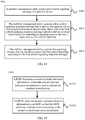
- FIG. 1 shows a schematic flowchart of an overload control method 100 according to an embodiment of the present invention. As shown in FIG. 1 , the method 100 includes:
- first overload indication information used to indicate an overload control policy is sent to a mobility management entity, and the mobility management entity executes the overload control policy according to the first overload indication information, thereby reducing load of the gateway device, and avoiding adverse impact brought by overload of the gateway device.
- overload indication information used to indicate an overload control policy is sent to a mobility management entity, so that the mobility management entity executes the overload control policy, which can avoid adverse impact brought by device overload; therefore, the device overload can be effectively controlled.
- the overload control policy is a policy that is set to reduce device load.
- the overload control policy includes: limiting initial access users, delaying signaling in a mobility management process, delaying signaling in a service request process, or delaying signaling in a session management process. Limiting initial access users may enable users to search for another lightly overloaded gateway device. A subscription event that brings more signaling, for example, cell location reporting, may be delayed.
- the overload control policy may be another policy that may reduce device load.
- all overload control policies may be configured in advance, and may further be updated continuously.
- overload indication information is used to indicate an overload control policy.
- the first overload indication information may be an indication associated with an overload control policy, that is, different indication values are used to indicate different overload control policies. For example, 1, 2, or 3 is used to respectively indicate a first, a second, or a third overload control policy.
- the first overload indication information may be overload status information associated with an overload control policy, that is, different overload status information is used to indicate different overload control policies. For example, “light”, “medium”, or “heavy” is used to respectively indicate a first, a second, or a third overload control policy.
- the first overload indication information further includes an overload control rate.
- an overload control rate For example, "1" and “a%” indicate reducing initial access users by a%.
- the mobility management entity After receiving the overload indication information, the mobility management entity executes the overload control policy according to the overload indication information to perform overload control.
- a time for performing overload control may be determined by the mobility management entity, or may be configured in advance, that is, upon receiving the overload indication information, the mobility management entity starts to perform overload control within the time configured in advance. This embodiment of the present invention imposes no limitation on a manner of determining the time for performing overload control.
- the overload indication information may be carried in different messages, for example, a control message or a path detection message between the mobility management entity and the gateway device, and sent.
- the method 100 further includes:
- S110 includes:
- the gateway device determines the first overload indication information according to a load status of the gateway device.
- S120 includes:
- the gateway device sends a first control response message to the mobility management entity, where the first control response message carries the first overload indication information.
- the overload indication information is sent by using a control message.
- the mobility management entity sends, to the gateway device, the first control request message, for example, a create session request message.
- the gateway device determines the first overload indication information according to the load status of the gateway device, and includes the first overload indication information in the first control response message that is to be sent to the mobility management entity, so as to indicate the overload control policy.
- the mobility management entity executes the overload control policy according to the first overload indication information carried in the first control response message, so as to perform control on overload of the gateway device.
- S111 includes:
- the gateway device determines overload indication information for mobility management entities according to the load status of the gateway device and signaling sending statuses of the mobility management entities, for example, information such as a quantity of signaling and/or frequency of sending signaling, so as to instruct the mobility management entities to execute different overload control policies. For example, for a mobility management entity that sends a large quantity of signaling, a tighter overload control policy is executed, and for a mobility management entity that sends a small quantity of signaling, a looser overload control policy may be executed.
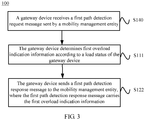
- the method 100 further includes:
- S110 includes:
- the gateway device determines the first overload indication information according to a load status of the gateway device.
- S 120 includes:
- the gateway device sends a first path detection response message to the mobility management entity, where the first path detection response message carries the first overload indication information.
- the overload indication information is sent by using a path detection message.
- the mobility management entity sends, to the gateway device, the first path detection request message, for example, an echo protocol (Echo Protocol, Echo) request message.
- the gateway device determines the first overload indication information according to the load status of the gateway device, and includes the first overload indication information in the first path detection response message that is to be sent to the mobility management entity, so as to indicate the overload control policy.
- the mobility management entity executes the overload control policy according to the first overload indication information carried in the first path detection response message, so as to perform control on overload of the gateway device.
- S111 includes:
- the gateway device is an SGW.
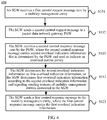
- the method 100 further includes:
- S110 includes:
- the SGW determines the second overload indication information as the first overload indication information, or the SGW determines the first overload indication information according to the second overload indication information and signaling sending statuses of mobility management entities connected to the SGW.
- S 120 includes:
- the SGW sends a first control response message to the mobility management entity, where the first control response message carries the first overload indication information.
- the overload indication information is sent by using a control message.
- the mobility management entity sends, to the SGW, the first control request message, for example, a create session request message.
- the SGW sends the second control request message to the PGW.
- the PGW determines the second overload indication information used to indicate the overload control policy.
- the PGW determines the second overload indication information according to a load status of the PGW, or the PGW determines the second overload indication information according to a load status of the PGW and signaling sending statuses of SGWs connected to the PGW
- the PGW includes the second overload indication information in the second control response message that is to be sent to the SGW, so as to indicate the overload control policy.
- the SGW uses the second overload indication information as the first overload indication information that is to be sent to the mobility management entity (that is, forwards the overload indication information sent by the PGW), or the SGW determines the first overload indication information according to the second overload indication information and the signaling sending statuses of the mobility management entities connected to the SGW
- the SGW includes the first overload indication information in the first control response message that is to be sent to the mobility management entity, so as to indicate the overload control policy.
- the mobility management entity executes the overload control policy according to the first overload indication information, so as to implement control on overload of the PGW
- the gateway device is an SGW As shown in FIG. 5 , before S110, the method 100 further includes:
- S110 includes:
- the SGW determines the second overload indication information as the first overload indication information, or the SGW determines the first overload indication information according to the second overload indication information and signaling sending statuses of mobility management entities connected to the SGW.
- S 120 includes:
- the SGW sends a first path detection message to the mobility management entity, where the first path detection message carries the first overload indication information.
- the overload indication information is sent by using a path detection message.
- the SGW sends, to the PGW, the second path detection request message, for example, an Echo request message.
- the PGW determines the second overload indication information used to indicate the overload control policy.
- the PGW determines the second overload indication information according to a load status of the PGW, or the PGW determines the second overload indication information according to a load status of the PGW and signaling sending statuses of SGWs connected to the PGW
- the PGW includes the second overload indication information in the second path detection response message that is to be sent to the SGW, so as to indicate the overload control policy.
- the SGW uses the second overload indication information as the first overload indication information that is to be sent to the mobility management entity (that is, forwards the overload indication information sent by the PGW), or the SGW determines the first overload indication information according to the second overload indication information and the signaling sending statuses of the mobility management entities connected to the SGW
- the SGW sends the first overload indication information to the mobility management entity by using the first path detection message (a path detection request message or a path detection response message).
- the SGW after receiving the first path detection request message sent by the mobility management entity to the SGW, the SGW includes the first overload indication information in the first path detection response message that is to be sent to the mobility management entity, or the SGW actively sends a path detection request message to the mobility management entity, where the path detection request message carries the first overload indication information, so as to indicate the overload control policy.
- the mobility management entity executes the overload control policy according to the first overload indication information, so as to implement control on overload of the PGW.
- the method 100 further includes:
- the gateway device further simultaneously sends the information about the delay timer to the mobility management entity, so as to instruct the mobility management entity to: execute the overload control policy to perform overload control before the delay timer expires and no longer perform overload control after the delay timer expires.
- the mobility management entity may be instructed, by using the information about the delay timer, to perform overload control in a particular time, without requiring the mobility management entity to determine a time for performing overload control. Therefore, the gateway device may adjust the time for performing overload control, which can implement overload control more effectively.
- the method 100 further includes:
- S110 includes:
- the gateway device determines the first overload indication information as a first control signaling response message that includes information about a delay timer, where the first overload indication information indicates that the overload control policy is controlling a signaling process that has a same type as first control signaling.
- a control signaling response message that includes the information about the delay timer for example, a create session response message is used to instruct to execute the overload control policy of controlling a signaling process that has a same type as the control signaling. That is, the control signaling response message that includes the information about the delay timer is associated with controlling the signaling process that has the same type as the control signaling.
- the gateway device instructs, by sending the control signaling response message that includes the information about the delay timer to the mobility management entity, the mobility management entity to control the signaling process that has the same type as the control signaling before the delay timer expires.
- S 114 includes:
- control signaling response message may further include an overload control rate, for example, "a%", which indicates that a rate of controlling the signaling process that has the same type as the control signaling is a%.
- overload indication information may also be carried in another message and sent, or may be sent by using a new message, which is not limited in this embodiment of the present invention.
- overload indication information used to indicate an overload control policy is sent to a mobility management entity, so that the mobility management entity executes the overload control policy according to the overload indication information, which can avoid adverse impact brought by device overload; therefore, the device overload can be effectively controlled.
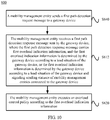
- FIG. 8 shows a schematic flowchart of an overload control method 800 according to an embodiment of the present invention. As shown in FIG. 8 , the method 800 includes:
- the gateway device when a gateway device is in an overloaded state, the gateway device sends, to a mobility management entity, first overload indication information used to indicate an overload control policy, and after receiving the first overload indication information sent by the gateway device, the mobility management entity executes the overload control policy according to the first overload indication information, thereby reducing load of the gateway device, and avoiding adverse impact brought by overload of the gateway device. Therefore, according to the overload control method in this embodiment of the present invention, overload indication information that is sent by a gateway device and used to indicate an overload control policy is received, and the overload control policy is executed according to the overload indication information, which can avoid adverse impact brought by device overload; therefore, the device overload can be effectively controlled.
- the overload control policy is a policy that is set to reduce device load.
- the overload control policy includes: limiting initial access users, delaying signaling in a mobility management process, delaying signaling in a service request process, or delaying signaling in a session management process. Limiting initial access users may enable users to search for another lightly overloaded gateway device.
- this embodiment of the present invention imposes no limitation on the overload control policy, and the overload control policy may be another policy that may reduce device load.
- all overload control policies may be configured in advance, and may further be updated continuously.
- overload indication information is used to indicate an overload control policy.
- This embodiment of the present invention imposes no limitation on a specific form of the overload indication information.
- the first overload indication information includes an indication or overload status information associated with the overload control policy.
- S820 includes:
- the first overload indication information may be an indication associated with an overload control policy, that is, different indication values are used to indicate different overload control policies. For example, 1, 2, or 3 is used to respectively indicate a first, a second, or a third overload control policy.
- the mobility management entity executes the overload control policy associated with the indication. For example, if the indication received by the mobility management entity is 1, the first overload control policy is executed.
- the first overload indication information may be overload status information associated with an overload control policy, that is, different overload status information is used to indicate different overload control policies. For example, “light”, “medium”, or “heavy” is used to respectively indicate a first, a second, or a third overload control policy.
- the mobility management entity executes the overload control policy associated with the overload status information.
- the first overload indication information further includes an overload control rate.
- S820 includes:
- the mobility management entity After receiving the overload indication information, the mobility management entity executes the overload control policy according to the overload indication information to perform overload control.
- a time for performing overload control may be determined by the mobility management entity, or may be configured in advance, that is, upon receiving the overload indication information, the mobility management entity starts to perform overload control within the time configured in advance. This embodiment of the present invention imposes no limitation on a manner of determining the time for performing overload control.
- the method 800 further includes:
- S810 includes:
- the mobility management entity receives a first control response message sent by the gateway device, where the first control response message carries the first overload indication information, and the first overload indication information is determined by the gateway device according to a load status of the gateway device, or the first overload indication information is determined by the gateway device according to a load status of the gateway device and signaling sending statuses of mobility management entities connected to the gateway device.
- the overload indication information is sent by using a control message.
- the mobility management entity sends the first control request message to the gateway device.
- the gateway device determines the first overload indication information according to the load status of the gateway device, or the gateway device determines the first overload indication information according to the load status of the gateway device and the signaling sending statuses of the mobility management entities connected to the gateway device.
- the first overload indication information is included in the first control response message that is to be sent to the mobility management entity, so as to indicate the overload control policy.
- the mobility management entity executes the overload control policy according to the first overload indication information carried in the first control response message, so as to perform control on overload of the gateway device.
- the method 800 further includes:
- S810 includes:
- the mobility management entity receives a first path detection response message sent by the gateway device, where the first path detection response message carries the first overload indication information, and the first overload indication information is determined by the gateway device according to a load status of the gateway device, or the first overload indication information is determined by the gateway device according to a load status of the gateway device and signaling sending statuses of mobility management entities connected to the gateway device.
- the overload indication information is sent by using a path detection message.
- the mobility management entity sends the first path detection request message to the gateway device.
- the gateway device determines the first overload indication information according to the load status of the gateway device, or the gateway device determines the first overload indication information according to the load status of the gateway device and the signaling sending statuses of the mobility management entities connected to the gateway device.
- the first overload indication information is included in the first path detection response message that is to be sent to the mobility management entity, so as to indicate the overload control policy.
- the mobility management entity After receiving the first path detection response message, the mobility management entity executes the overload control policy according to the first overload indication information carried in the first path detection response message, so as to perform control on overload of the gateway device.
- the gateway device is an SGW.
- the method 800 further includes:
- S810 includes:
- the mobility management entity receives a first control response message sent by the SGW, where the first control response message carries the first overload indication information, and the first overload indication information is the second overload indication information forwarded by the SGW, or the first overload indication information is determined by the SGW according to the second overload indication information and signaling sending statuses of mobility management entities connected to the SGW
- the overload indication information is sent by using a control message.
- the mobility management entity sends the first control request message to the SGW
- the SGW sends the second control request message to the PGW
- the PGW determines the second overload indication information used to indicate the overload control policy.
- the PGW determines the second overload indication information according to a load status of the PGW, or the PGW determines the second overload indication information according to a load status of the PGW and signaling sending statuses of SGWs connected to the PGW
- the PGW includes the second overload indication information in the second control response message that is to be sent to the SGW, so as to indicate the overload control policy.
- the SGW uses the second overload indication information as the first overload indication information that is to be sent to the mobility management entity (that is, forwards the overload indication information sent by the PGW), or the SGW determines the first overload indication information according to the second overload indication information and the signaling sending statuses of the mobility management entities connected to the SGW.
- the SGW includes the first overload indication information in the first control response message that is to be sent to the mobility management entity, so as to indicate the overload control policy. After receiving the first control response message, the mobility management entity executes the overload control policy according to the first overload indication information, so as to implement control on overload of the PGW.
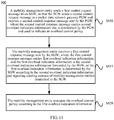
- the gateway device is an SGW. As shown in FIG. 12 ,
- S810 includes:
- the mobility management entity receives a first path detection message sent by the SGW, where the first path detection message carries the first overload indication information, and the first overload indication information is second overload indication information that is forwarded by the SGW, determined by the PGW, and used to indicate the overload control policy, or the first overload indication information is determined by the SGW according to the second overload indication information and signaling sending statuses of mobility management entities connected to the SGW
- the overload indication information is sent by using a path detection message.
- the SGW uses the second overload indication information as the first overload indication information that is to be sent to the mobility management entity (that is, forwards the overload indication information sent by the PGW), or the SGW determines the first overload indication information according to the second overload indication information and the signaling sending statuses of the mobility management entities connected to the SGW
- the SGW includes the first overload indication information in the first path detection message that is to be sent to the mobility management entity, so as to indicate the overload control policy.
- the mobility management entity executes the overload control policy according to the first overload indication information, so as to implement control on overload of the PGW
- the method 800 further includes:
- S820 includes:
- the mobility management entity executes the overload control policy according to the first overload indication information before the delay timer expires.
- the gateway device further simultaneously sends the information about the delay timer to the mobility management entity, so as to instruct the mobility management entity to: execute the overload control policy to perform overload control before the delay timer expires and no longer perform overload control after the delay timer expires.
- the mobility management entity Upon receiving the overload indication information and the information about the delay timer that are sent by the gateway device, the mobility management entity starts to execute the overload control policy before the delay timer expires, and ends overload control after the delay timer expires.
- the mobility management entity may be instructed, by using the information about the delay timer, to perform overload control in a particular time, without requiring the mobility management entity to determine a time for performing overload control. Therefore, the gateway device may adjust the time for performing overload control, which can implement overload control more effectively.
- the method 800 further includes:
- S810 includes:
- the mobility management entity receives a first control signaling response message that is sent by the gateway device and includes information about a delay timer, where the first control signaling response message indicates that the overload control policy is controlling a signaling process that has a same type as first control signaling.
- S820 includes:
- the mobility management entity controls the signaling process that has the same type as the first control signaling according to the first control signaling response message.
- a control signaling response message that includes the information about the delay timer is used to instruct to execute the overload control policy of controlling a signaling process that has a same type as the control signaling. That is, the control signaling response message that includes the information about the delay timer is associated with controlling the signaling process that has the same type as the control signaling.
- the gateway device instructs, by sending the control signaling response message that includes the information about the delay timer to the mobility management entity, the mobility management entity to control the signaling process that has the same type as the control signaling before the delay timer expires.
- the mobility management entity After receiving the control signaling response message that is sent by the gateway device and includes the information about the delay timer, the mobility management entity starts to control the signaling process that has the same type as the control signaling before the delay timer expires.
- the first control signaling response message further includes an overload control rate.
- S820 includes:
- control signaling response message may further include an overload control rate, for example, "a%".
- an overload control rate for example, "a%”.
- an overload control policy is executed according to overload indication information that is sent by a gateway device and used to indicate the overload control policy, which can avoid adverse impact brought by device overload; therefore, the device overload can be effectively controlled.
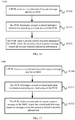
- FIG. 15 shows a schematic flowchart of an overload control method 1500 according to an embodiment of the present invention. As shown in FIG. 15 , the method 1500 includes:
- the PGW After determining the second overload indication information used to indicate the overload control policy, the PGW sends the second overload indication information to the SGW, and the SGW performs overload control according to the second overload indication information.
- the SGW executes the overload control policy according to the second overload indication information.
- the SGW uses the second overload indication information as first overload indication information that is to be sent to the mobility management entity (that is, forwards overload indication information sent by the PGW), or the SGW determines first overload indication information according to the second overload indication information and signaling sending statuses of mobility management entities connected to the SGW Then, the mobility management entity executes the overload control policy according to the first overload indication information, so as to implement control on overload of the PGW
- second overload indication information used to indicate an overload control policy is sent to an SGW, so that the SGW determines, according to the second overload indication information, first overload indication information that is to be sent to a mobility management entity and used to indicate the overload control policy, which can implement control on overload of the PGW and avoid adverse impact brought by device overload; therefore, the device overload can be effectively controlled.
- the overload control policy includes: limiting initial access users, delaying signaling in a mobility management process, delaying signaling in a service request process, or delaying signaling in a session management process.
- the second overload indication information includes an indication or overload status information associated with the overload control policy.
- the second overload indication information further includes an overload control rate. It should be understood that a specific form of the second overload indication information is similar to the first overload indication information, and refer to the foregoing embodiments. For brevity, details are not described herein again.
- the method 1500 further includes:
- S1510 includes:
- the PGW determines the second overload indication information according to a load status of the PGW.
- S 1520 includes:
- the PGW sends a second control response message to the SGW, where the second control response message carries the second overload indication information.
- the overload indication information is sent by using a control message.
- the SGW sends the second control request message to the PGW.
- the PGW determines the second overload indication information according to the load status of the PGW, and includes the second overload indication information in the second control response message that is to be sent to the SGW, so as to indicate the overload control policy.
- S1511 includes:
- the method 1500 further includes:
- S1510 includes:
- the PGW determines the second overload indication information according to a load status of the PGW
- S 1520 includes:
- the PGW sends a second path detection response message to the SGW, where the second path detection response message carries the second overload indication information.
- the overload indication information is sent by using a path detection message.
- the SGW sends the second path detection request message to the PGW.
- the PGW determines the second overload indication information according to the load status of the PGW, and includes the second overload indication information in the second path detection response message that is to be sent to the SGW, so as to indicate the overload control policy.
- S 1511 includes:
- the method 1500 further includes:
- the PGW further simultaneously sends the information about the delay timer to the SGW
- the SGW further simultaneously sends the information about the delay timer, so as to instruct the mobility management entity to: execute the overload control policy to perform overload control before the delay timer expires and no longer perform overload control after the delay timer expires.
- the method 1500 further includes:
- S1510 includes:
- the PGW determines that the second overload indication information as a second control signaling response message that includes information about a delay timer, where the second overload indication information indicates that the overload control policy is controlling a signaling process that has a same type as the second control signaling.
- a control signaling response message that includes the information about the delay timer is used to instruct to execute the overload control policy of controlling a signaling process that has a same type as the control signaling. That is, the control signaling response message that includes the information about the delay timer is associated with controlling the signaling process that has the same type as the control signaling.
- the PGW After receiving a control signaling message that is sent by the SGW, the PGW sends the control signaling response message that includes the information about the delay timer to the SGW, and the SGW sends the control signaling response message that includes the information about the delay timer to the mobility management entity, so as to instruct the mobility management entity to control the signaling process that has the same type as the control signaling before the delay timer expires.
- S1512 includes:
- control signaling response message may further include an overload control rate, for example, "a%".
- second overload indication information used to indicate an overload control policy is sent to an SGW, which can implement control on overload of a PGW and avoid adverse impact brought by device overload; therefore, the device overload can be effectively controlled.
- an overload control procedure is as follows:
- an overload control procedure is as follows:
- FIG. 22 is a flowchart of implementing overload control by using a path detection message. 2201.
- An MME sends an Echo request to an SGW
- the SGW sends an Echo response to the MME, where the Echo response carries overload indication information and information about a delay timer.
- the MME executes an overload control policy according to the Echo response to start overload control, and end overload control when the delay timer expires.
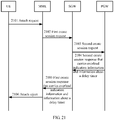
- FIG. 23 For a scenario in which a PGW is overloaded, a procedure of performing overload control is shown in FIG. 23 .
- An SGW sends a second Echo request to the PGW
- the PGW sends a second Echo response to the SGW, where the second Echo response carries overload indication information and information about a delay timer.
- An MME sends a first Echo request to the SGW
- the SGW sends a first Echo response to the MME, where the first Echo response carries overload indication information and information about a delay timer.
- the overload indication information of the PGW may be directly forwarded, or overload indication information may be determined according to the overload indication information of the PGW and signaling sending statuses of MMEs.
- the MME executes an overload control policy according to the first Echo response.
- sequence numbers of the foregoing processes do not mean execution sequences.
- the execution sequences of the processes should be determined according to functions and internal logic of the processes, and should not be construed as any limitation on the implementation processes of the embodiments of the present invention.
- FIG. 24 shows a schematic block diagram of a gateway device 2400 according to an embodiment of the present invention.
- the gateway device 2400 includes:
- overload indication information used to indicate an overload control policy is sent to a mobility management entity, so that the mobility management entity executes the overload control policy, which can avoid adverse impact brought by device overload; therefore, the device overload can be effectively controlled.
- the gateway device 2400 further includes:
- the determining module 2410 is specifically configured to determine the first overload indication information according to a load status of the gateway device.
- the sending module 2420 is specifically configured to send a first control response message to the mobility management entity, where the first control response message carries the first overload indication information.
- the gateway device 2400 further includes:
- the determining module 2410 is specifically configured to determine the first overload indication information according to a load status of the gateway device.
- the sending module 2420 is specifically configured to send a first path detection response message to the mobility management entity, where the first path detection response message carries the first overload indication information.
- the determining module 2410 is specifically configured to determine the first overload indication information according to the load status of the gateway device and signaling sending statuses of mobility management entities connected to the gateway device.
- the gateway device 2400 is an SGW.
- the gateway device 2400 further includes:
- the sending module 2420 is further configured to send a second control request message to a packet data network gateway PGW.
- the third receiving module is further configured to receive a second control response message sent by the PGW, where the second control response message carries second overload indication information that is determined by the PGW and used to indicate the overload control policy.
- the determining module 2410 is specifically configured to: determine the second overload indication information as the first overload indication information, or determine the first overload indication information according to the second overload indication information and signaling sending statuses of mobility management entities connected to the SGW
- the sending module 2420 is specifically configured to send a first control response message to the mobility management entity, where the first control response message carries the first overload indication information.
- the gateway device 2400 is an SGW
- the sending module 2420 is further configured to: before the determining module 2410 determines the first overload indication information, send a second path detection request message to a PGW.
- the gateway device 2400 further includes:
- the determining module 2410 is specifically configured to: determine the second overload indication information as the first overload indication information, or determine the first overload indication information according to the second overload indication information and signaling sending statuses of mobility management entities connected to the SGW
- the sending module 2420 is specifically configured to send a first path detection message to the mobility management entity, where the first path detection message carries the first overload indication information. According to the present invention, the sending module 2420 is further configured to send information about a delay timer to the mobility management entity, so that the mobility management entity executes the overload control policy according to the first overload indication information before the delay timer expires.
- the overload control policy includes: limiting initial access users, delaying signaling in a mobility management process, delaying signaling in a service request process, or delaying signaling in a session management process.
- the first overload indication information includes an indication or overload status information associated with the overload control policy.
- the first overload indication information further includes an overload control rate.
- the gateway device 2400 further includes:
- the determining module 2410 is specifically configured to determine the first overload indication information as a first control signaling response message that includes information about a delay timer, where the first overload indication information indicates that the overload control policy is controlling a signaling process that has a same type as first control signaling.
- the determining module 2410 is specifically configured to determine the first overload indication information as the first control signaling response message that includes the information about the delay timer, and an overload control rate.
- the gateway device 2400 may be corresponding to a gateway device in an overload control method according to the embodiments of the present invention, and the foregoing and other operations and/or functions of modules in the gateway device 2400 are separately used to implement corresponding procedures of the methods in FIG. 1 to FIG. 23 .
- details are not described herein again.
- overload indication information used to indicate an overload control policy is sent to a mobility management entity, so that the mobility management entity executes the overload control policy according to the overload indication information, which can avoid adverse impact brought by device overload; therefore, the device overload can be effectively controlled.
- FIG. 25 is a schematic block diagram of a mobility management entity 2500 according to an embodiment of the present invention. As show in FIG. 25 , the mobility management entity 2500 includes:
- overload indication information that is sent by a gateway device and used to indicate an overload control policy is received, and the overload control policy is executed according to the overload indication information, which can avoid adverse impact brought by device overload; therefore, the device overload can be effectively controlled.
- the mobility management entity 2500 further includes:
- the receiving module 2510 is specifically configured to receive a first control response message sent by the gateway device, where the first control response message carries the first overload indication information, and the first overload indication information is determined by the gateway device according to a load status of the gateway device, or the first overload indication information is determined by the gateway device according to a load status of the gateway device and signaling sending statuses of mobility management entities connected to the gateway device.
- the mobility management entity 2500 further includes:
- the receiving module 2510 is specifically configured to receive a first path detection response message sent by the gateway device, where the first path detection response message carries the first overload indication information, and the first overload indication information is determined by the gateway device according to a load status of the gateway device, or the first overload indication information is determined by the gateway device according to a load status of the gateway device and signaling sending statuses of mobility management entities connected to the gateway device.
- the gateway device is an SGW.
- the mobility management entity 2500 further includes:
- the receiving module 2510 is specifically configured to receive a first control response message sent by the SGW, where the first control response message carries the first overload indication information, and the first overload indication information is the second overload indication information forwarded by the SGW, or the first overload indication information is determined by the SGW according to the second overload indication information and signaling sending statuses of mobility management entities connected to the SGW
- the gateway device is an SGW.
- the receiving module 2510 is specifically configured to receive a first path detection message sent by the SGW, where the first path detection message carries the first overload indication information, and the first overload indication information is second overload indication information that is forwarded by the SGW, determined by the PGW, and used to indicate the overload control policy, or the first overload indication information is determined by the SGW according to the second overload indication information and signaling sending statuses of mobility management entities connected to the SGW According to the present invention, the receiving module 2510 is further configured to receive information about a delay timer sent by the gateway device.
- the processing module 2520 is specifically configured to execute the overload control policy according to the first overload indication information before the delay timer expires.
- the overload control policy includes: limiting initial access users, delaying signaling in a mobility management process, delaying signaling in a service request process, or delaying signaling in a session management process.
- the first overload indication information includes an indication or overload status information associated with the overload control policy.
- the processing module 2520 is specifically configured to execute the overload control policy associated with the indication or the overload status information.
- the first overload indication information further includes an overload control rate.
- the processing module 2520 is specifically configured to execute, according to the overload control rate, the overload control policy associated with the indication or the overload status information.
- the mobility management entity 2500 further includes:
- the receiving module 2510 is specifically configured to receive a first control signaling response message that is sent by the gateway device and includes information about a delay timer, where the first control signaling response message indicates that the overload control policy is controlling a signaling process that has a same type as first control signaling.
- the processing module 2520 is specifically configured to control, according to the first control signaling response message, the signaling process that has the same type as the first control signaling.
- the first control signaling response message further includes an overload control rate.
- the processing module 2520 is specifically configured to control, according to the overload control rate, the signaling process that has the same type as the first control signaling.
- the mobility management entity 2500 may be corresponding to a mobility management entity in an overload control method according to the embodiments of the present invention, and the foregoing and other operations and/or functions of modules in the mobility management entity 2500 are separately used to implement corresponding procedures of the methods in FIG. 1 to FIG. 23 .
- FIG. 1 to FIG. 23 For brevity, details are not described herein again.
- an overload control policy is executed according to overload indication information that is sent by a gateway device and used to indicate the overload control policy, which can avoid adverse impact brought by device overload; therefore, the device overload can be effectively controlled.
- FIG. 26 is a schematic block diagram of a PGW 2600 according to an embodiment of the present invention. As shown in FIG. 26 , the PGW 2600 includes:
- the second overload indication information is used to enable the SGW to determine, according to the second overload indication information, first overload indication information that is to be sent to a mobility management entity and used to indicate the overload control policy; or optionally, the second overload indication information is used to enable the SGW to execute the overload control policy according to the second overload indication information.
- second overload indication information used to indicate an overload control policy is sent to an SGW, so that the SGW determines, according to the second overload indication information, first overload indication information that is to be sent to a mobility management entity and used to indicate the overload control policy, which can implement control on overload of the PGW and avoid adverse impact brought by device overload; therefore, the device overload can be effectively controlled.
- the PGW 2600 further includes:
- the determining module 2610 is specifically configured to determine the second overload indication information according to a load status of the PGW
- the sending module 2620 is specifically configured to send a second control response message to the SGW, where the second control response message carries the second overload indication information.
- the PGW 2600 further includes:
- the determining module 2610 is specifically configured to determine the second overload indication information according to a load status of the PGW
- the sending module 2620 is specifically configured to send a second path detection response message to the SGW, where the second path detection response message carries the second overload indication information.
- the determining module 2610 is specifically configured to determine the second overload indication information according to the load status of the PGW and signaling sending statuses of SGWs connected to the PGW According to the present invention, the sending module 2620 is further configured to send information about a delay timer to the SGW
- the overload control policy includes: limiting initial access users, delaying signaling in a mobility management process, delaying signaling in a service request process, or delaying signaling in a session management process.
- the second overload indication information includes an indication or overload status information associated with the overload control policy.
- the second overload indication information further includes an overload control rate.
- the PGW 2600 further includes:
- the determining module 2610 is specifically configured to determine the second overload indication information as a second control signaling response message that includes information about a delay timer, where the second overload indication information indicates that the overload control policy is controlling a signaling process that has a same type as the second control signaling.
- the determining module 2610 is specifically configured to determine the second overload indication information as the second control signaling response message that includes the information about the delay timer, and an overload control rate.
- the PGW 2600 according to this embodiment of the present invention may be corresponding to a PGW in an overload control method according to the embodiments of the present invention, and the foregoing and other operations and/or functions of modules in the PGW 2600 are separately used to implement corresponding procedures of the methods in FIG. 1 to FIG. 23 .
- FIG. 1 to FIG. 23 For brevity, details are not described herein again.
- second overload indication information used to indicate an overload control policy is sent to an SGW, which can implement control on overload of the PGW and avoid adverse impact brought by device overload; therefore, the device overload can be effectively controlled.
- FIG. 27 shows a structure of a gateway device according to another embodiment of the present invention.
- the gateway device includes at least one processor 2702 (for example, a CPU), at least one network interface 2705 or another communications interface, a memory 2706, and at least one communications bus 2703 that is configured to implement connection and communication between these apparatuses.
- the processor 2702 is configured to execute an executable module, for example, a computer program, stored in the memory 2706.
- the memory 2706 may include a high-speed random access memory (RAM: Random Access Memory), and may further include a non-volatile memory (non-volatile memory), for example, at least one magnetic disk memory.
- RAM Random Access Memory
- non-volatile memory non-volatile memory
- a communication connection is implemented between the gateway device and at least one of other network elements over the Internet, a wide area network, a local area network, a metropolitan area network, or the like.
- a program 27061 is stored in the memory 2706, and the program 27061 may be executed by the processor 2702.
- This program includes:
- the program further includes: receiving, by the gateway device, a first control request message sent by the mobility management entity.
- the determining, by a gateway device, first overload indication information includes: determining, by the gateway device, the first overload indication information according to a load status of the gateway device.
- the sending, by the gateway device, the first overload indication information to a mobility management entity includes: sending, by the gateway device, a first control response message to the mobility management entity, where the first control response message carries the first overload indication information.
- the program further includes: receiving, by the gateway device, a first path detection request message sent by the mobility management entity.
- the determining, by a gateway device, first overload indication information includes: determining, by the gateway device, the first overload indication information according to a load status of the gateway device.
- the sending, by the gateway device, the first overload indication information to a mobility management entity includes: sending, by the gateway device, a first path detection response message to the mobility management entity, where the first path detection response message carries the first overload indication information.
- the determining, by the gateway device, the first overload indication information according to a load status of the gateway device includes: determining, by the gateway device, the first overload indication information according to the load status of the gateway device and signaling sending statuses of mobility management entities connected to the gateway device.
- the gateway device is an SGW.
- the program further includes: receiving, by the SGW, a first control request message sent by the mobility management entity; sending, by the SGW, a second control request message to a packet data network gateway PGW; and receiving, by the SGW, a second control response message sent by the PGW, where the second control response message carries second overload indication information that is determined by the PGW and used to indicate the overload control policy.
- the determining, by a gateway device, first overload indication information includes: determining, by the SGW, the second overload indication information as the first overload indication information, or determining, by the SGW, the first overload indication information according to the second overload indication information and signaling sending statuses of mobility management entities connected to the SGW
- the sending, by the gateway device, the first overload indication information to a mobility management entity includes: sending, by the SGW, a first control response message to the mobility management entity, where the first control response message carries the first overload indication information.
- the gateway device is an SGW
- the program further includes: sending, by the SGW, a second path detection request message to a PGW; and receiving, by the SGW, a second path detection response message sent by the PGW, where the second path detection response message carries second overload indication information that is determined by the PGW and used to indicate the overload control policy.
- the determining, by a gateway device, first overload indication information includes: determining, by the SGW, the second overload indication information as the first overload indication information, or determining, by the SGW, the first overload indication information according to the second overload indication information and signaling sending statuses of mobility management entities connected to the SGW
- the sending, by the gateway device, the first overload indication information to a mobility management entity includes: sending, by the SGW, a first path detection message to the mobility management entity, where the first path detection message carries the first overload indication information.
- the program further includes: sending, by the gateway device, information about a delay timer to the mobility management entity, so that the mobility management entity executes the overload control policy according to the first overload indication information before the delay timer expires.
- the overload control policy includes: limiting initial access users, delaying signaling in a mobility management process, delaying signaling in a service request process, or delaying signaling in a session management process.
- the first overload indication information includes an indication or overload status information associated with the overload control policy.
- the first overload indication information further includes an overload control rate.
- the program further includes: receiving, by the gateway device, a first control signaling message that is sent by the mobility management entity.
- the determining, by a gateway device, first overload indication information includes: determining, by the gateway device, the first overload indication information as a first control signaling response message that includes information about a delay timer, where the first overload indication information indicates that the overload control policy is controlling a signaling process that has a same type as first control signaling.
- the determining, by the gateway device, the first overload indication information as a first control signaling response message that includes information about a delay timer includes: determining, by the gateway device, the first overload indication information as the first control signaling response message that includes the information about the delay timer, and an overload control rate.
- FIG. 28 shows a structure of a mobility management entity according to another embodiment of the present invention.
- the mobility management entity includes at least one processor 2802 (for example, a CPU), at least one network interface 2805 or another communications interface, a memory 2806, and at least one communications bus 2803 that is configured to implement connection and communication between these apparatuses.
- the processor 2802 is configured to execute an executable module, for example, a computer program, stored in the memory 2806.
- the memory 2806 may include a high-speed random access memory (RAM: Random Access Memory), and may further include a non-volatile memory (non-volatile memory), for example, at least one magnetic disk memory.
- RAM Random Access Memory
- non-volatile memory for example, at least one magnetic disk memory.
- network interface 2805 which may be wired or wireless
- a communication connection is implemented between the system gateway and at least one of other network elements over the Internet, a wide area network, a local area network, a metropolitan area network, or the like.
- a program 28061 is stored in the memory 2806, and the program 28061 may be executed by the processor 2802.
- This program includes:
- the program before the receiving, by a mobility management entity, first overload indication information sent by a gateway device, the program further includes: sending, by the mobility management entity, a first control request message to the gateway device.
- the receiving, by a mobility management entity, first overload indication information sent by a gateway device includes: receiving, by the mobility management entity, a first control response message sent by the gateway device, where the first control response message carries the first overload indication information, and the first overload indication information is determined by the gateway device according to a load status of the gateway device, or the first overload indication information is determined by the gateway device according to a load status of the gateway device and signaling sending statuses of mobility management entities connected to the gateway device.
- the program before the receiving, by a mobility management entity, first overload indication information sent by a gateway device, the program further includes: sending, by the mobility management entity, a first path detection request message to the gateway device.
- the receiving, by a mobility management entity, first overload indication information sent by a gateway device includes: receiving, by the mobility management entity, a first path detection response message sent by the gateway device, where the first path detection response message carries the first overload indication information, and the first overload indication information is determined by the gateway device according to a load status of the gateway device, or the first overload indication information is determined by the gateway device according to a load status of the gateway device and signaling sending statuses of mobility management entities connected to the gateway device.
- the gateway device is an SGW.
- the program further includes: sending, by the mobility management entity, a first control request message to the SGW, so that the SGW sends a second control request message to a packet data network gateway PGW and receives a second control response message sent by the PGW, where the second control response message carries second overload indication information that is determined by the PGW and used to indicate the overload control policy.
- the receiving, by a mobility management entity, first overload indication information sent by a gateway device includes: receiving, by the mobility management entity, a first control response message sent by the SGW, where the first control response message carries the first overload indication information, and the first overload indication information is the second overload indication information forwarded by the SGW, or the first overload indication information is determined by the SGW according to the second overload indication information and signaling sending statuses of mobility management entities connected to the SGW
- the gateway device is an SGW
- the receiving, by a mobility management entity, first overload indication information sent by a gateway device includes: receiving, by the mobility management entity, a first path detection message sent by the SGW, where the first path detection message carries the first overload indication information, and the first overload indication information is second overload indication information that is forwarded by the SGW, determined by the PGW, and used to indicate the overload control policy, or the first overload indication information is determined by the SGW according to the second overload indication information and signaling sending statuses of mobility management entities connected to the SGW
- the program further includes: receiving, by the mobility management entity, information about a delay timer sent by the gateway device.
- the executing, by the mobility management entity, the overload control policy according to the first overload indication information includes: executing, by the mobility management entity, the overload control policy according to the first overload indication information before the delay timer expires.
- the overload control policy includes: limiting initial access users, delaying signaling in a mobility management process, delaying signaling in a service request process, or delaying signaling in a session management process.
- the first overload indication information includes an indication or overload status information associated with the overload control policy.
- the executing, by the mobility management entity, the overload control policy according to the first overload indication information includes: executing, by the mobility management entity, the overload control policy associated with the indication or the overload status information.
- the first overload indication information further includes an overload control rate.
- the executing, by the mobility management entity, the overload control policy according to the first overload indication information includes: executing, by the mobility management entity according to the overload control rate, the overload control policy associated with the indication or the overload status information.
- the program before the receiving, by a mobility management entity, first overload indication information sent by a gateway device, the program further includes: sending, by the mobility management entity, a first control signaling message to the gateway device.
- the receiving, by a mobility management entity, first overload indication information sent by a gateway device includes: receiving, by the mobility management entity, a first control signaling response message that is sent by the gateway device and includes information about a delay timer, where the first control signaling response message indicates that the overload control policy is controlling a signaling process that has a same type as first control signaling.
- the executing, by the mobility management entity, the overload control policy according to the first overload indication information includes: controlling, by the mobility management entity according to the first control signaling response message, the signaling process that has the same type as the first control signaling.
- the first control signaling response message further includes an overload control rate.
- the executing, by the mobility management entity, the overload control policy according to the first overload indication information includes: controlling, by the mobility management entity according to the overload control rate, the signaling process that has the same type as the first control signaling.
- overload indication information that is sent by a gateway device and used to indicate an overload control policy is received, and the overload control policy is executed according to the overload indication information, which can avoid adverse impact brought by device overload; therefore, the device overload can be effectively controlled.
- FIG. 29 shows a structure of a PGW according to another embodiment of the present invention.
- the PGW includes at least one processor 2902 (for example, a CPU), at least one network interface 2905 or another communications interface, a memory 2906, and at least one communications bus 2903 that is configured to implement connection and communication between these apparatuses.
- the processor 2902 is configured to execute an executable module, for example, a computer program, stored in the memory 2906.
- the memory 2906 may include a high-speed random access memory (RAM: Random Access Memory), and may further include a non-volatile memory (non-volatile memory), for example, at least one magnetic disk memory.
- RAM Random Access Memory
- non-volatile memory non-volatile memory
- a communication connection is implemented between the system gateway and at least one of other network elements over the Internet, a wide area network, a local area network, a metropolitan area network, or the like.
- a program 29061 is stored in the memory 2906, and the program 29061 may be executed by the processor 2902.
- This program includes:
- the program before the determining, by a PGW, second overload indication information, the program further includes: receiving, by the PGW, a second control request message sent by the SGW.
- the determining, by a PGW, second overload indication information includes: determining, by the PGW, the second overload indication information according to a load status of the PGW
- the sending, by the PGW, the second overload indication information to a serving gateway SGW includes: sending, by the PGW, a second control response message to the SGW, where the second control response message carries the second overload indication information.
- the program before the determining, by a PGW, second overload indication information, the program further includes: receiving, by the PGW, a second path detection request message sent by the SGW.
- the determining, by a PGW, second overload indication information includes: determining, by the PGW, the second overload indication information according to a load status of the PGW
- the sending, by the PGW, the second overload indication information to a serving gateway SGW includes: sending, by the PGW, a second path detection response message to the SGW, where the second path detection response message carries the second overload indication information.
- the determining, by the PGW, the second overload indication information according to a load status of the PGW includes: determining, by the PGW, the second overload indication information according to the load status of the PGW and signaling sending statuses of SGWs connected to the PGW
- the program further includes: sending, by the PGW, information about a delay timer to the SGW, so that the SGW sends the information about the delay timer and the first overload indication information to the mobility management entity.
- the overload control policy includes: limiting initial access users, delaying signaling in a mobility management process, delaying signaling in a service request process, or delaying signaling in a session management process.
- the second overload indication information includes an indication or overload status information associated with the overload control policy.
- the second overload indication information further includes an overload control rate.
- the program before the determining, by a PGW, second overload indication information, the program further includes: receiving, by the PGW, a second control signaling message that is sent by the SGW The determining, by a PGW, second overload indication information includes: determining, by the PGW, the second overload indication information as a second control signaling response message that includes information about a delay timer, where the second overload indication information indicates that the overload control policy is controlling a signaling process that has a same type as the second control signaling.
- the determining, by the PGW, the second overload indication information as a second control signaling response message that includes information about a delay timer includes: determining, by the PGW, the second overload indication information as the second control signaling response message that includes the information about the delay timer, and an overload control rate.
- second overload indication information used to indicate an overload control policy is sent to an SGW, so that the SGW determines, according to the second overload indication information, first overload indication information that is to be sent to a mobility management entity and used to indicate the overload control policy, which can implement control on overload of the PGW and avoid adverse impact brought by device overload; therefore, the device overload can be effectively controlled.
- the disclosed system, apparatus, and method may be implemented in other manners.
- the described apparatus embodiment is merely exemplary.
- the unit division is merely logical function division and may be other division in actual implementation.
- a plurality of units or components may be combined or integrated into another system, or some features may be ignored or not performed.
- the displayed or discussed mutual couplings or direct couplings or communication connections may be implemented through some interfaces.
- the indirect couplings or communication connections between the apparatuses or units may be implemented in electronic, mechanical, or other forms.
- the units described as separate parts may or may not be physically separate, and parts displayed as units may or may not be physical units, may be located in one position, or may be distributed on a plurality of network units. A part or all of the units may be selected according to actual needs to achieve the objectives of the solutions of the embodiments of the present invention.
- functional units in the embodiments of the present invention may be integrated into one processing unit, or each of the units may exist alone physically, or two or more units are integrated into one unit.
- the integrated unit may be implemented in a form of hardware, or may be implemented in a form of a software functional unit.
- the integrated unit When the integrated unit is implemented in the form of a software functional unit and sold or used as an independent product, the integrated unit may be stored in a computer-readable storage medium. Based on such an understanding, the technical solutions of the present invention essentially, or the part contributing to the prior art, or all or a part of the technical solutions may be implemented in the form of a software product.
- the software product is stored in a storage medium and includes several instructions for instructing a computer device (which may be a personal computer, a server, or a network device) to perform all or a part of the steps of the methods described in the embodiments of the present invention.
- the foregoing storage medium includes: any medium that can store program code, such as a USB flash drive, a removable hard disk, a read-only memory (ROM, Read-Only Memory), a random access memory (RAM, Random Access Memory), a magnetic disk, or an optical disc.
- program code such as a USB flash drive, a removable hard disk, a read-only memory (ROM, Read-Only Memory), a random access memory (RAM, Random Access Memory), a magnetic disk, or an optical disc.
Landscapes
- Engineering & Computer Science (AREA)
- Computer Networks & Wireless Communication (AREA)
- Signal Processing (AREA)
- Mobile Radio Communication Systems (AREA)
- Data Exchanges In Wide-Area Networks (AREA)
- Telephonic Communication Services (AREA)
Claims (12)
- Überlastungssteuerverfahren, umfassend:Bestimmen (s110), durch eine Gateway-Einrichtung, von ersten Überlastungsindikationsinformationen, wobei die ersten Überlastungsindikationsinformationen zum Angeben einer Überlastungssteuerrichtlinie verwendet werden; undSenden (s120), durch die Gateway-Einrichtung, der ersten Überlastungsindikationsinformationen zu einer Mobilitätsverwaltungsentität, so dass die Mobilitätsverwaltungsentität die Überlastungssteuerrichtlinie gemäß den ersten Überlastungsindikationsinformationen ausführt;wobei das Verfahren ferner Folgendes umfasst:Senden (s170), durch die Gateway-Einrichtung, von Informationen über einen Verzögerungs-Timer zur Mobilitätsverwaltungsentität, so dass die Mobilitätsverwaltungsentität angewiesen wird, damit anzufangen, die Überlastungssteuerrichtlinie beim Empfang der ersten Überlastungsindikationsinformationen gemäß den ersten Überlastungsindikationsinformationen auszuführen, bevor der Verzögerungs-Timer abläuft, und die Überlastungssteuerung zu beenden, nachdem der Verzögerungs-Timer abläuft.
- Verfahren nach Anspruch 1, wobei die ersten Überlastungsindikationsinformationen eine Indikation oder Überlastungsstatusinformationen, die mit der Überlastungssteuerrichtlinie assoziiert ist bzw. sind, umfassen.
- Verfahren nach Anspruch 2, wobei die ersten Überlastungsindikationsinformationen ferner eine Überlastungssteuerrate umfassen.
- Überlastungssteuerverfahren, umfassend:Empfangen (s810), durch eine Mobilitätsverwaltungsentität, von ersten Überlastungsindikationsinformationen, die durch eine Gateway-Einrichtung gesendet werden, wobei die ersten Überlastungsindikationsinformationen zum Angeben einer Überlastungssteuerrichtlinie verwendet werden; undAusführen (s820), durch die Mobilitätsverwaltungsentität, der Überlastungssteuerrichtlinie gemäß den ersten Überlastungsindikationsinformationen;wobei das Verfahren ferner Empfangen, durch die Mobilitätsverwaltungsentität, von Informationen über einen Verzögerungs-Timer, der durch die Gateway-Einrichtung gesendet wird, umfasst; unddas Ausführen, durch die Mobilitätsverwaltungsentität, der Überlastungssteuerrichtlinie gemäß den ersten Überlastungsindikationsinformationen Folgendes umfasst: Anfangen, beim Empfang der ersten Überlastungsindikationsinformationen, durch die Mobilitätsverwaltungsentität, die Überlastungssteuerrichtlinie gemäß den ersten Überlastungsindikationsinformationen auszuführen, bevor der Verzögerungs-Timer abläuft, und Beenden der Überlastungssteuerung, nachdem der Verzögerungs-Timer abläuft.
- Verfahren nach Anspruch 4, wobei die ersten Überlastungsindikationsinformationen eine Indikation oder Überlastungsstatusinformationen, die mit der Überlastungssteuerrichtlinie assoziiert ist bzw. sind, umfassen; und
das Ausführen, durch die Mobilitätsverwaltungsentität, der Überlastungssteuerrichtlinie gemäß den ersten Überlastungsindikationsinformationen Folgendes umfasst:Ausführen, durch die Mobilitätsverwaltungsentität, der Überlastungssteuerrichtlinie, die mit der Indikation oder den Überlastungsstatusinformationen assoziiert ist. - Verfahren nach Anspruch 5, wobei die ersten Überlastungsindikationsinformationen ferner eine Überlastungssteuerrate umfassen; und
das Ausführen, durch die Mobilitätsverwaltungsentität, der Überlastungssteuerrichtlinie gemäß den ersten Überlastungsindikationsinformationen Folgendes umfasst:Ausführen, durch die Mobilitätsverwaltungsentität gemäß der Überlastungssteuerrate, der Überlastungssteuerrichtlinie, die mit der Indikation oder den Überlastungsstatusinformationen assoziiert ist. - Gateway-Einrichtung, umfassend:ein Bestimmungsmodul (2410), das konfiguriert ist zum Bestimmen von ersten Überlastungsindikationsinformationen, wobei die ersten Überlastungsindikationsinformationen zum Angeben einer Überlastungssteuerrichtlinie verwendet werden; undein Sendemodul (2420), das konfiguriert ist zum Senden der ersten Überlastungsindikationsinformationen zu einer Mobilitätsverwaltungsentität, so dass die Mobilitätsverwaltungsentität die Überlastungssteuerrichtlinie gemäß den ersten Überlastungsindikationsinformationen ausführt,wobei das Sendemodul ferner konfiguriert ist zum Senden von Informationen über einen Verzögerungs-Timer zur Mobilitätsverwaltungsentität, so dass die Mobilitätsverwaltungsentität angewiesen wird, damit anzufangen, die Überlastungssteuerrichtlinie beim Empfang der ersten Überlastungsindikationsinformationen gemäß den ersten Überlastungsindikationsinformationen auszuführen, bevor der Verzögerungs-Timer abläuft, und die Überlastungssteuerung zu beenden, nachdem der Verzögerungs-Timer abläuft.
- Gateway-Einrichtung nach Anspruch 7, wobei die ersten Überlastungsindikationsinformationen eine Indikation oder Überlastungsstatusinformationen, die mit der Überlastungssteuerrichtlinie assoziiert ist bzw. sind, umfassen.
- Gateway-Einrichtung nach Anspruch 8, wobei die ersten Überlastungsindikationsinformationen ferner eine Überlastungssteuerrate umfassen.
- Mobilitätsverwaltungsentität, umfassend:ein Empfangsmodul (2510), das konfiguriert ist zum Empfangen von ersten Überlastungsindikationsinformationen, die durch eine Gateway-Einrichtung gesendet werden, wobei die ersten Überlastungsindikationsinformationen zum Angeben einer Überlastungssteuerrichtlinie verwendet werden; undein Verarbeitungsmodul (2520), das konfiguriert ist zum Ausführen der Überlastungssteuerrichtlinie gemäß den ersten Überlastungsindikationsinformationen; wobei das Empfangsmodul ferner konfiguriert ist zum Empfangen von Informationen über einen Verzögerungs-Timer, der durch die Gateway-Einrichtung gesendet wird; unddas Verarbeitungsmodul spezifisch konfiguriert ist zum Anfangen, beim Empfang der ersten Überlastungsindikationsinformationen, die Überlastungssteuerrichtlinie gemäß den ersten Überlastungsindikationsinformationen auszuführen, bevor der Verzögerungs-Timer abläuft, und zum Beenden der Überlastungssteuerung, nachdem der Verzögerungs-Timer abläuft.
- Mobilitätsverwaltungsentität nach Anspruch 10, wobei die ersten Überlastungsindikationsinformationen eine Indikation oder Überlastungsstatusinformationen, die mit der Überlastungssteuerrichtlinie assoziiert ist bzw. sind, umfassen; und
das Verarbeitungsmodul spezifisch konfiguriert ist zum Ausführen der Überlastungssteuerrichtlinie, die mit der Indikation oder den Überlastungsstatusinformationen assoziiert ist. - Mobilitätsverwaltungsentität nach Anspruch 11, wobei die ersten Überlastungsindikationsinformationen ferner eine Überlastungssteuerrate umfassen; und
das Verarbeitungsmodul spezifisch konfiguriert ist zum Ausführen, gemäß der Überlastungssteuerrate, der Überlastungssteuerrichtlinie, die mit der Indikation oder den Überlastungsstatusinformationen assoziiert ist.
Applications Claiming Priority (1)
| Application Number | Priority Date | Filing Date | Title |
|---|---|---|---|
| PCT/CN2013/075555 WO2014183253A1 (zh) | 2013-05-13 | 2013-05-13 | 过载控制的方法及设备 |
Publications (3)
| Publication Number | Publication Date |
|---|---|
| EP2991291A1 EP2991291A1 (de) | 2016-03-02 |
| EP2991291A4 EP2991291A4 (de) | 2016-03-16 |
| EP2991291B1 true EP2991291B1 (de) | 2018-01-31 |
Family
ID=51897575
Family Applications (1)
| Application Number | Title | Priority Date | Filing Date |
|---|---|---|---|
| EP13884741.3A Active EP2991291B1 (de) | 2013-05-13 | 2013-05-13 | Überlastungskontrollverfahren und -vorrichtung |
Country Status (8)
| Country | Link |
|---|---|
| US (2) | US9877228B2 (de) |
| EP (1) | EP2991291B1 (de) |
| JP (1) | JP6466411B2 (de) |
| CN (2) | CN104285414B (de) |
| BR (1) | BR112015028451A2 (de) |
| MX (1) | MX358876B (de) |
| RU (1) | RU2640643C2 (de) |
| WO (1) | WO2014183253A1 (de) |
Families Citing this family (8)
| Publication number | Priority date | Publication date | Assignee | Title |
|---|---|---|---|---|
| US10231203B2 (en) * | 2013-07-18 | 2019-03-12 | Lg Electronics Inc. | Service request method, and user equipment |
| KR20150073825A (ko) * | 2013-12-20 | 2015-07-01 | 삼성전자주식회사 | 이동 통신 시스템에서 음성 호 설정 시간을 단축시키는 방법 및 장치 |
| WO2015093912A1 (ko) | 2013-12-20 | 2015-06-25 | 삼성전자 주식회사 | 이동 통신 시스템에서 혼잡 제어 방법 및 장치 |
| KR20160002298A (ko) * | 2014-06-30 | 2016-01-07 | 삼성전자주식회사 | 트래픽 오프로딩 결정을 위한 방법 및 장치 |
| KR20180015727A (ko) * | 2015-06-19 | 2018-02-13 | 후아웨이 테크놀러지 컴퍼니 리미티드 | 네트워크 상태 정보 전달 방법 및 네트워크 장치 |
| US10432540B2 (en) * | 2015-11-03 | 2019-10-01 | Comcast Cable Communications, Llc | Determining quality information for a route |
| US11076322B2 (en) * | 2016-09-12 | 2021-07-27 | Sk Telecom Co., Ltd. | Internet of things network device and method for excluding a base station based on a received pushdata message |
| CN119049258B (zh) * | 2024-11-04 | 2025-01-28 | 山东科技大学 | 一种混凝土梁桥超载状态轻量化报警阈值确定方法及用途 |
Family Cites Families (51)
| Publication number | Priority date | Publication date | Assignee | Title |
|---|---|---|---|---|
| JPH05344158A (ja) * | 1992-06-11 | 1993-12-24 | Nippon Telegr & Teleph Corp <Ntt> | 輻輳制御方法 |
| JP2000253452A (ja) * | 1999-02-26 | 2000-09-14 | Nec Corp | 移動体通信システムの負荷低減方式 |
| US7099273B2 (en) * | 2001-04-12 | 2006-08-29 | Bytemobile, Inc. | Data transport acceleration and management within a network communication system |
| WO2002093958A1 (en) | 2001-05-14 | 2002-11-21 | Telefonaktiebolaget Lm Ericsson | Method for protecting against overload in a mobile communication network |
| JP2003070059A (ja) * | 2001-08-23 | 2003-03-07 | Ntt Docomo Inc | 移動パケット通信システム、及び、移動パケット通信網における通信規制方法 |
| US7492715B2 (en) * | 2004-02-27 | 2009-02-17 | Samsung Electronics Co., Ltd. | Apparatus and method for real-time overload control in a distributed call-processing environment |
| CN100411482C (zh) * | 2005-07-27 | 2008-08-13 | 华为技术有限公司 | 接入媒体网关过载控制方法 |
| WO2007071006A1 (en) * | 2005-12-22 | 2007-06-28 | Bce Inc. | Systems, methods and computer-readable media for regulating remote access to a data network |
| JP2008098798A (ja) * | 2006-10-10 | 2008-04-24 | Nec Corp | 通信システムにおけるデータ伝送状況判定方法および通信装置 |
| US9300487B1 (en) * | 2007-02-06 | 2016-03-29 | Apple Inc. | Re-establishing a direct tunnel between an access node and a gateway router |
| US8437306B2 (en) * | 2007-08-08 | 2013-05-07 | Qualcomm Incorporated | Layer 2 tunneling of data during handover in a wireless communication system |
| CN101400099A (zh) * | 2007-09-27 | 2009-04-01 | 华为技术有限公司 | 负荷信息提供方法、s-gw、服务网关的控制方法及mme |
| US7855982B2 (en) * | 2007-11-19 | 2010-12-21 | Rajesh Ramankutty | Providing services to packet flows in a network |
| CN101459928B (zh) * | 2008-04-16 | 2010-12-08 | 中兴通讯股份有限公司 | 网元间的过载通知方法 |
| WO2011026663A2 (en) * | 2009-09-02 | 2011-03-10 | Telefonaktiebolaget L M Ericsson (Publ) | Solution for paging differentiation in communication network |
| CN102014530A (zh) * | 2009-09-04 | 2011-04-13 | 中兴通讯股份有限公司 | 一种配置更新失败后的处理方法和网元设备 |
| US20110090795A1 (en) * | 2009-09-11 | 2011-04-21 | Victor On Kwok Li | Differentiation among occurrences of packet reordering, congestive packet loss, or random packet loss in communication networks |
| CN101778039B (zh) * | 2009-12-31 | 2012-07-04 | 华为技术有限公司 | 一种过载控制的方法及系统 |
| KR101670253B1 (ko) * | 2010-02-16 | 2016-10-31 | 삼성전자 주식회사 | 이동 무선통신 시스템에서 단말의 네트워크 억세스 제어 방법 및 장치. |
| JP2011223525A (ja) * | 2010-04-14 | 2011-11-04 | Kyocera Corp | 無線基地局及び通信制御方法 |
| JP5807055B2 (ja) * | 2010-04-22 | 2015-11-10 | ホアウェイ・テクノロジーズ・カンパニー・リミテッド | 輻輳/過負荷制御方法および装置 |
| ES2657263T3 (es) * | 2010-05-03 | 2018-03-02 | Alcatel Lucent | Control de sobrecarga en un sistema de comunicación móvil de paquetes |
| US8861535B2 (en) * | 2010-05-21 | 2014-10-14 | Cisco Technology, Inc. | Multi-tiered paging support using paging priority |
| CN102202412B (zh) * | 2010-06-03 | 2014-03-12 | 开曼群岛威睿电通股份有限公司 | 移动通信装置及其用于机器类型通信数据的传输方法 |
| JP5043157B2 (ja) | 2010-06-18 | 2012-10-10 | 株式会社エヌ・ティ・ティ・ドコモ | 移動通信システム、無線ネットワーク制御局及び方法 |
| US8537829B2 (en) * | 2010-09-15 | 2013-09-17 | Cisco Technology, Inc. | Paging control in communication networks |
| US8578035B2 (en) * | 2010-09-27 | 2013-11-05 | Telefonaktiebolaget Lm Ericsson (Publ) | Technique for relocating a serving gateway associated to a user equipment |
| WO2012043523A1 (ja) * | 2010-10-01 | 2012-04-05 | 三菱電機株式会社 | 通信システム |
| CN102111745A (zh) * | 2010-10-15 | 2011-06-29 | 电信科学技术研究院 | Eps系统的会话管理过程的重发起方法和设备 |
| KR101752707B1 (ko) | 2011-01-03 | 2017-07-03 | 삼성전자 주식회사 | 이동통신 시스템에서 혼잡 제어 방법 |
| CN103355002A (zh) * | 2011-02-10 | 2013-10-16 | 诺基亚公司 | 在存在网络过载状况的情况下减少信令开销的方法和装置 |
| CN103548296A (zh) * | 2011-03-21 | 2014-01-29 | 诺基亚西门子通信公司 | 用于改进移动网络中的tcp性能的方法和装置 |
| EP2509345A1 (de) * | 2011-04-05 | 2012-10-10 | Panasonic Corporation | Verbesserte Übertragung kleiner Datenmengen für MTC-Vorrichtungen |
| EP2756726A4 (de) * | 2011-09-12 | 2015-11-11 | Ntt Docomo Inc | Verfahren und vorrichtung an einer physikalischen verknüpfungsschicht für mobilkommunikation |
| CN107371154B (zh) * | 2011-09-29 | 2021-06-01 | 北京三星通信技术研究有限公司 | 一种实现mdt测量匿名汇报的方法 |
| KR101771260B1 (ko) * | 2011-10-04 | 2017-08-24 | 삼성전자주식회사 | 이동 통신 시스템에서 사용자 단말의 접속 제어 방법 및 장치 |
| KR102195872B1 (ko) * | 2011-10-13 | 2020-12-28 | 한국전자통신연구원 | 통신 시스템에서 데이터 송수신 장치 및 방법 |
| US9596635B2 (en) * | 2011-11-01 | 2017-03-14 | Lg Electronics Inc. | Method and apparatus for releasing delay tolerant access user equipment in wireless communication system |
| WO2013073809A1 (en) * | 2011-11-14 | 2013-05-23 | Lg Electronics Inc. | Method and apparatus for controlling network access in a wireless communication system |
| JP6079174B2 (ja) * | 2011-12-27 | 2017-02-15 | 株式会社リコー | 通信管理システム、通信システム、プログラム、及びメンテナンスシステム |
| EP2803225B1 (de) * | 2012-01-10 | 2020-09-02 | Nokia Solutions and Networks Oy | Handhabung von übergabeanfragen in einem kommunikationssystem |
| JP5260764B1 (ja) * | 2012-02-28 | 2013-08-14 | 株式会社エヌ・ティ・ティ・ドコモ | 無線通信システムおよび基地局 |
| WO2013137698A1 (ko) * | 2012-03-16 | 2013-09-19 | 엘지전자 주식회사 | 무선 통신 시스템에서 nas 시그널링 요청 처리 방법 및 장치 |
| CN102893638B (zh) * | 2012-06-13 | 2016-09-28 | 华为技术有限公司 | 获取服务网关的方法及移动管理节点、数据网关及系统 |
| US9392634B2 (en) * | 2012-08-15 | 2016-07-12 | Telefonaktiebolaget Lm Ericsson (Publ) | Node and method for connection re-establishment |
| WO2014026376A1 (zh) * | 2012-08-17 | 2014-02-20 | 华为技术有限公司 | 承载建立方法、基站、分组数据网关和计算机系统 |
| WO2014054916A2 (ko) * | 2012-10-04 | 2014-04-10 | 엘지전자 주식회사 | 무선 통신 시스템에서 지연 용인 정보 핸들링을 기반으로 하는 운영 방법 및 이를 지원하는 장치 |
| US9060294B2 (en) * | 2012-10-08 | 2015-06-16 | Cisco Technology, Inc. | System and method for throttling downlink data notifications in a network environment |
| US20140269279A1 (en) * | 2013-03-15 | 2014-09-18 | Seven Networks, Inc. | Triggering congestion control for radio aware applications |
| WO2014161780A1 (en) * | 2013-04-01 | 2014-10-09 | Nokia Solutions And Networks Oy | Enhanced back-off timer solution for gtp-c overload control |
| EP3664522B1 (de) * | 2013-04-07 | 2021-08-25 | Huawei Technologies Co., Ltd. | Kommunikationsverfahren und -vorrichtung |
-
2013
- 2013-05-13 EP EP13884741.3A patent/EP2991291B1/de active Active
- 2013-05-13 WO PCT/CN2013/075555 patent/WO2014183253A1/zh not_active Ceased
- 2013-05-13 RU RU2015153206A patent/RU2640643C2/ru active
- 2013-05-13 JP JP2016513189A patent/JP6466411B2/ja active Active
- 2013-05-13 BR BR112015028451A patent/BR112015028451A2/pt active Search and Examination
- 2013-05-13 CN CN201380004080.1A patent/CN104285414B/zh active Active
- 2013-05-13 MX MX2015015718A patent/MX358876B/es active IP Right Grant
- 2013-05-13 CN CN201810306098.1A patent/CN108632894B/zh active Active
-
2015
- 2015-11-12 US US14/939,860 patent/US9877228B2/en active Active
-
2017
- 2017-12-13 US US15/840,918 patent/US10531331B2/en active Active
Non-Patent Citations (1)
| Title |
|---|
| None * |
Also Published As
| Publication number | Publication date |
|---|---|
| EP2991291A1 (de) | 2016-03-02 |
| WO2014183253A1 (zh) | 2014-11-20 |
| JP2016521531A (ja) | 2016-07-21 |
| US10531331B2 (en) | 2020-01-07 |
| CN104285414B (zh) | 2018-04-27 |
| BR112015028451A2 (pt) | 2017-07-25 |
| MX358876B (es) | 2018-08-31 |
| CN104285414A (zh) | 2015-01-14 |
| CN108632894B (zh) | 2021-08-31 |
| MX2015015718A (es) | 2016-07-21 |
| RU2640643C2 (ru) | 2018-01-10 |
| US9877228B2 (en) | 2018-01-23 |
| US20160073289A1 (en) | 2016-03-10 |
| US20180103391A1 (en) | 2018-04-12 |
| EP2991291A4 (de) | 2016-03-16 |
| RU2015153206A (ru) | 2017-06-19 |
| JP6466411B2 (ja) | 2019-02-06 |
| CN108632894A (zh) | 2018-10-09 |
Similar Documents
| Publication | Publication Date | Title |
|---|---|---|
| US10531331B2 (en) | Overload control method, and device | |
| JP6906561B2 (ja) | プロキシミティサービスのためのepc拡張 | |
| US9936416B2 (en) | Method for controlling network transmission delay, QoS control entity and communication device | |
| US10200911B2 (en) | Control method and apparatus for load transmission | |
| US10057805B2 (en) | Use of traffic load reduction indicator for facilitating mobility management entity overload control function | |
| EP3422752B1 (de) | Verfahren und vorrichtung zur verarbeitung von datenpaketen | |
| EP3777465B1 (de) | Qci-wechsel über trägerfreigabe und wiederherstellung | |
| EP3035734B1 (de) | Verfahren und vorrichtung zur netzwerkleistungsregelung zwischen mno und mvno | |
| US11303761B2 (en) | Service data flow processing method and related device | |
| EP3758425B1 (de) | Mobilitätsverwaltungseinheit (mme), evolved node b (enb) und verfahren für funkruf in einem drahtloskommunikationssystem | |
| US12147845B2 (en) | Virtual machine migration based on network usage | |
| EP3697168B1 (de) | Computerlesbare speichermedien und verfahren zum aktualisieren eines gateways auf benutzerebene | |
| US20240340707A1 (en) | Method for determining application server and apparatus | |
| WO2015032053A1 (zh) | 控制数据流的方法及装置 | |
| US9307435B2 (en) | Method and device for reporting cell status | |
| EP2905978B1 (de) | Verfahren und vorrichtung zur übertragung von datenströmen | |
| RU2741332C1 (ru) | Способ и устройство для получения доступа к услуге | |
| EP3417586B1 (de) | Zuordnungseinheit, mobiles endgerät und verfahren darin zur einrichtung von trägern und kommunikation in einem überlasteten kommunikationsnetzwerk |
Legal Events
| Date | Code | Title | Description |
|---|---|---|---|
| PUAI | Public reference made under article 153(3) epc to a published international application that has entered the european phase |
Free format text: ORIGINAL CODE: 0009012 |
|
| 17P | Request for examination filed |
Effective date: 20151123 |
|
| AK | Designated contracting states |
Kind code of ref document: A1 Designated state(s): AL AT BE BG CH CY CZ DE DK EE ES FI FR GB GR HR HU IE IS IT LI LT LU LV MC MK MT NL NO PL PT RO RS SE SI SK SM TR |
|
| AX | Request for extension of the european patent |
Extension state: BA ME |
|
| A4 | Supplementary search report drawn up and despatched |
Effective date: 20160217 |
|
| RIC1 | Information provided on ipc code assigned before grant |
Ipc: H04W 28/02 20090101ALI20160211BHEP Ipc: H04L 12/813 20130101AFI20160211BHEP |
|
| DAX | Request for extension of the european patent (deleted) | ||
| RAP1 | Party data changed (applicant data changed or rights of an application transferred) |
Owner name: HUAWEI TECHNOLOGIES CO., LTD. |
|
| GRAP | Despatch of communication of intention to grant a patent |
Free format text: ORIGINAL CODE: EPIDOSNIGR1 |
|
| INTG | Intention to grant announced |
Effective date: 20170703 |
|
| GRAS | Grant fee paid |
Free format text: ORIGINAL CODE: EPIDOSNIGR3 |
|
| GRAJ | Information related to disapproval of communication of intention to grant by the applicant or resumption of examination proceedings by the epo deleted |
Free format text: ORIGINAL CODE: EPIDOSDIGR1 |
|
| GRAL | Information related to payment of fee for publishing/printing deleted |
Free format text: ORIGINAL CODE: EPIDOSDIGR3 |
|
| GRAR | Information related to intention to grant a patent recorded |
Free format text: ORIGINAL CODE: EPIDOSNIGR71 |
|
| INTC | Intention to grant announced (deleted) | ||
| GRAA | (expected) grant |
Free format text: ORIGINAL CODE: 0009210 |
|
| INTG | Intention to grant announced |
Effective date: 20171219 |
|
| AK | Designated contracting states |
Kind code of ref document: B1 Designated state(s): AL AT BE BG CH CY CZ DE DK EE ES FI FR GB GR HR HU IE IS IT LI LT LU LV MC MK MT NL NO PL PT RO RS SE SI SK SM TR |
|
| REG | Reference to a national code |
Ref country code: GB Ref legal event code: FG4D Ref country code: CH Ref legal event code: EP |
|
| REG | Reference to a national code |
Ref country code: AT Ref legal event code: REF Ref document number: 968277 Country of ref document: AT Kind code of ref document: T Effective date: 20180215 |
|
| REG | Reference to a national code |
Ref country code: IE Ref legal event code: FG4D |
|
| REG | Reference to a national code |
Ref country code: DE Ref legal event code: R096 Ref document number: 602013032875 Country of ref document: DE |
|
| REG | Reference to a national code |
Ref country code: NL Ref legal event code: MP Effective date: 20180131 |
|
| REG | Reference to a national code |
Ref country code: LT Ref legal event code: MG4D |
|
| REG | Reference to a national code |
Ref country code: AT Ref legal event code: MK05 Ref document number: 968277 Country of ref document: AT Kind code of ref document: T Effective date: 20180131 |
|
| PG25 | Lapsed in a contracting state [announced via postgrant information from national office to epo] |
Ref country code: LT Free format text: LAPSE BECAUSE OF FAILURE TO SUBMIT A TRANSLATION OF THE DESCRIPTION OR TO PAY THE FEE WITHIN THE PRESCRIBED TIME-LIMIT Effective date: 20180131 Ref country code: FI Free format text: LAPSE BECAUSE OF FAILURE TO SUBMIT A TRANSLATION OF THE DESCRIPTION OR TO PAY THE FEE WITHIN THE PRESCRIBED TIME-LIMIT Effective date: 20180131 Ref country code: HR Free format text: LAPSE BECAUSE OF FAILURE TO SUBMIT A TRANSLATION OF THE DESCRIPTION OR TO PAY THE FEE WITHIN THE PRESCRIBED TIME-LIMIT Effective date: 20180131 Ref country code: ES Free format text: LAPSE BECAUSE OF FAILURE TO SUBMIT A TRANSLATION OF THE DESCRIPTION OR TO PAY THE FEE WITHIN THE PRESCRIBED TIME-LIMIT Effective date: 20180131 Ref country code: NO Free format text: LAPSE BECAUSE OF FAILURE TO SUBMIT A TRANSLATION OF THE DESCRIPTION OR TO PAY THE FEE WITHIN THE PRESCRIBED TIME-LIMIT Effective date: 20180430 Ref country code: NL Free format text: LAPSE BECAUSE OF FAILURE TO SUBMIT A TRANSLATION OF THE DESCRIPTION OR TO PAY THE FEE WITHIN THE PRESCRIBED TIME-LIMIT Effective date: 20180131 |
|
| PG25 | Lapsed in a contracting state [announced via postgrant information from national office to epo] |
Ref country code: PL Free format text: LAPSE BECAUSE OF FAILURE TO SUBMIT A TRANSLATION OF THE DESCRIPTION OR TO PAY THE FEE WITHIN THE PRESCRIBED TIME-LIMIT Effective date: 20180131 Ref country code: RS Free format text: LAPSE BECAUSE OF FAILURE TO SUBMIT A TRANSLATION OF THE DESCRIPTION OR TO PAY THE FEE WITHIN THE PRESCRIBED TIME-LIMIT Effective date: 20180131 Ref country code: AT Free format text: LAPSE BECAUSE OF FAILURE TO SUBMIT A TRANSLATION OF THE DESCRIPTION OR TO PAY THE FEE WITHIN THE PRESCRIBED TIME-LIMIT Effective date: 20180131 Ref country code: LV Free format text: LAPSE BECAUSE OF FAILURE TO SUBMIT A TRANSLATION OF THE DESCRIPTION OR TO PAY THE FEE WITHIN THE PRESCRIBED TIME-LIMIT Effective date: 20180131 Ref country code: BG Free format text: LAPSE BECAUSE OF FAILURE TO SUBMIT A TRANSLATION OF THE DESCRIPTION OR TO PAY THE FEE WITHIN THE PRESCRIBED TIME-LIMIT Effective date: 20180430 Ref country code: SE Free format text: LAPSE BECAUSE OF FAILURE TO SUBMIT A TRANSLATION OF THE DESCRIPTION OR TO PAY THE FEE WITHIN THE PRESCRIBED TIME-LIMIT Effective date: 20180131 Ref country code: IS Free format text: LAPSE BECAUSE OF FAILURE TO SUBMIT A TRANSLATION OF THE DESCRIPTION OR TO PAY THE FEE WITHIN THE PRESCRIBED TIME-LIMIT Effective date: 20180531 Ref country code: GR Free format text: LAPSE BECAUSE OF FAILURE TO SUBMIT A TRANSLATION OF THE DESCRIPTION OR TO PAY THE FEE WITHIN THE PRESCRIBED TIME-LIMIT Effective date: 20180501 |
|
| PG25 | Lapsed in a contracting state [announced via postgrant information from national office to epo] |
Ref country code: AL Free format text: LAPSE BECAUSE OF FAILURE TO SUBMIT A TRANSLATION OF THE DESCRIPTION OR TO PAY THE FEE WITHIN THE PRESCRIBED TIME-LIMIT Effective date: 20180131 Ref country code: EE Free format text: LAPSE BECAUSE OF FAILURE TO SUBMIT A TRANSLATION OF THE DESCRIPTION OR TO PAY THE FEE WITHIN THE PRESCRIBED TIME-LIMIT Effective date: 20180131 Ref country code: RO Free format text: LAPSE BECAUSE OF FAILURE TO SUBMIT A TRANSLATION OF THE DESCRIPTION OR TO PAY THE FEE WITHIN THE PRESCRIBED TIME-LIMIT Effective date: 20180131 |
|
| REG | Reference to a national code |
Ref country code: DE Ref legal event code: R097 Ref document number: 602013032875 Country of ref document: DE |
|
| PG25 | Lapsed in a contracting state [announced via postgrant information from national office to epo] |
Ref country code: SK Free format text: LAPSE BECAUSE OF FAILURE TO SUBMIT A TRANSLATION OF THE DESCRIPTION OR TO PAY THE FEE WITHIN THE PRESCRIBED TIME-LIMIT Effective date: 20180131 Ref country code: CZ Free format text: LAPSE BECAUSE OF FAILURE TO SUBMIT A TRANSLATION OF THE DESCRIPTION OR TO PAY THE FEE WITHIN THE PRESCRIBED TIME-LIMIT Effective date: 20180131 Ref country code: DK Free format text: LAPSE BECAUSE OF FAILURE TO SUBMIT A TRANSLATION OF THE DESCRIPTION OR TO PAY THE FEE WITHIN THE PRESCRIBED TIME-LIMIT Effective date: 20180131 Ref country code: SM Free format text: LAPSE BECAUSE OF FAILURE TO SUBMIT A TRANSLATION OF THE DESCRIPTION OR TO PAY THE FEE WITHIN THE PRESCRIBED TIME-LIMIT Effective date: 20180131 |
|
| PLBE | No opposition filed within time limit |
Free format text: ORIGINAL CODE: 0009261 |
|
| STAA | Information on the status of an ep patent application or granted ep patent |
Free format text: STATUS: NO OPPOSITION FILED WITHIN TIME LIMIT |
|
| REG | Reference to a national code |
Ref country code: CH Ref legal event code: PL |
|
| 26N | No opposition filed |
Effective date: 20181102 |
|
| REG | Reference to a national code |
Ref country code: BE Ref legal event code: MM Effective date: 20180531 |
|
| PG25 | Lapsed in a contracting state [announced via postgrant information from national office to epo] |
Ref country code: MC Free format text: LAPSE BECAUSE OF FAILURE TO SUBMIT A TRANSLATION OF THE DESCRIPTION OR TO PAY THE FEE WITHIN THE PRESCRIBED TIME-LIMIT Effective date: 20180131 |
|
| REG | Reference to a national code |
Ref country code: IE Ref legal event code: MM4A |
|
| PG25 | Lapsed in a contracting state [announced via postgrant information from national office to epo] |
Ref country code: CH Free format text: LAPSE BECAUSE OF NON-PAYMENT OF DUE FEES Effective date: 20180531 Ref country code: SI Free format text: LAPSE BECAUSE OF FAILURE TO SUBMIT A TRANSLATION OF THE DESCRIPTION OR TO PAY THE FEE WITHIN THE PRESCRIBED TIME-LIMIT Effective date: 20180131 Ref country code: LI Free format text: LAPSE BECAUSE OF NON-PAYMENT OF DUE FEES Effective date: 20180531 |
|
| PG25 | Lapsed in a contracting state [announced via postgrant information from national office to epo] |
Ref country code: LU Free format text: LAPSE BECAUSE OF NON-PAYMENT OF DUE FEES Effective date: 20180513 |
|
| PG25 | Lapsed in a contracting state [announced via postgrant information from national office to epo] |
Ref country code: IE Free format text: LAPSE BECAUSE OF NON-PAYMENT OF DUE FEES Effective date: 20180513 Ref country code: FR Free format text: LAPSE BECAUSE OF NON-PAYMENT OF DUE FEES Effective date: 20180531 |
|
| PG25 | Lapsed in a contracting state [announced via postgrant information from national office to epo] |
Ref country code: BE Free format text: LAPSE BECAUSE OF NON-PAYMENT OF DUE FEES Effective date: 20180531 |
|
| PG25 | Lapsed in a contracting state [announced via postgrant information from national office to epo] |
Ref country code: MT Free format text: LAPSE BECAUSE OF NON-PAYMENT OF DUE FEES Effective date: 20180513 |
|
| PG25 | Lapsed in a contracting state [announced via postgrant information from national office to epo] |
Ref country code: TR Free format text: LAPSE BECAUSE OF FAILURE TO SUBMIT A TRANSLATION OF THE DESCRIPTION OR TO PAY THE FEE WITHIN THE PRESCRIBED TIME-LIMIT Effective date: 20180131 |
|
| PG25 | Lapsed in a contracting state [announced via postgrant information from national office to epo] |
Ref country code: PT Free format text: LAPSE BECAUSE OF FAILURE TO SUBMIT A TRANSLATION OF THE DESCRIPTION OR TO PAY THE FEE WITHIN THE PRESCRIBED TIME-LIMIT Effective date: 20180131 |
|
| PG25 | Lapsed in a contracting state [announced via postgrant information from national office to epo] |
Ref country code: MK Free format text: LAPSE BECAUSE OF NON-PAYMENT OF DUE FEES Effective date: 20180131 Ref country code: CY Free format text: LAPSE BECAUSE OF FAILURE TO SUBMIT A TRANSLATION OF THE DESCRIPTION OR TO PAY THE FEE WITHIN THE PRESCRIBED TIME-LIMIT Effective date: 20180131 Ref country code: HU Free format text: LAPSE BECAUSE OF FAILURE TO SUBMIT A TRANSLATION OF THE DESCRIPTION OR TO PAY THE FEE WITHIN THE PRESCRIBED TIME-LIMIT; INVALID AB INITIO Effective date: 20130513 |
|
| REG | Reference to a national code |
Ref country code: DE Ref legal event code: R079 Ref document number: 602013032875 Country of ref document: DE Free format text: PREVIOUS MAIN CLASS: H04L0012813000 Ipc: H04L0047200000 |
|
| P01 | Opt-out of the competence of the unified patent court (upc) registered |
Effective date: 20230524 |
|
| PGFP | Annual fee paid to national office [announced via postgrant information from national office to epo] |
Ref country code: DE Payment date: 20250402 Year of fee payment: 13 |
|
| PGFP | Annual fee paid to national office [announced via postgrant information from national office to epo] |
Ref country code: IT Payment date: 20250422 Year of fee payment: 13 |
|
| PGFP | Annual fee paid to national office [announced via postgrant information from national office to epo] |
Ref country code: GB Payment date: 20260325 Year of fee payment: 14 |