EP2990784A1 - Flüssigprobenmessvorrichtung, flüssigprobenmessverfahren und biosensor - Google Patents
Flüssigprobenmessvorrichtung, flüssigprobenmessverfahren und biosensor Download PDFInfo
- Publication number
- EP2990784A1 EP2990784A1 EP14788169.2A EP14788169A EP2990784A1 EP 2990784 A1 EP2990784 A1 EP 2990784A1 EP 14788169 A EP14788169 A EP 14788169A EP 2990784 A1 EP2990784 A1 EP 2990784A1
- Authority
- EP
- European Patent Office
- Prior art keywords
- current value
- voltage
- component
- biosensor
- liquid
- Prior art date
- Legal status (The legal status is an assumption and is not a legal conclusion. Google has not performed a legal analysis and makes no representation as to the accuracy of the status listed.)
- Granted
Links
Images











Classifications
-
- G—PHYSICS
- G01—MEASURING; TESTING
- G01N—INVESTIGATING OR ANALYSING MATERIALS BY DETERMINING THEIR CHEMICAL OR PHYSICAL PROPERTIES
- G01N27/00—Investigating or analysing materials by the use of electric, electrochemical, or magnetic means
- G01N27/26—Investigating or analysing materials by the use of electric, electrochemical, or magnetic means by investigating electrochemical variables; by using electrolysis or electrophoresis
- G01N27/28—Electrolytic cell components
- G01N27/30—Electrodes, e.g. test electrodes; Half-cells
- G01N27/327—Biochemical electrodes, e.g. electrical or mechanical details for in vitro measurements
- G01N27/3271—Amperometric enzyme electrodes for analytes in body fluids, e.g. glucose in blood
- G01N27/3274—Corrective measures, e.g. error detection, compensation for temperature or hematocrit, calibration
-
- G—PHYSICS
- G01—MEASURING; TESTING
- G01N—INVESTIGATING OR ANALYSING MATERIALS BY DETERMINING THEIR CHEMICAL OR PHYSICAL PROPERTIES
- G01N27/00—Investigating or analysing materials by the use of electric, electrochemical, or magnetic means
- G01N27/26—Investigating or analysing materials by the use of electric, electrochemical, or magnetic means by investigating electrochemical variables; by using electrolysis or electrophoresis
- G01N27/28—Electrolytic cell components
- G01N27/30—Electrodes, e.g. test electrodes; Half-cells
-
- G—PHYSICS
- G01—MEASURING; TESTING
- G01N—INVESTIGATING OR ANALYSING MATERIALS BY DETERMINING THEIR CHEMICAL OR PHYSICAL PROPERTIES
- G01N27/00—Investigating or analysing materials by the use of electric, electrochemical, or magnetic means
- G01N27/26—Investigating or analysing materials by the use of electric, electrochemical, or magnetic means by investigating electrochemical variables; by using electrolysis or electrophoresis
- G01N27/28—Electrolytic cell components
- G01N27/30—Electrodes, e.g. test electrodes; Half-cells
- G01N27/327—Biochemical electrodes, e.g. electrical or mechanical details for in vitro measurements
- G01N27/3271—Amperometric enzyme electrodes for analytes in body fluids, e.g. glucose in blood
Definitions
- the present invention relates to a liquid sample measurement device, a liquid sample measurement method, and a biosensor, for measuring the amounts of the components contained in a liquid.
- Patent Document 1 A known technique for measuring a biological sample is described in Patent Document 1mentioned below.
- a sensor chip for measuring the temperature of a blood sample is provided.
- a predetermined voltage is applied to the working electrode and the counter electrode of the sensor chip to measure the temperature of the blood sample.
- the predetermined voltage is selected to be a value that has little effect on the change in, for example, concentration of glucose.
- a voltage is applied to the same electrodes to measure, for example, the concentration of glucose of a blood sample.
- Patent Document 1 WO 2010/087191 A1
- Patent Document 1 it cannot be considered that the temperature of the reaction part is detected with a high accuracy. Thus, the concentration of glucose, etc. cannot be measured with a high accuracy.
- the present invention has been proposed and is intended to provide a liquid sample measurement device, a liquid sample measurement method, and a biosensor, in each of which the amounts of the components of a liquid can be measured with a high accuracy.
- a liquid sample measurement device is a liquid sample measurement device that measures the amounts of components using a biosensor in which a liquid is introduced and then components contained in said liquid are subjected to oxidation-reduction using an oxidoreductase, wherein the liquid sample measurement device includes: a first current value measurement means that detects, as a first current value, an oxidation-reduction current that is generated by the oxidation-reduction when a first voltage is applied to a first electrode pair, which composes the biosensor; a second current value measurement means that detects, as a second current value, a current that is generated when a second voltage is applied to a second electrode pair, which composes the biosensor; a control means that controls a voltage value and a voltage application period of each of the first voltage and the second voltage, that controls each measurement timing for measuring the first current value and the second current value, and that also controls the measurement timing so as to measure a third current value, which is different from the first current value and the second current value
- a liquid sample measurement device is a liquid sample measurement device that measures the amounts of components using a biosensor in which a liquid is introduced and then components contained in said liquid are subjected to oxidation-reduction using an oxidoreductase, wherein the liquid sample measurement device includes: a first current value measurement means that detects, as a first current value, an oxidation-reduction current that is generated by the oxidation-reduction when a first voltage is applied to a first electrode pair, which composes the biosensor; a second current value measurement means that detects, as a second current value, a current that is generated when a second voltage is applied to a second electrode pair, which composes the biosensor; a third current value measurement means that detects, as a third current value, a current that is generated when a third voltage is applied to a third electrode pair, which composes the biosensor; a control means that controls a voltage value and a voltage application period of each of the first voltage, the second voltage, and the
- a liquid sample measurement device is a liquid sample measurement device that measures the amounts of components using a biosensor in which a liquid is introduced and then components contained in said liquid are subjected to oxidation-reduction using an oxidoreductase, wherein the liquid sample measurement device includes: a temperature detection means that detects an ambient temperature; a first current value measurement means that detects, as a first current value, an oxidation-reduction current that is generated by the oxidation-reduction when a first voltage is applied to a first electrode pair, which composes the biosensor; a second current value measurement means that detects, as a second current value, a current that is generated when a second voltage is applied to a second electrode pair, which composes the biosensor; a third current value measurement means that detects, as a third current value, a current that is generated when a third voltage is applied to a third electrode pair, which composes the biosensor; a control means that controls a voltage value and a voltage application period of
- a liquid sample measurement device is the liquid sample measurement device of the above-mentioned second or third aspect, wherein the control means exerts control so that while the first voltage is applied to the first electrode pair by the first current value measurement means, the third current value is measured by the third current value measurement means.
- a liquid sample measurement device is the liquid sample measurement device of the above-mentioned second or third aspect, wherein the control means exerts control so that after the second voltage is applied to the second electrode pair by the second current value measurement means, the third current value is measured by the third current value measurement means.
- a liquid sample measurement device is the liquid sample measurement device of the above-mentioned first or second aspect, wherein the liquid sample measurement device includes a storage means that contains recorded data stored therein including the first current value, the second current value, and the third current value recorded per temperature and liquid containing the first component and the second component whose amounts are known, the calculation means compares the recorded data with measured data containing the first current value that was measured, the second current value that was measured, and the third current value that was measured, to calculate the amount of the first component of the liquid from which the recorded data most approximated to said measured data was obtained, as the amount of the first component of the liquid introduced into the biosensor.
- a liquid sample measurement device is the liquid sample measurement device of the above-mentioned second or third aspect, wherein the liquid sample measurement device includes a first storage means that contains recorded data stored therein including the first current value, the second current value, and the fourth current value recorded per temperature and liquid containing the first component and the second component whose amounts are known, the first calculation means compares the recorded data with measured data containing the first current value that was measured, the second current value that was measured, and the fourth current value that was measured, to calculate the amounts of the first component and the second component of the liquid from which the recorded data most approximated to said measured data was obtained as well as the temperature of the biosensor at which the recorded data most approximated to said measured data was obtained, as the amounts of the first component and the second component of the liquid introduced into the biosensor and the first temperature equivalent value, and the liquid sample measurement device includes a second storage means that contains recorded data stored therein including the first current value, the second current value, and the third current value recorded per temperature and liquid containing the first component and the
- a liquid sample measurement device is the liquid sample measurement device of the second or third aspect, wherein the third electrode pair is composed of a first electrode, which does not contact the liquid introduced into the biosensor, and an electrode, which does not contact the liquid, selected from the second electrode pair of the second current value measurement means.
- a liquid sample measurement method is a liquid sample measurement method in which the amounts of components are measured using a biosensor in which a liquid is introduced and then components contained in said liquid are subjected to oxidation-reduction using an oxidoreductase, wherein the liquid sample measurement method includes a first current value measurement step for detecting, as a first current value, an oxidation-reduction current that is generated by the oxidation-reduction when a first voltage is applied to a first electrode pair, which composes the biosensor, and a second current value measurement step for detecting, as a second current value, a current that is generated when a second voltage is applied to a second electrode pair, which composes the biosensor, a voltage value and a voltage application period of each of the first voltage and the second voltage are controlled, each measurement timing for measuring the first current value and the second current value is controlled, the measurement timing is controlled so that a third current value that is different from the first current value and the second current value is measured in the first current value
- a liquid sample measurement method is a liquid sample measurement method in which the amounts of components are measured using a biosensor in which a liquid is introduced and then components contained in said liquid are subjected to oxidation-reduction using an oxidoreductase, wherein the liquid sample measurement method includes: a first current value measurement step for detecting, as a first current value, an oxidation-reduction current that is generated by the oxidation-reduction when a first voltage is applied to a first electrode pair, which composes the biosensor; a second current value measurement step for detecting, as a second current value, a current that is generated when a second voltage is applied to a second electrode pair, which composes the biosensor; and a third current value measurement step for detecting, as a third current value, a current that is generated when a third voltage is applied to a third electrode pair, which composes the biosensor, a voltage value and a voltage application period of each of the first voltage, the second voltage, and the third
- a liquid sample measurement method is a liquid sample measurement method in which the amounts of components are measured using a biosensor in which a liquid is introduced and then components contained in said liquid are subjected to oxidation-reduction using an oxidoreductase, wherein the liquid sample measurement method includes: a temperature detection step for detecting ambient temperature; a first current value measurement step for detecting, as a first current value, an oxidation-reduction current that is generated by the oxidation-reduction when a first voltage is applied to a first electrode pair, which composes the biosensor; a second current value measurement step for detecting, as a second current value, a current that is generated when a second voltage is applied to a second electrode pair, which composes the biosensor; and a third current value measurement step for detecting, as a third current value, a current that is generated when a third voltage is applied to a third electrode pair, which composes the biosensor, a voltage value and a voltage application period of each of the first
- a liquid sample measurement method is the liquid sample measurement method of the above-mentioned ninth or tenth aspect, wherein the third current value is measured while the first voltage is applied to the first electrode pair.
- a liquid sample measurement method is the liquid sample measurement method of the above-mentioned ninth or tenth aspect, wherein the third current value is measured after the second voltage is applied to the second electrode pair.
- a liquid sample measurement method is the liquid sample measurement method of the above-mentioned ninth or tenth aspect, wherein recorded data containing the first current value, the second current value, and the third current value recorded per temperature and liquid containing the first component and the second component whose amounts are known is stored, the recorded data is compared with measured data containing the first current value that was measured, the second current value that was measured, and the third current value that was measured, and then the amount of the first component of the liquid from which the recorded data most approximated to said measured data was obtained is calculated as the amount of the first component of the liquid introduced into the biosensor.
- a liquid sample measurement method is the liquid sample measurement method of the above-mentioned eleventh aspect, wherein first recorded data containing the first current value, the second current value, and the fourth current value recorded per temperature and liquid containing the first component and the second component whose amounts are known is stored, and in the first calculation step, the first recorded data is compared with measured data containing the first current value that was measured, the second current value that was measured, and the fourth current value that was measured, and then the amounts of the first component and the second component of the liquid from which the recorded data most approximated to said measured data was obtained as well as the temperature of the biosensor at which the recorded data most approximated to said measured data was obtained are calculated as the amounts of the first component and the second component of the liquid introduced into the biosensor and the first temperature equivalent value, and second recorded data containing the first current value, the second current value, and the third current value recorded per temperature and liquid containing the first component and the second component whose amounts are known is stored, and in the second calculation step, the second recorded data containing the first current value, the second
- a biosensor is a biosensor in which a liquid is introduced and then liquid components contained in said liquid are subjected to oxidation-reduction using an oxidoreductase, wherein the biosensor includes: a first electrode pair including a first working electrode and a first counter electrode that contact the oxidoreductase and a mediator; a second electrode pair including a second working electrode that does not contact the oxidoreductase or the mediator, and a second counter electrode that contacts the oxidoreductase and the mediator but does not contact the first working electrode of the first electrode pair; and a third electrode pair in which a third working electrode and a third counter electrode disposed at positions that do not contact the oxidoreductase or the mediator are provided and a voltage is applied, with said third working electrode being used as the second working electrode in the second electrode pair.
- a liquid sample measurement device according to a seventeenth aspect of the present invention is
- a liquid sample measurement device is the liquid sample measurement device of the above-mentioned seventeenth aspect, wherein the liquid sample measurement device further includes a temperature detection means that detects ambient temperature, the first current measurement means further detects a fourth current value while the first voltage is applied to the first electrode pair, the control means further controls a measurement timing so as to measure the fourth current value at a timing different from those at which the first current value and the second current value are measured, the calculation means includes:
- a liquid sample measurement device is the liquid sample measurement device of the above-mentioned seventeenth or eighteenth aspect, wherein the control means exerts control so that while the first current value measurement means applies the first voltage to the first electrode pair, the third current value measurement means applies the third voltage to the third electrode pair to measure the third current value.
- a liquid sample measurement device is the liquid sample measurement device according to any one of the seventeenth to nineteenth aspects, wherein the control means exerts control so that after the second current value measurement means applies the second voltage to the second electrode pair, the third current value measurement means applies the third voltage to the third electrode pair to measure the third current value.
- a liquid sample measurement device is the liquid sample measurement device according to any one of the above-mentioned seventeenth to twentieth aspects, wherein the liquid sample measurement device includes a storage means that contains recorded data stored therein in which per temperature and liquid containing the first component and the second component whose amounts are known, the first current value, the second current value, and the third current value obtained with respect to the liquid were recorded, and the calculation means compares the recorded data with measured data containing the first current value that was measured, the second current value that was measured, and the third current value that was measured, to calculate the amount of the first component of the liquid from which the recorded data most approximated to said measured data was obtained, as the amount of the first component of the liquid introduced into the biosensor.
- a liquid sample measurement device is the liquid sample measurement device according to any one of the above-mentioned eighteenth to twenty-first aspects, wherein the liquid sample measurement device includes a first storage means that contains recorded data stored therein in which per temperature and liquid containing the first component and the second component whose amounts are known, the first current value, the second current value, and the fourth current value obtained with respect to the liquid were recorded, the first calculation means compares the recorded data with measured data containing the first current value that was measured, the second current value that was measured, and the fourth current value that was measured, to calculate the amounts of the first component and the second component of the liquid from which the recorded data most approximated to said measured data was obtained as well as the temperature of the biosensor at which the recorded data most approximated to said measured data was obtained, as the amounts of the first component and the second component of the liquid introduced into the biosensor and the first temperature equivalent value, the liquid sample measurement device includes a second storage means that contains recorded data stored therein in which per temperature and liquid containing the
- a liquid sample measurement device is the liquid sample measurement device according to any one of the above-mentioned seventeenth to twenty-second aspects, wherein the third electrode pair is composed of a first electrode that does not contact the oxidoreductase or a mediator and an electrode that does not contact the oxidoreductase or the mediator and that selected from the second electrode pair of the second current value measurement means.
- a liquid sample measurement device is the liquid sample measurement device according to any one of the above-mentioned seventeenth to twenty-third aspects, wherein the third current value measurement means further detects, as a fourth current value, a current that is generated when a fourth voltage is applied to the third electrode pair, which composes the biosensor, at a timing different from that at which the third current value is detected, and the calculation means calculates the amounts of the first component and the second component contained in the liquid as well as the value equivalent to the temperature of the biosensor using the fourth current value in addition to the first current value, the second current value, and the third current value.
- a liquid sample measurement device is the liquid sample measurement device according to any one of the above-mentioned seventeenth to twenty-fourth aspects, wherein the third current value measurement means further detects, as a fifth current value, a current that is generated when a fifth voltage is applied to the third electrode pair, which composes the biosensor, at a timing different from those at which the second current value and the third current value are detected, and the calculation mean calculates the amounts of the first component and the second component contained in the liquid as well as the value equivalent to the temperature of the biosensor using the fifth current value in addition to the first current value, the second current value, and the third current value.
- a liquid sample measurement method is a liquid sample measurement method of measuring the amounts of components using a biosensor in which a liquid is introduced and then components contained in said liquid are subjected to oxidation-reduction using an oxidoreductase, wherein the liquid sample measurement method includes:
- a liquid sample measurement method is the liquid sample measurement method of the above-mentioned twenty-sixth aspect, wherein the liquid sample measurement method further includes a temperature detection step for detecting an ambient temperature, and the calculation step includes:
- a liquid sample measurement method is the liquid sample measurement method according to the above-mentioned twenty-sixth or twenty-seventh aspect, wherein the third current value measurement step includes measuring the third current value while the first voltage is applied to the first electrode pair.
- a liquid sample measurement method is the liquid sample measurement method according to any one of the above-mentioned twenty-sixth to twenty-eighth aspects, wherein the third current value measurement step includes measuring the third current value after the second voltage is applied to the second electrode pair.
- a liquid sample measurement method is the liquid sample measurement method according to any one of the above-mentioned twenty-sixth to twenty-ninth aspects, wherein in the calculation step, recorded data, in which per temperature and liquid containing the first component and the second component whose amounts are known, the first current value, the second current value, and the third current value obtained with respect to the liquid were recorded, is compared with measured data containing the first current value that was measured, the second current value that was measured, and the third current value that was measured, and the amount of the first component of the liquid from which the recorded data most approximated to said measured data was obtained is calculated as the amount of the first component of the liquid introduced into the biosensor.
- a liquid sample measurement method is the liquid sample measurement method according to any one of the above-mentioned twenty-seventh to thirtieth aspects, wherein the calculation step includes:
- a liquid sample measurement method is the liquid sample measurement method according to any one of the above-mentioned twenty-sixth to thirty-first aspects, wherein the liquid sample measurement method further includes a fourth current measurement step for detecting, as a fourth current value, a current that is generated when a fourth voltage is applied to the third electrode pair, which composes the biosensor, at a timing different from that at which the third current value is detected, and in the calculation step, the amounts of the first component and the second component contained in the liquid as well as the value equivalent to the temperature of the biosensor are calculated using the fourth current value in addition to the first current value, the second current value, and the third current value.
- a liquid sample measurement method is the liquid sample measurement method according to any one of the above-mentioned twenty-sixth to thirty-second aspects, wherein the liquid sample measurement method further includes a fifth current measurement step for detecting, as a fifth current value, a current that is generated when a fifth voltage is applied to the third electrode pair, which composes the biosensor, at a timing different from those at which the second current value and the third current value are detected, and in the calculation step, the amounts of the first component and the second component contained in the liquid as well as the value equivalent to the temperature of the biosensor are calculated using the fifth current value in addition to the first current value, the second current value, and the third current value.
- voltage application in a biosensor is controlled to allow the amounts of the components of a liquid to be measured with a high accuracy.
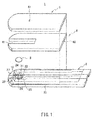
- the biosensor 1 shown as an embodiment of the present invention includes, for example, such respective parts as shown in FIG. 1 or FIG. 3 .
- FIG. 1 is an exploded perspective view of the biosensor 1.
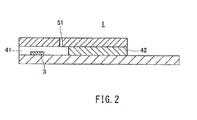
- FIG. 2 is a cross-sectional view of the biosensor 1.
- the biosensor 1 includes a blood component measurement layer 2, a reagent layer 3, a spacer layer 4, and a surface layer 5.
- the biosensor 1 is formed of these respective layers stacked together.
- the biosensor 1 is described below using, as an example, a biosensor that measures glucose and blood cells as blood cell components but it is not limited thereto.
- the biosensor 1 can be attached to or detached from a liquid sample measurement device 6 described later.
- the biosensor 1 composes a biosensor system together with the liquid sample measurement device 6.
- the biosensor system measures the amounts of liquid components of the matrix contained in blood spotted as a sample to a sample spotting site 41 located at the tip of the biosensor 1.
- the liquid sample measurement device 6 displays, as measurement results, the amounts of blood components (the concentration of glucose (the amount of a first component) and the amount of blood cells (the amount of a second component)) that were measured.
- the liquid sample measurement device 6 In order to quantify the amounts of blood components in the blood using the biosensor 1, first an end of the biosensor 1 is inserted into the liquid sample measurement device 6 by a user. Then the liquid sample measurement device 6 applies voltages to the electrodes of the biosensor 1 described later. In this state, blood is supplied to the sample spotting site 41. When the blood is spotted, said blood is drawn into the biosensor 1. This blood dissolves the reagent layer 3. The liquid sample measurement device 6 detects the electrical change generated between the electrodes of the biosensor 1 to measure the amounts of blood components.
- the biosensor 1 measures the amounts of specific blood components contained in the blood of a human body used as a sample liquid.
- the amounts of specific blood components include the concentration of glucose.
- disclosure is made regarding the measurement of the concentration of glucose contained in the blood of a human body.
- the biosensor system in the present embodiment can also measure lactic acid, cholesterol, and other components when suitable enzymes are selected.
- the blood component measurement layer 2 is configured with a conductive layer formed on an insulating substrate 20 that is formed of, for example, polyethylene terephthalate (PET), polycarbonate (PC), polyimide (PI), polyethylene (PE), polypropylene (PP), polystyrene (PS), polyvinyl chloride (PVC), polyoxymethylene (POM), monomer cast nylon (MC), polybutylene terephthalate (PBT), methacrylic resin (PMMA), ABS resin (ABS), or glass.
- the conductive layer is formed of an electroconductive material such as carbon or noble metal such as gold, platinum, or palladium, for example.
- the conductive layer is formed by, for example, a screen printing method or a sputter deposition method.
- the conductive layer can be formed on the whole surface or at least a part of the substrate.
- the conductive layer may be coated with a polymeric material for the purpose of preventing impurities from adhering thereto or preventing it from being oxidized.
- the coating of the surface of the conductive layer can be carried out by, for example, preparing a solution of the polymeric material, dropping or applying it to the surface of the conductive layer, and then drying it. Examples of the drying method include natural drying, air drying, hot air drying, and heat drying.
- the size of the insulating substrate 20 is not particularly limited. It has, for example, a total length of 5 to 100 mm, a width of 2 to 50 mm, and a thickness of 0.05 to 2 mm, preferably a total length of 7 to 50 mm, a width of 3 to 20 mm, and a thickness of 0.1 to 1 mm, and further preferably a total length of 10 to 30 mm, a width of 3 to 10 mm, and a thickness of 0.1 to 0.6 mm.
- the material of the spacer layer 4 is not particularly limited.
- the size of the spacer layer 4 is not particularly limited. It has, for example, a total length of 5 to 100 mm, a width of 2 to 50 mm, and a thickness of 0.01 to 1 mm, preferably a total length of 7 to 50 mm, a width of 3 to 20 mm, and a thickness of 0.05 to 0.5 mm, and more preferably a total length of 10 to 30 mm, a width of 3 to 10 mm, and a thickness of 0.05 to 0.25 mm.
- the spacer layer 4 has an I-shaped cutaway portion formed to serve as the sample spotting site 41 for introducing blood.
- the surface layer 5 is an insulating substrate provided with an air hole 51 in the central portion thereof.
- the surface layer 5 is disposed to form one body together with the blood component measurement layer 2, with the spacer layer 4 having the sample spotting site 41 as a cutaway portion being interposed between the surface layer 5 and the blood component measurement layer 2.
- the surface layer 5, the spacer layer 4, and the blood component measurement layer 2 may be bonded together with an adhesive or may be heat-sealed.
- the adhesive that can be used herein include an epoxy adhesive, an acrylic adhesive, a polyurethane adhesive, as well as a thermosetting adhesive (such as a hot-melt adhesive) and a UV curable adhesive.
- the material of the surface layer 5 is not particularly limited but, for example, a similar material to that of the substrate 20 can be used. It is further preferable that the portion corresponding to the ceiling portion of the sample spotting site 41 of the surface layer 5 be subjected to a hydrophilic treatment.
- a hydrophilic treatment examples include a method in which a surfactant is applied and a method in which a hydrophilic functional group such as a hydroxyl group, a carbonyl group, or a carboxyl group is introduced into the surface of the surface layer 5 by, for example, a plasma treatment.
- the size of the surface layer 5 is not particularly limited but it has, for example, a total length of 5 to 100 mm, a width of 3 to 50 mm, and a thickness of 0.01 to 0.5 mm, preferably a total length of 10 to 50 mm, a width of 3 to 20 mm, a thickness of 0.05 to 0.25 mm, and more preferably a total length of 15 to 30 mm, a width of 5 to 10 mm, and a thickness of 0.05 to 0.1 mm.
- the air hole 51 is formed in the surface layer 5.
- the shape thereof is, for example, round, oval, or polygonal.
- the air hole 51 has, for example, a maximum diameter of 0.01 to 10 mm, preferably a maximum diameter of 0.05 to 5 mm, and more preferably a maximum diameter of 0.1 to 2 mm.
- FIG. 3 is a top view of the blood component measurement layer 2 in the biosensor 1.
- a first electrode pair composed of a first working electrode 21(C) and a first counter electrode 22(E) is formed.
- the first working electrode 21 and the first counter electrode 22 are disposed at positions that contact an oxidoreductase and mediator of the reagent layer 3 described later.
- a second electrode pair composed of a second working electrode 23(A) and a second counter electrode 24(G) is formed.
- the second working electrode 23 is disposed at a position that does not contact the oxidoreductase and mediator of the reagent layer 3 described later.
- the second counter electrode 24 is disposed at a position that contacts the oxidoreductase and mediator of the reagent layer 3 described later but does not contact the first working electrode 21.
- a detection electrode 25 for detecting the introduction of blood is formed in the blood component measurement layer 2.
- a voltage (a first voltage) is applied between the first working electrode 21 and the first counter electrode 22, with the first working electrode 21 and the first counter electrode 22 being used as a positive electrode and a negative electrode, respectively.
- a voltage (a second voltage) is applied in the form of pulses between the second working electrode 23 and the second counter electrode 24, with the second working electrode 23 and the second counter electrode 24 being used as the positive electrode and the negative electrode, respectively.
- Examples of the form of pulses include forms of a rectangular wave, a triangular wave, etc. The details of such voltage applications are described later.
- a non-interference portion 26 with no conductive layer formed thereon is provided between the first working electrode 21 and the second counter electrode 24.
- the non-interference portion 26 separates the first working electrode 21 and the second counter electrode 24 from each other. This allows the non-interference portion 26 to prevent the mediator generated in the second counter electrode 24 from flowing into the first working electrode 21 in measuring the second current value.
- the blood component measurement layer 2 has a third electrode pair formed therein.
- the third electrode pair is composed of the second working electrode 23 (A, a third working electrode) and a third counter electrode 27 (F, a third counter electrode).
- a voltage a third voltage
- the position of the third counter electrode 27 is not limited to the blood introduction side (the left-hand side in FIG. 3 ) in the biosensor 1. It may be positioned on the detection electrode 25 side (the right-hand side in FIG. 3 ; excluding the portion where the reagent layer 3 is located).
- an identification section for identifying the biosensor 1 using the liquid sample measurement device 6 may be formed with electrodes.
- the identification section has, for example, a shape for identifying the type of the biosensor 1 and the difference in output characteristics per production lot.
- the identification section is formed, for example, on the side of the end of the biosensor 1 and can be read by the liquid sample measurement device 6.
- the spacer layer 4 is disposed to cover the respective electrodes 21 to 24, 26, and 27 located on the substrate 20 of the blood component measurement layer 2.
- the spacer layer 4 is a substrate 42 in which the rectangular sample spotting site 41 provided at the front edge center is formed.
- the sample spotting site 41 forms a sample supply path 10 shown in FIG. 3 .
- the reagent layer 3 is disposed between the blood component measurement layer 2 and the spacer layer 4.
- the reagent layer 3 is formed through application of a reagent containing, for example, an enzyme, a mediator (an electron acceptor), an amino acid, and sugar alcohol.
- the reagent layer 3 contacts the first working electrode 21 and the first counter electrode 22 that are exposed through the sample spotting site 41 of the spacer layer 4.
- the reagent layer 3 selectively contains, as optional components, a polymeric material, an enzyme stabilizer, a crystal homogenizer, etc.
- the surface layer 5 is disposed while leaving one end of the blood component measurement layer 2 exposed, with the spacer layer 4 being interposed therebetween.
- Examples of the oxidoreductase of the reagent layer 3 to be used herein include glucose oxidase, lactate oxidase, cholesterol oxidase, cholesterol esterase, uricase, ascorbate oxidase, bilirubin oxidase, glucose dehydrogenase, lactate dehydrogenase, and lactate dehydrogenase.
- the amount of the oxidoreductase is, for example, 0.01 to 100 U, preferably 0.05 to 10 U, and more preferably 0.1 to 5 U, per biosensor or per measurement.
- the oxidoreductase is preferably glucose oxidase or glucose dehydrogenase.
- the mediator (the electron acceptor) of the reagent layer 3 is preferably ferricyanide, more preferably potassium ferricyanide.
- mediators other than the potassium ferricyanide include p-benzoquinone and derivatives thereof, phenazine methosulfate, methylene blue, as we as ferrocene and derivatives thereof.
- the biosensor 1 of the present embodiment uses glucose oxidase as an oxidoreductase and potassium ferricyanide as a mediator that are carried by the reagent layer 3.
- the oxidoreductase and the mediator are dissolved in the blood used as a sample liquid. Then, an enzyme reaction proceeds between them and the glucose, which is a matrix in the blood, and thereby the mediator is reduced to produce ferrocyanide (potassium ferrocyanide in the case of the present embodiment). After completion of this reaction, the mediator thus reduced is electrochemically oxidized, and from the current obtained thereby, a response value (a first response value (mV)) that depends on the concentration of glucose in the blood to a high degree is measured.
- a first response value (mV) a response value that depends on the concentration of glucose in the blood to a high degree is measured.
- the blood cells denote red blood cells, white blood cells, platelets, and combinations thereof, which are contained in the blood, but preferably the blood cells denote red blood cells.
- the amount of the blood cells denotes, for example, the ratio (volume ratio) of the red blood cells contained in the blood, preferably the hematocrit (Hct) value.
- the liquid sample measurement device 6 carries out measurement using the biosensor 1 in which blood is introduced and blood components contained in said blood are subjected to oxidation-reduction using the oxidoreductase.
- the liquid sample measurement device 6 measures the concentration of glucose and the amount of blood cells as the amounts of blood components and measures a temperature equivalent value that is a value equivalent to the temperature of the biosensor 1.
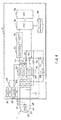
- the liquid sample measurement device 6 is connected to the electrodes A to F provided at the end of the biosensor 1, with the biosensor 1 being inserted in the liquid sample measurement device 6.
- the electrode C corresponds to the first working electrode 21
- the electrode E corresponds to the first counter electrode 22
- the electrode A corresponds to the second working electrode 23
- the electrode G corresponds to the second counter electrode 24
- the electrode D corresponds to the detection electrode 25
- the electrode F corresponds to the third counter electrode 27.
- the liquid sample measurement device 6 includes a plurality of connectors 61 to 66 and switches 67 to 71, a current/voltage conversion circuit 72, an A/D conversion circuit 73, a CPU 74, an LCD 75, and a data storage unit 76 (a storage means). Furthermore, the liquid sample measurement device 6 includes temperature measurement units 81, 82 (temperature detection means) for measuring the device inner temperature and switches 83, 84 for said temperature measurement units 81, 82.
- the connectors 62, 64 and the switches 67, 68 connected to the first counter electrode 22 and the second counter electrode 24 to serve as negative electrodes are grounded.
- the temperature measurement unit 81 and the temperature measurement unit 82 each measure the temperature inside the liquid sample measurement device 6 as the ambient temperature of the blood introduced. It is desirable that the temperature measurement units 81, 82 each measure the temperature of, for example, a position near the biosensor 1 inserted into the liquid sample measurement device 6.
- the temperature measurement values measured by the temperature measurement units 81, 82 are supplied to the CPU 74.
- the CPU 74 compares the two temperature measurement results. When the difference between the temperatures is not within a predetermined threshold, it is determined that one of the temperature measurement units 81, 82 is not working. This allows the failure of the liquid sample measurement device 6 to be detected accurately and easily. Furthermore, measurement errors caused by irregular temperature measurements are avoided.
- the temperature measurement timing may be immediately after the introduction of blood is detected by the detection electrode 25 or when the temperature of the blood introduced into the biosensor 1 is stabilized.
- the liquid sample measurement device 6 does not have to be provided with the temperature measurement units 81, 82.
- the liquid sample measurement device 6 needs to be provided with the temperature measurement units 81, 82 only when a measured temperature is used in addition to the temperature equivalent value described later.
- the respective connectors 61 to 66 are connected to the respective electrodes A and C to G of the biosensor 1.
- the respective switches 67 to 71 are connected to the connectors 62 to 66, respectively.
- the on/off states of the switches 67 to 71 are controlled by the CPU 74.
- the switch 67 is turned on to apply a voltage between the electrode C connected to the first working electrode 21 and the electrode E connected to the first counter electrode 22.
- the switches 68, 69 are turned on to apply a voltage between the electrode A connected to the second working electrode 23 and the electrode G connected to the second counter electrode 24.
- the voltage to be applied between the first working electrode 21 and the first counter electrode 22 as well as the voltage to be applied between the second working electrode 23 and the second counter electrode 24 can be changed.
- the switch 70 is turned on to apply a voltage to the electrode D connected to the detection electrode 25.
- the switches 68, 71 are turned on to apply a voltage between the electrode A connected to the second working electrode 23 and the electrode F connected to the third counter electrode 27.
- the current/voltage conversion circuit 72 is connected to the connectors 61 to 66 and the temperature measurement units 81, 82.
- the currents flowing between the first working electrode 21, the second working electrode 23, and the other electrodes are supplied to the current/voltage conversion circuit 72.
- currents corresponding to the ambient temperatures measured by the temperature measurement units 81, 82 are supplied to the current/voltage conversion circuit 72.
- the current/voltage conversion circuit 72 converts the currents thus supplied to voltages.
- the converted voltage values are supplied to the A/D conversion circuit 73.
- the A/D conversion circuit 73 is supplied with voltage values from the current/voltage conversion circuit 72.
- the A/D conversion circuit 73 converts the voltage values thus supplied to pulsed digital data and then outputs them to the CPU 74.
- the CPU 74 controls respective parts included in the liquid sample measurement device 6.
- the CPU 74 exerts control for turning the respective switches 67 to 71 on or off in measuring the concentration of glucose, the amount of blood cells, and the temperature equivalent value.
- the CPU 74 controls voltage values that are applied to the respective electrode pairs (a control means). Particularly, the CPU 74 controls the voltage value and voltage application period of each of the first voltage, the second voltage, and the third voltage. Moreover, the CPU 74 controls each measurement timing for measuring the first current value, the second current value, and the third current value.
- the CPU 74 calculates the first response value (mV) equivalent to the first current value, the second response value (mV) equivalent to the second current value, and the third response value (mV) equivalent to the third current value based on the digital data supplied from the A/D conversion circuit 73.
- the CPU 74 converts the first response value, the second response value, and the third response value thus calculated to the concentration of glucose, the amount of blood cells, and the value equivalent to the temperature of the biosensor 1.
- the CPU 74 obtains the concentration of glucose, the amount of blood cells, and the value equivalent to the temperature of the biosensor 1 based on the first response value, the second response value, and the third response value obtained with respect to the blood in which the concentration of glucose and the amount of blood cells as well as the temperature of the biosensor 1 are known.
- the process for obtaining the concentration of glucose, the amount of blood cells, and the value equivalent to the temperature of the biosensor 1 from the first response value, the second response value, and the third response value is described later.
- the LCD 75 is an LCD (a liquid crystal display; an output unit) that displays the measurement values calculated by the CPU 74.
- the data storage unit 76 contains data stored therein that can be referred to by the CPU 74.
- the data storage unit 76 contains recorded data stored therein that are used for calculating the concentration of glucose by the CPU 74.
- the recorded data is composed of a first response value, a second response value, and a third response value included therein that are equivalent to the first current value, the second current value, and the third current value measured per temperature and blood in which the concentration of glucose and the value of the amount of blood cells are known.
- the liquid sample measurement device 6 when the concentration of glucose, the amount of blood cells, and the value equivalent to the temperature of the biosensor 1 are to be measured, first the introduction of blood is detected by the detection electrode 25.
- the liquid sample measurement device 6 allows the CPU 74 to turn on the switch 67 to apply a voltage (the first voltage) between the first working electrode 21 and the first counter electrode 22 (the first electrode pair). In this state, the CPU 74 detects the oxidation-reduction current (the first response value) that is generated by oxidation-reduction (a first current value measurement means). The process for converting the first response value is described later.
- the liquid sample measurement device 6 allows the CPU 74 to turn on the switches 68, 69 to apply a voltage (the second voltage) between the second working electrode 23 and the second counter electrode 24 (the second electrode pair). In this state, the CPU 74 detects the second current value that is generated when the voltage is applied to the second working electrode 23 and the second counter electrode 24 (a second current value measurement means).
- the liquid sample measurement device 6 When obtaining the third current value to measure the third response value, the liquid sample measurement device 6 applies a voltage between the second working electrode 23 and the third counter electrode 27 of the third electrode pair to obtain the third current value (a third current value measurement means).
- the CPU 74 calculates the amount of a first component, the amount of a second component, and the value equivalent to the temperature of the biosensor 1 that were measured, based on the first response value, the second response value, and the third response value that were measured (a calculation means). In this process, the CPU 74 refers to the recorded data. The CPU 74 compares a plurality of recorded data each containing the first response value, the second response value, and the third response value stored in the data storage unit 76 with the measured data containing the first response value, the second response value, and the third response value that were measured.
- the CPU 74 calculates the amount of the first component of the blood from which the recorded data most approximated to the measured data was obtained, as the amount of the first component (the concentration of glucose) of the blood introduced into the biosensor 1. Similarly, the CPU 74 calculates the amount of the second component of the blood from which the recorded data most approximated to the measured data was obtained, as the amount of the second component (the amount of blood cells) of the blood introduced into the biosensor 1. The CPU 74 calculates the value equivalent to the temperature of the biosensor 1 at which the recorded data most approximated to the measured data was obtained, as the value equivalent to the temperature of the biosensor 1 obtained at the time of measurement.
- the first response value, the second response value, and the third response value are described with respect to the operations for obtaining the amount of the first component, the amount of the second component, and the value equivalent to the temperature of the biosensor 1 in the liquid sample measurement device 6 as described above.
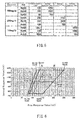
- the first response value of the liquid sample measurement device 6 that is expected to be supplied to the CPU 74 is, for example, as shown in FIG. 5 .
- the CPU 74 is expected to obtain a first response value of 120 as a current value and a second response value of 1250 as a current value.
- Such expected values of the first response value and the second response value can be obtained by preparing blood in which the concentration of glucose and the amount of blood cells have been regulated beforehand, and then carrying out measurement with the biosensor 1 and the liquid sample measurement device 6.
- the first response values and the second response values that are plotted on the line connecting the points obtained at each known same concentration of glucose can be converted into said known concentration of glucose and amount of blood cells. Therefore, using the conversion matrix, the concentration of glucose and the amount of blood cells can be obtained from the first response value and the second response value obtained from unknown blood. For example, when the first response value and the second response value indicated with a white circle in FIG. 6 were obtained, the ratio (A:B) between the respective first response values at concentrations of glucose of 100 mg/dl and 200 mg/dl in the conversion matrix is taken. Conversion is made from this ratio and thereby a concentration of glucose of 138 mg/dl can be obtained in the blood from which the first response value and the second response value indicated with the white circle in FIG.
- the conversion matrix allows the concentration of glucose and the amount of blood cells to be converted from the first response value and the second response value. Furthermore, the conversion matrix can include the third response value as described later. In this case, when the first response value, the second response value, and the third response value are obtained from blood using the liquid sample measurement device 6, the concentration of glucose, the amount of blood cells, and the value equivalent to the temperature of the biosensor 1 of the blood can be obtained.
- the liquid sample measurement device 6 measures the first response value, the second response value, and the third response value of the blood.
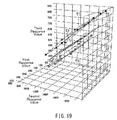
- the relationship between the first response value, the second response value, and the third response value is, for example, as shown in FIG. 7.
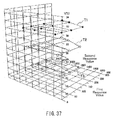
- FIG. 7 shows conversion matrices illustrating the relationship between the first response value (mV), the second response value (mV), and the third response value (mV), per temperature T1, T2, T3 (°C) of the biosensor 1.
- T1 is 20°C
- T2 is 25°C
- T3 is 30°C.
- a plurality of conversion matrices do not cross one another. That is, when the first response value, the second response value, and the third response value can be measured using blood in which the concentration of glucose and the amount of blood cells are unknown, the concentration of glucose, the amount of blood cells, and the value equivalent to the temperature of the biosensor 1 can be uniquely obtained by the liquid sample measurement device 6. On the other hand, when the planes formed by connecting the respective points forming the conversion matrices cross one another, a unique concentration of glucose, amount of blood cells, and value equivalent to the temperature of the biosensor 1 cannot be obtained by the liquid sample measurement device 6.
- the liquid sample measurement device 6 stores, per temperature T1, T2, and T3(°C) of the biosensor 1, recorded data (conversion matrices) including the first response value, the second response value, and the third response value obtained using blood in which the concentration of glucose and the amount of blood cells are known, as shown in FIG. 7 .
- the liquid sample measurement device 6 controls the first voltage to be applied between the first working electrode 21 and the first counter electrode 22 as well as the application time.
- the liquid sample measurement device 6 controls the second voltage to be applied between the second working electrode 23 and the second counter electrode 24 as well as the application time.
- the liquid sample measurement device 6 applies the third voltage to be applied between the second working electrode 23 and the third counter electrode 27 as well as the application time.
- the liquid sample measurement device 6 controls each measurement timing for measuring the first response value, the second response value, and the third response value.
- a means for exerting such controls is also referred to as a control means.
- the first voltage, the second voltage, and the third voltage are applied, respectively, in the same manner as when conversion matrices that do not cross one another were obtained as shown in FIG. 7 to measure the first response value, the second response value, and the third response value, respectively.
- the conversion matrices shown in FIG. 7 are compared with the first response value, second response value, and third response value that were measured and thereby a conversion matrix including the first response value, second response value, and third response value closest to the measured data is obtained.
- the liquid sample measurement device 6 can calculate the concentration of glucose, the amount of blood cells, and the temperature of the biosensor 1 at which said conversion matrix was obtained, as the concentration of glucose and the amount of blood cells of the unknown blood as well as the temperature of the biosensor 1.
- the liquid sample measurement device 6 controls the voltage values and application times of the first voltage, the second voltage, and the third voltage.
- the liquid sample measurement device 6 starts measuring current after a liquid to be measured is introduced into the biosensor 1 and then is detected by the detection electrode 25.
- the liquid sample measurement device 6 applies the first voltageV1 from the start to the end of measurement.
- the liquid sample measurement device 6 applies the second voltages V2-1, V2-2, V2-3, and V2-4 in the form of pulses for a plurality of times.
- the liquid sample measurement device 6 applies the third voltage V3 after the first second voltage V2-1 but before the second second voltage V2-2.
- the second voltage V2 When a plurality of second voltages are collectively referred to, they are referred to simply as the "second voltage V2".
- the liquid sample measurement device 6 changes the electrode to which a voltage is applied, the applied voltage, the application time, and the application timing as shown in FIG. 9 .
- the first voltage V1 is applied between the first working electrode 21(C) and the first counter electrode 22(E).
- the first voltage V1 is about 350 mV.
- Each second voltage V2 is applied between the second working electrode 23(A) and the second counter electrode 24(G).
- Each second voltage V2 is about 2500 mV
- the application time of each second voltage V2 is about 0.2 second.
- the third voltage V3 is applied between the second working electrode 23(A) and the third counter electrode 27(F).
- the third voltage V3 is about 2000 mV
- the application time of the third voltage V3 is 0.2 second.
- the first voltageV1, second voltageV2, and third voltageV3 whose applied voltage, application timing, and application time are as described above each are applied and thereby the liquid sample measurement device 6 obtains the first response value, the second response value, and the third response value with respect to the blood.
- the liquid sample measurement device 6 can obtain such conversion matrices as shown in FIG. 7 .
- the liquid sample measurement device 6 applies the first voltage V1, the second voltage V2, and the third voltage V3 as shown in FIGs.
- the liquid sample measurement device 6 thereby can obtain the first response value, the second response value, and the third response value with respect to the unknown blood.
- the liquid sample measurement device 6 can uniquely obtain the glucose conversion value, the blood cell amount conversion value, and the value equivalent to the temperature of the biosensor 1 from the first response value, the second response value, and the third response value obtained with respect to the unknown blood.
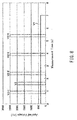
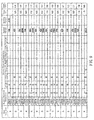
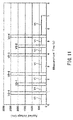
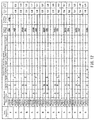
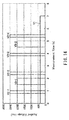
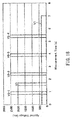
- FIG. 10 shows conversion matrices obtained when the first voltage V1 was set at 350 mV
- FIG. 10B shows conversion matrices obtained when the first voltage V1 was set at 500 mV
- the liquid sample measurement device 6 apply the first voltage V1 also during the application time of the third voltage V3 and the application time of the second voltage V2.
- the conversion matrices shown in FIG. 13 were obtained.
- the conversion matrices shown in FIG. 13 a plurality of conversion matrices corresponding to the respective temperatures T1, T2, and T3 of the biosensor 1 cross one another. Therefore, it is desirable that the liquid sample measurement device 6 apply the second voltage V2 and the third voltage V3 while applying the first voltage V1 to obtain the second response value and the third response value, respectively.
- the liquid sample measurement device 6 may adjust the application time of the third voltage V3 that is applied between the second working electrode 23 and the third counter electrode 27. As shown in, for example, FIG. 14 , the liquid sample measurement device 6 applies the third voltage V3 for a longer period of time than that shown in FIG. 8 to obtain the third response value.
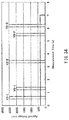
- the liquid sample measurement device 6 applies the first voltage V1, the second voltage V2, and the third voltage V3 at such timings and during such periods of time as shown in, for example, FIG. 15 .
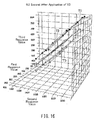
- the conversion matrices shown in FIG. 16 were obtained when the third response value was acquired 0.2 second after the third voltage V3-1 was applied.
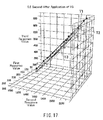
- the conversion matrices shown in FIG. 17 were obtained when the third response value was acquired 0.5 second after the third voltage V3-1 was applied.
- the liquid sample measurement device 6 can obtain transfer matrices in which the third response value varies significantly per temperature of the biosensor 1. That is, as shown in FIG. 16 , the liquid sample measurement device 6 can obtain conversion matrices of the temperatures T1, T2, T3 of the biosensor 1 that do not cross one another.
- the liquid sample measurement device 6 apply the third voltage V3 after the second voltage V2 is applied.
- the liquid sample measurement device 6 applies the third voltage V3 after the first second voltage V1-1 is applied.
- the liquid sample measurement device 6 can obtain conversion matrices of the temperatures T1, T2, T3 of the biosensor 1 that do not cross one another.
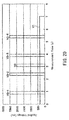
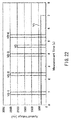
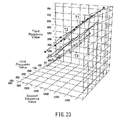
- the liquid sample measurement device 6 can apply the third voltageV3 after the second second voltageV2-2 is applied. Also in this case, as shown in FIG. 21 , the liquid sample measurement device 6 can obtain the concentration of glucose and the amount of blood cells of the unknown blood as well as the value equivalent to the temperature of the biosensor 1, using the conversion matrices of the temperatures T1, T2, T3 of the biosensor 1 that do not cross one another. For example, as shown in FIG. 22 , the liquid sample measurement device 6 applies the third voltage V3 after the third second voltageV2-3 is applied. Also in this case, as shown in FIG. 23 , the liquid sample measurement device 6 can obtain conversion matrices of the temperatures T1, T2, T3 of the biosensor 1 that do not cross one another.
- the liquid sample measurement device 6 when applying the third voltageV3 before the first second voltage V2-1 was applied, the liquid sample measurement device 6 obtained conversion matrices per temperature T1, T2, T3 of the biosensor 1 in which the difference in third response value was small as shown in FIG. 25 . Accordingly, it is desirable that the liquid sample measurement device 6 apply the third voltage V3 after the second voltage V2.
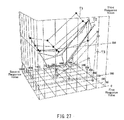
- the liquid sample measurement device 6 when the liquid sample measurement device 6 applies the third voltageV3 before applying the first second voltageV2-1 while not applying the first voltageV1, the conversion matrices obtained per temperature T1, T2, T3 of the biosensor 1 cross one another as shown in FIG. 27 . Therefore, it is desirable that the liquid sample measurement device 6 apply the third voltage V3 while applying the first voltage V1.
- the liquid sample measurement device 6 used the second working electrode 23 as the working electrode while using the third counter electrode 27 as the counter electrode, but they may be used inversely.
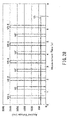
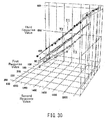
- the liquid sample measurement device 6 applies the third voltage V3 as shown in FIG. 28 .
- the liquid sample measurement device 6 applies the first third voltageV3, with the second working electrode 23(A) being used as the working electrode and the third counter electrode 27(F) being used as the counter electrode.
- the liquid sample measurement device 6 applies the second to fourth third voltages V3', with the second working electrode 23(A) being used as the counter electrode and the third counter electrode 27(F) being used as the working electrode.
- the liquid sample measurement device 6 can obtain conversion matrices of the temperatures T1, T2, T3 of the biosensor 1 that do not cross one another as shown in FIG. 30 .
- the liquid sample measurement device 6 is not limited to the embodiment described above, and the electrodes to which the second voltage V2 is applied may be changed.
- the second voltage V2 was applied between the second working electrode 23(A) and the second counter electrode 24(G).
- the third voltage V3 was applied between the second working electrode 23(A) and the third counter electrode 27(F).
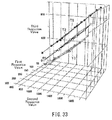
- the liquid sample measurement device 6 that applies the second voltage V2 and the third voltage V3 as shown in FIG. 31 applies the second voltage to another electrode pair.
- the liquid sample measurement device 6 applies a second voltage V2', with the third counter electrode 27(F) being used as the working electrode and the second counter electrode 24(G) being used as the counter electrode. In this manner, even when applying the second voltageV2' to obtain the second response values, the liquid sample measurement device 6 can obtain conversion matrices of the temperatures T1, T2, T3 of the biosensor 1 that do not cross one another as shown in FIG. 33 .
- the electrode pair to which the third voltage V3 is applied be different from the electrode pair to which the second voltage V2 is applied.
- the liquid sample measurement device 6 applies the second voltage V2-1, the third voltage V3-1, the second voltage V2-2, the third voltage V3-2, and the second voltage V2-3 in this order after starting the measurement.
- the liquid sample measurement device 6 applies the second third voltageV3-2 to the third counter electrode 27(F) and the second working electrode 23(A).
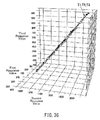
- the liquid sample measurement device 6 applies the second voltageV2 and the third voltageV3-1 other than the second third voltage V3-2 between the second working electrode 23(A) and the second counter electrode 24(G). That is, the second voltage V2 is applied to the second working electrode 23(A) and the second counter electrode 24(G). Furthermore, as the third voltageV3-1, a voltage with the same value as that of the third voltage V3-2 is applied between the second working electrode 23(A) and the second counter electrode 24(G). Then, the third response value does not vary much even at different temperatures of the biosensor 1. Accordingly, as shown in FIG. 36 , the conversion matrices of the temperatures T1, T2, T3 of the biosensor 1 overlap with one another in the same place. Therefore, it is desirable that the liquid sample measurement device 6 apply the second voltage V2 and the third voltage V3 to different electrode pairs, respectively.
- the concentration of glucose and the amount of blood cells of blood as well as the value equivalent to the temperature of the biosensor 1 can be measured using the first response value, the second response value, and the third response value.
- the temperature (°C) of the biosensor 1 must be constant in each conversion matrix as shown in FIG. 37 .
- the liquid sample measurement device 6 of the present invention can refer to conversion matrices obtained using not only the first response value and the second response value but also the third response value added thereto to determine the glucose conversion value, the blood cell amount conversion value, and the value equivalent to the temperature of the biosensor 1. Therefore, with the liquid sample measurement device 6 of the present invention, the glucose conversion value can be obtained with a high accuracy.
- the liquid sample measurement device 6 is provided with, for example, a third counter electrode 27 to obtain the third response value and applies the third voltage between said third counter electrode 27 (the counter electrode) and the second working electrode 23 (the working electrode).
- the liquid sample measurement device 6 can detect, as the third response value, the current obtained by applying the third voltage between the second working electrode 23 and the third counter electrode 27. Also this allows the liquid sample measurement device 6 to obtain the third response value that is considered to depend on the temperature of the reaction part of the biosensor 1. Therefore, the liquid sample measurement device 6 can calculate the concentration of glucose using not only the first response value that mainly depends on the concentration of glucose and the second response value that mainly depends on the amount of blood cells but also the third response value that depends on the temperature of the biosensor 1 to a high degree.
- the liquid sample measurement device 6 obtain the third current value (the third response value) while applying the first voltage.
- conversion matrices that do not overlap with one another in the direction of the third response value are obtained, and using these conversion matrices, the concentration of glucose and the amount of blood cells of blood as well as the value equivalent to the temperature of the biosensor 1 can be obtained.
- the liquid sample measurement device 6 obtain the third current value (the third response value) after applying the second voltage.
- the third current value the third response value
- conversion matrices that do not overlap with one another are obtained, and using these conversion matrices, the concentration of glucose and the amount of blood cells of blood as well as the value equivalent to the temperature of the biosensor 1 can be obtained.
- the liquid sample measurement device 6 stores recorded data in which, for example, per temperature and liquid containing the first component and the second component whose amounts are known, the first current value, the second current value, and the third current value obtained with respect to the liquid are recorded. Then, the liquid sample measurement device 6 compares the above-mentioned recorded data with measured data containing the first current value, the second current value, and the third current value and thereby can calculate, as the amount of the first component of the liquid introduced into the biosensor 1, the amount of the first component of the liquid from which the recorded data most approximated to said measured data was obtained.
- the liquid sample measurement device 6 can calculate, as the amount of blood cells of the blood subjected to the measurement and the value equivalent to the temperature of the biosensor 1, the amount of blood cells and the value equivalent to the temperature of the biosensor 1 that are most approximated to the measured data.
- the liquid sample measurement device 6 can obtain a highly accurate concentration of glucose and amount of blood cells of the blood as well as the value equivalent to the temperature of the biosensor 1 merely through the calculation for comparing the first response value, the second response value, and the third response value of the recorded data with those of the measured data, respectively.
- the electrode pair (the third electrode pair) for obtaining the third response value is composed of a first electrode that does not contact blood and an electrode that does not contact a liquid and that is selected from the electrode pair for measuring the second response value
- a third response value that depends mainly on the temperature of the reaction part of the biosensor 1 can be obtained.
- the third voltage was applied to the third electrode pair in order to obtain the third current value (the third response value) but another method may be used to obtain the third current value.
- the CPU 74 may control the first voltage value to be applied between the first working electrode 21 and the first counter electrode 22 for measuring the first current value to obtain a third current value that is different from the first current value and the second current value.
- the CPU 74 refers to the values determined by, for example, tests beforehand to apply the first voltage between the first working electrode 21 and the first counter electrode 22 and thereby can obtain the third current value.
- the first voltage set so as to be considered to mainly depend on the temperature of the biosensor 1 is applied and thereby the third current value is obtained.
- a voltage value within a predetermined range, a predetermined application timing, and a predetermined application time that have been determined by, for example, tests beforehand are selected.
- the first voltage to be applied to obtain the first response value is about 1 to 600 mV Such a range of the first voltage is a voltage range suitable for oxidation-reduction of blood.
- the first voltage to be applied to obtain a third response value that tends to depend on the temperature of the biosensor 1 is higher than the voltage to be applied to obtain a first response value of 600 mV and it is preferably 2000 mV
- a current value that highly depends on the temperature of the biosensor 1 can be obtained by tests in which a liquid is introduced into the biosensor 1.
- the first voltage to be applied to obtain the high third response value is in the range of voltages that allow water to be electrolyzed. Therefore, when applying the first voltage to obtain the temperature equivalent value, for example, the liquid sample measurement device 6 measures the first response value and thereafter applies the first voltage that is higher than the first response value to obtain the third response value.
- the liquid sample measurement device 6 shown as the present embodiment can control the first voltage V1 to obtain the third response value.
- the liquid sample measurement device 6 can measure the glucose conversion value and the blood cell amount conversion value of blood as well as the value equivalent to the temperature of the biosensor 1 with a high accuracy using the first response value, the second response value, and the third response value.
- the liquid sample measurement device 6 may refer to a plurality of first current values, a plurality of second current values, a third current value, a fourth current value, and temperatures measured by the temperature measurement units 81, 82 to obtain the concentration of glucose and the amount of blood cells of blood as well as the value equivalent to the temperature of the biosensor 1.
- the CPU 74 controls, for example, the voltage value and application period of each of the first voltage, the second voltage, and the third voltage. Then, for example, while controlling each measurement timing for measuring the first current value, the second current value, and the third current value, the CPU 74 controls the measurement timing so that the first voltage is applied to measure a fourth current value at a timing different from those used for the first current value and the second current value. For example, it is desirable that the fourth current value (a fourth response value) that depends on the concentration of glucose to a high degree be obtained while the first voltage is applied. Furthermore, in order to obtain the fourth current value, for example, a fourth voltage is applied between the third counter electrode 27 and the second working electrode 23. The fourth voltage is preferably substantially equivalent to the third voltage.
- the fourth current value be measured at a timing different from those used for the first current value and the second current value as described above as well as additionally the third current value.
- the fourth voltage V4-1 is applied, during which the fourth response value may be measured.
- a fifth current value (a fifth response value) that depends on the temperature of the biosensor 1 to a high degree be obtained while the first voltage is applied.
- a fifth voltage is applied between the third counter electrode 27 (the working electrode) and the second working electrode 23 (the counter electrode). It is preferable that the fifth voltage be substantially equivalent to the third voltage.
- the third voltage V3 is applied, with the second working electrode 23(A) being used as the working electrode and the third counter electrode 27(F) being used as the counter electrode, while the fifth voltage V5 is applied, with the working electrode and the counter electrode being used inversely.
- the fifth current value (the fifth response value) be measured at a timing different from those used for the second current value and the third current value. Specifically, for example, in FIG. 39 , the fifth voltage V5-1 may be applied, during which the fifth current value may be measured. There is an advantage that the use of the fifth current value also can yield results equivalent to those obtained using the third current value.
- the CPU 74 calculates the amounts of the first component and the second component contained in the liquid as well as a first temperature equivalent value equivalent to the temperature of the biosensor 1 using, for example, a set of the first current value, the second current value, the fourth current value, and/or the fifth current value generated when the first voltage, the second voltage, and the fourth voltage were applied, respectively.
- This operation corresponds to a first calculation means and a first calculation step.
- the liquid sample measurement device 6 has first recorded data stored therein in which per temperature and liquid containing the first component and the second component whose amounts are known, the first current value, the second current value, the fourth current value, and/or the fifth current value obtained using the liquid were recorded (a first storage means).
- the first calculation means compares the first recorded data with measured data containing the first current value that was measured, the second current value that was measured, and the fourth current value and/or fifth current value that were/was measured. Then, the first calculation means can calculate the amounts of the first component and the second component of the liquid from which the recorded data most approximated to said measured data was obtained as well as the temperature of the biosensor 1 at which the recorded data most approximated to said measured data was obtained, as the amounts of the first component and the second component of the liquid introduced into the biosensor 1 as well as the first temperature equivalent value of the biosensor 1.
- the CPU 74 calculates the amounts of the first component and the second component contained in the liquid as well as a second temperature equivalent value equivalent to the temperature of the biosensor 1using, for example, a set of the first current value, the second current value, and the third current value generated when the first voltage, the second voltage, and the third voltage were applied, respectively.
- This operation corresponds to a second calculation means and a second calculation step.
- the liquid sample measurement device 6 has second recorded data stored therein including the first current value, the second current value, and the third current value recorded per temperature and liquid containing the first component and the second component whose amounts are known (a second storage means).
- the second calculation means compares the second recorded data with measured data containing a first current value that was measured, a second current value that was measured, and a third current value that was measured. Then, the second calculation means can calculate the amounts of the first component and the second component of the liquid from which the recorded data most approximated to said measured data was obtained as well as the temperature of the biosensor 1 at which the recorded data most approximated to said measured data was obtained, as the amounts of the first component and the second component of the liquid introduced into the biosensor 1 as well as the second temperature equivalent value of the biosensor 1.
- the CPU 74 recalculates the amount of the first component based on, for example, the amount of the first component calculated by the first calculation means and the amount of the first component calculated by the second calculation means. Furthermore, the CPU 74 recalculates the amount of the second component based on, for example, the amount of the second component calculated by the first calculation means and the amount of the second component calculated by the second calculation means. Moreover, the CPU 74 recalculates the temperature of the biosensor 1 based on, for example, the temperatures detected by the temperature measurement units 81, 82 as well as the first temperature equivalent value and the second temperature equivalent value of the biosensor 1. In these recalculations, for example, average values may be taken.
- the liquid sample measurement device 6 can obtain the concentration of glucose (the amount of the first component) and the amount of blood cells (the amount of the second component) of blood as well as the value equivalent to the temperature of the biosensor 1 using the values obtained by the first calculation means and the second calculation means as well as the temperatures measured by the temperature measurement units 81, 82. Therefore, as described above, the liquid sample measurement device 6 can calculate the concentration of glucose (the amount of the first component) and the amount of blood cells (the amount of the second component) of blood as well as the value equivalent to the temperature of the biosensor 1 with a higher accuracy as compared to the values obtained using only the first calculation means or the second calculation means as described above.
Landscapes
- Health & Medical Sciences (AREA)
- Life Sciences & Earth Sciences (AREA)
- Chemical & Material Sciences (AREA)
- Hematology (AREA)
- Biochemistry (AREA)
- Immunology (AREA)
- Physics & Mathematics (AREA)
- Analytical Chemistry (AREA)
- Chemical Kinetics & Catalysis (AREA)
- General Health & Medical Sciences (AREA)
- General Physics & Mathematics (AREA)
- Electrochemistry (AREA)
- Pathology (AREA)
- Molecular Biology (AREA)
- Apparatus Associated With Microorganisms And Enzymes (AREA)
- Measuring Or Testing Involving Enzymes Or Micro-Organisms (AREA)
- Investigating Or Analysing Biological Materials (AREA)
- Investigating Or Analyzing Materials Using Thermal Means (AREA)
- Investigating Or Analyzing Materials By The Use Of Electric Means (AREA)
Applications Claiming Priority (2)
| Application Number | Priority Date | Filing Date | Title |
|---|---|---|---|
| JP2013094263 | 2013-04-26 | ||
| PCT/JP2014/002204 WO2014174815A1 (ja) | 2013-04-26 | 2014-04-18 | 液体試料測定装置、液体試料測定方法、及び、バイオセンサ |
Publications (3)
| Publication Number | Publication Date |
|---|---|
| EP2990784A1 true EP2990784A1 (de) | 2016-03-02 |
| EP2990784A4 EP2990784A4 (de) | 2016-06-01 |
| EP2990784B1 EP2990784B1 (de) | 2017-12-20 |
Family
ID=51791403
Family Applications (1)
| Application Number | Title | Priority Date | Filing Date |
|---|---|---|---|
| EP14788169.2A Active EP2990784B1 (de) | 2013-04-26 | 2014-04-18 | Flüssigprobenmessverfahren |
Country Status (5)
| Country | Link |
|---|---|
| US (2) | US10317360B2 (de) |
| EP (1) | EP2990784B1 (de) |
| JP (1) | JP6282636B2 (de) |
| CN (1) | CN105143870B (de) |
| WO (1) | WO2014174815A1 (de) |
Families Citing this family (7)
| Publication number | Priority date | Publication date | Assignee | Title |
|---|---|---|---|---|
| EP3086113B1 (de) * | 2015-04-06 | 2018-01-17 | ARKRAY, Inc. | Biosensor mit elektrode zur messung des hämatokritwertes |
| JP6577402B2 (ja) * | 2015-04-06 | 2019-09-18 | アークレイ株式会社 | ヘマトクリット値測定用電極を備えたバイオセンサ |
| EP3485265B1 (de) * | 2016-07-12 | 2025-03-12 | Ascensia Diabetes Care Holdings AG | Verfahren zur elektrochemischen analyse unter verwendung von abwechselnden ausgangssignalen zweier elektroden |
| CN110140046A (zh) * | 2016-11-25 | 2019-08-16 | 普和希控股公司 | 测量生物体试样的成分的方法 |
| JP7074753B2 (ja) * | 2016-12-05 | 2022-05-24 | アセンシア・ダイアベティス・ケア・ホールディングス・アーゲー | リスク因子モニタリング |
| WO2018222145A1 (en) * | 2017-05-30 | 2018-12-06 | Puangngernmak Nutdechatorn | Sensor plate structure for analyzing mixture of contacted materials |
| CN109406591A (zh) * | 2017-08-17 | 2019-03-01 | 爱科来株式会社 | 测定方法和测定装置 |
Family Cites Families (11)
| Publication number | Priority date | Publication date | Assignee | Title |
|---|---|---|---|---|
| US7494816B2 (en) * | 1997-12-22 | 2009-02-24 | Roche Diagnostic Operations, Inc. | System and method for determining a temperature during analyte measurement |
| US7132041B2 (en) | 2003-02-11 | 2006-11-07 | Bayer Healthcare Llc | Methods of determining the concentration of an analyte in a fluid test sample |
| EP3115777B1 (de) * | 2004-04-19 | 2020-01-08 | PHC Holdings Corporation | Verfahren zur messung von blutbestandteilen |
| CA2700507C (en) * | 2007-09-24 | 2018-05-29 | Bayer Healthcare Llc | Multi-region and potential test sensors, methods, and systems |
| JP2009250806A (ja) * | 2008-04-07 | 2009-10-29 | Panasonic Corp | バイオセンサシステム、センサチップおよび血液試料中の分析物濃度の測定方法 |
| WO2010061629A1 (ja) | 2008-11-28 | 2010-06-03 | パナソニック株式会社 | センサチップ、バイオセンサシステム、生体試料の温度測定方法、血液試料の温度測定方法、血液試料中の分析物の濃度測定方法 |
| KR101355271B1 (ko) * | 2009-01-30 | 2014-01-27 | 파나소닉 주식회사 | 생체 시료의 온도 측정 방법, 생체 시료의 농도 측정 방법, 센서 칩 및 바이오 센서 시스템 |
| JP4725665B2 (ja) | 2009-08-04 | 2011-07-13 | パナソニック株式会社 | バイオセンサ、バイオセンサ用測定装置及び基質の定量方法 |
| JP2011137769A (ja) | 2009-12-29 | 2011-07-14 | Nipro Corp | バイオセンサを有する測定装置 |
| US9629577B2 (en) * | 2012-05-07 | 2017-04-25 | Panasonic Healthcare Holdings Co., Ltd. | Biological information measurement device and biological information measurement method using same |
| US20150309010A1 (en) * | 2012-12-28 | 2015-10-29 | Panasonic Healthcare Holdings Co., Ltd. | Biological information measuring device, biological information measuring system using same biological information measuring device, and method using same biological information measuring device |
-
2014
- 2014-04-18 EP EP14788169.2A patent/EP2990784B1/de active Active
- 2014-04-18 JP JP2015513557A patent/JP6282636B2/ja active Active
- 2014-04-18 US US14/782,216 patent/US10317360B2/en active Active
- 2014-04-18 WO PCT/JP2014/002204 patent/WO2014174815A1/ja not_active Ceased
- 2014-04-18 CN CN201480023276.XA patent/CN105143870B/zh active Active
-
2019
- 2019-04-26 US US16/396,159 patent/US11268926B2/en active Active
Non-Patent Citations (1)
| Title |
|---|
| See references of WO2014174815A1 * |
Also Published As
| Publication number | Publication date |
|---|---|
| US20160025674A1 (en) | 2016-01-28 |
| JP6282636B2 (ja) | 2018-02-21 |
| CN105143870B (zh) | 2018-03-20 |
| US11268926B2 (en) | 2022-03-08 |
| WO2014174815A1 (ja) | 2014-10-30 |
| US20190250119A1 (en) | 2019-08-15 |
| JPWO2014174815A1 (ja) | 2017-02-23 |
| EP2990784A4 (de) | 2016-06-01 |
| US10317360B2 (en) | 2019-06-11 |
| CN105143870A (zh) | 2015-12-09 |
| EP2990784B1 (de) | 2017-12-20 |
Similar Documents
| Publication | Publication Date | Title |
|---|---|---|
| US11268926B2 (en) | Liquid sample measurement device, liquid sample measurement method, and biosensor | |
| EP1656554B1 (de) | Verfahren und vorrichtung für einen assay für elektrochemische eigenschaften | |
| CN100472210C (zh) | 血液成分的测定方法及该方法中使用的传感器和测定装置 | |
| US10509005B2 (en) | Blood component measuring device, method for measuring blood component, and bio-sensor | |
| EP2840389B1 (de) | Vorrichtung zur messung biologischer informationen und verfahren zur messung biologischer informationen damit | |
| US10344312B2 (en) | Blood component measurement device and blood component measurement method | |
| JP6453409B2 (ja) | 生体情報測定装置、及びバイオセンサシステム | |
| US11959872B2 (en) | Method for measuring amount of blood component in blood | |
| JP6739655B2 (ja) | 血液中の血液成分の量を測定する方法 |
Legal Events
| Date | Code | Title | Description |
|---|---|---|---|
| PUAI | Public reference made under article 153(3) epc to a published international application that has entered the european phase |
Free format text: ORIGINAL CODE: 0009012 |
|
| 17P | Request for examination filed |
Effective date: 20150922 |
|
| AK | Designated contracting states |
Kind code of ref document: A1 Designated state(s): AL AT BE BG CH CY CZ DE DK EE ES FI FR GB GR HR HU IE IS IT LI LT LU LV MC MK MT NL NO PL PT RO RS SE SI SK SM TR |
|
| AX | Request for extension of the european patent |
Extension state: BA ME |
|
| A4 | Supplementary search report drawn up and despatched |
Effective date: 20160503 |
|
| RIC1 | Information provided on ipc code assigned before grant |
Ipc: G01N 27/327 20060101ALI20160427BHEP Ipc: G01N 27/416 20060101ALI20160427BHEP Ipc: G01N 27/26 20060101AFI20160427BHEP |
|
| DAX | Request for extension of the european patent (deleted) | ||
| RIN1 | Information on inventor provided before grant (corrected) |
Inventor name: FUJIWARA, MASAKI Inventor name: YAMAMOTO, TOMOHIRO |
|
| GRAP | Despatch of communication of intention to grant a patent |
Free format text: ORIGINAL CODE: EPIDOSNIGR1 |
|
| INTG | Intention to grant announced |
Effective date: 20170314 |
|
| RIN1 | Information on inventor provided before grant (corrected) |
Inventor name: FUJIWARA, MASAKI Inventor name: YAMAMOTO, TOMOHIRO |
|
| GRAJ | Information related to disapproval of communication of intention to grant by the applicant or resumption of examination proceedings by the epo deleted |
Free format text: ORIGINAL CODE: EPIDOSDIGR1 |
|
| GRAP | Despatch of communication of intention to grant a patent |
Free format text: ORIGINAL CODE: EPIDOSNIGR1 |
|
| INTC | Intention to grant announced (deleted) | ||
| INTG | Intention to grant announced |
Effective date: 20170630 |
|
| GRAS | Grant fee paid |
Free format text: ORIGINAL CODE: EPIDOSNIGR3 |
|
| GRAA | (expected) grant |
Free format text: ORIGINAL CODE: 0009210 |
|
| AK | Designated contracting states |
Kind code of ref document: B1 Designated state(s): AL AT BE BG CH CY CZ DE DK EE ES FI FR GB GR HR HU IE IS IT LI LT LU LV MC MK MT NL NO PL PT RO RS SE SI SK SM TR |
|
| REG | Reference to a national code |
Ref country code: GB Ref legal event code: FG4D |
|
| REG | Reference to a national code |
Ref country code: CH Ref legal event code: EP |
|
| REG | Reference to a national code |
Ref country code: IE Ref legal event code: FG4D |
|
| REG | Reference to a national code |
Ref country code: AT Ref legal event code: REF Ref document number: 956820 Country of ref document: AT Kind code of ref document: T Effective date: 20180115 |
|
| REG | Reference to a national code |
Ref country code: DE Ref legal event code: R096 Ref document number: 602014018860 Country of ref document: DE |
|
| REG | Reference to a national code |
Ref country code: FR Ref legal event code: PLFP Year of fee payment: 5 |
|
| REG | Reference to a national code |
Ref country code: NL Ref legal event code: MP Effective date: 20171220 |
|
| PG25 | Lapsed in a contracting state [announced via postgrant information from national office to epo] |
Ref country code: LT Free format text: LAPSE BECAUSE OF FAILURE TO SUBMIT A TRANSLATION OF THE DESCRIPTION OR TO PAY THE FEE WITHIN THE PRESCRIBED TIME-LIMIT Effective date: 20171220 Ref country code: SE Free format text: LAPSE BECAUSE OF FAILURE TO SUBMIT A TRANSLATION OF THE DESCRIPTION OR TO PAY THE FEE WITHIN THE PRESCRIBED TIME-LIMIT Effective date: 20171220 Ref country code: NO Free format text: LAPSE BECAUSE OF FAILURE TO SUBMIT A TRANSLATION OF THE DESCRIPTION OR TO PAY THE FEE WITHIN THE PRESCRIBED TIME-LIMIT Effective date: 20180320 Ref country code: FI Free format text: LAPSE BECAUSE OF FAILURE TO SUBMIT A TRANSLATION OF THE DESCRIPTION OR TO PAY THE FEE WITHIN THE PRESCRIBED TIME-LIMIT Effective date: 20171220 |
|
| REG | Reference to a national code |
Ref country code: LT Ref legal event code: MG4D |
|
| REG | Reference to a national code |
Ref country code: AT Ref legal event code: MK05 Ref document number: 956820 Country of ref document: AT Kind code of ref document: T Effective date: 20171220 |
|
| PG25 | Lapsed in a contracting state [announced via postgrant information from national office to epo] |
Ref country code: GR Free format text: LAPSE BECAUSE OF FAILURE TO SUBMIT A TRANSLATION OF THE DESCRIPTION OR TO PAY THE FEE WITHIN THE PRESCRIBED TIME-LIMIT Effective date: 20180321 Ref country code: HR Free format text: LAPSE BECAUSE OF FAILURE TO SUBMIT A TRANSLATION OF THE DESCRIPTION OR TO PAY THE FEE WITHIN THE PRESCRIBED TIME-LIMIT Effective date: 20171220 Ref country code: LV Free format text: LAPSE BECAUSE OF FAILURE TO SUBMIT A TRANSLATION OF THE DESCRIPTION OR TO PAY THE FEE WITHIN THE PRESCRIBED TIME-LIMIT Effective date: 20171220 Ref country code: BG Free format text: LAPSE BECAUSE OF FAILURE TO SUBMIT A TRANSLATION OF THE DESCRIPTION OR TO PAY THE FEE WITHIN THE PRESCRIBED TIME-LIMIT Effective date: 20180320 Ref country code: RS Free format text: LAPSE BECAUSE OF FAILURE TO SUBMIT A TRANSLATION OF THE DESCRIPTION OR TO PAY THE FEE WITHIN THE PRESCRIBED TIME-LIMIT Effective date: 20171220 |
|
| RAP2 | Party data changed (patent owner data changed or rights of a patent transferred) |
Owner name: PHC HOLDINGS CORPORATION |
|
| REG | Reference to a national code |
Ref country code: DE Ref legal event code: R082 Ref document number: 602014018860 Country of ref document: DE Representative=s name: EISENFUEHR SPEISER PATENTANWAELTE RECHTSANWAEL, DE Ref country code: DE Ref legal event code: R081 Ref document number: 602014018860 Country of ref document: DE Owner name: PHC HOLDINGS CORP., JP Free format text: FORMER OWNER: PANASONIC HEALTHCARE HOLDINGS CO., LTD., TOKYO, JP |
|
| PG25 | Lapsed in a contracting state [announced via postgrant information from national office to epo] |
Ref country code: NL Free format text: LAPSE BECAUSE OF FAILURE TO SUBMIT A TRANSLATION OF THE DESCRIPTION OR TO PAY THE FEE WITHIN THE PRESCRIBED TIME-LIMIT Effective date: 20171220 |
|
| PG25 | Lapsed in a contracting state [announced via postgrant information from national office to epo] |
Ref country code: ES Free format text: LAPSE BECAUSE OF FAILURE TO SUBMIT A TRANSLATION OF THE DESCRIPTION OR TO PAY THE FEE WITHIN THE PRESCRIBED TIME-LIMIT Effective date: 20171220 Ref country code: CY Free format text: LAPSE BECAUSE OF FAILURE TO SUBMIT A TRANSLATION OF THE DESCRIPTION OR TO PAY THE FEE WITHIN THE PRESCRIBED TIME-LIMIT Effective date: 20171220 Ref country code: CZ Free format text: LAPSE BECAUSE OF FAILURE TO SUBMIT A TRANSLATION OF THE DESCRIPTION OR TO PAY THE FEE WITHIN THE PRESCRIBED TIME-LIMIT Effective date: 20171220 Ref country code: EE Free format text: LAPSE BECAUSE OF FAILURE TO SUBMIT A TRANSLATION OF THE DESCRIPTION OR TO PAY THE FEE WITHIN THE PRESCRIBED TIME-LIMIT Effective date: 20171220 Ref country code: SK Free format text: LAPSE BECAUSE OF FAILURE TO SUBMIT A TRANSLATION OF THE DESCRIPTION OR TO PAY THE FEE WITHIN THE PRESCRIBED TIME-LIMIT Effective date: 20171220 |
|
| PG25 | Lapsed in a contracting state [announced via postgrant information from national office to epo] |
Ref country code: AT Free format text: LAPSE BECAUSE OF FAILURE TO SUBMIT A TRANSLATION OF THE DESCRIPTION OR TO PAY THE FEE WITHIN THE PRESCRIBED TIME-LIMIT Effective date: 20171220 Ref country code: RO Free format text: LAPSE BECAUSE OF FAILURE TO SUBMIT A TRANSLATION OF THE DESCRIPTION OR TO PAY THE FEE WITHIN THE PRESCRIBED TIME-LIMIT Effective date: 20171220 Ref country code: IS Free format text: LAPSE BECAUSE OF FAILURE TO SUBMIT A TRANSLATION OF THE DESCRIPTION OR TO PAY THE FEE WITHIN THE PRESCRIBED TIME-LIMIT Effective date: 20180420 Ref country code: SM Free format text: LAPSE BECAUSE OF FAILURE TO SUBMIT A TRANSLATION OF THE DESCRIPTION OR TO PAY THE FEE WITHIN THE PRESCRIBED TIME-LIMIT Effective date: 20171220 Ref country code: PL Free format text: LAPSE BECAUSE OF FAILURE TO SUBMIT A TRANSLATION OF THE DESCRIPTION OR TO PAY THE FEE WITHIN THE PRESCRIBED TIME-LIMIT Effective date: 20171220 |
|
| REG | Reference to a national code |
Ref country code: DE Ref legal event code: R097 Ref document number: 602014018860 Country of ref document: DE |
|
| REG | Reference to a national code |
Ref country code: FR Ref legal event code: CD Owner name: PHC HOLDINGS CORPORATION, JP Effective date: 20180906 Ref country code: FR Ref legal event code: CJ Effective date: 20180906 |
|
| PLBE | No opposition filed within time limit |
Free format text: ORIGINAL CODE: 0009261 |
|
| STAA | Information on the status of an ep patent application or granted ep patent |
Free format text: STATUS: NO OPPOSITION FILED WITHIN TIME LIMIT |
|
| PG25 | Lapsed in a contracting state [announced via postgrant information from national office to epo] |
Ref country code: DK Free format text: LAPSE BECAUSE OF FAILURE TO SUBMIT A TRANSLATION OF THE DESCRIPTION OR TO PAY THE FEE WITHIN THE PRESCRIBED TIME-LIMIT Effective date: 20171220 Ref country code: MC Free format text: LAPSE BECAUSE OF FAILURE TO SUBMIT A TRANSLATION OF THE DESCRIPTION OR TO PAY THE FEE WITHIN THE PRESCRIBED TIME-LIMIT Effective date: 20171220 |
|
| REG | Reference to a national code |
Ref country code: CH Ref legal event code: PL |
|
| 26N | No opposition filed |
Effective date: 20180921 |
|
| REG | Reference to a national code |
Ref country code: BE Ref legal event code: MM Effective date: 20180430 |
|
| REG | Reference to a national code |
Ref country code: IE Ref legal event code: MM4A |
|
| PG25 | Lapsed in a contracting state [announced via postgrant information from national office to epo] |
Ref country code: LU Free format text: LAPSE BECAUSE OF NON-PAYMENT OF DUE FEES Effective date: 20180418 |
|
| PG25 | Lapsed in a contracting state [announced via postgrant information from national office to epo] |
Ref country code: LI Free format text: LAPSE BECAUSE OF NON-PAYMENT OF DUE FEES Effective date: 20180430 Ref country code: CH Free format text: LAPSE BECAUSE OF NON-PAYMENT OF DUE FEES Effective date: 20180430 Ref country code: BE Free format text: LAPSE BECAUSE OF NON-PAYMENT OF DUE FEES Effective date: 20180430 Ref country code: SI Free format text: LAPSE BECAUSE OF FAILURE TO SUBMIT A TRANSLATION OF THE DESCRIPTION OR TO PAY THE FEE WITHIN THE PRESCRIBED TIME-LIMIT Effective date: 20171220 |
|
| PG25 | Lapsed in a contracting state [announced via postgrant information from national office to epo] |
Ref country code: IE Free format text: LAPSE BECAUSE OF NON-PAYMENT OF DUE FEES Effective date: 20180418 |
|
| PG25 | Lapsed in a contracting state [announced via postgrant information from national office to epo] |
Ref country code: MT Free format text: LAPSE BECAUSE OF NON-PAYMENT OF DUE FEES Effective date: 20180418 |
|
| PG25 | Lapsed in a contracting state [announced via postgrant information from national office to epo] |
Ref country code: TR Free format text: LAPSE BECAUSE OF FAILURE TO SUBMIT A TRANSLATION OF THE DESCRIPTION OR TO PAY THE FEE WITHIN THE PRESCRIBED TIME-LIMIT Effective date: 20171220 |
|
| PG25 | Lapsed in a contracting state [announced via postgrant information from national office to epo] |
Ref country code: PT Free format text: LAPSE BECAUSE OF FAILURE TO SUBMIT A TRANSLATION OF THE DESCRIPTION OR TO PAY THE FEE WITHIN THE PRESCRIBED TIME-LIMIT Effective date: 20171220 |
|
| PG25 | Lapsed in a contracting state [announced via postgrant information from national office to epo] |
Ref country code: MK Free format text: LAPSE BECAUSE OF NON-PAYMENT OF DUE FEES Effective date: 20171220 Ref country code: HU Free format text: LAPSE BECAUSE OF FAILURE TO SUBMIT A TRANSLATION OF THE DESCRIPTION OR TO PAY THE FEE WITHIN THE PRESCRIBED TIME-LIMIT; INVALID AB INITIO Effective date: 20140418 |
|
| PG25 | Lapsed in a contracting state [announced via postgrant information from national office to epo] |
Ref country code: AL Free format text: LAPSE BECAUSE OF FAILURE TO SUBMIT A TRANSLATION OF THE DESCRIPTION OR TO PAY THE FEE WITHIN THE PRESCRIBED TIME-LIMIT Effective date: 20171220 |
|
| PGFP | Annual fee paid to national office [announced via postgrant information from national office to epo] |
Ref country code: DE Payment date: 20250429 Year of fee payment: 12 |
|
| PGFP | Annual fee paid to national office [announced via postgrant information from national office to epo] |
Ref country code: GB Payment date: 20250428 Year of fee payment: 12 |
|
| PGFP | Annual fee paid to national office [announced via postgrant information from national office to epo] |
Ref country code: IT Payment date: 20250422 Year of fee payment: 12 |
|
| PGFP | Annual fee paid to national office [announced via postgrant information from national office to epo] |
Ref country code: FR Payment date: 20250425 Year of fee payment: 12 |