EP2986555B1 - Systeme mit nicht-immunogenen und nukleaseresistenten nukleinsäure-origami-vorrichtungen für molekulare berechnung - Google Patents
Systeme mit nicht-immunogenen und nukleaseresistenten nukleinsäure-origami-vorrichtungen für molekulare berechnung Download PDFInfo
- Publication number
- EP2986555B1 EP2986555B1 EP14785273.5A EP14785273A EP2986555B1 EP 2986555 B1 EP2986555 B1 EP 2986555B1 EP 14785273 A EP14785273 A EP 14785273A EP 2986555 B1 EP2986555 B1 EP 2986555B1
- Authority
- EP
- European Patent Office
- Prior art keywords
- domain
- effector
- inputs
- nucleic acid
- binding
- Prior art date
- Legal status (The legal status is an assumption and is not a legal conclusion. Google has not performed a legal analysis and makes no representation as to the accuracy of the status listed.)
- Active
Links
Images






Classifications
-
- C—CHEMISTRY; METALLURGY
- C12—BIOCHEMISTRY; BEER; SPIRITS; WINE; VINEGAR; MICROBIOLOGY; ENZYMOLOGY; MUTATION OR GENETIC ENGINEERING
- C12N—MICROORGANISMS OR ENZYMES; COMPOSITIONS THEREOF; PROPAGATING, PRESERVING, OR MAINTAINING MICROORGANISMS; MUTATION OR GENETIC ENGINEERING; CULTURE MEDIA
- C12N15/00—Mutation or genetic engineering; DNA or RNA concerning genetic engineering, vectors, e.g. plasmids, or their isolation, preparation or purification; Use of hosts therefor
- C12N15/09—Recombinant DNA-technology
- C12N15/11—DNA or RNA fragments; Modified forms thereof; Non-coding nucleic acids having a biological activity
- C12N15/115—Aptamers, i.e. nucleic acids binding a target molecule specifically and with high affinity without hybridising therewith ; Nucleic acids binding to non-nucleic acids, e.g. aptamers
-
- A—HUMAN NECESSITIES
- A61—MEDICAL OR VETERINARY SCIENCE; HYGIENE
- A61K—PREPARATIONS FOR MEDICAL, DENTAL OR TOILETRY PURPOSES
- A61K47/00—Medicinal preparations characterised by the non-active ingredients used, e.g. carriers or inert additives; Targeting or modifying agents chemically bound to the active ingredient
- A61K47/50—Medicinal preparations characterised by the non-active ingredients used, e.g. carriers or inert additives; Targeting or modifying agents chemically bound to the active ingredient the non-active ingredient being chemically bound to the active ingredient, e.g. polymer-drug conjugates
- A61K47/69—Medicinal preparations characterised by the non-active ingredients used, e.g. carriers or inert additives; Targeting or modifying agents chemically bound to the active ingredient the non-active ingredient being chemically bound to the active ingredient, e.g. polymer-drug conjugates the conjugate being characterised by physical or galenical forms, e.g. emulsion, particle, inclusion complex, stent or kit
- A61K47/6901—Conjugates being cells, cell fragments, viruses, ghosts, red blood cells or viral vectors
-
- A—HUMAN NECESSITIES
- A61—MEDICAL OR VETERINARY SCIENCE; HYGIENE
- A61K—PREPARATIONS FOR MEDICAL, DENTAL OR TOILETRY PURPOSES
- A61K47/00—Medicinal preparations characterised by the non-active ingredients used, e.g. carriers or inert additives; Targeting or modifying agents chemically bound to the active ingredient
- A61K47/50—Medicinal preparations characterised by the non-active ingredients used, e.g. carriers or inert additives; Targeting or modifying agents chemically bound to the active ingredient the non-active ingredient being chemically bound to the active ingredient, e.g. polymer-drug conjugates
- A61K47/69—Medicinal preparations characterised by the non-active ingredients used, e.g. carriers or inert additives; Targeting or modifying agents chemically bound to the active ingredient the non-active ingredient being chemically bound to the active ingredient, e.g. polymer-drug conjugates the conjugate being characterised by physical or galenical forms, e.g. emulsion, particle, inclusion complex, stent or kit
- A61K47/6921—Medicinal preparations characterised by the non-active ingredients used, e.g. carriers or inert additives; Targeting or modifying agents chemically bound to the active ingredient the non-active ingredient being chemically bound to the active ingredient, e.g. polymer-drug conjugates the conjugate being characterised by physical or galenical forms, e.g. emulsion, particle, inclusion complex, stent or kit the form being a particulate, a powder, an adsorbate, a bead or a sphere
- A61K47/6923—Medicinal preparations characterised by the non-active ingredients used, e.g. carriers or inert additives; Targeting or modifying agents chemically bound to the active ingredient the non-active ingredient being chemically bound to the active ingredient, e.g. polymer-drug conjugates the conjugate being characterised by physical or galenical forms, e.g. emulsion, particle, inclusion complex, stent or kit the form being a particulate, a powder, an adsorbate, a bead or a sphere the form being an inorganic particle, e.g. ceramic particles, silica particles, ferrite or synsorb
-
- B—PERFORMING OPERATIONS; TRANSPORTING
- B82—NANOTECHNOLOGY
- B82Y—SPECIFIC USES OR APPLICATIONS OF NANOSTRUCTURES; MEASUREMENT OR ANALYSIS OF NANOSTRUCTURES; MANUFACTURE OR TREATMENT OF NANOSTRUCTURES
- B82Y5/00—Nanobiotechnology or nanomedicine, e.g. protein engineering or drug delivery
-
- C—CHEMISTRY; METALLURGY
- C12—BIOCHEMISTRY; BEER; SPIRITS; WINE; VINEGAR; MICROBIOLOGY; ENZYMOLOGY; MUTATION OR GENETIC ENGINEERING
- C12N—MICROORGANISMS OR ENZYMES; COMPOSITIONS THEREOF; PROPAGATING, PRESERVING, OR MAINTAINING MICROORGANISMS; MUTATION OR GENETIC ENGINEERING; CULTURE MEDIA
- C12N2310/00—Structure or type of the nucleic acid
- C12N2310/10—Type of nucleic acid
- C12N2310/16—Aptamers
-
- C—CHEMISTRY; METALLURGY
- C12—BIOCHEMISTRY; BEER; SPIRITS; WINE; VINEGAR; MICROBIOLOGY; ENZYMOLOGY; MUTATION OR GENETIC ENGINEERING
- C12N—MICROORGANISMS OR ENZYMES; COMPOSITIONS THEREOF; PROPAGATING, PRESERVING, OR MAINTAINING MICROORGANISMS; MUTATION OR GENETIC ENGINEERING; CULTURE MEDIA
- C12N2310/00—Structure or type of the nucleic acid
- C12N2310/30—Chemical structure
- C12N2310/35—Nature of the modification
- C12N2310/351—Conjugate
- C12N2310/3519—Fusion with another nucleic acid
Definitions
- the present invention relates in general to systems of molecular origami devices and their uses for molecular computing, quorum sensing and programmable drug delivery.
- MC molecular communication
- nanorobot nanobot in short
- Such tasks can be executed through the capacity of receiving inputs and generating outputs, which in a molecular communication context requires transceiver capabilities, as nanobots receive information by reacting to specific molecules and broadcast information by releasing other molecules, according to predefined parameters.
- Diffusion-based MC is achieved by encapsulating information molecules into vesicles that are emitted into a medium [Moritani, Y. et al ., 2006; Moritani, Y. et al ., 2007] where they subsequently propagate via diffusion or unpredicted turbulence of the medium.
- This approach also includes systems utilizing diffusion through gap-junctions between cells [Nakano, T. et al., 2005; Walsh, F.
- Such systems offer some of the most biologically realistic scenarios; i.e. as nanomachines can be deployed in flows which introduce a drift for the motion of signal molecules, such as in hormonal communication through the blood stream.
- signal molecules such as in hormonal communication through the blood stream.
- vesicle and long range hormones, pheromones, pollen or spores systems might be applicable in flow guided MC systems, no research on physical systems employing such propagation systems has been published.
- the fundamental challenge is to devise a biological nanobot platform that can combine the extraordinary characteristics of nano-transceivers with application-orientated functionality.
- a biological nanobot platform that can combine the extraordinary characteristics of nano-transceivers with application-orientated functionality.
- Ultimately such a system will provide the blue print for a scalable single network system that can interconnect large numbers of nanobots to perform complex tasks.
- the present invention relates to a system acting as a logic gate, said system comprising at least one effector device, at least one regulator device, at least one input and at least one output, wherein each one of said at least one effector device and at least one regulator device each is a nucleic acid origami device comprising a scaffold strand and a plurality of staple strands, and independently has the structure A, B or C, wherein in the structure A: (i) one of the staple strands comprises either (a) an aptamer domain capable of binding to binding partner comprising one of said at least one input; (b) an oligonucleotide capable of binding a DNA binding protein, said DNA binding protein comprising another of said at least one input; or (c) an oligoneucleotide attached to a nano-antenna capable of receiving an electromagnetic field comprising still another of said at least one input, or one of the staple strands comprises an aptamer domain of (a) and another of the staple strands comprises an
- the system of the present invention comprises one effector device having one or more handle domains each bound to a payload, at least one regulator device, at least one input and one output, wherein said output has a first output state when said effector device is in the closed configuration and a second output state when said effector device is in the open configuration. More particularly, the first output state corresponds to a logical off state and the second output state corresponds to a logical on state.
- Specific logical gates based on such a system are (i) a logical NAND gate, comprising two inputs and being in a logical on state if both inputs are present; (ii) a logical NOT gate, comprising one input and being in a logical on state if the input is absent; (iii) a logical implicit OR gate, comprising two inputs and being in a logical on state if at least one of the two inputs is present; and (iv) a logical exclusive OR (XOR) gate, comprising two inputs and being in a logical on state if only one of the two inputs is present, i.e., if the first of said two inputs is present and the second of said two inputs is absent, or the second of said two inputs is present and the first of said two inputs is absent.
- XOR logical exclusive OR
- the system of the present invention comprises two effector devices each having one or more handle domains each bound to a payload, at least one regulator device, at least one input and two outputs, wherein the first of said two outputs has a first output state when the first of said two effector devices is in the closed configuration and a second output state when the first of said two effector devices is in the open configuration; and the second of said two outputs has a first output state when the second of said two effector devices is in the closed configuration and a second output state when the second of said two effector devices is in the open configuration.
- each one of said first output states corresponds to a logical off state and each one of said second output states corresponds to a logical on state.
- Specific logical gates based on such a system are (i) a logical controlled NOT gate, comprising two inputs and two outputs, wherein the first output acts as a XOR gate and is in a logical on state if only one of the two inputs is present, and the second output is sensitive to the presence of the first of said two inputs only and it is thus in a logical on state if either only the first of said two inputs or both inputs are present.
- the effector device comprised in the system is in an open configuration and each one of the payloads is positioned on an outer surface of said effector device.
- the present invention relates to a system exhibiting quorum sensing comprising a plurality of effector nucleic acid origami devices each having the structure A, B or C as defined above in connection with the system acting as a logic gate or, alternatively, a plurality of a member each selected from a liposome, a particle or an artificial cell; at least one input; and at least one output, wherein said plurality of effector nucleic acid origami devices or members aggregates at a predetermined concentration, and wherein: each one of the effector nucleic acid origami devices comprises said handle domain bound to a first oligonucleotide capable of hybridizing with said aptamer domain of another of said effector nucleic acid origami devices and positioned on the outer surface of the device when the device is in the closed configuration; or each one of the members comprises on an outer surface thereof (a) a staple strand comprising a handle domain bound to a first oligonucleotide; and (b) a further staple
- the present invention provides a pharmaceutical composition
- a pharmaceutical composition comprising a system acting as a logic gate or a system exhibiting quorum sensing as defined above, and a pharmaceutically acceptable carrier.
- DNA also provides a natural conduit to affect genes, proteins and whole cells, although literature in this field is scarce. Benenson, Shapiro and colleagues have described elegant nucleic acid based computers, which generate logical outputs upon recognizing defined gene expression patterns [Xie, Z. et al ., 2011; Rinaudo, K. et al ., 2007; Benenson, Y.
- the current work aims at setting interactions or collisions between these bio-responsive nanorobots to produce computations of higher complexity for controlling molecules.
- Collision-based computing is driven by the interactions between discrete mobile objects such as billiard balls, particles or solitons in nonlinear media [Adamatzky, A., 2002].
- the DNA nanorobots disclosed herein provide a fit platform for universal collision-based computing if collisions can be designed to logically determine the state of the nanorobot carrying the effector payload.
- the state of a single nanorobot can be either closed (0) or open (1) controlled by the nanorobot gate [Douglas, S. M. et al ., 2012], equivalent to an AND gate.
- Each of the two “arms” in the gate (one for each input) consists of a sensing strand (e.g. an aptamer to a specific cue) and a complementary strand; when these hybridize, they hold the nanorobot at state 0.
- the gate system was re-designed as follows. The gate typically opens only in response to the chosen cue, which displaces the complementary strand from the sensing stand.
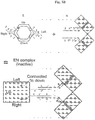
- the gate opens also in response to an external DNA "key", which hybridizes with the complementary strand, displacing the sensing strand by toehold-mediated migration [Zhang, D. Y. et al ., 2011; Zhang, D. Y. et al ., 2009] ( Figure 4A ).
- This external, cue-independent key to the effector nanorobot gate is loaded as cargo into a regulator nanorobot, such that when the latter is at state 1, a collision between the two will subsequently alter the former's state from 0 to 1.
- This assigns a "positive regulator” (P) phenotype to the nanorobot holding the external key.
- the regulator nanorobot is loaded with DNA strands that clasp two juxtaposed sides of the effector (E) nanorobot, thereby forcing it to close or preventing it from becoming open.
- E effector
- various architectures can be achieved by mixing the proper types at defined stoichiometries in the presence or absence of their cognate cues.
- E nanorobots carrying a payload and controlled by a gate, which opens if and only if both proteins X and Y are present.
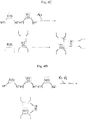
- An architecture consisting only of E nanorobots (termed E architecture) would emulate a logical AND gate as previously described [Douglas, S. M. et al ., 2012] ( Figure 4B ).
- P1 opens in response to X and carries the key to the Y arm of E
- P2 opens in response to Y and carries the key to the X arm of E.
- EP1P2 architecture ensures the latter opens in response to X alone (by P1), Y alone (by P2), or XY (by itself), emulating a logical OR gate ( Figure 4C ).
- NAND architecture can be based on two nanorobot types: Eopen, which is similar to E but lacks gate strands, hence it is constitutively open regardless of the inputs X and Y; and N, which opens in response to XY and negates Eopen as a result. This architecture therefore produces 0 in response to XY, and 1 otherwise.
- the present invention is based, inter alia , on the finding disclosed in Example 2, that the utilization of a great number of different nucleic acid origami devices, some acting as effector devices because they carry a payload, such as fluorescent molecule, biotin or avidin, and some acting as regulator devices because in their active state they are capable of interacting with the effector devices by way of their oligonucleotide payload and either turning them on or off, in specific predetermined architectures, can act as any important logical gate. For example, it has been found in accordance with the present invention that certain combinations of effector and regulator nucleic acid origami devices exhibit logical AND, OR, XOR, NAND, NOT and CNOT behavior.
- These different gates can be combined to form any logical circuit required in order to present one or more payloads, such as a drug or combination of different drugs, under specific circumstances that may be defined in terms of the presence of specific ligands or enzymes, or certain environmental determinants such as pH. Since the nucleic acid origami devices can circle between an open and a closed configuration, and since the payload may be bound to the device via a linker and presented when the device is in the open configuration without being released, not only the delivery of a drug may be controlled but also the withdrawal of the drug.
- payloads such as a drug or combination of different drugs
- the present invention relates to a system acting as a logic gate, said system comprising at least one effector device, at least one regulator device, at least one input and at least one output, wherein each one of said at least one effector device and at least one regulator device each is a nucleic acid origami device comprising a scaffold strand and a plurality of staple strands, and independently has the structure A, B or C, wherein in the structure A (this structure has one key: either an aptamer, a nano-antenna or a "ligand-sensing molecule"-type key): (i) one of the staple strands comprises either (a) an aptamer domain capable of binding to a binding partner comprising one of said at least one input; (b) an oligonucleotide capable of binding a DNA binding protein, said DNA binding protein comprising another of said at least one input; or (c) an oligoneucleotide attached to a nano-antenna capable of receiving
- nucleic acid origami device refers to a nucleic acid, e.g., a DNA, origami device as defined above, in any one of the configurations described below.
- scaffold strand refers to a long nucleic acid, e.g., DNA, strand, for example about 7250 bases long, that may be folded into a particular shape using a plurality of rationally designed "staple" DNA strands.
- staple DNA strand
- the sequences of the staple strands are designed such that they hybridize to particular portions of the scaffold strands and, in doing so, force the scaffold strands into a particular shape.
- latch domain refers to a nucleic acid domain capable of hybridizing to an opposing aptamer domain or other nucleic acid (e.g., attached to a nano-antenna) and thereby holds the nucleic acid origami device in a closed configuration.
- aptamer domain refers to a nucleic acid molecule selected such that it is capable of specifically binding a target molecule, much like an antibody is capable of specifically binding an antigen.
- Aptamers can be designed to target essentially any antigen of interest using methods known in the art. For example, methods of designing aptamers specific for a target of interest can be found in US Patent Nos. 5,582,981 , 5,756,291 , 5,840,867 and 7,745,607 , and in Tang et al., Anal. Chem. 79:4900-4907 (2007 ).
- a non-limiting example of an "oligonucleotide capable of binding a DNA binding protein" is an isolated response element originally found within a gene promoter.
- a specific example is the glucose responsive regulatory element.
- hybridized or “hybridizing” as used herein refer to the binding of two strands of nucleic acid molecules to each other, and are meant to include that the two strands are capable of hybridizing to each other, or that the two strands are complementary to each other, wherein the complementarity of the two strands may vary in order to calibrate the affinity between the two strands.
- each one of the two strands may have a sequence of base pairs that is 100, 99, 98, 96, 94, 92, 90, 85, 80, 75, 70, 65 or 60% complementary to the sequence of the other strand.
- the aptamer domain is capable of binding to a binding partner such that the binding partner displaces the latch domain.
- the binding partner is a ligand such as a target antigen that binds to the aptamer by inducing a structural change in the aptamer domain enabling it to bind to the ligand, the ligand binds to the aptamer domain at a higher affinity than the latch domain causing the aptamer to lose its linear configuration that enables it to hybridize with the latch domain, and therefore releases the latch domain.
- the binding partner is a nucleic acid molecule
- the nucleic acid molecule may have a higher degree of complementarity with the aptamer domain than has the latch domain and therefore displaces the latch domain.
- the nucleic acid molecule could be complementary to the latch domain and bind to it, thus displacing the aptamer domain. In both cases, the displacement would lead to the transitions of the device from a closed to an open configuration.
- the binding partner binds to the aptamer domain such that the binding partner displaces the latch domain
- the binding partner may alternatively bind to the latch domain such that oligonucleotide displaces the latch domain.
- external oligonucleotide refers to an oligonucleotide that is not comprised within a particular device being defined, but is found e.g. on a neighboring identical or different device.
- nuclease refers to an enzyme capable of cleaving the phosphodiester bonds between the nucleotide subunits of nucleic acids. Nucleases are usually further divided into endonucleases and exonucleases, although some of the enzymes may fall in both categories. Well known nucleases are deoxyribonuclease and ribonuclease.
- resistant to nucleases refers to nucleic acid molecules that have been modified so that they are more stable in the presence of nucleases than unmodified molecules.
- TLR9 recognition element refers to elements on a nucleic acid molecule, e.g., a nucleic acid molecule, that are recognized by Toll Like Receptor (TLR) 9 present in the cytoplasm of antigen presenting cells.
- TLR9 is expressed by numerous cells of the immune system such as dendritic cells, B lymphocytes, monocytes and natural killer (NK) cells.
- TLR9 is expressed intracellularly, within the endosomal compartments and functions to alert the immune system of viral and bacterial infections by binding to DNA rich in CpG motifs. TLR9 signals leads to activation of the cells initiating pro-inflammatory reactions that result in the production of cytokines such as type-I interferon and IL-12.
- CpG motif and “CpG island” are used interchangeably herein and refer to short single-stranded synthetic nucleic acid molecules that contain a cytidine triphosphate deoxynucleotide ("C)” followed by a guanidine triphosphate deoxynucleotide (“G”).
- C cytidine triphosphate deoxynucleotide
- G guanidine triphosphate deoxynucleotide
- p refers to the phosphodiester link between consecutive nucleotides, although some DNA nucleic acids have a modified phosphorothioate (PS) backbone instead.
- PS phosphorothioate
- masked nucleic acid origami device refers to a device that is linked to a molecule capable of covering domains otherwise accessible to the environment, such as CpG islands and thereby making these domains inaccessible to the environment.
- non-immunogenic refers to a molecule that does not induce a response against it by the immune system in a mammal, or induces a weaker response than would have been induced by the same molecule that differs only in that it has TLR9 recognition elements that have not been masked or modified.
- non-covalent binding examples include binding involving ionic bonds, electrostatic interactions, hydrophobic interactions, hydrogen bonds or van der Waals forces.
- one of the staple strands comprises a first aptamer domain and another of the staple strands comprises a second aptamer domain wherein both aptamer domains are capable of binding to identical binding partners;
- still another of the staple strands comprises a first latch domain hybridized to the first aptamer domain and selected such that the first aptamer domain is capable of binding to the binding partner such that the binding partner displaces the first latch domain;
- yet another of the staple strands comprises a second latch domain hybridized to the second aptamer domain and selected such that the second aptamer domain is capable of binding to the binding partner such that the binding partner displaces the second latch domain;
- said nucleic acid origami device is in a closed configuration when the first aptamer domain is hybridized to the first latch domain and/or the second aptamer domain is
- each one of the nucleic acid origami devices composing the logic gate of the present invention is non-immunogenic, resistant to nucleases, or both non-immunogenic and resistant to nucleases.
- the nucleic acid of each one of the nucleic acid origami devices composing the logic gate of the present invention is DNA.
- the TLR9 recognition elements are CpG islands, and the nucleic acid origami devices may be methylated, preferably at CpG dinucleotides.
- methylated refers to a nucleic acid molecule to which a methyl group has been added, specifically to the cytosine or adenine nucleotide.
- the nucleic acid origami devices composing the logic gate of the present invention are each methylated at the carbon atom in position 5 of cytosine residues; at the amino group linked to the carbon atom in position 4 of cytosine residues; or at the amino group linked to the carbon atom in position 6 of adenine residues, for example, the nucleic acid origami device may be methylated at the carbon atom in position 5 of cytosine residues in CpG dinucleotides.
- the nucleic acid origami devices composing the logic gate of the present invention are each modified at either cytosine or guanine residues in CpG dinucleotides.
- the cytosine or guanine residue may be modified by covalently linking it via a linker to a macromolecule having a functional group, wherein said macromolecule is selected from a polymer such as poly(ethylene)glycol, polystyrene, poly(vinyl)chloride, pectin, polygalacturonic acid, polygalacturonic acid and poly(lactic-co-glycolic acid) (PLGA), a peptide, a lipid or a polysaccharide.
- the functional group may be, but is not limited to, an amino, mercapto, and carboxyl group.
- the compound capable of non-covalently binding to the major- or minor-groove of a double stranded nucleic acid is selected from netropsin, distamycin, an oligoamide, a sugar-oligoamide conjugate or a bis-amidine.
- the compound is netropsin, and the netropsin is further covalently linked through two of its terminal amino groups, optionally via a linker, to the double stranded nucleic acid, as shown, e.g., in Figs. 9 and 10 of WO2014170898 , of which some of the present inventors are co-inventors.
- one or more further staple strands in at least one of the nucleic acid origami devices composing the logic gate of the present invention each comprises a handle domain bound to a payload, more specifically, to a payload moiety, optionally via a linker, wherein at least one of the payload(s) is one of said at least one output, and optionally, at least one of the payload(s) is one of said at least one input or emulates one of said at least one input.
- the linker comprises an oligonucleotide having a sequence complementary to the sequence of the handle domain and optionally comprising a further domain comprising a recognition site for enzymatic cleavage, and the payload is bound to the handle domain through the hybridization of the oligonucleotide to the handle domain.
- This further domain may comprise a peptide linker comprising a protease recognition site for cleavage by a protease, such as a matrix metalloproteinase.
- the linker may comprise a protein capable of binding a small molecule such as, but not limited to, a cyclooxygenase protein capable of binding paracetamol, a sodium channel subunit capable of binding tetrodotoxin and an anti-digoixin antibody capable of binding digoxin.
- a small molecule such as, but not limited to, a cyclooxygenase protein capable of binding paracetamol, a sodium channel subunit capable of binding tetrodotoxin and an anti-digoixin antibody capable of binding digoxin.
- protease recognition site refers to an amino acid sequence recognized by an endo peptidase, such as but not limited to: Trypsin - cuts after Arg or Lys, unless followed by Pro; Chymotrypsin - cuts after Phe, Trp, or Tyr, unless followed by Pro; Elastase - cuts after Ala, Gly, Ser, or Val, unless followed by Pro; Thermolysin - cuts before Ile, Met, Phe, Trp, Tyr, or Val, unless preceded by Pro; Pepsin - cuts before Leu, Phe, Trp or Tyr, unless preceded by Pro; and Endopeptidase V8 (also known as Glu-C) - cuts after Glu.
- endopeptidase V8 also known as Glu-C
- the payload each independently is a drug, such as insulin, an antibody or a fragment thereof, a cell surface receptor ligand or a biologically active fragment thereof, a small molecule, a nucleic acid, such as an oligonucleotide, a nuclease, an aptamer, a lipid, a glycan, a protein a glycoprotein, a glycolipid, a nanoparticle, a fluorophore, a radioactive compound, a nano-antenna, or a liposome.
- the payload being an oligonucleotide may function as an "external oligonucleotide" for another device.
- payload and “payload moiety” are used herein interchangeably and refer both to the free payload and to said payload when covalently linked directly to the handle domain or to the linker while maintaining its biological activity.
- the nano-antenna of a nucleic acid origami device included within the logic gate of the present invention e.g., a nucleic acid origami device having the structure A, or being used as a payload when linked to the handle domain, optionally via a linker, each independently comprises a metal quantum dot, a metal nanoparticle, or a metal nanocrystal, wherein said metal is preferably Au.
- the plurality of staple strands are selected such that at least one of the payloads is positioned on an inner surface of a nucleic acid origami device when the device is in the closed configuration; and the transition to the open configuration causes said payload to be positioned on an outer surface of the nucleic acid origami device.
- inner surface refers to any surface area of the device that is sterically precluded from interacting with members in the immediate environment surrounding the nucleic acid origami device, such as the surface of a cell
- an “outer surface” is any surface area of the device that is not sterically precluded from interacting with members in the immediate environment surrounding the nucleic acid origami device, such as the surface of a cell.
- the staple strands in at least one of the nucleic acid origami devices composing the logic gate of the present invention comprises a handle domain positioned on an outer surface of the device when the device is in the closed configuration, and in this case, the handle domain is bound to a payload preferably selected from an oligonucleotide or a liposome.
- the handle domain positioned on the outer surface of the device when the device is in the closed configuration becomes positioned on an inner surface of the device when the device is in the open configuration.
- each one of the devices composing the logic gate of the present invention may be chosen according to the purpose of the device, and is easily obtained by defining the shape in a specialized computer program well known in the art of DNA origami, such as CADnano software, available at http://www.cadnano.org.
- the plurality of staple strands composing at least one of the nucleic acid origami devices are selected such that the nucleic acid origami device is substantially barrel-shaped and in other embodiments the plurality of staple strands are selected such that the nucleic acid origami device has a substantially hexagonal tube shape.
- the plurality of staple strands composing at least one of the nucleic acid origami devices may be selected such that the nucleic acid origami device comprises an open end and they may be selected such that the nucleic acid origami device comprises two open ends.
- the plurality of staple strands are selected such that the nucleic acid origami device comprises a first domain and a second domain, wherein the first domain comprises said aptamer domain(s) of (a) each capable of binding to a binding partner; or said oligoneucleotide(s) of (b), each capable of binding a DNA binding protein; or said oligoneucleotide(s) of (c), each attached to a nano-antenna; and the second domain comprises said latch domain(s), wherein a first end of the first domain is attached to a first end of the second domain by at least one single-stranded nucleic acid hinge and the second end of the first domain is attached to the second end of the second domain by the hybridization or binding of each one of said aptamer domains or said oligonucleotides to said latch domains, respectively;
- the plurality of staple strands in at least one of the nucleic acid origami devices having the structure A or B are selected such that the second end of the first domain becomes unattached to the second end of the second domain if each one of said aptamer domains is contacted by its respective binding partner and/or if each one of said nano-antennas receives an electromagnetic field and undergoes inductive coupling and subsequent heating; or (ii) the plurality of staple strands in at least one of the nucleic acid origami device having the structure C are selected such that the second end of the first domain becomes attached to the second end of the second domain if each one of said latch domains is hybridized to a different one of said external oligonucleotides.
- the binding partner each independently is an antigen selected from a tumor associated antigen; a cell-membrane receptor; a secreted or membrane bound growth factor; a hormone; a cytokine; a ligand; a chemokine; a bacterial, a viral or parasitic antigen; a lipid; an oligonucleotide; a sugar, an enzyme or a DNA binding protein; or it may be a "damage cue” or "damage indicator", examples of which are an obligatory intracellular molecule such as ATP, ribosome fragments, rRNA, nuclear pore components, histones, etc.
- microRNA for discerning cell damage in a non-discriminatory way
- microRNA or certain isoforms or analogs of the above mentioned cues, such as glycosylation or phosphorylation variants, differentially present in a specific type of cell, a normal cell or a tumor cell.
- the system of the present invention may comprise a glucose-sensing nano-device that exhibits insulin on its surface at high glucose concentration.
- the nano-devise may comprise a binding partner that is selected such that it has a first configuration under a first condition and a different second configuration under a different second condition, and the aptamer of (a) or the oligonucleotide of (b) is capable of binding to the binding partner having the first configuration but incapable of binding to the binding partner having the second configuration such that the latch domain is displaced from the aptamer of (a) or the oligonucleotide of (b) when the binding partner transitions from the first to the second configuration, thereby opening the device and exposing the insulin.
- this binding partner may be an enzyme, for example a glucokinase (see Example 6).
- the enzyme is a glucokinase and the aptamer domain of (a) is capable of binding to the glucokinase having the first configuration but is incapable of binding to the glucokinase having the second configuration; or the DNA binding protein is a glucose response factor and said oligonucleotide of (b) is a glucose responsive regulatory element capable of binding to the glucose response factor having the first configuration but incapable of binding to the glucose response factor having the second configuration.
- the glucokinase may be a mammalian glucokinase, such as but not limited to human, mouse or rat beta cell glucokinase.
- the first condition (or input) is a glucose concentration in the range of 0-4.5 mM and the second condition (or input) is a glucose concentration above 4.5 mM, for example in the range of 5-10 mM.
- the system of the present invention may be used to specifically kill target cells while sparing non-target cells, e.g. normal healthy cells. This is achieved by administering, by means of one or more effector nanorobots, a toxin that preferentially kills the target cells, and by stopping the action of the nanorobots when it senses, as a system also comprising one or more regulatory nanorobots, a distress or damage cue released from normal healthy cells that are also damaged in the process.
- the nanorobot make-up of the system depends on the logic gate required to control the effector nanorobots, for example logic gates disclosed herein or combinations thereof.
- the system of the present invention comprises one effector device having one or more handle domains each bound to a payload, at least one regulator device, at least one input and one output, wherein said output has a first output state when said effector device is in the closed configuration and a second output state when said effector device is in the open configuration.
- the first output state corresponds to a logical off state
- the second output state corresponds to a logical on state.
- the system of the present invention is a logical NAND gate, comprising two inputs and being in a logical on state if both inputs are present.
- the system of the invention comprises one effector device and one regulator device, wherein (i) said effector device has the structure C and is initially in an open configuration; and (ii) said regulator device is a negative regulator device having the structure B and comprising two handle domains each bound to a nucleic acid molecule acting as a signal molecule capable of hybridizing to a different one of said latch domains of said effector device, said negative regulator device is initially in a closed configuration wherein said signal molecules are positioned on an inner surface of the negative regulator device and, when both inputs are present, transitions to an open configuration wherein said signal molecules are positioned on an outer surface of the negative regulator device, wherein the gate is in a logical on state when each one of said two signal molecules hybridizes to a different one of said latch domains of said effector device thereby promoting closure of the
- the system of the present invention is a logical NOT gate, comprising one input and being in a logical on state if the input is absent.
- the system of the invention comprises one effector device and one regulator device, wherein (i) said effector device has the structure C and is initially in an open configuration; and (ii) said regulator device is a negative regulator device having the structure A and comprising two handle domains each bound to a nucleic acid molecule acting as a signal molecule capable of hybridizing to a different one of said latch domains of said effector device, said negative regulator device is initially in a closed configuration wherein said signal molecules are positioned on an inner surface of the negative regulator device and, when the input is present, transitions to an open configuration wherein said signal molecules are positioned on an outer surface of the negative regulator device, wherein the gate is in a logical on state when each one of said two signal molecules hybridizes to a different one of said latch domains of said effector device thereby promoting closure of the effector device or
- the system of the present invention is a logical OR gate, comprising two inputs and being in a logical on state if at least one of the two inputs is present.
- the system of the invention comprises one effector device and two regulator devices, wherein (i) said effector device has the structure B, is initially in a closed configuration and, when both inputs are present, transitions to an open configuration; (ii) the first of said two regulator devices is a first positive regulator device having the structure A and comprises one handle domain bound to a nucleic acid molecule acting as a signal molecule capable of emulating the second of said two inputs by hybridizing to the aptamer domain of said effector device that is capable of binding to the second of said two inputs, said first positive regulator device is initially in a closed configuration wherein said signal molecule is positioned on an inner surface of said first positive regulator device and, when the first of said two inputs is present, transitions to an open configuration wherein said signal molecule is positioned on an outer surface
- the reference to an 'input that is present' is meant to represent for example the presence of an antigen that is capable of opening a nano-device by binding to an aptamer or the presence of a ligand, such as glucose at a certain concentration, that is capable of binding to a concentration-sensitive binding partner, such as a glucokinase, which upon binding of glucose alters its configuration thereby opening the nano-device.
- a ligand such as glucose at a certain concentration
- a concentration-sensitive binding partner such as a glucokinase
- the system of the present invention is an exclusive OR (XOR) gate, comprising two inputs and being in a logical on state if only one of the two inputs is present, i.e., if the first of said two inputs is present and the second of said two inputs is absent, or the second of said two inputs is present and the first of said two inputs is absent.
- XOR exclusive OR
- the system of the invention comprises one effector device and three regulator devices, wherein (i) said effector device has the structure B, is initially in a closed configuration and, when both inputs are present, transitions to an open configuration; (ii) the first of said three regulator devices is a first positive regulator device having the structure A and comprises one handle domain bound to a nucleic acid molecule acting as a signal molecule capable of emulating the second of said two inputs by hybridizing to the aptamer domain of said effector device that is capable of binding to the second of said two inputs, said first positive regulator device is initially in a closed configuration wherein said signal molecule is positioned on an inner surface of said first positive regulator device and, when the first of said two inputs is present, transitions to an open configuration wherein said signal molecule is positioned on an outer surface of the positive regulator device; (iii) the second of said three regulator devices is a second positive regulator device having the structure A and comprises one handle domain bound to a nucleic acid molecule acting as a
- the system of the present invention comprises two effector devices each having one or more handle domains each bound to a payload, at least one regulator device, at least one input and two outputs, wherein the first of said two outputs has a first output state when the first of said two effector devices is in the closed configuration and a second output state when the first of said two effector devices is in the open configuration; and the second of said two outputs has a first output state when the second of said two effector devices is in the closed configuration and a second output state when the second of said two effector devices is in the open configuration.
- each one of the first output states corresponds to a logical off state and each one of the second output states corresponds to a logical on state.
- the system of the present invention is a logical controlled NOT gate, comprising two inputs and two outputs, wherein the first output is in a logical on state if only one of the two inputs is present and the second output is sensitive to the presence of the first of said two inputs only and it is thus in a logical on state if either only the first of said two inputs or both inputs are present.
- the system of the invention comprises two effector devices and four regulator devices, wherein (i) the first of said two effector devices has the structure B, is initially in a closed configuration and, when both inputs are present, transitions to an open configuration; (ii) the first of said three regulator devices is a first positive regulator device having the structure A and comprises one handle domain bound to a nucleic acid molecule acting as a signal molecule capable of emulating the second of said two inputs by hybridizing to the aptamer domain of said effector device that is capable of binding to the second of said two inputs, said first positive regulator device is initially in a closed configuration wherein said signal molecule is positioned on an inner surface of said first positive regulator device and, when the first of said two inputs is present, transitions to an open configuration wherein said signal molecule is positioned on an outer surface of the positive regulator device; (iii) the second of said three regulator devices is a second positive regulator device having the structure A and comprises one handle domain bound to a nucleic acid molecule
- each one of the payload is positioned on an outer surface of the effector device(s).
- QS quorum sensing
- Bassler, B. L. et al ., 2006 as a bio-inspired collective behavior.
- QS is a phenomenon where microorganisms communicate and coordinate their behavior by the accumulation of signaling molecules.
- QS enables bacteria to regulate phenotypes such as biofilm formation [Davies, D. G. et al ., 1998], bioluminescence [Engebrecht, J. et al ., 1984], sporulation [Grossman, A. D. et al ., 1995] and virulence factor secretion [Miller, M. B. et al ., 2002; Hentzer, M. et al ., 2003], by population density.
- QS is based on a signal generated by each individual nanorobot, which builds up in the environment proportionally to the nanorobot population density. Subsequently, each nanorobot has to be able to detect this signal and respond to it by a concentration-dependent mechanism.
- the DNA nanorobot is activated in response to protein molecules termed "keys" through an aptamer-based gate [Douglas, S. M. et al ., 2012] in a concentration-dependent manner, making these proteins good candidates for use as QS signals.
- nucleic acid origami devices carrying quorum sensing molecules may aggregate in a concentration dependent manner both in vivo and in vitro as shown in Example 2.
- nanorobots can be made to aggregate by contacting one or more oligonucleotides presented on the outer surface of each individual nanorobot that is complementary to one or more other oligonucleotide also presented on the outer surface of each individual nanorobot.
- Example 3 shows that the delivery of a drug may be controlled so that the drug is presented to the cells only when the nucleic acid origami devices carrying the drug have accumulated to a high concentration. In this way, the target cells do not experience low levels of the drug that may enable them to develop resistance, as is often the case when the drug is given systemically, but are challenged with a high level of the drug that is likely to kill all cells in a short time span.
- the present invention relates to a system exhibiting quorum sensing comprising a plurality of effector nucleic acid origami devices each having the structure A, B or C as defined above in connection with the system acting as a logic gate or, alternatively, a plurality of a member each selected from a liposome, a particle or an artificial cell; at least one input; and at least one output, wherein said plurality of effector nucleic acid origami devices or members aggregates at a predetermined concentration, and wherein: (i) each one of the effector nucleic acid origami devices comprises said handle domain bound to a first oligonucleotide capable of hybridizing with said aptamer domain of another of said effector nucleic acid origami devices and positioned on the outer surface of the device when the device is in the closed configuration; or (ii) each one of the members comprises on an outer surface thereof (a) a staple strand comprising a handle domain bound to a first oligonucleotide
- said first oligonucleotide of each one of said effector nucleic acid origami devices binds to said aptamer domain of another of said effector nucleic acid origami devices such that the first oligonucleotide, acting as the first of said at least one input, displaces the latch domain of said another of said effector nucleic acid origami devices, thereby promoting transition of said another of said effector nucleic acid origami devices to an open configuration.
- each one of said effector nucleic acid origami devices or each one of said members comprises yet a further staple strand comprising an aptamer capable of binding to a binding partner acting as another of said at least one input, in particular wherein said binding partner is a target antigen.
- said binding partner is a target antigen.
- each one of said effector nucleic acid origami devices or, in particular, each one of said members further comprises a handle domain bound to a quorum sensing molecule, optionally via a linker, said quorum sensing molecule acting as a further one of said at least one input.
- said linker comprises a third oligonucleotide having a sequence complementary to the sequence of the handle domain and optionally a further domain comprising a recognition site for enzymatic cleavage, and the quorum sensing molecule is bound to the handle domain through the hybridization of the third oligonucleotide to the handle domain.
- This further domain may comprise a peptide linker comprising a protease recognition site for cleavage by a protease, such as a matrix metalloproteinase.
- each one of said effector nucleic acid origami devices or members comprises still a further staple strand positioned on its outer surface, said further staple strand comprising a fourth oligonucleotide selected such that it is capable of hybridizing to said handle domain of another of said effector nucleic acid origami devices or members, such that the fourth oligonucleotide displaces the third oligonucleotide of said another of said effector nucleic acid origami devices or members, linked to the quorum sensing molecule, thereby releasing said quorum sensing molecule linked to said third oligonucleotide.
- the concentration of the released quorum sensing molecule represents the concentration of the effector nucleic acid origami devices or members present.
- the released quorum sensing molecule is capable of causing transition of one of said effector nucleic acid origami devices or members from its closed configuration to its open configuration.
- the quorum sensing molecule is selected from a channel activating agent and a membrane permeable compound such as a peptide.
- a non-liming example of how a peptide may function as a quorum sensing molecule is liposomes that can be triggered by an external signal such as a small peptide, that is capable of diffusing into the liposome and trigger a biosynthetic machinery.
- an external signal such as a small peptide
- DNA arms decorated with a positively-charged peptide we used GRKKRRQRRRPQ; SEQ ID NO: 2 ) on the end, which can by themselves penetrate into the liposome and trigger its machinery.
- step 2 DNA arms on separate liposomes interact based on liposome density; 2) arm interaction displaces a DNA strand containing a positive peptide as in above; 3) the displaced arm with peptide penetrates into the liposome and activates its internal machinery. Since this process initiates with strand displacement (step 2), which occurs only upon a certain density of liposomes (step 1), it represents quorum sensing.
- the quorum sensing peptide is capable of penetrating membranes and in particular embodiments has the sequence KPLGMWSRC SEQ ID NO: 3) or GRKKRRQRRRPQ.
- the concentration at which the effector nucleic acid origami devices or members of the quorum sensing system aggregate can be calibrated by adjusting the affinities between the interacting oligonucleotides or quorum sensing molecules attached to the devices and members.
- said further nucleic acid molecule is capable of hybridizing to said handle domain of another of said plurality of at least one effector device or to said handle domain of another of said plurality of said member if the binding affinity of said handle domain to said further nucleic acid molecule is higher than the binding affinity of said handle domain to said nucleic acid molecule linked to the quorum sensing molecule.
- association constant of said binding affinity of said handle domain to said further nucleic acid molecule is selected by adjusting the degree of complementarity of said further nucleic acid molecule with said handle domain; and the association constant of said binding affinity of said handle domain to said nucleic acid molecule linked to the quorum sensing molecule is selected by adjusting the degree of complementarity of said nucleic acid molecule linked to the quorum sensing molecule with said handle domain.
- each one of said association constants of said binding affinity of said handle domain to said further nucleic acid molecule and to said nucleic acid molecule linked to the quorum sensing molecule is selected such that the binding affinity of said handle domain to said further nucleic acid molecule is higher than the binding affinity of said handle domain to said nucleic acid molecule linked to the quorum sensing molecule at a predetermined concentration of said further nucleic acid molecule.
- the present invention provides a pharmaceutical composition
- a pharmaceutical composition comprising a system acting as a logic gate or a system exhibiting quorum sensing in any one of the configurations defined above, and a pharmaceutically acceptable carrier.
- compositions for use in accordance with the present invention may be formulated in conventional manner using one or more physiologically acceptable carriers or excipients.
- the carrier(s) must be "acceptable” in the sense of being compatible with the other ingredients of the composition and not deleterious to the recipient thereof.
- Methods of administration include, but are not limited to, parenteral, e.g., intravenous, intraperitoneal, intramuscular, subcutaneous, mucosal (e.g., oral, intranasal, buccal, vaginal, rectal, intraocular), intrathecal, topical and intradermal routes. Administration can be systemic or local. In certain embodiments, the pharmaceutical composition is adapted for intra-brain administration.
- carrier refers to a diluent, adjuvant, excipient, or vehicle with which the active agent is administered.
- the carriers in the pharmaceutical composition may comprise a binder, such as microcrystalline cellulose, polyvinylpyrrolidone (polyvidone or povidone), gum tragacanth, gelatin, starch, lactose or lactose monohydrate; a disintegrating agent, such as alginic acid, maize starch and the like; a lubricant or surfactant, such as magnesium stearate, or sodium lauryl sulphate; and a glidant, such as colloidal silicon dioxide.
- a binder such as microcrystalline cellulose, polyvinylpyrrolidone (polyvidone or povidone), gum tragacanth, gelatin, starch, lactose or lactose monohydrate
- a disintegrating agent such as alginic acid, maize starch and the like
- a lubricant or surfactant such as
- compositions may be formulated for parenteral administration by injection, e.g., by bolus injection or continuous infusion.
- Formulations for injection may be presented in unit dosage form, e.g., in ampoules or in multidose containers, with an added preservative.
- the compositions may take such forms as suspensions, solutions or emulsions in oily or aqueous vehicles, and may contain formulatory agents such as suspending, stabilizing and/or dispersing agents.
- the active ingredient may be in powder form for constitution with a suitable vehicle, e.g., sterile pyrogen free water, before use.
- compositions for use according to the present invention are conveniently delivered in the form of an aerosol spray presentation from pressurized packs or a nebulizer, with the use of a suitable propellant, e.g., dichlorodifluoromethane, trichlorofluoromethane, dichlorotetrafluoroethane, carbon dioxide or other suitable gas.
- a suitable propellant e.g., dichlorodifluoromethane, trichlorofluoromethane, dichlorotetrafluoroethane, carbon dioxide or other suitable gas.
- a suitable propellant e.g., dichlorodifluoromethane, trichlorofluoromethane, dichlorotetrafluoroethane, carbon dioxide or other suitable gas.
- a suitable propellant e.g., dichlorodifluoromethane, trichlorofluoromethane, dichlorotetrafluoroethane, carbon dioxide or
- the pharmaceutical composition is formulated for administration by any known method as described above.
- DNA scaffold A 7249bp circular single-strand DNA molecule was used in the following examples (M13mp18 DNA; New England Biolabs; NEB #N4040; SEQ ID NO: 4.
- oligonucleotides Purchased from Integrated DNA Technologies SEQ ID NOs: 5-282. All sequences are in the 5' to 3' direction.
- the oligonucleotides were reconstituted in ultrapure, DNase/RNase-free water to 100 ⁇ M concentration and stored at -20°C.
- Robot preparation Robots were initially produced by mixing M13mp18 ssDNA as scaffold strand (final concentration of 20 nM) and staple strands (final concentrations of 200 nM of each strand). Buffer and salts of solution included 5mM Tris, 1mM EDTA (pH 8.0 at 20 °C) and 10 mM MgCl 2 . The mixture was subjected to a thermal-annealing ramp for folding. Initially the following program was used: 80 °C to 60 °C at 2 min/ ° C, 60 °C to 20 °C at 150 min/ ° C.
- TEM negative-stain Briefly, 5 ⁇ L of 0.5 M NaOH were added to a pre-made frozen aliquot of 100 ⁇ L 2% uranyl formate solution (Polysciences, 24762) followed by rigorous vortexing for 3 minutes, after which solution was centrifuged at 18,000 g for 5 minutes and precipitate was removed. Robot samples at 1-5 nM concentration were loaded onto a TEM Grid (Science Services, EFCF400-Cu-50) immediately after glow-discharge treatment (Emitech K100X), followed by two consecutive washes with 0.1% uranyl formate solution. During the third wash the grid was incubated with uranyl formate solution for 30 seconds.
- TEM Grid Science Services, EFCF400-Cu-50
- glow-discharge treatment Emitech K100X
- Antibodies were digested using a commercial kit (Thermo) with immobilized ficin in mouse IgG digestion buffer with 25 mM cysteine by shaking at a 37 °C water bath for 4 hours.
- Antibody Fab' fragments were purified by centrifugal filtration (Amicon, 10K MWCO Millipore) and evaluated by spectrophotometer (Thermo Sci. NanoDrop 2000c). Fab' fragments were buffer-exchanged into 0.05 M sodium borate buffer, pH 8.5, and incubated with DyLight Amine-Reactive Dye (Thermo) for 1 hour at room temperature on a rotary shaker. Excess dye was thoroughly removed using Amicon 10K MWCO (Millipore).
- Fab' fragments were incubated for 1 minute with 5'-amine-modified linker oligonucleotide (5AmMC6/GAACTGGAGTAGCAC ( SEQ ID NO: 283 , Integrated DNA Technologies) at a molar ratio of 1 to 10, in a 0.1 M MES-buffered saline, pH 4.7 (Pierce #28390).
- EDC Thermo, #22980
- Tris was added to a final concentration of 10 mM and solution was filtered via Amicon column 30K MWCO (Millipore).
- Cue-driven collisions between robots were based on toehold-mediated strand displacement reactions.
- the basic design enabling collisions between DNA strands extending from E, P, and N robots was based on a 3-level interaction: the first level is the interaction of the cue itself (e.g. PDGF or VEGF in this study) with the sensing strands of the gates of all robots (E, P, and N).
- the E gates can also interact with either P or N as described in Figs.
- the E gate complementary strand contains four regions (from 5' to 3'): 5 (toehold for collision with N), 4 (toehold for collision with P), 3* (partially complements with the aptamer), and 1 (anchors the gate to the robot chassis).
- the sensing strand contains two regions (from 5' to 3'): 2 (anchors the gate to the robot chassis) and 3 (the aptamer).
- the key loaded into P contains 3 regions (from 5' to 3'): 3 (portion of the sensing strand which only appear identical in this scheme), 4* (hybridizes with toehold 4), and 6 (loading sequence to robot).
- E robots are shown in Fig. 3B first from a front view with the virtual sides stated for proper orientation.
- the arms (clasps) extending from N include 4 regions (from 5' to 3'): 3 (portion of the sensing strand which only appear identical in this scheme), 4* (hybridizes with toehold 4), 5* (hybridizes with toehold 5), and 6.
- Multiple arms extending from N clasp the two gates of E. Since these are located on opposite sides of the robot (up and down), the result is inability of E to open properly.
- E and F consist of different regions dictating collisions with P and N.
- P1 and P2 robots key E by interacting with region 4 on the E gate ( Fig. 3C ).
- N robots close E by interacting with region 5. Since F robots contain neither region 4 nor 5, robots P1, P2 and N cannot interact with it. However, P3 keys F by interacting with region 7, which is also why it cannot key E.
- N gate complementary strands lack regions 5 and 4, so the N clasp arms cannot hybridize with them and inactivate N itself.
- Example 2 A nanorobotic collision-based computer controlling therapeutic molecules in a living animal
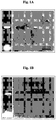
- FIG. 2 and Fig. 4A A scheme showing the nanorobot used in these studies is shown in Fig. 2 and Fig. 4A .
- the insect Blaberus discoidalis was chosen as model animal for various reasons, including simplicity, previous experience with closely related models, and availability of reliable custom made reagents [Bulmer, M. S. et al., 2009].
- the hemolymph of B. discoidalis expresses negligible nuclease activity and contains large amounts of free DNA as reported for other Dictyoptera [Garbutt, J. S. et al ., 2012], and its salt/metal composition well supports DNA origami structures.
- the DNA origami nanorobots can survive for relatively long periods in the insect hemolymph.
- Resident DNA fragments are used here as endogenous biological cues. Stability in hemolymph was confirmed by quantitative PCR (not shown), and DNA cues were defined by sequencing (not shown).
- a typical nanorobot mixture contained 0.1 pmol of the effector nanorobot, and 0.1 pmol or more of each regulator nanorobot, as described below.
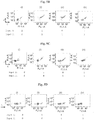
- E architecture exhibited AND gate behavior as previously observed with protein cues ( Fig. 4B and Fig. 5A ). For clarity, the truth table for the AND gate is shown below (k represents "key”):
- EP1P2 architecture exhibited partial to good activity at a 1:1:1 stoichiometry, and good activity at 1:>2:>2, which correlated well with an OR gate behavior. Binding of the target cells by an EP1 or EP2 nanorobot complex instead of just by solitary E nanorobots was shown by loading P1 and P2 with a reporter payload emitting at a wavelength different from that of the effector payload ( Fig. 4C and Fig. 5B ). For clarity, the truth table for the OR gate is shown below:
- EP1P2N performed similar to EP1P2 (OR) at first. XOR behavior emerged only when N was at a molar excess of -10 over E (not shown).
- EP1P2N architecture integrates XOR (E output) with AND (N output), thus emulating a 1- bit adder in which the sum bit is relayed to the effector payload by E in the EP1 and EP2 complexes.
- E output
- N output
- the carry bit cannot be relayed by N as both nanorobots in the EN complex (unlike in the EP complexes) directly face each other and sterically prevent each other from binding target cells; however it can be relayed by adding a second effector nanorobot (F), which is not keyed by P1 and P2 and not negated by N.
- F second effector nanorobot
- NAND architecture can be based on two nanorobot types: Eopen, which is similar to E but lacks gate strands, hence it is constitutively open regardless of the inputs X and Y; and N, which opens in response to XY and negates Eopen as a result.
- Eopen which is similar to E but lacks gate strands, hence it is constitutively open regardless of the inputs X and Y
- N which opens in response to XY and negates Eopen as a result.
- This architecture therefore produces 0 in response to XY, and 1 otherwise ( Fig. 4E ), and performed well at a 1:5 stoichiometry of EopenN ( Fig. 5D ).
- the truth table for the NAND gate is shown below:
- NX A simple inverter was constructed from this NAND gate (resulting in a NOT gate), by programming N to respond to X only (by placing two identical X arms instead of X and Y arms on the nanorobot), termed NX.
- EopenNX architecture produces 1 if X is absent (by Eopen) and 0 if X is present (by NX negating Eopen) ( Fig. 4F ), and performed well on insect cells at a 1:5 stoichiometry ( Fig. 5E ).
- the truth table for the NX gate is shown below:
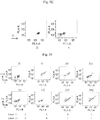
- EP1P2N XOR; Fig. 6B and Fig. 7
- Eopen:N NAND; Fig. 6C and Fig. 7
- EFP1P2P3N CNOT; not shown
- This feature enables the original cues to be explicitly inferred from the final states of the nanorobots, consequently revealing important information about the physiological and biochemical condition of the animal.
- the system can be used as a diagnostic tool by extracting activated nanorobot complexes and reading their output.
- toehold-driven displacement gating can be reproducibly designed [Zhang, D. Y. et al., 2011; Zhang, D. Y. et al ., 2009] and proved very efficient in this study; however, this obligates the use of nucleic acid cues, ostensibly limiting the application range of our design.
- a NOT gate used in an Asimov system may consist of two robot populations: (1) Eo (Eopen) robots - carrying the effector molecule (e.g. drug); and (2) N robots - which close Eo robots in response to damage (i.e. the presence of a damage indicator molecule).
- N becomes active, and closes E. This interaction requires N to be in a molar excess of ⁇ 10 over Eo ( Fig. 8A ). If one damage indicator is not enough to achieve damaged cell selectivity and discrimination, a multitype Asimov system can also be achieved by a NAND gate. By combining two or more indicators, the identity of the damaged cell can be inferred more precisely ( Fig. 8B ).
- Example 3 DNA nanorobots exhibiting group behavior
- a QS signal generator was constructed by chemically conjugating three components: a selected key, a cleavable tether; and a DNA tail (U1c) for loading onto a nanorobot loading site as previously described [Douglas, S. M. et al ., 2012].
- the tether is designed to undergo cleavage and generate a diffusing signal in response to certain stimuli.
- KPLGMWSRC SEQ ID NO: 3
- MMP matrix metalloproteinases
- PDGF-BB human platelet-derived growth factor BB
- the signal generator U1c-KPLGMWSRC-PDGF-BB was loaded into the nanorobots, which were then placed in MMP-2-containing buffer at various population densities (from 29 to 18,000 pM nanorobots.
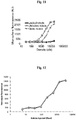
- Dynamic light scattering demonstrated a density-dependent structural change of the nanorobot indicating switching between states in agreement with previously-described observations 1 ( Fig. 10 ).
- This observation was repeated using nanorobots loaded with GFP in parallel with the signal generator and mixed with microspheres coated with anti-GFP antibody.
- the generated signal induced a concentration-dependent activation of the nanorobots and exposure of GFP, subsequently guiding their attachment to the microspheres.
- a potential drawback of the design showed thus far is that the signal generator operates immediately and only once, making it impossible to coordinate a group of nanorobots over a long period.
- a continuous signal generator was constructed by storing large amount of QS signal inside small liposomes, which were linked to the nanorobots.
- the nanorobots were capable of releasing QS signals to the environment over a period of time (not shown).
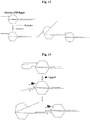
- the nanorobots can be made to aggregate by contacting one or more oligonucleotides presented on the outer surface of each individual nanorobot that is complementary to one or more other oligonucleotide also presented on the outer surface of each individual nanorobot ( Fig. 13 ).
- the hybridization of each pair of oligonucleotides cause the nanorobots to aggregate. If one of the oligonucleotides is an aptamer initially hybridized to a latch domain, which together keep the nanorobot in a closed configuration, then the hybridization of the other nucleotide to the aptamer will cause the displacement of the latch domain and subsequent opening of the nanorobot.
- the interaction between the two oligonucleotides present on the outer surface of the nanorobots may cause both aggregation and opening of the nanorobots.
- a drug stowed away inside the nanorobots when in a closed configuration can be released only when the concentration of the nanorobots is high enough to allow aggregation and opening.
- the other oligonucleotide mentioned above may be initially kept in an inactive form by binding to a complementary aptamer oligonucleotide.
- a ligand binds to the aptamer
- the other oligonucleotide is released and free to interact with complementary oligonucleotides on other nanorobots as described above ( Fig 14 ).
- the size of an individual nanorobot as assessed by measuring light scattering, is larger when it is in a closed configuration than when it is in an open configuration.
- the results shows that, indeed, the diameter of the individual nanorobots decrease with the increase in nanorobot concentration (density).
- Example 4 Controlled delivery of drugs by nanorobots exhibiting quorum sensing.
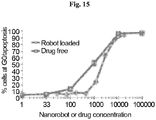
- Robots loaded with a cancer drug were mixed in various concentrations with cancer cells. In a separate sample the free drug was mixed too. The results demonstrate that the robot-induced effect is different than the drug-induced one and appears at different concentrations. In fact, quorum sensing here improved the therapeutic window of the drug because it enabled a higher dose to accumulate without being active until the defined dose was reached ( Fig 15 ).
Landscapes
- Health & Medical Sciences (AREA)
- Life Sciences & Earth Sciences (AREA)
- Engineering & Computer Science (AREA)
- Chemical & Material Sciences (AREA)
- Genetics & Genomics (AREA)
- Bioinformatics & Cheminformatics (AREA)
- Biomedical Technology (AREA)
- General Health & Medical Sciences (AREA)
- Organic Chemistry (AREA)
- Biotechnology (AREA)
- General Engineering & Computer Science (AREA)
- Molecular Biology (AREA)
- Zoology (AREA)
- Wood Science & Technology (AREA)
- Animal Behavior & Ethology (AREA)
- Public Health (AREA)
- Veterinary Medicine (AREA)
- Medicinal Chemistry (AREA)
- Pharmacology & Pharmacy (AREA)
- Epidemiology (AREA)
- Biochemistry (AREA)
- Plant Pathology (AREA)
- Biophysics (AREA)
- Microbiology (AREA)
- Physics & Mathematics (AREA)
- Inorganic Chemistry (AREA)
- Ceramic Engineering (AREA)
- Cell Biology (AREA)
- Hematology (AREA)
- Virology (AREA)
- Medicines That Contain Protein Lipid Enzymes And Other Medicines (AREA)
- Measuring Or Testing Involving Enzymes Or Micro-Organisms (AREA)
- Pharmaceuticals Containing Other Organic And Inorganic Compounds (AREA)
- Apparatus Associated With Microorganisms And Enzymes (AREA)
- Medicinal Preparation (AREA)
Claims (16)
- System, das als logisches Gatter wirkt, wobei das genannte System wenigstens eine Effektorvorrichtung, wenigstens eine Regulatorvorrichtung, wenigstens einen Eingang und wenigstens einen Ausgang umfasst,
wobei jede der genannten wenigstens einen Effektorvorrichtung und wenigstens einen Regulatorvorrichtung eine Nucleinsäure-Origami-Vorrichtung ist, die einen Gerüst-Strang und eine Mehrzahl von Heft-Strängen umfasst und unabhängig die Struktur A, B oder C hat, wobei:in Struktur A:(i) einer der Heft-Stränge Folgendes umfasst: entweder (a) eine Aptamer-Domäne, die sich an einen Bindungspartner binden kann, der einen des genannten wenigstens einen Eingangs umfasst; (b) ein Oligonucleotid, das ein DNA-Bindungsprotein binden kann, wobei das genannte DNA-Bindungsprotein einen anderen des genannten wenigstens einen Eingangs umfasst; oder (c) ein Oligonucleotid, das an eine Nanoantenne angefügt ist, die ein elektromagnetisches Feld empfangen kann, das noch einen anderen des genannten wenigstens einen Eingangs umfasst, oder einer der Heft-Stränge eine Aptamer-Domäne von (a) umfasst und ein anderer der Heft-Stränge ein Oligonucleotid von (c) umfasst;(ii) ein anderer der Heft-Stränge eine Latch-Domäne umfasst, die mit der genannten Aptamer-Domäne von (a) oder dem Oligonucleotid von (b) oder (c) hybridisiert oder daran gebunden ist, wobei die Latch-Domänensequenz so ausgewählt ist, dass die Aptamer-Domäne von (a) sich an den Bindungspartner binden kann, so dass der Bindungspartner die Latch-Domäne verschiebt, oder die Latch-Domäne sich mit einem externen Oligonucleotid hybridisieren kann, das so ausgewählt ist, dass es die Aptamer-Domäne verschiebt;
wobei die genannte Latch-Domäne mit einem Bindungspartner verknüpft ist, der so ausgewählt ist, dass er eine erste Konfiguration unter einer ersten Bedingung und eine andere zweite Konfiguration unter einer anderen zweiten Bedingung aufweist, und das Aptamer von (a) oder das Oligonucleotid von (b) sich an den Bindungspartner mit der ersten Konfiguration binden kann, sich aber nicht an den Bindungspartner mit der zweiten Konfiguration binden kann,
so dass die Latch-Domäne von dem Aptamer von (a) oder dem Oligonucleotid von (b) verschoben wird, wenn der Bindungspartner von der ersten in die zweite Konfiguration übergeht; oder die Nanoantenne von (c) nach Empfang des genannten elektromagnetischen Feldes einer induktiven Kopplung und anschließenden Erwärmung unterzogen wird,
wodurch die Latch-Domäne vom Oligonucleotid von (c) verschoben wird; und(iii) die Aptamer-Domäne von (a) oder das Oligonucleotid von (b) oder (c) und die Latch-Domäne, wenn miteinander hybridisiert oder aneinander gebunden, die Vorrichtung in einer geschlossenen Konfiguration halten; und die Vorrichtung in eine offene Konfiguration übergeht, wenn die genannte Aptamer-Domäne oder das Oligonucleotid und die Latch-Domäne nicht miteinander hybridisiert oder aneinander gebunden sind,in Struktur B:(i) einer der Heft-Stränge eine erste Aptamer-Domäne umfasst, die sich an einen ersten Bindungspartner binden kann, der einen des genannten wenigstens einen Eingangs umfasst;(ii) ein anderer der Heft-Stränge eine zweite Aptamer-Domäne umfasst, die sich an einen zweiten Bindungspartner binden kann, der einen anderen des genannten wenigstens einen Eingangs umfasst;(iii) noch ein anderer der Heft-Stränge eine erste Latch-Domäne umfasst, die mit der ersten Aptamer-Domäne hybridisiert ist, wobei die erste Latch-Domänensequenz so ausgewählt ist, dass die erste Aptamer-Domäne sich an den ersten Bindungspartner binden kann, so dass der erste Bindungspartner die erste Latch-Domäne verschiebt, oder die erste Latch-Domäne sich mit einem externen Oligonucleotid hybridisieren kann, das so ausgewählt ist, dass es die Aptamer-Domäne verschiebt;(iv) noch ein anderer der Heft-Stränge eine zweite Latch-Domäne umfasst, die mit der zweiten Aptamer-Domäne hybridisiert ist, wobei die zweite Latch-Domänensequenz so ausgewählt ist, dass die zweite Aptamer-Domäne sich an den zweiten Bindungspartner binden kann, so dass der zweite Bindungspartner die zweite Latch-Domäne verschiebt, oder die zweite Latch-Domäne sich mit einem externen Oligonucleotid hybridisieren kann, das so ausgewählt ist, dass es die Aptamer-Domäne verschiebt; und(v) die genannte Nucleinsäure-Origami-Vorrichtung in einer geschlossenen Konfiguration vorliegt, wenn die erste Aptamer-Domäne mit der ersten Latch-Domäne hybridisiert ist und/oder die zweite Aptamer-Domäne mit der zweiten Latch-Domäne hybridisiert ist; und die Vorrichtung in eine offene Konfiguration übergeht, wenn die erste Aptamer-Domäne nicht mit der ersten Latch-Domäne hybridisiert ist und die zweite Aptamer-Domäne nicht mit der zweiten Latch-Domäne hybridisiert ist,in Struktur C:(i) zwei der Heft-Stränge jeweils eine Latch-Domäne umfassen, die mit einem Oligonucleotid verknüpft ist, das sich mit einem externen Oligonucleotid hybridisieren kann, wobei die genannten externen Oligonucleotide auf einer anderen der genannten Nucleinsäure-Origami-Vorrichtungen positioniert sind; und(ii) die genannte Nucleinsäure-Origami-Vorrichtung in einer offenen Konfiguration vorliegt, wenn jedes der Oligonucleotide, die sich mit einem externen Oligonucleotid hybridisieren können, nicht mit dem genannten externen Oligonucleotid hybridisiert ist; und die Vorrichtung in eine geschlossene Konfiguration übergeht, wenn beide der genannten Oligonucleotide, die sich mit einem externen Oligonucleotid hybridisieren können, mit den genannten externen Oligonucleotiden hybridisiert sind, wobei
jede der genannten wenigstens einen Effektor-Nucleinsäure-Origami-Vorrichtung und wenigstens einen Regulator-Nucleinsäure-Origami-Vorrichtung entweder alkyliert, acyliert oder hydroxyliert ist oder mit einer Verbindung interagiert, die sich nicht kovalent an die große oder kleine Grube einer doppelsträngigen Nucleinsäure binden kann, und daher resistent gegen Nucleasen ist, und/oder
jeder der genannten wenigstens einen Effektor-Nucleinsäure-Origami-Vorrichtung und wenigstens einen Regulator-Nucleinsäure-Origami-Vorrichtung TLR9-Erkennungselemente fehlen oder die TLR9-Erkennungselemente der genannten Nucleinsäure-Origami-Vorrichtung maskiert oder modifiziert sind und daher die genannte Nucleinsäure-Origami-Vorrichtung nicht immunogen ist. - System nach Anspruch 1, wobei jede der genannten Nucleinsäure-Origami-Vorrichtungen methyliert ist, vorzugsweise an CpG-Dinucleotiden.
- System nach Anspruch 2, wobei die genannte Verbindung, die sich nicht kovalent an die große oder kleine Grube einer doppelsträngigen Nucleinsäure binden kann, ausgewählt ist aus Netropsin, Distamycin, einem Oligoamid, einem Zucker-Oligoamid-Konjugat oder einem Bis-Amidin, vorzugsweise ist die genannte Verbindung Netropsin und das genannte Netropsin ist ferner durch seine terminalen Aminogruppen, optional über einen Linker, mit der doppelsträngigen Nucleinsäure kovalent verknüpft.
- System nach Anspruch 1, wobei ein oder mehrere weitere Heft-Stränge in wenigstens einer der genannten Nucleinsäure-Origami-Vorrichtungen jeweils eine Handle-Domäne umfassen, die an eine Nutzlast gebunden ist, optional über einen Linker, wobei wenigstens eine der genannten Nutzlasten einer des genannten wenigstens einen Ausgangs ist und optional wenigstens eine der genannten Nutzlasten einer des genannten wenigstens einen Eingangs ist oder einen des genannten wenigstens einen Eingangs emuliert.
- System nach Anspruch 4, wobei der genannte Linker ein Oligonucleotid mit einer Sequenz umfasst, die zur Sequenz der Handle-Domäne komplementär ist, optional umfassend eine weitere Domäne, die eine Erkennungsstelle für enzymatische Spaltung umfasst, und die Nutzlast an die Handle-Domäne durch die Hybridisierung des Oligonucleotids mit der Handle-Domäne gebunden ist, wobei die genannte weitere Domäne optional einen Peptidlinker umfasst, der eine Proteaseerkennungsstelle für eine Spaltung durch eine Protease wie eine Matrix-Metalloproteinase umfasst, oder wobei der genannte Linker ein Protein umfasst, das ein kleines Molekül binden kann, wie Cyclooxygenase-Protein, das Paracetamol binden kann, eine Natriumkanal-Untereinheit, die Tetrodotoxin binden kann, und ein Anti-Digoxin-Antikörper, der Digoxin binden kann.
- System nach Anspruch 4, wobei die genannte Nutzlast jeweils unabhängig ein Arzneimittel wie Insulin, ein Antikörper oder ein Fragment davon, ein Zelloberflächenrezeptorligand oder ein biologisch aktives Fragment davon, ein kleines Molekül, ein Nucleinsäuremolekül wie ein Oligonucleotid, eine Nuclease, ein Aptamer, ein Lipid, ein Glycan, ein Protein, ein Glycoprotein, ein Glycolipid, ein Nanopartikel, ein Fluorophor, eine radioaktive Verbindung, eine Nanoantenne oder ein Liposom ist.
- System nach einem der Ansprüche 4 bis 6, wobei die Mehrzahl von Heft-Strängen so ausgewählt ist, dass wenigstens eine der Nutzlasten auf einer Innenfläche der Nucleinsäure-Origami-Vorrichtung positioniert ist, wenn die Vorrichtung in der geschlossenen Konfiguration ist, und der Übergang in die offene Konfiguration bewirkt, dass die genannte Nutzlast auf einer Außenfläche der Nucleinsäure-Origami-Vorrichtung positioniert wird; oder wobei einer der Heft-Stränge in wenigstens einer der genannten Nucleinsäure-Origami-Vorrichtungen eine Handle-Domäne umfasst, die auf einer Außenfläche der Vorrichtung positioniert ist, wenn die Vorrichtung in der geschlossenen Konfiguration ist, und der Übergang in die offene Konfiguration bewirkt, dass die genannte Nutzlast auf einer Innenfläche der Nucleinsäure-Origami-Vorrichtung positioniert wird, wobei die Handle-Domäne optional an eine Nutzlast gebunden ist, die aus einem Oligonucleotid oder einem Liposom ausgewählt ist.
- System nach Anspruch 1, wobei:(i) in wenigstens einer der genannten Nucleinsäure-Origami-Vorrichtungen mit der Struktur A oder B die Mehrzahl von Heft-Strängen so ausgewählt ist, dass die genannte(n) Nucleinsäure-Origami-Vorrichtung(en) eine erste Domäne und eine zweite Domäne umfasst/umfassen, wobei die erste Domäne die genannte(n) Aptamer-Domäne(n) von (a) umfasst, die sich jeweils an einen Bindungspartner binden können; oder das/die genannte(n) Oligonucleotid(e) von (b), die jeweils ein DNA-Bindungsprotein binden können; oder das/die genannte (n) Oligonucleotid (e) von (c), die jeweils an eine Nanoantenne angefügt sind; und die zweite Domäne die genannte Latch-Domäne(n) umfasst, wobei ein erstes Ende der ersten Domäne an ein erstes Ende der zweiten Domäne durch wenigstens ein einzelsträngiges Nucleinsäuregelenk angefügt ist bzw. das zweite Ende der ersten Domäne an das zweite Ende der zweiten Domäne durch Hybridisieren oder Binden der jeweiligen genannten Aptamer-Domänen oder Oligonucleotide mit/an die genannten Latch-Domänen angefügt ist; oder(ii) in wenigstens einer der genannten Nucleinsäure-Origami-Vorrichtungen mit der Struktur C die Mehrzahl von Heft-Strängen so ausgewählt ist, dass die genannte(n) Nucleinsäure-Origami-Vorrichtung(en) eine erste Domäne und eine zweite Domäne umfasst/umfassen, wobei die jeweiligen genannten ersten und zweiten Domänen eine der genannten Latch-Domänen umfassen, die mit einem Oligonucleotid verknüpft sind, das sich mit einem externen Oligonucleotid hybridisieren kann, wobei ein erstes Ende der ersten Domäne an ein erstes Ende der zweiten Domäne durch wenigstens ein einzelsträngiges Nucleinsäuregelenk angefügt ist und das zweite Ende der ersten Domäne nicht an das zweite Ende der zweiten Domäne angefügt ist, wobei optional(i) die Mehrzahl von Heft-Strängen in wenigstens einer der genannten Nucleinsäure-Origami-Vorrichtungen mit der Struktur A oder B so ausgewählt ist, dass das zweite Ende der ersten Domäne vom zweiten Ende der zweiten Domäne gelöst wird, wenn jede der genannten Aptamer-Domänen durch ihren jeweiligen Bindungspartner kontaktiert wird und/oder wenn jede der genannten Nanoantennen ein elektromagnetisches Feld empfängt und einer induktiven Kopplung und anschließenden Erwärmung unterzogen wird; oder(ii) die Mehrzahl von Heft-Strängen in wenigstens einer der genannten Nucleinsäure-Origami-Vorrichtungen mit der Struktur C so ausgewählt ist, dass das zweite Ende der ersten Domäne an das zweite Ende der zweiten Domäne angefügt wird, wenn jede der genannten Latch-Domänen mit einem anderen der genannten externen Oligonucleotide hybridisiert wird.
- System nach Anspruch 1, wobei jeder der genannten Bindungspartner unabhängig ein Antigen ist, ausgewählt aus einem tumorassoziierten Antigen, einem Zellmembranrezeptor, einem sekretierten oder membrangebundenen Wachstumsfaktor, einem Hormon, einem Zytokin, einem Liganden, einem Chemokin, einem bakteriellen, viralen oder parasitären Antigen, einem Lipid, einem Oligonucleotid, einem Zucker, einem Signalmolekül, einem Enzym oder einem DNA-Bindungsprotein, wobei das genannte Enzym vorzugsweise eine Glucokinase ist und die genannte Aptamer-Domäne von (a) sich an die Glucokinase mit der ersten Konfiguration binden kann, sich aber nicht an die Glucokinase mit der zweiten Konfiguration binden kann; oder das DNA-Bindungsprotein ist ein Glucose-Ansprechfaktor und das genannte Oligonucleotid von (b) ist ein auf Glucose ansprechendes regulatorisches Element, das sich an den Glucose-Ansprechfaktor mit der ersten Konfiguration binden kann, sich aber nicht an den Glucose-Ansprechfaktor mit der zweiten Konfiguration binden kann.
- System nach Anspruch 9, das Folgendes umfasst: eine Effektorvorrichtung mit einer oder mehreren Handle-Domänen, die jeweils an eine Nutzlast gebunden sind, wenigstens eine Regulatorvorrichtung, wenigstens einen Eingang und einen Ausgang, wobei der genannte Ausgang einen ersten Ausgangszustand aufweist, wenn die genannte Effektorvorrichtung in der geschlossenen Konfiguration ist, und einen zweiten Ausgangszustand, wenn die genannte Effektorvorrichtung in der offenen Konfiguration ist, wobei der erste Ausgangszustand vorzugsweise einem logischen Aus-Zustand entspricht und der zweite Ausgangszustand einem logischen Ein-Zustand entspricht, wobei das Gatter ausgewählt ist aus der Gruppe bestehend aus:(a) einem logischen NAND-Gatter, das zwei Eingänge umfasst und in einem logischen Ein-Zustand ist, wenn beide Eingänge fehlen, wobei das System eine Effektorvorrichtung und eine Regulatorvorrichtung umfasst, wobei(i) die genannte Effektorvorrichtung die Struktur C hat und zunächst in einer offenen Konfiguration ist; und(ii) die genannte Regulatorvorrichtung eine negative Regulatorvorrichtung ist, die die Struktur B hat und zwei Handle-Domänen umfasst, die jeweils an ein Nucleinsäuremolekül gebunden sind, das als Signalmolekül wirkt, das sich mit einer anderen der genannten Latch-Domänen der genannten Effektorvorrichtung hybridisieren kann, wobei die genannte negative Regulatorvorrichtung zunächst in einer geschlossenen Konfiguration ist, wobei die genannten Signalmoleküle auf einer Innenfläche der negativen Regulatorvorrichtung positioniert sind, und, wenn beide Eingänge vorhanden sind, in eine offene Konfiguration übergeht, wobei die genannten Signalmoleküle auf einer Außenfläche der negativen Regulatorvorrichtung positioniert sind, wobei das Gatter in einem logischen Ein-Zustand ist, wenn jedes der genannten zwei Signalmoleküle sich mit einer anderen der genannten Latch-Domänen der genannten Effektorvorrichtung hybridisiert, wodurch das Schließen der Effektorvorrichtung unterstützt oder der Übergang der Effektorvorrichtung in eine offene Konfiguration verhindert wird;(b) einem logischen NOT-Gatter, das einen Eingang umfasst und sich in einem logischen Ein-Zustand befindet, wenn der Eingang fehlt, wobei das System eine Effektorvorrichtung und eine Regulatorvorrichtung umfasst, wobei(i) die genannte Effektorvorrichtung die Struktur C hat und zunächst in einer offenen Konfiguration ist; und(ii) die genannte Regulatorvorrichtung eine negative Regulatorvorrichtung ist, die die Struktur A hat und zwei Handle-Domänen umfasst, die jeweils an ein Nucleinsäuremolekül gebunden sind, das als Signalmolekül wirkt, das sich mit einer anderen der genannten Latch-Domänen der genannten Effektorvorrichtung hybridisieren kann, wobei die genannte negative Regulatorvorrichtung zunächst in einer geschlossenen Konfiguration ist, wobei die genannten Signalmoleküle auf einer Innenfläche der negativen Regulatorvorrichtung positioniert sind und, wenn der Eingang vorhanden ist, in eine offene Konfiguration übergehen, wobei die genannten Signalmoleküle auf einer Außenfläche der negativen Regulatorvorrichtung positioniert sind,
wobei sich das Gatter in einem logischen Ein-Zustand befindet, wenn sich jedes der genannten zwei Signalmoleküle mit einer anderen der genannten Latch-Domänen der genannten Effektorvorrichtung hybridisiert, wodurch das Schließen der Effektorvorrichtung unterstützt oder der Übergang der Effektorvorrichtung in eine offene Konfiguration verhindert wird;(c) einem logischen impliziten OR-Gatter, das zwei Eingänge umfasst und sich in einem logischen Ein-Zustand befindet, wenn wenigstens einer der zwei Eingänge vorhanden ist, wobei das System eine Effektorvorrichtung und zwei Regulatorvorrichtungen umfasst, wobei(i) die genannte Effektorvorrichtung die Struktur B hat, zunächst in einer geschlossenen Konfiguration vorliegt und, wenn beide Eingänge vorhanden sind, in eine offene Konfiguration übergeht;(ii) die erste der genannten zwei Regulatorvorrichtungen eine erste positive Regulatorvorrichtung mit der Struktur A ist und eine Handle-Domäne umfasst, die an ein Nucleinsäuremolekül gebunden ist, das als Signalmolekül wirkt, das den zweiten der genannten zwei Eingänge emulieren kann, indem es sich mit der Aptamer-Domäne der genannten Effektorvorrichtung hybridisiert, die sich an den zweiten der genannten zwei Eingänge binden kann, wobei die genannte erste positive Regulatorvorrichtung zunächst in einer geschlossenen Konfiguration ist, wobei das genannte Signalmolekül auf einer Innenfläche der genannten ersten positiven Regulatorvorrichtung positioniert ist, und, wenn der erste der genannten zwei Eingänge vorhanden ist, in eine offene Konfiguration übergeht, wobei das genannte Signalmolekül auf einer Außenfläche der positiven Regulatorvorrichtung positioniert ist; und(iii) die zweite der genannten zwei Regulatorvorrichtungen eine zweite positive Regulatorvorrichtung mit der Struktur A ist und eine Handle-Domäne umfasst, die an ein Nucleinsäuremolekül gebunden ist, das als Signalmolekül wirkt, das den ersten der genannten zwei Eingänge emulieren kann, indem es sich mit der Aptamer-Domäne der genannten Effektorvorrichtung hybridisiert, die sich an den ersten der genannten zwei Eingänge binden kann, wobei die genannte zweite positive Regulatorvorrichtung zunächst in einer geschlossenen Konfiguration vorliegt, wobei das genannte Signalmolekül auf einer Innenfläche der genannten zweiten positiven Regulatorvorrichtung positioniert ist und, wenn der zweite der genannten zwei Eingänge vorhanden ist, in eine offene Konfiguration übergeht, wobei das genannte Signalmolekül auf einer Außenfläche der positiven Regulatorvorrichtung positioniert ist, wobei das Gatter in einem logischen Ein-Zustand ist, wenn:
der erste der genannten zwei Eingänge sich an die Aptamer-Domäne der Effektorvorrichtung bindet, die sich an den ersten der genannten zwei Eingänge binden kann, und der zweite der genannten zwei Eingänge sich an die Aptamer-Domäne der Effektorvorrichtung bindet, die sich an den zweiten der genannten zwei Eingänge binden kann, so dass die genannten Eingänge die Latch-Domänen jeweils verschieben, die zunächst mit den genannten Aptamer-Domänen hybridisiert wurden; der erste der genannten zwei Eingänge sich an die Aptamer-Domäne der genannten Effektorvorrichtung bindet, die ich an den ersten der genannten zwei Eingänge binden kann, und das Signalmolekül der ersten positiven Regulatorvorrichtung sich mit der Aptamer-Domäne der genannten Effektorvorrichtung hybridisiert, die sich an den zweiten der genannten zwei Eingänge binden kann, so dass der erste Eingang und das Signalmolekül der ersten positiven Regulatorvorrichtung die Latch-Domänen jeweils verschieben, die zunächst mit den genannten Aptamer-Domänen hybridisiert wurden; oder der zweite der genannten zwei Eingänge sich an die Aptamer-Domäne der genannten Effektorvorrichtung bindet, die sich an den zweiten der genannten zwei Eingänge binden kann, und das Signalmolekül der zweiten positiven Regulatorvorrichtung sich mit der Aptamer-Domäne der genannten Effektorvorrichtung hybridisiert, die sich an den ersten der genannten zwei Eingänge binden kann, so dass der zweite Eingang und das Signalmolekül der zweiten positiven Regulatorvorrichtung die Latch-Domänen jeweils verschieben, die zunächst mit den genannten Aptamer-Domänen hybridisiert wurden, undd) einem logischen exklusiven OR-(X OR)-Gatter, das zwei Eingänge umfasst und sich in einem logischen Ein-Zustand befindet, wenn nur einer der beiden Eingänge vorhanden ist, wobei das System eine Effektorvorrichtung und drei Regulatorvorrichtungen umfasst, wobei(i) die genannte Effektorvorrichtung die Struktur B hat, zunächst in einer geschlossenen Konfiguration ist und, wenn beide Eingänge vorhanden sind, in eine offene Konfiguration übergeht;(ii) die erste der genannten drei Regulatorvorrichtungen eine erste positive Regulatorvorrichtung mit der Struktur A ist und eine Handle-Domäne umfasst, die an ein Nucleinsäuremolekül gebunden ist, das als Signalmolekül wirkt, das den zweiten der genannten zwei Eingänge emulieren kann, indem es sich mit der Aptamer-Domäne der genannten Effektorvorrichtung hybridisiert, die an den zweiten der genannten zwei Eingänge binden kann, wobei die genannte erste positive Regulatorvorrichtung zunächst in einer geschlossenen Konfiguration ist, wobei das genannte Signalmolekül auf einer Innenfläche der genannten ersten positiven Regulatorvorrichtung positioniert ist und, wenn der erste der genannten zwei Eingänge vorhanden ist, in eine offene Konfiguration übergeht, wobei das genannte Signalmolekül auf einer Außenfläche der positiven Regulatorvorrichtung positioniert ist;(iv) die zweite der genannten drei Regulatorvorrichtungen eine zweite positive Regulatorvorrichtung mit der Struktur A ist und eine Handle-Domäne umfasst, die an ein Nucleinsäuremolekül gebunden ist, das als Signalmolekül wirkt, das den ersten der genannten zwei Eingänge emulieren kann, indem es sich mit der Aptamer-Domäne der genannten Effektorvorrichtung hybridisiert, die sich an den ersten der genannten zwei Eingänge binden kann, wobei die genannte zweite positive Regulatorvorrichtung zunächst in einer geschlossenen Konfiguration ist, wobei das genannte Signalmolekül auf einer Innenfläche der genannten zweiten positiven Regulatorvorrichtung positioniert ist und, wenn der zweite der genannten zwei Eingänge vorhanden ist, in eine offene Konfiguration übergeht, wobei das genannte Signalmolekül auf einer Außenfläche der positiven Regulatorvorrichtung positioniert ist; und(v) die dritte der genannten drei Regulatorvorrichtungen eine negative Regulatorvorrichtung ist, die die Struktur B hat und zwei Handle-Domänen umfasst, die jeweils an ein Nucleinsäuremolekül gebunden sind, das als Signalmolekül wirkt, das sich mit einer anderen der genannten Latch-Domänen der genannten Effektorvorrichtung hybridisieren kann, wobei die genannte negative Regulatorvorrichtung zunächst in einer geschlossenen Konfiguration ist, wobei die genannten Signalmoleküle auf einer Innenfläche der negativen Regulatorvorrichtung positioniert sind und, wenn beide Eingänge vorhanden sind, in eine offene Konfiguration übergeht, wobei die genannten Signalmoleküle auf einer Außenfläche der negativen Regulatorvorrichtung positioniert sind, wobei das Gatter in einem logischen Ein-Zustand ist, wenn:der erste der genannten zwei Eingänge sich an die Aptamer-Domäne der genannten Effektorvorrichtung bindet, die sich an den ersten der genannten zwei Eingänge binden kann, und das Signalmolekül der ersten positiven Regulatorvorrichtung sich mit der Aptamer-Domäne der genannten Effektorvorrichtung hybridisiert, die sich an den zweiten der genannten zwei Eingänge binden kann, so dass der erste Eingang und das Signalmolekül der ersten positiven Regulatorvorrichtung die Latch-Domänen jeweils verschieben, die zunächst mit den genannten Aptamer-Domänen hybridisiert wurden; oder der zweite der genannten zwei Eingänge sich an die Aptamer-Domäne der genannten Effektorvorrichtung bindet, die sich an den zweiten der genannten zwei Eingänge binden kann, und das Signalmolekül der zweiten positiven Regulatorvorrichtung sich mit der Aptamer-Domäne der genannten Effektorvorrichtung hybridisiert, die sich an den ersten der genannten zwei Eingänge binden kann, so dass der zweite Eingang und das Signalmolekül der zweiten positiven Regulatorvorrichtung die Latch-Domänen jeweils verschieben, die zunächst mit den genannten Aptamer-Domänen hybridisiert wurden, undwenn beide Eingänge vorhanden sind, der erste der genannten zwei Eingänge sich an die Aptamer-Domäne der Effektorvorrichtung bindet, die sich an den ersten der genannten zwei Eingänge binden kann, und der zweite der genannten zwei Eingänge sich an die Aptamer-Domäne der Effektorvorrichtung bindet, die sich an den zweiten der genannten zwei Eingänge binden kann, so dass die genannten Eingänge die Latch-Domänen jeweils verschieben, die zunächst mit den genannten Aptamer-Domänen hybridisiert wurden, und jedes der genannten zwei Signalmoleküle der negativen Regulatorvorrichtung sich mit einer anderen der genannten Latch-Domänen der genannten Effektorvorrichtung hybridisiert, wodurch das Schließen der Effektorvorrichtung unterstützt oder der Übergang der Effektorvorrichtung in eine offene Konfiguration verhindert wird. - System nach Anspruch 9, das Folgendes umfasst: zwei Effektorvorrichtungen, die jeweils ein oder mehrere Handle-Domänen haben, die jeweils an eine Nutzlast gebunden sind, wenigstens eine Regulatorvorrichtung, wenigstens einen Eingang und zwei Ausgänge, wobei
der erste der genannten zwei Ausgänge einen ersten Ausgangszustand aufweist, wenn die erste der genannten zwei Effektorvorrichtungen in der geschlossenen Konfiguration ist, und einen zweiten Ausgangszustand aufweist, wenn die erste der genannten zwei Effektorvorrichtungen in der offenen Konfiguration ist; und
der zweite der genannten zwei Ausgänge einen ersten Ausgangszustand aufweist, wenn die zweite der genannten zwei Effektorvorrichtungen in der geschlossenen Konfiguration ist, und einen zweiten Ausgangszustand aufweist, wenn die zweite der genannten zwei Effektorvorrichtungen in der offenen Konfiguration ist, wobei
vorzugsweise jeder der genannten ersten Ausgangszustände einem logischen Aus-Zustand entspricht und jeder der genannten zweiten Ausgangszustände einem logischen Ein-Zustand entspricht,
wobei das Gatter ein logisch gesteuertes NOT-Gatter ist, das zwei Eingänge und zwei Ausgänge umfasst, wobei der erste Ausgang in einem logischen Ein-Zustand ist, wenn nur einer der beiden Eingänge vorhanden ist, und der zweite Ausgang in einem logischen Ein-Zustand ist, wenn entweder nur der erste der genannten zwei Eingänge oder beide Eingänge vorhanden ist/sind, wobei das genannte System zwei Effektorvorrichtungen und drei Regulatorvorrichtungen umfasst, wobei(i) die erste der genannten zweite Effektorvorrichtungen die Struktur B hat, zunächst in einer geschlossenen Konfiguration ist und, wenn beide Eingänge vorhanden sind, in eine offene Konfiguration übergeht;(ii) die erste der genannten drei Regulatorvorrichtungen eine erste positive Regulatorvorrichtung mit der Struktur A ist und eine Handle-Domäne umfasst, die an ein Nucleinsäuremolekül gebunden ist, das als Signalmolekül wirkt, das den zweiten der genannten zwei Eingänge emulieren kann, indem es sich mit der Aptamer-Domäne der genannten Effektorvorrichtung hybridisiert, die sich an den zweiten der genannten zwei Eingänge binden kann, wobei die genannte erste positive Regulatorvorrichtung zunächst in einer geschlossenen Konfiguration ist, wobei das genannte Signalmolekül auf einer Innenfläche der genannten ersten positiven Regulatorvorrichtung positioniert ist und, wenn der erste der genannten zwei Eingänge vorhanden ist, in eine offene Konfiguration übergeht, wobei das genannte Signalmolekül auf einer Außenfläche der positiven Regulatorvorrichtung positioniert ist;(iii) die zweite der genannten drei Regulatorvorrichtungen eine zweite positive Regulatorvorrichtung mit der Struktur A ist und eine Handle-Domäne umfasst, die an ein Nucleinsäuremolekül gebunden ist, das als Signalmolekül wirkt, das den ersten der genannten zwei Eingänge emulieren kann, indem es sich mit der Aptamer-Domäne der genannten Effektorvorrichtung hybridisiert, die sich an den ersten der genannten zwei Eingänge binden kann, wobei die genannte zweite positive Regulatorvorrichtung zunächst in einer geschlossenen Konfiguration ist, wobei das genannte Signalmolekül auf einer Innenfläche der genannten zweiten positiven Regulatorvorrichtung positioniert ist und, wenn der zweite der genannten zwei Eingänge vorhanden ist, in eine offene Konfiguration übergeht, wobei das genannte Signalmolekül auf einer Außenfläche der positiven Regulatorvorrichtung positioniert ist;(iv) die dritte der genannten drei Regulatorvorrichtungen eine negative Regulatorvorrichtung ist, die die Struktur B hat und zwei Handle-Domänen umfasst, die jeweils an ein Nucleinsäuremolekül gebunden sind, das als Signalmolekül wirkt, das sich mit einer anderen der genannten Latch-Domänen der genannten Effektorvorrichtung hybridisieren kann, wobei die genannte negative Regulatorvorrichtung zunächst in einer geschlossenen Konfiguration vorliegt, wobei die genannten Signalmoleküle auf einer Innenfläche der negativen Regulatorvorrichtung positioniert sind und, wenn beide Eingänge vorhanden sind, in eine offene Konfiguration übergeht, wobei die genannten Signalmoleküle auf einer Außenfläche der negativen Regulatorvorrichtung positioniert sind; und(v) die zweite der genannten zwei Effektorvorrichtungen die Struktur A hat, zunächst in einer geschlossenen Konfiguration ist und, wenn der erste der genannten zwei Eingänge vorhanden ist, in eine offene Konfiguration übergeht,
wobei der erste der genannten zwei Ausgänge des Gatters in einem logischen Ein-Zustand ist, wenn:der erste der genannten zwei Eingänge sich an die Aptamer-Domäne der genannten ersten der genannten zwei Effektorvorrichtungen bindet, die sich an den ersten der genannten zwei Eingänge binden kann, und das Signalmolekül der ersten positiven Regulatorvorrichtung sich mit der Aptamer-Domäne des genannten ersten der genannten zwei Effektorvorrichtungen hybridisiert, die sich an den zweiten der genannten zwei Eingänge binden kann, so dass der erste Eingang und das Signalmolekül der ersten positiven Regulatorvorrichtung die Latch-Domänen jeweils verschiebt, die zunächst mit den genannten Aptamer-Domänen hybridisiert wurden; oderder zweite der genannten zwei Eingänge sich an die Aptamer-Domäne der genannten ersten der genannten zwei Effektorvorrichtungen bindet, die sich an den zweiten der genannten zwei Eingänge binden kann, und das Signalmolekül der zweiten positiven Regulatorvorrichtung sich mit der Aptamer-Domäne der genannten ersten der genannten zwei Effektorvorrichtungen hybridisiert, die sich an den ersten der genannten zwei Eingänge binden kann, so dass der zweite Eingang und das Signalmolekül der zweiten positiven Regulatorvorrichtung die Latch-Domänen jeweils verschiebt, die zunächst mit den genannten Aptamer-Domänen hybridisiert wurden, undwenn beide Eingänge vorhanden sind, der erste der genannten zwei Eingänge sich an die Aptamer-Domäne der ersten der genannten zwei Effektorvorrichtungen bindet, die sich an den ersten der genannten zwei Eingänge binden kann, und der zweite der genannten zwei Eingänge sich an die Aptamer-Domäne der ersten der genannten zwei Effektorvorrichtungen bindet, die sich an den zweiten der genannten zwei Eingänge binden kann, so dass die genannten Eingänge die Latch-Domänen jeweils verschieben, die zunächst mit den genannten Aptamer-Domänen hybridisiert wurden, und jedes der genannten zwei Signalmoleküle der negativen Regulatorvorrichtung sich mit einer anderen der genannten Latch-Domänen der genannten ersten der genannten zwei Effektorvorrichtungen hybridisiert, wodurch das Schließen der ersten der genannten zwei Effektorvorrichtungen unterstützt oder der Übergang der ersten der genannten zwei Effektorvorrichtungen in eine offene Konfiguration verhindert wird; undwobei der zweite der genannten zwei Ausgänge des Gatters in einem logischen Ein-Zustand ist, wenn nur der erste der genannten zwei Eingänge vorhanden ist, wenn der erste der genannten zwei Eingänge sich an die jeweiligen Aptamer-Domänen der zweiten der genannten zwei Effektorvorrichtungen bindet, die sich an den ersten der genannten zwei Eingänge binden kann, so dass jedes Signalmolekül eine andere der genannten Latch-Domänen verschiebt, und wobei, wenn die genannte(n) Effektorvorrichtung(en) in einer offenen Konfiguration vorliegen, jede der genannten Nutzlasten auf einer Außenfläche der genannten Effektorvorrichtung(en) positioniert ist. - System mit Quorum sensing, das Folgendes umfasst: eine Mehrzahl von Effektor-Nucleinsäure-Origami-Vorrichtungen, die jeweils wie in einem der Ansprüche 1 bis 9 definiert sind, oder eine Mehrzahl von Elementen, die jeweils aus einem Liposom, einem Partikel oder einer künstlichen Zelle ausgewählt sind; wenigstens einen Eingang; und wenigstens einen Ausgang, wobei sich die genannte Mehrzahl von Effektor-Nucleinsäure-Origami-Vorrichtungen oder Elementen in einer vorbestimmten Konzentration ansammelt, und wobei:(i) jede der Effektor-Nucleinsäure-Origami-Vorrichtungen die genannte Handle-Domäne umfasst, die an ein erstes Oligonucleotid gebunden ist, das sich mit der genannten Aptamer-Domäne einer anderen der genannten Effektor-Nucleinsäure-Origami-Vorrichtungen zu hybridisieren, und auf der Außenfläche der Vorrichtung positioniert ist, wenn die Vorrichtung in der geschlossenen Konfiguration ist; oder(ii) jedes der Elemente auf einer Außenfläche davon (a) einen Heft-Strang umfasst, der eine Handle-Domäne umfasst, die an ein erstes Oligonucleotid gebunden ist; und (b) einen weiteren Heft-Strang umfasst, der ein zweites Oligonucleotid umfasst, das so ausgewählt ist, dass es sich mit einem ersten Oligonucleotid eines anderen der genannten Mehrzahl von Elementen hybridisieren kann, wobei jede/s der genannten Effektor-Nucleinsäure-Origami-Vorrichtungen oder Elemente eine offene und eine geschlossene Konfiguration aufweist und zunächst in der geschlossenen Konfiguration ist.
- System nach Anspruch 12, wobei nach Ansammlung der genannten Mehrzahl von Effektor-Nucleinsäure-Origami-Vorrichtungen das genannte erste Oligonucleotid von jeder der genannten Effektor-Nucleinsäure-Origami-Vorrichtungen sich an die genannte Aptamer-Domäne einer anderen der genannten Effektor-Nucleinsäure-Origami-Vorrichtungen bindet, so dass das erste Oligonucleotid, das als erster des genannten wenigstens einen Eingangs wirkt, die Latch-Domäne der genannten anderen der genannten Effektor-Nucleinsäure-Origami-Vorrichtungen verschiebt, wodurch der Übergang der genannten anderen der genannten Effektor-Nucleinsäure-Origami-Vorrichtungen in eine offene Konfiguration unterstützt wird, wobei jede der genannten Effektor-Nucleinsäure-Origami-Vorrichtungen oder jedes der genannten Elemente noch einen weiteren Heft-Strang umfasst, der ein Aptamer umfasst, das sich an einen Bindungspartner binden kann, der als ein anderer des genannten wenigstens einen Eingangs wirkt, wobei der genannte Bindungspartner vorzugsweise ein Zielantigen ist.
- System nach Anspruch 12 oder 13, wobei jede/s der genannten Effektor-Nucleinsäure-Origami-Vorrichtungen oder Elemente ferner eine Handle-Domäne umfasst, die an ein Quorum-sensing-Molekül wie ein Kanalaktivierungsmittel oder eine membrandurchlässige Verbindung gebunden ist, optional über einen Linker, wobei das genannte Quorum-sensing-Molekül als ein weiterer des genannten wenigstens einen Eingangs wirkt, wobei der genannte Linker optional ein drittes Oligonucleotid mit einer Sequenz umfasst, die zur Sequenz der Handle-Domäne komplementär ist, und optional eine weitere Domäne, die eine Erkennungsstelle für enzymatische Spaltung umfasst, und das Quorum-sensing-Molekül an die Handle-Domäne durch die Hybridisierung des dritten Oligonucleotids mit der Handle-Domäne gebunden ist, wobei die genannte weitere Domäne vorzugsweise einen Peptidlinker umfasst, der eine Proteaseerkennungsstelle zur Spaltung durch eine Protease wie eine Matrix-Metalloproteinase umfasst.
- System nach Anspruch 14, wobei jede/s der genannten Effektor-Nucleinsäure-Origami-Vorrichtungen oder Elemente noch einen weiteren Heft-Strang umfasst, der auf ihrer/seiner Außenfläche positioniert ist, wobei der genannte weitere Heft-Strang ein viertes Oligonucleotid umfasst, das so ausgewählt ist, dass es sich mit der genannten Handle-Domäne einer/s anderen der genannten Effektor-Nucleinsäure-Origami-Vorrichtungen oder Elemente hybridisieren kann, so dass das vierte Oligonucleotid das mit dem Quorum-sensing-Molekül verknüpfte dritte Oligonucleotid des genannten anderen der genannten Effektor-Nucleinsäure-Origami-Vorrichtungen oder Elemente verschiebt, wodurch das mit dem genannten dritten Oligonucleotid verknüpfte genannte Quorum-sensing-Molekül freigesetzt wird, wobei das freigesetzte Quorum-sensing-Molekül optional den Übergang von einer/m der genannten Effektor-Nucleinsäure-Origami-Vorrichtungen oder Elemente von ihrer/seiner geschlossenen Konfiguration in ihre/seine offene Konfiguration bewirken kann.
- Pharmazeutische Zusammensetzung, die ein System nach einem der Ansprüche 1 bis 15 und einen pharmazeutisch akzeptablen Träger umfasst.
Applications Claiming Priority (2)
| Application Number | Priority Date | Filing Date | Title |
|---|---|---|---|
| US201361813417P | 2013-04-18 | 2013-04-18 | |
| PCT/IL2014/050357 WO2014170899A1 (en) | 2013-04-18 | 2014-04-13 | Systems comprising non-immunogenic and nuclease resistant nucleic acid origami devices for molecular computation |
Publications (3)
| Publication Number | Publication Date |
|---|---|
| EP2986555A1 EP2986555A1 (de) | 2016-02-24 |
| EP2986555A4 EP2986555A4 (de) | 2016-12-21 |
| EP2986555B1 true EP2986555B1 (de) | 2019-06-05 |
Family
ID=51730892
Family Applications (1)
| Application Number | Title | Priority Date | Filing Date |
|---|---|---|---|
| EP14785273.5A Active EP2986555B1 (de) | 2013-04-18 | 2014-04-13 | Systeme mit nicht-immunogenen und nukleaseresistenten nukleinsäure-origami-vorrichtungen für molekulare berechnung |
Country Status (4)
| Country | Link |
|---|---|
| US (1) | US10316320B2 (de) |
| EP (1) | EP2986555B1 (de) |
| JP (1) | JP2016522807A (de) |
| WO (1) | WO2014170899A1 (de) |
Families Citing this family (10)
| Publication number | Priority date | Publication date | Assignee | Title |
|---|---|---|---|---|
| EA035898B1 (ru) | 2014-10-03 | 2020-08-28 | НАНОТИКС, ЭлЭлСи | Композиции и способы для ингибирования биологической активности растворимых биомолекул |
| WO2017176762A1 (en) | 2016-04-06 | 2017-10-12 | Nanotics, Llc | Particles comprising subparticles or nucleic acid scaffolds |
| US10215441B2 (en) * | 2016-04-15 | 2019-02-26 | Hongyi CAI | Integrated light and heat arrangement of low profile light-emitting diode fixture |
| US11305019B2 (en) | 2016-07-20 | 2022-04-19 | Guild Biosciences | Functionalized nucleic acid nanostructures for RNA delivery |
| US11242533B2 (en) | 2018-01-10 | 2022-02-08 | Arizona Board Of Regents On Behalf Of Arizona State University | RNA-nanostructured double robots and methods of use thereof |
| CN109993309B (zh) * | 2019-04-09 | 2021-02-19 | 合肥本源量子计算科技有限责任公司 | 一种基于mpi多进程的双量子逻辑门实现方法 |
| CN111243672A (zh) * | 2019-12-30 | 2020-06-05 | 安徽理工大学 | 一种利用dna折纸手势图形进行整数规划问题求解模型 |
| CN111122752B (zh) * | 2020-02-26 | 2022-06-10 | 浙江清华长三角研究院 | 一种河豚毒素成分分析标准物质的制备方法 |
| CN111879941B (zh) * | 2020-06-29 | 2021-11-02 | 北京大学 | 基于自组装纳米孔的蛋白行为检测系统及其制备与使用方法 |
| CN113063946B (zh) * | 2021-03-26 | 2022-09-13 | 湖南大学 | 一种dna纳米机器及其在降低血糖中的应用 |
Family Cites Families (12)
| Publication number | Priority date | Publication date | Assignee | Title |
|---|---|---|---|---|
| US5840867A (en) | 1991-02-21 | 1998-11-24 | Gilead Sciences, Inc. | Aptamer analogs specific for biomolecules |
| US5582981A (en) | 1991-08-14 | 1996-12-10 | Gilead Sciences, Inc. | Method for identifying an oligonucleotide aptamer specific for a target |
| US5756291A (en) | 1992-08-21 | 1998-05-26 | Gilead Sciences, Inc. | Aptamers specific for biomolecules and methods of making |
| JP2005533862A (ja) | 2002-07-25 | 2005-11-10 | アーケミックス コーポレイション | 調節されたアプタマー治療剤 |
| EP1608780B1 (de) | 2003-03-31 | 2011-08-24 | McMASTER UNIVERSITY | Aptamerselektionsverfahren |
| US7842793B2 (en) * | 2005-06-14 | 2010-11-30 | The California Institute Of Technology | Methods of making nucleic acid nanostructures |
| MX2009003193A (es) | 2006-10-06 | 2009-08-13 | Johnson & Johnson Res Pty Ltd | Interruptores moleculares y metodos para su uso. |
| US20100216978A1 (en) | 2007-04-17 | 2010-08-26 | Dsna-Farber Cancer Institute Inc. | Wireframe nanostructures |
| US20080287668A1 (en) | 2007-05-14 | 2008-11-20 | Tihamer Thomas Toth-Fejel | Nanostructures and methods of making |
| US9102520B2 (en) | 2008-08-13 | 2015-08-11 | California Institute Of Technology | Nanocomposite structures and related methods and systems |
| WO2012061719A2 (en) * | 2010-11-04 | 2012-05-10 | President And Fellows Of Harvard College | Dna origami devices |
| EP2986556B1 (de) | 2013-04-18 | 2019-06-05 | Bar-Ilan University | Nicht-immunogene und nukleaseresistente nukleinsäure-origami-elemente und zusammensetzungen daraus |
-
2014
- 2014-04-13 EP EP14785273.5A patent/EP2986555B1/de active Active
- 2014-04-13 JP JP2016508287A patent/JP2016522807A/ja active Pending
- 2014-04-13 US US14/785,201 patent/US10316320B2/en active Active
- 2014-04-13 WO PCT/IL2014/050357 patent/WO2014170899A1/en not_active Ceased
Non-Patent Citations (1)
| Title |
|---|
| None * |
Also Published As
| Publication number | Publication date |
|---|---|
| US10316320B2 (en) | 2019-06-11 |
| EP2986555A4 (de) | 2016-12-21 |
| EP2986555A1 (de) | 2016-02-24 |
| WO2014170899A1 (en) | 2014-10-23 |
| JP2016522807A (ja) | 2016-08-04 |
| US20160083730A1 (en) | 2016-03-24 |
Similar Documents
| Publication | Publication Date | Title |
|---|---|---|
| EP2986555B1 (de) | Systeme mit nicht-immunogenen und nukleaseresistenten nukleinsäure-origami-vorrichtungen für molekulare berechnung | |
| Wang et al. | DNA nanostructure-based nucleic acid probes: construction and biological applications | |
| Wang et al. | Bioapplications of DNA nanotechnology at the solid–liquid interface | |
| Liu et al. | Interface-driven hybrid materials based on DNA-functionalized gold nanoparticles | |
| Fu et al. | DNA-based dynamic reaction networks | |
| Chen et al. | DNA nanotechnology from the test tube to the cell | |
| EP2986556B1 (de) | Nicht-immunogene und nukleaseresistente nukleinsäure-origami-elemente und zusammensetzungen daraus | |
| Nakano et al. | Effects of molecular crowding on the structures, interactions, and functions of nucleic acids | |
| EP3448997B1 (de) | Stabile nanoskalige nukleinsäureanordnungen und verfahren dafür | |
| JP7278027B2 (ja) | マイクロ流体送達による遺伝子編集 | |
| Bogunia-Kubik et al. | From molecular biology to nanotechnology and nanomedicine | |
| Smith et al. | Nucleic acid nanostructures for biomedical applications | |
| EP4025709A1 (de) | Systeme und verfahren zum barcodieren von zellen und zellwulsten | |
| WO2020051507A1 (en) | Nucleic acid assemblies for use in targeted delivery | |
| KR101257500B1 (ko) | mRNA 결합 프로브를 사용한 생세포의 선택 및 분리 | |
| WO2000026226A1 (en) | Multidomain polynucleotide molecular sensors | |
| Zhou et al. | Nucleic acid-templated functional nanocomposites for biomedical applications | |
| Mathur et al. | Determining the cytosolic stability of small DNA nanostructures in cellula | |
| DeLong et al. | Characterization and performance of nucleic acid nanoparticles combined with protamine and gold | |
| Zhang et al. | Smart nucleic acids as future therapeutics | |
| CN113423833A (zh) | 用于选择功能性适体的方法和组合物 | |
| CN109415726A (zh) | 用于识别基因表达的条形码 | |
| Liu et al. | Generation of DNAzyme in bacterial cells by a bacterial retron system | |
| Khoroshkin et al. | A generative framework for enhanced cell-type specificity in rationally designed mRNAs | |
| US20060121510A1 (en) | Multidomain polynucleotide molecular sensors |
Legal Events
| Date | Code | Title | Description |
|---|---|---|---|
| PUAI | Public reference made under article 153(3) epc to a published international application that has entered the european phase |
Free format text: ORIGINAL CODE: 0009012 |
|
| 17P | Request for examination filed |
Effective date: 20151021 |
|
| AK | Designated contracting states |
Kind code of ref document: A1 Designated state(s): AL AT BE BG CH CY CZ DE DK EE ES FI FR GB GR HR HU IE IS IT LI LT LU LV MC MK MT NL NO PL PT RO RS SE SI SK SM TR |
|
| AX | Request for extension of the european patent |
Extension state: BA ME |
|
| DAX | Request for extension of the european patent (deleted) | ||
| A4 | Supplementary search report drawn up and despatched |
Effective date: 20161117 |
|
| RIC1 | Information provided on ipc code assigned before grant |
Ipc: A61K 48/00 20060101ALI20161111BHEP Ipc: B82Y 5/00 20110101AFI20161111BHEP Ipc: C12N 15/115 20100101ALI20161111BHEP Ipc: C12N 15/11 20060101ALI20161111BHEP Ipc: C12N 15/87 20060101ALI20161111BHEP |
|
| STAA | Information on the status of an ep patent application or granted ep patent |
Free format text: STATUS: EXAMINATION IS IN PROGRESS |
|
| 17Q | First examination report despatched |
Effective date: 20171025 |
|
| RIC1 | Information provided on ipc code assigned before grant |
Ipc: B82Y 5/00 20110101AFI20180326BHEP Ipc: C12N 15/11 20060101ALI20180326BHEP Ipc: C12N 15/115 20100101ALI20180326BHEP |
|
| RIC1 | Information provided on ipc code assigned before grant |
Ipc: B82Y 5/00 20110101AFI20180424BHEP Ipc: A61K 31/7088 20060101ALI20180424BHEP Ipc: C12N 15/115 20100101ALI20180424BHEP Ipc: C12N 15/11 20060101ALI20180424BHEP |
|
| RAP1 | Party data changed (applicant data changed or rights of an application transferred) |
Owner name: BAR-ILAN UNIVERSITY |
|
| GRAP | Despatch of communication of intention to grant a patent |
Free format text: ORIGINAL CODE: EPIDOSNIGR1 |
|
| STAA | Information on the status of an ep patent application or granted ep patent |
Free format text: STATUS: GRANT OF PATENT IS INTENDED |
|
| INTG | Intention to grant announced |
Effective date: 20181108 |
|
| GRAJ | Information related to disapproval of communication of intention to grant by the applicant or resumption of examination proceedings by the epo deleted |
Free format text: ORIGINAL CODE: EPIDOSDIGR1 |
|
| STAA | Information on the status of an ep patent application or granted ep patent |
Free format text: STATUS: EXAMINATION IS IN PROGRESS |
|
| GRAS | Grant fee paid |
Free format text: ORIGINAL CODE: EPIDOSNIGR3 |
|
| STAA | Information on the status of an ep patent application or granted ep patent |
Free format text: STATUS: GRANT OF PATENT IS INTENDED |
|
| GRAP | Despatch of communication of intention to grant a patent |
Free format text: ORIGINAL CODE: EPIDOSNIGR1 |
|
| INTC | Intention to grant announced (deleted) | ||
| GRAA | (expected) grant |
Free format text: ORIGINAL CODE: 0009210 |
|
| STAA | Information on the status of an ep patent application or granted ep patent |
Free format text: STATUS: THE PATENT HAS BEEN GRANTED |
|
| INTG | Intention to grant announced |
Effective date: 20190408 |
|
| AK | Designated contracting states |
Kind code of ref document: B1 Designated state(s): AL AT BE BG CH CY CZ DE DK EE ES FI FR GB GR HR HU IE IS IT LI LT LU LV MC MK MT NL NO PL PT RO RS SE SI SK SM TR |
|
| REG | Reference to a national code |
Ref country code: GB Ref legal event code: FG4D |
|
| REG | Reference to a national code |
Ref country code: CH Ref legal event code: EP |
|
| REG | Reference to a national code |
Ref country code: AT Ref legal event code: REF Ref document number: 1139803 Country of ref document: AT Kind code of ref document: T Effective date: 20190615 |
|
| REG | Reference to a national code |
Ref country code: IE Ref legal event code: FG4D |
|
| REG | Reference to a national code |
Ref country code: DE Ref legal event code: R096 Ref document number: 602014047902 Country of ref document: DE |
|
| REG | Reference to a national code |
Ref country code: NL Ref legal event code: MP Effective date: 20190605 |
|
| REG | Reference to a national code |
Ref country code: LT Ref legal event code: MG4D |
|
| PG25 | Lapsed in a contracting state [announced via postgrant information from national office to epo] |
Ref country code: SE Free format text: LAPSE BECAUSE OF FAILURE TO SUBMIT A TRANSLATION OF THE DESCRIPTION OR TO PAY THE FEE WITHIN THE PRESCRIBED TIME-LIMIT Effective date: 20190605 Ref country code: ES Free format text: LAPSE BECAUSE OF FAILURE TO SUBMIT A TRANSLATION OF THE DESCRIPTION OR TO PAY THE FEE WITHIN THE PRESCRIBED TIME-LIMIT Effective date: 20190605 Ref country code: AL Free format text: LAPSE BECAUSE OF FAILURE TO SUBMIT A TRANSLATION OF THE DESCRIPTION OR TO PAY THE FEE WITHIN THE PRESCRIBED TIME-LIMIT Effective date: 20190605 Ref country code: LT Free format text: LAPSE BECAUSE OF FAILURE TO SUBMIT A TRANSLATION OF THE DESCRIPTION OR TO PAY THE FEE WITHIN THE PRESCRIBED TIME-LIMIT Effective date: 20190605 Ref country code: HR Free format text: LAPSE BECAUSE OF FAILURE TO SUBMIT A TRANSLATION OF THE DESCRIPTION OR TO PAY THE FEE WITHIN THE PRESCRIBED TIME-LIMIT Effective date: 20190605 Ref country code: NO Free format text: LAPSE BECAUSE OF FAILURE TO SUBMIT A TRANSLATION OF THE DESCRIPTION OR TO PAY THE FEE WITHIN THE PRESCRIBED TIME-LIMIT Effective date: 20190905 Ref country code: FI Free format text: LAPSE BECAUSE OF FAILURE TO SUBMIT A TRANSLATION OF THE DESCRIPTION OR TO PAY THE FEE WITHIN THE PRESCRIBED TIME-LIMIT Effective date: 20190605 |
|
| PG25 | Lapsed in a contracting state [announced via postgrant information from national office to epo] |
Ref country code: GR Free format text: LAPSE BECAUSE OF FAILURE TO SUBMIT A TRANSLATION OF THE DESCRIPTION OR TO PAY THE FEE WITHIN THE PRESCRIBED TIME-LIMIT Effective date: 20190906 Ref country code: BG Free format text: LAPSE BECAUSE OF FAILURE TO SUBMIT A TRANSLATION OF THE DESCRIPTION OR TO PAY THE FEE WITHIN THE PRESCRIBED TIME-LIMIT Effective date: 20190905 Ref country code: LV Free format text: LAPSE BECAUSE OF FAILURE TO SUBMIT A TRANSLATION OF THE DESCRIPTION OR TO PAY THE FEE WITHIN THE PRESCRIBED TIME-LIMIT Effective date: 20190605 Ref country code: RS Free format text: LAPSE BECAUSE OF FAILURE TO SUBMIT A TRANSLATION OF THE DESCRIPTION OR TO PAY THE FEE WITHIN THE PRESCRIBED TIME-LIMIT Effective date: 20190605 |
|
| REG | Reference to a national code |
Ref country code: AT Ref legal event code: MK05 Ref document number: 1139803 Country of ref document: AT Kind code of ref document: T Effective date: 20190605 |
|
| PG25 | Lapsed in a contracting state [announced via postgrant information from national office to epo] |
Ref country code: AT Free format text: LAPSE BECAUSE OF FAILURE TO SUBMIT A TRANSLATION OF THE DESCRIPTION OR TO PAY THE FEE WITHIN THE PRESCRIBED TIME-LIMIT Effective date: 20190605 Ref country code: NL Free format text: LAPSE BECAUSE OF FAILURE TO SUBMIT A TRANSLATION OF THE DESCRIPTION OR TO PAY THE FEE WITHIN THE PRESCRIBED TIME-LIMIT Effective date: 20190605 Ref country code: PT Free format text: LAPSE BECAUSE OF FAILURE TO SUBMIT A TRANSLATION OF THE DESCRIPTION OR TO PAY THE FEE WITHIN THE PRESCRIBED TIME-LIMIT Effective date: 20191007 Ref country code: SK Free format text: LAPSE BECAUSE OF FAILURE TO SUBMIT A TRANSLATION OF THE DESCRIPTION OR TO PAY THE FEE WITHIN THE PRESCRIBED TIME-LIMIT Effective date: 20190605 Ref country code: RO Free format text: LAPSE BECAUSE OF FAILURE TO SUBMIT A TRANSLATION OF THE DESCRIPTION OR TO PAY THE FEE WITHIN THE PRESCRIBED TIME-LIMIT Effective date: 20190605 Ref country code: CZ Free format text: LAPSE BECAUSE OF FAILURE TO SUBMIT A TRANSLATION OF THE DESCRIPTION OR TO PAY THE FEE WITHIN THE PRESCRIBED TIME-LIMIT Effective date: 20190605 Ref country code: EE Free format text: LAPSE BECAUSE OF FAILURE TO SUBMIT A TRANSLATION OF THE DESCRIPTION OR TO PAY THE FEE WITHIN THE PRESCRIBED TIME-LIMIT Effective date: 20190605 |
|
| PG25 | Lapsed in a contracting state [announced via postgrant information from national office to epo] |
Ref country code: IT Free format text: LAPSE BECAUSE OF FAILURE TO SUBMIT A TRANSLATION OF THE DESCRIPTION OR TO PAY THE FEE WITHIN THE PRESCRIBED TIME-LIMIT Effective date: 20190605 Ref country code: SM Free format text: LAPSE BECAUSE OF FAILURE TO SUBMIT A TRANSLATION OF THE DESCRIPTION OR TO PAY THE FEE WITHIN THE PRESCRIBED TIME-LIMIT Effective date: 20190605 Ref country code: IS Free format text: LAPSE BECAUSE OF FAILURE TO SUBMIT A TRANSLATION OF THE DESCRIPTION OR TO PAY THE FEE WITHIN THE PRESCRIBED TIME-LIMIT Effective date: 20191005 |
|
| REG | Reference to a national code |
Ref country code: DE Ref legal event code: R097 Ref document number: 602014047902 Country of ref document: DE |
|
| PG25 | Lapsed in a contracting state [announced via postgrant information from national office to epo] |
Ref country code: TR Free format text: LAPSE BECAUSE OF FAILURE TO SUBMIT A TRANSLATION OF THE DESCRIPTION OR TO PAY THE FEE WITHIN THE PRESCRIBED TIME-LIMIT Effective date: 20190605 |
|
| PLBE | No opposition filed within time limit |
Free format text: ORIGINAL CODE: 0009261 |
|
| STAA | Information on the status of an ep patent application or granted ep patent |
Free format text: STATUS: NO OPPOSITION FILED WITHIN TIME LIMIT |
|
| PG25 | Lapsed in a contracting state [announced via postgrant information from national office to epo] |
Ref country code: PL Free format text: LAPSE BECAUSE OF FAILURE TO SUBMIT A TRANSLATION OF THE DESCRIPTION OR TO PAY THE FEE WITHIN THE PRESCRIBED TIME-LIMIT Effective date: 20190605 Ref country code: DK Free format text: LAPSE BECAUSE OF FAILURE TO SUBMIT A TRANSLATION OF THE DESCRIPTION OR TO PAY THE FEE WITHIN THE PRESCRIBED TIME-LIMIT Effective date: 20190605 |
|
| 26N | No opposition filed |
Effective date: 20200306 |
|
| PG25 | Lapsed in a contracting state [announced via postgrant information from national office to epo] |
Ref country code: SI Free format text: LAPSE BECAUSE OF FAILURE TO SUBMIT A TRANSLATION OF THE DESCRIPTION OR TO PAY THE FEE WITHIN THE PRESCRIBED TIME-LIMIT Effective date: 20190605 |
|
| PG25 | Lapsed in a contracting state [announced via postgrant information from national office to epo] |
Ref country code: MC Free format text: LAPSE BECAUSE OF FAILURE TO SUBMIT A TRANSLATION OF THE DESCRIPTION OR TO PAY THE FEE WITHIN THE PRESCRIBED TIME-LIMIT Effective date: 20190605 |
|
| REG | Reference to a national code |
Ref country code: CH Ref legal event code: PL |
|
| PG25 | Lapsed in a contracting state [announced via postgrant information from national office to epo] |
Ref country code: LI Free format text: LAPSE BECAUSE OF NON-PAYMENT OF DUE FEES Effective date: 20200430 Ref country code: LU Free format text: LAPSE BECAUSE OF NON-PAYMENT OF DUE FEES Effective date: 20200413 Ref country code: CH Free format text: LAPSE BECAUSE OF NON-PAYMENT OF DUE FEES Effective date: 20200430 |
|
| REG | Reference to a national code |
Ref country code: BE Ref legal event code: MM Effective date: 20200430 |
|
| PG25 | Lapsed in a contracting state [announced via postgrant information from national office to epo] |
Ref country code: BE Free format text: LAPSE BECAUSE OF NON-PAYMENT OF DUE FEES Effective date: 20200430 |
|
| PG25 | Lapsed in a contracting state [announced via postgrant information from national office to epo] |
Ref country code: IE Free format text: LAPSE BECAUSE OF NON-PAYMENT OF DUE FEES Effective date: 20200413 |
|
| PG25 | Lapsed in a contracting state [announced via postgrant information from national office to epo] |
Ref country code: MT Free format text: LAPSE BECAUSE OF FAILURE TO SUBMIT A TRANSLATION OF THE DESCRIPTION OR TO PAY THE FEE WITHIN THE PRESCRIBED TIME-LIMIT Effective date: 20190605 Ref country code: CY Free format text: LAPSE BECAUSE OF FAILURE TO SUBMIT A TRANSLATION OF THE DESCRIPTION OR TO PAY THE FEE WITHIN THE PRESCRIBED TIME-LIMIT Effective date: 20190605 |
|
| PG25 | Lapsed in a contracting state [announced via postgrant information from national office to epo] |
Ref country code: MK Free format text: LAPSE BECAUSE OF FAILURE TO SUBMIT A TRANSLATION OF THE DESCRIPTION OR TO PAY THE FEE WITHIN THE PRESCRIBED TIME-LIMIT Effective date: 20190605 |
|
| PGFP | Annual fee paid to national office [announced via postgrant information from national office to epo] |
Ref country code: GB Payment date: 20240419 Year of fee payment: 11 |
|
| PGFP | Annual fee paid to national office [announced via postgrant information from national office to epo] |
Ref country code: DE Payment date: 20240418 Year of fee payment: 11 |
|
| PGFP | Annual fee paid to national office [announced via postgrant information from national office to epo] |
Ref country code: FR Payment date: 20240425 Year of fee payment: 11 |
|
| REG | Reference to a national code |
Ref country code: DE Ref legal event code: R119 Ref document number: 602014047902 Country of ref document: DE |
|
| GBPC | Gb: european patent ceased through non-payment of renewal fee |
Effective date: 20250413 |
|
| PG25 | Lapsed in a contracting state [announced via postgrant information from national office to epo] |
Ref country code: DE Free format text: LAPSE BECAUSE OF NON-PAYMENT OF DUE FEES Effective date: 20251104 |