EP2986107B1 - Method and system for breeding insects, using a plurality of individual crates - Google Patents
Method and system for breeding insects, using a plurality of individual crates Download PDFInfo
- Publication number
- EP2986107B1 EP2986107B1 EP14722373.9A EP14722373A EP2986107B1 EP 2986107 B1 EP2986107 B1 EP 2986107B1 EP 14722373 A EP14722373 A EP 14722373A EP 2986107 B1 EP2986107 B1 EP 2986107B1
- Authority
- EP
- European Patent Office
- Prior art keywords
- crates
- crate
- individual
- insects
- substrate
- Prior art date
- Legal status (The legal status is an assumption and is not a legal conclusion. Google has not performed a legal analysis and makes no representation as to the accuracy of the status listed.)
- Active
Links
Images

Classifications
-
- A—HUMAN NECESSITIES
- A01—AGRICULTURE; FORESTRY; ANIMAL HUSBANDRY; HUNTING; TRAPPING; FISHING
- A01K—ANIMAL HUSBANDRY; AVICULTURE; APICULTURE; PISCICULTURE; FISHING; REARING OR BREEDING ANIMALS, NOT OTHERWISE PROVIDED FOR; NEW BREEDS OF ANIMALS
- A01K67/00—Rearing or breeding animals, not otherwise provided for; New or modified breeds of animals
- A01K67/30—Rearing or breeding invertebrates
-
- A—HUMAN NECESSITIES
- A01—AGRICULTURE; FORESTRY; ANIMAL HUSBANDRY; HUNTING; TRAPPING; FISHING
- A01K—ANIMAL HUSBANDRY; AVICULTURE; APICULTURE; PISCICULTURE; FISHING; REARING OR BREEDING ANIMALS, NOT OTHERWISE PROVIDED FOR; NEW BREEDS OF ANIMALS
- A01K29/00—Other apparatus for animal husbandry
- A01K29/005—Monitoring or measuring activity
-
- A—HUMAN NECESSITIES
- A01—AGRICULTURE; FORESTRY; ANIMAL HUSBANDRY; HUNTING; TRAPPING; FISHING
- A01K—ANIMAL HUSBANDRY; AVICULTURE; APICULTURE; PISCICULTURE; FISHING; REARING OR BREEDING ANIMALS, NOT OTHERWISE PROVIDED FOR; NEW BREEDS OF ANIMALS
- A01K67/00—Rearing or breeding animals, not otherwise provided for; New or modified breeds of animals
- A01K67/30—Rearing or breeding invertebrates
- A01K67/33—Earthworms
-
- A—HUMAN NECESSITIES
- A01—AGRICULTURE; FORESTRY; ANIMAL HUSBANDRY; HUNTING; TRAPPING; FISHING
- A01K—ANIMAL HUSBANDRY; AVICULTURE; APICULTURE; PISCICULTURE; FISHING; REARING OR BREEDING ANIMALS, NOT OTHERWISE PROVIDED FOR; NEW BREEDS OF ANIMALS
- A01K67/00—Rearing or breeding animals, not otherwise provided for; New or modified breeds of animals
- A01K67/30—Rearing or breeding invertebrates
- A01K67/34—Insects
- A01K67/36—Industrial rearing of insects, e.g. insect farms
- A01K67/362—Containers or crates
-
- A—HUMAN NECESSITIES
- A01—AGRICULTURE; FORESTRY; ANIMAL HUSBANDRY; HUNTING; TRAPPING; FISHING
- A01K—ANIMAL HUSBANDRY; AVICULTURE; APICULTURE; PISCICULTURE; FISHING; REARING OR BREEDING ANIMALS, NOT OTHERWISE PROVIDED FOR; NEW BREEDS OF ANIMALS
- A01K2267/00—Animals characterised by purpose
Definitions
- the invention relates to a method, system for breeding insects, and a breeding container for use in the method and system.
- the invention also relates to waste conversion.
- a larvae rearing system to have a plurality of open topped culture trays arranged in stacks, with each tack comprised of multiple levels of trays.
- a feed delivery system automatically delivers larval feed to selected culture trays, while a separate water delivery system delivers water to the culture trays.
- successive breeding chambers are used for breeding imagoes of house fly and for diptera parasitoids.
- Each breeding chamber uses a plurality of breeding containers held in stacked rows by a mounting frame.
- an object of the present invention to propose and offer an improved system and method for breeding insects.
- the invention provides a method for breeding insects, a system for performing the method, and a crate for use in the method and system as defined by one or more of the appended claims.
- the invention is useful for producing insects, in particular in their larval or pupal stage, and worms for conversion into nutrient material, such as proteins, fatty acids, chitin, or like.
- Such an efficient converting method which is not part of the present invention, can comprise the steps of:
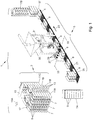
- FIG 1 a production facility is shown in the form of an insect breeding system 1.
- the insect breeding system 1 includes a climate area 3 and a feed area 5.
- columns 7 of stacked individual crates 9 are arranged in a plurality of parallel rows 11A, 11B, 11C.
- Figure 1 only shows a limited number of stacked columns 7, and a limited number of parallel rows 11A-C. It should however be understood that preferably and advantageously a great many of stacked columns 7 and rows 11A-C will be present in an actual production facility.
- the adjacent rows 11A-C are spaced from one another to allow an aeration system to supply conditioned air between a first pair of adjacent rows 11A, 11B, and to withdraw used air from between an adjacent second pair of rows 11B, 11C.
- the supply of conditioned air is indicated by arrows 13 and the withdrawal of used air is represented by a suction tube 15 and arrow 15A.
- the observation station 27 includes a weighing scale (not shown, but conventional) to obtain the weight of an individual crate 9 including its substrate and insect content and optionally an RFID identification unit for assigning data and measurements obtained by the observation station to a central control unit (not shown, but conventional).
- the observation station 27 further includes a camera 29 for obtaining an image of the contents of each individual crate 9 passing the observation station 27.
- the observation station 27 can include a multitude of camera systems (laser, sick range, IR, heat scan etc).
- the observation station 27 functions as an observation station at crate level.
- the acquired data is interpreted by a central control unit (not shown, but conventional) to determine a requirement for adding an appropriate amount of supplementary feed stock, or to determine a reason to withdraw the individual crate 9 from further breeding.
- a reason to withdraw an individual crate 9 from further breeding may be an indication from the preceding observation that its contents is ready for harvesting, but also that its contents is beyond recovery and needs to be discarded.
- Withdrawal of an individual crate 9 to prevent it from progressing to a feed station 31 may be performed manually, but may also be performed automatically by robot or other means.
- the conveyor 21 may also be joined by a further conveyor at an intersection indicated by line 33.
- feed stock contained in a hopper 35, usually consisting of waste material, is dosed in amounts determined individually by a central control unit (not shown, but conventional) to each of the crates 9 requiring additional feed stock.
- a central control unit not shown, but conventional
- each individual retrieved crate 9 progresses to a restacker 37 where the individual crates 9 are again stacked into a column 7B ready for return to the climate area 3.
- the retrieved column 7A, and the column 7B for return to the climate area 3 may also be automatically conveyed between the climate area 3 and the feed area 5 by an appropriate automatic conveying system (not shown, but conventional).
- Such further conveying systems may also be adapted to rearrange the columns and rows 11A-C within the climate area 3 to obtain a proper first-in-first-out order for the columns of crates.
- Such conveying systems are well known to the skilled individual and do not require further explanation for the purpose of the present invention.
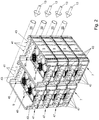
- FIG. 2 the aeration of crates 9 in the climate area is shown in greater detail.
- the aeration system is embodied by a plurality of air manifolds 39, each having evenly spaced outlet openings 41.
- the manifolds 39 and the outlet openings 41 are each spaced to correspond with end openings 43 created at opposite ends of the crates 9.
- Conditioned air of a predetermined temperature, humidity, volumetric rate, and/or constitution is fed to the manifolds 39 as indicated by arrows 13.
- the flow of conditioned air is then guided over a bed of substrate contained in each crate 9 upon leaving the respective outflow openings 41.
- the outflow openings 41 are aligned with the respective rear end openings 43 of the individual crates 9 and guided over the substrate in the crates 9 as indicated by arrows 45.
- a surplus of air then leaves the crates 9 through respective front end openings 43 as indicated by arrows 47. While the crates 9 are shown empty in Figure 2 , it will be understood that these will each be filled with an appropriate amount of substrate and insect larvae, when the system is in operation.
- the used air that leaves the crates 9 in accordance with arrows 47 is collected in the corridor in front of these crates by a suction tube 15 as illustrated in Figure 1 .
- the air so withdrawn can be analysed, so that its properties may be adjusted as necessary for reuse in the system. Temperature differences between the conditioned air and the withdrawn used air may advantageously benefit energy conservation.
- each crate 9 includes a generally rectangular bottom 49 having upstanding opposite front and rear walls 51, 53, and opposite side walls 55, 57.
- the opposite front and rear walls 51, 53 each have one of the end openings 43 formed by a recess in the upper edge 59 at the upstanding front and rear walls 51, 53.
- the bottom 49 is provided in this example with a limited number of insert receiving openings 61 for receiving an insert, such as a wire mesh shown in Figure 3 .
- the insert receiving openings 61 are bounded by an upstanding perimeter edge 63 for preventing moisture that is collected on the bottom 49 of the crate 9 to leak from the opening 61 where it could contaminate the contents of another crate that is lower in a stack, when in use.
- the insert receiving opening 61 could be filled with a closed insert or with an insert having a different mesh.
- the openings 61 in the bottom 49 of the crates 9 may provide additional aeration of a substrate therein from below. Such an aeration from below results from the forced flow of conditioned air over the substrate of a crate lower in the stack (as indicated by the arrows 45 in Figure 2 ).
- the growth technique is based on an interaction between a specially designed crate and a climate control technique and a working principle, by which the crates hold the insects and substrate which is fed to the insects.
- the crates are placed in stacks in front of aeration walls and/or tubular manifolds.
- the aeration walls have openings at the same heights as aeration openings in the crate. This allows for management of an airflow over the insects and substrate.
- For the supply and discharge of air it is also possible for the space between the stacks to be held at an over-pressure. The air then passes between the openings.
- the total production facility then has stacks of crates and crate level climate control.
- the air is controlled before it is blown over the crate.
- the air that has passed is sucked away and measured. This way a measurement and control system can monitor how much activity has taken place inside the crate.
- the climate system can then adjust the air characteristics of the air that is blown over the crate again. This way it becomes possible to maximize the growth potential of the insects in the crates.
- the total system is designed to generate as much output as possible.
- the crate is designed to be stackable and has design aspects that allow for optimal climate control of the insects and of a substrate in the crates.
- the crate can vary in size.
- it can be a crate having a size of 800 x 600 x 260 mm (length x width x height).
- Two sides of the crate are fully closed and two other sides have an opening at the top.
- the bottom of the crate has several pre-formed openings that allow for inserts of various materials.
- the crate has four openings. These openings are made such that inserts can be placed in the opening after production. Such inserts can be closed or preformed plates with wired mesh.
- the side openings and the bottom inserts can further be used for optimal climate control. The side openings allow for flow over the substrate and underneath the bottom of the crate placed immediately above.
- the bottom openings also allow for extra oxygen providence and/or for energy off-take. This latter option can be important for specific growth processes whereby a lot of energy is produced and/or when the substrate layers become thicker.
- the bottom openings offer flexibility by being closeable with plates or plates with various types of wire meshes. Such wire meshes can vary in material, mesh and thickness.
- the selection of the inserts can be different for various types of insects.
- a climate wall is thus made with openings at the same height as the openings in the crates.
- the climate wall can be a vertical hollow wall with openings or tubular manifolds suspended at the same height as the crate openings.
- Air is blown into the wall and/or tubular manifolds and is blown out over the crates.
- the air that is blown into the wall and/or tubular manifolds can also be regulated in respect of various of its aspects, such as temperature, moist level, energy content, gas content, flow rate and volume, and/or pressure, etc.
- the air that has been passed through the crates will have changed in composition. Such a change in composition may indicate the amount of activity inside the crates and is a proxy for processes like insect growth, material decay and/or degradation, life cycle progress, etc.
- the changed values in air composition and quality can then be used to determine the characteristics of the new air that is blown through the wall/tubular manifolds.
- the entire system of crates and climate control allows for a high-level of automation for large-scale insect production factory lines.
- a method and system 1 for breeding insects using a plurality of individual crates 9, wherein at least a portion of each crate is filled with a substrate, containing feed stock, and immature phases of insects.
- a climate area 3 housing the crates 9 that has an aeration system.
- a conveyor system 21 is included in the system for retrieving crates 9 from the climate area 3 and for returning same thereto.
- An observation system 27 for obtaining observations, including data and measurements, and downstream thereof a feedstock supply station 31 are arranged along the conveyor system 21.
- the method includes steps of aerating the substrate and the immature phases of insects with the aeration system, when in the climate area 3; periodically retrieving at least one individual crate 9 of the plurality of crates by the conveyor system 21 from the climate area 3 and passing it to the observation system 27; obtaining an observation of the substrate and the immature phases of insects in the at least one retrieved crate; and interpreting the observation of a retrieved individual crate and determining one of a requirement for adding an amount of supplementary feed stock, and a reason to withdraw the insects from further breeding for harvesting or discarding from further breeding.
- the method and system are further arranged for returning the retrieved individual crate 9 to the climate area 3 via the feedstock supply station 31, when a required amount of supplementary feedstock has been determined, and transferring the retrieved individual crate to one of an area for harvesting and an area for discarding, when a reason for withdrawal has been determined.
- the steps of the method are repeated for as long as at least one of the plurality of crates 9 remains in the climate area 3.
- insects which have maggot and/or larval stages.
- insects such as the House Fly (musca domestica), the Black Soldier Fly (Hermetia Illucens), and the BowFly can be bred very effectively and efficiently in this system.
Landscapes
- Life Sciences & Earth Sciences (AREA)
- Environmental Sciences (AREA)
- Animal Husbandry (AREA)
- Biodiversity & Conservation Biology (AREA)
- Animal Behavior & Ethology (AREA)
- Zoology (AREA)
- Biophysics (AREA)
- Catching Or Destruction (AREA)
- Housing For Livestock And Birds (AREA)
Description
- The invention relates to a method, system for breeding insects, and a breeding container for use in the method and system. The invention also relates to waste conversion.
- From the published international patent application document
WO 2012/115959 A2 it is known for a larvae rearing system to have a plurality of open topped culture trays arranged in stacks, with each tack comprised of multiple levels of trays. A feed delivery system automatically delivers larval feed to selected culture trays, while a separate water delivery system delivers water to the culture trays. - In a system for breeding flies and decomposing organic waste, as disclosed in Korean patent document
KR 100524413 B1 - The use of individual containers or trays in the treatment of organic matter and/or the breeding of insects is further described in patent documents
US 5,819,685 ,US 5,351,643 ,WO 2012/073949 ,WO 93/01711 WO 94/19296 - In the known systems it has not been possible to continuingly observe the processes in the individual containers in an efficient manner. This has reduced control over the processes and sometimes caused erratic yields.
- Accordingly it is an object of the present invention to propose and offer an improved system and method for breeding insects. In a more general sense it is thus an object of the invention to overcome or ameliorate at least one of the disadvantages of the prior art. It can also be seen as an object of the present invention to provide alternative structures and method steps that are less cumbersome in assembly and operation and which moreover can be accomplished relatively inexpensively. Alternatively it is an object of the invention to at least provide the public with a useful choice.
- To this end the invention provides a method for breeding insects, a system for performing the method, and a crate for use in the method and system as defined by one or more of the appended claims.
- The invention is useful for producing insects, in particular in their larval or pupal stage, and worms for conversion into nutrient material, such as proteins, fatty acids, chitin, or like.
- More in particular the invention is useful in providing basic matter to be fully converted into several nutrient streams, such as fat-containing, aqueous -containing and solid-containing fractions. Such an efficient converting method, which is not part of the present invention, can comprise the steps of:
- (a) squashing insects or worms thereby obtaining a pulp,
- (b) heating the pulp to a temperature of 70-100°C, and
- (c) subjecting the heated pulp to a physical separation step.
- Further advantageous aspects of the invention will become clear from the appended description and in reference to the accompanying drawings, in which:
-
Figure 1 , in a birds eye perspective, schematically shows a production facility for breeding insects in accordance with the present invention; -
Figure 2 is a partial perspective view showing a plurality of crates stacked in adjacent columns with an aeration system according to the invention; and -
Figure 3 is a perspective view of an individual crate according to the invention. - In
figure 1 a production facility is shown in the form of an insect breeding system 1. The insect breeding system 1 includes aclimate area 3 and a feed area 5. In theclimate area columns 7 of stackedindividual crates 9 are arranged in a plurality ofparallel rows Figure 1 only shows a limited number ofstacked columns 7, and a limited number ofparallel rows 11A-C. It should however be understood that preferably and advantageously a great many ofstacked columns 7 androws 11A-C will be present in an actual production facility. Theadjacent rows 11A-C are spaced from one another to allow an aeration system to supply conditioned air between a first pair ofadjacent rows rows arrows 13 and the withdrawal of used air is represented by asuction tube 15 andarrow 15A. - For the supply and discharge of air other ways to pass the air between the crates are also conceivable.In the
climate area 3 thesuccessive rows 11A-11C are repeated such that the supply and withdrawal of air alternates at eachcorridor rows 11A-11C. In the feed area 5 aconveyor 21 for movingindividual crates 9, moves in a direction indicated byarrow 23. A retrievedcolumn 7A of stackedindividual crates 9 is offered to adestacker unit 25, which destacks the stacked columns into individual creates. Eachindividual crate 9 then passes into anobservation station 27. Theobservation station 27 includes a weighing scale (not shown, but conventional) to obtain the weight of anindividual crate 9 including its substrate and insect content and optionally an RFID identification unit for assigning data and measurements obtained by the observation station to a central control unit (not shown, but conventional). Theobservation station 27 further includes acamera 29 for obtaining an image of the contents of
eachindividual crate 9 passing theobservation station 27. Theobservation station 27 can include a multitude of camera systems (laser, sick range, IR, heat scan etc). Theobservation station 27 functions as an observation station at crate level. The acquired data is interpreted by a central control unit (not shown, but conventional) to determine a requirement for adding an appropriate amount of supplementary feed stock, or to determine a reason to withdraw theindividual crate 9 from further breeding. Other options as a result of the interpretation of the acquired data are also conceivable. A reason to withdraw anindividual crate 9 from further breeding may be an indication from the preceding observation that its contents is ready for harvesting, but also that its contents is beyond recovery and needs to be discarded. Withdrawal of anindividual crate 9 to prevent it from progressing to afeed station 31 may be performed manually, but may also be performed automatically by robot or other means. In case withdrawal ofcrates 9 from between theobservation station 27 and thefeed station 31 is performed automatically, theconveyor 21 may also be joined by a further conveyor at an intersection indicated byline 33. - At the
feed station 31 feed stock, contained in ahopper 35, usually consisting of waste material, is dosed in amounts determined individually by a central control unit (not shown, but conventional) to each of thecrates 9 requiring additional feed stock. After leaving thefeed station 31 each individual retrievedcrate 9 progresses to arestacker 37 where theindividual crates 9 are again stacked into acolumn 7B ready for return to theclimate area 3. - While not shown in any detail in
Figure 1 , it should be understood that the retrievedcolumn 7A, and thecolumn 7B for return to theclimate area 3 may also be automatically conveyed between theclimate area 3 and the feed area 5 by an appropriate automatic conveying system (not shown, but conventional). Such further conveying systems may also be adapted to rearrange the columns androws 11A-C within theclimate area 3 to obtain a proper first-in-first-out order for the columns of crates. Such conveying systems are well known to the skilled individual and do not require further explanation for the purpose of the present invention. - In
Figure 2 the aeration ofcrates 9 in the climate area is shown in greater detail. In this example the aeration system is embodied by a plurality ofair manifolds 39, each having evenly spacedoutlet openings 41. Themanifolds 39 and theoutlet openings 41 are each spaced to correspond withend openings 43 created at opposite ends of thecrates 9. Conditioned air of a predetermined temperature, humidity, volumetric rate, and/or constitution is fed to themanifolds 39 as indicated byarrows 13. The flow of conditioned air is then guided over a bed of substrate contained in eachcrate 9 upon leaving therespective outflow openings 41. Theoutflow openings 41 are aligned with the respectiverear end openings 43 of theindividual crates 9 and guided over the substrate in thecrates 9 as indicated byarrows 45. A surplus of air then leaves thecrates 9 through respectivefront end openings 43 as indicated byarrows 47. While thecrates 9 are shown empty inFigure 2 , it will be understood that these will each be filled with an appropriate amount of substrate and insect larvae, when the system is in operation. The used air that leaves thecrates 9 in accordance witharrows 47 is collected in the corridor in front of these crates by asuction tube 15 as illustrated inFigure 1 . The air so withdrawn can be analysed, so that its properties may be adjusted as necessary for reuse in the system. Temperature differences between the conditioned air and the withdrawn used air may advantageously benefit energy conservation. - In
Figure 3 anindividual crate 9 is shown. Eachcrate 9 includes a generally rectangular bottom 49 having upstanding opposite front andrear walls opposite side walls Figure 2 the opposite front andrear walls end openings 43 formed by a recess in theupper edge 59 at the upstanding front andrear walls insert receiving openings 61 for receiving an insert, such as a wire mesh shown inFigure 3 . Theinsert receiving openings 61 are bounded by anupstanding perimeter edge 63 for preventing moisture that is collected on the bottom 49 of thecrate 9 to leak from theopening 61 where it could contaminate the contents of another crate that is lower in a stack, when in use. Alternatively theinsert receiving opening 61 could be filled with a closed insert or with an insert having a different mesh. When closed with a permeable insert, such as a mesh or filter material, theopenings 61 in the bottom 49 of thecrates 9 may provide additional aeration of a substrate therein from below. Such an aeration from below results from the forced flow of conditioned air over the substrate of a crate lower in the stack (as indicated by thearrows 45 inFigure 2 ). When aeration from below the substrate is not required , then completely closed inserts may be inserted into theopenings 61. In such instances it is also conceivable, but not according to the invention, that an alternative crate without insert receiving openings will be used. Conversely when bottom aeration can be standardized it is also conceivable, but not according to the invention, that the mesh covered openings are integrally formed in the bottom of the crate. When more than oneinsert receiving opening 61 is provided in eachcrate 9, it is also an option to use a combination of different inserts in one and the same crate. Further it is also seen inFigure 3 that the upstanding perimeter edges 63 around theopenings 61 can also be part of abottom reinforcing grid 65. - Thus an insect breeding technique has been described, which has been developed for the purpose of large scale insect production. The growth technique is based on an interaction between a specially designed crate and a climate control technique and a working principle, by which the crates hold the insects and substrate which is fed to the insects. The crates are placed in stacks in front of aeration walls and/or tubular manifolds. The aeration walls have openings at the same heights as aeration openings in the crate. This allows for management of an airflow over the insects and substrate. For the supply and discharge of air it is also possible for the space between the stacks to be held at an over-pressure. The air then passes between the openings. Then a system is obtained that does not have openings on the same height, but offering another way to pass the air between the crates.The total production facility then has stacks of crates and crate level climate control. The air is controlled before it is blown over the crate. The air that has passed is sucked away and measured. This way a measurement and control system can monitor how much activity has taken place inside the crate. The climate system can then adjust the air characteristics of the air that is blown over the crate again. This way it becomes possible to maximize the growth potential of the insects in the crates. The total system is designed to generate as much output as possible. The crate is designed to be stackable and has design aspects that allow for optimal climate control of the insects and of a substrate in the crates. The crate can vary in size. For the example as detailed here it can be a crate having a size of 800 x 600 x 260 mm (length x width x height). Two sides of the crate are fully closed and two other sides have an opening at the top. The bottom of the crate has several pre-formed openings that allow for inserts of various materials. In the described example the crate has four openings. These openings are made such that inserts can be placed in the opening after production. Such inserts can be closed or preformed plates with wired mesh. The side openings and the bottom inserts can further be used for optimal climate control. The side openings allow for flow over the substrate and underneath the bottom of the crate placed immediately above. The bottom openings also allow for extra oxygen providence and/or for energy off-take. This latter option can be important for specific growth processes whereby a lot of energy is produced and/or when the substrate layers become thicker. Hence the bottom openings offer flexibility by being closeable with plates or plates with various types of wire meshes. Such wire meshes can vary in material, mesh and thickness. The selection of the inserts can be different for various types of insects.
As regards climate control, a climate wall is thus made with openings at the same height as the openings in the crates. The climate wall can be a vertical hollow wall with openings or tubular manifolds suspended at the same height as the crate openings. Air is blown into the wall and/or tubular manifolds and is blown out over the crates. The air that is blown into the wall and/or tubular manifolds can also be regulated in respect of various of its aspects, such as temperature, moist level, energy content, gas content, flow rate and volume, and/or pressure, etc. The air that has been passed through the crates will have changed in composition. Such a change in composition may indicate the amount of activity inside the crates and is a proxy for processes like insect growth, material decay and/or degradation, life cycle progress, etc. The changed values in air composition and quality can then be used to determine the characteristics of the new air that is blown through the wall/tubular manifolds.
The entire system of crates and climate control allows for a high-level of automation for large-scale insect production factory lines. - Accordingly there has been described a method and system 1 for breeding insects, using a plurality of
individual crates 9, wherein at least a portion of each crate is filled with a substrate, containing feed stock, and immature phases of insects. Also provided is aclimate area 3 housing thecrates 9 that has an aeration system. Aconveyor system 21 is included in the system for retrievingcrates 9 from theclimate area 3 and for returning same thereto. Anobservation system 27 for obtaining observations, including data and measurements, and downstream thereof afeedstock supply station 31 are arranged along theconveyor system 21. The method includes steps of aerating the substrate and the immature phases of insects with the aeration system, when in theclimate area 3; periodically retrieving at least oneindividual crate 9 of the plurality of crates by theconveyor system 21 from theclimate area 3 and passing it to theobservation system 27; obtaining an observation of the substrate and the immature phases of insects in the at least one retrieved crate; and interpreting the observation of a retrieved individual crate and determining one of a requirement for adding an amount of supplementary feed stock, and a reason to withdraw the insects from further breeding for harvesting or discarding from further breeding. The method and system are further arranged for returning the retrievedindividual crate 9 to theclimate area 3 via thefeedstock supply station 31, when a required amount of supplementary feedstock has been determined, and transferring the retrieved individual crate to one of an area for harvesting and an area for discarding, when a reason for withdrawal has been determined. The steps of the method are repeated for as long as at least one of the plurality ofcrates 9 remains in theclimate area 3. - The method and system according to the invention is applicable to many insects which have maggot and/or larval stages. In particular insects such as the House Fly (musca domestica), the Black Soldier Fly (Hermetia Illucens), and the BowFly can be bred very effectively and efficiently in this system.
- It is thus believed that the operation and construction of the present invention will be apparent from the foregoing description and drawings appended thereto. It will be clear to the skilled person that the invention is not limited to any embodiment herein described and that modifications are possible which should be considered within the scope of the appended claims. Also kinematic inversions are considered inherently disclosed and to be within the scope of the invention. In the claims, any reference signs shall not be construed as limiting the claim. The term 'comprising' and 'including' when used in this description or the appended claims should not be construed in an exclusive or exhaustive sense but rather in an inclusive sense. Thus the expression 'comprising' as used herein does not exclude the presence of other elements or steps in addition to those listed in any claim. Furthermore, the words 'a' and 'an' shall not be construed as limited to 'only one', but instead are used to mean 'at least one', and do not exclude a plurality. Features that are not specifically or explicitly described or claimed may be additionally included in the structure of the invention within its scope. Expressions such as: "means for ..." should be read as: "component configured for ..." or "member constructed to ..." and should be construed to include equivalents for the structures disclosed. The use of expressions like: "critical", "preferred", "especially preferred" etc. is not intended to limit the invention. Additions, deletions, and modifications within the purview of the skilled person may generally be made without departing from the scope of the invention, as is determined by the claims.
Claims (20)
- Method for breeding insects, including the steps of:(a) providing a plurality of crates (9);(b) filling at least a portion of each crate of the plurality of crates with a substrate, containing feed stock, and immature phases of insects;(c) providing a climate area (3) having an aeration system and placing the plurality of crates in the climate area;(d) providing a conveyor system (21) for retrieving crates of the plurality of crates from the climate area and optionally for returning same thereto;(e) providing an observation system (27) along the conveyor system for obtaining observations, including data and measurements;(f) providing a feedstock supply station (31) along the conveyor system, downstream of the observation system;(g) aerating the substrate and the immature phases of insects with the aeration system, when in the climate area;(h) periodically retrieving at least one individual crate of the plurality of crates by the conveyor system from the climate area and passing it to the observation system;(i) obtaining an observation of the substrate and the immature phases of insects in the at least one retrieved crate;(j) interpreting the observation of a retrieved individual crate and determining one of a requirement for adding an amount of supplementary feed stock, and a reason to withdraw the insects from further breeding for harvesting or discarding from further breeding;(k) when an amount of supplementary feedstock has been determined in step (j), returning the retrieved individual crate to the climate area via the feedstock supply station;(l) when a reason for withdrawal has been determined in step (j), transferring the retrieved individual crate to one of an area for harvesting and an area for discarding; and(m) repeating the steps (g) to (l) for as long as at least one of the plurality of crates remains in the climate area.
- Method according to claim 1, wherein the plurality of crates are stacked in at least one column of stacked crates.
- Method according to claim 2, wherein the climate area is arranged to accommodate a plurality of stacked columns of crates in parallel rows.
- Method according to one of claims 1-3, wherein the aeration system of the climate area is arranged for forced aeration of the individual crates when placed in the climate area.
- Method according to claim 2 or 4, wherein the step of aerating the substrate and the immature phases of insects includes aerating the individual crates in each of the at least one column of stacked crates.
- Method according to one of claims 1-5, wherein individual crates of the plurality of crates are recognised and followed by a control system having a repository.
- Method according to claim 6, wherein recognising and following of the individual crates includes storing crate history information against individual crate identities in the repository of the control system.
- Method according to claim 7, wherein the observation system includes step of interpreting the observation of a retrieved individual crate includes accessing crate history information in the repository.
- Method according to claim 7 or 8, wherein the step of determining one of a requirement for adding an amount of supplementary feed stock, and a reason to withdraw the insects from further breeding further includes updating crate history information in the repository.
- Method according to claim 1, wherein the observation system includes a camera for obtaining an image of the substrate and insects in each retrieved individual crate, and wherein the obtained image is interpreted to determine one of a requirement for adding an amount of supplementary feed stock, and a reason to withdraw the insects from further breeding for harvesting or discarding from further breeding.
- Method according to claim 1, wherein the step of transferring the retrieved individual crate to the area for harvesting includes emptying the individual crate onto a conveyer belt that conveys its contents to a separator, which separates the larvae from the substrate.
- Method according to claim 1, wherein the step of transferring the retrieved individual crate to the area for discarding includes emptying the individual crate onto a reject conveyer that conveys its contents to a shredder.
- System having elements arranged for performing the method of any one of the preceding claims 1-12, wherein the system includes:a plurality of crates (9);a climate area (3) having an aeration system arranged for accommodating the plurality of crates in the climate area;a conveyor system (21) for retrieving crates of the plurality of crates from the climate area and optionally for returning same thereto;an observation system (27) for obtaining observations along the conveyor system; anda feedstock supply station (31) along the conveyor system, downstream of the observation system, characterized in that the observation system includes a camera (29) for obtaining an image of the substrate and insects in each retrieved individual crate, and wherein the obtained image is interpreted to determine one of a requirement for adding an amount of supplementary feed stock, and a reason to withdraw the insects from further breeding for harvesting or discarding from further breeding.
- System according to claim 13, further including at least one aeration wall in the climate area, wherein the at least one aeration wall includes one of a hollow wall and a plurality of tubular manifolds, each being arranged for blowing conditioned air over the substrate in each crate.
- System according to claim 14, wherein the at least one aeration wall includes a plurality of exit openings arranged in a pattern that positions each exit opening in correspondence with individual crates of the columns and rows.
- System according to claim 13, wherein the climate area when it is arranged to accommodate a plurality of stacked columns of crates in parallel rows, is also arranged to receive two of such rows, separated by a corridor, between opposite aeration walls, wherein the conditioned air after aerating the substrate and the immature phases of insects is collected from the corridor between two rows of columns of crates and is checked for alterations of its properties.
- Crate (9) adapted for use in at least one of the method of claims 1-12 and the system of claims 13-16, wherein the crate includes a bottom (49) having a substantially rectangular perimeter defined by upstanding opposite front and rear walls, as well as opposite side walls, characterized in that the bottom includes at least one opening (61) that is adapted to receive a selected one of at least two different inserts.
- Crate according to claim 17, wherein the upstanding opposite front and rear walls each having an opening therein, which are adapted to allow conditioned air to be blown there through for forced aeration, wherein the openings in the opposite front and rear walls are each formed by a recessed upper edge of the relevant front and rear wall.
- Crate according to claim 17, wherein the at least two different inserts includes one of a wire mesh insert and a closed insert.
- Crate according to claim 17, wherein the at least one opening has an upstanding perimeter edge to prevent leakage of moisture from the substrate through the at least one opening.
Priority Applications (1)
| Application Number | Priority Date | Filing Date | Title |
|---|---|---|---|
| PL14722373T PL2986107T3 (en) | 2013-04-19 | 2014-04-17 | Method and system for breeding insects, using a plurality of individual crates |
Applications Claiming Priority (2)
| Application Number | Priority Date | Filing Date | Title |
|---|---|---|---|
| NL2010666A NL2010666B3 (en) | 2013-04-19 | 2013-04-19 | Method and system for breeding insects, using a plurality of individual crates. |
| PCT/NL2014/050247 WO2014171829A1 (en) | 2013-04-19 | 2014-04-17 | Method and system for breeding insects, using a plurality of individual crates |
Publications (2)
| Publication Number | Publication Date |
|---|---|
| EP2986107A1 EP2986107A1 (en) | 2016-02-24 |
| EP2986107B1 true EP2986107B1 (en) | 2017-10-18 |
Family
ID=48998671
Family Applications (1)
| Application Number | Title | Priority Date | Filing Date |
|---|---|---|---|
| EP14722373.9A Active EP2986107B1 (en) | 2013-04-19 | 2014-04-17 | Method and system for breeding insects, using a plurality of individual crates |
Country Status (9)
| Country | Link |
|---|---|
| US (1) | US10362772B2 (en) |
| EP (1) | EP2986107B1 (en) |
| DK (1) | DK2986107T3 (en) |
| ES (1) | ES2655446T3 (en) |
| HU (1) | HUE035615T2 (en) |
| NL (1) | NL2010666B3 (en) |
| NO (1) | NO2986107T3 (en) |
| PL (1) | PL2986107T3 (en) |
| WO (1) | WO2014171829A1 (en) |
Cited By (3)
| Publication number | Priority date | Publication date | Assignee | Title |
|---|---|---|---|---|
| EP3964056A1 (en) | 2020-09-02 | 2022-03-09 | Bühler Insect Technology Solutions AG | High-speed dosing |
| RU2781554C1 (en) * | 2019-06-03 | 2022-10-13 | Бюлер Инсект Текнолоджи Солюшнз Аг | Climate system |
| LU103305B1 (en) | 2024-05-24 | 2025-11-24 | Reploid Group Ag | Device and method for breeding |
Families Citing this family (94)
| Publication number | Priority date | Publication date | Assignee | Title |
|---|---|---|---|---|
| US10264769B2 (en) * | 2016-08-21 | 2019-04-23 | Daniel Michael Leo | Insect production systems and methods |
| US10188083B2 (en) | 2016-08-21 | 2019-01-29 | Daniel Michael Leo | Insect production systems and methods |
| US20150366176A1 (en) * | 2014-06-19 | 2015-12-24 | Robert Fenchak | Component System Worm Farm |
| MX2017007267A (en) * | 2014-12-04 | 2018-04-10 | Senecio Ltd | DEVICE AND METHOD FOR STORAGE, TRANSPORT AND RELEASE FRAGILE INSECTS AND OTHER FRAGILE ARTICLES. |
| NL2014515B1 (en) | 2015-03-24 | 2017-01-19 | Proti-Farm R & D B V | Method and facility for breeding insects. |
| NL2014513B1 (en) | 2015-03-24 | 2017-01-19 | Proti-Farm R & D B V | Method and facility for breeding insects. |
| NL2014514B1 (en) | 2015-03-24 | 2017-01-19 | Proti-Farm R & D B V | Method and facility for breeding insects. |
| FR3034622B1 (en) * | 2015-04-13 | 2017-05-19 | Ynsect | INSECT BREEDING WORKSHOP |
| FR3034623B1 (en) * | 2015-04-13 | 2017-04-14 | Ynsect | INSECT BREEDING METHOD |
| NL2015124B1 (en) * | 2015-07-09 | 2017-02-01 | Proti-Farm R & D B V | Insect breeding facility and method for the industrial scale production of mature larvae from egg-laying mother beetles. |
| FR3046333B1 (en) * | 2015-12-31 | 2019-06-28 | Ynsect | INSECT BREEDING BIN AND ASSOCIATED ASSEMBLY |
| CN105728427A (en) * | 2016-01-27 | 2016-07-06 | 陈国清 | Method for treating organic garbage by earthworms cultivated by geothermal method |
| FR3050979B1 (en) * | 2016-05-03 | 2020-02-07 | Centre De Cooperation Internationale En Recherche Agronomique Pour Le Developpement (Cirad) | DEVICE AND METHOD FOR WIDENING FRAGILE PRODUCTS |
| US11395474B2 (en) * | 2016-05-10 | 2022-07-26 | Aspire Food Group Ltd | Harvesting and incubating systems for cultivation of insects |
| CN106070070A (en) * | 2016-06-17 | 2016-11-09 | 盱眙正泰永生物环境科技有限公司 | One is novel educates fly room |
| FR3053211B1 (en) * | 2016-06-29 | 2019-05-03 | Entofood Sdn Bhd | STACKING BED FOR AUTOMATED INSECT LARVA BREEDING, AND AUTOMATED PLANT FOR TREATMENT OF FARMING BINS |
| US10264768B2 (en) | 2016-08-21 | 2019-04-23 | Daniel Michael Leo | Insect production systems and methods |
| US10212949B2 (en) * | 2017-07-17 | 2019-02-26 | Daniel Michael Leo | Insect production systems and methods |
| US10058080B2 (en) | 2016-08-21 | 2018-08-28 | Daniel Michael Leo | Insect production systems and methods |
| US10188084B2 (en) * | 2016-08-21 | 2019-01-29 | Daniel Michael Leo | Insect production systems and methods |
| CN106386700A (en) * | 2016-08-29 | 2017-02-15 | 山东胜伟园林科技有限公司 | Earthworm cultivation box for saline-alkali land soil biological ecological improvement |
| US10051845B1 (en) | 2016-10-05 | 2018-08-21 | Verily Life Sciences Llc | Pupae emergence method and apparatus |
| US10779521B2 (en) | 2016-10-05 | 2020-09-22 | Verily Life Sciences Llc | Automated mass rearing system for insect larvae |
| US10278368B1 (en) | 2016-10-05 | 2019-05-07 | Verily Life Sciences Llc | Automated flying insect separator |
| FR3062988B1 (en) * | 2017-02-22 | 2019-04-12 | Ynsect | DEVICE AND METHOD FOR REALIZING AN OPERATION IN INSECT ELEVATION CONTAINERS |
| WO2018186741A1 (en) * | 2017-04-04 | 2018-10-11 | Protix B.V. | Centralized system for distributing olfactory triggers for ovipositioning to insect breeding enclosures |
| NL2018643B1 (en) * | 2017-04-04 | 2018-10-11 | Protix Bv | Centralized system for distributing olfactory triggers for ovipositioning to insect breeding enclosures |
| US10863737B2 (en) * | 2017-05-22 | 2020-12-15 | Drobot Biotechnology Limited Company | Culture container, and system and method of transferring a cultured organism between culture containers |
| NL2019344B1 (en) * | 2017-07-25 | 2019-02-18 | Proti Farm R & D B V | Method and system for controlling the climate of an insect rearing climate area. |
| GB201714822D0 (en) * | 2017-09-14 | 2017-11-01 | Entocycle Ltd | Apparatus and method for controlling insect production |
| US11832599B2 (en) * | 2017-09-20 | 2023-12-05 | Ynsect Nl R & D B.V. | Insect breeding |
| CN207531712U (en) * | 2017-10-18 | 2018-06-26 | 广州无两生物科技有限公司 | A kind of large-scale even black soldier flies adult plant propagation greenhouse |
| CN111315214A (en) * | 2017-11-08 | 2020-06-19 | 载资勒公司 | Method and device for raising small animals |
| CN107751117B (en) * | 2017-11-23 | 2023-08-11 | 广州飞禧特生物科技有限公司 | Black soldier fly larva separation and drying equipment and method |
| NL2020055B1 (en) * | 2017-12-12 | 2019-06-19 | Hazekamp Man Beheer B V | GROWING DEVICE FOR GROWING INSECTS AND METHOD FOR USE OF THE GROWING DEVICE FOR GENERATING HEAT |
| NL2020175B1 (en) * | 2017-12-22 | 2019-07-04 | Protix Bv | Climate control system for insect farming |
| CN107996525B (en) * | 2017-12-25 | 2023-07-21 | 贵州大学 | A climate chamber with airflow regulation |
| IT201800003619A1 (en) * | 2018-03-15 | 2019-09-15 | Kour Energy Srl | METHOD FOR THE MONITORING OF A POPULATION OF STRATIOMYID DIPTERS CONTAINED IN A BREEDING CHAMBER AND RELATED BREEDING APPARATUS |
| CN108684614B (en) * | 2018-04-27 | 2023-12-12 | 云南农业大学 | Device for preventing feed from mildew in frankliniella occidentalis feeding process and using method |
| CN108902058A (en) * | 2018-07-30 | 2018-11-30 | 嵊州陌桑高科股份有限公司 | A kind of transferable formula shelf and its transfer method applied to cultured insect |
| FR3088519B1 (en) * | 2018-11-20 | 2020-12-18 | Ynsect | Temperature regulation of a climatic zone of an insect breeding workshop |
| US12102058B2 (en) * | 2019-04-10 | 2024-10-01 | Beetle Genius, SPRL | Automated insect rearing facility, container, and modules |
| FR3095738B1 (en) | 2019-05-07 | 2022-07-22 | Protifly | Unit, building and method for rearing insect larvae |
| ES3013409T3 (en) * | 2019-06-03 | 2025-04-11 | Buehler Ag | Climate system |
| DK3979794T3 (en) | 2019-06-06 | 2024-05-13 | Protix Bv | SYSTEM AND PROCEDURE FOR BREEDING INVERTEBRATES |
| NL2023331B1 (en) * | 2019-06-17 | 2021-01-27 | Protix Bv | Climate control system for insect farming |
| DE102019121102B3 (en) * | 2019-08-05 | 2020-05-28 | Gia Tien Ngo | Device and method for breeding, in particular insects |
| EP3772275A1 (en) * | 2019-08-06 | 2021-02-10 | Alternative Gene Expression S.L. | Container for transporting and inoculating pupae |
| CN110800694A (en) * | 2019-11-05 | 2020-02-18 | 北京蓝狐天敌技术有限公司 | A kind of outdoor breeding method of beetle |
| TWI723666B (en) * | 2019-12-05 | 2021-04-01 | 國立虎尾科技大學 | Automatic breeding device for black water fly larva |
| CN110915768A (en) * | 2019-12-25 | 2020-03-27 | 石河子大学 | A kind of rearing method of sand-dwelling insects |
| WO2021186209A1 (en) * | 2020-03-16 | 2021-09-23 | Insect Technology Group Research Uk Limited | Oviposition trays for insect eggs |
| EP4149253A1 (en) * | 2020-05-13 | 2023-03-22 | Livin Farms Agrifood GmbH | Modular breeding system for insects |
| US11311003B2 (en) * | 2020-05-29 | 2022-04-26 | Yu Land Biological Agriculture Co., Ltd. | Mobile culture assembly for feeding larvae of black soldier fly |
| US11825821B2 (en) * | 2020-06-25 | 2023-11-28 | Solider Fly Technologies, Inc. | Insect breeding apparatus and methods |
| CN116322318A (en) | 2020-07-27 | 2023-06-23 | 恩比科技公司 | Systems and methods for growing biomass |
| CN116322319A (en) | 2020-07-27 | 2023-06-23 | 恩比科技公司 | Equipment for growing biomass |
| PL435064A1 (en) | 2020-08-24 | 2022-02-28 | Hipromine Spółka Akcyjna | Insect feed underfloor heating system, the use of underfloor heating systems, and an insect breeding method that uses them |
| PL249128B1 (en) * | 2020-08-24 | 2026-03-02 | Hipromine Spolka Akcyjna | Production line for rearing and/or culturing insects and/or larval forms of insects from the orders Coleoptera and/or Diptera, method for heating feed during the breeding of these insects and application of a closed-flow system for heating feed on a breeding line for breeding insects carried out on such a production line |
| CH717925A2 (en) * | 2020-10-01 | 2022-04-14 | Bertschi Patrik | Automated Insect Breeding Box. |
| JP7669670B2 (en) * | 2020-11-26 | 2025-04-30 | 株式会社ジェイテクト | Rearing Equipment |
| NL2027034B1 (en) | 2020-12-03 | 2022-07-06 | Protix Bv | Climate system and method for rearing invertebrates |
| FR3116993B1 (en) * | 2020-12-07 | 2024-05-10 | Ynsect | Insect breeding tank suitable for breeding on an industrial scale |
| FR3119511B1 (en) | 2021-02-05 | 2025-05-02 | Innovafeed | Arthropod breeding facility in multi-story modules |
| WO2022180132A1 (en) * | 2021-02-24 | 2022-09-01 | Illucens Gmbh | Module of an insect breeding station |
| GB202103149D0 (en) | 2021-03-05 | 2021-04-21 | Inspro Ltd | Bioconversion unit and method |
| KR102363800B1 (en) * | 2021-05-24 | 2022-02-16 | 송경규 | Automated system for larva breeding and processing |
| DE102021117134B3 (en) | 2021-07-02 | 2022-11-10 | Alpha-Protein GmbH | Device and method for rearing insects in a high-bay warehouse |
| EP4118963A1 (en) | 2021-07-14 | 2023-01-18 | INOVA Protein GmbH | Arrangement for cultivating insects and method for cultivating insects using the arrangement |
| USD996824S1 (en) | 2021-09-17 | 2023-08-29 | Beta Hatch Inc. | Sorting tray |
| WO2023043454A1 (en) * | 2021-09-17 | 2023-03-23 | Beta Hatch Inc. | Insect rearing systems and methods |
| USD997560S1 (en) | 2021-09-17 | 2023-09-05 | Beta Hatch Inc. | Sorting tray |
| EP4181672B1 (en) | 2021-10-08 | 2024-04-10 | WEDA-Dammann & Westerkamp GmbH | Method for providing feed in an installation for rearing insect larvae |
| FR3129147B1 (en) * | 2021-11-12 | 2023-12-01 | Invers | System and method for handling insect production bins |
| CN115251011B (en) * | 2021-11-15 | 2023-07-07 | 郑州笨农农业科技有限公司 | Air-drying system and method for breeding scavenging insects |
| DE102021134239A1 (en) | 2021-12-22 | 2023-06-22 | FarmInsect GmbH | Insect larvae raising device with an activity sensor device |
| NL2031084B1 (en) * | 2022-02-25 | 2023-09-07 | Bob Holtermans Beheer B V | Device for rearing insect larvae |
| DE102022114308B3 (en) | 2022-06-07 | 2023-06-22 | Alpha-Protein GmbH | DEVICE AND METHOD FOR SUPPLYING INSECTS |
| NL2032632B1 (en) * | 2022-07-28 | 2024-02-06 | Beekenkamp Verpakkingen B V | Insect breeding tray, method for manufacturing such a tray and a method for breeding insects |
| WO2024056355A1 (en) * | 2022-09-14 | 2024-03-21 | Skov A/S | An insect rearing/breeding housing |
| EP4388870A1 (en) * | 2022-12-23 | 2024-06-26 | Corbiota GmbH | System and method for producing an animal feed composition comprising worms |
| FR3143951B1 (en) | 2022-12-27 | 2025-04-25 | Ynsect | Optical device for determining one or more monitoring parameters of an insect farm |
| FR3144490B1 (en) * | 2022-12-29 | 2025-01-10 | Ynsect | Climatic zone of an agricultural system |
| DE102023200006A1 (en) | 2023-01-02 | 2024-07-04 | Smartbreed Ag | Tempered breeding device and method for breeding insects |
| ES2978607B2 (en) * | 2023-02-10 | 2025-04-28 | Belloch Jesus Francisco Suarez | FATTENING MODULE FOR INSECT LARVAE |
| DE102023114721B3 (en) | 2023-06-05 | 2024-05-16 | Ssi Schäfer Automation Gmbh (At) | Overhead conveyor rearing device, overhead conveyor system and insect rearing farm |
| EP4512244B1 (en) | 2023-08-22 | 2026-06-17 | Nasekomo B.V. | Method for promoting the bioconversion process of larvae during the second aging phase |
| EP4523526B1 (en) | 2023-09-13 | 2026-03-25 | Livin Farms Agrifood GmbH | Use and arrangement of a package for pre-dosed units for insect breeding |
| EP4523525A1 (en) * | 2023-09-13 | 2025-03-19 | Livin Farms Agrifood GmbH | Insect breeding with pre-dosed units |
| DE102023134767B4 (en) * | 2023-12-12 | 2025-06-18 | Ssi Schäfer Automation Gmbh | Insect rearing system |
| FR3160774A1 (en) * | 2024-03-29 | 2025-10-03 | Innovafeed | System for characterizing the contents of at least one tank of insect larvae and associated installation and production method |
| FR3161840A1 (en) * | 2024-05-03 | 2025-11-07 | Innovafeed | Insect larva rearing facility and associated environmental conditions management process |
| DE102024120290B3 (en) * | 2024-07-18 | 2025-10-09 | Ssi Schäfer Automation Gmbh | Insect rearing system with shelf-integrated feeding |
| KR20260081369A (en) | 2024-11-26 | 2026-06-04 | 농업회사법인 (주)뉴트리인더스트리 | Apparatus for breeding insect with heating microorganisms |
Family Cites Families (11)
| Publication number | Priority date | Publication date | Assignee | Title |
|---|---|---|---|---|
| WO1993001711A1 (en) * | 1991-07-16 | 1993-02-04 | Novosibirsky Gosudarstvenny Agrarny Universitet | Method and installation for processing pig manure into protein forage and biohumus |
| US5351643A (en) | 1992-12-11 | 1994-10-04 | Boyce Thompson Institute For Plant Research, Inc. | High density rearing system for larvae |
| EP0701542A1 (en) | 1993-02-17 | 1996-03-20 | Butterfly's Pty Limited | A method and apparatus for the treatment of organic matter |
| US5819685A (en) * | 1996-11-12 | 1998-10-13 | Molded Fiber Glass Companies | Tray for raising insect larva |
| KR100524413B1 (en) | 2003-04-07 | 2005-11-28 | 주식회사 한국유용곤충연구소 | Apparatus for breeding flies, system for breeding natural enemies of fly comprising the same, releasing container comprising the natural enemies and method for control of flies using the same |
| CA2587901C (en) * | 2007-05-04 | 2011-09-27 | Ivan Milin | System for processing waste using insect larvae |
| US8991098B2 (en) * | 2008-09-16 | 2015-03-31 | Basf Plant Science Gmbh | Method for improved plant breeding |
| JP5718033B2 (en) * | 2010-11-29 | 2015-05-13 | 株式会社Bbbジャパン | Organic fertilizer manufacturing method |
| US9629339B2 (en) * | 2011-02-21 | 2017-04-25 | The University Of Georgia Research Foundation, Inc. | Systems and methods for rearing insect larvae |
| JP5579122B2 (en) * | 2011-04-28 | 2014-08-27 | 株式会社イーズ | Organic fertilizer production system |
| KR101365703B1 (en) * | 2012-04-03 | 2014-03-12 | 진병규 | A paris consecutive forty-six device larvae |
-
2013
- 2013-04-19 NL NL2010666A patent/NL2010666B3/en active IP Right Maintenance
-
2014
- 2014-04-17 HU HUE14722373A patent/HUE035615T2/en unknown
- 2014-04-17 US US14/785,452 patent/US10362772B2/en active Active
- 2014-04-17 DK DK14722373.9T patent/DK2986107T3/en active
- 2014-04-17 EP EP14722373.9A patent/EP2986107B1/en active Active
- 2014-04-17 WO PCT/NL2014/050247 patent/WO2014171829A1/en not_active Ceased
- 2014-04-17 ES ES14722373.9T patent/ES2655446T3/en active Active
- 2014-04-17 NO NO14722373A patent/NO2986107T3/no unknown
- 2014-04-17 PL PL14722373T patent/PL2986107T3/en unknown
Non-Patent Citations (1)
| Title |
|---|
| None * |
Cited By (5)
| Publication number | Priority date | Publication date | Assignee | Title |
|---|---|---|---|---|
| RU2781554C1 (en) * | 2019-06-03 | 2022-10-13 | Бюлер Инсект Текнолоджи Солюшнз Аг | Climate system |
| EP3964056A1 (en) | 2020-09-02 | 2022-03-09 | Bühler Insect Technology Solutions AG | High-speed dosing |
| US12382926B2 (en) | 2020-09-02 | 2025-08-12 | Bühler Insect Technology Solutions Ag | High-speed dosing |
| LU103305B1 (en) | 2024-05-24 | 2025-11-24 | Reploid Group Ag | Device and method for breeding |
| WO2025242323A1 (en) | 2024-05-24 | 2025-11-27 | Reploid Group Ag | Device and method for breeding |
Also Published As
| Publication number | Publication date |
|---|---|
| PL2986107T3 (en) | 2018-06-29 |
| US10362772B2 (en) | 2019-07-30 |
| EP2986107A1 (en) | 2016-02-24 |
| WO2014171829A1 (en) | 2014-10-23 |
| DK2986107T3 (en) | 2018-01-15 |
| NO2986107T3 (en) | 2018-03-17 |
| NL2010666C (en) | 2014-10-21 |
| US20160066552A1 (en) | 2016-03-10 |
| HUE035615T2 (en) | 2018-05-28 |
| ES2655446T3 (en) | 2018-02-20 |
| NL2010666B3 (en) | 2018-11-21 |
Similar Documents
| Publication | Publication Date | Title |
|---|---|---|
| US10362772B2 (en) | Method and system for breeding insects, using a plurality of individual crates | |
| NL2019344B1 (en) | Method and system for controlling the climate of an insect rearing climate area. | |
| KR102593372B1 (en) | Farm for raising insects | |
| US11832599B2 (en) | Insect breeding | |
| KR101865044B1 (en) | Insect production automation system | |
| US10595517B2 (en) | Insect spawning container, facility and method for breeding insects | |
| US20200146270A1 (en) | Method and facility for breeding insects | |
| US20180055021A1 (en) | Method and facility for breeding insects | |
| CN114513952B (en) | Insect breeding box | |
| KR102146775B1 (en) | Device for breeding grub and method thereof | |
| DE102022114308B3 (en) | DEVICE AND METHOD FOR SUPPLYING INSECTS | |
| KR102661783B1 (en) | Smart farm system for breeding grub and the method to breed grub using the system | |
| OA18440A (en) | Farm for rearing insects | |
| NZ735348B2 (en) | Method and facility for breeding insects |
Legal Events
| Date | Code | Title | Description |
|---|---|---|---|
| PUAI | Public reference made under article 153(3) epc to a published international application that has entered the european phase |
Free format text: ORIGINAL CODE: 0009012 |
|
| 17P | Request for examination filed |
Effective date: 20151119 |
|
| AK | Designated contracting states |
Kind code of ref document: A1 Designated state(s): AL AT BE BG CH CY CZ DE DK EE ES FI FR GB GR HR HU IE IS IT LI LT LU LV MC MK MT NL NO PL PT RO RS SE SI SK SM TR |
|
| AX | Request for extension of the european patent |
Extension state: BA ME |
|
| DAX | Request for extension of the european patent (deleted) | ||
| GRAP | Despatch of communication of intention to grant a patent |
Free format text: ORIGINAL CODE: EPIDOSNIGR1 |
|
| INTG | Intention to grant announced |
Effective date: 20161130 |
|
| GRAJ | Information related to disapproval of communication of intention to grant by the applicant or resumption of examination proceedings by the epo deleted |
Free format text: ORIGINAL CODE: EPIDOSDIGR1 |
|
| GRAP | Despatch of communication of intention to grant a patent |
Free format text: ORIGINAL CODE: EPIDOSNIGR1 |
|
| INTC | Intention to grant announced (deleted) | ||
| INTG | Intention to grant announced |
Effective date: 20170504 |
|
| RIN1 | Information on inventor provided before grant (corrected) |
Inventor name: AARTS, KEES WILHELMUS PETRUS Inventor name: ARSIWALLA, TARIQUE |
|
| RAP1 | Party data changed (applicant data changed or rights of an application transferred) |
Owner name: BUHLER (CHANGZHOU) INSECT TECHNOLOGIES CO.LTD. |
|
| GRAS | Grant fee paid |
Free format text: ORIGINAL CODE: EPIDOSNIGR3 |
|
| GRAA | (expected) grant |
Free format text: ORIGINAL CODE: 0009210 |
|
| AK | Designated contracting states |
Kind code of ref document: B1 Designated state(s): AL AT BE BG CH CY CZ DE DK EE ES FI FR GB GR HR HU IE IS IT LI LT LU LV MC MK MT NL NO PL PT RO RS SE SI SK SM TR |
|
| REG | Reference to a national code |
Ref country code: GB Ref legal event code: FG4D |
|
| REG | Reference to a national code |
Ref country code: CH Ref legal event code: EP |
|
| REG | Reference to a national code |
Ref country code: AT Ref legal event code: REF Ref document number: 937142 Country of ref document: AT Kind code of ref document: T Effective date: 20171115 Ref country code: IE Ref legal event code: FG4D |
|
| REG | Reference to a national code |
Ref country code: DE Ref legal event code: R096 Ref document number: 602014015972 Country of ref document: DE |
|
| REG | Reference to a national code |
Ref country code: DK Ref legal event code: T3 Effective date: 20180108 |
|
| REG | Reference to a national code |
Ref country code: RO Ref legal event code: EPE |
|
| REG | Reference to a national code |
Ref country code: NL Ref legal event code: FP |
|
| REG | Reference to a national code |
Ref country code: ES Ref legal event code: FG2A Ref document number: 2655446 Country of ref document: ES Kind code of ref document: T3 Effective date: 20180220 |
|
| REG | Reference to a national code |
Ref country code: LT Ref legal event code: MG4D Ref country code: NO Ref legal event code: T2 Effective date: 20171018 |
|
| REG | Reference to a national code |
Ref country code: AT Ref legal event code: MK05 Ref document number: 937142 Country of ref document: AT Kind code of ref document: T Effective date: 20171018 |
|
| REG | Reference to a national code |
Ref country code: FR Ref legal event code: PLFP Year of fee payment: 5 |
|
| PG25 | Lapsed in a contracting state [announced via postgrant information from national office to epo] |
Ref country code: LT Free format text: LAPSE BECAUSE OF FAILURE TO SUBMIT A TRANSLATION OF THE DESCRIPTION OR TO PAY THE FEE WITHIN THE PRESCRIBED TIME-LIMIT Effective date: 20171018 Ref country code: SE Free format text: LAPSE BECAUSE OF FAILURE TO SUBMIT A TRANSLATION OF THE DESCRIPTION OR TO PAY THE FEE WITHIN THE PRESCRIBED TIME-LIMIT Effective date: 20171018 |
|
| REG | Reference to a national code |
Ref country code: HU Ref legal event code: AG4A Ref document number: E035615 Country of ref document: HU |
|
| PG25 | Lapsed in a contracting state [announced via postgrant information from national office to epo] |
Ref country code: BG Free format text: LAPSE BECAUSE OF FAILURE TO SUBMIT A TRANSLATION OF THE DESCRIPTION OR TO PAY THE FEE WITHIN THE PRESCRIBED TIME-LIMIT Effective date: 20180118 Ref country code: IS Free format text: LAPSE BECAUSE OF FAILURE TO SUBMIT A TRANSLATION OF THE DESCRIPTION OR TO PAY THE FEE WITHIN THE PRESCRIBED TIME-LIMIT Effective date: 20180218 Ref country code: RS Free format text: LAPSE BECAUSE OF FAILURE TO SUBMIT A TRANSLATION OF THE DESCRIPTION OR TO PAY THE FEE WITHIN THE PRESCRIBED TIME-LIMIT Effective date: 20171018 Ref country code: AT Free format text: LAPSE BECAUSE OF FAILURE TO SUBMIT A TRANSLATION OF THE DESCRIPTION OR TO PAY THE FEE WITHIN THE PRESCRIBED TIME-LIMIT Effective date: 20171018 Ref country code: LV Free format text: LAPSE BECAUSE OF FAILURE TO SUBMIT A TRANSLATION OF THE DESCRIPTION OR TO PAY THE FEE WITHIN THE PRESCRIBED TIME-LIMIT Effective date: 20171018 Ref country code: GR Free format text: LAPSE BECAUSE OF FAILURE TO SUBMIT A TRANSLATION OF THE DESCRIPTION OR TO PAY THE FEE WITHIN THE PRESCRIBED TIME-LIMIT Effective date: 20180119 Ref country code: HR Free format text: LAPSE BECAUSE OF FAILURE TO SUBMIT A TRANSLATION OF THE DESCRIPTION OR TO PAY THE FEE WITHIN THE PRESCRIBED TIME-LIMIT Effective date: 20171018 |
|
| REG | Reference to a national code |
Ref country code: DE Ref legal event code: R097 Ref document number: 602014015972 Country of ref document: DE |
|
| PG25 | Lapsed in a contracting state [announced via postgrant information from national office to epo] |
Ref country code: EE Free format text: LAPSE BECAUSE OF FAILURE TO SUBMIT A TRANSLATION OF THE DESCRIPTION OR TO PAY THE FEE WITHIN THE PRESCRIBED TIME-LIMIT Effective date: 20171018 Ref country code: SK Free format text: LAPSE BECAUSE OF FAILURE TO SUBMIT A TRANSLATION OF THE DESCRIPTION OR TO PAY THE FEE WITHIN THE PRESCRIBED TIME-LIMIT Effective date: 20171018 |
|
| PLBE | No opposition filed within time limit |
Free format text: ORIGINAL CODE: 0009261 |
|
| STAA | Information on the status of an ep patent application or granted ep patent |
Free format text: STATUS: NO OPPOSITION FILED WITHIN TIME LIMIT |
|
| PG25 | Lapsed in a contracting state [announced via postgrant information from national office to epo] |
Ref country code: SM Free format text: LAPSE BECAUSE OF FAILURE TO SUBMIT A TRANSLATION OF THE DESCRIPTION OR TO PAY THE FEE WITHIN THE PRESCRIBED TIME-LIMIT Effective date: 20171018 |
|
| 26N | No opposition filed |
Effective date: 20180719 |
|
| REG | Reference to a national code |
Ref country code: DE Ref legal event code: R081 Ref document number: 602014015972 Country of ref document: DE Owner name: BUEHLER AG, CH Free format text: FORMER OWNER: BUHLER (CHANGZHOU) INSECT TECHNOLOGIES CO.LTD., LIYANG, JIANGSU, CN Ref country code: DE Ref legal event code: R081 Ref document number: 602014015972 Country of ref document: DE Owner name: BUEHLER INSECT TECHNOLOGY SOLUTIONS AG, CH Free format text: FORMER OWNER: BUHLER (CHANGZHOU) INSECT TECHNOLOGIES CO.LTD., LIYANG, JIANGSU, CN |
|
| REG | Reference to a national code |
Ref country code: DK Ref legal event code: EBP Effective date: 20180430 |
|
| PG25 | Lapsed in a contracting state [announced via postgrant information from national office to epo] |
Ref country code: SI Free format text: LAPSE BECAUSE OF FAILURE TO SUBMIT A TRANSLATION OF THE DESCRIPTION OR TO PAY THE FEE WITHIN THE PRESCRIBED TIME-LIMIT Effective date: 20171018 Ref country code: MC Free format text: LAPSE BECAUSE OF FAILURE TO SUBMIT A TRANSLATION OF THE DESCRIPTION OR TO PAY THE FEE WITHIN THE PRESCRIBED TIME-LIMIT Effective date: 20171018 |
|
| REG | Reference to a national code |
Ref country code: NO Ref legal event code: CHAD Owner name: BUEHLER INSECT TECHNOLOGY SOLUTIONS AG, CH |
|
| REG | Reference to a national code |
Ref country code: HU Ref legal event code: FH1C Free format text: FORMER REPRESENTATIVE(S): DANUBIA SZABADALMI ES JOGI IRODA KFT., HU Representative=s name: DANUBIA SZABADALMI ES JOGI IRODA KFT., HU Ref country code: HU Ref legal event code: GB9C Owner name: BUEHLER INSECT TECHNOLOGY SOLUTIONS AG, CH Free format text: FORMER OWNER(S): BUHLER (CHANGZHOU) INSECT TECHNOLOGIES CO.LTD., CN |
|
| PG25 | Lapsed in a contracting state [announced via postgrant information from national office to epo] |
Ref country code: FI Free format text: LAPSE BECAUSE OF NON-PAYMENT OF DUE FEES Effective date: 20180417 Ref country code: LU Free format text: LAPSE BECAUSE OF NON-PAYMENT OF DUE FEES Effective date: 20180417 |
|
| REG | Reference to a national code |
Ref country code: BE Ref legal event code: PD Owner name: BUEHLER INSECT TECHNOLOGY SOLUTIONS AG; CH Free format text: DETAILS ASSIGNMENT: CHANGE OF OWNER(S), CESSION, DEED OF ASSIGNMENT.; FORMER OWNER NAME: BUHLER (CHANGZHOU) INSECT TECHNOLOGIES CO.LTD. Effective date: 20190103 |
|
| REG | Reference to a national code |
Ref country code: GB Ref legal event code: 732E Free format text: REGISTERED BETWEEN 20190207 AND 20190213 |
|
| REG | Reference to a national code |
Ref country code: NL Ref legal event code: PD Owner name: BUEHLER INSECT TECHNOLOGY SOLUTIONS AG; CH Free format text: DETAILS ASSIGNMENT: CHANGE OF OWNER(S), ASSIGNMENT; FORMER OWNER NAME: BUHLER (CHANGZHOU) INSECT TECHNOLOGIES CO.LTD. Effective date: 20190103 |
|
| REG | Reference to a national code |
Ref country code: CH Ref legal event code: PUE Owner name: BUEHLER INSECT TECHNOLOGY SOLUTIONS AG, CH Free format text: FORMER OWNER: BUHLER (CHANGZHOU) INSECT TECHNOLOGIES CO.LTD., CN |
|
| REG | Reference to a national code |
Ref country code: ES Ref legal event code: PC2A Owner name: BUEHLER INSECT TECHNOLOGY SOLUTIONS AG Effective date: 20190503 |
|
| PG25 | Lapsed in a contracting state [announced via postgrant information from national office to epo] |
Ref country code: DK Free format text: LAPSE BECAUSE OF NON-PAYMENT OF DUE FEES Effective date: 20180430 |
|
| PG25 | Lapsed in a contracting state [announced via postgrant information from national office to epo] |
Ref country code: MT Free format text: LAPSE BECAUSE OF NON-PAYMENT OF DUE FEES Effective date: 20180417 |
|
| PG25 | Lapsed in a contracting state [announced via postgrant information from national office to epo] |
Ref country code: PT Free format text: LAPSE BECAUSE OF FAILURE TO SUBMIT A TRANSLATION OF THE DESCRIPTION OR TO PAY THE FEE WITHIN THE PRESCRIBED TIME-LIMIT Effective date: 20171018 |
|
| PG25 | Lapsed in a contracting state [announced via postgrant information from national office to epo] |
Ref country code: CY Free format text: LAPSE BECAUSE OF FAILURE TO SUBMIT A TRANSLATION OF THE DESCRIPTION OR TO PAY THE FEE WITHIN THE PRESCRIBED TIME-LIMIT Effective date: 20171018 Ref country code: MK Free format text: LAPSE BECAUSE OF NON-PAYMENT OF DUE FEES Effective date: 20171018 |
|
| PG25 | Lapsed in a contracting state [announced via postgrant information from national office to epo] |
Ref country code: AL Free format text: LAPSE BECAUSE OF FAILURE TO SUBMIT A TRANSLATION OF THE DESCRIPTION OR TO PAY THE FEE WITHIN THE PRESCRIBED TIME-LIMIT Effective date: 20171018 |
|
| REG | Reference to a national code |
Ref country code: DE Ref legal event code: R081 Ref document number: 602014015972 Country of ref document: DE Owner name: BUEHLER AG, CH Free format text: FORMER OWNER: BUEHLER INSECT TECHNOLOGY SOLUTIONS AG, UZWIL, CH |
|
| REG | Reference to a national code |
Ref country code: HU Ref legal event code: GB9C Owner name: BUEHLER AG, CH Free format text: FORMER OWNER(S): BUHLER (CHANGZHOU) INSECT TECHNOLOGIES CO.LTD., CN; BUEHLER INSECT TECHNOLOGY SOLUTIONS AG, CH Ref country code: HU Ref legal event code: FH1C Free format text: FORMER REPRESENTATIVE(S): DANUBIA SZABADALMI ES JOGI IRODA KFT., HU Representative=s name: DANUBIA SZABADALMI ES JOGI IRODA KFT., HU |
|
| REG | Reference to a national code |
Ref country code: GB Ref legal event code: 732E Free format text: REGISTERED BETWEEN 20220714 AND 20220720 |
|
| REG | Reference to a national code |
Ref country code: NL Ref legal event code: PD Owner name: BUEHLER AG; CH Free format text: DETAILS ASSIGNMENT: CHANGE OF OWNER(S), MERGE; FORMER OWNER NAME: BUEHLER INSECT TECHNOLOGY SOLUTIONS AG Effective date: 20221014 |
|
| REG | Reference to a national code |
Ref country code: BE Ref legal event code: PD Owner name: BUEHLER AG; CH Free format text: DETAILS ASSIGNMENT: CHANGE OF OWNER(S), MERGE; FORMER OWNER NAME: BUEHLER INSECT TECHNOLOGY SOLUTIONS AG Effective date: 20221018 |
|
| P01 | Opt-out of the competence of the unified patent court (upc) registered |
Effective date: 20230523 |
|
| PGFP | Annual fee paid to national office [announced via postgrant information from national office to epo] |
Ref country code: NO Payment date: 20250422 Year of fee payment: 12 |
|
| PGFP | Annual fee paid to national office [announced via postgrant information from national office to epo] |
Ref country code: BE Payment date: 20250422 Year of fee payment: 12 |
|
| PGFP | Annual fee paid to national office [announced via postgrant information from national office to epo] |
Ref country code: RO Payment date: 20250414 Year of fee payment: 12 |
|
| PGFP | Annual fee paid to national office [announced via postgrant information from national office to epo] |
Ref country code: CZ Payment date: 20250404 Year of fee payment: 12 |
|
| PGFP | Annual fee paid to national office [announced via postgrant information from national office to epo] |
Ref country code: IE Payment date: 20250428 Year of fee payment: 12 |
|
| PGFP | Annual fee paid to national office [announced via postgrant information from national office to epo] |
Ref country code: GB Payment date: 20260324 Year of fee payment: 13 |
|
| REG | Reference to a national code |
Ref country code: CH Ref legal event code: U11 Free format text: ST27 STATUS EVENT CODE: U-0-0-U10-U11 (AS PROVIDED BY THE NATIONAL OFFICE) Effective date: 20260501 |
|
| PGFP | Annual fee paid to national office [announced via postgrant information from national office to epo] |
Ref country code: NL Payment date: 20260422 Year of fee payment: 13 |
|
| PGFP | Annual fee paid to national office [announced via postgrant information from national office to epo] |
Ref country code: HU Payment date: 20260416 Year of fee payment: 13 |
|
| PGFP | Annual fee paid to national office [announced via postgrant information from national office to epo] |
Ref country code: ES Payment date: 20260520 Year of fee payment: 13 |
|
| PGFP | Annual fee paid to national office [announced via postgrant information from national office to epo] |
Ref country code: PL Payment date: 20260407 Year of fee payment: 13 |
|
| PGFP | Annual fee paid to national office [announced via postgrant information from national office to epo] |
Ref country code: IT Payment date: 20260430 Year of fee payment: 13 |
|
| PGFP | Annual fee paid to national office [announced via postgrant information from national office to epo] |
Ref country code: DE Payment date: 20260420 Year of fee payment: 13 |
|
| PGFP | Annual fee paid to national office [announced via postgrant information from national office to epo] |
Ref country code: CH Payment date: 20260501 Year of fee payment: 13 |
|
| PGFP | Annual fee paid to national office [announced via postgrant information from national office to epo] |
Ref country code: TR Payment date: 20260415 Year of fee payment: 13 |
|
| PGFP | Annual fee paid to national office [announced via postgrant information from national office to epo] |
Ref country code: FR Payment date: 20260422 Year of fee payment: 13 |