EP2982365A2 - Kosmetische und dermatologische zubereitung enthaltend eine oder mehrere sub-stanz(en), die das gen / protein für den rezeptor endo180 modulieren - Google Patents
Kosmetische und dermatologische zubereitung enthaltend eine oder mehrere sub-stanz(en), die das gen / protein für den rezeptor endo180 modulieren Download PDFInfo
- Publication number
- EP2982365A2 EP2982365A2 EP15181985.1A EP15181985A EP2982365A2 EP 2982365 A2 EP2982365 A2 EP 2982365A2 EP 15181985 A EP15181985 A EP 15181985A EP 2982365 A2 EP2982365 A2 EP 2982365A2
- Authority
- EP
- European Patent Office
- Prior art keywords
- collagen
- skin
- endo180
- tocopherol
- catechin
- Prior art date
- Legal status (The legal status is an assumption and is not a legal conclusion. Google has not performed a legal analysis and makes no representation as to the accuracy of the status listed.)
- Ceased
Links
Images




Classifications
-
- A—HUMAN NECESSITIES
- A61—MEDICAL OR VETERINARY SCIENCE; HYGIENE
- A61Q—SPECIFIC USE OF COSMETICS OR SIMILAR TOILETRY PREPARATIONS
- A61Q19/00—Preparations for care of the skin
- A61Q19/08—Anti-ageing preparations
-
- A—HUMAN NECESSITIES
- A61—MEDICAL OR VETERINARY SCIENCE; HYGIENE
- A61K—PREPARATIONS FOR MEDICAL, DENTAL OR TOILETRY PURPOSES
- A61K8/00—Cosmetics or similar toiletry preparations
- A61K8/18—Cosmetics or similar toiletry preparations characterised by the composition
- A61K8/30—Cosmetics or similar toiletry preparations characterised by the composition containing organic compounds
- A61K8/49—Cosmetics or similar toiletry preparations characterised by the composition containing organic compounds containing heterocyclic compounds
- A61K8/494—Cosmetics or similar toiletry preparations characterised by the composition containing organic compounds containing heterocyclic compounds with more than one nitrogen as the only hetero atom
- A61K8/4953—Cosmetics or similar toiletry preparations characterised by the composition containing organic compounds containing heterocyclic compounds with more than one nitrogen as the only hetero atom containing pyrimidine ring derivatives, e.g. minoxidil
-
- A—HUMAN NECESSITIES
- A61—MEDICAL OR VETERINARY SCIENCE; HYGIENE
- A61K—PREPARATIONS FOR MEDICAL, DENTAL OR TOILETRY PURPOSES
- A61K8/00—Cosmetics or similar toiletry preparations
- A61K8/18—Cosmetics or similar toiletry preparations characterised by the composition
- A61K8/30—Cosmetics or similar toiletry preparations characterised by the composition containing organic compounds
- A61K8/49—Cosmetics or similar toiletry preparations characterised by the composition containing organic compounds containing heterocyclic compounds
- A61K8/4973—Cosmetics or similar toiletry preparations characterised by the composition containing organic compounds containing heterocyclic compounds with oxygen as the only hetero atom
- A61K8/498—Cosmetics or similar toiletry preparations characterised by the composition containing organic compounds containing heterocyclic compounds with oxygen as the only hetero atom having 6-membered rings or their condensed derivatives, e.g. coumarin
-
- A—HUMAN NECESSITIES
- A61—MEDICAL OR VETERINARY SCIENCE; HYGIENE
- A61K—PREPARATIONS FOR MEDICAL, DENTAL OR TOILETRY PURPOSES
- A61K8/00—Cosmetics or similar toiletry preparations
- A61K8/18—Cosmetics or similar toiletry preparations characterised by the composition
- A61K8/30—Cosmetics or similar toiletry preparations characterised by the composition containing organic compounds
- A61K8/67—Vitamins
- A61K8/678—Tocopherol, i.e. vitamin E
Definitions
- the invention encompasses cosmetic and dermatological preparations containing one or more substance (s) which modulate the gene / protein for the receptor Endo180, in particular those preparations for use on the skin of a human for the repair and regeneration of the human skin, in particular for improved skin contouring or against age-related skin folds.
- the aim of skin care is also to compensate for the daily loss of fat and water loss of the skin. This is especially important when the natural regeneration capacity is insufficient.
- skin care products to protect against environmental influences, especially from the sun and wind, and delay the aging of the skin.
- the present invention relates in particular to products for the care of naturally aged skin (intrinsic and extrinsic skin aging) and to the phenomena listed under a), c), e), h) and j).
- Products for the care of relaxed, especially aged, skin are known per se. They contain e.g. Retinoids (vitamin A acid and / or derivatives thereof) or vitamin A and / or its derivatives. Their effect on the structural damage, however, is limited in scope. In addition, there are significant difficulties in product development in stabilizing the active ingredients sufficiently against oxidative degradation. In addition, the use of vitamin A acid-containing products often causes severe erythematous skin irritation. Retinoids can therefore only be used in low concentrations.
- the main connective tissue protein collagen which gives the skin resilience and tensile strength, is also subject to a metabolism, starting with the collagen synthesis via the - Fibrillogenesis up to degradation and endocytosis. Collagen turnover is a relatively slow process because half-lives are described for collagen 10-15 years (Verzijl et al, 2000).
- Collagen is the most prominent protein in human skin and accounts for approximately 85% of the total protein. Thus, the collagen fibers have a decisive influence on the external appearance of the skin.
- the collagen turnover in the skin depends on the balance between the new formation and the breakdown of the collagen.
- the intrinsic and especially extrinsic aging of the skin leads to reduced collagen synthesis and increased degradation by collagen degrading enzymes such as matrix metalloproteases (MMPs).
- MMPs matrix metalloproteases
- the balance is disturbed, and there is a loss of dermal collagen, which contributes to the wrinkling and declining elasticity of aging skin.
- MMPs matrix metalloproteases
- Fibroblasts possess various receptors for collagen, in particular integrins, discoidin domain receptors (DDRs) and members of the mannose receptor family such as Endo180 (Leitinger and Hohenester, 2007).
- DDR2 and Endo180 receptors have been detected in mouse skin fibroblasts in association with wound healing and remodeling processes (Olaso et al, 2002, Madsen et al, 2007).
- DDR2 is a receptor tyrosine kinase that is important for fibroblast proliferation as well as collagen fibrillogenesis.
- Endo180 is important for the endocytotic removal of both intact collagen and collagen fragments. Following receptor-mediated collagen endocytosis, the resulting vesicles fuse with lysosomes, and the collagen fragments are subsequently degraded by cathepsins (Rünger et al, 2007). There is evidence that denatured collagens are better absorbed than native ones. In fibroblasts, which were cultured on collagen denatured versus native collagen, show an increased collagen former recording and COL1A1 expression (Abraham et al, 2007).
- Endo180 and integrin ⁇ 2 ß 1 are receptors on the surface of mesenchymal cells such as dermal fibroblasts and are responsible for the uptake of collagen. It could be shown that Endo180 and integrin ⁇ 2 are down-regulated in photoaged skin or after acute UV stress in vivo ( Fig. 1 ).
- Fig. 1 Gene expression analysis of Endo180 and integrin ⁇ 2 in photoaged skin or after acute UV stress in vivo.
- Fig. 2 Gene expression analysis of Endo180 and integrin ⁇ 2 as well as collagen endocytosis after acute UV stress in fibroblasts in vitro.
- B) Analysis of collagen internalization by flow cytometry. One day after SSR irradiation (135 mJ / cm 2 ), cells were incubated with collagen fluorescein [25 ⁇ g / ml] for 24 h and the proportion of cells that had taken up collagen fluorescein determined. The control was unirradiated cells. It was found that the collagen uptake after SSR irradiation was reduced by about 30%. n 6 Knockdown experiments in fibroblasts showed that Endo180 is essential for collagen uptake, while integrin ⁇ 2 is important for the initial binding of collagen, thus facilitating its uptake ( Fig. 3 ).
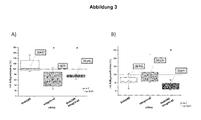
- Fig. 3 Collagen adhesion and endocytosis after Endo180 and / or integrin ⁇ 2 knockdown.
- Fig. 5 Gene expression analysis of Endo180 in young vs. intrinsically aged skin in vivo.
- the object of the present invention was therefore to find ways that avoid the disadvantages of the prior art.
- Another object of the present invention was to provide skin care preparations and skin care preparations, which preparations should soothe and beautify the body exterior.
- the receptor Endo180 is responsible for the uptake of collagen fragments by fibroblasts. Its expression decreases in photoaged skin. It would be desirable to stimulate the expression of Endo180 in the aging skin as an anti-aging approach.
- substance (s) selected from the following group with fused / condensed bicyclic compounds Caffeine (58-08-2), tocopherol (10191-41-0) and (-) - catechin (18829-70-4) stimulate the expression of Endo180.
- one or more substance (s) selected from the group consisting of fused / condensed bicyclic compounds Caffeine (58-08-2), tocopherol (10191-41-0) and (-) - catechin (18829-70-4) for smoothing the skin and / or the contours of the skin an advantageous embodiment of the present invention.
- Particularly advantageous active ingredients used according to the invention are tocopherol (10191-41-0) and (-) - catechin (18829-70-4).
- preparations according to the invention having a cosmetically effective content of one or more active ingredients used according to the invention - eg. B. in the form of the examples mentioned - leads to a surprising improvement in the appearance of the aged skin.
- Cosmetic or dermatological preparations according to the invention preferably contain from 0.00001 to 50% by weight, preferably from 0.001 to 20% by weight, of one or more active ingredients used according to the invention, based on the total weight of the preparation.
- the cosmetic or dermatological preparations according to the invention may be composed as usual and serve for the treatment, care and cleansing of the skin. They preferably contain 0.002-10.0% by weight, more preferably 0.002-5.0% by weight, very preferably 0.005-3.0% by weight, based on the total weight of the preparations, of one or more according to the invention used active ingredients.
- Emulsions are advantageous dosage forms in the sense of the present invention, e.g. in the form of a cream, a lotion, a cosmetic milk are advantageous and contain e.g. Fats, oils, waxes and / or other fatty substances, as well as water and one or more emulsifiers, as they are commonly used for such a type of formulation.
- Medicinal topical compositions according to the present invention usually contain one or more drugs in effective concentration.
- drugs for the sake of simplicity, reference is made to the clear distinction between cosmetic and medical use and corresponding products to the statutory provisions of the Federal Republic of Germany (for example, Cosmetics Regulation, Food and Medicines Act).
- mixtures of the abovementioned solvents are used.
- alcoholic solvents water can be another ingredient.
- the oil phase of the emulsions, oleogels or hydrodispersions or lipodispersions in the context of the present invention is advantageously selected from the group of esters of saturated and / or unsaturated, branched and / or unbranched alkanecarboxylic acids having a chain length of 3 to 30 carbon atoms and saturated and / or or unsaturated, branched and / or unbranched alcohols having a chain length of 3 to 30 carbon atoms, from the Group of esters of aromatic carboxylic acids and saturated and / or unsaturated, branched and / or unbranched alcohols having a chain length of 3 to 30 carbon atoms.
- ester oils can then be advantageously selected from the group isopropyl myristate, isopropyl palmitate, isopropyl stearate, isopropyl oleate, n-butyl stearate, n-hexyl laurate, n-decyl oleate, isooctyl stearate, isononyl stearate, isononyl isononanoate, 2-ethylhexyl palmitate, 2-ethylhexyl laurate, 2-hexyldecyl stearate, 2 Octyldodecyl palmitate, oleyl oleate, oleyl erucate, erucyl oleate, erucyl erucate and synthetic, semi-synthetic and natural mixtures of such esters, for example jojoba oil.
- the oil phase can be advantageously selected from the group of branched and unbranched hydrocarbons and waxes, the silicone oils, the dialkyl ethers, the group of saturated or unsaturated, branched or unbranched alcohols, and the fatty acid triglycerides, namely the triglycerol esters of saturated and / or unsaturated, branched and / or unbranched alkanecarboxylic acids of a chain length of 8 to 24, in particular 12 to 18 carbon atoms.
- the fatty acid triglycerides can be advantageously selected from the group of synthetic, semi-synthetic and natural oils, e.g. Olive oil, sunflower oil, soybean oil, peanut oil, rapeseed oil, almond oil, palm oil, coconut oil, palm kernel oil, and the like.
- Gels used according to the invention usually contain alcohols of low carbon number, for example ethanol, isopropanol, 1,2-propanediol, glycerol and water or an abovementioned oil in the presence of a thickener, which in oily-alcoholic gels preferably silica or an aluminum silicate, aqueous alcoholic or alcoholic gels preferably a polyacrylate.
- alcohols of low carbon number for example ethanol, isopropanol, 1,2-propanediol, glycerol and water or an abovementioned oil in the presence of a thickener, which in oily-alcoholic gels preferably silica or an aluminum silicate, aqueous alcoholic or alcoholic gels preferably a polyacrylate.
- Fixed pins contain e.g. natural or synthetic waxes, fatty alcohols or fatty acid esters.
- liquid oils for example paraffin oils, castor oil, isopropyl myristate
- semi-solid constituents eg petrolatum, lanolin
- solid constituents eg beeswax, ceresin and microcrystalline waxes or Ozokerite
- high-melting waxes eg carnauba wax, candelilla wax
- Suitable propellants for sprayable from aerosol containers cosmetic and / or dermatological preparations in the context of the present invention the usual known volatile, liquefied propellants, such as hydrocarbons (propane, butane, isobutane) are suitable, which can be used alone or in mixture with each other. Also, compressed air is advantageous to use.
- hydrocarbons propane, butane, isobutane
Landscapes
- Health & Medical Sciences (AREA)
- Life Sciences & Earth Sciences (AREA)
- Animal Behavior & Ethology (AREA)
- General Health & Medical Sciences (AREA)
- Public Health (AREA)
- Veterinary Medicine (AREA)
- Birds (AREA)
- Epidemiology (AREA)
- Gerontology & Geriatric Medicine (AREA)
- Dermatology (AREA)
- Cosmetics (AREA)
- Pharmaceuticals Containing Other Organic And Inorganic Compounds (AREA)
Abstract
Description
- Die Erfindung umfasst kosmetische und dermatologische Zubereitungen enthaltend eine oder mehrere Substanz(en) die das Gen / Protein für den Rezeptor Endo180 modulieren, insbesondere solche Zubereitungen zur Verwendung auf der Haut eines Menschen zur Reparatur und Regeneration der menschlichen Haut, insbesondere zur verbesserten Hautkonturierung bzw. gegen alterungsbedingte Hautfaltenbildung.
- Unter Kosmetik kann man alle Maßnahmen zusammenfassen, die aus ästhetischen Gründen Veränderungen an Haut und Haaren vornehmen oder zur Körperreinigung angewendet werden. Kosmetik bedeutet also, das Körperäußere zu pflegen, zu verbessern und zu verschönern, um auf sichtbare, fühlbare und riechbare Weise sowohl den Mitmenschen als auch sich selbst zu gefallen.
- Ziel der Hautpflege ist es ferner, den durch tägliches Waschen verursachten Fett- und Wasserverlust der Haut auszugleichen. Dies ist gerade dann wichtig, wenn das natürliche Regenerationsvermögen nicht ausreicht. Außerdem sollen Hautpflegeprodukte vor Umwelteinflüssen, insbesondere vor Sonne und Wind, schützen und die Hautalterung verzögern.
- Die chronologische Hautalterung wird z.B. durch endogene, genetisch determinierte Faktoren verursacht. In Epidermis und Dermis kommt es alterungsbedingt z.B. zu folgenden Strukturschäden und Funktionsstörungen:
- a) Trockenheit, Rauhigkeit und Ausbildung von Trockenheitsfältchen,
- b) Juckreiz
- c) dünnere Haut
- d) verringerte epidermale Zellteilungsrate
- e) verringerter Energiestoffwechsel und
- f) verminderte Rückfettung durch Talgdrüsen (z.B. nach Waschen).
- Exogene Faktoren, wie UV-Licht und chemische Noxen, können kumulativ wirksam sein und z.B. die intrinsischen Alterungsprozesse beschleunigen bzw. sie ergänzen. In Epidermis und Dermis kommt es insbesondere durch exogene Faktoren z.B. zu folgenden Strukturschäden- und Funktionsstörungen in der Haut, die über Maß und Qualität der Schäden bei chronologischer Alterung hinausgehen:
- g) Sichtbare Gefäßerweiterungen (Teleangiektasien, Cuperosis);
- h) Schlaffheit und Ausbildung von Falten;
- i) lokale Hyper-, Hypo- und Fehlpigmentierungen (z.B. Altersflecken) und
- j) vergrößerte Anfälligkeit gegenüber mechanischem Stress (z.B. Rissigkeit).
- Die vorliegende Erfindung betrifft insbesondere Produkte zur Pflege der auf natürliche Weise gealterten Haut (intrinsische und extrinsische Hautalterung), sowie der unter a), c), e), h) und j) aufgeführten Phänomene.
- Produkte zur Pflege erschlaffter, insbesondere gealterter Haut sind an sich bekannt. Sie enthalten z.B. Retinoide (Vitamin A-Säure und/oder deren Derivate) bzw. Vitamin A und/oder dessen Derivate. Ihre Wirkung auf die Strukturschäden ist allerdings umfangsmäßig begrenzt. Darüber hinaus gibt es bei der Produktentwicklung erhebliche Schwierigkeiten, die Wirkstoffe in ausreichendem Maße gegen oxidativen Zerfall zu stabilisieren. Die Verwendung Vitamin A-Säure-haltiger Produkte bedingt darüber hinaus oft starke erythematöse Hautreizungen. Retinoide sind daher nur in geringen Konzentrationen einsetzbar.
- Bei der Alterung des menschlichen Körpers kommt es in vielen Organen zu einer Verlangsamung von Stoffwechselaktivitäten. So bauen bspw. im Knochen spezielle Zellen - die Osteoklasten - Knochenmasse ab und ihre Gegenspieler - die Osteoblasten - Knochenmasse auf. Es dauert im Durchschnitt 200 Tage bis das gesamte Knochenkalzium eines Erwachsenen einmal komplett ausgetauscht wurde. Allerdings lässt der Knochenstoffwechsel mit zunehmendem Alter nach: Ab dem 35. Lebensjahr verliert der Mensch durchschnittlich 1,5 % Knochenmasse pro Jahr. Ähnlich verhält es sich in der Haut. Die Zellen der oberen Hautschicht (Epidermis) erneuern sich durch Differenzierung der Keratinozyten zu Korneozyten und Abschilfern innerhalb von ca. 28 Tagen bei jungen Menschen. Im Alter dauert der Prozess bis zu 50 Tage.
- Das Hauptbindegewebsprotein Kollagen, welches der Haut Spannkraft und Zugfestigkeit verleiht, unterliegt auch einem Stoffwechsel, angefangen bei der Kollagen-Synthese über die - Fibrillogenese bishin zur -Degradation und -Endocytose. Der Kollagen-Umsatz ist ein relativ langsamer Prozess, denn es sind Halbwertzeiten für Kollagen von 10-15 Jahren beschrieben (Verzijl et al, 2000).
- Kollagen ist das prominenteste Protein in der menschlichen Haut und macht ca. 85 % der Gesamtproteinmenge aus. Damit haben die Kollagenfasern einen entscheidenden Einfluss auf das äußere Erscheinungsbild der Haut.
- Der Kollagenumsatz in der Haut hängt von der Balance zwischen der Neubildung und dem Abbau des Kollagens ab. Durch die intrinsische und insbesondere extrinsische Hautalterung kommt es zu einer verminderten Kollagen-Synthese und einem verstärkten Abbau durch Kollagen degradierende Enzyme wie die Matrixmetalloproteasen (MMPs). Dadurch wird die Balance gestört, und es kommt zu einem Verlust an dermalem Kollagen, was zur Faltenbildung und nachlassenden Spannkraft der Altershaut beiträgt. Im Alter wird ein jährlicher Verlust von ca. 1 % der Collagenmenge in der Haut beschrieben (Shuster et al, 1975).
- Die Integrität des Kollagens und anderer Bestandteile der Extrazellulären Matrix (ECM) hat einen entscheidenden Einfluss auf die Wechselwirkung der Kollagenfasern mit den Fibroblasten, die die verschiedenen Komponenten der ECM synthetisieren können. Fibroblasten besitzen verschiedene Rezeptoren für Kollagen, und zwar insbesondere Integrine, Discoidin Domain Rezeptoren (DDRs) und Mitglieder der Mannose Rezeptorfamilie wie Endo180 (Leitinger und Hohenester, 2007). Die Rezeptoren DDR2 und Endo180 wurden in Hautfibroblasten der Maus in Zusammenhang mit Wundheilungsvorgängen und Remodellierungsvorgängen nachgewiesen (Olaso et al, 2002, Madsen et al, 2007). DDR2 ist eine Rezeptor-Tyrosinkinase, die u.a. für die Fibroblasten Proliferation aber auch für die Kollagen-Fibrillogenese von Bedeutung ist. Endo180 hingegen ist für das endocytotische Entfernen von sowohl intaktem Kollagen als auch Kollagen-Bruchstücken wichtig. Nach der Rezeptor-vermittelten Kollagen-Endocytose fusionieren die entstandenen Vesikel mit Lysosomen, und die Kollagenfragmente werden anschließend durch Cathepsine abgebaut (Rünger et al, 2007). Es gibt Hinweise darauf, dass denaturierte Kollagene besser als native aufgenommen werden. Bei Fibroblasten, die auf denaturiertem Kollagen versus nativem Kollagen kultiviert wurden, zeigen erstere eine erhöhte Kollagen-Aufnahme und COL1A1 Expression (Abraham et al, 2007).
- Während die Rolle verschiedener Integrine auf Fibroblasten (α2β1, α11β1, α1β1) für den Matrix-Abbau und deren Erneuerung schon relativ gut untersucht ist (White et al, 2004), ist es noch weitestgehend unbekannt, inwieweit die nicht-Integrin-Rezeptoren einen Anteil am Kollagenumsatz in gesunder Haut haben.
- Endo180 sowie Integrin α2ß1 sind Rezeptoren auf der Oberfläche von mesenchymalen Zellen wie dermalen Fibroblasten und für die Aufnahme von Kollagen verantwortlich. Es konnte gezeigt werden, dass Endo180 und Integrin α2 in photogealterter Haut bzw. nach akutem UV Stress in vivo herunter reguliert werden (
Abb. 1 ). - A) Genexpressionsanalyse von Endo180 und Integrin α2 in chronisch sonnenexponierter (Nacken) versus sonnengeschützter Haut. Probanden mit einer klinisch diagnostizierten solaren Elastose im Nacken wurden Vollhautbiopsien aus einem sonnenexponierten Areal (Nacken) und einem sonnengeschützten Areal (innerer Oberarm) entnommen. Die mRNA-Werte wurden auf die 18S rRNA-Werte normiert. n=8. B) Genexpressionsanalyse von Endo180 und Integrin α2 nach akutem UV Stress (2 Minimal Erythemal Dose (MED)) in vivo. Nach 24h und 48h wurden Vollhautstanzen (Gesäß) für die Analyse entnommen. Als Kontrolle dienten Stanzbiopsien aus unbestrahlten Arealen. Die mRNA-Werte wurden auf die 18S rRNA-Werte normiert. Dargestellt ist die Expression der Rezeptoren zu den jeweiligen Zeitpunkten nach Bestrahlung. n=31
- In vitro konnten diese Ergebnisse mir SSR (solar simulated radiation) bestrahlten humanen primären Fibroblasten nachvollzogen werden. Auch hier führt der UV-Stress zu einer verminderten Genexpression von Endo180 und Integrin α2 sowie einer verringerten Kollagenaufnahme durch die Zellen (
Abb. 2 ). - A) Expressionsprofil der Kollagenrezeptoren Endo180 und Integrin α2 nach SSR-Bestrahlung (135 mJ/cm2) nach 6h, 24h und 48h. Die Darstellung ist bezogen auf die unbehandelte Kontrolle. Die mRNA-Werte wurden auf die 18S rRNA-Werte normiert. B) Analyse der Kollagen-Internalisierung mittels Durchflusszytometrie. Einen Tag nach SSR-Bestrahlung (135 mJ/cm2) wurden die Zellen 24h mit Kollagen-Fluoreszein [25 µg/ml] inkubiert und der Anteil an Zellen bestimmt, die Kollagen-Fluoreszein aufgenommen haben. Als Kontrolle dienten unbestrahlte Zellen. Es zeigte sich, dass die Kollagenaufnahme nach SSR-Bestrahlung um ca. 30 % reduziert war. n=6 Knockdown Experimente in Fibroblasten zeigten, dass Endo180 essentiell für die Kollagenaufnahme ist, während Integrin α2 wichtig für die initiale Bindung von Kollagen ist und somit dessen Aufnahme erleichtert (
Abb. 3 ). - Analyse der Kollagen-Fluoreszein-Bindung bzw. -Aufnahme mittels Durchflusszytometrie. Sechs Tage nach siRNA-Transfektion wurden die knockdown Zellen trypsinisiert und neu ausgesät. Nach 5 Stunden wurde Kollagen-Fluoreszein [25 µg/ml] zu den Fibroblasten gegeben. Nach einer 24-stündigen Inkubation wurde der Anteil an Zellen bestimmt, die Kollagen-Fluoreszein oberflächlich gebunden bzw. aufgenommen haben. Als Kontrolle dienten Fibroblasten, die mit einem Non-Targeting Pool transfiziert wurden (= 100 %). A) Es zeigte sich, dass die Kollagenbindung in Integrin α2 knockdown Fibroblasten um 45 % reduziert war. In Endo180-/Integrin α2 Doppel-knockdown Fibroblasten war die Kollagenbindung um ca. 25 % reduziert. Der Endo180 knockdown alleine zeigte im Mittel keinen Effekt. B) Es zeigte sich, dass die Kollagenaufnahme in Endo180 knockdown Fibroblasten um ca. 35 % reduziert war. In Endo180-/Integrin α2 knockdown Fibroblasten war die Kollagenaufnahme um ca. 60 % reduziert. Der Integrin α2 knockdown alleine zeigte im Mittel keinen Effekt. nEndo180=6, nITGA2, Endo180/ITGA2=7
- Damit wird folgendes abgeleitet:
- ▪ Durch UV werden MMPs induziert
- ▪ Kollagen wird degradiert
- ▪ Endo180 und Integrin α2 werden reprimiert
- ▪ Der Fibroblast wird perizellulär von degradiertem Kollagen umgeben
- ▪ Verlust der Zell-Matrix-Kontakte
- Auf einer Posterpräsentation (
Abbildung 4 ) beim "Annual Meeting of the Society for Investigative Dermatology" 2012 wurde eine Stimulation der Endo180 Expression in gealterter Haut von der Arbeitsgruppe um Fisher gezeigt. Hier wird jedoch nicht darauf eingegangen, ob es sich um chronologisch oder photogealterte Haut handelt. - Die der vorliegenden Erfindung zugrundeliegenden Daten zeigen dagegen eine signifikante Inhibition der der Endo180 Expression in photogealterter Haut, während wir in chronologisch gealterter Haut keine Regulation der Endo180 Expression sehen (
Abb. 5 ). - Genexpressionsanalyse von Endo180 in der Haut (Gesäß) von jungen (21-31 Jahre) vs. alten (61-70 Jahre) Spendern. Die mRNA-Werte wurden auf die 18S rRNA-Werte normiert. njung=16, nalt=15
- Aufgabe der vorliegenden Erfindung war es somit, Wege zu finden, die die Nachteile des Standes der Technik vermeiden. Insbesondere war es eine Aufgabe der vorliegenden Erfindung, Zubereitungen zur Verfügung zu stellen, die eine vorteilhafte Straffung erschlaffter Haut bewirken können.
- Eine weitere Aufgabe der vorliegenden Erfindung war es, hautpflegende Zubereitungen und Zubereitungen zur Pflege der Haut zur Verfügung zu stellen, wobei die Zubereitungen das Körperäußere pflegen und verschönern sollten.
- In der vorliegenden Erfindung konnte gezeigt werden, dass der Rezeptor Endo180 verantwortlich für die Aufnahme von Kollagenfragmenten durch Fibroblasten ist. Seine Expression nimmt in photogealterter Haut ab. Es wäre wünschenswert, die Expression von Endo180 in der Altershaut als anti-aging Ansatz zu stimulieren.
- Überraschenderweise konnte in einem in vitro Modell einerseits festgestellt werden, dass eine oder mehrere Substanz(en), gewählt aus folgender Gruppe mit anellierten / kondensierten bizyklischen Verbindungen
Coffein (58-08-2), Tocopherol (10191-41-0) und (-)-Catechin (18829-70-4)
die Expression von Endo180 stimulieren. Diese werden im Rahmen der Offenbarung dieser Erfindung auch mit Begriffen wie "die erfindungsgemäß eingesetzten Wirkstoffe" bezeichnet werden.
Substanz Coffein IUPAC 1,3,7-Trimethyl-1H-purin-2,6(3H,7H)-dion CAS-Nr. 58-08-2 
Substanz Tocopherol IUPAC 2,5,7,8-Tetramethyl-2-(4,8,12-trimethyltridecyl)chroman-6-ol CAS-Nr. 10191-41-0 
Substanz (-)-Catechin IUPAC (2S,3R)-2-(3,4-Dihydroxyphenyl)chroman-3,5,7-triol CAS-Nr. 18829-70-4 - Der Einsatz dieser stimulierenden Substanzen in kosmetischen und dermatologischen Zubereitungen kann zur Verminderung des Erscheinungsbilds gealterter Haut (z.B. Faltenbildung, Verlust der Hautfestigkeit) führen.
- Erfindungsgemäß ist daher die Verwendung von einer oder mehreren Substanz(en), gewählt aus folgender Gruppe mit anellierten / kondensierten bizyklischen Verbindungen
Coffein (58-08-2), Tocopherol (10191-41-0) und (-)-Catechin (18829-70-4)
geeignet zur Stimulierung der Expression von Endo180. - Insbesondere ist die Verwendung von einer oder mehreren Substanz(en), gewählt aus folgender Gruppe mit anellierten / kondensierten bizyklischen Verbindungen
Coffein (58-08-2), Tocopherol (10191-41-0) und (-)-Catechin (18829-70-4)
zur Glättung der Haut und/oder der Hautkonturen
eine vorteilhafte Ausführungsart der vorliegenden Erfindung. - Besonders vorteilhafte erfindungsgemäß eingesetzte Wirkstoffen sind Tocopherol (10191-41-0) und (-)-Catechin (18829-70-4).
Tab. 1: Humane dermale Fibroblasten wurden für drei Tage mit der jeweiligen Substanz [10 µM] inkubiert. Als Kontrolle dienten unbehandelte Zellen. Anschließend wurde die Endo180 Expression mittels Antikörper-Nachweis im Cell Western gemessen und quantifiziert. Zur Normierung der Werte wurden die Zellen mit DRAQ5/Sapphire700 gefärbt. Die Kontrolle wird als 100 % dargestellt. Leicht Endo180 stimulierende Substanzen zeigen einen Wert von 105 - 109 %, stimulierende Substanzen 110-114 % und stark stimulierende Substanzen ≥115%. Substanz CAS Ergebnis [%] Coffein 58-08-2 107 Tocopherol 10191-41-0 111 (-)-Catechin 18829-70-4 119 - Die Verwendung erfindungsgemäßer Zubereitungen mit einem kosmetisch wirksamen Gehalt an einem oder mehreren erfindungsgemäß eingesetzten Wirkstoffen - z. B. in Form der genannten Beispiele - führt in überraschender Weise zu einer erheblichen Verbesserung des Aussehens der gealterten Haut.
- Es war überraschend, dass durch Anwenden von Zubereitungen gemäß der Erfindung die Hautfestigkeit verbessert wird.
- Bevorzugt enthalten kosmetische oder dermatologische Zubereitungen gemäß der Erfindung 0,00001 bis 50 Gew.-%, bevorzugt 0,001 bis 20 Gew.-%, an einem oder mehreren erfindungsgemäß eingesetzten Wirkstoffen, bezogen auf das Gesamtgewicht der Zubereitung.
- Die erfindungsgemäßen kosmetischen oder dermatologischen Zubereitungen können wie üblich zusammengesetzt sein und zur Behandlung, der Pflege und der Reinigung der Haut dienen. Sie enthalten bevorzugt 0,002 - 10,0 Gew.-%, besonders bevorzugt 0,002 - 5,0 Gew.-%, ganz besonders bevorzugt 0,005 - 3,0 Gew.-%, bezogen auf das Gesamtgewicht der Zubereitungen, an einem oder mehreren erfindungsgemäß eingesetzten Wirkstoffen.
- Emulsionen sind vorteilhafte Darreichungsformen im Sinne der vorliegenden Erfindung, z.B. in Form einer Creme, einer Lotion, einer kosmetischen Milch sind vorteilhaft und enthalten z.B. Fette, Öle, Wachse und/oder andere Fettkörper, sowie Wasser und einen oder mehrere Emulgatoren, wie sie üblicherweise für einen solchen Typ der Formulierung verwendet werden.
- Medizinische topische Zusammensetzungen im Sinne der vorliegenden Erfindung enthalten in der Regel ein oder mehrere Medikamente in wirksamer Konzentration. Der Einfachheit halber wird zur sauberen Unterscheidung zwischen kosmetischer und medizinischer Anwendung und entsprechenden Produkten auf die gesetzlichen Bestimmungen der Bundesrepublik Deutschland verwiesen (z.B. Kosmetikverordnung, Lebensmittel- und Arzneimittelgesetz).
- Es ist dabei ebenfalls von Vorteil, den erfindungsgemäß verwendeten Wirkstoff als Zusatzstoff zu Zubereitungen zu geben, die bereits andere Wirkstoffe für andere Zwecke enthalten.
- Sofern die kosmetische oder dermatologische Zubereitung im Sinne der vorliegenden Erfindung eine Lösung oder Emulsion oder Dispersion darstellt, können als Lösungsmittel verwendet werden:
- Wasser oder wässrige Lösungen
- Öle, wie Triglyceride der Caprin- oder der Caprylsäure, vorzugsweise aber Rizinusöl;
- Fette, Wachse und andere natürliche und synthetische Fettkörper, vorzugsweise Ester von Fettsäuren mit Alkoholen niedriger C-Zahl, z.B. mit Isopropanol, Propylenglykol oder Glycerin, oder Ester von Fettalkoholen mit Alkansäuren niedriger C-Zahl oder mit Fettsäuren;
- Alkohole, Diole oder Polyole niedriger C-Zahl, sowie deren Ether, vorzugsweise Ethanol, Isopropanol, Propylenglykol, Glycerin, Ethylenglykol, Ethylenglykolmonoethyl- oder -monobutylether, Propylenglykolmonomethyl, -monoethyl- oder -monobutylether, Diethylenglykolmonomethyl- oder -monoethylether und analoge Produkte.
- Insbesondere werden Gemische der vorstehend genannten Lösungsmittel verwendet. Bei alkoholischen Lösungsmitteln kann Wasser ein weiterer Bestandteil sein.
- Die Ölphase der Emulsionen, Oleogele bzw. Hydrodispersionen oder Lipodispersionen im Sinne der vorliegenden Erfindung wird vorteilhaft gewählt aus der Gruppe der Ester aus gesättigten und/oder ungesättigten, verzweigten und/oder unverzweigten Alkancarbonsäuren einer Kettenlänge von 3 bis 30 C-Atomen und gesättigten und/oder ungesättigten, verzweigten und/oder unverzweigten Alkoholen einer Kettenlänge von 3 bis 30 C-Atomen, aus der Gruppe der Ester aus aromatischen Carbonsäuren und gesättigten und/oder ungesättigten, verzweigten und/oder unverzweigten Alkoholen einer Kettenlänge von 3 bis 30 C-Atomen. Solche Esteröle können dann vorteilhaft gewählt werden aus der Gruppe Isopropylmyristat, Isopropylpalmitat, Isopropylstearat, Isopropyloleat, n-Butylstearat, n-Hexyllaurat, n-Decyloleat, Isooctylstearat, Isononylstearat, Isononylisononanoat, 2-Ethylhexylpalmitat, 2-Ethylhexyllaurat, 2-Hexyldecylstearat, 2-Octyldodecylpalmitat, Oleyloleat, Oleylerucat, Erucyloleat, Erucylerucat sowie synthetische, halbsynthetische und natürliche Gemische solcher Ester, z.B. Jojobaöl.
- Ferner kann die Ölphase vorteilhaft gewählt werden aus der Gruppe der verzweigten und unverzweigten Kohlenwasserstoffe und -wachse, der Silkonöle, der Dialkylether, der Gruppe der gesättigten oder ungesättigten, verzweigten oder unverzweigten Alkohole, sowie der Fettsäuretriglyceride, namentlich der Triglycerinester gesättigter und/oder ungesättigter, verzweigter und/oder unverzweigter Alkancarbonsäuren einer Kettenlänge von 8 bis 24, insbesondere 12 - 18 C-Atomen. Die Fettsäuretriglyceride können beispielsweise vorteilhaft gewählt werden aus der Gruppe der synthetischen, halbsynthetischen und natürlichen Öle, z.B. Olivenöl, Sonnenblumenöl, Sojaöl, Erdnußöl, Rapsöl, Mandelöl, Palmöl, Kokosöl, Palmkernöl und dergleichen mehr.
- Die wässrige Phase der erfindungsgemäßen Zubereitungen enthält gegebenenfalls vorteilhaft
- Alkohole, Diole oder Polyole niedriger C-Zahl, sowie deren Ether, vorzugsweise Ethanol, Isopropanol, Propylenglykol, Glycerin, Ethylenglykol, Ethylenglykolmonoethyl- oder -monobutylether, Propylenglykolmonomethyl, -monoethyl- oder -monobutylether, Diethylenglykolmonomethyl- oder -monoethylether und analoge Produkte, ferner Alkohole niedriger C-Zahl, z.B. Ethanol, Isopropanol, 1,2-Propandiol, Glycerin sowie insbesondere ein oder mehrere Verdickungsmittel, welches oder welche vorteilhaft gewählt werden können aus der Gruppe Siliciumdioxid, Aluminiumsilikate, Polysaccharide bzw. deren Derivate, z.B. Hyaluronsäure, Xanthangummi, Hydroxypropylmethylcellulose, besonders vorteilhaft aus der Gruppe der Polyacrylate, bevorzugt ein Polyacrylat aus der Gruppe der sogenannten Carbopole, beispielsweise Carbopole der Typen 980, 981, 1382, 2984, 5984, jeweils einzeln oder in Kombination.
- Erfindungsgemäß verwendete Gele enthalten üblicherweise Alkohole niedriger C-Zahl, z.B. Ethanol, Isopropanol, 1,2-Propandiol, Glycerin und Wasser bzw. ein vorstehend genanntes Öl in Gegenwart eines Verdickungsmittels, das bei ölig-alkoholischen Gelen vorzugsweise Siliciumdioxid oder ein Aluminiumsilikat, bei wäßrig-alkoholischen oder alkoholischen Gelen vorzugweise ein Polyacrylat ist.
- Feste Stifte enthalten z.B. natürliche oder synthetische Wachse, Fettalkohole oder Fettsäureester.
- Übliche Grundstoffe, welche für die Verwendung als kosmetische Stifte im Sinne der vorliegenden Erfindung geeignet sind, sind flüssige Öle (z.B. Paraffinöle, Ricinusöl, Isopropylmyristat), halbfeste Bestandteile (z.B. Vaseline, Lanolin), feste Bestandteile (z.B. Bienenwachs, Ceresin und Mikrokristalline Wachse bzw. Ozokerit) sowie hochschmelzende Wachse (z.B. Carnaubawachs, Candelillawachs).
- Als Treibmittel für aus Aerosolbehältern versprühbare kosmetische und/oder dermatologische Zubereitungen im Sinne der vorliegenden Erfindung sind die üblichen bekannten leichtflüchtigen, verflüssigten Treibmittel, beispielsweise Kohlenwasserstoffe (Propan, Butan, Isobutan) geeignet, die allein oder in Mischung miteinander eingesetzt werden können. Auch Druckluft ist vorteilhaft zu verwenden.
- Die nachfolgenden Beispiele sollen die vorliegende Erfindung verdeutlichen, ohne sie einzuschränken. Alle Mengenangaben, Anteile und Prozentanteile sind, soweit nicht anders angegeben, auf das Gewicht und die Gesamtmenge bzw. auf das Gesamtgewicht der Zubereitungen bezogen.
Rezepturbeispiel 1 2 3 4 INCI - Bezeichnung Gew.-% Gew.-% Gew.-% Gew.-% Stearinsäure 2,5 2,0 2,0 2,5 Glyceryl Stearat 1,0 1,0 1,0 1,0 C12-15 Alkyl Benzoat 3,0 5,00 3,0 2,0 Caprylsäure/Caprinsäure Triglyceride 2,5 2,50 2,0 2,5 Isopropyl Palmitat 2,0 - - 2,0 CetylStearylalkohol 3,0 - 2,0 3,0 Cetyl Alkohol - 2,00 - - Stearyl Alkohol - 2,00 1,0 - Cyclomethicon 1,0 1,0 0,5 - Dicaprylyl Carbonate 2,0 2,00 2,00 2,0 Dimethicon 1,0 - 0,5 1,0 Glycerin 5, 7,0 5,0 9,0 Methylparaben 0,2 - - - Phenoxyethanol 0,4 0,50 0,5 0,4 Propylparaben 0,1 - - 0,1 1,2-Hexandiol - - 0,1 0,1 Ethylhexylglycerin - - 0,2 - Methylisothiazolinon - 0,05 - - Butylenglykol - - 2,0 - Carbomer 0,15 0,10 0,15 0,1 Carrageenan 0,10 - 0,10 - Xanthan Gummi - - 0,10 - Acrylates/C10-30 Alkyl Acrylate Crosspolymer - 0,10 - 0,1 Trinatrium EDTA 0,20 0,20 0,2 0,2 Tapioka Stärke 1,5 1,0 - Nylon-12 - 0,2 - 0,5 Polymethylsissesquioxane - 1,0 1,0 - Aluminum Stärke Octenylsuccinat - - 1,0 - Distärkephosphat 1,0 - - 1,0 Butyl Methoxydibenzoylmethane 1,00 2,00 1,00 1,00 Phenylbenzimidazole Sulfonic Acid - 1,00 2,00 - Octocrylene - 2,00 1,00 - Ethylhexyl Salicylate 1,00 - - 1,00 Natriumhydroxid q.s. q.s. q.s. q.s. Coffein 0,1 - - 0,05 Tocopherol 0,005 0,01 - 0,05 (-)-Catechin - 0,005 0,01 - Parfüm 0,3 0,2 0,2 0,2 Natriumhydroxid q.s. q.s. q.s. q.s. Wasser ad 100 ad 100 ad 100 ad 100 Rezepturbeispiel 5 6 7 8 INCI - Bezeichnung Gew.-% Gew.-% Gew.-% Gew.-% Glyceryl Stearate Citrat 2,0 1,5 2,0 2,0 Behenyl Alkohol 1,5 1,0 1,0 1,0 C12-15 Alkyl Benzoat 2,0 2,5 2,0 2,5 Caprylsäure/Caprinsäure Triglyceride 2,0 2,0 2,5 2,5 Cetyl Alkohol 2,0 2,0 - 2,0 Cetylstearylalkohol - - 2,0 - Cyclomethicon 1,0 1,0 2,0 2,0 Dicaprylyl Carbonat - 2,0 2,5 2,5 Paraffinum Liquidum - - 0,5 - Octyldodecanol - 2,0 - - Dimethicon 0,5 1,00 1,00 - Glycerin 3,00 5,00 7,00 9,00 Methylparaben 0,20 0,15 - - Phenoxyethanol 0,40 0,60 0,5 0,50 Propylparaben 0,10 - - - Methylisothiazolinon - - 0,05 - Piroctone Olamine - - - 0,15 Glyceryl Caprylate - - - 0,2 Carbomer 0,20 - 0,15 0,15 Natrium Polyacrylate - 0,4 - - Xanthan Gummi 0,10 - 0,10 - Acrylates/C10-30 Alkyl Acrylate Crosspolymer - 0,1 - 0,1 Tapioka Stärke 0,50 - 0,50 - Nylon-12 1,0 - - 1,0 Polymethylsissesquioxane - 1,0 1,0 - Aluminum Stärke Octenylsuccinat - 1,0 - 1,00 Glycyrrhiza Inflata Root Extract 0,03 0,05 0,05 0,03 Titandioxid - 1,0 - - Octocrylene - 1,0 - 2,0 Bis-Ethylhexyloxyphenol Methoxyphenyl Triazines - 1,0 1,0 - 2-Ethylhexyl Methoxycinnamate - 1,0 2,0 2,0 Homosalat (3,3,5-Trimethyl-cyclohexylsalicylat) - - 1,0 1,0 Natriumhydroxid q.s. q.s. q.s. q.s. Coffein 0,1 - q.s. q.s. Tocopherol - 0,005 - - (-)-Catechin - - 0,01 - Parfüm 0,1 0,2 0,3 0,2 Wasser ad 100 ad 100 ad 100 ad 100 Rezepturbeispiele 9 10 11 12 INCI - Bezeichnung Gew.-% Gew.-% Gew.-% Gew.-% Polyglyceryl-3 Methylglucose Distearate 2,00 2,50 2,50 2,50 Sorbitan Stearate 1,50 3,00 1,50 3,00 C12-15 Alkyl Benzoate 2,50 2,50 2,50 2,50 Caprylsäure/Caprinsäure Triglyceride 2,50 2,50 2,50 2,50 Stearyl Alcohol 1,00 1,50 1,00 1,50 Cyclomethicone 3,00 1,00 2,00 1,00 Isopropyl Myristat - 2,50 2,0 2,50 Isopropyl Palmitat 2,0 - 1,0 - Dimethicone - 1,00 - 1,00 Glycerin 5,00 7,50 3,00 7,50 Butyrospermum Parkii Butter 2,0 - - - Methylparaben 0,20 0,20 - 0,1 Phenoxyethanol 0,40 0,40 0,40 0,40 Propylparaben 0,10 - - - Benzethonium chlorid - - 0,1 - Caprylyl Glycol - 0,2 - - Ethylhexylglycerin - 0,2 - 0,2 Carbomer 0,15 0,10 0,15 0,10 Ammonium Acryloyldimethyltaurate/VP Copolymer - 0,2 - 0,2 Carrageenan 0,1 - 0,15 - Trisodium EDTA - 1,00 - 1,00 Tapioka Stärke - 1,00 1,0 - Distärke Phosphat - 1,00 - 1,0 Acrylonitrile-methacrylonitrile-methyl-methacrylate Copolymer + Isopentane + Magnesium Hydroxide - - 1,0 1,0 Diethylamino Hydroxybenzoyl Hexyl Benzoate - - 1,0 - Ethylhexyl Methoxycinnamate - 1,00 - 2,00 Butyl Methoxydibenzoylmethane - 2,00 - 2,00 Octocrylen - 1,00 2,0 1,00 Titandioxid - - 1,0 - Natrium Hydroxid q.s. q.s. q.s. q.s. Ubiquinone 0,1 - - - Natrium Metabisulfite - 0,15 - - BHT (tert-Butylhydroxytoluol) - - 0,05 - Coffein 0,05 - - - Tocopherol - 0,05 - - (-)-Catechin - - 0,05 - Parfüm q.s. q.s. q.s. q.s. Wasser ad 100 ad 100 ad 100 ad 100 Rezepturbeispiele 13 14 15 16 INCI - Bezeichnung Gew.-% Gew.-% Gew.-% Gew.-% PEG-40 Stearate 0,80 1,00 1,00 1,00 Glyceryl Stearate 2,50 3,00 3,00 3,00 C12-15 Alkyl Benzoate 2,00 2,50 2,00 2,00 Caprylsäure/Caprinsäure Triglyceride 2,00 2,50 2,50 2,00 Cetylstearylalkohol 3,00 3,00 3,00 3,00 Cyclomethicone 2,00 2,00 2,00 2,00 Dicaprylyl Carbonate - 2,00 2,50 2,50 Octyldodecanol 1,0 - - 1,50 Butyrospermum Parkii Butter 2,0 - - - Octyldodecyl Myristate 1,0 - 1,5 1,0 Dimethicone 1,00 1,00 1,00 1,00 Glycerin 7,50 5,0 9,0 7,50 Methylparaben 0,20 - 0,1 - Phenoxyethanol 0,40 0,50 0,40 0,40 Propylparaben 0,10 - - - Glyceryl Caprylate - 0,25 - - Pentylenglykol - 0,5 - - Butylenglykol - - 3,0 - Carbomer 0,15 0,10 0,10 0,15 Sodium Polyacrylate - 0,20 0,20 - Xanthan Gummi 0,10 - - - Acrylates/C10-30 Alkyl Acrylate Crosspolymer - - - 0,1 Trisodium EDTA + Wasser (20%ige wässrige Lösung) - 1,00 1,00 1,00 Tapioca Stärke - 1,00 1,00 1,00 Distärke phosphat - 1,00 1,00 1,00 Aluminum Stärke Octenylsuccinat 2,0 - - - Acrylonitrile-methacrylonitrile-methyl-methacrylate Copolymer + Isopentane + Magnesium Hydroxide 1,0 - - - Ethylhexyl Methoxycinnamat - 1,00 1,00 2,00 Diethylamino Hydroxybenzoyl Hexyl Benzoat - 1,00 - 1,00 Titaniumdioxid - - 1,0 - Homosalate (3,3,5-Trimethyl-cyclohexylsalicylat) - - 2,0 - Phenylbenzimidazole Sulfonic Acid 1,0 Natrium Metabisulfite 0,1 - - - Natriumhydroxid q.s. q.s. q.s. q.s. Coffein 0,01 - - - Tocopherol - 0,05 - - (-)-Catechin - - 0,1 - Ascorbylpalmitat 0,1 - - - Parfüm q.s. q.s. q.s. q.s. Wasser ad 100 ad 100 ad 100 ad 100 Rezepturbeispiele 17 18 19 20 INCI - Bezeichnung Gew.-% Gew.-% Gew.-% Gew.-% Glyceryl Stearate Citrat 2,0 2,0 2,0 2,0 Isopropyl Palmitat 3,0 2,0 3,0 1,0 Cetylstearylalkohol 4,0 3,0 3,0 - Cetylalkohol 4,0 Caprylsäure/Caprinsäure Triglyceride 3,0 2,5 2,0 3,0 C12-15 Alkyl Benzoat 3,0 2,5 2,0 2,0 Cyclomethicon 1,0 - 1,0 - Dicaprylyl Carbonat - - 2,5 - Dimethicon - 0,50 - - Octyldodecyl Myristate - 1,0 - - Glycerin 4,00 6,00 5,00 6,00 Methylparaben 0,20 - 0,10 - Phenoxyethanol 0,40 0,40 0,40 0,40 Piroctone Olamine - - - 0,10 Ethylhexylglycerin - 0,3 - - Glyceryl Caprylate - 0,3 - - 2-Methyl-1,3-propandiol - 2,0 - 2,0 Carbomer 0,20 0,10 0,15 - Natrium Polyacrylate - 0,40 - - Xanthan Gummi 0,10 - - 0,15 Acrylates/C10-30 Alkyl Acrylate Crosspolymer - - 0,1 0,2 Acrylonitrile-methacrylonitrile-methyl-methacrylate Copolymer + Isopentane + Magnesium Hydroxide 0,50 - 0,50 - Aluminum Starch Octenylsuccinate - 1,00 - 1,00 Methyl Methacrylate Crosspolymer 1,0 1,0 Bis-Ethylhexyloxyphenol Methoxyphenyl Triazines - 1,0 Titandioxid - 1,00 - 1,00 Octocrylene - 1,00 1,0 1,00 Butyl Methoxydibenzoylmethane - 1,00 - 1,00 Ethylhexyl Salicylate - - 1,0 - Coffein 0,05 - 0,005 - Tocopherol 0,05 0,05 - 0,05 (-)-Catechin - - 0,05 0,05 Natriumhydroxid q.s. q.s. q.s. q.s. Wasser ad 100 ad 100 ad 100 ad 100 Rezepturbeispiele 21 22 23 24 INCI - Bezeichnung Gew.-% Gew.-% Gew.-% Gew.-% Sucrose Polystearate + Hydrogynated Polyisobutene 1,00 1,00 2,00 2,00 Sodium Stearoyl Glutamate 0,20 0,20 0,30 0,30 C12-15 Alkyl Benzoate 1,50 1,50 - - Cetyl Alcohol 0,50 0,50 - - Cyclomethicone 10,00 10,00 5,00 5,00 Dimethicone 3,00 3,00 2,50 2,50 Glycerin 7,50 7,50 5,00 5,00 Isopropyl Stearate 1,00 1,00 2,00 2,00 Paraffinum Liquidum 3,00 3,00 1,00 1,00 Methylparaben 0,10 - - 0,10 Ethylhexylglycerin - - 0,3 0,10 Propylparaben 0,1 - - - Methylisothiazolinon - 0,05 - - Phenoxyethanol 0,40 0,50 0,40 0,40 Ethylhexyl Methoxycinnamate 3,00 2,00 3,00 3,0 Butyl Methoxydibenzoylmethane 2,00 2,00 1,00 1,0 Phenylbenzimidazole Sulfonic Acid - 1,5 - 1,0 Butylenglykol - - 3,0 - Polymethylsissesquioxane - - 1,0 1,0 Nylon-12 - 1,0 1,0 - Distärke Phosphat - 1,0 - 1,0 Methyl Methacrylate Crosspolymer 1,0 - - - Aluminum Starch Octenylsuccinat 1,0 - - - Ammonium Acryloyldimethyltaurate/VP Copolymer - - 0,25 0,25 Xanthan Gummi 0,10 - - 0,1 Acrylates/C10-30 Alkyl Acrylate Crosspolymer 0,25 0,1 - - Carbomer - 0,1 0,1 - Coffein 0,005 0,01 - 0,1 Tocopherol - 0,1 0,5 - (-)-Catechin - - 0,05 0,1 Parfüm 0,2 0,2 0,2 0,2 Natriumhydroxid q.s. q.s. q.s. q.s. Wasser ad 100 ad 100 ad 100 ad 100 Rezepturbeispiele 25 26 27 28 INCI - Bezeichnung Gew.-% Gew.-% Gew.-% Gew.-% Natrium Cetearyl Sulfate 0,15 0,15 0,15 0,15 Glyceryl Stearate SE 2,00 2,00 1,50 1,50 C12-15 Alkyl Benzoate 2,50 2,50 2,50 2,50 Octyldodecanol 1,00 1,00 - - Caprylsäure/Caprinsäure Triglyceride 2,00 2,00 2,00 2,00 Cetylstearylalkohol 2,00 2,00 3,00 1,00 Cyclomethicone 1,50 1,50 2,50 2,50 Dimethicone 0,50 0,50 0,50 0,50 Glycerin 5,00 5,00 7,50 7,50 Isopropyl Stearat 3,00 3,00 2,00 2,00 Paraffinum Liquidum 2,00 2,00 1,00 1,00 Methylisothiazolinon - - - 0,05 Phenoxyethanol 0,4 0,5 0,40 0,30 Methylparaben 0,15 - - - Propylparaben 0,1 - - - Piroctone Olamine - 0,15 - - Benzethonium chlorid - - 0,10 - Ethylhexyl Methoxycinnamate 3,00 3,00 5,00 5,00 Butyl Methoxydibenzoylmethane 1,00 1,00 2,00 2,00 Pentylenglykol - 1,0 1,0 - Butylenglycol 1,0 1,5 3,0 3,0 2-Methyl-1,3-propandiol - - - - 1,2-Hexandiol - - - 1,0 Nylon-12 1,0 1,0 1,0 1,0 Carbomer - - 0,10 0,15 Ammonium Acryloyldimethyltaurate/VP Copolymer 0,20 - - - Chondrus Crispus 0,10 0,10 - - Xanthan Gummi - - 0,10 - Acrylates/C10-30 Alkyl Acrylate Crosspolymer - 0,2 0,1 0,1 Parfüm 0,2 0,2 0,2 0,2 Coffein 0,05 0,05 0,05 0,1 Tocopherol - 0,05 0,1 - (-)-Catechin 0,2 0,05 0,1. 0,05 Natriumhydroxid q.s. q.s. q.s. q.s. Wasser ad 100 ad 100 ad 100 ad 100 Rezepturbeispiele 29 30 31 32 Chemische Bezeichnung Gew.-% Gew.-% Gew.-% Gew.-% Natrium Cetearyl Sulfat 0,15 0,15 0,2 0,2 Glyceryl Stearate, selbstemulgierend 2 2 1,5 1,5 C12-15 Alkyl Benzoat 2 2 2 2 Octyldodecanol 1 1 - - Caprylsäure/Caprinsäure Triglyceride 2 2 2 2 Cetylstearylalkohol 2 2 1 1 Cyclomethicone 1 1 2 2 Dimethicone 0,5 0,5 1 1 Glycerin 5 5 7,5 7,5 Isopropyl Palmitat 2,5 2,5 2 2 DMDM Hydantoin 0,05 0,05 0,05 0,05 Phenoxyethanol 0,35 0,25 0,3 0,3 Ethanol 3,0 2,0 Pentylenglykol 1,0 1,0 1,5 Carbomer 0,2 0,2 0,2 0,2 Carrageenan 0,1 0,1 - - Xanthan Gummi - - 0,2 0,2 Acrylates/C10-30 Alkyl Acrylate Crosspolymer - - - 0,15 Natrium Polyacrylat - 0,2 - - Diethylhexyl 2,6-Naphthalat - - 1,0 - Phenylbenzimidazole Sulfonsäure - 1,0 - 2,0 Titandioxid - - 1,0 - Diethylamino Hydroxybenzoyl Hexyl Benzoate - - 1,0 1,0 Octocrylene - 4,0 2,0 3,0 3,3,5-Trimethylcyclohexylsalicylate 1,0 - - Distärkepjosphat - 1,0 1,0 - Methyl Methacrylate Crosspolymer 1,0 - - 1,0 Polymethylsissesquioxane - - 1,0 1,0 Acrylonitrile-methacrylonitrile-methyl-methacrylate Copolymer + Isopentane + Magnesium Hydroxide 1,0 1,0 - - Coffein - 0,1 0,1 0,5 Tocopherol 0,5 0,5 1,0 2,0 (-)-Catechin 0,05 - 0,005 0,05 Parfüm 0,15 0,15 0,3 0,3 Natriumhydroxid q.s. q.s. q.s. q.s. Wasser ad 100 ad 100 ad 100 ad 100 Rezepturbeispiele 33 34 35 36 INCI - Bezeichnung Gew.-% Gew.-% Gew.-% Gew.-% Natrium Cetearyl Sulfat 0,15 0,15 0,15 0,15 Glyceryl Stearate, selbstemulgierend 1,0 1,0 1,0 1,0 C12-15 Alkyl Benzoat 2,0 2,5 2,0 2,0 Isopropyl Palmitat 3,5 3,0 2,5 3,5 Dimethicon 1,0 1,0 1,0 1,0 Cetylstearylalkohol 1,0 1,0 1,0 1,0 Octyldodecyl Myristate - - - 1,0 Butyrospermum Parkii Butter - - 1,0 - Glycerin 7,0 3,0 9,0 5,0 Carbomer 0,1 0,15 0,1 0,1 Acrylates/C10-30 Alkyl Acrylate Crosspolymer 0,15 0,1 0,1 0,15 Xanthan Gummi 0,15 0,15 0,15 0,15 Phenylbenzimidazole Sulfonsäure 1,0 1,0 - 1,0 Butyl Methoxydibenzoylmethane 1,5 1,5 1,5 1,5 Ethylhexyl Salicylate 2,0 2,5 2,5 2,5 Octocrylene 1,5 1,5 2,5 1,5 TitanDioxide + Trimethoxycaprylylsilan 1,0 - 1,0 - Aluminum Stärke Octenylsuccinat - 1,0 - 0,5 Methyl Methacrylate Crosspolymer 0,5 - 0,5 - Nylon-12 (Puderharz) 0,5 - 1,0 - Tapioka Stärke 0,5 0,5 - 1,0 Phenoxyethanol 0,5 0,5 0,5 0,4 Ethylhexylglycerin 0,25 - 0,25 - 1,2-Hexandiol - 1,0 - 3,0 Caprylyl Glycol - 0,3 0,3 - 2-Methyl-1,2-propandiol 2,0 2,0 2,0 - Coffein 0,1 - 0,1 - Tocopherol - 2,0 - 3,0 (-)-Catechin 0,05 - 0,05 - Natriumhydroxid q.s. q.s. q.s. q.s. Wasser ad 100 ad 100 ad 100 ad 100 Rezepturbeispiele 37 38 39 40 INCI - Bezeichnung Gew.-% Gew.-% Gew.-% Gew.-% Polyglycerly-10 Stearat 0,2 0,20 0,20 0,20 Glyceryl Stearat 3,0 0,50 0,50 0,50 C12-15 Alkyl Benzoat 4,0 2,0 1,5 2,5 Isopropyl Palmitat 4,0 1,0 2,0 2,5 Caprylsäure/Caprinsäure Triglyceride 4,0 3,0 2,0 2,5 Hydrogenated Coco-Glycerides 3,0 - - 2,0 Butyrospermum Parkii Butter 3,0 - 2,5 - Cetylstearylalkohol 5,0 3,5 4,0 3,0 Paraffinum Liquidum - - - 1,0 Glycerin 5,0 3,0 7,0 9,0 Acrylates/C10-30 Alkyl Acrylate Crosspolymer 0,3 0,2 0,15 0,2 Methylisothiazolinone 0,05 - - 0,05 Phenoxyethanol 0,5 0,4 0,4 0,4 Carbomer 0,1 0,15 0,1 0,1 Methylparaben - 0,1 0,1 - Propylparaben - 0,1 - - Nylon-12 (Puderharz) 1,0 0,5 - - Polymethylsissesquioxane - 1,0 0,5 - Methyl Methacrylate Crosspolymer - - 1,0 0,5 Tapioka Stärke 0,5 - - 0,5 Ethanol 3,0 - 2,0 - Hexylsalicylat 0,05 0,005 - - Coffein - 0,5 0,5 - Tocopherol - - 0,5 0,5 (-)-Catechin 0,05 0,05 Parfüm 0,2 0,15 0,3 0,3 Natriumhydroxid q.s. q.s. q.s. q.s. Wasser ad 100 ad 100 ad 100 ad 100 Rezepturbeispiele 41 42 43 44 INCI - Bezeichnung Gew.-% Gew.-% Gew.-% Gew.-% Polyglycerly-10 Stearat 0,2 0,2 0,15 0,15 C12-15 Alkyl Benzoat 2,5 2,5 2,0 3,0 Isopropyl Palmitat 2,5 2,5 2,0 2,0 Caprylsäure/Caprinsäure Triglyceride 2,0 2,5 1,0 2,0 Glyceryl Stearat 1,0 1,0 0,5 0,5 Octyldodecanol 0,5 - - 1,0 Cyclomethicon - - 0,5 0,5 Butyl Methoxydibenzoylmethane - 2,0 2,0 - Octocrylene - 2,0 3,0 2,0 Ethylhexyl Salicylate - 1,0 1,0 - Phenylbenzimidazole Sulfonic Acid - 1,0 - 1,5 Titandioxid - 1,0 - 1,0 3,3,5-Trimethylcyclohexylsalicylate - - 1,0 1,0 Glycerin 9,0 5,0 7,0 7,0 Tapioka Stärke 1,0 1,0 - - Acrylonitrile-methacrylonitrile-methyl-methacry-late Copolymer + Isopentane + Magnesium Hydroxide - 1,0 0,5 - Aluminum Stärke Octenylsuccinat - - 1,0 1,0 Distärkephosphat - - - 1,0 Methylisothiazolinone 0,05 0,05 - - Phenoxyethanol 0,5 0,5 0,4 0,4 Benzethoniumchlorid - - 0,1 - Ethylhexylglycerin - - 0,1 - Methylparaben - - - 0,2 Carbomer 0,25 0,2 0,2 0,2 Acrylates/C10-30 Alkyl Acrylate Crosspolymer 0,2 - - 0,15 Ammonium Acryloyldimethyltaurate/VP Copolymer - 0,25 - - Natrium Polyacrylat - - 0,3 - Xanthan Gummi - - - 0,15 Ethanol 3,0 3,0 - - Butylenglykol - - 2,0 2,0 Cumarin - 0,05 0,05 - Coffein 0,05 0,05 - 0,1 Tocopherol - - 1,0 0,5 (-)-Catechin 0,05 0.05 Parfüm 0,15 0,2 0,25 0,3 Natriumhydroxid q.s. q.s. q.s. q.s. Wasser ad 100 ad 100 ad 100 ad 100 Rezepturbeispiele 45 46 47 48 INCI - Bezeichnung Gew.-% Gew.-% Gew.-% Gew.-% Kalium Cetylphosphat 0,20 0,20 0,25 0,20 C12-15 Alkyl Benzoat 2,5 2,5 2,0 2,0 Isopropyl Palmitat 2,5 2,5 - 3,0 Isopropy Stearat - - 2,0 - Caprylsäure/Caprinsäure Triglyceride 2,5 2,5 1,5 2,0 Glyceryl Stearate 1,0 1,0 1,25 1,5 Octyldodecanol - - 1,5 - Paraffinum Liquidum - - - 1,0 Glycerin 5,0 7,0 9,0 6,0 Bis-Ethylhexyloxyphenol Methoxyphenyl Triazines - 1,0 - 1,0 TitanDioxide + Trimethoxycaprylylsilane - - 1,0 1,0 Phenylbenzimidazole Sulfonic Acid - - 1,0 1,0 Butyl Methoxydibenzoylmethane 1,0 - 2,0 2,0 Dinatrium Phenyl Dibenzimidazol Tetrasulfonat - 1,5 1,0 - Ethylhexyltriazon 1,0 - - - Ethylhexyl Methoxycinnamat + BHT 2,0 - - - Carbomer 0,15 0,2 0,3 Acrylates/C10-30 Alkyl Acrylate Crosspolymer 0,3 0,1 0,15 - Xanthan Gummi 0,15 0,1 Methylisothiazolinone 0,05 - - - Phenoxyethanol 0,5 0,5 0,4 0,4 Methylparaben - 0,1 - - Ethylhexylsalicylat - - 0,3 - Butylenglycol - - 3,0 3,0 Benzethonium chlorid - - - 0,1 Coffein 0,05 - - 0,1 Tocopherol 0,05 0,5 - - (-)-Catechin - - 0,1 - Parfüm 0,1 0,3. 0,2 0,3 BHT (tert-Butylhydroxytoluol) 0,05 - - - Tocopheryl Acetat - 0,1 - - Natriumhydroxid q.s. q.s. q.s. q.s. Wasser ad 100 ad 100 ad 100 ad 100 Rezepturbeispiele 49 50 INCI - Bezeichnung Gew.-% Gew.-% Polygylceryl-3 Diisostearate 1,5 1,5 PEG-40 Sorbitan Perisostearate 2,5 2,5 Lanolin Alkohol 0,5 0,5 Mineralöl 8 8 Cera Microcrystallina 2,5 2,5 Cyclomethicone 4 4 Isohexadecan 2 2 Isopropylpalmitat 5 5 lodopropynyl Butylcarbamate - 0,1 Magnesiumsulfat 0,5 0,5 Potassium Sorbate 0,1 - Tocopherol 0,1 - Phenylethylalkohol - 0,1 Glycerin 7 7 Linalool 0,005 0,05 Wasser ad 100 ad 100
Claims (5)
- Verwendung von einer oder mehreren Substanz(en), gewählt aus folgender Gruppe mit anellierten / kondensierten bizyklischen Verbindungen
Coffein (58-08-2), Tocopherol (10191-41-0) und (-)-Catechin (18829-70-4)
zur Stimulierung der Expression von Endo180 zur Aktivierung des Kollagen-Stoffwechsels in der Altershaut. - Verwendung von einer oder mehreren Substanz(en), gewählt aus folgender Gruppe mit anellierten / kondensierten bizyklischen Verbindungen
Coffein (58-08-2), Tocopherol (10191-41-0) und (-)-Catechin (18829-70-4)
zur Stimulierung der Expression von Endo180 zur Anregung der Altershaut, defektes Kollagen zu beseitigen. - Verwendung nach einem der vorstehenden Ansprüche, dadurch gekennzeichnet, dass eine oder mehrere Substanz(en) aus der Gruppe Tocopherol (10191-41-0) und (-)-Catechin (18829-70-4) gewählt werden.
- Verwendung nach einem der vorstehenden Ansprüche, dadurch gekennzeichnet, dass die Substanz(en) mit einem Gehalt von 0,00001 - 50,0 Gew.-%, insbesondere 0,001 - 20,0 Gew.-%, bezogen auf das Gesamtgewicht der Zusammensetzung in kosmetischen oder dermatologischen Zusammensetzungen eingesetzt werden.
- Verwendung nach Anspruch 4 dadurch gekennzeichnet, dass die Substanz(en) mit 0,002 - 10,0 Gew.-%, besonders bevorzugt 0,002 - 5,0 Gew.-%, ganz besonders bevorzugt 0,005 - 3,0 Gew.-%, jeweils bezogen auf das Gesamtgewicht der Zusammensetzung in kosmetischen oder dermatologischen Zusammensetzungen eingesetzt werden.
Applications Claiming Priority (2)
| Application Number | Priority Date | Filing Date | Title |
|---|---|---|---|
| DE102012210384.8A DE102012210384A1 (de) | 2012-06-20 | 2012-06-20 | Kosmetische und dermatologische Zubereitung enthaltend eine oder mehrere Substanz(en), die das Gen / Protein für den Rezeptor Endo180 modulieren |
| EP13726183.0A EP2863879A2 (de) | 2012-06-20 | 2013-05-29 | Kosmetische und dermatologische zubereitung enthaltend eine oder mehrere substanz(en), die das gen / protein für den rezeptor endo180 modulieren |
Related Parent Applications (1)
| Application Number | Title | Priority Date | Filing Date |
|---|---|---|---|
| EP13726183.0A Division EP2863879A2 (de) | 2012-06-20 | 2013-05-29 | Kosmetische und dermatologische zubereitung enthaltend eine oder mehrere substanz(en), die das gen / protein für den rezeptor endo180 modulieren |
Publications (2)
| Publication Number | Publication Date |
|---|---|
| EP2982365A2 true EP2982365A2 (de) | 2016-02-10 |
| EP2982365A3 EP2982365A3 (de) | 2016-05-18 |
Family
ID=48539148
Family Applications (2)
| Application Number | Title | Priority Date | Filing Date |
|---|---|---|---|
| EP15181985.1A Ceased EP2982365A3 (de) | 2012-06-20 | 2013-05-29 | Kosmetische und dermatologische zubereitung enthaltend eine oder mehrere sub-stanz(en), die das gen / protein für den rezeptor endo180 modulieren |
| EP13726183.0A Ceased EP2863879A2 (de) | 2012-06-20 | 2013-05-29 | Kosmetische und dermatologische zubereitung enthaltend eine oder mehrere substanz(en), die das gen / protein für den rezeptor endo180 modulieren |
Family Applications After (1)
| Application Number | Title | Priority Date | Filing Date |
|---|---|---|---|
| EP13726183.0A Ceased EP2863879A2 (de) | 2012-06-20 | 2013-05-29 | Kosmetische und dermatologische zubereitung enthaltend eine oder mehrere substanz(en), die das gen / protein für den rezeptor endo180 modulieren |
Country Status (3)
| Country | Link |
|---|---|
| EP (2) | EP2982365A3 (de) |
| DE (1) | DE102012210384A1 (de) |
| WO (1) | WO2013189703A2 (de) |
Families Citing this family (2)
| Publication number | Priority date | Publication date | Assignee | Title |
|---|---|---|---|---|
| JP6781549B2 (ja) * | 2016-01-21 | 2020-11-04 | 丸善製薬株式会社 | Endo180産生促進剤 |
| JP7455344B2 (ja) * | 2018-04-03 | 2024-03-26 | 丸善製薬株式会社 | Endo180産生促進剤 |
Family Cites Families (15)
| Publication number | Priority date | Publication date | Assignee | Title |
|---|---|---|---|---|
| FR2687913A1 (fr) * | 1992-02-28 | 1993-09-03 | Oreal | Composition pour traitement topique contenant des vesicules lipidiques encapsulant au moins une eau minerale. |
| EP1344516A1 (de) * | 2002-03-12 | 2003-09-17 | Cognis Iberia, S.L. | Antioxidative Zubereitungen |
| US20060029555A1 (en) * | 2002-10-31 | 2006-02-09 | Bernstein Eric F | Compositions and methods for prevention of photoaging |
| JP2004359640A (ja) * | 2003-06-06 | 2004-12-24 | Toyo Shinyaku:Kk | コラーゲン産生増強皮膚外用剤 |
| JP5015594B2 (ja) * | 2003-06-23 | 2012-08-29 | トランスファーマ メディカル リミテッド | 化粧剤用経皮送達システム |
| US7776915B2 (en) * | 2005-03-24 | 2010-08-17 | Tracie Martyn International, Llc | Topical formulations and methods of use |
| TWI286941B (en) * | 2005-07-27 | 2007-09-21 | Anagen Therapeutics Inc | Stabilized pharmaceutical and cosmetic composition of catechins or derivatives thereof |
| WO2007029982A1 (en) * | 2005-09-08 | 2007-03-15 | Amorepacific Corporation | Composition of skin external application for anti-aging |
| KR101219293B1 (ko) * | 2005-09-08 | 2013-01-08 | (주)아모레퍼시픽 | 최적 농도의 카테킨과 데아닌을 함유하는 피부 외용제조성물 |
| KR20070091964A (ko) * | 2006-03-08 | 2007-09-12 | (주)아모레퍼시픽 | 퍼옥시좀 증식체 활성화 수용체 알파 활성화용 피부 외용제조성물 |
| BRPI0721698A2 (pt) * | 2007-05-11 | 2013-01-22 | Sigma Tau Ind Famaceutiche Riunite S P A | gel étil para a liberaÇço de ingredientes ativos cosmÉticos |
| FR2937866B1 (fr) * | 2008-10-30 | 2010-11-26 | Natura Cosmeticos Sa | Complexe antioxydant, compositions cosmetiques et pharmaceutiques contenant ledit complexe et utilisation dudit complexe |
| WO2011087654A1 (en) * | 2009-12-22 | 2011-07-21 | Avon Products, Inc. | Paxillin stimulating compositions and cosmetic uses thereof |
| EA025223B1 (ru) * | 2010-02-19 | 2016-12-30 | Мэри Кей Инк. | Состав для местного ухода за кожей и способ восстановления целостности дермально-эпидермального соединения тканей кожи |
| IT1405781B1 (it) * | 2010-10-12 | 2014-01-24 | Antropoli | Uso di un preparato basato su micro-patch di caffeina e polisaccaridi di betaglucano in trattamenti antirughe. |
-
2012
- 2012-06-20 DE DE102012210384.8A patent/DE102012210384A1/de not_active Withdrawn
-
2013
- 2013-05-29 EP EP15181985.1A patent/EP2982365A3/de not_active Ceased
- 2013-05-29 WO PCT/EP2013/061006 patent/WO2013189703A2/de not_active Ceased
- 2013-05-29 EP EP13726183.0A patent/EP2863879A2/de not_active Ceased
Non-Patent Citations (1)
| Title |
|---|
| None |
Also Published As
| Publication number | Publication date |
|---|---|
| EP2982365A3 (de) | 2016-05-18 |
| DE102012210384A1 (de) | 2014-05-22 |
| WO2013189703A3 (de) | 2014-06-26 |
| WO2013189703A2 (de) | 2013-12-27 |
| EP2863879A2 (de) | 2015-04-29 |
Similar Documents
| Publication | Publication Date | Title |
|---|---|---|
| CA2749750C (en) | Skin care compositions and methods of use thereof | |
| EP2968100B1 (de) | Kombinationen aus alkylamidothiazolen und konservierungsmitteln | |
| JP6766047B2 (ja) | 加齢皮膚およびしわの処置用および予防用のγ−ジケトン | |
| US6866856B2 (en) | Compositions and delivery methods for the treatment of wrinkles, fine lines and hyperhidrosis | |
| EP2863874A2 (de) | Kosmetische und dermatologische zubereitung enthaltend eine oder mehrere substanz(en), die das gen / protein für den rezeptor endo180 modulieren | |
| CH697417B1 (de) | Mittel zur Behandlung der Hautalterung enthaltend Paeoniflorin. | |
| DE102012210384A1 (de) | Kosmetische und dermatologische Zubereitung enthaltend eine oder mehrere Substanz(en), die das Gen / Protein für den Rezeptor Endo180 modulieren | |
| WO2013189694A2 (de) | Kosmetische und dermatologische zubereitung enthaltend eine oder mehrere substanz(en), die das gen / protein für den rezeptor endo180 modulieren | |
| EP2090290B1 (de) | Verwendung von 3-(4-Hydroxy-3-methoxphenyl)-1-(4-hydroxyphenyl)-propan-1-on zur verbesserten Hautkonturierung bzw. gegen Cellulite | |
| DE102012210410B4 (de) | Kosmetische und dermatologische Zubereitung enthaltend eine oder mehrere Substanz(en), die das Gen / Protein für den Rezeptor Endo180 modulieren | |
| EP2863873B1 (de) | Kosmetische und dermatologische zubereitung enthaltend eine oder mehrere substanz(en), die das gen / protein für den rezeptor endo180 modulieren | |
| EP2589374B1 (de) | Verwendung von Magnolienrindenextrakt zur Verbesserung der Hautoberflächenstruktur und zur Verminderung von Cellulite | |
| DE102010015788A1 (de) | Kosmetische Zubereitung mit einem Gehalt an Magnolienrindenextrakt zur Steigerung der Mikrozirkulation der haut sowie die Verwendung von Magolienrindenextrakt zur Herstellung topischer Zubereitungen zur Steigerung der Mikrozirkulation der Haut und/oder angiogenetisch wirksamer topischer Zubereitungen | |
| WO2013143866A2 (de) | Kosmetische und dermatologische zubereitungen, enthaltend eine oder mehrere substanzen, die das gen für den "krüppel-like factor 9" (klf9) modulieren | |
| US20250049686A1 (en) | Collagen serum formulations and methods of use thereof | |
| US20250049684A1 (en) | Collagen cream formulations and methods of use thereof | |
| US20250049685A1 (en) | Collagen lotion formulations and methods of use thereof | |
| EP2745832B1 (de) | Hautpflegemittel zur Behandlung reifer Haut | |
| DE102008009750A1 (de) | Kosmetische oder dermatologische Zubereitungen mit einem Gehalt an 3-(4-Hydroxy-3-methoxyphenyl)-1-(4-hydroxyphenyl)-propan-1-on und einem oder mehreren Polyolen | |
| US20240423897A1 (en) | Longevity serum | |
| US20240423898A1 (en) | Longevity eye cream | |
| DE102011085586A1 (de) | Verwendung von Zingeron zur verbesserten Hautkonturierung bzw. gegen Cellulite | |
| WO2013143855A2 (de) | Kosmetische und dermatologische zubereitungen enthaltend eine oder mehrere substanzen die das gen für den "krüppel-like factor 9" (klf9) modulieren | |
| DE102012205056A1 (de) | Kosmetische und dermatologische Zubereitungen enthaltend eine oder mehrere Substanzen die das Gen für den "Krüppel-like factor 9" (Klf9) modulieren | |
| DE102012205050A1 (de) | Kosmetische und dermatologische Zubereitungen enthaltend eine oder mehrere Sustanzen die das Gen für den "Krüppel-like factor 9" (Klf9) modulieren |
Legal Events
| Date | Code | Title | Description |
|---|---|---|---|
| PUAI | Public reference made under article 153(3) epc to a published international application that has entered the european phase |
Free format text: ORIGINAL CODE: 0009012 |
|
| AC | Divisional application: reference to earlier application |
Ref document number: 2863879 Country of ref document: EP Kind code of ref document: P |
|
| AK | Designated contracting states |
Kind code of ref document: A2 Designated state(s): AL AT BE BG CH CY CZ DE DK EE ES FI FR GB GR HR HU IE IS IT LI LT LU LV MC MK MT NL NO PL PT RO RS SE SI SK SM TR |
|
| PUAL | Search report despatched |
Free format text: ORIGINAL CODE: 0009013 |
|
| PUAF | Information related to the publication of a search report (a3 document) modified or deleted |
Free format text: ORIGINAL CODE: 0009199SEPU |
|
| PUAL | Search report despatched |
Free format text: ORIGINAL CODE: 0009013 |
|
| AK | Designated contracting states |
Kind code of ref document: A3 Designated state(s): AL AT BE BG CH CY CZ DE DK EE ES FI FR GB GR HR HU IE IS IT LI LT LU LV MC MK MT NL NO PL PT RO RS SE SI SK SM TR |
|
| RIC1 | Information provided on ipc code assigned before grant |
Ipc: A61K 8/49 20060101AFI20160317BHEP Ipc: A61K 8/67 20060101ALI20160317BHEP Ipc: A61Q 19/08 20060101ALI20160317BHEP |
|
| D17D | Deferred search report published (deleted) | ||
| AK | Designated contracting states |
Kind code of ref document: A3 Designated state(s): AL AT BE BG CH CY CZ DE DK EE ES FI FR GB GR HR HU IE IS IT LI LT LU LV MC MK MT NL NO PL PT RO RS SE SI SK SM TR |
|
| RIC1 | Information provided on ipc code assigned before grant |
Ipc: A61K 8/49 20060101AFI20160411BHEP Ipc: A61K 8/67 20060101ALI20160411BHEP Ipc: A61Q 19/08 20060101ALI20160411BHEP |
|
| 17P | Request for examination filed |
Effective date: 20161118 |
|
| RBV | Designated contracting states (corrected) |
Designated state(s): AL AT BE BG CH CY CZ DE DK EE ES FI FR GB GR HR HU IE IS IT LI LT LU LV MC MK MT NL NO PL PT RO RS SE SI SK SM TR |
|
| 17Q | First examination report despatched |
Effective date: 20170613 |
|
| 18R | Application refused |
Effective date: 20180219 |