EP2980431A1 - Gleitelement und gleitlager - Google Patents
Gleitelement und gleitlager Download PDFInfo
- Publication number
- EP2980431A1 EP2980431A1 EP14775504.5A EP14775504A EP2980431A1 EP 2980431 A1 EP2980431 A1 EP 2980431A1 EP 14775504 A EP14775504 A EP 14775504A EP 2980431 A1 EP2980431 A1 EP 2980431A1
- Authority
- EP
- European Patent Office
- Prior art keywords
- soft
- particles
- lining
- sliding member
- overlay
- Prior art date
- Legal status (The legal status is an assumption and is not a legal conclusion. Google has not performed a legal analysis and makes no representation as to the accuracy of the status listed.)
- Granted
Links
Images


Classifications
-
- F—MECHANICAL ENGINEERING; LIGHTING; HEATING; WEAPONS; BLASTING
- F16—ENGINEERING ELEMENTS AND UNITS; GENERAL MEASURES FOR PRODUCING AND MAINTAINING EFFECTIVE FUNCTIONING OF MACHINES OR INSTALLATIONS; THERMAL INSULATION IN GENERAL
- F16C—SHAFTS; FLEXIBLE SHAFTS; ELEMENTS OR CRANKSHAFT MECHANISMS; ROTARY BODIES OTHER THAN GEARING ELEMENTS; BEARINGS
- F16C33/00—Parts of bearings; Special methods for making bearings or parts thereof
- F16C33/02—Parts of sliding-contact bearings
- F16C33/04—Brasses; Bushes; Linings
- F16C33/06—Sliding surface mainly made of metal
- F16C33/12—Structural composition; Use of special materials or surface treatments, e.g. for rust-proofing
- F16C33/122—Multilayer structures of sleeves, washers or liners
- F16C33/124—Details of overlays
-
- B—PERFORMING OPERATIONS; TRANSPORTING
- B22—CASTING; POWDER METALLURGY
- B22F—WORKING METALLIC POWDER; MANUFACTURE OF ARTICLES FROM METALLIC POWDER; MAKING METALLIC POWDER; APPARATUS OR DEVICES SPECIALLY ADAPTED FOR METALLIC POWDER
- B22F5/00—Manufacture of workpieces or articles from metallic powder characterised by the special shape of the product
- B22F5/10—Manufacture of workpieces or articles from metallic powder characterised by the special shape of the product of articles with cavities or holes, not otherwise provided for in the preceding subgroups
-
- B—PERFORMING OPERATIONS; TRANSPORTING
- B22—CASTING; POWDER METALLURGY
- B22F—WORKING METALLIC POWDER; MANUFACTURE OF ARTICLES FROM METALLIC POWDER; MAKING METALLIC POWDER; APPARATUS OR DEVICES SPECIALLY ADAPTED FOR METALLIC POWDER
- B22F7/00—Manufacture of composite layers, workpieces, or articles, comprising metallic powder, by sintering the powder, with or without compacting wherein at least one part is obtained by sintering or compression
- B22F7/02—Manufacture of composite layers, workpieces, or articles, comprising metallic powder, by sintering the powder, with or without compacting wherein at least one part is obtained by sintering or compression of composite layers
-
- B—PERFORMING OPERATIONS; TRANSPORTING
- B22—CASTING; POWDER METALLURGY
- B22F—WORKING METALLIC POWDER; MANUFACTURE OF ARTICLES FROM METALLIC POWDER; MAKING METALLIC POWDER; APPARATUS OR DEVICES SPECIALLY ADAPTED FOR METALLIC POWDER
- B22F7/00—Manufacture of composite layers, workpieces, or articles, comprising metallic powder, by sintering the powder, with or without compacting wherein at least one part is obtained by sintering or compression
- B22F7/06—Manufacture of composite layers, workpieces, or articles, comprising metallic powder, by sintering the powder, with or without compacting wherein at least one part is obtained by sintering or compression of composite workpieces or articles from parts, e.g. to form tipped tools
- B22F7/08—Manufacture of composite layers, workpieces, or articles, comprising metallic powder, by sintering the powder, with or without compacting wherein at least one part is obtained by sintering or compression of composite workpieces or articles from parts, e.g. to form tipped tools with one or more parts not made from powder
-
- B—PERFORMING OPERATIONS; TRANSPORTING
- B32—LAYERED PRODUCTS
- B32B—LAYERED PRODUCTS, i.e. PRODUCTS BUILT-UP OF STRATA OF FLAT OR NON-FLAT, e.g. CELLULAR OR HONEYCOMB, FORM
- B32B15/00—Layered products comprising a layer of metal
- B32B15/01—Layered products comprising a layer of metal all layers being exclusively metallic
-
- B—PERFORMING OPERATIONS; TRANSPORTING
- B32—LAYERED PRODUCTS
- B32B—LAYERED PRODUCTS, i.e. PRODUCTS BUILT-UP OF STRATA OF FLAT OR NON-FLAT, e.g. CELLULAR OR HONEYCOMB, FORM
- B32B15/00—Layered products comprising a layer of metal
- B32B15/01—Layered products comprising a layer of metal all layers being exclusively metallic
- B32B15/013—Layered products comprising a layer of metal all layers being exclusively metallic one layer being formed of an iron alloy or steel, another layer being formed of a metal other than iron or aluminium
-
- B—PERFORMING OPERATIONS; TRANSPORTING
- B32—LAYERED PRODUCTS
- B32B—LAYERED PRODUCTS, i.e. PRODUCTS BUILT-UP OF STRATA OF FLAT OR NON-FLAT, e.g. CELLULAR OR HONEYCOMB, FORM
- B32B15/00—Layered products comprising a layer of metal
- B32B15/01—Layered products comprising a layer of metal all layers being exclusively metallic
- B32B15/013—Layered products comprising a layer of metal all layers being exclusively metallic one layer being formed of an iron alloy or steel, another layer being formed of a metal other than iron or aluminium
- B32B15/015—Layered products comprising a layer of metal all layers being exclusively metallic one layer being formed of an iron alloy or steel, another layer being formed of a metal other than iron or aluminium the said other metal being copper or nickel or an alloy thereof
-
- C—CHEMISTRY; METALLURGY
- C22—METALLURGY; FERROUS OR NON-FERROUS ALLOYS; TREATMENT OF ALLOYS OR NON-FERROUS METALS
- C22C—ALLOYS
- C22C12/00—Alloys based on antimony or bismuth
-
- C—CHEMISTRY; METALLURGY
- C22—METALLURGY; FERROUS OR NON-FERROUS ALLOYS; TREATMENT OF ALLOYS OR NON-FERROUS METALS
- C22C—ALLOYS
- C22C38/00—Ferrous alloys, e.g. steel alloys
-
- C—CHEMISTRY; METALLURGY
- C22—METALLURGY; FERROUS OR NON-FERROUS ALLOYS; TREATMENT OF ALLOYS OR NON-FERROUS METALS
- C22C—ALLOYS
- C22C38/00—Ferrous alloys, e.g. steel alloys
- C22C38/04—Ferrous alloys, e.g. steel alloys containing manganese
-
- C—CHEMISTRY; METALLURGY
- C22—METALLURGY; FERROUS OR NON-FERROUS ALLOYS; TREATMENT OF ALLOYS OR NON-FERROUS METALS
- C22C—ALLOYS
- C22C9/00—Alloys based on copper
-
- C—CHEMISTRY; METALLURGY
- C22—METALLURGY; FERROUS OR NON-FERROUS ALLOYS; TREATMENT OF ALLOYS OR NON-FERROUS METALS
- C22C—ALLOYS
- C22C9/00—Alloys based on copper
- C22C9/02—Alloys based on copper with tin as the next major constituent
-
- C—CHEMISTRY; METALLURGY
- C25—ELECTROLYTIC OR ELECTROPHORETIC PROCESSES; APPARATUS THEREFOR
- C25D—PROCESSES FOR THE ELECTROLYTIC OR ELECTROPHORETIC PRODUCTION OF COATINGS; ELECTROFORMING; APPARATUS THEREFOR
- C25D11/00—Electrolytic coating by surface reaction, i.e. forming conversion layers
- C25D11/02—Anodisation
-
- C—CHEMISTRY; METALLURGY
- C25—ELECTROLYTIC OR ELECTROPHORETIC PROCESSES; APPARATUS THEREFOR
- C25D—PROCESSES FOR THE ELECTROLYTIC OR ELECTROPHORETIC PRODUCTION OF COATINGS; ELECTROFORMING; APPARATUS THEREFOR
- C25D11/00—Electrolytic coating by surface reaction, i.e. forming conversion layers
- C25D11/02—Anodisation
- C25D11/022—Anodisation on selected surface areas
-
- C—CHEMISTRY; METALLURGY
- C25—ELECTROLYTIC OR ELECTROPHORETIC PROCESSES; APPARATUS THEREFOR
- C25D—PROCESSES FOR THE ELECTROLYTIC OR ELECTROPHORETIC PRODUCTION OF COATINGS; ELECTROFORMING; APPARATUS THEREFOR
- C25D11/00—Electrolytic coating by surface reaction, i.e. forming conversion layers
- C25D11/02—Anodisation
- C25D11/34—Anodisation of metals or alloys not provided for in groups C25D11/04 - C25D11/32
-
- C—CHEMISTRY; METALLURGY
- C25—ELECTROLYTIC OR ELECTROPHORETIC PROCESSES; APPARATUS THEREFOR
- C25D—PROCESSES FOR THE ELECTROLYTIC OR ELECTROPHORETIC PRODUCTION OF COATINGS; ELECTROFORMING; APPARATUS THEREFOR
- C25D5/00—Electroplating characterised by the process; Pretreatment or after-treatment of workpieces
- C25D5/34—Pretreatment of metallic surfaces to be electroplated
-
- C—CHEMISTRY; METALLURGY
- C25—ELECTROLYTIC OR ELECTROPHORETIC PROCESSES; APPARATUS THEREFOR
- C25D—PROCESSES FOR THE ELECTROLYTIC OR ELECTROPHORETIC PRODUCTION OF COATINGS; ELECTROFORMING; APPARATUS THEREFOR
- C25D7/00—Electroplating characterised by the article coated
- C25D7/10—Bearings
-
- F—MECHANICAL ENGINEERING; LIGHTING; HEATING; WEAPONS; BLASTING
- F16—ENGINEERING ELEMENTS AND UNITS; GENERAL MEASURES FOR PRODUCING AND MAINTAINING EFFECTIVE FUNCTIONING OF MACHINES OR INSTALLATIONS; THERMAL INSULATION IN GENERAL
- F16C—SHAFTS; FLEXIBLE SHAFTS; ELEMENTS OR CRANKSHAFT MECHANISMS; ROTARY BODIES OTHER THAN GEARING ELEMENTS; BEARINGS
- F16C33/00—Parts of bearings; Special methods for making bearings or parts thereof
- F16C33/02—Parts of sliding-contact bearings
- F16C33/04—Brasses; Bushes; Linings
- F16C33/06—Sliding surface mainly made of metal
- F16C33/12—Structural composition; Use of special materials or surface treatments, e.g. for rust-proofing
- F16C33/121—Use of special materials
-
- F—MECHANICAL ENGINEERING; LIGHTING; HEATING; WEAPONS; BLASTING
- F16—ENGINEERING ELEMENTS AND UNITS; GENERAL MEASURES FOR PRODUCING AND MAINTAINING EFFECTIVE FUNCTIONING OF MACHINES OR INSTALLATIONS; THERMAL INSULATION IN GENERAL
- F16C—SHAFTS; FLEXIBLE SHAFTS; ELEMENTS OR CRANKSHAFT MECHANISMS; ROTARY BODIES OTHER THAN GEARING ELEMENTS; BEARINGS
- F16C33/00—Parts of bearings; Special methods for making bearings or parts thereof
- F16C33/02—Parts of sliding-contact bearings
- F16C33/04—Brasses; Bushes; Linings
- F16C33/06—Sliding surface mainly made of metal
- F16C33/12—Structural composition; Use of special materials or surface treatments, e.g. for rust-proofing
- F16C33/122—Multilayer structures of sleeves, washers or liners
-
- F—MECHANICAL ENGINEERING; LIGHTING; HEATING; WEAPONS; BLASTING
- F16—ENGINEERING ELEMENTS AND UNITS; GENERAL MEASURES FOR PRODUCING AND MAINTAINING EFFECTIVE FUNCTIONING OF MACHINES OR INSTALLATIONS; THERMAL INSULATION IN GENERAL
- F16C—SHAFTS; FLEXIBLE SHAFTS; ELEMENTS OR CRANKSHAFT MECHANISMS; ROTARY BODIES OTHER THAN GEARING ELEMENTS; BEARINGS
- F16C9/00—Bearings for crankshafts or connecting-rods; Attachment of connecting-rods
- F16C9/02—Crankshaft bearings
-
- B—PERFORMING OPERATIONS; TRANSPORTING
- B22—CASTING; POWDER METALLURGY
- B22F—WORKING METALLIC POWDER; MANUFACTURE OF ARTICLES FROM METALLIC POWDER; MAKING METALLIC POWDER; APPARATUS OR DEVICES SPECIALLY ADAPTED FOR METALLIC POWDER
- B22F3/00—Manufacture of workpieces or articles from metallic powder characterised by the manner of compacting or sintering; Apparatus specially adapted therefor ; Presses and furnaces
- B22F3/24—After-treatment of workpieces or articles
- B22F2003/241—Chemical after-treatment on the surface
- B22F2003/242—Coating
-
- B—PERFORMING OPERATIONS; TRANSPORTING
- B22—CASTING; POWDER METALLURGY
- B22F—WORKING METALLIC POWDER; MANUFACTURE OF ARTICLES FROM METALLIC POWDER; MAKING METALLIC POWDER; APPARATUS OR DEVICES SPECIALLY ADAPTED FOR METALLIC POWDER
- B22F2998/00—Supplementary information concerning processes or compositions relating to powder metallurgy
- B22F2998/10—Processes characterised by the sequence of their steps
-
- F—MECHANICAL ENGINEERING; LIGHTING; HEATING; WEAPONS; BLASTING
- F16—ENGINEERING ELEMENTS AND UNITS; GENERAL MEASURES FOR PRODUCING AND MAINTAINING EFFECTIVE FUNCTIONING OF MACHINES OR INSTALLATIONS; THERMAL INSULATION IN GENERAL
- F16C—SHAFTS; FLEXIBLE SHAFTS; ELEMENTS OR CRANKSHAFT MECHANISMS; ROTARY BODIES OTHER THAN GEARING ELEMENTS; BEARINGS
- F16C2204/00—Metallic materials; Alloys
- F16C2204/10—Alloys based on copper
-
- F—MECHANICAL ENGINEERING; LIGHTING; HEATING; WEAPONS; BLASTING
- F16—ENGINEERING ELEMENTS AND UNITS; GENERAL MEASURES FOR PRODUCING AND MAINTAINING EFFECTIVE FUNCTIONING OF MACHINES OR INSTALLATIONS; THERMAL INSULATION IN GENERAL
- F16C—SHAFTS; FLEXIBLE SHAFTS; ELEMENTS OR CRANKSHAFT MECHANISMS; ROTARY BODIES OTHER THAN GEARING ELEMENTS; BEARINGS
- F16C2204/00—Metallic materials; Alloys
- F16C2204/10—Alloys based on copper
- F16C2204/18—Alloys based on copper with bismuth as the next major constituent
-
- F—MECHANICAL ENGINEERING; LIGHTING; HEATING; WEAPONS; BLASTING
- F16—ENGINEERING ELEMENTS AND UNITS; GENERAL MEASURES FOR PRODUCING AND MAINTAINING EFFECTIVE FUNCTIONING OF MACHINES OR INSTALLATIONS; THERMAL INSULATION IN GENERAL
- F16C—SHAFTS; FLEXIBLE SHAFTS; ELEMENTS OR CRANKSHAFT MECHANISMS; ROTARY BODIES OTHER THAN GEARING ELEMENTS; BEARINGS
- F16C2204/00—Metallic materials; Alloys
- F16C2204/30—Alloys based on one of tin, lead, antimony, bismuth, indium, e.g. materials for providing sliding surfaces
- F16C2204/36—Alloys based on bismuth
Definitions
- the present invention relates to a sliding member and a sliding bearing whereon a mating member is sliding.
- a technology comprising forming voids by ultrasonic cleaning a surface of Cu alloy and plating Bi overlay layer on the surface of Cu alloy and the voids, is known (Patent documents JP2009-203504A ). Accordingly, the overlay layer can be formed so that the Bi filled in the voids become anchors.
- array direction of the crystal grains of Bi filled in voids and Bi of the overlay layer are uniform, because Bi filled in voids and Bi of the overlay layer are continuously grown. That is, there is a problem that grain boundaries of Bi filled in voids and grain boundaries of Bi of the overlay layer continuously connect in a vertical direction for a sliding plane, and fatigue fractures transmit to Cu alloy from the overlay layer along the continuous grain boundaries.
- the present invention is made in consideration of such a problem, and provides a technology to refrain fatigue fractures from transmitting to a base layer from a soft layer.
- the present invention discloses a sliding member, comprised of a base layer including soft particles made of a soft material softer than a matrix and deposited in the matrix, and a soft layer made of the soft material formed on a surface of the base layer. And a boundary portion is formed between crystal grains that have a unique crystal grain structure of the soft particles and crystal grains that have a unique crystal grain structure of the soft layer.
- the soft particles deposited in the base layer and existing on a boundary surface between the base layer and the soft layer adhere to the soft layer. That is, the soft material composing the soft particles existing on the boundary surface between the base layer and the soft layer and the soft material composing the soft layer, adhere each other. In this manner, common soft material adheres between the soft particles existing on the boundary surface of the base layer, and the soft layer.
- the boundary portion between the crystal grains with the unique crystal grain structure (e.g. size and array direction of crystal grains) of the soft particles and the crystal grains with the unique crystal grain structure of the soft layer is formed, on a boundary surface where the common soft material adheres.
- the anodic oxidation film of the soft material can be formed on the boundary portion between the crystal grains that have the unique crystal grain structure of the soft particles and the crystal grains that have the unique crystal grain structure of the soft layer. That is, it is possible to prevent the soft materials of the soft layer from being epitaxially grown from the soft particles exposed on the surface of the base layer, by anodic oxidizing the soft particles exposed on the surface of the base layer before laminating the soft layer on the surface of the base layer. That is, it is possible to grow the crystal of the soft material with the crystal grain structure different to that of the soft particles, even on the soft particles exposed on the surface of the base layer.
- the matrix of the base layer can be Cu alloy and the soft material can be Bi.
- the conformability can be realized by the soft layer made of Bi, because Bi is softer than Cu alloy.
- Cu alloy means the alloy including Cu as a main component.
- the soft particles of Bi can deposit in Cu alloy because Bi does almost not have solid solubility for Cu.
- the matrix of the base layer does not limit to Cu alloy and the material of the matrix can be selected according to circumstances e.g. the hardness of the mating member. Further, materials e.g. Pb as long as softer than the matrix and are able to deposit in the matrix, can be the soft material.
- Fig. 1 is a perspective view of a sliding member 1 as an embodiment of the present invention.
- the sliding member 1 is comprised of a back metal 10, a lining 11 and an overlay 12.
- the sliding member 1 is a metal member in a half pipe shape that is a bisection shape of a hollow cylinder sectioned at a diametral plane.
- a cross-sectional shape of the sliding member 1 is a half circular arc.
- a sliding bearing A can be manufactured by combining two sliding members 1 to be in a cylindrical shape.
- a mating shaft 2 (e.g. a crankshaft of an engine) is inserted in an inner hollow space of the sliding bearing A.
- An outer diameter of the mating shaft 2 is a little smaller than an inner diameter of the sliding bearing A.
- a lubricating oil (e.g. engine oil) is provided to a clearance formed between an outer surface of the mating shaft 2 and an inner surface of the sliding bearing A. Then the outer surface of the mating shaft 2 can slide on the inner surface of the sliding bearing A.
- the sliding member 1 has a layered structure wherein the back metal 10, the lining 11 and the overlay 12 are laminated in order from a far side of the center of curvature. Therefore, the back metal 10 forms an outermost layer of the sliding member 1 and the overlay 12 is an innermost layer of the sliding member 1.
- Each of the back metal 10, the lining 11 and the overlay 12 has a constant thickness in a circumferential direction.
- the thickness of the back metal 10 is 1.3 mm.
- the thickness of the lining 11 is 0.2 mm.
- the thickness of the overlay 12 is 10 ⁇ m.
- a radius of a surface of the overlay 12 facing the center of curvature is 40 mm.
- the inner side means a side nearby the center of curvature of the sliding member 1 and "the outer side” means an opposite side to the center of curvature of the sliding member 1.
- the inner surface of the overlay 12 corresponds to a sliding surface between the sliding member 1 and the mating shaft 2.
- the back metal 10 is made of steel consisted of 0.15wt% (weight percentage for the back metal 10) of C (copper), 0.06wt% of Mn (manganese) and the balance Fe (ferrum).
- the back metal 10 can be made of a material that can support a load transmitted from the mating shaft 2 through the lining 11 and the overlay 12. Therefore the back metal 10 can be made of a material other than the steel.
- the lining 11 is a layer laminated on an inner surface of the back metal 10.
- the lining 11 corresponds to a base layer of the present invention.
- the lining 11 is consisted of 10wt% (weight percentage for the lining 11) of Sn (tin), 8wt% of Bi (bismuth) and the balance.
- the balance is consisted of Cu and unavoidable impurities.
- the unavoidable impurities included in the lining 11 are elements e.g. Mg (magnesium), Ti (titanium), B (boron), Pb (lead) and Cr (chromium).
- the unavoidable impurities are contaminated when the materials of the lining 11 are refined and/or scraped. Total weight percentage of the unavoidable impurities it less than 1.0wt%.
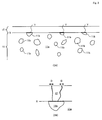
- Fig. (2A) is a schematic cross sectional views of the sliding member 1.
- the curve of the sliding member 1 is ignored.
- Bi particles 11b are deposited in a matrix 11a made of Cu-Sn alloy.
- Bi particles 11b are softer than the matrix 11a and corresponds to the soft particles of the present invention.
- Strength and wear resistance can be improved by adopting hard Cu-Sn alloy as the matrix 11a of the lining 11.
- the average equivalent circle diameter of Bi particles 11b on the cross sectional plane of the lining 11 was 100 ⁇ m. That is, the average area of Bi particles 11b on the cross sectional plane of the lining 11 was 2500n ⁇ m 2 .
- the area ratio of Bi particles 11b on the cross sectional plane of the lining 11 was 10%.
- the average equivalent circle diameter, the average area and the area ratio of Bi particles 11b on a boundary surface X between the lining 11 and the overlay 12 can be considered as same as the average equivalent circle diameter, the average area and the area ratio of Bi particles 11b on arbitrary cross sectional planes, because the distribution of Bi particles 11b in the lining 11 has uniformity and no directional dependency.
- the overlay 12 is a layer laminated on an inner surface of the lining 11.
- the overlay 12 corresponds to the soft layer of the present invention.
- the inner surface of the lining 11 corresponds to the boundary surface X between the lining 11 and the overlay 12.
- the overlay is consisted of Bi and unavoidable impurities.
- the unavoidable impurities included in the overlay 12 are elements e.g. Sn, Fe and Pb.
- the unavoidable impurities are impurities contaminated from plating liquid for the overlay 12.
- total weight percentage of the unavoidable impurities is not more than 1.0wt% and the weight percentage of Bi is not less than 99%.
- the crystal grain structure of Bi in the overlay 12 is determined according to the crystal growth condition of lamination of the overlay 12 on the surface of the lining 11. Consequently, the crystal grain structure of Bi composing Bi particles 11b existing on the boundary surface X between the lining 11 and the overlay 12 and the crystal grain structure of Bi composing the over lay 12 are determined according to different crystal growth condition each other. Therefore, the over lay 12 and Bi particles 11b existing on the boundary surface X between the lining 11 and the overlay 12 are made of same material (Bi), but the boundary portion Y where the crystal grain structure is changing is formed between them. That is, the boundary portion Y between Bi crystal grains that have the unique crystal grain structure of the soft particles 11b deposited in the lining 11 and Bi crystal grains that have the unique crystal grain structure of the overlay 12, is formed.
- Fig. (2B) is a schematic view showing the state that the fatigue fracture D is arisen in the overlay 12.
- Fig. (2B) even if fatigue fracture D arises in the overlay 12, it is possible to refrain the fatigue fracture D from penetrating the boundary portion Y between Bi particles 11b and the overlay 12 because the crystal grain structures of Bi particles 11b and that of the overlay 12 are different from each other and the grain boundary is discontinuous on the boundary portion Y between Bi particles 11b and the overlay 12. Therefore, it is possible to refrain the fatigue fracture D from penetrating the boundary surface X between the lining 11 and the overlay 12. That is, it is possible to refrain the fatigue fracture D arisen in the overlay 12 from transmitting to the lining 11 via Bi particles 11b. Further, it is possible to refrain the alloy components other than Bi included in the overlay 12 from diffusing to the lining 11 via Bi particles 11b.
- the masses of atoms included in the layers of the sliding member 1 were measured by an ICP (Inductively Coupled Plasma) atomic emission spectrometry analyzer (ICPS-8100 made by SHIMADZU CORPORATION).
- ICP Inductively Coupled Plasma
- ICPS-8100 made by SHIMADZU CORPORATION
- the average equivalent circle diameter of Bi particles 11b included in the lining 11 was measured by the methods as follows. First, the arbitrary cross sectional planes of the lining 11 (not limited in directions vertical to the rotation axis of the mating shaft 2) were polished by alumina abrasive grains whose diameter were 2 um.
- Observation image was prepared by imaging an observation view field covering an area of 0.02 mm 2 on the arbitrary cross sectional plane of the lining 11 by an electron microscope (JSM-6010A made by JEOL Ltd.) with 500 times of the optical magnification.
- the observation image was input to an image analyzing system (LUZEX II made by NIRECO CORPORATION) and images of Bi particles 11b were detected from the observation image.
- image analyzing system LZEX II made by NIRECO CORPORATION
- the projected area-equivalent diameter was a diameter of a circle having an area identical to the area of the image of Bi particles 11b and a real-space length converted from the diameter of image of Bi particles 11b based on the optical magnification. Further, an arithmetic mean (sum total/number of Bi particles 11b) of projected area-equivalent diameters of all Bi particles 11b was measured as the average equivalent circle diameter of Bi particles 11b.
- the total area of all Bi particles 11b was measured by multiplying the area of a circle with a diameter identical to the average equivalent circle diameter of Bi particles 11b and the number of all Bi particles 11b existing in the observation view field. Finally, the area ratio of Bi particles 11b was measured by dividing the total area of all Bi particles 11b by an area of the observation view field.
- the projected area-equivalent diameters less than 1.0 ⁇ m were ignored for calculation of the average equivalent circle diameter of Bi particles 11b e.g., because the projected area-equivalent diameters less than 1.0 ⁇ m might decrease a reliability of the projected area-equivalent diameter and a reliability of detection of the components.
- the boundary portion Y between Bi crystal grains that have the unique crystal grain structure of the soft particles 11b deposited in the lining 11 and Bi crystal grains that have the unique crystal grain structure of the overlay 12, is detected by the methods as follows.
- Observation image was prepared by imaging an arbitrary observation view field covering an area of 0.02 mm 2 (rectangular area with 0.1mm vertical length and 0.2mm horizontal width) on the cross sectional plane of the lining 11 by an electron microscope with 7000 times of the optical magnification.
- Fig. (3A) and Fig. (3B ) are photographs of the observation images. As shown in the Fig.
- the portion where edges exist in an area not farther than 1 ⁇ m and portions B (arrow) of the line segment L whose edge do not exist in the area not farther than 1 ⁇ m were detected.
- the epitaxial index was calculated by dividing the length of the portions B by the length of the line segment L. Further, the epitaxial index of each of Bi particles 11b existing at the boundary surface X was measured. In the present embodiment, the maximum epitaxial index of the sliding member 1 was 10%.
- the edge can be detected by the image analyzing system input the observation image.
- the powder of the materials for the lining 11 was scattered on the flat plate made of the low carbon steel.
- Cu powder, Bi powder and Sn powder were scattered on the low carbon steel flat plate to be same weight ratio as the weight ratio of the components of abovementioned lining 11.
- powder of alloy e.g. Cu-Bi and Cu-Sn can be scattered on the low carbon steel flat plate.
- the particle diameter of the powder was regulated to be not larger than 150 ⁇ m by a test sieve (JIS Z8801).
- the low carbon steel flat plate and the powder scattered on the low carbon steel flat plate were sintered. The sinter was performed in inert atmosphere and the sintering temperature was set to the range of 700 to 1000°C. Cooling was performed after sinter.
- the Cu alloy layer was formed on the low carbon steel flat plate after completion of the cooling.
- the soft Bi particles 11b deposited were included in this Cu alloy layer.
- the low carbon steel flat plate whereon the Cu alloy layer was formed was processed by the press working to be in the bisection shape of the hollow cylinder sectioned at a diametral plane. Then, the press working was performed to make the outer diameter of the low carbon steel flat plate same as the outer diameter of the sliding member 1.
- the Cu alloy layer formed on the low carbon steel flat plate was processed by grinding. Then, the grinding depth was controlled to make the thickness of the Cu alloy layer formed on the low carbon steel flat plate same as the thickness of the lining 11.
- the grinding was performed by the lathe on which is set the cutting tool made of the abrasive e.g. sintered diamonds.
- the surface of the lining 11 after grinding was the boundary surface X between the lining 11 and the overlay 12.
- the oxide films were formed on the surfaces of Bi particles 11b, by anodic oxidation of the surfaces of Bi particles 11b exposed on the surface of the lining 11.
- the anodic oxidation was performed by the method as follows. First, the degreasing of the surface of the lining 11 was performed by flowing direct minus current to the surface of the lining 11 in an electrolyte. Next, the surface of the lining 11 was rinsed with water. After completion of these pretreatments, the anodic oxidation was performed by flowing direct plus current to the lining 11 dipped in the anodizing solution.
- the composition of the anodizing solution included the sodium hydroxide with density range of 10 to 50 g/L. The temperature of the anodizing solution was 60°C. Further, the current supplied to the surface of the lining 11 was direct current and the current density of the direct current was in the range of 0.5 to 5.0 A/dm 2 .
- the overlay 12 was formed by laminating Bi as the soft material with thickness of 10 ⁇ m on the anodized surface of the lining 11, by the electroplating.
- the procedure of the electroplating was as follows. First, the degreasing of the anodized surface of the lining 11 was rinsed with water. Further, unnecessary oxides on the surface of the lining 11 were removed by pickling. After that, the surface of the lining 11 was rinsed with water again. After completion of abovementioned pretreatments, the electroplating was performed by supplying current to the surface of the lining 11 immersed in the plating liquid.
- the composition of the plating liquid included Bi with density range of 10 to 50 g/L, the organic sulfonic acid with density range of 25 to 100 g/L and additive agents with density range of 0.5 to 50 g/L.
- the temperature of the plating liquid was 25°C.
- the current supplied to the surface of the lining 11 was direct current and the current density of the direct current was in the range of 0.5 to 5.0 A/dm 2 .
- the overlay 12 could be laminated with refraining Bi from being epitaxially growing from Bi particles 11b existing on the surface of the lining 11.
- the manufacturing of the sliding member 1 was completed by rinsing with water and drying. Further the sliding bearing A was manufactured by combining two sliding members 1 to be in the cylindrical shape.
- the sliding member 1 composing the sliding bearing A that supports the crankshaft for the engine was exemplary shown in the above embodiment, the sliding bearing A for other use can be made of the sliding member 1 of the present invention.
- gear bushes for transmission, piston bushes and boss bushes can be made of the sliding member 1.
- the sliding member 1 can be parts whereon any mating members other than shafts are sliding.
- the matrix of the lining 11 does not limit to Cu alloy, the material of the matrix can be selected according to the hardness of the mating shaft 2. Further, materials e.g. Pb, Sn, In (indium) that are softer than the matrix and are able to deposit in the matrix, can be the soft material.
- the oxide films are formed on the boundary surface X, for example, the epitaxial growth of Bi from Bi particles 11b can be refrained by supplying large current to the surface of the lining 11 for the electroplating.
Landscapes
- Chemical & Material Sciences (AREA)
- Engineering & Computer Science (AREA)
- Materials Engineering (AREA)
- Mechanical Engineering (AREA)
- Metallurgy (AREA)
- Organic Chemistry (AREA)
- General Engineering & Computer Science (AREA)
- Electrochemistry (AREA)
- Chemical Kinetics & Catalysis (AREA)
- Manufacturing & Machinery (AREA)
- Composite Materials (AREA)
- Sliding-Contact Bearings (AREA)
- Powder Metallurgy (AREA)
- Electroplating Methods And Accessories (AREA)
Applications Claiming Priority (2)
| Application Number | Priority Date | Filing Date | Title |
|---|---|---|---|
| JP2013072012A JP6091961B2 (ja) | 2013-03-29 | 2013-03-29 | 摺動部材およびすべり軸受 |
| PCT/JP2014/058267 WO2014157193A1 (ja) | 2013-03-29 | 2014-03-25 | 摺動部材およびすべり軸受 |
Publications (3)
| Publication Number | Publication Date |
|---|---|
| EP2980431A1 true EP2980431A1 (de) | 2016-02-03 |
| EP2980431A4 EP2980431A4 (de) | 2016-12-21 |
| EP2980431B1 EP2980431B1 (de) | 2017-11-29 |
Family
ID=51624162
Family Applications (1)
| Application Number | Title | Priority Date | Filing Date |
|---|---|---|---|
| EP14775504.5A Active EP2980431B1 (de) | 2013-03-29 | 2014-03-25 | Gleitelement und gleitlager |
Country Status (5)
| Country | Link |
|---|---|
| US (2) | US9494193B2 (de) |
| EP (1) | EP2980431B1 (de) |
| JP (1) | JP6091961B2 (de) |
| CN (1) | CN105190064B (de) |
| WO (1) | WO2014157193A1 (de) |
Families Citing this family (11)
| Publication number | Priority date | Publication date | Assignee | Title |
|---|---|---|---|---|
| JP6091961B2 (ja) * | 2013-03-29 | 2017-03-08 | 大豊工業株式会社 | 摺動部材およびすべり軸受 |
| JP5981868B2 (ja) * | 2013-03-29 | 2016-08-31 | 大豊工業株式会社 | 摺動部材およびすべり軸受 |
| US11896245B2 (en) | 2017-02-09 | 2024-02-13 | Mg Stroke Analytics Inc. | Catheter systems for accessing the brain for treatment of ischemic stroke |
| JP6924315B2 (ja) * | 2017-06-21 | 2021-08-25 | 大豊工業株式会社 | 摺動部材およびすべり軸受 |
| JP6777594B2 (ja) * | 2017-06-21 | 2020-10-28 | 大豊工業株式会社 | 摺動部材およびすべり軸受 |
| JP7113793B2 (ja) * | 2019-07-31 | 2022-08-05 | 大同メタル工業株式会社 | 摺動部材 |
| CN112453407B (zh) * | 2020-11-05 | 2021-12-24 | 三阳纺织有限公司 | 滑动件的制作方法、滑动件及应用该滑动件的纺织机械 |
| JP7656392B2 (ja) * | 2020-12-09 | 2025-04-03 | 大同メタル工業株式会社 | 摺動部材及びその製造方法 |
| JP7503089B2 (ja) | 2022-03-30 | 2024-06-19 | 大同メタル工業株式会社 | 摺動部材、および摺動部材の製造方法 |
| US12363167B2 (en) * | 2022-05-18 | 2025-07-15 | Sophos Limited | Deduplication of endpoint images |
| US12556562B2 (en) | 2024-03-26 | 2026-02-17 | Sophos Limited | Deduplication of endpoint connections |
Family Cites Families (14)
| Publication number | Priority date | Publication date | Assignee | Title |
|---|---|---|---|---|
| JPS61235595A (ja) * | 1985-04-09 | 1986-10-20 | Ishikawajima Harima Heavy Ind Co Ltd | 滑り軸受の製造方法 |
| US4582368A (en) * | 1985-05-06 | 1986-04-15 | Ndc Company, Ltd. | Dry bearing |
| JP3057457B2 (ja) * | 1991-06-21 | 2000-06-26 | 本田技研工業株式会社 | 摺動部材 |
| JP3507388B2 (ja) * | 2000-02-08 | 2004-03-15 | 大同メタル工業株式会社 | 銅系摺動材料 |
| JP3571623B2 (ja) * | 2000-08-07 | 2004-09-29 | 大同メタル工業株式会社 | 摺動材料 |
| JP4195455B2 (ja) * | 2005-03-25 | 2008-12-10 | 大同メタル工業株式会社 | 摺動部材 |
| AT503735B1 (de) * | 2006-06-09 | 2008-05-15 | Miba Gleitlager Gmbh | Mehrschichtlager |
| JP4994266B2 (ja) | 2008-02-27 | 2012-08-08 | 大同メタル工業株式会社 | 摺動部材 |
| CN102149833B (zh) * | 2008-09-10 | 2013-07-17 | 大丰工业株式会社 | 不含Pb的Cu-Bi系烧结材料制得的滑动部件 |
| US20100276432A1 (en) * | 2009-01-12 | 2010-11-04 | Zhongxin Huo | Non-stick cookware |
| JP5243468B2 (ja) * | 2010-02-05 | 2013-07-24 | 大同メタル工業株式会社 | 摺動部材 |
| US20120180747A1 (en) * | 2011-01-18 | 2012-07-19 | David Domanchuk | Thermal spray coating with a dispersion of solid lubricant particles |
| JP6091961B2 (ja) * | 2013-03-29 | 2017-03-08 | 大豊工業株式会社 | 摺動部材およびすべり軸受 |
| JP5981868B2 (ja) * | 2013-03-29 | 2016-08-31 | 大豊工業株式会社 | 摺動部材およびすべり軸受 |
-
2013
- 2013-03-29 JP JP2013072012A patent/JP6091961B2/ja active Active
-
2014
- 2014-03-25 CN CN201480013839.7A patent/CN105190064B/zh active Active
- 2014-03-25 WO PCT/JP2014/058267 patent/WO2014157193A1/ja not_active Ceased
- 2014-03-25 US US14/773,456 patent/US9494193B2/en active Active
- 2014-03-25 EP EP14775504.5A patent/EP2980431B1/de active Active
-
2016
- 2016-10-13 US US15/292,707 patent/US20170030409A1/en not_active Abandoned
Also Published As
| Publication number | Publication date |
|---|---|
| CN105190064A (zh) | 2015-12-23 |
| CN105190064B (zh) | 2017-07-25 |
| US20160025132A1 (en) | 2016-01-28 |
| US20170030409A1 (en) | 2017-02-02 |
| WO2014157193A1 (ja) | 2014-10-02 |
| US9494193B2 (en) | 2016-11-15 |
| EP2980431B1 (de) | 2017-11-29 |
| JP6091961B2 (ja) | 2017-03-08 |
| JP2014196763A (ja) | 2014-10-16 |
| EP2980431A4 (de) | 2016-12-21 |
Similar Documents
| Publication | Publication Date | Title |
|---|---|---|
| EP2980431B1 (de) | Gleitelement und gleitlager | |
| US20170037899A1 (en) | Sliding member and sliding bearing | |
| US10982712B2 (en) | Sliding member | |
| US20190203769A1 (en) | Sliding member and sliding bearing | |
| US11149791B2 (en) | Sliding member | |
| CN109429498B (zh) | 滑动构件以及滑动轴承 | |
| JP6321436B2 (ja) | 摺動部材およびすべり軸受 | |
| JPWO2017094094A1 (ja) | 摺動部材およびすべり軸受 | |
| CN110582593A (zh) | 滑动构件 | |
| JP6091962B2 (ja) | 摺動部材およびすべり軸受 | |
| JP6242965B2 (ja) | 摺動部材およびすべり軸受 | |
| JP6242957B2 (ja) | 摺動部材およびすべり軸受 | |
| JP6924315B2 (ja) | 摺動部材およびすべり軸受 | |
| JP6247989B2 (ja) | 摺動部材およびすべり軸受 | |
| WO2015186621A1 (ja) | 摺動部材およびすべり軸受 |
Legal Events
| Date | Code | Title | Description |
|---|---|---|---|
| PUAI | Public reference made under article 153(3) epc to a published international application that has entered the european phase |
Free format text: ORIGINAL CODE: 0009012 |
|
| 17P | Request for examination filed |
Effective date: 20150918 |
|
| AK | Designated contracting states |
Kind code of ref document: A1 Designated state(s): AL AT BE BG CH CY CZ DE DK EE ES FI FR GB GR HR HU IE IS IT LI LT LU LV MC MK MT NL NO PL PT RO RS SE SI SK SM TR |
|
| AX | Request for extension of the european patent |
Extension state: BA ME |
|
| DAX | Request for extension of the european patent (deleted) | ||
| A4 | Supplementary search report drawn up and despatched |
Effective date: 20161117 |
|
| RIC1 | Information provided on ipc code assigned before grant |
Ipc: F16C 33/14 20060101ALI20161111BHEP Ipc: B22F 3/24 20060101ALI20161111BHEP Ipc: C25D 7/10 20060101ALI20161111BHEP Ipc: C25D 7/00 20060101ALI20161111BHEP Ipc: C22C 9/02 20060101ALI20161111BHEP Ipc: C22C 38/00 20060101ALI20161111BHEP Ipc: C25D 11/34 20060101ALI20161111BHEP Ipc: B32B 15/01 20060101ALI20161111BHEP Ipc: F16C 33/12 20060101AFI20161111BHEP Ipc: C22C 12/00 20060101ALI20161111BHEP Ipc: C25D 11/02 20060101ALI20161111BHEP Ipc: C22C 38/04 20060101ALI20161111BHEP Ipc: C22C 9/00 20060101ALI20161111BHEP Ipc: B22F 7/00 20060101ALI20161111BHEP |
|
| GRAP | Despatch of communication of intention to grant a patent |
Free format text: ORIGINAL CODE: EPIDOSNIGR1 |
|
| RIN1 | Information on inventor provided before grant (corrected) |
Inventor name: WADA, HITOSHI |
|
| INTG | Intention to grant announced |
Effective date: 20170724 |
|
| GRAS | Grant fee paid |
Free format text: ORIGINAL CODE: EPIDOSNIGR3 |
|
| GRAA | (expected) grant |
Free format text: ORIGINAL CODE: 0009210 |
|
| AK | Designated contracting states |
Kind code of ref document: B1 Designated state(s): AL AT BE BG CH CY CZ DE DK EE ES FI FR GB GR HR HU IE IS IT LI LT LU LV MC MK MT NL NO PL PT RO RS SE SI SK SM TR |
|
| REG | Reference to a national code |
Ref country code: CH Ref legal event code: EP |
|
| REG | Reference to a national code |
Ref country code: AT Ref legal event code: REF Ref document number: 950660 Country of ref document: AT Kind code of ref document: T Effective date: 20171215 |
|
| REG | Reference to a national code |
Ref country code: IE Ref legal event code: FG4D |
|
| REG | Reference to a national code |
Ref country code: DE Ref legal event code: R096 Ref document number: 602014017962 Country of ref document: DE |
|
| REG | Reference to a national code |
Ref country code: NL Ref legal event code: MP Effective date: 20171129 |
|
| REG | Reference to a national code |
Ref country code: LT Ref legal event code: MG4D |
|
| REG | Reference to a national code |
Ref country code: AT Ref legal event code: MK05 Ref document number: 950660 Country of ref document: AT Kind code of ref document: T Effective date: 20171129 |
|
| PG25 | Lapsed in a contracting state [announced via postgrant information from national office to epo] |
Ref country code: NO Free format text: LAPSE BECAUSE OF FAILURE TO SUBMIT A TRANSLATION OF THE DESCRIPTION OR TO PAY THE FEE WITHIN THE PRESCRIBED TIME-LIMIT Effective date: 20180228 Ref country code: FI Free format text: LAPSE BECAUSE OF FAILURE TO SUBMIT A TRANSLATION OF THE DESCRIPTION OR TO PAY THE FEE WITHIN THE PRESCRIBED TIME-LIMIT Effective date: 20171129 Ref country code: ES Free format text: LAPSE BECAUSE OF FAILURE TO SUBMIT A TRANSLATION OF THE DESCRIPTION OR TO PAY THE FEE WITHIN THE PRESCRIBED TIME-LIMIT Effective date: 20171129 Ref country code: LT Free format text: LAPSE BECAUSE OF FAILURE TO SUBMIT A TRANSLATION OF THE DESCRIPTION OR TO PAY THE FEE WITHIN THE PRESCRIBED TIME-LIMIT Effective date: 20171129 Ref country code: SE Free format text: LAPSE BECAUSE OF FAILURE TO SUBMIT A TRANSLATION OF THE DESCRIPTION OR TO PAY THE FEE WITHIN THE PRESCRIBED TIME-LIMIT Effective date: 20171129 |
|
| PG25 | Lapsed in a contracting state [announced via postgrant information from national office to epo] |
Ref country code: RS Free format text: LAPSE BECAUSE OF FAILURE TO SUBMIT A TRANSLATION OF THE DESCRIPTION OR TO PAY THE FEE WITHIN THE PRESCRIBED TIME-LIMIT Effective date: 20171129 Ref country code: LV Free format text: LAPSE BECAUSE OF FAILURE TO SUBMIT A TRANSLATION OF THE DESCRIPTION OR TO PAY THE FEE WITHIN THE PRESCRIBED TIME-LIMIT Effective date: 20171129 Ref country code: BG Free format text: LAPSE BECAUSE OF FAILURE TO SUBMIT A TRANSLATION OF THE DESCRIPTION OR TO PAY THE FEE WITHIN THE PRESCRIBED TIME-LIMIT Effective date: 20180228 Ref country code: HR Free format text: LAPSE BECAUSE OF FAILURE TO SUBMIT A TRANSLATION OF THE DESCRIPTION OR TO PAY THE FEE WITHIN THE PRESCRIBED TIME-LIMIT Effective date: 20171129 Ref country code: AT Free format text: LAPSE BECAUSE OF FAILURE TO SUBMIT A TRANSLATION OF THE DESCRIPTION OR TO PAY THE FEE WITHIN THE PRESCRIBED TIME-LIMIT Effective date: 20171129 Ref country code: GR Free format text: LAPSE BECAUSE OF FAILURE TO SUBMIT A TRANSLATION OF THE DESCRIPTION OR TO PAY THE FEE WITHIN THE PRESCRIBED TIME-LIMIT Effective date: 20180301 |
|
| PG25 | Lapsed in a contracting state [announced via postgrant information from national office to epo] |
Ref country code: NL Free format text: LAPSE BECAUSE OF FAILURE TO SUBMIT A TRANSLATION OF THE DESCRIPTION OR TO PAY THE FEE WITHIN THE PRESCRIBED TIME-LIMIT Effective date: 20171129 |
|
| PG25 | Lapsed in a contracting state [announced via postgrant information from national office to epo] |
Ref country code: CZ Free format text: LAPSE BECAUSE OF FAILURE TO SUBMIT A TRANSLATION OF THE DESCRIPTION OR TO PAY THE FEE WITHIN THE PRESCRIBED TIME-LIMIT Effective date: 20171129 Ref country code: DK Free format text: LAPSE BECAUSE OF FAILURE TO SUBMIT A TRANSLATION OF THE DESCRIPTION OR TO PAY THE FEE WITHIN THE PRESCRIBED TIME-LIMIT Effective date: 20171129 Ref country code: EE Free format text: LAPSE BECAUSE OF FAILURE TO SUBMIT A TRANSLATION OF THE DESCRIPTION OR TO PAY THE FEE WITHIN THE PRESCRIBED TIME-LIMIT Effective date: 20171129 Ref country code: CY Free format text: LAPSE BECAUSE OF FAILURE TO SUBMIT A TRANSLATION OF THE DESCRIPTION OR TO PAY THE FEE WITHIN THE PRESCRIBED TIME-LIMIT Effective date: 20171129 Ref country code: SK Free format text: LAPSE BECAUSE OF FAILURE TO SUBMIT A TRANSLATION OF THE DESCRIPTION OR TO PAY THE FEE WITHIN THE PRESCRIBED TIME-LIMIT Effective date: 20171129 |
|
| REG | Reference to a national code |
Ref country code: DE Ref legal event code: R097 Ref document number: 602014017962 Country of ref document: DE |
|
| PG25 | Lapsed in a contracting state [announced via postgrant information from national office to epo] |
Ref country code: IT Free format text: LAPSE BECAUSE OF FAILURE TO SUBMIT A TRANSLATION OF THE DESCRIPTION OR TO PAY THE FEE WITHIN THE PRESCRIBED TIME-LIMIT Effective date: 20171129 Ref country code: RO Free format text: LAPSE BECAUSE OF FAILURE TO SUBMIT A TRANSLATION OF THE DESCRIPTION OR TO PAY THE FEE WITHIN THE PRESCRIBED TIME-LIMIT Effective date: 20171129 Ref country code: SM Free format text: LAPSE BECAUSE OF FAILURE TO SUBMIT A TRANSLATION OF THE DESCRIPTION OR TO PAY THE FEE WITHIN THE PRESCRIBED TIME-LIMIT Effective date: 20171129 Ref country code: PL Free format text: LAPSE BECAUSE OF FAILURE TO SUBMIT A TRANSLATION OF THE DESCRIPTION OR TO PAY THE FEE WITHIN THE PRESCRIBED TIME-LIMIT Effective date: 20171129 |
|
| PLBE | No opposition filed within time limit |
Free format text: ORIGINAL CODE: 0009261 |
|
| STAA | Information on the status of an ep patent application or granted ep patent |
Free format text: STATUS: NO OPPOSITION FILED WITHIN TIME LIMIT |
|
| REG | Reference to a national code |
Ref country code: CH Ref legal event code: PL |
|
| 26N | No opposition filed |
Effective date: 20180830 |
|
| GBPC | Gb: european patent ceased through non-payment of renewal fee |
Effective date: 20180325 |
|
| PG25 | Lapsed in a contracting state [announced via postgrant information from national office to epo] |
Ref country code: MC Free format text: LAPSE BECAUSE OF FAILURE TO SUBMIT A TRANSLATION OF THE DESCRIPTION OR TO PAY THE FEE WITHIN THE PRESCRIBED TIME-LIMIT Effective date: 20171129 Ref country code: SI Free format text: LAPSE BECAUSE OF FAILURE TO SUBMIT A TRANSLATION OF THE DESCRIPTION OR TO PAY THE FEE WITHIN THE PRESCRIBED TIME-LIMIT Effective date: 20171129 |
|
| REG | Reference to a national code |
Ref country code: BE Ref legal event code: MM Effective date: 20180331 |
|
| REG | Reference to a national code |
Ref country code: IE Ref legal event code: MM4A |
|
| PG25 | Lapsed in a contracting state [announced via postgrant information from national office to epo] |
Ref country code: LU Free format text: LAPSE BECAUSE OF NON-PAYMENT OF DUE FEES Effective date: 20180325 |
|
| PG25 | Lapsed in a contracting state [announced via postgrant information from national office to epo] |
Ref country code: IE Free format text: LAPSE BECAUSE OF NON-PAYMENT OF DUE FEES Effective date: 20180325 |
|
| PG25 | Lapsed in a contracting state [announced via postgrant information from national office to epo] |
Ref country code: CH Free format text: LAPSE BECAUSE OF NON-PAYMENT OF DUE FEES Effective date: 20180331 Ref country code: LI Free format text: LAPSE BECAUSE OF NON-PAYMENT OF DUE FEES Effective date: 20180331 Ref country code: GB Free format text: LAPSE BECAUSE OF NON-PAYMENT OF DUE FEES Effective date: 20180325 Ref country code: BE Free format text: LAPSE BECAUSE OF NON-PAYMENT OF DUE FEES Effective date: 20180331 |
|
| PG25 | Lapsed in a contracting state [announced via postgrant information from national office to epo] |
Ref country code: FR Free format text: LAPSE BECAUSE OF NON-PAYMENT OF DUE FEES Effective date: 20180331 |
|
| PG25 | Lapsed in a contracting state [announced via postgrant information from national office to epo] |
Ref country code: MT Free format text: LAPSE BECAUSE OF NON-PAYMENT OF DUE FEES Effective date: 20180325 |
|
| PG25 | Lapsed in a contracting state [announced via postgrant information from national office to epo] |
Ref country code: TR Free format text: LAPSE BECAUSE OF FAILURE TO SUBMIT A TRANSLATION OF THE DESCRIPTION OR TO PAY THE FEE WITHIN THE PRESCRIBED TIME-LIMIT Effective date: 20171129 |
|
| PG25 | Lapsed in a contracting state [announced via postgrant information from national office to epo] |
Ref country code: PT Free format text: LAPSE BECAUSE OF FAILURE TO SUBMIT A TRANSLATION OF THE DESCRIPTION OR TO PAY THE FEE WITHIN THE PRESCRIBED TIME-LIMIT Effective date: 20171129 |
|
| PG25 | Lapsed in a contracting state [announced via postgrant information from national office to epo] |
Ref country code: MK Free format text: LAPSE BECAUSE OF NON-PAYMENT OF DUE FEES Effective date: 20171129 Ref country code: HU Free format text: LAPSE BECAUSE OF FAILURE TO SUBMIT A TRANSLATION OF THE DESCRIPTION OR TO PAY THE FEE WITHIN THE PRESCRIBED TIME-LIMIT; INVALID AB INITIO Effective date: 20140325 |
|
| PG25 | Lapsed in a contracting state [announced via postgrant information from national office to epo] |
Ref country code: AL Free format text: LAPSE BECAUSE OF FAILURE TO SUBMIT A TRANSLATION OF THE DESCRIPTION OR TO PAY THE FEE WITHIN THE PRESCRIBED TIME-LIMIT Effective date: 20171129 Ref country code: IS Free format text: LAPSE BECAUSE OF FAILURE TO SUBMIT A TRANSLATION OF THE DESCRIPTION OR TO PAY THE FEE WITHIN THE PRESCRIBED TIME-LIMIT Effective date: 20180329 |
|
| REG | Reference to a national code |
Ref country code: DE Ref legal event code: R082 Ref document number: 602014017962 Country of ref document: DE Representative=s name: CBDL PATENTANWAELTE GBR, DE Ref country code: DE Ref legal event code: R082 Ref document number: 602014017962 Country of ref document: DE Representative=s name: CBDL PATENTANWAELTE EGBR, DE |
|
| PGFP | Annual fee paid to national office [announced via postgrant information from national office to epo] |
Ref country code: DE Payment date: 20260128 Year of fee payment: 13 |