EP2977477A1 - Procédé d'élaboration d'une pièce en alliage métallique - Google Patents
Procédé d'élaboration d'une pièce en alliage métallique Download PDFInfo
- Publication number
- EP2977477A1 EP2977477A1 EP15177409.8A EP15177409A EP2977477A1 EP 2977477 A1 EP2977477 A1 EP 2977477A1 EP 15177409 A EP15177409 A EP 15177409A EP 2977477 A1 EP2977477 A1 EP 2977477A1
- Authority
- EP
- European Patent Office
- Prior art keywords
- alloy
- type
- temperature
- length
- implementation
- Prior art date
- Legal status (The legal status is an assumption and is not a legal conclusion. Google has not performed a legal analysis and makes no representation as to the accuracy of the status listed.)
- Granted
Links
Images
Classifications
-
- C—CHEMISTRY; METALLURGY
- C22—METALLURGY; FERROUS OR NON-FERROUS ALLOYS; TREATMENT OF ALLOYS OR NON-FERROUS METALS
- C22F—CHANGING THE PHYSICAL STRUCTURE OF NON-FERROUS METALS AND NON-FERROUS ALLOYS
- C22F1/00—Changing the physical structure of non-ferrous metals or alloys by heat treatment or by hot or cold working
- C22F1/16—Changing the physical structure of non-ferrous metals or alloys by heat treatment or by hot or cold working of other metals or alloys based thereon
- C22F1/18—High-melting or refractory metals or alloys based thereon
- C22F1/183—High-melting or refractory metals or alloys based thereon of titanium or alloys based thereon
-
- C—CHEMISTRY; METALLURGY
- C22—METALLURGY; FERROUS OR NON-FERROUS ALLOYS; TREATMENT OF ALLOYS OR NON-FERROUS METALS
- C22C—ALLOYS
- C22C14/00—Alloys based on titanium
Definitions
- the invention relates to a conversion process of an alloy containing predominantly titanium.
- Titanium alloys contain, as a mass percentage of the alloy, predominantly titanium and in particular at least 60% of the mass of the alloy is formed of titanium.
- the object of the invention is to obtain a method conversion of an alloy comprising, in mass percentage of the alloy, predominantly titanium, this process to promote the improvement of the quality of parts produced using the alloy converted according to the method of the invention.
- the transient temperature ⁇ , T ⁇ is the temperature above which there is a transition of at least some of the structures of the alloy which are in the ⁇ phase towards structures of the alloy. in phase ⁇ .
- the ⁇ phase alloy portion has a compact hexagonal micro crystallographic structure.
- the ⁇ -phase alloy portion has a centered cubic crystallographic micro structure.
- the parts of a batch of parts produced from the titanium alloy converted according to the process of the invention have homogenized characteristics from the point of view of the micro structure, from the point of view of the grain size distribution. in phases ⁇ contained in the alloy and from the point of view of composition chemical (the chemical species are better distributed in the alloy converted according to the method of the invention than they were in the ingot before implementation of the various steps of the method of the invention).
- the overall quality of the batch of parts is improved because the alloy constituting these parts has homogeneous characteristics between the parts of the batch.
- the ingot which weighs several tons, typically an ingot weighs from 3 to 7 tons and is more than 2 meters high, there is a stratification of the ingot such that the lower and central portion of the ingot exhibits elongated crystals of length and average section much greater than the length and the average section of the crystals located in the upper part of the ingot.
- the first step of the first type A is carried out at a first temperature T1 greater than the transus temperature ⁇ , which makes it possible to have a transformation of at least a portion of the crystallographic alloy structures that are in the ⁇ phase towards crystallographic structures. in phase ⁇ .
- the mechanical deformation / plastic deformation of the large grains of the ⁇ -phase alloy results in a break-up of these large ⁇ -phase grains, which are then recrystallized into small grains still in the ⁇ -phase.
- T1 greater than the transus temperature ⁇
- the first step of the second type A ' which is performed below the ⁇ transus temperature, in this case at a temperature T4, to preserve the nature of the ⁇ and ⁇ phases present in the material while applying to the same alloy, a plastic mechanical deformation which has the effect of creating / accumulating internal mechanical stresses in the alloy and around grains in ⁇ phase.
- the temperature of the alloy is then raised above the ⁇ transus temperature until it reaches a second temperature T2 which is strictly less than first temperature T1.
- the mechanical stresses accumulated around the grains in the ⁇ phase during the first step of the second type A ' generate again fractures / dislocations of the grains ⁇ which have the largest sizes and which are subjected to the largest constraints. The effect of these dislocations is to promote the recrystallization of the largest ⁇ alloy grains.
- This second step of the first type B is a recrystallization step, which makes it possible to prepare a first homogenization of the size of the ⁇ grains, by accumulation of dislocations in the larger grains, or the less well oriented with respect to most of the microstructure.
- the temperature of the alloy is lowered again so that it has a current temperature T4 lower than the transient temperature ⁇ , T ⁇ , and a new plastic deformation is applied to the alloy to create new mechanical stresses in the alloy and around the ⁇ -phase grains.
- step B is carried out below the ⁇ transus temperature, the ⁇ and ⁇ phases of the grains present in the alloy are conserved and only mechanical stresses are generated around the most heterogeneous ⁇ grains with respect to the microstructure .
- the temperature of the alloy is increased again so that it has a current temperature, called the third temperature T3, which is greater than the temperature of the ⁇ transus but strictly lower than the second temperature T2 which had been reached during the second step of the first type B.
- the mechanical stresses accumulated, around the grains ⁇ , during the second step of the second type B ' again generate breaks / dislocations of grains ⁇ which have the largest sizes and which are subjected to the greatest constraints. The effect of these new dislocations is always to favor the recrystallization of the ⁇ grains which contain the most dislocations.
- the alloy is thus homogenized again.
- first, second and third stages of the first type are carried out by progressively lowering the temperature while remaining above the ⁇ transus temperature makes it possible to progressively create dislocations that are increasingly fine to promote the precipitation of most heterogeneous ⁇ -phase alloy. All these steps of the conversion process according to the invention make it possible to homogenize the crystallographic structure of the alloy both in terms of the distribution of ⁇ -phase grains and ⁇ -phase grains in the alloy, as well as in the dimensions of the alloy. these respective grains.
- the alloy thus converted has more homogeneous mechanical characteristics which makes it possible to homogenize the characteristics as a function of the envisaged directions of the metal parts obtained from this alloy.
- each plastic deformation implemented during a step of the second type A ', B', C ' is such that it tends to at least partially reverse the deformation effect applied to the alloy during the step of the first type immediately preceding this step of the second type.
- inversion of the deformation effect is meant an inversion of at least one of the deformations undergone by the alloy.
- each of the plastic deformations used during the steps of the first type are compression deformations of the alloy in a direction of alloy compression common to all the steps of the first type, these plastic deformations being made. in the steps of the first type each have an effect of reducing the length Lx of the alloy.
- the length L x of the alloy is the largest dimension of the alloy or alloy block subjected to deformation. Whether the alloy is in the form of an ingot or billet, this alloy length Lx always remains the largest measurable dimension on this alloy and this length Lx is therefore a current length of the alloy measured before subjecting the alloy a new deformation step.
- each of the plastic deformations used during the steps of the second type A ', B', C ' are compression deformations of the alloy oriented so as to obtain at each step of the second type an increase in the length (Lx ) of the alloy.
- the plastic deformations used during the operations of the second type are obtained by compressing the alloy in compression directions perpendicular to the direction of common alloy compression at all stages of the first type.
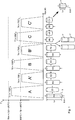
- FIG. figure 1 illustrates the process according to the invention.
- the method according to the invention aims to allow a conversion of a titanium alloy initially in the form of ingot, this conversion process for homogenizing the micro-structural characteristics of the alloy.
- the invention essentially relates to the conversion process according to the invention, it may also relate to a part production process such as a rod a bogie or an aircraft landing gear box, or any part of a size comparable to a landing gear rod (length greater than 1 meter) manufactured from an alloy converted according to the alloy conversion method according to the invention.
- This production process comprises, in addition to the alloy conversion method according to the invention, the aforementioned subsequent steps of forging, machining and aging to obtain a large piece of near-finished undercarriage, such as a rod, a bogie, a landing gear box.
- the first step of the conversion process according to the invention consists in producing an alloy comprising, as a mass percentage of the alloy, predominantly titanium.
- This alloy is chosen to have a ⁇ T ⁇ transus temperature of between 800 ° C. and 950 ° C. and preferably 900 ° C.
- Each of these titanium alloys has a transient temperature ⁇ T ⁇ of its own.
- the transus ⁇ temperature is the temperature from which a transition of ⁇ -phase alloy structures to structures of the ⁇ -phase alloy is observed.
- the alloy thus produced is cast to produce an ingot 1 composed of said alloy.
- the method comprises a third step of the second type C '.
- T ⁇ 800 ° C
- T1 1100 ° C
- T2 1000 ° C
- T3 900 ° C
- T4 750 ° C.
- T1, T2, T3, T4 are checked if they are between +/- 15 ° C of the indicated temperature and preferably between +/- 5 ° C of this temperature.
- the choice of the fourth temperature T4 makes it possible to preserve the ⁇ and ⁇ phases in the presence in the alloy without too much accumulation of stresses around the ⁇ grains.
- the ingot 1 formed of the alloy Before the first step of the first type A, the ingot 1 formed of the alloy has a running length Lx defining a main axis X-X of the alloy.
- the alloy compression direction is oriented parallel to this main axis of alloy, and more particularly parallel to this length of the ingot.
- the compressions used during the steps of the first type A, B, C are carried out by placing the ingot between elements of a press coming closer to each other in a direction parallel to the length of the ingot.
- the compressions implemented during the steps of the second type A ', B', C ' are obtained by crushing the alloy between tools of shape or not placed in facing relation to cause a reduction of the alloy and thus a progressive elongation of the alloy.
- the deformation carried out during the first step of the first type A comprises at least one repression operation R reducing the length Lx of the alloy of 20 to 30% of the length Lx of alloy measured before implementation of this first step of the first type A.
- the deformation carried out during the second step of the first type B also comprises a discharge operation R reducing the length Lx of the alloy by 20 to 30% of the length Lx of alloy measured after implementation of the first step of the second type A 'and before implementation of the second step of the first type B.
- the deformation carried out during the third step of the first type C also comprises a displacement R reducing the length Lx of the alloy by 15 to 20% of the length Lx of alloy measured after implementation of the second step of the second type B 'and before implementation of the third step of the first type C.
- the discharge R is a compression operation of the alloy along its length Lx, that is to say along the X-X axis of the alloy.
- the deformation E1 carried out during the first step of the second type A ' is carried out in order to increase the length Lx of the alloy by 20 to 30% of the length Lx of alloy measured after implementation of the first step of the first type. A and before this increase in length Lx implementation of the first step of the second type A '.
- the deformation E4 carried out during the second step of the second type B ' is adapted to increase the length Lx of the alloy by 20 to 30% of the length Lx of alloy measured after implementation of the second stage of the first type B and before the increase in length Lx achieved during this second step of the second type B '.
- this third step C' makes it possible to give the alloy a shape and dimensions specific to its subsequent forging to obtain a forging.
- This third step of the second type C ' may be adapted to increase the length Lx of the alloy by at least 30% of the length Lx of alloy Lx measured after implementation of the third step of the first type C and before setting implementation of this increase in length Lx performed in the third step of the second type C '.
- an X cutting step is carried out in a transverse plane of the alloy. so as to obtain two elongated bar-shaped portions, called billets 1 ', 1 ".
- these parts / billets 1 ', 1 are of identical shapes to each other.
- the shape of a billet intended to form a large aircraft landing gear part is substantially cylindrical right of length between 2 m and 3 m and diameter between 0.4 and 0.5 m.
- the alloy ingot, before implementation of the first step of the first type A is straight cylindrical in length between 3m and 5m and diameter between 0.6 m and 1.2 m.
- the volume of two billets 1 ', 1 is smaller than the volume of the ingot, which implies that part of the alloy has been removed during the various stages of the alloy conversion process according to the invention.
- the billet 1 'resulting from the process is formed of a converted alloy whose microstructure is homogenized at least in terms of grain size in ⁇ phase and distribution of these grains in the alloy relative to the microstructure observed before implementation of step A of the process.
- the method according to the invention has been presented with three steps of the first type and three steps of the second type, it is noted that it may also comprise a greater number of steps of the first type and a greater number of steps. of the second type.
Landscapes
- Chemical & Material Sciences (AREA)
- Engineering & Computer Science (AREA)
- Materials Engineering (AREA)
- Mechanical Engineering (AREA)
- Metallurgy (AREA)
- Organic Chemistry (AREA)
- Physics & Mathematics (AREA)
- Thermal Sciences (AREA)
- Crystallography & Structural Chemistry (AREA)
- Forging (AREA)
- Heat Treatment Of Steel (AREA)
Abstract
Description
- L'invention concerne un procédé de conversion d'alliage contenant majoritairement du titane.
- Plus particulièrement, l'invention concerne un procédé de conversion d'un alliage comportant, en pourcentage massique de l'alliage, majoritairement du titane, cet alliage présentant une température de transus β à partir de laquelle on observe une transition de structures de l'alliage en phase α vers des structures de l'alliage en phase β, le procédé comportant :
- une étape de fabrication d'un lingot (1) composé dudit alliage ;
- au moins des première, seconde et troisième étapes d'un premier type consistant à déformer plastiquement l'alliage issu dudit lingot alors qu'il est à une température courante strictement supérieure à la température de transus β; et
- au moins des première et seconde étapes d'un second type consistant à déformer plastiquement l'alliage issu dudit lingot alors qu'il est à une température courante strictement inférieure à la température de transus β.
- Les alliages titane contiennent, en pourcentage massique de l'alliage, majoritairement du titane et en particulier au moins 60% de la masse de l'alliage est formée de titane.
- On a constaté une hétérogénéité de résistance mécanique entre des pièces appartenant à un même lot de pièces obtenues à partir d'un même alliage.
- Pour des questions de qualité de production, il est souhaitable que des pièces similaires obtenues à partir d'un même alliage titane présentent une homogénéité de résistance mécanique.
- L'invention a pour objet l'obtention d'un procédé de conversion d'un alliage comportant, en pourcentage massique de l'alliage, majoritairement du titane, ce procédé devant favoriser l'amélioration de la qualité de pièces produites à l'aide de l'alliage converti suivant le procédé de l'invention.
- En vue de réaliser cet objet, il est proposé selon l'invention, un procédé de conversion d'un alliage comportant, en pourcentage massique de l'alliage, majoritairement du titane, cet alliage présentant une température de transus β à partir de laquelle on observe une transition de structures de l'alliage en phase α vers des structures de l'alliage en phase β, le procédé comportant :
- une étape de fabrication d'un lingot composé dudit alliage ;
- au moins des première, seconde et troisième étapes d'un premier type A, B, C consistant à déformer plastiquement l'alliage issu dudit lingot alors qu'il est à une température courante strictement supérieure à la température de transus β Tβ; et
- au moins des première et seconde étapes d'un second type A', B' consistant à déformer plastiquement l'alliage issu dudit lingot alors qu'il est à une température courante strictement inférieure à la température de transus β Tβ.
- Le procédé de conversion selon l'invention est essentiellement caractérisé en ce que les étapes des premier et second types A, A', B, B', C sont appliquées selon la séquence consistant en :
- la mise en oeuvre de la première étape du premier type A alors que l'alliage se trouve à une première température T1; suivie de
- la mise en oeuvre de la première étape du second type A'; suivie de
- la mise en oeuvre de la seconde étape du premier type B alors que l'alliage se trouve à une seconde température T2 strictement inférieure à ladite première température T1; suivie de
- la mise en oeuvre de la seconde étape du second type B'; suivie de
- la mise en oeuvre de la troisième étape du premier type C alors que l'alliage se trouve à une troisième température T3 strictement inférieure à ladite seconde température T2.
- Pour la compréhension de l'invention, la température de transus β, Tβ, est la température au-dessus de laquelle on observe une transition de certaines au moins des structures de l'alliage qui sont en phase α vers des structures de l'alliage en phase β.
- La portion d'alliage en phase α présente une micro structure cristallographique hexagonale compacte.
- La portion d'alliage en phase β présente une micro structure cristallographique cubique centrée.
- Ainsi, lorsque l'on passe au-dessus de cette température de transus β, on constate que des portions de l'alliage qui se présentaient sous forme hexagonale compacte, se transforment en portions d'alliage cubique centrée. L'enchainement d'étapes selon le procédé de l'invention combine traitements thermiques et déformations mécaniques plastiques de l'alliage accomplies de manière à homogénéiser la micro structure interne de l'alliage en homogénéisant progressivement la taille des cristaux / grains qui composent l'alliage.
- Ainsi, les pièces d'un lot de pièces produit à partir de l'alliage titane converti suivant le procédé de l'invention présentent des caractéristiques homogénéisées du point de vu de la micro structure, du point de vue de la répartition des tailles des grains en phases β contenus dans l'alliage et du point de vu de composition chimique (les espèces chimiques sont mieux réparties dans l'alliage converti suivant le procédé de l'invention qu'elles ne l'étaient dans le lingot avant mise en oeuvre des différentes étapes du procédé de l'invention).
- Ainsi, la qualité globale du lot de pièces est améliorée car l'alliage constituant ces pièces présente des caractéristiques homogènes entre les pièces du lot.
- Lors de la formation du lingot, qui pèse plusieurs tonnes, typiquement un lingot pèse de 3 à 7 tonnes et mesure plus de 2 mètres de hauteur, on constate une stratification du lingot telle que la partie inférieure et centrale du lingot présente des cristaux allongés de longueur et section moyenne largement supérieure à la longueur et à la section moyenne des cristaux se trouvant en partie supérieure du lingot.
- La première étape du premier type A est réalisée à une première température T1 supérieure à la température de transus β ce qui permet d'avoir une transformation d'une partie au moins des structures cristallographiques d'alliage qui sont en phase α vers des structures cristallographiques en phase β. La déformation mécanique / déformation plastique des gros grains de l'alliage en phase β entraine une cassure de ces gros grains en phase β qui sont alors recristallisés en petits grains toujours en phase β. On a ici un début d'homogénéisation de l'alliage du lingot en termes de nature de phases α et β présentes dans l'alliage et de taille de grains β.
- La première étape du second type A' qui est réalisée en dessous de la température de transus β, en l'occurrence à une température T4, pour conserver la nature des phases α et β présentes dans le matériau tout en appliquant à ce même alliage, une déformation mécanique plastique qui a pour effet de créer / accumuler des contraintes mécaniques internes dans l'alliage et autour des grains en phase β.
- Lors de l'étape d'après qui est la seconde étape du premier type B, on remonte alors la température de l'alliage au-dessus de la température de transus β jusqu'à atteindre une seconde température T2 qui est strictement inférieure à la première température T1. Lors de cette étape B, les contraintes mécaniques accumulées autour des grains en phase β lors de la première étape du second type A', génèrent à nouveau des ruptures / dislocations des grains β qui ont les plus grandes tailles et qui sont soumis aux plus grandes contraintes. L'effet de ces dislocations est de favoriser la recristallisation des grains d'alliage β les plus gros. Cette seconde étape du premier type B est une étape de recristallisation, qui permet de préparer une première homogénéisation la taille des grains β, par accumulation de dislocations dans les grains les plus gros, ou les moins bien orientés par rapport à l'essentiel de la microstructure.
- Lors de l'étape d'après, qui est la seconde étape du second type B', on abaisse à nouveau la température de l'alliage pour qu'il ait une température courante T4 inférieure à la température de transus β, Tβ, et on applique à nouveau une déformation plastique à l'alliage pour à nouveau créer de nouvelles contraintes mécaniques dans l'alliage et autour des grains en phase β.
- Comme cette étape B' est réalisée en dessous de la température de transus β, les phases α et β des grains en présence dans l'alliage sont conservées et seules des contraintes mécaniques sont générées autour des grains β les plus hétérogènes par rapport à la microstructure.
- Lors de l'étape d'après, qui est la troisième étape du premier type C, on augmente à nouveau la température de l'alliage pour qu'il ait une température courante, dite troisième température T3, qui soit supérieure à la température de transus β, mais strictement inférieure à la seconde température T2 qui avait été atteinte lors de la seconde étape du premier type B. Lors de cette troisième étape du premier type C, les contraintes mécaniques accumulées, autour des grains β, lors de la seconde étape du second type B', génèrent à nouveau des ruptures / dislocations des grains β qui ont les plus grandes tailles et qui sont soumis aux plus grandes contraintes. L'effet de ces nouvelles dislocations est toujours de favoriser la recristallisation des grains β qui contiennent le plus de dislocations. L'alliage est ainsi à nouveau homogénéisé.
- Le fait que les première, second et troisième étapes du premier type soient réalisées en abaissant progressivement la température tout en restant au-dessus de la température de transus β permet de créer progressivement des dislocations de plus en plus fines pour favoriser la précipitation des grains d'alliage en phase β les plus hétérogènes. Toutes ces étapes du procédé de conversion selon l'invention permettent d'homogénéiser la structure cristallographique de l'alliage tant au niveau de la répartition des grains de phases α et des grains de phase β dans l'alliage qu'au niveau des dimensions de ces grains respectifs.
- L'alliage ainsi converti présente des caractéristiques mécaniques plus homogènes ce qui permet d'homogénéiser les caractéristiques en fonction des directions envisagées des pièces métalliques obtenue à partir de cet alliage.
- Dans un mode de réalisation préférentiel du procédé selon l'invention, on fait en sorte que :
- la première température T1 soit supérieure à la température de transus β Tβ d'au moins 200°C et d'au plus 300°C ; que
- la seconde température T2 soit supérieure à la température de transus β Tβ d'au moins 100°C et d'au plus 200°C ; et que
- la troisième température T3 soit supérieure à la température de transus β Tβ d'au moins 50°C et d'au plus 150°C.
- Le fait :
- d'une part de limiter progressivement l'écart entre la température de transus β Tβ et les températures T1, T2, T3 successivement mises en oeuvre pour les première, seconde et troisième étapes du premier type A, B, C ; tout en s'assurant
- d'autre part de ne pas dépasser une température limite Tlim au-dessus de la température de transus β Tβ;
- Dans un mode de réalisation préférentiel de l'invention combiné à l'un quelconque des modes précités, on fait en sorte que chaque déformation plastique mise en oeuvre lors d'une étape du second type A', B', C' est telle qu'elle tend à inverser au moins partiellement l'effet de déformation appliquée à l'alliage lors de l'étape du premier type précédant immédiatement cette étape du second type.
- Par inversion d'effet de déformation, on entend une inversion d'au moins une des déformations subies par l'alliage. Ainsi, si une première déformation a conduit à une diminution de la longueur de la billette composée de l'alliage, alors la déformation inversant l'effet de cette première déformation doit être réalisée de manière à obtenir une augmentation de la longueur de la billette.
- En inversant, lors d'une étape du second type A', B', C', l'effet de la déformation appliquée lors de l'étape précédente du premier type A, B ou C, on augmente la capacité de déformation pouvant être mise en oeuvre lors d'une étape du premier type ultérieure. En effet, si l'on ne réalisait pas une déformation inversant au moins partiellement l'effet de la déformation réalisée lors d'une étape du premier type, on aurait alors une capacité de déformation de l'alliage beaucoup plus limitée lors de l'étape du premier type suivante. En effet, les déformations réalisées entre deux étapes successives du premier type A, B, C s'additionneraient jusqu'à atteindre une déformation telle qu'elle conduit à une rupture complète locale de l'alliage.
- En conséquence, l'inversion de l'effet de déformation permet de limiter les effets délétères associés aux multiples déformations réalisées durant les étapes du premier type.
- Dans un mode de réalisation préférentiel, chacune des déformations plastiques mises en oeuvre lors des étapes du premier type sont des déformations par compression de l'alliage suivant une direction de compression d'alliage commune à toutes les étapes du premier type, ces déformations plastiques mises en oeuvre lors des étapes du premier type ont chacune un effet de réduction de la longueur Lx de l'alliage.
- La longueur Lx de l'alliage est la plus grande dimension de l'alliage ou du bloc d'alliage soumis à une déformation. Que l'alliage soit sous forme de lingot ou billette, cette longueur Lx d'alliage reste toujours la plus grande dimension mesurable sur cet alliage et cette longueur Lx est donc une longueur courante de l'alliage mesurée avant de faire subir à l'alliage une nouvelle étape de déformation.
- Ainsi, lors des étapes du premier type, on tend à compacter l'alliage en en réduisant sa dimension courante Lx la plus importante la déformation. Ce type de déformation réalisée à température supérieure à Tβ est moins fragilisante qu'une déformation tendant à étirer l'alliage.
- Préférentiellement, chacune des déformations plastiques mise en oeuvre lors des étapes du second type A', B', C' sont des déformations par compression de l'alliage orientées de manière à obtenir à chaque étape du second type une augmentation de la longueur (Lx) de l'alliage.
- Typiquement, les déformations plastiques mises en oeuvre lors des opérations du deuxième type sont obtenues en comprimant l'alliage selon des directions de compression perpendiculaires à la direction de compression d'alliage commune à toutes les étapes du premier type.
- D'autres caractéristiques et avantages de l'invention ressortiront clairement de la description qui en est faite ci-après, à titre indicatif et nullement limitatif, en référence aux dessins de la
figure 1 qui illustre le procédé selon l'invention. - Le procédé selon l'invention a pour but de permettre une conversion d'un alliage de titane se présentant au départ sous forme de lingot, ce procédé de conversion permettant d'homogénéiser les caractéristiques micro-structurelles de l'alliage.
- L'alliage converti suivant le procédé de conversion selon l'invention se présente sous la forme d'une ou plusieurs billettes. L'alliage ainsi obtenu se présente sous forme de billette et est alors successivement :
- forgé pour générer des formes particulières nécessaires à la pièce finale qui est préférentiellement une grosse pièce d'atterrisseur comme une tige ou un bogie ; puis
- usinée pour retirer une partie de l'alliage présent sur la pièce forgée ; puis éventuellement
- mis en solution et trempé à l'eau ou l'air ;puis
- vieilli thermiquement pour être durci, l'alliage ainsi vieilli étant un alliage quasi β contenant des nodules d'alliage en phase alpha primaire entre les grains β, ainsi qu'une précipitation de alpha secondaire à l'intérieur des grains β.
- Bien que l'invention concerne essentiellement le procédé de conversion selon l'invention, elle peut également concerner un procédé de production de pièce telle qu'une tige un bogie ou un caisson d'atterrisseur d'aéronef, ou toute pièce de taille comparable à une tige d'atterrisseur (longueur supérieure à 1 mètre), fabriquée à partir d'un alliage converti conformément au procédé de conversion d'alliage selon l'invention.
- Ce procédé de production comporte, outre le procédé de conversion d'alliage selon l'invention, des étapes ultérieures précitées de forgeage, d'usinage et de vieillissement pour obtenir une grosse pièce d'atterrisseur quasi finie, comme une tige, un bogie, un caisson d'atterrisseur.
- La présente description va maintenant présenter le procédé de conversion selon l'invention.
- La première étape du procédé de conversion selon l'invention consiste à produire un alliage comportant, en pourcentage massique de l'alliage, majoritairement du titane. Cet alliage est choisi pour présenter une température de transus β Tβ comprise entre 800°C et 950°C et préférentiellement de 900°C.
- Plus particulièrement, cet alliage est choisi dans le groupe d'alliages comprenant :
- un premier alliage (Ti 10-2-3) comportant, en proportion massique, les éléments suivants :Aluminium, Al 2.6 - 3.4 % Carbone, C <= 0.050 % Hydrogène H <= 0.015 % Fer, Fe 1.6 - 2.2 % Azote, N <= 0.050 % Oxygène, O <= 0.13 % Titane, Ti 83 - 86.8 % Vanadium, V 9.0 - 11 % ; Fer Fe 0.5 - 1.5% Carbone C maximum 0.1% Silicium Si maximum 0.15% Chrome Cr 0.5 - 1.5% Molybdène Mo 4 - 5.5% Vanadium V 4 - 5.5% Azote N maximum 0.05% Titane Ti 79.4 - 86.3% Aluminium Al 4.4% - 5.7% Zirconium Zr maximum 0.3% Oxygène O maximum 0.18% Hydrogène H maximum 0.15% Impuretés 0.3%; Fer Fe 0.5 - 1.5% Carbone C maximum 0.1% Silicium Si maximum 0.15% Chrome Cr 0.5 - 1.5% Molybdène Mo 4 - 5.5% Vanadium V 4 - 5.5% Azote N maximum 0.05% Titane Ti 79.4 - 86.3% Aluminium Al 4.4% - 5.7% Zirconium Zr 1% Oxygène O maximum 0.18% Hydrogène H maximum 0.15% Impuretés 0.3%; document brevet GB2470613A Aluminium 5.3-5.7 % Vanadium V 4.8-5.2 % Fer Fe 0.7-0.9 % Molybdène Mo 4.6-5.3 % Chrome Cr 2.0-2.5 % Oxygène O 0.12-0.16 %
- un cinquième alliage comportant, en proportion massique, les éléments suivants :Titane au moins 84% Aluminium Al 4%-7.5% Oxygène au moins 0,1% Carbone C au moins 0,01% - Le cinquième alliage est particulièrement adapté pour être converti à l'aide du procédé selon l'invention car il présente une température de transus β, Tβ, comprise entre 800°C et 950°C et plus particulièrement une température de transus β, Tβ=900°C.
- Plus particulièrement, ce cinquième alliage, comporte, en proportion massique, au moins 84% de Titane et au moins les éléments suivants :
- Aluminium 4,0 - 7,5%
- Vanadium 3,5 - 5,5%
- Molybdène 4,5-7,5%
- Chrome 1,8-3,6%
- Fer 0,2-0,5%
- Hafnium 0,1-1,1%
- Oxygène 0,1-0,3%
- Carbone 0,01-0,2%.
- Chacun de ces alliages de titane présente une température de transus β Tβ qui lui est propre.
- Typiquement, la température du cinquième alliage préférentiel est de Tβ = 900°C.
- Comme indiqué précédemment, la température de transusβ est la température à partir de laquelle on observe une transition de structures de l'alliage en phase α vers des structures de l'alliage en phase β.
- L'alliage ainsi produit est coulé pour fabriquer un lingot 1 composé dudit alliage.
- Comme on le voit sur la
figure 1 , le procédé de conversion selon l'invention comporte : - au moins des première, seconde et troisième étapes d'un premier type A, B, C consistant à déformer plastiquement l'alliage issu dudit lingot alors qu'il est à une température courante strictement supérieure à la température de transus β Tβ et inférieure à une température limite Tlim = Tβ+300°C; et
- au moins des première et seconde étapes d'un second type A', B' consistant à déformer plastiquement l'alliage issu dudit lingot alors qu'il est à une température courante strictement inférieure à la température de transus β Tβ.
- Dans le cas présent, le procédé comporte une troisième étape du second type C'.
- Ces étapes des premier et second types A, A', B, B', C sont mises en oeuvre pour une même portion de l'alliage en suivant la séquence consistant en :
- réalisation de la première étape du premier type A alors que l'alliage se trouve à une première température T1; puis
- réalisation de la première étape du second type A' alors que l'alliage se trouve à une température T4, dite quatrième température; puis
- réalisation de la seconde étape du premier type B alors que l'alliage se trouve à une seconde température T2 strictement inférieure à ladite première température T1; puis
- réalisation de la seconde étape du second type B' alors que l'alliage est à T4; puis
- réalisation de la troisième étape du premier type C alors que l'alliage se trouve à une troisième température T3 strictement inférieure à ladite seconde température T2 ; puis
- réalisation de la troisième étape du second type C' alors que l'alliage est à T4.
- Typiquement, on a
- *T1 défini par (Tβ + 200°C) <T1< (Tβ+300°C) ;
- *T2 défini par T2<T1 et (Tβ + 100°C) <T2< (Tβ + 200°C) ;
- *T3 défini par T3<T2<T1 et (Tβ + 50°C) <T3< (Tβ + 150°C).
- * T4 qui est la quatrième température mise en oeuvre à chacune des étapes du second type est définie par (Tβ-65°C)<T4<(Tβ-35°C) ou préférentiellement par (Tβ-55°C) <T4< (Tβ-45°C).
- Dans le cas de la
figure 1 ,
Tβ=800°C, T1=1100°C, T2=1000°C, T3=900°C, T4=750°C. - Ces températures T1, T2, T3, T4 sont vérifiées si elles sont entre +/-15°C de la température indiquée et préférentiellement entre +/-5°C de cette température. Le choix de la quatrième température T4 permet de conserver les phases α et β en présence dans l'alliage sans trop accumuler de contraintes autour des grains β.
- Bien que l'on ait décrit que les températures auxquelles sont mises en oeuvre les étapes du second type A', B', C' sont identiques, il est possible qu'elles diffèrent entre elles.
- Avant la première étape du premier type A, le lingot 1 formé de l'alliage présente une longueur courante Lx définissant un axe principal X-X de l'alliage.
- Dans toutes les étapes du premier type, A, B, C, la direction de compression d'alliage est orientée parallèlement à cet axe principal d'alliage, et plus particulièrement parallèlement à cette longueur du lingot.
- Les directions de compression de l'alliage qui sont mises en oeuvre lors des étapes du second type A', B', C' sont perpendiculaires à la longueur du lingot, c'est-à-dire perpendiculaires à l'axe principal X-X.
- Typiquement, les compressions mises en oeuvre lors des étapes du premier type A, B, C sont réalisées en plaçant le lingot entre des éléments d'une presse se rapprochant l'un de l'autre suivant une direction parallèle à la longueur du lingot.
- Typiquement, les compressions mises en oeuvre lors des étapes du deuxième type A', B', C' sont obtenues par écrasement de l'alliage entre des outils de forme ou non placés en vis-à-vis pour entrainer une réduction de section de l'alliage et ainsi un allongement progressif de l'alliage. La déformation réalisée au cours de la première étape du premier type A comprend au moins une opération de refoulement R réduisant la longueur Lx de l'alliage de 20 à 30% de la longueur Lx d'alliage mesurée avant mise en oeuvre de cette première étape du premier type A.
- La déformation réalisée au cours de la seconde étape du premier type B comprend également une opération de refoulement R réduisant la longueur Lx de l'alliage de 20 à 30% de la longueur Lx d'alliage mesurée après mise en oeuvre de la première étape du second type A' et avant mise en oeuvre de la seconde étape du premier type B.
- La déformation réalisée au cours de la troisième étape du premier type C comprend aussi un refoulement R réduisant la longueur Lx de l'alliage de 15 à 20% de la longueur Lx d'alliage mesurée après mise en oeuvre de la seconde étape du second type B' et avant mise en oeuvre de la troisième étape du premier type C.
- Le refoulement R est une opération de compression de l'alliage selon sa longueur Lx, c'est-à-dire selon l'axe X-X de l'alliage.
- La déformation E1 réalisée au cours de la première étape du second type A' est réalisée pour augmenter la longueur Lx de l'alliage de 20 à 30% de la longueur Lx d'alliage mesurée après mise en oeuvre de la première étape du premier type A et avant cette augmentation de longueur Lx mise en oeuvre de la première étape du second type A'.
- La déformation E4 réalisée au cours de la seconde étape du second type B' est adaptée à augmenter la longueur Lx de l'alliage de 20 à 30% de la longueur Lx d'alliage mesurée après mise en oeuvre de la seconde étape du premier type B et avant l'augmentation de longueur Lx réalisée lors de cette seconde étape du second type B'.
- Postérieurement à la troisième étape du premier type C, on met en oeuvre une troisième étape du second type C', cette troisième étape C' permet de donner à l'alliage une forme et des dimensions propres à son forgeage ultérieur pour l'obtention d'une pièce forgée.
- Cette troisième étape du second type C' peut être adaptée à augmenter la longueur Lx de l'alliage d'au moins 30% de la longueur Lx d'alliage Lx mesurée après mise en oeuvre de la troisième étape du premier type C et avant mise en oeuvre de cette augmentation de longueur Lx réalisée à la troisième étape du second type C'.
- On note que postérieurement à la seconde étape du premier type B et avant la troisième étape du second type C', de préférence entre les étapes B' et C, on met en oeuvre une étape de découpe X selon un plan transversal de l'alliage de manière à obtenir deux parties allongées en forme de barres nommées billettes 1', 1".
- Idéalement, ces parties/billettes 1', 1" sont de formes identiques entre elles. La forme d'une billette destinée à former une grosse pièce d'atterrisseur d'aéronef est sensiblement cylindrique droite de longueur comprise entre 2 m et 3 m et de diamètre compris entre 0.4 et 0.5 m.
- A l'origine, le lingot d'alliage, avant mise en oeuvre de la première étape du premier type A est de forme cylindrique droite de longueur comprise entre 3m et 5m et de diamètre compris entre 0.6 m et 1.2 m .
- Le volume de deux billettes 1', 1" est inférieur au volume du lingot ce qui implique qu'une partie de l'alliage a été évacuée lors des différentes étapes du procédé de conversion d'alliage selon l'invention.
- Dans le cas présent :
- à l'étape A, on réalise une opération de refoulement R1 suivie d'une opération d'étirage E1 ;
- à l'étape A', on réalise une opération de refoulement R2 suivie d'une opération d'étirage E2 ;
- à l'étape B, on réalise une opération de refoulement R3 suivie d'une opération d'étirage E3 ;
- à l'étape B', on réalise une opération de refoulement R4 suivie d'une opération d'étirage E4 ;
- à l'étape C, on réalise une opération de refoulement R5 suivie d'une opération d'étirage E5 ;
- à l'étape C', on réalise une opération de refoulement R6 suivie d'une opération d'étirage E6 qui conduit à la billette 1' finie et prête à être forgée.
- Ces étirements E1, E2, E3, E4, E5, E6 sont des allongements de la longueur courante d'alliage Lx obtenus par compression latérale de l'alliage et non par traction.
- La billette 1' issue du procédé est formée d'un alliage converti dont la microstructure est homogénéisée au moins en terme de dimensions de grains en phase β et de répartition de ces grains dans l'alliage par rapport à la microstructure observée avant mise en oeuvre de l'étape A du procédé.
- Bien que le procédé selon l'invention ait été présenté avec trois étapes du premier type et trois étapes du second type, on note qu'il peut aussi comporter un plus grand nombre d'étapes du premier type et un plus grand nombre d'étapes du second type.
- Quel que soit le nombre d'étapes du second type mises en oeuvre on fait préférentiellement en sorte que l'on ait au moins une étape du second type mise en oeuvre entre deux étapes successives du premier type.
Claims (16)
- Procédé de conversion d'un alliage comportant, en pourcentage massique de l'alliage, majoritairement du titane, cet alliage présentant une température de transus β à partir de laquelle on observe une transition de structures de l'alliage en phase α vers des structures de l'alliage en phase β, le procédé comportant :- une étape de fabrication d'un lingot (1) composé dudit alliage ;- au moins des première, seconde et troisième étapes d'un premier type (A, B, C) consistant à déformer plastiquement l'alliage issu dudit lingot alors qu'il est à une température courante strictement supérieure à la température de transus β (Tβ); et- au moins des première et seconde étapes d'un second type (A', B') consistant à déformer plastiquement l'alliage issu dudit lingot alors qu'il est à une température courante strictement inférieure à la température de transus β (Tβ), caractérisé en ce que ces étapes des premier et second types (A, A', B, B', C) sont appliquées selon la séquence consistant en :- la mise en oeuvre de la première étape du premier type (A) alors que l'alliage se trouve à une première température (T1); suivie de- la mise en oeuvre de la première étape du second type (A') ; suivie de- la mise en oeuvre de la seconde étape du premier type (B) alors que l'alliage se trouve à une seconde température (T2) strictement inférieure à ladite première température (T1); suivie de- la mise en oeuvre de la seconde étape du second type (B') ; suivie de- la mise en oeuvre de la troisième étape du premier type (C) alors que l'alliage se trouve à une troisième température (T3) strictement inférieure à ladite seconde température (T2).
- Procédé de conversion d'alliage selon la revendication 1, dans lequel :- la première température (T1) est supérieure à la température de transus β (Tβ) d'au moins 200°C et d'au plus 300°C ;- la seconde température (T2) est supérieure à la température de transus β (Tβ) d'au moins 100°C et d'au plus 200°C ;- la troisième température (T3) est supérieure à la température de transus β (Tβ) d'au moins 50°C et d'au plus 150°C.
- Procédé de conversion d'alliage selon l'une au moins des revendications 1 ou 2, dans lequel chaque déformation plastique mise en oeuvre lors d'une étape du second type (A', B', C') est telle qu'elle tend à inverser au moins partiellement l'effet de déformation appliquée à l'alliage lors de l'étape du premier type précédant cette étape du second type.
- Procédé de conversion d'alliage selon l'une au moins des revendications 1 à 3, dans lequel chacune des déformations plastiques mises en oeuvre lors des étapes du premier type sont des déformations par compression de l'alliage suivant une direction de compression d'alliage commune à toutes les étapes du premier type, ces déformations plastiques mises en oeuvre lors des étapes du premier type ayant chacune un effet de réduction de la longueur (Lx) de l'alliage.
- Procédé de conversion d'alliage suivant la revendication 4, dans lequel chacune des déformations plastiques mise en oeuvre lors des étapes du second type sont des déformations par compression de l'alliage orientées de manière à obtenir à chaque étape du second type une augmentation de la longueur (Lx) de l'alliage.
- Procédé de conversion d'alliage selon la revendication 5, dans lequel la déformation (R1) réalisée au cours de la première étape du premier type (A) est adaptée à réduire la longueur (Lx) de l'alliage de 20 à 30% de la longueur (Lx) d'alliage mesurée avant mise en oeuvre de cette première étape du premier type (A).
- Procédé de conversion selon la revendication 6, dans lequel la déformation (R3) réalisée au cours de la seconde étape du premier type (B) est adaptée à réduire la longueur (Lx) de l'alliage de 20 à 30% de la longueur (Lx) d'alliage mesurée après mise en oeuvre de la première étape du second type (A') et avant mise en oeuvre de cette seconde étape du premier type (B).
- Procédé de conversion selon l'une au moins des revendications 6 ou 7, dans lequel la déformation (R5) réalisée au cours de la troisième étape du premier type (C) est adaptée à réduire la longueur (Lx) de l'alliage de 15 à 20% de la longueur (Lx) d'alliage mesurée après mise en oeuvre de la seconde étape du second type (B') et avant mise en oeuvre de cette troisième étape du premier type (C).
- Procédé de conversion selon l'une au moins des revendications 6 à 8, dans lequel la déformation (E2) réalisée au cours de la première étape du second type (A') est adaptée à augmenter la longueur (Lx) de l'alliage de 20 à 30% de la longueur (Lx) d'alliage mesurée après mise en oeuvre de la première étape du premier type (A) et avant l'augmentation de longueur (Lx) mise en oeuvre lors de cette première étape du second type (A').
- Procédé de conversion selon la revendication 9, dans lequel la déformation (E4) réalisée au cours de la seconde étape du second type (B') est adaptée à augmenter la longueur (Lx) de l'alliage de 20 à 30% de la longueur (Lx) d'alliage mesurée après mise en oeuvre de la seconde étape du premier type (B) et avant l'augmentation de longueur (Lx) mise en oeuvre lors de cette seconde étape du second type (B').
- Procédé de conversion d'alliage selon l'une au moins des revendications 1 à 10, dans lequel postérieurement à la troisième étape du premier type (C), on met en oeuvre une troisième étape du second type (C').
- Procédé de conversion d'alliage selon la revendication 11, dans lequel postérieurement à la seconde étape du premier type (B) et avant la troisième étape du second type (C'), on met en oeuvre une étape de découpe selon un plan transversal de l'alliage de manière à obtenir deux parties allongées en forme de barres nommées billettes.
- Procédé de conversion selon l'une quelconque des revendications précédentes, dans lequel chacune des étapes du premier type est mise en oeuvre à une quatrième température (T4) comprise entre la température de transus β (Tβ) moins 50°C à plus ou moins 15°C près et préférentiellement à plus ou moins 5°C près.
- Procédé selon l'une quelconque des revendications 1 à 13, dans lequel l'alliage est choisi pour présenter une température de transus β (Tβ) comprise entre 800°C et 950°C et préférentiellement de 900°C.
- Procédé selon l'une quelconque des revendications 1 à 14, dans lequel l'alliage est choisi dans le groupe d'alliages comprenant :- un premier alliage (Ti 10-2-3) comportant, en proportion massique, les éléments suivants :
Aluminium, Al 2.6 - 3.4 % Carbone, C <= 0.050 % Hydrogène H <= 0.015 % Fer, Fe 1.6 - 2.2 % Azote, N <= 0.050 % Oxygène, O <= 0.13 % Titane, Ti 83 - 86.8 % Vanadium, V 9.0 - 11 % ; - un second alliage de type (Ti 5-5-5-3) comportant, en proportion massique, les éléments suivants :Fer Fe 0.5 - 1.5% Carbone C maximum 0.1% Silicium Si maximum 0.15% Chrome Cr 0.5 - 1.5% Molybdène Mo 4 - 5.5% Vanadium V 4 - 5.5% Azote N maximum 0.05% Titane Ti 79.4 - 86.3% Aluminium Al 4.4% - 5.7% Zirconium Zr maximum 0.3% Oxygène O maximum 0.18% Hydrogène H maximum 0.15% Impuretés 0.3%; - un troisième alliage de type (Ti 5553-1) comportant, en proportion massique, les éléments suivants :Fer Fe 0.5 - 1.5% Carbone C maximum 0.1% Silicium Si maximum 0.15% Chrome Cr 0.5 - 1.5% Molybdène Mo 4 - 5.5% Vanadium V 4 - 5.5% Azote N maximum 0.05% Titane Ti 79.4 - 86.3% Aluminium Al 4.4% - 5.7% Zirconium Zr 1% Oxygène O maximum 0.18% Hydrogène H maximum 0.15% Impuretés 0.3%; - un quatrième alliage de type (Ti18) comportant, en proportion massique, les éléments suivants :Aluminium 5.3-5.7 % Vanadium V 4.8-5.2 % Fer Fe 0.7-0.9 % Molybdène Mo 4.6-5.3 % Chrome Cr 2.0-2.5 % Oxygène O 0.12-0.16 % - un cinquième alliage comportant, en proportion massique, les éléments suivants :Titane au moins 84%Aluminium Al 4%Oxygène au moins 0,1%Carbone C au moins 0,01%au moins un élément choisi parmi le vanadium, le molybdène, le chrome ou le fer, ce cinquième alliage comportant également du Hafnium et du Zirconium en addition dans une proportion massique d'au moins 0,1%. - Pièce d'atterrisseur d'aéronef, telle qu'une tige d'atterrisseur, un bogie, ou un caisson fabriquée à partir d'un alliage converti conformément au procédé de conversion d'alliage selon l'une quelconque des revendications 1 à 15.
Applications Claiming Priority (1)
| Application Number | Priority Date | Filing Date | Title |
|---|---|---|---|
| FR1457114A FR3024160B1 (fr) | 2014-07-23 | 2014-07-23 | Procede d'elaboration d`une piece en alliage metallique |
Publications (2)
| Publication Number | Publication Date |
|---|---|
| EP2977477A1 true EP2977477A1 (fr) | 2016-01-27 |
| EP2977477B1 EP2977477B1 (fr) | 2024-02-28 |
Family
ID=51932385
Family Applications (1)
| Application Number | Title | Priority Date | Filing Date |
|---|---|---|---|
| EP15177409.8A Active EP2977477B1 (fr) | 2014-07-23 | 2015-07-17 | Procédé de conversion d'un alliage et procédé de production d'une pièce d'atterrisseur |
Country Status (4)
| Country | Link |
|---|---|
| US (1) | US20160024631A1 (fr) |
| EP (1) | EP2977477B1 (fr) |
| JP (1) | JP2016040410A (fr) |
| FR (1) | FR3024160B1 (fr) |
Families Citing this family (2)
| Publication number | Priority date | Publication date | Assignee | Title |
|---|---|---|---|---|
| BR112018071290A2 (pt) * | 2016-04-25 | 2019-02-05 | Arconic Inc. | materiais bcc de titânio, alumínio, vanádio e ferro, e produtos feitos a partir destes |
| EP4392590A1 (fr) * | 2021-08-24 | 2024-07-03 | Titanium Metals Corporation | Alliage de ti alpha-bêta présentant des propriétés à haute température améliorées |
Citations (8)
| Publication number | Priority date | Publication date | Assignee | Title |
|---|---|---|---|---|
| US3470034A (en) * | 1967-02-14 | 1969-09-30 | Reactive Metals Inc | Method of refining the macrostructure of titanium alloys |
| FR2475952A1 (fr) * | 1980-02-14 | 1981-08-21 | Rolls Royce | Procede de forgeage d'une piece en alliage a base de titane |
| EP1136582A1 (fr) * | 2000-03-24 | 2001-09-26 | General Electric Company | Traitement d'une billette en alliage de titane pour ameliorer l'abilité d'inspection par ultrasons |
| FR2836640A1 (fr) * | 2002-03-01 | 2003-09-05 | Snecma Moteurs | Produits minces en alliages de titane beta ou quasi beta fabrication par forgeage |
| FR2936172A1 (fr) * | 2008-09-22 | 2010-03-26 | Snecma | Procede de forgeage d'une piece thermomecanique en alliage de titane |
| GB2470613A (en) | 2009-05-29 | 2010-12-01 | Titanium Metals Corp | A precipitation hardened, near beta Ti-Al-V-Fe-Mo-Cr-O alloy |
| US20120060981A1 (en) * | 2010-09-15 | 2012-03-15 | Ati Properties, Inc. | Processing Routes for Titanium and Titanium Alloys |
| US20120107132A1 (en) * | 2012-01-12 | 2012-05-03 | Titanium Metals Corporation | Titanium alloy with improved properties |
Family Cites Families (13)
| Publication number | Priority date | Publication date | Assignee | Title |
|---|---|---|---|---|
| US3489617A (en) * | 1967-04-11 | 1970-01-13 | Titanium Metals Corp | Method for refining the beta grain size of alpha and alpha-beta titanium base alloys |
| JPS5331550A (en) * | 1976-09-06 | 1978-03-24 | Mitsubishi Heavy Ind Ltd | Method of forging alpha plus beta titanium alloy |
| US4675964A (en) * | 1985-12-24 | 1987-06-30 | Ford Motor Company | Titanium engine valve and method of making |
| JPS62286639A (ja) * | 1986-06-03 | 1987-12-12 | Nippon Steel Corp | チタン合金大型品の鍛造方法 |
| DE3622433A1 (de) * | 1986-07-03 | 1988-01-21 | Deutsche Forsch Luft Raumfahrt | Verfahren zur verbesserung der statischen und dynamischen mechanischen eigenschaften von ((alpha)+ss)-titanlegierungen |
| US5277718A (en) * | 1992-06-18 | 1994-01-11 | General Electric Company | Titanium article having improved response to ultrasonic inspection, and method therefor |
| EP0909339B1 (fr) * | 1996-06-21 | 2001-11-21 | General Electric Company | Procede de traitement de billettes a partir d'un alliage multiphase et article |
| US7611592B2 (en) * | 2006-02-23 | 2009-11-03 | Ati Properties, Inc. | Methods of beta processing titanium alloys |
| RU2383654C1 (ru) * | 2008-10-22 | 2010-03-10 | Государственное образовательное учреждение высшего профессионального образования "Уфимский государственный авиационный технический университет" | Наноструктурный технически чистый титан для биомедицины и способ получения прутка из него |
| FR2946363B1 (fr) * | 2009-06-08 | 2011-05-27 | Messier Dowty Sa | Composition d'alliage de titane a caracteristiques mecaniques elevees pour la fabrication de pieces a hautes performances notamment pour l'industrie aeronautique |
| EP2615186A4 (fr) * | 2010-09-08 | 2017-10-18 | Nippon Steel & Sumitomo Metal Corporation | Matériau de titane |
| RU2441097C1 (ru) * | 2010-09-27 | 2012-01-27 | Открытое Акционерное Общество "Корпорация Всмпо-Ависма" | Способ изготовления деформированных изделий из псевдо-бета-титановых сплавов |
| SG10201704857RA (en) * | 2012-12-14 | 2017-07-28 | Ati Properties Inc | Methods for processing titanium alloys |
-
2014
- 2014-07-23 FR FR1457114A patent/FR3024160B1/fr active Active
-
2015
- 2015-07-17 EP EP15177409.8A patent/EP2977477B1/fr active Active
- 2015-07-22 US US14/805,786 patent/US20160024631A1/en not_active Abandoned
- 2015-07-23 JP JP2015145596A patent/JP2016040410A/ja active Pending
Patent Citations (8)
| Publication number | Priority date | Publication date | Assignee | Title |
|---|---|---|---|---|
| US3470034A (en) * | 1967-02-14 | 1969-09-30 | Reactive Metals Inc | Method of refining the macrostructure of titanium alloys |
| FR2475952A1 (fr) * | 1980-02-14 | 1981-08-21 | Rolls Royce | Procede de forgeage d'une piece en alliage a base de titane |
| EP1136582A1 (fr) * | 2000-03-24 | 2001-09-26 | General Electric Company | Traitement d'une billette en alliage de titane pour ameliorer l'abilité d'inspection par ultrasons |
| FR2836640A1 (fr) * | 2002-03-01 | 2003-09-05 | Snecma Moteurs | Produits minces en alliages de titane beta ou quasi beta fabrication par forgeage |
| FR2936172A1 (fr) * | 2008-09-22 | 2010-03-26 | Snecma | Procede de forgeage d'une piece thermomecanique en alliage de titane |
| GB2470613A (en) | 2009-05-29 | 2010-12-01 | Titanium Metals Corp | A precipitation hardened, near beta Ti-Al-V-Fe-Mo-Cr-O alloy |
| US20120060981A1 (en) * | 2010-09-15 | 2012-03-15 | Ati Properties, Inc. | Processing Routes for Titanium and Titanium Alloys |
| US20120107132A1 (en) * | 2012-01-12 | 2012-05-03 | Titanium Metals Corporation | Titanium alloy with improved properties |
Non-Patent Citations (2)
| Title |
|---|
| BAO R Q ET AL: "Optimisation of hot die forging processes of Ti-10V-2Fe-3Al alloy", MATERIALS SCIENCE AND TECHNOLOGY, MANEY PUBLISHING, GB, vol. 21, no. 4, 1 April 2005 (2005-04-01), pages 451 - 458, XP009181661, ISSN: 0267-0836 * |
| SEMIATIN S L ET AL: "The Thermomechanical Processing of Alpha/Beta Titanium Alloys", JOURNAL OF METALS, AMERICAN SOCIETY OF MECHANICAL ENGINEERS, NEW YORK, NY, US, 1 June 1997 (1997-06-01), pages 33 - 39,68, XP002272446, ISSN: 0022-2674 * |
Also Published As
| Publication number | Publication date |
|---|---|
| JP2016040410A (ja) | 2016-03-24 |
| FR3024160B1 (fr) | 2016-08-19 |
| US20160024631A1 (en) | 2016-01-28 |
| EP2977477B1 (fr) | 2024-02-28 |
| FR3024160A1 (fr) | 2016-01-29 |
Similar Documents
| Publication | Publication Date | Title |
|---|---|---|
| EP2766503B2 (fr) | Procédé de transformation amélioré de tôles en alliage al-cu-li | |
| BE1001676A5 (fr) | Procede de fabrication de tubes, barres et bandes. | |
| CN106498318B (zh) | 提高2219铝合金环件综合力学性能的工艺方法 | |
| EP3201371B1 (fr) | Procédé de fabrication d'un produit corroyé en alliage aluminium- magnésium-lithium, produit corroyé et utilisation du produit corroyé | |
| Saibaba et al. | Study of microstructure, texture and mechanical properties of Zr–2.5 Nb alloy pressure tubes fabricated with different processing routes | |
| RU2758044C1 (ru) | СПОСОБ ИЗГОТОВЛЕНИЯ КОВАНОЙ ЗАГОТОВКИ В ВИДЕ ПРУТКА ИЗ (α+β)-ТИТАНОВЫХ СПЛАВОВ | |
| RU2758735C1 (ru) | СПОСОБ ИЗГОТОВЛЕНИЯ КОВАНОЙ ЗАГОТОВКИ В ВИДЕ ПРУТКА ИЗ (α+β)-ТИТАНОВЫХ СПЛАВОВ | |
| CN110088313A (zh) | α+β型钛合金挤出型材 | |
| RU2644714C2 (ru) | Способ изготовления прутков из сплавов на основе титана | |
| EP2977477B1 (fr) | Procédé de conversion d'un alliage et procédé de production d'une pièce d'atterrisseur | |
| RU2702880C2 (ru) | Титансодержащая структура и титановый продукт | |
| US6368429B1 (en) | Method of manufacturing zirconium alloy tubes | |
| CN107406911B (zh) | 生产钛及钛合金制品的方法 | |
| RU2314362C2 (ru) | СПОСОБ ИЗГОТОВЛЕНИЯ ПРОМЕЖУТОЧНОЙ ЗАГОТОВКИ ИЗ α- ИЛИ α+β-ТИТАНОВЫХ СПЛАВОВ | |
| Lee et al. | Novel forging technology of a magnesium alloy impeller with twisted blades of micro-thickness | |
| US20140305554A1 (en) | Manufacturing method of titanium alloy with high-strength and high-formability and its titanium alloy | |
| CN107199321A (zh) | 一种时变控制半固态成形工艺 | |
| CN118048540A (zh) | 一种高强铌合金棒材及其制备方法 | |
| EP2424688B1 (fr) | Procede de fabrication de produits allonges en titane | |
| KR101492122B1 (ko) | 알루미늄 합금 단조용 소재 및 그 제조방법 | |
| JP3118342B2 (ja) | チタンおよびチタン合金圧延素材の加熱方法 | |
| KR102671205B1 (ko) | 압출용 빌렛의 형상 제어를 통한 고특성 마그네슘 합금 압출재의 제조방법 및 이에 의해 제조된 마그네슘 합금 압출재 | |
| EP0363232B1 (fr) | Procédé de réalisation d'une pièce de structure à haute résistance mécanique | |
| RU2390395C1 (ru) | СПОСОБ ПОЛУЧЕНИЯ ПРУТКОВ С МЕЛКОКРИСТАЛЛИЧЕСКОЙ ГЛОБУЛЯРНОЙ СТРУКТУРОЙ В α И α+β-ТИТАНОВЫХ СПЛАВАХ | |
| CA3001519C (fr) | Toles minces en alliage aluminium-magnesium-zirconium pour applications aerospatiales |
Legal Events
| Date | Code | Title | Description |
|---|---|---|---|
| PUAI | Public reference made under article 153(3) epc to a published international application that has entered the european phase |
Free format text: ORIGINAL CODE: 0009012 |
|
| AK | Designated contracting states |
Kind code of ref document: A1 Designated state(s): AL AT BE BG CH CY CZ DE DK EE ES FI FR GB GR HR HU IE IS IT LI LT LU LV MC MK MT NL NO PL PT RO RS SE SI SK SM TR |
|
| AX | Request for extension of the european patent |
Extension state: BA ME |
|
| 17P | Request for examination filed |
Effective date: 20160726 |
|
| RBV | Designated contracting states (corrected) |
Designated state(s): AL AT BE BG CH CY CZ DE DK EE ES FI FR GB GR HR HU IE IS IT LI LT LU LV MC MK MT NL NO PL PT RO RS SE SI SK SM TR |
|
| RAP1 | Party data changed (applicant data changed or rights of an application transferred) |
Owner name: SAFRAN LANDING SYSTEMS |
|
| RAP1 | Party data changed (applicant data changed or rights of an application transferred) |
Owner name: SAFRAN LANDING SYSTEMS |
|
| STAA | Information on the status of an ep patent application or granted ep patent |
Free format text: STATUS: EXAMINATION IS IN PROGRESS |
|
| 17Q | First examination report despatched |
Effective date: 20170607 |
|
| GRAP | Despatch of communication of intention to grant a patent |
Free format text: ORIGINAL CODE: EPIDOSNIGR1 |
|
| STAA | Information on the status of an ep patent application or granted ep patent |
Free format text: STATUS: GRANT OF PATENT IS INTENDED |
|
| INTG | Intention to grant announced |
Effective date: 20230920 |
|
| GRAS | Grant fee paid |
Free format text: ORIGINAL CODE: EPIDOSNIGR3 |
|
| GRAA | (expected) grant |
Free format text: ORIGINAL CODE: 0009210 |
|
| STAA | Information on the status of an ep patent application or granted ep patent |
Free format text: STATUS: THE PATENT HAS BEEN GRANTED |
|
| AK | Designated contracting states |
Kind code of ref document: B1 Designated state(s): AL AT BE BG CH CY CZ DE DK EE ES FI FR GB GR HR HU IE IS IT LI LT LU LV MC MK MT NL NO PL PT RO RS SE SI SK SM TR |
|
| REG | Reference to a national code |
Ref country code: GB Ref legal event code: FG4D Free format text: NOT ENGLISH |
|
| REG | Reference to a national code |
Ref country code: CH Ref legal event code: EP |
|
| REG | Reference to a national code |
Ref country code: DE Ref legal event code: R096 Ref document number: 602015087688 Country of ref document: DE |
|
| REG | Reference to a national code |
Ref country code: IE Ref legal event code: FG4D Free format text: LANGUAGE OF EP DOCUMENT: FRENCH |
|
| REG | Reference to a national code |
Ref country code: LT Ref legal event code: MG9D |
|
| PG25 | Lapsed in a contracting state [announced via postgrant information from national office to epo] |
Ref country code: IS Free format text: LAPSE BECAUSE OF FAILURE TO SUBMIT A TRANSLATION OF THE DESCRIPTION OR TO PAY THE FEE WITHIN THE PRESCRIBED TIME-LIMIT Effective date: 20240628 |
|
| REG | Reference to a national code |
Ref country code: NL Ref legal event code: MP Effective date: 20240228 |
|
| PG25 | Lapsed in a contracting state [announced via postgrant information from national office to epo] |
Ref country code: LT Free format text: LAPSE BECAUSE OF FAILURE TO SUBMIT A TRANSLATION OF THE DESCRIPTION OR TO PAY THE FEE WITHIN THE PRESCRIBED TIME-LIMIT Effective date: 20240228 |
|
| PG25 | Lapsed in a contracting state [announced via postgrant information from national office to epo] |
Ref country code: GR Free format text: LAPSE BECAUSE OF FAILURE TO SUBMIT A TRANSLATION OF THE DESCRIPTION OR TO PAY THE FEE WITHIN THE PRESCRIBED TIME-LIMIT Effective date: 20240529 |
|
| PG25 | Lapsed in a contracting state [announced via postgrant information from national office to epo] |
Ref country code: RS Free format text: LAPSE BECAUSE OF FAILURE TO SUBMIT A TRANSLATION OF THE DESCRIPTION OR TO PAY THE FEE WITHIN THE PRESCRIBED TIME-LIMIT Effective date: 20240528 Ref country code: HR Free format text: LAPSE BECAUSE OF FAILURE TO SUBMIT A TRANSLATION OF THE DESCRIPTION OR TO PAY THE FEE WITHIN THE PRESCRIBED TIME-LIMIT Effective date: 20240228 Ref country code: NL Free format text: LAPSE BECAUSE OF FAILURE TO SUBMIT A TRANSLATION OF THE DESCRIPTION OR TO PAY THE FEE WITHIN THE PRESCRIBED TIME-LIMIT Effective date: 20240228 |
|
| PG25 | Lapsed in a contracting state [announced via postgrant information from national office to epo] |
Ref country code: ES Free format text: LAPSE BECAUSE OF FAILURE TO SUBMIT A TRANSLATION OF THE DESCRIPTION OR TO PAY THE FEE WITHIN THE PRESCRIBED TIME-LIMIT Effective date: 20240228 |
|
| PG25 | Lapsed in a contracting state [announced via postgrant information from national office to epo] |
Ref country code: RS Free format text: LAPSE BECAUSE OF FAILURE TO SUBMIT A TRANSLATION OF THE DESCRIPTION OR TO PAY THE FEE WITHIN THE PRESCRIBED TIME-LIMIT Effective date: 20240528 Ref country code: NO Free format text: LAPSE BECAUSE OF FAILURE TO SUBMIT A TRANSLATION OF THE DESCRIPTION OR TO PAY THE FEE WITHIN THE PRESCRIBED TIME-LIMIT Effective date: 20240528 Ref country code: NL Free format text: LAPSE BECAUSE OF FAILURE TO SUBMIT A TRANSLATION OF THE DESCRIPTION OR TO PAY THE FEE WITHIN THE PRESCRIBED TIME-LIMIT Effective date: 20240228 Ref country code: LT Free format text: LAPSE BECAUSE OF FAILURE TO SUBMIT A TRANSLATION OF THE DESCRIPTION OR TO PAY THE FEE WITHIN THE PRESCRIBED TIME-LIMIT Effective date: 20240228 Ref country code: IS Free format text: LAPSE BECAUSE OF FAILURE TO SUBMIT A TRANSLATION OF THE DESCRIPTION OR TO PAY THE FEE WITHIN THE PRESCRIBED TIME-LIMIT Effective date: 20240628 Ref country code: HR Free format text: LAPSE BECAUSE OF FAILURE TO SUBMIT A TRANSLATION OF THE DESCRIPTION OR TO PAY THE FEE WITHIN THE PRESCRIBED TIME-LIMIT Effective date: 20240228 Ref country code: GR Free format text: LAPSE BECAUSE OF FAILURE TO SUBMIT A TRANSLATION OF THE DESCRIPTION OR TO PAY THE FEE WITHIN THE PRESCRIBED TIME-LIMIT Effective date: 20240529 Ref country code: FI Free format text: LAPSE BECAUSE OF FAILURE TO SUBMIT A TRANSLATION OF THE DESCRIPTION OR TO PAY THE FEE WITHIN THE PRESCRIBED TIME-LIMIT Effective date: 20240228 Ref country code: ES Free format text: LAPSE BECAUSE OF FAILURE TO SUBMIT A TRANSLATION OF THE DESCRIPTION OR TO PAY THE FEE WITHIN THE PRESCRIBED TIME-LIMIT Effective date: 20240228 Ref country code: BG Free format text: LAPSE BECAUSE OF FAILURE TO SUBMIT A TRANSLATION OF THE DESCRIPTION OR TO PAY THE FEE WITHIN THE PRESCRIBED TIME-LIMIT Effective date: 20240228 |
|
| PG25 | Lapsed in a contracting state [announced via postgrant information from national office to epo] |
Ref country code: PT Free format text: LAPSE BECAUSE OF FAILURE TO SUBMIT A TRANSLATION OF THE DESCRIPTION OR TO PAY THE FEE WITHIN THE PRESCRIBED TIME-LIMIT Effective date: 20240628 Ref country code: PL Free format text: LAPSE BECAUSE OF FAILURE TO SUBMIT A TRANSLATION OF THE DESCRIPTION OR TO PAY THE FEE WITHIN THE PRESCRIBED TIME-LIMIT Effective date: 20240228 |
|
| REG | Reference to a national code |
Ref country code: AT Ref legal event code: MK05 Ref document number: 1661299 Country of ref document: AT Kind code of ref document: T Effective date: 20240228 |
|
| PG25 | Lapsed in a contracting state [announced via postgrant information from national office to epo] |
Ref country code: SE Free format text: LAPSE BECAUSE OF FAILURE TO SUBMIT A TRANSLATION OF THE DESCRIPTION OR TO PAY THE FEE WITHIN THE PRESCRIBED TIME-LIMIT Effective date: 20240228 Ref country code: PT Free format text: LAPSE BECAUSE OF FAILURE TO SUBMIT A TRANSLATION OF THE DESCRIPTION OR TO PAY THE FEE WITHIN THE PRESCRIBED TIME-LIMIT Effective date: 20240628 Ref country code: PL Free format text: LAPSE BECAUSE OF FAILURE TO SUBMIT A TRANSLATION OF THE DESCRIPTION OR TO PAY THE FEE WITHIN THE PRESCRIBED TIME-LIMIT Effective date: 20240228 Ref country code: LV Free format text: LAPSE BECAUSE OF FAILURE TO SUBMIT A TRANSLATION OF THE DESCRIPTION OR TO PAY THE FEE WITHIN THE PRESCRIBED TIME-LIMIT Effective date: 20240228 |
|
| PG25 | Lapsed in a contracting state [announced via postgrant information from national office to epo] |
Ref country code: DK Free format text: LAPSE BECAUSE OF FAILURE TO SUBMIT A TRANSLATION OF THE DESCRIPTION OR TO PAY THE FEE WITHIN THE PRESCRIBED TIME-LIMIT Effective date: 20240228 |
|
| PG25 | Lapsed in a contracting state [announced via postgrant information from national office to epo] |
Ref country code: SM Free format text: LAPSE BECAUSE OF FAILURE TO SUBMIT A TRANSLATION OF THE DESCRIPTION OR TO PAY THE FEE WITHIN THE PRESCRIBED TIME-LIMIT Effective date: 20240228 |
|
| PG25 | Lapsed in a contracting state [announced via postgrant information from national office to epo] |
Ref country code: CZ Free format text: LAPSE BECAUSE OF FAILURE TO SUBMIT A TRANSLATION OF THE DESCRIPTION OR TO PAY THE FEE WITHIN THE PRESCRIBED TIME-LIMIT Effective date: 20240228 Ref country code: EE Free format text: LAPSE BECAUSE OF FAILURE TO SUBMIT A TRANSLATION OF THE DESCRIPTION OR TO PAY THE FEE WITHIN THE PRESCRIBED TIME-LIMIT Effective date: 20240228 |
|
| PG25 | Lapsed in a contracting state [announced via postgrant information from national office to epo] |
Ref country code: AT Free format text: LAPSE BECAUSE OF FAILURE TO SUBMIT A TRANSLATION OF THE DESCRIPTION OR TO PAY THE FEE WITHIN THE PRESCRIBED TIME-LIMIT Effective date: 20240228 |
|
| PG25 | Lapsed in a contracting state [announced via postgrant information from national office to epo] |
Ref country code: SK Free format text: LAPSE BECAUSE OF FAILURE TO SUBMIT A TRANSLATION OF THE DESCRIPTION OR TO PAY THE FEE WITHIN THE PRESCRIBED TIME-LIMIT Effective date: 20240228 |
|
| PG25 | Lapsed in a contracting state [announced via postgrant information from national office to epo] |
Ref country code: SM Free format text: LAPSE BECAUSE OF FAILURE TO SUBMIT A TRANSLATION OF THE DESCRIPTION OR TO PAY THE FEE WITHIN THE PRESCRIBED TIME-LIMIT Effective date: 20240228 Ref country code: SK Free format text: LAPSE BECAUSE OF FAILURE TO SUBMIT A TRANSLATION OF THE DESCRIPTION OR TO PAY THE FEE WITHIN THE PRESCRIBED TIME-LIMIT Effective date: 20240228 Ref country code: RO Free format text: LAPSE BECAUSE OF FAILURE TO SUBMIT A TRANSLATION OF THE DESCRIPTION OR TO PAY THE FEE WITHIN THE PRESCRIBED TIME-LIMIT Effective date: 20240228 Ref country code: EE Free format text: LAPSE BECAUSE OF FAILURE TO SUBMIT A TRANSLATION OF THE DESCRIPTION OR TO PAY THE FEE WITHIN THE PRESCRIBED TIME-LIMIT Effective date: 20240228 Ref country code: DK Free format text: LAPSE BECAUSE OF FAILURE TO SUBMIT A TRANSLATION OF THE DESCRIPTION OR TO PAY THE FEE WITHIN THE PRESCRIBED TIME-LIMIT Effective date: 20240228 Ref country code: CZ Free format text: LAPSE BECAUSE OF FAILURE TO SUBMIT A TRANSLATION OF THE DESCRIPTION OR TO PAY THE FEE WITHIN THE PRESCRIBED TIME-LIMIT Effective date: 20240228 Ref country code: AT Free format text: LAPSE BECAUSE OF FAILURE TO SUBMIT A TRANSLATION OF THE DESCRIPTION OR TO PAY THE FEE WITHIN THE PRESCRIBED TIME-LIMIT Effective date: 20240228 |
|
| REG | Reference to a national code |
Ref country code: DE Ref legal event code: R097 Ref document number: 602015087688 Country of ref document: DE |
|
| PG25 | Lapsed in a contracting state [announced via postgrant information from national office to epo] |
Ref country code: IT Free format text: LAPSE BECAUSE OF FAILURE TO SUBMIT A TRANSLATION OF THE DESCRIPTION OR TO PAY THE FEE WITHIN THE PRESCRIBED TIME-LIMIT Effective date: 20240228 |
|
| PG25 | Lapsed in a contracting state [announced via postgrant information from national office to epo] |
Ref country code: IT Free format text: LAPSE BECAUSE OF FAILURE TO SUBMIT A TRANSLATION OF THE DESCRIPTION OR TO PAY THE FEE WITHIN THE PRESCRIBED TIME-LIMIT Effective date: 20240228 |
|
| PLBE | No opposition filed within time limit |
Free format text: ORIGINAL CODE: 0009261 |
|
| STAA | Information on the status of an ep patent application or granted ep patent |
Free format text: STATUS: NO OPPOSITION FILED WITHIN TIME LIMIT |
|
| 26N | No opposition filed |
Effective date: 20241129 |
|
| PG25 | Lapsed in a contracting state [announced via postgrant information from national office to epo] |
Ref country code: MC Free format text: LAPSE BECAUSE OF FAILURE TO SUBMIT A TRANSLATION OF THE DESCRIPTION OR TO PAY THE FEE WITHIN THE PRESCRIBED TIME-LIMIT Effective date: 20240228 |
|
| REG | Reference to a national code |
Ref country code: CH Ref legal event code: PL |
|
| PG25 | Lapsed in a contracting state [announced via postgrant information from national office to epo] |
Ref country code: LU Free format text: LAPSE BECAUSE OF NON-PAYMENT OF DUE FEES Effective date: 20240717 |
|
| PG25 | Lapsed in a contracting state [announced via postgrant information from national office to epo] |
Ref country code: LU Free format text: LAPSE BECAUSE OF NON-PAYMENT OF DUE FEES Effective date: 20240717 |
|
| PG25 | Lapsed in a contracting state [announced via postgrant information from national office to epo] |
Ref country code: SI Free format text: LAPSE BECAUSE OF FAILURE TO SUBMIT A TRANSLATION OF THE DESCRIPTION OR TO PAY THE FEE WITHIN THE PRESCRIBED TIME-LIMIT Effective date: 20240228 Ref country code: BE Free format text: LAPSE BECAUSE OF NON-PAYMENT OF DUE FEES Effective date: 20240731 Ref country code: CH Free format text: LAPSE BECAUSE OF NON-PAYMENT OF DUE FEES Effective date: 20240731 |
|
| REG | Reference to a national code |
Ref country code: BE Ref legal event code: MM Effective date: 20240731 |
|
| PG25 | Lapsed in a contracting state [announced via postgrant information from national office to epo] |
Ref country code: IE Free format text: LAPSE BECAUSE OF NON-PAYMENT OF DUE FEES Effective date: 20240717 |
|
| PGFP | Annual fee paid to national office [announced via postgrant information from national office to epo] |
Ref country code: DE Payment date: 20250722 Year of fee payment: 11 |
|
| PGFP | Annual fee paid to national office [announced via postgrant information from national office to epo] |
Ref country code: GB Payment date: 20250724 Year of fee payment: 11 |
|
| PGFP | Annual fee paid to national office [announced via postgrant information from national office to epo] |
Ref country code: FR Payment date: 20250722 Year of fee payment: 11 |
|
| PG25 | Lapsed in a contracting state [announced via postgrant information from national office to epo] |
Ref country code: CY Free format text: LAPSE BECAUSE OF FAILURE TO SUBMIT A TRANSLATION OF THE DESCRIPTION OR TO PAY THE FEE WITHIN THE PRESCRIBED TIME-LIMIT; INVALID AB INITIO Effective date: 20150717 |
|
| PG25 | Lapsed in a contracting state [announced via postgrant information from national office to epo] |
Ref country code: HU Free format text: LAPSE BECAUSE OF FAILURE TO SUBMIT A TRANSLATION OF THE DESCRIPTION OR TO PAY THE FEE WITHIN THE PRESCRIBED TIME-LIMIT; INVALID AB INITIO Effective date: 20150717 |