EP2956437B1 - Albicidinderivate für die behandlung von bakteriellen infektionen - Google Patents
Albicidinderivate für die behandlung von bakteriellen infektionen Download PDFInfo
- Publication number
- EP2956437B1 EP2956437B1 EP14712606.4A EP14712606A EP2956437B1 EP 2956437 B1 EP2956437 B1 EP 2956437B1 EP 14712606 A EP14712606 A EP 14712606A EP 2956437 B1 EP2956437 B1 EP 2956437B1
- Authority
- EP
- European Patent Office
- Prior art keywords
- unsubstituted
- substituted
- och
- ocf
- heterocycle
- Prior art date
- Legal status (The legal status is an assumption and is not a legal conclusion. Google has not performed a legal analysis and makes no representation as to the accuracy of the status listed.)
- Active
Links
Images






Classifications
-
- C—CHEMISTRY; METALLURGY
- C07—ORGANIC CHEMISTRY
- C07D—HETEROCYCLIC COMPOUNDS
- C07D317/00—Heterocyclic compounds containing five-membered rings having two oxygen atoms as the only ring hetero atoms
- C07D317/08—Heterocyclic compounds containing five-membered rings having two oxygen atoms as the only ring hetero atoms having the hetero atoms in positions 1 and 3
-
- C—CHEMISTRY; METALLURGY
- C07—ORGANIC CHEMISTRY
- C07C—ACYCLIC OR CARBOCYCLIC COMPOUNDS
- C07C255/00—Carboxylic acid nitriles
- C07C255/01—Carboxylic acid nitriles having cyano groups bound to acyclic carbon atoms
- C07C255/32—Carboxylic acid nitriles having cyano groups bound to acyclic carbon atoms having cyano groups bound to acyclic carbon atoms of a carbon skeleton containing at least one six-membered aromatic ring
- C07C255/42—Carboxylic acid nitriles having cyano groups bound to acyclic carbon atoms having cyano groups bound to acyclic carbon atoms of a carbon skeleton containing at least one six-membered aromatic ring the carbon skeleton being further substituted by singly-bound nitrogen atoms, not being further bound to other hetero atoms
- C07C255/44—Carboxylic acid nitriles having cyano groups bound to acyclic carbon atoms having cyano groups bound to acyclic carbon atoms of a carbon skeleton containing at least one six-membered aromatic ring the carbon skeleton being further substituted by singly-bound nitrogen atoms, not being further bound to other hetero atoms at least one of the singly-bound nitrogen atoms being acylated
-
- A—HUMAN NECESSITIES
- A61—MEDICAL OR VETERINARY SCIENCE; HYGIENE
- A61P—SPECIFIC THERAPEUTIC ACTIVITY OF CHEMICAL COMPOUNDS OR MEDICINAL PREPARATIONS
- A61P31/00—Antiinfectives, i.e. antibiotics, antiseptics, chemotherapeutics
- A61P31/04—Antibacterial agents
-
- A—HUMAN NECESSITIES
- A61—MEDICAL OR VETERINARY SCIENCE; HYGIENE
- A61P—SPECIFIC THERAPEUTIC ACTIVITY OF CHEMICAL COMPOUNDS OR MEDICINAL PREPARATIONS
- A61P31/00—Antiinfectives, i.e. antibiotics, antiseptics, chemotherapeutics
- A61P31/04—Antibacterial agents
- A61P31/06—Antibacterial agents for tuberculosis
-
- C—CHEMISTRY; METALLURGY
- C07—ORGANIC CHEMISTRY
- C07C—ACYCLIC OR CARBOCYCLIC COMPOUNDS
- C07C233/00—Carboxylic acid amides
- C07C233/64—Carboxylic acid amides having carbon atoms of carboxamide groups bound to carbon atoms of six-membered aromatic rings
- C07C233/81—Carboxylic acid amides having carbon atoms of carboxamide groups bound to carbon atoms of six-membered aromatic rings having the nitrogen atom of at least one of the carboxamide groups bound to a carbon atom of a hydrocarbon radical substituted by carboxyl groups
- C07C233/82—Carboxylic acid amides having carbon atoms of carboxamide groups bound to carbon atoms of six-membered aromatic rings having the nitrogen atom of at least one of the carboxamide groups bound to a carbon atom of a hydrocarbon radical substituted by carboxyl groups with the substituted hydrocarbon radical bound to the nitrogen atom of the carboxamide group by an acyclic carbon atom
- C07C233/83—Carboxylic acid amides having carbon atoms of carboxamide groups bound to carbon atoms of six-membered aromatic rings having the nitrogen atom of at least one of the carboxamide groups bound to a carbon atom of a hydrocarbon radical substituted by carboxyl groups with the substituted hydrocarbon radical bound to the nitrogen atom of the carboxamide group by an acyclic carbon atom of an acyclic saturated carbon skeleton
-
- C—CHEMISTRY; METALLURGY
- C07—ORGANIC CHEMISTRY
- C07C—ACYCLIC OR CARBOCYCLIC COMPOUNDS
- C07C237/00—Carboxylic acid amides, the carbon skeleton of the acid part being further substituted by amino groups
- C07C237/28—Carboxylic acid amides, the carbon skeleton of the acid part being further substituted by amino groups having the carbon atom of at least one of the carboxamide groups bound to a carbon atom of a non-condensed six-membered aromatic ring of the carbon skeleton
- C07C237/42—Carboxylic acid amides, the carbon skeleton of the acid part being further substituted by amino groups having the carbon atom of at least one of the carboxamide groups bound to a carbon atom of a non-condensed six-membered aromatic ring of the carbon skeleton having nitrogen atoms of amino groups bound to the carbon skeleton of the acid part, further acylated
-
- C—CHEMISTRY; METALLURGY
- C07—ORGANIC CHEMISTRY
- C07C—ACYCLIC OR CARBOCYCLIC COMPOUNDS
- C07C255/00—Carboxylic acid nitriles
- C07C255/01—Carboxylic acid nitriles having cyano groups bound to acyclic carbon atoms
- C07C255/02—Carboxylic acid nitriles having cyano groups bound to acyclic carbon atoms of an acyclic and saturated carbon skeleton
- C07C255/03—Mononitriles
-
- C—CHEMISTRY; METALLURGY
- C07—ORGANIC CHEMISTRY
- C07C—ACYCLIC OR CARBOCYCLIC COMPOUNDS
- C07C255/00—Carboxylic acid nitriles
- C07C255/01—Carboxylic acid nitriles having cyano groups bound to acyclic carbon atoms
- C07C255/24—Carboxylic acid nitriles having cyano groups bound to acyclic carbon atoms containing cyano groups and singly-bound nitrogen atoms, not being further bound to other hetero atoms, bound to the same saturated acyclic carbon skeleton
- C07C255/29—Carboxylic acid nitriles having cyano groups bound to acyclic carbon atoms containing cyano groups and singly-bound nitrogen atoms, not being further bound to other hetero atoms, bound to the same saturated acyclic carbon skeleton containing cyano groups and acylated amino groups bound to the carbon skeleton
-
- C—CHEMISTRY; METALLURGY
- C07—ORGANIC CHEMISTRY
- C07C—ACYCLIC OR CARBOCYCLIC COMPOUNDS
- C07C255/00—Carboxylic acid nitriles
- C07C255/49—Carboxylic acid nitriles having cyano groups bound to carbon atoms of six-membered aromatic rings of a carbon skeleton
- C07C255/57—Carboxylic acid nitriles having cyano groups bound to carbon atoms of six-membered aromatic rings of a carbon skeleton containing cyano groups and carboxyl groups, other than cyano groups, bound to the carbon skeleton
-
- C—CHEMISTRY; METALLURGY
- C07—ORGANIC CHEMISTRY
- C07C—ACYCLIC OR CARBOCYCLIC COMPOUNDS
- C07C275/00—Derivatives of urea, i.e. compounds containing any of the groups, the nitrogen atoms not being part of nitro or nitroso groups
- C07C275/28—Derivatives of urea, i.e. compounds containing any of the groups, the nitrogen atoms not being part of nitro or nitroso groups having nitrogen atoms of urea groups bound to carbon atoms of six-membered aromatic rings of a carbon skeleton
- C07C275/42—Derivatives of urea, i.e. compounds containing any of the groups, the nitrogen atoms not being part of nitro or nitroso groups having nitrogen atoms of urea groups bound to carbon atoms of six-membered aromatic rings of a carbon skeleton being further substituted by carboxyl groups
-
- C—CHEMISTRY; METALLURGY
- C07—ORGANIC CHEMISTRY
- C07C—ACYCLIC OR CARBOCYCLIC COMPOUNDS
- C07C311/00—Amides of sulfonic acids, i.e. compounds having singly-bound oxygen atoms of sulfo groups replaced by nitrogen atoms, not being part of nitro or nitroso groups
- C07C311/15—Sulfonamides having sulfur atoms of sulfonamide groups bound to carbon atoms of six-membered aromatic rings
- C07C311/21—Sulfonamides having sulfur atoms of sulfonamide groups bound to carbon atoms of six-membered aromatic rings having the nitrogen atom of at least one of the sulfonamide groups bound to a carbon atom of a six-membered aromatic ring
-
- C—CHEMISTRY; METALLURGY
- C07—ORGANIC CHEMISTRY
- C07C—ACYCLIC OR CARBOCYCLIC COMPOUNDS
- C07C311/00—Amides of sulfonic acids, i.e. compounds having singly-bound oxygen atoms of sulfo groups replaced by nitrogen atoms, not being part of nitro or nitroso groups
- C07C311/30—Sulfonamides, the carbon skeleton of the acid part being further substituted by singly-bound nitrogen atoms, not being part of nitro or nitroso groups
- C07C311/45—Sulfonamides, the carbon skeleton of the acid part being further substituted by singly-bound nitrogen atoms, not being part of nitro or nitroso groups at least one of the singly-bound nitrogen atoms being part of any of the groups, X being a hetero atom, Y being any atom, e.g. N-acylaminosulfonamides
- C07C311/46—Y being a hydrogen or a carbon atom
-
- C—CHEMISTRY; METALLURGY
- C07—ORGANIC CHEMISTRY
- C07C—ACYCLIC OR CARBOCYCLIC COMPOUNDS
- C07C311/00—Amides of sulfonic acids, i.e. compounds having singly-bound oxygen atoms of sulfo groups replaced by nitrogen atoms, not being part of nitro or nitroso groups
- C07C311/30—Sulfonamides, the carbon skeleton of the acid part being further substituted by singly-bound nitrogen atoms, not being part of nitro or nitroso groups
- C07C311/45—Sulfonamides, the carbon skeleton of the acid part being further substituted by singly-bound nitrogen atoms, not being part of nitro or nitroso groups at least one of the singly-bound nitrogen atoms being part of any of the groups, X being a hetero atom, Y being any atom, e.g. N-acylaminosulfonamides
- C07C311/47—Y being a hetero atom
-
- C—CHEMISTRY; METALLURGY
- C07—ORGANIC CHEMISTRY
- C07D—HETEROCYCLIC COMPOUNDS
- C07D207/00—Heterocyclic compounds containing five-membered rings not condensed with other rings, with one nitrogen atom as the only ring hetero atom
- C07D207/02—Heterocyclic compounds containing five-membered rings not condensed with other rings, with one nitrogen atom as the only ring hetero atom with only hydrogen or carbon atoms directly attached to the ring nitrogen atom
- C07D207/30—Heterocyclic compounds containing five-membered rings not condensed with other rings, with one nitrogen atom as the only ring hetero atom with only hydrogen or carbon atoms directly attached to the ring nitrogen atom having two double bonds between ring members or between ring members and non-ring members
- C07D207/34—Heterocyclic compounds containing five-membered rings not condensed with other rings, with one nitrogen atom as the only ring hetero atom with only hydrogen or carbon atoms directly attached to the ring nitrogen atom having two double bonds between ring members or between ring members and non-ring members with hetero atoms or with carbon atoms having three bonds to hetero atoms with at the most one bond to halogen, e.g. ester or nitrile radicals, directly attached to ring carbon atoms
-
- C—CHEMISTRY; METALLURGY
- C07—ORGANIC CHEMISTRY
- C07D—HETEROCYCLIC COMPOUNDS
- C07D209/00—Heterocyclic compounds containing five-membered rings, condensed with other rings, with one nitrogen atom as the only ring hetero atom
- C07D209/02—Heterocyclic compounds containing five-membered rings, condensed with other rings, with one nitrogen atom as the only ring hetero atom condensed with one carbocyclic ring
- C07D209/04—Indoles; Hydrogenated indoles
- C07D209/30—Indoles; Hydrogenated indoles with hetero atoms or with carbon atoms having three bonds to hetero atoms with at the most one bond to halogen, directly attached to carbon atoms of the hetero ring
- C07D209/32—Oxygen atoms
- C07D209/34—Oxygen atoms in position 2
-
- C—CHEMISTRY; METALLURGY
- C07—ORGANIC CHEMISTRY
- C07D—HETEROCYCLIC COMPOUNDS
- C07D213/00—Heterocyclic compounds containing six-membered rings, not condensed with other rings, with one nitrogen atom as the only ring hetero atom and three or more double bonds between ring members or between ring members and non-ring members
- C07D213/02—Heterocyclic compounds containing six-membered rings, not condensed with other rings, with one nitrogen atom as the only ring hetero atom and three or more double bonds between ring members or between ring members and non-ring members having three double bonds between ring members or between ring members and non-ring members
- C07D213/04—Heterocyclic compounds containing six-membered rings, not condensed with other rings, with one nitrogen atom as the only ring hetero atom and three or more double bonds between ring members or between ring members and non-ring members having three double bonds between ring members or between ring members and non-ring members having no bond between the ring nitrogen atom and a non-ring member or having only hydrogen or carbon atoms directly attached to the ring nitrogen atom
- C07D213/60—Heterocyclic compounds containing six-membered rings, not condensed with other rings, with one nitrogen atom as the only ring hetero atom and three or more double bonds between ring members or between ring members and non-ring members having three double bonds between ring members or between ring members and non-ring members having no bond between the ring nitrogen atom and a non-ring member or having only hydrogen or carbon atoms directly attached to the ring nitrogen atom with hetero atoms or with carbon atoms having three bonds to hetero atoms with at the most one bond to halogen, e.g. ester or nitrile radicals, directly attached to ring carbon atoms
- C07D213/78—Carbon atoms having three bonds to hetero atoms, with at the most one bond to halogen, e.g. ester or nitrile radicals
- C07D213/81—Amides; Imides
-
- C—CHEMISTRY; METALLURGY
- C07—ORGANIC CHEMISTRY
- C07D—HETEROCYCLIC COMPOUNDS
- C07D237/00—Heterocyclic compounds containing 1,2-diazine or hydrogenated 1,2-diazine rings
- C07D237/02—Heterocyclic compounds containing 1,2-diazine or hydrogenated 1,2-diazine rings not condensed with other rings
- C07D237/06—Heterocyclic compounds containing 1,2-diazine or hydrogenated 1,2-diazine rings not condensed with other rings having three double bonds between ring members or between ring members and non-ring members
- C07D237/10—Heterocyclic compounds containing 1,2-diazine or hydrogenated 1,2-diazine rings not condensed with other rings having three double bonds between ring members or between ring members and non-ring members with hetero atoms or with carbon atoms having three bonds to hetero atoms with at the most one bond to halogen, e.g. ester or nitrile radicals, directly attached to ring carbon atoms
- C07D237/24—Carbon atoms having three bonds to hetero atoms with at the most one bond to halogen
-
- C—CHEMISTRY; METALLURGY
- C07—ORGANIC CHEMISTRY
- C07D—HETEROCYCLIC COMPOUNDS
- C07D241/00—Heterocyclic compounds containing 1,4-diazine or hydrogenated 1,4-diazine rings
- C07D241/02—Heterocyclic compounds containing 1,4-diazine or hydrogenated 1,4-diazine rings not condensed with other rings
- C07D241/10—Heterocyclic compounds containing 1,4-diazine or hydrogenated 1,4-diazine rings not condensed with other rings having three double bonds between ring members or between ring members and non-ring members
- C07D241/14—Heterocyclic compounds containing 1,4-diazine or hydrogenated 1,4-diazine rings not condensed with other rings having three double bonds between ring members or between ring members and non-ring members with hetero atoms or with carbon atoms having three bonds to hetero atoms with at the most one bond to halogen, e.g. ester or nitrile radicals, directly attached to ring carbon atoms
- C07D241/24—Carbon atoms having three bonds to hetero atoms with at the most one bond to halogen, e.g. ester or nitrile radicals
-
- C—CHEMISTRY; METALLURGY
- C07—ORGANIC CHEMISTRY
- C07D—HETEROCYCLIC COMPOUNDS
- C07D263/00—Heterocyclic compounds containing 1,3-oxazole or hydrogenated 1,3-oxazole rings
- C07D263/02—Heterocyclic compounds containing 1,3-oxazole or hydrogenated 1,3-oxazole rings not condensed with other rings
- C07D263/08—Heterocyclic compounds containing 1,3-oxazole or hydrogenated 1,3-oxazole rings not condensed with other rings having one double bond between ring members or between a ring member and a non-ring member
- C07D263/16—Heterocyclic compounds containing 1,3-oxazole or hydrogenated 1,3-oxazole rings not condensed with other rings having one double bond between ring members or between a ring member and a non-ring member with hetero atoms or with carbon atoms having three bonds to hetero atoms with at the most one bond to halogen, e.g. ester or nitrile radicals, directly attached to ring carbon atoms
- C07D263/18—Oxygen atoms
- C07D263/20—Oxygen atoms attached in position 2
- C07D263/24—Oxygen atoms attached in position 2 with hydrocarbon radicals, substituted by oxygen atoms, attached to other ring carbon atoms
-
- C—CHEMISTRY; METALLURGY
- C07—ORGANIC CHEMISTRY
- C07D—HETEROCYCLIC COMPOUNDS
- C07D277/00—Heterocyclic compounds containing 1,3-thiazole or hydrogenated 1,3-thiazole rings
- C07D277/02—Heterocyclic compounds containing 1,3-thiazole or hydrogenated 1,3-thiazole rings not condensed with other rings
- C07D277/20—Heterocyclic compounds containing 1,3-thiazole or hydrogenated 1,3-thiazole rings not condensed with other rings having two or three double bonds between ring members or between ring members and non-ring members
- C07D277/32—Heterocyclic compounds containing 1,3-thiazole or hydrogenated 1,3-thiazole rings not condensed with other rings having two or three double bonds between ring members or between ring members and non-ring members with hetero atoms or with carbon atoms having three bonds to hetero atoms with at the most one bond to halogen, e.g. ester or nitrile radicals, directly attached to ring carbon atoms
- C07D277/56—Carbon atoms having three bonds to hetero atoms with at the most one bond to halogen
-
- C—CHEMISTRY; METALLURGY
- C07—ORGANIC CHEMISTRY
- C07D—HETEROCYCLIC COMPOUNDS
- C07D295/00—Heterocyclic compounds containing polymethylene-imine rings with at least five ring members, 3-azabicyclo [3.2.2] nonane, piperazine, morpholine or thiomorpholine rings, having only hydrogen atoms directly attached to the ring carbon atoms
- C07D295/04—Heterocyclic compounds containing polymethylene-imine rings with at least five ring members, 3-azabicyclo [3.2.2] nonane, piperazine, morpholine or thiomorpholine rings, having only hydrogen atoms directly attached to the ring carbon atoms with substituted hydrocarbon radicals attached to ring nitrogen atoms
- C07D295/14—Heterocyclic compounds containing polymethylene-imine rings with at least five ring members, 3-azabicyclo [3.2.2] nonane, piperazine, morpholine or thiomorpholine rings, having only hydrogen atoms directly attached to the ring carbon atoms with substituted hydrocarbon radicals attached to ring nitrogen atoms substituted by carbon atoms having three bonds to hetero atoms with at the most one bond to halogen, e.g. ester or nitrile radicals
-
- C—CHEMISTRY; METALLURGY
- C07—ORGANIC CHEMISTRY
- C07D—HETEROCYCLIC COMPOUNDS
- C07D295/00—Heterocyclic compounds containing polymethylene-imine rings with at least five ring members, 3-azabicyclo [3.2.2] nonane, piperazine, morpholine or thiomorpholine rings, having only hydrogen atoms directly attached to the ring carbon atoms
- C07D295/04—Heterocyclic compounds containing polymethylene-imine rings with at least five ring members, 3-azabicyclo [3.2.2] nonane, piperazine, morpholine or thiomorpholine rings, having only hydrogen atoms directly attached to the ring carbon atoms with substituted hydrocarbon radicals attached to ring nitrogen atoms
- C07D295/14—Heterocyclic compounds containing polymethylene-imine rings with at least five ring members, 3-azabicyclo [3.2.2] nonane, piperazine, morpholine or thiomorpholine rings, having only hydrogen atoms directly attached to the ring carbon atoms with substituted hydrocarbon radicals attached to ring nitrogen atoms substituted by carbon atoms having three bonds to hetero atoms with at the most one bond to halogen, e.g. ester or nitrile radicals
- C07D295/155—Heterocyclic compounds containing polymethylene-imine rings with at least five ring members, 3-azabicyclo [3.2.2] nonane, piperazine, morpholine or thiomorpholine rings, having only hydrogen atoms directly attached to the ring carbon atoms with substituted hydrocarbon radicals attached to ring nitrogen atoms substituted by carbon atoms having three bonds to hetero atoms with at the most one bond to halogen, e.g. ester or nitrile radicals with the ring nitrogen atoms and the carbon atoms with three bonds to hetero atoms separated by carbocyclic rings or by carbon chains interrupted by carbocyclic rings
-
- C—CHEMISTRY; METALLURGY
- C07—ORGANIC CHEMISTRY
- C07D—HETEROCYCLIC COMPOUNDS
- C07D307/00—Heterocyclic compounds containing five-membered rings having one oxygen atom as the only ring hetero atom
- C07D307/02—Heterocyclic compounds containing five-membered rings having one oxygen atom as the only ring hetero atom not condensed with other rings
- C07D307/34—Heterocyclic compounds containing five-membered rings having one oxygen atom as the only ring hetero atom not condensed with other rings having two or three double bonds between ring members or between ring members and non-ring members
- C07D307/56—Heterocyclic compounds containing five-membered rings having one oxygen atom as the only ring hetero atom not condensed with other rings having two or three double bonds between ring members or between ring members and non-ring members with hetero atoms or with carbon atoms having three bonds to hetero atoms with at the most one bond to halogen, e.g. ester or nitrile radicals, directly attached to ring carbon atoms
-
- C—CHEMISTRY; METALLURGY
- C07—ORGANIC CHEMISTRY
- C07D—HETEROCYCLIC COMPOUNDS
- C07D311/00—Heterocyclic compounds containing six-membered rings having one oxygen atom as the only hetero atom, condensed with other rings
- C07D311/02—Heterocyclic compounds containing six-membered rings having one oxygen atom as the only hetero atom, condensed with other rings ortho- or peri-condensed with carbocyclic rings or ring systems
- C07D311/04—Benzo[b]pyrans, not hydrogenated in the carbocyclic ring
- C07D311/06—Benzo[b]pyrans, not hydrogenated in the carbocyclic ring with oxygen or sulfur atoms directly attached in position 2
- C07D311/08—Benzo[b]pyrans, not hydrogenated in the carbocyclic ring with oxygen or sulfur atoms directly attached in position 2 not hydrogenated in the hetero ring
- C07D311/12—Benzo[b]pyrans, not hydrogenated in the carbocyclic ring with oxygen or sulfur atoms directly attached in position 2 not hydrogenated in the hetero ring substituted in position 3 and unsubstituted in position 7
-
- C—CHEMISTRY; METALLURGY
- C07—ORGANIC CHEMISTRY
- C07D—HETEROCYCLIC COMPOUNDS
- C07D317/00—Heterocyclic compounds containing five-membered rings having two oxygen atoms as the only ring hetero atoms
- C07D317/08—Heterocyclic compounds containing five-membered rings having two oxygen atoms as the only ring hetero atoms having the hetero atoms in positions 1 and 3
- C07D317/44—Heterocyclic compounds containing five-membered rings having two oxygen atoms as the only ring hetero atoms having the hetero atoms in positions 1 and 3 ortho- or peri-condensed with carbocyclic rings or ring systems
- C07D317/46—Heterocyclic compounds containing five-membered rings having two oxygen atoms as the only ring hetero atoms having the hetero atoms in positions 1 and 3 ortho- or peri-condensed with carbocyclic rings or ring systems condensed with one six-membered ring
-
- C—CHEMISTRY; METALLURGY
- C07—ORGANIC CHEMISTRY
- C07D—HETEROCYCLIC COMPOUNDS
- C07D333/00—Heterocyclic compounds containing five-membered rings having one sulfur atom as the only ring hetero atom
- C07D333/02—Heterocyclic compounds containing five-membered rings having one sulfur atom as the only ring hetero atom not condensed with other rings
- C07D333/04—Heterocyclic compounds containing five-membered rings having one sulfur atom as the only ring hetero atom not condensed with other rings not substituted on the ring sulphur atom
- C07D333/26—Heterocyclic compounds containing five-membered rings having one sulfur atom as the only ring hetero atom not condensed with other rings not substituted on the ring sulphur atom with hetero atoms or with carbon atoms having three bonds to hetero atoms with at the most one bond to halogen, e.g. ester or nitrile radicals, directly attached to ring carbon atoms
- C07D333/38—Carbon atoms having three bonds to hetero atoms with at the most one bond to halogen, e.g. ester or nitrile radicals
-
- C—CHEMISTRY; METALLURGY
- C07—ORGANIC CHEMISTRY
- C07F—ACYCLIC, CARBOCYCLIC OR HETEROCYCLIC COMPOUNDS CONTAINING ELEMENTS OTHER THAN CARBON, HYDROGEN, HALOGEN, OXYGEN, NITROGEN, SULFUR, SELENIUM OR TELLURIUM
- C07F9/00—Compounds containing elements of Groups 5 or 15 of the Periodic Table
- C07F9/02—Phosphorus compounds
- C07F9/06—Phosphorus compounds without P—C bonds
- C07F9/062—Organo-phosphoranes without P-C bonds
-
- C—CHEMISTRY; METALLURGY
- C07—ORGANIC CHEMISTRY
- C07F—ACYCLIC, CARBOCYCLIC OR HETEROCYCLIC COMPOUNDS CONTAINING ELEMENTS OTHER THAN CARBON, HYDROGEN, HALOGEN, OXYGEN, NITROGEN, SULFUR, SELENIUM OR TELLURIUM
- C07F9/00—Compounds containing elements of Groups 5 or 15 of the Periodic Table
- C07F9/02—Phosphorus compounds
- C07F9/06—Phosphorus compounds without P—C bonds
- C07F9/08—Esters of oxyacids of phosphorus
- C07F9/09—Esters of phosphoric acids
-
- C—CHEMISTRY; METALLURGY
- C07—ORGANIC CHEMISTRY
- C07F—ACYCLIC, CARBOCYCLIC OR HETEROCYCLIC COMPOUNDS CONTAINING ELEMENTS OTHER THAN CARBON, HYDROGEN, HALOGEN, OXYGEN, NITROGEN, SULFUR, SELENIUM OR TELLURIUM
- C07F9/00—Compounds containing elements of Groups 5 or 15 of the Periodic Table
- C07F9/02—Phosphorus compounds
- C07F9/06—Phosphorus compounds without P—C bonds
- C07F9/08—Esters of oxyacids of phosphorus
- C07F9/09—Esters of phosphoric acids
- C07F9/12—Esters of phosphoric acids with hydroxyaryl compounds
-
- C—CHEMISTRY; METALLURGY
- C07—ORGANIC CHEMISTRY
- C07C—ACYCLIC OR CARBOCYCLIC COMPOUNDS
- C07C2601/00—Systems containing only non-condensed rings
- C07C2601/02—Systems containing only non-condensed rings with a three-membered ring
-
- C—CHEMISTRY; METALLURGY
- C07—ORGANIC CHEMISTRY
- C07C—ACYCLIC OR CARBOCYCLIC COMPOUNDS
- C07C2601/00—Systems containing only non-condensed rings
- C07C2601/06—Systems containing only non-condensed rings with a five-membered ring
- C07C2601/08—Systems containing only non-condensed rings with a five-membered ring the ring being saturated
-
- C—CHEMISTRY; METALLURGY
- C07—ORGANIC CHEMISTRY
- C07C—ACYCLIC OR CARBOCYCLIC COMPOUNDS
- C07C2601/00—Systems containing only non-condensed rings
- C07C2601/12—Systems containing only non-condensed rings with a six-membered ring
- C07C2601/14—The ring being saturated
-
- C—CHEMISTRY; METALLURGY
- C07—ORGANIC CHEMISTRY
- C07C—ACYCLIC OR CARBOCYCLIC COMPOUNDS
- C07C2601/00—Systems containing only non-condensed rings
- C07C2601/18—Systems containing only non-condensed rings with a ring being at least seven-membered
-
- C—CHEMISTRY; METALLURGY
- C07—ORGANIC CHEMISTRY
- C07C—ACYCLIC OR CARBOCYCLIC COMPOUNDS
- C07C2603/00—Systems containing at least three condensed rings
- C07C2603/56—Ring systems containing bridged rings
- C07C2603/58—Ring systems containing bridged rings containing three rings
- C07C2603/70—Ring systems containing bridged rings containing three rings containing only six-membered rings
- C07C2603/74—Adamantanes
Definitions
- Albicidin has been initially described as an antibiotic substance derived from Xanthomonas albilineans, a protobacterial sugarcane pathogen.
- ⁇ -albicidin Since its first description in 1985, ⁇ -albicidin has eluded structural determination in spite of its interesting properties, namely its antibiotic activity against gram-negative bacteria, a group which encompasses many medically important pathogens such as, for example, Escherichia coli, Salmonella, Shigella, Pseudomonas, Moraxella, Helicobacter, Stenotrophomonas, Neisseria, Hemophilus and Legionella.
- pathogens such as, for example, Escherichia coli, Salmonella, Shigella, Pseudomonas, Moraxella, Helicobacter, Stenotrophomonas, Neisseria, Hemophilus and Legionella.
- the problem underlying the present invention is the provision of new compounds, which comprise antibiotic properties, a method of their synthesis and their use. This problem is attained by the subject-matter of the independent claims.
- purity refers to the content of said compound relative to the sum of all compounds contained in the preparation.
- compound in this context is to be understood as a compound according to the general formula 1 (or any specific embodiments thereof) as well as any salts, hydrates or solvates thereof. Thus, the respective salts, hydrates or solvents are not considered as impurities according to the previous definition.
- the "purity" of a compound may be determined using elemental analysis, HPLC analysis using UV diode array detection also in combination with mass spectrometry detection, or quantitative NMR analysis.
- DIPEA is N,N-Diisopropylethylamine ( CAS No. 7087-68-5 ).
- HATU is (Dimethylamino)- N , N- dimethyl(3 H -[1,2,3]triazolo[4,5- b ]pyridin-3-yloxy)methaniminium hexafluorophosphate ( CAS No. 148893-10-1 ).
- TEA is Triethylamine ( CAS No. 121-44-8 ).
- BTC is Bis(trichloromethyl) carbonate ( CAS No. 32315-10-9 ).
- PFP is Pentafluorophenole ( CAS No. 771-61-9 ).
- PNP is para-nitrophenol ( CAS No.
- HONB N-Hydroxy-5-norbornene-2,3-dicarboximide ( CAS No. 21715-90-2 ).
- NHS is N-hydroxysuccinimidyl ( CAS No. 6066-82-6 ).
- BOB is Benzotriazolyloxytris-(dimethylamino)-phosphonium hexafluorophosphate ( CAS No. 56602-33-6 ).
- pyBOP is Benzotriazol-1-yl-oxy-tripyrrolidinophosphonium hexafluorophosphate ( CAS No. 128625-52-5 ).
- HBTU is N,N,N',N'-Tetramethyl-O-(1H-benzotriazol-1-yl)uronium hexafluorophosphate ( CAS No. 94790-37-1 ).
- DCC is N , N '-Dicyclohexylcarbodiimide ( CAS No. 538-75-0 ).
- DIC is N , N '-Dicyclopropylcarbodiimide ( CAS No. 693-13-0 ),
- EDC is 1-Ethyl-3-(3-dimethylaminopropyl)carbodiimide ( CAS No. 25952-53-8 , 22572-40-3, 1892-57-5).
- TFFH Fluoro-N,N,N',N'-tetramethylformamidinium hexafluorophosphate ( CAS. No. 164298-23-1 ).
- DEPT is 3-(Diethoxyphosphoryloxy)-1,2,3-benzotriazin-4(3H9-one ( CAS No. 165534-43-0 ).
- a protecting group in the context of the present specification is a group employed to reduce the reactivity of a particular moiety.
- Protecting groups are well known to the person skilled in the art of organic chemistry. P. G. M. Wuts, "Greene's Protective Groups in Organic Synthesis, “4th ed. (2006, Wiley; ISBN 978-0-471-69754-1; 5th edition June 2013 Wiley-Blackwell ).
- PGH is a suitable protection group for hydroxyl groups known in the art.
- PGA is a suitable protection group for carboxylic acid groups known in the art.
- PGN is a suitable protection group for a NH 2 moiety of for example amino or amide groups known in the art.
- a NH 2 moiety will be described as an amino moiety irrespective of the further parts of the compound.
- M is a so called masked functional group such as - without being limited to - a -NO 2 group or a -N 3 group.
- a masked functional group can be reduced under certain conditions to an - NH 2 functional group but does not interfere with the coupling reactions of an acid partner with an amino partner, as discussed further below.
- Protecting groups for use as PGN, PGH or PGA groups herein include, but are not limited to: (i) ethers such as methyl, substituted methyl (methoxymethyl, methylthiomethyl, (phenyidimethylsilyl) methoxymethyl, benzyloxymethyl, p-methoxybenzyloxymethyl, p-nitrobenzyloxymethyl, o-nitrobenzyloxymethyl, (4-methoxyphenoxy) methyl, guaia-colmethyl, t-butoxymethyl, 4- pentenyloxymethyl, siloxymethyl, 2-methoxyethoxymethyl, 2,2,2,-trichloroethoxymethyl, bis(2-chloroethoxymethyl), 2-(trimethylsilyl)ethoxymethyl, menthoxymethyl, tetrahydropyranyl, 3-bromotetrahydropyranyl, tetrahydrothiopyranyl, 1-methoxycyclohexyl, 4-methoxytetrahydropyranyl
- An activated carboxylic acid moiety in the context of the present specification relates to a carboxylic acid (COOH) derivative that undergoes amidation (condensation with an amine moiety) with primary or secondary under conditions that allow for the preservation of other chemical functionalities present in either reaction partner.
- Preferred reaction conditions are pH 4-9 and temperatures in the range of about -30° C to of about 80° C, in particular at temperatures from 25 °C to 30°C.
- activated carboxylic acid moieties are pentafluorophenol (PFP) esters, para-nitrophenol (PNP) esters, 2,4,5-trichlorophenol esters, N-Hydroxy-5-norbornene-2,3-dicarboximide (HONB) esters, N-hydroxy-succinimidyl (NHS) ester, carboxylic acid chloride (acyl chloride), carboxylic acid fluoride (acyl fluoride), carboxylic acid bromide (acyl bromide), which may be produced - without being limited to - by the reaction of the carboxylic acid and thionyl chloride phosphorus pentachloride, cyanuric chloride, SO 2 Cl 2 , SOCl 2 , triphenylphosphine and tetrachloromethane, Fluoro-N,N,N',N'-tetramethylformamidinium hexafluorophosphate (TFFH) or cyanuric fluor
- Carbonic anhydrides may be synthesized by use of coupling reagents, such as - without being limited to - 1,1'-Carbonyldiimidazol (CDI), 1,1 '-carbonylbis(3-methylimidazoliumtriflate) (CBMIT) and the before mentioned coupling agents or from carboxylic acid and acid chloride (e.g. pivaloylchloride), or from carboxylic acid and chloroformates (e.g. ethyl chloroformate).
- anhydrides may be synthesized from carboxylic acid and 2-ethoxy-1-ethoxycarbonyl-1,2-dihydroquinoline (EDDQ)
- Coupling agents to achieve activated carboxylic moieties may further be - without being limited to - AOP (7-Azabenzotriazol-1-yloxytris(dimethylamino)phosphonium hexafluorophosphate - CAS 156311-85-2 ), PyAOP ([(7-azabenzotriazol-1-yl)oxy]tris-(pyrrolidino) phosphonium hexafluorophosphate CAS - 156311-83-0 ), Brop (bromotris(dimethylamino)phosphonium hexafluorophosphate, CAS 50296-37-2 ), PyBrop (bromotri(pyrrolidino)phosphonium hexafluorophosphate, CAS 132705-51-2 ), PyClop (chlorotri(pyrrolidino)phosphonium hexafluorophosphate, CAS 128625-52-5 ), BOP-CI (N,N0-bis(2-o
- imidazolium agents may be employed to achieve activated carboxylic moieties, whereby examples of imidazolium agents are - without being limited to - BOI (2-(benzotriazol-1-yl)oxy-1,3-dimethylimidazolidinium hexafluorophosphate - CAS 123377-20-8 ) or CMBI (2-chloro-1,3-dimethyl 1H-benzimidazoliumhexafluorophosphate).
- the coupling reactions may be supported by addition of bases or acylation catalysts such as -without being limited to - ( N , N -Diisopropylethylamine) (DIEA), N-Methylmorpholine (NMM), 4-Dimethylaminopyridine (DMAP), 2,4,6-Trimethylpyridine ( sym -collidine) or 2,6-di-tert-butyl-4-dimethylaminopyridine (DBDMAP).
- bases or acylation catalysts such as -without being limited to - ( N , N -Diisopropylethylamine) (DIEA), N-Methylmorpholine (NMM), 4-Dimethylaminopyridine (DMAP), 2,4,6-Trimethylpyridine ( sym -collidine) or 2,6-di-tert-butyl-4-dimethylaminopyridine (DBDMAP).
- DIEA N , N -Diis
- bases may be added, in particular the above mentioned bases, in order to prevent a removal of the protecting group due to acidic by products.
- the coupling reaction may be catalyzed by addition of acylation catalysts as DMAP.
- the carboxylic acid moiety may be activated by using a catalytic amount of a proton acid or a Lewis acid such as - without being limited to - boronic acid catalyst.
- the coupling reactions may also be achieved by the azide coupling method using diphenyl phosphorazidate (DPPA) or alternative azides.
- DPPA diphenyl phosphorazidate
- substituted refers to the addition of a substituent group to a parent moiety.
- substituted groups can be protected or unprotected and can be added to one available site or to many available sites in a parent moiety. Substituent groups may also be further substituted with other substituent groups and may be attached directly or by a linking group such as an alkyl, an amide or hydrocarbyl group to a parent moiety.
- each R a , R b and R c is, independently, H or a further substituent group with a preferred list including without limitation, H, alkyl, alkenyl, alkynyl, aliphatic, alkoxy, acyl, aryl, heteroaryl, alicyclic, heterocyclic and heteroarylalkyl.
- alkyl refers to a saturated straight or branched hydrocarbon moiety containing up to 8, particularly up to 4 carbon atoms.
- alkyl groups include, without limitation, methyl, ethyl, propyl, butyl, isopropyl, n-hexyl, octyl, and the like.
- Alkyl groups typically include from 1 to about 8 carbon atoms (C 1 -C 8 alkyl), particularly with from 1 to about 4 carbon atoms (C 1 -C 4 alkyl).
- cycloalkyl refers to an interconnected alkyl group forming a saturated or unsaturated ring or polyring structure containing 3 to 10, particularly 5 to 10 carbon atoms.
- cycloalkyl groups include, without limitation, cyclopropane, cyclopentane, cyclohexane, norbornane, decaline or adamantan (Tricyclo[3.3.1.1]decan), and the like.
- Cycloalkyl groups typically include from 5 to 10 carbon atoms (C 5 -C 10 cycloalkyl).
- Alkyl or cycloalkyl groups as used herein may optionally include further substituent groups.
- a substitution on the cycloalkyl group also encompasses an aryl, a heterocycle or a heteroaryl substituent, which can be connected to the cycloalkyl group via one atom or two atoms of the cycloalkyl group (like tetraline).
- haloalkyl refers to a saturated straight or branched hydrocarbon moiety containing 1 to 8, particularly 1 to 4, carbon atoms and at least one halogen atom, in particular Cl or F, connected to a carbon atom.
- haloalkyl groups include, without limitation, CF 3 , CHF 2 , CH 2 F, CH 2 CF 3 , CH 2 CHF 2 , CH 2 CH 2 F, CHFCF 3 , CHFCHF 2 , CHFCH 2 F, CF 2 CF 3 , CF 2 CHF 2 , CF 2 CH 2 F and the like.
- Haloalkyl groups typically include 1 to 4 carbon atoms (C 1 -C 4 haloalkyl). More particularly haloalkyl groups comprise only F as halogen atoms.
- halo cycloalkyl refers to an interconnected alkyl group forming a saturated or unsaturated ring or polyring structure containing 3 to 10, particularly 5 to 10 carbon atoms and at least one halogen atom, in particular Cl or F, connected to a carbon atom.
- halo cycloalkyl groups include, without limitation, fluorocyclopropane, chlorocyclohexane, dichlorocyclohexane, chloroadamantan, and the like.
- Halo cycloalkyl groups typically include from 5 to 10 carbon atoms (C 5 -C 10 cycloalkyl). More particularly cyclohaloalkyl groups comprise only F as halogen atoms.
- Halo alkyl or halo cycloalkyl groups as used herein may optionally include further substituent groups.
- a substitution on the halo cycloalkyl group also encompasses an aryl, a hetreocylce or a heteroaryl substituent, which can be connected to the halo cycloalkyl group via one atom or two atoms of the halo cycloalkyl group (like tetraline).
- alkenyl refers to a straight or branched hydrocarbon chain moiety containing up to 8 carbon atoms and having at least one carbon-carbon double bond.
- alkenyl groups include, without limitation, ethenyl, propenyl, butenyl, 1-methyl-2-buten-1-yl, dienes such as 1,3-butadiene and the like.
- Alkenyl groups typically include from 2 to about 8 carbon atoms, more typically from 2 to about 4 carbon atoms. Alkenyl groups as used herein may optionally include further substituent groups.
- alkynyl refers to a straight or branched hydrocarbon moiety containing up to 8 carbon atoms and having at least one carbon-carbon triple bond.
- alkynyl groups include, without limitation, ethynyl, 1-propynyl, 1-butynyl, and the like.
- Alkynyl groups typically include from 2 to about 8 carbon atoms, more typically from 2 to about 4 carbon atoms. Alkynyl groups as used herein may optionally include further substituent groups.
- carboxy groups include without limitation, formate, acetate, lactate, citrate, oxalate and the like.
- Carboxy groups as used herein may optionally include further substituent groups.
- Non limiting examples are polyethylester or polyacrylate.
- alkoxy refers to an oxygen alkyl moiety containing 1 to 8, particularly 1 to 4 carbon atoms comprising at least one oxygen moiety, wherein the oxygen atom is used to attach the alkoxy group to a parent molecule.
- alkoxy groups include without limitation, methoxy, ethoxy, propoxy, isopropoxy, n-butoxy, sec-butoxy, tert-butoxy, n-pentoxy, neopentoxy, n-hexoxy and the like.
- Alkoxy groups as used herein may optionally include further substituent groups.
- alkoxy” groups include straight or branched polyalkoxy groups (polyether), which comprise several interconnected monomere alkoxy groups (e. g. -O-CH 2 -CH 2 -).
- Non limiting examples are polyethyleneglycol (PEG) or polypropylenglycol (PPG).
- heterocycle refers to an interconnected alkyl group forming a saturated or unsaturated ring or polyring structure containing 3 to 10, particularly 5 to 10 carbon atoms in which at least one carbon atom is replaced with an oxygen, a nitrogen or a sulphur atom forming a non aromatic structure.
- heterocycle groups include, without limitation, oxalane, pyrrolidine or piperidine.
- Heterocyclic groups as used herein may optionally include further substituent groups.
- a substitution on the heterocyclic group also encompasses an aryl, a cycloalkyl or a heteroaryl substituent, which can be connected to the heterocyclic group via one atom or two atoms of the heterocyclic group (comparable to indole).
- aryl refers to a hydrocarbon with alternating double and single bonds between the carbon atoms forming an aromatic ring structure, in particular a six (C 6 to ten (C 10 ) membered ring or polyring structure.
- heteroaryl refers to aromatic structures comprising a five to ten membered ring or polyring structure, comparable to aryl compounds, in which at least one member is an oxygen or a nitrogen or a sulphur atom. Due to simplicity reasons they are denominated C 5 to C 10 heteroaryl, wherein at least one carbon atom is replaced with an oxygen, a nitrogen or a sulphur atom forming an aromatic structure.
- a C 5 heteroaryl comprises a five membered ring structure with at least one carbon atom being replaced with an oxygen, a nitrogen or a sulphur atom.
- Examples for such a C 5 heteroaryl are triazole, pyrazole, imidazole, thiophen, furan or oxazole.
- a C 6 heteroaryl can be pyridine, pyrimidine or triazine.
- a C 9 heteroaryl can be indole and a C 10 heteroaryl can be quinoline.
- Aryl or hetero aryl groups as used herein may optionally include further substituent groups.
- a substitution on the hetero aryl group also encompasses an aryl, a cycloalkyl or a heterocycle substituent, which can be connected to the hetero aryl via one atom or two atoms of the hetero aryl group (comparable to indole). The same applies to an aryl group.
- linker refers to a covalently connected straight chain or a ring structure of carbon, sulphur, nitrogen and/or oxygen atoms connecting a moiety comprising E or R 4 (as defined below) to the parent moiety (termed PM) providing a distance between these moieties.
- the distance may comprise between 1 up to 5 atoms, in particular 2 or 3 atoms, along the longitudinal extension direction of the parent moiety.
- the straight chain or the ring structure of the linker atoms may comprise further substituents.
- the linker may comprise a straight C 4 -chain (butyl) providing a distance of 4 atoms or a methyl group providing a distance of 1 atom.
- a -N(H)S(O 2 )- group also provides a distance of 2 atoms.
- the linker may further comprise a ring structure like a triazole providing a distance of 3 atoms along the longitudinal extension direction of the parent moiety.
- linking function refers to a first linking function and a second linking function capable of selectively forming a covalent bond between each other (linking reaction or coupling reaction).
- linking reactions may be an organometallic coupling reaction, a Wittig reaction, an addition reaction, a condensation reaction a "click chemistry” reaction or an amide coupling reaction.
- * indicates a stereo center of a L- or D- enantiomer, which is located on the tertiary carbon atom below the asterisk *, and wherein the compound of a general formula comprising "*" is an essentially pure L-enantiomer, an essentially pure D-enantiomer or a mixture of the L- and D-enantiomer of the same molecular formula, wherein in particular such a compound is an essentially pure L-enantiomer or an essentially pure D-enantiomer.
- Antibiotically active compounds as characterized in the claims by general formulae BAc, BAd, FAb fall under the general molecular structure as defined by formula 1
- the compounds may comprise one, two or more deuterium atoms (any hydrogen of the structure may be "exchanged") instead of hydrogen atoms.
- the compounds comprise only deuterium atoms instead of hydrogen atoms (all the H are "exchanged” with deuterium).
- essentially pure L- and D- enantiomers of the general formula 1 are considered or mixtures of the L- and D-enantiomers of the same molecular formula, whereby the stereo center concerning the building block BC is indicated by an asterisk "*" and located on the tertiary carbon atom below the asterisk.
- the general formula 1 with the stereo center marked with an asterisk encompasses the essentially pure L- and the D- enantiomers.
- the compounds according to the invention are intended for use in a method of treatment of diseases, in particular for use in a method of treatment of bacterial infections.
- antibiotically active compounds having a molecular structure are defined by formula 1
- the compound according to the general formula 1 does not include a compound of the general formula 2a or the general formula 2b or the general formula 2c wherein R 1 is H or CO(NH 2 ), R 2' is CO(NH 2 ) or CN, R 3 ' is H or OCH 3 , FN is H 2 N or Ma, wherein Ma is a masked functional group, in particular a -NO 2 or -N 3 moiety, and wherein the -NH 2 , - NH-, -COOH or-OH moieties can comprise a removable protecting group (PGN, PGH or PGA), in particular an allyl moiety and/or an activated carboxylic acid moiety CO act, in particular a - COCI moiety.
- R 1 is H or CO(NH 2 )
- R 2' is CO(NH 2 ) or CN
- R 3 ' is H or OCH 3
- FN is H 2 N or Ma
- Ma is a masked functional group, in particular a -NO
- a first sub aspect (sub aspect 1) of the first aspect relates to compounds having a molecular structure s defined by a general formula (3), with X 1 , D 2 , BC, D 3 , BD, D 4 , BE, D 5 and BF having the same meaning as defined previously.
- sub aspect 2 of the first aspect relates to compounds having a molecular structure as defined by a general formula (4), with X 1 , R 8 , BC, D 3 , BD, D 4 , BE, D 5 and BF having the same meaning as defined previously.
- sub aspect 3 of the first aspect it relates to compounds having a molecular structure as defined by a general formula (5), with X 1 , D 2 , BC, D 3 , D 4 , BE, D 5 and BF having the same meaning as defined previously.
- sub aspect 4 of the first aspect it relates to compounds having a molecular structure as defined by a general formula (6), with X 1 , R 8 , BC, BE, D 5 and BF having the same meaning as defined previously.
- sub aspect 5 it relates to compounds having a molecular structure as defined by a general formula (7), with X 1 , D 2 , BC, D 3 , D 4 , R 11 n , D 5 and BF having the same meaning as defined previously or further below.
- sub aspect 6 of the first aspect it relates to compounds having a molecular structure as defined by a general formula (8), with X 1 , R 8 , BC, R 11 n , D 5 and BF having the same meaning as defined previously or further below.
- sub aspect 7 of the first aspect it relates to compounds having a molecular structure as defined by a general formula (9), with X 1 , D 2 , BC, D 3 , D 4 , R 11 , D 5 and BF having the same meaning as defined previously or further below.
- sub aspect 8 of the first aspect it relates to compounds having a molecular structure as defined by a general formula (10), with X 1 , R 8 , BC, R 11 , D 5 and BF having the same meaning as defined previously or further below.
- sub aspect 9) of the first aspect it relates to compounds having a molecular structure as defined by a general formula (11), with X 1 , R 8 , BC, D 5 and BF having the same meaning as defined previously.
- sub aspect 10 it relates to antibiotically active compounds having a molecular structure as defined by a general formula (12), with X 1 , D 2 , BC, D 3 , D 4 , R 11 , R 10 n , T and D 5 having the same meaning as defined previously or further below.
- sub aspect 11 it relates to compounds having a molecular structure as defined by a general formula (13), with E, R 2 , R 3 , D 1 , D 2 , BC, D 3 , D 4 , R 11 , R 10 n , T and D 5 having the same meaning as defined previously or further below.
- sub aspect 12 it relates to compounds having a molecular structure as defined by a general formula (14), with R 2 , R 3 , D 1 , D 2 , BC, D 3 , D 4 , R 1 n , R 11 , R 10 n , T and D 5 having the same meaning as defined previously or further below.
- sub aspect 13 it relates to compounds having a molecular structure as defined by a general formula (15), with Y, Z, R 2 ,R 3 , D 1 , D 2 , D 3 , D 4 , R 11 , R 10 n , R 1 n , T and D 5 having the same meaning as defined previously or further below.
- sub aspect 14 it relates to compounds having a molecular structure as defined by a general formula (16), with X 1 , R 8 , BC and BF having the same meaning as defined previously.
- sub aspect 15 it relates to compounds having a molecular structure as defined by a general formula (17), with X 1 , R 8 , D 2 , BC, D 3 , D 5 and BF having the same meaning as defined previously.
- sub aspect 16 it relates to compounds having a molecular structure as defined by a general formula (18), with X 1 , R 8 , BC, D 5 and BF having the same meaning as defined previously.
- sub aspect 17 it relates to compounds having a molecular structure as defined by a general formula (19), with X 1 , R 8 , BC, R 10 n , and T having the same meaning as defined previously or further below.
- sub aspect 18 of the first aspect it relates to compounds having a molecular structure as defined by a general formula (20), with X 1 , R 8 , BC, R 10 and T having the same meaning as defined previously or further below.
- sub aspect 19 it relates to compounds having a molecular structure as defined by a general formula (21), with X 1 , R 8 , BC, R 11 n , R 10 n and T having the same meaning as defined previously or further below.
- sub aspect 20 it relates to compounds having a molecular structure as defined by a general formula (22), with X 1 , R 8 , BC and T having the same meaning as defined previously or further below.
- sub aspect 21 it relates to compounds having a molecular structure as defined by a general formula (23), with X 1 , R 8 , BC, D 4 , D 5 , R 11 n , R 10 n and T having the same meaning as defined previously or further below.
- sub aspect 22 it relates to compounds having a molecular structure as defined by a general formula (24), with X 1 , R 8 , BC, D 4 , D 5 , R 11 , R 10 and T having the same meaning as defined previously or further below.
- sub aspect 23 it relates to compounds having a molecular structure as defined by a general formula (25), with X 1 , R 8 , BC, R 11 , R 10 and T having the same meaning as defined previously or further below.
- sub aspect 24 it relates to compounds having a molecular structure as defined by a general formula (26), with E, R 2 , R 3 , D 1 , R 8 , BC, R 11 n , R 10 n and T having the same meaning as defined previously or further below.
- sub aspect 25 it relates to compounds having a molecular structure as defined by a general formula (27), with E, R 2 , R 3 , D 1 , R 8 , BC, R 11 , R 10 and T having the same meaning as defined previously or further below.
- sub aspect 26 it relates to compounds having a molecular structure as defined by a general formula (28), with E, R 2 , R 3 , D 1 , R 8 , BC, R 10 and T having the same meaning as defined previously or further below.
- sub aspect 27 it relates to compounds having a molecular structure as defined by a general formula (29), with R 1 n , R 10 n , R 11 n , R 2 , R 3 , D 1 , R 8 , BC and T having the same meaning as defined previously or further below.
- sub aspect 28 it relates to compounds having a molecular structure as defined by a general formula (30), with R 1 n , R 11 , R 10 , D 1 , R 2 , R 3 , R 8 , BC and T having the same meaning as defined previously or further below.
- sub aspect 29 of the first aspect it relates to compounds having a molecular structure as defined by a general formula (31), with R 1 n , R 11 , R 10 , R 2 , R 3 , R 8 , BC and T having the same meaning as defined previously or further below.
- sub aspect 30 it relates to compounds having a molecular structure as defined by a general formula (32), with R 1 n , R 2 , R 3 , D 1 , R 8 , BC and T having the same meaning as defined previously or further below.
- sub aspect 31 of the first aspect it relates to compounds having a molecular structure as defined by a general formula (33), with R 1 n , R 2 , R 3 , R 8 , BC and T having the same meaning as defined previously or further below.
- sub aspect 32 it relates to compounds having a molecular structure as defined by a general formula (34), with R 1 , R 1 n , R 11 , R 10 , Z, Y and T having the same meaning as defined previously or further below.
- X 1 is
- X 1 is
- X 1 is
- X 1 is R 4 -D 1 -, with D 1 having the same meaning as defined above, and wherein R 4 is
- X 1 is R 4 -D 1 -, with D 1 having the same meaning as defined above, and wherein R 4 is
- X 1 is R 4 -D 1 -, with D 1 having the same meaning as defined above, and wherein R 4 is
- X 1 is R 4 -D 1 -, with D 1 having the same meaning as defined above, and wherein
- X 1 is BA-D 1 -, with D 1 having the same meaning as defined above, and BA is selected from
- E is
- E is
- E is
- E is
- E is
- E is with n of R 1 n being 0, 1, 2, 3, 4 or 5, in particular n of R 1 n being 0, 1, 2 or 3, more particularly n of R 1 n being1, and with each R' independently from any other R' being -OH, -F, -Cl, I, -CN, -OCH 3 , -OCF 3 , -CONH 2 or -CF 3 .
- E is
- E is with n of R 1 n being 0, 1, 2, 3, 4 or 5, in particular n of R 1 n being 0, 1, 2 or 3, more particularly n of R 1 n being 1, and with each R' independently from any other R' being -OH, OCH 3 , -F, - OCONH 2 or -CF 3 .
- E is
- E is
- E is or
- E is or
- E is selected from or
- n of R 1 n of BA being 0, 1, 2, 3, 4 or 5, in particular n of R 1 n being 0, 1, 2 or 3, more particularly n of R 1 n 1, and
- n of R 1 n is 0, 1, 2, 3, 4 or 5, in particular n of R 1 n is 0, 1, 2 or 3, more particularly n of R 1 n is 1, and with each R' independently from any other R' being -OH, OCH 3 , -F or -CF 3 .
- R 2 and R 3 are selected, where applicable, independently from each other from -H, -F, - CN, -OH, -NH 2 , -NO 2 , -NHCH 3 , -NH(CH 3 ) 2 , a substituted or unsubstituted C 1 -C 3 alkyl, a substituted or unsubstituted C 1 -C 3 alkoxy or a C 1 -C 3 haloalkyl.
- R 2 and R 3 are selected, where applicable, independently from each other from -H, -F, - CN, -OH, -NH 2 , -NO 2 , -NHCH 3 , -NH(CH 3 ) 2 , -CH 3 , -CH 2 CH 3 , -OCH 3 , -OCH 2 CH 3 , - OCH 2 CH 2 CH 3 , -OCH(CH 3 ) 2 , -OCF 3 , -CH 2 CF 3 , -CHFCF 3 , -CF 2 CF 3 , -CHF 2 , -CH 2 F or -CF 3 .
- R 2 and R 3 are selected independently from each other from -H, -F or -CH 3 .
- X 1 is selected from or , with R 8 being selected from H or CH 3 , in particluar R 8 is H and with V being selected from O, NH or S, in particular from O or NH.
- X 1 is selected from or with R 8 being selected from H or CH 3 , in particluar R 8 is H.
- X 1 is selected from with R 8 being selected from H or CH 3 , in particluar R 8 is H.
- X 1 is selected from
- BB is with n of R 13 n being 0, 1, 2, 3 or 4, in particular n of R 13 n being 0, 1 or 2,
- BB is
- L 1 , L 2 , L 3 , L 4 and L 5 comprise the structure elements of amino acids and their derivatives.
- the respective amino acid is named in brackets.
- BC is selected from
- BC is selected from
- BC is selected from
- BC is selected from in particular according to any one of the sub aspects 1 to 12 or 14 to 38.
- BC is selected from in particular according to any one of the sub aspects 1 to 12 or 14 to 38.
- BC is selected from in particular according to any one of the sub aspects 1 to 12 or 14 to 38.
- BC is selected from in particular according to any one of the sub aspects 1 to 12 or 14 to 38.
- -D 2 -BC- is with p being 1, 2, 3, 4 or 5, in particular p being 2 or 3, and with, where applicable, each R 8 being selected independently from each other from -H, -CH 3 , -CH 2 CH 3 , -OCH 3 , -OCF 3 , -CH 2 CF 3 , - CHFCF 3 , -CF 2 CF 3 , -CHF 2 , -CH 2 F or-CF 3 , in particular with each R 8 being selected independently from each other from H or CH 3 , more particularly each R 8 being H.
- -D 2 -BC- is with p being 1, 2, 3, 4 or 5, in particular p being 2 or 3, and with R 8 being H or CH 3 .
- BD is with n of R 12 n being 0, 1, 2, 3 or 4, in particular n of R 12 n being 0, 1 or 2,
- BD is
- BE is
- BE is
- BE is
- BE is with n of R 11 n being 0 or 2, and with one R 11 being Q and the other R 11 being -OCH 3 or - OCF 3 , more particularly Q is in ortho and OCH 3 or -OCF 3 is in meta position with respect to the attachment position of the phenyl moiety of BB to D 5 , with Q having the same meaning as defined above.
- X 2 is
- X 2 is
- BF is
- BF is
- BF is
- Q is selected from
- T is selected from
- T is selected from
- T is selected from
- each D 1 to D 5 is selected independently from each other from
- D1 to D5 may also be a phosphor containing groups, in particular a O-P containing functionality such as -OP(O) 2 -NH- or alike.
- each D 1 to D 5 is selected independently from each other from
- each D 1 to D 5 is selected independently from each other from
- each D 1 to D 5 is selected independently from each other from or
- each D 1 to D 5 is selected independently from each other from or in particular from
- R 2 and R 3 of BA are selected, where applicable, independently from each other from -H, - F, -CN, -OH, -NH 2 , -NO 2 , -NHCH 3 , -NH(CH 3 ) 2 , a substituted or unsubstituted C 1 -C 3 alkyl, a substituted or unsubstituted C 1 -C 3 alkoxy or a C 1 -C 3 haloalkyl , in particular from -H, -F, -CN, -OH, -NH 2 , -NO 2 , -NHCH 3 , -NH(CH 3 ) 2 , -CH 3 , -CH 2 CH 3 , -OCH 3 , -OCH 2 CH 3 , -OCH 2 CH 2 CH 3 , - OCH(CH 3 ) 2 , -OCF 3 , -CH
- each R 8 is, where applicable, selected independently from each other from -H, -CH 3 , - CH 2 CH 3 , -OCH 3 , -OCF 3 , -CH 2 CF 3 , -CHFCF 3 , -CF 2 CF 3 , -CHF 2 , -CH 2 F or-CF 3 , in particular with each R 8 being selected independently from each other from H or CH 3 , more particularly each R 8 being H.
- sub aspect 32 relates to antibiotically active compounds having a molecular structure as defined by a general formula (34),
- the compounds are characterized by the formula 1L
- the compounds are characterized by the formula 1D
- the compounds relate to a mixture of the L- and D-enantiomer of the same molecular formula.
- Z of the general formula 1 is -H and Y is -CN.
- the compounds are characterized by a general formula 1,
- the compounds are characterized by a general formula 1A,
- X of the general formula 1A is
- X of the general formula 1A is
- the compound of the general formula 1 is an essentially pure L-enantiomer, an essentially pure D-enantiomer or a mixture of the L- and D-enantiomer of the same molecular formula, wherein in particular the compound of the general formula 1 is an essentially pure L-enantiomer or an essentially pure D-enantiomer, more particularly an essentially pure L-enantiomer.
- the compound is characterized by the formula 1, wherein
- D of the general formula 1A is selected from with each R 8 being -H, or, where applicable, with each R 8 being selected independently from each other from -H, -CH 3 , -CH 2 CH 3 , -OCH 3 , -CH 2 CF 3 , -CHFCF 3 , -CF 2 CF 3 , -CHF 2 , -CH 2 F or - CF 3 , in particular each R 8 is selected independently from each other from H or CH 3 , and with V being, where applicable, S, NH or O, in particular V being O.
- D of the general formula 1A is selected from
- D of the general formula 1A is selected from
- D of the general formula 1A is selected from
- R 4 of the general formula 1A is
- R 4 of the general formula 1A is
- R 4 of the general formula 1A is
- R 4 of the general formula 1A is
- R 4 of the general formula 1A is selected from
- R 4 of the general formula 1A is
- R 4 of the general formula 1A is
- X of the general formula 1A is with R 2 and R 3 being selected independently from each other from H or CH 3 , in particular with R 2 being H and R 3 being CH 3 or R 2 being H and R 3 being H.
- E of the general formula 1A is
- E of the general formula 1A is
- E of the general formula 1A is
- E of the general formula 1A is
- E of the general formula 1A is
- E of the general formula 1A is
- E of the general formula 1A is
- E of the general formula 1A is
- E of the general formula 1A is with n of R 1 n being 0, 1, 2, 3, 4 or 5, in particular n of R 1 n being 0, 1 or 2, more particularly 0 or 1, and
- E of the general formula 1A is
- E of the general formula 1A is
- E of the general formula 1A is
- E of the general formula 1A is selected from or
- X of the general formula 1A is
- X of the general formula 1A is
- X of the general formula 1A is
- X of the general formula 1A is
- X of the general formula 1A is
- X of the general formula 1A is
- X of the general formula 1A is
- X of the general formula 1A is with E-D- being selected from or with R 8 being selected from H or CH 3 , in particluar R 8 is H and with V being selected from O, NH or S, in particular from O or NH.
- X is or with R 8 being selected from H or CH 3 , in particluar R 8 is H.
- X of the general formula 1A is with R 8 being selected from H or CH 3 , in particluar R 8 is H.
- X of the general formula 1A is with R 8 being selected from H or CH 3 , in particluar R 8 is H.
- X of the general formula 1A is with D being a linker which comprises carbon, sulphur, nitrogen and/or oxygen atoms and which is covalently connecting the moiety comprising R 1 and the parent moiety, in particular D is a linker selected from the linkers characterized by general formula D1 to D21, D1 to D12, D1 to D6 or D1 to D4, and with
- X of the general formula 1A is with D being and with
- X of the general formula 1A is with R 4 -D- being selected from with R 8 being selected from H or CH 3 , in particluar R 8 is H.
- the compound is characterised by the general formula CAa
- the compound is characterised by the general formula CAa with R 2 and R 3 being selected, where applicable, independently from each other from -H, -F, -CN, - NHCH 3 , -NH(CH 3 ) 2 , a substituted or unsubstituted C 1 -C 3 alkyl, a substituted or unsubstituted C 1 -C 3 alkoxy or a C 1 -C 3 haloalkyl, in particular from -H, -F, -CN, -NHCH 3 , -NH(CH 3 ) 2 , -CH 3 , - CH 2 CH 3 , -OCH 3 , -OCH 2 CH 3 , -OCH 2 CH 2 CH 3 , -OCH(CH 3 ) 2 , -OCF 3 , -CH 2 CF 3 , -CHFCF 3 , - CF 2 CF 3 , -CHF 2 , -CH 2 F or
- the compound is characterised by the general formula CAa with R 2 being H and R 3 being CH 3 or R 2 being H and R 3 being H, and with D being a linker as defined above, in particular D is a linker selected from the linkers characterized by general formula D1 to D21, D1 to D12, D1 to D6 or D1 to D4, and with n of R 1 n being 0 or 1, in particular n of R 1 n being 1, and
- the compound is characterised by the general formula CAb
- the compound is characterised by the general formula CAb with R 2 and R 3 being selected, where applicable, independently from each other from -H, -F, -CN, - NHCH 3 , -NH(CH 3 ) 2 , a substituted or unsubstituted C 1 -C 3 alkyl, a substituted or unsubstituted C 1 -C 3 alkoxy or a C 1 -C 3 haloalkyl, in particular from -H, -F, -CN, -NHCH 3 , -NH(CH 3 ) 2 , -CH 3 , - CH 2 CH 3 , -OCH 3 , -OCH 2 CH 3 , -OCH 2 CH 2 CH 3 , -OCH(CH 3 ) 2 , -OCF 3 , -CH 2 CF 3 , -CHFCF 3 , - CF 2 CF 3 , -CHF 2 , -CH 2 F or
- the compound is characterised by the general formula CAb with R 2 being H and R 3 being CH 3 or R 2 being H and R 3 being H, and with D being a linker as defined above, in particular D is a linker selected from the linkers characterized by general formula D1 to D21, D1 to D12, D1 to D6 or D1 to D4, and with R 5 and R 6 being selected independently from each other from -H, -F or -CH 3 , in particular R 5 and R 6 are H, and
- the compound is characterised by the general formula CAc, with D being a linker of the formula D1
- the compound is characterised by the general formula CAc with R 2 and R 3 being selected, where applicable, independently from each other from -H, -F, -CN, - NHCH 3 , -NH(CH 3 ) 2 , a substituted or unsubstituted C 1 -C 3 alkyl, a substituted or unsubstituted C 1 -C 3 alkoxy or a C 1 -C 3 haloalkyl, in particular from -H, -F, -CN, -NHCH 3 , -NH(CH 3 ) 2 , -CH 3 , - CH 2 CH 3 , -OCH 3 , -OCH 2 CH 3 , -OCH 2 CH 2 CH 3 , -OCH(CH 3 ) 2 , -OCF 3 , -CH 2 CF 3 , -CHFCF 3 , - CF 2 CF 3 , -CHF 2 , -CH 2 F or
- the compound is characterised by the general formula CAc with R 2 being H and R 3 being CH 3 or R 2 being H and R 3 being H, and with n of R 1 n being 0 or 1, in particular n of R 1 n being 1, and
- the compound is characterised by the general formula CAd, with D being a linker of the formula D1
- the compound is characterised by the general formula CAd with R 2 and R 3 being selected, where applicable, independently from each other from -H, -F, -CN, - NHCH 3 , -NH(CH 3 ) 2 , a substituted or unsubstituted C 1 -C 3 alkyl, a substituted or unsubstituted C 1 -C 3 alkoxy or a C 1 -C 3 haloalkyl, in particular from -H, -F, -CN, -NHCH 3 , -NH(CH 3 ) 2 , -CH 3 , - CH 2 CH 3 , -OCH 3 , -OCH 2 CH 3 , -OCH 2 CH 2 CH 3 , -OCH(CH 3 ) 2 , -OCF 3 , -CH 2 CF 3 , -CHFCF 3 , - CF 2 CF 3 , -CHF 2 , -CH 2 F or
- the compound is characterised by the general formula CAd with R 2 being H and R 3 being CH 3 or R 2 being H and R 3 being H, and with R 6 and R 6 being selected independently from each other from -H, -F or -CH 3 , in particular R 5 and R 6 are H, and
- the compound is characterised by the general formula BAa
- the compound is characterised by the general formula BAa with D being a linker as defined above, in particular D is a linker selected from the linkers characterized by general formula D1 to D21, D1 to D12, D1 to D6 or D1 to D4, and with Cy being
- the compound is characterised by the general formula BAb
- the compound is characterised by the general formula BAb with D being a linker as defined above, in particular D is a linker selected from the linkers characterized by general formula D1 to D21, D1 to D12, D1 to D6 or D1 to D4, and with n of R 1 n being 0, 1, 2, 3, 4 or 5, in particular n of R 1 n being 0, 1 or 2, more particularly 1, and
- the compound is characterised by the general formula BAb with D being a linker as defined above, in particular D is a linker selected from the linkers characterized by general formula D1 to D21, D1 to D12, D1 to D6 or D1 to D4, and with n of R 1 n being 0 or 1, in particular n of R 1 n being 1, and
- the compound is characterised by the general formula BAc with D being a linker of the formula D1 with Cy being
- the compound of the invention is characterised by the general formula BAc with
- the compound is characterised by the general formula BAd with D being a linker of the formula D1 with n of R 1 n being 0, 1, 2, 3, 4 or 5, in particular n of R 1 n being 0, 1 or 2, more particularly 1, and with each R 1 independently from any other R 1 being
- the compound is characterised by the general formula BAd with n of R 1 n being 0, 1, 2, 3, 4 or 5, in particular n of R 1 n being 0, 1 or 2, more particularly 1, and
- the compound is characterised by the general formula BAd with n of R 1 n being 0 or 1, in particular n of R 1 n being 1, and
- the compound is characterised by the general formula PAa with R 2 being selected, where applicable, from -H, -OH, -NH 2 , -NHCH 3 , -NH(CH 3 ) 2 , a substituted or unsubstituted C 1 -C 3 alkyl, a substituted or unsubstituted C 1 -C 3 alkoxy or a C 1 -C 3 haloalkyl , in particular from -H, -OH, -NH 2 , -NHCH 3 , -NH(CH 3 ) 2 , -CH 3 , -CH 2 CH 3 , -OCH 3 , - OCH 2 CH 3 , -OCH 2 CH 2 CH 3 , -OCH(CH 3 ) 2 , -OCF 3 , -CH 2 CF 3 , -CHFCF 3 , -CF 2 CF 3 , -CHF 2 , -CH 2 F or -CF 3
- the compound is characterised by the general formula PAa, with R 2 being selected, where applicable, from -H, -OH, -NH 2 , -NHCH 3 , -NH(CH 3 ) 2 , a substituted or unsubstituted C 1 -C 3 alkyl, a substituted or unsubstituted C 1 -C 3 alkoxy or a C 1 -C 3 haloalkyl , in particular from -H, -OH, -NH 2 , -NHCH 3 , -NH(CH 3 ) 2 , -CH 3 , -CH 2 CH 3 , -OCH 3 , -OCH 2 CH 3 , - OCH 2 CH 2 CH 3 , -OCH(CH 3 ) 2 , -OCF 3 , -CH 2 CF 3 , -CHFCF 3 , -CF 2 CF 3 , -CHF 2 , -CH 2 F or -CF 3
- R 2
- the compound is characterised by the general formula PAa, with R 2 being selected -H or -CH 3 , in particular with R 2 being -H, with D being a linker as defined above, in particular D is a linker selected from the linkers characterized by general formula D1 to D21, D1 to D12, D1 to D6 or D1 to D4, and with n of R 1 n being 0 or 1, in particular n of R 1 n being 1, and
- the compound is characterised by the general formula PAb with D being a linker of the formula D1 with n of R 1 n being 0, 1, 2, 3, 4 or 5, in particular n of R 1 n being 0, 1 or 2, more particularly 1, and with each R 1 independently from any other R 1 being
- the compound is characterised by the general formula PAb with n of R 1 n being 0, 1, 2, 3, 4 or 5, in particular n of R 1 n being 0, 1 or 2, more particularly 1, and
- the compound is characterised by the general formula PPa
- the compound is characterised by the general formula PPa with R 2 and R 3 being selected, where applicable, independently from each other from -H, -F, -CN, - OH, -NO 2 , -NH 2 , -NHCH 3 , -NH(CH 3 ) 2 , a substituted or unsubstituted C 1 -C 3 alkyl, a substituted or unsubstituted C 1 -C 3 alkoxy or a C 1 -C 3 haloalkyl, in particular from -H, -F, -CN, -OH, -NH 2 , - NO 2 , -NHCH 3 , -NH(CH 3 ) 2 , -CH 3 , -CH 2 CH 3 , -OCH 3 , -OCH 2 CH 3 , -OCH 2 CH 2 CH 3 , -OCH(CH 3 ) 2 , - OCF 3 , -CH 2 CF 3
- the compound is characterised by the general formula PPa with R 2 being H and R 3 being CH 3 or R 2 being H and R 3 being H, and with D being a linker as defined above, in particular D is a linker selected from the linkers characterized by general formula D1 to D21, D1 to D12, D1 to D6 or D1 to D4, and with n of R 1 n being 0 or 1, in particular n of R 1 n being 1, and
- the compound is characterised by the general formula PPb, with D being a linker of the formula D1
- the compound is characterised by the general formula PPb with R 2 and R 3 being selected, where applicable, independently from each other from -H, -F, -CN, - OH, -NH 2 , -NO 2 , -NHCH 3 , -NH(CH 3 ) 2 , a substituted or unsubstituted C 1 -C 3 alkyl, a substituted or unsubstituted C 1 -C 3 alkoxy or a C 1 -C 3 haloalkyl, in particular from -H, -F, -CN, -OH, -NH 2 , - NO 2 , -NHCH 3 , -NH(CH 3 ) 2 , -CH 3 , -CH 2 CH 3 , -OCH 3 , -OCH 2 CH 3 , -OCH 2 CH 2 CH 3 , -OCH(CH 3 ) 2 , - OCF 3 , -CH 2 CF 3
- the compound is characterised by the general formula PPb with R 2 being H and R 3 being CH 3 or R 2 being H and R 3 being H, and with n of R 1 n being 0 or 1, in particular n of R 1 n being 1, and
- the compound is characterised by the general formula PPc and comprises a benzoic acid structural element or a similar element
- the compound is characterised by the general formula PPc, with R 2 and R 3 being selected, where applicable, independently from each other from -H, -F, -CN, - OH, -NH 2 , -NO 2 , -NHCH 3 , -NH(CH 3 ) 2 , a substituted or unsubstituted C 1 -C 3 alkyl, a substituted or unsubstituted C 1 -C 3 alkoxy or a C 1 -C 3 haloalkyl, in particular from -H, -F, -CN, - OH, -NH 2 , -NO 2 , -NHCH 3 , -NH(CH 3 ) 2 , -CH 3 , -CH 2 CH 3 , -OCH 3 , -OCH 2 CH 3 , -OCH 2 CH 2 CH 3 , - OCH(CH 3 ) 2 , -OCF 3 , -CH 2 CF
- the compound is characterised by the general formula PPd
- the compound is characterised by the general formula PPd with R 2 and R 3 being selected, where applicable, independently from each other from -H, -F, -CN, - OH, -NH 2 , -NO 2 , -NHCH 3 , -NH(CH 3 ) 2 , a substituted or unsubstituted C 1 -C 3 alkyl, a substituted or unsubstituted C 1 -C 3 alkoxy or a C 1 -C 3 haloalkyl, in particular from -H, -F, -CN, - OH, -NH 2 , -NO 2 , -NHCH 3 , -NH(CH 3 ) 2 , -CH 3 , -CH 2 CH 3 , -OCH 3 , -OCH 2 CH 3 , -OCH 2 CH 2 CH 3 , - OCH(CH 3 ) 2 , -OCF 3 , -CH 2 CF 3
- the compound is characterised by the general formula P,
- the compound is characterised by the general formula P with R 2 being selected, where applicable, from -H, -OH, -NH 2 , -NHCH 3 , -NH(CH 3 ) 2 , a substituted or unsubstituted C 1 -C 3 alkyl, a substituted or unsubstituted C 1 -C 3 alkoxy or a C 1 -C 3 haloalkyl , in particular from -H, -OH, -CH 2 OH, -NH 2 , -NHCH 3 , -NH(CH 3 ) 2 , -CH 3 , -CH 2 CH 3 , -CH 2 CH 2 CH 3 , - CH(CH 3 ) 2 , -OCH 3 , -OCH 2 CH 3 , -OCH 2 CH 2 CH 3 , -OCH(CH 3 ) 2 , -OCF 3 , -CH 2 CF 3 , -CHFCF 3 , -CH 2
- the compound is characterised by the general formula P with R 2 being CH 3 or R 3 being H, and with n of R 1 n being 0 or 1, in particular n of R 1 n being 1, and
- the compound is characterised by the general formula FAa
- the compound is characterised by the general formula FAa with D being a linker as defined above, in particular D is a linker selected from the linkers characterized by general formula D1 to D21, D1 to D12, D1 to D6 or D1 to D4, and with R 4 being a straight or branched C 1 -C 5 alkyl or a C 6 -C 10 cycloalkyl ring or polyring structure.
- the compound is characterised by the general formula FAb with D being a linker of the formula D1
- the compound is characterised by the general formula FAb with D being a linker as defined above, in particular D is a linker selected from the linkers characterized by general formula D1 to D21, D1 to D12, D1 to D6 or D1 to D4, and with R 4 being a straight or branched C 1 -C 5 alkyl or a C 6 -C 10 cycloalkyl ring or polyring structure.
- the compound is characterised by the general formula UAa
- the compound is characterised by the general formula UAa with n of R 1 n being 0, 1, 2, 3, 4 or 5, in particular n of R 1 n being 0, 1 or 2, more particularly 0 or 1, and
- the compound is characterised by the general formula UAa with n of R 1 n being 0 or 1, and
- the compound is characterised by the general formula UAa with n of R 1 n being 0.
- the compound is characterised by the general formula AMa with n of R 1 n being 0, 1, 2, 3, 4 or 5, in particular n of R 1 n being 0, 1 or 2, more particularly 1, and with each R 1 independently from any other R 1 being
- the compound is characterised by the general formula BAd with n of R 1 n being 0, 1, 2, 3, 4 or 5, in particular n of R 1 n being 0, 1 or 2, more particularly 1, and
- the compound is characterised by the general formula AMa with n of R 1 n being 0 or 1, in particular n of R 1 n being 1, and
- the compound is characterised by the general formula SAa with n of R 1 n being 0, 1, 2, 3, 4 or 5, in particular n of R 1 n being 0, 1 or 2, more particularly 1, and with each R 1 independently from any other R 1 being
- the compound is characterised by the general formula SAa with n of R 1 n being 0, 1, 2, 3, 4 or 5, in particular n of R 1 n being 0, 1 or 2, more particularly 1, and
- the compound is characterised by the general formula SAa with n of R 1 n being 0 or 1, in particular n of R 1 n being 1, and
- Particular embodiments are the compounds 1 to 50, 70 to 76 as depicted in the experimental section and the following compounds 78 to 117.
- the compounds 1 to 50, 70 to 76 and 78 to 117 comprise an essentially pure L-enantiomer structure, an essentially pure D-enantiomer structure or a mixture of the L- and D-enantiomer of the same molecular formula, wherein in particular the compounds 1 to 50, 70 to 76 and 78 to 117 comprise an essentially pure L-enantiomer structure.
- the compounds relate to a mixture of the L- and D-enantiomer of the same molecular formula.
- the compounds relate to a mixture of
- the compounds relate to a mixture of beta-Albicidin and Enantio-beta-Albicidin, or Asn-Albicidin and Enantio-Asn-Albicidin.
- the compounds relate to a mixture of beta-Albicidin and Enantio-beta-Albicidin.
- the compounds according to formula 1L, 1D, 1L1, 1L2, 1D1 and/or 1D2 may be exempted from the general formula (1).
- the natural occuring L-albicidin compounds of formula 1L may be exempted from the general formula I.
- all the compounds of the general formulae 1 and embodiments thereof may comprise -depending on the selected substituents - at least one further stereocenter with an L- or D- configuration.
- a pure compound with the same stereo centers e.g. a compound only with an L and a D stereo center or two L stereo centers
- a mixture of the respective enantiomers of the same molecular formula may be encompassed.
- the compounds of the general formula 1 can also be obtained in the form of their hydrates and/or also can include other solvents used for example for the crystallization of compounds present in the solid form.
- compounds of the general formula 1 can be obtained in the free form or in the form of salts. Particularly in the form of salts of alkali metals, alkaline earth metals, ammonium or alkylammonium.
- compositions of the formula (I) mean both their organic and inorganic salts as described in Remington's Pharmaceutical Sciences (17th edition, page 1418 (1985 )). Because of the physical and chemical stability and the solubility, preference is given for acidic groups inter alia to sodium, potassium, calcium and ammonium salts; preference is given for basic groups inter alia to salts of maleic acid, fumaric acid, succinic acid, malic acid, tartaric acid, methylsulfonic acid, hydrochloric acid, sulfuric acid, phosphoric acid or of carboxylic acids or sulfonic acids, for example as hydrochlorides, hydrobromides, phosphates, sulfates, methanesulfonates, acetates, lactates, maleates, fumarates, malates, gluconates, and salts of amino acids, of natural bases or carboxylic acids.
- acidic groups inter alia to sodium, potassium, calcium and ammonium salts
- basic groups inter alia to salts of maleic
- the compounds of the formula (I) form stable alkali metal, alkaline earth metal or optionally substituted ammonium salts with basic reagents such as hydroxides, carbonates, bicarbonates, alcoholates and ammonia or organic bases, for example trimethyl- or triethylamine, ethanolamine, diethanolamine or triethanolamine, trometamol or else basic amino acids, for example lysine, ornithine or arginine.
- basic reagents such as hydroxides, carbonates, bicarbonates, alcoholates and ammonia or organic bases, for example trimethyl- or triethylamine, ethanolamine, diethanolamine or triethanolamine, trometamol or else basic amino acids, for example lysine, ornithine or arginine.
- stable acid addition salts can also be prepared with strong acids.
- Suitable pharmaceutically acceptable acid addition salts of the compounds are salts of inorganic acids such as hydrochloric acid, hydrobromic, phosphoric, metaphosphoric, nitric and sulfuric acid, and of organic acids such as, for example, acetic acid, benzenesulfonic, benzoic, citric, ethanesulfonic, fumaric, gluconic, glycolic, isethionic, lactic, lactobionic, maleic, malic, methanesulfonic, succinic, p-toluenesulfonic and tartaric acid.
- the hydrochloride salt is a preferred salt.
- Salts with a pharmaceutically unacceptable anion such as, for example, trifluoroacetate likewise belong within the framework as useful intermediates for the preparation or purification of pharmaceutically acceptable salts and/or for use in nontherapeutic, for example in vitro, applications.
- pharmaceutical preparations may be provided which contain an effective amount of at least one compound of the formula (I) and/or its pharmaceutically acceptable salts and a pharmaceutically acceptable carrier, i. e. one or more pharmaceutically acceptable carrier substances (or vehicles) and/or additives (or excipients).
- a pharmaceutically acceptable carrier i. e. one or more pharmaceutically acceptable carrier substances (or vehicles) and/or additives (or excipients).
- the pharmaceuticals can be administered orally, for example in the form of pills, tablets, lacquered tablets, coated tablets, granules, hard and soft gelatin capsules, solutions, syrups, emulsions, suspensions or aerosol mixtures.
- Administration can also be carried out rectally, for example in the form of suppositories, or parenterally, for example intravenously, intramuscularly or subcutaneously, in the form of injection solutions or infusion solutions, microcapsules, implants or rods, or percutaneously or topically, for example in the form of ointments, solutions or tinctures, or in other ways, for example in the form of aerosols or nasal sprays.
- the pharmaceutical preparations are prepared in a manner known per se and familiar to one skilled in the art, pharmaceutically acceptable inert inorganic and/or organic carrier substances and/or additives being used in addition to the compound(s) of the formula (I) and/or its (their) pharmaceutically acceptable salts and/or its (their) prodrugs.
- pharmaceutically acceptable inert inorganic and/or organic carrier substances and/or additives being used in addition to the compound(s) of the formula (I) and/or its (their) pharmaceutically acceptable salts and/or its (their) prodrugs.
- pharmaceutically acceptable inert inorganic and/or organic carrier substances and/or additives being used in addition to the compound(s) of the formula (I) and/or its (their) pharmaceutically acceptable salts and/or its (their) prodrugs.
- for the production of pills, tablets, coated tablets and hard gelatin capsules it is possible to use, for example, lactose, corn starch or derivatives thereof, talc,
- Suitable carrier substances for the production of solutions for example injection solutions, or of emulsions or syrups are, for example, water, saline, alcohols, glycerol, polyols, sucrose, invert sugar, glucose, vegetable oils, etc.
- Suitable carrier substances for microcapsules, implants or rods are, for example, copolymers of glycolic acid and lactic acid.
- the pharmaceutical preparations normally contain about 0.5 to about 90 % by weight of the compounds of the formula (I) and/or their pharmaceutically acceptable salts and/or their prodrugs.
- the amount of the active ingredient of the formula (I) and/or its pharmaceutically acceptable salts and/or its prodrugs in the pharmaceutical preparations normally is from about 0.5 to about 1000 mg, preferably from about 1 to about 500 mg.
- a prodrug is a precursor chemical compound of an biological active compound of general formula (1). Instead of administering the active compopund or drug, a prodrug might be used instead to improve the absorption, distribution, metabolization and excretion. Prod rugs are often designed to improve bioavailability when a drug itself is poorly absorbed from the gastrointestinal tract. A prodrug may also be used to improve the selectively of the drug. This reduces adverse or unintended effects of a drug, especially important in treatments like chemotherapy, which can have severe unintended and undesirable side effects.
- X can be a -OPO 3 H or -OSO 3 H moiety each with single or multiple substituents.
- the pharmaceutical preparations can contain one or more additives such as, for example, fillers, disintegrants, binders, lubricants, wetting agents, stabilizers, emulsifiers, preservatives, sweeteners, colorants, flavorings, aromatizers, thickeners, diluents, buffer substances, solvents, solubilizers, agents for achieving a depot effect, salts for altering the osmotic pressure, coating agents or antioxidants. They can also contain two or more compounds of the formula (I) and/or their pharmaceutically acceptable salts.
- a pharmaceutical preparation contains two or more compounds of the formula (I) the selection of the individual compounds can aim at a specific overall pharmacological profile of the pharmaceutical preparation. For example, a highly potent compound with a shorter duration of action may be combined with a long-acting compound of lower potency.
- the flexibility permitted with respect to the choice of substituents in the compounds of the formula (I) allows a great deal of control over the biological and physico-chemical properties of the compounds and thus allows the selection of such desired compounds.
- the pharmaceutical preparations can also contain one or more other therapeutically or prophylactically active ingredients.
- the dose can vary within wide limits and, as is customary and is known to the physician, is to be suited to the individual conditions in each individual case. It depends, for example, on the specific compound employed, on the nature and severity of the disease to be treated, on the mode and the schedule of administration, or on whether an acute or chronic condition is treated or whether prophylaxis is carried out.
- An appropriate dosage can be established using clinical approaches well known in the medical art.
- the daily dose for achieving the desired results in an adult weighing about 75 kg is from about 0.01 to about 100 mg/kg, preferably from about 0.1 to about 50 mg/kg, in particular from about 0.1 to about 10 mg/kg, (in each case in mg per kg of body weight).
- the daily dose can be divided, in particular in the case of the administration of relatively large amounts, into several, for example 2, 3 or 4, part administrations. As usual, depending on individual behavior it may be necessary to deviate upwards or downwards from the daily dose indicated.
- the compounds of the formula (I) can be used as synthesis intermediates for the preparation of other compounds, in particular of other pharmaceutical active ingredients, which are obtainable from the compounds of the formula I1 for example by introduction of substituents or modification of functional groups.
- the compounds may also exist in various polymorphous forms, for example as amorphous and crystalline polymorphous forms. All polymorphous forms of the compounds belong within the framework.
- the compounds of the general formula 1 may be present as optical isomers or as mixtures thereof. It is related both to the pure isomers and all possible isomeric mixtures and is hereinafter understood as doing so, even if stereochemical details are not specifically mentioned in every case.
- Enantiomeric mixtures of compounds of the general formula 1, which are obtainable by the process or any other way, may be separated in known manner - on the basis of the physical-chemical differences of their components - into pure enantiomers, for example by fractional crystallisation, distillation and/or chromatography, in particular by preparative HPLC using a chiral HPLC column.
- a compound of the general formula (1) can generally be regarded as a chain of up to six building blocks a-b-c-d-e-f, each block being linked to the next by a linker group, for example a peptide (amide) bond.
- the six building blocks are a: BA-J or X 1 -J b: G-BB-J or X 1 -BB-J; c: G-BC-J; d: G-BD-J e: G-BE-J, or G-BE-X 2 ; f: G-BF or G-X 2 , with G being a second linking function capable of selectively forming a covalent bond by a reaction with a first linking function J yielding the respective and with X 1 , BA, BB, BC, BD, BE, BF and X 2 having the same meaning as defined previously.
- the reaction of the building block b with the building block c will yield a building compound b-c.
- This compound b-c can react as a further building block in subsequent reactions by removing or adding a protection group, if necessary.
- the further building block b-c can react with a building block a, yielding a compound a-b-c.
- Said compound a-b-c can function as a reaction partner for the building block d. The same applies to further subsequent reactions in order to arrive at the full sequence of six blocks.
- this last step of backbone formation can be: a + b ⁇ c ⁇ d ⁇ e ⁇ f , or a ⁇ b + c ⁇ d ⁇ e ⁇ f , or a ⁇ b ⁇ c + d ⁇ e ⁇ f , or a ⁇ b ⁇ c ⁇ d + e ⁇ f , or a ⁇ b ⁇ c ⁇ d ⁇ ⁇ e + f .
- this step can be: a + b ⁇ c ⁇ d ⁇ e , or a ⁇ b + c ⁇ d ⁇ e , or a ⁇ b ⁇ c + d ⁇ e , or a ⁇ b ⁇ c ⁇ d + e .
- this step can be: b ⁇ c ⁇ d ⁇ e + f , or b ⁇ c ⁇ d + e ⁇ f , or b ⁇ c + d ⁇ e ⁇ f , or b + c ⁇ d ⁇ e ⁇ f .
- this step can be: b ⁇ c ⁇ d + e , or b ⁇ c + d ⁇ e , or b + c ⁇ d ⁇ e .
- a building block G-BC-J (c-J) is reacted with a building block G-BD-J (d-J) yielding a building block G ⁇ BC ⁇ D 3 ⁇ BD ⁇ J BZ1 ⁇ J .
- a building block X 1 -BB-J (X 1 -b-J) is reacted with a building block G-BC-D 3 -BD-J P (BZ1-J) yielding a building block X 1 ⁇ BB ⁇ D 2 ⁇ BC ⁇ D 3 ⁇ BD ⁇ J BZ2a ⁇ J .
- a building block G-BB-J (b-J) is reacted with a building block G-BC-D 3 -BD-J (BZ1-J) yielding a building block G ⁇ BB ⁇ D 2 ⁇ BC ⁇ D 3 ⁇ BD ⁇ J BZ2b ⁇ J .
- a building block G-BE-J (e-J) is reacted with a building block G-X 2 (G-X 2 ) yielding a building block G ⁇ BE ⁇ D 5 ⁇ X 2 BZ3a
- a building block G-BE-J (e-J) is reacted with a building block G-BF-J (BF-J) yielding a building block G ⁇ BE ⁇ D 5 ⁇ BF BZ 3 b .
- the building block X 1 -BB-D 2 -BC-D 3 -BD-J (BZ2a-J) is reacted with a building block G- BE-X 2 (BE-X 2 ), wherein after an eventual removal of possible protecting groups the compound with a molecular structure as defined in formula 1 X 1 ⁇ BB ⁇ D 2 ⁇ BC ⁇ D 3 ⁇ BD ⁇ D 4 ⁇ BE ⁇ X 2 is provided.
- the building block X 1 -BB-D 2 -BC-D 3 -BD-J (BZ2a-J) is reacted with a building block G-BE-D 5 -X 2 (BZ3a), wherein after an eventual removal of possible protecting groups the compound with a molecular structure as defined in formula 1, X 1 ⁇ BB ⁇ D 2 ⁇ BC ⁇ D 3 ⁇ BD ⁇ D 4 ⁇ BE ⁇ D 5 ⁇ X 2 is provided.
- the building block X 1 -BB-D 2 -BC-D 3 -BD-J (BZ2a-J) is reacted with a building block G-BE-D 5 -BF (BZ3b), wherein after an eventual removal of possible protecting groups the compound with a molecular structure as defined in formula 1, with X 2 being -D 5 -BF, X 1 ⁇ BB ⁇ D 2 ⁇ BC ⁇ D 3 ⁇ BD ⁇ D 4 ⁇ BE ⁇ D 5 ⁇ BF is provided.
- the building block G-BB-D 2 -BC-D 3 -BD-J (BZ2b-J) is reacted with a building block G-BE-X 2 (BE-X 2 ), wherein a building block G ⁇ BB ⁇ D 2 ⁇ BC ⁇ D 3 ⁇ BD ⁇ D 4 ⁇ BE ⁇ X 2 BZ 4 a is provided.
- the building block G-BB-D 2 -BC-D 3 -BD-D 4 -BE-X 2 (BZ4a) is then reacted with a building block BA-J (a-J), wherein after an eventual removal of possible protecting groups the compound with a molecular structure as defined in formula 1, with X 1 being BA-D 1 - BA ⁇ D 1 ⁇ BB ⁇ D 2 ⁇ BC ⁇ D 3 ⁇ BD ⁇ D 4 ⁇ BE ⁇ X 2 is provided.
- the building block G-BB-D 2 -BC-D 3 -BD-J (BZ2b-J) is reacted with a building block G-BE-D 5 -X 2 (BZ3a), yielding a building block G ⁇ BB ⁇ D 2 ⁇ BC ⁇ D 3 ⁇ BD ⁇ D 4 ⁇ BE ⁇ D 5 ⁇ X 2 BZ 4 b .
- the building block G-BB-D 2 -BC-D 3 -BD-D 4 -BE-D 5 -X 2 (BZ4b) is reacted with BA-J (a-J), wherein after an eventual removal of possible protecting groups the compound with a molecular structure as defined in formula 1, with X 1 being BA-D 1 - BA ⁇ D 1 ⁇ BB ⁇ D 2 ⁇ BC ⁇ D 3 ⁇ BD ⁇ D 4 ⁇ BE ⁇ D 5 ⁇ X 2 Is provided.
- the building block G-BB-D 2 -BC-D 3 -BD-J (BZ2b-J) is reacted with a building block G-BE-D 5 -BF (BZ3b) yielding a building block G ⁇ BB ⁇ D 2 ⁇ BC ⁇ D 3 ⁇ BD ⁇ D 4 ⁇ BE ⁇ D 5 ⁇ BF BZ 4 c
- the building block G-BB-D 2 -BC-D 3 -BD-D 4 -BE-D 5 -BF (BZ4c) is reacted with BA-J (a-J), wherein after an eventual removal of possible protecting groups the compound with a molecular structure as defined in formula 1, with X 1 being BA-D 1 - and X 2 being D 5 -BF, BA ⁇ D 1 ⁇ BB ⁇ D 2 ⁇ BC ⁇ D 3 ⁇ BD ⁇ D 4 ⁇ BE ⁇ D 5 ⁇ BF is provided.
- J refers to a COOH moiety, wherein said first linking function may be , if necessary, activated (CO act ) or protected (COO PGA ), and G refers to a NH 2 moiety, wherein said second linking function may be, if necessary, protected (FN).
- a building block c-COOH or a building block FN-c-CO act is reacted with a building block (H 2 N-d): yielding a building block BZ1a
- a building block X 1 -b-COOH or a building block X 1 -b-CO act is reacted with the building block (BZa1) yielding a building block BZ2a wherein the depicted building block is representative for the other similar building blocks BZ2a derived from a reaction with the building block BZa1, which may be used in an analogue reaction yielding to analogue compounds.
- This building block is used further below to describe the further reactions, the other building blocks may be used in a similar manner.
- the protecting group PGA may be removed and a building block BZ2a-COOH is provided, which can be optionally activated to provide a building block BZ2a-CO act
- a building block HN-c is reacted with a building block X 1 -b-COOH or a building block X 1 -b-CO act , the protecting group PGA is removed and the reaction product is reacted with a building block H 2 N-d yielding a compound BZ2a-COOH
- a building block e-COOH or a building block e-CO act or is reacted with the building block H 2 N-f yielding a building block BZ3b wherein variants of the block BE are not depicted due to simplicity reasons. These variants may be used in a similar manner, yielding analogue building blocks BZ3b.
- the depicted building blocks BZ3b are used further below to describe the further reactions, the other building blocks may be used in a similar manner
- the building block BZ2a-COOH or the building block BZ2a-CO act or is reacted with a building block BZ3b wherein after removal of the protecting groups the compound with a molecular structure as defined in formula 1 is provided
- a building block BB1 may be employed, which may be provided analogously to the previously described synthesis, is provided.
- Said building block BB1 may be described by the general formula GBB1 G-PPM (GBB1), with PPM being the protected parent moiety
- Building blocks B1 and C1 to C6 are known compounds, commercially available or may be produced analogously to known compounds.
- n of R 1 n being 0, 1, 2, 3 or 4, in particular n of R 1 n being 0, 1, 2 or 3, more particularly n of R 1 n being 1, and with each R 1 independently from any other R 1 being selected from a substituent group S1 or S2.
- connection of two compounds by the first and second linking function (G and J) providing a defined bond (a linker D) between these compounds is known in the art and can be achieved by standard reaction according to basic literature procedures or adapted basic literature procedures.
- J of one compound may be -CH 2 ) 2 OH and G of another compound may be Cl.
- the reaction of these compounds in the presence of NaH yields a - CH 2 ) 2 O- bond (linker D) between the two compounds providing a space of 3 atoms between these compounds.
- Exemplary examples are given further below for one linker D'. Analogue pathways apply for the other linkers D 2 to D 5 .
- the above mentioned compounds B1 or C1 to C6 are known compounds, commercially available or may be produced analogously to known compounds.
- the synthesis comprises the compound 55, which is prepared according to the reaction pathway depicted in scheme 1
- the compound 52 and the compound 53 may be synthesised according to scheme 2 or scheme 3.
- Scheme 3 describes the reaction of compound 61 with compound 62 in the presence of Bis-(trichloromethyl)carbonate (BTC), 2,4,6-Collidine and N , N -diisopropylethylamine (DIPEA), yielding compound 63 (step a).
- BTC Bis-(trichloromethyl)carbonate
- DIPEA N , N -diisopropylethylamine
- Compounds 57, 60, 61 or 62 are known compounds, commercially available or may be produced analogously to known compounds.
- Compound 60 can be synthesised according to Adamczyk, M., Fino, J., R., Org. Prep. Proced. Int., 2009, 28, 470-474 .
- compound 61 and 62 may be produced by an adapted procedure according to Tichenor et al. ( M. S. Tichenor, D. B. Kastrinsky and D. L. Boger, J. Am. Chem. Soc., 2004, 126, 8396 ).
- Comparable compounds to 57, 61 or 62 with different substituents on the phenyl moieties may be employed in a similar reaction to provide the respective building blocks comparable to compound 53.
- the method of choice of linking these compounds is a selective coupling reaction between the (activated) carboxylic acid moiety R 4 -COOH or R 4 -COO act or E-COOH or E-COO act (acid partner), and the amino moiety (amino partner), whereby other functional groups of the amino and acid partner are protected.
- the reactive hydroxyl groups need to be transitionally (reversibly) protected by any of the many suitable protection groups for hydroxyl groups (PGH) known in the art.
- PSH hydroxyl groups
- the carboxylic acid moiety of the amino partner H 2 N- will be protected by any of the many suitable protection groups (PGA) known in the art for carboxylic acid groups to prevent homopolymer formation.
- any amino moiety of the acid partner will likewise be protected by any of the many suitable protection groups for amino groups (PGN) known in the art.
- Activation of the carboxylic acid moiety of the acid partner may be applied before the reaction of the acid partner with the amino partner and can be achieved by any of the methods known in the art for increasing the reactivity of carboxylic acids to amide formation with primary amines, in particular reference is made to the activation of the carboxylic acid as discussed.
- the reactions are carried out between -30° C to 80° C, in particular between 25° C to 60° C and further in particular between 25 to 30 °C.
- the PGH protecting groups can be C 4 H 9 (t-Butyl), para-methoxybenzyl (PMB), benzyl or CH 2 CHCH 2 (allyl), in particular CH 2 CHCH 2 (allyl).
- the PGA protecting groups can be C 4 H 9 (t-Butyl), para-methoxybenzyl (PMB), benzyl 9-fluorenylmethyl (Fm) or CH 2 CHCH 2 (allyl), in particular CH 2 CHCH 2 (allyl).
- the activated carboxyl moiety can be any activated carboxyl moiety.
- the coupling reactions to the activated carboxyl moiety may be supported by addition of bases selected from ( N , N -diisopropylethylamine) (DIPEA), N-methylmorpholine (NMM), 4-dimethylaminopyridine (DMAP), triethylamine (TEA), 2,4,6-trimethylpyridine (sym-collidine), pyridine, N,N'-Diisopropylcarbodiimide (DIC), 2,6-di-tert-butyl-4-dimethylaminopyridine (DBDMAP), in particular from N , N -diisopropylethylamine (DIPEA) or 2,4,6-Trimethylpyridine (sym-collidine).
- bases selected from ( N , N -diisopropylethylamine) (DIPEA), N-methylmorpholine (NMM), 4-dimethylaminopyridine (DMAP), triethylamine (TEA
- the solvent of the reactions is tetrahydrofuran, dioxane, acetonitrile, tert-butyl methyl ether, dichlormethane, chloroform, 1-methyl-2-pyrrolidinone, N,N-dimethylacetamide (DMA), or dimethylformamide, in particular tetrahydrofuran or dimethylformamide.
- Other solvents may be applied if necessary.
- the compound characterized by the general formula 1 is obtained by removal of the protecting groups.
- An analogue pathway applies for D' being with R 8 being selected from -CH 3 , -CH 2 CH 3 , -OCH 3 , -OCF 3 , -CH 2 CF 3 , - CHFCF 3 , -CF 2 CF 3 , -CHF 2 , -CH 2 F or -CF 3 , in particular with R 8 being CH 3 , , and with V being S or O.
- An analogue pathway applies for D' being with R 8 being selected from -H, -CH 3 , -CH 2 CH 3 , -OCH 3 , -OCF 3 , -CH 2 CF 3 , - CHFCF 3 , -CF 2 CF 3 , -CHF 2 , -CH 2 F or -CF 3 , in particular R 8 being selected from H or CH 3 , more particularly R 8 being H, and with V being S, NH or O. Reference is made to the description above, wherein the respective functional groups are switched.
- R 8 being selected from -H, -CH 3 , - CH 2 CH 3 , -OCH 3 , -OCF 3 , -CH 2 CF 3 , -CHFCF 3 , -CF 2 CF 3 , -CHF 2 , -CH 2 F or-CF 3 , in particular with R 8 being selected from H or CH 3 , more particularly R 8 being H, and with V being S, NH or O.
- An analogue pathway applies also for D' being with R 8 being selected from -H, -CH 3 , -CH 2 CH 3 , - OCH 3 , -CH 2 CF 3 , -CHFCF 3 , -CF 2 CF 3 , -CHF 2 , -CH 2 F or -CF 3 , and with V being S, NH or O,.
- R 8 being selected from -H, -CH 3 , - CH 2 CH 3 , -OCH 3 , -CH 2 CF 3 , -CHFCF 3 , -CF 2 CF 3 , -CHF 2 , -CH 2 F or-CF 3 .
- An analogue pathway applies also for D' being with each R 8 being selected independently from each other from -H, - CH 3 , -CH 2 CH 3 , -OCH 3 , -OCF 3 , -CH 2 CF 3 , -CHFCF 3 , -CF 2 CF 3 , -CHF 2 , -CH 2 F or-CF 3 , in particular with each R 8 being selected independently from each other from H or CH 3 , more particularly each R 8 being H, and with V being S, NH or O.
- An analogue pathway applies also for D' being with R 8 being selected from -H, -CH 3 , -CH 2 CH 3 , - OCH 3 , -OCF 3 , -CH 2 CF 3 , -CHFCF 3 , -CF 2 CF 3 , -CHF 2 , -CH 2 F or-CF 3 , in particular with R 8 being selected from H or CH 3 , more particularly R 8 being H.
- An analogue pathway applies also for D being wherine the respective heterocycle is produced with an adapted procedure of Zhang et al. (Org. Lett., 2010, 12 (17), pp 3942-3945 ), using an aluminumbased Lewis acids promotion for a condensation of substituted ⁇ -chloroglycinates with isonitriles or with cyanide ion.
- An analogue pathway applies for D 1 being with R 8 being selected from -H, -CH 3 , -CH 2 CH 3 , -OCH 3 , -OCF 3 , -CH 2 CF 3 , - CHFCF 3 , -CF 2 CF 3 , -CHF 2 , -CH 2 F or -CF 3 , in particular with R 8 being selected from H or CH 3 , more particularly R 8 being H.
- E is one of the moieties below or T, T', T", R 5 , R 6 , R 6′ , R 7 , m or R 9 m having the same meaning as defined previously.
- the preparation further comprises a compound with n, R 1 , R 2 , R 3 , D, E, Z and Y having the same meaning as defined above.
- An analogue synthesis may be applied for the moieties below, with J being COOH or COO act. .
- Z is exemplary reaction pathways
- reaction pathways may be used for different building blocks BC, as described above.
- the reaction of the two linking functions G and J yielding different D moieties (D1 to D21) may be employed with respect for the other building block (e.g. a connection between building block BE with BF).
- a reaction pathway to the a-b-c-d-e-f backbone starting from the above depicted building blocks -b-c-d- is depicted in scheme 8.
- An alternative pathway for building blocks comprising a -SO 2 - linker different is depicted in scheme 9 and scheme 10. These examples may be applied for other building blocks as well.
- An analogue procedure applies to BC moieties selected from wherein the NH 2 or the COOH moieties may be protected by a suitable protecting group and the COOH, in an analogue way as described above, moiety may be activated- if necessary - in an analogue way as described above.
- These building blocks (comparable to compound 68) may be used according to scheme 1 to provide an analogue derivative of compound 55, which can be used as an intermediate for the last coupling reaction under similar conditions as described previously, in particular in scheme 4.
- heteroaryl moiety or a bicyclic aryl or heteroaryl system or with different substituents an the phenyl moiety, in particular may be the COOH moiety of building block BF be replaced with the substituent T (as defined above) may be employed in a similar manner.
- the method of choice of linking these building blocks is a selective coupling reaction between the (activated) carboxylic acid moiety of one block (acid partner), and a amino moiety of another block (amino partner), whereby other functional groups of the amino and acid partner are protected.
- the reactive hydroxyl groups of block a e and f need to be transitionally (reversibly) protected by any of the many suitable protection groups for hydroxyl groups (PGH) known in the art.
- PSH hydroxyl groups
- the carboxylic acid moiety of the amino partner will be protected by any of the many suitable protection groups (PGA) known in the art for carboxylic acid groups to prevent homopolymer formation.
- any amino moiety of the acid partner will likewise be protected by any of the many suitable protection groups for amino groups (PGN) known in the art.
- the group R 1 will be transitionally (reversibly) protected by a protecting group R 1 PG, whereby R 1 PG is, in case of R 1 being H, the protection group for hydroxyl groups PGH (O PGH ) and, in case of R 1 being -CO(NH 2 ), the protection group for amino groups (PGN) attached to the -CO(NH 2 ) moiety of R 1 (-CO(N PGN )).
- the group R 2 will be, in case of R 2 being CO(NH 2 ), transitionally (reversibly) protected by a protecting group PGN attached to the -CO(NH 2 ) moiety of R 2′ (-CO(N PGN )), whereby in case of R 2 being CN no protection group is applied.
- Activation of the carboxylic acid moiety of the acid partner may be applied before the reaction of the acid partner with the amino partner and can be achieved by any of the methods known in the art for increasing the reactivity of carboxylic acids to amide formation with primary amines, in particular reference is made to the activation of the carboxylic acid as discussed.
- derivatives of the six building blocks are employed as intermediates in the synthesis of building blocks of the general formula
- only the activated carboxylic acid moiety of the acid partner is used in one of the steps i. to v., in particular in all the steps i. to v. is the carboxylic acid moiety of the acid partner activated.
- the reaction of the acid partner b with the amino partner c will yield a building compound b-c, wherein the amino moiety of the block b and the carboxylic acid moiety of block c are protected.
- This compound b-c can react as an acid partner as well as an amino partner in subsequent reactions.
- a reaction with an acid partner a can be established, yielding compound a-b-c, wherein the carboxylic acid moiety of block c is protected.
- compound a-b-c can function as an acid partner for the amino partner d.
- further subsequent reactions in order to arrive at the full sequence of six blocks.
- this last step of backbone formation can be: a + b ⁇ c ⁇ d ⁇ e ⁇ f , or a ⁇ b + c ⁇ d ⁇ e ⁇ f , or a ⁇ b ⁇ c + d ⁇ e ⁇ f , or a ⁇ b ⁇ c ⁇ d + e ⁇ f , or a ⁇ b ⁇ c ⁇ d ⁇ ⁇ e + f .
- this step can be: a + b ⁇ c ⁇ d ⁇ e , or a ⁇ b + c ⁇ d ⁇ e , or a ⁇ b ⁇ c + d ⁇ e , or a ⁇ b ⁇ c ⁇ d + e .
- this step can be: b ⁇ c ⁇ d ⁇ e + f , or b ⁇ c ⁇ d + e ⁇ f , or b ⁇ c + d ⁇ e ⁇ f , or b + c ⁇ d ⁇ e ⁇ f .
- this step can be: b ⁇ c ⁇ d + e , or b ⁇ c + d ⁇ e , or b + c ⁇ d ⁇ e .
- a compound (a-b-c-d-CO act ): is reacted with a compound (H 2 N-e-f): wherein
- a compound (a-b-c-CO act ) is reacted with a compound (H 2 N-d-e-f) wherein
- a compound (a-b-CO act ) is reacted with a compound (H 2 N-c-d-e-f) wherein
- compound (a-Co act ) is reacted with a compound (H 2 N-b-c-d-e-f): wherein
- the peptide coupling steps to arrive at the albicidin backbone can be achieved by using combined building blocks (a-b); (c-d) and (e-f).
- compound (e-CO act ) is reacted with compound (H 2 N-f), yielding a compound (e-f): and/or compound (a-Co act ) is reacted with compound (H 2 N-b), yielding a compound (a-b): and/or compound (c-CO act ) is reacted with compound (H 2 N-d) yielding a compound (c-d): wherein
- any step of the synthesis it is possible to use the -COOH building blocks instead of the -CO act building blocks, whereby the -COOH moiety may be activated with a catalytic amount of a proton or a lewis acid, as discussed above.
- the carboxyl protecting group PGA of compound (a-b) is selectively removed, yielding a compound (a-b-COOH): and optionally the carboxylic acid moiety of compound (a-b-COOH) is activated, yielding a compound (a-b-CO act ): and the carboxyl protecting group of compound (c-d) is selectively removed, yielding a compound (c-d-COOH): and optionally the carboxylic acid moiety of compound (c-d-COOH) is activated, yielding a compound (c-d-CO act ): and subsequently compound (c-d-COOH) or compound (c-d-CO act ) is reacted with (H 2 N-e-f), yielding a compound (c-d-e-f): from which the amino-protecting group PGN of FN is selectively removed or the masked functional group M of FN is selectively reduced to -NH 2 , yielding compound (H 2 N-c-d-e-
- the amino protecting group PGN of compound (c-d) is selectively removed, yielding a compound (H 2 N-c-d): and subsequently, (H 2 N-c-d) is reacted with compound (a-b-COOH) or with compound (a-b-CO act ), yielding a compound (a-b-c-d): and the carboxyl protecting group PGA of compound (a-b-c-d) is selectively removed, yielding compound (a-b-c-d-COOH): and optionally the carboxylic acid moiety of compound (a-b-c-d-COOH) is activated, yielding compound (a-b-c-d-CO act ), and subsequently compound (a-b-c-d-COOH) or compound (a-b-c-d-CO act ) is reacted with compound (H 2 N-e-f), yielding compound (a-b-c-d-e-f), from which albicidin is obtained by removal of the protecting groups PGN,
- compound (a-b-CO act ) or compound (a-b-COOH) is reacted with compound (H 2 N-c), yielding a compound (a-b-c): thereafter, the carboxyl protecting group PGA of compound (a-b-c) is selectively removed, yielding a compound (a-b-c-COOH): and optionally the carboxylic acid moiety of compound (a-b-c-COOH) is activated, yielding compound (a-b-c-CO act ), and compound (H 2 N-e-f) is reacted with compound (d-COOH) or (d-CO act ), yielding a compound (d-e-f): and thereafter, the amino-protecting group PGN of FN of compound (d-e-f) is selectively removed or the masked functional group M of FN of compound (d-e-f) is selectively reduced to -NH 2 , to render compound (H 2 N-d-e-f), which is thereafter reacted with compound
- compound (H 2 N-e-f) is reacted with compound (d-CO act ) or compound (d-COOH), yielding compound (d-e-f), subsequently, the amino-protecting group PGN of FN of compound (d-e-f) is selectively removed or the masked functional group M of FN of compound (d-e-f) is selectively reacted to -NH 2 , yielding compound (H 2 N-d-e-f); then compound (H 2 N-d-e-f) is reacted with compound (c-CO act ) or compound (c-COOH), yielding compound (c-d-e-f), from which the amino-protecting group PGN is selectively removed, yielding compound (H 2 N-c-d-e-f), and compound (H 2 N-c-d-e-f) is reacted with compound (a-b-CO act ) or compouind (a-b-COOH), yielding compound (a-b-c-d-e-f
- compound (H 2 N-e-f) is further reacted
- compound (b-COOH) or (b-CO act ) is further reacted
- the compound (b-c-d) may be achieved by a reaction of the compound (b-c) with block d in a similar manner.
- R 1 PG can be a hydroxyl protecting group PGH yielding a O PGH moiety, and, thus, after removal of the protecting group PGH R 1 is H.
- the reactions are carried out between -30° C to 80° C, in particular between 25° C to 60° C and further in particular between 25 to 30 °C.
- the reactions are carried out between -30° C to 30° C, in particular between -30° C and 0° C, in order to suppress racemisation reactions.
- the PGN protecting groups are tert-butyloxycarbonyl (t-Boc), allyloxycarbonyl (Alloc), 9-fluorenylmethoxycarbonyl (Fmoc), para-methoxybenzyl carbamate (Moz) and benzyloxycarbonyl (Z).
- the PGN protecting groups are, in case of a CO(N PGN ) moiety, in particular for the amide sidechain of asparagine (building block c), 9-Xanthenyl (Xan), Trityl (Trt), 4-Methyltrityl (Mtt), Cyclopropyldimethylcarbinyl (Cpd), 4,4'-Dimethoxybenzhydryl (Mbh), 2,4,6-Trimethoxybenzyl (Tmob).
- the PGH protecting groups are C 4 H 9 ( t -Butyl), para-methoxybenzyl (PMB), benzyl or CH 2 CHCH 2 (allyl).
- the PGA protecting groups are C 4 H 9 ( t -Butyl), para-methoxybenzyl (PMB), benzyl 9-fluorenylmethyl (Fm) or CH 2 CHCH 2 (allyl).
- the activated carboxyl moiety is N-(2-aminoethyl)-2-aminoethyl-N-(2-aminoethyl)-2-aminoethyl-N-(2-aminoethyl)-2-aminoethyl-N-(2-aminoethyl)-2-aminoethyl-N-(2-aminoethyl)-2-aminoethyl moiety
- the coupling reactions to the activated carboxyl moiety may be supported by addition of bases selected from ( N , N -diisopropylethylamine) (DIEA), N-methylmorpholine (NMM), 4-dimethylaminopyridine (DMAP), triethylamine (TEA), 2,4,6-trimethylpyridin (sym-collidine), pyridine, N,N'-Diisopropylcarbodiimid (DIC), 2,6-di-tert-butyl-4-dimethylaminopyridine (DBDMAP), in particular from N,N -diisopropylethylamine (DIEA) or 2,4,6-Trimethylpyridin (sym-collidine).
- bases selected from ( N , N -diisopropylethylamine) (DIEA), N-methylmorpholine (NMM), 4-dimethylaminopyridine (DMAP), triethylamine (TEA), 2,
- an acyl halogenide in particular an acyl chloride
- a base selected from N , N -diisopropylethylamine (DIEA), N-methylmorpholine (NMM), triethylamine (TEA), 4-dimethylaminopyridine (DMAP), 2,4,6-trimethylpyridin ( sym -collidine), 2,6-di-tert-butyl-4-dimethylaminopyridine (DBDMAP), in particular from N , N -diisopropylethylamine) (DIEA), or 2,4,6-trimethylpyridin ( sym -collidine), is added in order to prevent a removal of the protecting group due to acidic by-products.
- DIEA N -diisopropylethylamine
- DDDMAP 2,4,6-trimethylpyridin
- the solvent of the reactions is tetrahydrofuran, dioxane, acetonitrile, tert-butyl methyl ether, dichlormethane, chloroform, 1-methyl-2-pyrrolidinone, N,N-dimethylacetamide (DMA), or dimethylformamide, in particular tetrahydrofuran or dimethylformamide.
- Other solvents may be applied if necessary.
- Scheme 14 depicts a general reaction pathway to the compound beta albicidin from the compound (c-d) over (b-c-d) to compound (b-c-d-e-f) and the unprotected (a-b-c-d-e-f).
- a reaction between (FN-c-COOH) and (H 2 N-d) a reaction between (C-COOH) respectively (c-CO act ) and (H 2 N-d) may be applied, wherein the CO(NH 2 ) moiety of R 2 of building block c is protected (CO)N PGN .
- Scheme 15 depicts a reaction pathway to the compound (b-c-d) and R 2' of compound (b-c-d) being CN.
- Scheme 16 depicts a reaction pathway to beta-Albicidin from the compound (b-c-d) over the compound (b-c-d-e-f) to the unprotected compound (a-b-c-d-e-f).
- Scheme 17 depicts a reaction pathway to beta-Albicidin from the compound (d-e) over the compound (d-e-f), (c-d-e-f) to the unprotected compound (a-b-c-d-e-f).
- Carbamoyl-Albicidin can be produced according to a similar reactions pathway as depicted in schemes 14 to 17, whereby the CO(NHz) moiety of building block a is protected ((CO)N PGN ) until the global deprotection.
- the compound Asn-Albicidin can be produced according to a similar reactions pathway as depicted in schemes 14 to 17, by using a reaction between (C-COOH) respectively (c-CO act ) and (H 2 N-d), wherein the CO(NH 2 ) moiety of R 2 of building block c is protected (CO)N PGN .
- the compounds Enantio-beta-Albicidin, Enantio-Asn-Albicidin, Enantio-Carbamoyl-Albicidin, Enantio-Carbamoyl-Asn-Albicidin, Enantio-beta-OMe-Albicidin, Enantio-Asn-OMe-Albicidin, Enantio-Carbamoyl-OMe-Albicidin or Enantio-OMe-Carbamoyl-Asn-Albicidin are producible according to a similar pathway as depicted in the schemes 14 to 17, whereby instead of a L building block c moiety a D building block c moiety is used or generated.
- albicidin compounds or the respective intermediates
- the beta-Albacidin may be converted to the Asn-albicidin, as described below.
- Albicidin (1.2 mg) is dissolved in 0.5 mL THF under argon atmosphere at room temperature 21 °C. Then one equivalent of an aqueous solution of LiOH (1 mg/mL) is slowly added via a syringe pump. The resulting suspension is stirred at room temperature for 20 min. Stirring is continued for 3 h at room temperature. the process of hydrolysis is controlled by ESI-mass spectrometry. The organic solvent is removed under reduced pressure and EtOAc is added. The mixture is washed successively with saturated NaHCOs, water and brine. The organic solvent is dried over Na 2 SO 4 , filtered and removed under reduced pressure. The product is purified by column chromatography.
- the acid partner (1 eq) is refluxed in SOCl 2 for 2h.
- the solvent is removed under reduced pressure and traces of SOCl 2 are removed by coevaporation with toluene.
- TLC control After completion of the reaction (TLC control), the solvent is removed under reduced pressure and the residue is diluted with EtOAc.
- the organic layer is washed successively with saturated NaHCOs, HCl (5 %), water and brine. After drying over Na 2 SO 4 and filtration the product is isolated by column chromatography or crystallisation.
- Free amine (1.0 eq) and aldehyde (1.0 eq) were dissolved in MeOH and acetic acid (3.5 eq) was added.
- NaBH 3 CN (1.2 eq) was added and the mixture was stirred for 16 h at room temperature.
- the reaction mixture was quenched with saturated NaHCO 3 solution and extracted with EtOAc.
- the organic solvent was dried over Na 2 SO 4 , filtered and removed under reduced pressure.
- the residue was dissolved in 4 N HCl in dioxane. After 5 h of stirring at room temperature the organic solvent was removed under reduced pressure.
- the residue was dissolved in 10% NaHCO 3 and filtrated. Acidification with conc. HCl precipitated the pure carboxylic acid which was isolated by filtration.
- the amine (1.0 eq) and aldehyde (1.0 eq) were dissolved in dry THF under argon atmosphere and a catalytic amount of acetic acid was added. After stirring for 60 min at room tempearature NaBH 3 CN (1.3 eq) was added. The reaction mixture was stirred for 3 h at room temperature and another 1.3 eq of NaBH 3 CN was added and the mixture was stirred for 16 h at room temperature. The reaction was quenched by addition of 1 N HCl and extracted three times with EtOAc. The organic solvent was dried over Na 2 SO 4 , filtered and removed under reduced pressure. The product was purified by column chromatography or crystallisation.
- deuterium-containing compounds may be synthesized according to known methods (e.g. David S. Wisharta, Brian D. Sykesa, Frederic M. Richards, Biochimica et Biophysica Acta - Protein Structure and Molecular Enzymology, Volume 1164, Issue 1, 1993, Pages 36-46 ).
- the respective intermediates may comprise one or more deuterium instead of hydrogen or only deuterium.
- compounds characterized by the general formula 1 are produced, which comprise at least one deuterium in their structure.
- Such intermediates may be purchased or may be produced to known literature procedures.
- Reaction conditions for coupling primary amines or aryl amines with carboxylic acids to yield amide linkages are known to those of ordinary skill in the art and may be found in any compendium of standard synthetic methods or literature related to the synthesis of peptides and proteins.
- the protected amine, phenol or acid is dissolved in an acid (e . g . TFA - 5-95 % in DCM) and scavenger (e . g . triethylsilane, 3 eq) is added. Stirring is continued for 12 h (TLC control) and the solvent is removed under reduced pressure. Purification is performed by column chromatography or crystallisation.
- an acid e . g . TFA - 5-95 % in DCM
- scavenger e . g . triethylsilane, 3 eq
- the protected amine (carbamate), phenol (ether) or carboxylic acid (ester) (1 eq) is dissolved in a solvent (e . g. THF), then scavenger (e . g. phenylsilane, 1.5 eq) and Pd 0 ( e . g. Pd[P(Ph) 3 ] 4 , 0.1 eq) are added under argon or nitrogen atmosphere and the exclusion of light. Stirring is continued for 12 h at room temperature and the solvent is removed under reduced pressure. Column chromatography or crystallisation yields the pure product.
- a solvent e . g. THF
- scavenger e . g. phenylsilane, 1.5 eq
- Pd 0 e . g. Pd[P(Ph) 3 ] 4 , 0.1 eq
- Preferred groups for protecting primary amines and aryl amines are tert-butyloxycarbonyl ("t-Boc”), allyloxycarbonyl (Alloc), 9-fluorenylmethoxycarbonyl (“Fmoc”), para-methoxybenzyl carbamate (Moz) and benzyloxycarbonyl ("Z").
- Preferred groups for protecting carboxylic acids are tert-butyl ("t-Bu”), allyl (All), 9-fluorenylmethyl (“Fm”), para-methoxybenzyl (PMB) and benzyl ("Bzl”).
- Preferred groups for protecting phenols are tert-butyl ("t-Bu”), allyl (All), para-methoxybenzyl (PMB) and benzyl ("Bzl").
- Preferred groups for protecting amides are 9-xanthenyl ("Xan”), Trityl (Trt), 4-Methyltrityl (Mtt) and benzyl ("Bzl”).
- Carboxylic acid (1.1 eq) is dissolved in dry organic solvent (e . g . DMF) and cooled to 0°C. DIPEA (3 eq) and HATU (2 eq) is added. After five minutes the amine (1 eq) is added and stirring was continued for 12 h at room temperature. EtOAc is added and the mixture is washed successively with brine (3 x), saturated NaHCOs, 5% HCl, water and brine. After drying over Na 2 SO 4 and filtration the solvent is removed under reduced pressure. The product is purified by column chromatography or crystallisation.
- masked functional group M is NOz or N 3 .
- the reduction of the masked functional group M is carried out under conditions which are state of the art and can be performed by a chemist experienced in the state of the art.
- the reduction of the nitro group and of the azide group is not limited to the use of hydrogen gas in combination with a catalyst.
- the azide or the nitro-group containing compound is dissolved in appropriate solvents as ethyl acetate, acetonitrile, alcohols.
- a catalyst Pd, PtOz, 10%Pd/C
- H 2 1 atm hydrogen gas
- the reaction stirred preferably at room temperature may be performed between 1h and 20h.
- the application of higher or lower reaction temperatures as well as elevated pressure of hydrogen gas may be applied.
- LCMS / high-resolution mass spectra were recorded on a Orbitrap high resolution mass spectrometer using electrospray ionization (ESI) in positive mode unless otherwise specified.
- ESI electrospray ionization
- HPLC measurements were performed on a Agilent 1100-HPLC with diode array detection (Agilent, Waldbronn, Germany). Unless otherwise noted the following parameters have been used; Coulmn: Luna C18, 100 A, 100x4.6 mm, 5 um. Gradient: H 2 O/ACN (A/B) + 0.1% HCOOH, starting with 5% B to 100% B in 10 min, holding 2 min 100% B, reconditioning zo 5% B in 3 min, with a constant flow rate of 1 mL/min
- HPLC-MS / high-resolution mass spectra were recorded on a Exactive Orbitrap high resolution mass spectrometer (Thermo Scientific, Bremen, Germany) using electrospray ionization (ESI) in positive mode unless otherwise specified.
- MS/MS experiments were performed on a ESI-Triple-Quadrupol-MS, 6460 series (Agilent Technologies, Waldbronn, Germany).
- HPLC-ESI-MS was performed on a LTQ Orbitrap XL (Thermo Fisher Scientific, Waltham, USA) mass spectrometer and an using a Grom-Sil-120-ODS-4-HE column (Grace, Maryland, USA), length 50 mm, i.d. 2 mm, particle size 3 ⁇ m.
- Circular dichroism (CD) spectra were recorded on a JASCO J-815 CD spectrometer (JASCO, Tokyo, Japan). The parameters are the following: constant temperature at 20 °C, cell length 10 mm, range of measurement 700-200 nm, data intervall 0.1 mm, scanning speed 100 nm/min. Each CD-spectrum was accumulated four times. Unless otherwise noted all spectra presented were recorded in DMSO as a solvent. CD-spectra of the albicidins were obtained after subtraction of the blank spectrum (DMSO).
- Preparative / semipreparative HPLC for purification was performed with a system from Agilent 1260 Infinity (Agilent, Santa Clara, USA) using a C 18 - RP - Column (Agilent, Santa Clara, USA), length 250 mm, i. d. 21.2 mm, particle size 10 ⁇ m.
- Table 1 Chromatographic conditions for purification of albicidins with HPLC-DAD.
- Solvent system (A / B) Gradient Column Step 1 H 2 O/MeOH 35% MeOH + 0.1% HCOOH to 80% MeOH + 0.1% HCOOH in 40 min Grace (Germany, Rottenburg-Hailfingen) C18-HPLC GromSil 120 ODS 5 ST, 10 um; 250 x 20 mm Flow rate: 15 mL/min
- Liquid cultures of heterologous host Xanthomonas axonopodis pv. vesicatoria were prepared in plastic falcon tubes of 500 mL, to avoid adsorption sticking of albicidins to the glass surfaces. Cultures were grown under agitation at 28 °C, for 5 days, in 72 tubes each containing 200 mL of a modified XaBMM (used for wild-type)/XVM2B (previously used for heterologous host) medium, now called XVM3B medium (see table 2).
- Table 2 Medium composition per liter for the production of albicidins in X. axonopodis pv. vesicatoria X. axonopodis pv.
- Staphylococcus aureus DSM 2569 [gram. Pos.] Medium: MHB / 37°C Pseudomonas aeruginosa DSM1117 [gram. Neg.] Medium: MHB / 37°C Bacillus subtilis DSM10 [gram. Pos.] Medium: MHB / 30°C Micrococcus luteus DSM1790 [gram. Pos.] Medium: MHB / 37°C Escherichia coli DH 5 ⁇ [gram. Neg.] Medium: MHB / 37°C Escherichia coli albi-res (Montpellier) [gram. Neg.] Medium: MHB / 37°C Bacillus megaterium [gram.
- DSM 10, 1117 1790 2569 are the order numbers of the "Leibniz-lnstitut DSMZ- Deutsche Sammlung von Mikroorganismen und Zellkulturen GmbH", one of the largest biological resource centres worldwide (www.dsmz.de)
- Every plate is prepared by pouring 10ml Mueller-Hinton agar into standard petri dishes (diam 94mm). The so obtained Mueller-Hinton plates are overlayed with 4ml Mueller-Hinton soft agar containing 100 ⁇ l suspension of the test strain.
- sterile susceptibility test discs were circular placed on the agar and on every test disc 10 ⁇ l compound was added. Each concentration is tested in triplicate. The agar dishes were incubated for 18 hours at a temperature of 30°C or 37°C. Results are obtained by measuring the diameter of inhibition area around each test disc.
- ATCC 25922, 27853, 29213 are the order numbers of the "American Type Culture Collection", a biological resource centre.
- L-albicidin of the general formula (1L) were characterised by mass spectrometry (MS and MS2), CD spectroscopy and NMR spectroscopy (1H, 13C) and the molecular formulas of the respective albicidin was determined (see e.g. Figure 2 ).
- the albicidin compounds were purified by column chromatography or crystallization.
- Results are obtained by determining the diameter of inhibition area around each test disc, which could be seen in table 1.
- A Albicidin;
- EA Enantio-Albicidin ("-" no activity detected).
- compound concentration [mg/ml] Bacillus subtilis DSM 10 Bacillus megaterium Mycobacterium phlei DSM 750 Micrococcus-luteus Escherichi a coli K12 (W1130) Apramycin 1 2,0 3,5 2,2 1,8 1,7 A 1 2,8 2,0 1,5 2,8 2,6 A 0,1 1,4 1,2 - 2,0 1,9 EA 1 2,8 2,4 1,4 2,9 2,6 EA 0,1 1,8 1,4 0,6 2,0 1,9 DMSO 100% - - - - - DMSO 10% - - - - - H 2 O 100% - - - - - - - - - -
- Natural albicidin showed in the same tests a diameter of inhibition of more than 1 cm.
- Micrococcus luteus DSM1790
- Escherichia coli (ATCC 25922, 100-2-49 and 100-2-56):
- Salmonella enteritidis (PEG-10-3-58):
- Pseudomonas aeruginosa PEG-10-2-61):
- the Infectious Diseases Society of America in the January 2009 highlighted the impact of the ESKAPE pathogens ( Enterococcus faecium, Staphylococcus aureus, Klebsiella pneumoniae, Acinetobacter baumannii, Pseudomonas aeruginosa and Enterobacter species) as a group of particularly troublesome bacteria having the ability to "escape" the effects of current antimicrobial agents [ Boucher HW, Talbot GH, Bradley JS, et al Bad bugs, no drugs: no ESKAPE! An update from the Infectious Diseases Society of America. Clin Infect Dis 2009;48:1-12 .].
- coli is the predominant etiologic pathogen for gram-negative infections and it represents a great total burden of disease.
- Livermore et al [ Livermore DM, Hope R, Brick G, Lillie M, Reynolds R. BSAC Working Parties on Resistance Surveillance. Non-susceptibility trends among Enterobacteriaceae from bacteraemias in the UK and Ireland, 2001-06. J Antimicrob Chemother 2008;62(Suppl 2):ii41-54 .] point out that E. coli infections currently account for ⁇ 20% of all cases of bacteraemia in the United Kingdom. This rivals the incidence of S . aureus infection and is nearly double that associated with any other pathogen.
- Ciprofloxacin is commonly used for urinary tract and intestinal infections (traveler's diarrhea), used to treat especially tenacious infections. Many bacteria have developed resistance to this drug in recent years, leaving it significantly less effective than it would have been otherwise. Numerous pathogens, including Staphylococcus aureus, enterococci, Streptococcus pyogenes and Klebsiella pneumoniae (quinolone-resistant) now exhibit resistance worldwide.
- Trimethylacetyl chloride (5 eq, 0.436 mmol, 53.7 ⁇ l) was added via syringe to a solution of amine (1 eq, 0.087 mmol, 70 mg) and DIPEA (5 eq, 0.436 mmol,76 ⁇ l) under an atmosphere of argon.
- the reaction mixture was stirred for 12 h at room temperature and quenched by the addition of water. After removing the organic solvent under reduced pressure the aqueous phase was extracted with EtOAc (3 x 50 ml).
- Boc-L-Asn-OH (1.0 eq, 4.31 mmol, 1.0 g), DIPEA (5.0 eq, 21.53 mmol, 3.7 mL) and HATU (2.0 eq, 8.61 mmol, 3.3 g) were dissolved in dry DMF (40 mL) under argon atmosphere. After stirring for 10 min at room temperature tert -butyl 4-aminobenzoate (1.0 eq, 4.31 mmol, 0.8 g) was added and stirring was continued for 19 h.
- Boc-L-Asn-OH (1.0 eq, 4.31 mmol, 1.0 g), DIPEA (5.0 eq, 21.53 mmol, 3.7 mL) and HATU (2.0 eq, 8.61 mmol, 3.3 g) were dissolved in dry DMF (40 mL) under argon atmosphere. After stirring for 10 min at room temperature tert -butyl 4-aminobenzoate (1.0 eq, 4.31 mmol, 0.8 g) was added and stirring was continued for 19 h.
- Boc-L-Asn-OH (2.0 eq, 2.07 mmol, 481 mg) and DCC (4.0 eq, 4.14 mmol, 854 mg) are dissolved in dry DMF (10 mL) under an atmosphere of argon.
- tert -butyl 4-aminobenzoate (1.0 eq, 1.04 mmol, 200 mg) is added and the reaction mixture is stirred at room temperature for 12 h.
- EtOAc 50 mL
- the mixture is washed with brine (3 x 20 mL).
- Free amine (1.0 eq) and aldehyde (1.0 eq) were dissolved in MeOH and acetic acid (3.5 eq) was added.
- NaBH 3 CN (1.2 eq) was added and the mixture was stirred for 16 h at room temperature.
- the reaction mixture was quenched with saturated NaHCO 3 solution and extracted with EtOAc.
- the organic solvent was dried over Na 2 SO 4 , filtered and removed under reduced pressure.
- the residue was dissolved in 4 N HCl in dioxane. After 5 h of stirring at room temperature the organic solvent was removed under reduced pressure. The residue was dissolved in 10% NaHCOs and filtrated. Acidification with conc.
- Boc-Gly-OH 2.0 eq, 20.8 mmol, 3.64 g
- DIPEA 5.0 eq, 52.0 mmol, 8.8 mL
- HATU 1.9 eq, 19.8 mmol, 7.51 g
- Phenylsilane 56 mg, 64 ⁇ l, 0.518 mmol, 8.00 eq
- [Pd(PPh 3 ) 4 ] 38 mg, 0.032 mmol, 0.50 eq
- the solvent was removed and the crude product was purified via HPLC chromatography to give the product as a white solid (42 %).
- 2,5-dioxopyrrolidin-1-yl 4-nitrobenzoate can be synthesised according to Adamczyk, M., Fino, J., R., Org. Prep. Proced. Int., 2009 , 28 , 470-474.
- Boc-L-Asn-OH (2.0 eq, 34.44 mmol, 8.0 g) and DCC (4.0 eq, 68.87 mmol, 14.2 g) were dissolved in dry DMF (150 mL) under argon atmosphere. After stirring for 10 min at room temperature tert-butyl 4-aminobenzoate (1.0 eq, 17.22 mmol, 3.9 g) was added and stirring was continued for 19 h. EtOAc (400 mL) was added and the mixture was washed successively with brine (3 x 150 mL), saturated NaHCOs solution (2 x 150 mL), HCl (5 %, 2 x 150 mL) and brine (1 ⁇ 150 mL). The organic phase was dried over Na 2 SO 4 , filtered and the solvent was removed under reduced pressure. Column chromatography (H:EA - 4:1) yielded the product as a white solid (4.2 g, 57 %).
- 6-Amineonicotinic acid 1.00 g, 7.246 mmol, 1.00 eq
- MeOH 40 ml
- SOCl 2 2.587 g, 1.70 ml, 21.739 mmol, 3.00 eq
- Methyl 6-[[(E)-3-(4-allyloxyphenyl)-2-methyl-prop-2-enoyl]amino]pyridine-3-carboxylate (1.00 eq) was dissolved in Dioxane/H 2 O (1:1) and LiOH (3.00 eq) was added. The mixture was stirred for 4 h. The Dioxane was removed and the aqueous layer acidified with conc. HCl. The aqueous layer was extracted 3 x with EE and the combined organic layers were dried over Na 2 SO 4 . The solvent was evaporated to give the product.
- the amine (500 mg, 1.068 mmol, 1.00 eq) was dissolved in DCM and DMAP (100 mg, w/w 10 %) and Pyridin (2.5 ml) were added.
- 4-Nitrobenzene-1-sulfonyl chloride (710 mg, 3.205 mmol, 3.00 eq) was added and it was stirred at room temperature for 72 h. The mixture was washed 3 x with 1 N HCl and brine. After drying over Na 2 SO 4 the solvent was removed. The crude product was chromathographically (Hex/EE 3:1) purified to give the product as a yellow solid.
Landscapes
- Chemical & Material Sciences (AREA)
- Organic Chemistry (AREA)
- Health & Medical Sciences (AREA)
- General Health & Medical Sciences (AREA)
- Life Sciences & Earth Sciences (AREA)
- Molecular Biology (AREA)
- Biochemistry (AREA)
- Public Health (AREA)
- Nuclear Medicine, Radiotherapy & Molecular Imaging (AREA)
- Medicinal Chemistry (AREA)
- Pharmacology & Pharmacy (AREA)
- General Chemical & Material Sciences (AREA)
- Animal Behavior & Ethology (AREA)
- Chemical Kinetics & Catalysis (AREA)
- Oncology (AREA)
- Veterinary Medicine (AREA)
- Communicable Diseases (AREA)
- Pharmaceuticals Containing Other Organic And Inorganic Compounds (AREA)
- Pulmonology (AREA)
- Organic Low-Molecular-Weight Compounds And Preparation Thereof (AREA)
- Heterocyclic Compounds That Contain Two Or More Ring Oxygen Atoms (AREA)
- Thiazole And Isothizaole Compounds (AREA)
- Pyridine Compounds (AREA)
- Pyrrole Compounds (AREA)
- Medicines That Contain Protein Lipid Enzymes And Other Medicines (AREA)
- Heterocyclic Compounds Containing Sulfur Atoms (AREA)
- Furan Compounds (AREA)
- Acyclic And Carbocyclic Compounds In Medicinal Compositions (AREA)
Claims (15)
- Verbindung, gekennzeichnet durch die allgemeine Formel BAc
 Cy für- einen C5-C6-Halogenheterocyclus oder- ein substituiertes oder unsubstituiertes C5-C6-Heteroaryl,- ein Tetralin oder Indan,- ein C5-C6-Halogenheteroaryl mit einem oder zwei aus Cl und F ausgewählten Halogenatomen steht; oderCy aus der aus Pyrrol, Furan, Thiophen, Benzothiophen, Chromen, Thiazol, Pyrazin, Pyridazin, Pyridin, 1,2,3-Triazol, 1,2,4-Triazol, Imidazol, Oxazol, Thiazol, Indol, Isoindol, Chinolin, Isochinolin, Naphthalin, Cumarin, Aminocumarin, Umbelliferon, Benzotriazol, Psoralen, Benzofuran, Benzothiophen, Benzimidazol, Benzothiazol, Benzoxazol und Benzopyridazin sowie hydroxylierten, methylierten und halogenierten Derivaten davon bestehenden Gruppe ausgewählt ist;wobei Y = CN und Z = H.
 - Verbindung nach Anspruch 1, wobei
Cy für- einen C5-C6-Halogenheterocyclus mit einem oder zwei aus Cl und F ausgewählten Halogenatomen oder- Tetralin oder Indan,- ein C5-C6-Halogenheteroaryl mit einem Cl oder einem F in der para-Position zum Anbindungspunkt des Heteroaryls an die -C(=O)-NH-Gruppierung steht. - Verbindung nach Anspruch 1 oder 2, wobei
Cy für- einen C5-C6-Halogenheterocyclus mit einem Cl oder einem F in der para-Position zum Anbindungspunkt des Heterocyclus an die -C(=O)-NH-Gruppierung steht. - Verbindung, gekennzeichnet durch die allgemeine Formel BAd
 n von R1 n für 0 oder 1 steht und- wobei R1 für- -OH, -F, -Cl, -Br, -I, -CCH, -CN, -N3, -OCH3, - OCF3, -NH2, -CH3, -CF3, -OCONH2 oder -NO2 steht, oder- einen substituierten oder unsubstituierten C5-C6-Heterocyclus,- ein substituiertes oder unsubstituiertes C5-C6-Heteroaryl,- ein substituiertes oder unsubstituiertes C6-Aryl steht;wobei Y = CN und Z = H.
 - Verbindung nach Anspruch 4, wobei
n von R1 n für 0 oder 1 steht,- wobei R1 in der para-Position zum Anbindungspunkt der Benzolgruppierung an die -C(=O)NH-Gruppierung steht. - Verbindung, gekennzeichnet durch die allgemeine Formel FAb
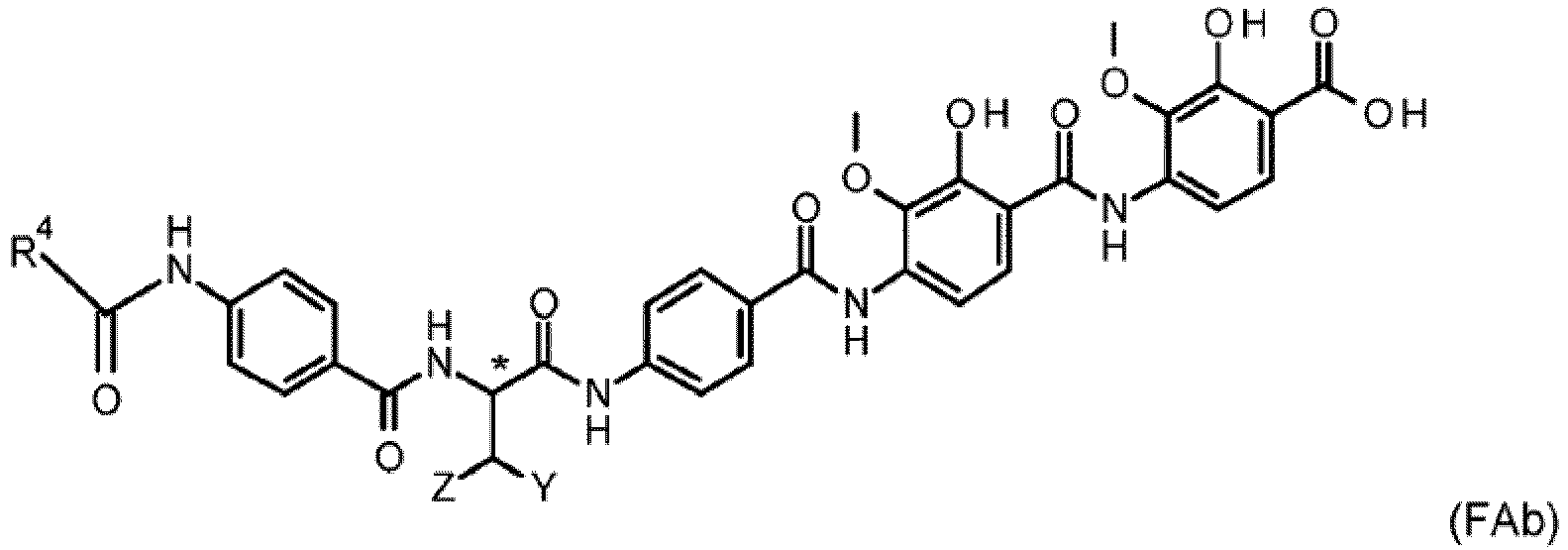 wobei R4 für- ein substituiertes oder unsubstituiertes C3-C10-Cycloalkyl oder ein C3-C10-Halogencycloalkyl steht,wobei Y = CN und Z = H.
 - Verbindung nach einem der Ansprüche 1-3, wobei es sich bei der Verbindung um eine der folgenden Verbindungen-handelt:


- Verbindung nach einem der Ansprüche 4-5, wobei es sich bei der Verbindung um eine der folgenden Verbindungen handelt:

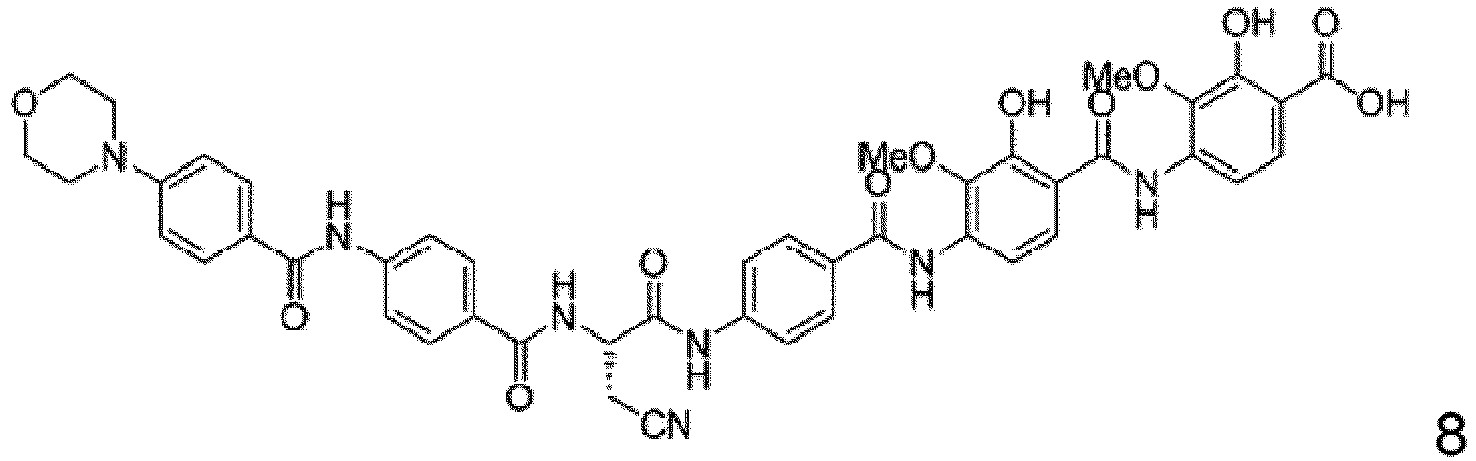


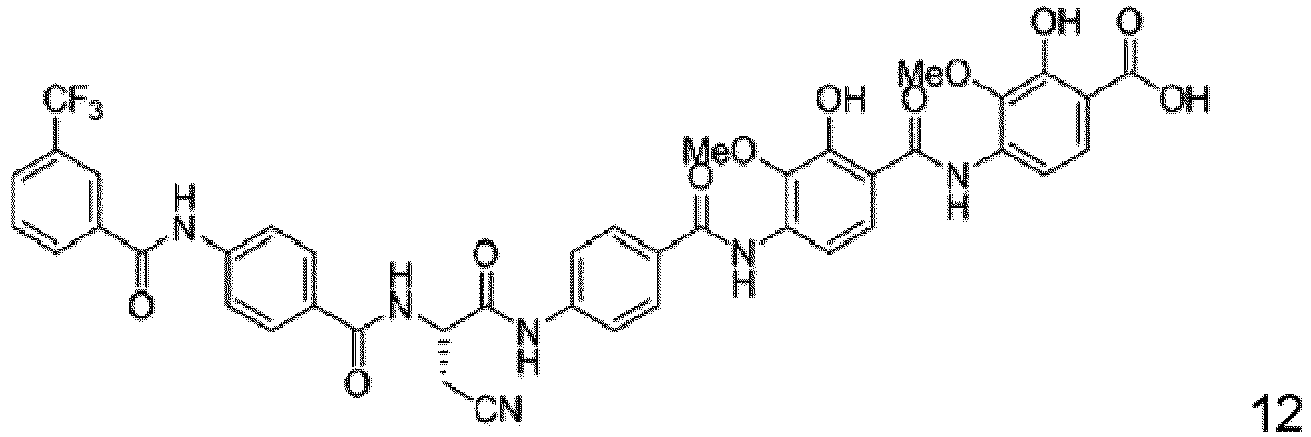


- Verbindung nach Anspruch 6, wobei es sich bei der Verbindung um eine der folgenden Verbindungen handelt:
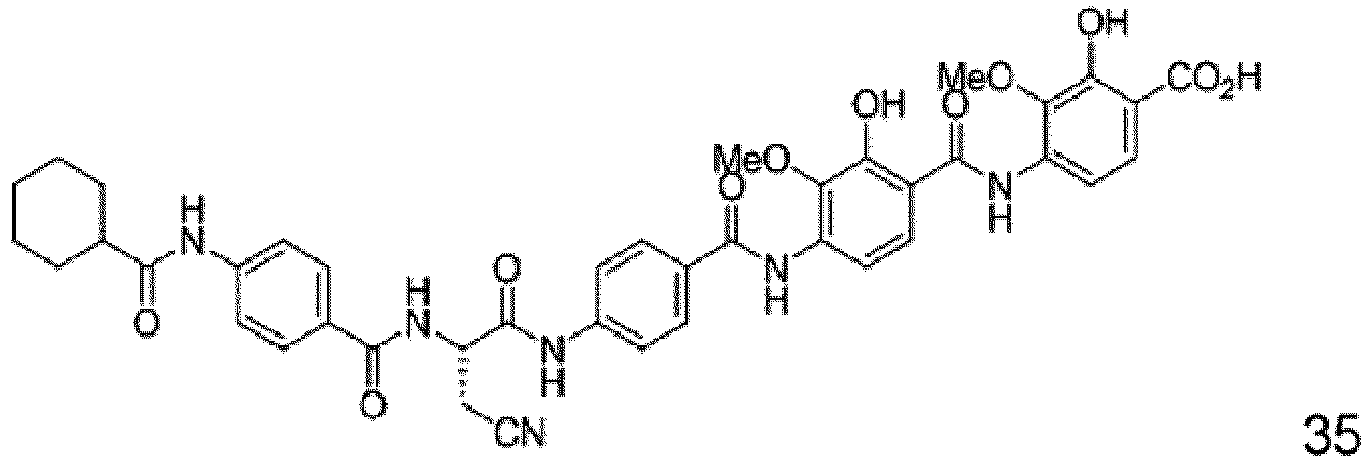


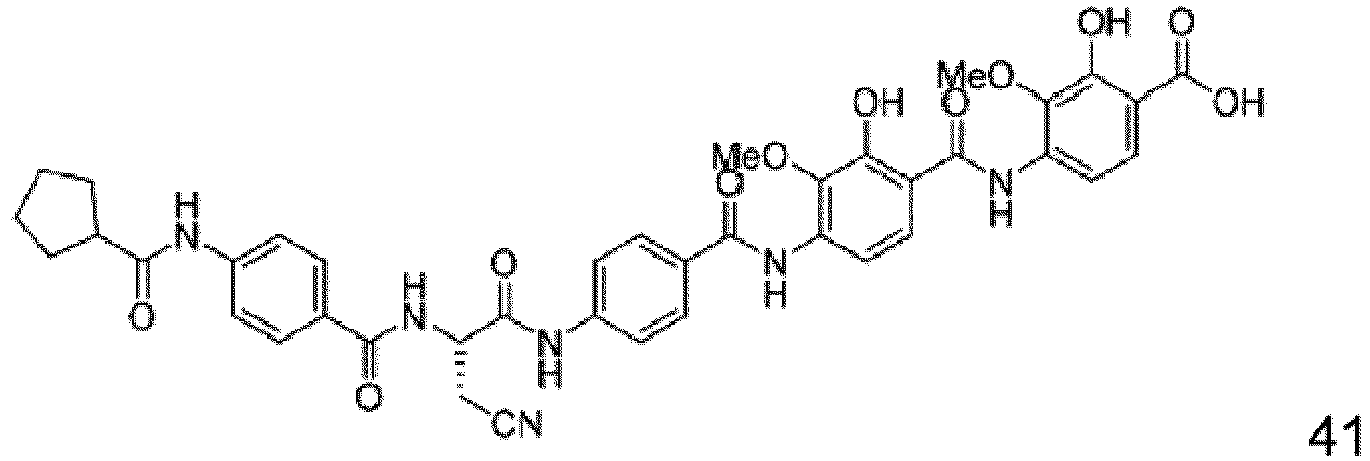

- Verbindung nach einem der vorhergehenden Ansprüche zur Verwendung in einem Verfahren zur Behandlung von Bakterieninfektionen.
- Verbindung zur Verwendung in einem Verfahren nach Anspruch 10, wobei es sich bei der Bakterieninfektion um eine Infektion durch eine der Gattungen Acinetobacter, Bordatella, Borellia, Brucella, Camphylobacter, Chlamydia, Chlamydophila, Enterobacter, Escherichia, Francisella, Haemophilus, Helicobacter, Klebisella, Legionella, Leptospira, Morganella, Moraxella, Neisseria, Proteus, Pseudomonas, Rickettsia, Shigella, Salmonella, Stenotrophomonas, Treponema oder Yersinia handelt.
- Verbindung zur Verwendung in einem Verfahren nach Anspruch 10, wobei es sich bei der Bakterieninfektion um eine Infektion durch eine der Gattungen Escherichia, Enterobacter, Salmonella, Klebisella, Pseudomonas, Haemophilus, Shigella, Proteus oder Morganella handelt.
- Verbindung zur Verwendung in einem Verfahren nach Anspruch 10, wobei es sich bei der Bakterieninfektion um eine Infektion- durch eine der Gattungen Bacillus, Chlostridium, Corynebacterium, Enterococcus, Listeria, Micrococcus, Staphylococcus oder Streptococcus oder- durch eine der Gattung Mycobacterium oder- durch eine der Gattung Mycoplasma
handelt. - Verbindung zur Verwendung in einem Verfahren nach Anspruch 13, wobei es sich bei der Bakterieninfektion um eine Infektion- durch eine der Gattungen Staphylococcus, Streptococcus, Bacillus oder Micrococcus oder- durch Mycobacterium tuberculosis, Mycobacterium leprae, Mycobacterium ulcerans oder Mycobacterium avium oder- durch Mycoplasma pneumonia handelt.
- Verbindung zur Verwendung in einem Verfahren nach Anspruch 10, wobei es sich bei der Bakterieninfektion um eine Infektion durch Staphylococcus aureus, Staphylococcus epidermidis, Staphylococcus aureus, Streptococcus pyogenes, Bacillus subtilis, Bacillus megaterium, Micrococcus luteus, Escherichia coli, Enterobacter aerogenes, Enterobacter cloacae, Enterobacter sakazakii, Cronobacter sakazakii, Salmonella typhi, Salmonella enteritidis, Klebisella pneumonia, Pseudomonas aeruginosa, Haemophilus influenza, Shigella sonnei, Proteus vulgaris, Proteus mirabilis oder Morganella morganii handelt.
Priority Applications (1)
| Application Number | Priority Date | Filing Date | Title |
|---|---|---|---|
| EP14712606.4A EP2956437B1 (de) | 2013-02-15 | 2014-02-14 | Albicidinderivate für die behandlung von bakteriellen infektionen |
Applications Claiming Priority (8)
| Application Number | Priority Date | Filing Date | Title |
|---|---|---|---|
| US201361765056P | 2013-02-15 | 2013-02-15 | |
| EP13170957 | 2013-06-06 | ||
| EP13192247 | 2013-11-08 | ||
| EP13199922 | 2013-12-31 | ||
| EP13199921 | 2013-12-31 | ||
| EP13199920 | 2013-12-31 | ||
| PCT/EP2014/052922 WO2014125075A1 (en) | 2013-02-15 | 2014-02-14 | Albicidin derivatives, their use and synthesis |
| EP14712606.4A EP2956437B1 (de) | 2013-02-15 | 2014-02-14 | Albicidinderivate für die behandlung von bakteriellen infektionen |
Publications (2)
| Publication Number | Publication Date |
|---|---|
| EP2956437A1 EP2956437A1 (de) | 2015-12-23 |
| EP2956437B1 true EP2956437B1 (de) | 2023-05-10 |
Family
ID=51353494
Family Applications (1)
| Application Number | Title | Priority Date | Filing Date |
|---|---|---|---|
| EP14712606.4A Active EP2956437B1 (de) | 2013-02-15 | 2014-02-14 | Albicidinderivate für die behandlung von bakteriellen infektionen |
Country Status (6)
| Country | Link |
|---|---|
| US (1) | US10308595B2 (de) |
| EP (1) | EP2956437B1 (de) |
| JP (1) | JP6474736B2 (de) |
| CN (1) | CN105143176B (de) |
| CA (1) | CA2901576C (de) |
| WO (1) | WO2014125075A1 (de) |
Families Citing this family (10)
| Publication number | Priority date | Publication date | Assignee | Title |
|---|---|---|---|---|
| CN105793424B (zh) * | 2013-07-12 | 2021-02-19 | 亥姆霍兹感染研究中心有限公司 | 孢囊菌酰胺 |
| AU2015314287B2 (en) | 2014-09-12 | 2019-04-18 | UNION therapeutics A/S | Antibacterial use of halogenated salicylanilides |
| CA2968270C (en) | 2014-11-26 | 2022-11-01 | Helmholtz-Zentrum Fur Infektionsforschung Gmbh | Further natural cystobactamides, synthetic derivatives thereof, and use thereof in treating bacterial infections |
| GB201509326D0 (en) | 2015-05-29 | 2015-07-15 | Antibio Tx Aps | Novel use |
| WO2019015794A1 (en) | 2017-07-18 | 2019-01-24 | Technische Universität Berlin | NEW ALBICIDINE DERIVATIVES, THEIR USE AND THEIR SYNTHESIS |
| US11034648B2 (en) | 2017-08-23 | 2021-06-15 | Helmholtz-Zentrum Für | Cystobactamide derivatives |
| EP3546455A1 (de) * | 2018-03-29 | 2019-10-02 | Technische Universität Berlin | Neuartige albicidinderivate, deren verwendung und synthese |
| US11419834B2 (en) | 2019-02-25 | 2022-08-23 | Rhode Island Hospital | Methods for treating diseases or infections caused by or associated with H. pylori using a halogenated salicylanilide |
| EP3974416A1 (de) * | 2020-09-23 | 2022-03-30 | Technische Universität Berlin | Neuartige albicidinderivate, deren verwendung und synthese |
| WO2025003147A1 (en) | 2023-06-26 | 2025-01-02 | Helmholtz-Zentrum für Infektionsforschung GmbH | Cystobactamid derivatives |
Family Cites Families (7)
| Publication number | Priority date | Publication date | Assignee | Title |
|---|---|---|---|---|
| US4525354A (en) * | 1983-09-14 | 1985-06-25 | University Of Hawaii | Antibiotic and process for the production thereof |
| WO2004035760A2 (en) | 2002-10-18 | 2004-04-29 | University Of Florida | Complete biosynthetic gene set for biosynthesis of albicidin, resistance genes, and uses thereof |
| JP2006306771A (ja) * | 2005-04-28 | 2006-11-09 | Mitsui Chemicals Inc | 農園芸用殺虫剤 |
| WO2008112938A2 (en) | 2007-03-13 | 2008-09-18 | New England Medical Center Hospitals, Inc. | Composition and method for the treatment of diseases affected by a peptide receptor |
| CN101693763B (zh) | 2009-10-12 | 2011-06-01 | 四川大学 | 氢键自组装超分子蓝色荧光聚合物及其合成方法 |
| WO2011084970A1 (en) * | 2010-01-07 | 2011-07-14 | Polymedix Inc. | Anti-heparin compounds |
| RU2606128C2 (ru) | 2011-05-16 | 2017-01-10 | Селлсьютикс Корпорейшн | Соединения для применения в лечении мукозита |
-
2014
- 2014-02-14 EP EP14712606.4A patent/EP2956437B1/de active Active
- 2014-02-14 CA CA2901576A patent/CA2901576C/en active Active
- 2014-02-14 JP JP2015557442A patent/JP6474736B2/ja active Active
- 2014-02-14 CN CN201480019427.4A patent/CN105143176B/zh active Active
- 2014-02-14 WO PCT/EP2014/052922 patent/WO2014125075A1/en not_active Ceased
- 2014-02-14 US US14/768,323 patent/US10308595B2/en active Active
Also Published As
| Publication number | Publication date |
|---|---|
| CA2901576A1 (en) | 2014-08-21 |
| EP2956437A1 (de) | 2015-12-23 |
| US10308595B2 (en) | 2019-06-04 |
| JP6474736B2 (ja) | 2019-02-27 |
| WO2014125075A1 (en) | 2014-08-21 |
| CA2901576C (en) | 2021-03-23 |
| CN105143176B (zh) | 2018-02-13 |
| US20150376120A1 (en) | 2015-12-31 |
| JP2016513103A (ja) | 2016-05-12 |
| CN105143176A (zh) | 2015-12-09 |
Similar Documents
| Publication | Publication Date | Title |
|---|---|---|
| EP2956437B1 (de) | Albicidinderivate für die behandlung von bakteriellen infektionen | |
| TWI810198B (zh) | Nlrp3發炎體之選擇性抑制劑 | |
| US20040186296A1 (en) | Process to produce derivatives from uk-2a derivatives | |
| UA81808C2 (en) | Normal;heading 1;heading 2;DERIVATIVES OF PIPERIDINYL- AND PIPERAZINYL-ALKYL CARBAMATES, PROCESS FOR PREPARATION AND THERAPEUTIC USES THEREOF | |
| AU2015414743B2 (en) | Process for the preparation of kinase inhibitors and intermediates thereof | |
| WO2000047561A1 (en) | Non-nucleoside reverse transcriptase inhibitors | |
| JP7244493B2 (ja) | 新規なシストバクタミド誘導体 | |
| CN116751136A (zh) | 氧代吡啶类化合物的新型制备方法及关键中间体 | |
| US9533971B2 (en) | Process for the synthesis of dabigatran and its intermediates | |
| JP7382647B2 (ja) | 新規のアルビシジン誘導体、それらの使用および合成 | |
| SK55093A3 (en) | Cyclopentane-beta-amino acids and cyclopentene-beta-amino acids | |
| CN114641466B (zh) | 磺酰脲衍生物及其用途 | |
| KR20060004907A (ko) | 포화 퀴녹살린 유도체 및 그의 메타보트로픽 글루타메이트수용체 리간드로서의 용도 | |
| EP3628664A1 (de) | Irreversible inhibitoren der kras-g12c-mutante | |
| KR20210141930A (ko) | 염증성 질환의 치료를 위한 아미노산 유도체 | |
| JP2010030999A (ja) | テロメラーゼ阻害剤 | |
| CN113336792A (zh) | 一种环状膦酸酯化合物的制备方法 | |
| US10077251B2 (en) | Process for the synthesis of Dabigatran Etexilate and its intermediates | |
| TWI904095B (zh) | 乙醯輔酶a合成酶短鏈2(acss2)之小分子抑制劑 | |
| JP7693921B2 (ja) | プロリンアミド化合物の製造方法 | |
| JP7279134B2 (ja) | プロリンアミド化合物の製造方法 | |
| JP5797662B2 (ja) | 5−アミノ−4−ヒドロキシペントイルアミド | |
| HUP0203835A2 (en) | Pyrimidine derivatives, process for preparing the derivatives and drugs containing the same as the active ingredient | |
| KR20250117821A (ko) | Hdac 억제제 및 이의 용도 | |
| WO2022063827A1 (en) | Novel albicidin derivatives, their use and synthesis |
Legal Events
| Date | Code | Title | Description |
|---|---|---|---|
| PUAI | Public reference made under article 153(3) epc to a published international application that has entered the european phase |
Free format text: ORIGINAL CODE: 0009012 |
|
| 17P | Request for examination filed |
Effective date: 20150810 |
|
| AK | Designated contracting states |
Kind code of ref document: A1 Designated state(s): AL AT BE BG CH CY CZ DE DK EE ES FI FR GB GR HR HU IE IS IT LI LT LU LV MC MK MT NL NO PL PT RO RS SE SI SK SM TR |
|
| AX | Request for extension of the european patent |
Extension state: BA ME |
|
| RAP1 | Party data changed (applicant data changed or rights of an application transferred) |
Owner name: CENTRE DE COOPERATION INTERNATIONALE EN RECHERCHE Owner name: TECHNISCHE UNIVERSITAET BERLIN |
|
| RIN1 | Information on inventor provided before grant (corrected) |
Inventor name: ROTT, PHILIPPE Inventor name: HUEGELLAND, MANUELA Inventor name: COCIANCICH, STEPHANE Inventor name: KRETZ, JULIAN Inventor name: GRAETZ, STEFAN Inventor name: KERWAT, DENNIS Inventor name: ROYER, MONIQUE Inventor name: SCHUBERT, VIVIEN Inventor name: SUESSMUTH, RODERICH Inventor name: PESIC, ALEXANDER |
|
| DAX | Request for extension of the european patent (deleted) | ||
| STAA | Information on the status of an ep patent application or granted ep patent |
Free format text: STATUS: EXAMINATION IS IN PROGRESS |
|
| 17Q | First examination report despatched |
Effective date: 20170609 |
|
| RAP1 | Party data changed (applicant data changed or rights of an application transferred) |
Owner name: TECHNISCHE UNIVERSITAET BERLIN |
|
| REG | Reference to a national code |
Ref country code: DE Ref legal event code: R079 Ref document number: 602014086892 Country of ref document: DE Free format text: PREVIOUS MAIN CLASS: C07C0255570000 Ipc: C07C0237420000 |
|
| GRAP | Despatch of communication of intention to grant a patent |
Free format text: ORIGINAL CODE: EPIDOSNIGR1 |
|
| STAA | Information on the status of an ep patent application or granted ep patent |
Free format text: STATUS: GRANT OF PATENT IS INTENDED |
|
| RIC1 | Information provided on ipc code assigned before grant |
Ipc: A61K 31/277 20060101ALI20221104BHEP Ipc: A61P 31/06 20060101ALI20221104BHEP Ipc: A61P 31/04 20060101ALI20221104BHEP Ipc: C07D 333/38 20060101ALI20221104BHEP Ipc: C07D 317/46 20060101ALI20221104BHEP Ipc: C07D 317/08 20060101ALI20221104BHEP Ipc: C07D 311/12 20060101ALI20221104BHEP Ipc: C07D 307/56 20060101ALI20221104BHEP Ipc: C07D 295/14 20060101ALI20221104BHEP Ipc: C07D 277/56 20060101ALI20221104BHEP Ipc: C07D 263/24 20060101ALI20221104BHEP Ipc: C07D 241/24 20060101ALI20221104BHEP Ipc: C07D 237/24 20060101ALI20221104BHEP Ipc: C07D 213/81 20060101ALI20221104BHEP Ipc: C07D 209/34 20060101ALI20221104BHEP Ipc: C07D 207/34 20060101ALI20221104BHEP Ipc: C07C 311/46 20060101ALI20221104BHEP Ipc: C07C 311/21 20060101ALI20221104BHEP Ipc: C07C 255/29 20060101ALI20221104BHEP Ipc: C07C 237/42 20060101AFI20221104BHEP |
|
| INTG | Intention to grant announced |
Effective date: 20221128 |
|
| GRAS | Grant fee paid |
Free format text: ORIGINAL CODE: EPIDOSNIGR3 |
|
| GRAA | (expected) grant |
Free format text: ORIGINAL CODE: 0009210 |
|
| STAA | Information on the status of an ep patent application or granted ep patent |
Free format text: STATUS: THE PATENT HAS BEEN GRANTED |
|
| AK | Designated contracting states |
Kind code of ref document: B1 Designated state(s): AL AT BE BG CH CY CZ DE DK EE ES FI FR GB GR HR HU IE IS IT LI LT LU LV MC MK MT NL NO PL PT RO RS SE SI SK SM TR |
|
| REG | Reference to a national code |
Ref country code: GB Ref legal event code: FG4D |
|
| REG | Reference to a national code |
Ref country code: AT Ref legal event code: REF Ref document number: 1566553 Country of ref document: AT Kind code of ref document: T Effective date: 20230515 Ref country code: CH Ref legal event code: EP |
|
| REG | Reference to a national code |
Ref country code: DE Ref legal event code: R096 Ref document number: 602014086892 Country of ref document: DE |
|
| REG | Reference to a national code |
Ref country code: IE Ref legal event code: FG4D |
|
| REG | Reference to a national code |
Ref country code: LT Ref legal event code: MG9D |
|
| REG | Reference to a national code |
Ref country code: NL Ref legal event code: MP Effective date: 20230510 |
|
| REG | Reference to a national code |
Ref country code: AT Ref legal event code: MK05 Ref document number: 1566553 Country of ref document: AT Kind code of ref document: T Effective date: 20230510 |
|
| PG25 | Lapsed in a contracting state [announced via postgrant information from national office to epo] |
Ref country code: SE Free format text: LAPSE BECAUSE OF FAILURE TO SUBMIT A TRANSLATION OF THE DESCRIPTION OR TO PAY THE FEE WITHIN THE PRESCRIBED TIME-LIMIT Effective date: 20230510 Ref country code: PT Free format text: LAPSE BECAUSE OF FAILURE TO SUBMIT A TRANSLATION OF THE DESCRIPTION OR TO PAY THE FEE WITHIN THE PRESCRIBED TIME-LIMIT Effective date: 20230911 Ref country code: NO Free format text: LAPSE BECAUSE OF FAILURE TO SUBMIT A TRANSLATION OF THE DESCRIPTION OR TO PAY THE FEE WITHIN THE PRESCRIBED TIME-LIMIT Effective date: 20230810 Ref country code: NL Free format text: LAPSE BECAUSE OF FAILURE TO SUBMIT A TRANSLATION OF THE DESCRIPTION OR TO PAY THE FEE WITHIN THE PRESCRIBED TIME-LIMIT Effective date: 20230510 Ref country code: ES Free format text: LAPSE BECAUSE OF FAILURE TO SUBMIT A TRANSLATION OF THE DESCRIPTION OR TO PAY THE FEE WITHIN THE PRESCRIBED TIME-LIMIT Effective date: 20230510 Ref country code: AT Free format text: LAPSE BECAUSE OF FAILURE TO SUBMIT A TRANSLATION OF THE DESCRIPTION OR TO PAY THE FEE WITHIN THE PRESCRIBED TIME-LIMIT Effective date: 20230510 |
|
| PG25 | Lapsed in a contracting state [announced via postgrant information from national office to epo] |
Ref country code: RS Free format text: LAPSE BECAUSE OF FAILURE TO SUBMIT A TRANSLATION OF THE DESCRIPTION OR TO PAY THE FEE WITHIN THE PRESCRIBED TIME-LIMIT Effective date: 20230510 Ref country code: PL Free format text: LAPSE BECAUSE OF FAILURE TO SUBMIT A TRANSLATION OF THE DESCRIPTION OR TO PAY THE FEE WITHIN THE PRESCRIBED TIME-LIMIT Effective date: 20230510 Ref country code: LV Free format text: LAPSE BECAUSE OF FAILURE TO SUBMIT A TRANSLATION OF THE DESCRIPTION OR TO PAY THE FEE WITHIN THE PRESCRIBED TIME-LIMIT Effective date: 20230510 Ref country code: LT Free format text: LAPSE BECAUSE OF FAILURE TO SUBMIT A TRANSLATION OF THE DESCRIPTION OR TO PAY THE FEE WITHIN THE PRESCRIBED TIME-LIMIT Effective date: 20230510 Ref country code: IS Free format text: LAPSE BECAUSE OF FAILURE TO SUBMIT A TRANSLATION OF THE DESCRIPTION OR TO PAY THE FEE WITHIN THE PRESCRIBED TIME-LIMIT Effective date: 20230910 Ref country code: HR Free format text: LAPSE BECAUSE OF FAILURE TO SUBMIT A TRANSLATION OF THE DESCRIPTION OR TO PAY THE FEE WITHIN THE PRESCRIBED TIME-LIMIT Effective date: 20230510 Ref country code: GR Free format text: LAPSE BECAUSE OF FAILURE TO SUBMIT A TRANSLATION OF THE DESCRIPTION OR TO PAY THE FEE WITHIN THE PRESCRIBED TIME-LIMIT Effective date: 20230811 |
|
| PG25 | Lapsed in a contracting state [announced via postgrant information from national office to epo] |
Ref country code: FI Free format text: LAPSE BECAUSE OF FAILURE TO SUBMIT A TRANSLATION OF THE DESCRIPTION OR TO PAY THE FEE WITHIN THE PRESCRIBED TIME-LIMIT Effective date: 20230510 |
|
| PG25 | Lapsed in a contracting state [announced via postgrant information from national office to epo] |
Ref country code: SK Free format text: LAPSE BECAUSE OF FAILURE TO SUBMIT A TRANSLATION OF THE DESCRIPTION OR TO PAY THE FEE WITHIN THE PRESCRIBED TIME-LIMIT Effective date: 20230510 |
|
| PG25 | Lapsed in a contracting state [announced via postgrant information from national office to epo] |
Ref country code: SM Free format text: LAPSE BECAUSE OF FAILURE TO SUBMIT A TRANSLATION OF THE DESCRIPTION OR TO PAY THE FEE WITHIN THE PRESCRIBED TIME-LIMIT Effective date: 20230510 Ref country code: SK Free format text: LAPSE BECAUSE OF FAILURE TO SUBMIT A TRANSLATION OF THE DESCRIPTION OR TO PAY THE FEE WITHIN THE PRESCRIBED TIME-LIMIT Effective date: 20230510 Ref country code: RO Free format text: LAPSE BECAUSE OF FAILURE TO SUBMIT A TRANSLATION OF THE DESCRIPTION OR TO PAY THE FEE WITHIN THE PRESCRIBED TIME-LIMIT Effective date: 20230510 Ref country code: EE Free format text: LAPSE BECAUSE OF FAILURE TO SUBMIT A TRANSLATION OF THE DESCRIPTION OR TO PAY THE FEE WITHIN THE PRESCRIBED TIME-LIMIT Effective date: 20230510 Ref country code: DK Free format text: LAPSE BECAUSE OF FAILURE TO SUBMIT A TRANSLATION OF THE DESCRIPTION OR TO PAY THE FEE WITHIN THE PRESCRIBED TIME-LIMIT Effective date: 20230510 Ref country code: CZ Free format text: LAPSE BECAUSE OF FAILURE TO SUBMIT A TRANSLATION OF THE DESCRIPTION OR TO PAY THE FEE WITHIN THE PRESCRIBED TIME-LIMIT Effective date: 20230510 |
|
| REG | Reference to a national code |
Ref country code: DE Ref legal event code: R097 Ref document number: 602014086892 Country of ref document: DE |
|
| PLBE | No opposition filed within time limit |
Free format text: ORIGINAL CODE: 0009261 |
|
| STAA | Information on the status of an ep patent application or granted ep patent |
Free format text: STATUS: NO OPPOSITION FILED WITHIN TIME LIMIT |
|
| 26N | No opposition filed |
Effective date: 20240213 |
|
| PG25 | Lapsed in a contracting state [announced via postgrant information from national office to epo] |
Ref country code: SI Free format text: LAPSE BECAUSE OF FAILURE TO SUBMIT A TRANSLATION OF THE DESCRIPTION OR TO PAY THE FEE WITHIN THE PRESCRIBED TIME-LIMIT Effective date: 20230510 |
|
| PG25 | Lapsed in a contracting state [announced via postgrant information from national office to epo] |
Ref country code: SI Free format text: LAPSE BECAUSE OF FAILURE TO SUBMIT A TRANSLATION OF THE DESCRIPTION OR TO PAY THE FEE WITHIN THE PRESCRIBED TIME-LIMIT Effective date: 20230510 Ref country code: IT Free format text: LAPSE BECAUSE OF FAILURE TO SUBMIT A TRANSLATION OF THE DESCRIPTION OR TO PAY THE FEE WITHIN THE PRESCRIBED TIME-LIMIT Effective date: 20230510 |
|
| PG25 | Lapsed in a contracting state [announced via postgrant information from national office to epo] |
Ref country code: MC Free format text: LAPSE BECAUSE OF FAILURE TO SUBMIT A TRANSLATION OF THE DESCRIPTION OR TO PAY THE FEE WITHIN THE PRESCRIBED TIME-LIMIT Effective date: 20230510 |
|
| PG25 | Lapsed in a contracting state [announced via postgrant information from national office to epo] |
Ref country code: LU Free format text: LAPSE BECAUSE OF NON-PAYMENT OF DUE FEES Effective date: 20240214 |
|
| PG25 | Lapsed in a contracting state [announced via postgrant information from national office to epo] |
Ref country code: LU Free format text: LAPSE BECAUSE OF NON-PAYMENT OF DUE FEES Effective date: 20240214 |
|
| PG25 | Lapsed in a contracting state [announced via postgrant information from national office to epo] |
Ref country code: BG Free format text: LAPSE BECAUSE OF FAILURE TO SUBMIT A TRANSLATION OF THE DESCRIPTION OR TO PAY THE FEE WITHIN THE PRESCRIBED TIME-LIMIT Effective date: 20230510 |
|
| PG25 | Lapsed in a contracting state [announced via postgrant information from national office to epo] |
Ref country code: BG Free format text: LAPSE BECAUSE OF FAILURE TO SUBMIT A TRANSLATION OF THE DESCRIPTION OR TO PAY THE FEE WITHIN THE PRESCRIBED TIME-LIMIT Effective date: 20230510 |
|
| REG | Reference to a national code |
Ref country code: BE Ref legal event code: MM Effective date: 20240229 |
|
| PG25 | Lapsed in a contracting state [announced via postgrant information from national office to epo] |
Ref country code: BE Free format text: LAPSE BECAUSE OF NON-PAYMENT OF DUE FEES Effective date: 20240229 |
|
| PG25 | Lapsed in a contracting state [announced via postgrant information from national office to epo] |
Ref country code: IE Free format text: LAPSE BECAUSE OF NON-PAYMENT OF DUE FEES Effective date: 20240214 |
|
| PG25 | Lapsed in a contracting state [announced via postgrant information from national office to epo] |
Ref country code: IE Free format text: LAPSE BECAUSE OF NON-PAYMENT OF DUE FEES Effective date: 20240214 Ref country code: BE Free format text: LAPSE BECAUSE OF NON-PAYMENT OF DUE FEES Effective date: 20240229 |
|
| PGFP | Annual fee paid to national office [announced via postgrant information from national office to epo] |
Ref country code: DE Payment date: 20250218 Year of fee payment: 12 |
|
| PGFP | Annual fee paid to national office [announced via postgrant information from national office to epo] |
Ref country code: CH Payment date: 20250301 Year of fee payment: 12 |
|
| PGFP | Annual fee paid to national office [announced via postgrant information from national office to epo] |
Ref country code: FR Payment date: 20250220 Year of fee payment: 12 |
|
| PGFP | Annual fee paid to national office [announced via postgrant information from national office to epo] |
Ref country code: GB Payment date: 20250220 Year of fee payment: 12 |
|
| PG25 | Lapsed in a contracting state [announced via postgrant information from national office to epo] |
Ref country code: CY Free format text: LAPSE BECAUSE OF FAILURE TO SUBMIT A TRANSLATION OF THE DESCRIPTION OR TO PAY THE FEE WITHIN THE PRESCRIBED TIME-LIMIT; INVALID AB INITIO Effective date: 20140214 |
|
| PG25 | Lapsed in a contracting state [announced via postgrant information from national office to epo] |
Ref country code: HU Free format text: LAPSE BECAUSE OF FAILURE TO SUBMIT A TRANSLATION OF THE DESCRIPTION OR TO PAY THE FEE WITHIN THE PRESCRIBED TIME-LIMIT; INVALID AB INITIO Effective date: 20140214 |