EP2954064B1 - Cyclodextrin glucantransferase - Google Patents
Cyclodextrin glucantransferase Download PDFInfo
- Publication number
- EP2954064B1 EP2954064B1 EP14704877.1A EP14704877A EP2954064B1 EP 2954064 B1 EP2954064 B1 EP 2954064B1 EP 14704877 A EP14704877 A EP 14704877A EP 2954064 B1 EP2954064 B1 EP 2954064B1
- Authority
- EP
- European Patent Office
- Prior art keywords
- host cell
- seq
- nucleic acid
- set forth
- cyclodextrin
- Prior art date
- Legal status (The legal status is an assumption and is not a legal conclusion. Google has not performed a legal analysis and makes no representation as to the accuracy of the status listed.)
- Active
Links
Images









Classifications
-
- C—CHEMISTRY; METALLURGY
- C12—BIOCHEMISTRY; BEER; SPIRITS; WINE; VINEGAR; MICROBIOLOGY; ENZYMOLOGY; MUTATION OR GENETIC ENGINEERING
- C12N—MICROORGANISMS OR ENZYMES; COMPOSITIONS THEREOF; PROPAGATING, PRESERVING, OR MAINTAINING MICROORGANISMS; MUTATION OR GENETIC ENGINEERING; CULTURE MEDIA
- C12N9/00—Enzymes; Proenzymes; Compositions thereof; Processes for preparing, activating, inhibiting, separating or purifying enzymes
- C12N9/10—Transferases (2.)
- C12N9/1048—Glycosyltransferases (2.4)
- C12N9/1051—Hexosyltransferases (2.4.1)
-
- C—CHEMISTRY; METALLURGY
- C12—BIOCHEMISTRY; BEER; SPIRITS; WINE; VINEGAR; MICROBIOLOGY; ENZYMOLOGY; MUTATION OR GENETIC ENGINEERING
- C12N—MICROORGANISMS OR ENZYMES; COMPOSITIONS THEREOF; PROPAGATING, PRESERVING, OR MAINTAINING MICROORGANISMS; MUTATION OR GENETIC ENGINEERING; CULTURE MEDIA
- C12N1/00—Microorganisms; Compositions thereof; Processes of propagating, maintaining or preserving microorganisms or compositions thereof; Processes of preparing or isolating a composition containing a microorganism; Culture media therefor
- C12N1/20—Bacteria; Culture media therefor
-
- C—CHEMISTRY; METALLURGY
- C12—BIOCHEMISTRY; BEER; SPIRITS; WINE; VINEGAR; MICROBIOLOGY; ENZYMOLOGY; MUTATION OR GENETIC ENGINEERING
- C12N—MICROORGANISMS OR ENZYMES; COMPOSITIONS THEREOF; PROPAGATING, PRESERVING, OR MAINTAINING MICROORGANISMS; MUTATION OR GENETIC ENGINEERING; CULTURE MEDIA
- C12N15/00—Mutation or genetic engineering; DNA or RNA concerning genetic engineering, vectors, e.g. plasmids, or their isolation, preparation or purification; Use of hosts therefor
- C12N15/09—Recombinant DNA-technology
- C12N15/63—Introduction of foreign genetic material using vectors; Vectors; Use of hosts therefor; Regulation of expression
- C12N15/74—Vectors or expression systems specially adapted for prokaryotic hosts other than E. coli, e.g. Lactobacillus, Micromonospora
-
- C—CHEMISTRY; METALLURGY
- C12—BIOCHEMISTRY; BEER; SPIRITS; WINE; VINEGAR; MICROBIOLOGY; ENZYMOLOGY; MUTATION OR GENETIC ENGINEERING
- C12N—MICROORGANISMS OR ENZYMES; COMPOSITIONS THEREOF; PROPAGATING, PRESERVING, OR MAINTAINING MICROORGANISMS; MUTATION OR GENETIC ENGINEERING; CULTURE MEDIA
- C12N15/00—Mutation or genetic engineering; DNA or RNA concerning genetic engineering, vectors, e.g. plasmids, or their isolation, preparation or purification; Use of hosts therefor
- C12N15/09—Recombinant DNA-technology
- C12N15/63—Introduction of foreign genetic material using vectors; Vectors; Use of hosts therefor; Regulation of expression
- C12N15/74—Vectors or expression systems specially adapted for prokaryotic hosts other than E. coli, e.g. Lactobacillus, Micromonospora
- C12N15/75—Vectors or expression systems specially adapted for prokaryotic hosts other than E. coli, e.g. Lactobacillus, Micromonospora for Bacillus
-
- C—CHEMISTRY; METALLURGY
- C12—BIOCHEMISTRY; BEER; SPIRITS; WINE; VINEGAR; MICROBIOLOGY; ENZYMOLOGY; MUTATION OR GENETIC ENGINEERING
- C12N—MICROORGANISMS OR ENZYMES; COMPOSITIONS THEREOF; PROPAGATING, PRESERVING, OR MAINTAINING MICROORGANISMS; MUTATION OR GENETIC ENGINEERING; CULTURE MEDIA
- C12N9/00—Enzymes; Proenzymes; Compositions thereof; Processes for preparing, activating, inhibiting, separating or purifying enzymes
- C12N9/10—Transferases (2.)
- C12N9/1048—Glycosyltransferases (2.4)
- C12N9/1051—Hexosyltransferases (2.4.1)
- C12N9/1074—Cyclomaltodextrin glucanotransferase (2.4.1.19)
-
- C—CHEMISTRY; METALLURGY
- C12—BIOCHEMISTRY; BEER; SPIRITS; WINE; VINEGAR; MICROBIOLOGY; ENZYMOLOGY; MUTATION OR GENETIC ENGINEERING
- C12P—FERMENTATION OR ENZYME-USING PROCESSES TO SYNTHESISE A DESIRED CHEMICAL COMPOUND OR COMPOSITION OR TO SEPARATE OPTICAL ISOMERS FROM A RACEMIC MIXTURE
- C12P19/00—Preparation of compounds containing saccharide radicals
- C12P19/18—Preparation of compounds containing saccharide radicals produced by the action of a glycosyl transferase, e.g. alpha-, beta- or gamma-cyclodextrins
-
- C—CHEMISTRY; METALLURGY
- C12—BIOCHEMISTRY; BEER; SPIRITS; WINE; VINEGAR; MICROBIOLOGY; ENZYMOLOGY; MUTATION OR GENETIC ENGINEERING
- C12P—FERMENTATION OR ENZYME-USING PROCESSES TO SYNTHESISE A DESIRED CHEMICAL COMPOUND OR COMPOSITION OR TO SEPARATE OPTICAL ISOMERS FROM A RACEMIC MIXTURE
- C12P7/00—Preparation of oxygen-containing organic compounds
- C12P7/02—Preparation of oxygen-containing organic compounds containing a hydroxy group
- C12P7/04—Preparation of oxygen-containing organic compounds containing a hydroxy group acyclic
- C12P7/06—Ethanol, i.e. non-beverage
-
- C—CHEMISTRY; METALLURGY
- C12—BIOCHEMISTRY; BEER; SPIRITS; WINE; VINEGAR; MICROBIOLOGY; ENZYMOLOGY; MUTATION OR GENETIC ENGINEERING
- C12P—FERMENTATION OR ENZYME-USING PROCESSES TO SYNTHESISE A DESIRED CHEMICAL COMPOUND OR COMPOSITION OR TO SEPARATE OPTICAL ISOMERS FROM A RACEMIC MIXTURE
- C12P7/00—Preparation of oxygen-containing organic compounds
- C12P7/02—Preparation of oxygen-containing organic compounds containing a hydroxy group
- C12P7/04—Preparation of oxygen-containing organic compounds containing a hydroxy group acyclic
- C12P7/06—Ethanol, i.e. non-beverage
- C12P7/065—Ethanol, i.e. non-beverage with microorganisms other than yeasts
-
- C—CHEMISTRY; METALLURGY
- C12—BIOCHEMISTRY; BEER; SPIRITS; WINE; VINEGAR; MICROBIOLOGY; ENZYMOLOGY; MUTATION OR GENETIC ENGINEERING
- C12P—FERMENTATION OR ENZYME-USING PROCESSES TO SYNTHESISE A DESIRED CHEMICAL COMPOUND OR COMPOSITION OR TO SEPARATE OPTICAL ISOMERS FROM A RACEMIC MIXTURE
- C12P7/00—Preparation of oxygen-containing organic compounds
- C12P7/02—Preparation of oxygen-containing organic compounds containing a hydroxy group
- C12P7/04—Preparation of oxygen-containing organic compounds containing a hydroxy group acyclic
- C12P7/16—Butanols
-
- C—CHEMISTRY; METALLURGY
- C12—BIOCHEMISTRY; BEER; SPIRITS; WINE; VINEGAR; MICROBIOLOGY; ENZYMOLOGY; MUTATION OR GENETIC ENGINEERING
- C12P—FERMENTATION OR ENZYME-USING PROCESSES TO SYNTHESISE A DESIRED CHEMICAL COMPOUND OR COMPOSITION OR TO SEPARATE OPTICAL ISOMERS FROM A RACEMIC MIXTURE
- C12P7/00—Preparation of oxygen-containing organic compounds
- C12P7/24—Preparation of oxygen-containing organic compounds containing a carbonyl group
- C12P7/26—Ketones
- C12P7/28—Acetone-containing products
-
- C—CHEMISTRY; METALLURGY
- C12—BIOCHEMISTRY; BEER; SPIRITS; WINE; VINEGAR; MICROBIOLOGY; ENZYMOLOGY; MUTATION OR GENETIC ENGINEERING
- C12P—FERMENTATION OR ENZYME-USING PROCESSES TO SYNTHESISE A DESIRED CHEMICAL COMPOUND OR COMPOSITION OR TO SEPARATE OPTICAL ISOMERS FROM A RACEMIC MIXTURE
- C12P7/00—Preparation of oxygen-containing organic compounds
- C12P7/40—Preparation of oxygen-containing organic compounds containing a carboxyl group including Peroxycarboxylic acids
- C12P7/52—Propionic acid; Butyric acids
-
- C—CHEMISTRY; METALLURGY
- C12—BIOCHEMISTRY; BEER; SPIRITS; WINE; VINEGAR; MICROBIOLOGY; ENZYMOLOGY; MUTATION OR GENETIC ENGINEERING
- C12Y—ENZYMES
- C12Y204/00—Glycosyltransferases (2.4)
- C12Y204/01—Hexosyltransferases (2.4.1)
- C12Y204/01019—Cyclomaltodextrin glucanotransferase (2.4.1.19)
-
- C—CHEMISTRY; METALLURGY
- C12—BIOCHEMISTRY; BEER; SPIRITS; WINE; VINEGAR; MICROBIOLOGY; ENZYMOLOGY; MUTATION OR GENETIC ENGINEERING
- C12N—MICROORGANISMS OR ENZYMES; COMPOSITIONS THEREOF; PROPAGATING, PRESERVING, OR MAINTAINING MICROORGANISMS; MUTATION OR GENETIC ENGINEERING; CULTURE MEDIA
- C12N2510/00—Genetically modified cells
- C12N2510/02—Cells for production
-
- Y—GENERAL TAGGING OF NEW TECHNOLOGICAL DEVELOPMENTS; GENERAL TAGGING OF CROSS-SECTIONAL TECHNOLOGIES SPANNING OVER SEVERAL SECTIONS OF THE IPC; TECHNICAL SUBJECTS COVERED BY FORMER USPC CROSS-REFERENCE ART COLLECTIONS [XRACs] AND DIGESTS
- Y02—TECHNOLOGIES OR APPLICATIONS FOR MITIGATION OR ADAPTATION AGAINST CLIMATE CHANGE
- Y02E—REDUCTION OF GREENHOUSE GAS [GHG] EMISSIONS, RELATED TO ENERGY GENERATION, TRANSMISSION OR DISTRIBUTION
- Y02E50/00—Technologies for the production of fuel of non-fossil origin
- Y02E50/10—Biofuels, e.g. bio-diesel
Definitions
- the present invention relates to a novel cyclodextrin glucanotransferase (CGTase) enzyme which is obtainable from Clostridium saccharoperbutylacetonicum N1-4(HMT) or N1-504.
- the invention further relates to nucleic acids encoding the enzyme, vectors and host cells, and uses of the CGTase.
- Cyclodextrins are cyclic glucose oligosaccharides which are generally composed of ⁇ -(1,4) linked glucopyranose subunits. Common cyclodextrins include ⁇ -cyclodextrin (6-membered sugar ring), ⁇ -cyclodextrin (7-membered sugar ring) and ⁇ -cyclodextrin (8-membered sugar ring). Cyclodextrins have many uses in industry, including in separation and extraction processes, as drug-delivery agents and as stabilisers in the food industry. Cyclodextrins have also been used as intermediates in the production of ethanol (e.g. WO 89/03421 ).
- Cyclodextrins are generally produced by the enzymatic conversion of starch using enzymes such as cyclodextrin glucanotransferases.
- Cyclodextrin glucanotransferases are also known as cyclodextrin glycosyl transferases and cyclodextrin glucosyltransferases. These enzymes are generally only found in bacteria, particularly bacteria of the genus Bacillus (e.g. B . circulans, B. macerans and B . stearothermophilus ) .
- Clostridium thermohydrosulfuricus was previously classified as a Clostridial species, it has now been reclassified as Thermoanaerobacter thermohydrosulfuricus ( Collins, M.D. et al. (1994). The phylogeny of the genus Clostridium: proposal of five new genera and eleven new species combinations. Int. J. Syst. Bacteriol., 44(4), 812-26 ). The genus Thermoanaerobacter has now clearly established by sequence analysis and shown that it forms a separate and distinct genus from Clostridium sensu stricto (Cluster I) ( Stackebrandt et al.
- US 2,945,786 relates to a process for producing butanol by fermentation.
- E.M. Martin Del Valle Process Biochemistry, (2004), vol. 39, no. 9, pages 1033-1046 discloses "Cyclodextrins and their uses: a review ". Keis Stephanie et al. (International Journal of Systematic and Evolutionary Microbiology, Society for General Microbiology, Reading, GB, 2011, vol. 51, no. 6, pages 2095 - 2103) disclose "Emended descriptions of Clostridium acetobutylicum and Clostridium beijerinckii, and descriptions of Clostridium saccharoperbutylacetonicum sp. nov. and Clostridium saccharobutylicum sp.
- CGTases Whilst CGTases are generally capable of catalysing more than one reaction, the most important activity is the production of cyclic dextrins from substrates such as starch, amylose and other polysaccharides. In this process, the polysaccharide chain is cleaved and the ends are joined by the CGTase in order to produce a cyclic dextrin, i.e. a cyclodextrin.
- the size of the cyclodextrin i.e. the number of sugar residues it incorporates is dependent on the distance apart of the ends.
- the invention provides a polypeptide, wherein the amino acid sequence of the polypeptide:
- the invention also provides a composition comprising the polypeptide of claim 1.
- the invention further provides a nucleic acid molecule comprising:
- the invention also provides a vector comprising a nucleic acid molecule of claim 2. Also provided is a host cell comprising a vector of claim 5.
- the invention further provides a method of hydrolysing a polysaccharide, comprising contacting the polysaccharide with a host cell as claimed in any one of claims 6-8.
- polypeptide of the invention may be isolated and/or purified.
- the polypeptide of the invention may be in a form which is isolated from one or more of the following: bacteria, polysaccharide (e.g. potato, starch), yeast extract, tryptone, other enzymes.
- the polypeptide may be purified, i.e. the polypeptide may be substantially pure.
- the polypeptide may be at least 90%, preferably at least 95% and more preferably at least 99% pure. Purity may be assessed using SDS-PAGE or any other appropriate method.
- the invention also provides variants or derivatives of the polypeptide of SEQ ID NO: 1 or 3 as defined in claim 1.
- the proteins of the invention may be altered in various ways including substitutions, deletions, truncations, and/or insertions of one or more (e.g. 2-5, 2-10) amino acids, preferably in a manner which does not substantially alter the biological activity of the polypeptide of the invention.
- Guidance as to appropriate amino acid changes that do not affect biological activity of the protein of interest may be found in the model of Dayhoff et al. (1978) Atlas of Protein Sequence and Structure (Nat'l. Biomed. Res. Found., Washington, D.C .).
- Conservative substitutions, such as exchanging one amino acid with another having similar properties may be also made.
- substitution of one hydrophobic amino acid such as isoleucine, valine, leucine or methionine for another may be made; or the substitution of one polar amino acid residue for another, such as arginine for lysine, glutamic for aspartic acid, or glutamine for asparagine, may be made.
- One or more (e.g. 1-5, 1-10) amino acids in the polypeptides of the invention may be substituted by their corresponding D-amino acids, preferably at the N- and/or C-terminus.
- the invention provides a variant of the polypeptide of SEQ ID NO: 1 or 3, wherein the amino acid sequence of the variant comprises or consists of an amino acid sequence having at least 70%, preferably at least 80%, 85%, 90%, 95% or 99% sequence identity with SEQ ID NO: 1 or 3, preferably using the blastp method of alignment, and which codes for a cyclodextrin glucanotransferase.
- the invention particularly relates to polypeptides of SEQ ID NO: 1 or 3 or to variants of the polypeptide of SEQ ID NO: 1 or 3 as defined herein, wherein the amino acid which corresponds to the amino acid at position 223 is a small amino acid, e.g. glycine, alanine, leucine, serine, threonine or valine, preferably glycine.
- the size of the amino acid residue at position 223 may be involved in determining the size of any cyclodextrin products or ratio of any cyclodextrin products.
- the CGTases of the invention are capable of producing one or more cyclodextrins from polysaccharides, e.g. starch.
- the CGTases fall within the general EC classification 2.4.1. (hexosyltransferases). In some embodiments, the CGTase of the invention falls within classification EC 2.4.1.248 (cycloisomaltooligosaccharide glucanotransferase). In other embodiments of the invention, the CGTase falls within classification EC 2.4.1.19 (cyclomaltodextrin glucanotransferase).
- the invention also provides a composition comprising or consisting essentially of a polypeptide of the invention.
- the polypeptide may be present in the composition in the absence of one or more of the following: bacteria, polysaccharide (e.g. potato, starch), yeast extract, tryptone.
- polypeptide of the invention may be provided in any suitable form, e.g. in lyophilised form or in a buffer.
- nucleic acid molecule refers to a DNA or RNA molecule, which might be single- or double-stranded.
- the nucleic acid molecule is a DNA molecule, most preferably a double-stranded DNA molecule.
- the nucleic acid molecule is preferably one which contains no introns.
- the nucleic acid molecule may, for example, be intron-less genomic DNA or cDNA.
- the nucleic acid molecule of the invention is preferably isolated or purified.
- isolated nucleic acid means that the nucleic acid molecule is not contiguous with other genes with which it is normally associated in the natural source of the polypeptide-encoding nucleic acid.
- an isolated nucleic acid of the invention will not be contiguous with a nucleic acid encoding a maltose binding protein periplasmic precursor; or it will not be contiguous with a nucleic acid encoding a neopullananse/cyclomaltodextrinase.
- purified nucleic acid means a nucleic acid molecule which is free or substantially free from other non-contiguous nucleic acids and/or is free or substantially free from one or more of the following: bacteria, polysaccharide (e.g. potato, starch), yeast extract, tryptone.
- polysaccharide or “polysaccharide substrate” refers preferably to a glucose-based polysaccharide, e.g. a starch or a starch-based material.
- the polysaccharide is starch or a starch-based material, e.g. corn, corn starch, corn mash, potato, potato starch, potato mash, potato peeling, potato chips, cassava, cassava starch, cassava chips, sago, sago starch or 'soluble starch'.
- the nucleic acid molecule is a recombinant nucleic acid.
- the nucleic acid of the invention is preferably operably associated with one or more regulatory elements, e.g. a promoter and/or a terminator element.
- a promoter e.g. a promoter and/or a terminator element.
- operably associated or “operably linked” with a promoter means that the polypeptide-encoding region is transcribable from that promoter.
- the polypeptide-encoding region may, for example, be immediately 3' to the promoter, in which case the promoter will direct the transcription of the coding sequence.
- the polypeptide-encoding region may be part of an operon in which case the associated or linked promoter will direct the transcription of all of the polypeptide-encoding regions within that operon.
- the promoter or promoters are preferably ones which are operable in bacterial cells. More preferably, the promoters are bacterial promoters. Suitable promoters include inducible promoters, such as those that are inducible with specific sugars or sugar analogues, e.g. arabinose (e.g. lac, ara), those inducible with antibiotics (e.g. tetracycline, tet), those inducible with IPTG (e.g. trp, tac, Pspac), those inducible with heat (e.g. hsp70), those inducible with anaerobic induction (e.g.
- inducible promoters such as those that are inducible with specific sugars or sugar analogues, e.g. arabinose (e.g. lac, ara), those inducible with antibiotics (e.g. tetracycline, tet), those inducible with IPTG (e.g. trp, tac,
- the promoter is a constitutive promoter, e.g. the promoters for the thiolase gene (thl) or the permease operon (hfuC).
- the promoter may be one from Clostridia, e.g. a promoter from the pta/ptb genes.
- the promoter may be one from a butanol and/or butyrate biosynthetic pathway gene.
- the promoter may be an early onset promoter, i.e. a promoter from a gene which is upregulated during early exponential phase and reduced during transition phase and stationary phase.
- early onset promoter i.e. a promoter from a gene which is upregulated during early exponential phase and reduced during transition phase and stationary phase.
- promoters include promoters from glcK, hydA genes, or vitamin B12 synthesis, pta, ptb promoters.
- the promoter may be a promoter from a gene which is normally active in the exponential phase of solventogenic bacteria.
- Examples include promoters from genes that are expressed constitutively throughout exponential phase, e.g. from glycolysis genes and those in the pathway to produce butyryl-CoA (pfk, gap, pgk, bcd).
- promoters include the P2 (pta-ack, CAC1742, promoter), P6 (luxS, CAC2942, promoter) and P7 (CAC2941) promoters ( Alsaker and Papoutsakis, 2005, J. Bacteriol. 187:7103-7118 ).
- the P2 promoter is the promoter region from the operon encoding the phosphotransferase and the acetate kinase involved in acetate production from acetyl-CoA.
- the P6 promoter is the promoter region from a single chromosomal open reading frame encoding a LuxS homolog (CAC 2942), predicted to be involved in quorum sensing.
- the P7 promoter is the promoter region from a chromosomal operon (CAC 2938 - 2941) encoded downstream and in the reverse orientation to CAC 2942 and putatively involved in quorum sensing.
- the operon encodes a hydrolase (CAC 2941), a histidine kinase (CAC 2940), a response regulator (CAC 2939) and a hypothetical protein (CAC 2938).
- the invention provides a variant of the nucleic acid molecule of SEQ ID NO: 2 or 4, wherein the nucleotide sequence of the variant comprises or consists of an nucleotide sequence having at least 70%, preferably at least 80%, 85%, 90%, 95% or 99% sequence identity with SEQ ID NO: 2 or 4, preferably using the BLASTN method of alignment, and which encodes a cyclodextrin glucanotransferase.
- Percentage amino acid sequence identities and nucleotide sequence identities may be obtained using the BLAST methods of alignment ( Altschul et al. (1997), "Gapped BLAST and PSI-BLAST: a new generation of protein database search programs", Nucleic Acids Res. 25:3389-3402 ; and http://www.ncbi.nlm.nih.gov/BLAST ). Preferably the standard or default alignment parameters are used.
- blastp Standard protein-protein BLAST
- blastp is designed to find local regions of similarity.
- sequence similarity spans the whole sequence, blastp will also report a global alignment, which is the preferred result for protein identification purposes.
- the standard or default alignment parameters are used.
- the "low complexity filter" may be taken off.
- MEGABLAST discontiguous-megablast, and blastn may be used to accomplish this goal.
- the standard or default alignment parameters are used.
- MEGABLAST is specifically designed to efficiently find long alignments between very similar sequences.
- Discontiguous MEGABLAST may be used to find nucleotide sequences which are similar, but not identical, to the nucleic acids of the invention.
- the BLAST nucleotide algorithm finds similar sequences by breaking the query into short subsequences called words. The program identifies the exact matches to the query words first (word hits). The BLAST program then extends these word hits in multiple steps to generate the final gapped alignments.
- blastn is more sensitive than MEGABLAST. The most important reason that blastn is more sensitive than MEGABLAST is that it uses a shorter default word size (11). Because of this, blastn is better than MEGABLAST at finding alignments to related nucleotide sequences from other organisms.
- the word size is adjustable in blastn and can be reduced from the default value to a minimum of 7 to increase search sensitivity.
- discontiguous megablast uses an algorithm which is similar to that reported by Ma et al. (Bioinformatics. 2002 Mar; 18(3): 440-5 ). Rather than requiring exact word matches as seeds for alignment extension, discontiguous megablast uses non-contiguous word within a longer window of template.
- the third base wobbling is taken into consideration by focusing on finding matches at the first and second codon positions while ignoring the mismatches in the third position.
- the nucleic acid of the invention is present in an operon with one or more genes which are involved in starch metabolism.
- the nucleic acid of the invention is in an operon, wherein the nucleic acid of the invention is contiguous with one or more nucleic acid molecules which encode one or more of the following: a maltose binding protein periplasmic precursor, a neopullanase/cyclomaltodextrinase, one or more maltose/maltodextrin ABC transporter permease proteins, an alpha amylase catalytic domain protein and a glycogen debranching protein.
- the term "operon” refers to a segment of a nucleic acid molecule which comprises a linear sequence of two, three, four or more polypeptide-encoding regions which are all in the same 5'-3' orientation and which are transcribable as a single (polycistronic) unit from an associated promoter.
- the promoter will in general be at the 5' end of the operon.
- transcription will be initiated from the first promoter and a single polycistronic mRNA transcript will be produced from the said two, three, four or more of the polypeptide-encoding regions.
- the remaining polypeptide-encoding regions of the nucleic acid molecule may independently be operably linked together with a second promoter in a second operon, wherein the second operon is transcribable from the second promoter; or they may each be operably linked to and transcribable from further promoters.
- the operon has the sequence as given in SEQ ID NO: 5, or a variant thereof having at least 70%, preferably at least 80%, 90%, 95% or 99% sequence identity with SEQ ID NO: 5 using the BLASTN method of alignment.
- the poeron may encode the following polypeptides in the order 5'-3' (and each coding sequence being in the 5'-3' direction): a maltose binding protein periplasmic precursor, an isocyclomaltooligosaccharide glucanotransferase (of the invention), a neopullanase/cyclomaltodextrinase, two maltose/maltodextrin ABC transporter permease proteins, an alpha amylase catalytic domain protein and a glycogen debranching protein.
- the nucleic acid molecule of the invention or operon will preferably be in the form of a vector, particularly an expression vector, or a plasmid.
- the vector or plasmid may comprise one or more selectable markers and/or other genetic elements.
- the vector or plasmid is less than 100Kb, more preferably less than 90, 80, 70, 60, 50, 40, 30 or 20Kb.
- the vector or plasmid additionally comprises one or more antibiotic resistance genes. Examples of such genes include genes conferring resistance to ampicillin, erythromycin, neomycin/kanamycin, tetracycline, chloramphenicol, spectinomycin, bleomycin and puromycin.
- the vector or plasmid may also comprise one or more genes conferring tolerance to one or more heavy metals, e.g. mercury.
- Other selectable markers include auxotrophy genes, e.g. genes for essential amino acids.
- the vector or plasmid may also comprise an origin of replication, for example a Gram positive and/or a Gram negative origin of replication.
- the vector or plasmid may also comprise one or more insertion sequences, e.g. Tn10, Tn5, Tn1545, Tn916 and/or ISCb.
- the nucleic acid molecule of the invention or operon or the plasmid or vector may be introduced into a host cell, e.g. a micro-organism, preferably a bacterial cell.
- the bacterial cell may, for example, be a Gram-positive or Gram-negative bacterium.
- the micro-organism may be a spore-forming bacterium or a saccharolytic bacterium.
- the bacterium may be an aerobic or an anaerobic bacteria. Preferably it is an anaerobic bacteria.
- the bacteria may be a thermophilic bacterium.
- the bacterium is a biphasic bacterium.
- the term "biphasic” refers to a bacterium which has an acidogenic growth phase and a solventogenic growth phase.
- the term "acidogenic growth phase” refers to the ability of the bacterium to convert a substrate into R-COOH, for example, into acetate and/or butyrate. In this context, wherein R is an aliphatic C1-C5, preferably C1-3, alkyl or alkenyl group.
- solventogenic growth phase refers to the ability of the bacterium to convert the RCOOH into a solvent, preferably into one or more of acetone, ethanol and/or butanol.
- the bacterium may be a solvent-producing bacterium.
- solvent-producing means that the bacterium is one which is capable of producing a solvent, preferably a solvent such as acetone, ethanol, propanol and/or butanol.
- the bacterium may be capable of producing ethanol, acetone and butanol.
- the bacteria is a butanol-producing bacteria or a butanol-tolerant bacterium.
- the bacterium is of the genus Clostridium.
- Preferred Clostridium species include C. acetobutylicum, C. aurantibutyricum, C. beijerinckii, C. thermocellum, C. thermobutyricum, C. pasteurianum, C. kluyveri, C. saccharobutylicum, C. thermosaccharolyticum, C. saccharolyticum, C. tyrobutyricum, C. butyricum, C. puniceum, C. diolis and C . roseum.
- the bacteria is a Cluster I Clostridia.
- Preferred examples of Cluster I Clostridia include C . acetobutylicum, C. arbusti, C. argentinense, C. beijerinckii, C. butyricum, C. cellulovorans, C. diolis, C. kluyveri, C. novyi, C. pasteurianum, C. puniceum, C. roseum, C. saccharobutylicum, C. saccharoperbutylacetonicum and C . tyrobutyricum.
- a recombinant bacterial host cell comprises a nucleic acid molecule integrated into the host cell genome, wherein the nucleotide sequence of the nucleic acid molecule: (a) encodes the amino acid sequence set forth in SEQ ID NO: 1 or 3; (b) encodes a CGTase having at least 70% amino acid sequence identity with SEQ ID NO: 1 or 3; (c) is set forth in SEQ ID NO: 2 or 4; or (d) has at least 70% sequence identity with the nucleotide sequence set forth in SEQ ID NO: 2 or 4, and which encodes a CGTase, wherein the recombinant host cell is not Clostridium saccharoperbutylacetonicum N1-4 (HMT) or Clostridium saccharoperbutylacetonicum N1-504.
- HMT Clostridium saccharoperbutylacetonicum N1-4
- N1-5 Clostridium saccharoperbutylacetonicum N1-504.
- a recombinant bacterial host cell comprises a nucleic acid molecule integrated into the host cell genome, wherein the nucleotide sequence of the nucleic acid molecule: (a) encodes the amino acid sequence set forth in SEQ ID NO: 1 or 3; (b) encodes a CGTase having at least 70% amino acid sequence identity with SEQ ID NO: 1 or 3; (c) is set forth in SEQ ID NO: 2 or 4; or (d) has at least 70% sequence identity with the nucleotide sequence set forth in SEQ ID NO: 2 or 4, and which encodes a CGTase, wherein the nucleic acid molecule is operably associated with a constitutive promoter.
- the host cell is not C . saccharoperbutylacetonicum N1-4. In other instances, the host cell is not C . saccharoperbutylacetonicum N1-4(HMT). In yet other instances, the host cell is not C. saccharoperbutylacetonicum N1-504.
- the bacterium may be of the genus Bacillus or Geobacillus.
- the invention further provides a process for making a recombinant bacterial host cell, comprising introducing a nucleic acid molecule of the invention, or an operon or a vector of the invention, into a bacterial host.
- Methods of introducing nucleic acid molecules, operons, plasmids and vectors into bacterial hosts are well known in the art. These include transformation, transfection and electroporation techniques.
- the invention also provides a recombinant bacterial host cell comprising a vector as defined in claim 5.
- the nucleic acid molecule or operon may be present in the cytoplasm of the host, e.g. as a plasmid or a vector, or it may be integrated in the host genome.
- the vector may be present in the cytoplasm of the cell.
- the vector may be stably integrated into the genome of the cell.
- the invention also provides a method of hydrolysing a polysaccharide, comprising contacting the polysaccharide with a host cell of the invention, preferably a recombinant bacterial host cell of the invention.
- a method of hydrolysing a polysaccharide may comprise contacting the polysaccharide with a host cell of the invention which has been stably transformed with a nucleic acid or operon or vector or plasmid of the invention, such that the host cell expresses a CGTase and optionally one or more other polypeptides which are involved in starch metabolism.
- polypeptides which are involved in starch metabolism includes maltose binding protein periplasmic precursors, isocyclomaltooligosaccharide glucanotransferases, neopullanase/cyclomaltodextrinases, maltose/maltodextrin ABC transporter permease proteins, alpha amylase catalytic domain proteins and glycogen debranching proteins.
- the host cell is also capable of converting the hydrolysed polysaccharide to an acid such as R-COOH, for example into acetate and/or butyrate.
- the host cell is also capable of converting the RCOOH into a solvent, preferably into one or more of acetone, ethanol and/or butanol.
- step (i) is carried out under conditions wherein the host cell expresses the CGTase and wherein the CGTase hydrolyses some or all of the polysaccharide substrate.
- the host cell may be one which is naturally capable of converting the hydrolysed polysaccharide to an acid such as R-COOH and/or which is naturally capable of converting the RCOOH into a solvent.
- the host cell is one which has been transformed with one or more nucleic acid molecules encoding polypeptides which are capable of converting the hydrolysed polysaccharide to an acid such as R-COOH and/or which are capable of converting the RCOOH into a solvent.
- the polysaccharide substrate a glucose-based polysaccharide. More preferably, the polysaccharide substrate is starch or a starch-based material, e.g. corn mash, potato mash, potato peeling.
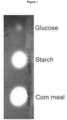
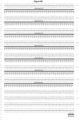
- C. saccharoperbutylacetonicum was grown on various substrates. Supernatant samples were taken after 72 hours, concentrated and then spotted onto a starch plate. Supernatant from C . saccharoperbutylacetonicum grown on glucose does not show any hydrolytic activity, whereas supernatant from starch and corn does ( Figure 1 ).
- the induced peptide was excised from the SDS-PAGE gel and identified by mass spectrometry as being an isocyclomaltooligosaccharide glucanotransferase (CGTase).
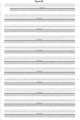
- the portion of the C . saccharoperbutylacetonicum genome coding for the CGTase was sequenced. It was found that the CGTase is located within a starch metabolism operon ( Figure 3 and SEQ ID NO: 5).
- the amino acid sequence of the CGTase from C . saccharoperbutylacetonicum N1-4(HMT) is given in SEQ ID NO: 1.
- the corresponding nucleic acid sequence is given in SEQ ID NO: 2.
- the amino acid sequence of the CGTase from C . saccharoperbutylacetonicum N1-504 is given in SEQ ID NO: 3.
- the corresponding nucleic acid sequence is given in SEQ ID NO: 4.
- the CGTase from C . saccharoperbutylacetonicum appears to be a novel enzyme.
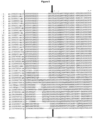
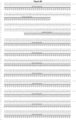
- a number of features make it different from the well-characterised ⁇ -, ⁇ -, and ⁇ -CGTases for example, protein alignments show it clusters with CGTases from B . circulans and Arthrobacter which have been characterised and do not form the standard ⁇ -, ⁇ - or ⁇ -cyclodextrins containing 6, 7 or 8 glucose units with ⁇ 1-4 linkages ( Figure 4 ). Instead this class of CGTase enzymes appears to be much less conserved and converts starch to cyclodextrins containing 4, 5 or 6 glucose units with both ⁇ 1-4 and ⁇ 1-6 linkages.
- a key feature of these enzymes is a highly conserved residue required for efficient cyclisation.
- the ⁇ -, ⁇ -, and ⁇ -CGTases all have tyr or phe at this position.
- ⁇ - amylases have a small residue at this equivalent position, as do the CGTases from B. circulans, Arthrobacter and C . saccharoperbutylacetonicum ( Figure 5 ).
- Proteins secreted into the supernatant during a C . saccharoperbutylacetonicum fermentation on a starch-based substrate were fractionated using ammonium sulphate cuts.
- the starch degradation activity was followed by spotting each fraction onto a starch plate and staining with iodine to detect zones of clearing.
- the fraction containing starch hydrolysis activity was added to a flask containing 10g/L starch solution and incubated overnight at 35°C in a shaking incubator.
- the starch solution was known to contain some linear dextrins.
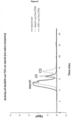
- Example 3 The hydrolysis products from Example 3 were detected by HPLC. As shown in Figure 6 , various starch hydrolysis products were detected, including linear- and cyclo-dextrins.
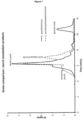
- the CGTase enzyme from C . saccharoperbutylacetonicum produced a cyclic dextrin with an elution profile which was different from known ⁇ -, ⁇ - and ⁇ - cyclodextrins ( Figure 7 ).
- the elution profile was also clearly different to the elution profile one would expect to see if the strain was converting starch to dextrins and glucose using ⁇ -amylase and glucoamylase.
- the cyclic compound was found to be relatively resistant to further hydrolysis by other amylases.
Landscapes
- Chemical & Material Sciences (AREA)
- Organic Chemistry (AREA)
- Life Sciences & Earth Sciences (AREA)
- Engineering & Computer Science (AREA)
- Zoology (AREA)
- Wood Science & Technology (AREA)
- Health & Medical Sciences (AREA)
- Genetics & Genomics (AREA)
- Bioinformatics & Cheminformatics (AREA)
- General Engineering & Computer Science (AREA)
- Biotechnology (AREA)
- General Health & Medical Sciences (AREA)
- Biochemistry (AREA)
- Microbiology (AREA)
- Chemical Kinetics & Catalysis (AREA)
- General Chemical & Material Sciences (AREA)
- Biomedical Technology (AREA)
- Molecular Biology (AREA)
- Medicinal Chemistry (AREA)
- Plant Pathology (AREA)
- Biophysics (AREA)
- Physics & Mathematics (AREA)
- Tropical Medicine & Parasitology (AREA)
- Virology (AREA)
- Micro-Organisms Or Cultivation Processes Thereof (AREA)
- Enzymes And Modification Thereof (AREA)
- Preparation Of Compounds By Using Micro-Organisms (AREA)
Claims (15)
- Polypeptid, wobei die Aminosäuresequenz des Polypeptids:(a) die in SEQ ID Nr. 1 oder 3 dargelegte Aminosäuresequenz umfasst;(b) eine Aminosäuresequenz umfasst, die mindestens 70 % Sequenzidentität mit SEQ ID Nr. 1 oder 3 aufweist und die für eine Cyclodextrin-Glucanotransferase codiert;(c) durch die in SEQ ID Nr. 2 oder 4 dargelegte Nukleotidsequenz codiert wird; oder(d) durch eine Nukleotidsequenz codiert wird, die mindestens 70 % Sequenzidentität mit der in SEQ ID Nr. 2 oder 4 dargelegten Nukleotidsequenz aufweist und die eine Cyclodextrin-Glucanotransferase codiert.
- Nukleinsäuremolekül, umfassend:(a) die in SEQ ID Nr. 2 oder 4 dargelegte Nukleotidsequenz;(b) eine Nukleotidsequenz, die mindestens 70 % Sequenzidentität mit der in SEQ ID Nr. 2 oder 4 dargelegten Nukleotidsequenz aufweist und die eine Cyclodextrin-Glucanotransferase codiert; oderc) das Komplement von (a) oder (b),vorzugsweise funktionell mit einem oder mehreren regulatorischen Elementen verbunden.
- Zusammensetzung, die ein Polypeptid nach Anspruch 1 oder eine Nukleinsäure nach Anspruch 2 umfasst.
- Operon, das ein Nukleinsäuremolekül nach Anspruch 2 in Verbindung mit einem oder mehreren Nukleinsäuremolekülen umfasst, die Polypeptide codieren, die am Stärkestoffwechsel beteiligt sind, vorzugsweise wobei die Polypeptide, die am Stärkestoffwechsel beteiligt sind, ausgewählt sind aus der Gruppe bestehend aus einem periplasmatischen Vorläufer eines Maltose-bindenden Proteins, einer Neopullanase/Cyclomaltodextrinase, einem oder mehreren Maltose-/Maltodextrin-ABC-Transporter-Permease-Proteinen, einem Protein der katalytischen Domäne von Alpha-Amylase und einem Glykogen-Entzweigungs-Protein.
- Vektor, der ein Nukleinsäuremolekül nach Anspruch 2 oder ein Operon nach Anspruch 4 umfasst.
- Wirtszelle, die einen Vektor nach Anspruch 5 umfasst.
- Wirtszelle nach Anspruch 6, wobei die Wirtszelle eine bakterielle Zelle, vorzugsweise der Gattung Clostridium oder Bacillus, ist, bevorzugter wobei es sich bei der Wirtszelle um ein biphasisches Bakterium handelt.
- Wirtszelle nach Anspruch 7, wobei die Wirtszelle ausgewählt ist aus der Gruppe bestehend aus C. acetobutylicum, C. aurantibutyricum, C. beijerinckii, C. thermocellum, C.thermobutyricum, C. pasteurianum, C. kluyveri, C. saccharobutylicum, C. thermosaccharolyticum, C. saccharolyticum, C. tyrobutyricum, C. butyricum, C. puniceum, C. diolis und C. roseum; oder die Wirtszelle ein Cluster-I-Clostridium ist.
- Rekombinante bakterielle Wirtszelle, die ein in das Genom der Wirtszelle integriertes Nukleinsäuremolekül umfasst, wobei die Nukleotidsequenz des Nukleinsäuremoleküls:(a) die in SEQ ID Nr. 1 oder 3 dargelegte Aminosäuresequenz codiert;(b) eine CGTase codiert, die mindestens 70 % Aminosäuresequenzidentität mit SEQ ID Nr. 1 oder 3 aufweist;(c) in SEQ ID Nr. 2 oder 4 dargelegt ist; oder(d) mindestens 70 % Sequenzidentität mit der in SEQ ID Nr. 2 oder 4 dargelegten Nukleotidsequenz aufweist, und die eine CGTase codiert,wobei die rekombinante Wirtszelle nicht Clostridium saccharoperbutylacetonicum N1-4 (HMT) oder Clostridium saccharoperbutylacetonicum N1-504 ist.
- Rekombinante bakterielle Wirtszelle, die ein in das Genom der Wirtszelle integriertes Nukleinsäuremolekül umfasst, wobei die Nukleotidsequenz des Nukleinsäuremoleküls:(a) die in SEQ ID Nr. 1 oder 3 dargelegte Aminosäuresequenz codiert;(b) eine CGTase codiert, die mindestens 70 % Aminosäuresequenzidentität mit SEQ ID Nr. 1 oder 3 aufweist;(c) in SEQ ID Nr. 2 oder 4 dargelegt ist; oder(d) mindestens 70 % Sequenzidentität mit der in SEQ ID Nr. 2 oder 4 dargelegten Nukleotidsequenz aufweist, und die eine CGTase codiert,wobei das Nukleinsäuremolekül funktionell mit einem konstitutiven Promotor verbunden ist.
- Prozess zum Herstellen einer rekombinanten Wirtszelle, der das Einführen eines Nukleinsäuremoleküls nach Anspruch 2, eines Operons nach Anspruch 4 oder eines Vektors nach Anspruch 5 in eine Wirtszelle umfasst.
- Verfahren zum Hydrolysieren eines Polysaccharids, das das Inkontaktbringen des Polysaccharids mit einer Wirtszelle nach einem der Ansprüche 6 bis 8 umfasst.
- Verfahren zum Produzieren eines Lösungsmittels, das die folgenden Schritte umfasst:(i) Inkubieren einer Wirtszelle nach einem der Ansprüche 6 bis 8, wobei die Wirtszelle ein lösungsmittelproduzierendes Clostridium ist, mit einem Polysaccharidsubstrat;und wobei die Wirtszelle auch in der Lage ist, hydrolysiertes Polysaccharid in Acetat und/oder Butyrat umzuwandeln, vorzugsweise wobei die Wirtszelle weiter in der Lage ist, das Acetat und/oder Butyrat in eines oder mehrere von Aceton, Ethanol und/oder Butanol umzuwandeln.
- Prozess zum Produzieren eines Cyclodextrins, wobei der Prozess die folgenden Schritte umfasst:(i) Inkontaktbringen eines Polypeptids nach Anspruch 1 mit einem Polysaccharidsubstrat in einem Reaktionsgefäß, und(ii) Isolieren eines Cyclodextrins aus dem Reaktionsgefäß,und gegebenenfalls Reinigen und/oder Konzentrieren des erhaltenen Cyclodextrins.
- Prozess zum Produzieren eines Cyclodextrins, wobei der Prozess die folgenden Schritte umfasst:(i) Inkontaktbringen einer Wirtszelle nach einem der Ansprüche 6 bis 8 mit einem Polysaccharidsubstrat in einem Reaktionsgefäß, und(ii) Isolieren eines Cyclodextrins aus dem Reaktionsgefäß,und gegebenenfalls Reinigen und/oder Konzentrieren des erhaltenen Cyclodextrins.
Applications Claiming Priority (3)
| Application Number | Priority Date | Filing Date | Title |
|---|---|---|---|
| GBGB1302030.0A GB201302030D0 (en) | 2013-02-05 | 2013-02-05 | Protein |
| GBGB1303595.1A GB201303595D0 (en) | 2013-02-28 | 2013-02-28 | Production of butanol |
| PCT/GB2014/050322 WO2014122449A1 (en) | 2013-02-05 | 2014-02-05 | Cyclodextrin glucanotransferase |
Publications (3)
| Publication Number | Publication Date |
|---|---|
| EP2954064A1 EP2954064A1 (de) | 2015-12-16 |
| EP2954064B1 true EP2954064B1 (de) | 2025-01-15 |
| EP2954064C0 EP2954064C0 (de) | 2025-01-15 |
Family
ID=50114389
Family Applications (2)
| Application Number | Title | Priority Date | Filing Date |
|---|---|---|---|
| EP14704877.1A Active EP2954064B1 (de) | 2013-02-05 | 2014-02-05 | Cyclodextrin glucantransferase |
| EP14704876.3A Withdrawn EP2954063A1 (de) | 2013-02-05 | 2014-02-05 | Herstellung von butanol |
Family Applications After (1)
| Application Number | Title | Priority Date | Filing Date |
|---|---|---|---|
| EP14704876.3A Withdrawn EP2954063A1 (de) | 2013-02-05 | 2014-02-05 | Herstellung von butanol |
Country Status (4)
| Country | Link |
|---|---|
| US (4) | US9499804B2 (de) |
| EP (2) | EP2954064B1 (de) |
| GB (3) | GB2515366A (de) |
| WO (2) | WO2014122448A1 (de) |
Families Citing this family (2)
| Publication number | Priority date | Publication date | Assignee | Title |
|---|---|---|---|---|
| GB201716845D0 (en) | 2017-10-13 | 2017-11-29 | Green Biologics Ltd | Process |
| CN108410912B (zh) * | 2018-03-07 | 2021-08-03 | 北京科技大学 | 一种利用含淀粉废物直接制备丁醇的方法 |
Family Cites Families (15)
| Publication number | Priority date | Publication date | Assignee | Title |
|---|---|---|---|---|
| US2945786A (en) | 1959-04-04 | 1960-07-19 | Sanraku Shuzo Kabushiki Kaisha | Process for producing butanol by fermentation |
| US4578352A (en) | 1983-07-13 | 1986-03-25 | Cpc International Inc. | Novel thermostable, aciduric alpha-amylase and method for its production |
| US4536477A (en) | 1983-08-17 | 1985-08-20 | Cpc International Inc. | Thermostable glucoamylase and method for its production |
| WO1988008031A1 (en) | 1987-04-08 | 1988-10-20 | Genetics Institute, Inc. | Process for preparing cyclodextrins |
| WO1989001043A1 (en) | 1987-07-28 | 1989-02-09 | Genetics Institute, Inc. | Process and enzyme for preparing cyclodextrins, especially alpha-cyclodextrin |
| WO1989001044A1 (en) | 1987-08-03 | 1989-02-09 | Genetics Institute, Inc. | Process for preparing cyclodextrins |
| DE3886382T2 (de) | 1987-10-15 | 1994-05-05 | Novonordisk As | Wärmestabiles cyclodextrin glycosyl-transferase, deren herstellung und verwendung. |
| US5501968A (en) | 1987-10-15 | 1996-03-26 | Novo Nordisk A/S | Thermostable cyclodextrin glycosyl transferase and processes using it |
| EP0506790B1 (de) | 1989-12-22 | 1993-09-08 | Novo Nordisk A/S | Verfahren zur enzymatischen umwandlung von stärke in cyclodextrine |
| US5786196A (en) | 1995-06-12 | 1998-07-28 | The United States Of America As Represented By The Secretary Of Agriculture | Bacteria and enzymes for production of alternan fragments |
| EP1066374B1 (de) | 1998-02-27 | 2006-05-31 | Novozymes A/S | Varianten amylolytischer enzyme |
| KR101223381B1 (ko) | 2004-09-27 | 2013-01-16 | 가부시끼가이샤 하야시바라 세이부쓰 가가꾸 겐꾸조 | 이소사이클로말토올리고당 및 이소사이클로말토올리고당생성 효소와 이들의 제조 방법 및 용도 |
| WO2008052596A1 (en) | 2006-10-31 | 2008-05-08 | Metabolic Explorer | Process for the biological production of n-butanol with high yield |
| CN102482690A (zh) | 2009-06-26 | 2012-05-30 | 钴技术有限公司 | 生物产物生产的集成系统和方法 |
| JP4665066B1 (ja) * | 2010-02-15 | 2011-04-06 | 住友商事株式会社 | ブタノールの新規な生産方法 |
-
2014
- 2014-02-05 EP EP14704877.1A patent/EP2954064B1/de active Active
- 2014-02-05 WO PCT/GB2014/050321 patent/WO2014122448A1/en not_active Ceased
- 2014-02-05 US US14/765,795 patent/US9499804B2/en active Active
- 2014-02-05 EP EP14704876.3A patent/EP2954063A1/de not_active Withdrawn
- 2014-02-05 US US14/765,772 patent/US20150368678A1/en not_active Abandoned
- 2014-02-05 GB GB1401943.4A patent/GB2515366A/en not_active Withdrawn
- 2014-02-05 GB GB1401955.8A patent/GB2515367B/en active Active
- 2014-02-05 WO PCT/GB2014/050322 patent/WO2014122449A1/en not_active Ceased
-
2016
- 2016-10-13 US US15/293,189 patent/US20170096647A1/en not_active Abandoned
-
2017
- 2017-02-17 US US15/436,611 patent/US9783831B2/en active Active
- 2017-05-05 GB GBGB1707235.6A patent/GB201707235D0/en not_active Ceased
Also Published As
| Publication number | Publication date |
|---|---|
| GB201401955D0 (en) | 2014-03-19 |
| EP2954063A1 (de) | 2015-12-16 |
| US20150368678A1 (en) | 2015-12-24 |
| US9783831B2 (en) | 2017-10-10 |
| US20170166932A1 (en) | 2017-06-15 |
| WO2014122448A4 (en) | 2014-11-06 |
| US20170096647A1 (en) | 2017-04-06 |
| GB2515367A (en) | 2014-12-24 |
| GB201401943D0 (en) | 2014-03-19 |
| GB2515367B (en) | 2017-05-31 |
| WO2014122448A1 (en) | 2014-08-14 |
| EP2954064C0 (de) | 2025-01-15 |
| US9499804B2 (en) | 2016-11-22 |
| GB2515366A (en) | 2014-12-24 |
| US20150368623A1 (en) | 2015-12-24 |
| GB201707235D0 (en) | 2017-06-21 |
| WO2014122449A1 (en) | 2014-08-14 |
| EP2954064A1 (de) | 2015-12-16 |
Similar Documents
| Publication | Publication Date | Title |
|---|---|---|
| Thormann et al. | Control of butanol formation in Clostridium acetobutylicum by transcriptional activation | |
| Boynton et al. | Cloning, sequencing, and expression of genes encoding phosphotransacetylase and acetate kinase from Clostridium acetobutylicum ATCC 824 | |
| KR101076042B1 (ko) | 에탄올 및 부탄올 생성능이 증가된 재조합 미생물 및 이를이용한 에탄올과 부탄올의 제조방법 | |
| CN111936631A (zh) | 用于生物产生乙二醇的微生物和方法 | |
| US20160053223A1 (en) | Methods and compositions for affecting the differentiation of clostridia in culture | |
| EP2481793B1 (de) | Rekombinanter mikroorganismus mit erhöhter butanolherstellungsfähigkeit sowie herstellungsverfahren für butanol damit | |
| US9783831B2 (en) | Cyclodextrin glucanotransferase | |
| EP2766332B1 (de) | Herstellung von isopropanol durch verbesserte rekombinante stämme | |
| JP5224572B2 (ja) | デキストラン生成酵素遺伝子、デキストラン生成酵素およびその製造方法、デキストランの製造方法 | |
| US11584914B2 (en) | Processes for producing organic solvents using Clostridium saccharoperbutylacetonicum | |
| CN101423814B (zh) | 合成谷胱甘肽的梭菌及其构建方法与应用 | |
| SIEMERINK et al. | Comparative genomic analysis of the central metabolism of the solventogenic species Clostridium acetobutylicum ATCC 824 and Clostridium beijerinckii NCIMB 8052 | |
| KR102951928B1 (ko) | 일산화탄소 이용능이 증대된 미생물 및 이를 이용한 2,3-bdo 생산 | |
| CN112251420A (zh) | 一种严格厌氧菌来源的菌果聚糖合成酶 | |
| CN101423815B (zh) | 重组丙酮丁醇梭菌及其构建方法与应用 | |
| EP2031066A1 (de) | Mutant und dafür kodierendes gen | |
| Dürre | Solventogenesis by clostridia | |
| CN121380237A (zh) | 利用酶法裂解黄酮类碳苷c-c糖苷键的方法 | |
| CN114908067A (zh) | 氧甲基转移酶fsr2在催化山奈酚4`羟基氧甲基化中的应用 | |
| CN121950758A (zh) | β-葡萄糖醛酸苷酶突变体及其应用 | |
| CN118480519A (zh) | 一种底物选择性提高的核糖醇脱氢酶突变体及其应用 | |
| CN114761571A (zh) | 可发酵糖组合物的制备方法及其发酵 | |
| Tollin | The characterization of Clostridium beijerinckii NRRL B592 cells transformed with plasmids containing the butanol-production genes under the control of constitutive promoters | |
| BR112014008838B1 (pt) | Produção de isopropanol por estirpes recombinantes melhoradas |
Legal Events
| Date | Code | Title | Description |
|---|---|---|---|
| PUAI | Public reference made under article 153(3) epc to a published international application that has entered the european phase |
Free format text: ORIGINAL CODE: 0009012 |
|
| 17P | Request for examination filed |
Effective date: 20150903 |
|
| AK | Designated contracting states |
Kind code of ref document: A1 Designated state(s): AL AT BE BG CH CY CZ DE DK EE ES FI FR GB GR HR HU IE IS IT LI LT LU LV MC MK MT NL NO PL PT RO RS SE SI SK SM TR |
|
| AX | Request for extension of the european patent |
Extension state: BA ME |
|
| DAX | Request for extension of the european patent (deleted) | ||
| RAP1 | Party data changed (applicant data changed or rights of an application transferred) |
Owner name: GREEN BIOLOGICS LIMITED |
|
| STAA | Information on the status of an ep patent application or granted ep patent |
Free format text: STATUS: EXAMINATION IS IN PROGRESS |
|
| 17Q | First examination report despatched |
Effective date: 20181123 |
|
| RAP1 | Party data changed (applicant data changed or rights of an application transferred) |
Owner name: BIOCLEAVE LIMITED |
|
| GRAP | Despatch of communication of intention to grant a patent |
Free format text: ORIGINAL CODE: EPIDOSNIGR1 |
|
| STAA | Information on the status of an ep patent application or granted ep patent |
Free format text: STATUS: GRANT OF PATENT IS INTENDED |
|
| INTG | Intention to grant announced |
Effective date: 20211112 |
|
| GRAJ | Information related to disapproval of communication of intention to grant by the applicant or resumption of examination proceedings by the epo deleted |
Free format text: ORIGINAL CODE: EPIDOSDIGR1 |
|
| STAA | Information on the status of an ep patent application or granted ep patent |
Free format text: STATUS: EXAMINATION IS IN PROGRESS |
|
| INTC | Intention to grant announced (deleted) | ||
| GRAP | Despatch of communication of intention to grant a patent |
Free format text: ORIGINAL CODE: EPIDOSNIGR1 |
|
| STAA | Information on the status of an ep patent application or granted ep patent |
Free format text: STATUS: GRANT OF PATENT IS INTENDED |
|
| INTG | Intention to grant announced |
Effective date: 20230426 |
|
| RAP1 | Party data changed (applicant data changed or rights of an application transferred) |
Owner name: BCL2020 LIMITED |
|
| 19U | Interruption of proceedings before grant |
Effective date: 20231123 |
|
| 19W | Proceedings resumed before grant after interruption of proceedings |
Effective date: 20241104 |
|
| GRAS | Grant fee paid |
Free format text: ORIGINAL CODE: EPIDOSNIGR3 |
|
| RAP3 | Party data changed (applicant data changed or rights of an application transferred) |
Owner name: NCIMB LIMITED |
|
| GRAA | (expected) grant |
Free format text: ORIGINAL CODE: 0009210 |
|
| STAA | Information on the status of an ep patent application or granted ep patent |
Free format text: STATUS: THE PATENT HAS BEEN GRANTED |
|
| AK | Designated contracting states |
Kind code of ref document: B1 Designated state(s): AL AT BE BG CH CY CZ DE DK EE ES FI FR GR HR HU IE IS IT LI LT LU LV MC MK MT NL NO PL PT RO RS SE SI SK SM TR |
|
| RBV | Designated contracting states (corrected) |
Designated state(s): AL AT BE BG CH CY CZ DE DK EE ES FI FR GR HR HU IE IS IT LI LT LU LV MC MK MT NL NO PL PT RO RS SE SI SK SM TR |
|
| REG | Reference to a national code |
Ref country code: CH Ref legal event code: EP |
|
| REG | Reference to a national code |
Ref country code: DE Ref legal event code: R096 Ref document number: 602014091447 Country of ref document: DE |
|
| REG | Reference to a national code |
Ref country code: IE Ref legal event code: FG4D |
|
| U01 | Request for unitary effect filed |
Effective date: 20250213 |
|
| U07 | Unitary effect registered |
Designated state(s): AT BE BG DE DK EE FI FR IT LT LU LV MT NL PT RO SE SI Effective date: 20250307 |
|
| U20 | Renewal fee for the european patent with unitary effect paid |
Year of fee payment: 12 Effective date: 20250528 |
|
| PG25 | Lapsed in a contracting state [announced via postgrant information from national office to epo] |
Ref country code: RS Free format text: LAPSE BECAUSE OF FAILURE TO SUBMIT A TRANSLATION OF THE DESCRIPTION OR TO PAY THE FEE WITHIN THE PRESCRIBED TIME-LIMIT Effective date: 20250415 |
|
| PG25 | Lapsed in a contracting state [announced via postgrant information from national office to epo] |
Ref country code: PL Free format text: LAPSE BECAUSE OF FAILURE TO SUBMIT A TRANSLATION OF THE DESCRIPTION OR TO PAY THE FEE WITHIN THE PRESCRIBED TIME-LIMIT Effective date: 20250115 |
|
| PG25 | Lapsed in a contracting state [announced via postgrant information from national office to epo] |
Ref country code: ES Free format text: LAPSE BECAUSE OF FAILURE TO SUBMIT A TRANSLATION OF THE DESCRIPTION OR TO PAY THE FEE WITHIN THE PRESCRIBED TIME-LIMIT Effective date: 20250115 |
|
| PG25 | Lapsed in a contracting state [announced via postgrant information from national office to epo] |
Ref country code: NO Free format text: LAPSE BECAUSE OF FAILURE TO SUBMIT A TRANSLATION OF THE DESCRIPTION OR TO PAY THE FEE WITHIN THE PRESCRIBED TIME-LIMIT Effective date: 20250415 Ref country code: IS Free format text: LAPSE BECAUSE OF FAILURE TO SUBMIT A TRANSLATION OF THE DESCRIPTION OR TO PAY THE FEE WITHIN THE PRESCRIBED TIME-LIMIT Effective date: 20250515 |
|
| PG25 | Lapsed in a contracting state [announced via postgrant information from national office to epo] |
Ref country code: HR Free format text: LAPSE BECAUSE OF FAILURE TO SUBMIT A TRANSLATION OF THE DESCRIPTION OR TO PAY THE FEE WITHIN THE PRESCRIBED TIME-LIMIT Effective date: 20250115 |
|
| PG25 | Lapsed in a contracting state [announced via postgrant information from national office to epo] |
Ref country code: GR Free format text: LAPSE BECAUSE OF FAILURE TO SUBMIT A TRANSLATION OF THE DESCRIPTION OR TO PAY THE FEE WITHIN THE PRESCRIBED TIME-LIMIT Effective date: 20250416 |
|
| REG | Reference to a national code |
Ref country code: CH Ref legal event code: PL |
|
| PG25 | Lapsed in a contracting state [announced via postgrant information from national office to epo] |
Ref country code: SM Free format text: LAPSE BECAUSE OF FAILURE TO SUBMIT A TRANSLATION OF THE DESCRIPTION OR TO PAY THE FEE WITHIN THE PRESCRIBED TIME-LIMIT Effective date: 20250115 |
|
| PG25 | Lapsed in a contracting state [announced via postgrant information from national office to epo] |
Ref country code: MC Free format text: LAPSE BECAUSE OF FAILURE TO SUBMIT A TRANSLATION OF THE DESCRIPTION OR TO PAY THE FEE WITHIN THE PRESCRIBED TIME-LIMIT Effective date: 20250115 |
|
| PG25 | Lapsed in a contracting state [announced via postgrant information from national office to epo] |
Ref country code: CH Free format text: LAPSE BECAUSE OF NON-PAYMENT OF DUE FEES Effective date: 20250228 |
|
| PG25 | Lapsed in a contracting state [announced via postgrant information from national office to epo] |
Ref country code: CZ Free format text: LAPSE BECAUSE OF FAILURE TO SUBMIT A TRANSLATION OF THE DESCRIPTION OR TO PAY THE FEE WITHIN THE PRESCRIBED TIME-LIMIT Effective date: 20250115 |
|
| PG25 | Lapsed in a contracting state [announced via postgrant information from national office to epo] |
Ref country code: SK Free format text: LAPSE BECAUSE OF FAILURE TO SUBMIT A TRANSLATION OF THE DESCRIPTION OR TO PAY THE FEE WITHIN THE PRESCRIBED TIME-LIMIT Effective date: 20250115 |
|
| PLBE | No opposition filed within time limit |
Free format text: ORIGINAL CODE: 0009261 |
|
| STAA | Information on the status of an ep patent application or granted ep patent |
Free format text: STATUS: NO OPPOSITION FILED WITHIN TIME LIMIT |
|
| 26N | No opposition filed |
Effective date: 20251016 |
|
| PG25 | Lapsed in a contracting state [announced via postgrant information from national office to epo] |
Ref country code: IE Free format text: LAPSE BECAUSE OF NON-PAYMENT OF DUE FEES Effective date: 20250205 |