EP2947461B1 - Verfahren zur massenspektrometrischen analyse von biopolymeren durch verwendung einer optimierten oligomereinteilung - Google Patents
Verfahren zur massenspektrometrischen analyse von biopolymeren durch verwendung einer optimierten oligomereinteilung Download PDFInfo
- Publication number
- EP2947461B1 EP2947461B1 EP15168027.9A EP15168027A EP2947461B1 EP 2947461 B1 EP2947461 B1 EP 2947461B1 EP 15168027 A EP15168027 A EP 15168027A EP 2947461 B1 EP2947461 B1 EP 2947461B1
- Authority
- EP
- European Patent Office
- Prior art keywords
- peptide
- peptides
- molecules
- time
- scheduled
- Prior art date
- Legal status (The legal status is an assumption and is not a legal conclusion. Google has not performed a legal analysis and makes no representation as to the accuracy of the status listed.)
- Active
Links
Images




Classifications
-
- G—PHYSICS
- G01—MEASURING; TESTING
- G01N—INVESTIGATING OR ANALYSING MATERIALS BY DETERMINING THEIR CHEMICAL OR PHYSICAL PROPERTIES
- G01N33/00—Investigating or analysing materials by specific methods not covered by groups G01N1/00 - G01N31/00
- G01N33/48—Biological material, e.g. blood, urine; Haemocytometers
- G01N33/50—Chemical analysis of biological material, e.g. blood, urine; Testing involving biospecific ligand binding methods; Immunological testing
- G01N33/68—Chemical analysis of biological material, e.g. blood, urine; Testing involving biospecific ligand binding methods; Immunological testing involving proteins, peptides or amino acids
- G01N33/6803—General methods of protein analysis not limited to specific proteins or families of proteins
- G01N33/6848—Methods of protein analysis involving mass spectrometry
-
- G—PHYSICS
- G16—INFORMATION AND COMMUNICATION TECHNOLOGY [ICT] SPECIALLY ADAPTED FOR SPECIFIC APPLICATION FIELDS
- G16B—BIOINFORMATICS, i.e. INFORMATION AND COMMUNICATION TECHNOLOGY [ICT] SPECIALLY ADAPTED FOR GENETIC OR PROTEIN-RELATED DATA PROCESSING IN COMPUTATIONAL MOLECULAR BIOLOGY
- G16B5/00—ICT specially adapted for modelling or simulations in systems biology, e.g. gene-regulatory networks, protein interaction networks or metabolic networks
- G16B5/20—Probabilistic models
-
- G—PHYSICS
- G16—INFORMATION AND COMMUNICATION TECHNOLOGY [ICT] SPECIALLY ADAPTED FOR SPECIFIC APPLICATION FIELDS
- G16B—BIOINFORMATICS, i.e. INFORMATION AND COMMUNICATION TECHNOLOGY [ICT] SPECIALLY ADAPTED FOR GENETIC OR PROTEIN-RELATED DATA PROCESSING IN COMPUTATIONAL MOLECULAR BIOLOGY
- G16B99/00—Subject matter not provided for in other groups of this subclass
Definitions
- the present invention relates generally to mass spectrometry, and more particularly to methods of characterizing a plurality of biopolymer analytes in a biological sample by mass spectrometric detection of oligomer molecules formed by fragmentation, cleavage or digestion of the various biopolymers.
- Mass spectrometry has advanced over the last few decades to the point where it is one of the most broadly applicable analytical tools for detection and characterization of a wide class of molecules. Mass spectrometric analysis is applicable to almost any species capable of forming an ion in the gas phase, and, therefore, provides perhaps the most universally applicable method of quantitative analysis. In addition, mass spectrometry is a highly selective technique especially well suited for the analysis of complex mixtures of different compounds in varying concentrations. Mass spectrometric methods provide very high detection sensitivities, approaching tenths of parts per trillion for some species.
- biopolymers such as polynucleotides (RNA and DNA) polypeptides and polysaccharides.
- RNA and DNA polynucleotides
- sequence of monomers are the distinguishing analytical characteristics of biopolymer molecules of a given class.
- biopolymer molecules of a given class generally have high molecular weights and can generate ions having a wide range of charge states, distinguishing various molecules within a mixture of such molecules by mass spectrometry can be challenging.
- the digested sample is chromatographically separated (in one or multiple dimensions) such that the digest components elute at various times according to their column retention times (RTs).
- the various eluting components are then introduced to an ion source, usually an electrospray ionization (ESI) source, on a mass spectrometer.
- ESI electrospray ionization
- the ESI source converts condensed phase ions, eluting from the HPLC column, to multiply-protonated molecules (cations) in the gas-phase.
- the mass spectrometer then detects the ions and identifies the various peptides using, generally, the technique of tandem mass spectrometry, which is sometimes referred to as “MS/MS” spectrometry or “selected-reaction monitoring” (SRM) and is discussed in greater detail below.
- MS/MS tandem mass spectrometry
- SRM selected-reaction monitoring
- tandem mass spectrometry operation various precursor ion types that have been chosen to represent respective peptides are isolated.
- the isolated precursor ions are then subjected to fragmentation (e.g., in a collision cell), and the resulting fragment (product) ions are transported for analysis in a second stage of mass analysis or a second mass analyzer.
- the method can be extended to provide fragmentation of a selected fragment, and so on, with analysis of the resulting fragments for each generation. This is typically referred to an MS n spectrometry, with n indicating the number of steps of mass analysis and the number of generations of ions.
- MS 2 mass analysis corresponds to two stages of mass analysis with two generations of ions analyzed (precursor and products).
- a resulting product spectrum exhibits a set of fragmentation peaks (a fragment set) which, in many instances, may be used as a fingerprint to identify the peptide from which the particular precursor and product ions were derived.
- a single SRM transition can be used to successfully identify a particular peptide, in order to identify each of the various proteins from which the peptides were formed (during the digestion step), generally more than one diagnostic peptide is required.
- a certain number, Q of peptide identifications is considered to be necessary in order to confidently infer the presence of a particular protein in the original sample the possibility exists that any given peptide may be generated in the digest from more than one protein.
- the mass spectrometer system should be programmed so as to search for the various diagnostic ions at appropriate times during the course of the chromatographic elutions.
- SRMs scheduling SRMs or targeted MS/MS acquisitions based upon the expected retention times.
- Similar scheduling problems occur, in general, in various situations in which the demand for a resource is not equally distributed over time. Surges in demand create a problem when there is a ceiling on the maximum amount of resource that can be delivered per unit time. A common example of this is power usage in the afternoon on a hot, summer day.
- the free market can provide a solution by assigning a higher price to consumption during periods of high demand. This has the effect of encouraging some fraction of price-sensitive users to reschedule their usage to periods of lower demand, thus leveling out the overall demand for the good.
- the distribution of retention times is approximately Gaussian, with a high peak density in the center and much lower density in the tails.
- the shape of this distribution is fundamental because the retention time of a peptide can be accurately approximated as the sum of the retention times of its constituent amino acid residues.
- the Central Limit Theorem states that the sum of independent, identically distributed random variables tends to a Gaussian distribution as the number of terms in the sum increases. Peptides with more than 5 or 6 residues, as are commonly encountered in proteomics experiments, produce retention time distribution that follow the expected Gaussian distribution.
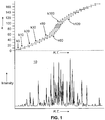
- Curve 10 in the lower portion of FIG. 1 represents a hypothetical chromatogram (detected ion intensity plotted against retention time) showing the elution of numerous peptides - each corresponding to a peak in the chromatogram - during the course of a single experimental run.
- the chromatogram 10 includes a total of 170 separate elution peaks.
- each peptide may be referred to by a numerical index, k , where 1 ⁇ k ⁇ 170 and where, in this example, the index k is assigned in order of elution.
- the elution periods are indicated for a subset of the various peptides by horizontal lines in the upper portion of FIG. 1 .
- the index k is plotted along the vertical axis of the upper portion of FIG. 1 .
- each horizontal bar indicates the respective elution start and elution end times for the respective peptide.
- the elution periods corresponding to other peptides are not specifically indicated but may be assumed to follow the general trend shown in the upper portion of FIG. 1 .
- FIG. 1 illustrates that the density of peaks is generally greater in the center of the run because of the adherence to the Central Limit Theorem as noted above.
- the central region of greater peak density gives rise to greater peak overlap in this region, relative to the beginning and ending portions of the experimental run, as is schematically illustrated in the upper portion of FIG. 1 .
- FIG. 2A schematically illustrates the expected general form of a histogram of the number of peptide peaks per each segment of the total chromatographic run of a protein tryptic digest, if one were to partition the total run time into equal time segments and count the number of eluting peptide peaks in each segment.
- the vertical bars centered at retention times t 1 - t 10 in FIG. 2A represent the hypothetical distribution of peak counts per partition if one were to partition a chromatogram such as the one illustrated in the bottom portion of FIG. 1A into ten equal-width time segments.
- the form of such a histogram should approach the form of a Gaussian probability density distribution, shown as curve 80, as the total number of peptides increases and the partition width decreases.
- the peptide selection probability density at any time point may be defined as the probability per unit time of selecting a peptide within a time partition that includes the time point. If one were to select peptides to be detected uniformly at random from such a Gaussian distribution, i.e. without taking into account the predicted retention times, the distribution of retention times of the selected peptides would be essentially the same as the underlying distribution, i.e. Gaussian.
- WO 2004/013635 describes a system and method for scoring peptide matches.
- a stochastic model may be generated based on one or more match characteristics associated with the first and second peptides and their fragments.
- a first probability that the first and second peptides match, and a second probability that the first and second peptides do not match, may be calculated based on the stochastic model.
- a match between the first and second peptides may be scored based at least in part on a ratio between the first and second probabilities.
- the case of characterizing a list of proteins of interest by the method of bottom-up proteomics is considered.
- the characterization involves assaying a selected subset of tryptic peptides from these proteins.
- the sequences of the tryptic peptides can be predicted because the sequences of the proteins of interest are known in advance. This allows prediction of the expected retention times of the peptides in advance using one of a number of available modeling tools. Given this predicted retention-time distribution, a subset of tryptic peptides from the overall pool of tryptic peptides is selected that represents optimal utilization of the analyzer by creating an essentially uniform schedule of SRMs or MS/MS events. According to the methods in accordance with the present teachings, the distribution of scheduled peptide detection events along the time axis is caused to be as evenly distributed as possible over the course of an experimental run.
- peptide selection is weighted so as to favor those peptides that occur in low-peak-density regions of the retention time histogram over peptides that occur in high-peak-density regions.
- the probability of selecting a peptide at a particular point in time is equal to the retention time probability distribution (generally a Gaussian distribution as noted above) times a probability weighting factor we are free to choose.
- the idea of the present teachings is to artificially increase the selection probability of peptides whose elution times (retention times) fall in the tails of the retention time distribution and artificially decrease the selection probability of those peptides that fall in the center of the distribution.
- FIG. 2B is an approximate schematic depiction of the way in which peptide selection probabilities may be modified, in accordance with the present teachings, so that scheduled peptide detection events during an experimental run are caused to approach a uniform distribution over time.
- a group of diagnostic tryptic-digest peptides whose presence will proxy for that of the parent protein.
- problems may occur in the scheduling of peptide detection events, since a large portion of the peptides elute within a narrow time range (relative to the total time range of an experimental run).
- the expected retention times of the various eluting oligomers may be modeled in terms of a retention-time prediction index, such as the so-called hydrophobicity index, which is a quantity derived from chemical composition or other chemical or molecular properties or from experimental parameters.
- a retention-time prediction index such as the so-called hydrophobicity index, which is a quantity derived from chemical composition or other chemical or molecular properties or from experimental parameters.
- the retention-time prediction index may be used, e.g., in FIGS. 2A-2B , as a proxy of substitute for actual retention times.
- the horizontal axis in FIGS. 2A-2B is schematically labeled in terms of both retention time (R.T.) and retention-time prediction index (RTP index).
- the retention-time prediction index is of use in providing general models of relative elution behavior of different chemical compounds, since actual retention times may depend on particulars of any experimental setup.
- analyte detection techniques such as tandem mass spectrometry
- sequence of operations that needs to be performed for detecting a particular analyte will vary with the nature of the analyte.
- detection techniques such as UV-visible spectroscopy, vibrational spectroscopy or fluorescence spectroscopy
- the near simultaneous occurrence of multiple overlapping elution events may produce a complex signal that is difficult to decompose.
- overlapping elution events may cause errors or other difficulties in detection.
- the inventors have conceptualized methods of calculating a set of probability weighting factors so as to (as indicated by the arrows in FIG. 2B ) artificially increase the probability of selecting peptides whose retention times fall in the tails of the natural Gaussian-like distribution and decrease the probability of selecting peptides in the center of the distribution.
- One possible way of making the distribution of selected peptides flat with respect to time might be to simply weight each peptide by the inverse of its probability density that appears on the histogram or on the Gaussian approximation to the histogram and then normalize the so-weighted probabilities between the beginning detection time and the ending detection time of any experimental run.
- the identities of the peptides and their various elution times need to known or estimated. This information can be predicted, in many cases, using known tryptic digestion modeling and peptide retention time modeling algorithms as further discussed below with reference to the method 200 illustrated in FIG. 4 .
- the probability weighting procedure can be simplified by noting the position of either the mode or the mean of the predicted histogram and choosing probability weighting factors that decrease away from this point, either in a time-increasing or time-decreasing direction.
- the weighting scheme could be based on a chosen functional form - such as a linear function, a polynomial function, a Gaussian-like function or some other form - used to approximate the decrease of weighting factors away from the histogram mode or mean.
- the probability of populating any given bin of the histogram is uniform, where the "bins" are considered to be a set of equal-time-width segments (partitions) of the total detection time period (the time period during which the detector is operating to detect the peptides).
- each "scheduled peptide-detection event" comprises a definite time period - having a respective start time and a respective stop time - during which a signature of the respective peptide is to be searched for.
- This best procedure is slightly different than generating a uniform histogram, because the bins of the histogram are arbitrary, while the detection-event scheduling depends upon the retention times themselves.
- This procedure of causing the scheduled peptide-detection events to be as evenly distributed as possible also causes the number of overlaps - the occurrence of simultaneous scheduled peptide detection events - to also be as evenly distributed as possible.
- the scheduled detection events of two or more peptides may overlap during an experimental run, there should be no time point during the run at which the number of overlapping detection events is significantly greater than (or less than) the average number of overlaps.
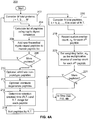
- FIG. 4 is a flow diagram of a general method 200 in accordance with the present teachings.
- a pool of target proteins This list may comprise a total of M specific proteins of interest, the presence or absence of which one wishes to determine in regard to a sample. Alternatively or additionally, one may wish to determine the concentrations of the various specific proteins in the sample.
- an ideal (calculated) tryptic digest is determined in silico (step 204 ) using any one of a number of available chemical digestion simulation models. These model calculations generate a master list of theoretical tryptic peptides (step 206 ) from each one of the pool of proteins of interest.
- a predicted retention time is calculated for each such peptide (step 212 ).
- a number of retention time calculation models are available for this purpose.
- the calculation of retention time may make use of a retention-time predictor index, which may be a quantity that may be calculated from molecular composition, molecular structure or other chemical or molecular properties or some combination of such properties.
- the retention-time prediction index (RTP index) may also be calculated from parameters related to properties of the type of chromatographic column employed. For example, the semi-empirical metric known as "hydrophobicity index" is one type of retention-time prediction index.
- a value of the hydrophobicity index may be calculated for each peptide based on the peptide composition.
- Peptide retention times that are observed in reverse-phase high pressure liquid chromatograph (RP-HPLC) are found to depend on peptide hydrophobicity and can be modeled in terms of the hydrophobicity index.
- peptide retention time prediction models such as those based on hydrophobicity index, have been extended so as to take into account not only amino acid composition but also residue position within the peptide chain [e.g., Krokhin et al., "An Improved Model for Prediction of Retention Times of Tryptic Peptides in Ion Pair Reversed-phase HPLC” Molecular & Cellular Proteomics: MCP, 2004, 3(9), pp. 908-919 ; Krokhin, "Sequence-specific retention calculator. Algorithm for peptide retention prediction in ion-pair RP-HPLC: application to 300-and 100-A pore size C18 sorbents", Anal Chem., 2006, 78(22), pp.
- the measured retention time (R.T.) of test peptides tends to closely follow the predicted R.T., which is generated based on both the applied calibration as well as the predictions of the sequence-specific retention time calculator algorithm ( FIG. 3 ).
- the various peptides are sorted in order of retention time (step 214 ).
- a calculation is made, for each peptide, how many other peptides in the set have a scheduling overlap (step 218 ), where a "scheduling overlap" is defined as the condition where the predicted retention time difference between the peptide under consideration and another of the peptides is less than the scheduling window, e.g. the chromatographic peak width or an otherwise pre-determined measurement time duration.
- the peptides are considered in order of their retention time.
- the method For each peptide, the method performs the overlap calculation (step 218 ) by first moving backward in the list counting all the peptides encountered at earlier retention times until either the beginning of the list is reached or up to one scheduling window backward in time from the R.T of the peptide under consideration. The count is continued similarly moving forward until either the end of the list is reached or up to one scheduling window forward from the R.T of the peptide under consideration. The cumulative overlap count - both forward and backward - is then recorded for each peptide.
- step 220 the multiplicative inverse of the overlap count as the weighting factor for adjusting the probability of selecting each peptide. Then, using these weighting factors, a certain predetermined number, Q, of diagnostic peptides are determined for each of the M proteins of interest, in accordance with the present teachings, such that the aggregate distribution of retention times will, on average, will minimize the extent of scheduling conflicts.
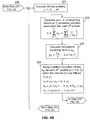
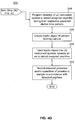
- This peptide selection is performed in the loop of steps 222-240 which spans FIG. 4B and 4C .
- the master list of theoretical peptides (i.e., see step 206 ) is consulted such that only those peptides that are predicted to be generated in the digestion of protein j are considered.
- the real-number interval [0,1] is then partitioned (conceptually) among the candidate peptides.
- the partitions are made of unequal size in accordance with the various weighting factors.
- each weighting factor, w k is equal to l/ n k , where n k is the number of overlaps encountered by peptide k .
- this sum is S .
- the boundary values of the various partitions are calculated. For example, let b k denote the sum of the first k normalized partition sizes.
- the partition of the interval [0,1] that belongs to the candidate peptide k is the interval [ b k-l , b k ].
- the values b 1 ... b N can be thought of as the positions of partition boundaries within the interval [0,1].
- steps 230-240 randomly select a total of Q peptides (for example 3 peptides) from among the Y j candidate peptides using the above weighting scheme. This is performed by generating a uniformly random number, x , in the interval [0,1] (step 232 ) and then determining (step 234 ) which interval [b k -1 , b k ] within which the random number, x occurs. The peptide k is then selected for association with the protein j (step 238 ) unless this peptide has already been selected. If the peptide has already been selected, then steps 232-236 are executed again.
- Q peptides for example 3 peptides
- Steps 230-240 are repeatedly executed until Q diagnostic peptides have been associated with the protein j .
- Steps 222-242 are executed for each protein of interest until all such proteins have been considered.
- an LC instrument system - comprising a liquid chromatograph as well as a detector or detection system coupled to the chromotograph so as to detect analytes eluting from the chromatograph - is programmed so to automatically attempt to detect all of the assigned peptides (as determined during the previous steps of the method 200 ) during their respective expected elution time periods.
- the phrase "attempt to detect” is used here because not all proteins of interest may be present in a sample.
- the detector comprises a mass spectrometer because of the high sensitivity and analytical specificity of mass spectrometer instruments.
- the programming step will generally include selecting, for each peptide, a diagnostic ion or ions to be searched for so as to recognize the presence of the peptide and possibly to quantify the peptide.
- the programming of the mass spectrometer detector may include programmed instructions to automatically search for a precursor ion and, if the precursor ion is recognized, programmed instructions to fragment the precursor ion and to search for specific product ions formed during the fragmentation.
- a mass spectrometer can perform this sequence of steps in a time period that is much shorter than a typical elution time period of any peptide, the mass spectrometer can successfully detect multiple peptide analytes essentially simultaneously in the case of a small or moderate number of overlapping peptide elution peaks.
- the methods in accordance with the present teachings are designed to prevent this upper limit from being reached, in most instances.
- a tryptic digest is made of a protein-bearing sample of interest. In principle, this step will physically generate the same peptide species as predicted in step 204 for any of the proteins of interest that are actually present in the sample.
- the tryptic digest in introduced into the LC instrument system which is then operated, in accordance with the instructions programmed in step 244 so as to detect any of the assigned peptides that might be present in the tryptic digest.
- the detected presence and/or quantities of proteins in the sample is recorded as inferred from the detected peptides, if any.
- FIG. 5A-5B are simulated plots of the number of peptide elution overlaps predicted to occur when peptides are selected for detection by two different methods.
- FIG. 5A is a graphical depiction of the number of peptide elution overlaps that are predicted to occur for each peptide within a group of 433 randomly selected peptides. The number of elution overlaps is plotted versus hydrophobicity index which, for purposes of this example, may serve as a proxy for retention time.
- FIG. 5A indicates that when peptides are selected randomly for detection, as in conventional methods, a large number of such peptides may elute simultaneously.
- FIG. 5B is a graphical depiction of the number of peptide elution overlaps that are predicted to occur over the course of elution of each one of a subset of 145 peptides, where the peptides are selected and scheduled for detection in accordance with the methods of the present teachings.
- the number of elution overlaps is roughly uniform - at a relatively low number of such overlaps - over the course of an entire proteomic analysis.
- mass spectrometry for detection
- other means of chemical detection such as molecular vibrational spectroscopy (e.g., Raman spectroscopy, resonance Raman spectroscopy, surface-enhanced Raman spectroscopy) or UV-visible spectroscopy.
- the detection techniques may be employed to detect the presence of unmodified analytes or, alternatively, may be employed to detect reporter molecular groups - such as isotopically labeled groups or fluorophore labeled groups - that have been chemically bound to proteins prior to digestion and chromatographic analysis.
- each biopolymer of interest may be chemically fragmented or reacted so as to produce polymer fragments (e.g., oligomers) or other product species whose detected presence can be used to infer the information about the presence or quantity of the parent biopolymer in a sample;
- polymer fragments e.g., oligomers
- the type of fragments or product species can be theoretically predicted for each biopolymer of interest;
- the chromatographic separation times - such as elution times or retention times - of the various theoretically predicted fragments or product species can be predicted or estimated.
Landscapes
- Life Sciences & Earth Sciences (AREA)
- Health & Medical Sciences (AREA)
- Engineering & Computer Science (AREA)
- Physics & Mathematics (AREA)
- Molecular Biology (AREA)
- Bioinformatics & Cheminformatics (AREA)
- Bioinformatics & Computational Biology (AREA)
- Biotechnology (AREA)
- Spectroscopy & Molecular Physics (AREA)
- General Health & Medical Sciences (AREA)
- Immunology (AREA)
- Biomedical Technology (AREA)
- Hematology (AREA)
- Urology & Nephrology (AREA)
- Chemical & Material Sciences (AREA)
- Biophysics (AREA)
- Theoretical Computer Science (AREA)
- Medical Informatics (AREA)
- Evolutionary Biology (AREA)
- Biochemistry (AREA)
- Analytical Chemistry (AREA)
- Medicinal Chemistry (AREA)
- Food Science & Technology (AREA)
- General Physics & Mathematics (AREA)
- Pathology (AREA)
- Microbiology (AREA)
- Proteomics, Peptides & Aminoacids (AREA)
- Cell Biology (AREA)
- Probability & Statistics with Applications (AREA)
- Physiology (AREA)
- Other Investigation Or Analysis Of Materials By Electrical Means (AREA)
Claims (2)
- Verfahren zum Nachweisen des Vorhandenseins oder einer Menge von jedem von zwei oder mehr Polypeptidmolekülen von einer Liste bekannter Polypeptidmoleküle in einer Probe, umfassend:für jedes Polypeptidmolekül Berechnen einer jeweiligen Liste von Peptidmolekülen, die erwartungsgemäß durch eine chemische Umsetzung oder Verarbeitung des jeweiligen Polypeptidmoleküls produziert werden, wobei die chemische Umsetzung oder Verarbeitung des jeweiligen Polypeptidmoleküls das Durchführen eines tryptischen Verdaus des jeweiligen Polypeptidmoleküls umfasst;Berechnen einer jeweiligen erwarteten Chromatographie-Elutionszeitspanne für jedes Peptidmolekül von jeder Liste von Peptidmolekülen, wobei das Berechnen entweder auf Hydrophobieindizes der Peptide oder auf den Zusammensetzungen und Aminosäuresequenzen der Peptide basiert;für jedes Polypeptidmolekül Zuweisen eines oder mehrerer Peptidmoleküle, die ausgewählt sind aus der jeweiligen Liste von Peptidmolekülen, als Stellvertreter für das jeweilige Polypeptidmolekül,wobei für das Zuweisen des einen oder der mehreren Peptidmoleküle Folgendes verwendet wird:(i) ein Satz gewichteter Peptidauswahlwahrscheinlichkeiten, die so gewählt werden, dass sie bewirken, dass eine Dichteverteilung einer Peptidauswahlwahrscheinlichkeit in Bezug auf einen Verweilzeiterwartungsindex im Wesentlichen gleichmäßig ist,(ii) ein Satz gewichteter Peptidauswahlwahrscheinlichkeiten, die so gewählt werden, dass sie bewirken, dass mehrere geplante Peptidionennachweisereignisse im Wesentlichen gleichmäßig über die Zeit verteilt sind,(iii) ein Satz gewichteter Peptidauswahlwahrscheinlichkeiten, die so gewählt werden, dass eine Anzahl von Überschneidungen geplanter Peptidionennachweisereignisse in Bezug auf die Zeit im Wesentlichen gleichmäßig ist,(iv) ein Satz gewichteter Peptidauswahlwahrscheinlichkeiten, die so gewählt werden, dass ein Gewichtungsfaktor einer Peptidauswahlwahrscheinlichkeit zunehmend größer wird, je weiter eine Zeit entfernt ist, zu der eine maximale Anzahl von Peptidmolekülen gleichzeitig eluieren, oder(v) ein Satz gewichteter Peptidauswahlwahrscheinlichkeiten, die so gewählt werden, dass ein Gewichtungsfaktor einer Peptidauswahlwahrscheinlichkeit zunehmend größer wird, je weiter eine Zeit einer mittleren Peptidelution entfernt ist;Planen mehrerer Peptidionennachweisereignisse eines Massenspektrometer-Nachweissystems, wobei jedes Peptidionennachweisereignis jeweils einer von den erwarteten Chromatographie-Elutionszeitspannen der ausgewählten Peptidmoleküle entspricht;Durchführen der chemischen Umsetzung oder Verarbeitung der Probe, um eine verarbeitete Probe zu erzeugen;Einführen der verarbeiteten Probe in ein Chromatographiesystem, so dass Peptide, falls solche aus dem Chromatographiesystem eluieren, in das Massenspektrometer-Nachweissystem eingeführt werden; undBetätigen des Massenspektrometer-Nachweissystems auf solche Weise, dass nach dem Vorhandensein oder einer Menge von jedem der ausgewählten Peptidmoleküle gemäß den mehreren geplanten Peptidionennachweisereignissen gesucht wird.
- Verfahren nach Anspruch 1, wobei das Betätigen des Massenspektrometer-Nachweissystems, um nach dem Vorhandensein oder einer Menge von jedem der ausgewählten Peptidmoleküle zu suchen, das Betätigen des Massenspektrometer-Nachweissystems auf solche Weise umfasst, dass während jedes geplanten Peptidionennachweisereignisses die folgenden Schritte durchgeführt werden:Versuchen, Ionen nachzuweisen, die ein bestimmtes Massezu-Ladungs(m/z)-Verhältnis umfassen, welches auf das Vorhandensein eines jeweiligen, mit dem geplanten Peptidionennachweisereignis assoziierten Peptids schließen lässt; und,falls die Ionen nachgewiesen werden:Fragmentieren eines Teils der nachgewiesenen Ionen, um Produktionen zu bilden; undVersuchen, Produktionen nachzuweisen, die ein anderes bestimmtes m/z-Verhältnis umfassen, welches auf das Vorhandensein eines jeweiligen, mit dem geplanten Peptidionennachweisereignis assoziierten Peptids schließen lässt.
Applications Claiming Priority (1)
| Application Number | Priority Date | Filing Date | Title |
|---|---|---|---|
| US14/283,582 US9720001B2 (en) | 2014-05-21 | 2014-05-21 | Methods for mass spectrometric biopolymer analysis using optimized weighted oligomer scheduling |
Publications (2)
| Publication Number | Publication Date |
|---|---|
| EP2947461A1 EP2947461A1 (de) | 2015-11-25 |
| EP2947461B1 true EP2947461B1 (de) | 2018-01-31 |
Family
ID=53180599
Family Applications (1)
| Application Number | Title | Priority Date | Filing Date |
|---|---|---|---|
| EP15168027.9A Active EP2947461B1 (de) | 2014-05-21 | 2015-05-18 | Verfahren zur massenspektrometrischen analyse von biopolymeren durch verwendung einer optimierten oligomereinteilung |
Country Status (3)
| Country | Link |
|---|---|
| US (1) | US9720001B2 (de) |
| EP (1) | EP2947461B1 (de) |
| CN (2) | CN107991411B (de) |
Families Citing this family (3)
| Publication number | Priority date | Publication date | Assignee | Title |
|---|---|---|---|---|
| US9905405B1 (en) * | 2017-02-13 | 2018-02-27 | Thermo Finnigan Llc | Method of generating an inclusion list for targeted mass spectrometric analysis |
| US12276666B2 (en) | 2018-01-19 | 2025-04-15 | Thermo Finnigan Llc | Method of generating an inclusion list for targeted mass spectrometric analysis |
| CN114154029B (zh) * | 2022-02-10 | 2022-04-08 | 华谱科仪(北京)科技有限公司 | 一种基于人工智能和色谱分析的样品查询方法及服务器 |
Family Cites Families (38)
| Publication number | Priority date | Publication date | Assignee | Title |
|---|---|---|---|---|
| US5885841A (en) * | 1996-09-11 | 1999-03-23 | Eli Lilly And Company | System and methods for qualitatively and quantitatively comparing complex admixtures using single ion chromatograms derived from spectroscopic analysis of such admixtures |
| GB2385918B (en) * | 2001-12-08 | 2004-05-26 | Micromass Ltd | Method of mass spectrometry |
| US7409296B2 (en) * | 2002-07-29 | 2008-08-05 | Geneva Bioinformatics (Genebio), S.A. | System and method for scoring peptide matches |
| AU2003262824B2 (en) * | 2002-08-22 | 2007-08-23 | Applied Biosystems Inc. | Method for characterizing biomolecules utilizing a result driven strategy |
| US20100161530A1 (en) * | 2002-12-18 | 2010-06-24 | Battelle Memorial Institute | Method for enhanced accuracy in predicting peptides elution time using liquid separations or chromatography |
| US7136759B2 (en) * | 2002-12-18 | 2006-11-14 | Battelle Memorial Institute | Method for enhanced accuracy in predicting peptides using liquid separations or chromatography |
| US20050267688A1 (en) * | 2002-12-18 | 2005-12-01 | Konstantinos Petritis | Method for enhanced accuracy in predicting peptides elution time using liquid separations or chromatography |
| WO2005057208A1 (en) * | 2003-12-03 | 2005-06-23 | Prolexys Pharmaceuticals, Inc. | Methods of identifying peptides and proteins |
| US7329353B2 (en) * | 2004-01-23 | 2008-02-12 | Amgen Inc. | LC/MS method of analyzing high molecular weight proteins |
| GB2430794B (en) * | 2004-05-20 | 2009-10-21 | Waters Investments Ltd | Method and apparatus for identifying proteins in mixtures |
| WO2006011351A1 (en) * | 2004-07-29 | 2006-02-02 | Eisai R&D Management Co., Ltd. | Absolute quantitation of protein contents based on exponentially modified protein abundance index by mass spectrometry |
| WO2006133191A2 (en) * | 2005-06-03 | 2006-12-14 | Waters Investments Limited | Methods and apparatus for performing retention-time matching |
| US20060287834A1 (en) * | 2005-06-16 | 2006-12-21 | Kearney Paul E | Virtual mass spectrometry |
| EP1941280A2 (de) * | 2005-10-13 | 2008-07-09 | Applera Corporation | Verfahren zur entwicklung eines biomolekültests |
| US7756646B2 (en) * | 2006-03-31 | 2010-07-13 | Battelle Memorial Institute | Method for predicting peptide detection in mass spectrometry |
| US8271203B2 (en) * | 2006-07-12 | 2012-09-18 | Dh Technologies Development Pte. Ltd. | Methods and systems for sequence-based design of multiple reaction monitoring transitions and experiments |
| US20090256068A1 (en) * | 2008-04-10 | 2009-10-15 | Konstantinos Petritis | Solution fragmentation systems and processes for proteomics analysis |
| US8399827B1 (en) * | 2007-09-10 | 2013-03-19 | Cedars-Sinai Medical Center | Mass spectrometry systems |
| US20090203068A1 (en) | 2008-02-07 | 2009-08-13 | Battelle Memorial Institute | High Pressure Enzymatic Digestion System For Protein Characterization |
| US7776522B2 (en) | 2008-04-24 | 2010-08-17 | Becton, Dickinson And Company | Methods for diagnosing oncogenic human papillomavirus (HPV) |
| WO2010060218A1 (en) * | 2008-11-28 | 2010-06-03 | University Of Manitoba | A composition for use as a peptide retention standard and a method of predicting peptide hydrophobicity in liquid chromatography |
| CN101477089B (zh) * | 2009-01-09 | 2012-06-13 | 中国科学院计算技术研究所 | 一种蛋白质翻译后修饰的发现方法 |
| EP2427844A4 (de) * | 2009-05-08 | 2016-11-02 | Thermo Finnigan Llc | Verfahren und systeme zur abstimmung von produkten und vorläuferionen |
| US8987662B2 (en) * | 2009-05-14 | 2015-03-24 | Agilent Technologies, Inc. | System and method for performing tandem mass spectrometry analysis |
| US9354236B2 (en) * | 2009-07-01 | 2016-05-31 | Consejo Superior De Investigaciones Cientificas | Method for identifying peptides and proteins from mass spectrometry data |
| JP5651176B2 (ja) | 2009-08-20 | 2015-01-07 | スペクトロセンス リミテッド | ガスクロマトグラフ分析方法およびシステム |
| US8620595B2 (en) * | 2010-03-26 | 2013-12-31 | University Of Manitoba | Methods for determining the retention of peptides in reverse phase chromatography using linear solvent strength theory |
| EP2572192A4 (de) * | 2010-05-17 | 2013-12-11 | Uab Research Foundation | Allgemeines massenspektrometrie-assay mit kontinuierlicher eluierung co-fraktionierender reporter über die massenspektrometrische erkennungseffizienz |
| CA2799571A1 (en) * | 2010-05-20 | 2011-11-24 | University Of Manitoba | Methods and systems for analysis of peptide sample streams using tandem mass spectroscopy |
| US10553412B2 (en) * | 2010-05-24 | 2020-02-04 | Agilent Technologies, Inc. | System and method of data-dependent acquisition by mass spectrometry |
| GB2495036B (en) * | 2010-07-07 | 2019-03-27 | Thermo Fisher Scient Gmbh | Kits for analyte mass spectrometry quantitation using a universal reporter |
| US20130288230A1 (en) | 2010-11-22 | 2013-10-31 | Artur Martynov | Method for identification of a natural biopolymer |
| US8935101B2 (en) * | 2010-12-16 | 2015-01-13 | Thermo Finnigan Llc | Method and apparatus for correlating precursor and product ions in all-ions fragmentation experiments |
| WO2012128810A1 (en) * | 2011-03-23 | 2012-09-27 | Abbott Laboratories | Methods and systems for the analysis of protein samples |
| DE102012102875B4 (de) * | 2011-04-04 | 2024-04-18 | Wisconsin Alumni Research Foundation | Vorläuferauswahl mit einem Artificial-Intelligence-Algorithmus erhöht Abdeckung und Reproduzierbarkeit von proteomischen Proben |
| US9252003B2 (en) * | 2013-06-07 | 2016-02-02 | Pierce Biotechnology, Inc. | Absolute quantitation of proteins and protein modifications by mass spectrometry with multiplexed internal standards |
| CN103439441B (zh) | 2013-08-26 | 2015-04-15 | 中国科学院数学与系统科学研究院 | 一种基于子集错误率估计的肽鉴定方法 |
| CN103776891B (zh) * | 2013-09-04 | 2017-03-29 | 中国科学院计算技术研究所 | 一种检测差异表达蛋白质的方法 |
-
2014
- 2014-05-21 US US14/283,582 patent/US9720001B2/en active Active
-
2015
- 2015-05-18 EP EP15168027.9A patent/EP2947461B1/de active Active
- 2015-05-19 CN CN201711227951.2A patent/CN107991411B/zh active Active
- 2015-05-19 CN CN201510257432.5A patent/CN105092726B/zh active Active
Non-Patent Citations (1)
| Title |
|---|
| None * |
Also Published As
| Publication number | Publication date |
|---|---|
| EP2947461A1 (de) | 2015-11-25 |
| CN105092726A (zh) | 2015-11-25 |
| US20150338418A1 (en) | 2015-11-26 |
| CN107991411B (zh) | 2020-10-16 |
| CN105092726B (zh) | 2017-12-08 |
| US9720001B2 (en) | 2017-08-01 |
| CN107991411A (zh) | 2018-05-04 |
Similar Documents
| Publication | Publication Date | Title |
|---|---|---|
| CA2495378C (en) | Method for characterizing biomolecules utilizing a result driven strategy | |
| JP6159258B2 (ja) | バックグラウンド減算を媒介したデータ依存式収集方法及びシステム | |
| AU2022290368B2 (en) | Method and apparatus for identifying molecular species in a mass spectrum | |
| EP1756852A2 (de) | Verfahren und vorrichtung zur identifizierung von proteinen in gemischen | |
| WO2007144606A2 (en) | Mass spectrometry biomarker assay | |
| Johnson et al. | Optimization of data-dependent acquisition parameters for coupling high-speed separations with LC-MS/MS for protein identifications | |
| CN103109345A (zh) | 产物离子光谱的数据独立获取及参考光谱库匹配 | |
| Szabo et al. | Challenges and developments in protein identification using mass spectrometry | |
| EP3542292B1 (de) | Verfahren zur massenanalyse einer komplexen probe | |
| EP2761288A1 (de) | Verfahren zur analyse von proben in gezielten proteomik-anwendungen, computerprogrammprodukt und satz von referenzpeptiden dafür | |
| JP2008545973A (ja) | 化学分析のためのポリペプチド関連情報のカタログの発生および使用 | |
| CN112014515A (zh) | 利用质谱数据库搜索来操作质谱仪 | |
| Salmi et al. | Quality classification of tandem mass spectrometry data | |
| US9720001B2 (en) | Methods for mass spectrometric biopolymer analysis using optimized weighted oligomer scheduling | |
| High et al. | Deep proteome profiling by isobaric labeling, extensive liquid chromatography, mass spectrometry, and software-assisted quantification | |
| EP3361258B1 (de) | Verfahren zur erzeugung einer einschlussliste zur gezielten massenspektrometrischen analyse | |
| CN116263442A (zh) | 提高效率的质谱法数据非依赖性分析方法 | |
| CN109932411B (zh) | 解卷积等量异位报告离子比率 | |
| EP3745407A1 (de) | Betrieb eines massenspektrometers unter verwendung einer beförderungsliste | |
| Bogdan et al. | Hardware acceleration of processing of mass spectrometric data for proteomics | |
| Liu et al. | Automated iterative MS/MS acquisition: a tool for improving efficiency of protein identification using a LC–MALDI MS workflow | |
| EP4475130A1 (de) | Unterstützungssysteme für wissenschaftliche massenspektrometrieinstrumente | |
| Saeed et al. | Introduction to Mass Spectrometry Data | |
| EP3397969B1 (de) | Verfahren zur massenspektrometrischen strukturbestimmung von biomolekülen | |
| Hoefkens et al. | Mass spectrometry in characterising biopharmaceuticals |
Legal Events
| Date | Code | Title | Description |
|---|---|---|---|
| PUAI | Public reference made under article 153(3) epc to a published international application that has entered the european phase |
Free format text: ORIGINAL CODE: 0009012 |
|
| AK | Designated contracting states |
Kind code of ref document: A1 Designated state(s): AL AT BE BG CH CY CZ DE DK EE ES FI FR GB GR HR HU IE IS IT LI LT LU LV MC MK MT NL NO PL PT RO RS SE SI SK SM TR |
|
| AX | Request for extension of the european patent |
Extension state: BA ME |
|
| 17P | Request for examination filed |
Effective date: 20160523 |
|
| RBV | Designated contracting states (corrected) |
Designated state(s): AL AT BE BG CH CY CZ DE DK EE ES FI FR GB GR HR HU IE IS IT LI LT LU LV MC MK MT NL NO PL PT RO RS SE SI SK SM TR |
|
| 17Q | First examination report despatched |
Effective date: 20160721 |
|
| GRAP | Despatch of communication of intention to grant a patent |
Free format text: ORIGINAL CODE: EPIDOSNIGR1 |
|
| INTG | Intention to grant announced |
Effective date: 20170830 |
|
| GRAS | Grant fee paid |
Free format text: ORIGINAL CODE: EPIDOSNIGR3 |
|
| GRAA | (expected) grant |
Free format text: ORIGINAL CODE: 0009210 |
|
| AK | Designated contracting states |
Kind code of ref document: B1 Designated state(s): AL AT BE BG CH CY CZ DE DK EE ES FI FR GB GR HR HU IE IS IT LI LT LU LV MC MK MT NL NO PL PT RO RS SE SI SK SM TR |
|
| REG | Reference to a national code |
Ref country code: GB Ref legal event code: FG4D Ref country code: CH Ref legal event code: EP |
|
| REG | Reference to a national code |
Ref country code: AT Ref legal event code: REF Ref document number: 967864 Country of ref document: AT Kind code of ref document: T Effective date: 20180215 |
|
| REG | Reference to a national code |
Ref country code: IE Ref legal event code: FG4D |
|
| REG | Reference to a national code |
Ref country code: DE Ref legal event code: R096 Ref document number: 602015007671 Country of ref document: DE |
|
| REG | Reference to a national code |
Ref country code: NL Ref legal event code: MP Effective date: 20180131 |
|
| REG | Reference to a national code |
Ref country code: LT Ref legal event code: MG4D |
|
| REG | Reference to a national code |
Ref country code: AT Ref legal event code: MK05 Ref document number: 967864 Country of ref document: AT Kind code of ref document: T Effective date: 20180131 |
|
| PG25 | Lapsed in a contracting state [announced via postgrant information from national office to epo] |
Ref country code: ES Free format text: LAPSE BECAUSE OF FAILURE TO SUBMIT A TRANSLATION OF THE DESCRIPTION OR TO PAY THE FEE WITHIN THE PRESCRIBED TIME-LIMIT Effective date: 20180131 Ref country code: NL Free format text: LAPSE BECAUSE OF FAILURE TO SUBMIT A TRANSLATION OF THE DESCRIPTION OR TO PAY THE FEE WITHIN THE PRESCRIBED TIME-LIMIT Effective date: 20180131 Ref country code: FI Free format text: LAPSE BECAUSE OF FAILURE TO SUBMIT A TRANSLATION OF THE DESCRIPTION OR TO PAY THE FEE WITHIN THE PRESCRIBED TIME-LIMIT Effective date: 20180131 Ref country code: LT Free format text: LAPSE BECAUSE OF FAILURE TO SUBMIT A TRANSLATION OF THE DESCRIPTION OR TO PAY THE FEE WITHIN THE PRESCRIBED TIME-LIMIT Effective date: 20180131 Ref country code: NO Free format text: LAPSE BECAUSE OF FAILURE TO SUBMIT A TRANSLATION OF THE DESCRIPTION OR TO PAY THE FEE WITHIN THE PRESCRIBED TIME-LIMIT Effective date: 20180430 Ref country code: HR Free format text: LAPSE BECAUSE OF FAILURE TO SUBMIT A TRANSLATION OF THE DESCRIPTION OR TO PAY THE FEE WITHIN THE PRESCRIBED TIME-LIMIT Effective date: 20180131 |
|
| PG25 | Lapsed in a contracting state [announced via postgrant information from national office to epo] |
Ref country code: AT Free format text: LAPSE BECAUSE OF FAILURE TO SUBMIT A TRANSLATION OF THE DESCRIPTION OR TO PAY THE FEE WITHIN THE PRESCRIBED TIME-LIMIT Effective date: 20180131 Ref country code: GR Free format text: LAPSE BECAUSE OF FAILURE TO SUBMIT A TRANSLATION OF THE DESCRIPTION OR TO PAY THE FEE WITHIN THE PRESCRIBED TIME-LIMIT Effective date: 20180501 Ref country code: RS Free format text: LAPSE BECAUSE OF FAILURE TO SUBMIT A TRANSLATION OF THE DESCRIPTION OR TO PAY THE FEE WITHIN THE PRESCRIBED TIME-LIMIT Effective date: 20180131 Ref country code: SE Free format text: LAPSE BECAUSE OF FAILURE TO SUBMIT A TRANSLATION OF THE DESCRIPTION OR TO PAY THE FEE WITHIN THE PRESCRIBED TIME-LIMIT Effective date: 20180131 Ref country code: IS Free format text: LAPSE BECAUSE OF FAILURE TO SUBMIT A TRANSLATION OF THE DESCRIPTION OR TO PAY THE FEE WITHIN THE PRESCRIBED TIME-LIMIT Effective date: 20180531 Ref country code: PL Free format text: LAPSE BECAUSE OF FAILURE TO SUBMIT A TRANSLATION OF THE DESCRIPTION OR TO PAY THE FEE WITHIN THE PRESCRIBED TIME-LIMIT Effective date: 20180131 Ref country code: LV Free format text: LAPSE BECAUSE OF FAILURE TO SUBMIT A TRANSLATION OF THE DESCRIPTION OR TO PAY THE FEE WITHIN THE PRESCRIBED TIME-LIMIT Effective date: 20180131 Ref country code: BG Free format text: LAPSE BECAUSE OF FAILURE TO SUBMIT A TRANSLATION OF THE DESCRIPTION OR TO PAY THE FEE WITHIN THE PRESCRIBED TIME-LIMIT Effective date: 20180430 |
|
| PG25 | Lapsed in a contracting state [announced via postgrant information from national office to epo] |
Ref country code: IT Free format text: LAPSE BECAUSE OF FAILURE TO SUBMIT A TRANSLATION OF THE DESCRIPTION OR TO PAY THE FEE WITHIN THE PRESCRIBED TIME-LIMIT Effective date: 20180131 Ref country code: RO Free format text: LAPSE BECAUSE OF FAILURE TO SUBMIT A TRANSLATION OF THE DESCRIPTION OR TO PAY THE FEE WITHIN THE PRESCRIBED TIME-LIMIT Effective date: 20180131 Ref country code: EE Free format text: LAPSE BECAUSE OF FAILURE TO SUBMIT A TRANSLATION OF THE DESCRIPTION OR TO PAY THE FEE WITHIN THE PRESCRIBED TIME-LIMIT Effective date: 20180131 Ref country code: AL Free format text: LAPSE BECAUSE OF FAILURE TO SUBMIT A TRANSLATION OF THE DESCRIPTION OR TO PAY THE FEE WITHIN THE PRESCRIBED TIME-LIMIT Effective date: 20180131 |
|
| REG | Reference to a national code |
Ref country code: DE Ref legal event code: R097 Ref document number: 602015007671 Country of ref document: DE |
|
| PG25 | Lapsed in a contracting state [announced via postgrant information from national office to epo] |
Ref country code: SM Free format text: LAPSE BECAUSE OF FAILURE TO SUBMIT A TRANSLATION OF THE DESCRIPTION OR TO PAY THE FEE WITHIN THE PRESCRIBED TIME-LIMIT Effective date: 20180131 Ref country code: DK Free format text: LAPSE BECAUSE OF FAILURE TO SUBMIT A TRANSLATION OF THE DESCRIPTION OR TO PAY THE FEE WITHIN THE PRESCRIBED TIME-LIMIT Effective date: 20180131 Ref country code: CZ Free format text: LAPSE BECAUSE OF FAILURE TO SUBMIT A TRANSLATION OF THE DESCRIPTION OR TO PAY THE FEE WITHIN THE PRESCRIBED TIME-LIMIT Effective date: 20180131 Ref country code: SK Free format text: LAPSE BECAUSE OF FAILURE TO SUBMIT A TRANSLATION OF THE DESCRIPTION OR TO PAY THE FEE WITHIN THE PRESCRIBED TIME-LIMIT Effective date: 20180131 |
|
| PLBE | No opposition filed within time limit |
Free format text: ORIGINAL CODE: 0009261 |
|
| STAA | Information on the status of an ep patent application or granted ep patent |
Free format text: STATUS: NO OPPOSITION FILED WITHIN TIME LIMIT |
|
| REG | Reference to a national code |
Ref country code: CH Ref legal event code: PL |
|
| 26N | No opposition filed |
Effective date: 20181102 |
|
| REG | Reference to a national code |
Ref country code: BE Ref legal event code: MM Effective date: 20180531 |
|
| PG25 | Lapsed in a contracting state [announced via postgrant information from national office to epo] |
Ref country code: MC Free format text: LAPSE BECAUSE OF FAILURE TO SUBMIT A TRANSLATION OF THE DESCRIPTION OR TO PAY THE FEE WITHIN THE PRESCRIBED TIME-LIMIT Effective date: 20180131 |
|
| REG | Reference to a national code |
Ref country code: IE Ref legal event code: MM4A |
|
| PG25 | Lapsed in a contracting state [announced via postgrant information from national office to epo] |
Ref country code: LI Free format text: LAPSE BECAUSE OF NON-PAYMENT OF DUE FEES Effective date: 20180531 Ref country code: SI Free format text: LAPSE BECAUSE OF FAILURE TO SUBMIT A TRANSLATION OF THE DESCRIPTION OR TO PAY THE FEE WITHIN THE PRESCRIBED TIME-LIMIT Effective date: 20180131 Ref country code: CH Free format text: LAPSE BECAUSE OF NON-PAYMENT OF DUE FEES Effective date: 20180531 |
|
| PG25 | Lapsed in a contracting state [announced via postgrant information from national office to epo] |
Ref country code: LU Free format text: LAPSE BECAUSE OF NON-PAYMENT OF DUE FEES Effective date: 20180518 |
|
| PG25 | Lapsed in a contracting state [announced via postgrant information from national office to epo] |
Ref country code: FR Free format text: LAPSE BECAUSE OF NON-PAYMENT OF DUE FEES Effective date: 20180531 Ref country code: IE Free format text: LAPSE BECAUSE OF NON-PAYMENT OF DUE FEES Effective date: 20180518 |
|
| PG25 | Lapsed in a contracting state [announced via postgrant information from national office to epo] |
Ref country code: BE Free format text: LAPSE BECAUSE OF NON-PAYMENT OF DUE FEES Effective date: 20180531 |
|
| PG25 | Lapsed in a contracting state [announced via postgrant information from national office to epo] |
Ref country code: MT Free format text: LAPSE BECAUSE OF NON-PAYMENT OF DUE FEES Effective date: 20180518 |
|
| PG25 | Lapsed in a contracting state [announced via postgrant information from national office to epo] |
Ref country code: TR Free format text: LAPSE BECAUSE OF FAILURE TO SUBMIT A TRANSLATION OF THE DESCRIPTION OR TO PAY THE FEE WITHIN THE PRESCRIBED TIME-LIMIT Effective date: 20180131 |
|
| PG25 | Lapsed in a contracting state [announced via postgrant information from national office to epo] |
Ref country code: PT Free format text: LAPSE BECAUSE OF FAILURE TO SUBMIT A TRANSLATION OF THE DESCRIPTION OR TO PAY THE FEE WITHIN THE PRESCRIBED TIME-LIMIT Effective date: 20180131 |
|
| PG25 | Lapsed in a contracting state [announced via postgrant information from national office to epo] |
Ref country code: MK Free format text: LAPSE BECAUSE OF NON-PAYMENT OF DUE FEES Effective date: 20180131 Ref country code: CY Free format text: LAPSE BECAUSE OF FAILURE TO SUBMIT A TRANSLATION OF THE DESCRIPTION OR TO PAY THE FEE WITHIN THE PRESCRIBED TIME-LIMIT Effective date: 20180131 Ref country code: HU Free format text: LAPSE BECAUSE OF FAILURE TO SUBMIT A TRANSLATION OF THE DESCRIPTION OR TO PAY THE FEE WITHIN THE PRESCRIBED TIME-LIMIT; INVALID AB INITIO Effective date: 20150518 |
|
| PGFP | Annual fee paid to national office [announced via postgrant information from national office to epo] |
Ref country code: DE Payment date: 20250416 Year of fee payment: 11 |
|
| PGFP | Annual fee paid to national office [announced via postgrant information from national office to epo] |
Ref country code: GB Payment date: 20260316 Year of fee payment: 12 |