EP2947127B1 - Self-adhesive composition, self-adhesive sheet, method for producing self-adhesive sheets and use of a self-adhesive sheet - Google Patents
Self-adhesive composition, self-adhesive sheet, method for producing self-adhesive sheets and use of a self-adhesive sheet Download PDFInfo
- Publication number
- EP2947127B1 EP2947127B1 EP13872031.3A EP13872031A EP2947127B1 EP 2947127 B1 EP2947127 B1 EP 2947127B1 EP 13872031 A EP13872031 A EP 13872031A EP 2947127 B1 EP2947127 B1 EP 2947127B1
- Authority
- EP
- European Patent Office
- Prior art keywords
- self
- polymer
- adhesive
- component
- polymer block
- Prior art date
- Legal status (The legal status is an assumption and is not a legal conclusion. Google has not performed a legal analysis and makes no representation as to the accuracy of the status listed.)
- Active
Links
Classifications
-
- C—CHEMISTRY; METALLURGY
- C09—DYES; PAINTS; POLISHES; NATURAL RESINS; ADHESIVES; COMPOSITIONS NOT OTHERWISE PROVIDED FOR; APPLICATIONS OF MATERIALS NOT OTHERWISE PROVIDED FOR
- C09J—ADHESIVES; NON-MECHANICAL ASPECTS OF ADHESIVE PROCESSES IN GENERAL; ADHESIVE PROCESSES NOT PROVIDED FOR ELSEWHERE; USE OF MATERIALS AS ADHESIVES
- C09J153/00—Adhesives based on block copolymers containing at least one sequence of a polymer obtained by reactions only involving carbon-to-carbon unsaturated bonds; Adhesives based on derivatives of such polymers
- C09J153/02—Vinyl aromatic monomers and conjugated dienes
- C09J153/025—Vinyl aromatic monomers and conjugated dienes modified
-
- C—CHEMISTRY; METALLURGY
- C08—ORGANIC MACROMOLECULAR COMPOUNDS; THEIR PREPARATION OR CHEMICAL WORKING-UP; COMPOSITIONS BASED THEREON
- C08L—COMPOSITIONS OF MACROMOLECULAR COMPOUNDS
- C08L23/00—Compositions of homopolymers or copolymers of unsaturated aliphatic hydrocarbons having only one carbon-to-carbon double bond; Compositions of derivatives of such polymers
- C08L23/02—Compositions of homopolymers or copolymers of unsaturated aliphatic hydrocarbons having only one carbon-to-carbon double bond; Compositions of derivatives of such polymers not modified by chemical after-treatment
- C08L23/10—Homopolymers or copolymers of propene
- C08L23/14—Copolymers of propene
-
- C—CHEMISTRY; METALLURGY
- C09—DYES; PAINTS; POLISHES; NATURAL RESINS; ADHESIVES; COMPOSITIONS NOT OTHERWISE PROVIDED FOR; APPLICATIONS OF MATERIALS NOT OTHERWISE PROVIDED FOR
- C09J—ADHESIVES; NON-MECHANICAL ASPECTS OF ADHESIVE PROCESSES IN GENERAL; ADHESIVE PROCESSES NOT PROVIDED FOR ELSEWHERE; USE OF MATERIALS AS ADHESIVES
- C09J7/00—Adhesives in the form of films or foils
- C09J7/20—Adhesives in the form of films or foils characterised by their carriers
-
- C—CHEMISTRY; METALLURGY
- C09—DYES; PAINTS; POLISHES; NATURAL RESINS; ADHESIVES; COMPOSITIONS NOT OTHERWISE PROVIDED FOR; APPLICATIONS OF MATERIALS NOT OTHERWISE PROVIDED FOR
- C09J—ADHESIVES; NON-MECHANICAL ASPECTS OF ADHESIVE PROCESSES IN GENERAL; ADHESIVE PROCESSES NOT PROVIDED FOR ELSEWHERE; USE OF MATERIALS AS ADHESIVES
- C09J2203/00—Applications of adhesives in processes or use of adhesives in the form of films or foils
- C09J2203/306—Applications of adhesives in processes or use of adhesives in the form of films or foils for protecting painted surfaces, e.g. of cars
-
- C—CHEMISTRY; METALLURGY
- C09—DYES; PAINTS; POLISHES; NATURAL RESINS; ADHESIVES; COMPOSITIONS NOT OTHERWISE PROVIDED FOR; APPLICATIONS OF MATERIALS NOT OTHERWISE PROVIDED FOR
- C09J—ADHESIVES; NON-MECHANICAL ASPECTS OF ADHESIVE PROCESSES IN GENERAL; ADHESIVE PROCESSES NOT PROVIDED FOR ELSEWHERE; USE OF MATERIALS AS ADHESIVES
- C09J2423/00—Presence of polyolefin
- C09J2423/10—Presence of homo or copolymers of propene
-
- C—CHEMISTRY; METALLURGY
- C09—DYES; PAINTS; POLISHES; NATURAL RESINS; ADHESIVES; COMPOSITIONS NOT OTHERWISE PROVIDED FOR; APPLICATIONS OF MATERIALS NOT OTHERWISE PROVIDED FOR
- C09J—ADHESIVES; NON-MECHANICAL ASPECTS OF ADHESIVE PROCESSES IN GENERAL; ADHESIVE PROCESSES NOT PROVIDED FOR ELSEWHERE; USE OF MATERIALS AS ADHESIVES
- C09J2453/00—Presence of block copolymer
Definitions
- the present invention relates to a novel self-adhesive composition, a self-adhesive sheet comprising the self-adhesive composition, a method for producing the self-adhesive sheets, and a use of a self-adhesive sheet.
- Self-adhesive compositions containing a styrene elastomer which is used in self-adhesive sheets for surface protection are proposed in the art.
- Patent Literature 1 discloses a pressure-sensitive adhesive from the viewpoint of workability that is based on a copolymer obtained by hydrogenating a mixture of polymers having a styrene polymer block and a conjugated diene polymer block.
- Patent Literature 2 discloses a self-adhesive agent including a hydrogenated styrene (1-50 wt%)-diene hydrocarbon (99-50 wt%) random copolymer and an amorphous polypropylene elastomer in a specific ratio.
- Patent Literature 3 discloses a self-adhesive composition which includes an amorphous olefin copolymer, a crystalline olefin polymer and a hydrogenated styrene block copolymer in a specific ratio and has a maximum value of tan ⁇ at 10 Hz in the range of 0.2 or more and less than 1.0.
- Patent Literature 4 discloses a surface protective film that includes a self-adhesive layer containing a styrene elastomer having a vinyl-isoprene block, a polyolefin and a tackifier, the self-adhesive layer having a specific hardness (Martens hardness).
- the self-adhesive sheets for surface protection described above are sometimes subjected to severe high temperature conditions such as, for example, when used for top coatings on the surface of coat-finished car bodies that are exposed to the outdoor in the hot sun.
- severe high temperature conditions such as, for example, when used for top coatings on the surface of coat-finished car bodies that are exposed to the outdoor in the hot sun.
- the use under such high temperature conditions has expanded beyond Japan, and the protective sheets are recently used outdoors in the scorching sun in countries near the equator.
- Patent Literature 1 significantly increases adhesive strength with time, has poor peelability, and causes the occurrence of marks to have low waterproofness.
- Patent Literature 2 The self-adhesive agent disclosed in Patent Literature 2 has been found to leave residual adhesive when the agent applied to an adherend is exposed to severe conditions such as temperatures exceeding 70°C, and further has poor waterproofness.
- the self-adhesive composition disclosed in Patent Literature 3 is a hard self-adhesive agent.
- Such hard self-adhesive agents have been found to tend to leave conspicuous marks under high temperature conditions as compared to soft self-adhesive agents, and further have low waterproofness under high temperature conditions.
- the self-adhesive composition disclosed in Patent Literature 4 is a hard self-adhesive agent and leaves noticeable marks under high temperature conditions or in the presence of water.
- the present invention has an object of providing a self-adhesive composition which can form a self-adhesive sheet that is resistant to separation during use (hereinafter, also referred to as having good adhesive strength), is unlikely to cause residual adhesive (hereinafter, also referred to as having clean adhesive removability) when exposed to a high temperature of 90°C, and reduces marks even in the presence of water (hereinafter, also referred to as having good waterproofness).
- the present invention has another object of providing a self-adhesive sheet including the self-adhesive composition, and a method for producing the self-adhesive sheets.
- a self-adhesive composition which can form a self-adhesive sheet that is resistant to separation during use (hereinafter, also referred to as having good adhesive strength), is unlikely to cause residual adhesive when exposed to a high temperature of 90°C, and exhibits good waterproofness even in the presence of water, as well as a self-adhesive sheet comprising the self-adhesive composition, and a method for producing the self-adhesive sheets.
- the press machine that is used is preferably " 10-Ton Desktop Test Press Machine” (Gonno Yuatsuki Seisakusho K.K .) or one having a load scale corresponding to that of the above press machine (10 ton), and the viscoelastometer is preferably "Physica MCR301” (product name, manufactured by Anton Paar) or one having a measurement accuracy corresponding to that of "Physica MCR301".
- the term refers to an elastic high-molecular material which preferably exhibits, at normal temperature (for example, 20°C), a Young's elastic modulus of 10 6 to 10 9 dyn/cm 2 , a tensile strength of not less than 5 kg/cm 2 and an elongation of not less than 100%, and which is preferably deformed easily by the application of external forces and substantially returns to the original shape quickly after the removal of such forces.
- the occurrence of residual adhesive after the removal of a self-adhesive sheet comprising a conventional self-adhesive composition which does not contain the component A may be reduced by selecting a styrene elastomer different from the component A such that the self-adhesive composition has a low [tan ⁇ ] pmax .
- a styrene elastomer different from the component A such that the self-adhesive composition has a low [tan ⁇ ] pmax .
- it is difficult for this self-adhesive sheet to achieve good waterproofness at the same time see, for example, Comparative Example 1 described later.
- the waterproofness of a self-adhesive sheet comprising a conventional self-adhesive composition may be enhanced by the addition of a softener and a tackifier, etc. described later.
- this approach then encounters a difficulty in reducing the occurrence of residual adhesive at the same time (see, for example, Comparative
- the inventive self-adhesive composition (hereinafter, also referred to as the self-adhesive composition) comprises the component A that is a specific styrene elastomer, and the component B that is an amorphous polypropylene elastomer in the aforementioned specific range of content.
- This configuration makes it possible for an inventive self-adhesive sheet comprising the self-adhesive composition (hereinafter, also referred to as the self-adhesive sheet) to satisfy high levels of clean adhesive removability and waterproofness even without the use of softeners or tackifiers (see, for example, Example 1 described later).
- the self-adhesive sheet achieves further enhanced waterproofness while maintaining a high level of clean adhesive removability by configuring the self-adhesive composition of the invention such that:
- the total amount of the components A and B in the self-adhesive composition excluding the total of a softener and a tackifier described later is: while the [tan ⁇ ] pmax is 1.1 to 3.0 in the self-adhesive composition according to an aspect of the present invention, the total amount is preferably 55 to 80 wt%, more preferably 60 to 80 wt%, and still more preferably 60 to 70 wt%.
- the component A is a hydrogenated product of a block copolymer formed by copolymerization of:
- the component A serves as a base polymer of the self-adhesive agent and is probably responsible for the hardness and the retention of the self-adhesive agent.
- units in the polymer block I other than the units derived from the styrene compound are preferably derived from a compound copolymerizable with the styrene compound.
- units in the polymer blocks II and III other than the units derived from the diene compound 1 are preferably derived from a compound copolymerizable with the diene compound 1, more preferably derived from a diene compound different from the diene compound 1, and still more preferably derived from the diene compound 2.
- units in the polymer blocks IV and V other than the units derived from the diene compound 2 are preferably derived from a compound copolymerizable with the diene compound 2, more preferably derived from a diene compound different from the diene compound 2, and still more preferably derived from the diene compound 1.
- the styrene compound is a vinyl aromatic compound. From the viewpoints of the clean adhesive removability and the waterproofness of the self-adhesive composition, the styrene compound is styrene.
- the diene compounds 1 and 2 are conjugated diene compounds. From the viewpoints of the clean adhesive removability and the waterproofness of the self-adhesive composition, the diene compound 1 and the diene compound 2 are isoprene and 1,3-butadiene, respectively.
- the polymer block II and the polymer block IV are formed by 1,2-vinyl polymerization of the diene compound 1 and the diene compound 2, respectively, and the polymer block III and the polymer block V are formed by 1,4-addition polymerization of the diene compound 1 and the diene compound 2, respectively.
- the component A is a hydrogenated product of a block copolymer obtained by copolymerization of:
- the component B is a polymer formed by polymerization of at least propylene.
- the component B is a polypropylene elastomer (excluding the component A) which does not show a peak having a heat of crystal melting of 1 J/g or more, and preferably which does not show a peak having a heat of crystal melting of 0.5 J/g or more as measured by DSC (differential scanning calorimetry, heating rate 5°C/min) in the range of 20 to 250°C in accordance with JIS K7122.
- the component is considered to serve in the self-adhesive composition to adjust the suitability with respect to coatings (to reduce the occurrence of streaks, dullness, fouling (tarnishing), and steps formed at wrinkles or trapped bubbles at a site on which the coatings are applied, when being subjected to tests such as heat resistance test, humidity resistance test, accelerated weather resistance test and outdoor weather resistance test).
- the polypropylene elastomer is a propylene- ⁇ -olefin copolymer elastomer which comprises units derived from polypropylene and units derived from another ⁇ -olefin (except ethylene).
- ⁇ -olefins other than polypropylene include ⁇ -olefins having 4 to 20 carbon atoms such as 1-butene, 1-pentene, 1-hexene, 4-methyl-1-pentene and 1-octene.
- ⁇ -Olefins having 4 to 10 carbon atoms are more preferable.
- the component B may further include at least one kind of units selected from the group consisting of units derived from polyene compounds such as butadiene, isoprene, ethylidenenorbornene and dicyclopentadiene, units derived from cycloolefins and units derived from vinyl aromatic compounds.
- Preferred examples of the components B include propylene ⁇ 1-butene copolymer, propylene ⁇ cycloolefin copolymer, propylene ⁇ butadiene copolymer and propylene ⁇ 1-butene ⁇ styrene copolymer, with propylene ⁇ 1-butene copolymer being more preferable.
- Preferred examples of the components B available in the market include TAFTHREN X1102 (manufactured by Sumitomo Chemical Co., Ltd.) having a very low weight proportion of crystals.
- the [tan ⁇ ] pmax of the self-adhesive composition according to an aspect of the present invention is 1.1 to 3.0, more preferably 1.2 to 2.7, still more preferably 1.3 to 2.5, and further preferably 1.3 to 2.0.
- the self-adhesive composition preferably has a glass transition point Tg of -60 to 20°C, more preferably -50 to 15°C, and still more preferably -40 to 10°C as measured by Standard Test 2 described below.
- the self-adhesive composition of the present invention preferably has an adhesive strength measured by Standard Test 3 described below (hereinafter, also referred to as the specific adhesive strength) of 1.0 to 8.0 N/25 mm, more preferably 1.5 to 7.0 N/25 mm, still more preferably 2.0 to 6.0 N/25 mm, and further preferably 2.0 to 5.5 N/25 mm.
- the [tan ⁇ ] pmax , the Tg and the specific adhesive strength may be controlled to the aforementioned preferred ranges based on known findings by the contents of the components A and B or by adding to the components A and B a styrene elastomer other than the component A, a component C described later, or other known resins suited for self-adhesive agents.
- the self-adhesive composition a softener described later that serves to adjust the hardness and the tackiness at low temperatures (for example, -30°C to 0°C) of the self-adhesive agent, and further the preferred specific adhesive strength is adjusted by adding to the self-adhesive composition a tackifier described later (a substance having a function to impart tackiness to thermoplastic elastomers).
- the softener is preferably at least one selected from the group consisting of oils, paraffin waxes, low-molecular weight polybutenes, low-molecular weight polyisoprenes and low-molecular weight polyisobutylenes.
- paraffin waxes used as the softeners include paraffin waxes and polyethylene waxes, with specific examples including 125°F Paraffin (trade name) manufactured by JX Nippon Oil & Energy Corporation.
- low-molecular weight polyisoprenes used as the softeners include liquid polyisoprenes having a viscosity average molecular weight of about several thousands to about 60000, with specific examples including KURAPRENE LIR (trade name) manufactured by KURARAY CO., LTD.
- low-molecular weight polyisobutylenes used as the softeners include polyisobutylenes having a viscosity average molecular weight of about 5000 to about 50000, with specific examples including TETRAX 3T (trade name) manufactured by JX Nippon Oil & Energy Corporation.
- low-molecular weight polyolefins used as the softeners include polyolefins having a viscosity average molecular weight of about 5000 to about 50000, with specific examples including low-molecular weight polyethylene products such as EPOLENE (trade name) manufactured by Eastman Chemicals and low-molecular weight polypropylene products such as APP.
- EPOLENE trade name
- APP low-molecular weight polypropylene products
- the "tackifiers" used in the invention are substances which, when added to thermoplastic elastomers, have a function to impart tackiness to the thermoplastic elastomers.
- the tackifier at least one selected from the group consisting of rosin resins, terpene resins, coumarone ⁇ indene resins, styrene resins, aliphatic, alicyclic or aromatic petroleum resins, and hydrogenated products of these resins may be used.
- the softener is preferably added in an amount of 1 to 100 parts by weight, more preferably 3 to 90 parts by weight, still more preferably 5 to 80 parts by weight, further preferably 10 to 70 parts by weight, still further preferably 15 to 60 parts by weight, even more preferably 20 to 50 parts by weight, and even further preferably 25 to 40 parts by weight, with respect to 100 parts by weight of the total of the components A and B in an embodiment of the use of a self-adhesive sheet according to an aspect of the present invention (when the composition comprises a component C described later as in the composition according to an aspect of the present invention, the total of the components A, B and C).
- the tackifier is preferably added in an amount of 1 to 50 parts by weight, more preferably 5 to 40 parts by weight, still more preferably 10 to 35 parts by weight, and further preferably 15 to 30 parts by weight, with respect to 100 parts by weight of the total of the components A and B in the use of a self-adhesive sheet according to an aspect of the present invention (when the composition comprises a component C described later as in the composition according to an aspect of the present invention, the total of the components A, B and C).
- a part of the component A is replaced by a component C in the composition according to an aspect of the present invention while controlling the [tan ⁇ ] pmax (preferably, further the Tg and/or the specific adhesive strength) of the self-adhesive composition of the invention to the aforementioned preferred ranges.
- the component C is a polymer formed by polymerization of an olefin monomer.
- the polymer is such that the units formed by polymerization of the olefin monomer give rise to a peak having a heat of crystal melting of 1 J/g or more, and preferably 2 J/g or more as measured by DSC (differential scanning calorimetry, heating rate 5°C/min) in the range of 20 to 250°C in accordance with JIS K7122.
- the component C serves to control adhesive strength and to control clean adhesive removability.
- the occurrence of residual adhesive after the removal of the self-adhesive sheet can be reduced.
- the component C has a peak (melting point; Tm) in the range of 50 to 200°C, preferably 60 to 170°C and more preferably 70 to 160°C in DSC (differential scanning calorimetry) in accordance with JIS K7121.
- Tm melting point
- the component C is preferably a homopolymer of an ⁇ -olefin such as ethylene, propylene, 1-butene, 1-hexene, 4-methyl ⁇ 1-pentene or 1-octene, or a copolymer of two or more kinds of different ⁇ -olefins or an ⁇ -olefin-based copolymer of an ⁇ -olefin and another polymerizable compound such as vinyl acetate, an ⁇ , ⁇ -unsaturated carboxylic acid or a derivative thereof.
- an ⁇ -olefin such as ethylene, propylene, 1-butene, 1-hexene, 4-methyl ⁇ 1-pentene or 1-octene
- a copolymer of two or more kinds of different ⁇ -olefins or an ⁇ -olefin-based copolymer of an ⁇ -olefin and another polymerizable compound such as vinyl acetate, an ⁇ , ⁇ -unsaturated carboxylic
- components C include:
- the component C may be a single polymer or two or more kinds of polymers.
- a copolymer of ethylene and propylene is preferable as the component C.
- Examples of the components C available in the market include Vistamaxx 6102 (trade name, manufactured by ExxonMobil Chemical) (a low-crystalline copolymer of 80 wt% or more propylene with ethylene (density 0.855 to 0.871 g/cm 3 )).
- the total content of the components A, B and C is preferably 50 to 100 wt%, more preferably 55 to 90 wt%, still more preferably 55 to 80 wt%, and furthermore preferably 55 to 70 wt% in the self-adhesive composition excluding the total of the softener and the tackifier; with respect to 100 wt% of the total of the components A, B and C, the total of the components A and C is 60 to 80 wt%, more preferably 65 to 80 wt%, still more preferably 70 to 80 wt%, and furthermore preferably 72 to 78 wt%; and with respect to 100 wt% of the total of the components A and C, the content of the aforementioned component C is 5 to 50 wt%, more preferably 10 to
- the self-adhesive composition may further contain at least one additive selected from antioxidants, UV absorbers, UV stabilizers, antistatic agents and lubricants.
- Antioxidants are added in order to prevent a change in adhesive strength and a decrease in cohesive power of the self-adhesive composition due to oxidative degradation.
- the amount is preferably not more than 5 parts by weight, more preferably not more than 2 parts by weight, and still more preferably not more than 1 part by weight per 100 parts by weight of the total of the components A and B in the use of a self-adhesive sheet according to an aspect of the present invention (when the composition comprises the component C as in the composition according to an aspect of the present invention, the total of the components A, B and C).
- antioxidants examples include phenolic antioxidants, phosphite antioxidants and thioether antioxidants, with specific examples including ANTAGE W500, W400, W300, BHT, SP, DBH, DHA and Crystal (trade names) manufactured by Kawaguchi Chemical Industry Co., Ltd., and SUMILIZER TPL and TTP (trade names) manufactured by Sumitomo Chemical Co., Ltd.
- UV absorbers are added to absorb UV rays and thereby to prevent the self-adhesive composition from photooxidative degradation.
- the amount is preferably not more than 5 parts by weight, more preferably not more than 2 parts by weight, and still more preferably not more than 1 part by weight per 100 parts by weight of the total of the components A and B in the use of a self-adhesive sheet according to an aspect of the present invention (when the composition comprises the component C as in the composition according to an aspect of the present invention, the total of the components A, B and C).
- UV absorbers examples include benzotriazole UV absorbers, benzophenone UV absorbers and inorganic UV absorbers such as fine particulate cerium oxide, with specific examples including TINUVIN 326 and TINUVIN P (trade names) manufactured by BASF JAPAN.
- UV stabilizers are added from the viewpoint of the weather resistance of the self-adhesive composition.
- the amount is preferably not more than 5 parts by weight, more preferably not more than 2 parts by weight, and still more preferably not more than 1 part by weight per 100 parts by weight of the total of the components A and B in the use of a self-adhesive sheet according to an aspect of the present invention (when the composition comprises the component C as in the composition according to an aspect of the present invention, the total of the components A, B and C).
- UV stabilizers examples include hindered amine light stabilizers (HALSs) and benzoate light stabilizers.
- HALSs hindered amine light stabilizers
- benzoate light stabilizers examples include benzoate light stabilizers.
- Inorganic fillers and/or organic fillers are added to control the viscosity and the adhesive strength of the self-adhesive composition.
- the amount is preferably not more than 5 parts by weight, more preferably not more than 2 parts by weight, and still more preferably not more than 1 part by weight per 100 parts by weight of the total of the components A and B in the use of a self-adhesive sheet according to an aspect of the present invention (when the composition comprises the component C as in the composition according to an aspect of the present invention, the total of the components A, B and C).
- examples of the inorganic fillers include talc and calcium carbonate.
- examples of the organic fillers include polyethylene fine particles.
- Antistatic agents are added to prevent the buildup of static electricity in the self-adhesive composition.
- the amount is preferably not more than 5 parts by weight, more preferably not more than 2 parts by weight, and still more preferably not more than 1 part by weight per 100 parts by weight of the total of the components A and B in the use of a self-adhesive sheet according to an aspect of the present invention (when the composition comprises the component C as in the composition according to an aspect of the present invention, the total of the components A, B and C).
- antistatic agents examples include surfactants, conductive resins and conductive fillers.
- Lubricants are added to improve the slip properties of plastics during the shaping and working of the self-adhesive composition as well as the slip properties of the surface of products after the shaping and working.
- the amount is preferably not more than 5 parts by weight, more preferably not more than 2 parts by weight, and still more preferably not more than 1 part by weight per 100 parts by weight of the total of the components A and B in the use of a self-adhesive sheet according to an aspect of the present invention (when the composition comprises the component C as in the composition according to an aspect of the present invention, the total of the components A, B and C).
- lubricants examples include stearic acid amide and calcium stearate.
- a self-adhesive sheet of the invention has the inventive self-adhesive composition on at least one side of a sheet substrate.
- films, nonwoven fabrics, woven fabrics, papers or the like may be used as the sheet substrates.
- Metals may be vapor-deposited thereon as required. From the viewpoints of application workability, durability and cost, films or films on which metal is vapor-deposited as required are preferable.
- thermoplastic resins As materials of the sheet substrates, thermoplastic resins, cellulose polymers, metals, glasses or the like may be used. From the viewpoints of easy production and workability of the self-adhesive sheets, thermoplastic resins are preferable.
- thermoplastic resins examples include polyolefin resins such as polyethylene, polypropylene, ethylene/ ⁇ -olefin copolymer and ethylene/vinyl acetate copolymer, nylon resins and polyester resins. From the viewpoints of easy production and workability of the self-adhesive sheets, polyolefin resins and/or polyester resins are preferable, and polyolefin resins are more preferable.
- the materials may be used singly or in combination as a mixture or a laminated body.
- the sheet substrate may be a single-layer or multilayer substrate.
- Designs such as characters, information, patterns, graphics and pictures, or monochromatic colors may be printed on one side of the sheet substrate, preferably on the side of the sheet substrate opposite to the self-adhesive agent. Further, continuous uneven or irregular patterns may be formed to eliminate bubbles that are easily trapped during application.
- the sheet substrate may comprise titanium oxide or carbon black for the purpose of blocking UV rays, and may comprise at least one selected from antioxidants, UV absorbers, UV stabilizers, antistatic agents and lubricants.
- the thickness of the self-adhesive agent is preferably 4 to 20 ⁇ m, and more preferably 5 to 15 ⁇ m.
- the present invention relates to the use of a self-adhesive sheet for the protection of coatings which may be suitably used in coating protection applications to protect coatings on articles that are used under severe high temperature conditions such as, for example, being exposed to the outdoor in the hot sun.
- the adhesive sheet comprises a self-adhesive composition comprising:
- Preferred examples of such coatings on articles include automobile coatings, building exterior coatings and exterior materials.
- the UV transmittance at 190 to 400 nm of the sheet substrate used in the invention is preferably not more than 1%, more preferably not more than 0.5%, and particularly preferably not more than 0.3% as measured with a spectrophotometer (V-570 manufactured by JASCO Corporation) from the viewpoint of the degradation of the self-adhesive agent.
- the thickness of the self-adhesive agent is preferably 4 to 20 ⁇ m, and more preferably 5 to 15 ⁇ m.
- the self-adhesive sheet may be produced by coating at least one side of the sheet substrate with the self-adhesive composition by any of various known methods.
- the self-adhesive sheet is fabricated by the extrusion coating (hot melt coating) of the self-adhesive composition.
- a spread coating method may be adopted.
- extrusion coating methods include a method for coextrusion of the single-layer or multilayer sheet substrate and the self-adhesive composition, or a method for melt extrusion coating of the self-adhesive composition onto the sheet substrate.
- the self-adhesive sheet of the invention may be produced by kneading beforehand the self-adhesive composition of the invention in an extruder equipped with a multilayer die such as a feedblock die or a multimanifold die, and then coextruding the kneadate with the sheet substrate to form a film.
- a multilayer die such as a feedblock die or a multimanifold die
- the temperature of the extruder for the sheet substrate is set at 100 to 280°C, and preferably 150 to 240°C
- the temperature of the extruder for the self-adhesive composition is set at 100 to 250°C, and preferably 150 to 240°C.
- the temperature of the die is set at 100 to 280°C, and preferably 150 to 240°C.
- the take-off speed is 0.1 to 300 m/min, and preferably 5 to 100 m/min.
- the self-adhesive sheet of the invention may be produced by melt-extruding with a T-die extruder the previously-kneaded self-adhesive composition onto at least one side of the sheet substrate that has been subjected to a corona treatment, a release treatment (a long-chain alkyl releasing agent, a silicon releasing agent or the like) or a primer treatment to form a film.
- a corona treatment a release treatment (a long-chain alkyl releasing agent, a silicon releasing agent or the like) or a primer treatment to form a film.
- the temperature of the die is set at 100 to 280°C, and preferably 150 to 240°C.
- the take-off speed is 0.1 to 300 m/min, and preferably 5 to 100 m/min.
- the sheet substrate may be a thermoplastic film or a non-thermoplastic substrate such as paper, metal, woven fabric or nonwoven fabric.
- the kneading of the self-adhesive composition may be performed with a kneading machine such as a single-screw extruder, a twin-screw extruder, a kneader or a Banbury mixer.
- a kneading machine such as a single-screw extruder, a twin-screw extruder, a kneader or a Banbury mixer.
- the spread coating method may be performed, although not limited to, in such a manner that the self-adhesive agent of the invention is dissolved in a solvent such as toluene or hexane with a concentration of 5 to 45%, preferably 10 to 30%, and the solution is applied by a known coating method and then dried, thereby producing the self-adhesive sheet of the invention.
- a solvent such as toluene or hexane with a concentration of 5 to 45%, preferably 10 to 30%
- the melt flow rate (MFR) of the self-adhesive composition is preferably not more than 60 g/10 min, more preferably not more than 50 g/10 min, still more preferably not more than 45 g/10 min, and further preferably not more than 30 g/10 min.
- the sheet substrate is composed of a thermoplastic resin composition
- the MFRs of the resin forming the sheet substrate and the self-adhesive composition be:
- the MFR of the self-adhesive composition may be controlled by increasing or decreasing the MFR(s) of the component(s) A, B and/or C, or the amounts of the tackifier and the softener.
- the MFR of the resin forming the sheet substrate may be controlled by the MFR of the base polymer.
- Self-adhesive sheets of Examples 1 to 5 and Comparative Examples 1 to 5 were evaluated by the measurement methods under the measurement conditions described below.
- the self-adhesive composition was formed into a 1 mm thick sheet with 10-Ton Desktop Test Press Machine (Gonno Yuatsuki Seisakusho K.K.) at 160°C and a pressure of 40 kgf/cm 2 , and the sheet was cut to give a test sheet for the measurement of [tan ⁇ ] pmax and Tg.
- the test sheet was tested on a viscoelastometer (product name Physica MCR301, manufactured by Anton Paar) at a measurement frequency of 1 Hz, a swing angle ⁇ of 0.05%, measurement temperatures of -30°C to 100°C and a heating rate of 5°C/min to determine the tan ⁇ and the Tg (glass transition point).
- a maximum value of the tan ⁇ peak(s) was obtained as the [tan ⁇ ] pmax of the self-adhesive composition.
- test sheets of Examples 1 to 4 each had a single tan ⁇ peak at -30°C to 100°C, and the maximum value was its peak top value.
- the adhesive strength was determined by measuring the 180° peel strength by a method in accordance with JIS Z0237 2000. A 25 mm wide self-adhesive sheet was applied to a BASUS plate and was compression bonded thereto by moving thereon a 1 kg compression roller back and forth one time. After 5 minutes, the 180° peel strength was determined at a tensile speed of 0.3 m/min.
- the surface of a plate coated with an automobile clear coating manufactured by NIPPON PAINT CO., LTD. was lightly polished with a coating polishing compound (FINESSE-IT PASTE GLAZE manufactured by 3M) and was wiped to remove the compound. Thereafter, the self-adhesive sheet was applied to the coated plate such that several wrinkles were formed. After the lapse of 12 hours at 90°C, the self-adhesive sheet was peeled slowly at an angle of 45° in a 60°C atmosphere. The surface was visually inspected for the presence or absence of any residual adhesive.
- the self-adhesive sheet was applied to a coated plate described below in such a manner that a wrinkle was formed.
- the plate was then allowed to stand in distilled water at 40°C for 24 hours. After collection, the self-adhesive sheet was released and then the plate was allowed to stand at normal temperature for 24 hours.
- the size of the mark step that had occurred in the coated plate in contact with the wrinkle of the self-adhesive sheet was measured with SURFCORDER ET4000A manufactured by Kosaka Laboratory Ltd. The height from the trough to the crest of the mark left under the wrinkle was measured as the size of the mark step.
- SURFCORDER ET4000A was set as follows.
- Coating D automobile clear coating (manufactured by DAI NIPPON TORYO CO., LTD.)
- Coating S automobile clear coating (manufactured by BASF)
- the above coatings were each formed in the following manner.
- An electrodeposited plate manufactured by PALTEC TEST PANELS CO., LTD. which had a steel plate thickness of 0.7 mm was coated with a black paint and was allowed to stand at normal temperature for 5 minutes; further, a clear paint manufactured by DAI NIPPON TORYO CO., LTD. or BASF was applied thereon and was baked at 140°C for 20 minutes, thus forming an approximately 15 ⁇ m thick black coating and an approximately 30 ⁇ m thick clear coating.
- the melt flow rate was measured by a method in accordance with JIS K 7210.
- melt flow rate was measured at a measurement temperature of 230°C under a load of 2.16 kg with use of melt index tester KAYENESS 7053 manufactured by YASUDA SEIKI SEISAKUSHO, LTD.
- a polymer block may be referred to by using the name of a compound from which the units are derived, specifically, may be referred to as a "name-of-compound polymer block".
- a polymer block of units derived from styrene will be otherwise referred to as a styrene polymer block.
- Low-crystalline copolymer of at least 80 wt% propylene with ethylene (density 0.855 to 0.871 g/cm 3 ).
- Amorphous polyolefin is Amorphous polyolefin.
- SEPS resin hydrogenated product of a polymer having a styrene polymer block and a styrene/isoprene random polymer block.
- HSBR resin hydrogenated product of styrene ⁇ butadiene random copolymer
- SEBS resin hydrogenated product of a polymer having a styrene polymer block and a styrene/butadiene random polymer block.
- Example 1 is an example of a composition that may be employed in the use according to an aspect of the present invention.
- Component A HYBRAR 7311 46.9 parts by weight
- Component B TAFTHREN X1102 15.6 parts by weight
- Sheet substrate white polypropylene substrate layer (50 ⁇ m in thickness)
- a self-adhesive composition having the above chemical composition was kneaded with a twin-screw extruder (product name TEM-35BH manufactured by TOSHIBA MACHINE CO., LTD.) at 180°C and 200 rpm.
- the kneaded materials were melt-coextruded with the sheet substrate with use of a T-die extruder having 30 mm orifices at a T-die temperature of 230°C and a film take-off speed of 5 m/min to be formed as a self-adhesive layer (8 ⁇ m in thickness).
- a self-adhesive sheet was thus fabricated.
- Example 2 is an example of a composition that may be employed in the use according to an aspect of the present invention.
- Component A HYBRAR 7311 46.9 parts by weight
- Component B TAFTHREN X1102 15.6 parts by weight
- Softener Polybutene HV300 (manufactured by JX Nippon Oil & Energy Corporation) 20.8 parts by weight
- Tackifier CLEARON K100 (manufactured by YASUHARA CHEMICAL CO., LTD.) 15.6 parts by weight
- Antioxidant: ANTAGE W500 (manufactured by Kawaguchi Chemical Industry Co., Ltd.) 0.5 parts by weight
- Sheet substrate white polypropylene substrate layer (50 ⁇ m in thickness)
- a self-adhesive composition having the above chemical composition was kneaded with a twin-screw extruder (product name TEM-35BH manufactured by TOSHIBA MACHINE CO., LTD.) at 180°C and 200 rpm.
- the kneaded materials were melt-coextruded with the sheet substrate with use of a T-die extruder having 30 mm orifices at a T-die temperature of 230°C and a film take-off speed of 5 m/min to be formed as a self-adhesive layer (8 ⁇ m in thickness).
- a self-adhesive sheet was thus fabricated.
- Component A HYBRAR 7311 26.0 parts by weight
- Component C Vistamaxx 6102 20.8 parts by weight
- Component B TAFTHREN X1102 15.6 parts by weight
- Softener Polybutene HV300 (manufactured by JX Nippon Oil & Energy Corporation) 20.8 parts by weight
- Tackifier CLEARON K100 (manufactured by YASUHARA CHEMICAL CO., LTD.) 15.6 parts by weight
- Antioxidant ANTAGE W500 (manufactured by Kawaguchi Chemical Industry Co., Ltd.) 0.5 parts by weight
- Sheet substrate white polypropylene substrate layer (50 ⁇ m in thickness)
- a self-adhesive sheet was fabricated in the similar manner to in Example 3, except that the above chemical composition contained the component C.
- Component A HYBRAR 7311 (manufactured by KURARAY CO., LTD.) 24.8 parts by weight
- Component C Vistamaxx 6102 18.9 parts by weight
- Component B TAFTHREN X1102 14.9 parts by weight
- Softener Polybutene HV300 (manufactured by JX Nippon Oil & Energy Corporation) 24.8 parts by weight
- Tackifier CLEARON K100 (manufactured by YASUHARA CHEMICAL CO., LTD.) 14.9 parts by weight
- Antioxidant: ANTAGE W500 manufactured by Kawaguchi Chemical Industry Co., Ltd.
- Sheet substrate white polypropylene substrate layer (50 ⁇ m in thickness)
- a self-adhesive sheet was fabricated in the similar manner to in Example 3, except that the above chemical composition contained the component C.
- SEPS resin SEPTON 2063 46.9 parts by weight
- Component B TAFTHREN X1102 15.6 parts by weight
- Sheet substrate white polypropylene substrate layer (50 ⁇ m in thickness)
- a self-adhesive composition having the above chemical composition was kneaded with a twin-screw extruder (product name TEM-35BH manufactured by TOSHIBA MACHINE CO., LTD.) at 180°C and 200 rpm.
- the kneaded materials were melt-coextruded with the sheet substrate with use of a T-die extruder having 30 mm orifices at a T-die temperature of 230°C and a film take-off speed of 5 m/min to be formed as a self-adhesive layer (8 ⁇ m in thickness).
- a self-adhesive sheet was thus fabricated.
- SEPS resin SEPTON 2063 46.9 parts by weight TAFTHREN X1102 15.6 parts by weight Softener: Polybutene HV300 (manufactured by JX Nippon Oil & Energy Corporation) 20.8 parts by weight Tackifier: CLEARON K100 (manufactured by YASUHARA CHEMICAL CO., LTD.) 15.6 parts by weight
- Antioxidant ANTAGE W500 (manufactured by Kawaguchi Chemical Industry Co., Ltd.) 0.5 parts by weight
- Sheet substrate white polypropylene substrate layer (50 ⁇ m in thickness)
- a surface self-adhesive sheet was fabricated in the similar manner to in Example 1, except that the component A was not added and instead the SEPS resin (a hydrogenated product of a polymer having a styrene polymer block and a styrene/isoprene random polymer block) was added.
- SEPS resin a hydrogenated product of a polymer having a styrene polymer block and a styrene/isoprene random polymer block
- TAFTHREN X1102 23.6 parts by weight DYNARON 1320 (manufactured by JSR CORPORATION) 35.4 parts by weight Softener: Polybutene HV300 (manufactured by JX Nippon Oil & Energy Corporation) 15.0 parts by weight Tackifier: CLEARON K100 (manufactured by YASUHARA CHEMICAL CO., LTD.) 20.0 parts by weight Antioxidant: ANTAGE W500 (manufactured by Kawaguchi Chemical Industry Co., Ltd.) 0.5 parts by weight
- Sheet substrate white polypropylene substrate layer (50 ⁇ m in thickness)
- a surface self-adhesive sheet was fabricated in the similar manner to in Example 1, except that the above chemical composition contained DYNARON 1320 (the HSBR resin (a hydrogenated product of styrene ⁇ butadiene random copolymer)) instead of the component A.
- DYNARON 1320 the HSBR resin (a hydrogenated product of styrene ⁇ butadiene random copolymer)
- TAFTHREN X1102 12.3 parts by weight TUFTEC H1221 61.7 parts by weight Softener: Polybutene HV300 (manufactured by JX Nippon Oil & Energy Corporation) 6.2 parts by weight Tackifier: CLEARON K100 (manufactured by YASUHARA CHEMICAL CO., LTD.) 18.5 parts by weight Antioxidant: ANTAGE W500 (manufactured by Kawaguchi Chemical Industry Co., Ltd.) 0.5 parts by weight Sheet substrate: white polypropylene substrate layer (50 ⁇ m in thickness)
- a surface self-adhesive sheet was fabricated in the similar manner to in Example 1, except that the above chemical composition contained TUFTEC H1221 (the SEBS resin (a hydrogenated product of a polymer having a styrene polymer block and a styrene/butadiene random polymer block)) instead of the component A.
- TUFTEC H1221 the SEBS resin (a hydrogenated product of a polymer having a styrene polymer block and a styrene/butadiene random polymer block)
- TAFTHREN X1102 23.6 parts by weight
- TUFTEC H1221 manufactured by Asahi Kasei Chemicals Corporation
- Softener Polybutene HV300 (manufactured by JX Nippon Oil & Energy Corporation) 15.0 parts by weight
- Tackifier CLEARON K100 (manufactured by YASUHARA CHEMICAL CO., LTD.) 20.0 parts by weight
- Antioxidant ANTAGE W500 (manufactured by Kawaguchi Chemical Industry Co., Ltd.) 0.5 parts by weight
- Sheet substrate white polypropylene substrate layer (50 ⁇ m in thickness)
- a surface self-adhesive sheet was fabricated in the similar manner to in Example 1, except that the above chemical composition contained TUFTEC H1221 (the SEBS resin (a hydrogenated product of a polymer having a styrene polymer block and a styrene/butadiene random polymer block)) instead of the component A.
- TUFTEC H1221 the SEBS resin (a hydrogenated product of a polymer having a styrene polymer block and a styrene/butadiene random polymer block)
- the self-adhesive sheets of Examples 1, 2, 3 and 4 achieved very small degrees of both residual adhesive and waterproofness steps, and were shown to have high levels of both clean adhesive removability and waterproofness. Deep waterproofness steps were caused in Comparative Example 1. Comparative Examples 2 and 3 resulted in large amounts of residual adhesive. In Comparative Examples 4 and 5, the waterproofness steps were deep and the tested coatings had a dull surface.
Landscapes
- Chemical & Material Sciences (AREA)
- Organic Chemistry (AREA)
- Chemical Kinetics & Catalysis (AREA)
- Health & Medical Sciences (AREA)
- Medicinal Chemistry (AREA)
- Polymers & Plastics (AREA)
- Adhesives Or Adhesive Processes (AREA)
- Adhesive Tapes (AREA)
Description
- The present invention relates to a novel self-adhesive composition, a self-adhesive sheet comprising the self-adhesive composition, a method for producing the self-adhesive sheets, and a use of a self-adhesive sheet.
- Self-adhesive compositions containing a styrene elastomer which is used in self-adhesive sheets for surface protection are proposed in the art.
- Patent Literature 1 discloses a pressure-sensitive adhesive from the viewpoint of workability that is based on a copolymer obtained by hydrogenating a mixture of polymers having a styrene polymer block and a conjugated diene polymer block.
- Patent Literature 2 discloses a self-adhesive agent including a hydrogenated styrene (1-50 wt%)-diene hydrocarbon (99-50 wt%) random copolymer and an amorphous polypropylene elastomer in a specific ratio.
- Patent Literature 3 discloses a self-adhesive composition which includes an amorphous olefin copolymer, a crystalline olefin polymer and a hydrogenated styrene block copolymer in a specific ratio and has a maximum value of tanδ at 10 Hz in the range of 0.2 or more and less than 1.0.
- Patent Literature 4 discloses a surface protective film that includes a self-adhesive layer containing a styrene elastomer having a vinyl-isoprene block, a polyolefin and a tackifier, the self-adhesive layer having a specific hardness (Martens hardness).
-
- Patent Literature 1: Japanese Patent Publication No.
H5-74627 - Patent Literature 2: Japanese Patent No.
4275191 - Patent Literature 3: Japanese Patent Application Kokai Publication No.
2006-188646 - Patent Literature 4: Japanese Patent Application Kokai Publication No.
2010-126711 - However, the self-adhesive sheets for surface protection described above are sometimes subjected to severe high temperature conditions such as, for example, when used for top coatings on the surface of coat-finished car bodies that are exposed to the outdoor in the hot sun. The use under such high temperature conditions has expanded beyond Japan, and the protective sheets are recently used outdoors in the scorching sun in countries near the equator.
- It is known that the removal of a self-adhesive sheet that has been applied to a coating leaves traces (unevenness on the surface of the coating, and deformation of the coating) particularly at contact interfaces (wrinkles or trapped bubbles) between the coating and the sheet. Such traces on the coatings become more noticeable (the size of unevenness is increased) by the presence of water such as rain. This problem too is not only encountered in Japan but tends to be more serious in rainy overseas regions. Thus, there have been demands for the remedy of traces (hereinafter, also referred to as marks or coating deformation) left on the coatings in the presence of water.
- The styrene copolymer disclosed in Patent Literature 1 significantly increases adhesive strength with time, has poor peelability, and causes the occurrence of marks to have low waterproofness.
- The self-adhesive agent disclosed in Patent Literature 2 has been found to leave residual adhesive when the agent applied to an adherend is exposed to severe conditions such as temperatures exceeding 70°C, and further has poor waterproofness.
- The self-adhesive composition disclosed in Patent Literature 3 is a hard self-adhesive agent. Such hard self-adhesive agents have been found to tend to leave conspicuous marks under high temperature conditions as compared to soft self-adhesive agents, and further have low waterproofness under high temperature conditions.
- The self-adhesive composition disclosed in Patent Literature 4 is a hard self-adhesive agent and leaves noticeable marks under high temperature conditions or in the presence of water.
- The present invention has an object of providing a self-adhesive composition which can form a self-adhesive sheet that is resistant to separation during use (hereinafter, also referred to as having good adhesive strength), is unlikely to cause residual adhesive (hereinafter, also referred to as having clean adhesive removability) when exposed to a high temperature of 90°C, and reduces marks even in the presence of water (hereinafter, also referred to as having good waterproofness). The present invention has another object of providing a self-adhesive sheet including the self-adhesive composition, and a method for producing the self-adhesive sheets.
- The present invention and embodiments thereof are defined in the claims.
- According to the present invention, there may be provided a self-adhesive composition which can form a self-adhesive sheet that is resistant to separation during use (hereinafter, also referred to as having good adhesive strength), is unlikely to cause residual adhesive when exposed to a high temperature of 90°C, and exhibits good waterproofness even in the presence of water, as well as a self-adhesive sheet comprising the self-adhesive composition, and a method for producing the self-adhesive sheets.
- An inventive self-adhesive composition (hereinafter, also referred to as self-adhesive composition) according to an aspect of the present invention comprises:
- a styrene elastomer (component A), and
- an amorphous polypropylene elastomer (component B),
- wherein the component A is a hydrogenated product of a block copolymer formed by copolymerization of:
- a polymer block I of units derived from styrene, wherein the unit of the polymer is represented by Formula (1) below:

- a polymer block II formed by 1,2-vinyl polymerization of isoprene (diene compound 1), wherein the unit of the polymer is represented by Formula (2) below:

- a polymer block III having double bonds in the polymer main chain, formed by 1,4-addition polymerization of isoprene (diene compound 1), wherein the unit of the polymer is represented by Formula (3) below:

- a polymer block IV formed by 1,2-vinyl polymerization of 1,3-butadiene (diene compound 2), wherein the unit of the polymer is represented by Formula (4) below:

- and a polymer block V having double bonds in the polymer main chain, formed by 1,4-addition polymerization of 1,3-butadiene (diene compound 2), wherein the unit of the polymer is represented by Formula (5) below:

- the polymer block I comprises 90 mol% or more of the styrene compound-derived units,
- the polymer block II comprises 90 mol% or more of units derived from the diene compound 1,
- the polymer block III comprises 90 mol% or more of units derived from the diene compound 1,
- the polymer block IV comprises 90 mol% or more of units derived from the diene compound 2, and
- the polymer block V comprising 90 mol% or more of units derived from the diene compound 2;
- the self-adhesive composition has a [tanδ]pmax of 1.1 to 3.0 as measured by Standard Test 1, the content of the component A is 50 to 80 wt% relative to the total of the components A and B taken as 100 wt%.
- a polymer block I of units derived from styrene, wherein the unit of the polymer is represented by Formula (1) below:
- In Standard Test 1, the press machine that is used is preferably "10-Ton Desktop Test Press Machine" (Gonno Yuatsuki Seisakusho K.K.) or one having a load scale corresponding to that of the above press machine (10 ton), and the viscoelastometer is preferably "Physica MCR301" (product name, manufactured by Anton Paar) or one having a measurement accuracy corresponding to that of "Physica MCR301".
- In Examples and Comparative Examples, "10-Ton Desktop Test Press Machine" (Gonno Yuatsuki Seisakusho K.K.) was used as the press machine, and "Physica MCR301" (product name, manufactured by Anton Paar) was used as the viscoelastometer.
- The term "vinyl polymerization" is used in the present specification in accordance with the definition of "vinyl polymerization" described in Koubunshi Jiten (Polymer Dictionary) (edited by The Society of Polymer Science, Japan, published from Asakura Publishing Co., Ltd., first printed on June 30, 1971). Specifically, the term refers to 1,2-polymerization wherein 1,2-double bonds of vinyl monomers (vinyl compounds (CH2=CHX), vinylidene compounds (CH2=CXY) and vinylene compounds (CHX=CHY)) is opened to polymerize. For example, it is distinguished from 1,4-polymerization of butadiene.
- The term "elastomer" used in the present specification may be understood as being in accordance with the description of "elastomer" in Koubunshi Jiten (Polymer Dictionary) (edited by The Society of Polymer Science, Japan, published from Asakura Publishing Co., Ltd., first printed on June 30, 1971). Specifically, the term refers to an elastic high-molecular material which preferably exhibits, at normal temperature (for example, 20°C), a Young's elastic modulus of 106 to 109 dyn/cm2, a tensile strength of not less than 5 kg/cm2 and an elongation of not less than 100%, and which is preferably deformed easily by the application of external forces and substantially returns to the original shape quickly after the removal of such forces.
- The occurrence of residual adhesive after the removal of a self-adhesive sheet comprising a conventional self-adhesive composition which does not contain the component A may be reduced by selecting a styrene elastomer different from the component A such that the self-adhesive composition has a low [tanδ]pmax. However, it is difficult for this self-adhesive sheet to achieve good waterproofness at the same time (see, for example, Comparative Example 1 described later). Further, the waterproofness of a self-adhesive sheet comprising a conventional self-adhesive composition may be enhanced by the addition of a softener and a tackifier, etc. described later. However, this approach then encounters a difficulty in reducing the occurrence of residual adhesive at the same time (see, for example, Comparative Example 2 described later).
- The inventive self-adhesive composition (hereinafter, also referred to as the self-adhesive composition) comprises the component A that is a specific styrene elastomer, and the component B that is an amorphous polypropylene elastomer in the aforementioned specific range of content. This configuration makes it possible for an inventive self-adhesive sheet comprising the self-adhesive composition (hereinafter, also referred to as the self-adhesive sheet) to satisfy high levels of clean adhesive removability and waterproofness even without the use of softeners or tackifiers (see, for example, Example 1 described later).
- The self-adhesive sheet achieves further enhanced waterproofness while maintaining a high level of clean adhesive removability by configuring the self-adhesive composition of the invention such that:
- the [tanδ]pmax of the self-adhesive composition according to an aspect of the present invention is controlled to 1.1 to 3.0, the content of the component A is 50 to 80 wt%, and preferably 60 to 70 wt% relative to the total of the components A and B taken as 100 wt%; and
- more preferably, the [tanδ]pmax is controlled to 1.1 to 3.0 by adding a specific softener and/or a specific tackifier described later (see, for example, Example 2 described later).
- In the self-adhesive composition according to an aspect of the present invention, part of the component A is replaced by a crystalline polyolefin (component C), and the contents of the components A, B and C are controlled to specific ranges described later. In this manner, the clean adhesive removability and the waterproofness of the self-adhesive sheet may be satisfied both at higher levels (see, for example, Example 3 described later).
- In order to satisfy the clean adhesive removability and the waterproofness of the self-adhesive sheet both at high levels, the total amount of the components A and B in the self-adhesive composition excluding the total of a softener and a tackifier described later is:
while the [tanδ]pmax is 1.1 to 3.0 in the self-adhesive composition according to an aspect of the present invention, the total amount is preferably 55 to 80 wt%, more preferably 60 to 80 wt%, and still more preferably 60 to 70 wt%. - The component A is a hydrogenated product of a block copolymer formed by copolymerization of:
- a polymer block I of units derived from styrene, wherein the unit of the polymer is represented by Formula (1) below:

- a polymer block II formed by 1,2-vinyl polymerization of isoprene (diene compound 1), wherein the unit of the polymer is represented by Formula (2) below:

- a polymer block III having double bonds in the polymer main chain, formed by 1,4-addition polymerization of isoprene (diene compound 1), wherein the unit of the polymer is represented by Formula (3) below:

- a polymer block IV formed by 1,2-vinyl polymerization of 1,3-butadiene (diene compound 2), wherein the unit of the polymer is represented by Formula (4) below:

- and a polymer block V having double bonds in the polymer main chain, formed by 1,4-addition polymerization of 1,3-butadiene (diene compound 2), wherein the unit of the polymer is represented by Formula (5) below:

- the polymer block I comprises 90 mol% or more of the styrene compound-derived units,
- the polymer block II comprises 90 mol% or more of units derived from the diene compound 1,
- the polymer block III comprises 90 mol% or more of units derived from the diene compound 1,
- the polymer block IV comprises 90 mol% or more of units derived from the diene compound 2, and
- the polymer block V comprises 90 mol% or more of units derived from the diene compound 2.
- In the self-adhesive composition, the component A serves as a base polymer of the self-adhesive agent and is probably responsible for the hardness and the retention of the self-adhesive agent.
- The combined use of the component A with the component B in the specific range of content results in a larger [tanδ]pmax (a lower hardness of the self-adhesive agent) than self-adhesive compositions containing a conventional styrene elastomer in place of the component A. Thus, the occurrence of marks after the removal of the self-adhesive sheet may be reduced.
- From the viewpoints of the clean adhesive removability and the waterproofness of the self-adhesive composition, it is preferable that the contents of:
- the units derived from the styrene compound in the polymer block I,
- the units derived from the diene compound 1 in the polymer block II,
- the units derived from the diene compound 1 in the polymer block III,
- the units derived from the diene compound 2 in the polymer block IV, and
- the units derived from the diene compound 2 in the polymer block V
- be each not less than 95 mol%, more preferably not less than 97 mol%, still more preferably not less than 99 mol%, further preferably not less than 99.5 mol%, still further preferably not less than 99.9 mol%, and even further preferably 100 mol%.
- From the viewpoints of the clean adhesive removability and the waterproofness of the self-adhesive composition,
units in the polymer block I other than the units derived from the styrene compound are preferably derived from a compound copolymerizable with the styrene compound. - From the viewpoints of the clean adhesive removability and the waterproofness of the self-adhesive composition,
units in the polymer blocks II and III other than the units derived from the diene compound 1 are preferably derived from a compound copolymerizable with the diene compound 1, more preferably derived from a diene compound different from the diene compound 1, and still more preferably derived from the diene compound 2. - From the viewpoints of the clean adhesive removability and the waterproofness of the self-adhesive composition,
units in the polymer blocks IV and V other than the units derived from the diene compound 2 are preferably derived from a compound copolymerizable with the diene compound 2, more preferably derived from a diene compound different from the diene compound 2, and still more preferably derived from the diene compound 1. - The styrene compound is a vinyl aromatic compound.
From the viewpoints of the clean adhesive removability and the waterproofness of the self-adhesive composition,
the styrene compound is styrene. - The diene compounds 1 and 2 are conjugated diene compounds.
From the viewpoints of the clean adhesive removability and the waterproofness of the self-adhesive composition,
the diene compound 1 and the diene compound 2 are isoprene and 1,3-butadiene, respectively. - From the viewpoints of the clean adhesive removability and the waterproofness of the self-adhesive composition,
the polymer block II and the polymer block IV are formed by 1,2-vinyl polymerization of the diene compound 1 and the diene compound 2, respectively, and
the polymer block III and the polymer block V are formed by 1,4-addition polymerization of the diene compound 1 and the diene compound 2, respectively. - The component A is a hydrogenated product of a block copolymer obtained by copolymerization of:
- a polymer block I of units derived from styrene, wherein the units of the polymer is represented by Formula (1) below:

- a polymer block II formed by 1,2-vinyl polymerization of isoprene (diene compound 1), wherein the units of the polymer is represented by Formula (2) below:

- a polymer block III having double bonds in the polymer main chain, formed by 1,4-addition polymerization of isoprene (diene compound 1), wherein the units of the polymer is represented by Formula (3) below:

- a polymer block IV formed by 1,2-vinyl polymerization of 1,3-butadiene (diene compound 2), wherein the units of the polymer is represented by Formula (4) below:

- and a polymer block V having double bonds in the polymer main chain, formed by 1,4-addition polymerization of 1,3-butadiene (diene compound 2), wherein the units of the polymer is represented by Formula (5) below:

- The component B is a polymer formed by polymerization of at least propylene. The component B is a polypropylene elastomer (excluding the component A) which does not show a peak having a heat of crystal melting of 1 J/g or more, and preferably which does not show a peak having a heat of crystal melting of 0.5 J/g or more as measured by DSC (differential scanning calorimetry, heating rate 5°C/min) in the range of 20 to 250°C in accordance with JIS K7122. The component is considered to serve in the self-adhesive composition to adjust the suitability with respect to coatings (to reduce the occurrence of streaks, dullness, fouling (tarnishing), and steps formed at wrinkles or trapped bubbles at a site on which the coatings are applied, when being subjected to tests such as heat resistance test, humidity resistance test, accelerated weather resistance test and outdoor weather resistance test).
- The combined use of the component B with the component A in the specific range of content results in a larger [tanδ]pmax (a lower hardness of the self-adhesive agent) than conventional self-adhesive compositions. Thus, the occurrence of residual adhesive after the removal of the self-adhesive sheet may be reduced.
- The polypropylene elastomer is a propylene-α-olefin copolymer elastomer which comprises units derived from polypropylene and units derived from another α-olefin (except ethylene).
- Preferred examples of the α-olefins other than polypropylene include α-olefins having 4 to 20 carbon atoms such as 1-butene, 1-pentene, 1-hexene, 4-methyl-1-pentene and 1-octene. α-Olefins having 4 to 10 carbon atoms are more preferable.
- Where necessary, the component B may further include at least one kind of units selected from the group consisting of units derived from polyene compounds such as butadiene, isoprene, ethylidenenorbornene and dicyclopentadiene, units derived from cycloolefins and units derived from vinyl aromatic compounds.
- Preferred examples of the components B include propylene·1-butene copolymer, propylene·cycloolefin copolymer, propylene·butadiene copolymer and propylene·1-butene·styrene copolymer, with propylene·1-butene copolymer being more preferable.
- Preferred examples of the components B available in the market include TAFTHREN X1102 (manufactured by Sumitomo Chemical Co., Ltd.) having a very low weight proportion of crystals.
- To ensure that the self-adhesive sheet maintains a high level of clean adhesive removability at high temperatures and achieves enhanced waterproofness, the [tanδ]pmax of the self-adhesive composition according to an aspect of the present invention is 1.1 to 3.0, more preferably 1.2 to 2.7, still more preferably 1.3 to 2.5, and further preferably 1.3 to 2.0.
- From the viewpoints of heat resistance and cold resistance, the self-adhesive composition preferably has a glass transition point Tg of -60 to 20°C, more preferably -50 to 15°C, and still more preferably -40 to 10°C as measured by Standard Test 2 described below.
-
- (1) The self-adhesive composition is formed into a 1 mm thick sheet with 10-Ton Desktop Test Press Machine (Gonno Yuatsuki Seisakusho K.K.) at 160°C and a pressure of 40 kgf/cm2, and the sheet is cut to give a test sheet for the measurement of Tg.
- (2) The test sheet is tested on a viscoelastometer (product name Physica MCR301, manufactured by Anton Paar) at a measurement frequency of 1 Hz, a swing angle γ of 0.05%, measurement temperatures of -30°C to 100°C (the measurement is performed at increasing temperatures) and a heating rate of 5°C/min to determine the Tg of the test sheet as the Tg of the self-adhesive composition.
- To reduce the occurrence of residual adhesive of the self-adhesive sheet at high temperatures, the self-adhesive composition of the present invention preferably has an adhesive strength measured by Standard Test 3 described below (hereinafter, also referred to as the specific adhesive strength) of 1.0 to 8.0 N/25 mm, more preferably 1.5 to 7.0 N/25 mm, still more preferably 2.0 to 6.0 N/25 mm, and further preferably 2.0 to 5.5 N/25 mm.
-
- (1) The adhesive strength was determined by measuring the 180° peel strength by a method in accordance with JIS Z0237 2000.
- (2) A 25 mm wide self-adhesive sheet was applied to a BASUS plate and was compression bonded thereto by moving thereon a 1 kg compression roller back and forth one time. After 5 minutes, the 180° peel strength was determined at a tensile speed of 0.3 m/min.
- The [tanδ]pmax, the Tg and the specific adhesive strength may be controlled to the aforementioned preferred ranges based on known findings by the contents of the components A and B or by adding to the components A and B a styrene elastomer other than the component A, a component C described later, or other known resins suited for self-adhesive agents. However, they are preferably adjusted to the preferred ranges by adding to the self-adhesive composition a softener described later that serves to adjust the hardness and the tackiness at low temperatures (for example, -30°C to 0°C) of the self-adhesive agent, and further the preferred specific adhesive strength is adjusted by adding to the self-adhesive composition a tackifier described later (a substance having a function to impart tackiness to thermoplastic elastomers).
- The softener is preferably at least one selected from the group consisting of oils, paraffin waxes, low-molecular weight polybutenes, low-molecular weight polyisoprenes and low-molecular weight polyisobutylenes.
- Examples of the paraffin waxes used as the softeners include paraffin waxes and polyethylene waxes, with specific examples including 125°F Paraffin (trade name) manufactured by JX Nippon Oil & Energy Corporation.
- Examples of the low-molecular weight polyisoprenes used as the softeners include liquid polyisoprenes having a viscosity average molecular weight of about several thousands to about 60000, with specific examples including KURAPRENE LIR (trade name) manufactured by KURARAY CO., LTD.
- Examples of the low-molecular weight polyisobutylenes used as the softeners include polyisobutylenes having a viscosity average molecular weight of about 5000 to about 50000, with specific examples including TETRAX 3T (trade name) manufactured by JX Nippon Oil & Energy Corporation.
- Examples of the low-molecular weight polyolefins used as the softeners include polyolefins having a viscosity average molecular weight of about 5000 to about 50000, with specific examples including low-molecular weight polyethylene products such as EPOLENE (trade name) manufactured by Eastman Chemicals and low-molecular weight polypropylene products such as APP.
- The "tackifiers" used in the invention are substances which, when added to thermoplastic elastomers, have a function to impart tackiness to the thermoplastic elastomers. As the tackifier, at least one selected from the group consisting of rosin resins, terpene resins, coumarone·indene resins, styrene resins, aliphatic, alicyclic or aromatic petroleum resins, and hydrogenated products of these resins may be used.
- To ensure that the [tanδ]pmax of the self-adhesive composition according to an aspect of the present invention falls in the range of 1.1 to 3.0,
the softener is preferably added in an amount of 1 to 100 parts by weight, more preferably 3 to 90 parts by weight, still more preferably 5 to 80 parts by weight, further preferably 10 to 70 parts by weight, still further preferably 15 to 60 parts by weight, even more preferably 20 to 50 parts by weight, and even further preferably 25 to 40 parts by weight,
with respect to 100 parts by weight of the total of the components A and B in an embodiment of the use of a self-adhesive sheet according to an aspect of the present invention (when the composition comprises a component C described later as in the composition according to an aspect of the present invention, the total of the components A, B and C). - To ensure that the specific adhesive strength of the self-adhesive composition falls in the aforementioned preferred range,
the tackifier is preferably added in an amount of 1 to 50 parts by weight, more preferably 5 to 40 parts by weight, still more preferably 10 to 35 parts by weight, and further preferably 15 to 30 parts by weight,
with respect to 100 parts by weight of the total of the components A and B in the use of a self-adhesive sheet according to an aspect of the present invention (when the composition comprises a component C described later as in the composition according to an aspect of the present invention, the total of the components A, B and C). - In order to ensure that the self-adhesive composition of the invention satisfies both clean adhesive removability and waterproofness of the self-adhesive sheet at higher levels,
a part of the component A is replaced by a component C in the composition according to an aspect of the present invention while controlling the [tanδ]pmax (preferably, further the Tg and/or the specific adhesive strength) of the self-adhesive composition of the invention to the aforementioned preferred ranges. - The component C is a polymer formed by polymerization of an olefin monomer. The polymer is such that the units formed by polymerization of the olefin monomer give rise to a peak having a heat of crystal melting of 1 J/g or more, and preferably 2 J/g or more as measured by DSC (differential scanning calorimetry, heating rate 5°C/min) in the range of 20 to 250°C in accordance with JIS K7122.
- In the self-adhesive composition, the component C serves to control adhesive strength and to control clean adhesive removability.
- Due to the addition of the component C in the composition according to an aspect of the present invention, the occurrence of residual adhesive after the removal of the self-adhesive sheet can be reduced.
- Preferably, the component C has a peak (melting point; Tm) in the range of 50 to 200°C, preferably 60 to 170°C and more preferably 70 to 160°C in DSC (differential scanning calorimetry) in accordance with JIS K7121.
- The component C is preferably a homopolymer of an α-olefin such as ethylene, propylene, 1-butene, 1-hexene, 4-methyl·1-pentene or 1-octene, or
a copolymer of two or more kinds of different α-olefins or an α-olefin-based copolymer of an α-olefin and another polymerizable compound such as vinyl acetate, an α,β-unsaturated carboxylic acid or a derivative thereof. - Specific examples of the components C include:
- high-pressure low-density polyethylenes (LDPEs),
- ethylene homopolymers produced and marketed as linear low-density polyethylenes (LLDPEs) and high-density polyethylenes (HDPEs),
- ethylene-based polymers which are random copolymers of ethylene with one or more other α-olefins such as propylene, 1-butene, 1-pentene, 1-hexene, 4-methyl·1-pentene, 1-octene and 1-decene, and usually have a density in the range of 0.850 to 0.970 g/cm3, and preferably 0.890 to 0.940 g/cm3,
- propylene homopolymers produced and marketed as polypropylenes,
- random or block copolymers of propylene with one or more other α-olefins such as ethylene, 1-butene, 1-pentene, 1-hexene, 4-methyl·1-pentene, 1-octene and 1-decene,
- 1-butene homopolymers produced and marketed as polybutenes, or 1-butene-based polymers (1-butene polymers) which are random copolymers of 1-butene with one or more other α-olefins such as ethylene, propylene, 1-pentene, 1-hexene, 4-methyl·1-pentene, 1-octene and 1-decene,
- 4-methyl·1-pentene homopolymers produced and marketed as 4-methyl·1-pentenes,
- 4-methyl·1-pentene-based polymers (4-methyl·1-pentene polymers) which are random copolymers of 4-methyl·1-pentene with one or more other α-olefins such as ethylene, propylene, 1-butene, 1-pentene, 1-hexene, 1-octene and 1-decene, and
- copolymers of ethylene with another polymerizable compound such as acrylic acid, methacrylic acid, vinylacetic acid, vinyl acetate, methyl acrylate, ethyl acrylate, butyl acrylate, methyl methacrylate or ethyl methacrylate, preferably with a vinyl compound (ethylene·vinyl compound copolymers).
- The component C may be a single polymer or two or more kinds of polymers.
- Of the polymers described above as examples, a copolymer of ethylene and propylene is preferable as the component C.
- Examples of the components C available in the market include Vistamaxx 6102 (trade name, manufactured by ExxonMobil Chemical) (a low-crystalline copolymer of 80 wt% or more propylene with ethylene (density 0.855 to 0.871 g/cm3)).
- While the component C is added to the self-adhesive composition according to an aspect of the present invention, in order to further enhance the levels of both the clean adhesive removability and the waterproofness of the self-adhesive sheet,
the total content of the components A, B and C is preferably 50 to 100 wt%, more preferably 55 to 90 wt%, still more preferably 55 to 80 wt%, and furthermore preferably 55 to 70 wt% in the self-adhesive composition excluding the total of the softener and the tackifier;
with respect to 100 wt% of the total of the components A, B and C,
the total of the components A and C is 60 to 80 wt%, more preferably 65 to 80 wt%, still more preferably 70 to 80 wt%, and furthermore preferably 72 to 78 wt%; and
with respect to 100 wt% of the total of the components A and C,
the content of the aforementioned component C is 5 to 50 wt%, more preferably 10 to 48 wt%, still more preferably 20 to 45 wt%, furthermore preferably 30 to 45 wt%, and even more preferably 35 to 45 wt%. - When necessary, the self-adhesive composition may further contain at least one additive selected from antioxidants, UV absorbers, UV stabilizers, antistatic agents and lubricants.
- Antioxidants are added in order to prevent a change in adhesive strength and a decrease in cohesive power of the self-adhesive composition due to oxidative degradation. The amount is preferably not more than 5 parts by weight, more preferably not more than 2 parts by weight, and still more preferably not more than 1 part by weight per 100 parts by weight of the total of the components A and B in the use of a self-adhesive sheet according to an aspect of the present invention (when the composition comprises the component C as in the composition according to an aspect of the present invention, the total of the components A, B and C).
- Examples of the antioxidants include phenolic antioxidants, phosphite antioxidants and thioether antioxidants, with specific examples including ANTAGE W500, W400, W300, BHT, SP, DBH, DHA and Crystal (trade names) manufactured by Kawaguchi Chemical Industry Co., Ltd., and SUMILIZER TPL and TTP (trade names) manufactured by Sumitomo Chemical Co., Ltd.
- UV absorbers are added to absorb UV rays and thereby to prevent the self-adhesive composition from photooxidative degradation. The amount is preferably not more than 5 parts by weight, more preferably not more than 2 parts by weight, and still more preferably not more than 1 part by weight per 100 parts by weight of the total of the components A and B in the use of a self-adhesive sheet according to an aspect of the present invention (when the composition comprises the component C as in the composition according to an aspect of the present invention, the total of the components A, B and C).
- Examples of the UV absorbers include benzotriazole UV absorbers, benzophenone UV absorbers and inorganic UV absorbers such as fine particulate cerium oxide, with specific examples including TINUVIN 326 and TINUVIN P (trade names) manufactured by BASF JAPAN.
- UV stabilizers are added from the viewpoint of the weather resistance of the self-adhesive composition. The amount is preferably not more than 5 parts by weight, more preferably not more than 2 parts by weight, and still more preferably not more than 1 part by weight per 100 parts by weight of the total of the components A and B in the use of a self-adhesive sheet according to an aspect of the present invention (when the composition comprises the component C as in the composition according to an aspect of the present invention, the total of the components A, B and C).
- Examples of the UV stabilizers include hindered amine light stabilizers (HALSs) and benzoate light stabilizers.
- Inorganic fillers and/or organic fillers are added to control the viscosity and the adhesive strength of the self-adhesive composition. The amount is preferably not more than 5 parts by weight, more preferably not more than 2 parts by weight, and still more preferably not more than 1 part by weight per 100 parts by weight of the total of the components A and B in the use of a self-adhesive sheet according to an aspect of the present invention (when the composition comprises the component C as in the composition according to an aspect of the present invention, the total of the components A, B and C).
- Examples of the inorganic fillers include talc and calcium carbonate. Examples of the organic fillers include polyethylene fine particles.
- Antistatic agents are added to prevent the buildup of static electricity in the self-adhesive composition. The amount is preferably not more than 5 parts by weight, more preferably not more than 2 parts by weight, and still more preferably not more than 1 part by weight per 100 parts by weight of the total of the components A and B in the use of a self-adhesive sheet according to an aspect of the present invention (when the composition comprises the component C as in the composition according to an aspect of the present invention, the total of the components A, B and C).
- Examples of the antistatic agents include surfactants, conductive resins and conductive fillers.
- Lubricants are added to improve the slip properties of plastics during the shaping and working of the self-adhesive composition as well as the slip properties of the surface of products after the shaping and working. The amount is preferably not more than 5 parts by weight, more preferably not more than 2 parts by weight, and still more preferably not more than 1 part by weight per 100 parts by weight of the total of the components A and B in the use of a self-adhesive sheet according to an aspect of the present invention (when the composition comprises the component C as in the composition according to an aspect of the present invention, the total of the components A, B and C).
- Examples of the lubricants include stearic acid amide and calcium stearate.
- A self-adhesive sheet of the invention has the inventive self-adhesive composition on at least one side of a sheet substrate.
- As the sheet substrates, films, nonwoven fabrics, woven fabrics, papers or the like may be used. Metals may be vapor-deposited thereon as required. From the viewpoints of application workability, durability and cost, films or films on which metal is vapor-deposited as required are preferable.
- As materials of the sheet substrates, thermoplastic resins, cellulose polymers, metals, glasses or the like may be used. From the viewpoints of easy production and workability of the self-adhesive sheets, thermoplastic resins are preferable.
- Examples of the thermoplastic resins include polyolefin resins such as polyethylene, polypropylene, ethylene/α-olefin copolymer and ethylene/vinyl acetate copolymer, nylon resins and polyester resins. From the viewpoints of easy production and workability of the self-adhesive sheets, polyolefin resins and/or polyester resins are preferable, and polyolefin resins are more preferable.
- The materials may be used singly or in combination as a mixture or a laminated body. The sheet substrate may be a single-layer or multilayer substrate.
- Designs such as characters, information, patterns, graphics and pictures, or monochromatic colors may be printed on one side of the sheet substrate, preferably on the side of the sheet substrate opposite to the self-adhesive agent. Further, continuous uneven or irregular patterns may be formed to eliminate bubbles that are easily trapped during application.
- Where necessary, the sheet substrate may comprise titanium oxide or carbon black for the purpose of blocking UV rays, and may comprise at least one selected from antioxidants, UV absorbers, UV stabilizers, antistatic agents and lubricants.
- From the viewpoints of adhesive strength and cost, the thickness of the self-adhesive agent is preferably 4 to 20 µm, and more preferably 5 to 15 µm.
- According to an aspect, the present invention relates to the use of a self-adhesive sheet for the protection of coatings which may be suitably used in coating protection applications to protect coatings on articles that are used under severe high temperature conditions such as, for example, being exposed to the outdoor in the hot sun.
In the use of a self-adhesive sheet for the protection of coatings according to an aspect of the present invention, the adhesive sheet comprises a self-adhesive composition comprising: - a styrene elastomer (component A), and
- an amorphous polypropylene elastomer (component B),
- on at least one side of a sheet substrate,
- wherein the component A is a hydrogenated product of a block copolymer formed by copolymerization of:
- a polymer block I of units derived from styrene, wherein the unit of the polymer is represented by Formula (1) below:

- a polymer block II formed by 1,2-vinyl polymerization of isoprene (diene compound 1), wherein the unit of the polymer is represented by Formula (2) below:
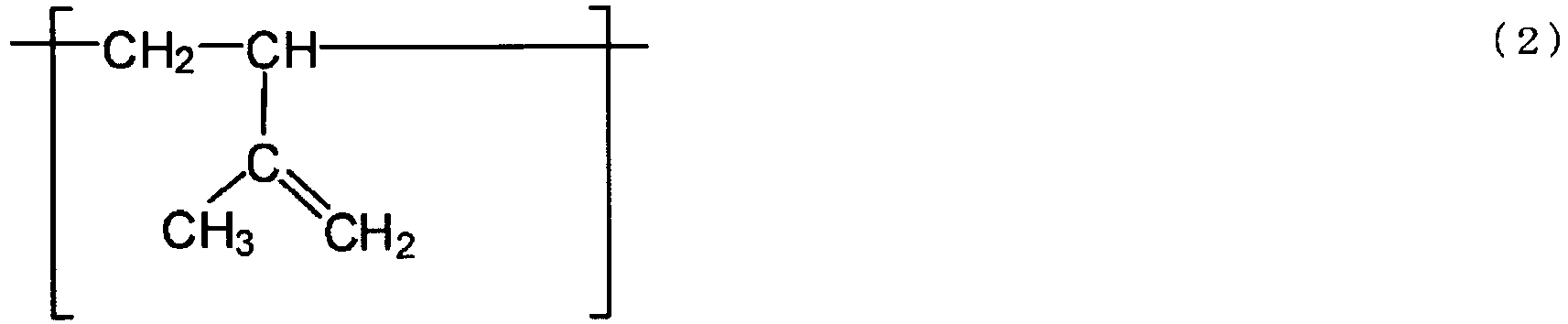
- a polymer block III having double bonds in the polymer main chain, formed by 1,4-addition polymerization of isoprene (diene compound 1), wherein the unit of the polymer is represented by Formula (3) below:

- a polymer block IV formed by 1,2-vinyl polymerization of 1,3-butadiene (diene compound 2), wherein the unit of the polymer is represented by Formula (4) below:

- and a polymer block V having double bonds in the polymer main chain, formed by 1,4-addition polymerization of 1,3-butadiene (diene compound 2), wherein the unit of the polymer is represented by Formula (5) below:

- the polymer block I comprises 90 mol% or more of the styrene compound-derived units,
- the polymer block II comprises 90 mol% or more of units derived from the diene compound 1,
- the polymer block III comprises 90 mol% or more of units derived from the diene compound 1,
- the polymer block IV comprises 90 mol% or more of units derived from the diene compound 2, and
- the polymer block V comprises 90 mol% or more of units derived from the diene compound 2;
- the component B is a polymer formed by polymerization of at least propylene, and is a polypropylene elastomer (excluding the component A) which does not show a peak having a heat of crystal melting of 1 J/g or more as measured by DSC (differential scanning calorimetry, heating rate 5°C/min) in the range of 20 to 250°C in accordance with JIS K7122,
- the self-adhesive composition has a [tanδ]pmax of 0.6 to 3.0 as measured by Standard Test 1 described below, and
- when the [tanδ]pmax is 0.6 or more and less than 1.1, the content of the component A is 60 to 80 wt% relative to the total of the components A and B taken as 100 wt%, and
- when the [tanδ]pmax is 1.1 to 3.0, the content of the component A is 50 to 80 wt% relative to the above total,
- a polymer block I of units derived from styrene, wherein the unit of the polymer is represented by Formula (1) below:
-
- (1) the self-adhesive composition is formed into a 1 mm thick sheet with a press machine at 160°C and a pressure of 40 kgf/cm2, and the sheet is cut to give a test sheet for the measurement of [tanδ]pmax;
- (2) the test sheet is tested on a viscoelastometer at a measurement frequency of 1 Hz, a swing angle γ of 0.05%, measurement temperatures of -30°C to 100°C and a heating rate of 5°C/min to record a tanδ vs. temperature curve, and a maximum value of a tanδ peak or peaks recorded at -30°C to 100°C is obtained as the [tanδ]pmax of the self-adhesive composition.
- Preferred examples of such coatings on articles include automobile coatings, building exterior coatings and exterior materials.
- In particular, automobile coatings, for example, top coatings on the surface of coat-finished car bodies are frequently exposed to severe high temperature conditions, not only in Japan but recently outdoors in the scorching sun in countries near the equator. Thus, suitable use is made of the self-adhesive sheets of the invention with which the occurrence of residual adhesive is suppressed even when the sheets are exposed to a high temperature of 90°C.
- In the applications described above,
the UV transmittance at 190 to 400 nm of the sheet substrate used in the invention is preferably not more than 1%, more preferably not more than 0.5%, and particularly preferably not more than 0.3% as measured with a spectrophotometer (V-570 manufactured by JASCO Corporation) from the viewpoint of the degradation of the self-adhesive agent. - To suppress the occurrence of residual adhesive at high temperatures, the thickness of the self-adhesive agent is preferably 4 to 20 µm, and more preferably 5 to 15 µm.
- The self-adhesive sheet may be produced by coating at least one side of the sheet substrate with the self-adhesive composition by any of various known methods. Preferably, the self-adhesive sheet is fabricated by the extrusion coating (hot melt coating) of the self-adhesive composition. In the case where the self-adhesive composition is soluble in solvents, a spread coating method may be adopted.
- Examples of the extrusion coating methods include a method for coextrusion of the single-layer or multilayer sheet substrate and the self-adhesive composition, or a method for melt extrusion coating of the self-adhesive composition onto the sheet substrate.
- In the method for coextrusion, for example, the self-adhesive sheet of the invention may be produced by kneading beforehand the self-adhesive composition of the invention in an extruder equipped with a multilayer die such as a feedblock die or a multimanifold die, and then coextruding the kneadate with the sheet substrate to form a film.
- During this process, the temperature of the extruder for the sheet substrate is set at 100 to 280°C, and preferably 150 to 240°C, and
the temperature of the extruder for the self-adhesive composition is set at 100 to 250°C, and preferably 150 to 240°C. - The temperature of the die is set at 100 to 280°C, and preferably 150 to 240°C. The take-off speed is 0.1 to 300 m/min, and preferably 5 to 100 m/min.
- In the melt extrusion coating, for example, the self-adhesive sheet of the invention may be produced by melt-extruding with a T-die extruder the previously-kneaded self-adhesive composition onto at least one side of the sheet substrate that has been subjected to a corona treatment, a release treatment (a long-chain alkyl releasing agent, a silicon releasing agent or the like) or a primer treatment to form a film.
- The temperature of the die is set at 100 to 280°C, and preferably 150 to 240°C. The take-off speed is 0.1 to 300 m/min, and preferably 5 to 100 m/min.
- When the melt extrusion coating is adopted, the sheet substrate may be a thermoplastic film or a non-thermoplastic substrate such as paper, metal, woven fabric or nonwoven fabric.
- The kneading of the self-adhesive composition may be performed with a kneading machine such as a single-screw extruder, a twin-screw extruder, a kneader or a Banbury mixer.
- For example, the spread coating method may be performed, although not limited to, in such a manner that the self-adhesive agent of the invention is dissolved in a solvent such as toluene or hexane with a concentration of 5 to 45%, preferably 10 to 30%, and the solution is applied by a known coating method and then dried, thereby producing the self-adhesive sheet of the invention.
- From the viewpoint of productivity, the melt flow rate (MFR) of the self-adhesive composition is preferably not more than 60 g/10 min, more preferably not more than 50 g/10 min, still more preferably not more than 45 g/10 min, and further preferably not more than 30 g/10 min.
- In the case where the sheet substrate is composed of a thermoplastic resin composition, it is preferable from the viewpoint of productivity that the MFRs of the resin forming the sheet substrate and the self-adhesive composition be:
- [MFR of the resin forming the sheet substrate] ≤ [MFR of the self-adhesive composition],
- more preferably, [MFR of the self-adhesive composition] - [MFR of the resin forming the sheet substrate] ≤ 50 g/10 min,
- still more preferably, [MFR of the self-adhesive composition] - [MFR of the resin forming the sheet substrate] ≤ 20 g/10 min, and
- further preferably, [MFR of the self-adhesive composition] - [MFR of the resin forming the sheet substrate] ≤ 10 g/10 min.
- The MFR of the self-adhesive composition may be controlled by increasing or decreasing the MFR(s) of the component(s) A, B and/or C, or the amounts of the tackifier and the softener.
- The MFR of the resin forming the sheet substrate may be controlled by the MFR of the base polymer.
- Self-adhesive sheets of Examples 1 to 5 and Comparative Examples 1 to 5 were evaluated by the measurement methods under the measurement conditions described below.
- The self-adhesive composition was formed into a 1 mm thick sheet with 10-Ton Desktop Test Press Machine (Gonno Yuatsuki Seisakusho K.K.) at 160°C and a pressure of 40 kgf/cm2, and the sheet was cut to give a test sheet for the measurement of [tanδ]pmax and Tg.
- The test sheet was tested on a viscoelastometer (product name Physica MCR301, manufactured by Anton Paar) at a measurement frequency of 1 Hz, a swing angle γ of 0.05%, measurement temperatures of -30°C to 100°C and a heating rate of 5°C/min to determine the tanδ and the Tg (glass transition point). With respect to the tanδ vs. temperature curve recorded at -30°C to 100°C, a maximum value of the tanδ peak(s) was obtained as the [tanδ]pmax of the self-adhesive composition.
- The test sheets of Examples 1 to 4 each had a single tanδ peak at -30°C to 100°C, and the maximum value was its peak top value.
- The adhesive strength was determined by measuring the 180° peel strength by a method in accordance with JIS Z0237 2000. A 25 mm wide self-adhesive sheet was applied to a BASUS plate and was compression bonded thereto by moving thereon a 1 kg compression roller back and forth one time. After 5 minutes, the 180° peel strength was determined at a tensile speed of 0.3 m/min.
- The surface of a plate coated with an automobile clear coating manufactured by NIPPON PAINT CO., LTD. was lightly polished with a coating polishing compound (FINESSE-IT PASTE GLAZE manufactured by 3M) and was wiped to remove the compound. Thereafter, the self-adhesive sheet was applied to the coated plate such that several wrinkles were formed. After the lapse of 12 hours at 90°C, the self-adhesive sheet was peeled slowly at an angle of 45° in a 60°C atmosphere. The surface was visually inspected for the presence or absence of any residual adhesive.
- The self-adhesive sheet was applied to a coated plate described below in such a manner that a wrinkle was formed. The plate was then allowed to stand in distilled water at 40°C for 24 hours. After collection, the self-adhesive sheet was released and then the plate was allowed to stand at normal temperature for 24 hours. The size of the mark step that had occurred in the coated plate in contact with the wrinkle of the self-adhesive sheet was measured with SURFCORDER ET4000A manufactured by Kosaka Laboratory Ltd. The height from the trough to the crest of the mark left under the wrinkle was measured as the size of the mark step.
SURFCORDER ET4000A was set as follows.
Measurement stylus: 2 µm R
Measurement load: 100 µN
Measurement speed: 0.02 mm/s
Measurement distance: 0.4 mm
Cut off: 0.25 mm
Leveling: 2 points in the vicinity
The following coatings were used.
Coating D: automobile clear coating (manufactured by DAI NIPPON TORYO CO., LTD.)
Coating S: automobile clear coating (manufactured by BASF) - The above coatings were each formed in the following manner. An electrodeposited plate manufactured by PALTEC TEST PANELS CO., LTD. which had a steel plate thickness of 0.7 mm was coated with a black paint and was allowed to stand at normal temperature for 5 minutes; further, a clear paint manufactured by DAI NIPPON TORYO CO., LTD. or BASF was applied thereon and was baked at 140°C for 20 minutes, thus forming an approximately 15 µm thick black coating and an approximately 30 µm thick clear coating.
- After the measurement of the mark step, the surface was visually observed under a fluorescent lamp and was evaluated:
- as good when the mark was nearly invisible at any angles of the coating;
- as substantially good when the mark was nearly invisible as seen from the front but was visible depending on the angle; and
- as dull when fine unevenness was seen on the surface, the surface gloss was apparently lost, or the reflection of light on the surface was apparently different from an area to which the sheet was applied depending on the angle.
- The melt flow rate was measured by a method in accordance with JIS K 7210.
- The melt flow rate was measured at a measurement temperature of 230°C under a load of 2.16 kg with use of melt index tester KAYENESS 7053 manufactured by YASUDA SEIKI SEISAKUSHO, LTD.
- Film uniformity such as color unevenness and melt fracture was visually evaluated.
- In the following, a polymer block may be referred to by using the name of a compound from which the units are derived, specifically, may be referred to as a "name-of-compound polymer block". For example, a polymer block of units derived from styrene will be otherwise referred to as a styrene polymer block.
- Hydrogenated product of a block copolymer having a styrene polymer block-isoprene polymer block-vinyl isoprene polymer block-1,3-butadiene polymer block-vinyl 1,3-butadiene polymer block structure.
- Low-crystalline copolymer of at least 80 wt% propylene with ethylene (density 0.855 to 0.871 g/cm3).
- Amorphous polyolefin.
- SEPS resin (hydrogenated product of a polymer having a styrene polymer block and a styrene/isoprene random polymer block).
- HSBR resin (hydrogenated product of styrene·butadiene random copolymer).
- SEBS resin (hydrogenated product of a polymer having a styrene polymer block and a styrene/butadiene random polymer block).
- [Example 1] is an example of a composition that may be employed in the use according to an aspect of the present invention.
Component A: HYBRAR 7311 46.9 parts by weight Component B: TAFTHREN X1102 15.6 parts by weight Sheet substrate: white polypropylene substrate layer (50 µm in thickness) - First, 3 kg of a self-adhesive composition having the above chemical composition was kneaded with a twin-screw extruder (product name TEM-35BH manufactured by TOSHIBA MACHINE CO., LTD.) at 180°C and 200 rpm. The kneaded materials were melt-coextruded with the sheet substrate with use of a T-die extruder having 30 mm orifices at a T-die temperature of 230°C and a film take-off speed of 5 m/min to be formed as a self-adhesive layer (8 µm in thickness). A self-adhesive sheet was thus fabricated.
- [Example 2] is an example of a composition that may be employed in the use according to an aspect of the present invention.
Component A: HYBRAR 7311 46.9 parts by weight Component B: TAFTHREN X1102 15.6 parts by weight Softener: Polybutene HV300 (manufactured by JX Nippon Oil & Energy Corporation) 20.8 parts by weight Tackifier: CLEARON K100 (manufactured by YASUHARA CHEMICAL CO., LTD.) 15.6 parts by weight Antioxidant: ANTAGE W500 (manufactured by Kawaguchi Chemical Industry Co., Ltd.) 0.5 parts by weight Sheet substrate: white polypropylene substrate layer (50 µm in thickness) - First, 3 kg of a self-adhesive composition having the above chemical composition was kneaded with a twin-screw extruder (product name TEM-35BH manufactured by TOSHIBA MACHINE CO., LTD.) at 180°C and 200 rpm. The kneaded materials were melt-coextruded with the sheet substrate with use of a T-die extruder having 30 mm orifices at a T-die temperature of 230°C and a film take-off speed of 5 m/min to be formed as a self-adhesive layer (8 µm in thickness). A self-adhesive sheet was thus fabricated.
-
Component A: HYBRAR 7311 26.0 parts by weight Component C: Vistamaxx 6102 20.8 parts by weight Component B: TAFTHREN X1102 15.6 parts by weight Softener: Polybutene HV300 (manufactured by JX Nippon Oil & Energy Corporation) 20.8 parts by weight Tackifier: CLEARON K100 (manufactured by YASUHARA CHEMICAL CO., LTD.) 15.6 parts by weight Antioxidant: ANTAGE W500 (manufactured by Kawaguchi Chemical Industry Co., Ltd.) 0.5 parts by weight Sheet substrate: white polypropylene substrate layer (50 µm in thickness) - A self-adhesive sheet was fabricated in the similar manner to in Example 3, except that the above chemical composition contained the component C.
-
Component A: HYBRAR 7311 (manufactured by KURARAY CO., LTD.) 24.8 parts by weight Component C: Vistamaxx 6102 18.9 parts by weight Component B: TAFTHREN X1102 14.9 parts by weight Softener: Polybutene HV300 (manufactured by JX Nippon Oil & Energy Corporation) 24.8 parts by weight Tackifier: CLEARON K100 (manufactured by YASUHARA CHEMICAL CO., LTD.) 14.9 parts by weight Antioxidant: ANTAGE W500 (manufactured by Kawaguchi Chemical Industry Co., Ltd.) 0.5 parts by weight Sheet substrate: white polypropylene substrate layer (50 µm in thickness) - A self-adhesive sheet was fabricated in the similar manner to in Example 3, except that the above chemical composition contained the component C.
-
SEPS resin: SEPTON 2063 46.9 parts by weight Component B: TAFTHREN X1102 15.6 parts by weight Sheet substrate: white polypropylene substrate layer (50 µm in thickness) - First, 3 kg of a self-adhesive composition having the above chemical composition was kneaded with a twin-screw extruder (product name TEM-35BH manufactured by TOSHIBA MACHINE CO., LTD.) at 180°C and 200 rpm. The kneaded materials were melt-coextruded with the sheet substrate with use of a T-die extruder having 30 mm orifices at a T-die temperature of 230°C and a film take-off speed of 5 m/min to be formed as a self-adhesive layer (8 µm in thickness). A self-adhesive sheet was thus fabricated.
-
SEPS resin: SEPTON 2063 46.9 parts by weight TAFTHREN X1102 15.6 parts by weight Softener: Polybutene HV300 (manufactured by JX Nippon Oil & Energy Corporation) 20.8 parts by weight Tackifier: CLEARON K100 (manufactured by YASUHARA CHEMICAL CO., LTD.) 15.6 parts by weight Antioxidant: ANTAGE W500 (manufactured by Kawaguchi Chemical Industry Co., Ltd.) 0.5 parts by weight Sheet substrate: white polypropylene substrate layer (50 µm in thickness) - A surface self-adhesive sheet was fabricated in the similar manner to in Example 1, except that the component A was not added and instead the SEPS resin (a hydrogenated product of a polymer having a styrene polymer block and a styrene/isoprene random polymer block) was added.
-
TAFTHREN X1102 23.6 parts by weight DYNARON 1320 (manufactured by JSR CORPORATION) 35.4 parts by weight Softener: Polybutene HV300 (manufactured by JX Nippon Oil & Energy Corporation) 15.0 parts by weight Tackifier: CLEARON K100 (manufactured by YASUHARA CHEMICAL CO., LTD.) 20.0 parts by weight Antioxidant: ANTAGE W500 (manufactured by Kawaguchi Chemical Industry Co., Ltd.) 0.5 parts by weight Sheet substrate: white polypropylene substrate layer (50 µm in thickness) - A surface self-adhesive sheet was fabricated in the similar manner to in Example 1, except that the above chemical composition contained DYNARON 1320 (the HSBR resin (a hydrogenated product of styrene·butadiene random copolymer)) instead of the component A.
-
TAFTHREN X1102 12.3 parts by weight TUFTEC H1221 61.7 parts by weight Softener: Polybutene HV300 (manufactured by JX Nippon Oil & Energy Corporation) 6.2 parts by weight Tackifier: CLEARON K100 (manufactured by YASUHARA CHEMICAL CO., LTD.) 18.5 parts by weight Antioxidant: ANTAGE W500 (manufactured by Kawaguchi Chemical Industry Co., Ltd.) 0.5 parts by weight Sheet substrate: white polypropylene substrate layer (50 µm in thickness) - A surface self-adhesive sheet was fabricated in the similar manner to in Example 1, except that the above chemical composition contained TUFTEC H1221 (the SEBS resin (a hydrogenated product of a polymer having a styrene polymer block and a styrene/butadiene random polymer block)) instead of the component A.
-
TAFTHREN X1102 23.6 parts by weight TUFTEC H1221 (manufactured by Asahi Kasei Chemicals Corporation) 35.4 parts by weight Softener: Polybutene HV300 (manufactured by JX Nippon Oil & Energy Corporation) 15.0 parts by weight Tackifier: CLEARON K100 (manufactured by YASUHARA CHEMICAL CO., LTD.) 20.0 parts by weight Antioxidant: ANTAGE W500 (manufactured by Kawaguchi Chemical Industry Co., Ltd.) 0.5 parts by weight Sheet substrate: white polypropylene substrate layer (50 µm in thickness) - A surface self-adhesive sheet was fabricated in the similar manner to in Example 1, except that the above chemical composition contained TUFTEC H1221 (the SEBS resin (a hydrogenated product of a polymer having a styrene polymer block and a styrene/butadiene random polymer block)) instead of the component A.
[Table 1] Ex. 1 Ex. 2 Ex. 3 Ex. 4 Comp. Ex. 1 Comp. Ex. 2 Comp. Ex. 3 Comp. Ex. 4 Comp. Ex. 5 Component A (pbw) HYBRAR 7311 46.9 46.9 26.0 24.8 Component A1 (pbw) DYNARON 1320 35.4 Component A2 (pbw) SEPTON 2063 46.9 46.9 Component A3 (pbw) TUFTEC H1221 61.7 35.4 Component B (pbw) TAFTHREN X1102 15.6 15.6 15.6 14.9 15.6 15.6 23.6 12.3 23.6 Component C (pbw) Vistamaxx 6102 20.8 18.9 A/(A+B) wt% 75.0 75.0 62.5 62.5 75.0 75.0 60.0 83.4 60.0 (A+C)/(A+B+C) wt% 75.0 75.0 75.0 74.6 75.0 75.0 60.0 83.4 60.0 A+B+C pbw 62.5 62.5 62.4 58.6 62.5 62.5 59.0 74.0 59.0 (A+B)/(A+B+C) wt% 100 100 67 68 100 100 100 100 100 C/(A+C) wt% 0 0 44.4 43.2 0 0 0 0 0 Softener HV300 pbw 0 20.8 20.8 24.8 0 20.8 15.0 6.2 15.0 wt% to (A+B+C) 0 33.3 33.3 42.3 0 33.3 25.4 8.4 25.4 Tackifier CLEARON K100 pbw 0 15.6 15.6 14.9 0 15.6 20 18.5 20 wt% to (A+B+C) 0 25.0 25.0 25.4 0 25.0 33.9 25.0 33.9 Antioxidant W500 pbw 0 0.5 0.5 0.5 0 0.5 0.5 0.5 0.5 T (total parts bv weight (pbw)) 62.5 99.4 99.3 98.8 62.5 99.4 94.5 99.2 94.5 (A+B+C)/T wt% 100 62.9 62.8 59.3 100 62.9 62.4 74.6 62.4 [tanδ]pmax 0.82 1.68 1.69 1.33 0.42 0.45 1.31 1.37 1.62 Glass transition point Tg(°C) -7.7 -15.8 -14.8 -16.9 -7.2 -6.7 -12.8 -26.2 -13.8 Specific adhesive strength (N/25 mm) With respect to BASUS plate 2.25 4.85 4.89 5.24 2.57 6.05 5.54 4.81 7.14 Clean adhesive removability ⊚ ⊚○ ⊚ ⊚ ⊚○ Δ × Δ× ⊚ ⊚ Mark (waterproofness step) Coating D 0.25 0.13 0.16 0.17 0.48 0.11 0.33 0.71 0.42 Coating S 0.47 0.29 0.27 0.28 0.49 0.23 0.88 0.59 0.27 Surface of tested coating Good Good Good Good Good Substantially good Good Dull Dull MFR (g/10mm) at 230°C Substrate 2 2 2 2 2 2 2 2 2 Self-adhesive agent 1 17 14 17 2 39 15 21 41 Film forming properties OK OK OK OK OK OK OK OK OK Total evaluation ○ ○ ○ ○ × × × × × - The self-adhesive sheets of Examples 1, 2, 3 and 4 achieved very small degrees of both residual adhesive and waterproofness steps, and were shown to have high levels of both clean adhesive removability and waterproofness. Deep waterproofness steps were caused in Comparative Example 1. Comparative Examples 2 and 3 resulted in large amounts of residual adhesive. In Comparative Examples 4 and 5, the waterproofness steps were deep and the tested coatings had a dull surface.
Claims (9)
- A self-adhesive composition comprising:a styrene elastomer (component A),an amorphous polypropylene elastomer (component B), anda crystalline polyolefin (component C),wherein the component A is a hydrogenated product of a block copolymer formed by copolymerization of:a polymer block I of units derived from styrene, wherein the unit of the polymer is represented by Formula (1) below:
 a polymer block II formed by 1,2-vinyl polymerization of isoprene (diene compound 1), wherein the unit of the polymer is represented by Formula (2) below:
 a polymer block III having double bonds in the polymer main chain, formed by 1,4-addition polymerization of isoprene (diene compound 1), wherein the unit of the polymer is represented by Formula (3) below:
 a polymer block IV formed by 1,2-vinyl polymerization of 1,3-butadiene (diene compound 2), wherein the unit of the polymer is represented by Formula (4) below:
 and a polymer block V having double bonds in the polymer main chain, formed by 1,4-addition polymerization of 1,3-butadiene (diene compound 2), wherein the unit of the polymer is represented by Formula (5) below:
 the polymer block I comprises 90 mol% or more of the styrene compound-derived units,the polymer block II comprises 90 mol% or more of units derived from the diene compound 1,the polymer block III comprises 90 mol% or more of units derived from the diene compound 1,the polymer block IV comprises 90 mol% or more of units derived from the diene compound 2, andthe polymer block V comprises 90 mol% or more of units derived from the diene compound 2;the component B is a polymer formed by polymerization of at least propylene, and is a polypropylene elastomer (excluding the component A) which does not show a peak having a heat of crystal melting of 1 J/g or more as measured by DSC (differential scanning calorimetry, heating rate 5°C/min) in the range of 20 to 250°C in accordance with JIS K7122,the self-adhesive composition has a [tanδ]pmax of 1.1 to 3.0 as measured by Standard Test 1 described below,the content of the component A is 50 to 80 wt% relative to the total of the components A and B taken as 100 wt%,the total of the components A and C is 60 to 80 wt% with respect to 100 wt% of the total of the components A, B and C, andthe content of the component C is 5 to 50 wt% with respect to 100 wt% of the total of the components A and C,[Standard Test 1](1) the self-adhesive composition is formed into a 1 mm thick sheet with a press machine at 160°C and a pressure of 40 kgf/cm2, and the sheet is cut to give a test sheet for the measurement of (tanδ]pmax;(2) the test sheet is tested on a viscoelastometer at a measurement frequency of 1 Hz, a swing angle γ of 0.05%, measurement temperatures of -30°C to 100°C and a heating rate of 5°C/min to record a tanδ vs. temperature curve, and a maximum value of a tanδ peak or peaks recorded at -30°C to 100°C is obtained as the [tanδ]pmax of the self-adhesive composition.
 - The self-adhesive composition according to claim 1, wherein
the self-adhesive composition further comprises a softener and/or a tackifier resin,
the softener is at least one selected from the group consisting of oils, paraffin waxes, low-molecular weight polybutenes, low-molecular weight polyisoprenes, low-molecular weight polyisobutylenes and low-molecular weight polyolefins, and
the tackifier resin is at least one selected from the group consisting of rosin resins, terpene resins, coumarone·indene resins, styrene resins, aliphatic, alicyclic or aromatic petroleum resins, and hydrogenated products of these resins. - The self-adhesive composition according to claim 1 or 2, further comprising at least one agent selected from the group consisting of antioxidants, UV absorbers, UV stabilizers, antistatic agents and lubricants.
- A self-adhesive sheet comprising the self-adhesive composition described in any one of claims 1 to 3 on at least one side of a sheet substrate.
- The self-adhesive sheet according to claim 4, which is a self-adhesive sheet for the protection of coatings.
- The self-adhesive sheet according to claim 5, which is a self-adhesive sheet for the protection of automobile coatings.
- A method for producing the self-adhesive sheet described in claim 5 or 6, comprising coextruding the self-adhesive composition and the sheet substrate in a side-by-side manner to form a stack, wherein
the sheet substrate comprises a thermoplastic resin composition,
the self-adhesive composition has a MFR at 230°C of not more than 60 g/10 min,
the difference between the MFR at 230°C of the self-adhesive composition and the MFR at 230°C of the thermoplastic resin composition is not more than 50 g/10 min. - The method for producing the self-adhesive sheet according to claim 7, wherein the difference between the MFRs is not more than 30 g/10 min.
- Use of a self-adhesive sheet for the protection of coatings comprising a self-adhesive composition comprising:a styrene elastomer (component A), andan amorphous polypropylene elastomer (component B),on at least one side of a sheet substrate,wherein the component A is a hydrogenated product of a block copolymer formed by copolymerization of:a polymer block I of units derived from styrene, wherein the unit of the polymer is represented by Formula (1) below:
 a polymer block II formed by 1,2-vinyl polymerization of isoprene (diene compound 1), wherein the unit of the polymer is represented by Formula (2) below:
 a polymer block III having double bonds in the polymer main chain, formed by 1,4-addition polymerization of isoprene (diene compound 1), wherein the unit of the polymer is represented by Formula (3) below:
 a polymer block IV formed by 1,2-vinyl polymerization of 1,3-butadiene (diene compound 2), wherein the unit of the polymer is represented by Formula (4) below:
 and a polymer block V having double bonds in the polymer main chain, formed by 1,4-addition polymerization of 1,3-butadiene (diene compound 2), wherein the unit of the polymer is represented by Formula (5) below:
 the polymer block I comprises 90 mol% or more of the styrene compound-derived units,the polymer block II comprises 90 mol% or more of units derived from the diene compound 1,the polymer block III comprises 90 mol% or more of units derived from the diene compound 1,the polymer block IV comprises 90 mol% or more of units derived from the diene compound 2, andthe polymer block V comprises 90 mol% or more of units derived from the diene compound 2;the component B is a polymer formed by polymerization of at least propylene, and is a polypropylene elastomer (excluding the component A) which does not show a peak having a heat of crystal melting of 1 J/g or more as measured by DSC (differential scanning calorimetry, heating rate 5°C/min) in the range of 20 to 250°C in accordance with JIS K7122,the self-adhesive composition has a [tanδ]pmax of 0.6 to 3.0 as measured by Standard Test 1 described below, andwhen the [tanδ]pmax is 0.6 or more and less than 1.1, the content of the component A is 60 to 80 wt% relative to the total of the components A and B taken as 100 wt%, andwhen the [tanδ]pmax is 1.1 to 3.0, the content of the component A is 50 to 80 wt% relative to the above total,[Standard Test 1](1) the self-adhesive composition is formed into a 1 mm thick sheet with a press machine at 160°C and a pressure of 40 kgf/cm2, and the sheet is cut to give a test sheet for the measurement of [tanδ]pmax;(2) the test sheet is tested on a viscoelastometer at a measurement frequency of 1 Hz, a swing angle γ of 0.05%, measurement temperatures of -30°C to 100°C and a heating rate of 5°C/min to record a tanδ vs. temperature curve, and a maximum value of a tanδ peak or peaks recorded at -30°C to 100°C is obtained as the [tanδ]pmax of the self-adhesive composition.
Applications Claiming Priority (1)
| Application Number | Priority Date | Filing Date | Title |
|---|---|---|---|
| PCT/JP2013/050901 WO2014112097A1 (en) | 2013-01-18 | 2013-01-18 | Adhesive agent composition, adhesive sheet, and method for manufacturing adhesive sheet |
Publications (3)
| Publication Number | Publication Date |
|---|---|
| EP2947127A1 EP2947127A1 (en) | 2015-11-25 |
| EP2947127A4 EP2947127A4 (en) | 2016-09-28 |
| EP2947127B1 true EP2947127B1 (en) | 2020-03-18 |
Family
ID=51209218
Family Applications (1)
| Application Number | Title | Priority Date | Filing Date |
|---|---|---|---|
| EP13872031.3A Active EP2947127B1 (en) | 2013-01-18 | 2013-01-18 | Self-adhesive composition, self-adhesive sheet, method for producing self-adhesive sheets and use of a self-adhesive sheet |
Country Status (3)
| Country | Link |
|---|---|
| EP (1) | EP2947127B1 (en) |
| JP (1) | JP6039693B2 (en) |
| WO (1) | WO2014112097A1 (en) |
Families Citing this family (4)
| Publication number | Priority date | Publication date | Assignee | Title |
|---|---|---|---|---|
| JP6417863B2 (en) * | 2014-08-26 | 2018-11-07 | 王子ホールディングス株式会社 | Adhesive sheet |
| JP6621045B2 (en) | 2017-07-31 | 2019-12-18 | 株式会社クラレ | Thermoplastic resin composition, hot melt adhesive, automobile member, and sanitary material member |
| JP7524579B2 (en) * | 2020-03-31 | 2024-07-30 | 王子ホールディングス株式会社 | Decorative film and decorative molded body |
| JP7585618B2 (en) * | 2020-03-31 | 2024-11-19 | 王子ホールディングス株式会社 | Decorative film and decorative molded body |
Family Cites Families (8)
| Publication number | Priority date | Publication date | Assignee | Title |
|---|---|---|---|---|
| JPS62127376A (en) * | 1985-11-27 | 1987-06-09 | Nitto Electric Ind Co Ltd | Surface protecting film |
| JPH0574627A (en) | 1991-09-11 | 1993-03-26 | Toshiba Corp | Low temperature structure |
| JP2006188646A (en) | 2004-12-07 | 2006-07-20 | Tohcello Co Ltd | Adhesive film |
| JP5288733B2 (en) * | 2007-05-31 | 2013-09-11 | 出光ユニテック株式会社 | Surface protection film |
| DE112008003773B4 (en) | 2008-03-10 | 2024-02-01 | Nichiban Company Limited | Surface protective layer |
| JP5117255B2 (en) * | 2008-03-31 | 2013-01-16 | 三菱樹脂株式会社 | Multi-layer film with reseal function and package using the same |
| JP5466852B2 (en) | 2008-12-01 | 2014-04-09 | 出光ユニテック株式会社 | Surface protection film |
| WO2013011561A1 (en) * | 2011-07-19 | 2013-01-24 | ニチバン株式会社 | Adhesive composition, adhesive sheet, and method for producing adhesive sheet |
-
2013
- 2013-01-18 JP JP2014557281A patent/JP6039693B2/en active Active
- 2013-01-18 WO PCT/JP2013/050901 patent/WO2014112097A1/en not_active Ceased
- 2013-01-18 EP EP13872031.3A patent/EP2947127B1/en active Active
Non-Patent Citations (1)
| Title |
|---|
| None * |
Also Published As
| Publication number | Publication date |
|---|---|
| EP2947127A1 (en) | 2015-11-25 |
| JP6039693B2 (en) | 2016-12-07 |
| WO2014112097A1 (en) | 2014-07-24 |
| JPWO2014112097A1 (en) | 2017-01-19 |
| EP2947127A4 (en) | 2016-09-28 |
Similar Documents
| Publication | Publication Date | Title |
|---|---|---|
| TWI421321B (en) | Surface protective film | |
| WO1995033012A1 (en) | Coating-protective film | |
| JP2014019777A (en) | Surface protection sheet | |
| WO2006075383A1 (en) | Surface-protective sheet | |
| US20130177761A1 (en) | Surface protection film | |
| JP2013194130A (en) | Sheet for protecting coated film | |
| JP5989434B2 (en) | Surface protection sheet | |
| KR20120089285A (en) | Protective sheet for coating film | |
| CN103339217A (en) | Release agent, release material, and adhesive tape | |
| EP2641951A1 (en) | Surface protection sheet | |
| JP6628101B2 (en) | Laminated film | |
| JP6615614B2 (en) | Surface protection film | |
| EP2947127A1 (en) | Adhesive agent composition, adhesive sheet, and method for manufacturing adhesive sheet | |
| EP3492542A1 (en) | Pressure-sensitive adhesive sheet | |
| JP5989433B2 (en) | Surface protection sheet | |
| CA2724099A1 (en) | Adhesive tape with a viscoelastic polyolefin backing | |
| JP5989432B2 (en) | Coating film protection sheet | |
| WO2013011561A1 (en) | Adhesive composition, adhesive sheet, and method for producing adhesive sheet | |
| JP4855093B2 (en) | Surface protective film substrate, surface protective adhesive film, and method for producing the same | |
| KR20190113807A (en) | Adhesive resin composition and laminated film comprising same | |
| WO2012105339A1 (en) | Release agent, manufacturing method therefor, release material, and pressure-sensitive adhesive tape | |
| KR20240131902A (en) | Sheet for led encapsulation | |
| JP3857899B2 (en) | Surface protection film | |
| WO2013121847A1 (en) | Surface protection sheet | |
| WO2013121848A1 (en) | Surface protection sheet |
Legal Events
| Date | Code | Title | Description |
|---|---|---|---|
| PUAI | Public reference made under article 153(3) epc to a published international application that has entered the european phase |
Free format text: ORIGINAL CODE: 0009012 |
|
| 17P | Request for examination filed |
Effective date: 20150813 |
|
| AK | Designated contracting states |
Kind code of ref document: A1 Designated state(s): AL AT BE BG CH CY CZ DE DK EE ES FI FR GB GR HR HU IE IS IT LI LT LU LV MC MK MT NL NO PL PT RO RS SE SI SK SM TR |
|
| AX | Request for extension of the european patent |
Extension state: BA ME |
|
| DAX | Request for extension of the european patent (deleted) | ||
| A4 | Supplementary search report drawn up and despatched |
Effective date: 20160831 |
|
| RIC1 | Information provided on ipc code assigned before grant |
Ipc: C09J 153/02 20060101AFI20160825BHEP Ipc: C09J 123/14 20060101ALI20160825BHEP Ipc: C09J 7/02 20060101ALI20160825BHEP |
|
| STAA | Information on the status of an ep patent application or granted ep patent |
Free format text: STATUS: EXAMINATION IS IN PROGRESS |
|
| 17Q | First examination report despatched |
Effective date: 20181022 |
|
| GRAP | Despatch of communication of intention to grant a patent |
Free format text: ORIGINAL CODE: EPIDOSNIGR1 |
|
| STAA | Information on the status of an ep patent application or granted ep patent |
Free format text: STATUS: GRANT OF PATENT IS INTENDED |
|
| RIC1 | Information provided on ipc code assigned before grant |
Ipc: C09J 7/20 20180101ALI20191001BHEP Ipc: C09J 153/02 20060101AFI20191001BHEP Ipc: C09J 123/14 20060101ALI20191001BHEP |
|
| INTG | Intention to grant announced |
Effective date: 20191030 |
|
| GRAS | Grant fee paid |
Free format text: ORIGINAL CODE: EPIDOSNIGR3 |
|
| GRAA | (expected) grant |
Free format text: ORIGINAL CODE: 0009210 |
|
| STAA | Information on the status of an ep patent application or granted ep patent |
Free format text: STATUS: THE PATENT HAS BEEN GRANTED |
|
| AK | Designated contracting states |
Kind code of ref document: B1 Designated state(s): AL AT BE BG CH CY CZ DE DK EE ES FI FR GB GR HR HU IE IS IT LI LT LU LV MC MK MT NL NO PL PT RO RS SE SI SK SM TR |
|
| REG | Reference to a national code |
Ref country code: GB Ref legal event code: FG4D |
|
| REG | Reference to a national code |
Ref country code: DE Ref legal event code: R096 Ref document number: 602013067050 Country of ref document: DE |
|
| REG | Reference to a national code |
Ref country code: AT Ref legal event code: REF Ref document number: 1245892 Country of ref document: AT Kind code of ref document: T Effective date: 20200415 Ref country code: IE Ref legal event code: FG4D |
|
| PG25 | Lapsed in a contracting state [announced via postgrant information from national office to epo] |
Ref country code: RS Free format text: LAPSE BECAUSE OF FAILURE TO SUBMIT A TRANSLATION OF THE DESCRIPTION OR TO PAY THE FEE WITHIN THE PRESCRIBED TIME-LIMIT Effective date: 20200318 Ref country code: FI Free format text: LAPSE BECAUSE OF FAILURE TO SUBMIT A TRANSLATION OF THE DESCRIPTION OR TO PAY THE FEE WITHIN THE PRESCRIBED TIME-LIMIT Effective date: 20200318 Ref country code: NO Free format text: LAPSE BECAUSE OF FAILURE TO SUBMIT A TRANSLATION OF THE DESCRIPTION OR TO PAY THE FEE WITHIN THE PRESCRIBED TIME-LIMIT Effective date: 20200618 |
|
| REG | Reference to a national code |
Ref country code: NL Ref legal event code: MP Effective date: 20200318 |
|
| PG25 | Lapsed in a contracting state [announced via postgrant information from national office to epo] |
Ref country code: BG Free format text: LAPSE BECAUSE OF FAILURE TO SUBMIT A TRANSLATION OF THE DESCRIPTION OR TO PAY THE FEE WITHIN THE PRESCRIBED TIME-LIMIT Effective date: 20200618 Ref country code: HR Free format text: LAPSE BECAUSE OF FAILURE TO SUBMIT A TRANSLATION OF THE DESCRIPTION OR TO PAY THE FEE WITHIN THE PRESCRIBED TIME-LIMIT Effective date: 20200318 Ref country code: GR Free format text: LAPSE BECAUSE OF FAILURE TO SUBMIT A TRANSLATION OF THE DESCRIPTION OR TO PAY THE FEE WITHIN THE PRESCRIBED TIME-LIMIT Effective date: 20200619 Ref country code: SE Free format text: LAPSE BECAUSE OF FAILURE TO SUBMIT A TRANSLATION OF THE DESCRIPTION OR TO PAY THE FEE WITHIN THE PRESCRIBED TIME-LIMIT Effective date: 20200318 Ref country code: LV Free format text: LAPSE BECAUSE OF FAILURE TO SUBMIT A TRANSLATION OF THE DESCRIPTION OR TO PAY THE FEE WITHIN THE PRESCRIBED TIME-LIMIT Effective date: 20200318 |
|
| REG | Reference to a national code |
Ref country code: LT Ref legal event code: MG4D |
|
| PG25 | Lapsed in a contracting state [announced via postgrant information from national office to epo] |
Ref country code: NL Free format text: LAPSE BECAUSE OF FAILURE TO SUBMIT A TRANSLATION OF THE DESCRIPTION OR TO PAY THE FEE WITHIN THE PRESCRIBED TIME-LIMIT Effective date: 20200318 |
|
| PG25 | Lapsed in a contracting state [announced via postgrant information from national office to epo] |
Ref country code: SK Free format text: LAPSE BECAUSE OF FAILURE TO SUBMIT A TRANSLATION OF THE DESCRIPTION OR TO PAY THE FEE WITHIN THE PRESCRIBED TIME-LIMIT Effective date: 20200318 Ref country code: IS Free format text: LAPSE BECAUSE OF FAILURE TO SUBMIT A TRANSLATION OF THE DESCRIPTION OR TO PAY THE FEE WITHIN THE PRESCRIBED TIME-LIMIT Effective date: 20200718 Ref country code: CZ Free format text: LAPSE BECAUSE OF FAILURE TO SUBMIT A TRANSLATION OF THE DESCRIPTION OR TO PAY THE FEE WITHIN THE PRESCRIBED TIME-LIMIT Effective date: 20200318 Ref country code: RO Free format text: LAPSE BECAUSE OF FAILURE TO SUBMIT A TRANSLATION OF THE DESCRIPTION OR TO PAY THE FEE WITHIN THE PRESCRIBED TIME-LIMIT Effective date: 20200318 Ref country code: PT Free format text: LAPSE BECAUSE OF FAILURE TO SUBMIT A TRANSLATION OF THE DESCRIPTION OR TO PAY THE FEE WITHIN THE PRESCRIBED TIME-LIMIT Effective date: 20200812 Ref country code: EE Free format text: LAPSE BECAUSE OF FAILURE TO SUBMIT A TRANSLATION OF THE DESCRIPTION OR TO PAY THE FEE WITHIN THE PRESCRIBED TIME-LIMIT Effective date: 20200318 Ref country code: SM Free format text: LAPSE BECAUSE OF FAILURE TO SUBMIT A TRANSLATION OF THE DESCRIPTION OR TO PAY THE FEE WITHIN THE PRESCRIBED TIME-LIMIT Effective date: 20200318 Ref country code: LT Free format text: LAPSE BECAUSE OF FAILURE TO SUBMIT A TRANSLATION OF THE DESCRIPTION OR TO PAY THE FEE WITHIN THE PRESCRIBED TIME-LIMIT Effective date: 20200318 |
|
| REG | Reference to a national code |
Ref country code: AT Ref legal event code: MK05 Ref document number: 1245892 Country of ref document: AT Kind code of ref document: T Effective date: 20200318 |
|
| REG | Reference to a national code |
Ref country code: DE Ref legal event code: R097 Ref document number: 602013067050 Country of ref document: DE |
|
| PLBE | No opposition filed within time limit |
Free format text: ORIGINAL CODE: 0009261 |
|
| STAA | Information on the status of an ep patent application or granted ep patent |
Free format text: STATUS: NO OPPOSITION FILED WITHIN TIME LIMIT |
|
| PG25 | Lapsed in a contracting state [announced via postgrant information from national office to epo] |
Ref country code: IT Free format text: LAPSE BECAUSE OF FAILURE TO SUBMIT A TRANSLATION OF THE DESCRIPTION OR TO PAY THE FEE WITHIN THE PRESCRIBED TIME-LIMIT Effective date: 20200318 Ref country code: AT Free format text: LAPSE BECAUSE OF FAILURE TO SUBMIT A TRANSLATION OF THE DESCRIPTION OR TO PAY THE FEE WITHIN THE PRESCRIBED TIME-LIMIT Effective date: 20200318 Ref country code: DK Free format text: LAPSE BECAUSE OF FAILURE TO SUBMIT A TRANSLATION OF THE DESCRIPTION OR TO PAY THE FEE WITHIN THE PRESCRIBED TIME-LIMIT Effective date: 20200318 Ref country code: ES Free format text: LAPSE BECAUSE OF FAILURE TO SUBMIT A TRANSLATION OF THE DESCRIPTION OR TO PAY THE FEE WITHIN THE PRESCRIBED TIME-LIMIT Effective date: 20200318 |
|
| 26N | No opposition filed |
Effective date: 20201221 |
|
| PG25 | Lapsed in a contracting state [announced via postgrant information from national office to epo] |
Ref country code: PL Free format text: LAPSE BECAUSE OF FAILURE TO SUBMIT A TRANSLATION OF THE DESCRIPTION OR TO PAY THE FEE WITHIN THE PRESCRIBED TIME-LIMIT Effective date: 20200318 |
|
| PG25 | Lapsed in a contracting state [announced via postgrant information from national office to epo] |
Ref country code: SI Free format text: LAPSE BECAUSE OF FAILURE TO SUBMIT A TRANSLATION OF THE DESCRIPTION OR TO PAY THE FEE WITHIN THE PRESCRIBED TIME-LIMIT Effective date: 20200318 |
|
| PG25 | Lapsed in a contracting state [announced via postgrant information from national office to epo] |
Ref country code: MC Free format text: LAPSE BECAUSE OF FAILURE TO SUBMIT A TRANSLATION OF THE DESCRIPTION OR TO PAY THE FEE WITHIN THE PRESCRIBED TIME-LIMIT Effective date: 20200318 |
|
| REG | Reference to a national code |
Ref country code: CH Ref legal event code: PL |
|
| GBPC | Gb: european patent ceased through non-payment of renewal fee |
Effective date: 20210118 |
|
| PG25 | Lapsed in a contracting state [announced via postgrant information from national office to epo] |
Ref country code: LU Free format text: LAPSE BECAUSE OF NON-PAYMENT OF DUE FEES Effective date: 20210118 |
|
| REG | Reference to a national code |
Ref country code: BE Ref legal event code: MM Effective date: 20210131 |
|
| PG25 | Lapsed in a contracting state [announced via postgrant information from national office to epo] |
Ref country code: FR Free format text: LAPSE BECAUSE OF NON-PAYMENT OF DUE FEES Effective date: 20210131 |
|
| PG25 | Lapsed in a contracting state [announced via postgrant information from national office to epo] |
Ref country code: CH Free format text: LAPSE BECAUSE OF NON-PAYMENT OF DUE FEES Effective date: 20210131 Ref country code: GB Free format text: LAPSE BECAUSE OF NON-PAYMENT OF DUE FEES Effective date: 20210118 Ref country code: LI Free format text: LAPSE BECAUSE OF NON-PAYMENT OF DUE FEES Effective date: 20210131 |
|
| PG25 | Lapsed in a contracting state [announced via postgrant information from national office to epo] |
Ref country code: IE Free format text: LAPSE BECAUSE OF NON-PAYMENT OF DUE FEES Effective date: 20210118 |
|
| PG25 | Lapsed in a contracting state [announced via postgrant information from national office to epo] |
Ref country code: BE Free format text: LAPSE BECAUSE OF NON-PAYMENT OF DUE FEES Effective date: 20210131 |
|
| PG25 | Lapsed in a contracting state [announced via postgrant information from national office to epo] |
Ref country code: HU Free format text: LAPSE BECAUSE OF FAILURE TO SUBMIT A TRANSLATION OF THE DESCRIPTION OR TO PAY THE FEE WITHIN THE PRESCRIBED TIME-LIMIT; INVALID AB INITIO Effective date: 20130118 |
|
| PG25 | Lapsed in a contracting state [announced via postgrant information from national office to epo] |
Ref country code: CY Free format text: LAPSE BECAUSE OF FAILURE TO SUBMIT A TRANSLATION OF THE DESCRIPTION OR TO PAY THE FEE WITHIN THE PRESCRIBED TIME-LIMIT Effective date: 20200318 |
|
| PG25 | Lapsed in a contracting state [announced via postgrant information from national office to epo] |
Ref country code: MK Free format text: LAPSE BECAUSE OF FAILURE TO SUBMIT A TRANSLATION OF THE DESCRIPTION OR TO PAY THE FEE WITHIN THE PRESCRIBED TIME-LIMIT Effective date: 20200318 |
|
| PG25 | Lapsed in a contracting state [announced via postgrant information from national office to epo] |
Ref country code: MT Free format text: LAPSE BECAUSE OF FAILURE TO SUBMIT A TRANSLATION OF THE DESCRIPTION OR TO PAY THE FEE WITHIN THE PRESCRIBED TIME-LIMIT Effective date: 20200318 |
|
| PG25 | Lapsed in a contracting state [announced via postgrant information from national office to epo] |
Ref country code: TR Free format text: LAPSE BECAUSE OF FAILURE TO SUBMIT A TRANSLATION OF THE DESCRIPTION OR TO PAY THE FEE WITHIN THE PRESCRIBED TIME-LIMIT Effective date: 20200318 |
|
| PGFP | Annual fee paid to national office [announced via postgrant information from national office to epo] |
Ref country code: DE Payment date: 20260121 Year of fee payment: 14 |