EP2933870B1 - Heat sink having two separated flow channels - Google Patents
Heat sink having two separated flow channels Download PDFInfo
- Publication number
- EP2933870B1 EP2933870B1 EP14853248.4A EP14853248A EP2933870B1 EP 2933870 B1 EP2933870 B1 EP 2933870B1 EP 14853248 A EP14853248 A EP 14853248A EP 2933870 B1 EP2933870 B1 EP 2933870B1
- Authority
- EP
- European Patent Office
- Prior art keywords
- heat sink
- cooling
- battery
- secondary battery
- present disclosure
- Prior art date
- Legal status (The legal status is an assumption and is not a legal conclusion. Google has not performed a legal analysis and makes no representation as to the accuracy of the status listed.)
- Active
Links
Images


Classifications
-
- H—ELECTRICITY
- H01—ELECTRIC ELEMENTS
- H01M—PROCESSES OR MEANS, e.g. BATTERIES, FOR THE DIRECT CONVERSION OF CHEMICAL ENERGY INTO ELECTRICAL ENERGY
- H01M10/00—Secondary cells; Manufacture thereof
- H01M10/60—Heating or cooling; Temperature control
- H01M10/65—Means for temperature control structurally associated with the cells
- H01M10/655—Solid structures for heat exchange or heat conduction
- H01M10/6556—Solid parts with flow channel passages or pipes for heat exchange
-
- H—ELECTRICITY
- H01—ELECTRIC ELEMENTS
- H01M—PROCESSES OR MEANS, e.g. BATTERIES, FOR THE DIRECT CONVERSION OF CHEMICAL ENERGY INTO ELECTRICAL ENERGY
- H01M10/00—Secondary cells; Manufacture thereof
- H01M10/60—Heating or cooling; Temperature control
-
- B—PERFORMING OPERATIONS; TRANSPORTING
- B60—VEHICLES IN GENERAL
- B60L—PROPULSION OF ELECTRICALLY-PROPELLED VEHICLES; SUPPLYING ELECTRIC POWER FOR AUXILIARY EQUIPMENT OF ELECTRICALLY-PROPELLED VEHICLES; ELECTRODYNAMIC BRAKE SYSTEMS FOR VEHICLES IN GENERAL; MAGNETIC SUSPENSION OR LEVITATION FOR VEHICLES; MONITORING OPERATING VARIABLES OF ELECTRICALLY-PROPELLED VEHICLES; ELECTRIC SAFETY DEVICES FOR ELECTRICALLY-PROPELLED VEHICLES
- B60L53/00—Methods of charging batteries, specially adapted for electric vehicles; Charging stations or on-board charging equipment therefor; Exchange of energy storage elements in electric vehicles
-
- B—PERFORMING OPERATIONS; TRANSPORTING
- B60—VEHICLES IN GENERAL
- B60L—PROPULSION OF ELECTRICALLY-PROPELLED VEHICLES; SUPPLYING ELECTRIC POWER FOR AUXILIARY EQUIPMENT OF ELECTRICALLY-PROPELLED VEHICLES; ELECTRODYNAMIC BRAKE SYSTEMS FOR VEHICLES IN GENERAL; MAGNETIC SUSPENSION OR LEVITATION FOR VEHICLES; MONITORING OPERATING VARIABLES OF ELECTRICALLY-PROPELLED VEHICLES; ELECTRIC SAFETY DEVICES FOR ELECTRICALLY-PROPELLED VEHICLES
- B60L58/00—Methods or circuit arrangements for monitoring or controlling batteries or fuel cells, specially adapted for electric vehicles
- B60L58/10—Methods or circuit arrangements for monitoring or controlling batteries or fuel cells, specially adapted for electric vehicles for monitoring or controlling batteries
- B60L58/18—Methods or circuit arrangements for monitoring or controlling batteries or fuel cells, specially adapted for electric vehicles for monitoring or controlling batteries of two or more battery modules
- B60L58/21—Methods or circuit arrangements for monitoring or controlling batteries or fuel cells, specially adapted for electric vehicles for monitoring or controlling batteries of two or more battery modules having the same nominal voltage
-
- H—ELECTRICITY
- H01—ELECTRIC ELEMENTS
- H01M—PROCESSES OR MEANS, e.g. BATTERIES, FOR THE DIRECT CONVERSION OF CHEMICAL ENERGY INTO ELECTRICAL ENERGY
- H01M10/00—Secondary cells; Manufacture thereof
- H01M10/42—Methods or arrangements for servicing or maintenance of secondary cells or secondary half-cells
- H01M10/425—Structural combination with electronic components, e.g. electronic circuits integrated to the outside of the casing
-
- H—ELECTRICITY
- H01—ELECTRIC ELEMENTS
- H01M—PROCESSES OR MEANS, e.g. BATTERIES, FOR THE DIRECT CONVERSION OF CHEMICAL ENERGY INTO ELECTRICAL ENERGY
- H01M10/00—Secondary cells; Manufacture thereof
- H01M10/42—Methods or arrangements for servicing or maintenance of secondary cells or secondary half-cells
- H01M10/44—Methods for charging or discharging
- H01M10/441—Methods for charging or discharging for several batteries or cells simultaneously or sequentially
-
- H—ELECTRICITY
- H01—ELECTRIC ELEMENTS
- H01M—PROCESSES OR MEANS, e.g. BATTERIES, FOR THE DIRECT CONVERSION OF CHEMICAL ENERGY INTO ELECTRICAL ENERGY
- H01M10/00—Secondary cells; Manufacture thereof
- H01M10/60—Heating or cooling; Temperature control
- H01M10/61—Types of temperature control
- H01M10/613—Cooling or keeping cold
-
- H—ELECTRICITY
- H01—ELECTRIC ELEMENTS
- H01M—PROCESSES OR MEANS, e.g. BATTERIES, FOR THE DIRECT CONVERSION OF CHEMICAL ENERGY INTO ELECTRICAL ENERGY
- H01M10/00—Secondary cells; Manufacture thereof
- H01M10/60—Heating or cooling; Temperature control
- H01M10/65—Means for temperature control structurally associated with the cells
- H01M10/655—Solid structures for heat exchange or heat conduction
- H01M10/6551—Surfaces specially adapted for heat dissipation or radiation, e.g. fins or coatings
-
- H—ELECTRICITY
- H01—ELECTRIC ELEMENTS
- H01M—PROCESSES OR MEANS, e.g. BATTERIES, FOR THE DIRECT CONVERSION OF CHEMICAL ENERGY INTO ELECTRICAL ENERGY
- H01M10/00—Secondary cells; Manufacture thereof
- H01M10/60—Heating or cooling; Temperature control
- H01M10/65—Means for temperature control structurally associated with the cells
- H01M10/655—Solid structures for heat exchange or heat conduction
- H01M10/6554—Rods or plates
- H01M10/6555—Rods or plates arranged between the cells
-
- H—ELECTRICITY
- H02—GENERATION; CONVERSION OR DISTRIBUTION OF ELECTRIC POWER
- H02J—ELECTRIC POWER NETWORKS; CIRCUIT ARRANGEMENTS OR SYSTEMS FOR SUPPLYING OR DISTRIBUTING ELECTRIC POWER; SYSTEMS FOR STORING ELECTRIC ENERGY
- H02J7/00—Circuit arrangements for charging or discharging batteries or for supplying loads from batteries
- H02J7/50—Circuit arrangements for charging or discharging batteries or for supplying loads from batteries acting upon multiple batteries simultaneously or sequentially
- H02J7/575—Parallel/serial switching of connection of batteries to charge or load circuit
-
- H—ELECTRICITY
- H01—ELECTRIC ELEMENTS
- H01M—PROCESSES OR MEANS, e.g. BATTERIES, FOR THE DIRECT CONVERSION OF CHEMICAL ENERGY INTO ELECTRICAL ENERGY
- H01M10/00—Secondary cells; Manufacture thereof
- H01M10/42—Methods or arrangements for servicing or maintenance of secondary cells or secondary half-cells
- H01M10/425—Structural combination with electronic components, e.g. electronic circuits integrated to the outside of the casing
- H01M2010/4271—Battery management systems including electronic circuits, e.g. control of current or voltage to keep battery in healthy state, cell balancing
-
- Y—GENERAL TAGGING OF NEW TECHNOLOGICAL DEVELOPMENTS; GENERAL TAGGING OF CROSS-SECTIONAL TECHNOLOGIES SPANNING OVER SEVERAL SECTIONS OF THE IPC; TECHNICAL SUBJECTS COVERED BY FORMER USPC CROSS-REFERENCE ART COLLECTIONS [XRACs] AND DIGESTS
- Y02—TECHNOLOGIES OR APPLICATIONS FOR MITIGATION OR ADAPTATION AGAINST CLIMATE CHANGE
- Y02E—REDUCTION OF GREENHOUSE GAS [GHG] EMISSIONS, RELATED TO ENERGY GENERATION, TRANSMISSION OR DISTRIBUTION
- Y02E60/00—Enabling technologies; Technologies with a potential or indirect contribution to GHG emissions mitigation
- Y02E60/10—Energy storage using batteries
-
- Y—GENERAL TAGGING OF NEW TECHNOLOGICAL DEVELOPMENTS; GENERAL TAGGING OF CROSS-SECTIONAL TECHNOLOGIES SPANNING OVER SEVERAL SECTIONS OF THE IPC; TECHNICAL SUBJECTS COVERED BY FORMER USPC CROSS-REFERENCE ART COLLECTIONS [XRACs] AND DIGESTS
- Y02—TECHNOLOGIES OR APPLICATIONS FOR MITIGATION OR ADAPTATION AGAINST CLIMATE CHANGE
- Y02T—CLIMATE CHANGE MITIGATION TECHNOLOGIES RELATED TO TRANSPORTATION
- Y02T10/00—Road transport of goods or passengers
- Y02T10/60—Other road transportation technologies with climate change mitigation effect
- Y02T10/70—Energy storage systems for electromobility, e.g. batteries
-
- Y—GENERAL TAGGING OF NEW TECHNOLOGICAL DEVELOPMENTS; GENERAL TAGGING OF CROSS-SECTIONAL TECHNOLOGIES SPANNING OVER SEVERAL SECTIONS OF THE IPC; TECHNICAL SUBJECTS COVERED BY FORMER USPC CROSS-REFERENCE ART COLLECTIONS [XRACs] AND DIGESTS
- Y02—TECHNOLOGIES OR APPLICATIONS FOR MITIGATION OR ADAPTATION AGAINST CLIMATE CHANGE
- Y02T—CLIMATE CHANGE MITIGATION TECHNOLOGIES RELATED TO TRANSPORTATION
- Y02T10/00—Road transport of goods or passengers
- Y02T10/60—Other road transportation technologies with climate change mitigation effect
- Y02T10/7072—Electromobility specific charging systems or methods for batteries, ultracapacitors, supercapacitors or double-layer capacitors
-
- Y—GENERAL TAGGING OF NEW TECHNOLOGICAL DEVELOPMENTS; GENERAL TAGGING OF CROSS-SECTIONAL TECHNOLOGIES SPANNING OVER SEVERAL SECTIONS OF THE IPC; TECHNICAL SUBJECTS COVERED BY FORMER USPC CROSS-REFERENCE ART COLLECTIONS [XRACs] AND DIGESTS
- Y02—TECHNOLOGIES OR APPLICATIONS FOR MITIGATION OR ADAPTATION AGAINST CLIMATE CHANGE
- Y02T—CLIMATE CHANGE MITIGATION TECHNOLOGIES RELATED TO TRANSPORTATION
- Y02T90/00—Enabling technologies or technologies with a potential or indirect contribution to GHG emissions mitigation
- Y02T90/10—Technologies relating to charging of electric vehicles
- Y02T90/14—Plug-in electric vehicles
Definitions
- the present disclosure relates to a heat sink, and more particularly, to a heat sink with two separated channels.
- a secondary battery Due to its characteristics of being easily applicable to various products and electrical properties such as a high energy density, a secondary battery is not only commonly applied to a portable device, but universally applied to an electric vehicle (EV) or a hybrid electric vehicle (HEV) and an energy storage system that is propelled by an electric motor.
- EV electric vehicle
- HEV hybrid electric vehicle
- This secondary battery is gaining attention for its primary advantage of remarkably reducing the use of fossil fuels and not generating by-products from the use of energy, making it a new eco-friendly and energy efficient source of energy.
- a battery pack for use in electric vehicles has a structure consisting of a plurality of cell assemblies connected in series, each cell assembly including a plurality of unit cells, to obtain high power.
- the unit cell includes a positive electrode current collector and a negative electrode current collector, a separator, an active material, and an electrolyte solution, and allows repeated charging and discharging by electrochemical reactions between the constituent elements.
- a battery pack of a multi-module structure is designed to have a plurality of secondary batteries arranged with a high density in a narrow space, it is important to easily discharge heat generated from the respective secondary batteries.
- a cooling method using a coolant is disclosed in Korean Patent Application Publication No. 10-2013-0062056 .
- FIG. 1 is a diagram illustrating the design of a cooling channel 10 according to a related art.
- the cooling channel 10 for cooling a secondary battery is illustrated.
- a refrigerant flowing in the cooling channel 10 enters an inlet 11 and exits an outlet 12.
- the secondary battery is more cooled at the inlet 11 side and is less cooled at the outlet 12 side. That is, the farther from the inlet 11 and closer to the outlet 12 the location is, the higher the temperature of the coolant is, so the cooling efficiency reduces.
- the above problem of the related art causes a temperature gradient of the secondary battery, and the temperature gradient of the secondary battery leads to a performance gradient of the secondary battery. Finally, it connects with performance deterioration of a system such as a battery pack including the secondary battery. Therefore, there is a need for the design of a cooling channel to provide a uniform cooling effect.
- the present disclosure is designed to address the above issue of the related art, and therefore, the present disclosure is directed to providing a heat sink with two separated channels.
- a heat sink according to the present disclosure includes the features as defined in claim 1.
- each cooling channel inlet of the separated channels may be formed near other cooling channel inlet on a same side of the heat sink.
- each cooling channel inlet of the separated channels may be formed near other cooling channel outlet on a same side of the heat sink.
- the heat sink according to the present disclosure may be an element of an indirect secondary battery cooling apparatus including the heat sink and a cooling fin which comes into contact with one surface of the secondary battery.
- the indirect secondary battery cooling apparatus may be an element of a battery module including the indirect secondary battery cooling apparatus and at least two secondary batteries.
- the battery module according to the present disclosure may be an element of a battery pack including a plurality of battery modules and a battery management system which controls the charge and discharge of the battery modules.
- the battery pack according to the present disclosure may be an element of a battery operating system including the battery pack and a load which is supplied with power from the battery pack.
- the load may be an electrical drive means or a portable device.
- Two separated cooling channels according to the present disclosure have a shorter movement distance than a related art.
- a rate at which the temperature rises with the increasing distance from an inlet of the cooling channel is relatively low. That is, the problem of the related art, i.e., the cooling efficiency reduces with the increasing distance from the inlet of the cooling channel, may be solved.
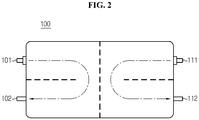
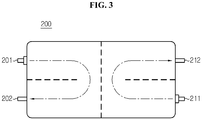
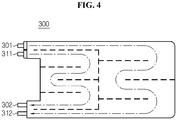
- FIGS. 2 through 5 are cross-sectional views illustrating heat sinks 100, 200, 300, and 400 with cooling channels according to the present disclosure.
- the heat sink according to the present disclosure uses an indirect cooling method to cool a secondary battery.
- heat generated from the secondary battery is transferred to a cooling fin by a contact between the surface of the secondary battery and the cooling fin.
- the cooling fin is connected to a heat sink having a large surface area, and the heat is transferred from the cooling fin to the heat sink.
- the heat sink is cooled by a coolant again.
- the indirect cooling method is a method which cools the secondary battery through the cooling fin and the heat sink, without requiring the coolant to directly pass through the secondary battery.
- the cooling channel formed inside the heat sink should be understood from a cross sectional area of the heat sink.
- the present disclosure features two separated cooling channels.
- the two separated cooling channels have a shorter movement distance than the related art.
- a rate at which the temperature rises with the increasing distance from an inlet of the cooling channel is relatively low. That is, the problem of the related art, i.e., the cooling efficiency reduces with the increasing distance from the inlet of the cooling channel, may be solved.
- inlets 101 and 111 of the two cooling channels are formed at opposing locations with respect to the center of the heat sink 100.
- outlets 102 and 112 of the cooling channels may be also formed at opposing locations with respect to the center of the heat sink 100.
- inlets 201 and 211 of the two cooling channels are formed at diagonal locations with respect to the center of the heat sink 200.
- outlets 202 and 212 of the cooling channels may be also formed at diagonal locations with respect to the center of the heat sink heat sink 200.
- FIGS. 2 and 3 show that a refrigerant flows in the cooling channel only one time for simplification of the drawings, it should be understood that the internal cooling channel may be variously formed.
- the heat sinks 100 and 200 described with reference to FIGS. 2 and 3 are designed such that a heat sink area is divided into halves, a cooling channel is split into halves, and each channel covers half the cooling.
- a channel length is half the channel length of a traditional heat sink, a maximum distance from the inlets 101 and 111 and 201 and 211 of the cooling channels to a point where heat is generated may be reduced by half.
- an inflow of coolant flows in two halves there is an advantage of reducing a loss of pressure in the same system.
- each cooling channel inlet 301 or 311 of the separated channels is formed near the other cooling channel inlet 311 or 301 on the same side of the heat sink 300.
- each cooling channel inlet 401 or 411 of the separated channels is formed near the other cooling channel outlet 412 or 402 on the same side of the heat sink 400.
- FIGS. 2 through 5 present a heat sink with two separated channels as an example, the heat sink according to the present disclosure may have two separated cooling channels as described above. Thus, with the increasing number of separated cooling channels, the number of inlets and outlets of each cooling channel may increase.
- the heat sink according to the present disclosure may be an element of an indirect secondary battery cooling apparatus including the heat sink and a cooling fin in contact with one surface of a secondary battery.
- the indirect secondary battery cooling apparatus may be an element of a battery module including the indirect secondary battery cooling apparatus and at least two secondary batteries.
- the battery module according to the present disclosure may be an element of a battery pack including a plurality of battery modules and a battery management system which controls the charge and discharge of the battery modules.
- the battery pack according to the present disclosure may be an element of a battery operating system including the battery pack and a load which is supplied with power from the battery pack.
- the battery operating system may be, for example, an electric vehicle (EV), a hybrid electric vehicle (HEV), an electric bike, a power tool, an energy storage system, an uninterruptible power supply (UPS), a portable computer, a mobile phone, a portable audio player, or a portable video player, and the load may be a motor that generates a rotational force by power supplied from a battery pack, or a power inverter circuit that inverts power supplied from a battery pack to power required for various circuit components.
- EV electric vehicle
- HEV hybrid electric vehicle
- UPS uninterruptible power supply
- the load may be a motor that generates a rotational force by power supplied from a battery pack, or a power inverter circuit that inverts power supplied from a battery pack to power required for various circuit components.
- the heat sink according to the present disclosure does not limit the scope of the invention by the secondary battery being cooled.
- the secondary battery includes a cell assembly in which at least two unit cells are stacked, each unit cell including a positive electrode plate, a separator, and a negative electrode plate, and a plurality of positive and negative electrode tabs protruding from the positive and negative electrode plates of each unit cell is electrically connected to positive and negative leads, respectively.
- the positive electrode plate is primarily made from aluminum.
- the positive electrode plate may be made from stainless steel, nickel, titanium, baked carbon, or aluminum or stainless steel treated with carbon, nickel, titanium, or silver on the surface.
- the positive electrode plate is not limited to a particular material if it has a high conductivity while not causing a chemical change in the secondary battery.
- the positive electrode tab is provided at a certain area of the positive electrode plate, and may extend from the positive electrode plate.
- the positive electrode tab may be formed by joining a member of a conductive material to a predetermined portion of the positive electrode plate, for example, through welding.
- the positive electrode tab may be formed by coating and drying a positive electrode material on a certain area of a peripheral surface of the positive electrode plate.
- the negative electrode plate corresponding to the positive electrode plate is primarily made from copper.
- the negative electrode plate may be made from stainless steel, aluminum, nickel, titanium, baked carbon, or copper or stainless steel treated with carbon, nickel, titanium, or silver on the surface, and aluminum-cadmium alloys may be also used.
- the negative electrode tab is also provided at a certain area of the negative electrode plate, and similar to the positive electrode tab described above, may extend from the negative electrode plate, and the negative electrode tab may be formed by joining a member of a conductive material to a predetermined portion of the negative electrode plate, for example, through welding, and may be formed by coating and drying a negative electrode material on a certain area of a peripheral surface of the negative electrode plate.
- the positive electrode lead is electrically connected to the positive electrode tab of the positive electrode plate
- the negative electrode lead is electrically connected to the negative electrode tab of the negative electrode plate.
- the positive electrode lead and the negative electrode lead are joined with a plurality of positive electrode tabs and a plurality of negative electrode tabs, respectively.
- the positive electrode plate and the negative electrode plate are coated with a positive electrode active material and a negative electrode active material, respectively.
- the positive electrode active material is a lithium-based active material, and as a typical example, may include metal oxide such as LiCoO 2 , LiNiO 2 , LiMnO 2 , LiMn 2 O 4 , LiFePO 4 , or Li 1+z Ni 1-x-y Co x M y O 2 (0 ⁇ x ⁇ 1, 0 ⁇ y ⁇ 1, 0 ⁇ x+y ⁇ 1, 0 ⁇ z ⁇ 1, M denotes a metal such as Al, Sr, Mg, La, and Mn).
- the negative electrode active material is a carbon-based active material, and may include a carbon material such as crystalline carbon, amorphous carbon, carbon complex, and carbon fibers, lithium metals, and lithium alloys.
- the type and chemical composition of the positive electrode active material and the negative electrode active material may change based on the type of the secondary battery, and it should be understood that the above particular example is just one example.
- the separator is not limited to a particular type, provided it is made from a porous material.
- the separator may be formed of a porous polymer membrane, for example, a porous polyolefin membrane, polyvinylidene fluoride-co-hexafluoropropylene, polyvinylidene fluoride-trichloroethylene, polymethylmetacrylate, polyacrylonitrile, polyvinylpyrrolidone, polyvinylacetate, ethylene vinyl acetate copolymer, polyethyleneoxide, cellulose acetate, cellulose acetate butylate, cellulose acetate propionate, cyanoethylpullulan, cyanoethylpolyvinylalcohol, cyanoethylcellulose, cyanoethylsucrose, pullulan, carboxyl methyl cellulose, acrylonitrile butadiene styrene copolymer, polyimide, polyethylene terephthalate, poly
- the inorganic particles are preferably inorganic particles having a high dielectric constant greater than or equal to 5, and more preferably, inorganic particles having a high dielectric constant greater than or equal to 10 and a low density. This facilitates the transfer of lithium ions moving in the battery.
- Non-limiting examples of inorganic particles having a high dielectric constant greater than or equal to 5 include Pb(Zr,Ti)O 3 (PZT), Pb 1-x La x Zr 1-y Ti y O 3 (PLZT), Pb(Mg 3 Nb 2/3 )O 3 -PbTiO 3 (PMN-PT), BaTiO 3 , hafnia (HfO 2 ), SrTiO 3 , TiO 2 , Al 2 O 3 , ZrO 2 , SnO 2 , CeO 2 , MgO, CaO, ZnO, Y 2 O 3 , or mixtures thereof.
- PZT Pb 1-x La x Zr 1-y Ti y O 3
- PMN-PT Pb(Mg 3 Nb 2/3 )O 3 -PbTiO 3
- BaTiO 3 hafnia
- HfO 2 hafnia
- SrTiO 3 TiO 2 , Al 2 O
- the cell assembly may have a simple stack structure of a plurality of unit cells with an insulating membrane interposed between the unit cells.
- the cell assembly may have a stack folding structure in which unit cells are arranged at an optimum interval on an upper surface and/or a lower surface of an insulating membrane and the insulating membrane is folded in one direction together with the unit cells, so the unit cells are inserted between the folded insulating membrane.
- the cell assembly may have a jelly roll structure formed by mounting, on an insulating membrane, a unit cell extending in the shape of a strand and continuously rolling up the unit cell and the insulating membrane together in one direction.
- the insulating membrane may be made from a material that may be employed as the separator. According to circumstances, the insulating membrane may be made from the same material membrane and/or with the same structure as the separator.
Landscapes
- Engineering & Computer Science (AREA)
- Manufacturing & Machinery (AREA)
- Chemical & Material Sciences (AREA)
- Chemical Kinetics & Catalysis (AREA)
- Electrochemistry (AREA)
- General Chemical & Material Sciences (AREA)
- Power Engineering (AREA)
- Transportation (AREA)
- Mechanical Engineering (AREA)
- Sustainable Development (AREA)
- Sustainable Energy (AREA)
- Life Sciences & Earth Sciences (AREA)
- Microelectronics & Electronic Packaging (AREA)
- Battery Mounting, Suspending (AREA)
- Secondary Cells (AREA)
Priority Applications (1)
| Application Number | Priority Date | Filing Date | Title |
|---|---|---|---|
| PL14853248T PL2933870T3 (pl) | 2013-10-17 | 2014-10-07 | Radiator mający dwa oddzielone kanały przepływu |
Applications Claiming Priority (2)
| Application Number | Priority Date | Filing Date | Title |
|---|---|---|---|
| KR1020130123912A KR101601149B1 (ko) | 2013-10-17 | 2013-10-17 | 2이상의 분리된 유로를 가진 히트싱크 |
| PCT/KR2014/009441 WO2015056921A1 (ko) | 2013-10-17 | 2014-10-07 | 2 이상의 분리된 유로를 가진 히트싱크 |
Publications (3)
| Publication Number | Publication Date |
|---|---|
| EP2933870A1 EP2933870A1 (en) | 2015-10-21 |
| EP2933870A4 EP2933870A4 (en) | 2016-07-13 |
| EP2933870B1 true EP2933870B1 (en) | 2018-12-05 |
Family
ID=52828311
Family Applications (1)
| Application Number | Title | Priority Date | Filing Date |
|---|---|---|---|
| EP14853248.4A Active EP2933870B1 (en) | 2013-10-17 | 2014-10-07 | Heat sink having two separated flow channels |
Country Status (6)
| Country | Link |
|---|---|
| US (1) | US10637113B2 (pl) |
| EP (1) | EP2933870B1 (pl) |
| KR (1) | KR101601149B1 (pl) |
| CN (1) | CN104919645A (pl) |
| PL (1) | PL2933870T3 (pl) |
| WO (1) | WO2015056921A1 (pl) |
Families Citing this family (12)
| Publication number | Priority date | Publication date | Assignee | Title |
|---|---|---|---|---|
| KR101601142B1 (ko) * | 2013-10-18 | 2016-03-08 | 주식회사 엘지화학 | 단열재를 포함하여 2이상의 분리된 유로를 가진 히트싱크 |
| EP3309858B1 (en) * | 2016-10-13 | 2019-07-10 | Samsung SDI Co., Ltd. | Battery module carrier, battery system and use of a modified h-beam as battery module carrier |
| GB2570300B (en) * | 2018-01-17 | 2020-11-25 | Siemens Ag | Energy storage system |
| KR102204302B1 (ko) | 2018-09-13 | 2021-01-15 | 주식회사 엘지화학 | 배터리 모듈, 이러한 배터리 모듈을 포함하는 배터리 팩 및 이러한 배터리 팩을 포함하는 자동차 |
| TWI678016B (zh) * | 2018-11-22 | 2019-11-21 | 國家中山科學研究院 | 電池模組及其液態冷卻裝置 |
| KR20210125721A (ko) * | 2020-04-09 | 2021-10-19 | 주식회사 엘지에너지솔루션 | 전지 모듈 및 이를 포함하는 전지 팩 |
| US11799150B2 (en) | 2020-07-17 | 2023-10-24 | Toyota Motor Engineering & Manufacturing North America, Inc. | Cooling structure for hybrid-electric vehicle battery cell assemblies |
| EP4266456B1 (en) * | 2021-02-23 | 2026-07-29 | LG Energy Solution, Ltd. | Battery module and battery pack including the same |
| DE102021120492A1 (de) * | 2021-08-06 | 2023-02-09 | Volkswagen Aktiengesellschaft | Batteriezelle |
| KR20260072306A (ko) * | 2024-11-13 | 2026-05-20 | 삼성에스디아이 주식회사 | 이차전지 모듈 및 이차전지 냉각장치 |
| US12471250B1 (en) * | 2025-02-20 | 2025-11-11 | Next Silicon Ltd. | Liquid cooling assembly for electronic components on printed circuit boards and computing device including same |
| US12520416B1 (en) * | 2025-02-20 | 2026-01-06 | Next Silicon Ltd. | Liquid cooling assembly for dual-sided thermal management and computing device including the same |
Citations (1)
| Publication number | Priority date | Publication date | Assignee | Title |
|---|---|---|---|---|
| US20130189557A1 (en) * | 2010-07-30 | 2013-07-25 | Valeo Klimasysteme Gmbh | Cooling Device For A Vehicle Battery And A Vehicle Battery With Such A Cooling Device |
Family Cites Families (17)
| Publication number | Priority date | Publication date | Assignee | Title |
|---|---|---|---|---|
| JP5147373B2 (ja) * | 2007-11-29 | 2013-02-20 | 三洋電機株式会社 | バッテリシステム |
| DE102008027293A1 (de) * | 2008-06-06 | 2009-12-10 | Behr Gmbh & Co. Kg | Vorrichtung zur Kühlung einer Fahrzeugbatterie |
| DE102008034885A1 (de) * | 2008-07-26 | 2010-01-28 | Daimler Ag | Kühlvorrichtung für eine Batterie mit mehreren Batteriezellen |
| US20110244297A1 (en) * | 2009-11-03 | 2011-10-06 | Delphi Technologies, Inc. | Prismatic-cell battery pack with integral coolant channels |
| KR20110090491A (ko) | 2010-02-04 | 2011-08-10 | 충북대학교 산학협력단 | 진동형 히트파이프를 이용한 전기 자동차용 중대형 배터리 냉각 및 가열장치 |
| US8383260B2 (en) * | 2010-02-26 | 2013-02-26 | GM Global Technology Operations LLC | U-formed cooling plate with solid fins for lithium pouch cells |
| DE102010056204A1 (de) * | 2010-03-26 | 2011-09-29 | Daimler Ag | Temperierelement für eine Batterie |
| KR101205181B1 (ko) | 2010-05-18 | 2012-11-27 | 주식회사 엘지화학 | 신규한 구조의 냉각부재와 이를 포함하는 전지모듈 |
| CH703973A1 (de) | 2010-10-29 | 2012-04-30 | Obrist Engineering Gmbh | Temperaturgesteuerte Batterie. |
| KR101177887B1 (ko) * | 2010-11-22 | 2012-08-29 | 주식회사 한국쿨러 | 히트 싱크를 이용한 전기 차량용 전지셀 모듈 |
| KR101293971B1 (ko) * | 2011-01-26 | 2013-08-07 | 주식회사 엘지화학 | 냉각 성능이 향상된 냉각부재와 이를 포함하는 전지모듈 |
| JP2012164456A (ja) | 2011-02-04 | 2012-08-30 | Kawasaki Heavy Ind Ltd | 二次電池用の放熱板およびその製造方法、ならびに放熱板を配した二次電池モジュール |
| US8835039B2 (en) * | 2011-10-21 | 2014-09-16 | Avl Powertrain Engineering, Inc. | Battery cooling plate and cooling system |
| DE102011086246A1 (de) * | 2011-11-14 | 2013-05-16 | Sb Limotive Company Ltd. | Batteriesystem und Kraftfahrzeug |
| KR101750066B1 (ko) | 2011-12-02 | 2017-06-23 | 에스케이이노베이션 주식회사 | 수냉식 이차전지 |
| KR20130104660A (ko) * | 2012-03-15 | 2013-09-25 | 에스케이이노베이션 주식회사 | 배터리 모듈 |
| CN102623771B (zh) * | 2012-04-26 | 2017-10-10 | 重庆长安汽车股份有限公司 | 一种电池冷却板结构 |
-
2013
- 2013-10-17 KR KR1020130123912A patent/KR101601149B1/ko active Active
-
2014
- 2014-10-07 PL PL14853248T patent/PL2933870T3/pl unknown
- 2014-10-07 WO PCT/KR2014/009441 patent/WO2015056921A1/ko not_active Ceased
- 2014-10-07 CN CN201480005249.XA patent/CN104919645A/zh active Pending
- 2014-10-07 EP EP14853248.4A patent/EP2933870B1/en active Active
- 2014-10-07 US US14/650,031 patent/US10637113B2/en active Active
Patent Citations (1)
| Publication number | Priority date | Publication date | Assignee | Title |
|---|---|---|---|---|
| US20130189557A1 (en) * | 2010-07-30 | 2013-07-25 | Valeo Klimasysteme Gmbh | Cooling Device For A Vehicle Battery And A Vehicle Battery With Such A Cooling Device |
Also Published As
| Publication number | Publication date |
|---|---|
| EP2933870A1 (en) | 2015-10-21 |
| WO2015056921A1 (ko) | 2015-04-23 |
| KR20150044631A (ko) | 2015-04-27 |
| CN104919645A (zh) | 2015-09-16 |
| US10637113B2 (en) | 2020-04-28 |
| KR101601149B1 (ko) | 2016-03-08 |
| US20150318587A1 (en) | 2015-11-05 |
| PL2933870T3 (pl) | 2019-05-31 |
| EP2933870A4 (en) | 2016-07-13 |
Similar Documents
| Publication | Publication Date | Title |
|---|---|---|
| EP2933871B1 (en) | Heat sink having two or more separated channels arranged vertically with common inlet and common outlet | |
| EP2930781B1 (en) | Heat sink with two or more separated channels including insulation material | |
| US10637113B2 (en) | Heat sink with two or more separated channels | |
| KR20150050435A (ko) | 양극 집전체에 간헐적 무지부가 형성된 젤리 롤 형태 전극 조립체를 가진 이차전지 | |
| US10957955B2 (en) | Battery module and battery pack including the same | |
| US9437898B2 (en) | Secondary battery including plurality of electrode assemblies | |
| US9692027B2 (en) | Electrode assembly and lithium secondary battery including the same | |
| JP2006079987A (ja) | ハイブリッド電池システム | |
| KR101760865B1 (ko) | 열전소자를 이용한 배터리팩 자가 냉각 방법 및 시스템 | |
| KR20150045245A (ko) | 공통 출입구가 형성된 2이상의 분리된 유로를 가진 히트싱크 | |
| CN104769747B (zh) | 二次电池及其制造方法 | |
| US9356294B2 (en) | Secondary battery including collectors with pores and manufacturing method thereof | |
| KR20150072107A (ko) | 미 열융착 라인을 통해 파우치형 케이스의 주변 부위가 접힌 이차전지 | |
| KR101668356B1 (ko) | 스택-폴딩형 전극 조립체 및 그 제조 방법 | |
| EP3353842B1 (en) | Secondary battery | |
| CN107834015A (zh) | 电池组 | |
| US20260074295A1 (en) | Electrode assembly for secondary battery and method for manufacturing the same | |
| CN120657197A (zh) | 用于制造二次电池的方法和使用该方法制造的二次电池 |
Legal Events
| Date | Code | Title | Description |
|---|---|---|---|
| PUAI | Public reference made under article 153(3) epc to a published international application that has entered the european phase |
Free format text: ORIGINAL CODE: 0009012 |
|
| 17P | Request for examination filed |
Effective date: 20150715 |
|
| AK | Designated contracting states |
Kind code of ref document: A1 Designated state(s): AL AT BE BG CH CY CZ DE DK EE ES FI FR GB GR HR HU IE IS IT LI LT LU LV MC MK MT NL NO PL PT RO RS SE SI SK SM TR |
|
| AX | Request for extension of the european patent |
Extension state: BA ME |
|
| A4 | Supplementary search report drawn up and despatched |
Effective date: 20160609 |
|
| RIC1 | Information provided on ipc code assigned before grant |
Ipc: H01M 10/65 20140101ALI20160603BHEP Ipc: H01M 2/10 20060101ALI20160603BHEP Ipc: H01M 10/6554 20140101ALI20160603BHEP Ipc: H01M 10/6556 20140101ALI20160603BHEP Ipc: H01M 10/60 20140101AFI20160603BHEP |
|
| DAX | Request for extension of the european patent (deleted) | ||
| STAA | Information on the status of an ep patent application or granted ep patent |
Free format text: STATUS: EXAMINATION IS IN PROGRESS |
|
| 17Q | First examination report despatched |
Effective date: 20170719 |
|
| GRAP | Despatch of communication of intention to grant a patent |
Free format text: ORIGINAL CODE: EPIDOSNIGR1 |
|
| STAA | Information on the status of an ep patent application or granted ep patent |
Free format text: STATUS: GRANT OF PATENT IS INTENDED |
|
| INTG | Intention to grant announced |
Effective date: 20180807 |
|
| GRAS | Grant fee paid |
Free format text: ORIGINAL CODE: EPIDOSNIGR3 |
|
| GRAA | (expected) grant |
Free format text: ORIGINAL CODE: 0009210 |
|
| STAA | Information on the status of an ep patent application or granted ep patent |
Free format text: STATUS: THE PATENT HAS BEEN GRANTED |
|
| AK | Designated contracting states |
Kind code of ref document: B1 Designated state(s): AL AT BE BG CH CY CZ DE DK EE ES FI FR GB GR HR HU IE IS IT LI LT LU LV MC MK MT NL NO PL PT RO RS SE SI SK SM TR |
|
| REG | Reference to a national code |
Ref country code: GB Ref legal event code: FG4D |
|
| REG | Reference to a national code |
Ref country code: CH Ref legal event code: EP |
|
| REG | Reference to a national code |
Ref country code: AT Ref legal event code: REF Ref document number: 1074205 Country of ref document: AT Kind code of ref document: T Effective date: 20181215 |
|
| REG | Reference to a national code |
Ref country code: IE Ref legal event code: FG4D |
|
| REG | Reference to a national code |
Ref country code: DE Ref legal event code: R096 Ref document number: 602014037601 Country of ref document: DE |
|
| REG | Reference to a national code |
Ref country code: NL Ref legal event code: MP Effective date: 20181205 |
|
| REG | Reference to a national code |
Ref country code: AT Ref legal event code: MK05 Ref document number: 1074205 Country of ref document: AT Kind code of ref document: T Effective date: 20181205 |
|
| REG | Reference to a national code |
Ref country code: LT Ref legal event code: MG4D |
|
| PG25 | Lapsed in a contracting state [announced via postgrant information from national office to epo] |
Ref country code: FI Free format text: LAPSE BECAUSE OF FAILURE TO SUBMIT A TRANSLATION OF THE DESCRIPTION OR TO PAY THE FEE WITHIN THE PRESCRIBED TIME-LIMIT Effective date: 20181205 Ref country code: NO Free format text: LAPSE BECAUSE OF FAILURE TO SUBMIT A TRANSLATION OF THE DESCRIPTION OR TO PAY THE FEE WITHIN THE PRESCRIBED TIME-LIMIT Effective date: 20190305 Ref country code: HR Free format text: LAPSE BECAUSE OF FAILURE TO SUBMIT A TRANSLATION OF THE DESCRIPTION OR TO PAY THE FEE WITHIN THE PRESCRIBED TIME-LIMIT Effective date: 20181205 Ref country code: LT Free format text: LAPSE BECAUSE OF FAILURE TO SUBMIT A TRANSLATION OF THE DESCRIPTION OR TO PAY THE FEE WITHIN THE PRESCRIBED TIME-LIMIT Effective date: 20181205 Ref country code: BG Free format text: LAPSE BECAUSE OF FAILURE TO SUBMIT A TRANSLATION OF THE DESCRIPTION OR TO PAY THE FEE WITHIN THE PRESCRIBED TIME-LIMIT Effective date: 20190305 Ref country code: ES Free format text: LAPSE BECAUSE OF FAILURE TO SUBMIT A TRANSLATION OF THE DESCRIPTION OR TO PAY THE FEE WITHIN THE PRESCRIBED TIME-LIMIT Effective date: 20181205 Ref country code: LV Free format text: LAPSE BECAUSE OF FAILURE TO SUBMIT A TRANSLATION OF THE DESCRIPTION OR TO PAY THE FEE WITHIN THE PRESCRIBED TIME-LIMIT Effective date: 20181205 Ref country code: AT Free format text: LAPSE BECAUSE OF FAILURE TO SUBMIT A TRANSLATION OF THE DESCRIPTION OR TO PAY THE FEE WITHIN THE PRESCRIBED TIME-LIMIT Effective date: 20181205 |
|
| PG25 | Lapsed in a contracting state [announced via postgrant information from national office to epo] |
Ref country code: AL Free format text: LAPSE BECAUSE OF FAILURE TO SUBMIT A TRANSLATION OF THE DESCRIPTION OR TO PAY THE FEE WITHIN THE PRESCRIBED TIME-LIMIT Effective date: 20181205 Ref country code: RS Free format text: LAPSE BECAUSE OF FAILURE TO SUBMIT A TRANSLATION OF THE DESCRIPTION OR TO PAY THE FEE WITHIN THE PRESCRIBED TIME-LIMIT Effective date: 20181205 Ref country code: GR Free format text: LAPSE BECAUSE OF FAILURE TO SUBMIT A TRANSLATION OF THE DESCRIPTION OR TO PAY THE FEE WITHIN THE PRESCRIBED TIME-LIMIT Effective date: 20190306 Ref country code: SE Free format text: LAPSE BECAUSE OF FAILURE TO SUBMIT A TRANSLATION OF THE DESCRIPTION OR TO PAY THE FEE WITHIN THE PRESCRIBED TIME-LIMIT Effective date: 20181205 |
|
| PG25 | Lapsed in a contracting state [announced via postgrant information from national office to epo] |
Ref country code: NL Free format text: LAPSE BECAUSE OF FAILURE TO SUBMIT A TRANSLATION OF THE DESCRIPTION OR TO PAY THE FEE WITHIN THE PRESCRIBED TIME-LIMIT Effective date: 20181205 |
|
| PG25 | Lapsed in a contracting state [announced via postgrant information from national office to epo] |
Ref country code: CZ Free format text: LAPSE BECAUSE OF FAILURE TO SUBMIT A TRANSLATION OF THE DESCRIPTION OR TO PAY THE FEE WITHIN THE PRESCRIBED TIME-LIMIT Effective date: 20181205 Ref country code: IT Free format text: LAPSE BECAUSE OF FAILURE TO SUBMIT A TRANSLATION OF THE DESCRIPTION OR TO PAY THE FEE WITHIN THE PRESCRIBED TIME-LIMIT Effective date: 20181205 Ref country code: PT Free format text: LAPSE BECAUSE OF FAILURE TO SUBMIT A TRANSLATION OF THE DESCRIPTION OR TO PAY THE FEE WITHIN THE PRESCRIBED TIME-LIMIT Effective date: 20190405 |
|
| PG25 | Lapsed in a contracting state [announced via postgrant information from national office to epo] |
Ref country code: RO Free format text: LAPSE BECAUSE OF FAILURE TO SUBMIT A TRANSLATION OF THE DESCRIPTION OR TO PAY THE FEE WITHIN THE PRESCRIBED TIME-LIMIT Effective date: 20181205 Ref country code: SK Free format text: LAPSE BECAUSE OF FAILURE TO SUBMIT A TRANSLATION OF THE DESCRIPTION OR TO PAY THE FEE WITHIN THE PRESCRIBED TIME-LIMIT Effective date: 20181205 Ref country code: IS Free format text: LAPSE BECAUSE OF FAILURE TO SUBMIT A TRANSLATION OF THE DESCRIPTION OR TO PAY THE FEE WITHIN THE PRESCRIBED TIME-LIMIT Effective date: 20190405 Ref country code: SM Free format text: LAPSE BECAUSE OF FAILURE TO SUBMIT A TRANSLATION OF THE DESCRIPTION OR TO PAY THE FEE WITHIN THE PRESCRIBED TIME-LIMIT Effective date: 20181205 Ref country code: EE Free format text: LAPSE BECAUSE OF FAILURE TO SUBMIT A TRANSLATION OF THE DESCRIPTION OR TO PAY THE FEE WITHIN THE PRESCRIBED TIME-LIMIT Effective date: 20181205 |
|
| REG | Reference to a national code |
Ref country code: DE Ref legal event code: R097 Ref document number: 602014037601 Country of ref document: DE |
|
| PLBE | No opposition filed within time limit |
Free format text: ORIGINAL CODE: 0009261 |
|
| STAA | Information on the status of an ep patent application or granted ep patent |
Free format text: STATUS: NO OPPOSITION FILED WITHIN TIME LIMIT |
|
| PG25 | Lapsed in a contracting state [announced via postgrant information from national office to epo] |
Ref country code: DK Free format text: LAPSE BECAUSE OF FAILURE TO SUBMIT A TRANSLATION OF THE DESCRIPTION OR TO PAY THE FEE WITHIN THE PRESCRIBED TIME-LIMIT Effective date: 20181205 Ref country code: SI Free format text: LAPSE BECAUSE OF FAILURE TO SUBMIT A TRANSLATION OF THE DESCRIPTION OR TO PAY THE FEE WITHIN THE PRESCRIBED TIME-LIMIT Effective date: 20181205 |
|
| 26N | No opposition filed |
Effective date: 20190906 |
|
| PG25 | Lapsed in a contracting state [announced via postgrant information from national office to epo] |
Ref country code: TR Free format text: LAPSE BECAUSE OF FAILURE TO SUBMIT A TRANSLATION OF THE DESCRIPTION OR TO PAY THE FEE WITHIN THE PRESCRIBED TIME-LIMIT Effective date: 20181205 |
|
| PG25 | Lapsed in a contracting state [announced via postgrant information from national office to epo] |
Ref country code: MC Free format text: LAPSE BECAUSE OF FAILURE TO SUBMIT A TRANSLATION OF THE DESCRIPTION OR TO PAY THE FEE WITHIN THE PRESCRIBED TIME-LIMIT Effective date: 20181205 |
|
| REG | Reference to a national code |
Ref country code: CH Ref legal event code: PL |
|
| PG25 | Lapsed in a contracting state [announced via postgrant information from national office to epo] |
Ref country code: CH Free format text: LAPSE BECAUSE OF NON-PAYMENT OF DUE FEES Effective date: 20191031 Ref country code: LI Free format text: LAPSE BECAUSE OF NON-PAYMENT OF DUE FEES Effective date: 20191031 Ref country code: LU Free format text: LAPSE BECAUSE OF NON-PAYMENT OF DUE FEES Effective date: 20191007 |
|
| REG | Reference to a national code |
Ref country code: BE Ref legal event code: MM Effective date: 20191031 |
|
| PG25 | Lapsed in a contracting state [announced via postgrant information from national office to epo] |
Ref country code: BE Free format text: LAPSE BECAUSE OF NON-PAYMENT OF DUE FEES Effective date: 20191031 |
|
| PG25 | Lapsed in a contracting state [announced via postgrant information from national office to epo] |
Ref country code: IE Free format text: LAPSE BECAUSE OF NON-PAYMENT OF DUE FEES Effective date: 20191007 |
|
| PG25 | Lapsed in a contracting state [announced via postgrant information from national office to epo] |
Ref country code: CY Free format text: LAPSE BECAUSE OF FAILURE TO SUBMIT A TRANSLATION OF THE DESCRIPTION OR TO PAY THE FEE WITHIN THE PRESCRIBED TIME-LIMIT Effective date: 20181205 |
|
| PG25 | Lapsed in a contracting state [announced via postgrant information from national office to epo] |
Ref country code: HU Free format text: LAPSE BECAUSE OF FAILURE TO SUBMIT A TRANSLATION OF THE DESCRIPTION OR TO PAY THE FEE WITHIN THE PRESCRIBED TIME-LIMIT; INVALID AB INITIO Effective date: 20141007 Ref country code: MT Free format text: LAPSE BECAUSE OF FAILURE TO SUBMIT A TRANSLATION OF THE DESCRIPTION OR TO PAY THE FEE WITHIN THE PRESCRIBED TIME-LIMIT Effective date: 20181205 |
|
| PG25 | Lapsed in a contracting state [announced via postgrant information from national office to epo] |
Ref country code: MK Free format text: LAPSE BECAUSE OF FAILURE TO SUBMIT A TRANSLATION OF THE DESCRIPTION OR TO PAY THE FEE WITHIN THE PRESCRIBED TIME-LIMIT Effective date: 20181205 |
|
| P01 | Opt-out of the competence of the unified patent court (upc) registered |
Effective date: 20230512 |
|
| REG | Reference to a national code |
Ref country code: DE Ref legal event code: R081 Ref document number: 602014037601 Country of ref document: DE Owner name: LG ENERGY SOLUTION, LTD., KR Free format text: FORMER OWNER: LG CHEM, LTD., SEOUL, KR |
|
| REG | Reference to a national code |
Ref country code: GB Ref legal event code: 732E Free format text: REGISTERED BETWEEN 20230824 AND 20230831 |
|
| PGFP | Annual fee paid to national office [announced via postgrant information from national office to epo] |
Ref country code: PL Payment date: 20250923 Year of fee payment: 12 |
|
| PGFP | Annual fee paid to national office [announced via postgrant information from national office to epo] |
Ref country code: GB Payment date: 20250922 Year of fee payment: 12 |
|
| PGFP | Annual fee paid to national office [announced via postgrant information from national office to epo] |
Ref country code: FR Payment date: 20250925 Year of fee payment: 12 |
|
| PGFP | Annual fee paid to national office [announced via postgrant information from national office to epo] |
Ref country code: DE Payment date: 20250922 Year of fee payment: 12 |