EP2928623B1 - Verfahren zur dekontamination mit oberflächenmaterialien - Google Patents
Verfahren zur dekontamination mit oberflächenmaterialien Download PDFInfo
- Publication number
- EP2928623B1 EP2928623B1 EP13776896.6A EP13776896A EP2928623B1 EP 2928623 B1 EP2928623 B1 EP 2928623B1 EP 13776896 A EP13776896 A EP 13776896A EP 2928623 B1 EP2928623 B1 EP 2928623B1
- Authority
- EP
- European Patent Office
- Prior art keywords
- state
- hydrophilic
- hydrophobic
- substrate
- decontamination
- Prior art date
- Legal status (The legal status is an assumption and is not a legal conclusion. Google has not performed a legal analysis and makes no representation as to the accuracy of the status listed.)
- Active
Links
Images


Classifications
-
- B—PERFORMING OPERATIONS; TRANSPORTING
- B08—CLEANING
- B08B—CLEANING IN GENERAL; PREVENTION OF FOULING IN GENERAL
- B08B17/00—Methods preventing fouling
- B08B17/02—Preventing deposition of fouling or of dust
- B08B17/06—Preventing deposition of fouling or of dust by giving articles subject to fouling a special shape or arrangement
-
- B—PERFORMING OPERATIONS; TRANSPORTING
- B08—CLEANING
- B08B—CLEANING IN GENERAL; PREVENTION OF FOULING IN GENERAL
- B08B17/00—Methods preventing fouling
- B08B17/02—Preventing deposition of fouling or of dust
-
- B—PERFORMING OPERATIONS; TRANSPORTING
- B08—CLEANING
- B08B—CLEANING IN GENERAL; PREVENTION OF FOULING IN GENERAL
- B08B3/00—Cleaning by methods involving the use or presence of liquid or steam
- B08B3/04—Cleaning involving contact with liquid
- B08B3/08—Cleaning involving contact with liquid the liquid having chemical or dissolving effect
-
- B—PERFORMING OPERATIONS; TRANSPORTING
- B08—CLEANING
- B08B—CLEANING IN GENERAL; PREVENTION OF FOULING IN GENERAL
- B08B3/00—Cleaning by methods involving the use or presence of liquid or steam
- B08B3/04—Cleaning involving contact with liquid
- B08B3/10—Cleaning involving contact with liquid with additional treatment of the liquid or of the object being cleaned, e.g. by heat, by electricity or by vibration
-
- B—PERFORMING OPERATIONS; TRANSPORTING
- B08—CLEANING
- B08B—CLEANING IN GENERAL; PREVENTION OF FOULING IN GENERAL
- B08B7/00—Cleaning by methods not provided for in a single other subclass or a single group in this subclass
- B08B7/0035—Cleaning by methods not provided for in a single other subclass or a single group in this subclass by radiant energy, e.g. UV, laser, light beam or the like
- B08B7/0057—Cleaning by methods not provided for in a single other subclass or a single group in this subclass by radiant energy, e.g. UV, laser, light beam or the like by ultraviolet radiation
-
- B—PERFORMING OPERATIONS; TRANSPORTING
- B08—CLEANING
- B08B—CLEANING IN GENERAL; PREVENTION OF FOULING IN GENERAL
- B08B7/00—Cleaning by methods not provided for in a single other subclass or a single group in this subclass
- B08B7/04—Cleaning by methods not provided for in a single other subclass or a single group in this subclass by a combination of operations
-
- B—PERFORMING OPERATIONS; TRANSPORTING
- B60—VEHICLES IN GENERAL
- B60S—SERVICING, CLEANING, REPAIRING, SUPPORTING, LIFTING, OR MANOEUVRING OF VEHICLES, NOT OTHERWISE PROVIDED FOR
- B60S3/00—Vehicle cleaning apparatus not integral with vehicles
- B60S3/008—Vehicle cleaning apparatus not integral with vehicles for interiors of land vehicles
-
- B—PERFORMING OPERATIONS; TRANSPORTING
- B60—VEHICLES IN GENERAL
- B60S—SERVICING, CLEANING, REPAIRING, SUPPORTING, LIFTING, OR MANOEUVRING OF VEHICLES, NOT OTHERWISE PROVIDED FOR
- B60S3/00—Vehicle cleaning apparatus not integral with vehicles
- B60S3/04—Vehicle cleaning apparatus not integral with vehicles for exteriors of land vehicles
-
- B—PERFORMING OPERATIONS; TRANSPORTING
- B64—AIRCRAFT; AVIATION; COSMONAUTICS
- B64F—GROUND OR AIRCRAFT-CARRIER-DECK INSTALLATIONS SPECIALLY ADAPTED FOR USE IN CONNECTION WITH AIRCRAFT; DESIGNING, MANUFACTURING, ASSEMBLING, CLEANING, MAINTAINING OR REPAIRING AIRCRAFT, NOT OTHERWISE PROVIDED FOR; HANDLING, TRANSPORTING, TESTING OR INSPECTING AIRCRAFT COMPONENTS, NOT OTHERWISE PROVIDED FOR
- B64F5/00—Designing, manufacturing, assembling, cleaning, maintaining or repairing aircraft, not otherwise provided for; Handling, transporting, testing or inspecting aircraft components, not otherwise provided for
- B64F5/30—Cleaning aircraft
Definitions
- This disclosure relates to decontamination methods and surfaces configured for decontamination, and in particular to methods of and materials for using a surface adjustable upon application of an external stimulus.
- Bio decontamination is the deactivation and/or destruction of microorganisms, and pathogens, such as bacteria, both vegetative and sporulative, bacterial spores, viruses, mycoplasma, protozoans, oocysts, and toxins.
- Chemical decontamination is the deactivation and/or destruction of chemical contaminants, pesticides, chemical warefare agents, and other toxic substances.
- Chemical washing includes washing the surface with simple soap and water, bleach, DS-2, hydrogen peroxide, alkali, hexachlorophene, quaternary amines, and the like.
- Fumigation includes exposing an object or its surface to a fumigant for a time sufficient to deactivate or destroy the biological/chemical agent. Heat and irradiation treatments involve providing temperatures or amounts of radiation, respectfully, that is fatal to the biologic or sufficient to decompose or alter the chemical substance to one that is not harmful.
- liquid decontaminant In certain situations, it may be necessary to decontaminate a vehicle, for example, an aerospace vehicle, which has been contaminated for one or more reasons. "Contaminated" interior aircraft surfaces are typically decontaminated by application of fluid decontaminants.
- the methods for applying the liquid decontaminant include hand-wiping, or controlled application using sprayers, or injectors, nebulizers or atomizers.
- caustic oxidizing solutions such as DS2 (Decontamination Solution Number 2), which comprises 70% diethylenetriamine, 28% ethylene glycol monomethyl ether, and 2% sodium hydroxide, can cause damage to surfaces and surroundings to which it is applied.
- US 2012/0276334 discloses surfaces with controllable wetting and adhesion.
- US 2006/0207629 discloses an apparatus and a method for an ultraviolet cleaning tool.
- EP 0 718 872 B1 discloses a semiconductor substrate cleaning method.
- WO 2010/096073 discloses flexible microstructured superhydrophobic materials configuration.
- a method comprising applying an external stimulus to a surface of a substrate, adjusting at least a portion of the surface from a first state to a second state, state wherein either (i) the first state presents a substantially hydrophobic surface and the second state presents a substantially hydrophilic surface; or (ii) the first state presents a substantially hydrophilic surface and second state presents a substantially hydrophobic surface; contacting the surface in the second state with a fluid or gas, the fluid or gas having one or more decontaminating agents effective against one or more contaminates associated with the surface of the substrate; removing the external stimulus to the surface of the substrate, the surface transforming from the second state back to the first state, whereby at least a portion of the surface of the substrate is decontaminated.
- the substrate is at least an interior surface of a vehicle.
- the one or more decontaminating agents are applied to the surface as an aerosol spray.
- the stimulus is light.
- the present disclosure related to reversibly adjustable, or transformable, materials for protecting against contamination and/or enabling effective decontamination dynamically with application of an external stimulus.
- Such surfaces or surface-adjustable coatings can be used on equipment existing or interiors of vehicles. Such surfaces or coatings preferably maintain their adjustability in severe wear-intensive environments.
- Such adjustable coatings can be applied on top of a painted surface, a fabric, or other surface used on or in vehicles, or equipment.
- Such surfaces or coatings reduce the amount of chemical (decontaminating agents) required and/or shorten the return-to-service time to decontaminate the equipment or vehicle.
- Such surfaces and coatings are adapted for use with conventional hazmat and decontamination techniques and can be readily incorporated with such methods.
- the process and materials disclosed herein are particularly suited for the decontamination of surfaces pertaining to equipment, and occupiable volumes or spaces in need thereof as a result of a contamination event.
- hydrophobic and hydroophilic in relationship to surfaces, have their ordinary and customary meaning as used herein.
- Superhydrophobic surfaces are highly hydrophobic, e.g., extremely difficult to wet.
- the contact angle of a water droplet on a superhydrophobic surface exceeds 150° and the roll-off angle is less than 10°.
- Superhydrophilic surfaces are characterized as providing extremely low contact angle between water and the surface.
- the contact angle of water with generally hydrophilic inorganic materials, such as glass is generally 20-40 degrees, whereas the contact angle of water with typical hydrophilic organic materials, such as resins, is 70-90 degrees, and the contact angle of water with hydrophobic resins, such as silicone resin and fluorocarbon polymers, is more than 90 degrees.
- the contact angle of superhydrophilic surfaces is less than 20 degrees, less than 10 degrees, or less than 5 degrees.
- a superhydrophilic surface can cause the water contact angle to approach zero.
- Contact angle is a measure of static hydrophobicity
- contact angle hysteresis and slide angle are dynamic measures useful for determining the state of the surface of the disclosed aspects.
- Contact angle hysteresis is a phenomenon that characterizes surface heterogeneity. Differences between advancing and receding contact angles, termed contact angle hysteresis, can be used to characterize surface heterogeneity, roughness, and mobility. Surfaces that are not homogeneous will have domains which impede motion of the contact line.
- the slide angle is another dynamic measure of hydrophobicity and is measured by depositing a droplet on a surface and tilting the surface until the droplet begins to slide.
- the present method provides, in one aspect, an adjustable substrate surface having a first hydrophobic surface state that transitions to a second hydrophilic surface state promoting uniform coverage with a fluid film comprising one or more water-based decontaminant, which maximizes decontamination of the substrate.
- the substrate surface state can be transitioned back to the first hydrophobic surface state that promotes aggregation of the fluid into droplets that can be removed easier.
- hydrophobic/hydrophilic transitional properties of the surface is beneficial for the decontaminating agent such as where for water-based decontaminant fluids, the second hydrophilic surface state promotes essentially a uniform coverage with a fluid film (e.g., wetting), which enhances decontamination, and the first hydrophobic surface state promotes aggregation of fluid into droplets that can be removed easier, since they will coalesce and/or tend to roll off the surface.
- a fluid film e.g., wetting
- an adjustable substrate surface having a first hydrophilic surface state that transitions to a second hydrophobic surface state is beneficial for utilization of one or more emulsion-type decontaminant that is at least partially hydrophobic, and thus, the one or more emulsion-type decontaminates will form a film on the second hydrophobic surface, and upon transition back to the first hydrophilic surface state provide for removal of the emulsion-type decontaminate.
- Adjustable surfaces switching reversibly between hydrophobic and hydrophobic surface states can be effectively fabricated by utilizing stimuli-responsive materials. Such surfaces in combination with decontaminating agents provide a method of decontaminating vehicles and/or equipment.
- the surfaces can be prepared with materials added to engineering materials used to fabricate the vehicle or equipment or can be coated on existing interiors and/or surfaces of the vehicle or equipment.
- adjustable surfaces switching reversibly between super-hydrophobic and super-hydrophilic surface states can be employed.
- the surface states can be adjusted by the application of an external stimulus, whereas discontinuation or modulation of the external stimulus reversibly adjusts the surface of the substrate between the first state and second state.
- the external stimulus can be directed to the materials directly or the interior they are coated on.
- the decontamination can be more efficient, as the surface contaminate is more effectively presented to the decontaminating agents and or more easily removed from the contaminated surfaces. Moreover, contamination that has entered small crevices or surface defects is more efficiently presented to the decontaminating agents upon adjustment of the substrate surface from a first hydrophobic surface state to a second hydrophilic state.
- adjustable surfaces include controllable, wettable surfaces that are configured to receive and/or interact with decontaminating agents and other compounds effective in decontamination.
- adjustable materials for the methods disclosed herein include, for example, photo-responsive materials, include inorganic semiconductor oxides such as titania, zinc oxide, vanadium oxide, etc. These materials are normally hydrophobic in a first state, and can be modified, e.g., by texturing to a submicron roughness, to provide a first superhydrophobic surface state. Exposure of the semiconductor oxide surfaces to UV light provides for an adjustment or transition of the surface to a second hydrophilic surface state, which if modified by submicron roughness can provide essentially complete wetting of aqueous media alone or in combination with decontaminating agents. Storage of the second hydrophilic state in the dark for a sufficient time interval provides for reversibility from the second state to the first state.
- photo-responsive materials include inorganic semiconductor oxides such as titania, zinc oxide, vanadium oxide, etc. These materials are normally hydrophobic in a first state, and can be modified, e.g., by texturing to a submicron roughness, to provide a first
- the adjustable materials or coatings can include one or more of oxides of titanium, oxides of zinc, oxides of iron, oxides of silver, oxides of copper, oxides of tungsten, oxides of tin, oxides of bismuth, strontium titanate and mixtures thereof.
- the oxides in the adjustable materials or coatings can include sub-oxides, stoichiometric oxides, and super-oxides.
- the ultraviolet radiation activated layer includes one or more of TiO 2 , ZnO, Fe 2 O 3 , WO 3 , SnO 2 , Bi 2 O 3 , V 2 O 5 , and SrTiO 3 .
- the oxides can be used in a form that is suitable for incorporation into materials to affect the surface thereof, or used in coatings.
- the oxides can be of a size suitable for such applications, including micron particles, submicron particles, nanoparticles, and physical mixtures and/or distributions thereof.
- the adjustable materials or coatings include titanium oxide or vanadium oxides.
- the titanium oxide includes TiO 2 .
- the titanium oxide can include amorphous, rutile and anatase phases of titanium oxide, or a mixture of two or more of these phases.
- the inorganic semiconductor oxides can be added to materials normally used in the fabrication or construction of vehicles or equipment, especially interiors of vehicles.
- the inorganic semiconductor oxides are more concentrated at the surface, which can be provided by molding techniques or post-fabrication annealing.
- the inorganic semiconductor oxides can be deposited on existing surfaces of the vehicles or equipment, for example, by sputter coating, thermal spraying, or other coating techniques.
- Additional compounds can be used alone or in combination with the above inorganic semiconductor oxides.
- Such additional compounds can be organic or substantially organic, for example, azobenzene and spiropyran functional groups, capable of switching between polar forms in response to light and switching back to a nonpolar form after a predetermined time in the dark.
- adjustable materials or coatings useful for practicing the methods herein disclosed can be reversibly electrically induced between different surface states.
- Such adjustable materials or coatings include conducting polymers, for example, a positively charged conjugated (alternating single and double bond) backbone polymer in combination with negatively charged dopants.
- the hydrophobicity/hydrophilicity can be controlled by the selection of conducting polymer and type of dopant and the dopant concentration.
- polypyrrole (PPy) films on submicron roughened surfaces can be adjusted from a (super)hydrophobic to (super)hydrophilic state by adjusting the applied voltage to the adjustable material or coating, or the grounded vehicle or equipment.
- adjustable surface can be reversed by application of an amount of heat or thermal radiation sufficient to effect the transition of the first hydrophobic surface state to the second hydrophilic surface state.
- exemplary adjustable materials or coatings that can be reversibly thermally adjusted between a first hydrophobic surface state and a second hydrophilic surface state include polymeric systems and surface coatings.
- chemically modified poly(N-isopropylacrylamide) combined with surface roughness has excellent reversibility between a first hydrophobic state at about at 20 °C and a second hydrophilic state at about 40 °C, respectively.
- reversibility between a hydrophobic surface and a hydrophilic surface can, in part, be manipulated by the roughness of the surface.
- the roughness-enhanced thermally responsive wettability of a poly(N-isopropylacrylamide) (PNI-PAAm)-modified surface provides for reversible switching between a first superhydrophilic surface state and a second superhydrophobic surface state in a narrow temperature range of about 10°C. While not to be held to any particular theory, this transition is believed to result from the combined effect of the chemical variation of the surface and the surface roughness.
- Such surfaces may be prepared by surface-initiated atom-transfer radical polymerization to fabricate thermally responsive PNI-PAAm thin films, for example, on both flat and textured substrates.
- exemplary surfaces and coatings useful in practicing the methods herein disclosed include materials that can adjust from a first hydrophobic surface state and a second hydrophilic surface state by way of geometric control of the surface and/or the introduction of stress to the surface.
- applying a mechanical stress to a micro/nanostructured surface effectuates a change the spacing and/or geometry of surface features, such as asperities in one or more physical dimensions.
- Roughness projected area/actual area
- a first geometric-shaped hydrophobic surface state can be stimulated to change to a second geometric-shaped hydrophilic surface state under a stress.
- the stress can be uni-axial or biaxial relative to the surface of the substrate or coating.
- the coating or surface in a first unstretched state is hydrophobic or superhydrophobic and adjusts or transforms to a second stretched state that is hydrophilic or superhydrophilic when stretched.
- the polymer is a polyimide with a predetermined side chain configuration of predetermined length and/or chemical composition that allows wetting in the second the stretched-strained state by providing the wetting fluid access to a lower energy state as opposed to a higher energy state that forces or repeals the wetting fluid in the (super)hydrophobic "Cassie" state.
- the process disclosed herein is adaptable for treating chemical and/or biological contamination of a surface, such as a surface interior of a vehicle, such as an aerospace vehicle or other vehicle or equipment.
- a photo-adjustable material is used to exemplify the methods herein disclosed, for which substitution of the appropriate stimulus being readily undertaken by one of ordinary skill.
- a decontaminating agent is applied to the surface as an aerosol spray, whereby the surface having previously been or subsequently illuminated, preferably with ultraviolet light, with sufficient intensity (power per unit area) to effect adjustment of the surface from the first hydrophobic surface state to the second hydrophilic surface state to receive the decontamination agent.
- This decontamination can result from the photodecomposition of the chemical contaminants or alteration of critical biological molecules or structures of the pathogens, and/or result in chemical reaction with the products of photochemical reactions to effect the decontamination or deactivation.
- the surface state can be reversed back to one of hydrophobic or superhydrophobic to facilitate the removal of the contaminates, which can be viable or partially or completely deactivated.
- an adjustable surface suitable for UV stimulation can be a semiconductor oxide, suitable for exposure of UV having a surface thickness on a substrate of from about 1 to about 250 nm, preferably from 14 to 20 nm, thick.
- UV activation can be accomplished by exposure to sunlight or UV radiation having a wavelength in a range of from 10 to 400 nm, e.g., from 300 to 400 nm.
- UV radiation having a wavelength of 350 to 400 nm can be used for adjusting materials or coating comprising, e.g., TiO 2 .
- the ultraviolet radiation activated layer can generally be activated with a minimum dose of UV radiation in a range of from about 0.001 to 1 mW/cm 2 . Other intensities can be used.
- the decontaminating agent(s) can be electrostatically charged (e.g., as it is sprayed as an aerosol) to promote the adherence of the agent to the surface to be treated.
- electrostatically charged e.g., as it is sprayed as an aerosol
- the charged particles resulting from the electrospraying will be attracted to, and adhere to, the surface to be treated.
- a thermally-adjustable material is used to exemplify the methods herein disclosed, for which a thermal system can be employed to raise the temperature of the substrate, which can be the interior surfaces of a contaminated vehicle or equipment.
- the thermal decontamination system is configured to deliver heated or cooled air under feed-back control from a self contained unit, which can be mobile, e.g., on a truck.
- the system is intended to deliver hot air of controlled humidity to achieve transition of the first hydrophobic surface state to the second hydrophilic surface state while decontaminating agents are introduced. Viral and/or chemical decontamination can also occur by heat exposure.
- the second hydrophilic surface state is then cooled so as to return to first hydrophobic surface for re-entry and/or use the vehicle or equipment.
- a biomimetic surface includes a structure similar to that found in nature, comprising a surface-structured polymer, such as polycarbonate, polyamide or other engineering resins.
- the polymer comprises a micro/nano binary structure similar to a natural micro/nanostructure, e.g., that of a lotus leaf.
- the decontaminating agent can be a fluid, a gas, or a solid dissolved or suspended in a fluid carrier.
- Decontaminating agent chemistry can be chosen based on its effectiveness for destruction/inactivation of the particular biological and chemical agents, preferably agents are safe to the components of the vehicle and/or equipment interior components, for example.
- contacting the surface with a fluid or gas, the fluid or gas having one or more decontaminating agents effective against one or more contaminates is inclusive of any amount of destruction/inactivation of the particular biological and/or chemical agent, or the encapsulation of the particular biological and/or chemical agent for safe removal.
- Destruction includes the death of a biological agent or the biological alteration thereof to a non viral or non-toxic state or form.
- Inactivation includes chemical alteration of the chemical agent to a non-toxic or harmless compound.
- non-toxic decontaminants include peracids, such as peracetic acid, halogen solutions, halogen compounds and solutions of halogen compounds (e.g., sodium hypochlorite, chlorhexidine digluconate, cetyltrimethylammonium, -benzylammonium, and - diammonium halides, cetyltributyl-phosphonium halides, dodecyltrimethylammonium halides, tetradecyltrimethylammonium halides, and the like), phenolic compounds and halogenated phenolic compounds in solution (e.g., Triclosan), selenium sulfide, asiatic acid, benzoyl peroxide, minocyclin, and the like, alone or in combination.
- peracids such as peracetic acid, halogen solutions, halogen compounds and solutions of halogen compounds (e.g., sodium hypochlorite, chlorhexidine digluconate, cetyltrimethylam
- a peracetic acid solution at a concentration of about 500 to about 5000 ppm optionally with surfactants to aid removal of the contamination, is suitable and is effective against a large number of chemical and biological pathogens.
- sensitizers e.g., photosensitizers, surfactants, wetting agents, etc.
- sensitizers e.g., photosensitizers, surfactants, wetting agents, etc.
- Photosensitizers can be chosen based on a preferred microbicidal or chemical decontamination protocol, e.g., photooxidative, photocytotoxic or photodynamic reactions. For broad spectrum microbicidal effect, photooxidative photosensitive effects can be used. Suitable photosensitizers include mixtures of peroxy compounds, for example, peroxy compounds comprising an --OH or an --OOH group, including hydrogen peroxide, paracetic acid, hydrogen peroxide and paracetic acid, perpropioniac acid, propionic acid, and mixtures thereof.
- One suitable photosensitizer is an aqueous solution containing about 0.01% to about 1% peracetic acid sold as ZEROTOL ⁇ available from Bio-Safe System, Inc., or RENALIN ⁇ available from Minntech Corp.
- a surfactant may be added to decontaminating agents to aid in the dispersion and coating of the surface in the second hydrophilic state.
- the selection of the surfactant depends upon the nature of the surface, the biological/chemical contaminant and/or its action as a wetting agent and its non-interference on the decontamination effect of the decontaminating.
- Suitable surfactants include non-ionic surfactants such as low carbon number alcohol ethoxylate, anionic surfactants, including alkyl sulfates and alkane sulfonates, and mixtures thereof. For example, alkyl sulfates and alkane sulfonates can be used.
- diluents can be added to adjust the viscosity or concentration of the decontaminating agents, or to stabilize the decontaminating agents.
- the selection of the diluent depends upon the environmental conditions and the delivery system. Suitable diluents include water and weaker acids. Wetting and dispersion on the surface of an object can be aided by use of a surfactant. Selection of surfactant depends on.
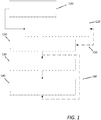
- Step 100 provides a substrate having a first surface state, which can be hydrophobic or hydrophilic.
- Step 110 provide for the application of a stimulus to the adjustable surface, causing the first surface to transition, e.g., to hydrophilic or hydrophobic, (the "opposite") respectively, which can be sequential or simultaneous with Step 150, the introduction of the decontaminating agent to the particular adjusted surface state, as shown by dotted double arrow cycle 150, whereby the decontaminate, having hydrophobic or hydrophilic characteristics, can form a film on the second surface state. Cycling of steps 110 (including the stimulus) and 120 (including varying amounts of agent introduction) can be used as needed.
- Step 130 the application of stimulus is discontinued, terminated, or otherwise ended, as in Step 130. Termination of the stimulus reverts the second surface state back to the first surface state and facilitates the removal, e.g., by beading up, of the decontaminate and optionally, the contaminate.
- Steps 110, 120 and 130 can be cycled any number of times as needed.
- Step 140 depicts the optional removal of at least a portion of the decontaminating agents from the surface of the substrate, for example by wiping, vacuum, evaporating, etc., and/or at least a portion of the contaminates. Steps 110, 120, 130, and 140 can be cycled any number of times as needed.
- the substrate surface is designed for one cycle, for example, the adjustment from the first state to the second state, whereby the decontamination is completed and the substrate surface is replaced. In other aspects, the substrate surface is returned to normal or similar service.
- Fig. 1 depicts step 100 providing substrate having first surface state (e.g. hydrophobic or hydrophilic); step 110 providing stimulus to first surface state to adjust to second surface state (e.g., hydrophilic or hydrophobic, respectively); step 120 introducing decontaminating agents to second surface state; step 130 discontinuing stimulus and reverting back to first surface state; and step 140 optionally removing decontaminating agents and/or optionally removing contaminants from surface.
- first surface state e.g. hydrophobic or hydrophilic
- second surface state e.g., hydrophilic or hydrophobic, respectively
- step 120 introducing decontaminating agents to second surface state
- step 130 discontinuing stimulus and reverting back to first surface state
- step 140 optionally removing decontaminating agents and/or optionally removing contaminants from surface.
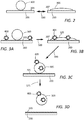
- FIG. 2 depicts in general the reversibility of the first and second surface states and the effect on wetting.
- substrate 200 having hydrophobic (or hydrophillic) surface 205 which is in the first state, displays characteristic beading of aqueous droplet 300.
- Adjustment or transformation by stimulus, indicated by arrow 500 provides altered second surface state 207, displaying characteristic wetting behavior of aqueous droplet 305.
- Removal of stimulus which can be electrical, light energy, heat energy, or mechanical stress, causes reversal of essentially all or part of surface 207 to convert, transform, or adjust back to first hydrophobic (or hydrophilic) state, e.g., surface 205.
- FIG. 2 can be representative of a superhydrophobic-superhydrophilic surface state transition or adjustment.
- FIG. 3A depicts one aspect of the method disclosed herein wherein a contaminated surface is decontaminated.
- substrate 200 having hydrophobic (or hydrophilic) surface 205 which is in the first date, further having contaminant 400 present thereon, is presented with decontaminating agent 300.
- FIG. 3B depicts adjustment or transition from the first hydrophobic (or hydrophilic) surface state to a second hydrophilic (or hydrophobic) surface state, depicted as surface 207, whereby decontaminating agent 300 has wetted surface 207 and contaminant 400 is either deactivated, chemically altered, or both as depicted by the generic "deactivated contaminant" 405.
- deactivated contaminant 405 may still be viable.
- 3C-3D depict adjustment of the second hydrophilic (or hydrophobic) surface state back to the first hydrophobic (or hydrophilic) surface state (shown by arrow 550), whereby surface 205 causes decontaminating agent 305, which contains deactivated (or viable) contaminant 405, is presented for removal.
- decontaminating agent 305 which contains deactivated (or viable) contaminant 405
- contaminate 405 is left on the surface in a deactivated or detoxified state.
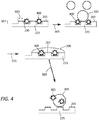
- FIG. 4 presents an alternate aspect of the methods described herein, whereby surface of substrate is configured with asperities having a length 605 along the longitudinal axis of the surface, and having a height 607 perpendicular to the longitudinal axis of the surface of substrate 225.
- Contaminant 400 may be present in crevices or cracks 230 in the surface of substrate 205.
- Decontaminating agents 300 are presented to substrate to 225 after adjustment of surface 205 to the second hydrophilic (or hydrophobic) surface state, depicted as surface 207.
- Decontaminating agents 305 wets the surface 207, which may deactivate or chemically alter contaminant 405.
- Adjustment of the second hydrophilic surface state 207 back to first hydrophobic (or hydrophilic) surface state presents decontaminating agent 305 and deactivated contaminant 405 for removal.
- Figure 5 depicts an alternative method herein disclosed similar to that as depicted in figure 4 except that adjustment or transition state, as depicted by arrow 725, is performed prior to introduction of the decontaminating agent 300.
- contaminant 400 is more efficiently presented to decontaminating agent 300 on second hydrophilic (or hydrophobic) surface state depicted by surface 207.
- Wetting of decontaminating agent 305 on surface 207 facilitates removal of deactivated contaminant 405 as shown by dotted arrow 750.
- FIG. 6 depicts an alternate method herein disclosed similar to that of FIG. 5 (that can alternatively be that of FIG. 4 ), but for deactivated contaminate 405b remaining on the surface of the substrate after reversal to the first surface state.
- Decontaminating agent 300 can be removed or left on surface 205 e.g., left to evaporate or sublime and/or be physically removed alone or in combination with contaminate 405 or 405b.
- a UV light unit may be a hand-held, pulsed UV lamp system, such as a short-arc-bulb flashlamp array.
- the UV light unit can be placed in close proximity to the surface to facilitate the adjustment of the surface from the first surface state to the second surface state.
- the adjustable surface when in the second hydrophilic surface state can be contacted with one or more decontaminating agents.
- the decontaminating agent when contacting the second hydrophilic surface state effectively removes substantially all of the contamination.
- the UV light alone or in combination with the second hydrophilic surface state and decontaminating agent and/or sensitizers, surfactants, etc., can deactivate the contaminate. Exposures of less than 105 J/m 2 can effect several orders of magnitude deactivation of most pathogens.
- a mobile system is used to provide the UV light and/or thermal energy to facilitate the surface adjustment of the substrate to be decontaminated.
- the mobile unit can be configured for deployment in an aerospace vehicle, for example, a unit having a UV light intensity of about 1 to 1000 mW/cm 2 or IR heat.
- the light source can be continuous or pulsed.
- the mobile system can further comprise a spraying system for dispensing the decontaminating agents.
- the sprayer system and the UV or IR light system can be operated remotely, or manually operated, for example by personnel wearing protective clothing, protective eyeglasses, goggles, masks and/or respirator apparatus as may be necessary.
- the personnel can be provided with, and garments to avoid damage to their eyes or skin by prolonged exposure to UV light.
- the time required for decontamination is proportional to the amount of contaminating substance present.
- the decontamination time is also a function of the time required for the first hydrophobic surface state to adjust to the second hydrophilic surface state, decontaminating agent and/or the specific stimulus (e.g., wavelength of UV light applied, and the flux intensity of light) used and applied.
- the methods and apparatus of the present invention can be used in emergency and military applications to decontaminate vehicles, clothed and unclothed persons, tools and implements, and airborne clouds created by chemical and biological weapons, and industrial accidents.
Landscapes
- Engineering & Computer Science (AREA)
- Mechanical Engineering (AREA)
- Manufacturing & Machinery (AREA)
- Transportation (AREA)
- Aviation & Aerospace Engineering (AREA)
- Chemical & Material Sciences (AREA)
- Chemical Kinetics & Catalysis (AREA)
- General Chemical & Material Sciences (AREA)
- Physics & Mathematics (AREA)
- Optics & Photonics (AREA)
- Detergent Compositions (AREA)
- Apparatus For Disinfection Or Sterilisation (AREA)
Claims (8)
- Verfahren, mit:Beaufschlagen eines externen Stimulus auf eine Oberfläche (205, 207) eines Substrats (200),Einstellen zumindest eines Teils der Oberfläche von einem ersten Zustand in einen zweiten Zustand, wobei entweder (i) der erste Zustand eine hydrophobe Oberfläche bereitstellt und der zweite Zustand eine hydrophile Oberfläche bereitstellt; oder (ii) der erste Zustand eine hydrophile Oberfläche und der zweite Zustand eine hydrophobe Oberfläche bereitstellt;Kontaktieren der Oberfläche (207) in dem zweiten Zustand mit einer Flüssigkeit oder einem Gas, wobei die Flüssigkeit oder das Gas ein oder mehrere Dekontaminationsmittel aufweist, die effektiv gegen ein oder mehrere Kontaminante (400, 405) sind, die mit der Oberfläche des Substrats verknüpft sind;Entfernen des externen Stimulus auf die Oberfläche des Substrats, wobei die Oberfläche sich von dem zweiten Zustand zurück in den ersten Zustand transformiert, wodurch zumindest ein Teil der Oberfläche des Substrats dekontaminiert ist; wobei das Substrat zumindest eine Innenoberfläche eines Fahrzeugs ist, und wobei das eine oder mehrere Dekontaminationsmittel auf die Oberfläche als ein Aerosolspray beaufschlagt wird, wobei der Stimulus Licht ist.
- Verfahren nach Anspruch 1, des Weiteren mit dem Entfernen zumindest eines Teils des einen oder mehreren Dekontaminationsmittels von der Oberfläche.
- Verfahren nach Anspruch 1, wobei das eine oder mehrere Dekontaminationsmittel im Wesentlichen die hydrophile Oberfläche benetzen.
- Verfahren nach Anspruch 1, wobei die hydrophobe Oberfläche eine superhydrophobe Oberfläche ist.
- Verfahren nach Anspruch 1, wobei die hydrophile Oberfläche eine superhydrophile Oberfläche ist.
- Verfahren nach Anspruch 1 oder 5, wobei die hydrophile Oberfläche das Bilden eines Flüssigkeitsfilms auf dem einen oder mehreren Dekontaminationsmittel erleichtert.
- Verfahren nach einem der Ansprüche 1 bis 6, des Weiteren mit dem Entfernen zumindest eines Teils der einen oder mehreren Kontaminante.
- Verfahren nach Anspruch 1, wobei das Substrat zumindest eine Innenoberfläche eines Luftfahrzeugs ist.
Priority Applications (1)
| Application Number | Priority Date | Filing Date | Title |
|---|---|---|---|
| EP19174543.9A EP3549686B1 (de) | 2012-12-04 | 2013-09-30 | Oberflächenmaterialien zur dekontamination mit dekontaminantien |
Applications Claiming Priority (2)
| Application Number | Priority Date | Filing Date | Title |
|---|---|---|---|
| US13/693,562 US9339853B2 (en) | 2012-12-04 | 2012-12-04 | Surface materials for decontamination with decontaminants |
| PCT/US2013/062705 WO2014088690A1 (en) | 2012-12-04 | 2013-09-30 | Surface materials for decontamination with decontaminants |
Related Child Applications (2)
| Application Number | Title | Priority Date | Filing Date |
|---|---|---|---|
| EP19174543.9A Division EP3549686B1 (de) | 2012-12-04 | 2013-09-30 | Oberflächenmaterialien zur dekontamination mit dekontaminantien |
| EP19174543.9A Division-Into EP3549686B1 (de) | 2012-12-04 | 2013-09-30 | Oberflächenmaterialien zur dekontamination mit dekontaminantien |
Publications (2)
| Publication Number | Publication Date |
|---|---|
| EP2928623A1 EP2928623A1 (de) | 2015-10-14 |
| EP2928623B1 true EP2928623B1 (de) | 2019-07-24 |
Family
ID=49356511
Family Applications (2)
| Application Number | Title | Priority Date | Filing Date |
|---|---|---|---|
| EP13776896.6A Active EP2928623B1 (de) | 2012-12-04 | 2013-09-30 | Verfahren zur dekontamination mit oberflächenmaterialien |
| EP19174543.9A Active EP3549686B1 (de) | 2012-12-04 | 2013-09-30 | Oberflächenmaterialien zur dekontamination mit dekontaminantien |
Family Applications After (1)
| Application Number | Title | Priority Date | Filing Date |
|---|---|---|---|
| EP19174543.9A Active EP3549686B1 (de) | 2012-12-04 | 2013-09-30 | Oberflächenmaterialien zur dekontamination mit dekontaminantien |
Country Status (3)
| Country | Link |
|---|---|
| US (4) | US9339853B2 (de) |
| EP (2) | EP2928623B1 (de) |
| WO (1) | WO2014088690A1 (de) |
Families Citing this family (12)
| Publication number | Priority date | Publication date | Assignee | Title |
|---|---|---|---|---|
| US9339853B2 (en) | 2012-12-04 | 2016-05-17 | The Boeing Company | Surface materials for decontamination with decontaminants |
| US12091160B2 (en) | 2014-10-23 | 2024-09-17 | The Boeing Company | Actively controlled surfaces |
| US20160114883A1 (en) | 2014-10-23 | 2016-04-28 | The Boeing Company | Actively-controlled superhydrophobic surfaces |
| US20170086312A1 (en) * | 2015-09-17 | 2017-03-23 | Syed Taymur Ahmad | Process for protecting an electronic device by selective deposition of polymer coatings |
| US11161156B2 (en) * | 2015-10-27 | 2021-11-02 | Hamilton Sundstrand Corporation | Powder monitoring |
| US10220422B2 (en) * | 2015-10-27 | 2019-03-05 | Hamilton Sundstrand Corporation | Powder removal |
| US20180083662A1 (en) * | 2016-09-16 | 2018-03-22 | Syed Taymur Ahmad | Process for protecting an electronic device by selective deposition of polymer coatings |
| JP7499561B2 (ja) * | 2018-12-28 | 2024-06-14 | ホヤ レンズ タイランド リミテッド | 眼鏡レンズの製造方法 |
| CN109796616B (zh) * | 2019-01-11 | 2020-04-10 | 西北大学 | 一种仿生聚合物及制作耐久性双仿生聚合物涂层的方法与应用 |
| US11465092B2 (en) * | 2019-09-23 | 2022-10-11 | The Boeing Company | Particulate filter and methods for removing particulates from a particulate filter |
| CN111128685B (zh) * | 2019-12-30 | 2021-09-03 | 广州粤芯半导体技术有限公司 | 半导体器件及其制造方法 |
| CN113305106B (zh) * | 2021-06-03 | 2022-08-02 | 四川大学 | 一种激光清洗微纳颗粒污染物的方法和应用 |
Citations (1)
| Publication number | Priority date | Publication date | Assignee | Title |
|---|---|---|---|---|
| DE102010010792A1 (de) * | 2010-03-09 | 2011-09-15 | Pss Polymer Standards Service Gmbh | Wahlweise hydrophil oder hydrophob schaltbare Schicht, damit beschichtetes Substrat, Verfahren zur Herstellung sowie Verwendung |
Family Cites Families (6)
| Publication number | Priority date | Publication date | Assignee | Title |
|---|---|---|---|---|
| JPH08172068A (ja) | 1994-12-19 | 1996-07-02 | Fujitsu Ltd | 半導体基板の洗浄方法及び半導体装置の製造方法 |
| US7921859B2 (en) | 2004-12-16 | 2011-04-12 | Sematech, Inc. | Method and apparatus for an in-situ ultraviolet cleaning tool |
| CN102387915A (zh) | 2009-02-17 | 2012-03-21 | 伊利诺伊大学评议会 | 柔性微结构超疏水材料 |
| DE102009058962B4 (de) | 2009-11-03 | 2012-12-27 | Suss Microtec Photomask Equipment Gmbh & Co. Kg | Verfahren und Vorrichtung zum Behandeln von Substraten |
| US20120276334A1 (en) | 2011-02-23 | 2012-11-01 | Massachusetts Institute Of Technology | Surfaces with Controllable Wetting and Adhesion |
| US9339853B2 (en) * | 2012-12-04 | 2016-05-17 | The Boeing Company | Surface materials for decontamination with decontaminants |
-
2012
- 2012-12-04 US US13/693,562 patent/US9339853B2/en active Active
-
2013
- 2013-09-30 WO PCT/US2013/062705 patent/WO2014088690A1/en not_active Ceased
- 2013-09-30 EP EP13776896.6A patent/EP2928623B1/de active Active
- 2013-09-30 EP EP19174543.9A patent/EP3549686B1/de active Active
-
2016
- 2016-04-15 US US15/099,949 patent/US9579698B2/en active Active
-
2017
- 2017-01-17 US US15/408,008 patent/US10286430B2/en active Active
-
2019
- 2019-03-25 US US16/363,715 patent/US10625315B2/en active Active
Patent Citations (1)
| Publication number | Priority date | Publication date | Assignee | Title |
|---|---|---|---|---|
| DE102010010792A1 (de) * | 2010-03-09 | 2011-09-15 | Pss Polymer Standards Service Gmbh | Wahlweise hydrophil oder hydrophob schaltbare Schicht, damit beschichtetes Substrat, Verfahren zur Herstellung sowie Verwendung |
Also Published As
| Publication number | Publication date |
|---|---|
| US9579698B2 (en) | 2017-02-28 |
| US20190217350A1 (en) | 2019-07-18 |
| US10286430B2 (en) | 2019-05-14 |
| EP2928623A1 (de) | 2015-10-14 |
| EP3549686B1 (de) | 2024-02-14 |
| US9339853B2 (en) | 2016-05-17 |
| US20170182529A1 (en) | 2017-06-29 |
| US10625315B2 (en) | 2020-04-21 |
| US20160303623A1 (en) | 2016-10-20 |
| WO2014088690A1 (en) | 2014-06-12 |
| US20140150814A1 (en) | 2014-06-05 |
| EP3549686A1 (de) | 2019-10-09 |
Similar Documents
| Publication | Publication Date | Title |
|---|---|---|
| US10625315B2 (en) | Surface materials for decontamination with decontaminants | |
| US12295371B2 (en) | Antiviral substrate, antiviral composition, method for manufacturing antiviral substrate, antimicrobial substrate, antimicrobial composition and method for manufacturing antimicrobial substrate | |
| EP2697422B1 (de) | Verfahren zur herstellung einer selbstdekontaminierenden oberfläche | |
| JP2011190443A (ja) | 超疎水性効果と適切な酸化界面を用いることによる有害な生体病原と有害化学物質に対する自己洗浄コーティング | |
| US11186519B2 (en) | Methhod for producing a biocidal glass surface of a soda-lime glass | |
| JP2001081409A (ja) | 抗菌コート剤、抗菌剤、及び院内感染防止方法 | |
| US20210355342A1 (en) | Bio-secure protective equipment and methods for making | |
| AU2021102026A4 (en) | Bio-secure protective equipment and methods for making | |
| US9358577B2 (en) | Making colored biocidal multi-layer structure | |
| Fatahi et al. | Polymers for smart coatings | |
| CA3084883C (en) | Coatings for sterilization by means of ultraviolet rays | |
| US9271491B1 (en) | Using colored biocidal multi-layer structure | |
| JP2023108471A (ja) | 噴霧用除菌剤及び除菌方法 | |
| EP4442771A1 (de) | Antifouling- und antistatische beschichtungen durch automatisiertes auftragen | |
| Dallaev | Advances in Polymer Film and Coating Technologies for Enhanced Surface Functionality | |
| Ameta et al. | Antimicrobial activity of nanosized photocatalytic materials | |
| CN119698503A (zh) | 带有颗粒的等离子涂层 | |
| CN113231053A (zh) | 自消毒光催化剂片 | |
| US20060182953A1 (en) | Mold treatment and removal apparatus and methods | |
| Hope | Adverse effects of silicones on painting and other finishing operations |
Legal Events
| Date | Code | Title | Description |
|---|---|---|---|
| PUAI | Public reference made under article 153(3) epc to a published international application that has entered the european phase |
Free format text: ORIGINAL CODE: 0009012 |
|
| 17P | Request for examination filed |
Effective date: 20150618 |
|
| AK | Designated contracting states |
Kind code of ref document: A1 Designated state(s): AL AT BE BG CH CY CZ DE DK EE ES FI FR GB GR HR HU IE IS IT LI LT LU LV MC MK MT NL NO PL PT RO RS SE SI SK SM TR |
|
| AX | Request for extension of the european patent |
Extension state: BA ME |
|
| DAX | Request for extension of the european patent (deleted) | ||
| STAA | Information on the status of an ep patent application or granted ep patent |
Free format text: STATUS: EXAMINATION IS IN PROGRESS |
|
| 17Q | First examination report despatched |
Effective date: 20180323 |
|
| GRAP | Despatch of communication of intention to grant a patent |
Free format text: ORIGINAL CODE: EPIDOSNIGR1 |
|
| STAA | Information on the status of an ep patent application or granted ep patent |
Free format text: STATUS: GRANT OF PATENT IS INTENDED |
|
| RIC1 | Information provided on ipc code assigned before grant |
Ipc: B08B 3/10 20060101ALI20181130BHEP Ipc: B08B 17/06 20060101AFI20181130BHEP |
|
| INTG | Intention to grant announced |
Effective date: 20190109 |
|
| GRAJ | Information related to disapproval of communication of intention to grant by the applicant or resumption of examination proceedings by the epo deleted |
Free format text: ORIGINAL CODE: EPIDOSDIGR1 |
|
| STAA | Information on the status of an ep patent application or granted ep patent |
Free format text: STATUS: EXAMINATION IS IN PROGRESS |
|
| GRAP | Despatch of communication of intention to grant a patent |
Free format text: ORIGINAL CODE: EPIDOSNIGR1 |
|
| STAA | Information on the status of an ep patent application or granted ep patent |
Free format text: STATUS: GRANT OF PATENT IS INTENDED |
|
| GRAS | Grant fee paid |
Free format text: ORIGINAL CODE: EPIDOSNIGR3 |
|
| GRAA | (expected) grant |
Free format text: ORIGINAL CODE: 0009210 |
|
| STAA | Information on the status of an ep patent application or granted ep patent |
Free format text: STATUS: THE PATENT HAS BEEN GRANTED |
|
| INTG | Intention to grant announced |
Effective date: 20190603 |
|
| AK | Designated contracting states |
Kind code of ref document: B1 Designated state(s): AL AT BE BG CH CY CZ DE DK EE ES FI FR GB GR HR HU IE IS IT LI LT LU LV MC MK MT NL NO PL PT RO RS SE SI SK SM TR |
|
| REG | Reference to a national code |
Ref country code: GB Ref legal event code: FG4D |
|
| REG | Reference to a national code |
Ref country code: CH Ref legal event code: EP |
|
| REG | Reference to a national code |
Ref country code: DE Ref legal event code: R096 Ref document number: 602013058226 Country of ref document: DE |
|
| REG | Reference to a national code |
Ref country code: AT Ref legal event code: REF Ref document number: 1157586 Country of ref document: AT Kind code of ref document: T Effective date: 20190815 |
|
| REG | Reference to a national code |
Ref country code: IE Ref legal event code: FG4D |
|
| REG | Reference to a national code |
Ref country code: NL Ref legal event code: MP Effective date: 20190724 |
|
| REG | Reference to a national code |
Ref country code: LT Ref legal event code: MG4D |
|
| REG | Reference to a national code |
Ref country code: AT Ref legal event code: MK05 Ref document number: 1157586 Country of ref document: AT Kind code of ref document: T Effective date: 20190724 |
|
| PG25 | Lapsed in a contracting state [announced via postgrant information from national office to epo] |
Ref country code: FI Free format text: LAPSE BECAUSE OF FAILURE TO SUBMIT A TRANSLATION OF THE DESCRIPTION OR TO PAY THE FEE WITHIN THE PRESCRIBED TIME-LIMIT Effective date: 20190724 Ref country code: LT Free format text: LAPSE BECAUSE OF FAILURE TO SUBMIT A TRANSLATION OF THE DESCRIPTION OR TO PAY THE FEE WITHIN THE PRESCRIBED TIME-LIMIT Effective date: 20190724 Ref country code: HR Free format text: LAPSE BECAUSE OF FAILURE TO SUBMIT A TRANSLATION OF THE DESCRIPTION OR TO PAY THE FEE WITHIN THE PRESCRIBED TIME-LIMIT Effective date: 20190724 Ref country code: NO Free format text: LAPSE BECAUSE OF FAILURE TO SUBMIT A TRANSLATION OF THE DESCRIPTION OR TO PAY THE FEE WITHIN THE PRESCRIBED TIME-LIMIT Effective date: 20191024 Ref country code: BG Free format text: LAPSE BECAUSE OF FAILURE TO SUBMIT A TRANSLATION OF THE DESCRIPTION OR TO PAY THE FEE WITHIN THE PRESCRIBED TIME-LIMIT Effective date: 20191024 Ref country code: SE Free format text: LAPSE BECAUSE OF FAILURE TO SUBMIT A TRANSLATION OF THE DESCRIPTION OR TO PAY THE FEE WITHIN THE PRESCRIBED TIME-LIMIT Effective date: 20190724 Ref country code: NL Free format text: LAPSE BECAUSE OF FAILURE TO SUBMIT A TRANSLATION OF THE DESCRIPTION OR TO PAY THE FEE WITHIN THE PRESCRIBED TIME-LIMIT Effective date: 20190724 Ref country code: PT Free format text: LAPSE BECAUSE OF FAILURE TO SUBMIT A TRANSLATION OF THE DESCRIPTION OR TO PAY THE FEE WITHIN THE PRESCRIBED TIME-LIMIT Effective date: 20191125 Ref country code: AT Free format text: LAPSE BECAUSE OF FAILURE TO SUBMIT A TRANSLATION OF THE DESCRIPTION OR TO PAY THE FEE WITHIN THE PRESCRIBED TIME-LIMIT Effective date: 20190724 |
|
| PG25 | Lapsed in a contracting state [announced via postgrant information from national office to epo] |
Ref country code: ES Free format text: LAPSE BECAUSE OF FAILURE TO SUBMIT A TRANSLATION OF THE DESCRIPTION OR TO PAY THE FEE WITHIN THE PRESCRIBED TIME-LIMIT Effective date: 20190724 Ref country code: GR Free format text: LAPSE BECAUSE OF FAILURE TO SUBMIT A TRANSLATION OF THE DESCRIPTION OR TO PAY THE FEE WITHIN THE PRESCRIBED TIME-LIMIT Effective date: 20191025 Ref country code: AL Free format text: LAPSE BECAUSE OF FAILURE TO SUBMIT A TRANSLATION OF THE DESCRIPTION OR TO PAY THE FEE WITHIN THE PRESCRIBED TIME-LIMIT Effective date: 20190724 Ref country code: LV Free format text: LAPSE BECAUSE OF FAILURE TO SUBMIT A TRANSLATION OF THE DESCRIPTION OR TO PAY THE FEE WITHIN THE PRESCRIBED TIME-LIMIT Effective date: 20190724 Ref country code: IS Free format text: LAPSE BECAUSE OF FAILURE TO SUBMIT A TRANSLATION OF THE DESCRIPTION OR TO PAY THE FEE WITHIN THE PRESCRIBED TIME-LIMIT Effective date: 20191124 Ref country code: RS Free format text: LAPSE BECAUSE OF FAILURE TO SUBMIT A TRANSLATION OF THE DESCRIPTION OR TO PAY THE FEE WITHIN THE PRESCRIBED TIME-LIMIT Effective date: 20190724 |
|
| PG25 | Lapsed in a contracting state [announced via postgrant information from national office to epo] |
Ref country code: TR Free format text: LAPSE BECAUSE OF FAILURE TO SUBMIT A TRANSLATION OF THE DESCRIPTION OR TO PAY THE FEE WITHIN THE PRESCRIBED TIME-LIMIT Effective date: 20190724 |
|
| PG25 | Lapsed in a contracting state [announced via postgrant information from national office to epo] |
Ref country code: PL Free format text: LAPSE BECAUSE OF FAILURE TO SUBMIT A TRANSLATION OF THE DESCRIPTION OR TO PAY THE FEE WITHIN THE PRESCRIBED TIME-LIMIT Effective date: 20190724 Ref country code: EE Free format text: LAPSE BECAUSE OF FAILURE TO SUBMIT A TRANSLATION OF THE DESCRIPTION OR TO PAY THE FEE WITHIN THE PRESCRIBED TIME-LIMIT Effective date: 20190724 Ref country code: IT Free format text: LAPSE BECAUSE OF FAILURE TO SUBMIT A TRANSLATION OF THE DESCRIPTION OR TO PAY THE FEE WITHIN THE PRESCRIBED TIME-LIMIT Effective date: 20190724 Ref country code: RO Free format text: LAPSE BECAUSE OF FAILURE TO SUBMIT A TRANSLATION OF THE DESCRIPTION OR TO PAY THE FEE WITHIN THE PRESCRIBED TIME-LIMIT Effective date: 20190724 Ref country code: DK Free format text: LAPSE BECAUSE OF FAILURE TO SUBMIT A TRANSLATION OF THE DESCRIPTION OR TO PAY THE FEE WITHIN THE PRESCRIBED TIME-LIMIT Effective date: 20190724 |
|
| PG25 | Lapsed in a contracting state [announced via postgrant information from national office to epo] |
Ref country code: SK Free format text: LAPSE BECAUSE OF FAILURE TO SUBMIT A TRANSLATION OF THE DESCRIPTION OR TO PAY THE FEE WITHIN THE PRESCRIBED TIME-LIMIT Effective date: 20190724 Ref country code: SM Free format text: LAPSE BECAUSE OF FAILURE TO SUBMIT A TRANSLATION OF THE DESCRIPTION OR TO PAY THE FEE WITHIN THE PRESCRIBED TIME-LIMIT Effective date: 20190724 Ref country code: IS Free format text: LAPSE BECAUSE OF FAILURE TO SUBMIT A TRANSLATION OF THE DESCRIPTION OR TO PAY THE FEE WITHIN THE PRESCRIBED TIME-LIMIT Effective date: 20200224 Ref country code: MC Free format text: LAPSE BECAUSE OF FAILURE TO SUBMIT A TRANSLATION OF THE DESCRIPTION OR TO PAY THE FEE WITHIN THE PRESCRIBED TIME-LIMIT Effective date: 20190724 Ref country code: CZ Free format text: LAPSE BECAUSE OF FAILURE TO SUBMIT A TRANSLATION OF THE DESCRIPTION OR TO PAY THE FEE WITHIN THE PRESCRIBED TIME-LIMIT Effective date: 20190724 |
|
| REG | Reference to a national code |
Ref country code: CH Ref legal event code: PL |
|
| REG | Reference to a national code |
Ref country code: DE Ref legal event code: R097 Ref document number: 602013058226 Country of ref document: DE |
|
| PLBE | No opposition filed within time limit |
Free format text: ORIGINAL CODE: 0009261 |
|
| STAA | Information on the status of an ep patent application or granted ep patent |
Free format text: STATUS: NO OPPOSITION FILED WITHIN TIME LIMIT |
|
| PG2D | Information on lapse in contracting state deleted |
Ref country code: IS |
|
| PG25 | Lapsed in a contracting state [announced via postgrant information from national office to epo] |
Ref country code: IE Free format text: LAPSE BECAUSE OF NON-PAYMENT OF DUE FEES Effective date: 20190930 Ref country code: LU Free format text: LAPSE BECAUSE OF NON-PAYMENT OF DUE FEES Effective date: 20190930 Ref country code: CH Free format text: LAPSE BECAUSE OF NON-PAYMENT OF DUE FEES Effective date: 20190930 Ref country code: LI Free format text: LAPSE BECAUSE OF NON-PAYMENT OF DUE FEES Effective date: 20190930 |
|
| REG | Reference to a national code |
Ref country code: BE Ref legal event code: MM Effective date: 20190930 |
|
| 26N | No opposition filed |
Effective date: 20200603 |
|
| PG25 | Lapsed in a contracting state [announced via postgrant information from national office to epo] |
Ref country code: SI Free format text: LAPSE BECAUSE OF FAILURE TO SUBMIT A TRANSLATION OF THE DESCRIPTION OR TO PAY THE FEE WITHIN THE PRESCRIBED TIME-LIMIT Effective date: 20190724 Ref country code: BE Free format text: LAPSE BECAUSE OF NON-PAYMENT OF DUE FEES Effective date: 20190930 |
|
| PG25 | Lapsed in a contracting state [announced via postgrant information from national office to epo] |
Ref country code: CY Free format text: LAPSE BECAUSE OF FAILURE TO SUBMIT A TRANSLATION OF THE DESCRIPTION OR TO PAY THE FEE WITHIN THE PRESCRIBED TIME-LIMIT Effective date: 20190724 |
|
| PG25 | Lapsed in a contracting state [announced via postgrant information from national office to epo] |
Ref country code: HU Free format text: LAPSE BECAUSE OF FAILURE TO SUBMIT A TRANSLATION OF THE DESCRIPTION OR TO PAY THE FEE WITHIN THE PRESCRIBED TIME-LIMIT; INVALID AB INITIO Effective date: 20130930 Ref country code: MT Free format text: LAPSE BECAUSE OF FAILURE TO SUBMIT A TRANSLATION OF THE DESCRIPTION OR TO PAY THE FEE WITHIN THE PRESCRIBED TIME-LIMIT Effective date: 20190724 |
|
| PG25 | Lapsed in a contracting state [announced via postgrant information from national office to epo] |
Ref country code: MK Free format text: LAPSE BECAUSE OF FAILURE TO SUBMIT A TRANSLATION OF THE DESCRIPTION OR TO PAY THE FEE WITHIN THE PRESCRIBED TIME-LIMIT Effective date: 20190724 |
|
| P01 | Opt-out of the competence of the unified patent court (upc) registered |
Effective date: 20230516 |
|
| PGFP | Annual fee paid to national office [announced via postgrant information from national office to epo] |
Ref country code: DE Payment date: 20250929 Year of fee payment: 13 |
|
| PGFP | Annual fee paid to national office [announced via postgrant information from national office to epo] |
Ref country code: GB Payment date: 20250929 Year of fee payment: 13 |
|
| PGFP | Annual fee paid to national office [announced via postgrant information from national office to epo] |
Ref country code: FR Payment date: 20250925 Year of fee payment: 13 |