EP2927292A1 - Fluoropolyether-containing polymer-modified silane, surface treating agent, and article - Google Patents
Fluoropolyether-containing polymer-modified silane, surface treating agent, and article Download PDFInfo
- Publication number
- EP2927292A1 EP2927292A1 EP15159697.0A EP15159697A EP2927292A1 EP 2927292 A1 EP2927292 A1 EP 2927292A1 EP 15159697 A EP15159697 A EP 15159697A EP 2927292 A1 EP2927292 A1 EP 2927292A1
- Authority
- EP
- European Patent Office
- Prior art keywords
- group
- containing polymer
- fluoropolyether
- groups
- treating agent
- Prior art date
- Legal status (The legal status is an assumption and is not a legal conclusion. Google has not performed a legal analysis and makes no representation as to the accuracy of the status listed.)
- Granted
Links
Classifications
-
- C—CHEMISTRY; METALLURGY
- C08—ORGANIC MACROMOLECULAR COMPOUNDS; THEIR PREPARATION OR CHEMICAL WORKING-UP; COMPOSITIONS BASED THEREON
- C08G—MACROMOLECULAR COMPOUNDS OBTAINED OTHERWISE THAN BY REACTIONS ONLY INVOLVING UNSATURATED CARBON-TO-CARBON BONDS
- C08G65/00—Macromolecular compounds obtained by reactions forming an ether link in the main chain of the macromolecule
- C08G65/002—Macromolecular compounds obtained by reactions forming an ether link in the main chain of the macromolecule from unsaturated compounds
- C08G65/005—Macromolecular compounds obtained by reactions forming an ether link in the main chain of the macromolecule from unsaturated compounds containing halogens
- C08G65/007—Macromolecular compounds obtained by reactions forming an ether link in the main chain of the macromolecule from unsaturated compounds containing halogens containing fluorine
-
- C—CHEMISTRY; METALLURGY
- C03—GLASS; MINERAL OR SLAG WOOL
- C03C—CHEMICAL COMPOSITION OF GLASSES, GLAZES OR VITREOUS ENAMELS; SURFACE TREATMENT OF GLASS; SURFACE TREATMENT OF FIBRES OR FILAMENTS MADE FROM GLASS, MINERALS OR SLAGS; JOINING GLASS TO GLASS OR OTHER MATERIALS
- C03C17/00—Surface treatment of glass, not in the form of fibres or filaments, by coating
- C03C17/28—Surface treatment of glass, not in the form of fibres or filaments, by coating with organic material
- C03C17/30—Surface treatment of glass, not in the form of fibres or filaments, by coating with organic material with silicon-containing compounds
-
- C—CHEMISTRY; METALLURGY
- C08—ORGANIC MACROMOLECULAR COMPOUNDS; THEIR PREPARATION OR CHEMICAL WORKING-UP; COMPOSITIONS BASED THEREON
- C08G—MACROMOLECULAR COMPOUNDS OBTAINED OTHERWISE THAN BY REACTIONS ONLY INVOLVING UNSATURATED CARBON-TO-CARBON BONDS
- C08G65/00—Macromolecular compounds obtained by reactions forming an ether link in the main chain of the macromolecule
- C08G65/02—Macromolecular compounds obtained by reactions forming an ether link in the main chain of the macromolecule from cyclic ethers by opening of the heterocyclic ring
- C08G65/32—Polymers modified by chemical after-treatment
- C08G65/329—Polymers modified by chemical after-treatment with organic compounds
- C08G65/336—Polymers modified by chemical after-treatment with organic compounds containing silicon
-
- C—CHEMISTRY; METALLURGY
- C09—DYES; PAINTS; POLISHES; NATURAL RESINS; ADHESIVES; COMPOSITIONS NOT OTHERWISE PROVIDED FOR; APPLICATIONS OF MATERIALS NOT OTHERWISE PROVIDED FOR
- C09D—COATING COMPOSITIONS, e.g. PAINTS, VARNISHES OR LACQUERS; FILLING PASTES; CHEMICAL PAINT OR INK REMOVERS; INKS; CORRECTING FLUIDS; WOODSTAINS; PASTES OR SOLIDS FOR COLOURING OR PRINTING; USE OF MATERIALS THEREFOR
- C09D171/00—Coating compositions based on polyethers obtained by reactions forming an ether link in the main chain; Coating compositions based on derivatives of such polymers
-
- G—PHYSICS
- G02—OPTICS
- G02B—OPTICAL ELEMENTS, SYSTEMS OR APPARATUS
- G02B1/00—Optical elements characterised by the material of which they are made; Optical coatings for optical elements
- G02B1/10—Optical coatings produced by application to, or surface treatment of, optical elements
- G02B1/18—Coatings for keeping optical surfaces clean, e.g. hydrophobic or photo-catalytic films
-
- C—CHEMISTRY; METALLURGY
- C08—ORGANIC MACROMOLECULAR COMPOUNDS; THEIR PREPARATION OR CHEMICAL WORKING-UP; COMPOSITIONS BASED THEREON
- C08L—COMPOSITIONS OF MACROMOLECULAR COMPOUNDS
- C08L2205/00—Polymer mixtures characterised by other features
- C08L2205/02—Polymer mixtures characterised by other features containing two or more polymers of the same C08L -group
-
- Y—GENERAL TAGGING OF NEW TECHNOLOGICAL DEVELOPMENTS; GENERAL TAGGING OF CROSS-SECTIONAL TECHNOLOGIES SPANNING OVER SEVERAL SECTIONS OF THE IPC; TECHNICAL SUBJECTS COVERED BY FORMER USPC CROSS-REFERENCE ART COLLECTIONS [XRACs] AND DIGESTS
- Y10—TECHNICAL SUBJECTS COVERED BY FORMER USPC
- Y10T—TECHNICAL SUBJECTS COVERED BY FORMER US CLASSIFICATION
- Y10T428/00—Stock material or miscellaneous articles
- Y10T428/31—Surface property or characteristic of web, sheet or block
- Y10T428/315—Surface modified glass [e.g., tempered, strengthened, etc.]
-
- Y—GENERAL TAGGING OF NEW TECHNOLOGICAL DEVELOPMENTS; GENERAL TAGGING OF CROSS-SECTIONAL TECHNOLOGIES SPANNING OVER SEVERAL SECTIONS OF THE IPC; TECHNICAL SUBJECTS COVERED BY FORMER USPC CROSS-REFERENCE ART COLLECTIONS [XRACs] AND DIGESTS
- Y10—TECHNICAL SUBJECTS COVERED BY FORMER USPC
- Y10T—TECHNICAL SUBJECTS COVERED BY FORMER US CLASSIFICATION
- Y10T428/00—Stock material or miscellaneous articles
- Y10T428/31504—Composite [nonstructural laminate]
- Y10T428/31551—Of polyamidoester [polyurethane, polyisocyanate, polycarbamate, etc.]
- Y10T428/31609—Particulate metal or metal compound-containing
- Y10T428/31612—As silicone, silane or siloxane
-
- Y—GENERAL TAGGING OF NEW TECHNOLOGICAL DEVELOPMENTS; GENERAL TAGGING OF CROSS-SECTIONAL TECHNOLOGIES SPANNING OVER SEVERAL SECTIONS OF THE IPC; TECHNICAL SUBJECTS COVERED BY FORMER USPC CROSS-REFERENCE ART COLLECTIONS [XRACs] AND DIGESTS
- Y10—TECHNICAL SUBJECTS COVERED BY FORMER USPC
- Y10T—TECHNICAL SUBJECTS COVERED BY FORMER US CLASSIFICATION
- Y10T428/00—Stock material or miscellaneous articles
- Y10T428/31504—Composite [nonstructural laminate]
- Y10T428/31652—Of asbestos
- Y10T428/31663—As siloxane, silicone or silane
Definitions
- This invention relates to a silane modified with a fluoropolyether-containing polymer, and more particularly, to a fluoropolyether-containing polymer-modified silane capable of forming a coating having water/oil repellency and weatherability, a surface treating agent comprising the modified silane and/or a partial hydrolytic condensate thereof, and an article treated with the surface treating agent.
- Prior art water/oil repellent layers have high water/oil repellency and easy stain wipe-off, but suffer from the problem that the antifouling performance deteriorates during service.
- One of the factors accounting for deterioration of antifouling performance is a lack of weather resistance.
- fluoropolyether-containing compounds exhibit, by virtue of their extremely low surface free energy, water/oil repellency, chemical resistance, lubricity, parting, antifouling and other properties. Taking advantage of these properties, they find use in a variety of industrial fields as water/oil repellent antifouling agents for paper and textiles, lubricants for magnetic recording media, oil-repellent agents for precision instruments, parting agents, cosmetic ingredients, protective films and the like. Inversely, the same properties indicate non-tackiness or non-adhesion to other substrates. Even if they can be coated to the substrate surface, it is difficult for the coating to tightly adhere thereto.
- silane coupling agents are well known for their ability to bond surfaces of glass or fabric substrates to organic compounds. They are widely used as surface coating agents for numerous substrates.
- the silane coupling agent contains an organic functional group and a reactive silyl group (typically hydrolysable silyl such as alkoxysilyl) in the molecule.
- a reactive silyl group typically hydrolysable silyl such as alkoxysilyl
- the hydrolysable silyl groups undergo self-condensation reaction to form a coating.
- the hydrolysable silyl groups form chemical and physical bonds with the surface of glass or metal, the coating becomes a tough coating having durability.
- Patent Documents 1 to 8 disclose compositions predominantly comprising a fluoropolyether-containing polymer-modified silane which is obtained by introducing a hydrolysable silyl group into a fluoropolyether-containing compound, the composition being tightly adherent to the substrate surface and capable of forming a coating with water/oil repellency, chemical resistance, lubricity, parting, antifouling and other properties.
- Lenses and antireflective coatings when treated with the fluoropolyether-containing polymer-modified silane, are improved in lubricity, parting property and abrasion resistance, but lack weather resistance.
- any of various coating techniques may be used to form a coating on the surface.
- the hydrolysis reaction is typically accelerated at elevated temperatures of 80°C to 120°C or under humid conditions. Even at room temperature, hydrolysable silyl groups slowly react with airborne moisture until a cured film is formed. Since the curing step requires hot humid conditions or the curing step at room temperature takes a time, the curing step can be a rate-determining or retarding factor for the manufacture process.
- a coating (or water/oil repellent layer) which is cured under mild conditions, such as room temperature, in a short time has poor abrasion resistance and weatherability and its antifouling performance degrades during service.
- Patent Document 9 discloses a coating composition to which fluorinated carboxylic acid is added as curing catalyst to accelerate cure so that a coating may be completed under mild conditions in a short time.
- abrasion resistance is adversely affected if the catalyst amount is reduced, and initial performance deteriorates if the catalyst amount is increased.
- carboxyl groups which are polar groups emerge on the outermost surface of the coating. If so, the coating does not perform well.
- catalysts include organotitanates such as tetrabutyl titanate and tetraisopropyl titanate; organotitanium chelate compounds such as titanium diisopropoxybis(ethyl acetoacetate) and titanium diisopropoxybis(methyl acetoacetate); organoaluminum compounds such as tris(acetylacetonato)aluminum and aluminum tris(ethyl acetoacetate); organozirconium compounds such as tetra(acetylacetonato)zirconium and zirconium tetrabutyrate; organotin compounds such as dibutyltin dioctoate, dibutyltin dilaurate, dibutyltin di(2-ethyl hexanoate), dioctyltin dilaurate, dioct
- An object herein is to provide new and useful fluoropolyether-containing polymer-modified silanes which desirably are capable of curing under mild conditions, typically room temperature, in a short time into a water/oil repellent layer having abrasion resistance, weatherability, and low dynamic friction.
- Other aspects are a surface treating agent comprising the fluoropolyether-containing polymer-modified silane and/or a partial hydrolytic condensate thereof, an article treated with such surface treating agent and corresponding methods and uses.
- a surface treating agent comprising a fluoropolyether-containing polymer-modified silane which is analogous to the fluoropolyether-containing polymer-modified silane mentioned above, but uses an ether bond-free linker as the linker between the fluoropolyether group and the hydrolysable silyl group is capable of forming a water/oil repellent layer having weatherability.
- This surface treating agent may be cured under mild conditions, typically room temperature, in a short time into a water/oil repellent layer having abrasion resistance, weatherability, and low dynamic friction.
- the invention provides a fluoropolyether-containing polymer-modified silane having the general formula (1).
- Rf is a monovalent fluorooxyalkyl or divalent fluorooxyalkylene-containing polymer residue
- Y is a divalent to hexavalent hydrocarbon group which may contain a siloxane bond or silylene group
- R is independently an alkyl group of 1 to 4 carbon atoms or phenyl group
- X is independently a hydrolysable group
- n is an integer of 1 to 3
- m is an integer of 1 to 5
- ⁇ is 1 or 2.
- ⁇ is 1, and Rf is a group having the general formula (2).
- p, q, r and s are each independently an integer of 0 to 200 and the sum p+q+r+s is 3 to 200.
- ⁇ Each unit may be linear or branched in structure. Repeating units may be randomly arranged.
- ⁇ is 2, and Rf is a group having the general formula (3).
- p, q, r and s are each independently an integer of 0 to 200, the sum p+q+r+s is 3 to 200.
- Each unit may be linear or branched in structure. Repeating units may be randomly arranged.
- Y is selected from among alkylene groups of 3 to 10 carbon atoms, phenylene-containing alkylene groups, divalent groups having alkylene groups bonded via a silalkylene or silarylene structure, and divalent to tetravalent groups having alkylene groups bonded to a divalent to tetravalent, linear, branched or cyclic organopolysiloxane residue of 2 to 10 silicon atoms.
- X is selected from among C 1 -C 10 alkoxy groups, C 2 -C 10 alkoxyalkoxy groups, C 1 -C 10 acyloxy groups, C 2 -C 10 alkenyloxy groups, and halogens.
- the invention provides a surface treating agent comprising a fluoropolyether-containing polymer having both an active hydrogen-containing functional group and a hydrolysable group and/or a partial hydrolytic condensate thereof.
- the fluoropolyether-containing polymer having both an active hydrogen-containing functional group and a hydrolysable group is a fluoropolyether-containing polymer-modified silane as defined above, or according to any option disclosed herein.
- the surface treating agent may further comprise a fluoropolyether-containing polymer having the general formula (4) : A-Rf'-A (4) wherein A is a monovalent fluorinated group terminated with -CF 3 radical, and Rf' is a divalent fluorooxyalkylene-containing polymer residue.
- an article which is surface treated with the surface treating agent defined above.
- Typical of the article are an optical article, touch panel, antireflective film, SiO 2 -deposited glass, strengthened glass, sapphire glass, and quartz substrate, which are surface treated with the surface treating agent defined above.
- a further aspect is the use, as a surface treating agent, of a fluoropolyether-containing polymer having both an active hydrogen-containing functional group and a hydrolysable group and/or a partial hydrolytic condensate thereof, or of a fluoropolyether-containing polymer-modified silane as defined above or according to any option disclosed herein.
- the use may be on articles or materials as specified above or according to any option disclosed herein.
- surface treating agents comprising a fluoropolyether-containing polymer-modified silane and/or partial hydrolytic condensate thereof according to the invention can form coatings having high water/oil repellency. Even when the coatings are cured under mild conditions, typically room temperature, in a short time, we find that they can exhibit abrasion resistance, weatherability, and low dynamic friction.
- surface treating agent and briefly curing under mild conditions, a variety of articles are endowed with excellent water/oil repellency, low dynamic friction, abrasion resistance, and weatherability. The treated articles become highly resistant to UV and maintain antifouling performance over a long term.
- Cn-Cm means a group containing from n to m carbon atoms per group.
- Me stands for methyl, and Ph for phenyl.
- the fluoropolyether-containing polymer-modified silane disclosed herein has the general formula (1).
- Rf is a monovalent fluorooxyalkyl and/or divalent fluorooxyalkylene-containing polymer residue
- Y is/are divalent to hexavalent hydrocarbon group which may contain a siloxane bond or silylene group
- R is independently a C 1 -C 4 alkyl group or phenyl group
- X is independently a hydrolysable group
- n is an integer of 1 to 3
- m is an integer of 1 to 5
- ⁇ is 1 or 2.
- the fluoropolyether-containing polymer-modified silane of the invention is characterized by the structure that the monovalent fluorooxyalkyl or divalent fluorooxyalkylene-containing polymer residue (Rf) is linked to the hydrolysable silyl group (-Si(R) 3-n (X) n ), typically alkoxysilyl, via the hydrocarbon chain (Y).
- fluorooxyalkyl or fluorooxyalkylene-containing polymer residue (Rf) is linked to the hydrolysable silyl group (-Si(R) 3-n (X) n ), typically alkoxysilyl, via an ether bond, -CF 2 -CONH- bond, or -CF 2 -CONPh-CH 2 - bond.
- the fluoropolyether-containing polymer-modified silane does not contain a hydrocarbon ether chain in the linker, which accounts for improved abrasion resistance and weatherability.
- Rf may be a monovalent fluorooxyalkyl group having the general formula (2): wherein p, q, r and s are each independently an integer of 0 to 200, the sum p+q+r+s is 3 to 200, each repeating unit may be linear or branched, and individual repeating units may be randomly arranged.
- Rf may be a divalent fluorooxyalkylene group having the general formula (3): wherein p, q, r and s are each independently an integer of 0 to 200, the sum p+q+r+s is 3 to 200, each repeating unit may be linear or branched, and individual repeating units may be randomly arranged.
- p, q, r and s are each independently an integer of 0 to 200.
- p is an integer of 5 to 100.
- q is an integer of 5 to 100.
- r is an integer of 0 to 100.
- s is an integer of 0 to 100.
- the sum p+q+r+s is 3 to 200, preferably 10 to 100.
- the repeating unit-containing group Rf especially when having a backbone structure of formula (2) or (3), ensures to form a cured film with a low coefficient of dynamic friction.
- the linear polymer having a fluoropolyether structure backbone and terminated with a hydrolysable group at one end of the molecular chain (wherein ⁇ is 1 and Rf is a monovalent fluorooxyalkyl group of formula (2)) is effective for endowing the film with abrasion resistance, as compared with the linear polymer terminated with a hydrolysable group at each end of the molecular chain (wherein ⁇ is 2 and Rf is a divalent fluorooxyalkylene group of formula (3)).
- Y is a hydrocarbon group which is di-to hexavalent, preferably di- to tetravalent, and most preferably divalent, and which may contain a siloxane bond or silylene group. Due to elimination of a linker with low bond energy (typically ether bond) from the molecule, a coating having improved weatherability and abrasion resistance can be formed.
- a linker with low bond energy typically ether bond
- Y is selected from the following: C 3 -C 10 alkylene groups such as propylene (trimethylene or methylethylene), butylene (tetramethylene or methylpropylene), and hexamethylene; alkylene groups containing C 6 -C 8 arylene, typically phenylene, such as C 8 -C 16 alkylene-arylene groups; a divalent group having alkylene groups bonded via a silalkylene or silarylene structure; and a di- to hexavalent group having alkylene groups bonded to valence bonds of a di-to hexavalent, linear, branched or cyclic organopolysiloxane residue of 2 to 10 silicon atoms, preferably 2 to 5 silicon atoms.
- C 3 -C 10 alkylene groups such as propylene (trimethylene or methylethylene), butylene (tetramethylene or methylpropylene), and hexamethylene
- Y is a C 3 -C 10 alkylene group, a phenylene-containing alkylene group, a divalent group having alkylene groups bonded via a silalkylene or silarylene structure, or a di- to tetravalent group having alkylene groups bonded to valence bonds of a di- to tetravalent, linear, branched or cyclic organopolysiloxane residue of 2 to 10 silicon atoms, and more preferably C 3 -C 6 alkylene group.
- the silalkylene or silarylene structure is exemplified by the following structure.
- R 1 which may be the same or different are C 1 -C 4 alkyl group such as methyl, ethyl, propyl or butyl, or aryl group such as phenyl.
- R 2 is a C 1 -C 4 alkylene group such as methylene, ethylene, or propylene (trimethylene or methylethylene), or arylene group such as phenylene.
- R 1 is as defined above, g is an integer of 1 to 9, preferably 1 to 3, h is an integer of 2 to 6, preferably 2 to 4, j is an integer of 0 to 8, preferably 0 or 1, the sum h+j is an integer of 3 to 10, preferably 3 to 5, and k is an integer of 1 to 3, preferably 2 or 3.
- X is each independently a hydrolysable group.
- Suitable hydrolysable groups include C 1 -C 10 alkoxy groups such as methoxy, ethoxy, propoxy, isopropoxy, and butoxy, C 2 -C 10 alkoxyalkoxy groups such as methoxymethoxy and methoxyethoxy, C 1 -C 10 acyloxy groups such as acetoxy, C 2 -C 10 alkenyloxy groups such as isopropenoxy, halogen groups such as chloro, bromo and iodo. Inter alia, methoxy, ethoxy, isopropenoxy and chloro are preferred.
- R is a C 1 -C 4 alkyl group such as methyl, ethyl, propyl or butyl, or a phenyl group, with methyl being preferred.
- the subscript n is an integer of 1 to 3, preferably 2 or 3. It is most preferred from the standpoints of reactivity and adhesion to substrates that n be 3.
- the subscript m is an integer of 1 to 5. If m is less than 1, adhesion to substrates is poor. If m is more than 5, an excessively high terminal alkoxy number adversely affects the desired performance.
- m is 1, 2 or 3, and most preferably 1.
- fluoropolyether-containing polymer-modified silane of formula (1) examples include fluoropolyether-containing polymer-modified silane of formula (1).
- the repetition number of repeating units in the form of fluorooxyalkyl or fluorooxyalkylene groups, also referred to as degree of polymerization may be an arbitrary number but preferably as stated for formula (2) or (3) representative of Rf.
- a fluorooxyalkyl-containing polymer having two olefin sites at one end of the molecular chain is dissolved in a solvent, typically fluorochemical solvent such as 1,3-bis(trifluoromethyl)benzene.
- a solvent typically fluorochemical solvent such as 1,3-bis(trifluoromethyl)benzene.
- an organosilicon compound having a SiH group and a hydrolysable terminal group in the molecule such as trimethoxysilane and a hydrosilylation catalyst such as a toluene solution of chloroplatinic acid/vinylsiloxane complex are added.
- the reaction mixture is aged at a temperature of 40 to 120°C, preferably 60 to 100°C, and more preferably about 80°C for 1 to 72 hours, preferably 36 to 60 hours, and more preferably about
- a fluorooxyalkyl-containing polymer having two olefin sites at one end of the molecular chain is dissolved in a solvent, typically fluorochemical solvent such as 1,3-bistrifluoromethylbenzene.
- a solvent typically fluorochemical solvent such as 1,3-bistrifluoromethylbenzene.
- an organosilicon compound having a SiH group and a hydrolysable terminal group in the molecule such as trichlorosilane and a hydrosilylation catalyst such as a toluene solution of chloroplatinic acid/vinylsiloxane complex are added.
- the reaction mixture is aged at a temperature of 40 to 120°C, preferably 60 to 100°C, and more preferably about 80°C for 1 to 72 hours, preferably 36 to 60 hours, and more preferably about 48 hours.
- the substituent on the silyl group is converted to a methoxy group, for example.
- an SiH-containing organosilicon compound free of a hydrolysable terminal group may also be used.
- an organosilicon compound having at least two SiH groups is used.
- organosilicon compound having at least two SiH groups is reacted with a fluorooxyalkyl-containing polymer having two olefin sites at one end of the molecular chain like the above method
- a mixture of the polymer having terminal SiH groups and an organosilicon compound having an olefin site and a hydrolysable terminal group in the molecule such as allyltrimethoxysilane is aged, in the presence of a hydrosilylation catalyst such as a toluene solution of chloroplatinic acid/vinylsiloxane complex, at a temperature of 40 to 120°C, preferably 60 to 100°C, and more preferably about 80°C for 1 to 72 hours, preferably 36 to 60 hours, and more preferably about 48 hours.
- a hydrosilylation catalyst such as a toluene solution of chloroplatinic acid/vinylsiloxane complex
- the fluorooxyalkyl-containing polymer having two olefin sites at one end of the molecular chain is typically a fluorooxyalkyl-containing polymer of the general formula (5): wherein Rf is as defined above, and Z is a divalent hydrocarbon group.
- Z is a divalent hydrocarbon group, examples of which include C 1 -C 8 , preferably C 1 -C 4 alkylene groups such as methylene, ethylene, propylene (trimethylene or methylethylene), butylene (tetramethylene or methylpropylene), hexamethylene, and octamethylene, arylene groups such as phenylene, and combinations of two or more of the foregoing such as alkylene-arylene groups.
- Z is a C 1 -C 4 linear alkylene group or phenylene.
- fluorooxyalkyl-containing polymer of formula (5) Preferred examples of the fluorooxyalkyl-containing polymer of formula (5) are shown below.
- the repetition number of repeating units in the form of fluorooxyalkyl groups also referred to as degree of polymerization, may be an arbitrary number meeting formula (2) representative of Rf.
- the fluorooxyalkyl-containing polymer of formula (5) may be prepared, for example, by the following method.
- the perfluorooxyalkyl-containing polymer may have another group at one end of the molecular chain, such as acid halide, acid anhydride, ester, carboxylic acid or amide. Examples of the perfluorooxyalkyl-containing polymer having such a group at one end of the molecular chain are shown below.
- the nucleophilic reagent used in the preparation of a fluorooxyalkyl-containing polymer having formula (5) may be selected from allylmagnesium halides, 3-butenylmagnesium halides, 4-pentenylmagnesium halides, and 5-hexenylmagnesium halides, for example. Corresponding lithium reagents may also be used. Relative to the perfluorooxyalkyl-containing polymer, the nucleophilic reagent may be used in an amount of 2 to 5 equivalents, preferably 2.5 to 3.5 equivalents, and more preferably about 3 equivalents per equivalent of reactive terminal group (concentration) of the polymer.
- suitable fluorochemical solvents include hydrofluoroether (HFE) solvents (commercially available as Novec® products from 3M), such as 1,3-bistrifluoromethylbenzene, trifluoromethylbenzene, methyl nonafluorobutyl ether, methyl nonafluoroisobutyl ether, ethyl nonafluorobutyl ether, ethyl nonafluoroisobutyl ether, 1,1,1,2,3,4,4,5,5,5-decafluoro-3-methoxy-2-(trifluoromethyl)-pentane, and perfluoro solvents composed of perfluorinated compounds (commercially available as Fluorinert® products from 3M).
- HFE hydrofluoroether
- Organic solvents are also useful, for example, ether solvents such as tetrahydrofuran, monoethylene glycol dimethyl ether, diethylene glycol dimethyl ether, triethylene glycol dimethyl ether, tetraethylene glycol dimethyl ether, and dioxane.
- the solvent may be used in an amount of 10 to 300 parts, preferably 100 to 200 parts, and more preferably about 150 parts by weight per 100 parts by weight of the perfluorooxyalkyl-containing polymer.
- reaction solution is separated into a water layer and a fluorochemical solvent layer by separatory operation.
- fluorochemical solvent layer is washed with an organic solvent before the solvent is distilled off, yielding a fluorooxyalkyl-containing polymer having two olefin sites at one end of the molecular chain.
- fluorochemical solvents are preferred and include hydrofluoroether (HFE) solvents (commercially available as Novec® products from 3M), such as 1,3-bistrifluoromethylbenzene, trifluoromethylbenzene, methyl nonafluorobutyl ether, methyl nonafluoroisobutyl ether, ethyl nonafluorobutyl ether, ethyl nonafluoroisobutyl ether, 1,1,1,2,3,4,4,5,5,5-decafluoro-3-methoxy-2-(trifluoromethyl)-pentane, and perfluoro solvents composed of perfluorinated compounds (commercially available as Fluorinert® products from 3M).
- HFE hydrofluoroether
- the solvent may be used in an amount of 10 to 300 parts, preferably 50 to 150 parts, and more preferably about 100 parts by weight per 100 parts by weight of the fluorooxyalkyl-containing polymer having two olefin sites at one end of the molecular chain.
- the organosilicon compound having a SiH group and a hydrolysable terminal group in the molecule is preferably selected from compounds having the general formulae (6) to (9).
- R, X, n, R 1 , R 2 , g and j are as defined above
- R 3 is a C 2 -C 8 divalent hydrocarbon group
- i is an integer of 2 to 9, preferably 2 to 4
- the sum i+j is an integer of 2 to 9.
- R 3 is a C 2 -C 8 , preferably C 2 -C 3 divalent hydrocarbon group, examples of which include alkylene groups such as methylene, ethylene, propylene (trimethylene or methylethylene), butylene (tetramethylene or methylpropylene), hexamethylene, and octamethylene, arylene groups such as phenylene, and combinations of two or more of the foregoing such as alkylene-arylene groups. Inter alia, ethylene and trimethylene are preferred.
- organosilicon compound examples include trimethoxysilane, triethoxysilane, tripropoxysilane, triisopropoxysilane, tributoxysilane, triisopropenoxysilane, triacetoxysilane, trichlorosilane, tribromosilane, and triiodosilane as well as silanes of the following formulae.
- the organosilicon compound may be used in an amount of 2 to 6 equivalents, preferably 2.2 to 3.5 equivalents, and more preferably about 3 equivalents per equivalent of reactive terminal group (concentration) of the polymer.
- the organosilicon compound having at least two SiH groups, but not hydrolysable terminal groups in the molecule is preferably selected from compounds having the general formulae (10) to (12).
- R 1 , R 2 , g, j and i are as defined above.
- organosilicon compound having at least two SiH groups, but not hydrolysable terminal groups in the molecule examples are shown below.
- the organosilicon compound may be used in an amount of 5 to 20 equivalents, preferably 7.5 to 12.5 equivalents, and more preferably about 10 equivalents per equivalent of reactive terminal group (concentration) of the polymer.
- the organosilicon compound having an olefin site and a hydrolysable terminal group in the molecule is preferably selected from compounds having the general formula (13).
- R, X and n are as defined above.
- V is a single bond or a divalent hydrocarbon group of 1 to 6 carbon atoms.
- Examples of the C 1 -C 6 divalent hydrocarbon group include alkylene groups such as methylene, ethylene, propylene (trimethylene or methylethylene), butylene (tetramethylene or methylpropylene), and hexamethylene, and arylene groups such as phenylene.
- V is a single bond or methylene.
- the latter organosilicon compound For the reaction of the reaction product between the fluorooxyalkyl-containing polymer having two olefin sites at one end of the molecular chain and the organosilicon compound having at least two SiH groups with the organosilicon compound having an olefin site and a hydrolysable terminal group in the molecule, typically allyltrimethoxysilane, the latter organosilicon compound may be used in an amount of 2 to 6 equivalents, preferably 2.2 to 3.5 equivalents, and more preferably about 3 equivalents per equivalent of reactive terminal group (concentration) of the polymer.
- Typical of the hydrosilylation catalyst are platinum group metal based catalysts including platinum black, chloroplatinic acid, alcohol-modified chloroplatinic acid, complexes of chloroplatinic acid with olefin, aldehyde, vinylsiloxane, and acetylene alcohol, tetrakis(triphenylphosphine)palladium, and chlorotris(triphenylphosphine)rhodium.
- platinum compounds such as vinylsiloxane coordination compounds are preferred.
- the hydrosilylation catalyst is preferably used in an amount to provide 0.1 to 100 ppm, more preferably 1 to 50 ppm of transition metal based on the weight of the fluorooxyalkyl-containing polymer having two olefin sites at one end of the molecular chain or the reaction product between the fluorooxyalkyl-containing polymer having two olefin sites at one end of the molecular chain and the organosilicon compound having at least two SiH groups.
- the conversion step may be similar to the well-known reaction procedure for the alkoxysilylation of hydrolysable silyl groups.
- a fluorooxyalkyl-containing polymer terminated with a trichlorosilyl group may be reacted with a lower alcohol (e.g. methanol) in the presence of an amine (e.g. triethylamine, pyridine or urea) as acid acceptor, for effecting methoxysilylation.
- a lower alcohol e.g. methanol
- an amine e.g. triethylamine, pyridine or urea
- the solvent and unreacted reactants are distilled off in vacuum, yielding the target compound.
- the fluorooxyalkyl-containing polymer having two olefin sites at one end of the molecular chain is of the formula: and the organosilicon compound having a SiH group and a hydrolysable terminal group is trimethoxysilane, there is obtained a compound of the following formula.
- a fluorooxyalkylene-containing polymer having two olefin sites at each of both ends of the molecular chain is dissolved in a solvent, typically fluorochemical solvent such as 1,3-bistrifluoromethylbenzene.
- an organosilicon compound having a SiH group and a hydrolysable terminal group in the molecule such as trimethoxysilane and a hydrosilylation catalyst such as a toluene solution of chloroplatinic acid/vinylsiloxane complex are added.
- the reaction mixture is aged at a temperature of 40 to 120°C, preferably 60 to 100°C, and more preferably about 80°C for 1 to 72 hours, preferably 36 to 60 hours, and more preferably about 48 hours.
- a fluorooxyalkylene-containing polymer having two olefin sites at each end of the molecular chain is dissolved in a solvent, typically fluorochemical solvent such as 1,3-bistrifluoromethylbenzene.
- a solvent typically fluorochemical solvent such as 1,3-bistrifluoromethylbenzene.
- an organosilicon compound having a SiH group and a hydrolysable terminal group in the molecule such as trichlorosilane and a hydrosilylation catalyst such as a toluene solution of chloroplatinic acid/vinylsiloxane complex are added.
- the reaction mixture is aged at a temperature of 40 to 120°C, preferably 60 to 100°C, and more preferably about 80°C for 1 to 72 hours, preferably 36 to 60 hours, and more preferably about 48 hours.
- the substituent on the silyl group is converted to a methoxy group, for example.
- an SiH-containing organosilicon compound free of a hydrolysable terminal group may also be used.
- an organosilicon compound having at least two SiH groups is used.
- organosilicon compound having at least two SiH groups is reacted with a fluorooxyalkylene-containing polymer having two olefin sites at each end of the molecular chain like the above method, a mixture of the polymer having terminal SiH groups and an organosilicon compound having an olefin site and a hydrolysable terminal group in the molecule such as allyltrimethoxysilane is aged, in the presence of a hydrosilylation catalyst such as a toluene solution of chloroplatinic acid/vinylsiloxane complex, at a temperature of 40 to 120°C, preferably 60 to 100°C, and more preferably about 80°C for 1 to 72 hours, preferably 36 to 60 hours, and more preferably about 48 hours.
- a hydrosilylation catalyst such as a toluene solution of chloroplatinic acid/vinylsiloxane complex
- the fluorooxyalkylene-containing polymer having two olefin sites at each end of the molecular chain is typically a fluorooxyalkylene-containing polymer of the general formula (14) : wherein Rf and Z are as defined above.
- fluorooxyalkylene-containing polymer of formula (14) Preferred examples of the fluorooxyalkylene-containing polymer of formula (14) are shown below.
- the repetition number of repeating units in the form of fluorooxyalkylene groups also referred to as degree of polymerization, may be an arbitrary number meeting formula (3) representative of Rf.
- the fluorooxyalkylene-containing polymer of formula (14) may be prepared, for example, by the following method.
- the perfluorooxyalkylene-containing polymer may have another group at each end of the molecular chain, such as acid halide, acid anhydride, ester, carboxylic acid or amide. Examples of the perfluorooxyalkylene-containing polymer having such groups at both ends of the molecular chain are shown below.
- the nucleophilic reagent used in the preparation of the fluorooxyalkylene-containing polymer having formula (14) may be selected from allylmagnesium halides, 3-butenylmagnesium halides, 4-pentenylmagnesium halides, and 5-hexenylmagnesium halides, for example. Corresponding lithium reagents may also be used.
- the nucleophilic reagent may be used in an amount of 4 to 10 equivalents, preferably 5 to 7 equivalents, and more preferably about 6 equivalents per equivalent of reactive terminal group (concentration) of the perfluorooxyalkylene-containing polymer.
- suitable fluorochemical solvents include hydrofluoroether (HFE) solvents (commercially available as Novec® products from 3M), such as 1,3-bistrifluoromethylbenzene, trifluoromethylbenzene, methyl nonafluorobutyl ether, methyl nonafluoroisobutyl ether, ethyl nonafluorobutyl ether, ethyl nonafluoroisobutyl ether, 1,1,1,2,3,4,4,5,5,5-decafluoro-3-methoxy-2-(trifluoromethyl)pentane, and perfluoro solvents composed of perfluorinated compounds (commercially available as Fluorinert® products from 3M).
- HFE hydrofluoroether
- Organic solvents are also useful, for example, ether solvents such as tetrahydrofuran, monoethylene glycol dimethyl ether, diethylene glycol dimethyl ether, triethylene glycol dimethyl ether, tetraethylene glycol dimethyl ether, and dioxane.
- the solvent may be used in an amount of 10 to 300 parts, preferably 100 to 200 parts, and more preferably about 150 parts by weight per 100 parts by weight of the perfluorooxyalkylene-containing polymer.
- reaction solution is separated into a water layer and a fluorochemical solvent layer by separatory operation.
- fluorochemical solvent layer is washed with an organic solvent before the solvent is distilled off, yielding a fluorooxyalkylene-containing polymer having two olefin sites at each end of the molecular chain.
- fluorochemical solvents are preferred and include hydrofluoroether (HFE) solvents (commercially available as Novec® products from 3M), such as 1,3-bistrifluoromethylbenzene, trifluoromethylbenzene, methyl nonafluorobutyl ether, methyl nonafluoroisobutyl ether, ethyl nonafluorobutyl ether, ethyl nonafluoroisobutyl ether, 1,1,1,2,3,4,4,5,5,5-decafluoro-3-methoxy-2-(trifluoromethyl)-pentane, and perfluoro solvents composed of perfluorinated compounds (commercially available as Fluorinert® products from 3M).
- HFE hydrofluoroether
- the solvent may be used in an amount of 10 to 300 parts, preferably 50 to 150 parts, and more preferably about 100 parts by weight per 100 parts by weight of the fluorooxyalkylene-containing polymer having two olefin sites at each end of the molecular chain.
- the organosilicon compound having a SiH group and a hydrolysable terminal group in the molecule is preferably selected from compounds having the general formulae (6) to (9).
- R, X, n, R 1 , R 2 , R 3 , g, j, and i are as defined above.
- organosilicon compound examples include trimethoxysilane, triethoxysilane, tripropoxysilane, triisopropoxysilane, tributoxysilane, triisopropenoxysilane, triacetoxysilane, trichlorosilane, tribromosilane, and triiodosilane as well as silanes of the following formulae.
- the organosilicon compound may be used in an amount of 4 to 12 equivalents, preferably 4.4 to 7 equivalents, and more preferably about 6 equivalents per equivalent of reactive terminal group (concentration) of the polymer.
- the organosilicon compound having at least two SiH groups, but not hydrolysable terminal groups in the molecule is preferably selected from compounds having the general formulae (10) to (12).
- R 1 , R 2 , g, j and i are as defined above.
- organosilicon compound having at least two SiH groups, but not hydrolysable terminal groups in the molecule examples are shown below.
- the organosilicon compound may be used in an amount of 10 to 40 equivalents, preferably 15 to 25 equivalents, and more preferably about 20 equivalents per equivalent of reactive terminal group (concentration) of the polymer.
- the organosilicon compound having an olefin site and a hydrolysable terminal group in the molecule is preferably selected from compounds having the general formula (13).
- V, R, X and n are as defined above.
- the latter organosilicon compound For the reaction of the reaction product between the fluorooxyalkylene-containing polymer having two olefin sites at each end of the molecular chain and the organosilicon compound having at least two SiH groups with the organosilicon compound having an olefin site and a hydrolysable terminal group in the molecule, typically allyltrimethoxysilane, the latter organosilicon compound may be used in an amount of 4 to 12 equivalents, preferably 4.4 to 7 equivalents, and more preferably about 6 equivalents per equivalent of reactive terminal group (concentration) of the polymer.
- Typical of the hydrosilylation reaction catalyst are platinum group metal based catalysts including platinum black, chloroplatinic acid, alcohol-modified chloroplatinic acid, complexes of chloroplatinic acid with olefin, aldehyde, vinylsiloxane, and acetylene alcohol, tetrakis(triphenylphosphine)palladium, and chlorotris(triphenylphosphine)rhodium.
- platinum compounds such as vinylsiloxane coordination compounds are preferred.
- the hydrosilylation catalyst is preferably used in an amount to provide 0.1 to 100 ppm, more preferably 1 to 50 ppm of transition metal based on the weight of the fluorooxyalkylene-containing polymer having two olefin sites at each end of the molecular chain or the reaction product between the fluorooxyalkylene-containing polymer having two olefin sites at each end of the molecular chain and the organosilicon compound having at least two SiH groups.
- the conversion step may be similar to the well-known reaction procedure for the alkoxysilylation of hydrolysable silyl groups.
- a fluorooxyalkyl-containing polymer terminated with a trichlorosilyl group may be reacted with a lower alcohol (e.g. methanol) in the presence of an amine (e.g. triethylamine, pyridine or urea) as acid acceptor, for effecting methoxysilylation.
- a lower alcohol e.g. methanol
- an amine e.g. triethylamine, pyridine or urea
- the solvent and unreacted reactants are distilled off in vacuum, yielding the target compound.
- the fluorooxyalkylene-containing polymer having two olefin sites at each end of the molecular chain is of the formula: and the organosilicon compound having a SiH group and a hydrolysable terminal group is trimethoxysilane, there is obtained a compound of the following formula.
- Another aspect of the invention is a surface treating agent comprising a fluoropolyether-containing polymer having both an active hydrogen-containing functional group and a hydrolysable group and/or a partial hydrolytic condensate thereof, and a corresponding surface treatment method.
- active hydrogen within the polymer ensures that hydrolytic reaction of hydrolysable groups (e.g. alkoxysilyl) is accelerated without a need for curing catalysts.
- Suitable active hydrogen-containing groups include hydroxyl, carboxyl, amino, imino, N-hydroxyl, thiol, sulfo and phosphoric acid groups, with hydroxyl and carboxyl being preferred.
- Suitable hydrolysable groups include C 1 -C 10 alkoxy groups such as methoxy, ethoxy, propoxy, isopropoxy, and butoxy, C 2 -C 10 alkoxyalkoxy groups such as methoxymethoxy and methoxyethoxy, C 1 -C 10 acyloxy groups such as acetoxy, C 2 -C 10 alkenyloxy groups such as isopropenoxy, and halogen groups such as chloro, bromo and iodo.
- the fluoropolyether-containing polymer having both an active hydrogen-containing functional group and a hydrolysable group is preferably the fluoropolyether-containing polymer-modified silane of formula (1) defined above.
- the surface treating agent may comprise a partial hydrolytic condensate obtained by previously subjecting the fluoropolyether-containing polymer-modified silane (specifically its terminal hydrolysable group) to partial hydrolysis and condensation in a well-known manner.
- the surface treating agent may further comprise a fluoropolyether-containing polymer having the general formula (4): A-Rf'-A (4) wherein A is a monovalent fluorinated group terminated with -CF 3 radical, and Rf' is a divalent fluorooxyalkylene-containing polymer residue.
- This polymer is also referred to as "nonfunctional polymer.”
- A is a monovalent fluorinated group terminated with -CF 3 radical, preferably a linear perfluoroalkyl group of 1 to 6 carbon atoms, and most preferably CF 3 .
- Rf' may be identical with or different from the divalent fluorooxyalkylene-containing polymer residue represented by Rf in formula (1). Preferred examples of Rf' are given below.
- the nonfunctional polymer having formula (4) may be blended in any desired amount, preferably in an amount of 0.1 to 60%, more preferably 10 to 40% by weight based on the weight of the fluoropolyether-containing polymer-modified silane having formula (1). Too large an amount may be detrimental to adhesion.
- a hydrolytic condensation catalyst may be added if desired.
- Suitable hydrolytic condensation catalysts include organotin compounds such as dibutyltin dimethoxide and dibutyltin dilaurate, organotitanium compounds such as tetra-n-butyl titanate, organic acids such as acetic acid, methanesulfonic acid, and fluorine-modified carboxylic acids, and inorganic acids such as hydrochloric acid and sulfuric acid. Of these, acetic acid, tetra-n-butyl titanate, dibutyltin dilaurate, and fluorine-modified carboxylic acids are preferred.
- the catalyst may be added in a catalytic amount, typically 0.01 to 5 parts, more preferably 0.1 to 1 part by weight per 100 parts by weight of the fluorooxyalkylene-containing polymer and/or partial hydrolytic condensate thereof.
- the surface treating agent may further comprise a solvent.
- Suitable solvents include fluorine-modified aliphatic hydrocarbon solvents such as perfluoroheptane and perfluorooctane; fluorine-modified aromatic hydrocarbon solvents such as m-xylene hexafluoride, benzotrifluoride, and 1,3-trifluoromethylbenzene; fluorine-modified ether solvents such as methyl perfluorobutyl ether, ethyl perfluorobutyl ether, and perfluoro(2-butyltetrahydrofuran); fluorine-modified alkylamine solvents such as perfluorotributylamine and perfluorotripentylamine; hydrocarbon solvents such as petroleum benzine, mineral spirits, toluene, and xylene; ketone solvents such as acetone, methyl ethyl ketone, and methyl isobutyl ketone.
- fluorine-modified solvents are desirable for solubility and wettability, with m-xylene hexafluoride, perfluoro(2-butyltetrahydrofuran), perfluorotributylamine, and ethyl perfluorobutyl ether being more desirable.
- the solvents may be used alone or in admixture of two or more while it is preferred that the fluoropolyether-containing polymer-modified silane and/or partial hydrolytic condensate thereof be uniformly dissolved in the solvent.
- An optimum concentration of the fluoropolyether-containing polymer-modified silane and/or partial hydrolytic condensate thereof in the solvent is 0.01 to 40% by weight, especially 0.05 to 25% by weight of the surface treating agent, though it varies with a particular treating mode.
- the surface treating agent may be applied to a substrate by any well-known techniques such as brush coating, dipping, spraying and evaporation.
- the heating mode may be either resistance heating or EB heating.
- a coating of the surface treating agent is cured to the substrate.
- the curing conditions vary with a particular coating or curing technique. When the coating technique is evaporation or spray coating and the substrate is SiO 2 -deposited glass, for example, suitable curing conditions include a temperature from room temperature (25°C) to 200°C and a time of 5 minutes to 24 hours, especially 10 minutes to 12 hours. Humid curing conditions are also useful.
- a coating of the surface treating agent may cure at room temperature in a time of 10 minutes to 24 hours, typically 30 minutes to 12 hours, and even in a short time of 30 minutes to 1 hour.
- the cured coating typically has a thickness of 0.1 to 100 nm, desirably 1 to 20 nm although the thickness depends on the type of substrate.
- the hydrolysable groups may be previously hydrolysed.
- the surface treating agent is diluted with a fluorochemical solvent having some water added thereto, whereby the hydrolysable groups in the agent are hydrolysed to form Si-OH groups in the solution.
- the resulting solution is spray coated, with the advantage of fast cure after coating.
- the substrate to be treated with the surface treating agent is not particularly limited, and may be made of any desired materials including paper, fabric, metals, metal oxides, glass, plastics, ceramics, and quartz.
- the surface treating agent is effective for endowing the substrate with excellent water/oil repellency, and its coating has high UV resistance and long-lasting antifouling performance.
- Preferred articles include optical articles, touch panels, antireflective film, glass such as SiO 2 -deposited glass, strengthened glass, sapphire glass, and quartz substrates which are used as parts in car navigation systems, mobile phones, digital cameras, digital video cameras, PDA, portable audio players, car audio players, game consoles, eyeglass lenses, camera lenses, lens filters, sunglasses, medical instruments (e.g. gastroscopes), copiers, personal computers, LC displays, organic EL displays, plasma displays, touch panel displays, protective film, and antireflective film.
- glass such as SiO 2 -deposited glass, strengthened glass, sapphire glass, and quartz substrates which are used as parts in car navigation systems, mobile phones, digital cameras, digital video cameras, PDA, portable audio players, car audio players, game consoles, eyeglass lenses, camera lenses, lens filters, sunglasses, medical instruments (e.g. gastroscopes), copiers, personal computers, LC displays, organic EL displays, plasma displays, touch panel displays, protective film, and antireflective film.
- the agent is particularly useful as a water/oil repellent layer on touch panel displays and antireflective film.
- a reactor was charged with 150 g of tetrahydrofuran and 300 g of 1,3-bistrifluoromethylbenzene, to which 160 ml of 0.7M allylmagnesium bromide was added dropwise. Subsequently, 300 g (4.8 ⁇ 10 -2 mol) of a compound of the following formula (I) was slowly added dropwise. The resulting solution was heated at 60°C for 4 hours. Thereafter, it was cooled to room temperature and added dropwise to 300 g of 1.2M hydrochloric acid aqueous solution to quench the reaction. The lower layer or fluoro compound layer was recovered by separatory operation and washed with acetone. The lower layer or fluoro compound layer after washing was recovered again. The residual solvent was distilled off in vacuum, yielding 292 g of a fluoropolyether-containing polymer of the following formula (II).
- a reactor was charged with 200 g (2.6 ⁇ 10 -2 mol) of the compound having the formula (II) shown below, 200 g of 1,3-bistrifluoromethylbenzene, 12.7 g (1.1 ⁇ 10 -1 mol) of trimethoxysilane, and 6.0 ⁇ 10 -1 g of a toluene solution of chloroplatinic acid/vinylsiloxane complex (containing 1.6 ⁇ 10 -5 mol of Pt), which were mixed.
- the solution was aged at 80°C for 40 hours. Thereafter, the solvent and unreacted reactants were distilled off in vacuum. Subsequently, the residual low- and high-boiling fractions were removed by means of a molecular distillation still, obtaining 100 g of a liquid product.
- a reactor was charged with 150 g of tetrahydrofuran and 300 g of 1,3-bistrifluoromethylbenzene, to which 320 ml of 0.7M allylmagnesium bromide was added dropwise. Subsequently, 300 g (9.6 ⁇ 10 -2 mol) of a compound of the following formula (VI) was slowly added dropwise. The resulting solution was heated at 60°C for 4 hours. Thereafter, it was cooled to room temperature and added dropwise to 300 g of 1.2M hydrochloric acid aqueous solution to quench the reaction. The lower layer or fluoro compound layer was recovered by separatory operation and washed with acetone. The lower layer or fluoro compound layer after washing was recovered again. The residual solvent was distilled off in vacuum, yielding 286 g of a fluoropolyether-containing polymer of the following formula (VII).
- a reactor was charged with 200 g (1.4 ⁇ 10 -1 mol) of the compound having the formula (VII) shown below, 200 g of 1,3-bistrifluoromethylbenzene, 68.4 g (5.6 ⁇ 10 -1 mol) of trimethoxysilane, and 1.2 g of a toluene solution of chloroplatinic acid/vinylsiloxane complex (containing 3.2 ⁇ 10 -5 mol of Pt), which were mixed. The solution was aged at 80°C for 45 hours. Thereafter, the solvent and unreacted reactants were distilled off in vacuum, obtaining 205 g of a liquid product.
- Surface treating agents were prepared by dissolving the fluoropolyether-containing polymer-modified silanes obtained in Examples 1 to 4 and the polymers of Comparative Examples 1 and 2 in solvent Novec® 7200 (ethyl perfluorobutyl ether by 3M) in a concentration of 20 wt%. 10 mg of each surface treating agent was deposited by vacuum evaporation, at a pressure of 2.0 ⁇ 10 -2 Pa and a temperature of 700°C, onto glass having an outermost surface treated with SiO 2 of 10 nm (Gorilla® by Corning). The deposit was held at 80°C in an atmosphere of humidity 80% for 12 hours or at 25°C in an atmosphere of humidity 40% for 24 hours, obtaining a cured film 15 nm thick.
- solvent Novec® 7200 ethyl perfluorobutyl ether by 3M
- a surface treating agent was prepared by dissolving the fluoropolyether-containing polymer-modified silane obtained in Example 1 in solvent Novec® 7200 (ethyl perfluorobutyl ether by 3M) in a concentration of 20 wt%.
- the solvent used herein contained 50 ppm of water.
- 10 mg of the surface treating agent was deposited by vacuum evaporation, at a pressure of 2.0 ⁇ 10 -2 Pa and a temperature of 700°C, onto glass having an outermost surface treated with SiO 2 of 10 nm (Gorilla® by Corning). The deposit was held at 25°C in an atmosphere of humidity 40% for 24 hours, obtaining a cured film of 15 nm thick.
- the film of Example 5 is a film formed using the solvent having water added thereto.
- Table 1 shows the results of the film resulting from curing at 80°C and humidity 80% for 12 hours
- Table 2 shows the results of the film resulting from curing at 25°C and humidity 40% for 24 hours. All the films showed excellent water repellency initially.
- the cured film on glass was exposed to UV light (wavelength 300-400 nm) from a metal halide lamp at an irradiance of 770 W/m 2 for 160 hours. After this weathering, the film was measured for contact angle with water again.
- Table 1 shows the results of the film resulting from curing at 80°C and humidity 80% for 12 hours
- Table 2 shows the results of the film resulting from curing at 25°C and humidity 40% for 24 hours.
- the film of Comparative Example 1 using a polymer having an ether bond-containing linker showed a substantial drop of contact angle, indicating poor weathering resistance.
- the film of Comparative Example 2 using a polymer free of ether bond in the linker and free of active hydrogen showed poor weathering resistance in the case of room temperature cure.
- the film resulting from curing at 25°C and humidity 40% for 24 hours was rubbed a multiplicity of back-and-forth strokes with steel wool. After every 1,000 strokes of rubbing, the film was measured for a contact angle with water.
- Atmosphere 25°C and humidity 40% Steel wool: BonStar® #0000 (Nihon SteelWool Co., Ltd.) Moving distance (one way): 30 mm Moving speed: 1,800 mm/min Load: 1 kg/cm 2
- the films of the treating agents of Examples having active hydrogen in the molecule exhibited satisfactory abrasion resistance even when they were cured at 25°C and humidity 40% for 24 hours.
- Table 1 Film cured at 80°C and humidity 80% for 12 hours Surface modifier Initial contact angle with water (°) Contact angle with water after weathering (°)
- Example 1 117 102 Example 2 116 100 Comparative Example 1 116 48
- Table 2 Film cured at 25°C and humidity 40% for 24 hours
- Surface modifier Initial contact angle with water Contact angle with water after weathering (°) Abrasion resistance (count)
- Example 2 117 102 16,000
- Example 3 114 102 10,000
- Example 5 117 101 15,000 Comparative Example 1 116 38 3,000 Comparative Example 2 116 59 6,000
Landscapes
- Chemical & Material Sciences (AREA)
- Chemical Kinetics & Catalysis (AREA)
- Organic Chemistry (AREA)
- Medicinal Chemistry (AREA)
- Polymers & Plastics (AREA)
- Health & Medical Sciences (AREA)
- Engineering & Computer Science (AREA)
- Materials Engineering (AREA)
- Life Sciences & Earth Sciences (AREA)
- General Chemical & Material Sciences (AREA)
- Physics & Mathematics (AREA)
- Wood Science & Technology (AREA)
- Optics & Photonics (AREA)
- General Physics & Mathematics (AREA)
- Geochemistry & Mineralogy (AREA)
- Polyethers (AREA)
- Materials Applied To Surfaces To Minimize Adherence Of Mist Or Water (AREA)
- Paints Or Removers (AREA)
- Surface Treatment Of Optical Elements (AREA)
- Surface Treatment Of Glass (AREA)
- Silicon Polymers (AREA)
Abstract
Description
- This invention relates to a silane modified with a fluoropolyether-containing polymer, and more particularly, to a fluoropolyether-containing polymer-modified silane capable of forming a coating having water/oil repellency and weatherability, a surface treating agent comprising the modified silane and/or a partial hydrolytic condensate thereof, and an article treated with the surface treating agent.
- Recently, there is an accelerating demand to mount touch panels as the screen on mobile phones and other displays. While the touch panel has a screen kept bare, there are many chances of the finger or cheek coming in direct contact with the screen. Undesirably the touch panel is readily fouled with stains like sebum. There is an increasing need for technology to attain fingerprint proofness or easy stain removal on a display surface for better appearance or visibility. It is thus desired to have a material capable of meeting these requirements. In particular, for touch panel displays which are readily stained with fingerprints, it is desirable to form a water/oil repellent layer on their surface. Prior art water/oil repellent layers have high water/oil repellency and easy stain wipe-off, but suffer from the problem that the antifouling performance deteriorates during service. One of the factors accounting for deterioration of antifouling performance is a lack of weather resistance.
- Generally, fluoropolyether-containing compounds exhibit, by virtue of their extremely low surface free energy, water/oil repellency, chemical resistance, lubricity, parting, antifouling and other properties. Taking advantage of these properties, they find use in a variety of industrial fields as water/oil repellent antifouling agents for paper and textiles, lubricants for magnetic recording media, oil-repellent agents for precision instruments, parting agents, cosmetic ingredients, protective films and the like. Inversely, the same properties indicate non-tackiness or non-adhesion to other substrates. Even if they can be coated to the substrate surface, it is difficult for the coating to tightly adhere thereto.
- On the other hand, silane coupling agents are well known for their ability to bond surfaces of glass or fabric substrates to organic compounds. They are widely used as surface coating agents for numerous substrates. The silane coupling agent contains an organic functional group and a reactive silyl group (typically hydrolysable silyl such as alkoxysilyl) in the molecule. In the presence of airborne moisture or the like, the hydrolysable silyl groups undergo self-condensation reaction to form a coating. As the hydrolysable silyl groups form chemical and physical bonds with the surface of glass or metal, the coating becomes a tough coating having durability.
- Patent Documents 1 to 8 disclose compositions predominantly comprising a fluoropolyether-containing polymer-modified silane which is obtained by introducing a hydrolysable silyl group into a fluoropolyether-containing compound, the composition being tightly adherent to the substrate surface and capable of forming a coating with water/oil repellency, chemical resistance, lubricity, parting, antifouling and other properties.
- Lenses and antireflective coatings, when treated with the fluoropolyether-containing polymer-modified silane, are improved in lubricity, parting property and abrasion resistance, but lack weather resistance.
- When substrates are surface treated with compositions comprising fluoropolyether-containing polymer-modified silanes, any of various coating techniques may be used to form a coating on the surface. In the subsequent step of curing the coating as applied via hydrolysis of hydrolysable silyl groups, the hydrolysis reaction is typically accelerated at elevated temperatures of 80°C to 120°C or under humid conditions. Even at room temperature, hydrolysable silyl groups slowly react with airborne moisture until a cured film is formed. Since the curing step requires hot humid conditions or the curing step at room temperature takes a time, the curing step can be a rate-determining or retarding factor for the manufacture process. Additionally, a coating (or water/oil repellent layer) which is cured under mild conditions, such as room temperature, in a short time has poor abrasion resistance and weatherability and its antifouling performance degrades during service.
- Patent Document 9 discloses a coating composition to which fluorinated carboxylic acid is added as curing catalyst to accelerate cure so that a coating may be completed under mild conditions in a short time. However, abrasion resistance is adversely affected if the catalyst amount is reduced, and initial performance deteriorates if the catalyst amount is increased. There is a possibility that the carboxyl groups which are polar groups emerge on the outermost surface of the coating. If so, the coating does not perform well.
- It is known to add a catalyst to accelerate hydrolysis reaction of alkoxysilyl groups. Prior art well-known catalysts include organotitanates such as tetrabutyl titanate and tetraisopropyl titanate; organotitanium chelate compounds such as titanium diisopropoxybis(ethyl acetoacetate) and titanium diisopropoxybis(methyl acetoacetate); organoaluminum compounds such as tris(acetylacetonato)aluminum and aluminum tris(ethyl acetoacetate); organozirconium compounds such as tetra(acetylacetonato)zirconium and zirconium tetrabutyrate; organotin compounds such as dibutyltin dioctoate, dibutyltin dilaurate, dibutyltin di(2-ethyl hexanoate), dioctyltin dilaurate, dioctyltin diacetate, and dioctyltin dioctoate; metal salts of organic carboxylic acids such as tin naphthenate, tin oleate, tin butyrate, cobalt naphthenate, and zinc stearate; amine compounds and salts thereof such as hexylamine and dodecylamine phosphate; quaternary ammonium salts such as benzyl triethylammonium acetate; alkali metal salts of lower fatty acids such as potassium acetate; dialkylhydroxylamines such as dimethylhydroxylamine and diethylhydroxylamine; guanidyl-containing organosilicon compounds such as tetramethylguanidylpropyltrimethoxysilane; organic acids such as acetic acid and methanesulfonic acid; and inorganic acids such as hydrochloric acid and sulfuric acid. Regrettably, since these catalysts are not dissolved in fluorochemical solvents or even if soluble, only little dissolved, catalyst efficiency is low. In some cases, the metal value is left in the cured coating, adversely affecting the properties thereof.
-
- Patent Document 1:
-
JP-A 2003-238577 - Patent Document 2:
-
JP 2860979 - Patent Document 3:
-
JP 4672095 - Patent Document 4:
-
JP-A 2008-534696 - Patent Document 5:
-
JP-A 2008-537557 - Patent Document 6:
-
JP-A 2012-072272 US 8,900,711 ,EP 2436716 ) Patent Document 7:JP-A 2012-157856 - Patent Document 8:
-
JP-A 2013-136833 - Patent Document 9:
-
JP-A 2008-144144 US 7,847,015 ,EP 1923434 ) - An object herein is to provide new and useful fluoropolyether-containing polymer-modified silanes which desirably are capable of curing under mild conditions, typically room temperature, in a short time into a water/oil repellent layer having abrasion resistance, weatherability, and low dynamic friction. Other aspects are a surface treating agent comprising the fluoropolyether-containing polymer-modified silane and/or a partial hydrolytic condensate thereof, an article treated with such surface treating agent and corresponding methods and uses.
- The inventors have found that a surface treating agent comprising a fluoropolyether-containing polymer-modified silane which is analogous to the fluoropolyether-containing polymer-modified silane mentioned above, but uses an ether bond-free linker as the linker between the fluoropolyether group and the hydrolysable silyl group is capable of forming a water/oil repellent layer having weatherability. This surface treating agent may be cured under mild conditions, typically room temperature, in a short time into a water/oil repellent layer having abrasion resistance, weatherability, and low dynamic friction.
- In one aspect, the invention provides a fluoropolyether-containing polymer-modified silane having the general formula (1).

- In a preferred embodiment, α is 1, and Rf is a group having the general formula (2).

- In another preferred embodiment, α is 2, and Rf is a group having the general formula (3).

- Preferably Y is selected from among alkylene groups of 3 to 10 carbon atoms, phenylene-containing alkylene groups, divalent groups having alkylene groups bonded via a silalkylene or silarylene structure, and divalent to tetravalent groups having alkylene groups bonded to a divalent to tetravalent, linear, branched or cyclic organopolysiloxane residue of 2 to 10 silicon atoms.
- Preferably X is selected from among C1-C10 alkoxy groups, C2-C10 alkoxyalkoxy groups, C1-C10 acyloxy groups, C2-C10 alkenyloxy groups, and halogens.
- In another aspect, the invention provides a surface treating agent comprising a fluoropolyether-containing polymer having both an active hydrogen-containing functional group and a hydrolysable group and/or a partial hydrolytic condensate thereof.
- Preferably in the surface treating agent the fluoropolyether-containing polymer having both an active hydrogen-containing functional group and a hydrolysable group is a fluoropolyether-containing polymer-modified silane as defined above, or according to any option disclosed herein.
- The surface treating agent may further comprise a fluoropolyether-containing polymer having the general formula (4) :
A-Rf'-A (4)
wherein A is a monovalent fluorinated group terminated with -CF3 radical, and Rf' is a divalent fluorooxyalkylene-containing polymer residue. - Also contemplated herein is an article which is surface treated with the surface treating agent defined above. Typical of the article are an optical article, touch panel, antireflective film, SiO2-deposited glass, strengthened glass, sapphire glass, and quartz substrate, which are surface treated with the surface treating agent defined above.
- A further aspect is the use, as a surface treating agent, of a fluoropolyether-containing polymer having both an active hydrogen-containing functional group and a hydrolysable group and/or a partial hydrolytic condensate thereof, or of a fluoropolyether-containing polymer-modified silane as defined above or according to any option disclosed herein. The use may be on articles or materials as specified above or according to any option disclosed herein.
- We find that surface treating agents comprising a fluoropolyether-containing polymer-modified silane and/or partial hydrolytic condensate thereof according to the invention can form coatings having high water/oil repellency. Even when the coatings are cured under mild conditions, typically room temperature, in a short time, we find that they can exhibit abrasion resistance, weatherability, and low dynamic friction. By treating with the surface treating agent and briefly curing under mild conditions, a variety of articles are endowed with excellent water/oil repellency, low dynamic friction, abrasion resistance, and weatherability. The treated articles become highly resistant to UV and maintain antifouling performance over a long term.
- The notation (Cn-Cm) means a group containing from n to m carbon atoms per group. Me stands for methyl, and Ph for phenyl.
- The fluoropolyether-containing polymer-modified silane disclosed herein has the general formula (1).

- The fluoropolyether-containing polymer-modified silane of the invention is characterized by the structure that the monovalent fluorooxyalkyl or divalent fluorooxyalkylene-containing polymer residue (Rf) is linked to the hydrolysable silyl group (-Si(R)3-n(X)n), typically alkoxysilyl, via the hydrocarbon chain (Y). It is found to be improved in weatherability over the structure that the fluorooxyalkyl or fluorooxyalkylene-containing polymer residue (Rf) is linked to the hydrolysable silyl group (-Si(R)3-n(X)n), typically alkoxysilyl, via an ether bond, -CF2-CONH- bond, or -CF2-CONPh-CH2- bond. The fluoropolyether-containing polymer-modified silane does not contain a hydrocarbon ether chain in the linker, which accounts for improved abrasion resistance and weatherability.
- In an embodiment wherein α is 1, Rf may be a monovalent fluorooxyalkyl group having the general formula (2):

- In an embodiment wherein α is 2, Rf may be a divalent fluorooxyalkylene group having the general formula (3):

- In formulae (2) and (3), p, q, r and s are each independently an integer of 0 to 200. Preferably p is an integer of 5 to 100. Preferably q is an integer of 5 to 100. Preferably r is an integer of 0 to 100. Preferably s is an integer of 0 to 100. The sum p+q+r+s is 3 to 200, preferably 10 to 100. Each repeating unit may be linear or branched, and individual repeating units may be randomly arranged. More preferably, p+q is an integer of 15 to 60, and r=s=0.
- If p+q+r+s is below the upper limit, adhesion and cure are satisfactory. If p+q+r+s is above the lower limit, the characteristics of fluoropolyether group are fully exerted.
- The repeating unit-containing group Rf, especially when having a backbone structure of formula (2) or (3), ensures to form a cured film with a low coefficient of dynamic friction.
- Also, the linear polymer having a fluoropolyether structure backbone and terminated with a hydrolysable group at one end of the molecular chain (wherein α is 1 and Rf is a monovalent fluorooxyalkyl group of formula (2)) is effective for endowing the film with abrasion resistance, as compared with the linear polymer terminated with a hydrolysable group at each end of the molecular chain (wherein α is 2 and Rf is a divalent fluorooxyalkylene group of formula (3)).
- Examples of Rf are shown below.
F(CF2O)p(CF2CF2O)q-
p:q=47:53, p + q ≈ 45
F(CF2O)p(CF2CF2O)q(CF2CF2CF2O)r-
p:q:r=47:52:1, p + q + r ≈ 45
F(CF2O)p(CF2CF2O)q(CF2CF2CF2CF2O)s-
p:q:s=47:52:1, p + q + s ≈ 45
F(CF2O)p(CF2CF2O)q(CF2CF2CF2O)r(CF2CF2CF2CF2O)s-
p:q:r:s=46:52:1:1, p + q + r + s ≈ 45
F(CF2CF2O)10-
F(CF2CF2CF2O)25-

-O(CF2O)p(CF2CF2O)q-
p:q=47:53, p + q ≈ 45
-O(CF2O)p(CF2CF2O)q(CF2CF2CF2O)r-
p:q:r=47:52:1, p + q + r ≈ 45
-O(CF2O)p(CF2CF2O)q(CF2CF2CF2CF2O)s-
p:q:s=47:52:1, p + q + s ≈ 45
-O(CF2O)p(CF2CF2O)q(CF2CF2CF2O)r(CF2CF2CF2CF2O)s-
p : q : r : s = 46 : 52 : 1 : 1, p + q + r + s ≈ 45
-O(CF2CF2CF2O)25-

- In formula (1), Y is a hydrocarbon group which is di-to hexavalent, preferably di- to tetravalent, and most preferably divalent, and which may contain a siloxane bond or silylene group. Due to elimination of a linker with low bond energy (typically ether bond) from the molecule, a coating having improved weatherability and abrasion resistance can be formed.
- Specifically, Y is selected from the following: C3-C10 alkylene groups such as propylene (trimethylene or methylethylene), butylene (tetramethylene or methylpropylene), and hexamethylene; alkylene groups containing C6-C8 arylene, typically phenylene, such as C8-C16 alkylene-arylene groups; a divalent group having alkylene groups bonded via a silalkylene or silarylene structure; and a di- to hexavalent group having alkylene groups bonded to valence bonds of a di-to hexavalent, linear, branched or cyclic organopolysiloxane residue of 2 to 10 silicon atoms, preferably 2 to 5 silicon atoms. Preferably Y is a C3-C10 alkylene group, a phenylene-containing alkylene group, a divalent group having alkylene groups bonded via a silalkylene or silarylene structure, or a di- to tetravalent group having alkylene groups bonded to valence bonds of a di- to tetravalent, linear, branched or cyclic organopolysiloxane residue of 2 to 10 silicon atoms, and more preferably C3-C6 alkylene group.
- The silalkylene or silarylene structure is exemplified by the following structure.

- Examples of the linear, branched or cyclic organopolysiloxane residue are shown below.


- Examples of Y are shown below.
-CH2CH2CH2-
-CH2CH2CH2CH2-
-CH2CH2CH2CH2CH2-
-CH2CH2CH2CH2CH2CH2-


- In formula (1), X is each independently a hydrolysable group. Suitable hydrolysable groups include C1-C10 alkoxy groups such as methoxy, ethoxy, propoxy, isopropoxy, and butoxy, C2-C10 alkoxyalkoxy groups such as methoxymethoxy and methoxyethoxy, C1-C10 acyloxy groups such as acetoxy, C2-C10 alkenyloxy groups such as isopropenoxy, halogen groups such as chloro, bromo and iodo. Inter alia, methoxy, ethoxy, isopropenoxy and chloro are preferred.
- In formula (1), R is a C1-C4 alkyl group such as methyl, ethyl, propyl or butyl, or a phenyl group, with methyl being preferred. The subscript n is an integer of 1 to 3, preferably 2 or 3. It is most preferred from the standpoints of reactivity and adhesion to substrates that n be 3. The subscript m is an integer of 1 to 5. If m is less than 1, adhesion to substrates is poor. If m is more than 5, an excessively high terminal alkoxy number adversely affects the desired performance. Preferably m is 1, 2 or 3, and most preferably 1.
- Examples of the fluoropolyether-containing polymer-modified silane of formula (1) are shown below. In each formula, the repetition number of repeating units in the form of fluorooxyalkyl or fluorooxyalkylene groups, also referred to as degree of polymerization, may be an arbitrary number but preferably as stated for formula (2) or (3) representative of Rf.


- The fluoropolyether-containing polymer-modified silane of formula (1) wherein α=1 may be prepared, for example, by the following methods. In one exemplary method, a fluorooxyalkyl-containing polymer having two olefin sites at one end of the molecular chain is dissolved in a solvent, typically fluorochemical solvent such as 1,3-bis(trifluoromethyl)benzene. To the solution, an organosilicon compound having a SiH group and a hydrolysable terminal group in the molecule such as trimethoxysilane and a hydrosilylation catalyst such as a toluene solution of chloroplatinic acid/vinylsiloxane complex are added. The reaction mixture is aged at a temperature of 40 to 120°C, preferably 60 to 100°C, and more preferably about 80°C for 1 to 72 hours, preferably 36 to 60 hours, and more preferably about 48 hours.
- Another method may be employed for preparing the fluoropolyether-containing polymer-modified silane of formula (1) wherein α=1. A fluorooxyalkyl-containing polymer having two olefin sites at one end of the molecular chain is dissolved in a solvent, typically fluorochemical solvent such as 1,3-bistrifluoromethylbenzene. To the solution, an organosilicon compound having a SiH group and a hydrolysable terminal group in the molecule such as trichlorosilane and a hydrosilylation catalyst such as a toluene solution of chloroplatinic acid/vinylsiloxane complex are added. The reaction mixture is aged at a temperature of 40 to 120°C, preferably 60 to 100°C, and more preferably about 80°C for 1 to 72 hours, preferably 36 to 60 hours, and more preferably about 48 hours. Finally, the substituent on the silyl group is converted to a methoxy group, for example.
- Instead of the organosilicon compound having a SiH group and a hydrolysable terminal group in the molecule, an SiH-containing organosilicon compound free of a hydrolysable terminal group may also be used. In this case, an organosilicon compound having at least two SiH groups is used. Once the organosilicon compound having at least two SiH groups is reacted with a fluorooxyalkyl-containing polymer having two olefin sites at one end of the molecular chain like the above method, a mixture of the polymer having terminal SiH groups and an organosilicon compound having an olefin site and a hydrolysable terminal group in the molecule such as allyltrimethoxysilane is aged, in the presence of a hydrosilylation catalyst such as a toluene solution of chloroplatinic acid/vinylsiloxane complex, at a temperature of 40 to 120°C, preferably 60 to 100°C, and more preferably about 80°C for 1 to 72 hours, preferably 36 to 60 hours, and more preferably about 48 hours.
- The fluorooxyalkyl-containing polymer having two olefin sites at one end of the molecular chain is typically a fluorooxyalkyl-containing polymer of the general formula (5):

- In formula (5), Z is a divalent hydrocarbon group, examples of which include C1-C8, preferably C1-C4 alkylene groups such as methylene, ethylene, propylene (trimethylene or methylethylene), butylene (tetramethylene or methylpropylene), hexamethylene, and octamethylene, arylene groups such as phenylene, and combinations of two or more of the foregoing such as alkylene-arylene groups. Preferably Z is a C1-C4 linear alkylene group or phenylene.
- Preferred examples of the fluorooxyalkyl-containing polymer of formula (5) are shown below. In each formula, the repetition number of repeating units in the form of fluorooxyalkyl groups, also referred to as degree of polymerization, may be an arbitrary number meeting formula (2) representative of Rf.


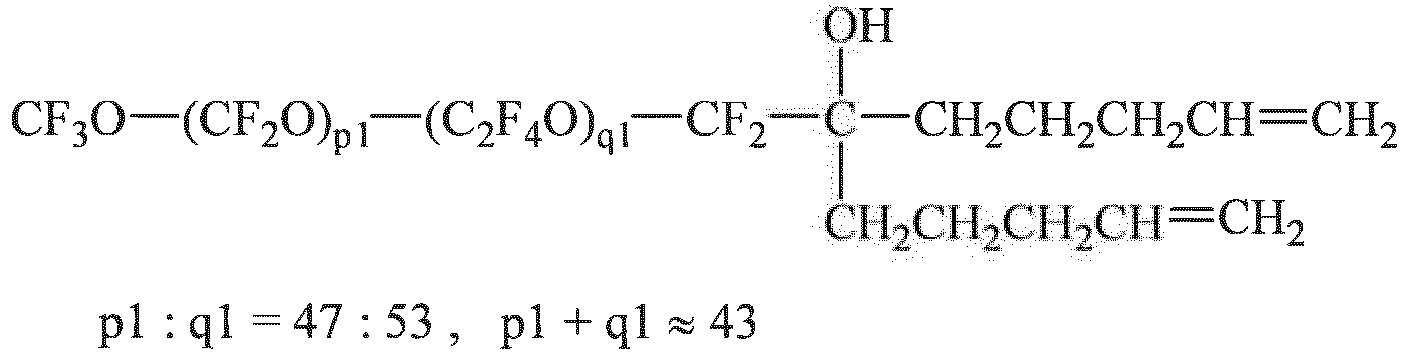

- The fluorooxyalkyl-containing polymer of formula (5) may be prepared, for example, by the following method. A perfluorooxyalkyl-containing polymer having an acid fluoride group (-C(=O)-F) at one end of the molecular chain is mixed with a Grignard reagent as a nucleophilic reagent and a solvent such as 1,3-bistrifluoromethylbenzene and tetrahydrofuran, and aged at a temperature of 0 to 80°C, preferably 50 to 70°C, and more preferably about 60°C for 1 to 6 hours, preferably 3 to 5 hours, and more preferably about 4 hours.
- Besides the acid fluoride, the perfluorooxyalkyl-containing polymer may have another group at one end of the molecular chain, such as acid halide, acid anhydride, ester, carboxylic acid or amide. Examples of the perfluorooxyalkyl-containing polymer having such a group at one end of the molecular chain are shown below.


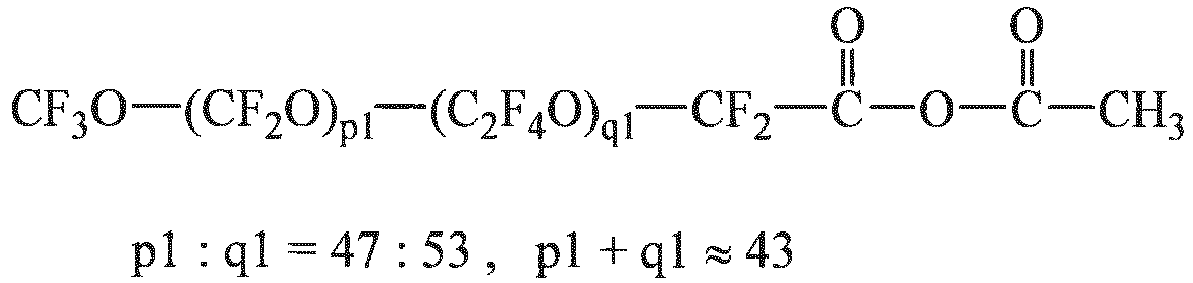


- The nucleophilic reagent used in the preparation of a fluorooxyalkyl-containing polymer having formula (5) may be selected from allylmagnesium halides, 3-butenylmagnesium halides, 4-pentenylmagnesium halides, and 5-hexenylmagnesium halides, for example. Corresponding lithium reagents may also be used. Relative to the perfluorooxyalkyl-containing polymer, the nucleophilic reagent may be used in an amount of 2 to 5 equivalents, preferably 2.5 to 3.5 equivalents, and more preferably about 3 equivalents per equivalent of reactive terminal group (concentration) of the polymer.
- As the solvent used in the preparation of a fluorooxyalkyl-containing polymer having formula (5), suitable fluorochemical solvents include hydrofluoroether (HFE) solvents (commercially available as Novec® products from 3M), such as 1,3-bistrifluoromethylbenzene, trifluoromethylbenzene, methyl nonafluorobutyl ether, methyl nonafluoroisobutyl ether, ethyl nonafluorobutyl ether, ethyl nonafluoroisobutyl ether, 1,1,1,2,3,4,4,5,5,5-decafluoro-3-methoxy-2-(trifluoromethyl)-pentane, and perfluoro solvents composed of perfluorinated compounds (commercially available as Fluorinert® products from 3M). Organic solvents are also useful, for example, ether solvents such as tetrahydrofuran, monoethylene glycol dimethyl ether, diethylene glycol dimethyl ether, triethylene glycol dimethyl ether, tetraethylene glycol dimethyl ether, and dioxane. The solvent may be used in an amount of 10 to 300 parts, preferably 100 to 200 parts, and more preferably about 150 parts by weight per 100 parts by weight of the perfluorooxyalkyl-containing polymer.
- Subsequently, the reaction is stopped. The reaction solution is separated into a water layer and a fluorochemical solvent layer by separatory operation. The fluorochemical solvent layer is washed with an organic solvent before the solvent is distilled off, yielding a fluorooxyalkyl-containing polymer having two olefin sites at one end of the molecular chain.
- As mentioned previously, the method for the preparation of a fluoropolyether-containing polymer-modified silane having formula (1) wherein α=1 uses a solvent. As the solvent, fluorochemical solvents are preferred and include hydrofluoroether (HFE) solvents (commercially available as Novec® products from 3M), such as 1,3-bistrifluoromethylbenzene, trifluoromethylbenzene, methyl nonafluorobutyl ether, methyl nonafluoroisobutyl ether, ethyl nonafluorobutyl ether, ethyl nonafluoroisobutyl ether, 1,1,1,2,3,4,4,5,5,5-decafluoro-3-methoxy-2-(trifluoromethyl)-pentane, and perfluoro solvents composed of perfluorinated compounds (commercially available as Fluorinert® products from 3M). The solvent may be used in an amount of 10 to 300 parts, preferably 50 to 150 parts, and more preferably about 100 parts by weight per 100 parts by weight of the fluorooxyalkyl-containing polymer having two olefin sites at one end of the molecular chain.
- The organosilicon compound having a SiH group and a hydrolysable terminal group in the molecule is preferably selected from compounds having the general formulae (6) to (9).


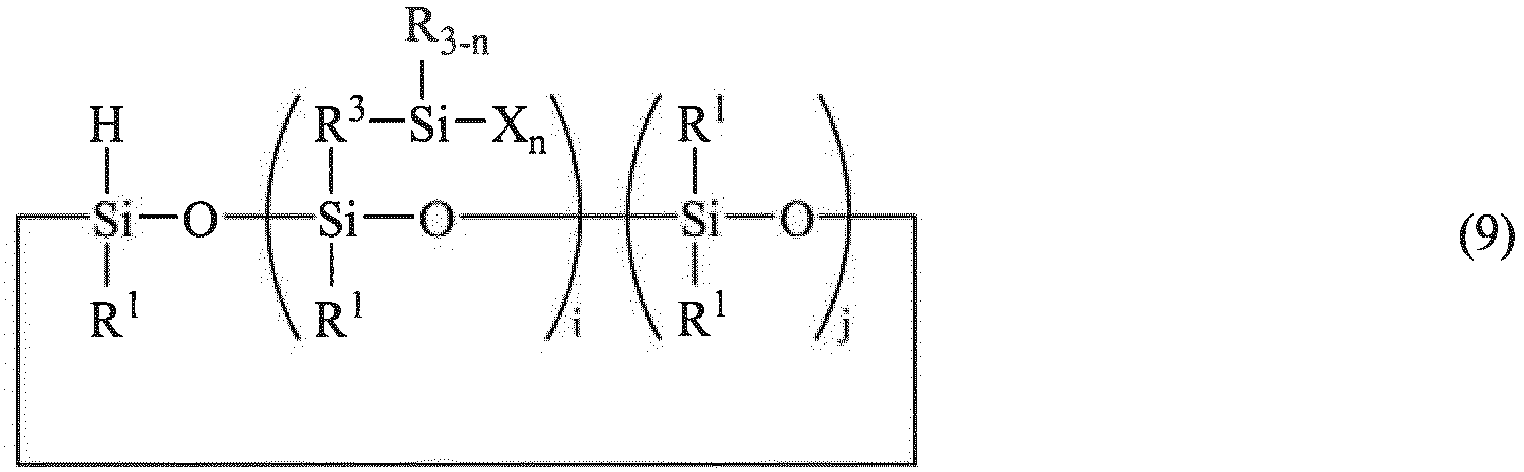
- R3 is a C2-C8, preferably C2-C3 divalent hydrocarbon group, examples of which include alkylene groups such as methylene, ethylene, propylene (trimethylene or methylethylene), butylene (tetramethylene or methylpropylene), hexamethylene, and octamethylene, arylene groups such as phenylene, and combinations of two or more of the foregoing such as alkylene-arylene groups. Inter alia, ethylene and trimethylene are preferred.
- Examples of the organosilicon compound include trimethoxysilane, triethoxysilane, tripropoxysilane, triisopropoxysilane, tributoxysilane, triisopropenoxysilane, triacetoxysilane, trichlorosilane, tribromosilane, and triiodosilane as well as silanes of the following formulae.


- For the reaction of the fluorooxyalkyl-containing polymer having two olefin sites at one end of the molecular chain with the organosilicon compound having a SiH group and hydrolysable terminal group, the organosilicon compound may be used in an amount of 2 to 6 equivalents, preferably 2.2 to 3.5 equivalents, and more preferably about 3 equivalents per equivalent of reactive terminal group (concentration) of the polymer.
- The organosilicon compound having at least two SiH groups, but not hydrolysable terminal groups in the molecule is preferably selected from compounds having the general formulae (10) to (12).


- Examples of the organosilicon compound having at least two SiH groups, but not hydrolysable terminal groups in the molecule are shown below.


- For the reaction of the fluorooxyalkyl-containing polymer having two olefin sites at one end of the molecular chain with the organosilicon compound having at least two SiH groups, but not hydrolysable terminal groups, the organosilicon compound may be used in an amount of 5 to 20 equivalents, preferably 7.5 to 12.5 equivalents, and more preferably about 10 equivalents per equivalent of reactive terminal group (concentration) of the polymer.
- The organosilicon compound having an olefin site and a hydrolysable terminal group in the molecule is preferably selected from compounds having the general formula (13).

- For the reaction of the reaction product between the fluorooxyalkyl-containing polymer having two olefin sites at one end of the molecular chain and the organosilicon compound having at least two SiH groups with the organosilicon compound having an olefin site and a hydrolysable terminal group in the molecule, typically allyltrimethoxysilane, the latter organosilicon compound may be used in an amount of 2 to 6 equivalents, preferably 2.2 to 3.5 equivalents, and more preferably about 3 equivalents per equivalent of reactive terminal group (concentration) of the polymer.
- Typical of the hydrosilylation catalyst are platinum group metal based catalysts including platinum black, chloroplatinic acid, alcohol-modified chloroplatinic acid, complexes of chloroplatinic acid with olefin, aldehyde, vinylsiloxane, and acetylene alcohol, tetrakis(triphenylphosphine)palladium, and
chlorotris(triphenylphosphine)rhodium. Inter alia, platinum compounds such as vinylsiloxane coordination compounds are preferred. The hydrosilylation catalyst is preferably used in an amount to provide 0.1 to 100 ppm, more preferably 1 to 50 ppm of transition metal based on the weight of the fluorooxyalkyl-containing polymer having two olefin sites at one end of the molecular chain or the reaction product between the fluorooxyalkyl-containing polymer having two olefin sites at one end of the molecular chain and the organosilicon compound having at least two SiH groups. - In the other method involving the steps of hydrosilylation reaction of a fluorooxyalkyl-containing polymer having two olefin sites at one end of the molecular chain with an organosilicon compound having a SiH group and a hydrolysable terminal group in the molecule such as trichlorosilane, and converting the substituent on the silyl group to a methoxy group, for example, the conversion step may be similar to the well-known reaction procedure for the alkoxysilylation of hydrolysable silyl groups. For example, a fluorooxyalkyl-containing polymer terminated with a trichlorosilyl group may be reacted with a lower alcohol (e.g. methanol) in the presence of an amine (e.g. triethylamine, pyridine or urea) as acid acceptor, for effecting methoxysilylation.
- Thereafter, the solvent and unreacted reactants are distilled off in vacuum, yielding the target compound. For example, when the fluorooxyalkyl-containing polymer having two olefin sites at one end of the molecular chain is of the formula:


- Next, the fluoropolyether-containing polymer-modified silane of formula (1) wherein α=2 may be prepared, for example, by the following methods. In one exemplary method, a fluorooxyalkylene-containing polymer having two olefin sites at each of both ends of the molecular chain is dissolved in a solvent, typically fluorochemical solvent such as 1,3-bistrifluoromethylbenzene. To the solution, an organosilicon compound having a SiH group and a hydrolysable terminal group in the molecule such as trimethoxysilane and a hydrosilylation catalyst such as a toluene solution of chloroplatinic acid/vinylsiloxane complex are added. The reaction mixture is aged at a temperature of 40 to 120°C, preferably 60 to 100°C, and more preferably about 80°C for 1 to 72 hours, preferably 36 to 60 hours, and more preferably about 48 hours.
- Another method may be employed for preparing the fluoropolyether-containing polymer-modified silane of formula (1) wherein α=2. A fluorooxyalkylene-containing polymer having two olefin sites at each end of the molecular chain is dissolved in a solvent, typically fluorochemical solvent such as 1,3-bistrifluoromethylbenzene. To the solution, an organosilicon compound having a SiH group and a hydrolysable terminal group in the molecule such as trichlorosilane and a hydrosilylation catalyst such as a toluene solution of chloroplatinic acid/vinylsiloxane complex are added. The reaction mixture is aged at a temperature of 40 to 120°C, preferably 60 to 100°C, and more preferably about 80°C for 1 to 72 hours, preferably 36 to 60 hours, and more preferably about 48 hours. Finally, the substituent on the silyl group is converted to a methoxy group, for example.
- Instead of the organosilicon compound having a SiH group and a hydrolysable terminal group in the molecule, an SiH-containing organosilicon compound free of a hydrolysable terminal group may also be used. In this case, an organosilicon compound having at least two SiH groups is used. Once the organosilicon compound having at least two SiH groups is reacted with a fluorooxyalkylene-containing polymer having two olefin sites at each end of the molecular chain like the above method, a mixture of the polymer having terminal SiH groups and an organosilicon compound having an olefin site and a hydrolysable terminal group in the molecule such as allyltrimethoxysilane is aged, in the presence of a hydrosilylation catalyst such as a toluene solution of chloroplatinic acid/vinylsiloxane complex, at a temperature of 40 to 120°C, preferably 60 to 100°C, and more preferably about 80°C for 1 to 72 hours, preferably 36 to 60 hours, and more preferably about 48 hours.
- The fluorooxyalkylene-containing polymer having two olefin sites at each end of the molecular chain is typically a fluorooxyalkylene-containing polymer of the general formula (14) :

- Preferred examples of the fluorooxyalkylene-containing polymer of formula (14) are shown below. In each formula, the repetition number of repeating units in the form of fluorooxyalkylene groups, also referred to as degree of polymerization, may be an arbitrary number meeting formula (3) representative of Rf.


- The fluorooxyalkylene-containing polymer of formula (14) may be prepared, for example, by the following method. A perfluorooxyalkylene-containing polymer having an acid fluoride group (-C(=O)-F) at each end of the molecular chain is mixed with a Grignard reagent as a nucleophilic reagent and a solvent such as 1,3-bistrifluoromethylbenzene and tetrahydrofuran, and aged at a temperature of 0 to 80°C, preferably 50 to 70°C, and more preferably about 60°C for 1 to 6 hours, preferably 3 to 5 hours, and more preferably about 4 hours.
- Besides the acid fluoride, the perfluorooxyalkylene-containing polymer may have another group at each end of the molecular chain, such as acid halide, acid anhydride, ester, carboxylic acid or amide. Examples of the perfluorooxyalkylene-containing polymer having such groups at both ends of the molecular chain are shown below.

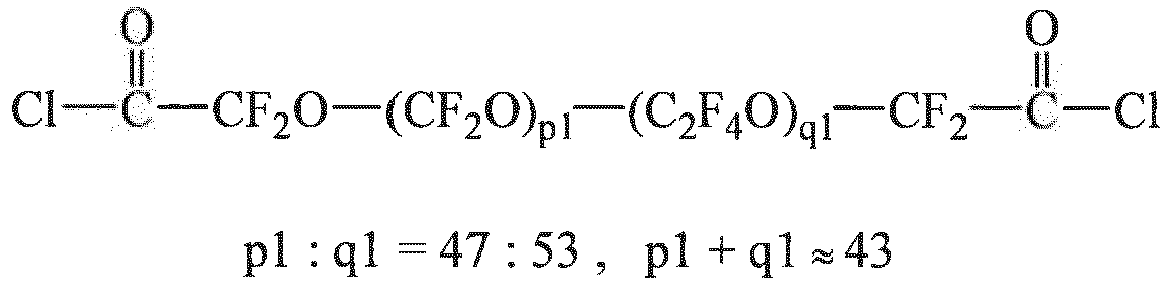


- The nucleophilic reagent used in the preparation of the fluorooxyalkylene-containing polymer having formula (14) may be selected from allylmagnesium halides, 3-butenylmagnesium halides, 4-pentenylmagnesium halides, and 5-hexenylmagnesium halides, for example. Corresponding lithium reagents may also be used. The nucleophilic reagent may be used in an amount of 4 to 10 equivalents, preferably 5 to 7 equivalents, and more preferably about 6 equivalents per equivalent of reactive terminal group (concentration) of the perfluorooxyalkylene-containing polymer.
- As the solvent used in the preparation of the fluorooxyalkylene-containing polymer having formula (14), suitable fluorochemical solvents include hydrofluoroether (HFE) solvents (commercially available as Novec® products from 3M), such as 1,3-bistrifluoromethylbenzene, trifluoromethylbenzene, methyl nonafluorobutyl ether, methyl nonafluoroisobutyl ether, ethyl nonafluorobutyl ether, ethyl nonafluoroisobutyl ether, 1,1,1,2,3,4,4,5,5,5-decafluoro-3-methoxy-2-(trifluoromethyl)pentane, and perfluoro solvents composed of perfluorinated compounds (commercially available as Fluorinert® products from 3M). Organic solvents are also useful, for example, ether solvents such as tetrahydrofuran, monoethylene glycol dimethyl ether, diethylene glycol dimethyl ether, triethylene glycol dimethyl ether, tetraethylene glycol dimethyl ether, and dioxane. The solvent may be used in an amount of 10 to 300 parts, preferably 100 to 200 parts, and more preferably about 150 parts by weight per 100 parts by weight of the perfluorooxyalkylene-containing polymer.
- Subsequently, the reaction is stopped. The reaction solution is separated into a water layer and a fluorochemical solvent layer by separatory operation. The fluorochemical solvent layer is washed with an organic solvent before the solvent is distilled off, yielding a fluorooxyalkylene-containing polymer having two olefin sites at each end of the molecular chain.
- As mentioned previously, the method for the preparation of a fluoropolyether-containing polymer-modified silane having formula (1) wherein α=2 uses a solvent. As the solvent, fluorochemical solvents are preferred and include hydrofluoroether (HFE) solvents (commercially available as Novec® products from 3M), such as 1,3-bistrifluoromethylbenzene, trifluoromethylbenzene, methyl nonafluorobutyl ether, methyl nonafluoroisobutyl ether, ethyl nonafluorobutyl ether, ethyl nonafluoroisobutyl ether, 1,1,1,2,3,4,4,5,5,5-decafluoro-3-methoxy-2-(trifluoromethyl)-pentane, and perfluoro solvents composed of perfluorinated compounds (commercially available as Fluorinert® products from 3M). The solvent may be used in an amount of 10 to 300 parts, preferably 50 to 150 parts, and more preferably about 100 parts by weight per 100 parts by weight of the fluorooxyalkylene-containing polymer having two olefin sites at each end of the molecular chain.
- The organosilicon compound having a SiH group and a hydrolysable terminal group in the molecule is preferably selected from compounds having the general formulae (6) to (9).


- Examples of the organosilicon compound include trimethoxysilane, triethoxysilane, tripropoxysilane, triisopropoxysilane, tributoxysilane, triisopropenoxysilane, triacetoxysilane, trichlorosilane, tribromosilane, and triiodosilane as well as silanes of the following formulae.


- For the reaction of the fluorooxyalkylene-containing polymer having two olefin sites at each end of the molecular chain with the organosilicon compound having a SiH group and a hydrolysable terminal group, the organosilicon compound may be used in an amount of 4 to 12 equivalents, preferably 4.4 to 7 equivalents, and more preferably about 6 equivalents per equivalent of reactive terminal group (concentration) of the polymer.
- The organosilicon compound having at least two SiH groups, but not hydrolysable terminal groups in the molecule is preferably selected from compounds having the general formulae (10) to (12).


- Examples of the organosilicon compound having at least two SiH groups, but not hydrolysable terminal groups in the molecule are shown below.


- For the reaction of the fluorooxyalkylene-containing polymer having two olefin sites at each end of the molecular chain with the organosilicon compound having at least two SiH groups, but not hydrolysable terminal groups, the organosilicon compound may be used in an amount of 10 to 40 equivalents, preferably 15 to 25 equivalents, and more preferably about 20 equivalents per equivalent of reactive terminal group (concentration) of the polymer.
- The organosilicon compound having an olefin site and a hydrolysable terminal group in the molecule is preferably selected from compounds having the general formula (13).

- For the reaction of the reaction product between the fluorooxyalkylene-containing polymer having two olefin sites at each end of the molecular chain and the organosilicon compound having at least two SiH groups with the organosilicon compound having an olefin site and a hydrolysable terminal group in the molecule, typically allyltrimethoxysilane, the latter organosilicon compound may be used in an amount of 4 to 12 equivalents, preferably 4.4 to 7 equivalents, and more preferably about 6 equivalents per equivalent of reactive terminal group (concentration) of the polymer.
- Typical of the hydrosilylation reaction catalyst are platinum group metal based catalysts including platinum black, chloroplatinic acid, alcohol-modified chloroplatinic acid, complexes of chloroplatinic acid with olefin, aldehyde, vinylsiloxane, and acetylene alcohol, tetrakis(triphenylphosphine)palladium, and chlorotris(triphenylphosphine)rhodium. Inter alia, platinum compounds such as vinylsiloxane coordination compounds are preferred. The hydrosilylation catalyst is preferably used in an amount to provide 0.1 to 100 ppm, more preferably 1 to 50 ppm of transition metal based on the weight of the fluorooxyalkylene-containing polymer having two olefin sites at each end of the molecular chain or the reaction product between the fluorooxyalkylene-containing polymer having two olefin sites at each end of the molecular chain and the organosilicon compound having at least two SiH groups.
- In the other method involving the steps of hydrosilylation reaction of a fluorooxyalkylene-containing polymer having two olefin sites at each end of the molecular chain with an organosilicon compound having a SiH group and a hydrolysable terminal group in the molecule such as trichlorosilane, and converting the substituent on the silyl group to a methoxy group, for example, the conversion step may be similar to the well-known reaction procedure for the alkoxysilylation of hydrolysable silyl groups. For example, a fluorooxyalkyl-containing polymer terminated with a trichlorosilyl group may be reacted with a lower alcohol (e.g. methanol) in the presence of an amine (e.g. triethylamine, pyridine or urea) as acid acceptor, for effecting methoxysilylation.
- Thereafter, the solvent and unreacted reactants are distilled off in vacuum, yielding the target compound. For example, when the fluorooxyalkylene-containing polymer having two olefin sites at each end of the molecular chain is of the formula:


- Another aspect of the invention is a surface treating agent comprising a fluoropolyether-containing polymer having both an active hydrogen-containing functional group and a hydrolysable group and/or a partial hydrolytic condensate thereof, and a corresponding surface treatment method.
- The presence of active hydrogen within the polymer ensures that hydrolytic reaction of hydrolysable groups (e.g. alkoxysilyl) is accelerated without a need for curing catalysts. Suitable active hydrogen-containing groups include hydroxyl, carboxyl, amino, imino, N-hydroxyl, thiol, sulfo and phosphoric acid groups, with hydroxyl and carboxyl being preferred. Suitable hydrolysable groups include C1-C10 alkoxy groups such as methoxy, ethoxy, propoxy, isopropoxy, and butoxy, C2-C10 alkoxyalkoxy groups such as methoxymethoxy and methoxyethoxy, C1-C10 acyloxy groups such as acetoxy, C2-C10 alkenyloxy groups such as isopropenoxy, and halogen groups such as chloro, bromo and iodo.
- The fluoropolyether-containing polymer having both an active hydrogen-containing functional group and a hydrolysable group is preferably the fluoropolyether-containing polymer-modified silane of formula (1) defined above. The surface treating agent may comprise a partial hydrolytic condensate obtained by previously subjecting the fluoropolyether-containing polymer-modified silane (specifically its terminal hydrolysable group) to partial hydrolysis and condensation in a well-known manner.
- In a preferred embodiment, the surface treating agent may further comprise a fluoropolyether-containing polymer having the general formula (4):
A-Rf'-A (4)
wherein A is a monovalent fluorinated group terminated with -CF3 radical, and Rf' is a divalent fluorooxyalkylene-containing polymer residue. This polymer is also referred to as "nonfunctional polymer." - In formula (4), A is a monovalent fluorinated group terminated with -CF3 radical, preferably a linear perfluoroalkyl group of 1 to 6 carbon atoms, and most preferably CF3. Rf' may be identical with or different from the divalent fluorooxyalkylene-containing polymer residue represented by Rf in formula (1). Preferred examples of Rf' are given below.


- Examples of the nonfunctional polymer having formula (4) are shown below.


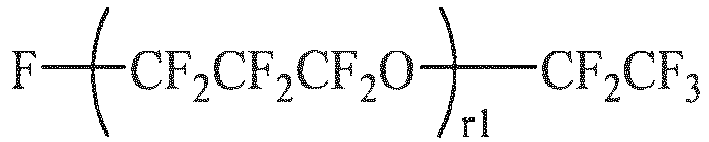

- When used, the nonfunctional polymer having formula (4) may be blended in any desired amount, preferably in an amount of 0.1 to 60%, more preferably 10 to 40% by weight based on the weight of the fluoropolyether-containing polymer-modified silane having formula (1). Too large an amount may be detrimental to adhesion.
- To the surface treating agent, a hydrolytic condensation catalyst may be added if desired. Suitable hydrolytic condensation catalysts include organotin compounds such as dibutyltin dimethoxide and dibutyltin dilaurate, organotitanium compounds such as tetra-n-butyl titanate, organic acids such as acetic acid, methanesulfonic acid, and fluorine-modified carboxylic acids, and inorganic acids such as hydrochloric acid and sulfuric acid. Of these, acetic acid, tetra-n-butyl titanate, dibutyltin dilaurate, and fluorine-modified carboxylic acids are preferred. The catalyst may be added in a catalytic amount, typically 0.01 to 5 parts, more preferably 0.1 to 1 part by weight per 100 parts by weight of the fluorooxyalkylene-containing polymer and/or partial hydrolytic condensate thereof.
- The surface treating agent may further comprise a solvent. Suitable solvents include fluorine-modified aliphatic hydrocarbon solvents such as perfluoroheptane and perfluorooctane; fluorine-modified aromatic hydrocarbon solvents such as m-xylene hexafluoride, benzotrifluoride, and 1,3-trifluoromethylbenzene; fluorine-modified ether solvents such as methyl perfluorobutyl ether, ethyl perfluorobutyl ether, and perfluoro(2-butyltetrahydrofuran); fluorine-modified alkylamine solvents such as perfluorotributylamine and perfluorotripentylamine; hydrocarbon solvents such as petroleum benzine, mineral spirits, toluene, and xylene; ketone solvents such as acetone, methyl ethyl ketone, and methyl isobutyl ketone. Of these, fluorine-modified solvents are desirable for solubility and wettability, with m-xylene hexafluoride, perfluoro(2-butyltetrahydrofuran), perfluorotributylamine, and ethyl perfluorobutyl ether being more desirable.
- The solvents may be used alone or in admixture of two or more while it is preferred that the fluoropolyether-containing polymer-modified silane and/or partial hydrolytic condensate thereof be uniformly dissolved in the solvent. An optimum concentration of the fluoropolyether-containing polymer-modified silane and/or partial hydrolytic condensate thereof in the solvent is 0.01 to 40% by weight, especially 0.05 to 25% by weight of the surface treating agent, though it varies with a particular treating mode.
- The surface treating agent may be applied to a substrate by any well-known techniques such as brush coating, dipping, spraying and evaporation. In the case of evaporation, the heating mode may be either resistance heating or EB heating. A coating of the surface treating agent is cured to the substrate. The curing conditions vary with a particular coating or curing technique. When the coating technique is evaporation or spray coating and the substrate is SiO2-deposited glass, for example, suitable curing conditions include a temperature from room temperature (25°C) to 200°C and a time of 5 minutes to 24 hours, especially 10 minutes to 12 hours. Humid curing conditions are also useful. A coating of the surface treating agent may cure at room temperature in a time of 10 minutes to 24 hours, typically 30 minutes to 12 hours, and even in a short time of 30 minutes to 1 hour. The cured coating typically has a thickness of 0.1 to 100 nm, desirably 1 to 20 nm although the thickness depends on the type of substrate.
- Before the surface treating agent comprising the fluoropolyether-containing polymer having an active hydrogen-containing functional group and a hydrolysable group and/or partial hydrolytic condensate thereof is applied to a substrate, the hydrolysable groups may be previously hydrolysed. In the case of spray coating, for example, the surface treating agent is diluted with a fluorochemical solvent having some water added thereto, whereby the hydrolysable groups in the agent are hydrolysed to form Si-OH groups in the solution. The resulting solution is spray coated, with the advantage of fast cure after coating.
- The substrate to be treated with the surface treating agent is not particularly limited, and may be made of any desired materials including paper, fabric, metals, metal oxides, glass, plastics, ceramics, and quartz. The surface treating agent is effective for endowing the substrate with excellent water/oil repellency, and its coating has high UV resistance and long-lasting antifouling performance.
- Various articles may be treated with the surface treating agent. Preferred articles include optical articles, touch panels, antireflective film, glass such as SiO2-deposited glass, strengthened glass, sapphire glass, and quartz substrates which are used as parts in car navigation systems, mobile phones, digital cameras, digital video cameras, PDA, portable audio players, car audio players, game consoles, eyeglass lenses, camera lenses, lens filters, sunglasses, medical instruments (e.g. gastroscopes), copiers, personal computers, LC displays, organic EL displays, plasma displays, touch panel displays, protective film, and antireflective film.
- Since a coating having excellent water/oil repellency, UV resistance and long-lasting antifouling performance is formed by coating the substrate with the surface treating agent and curing under mild conditions, typically at room temperature in a short time, the agent is particularly useful as a water/oil repellent layer on touch panel displays and antireflective film.
- Examples of the invention are given below by way of illustration and not by way of limitation.
- A reactor was charged with 150 g of tetrahydrofuran and 300 g of 1,3-bistrifluoromethylbenzene, to which 160 ml of 0.7M allylmagnesium bromide was added dropwise. Subsequently, 300 g (4.8×10⁻² mol) of a compound of the following formula (I) was slowly added dropwise.


- A reactor was charged with 200 g (2.6×10⁻² mol) of the compound having the formula (II) shown below, 200 g of 1,3-bistrifluoromethylbenzene, 12.7 g (1.1×10⁻¹ mol) of trimethoxysilane, and 6.0×10⁻¹ g of a toluene solution of chloroplatinic acid/vinylsiloxane complex (containing 1.6×10⁻⁵ mol of Pt), which were mixed.

- On NMR analysis, the product was identified to have a structure of the following formula (III).

δ 0.2-2.2 (-CH 2 CH 2 CH 2 -) 12H
δ 3.0-3.5 (-Si(OCH 3 )3)18H - In a reactor, 200 g (2.6×10⁻² mol) of the compound having the formula (II) shown below was dissolved in 200 g of 1,3-bistrifluoromethylbenzene.

- On NMR analysis, the product was identified to have a structure of the following formula (IV).

δ 0.2-2.2(-CH 2 CH 2 CH 2 -) 12H
δ 1.6-1.8(-Si(OC(CH 3 )=CH2)3)6H
δ 3.8-4.2(-Si(OC(CH3)=CH 2 )3)4H - In a reactor, 200 g (1.3×10⁻² mol) of the compound having the formula (II) shown below was dissolved in 200 g of 1,3-bistrifluoromethylbenzene.

- On NMR analysis, the product was identified to have a structure of the following formula (V).

δ 0.2-2.2(C-CH2CH2CH2-Si) 12H
δ 0.1-0.0(-Si(CH 3 )2-)24H
δ 0.2-1.0(Si-CH 2 CH 2 -Si)8H
δ 3.0-3.5(-Si(OCH 3 )3)18H - A reactor was charged with 150 g of tetrahydrofuran and 300 g of 1,3-bistrifluoromethylbenzene, to which 320 ml of 0.7M allylmagnesium bromide was added dropwise. Subsequently, 300 g (9.6×10⁻² mol) of a compound of the following formula (VI) was slowly added dropwise.


- A reactor was charged with 200 g (1.4×10⁻¹ mol) of the compound having the formula (VII) shown below, 200 g of 1,3-bistrifluoromethylbenzene, 68.4 g (5.6×10⁻¹ mol) of trimethoxysilane, and 1.2 g of a toluene solution of chloroplatinic acid/vinylsiloxane complex (containing 3.2×10⁻⁵ mol of Pt), which were mixed.

- On NMR analysis, the product was identified to have a structure of the following formula (VIII).

δ 0.2-2.2(-CH 2 CH 2 CH 2 -) 24H
δ 3.0-3.5(-Si(OCH 3 )3)36H - The following polymer was used for comparison.
CF3O-(CF2O)p1-(C2F4O)q1-CF2-O-CH2CH2CH2-Si(OCH3)3
p1 : q1 = 47 : 53, p1 + q1 ≈ 43 - The following polymer was used for comparison.

- Surface treating agents were prepared by dissolving the fluoropolyether-containing polymer-modified silanes obtained in Examples 1 to 4 and the polymers of Comparative Examples 1 and 2 in solvent Novec® 7200 (ethyl perfluorobutyl ether by 3M) in a concentration of 20 wt%. 10 mg of each surface treating agent was deposited by vacuum evaporation, at a pressure of 2.0×10⁻² Pa and a temperature of 700°C, onto glass having an outermost surface treated with SiO2 of 10 nm (Gorilla® by Corning). The deposit was held at 80°C in an atmosphere of humidity 80% for 12 hours or at 25°C in an atmosphere of humidity 40% for 24 hours, obtaining a cured film 15 nm thick.
- A surface treating agent was prepared by dissolving the fluoropolyether-containing polymer-modified silane obtained in Example 1 in solvent Novec® 7200 (ethyl perfluorobutyl ether by 3M) in a concentration of 20 wt%. The solvent used herein contained 50 ppm of water. 10 mg of the surface treating agent was deposited by vacuum evaporation, at a pressure of 2.0×10⁻² Pa and a temperature of 700°C, onto glass having an outermost surface treated with SiO2 of 10 nm (Gorilla® by Corning). The deposit was held at 25°C in an atmosphere of humidity 40% for 24 hours, obtaining a cured film of 15 nm thick. The film of Example 5 is a film formed using the solvent having water added thereto.
- Using a contact angle meter Drop Master (Kyowa Interface Science Co., Ltd.), the cured film on glass was measured for a contact angle with water as an index of water repellency. Table 1 shows the results of the film resulting from curing at 80°C and humidity 80% for 12 hours, and Table 2 shows the results of the film resulting from curing at 25°C and humidity 40% for 24 hours. All the films showed excellent water repellency initially.
- The cured film on glass was exposed to UV light (wavelength 300-400 nm) from a metal halide lamp at an irradiance of 770 W/m2 for 160 hours. After this weathering, the film was measured for contact angle with water again. Table 1 shows the results of the film resulting from curing at 80°C and humidity 80% for 12 hours, and Table 2 shows the results of the film resulting from curing at 25°C and humidity 40% for 24 hours.
- The film of Comparative Example 1 using a polymer having an ether bond-containing linker showed a substantial drop of contact angle, indicating poor weathering resistance. The film of Comparative Example 2 using a polymer free of ether bond in the linker and free of active hydrogen showed poor weathering resistance in the case of room temperature cure.
- Using an abrasion tester (Shinto Scientific Co., Ltd.), the film resulting from curing at 25°C and humidity 40% for 24 hours was rubbed a multiplicity of back-and-forth strokes with steel wool. After every 1,000 strokes of rubbing, the film was measured for a contact angle with water.
-
Atmosphere: 25°C and humidity 40% Steel wool: BonStar® #0000 (Nihon SteelWool Co., Ltd.) Moving distance (one way): 30 mm Moving speed: 1,800 mm/min Load: 1 kg/cm2 - The test was terminated when the contact angle with water decreased below 100°. The count of rubbing strokes continued while a contact angle with water of at least 100° was kept was an index of abrasion resistance. The results are shown in Table 2.
- The films of the treating agents of Examples having active hydrogen in the molecule exhibited satisfactory abrasion resistance even when they were cured at 25°C and humidity 40% for 24 hours.
Table 1: Film cured at 80°C and humidity 80% for 12 hours Surface modifier Initial contact angle with water (°) Contact angle with water after weathering (°) Example 1 117 102 Example 2 116 100 Comparative Example 1 116 48 Table 2: Film cured at 25°C and humidity 40% for 24 hours Surface modifier Initial contact angle with water Contact angle with water after weathering (°) Abrasion resistance (count) Example 1 117 103 20,000 Example 2 117 102 16,000 Example 3 114 102 10,000 Example 4 110 105 11,000 Example 5 117 101 15,000 Comparative Example 1 116 38 3,000 Comparative Example 2 116 59 6,000 - In respect of numerical ranges disclosed in the present description it will of course be understood that in the normal way the technical criterion for the upper limit is different from the technical criterion for the lower limit, i.e. the upper and lower limits are intrinsically distinct proposals.
- For the avoidance of doubt it is confirmed that in the general description above, in the usual way the proposal of general preferences and options in respect of different features of the silane, method of making it, surface treating agent, surface treating method and treated article constitutes the proposal of general combinations of those general preferences and options for the different features, insofar as they are combinable and compatible and are put forward in the same context.
- The entire disclosures of Japanese Patent Application Nos.
2014-074213 2014-250460 - Although some preferred embodiments have been described, many modifications and variations may be made thereto in light of the above teachings. It is therefore to be understood that the invention may be practised otherwise than as specifically described without departing from the scope of the general teachings herein.
Claims (12)
- A fluoropolyether-containing polymer-modified silane having the general formula (1):

- The silane of claim 1 wherein α is 1, and Rf is a group having the general formula (2):

- The silane of claim 1 wherein α is 2, and Rf is a group having the general formula (3):

- The silane of any one of claims 1 to 3 wherein Y is selected from alkylene groups of 3 to 10 carbon atoms, phenylene-containing alkylene groups, divalent groups having alkylene groups bonded via a silalkylene or silarylene structure, and divalent to tetravalent groups having alkylene groups bonded to a divalent to tetravalent, linear, branched or cyclic organopolysiloxane residue of 2 to 10 silicon atoms.
- The silane of any one of claims 1 to 4 wherein each X is selected from C1-C10 alkoxy groups, C2-C10 alkoxyalkoxy groups, C1-C10 acyloxy groups, C2-C10 alkenyloxy groups and halogens.
- A surface treating agent comprising a fluoropolyether-containing polymer having both an active hydrogen-containing functional group and a hydrolysable group and/or a partial hydrolytic condensate thereof.
- The surface treating agent of claim 6 wherein the fluoropolyether-containing polymer having both an active hydrogen-containing functional group and a hydrolysable group is the fluoropolyether-containing polymer-modified silane of any one of claims 1 to 5.
- The surface treating agent of claim 6 or 7, further comprising a fluoropolyether-containing polymer having the general formula (4):
A-Rf'-A (4)
wherein A is a monovalent fluorinated group terminated with -CF3 radical, and Rf' is a divalent fluorooxyalkylene-containing polymer residue. - An article which has a surface treatment of a surface treating agent of any one of claims 6 to 8.
- An article of claim 9 which is an optical article, touch panel, antireflective film, SiO2-deposited glass, strengthened glass, sapphire glass or quartz substrate.
- The use, as or in a surface treating agent, of a fluoropolyether-containing polymer having both an active hydrogen-containing functional group and a hydrolysable group and/or a partial hydrolytic condensate thereof, such as a fluoropolyether-containing polymer-modified silane of any one of claims 1 to 5.
- Use according to claim 11 to surface treat an article which is an optical article, touch panel, antireflective film, SiO2-deposited glass, strengthened glass, sapphire glass or quartz substrate.
Applications Claiming Priority (2)
| Application Number | Priority Date | Filing Date | Title |
|---|---|---|---|
| JP2014074213 | 2014-03-31 | ||
| JP2014250460A JP6451279B2 (en) | 2014-03-31 | 2014-12-11 | Fluoropolyether group-containing polymer-modified silane, surface treatment agent and article |
Publications (2)
| Publication Number | Publication Date |
|---|---|
| EP2927292A1 true EP2927292A1 (en) | 2015-10-07 |
| EP2927292B1 EP2927292B1 (en) | 2017-08-02 |
Family
ID=52726992
Family Applications (1)
| Application Number | Title | Priority Date | Filing Date |
|---|---|---|---|
| EP15159697.0A Active EP2927292B1 (en) | 2014-03-31 | 2015-03-18 | Fluoropolyether-containing polymer-modified silane, surface treating agent, and article |
Country Status (6)
| Country | Link |
|---|---|
| US (1) | US10093773B2 (en) |
| EP (1) | EP2927292B1 (en) |
| JP (1) | JP6451279B2 (en) |
| KR (1) | KR102243225B1 (en) |
| CN (1) | CN104945610B (en) |
| TW (1) | TWI656145B (en) |
Cited By (1)
| Publication number | Priority date | Publication date | Assignee | Title |
|---|---|---|---|---|
| EP3006447A1 (en) * | 2014-08-07 | 2016-04-13 | Shin-Etsu Chemical Co., Ltd. | Fluorochemical surface treating agent and article treated therewith |
Families Citing this family (76)
| Publication number | Priority date | Publication date | Assignee | Title |
|---|---|---|---|---|
| JP6119656B2 (en) * | 2014-03-31 | 2017-04-26 | 信越化学工業株式会社 | Fluoropolyether group-containing polymer |
| JP6274083B2 (en) * | 2014-11-17 | 2018-02-07 | 信越化学工業株式会社 | Water- and oil-repellent treatment agent having heat resistance, method for producing the same, and article |
| EP3085749B1 (en) * | 2015-04-20 | 2017-06-28 | Shin-Etsu Chemical Co., Ltd. | Fluoropolyether-containing polymer-modified silane, surface treating agent, and treated article |
| JP6260579B2 (en) * | 2015-05-01 | 2018-01-17 | 信越化学工業株式会社 | Fluoropolyether group-containing polymer-modified silane, surface treatment agent and article |
| JP6390521B2 (en) * | 2015-06-03 | 2018-09-19 | 信越化学工業株式会社 | Fluoropolyether group-containing polymer-modified silane |
| JP6531833B2 (en) * | 2015-11-06 | 2019-06-19 | 信越化学工業株式会社 | Surface-treated resin products |
| JP6521091B2 (en) * | 2015-11-06 | 2019-05-29 | 信越化学工業株式会社 | Fluoropolyether group-containing polymer modified organosilicon compound, surface treating agent and article |
| WO2017104249A1 (en) * | 2015-12-14 | 2017-06-22 | 信越化学工業株式会社 | Silane modified with polymer containing fluoropolyether group, surface-treating agent, and article |
| CN106883405B (en) * | 2015-12-15 | 2019-05-17 | 比亚迪股份有限公司 | A kind of silane-modified fluoropolymer and preparation method thereof and anti-fingerprint coating |
| CN105801835B (en) * | 2016-04-12 | 2016-12-14 | 泉州市思康新材料发展有限公司 | A kind of perfluoropolyether-modified silane compound and comprise its surface treating composition and thin film |
| JP6828744B2 (en) * | 2016-06-10 | 2021-02-10 | 信越化学工業株式会社 | Fluoropolyester group-containing polymers, surface treatment agents and articles |
| BR112019001902A2 (en) | 2016-08-05 | 2019-07-09 | Chugai Seiyaku Kabushiki Kaisha | prophylaxis or treatment composition for il-8-related diseases |
| WO2018034138A1 (en) | 2016-08-19 | 2018-02-22 | 旭硝子株式会社 | Composition for forming water-repellent film, water-repellent film, and water-repellent-film-attached substrate and article |
| JP6724994B2 (en) * | 2016-09-08 | 2020-07-15 | ダイキン工業株式会社 | Composition containing perfluoro(poly)ether group-containing silane compound |
| CN109790443B (en) * | 2016-10-06 | 2022-03-29 | 信越化学工业株式会社 | Surface treatment agent, article having cured product of surface treatment agent, and method for forming cured coating on surface of article |
| JP6741074B2 (en) * | 2016-10-31 | 2020-08-19 | Agc株式会社 | Fluorine-containing ether composition, coating liquid and article |
| CN110392711B (en) * | 2017-03-27 | 2022-04-12 | Agc株式会社 | Fluorine-containing ether composition and method for producing the same |
| WO2018216404A1 (en) * | 2017-05-23 | 2018-11-29 | 信越化学工業株式会社 | Fluorine-containing coating agent composition, surface treatment agent containing said composition, and article |
| JP6984656B2 (en) * | 2017-05-25 | 2021-12-22 | 信越化学工業株式会社 | Fluoropolyether group-containing polymer-modified organosilicon compounds, surface treatment agents and articles |
| WO2018235778A1 (en) | 2017-06-21 | 2018-12-27 | Agc株式会社 | Article with water and oil repellent layer and method for producing the same |
| CN111032337B (en) * | 2017-08-17 | 2023-02-10 | 信越化学工业株式会社 | Water-repellent member and method of manufacturing water-repellent member |
| WO2019044479A1 (en) * | 2017-08-31 | 2019-03-07 | Agc株式会社 | Fluorine-containing ether compound, fluorine-containing ether composition, coating solution, article and method for producing same |
| KR102589656B1 (en) * | 2017-09-27 | 2023-10-16 | 신에쓰 가가꾸 고교 가부시끼가이샤 | Fluorine-containing coating compositions, surface treatment agents and articles |
| WO2019082583A1 (en) | 2017-10-26 | 2019-05-02 | 信越化学工業株式会社 | Lipophilic group-containing organosilane compound, surface treatment agent and article |
| WO2019102832A1 (en) | 2017-11-21 | 2019-05-31 | 信越化学工業株式会社 | Fluoropolyether-group-containing polymer, surface treatment agent, and article |
| JP6888545B2 (en) * | 2017-12-28 | 2021-06-16 | 信越化学工業株式会社 | Surface treatment agents, articles and surface treatment methods |
| CN111630123B (en) | 2018-01-22 | 2023-02-17 | 信越化学工业株式会社 | Coating agent composition, surface treatment agent comprising the same, and article surface-treated with the surface treatment agent |
| KR20250025774A (en) | 2018-02-13 | 2025-02-24 | 신에쓰 가가꾸 고교 가부시끼가이샤 | Organosiloxane compound and surface treatment agent |
| WO2020026729A1 (en) * | 2018-07-31 | 2020-02-06 | 信越化学工業株式会社 | Organosilane compound containing lipophilic group, surface treatment agent and article |
| EP3882370B1 (en) | 2018-11-13 | 2024-01-10 | Agc Inc. | Substrate with water repellent oil repellent layer, vapor deposition material, and method for producing substrate with water repellent oil repellent layer |
| EP3904305A4 (en) | 2018-12-26 | 2022-10-05 | Agc Inc. | SUBSTRATE ATTACHED TO A WATER-REPELLENT AND OIL-REPELLENT LAYER AND METHOD FOR MAKING THE SAME |
| WO2020162371A1 (en) | 2019-02-08 | 2020-08-13 | Agc株式会社 | Fluorine-containing ether compound, fluorine-containing ether composition, coating liquid, article, method for producing article, and method for producing fluorine-containing compound |
| JP7480780B2 (en) | 2019-05-31 | 2024-05-10 | Agc株式会社 | Transparent substrate with anti-fouling layer |
| CN113906082B (en) * | 2019-06-06 | 2024-11-26 | 信越化学工业株式会社 | Fluoropolyether group-containing polymer and method for producing the same |
| JP7325240B2 (en) * | 2019-06-18 | 2023-08-14 | ホヤ レンズ タイランド リミテッド | Spectacle lens manufacturing method, spectacle lens, and water-repellent material composition |
| JP7136032B2 (en) * | 2019-07-25 | 2022-09-13 | 信越化学工業株式会社 | Method for producing perfluorooxyalkylene group-containing polymer having reactive silyl group |
| JP6791430B1 (en) * | 2019-08-02 | 2020-11-25 | ダイキン工業株式会社 | Surface treatment agent |
| KR102830903B1 (en) | 2019-08-08 | 2025-07-08 | 신에쓰 가가꾸 고교 가부시끼가이샤 | Method for measuring optical constants of thin films of fluorine-containing organosilicon compounds |
| KR102808181B1 (en) | 2019-08-09 | 2025-05-16 | 신에쓰 가가꾸 고교 가부시끼가이샤 | Fluoropolyether-containing polymers, surface treatment agents and articles |
| JP7544060B2 (en) | 2019-09-20 | 2024-09-03 | Agc株式会社 | Fluorine-containing ether compound, surface treatment agent, fluorine-containing ether composition, coating liquid, article, and compound |
| CN114746475B (en) | 2019-12-03 | 2024-03-22 | 信越化学工业株式会社 | Fluoropolyether group-containing polymer, surface treatment agent, and article |
| KR20220121825A (en) | 2019-12-26 | 2022-09-01 | 에이지씨 가부시키가이샤 | Fluorine-containing ether compounds, surface treatment agents, fluorine-containing ether compositions, coating solutions, articles, and methods for producing articles |
| CN115279819B (en) | 2020-03-09 | 2024-01-30 | Agc株式会社 | Fluorine-containing ether compound and method for producing same, fluorine-containing ether composition, coating liquid, article and method for producing same |
| WO2021210420A1 (en) | 2020-04-14 | 2021-10-21 | 信越化学工業株式会社 | Surface treatment agent including fluoropolyether group–containing polymer and/or partial (hydrolysis) condensate of same, and article |
| KR102835392B1 (en) | 2020-05-11 | 2025-07-18 | 신에쓰 가가꾸 고교 가부시끼가이샤 | Coating composition, surface treatment agent comprising said composition, and article surface treated with said surface treatment agent |
| CN115551955B (en) | 2020-05-14 | 2024-02-02 | 3M创新有限公司 | Fluorinated coupling agent and fluorinated (co) polymer layer prepared using the same |
| WO2021229340A1 (en) | 2020-05-14 | 2021-11-18 | 3M Innovative Properties Company | Fluorinated photoinitiators and fluorinated (co)polymer layers made using the same |
| EP4149758A4 (en) | 2020-05-14 | 2024-09-11 | 3M Innovative Properties Company | MULTILAYER OPTICAL FILMS HAVING AT LEAST ONE FLUORINATED (CO)POLYMER LAYER WITH A FLUORINATED PHOTOINITIATOR AND METHOD FOR THE PRODUCTION AND USE THEREOF |
| JP7408250B2 (en) * | 2020-10-01 | 2024-01-05 | 信越化学工業株式会社 | Fluoropolyether group-containing polymer compositions, coating agents and articles |
| US20230391958A1 (en) * | 2020-10-14 | 2023-12-07 | Solvay Specialty Polymers Italy S.P.A. | Novel (per)fluoropolyether polymers and use thereof |
| EP4245819B1 (en) | 2020-11-13 | 2025-09-10 | Shin-Etsu Chemical Co., Ltd. | Coating agent composition, surface treatment agent comprising said composition, and article surface-treated with said surface treatment agent |
| JP7616240B2 (en) | 2020-12-17 | 2025-01-17 | 信越化学工業株式会社 | Surface treatment agent and article treated with said surface treatment agent |
| CN116589194B (en) * | 2021-01-29 | 2025-10-21 | 重庆鑫景特种玻璃有限公司 | A glass-ceramic display screen and its manufacturing method |
| CN117062854A (en) * | 2021-03-30 | 2023-11-14 | 大金工业株式会社 | Silane compounds containing fluorinated polyether groups |
| CN117222689A (en) | 2021-04-28 | 2023-12-12 | 信越化学工业株式会社 | Polymers, surface treatments and articles containing fluoropolyether groups |
| EP4382291A4 (en) | 2021-08-05 | 2025-07-09 | Shinetsu Chemical Co | ARTICLES WITH WATER AND OIL REPELLENT SURFACE LAYER |
| EP4382290A4 (en) * | 2021-08-05 | 2025-07-30 | Shinetsu Chemical Co | ARTICLES WITH WATER AND OIL-REPELLENT SURFACE LAYER |
| WO2023022038A1 (en) | 2021-08-17 | 2023-02-23 | 信越化学工業株式会社 | Surface-treated article, and method for improving uvc resistance of water-repellent article |
| US20250136840A1 (en) | 2021-09-15 | 2025-05-01 | Shin-Etsu Chemical Co., Ltd. | Fluoropolyether-group-containing polymer, surface treatment agent, and article |
| CN113912834B (en) * | 2021-10-29 | 2022-06-14 | 甘肃华隆芯材料科技有限公司 | Preparation method of perfluoropolyether siloxane product and application of perfluoropolyether siloxane product in anti-fingerprint coating and anti-fingerprint coating |
| CN118201985A (en) | 2021-10-29 | 2024-06-14 | Agc株式会社 | Compound, composition, surface treatment agent, coating liquid, article, and method for producing the article |
| KR20240134335A (en) | 2022-01-11 | 2024-09-09 | 에이지씨 가부시키가이샤 | Surface treatment agent, article, method of manufacturing article |
| KR20240132356A (en) | 2022-01-19 | 2024-09-03 | 신에쓰 가가꾸 고교 가부시끼가이샤 | Fluoropolyether group-containing polymer composition, coating agent and article, and method for surface modification of article |
| JPWO2023199768A1 (en) | 2022-04-15 | 2023-10-19 | ||
| KR20250003777A (en) | 2022-04-19 | 2025-01-07 | 신에쓰 가가꾸 고교 가부시끼가이샤 | Fluoropolyether group-containing polymer composition, coating agent and article, and method for surface modification of article |
| WO2023248880A1 (en) | 2022-06-24 | 2023-12-28 | 信越化学工業株式会社 | Fluoropolyether group-containing polymer, surface treatment agent, and article |
| KR20250060235A (en) | 2022-09-06 | 2025-05-07 | 신에쓰 가가꾸 고교 가부시끼가이샤 | Fluorine-containing compositions, surface treatment agents and articles |
| KR20250078555A (en) | 2022-10-07 | 2025-06-02 | 신에쓰 가가꾸 고교 가부시끼가이샤 | Fluoropolyether group-containing polymer composition, coating agent, article and method for surface modification of article |
| JPWO2024157843A1 (en) | 2023-01-25 | 2024-08-02 | ||
| WO2024166724A1 (en) | 2023-02-07 | 2024-08-15 | 信越化学工業株式会社 | Fluorine-containing coating agent, article, and method for modifying surface of article |
| CN121127480A (en) | 2023-05-16 | 2025-12-12 | 信越化学工业株式会社 | Compounds, surface treatment agents, and articles containing hydrocarbon terminal groups |
| JPWO2024247807A1 (en) | 2023-06-01 | 2024-12-05 | ||
| JPWO2025047303A1 (en) * | 2023-08-28 | 2025-03-06 | ||
| WO2025150358A1 (en) * | 2024-01-11 | 2025-07-17 | 信越化学工業株式会社 | Fluoropolyether-group-containing polymer, surface treatment agent, and article |
| WO2025182641A1 (en) * | 2024-02-29 | 2025-09-04 | 信越化学工業株式会社 | Fluoropolyether group-containing polymer composition, coating agent, article, and method for modifying surface of article |
| JP2026041666A (en) | 2024-08-26 | 2026-03-10 | 信越化学工業株式会社 | Surface treatment agent composition, pellets, and articles |
Citations (11)
| Publication number | Priority date | Publication date | Assignee | Title |
|---|---|---|---|---|
| JP2860979B2 (en) | 1996-01-24 | 1999-02-24 | ダイキン工業株式会社 | Surface treatment method |
| EP1300433A2 (en) * | 2001-10-05 | 2003-04-09 | Shin-Etsu Chemical Co., Ltd. | Perfluoropolyether-modified silane, surface treating agent, and antireflection filter |
| JP2003238577A (en) | 2001-10-05 | 2003-08-27 | Shin Etsu Chem Co Ltd | Perfluoropolyether-modified silane and surface treatment agent, and antireflection filter |
| WO2006107083A2 (en) * | 2005-04-01 | 2006-10-12 | Daikin Industries, Ltd. | Surface modifier |
| EP1923434A1 (en) | 2006-11-15 | 2008-05-21 | Shin-Etsu Chemical Company, Ltd. | Coating Composition |
| JP2008144144A (en) | 2006-11-15 | 2008-06-26 | Shin Etsu Chem Co Ltd | Coating agent composition |
| JP2008537557A (en) | 2005-04-01 | 2008-09-18 | ダイキン工業株式会社 | Surface modifier and its use |
| JP4672095B2 (en) | 1999-04-26 | 2011-04-20 | 凸版印刷株式会社 | Method for manufacturing antireflection film |
| EP2436716A1 (en) | 2010-09-28 | 2012-04-04 | Shin-Etsu Chemical Co., Ltd. | Fluorooxyalkylene group-containing polymer composition, a surface treatment agent comprising the same and an article treated with the agent |
| JP2012157856A (en) | 2011-01-13 | 2012-08-23 | Central Glass Co Ltd | Stainproof article and method for manufacturing this article |
| US20130136928A1 (en) * | 2011-11-30 | 2013-05-30 | Shin-Etsu Chemical Co., Ltd | Fluorine-based surface treating agent for vapor deposition and article finished with the surface treating agent by vapor deposition |
Family Cites Families (13)
| Publication number | Priority date | Publication date | Assignee | Title |
|---|---|---|---|---|
| JPS60190727A (en) * | 1984-03-09 | 1985-09-28 | Daikin Ind Ltd | Fluorine-containing organic silane compound, preparation and use thereof |
| IT1188216B (en) * | 1985-12-23 | 1988-01-07 | Ausimont Spa | FLUORINATED POLYMERS CONTAINING CHARGES AND HAVING IMPROVED PROPERTIES |
| JP2003113244A (en) * | 2001-10-03 | 2003-04-18 | Shin Etsu Chem Co Ltd | Perfluoropolyether-modified cyclopolysiloxane, surface treatment agent, and article formed with cured coating |
| JP2005015753A (en) * | 2003-06-05 | 2005-01-20 | Daikin Ind Ltd | Curable surface modifier and curable surface modifying composition using the same |
| KR100940086B1 (en) * | 2007-12-13 | 2010-02-02 | 한국화학연구원 | Perfluorinated Polyether Modified Silane Compound and Antifouling Coating Composition Containing the Same and Membrane Applying the Same |
| US8815325B2 (en) * | 2009-05-06 | 2014-08-26 | 3M Innovative Properties Company | Medicinal inhalation device |
| US8603709B2 (en) * | 2010-06-25 | 2013-12-10 | Xerox Corporation | Polyurethane anticurl backside coating (ACBC) photoconductors |
| US20130201635A1 (en) * | 2012-02-08 | 2013-08-08 | Brewer Science Inc. | Fluorinated silane coating compositions for thin wafer bonding and handling |
| JP5938280B2 (en) * | 2012-06-22 | 2016-06-22 | 日華化学株式会社 | Perfluoropolyether-modified silane compound, antifouling film forming composition, antifouling film, and article having this film |
| JP2014194530A (en) * | 2013-02-28 | 2014-10-09 | Asahi Glass Co Ltd | Optical element |
| JP6319143B2 (en) * | 2014-03-31 | 2018-05-09 | 信越化学工業株式会社 | Fluorine-containing coating agent and article treated with the coating agent |
| JP6164144B2 (en) * | 2014-03-31 | 2017-07-19 | 信越化学工業株式会社 | Fluorine-containing coating agent and article treated with the coating agent |
| WO2016101185A1 (en) * | 2014-12-24 | 2016-06-30 | E. I. Du Pont De Nemours And Company | Perfluoropolyether silanes and method of forming the same |
-
2014
- 2014-12-11 JP JP2014250460A patent/JP6451279B2/en active Active
-
2015
- 2015-03-18 US US14/661,557 patent/US10093773B2/en active Active
- 2015-03-18 EP EP15159697.0A patent/EP2927292B1/en active Active
- 2015-03-26 KR KR1020150042361A patent/KR102243225B1/en active Active
- 2015-03-30 TW TW104110253A patent/TWI656145B/en active
- 2015-03-31 CN CN201510147595.8A patent/CN104945610B/en active Active
Patent Citations (16)
| Publication number | Priority date | Publication date | Assignee | Title |
|---|---|---|---|---|
| JP2860979B2 (en) | 1996-01-24 | 1999-02-24 | ダイキン工業株式会社 | Surface treatment method |
| JP4672095B2 (en) | 1999-04-26 | 2011-04-20 | 凸版印刷株式会社 | Method for manufacturing antireflection film |
| EP1300433A2 (en) * | 2001-10-05 | 2003-04-09 | Shin-Etsu Chemical Co., Ltd. | Perfluoropolyether-modified silane, surface treating agent, and antireflection filter |
| JP2003238577A (en) | 2001-10-05 | 2003-08-27 | Shin Etsu Chem Co Ltd | Perfluoropolyether-modified silane and surface treatment agent, and antireflection filter |
| JP2008537557A (en) | 2005-04-01 | 2008-09-18 | ダイキン工業株式会社 | Surface modifier and its use |
| WO2006107083A2 (en) * | 2005-04-01 | 2006-10-12 | Daikin Industries, Ltd. | Surface modifier |
| JP2008534696A (en) | 2005-04-01 | 2008-08-28 | ダイキン工業株式会社 | Surface modifier |
| US7847015B2 (en) | 2006-11-15 | 2010-12-07 | Shin-Etsu Chemical Co., Ltd. | Coating composition |
| JP2008144144A (en) | 2006-11-15 | 2008-06-26 | Shin Etsu Chem Co Ltd | Coating agent composition |
| EP1923434A1 (en) | 2006-11-15 | 2008-05-21 | Shin-Etsu Chemical Company, Ltd. | Coating Composition |
| EP2436716A1 (en) | 2010-09-28 | 2012-04-04 | Shin-Etsu Chemical Co., Ltd. | Fluorooxyalkylene group-containing polymer composition, a surface treatment agent comprising the same and an article treated with the agent |
| JP2012072272A (en) | 2010-09-28 | 2012-04-12 | Shin-Etsu Chemical Co Ltd | Fluorooxyalkylene group-containing polymer composition, surface treatment agent containing the composition, and article subjected to surface treatment using the surface treatment agent |
| US8900711B2 (en) | 2010-09-28 | 2014-12-02 | Shin-Etsu Chemical Co., Ltd. | Fluorooxyalkylene group-containing polymer composition, a surface treatment agent comprising the same and an article treated with the agent |
| JP2012157856A (en) | 2011-01-13 | 2012-08-23 | Central Glass Co Ltd | Stainproof article and method for manufacturing this article |
| US20130136928A1 (en) * | 2011-11-30 | 2013-05-30 | Shin-Etsu Chemical Co., Ltd | Fluorine-based surface treating agent for vapor deposition and article finished with the surface treating agent by vapor deposition |
| JP2013136833A (en) | 2011-11-30 | 2013-07-11 | Shin-Etsu Chemical Co Ltd | Fluorine-based surface treating agent for vapor deposition and article finished with the surface treating agent by vapor deposition |
Cited By (1)
| Publication number | Priority date | Publication date | Assignee | Title |
|---|---|---|---|---|
| EP3006447A1 (en) * | 2014-08-07 | 2016-04-13 | Shin-Etsu Chemical Co., Ltd. | Fluorochemical surface treating agent and article treated therewith |
Also Published As
| Publication number | Publication date |
|---|---|
| KR102243225B1 (en) | 2021-04-22 |
| EP2927292B1 (en) | 2017-08-02 |
| TW201602165A (en) | 2016-01-16 |
| TWI656145B (en) | 2019-04-11 |
| KR20150113881A (en) | 2015-10-08 |
| JP6451279B2 (en) | 2019-01-16 |
| US10093773B2 (en) | 2018-10-09 |
| CN104945610B (en) | 2018-11-02 |
| US20150274889A1 (en) | 2015-10-01 |
| JP2015199906A (en) | 2015-11-12 |
| CN104945610A (en) | 2015-09-30 |
Similar Documents
| Publication | Publication Date | Title |
|---|---|---|
| EP2927292B1 (en) | Fluoropolyether-containing polymer-modified silane, surface treating agent, and article | |
| US10196483B2 (en) | Fluoropolyether-containing polymer-modified silane, surface treating agent, and article | |
| US9790322B2 (en) | Fluoropolyether-containing polymer-modified silane, surface treating agent, and treated article | |
| JP7456499B2 (en) | Surface treatment agents and articles containing fluoropolyether group-containing polymers and/or partial (hydrolyzed) condensates thereof | |
| JP7276464B2 (en) | Fluoropolyether group-containing polymer, surface treatment agent and article | |
| JP5935748B2 (en) | Fluorooxyalkylene group-containing polymer-modified silane, surface treatment agent containing the silane, and article surface-treated with the surface treatment agent | |
| EP3715399B1 (en) | Fluoropolyether-group-containing polymer, surface treatment agent, and article | |
| EP4071197B1 (en) | Fluoropolyether group-containing polymer, surface treatment agent, and article | |
| KR102656448B1 (en) | Surface treated resin products | |
| JP7806802B2 (en) | Fluoropolyether group-containing polymer, surface treatment agent and article | |
| WO2023199768A1 (en) | Fluoropolyether group-containing polymer, surface treatment agent, and article | |
| JP2025138786A (en) | Fluoropolyether group-containing polymer, surface treatment agent and article | |
| WO2023248880A1 (en) | Fluoropolyether group-containing polymer, surface treatment agent, and article | |
| WO2025229833A1 (en) | Fluoropolyether-group-containing polymer composition, surface treatment agent, and article |
Legal Events
| Date | Code | Title | Description |
|---|---|---|---|
| PUAI | Public reference made under article 153(3) epc to a published international application that has entered the european phase |
Free format text: ORIGINAL CODE: 0009012 |
|
| AK | Designated contracting states |
Kind code of ref document: A1 Designated state(s): AL AT BE BG CH CY CZ DE DK EE ES FI FR GB GR HR HU IE IS IT LI LT LU LV MC MK MT NL NO PL PT RO RS SE SI SK SM TR |
|
| AX | Request for extension of the european patent |
Extension state: BA ME |
|
| 17P | Request for examination filed |
Effective date: 20151006 |
|
| RBV | Designated contracting states (corrected) |
Designated state(s): AL AT BE BG CH CY CZ DE DK EE ES FI FR GB GR HR HU IE IS IT LI LT LU LV MC MK MT NL NO PL PT RO RS SE SI SK SM TR |
|
| GRAP | Despatch of communication of intention to grant a patent |
Free format text: ORIGINAL CODE: EPIDOSNIGR1 |
|
| RIC1 | Information provided on ipc code assigned before grant |
Ipc: C08G 65/336 20060101ALI20170303BHEP Ipc: C07F 7/00 20060101ALI20170303BHEP Ipc: C09D 183/12 20060101AFI20170303BHEP |
|
| INTG | Intention to grant announced |
Effective date: 20170405 |
|
| GRAS | Grant fee paid |
Free format text: ORIGINAL CODE: EPIDOSNIGR3 |
|
| GRAA | (expected) grant |
Free format text: ORIGINAL CODE: 0009210 |
|
| AK | Designated contracting states |
Kind code of ref document: B1 Designated state(s): IT |
|
| RBV | Designated contracting states (corrected) |
Designated state(s): IT |
|
| REG | Reference to a national code |
Ref country code: DE Ref legal event code: R108 |
|
| PLBE | No opposition filed within time limit |
Free format text: ORIGINAL CODE: 0009261 |
|
| STAA | Information on the status of an ep patent application or granted ep patent |
Free format text: STATUS: NO OPPOSITION FILED WITHIN TIME LIMIT |
|
| 26N | No opposition filed |
Effective date: 20180503 |
|
| PGFP | Annual fee paid to national office [announced via postgrant information from national office to epo] |
Ref country code: IT Payment date: 20260220 Year of fee payment: 12 |