EP1923434A1 - Coating Composition - Google Patents
Coating Composition Download PDFInfo
- Publication number
- EP1923434A1 EP1923434A1 EP07120741A EP07120741A EP1923434A1 EP 1923434 A1 EP1923434 A1 EP 1923434A1 EP 07120741 A EP07120741 A EP 07120741A EP 07120741 A EP07120741 A EP 07120741A EP 1923434 A1 EP1923434 A1 EP 1923434A1
- Authority
- EP
- European Patent Office
- Prior art keywords
- integer
- group
- fluorine
- coating composition
- carboxylic acid
- Prior art date
- Legal status (The legal status is an assumption and is not a legal conclusion. Google has not performed a legal analysis and makes no representation as to the accuracy of the status listed.)
- Granted
Links
- MFSQOEZEWOMCLK-UHFFFAOYSA-N C[Si](OCCS(C)C)(O[Si+](C)(C)C)O[Si+](C)(C)N Chemical compound C[Si](OCCS(C)C)(O[Si+](C)(C)C)O[Si+](C)(C)N MFSQOEZEWOMCLK-UHFFFAOYSA-N 0.000 description 1
Classifications
-
- C—CHEMISTRY; METALLURGY
- C09—DYES; PAINTS; POLISHES; NATURAL RESINS; ADHESIVES; COMPOSITIONS NOT OTHERWISE PROVIDED FOR; APPLICATIONS OF MATERIALS NOT OTHERWISE PROVIDED FOR
- C09D—COATING COMPOSITIONS, e.g. PAINTS, VARNISHES OR LACQUERS; FILLING PASTES; CHEMICAL PAINT OR INK REMOVERS; INKS; CORRECTING FLUIDS; WOODSTAINS; PASTES OR SOLIDS FOR COLOURING OR PRINTING; USE OF MATERIALS THEREFOR
- C09D5/00—Coating compositions, e.g. paints, varnishes or lacquers, characterised by their physical nature or the effects produced; Filling pastes
- C09D5/16—Antifouling paints; Underwater paints
- C09D5/1606—Antifouling paints; Underwater paints characterised by the anti-fouling agent
- C09D5/1637—Macromolecular compounds
- C09D5/165—Macromolecular compounds containing hydrolysable groups
-
- C—CHEMISTRY; METALLURGY
- C08—ORGANIC MACROMOLECULAR COMPOUNDS; THEIR PREPARATION OR CHEMICAL WORKING-UP; COMPOSITIONS BASED THEREON
- C08G—MACROMOLECULAR COMPOUNDS OBTAINED OTHERWISE THAN BY REACTIONS ONLY INVOLVING UNSATURATED CARBON-TO-CARBON BONDS
- C08G65/00—Macromolecular compounds obtained by reactions forming an ether link in the main chain of the macromolecule
- C08G65/002—Macromolecular compounds obtained by reactions forming an ether link in the main chain of the macromolecule from unsaturated compounds
- C08G65/005—Macromolecular compounds obtained by reactions forming an ether link in the main chain of the macromolecule from unsaturated compounds containing halogens
- C08G65/007—Macromolecular compounds obtained by reactions forming an ether link in the main chain of the macromolecule from unsaturated compounds containing halogens containing fluorine
-
- C—CHEMISTRY; METALLURGY
- C08—ORGANIC MACROMOLECULAR COMPOUNDS; THEIR PREPARATION OR CHEMICAL WORKING-UP; COMPOSITIONS BASED THEREON
- C08G—MACROMOLECULAR COMPOUNDS OBTAINED OTHERWISE THAN BY REACTIONS ONLY INVOLVING UNSATURATED CARBON-TO-CARBON BONDS
- C08G65/00—Macromolecular compounds obtained by reactions forming an ether link in the main chain of the macromolecule
- C08G65/02—Macromolecular compounds obtained by reactions forming an ether link in the main chain of the macromolecule from cyclic ethers by opening of the heterocyclic ring
- C08G65/32—Polymers modified by chemical after-treatment
- C08G65/329—Polymers modified by chemical after-treatment with organic compounds
- C08G65/336—Polymers modified by chemical after-treatment with organic compounds containing silicon
-
- C—CHEMISTRY; METALLURGY
- C09—DYES; PAINTS; POLISHES; NATURAL RESINS; ADHESIVES; COMPOSITIONS NOT OTHERWISE PROVIDED FOR; APPLICATIONS OF MATERIALS NOT OTHERWISE PROVIDED FOR
- C09D—COATING COMPOSITIONS, e.g. PAINTS, VARNISHES OR LACQUERS; FILLING PASTES; CHEMICAL PAINT OR INK REMOVERS; INKS; CORRECTING FLUIDS; WOODSTAINS; PASTES OR SOLIDS FOR COLOURING OR PRINTING; USE OF MATERIALS THEREFOR
- C09D171/00—Coating compositions based on polyethers obtained by reactions forming an ether link in the main chain; Coating compositions based on derivatives of such polymers
- C09D171/02—Polyalkylene oxides
-
- C—CHEMISTRY; METALLURGY
- C09—DYES; PAINTS; POLISHES; NATURAL RESINS; ADHESIVES; COMPOSITIONS NOT OTHERWISE PROVIDED FOR; APPLICATIONS OF MATERIALS NOT OTHERWISE PROVIDED FOR
- C09D—COATING COMPOSITIONS, e.g. PAINTS, VARNISHES OR LACQUERS; FILLING PASTES; CHEMICAL PAINT OR INK REMOVERS; INKS; CORRECTING FLUIDS; WOODSTAINS; PASTES OR SOLIDS FOR COLOURING OR PRINTING; USE OF MATERIALS THEREFOR
- C09D183/00—Coating compositions based on macromolecular compounds obtained by reactions forming in the main chain of the macromolecule a linkage containing silicon, with or without sulfur, nitrogen, oxygen, or carbon only; Coating compositions based on derivatives of such polymers
- C09D183/04—Polysiloxanes
- C09D183/08—Polysiloxanes containing silicon bound to organic groups containing atoms other than carbon, hydrogen, and oxygen
-
- C—CHEMISTRY; METALLURGY
- C09—DYES; PAINTS; POLISHES; NATURAL RESINS; ADHESIVES; COMPOSITIONS NOT OTHERWISE PROVIDED FOR; APPLICATIONS OF MATERIALS NOT OTHERWISE PROVIDED FOR
- C09D—COATING COMPOSITIONS, e.g. PAINTS, VARNISHES OR LACQUERS; FILLING PASTES; CHEMICAL PAINT OR INK REMOVERS; INKS; CORRECTING FLUIDS; WOODSTAINS; PASTES OR SOLIDS FOR COLOURING OR PRINTING; USE OF MATERIALS THEREFOR
- C09D183/00—Coating compositions based on macromolecular compounds obtained by reactions forming in the main chain of the macromolecule a linkage containing silicon, with or without sulfur, nitrogen, oxygen, or carbon only; Coating compositions based on derivatives of such polymers
- C09D183/10—Block or graft copolymers containing polysiloxane sequences
- C09D183/12—Block or graft copolymers containing polysiloxane sequences containing polyether sequences
-
- C—CHEMISTRY; METALLURGY
- C09—DYES; PAINTS; POLISHES; NATURAL RESINS; ADHESIVES; COMPOSITIONS NOT OTHERWISE PROVIDED FOR; APPLICATIONS OF MATERIALS NOT OTHERWISE PROVIDED FOR
- C09D—COATING COMPOSITIONS, e.g. PAINTS, VARNISHES OR LACQUERS; FILLING PASTES; CHEMICAL PAINT OR INK REMOVERS; INKS; CORRECTING FLUIDS; WOODSTAINS; PASTES OR SOLIDS FOR COLOURING OR PRINTING; USE OF MATERIALS THEREFOR
- C09D183/00—Coating compositions based on macromolecular compounds obtained by reactions forming in the main chain of the macromolecule a linkage containing silicon, with or without sulfur, nitrogen, oxygen, or carbon only; Coating compositions based on derivatives of such polymers
- C09D183/14—Coating compositions based on macromolecular compounds obtained by reactions forming in the main chain of the macromolecule a linkage containing silicon, with or without sulfur, nitrogen, oxygen, or carbon only; Coating compositions based on derivatives of such polymers in which at least two but not all the silicon atoms are connected by linkages other than oxygen atoms
-
- C—CHEMISTRY; METALLURGY
- C09—DYES; PAINTS; POLISHES; NATURAL RESINS; ADHESIVES; COMPOSITIONS NOT OTHERWISE PROVIDED FOR; APPLICATIONS OF MATERIALS NOT OTHERWISE PROVIDED FOR
- C09D—COATING COMPOSITIONS, e.g. PAINTS, VARNISHES OR LACQUERS; FILLING PASTES; CHEMICAL PAINT OR INK REMOVERS; INKS; CORRECTING FLUIDS; WOODSTAINS; PASTES OR SOLIDS FOR COLOURING OR PRINTING; USE OF MATERIALS THEREFOR
- C09D5/00—Coating compositions, e.g. paints, varnishes or lacquers, characterised by their physical nature or the effects produced; Filling pastes
- C09D5/16—Antifouling paints; Underwater paints
- C09D5/1656—Antifouling paints; Underwater paints characterised by the film-forming substance
- C09D5/1662—Synthetic film-forming substance
- C09D5/1675—Polyorganosiloxane-containing compositions
-
- C—CHEMISTRY; METALLURGY
- C08—ORGANIC MACROMOLECULAR COMPOUNDS; THEIR PREPARATION OR CHEMICAL WORKING-UP; COMPOSITIONS BASED THEREON
- C08G—MACROMOLECULAR COMPOUNDS OBTAINED OTHERWISE THAN BY REACTIONS ONLY INVOLVING UNSATURATED CARBON-TO-CARBON BONDS
- C08G2650/00—Macromolecular compounds obtained by reactions forming an ether link in the main chain of the macromolecule
- C08G2650/28—Macromolecular compounds obtained by reactions forming an ether link in the main chain of the macromolecule characterised by the polymer type
- C08G2650/46—Macromolecular compounds obtained by reactions forming an ether link in the main chain of the macromolecule characterised by the polymer type containing halogen
- C08G2650/48—Macromolecular compounds obtained by reactions forming an ether link in the main chain of the macromolecule characterised by the polymer type containing halogen containing fluorine, e.g. perfluropolyethers
-
- C—CHEMISTRY; METALLURGY
- C08—ORGANIC MACROMOLECULAR COMPOUNDS; THEIR PREPARATION OR CHEMICAL WORKING-UP; COMPOSITIONS BASED THEREON
- C08K—Use of inorganic or non-macromolecular organic substances as compounding ingredients
- C08K5/00—Use of organic ingredients
- C08K5/04—Oxygen-containing compounds
- C08K5/09—Carboxylic acids; Metal salts thereof; Anhydrides thereof
- C08K5/095—Carboxylic acids containing halogens
-
- C—CHEMISTRY; METALLURGY
- C08—ORGANIC MACROMOLECULAR COMPOUNDS; THEIR PREPARATION OR CHEMICAL WORKING-UP; COMPOSITIONS BASED THEREON
- C08L—COMPOSITIONS OF MACROMOLECULAR COMPOUNDS
- C08L2205/00—Polymer mixtures characterised by other features
- C08L2205/05—Polymer mixtures characterised by other features containing polymer components which can react with one another
Definitions
- the present invention relates to a coating composition which can be cured rapidly to form a coating layer having excellent water- and oil-repellency, and antifouling property.
- an antifouling coating is often provided to the article such as lenses of eye glasses or sun glasses, displays of cell phones, personal digital assistants, portable musical players, liquid displays, CRT displays, plasma displays, and EL displays, optical mediums such as compact disks(CD) and digital versatile disks(DVD), and window glass.
- JPA Japanese Patent Application Laid-Open, hereinafter abbreviated as "JPA", No.H09-137117 , JPA No.2000-143991 and JPA 2005-290323 describe a method of forming an antifouling coating by applying a perfluoropolyether having an alkoxysilyl group at an end.
- JPA H02-248480 and H06-184527 describe a method to form an antifouling coating layer comprising a fluoroalkylsilane compound on a glass plate surface.
- JPA H06-256756 describes a method to form an antifouling coating layer comprising a fluoroalkylsilane compound and a polysiloxane compound on a glass plate surface.
- fluoroalkylsilane and the perfluoropolyether having a terminal alkoxysilyl group are usually dissolved in a solvent and then spin-coated on an object.
- solvents mostly fluorinated solvents. Because such solvents are not miscible with water, hydrolysis of the fluoroalkylsilane or the perfluoropolyether is controlled by atmospheric moisture, proceeding slowly.
- JPA No.H10-204421 describes a method of surface reforming comprising the steps of surface-treating with a silane coupling agent having a polar group which agent is soluble in various solvents, and then reacting the polar group with a fluoroalkyl carboxylic acid halide or a perfluoropolyoxyalkyl carboxylic acid halide to fix the fluoroalkyl or perfluoro polyoxyalkyl group to the surface.
- the method requires two steps, which is troublesome and time-consuming. Further, halides formed in the second step are not desirable from the environmental viewpoint.
- a catalyst may be added to a coating composition.
- known catalysts for hydrolysis reaction include organic titanate such as tetrabutyl titanate and tetraisopropyl titanate; organic titanium chelate compounds such as titanium diisopropoxy bis(ethylacetoacetate); organic aluminum compounds such as aluminum tris(acetylacetonate) and aluminum tris(ethyl acetoacetate); organic zirconium compounds such as zirconium tetra(acetylacetonate) and zirconium tetrabutylate; organic tin compounds such as dibutyltin dioctoate, dibutyltin dilaurate, dibutyltin di(2-ethylhexanoate), dioctyltin dilaurate, dioctyltin diacetate, and dioctyltin dioctoate; a metal salt of a
- these catalysts are insoluble or scarcely soluble in fluorinated solvents, so that catalytic efficiency of these catalysts is low. Moreover, metals contained in the catalysts remain in a cured coating layer to cause degradation of the coating layer.
- An object of the present invention is to provide a coating composition which can rapidly form coating layer in a simple process.
- the present invention is a coating composition
- a coating composition comprising
- the coating composition of the present invention can be cured rapidly even at room temperature to from a coating which is excellent in water-repellency and adheres strongly to a substrate.
- the component (A) is a fluorine-containing silicon compound represented by the above formula (1) or (2). A mixture of these compounds can be used.
- Rf 1 and Rf 2 are fluorine-containing groups.
- Rf 1 is a perfluoroalkyl group or a perfluoroxyalkyl group, and may be branched. Preferably, Rf 1 has 2 to 14 carbon atoms.
- An example of the perfluoroalkyl group is as shown below: CF 3 (CF 2 )n- wherein n is an integer of from 1 to 13, preferably from 4 to 10.
- Rf 1 is represented by the following formula (3), (4) or (5): wherein m is an integer of from 2 to 200, d is an integer of from 1 to 3, and Y is a fluorine atom or a CF 3 group; CF 3 O(CF 2 CF 2 CF 2 O) m C d F 2d - (4) wherein m is an integer of from 2 to 200, and d is an integer of from 1 to 3; CF 3 O(CF 2 O) e (C 2 F 4 O) f CF 2 - (5) wherein e is an integer of from 0 to 200, f is an integer of from 0 to 200 with e+f ranging from 2 to 200, and repeating units, -CF 2 O- and -C 2 F 4 O-,
- Rf 2 is a divalent perfluoroxyalkylene group which may be branched.
- the group may have one or more of the repeating unit represented by the formula, -C g F 2g O-, wherein g is an integer of from 1 to 6, so that an example of Rf 2 is represented by the formula, -(C g F 2g O) h -, wherein h is an integer of from 1 to 500, preferably 2 to 400, more preferably 10 to 200.
- g may be different from each other.
- repeating unit -C g F 2g O-
- Rf 2 may have a combination of two or more of these units.
- Rf 2 is represented by the following formula (6), (7) or (8): wherein Y may be the same with or different from each other and is a fluorine atom or a CF 3 group, r is an integer of from 2 to 6, d is an integer of from 1 to 3, m is an integer of from 0 to 200, n is an integer of from 0 to 200 with m+n ranging from 2 to 200, s is an integer of from 0 to 6, and the repeating units, (C r F 2r O), may be linked randomly; - C d F 2d (CF 2 CF 2 CF 2 O) l C d F 2d - (7) wherein 1 is an integer of from 1 to 200, and d is an integer of from 1 to 3; wherein Y is a fluorine atom or CF 3 group, d is an integer of from 1 to 3, m is an integer of from 0 to 200, n is an integer of from 0 to 200 with m+n ranging from 2 to
- Rf 2 has repeating units with g ranging from 1 to 4.
- m, p and q range from 1 to 50, most preferably, from 10 to 40.
- Q is a group to connect Rf 1 with Z 1 , Rf 2 with Z 2 , and Rf 2 with Z 1 .
- Q between Rf 2 and Z 1 , and Q between Rf 2 and Z 2 may be different from each other.
- Z 1 is a single bond
- Q is directly bonded to A, connecting Rf 1 or Rf 2 with A.
- Q is a di- to nona-valent organic group having 2 to 12 carbon atoms and may have an oxygen and/or nitrogen atom.
- Q examples include following groups having a hydrocarbon group, amide, ether, or ester bond: -CH 2 O-(-CH 2 -)- n wherein n is an integer of from 0 to 4; -(-CH 2 -)- n wherein n is an integer of from 1 to 6; wherein n is an integer of from 1 to 5;
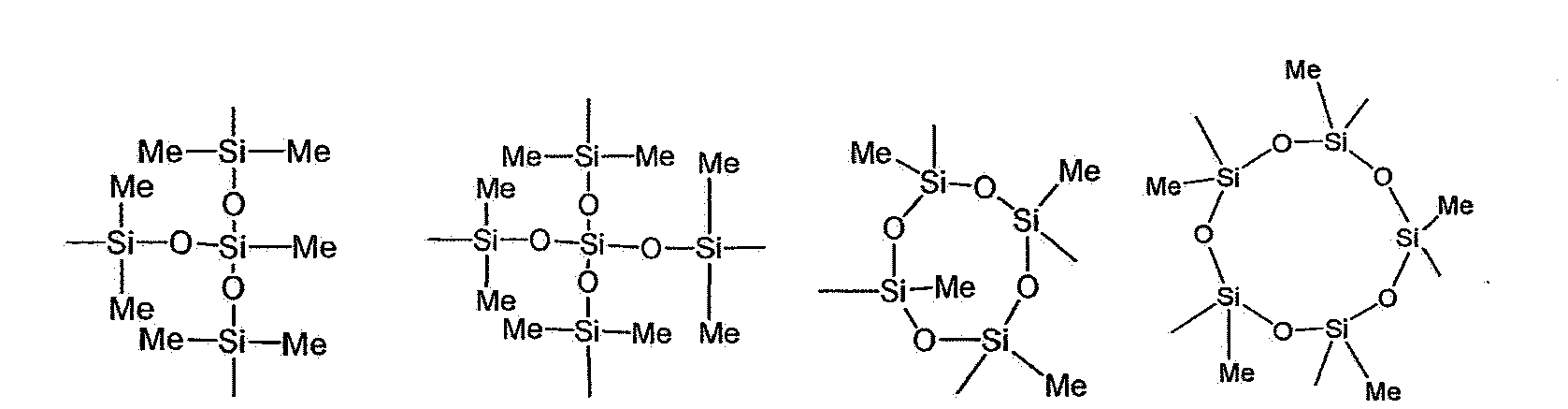
- Z 1 is a single bond or a di- to nona-valent group having 1 to 15 silicon atoms. As described above, the hydrolyzable group, A, is directly bonded to Q when Z 1 is a single bond. Examples of Z 1 are as shown below: wherein n is an integer of from 0 to 14;
- Z 2 is a divalent polyorganosiloxylene group having 2 to 100 silicon atoms.
- Z 2 is the following linear polyorganosiloxylene group: wherein m is an integer of from 1 to 99, preferably from 9 to 49, R may be the same with or different from each other and is a C 1-4 alkyl, aryl or aralkyl group.
- A is a group represented by the following formula : -C b H 2b SiR 3-a X a wherein X is a hydrolyzable group.
- X include alkoxy groups having 1 to 10 carbon atoms such as methoxy, ethoxy, propoxy and buthoxy groups; oxyalkoxy groups having 2 to 10 carbon atoms such as methoxymethoxy and methoxyethoxy groups; acyloxy groups having 1 to 10 carbon atoms such as an acetoxy group; alkenyloxy groups having 2 to 10 carbon atoms such as an isopropenoxy group; halogen atoms such as chlorine, bromine, and iodine atoms.
- methoxy, ethoxy, iropropenoxy groups and chlorine atom are preferred.
- R is an alkyl group having 1 to 4 carbon atoms such as methyl or ethyl group, or a phenyl group, among which a methyl group is preferred; a is 2 or 3, preferably 3, because of higher reactivity and stronger bonding to a substrate and two or three X's may be different from each other; and b is an integer of from 0 to 6, preferably 0, 2 or 3.
- the aforesaid fluorine-containing organosilicon compounds can be prepared by the following method.
- the fluorine-containing organosilicon compound of the formula (1) can be produced by reacting a compound having an unsaturated group represented by the following formula , wherein R, X, a and b are as defined above, with an organohydrogenpolysiloxane of the formula, Z 1 H k , wherein k is an integer of from 2 to 9, in the presence of an addition reaction catalyst to produce an organohydrogenpolysiloxane with its hydrogen atoms partly substituted with the group, A, and then reacting a fluroine-containing group having an unsaturated group Q' represented by the following formula (i) Rf 1 Q' (i) with the remaining hydrogen atoms of the organohydrogenpolysiloxane having the group A.
- Rf 1 is as defined above and Q' is a group having an unsaturated bond as shown below.
- the fluorine-containing organosilicon compound of the formula (2) can be produced by subjecting an addition-reaction the following compound (ii) having unsaturated bonds at both ends of Rf 2 Q'Rf 2 Q' (ii) ,wherein Rf 2 and Q' are as defined above, with an organohydrogenpolysiloxane of the formula, Z 2 H 2 , to produce a compound represented by the following formula Q'-Rf 2 -(Q-Z 2 -Q-Rf 2 ) x -Q' and then adding the aforesaid organohydrogenpolysiloxane having the group A to Q'.
- the addition reaction can be performed according to conventional methods.
- the addition-reaction to introduce the group A can be performed first.
- Component (B) is a fluorine-containing carboxylic acid having a number average molecular weight of from 100 to 10,000, preferably from 200 to 8,000, and a fluorine content of at least 25 wt%, based on weight of the fluorine-containing carboxylic acid. Having a fluorine content of at least 25 wt%, the fluorine-containing carboxylic acid has excellent solubility in fluorinated solvents. In addition, it functions as a water- and oil-repellent agent in a cured layer. Preferably a perfluoroalkyl carboxylic acid and/or a perfluoropolyether carboxylic acid are used.
- the fluorine-containing carboxylic acid has one or more fluorine atom bonded to ⁇ -carbon to which a carboxyl group is bonded.
- a fluorine-containing carboxylic acid has higher catalytic activity.
- Preferred examples of the fluorine-containing carboxylic acid are as shown below: wherein n is an integer of from 0 to 20 and m is 1 or 2; wherein n is an integer of from 0 to 20; wherein n is an integer of from 0 to 20; wherein n is an integer of from 1 to 200; wherein n is an integer of from 1 to 10, and m is an integer of from 1 to 100; wherein 1 is an integer of from 0 to 100, m is an integer of from 0 to 100, and n is an integer of from 1 to 10; wherein m is an integer of 1 to 200, n is an integer of from 1 to 200, and repeating units, -OCF 2 - and -OC 2 F 4 -, may be linked randomly.
- a derivative of the fluorine-containing carboxylic acid can also be used which derivative changes into a corresponding carboxylic acid through a reaction such as hydrolysis when the composition is used.
- Examples of the derivative include carboxylic acid anhydrides and carboxylic acid esters.
- a content of the component (B) in the composition ranges from 0.001 to 10 parts by weight, preferably from 0.05 to 2 parts by weight, per 100 parts by weight of the component (A), depending on desired curing time and a molecular weight of the component (B). If the component (B) is contained less than the aforesaid lower limit, desired catalytic effect is not attained. If the component (B) is contained more than the aforesaid upper limit, it may degrade a cured coating, for example, lowering water-repellency of the coating.
- Mixing the component (A) with (B) can be performed with a known mixing means. These components may be mixed after each component is dissolved in the after-mentioned solvent.
- the present coating composition is usually diluted with a fluorinated solvent just before use. It may be diluted beforehand.
- fluorinated solvents include 1,3-bistrifluoromethylbenzene and those represented by the following formulas: C 4 F 9 OCH 3 C 4 F 9 OC 2 H 5 CF 3 CF 2 CHCl 2 C 2 H 5 CF(OCH 3 )CF(CF 3 ) 2
- a mixture of two or more of these may be used.
- a non-fluorinated solvent may be added in an amount not to adversely affect the present invention.
- the fluorinated solvent is used in such an amount that a total weight% of the components (A) and (B), based on total weight of the coating composition, ranges from 0.01 to 1 %, preferably from 0.05 to 0.5 wt %.
- the coating composition is applied to an object to be surface-treated.
- the application may be performed by dipping the object in the coating composition and then pulling up the object followed by drying the object.
- the component (B) catalyzes hydrolysis reaction with atmospheric moisture and condensation reaction, so that a cured coating is formed rapidly.
- the application may be performed by spraying, brushing, or spin-coating.
- Curing of the applied composition can be performed by standing the applied composition at a temperature of from 20 to 35 °C for 15 minutes to 2 hours.
- the applied composition may be heated at a temperature of 100 °C or lower.
- the composition can be cured at a relative humidity of from 10 to 90 %, with a higher relative humidity preferred.
- An object or an article to be treated with the composition may be made of any material such as paper, cloth, metal or an oxide thereof, glass, plastic or ceramic.
- the treatment with the present composition provides the object with water- and oil-repellency, and antifouling property.
- Coating compositions of Examples and Comparative Examples were prepared by dissolving a fluorine-containing organosilicon compound and a catalyst in a fluorinated solvent, Novec HFE-7200, ex Sumitomo 3M Ltd. at concentrations as shown in Table 1.
- a sheet of a slide glass was dipped and then pulled up to be coated with the composition.
- the slide glass coated with the composition was left in an environment at a temperature of 25 °C and at a relative humidity of 50 %.
- a water contact angle of the coating layer was measured by a sliding method with a contact angle meter, Model A3, ex Kyowa InterFACE Science Co.,Ltd. The results are as shown in Table 1.
- B-5 Fluorine-containing organosilicon wt% Catalyst ppm Water contact angle after 30min.,degree
- Example 1 A-1 B-2 30 116
- Example 2 A-2 0.3 B-2 30 117
- Example 3 A-2 0.3 B-1 5 117
- Example 8 A-6 0.3 B-3 15 104
- Example 9 A-7 0.3 B-4 30 116
- composition comprising the catalyst B-1, B-2, B-3 or B-4 showed significantly larger contact angle than those comprising B-5 or B-6. This indicates that the compositions of Examples are sufficiently cured even in 30 minutes, whereas the compositions of Comparative Examples are not.
- the present composition is thus very useful for coating applications where rapid curing at low temperature is desired.
Landscapes
- Chemical & Material Sciences (AREA)
- Organic Chemistry (AREA)
- Life Sciences & Earth Sciences (AREA)
- Engineering & Computer Science (AREA)
- Materials Engineering (AREA)
- Wood Science & Technology (AREA)
- Chemical Kinetics & Catalysis (AREA)
- Health & Medical Sciences (AREA)
- Medicinal Chemistry (AREA)
- Polymers & Plastics (AREA)
- General Chemical & Material Sciences (AREA)
- Paints Or Removers (AREA)
Abstract
Description
- The present invention relates to a coating composition which can be cured rapidly to form a coating layer having excellent water- and oil-repellency, and antifouling property.
- To prevent an article from being fouled with finger prints, sebum, sweat, cosmetics, or food, an antifouling coating is often provided to the article such as lenses of eye glasses or sun glasses, displays of cell phones, personal digital assistants, portable musical players, liquid displays, CRT displays, plasma displays, and EL displays, optical mediums such as compact disks(CD) and digital versatile disks(DVD), and window glass.
- Japanese Patent Application Laid-Open, hereinafter abbreviated as "JPA",
No.H09-137117 No.2000-143991 2005-290323 H02-248480 H06-184527 H06-256756 - To apply the fluoroalkylsilane and the perfluoropolyether having a terminal alkoxysilyl group, they are usually dissolved in a solvent and then spin-coated on an object. However, due to their high fluorine contents, they are soluble only in limited solvents, mostly fluorinated solvents. Because such solvents are not miscible with water, hydrolysis of the fluoroalkylsilane or the perfluoropolyether is controlled by atmospheric moisture, proceeding slowly.
- To solve this problem, JPA No.H10-204421 describes a method of surface reforming comprising the steps of surface-treating with a silane coupling agent having a polar group which agent is soluble in various solvents, and then reacting the polar group with a fluoroalkyl carboxylic acid halide or a perfluoropolyoxyalkyl carboxylic acid halide to fix the fluoroalkyl or perfluoro polyoxyalkyl group to the surface. The method requires two steps, which is troublesome and time-consuming. Further, halides formed in the second step are not desirable from the environmental viewpoint.
- To promote hydrolysis of an alkoxysilyl group, a catalyst may be added to a coating composition. Examples of known catalysts for hydrolysis reaction include organic titanate such as tetrabutyl titanate and tetraisopropyl titanate; organic titanium chelate compounds such as titanium diisopropoxy bis(ethylacetoacetate); organic aluminum compounds such as aluminum tris(acetylacetonate) and aluminum tris(ethyl acetoacetate); organic zirconium compounds such as zirconium tetra(acetylacetonate) and zirconium tetrabutylate; organic tin compounds such as dibutyltin dioctoate, dibutyltin dilaurate, dibutyltin di(2-ethylhexanoate), dioctyltin dilaurate, dioctyltin diacetate, and dioctyltin dioctoate; a metal salt of a carboxylic acid such as tin naphthenate, tin oleate, tin butylate, cobalt naphthenate, and zinc stearate; amine compounds and salts thereof such as hexyl amine and dodecyl amine phosphate; quarterly amine salts such as benzyl triethyl ammonium acetate; salts of lower fatty acids such as potassium acetate and lithium nitrate; dialkylhydroxylamine such as dimehtylhydroxylamine and diethylhydroxylamine; organosilicon compound having a guanidyl group such as tetramethylguanidylpropyltrimethoxy silane; organic acids such as acetic acid and methanesulfonic acid, and inorganic acid.
- However, these catalysts are insoluble or scarcely soluble in fluorinated solvents, so that catalytic efficiency of these catalysts is low. Moreover, metals contained in the catalysts remain in a cured coating layer to cause degradation of the coating layer.
- An object of the present invention is to provide a coating composition which can rapidly form coating layer in a simple process.
- After extensive studies, the present inventors have found that the above object can be attained by using a specific carboxylic acid as a catalyst.
- The present invention is a coating composition comprising
- (A) at least one fluorine-containing organosilicon compound represented by the following formula (1) or (2)
Rf1-QZ1 Aα (1)
AαZ1 Q-Rf2-(Q-Z2-Q-Rf2)x-QZ1 Aα (2)
wherein Rf1 is a perfluoroalkyl group or a perfluoroxyalkyl group,
Rf2 is a perfluoroxyalkylene group,
Z1 is a single bond or a di- to nona-valent organic group containing 1 to 15 silicon atoms,
Z2 is a divalent polyorganosiloxylene group having 2 to 100 silicon atoms,
Q is a di- to nona-valent group having 2 to 12 carbon atoms and may have an oxygen and/or nitrogen atom, Q in the formula (2) being the same with or different from each other,
α is an integer of from 1 to 8, x is an integer of from 0 to 5, and A is a group represented by the following formula
-CbH2bSiR3-aXa
wherein R is a C1-4 alkyl group or a phenyl group, X is a hydrolyzable group, a is 2 or 3, and b is an integer of from 0 to 6, and - (B) a fluorine-containing carboxylic acid having a number average molecular weight of from 100 to 10,000 and a fluorine content of at least 25 wt%, based on weight of the fluorine-containing carboxylic acid, wherein an amount of the fluorine-containing carboxylic acid ranges from 0.001 to 10 parts by weight per 100 parts by weight of the component (A).
- The coating composition of the present invention can be cured rapidly even at room temperature to from a coating which is excellent in water-repellency and adheres strongly to a substrate.
- The component (A) is a fluorine-containing silicon compound represented by the above formula (1) or (2). A mixture of these compounds can be used. In the formulas (1) and (2), Rf1 and Rf2 are fluorine-containing groups. Rf1 is a perfluoroalkyl group or a perfluoroxyalkyl group, and may be branched. Preferably, Rf1 has 2 to 14 carbon atoms. An example of the perfluoroalkyl group is as shown below:
CF3 (CF2)n-
wherein n is an integer of from 1 to 13, preferably from 4 to 10. - An example of the perfluoroxyalkyl group is as shown below:
CF3 (CkF2kO)m-
wherein k is an integer of from 1 to 8, and m is an integer of from 2 to 200. Preferably, Rf1 is represented by the following formula (3), (4) or (5):
CF3O(CF2CF2 CF2O)mCdF2d- (4)
wherein m is an integer of from 2 to 200, and d is an integer of from 1 to 3;
CF3O(CF2O)e(C2F4O)fCF2- (5)
wherein e is an integer of from 0 to 200, f is an integer of from 0 to 200 with e+f ranging from 2 to 200, and repeating units, -CF2O- and -C2F4O-, may be linked randomly. - Rf2 is a divalent perfluoroxyalkylene group which may be branched. The group may have one or more of the repeating unit represented by the formula, -CgF2gO-, wherein g is an integer of from 1 to 6, so that an example of Rf2 is represented by the formula, -(CgF2gO)h-, wherein h is an integer of from 1 to 500, preferably 2 to 400, more preferably 10 to 200. Among a plurality of repeating units, g may be different from each other.
- Examples of the repeating unit, -CgF2gO-, are as shown below and Rf2 may have a combination of two or more of these units.
-CF2O-
-CF2CF2O-
-CF2CF2CF2O-
-CF(CF3)CF2O-
-CF2CF2CF2CF2O-
-CF2CF2CF2CF2CF2CF2O-
- Preferably, Rf2 is represented by the following formula (6), (7) or (8):


- CdF2d (CF2CF2 CF2O)lCdF2d- (7)
wherein 1 is an integer of from 1 to 200, and d is an integer of from 1 to 3;

- More preferred Rf2 has repeating units with g ranging from 1 to 4. Preferably, m, p and q range from 1 to 50, most preferably, from 10 to 40.
- Q is a group to connect Rf1 with Z1, Rf2 with Z2, and Rf2 with Z1. In the formula (2), Q between Rf2 and Z1, and Q between Rf2 and Z2 may be different from each other. When Z1 is a single bond, Q is directly bonded to A, connecting Rf1 or Rf2 with A. Q is a di- to nona-valent organic group having 2 to 12 carbon atoms and may have an oxygen and/or nitrogen atom. Examples of Q include following groups having a hydrocarbon group, amide, ether, or ester bond:
-CH2O-(-CH2-)-n
wherein n is an integer of from 0 to 4;
-(-CH2-)-n
wherein n is an integer of from 1 to 6;


- Z1 is a single bond or a di- to nona-valent group having 1 to 15 silicon atoms. As described above, the hydrolyzable group, A, is directly bonded to Q when Z1 is a single bond. Examples of Z1 are as shown below:



- Z2 is a divalent polyorganosiloxylene group having 2 to 100 silicon atoms. Preferably, Z2 is the following linear polyorganosiloxylene group:

- A is a group represented by the following formula :
-CbH2bSiR3-aXa
wherein X is a hydrolyzable group. Examples of X include alkoxy groups having 1 to 10 carbon atoms such as methoxy, ethoxy, propoxy and buthoxy groups; oxyalkoxy groups having 2 to 10 carbon atoms such as methoxymethoxy and methoxyethoxy groups; acyloxy groups having 1 to 10 carbon atoms such as an acetoxy group; alkenyloxy groups having 2 to 10 carbon atoms such as an isopropenoxy group; halogen atoms such as chlorine, bromine, and iodine atoms. Among these, methoxy, ethoxy, iropropenoxy groups and chlorine atom are preferred. - R is an alkyl group having 1 to 4 carbon atoms such as methyl or ethyl group, or a phenyl group, among which a methyl group is preferred; a is 2 or 3, preferably 3, because of higher reactivity and stronger bonding to a substrate and two or three X's may be different from each other; and b is an integer of from 0 to 6, preferably 0, 2 or 3.
- The aforesaid fluorine-containing organosilicon compounds can be prepared by the following method.
- The fluorine-containing organosilicon compound of the formula (1) can be produced by reacting a compound having an unsaturated group represented by the following formula

with an organohydrogenpolysiloxane of the formula, Z1Hk, wherein k is an integer of from 2 to 9, in the presence of an addition reaction catalyst to produce an organohydrogenpolysiloxane with its hydrogen atoms partly substituted with the group, A, and then reacting a fluroine-containing group having an unsaturated group Q' represented by the following formula (i)
Rf1Q' (i)
with the remaining hydrogen atoms of the organohydrogenpolysiloxane having the group A. - In the formula (i), Rf1 is as defined above and Q' is a group having an unsaturated bond as shown below.

- The fluorine-containing organosilicon compound of the formula (2) can be produced by subjecting an addition-reaction the following compound (ii) having unsaturated bonds at both ends of Rf2
Q'Rf2Q' (ii)
,wherein Rf2 and Q' are as defined above, with an organohydrogenpolysiloxane of the formula, Z2H2, to produce a compound represented by the following formula
Q'-Rf2-(Q-Z2-Q-Rf2)x-Q'
and then adding the aforesaid organohydrogenpolysiloxane having the group A to Q'. The addition reaction can be performed according to conventional methods. The addition-reaction to introduce the group A can be performed first. - Component (B) is a fluorine-containing carboxylic acid having a number average molecular weight of from 100 to 10,000, preferably from 200 to 8,000, and a fluorine content of at least 25 wt%, based on weight of the fluorine-containing carboxylic acid. Having a fluorine content of at least 25 wt%, the fluorine-containing carboxylic acid has excellent solubility in fluorinated solvents. In addition, it functions as a water- and oil-repellent agent in a cured layer. Preferably a perfluoroalkyl carboxylic acid and/or a perfluoropolyether carboxylic acid are used.
- More preferably, the fluorine-containing carboxylic acid has one or more fluorine atom bonded to α-carbon to which a carboxyl group is bonded. Such a fluorine-containing carboxylic acid has higher catalytic activity.
- Preferred examples of the fluorine-containing carboxylic acid are as shown below:


- A derivative of the fluorine-containing carboxylic acid can also be used which derivative changes into a corresponding carboxylic acid through a reaction such as hydrolysis when the composition is used. Examples of the derivative include carboxylic acid anhydrides and carboxylic acid esters.
- A content of the component (B) in the composition ranges from 0.001 to 10 parts by weight, preferably from 0.05 to 2 parts by weight, per 100 parts by weight of the component (A), depending on desired curing time and a molecular weight of the component (B). If the component (B) is contained less than the aforesaid lower limit, desired catalytic effect is not attained. If the component (B) is contained more than the aforesaid upper limit, it may degrade a cured coating, for example, lowering water-repellency of the coating. Mixing the component (A) with (B) can be performed with a known mixing means. These components may be mixed after each component is dissolved in the after-mentioned solvent.
- The present coating composition is usually diluted with a fluorinated solvent just before use. It may be diluted beforehand. Preferred examples of the fluorinated solvents include 1,3-bistrifluoromethylbenzene and those represented by the following formulas:
C4F9OCH3
C4F9OC2H5
CF3CF2CHCl2
C2H5CF(OCH3)CF(CF3)2
- These solvents are available under the trade names of Novec HFE-7100, Novec HFE-7200, Novec 7300, Fluorinert FC-77, all from Sumitomo 3M Ltd., and Asahiklin AK-225 from Asahi Glass Co. Ltd. A mixture of two or more of these may be used. A non-fluorinated solvent may be added in an amount not to adversely affect the present invention. Preferably, the fluorinated solvent is used in such an amount that a total weight% of the components (A) and (B), based on total weight of the coating composition, ranges from 0.01 to 1 %, preferably from 0.05 to 0.5 wt %.
- The coating composition is applied to an object to be surface-treated. The application may be performed by dipping the object in the coating composition and then pulling up the object followed by drying the object. In the applied coating composition, the component (B) catalyzes hydrolysis reaction with atmospheric moisture and condensation reaction, so that a cured coating is formed rapidly. The application may be performed by spraying, brushing, or spin-coating.
- Curing of the applied composition can be performed by standing the applied composition at a temperature of from 20 to 35 °C for 15 minutes to 2 hours. The applied composition may be heated at a temperature of 100 °C or lower. The composition can be cured at a relative humidity of from 10 to 90 %, with a higher relative humidity preferred.
- An object or an article to be treated with the composition may be made of any material such as paper, cloth, metal or an oxide thereof, glass, plastic or ceramic. The treatment with the present composition provides the object with water- and oil-repellency, and antifouling property.
- The present invention is explained with reference to the following examples, but not limited thereto.
- Coating compositions of Examples and Comparative Examples were prepared by dissolving a fluorine-containing organosilicon compound and a catalyst in a fluorinated solvent, Novec HFE-7200, ex Sumitomo 3M Ltd. at concentrations as shown in Table 1. In each composition obtained, a sheet of a slide glass was dipped and then pulled up to be coated with the composition. The slide glass coated with the composition was left in an environment at a temperature of 25 °C and at a relative humidity of 50 %. After 30 minutes from the coating, a water contact angle of the coating layer was measured by a sliding method with a contact angle meter, Model A3, ex Kyowa InterFACE Science Co.,Ltd. The results are as shown in Table 1.
- In Table 1, A-1 to A-7 are the following fluorine-containing organosilicon compounds.


- In Table 1, B-1 to B-6 are the following catalysts.




(B-5) CH3-COOH
(B-6) C3H7-COOH
Table 1 Fluorine-containing organosilicon wt% Catalyst ppm Water contact angle after 30min.,degree Example 1 A-1 B-2 30 116 Example 2 A-2 0.3 B-2 30 117 Example 3 A-2 0.3 B-1 5 117 Example 4 A-2 0.3 B-3 15 116 Example 5 A-3 0.3 B-2 30 115 Example 6 A-4 0.3 B-4 30 106 Example 7 A-5 0.3 B-4 10 105 Example 8 A-6 0.3 B-3 15 104 Example 9 A-7 0.3 B-4 30 116 Comparative Example 1 A-2 0.3 B-5 100 82 Comparative Example 2 A-2 0.3 B-6 150 85 - As is evident from Table 1, the composition comprising the catalyst B-1, B-2, B-3 or B-4 showed significantly larger contact angle than those comprising B-5 or B-6. This indicates that the compositions of Examples are sufficiently cured even in 30 minutes, whereas the compositions of Comparative Examples are not. The present composition is thus very useful for coating applications where rapid curing at low temperature is desired.
Claims (7)
- A coating composition comprising(A) at least one fluorine-containing organosilicon compound represented by the following formula (1) or (2)
Rf1-QZ1Aα (1)
AαZ1Q-Rf2-(Q-Z2-Q-Rf2)x-QZ1Aα (2)
wherein Rf1 is a perfluoroalkyl group or a perfluoroxyalkyl group,
Rf2 is a perfluoroxyalkylene group,
Z1 is a single bond or a di- to nona-valent organic group having 1 to 15 silicon atoms,
Z2 is a divalent polyorganosiloxylene group having 2 to 100 silicon atoms,
Q is a di- to nona-valent group having 2 to 12 carbon atoms and may have an oxygen and/or nitrogen atom, Q in the formula (2) being the same with or different from each other,
α is an integer of from 1 to 8, x is an integer of from 0 to 5, and A is a group represented by the following formula
-CbH2bSiR3-aXa
wherein R is a C1-4 alkyl group or a phenyl group, X is a hydrolyzable group, a is 2 or 3, and b is an integer of from 0 to 6, and(B) a fluorine-containing carboxylic acid having a number average molecular weight of from 100 to 10,000 and a fluorine content of at least 25 wt%, based on weight of the fluorine-containing carboxylic acid, wherein an amount of the fluorine-containing carboxylic acid ranges from 0.001 to 10 parts by weight per 100 parts by weight of the component (A). - The coating composition according to claim 1, wherein the component (B) is a perfluoroalkyl carboxylic acid or a perfluoropolyether carboxylic acid.
- The coating composition according to claim 1 or 2, wherein the component (B) is represented by any one of the following formulas:


- The coating composition according to claim 1 or 2, wherein the component (B) is represented by any one of the following formulas:


- The coating composition according to any one of claims 1 to 4, wherein the coating composition further comprises (C) a fluorinated solvent in such an amount that a total wt% of the components (A) and (B), based on total weight of the coating composition, ranges from 0.01 to 1 wt%.
- The coating composition according to any one of claims 1 to 5, wherein Rf1 in the formula (1) is represented by the following formula (3), (4) or (5):

CF3O(CF2CF2 CF2O)mCdF2d- (4)
wherein m is an integer of from 2 to 200, and d is an integer of from 1 to 3;
CF3O(CF2O)e(C2F4O)fCF2- (5)
wherein e is an integer of from 0 to 200, f is an integer of from 0 to 200 with e+f ranging from 2 to 200, and the repeating units, -CF2O- and -C2F4O-, may be linked randomly. - The coating composition according to any one of claims 1 to 6, wherein Rf2 in the formula (2) is represented by the following formula (6), (7) or (8):

- CdF2d (CF2CF2 CF2O)lCdF2d- (7)
wherein 1 is an integer of from 1 to 200, and d is an integer of from 1 to 3;
Applications Claiming Priority (2)
| Application Number | Priority Date | Filing Date | Title |
|---|---|---|---|
| JP2006309528 | 2006-11-15 | ||
| JP2007286016A JP2008144144A (en) | 2006-11-15 | 2007-11-02 | Coating agent composition |
Publications (3)
| Publication Number | Publication Date |
|---|---|
| EP1923434A1 true EP1923434A1 (en) | 2008-05-21 |
| EP1923434B1 EP1923434B1 (en) | 2011-02-02 |
| EP1923434B8 EP1923434B8 (en) | 2013-08-28 |
Family
ID=39111502
Family Applications (1)
| Application Number | Title | Priority Date | Filing Date |
|---|---|---|---|
| EP07120741.9A Ceased EP1923434B8 (en) | 2006-11-15 | 2007-11-15 | Coating Composition |
Country Status (2)
| Country | Link |
|---|---|
| US (1) | US7847015B2 (en) |
| EP (1) | EP1923434B8 (en) |
Cited By (6)
| Publication number | Priority date | Publication date | Assignee | Title |
|---|---|---|---|---|
| EP1997824A1 (en) * | 2007-06-01 | 2008-12-03 | Shin-Etsu Chemical Co., Ltd. | Perfluoropolyether-modified aminosilane, surface treating agent, and aminosilane-coated article |
| ITMI20102217A1 (en) * | 2010-11-30 | 2012-05-31 | Milano Politecnico | SURFACE COATING WITH PERFLUORURED COMPOUNDS AS AN ANTIFOULING |
| EP2927292A1 (en) | 2014-03-31 | 2015-10-07 | Shin-Etsu Chemical Co., Ltd. | Fluoropolyether-containing polymer-modified silane, surface treating agent, and article |
| WO2019151442A1 (en) | 2018-02-02 | 2019-08-08 | ダイキン工業株式会社 | Fluoro (poly)ether group-containing silane compound |
| WO2019151445A1 (en) | 2018-02-02 | 2019-08-08 | ダイキン工業株式会社 | Electronic device |
| EP4095181A4 (en) * | 2020-01-20 | 2024-02-28 | Shin-Etsu Chemical Co., Ltd. | Alkoxysilyl group-containing perfluoropolyether compound, and composition containing same |
Families Citing this family (7)
| Publication number | Priority date | Publication date | Assignee | Title |
|---|---|---|---|---|
| JP2010254832A (en) * | 2009-04-27 | 2010-11-11 | Shin-Etsu Chemical Co Ltd | Antifouling paint composition and antifouling method |
| EP3022267A4 (en) * | 2013-07-17 | 2016-12-28 | Honeywell Int Inc | Substrate coating compositions and methods |
| JP6724994B2 (en) * | 2016-09-08 | 2020-07-15 | ダイキン工業株式会社 | Composition containing perfluoro(poly)ether group-containing silane compound |
| CN109790443B (en) * | 2016-10-06 | 2022-03-29 | 信越化学工业株式会社 | Surface treatment agent, article having cured product of surface treatment agent, and method for forming cured coating on surface of article |
| CN110537116B (en) * | 2017-04-20 | 2021-10-29 | 信越化学工业株式会社 | Anti-reflection member and method of manufacturing the same |
| CN111032337B (en) | 2017-08-17 | 2023-02-10 | 信越化学工业株式会社 | Water-repellent member and method of manufacturing water-repellent member |
| JP6988905B2 (en) | 2017-10-03 | 2022-01-05 | 信越化学工業株式会社 | Water- and oil-repellent member and method for manufacturing water- and oil-repellent member |
Citations (11)
| Publication number | Priority date | Publication date | Assignee | Title |
|---|---|---|---|---|
| JPS58147484A (en) * | 1982-02-26 | 1983-09-02 | Asahi Glass Co Ltd | Water and oil repellent for glass surface |
| JPH06184527A (en) * | 1992-12-18 | 1994-07-05 | Central Glass Co Ltd | Water repellent, substrate treated therewith, and its production |
| EP0696627A1 (en) * | 1994-08-12 | 1996-02-14 | Shin-Etsu Chemical Co., Ltd. | Water repellent composition |
| JPH08209118A (en) * | 1994-08-12 | 1996-08-13 | Shin Etsu Chem Co Ltd | Water repellent treatment |
| US5660888A (en) * | 1995-04-28 | 1997-08-26 | Minnesota Mining & Manufacturing Company | Surfactants to create fluoropolymer dispersions in fluorinated liquids |
| EP1059320A2 (en) * | 1999-05-20 | 2000-12-13 | Shin-Etsu Chemical Co., Ltd. | Perfluoropolyether-modified amonisilane, surface treating agent, and aminosilane-coated article |
| WO2002030848A1 (en) * | 2000-10-12 | 2002-04-18 | 3M Innovative Properties Company | Compositions comprising fluorinated polyether silanes for rendering substrates oil and water repellent |
| JP2002348370A (en) * | 2001-05-25 | 2002-12-04 | Shin Etsu Chem Co Ltd | Perfluoropolyether-modified silane and surface treatment agent using the same |
| EP1300433A2 (en) * | 2001-10-05 | 2003-04-09 | Shin-Etsu Chemical Co., Ltd. | Perfluoropolyether-modified silane, surface treating agent, and antireflection filter |
| US20030124361A1 (en) * | 2001-11-08 | 2003-07-03 | 3M Innovative Properties Company | Coating composition comprising fluorochemical polyether silane polycondensate and use thereof |
| US20040091720A1 (en) * | 2001-11-08 | 2004-05-13 | 3M Innovative Properties Company | Coating composition comprising a fluorochemical polyether silane partial condensate and use thereof |
Family Cites Families (14)
| Publication number | Priority date | Publication date | Assignee | Title |
|---|---|---|---|---|
| JPS58147448A (en) | 1982-02-25 | 1983-09-02 | Kanegafuchi Chem Ind Co Ltd | Resin composition |
| JPH0781024B2 (en) | 1989-03-22 | 1995-08-30 | 旭硝子株式会社 | Water repellency. Antifouling transparent base material and structure equipped with the same |
| JPH0662853B2 (en) * | 1989-08-03 | 1994-08-17 | 信越化学工業株式会社 | Room temperature curable organopolysiloxane composition |
| JPH0710872B2 (en) * | 1989-08-03 | 1995-02-08 | 信越化学工業株式会社 | Fluorine-containing carboxylic acid derivative and method for producing the same |
| GB9122328D0 (en) * | 1991-10-22 | 1991-12-04 | British Petroleum Co Plc | Novel esters |
| EP0562878B1 (en) * | 1992-03-27 | 1997-05-14 | Shin-Etsu Chemical Co., Ltd. | Room temperature curable organopolysiloxane composition and cured product of the same |
| US5290900A (en) * | 1992-04-27 | 1994-03-01 | Dow Corning Toray Silicone, Ltd. | Curable fluorosilicone resin composition |
| JP2776190B2 (en) | 1993-03-08 | 1998-07-16 | 信越化学工業株式会社 | Water repellent composition |
| EP0745604A3 (en) * | 1995-05-29 | 1998-07-29 | Shin-Etsu Chemical Co., Ltd. | Room temperature curable fluoropolymer composition; and fluorine-containing organosilicon compounds, a method of producing the same, and room temperature curable silicone composition containing the same |
| JP3508342B2 (en) | 1995-11-15 | 2004-03-22 | 住友化学工業株式会社 | Method for forming silane compound coating |
| JPH10204421A (en) | 1997-01-27 | 1998-08-04 | Matsushita Electric Ind Co Ltd | Surface modification method |
| JP3712031B2 (en) * | 1998-02-23 | 2005-11-02 | 信越化学工業株式会社 | Curable composition |
| JP3622830B2 (en) | 1998-11-06 | 2005-02-23 | 信越化学工業株式会社 | COATING COMPOSITION AND ARTICLE HAVING THE COATING FILM |
| JP2005290323A (en) | 2004-04-05 | 2005-10-20 | Shin Etsu Chem Co Ltd | Surface treatment agent composition |
-
2007
- 2007-11-14 US US11/984,175 patent/US7847015B2/en not_active Expired - Fee Related
- 2007-11-15 EP EP07120741.9A patent/EP1923434B8/en not_active Ceased
Patent Citations (11)
| Publication number | Priority date | Publication date | Assignee | Title |
|---|---|---|---|---|
| JPS58147484A (en) * | 1982-02-26 | 1983-09-02 | Asahi Glass Co Ltd | Water and oil repellent for glass surface |
| JPH06184527A (en) * | 1992-12-18 | 1994-07-05 | Central Glass Co Ltd | Water repellent, substrate treated therewith, and its production |
| EP0696627A1 (en) * | 1994-08-12 | 1996-02-14 | Shin-Etsu Chemical Co., Ltd. | Water repellent composition |
| JPH08209118A (en) * | 1994-08-12 | 1996-08-13 | Shin Etsu Chem Co Ltd | Water repellent treatment |
| US5660888A (en) * | 1995-04-28 | 1997-08-26 | Minnesota Mining & Manufacturing Company | Surfactants to create fluoropolymer dispersions in fluorinated liquids |
| EP1059320A2 (en) * | 1999-05-20 | 2000-12-13 | Shin-Etsu Chemical Co., Ltd. | Perfluoropolyether-modified amonisilane, surface treating agent, and aminosilane-coated article |
| WO2002030848A1 (en) * | 2000-10-12 | 2002-04-18 | 3M Innovative Properties Company | Compositions comprising fluorinated polyether silanes for rendering substrates oil and water repellent |
| JP2002348370A (en) * | 2001-05-25 | 2002-12-04 | Shin Etsu Chem Co Ltd | Perfluoropolyether-modified silane and surface treatment agent using the same |
| EP1300433A2 (en) * | 2001-10-05 | 2003-04-09 | Shin-Etsu Chemical Co., Ltd. | Perfluoropolyether-modified silane, surface treating agent, and antireflection filter |
| US20030124361A1 (en) * | 2001-11-08 | 2003-07-03 | 3M Innovative Properties Company | Coating composition comprising fluorochemical polyether silane polycondensate and use thereof |
| US20040091720A1 (en) * | 2001-11-08 | 2004-05-13 | 3M Innovative Properties Company | Coating composition comprising a fluorochemical polyether silane partial condensate and use thereof |
Cited By (10)
| Publication number | Priority date | Publication date | Assignee | Title |
|---|---|---|---|---|
| EP1997824A1 (en) * | 2007-06-01 | 2008-12-03 | Shin-Etsu Chemical Co., Ltd. | Perfluoropolyether-modified aminosilane, surface treating agent, and aminosilane-coated article |
| ITMI20102217A1 (en) * | 2010-11-30 | 2012-05-31 | Milano Politecnico | SURFACE COATING WITH PERFLUORURED COMPOUNDS AS AN ANTIFOULING |
| WO2012073198A1 (en) * | 2010-11-30 | 2012-06-07 | S.T. Special Tanks Srl | Surface coating with perfluorinated compounds as antifouling |
| EP2927292A1 (en) | 2014-03-31 | 2015-10-07 | Shin-Etsu Chemical Co., Ltd. | Fluoropolyether-containing polymer-modified silane, surface treating agent, and article |
| WO2019151442A1 (en) | 2018-02-02 | 2019-08-08 | ダイキン工業株式会社 | Fluoro (poly)ether group-containing silane compound |
| WO2019151445A1 (en) | 2018-02-02 | 2019-08-08 | ダイキン工業株式会社 | Electronic device |
| EP3747930A4 (en) * | 2018-02-02 | 2021-12-01 | Daikin Industries, Ltd. | SILANE COMPOUND INCLUDING A FLUORO (POLY) ETHER GROUP |
| EP3747931A4 (en) * | 2018-02-02 | 2021-12-15 | Daikin Industries, Ltd. | ELECTRONIC DEVICE |
| EP4095181A4 (en) * | 2020-01-20 | 2024-02-28 | Shin-Etsu Chemical Co., Ltd. | Alkoxysilyl group-containing perfluoropolyether compound, and composition containing same |
| EP4450562A3 (en) * | 2020-01-20 | 2025-01-22 | Shin-Etsu Chemical Co., Ltd. | Alkoxysilyl group-containing perfluoropolyether compound, and composition containing same |
Also Published As
| Publication number | Publication date |
|---|---|
| US20080114120A1 (en) | 2008-05-15 |
| EP1923434B1 (en) | 2011-02-02 |
| EP1923434B8 (en) | 2013-08-28 |
| US7847015B2 (en) | 2010-12-07 |
Similar Documents
| Publication | Publication Date | Title |
|---|---|---|
| EP1923434B1 (en) | Coating Composition | |
| EP2154176B1 (en) | Perfluoroether moiety-containing polymer and a surface treating agent comprising the same | |
| JP2008144144A (en) | Coating agent composition | |
| US8263724B2 (en) | Fluorine-containing surface treating agent and an article surface-treated therewith | |
| TWI439489B (en) | Polymer composition containing fluoroxyalkylene group and surface treating agent containing polymer composition and goods treated by treating agent | |
| EP1444305B1 (en) | Coating composition comprising a fluorochemical polyether silane partial condensate and use thereof | |
| CN101456947B (en) | Per-fluoro polyether compound, antifouling coating composition and film containing same | |
| EP3006447B1 (en) | Fluorochemical surface treating agent and article treated therewith | |
| EP2436716B1 (en) | Fluorooxyalkylene group-containing polymer composition, a surface treatment agent comprising the same and an article treated with the agent | |
| TWI791756B (en) | Fluoro (poly) ether group-containing silane compound | |
| EP2927293B1 (en) | Fluorochemical coating composition and article treated therewith | |
| US7829649B2 (en) | Perfluoropolyether-polyorganosiloxane block copolymer and a surface treatment agent comprising the same | |
| EP2011831B1 (en) | Coating composition and a coating therefrom having waterdrop sliding property | |
| US20080071042A1 (en) | Perfluoropolyether-organopolysiloxane copolymer and a surface treatment composition comprising the same | |
| JP2005528499A5 (en) | ||
| TWI853992B (en) | Fluorinated polyether-based polymers, surface treatment agents and articles | |
| TWI669306B (en) | Fluorine-containing coating agent and journal consulting by the coating agent | |
| EP2725078A1 (en) | Coating composition, surface treating material containing said composition, and article whose surface is treated with said surface treating material | |
| JPWO2015190526A1 (en) | Curable composition containing perfluoropolyether having a silyl group | |
| CN113677738B (en) | Fluorinated polyether group-containing compounds | |
| WO2019065035A1 (en) | Fluorine-containing coating agent composition, surface treating agent, and article | |
| WO2019088110A1 (en) | Curable composition | |
| TW202140614A (en) | Alkoxysilyl group-containing perfluoropolyether compound, and composition containing same | |
| TW201605996A (en) | Fluorine-containing coating agent and article treated with the same | |
| JP2002003595A (en) | Fluorine-containing cured product |
Legal Events
| Date | Code | Title | Description |
|---|---|---|---|
| PUAI | Public reference made under article 153(3) epc to a published international application that has entered the european phase |
Free format text: ORIGINAL CODE: 0009012 |
|
| AK | Designated contracting states |
Kind code of ref document: A1 Designated state(s): AT BE BG CH CY CZ DE DK EE ES FI FR GB GR HU IE IS IT LI LT LU LV MC MT NL PL PT RO SE SI SK TR |
|
| AX | Request for extension of the european patent |
Extension state: AL BA HR MK RS |
|
| 17P | Request for examination filed |
Effective date: 20081105 |
|
| 17Q | First examination report despatched |
Effective date: 20081219 |
|
| AKX | Designation fees paid |
Designated state(s): DE FR |
|
| GRAP | Despatch of communication of intention to grant a patent |
Free format text: ORIGINAL CODE: EPIDOSNIGR1 |
|
| GRAS | Grant fee paid |
Free format text: ORIGINAL CODE: EPIDOSNIGR3 |
|
| GRAA | (expected) grant |
Free format text: ORIGINAL CODE: 0009210 |
|
| AK | Designated contracting states |
Kind code of ref document: B1 Designated state(s): DE FR |
|
| REF | Corresponds to: |
Ref document number: 602007012330 Country of ref document: DE Date of ref document: 20110317 Kind code of ref document: P |
|
| REG | Reference to a national code |
Ref country code: DE Ref legal event code: R096 Ref document number: 602007012330 Country of ref document: DE Effective date: 20110317 |
|
| PLBE | No opposition filed within time limit |
Free format text: ORIGINAL CODE: 0009261 |
|
| 26N | No opposition filed |
Effective date: 20111103 |
|
| REG | Reference to a national code |
Ref country code: DE Ref legal event code: R097 Ref document number: 602007012330 Country of ref document: DE Effective date: 20111103 |
|
| PLAA | Information modified related to event that no opposition was filed |
Free format text: ORIGINAL CODE: 0009299DELT |
|
| PLBE | No opposition filed within time limit |
Free format text: ORIGINAL CODE: 0009261 |
|
| STAA | Information on the status of an ep patent application or granted ep patent |
Free format text: STATUS: NO OPPOSITION FILED WITHIN TIME LIMIT |
|
| R26N | No opposition filed (corrected) |
Effective date: 20111103 |
|
| RIN2 | Information on inventor provided after grant (corrected) |
Inventor name: KISHITA, HIROFUMI C/O SILICONE-ELECTRONICS MATERIA Inventor name: YAMANE, YUJI C/O SILICONE-ELECTRONICS MATERIALS RE Inventor name: KOIKE, NORIYUKI C/O SILICONE-ELECTRONICS MATERIALS Inventor name: YAMAGUCHI, KOICHI C/O SILICONE-ELECTRONICS MATERIA |
|
| REG | Reference to a national code |
Ref country code: FR Ref legal event code: PLFP Year of fee payment: 9 |
|
| REG | Reference to a national code |
Ref country code: FR Ref legal event code: PLFP Year of fee payment: 10 |
|
| REG | Reference to a national code |
Ref country code: FR Ref legal event code: PLFP Year of fee payment: 11 |
|
| REG | Reference to a national code |
Ref country code: FR Ref legal event code: PLFP Year of fee payment: 12 |
|
| PGFP | Annual fee paid to national office [announced via postgrant information from national office to epo] |
Ref country code: FR Payment date: 20230929 Year of fee payment: 17 |
|
| PGFP | Annual fee paid to national office [announced via postgrant information from national office to epo] |
Ref country code: DE Payment date: 20230929 Year of fee payment: 17 |
|
| REG | Reference to a national code |
Ref country code: DE Ref legal event code: R119 Ref document number: 602007012330 Country of ref document: DE |
|
| PG25 | Lapsed in a contracting state [announced via postgrant information from national office to epo] |
Ref country code: DE Free format text: LAPSE BECAUSE OF NON-PAYMENT OF DUE FEES Effective date: 20250603 |
|
| PG25 | Lapsed in a contracting state [announced via postgrant information from national office to epo] |
Ref country code: FR Free format text: LAPSE BECAUSE OF NON-PAYMENT OF DUE FEES Effective date: 20241130 |