EP2922881B1 - Low density ethylene-based polymers with high melt strength - Google Patents
Low density ethylene-based polymers with high melt strength Download PDFInfo
- Publication number
- EP2922881B1 EP2922881B1 EP13712058.0A EP13712058A EP2922881B1 EP 2922881 B1 EP2922881 B1 EP 2922881B1 EP 13712058 A EP13712058 A EP 13712058A EP 2922881 B1 EP2922881 B1 EP 2922881B1
- Authority
- EP
- European Patent Office
- Prior art keywords
- ethylene
- composition
- polymer
- based polymer
- blend
- Prior art date
- Legal status (The legal status is an assumption and is not a legal conclusion. Google has not performed a legal analysis and makes no representation as to the accuracy of the status listed.)
- Active
Links
Images
Classifications
-
- C—CHEMISTRY; METALLURGY
- C08—ORGANIC MACROMOLECULAR COMPOUNDS; THEIR PREPARATION OR CHEMICAL WORKING-UP; COMPOSITIONS BASED THEREON
- C08F—MACROMOLECULAR COMPOUNDS OBTAINED BY REACTIONS ONLY INVOLVING CARBON-TO-CARBON UNSATURATED BONDS
- C08F110/00—Homopolymers of unsaturated aliphatic hydrocarbons having only one carbon-to-carbon double bond
- C08F110/02—Ethene
-
- C—CHEMISTRY; METALLURGY
- C08—ORGANIC MACROMOLECULAR COMPOUNDS; THEIR PREPARATION OR CHEMICAL WORKING-UP; COMPOSITIONS BASED THEREON
- C08L—COMPOSITIONS OF MACROMOLECULAR COMPOUNDS
- C08L23/00—Compositions of homopolymers or copolymers of unsaturated aliphatic hydrocarbons having only one carbon-to-carbon double bond; Compositions of derivatives of such polymers
- C08L23/02—Compositions of homopolymers or copolymers of unsaturated aliphatic hydrocarbons having only one carbon-to-carbon double bond; Compositions of derivatives of such polymers not modified by chemical after-treatment
- C08L23/04—Homopolymers or copolymers of ethene
- C08L23/06—Polyethene
-
- C—CHEMISTRY; METALLURGY
- C08—ORGANIC MACROMOLECULAR COMPOUNDS; THEIR PREPARATION OR CHEMICAL WORKING-UP; COMPOSITIONS BASED THEREON
- C08L—COMPOSITIONS OF MACROMOLECULAR COMPOUNDS
- C08L23/00—Compositions of homopolymers or copolymers of unsaturated aliphatic hydrocarbons having only one carbon-to-carbon double bond; Compositions of derivatives of such polymers
- C08L23/02—Compositions of homopolymers or copolymers of unsaturated aliphatic hydrocarbons having only one carbon-to-carbon double bond; Compositions of derivatives of such polymers not modified by chemical after-treatment
- C08L23/04—Homopolymers or copolymers of ethene
- C08L23/08—Copolymers of ethene
- C08L23/0807—Copolymers of ethene with unsaturated hydrocarbons only containing four or more carbon atoms
- C08L23/0815—Copolymers of ethene with unsaturated hydrocarbons only containing four or more carbon atoms with aliphatic 1-olefins containing one carbon-to-carbon double bond
-
- C—CHEMISTRY; METALLURGY
- C08—ORGANIC MACROMOLECULAR COMPOUNDS; THEIR PREPARATION OR CHEMICAL WORKING-UP; COMPOSITIONS BASED THEREON
- C08L—COMPOSITIONS OF MACROMOLECULAR COMPOUNDS
- C08L23/00—Compositions of homopolymers or copolymers of unsaturated aliphatic hydrocarbons having only one carbon-to-carbon double bond; Compositions of derivatives of such polymers
- C08L23/02—Compositions of homopolymers or copolymers of unsaturated aliphatic hydrocarbons having only one carbon-to-carbon double bond; Compositions of derivatives of such polymers not modified by chemical after-treatment
- C08L23/04—Homopolymers or copolymers of ethene
- C08L23/08—Copolymers of ethene
- C08L23/0846—Copolymers of ethene with unsaturated hydrocarbons containing atoms other than carbon or hydrogen
- C08L23/0869—Copolymers of ethene with unsaturated hydrocarbons containing atoms other than carbon or hydrogen with unsaturated acids, e.g. [meth]acrylic acid; with unsaturated esters, e.g. [meth]acrylic acid esters
-
- C—CHEMISTRY; METALLURGY
- C09—DYES; PAINTS; POLISHES; NATURAL RESINS; ADHESIVES; COMPOSITIONS NOT OTHERWISE PROVIDED FOR; APPLICATIONS OF MATERIALS NOT OTHERWISE PROVIDED FOR
- C09D—COATING COMPOSITIONS, e.g. PAINTS, VARNISHES OR LACQUERS; FILLING PASTES; CHEMICAL PAINT OR INK REMOVERS; INKS; CORRECTING FLUIDS; WOODSTAINS; PASTES OR SOLIDS FOR COLOURING OR PRINTING; USE OF MATERIALS THEREFOR
- C09D123/00—Coating compositions based on homopolymers or copolymers of unsaturated aliphatic hydrocarbons having only one carbon-to-carbon double bond; Coating compositions based on derivatives of such polymers
- C09D123/02—Coating compositions based on homopolymers or copolymers of unsaturated aliphatic hydrocarbons having only one carbon-to-carbon double bond; Coating compositions based on derivatives of such polymers not modified by chemical after-treatment
- C09D123/04—Homopolymers or copolymers of ethene
- C09D123/06—Polyethene
-
- C—CHEMISTRY; METALLURGY
- C09—DYES; PAINTS; POLISHES; NATURAL RESINS; ADHESIVES; COMPOSITIONS NOT OTHERWISE PROVIDED FOR; APPLICATIONS OF MATERIALS NOT OTHERWISE PROVIDED FOR
- C09D—COATING COMPOSITIONS, e.g. PAINTS, VARNISHES OR LACQUERS; FILLING PASTES; CHEMICAL PAINT OR INK REMOVERS; INKS; CORRECTING FLUIDS; WOODSTAINS; PASTES OR SOLIDS FOR COLOURING OR PRINTING; USE OF MATERIALS THEREFOR
- C09D123/00—Coating compositions based on homopolymers or copolymers of unsaturated aliphatic hydrocarbons having only one carbon-to-carbon double bond; Coating compositions based on derivatives of such polymers
- C09D123/02—Coating compositions based on homopolymers or copolymers of unsaturated aliphatic hydrocarbons having only one carbon-to-carbon double bond; Coating compositions based on derivatives of such polymers not modified by chemical after-treatment
- C09D123/04—Homopolymers or copolymers of ethene
- C09D123/08—Copolymers of ethene
- C09D123/0807—Copolymers of ethene with unsaturated hydrocarbons only containing more than three carbon atoms
- C09D123/0815—Copolymers of ethene with aliphatic 1-olefins
-
- C—CHEMISTRY; METALLURGY
- C09—DYES; PAINTS; POLISHES; NATURAL RESINS; ADHESIVES; COMPOSITIONS NOT OTHERWISE PROVIDED FOR; APPLICATIONS OF MATERIALS NOT OTHERWISE PROVIDED FOR
- C09D—COATING COMPOSITIONS, e.g. PAINTS, VARNISHES OR LACQUERS; FILLING PASTES; CHEMICAL PAINT OR INK REMOVERS; INKS; CORRECTING FLUIDS; WOODSTAINS; PASTES OR SOLIDS FOR COLOURING OR PRINTING; USE OF MATERIALS THEREFOR
- C09D123/00—Coating compositions based on homopolymers or copolymers of unsaturated aliphatic hydrocarbons having only one carbon-to-carbon double bond; Coating compositions based on derivatives of such polymers
- C09D123/02—Coating compositions based on homopolymers or copolymers of unsaturated aliphatic hydrocarbons having only one carbon-to-carbon double bond; Coating compositions based on derivatives of such polymers not modified by chemical after-treatment
- C09D123/04—Homopolymers or copolymers of ethene
- C09D123/08—Copolymers of ethene
- C09D123/0846—Copolymers of ethene with unsaturated hydrocarbons containing other atoms than carbon or hydrogen atoms
- C09D123/0869—Acids or derivatives thereof
-
- C—CHEMISTRY; METALLURGY
- C08—ORGANIC MACROMOLECULAR COMPOUNDS; THEIR PREPARATION OR CHEMICAL WORKING-UP; COMPOSITIONS BASED THEREON
- C08L—COMPOSITIONS OF MACROMOLECULAR COMPOUNDS
- C08L2205/00—Polymer mixtures characterised by other features
- C08L2205/02—Polymer mixtures characterised by other features containing two or more polymers of the same C08L -group
-
- C—CHEMISTRY; METALLURGY
- C08—ORGANIC MACROMOLECULAR COMPOUNDS; THEIR PREPARATION OR CHEMICAL WORKING-UP; COMPOSITIONS BASED THEREON
- C08L—COMPOSITIONS OF MACROMOLECULAR COMPOUNDS
- C08L2205/00—Polymer mixtures characterised by other features
- C08L2205/02—Polymer mixtures characterised by other features containing two or more polymers of the same C08L -group
- C08L2205/025—Polymer mixtures characterised by other features containing two or more polymers of the same C08L -group containing two or more polymers of the same hierarchy C08L, and differing only in parameters such as density, comonomer content, molecular weight, structure
-
- C—CHEMISTRY; METALLURGY
- C08—ORGANIC MACROMOLECULAR COMPOUNDS; THEIR PREPARATION OR CHEMICAL WORKING-UP; COMPOSITIONS BASED THEREON
- C08L—COMPOSITIONS OF MACROMOLECULAR COMPOUNDS
- C08L2207/00—Properties characterising the ingredient of the composition
- C08L2207/06—Properties of polyethylene
- C08L2207/066—LDPE (radical process)
Definitions
- Low density polyethylene (LDPE) resins for extrusion coating and extrusion lamination on paper, board, aluminum, etc. are designed with broad MWD (molecular weight distribution) and low extractables.
- MWD molecular weight distribution
- the polymer is processed at high temperature conditions, typically above 260°C and below 350°C.
- Broad molecular weight distribution (MWD) resins with a very high molecular weight fraction are used for good processability during coating (neck-in and drawdown balance).
- Low extractables are needed to reduce undesirable taste and odor issues in the final product.
- Low extractables are also needed to reduce smoke formation during the processing of the resin, especially during coating processes run at high temperatures.
- LDPE resins with broad MWD are made using autoclave reactors or a combination of autoclave and tube reactors.
- Broad MWD resins can be achieved in autoclave reactors by promoting long chain branching, and through the inherent residence time distribution, by which molecules will undergo shorter (low molecular weight) or longer (high molecular weight) growth paths.
- the autoclave and tubular reactor systems differ from each other in respect to residence time distribution, which is typically more uniform for tubular reactors and dispersed for autoclave reactor zones.
- Polymerization conditions like temperature, pressure and polymer concentrations vary widely in tubular reactor systems, and are uniform or are less differentiated for autoclave reactor systems.
- the uniform residence time in tubular reactors leads to narrower MWD, therefore very broad MWD can only be achieved in tubular reactors by applying extremely differentiated polymerization conditions, for example, as described in International Application No. PCT/US12/064284 (filed November 9, 2012 ), and/or application of a branching/cross-linking agent, for example, as described in US7820776 .
- the use of extreme process conditions and/or branching/cross-linking agents can lead to high melt strength tubular, low density polyethylene suitable for extrusion coating applications.
- These tubular polyethylenes will have a specific composition (e.g. density), and functionality as determined by the applied process conditions, type and level of branching agent and/or comonomer.
- Undesirable gels in the polymer can be an issue, resulting from the use of branching or crosslinking agents.
- coating performance at variable processing speeds the following product and application properties are, among others, of importance: coating performance at variable processing speeds, adhesion to the substrate, barrier properties, and seal formation.
- the coating performance at variable processing speeds will depend mainly on the viscoelastic properties of the polymer, while adhesion, barrier, and sealing properties will also depend, in addition to the viscoelastic properties, on the density and functionality of the polymer.
- EP0792318A1 , EP1777238A1 , EP2123707A1 , and EP2123707A1 describe compositions of polymers suitable for use in extrusion coating applications, in which the viscoelastic performance is contributed by an autoclave-based LDPE, as a minor blend component, and in which the overall density and the application performance are determined by the major (non-LDPE) blend component.
- the autoclave blend components used in such compositions have melt strength properties exceeding the normal autoclave products used in non-blend extrusion coating applications, and are therefore even more difficult to match in a tubular LDPE process.
- This favorable viscoelastic performance of these autoclave blend components is achieved by extremely broad, and, in some cases, bimodal MWD.
- the presence of an ultra high molecular weight fraction in these resins has a negative impact on the optical appearance in the final extrusion coating application.
- an autoclave process typically operates at lower conversion levels, and is more capital/energy intensive than a tubular process.
- EP0792318A1 discloses an ethylene polymer composition comprising from about 75 to 95 percent, by weight, of at least one ethylene/ ⁇ -olefin interpolymer, and about 5 to 25 percent, by weight, of at least one high pressure ethylene polymer.
- the ethylene/ ⁇ -olefin interpolymer is selected from the group consisting of a substantially linear ethylene polymer, a homogeneously branched linear ethylene polymer and a heterogeneously branched linear ethylene polymer, wherein the ethylene/ ⁇ -olefin polymer is characterized as having a density in the range of 0.85 g/cc to 0.940 g/cc.
- the high pressure ethylene polymer is characterized as having a melt index, I 2 , less than 6.0 g/10 minutes, a density of at least 0.916 g/cc, a melt strength of at least 9 cN, a M w /M n ratio of at least 7.0, and a bimodal molecular weight distribution as determined by gel permeation chromatography.
- the ethylene polymer extrusion composition has a melt index, I 2 , of at least 1.0 g/10 minutes.
- US7776987 discloses a composition based on low melt index LDPE (typically in the range of 0.2 to 1.0 g/10 min), in the amount of 10 to 25%, together with a high melt index linear polyethylene, where the melt index of the linear polyethylene is in the range of 20 to 100, preferably 30 to 40, and is suitable for use in extrusion coating.
- the composition comprises polymeric material having certain rheological and gel permeation chromatography (GPC) properties, and exhibits reduced neck-in when used in extrusion coating. This neck-in is independent of melt strength, thereby facilitating improved extrusion processes.
- GPC gel permeation chromatography
- EP1777238A1 claims the use of an autoclave based LDPE with a melt index within the range of 2.5 to 10.0 g/10 minutes, with certain dynamic mechanical spectroscopy rheological properties, as a blend component in compositions suitable for extrusion coating applications.
- a related patent, EP2123707A1 discloses 2 - 30 wt% of the above autoclave LDPE in blends with a tubular LDPE having a melt index of 2 to 8.
- US2007/0225445 discloses polymer blends composed of 25 to 75 wt% homopolymer LDPE, produced in a tubular reactor, and 75 to 25 wt% of ethylene homopolymer LDPE produced in a high pressure autoclave reactor, and provided that each homopolymer is removed from the reaction zone prior to being blended together.
- the blends, so formed, have a good combination of neck-in and adhesion properties.
- the neck-in of the polymer web varied between 165 to 95% versus the neck-in of the autoclave reference.
- the pure (100%) tubular neck-in was 305% times the neck-in of the autoclave reference.
- the invention provides a composition comprising a first ethylene-based polymer, formed by a high pressure, free-radical polymerization process, and comprising the following properties:
- the invention provides a composition comprising a first ethylene-based polymer, formed by a high pressure, free-radical polymerization process, comprising the following properties:
- composition may comprise a combination of two or more embodiments described herein.
- the Mw(abs) is determined by GPC Method A as described herein.
- the Melt Strength (MS) is determined at 190°C; see test method described herein.
- the first ethylene-based polymer has a melt index (I2) from 0.1 g/ 10 min to 6.0 g/10 min (ASTM 2.16 kg/190°C).
- the first ethylene-based polymer has a melt index (I2) from 0.2 g/ 10 min to 6.0 g/10 min, further from 0.3 g/ 10 min to 6.0 g/10 min (ASTM 2.16 kg/190°C).
- the first ethylene-based polymer has a melt index (I2) from 0.4 g/ 10 min to 6.0 g/10 min, further from 0.5 g/ 10 min to 6.0 g/10 min (ASTM 2.16 kg/190°C).
- the first ethylene-based polymer has a melt index (I2) from 0.1 to less than 4.0 g/10 min.
- the first ethylene-based polymer has a melt index (I2) from 0.3 to 6.0 g/10 min.
- the first ethylene-based polymer has a melt index (I2) from 0.3 to less than 4.0 g/10 min.
- the first ethylene-based polymer has a G' value greater than, or equal to,140 Pa, at 170°C, further greater than, or equal to,150 Pa, at 170°C, further greater than, or equal to, 160 Pa, at 170°C.
- the first ethylene-based polymer has a melt strength greater than, or equal to, 9.0 cN, at 190°C, further greater than, or equal to, 12.0 cN, at 190°C, further greater than, or equal to,15.0 cN, at 190°C.
- the first ethylene-based polymer is polymerized in at least one tubular reactor. In a further embodiment, the first ethylene-based polymer is polymerized in a tubular reactor system that does not comprise an autoclave reactor.
- the composition further comprises a second ethylene-based polymer.
- the composition has a melt index (I2) from 2 to 50 g/10 min, further from 3 to 35 g/10 min, and further 4 to 20 g/10 min.
- the composition has a density from 0.900 to 0.955 g/cc.
- the composition has a MS value greater than, or equal to, 2.5 cN (at 190°C).
- the second ethylene-based polymer has a density from 0.860 to 0.960 g/cc, further from 0.870 to 0.955 g/cc, further from 0.880 to 0.950 g/cc.
- the second ethylene-based polymer has a melt index from 2 to 80 g/10 min, further from 4 to 50 g/10 min, further from 6 to 35 g/10 min.
- the second ethylene-based polymer is a polyethylene homopolymer.
- the polyethylene homopolymer has a density from 0.915 to 0.935 g/cc, further from 0.915 to 0.932 g/cc, further from 0.915 to 0.930 g/cc.
- the second ethylene-based polymer may comprise a combination of two or more embodiments as described herein.
- the second ethylene-based polymer comprises at least one comonomer selected from a C3-C20 alpha-olefin, an acrylate, an acetate, a carboxylic acid, carbon monoxide, or an ionomer.
- the second ethylene-based polymer comprises at least one comonomer selected from a C3-C10 alpha-olefin, an acrylate, an acetate, a carboxylic acid, or carbon monoxide.
- the second ethylene-based polymer is selected from an ethylene/alpha-olefin copolymer, a low density polyethylene (LDPE), a high density polyethylene (HDPE), or a combination thereof.
- LDPE low density polyethylene
- HDPE high density polyethylene
- Suitable second ethylene-based polymers include DOWLEX Polyethylene Resins, ELITE Enhanced Polyethylenes (for example, ELITE 5815 Enhanced Polyethylene), AFFINITY Polyolefin Plastomers, ENGAGE Polyolefin Elastomers, ASPUN Polyethylene, AMPLIFY Functional Polymers, and INFUSE Olefin Block Copolymers.
- Linear low density polyethylenes include copolymers of ethylene with one or more alpha-olefins, such as, but not limited to, propylene, butene-1, pentene-1, 4-methylpentene-1, pentene-1, hexene-1 and octene-1.
- the composition further comprises a functionalized ethylene-based polymer.
- Suitable functionalized ethylene-based polymers include maleic anhydride grafted ethylene-based polymers, for example AMPLIFY TY Functional Polymers.
- the composition further comprises a propylene-based polymer.
- Suitable propylene-based polymers include VERSIFY Plastomers and Elastomers.
- the composition has a density from 0.900 to 0.955 g/cc, further from 0.900 to 0.950 g/cc.
- the composition has a melt index (I2) from 2 to 50 g/10 min, further from 3 to 35 g/10 min, and further 4 to 20 g/10 min.
- the composition has a G' value greater than, or equal to, 80 Pa, at 170°C, further greater than, or equal to, 90 Pa, at 170°C, further greater than, or equal to, 100 Pa, at 170°C.
- the composition has a MS value greater than, or equal to, 2.5 cN, at 190°C, further greater than, or equal to, 3.0 cN, at 190°C, further greater than, or equal to, 3.5 cN, at 190°C.
- the composition comprises "greater than 0 wt%,” but less than 15 wt%, of the first ethylene-based polymer, based on the sum of the weight of first and second polymers, and wherein the composition has a G' value greater than, or equal to, 80 Pa (at 170°C).
- the composition comprises "greater than 0 wt%,” but less than 40 wt%, of the first ethylene-based polymer, based on the sum of the weight of first and second polymers, and wherein the composition has a G' value greater than, or equal to, 80 Pa (at 170°C).
- composition may comprise a combination of two or more embodiments as described herein.
- the first ethylene-based polymer may comprise a combination of two or more embodiments as described herein.
- the first ethylene-based polymer is selected from a polyethylene homopolymer or an ethylene-based interpolymer.
- the first ethylene-based polymer is selected from a polyethylene homopolymer or an ethylene-based copolymer; and wherein the comonomer of the ethylene-based copolymer is selected from a vinyl acetate, an alkyl acrylate, carbon monoxide, an acrylic acid, a carboxylic acid-containing comonomer, an ionomer, a mono olefin, or selected from a vinyl acetate, an alkyl acrylate, acrylic acid, or a mono olefin.
- the comonomer is present in an amount from 0.5 to 30 wt% comonomer, based on weight of copolymer.
- the first ethylene-based polymer comprises less than 30 mole ppm of a crosslinking agent (able to form a covalent bond or linkage between two polymer molecules) or a comonomer with crosslinking capability (able to form a covalent bond or linkage between two polymer molecules), based on total moles of monomer units in the ethylene-based polymer.
- the first ethylene-based polymer comprises less than 30 ppm of a comonomer containing multiple unsaturations or containing an acetylenic functionality.
- trace amounts of impurities can be incorporated into the polymer structure; for example, low trace acetylenic components (less than 20 mol ppm in polymer) can be present in the ethylene feed according to typical specifications for ethylene (for example, acetylene at a maximum 5 mol ppm in the ethylene supply).
- the first ethylene-based polymer comprises less than 10 mole ppm incorporated propylene, based on the total moles of monomeric units in the ethylene-based polymer.
- the first ethylene-based polymer has low gels.
- the direct addition of crosslinking agents or comonomers with crosslinking capability is not desired in the polymerizations of the first ethylene-based polymers described herein.
- the first ethylene-based polymer has an I2 ⁇ 0.5 g/10 min.
- the first ethylene-based polymer has an I2 ⁇ 1 g/10 min.
- the first ethylene-based polymer has an I2 ⁇ 10 g/10 min.
- the first ethylene-based polymer has an I2 ⁇ 6 g/10 min.
- the first ethylene-based polymer has an I2 ⁇ 5 g/10 min.
- the ethylene-based polymer has an I2 ⁇ 4 g/10 min.
- the first ethylene-based polymer has a G' ⁇ 120 Pa, further G' ⁇ 130 Pa (at 170°C), further G' ⁇ 140 Pa (at 170°C), further G' ⁇ 150 Pa (at 170°C).
- the first ethylene-based polymer has a density greater than, or equal to, 0.915 g/cc, or greater than, or equal to, 0.918 g/cc.
- An inventive first ethylene-based polymer may comprise a combination of two or more embodiments as described herein.
- Draw down is defined as the maximum line speed attainable before web breakage or web defects /edge inconsistencies occur, when accelerating the line speed at a constant polymer output.
- the constant polymer output level is set by a coating weight of 15 g/m 2 , running at 100 m/min line speed.
- Neck-in is the difference between the final width of the web and the die width at fixed line speed.
- An inventive composition may comprise a combination of two or more embodiments as described herein.
- the first ethylene-based polymer may comprise a combination of two or more embodiments as described herein.
- the invention also provides an article comprising at least one component formed from an inventive composition.
- the article is selected from coatings, films, foams, laminates, fibers, or tapes.
- the article is an extrusion coating. In another embodiment, the article is a film.
- An inventive article may comprise a combination of two or more embodiments as described herein.
- the invention also provides a method for forming an inventive composition, said method comprising polymerizing ethylene in a reactor configuration that comprises at least one tubular reactor.
- the tubular reactor comprises at least two reaction zones.
- the tubular reactor comprises at least three reaction zones.
- An inventive method may comprise a combination of two or more embodiments as described herein.
- the first type is an agitated autoclave vessel having one or more reaction zones (the autoclave reactor).
- the second type is a jacketed tube which has one or more reaction zones (the tubular reactor).
- the pressure in each autoclave and tubular reactor zone of the process is typically from 100 to 400, more typically from 120 to 360, and even more typically from 150 to 320 MPa.
- the polymerization temperature in each tubular reactor zone of the process is typically from 100 to 400°C, more typically from 130 to 360°C, and even more typically from 140 to 330°C.
- the polymerization temperature in each autoclave reactor zone of the process is typically from 150 to 300°C, more typically from 165 to 290°C, and even more typically from 180 to 280°C.
- the temperatures in the autoclave are considerably lower and less differentiated than those of the tubular reactor, and thus, more favorable extractable levels are typically observed in polymers produced in an autoclave-based reactor systems.
- the high pressure process of the present invention to produce polyethylene homo or interpolymers having the advantageous properties as found in accordance with the invention is preferably carried out in a tubular reactor having at least three reaction zones.
- the process of the present invention is a free radical polymerization process.
- the type of free radical initiator to be used in the present process is not critical, but preferably one of the initiators applied, should allow high temperature operation in the range from 300°C to 350°C.
- Free radical initiators that are generally used include organic peroxides, such as peresters, perketals, peroxy ketones, percarbonates and cyclic multifunctional peroxides. These organic peroxy initiators are used in conventional amounts, typically from 0.005 to 0.2 wt% based on the weight of polymerizable monomers.
- Suitable initiators include azodicarboxylic esters, azodicarboxylic dinitriles and 1,1,2,2-tetramethylethane derivatives, and other components capable of forming free radicals in the desired operating temperature range.
- Peroxides are typically injected as diluted solutions in a suitable solvent, for example, in a hydrocarbon solvent.
- an initiator is added to at least one reaction zone of the polymerization, and wherein the initiator has a "half-life temperature at one second" greater than 255°C, preferably greater than 260°C. In a further embodiment, such initiators are used at a peak polymerization temperature from 320°C to 350°C. In a further embodiment, the initiator comprises at least one peroxide group incorporated in a ring structure.
- initiators examples include, but are not limited to, TRIGONOX 301 (3,6,9-triethyl-3,6,9-trimethyl-1,4,7-triperoxonaan) and TRIGONOX 311 (3,3,5,7,7-pentamethyl-1,2,4-trioxepane), both available from Akzo Nobel, and HMCH-4-AL (3,3,6,6,9,9-hexamethyl-1,2,4,5-tetroxonane) available from United Initiators. See also International Publication Nos. WO 02/14379 and WO 01/68723 .
- CTA Chain Transfer Agents
- Chain transfer agents or telogens are used to control the melt index in a polymerization process.
- Chain transfer involves the termination of growing polymer chains, thus limiting the ultimate molecular weight of the polymer material.
- Chain transfer agents are typically hydrogen atom donors that will react with a growing polymer chain and stop the polymerization reaction of the chain. These agents can be of many different types, from saturated hydrocarbons or unsaturated hydrocarbons to aldehydes, ketones or alcohols.
- concentration of the selected chain transfer agent By controlling the concentration of the selected chain transfer agent, one can control the length of polymer chains, and, hence, the molecular weight, for example, the number average molecular weight, Mn.
- the melt flow index (MFI or I 2 ) of a polymer, which is related to Mn, is controlled in the same way.
- the chain transfer agents used in the process of this invention include, but are not limited to, aliphatic and olefinic hydrocarbons, such as pentane, hexane, cyclohexane, propene, pentene or hexane; ketones such as acetone, diethyl ketone or diamyl ketone; aldehydes such as formaldehyde or acetaldehyde; and saturated aliphatic aldehyde alcohols such as methanol, ethanol, propanol or butanol.
- the chain transfer agent may also be a monomeric chain transfer agent. For example, see WO 2012/057975 , US 61/579067 (see International Application No. PCT/US12/068727 filed December 10, 2012 ) and US 61/664956 (filed June 27, 2012 ).
- a further way to influence the melt-index includes the build up and control, in the ethylene recycle streams, of incoming ethylene impurities, like methane and ethane, peroxide dissociation products, like tert-butanol, acetone, etc., and or solvent components used to dilute the initiators.
- ethylene impurities, peroxide dissociation products and/or dilution solvent components can act as chain transfer agents.
- the first ethylene-based polymers of this invention have a density from 0.912 to 0.935, more typically from 0.914 to 0.930 and even more typically from 0.916 to 0.926, grams per cubic centimeter (g/cc or g/cm 3 ).
- the ethylene-based polymers of this invention have a melt index (I 2 ) from 0.3 to 6 grams per 10 minutes (g/10 min) at 190°C/2.16 kg, further from 0.5 to 5 grams per 10 minutes (g/10 min) at 190°C/2.16 kg.
- Ethylene-based polymers include LDPE homopolymer, and high pressure copolymers, including ethylene/vinyl acetate (EVA), ethylene ethyl acrylate (EEA), ethylene butyl acrylate (EBA), ethylene acrylic acid (EAA), ethylene methacrylic acid (EMAA), and ethylene carbon monoxide (ECO).
- EVA ethylene/vinyl acetate
- EAA ethylene ethyl acrylate
- EBA ethylene butyl acrylate
- EAA ethylene acrylic acid
- EAA ethylene methacrylic acid
- ECO ethylene carbon monoxide
- Other suitable comonomers are described in Ehrlich, P.; Mortimer, G.A.; Adv. Polymer Science; Fundamentals of Free-radical Polymerization of Ethylene; Vol. 7, pp.386-448 (1970 ).
- comonomers exclude comonomers capable of crosslinking polymer chains, for instance containing multiple unsatur
- ethylene interpolymer refers to polymers of ethylene and one or more comonomers.
- Suitable comonomers to be used in the ethylene polymers of the present invention include, but are not limited to, ethylenically unsaturated monomers, and especially C 3-20 alpha-olefins, carbon monoxide, vinyl acetate, and C 2-6 alkyl acrylates.
- the ethylene-based polymer does not contain comonomers capable of crosslinking polymer chains, for instance comonomers containing multiple unsaturations or containing an acetylenic functionality.
- the inventive polymers can be blended with one or more other polymers, such as, but not limited to, high pressure copolymers and terpolymers, including grafted copolymers and grafted terpolymers; linear low density polyethylene (LLDPE); copolymers of ethylene with one or more alpha-olefins, such as, but not limited to, propylene, butene-1, pentene-1, 4-methylpentene-1, pentene-1, hexene-1 and octene-1; high density polyethylene (HDPE), such as HDPE grades HD 940-970 available from The Dow Chemical Company.
- the amount of inventive polymer in the blend can vary widely, but typically it is from 5 to 90, or from 10 to 85, or from 15 to 80, weight percent, based on the weight of the polymers in the blend.
- additives may be added to a composition comprising an inventive polymer.
- Suitable additives include stabilizers; fillers, such as organic or inorganic particles, including clays, talc, titanium dioxide, zeolites, powdered metals, organic or inorganic fibers, including carbon fibers, silicon nitride fibers, steel wire or mesh, and nylon or polyester cording, nano-sized particles, clays, and so forth; tackifiers; and oil extenders, including paraffinic or napthelenic oils.
- An inventive composition may be employed in a variety of conventional thermoplastic fabrication processes to produce useful articles, including extrusion coatings; films; and molded articles, such as blow molded, injection molded, or rotomolded articles; foams; wire and cable, fibers, and woven or non-woven fabrics.
- composition refers to a mixture of materials which comprise the composition, as well as reaction products and decomposition products formed from the materials of the composition.
- blend or "polymer blend,” as used, mean an intimate physical mixture (that is, without reaction) of two or more polymers.
- a blend may or may not be miscible (not phase separated at molecular level).
- a blend may or may not be phase separated.
- a blend may or may not contain one or more domain configurations, as determined from transmission electron spectroscopy, light scattering, x-ray scattering, and other methods known in the art.
- the blend may be effected by physically mixing the two or more polymers on the macro level (for example, melt blending resins or compounding) or the micro level (for example, simultaneous forming within the same reactor).
- polymer refers to a compound prepared by polymerizing monomers, whether of the same or a different type.
- the generic term polymer thus embraces the term homopolymer (which refers to polymers prepared from only one type of monomer with the understanding that trace amounts of impurities can be incorporated into the polymer structure), and the term "interpolymer” as defined infra. Trace amounts of impurities may be incorporated into and/or within a polymer.
- interpolymer refers to polymers prepared by the polymerization of at least two different types of monomers.
- the generic term interpolymer includes copolymers (which refers to polymers prepared from two different monomers), and polymers prepared from more than two different types of monomers.
- ethylene-based polymer or "ethylene polymer” refers to a polymer that comprises a majority amount of polymerized ethylene based on the weight of the polymer and, optionally, may comprise at least one comonomer.
- ethylene-based interpolymer or "ethylene interpolymer” refers to an interpolymer that comprises a majority amount of polymerized ethylene based on the weight of the interpolymer, and comprises at least one comonomer.
- ethylene-based copolymer or "ethylene copolymer” refers to an interpolymer that comprises a majority amount of polymerized ethylene based on the weight of the copolymer, and only one comonomer (thus, only two monomer types).
- autoclave-based products or “autoclaved-based polymers,” as used herein, refer to polymers prepared in a reactor system comprising at least one autoclave reactor.
- high pressure, free-radical polymerization process refers to a free radical initiated polymerization carried out at an elevated pressure of at least 1000 bar (100 MPa).
- compositions claimed through use of the term “comprising” may include any additional additive, adjuvant, or compound, whether polymeric or otherwise, unless stated to the contrary.
- the term, “consisting essentially of” excludes from the scope of any succeeding recitation any other component, step or procedure, excepting those that are not essential to operability.
- the term “consisting of” excludes any component, step or procedure not specifically delineated or listed.
- Density Samples for density measurement are prepared according to ASTM D 1928. Polymer samples are pressed at 190°C and 30,000 psi (207 MPa) for three minutes, and then at 21°C and 207 MPa for one minute. Measurements are made within one hour of sample pressing using ASTM D792, Method B.
- Melt Index Melt index, or I 2 , (grams/10 minutes or dg/min) is measured in accordance with ASTM D 1238, Condition 190°C/2.16 kg. I 10 is measured with ASTM D 1238, Condition 190°C/10 kg.
- TPC Triple Detector Gel Permeation Chromatography
- High temperature 3Det-GPC analysis was performed on an ALLIANCE GPCV2000 instrument (Waters Corp.) set at 145°C.
- the flow rate for the GPC was 1 mL/min.
- the injection volume was 218.5 ⁇ L.
- the column set consists of four Mixed-A columns (20- ⁇ m particles; 7.5 ⁇ 300 mm; Polymer Laboratories Ltd).
- the MALS detector was calibrated by measuring the scattering intensity of the TCB solvent. Normalization of the photodiodes was done by injecting SRM 1483, a high density polyethylene with weight-average molecular weight (Mw) of 32,100 g/mol and polydispersity (MWD) of 1.11.
- SRM 1483 was obtained from the U.S. National Institute of Standards and Technology (Gaithersburg, MD, USA).
- the conventional GPC calibration was done with 20 narrow PS standards (Polymer Laboratories Ltd.) with molecular weights in the range from 580 to 7,500,000 g/mol.
- the value of A was determined by using a linear high density polyethylene homopolymer (HDPE) with Mw of 115,000 g/mol.
- the HDPE reference material was also used to calibrate the IR detector and viscometer by assuming 100 % mass recovery and an intrinsic viscosity of 1.873 dL/g.
- LDPE solutions were prepared by dissolving the samples under gentle stirring for three hours at 160°C.
- the PS standards were dissolved under the same conditions for 30 minutes.
- the sample concentration for the 3Det-GPC experiment was 1.5 mg/mL, and the polystyrene concentrations were 0.2 mg/mL.
- a MALS detector measures the scattered signal from polymers or particles in a sample under different scattering angles ⁇ .
- ASTRA 4.72 Wiatt Technology Corp.
- the calculated molecular weights e.g. Mw(abs), and molecular weight distributions (e.g., Mw(abs)/Mn(abs)) were obtained using a light scattering constant derived from one or more of the polyethylene standards mentioned and a refractive index concentration coefficient, dn/dc, of 0.104.
- the mass detector response and the light scattering constant should be determined from a linear standard with a molecular weight in excess of about 50,000 Daltons.
- the viscometer calibration can be accomplished using the methods described by the manufacturer, or alternatively, by using the published values of suitable linear standards, such as Standard Reference Materials (SRM) 1475a, 1482a, 1483, or 1484a.
- SRM Standard Reference Materials
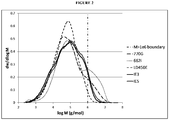
- Mw(abs) curve from TD-GPC was summarized with three characteristic parameters: Mw(abs), Mn(abs), and w, where w is defined as "weight fraction of molecular weight greater than 10 6 g/mole, based on the total weight of polymer, and as determined by GPC(abs)."
- Figure 2 shows the MWD(abs) for several comparative examples and Inventive Examples 3 and 4.
- a vertical line indicates the lower integration limit to determine "w.”
- "w" effectively is the area under the curve to the right of this vertical line.
- the g' parameter is defined as the weight-average ratio of the intrinsic viscosity of the LDPE and the intrinsic viscosity of the linear HDPE reference material discussed above (Mw of 115,000 g/mole).
- a Triple Detector Gel Permeation Chromatography (3D-GPC or TDGPC) system consisting of a Polymer Laboratories (now Agilent) high temperature chromatograph Model 220, equipped with a 2-angle laser light scattering (LS) detector Model 2040 (Precision Detectors, now Agilent), an IR-4 infra-red detector from Polymer Char (Valencia, Spain), and a 4-capillary solution viscometer (DP) (Viscotek, now Malvern) was used. Data collection was performed using Polymer Char DM 100 data acquisition box and related software (Valencia, Spain). The system was also equipped with an on-line solvent degassing device from Polymer Laboratories (now Agilent).
- High temperature GPC columns consisting of four 30 cm, 20 um mixed A LS columns from Polymer Laboratories (now Agilent) were used.
- the sample carousel compartment was operated at 140°C, and the column compartment was operated at 150°C.
- the samples were prepared at a concentration of 0.1 grams of polymer in 50 milliliters of solvent.
- the chromatographic solvent and the sample preparation solvent was 1,2,4-trichlorobenzene (TCB) containing 200 ppm of 2,6-di-tert-butyl-4methylphenol (BHT).
- TAB 1,2,4-trichlorobenzene
- BHT 2,6-di-tert-butyl-4methylphenol
- the solvent was sparged with nitrogen.
- the polymer samples were gently stirred at 160°C for four hours.
- the injection volume was 200 microliters.
- the flow rate through the GPC was set at 1.0 ml/minute.
- the column calibration curve was obtained by fitting a first order polynomial to the respective polyethylene-equivalent calibration points obtained from the above Equation to the observed elution volumes.
- the molecular weight distribution (MWD) is expressed as the ratio of the weight average molecular weight (Mw) to the number average molecular weight (Mn).
- the A value was determined by adjusting the A value in the Williams and Ward Equation, until Mw, the weight average molecular weight, calculated using the above Equation, and the corresponding retention volume polynomial agreed with the independently determined value of Mw, obtained in accordance with the linear homopolymer reference with known weight average molecular weight of 115,000 g/mol.
- the sample used in the G' measurement was prepared from a compression molding plaque.
- a piece of aluminum foil was placed on a backplate, and a template or mold was placed on top of the backplate.
- Approximately 12 grams of resin was placed in the mold, and a second piece of aluminum foil was placed over the resin and mold.
- a second backplate was then placed on top of the aluminum foil.
- the total ensemble was put into a compression molding press, which was run at the following conditions: 3 min at 150°C, at 10 bar pressure, followed by 1 min at 150°C, at 150 bar, followed by a "1.5 min” quench cooling to room temperature, at 150 bar.
- a 25 mm disk was stamped out of the compression-molded plaque. The thickness of this disk was approximately 2.0 mm.
- the rheology measurement to determine G' was done in a nitrogen environment, at 170°C, and a strain of 10%.
- the stamped-out disk was placed between the two "25 mm” parallel plates located in an ARES-1 (Rheometrics SC) rheometer oven, which was preheated, for at least 30 minutes, at 170°C, and the gap of the "25 mm” parallel plates was slowly reduced to 1.65 mm.
- the sample was then allowed to remain for exactly 5 minutes at these conditions. The oven was then opened, the excess sample was carefully trimmed around the edge of the plates, and the oven was closed.
- the storage modulus and loss modulus of the sample were measured via a small amplitude, oscillatory shear, according to a decreasing frequency sweep from 100 to 0.1 rad/s (when able to obtain a G" value lower than 500 Pa at 0.1 rad/s), or from 100 to 0.01 rad/s. For each frequency sweep, 10 points (logarithmically spaced) per frequency decade were used.
- the data were plotted (G' (Y-axis) versus G" (X-axis)) on a log-log scale.
- the Y-axis scale covered the range from 10 to 1000 Pa, while the X-axis scale covered the range from 100 to 1000 Pa.
- an Orchestrator software was used to select the data in the region where G" was between 200 and 800 Pa (or using at least 4 data points).
- G', at G" equal to 500 Pa, was determined by interpolation.
- the G' (at a G" of 500 Pa) was determined from test temperatures of 150°C and 190°C. The value at 170°C was calculated from a linear interpolation from the values at these two temperatures.
- Samples were prepared by adding approximately "3 g of a 50/50 mixture of tetrachloroethane-d2/orthodichlorobenzene, containing 0.025 M Cr(AcAc) 3 ,” to a "0.25 to 0.40 g polymer sample,” in a 10 mm NMR tube. Oxygen was removed from the sample by placing the open tubes in a nitrogen environment for at least 45 minutes. The samples were then dissolved and homogenized by heating the tube, and its contents to 150°C, using a heating block and heat gun. Each dissolved sample was visually inspected to ensure homogeneity. Samples were thoroughly mixed, immediately prior to analysis, and were not allowed to cool before insertion into the heated NMR sample holders.
- the samples were prepared by adding approximately 130 mg of sample to "3.25 g of 50/50, by weight, tetrachlorethane-d2/perchloroethylene" with 0.001 M Cr(AcAc) 3 in a NORELL 1001-7, 10 mm NMR tube.
- the samples were purged by bubbling N2 through the solvent, via a pipette inserted into the tube, for approximately five minutes, to prevent oxidation.
- Each tube was capped, sealed with TEFLON tape, and then soaked at room temperature, overnight, to facilitate sample dissolution.
- the samples were kept in a N2 purge box, during storage, before, and after preparation, to minimize exposure to 02.
- the samples were heated and vortexed at 115°C to ensure homogeneity.
- the 1H NMR was performed on a Bruker AVANCE 400 MHz spectrometer, equipped with a Bruker Dual DUL high-temperature CryoProbe, and a sample temperature of 120°C. Two experiments were run to obtain spectra, a control spectrum to quantitate the total polymer protons, and a double presaturation experiment, which suppressed the intense polymer backbone peaks, and enabled high sensitivity spectra for quantitation of the endgroups.
- the control was run with ZG pulse, 4 scans, SWH 10,000 Hz, AQ 1.64s, D1 14s.
- the double presaturation experiment was run with a modified pulse sequence, TD 32768, 100 scans, DS 4, SWH 10,000 Hz, AQ 1.64s, D1 1s, D13 13s.
- the signal from residual 1H in TCE-d2 (at 6.0 ppm) was integrated, and set to a value of 100, and the integral from 3 to -0.5 ppm was used as the signal from the whole polymer in the control experiment.
- the TCE signal was also set to 100, and the corresponding integrals for unsaturation (vinylene at about 5.40 to 5.60 ppm, trisubstituted at about 5.16 to 5.35 ppm, vinyl at about 4.95 to 5.15 ppm, and vinylidene at about 4.70 to 4.90 ppm) were obtained.
- the unsaturated group integrals divided by the corresponding number of protons contributing to that integral, represent the moles of each type of unsaturation per X thousand carbons. Dividing the moles of each type of unsaturation by X, then gives moles unsaturated groups per 1000 moles of carbons.
- the polymerization was carried out in tubular reactor with three reaction zones. In each reaction zone, pressurized water was used for cooling and/or heating the reaction medium, by circulating this water through the jacket of the reactor.
- the inlet-pressure was 2100 bar, and the pressure drop over the whole tubular reactor system was about 300 bars
- Each reaction zone had one inlet and one outlet.
- Each inlet stream consisted of the outlet stream from the previous reaction zone and/or an added ethylene-rich feed stream.
- the ethylene was supplied according a specification, which allowed a trace amount (maximum of 5 mol ppm) of acetylene in the ethylene.
- the maximum, potential amount of incorporated acetylene in the polymer is less than, or equal to, 16 mole ppm, based on the total moles of monomeric units in the ethylene-based polymer (see conversion level in Table 3).
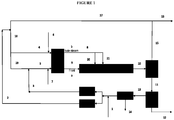
- the non-converted ethylene, and other gaseous components in the reactor outlet were recycled through a high pressure and a low pressure recycles, and were compressed and distributed through a booster, a primary and a hyper (secondary) compressors, according flow scheme shown in Figure 1 .
- Organic peroxides were fed into each reaction zone (see Table 1).
- Acetone was used as a chain transfer agent, and it was present in each reaction zone inlet originating from the low pressure and high pressure recycle flows (#13 and #15), as well as from freshly injected CTA make-up stream #7 and/or stream #6.
- the polymer was made at a melt index of 3.3 g/10 min.
- reaction medium After reaching the first peak temperature (maximum temperature) in reaction zone 1, the reaction medium was cooled with the help of the pressurized water. At the outlet of the reaction zone 1, the reaction medium was further cooled by injecting a fresh, cold, ethylene-rich feed stream (#20), and the reaction was re-initiated by feeding an organic peroxide. This process was repeated at the end of the second reaction zone, to enable further polymerization in the third reaction zone.
- the polymer was extruded and pelletized (about 30 pellets per gram), using a "single screw” extruder at a melt temperature around 230-250°C.
- the weight ratio of the ethylene-rich feed streams (9:20:21) to the three reaction zones was 1.00:0.75:0.25.
- the internal process velocity was approximately 12.5, 9 and 11 m/sec for respectively the 1 st , 2 nd and 3 rd reaction zones.
- the weight ratio of the CTA make-up streams #7 and #6 was 3.6. Additional information can be found in Tables 2 and 3.
- the polymerization was carried out in tubular reactor with three reaction zones, as discussed above.
- the peak temperatures were slightly adjusted, and the melt-index was lowered to 2.0.
- the weight ratio of the CTA (acetone) make-up streams #7 and #6 was 1.1. Additional information can be found in Tables 2 and 3.
- the polymerization was carried out in tubular reactor with three reaction zones, as discussed above, with the exemption that both discharge streams (2 and 3) of the primary compressor were sent to the reactor front feed stream 4.
- the weight ratio of the ethylene-rich feed streams (9:20:21) to the three reaction zones was 1.00:0.75:0.25.
- the polymer was made at a melt index of 1.5 g/10 min.
- the R2 and R3 values each approached infinity ( ⁇ ).
- the weight ratio of the CTA make-up streams #7 and #6 was 0.09. Additional information can be found in Tables 2 and 3.
- the CTA was propionaldehyde (PA).
- the polymerization was carried out in tubular reactor with three reaction zones, as discussed above, with the exemption that both discharge streams (2 and 3) of the primary compressor were sent to the reactor front feed stream 4.
- the weight ratio of the ethylene-rich feed streams (9:20:21) to the three reaction zones was 1.00:0.75:0.25.
- the polymer was made at a melt index of 0.58 g/10 min.
- the R2 and R3 values each approached infinity ( ⁇ ).
- the weight ratio of the CTA make-up streams #7 and #6 was 2. Additional information can be found in Tables 2 and 3.
- the CTA was propionaldehyde (PA).
- the polymerization was carried out in tubular reactor with three reaction zones, as discussed above, with the exemption that both discharge streams (2 and 3) of the primary compressor were sent to the reactor front feed stream 4.
- the weight ratio of the ethylene-rich feed streams (9:20:21) to the three reaction zones was 1.00:0.75:0.25.
- the polymer was made at a melt index of 0.37 g/10 min.
- the R2 and R3 values each approached infinity ( ⁇ ).
- the weight ratio of the CTA make-up streams #7 and #6 was 1,35. Additional information can be found in Tables 2 and 3.
- the CTA was propionaldehyde (PA).
- Type Inlet-pressure / bar Start-temp. /°C reinitiation temp. 2nd zone /°C reinitiation temp. 3rd zone /°C 1st Peak temp. / °C 2nd Peak temp./° C 3rd Peak temp. /°C IE1 Inv. 2100 140 159 246 330 330 312 IE2 Inv. 2100 140 159 241 331 326 311 IE3 Inv 2100 140 163 248 336 330 309 IE4 Inv 2100 140 169 243 330 325 299 IE5 Inv 2100 140 173 243 327 323 299 Table 3: Additional Information (Inventive Examples) LDPE Exs.
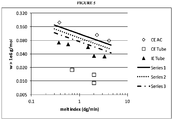
- Table 4 Polymer Properties LDPE Type* I2 (dg/min) Density (g/cc) Mw(abs) (kg/mol) t Mw(abs)/ Mn(abs) t Melt Strength (cN) G' (Pa) at 170°C u Fraction with MW above 1x10 6 g/mol t Mw(abs)/ Mw(GPC) t g' t PG7004** CE, AC 4.1 0.9215 321 22.6 9.1 146 0.080 2.61 0.54 LDPE 770G** CE, AC 2.3 0.918 433 26.2 14.8 183 0.106 2.99 0.55 LDPE 662I** CE, AC 0.38 0.9182 872 46.1 30.0 cnbm 0.202 3.54 0.39 LD310E** CE, tub 0.7 0.9231 144 8.3 14.0 cnbm 0.018 1.51 0.57 LD410E** CE, tub 2.0 0.9242 121
- Table 6 contains the branches per 1000C as measured by 13 C NMR.
- These LDPE polymers contain amyl, or C5 branches, which are not contained in substantially linear polyethylenes, such as AFFINITY Polyolefin Plastomers, or Ziegler-Natta catalyzed LLDPE, such as DOWLEX Polyethylene Resins, both produced by The Dow Chemical Company.
- Each inventive LDPE, shown in Table 6, contains greater than, or equal to, 2.0 amyl groups (branches) per 1000 carbon atoms.
- Table 7 contains unsaturation results by 1 H NMR.
- Table 6 Branching Results in branches per 1000C by 13 C NMR of Inventive Examples and Comparative Examples.
- Table 8 lists some examples of second ethylene-based polymers for use in the inventive compositions.
- Table 8 Second Polymers Material Description I2 (dg/min) Density (g/cc) EO1* ethylene-octene copolymer 21.5 0.911 EO2* ethylene-octene copolymer 15.0 0.912 EO3* ethylene-octene copolymer 15.0 0.910 LDPE 751A LDPE 6.4 0.926 AMPLIFY EA 103 EEA (ethylene-ethylacrylate) copolymer 19.5 0.927 ASPUN 6835A higher density ethylene-octene copolymer 17.0 0.950
- the blend components were compounded using an "18 mm" twin screw extruder (micro-18).
- the twin screw extruder was a Leistritz machine controlled by HAAKE software.
- the extruder had five heated zones, a feed zone, and a "3 mm” strand die.
- the feed zone was cooled by flowing river water, while the remaining zones 1-5 and die were electrically heated and air cooled to 120, 135, 150, 190, 190, and 190°C, respectively.
- the pelletized polymer components were combined in a plastic bag, and tumble blended by hand. After preheating the extruder, the load cell and die pressure transducers were calibrated.
- the drive unit for the extruder was run at 200 rpm, which resulted by gear transfer to a screw speed of 250 rpm.
- the dry blend was then fed (6-8 lbs/hr) to the extruder through a twin auger K-Tron feeder (model # K2VT20) using pellet augers.
- the hopper of the feeder was padded with nitrogen, and the feed cone to the extruder was covered with foil, to minimize air intrusion, to minimize possible oxygen degradation of the polymer.
- the resulting strand was water quenched, dried with an air knife, and pelletized with a Conair chopper.
- a first set of blend compositions was made using EO1 with either LDPE 770G or IE3 in various blend ratios. Table 9 shows rheological and molecular weight properties of these blends.
- LDPE 770G was used, in practice, as a blend component in extrusion coating with second components, such as EO1. It was discovered that the blend containing IE3, at a weight ratio of 70/30, had similar Melt Strength, as compared to the comparative example containing LDPE 770G (70/30 weight ratio), but also has a higher G'value. Furthermore, the Melt Strength (MS), and consequently, the G' value (storage modulus), for the inventive blend can be further optimized by varying the blend ratio.
- MS Melt Strength
- G' value storage modulus
- Blend composition I2 Density (g/cc) Melt Strength (cN) G' (Pa) (170°C) u Mw (conv) (kg/mol) t Mw (conv)/ Mn (conv) t Mz (conv)/ Mw (conv) t 70% EO1 + 30% 770G 12.1 0.911 4.2 96 85.7 5.03 4.75 80% EO1 + 20% IE3 15.1 0.910 2.7 84 64.8 3.85 3.14 70% EO1 + 30% IE3 11.4 0.911 4.2 111 73.7 4.32 3.43 60% EO1 + 40% IE3 8.9 0.912 6.4 134 82.4 4.80 3.43 t) All MWD metrics in this table obtained from GPC Method B. u) Software B was used to determine G'.
- a second set of blends was made using LDPE 751A, with either LDPE 770G or IE3 in various blend ratios.
- Table 10 shows rheological and molecular weight properties of the blends. It was discovered that the blend containing IE3, at a weight ratio of 80/20, had a higher Melt Strength as compared to the comparative example containing LDPE 770G (80/20). These blends have a density of about 0.923 g/cc, and, in view of their I2 and Melt Strength (MS), are suitable for coating applications. However, the inventive blends reach the desired melt strength at a lower blend ratio (less inventive IE3). Furthermore, the Melt Strength for the inventive blend can be further optimized by varying the blend ratio.
- Blend composition I2 Density (g/cc) Melt Strengt h (cN) Mw (conv) (kg/mol) t Mw (conv)/ Mn (conv) Mz (conv)/ Mw (conv) 80% LDPE 751A + 20% 770G 5.2 0.923 6.6 115 6.92 3.90 80% LDPE 751A + 20% IE3 5.2 0.923 7.0 105 6.32 3.33 70% LDPE 751A + 30% IE3 4.0 0.922 8.2 110 6.67 3.25 60% LDPE 751A + 40% IE3 3.7 0.922 9.0 112 7.16 3.33 t) All MWD metrics in this table obtained from GPC Method B.
- a third set of blends was made using EO2 with LD410E, LD450E, or IE3, in various blend ratios.
- Table 11 shows rheological and molecular weight properties of the blends. It was discovered that the blends containing IE3 show significantly higher Melt Strength (MS) and G' values than the blends containing LD410E or LD450E, at similar melt index (I2).
- LD450E is a resin especially designed for foam applications, where high Melt Strength is required.
- the blends containing IE3 had significantly higher Melt Strength (MS) and G' values than the blend compositions that did not contain IE3.
- the blend composition containing only 20 wt% of IE3 achieved a higher Melt Strength (MS) and a higher G' values, as compared to the respective blend compositions that contain 40 wt% each of LD410E and LD450E, despite the higher melt index of the blend composition containing IE3.
- Blend composition I2 (dg/min) Density (g/cc) Melt Strength (cN) G' At 170°C (Pa) u Mw (conv) (kg/mol) t Mw (conv)/ Mn (conv) t Mz (conv)/ Mw (conv) t 80% EO2 + 20% LD410E 11.0 0.913 0.4 48 56.9 2.98 2.07 70% EO2 + 30% LD410E 9.2 0.915 0.5 59 58.7 2.93 2.15 60% EO2 + 40% LD410E 7.2 0.916 2.0 71 61.4 3.06 2.18 80% EO2 + 20% LD450E 10.8 0.914 0.5 53 60.2 3.15 2.52 70% EO2 + 30% LD450E 9.1 0.915 2.0 67 59.3 3.02 2.11 60% EO2 + 40% LD450E 7.0 0.916 2.8 76 67.8 3.51 2.79
- a fourth set of blends was made using IE3 in various blend ratios with AMPLIFY EA 103.
- Table 12 shows rheological and molecular weight properties of these blends. It was discovered that the blends with IE3 showed Melt Strength (MS) values suitable for extrusion coating.
- MS Melt Strength
- Blend composition I2 Density (g/cc) Melt Strengt h (cN) Mw (conv) (kg/mol) t Mw (conv)/ Mn (conv) t Mz (conv)/ Mw (conv) t 80% AMPLIFY EA 103 + 20% IE3 10.8 0.927 2.9 82.3 5.37 3.45 70% AMPLIFY EA 103 + 30% IE3 9.0 0.925 3.8 85.9 5.31 3.28 60% AMPLIFY EA 103 + 40% IE3 6.9 0.925 6.4 93.7 6.10 3.24 t) All MWD metrics in this table obtain from GPC Method B.
- a fifth set of blends was made using IE3 in various blend ratios with ASPUN 6835A.
- Table 13 shows rheological and molecular weight properties of these blends. It was discovered that the blends with IE3 show Melt Strength (MS) and G' values suitable for extrusion coating, at increased density of the blend composition.
- MS Melt Strength
- Blend composition I2 Density (g/cc) Melt Strength (cN) G' at 170° C(Pa) Mw t (conv) (kg/mol) t Mw (conv)/ Mn (conv) t Mz (conv)/ Mw (conv) t 80% ASPUN 6835A + 20% IE3 10.6 0.944 3.35 85 71.4 4.16 3.18 70% ASPUN 6835A + 30% IE3 8.1 0.940 5.9 115 80.8 4.87 3.6 60% ASPUN 6835A + 40% IE3 6.3 0.937 8.4 135 88.5 5.37 3.34 t) All MWD metrics in this table obtain from GPC Method B. u) Software B was used to determine G'.
- a sixth set of blend compositions was made using EO3 with either LDPE 662i or IE4 or IE5 in a blend ratio of 85% EO3 and 15% LDPE.
- Table 14 shows rheological and molecular weight properties of these blends.
- LDPE 662i was used, in practice, as a blend component in extrusion coating with second components, such as EO3. It was discovered that the blend containing IE4 or IE5 had similar or higher Melt Strength as compared to the comparative example containing LDPE 662i.
- Blend composition I2 Density (g/cc) Melt Strength (cN) Mw (conv) (kg/mol) t Mw (conv)/ Mn (conv) t Mz (conv)/ Mw (conv) t 85% EO3 + 15% 662i 9.6 0.913 3.4 76.6 3.92 5.03 85% EO3 + 15% IE4 9.5 0.913 3.7 67.4 3.68 3.74 85% EO3 + 15% IE5 9.3 0.913 4.1 63.5 3.45 3.54 t) All MWD metrics in this table obtained from GPC Method B.
- Monolayer extrusion coatings were performed at following temperature settings: Extruder Barrel - 200/ 250/ 280/ 290/ 290/ 290°C; Flange/ Adapter/ Piping - 290°C (6 zones); and Die - 290°C x 10 Zones.
- the blend compositions were extruded on a "3.5 inch" diameter screw, with a length over diameter (L/D) ratio of 32, onto 70 g/m 2 Kraft paper, in an amount (coating weight) of 25 g/m 2 .
- Melt pressure and melt temperature were recorded with thermocouples placed in the adapter.
- the melt was delivered through a Davis Standard/Er-We-Pa flex lip edge bead reduction die, Series 510A, nominally set to a die gap of 0.6 mm.
- the melt drawing and application of the melt vertically onto the moving substrate was performed at an air gap of 250 mm and a nip off-set of 15mm, towards the pressure roll.
- the melt was applied onto the moving substrate in the laminator nip, which is the contact point of the pressure roll, with a rubber surface layer contacting the "water cooled” chill roll with a matte surface finish, and maintained at a temperature of 15°C to 20°C.
- the air gap was defined as the vertical distance between the die lip and the laminator nip.
- the nip off-set was defined as the horizontal off-set of the die lip position relative to the laminator nip.
- Dry blends were prepared using a Maguire WSB-240T gravimetric blending unit (at room temperature), permitting controlled weight percentages of respective blend components, prior to extrusion.
- Neck-in is the difference between the final width of the web and the die width at fixed line speed. Lower neck-in and higher draw down are both very desirable. Lower neck-in indicates better dimensional stability of the web, which, in turn, provides for better control of the coating onto the substrate. Higher draw down indicates higher line speed capability, which, in turn, provides for better productivity. Neck-in and draw down results are shown in Table 15 for blends of EO1 with LDPE 770G or IE3.
- the blend compositions based on 30 wt% LDPE 770G (autoclave) as minor component, had low neck-in, and were applied in extrusion coating applications. Typically it is difficult to achieve low neck-in with tubular LDPE. IE3 was shown to have similar Melt Strength (MS) as 770G, with, and without, EO1. It has been discovered that IE3 leads to similarly or improved coating performance, as the AC-based blend benchmark (EO1/770G blend). The inventive compositions provide good extrusion coatings, even at lower Mw(conv), as compared to the AC-based example (EO1/770G blend). The inventive compositions can be made on a tubular reactor train, with improved conversion levels and lower energy input, as compared to autoclave processes.
- inventive compositions make it possible to produce high clarity film and extrusion coatings.
- gel levels should be extremely low.
- a crosslinking agent is not typically desired, and/or a comonomer with crosslinking capability is not typically desired, in the formation of the polymer, especially at low melt index.
- Table 15 Extrusion coating properties of blend compositions
- Blend composition Neck-in 290°C; 25 g/m 2 ; 100 m/min (mm) Neck-in 290°C; 25 g/m 2 ; 300 m/min (mm) Neck-in 290°C; 15 g/m 2 ; 100 m/min (mm) Draw-down 290°C (m/min)* 70% EO1 + 30% 770G 114 137 110 300 80% EO1 + 20% IE3 172 160 175 467 70% EO1 + 30% IE3 137 118 121 432 60% EO1 + 40% IE3 105 106 102 340 *Starting at a coating weight of 15 g/m 2
- Comparative compositions containing EO2 and LD410E or LD450E could not be fabricated into good coating webs due to low Melt Strength (MS), which would result in excessive neck-in.
- MS Melt Strength
- Table 16 shows coating results for the blends of EO2 with IE3, which shows good neck-in data and excellent draw-down values.
- Table 16 Extrusion coating properties of blend compositions Blend composition Neck-in 290°C; 25 g/m 2 ; 100 m/min (mm) Neck-in 290°C; 25 g/m 2 ; 300 m/min (mm) Neck-in 290°C; 15 g/m 2 ; 100 m/min (mm) Draw-down 290°C (m/min)* 80% EO2 + 20% IE3 156 162 153 450 70% EO2 + 30% IE3 109 118 108 335 60% EO2 + 40% IE3 100 103 93 250 *Starting at a coating weight of 15 g/m 2 at 100mpm line speed.
- blend compositions containing IE3 have significantly better (higher) draw-down, as compared to the blend compositions containing the LDPE 770G.
- the neck-in performance will depend on the weight ratio of polymer components in the blend and the particular polymer components.
- Blend compositions containing IE3 have comparable neck-in values at the same weight ratio.
- the neck-in value can be further improved by adjusting the weight ratio of the polymer components, while maintaining better draw down performance.
- Additional monolayer extrusion coatings were performed on a Black-Clawson extrusion coating/lamination line.
- An extruder with 150 horsepower and 3.5 inch diameter screw was used at screw speeds of approximately 90 rpm, resulting in 114 kg/h (250 lb/h) polymer output.
- Temperature in each zone of the extruder was 177, 232, 288, and 316 °C (350, 450, 550 and 600 °F), respectively, leading to a target melt temperature of 320 °C.
- the nominal die width of 76 cm (30 inches) was deckled to an open die width of 61 cm (24 inches).
- the width of the Kraft paper was 61 cm (24 inches).
- the blend compositions based on 15 wt% LDPE 662i (autoclave) as minor component had low neck-in. Typically it is difficult to achieve low neck-in with tubular LDPE. IE4 and IE5 were shown to have similar Melt Strength (MS) as 662i, with, and without, EO3. It has been discovered that the blend of high melt index, linear low-density ethylene-octene copolymer with a low level of tubular LDPE (e.g., IE5) leads to satisfactory coating performance, comparable to the benchmark AC-based blend (EO3/662i blend). One skilled in the art can further optimize the neck-in/draw-down balance by adjusting the blend ratio.
- MS Melt Strength
- neck-in improvement can be achieved by incremental increases in the amount of a suitable LDPE component.
- Table 17 Extrusion coating properties of blend compositions Blend composition Neck-in 320°C; 25 micron; 134 m/min (cm) Neck-in 320°C; 13 micron; 268 m/min (cm) Draw-down 320°C (m/min)* 85% EO3 + 15% 662i 6.4 5.4 >457 85% EO3 + 15% IE4 8.9 9.8 >457 85% EO3 + 15% IE5 7.3 6.0 >457 *Starting at a coating thickness of 13 micron at 268 m/min line speed.
Landscapes
- Chemical & Material Sciences (AREA)
- Organic Chemistry (AREA)
- Polymers & Plastics (AREA)
- Health & Medical Sciences (AREA)
- Chemical Kinetics & Catalysis (AREA)
- Medicinal Chemistry (AREA)
- Materials Engineering (AREA)
- Engineering & Computer Science (AREA)
- Wood Science & Technology (AREA)
- Life Sciences & Earth Sciences (AREA)
- Addition Polymer Or Copolymer, Post-Treatments, Or Chemical Modifications (AREA)
- Compositions Of Macromolecular Compounds (AREA)
- Polymerisation Methods In General (AREA)
- Manufacturing & Machinery (AREA)
- Extrusion Moulding Of Plastics Or The Like (AREA)
Applications Claiming Priority (2)
| Application Number | Priority Date | Filing Date | Title |
|---|---|---|---|
| US201261728341P | 2012-11-20 | 2012-11-20 | |
| PCT/US2013/030459 WO2014081458A1 (en) | 2012-11-20 | 2013-03-12 | Low density ethylene-based polymers with high melt strength |
Publications (2)
| Publication Number | Publication Date |
|---|---|
| EP2922881A1 EP2922881A1 (en) | 2015-09-30 |
| EP2922881B1 true EP2922881B1 (en) | 2017-07-19 |
Family
ID=47997894
Family Applications (1)
| Application Number | Title | Priority Date | Filing Date |
|---|---|---|---|
| EP13712058.0A Active EP2922881B1 (en) | 2012-11-20 | 2013-03-12 | Low density ethylene-based polymers with high melt strength |
Country Status (9)
| Country | Link |
|---|---|
| US (3) | US9394389B2 (enExample) |
| EP (1) | EP2922881B1 (enExample) |
| JP (2) | JP6325566B2 (enExample) |
| KR (1) | KR102067312B1 (enExample) |
| CN (1) | CN104781290B (enExample) |
| BR (1) | BR112015010787B1 (enExample) |
| ES (1) | ES2640018T3 (enExample) |
| MX (1) | MX363922B (enExample) |
| WO (1) | WO2014081458A1 (enExample) |
Cited By (1)
| Publication number | Priority date | Publication date | Assignee | Title |
|---|---|---|---|---|
| EP4186946A1 (en) * | 2021-11-30 | 2023-05-31 | Hanwha TotalEnergies Petrochemical Co., Ltd. | Polyethylene resin composition for pipe, method of preparing same, and molded article prepared therefrom |
Families Citing this family (39)
| Publication number | Priority date | Publication date | Assignee | Title |
|---|---|---|---|---|
| ES2742509T3 (es) | 2011-11-23 | 2020-02-14 | Dow Global Technologies Llc | Polímeros a base de etileno de baja densidad con distribuciones amplias de pesos moleculares y contenido de extraíbles bajo |
| US9394389B2 (en) * | 2012-11-20 | 2016-07-19 | Dow Global Technologies Llc | Low density ethylene-based polymers with high melt strength |
| ES2637970T3 (es) | 2013-05-22 | 2017-10-18 | Dow Global Technologies Llc | Composiciones poliméricas basadas en etileno de baja densidad con alta resistencia en estado fundido y control de densidad medio-alto |
| KR20200120756A (ko) * | 2013-05-22 | 2020-10-21 | 다우 글로벌 테크놀로지스 엘엘씨 | 고용융 강도를 갖는 저밀도 에틸렌-기반 폴리머를 함유하는 조성물 및 이로부터 형성된 필름 |
| KR102240585B1 (ko) * | 2013-12-19 | 2021-04-16 | 다우 글로벌 테크놀로지스 엘엘씨 | 추출성 및 용융 탄성의 개선된 균형을 갖는 관상 저밀도 에틸렌 기반 폴리머 |
| CA2989407C (en) | 2015-06-17 | 2023-09-19 | Dow Global Technologies Llc | Process for making crosslinked cable insulation using high melt strength ethylene-based polymer made in a tubular reactor and optionally modified with a branching agent |
| CN107810208B (zh) * | 2015-06-25 | 2020-07-24 | 陶氏环球技术有限责任公司 | 具有低己烷可萃取率的乙烯基聚合物 |
| EP3313902B1 (en) | 2015-06-25 | 2023-07-19 | Dow Global Technologies LLC | A process for producing an ethylene-based polymer |
| EP3313894B1 (en) | 2015-06-25 | 2019-12-18 | Dow Global Technologies LLC | Improved process to make tubular ethylene based polymers with high g' and broad mwd |
| ES2786677T3 (es) | 2015-06-25 | 2020-10-13 | Dow Global Technologies Llc | Proceso para formar polímeros basados en etileno |
| US10400046B2 (en) | 2015-06-25 | 2019-09-03 | Joseph J. Matsko | Portable powered paint system |
| BR112017028455B1 (pt) | 2015-06-30 | 2022-08-09 | Dow Global Technologies Llc | Mistura de composições de polímero à base de etileno para revestimentos e artigo |
| WO2018001486A1 (en) * | 2016-06-30 | 2018-01-04 | Sabic Global Technologies B.V. | Process for the preparation of polyolefin particles |
| US11136438B2 (en) * | 2015-07-13 | 2021-10-05 | Sabic Global Technologies B.V. | Process for the preparation of polyolefin particles |
| EP3168238A1 (en) | 2015-11-10 | 2017-05-17 | Dow Global Technologies LLC | Ethylene-based polymers formed by high pressure free radical polymerizations |
| WO2017146981A1 (en) | 2016-02-23 | 2017-08-31 | Dow Global Technologies Llc | Ethylene-based polymers and processes to make the same |
| KR102387183B1 (ko) | 2016-04-22 | 2022-04-18 | 다우 글로벌 테크놀로지스 엘엘씨 | 투명 압출 코팅 공정을 위한 저휘발성 관형 저밀도 에틸렌계 폴리머의 제조 방법 |
| WO2017201110A1 (en) | 2016-05-18 | 2017-11-23 | Dow Global Technologies Llc | Ethylene-based polymers and processes to make the same |
| EP3260473A1 (en) | 2016-06-24 | 2017-12-27 | Dow Global Technologies LLC | High pressure, free radical polymerizations to produce ethylene-based polymers |
| EP3260472A1 (en) | 2016-06-24 | 2017-12-27 | Dow Global Technologies LLC | Ethylene-based polymers formed by high pressure free radical polymerizations |
| BR112018074634B1 (pt) | 2016-06-24 | 2022-12-27 | Dow Global Technologies Llc | Processo de polimerização de alta pressão para formar um polímero à base de etileno, polímero à base de etileno, composição e configuração de cabo ou de fio |
| US20200087492A1 (en) * | 2016-12-22 | 2020-03-19 | Dow Global Technologies Llc | Process to Make High Density Ethylene-Based Polymer Compositions with High Melt Strength |
| EP3562875B1 (en) | 2017-01-02 | 2020-10-21 | SABIC Global Technologies B.V. | Process for recycling polyolefin |
| CN110392704B (zh) * | 2017-03-21 | 2022-12-23 | 陶氏环球技术有限责任公司 | 具有改良光学的乙烯类聚合物 |
| WO2018191000A1 (en) * | 2017-04-10 | 2018-10-18 | Exxonmobil Chemicl Patents Inc. | Methods for making polyolefin polymer compositions |
| WO2018218470A1 (en) | 2017-05-29 | 2018-12-06 | Dow Global Technologies Llc | Thermoplastic polyolefin compositions useful for aldehyde abatement |
| EP3658592B1 (en) * | 2017-07-28 | 2021-08-25 | Dow Global Technologies Llc | Low density ethylene-based polymers for low speed extrusion coating operations |
| JP7261788B2 (ja) | 2017-07-31 | 2023-04-20 | ダウ グローバル テクノロジーズ エルエルシー | 末端および内部不飽和の新規な分布を有するエチレン系ポリマー |
| SG11202102966RA (en) * | 2018-09-28 | 2021-04-29 | Dow Global Technologies Llc | Tetra-functional long-chain branched ethylene-based polymers |
| ES3037971T3 (en) * | 2018-09-28 | 2025-10-08 | Dow Global Technologies Llc | Tetra-functional long-chain branched ethylene-based polymers |
| JP7199997B2 (ja) * | 2019-02-20 | 2023-01-06 | 日清食品ホールディングス株式会社 | 発泡断熱紙容器用シートの製造方法 |
| JP7146667B2 (ja) | 2019-02-20 | 2022-10-04 | 日清食品ホールディングス株式会社 | 電子レンジ耐性を有する発泡断熱紙容器用シートの製造方法 |
| EP3938167A1 (en) * | 2019-03-14 | 2022-01-19 | Braskem S.A. | Extrusion coating resin from tubular reactor |
| AR119441A1 (es) | 2019-07-31 | 2021-12-15 | Dow Global Technologies Llc | Polietileno de baja densidad con resistencia de adhesión en caliente y adhesión al metal mejoradas mediante la adición de ionómeros |
| AR119432A1 (es) | 2019-07-31 | 2021-12-15 | Dow Global Technologies Llc | Supresión de estrechamiento para polímeros tubulares a base de ldpe para recubrimiento por extrusión a velocidad de línea media y alta |
| AR119443A1 (es) | 2019-07-31 | 2021-12-15 | Dow Global Technologies Llc | Polietileno de baja densidad con papel adhesivo de aluminio mejorado mediante la mezcla de resinas de copolímero ácido |
| MX2022005286A (es) * | 2019-11-11 | 2022-05-24 | Dow Global Technologies Llc | Composiciones polimericas para componentes de cable de fibra optica. |
| US20230014128A1 (en) * | 2019-12-03 | 2023-01-19 | Basell Polyolefine Gmbh | Cooling of reaction mixture obtained by high-pressure polymerization process of ethylenically unsaturated monomers |
| KR102853435B1 (ko) * | 2021-11-30 | 2025-09-04 | 한화토탈에너지스 주식회사 | 파이프용 폴리에틸렌 수지 조성물, 이의 제조 방법 및 이로부터 제조된 성형품 |
Family Cites Families (34)
| Publication number | Priority date | Publication date | Assignee | Title |
|---|---|---|---|---|
| US5582923A (en) * | 1991-10-15 | 1996-12-10 | The Dow Chemical Company | Extrusion compositions having high drawdown and substantially reduced neck-in |
| CN1169744A (zh) * | 1994-11-14 | 1998-01-07 | 陶氏化学公司 | 具有高牵伸性和显著减小的缩幅的挤出组合物 |
| IL115911A0 (en) | 1994-11-14 | 1996-01-31 | Dow Chemical Co | Extrusion compositions having high drawdown and substantially reduced neck-in |
| US6114457A (en) * | 1997-02-07 | 2000-09-05 | Exxon Chemical Patents Inc. | High melt strength polyethylene compositions |
| CA2279851A1 (en) | 1997-02-07 | 1998-08-13 | Exxon Chemical Patents, Inc. | Improved processing olefin copolymers |
| AU2001256204A1 (en) | 2000-03-16 | 2001-09-24 | Basell Polyolefine Gmbh | Method for the production of polyethylene |
| PL360880A1 (en) | 2000-08-15 | 2004-09-20 | Akzo Nobel N.V. | Use of trioxepans in the process to make high-solid acrylic, styrenic, and ldpe-type resins |
| US7415442B1 (en) | 2000-09-26 | 2008-08-19 | Integrated Technological Systems, Inc. | Integrated technology money transfer system |
| US6545094B2 (en) * | 2001-03-09 | 2003-04-08 | The Dow Chemical Company | Blends of ethylenic polymers with improved modulus and melt strength and articles fabricated from these blends |
| US7776987B2 (en) | 2003-09-05 | 2010-08-17 | Dow Global Technologies, Inc. | Resin compositions for extrusion coating |
| CN101087824B (zh) * | 2005-01-12 | 2011-02-16 | 波利亚里斯技术有限公司 | 挤出涂覆聚乙烯 |
| WO2006094723A1 (en) | 2005-03-09 | 2006-09-14 | Saudi Basic Industries Corporation | A process for the preparation of an ethylene copolymer in a tubular reactor |
| EP1731565B2 (en) * | 2005-06-08 | 2019-11-06 | Borealis Technology Oy | Polyolefin composition for use as an insulating material |
| DE602005001055T2 (de) | 2005-10-18 | 2007-12-27 | Borealis Technology Oy | Polyethylenmischungskomponente und diese enthaltende Mischungen |
| CA2541180A1 (en) | 2006-03-23 | 2007-09-23 | Nova Chemicals Corporation | Extrusion coating composition |
| EP2123707B1 (en) | 2008-05-19 | 2010-10-06 | Borealis Technology OY | Extrusion coating polyethylene composition |
| JP2010242057A (ja) * | 2009-03-19 | 2010-10-28 | Asahi Kasei Chemicals Corp | ガラス基板合紙 |
| EP2464672B1 (en) * | 2009-08-10 | 2019-11-27 | Dow Global Technologies LLC | Ldpe for use as a blend component in shrinkage film applications |
| US8729186B2 (en) | 2009-12-18 | 2014-05-20 | Dow Global Technologies Llc | Polymerization process to make low density polyethylene |
| BR112013007508A2 (pt) | 2010-09-30 | 2019-09-24 | Dow Global Technologies Llc | processo de polimerização em alta pressãp para formar um interpolímero a base de etileno, interpolímero a base de etileno e artigo |
| ES2592184T3 (es) | 2010-09-30 | 2016-11-28 | Dow Global Technologies Llc | Proceso de polimerización para preparar polietileno de baja densidad |
| US9150681B2 (en) | 2010-10-29 | 2015-10-06 | Dow Global Technologies Llc | Ethylene-based polymers and processes for the same |
| JP5829160B2 (ja) * | 2011-03-23 | 2015-12-09 | 旭化成ケミカルズ株式会社 | 絶縁体用ポリエチレン系樹脂組成物およびそれを用いた高周波同軸ケーブル |
| CN104011095B (zh) | 2011-10-19 | 2016-10-05 | 陶氏环球技术有限责任公司 | 用于制备低密度基于乙烯的聚合物的采用新鲜乙烯分配的聚合方法 |
| IN2014CN03760A (enExample) | 2011-11-23 | 2015-09-04 | Dow Global Technologies Llc | |
| ES2742509T3 (es) | 2011-11-23 | 2020-02-14 | Dow Global Technologies Llc | Polímeros a base de etileno de baja densidad con distribuciones amplias de pesos moleculares y contenido de extraíbles bajo |
| WO2013095969A1 (en) | 2011-12-22 | 2013-06-27 | Dow Global Technologies Llc | Ethylene-based polymers with improved melt strength and processes for the same |
| CN104507982B (zh) | 2012-06-27 | 2017-06-20 | 陶氏环球技术有限责任公司 | 基于乙烯的聚合物以及用于其的方法 |
| US9394389B2 (en) * | 2012-11-20 | 2016-07-19 | Dow Global Technologies Llc | Low density ethylene-based polymers with high melt strength |
| KR20160030084A (ko) | 2013-05-01 | 2016-03-16 | 다우 글로벌 테크놀로지스 엘엘씨 | 우수한 용융 강도 및 고밀도를 갖는 저밀도 에틸렌계 폴리머 조성물 |
| KR20200120756A (ko) | 2013-05-22 | 2020-10-21 | 다우 글로벌 테크놀로지스 엘엘씨 | 고용융 강도를 갖는 저밀도 에틸렌-기반 폴리머를 함유하는 조성물 및 이로부터 형성된 필름 |
| KR102171521B1 (ko) | 2013-05-22 | 2020-10-30 | 다우 글로벌 테크놀로지스 엘엘씨 | 개선된 용융 강도, 출력 및 기계적 특성을 갖는 저밀도 에틸렌계 조성물 |
| ES2637970T3 (es) | 2013-05-22 | 2017-10-18 | Dow Global Technologies Llc | Composiciones poliméricas basadas en etileno de baja densidad con alta resistencia en estado fundido y control de densidad medio-alto |
| KR102240585B1 (ko) | 2013-12-19 | 2021-04-16 | 다우 글로벌 테크놀로지스 엘엘씨 | 추출성 및 용융 탄성의 개선된 균형을 갖는 관상 저밀도 에틸렌 기반 폴리머 |
-
2013
- 2013-03-12 US US14/434,204 patent/US9394389B2/en active Active
- 2013-03-12 JP JP2015543028A patent/JP6325566B2/ja active Active
- 2013-03-12 WO PCT/US2013/030459 patent/WO2014081458A1/en not_active Ceased
- 2013-03-12 KR KR1020157012803A patent/KR102067312B1/ko active Active
- 2013-03-12 EP EP13712058.0A patent/EP2922881B1/en active Active
- 2013-03-12 MX MX2015006373A patent/MX363922B/es active IP Right Grant
- 2013-03-12 ES ES13712058.0T patent/ES2640018T3/es active Active
- 2013-03-12 CN CN201380059321.2A patent/CN104781290B/zh active Active
- 2013-03-12 BR BR112015010787-7A patent/BR112015010787B1/pt active IP Right Grant
-
2016
- 2016-07-13 US US15/209,368 patent/US10017589B2/en active Active
-
2018
- 2018-03-06 JP JP2018039993A patent/JP6759263B2/ja active Active
- 2018-07-05 US US16/028,194 patent/US10975179B2/en active Active
Non-Patent Citations (1)
| Title |
|---|
| None * |
Cited By (1)
| Publication number | Priority date | Publication date | Assignee | Title |
|---|---|---|---|---|
| EP4186946A1 (en) * | 2021-11-30 | 2023-05-31 | Hanwha TotalEnergies Petrochemical Co., Ltd. | Polyethylene resin composition for pipe, method of preparing same, and molded article prepared therefrom |
Also Published As
| Publication number | Publication date |
|---|---|
| US20160319053A1 (en) | 2016-11-03 |
| MX2015006373A (es) | 2015-10-05 |
| CN104781290A (zh) | 2015-07-15 |
| JP2018123327A (ja) | 2018-08-09 |
| JP6759263B2 (ja) | 2020-09-23 |
| US10975179B2 (en) | 2021-04-13 |
| KR20150087235A (ko) | 2015-07-29 |
| JP6325566B2 (ja) | 2018-05-16 |
| BR112015010787A2 (pt) | 2017-07-11 |
| BR112015010787B1 (pt) | 2022-01-18 |
| JP2015535035A (ja) | 2015-12-07 |
| MX363922B (es) | 2019-04-05 |
| ES2640018T3 (es) | 2017-10-31 |
| US9394389B2 (en) | 2016-07-19 |
| KR102067312B1 (ko) | 2020-01-16 |
| WO2014081458A1 (en) | 2014-05-30 |
| CN104781290B (zh) | 2018-05-18 |
| US20180319910A1 (en) | 2018-11-08 |
| EP2922881A1 (en) | 2015-09-30 |
| US20150274856A1 (en) | 2015-10-01 |
| US10017589B2 (en) | 2018-07-10 |
Similar Documents
| Publication | Publication Date | Title |
|---|---|---|
| US10975179B2 (en) | Low density ethylene-based polymers with high melt strength | |
| EP2999742B1 (en) | Compositions containing low density ethylene-based polymers with high melt strength and films formed from the same | |
| US10287423B2 (en) | Low density ethylene-based compositions with improved melt strength, output, and mechanical properties | |
| EP2918634B1 (en) | Low density ethylene-based polymers with broad molecular weight distributions and low extractables | |
| EP3658592B1 (en) | Low density ethylene-based polymers for low speed extrusion coating operations |
Legal Events
| Date | Code | Title | Description |
|---|---|---|---|
| PUAI | Public reference made under article 153(3) epc to a published international application that has entered the european phase |
Free format text: ORIGINAL CODE: 0009012 |
|
| 17P | Request for examination filed |
Effective date: 20150417 |
|
| AK | Designated contracting states |
Kind code of ref document: A1 Designated state(s): AL AT BE BG CH CY CZ DE DK EE ES FI FR GB GR HR HU IE IS IT LI LT LU LV MC MK MT NL NO PL PT RO RS SE SI SK SM TR |
|
| AX | Request for extension of the european patent |
Extension state: BA ME |
|
| DAX | Request for extension of the european patent (deleted) | ||
| 17Q | First examination report despatched |
Effective date: 20160323 |
|
| GRAP | Despatch of communication of intention to grant a patent |
Free format text: ORIGINAL CODE: EPIDOSNIGR1 |
|
| INTG | Intention to grant announced |
Effective date: 20170127 |
|
| GRAS | Grant fee paid |
Free format text: ORIGINAL CODE: EPIDOSNIGR3 |
|
| GRAA | (expected) grant |
Free format text: ORIGINAL CODE: 0009210 |
|
| AK | Designated contracting states |
Kind code of ref document: B1 Designated state(s): AL AT BE BG CH CY CZ DE DK EE ES FI FR GB GR HR HU IE IS IT LI LT LU LV MC MK MT NL NO PL PT RO RS SE SI SK SM TR |
|
| REG | Reference to a national code |
Ref country code: GB Ref legal event code: FG4D |
|
| REG | Reference to a national code |
Ref country code: CH Ref legal event code: EP |
|
| REG | Reference to a national code |
Ref country code: IE Ref legal event code: FG4D |
|
| REG | Reference to a national code |
Ref country code: AT Ref legal event code: REF Ref document number: 910322 Country of ref document: AT Kind code of ref document: T Effective date: 20170815 |
|
| REG | Reference to a national code |
Ref country code: DE Ref legal event code: R096 Ref document number: 602013023701 Country of ref document: DE |
|
| REG | Reference to a national code |
Ref country code: NL Ref legal event code: FP |
|
| REG | Reference to a national code |
Ref country code: ES Ref legal event code: FG2A Ref document number: 2640018 Country of ref document: ES Kind code of ref document: T3 Effective date: 20171031 |
|
| REG | Reference to a national code |
Ref country code: LT Ref legal event code: MG4D |
|
| REG | Reference to a national code |
Ref country code: AT Ref legal event code: MK05 Ref document number: 910322 Country of ref document: AT Kind code of ref document: T Effective date: 20170719 |
|
| PG25 | Lapsed in a contracting state [announced via postgrant information from national office to epo] |
Ref country code: LT Free format text: LAPSE BECAUSE OF FAILURE TO SUBMIT A TRANSLATION OF THE DESCRIPTION OR TO PAY THE FEE WITHIN THE PRESCRIBED TIME-LIMIT Effective date: 20170719 Ref country code: SE Free format text: LAPSE BECAUSE OF FAILURE TO SUBMIT A TRANSLATION OF THE DESCRIPTION OR TO PAY THE FEE WITHIN THE PRESCRIBED TIME-LIMIT Effective date: 20170719 Ref country code: HR Free format text: LAPSE BECAUSE OF FAILURE TO SUBMIT A TRANSLATION OF THE DESCRIPTION OR TO PAY THE FEE WITHIN THE PRESCRIBED TIME-LIMIT Effective date: 20170719 Ref country code: AT Free format text: LAPSE BECAUSE OF FAILURE TO SUBMIT A TRANSLATION OF THE DESCRIPTION OR TO PAY THE FEE WITHIN THE PRESCRIBED TIME-LIMIT Effective date: 20170719 Ref country code: FI Free format text: LAPSE BECAUSE OF FAILURE TO SUBMIT A TRANSLATION OF THE DESCRIPTION OR TO PAY THE FEE WITHIN THE PRESCRIBED TIME-LIMIT Effective date: 20170719 Ref country code: NO Free format text: LAPSE BECAUSE OF FAILURE TO SUBMIT A TRANSLATION OF THE DESCRIPTION OR TO PAY THE FEE WITHIN THE PRESCRIBED TIME-LIMIT Effective date: 20171019 |
|
| REG | Reference to a national code |
Ref country code: FR Ref legal event code: PLFP Year of fee payment: 6 |
|
| PG25 | Lapsed in a contracting state [announced via postgrant information from national office to epo] |
Ref country code: PL Free format text: LAPSE BECAUSE OF FAILURE TO SUBMIT A TRANSLATION OF THE DESCRIPTION OR TO PAY THE FEE WITHIN THE PRESCRIBED TIME-LIMIT Effective date: 20170719 Ref country code: BG Free format text: LAPSE BECAUSE OF FAILURE TO SUBMIT A TRANSLATION OF THE DESCRIPTION OR TO PAY THE FEE WITHIN THE PRESCRIBED TIME-LIMIT Effective date: 20171019 Ref country code: GR Free format text: LAPSE BECAUSE OF FAILURE TO SUBMIT A TRANSLATION OF THE DESCRIPTION OR TO PAY THE FEE WITHIN THE PRESCRIBED TIME-LIMIT Effective date: 20171020 Ref country code: RS Free format text: LAPSE BECAUSE OF FAILURE TO SUBMIT A TRANSLATION OF THE DESCRIPTION OR TO PAY THE FEE WITHIN THE PRESCRIBED TIME-LIMIT Effective date: 20170719 Ref country code: LV Free format text: LAPSE BECAUSE OF FAILURE TO SUBMIT A TRANSLATION OF THE DESCRIPTION OR TO PAY THE FEE WITHIN THE PRESCRIBED TIME-LIMIT Effective date: 20170719 Ref country code: IS Free format text: LAPSE BECAUSE OF FAILURE TO SUBMIT A TRANSLATION OF THE DESCRIPTION OR TO PAY THE FEE WITHIN THE PRESCRIBED TIME-LIMIT Effective date: 20171119 |
|
| REG | Reference to a national code |
Ref country code: DE Ref legal event code: R097 Ref document number: 602013023701 Country of ref document: DE |
|
| PG25 | Lapsed in a contracting state [announced via postgrant information from national office to epo] |
Ref country code: CZ Free format text: LAPSE BECAUSE OF FAILURE TO SUBMIT A TRANSLATION OF THE DESCRIPTION OR TO PAY THE FEE WITHIN THE PRESCRIBED TIME-LIMIT Effective date: 20170719 Ref country code: RO Free format text: LAPSE BECAUSE OF FAILURE TO SUBMIT A TRANSLATION OF THE DESCRIPTION OR TO PAY THE FEE WITHIN THE PRESCRIBED TIME-LIMIT Effective date: 20170719 Ref country code: DK Free format text: LAPSE BECAUSE OF FAILURE TO SUBMIT A TRANSLATION OF THE DESCRIPTION OR TO PAY THE FEE WITHIN THE PRESCRIBED TIME-LIMIT Effective date: 20170719 |
|
| PLBE | No opposition filed within time limit |
Free format text: ORIGINAL CODE: 0009261 |
|
| STAA | Information on the status of an ep patent application or granted ep patent |
Free format text: STATUS: NO OPPOSITION FILED WITHIN TIME LIMIT |
|
| PG25 | Lapsed in a contracting state [announced via postgrant information from national office to epo] |
Ref country code: SK Free format text: LAPSE BECAUSE OF FAILURE TO SUBMIT A TRANSLATION OF THE DESCRIPTION OR TO PAY THE FEE WITHIN THE PRESCRIBED TIME-LIMIT Effective date: 20170719 Ref country code: EE Free format text: LAPSE BECAUSE OF FAILURE TO SUBMIT A TRANSLATION OF THE DESCRIPTION OR TO PAY THE FEE WITHIN THE PRESCRIBED TIME-LIMIT Effective date: 20170719 Ref country code: SM Free format text: LAPSE BECAUSE OF FAILURE TO SUBMIT A TRANSLATION OF THE DESCRIPTION OR TO PAY THE FEE WITHIN THE PRESCRIBED TIME-LIMIT Effective date: 20170719 |
|
| 26N | No opposition filed |
Effective date: 20180420 |
|
| PG25 | Lapsed in a contracting state [announced via postgrant information from national office to epo] |
Ref country code: SI Free format text: LAPSE BECAUSE OF FAILURE TO SUBMIT A TRANSLATION OF THE DESCRIPTION OR TO PAY THE FEE WITHIN THE PRESCRIBED TIME-LIMIT Effective date: 20170719 |
|
| REG | Reference to a national code |
Ref country code: CH Ref legal event code: PL |
|
| PG25 | Lapsed in a contracting state [announced via postgrant information from national office to epo] |
Ref country code: MC Free format text: LAPSE BECAUSE OF FAILURE TO SUBMIT A TRANSLATION OF THE DESCRIPTION OR TO PAY THE FEE WITHIN THE PRESCRIBED TIME-LIMIT Effective date: 20170719 |
|
| REG | Reference to a national code |
Ref country code: BE Ref legal event code: MM Effective date: 20180331 |
|
| REG | Reference to a national code |
Ref country code: IE Ref legal event code: MM4A |
|
| PG25 | Lapsed in a contracting state [announced via postgrant information from national office to epo] |
Ref country code: LU Free format text: LAPSE BECAUSE OF NON-PAYMENT OF DUE FEES Effective date: 20180312 |
|
| PG25 | Lapsed in a contracting state [announced via postgrant information from national office to epo] |
Ref country code: IE Free format text: LAPSE BECAUSE OF NON-PAYMENT OF DUE FEES Effective date: 20180312 |
|
| PG25 | Lapsed in a contracting state [announced via postgrant information from national office to epo] |
Ref country code: BE Free format text: LAPSE BECAUSE OF NON-PAYMENT OF DUE FEES Effective date: 20180331 Ref country code: LI Free format text: LAPSE BECAUSE OF NON-PAYMENT OF DUE FEES Effective date: 20180331 Ref country code: CH Free format text: LAPSE BECAUSE OF NON-PAYMENT OF DUE FEES Effective date: 20180331 |
|
| PG25 | Lapsed in a contracting state [announced via postgrant information from national office to epo] |
Ref country code: MT Free format text: LAPSE BECAUSE OF NON-PAYMENT OF DUE FEES Effective date: 20180312 |
|
| PG25 | Lapsed in a contracting state [announced via postgrant information from national office to epo] |
Ref country code: TR Free format text: LAPSE BECAUSE OF FAILURE TO SUBMIT A TRANSLATION OF THE DESCRIPTION OR TO PAY THE FEE WITHIN THE PRESCRIBED TIME-LIMIT Effective date: 20170719 |
|
| PG25 | Lapsed in a contracting state [announced via postgrant information from national office to epo] |
Ref country code: PT Free format text: LAPSE BECAUSE OF FAILURE TO SUBMIT A TRANSLATION OF THE DESCRIPTION OR TO PAY THE FEE WITHIN THE PRESCRIBED TIME-LIMIT Effective date: 20170719 |
|
| PG25 | Lapsed in a contracting state [announced via postgrant information from national office to epo] |
Ref country code: MK Free format text: LAPSE BECAUSE OF NON-PAYMENT OF DUE FEES Effective date: 20170719 Ref country code: CY Free format text: LAPSE BECAUSE OF FAILURE TO SUBMIT A TRANSLATION OF THE DESCRIPTION OR TO PAY THE FEE WITHIN THE PRESCRIBED TIME-LIMIT Effective date: 20170719 Ref country code: HU Free format text: LAPSE BECAUSE OF FAILURE TO SUBMIT A TRANSLATION OF THE DESCRIPTION OR TO PAY THE FEE WITHIN THE PRESCRIBED TIME-LIMIT; INVALID AB INITIO Effective date: 20130312 |
|
| PG25 | Lapsed in a contracting state [announced via postgrant information from national office to epo] |
Ref country code: AL Free format text: LAPSE BECAUSE OF FAILURE TO SUBMIT A TRANSLATION OF THE DESCRIPTION OR TO PAY THE FEE WITHIN THE PRESCRIBED TIME-LIMIT Effective date: 20170719 |
|
| P01 | Opt-out of the competence of the unified patent court (upc) registered |
Effective date: 20230526 |
|
| PGFP | Annual fee paid to national office [announced via postgrant information from national office to epo] |
Ref country code: FR Payment date: 20241231 Year of fee payment: 13 |
|
| PGFP | Annual fee paid to national office [announced via postgrant information from national office to epo] |
Ref country code: NL Payment date: 20250107 Year of fee payment: 13 |
|
| PGFP | Annual fee paid to national office [announced via postgrant information from national office to epo] |
Ref country code: DE Payment date: 20241231 Year of fee payment: 13 |
|
| PGFP | Annual fee paid to national office [announced via postgrant information from national office to epo] |
Ref country code: IT Payment date: 20250211 Year of fee payment: 13 Ref country code: GB Payment date: 20250102 Year of fee payment: 13 |
|
| PGFP | Annual fee paid to national office [announced via postgrant information from national office to epo] |
Ref country code: ES Payment date: 20250411 Year of fee payment: 13 |