EP2920940B1 - Verfahren und vorrichtung zur datenflussverarbeitung - Google Patents
Verfahren und vorrichtung zur datenflussverarbeitung Download PDFInfo
- Publication number
- EP2920940B1 EP2920940B1 EP13798469.6A EP13798469A EP2920940B1 EP 2920940 B1 EP2920940 B1 EP 2920940B1 EP 13798469 A EP13798469 A EP 13798469A EP 2920940 B1 EP2920940 B1 EP 2920940B1
- Authority
- EP
- European Patent Office
- Prior art keywords
- port
- flowtag
- aggregation device
- credential
- data
- Prior art date
- Legal status (The legal status is an assumption and is not a legal conclusion. Google has not performed a legal analysis and makes no representation as to the accuracy of the status listed.)
- Active
Links
Images


Classifications
-
- H—ELECTRICITY
- H04—ELECTRIC COMMUNICATION TECHNIQUE
- H04L—TRANSMISSION OF DIGITAL INFORMATION, e.g. TELEGRAPHIC COMMUNICATION
- H04L63/00—Network architectures or network communication protocols for network security
- H04L63/08—Network architectures or network communication protocols for network security for authentication of entities
-
- G—PHYSICS
- G06—COMPUTING OR CALCULATING; COUNTING
- G06F—ELECTRIC DIGITAL DATA PROCESSING
- G06F13/00—Interconnection of, or transfer of information or other signals between, memories, input/output devices or central processing units
- G06F13/38—Information transfer, e.g. on bus
- G06F13/40—Bus structure
- G06F13/4004—Coupling between buses
- G06F13/4022—Coupling between buses using switching circuits, e.g. switching matrix, connection or expansion network
-
- H—ELECTRICITY
- H04—ELECTRIC COMMUNICATION TECHNIQUE
- H04L—TRANSMISSION OF DIGITAL INFORMATION, e.g. TELEGRAPHIC COMMUNICATION
- H04L12/00—Data switching networks
- H04L12/28—Data switching networks characterised by path configuration, e.g. LAN [Local Area Networks] or WAN [Wide Area Networks]
- H04L12/46—Interconnection of networks
- H04L12/4641—Virtual LANs, VLANs, e.g. virtual private networks [VPN]
-
- H—ELECTRICITY
- H04—ELECTRIC COMMUNICATION TECHNIQUE
- H04L—TRANSMISSION OF DIGITAL INFORMATION, e.g. TELEGRAPHIC COMMUNICATION
- H04L45/00—Routing or path finding of packets in data switching networks
- H04L45/38—Flow based routing
-
- H—ELECTRICITY
- H04—ELECTRIC COMMUNICATION TECHNIQUE
- H04L—TRANSMISSION OF DIGITAL INFORMATION, e.g. TELEGRAPHIC COMMUNICATION
- H04L63/00—Network architectures or network communication protocols for network security
- H04L63/06—Network architectures or network communication protocols for network security for supporting key management in a packet data network
-
- H—ELECTRICITY
- H04—ELECTRIC COMMUNICATION TECHNIQUE
- H04L—TRANSMISSION OF DIGITAL INFORMATION, e.g. TELEGRAPHIC COMMUNICATION
- H04L63/00—Network architectures or network communication protocols for network security
- H04L63/12—Applying verification of the received information
- H04L63/123—Applying verification of the received information received data contents, e.g. message integrity
-
- H—ELECTRICITY
- H04—ELECTRIC COMMUNICATION TECHNIQUE
- H04L—TRANSMISSION OF DIGITAL INFORMATION, e.g. TELEGRAPHIC COMMUNICATION
- H04L63/00—Network architectures or network communication protocols for network security
- H04L63/14—Network architectures or network communication protocols for network security for detecting or protecting against malicious traffic
- H04L63/1441—Countermeasures against malicious traffic
- H04L63/1466—Active attacks involving interception, injection, modification, spoofing of data unit addresses, e.g. hijacking, packet injection or TCP sequence number attacks
-
- G—PHYSICS
- G06—COMPUTING OR CALCULATING; COUNTING
- G06F—ELECTRIC DIGITAL DATA PROCESSING
- G06F2213/00—Indexing scheme relating to interconnection of, or transfer of information or other signals between, memories, input/output devices or central processing units
- G06F2213/0026—PCI express
Definitions
- the present invention relates generally to data networks, and more specifically, to systems and methods for controlling a data flow between data network devices.
- a typical data center can house various types of electronic equipment, such as computers, domain name system (DNS) servers, network switches, routers, data storage devices, and so on.
- DNS domain name system
- a data center can have hundreds or thousands of interconnected host devices, for example, server nodes, communicating with each other and external devices via a switching architecture comprising switches, routers, etc.
- the host device transmits a destination media access control (MAC) address with the data payload, for example, in an Ethernet frame, to the switch.
- the switch decodes the MAC address to determine the intended destination of the data payload.
- MAC media access control
- a conventional network switch is typically configured with a content addressable memory (CAM) table that includes frame forwarding information such as destination device MAC addresses and switch port information for outputting data to the destination devices.
- CAM content addressable memory
- a conventional server node transmits a data packet to a network switch, which forwards the data packet to its destination device according to the source and destination MAC addresses provided with the data packet.
- the management of a switch's CAM table requires a set of logic-intensive steps, which include MAC address lookups or related decode functions, MAC address-to-port mappings, and so on. This expensive processing can be magnified in virtual network configurations, where a virtual machine (VM) is provided for each connection to the network switch, and where each VM requires one or more MAC addresses.
- VM virtual machine
- Some features of the present invention include an approach for efficiently controlling the routing of data packets, frames, cells, or other fixed or variable amounts of data that are exchanged between one or more server nodes in communication with an aggregation device in a network environment such as a data center, and enforcing security-related properties related to the transfer of the data, for example, source MAC address validation, virtual local area network (VLAN) membership, and destination MAC address filtering.
- the aggregation device receives a request from a source device to route a data packet through the aggregation device to a destination device.
- the aggregation device generates a flowtag that includes a port identifier or the like that is mapped to a MAC address of the destination device.
- the aggregation device can also generate a credential which can be used to seal the flowtag.
- the flowtag is received by the source device and stored in a flowtag cache.
- the flowtag can include switch port numbers or other routing information that is used by the aggregation device in lieu of a MAC address for routing the data to the destination device.
- the aggregation device directs a packet received from the source device to a port corresponding to the port number or related identifier in the flowtag.
- the aggregation device uses the port number or the like from the received flowtag to route the data instead of a MAC address. Accordingly, MAC address lookups are not necessary. This permits decode functions or the like to be performed in software at the aggregation device instead of a hardware-intensive CAM table, thereby reducing hardware efforts generally required when processing MAC addresses.
- additional or alternative features of the present invention also reduce the risk of exposure of MAC addresses to spoofing and the like, especially in virtualization applications.
- This can be achieved by the aggregation device validating the credential received with the flowtag, which seals the flowtag contents, prior to routing the packet to the destination device.
- the credential can be validated by recalculating the credential at the aggregation device and comparing it to the received credential.
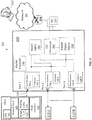
- FIG. 1 is a block diagram of a computing environment 10, in which embodiments of the present inventive concepts can be practiced.
- the computing environment 10 can include a data network, where data is exchanged between elements of the network.
- the computing environment 10 includes a plurality of server nodes 112-1 through 112-N (generally, 112), where N is an integer greater than 0.
- the server nodes 112 are each coupled to an aggregation device 200 by a Peripheral Component Interconnect Express (PCIe) connector or the like for establishing a communication path 116 with an aggregation device 200.
- the server nodes 112 can comprise single socket servers or related microprocessor devices attached to the aggregation device 200 by PCIe interfaces and the like.
- the server nodes 112 can be constructed and arranged as a processor cluster or other well-known arrangement.
- One or more server nodes 112 can be virtualized or non-virtualized.
- a server node 112 includes one or more network interfaces, for example, NICs.
- a virtualized server node and/or the aggregation device 200 can include multiple virtual network interface cards (vNICs).
- a server node 112 includes a processor 102, which can include one or more microprocessors, central processing units (CPUs), graphics processing units (GPUs), digital signal processors (DSPs), application-specific integrated circuits (ASICs), memory controllers, multi-core processors, or other types of data processing devices, or portions and combinations of these and other devices.
- processors can include one or more microprocessors, central processing units (CPUs), graphics processing units (GPUs), digital signal processors (DSPs), application-specific integrated circuits (ASICs), memory controllers, multi-core processors, or other types of data processing devices, or portions and combinations of these and other devices.
- a server node 112 also includes a memory (not shown).
- the memory can be a non-volatile or volatile memory, for example, DRAM or static RAM (SRAM).
- Stored at the memory 104 includes program code of an operating system, one or more applications, or other software programs executed by a processor 102. Also stored at the memory 104 can include some or all of a node interface 122, a device driver 124, a flowtag cache 126, and a network stack 128.
- the node interface 122 can include a PCIe port or related network connector, and communicate with the device driver 124 for establishing the communication path 116 with the aggregation device 200.
- the flowtag cache 126 stores MAC address-to-routing information map data.
- the routing information can include the egress port or other identifiers corresponding to the destination device.
- the flowtag cache 126 maps a tuple, for example, ⁇ destination MAC address, VLAN tag (if present) ⁇ , to a variable length flowtag.
- the flowtag cache 126 can map the MAC address of server node 112-2 with Port 2 at the aggregation device 200.
- the flowtag can be inserted into a header that is transmitted with an Ethernet frame or other unit of data, e.g., a cell, packet, or the like, to the aggregation device 200.
- the driver 124 also referred to as a host driver, can manage the flowtag cache 126.
- the driver 124 includes a virtual queue interface 132 that communicates with a virtual queue, or virtual queue 218, supported by a vNIC at the aggregation device 200.
- the network stack 128 can include a multi-layer software stack for network communications.
- the network stack 128 can include a Transmission Control Protocol (TCP), User Datagram Protocol (UDP), or related protocols included in an Internet Protocol (IP) suite.
- TCP Transmission Control Protocol
- UDP User Datagram Protocol
- IP Internet Protocol
- the network stack 128 can include other network, transport, and/or link layers, or other abstraction layers, for example, which comply with the Open Systems Interconnection (OSI) model.
- OSI Open Systems Interconnection
- a link layer of the network stack 128 can attach a source and destination MAC address, allowing data packets to be directed to a specific network interface on the server node 112-1, for example, interface 122.
- the server node 112-1 can be virtualized.
- a virtualized server node 112-1 can include one or more virtual machines (not shown) or guests, a hypervisor, and/or other virtualization elements, permitting the server node 112-1 to share hardware, such as a physical NIC 242, and/or a BIOS, HBA, or other hardware device in communication with the aggregation device 200.
- the aggregation device 200 can be coupled between the server nodes 112 and one or more network interface cards (NICs) 242 or related network adaptors, so that the server nodes 112 can communicate with one or more remote electronic devices 152.
- NICs network interface cards
- the aggregation device 200 can be used as a connection fabric for the server nodes 112, which can be organized into a cluster, replacing some or all of the traditional Ethernet switching requirements used in conventional server racks.
- the aggregation device 200 can include a switch fabric 202, an input/output (I/O) processor 204, a packet management device 210, a plurality of ports 1-N, and a corresponding plurality of port processors 216-1 through 216-N, where N is an integer greater than 1.
- the ports 1-N can be input ports and/or output ports.
- the port processors 216 can provide PCIe links or the like that form communication paths 116 with a server node 112.
- the port processors 216 can include transmit and/or receive control logic and decode logic for processing incoming packets from the server nodes 112.
- the switch fabric 202 provides a data plane interconnection between the server nodes 112, exchanging data between the server nodes 112 and/or one or more remote electronic devices 152 in communication with the aggregation system 200 via one or more NICs 242.
- the I/O processor 204 processes data transferred between the aggregation system 200 and the server nodes 112 and/or remote computing devices 252.
- the I/O processor 204 can oversee the transfer of data packets between the server nodes 112 and/or one or more remote computing devices 152.
- the I/O processor 204 includes a network processor for exchanging data between server nodes 112 and/or the remote electronic device 152.
- the I/O processor 204 includes a multiplexer and other logic for performing data transfers to and from the switch fabric 202 in accordance with a control plane processor (not shown), for example, at which a plurality of vNICs can be provided.
- the I/O processor 204 can serve as a staging area for transmitting data into and out of the aggregation device 200, for example, between two or more server nodes 112, or between a server node 112 and the remote computing device 152.
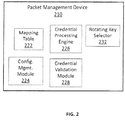
- FIG. 2 is a block diagram of the packet management device 210 of the aggregation system of FIG. 1 , in accordance with an embodiment.
- the packet management device 210 includes a mapping table 222, a configuration management module 224, a credential processing engine 226, a credential validation module 228, and a rotating key selector 232.
- the mapping table 222 includes a set of mappings between MAC addresses of source server nodes in communication with the aggregation device 200 and aggregation system ports 1-N.
- the mapping table 222 can be part of a software application that tracks and manages MAC addresses of the server nodes 112 and/or other devices in communication with the aggregation device 200 and the ports that the server nodes 112 and/or other devices are on. For example, referring to FIG. 2 , MAC addresses assigned to server nodes 212A and 212B, respectively, can each be associated with a switch port of the switch ports 1-N, requiring less processing than a hardware-intensive CAM table.
- the configuration management module 224 can detect configuration changes related to MAC addresses. For example, the configuration management module 224 can detect when a device has changed to a different port at the aggregation device 200.
- a management device such as an external controller can update the mapping table 222 with a mapping between a MAC address of the device and the new port.
- the credential processing engine 226 generates credentials that can be used to protect routing information such as port numbers or the like in an exchange between the aggregation device 200 and the server node 112. This can be achieved, for example, by a credential sealing elements of a data packet such as a flowtag and header information such as MAC addresses.
- the credential processing engine 226 can generate a credential on a per-virtual machine or per-port basis.
- a cache of credentials can be maintained by a host driver 124.
- a credential can be constructed by the credential processing engine 226 by computing a one-way hash of a flowtag and related header information, for example: ⁇ per port seed, port number, link number, virtual queue tag ⁇ .
- the credential processing engine 226 can assign one or more credentials based on a virtual queue (VQ) tag, VLAN membership, and/or a currently active key, or a port seed or rotating value of a credential, used for rotating credentials, so that a credential can be used more than once.
- VQ virtual queue
- the credential validation module 228 authenticates flowtag data can validate a credential received with a flowtag against a copy generated, or recalculated, at an ingress port at the aggregation device 200. Once the credential is validated, the flowtag contents can be used to route the packet to the appropriate destination virtqueue 218.
- a credential can be recycled at the aggregation device 200.
- the rotating key selector 232 can recycle credentials on a predetermined basis, and can maintain a status of the credentials. This can be achieved by a key, for example, a per-VQ key, that is periodically rotated by the rotating key selector 232 to prevent or otherwise reduce the risk of an unauthorized host or other snooping device from subverting the credential.
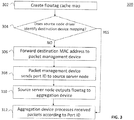
- FIG. 3 is a flow diagram of a method 300 for managing a data exchange in a network environment, in accordance with an embodiment. In describing the method 300, reference is made to elements of FIGs. 1 and 2 .
- a flowtag cache map is created.
- the flowtag cache map can include a mapping between server node MAC addresses and device ports at the aggregation device 200.
- a flowtag cache map at the cache 126 can include a first mapping between a MAC address of the server node 112-1 and Port 1 of the aggregation device 200 and a second mapping between a MAC address of the server node 112-2 and Port 2 of the aggregation device.
- the flowtag cache map can be populated by data collected at the aggregation device 200 related to MAC address-to-port mappings, for example, a new device coupled to the aggregation device 200.
- a source node driver for example, a driver 124 of the server node 112-1
- a mapping between a destination MAC address for example, a MAC address of the destination server node 112-2
- ID egress port identification
- the method 300 proceeds to block 312, where the aggregation device 200 processes packets sent from the source server node 112-1 to the destination server node 112-2 according to the port ID of the destination server node 112-2, i.e., Port 2, instead of the destination MAC address.
- the method 300 proceeds to block 306, where the destination MAC address is forwarded to the packet management device 210.
- the packet management device 210 can send a port number or related identifier to the source server node 112-1 that corresponds to the received destination MAC address.
- the port number preferably relates to an egress port at which the destination server node 112-2 having the destination MAC address is in communication.
- the port number or related identifier can be part of a flowtag generated at the packet management device, which is sent to the source server node 112-1 in response to a request.
- the flowtag can be stored at the flowtag cache 126.
- the source server node 112-1 outputs a data packet including a flowtag to the aggregation device 200 for routing to its destination.
- the data packet can be an Ethernet packet or the like.
- the aggregation device 200 processes the data packet sent from the source server node 112-1 to the destination server node 112-2 according to the port number or related identifier of the destination server node 112-2, i.e., Port 2. Since routing occurs according to the port number, less processing is required than configurations where routing occurs according to a MAC address.
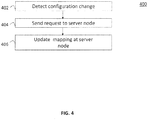
- FIG. 4 is a flow diagram of a method 400 for managing a data exchange in an electronic communications environment, in accordance with another embodiment. In describing the method 400, reference is made to elements of FIGs. 1-3 .
- a configuration change can include a change to a different port by a server node 112.
- a server node 112 or external device 152 can be reconfigured with a different MAC address, or a MAC address can be relocated to a different server node 112 or external device 152.
- the cache 126 at the source server node 112-1 may have an entry that refers to a MAC address mapped to Port 2 of the aggregation device 200.
- the aggregation device 200 more specifically, the configuration manager 228 of the packet management device 210, can detect that a different MAC address is in communication with Port 2, or that the MAC address stored at the cache 126 has been changed to a different MAC address.
- the aggregation device 200 detects that a virtual machine at a server node 112 is assigned a different MAC address.
- the packet management device 210 sends a request to the source server node 112-1.
- the request can include an invalidation request, indicating to the source server node 112-1 that the previous mapping of the destination MAC address and Port 2 is no longer valid.
- the request includes an update request for the source server node 112-1.
- the source server node 112-1 erases the previous mapping information in the flowtag cache 126 and processes new mapping information. Accordingly, a request can be sent by the packet management device 210 to invalidate the previous mapping at the flowtag cache 126, or, alternatively, an indicator can be sent to the source server node 112-1 to perform the invalidation and subsequent updating of the mapping.
- the flowtag cache 126 is updated to include MAC address-to-port mapping information that reflects the configuration change detected at block 402.
- the MAC address-to-port mapping information is provided from the mapping table 222 of the packet management device 210.
- FIG. 5 is a flow diagram of a method 500 for validating packet data, in accordance with an embodiment.
- the method 500 can be applied to address security-related problems, for example, where routing information such as a MAC address in a guest driver of a virtualized server node may be acquired for spoofing or prone to other unauthorized or illicit uses, for example, to prevent others from circumventing access to the server nodes to acquire data.
- the source server node 112-1 can send a routing request message to the aggregation device 200.
- the routing request message can include a request for a destination MAC address or other routing data.
- the packet management device 210 of the aggregation device 200 can send routing data in response to the request made at block 502.
- the aggregation device 200 sends a credential with a flowtag instead of a requested destination MAC address according to mapping information at the mapping table 222.
- the aggregation device 200 can also send a credential and/or other information such as VLAN membership data with the routing data to the requesting source server node 112-1.
- a credential can be created by the credential processing engine 226.
- the credential can be constructed by computing a one-way hash of flowtag data and/or packet header information, such as a per-port seed, port numbers, link numbers, virtual queue identifiers or tags, and/or a generation identification, which can be used for recycling credentials as described below.
- a credential is created for each virtual machine of a server node 112.
- a credential is created for each port 1-N to which a server node 112 or other electronic device is coupled.
- the credential processing engine 226 can assign a credential based on the virtual queue tags, VLAN membership for the source, and/or a currently active key, described below with respect to FIG. 7 .
- the server node 112 transmits a packet or related unit of data that includes a flowtag.
- the flowtag can include data related to the destination port, VLAN data, and/or other routing data, for example, described herein.
- the flowtag can include a credential and/or the generation identification, or phase identification provided by the aggregation device 200 described at block 504.
- the packet provided with the flowtag can be an Ethernet packet or the like.
- the packet management device 210 validates the credential received with the flowtag.
- the credential validation module 228 can validate the received credential against a copy generated at the ingress port, for example, by recalculating the credential, for example, performing a one-way hash.
- the credential validation module 228 communicates with one or more virtual queues at the aggregation device 200 that allow a guest to post descriptors pointing to data buffers to the server nodes 112, and the server nodes 112 to release descriptors back to the guest for re-use.
- a flow path can be established with a requesting server node virtual machine's NIC for moving the flowtag and packet through the aggregation device 200.
- flowtag contents such as an aggregation device egress port number can be used for routing the packet to its destination.
- the packet can be routed to a destination virtual queue 218 at the aggregation device 200, for example, for data buffering. In other embodiments, the packet is routed directly to an egress port 1-N for output to a destination server node 112 or remote device.
- FIG. 6 is a diagram illustrating contents of a packet 600 output from a server node 112 to an aggregation device 200, in accordance with an embodiment
- the unit of data 600 can be a packet, frame, cell, or the like.
- the unit of data 600 includes a flowtag 602, a header 604, and a data payload 606.
- the flowtag 602 can be the same as or similar to those described in accordance with embodiments herein.
- the header 604 can be an Ethernet header or the like, and can include a preamble, source MAC address, destination MAC address, VLAN ID, and/or Ethernet type fields.
- the flowtag 602 can include a port ID field, a credential field, and/or a generation ID field.
- the port ID field can include a destination port number.
- the port number in the port ID field can be used for routing the network packet 604 to a destination device.
- the credential field can include a credential generated by the aggregation device 200 and provided to the server node 112-1 during a data exchange, for example, in accordance with a method described herein.
- the generation ID field can include a generation identification, or port seed, which can be used to prevent a snooper from gathering information over time which would otherwise weaken a hash.
- the generation ID permits the aggregation device 200 maintains a status of generated credentials, and permits the credentials to be periodically recycled, for example, by tracking the credential.
- FIG. 7 is a detailed block diagram illustrating a packet validation flow, in accordance with an embodiment.
- packet validation flow reference is made to elements of FIGs. 1-6 , in particular, to the credential validation step described at block 508 of FIG. 5 .
- a server node 112 transmits a packet 702 or the like to the aggregation device 200.
- the packet 702 includes a flowtag 712, an Ethernet header 714, and a payload 716.
- the flowtag 712 can be similar to the flowtag 602 described at FIG. 6 .
- the flowtag 712 includes a key select field 722, a credential field 724, and a VQ_DestTag field 726.
- the key select field 722 includes a key select value that is used by the rotating key selector 704, also referred to as a generation identification (ID), to select a valid encryption key (Key 0, Key 1).
- the selected encryption key 734 can be used when a credential is generated that is compared to the credential 724 in the flowtag 712 during the validation process.
- the keys (Key 0, Key 1) can be stored at the aggregation device 200 and can be rotated by the credential processing engine 226 on a predetermined basis, for example, every 4 seconds, in order to reduce the risk of an unauthorized party such as a snooper from subverting the mechanism for generating and validating credentials.
- the credential 724 can be generated and inserted in the flowtag 712 according to embodiments described herein, for example, generated by the credential processing engine 226.
- the credential 724 is validated by the credential validation module 228 in part by the credential processing engine 226 recalculating the credential using data 740 received from the incoming packet 702, such as the VLAN membership identification (VLAN_ID) 730 of the Ethernet header 714.
- VLAN_ID VLAN membership identification
- the VQ_DestTag 726 relates to a virtual queue that identifies the destination device for receiving the packet data.
- the VQ_DestTag 726 can be created by decoding a MMIO mailbox write address and data related to the storing of the packet data in a buffer or the like at the aggregation device 200 for receipt by the destination device.
- the Ethernet header 714 can include one or more fields that are well-known to those of ordinary skill in the art, such as a preamble, source MAC address, destination MAC address, VLAN ID, and Ethernet type fields.
- the credential validation module 228 During a packet validation operation, the credential validation module 228 generates a credential that is compared to the credential 724 of the packet 702.
- the VQ_DestTag 726 and the VLAN ID of the Ethernet header 714 can be combined with the VQ_SrcTag and a key (Key 0, Key 1) output from the rotating key selector 232 to generate the credential, which can be compared to the credential 724 in the received flowtag 702 to produce a validation result. If the validation fails, then the packet can be dropped, and a log can be created of the result. If the validation passes, the packet processor can process the received data.
- aspects of the present invention may be embodied as a system, method or computer program product. Accordingly, aspects of the present invention may take the form of an entirely hardware embodiment, an entirely software embodiment (including firmware, resident software, micro-code, etc.) or an embodiment combining software and hardware aspects that may all generally be referred to herein as a "circuit,” “module” or “system.” Furthermore, aspects of the present invention may take the form of a computer program product embodied in one or more computer readable medium(s) having computer readable program code embodied thereon.
- the computer readable medium may be a computer readable signal medium or a computer readable storage medium.
- a computer readable storage medium may be, for example, but not limited to, an electronic, magnetic, optical, electromagnetic, infrared, or semiconductor system, apparatus, or device, or any suitable combination of the foregoing.
- a computer readable storage medium may be any tangible medium that can contain, or store a program for use by or in connection with an instruction execution system, apparatus, or device.
- a computer readable signal medium may include a propagated data signal with computer readable program code embodied therein, for example, in baseband or as part of a carrier wave. Such a propagated signal may take any of a variety of forms, including, but not limited to, electro-magnetic, optical, or any suitable combination thereof.
- a computer readable signal medium may be any computer readable medium that is not a computer readable storage medium and that can communicate, propagate, or transport a program for use by or in connection with an instruction execution system, apparatus, or device.
- Program code embodied on a computer readable medium may be transmitted using any appropriate medium, including but not limited to wireless, wireline, optical fiber cable, RF, etc., or any suitable combination of the foregoing.
- Computer program code for carrying out operations for aspects of the present invention may be written in any combination of one or more programming languages, including an object oriented programming language such as Java, Smalltalk, C++ or the like and conventional procedural programming languages, such as the "C" programming language or similar programming languages.
- the program code may execute entirely on the user's computer, partly on the user's computer, as a stand-alone software package, partly on the user's computer and partly on a remote computer or entirely on the remote computer or server.
- the remote computer may be connected to the user's computer through any type of network, including a local area network (LAN) or a wide area network (WAN), or the connection may be made to an external computer (for example, through the Internet using an Internet Service Provider).
- LAN local area network
- WAN wide area network
- Internet Service Provider for example, AT&T, MCI, Sprint, EarthLink, MSN, GTE, etc.
- These computer program instructions may also be stored in a computer readable medium that can direct a computer, other programmable data processing apparatus, or other devices to function in a particular manner, such that the instructions stored in the computer readable medium produce an article of manufacture including instructions which implement the function/act specified in the flowchart and/or block diagram block or blocks.
- the computer program instructions may also be loaded onto a computer, other programmable data processing apparatus, or other devices to cause a series of operational steps to be performed on the computer, other programmable apparatus or other devices to produce a computer implemented process such that the instructions which execute on the computer or other programmable apparatus provide processes for implementing the functions/acts specified in the flowchart and/or block diagram block or blocks.
- each block in the flowchart or block diagrams may represent a module, segment, or portion of code, which comprises one or more executable instructions for implementing the specified logical function(s).
- the functions noted in the block may occur out of the order noted in the figures. For example, two blocks shown in succession may, in fact, be executed substantially concurrently, or the blocks may sometimes be executed in the reverse order, depending upon the functionality involved.
Landscapes
- Engineering & Computer Science (AREA)
- Computer Security & Cryptography (AREA)
- Signal Processing (AREA)
- Computer Networks & Wireless Communication (AREA)
- General Engineering & Computer Science (AREA)
- Computer Hardware Design (AREA)
- Computing Systems (AREA)
- Theoretical Computer Science (AREA)
- Physics & Mathematics (AREA)
- General Physics & Mathematics (AREA)
- Mathematical Physics (AREA)
- Data Exchanges In Wide-Area Networks (AREA)
- Small-Scale Networks (AREA)
Claims (15)
- Verfahren zur Verwaltung eines Datenaustauschs in einer Netzwerkumgebung, umfassend:Übertragen (308), durch eine Aggregationsvorrichtung (200), eines Flowtags an eine Quellenvorrichtung (112-1), wobei das Flowtag eine Anschlussidentifizierung beinhaltet, die einem Ausgangsanschluss (Anschluss 2,..., Anschluss N) an der Aggregationsvorrichtung entspricht, wobei die Anschlussidentifizierung eine Anschlussnummer des Ausgangsanschlusses ist und die Aggregationsvorrichtung über den Ausgangsanschluss in Kommunikation mit der Zielvorrichtung (112-2,..., 112-N) steht;Empfangen (310), durch die Aggregationsvorrichtung, eines Datenpakets, das das Flowtag beinhaltet, von der Quellenvorrichtung;Authentifizieren des Datenpakets an der Aggregationsvorrichtung; undAusgeben (312), durch die Aggregationsvorrichtung, des authentifizierten Datenpakets an dem Ausgangsanschluss gemäß der Anschlussnummer in dem Flowtag des authentifizierten Datenpakets.
- Verfahren nach Anspruch 1, wobei das Datenpaket an eine Zielvorrichtung in Kommunikation mit dem Ausgangsanschluss an der Aggregationsvorrichtung ausgegeben wird und wobei die Anschlussidentifizierung einer MAC-Adresse der Zielvorrichtung zugeordnet ist.
- Verfahren nach Anspruch 1, ferner umfassend:
Senden einer Anfrage nach der Anschlussidentifizierung von der Quellenvorrichtung an die Aggregationsvorrichtung, wobei die Anfrage eine MAC-Adresse einer Zielvorrichtung beinhaltet; und Senden, durch die Aggregationsvorrichtung, der Anschlussidentifizierung an die Quellenvorrichtung gemäß einem Zuordnungstabelleneintrag an der Aggregationsvorrichtung, der die empfangene MAC-Adresse mit der Anschlussidentifizierung assoziiert. - Verfahren nach Anspruch 3, ferner umfassend:Erstellen des Flowtags an der Aggregationsvorrichtung;Weiterleiten des Flowtags einschließlich der Anschlussidentifizierung an die Quellenvorrichtung; undSpeichern des Flowtags an der Quellenvorrichtung.
- Verfahren nach Anspruch 1, ferner umfassend:Erfassen einer Konfigurationsänderung;Senden einer Anfrage von der Aggregationsvorrichtung an die Quellenvorrichtung, wobei die Anfrage Daten in Bezug auf die Konfigurationsänderung beinhaltet; undAktualisieren eines Flowtag-Caches als Reaktion auf die Anfrage, die Daten in Bezug auf die Konfigurationsänderung einzuschließen.
- Verfahren nach Anspruch 1, wobei das Validieren des Flowtags Folgendes umfasst:Senden einer Routing-Anfragenachricht von der Quellenvorrichtung an die Aggregationsvorrichtung;Empfangen einer Berechtigung, die das Flowtag versiegelt, von der Aggregationsvorrichtung;Übertragen des Flowtags und des Datenpakets von der Quellenvorrichtung an die Aggregationsvorrichtung, wobei das Flowtag die Routing-Daten und die Berechtigung beinhaltet; undValidieren der Berechtigung an der Aggregationsvorrichtung.
- Verfahren nach Anspruch 6, wobei das Flowtag eine Erstellungs-ID umfasst, die der Berechtigung unter einer Vielzahl von an der Aggregationsvorrichtung erstellten Berechtigungen entspricht.
- Verfahren nach Anspruch 6, wobei das Validieren der Berechtigung Folgendes umfasst:Erstellen der Berechtigung an der Aggregationsvorrichtung;Vergleichen der von der Quellenvorrichtung gesendeten Berechtigung mit einer neuberechneten Berechtigung an der Aggregationsvorrichtung; undVerarbeiten des Datenpakets als Reaktion auf ein Vergleichsergebnis.
- Verfahren nach Anspruch 1, ferner umfassend:Beibehalten eines Flowtag-Caches an der Quellenvorrichtung,wobei der Flowtag-Cache Flowtags beinhaltet, die Informationen in Bezug auf eine Zuordnung zwischen Vorrichtungs-MAC-Adressen und Anschlussidentifizierungen beinhalten.
- Datennetzwerk (10), umfassend:eine Quellenvorrichtung (112-1), die konfiguriert ist, um einem Datenpaket in einem Datenübertragungsvorgang ein Flowtag zuzuweisen,wobei das Flowtag eine Anschlussidentifizierung beinhaltet, die einem Ausgangsanschluss (Anschluss 2,..., Anschluss N) an einer Aggregationsvorrichtung (200) entspricht, die einer Ziel-MAC-Adresse einer Zielvorrichtung (112-2,..., 112-N) entspricht,wobei die Anschlussidentifizierung eine Anschlussnummer des Ausgangsanschlusses ist;eine Zielvorrichtung, die konfiguriert ist, um das Datenpaket in dem Datenübertragungsvorgang zu empfangen;wobei die Aggregationsvorrichtung einen ersten Anschluss aufweist, an den die Quellenvorrichtung kommunikativ gekoppelt ist, und den Ausgangsanschluss, an den die Zielvorrichtung kommunikativ gekoppelt ist,wobei die Aggregationsvorrichtung eine Paketverwaltungsvorrichtung (210) beinhaltet, die konfiguriert ist, um Routing-Daten in dem Flowtag zu verarbeiten und eine Berechtigung, die das Flowtag versiegelt, zu validieren, und, auf Grundlage der Anschlussnummer in der Anschlussidentifizierung in dem Flowtag, das Datenpaket an dem Ausgangsanschluss gemäß der Anschlussnummer auszugeben.
- Datennetzwerk nach Anspruch 10, wobei die Quellenvorrichtung einen Flowtag-Cache umfasst, der eine Vielzahl von Einträgen beinhaltet, wobei ein erster Eintrag eine Zuordnung zwischen einer MAC-Adresse der Quellenvorrichtung und einer Anschlussidentifizierung entsprechend dem ersten Anschluss beinhaltet und ein zweiter Eintrag eine Zuordnung zwischen einer MAC-Adresse der Zielvorrichtung und der Anschlussidentifizierung entsprechend dem Ausgangsanschluss beinhaltet.
- Datennetzwerk nach Anspruch 10, wobei die Paketverwaltungsvorrichtung eine Zuordnungstabelle umfasst, die konfiguriert ist, um die Zuordnung zwischen der MAC-Adresse der Zielvorrichtung und der Anschlussidentifizierung entsprechend dem Ausgangsanschluss als Reaktion auf eine von der Quellenvorrichtung gesendete Anfrage bereitzustellen.
- Datennetzwerk nach Anspruch 12, wobei die Paketverwaltungsvorrichtung ein Konfigurationsverwaltungsmodul umfasst, das konfiguriert ist, um eine Anschlusskonfigurationsänderung zu erfassen, und wobei die Zuordnungstabelle konfiguriert ist, um als Reaktion auf die Anschlusskonfigurationsänderung aktualisiert zu werden.
- Datennetzwerk nach Anspruch 10, wobei die Paketverwaltungsvorrichtung ein Berechtigungsvalidierungsmodul umfasst, das konfiguriert ist, um die von der Quellenvorrichtung empfangene Berechtigung zu validieren.
- Computerprogrammprodukt, umfassend:
ein computerlesbares Speichermedium, mit dem computerlesbarer Programmcode ausgeführt ist, wobei der computerlesbare Programmcode, wenn er durch eine Aggregationsvorrichtung ausgeführt wird, ein Verfahren durchführt, umfassend:Übertragen eines Flowtags an eine Quellenvorrichtung, wobei das Flowtag eine Anschlussidentifizierung entsprechend einem Ausgangsanschluss an der Aggregationsvorrichtung beinhaltet, wobei die Anschlussidentifizierung eine Anschlussnummer des Ausgangsanschlusses ist, und die Aggregationsvorrichtung ausgelegt ist, um über den Ausgangsanschluss mit der Zielvorrichtung zu kommunizieren;Empfangen eines Datenpakets, das das Flowtag enthält, von der Quellenvorrichtung;Authentifizieren des Datenpakets an der Aggregationsvorrichtung; undAusgeben des authentifizierten Datenpakets an dem Ausgangsanschluss gemäß der Anschlussnummer in dem Flowtag des authentifizierten Datenpakets.
Applications Claiming Priority (2)
| Application Number | Priority Date | Filing Date | Title |
|---|---|---|---|
| US13/675,401 US8875256B2 (en) | 2012-11-13 | 2012-11-13 | Data flow processing in a network environment |
| PCT/US2013/069572 WO2014078271A1 (en) | 2012-11-13 | 2013-11-12 | Method and device for data flow processing |
Publications (2)
| Publication Number | Publication Date |
|---|---|
| EP2920940A1 EP2920940A1 (de) | 2015-09-23 |
| EP2920940B1 true EP2920940B1 (de) | 2018-12-26 |
Family
ID=49679637
Family Applications (1)
| Application Number | Title | Priority Date | Filing Date |
|---|---|---|---|
| EP13798469.6A Active EP2920940B1 (de) | 2012-11-13 | 2013-11-12 | Verfahren und vorrichtung zur datenflussverarbeitung |
Country Status (6)
| Country | Link |
|---|---|
| US (1) | US8875256B2 (de) |
| EP (1) | EP2920940B1 (de) |
| JP (1) | JP2016502795A (de) |
| KR (1) | KR101688984B1 (de) |
| CN (1) | CN104769912B (de) |
| WO (1) | WO2014078271A1 (de) |
Families Citing this family (15)
| Publication number | Priority date | Publication date | Assignee | Title |
|---|---|---|---|---|
| US9374305B2 (en) * | 2013-10-24 | 2016-06-21 | Dell Products L.P. | Packet transfer system |
| US9672512B1 (en) * | 2014-01-02 | 2017-06-06 | Sprint Communications Company L.P. | Processor routing number for mobile communication service provider billing |
| EP3314828A4 (de) * | 2015-06-26 | 2018-12-19 | McAfee, LLC | System und verfahren zum routen von daten in software-definierten netzwerken |
| US10187218B2 (en) * | 2015-09-15 | 2019-01-22 | Google Llc | Systems and methods for processing packets in a computer network |
| US9606959B1 (en) | 2015-11-12 | 2017-03-28 | International Business Machines Corporation | Indicating a sending buffer and receiving buffer in a message to use to validate the message in the receiving buffer |
| US10547559B2 (en) * | 2015-12-26 | 2020-01-28 | Intel Corporation | Application-level network queueing |
| US10454930B2 (en) | 2017-07-14 | 2019-10-22 | EMC IP Holding Company LLC | System and method for local data IP based network security for preventing data breach attempts in a multi-tenant protection storage deployment |
| US10146953B1 (en) * | 2017-07-14 | 2018-12-04 | EMC IP Holding Company LLC | System and method for physical data packets isolation for different tenants in a multi-tenant protection storage environment |
| US20190109789A1 (en) * | 2018-12-06 | 2019-04-11 | Intel Corporation | Infrastructure and components to provide a reduced latency network with checkpoints |
| CN110691074B (zh) * | 2019-09-20 | 2022-04-22 | 西安瑞思凯微电子科技有限公司 | 一种IPv6数据加密方法、IPv6数据解密方法 |
| US11477048B2 (en) * | 2021-01-15 | 2022-10-18 | BlackBear (Taiwan) Industrial Networking Security Ltd. | Communication method for one-way transmission based on VLAN ID and switch device using the same |
| KR102345866B1 (ko) * | 2021-05-13 | 2022-01-03 | 주식회사 엠엘소프트 | 서버시스템 및 서버시스템에서 수행되는 사용자단말에 대한 통신 보안방법 |
| CN113312656B (zh) * | 2021-07-29 | 2022-04-15 | 阿里云计算有限公司 | 数据轮转方法、装置、设备及系统 |
| CN113382024B (zh) * | 2021-08-12 | 2021-12-21 | 阿里云计算有限公司 | 凭据的轮转方法、计算设备及存储介质 |
| KR102309116B1 (ko) * | 2021-09-07 | 2021-10-08 | 프라이빗테크놀로지 주식회사 | 데이터 플로우 기반 애플리케이션의 네트워크 접속을 제어하기 위한 시스템 및 그에 관한 방법 |
Citations (1)
| Publication number | Priority date | Publication date | Assignee | Title |
|---|---|---|---|---|
| US20120082163A1 (en) * | 2009-06-09 | 2012-04-05 | Christian Esteve Rothenberg | Packet Routing In A Network |
Family Cites Families (41)
| Publication number | Priority date | Publication date | Assignee | Title |
|---|---|---|---|---|
| US5291482A (en) | 1992-07-24 | 1994-03-01 | At&T Bell Laboratories | High bandwidth packet switch |
| JP2570963B2 (ja) * | 1993-05-31 | 1997-01-16 | 日本電気株式会社 | パケット網における中継経路情報を用いたシグナリング方式 |
| US6031842A (en) | 1996-09-11 | 2000-02-29 | Mcdata Corporation | Low latency shared memory switch architecture |
| US6370605B1 (en) | 1999-03-04 | 2002-04-09 | Sun Microsystems, Inc. | Switch based scalable performance storage architecture |
| US6850987B1 (en) | 1999-06-01 | 2005-02-01 | Fastforward Networks, Inc. | System for multipoint infrastructure transport in a computer network |
| US6785892B1 (en) | 2000-06-23 | 2004-08-31 | Unisys | Communications between partitioned host processors and management processor |
| US6823453B1 (en) | 2000-10-06 | 2004-11-23 | Hewlett-Packard Development Company, L.P. | Apparatus and method for implementing spoofing-and replay-attack-resistant virtual zones on storage area networks |
| US20020069318A1 (en) | 2000-12-01 | 2002-06-06 | Chow Yan Chiew | Real time application accelerator and method of operating the same |
| US6795886B1 (en) | 2000-12-22 | 2004-09-21 | Ncr Corporation | Interconnect switch method and apparatus |
| US7154885B2 (en) | 2001-12-31 | 2006-12-26 | Stmicroelectronics Ltd. | Apparatus for switching data in high-speed networks and method of operation |
| WO2004068314A2 (en) * | 2003-01-27 | 2004-08-12 | Raza Microelectronics, Inc. | Method and device for the classification and redirection of data packets in a heterogeneous network |
| US7421532B2 (en) | 2003-11-18 | 2008-09-02 | Topside Research, Llc | Switching with transparent and non-transparent ports |
| US8688834B2 (en) * | 2004-07-09 | 2014-04-01 | Toshiba America Research, Inc. | Dynamic host configuration and network access authentication |
| US8095600B2 (en) | 2004-10-22 | 2012-01-10 | Microsoft Corporation | Inter-proximity communication within a rendezvous federation |
| US7694167B2 (en) | 2004-10-22 | 2010-04-06 | Microsoft Corporation | Maintaining routing consistency within a rendezvous federation |
| US7480303B1 (en) | 2005-05-16 | 2009-01-20 | Pericom Semiconductor Corp. | Pseudo-ethernet switch without ethernet media-access-controllers (MAC's) that copies ethernet context registers between PCI-express ports |
| US7568074B1 (en) | 2005-10-25 | 2009-07-28 | Xilinx, Inc. | Time based data storage for shared network memory switch |
| KR100992050B1 (ko) | 2006-01-12 | 2010-11-05 | 브로드콤 이스라엘 알 앤 디 | 가상화된 네트워크 환경에서 입력/출력 공유를 가지는프로토콜 오프로드 및 다이렉트 입력/출력을 위한 방법 및시스템 |
| US8397284B2 (en) | 2006-01-17 | 2013-03-12 | University Of Maryland | Detection of distributed denial of service attacks in autonomous system domains |
| JP2007328461A (ja) | 2006-06-06 | 2007-12-20 | Matsushita Electric Ind Co Ltd | 非対称マルチプロセッサ |
| WO2007144702A1 (en) | 2006-06-13 | 2007-12-21 | Freescale Semiconductor, Inc. | Method for processing information fragments and a device having information fragment processing capabilities |
| US8140719B2 (en) | 2007-06-21 | 2012-03-20 | Sea Micro, Inc. | Dis-aggregated and distributed data-center architecture using a direct interconnect fabric |
| US7925802B2 (en) | 2007-06-21 | 2011-04-12 | Seamicro Corp. | Hardware-based virtualization of BIOS, disks, network-interfaces, and consoles using a direct interconnect fabric |
| WO2009036400A2 (en) | 2007-09-12 | 2009-03-19 | Citrix Systems, Inc. | Methods and systems for generating desktop environments providing integrated access to remote and local resources |
| JP5096905B2 (ja) | 2007-12-20 | 2012-12-12 | 株式会社日立製作所 | サーバ装置及びそのリンク回復処理方法 |
| US8249072B2 (en) | 2009-03-12 | 2012-08-21 | Oracle America, Inc. | Scalable interface for connecting multiple computer systems which performs parallel MPI header matching |
| US9575889B2 (en) | 2008-07-03 | 2017-02-21 | Hewlett Packard Enterprise Development Lp | Memory server |
| KR101539297B1 (ko) | 2009-01-05 | 2015-07-24 | 삼성전자주식회사 | 반도체 장치, 이를 포함하는 반도체 시스템, 및 반도체 장치의 전압 공급방법 |
| US8732258B2 (en) * | 2009-03-20 | 2014-05-20 | Oracle America, Inc. | Method and system for transporting telemetry data across a network |
| US7913027B2 (en) | 2009-04-07 | 2011-03-22 | Lsi Corporation | Configurable storage array controller |
| US8352669B2 (en) | 2009-04-27 | 2013-01-08 | Lsi Corporation | Buffered crossbar switch system |
| TW201115458A (en) | 2009-10-29 | 2011-05-01 | Ralink Technology Corp | Buffer space allocation method and related packet switch |
| US8463934B2 (en) | 2009-11-05 | 2013-06-11 | Rj Intellectual Properties, Llc | Unified system area network and switch |
| RU2012144031A (ru) * | 2010-03-17 | 2014-04-27 | Нек Корпорейшн | Система связи, узел, сервер управления, способ осуществления связи и программа |
| JP2011234063A (ja) * | 2010-04-27 | 2011-11-17 | Fujitsu Ltd | 中継装置、及び、転送方法 |
| KR101509145B1 (ko) | 2011-03-03 | 2015-04-07 | 가부시키가이샤 무라타 세이사쿠쇼 | 적층 세라믹 콘덴서 |
| US8989009B2 (en) * | 2011-04-29 | 2015-03-24 | Futurewei Technologies, Inc. | Port and priority based flow control mechanism for lossless ethernet |
| US9021475B2 (en) * | 2011-05-04 | 2015-04-28 | Citrix Systems, Inc. | Systems and methods for SR-IOV pass-thru via an intermediary device |
| US8490113B2 (en) | 2011-06-24 | 2013-07-16 | International Business Machines Corporation | Messaging in a parallel computer using remote direct memory access (‘RDMA’) |
| US9137173B2 (en) | 2012-06-19 | 2015-09-15 | Advanced Micro Devices, Inc. | Devices and methods for interconnecting server nodes |
| US8930595B2 (en) | 2012-06-21 | 2015-01-06 | Advanced Micro Devices, Inc. | Memory switch for interconnecting server nodes |
-
2012
- 2012-11-13 US US13/675,401 patent/US8875256B2/en active Active
-
2013
- 2013-11-12 JP JP2015541998A patent/JP2016502795A/ja active Pending
- 2013-11-12 KR KR1020157011759A patent/KR101688984B1/ko active Active
- 2013-11-12 CN CN201380057816.1A patent/CN104769912B/zh active Active
- 2013-11-12 WO PCT/US2013/069572 patent/WO2014078271A1/en not_active Ceased
- 2013-11-12 EP EP13798469.6A patent/EP2920940B1/de active Active
Patent Citations (1)
| Publication number | Priority date | Publication date | Assignee | Title |
|---|---|---|---|---|
| US20120082163A1 (en) * | 2009-06-09 | 2012-04-05 | Christian Esteve Rothenberg | Packet Routing In A Network |
Also Published As
| Publication number | Publication date |
|---|---|
| JP2016502795A (ja) | 2016-01-28 |
| US8875256B2 (en) | 2014-10-28 |
| KR101688984B1 (ko) | 2016-12-22 |
| CN104769912A (zh) | 2015-07-08 |
| CN104769912B (zh) | 2018-10-02 |
| KR20150082282A (ko) | 2015-07-15 |
| WO2014078271A1 (en) | 2014-05-22 |
| EP2920940A1 (de) | 2015-09-23 |
| US20140137215A1 (en) | 2014-05-15 |
Similar Documents
| Publication | Publication Date | Title |
|---|---|---|
| EP2920940B1 (de) | Verfahren und vorrichtung zur datenflussverarbeitung | |
| US12218956B2 (en) | Providing a virtual security appliance architecture to a virtual cloud infrastructure | |
| US10949379B2 (en) | Network traffic routing in distributed computing systems | |
| US10263832B1 (en) | Physical interface to virtual interface fault propagation | |
| US10812378B2 (en) | System and method for improved service chaining | |
| US9413554B2 (en) | Virtual network overlays | |
| US20200344088A1 (en) | Network interoperability support for non-virtualized entities | |
| US9948579B1 (en) | NIC-based packet assignment for virtual networks | |
| KR101969194B1 (ko) | 네트워킹 장치 가상화를 위한 패킷 처리 오프로딩 기법 | |
| US10182005B2 (en) | Software defined network (SDN) switch clusters having layer-3 distributed router functionality | |
| US9571394B1 (en) | Tunneled packet aggregation for virtual networks | |
| US11929987B1 (en) | Preserving packet flow information across bump-in-the-wire firewalls | |
| US20200351286A1 (en) | Configuring an island virtual switch for provisioning of network security services | |
| US20230388398A1 (en) | Encoding of an implicit packet sequence number in a packet | |
| US10469529B2 (en) | Address checking to protect against denial of service attack | |
| WO2019165274A1 (en) | Systems and methods for preventing malicious network traffic from accessing trusted network resources | |
| US20140068088A1 (en) | Systems and methods for processing media access control (mac) addresses | |
| US20230155988A1 (en) | Packet security over multiple networks |
Legal Events
| Date | Code | Title | Description |
|---|---|---|---|
| PUAI | Public reference made under article 153(3) epc to a published international application that has entered the european phase |
Free format text: ORIGINAL CODE: 0009012 |
|
| 17P | Request for examination filed |
Effective date: 20150522 |
|
| AK | Designated contracting states |
Kind code of ref document: A1 Designated state(s): AL AT BE BG CH CY CZ DE DK EE ES FI FR GB GR HR HU IE IS IT LI LT LU LV MC MK MT NL NO PL PT RO RS SE SI SK SM TR |
|
| AX | Request for extension of the european patent |
Extension state: BA ME |
|
| DAX | Request for extension of the european patent (deleted) | ||
| STAA | Information on the status of an ep patent application or granted ep patent |
Free format text: STATUS: EXAMINATION IS IN PROGRESS |
|
| 17Q | First examination report despatched |
Effective date: 20171214 |
|
| RAP1 | Party data changed (applicant data changed or rights of an application transferred) |
Owner name: ADVANCED MICRO DEVICES, INC. |
|
| RAP1 | Party data changed (applicant data changed or rights of an application transferred) |
Owner name: ADVANCED MICRO DEVICES, INC. |
|
| GRAP | Despatch of communication of intention to grant a patent |
Free format text: ORIGINAL CODE: EPIDOSNIGR1 |
|
| STAA | Information on the status of an ep patent application or granted ep patent |
Free format text: STATUS: GRANT OF PATENT IS INTENDED |
|
| RIC1 | Information provided on ipc code assigned before grant |
Ipc: H04L 12/46 20060101ALI20180731BHEP Ipc: H04L 12/721 20130101ALI20180731BHEP Ipc: G06F 13/40 20060101ALI20180731BHEP Ipc: H04L 29/06 20060101AFI20180731BHEP |
|
| INTG | Intention to grant announced |
Effective date: 20180828 |
|
| GRAS | Grant fee paid |
Free format text: ORIGINAL CODE: EPIDOSNIGR3 |
|
| GRAJ | Information related to disapproval of communication of intention to grant by the applicant or resumption of examination proceedings by the epo deleted |
Free format text: ORIGINAL CODE: EPIDOSDIGR1 |
|
| GRAL | Information related to payment of fee for publishing/printing deleted |
Free format text: ORIGINAL CODE: EPIDOSDIGR3 |
|
| STAA | Information on the status of an ep patent application or granted ep patent |
Free format text: STATUS: EXAMINATION IS IN PROGRESS |
|
| GRAR | Information related to intention to grant a patent recorded |
Free format text: ORIGINAL CODE: EPIDOSNIGR71 |
|
| STAA | Information on the status of an ep patent application or granted ep patent |
Free format text: STATUS: GRANT OF PATENT IS INTENDED |
|
| GRAA | (expected) grant |
Free format text: ORIGINAL CODE: 0009210 |
|
| STAA | Information on the status of an ep patent application or granted ep patent |
Free format text: STATUS: THE PATENT HAS BEEN GRANTED |
|
| INTC | Intention to grant announced (deleted) | ||
| INTG | Intention to grant announced |
Effective date: 20181108 |
|
| AK | Designated contracting states |
Kind code of ref document: B1 Designated state(s): AL AT BE BG CH CY CZ DE DK EE ES FI FR GB GR HR HU IE IS IT LI LT LU LV MC MK MT NL NO PL PT RO RS SE SI SK SM TR |
|
| REG | Reference to a national code |
Ref country code: GB Ref legal event code: FG4D |
|
| REG | Reference to a national code |
Ref country code: CH Ref legal event code: EP |
|
| REG | Reference to a national code |
Ref country code: AT Ref legal event code: REF Ref document number: 1082976 Country of ref document: AT Kind code of ref document: T Effective date: 20190115 |
|
| REG | Reference to a national code |
Ref country code: IE Ref legal event code: FG4D |
|
| REG | Reference to a national code |
Ref country code: DE Ref legal event code: R096 Ref document number: 602013048899 Country of ref document: DE |
|
| PG25 | Lapsed in a contracting state [announced via postgrant information from national office to epo] |
Ref country code: FI Free format text: LAPSE BECAUSE OF FAILURE TO SUBMIT A TRANSLATION OF THE DESCRIPTION OR TO PAY THE FEE WITHIN THE PRESCRIBED TIME-LIMIT Effective date: 20181226 Ref country code: HR Free format text: LAPSE BECAUSE OF FAILURE TO SUBMIT A TRANSLATION OF THE DESCRIPTION OR TO PAY THE FEE WITHIN THE PRESCRIBED TIME-LIMIT Effective date: 20181226 Ref country code: BG Free format text: LAPSE BECAUSE OF FAILURE TO SUBMIT A TRANSLATION OF THE DESCRIPTION OR TO PAY THE FEE WITHIN THE PRESCRIBED TIME-LIMIT Effective date: 20190326 Ref country code: LV Free format text: LAPSE BECAUSE OF FAILURE TO SUBMIT A TRANSLATION OF THE DESCRIPTION OR TO PAY THE FEE WITHIN THE PRESCRIBED TIME-LIMIT Effective date: 20181226 Ref country code: LT Free format text: LAPSE BECAUSE OF FAILURE TO SUBMIT A TRANSLATION OF THE DESCRIPTION OR TO PAY THE FEE WITHIN THE PRESCRIBED TIME-LIMIT Effective date: 20181226 Ref country code: NO Free format text: LAPSE BECAUSE OF FAILURE TO SUBMIT A TRANSLATION OF THE DESCRIPTION OR TO PAY THE FEE WITHIN THE PRESCRIBED TIME-LIMIT Effective date: 20190326 |
|
| REG | Reference to a national code |
Ref country code: NL Ref legal event code: MP Effective date: 20181226 |
|
| REG | Reference to a national code |
Ref country code: LT Ref legal event code: MG4D |
|
| PG25 | Lapsed in a contracting state [announced via postgrant information from national office to epo] |
Ref country code: GR Free format text: LAPSE BECAUSE OF FAILURE TO SUBMIT A TRANSLATION OF THE DESCRIPTION OR TO PAY THE FEE WITHIN THE PRESCRIBED TIME-LIMIT Effective date: 20190327 Ref country code: RS Free format text: LAPSE BECAUSE OF FAILURE TO SUBMIT A TRANSLATION OF THE DESCRIPTION OR TO PAY THE FEE WITHIN THE PRESCRIBED TIME-LIMIT Effective date: 20181226 Ref country code: AL Free format text: LAPSE BECAUSE OF FAILURE TO SUBMIT A TRANSLATION OF THE DESCRIPTION OR TO PAY THE FEE WITHIN THE PRESCRIBED TIME-LIMIT Effective date: 20181226 Ref country code: SE Free format text: LAPSE BECAUSE OF FAILURE TO SUBMIT A TRANSLATION OF THE DESCRIPTION OR TO PAY THE FEE WITHIN THE PRESCRIBED TIME-LIMIT Effective date: 20181226 |
|
| REG | Reference to a national code |
Ref country code: AT Ref legal event code: MK05 Ref document number: 1082976 Country of ref document: AT Kind code of ref document: T Effective date: 20181226 |
|
| PG25 | Lapsed in a contracting state [announced via postgrant information from national office to epo] |
Ref country code: NL Free format text: LAPSE BECAUSE OF FAILURE TO SUBMIT A TRANSLATION OF THE DESCRIPTION OR TO PAY THE FEE WITHIN THE PRESCRIBED TIME-LIMIT Effective date: 20181226 |
|
| PG25 | Lapsed in a contracting state [announced via postgrant information from national office to epo] |
Ref country code: PL Free format text: LAPSE BECAUSE OF FAILURE TO SUBMIT A TRANSLATION OF THE DESCRIPTION OR TO PAY THE FEE WITHIN THE PRESCRIBED TIME-LIMIT Effective date: 20181226 Ref country code: IT Free format text: LAPSE BECAUSE OF FAILURE TO SUBMIT A TRANSLATION OF THE DESCRIPTION OR TO PAY THE FEE WITHIN THE PRESCRIBED TIME-LIMIT Effective date: 20181226 Ref country code: CZ Free format text: LAPSE BECAUSE OF FAILURE TO SUBMIT A TRANSLATION OF THE DESCRIPTION OR TO PAY THE FEE WITHIN THE PRESCRIBED TIME-LIMIT Effective date: 20181226 Ref country code: PT Free format text: LAPSE BECAUSE OF FAILURE TO SUBMIT A TRANSLATION OF THE DESCRIPTION OR TO PAY THE FEE WITHIN THE PRESCRIBED TIME-LIMIT Effective date: 20190426 Ref country code: ES Free format text: LAPSE BECAUSE OF FAILURE TO SUBMIT A TRANSLATION OF THE DESCRIPTION OR TO PAY THE FEE WITHIN THE PRESCRIBED TIME-LIMIT Effective date: 20181226 |
|
| PG25 | Lapsed in a contracting state [announced via postgrant information from national office to epo] |
Ref country code: SK Free format text: LAPSE BECAUSE OF FAILURE TO SUBMIT A TRANSLATION OF THE DESCRIPTION OR TO PAY THE FEE WITHIN THE PRESCRIBED TIME-LIMIT Effective date: 20181226 Ref country code: IS Free format text: LAPSE BECAUSE OF FAILURE TO SUBMIT A TRANSLATION OF THE DESCRIPTION OR TO PAY THE FEE WITHIN THE PRESCRIBED TIME-LIMIT Effective date: 20190426 Ref country code: SM Free format text: LAPSE BECAUSE OF FAILURE TO SUBMIT A TRANSLATION OF THE DESCRIPTION OR TO PAY THE FEE WITHIN THE PRESCRIBED TIME-LIMIT Effective date: 20181226 Ref country code: EE Free format text: LAPSE BECAUSE OF FAILURE TO SUBMIT A TRANSLATION OF THE DESCRIPTION OR TO PAY THE FEE WITHIN THE PRESCRIBED TIME-LIMIT Effective date: 20181226 Ref country code: RO Free format text: LAPSE BECAUSE OF FAILURE TO SUBMIT A TRANSLATION OF THE DESCRIPTION OR TO PAY THE FEE WITHIN THE PRESCRIBED TIME-LIMIT Effective date: 20181226 |
|
| REG | Reference to a national code |
Ref country code: DE Ref legal event code: R097 Ref document number: 602013048899 Country of ref document: DE |
|
| PG25 | Lapsed in a contracting state [announced via postgrant information from national office to epo] |
Ref country code: AT Free format text: LAPSE BECAUSE OF FAILURE TO SUBMIT A TRANSLATION OF THE DESCRIPTION OR TO PAY THE FEE WITHIN THE PRESCRIBED TIME-LIMIT Effective date: 20181226 Ref country code: DK Free format text: LAPSE BECAUSE OF FAILURE TO SUBMIT A TRANSLATION OF THE DESCRIPTION OR TO PAY THE FEE WITHIN THE PRESCRIBED TIME-LIMIT Effective date: 20181226 |
|
| PLBE | No opposition filed within time limit |
Free format text: ORIGINAL CODE: 0009261 |
|
| STAA | Information on the status of an ep patent application or granted ep patent |
Free format text: STATUS: NO OPPOSITION FILED WITHIN TIME LIMIT |
|
| 26N | No opposition filed |
Effective date: 20190927 |
|
| PG25 | Lapsed in a contracting state [announced via postgrant information from national office to epo] |
Ref country code: SI Free format text: LAPSE BECAUSE OF FAILURE TO SUBMIT A TRANSLATION OF THE DESCRIPTION OR TO PAY THE FEE WITHIN THE PRESCRIBED TIME-LIMIT Effective date: 20181226 |
|
| PG25 | Lapsed in a contracting state [announced via postgrant information from national office to epo] |
Ref country code: TR Free format text: LAPSE BECAUSE OF FAILURE TO SUBMIT A TRANSLATION OF THE DESCRIPTION OR TO PAY THE FEE WITHIN THE PRESCRIBED TIME-LIMIT Effective date: 20181226 |
|
| REG | Reference to a national code |
Ref country code: CH Ref legal event code: PL |
|
| PG25 | Lapsed in a contracting state [announced via postgrant information from national office to epo] |
Ref country code: LI Free format text: LAPSE BECAUSE OF NON-PAYMENT OF DUE FEES Effective date: 20191130 Ref country code: MC Free format text: LAPSE BECAUSE OF FAILURE TO SUBMIT A TRANSLATION OF THE DESCRIPTION OR TO PAY THE FEE WITHIN THE PRESCRIBED TIME-LIMIT Effective date: 20181226 Ref country code: CH Free format text: LAPSE BECAUSE OF NON-PAYMENT OF DUE FEES Effective date: 20191130 Ref country code: LU Free format text: LAPSE BECAUSE OF NON-PAYMENT OF DUE FEES Effective date: 20191112 |
|
| REG | Reference to a national code |
Ref country code: BE Ref legal event code: MM Effective date: 20191130 |
|
| PG25 | Lapsed in a contracting state [announced via postgrant information from national office to epo] |
Ref country code: FR Free format text: LAPSE BECAUSE OF NON-PAYMENT OF DUE FEES Effective date: 20191130 Ref country code: IE Free format text: LAPSE BECAUSE OF NON-PAYMENT OF DUE FEES Effective date: 20191112 |
|
| PG25 | Lapsed in a contracting state [announced via postgrant information from national office to epo] |
Ref country code: BE Free format text: LAPSE BECAUSE OF NON-PAYMENT OF DUE FEES Effective date: 20191130 |
|
| PG25 | Lapsed in a contracting state [announced via postgrant information from national office to epo] |
Ref country code: CY Free format text: LAPSE BECAUSE OF FAILURE TO SUBMIT A TRANSLATION OF THE DESCRIPTION OR TO PAY THE FEE WITHIN THE PRESCRIBED TIME-LIMIT Effective date: 20181226 |
|
| PG25 | Lapsed in a contracting state [announced via postgrant information from national office to epo] |
Ref country code: MT Free format text: LAPSE BECAUSE OF FAILURE TO SUBMIT A TRANSLATION OF THE DESCRIPTION OR TO PAY THE FEE WITHIN THE PRESCRIBED TIME-LIMIT Effective date: 20181226 Ref country code: HU Free format text: LAPSE BECAUSE OF FAILURE TO SUBMIT A TRANSLATION OF THE DESCRIPTION OR TO PAY THE FEE WITHIN THE PRESCRIBED TIME-LIMIT; INVALID AB INITIO Effective date: 20131112 |
|
| REG | Reference to a national code |
Ref country code: DE Ref legal event code: R079 Ref document number: 602013048899 Country of ref document: DE Free format text: PREVIOUS MAIN CLASS: H04L0029060000 Ipc: H04L0065000000 |
|
| PG25 | Lapsed in a contracting state [announced via postgrant information from national office to epo] |
Ref country code: MK Free format text: LAPSE BECAUSE OF FAILURE TO SUBMIT A TRANSLATION OF THE DESCRIPTION OR TO PAY THE FEE WITHIN THE PRESCRIBED TIME-LIMIT Effective date: 20181226 |
|
| P01 | Opt-out of the competence of the unified patent court (upc) registered |
Effective date: 20230530 |
|
| PGFP | Annual fee paid to national office [announced via postgrant information from national office to epo] |
Ref country code: DE Payment date: 20251010 Year of fee payment: 13 |
|
| PGFP | Annual fee paid to national office [announced via postgrant information from national office to epo] |
Ref country code: GB Payment date: 20251105 Year of fee payment: 13 |