EP2916248A1 - Interaktives Werkzeug zur Eingabe von rezeptpflichtigen Medikamenten - Google Patents
Interaktives Werkzeug zur Eingabe von rezeptpflichtigen Medikamenten Download PDFInfo
- Publication number
- EP2916248A1 EP2916248A1 EP14157428.5A EP14157428A EP2916248A1 EP 2916248 A1 EP2916248 A1 EP 2916248A1 EP 14157428 A EP14157428 A EP 14157428A EP 2916248 A1 EP2916248 A1 EP 2916248A1
- Authority
- EP
- European Patent Office
- Prior art keywords
- prescription
- input
- medical information
- dosage
- memory
- Prior art date
- Legal status (The legal status is an assumption and is not a legal conclusion. Google has not performed a legal analysis and makes no representation as to the accuracy of the status listed.)
- Withdrawn
Links
- 239000003814 drug Substances 0.000 title claims abstract description 37
- 229940079593 drug Drugs 0.000 title claims abstract description 35
- 230000002452 interceptive effect Effects 0.000 title description 7
- 238000012545 processing Methods 0.000 claims abstract description 16
- 238000000034 method Methods 0.000 claims abstract description 15
- 239000002552 dosage form Substances 0.000 claims description 10
- 238000011156 evaluation Methods 0.000 claims description 7
- 238000010200 validation analysis Methods 0.000 claims description 3
- 230000001960 triggered effect Effects 0.000 claims 1
- 238000007726 management method Methods 0.000 description 5
- 238000013479 data entry Methods 0.000 description 4
- 239000006187 pill Substances 0.000 description 4
- 239000002775 capsule Substances 0.000 description 2
- 230000001419 dependent effect Effects 0.000 description 2
- 238000010586 diagram Methods 0.000 description 2
- 239000007924 injection Substances 0.000 description 2
- 238000002347 injection Methods 0.000 description 2
- 239000008297 liquid dosage form Substances 0.000 description 2
- 238000012795 verification Methods 0.000 description 2
- 241001465754 Metazoa Species 0.000 description 1
- 230000002411 adverse Effects 0.000 description 1
- 238000004458 analytical method Methods 0.000 description 1
- 230000009286 beneficial effect Effects 0.000 description 1
- 230000036772 blood pressure Effects 0.000 description 1
- 238000004364 calculation method Methods 0.000 description 1
- 150000001875 compounds Chemical class 0.000 description 1
- 238000004590 computer program Methods 0.000 description 1
- 239000006196 drop Substances 0.000 description 1
- 238000012377 drug delivery Methods 0.000 description 1
- 230000000694 effects Effects 0.000 description 1
- 230000010365 information processing Effects 0.000 description 1
- 238000007918 intramuscular administration Methods 0.000 description 1
- 238000001990 intravenous administration Methods 0.000 description 1
- 239000007788 liquid Substances 0.000 description 1
- 238000005259 measurement Methods 0.000 description 1
- 230000003340 mental effect Effects 0.000 description 1
- 238000012986 modification Methods 0.000 description 1
- 230000004048 modification Effects 0.000 description 1
- 230000003334 potential effect Effects 0.000 description 1
- 238000009877 rendering Methods 0.000 description 1
- 239000008299 semisolid dosage form Substances 0.000 description 1
- 239000007909 solid dosage form Substances 0.000 description 1
- 238000007920 subcutaneous administration Methods 0.000 description 1
- 239000000126 substance Substances 0.000 description 1
- 239000000829 suppository Substances 0.000 description 1
- 239000006188 syrup Substances 0.000 description 1
- 235000020357 syrup Nutrition 0.000 description 1
- 239000003826 tablet Substances 0.000 description 1
- 230000000699 topical effect Effects 0.000 description 1
- 230000000007 visual effect Effects 0.000 description 1
Images



Classifications
-
- G—PHYSICS
- G16—INFORMATION AND COMMUNICATION TECHNOLOGY [ICT] SPECIALLY ADAPTED FOR SPECIFIC APPLICATION FIELDS
- G16H—HEALTHCARE INFORMATICS, i.e. INFORMATION AND COMMUNICATION TECHNOLOGY [ICT] SPECIALLY ADAPTED FOR THE HANDLING OR PROCESSING OF MEDICAL OR HEALTHCARE DATA
- G16H20/00—ICT specially adapted for therapies or health-improving plans, e.g. for handling prescriptions, for steering therapy or for monitoring patient compliance
- G16H20/10—ICT specially adapted for therapies or health-improving plans, e.g. for handling prescriptions, for steering therapy or for monitoring patient compliance relating to drugs or medications, e.g. for ensuring correct administration to patients
-
- G—PHYSICS
- G16—INFORMATION AND COMMUNICATION TECHNOLOGY [ICT] SPECIALLY ADAPTED FOR SPECIFIC APPLICATION FIELDS
- G16H—HEALTHCARE INFORMATICS, i.e. INFORMATION AND COMMUNICATION TECHNOLOGY [ICT] SPECIALLY ADAPTED FOR THE HANDLING OR PROCESSING OF MEDICAL OR HEALTHCARE DATA
- G16H15/00—ICT specially adapted for medical reports, e.g. generation or transmission thereof
Definitions
- the present invention relates generally to the management of medication prescriptions by means of charts or time-lines which are being created and maintained for an in-patient setting in a hospital.
- the prescription and administration of a medicine is a common, but important, clinical procedure. It is the manner in which a medicine is administered that will determine to some extent whether or not the patient gains any clinical benefit, and whether they suffer any adverse effect from their medicines.
- these medical charts combine the prescription and treatment delivery records with other measurements (blood pressure, temperature), as well as other observations performed by the staff on the patient.
- These different records are often combined as separate pages to the bedside patient record, or are -in the case of an implementation in a hospital information system- integrated into a common database which then allows to extract and display the different records for a particular patient on an integrated chart.
- a drug prescription prescribed by the doctor may constitute of different parameters like the route of administration, daily frequency of dosage, the strength, dosage form, the dosage application type (continuous, discontinuous (each can be prescribed with or without a duration)) and other parameters, which all need to be interpreted correctly by the caretaker. This mental activity is prone to human error, and induces a risk for faulty administration of medication to the patient.
- the prescription can be recorded and presented to the caretaker (and prescribing physician) in a unified format, and that the prescription is presented in an unambiguous format which allows quick verification of the validity of the prescription which will be administered to the patient.
- prescription can be modified or updated when necessary in an intuitive way.
- the present invention provides a computer-implemented method for entering a medication prescription for a patient.
- the method comprises:
- the present invention can be implemented as a computer program product adapted to carry out the steps set out in the description.
- the computer executable program code adapted to carry out the steps set out in the description can be stored on a computer readable medium.
- an input module for entering medical information should be understood as the data entry screen or set of screens of a medication management system, which allow inputting data in all required input fields for a complete prescription record to be created and stored in the computer memory (in the prescription database), where the actual data input is made through standard computer input devices such as a keyboard, a mouse, a touch screen, a barcode scanner, or other devices.
- a data entry screen in the context of this invention is a combination of input fields shown together in the context of the entry of a complete medication prescription.
- Input fields are computer display elements which allow entry of input data, such as data entry widgets (text boxes, sliders, dropdown boxes, selection boxes, ).
- a prescription for a medication is characterised and defined by a number of parameters: the route of administration, the dosage application type (continuous or discontinuous), the dosage regime (frequency of applications) and the dosage itself (for instance: mg, drops, # of pills/capsules/..., or a measure which is expressed with a denominator, for instance: mg/kg bodymass, etc
- the route of administration is the path by which a drug is taken into the body, this can be oral (sublingual), suppository, inhalation, topical or parenteral (intravenous, intramuscular, subcutaneous).
- dosage forms come in several types. These include many kinds of liquid, solid, and semisolid dosage forms. Common dosage forms include pills, tablets, or capsules, drink or syrup, and natural or herbal form such as plant or food of sorts, among many others.
- the route of administration for drug delivery is dependent on the dosage form of the substance in question.
- a liquid dosage form is the liquid form of a dose of a chemical compound used as a drug or medication intended for administration or consumption.
- a time-line chart is a way of displaying a list of dosage events composing the prescription for a 24 hour period in chronological order.
- the individual dosage events are shown as individual marks on the time-line represented by a pictogram which typically represents a single dosage event, and which depicts the dosage form of the prescribed drug dosage event (the pictogram can be, but is not limited to, for instance an icon of a pill, a gel, an injection, a drop, a bar representing a an application over some time.)
- Other pictograms may be shown on the time-line indicating other events besides dosage events, such as the start-time of the medication treatment schedule.
- the processing module may include dedicated hardware, software and/or firmware for performing information processing.
- the processing module can be connected to a memory, and can be capable of reading in data from the said memory and from input devices connected to the processor (such as a touch screen, a keyboard, a mouse, a bar code scanner, ).
- the processor can also be connected to output devices, such as a printer, a computer screen or monitor, an external memory for rendering or storing the prescription time-line chart.
- the concept of "interactivity" applied to the prescription timeline means that certain graphically represented elements (such as the dosage events) can be manipulated by means of “dragging”, “expanding” or “shrinking” them on the prescription timeline and serve as intuitive input from the users to make changes to the medication prescription.
- the patient may be a human patient or an animal.
- the visual format of the prescription time-line is an enhancement over the prior art as it allows immediate validation of the prescription as made by the caretaker who entered the prescription in the system.
- the interactivity of the prescription time-line is an enhancement over the prior art as it allows immediate modification of the prescription in an intuitive and efficient way for the user.
- Embodiments of the present invention provide a method for entering and processing a medication prescription for a patient in a medical information management system.
- the medical information management system is typically implemented on a computer system comprising a means for inputting data (such as a keyboard, a touch screen, a computer mouse, a bar code scanner or other means), a means for storing the medical data (such as a computer memory), a processor for applying calculations, rules and comparisons on the data, and a means of displaying or storing the results (in the shape of for instance the medication chart) such as a computer monitor, a printer, and/or an external computer memory.
- a means for inputting data such as a keyboard, a touch screen, a computer mouse, a bar code scanner or other means
- a means for storing the medical data such as a computer memory
- a processor for applying calculations, rules and comparisons on the data
- a means of displaying or storing the results in the shape of for instance the medication chart
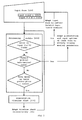
- Fig. 1 represents a block diagram illustrating the method of creating the medical prescription chart as described in an embodiment of the invention.
- the user input is collected by means of an input form [100] which is presented to the user.
- a set of medical information is requested from the user by presenting an input form allowing the different elements of the medication prescription to be entered in separate input fields [101, 102].
- the set of medical information makes up the medication prescription, the parameters to be supplied may vary depending on the chosen medication regime for the particular drug to be administered. When all accessible input fields on the input form have been supplied with input, a valid prescription is the result of this input.
- Every element of entered user input through an input field [101, 102] is passed immediately to the processing module [200] which comprises a predefined set of instructions that could be used to interpret the medical information.
- the analysis module could include a look up table based on which the medical information is interpreted.
- Fig 2 represents a block diagram illustrating the method of claim 2, where the processing module [200] interprets and processes the data by evaluating potentially 3 different things:
- the evaluation module [200] will decide whether to accept the input or to adapt the input form to reflect the invalid input entered in an input field [200A].
- the input form is changed by showing an error message on the input field [101, 102] expressing the unsatisfied input condition in relation with the particular input field.
- the input form is changed by showing a suggestion to correct the incorrect data entry made in the input field.
- the input field [200A] may show up in a different color (for instance red) to suggest that an invalid entry was made in the concerned input field.
- the evaluation module [200] may decide to adapt the input form to reflect the selection of a different dosage application type (continuous or continuous) [200B].
- the change in the medication prescription of the dosage application type has an immediate impact on the layout of the input form.
- the selected dosage application type is changed to "Continuous”
- the input fields for entering/defining the dosage timing and distribution over the day are no longer relevant for the prescription, and will be omitted from the input form.
- the evaluation module [200] may decide to adapt the prescription timeline chart [300] to reflect the validated prescription in step [200C]. Every time the condition of [200C] is met, the prescription timeline chart [300] will be updated.
- the prescription timeline [300] is interactive, meaning that the different elements or icons representing a dosage event can be moved or dragged, expanded or shrunken, duplicated or deleted, depending on the characteristics of the icons themselves.
- Different dosage events are represented on the dosage timeline chart as different icons.
- Discrete dosage events (having no duration) are represented as an icon showing the dosage form (in the shape of a pill, injection, drop,...), whereas dosage events with a certain duration are represented on the prescription timeline as a bar indicating the time period of the application.
- the discrete dosage event icons can be moved on the timeline to alter their intended dosage timing.
- the discrete dosage events can also be duplicated or removed from the timeline in an interactive way (i.e. by performing an operation on the icon by means of the available input devices of the computer implementation, which are typically: a computer mouse, a touch screen, or keyboard keystrokes).
- Dosage events with a duration are shown as a bar on the timeline; the length of the bar representing the duration of the event.
- the said bar can be removed or duplicated, but also can be moved (to change the starting time of the event), stretched or shrunken (make the duration longer or shorter respectively) in order to alter the medication prescription interactively.
- the icon representing the start-time of the medication prescription for the patient is represented with an icon on the same prescription time-line depicting a clock or watch.
Landscapes
- Health & Medical Sciences (AREA)
- Engineering & Computer Science (AREA)
- Epidemiology (AREA)
- General Health & Medical Sciences (AREA)
- Medical Informatics (AREA)
- Primary Health Care (AREA)
- Public Health (AREA)
- Chemical & Material Sciences (AREA)
- Bioinformatics & Cheminformatics (AREA)
- Medicinal Chemistry (AREA)
- Medical Treatment And Welfare Office Work (AREA)
Priority Applications (1)
| Application Number | Priority Date | Filing Date | Title |
|---|---|---|---|
| EP14157428.5A EP2916248A1 (de) | 2014-03-03 | 2014-03-03 | Interaktives Werkzeug zur Eingabe von rezeptpflichtigen Medikamenten |
Applications Claiming Priority (1)
| Application Number | Priority Date | Filing Date | Title |
|---|---|---|---|
| EP14157428.5A EP2916248A1 (de) | 2014-03-03 | 2014-03-03 | Interaktives Werkzeug zur Eingabe von rezeptpflichtigen Medikamenten |
Publications (1)
| Publication Number | Publication Date |
|---|---|
| EP2916248A1 true EP2916248A1 (de) | 2015-09-09 |
Family
ID=50189589
Family Applications (1)
| Application Number | Title | Priority Date | Filing Date |
|---|---|---|---|
| EP14157428.5A Withdrawn EP2916248A1 (de) | 2014-03-03 | 2014-03-03 | Interaktives Werkzeug zur Eingabe von rezeptpflichtigen Medikamenten |
Country Status (1)
| Country | Link |
|---|---|
| EP (1) | EP2916248A1 (de) |
Citations (5)
| Publication number | Priority date | Publication date | Assignee | Title |
|---|---|---|---|---|
| US5758096A (en) * | 1995-08-09 | 1998-05-26 | Barsky; Howard | System and method for personalized medication treatment management |
| US20030236683A1 (en) * | 2002-06-21 | 2003-12-25 | Dwight Henderson | Closed loop medication use system and method |
| US20070203755A1 (en) * | 2006-02-28 | 2007-08-30 | Siemens Medical Solutions Usa, Inc. | Medication Administration Information and User Interface System |
| US20090281835A1 (en) * | 2008-05-07 | 2009-11-12 | Ravindra Patwardhan | Medical prescription scheduler for reminding and compliance |
| US20100042430A1 (en) * | 2008-08-12 | 2010-02-18 | Irody Inc | System and method for collecting and authenticating medication consumption |
-
2014
- 2014-03-03 EP EP14157428.5A patent/EP2916248A1/de not_active Withdrawn
Patent Citations (5)
| Publication number | Priority date | Publication date | Assignee | Title |
|---|---|---|---|---|
| US5758096A (en) * | 1995-08-09 | 1998-05-26 | Barsky; Howard | System and method for personalized medication treatment management |
| US20030236683A1 (en) * | 2002-06-21 | 2003-12-25 | Dwight Henderson | Closed loop medication use system and method |
| US20070203755A1 (en) * | 2006-02-28 | 2007-08-30 | Siemens Medical Solutions Usa, Inc. | Medication Administration Information and User Interface System |
| US20090281835A1 (en) * | 2008-05-07 | 2009-11-12 | Ravindra Patwardhan | Medical prescription scheduler for reminding and compliance |
| US20100042430A1 (en) * | 2008-08-12 | 2010-02-18 | Irody Inc | System and method for collecting and authenticating medication consumption |
Similar Documents
| Publication | Publication Date | Title |
|---|---|---|
| CN109902112B (zh) | 一种基于时间轴的电子病历可视化方法及可视化系统 | |
| KR100573753B1 (ko) | 의료 스케줄 및/또는 기록 지원 시스템 및 그 시스템에의해 판독 가능한 프로그램 저장 장치 | |
| US10468128B2 (en) | Apparatus and method for presentation of medical data | |
| EP3346440A1 (de) | Informationsverarbeitungsvorrichtung, -verfahren und -programm | |
| US20050027560A1 (en) | Interactive multi-user medication and medical history management method | |
| CN111226285B (zh) | 医院信息系统及存储介质 | |
| JP5106352B2 (ja) | プロジェクト管理情報生成装置、プロジェクト管理情報生成プログラム、および電子カルテ情報生成装置 | |
| JP2004126894A (ja) | 薬品決定支援システム、および薬品決定支援プログラム | |
| US20210142878A1 (en) | Patient-Facing App for Health Literacy and Numeracy | |
| JPH11282934A (ja) | 調剤及び医療診断支援装置 | |
| JP4087873B2 (ja) | 電子カルテシステム | |
| US20180330822A1 (en) | Medical information processing device and medical information processing method | |
| EP2916248A1 (de) | Interaktives Werkzeug zur Eingabe von rezeptpflichtigen Medikamenten | |
| JP6223810B2 (ja) | 血糖管理支援装置、システム、方法及びプログラム | |
| JP2005316967A (ja) | 電子カルテ装置 | |
| JP2004164196A (ja) | 電子カルテシステム | |
| WO2020241332A1 (ja) | 医療情報登録支援装置、医療情報登録支援方法、及びプログラム | |
| US20100324937A1 (en) | Method and system for creating customized medication charts | |
| US20210151149A1 (en) | System For Interpreting And Managing Diet And Medication Interactions | |
| JP7360010B2 (ja) | 情報管理システム、情報管理プログラム | |
| dos Santos | E-anamnesis: a clinical observation electronic platform for emergency departments | |
| KR20140124208A (ko) | 진료 오더 처리 서비스 제공 방법 및 시스템 | |
| JP6500460B2 (ja) | 医用システム | |
| CN113178238A (zh) | 云电子病历的体温单生成方法 | |
| JP2008171297A (ja) | 診療支援装置、診療支援方法および診療支援プログラム |
Legal Events
| Date | Code | Title | Description |
|---|---|---|---|
| PUAI | Public reference made under article 153(3) epc to a published international application that has entered the european phase |
Free format text: ORIGINAL CODE: 0009012 |
|
| AK | Designated contracting states |
Kind code of ref document: A1 Designated state(s): AL AT BE BG CH CY CZ DE DK EE ES FI FR GB GR HR HU IE IS IT LI LT LU LV MC MK MT NL NO PL PT RO RS SE SI SK SM TR |
|
| AX | Request for extension of the european patent |
Extension state: BA ME |
|
| STAA | Information on the status of an ep patent application or granted ep patent |
Free format text: STATUS: THE APPLICATION IS DEEMED TO BE WITHDRAWN |
|
| 18D | Application deemed to be withdrawn |
Effective date: 20160310 |