EP2914972B1 - Methods to optimize and streamline ap placement on floor plan - Google Patents
Methods to optimize and streamline ap placement on floor plan Download PDFInfo
- Publication number
- EP2914972B1 EP2914972B1 EP13779710.6A EP13779710A EP2914972B1 EP 2914972 B1 EP2914972 B1 EP 2914972B1 EP 13779710 A EP13779710 A EP 13779710A EP 2914972 B1 EP2914972 B1 EP 2914972B1
- Authority
- EP
- European Patent Office
- Prior art keywords
- aps
- conventions
- floor plan
- map
- location
- Prior art date
- Legal status (The legal status is an assumption and is not a legal conclusion. Google has not performed a legal analysis and makes no representation as to the accuracy of the status listed.)
- Not-in-force
Links
- 238000000034 method Methods 0.000 title claims description 74
- 230000000007 visual effect Effects 0.000 claims description 11
- 238000004590 computer program Methods 0.000 claims description 4
- 238000002372 labelling Methods 0.000 claims 1
- 238000004891 communication Methods 0.000 description 29
- 230000008569 process Effects 0.000 description 12
- 230000015654 memory Effects 0.000 description 11
- 230000003936 working memory Effects 0.000 description 8
- 238000012545 processing Methods 0.000 description 7
- 230000005540 biological transmission Effects 0.000 description 5
- 230000006870 function Effects 0.000 description 5
- 230000003287 optical effect Effects 0.000 description 5
- 238000004458 analytical method Methods 0.000 description 4
- 238000010586 diagram Methods 0.000 description 4
- 238000000605 extraction Methods 0.000 description 4
- 230000008901 benefit Effects 0.000 description 3
- 230000001143 conditioned effect Effects 0.000 description 3
- 238000012217 deletion Methods 0.000 description 3
- 230000037430 deletion Effects 0.000 description 3
- 238000009434 installation Methods 0.000 description 3
- 238000013507 mapping Methods 0.000 description 3
- 239000011159 matrix material Substances 0.000 description 3
- 238000005457 optimization Methods 0.000 description 3
- 238000013461 design Methods 0.000 description 2
- 238000005516 engineering process Methods 0.000 description 2
- 238000005259 measurement Methods 0.000 description 2
- 230000004044 response Effects 0.000 description 2
- RYGMFSIKBFXOCR-UHFFFAOYSA-N Copper Chemical compound [Cu] RYGMFSIKBFXOCR-UHFFFAOYSA-N 0.000 description 1
- 235000015429 Mirabilis expansa Nutrition 0.000 description 1
- 244000294411 Mirabilis expansa Species 0.000 description 1
- 241001168730 Simo Species 0.000 description 1
- 230000001133 acceleration Effects 0.000 description 1
- 230000002411 adverse Effects 0.000 description 1
- 230000009286 beneficial effect Effects 0.000 description 1
- 238000004364 calculation method Methods 0.000 description 1
- 230000010267 cellular communication Effects 0.000 description 1
- 230000001413 cellular effect Effects 0.000 description 1
- 230000008859 change Effects 0.000 description 1
- 239000003795 chemical substances by application Substances 0.000 description 1
- 230000000295 complement effect Effects 0.000 description 1
- 230000006835 compression Effects 0.000 description 1
- 238000007906 compression Methods 0.000 description 1
- 238000010276 construction Methods 0.000 description 1
- 238000013500 data storage Methods 0.000 description 1
- 230000006837 decompression Effects 0.000 description 1
- 238000010790 dilution Methods 0.000 description 1
- 239000012895 dilution Substances 0.000 description 1
- 239000000835 fiber Substances 0.000 description 1
- 238000009472 formulation Methods 0.000 description 1
- 230000000977 initiatory effect Effects 0.000 description 1
- 235000013536 miso Nutrition 0.000 description 1
- 239000000203 mixture Substances 0.000 description 1
- 238000012986 modification Methods 0.000 description 1
- 230000004048 modification Effects 0.000 description 1
- 230000006855 networking Effects 0.000 description 1
- 238000012913 prioritisation Methods 0.000 description 1
- 230000001953 sensory effect Effects 0.000 description 1
- URWAJWIAIPFPJE-YFMIWBNJSA-N sisomycin Chemical compound O1C[C@@](O)(C)[C@H](NC)[C@@H](O)[C@H]1O[C@@H]1[C@@H](O)[C@H](O[C@@H]2[C@@H](CC=C(CN)O2)N)[C@@H](N)C[C@H]1N URWAJWIAIPFPJE-YFMIWBNJSA-N 0.000 description 1
Images




Classifications
-
- H—ELECTRICITY
- H04—ELECTRIC COMMUNICATION TECHNIQUE
- H04W—WIRELESS COMMUNICATION NETWORKS
- H04W16/00—Network planning, e.g. coverage or traffic planning tools; Network deployment, e.g. resource partitioning or cells structures
- H04W16/18—Network planning tools
- H04W16/20—Network planning tools for indoor coverage or short range network deployment
-
- G—PHYSICS
- G01—MEASURING; TESTING
- G01S—RADIO DIRECTION-FINDING; RADIO NAVIGATION; DETERMINING DISTANCE OR VELOCITY BY USE OF RADIO WAVES; LOCATING OR PRESENCE-DETECTING BY USE OF THE REFLECTION OR RERADIATION OF RADIO WAVES; ANALOGOUS ARRANGEMENTS USING OTHER WAVES
- G01S5/00—Position-fixing by co-ordinating two or more direction or position line determinations; Position-fixing by co-ordinating two or more distance determinations
- G01S5/02—Position-fixing by co-ordinating two or more direction or position line determinations; Position-fixing by co-ordinating two or more distance determinations using radio waves
- G01S5/0205—Details
- G01S5/0236—Assistance data, e.g. base station almanac
-
- G—PHYSICS
- G01—MEASURING; TESTING
- G01S—RADIO DIRECTION-FINDING; RADIO NAVIGATION; DETERMINING DISTANCE OR VELOCITY BY USE OF RADIO WAVES; LOCATING OR PRESENCE-DETECTING BY USE OF THE REFLECTION OR RERADIATION OF RADIO WAVES; ANALOGOUS ARRANGEMENTS USING OTHER WAVES
- G01S5/00—Position-fixing by co-ordinating two or more direction or position line determinations; Position-fixing by co-ordinating two or more distance determinations
- G01S5/02—Position-fixing by co-ordinating two or more direction or position line determinations; Position-fixing by co-ordinating two or more distance determinations using radio waves
- G01S5/0205—Details
- G01S5/0242—Determining the position of transmitters to be subsequently used in positioning
-
- H—ELECTRICITY
- H04—ELECTRIC COMMUNICATION TECHNIQUE
- H04W—WIRELESS COMMUNICATION NETWORKS
- H04W16/00—Network planning, e.g. coverage or traffic planning tools; Network deployment, e.g. resource partitioning or cells structures
- H04W16/18—Network planning tools
-
- H—ELECTRICITY
- H04—ELECTRIC COMMUNICATION TECHNIQUE
- H04W—WIRELESS COMMUNICATION NETWORKS
- H04W24/00—Supervisory, monitoring or testing arrangements
-
- H—ELECTRICITY
- H04—ELECTRIC COMMUNICATION TECHNIQUE
- H04W—WIRELESS COMMUNICATION NETWORKS
- H04W24/00—Supervisory, monitoring or testing arrangements
- H04W24/02—Arrangements for optimising operational condition
-
- H—ELECTRICITY
- H04—ELECTRIC COMMUNICATION TECHNIQUE
- H04W—WIRELESS COMMUNICATION NETWORKS
- H04W76/00—Connection management
- H04W76/10—Connection setup
Definitions
- US Patent 2011/018732 A1 describes an infrastructure information collecting device that collects measurement information including location information regarding a plurality of wireless access devices disposed in an indoor space based on an indoor map, and a positioning system that generates information regarding a wireless communication infrastructure of the corresponding indoor space based on the thusly collected measurement information. The positioning system then provides the generated wireless communication infrastructure information to a terminal of which location is desired to be measured, and then the terminal measures its location based on the wireless communication infrastructure information and signals received from nearby wireless access devices.
- GNSS global navigation satellite systems
- Embodiments may automatically place access points (APs) on floor plans by incorporating a plurality of conventions for identifying types and locations of APs. These conventions may include the name of APs, MAC addresses, latitude/longitude (lat/lon) information, and feature analysis or image recognition techniques for matching visual cues if the AP locations are marked on images. In some embodiments, the plurality of APs are automatically placed using the plurality of conventions.
- a first AP of the plurality of APs may be automatically placed on the floor plan map using a first convention of the plurality of conventions
- a second AP of the plurality of APs may be automatically placed on the floor plan map using a second convention of the plurality of conventions.
- Some embodiments may conduct several other operations to optimize placement of APs. These optimization operations may reduce the number of steps needed to place APs on floor plans, and/or may reduce extraneous and superfluous information from the floor plans that may clutter the annotated floor plan map.
- present techniques have the ability to group APs based on at least one common attribute (e.g. MAC prefix, elevation, lat/lon proximity, etc.). The grouping may allow for additional operations, such as a group move, updating all APs in the group in the same way, mass deletion, etc.
- Some embodiments may identify APs that are redundant with respect to positioning performance. APs may be identified based on their locations and signal strength, and if other APs are nearby and/or offer stronger performance, some APs may be identified as offering redundant positioning performance. In some embodiments, these APs may be removed or ignored from consideration if they offer little to no benefit. Thus, present techniques may reduce the number of APs from consideration or determine a minimal number of APs such that full coverage of the floor plan is still attained.
- an "access point” may refer to any device capable of and/or configured to route, connect, share, and/or otherwise provide a network connection to one or more other devices.
- An access point may include one or more wired and/or wireless interfaces, such as one or more Ethernet interfaces and/or one or more IEEE 802.11 interfaces, respectively, via which such a connection may be provided.
- an access point such as a wireless router
- a local modem or other network components e.g., switches, gateways, etc.
- antennas and/or wireless networking cards to broadcast, transmit, and/or otherwise provide one or more wireless signals to facilitate connectivity with one or more other devices.
- An access terminal can also be called a system, subscriber unit, subscriber station, mobile station, mobile, remote station, remote terminal, mobile device, user terminal, terminal, wireless communication device, user agent, user device, or user equipment (UE).
- An access terminal can be a cellular telephone, a cordless telephone, a Session Initiation Protocol (SIP) phone, a wireless local loop (WLL) station, a personal digital assistant (PDA), a handheld device having wireless connection capability, computing device, or other processing device connected to a wireless modem.
- SIP Session Initiation Protocol
- WLL wireless local loop
- PDA personal digital assistant
- Some embodiments include methods for placing access points (APs) on a floor plan map automatically and in an optimized manner.
- Indoor positioning techniques may rely on determining position of a user or mobile device relative to known locations of access points (APs).
- APs may be a wireless receiver connected to the Internet such as a wireless router, a local area network (LAN) router, or a GPS device configured to broadcast GPS coordinates.
- APs may be placed physically in a building in any location, such as on the ceiling in the middle of a conference room, near a stairwell, in the corner of a room, etc.
- Current techniques for placing APs on floor plans generally involve a tedious manual procedure, where an analyst may need to place an approximate location of each AP manually onto a digital floor plan.
- Embodiments herein may solve these and other related problems.
- Embodiments may automatically place APs on floor plans by incorporating a number of conventions for identifying types and locations of APs. These conventions may include the name of APs MAC addresses, lat/lon information, and feature analysis or image recognition techniques for matching visual cues if the AP locations are marked on images.
- some embodiments may conduct several other operations to optimize placement of APs. These optimization operations may reduce the number of steps needed to place APs on floor plans, and/or may reduce extraneous and superfluous information from the floor plans that may clutter the annotated floor plan map.
- present techniques have the ability to group APs based on at least one common attribute (e.g. MAC prefix, elevation, lat/lon proximity, etc.). The grouping may allow for additional operations, such as a group move, updating all APs in the group in the same way, mass deletion, etc.
- embodiments may identify APs that are redundant with respect to positioning performance. APs may be identified based on their locations and signal strength, and if other APs are nearby and/or offer stronger performance, some APs may be identified as offering redundant positioning performance. In some embodiments, these APs may be removed or ignored from consideration if they offer little to no benefit. Thus, present techniques may reduce the number of APs from consideration or determine a minimal number of APs such that full coverage of the floor plan is still attained.
- Access point (AP) 100 includes multiple antennas, including 104, 106, and 108. More or fewer antennas may be utilized in other embodiments.
- Access terminal 116 (AT) may be in communication with AP 100 via antenna 104, where antenna 104 may transmit signals to access terminal 116 over forward link 120 and may receive signals from access terminal 116 over reverse link 118.
- Access terminal 122 is in communication with AP 100 via antenna 108, where antenna 108 may transmit signals to access terminal 122 over forward link 126 and may receive signals from access terminal 122 over reverse link 124.
- FDD Frequency Division Duplex
- communication links 118, 120, 124 and 126 may use different frequencies for communication.
- forward link 120 may use a different frequency then that used by reverse link 118.
- antennas 104, 106, and 108 may each be in communication with both ATs 116 and 122.
- AT 116 may be in communication with AP 100 in a first frequency
- AT 122 may be in communication with AP 100 in a second frequency, for example.
- multiple antennas e.g. antennas 104 and 106, may be in communication with just a single mobile device, e.g. AT 116. Multiple antennas may be used to transmit the same type of data but arranged in different sequences to improve diversity gain.
- antenna groups each are designed to communicate to access terminals in a sector of the areas covered by access point 100.
- the transmitting antennas of access point 100 may utilize beamforming in order to improve the signal-to-noise ratio of forward links for the different access terminals 116 and 124. Also, an access point using beamforming to transmit to access terminals scattered randomly through its coverage causes less interference to access terminals in neighboring cells than an access point transmitting through a single antenna to all its access terminals.
- FIG. 2 is a block diagram of an embodiment of a transmitter system 210 of an access point and a receiver system 250 of an access terminal in a multiple-input and multiple-output (MIMO) system 200 according to some embodiments.
- traffic data for a number of data streams is provided from a data source 212 to a transmit (TX) data processor 214.
- TX transmit
- each data stream is transmitted over a respective transmit antenna.
- TX data processor 214 formats, codes, and interleaves the traffic data for each data stream based on a particular coding scheme selected for that data stream to provide coded data.
- the coded data for each data stream may be multiplexed with pilot data using orthogonal frequency division multiplexing (OFDM) techniques.
- the pilot data is typically a known data pattern that is processed in a known manner and may be used at the receiver system to estimate the channel response.
- the multiplexed pilot and coded data for each data stream is then modulated (i.e., symbol mapped) based on a particular modulation scheme (e.g., BPSK, QSPK, M-PSK, or M-QAM) selected for that data stream to provide modulation symbols.
- the data rate, coding, and modulation for each data stream may be determined by instructions performed by processor 230.
- TX MIMO processor 220 may further process the modulation symbols (e.g., for OFDM).
- TX MIMO processor 220 then provides NT modulation symbol streams to NT transmitters (TMTR) 222a through 222t, where NT is a positive integer associated with transmitters described in FIG. 2 .
- TMTR NT transmitters
- TX MIMO processor 220 applies beamforming weights to the symbols of the data streams and to the antenna from which the symbol is being transmitted.
- Each transmitter 222 receives and processes a respective symbol stream to provide one or more analog signals, and further conditions (e.g., amplifies, filters, and upconverts) the analog signals to provide a modulated signal suitable for transmission over the MIMO channel.
- NT modulated signals from transmitters 222a through 222t are then transmitted from NT antennas 224a through 224t, respectively.
- the transmitted modulated signals are received by NR antennas 252a through 252r and the received signal from each antenna 252 is provided to a respective receiver (RCVR) 254a through 254r, where NR is a positive integer associated with receivers described in FIG. 2 .
- Each receiver 254 conditions (e.g., filters, amplifies, and downconverts) a respective received signal, digitizes the conditioned signal to provide samples, and further processes the samples to provide a corresponding "received" symbol stream.
- An RX data processor 260 then receives and processes the NR received symbol streams from NR receivers 254 based on a particular receiver processing technique to provide NT "detected" symbol streams.
- the RX data processor 260 then demodulates, deinterleaves, and decodes each detected symbol stream to recover the traffic data for the data stream.
- the processing by RX data processor 260 is complementary to that performed by TX MIMO processor 220 and TX data processor 214 at transmitter system 210,
- a processor 270 periodically determines which pre-coding matrix to use (discussed below). Processor 270 formulates a reverse link message comprising a matrix index portion and a rank value portion. Memory 272 stores the various pre-coding matrices that are used by processor 270.
- the reverse link message may comprise various types of information regarding the communication link and/or the received data stream.
- the reverse link message is then processed by a TX data processor 238, which also receives traffic data for a number of data streams from a data source 236, modulated by a modulator 280, conditioned by transmitters 254a through 254r, and transmitted back to transmitter system 210.
- the modulated signals from receiver system 250 are received by antennas 224, conditioned by receivers 222, demodulated by a demodulator 240, and processed by a RX data processor 242 to extract the reserve link message transmitted by the receiver system 250.
- Processor 230 determines which pre-coding matrix to use for determining the beamforming weights then processes the extracted message.
- Processor 230 obtains the pre-coding matrices from memory 232, which stores various pre-coding matrices.
- Memory 232 may also contain other types of data, such as information databases and locally and globally unique attributes of multiple base stations.
- the techniques described herein may also be practiced with APs containing just a single receiving antenna and a single transmitting antenna (SISO), a single receiving antenna and multiple transmitting antennas (SIMO), and multiple transmitting antennas and a single receiving antenna (MISO) with configurations similar to those described in FIGs. 1 and 2 .
- ISO single receiving antenna and a single transmitting antenna
- SIMO single receiving antenna and multiple transmitting antennas
- MISO single receiving antenna
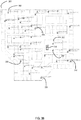
- exemplary floor plan map 300 may illustrate an example placement of numerous APs onto a single floor plan.
- Floor plan map 300 in FIG. 3A may represent a large office building floor or a mall plan floor. Given the many rooms, conventional access to WiFi may require dozens, if not hundreds of APs being placed throughout the floor plan map 300.
- floor plan map 300 may require many APs to be placed, as shown, in order to provide comprehensive WiFi coverage throughout the floor 300.
- the locations may be recorded on floor plan map 300, and may represent an exact or near approximate position of each AP.
- Example APs may include APs 302, 304, 306, 308, 310, 312, and 314 as shown.
- a user equipment (UE) 316 operating within the wireless network environment of access points (APs) of floor plan map 300 may be able to receive wireless coverage throughout the floor.
- a UE 316 may refer to any apparatus used and/or operated by a user or consumer, such as a mobile device, cell phone, electronic tablet, touch screen device, radio, GPS device, etc.
- a UE or mobile station e.g.
- a cell phone 316 may attempt to determine its global position or access global positioning information for other purposes, utilizing the APs in the wireless environment.
- a UE may also be able to access the Internet or wireless local area networks (WLANs) through the APs.
- the APs including APs 302, 304, 306, 308, 310, 312, and 314 and others as shown, may be configured to transmit and receive messages from multiple mobile devices, and may be consistent with those described in FIGs. 1 and 2 .
- Each AP may have location information to uniquely identify each AP and its location.
- the APs on floor plan 300 show a twelve-hexadecimal character serial number to unambiguously identify each AP.
- a database containing a list of all of the serial numbers may then reference each AP to a location, defined in latitude/longitude coordinates, for example.
- the location of each AP may not be as specific, and descriptions of APs provided by venue owners may contain only a listing of what floor and building each AP is located on.
- only just the floor plan 300 may be provided with approximate locations of APs as shown and no unique identifying information, where an analyst may then be required to determine a quantifiable location of the APs for suitable use for indoor location positioning.
- AP locations may contain only room number descriptions, or merely a MAC address mapping. In other cases, some APs may be described by a short abbreviation of their locations, e.g. "Room_212_AP_1,” or “AP_2_NW,” etc. Other forms of descriptions of AP locations may certainly be possible, and embodiments may be configured to process any and all of them.
- the AP locations may be wholly inaccurate, because the information may be old and/or placements may have changed after their initial locations were recorded.
- a manual process of receiving such spotty and unsystematic information can be quite error-prone, as well as extremely time consuming.
- To record the AP locations and other relevant information of just this floor plan map 300 alone may involve recording dozens of AP locations, using whatever information is provided, and performing tedious calculations or operations to obtain other information where needed.
- Embodiments therefore may automatically place APs on floor plan maps based on a number of conventions provided by entities supplying the AP location information, including venue owners of the buildings to which the floor plans pertain.
- Embodiments may also incorporate language parsing techniques to discern certain metadata in order to intelligently place APs. For example, regular expression matching techniques using suitable scripting languages, e.g. Perl, Python, Tel, etc., may be used to parse descriptive information out of provided names or labels associated with the floor plan maps.
- a grammar for how room numbers may be arranged for any particular floor plan map may be derived from various sources, including any information associated with the APs or the floor plan maps.
- Room number grammar may include how many digits are used to list room numbers, and whether an alphabet is included in describing the rooms, for example.
- other parsing variants may be used, such as tokenization, top-down parsing, and bottom-up parsing.
- Certain key characters, such as "_” and " " may be focused on, along with other human input, to help determine what specific techniques may be most suitable for the floor plan map information available at present.
- an AP with labeled as "AP1_room_212” may be placed in a room with room number "212” using examples techniques described herein, or others that are apparent to persons having ordinary skill in the art.
- input data files with mappings of AP names to MAC addresses may be parsed to obtain the MAC address of each AP, and the location may be inferred at least based in part by the MAC address information.
- a mapping of the AP position may be obtained from absolute positioning information (e.g. latitude/longitude) by coordinating the absolute positioning information of the AP with the absolute positioning information of the floor plan map.
- the coordinates may be provided with the APs listed in floor plan maps, or may be estimated based on standard geo-referencing techniques, known in the art.
- APs that are already visually marked on floor plan map images may be automatically placed in a computer system by performing feature analysis or other image recognition techniques.
- the techniques may be based on vector extraction on raster images as well as extraction of various AP location features, e.g. whether APs are near walls, near stairwells, etc.
- vector extraction may involve image processing to determine which sequence of pixels can constitute certain room properties, e.g. line segments, arcs, etc., and whether multiple such sequences can be merged in the same vector line segment (e.g. for thick lines).
- Embodiments may also combine any of these techniques together to verify or improve automatic placements.
- Other auto-population techniques may be based on MAC addresses of the APs and their contiguity to other APs with similar MAC address. For example, in some embodiments, MAC addresses that differ by one in the last digit may be determined to belong to the same physical WiFi AP, and thus it may be determined that these MAC addresses inherit all the properties of the original AP. Other factors for auto-population may include the positions of the APs on the floor plan maps, the frequency of the APs, the MAC address prefixes, WLAN chip model serial numbers and vendor/manufacturer information, and the like. In another example, once the information about the APs on a floor plan map are obtained (e.g.
- the locations of the APs with respect to the floor plan map may be known (e.g. in lat/lon coordinates, or a relative ⁇ x,y ⁇ formulation.
- the absolute locations of the APs can be known then, either by obtaining coordinates in an absolute scale, or by combining the locations in a relative scale with an absolute location known for the floor plan map. Thereafter, this group of APs may be grouped as described in aforementioned techniques above.
- Embodiments may also provide for group selecting multiple APs in or on floor plan maps for ease of placement or to modify the group's metadata information.
- Group selecting may be based on several criteria, including but not limited to: MAC prefix, elevation, proximity in relation to other APs, AP Model information (e.g. round trip time (RTT) TCF, transmitter power, antenna type, etc.), different bounding polygonal structures for grouping, and other physical characteristics of the APs such as bandwidth, number of ports, number of antennas, etc.
- Group selecting may be beneficial for a number of reasons, including, for example, ease of placement for APs with common attributes, making changes en masse when warranted, e.g. data for a whole floor plan is old and needs to be updated every six months, etc.
- Exemplary group operations may include performing a group move of the APs on the floor plan map, updating parameters of all APs in the group, and group removal or deletion off of the floor plan map.
- some embodiments may optimize the placement of APs by identifying and marking APs that are redundant with respect to positioning performance provided. For example, some APs may be very close to each other, wherein one of the APs provides much stronger coverage than all the others. Thus, the one or more APs providing weaker coverage may be considered redundant, and it may not be necessary, therefore, to identify and record the information of these APs for positioning performance purposes.
- some embodiments may cluster APs into groups based on proximity to each other.
- the AP clusters may then be ranked based on their impact on location performance. For example, one can calculate the horizontal dilution of precision (HDOP) under some conservative signal strength threshold such as - 70. If the HDOP does not degrade with thinning of the clusters (removal of AP in a cluster) then the AP can be safely removed from the assistance database without adversely affecting coverage, or only provide it if the mobile requests the full database.
- Clustering groups of APs close to each other based on distance and the HDOP analysis allows for a reliable removal of APs from individual clusters while maintaining position performance.
- recordation and assistance data generation for those clusters may be skipped with least impact on performance to reduce assistance data necessary to be held in a database.
- exemplary flowchart 400 may illustrate some method steps according to some embodiments. For example, at block 402, some embodiments may receive information indicative of a location of an AP on a floor plan map. At block 404, embodiments may determine that the received information matches at least one convention for identifying the AP and its location. The at least one convention may be any of the location identification conventions described in the above disclosures, including descriptions at FIGs. 3A and 3B . At block 406, embodiments may automatically place the AP at the location of the floor plan map based on the received information.
- exemplary flowchart 450 may illustrate other method steps according to some embodiments.
- embodiments may receive information indicative of a plurality of APs on a floor plan map.
- embodiments may then identify at least one attribute within the received information common to at least two APs in the plurality of APs.
- embodiments may then group the at least two APs based on the at least one common attribute.
- some embodiments may perform an operation on the at least two APs utilizing the at least one common attribute.
- the common attributes referred to herein may be consistent with any of the attributes associated with the APs described in any of the above disclosures.
- Example operations may include group moving, group updating, and group removal of APs.
- Example types of group updating may include providing a common tag or label for each AP in the group, updating the names of the APs, updating a type of manufacturer or model of the APs etc. Additionally, operations may include determining what groups of APs are redundant and/or provide minimal additional coverage to wireless performance. The groups may then be ranked to determine which groups may be removed, or simply moved, to optimize AP placement.
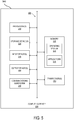
- a computer system as illustrated in FIG. 5 may be incorporated as part of a computing device, which may implement, perform, and/or execute any and/or all of the features, methods, and/or method steps described herein.
- computer system 500 may represent some of the components of a hand-held device.
- a hand-held device may be any computing device with an input sensory unit, such as a wireless receiver or modem. Examples of a hand-held device include but are not limited to video game consoles, tablets, smart phones, televisions, and mobile devices or mobile stations.
- FIG. 5 provides a schematic illustration of one embodiment of a computer system 500 that can perform the methods provided by various other embodiments, as described herein, and/or can function as the host computer system, a remote kiosk/terminal, a point-of-sale device, a mobile device, a set-top box, and/or a computer system.
- FIG. 5 is meant only to provide a generalized illustration of various components, any and/or all of which may be utilized as appropriate.
- FIG. 5 therefore, broadly illustrates how individual system elements may be implemented in a relatively separated or relatively more integrated manner.
- the computer system 500 is shown comprising hardware elements that can be electrically coupled via a bus 505 (or may otherwise be in communication, as appropriate).
- the hardware elements may include one or more processors 510, including without limitation one or more general-purpose processors and/or one or more special-purpose processors (such as digital signal processing chips, graphics acceleration processors, and/or the like); one or more input devices 515, which can include without limitation a camera, wireless receivers, wireless sensors, a mouse, a keyboard and/or the like; and one or more output devices 520, which can include without limitation a display unit, a printer and/or the like.
- the one or more processor 510 may be configured to perform a subset or all of the functions described above with respect to FIGs. 4A and 4B .
- the processor 510 may comprise a general processor and/or and application processor, for example.
- the processor is integrated into an element that processes visual tracking device inputs and wireless sensor inputs.
- the computer system 500 may further include (and/or be in communication with) one or more non-transitory storage devices 525, which can comprise, without limitation, local and/or network accessible storage, and/or can include, without limitation, a disk drive, a drive array, an optical storage device, a solid-state storage device such as a random access memory (“RAM”) and/or a read-only memory (“ROM”), which can be programmable, flash-updateable and/or the like.
- RAM random access memory
- ROM read-only memory
- Such storage devices may be configured to implement any appropriate data storage, including without limitation, various file systems, database structures, and/or the like.
- the computer system 500 might also include a communications subsystem 530, which can include without limitation a modem, a network card (wireless or wired), an infrared communication device, a wireless communication device and/or chipset (such as a Bluetooth® device, an 802.11 device, a WiFi device, a WiMax device, cellular communication facilities, etc.), and/or the like.
- the communications subsystem 530 may permit data to be exchanged with a network (such as the network described below, to name one example), other computer systems, and/or any other devices described herein.
- the computer system 500 will further comprise a non-transitory working memory 535, which can include a RAM or ROM device, as described above.
- communications subsystem 530 may interface with transceiver(s) 550 configured to transmit and receive signals from access points or mobile devices. Some embodiments may include a separate receiver or receivers, and a separate transmitter or transmitters.
- the computer system 500 also can comprise software elements, shown as being currently located within the working memory 535, including an operating system 540, device drivers, executable libraries, and/or other code, such as one or more application programs 545, which may comprise computer programs provided by various embodiments, and/or may be designed to implement methods, and/or configure systems, provided by other embodiments, as described herein.
- an operating system 540 operating system 540
- device drivers executable libraries
- application programs 545 which may comprise computer programs provided by various embodiments, and/or may be designed to implement methods, and/or configure systems, provided by other embodiments, as described herein.
- application programs 545 may comprise computer programs provided by various embodiments, and/or may be designed to implement methods, and/or configure systems, provided by other embodiments, as described herein.
- application programs 545 may comprise computer programs provided by various embodiments, and/or may be designed to implement methods, and/or configure systems, provided by other embodiments, as described herein.
- code and/or instructions can be used to configure and/or adapt a general purpose computer (or other device) to perform one or more operations in accordance with the described methods.
- a set of these instructions and/or code might be stored on a computer-readable storage medium, such as the storage device(s) 525 described above.
- the storage medium might be incorporated within a computer system, such as computer system 500.
- the storage medium might be separate from a computer system (e.g., a removable medium, such as a compact disc), and/or provided in an installation package, such that the storage medium can be used to program, configure and/or adapt a general purpose computer with the instructions/code stored thereon.
- These instructions might take the form of executable code, which is executable by the computer system 500 and/or might take the form of source and/or installable code, which, upon compilation and/or installation on the computer system 500 (e.g., using any of a variety of generally available compilers, installation programs, compression/decompression utilities, etc.) then takes the form of executable code.
- Some embodiments may employ a computer system (such as the computer system 500) to perform methods in accordance with the disclosure. For example, some or all of the procedures of the described methods may be performed by the computer system 500 in response to processor 510 executing one or more sequences of one or more instructions (which might be incorporated into the operating system 540 and/or other code, such as an application program 545) contained in the working memory 535. Such instructions may be read into the working memory 535 from another computer-readable medium, such as one or more of the storage device(s) 525. Merely by way of example, execution of the sequences of instructions contained in the working memory 535 might cause the processor(s) 510 to perform one or more procedures of the methods described herein, for example methods described with respect to FIG. 5 .
- machine-readable medium and “computer-readable medium,” as used herein, refer to any medium that participates in providing data that causes a machine to operate in a specific fashion.
- various computer-readable media might be involved in providing instructions/code to processor(s) 510 for execution and/or might be used to store and/or carry such instructions/code (e.g., as signals).
- a computer-readable medium is a physical and/or tangible storage medium.
- Such a medium may take many forms, including but not limited to, non-volatile media, volatile media, and transmission media.
- Non-volatile media include, for example, optical and/or magnetic disks, such as the storage device(s) 525.
- Volatile media include, without limitation, dynamic memory, such as the working memory 535.
- Transmission media include, without limitation, coaxial cables, copper wire and fiber optics, including the wires that comprise the bus 505, as well as the various components of the communications subsystem 530 (and/or the media by which the communications subsystem 530 provides communication with other devices).
- transmission media can also take the form of waves (including without limitation radio, acoustic and/or light waves, such as those generated during radio-wave and infrared data communications).
- Common forms of physical and/or tangible computer-readable media include, for example, a floppy disk, a flexible disk, hard disk, magnetic tape, or any other magnetic medium, a CD-ROM, any other optical medium, punchcards, papertape, any other physical medium with patterns of holes, a RAM, a PROM, EPROM, a FLASH-EPROM, any other memory chip or cartridge, a carrier wave as described hereinafter, or any other medium from which a computer can read instructions and/or code.
- Various forms of computer-readable media may be involved in carrying one or more sequences of one or more instructions to the processor(s) 510 for execution.
- the instructions may initially be carried on a magnetic disk and/or optical disc of a remote computer.
- a remote computer might load the instructions into its dynamic memory and send the instructions as signals over a transmission medium to be received and/or executed by the computer system 500.
- These signals which might be in the form of electromagnetic signals, acoustic signals, optical signals and/or the like, are all examples of carrier waves on which instructions can be encoded, in accordance with various embodiments of the invention.
- the communications subsystem 530 (and/or components thereof) generally will receive the signals, and the bus 505 then might carry the signals (and/or the data, instructions, etc. carried by the signals) to the working memory 535, from which the processor(s) 510 retrieves and executes the instructions.
- the instructions received by the working memory 535 may optionally be stored on a non-transitory storage device 525 either before or after execution by the processor(s) 510.
- Memory 535 may contain at least one database according to any of the databases and methods described herein. Memory 535 may thus store any of the values discussed in any of the present disclosures, including FIGs. 1 , 2 , 3A , 3B , 4A , 4B and related descriptions.
- processor 510 may be configured to perform any of the functions of blocks in diagrams 400 and 450.
- Storage device 525 may be configured to store an intermediate result, such as a globally unique attribute or locally unique attribute discussed within any of blocks mentioned herein.
- Storage device 525 may also contain a database consistent with any of the present disclosures.
- the memory 535 may similarly be configured to record signals, representation of signals, or database values necessary to perform any of the functions described in any of the blocks mentioned herein. Results that may need to be stored in a temporary or volatile memory, such as RAM, may also be included in memory 535, and may include any intermediate result similar to what may be stored in storage device 525.
- Input device 515 may be configured to receive wireless signals from satellites and/or base stations according to the present disclosures described herein.
- Output device 520 may be configured to display images, print text, transmit signals and/or output other data according to any of the present disclosures.
- embodiments were described as processes depicted as flow diagrams or block diagrams. Although each may describe the operations as a sequential process, many of the operations can be performed in parallel or concurrently. In addition, the order of the operations may be rearranged. A process may have additional steps not included in the figure.
- embodiments of the methods may be implemented by hardware, software, firmware, middleware, microcode, hardware description languages, or any combination thereof.
- the program code or code segments to perform the associated tasks may be stored in a computer-readable medium such as a storage medium. Processors may perform the associated tasks.
Landscapes
- Engineering & Computer Science (AREA)
- Physics & Mathematics (AREA)
- General Physics & Mathematics (AREA)
- Radar, Positioning & Navigation (AREA)
- Remote Sensing (AREA)
- Computer Networks & Wireless Communication (AREA)
- Signal Processing (AREA)
- Mobile Radio Communication Systems (AREA)
- Position Fixing By Use Of Radio Waves (AREA)
Applications Claiming Priority (3)
| Application Number | Priority Date | Filing Date | Title |
|---|---|---|---|
| US201261721435P | 2012-11-01 | 2012-11-01 | |
| US13/763,257 US9888360B2 (en) | 2012-11-01 | 2013-02-08 | Methods to optimize and streamline AP placement on floor plan |
| PCT/US2013/064143 WO2014070398A1 (en) | 2012-11-01 | 2013-10-09 | Methods to optimize and streamline ap placement on floor plan |
Publications (2)
| Publication Number | Publication Date |
|---|---|
| EP2914972A1 EP2914972A1 (en) | 2015-09-09 |
| EP2914972B1 true EP2914972B1 (en) | 2018-05-23 |
Family
ID=50547734
Family Applications (1)
| Application Number | Title | Priority Date | Filing Date |
|---|---|---|---|
| EP13779710.6A Not-in-force EP2914972B1 (en) | 2012-11-01 | 2013-10-09 | Methods to optimize and streamline ap placement on floor plan |
Country Status (5)
| Country | Link |
|---|---|
| US (1) | US9888360B2 (enExample) |
| EP (1) | EP2914972B1 (enExample) |
| JP (1) | JP6199402B2 (enExample) |
| CN (1) | CN104755952B (enExample) |
| WO (1) | WO2014070398A1 (enExample) |
Families Citing this family (27)
| Publication number | Priority date | Publication date | Assignee | Title |
|---|---|---|---|---|
| US9400320B2 (en) | 2012-04-04 | 2016-07-26 | Qualcomm Incorporated | Methods and apparatus for efficient transport and management of a positioning and timing almanac |
| US9282466B2 (en) * | 2013-04-30 | 2016-03-08 | Honeywell International Inc. | Deploying a network of nodes in an area of interest |
| US10021737B2 (en) * | 2013-09-17 | 2018-07-10 | Qualcomm Incorporated | Techniques for determining common characteristics of groups of wireless access points |
| US10127667B2 (en) * | 2014-08-01 | 2018-11-13 | Locuslabs, Inc. | Image-based object location system and process |
| US9253599B1 (en) | 2014-08-20 | 2016-02-02 | Qualcomm Incorporated | RTT processing based on a characteristic of access points |
| US9609525B1 (en) | 2016-05-31 | 2017-03-28 | International Business Machines Coporation | Beacon placement suggestion based on target region |
| JP7068814B2 (ja) * | 2017-03-24 | 2022-05-17 | 東芝テック株式会社 | 測位装置及びプログラム |
| MX2019012059A (es) | 2017-04-07 | 2020-07-20 | Bxb Digital Pty Ltd | Sistemas y métodos para el seguimiento de promociones. |
| US10832208B2 (en) * | 2017-05-02 | 2020-11-10 | BXB Digital Pty Limited | Systems and methods for facility matching and localization |
| US10824904B2 (en) | 2017-05-02 | 2020-11-03 | BXB Digital Pty Limited | Systems and methods for pallet identification |
| WO2018204912A1 (en) | 2017-05-05 | 2018-11-08 | BXB Digital Pty Limited | Pallet with tracking device |
| CN107548151B (zh) * | 2017-06-14 | 2020-09-08 | 新华三大数据技术有限公司 | 标记无线接入点ap的方法和装置 |
| US10834609B2 (en) * | 2017-06-28 | 2020-11-10 | AVAST Software s.r.o. | Optimal wireless router positioning |
| EP3673426B1 (en) | 2017-08-21 | 2024-03-06 | BXB Digital PTY Limited | Systems and methods for pallet tracking using hub and spoke architecture |
| MA50387A (fr) | 2017-10-20 | 2020-08-26 | Bxb Digital Pty Ltd | Systèmes et procédés de suivi de transporteurs de marchandises |
| US10816637B2 (en) | 2018-12-27 | 2020-10-27 | Chep Technology Pty Limited | Site matching for asset tracking |
| US10925070B2 (en) * | 2019-01-30 | 2021-02-16 | Hewlett Packard Enterprise Development Lp | Access point update |
| CN113424237B (zh) | 2019-02-25 | 2023-07-25 | Bxb数码私人有限公司 | 供应链中的智能物理封闭件 |
| US11743738B2 (en) | 2020-03-05 | 2023-08-29 | Comcast Cable Communications, Llc | Evaluation of access point placement |
| CN111372256B (zh) * | 2020-03-13 | 2023-04-04 | 华为技术有限公司 | 辅助客户终端设备安装的方法和电子设备 |
| US11805389B2 (en) * | 2020-10-27 | 2023-10-31 | International Business Machines Corporation | Evaluation of device placement |
| US11533700B2 (en) * | 2021-03-31 | 2022-12-20 | Qualcomm Incorporated | Geometric dilution of precision based transmit/receive point selection for wireless positioning |
| KR20220159629A (ko) | 2021-05-26 | 2022-12-05 | 삼성전자주식회사 | 로봇 청소기 및 이의 제어 방법 |
| CN116939529A (zh) * | 2022-03-31 | 2023-10-24 | 华为技术有限公司 | 一种定位方法和相关设备 |
| FR3140505A1 (fr) * | 2022-09-29 | 2024-04-05 | Orange | Procédé d’optimisation, terminal de communication et automate apte à optimiser une couverture d’une zone locale par un réseau de communication sans fil |
| US20260040026A1 (en) * | 2023-12-28 | 2026-02-05 | Cisco Technology, Inc. | Guided anchor-free method for access point location determination |
| JP7882287B2 (ja) * | 2024-04-16 | 2026-06-30 | 株式会社ダイフク | 検証システム及び検証方法 |
Family Cites Families (21)
| Publication number | Priority date | Publication date | Assignee | Title |
|---|---|---|---|---|
| WO2004086783A1 (en) * | 2003-03-24 | 2004-10-07 | Strix Systems, Inc. | Node placement method within a wireless network, such as a wireless local area network |
| US20040233857A1 (en) * | 2003-05-21 | 2004-11-25 | Alcatel | Node topology placement based on geographical information |
| US20050059406A1 (en) | 2003-09-17 | 2005-03-17 | Trapeze Networks, Inc. | Wireless LAN measurement feedback |
| US7583961B2 (en) | 2004-04-28 | 2009-09-01 | Avaya Inc. | Method and apparatus for generating a signal strength model for an access point at an arbitrary location |
| US7043277B1 (en) * | 2004-05-27 | 2006-05-09 | Autocell Laboratories, Inc. | Automatically populated display regions for discovered access points and stations in a user interface representing a wireless communication network deployed in a physical environment |
| US8369264B2 (en) | 2005-10-28 | 2013-02-05 | Skyhook Wireless, Inc. | Method and system for selecting and providing a relevant subset of Wi-Fi location information to a mobile client device so the client device may estimate its position with efficient utilization of resources |
| US7567822B2 (en) | 2005-10-11 | 2009-07-28 | Cisco Technology, Inc. | Automated configuration of RF WLANs via selected sensors |
| US7664511B2 (en) * | 2005-12-12 | 2010-02-16 | Nokia Corporation | Mobile location method for WLAN-type systems |
| US7983684B2 (en) * | 2007-01-31 | 2011-07-19 | Symbol Technologies, Inc. | Methods and apparatus for determining RF transmitter placement via local coverage optimization |
| US8259692B2 (en) * | 2008-07-11 | 2012-09-04 | Nokia Corporation | Method providing positioning and navigation inside large buildings |
| US8204029B2 (en) * | 2008-11-10 | 2012-06-19 | Cisco Technology, Inc. | Mobile intelligent roaming using multi-modal access point devices |
| JP5168137B2 (ja) | 2008-12-26 | 2013-03-21 | ソニー株式会社 | 通信装置、通信方法、プログラム、情報管理装置および通信システム |
| US8483707B2 (en) | 2009-06-26 | 2013-07-09 | Motorola Mobility Llc | Wireless terminal and method for managing the receipt of position reference singals for use in determining a location |
| US8547224B2 (en) | 2009-07-27 | 2013-10-01 | Electronics And Telecommunications Research Institute | Device and method for collecting information related to infrastructure, and positioning method and system using the same |
| US8188921B2 (en) | 2009-09-18 | 2012-05-29 | TEECOM Design Group | Apparatus and method for constructing and utilizing a beacon location database |
| US8462049B2 (en) | 2009-09-18 | 2013-06-11 | Teecom | Apparatus and method for constructing and utilizing a beacon location database |
| US8311548B2 (en) | 2010-03-24 | 2012-11-13 | Honeywell International Inc. | Automatic association of wireless devices to point names |
| US8599780B2 (en) | 2010-04-28 | 2013-12-03 | Quantenna Communications, Inc. | Access point range extension |
| JP5648434B2 (ja) | 2010-11-11 | 2015-01-07 | 富士通株式会社 | 無線基地局及び位置検出方法 |
| US8744352B2 (en) * | 2010-11-22 | 2014-06-03 | Juniper Networks, Inc. | Automatic access point location, planning, and coverage optimization |
| US9014112B2 (en) * | 2012-07-31 | 2015-04-21 | Aruba Networks, Inc. | System and method for computing coverage set and resource allocations in wireless networks |
-
2013
- 2013-02-08 US US13/763,257 patent/US9888360B2/en not_active Expired - Fee Related
- 2013-10-09 JP JP2015539633A patent/JP6199402B2/ja not_active Expired - Fee Related
- 2013-10-09 CN CN201380056784.3A patent/CN104755952B/zh active Active
- 2013-10-09 WO PCT/US2013/064143 patent/WO2014070398A1/en not_active Ceased
- 2013-10-09 EP EP13779710.6A patent/EP2914972B1/en not_active Not-in-force
Non-Patent Citations (1)
| Title |
|---|
| None * |
Also Published As
| Publication number | Publication date |
|---|---|
| JP6199402B2 (ja) | 2017-09-20 |
| CN104755952A (zh) | 2015-07-01 |
| EP2914972A1 (en) | 2015-09-09 |
| JP2016502652A (ja) | 2016-01-28 |
| US20140120945A1 (en) | 2014-05-01 |
| CN104755952B (zh) | 2018-05-01 |
| WO2014070398A1 (en) | 2014-05-08 |
| US9888360B2 (en) | 2018-02-06 |
Similar Documents
| Publication | Publication Date | Title |
|---|---|---|
| US9888360B2 (en) | Methods to optimize and streamline AP placement on floor plan | |
| CN105519143B (zh) | 用于无线设备的规则遵守 | |
| US9451577B2 (en) | Position information processing device, position information processing method, program, and position information processing system | |
| KR101895455B1 (ko) | 전자장치에서 의미적 위치 인식 방법 및 장치 | |
| CN103181218B (zh) | 管理外围无线lan信号的方法及针对该方法的装置、定位服务器 | |
| US9204260B2 (en) | Method and apparatus for generating positioning assistance data | |
| US20140266916A1 (en) | Method and apparatus for determining locations of access points | |
| US20150195775A1 (en) | Wlan radiomap with access points uniquely identified by combination of bssid and mcc | |
| KR101615201B1 (ko) | 근거리 통신을 이용한 실내 위치 측위 방법과 그를 위한 시스템, 단말기 및 서버 | |
| US11228493B1 (en) | Methods and systems for providing location based network configuration | |
| US12075382B2 (en) | Methods and systems for location based network service deployment | |
| CA2967062A1 (en) | Hidden hotspot access method and apparatus | |
| US9888433B2 (en) | Mobile terminal and method for controlling the same | |
| CN105208522A (zh) | 自动选择区域的通信信道的方法及其移动电子装置 | |
| US11445041B2 (en) | Methods and systems of service area based network device configuration | |
| US20220006543A1 (en) | Apparatus and method for precise positioning based on deep learning | |
| CN102752271A (zh) | 一种基于射频信号强度的信息处理方法 | |
| US9853939B1 (en) | Apparatuses and methods for identifying mobile access points (APS) in mobile positioning systems | |
| US20140201210A1 (en) | Automatic model selection for assistance data generation based on apriori information | |
| US11811607B2 (en) | Methods and systems for network device name management | |
| EP3314287B1 (en) | Apparatuses, methods and computer-readable code relating to radiomap data | |
| CN104737568B (zh) | 用于确定基站身份的方法和设备 | |
| JP2005079819A (ja) | 移動通信端末 | |
| CN104105149A (zh) | 一种网络发现的方法、装置和系统 | |
| JP2002058055A (ja) | 携帯電話機を利用した遭難者探索装置 |
Legal Events
| Date | Code | Title | Description |
|---|---|---|---|
| PUAI | Public reference made under article 153(3) epc to a published international application that has entered the european phase |
Free format text: ORIGINAL CODE: 0009012 |
|
| 17P | Request for examination filed |
Effective date: 20150527 |
|
| AK | Designated contracting states |
Kind code of ref document: A1 Designated state(s): AL AT BE BG CH CY CZ DE DK EE ES FI FR GB GR HR HU IE IS IT LI LT LU LV MC MK MT NL NO PL PT RO RS SE SI SK SM TR |
|
| AX | Request for extension of the european patent |
Extension state: BA ME |
|
| DAX | Request for extension of the european patent (deleted) | ||
| 17Q | First examination report despatched |
Effective date: 20160711 |
|
| GRAP | Despatch of communication of intention to grant a patent |
Free format text: ORIGINAL CODE: EPIDOSNIGR1 |
|
| INTG | Intention to grant announced |
Effective date: 20171215 |
|
| GRAS | Grant fee paid |
Free format text: ORIGINAL CODE: EPIDOSNIGR3 |
|
| GRAA | (expected) grant |
Free format text: ORIGINAL CODE: 0009210 |
|
| AK | Designated contracting states |
Kind code of ref document: B1 Designated state(s): AL AT BE BG CH CY CZ DE DK EE ES FI FR GB GR HR HU IE IS IT LI LT LU LV MC MK MT NL NO PL PT RO RS SE SI SK SM TR |
|
| REG | Reference to a national code |
Ref country code: GB Ref legal event code: FG4D Ref country code: FR Ref legal event code: PLFP Year of fee payment: 6 |
|
| REG | Reference to a national code |
Ref country code: CH Ref legal event code: EP |
|
| REG | Reference to a national code |
Ref country code: IE Ref legal event code: FG4D |
|
| REG | Reference to a national code |
Ref country code: AT Ref legal event code: REF Ref document number: 1001946 Country of ref document: AT Kind code of ref document: T Effective date: 20180615 |
|
| REG | Reference to a national code |
Ref country code: DE Ref legal event code: R096 Ref document number: 602013037859 Country of ref document: DE |
|
| REG | Reference to a national code |
Ref country code: NL Ref legal event code: MP Effective date: 20180523 |
|
| REG | Reference to a national code |
Ref country code: LT Ref legal event code: MG4D |
|
| PG25 | Lapsed in a contracting state [announced via postgrant information from national office to epo] |
Ref country code: BG Free format text: LAPSE BECAUSE OF FAILURE TO SUBMIT A TRANSLATION OF THE DESCRIPTION OR TO PAY THE FEE WITHIN THE PRESCRIBED TIME-LIMIT Effective date: 20180823 Ref country code: FI Free format text: LAPSE BECAUSE OF FAILURE TO SUBMIT A TRANSLATION OF THE DESCRIPTION OR TO PAY THE FEE WITHIN THE PRESCRIBED TIME-LIMIT Effective date: 20180523 Ref country code: NO Free format text: LAPSE BECAUSE OF FAILURE TO SUBMIT A TRANSLATION OF THE DESCRIPTION OR TO PAY THE FEE WITHIN THE PRESCRIBED TIME-LIMIT Effective date: 20180823 Ref country code: SE Free format text: LAPSE BECAUSE OF FAILURE TO SUBMIT A TRANSLATION OF THE DESCRIPTION OR TO PAY THE FEE WITHIN THE PRESCRIBED TIME-LIMIT Effective date: 20180523 Ref country code: ES Free format text: LAPSE BECAUSE OF FAILURE TO SUBMIT A TRANSLATION OF THE DESCRIPTION OR TO PAY THE FEE WITHIN THE PRESCRIBED TIME-LIMIT Effective date: 20180523 Ref country code: LT Free format text: LAPSE BECAUSE OF FAILURE TO SUBMIT A TRANSLATION OF THE DESCRIPTION OR TO PAY THE FEE WITHIN THE PRESCRIBED TIME-LIMIT Effective date: 20180523 |
|
| PG25 | Lapsed in a contracting state [announced via postgrant information from national office to epo] |
Ref country code: NL Free format text: LAPSE BECAUSE OF FAILURE TO SUBMIT A TRANSLATION OF THE DESCRIPTION OR TO PAY THE FEE WITHIN THE PRESCRIBED TIME-LIMIT Effective date: 20180523 Ref country code: LV Free format text: LAPSE BECAUSE OF FAILURE TO SUBMIT A TRANSLATION OF THE DESCRIPTION OR TO PAY THE FEE WITHIN THE PRESCRIBED TIME-LIMIT Effective date: 20180523 Ref country code: RS Free format text: LAPSE BECAUSE OF FAILURE TO SUBMIT A TRANSLATION OF THE DESCRIPTION OR TO PAY THE FEE WITHIN THE PRESCRIBED TIME-LIMIT Effective date: 20180523 Ref country code: HR Free format text: LAPSE BECAUSE OF FAILURE TO SUBMIT A TRANSLATION OF THE DESCRIPTION OR TO PAY THE FEE WITHIN THE PRESCRIBED TIME-LIMIT Effective date: 20180523 Ref country code: GR Free format text: LAPSE BECAUSE OF FAILURE TO SUBMIT A TRANSLATION OF THE DESCRIPTION OR TO PAY THE FEE WITHIN THE PRESCRIBED TIME-LIMIT Effective date: 20180824 |
|
| REG | Reference to a national code |
Ref country code: AT Ref legal event code: MK05 Ref document number: 1001946 Country of ref document: AT Kind code of ref document: T Effective date: 20180523 |
|
| PG25 | Lapsed in a contracting state [announced via postgrant information from national office to epo] |
Ref country code: EE Free format text: LAPSE BECAUSE OF FAILURE TO SUBMIT A TRANSLATION OF THE DESCRIPTION OR TO PAY THE FEE WITHIN THE PRESCRIBED TIME-LIMIT Effective date: 20180523 Ref country code: PL Free format text: LAPSE BECAUSE OF FAILURE TO SUBMIT A TRANSLATION OF THE DESCRIPTION OR TO PAY THE FEE WITHIN THE PRESCRIBED TIME-LIMIT Effective date: 20180523 Ref country code: SK Free format text: LAPSE BECAUSE OF FAILURE TO SUBMIT A TRANSLATION OF THE DESCRIPTION OR TO PAY THE FEE WITHIN THE PRESCRIBED TIME-LIMIT Effective date: 20180523 Ref country code: AT Free format text: LAPSE BECAUSE OF FAILURE TO SUBMIT A TRANSLATION OF THE DESCRIPTION OR TO PAY THE FEE WITHIN THE PRESCRIBED TIME-LIMIT Effective date: 20180523 Ref country code: DK Free format text: LAPSE BECAUSE OF FAILURE TO SUBMIT A TRANSLATION OF THE DESCRIPTION OR TO PAY THE FEE WITHIN THE PRESCRIBED TIME-LIMIT Effective date: 20180523 Ref country code: CZ Free format text: LAPSE BECAUSE OF FAILURE TO SUBMIT A TRANSLATION OF THE DESCRIPTION OR TO PAY THE FEE WITHIN THE PRESCRIBED TIME-LIMIT Effective date: 20180523 Ref country code: RO Free format text: LAPSE BECAUSE OF FAILURE TO SUBMIT A TRANSLATION OF THE DESCRIPTION OR TO PAY THE FEE WITHIN THE PRESCRIBED TIME-LIMIT Effective date: 20180523 |
|
| REG | Reference to a national code |
Ref country code: DE Ref legal event code: R097 Ref document number: 602013037859 Country of ref document: DE |
|
| PG25 | Lapsed in a contracting state [announced via postgrant information from national office to epo] |
Ref country code: SM Free format text: LAPSE BECAUSE OF FAILURE TO SUBMIT A TRANSLATION OF THE DESCRIPTION OR TO PAY THE FEE WITHIN THE PRESCRIBED TIME-LIMIT Effective date: 20180523 Ref country code: IT Free format text: LAPSE BECAUSE OF FAILURE TO SUBMIT A TRANSLATION OF THE DESCRIPTION OR TO PAY THE FEE WITHIN THE PRESCRIBED TIME-LIMIT Effective date: 20180523 |
|
| PLBE | No opposition filed within time limit |
Free format text: ORIGINAL CODE: 0009261 |
|
| STAA | Information on the status of an ep patent application or granted ep patent |
Free format text: STATUS: NO OPPOSITION FILED WITHIN TIME LIMIT |
|
| 26N | No opposition filed |
Effective date: 20190226 |
|
| PG25 | Lapsed in a contracting state [announced via postgrant information from national office to epo] |
Ref country code: SI Free format text: LAPSE BECAUSE OF FAILURE TO SUBMIT A TRANSLATION OF THE DESCRIPTION OR TO PAY THE FEE WITHIN THE PRESCRIBED TIME-LIMIT Effective date: 20180523 |
|
| REG | Reference to a national code |
Ref country code: CH Ref legal event code: PL |
|
| REG | Reference to a national code |
Ref country code: BE Ref legal event code: MM Effective date: 20181031 |
|
| PG25 | Lapsed in a contracting state [announced via postgrant information from national office to epo] |
Ref country code: MC Free format text: LAPSE BECAUSE OF FAILURE TO SUBMIT A TRANSLATION OF THE DESCRIPTION OR TO PAY THE FEE WITHIN THE PRESCRIBED TIME-LIMIT Effective date: 20180523 Ref country code: LU Free format text: LAPSE BECAUSE OF NON-PAYMENT OF DUE FEES Effective date: 20181009 |
|
| REG | Reference to a national code |
Ref country code: IE Ref legal event code: MM4A |
|
| PG25 | Lapsed in a contracting state [announced via postgrant information from national office to epo] |
Ref country code: LI Free format text: LAPSE BECAUSE OF NON-PAYMENT OF DUE FEES Effective date: 20181031 Ref country code: CH Free format text: LAPSE BECAUSE OF NON-PAYMENT OF DUE FEES Effective date: 20181031 Ref country code: BE Free format text: LAPSE BECAUSE OF NON-PAYMENT OF DUE FEES Effective date: 20181031 |
|
| PG25 | Lapsed in a contracting state [announced via postgrant information from national office to epo] |
Ref country code: IE Free format text: LAPSE BECAUSE OF NON-PAYMENT OF DUE FEES Effective date: 20181009 |
|
| PGFP | Annual fee paid to national office [announced via postgrant information from national office to epo] |
Ref country code: FR Payment date: 20190924 Year of fee payment: 7 |
|
| PG25 | Lapsed in a contracting state [announced via postgrant information from national office to epo] |
Ref country code: AL Free format text: LAPSE BECAUSE OF FAILURE TO SUBMIT A TRANSLATION OF THE DESCRIPTION OR TO PAY THE FEE WITHIN THE PRESCRIBED TIME-LIMIT Effective date: 20180523 |
|
| PGFP | Annual fee paid to national office [announced via postgrant information from national office to epo] |
Ref country code: GB Payment date: 20190925 Year of fee payment: 7 |
|
| PG25 | Lapsed in a contracting state [announced via postgrant information from national office to epo] |
Ref country code: MT Free format text: LAPSE BECAUSE OF NON-PAYMENT OF DUE FEES Effective date: 20181009 |
|
| PGFP | Annual fee paid to national office [announced via postgrant information from national office to epo] |
Ref country code: DE Payment date: 20190917 Year of fee payment: 7 |
|
| PG25 | Lapsed in a contracting state [announced via postgrant information from national office to epo] |
Ref country code: TR Free format text: LAPSE BECAUSE OF FAILURE TO SUBMIT A TRANSLATION OF THE DESCRIPTION OR TO PAY THE FEE WITHIN THE PRESCRIBED TIME-LIMIT Effective date: 20180523 |
|
| PG25 | Lapsed in a contracting state [announced via postgrant information from national office to epo] |
Ref country code: PT Free format text: LAPSE BECAUSE OF FAILURE TO SUBMIT A TRANSLATION OF THE DESCRIPTION OR TO PAY THE FEE WITHIN THE PRESCRIBED TIME-LIMIT Effective date: 20180523 |
|
| PG25 | Lapsed in a contracting state [announced via postgrant information from national office to epo] |
Ref country code: HU Free format text: LAPSE BECAUSE OF FAILURE TO SUBMIT A TRANSLATION OF THE DESCRIPTION OR TO PAY THE FEE WITHIN THE PRESCRIBED TIME-LIMIT; INVALID AB INITIO Effective date: 20131009 Ref country code: CY Free format text: LAPSE BECAUSE OF FAILURE TO SUBMIT A TRANSLATION OF THE DESCRIPTION OR TO PAY THE FEE WITHIN THE PRESCRIBED TIME-LIMIT Effective date: 20180523 Ref country code: MK Free format text: LAPSE BECAUSE OF NON-PAYMENT OF DUE FEES Effective date: 20180523 |
|
| PG25 | Lapsed in a contracting state [announced via postgrant information from national office to epo] |
Ref country code: IS Free format text: LAPSE BECAUSE OF FAILURE TO SUBMIT A TRANSLATION OF THE DESCRIPTION OR TO PAY THE FEE WITHIN THE PRESCRIBED TIME-LIMIT Effective date: 20180923 |
|
| REG | Reference to a national code |
Ref country code: DE Ref legal event code: R119 Ref document number: 602013037859 Country of ref document: DE |
|
| GBPC | Gb: european patent ceased through non-payment of renewal fee |
Effective date: 20201009 |
|
| PG25 | Lapsed in a contracting state [announced via postgrant information from national office to epo] |
Ref country code: DE Free format text: LAPSE BECAUSE OF NON-PAYMENT OF DUE FEES Effective date: 20210501 Ref country code: FR Free format text: LAPSE BECAUSE OF NON-PAYMENT OF DUE FEES Effective date: 20201031 |
|
| PG25 | Lapsed in a contracting state [announced via postgrant information from national office to epo] |
Ref country code: GB Free format text: LAPSE BECAUSE OF NON-PAYMENT OF DUE FEES Effective date: 20201009 |