EP2910238B1 - Hyaluronic acid gel sheet and method for producing same - Google Patents
Hyaluronic acid gel sheet and method for producing same Download PDFInfo
- Publication number
- EP2910238B1 EP2910238B1 EP13847345.9A EP13847345A EP2910238B1 EP 2910238 B1 EP2910238 B1 EP 2910238B1 EP 13847345 A EP13847345 A EP 13847345A EP 2910238 B1 EP2910238 B1 EP 2910238B1
- Authority
- EP
- European Patent Office
- Prior art keywords
- hyaluronic acid
- acid
- skin
- gel
- gel sheet
- Prior art date
- Legal status (The legal status is an assumption and is not a legal conclusion. Google has not performed a legal analysis and makes no representation as to the accuracy of the status listed.)
- Not-in-force
Links
Classifications
-
- A—HUMAN NECESSITIES
- A61—MEDICAL OR VETERINARY SCIENCE; HYGIENE
- A61K—PREPARATIONS FOR MEDICAL, DENTAL OR TOILETRY PURPOSES
- A61K8/00—Cosmetics or similar toiletry preparations
- A61K8/18—Cosmetics or similar toiletry preparations characterised by the composition
- A61K8/72—Cosmetics or similar toiletry preparations characterised by the composition containing organic macromolecular compounds
- A61K8/73—Polysaccharides
- A61K8/735—Mucopolysaccharides, e.g. hyaluronic acid; Derivatives thereof
-
- A—HUMAN NECESSITIES
- A61—MEDICAL OR VETERINARY SCIENCE; HYGIENE
- A61K—PREPARATIONS FOR MEDICAL, DENTAL OR TOILETRY PURPOSES
- A61K8/00—Cosmetics or similar toiletry preparations
- A61K8/02—Cosmetics or similar toiletry preparations characterised by special physical form
- A61K8/0212—Face masks
-
- A—HUMAN NECESSITIES
- A61—MEDICAL OR VETERINARY SCIENCE; HYGIENE
- A61K—PREPARATIONS FOR MEDICAL, DENTAL OR TOILETRY PURPOSES
- A61K8/00—Cosmetics or similar toiletry preparations
- A61K8/02—Cosmetics or similar toiletry preparations characterised by special physical form
- A61K8/0216—Solid or semisolid forms
-
- A—HUMAN NECESSITIES
- A61—MEDICAL OR VETERINARY SCIENCE; HYGIENE
- A61K—PREPARATIONS FOR MEDICAL, DENTAL OR TOILETRY PURPOSES
- A61K8/00—Cosmetics or similar toiletry preparations
- A61K8/02—Cosmetics or similar toiletry preparations characterised by special physical form
- A61K8/04—Dispersions; Emulsions
- A61K8/042—Gels
-
- A—HUMAN NECESSITIES
- A61—MEDICAL OR VETERINARY SCIENCE; HYGIENE
- A61K—PREPARATIONS FOR MEDICAL, DENTAL OR TOILETRY PURPOSES
- A61K8/00—Cosmetics or similar toiletry preparations
- A61K8/18—Cosmetics or similar toiletry preparations characterised by the composition
- A61K8/30—Cosmetics or similar toiletry preparations characterised by the composition containing organic compounds
- A61K8/33—Cosmetics or similar toiletry preparations characterised by the composition containing organic compounds containing oxygen
- A61K8/34—Alcohols
- A61K8/345—Alcohols containing more than one hydroxy group
-
- A—HUMAN NECESSITIES
- A61—MEDICAL OR VETERINARY SCIENCE; HYGIENE
- A61K—PREPARATIONS FOR MEDICAL, DENTAL OR TOILETRY PURPOSES
- A61K8/00—Cosmetics or similar toiletry preparations
- A61K8/18—Cosmetics or similar toiletry preparations characterised by the composition
- A61K8/30—Cosmetics or similar toiletry preparations characterised by the composition containing organic compounds
- A61K8/33—Cosmetics or similar toiletry preparations characterised by the composition containing organic compounds containing oxygen
- A61K8/36—Carboxylic acids; Salts or anhydrides thereof
- A61K8/362—Polycarboxylic acids
-
- A—HUMAN NECESSITIES
- A61—MEDICAL OR VETERINARY SCIENCE; HYGIENE
- A61K—PREPARATIONS FOR MEDICAL, DENTAL OR TOILETRY PURPOSES
- A61K8/00—Cosmetics or similar toiletry preparations
- A61K8/18—Cosmetics or similar toiletry preparations characterised by the composition
- A61K8/30—Cosmetics or similar toiletry preparations characterised by the composition containing organic compounds
- A61K8/33—Cosmetics or similar toiletry preparations characterised by the composition containing organic compounds containing oxygen
- A61K8/36—Carboxylic acids; Salts or anhydrides thereof
- A61K8/365—Hydroxycarboxylic acids; Ketocarboxylic acids
-
- A—HUMAN NECESSITIES
- A61—MEDICAL OR VETERINARY SCIENCE; HYGIENE
- A61Q—SPECIFIC USE OF COSMETICS OR SIMILAR TOILETRY PREPARATIONS
- A61Q19/00—Preparations for care of the skin
-
- A—HUMAN NECESSITIES
- A61—MEDICAL OR VETERINARY SCIENCE; HYGIENE
- A61Q—SPECIFIC USE OF COSMETICS OR SIMILAR TOILETRY PREPARATIONS
- A61Q19/00—Preparations for care of the skin
- A61Q19/08—Anti-ageing preparations
-
- C—CHEMISTRY; METALLURGY
- C08—ORGANIC MACROMOLECULAR COMPOUNDS; THEIR PREPARATION OR CHEMICAL WORKING-UP; COMPOSITIONS BASED THEREON
- C08G—MACROMOLECULAR COMPOUNDS OBTAINED OTHERWISE THAN BY REACTIONS ONLY INVOLVING UNSATURATED CARBON-TO-CARBON BONDS
- C08G63/00—Macromolecular compounds obtained by reactions forming a carboxylic ester link in the main chain of the macromolecule
- C08G63/66—Polyesters containing oxygen in the form of ether groups
-
- C—CHEMISTRY; METALLURGY
- C08—ORGANIC MACROMOLECULAR COMPOUNDS; THEIR PREPARATION OR CHEMICAL WORKING-UP; COMPOSITIONS BASED THEREON
- C08J—WORKING-UP; GENERAL PROCESSES OF COMPOUNDING; AFTER-TREATMENT NOT COVERED BY SUBCLASSES C08B, C08C, C08F, C08G or C08H
- C08J3/00—Processes of treating or compounding macromolecular substances
- C08J3/02—Making solutions, dispersions, lattices or gels by other methods than by solution, emulsion or suspension polymerisation techniques
- C08J3/03—Making solutions, dispersions, lattices or gels by other methods than by solution, emulsion or suspension polymerisation techniques in aqueous media
- C08J3/075—Macromolecular gels
-
- C—CHEMISTRY; METALLURGY
- C08—ORGANIC MACROMOLECULAR COMPOUNDS; THEIR PREPARATION OR CHEMICAL WORKING-UP; COMPOSITIONS BASED THEREON
- C08L—COMPOSITIONS OF MACROMOLECULAR COMPOUNDS
- C08L5/00—Compositions of polysaccharides or of their derivatives not provided for in groups C08L1/00 or C08L3/00
- C08L5/08—Chitin; Chondroitin sulfate; Hyaluronic acid; Derivatives thereof
-
- A—HUMAN NECESSITIES
- A61—MEDICAL OR VETERINARY SCIENCE; HYGIENE
- A61K—PREPARATIONS FOR MEDICAL, DENTAL OR TOILETRY PURPOSES
- A61K2800/00—Properties of cosmetic compositions or active ingredients thereof or formulation aids used therein and process related aspects
- A61K2800/20—Chemical, physico-chemical or functional or structural properties of the composition as a whole
- A61K2800/22—Gas releasing
-
- A—HUMAN NECESSITIES
- A61—MEDICAL OR VETERINARY SCIENCE; HYGIENE
- A61K—PREPARATIONS FOR MEDICAL, DENTAL OR TOILETRY PURPOSES
- A61K2800/00—Properties of cosmetic compositions or active ingredients thereof or formulation aids used therein and process related aspects
- A61K2800/20—Chemical, physico-chemical or functional or structural properties of the composition as a whole
- A61K2800/24—Thermal properties
- A61K2800/242—Exothermic; Self-heating; Heating sensation
-
- C—CHEMISTRY; METALLURGY
- C08—ORGANIC MACROMOLECULAR COMPOUNDS; THEIR PREPARATION OR CHEMICAL WORKING-UP; COMPOSITIONS BASED THEREON
- C08J—WORKING-UP; GENERAL PROCESSES OF COMPOUNDING; AFTER-TREATMENT NOT COVERED BY SUBCLASSES C08B, C08C, C08F, C08G or C08H
- C08J2305/00—Characterised by the use of polysaccharides or of their derivatives not provided for in groups C08J2301/00 or C08J2303/00
- C08J2305/08—Chitin; Chondroitin sulfate; Hyaluronic acid; Derivatives thereof
Definitions
- the present invention relates to a hyaluronic acid gel sheet and a manufacturing method thereof.
- Hyaluronic acid is a linear polymeric polysaccharide binding to ⁇ -D-N-acetylglucosamine and ⁇ -D-glucuronic acid alternately.
- Hyaluronic acid is distributed in connective tissues of mammals and otherwise prepared by isolation and extraction from crest and umbilical cord of chicken, etc. or by fermentation using microorganisms such as Streptococcus.
- hyaluronic acid since hyaluronic acid is contained in a human body, has excellent biocompatibility, and shows various medicinal effects primarily including moisture retaining action, it is attracting attention as a natural material in the medical and cosmetic fields.
- hyaluronic acid gel is excellent in handleability and very useful in the medical and cosmetic fields.
- the hyaluronic acid gel is usually prepared by crosslinking hyaluronic acid through chemical modification (Patent Documents 1 to 3), the crosslinked hyaluronic acid chemically modified is not a natural hyaluronic acid itself.
- manufacturing methods for hyaluronic acid gel using acids are known (Patent Documents 4 and 5), they are unsuitable for manufacturing hyaluronic acid gel in a form of a gel sheet or the like which takes complex processes and is required for the medical and cosmetic fields.
- hyaluronic acid is not dissolved, and thus they are unsuitable as gel used in the cosmetic field aimed at actions of the hyaluronic acid on the skin for providing moisture and tension to the skin.
- Patent Document 8 A cosmetic which makes skin absorb CO 2 gas to improve bloodstream is also known.
- use of this cosmetic is also complicated because the cosmetic is to be applied to the face while CO 2 gas is generated by mixing a carbonate-containing preparation with an acidic components-containing preparation in using.
- An object to be achieved by the present invention is to provide a cosmetic comprising hyaluronic acid gel which solves the above-mentioned conventional problems, is prepared by a simple process, has flexibility, elasticity and tensile strength required for cosmetics by exploiting excellent original properties of the hyaluronic acid, sufficiently fits the surface of the skin, and adheres tightly to the skin to provide moisture-rich effects on the skin. Furthermore, another object is to provide a cosmetic characterized in that, when the hyaluronic acid gel cosmetic is applied to skin and then the skin is massaged with water, the gel is rapidly dissolved, and the hyaluronic acid and the ingredients contained in the cosmetic are absorbed in the skin.
- the other object to be achieved by the present invention is to provide a cosmetic which is applied to skin and shows high anti-wrinkle effects and cosmetic effects.
- the hyaluronic acid gel sheet according to the present invention made for solving the above-mentioned problems is characterized by containing hyaluronic acid, polycarboxylic acid or oxycarbonic acid, and polyhydric alcohol, as defined in claim 1.
- the hyaluronic acid gel sheet according to the present invention rapidly dissolves by adding an appropriate amount of water or skin lotion.
- the reason for the rapid dissolution is that the material is suitably selected.
- Hyaluronic acid gel sheets having the desired properties can be easily prepared by preparing an aqueous solution containing hyaluronic acid, polycarboxylic acid or oxycarbonic acid, and polyhydric alcohol, and drying its moisture.
- a content of the polycarboxylic acid or oxycarbonic acid is 10 to 100 pts.wt. with respect to 100 pts.wt. of the hyaluronic acid.
- a content of the polyhydric alcohol is 100 to 8000 pts.wt. with respect to 100 pts.wt. of the hyaluronic acid.
- Cosmetic valuable components may be contained in the ingredients.
- the hyaluronic acid gel is characterized in that, when the gel is brought into contact with a large amount of water, the structure of the gel is broken and the hyaluronic acid dissolves.
- the hyaluronic acid gel in the present invention can reversibly become gelatinous and soluble.
- the hyaluronic acid gel is solubilized, and the hyaluronic acid and the valuable compounds can be effectively absorbed in the skin.
- the hyaluronic acid gel is shaped into a suitable sheet shape as a cosmetic such as a whole-face sheet and an eye sheet.
- a thickness of the sheet is 30 ⁇ m to 1 mm. When the thickness of the sheet is smaller than 30 ⁇ m, its handling may be difficult because of low strength of the sheet, and the warm sensation in application to the skin may be lowered. When the thickness is 1 mm or more, the handling may also be difficult because of its heaviness.
- the hyaluronic acid gel as a cosmetic is characterized in that, when the gel is brought into contact with a large amount of water, the structure of the gel is broken and the hyaluronic acid dissolves.
- the hyaluronic acid gel can reversibly become gelatinous and soluble.
- the hyaluronic acid gel is solubilized, and the hyaluronic acid and the valuable compounds can be effectively absorbed in the skin.
- the structure of the gel is broken and dissolves as a water-soluble hyaluronic acid while providing warm sensation.
- water or skin lotion containing an appropriate amount of carbonate the carbonate is oxidized to CO 2 gas and foams on the skin, because the hyaluronic acid gel is acidic due to the hyaluronic acid and the polyhydric alcohol.
- the carbonate sodium carbonate, sodium hydrogen carbonate, potassium carbonate, etc. may be used.
- the CO 2 gas generated on the skin surface is incorporated into the skin to enhance metabolism of the skin cells and activation of the skin, so that the cosmetic effects can be further increased.
- the hyaluronic acid as a raw material may be either one extracted from animal tissues or one produced by fermentation.
- the hyaluronic acid may be a metal salt such as sodium salt, potassium salt, or the like.
- a molecular weight of the hyaluronic acid as a raw material is from about 5x10 4 to about 5x10 6 daltons.
- the molecular weight in the present invention is represented by viscosity-average molecular weight.
- two kinds or more of hyaluronic acids having different molecular weights may be blended for use.
- a hyaluronic acid with a molecular weight within this range and a hyaluronic acid with a molecular weight smaller than this range may be blended for use.
- the dissolution rate of the gel can be accelerated by addition of low molecular weight water-soluble substances such as a low molecular weight hyaluronic acid (molecular weight: 2x10 4 or smaller), collagen and acetylglucosamine.
- low molecular weight water-soluble substances such as a low molecular weight hyaluronic acid (molecular weight: 2x10 4 or smaller), collagen and acetylglucosamine.
- An amount of the hyaluronic acid used in the present invention in the gel is preferably from 0.1 wt% to 50 wt%. If the amount of the hyaluronic acid in the gel is less than 0.1 wt%, the gel softens, and gel having excellent elasticity may be hardly produced. On the other hand, if the amount is beyond 50 wt%, the gel hardens, the gel having excellent elasticity may be hardly produced, and adhesiveness to the skin may be poor.
- the polycarboxylic acid used in the present invention is not particularly limited as long as it includes any polycarboxylic acid having two or more carboxylic acid groups in its molecule.
- the oxycarbonic acid is not particularly limited as long as it includes any oxycarbonic acid having a carboxylic acid group and a hydroxyl group in the molecule.
- citric acid, lactic acid, tartaric acid, oxalic acid, etc. can be used. Particularly, citric acid and lactic acid are preferable.
- two kinds or more of polycarboxylic acids or oxycarbonic acids can be blended for use.
- An amount of the polycarboxylic acid or oxycarbonic acid is 10 pts.wt. or more, more preferably 20 to 100 pts.wt. with respect to 100 pts.wt. of the hyaluronic acid.
- it is less than 10 pts.wt., gel having excellent elasticity may be hardly produced.
- acidity of the gel is unnecessarily increased, the gel may be hardly produced.
- Polyhydric alcohol used in the present invention is not limited and may include glycerin, propylene glycol, polyethylene glycol, 1, 3-butylene glycol, dipropylene glycol, sorbitol, etc. Among them, glycerin and propylene glycol are particularly preferable.
- the amount of the polyhydric alcohol is 100 pts.wt. to 8000 pts.wt. with respect to 100 pts.wt. of the hyaluronic acid. If the amount of the polyhydric alcohol is less than 100 pts.wt., gel having excellent elasticity may be hardly produced. On the other hand, if the amount is beyond 8000 pts.wt., the gel softens, and the gel having excellent elasticity may be hardly produced.
- At least one or more compounds selected from a group consisting of hydroxypropyl cellulose, polyvinylpyrrolidone, polyvinyl alcohol, carboxymethylcellulose, polyacrylic acid and polyethylene glycol may be included.
- the inclusion of the above water-soluble polymers leads to improvement of mechanical strength of the hyaluronic acid gel and increase of the viscosity of the aqueous solution, and thus is preferable for manufacture stability.
- an appropriate amount of water can be contained in the hyaluronic acid gel for adjusting the hardness, as required.
- active ingredients used for cosmetics and medicinal products can be blended to the extent that does not affect the purpose and effects of the present invention. Particularly, they are advantageous for application as cosmetics and quasi drugs.
- the compoundable active ingredients may include, for example, whitening components, anti-wrinkle components, anti-inflammatory components, blood circulation promoting components, antimicrobial components, anti-itching components, various vitamins and their derivatives, antioxidative components, pigments, fragrances, etc.
- the whitening components include, but are not limited to, vitamin C derivatives such as ascorbic acid phosphate ester magnesium salt, ascorbic acid glucoside and salt and acyl derivative thereof, ethylascorbic acid and ascorbyl palmitate, ⁇ -arbutin, ⁇ -arbutin, kojic acid, placenta extract, cysteine, glutathione, ellagic acid, rucinol, tranexamic acid, baicalein, adenosine and sodium phosphate thereof, astaxanthin, deer horn shape ganoderma lucidum, oil-soluble licorice, lavender, lempuyang, burnet, resveratrol, ganoderma lucidum, extracts of them, components contained in tincture or them, etc., for example.
- vitamin C derivatives such as ascorbic acid phosphate ester magnesium salt, ascorbic acid glucoside and salt and acyl derivative thereof, ethylascor
- the moisturizing components include lactic acid, urea, sorbitol, amino acid, acetylglucosamin, etc.
- the anti-wrinkle components include, but are not limited to, retinoid such as retinol, retinoic acid, retinol acetate and retinol palmitate, ⁇ -hydroxy acid such as citric acid, fruit acid, glycolic acid and lactic acid, ⁇ -hydroxyl acid cholesterol, rutin derivative, N-methylserine, elastin, collagen, sericin, centella asiatica extract, scutellaria baicalensis extract, etc.
- retinoid such as retinol, retinoic acid, retinol acetate and retinol palmitate
- ⁇ -hydroxy acid such as citric acid, fruit acid, glycolic acid and lactic acid
- ⁇ -hydroxyl acid cholesterol rutin derivative, N-methylserine, elastin, collagen, sericin, centella asiatica extract, scutellaria baicalensis extract, etc.
- the anti-inflammatory components include, but are not limited to, glycyrrhetinic acid, ghycyrrhetinic acid 2K, allantoin, epsilon-aminocaproic acid, azulene, shikonin, tranexamic acid, and Coptis japonica, licorice, Terminalia, yallow, tooth root, comfrey, aloe, Butcher Bloom, horse chestnut, peach leaf, loquat leaf, extracts of them, components contained in tincture or them, etc., for example.
- the blood circulation promoting components include, but are not limited to, vitamin E, nicotinic acid, nicotinic acid amide, benzyl nicotinate, nicomol, caffeine, capsaicin, nonanoic acid vanillylamide, shogaol, gingerol, etc., for example.
- the antimicrobial components include, but are not limited to, cationic surfactant such as isopropyl methylphenol, triclosan, triclocarban, trichloro-hydroxyphenol, halocarbon, benzalkonium chloride and benzethonium chloride, photosensitizer, zinc oxide, titanium oxide, chitin, chitosan, hinokiol, anise, etc., for example.
- cationic surfactant such as isopropyl methylphenol, triclosan, triclocarban, trichloro-hydroxyphenol, halocarbon, benzalkonium chloride and benzethonium chloride
- photosensitizer zinc oxide, titanium oxide, chitin, chitosan, hinokiol, anise, etc., for example.
- the anti-itching components include, but are not limited to, diphenhydramine hydrochloride, chlorpheniramine maleate, crotamiton, glycyrrhizin acid, menthol, camphor, rosemary oil, capsaicin, nonanoic acid vanillylamide, dibucaine, etc., for example.
- the vitamins as oil-soluble vitamin include, but are not limited to, vitamin A oil, cod-liver oil, retinol acetate, retinol palmitate, retinol, dehydroretinol, vitamin A 3 , retinoic acid, vitamin D, vitamin D 2 (ergocalciferol), vitamin D 3 (cholecalciferol), vitamin derivative, vitamin E (tocopherol), d1- ⁇ -tocopherol acetate, d1- ⁇ -tocopherol, tocopherol butyrate, tocopheryl nicotinate, nicotinic acid benzyl ester, natural vitamin E, vitamin K, vitamin U, etc., for example.
- the vitamins as water-soluble vitamin include vitamin B 1 (thiamin), vitamin B 2 (riboflavin tetrabutyrate), vitamin B 6 (fatty acid ester such as pyridoxine dicaprylate and pyridoxine dipalmitate), vitamin B 12 (cobalamin), vitamin B 13 , vitamin B 14 , vitamin B 15 (pangamic acid), folic acid, carnitine, thioctic acid, pantothenyl alcohol, pantothenyl ethyl ether, pantothenic acid, nicotinic acid, nicotinic-acid amide, choline, inositol, vitamin C (ascorbic acid), ascorbyl stearate, ascorbyl pantothenate, ascorbyl dipalmitate, vitamin H (biotin), vitamin P (hesperidin), Apprecier (APPS), etc.
- vitamin B 1 thiamin
- vitamin B 2 riboflavin tetrabutyrate
- the antioxidative components include, but are not limited to, polyphenols such as anthocyanin, catechin, green tea polyphenol and apple polyphenol, carotenoids such as ascorbic acid, sodium ascorbate, sodium sulfate ascorbate, ⁇ -carotene and astaxanthin, ⁇ -diketones such as tocopherols, tocopherol acetate, natural vitamin E, tocomonoenol, tocotrienol and curcumin, lignins such as sesamin and sesamolin, phenols such as eugenol, etc., for example.
- polyphenols such as anthocyanin, catechin, green tea polyphenol and apple polyphenol
- carotenoids such as ascorbic acid, sodium ascorbate, sodium sulfate ascorbate, ⁇ -carotene and astaxanthin
- ⁇ -diketones such as tocopherols, tocopherol acetate, natural vitamin E, tocomono
- Anti-allergic components include, but are not limited to, glycyrrhetinic acid derivative such as glycyrrhetinic acid and glycyrrhetinic acid 2K, licorice, chlorella, comfrey, moutan cortex, Tilia cordata, Isodon japonicus, sage, shiso, mugwort, extracts of them, components contained in tincture or them, etc., for example.
- ingredients used for cosmetics and medicinal products can be blended to the extent that does not affect the purpose and effects of the present invention. Particularly, they are advantageous for application as cosmetics and quasi drugs.
- the compoundable ingredients may include, for example, whitening components, anti-wrinkle components, anti-inflammatory components, blood circulation promoting components, antimicrobial components, anti-itching components, various vitamins and their derivatives, antioxidative components, pigments, fragrances, etc.
- water or the skin lotion is previously adjusted to around pH 6.5 to 7.5 by adding a carbonate such as sodium carbonate and sodium bicarbonate.
- a carbonate such as sodium carbonate and sodium bicarbonate.
- a concentration of the used carbonate in water or the skin lotion is preferably 2 to 20%, more preferably 3 to 7%.
- the hyaluronic acid gel is sheet-shaped.
- a hyaluronic acid, a polycarboxylic acid or oxycarbonic acid and a polyhydric alcohol are uniformly dissolved in water, at least a part of the moisture is dried so as to be an intended form, and thereby the hyaluronic acid gel can be manufactured.
- the manufacturing method for the hyaluronic acid according to the present invention includes a step of preparing an aqueous solution in which the hyaluronic acid, the polycarboxylic acid or oxycarbonic acid and the polyhydric alcohol are uniformly dissolved in water, and a step of producing the sheet-like hyaluronic acid gel by applying the aqueous solution on a film so that its thickness is uniform and drying it.
- respective aqueous solutions each of which contains the hyaluronic acid, the polycarboxylic acid or oxycarbonic acid and the polyhydric alcohol, are stirred and homogenized by a propeller type rotary stirrer, for preparation.
- the prepared aqueous solution is applied on a polyethylene terephthalate film so that its thickness is uniform, and dried by hot air to produce the transparent sheet-like hyaluronic acid gel with a uniform thickness.
- it is desirable that the sheet is cut and used as a circle, oval, comma-shaped and face-shaped sheet cosmetic.
- Hyaluronic acid gel which is not chemically crosslinked is water-soluble, and useful as a material used particularly for the cosmetic field.
- the gel sheet is applied on skin and the skin is massaged with a small amount of water or skin lotion, the hyaluronic acid and the ingredients penetrate into the skin, and even when the gel is subsequently rinsed with a large amount of water, the effects of the hyaluronic acid and the ingredients are sustained to provide a moisture sensation and smoothness to the skin. Furthermore, a warm sensation is provided to the skin, so that the skin texture becomes pleasant.
- the carbonate ion When the skin is massaged with water or skin lotion containing a carbonate, the carbonate ion is converted into CO 2 gas by acidic components in the hyaluronic acid gel, and penetrates into the skin. Even when the gel is subsequently rinsed with a large amount of water, the effects of the hyaluronic acid, the ingredients and CO 2 gas are sustained to provide a moisture sensation, smoothness and fluffy sensation to the skin.
- the hyaluronic acid gel sheets in Examples 1 to 29 and Comparative Examples 1 to 9 were produced according to the compounding ratios (weight ratio) described in Table 1 and Table 2 below.
- Table 1 and Table 2 the molecular weights of the used hyaluronic acid are described below the columns of the hyaluronic acid. All of these molecular weights are values indicated on the purchased products.
- H200 is a hyaluronic acid with molecular weight of about 2,000,000 (HA-LQH, Kewpie Corporation)
- H80 is a hyaluronic acid with molecular weight of about 800,000 (FCH-80, Kikkoman Biochemifa Company)
- H10 is a hyaluronic acid with molecular weight of about 5 to 100,000 (FCH-SU, Kildcoman Biochemifa Company)
- H1 is a hyaluronic acid with molecular weight of about 10,000 (Hyalo-Oligo, Kewpie Corporation)
- H0.2 is a hyaluronic acid with molecular weight of about 2,000 (Micro Hyaluronic Acid, Kikkoman Biochemifa Company).
- glycerol Concentrated glycerin, MIYOSHI OIL & FAT CO., LTD.
- citric acid NACALAI TESQUE, INC.
- vitamin C derivative Apprecier, SHOWA DENKO K.K.
- tocopherol NACALAI TESQUE, INC.
- adenosine NACALAI TESQUE, INC.
- polyethylene glycol Polyethylene Glycol 400, Wako Pure Chemical Industries, Ltd.
- Respective aqueous solutions each of which contains the hyaluronic acid, the polyhydric alcohol, and the polycarboxylic acid or oxycarbonic acid, were stirred and homogenized by a propeller type rotary stirrer, for preparation.
- the tocopherol and the adenosine were dissolved in a small amount of ethanol and then added.
- the prepared aqueous solution was applied on a polyethylene terephthalate film with a thickness of 26 ⁇ m (DIAFOIL #130-26: Mitsubishi Plastics, Inc.) so that the thickness was uniform, and dried at 80°C by a geer type oven for 30 minutes to obtain a hyaluronic acid gel sheet with a thickness of about 200 ⁇ m or a non-gelatinized viscous material.
- DIAFOIL #130-26 Mitsubishi Plastics, Inc.
- Hyaluronic acid gel sheets (2 cm x 2 cm) were applied on forearms of human volunteers, on which 10 ml of water was dripped, and the skin was massaged over the sheet for 3 minutes, and the solubility of the hyaluronic acid gel was observed.
- A represents that all of flexibility, elasticity and tensile strength are sufficient
- B represents that flexibility and elasticity are insufficient but tensile strength is sufficient
- C represents that flexibility and elasticity are sufficient but tensile strength is insufficient
- D represents that it is a liquid, and all of flexibility, elasticity and tensile strength are insufficient.
- A represents good adherence
- B represents adherence with partial detachment
- C represents no adherence and moreover detachment.
- A represents complete dissolution
- B represents partial dissolution
- A* represents rapid dissolution within 30 seconds. Basically, the products showing C and D in the observation results for the properties were not the subjects for this test.
- test samples and the administration method were as below.
- Test example 1 The hyaluronic acid gel sheet (2 cm x 2 cm) in Example 4 was applied on the forearm for 30 minutes, then the skin was massaged while the gel was dissolved by adding about 10 mL of purified water on the gel little by little for about 3 minutes, then it was rinsed with purified water, and naturally dried.
- Test example 2 The hyaluronic acid gel sheet (2 cm x 2 cm) in Example 17 was applied on the forearm for 30 minutes, then the skin was massaged while the gel was dissolved by adding about 10 mL of purified water on the gel little by little for about 3 minutes, then it was rinsed with purified water, and naturally dried.
- Test example 3 About 1 mL of the aqueous solution before preparation of the gel in Example 17 was applied on the forearm (about 2 cm x 2 cm), and 30 minutes later, the skin was massaged for about 3 minutes, then it was rinsed with purified water, and naturally dried.
- Test example 4 According to the method described in Example 6 of WO01/57093 , the hyaluronic acid gel sheet (2 cm x 2 cm) prepared using an aqueous solution containing 0.5% of hyaluronic acid (HA-LQH: Kewpie Corporation) and 0.5% of hyaluronic acid (Hyalo-Oligo: Kewpie Corporation) was applied on the forearm for 30 minutes, then the skin was massaged while adding about 10 mL of purified water on the gel little by little for about 10 minutes, then it was rinsed with purified water, and naturally dried.
- H-LQH hyaluronic acid
- Hyalo-Oligo Kewpie Corporation
- the hyaluronic acid gel sheet showed significant increase of the skin moisture content compared to Example 6 in WO01/57093 .
- the hyaluronic acid gel sheets in Examples 4 and 17 showed increment of the skin moisture content equal to that in the aqueous solution before preparation of the gel in Example 17.
- the hyaluronic acid gel sheets in Examples 4 and 17 showed handleability and sense of use in its administration to the skin superior to those of the hyaluronic acid aqueous solution in Example 17.
- the hyaluronic acid gel sheets in Examples 30 to 36 were produced according to the compounding ratios (weight ratio) described in Table 5 below.
- Aqueous solutions of each constituent were stirred and homogenized by a propeller type rotary stirrer, for preparation.
- the prepared aqueous solution was applied on a polyethylene terephthalate film with a thickness of 26 ⁇ m (DIAFOIL #130-26: Mitsubishi Plastics, Inc.) so that the thickness was uniform, and dried at 80°C by a geer type oven for 30 minutes to obtain a hyaluronic acid gel sheet with a thickness of about 200 ⁇ m.
- This hyaluronic acid gel sheet was cut to obtain a circle hyaluronic acid gel sheet with a diameter of 20 cm, and a face mask having holes corresponding to eyes and mouth was produced.
- the hyaluronic acid gel sheets in Comparative Examples 10 and 11 were similarly produced according to the compounding ratios (weight ratio) described in Table 5. Also, their face masks were similarly produced. The thicknesses of the films for the hyaluronic acid gel sheets were 15 ⁇ m and 25 ⁇ m respectively.
- the skin lotion for the test was produced according to the compounding ratios (weight ratio) for the components described in Table 6 below.
- Aqueous solutions of each constituent were mixed by a propeller type rotary stirrer, for preparation.
- Table 6 Skin lotion Hyaluronic acid 2000 Acetylglucosamine Scutellaria baicalensis extra ct Butylene glycol Glycerin Oleyl alcohol POE (25) Methyl paraben Sodium bicarbonate Water A 0.01 1 0.01 6 4 0.1 0.5 0.05 1 85 B 0.01 1 0.01 6 4 0.1 0.5 0.05 0 85
- Each of the obtained face masks was applied on the face of the volunteer lying face up, and presence of warm sensation at the application site on the skin was evaluated.
- the skin temperatures at the application site and the non-application site were measured to calculate the temperature difference between them.
- a digital thermometer (GT-07) was used for measurement of the skin temperature.
Landscapes
- Health & Medical Sciences (AREA)
- Life Sciences & Earth Sciences (AREA)
- Animal Behavior & Ethology (AREA)
- General Health & Medical Sciences (AREA)
- Public Health (AREA)
- Veterinary Medicine (AREA)
- Chemical & Material Sciences (AREA)
- Epidemiology (AREA)
- Birds (AREA)
- Dispersion Chemistry (AREA)
- Emergency Medicine (AREA)
- Medicinal Chemistry (AREA)
- Chemical Kinetics & Catalysis (AREA)
- Organic Chemistry (AREA)
- Polymers & Plastics (AREA)
- Dermatology (AREA)
- Gerontology & Geriatric Medicine (AREA)
- Cosmetics (AREA)
- Pharmacology & Pharmacy (AREA)
- Inorganic Chemistry (AREA)
- Engineering & Computer Science (AREA)
- Bioinformatics & Cheminformatics (AREA)
- Compositions Of Macromolecular Compounds (AREA)
Description
- The present invention relates to a hyaluronic acid gel sheet and a manufacturing method thereof.
- Hyaluronic acid is a linear polymeric polysaccharide binding to β-D-N-acetylglucosamine and β-D-glucuronic acid alternately. Hyaluronic acid is distributed in connective tissues of mammals and otherwise prepared by isolation and extraction from crest and umbilical cord of chicken, etc. or by fermentation using microorganisms such as Streptococcus.
- In addition, since hyaluronic acid is contained in a human body, has excellent biocompatibility, and shows various medicinal effects primarily including moisture retaining action, it is attracting attention as a natural material in the medical and cosmetic fields. In addition, hyaluronic acid gel is excellent in handleability and very useful in the medical and cosmetic fields.
- Although the hyaluronic acid gel is usually prepared by crosslinking hyaluronic acid through chemical modification (Patent Documents 1 to 3), the crosslinked hyaluronic acid chemically modified is not a natural hyaluronic acid itself. Also, although manufacturing methods for hyaluronic acid gel using acids are known (Patent Documents 4 and 5), they are unsuitable for manufacturing hyaluronic acid gel in a form of a gel sheet or the like which takes complex processes and is required for the medical and cosmetic fields. In addition, since such gel is poorly water-soluble, hyaluronic acid is not dissolved, and thus they are unsuitable as gel used in the cosmetic field aimed at actions of the hyaluronic acid on the skin for providing moisture and tension to the skin.
- Recently, scientific effectiveness of skin heating as a countermeasure to wrinkles is known and attracting attention. As cosmetics for increasing a temperature of skin, cosmetics which generate heat by mixing a polyhydric alcohol such as glycerin with water to provide hyperthermic effects have already been known (Patent Documents 6 and 7). However, these cosmetics are to be heated by mixing a polyhydric alcohol-containing preparation with a water-containing preparation and then applied to skin in using, and thus the handling is complicated.
- A cosmetic which makes skin absorb CO2 gas to improve bloodstream is also known (Patent Document 8). However, use of this cosmetic is also complicated because the cosmetic is to be applied to the face while CO2 gas is generated by mixing a carbonate-containing preparation with an acidic components-containing preparation in using.
-
- [Patent Document 1]
JP-3094074A - [Patent Document 2]
JP-H08143604A - [Patent Document 3]
WO2006/051950 - [Patent Document 4]
JP-H0558881A - [Patent Document 5]
WO2001/57093 - [Patent Document 6]
JP-2002338423A - [Patent Document 7]
JP-2006306843A - [Patent Document 8]
JP-2002338423A - An object to be achieved by the present invention is to provide a cosmetic comprising hyaluronic acid gel which solves the above-mentioned conventional problems, is prepared by a simple process, has flexibility, elasticity and tensile strength required for cosmetics by exploiting excellent original properties of the hyaluronic acid, sufficiently fits the surface of the skin, and adheres tightly to the skin to provide moisture-rich effects on the skin. Furthermore, another object is to provide a cosmetic characterized in that, when the hyaluronic acid gel cosmetic is applied to skin and then the skin is massaged with water, the gel is rapidly dissolved, and the hyaluronic acid and the ingredients contained in the cosmetic are absorbed in the skin.
- Furthermore, the other object to be achieved by the present invention is to provide a cosmetic which is applied to skin and shows high anti-wrinkle effects and cosmetic effects.
- The hyaluronic acid gel sheet according to the present invention made for solving the above-mentioned problems is characterized by containing hyaluronic acid, polycarboxylic acid or oxycarbonic acid, and polyhydric alcohol, as defined in claim 1.
- The hyaluronic acid gel sheet according to the present invention rapidly dissolves by adding an appropriate amount of water or skin lotion.
- The reason for the rapid dissolution is that the material is suitably selected.
- Hyaluronic acid gel sheets having the desired properties can be easily prepared by preparing an aqueous solution containing hyaluronic acid, polycarboxylic acid or oxycarbonic acid, and polyhydric alcohol, and drying its moisture.
- A content of the polycarboxylic acid or oxycarbonic acid is 10 to 100 pts.wt. with respect to 100 pts.wt. of the hyaluronic acid. A content of the polyhydric alcohol is 100 to 8000 pts.wt. with respect to 100 pts.wt. of the hyaluronic acid. Cosmetic valuable components may be contained in the ingredients.
- The hyaluronic acid gel is characterized in that, when the gel is brought into contact with a large amount of water, the structure of the gel is broken and the hyaluronic acid dissolves. The hyaluronic acid gel in the present invention can reversibly become gelatinous and soluble. Thus, by applying the gel in a gelatinous state to skin and then massaging the skin with an appropriate amount of water, the hyaluronic acid gel is solubilized, and the hyaluronic acid and the valuable compounds can be effectively absorbed in the skin.
- Characteristically, when the water-soluble hyaluronic acid gel is applied to skin, a large amount of the polyhydric alcohol contained in the gel is hydrated with water to generate heat, and it gives mild warm sensation to the skin and heals the skin.
- The hyaluronic acid gel is shaped into a suitable sheet shape as a cosmetic such as a whole-face sheet and an eye sheet. A thickness of the sheet is 30 µm to 1 mm. When the thickness of the sheet is smaller than 30 µm, its handling may be difficult because of low strength of the sheet, and the warm sensation in application to the skin may be lowered. When the thickness is 1 mm or more, the handling may also be difficult because of its heaviness.
- The hyaluronic acid gel as a cosmetic is characterized in that, when the gel is brought into contact with a large amount of water, the structure of the gel is broken and the hyaluronic acid dissolves. The hyaluronic acid gel can reversibly become gelatinous and soluble. Thus, by applying the gel in a gelatinous state to skin and then massaging the skin with an appropriate amount of water, the hyaluronic acid gel is solubilized, and the hyaluronic acid and the valuable compounds can be effectively absorbed in the skin.
- At this time, if the skin is massaged using water or skin lotion containing valuable components, the structure of the gel is broken and dissolves as a water-soluble hyaluronic acid while providing warm sensation. When water or skin lotion containing an appropriate amount of carbonate is used, the carbonate is oxidized to CO2 gas and foams on the skin, because the hyaluronic acid gel is acidic due to the hyaluronic acid and the polyhydric alcohol. As the carbonate, sodium carbonate, sodium hydrogen carbonate, potassium carbonate, etc. may be used. Characteristically, the CO2 gas generated on the skin surface is incorporated into the skin to enhance metabolism of the skin cells and activation of the skin, so that the cosmetic effects can be further increased.
- In the present invention, the hyaluronic acid as a raw material may be either one extracted from animal tissues or one produced by fermentation. In addition, the hyaluronic acid may be a metal salt such as sodium salt, potassium salt, or the like.
- In the present invention, a molecular weight of the hyaluronic acid as a raw material is from about 5x10⁴ to about 5x10⁶ daltons. Note that the molecular weight in the present invention is represented by viscosity-average molecular weight. In this range, two kinds or more of hyaluronic acids having different molecular weights may be blended for use. In addition, a hyaluronic acid with a molecular weight within this range and a hyaluronic acid with a molecular weight smaller than this range may be blended for use. The dissolution rate of the gel can be accelerated by addition of low molecular weight water-soluble substances such as a low molecular weight hyaluronic acid (molecular weight: 2x10⁴ or smaller), collagen and acetylglucosamine.
- An amount of the hyaluronic acid used in the present invention in the gel is preferably from 0.1 wt% to 50 wt%. If the amount of the hyaluronic acid in the gel is less than 0.1 wt%, the gel softens, and gel having excellent elasticity may be hardly produced. On the other hand, if the amount is beyond 50 wt%, the gel hardens, the gel having excellent elasticity may be hardly produced, and adhesiveness to the skin may be poor.
- The polycarboxylic acid used in the present invention is not particularly limited as long as it includes any polycarboxylic acid having two or more carboxylic acid groups in its molecule. The oxycarbonic acid is not particularly limited as long as it includes any oxycarbonic acid having a carboxylic acid group and a hydroxyl group in the molecule. For example, citric acid, lactic acid, tartaric acid, oxalic acid, etc. can be used. Particularly, citric acid and lactic acid are preferable. In addition, two kinds or more of polycarboxylic acids or oxycarbonic acids can be blended for use.
- An amount of the polycarboxylic acid or oxycarbonic acid is 10 pts.wt. or more, more preferably 20 to 100 pts.wt. with respect to 100 pts.wt. of the hyaluronic acid. When it is less than 10 pts.wt., gel having excellent elasticity may be hardly produced. On the other hand, when it is more than 100 pts.wt., acidity of the gel is unnecessarily increased, the gel may be hardly produced.
- Polyhydric alcohol used in the present invention is not limited and may include glycerin, propylene glycol, polyethylene glycol, 1, 3-butylene glycol, dipropylene glycol, sorbitol, etc. Among them, glycerin and propylene glycol are particularly preferable.
- The amount of the polyhydric alcohol is 100 pts.wt. to 8000 pts.wt. with respect to 100 pts.wt. of the hyaluronic acid. If the amount of the polyhydric alcohol is less than 100 pts.wt., gel having excellent elasticity may be hardly produced. On the other hand, if the amount is beyond 8000 pts.wt., the gel softens, and the gel having excellent elasticity may be hardly produced.
- In the present invention, furthermore, at least one or more compounds selected from a group consisting of hydroxypropyl cellulose, polyvinylpyrrolidone, polyvinyl alcohol, carboxymethylcellulose, polyacrylic acid and polyethylene glycol may be included. In this case, the inclusion of the above water-soluble polymers leads to improvement of mechanical strength of the hyaluronic acid gel and increase of the viscosity of the aqueous solution, and thus is preferable for manufacture stability.
- In the present invention, an appropriate amount of water can be contained in the hyaluronic acid gel for adjusting the hardness, as required.
- In the hyaluronic acid gel sheet of the present invention, active ingredients used for cosmetics and medicinal products can be blended to the extent that does not affect the purpose and effects of the present invention. Particularly, they are advantageous for application as cosmetics and quasi drugs. The compoundable active ingredients may include, for example, whitening components, anti-wrinkle components, anti-inflammatory components, blood circulation promoting components, antimicrobial components, anti-itching components, various vitamins and their derivatives, antioxidative components, pigments, fragrances, etc.
- The whitening components include, but are not limited to, vitamin C derivatives such as ascorbic acid phosphate ester magnesium salt, ascorbic acid glucoside and salt and acyl derivative thereof, ethylascorbic acid and ascorbyl palmitate, α-arbutin, β-arbutin, kojic acid, placenta extract, cysteine, glutathione, ellagic acid, rucinol, tranexamic acid, baicalein, adenosine and sodium phosphate thereof, astaxanthin, deer horn shape ganoderma lucidum, oil-soluble licorice, lavender, lempuyang, burnet, resveratrol, ganoderma lucidum, extracts of them, components contained in tincture or them, etc., for example.
- The moisturizing components include lactic acid, urea, sorbitol, amino acid, acetylglucosamin, etc.
- The anti-wrinkle components include, but are not limited to, retinoid such as retinol, retinoic acid, retinol acetate and retinol palmitate, α-hydroxy acid such as citric acid, fruit acid, glycolic acid and lactic acid, α-hydroxyl acid cholesterol, rutin derivative, N-methylserine, elastin, collagen, sericin, centella asiatica extract, scutellaria baicalensis extract, etc.
- The anti-inflammatory components include, but are not limited to, glycyrrhetinic acid, ghycyrrhetinic acid 2K, allantoin, epsilon-aminocaproic acid, azulene, shikonin, tranexamic acid, and Coptis japonica, licorice, Terminalia, yallow, tooth root, comfrey, aloe, Butcher Bloom, horse chestnut, peach leaf, loquat leaf, extracts of them, components contained in tincture or them, etc., for example.
- The blood circulation promoting components include, but are not limited to, vitamin E, nicotinic acid, nicotinic acid amide, benzyl nicotinate, nicomol, caffeine, capsaicin, nonanoic acid vanillylamide, shogaol, gingerol, etc., for example.
- The antimicrobial components include, but are not limited to, cationic surfactant such as isopropyl methylphenol, triclosan, triclocarban, trichloro-hydroxyphenol, halocarbon, benzalkonium chloride and benzethonium chloride, photosensitizer, zinc oxide, titanium oxide, chitin, chitosan, hinokiol, anise, etc., for example.
- The anti-itching components include, but are not limited to, diphenhydramine hydrochloride, chlorpheniramine maleate, crotamiton, glycyrrhizin acid, menthol, camphor, rosemary oil, capsaicin, nonanoic acid vanillylamide, dibucaine, etc., for example.
- The vitamins as oil-soluble vitamin include, but are not limited to, vitamin A oil, cod-liver oil, retinol acetate, retinol palmitate, retinol, dehydroretinol, vitamin A3, retinoic acid, vitamin D, vitamin D2 (ergocalciferol), vitamin D3 (cholecalciferol), vitamin derivative, vitamin E (tocopherol), d1-α-tocopherol acetate, d1-α-tocopherol, tocopherol butyrate, tocopheryl nicotinate, nicotinic acid benzyl ester, natural vitamin E, vitamin K, vitamin U, etc., for example. In addition, the vitamins as water-soluble vitamin include vitamin B1 (thiamin), vitamin B2 (riboflavin tetrabutyrate), vitamin B6 (fatty acid ester such as pyridoxine dicaprylate and pyridoxine dipalmitate), vitamin B12 (cobalamin), vitamin B13, vitamin B14, vitamin B15 (pangamic acid), folic acid, carnitine, thioctic acid, pantothenyl alcohol, pantothenyl ethyl ether, pantothenic acid, nicotinic acid, nicotinic-acid amide, choline, inositol, vitamin C (ascorbic acid), ascorbyl stearate, ascorbyl pantothenate, ascorbyl dipalmitate, vitamin H (biotin), vitamin P (hesperidin), Apprecier (APPS), etc.
- The antioxidative components include, but are not limited to, polyphenols such as anthocyanin, catechin, green tea polyphenol and apple polyphenol, carotenoids such as ascorbic acid, sodium ascorbate, sodium sulfate ascorbate, β-carotene and astaxanthin, β-diketones such as tocopherols, tocopherol acetate, natural vitamin E, tocomonoenol, tocotrienol and curcumin, lignins such as sesamin and sesamolin, phenols such as eugenol, etc., for example.
- Anti-allergic components include, but are not limited to, glycyrrhetinic acid derivative such as glycyrrhetinic acid and glycyrrhetinic acid 2K, licorice, chlorella, comfrey, moutan cortex, Tilia cordata, Isodon japonicus, sage, shiso, mugwort, extracts of them, components contained in tincture or them, etc., for example.
- In the skin lotion used in the present invention, ingredients used for cosmetics and medicinal products can be blended to the extent that does not affect the purpose and effects of the present invention. Particularly, they are advantageous for application as cosmetics and quasi drugs. The compoundable ingredients may include, for example, whitening components, anti-wrinkle components, anti-inflammatory components, blood circulation promoting components, antimicrobial components, anti-itching components, various vitamins and their derivatives, antioxidative components, pigments, fragrances, etc.
- In order to generate CO2 gas by adding water or skin lotion to the hyaluronic acid gel sheet of the present invention, it is preferable that water or the skin lotion is previously adjusted to around pH 6.5 to 7.5 by adding a carbonate such as sodium carbonate and sodium bicarbonate. When water or the skin lotion is applied on the hyaluronic acid gel sheet and the skin is massaged, the carbonate is reacted with the acid in the hyaluronic acid gel sheet to generate CO2 gas. A concentration of the used carbonate in water or the skin lotion is preferably 2 to 20%, more preferably 3 to 7%. When it is lower than 2%, CO2 gas is hardly generated, and when it is 20% or higher, the carbonate is not completely reacted and remains on the skin, and the skin texture may become worse.
- In the present invention, the hyaluronic acid gel is sheet-shaped.
- In the method for manufacturing the hyaluronic acid gel sheet as defined in claim 7, a hyaluronic acid, a polycarboxylic acid or oxycarbonic acid and a polyhydric alcohol are uniformly dissolved in water, at least a part of the moisture is dried so as to be an intended form, and thereby the hyaluronic acid gel can be manufactured.
- In addition, the manufacturing method for the hyaluronic acid according to the present invention includes a step of preparing an aqueous solution in which the hyaluronic acid, the polycarboxylic acid or oxycarbonic acid and the polyhydric alcohol are uniformly dissolved in water, and a step of producing the sheet-like hyaluronic acid gel by applying the aqueous solution on a film so that its thickness is uniform and drying it.
- For example, respective aqueous solutions, each of which contains the hyaluronic acid, the polycarboxylic acid or oxycarbonic acid and the polyhydric alcohol, are stirred and homogenized by a propeller type rotary stirrer, for preparation. The prepared aqueous solution is applied on a polyethylene terephthalate film so that its thickness is uniform, and dried by hot air to produce the transparent sheet-like hyaluronic acid gel with a uniform thickness. In actual use, it is desirable that the sheet is cut and used as a circle, oval, comma-shaped and face-shaped sheet cosmetic.
- For the hyaluronic acid gel sheet of the present invention, the original excellent properties of the hyaluronic acid are exploited. Hyaluronic acid gel which is not chemically crosslinked is water-soluble, and useful as a material used particularly for the cosmetic field. When the gel sheet is applied on skin and the skin is massaged with a small amount of water or skin lotion, the hyaluronic acid and the ingredients penetrate into the skin, and even when the gel is subsequently rinsed with a large amount of water, the effects of the hyaluronic acid and the ingredients are sustained to provide a moisture sensation and smoothness to the skin. Furthermore, a warm sensation is provided to the skin, so that the skin texture becomes pleasant.
- When the skin is massaged with water or skin lotion containing a carbonate, the carbonate ion is converted into CO2 gas by acidic components in the hyaluronic acid gel, and penetrates into the skin. Even when the gel is subsequently rinsed with a large amount of water, the effects of the hyaluronic acid, the ingredients and CO2 gas are sustained to provide a moisture sensation, smoothness and fluffy sensation to the skin.
- Hereinafter, the present invention will be explained with reference to Examples, but the present invention is not originally limited to Examples.
- The hyaluronic acid gel sheets in Examples 1 to 29 and Comparative Examples 1 to 9 were produced according to the compounding ratios (weight ratio) described in Table 1 and Table 2 below. In Table 1 and Table 2, the molecular weights of the used hyaluronic acid are described below the columns of the hyaluronic acid. All of these molecular weights are values indicated on the purchased products. H200 is a hyaluronic acid with molecular weight of about 2,000,000 (HA-LQH, Kewpie Corporation), H80 is a hyaluronic acid with molecular weight of about 800,000 (FCH-80, Kikkoman Biochemifa Company), H10 is a hyaluronic acid with molecular weight of about 5 to 100,000 (FCH-SU, Kildcoman Biochemifa Company), H1 is a hyaluronic acid with molecular weight of about 10,000 (Hyalo-Oligo, Kewpie Corporation), and H0.2 is a hyaluronic acid with molecular weight of about 2,000 (Micro Hyaluronic Acid, Kikkoman Biochemifa Company).
- In addition, glycerol (concentrated glycerin, MIYOSHI OIL & FAT CO., LTD.), citric acid (NACALAI TESQUE, INC.), vitamin C derivative (Apprecier, SHOWA DENKO K.K.), tocopherol (NACALAI TESQUE, INC.), adenosine (NACALAI TESQUE, INC.), polyethylene glycol (Polyethylene Glycol 400, Wako Pure Chemical Industries, Ltd.) were used. For all of other valuable components, grades described in Japanese Standards of Cosmetic Ingredients were used.

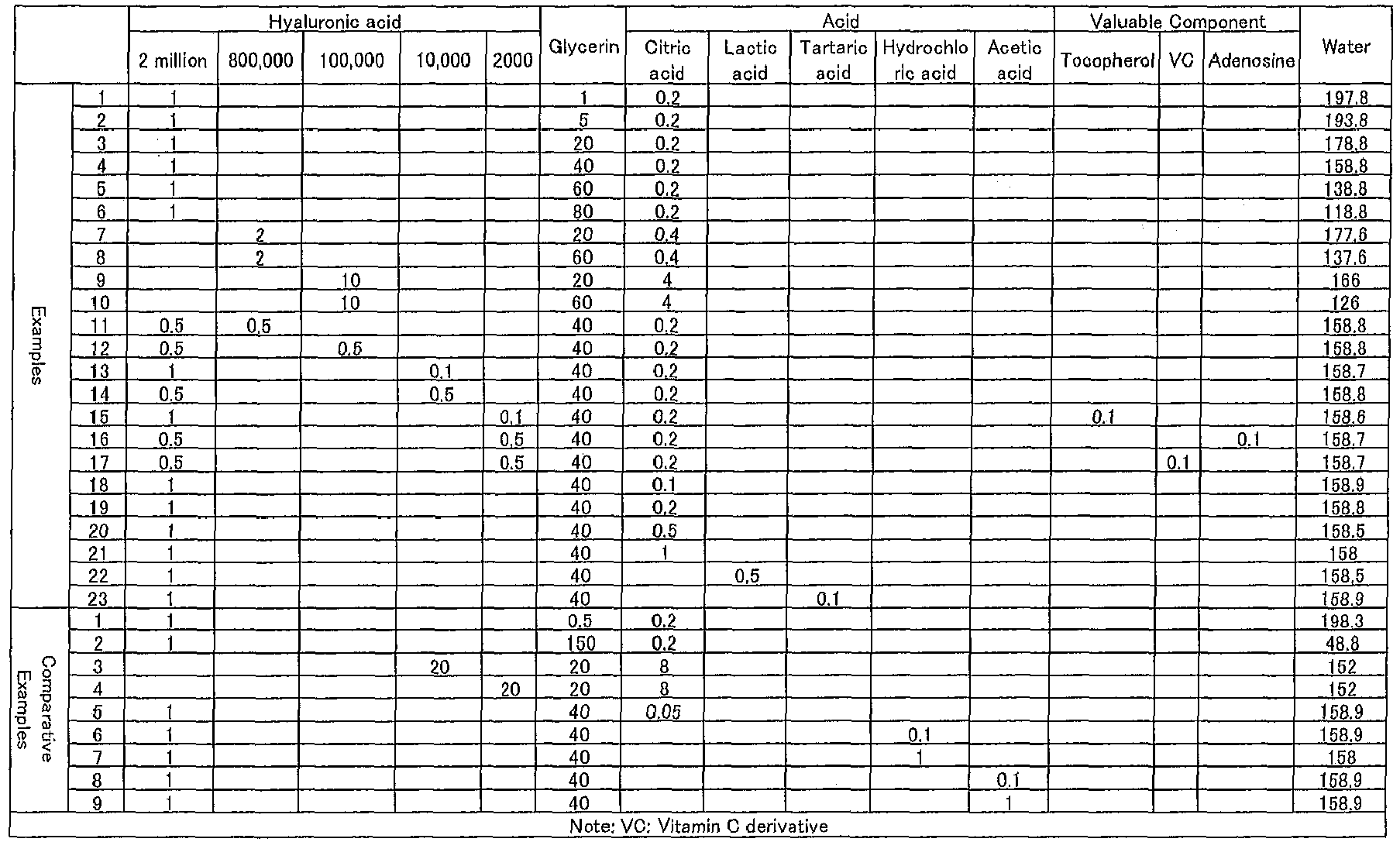

- Respective aqueous solutions, each of which contains the hyaluronic acid, the polyhydric alcohol, and the polycarboxylic acid or oxycarbonic acid, were stirred and homogenized by a propeller type rotary stirrer, for preparation. In Examples 15 and 16, the tocopherol and the adenosine were dissolved in a small amount of ethanol and then added. The prepared aqueous solution was applied on a polyethylene terephthalate film with a thickness of 26 µm (DIAFOIL #130-26: Mitsubishi Plastics, Inc.) so that the thickness was uniform, and dried at 80°C by a geer type oven for 30 minutes to obtain a hyaluronic acid gel sheet with a thickness of about 200 µm or a non-gelatinized viscous material.
- The produced hyaluronic acid gel sheets obtained in Examples 1 to 29 and Comparative Examples 1 to 9 were evaluated from the following three view points. The results of the evaluations are summarized in Table 3 below.
- Results of observation for flexibility, elasticity and tensile strength by naked eye and sense of touch are shown.
- Results of test for adherence to the skin in which hyaluronic acid gel sheets (2 cm x 2 cm) were applied on insides of forearms of human volunteers are shown.
- Hyaluronic acid gel sheets (2 cm x 2 cm) were applied on forearms of human volunteers, on which 10 ml of water was dripped, and the skin was massaged over the sheet for 3 minutes, and the solubility of the hyaluronic acid gel was observed.
Table 3 Property Adherence to skin Solubility Examples 1 A A A 2 A A A 3 A A A 4 A A A 5 A A A 6 A A A 7 A A A 8 A A A 9 A A A 10 A A A 11 A A A 12 A A A 13 A A A 14 A A A 15 A A A* 16 A A A* 17 A A A* 18 A A A 19 A A A 20 A A A 21 A A A 22 A A A 23 A A A 24 A A A 25 A A A 26 A A A 27 A A A 28 A A A 29 A A A Comparative Examples 1 B C B 2 D Insufficient sheet forming Unable to test 3 D Unable to form sheet Unable to test 4 D Unable to form sheet Unable to test 5 D Unable to form sheet Unable to test 6 D Unable to form sheet Unable to test 7 D Unable to form sheet Unable to test 8 D Unable to form sheet Unable to test 9 D Unable to form sheet Unable to test - Respective symbols in Table 3 mean the following results.
- In the observation results for properties, A represents that all of flexibility, elasticity and tensile strength are sufficient, B represents that flexibility and elasticity are insufficient but tensile strength is sufficient, C represents that flexibility and elasticity are sufficient but tensile strength is insufficient, and D represents that it is a liquid, and all of flexibility, elasticity and tensile strength are insufficient.
- In the skin adherence test, A represents good adherence, B represents adherence with partial detachment, and C represents no adherence and moreover detachment. Basically, the products showing C and D in the observation results for the properties were not the subjects for this test.
- In the solubility test, A represents complete dissolution, and B represents partial dissolution. A* represents rapid dissolution within 30 seconds. Basically, the products showing C and D in the observation results for the properties were not the subjects for this test.
- The following four test samples were administered to the same sites of forearms of 5 human volunteers twice at morning and night for a total of 7 days, and one day after the completion of the administration (8 days after the start of the administration), their skin moisture contents were measured using Cutometer (MPA 580). The results of the measurement were indicated as electrostatic capacities (unit: a.u.). Also, their skin moisture contents before administration were measured as controls. The increment of electrostatic capacity (=increment of the moisture content) compared with that before administration were summarized in Table 4. The results are represented by an average and a standard deviation (SD) of the results of the 5 subjects.
Table 4 Test Examples Target Samples Average and SD of increment of electrostatic capacity of skin (unit: a.u.) 1 Example 4 Gel sheet 42 ± 6 2 Example 17 Gel sheet 47 ± 5 3 Example 17 Solution 49 ± 8 4 WO01/57093 30 ± 6 - The test samples and the administration method were as below.
- Test example 1: The hyaluronic acid gel sheet (2 cm x 2 cm) in Example 4 was applied on the forearm for 30 minutes, then the skin was massaged while the gel was dissolved by adding about 10 mL of purified water on the gel little by little for about 3 minutes, then it was rinsed with purified water, and naturally dried.
- Test example 2: The hyaluronic acid gel sheet (2 cm x 2 cm) in Example 17 was applied on the forearm for 30 minutes, then the skin was massaged while the gel was dissolved by adding about 10 mL of purified water on the gel little by little for about 3 minutes, then it was rinsed with purified water, and naturally dried.
- Test example 3: About 1 mL of the aqueous solution before preparation of the gel in Example 17 was applied on the forearm (about 2 cm x 2 cm), and 30 minutes later, the skin was massaged for about 3 minutes, then it was rinsed with purified water, and naturally dried.
- Test example 4: According to the method described in Example 6 of
WO01/57093 - The hyaluronic acid gel sheet showed significant increase of the skin moisture content compared to Example 6 in
WO01/57093 - The hyaluronic acid gel sheets in Examples 30 to 36 were produced according to the compounding ratios (weight ratio) described in Table 5 below. Aqueous solutions of each constituent were stirred and homogenized by a propeller type rotary stirrer, for preparation. The prepared aqueous solution was applied on a polyethylene terephthalate film with a thickness of 26 µm (DIAFOIL #130-26: Mitsubishi Plastics, Inc.) so that the thickness was uniform, and dried at 80°C by a geer type oven for 30 minutes to obtain a hyaluronic acid gel sheet with a thickness of about 200 µm. This hyaluronic acid gel sheet was cut to obtain a circle hyaluronic acid gel sheet with a diameter of 20 cm, and a face mask having holes corresponding to eyes and mouth was produced.
- Also, the hyaluronic acid gel sheets in Comparative Examples 10 and 11 were similarly produced according to the compounding ratios (weight ratio) described in Table 5. Also, their face masks were similarly produced. The thicknesses of the films for the hyaluronic acid gel sheets were 15 µm and 25 µm respectively.
Table 5 Hyaluronic acid Polyhydric alcohol Acid Valuable Component Hydroxy Water 2 million 2000 Glycerin Polyethylene Lactic acid Citric acid Tartaric acid Collagen Acetylglucosamine Trehalose Niacin amide Glycyrrhizin 2K Adenosine Scutellaria Examples 30 1 0.1 30 5 0.2 0.6 0.2 1 0 0 0.02 0.01 0.05 0.02 0 150 31 1 0.1 40 0 0.2 0.8 0 2 0 0 0.02 0.01 0.05 0.02 0 150 32 1 0.1 60 0 0 1 0 0 1 0 0.02 0.01 0.1 0.02 0.1 150 33 1 0 50 0 0 0 1 0 1 0 0.02 0.01 0.05 0.02 0.1 150 34 1 0.1 40 0 0.2 0.6 0.2 1 0 0 0.02 0.01 0.05 0.02 0 150 35 1 0 40 2 0.2 0.8 0 2 0 0 0.02 0.01 0.05 0.02 0 150 36 1 0.1 50 0 0 0.2 0.8 0 1 0 0.02 0.01 0.1 0.02 0 150 Comparative Examples 10 1 0 50 0 0.2 0.6 0.2 0 1 0 0.02 0.01 0.05 0.02 0 150 11 1 0.05 50 2 0.2 0.6 0 0 0 1 0.02 0.01 0.1 0.02 0 150 Note: Polyethylene: polyethylene glycol 400, Scutellaria: scutellaria baicalensis extract, Hydroxy: hydroxypropyl-cellulose - The skin lotion for the test was produced according to the compounding ratios (weight ratio) for the components described in Table 6 below. Aqueous solutions of each constituent were mixed by a propeller type rotary stirrer, for preparation.
Table 6 Skin lotion Hyaluronic acid 2000 Acetylglucosamine Scutellaria baicalensis extra ct Butylene glycol Glycerin Oleyl alcohol POE (25) Methyl paraben Sodium bicarbonate Water A 0.01 1 0.01 6 4 0.1 0.5 0.05 1 85 B 0.01 1 0.01 6 4 0.1 0.5 0.05 0 85 - Each of the obtained face masks was applied on the face of the volunteer lying face up, and presence of warm sensation at the application site on the skin was evaluated. The skin temperatures at the application site and the non-application site were measured to calculate the temperature difference between them. For measurement of the skin temperature, a digital thermometer (GT-07) was used.
- Subsequently, about 0.5 mL of skin lotion for the test was sprayed to the whole surface of the face mask by a spray, and the skin was massaged to evaluate foaming of CO2 gas. In this test, skin lotion A was used in Examples 30 to 35 and Comparative Examples 10 and 11, and skin lotion B was used in Example 36.
- The evaluation results were summarized in Table 7 below. The face mask was dissolved by massage for about 3 minutes, then it was rinsed with purified water, and naturally dried.
Table 7 Handleabiliy Test result for warm sensation of skin Test result for CO2 gas foaming Examples 30 Good Skin temperature increased by 0.5°C for more than 1 min Intense foaming 31 ditto ditto ditto 32 ditto ditto ditto 33 ditto ditto ditto 34 ditto ditto ditto 35 ditto ditto ditto 36 ditto ditto No foaming Comparative Examples 10 Insufficient sheet strength, difficult to handle Skin temperature increased by 0.3°C or less Small amount of foam generated 11 ditto ditto ditto
Claims (7)
- Hyaluronic acid gel sheet containing 100 parts by weight of a hyaluronic acid having a molecular weight of from 5x10⁴ to 5x10⁶ daltons, 10 to 100 parts by weight of polycarboxylic acid or oxycarbonic acid, and 100 to 8000 parts by weight of polyhydric alcohol, and the thickness of the sheet is in a range of 30 µm to 1 mm.
- The hyaluronic acid gel sheet according to Claim 1, wherein
10 weight percent or more of a hyaluronic acid whose molecular weight is 2x10⁴ daltons or below is further contained in addition to 100 weight percent of said hyaluronic acid having a molecular weight of from 5x10⁴ to 5x10⁶ daltons. - The hyaluronic acid gel sheet according to Claim 1 or 2, wherein
the polycarboxylic acid or oxycarbonic acid is at least one or more carboxylic acids selected from a group consisting of citric acid, tartaric acid and lactic acid. - The hyaluronic acid gel sheet according to any one of claims 1 to 3, wherein
the polyhydric alcohol is glycerin. - The hyaluronic acid gel sheet according to any one of Claims 1 to 4, farther containing at least one or more compounds selected from a group consisting of hydroxypropyl cellulose, polyvinylpyrrolidone, polyvinyl alcohol, carboxymethylcellulose, polyacrylic acid and polyethylene glycol.
- The hyaluronic acid gel sheet according to any one of Claims 1 to 5, further containing active ingredients used for cosmetics and medicinal products.
- A method for manufacturing hyaluronic acid gel sheet, including
a step of preparing an aqueous solution by uniformly dissolving 100 parts by weight of a hyaluronic acid having a molecular weight of from 5x10⁴ to 5x10⁶ daltons, 10 to 100 parts by weight of a polycarboxylic acid or oxycarbonic acid and 100 to 8000 parts by weight of a polyhydric alcohol in water, and
a step of producing the sheet-like hyaluronic acid gel by applying the aqueous solution on a film so that its thickness is uniform and drying it.
Applications Claiming Priority (2)
| Application Number | Priority Date | Filing Date | Title |
|---|---|---|---|
| JP2012242203A JP5840107B2 (en) | 2012-06-17 | 2012-10-17 | Hyaluronic acid gel and method for producing the same |
| PCT/JP2013/071003 WO2014061332A1 (en) | 2012-10-17 | 2013-08-02 | Hyaluronic acid gel and method for producing same |
Publications (3)
| Publication Number | Publication Date |
|---|---|
| EP2910238A1 EP2910238A1 (en) | 2015-08-26 |
| EP2910238A4 EP2910238A4 (en) | 2016-05-25 |
| EP2910238B1 true EP2910238B1 (en) | 2018-10-31 |
Family
ID=50488942
Family Applications (1)
| Application Number | Title | Priority Date | Filing Date |
|---|---|---|---|
| EP13847345.9A Not-in-force EP2910238B1 (en) | 2012-10-17 | 2013-08-02 | Hyaluronic acid gel sheet and method for producing same |
Country Status (9)
| Country | Link |
|---|---|
| US (1) | US9855206B2 (en) |
| EP (1) | EP2910238B1 (en) |
| JP (2) | JP5840107B2 (en) |
| KR (1) | KR102098427B1 (en) |
| CN (3) | CN110339087A (en) |
| AU (1) | AU2013333184B2 (en) |
| CA (1) | CA2887988C (en) |
| ES (1) | ES2705495T3 (en) |
| WO (1) | WO2014061332A1 (en) |
Families Citing this family (27)
| Publication number | Priority date | Publication date | Assignee | Title |
|---|---|---|---|---|
| CN105163716B (en) * | 2013-07-03 | 2019-02-12 | 株式会社利他药业 | Water-soluble hyaluronic acid gel and method for producing the same |
| JP6430128B2 (en) | 2014-02-17 | 2018-11-28 | コスメディ製薬株式会社 | Cosmetic gel sheet and method for producing the same |
| FR3027221B1 (en) * | 2014-10-17 | 2018-01-19 | Oreal | COSMETIC AQUEOUS GEL |
| JP2016098197A (en) * | 2014-11-20 | 2016-05-30 | 株式会社タイキ | Carbon dioxide gas generation kit for skin patch |
| WO2016121611A1 (en) * | 2015-01-29 | 2016-08-04 | 株式会社リタファーマ | Water-soluble hyaluronic acid gel and method for producing same |
| JP6478132B2 (en) * | 2015-01-29 | 2019-03-06 | 株式会社リタファーマ | Water-soluble hyaluronic acid gel and method for producing the same |
| JP6512560B2 (en) * | 2015-01-29 | 2019-05-15 | 株式会社リタファーマ | Water soluble hyaluronic acid gel and method for producing the same |
| WO2017052133A1 (en) * | 2015-09-22 | 2017-03-30 | 바이오플러스 주식회사 | Gel sheet using hyaluronic acid and method for preparing same |
| JP6853994B2 (en) | 2016-04-28 | 2021-04-07 | コスメディ製薬株式会社 | Cosmetic alcogel sheet and its manufacturing method |
| US10602250B2 (en) | 2016-10-13 | 2020-03-24 | Bose Corporation | Acoustaical devices employing phase change materials |
| US10531174B2 (en) * | 2016-10-13 | 2020-01-07 | Bose Corporation | Earpiece employing cooling and sensation inducing materials |
| WO2018164358A1 (en) * | 2017-03-07 | 2018-09-13 | (주)진우바이오 | Method for manufacturing hyaluronate film and hyaluronate film manufactured thereby |
| JP6931217B2 (en) | 2017-03-28 | 2021-09-01 | コスメディ製薬株式会社 | Applicator for water-soluble sheet-like preparation |
| JP6912327B2 (en) | 2017-09-04 | 2021-08-04 | 大日精化工業株式会社 | Manufacturing method of medical / beauty materials and medical / beauty materials |
| JP6925233B2 (en) | 2017-10-27 | 2021-08-25 | 大日精化工業株式会社 | Molded products for cosmetics and their manufacturing methods |
| JP7299886B2 (en) * | 2018-05-29 | 2023-06-28 | 株式会社 資生堂 | warming cosmetics |
| CN109316628B (en) * | 2018-09-21 | 2021-04-20 | 广州远想生物科技有限公司 | Gel and preparation method and application thereof |
| JP6815363B2 (en) * | 2018-10-31 | 2021-01-20 | コスメディ製薬株式会社 | Cosmetic gel sheet and its manufacturing method |
| JP7491551B2 (en) | 2019-04-25 | 2024-05-28 | コスメディ製薬株式会社 | Applicator 2 for water-soluble sheet preparation |
| KR102215559B1 (en) * | 2019-10-08 | 2021-02-15 | 주식회사 제네웰 | Preparing method of dry hyaluronic acid based composition and dry hyaluronic acid based composition |
| US11511186B2 (en) * | 2020-02-14 | 2022-11-29 | Valve Corporation | Controller with sensor-rich controls |
| CN112160185B (en) * | 2020-09-25 | 2022-09-30 | 山东华熙海御生物医药有限公司 | Cigarette paper containing hyaluronic acid and preparation method thereof |
| JP7166014B2 (en) * | 2020-12-22 | 2022-11-07 | コスメディ製薬株式会社 | Cosmetic gel sheet and manufacturing method thereof |
| CN113244134A (en) * | 2021-05-07 | 2021-08-13 | 南京中源盛生物科技研究院有限公司 | Skin care product active substance micro/nano sphere-hydrogel and preparation method thereof |
| DE102022202547A1 (en) | 2021-12-09 | 2023-06-15 | Beiersdorf Aktiengesellschaft | Topically applicable preparation to improve the condition of the skin |
| WO2024055132A1 (en) * | 2022-09-12 | 2024-03-21 | Universidad De Talca | Method for the synthesis of a branched copolymer of hyaluronic acid and poly(lactic-co-glycolic) acid |
| KR102712667B1 (en) * | 2023-09-26 | 2024-10-04 | 문석현 | Manufacturing method of hydrogel matrix composition for solid cosmetics |
Family Cites Families (39)
| Publication number | Priority date | Publication date | Assignee | Title |
|---|---|---|---|---|
| JPS61180705A (en) | 1985-02-06 | 1986-08-13 | Shiseido Co Ltd | Cosmetic |
| JPS63159452A (en) * | 1986-12-23 | 1988-07-02 | Toyo Jozo Co Ltd | Film composition |
| US5089349A (en) | 1989-06-05 | 1992-02-18 | Calgon Corporation | Compositions and method for applying coatings to metallic surfaces |
| JPH0363209A (en) * | 1989-07-31 | 1991-03-19 | Chisso Corp | Production of sheet-like hyaluronic acid or its salt and its use |
| FR2650180B1 (en) | 1989-07-31 | 1995-03-03 | Chisso Corp | PROCESS FOR PRODUCING AN EASILY WATER-SOLUBLE SHEET BASED ON HYALURONIC ACID OR HYALURONATE AND SHEET THUS OBTAINED |
| JP3051215B2 (en) | 1991-08-27 | 2000-06-12 | 株式会社資生堂 | Hyaluronic acid gel and method for producing the same |
| JPH0665048A (en) * | 1992-08-20 | 1994-03-08 | Kibun Food Chemifa Co Ltd | Filmy pack agent |
| JP3308742B2 (en) | 1994-11-17 | 2002-07-29 | 生化学工業株式会社 | Photocrosslinkable hyaluronic acid derivative, crosslinked product thereof and methods for producing them |
| US5827937A (en) | 1995-07-17 | 1998-10-27 | Q Med Ab | Polysaccharide gel composition |
| JPH09110680A (en) * | 1995-10-19 | 1997-04-28 | Yuutoku Yakuhin Kogyo Kk | Dermatitis-curing strap |
| US6136297A (en) * | 1997-06-06 | 2000-10-24 | The Procter & Gamble Company | Delivery system for an oral care substance using a strip of material having low flexural stiffness |
| US5879711A (en) * | 1997-11-07 | 1999-03-09 | Sequeira; Joel A. | Stable antiandrogenic gel composition |
| JP2000273033A (en) * | 1999-03-21 | 2000-10-03 | Tadashi Fukiya | Gel comprising natural material |
| JP2001064154A (en) | 1999-08-27 | 2001-03-13 | Takashi Yokota | Humectant composition |
| AU781105B2 (en) * | 2000-02-03 | 2005-05-05 | Denki Kagaku Kogyo Kabushiki Kaisha | Hyaluronic acid gel, process for producing the same, and medical material containing the same |
| JP2001335427A (en) * | 2000-05-29 | 2001-12-04 | Kanebo Ltd | Sheet-shaped cosmetic and makeup method |
| JP3990541B2 (en) * | 2001-01-18 | 2007-10-17 | 株式会社科薬 | Gel-like composition for moisturizing |
| JP2002338423A (en) | 2001-05-15 | 2002-11-27 | Yukipuramu Company:Kk | Sweating gel |
| RU2005102604A (en) * | 2002-07-03 | 2005-09-10 | Перикор Сайенс, Инк. (Us) | COMPOSITION OF HYALURONIC ACID AND METHODS OF APPLICATION |
| JP3094074U (en) | 2002-11-15 | 2003-05-30 | オアシス グロウバル リミテッド | electric toothbrush |
| ITMI20031291A1 (en) * | 2003-06-25 | 2004-12-26 | Ricerfarma Srl | USE OF HYALURONIC ACID FOR THE PREPARATION OF COMPOSITIONS FOR THE TREATMENT OF AFTE OF THE ORAL CABLE. |
| JP2005022980A (en) * | 2003-06-30 | 2005-01-27 | Bcs Inc | Pack sheet for makeup and method for producing the same |
| JP2005060234A (en) * | 2003-08-08 | 2005-03-10 | Rohto Pharmaceut Co Ltd | External preparation for skin |
| US20050112151A1 (en) | 2003-11-20 | 2005-05-26 | Horng Liou L. | Skin adherent hydrogels |
| JP4875988B2 (en) | 2004-11-15 | 2012-02-15 | 株式会社 資生堂 | Method for producing crosslinked hyaluronic acid gel |
| JP2006306843A (en) | 2005-03-29 | 2006-11-09 | Kose Corp | Thermomassage material |
| JP5289936B2 (en) * | 2006-02-24 | 2013-09-11 | キユーピー株式会社 | Novel low molecular weight hyaluronic acid and / or salt thereof, and cosmetics, pharmaceutical compositions and food compositions using the same |
| JP5066342B2 (en) | 2006-04-28 | 2012-11-07 | キユーピー株式会社 | Novel hyaluronic acid and / or salt thereof, and cosmetics, pharmaceutical compositions, food compositions, and cosmetic kits using the same |
| DE102007015621A1 (en) | 2007-03-29 | 2008-10-02 | Rudolf Weyergans | Method for optimizing artificial tanning |
| JP2009102228A (en) * | 2007-10-19 | 2009-05-14 | La Shinshia Kk | Gel sheet and hydrous gel composition used for the gel sheet |
| JP5472673B2 (en) * | 2008-09-29 | 2014-04-16 | コスメディ製薬株式会社 | Microneedle array |
| JP2010130920A (en) | 2008-12-03 | 2010-06-17 | Shiseido Co Ltd | Hyaluronic acid enzyme conjugate gel |
| CN101450028A (en) | 2008-12-31 | 2009-06-10 | 桐乡市恒基生物科技有限公司 | Efficient moisture-retention sodium hyaluronic acid raw-liquor |
| JP5398062B2 (en) | 2009-03-16 | 2014-01-29 | 積水化成品工業株式会社 | Hydrogel external preparation |
| EP2536786B1 (en) * | 2010-02-18 | 2015-12-30 | Dow Corning Corporation | Surface-modified hydrogels and hydrogel microparticles |
| CN102266273B (en) | 2010-06-04 | 2012-10-24 | 珠海海狮龙生物科技有限公司 | Production method of hydrogel skin caring film |
| HUE042252T2 (en) * | 2011-03-21 | 2019-06-28 | Broda Tech Co Ltd | Reversely thermo-reversible hydrogel compositions |
| JP2013223644A (en) | 2012-04-23 | 2013-10-31 | Dainippon Printing Co Ltd | Hydrogel thin film and method for manufacturing dried gel thin film |
| CN105163716B (en) * | 2013-07-03 | 2019-02-12 | 株式会社利他药业 | Water-soluble hyaluronic acid gel and method for producing the same |
-
2012
- 2012-10-17 JP JP2012242203A patent/JP5840107B2/en active Active
-
2013
- 2013-08-02 WO PCT/JP2013/071003 patent/WO2014061332A1/en not_active Ceased
- 2013-08-02 ES ES13847345T patent/ES2705495T3/en active Active
- 2013-08-02 KR KR1020157009628A patent/KR102098427B1/en active Active
- 2013-08-02 CN CN201910795943.0A patent/CN110339087A/en active Pending
- 2013-08-02 CN CN201380052533.8A patent/CN104717960A/en active Pending
- 2013-08-02 AU AU2013333184A patent/AU2013333184B2/en not_active Ceased
- 2013-08-02 CN CN201910795923.3A patent/CN110384624A/en active Pending
- 2013-08-02 EP EP13847345.9A patent/EP2910238B1/en not_active Not-in-force
- 2013-08-02 CA CA2887988A patent/CA2887988C/en active Active
- 2013-08-02 US US14/436,463 patent/US9855206B2/en not_active Expired - Fee Related
-
2015
- 2015-07-23 JP JP2015146211A patent/JP6064004B2/en active Active
Non-Patent Citations (1)
| Title |
|---|
| None * |
Also Published As
| Publication number | Publication date |
|---|---|
| JP2015187184A (en) | 2015-10-29 |
| CN110339087A (en) | 2019-10-18 |
| AU2013333184A1 (en) | 2015-04-23 |
| EP2910238A4 (en) | 2016-05-25 |
| AU2013333184B2 (en) | 2018-03-01 |
| JP2014024828A (en) | 2014-02-06 |
| US9855206B2 (en) | 2018-01-02 |
| KR20150070159A (en) | 2015-06-24 |
| KR102098427B1 (en) | 2020-04-07 |
| CN110384624A (en) | 2019-10-29 |
| WO2014061332A1 (en) | 2014-04-24 |
| US20150272850A1 (en) | 2015-10-01 |
| ES2705495T3 (en) | 2019-03-25 |
| JP5840107B2 (en) | 2016-01-06 |
| CA2887988C (en) | 2020-10-27 |
| CN104717960A (en) | 2015-06-17 |
| CA2887988A1 (en) | 2014-04-24 |
| JP6064004B2 (en) | 2017-01-18 |
| EP2910238A1 (en) | 2015-08-26 |
Similar Documents
| Publication | Publication Date | Title |
|---|---|---|
| US9855206B2 (en) | Hyaluronic acid gel and manufacturing method thereof | |
| US11701309B2 (en) | Cosmetic gel sheet and manufacturing method thereof | |
| JP2021080302A (en) | Cosmetic alcogel sheet and method for producing the same | |
| JP2008285461A (en) | Biomedical adhesive gel sheet and sheet-like cosmetic containing the same | |
| JP7166014B2 (en) | Cosmetic gel sheet and manufacturing method thereof | |
| JP7591246B2 (en) | Cosmetic gel sheet using oblate as support and method for producing same | |
| WO2017188424A1 (en) | Alcogel sheet for cosmetic use, and method for producing same | |
| JP2019031558A (en) | Cosmetic gel sheet and method for producing the same |
Legal Events
| Date | Code | Title | Description |
|---|---|---|---|
| TPAC | Observations filed by third parties |
Free format text: ORIGINAL CODE: EPIDOSNTIPA |
|
| PUAI | Public reference made under article 153(3) epc to a published international application that has entered the european phase |
Free format text: ORIGINAL CODE: 0009012 |
|
| 17P | Request for examination filed |
Effective date: 20150407 |
|
| AK | Designated contracting states |
Kind code of ref document: A1 Designated state(s): AL AT BE BG CH CY CZ DE DK EE ES FI FR GB GR HR HU IE IS IT LI LT LU LV MC MK MT NL NO PL PT RO RS SE SI SK SM TR |
|
| AX | Request for extension of the european patent |
Extension state: BA ME |
|
| DAX | Request for extension of the european patent (deleted) | ||
| RA4 | Supplementary search report drawn up and despatched (corrected) |
Effective date: 20160421 |
|
| RIC1 | Information provided on ipc code assigned before grant |
Ipc: A61K 8/02 20060101ALI20160415BHEP Ipc: C08L 5/00 20060101ALI20160415BHEP Ipc: A61K 8/365 20060101ALI20160415BHEP Ipc: C08B 37/08 20060101ALI20160415BHEP Ipc: A61K 8/73 20060101AFI20160415BHEP Ipc: A61K 47/36 20060101ALI20160415BHEP Ipc: A61Q 19/08 20060101ALI20160415BHEP Ipc: A61Q 19/00 20060101ALI20160415BHEP Ipc: A61K 9/70 20060101ALI20160415BHEP Ipc: A61K 8/34 20060101ALI20160415BHEP |
|
| GRAP | Despatch of communication of intention to grant a patent |
Free format text: ORIGINAL CODE: EPIDOSNIGR1 |
|
| STAA | Information on the status of an ep patent application or granted ep patent |
Free format text: STATUS: GRANT OF PATENT IS INTENDED |
|
| RIC1 | Information provided on ipc code assigned before grant |
Ipc: A61Q 19/00 20060101ALI20180504BHEP Ipc: A61K 8/02 20060101ALI20180504BHEP Ipc: C08L 5/00 20060101ALI20180504BHEP Ipc: A61K 9/70 20060101ALI20180504BHEP Ipc: A61K 8/362 20060101ALI20180504BHEP Ipc: A61K 8/73 20060101AFI20180504BHEP Ipc: A61K 8/34 20060101ALI20180504BHEP Ipc: A61Q 19/08 20060101ALI20180504BHEP Ipc: C08B 37/08 20060101ALI20180504BHEP Ipc: A61K 47/36 20060101ALI20180504BHEP Ipc: A61K 8/365 20060101ALI20180504BHEP |
|
| INTG | Intention to grant announced |
Effective date: 20180601 |
|
| GRAS | Grant fee paid |
Free format text: ORIGINAL CODE: EPIDOSNIGR3 |
|
| GRAA | (expected) grant |
Free format text: ORIGINAL CODE: 0009210 |
|
| STAA | Information on the status of an ep patent application or granted ep patent |
Free format text: STATUS: THE PATENT HAS BEEN GRANTED |
|
| AK | Designated contracting states |
Kind code of ref document: B1 Designated state(s): AL AT BE BG CH CY CZ DE DK EE ES FI FR GB GR HR HU IE IS IT LI LT LU LV MC MK MT NL NO PL PT RO RS SE SI SK SM TR |
|
| REG | Reference to a national code |
Ref country code: GB Ref legal event code: FG4D Ref country code: CH Ref legal event code: EP |
|
| REG | Reference to a national code |
Ref country code: AT Ref legal event code: REF Ref document number: 1058526 Country of ref document: AT Kind code of ref document: T Effective date: 20181115 |
|
| REG | Reference to a national code |
Ref country code: IE Ref legal event code: FG4D |
|
| REG | Reference to a national code |
Ref country code: DE Ref legal event code: R096 Ref document number: 602013046103 Country of ref document: DE |
|
| REG | Reference to a national code |
Ref country code: NL Ref legal event code: FP |
|
| REG | Reference to a national code |
Ref country code: LT Ref legal event code: MG4D |
|
| REG | Reference to a national code |
Ref country code: ES Ref legal event code: FG2A Ref document number: 2705495 Country of ref document: ES Kind code of ref document: T3 Effective date: 20190325 |
|
| REG | Reference to a national code |
Ref country code: AT Ref legal event code: MK05 Ref document number: 1058526 Country of ref document: AT Kind code of ref document: T Effective date: 20181031 |
|
| PG25 | Lapsed in a contracting state [announced via postgrant information from national office to epo] |
Ref country code: IS Free format text: LAPSE BECAUSE OF FAILURE TO SUBMIT A TRANSLATION OF THE DESCRIPTION OR TO PAY THE FEE WITHIN THE PRESCRIBED TIME-LIMIT Effective date: 20190228 Ref country code: FI Free format text: LAPSE BECAUSE OF FAILURE TO SUBMIT A TRANSLATION OF THE DESCRIPTION OR TO PAY THE FEE WITHIN THE PRESCRIBED TIME-LIMIT Effective date: 20181031 Ref country code: PL Free format text: LAPSE BECAUSE OF FAILURE TO SUBMIT A TRANSLATION OF THE DESCRIPTION OR TO PAY THE FEE WITHIN THE PRESCRIBED TIME-LIMIT Effective date: 20181031 Ref country code: HR Free format text: LAPSE BECAUSE OF FAILURE TO SUBMIT A TRANSLATION OF THE DESCRIPTION OR TO PAY THE FEE WITHIN THE PRESCRIBED TIME-LIMIT Effective date: 20181031 Ref country code: LT Free format text: LAPSE BECAUSE OF FAILURE TO SUBMIT A TRANSLATION OF THE DESCRIPTION OR TO PAY THE FEE WITHIN THE PRESCRIBED TIME-LIMIT Effective date: 20181031 Ref country code: BG Free format text: LAPSE BECAUSE OF FAILURE TO SUBMIT A TRANSLATION OF THE DESCRIPTION OR TO PAY THE FEE WITHIN THE PRESCRIBED TIME-LIMIT Effective date: 20190131 Ref country code: NO Free format text: LAPSE BECAUSE OF FAILURE TO SUBMIT A TRANSLATION OF THE DESCRIPTION OR TO PAY THE FEE WITHIN THE PRESCRIBED TIME-LIMIT Effective date: 20190131 Ref country code: AT Free format text: LAPSE BECAUSE OF FAILURE TO SUBMIT A TRANSLATION OF THE DESCRIPTION OR TO PAY THE FEE WITHIN THE PRESCRIBED TIME-LIMIT Effective date: 20181031 Ref country code: LV Free format text: LAPSE BECAUSE OF FAILURE TO SUBMIT A TRANSLATION OF THE DESCRIPTION OR TO PAY THE FEE WITHIN THE PRESCRIBED TIME-LIMIT Effective date: 20181031 |
|
| PG25 | Lapsed in a contracting state [announced via postgrant information from national office to epo] |
Ref country code: AL Free format text: LAPSE BECAUSE OF FAILURE TO SUBMIT A TRANSLATION OF THE DESCRIPTION OR TO PAY THE FEE WITHIN THE PRESCRIBED TIME-LIMIT Effective date: 20181031 Ref country code: RS Free format text: LAPSE BECAUSE OF FAILURE TO SUBMIT A TRANSLATION OF THE DESCRIPTION OR TO PAY THE FEE WITHIN THE PRESCRIBED TIME-LIMIT Effective date: 20181031 Ref country code: SE Free format text: LAPSE BECAUSE OF FAILURE TO SUBMIT A TRANSLATION OF THE DESCRIPTION OR TO PAY THE FEE WITHIN THE PRESCRIBED TIME-LIMIT Effective date: 20181031 Ref country code: GR Free format text: LAPSE BECAUSE OF FAILURE TO SUBMIT A TRANSLATION OF THE DESCRIPTION OR TO PAY THE FEE WITHIN THE PRESCRIBED TIME-LIMIT Effective date: 20190201 Ref country code: PT Free format text: LAPSE BECAUSE OF FAILURE TO SUBMIT A TRANSLATION OF THE DESCRIPTION OR TO PAY THE FEE WITHIN THE PRESCRIBED TIME-LIMIT Effective date: 20190301 |
|
| PG25 | Lapsed in a contracting state [announced via postgrant information from national office to epo] |
Ref country code: CZ Free format text: LAPSE BECAUSE OF FAILURE TO SUBMIT A TRANSLATION OF THE DESCRIPTION OR TO PAY THE FEE WITHIN THE PRESCRIBED TIME-LIMIT Effective date: 20181031 Ref country code: DK Free format text: LAPSE BECAUSE OF FAILURE TO SUBMIT A TRANSLATION OF THE DESCRIPTION OR TO PAY THE FEE WITHIN THE PRESCRIBED TIME-LIMIT Effective date: 20181031 |
|
| REG | Reference to a national code |
Ref country code: DE Ref legal event code: R097 Ref document number: 602013046103 Country of ref document: DE |
|
| PG25 | Lapsed in a contracting state [announced via postgrant information from national office to epo] |
Ref country code: SM Free format text: LAPSE BECAUSE OF FAILURE TO SUBMIT A TRANSLATION OF THE DESCRIPTION OR TO PAY THE FEE WITHIN THE PRESCRIBED TIME-LIMIT Effective date: 20181031 Ref country code: EE Free format text: LAPSE BECAUSE OF FAILURE TO SUBMIT A TRANSLATION OF THE DESCRIPTION OR TO PAY THE FEE WITHIN THE PRESCRIBED TIME-LIMIT Effective date: 20181031 Ref country code: SK Free format text: LAPSE BECAUSE OF FAILURE TO SUBMIT A TRANSLATION OF THE DESCRIPTION OR TO PAY THE FEE WITHIN THE PRESCRIBED TIME-LIMIT Effective date: 20181031 Ref country code: RO Free format text: LAPSE BECAUSE OF FAILURE TO SUBMIT A TRANSLATION OF THE DESCRIPTION OR TO PAY THE FEE WITHIN THE PRESCRIBED TIME-LIMIT Effective date: 20181031 |
|
| PLBE | No opposition filed within time limit |
Free format text: ORIGINAL CODE: 0009261 |
|
| STAA | Information on the status of an ep patent application or granted ep patent |
Free format text: STATUS: NO OPPOSITION FILED WITHIN TIME LIMIT |
|
| 26N | No opposition filed |
Effective date: 20190801 |
|
| PG25 | Lapsed in a contracting state [announced via postgrant information from national office to epo] |
Ref country code: SI Free format text: LAPSE BECAUSE OF FAILURE TO SUBMIT A TRANSLATION OF THE DESCRIPTION OR TO PAY THE FEE WITHIN THE PRESCRIBED TIME-LIMIT Effective date: 20181031 |
|
| PG25 | Lapsed in a contracting state [announced via postgrant information from national office to epo] |
Ref country code: TR Free format text: LAPSE BECAUSE OF FAILURE TO SUBMIT A TRANSLATION OF THE DESCRIPTION OR TO PAY THE FEE WITHIN THE PRESCRIBED TIME-LIMIT Effective date: 20181031 |
|
| PG25 | Lapsed in a contracting state [announced via postgrant information from national office to epo] |
Ref country code: LI Free format text: LAPSE BECAUSE OF NON-PAYMENT OF DUE FEES Effective date: 20190831 Ref country code: CH Free format text: LAPSE BECAUSE OF NON-PAYMENT OF DUE FEES Effective date: 20190831 Ref country code: MC Free format text: LAPSE BECAUSE OF FAILURE TO SUBMIT A TRANSLATION OF THE DESCRIPTION OR TO PAY THE FEE WITHIN THE PRESCRIBED TIME-LIMIT Effective date: 20181031 Ref country code: LU Free format text: LAPSE BECAUSE OF NON-PAYMENT OF DUE FEES Effective date: 20190802 |
|
| REG | Reference to a national code |
Ref country code: BE Ref legal event code: MM Effective date: 20190831 |
|
| PG25 | Lapsed in a contracting state [announced via postgrant information from national office to epo] |
Ref country code: IE Free format text: LAPSE BECAUSE OF NON-PAYMENT OF DUE FEES Effective date: 20190802 |
|
| PG25 | Lapsed in a contracting state [announced via postgrant information from national office to epo] |
Ref country code: BE Free format text: LAPSE BECAUSE OF NON-PAYMENT OF DUE FEES Effective date: 20190831 |
|
| PG25 | Lapsed in a contracting state [announced via postgrant information from national office to epo] |
Ref country code: CY Free format text: LAPSE BECAUSE OF FAILURE TO SUBMIT A TRANSLATION OF THE DESCRIPTION OR TO PAY THE FEE WITHIN THE PRESCRIBED TIME-LIMIT Effective date: 20181031 |
|
| PG25 | Lapsed in a contracting state [announced via postgrant information from national office to epo] |
Ref country code: MT Free format text: LAPSE BECAUSE OF FAILURE TO SUBMIT A TRANSLATION OF THE DESCRIPTION OR TO PAY THE FEE WITHIN THE PRESCRIBED TIME-LIMIT Effective date: 20181031 Ref country code: HU Free format text: LAPSE BECAUSE OF FAILURE TO SUBMIT A TRANSLATION OF THE DESCRIPTION OR TO PAY THE FEE WITHIN THE PRESCRIBED TIME-LIMIT; INVALID AB INITIO Effective date: 20130802 |
|
| PG25 | Lapsed in a contracting state [announced via postgrant information from national office to epo] |
Ref country code: MK Free format text: LAPSE BECAUSE OF FAILURE TO SUBMIT A TRANSLATION OF THE DESCRIPTION OR TO PAY THE FEE WITHIN THE PRESCRIBED TIME-LIMIT Effective date: 20181031 |
|
| P01 | Opt-out of the competence of the unified patent court (upc) registered |
Effective date: 20230606 |
|
| PGFP | Annual fee paid to national office [announced via postgrant information from national office to epo] |
Ref country code: NL Payment date: 20230823 Year of fee payment: 11 |
|
| PGFP | Annual fee paid to national office [announced via postgrant information from national office to epo] |
Ref country code: IT Payment date: 20230831 Year of fee payment: 11 Ref country code: GB Payment date: 20230824 Year of fee payment: 11 Ref country code: ES Payment date: 20230918 Year of fee payment: 11 |
|
| PGFP | Annual fee paid to national office [announced via postgrant information from national office to epo] |
Ref country code: FR Payment date: 20230821 Year of fee payment: 11 Ref country code: DE Payment date: 20230830 Year of fee payment: 11 |
|
| REG | Reference to a national code |
Ref country code: DE Ref legal event code: R119 Ref document number: 602013046103 Country of ref document: DE |
|
| REG | Reference to a national code |
Ref country code: NL Ref legal event code: MM Effective date: 20240901 |
|
| GBPC | Gb: european patent ceased through non-payment of renewal fee |
Effective date: 20240802 |
|
| PG25 | Lapsed in a contracting state [announced via postgrant information from national office to epo] |
Ref country code: NL Free format text: LAPSE BECAUSE OF NON-PAYMENT OF DUE FEES Effective date: 20240901 |
|
| PG25 | Lapsed in a contracting state [announced via postgrant information from national office to epo] |
Ref country code: DE Free format text: LAPSE BECAUSE OF NON-PAYMENT OF DUE FEES Effective date: 20250301 |
|
| PG25 | Lapsed in a contracting state [announced via postgrant information from national office to epo] |
Ref country code: GB Free format text: LAPSE BECAUSE OF NON-PAYMENT OF DUE FEES Effective date: 20240802 |
|
| PG25 | Lapsed in a contracting state [announced via postgrant information from national office to epo] |
Ref country code: IT Free format text: LAPSE BECAUSE OF NON-PAYMENT OF DUE FEES Effective date: 20240802 |
|
| PG25 | Lapsed in a contracting state [announced via postgrant information from national office to epo] |
Ref country code: FR Free format text: LAPSE BECAUSE OF NON-PAYMENT OF DUE FEES Effective date: 20240831 |
|
| REG | Reference to a national code |
Ref country code: ES Ref legal event code: FD2A Effective date: 20250926 |
|
| PG25 | Lapsed in a contracting state [announced via postgrant information from national office to epo] |
Ref country code: ES Free format text: LAPSE BECAUSE OF NON-PAYMENT OF DUE FEES Effective date: 20240803 |