EP2909979B1 - System und verfahren zur versorgung eines nachrichten-client - Google Patents
System und verfahren zur versorgung eines nachrichten-client Download PDFInfo
- Publication number
- EP2909979B1 EP2909979B1 EP13805647.8A EP13805647A EP2909979B1 EP 2909979 B1 EP2909979 B1 EP 2909979B1 EP 13805647 A EP13805647 A EP 13805647A EP 2909979 B1 EP2909979 B1 EP 2909979B1
- Authority
- EP
- European Patent Office
- Prior art keywords
- message
- service
- updates
- update
- service layer
- Prior art date
- Legal status (The legal status is an assumption and is not a legal conclusion. Google has not performed a legal analysis and makes no representation as to the accuracy of the status listed.)
- Active
Links
Images




Classifications
-
- H—ELECTRICITY
- H04—ELECTRIC COMMUNICATION TECHNIQUE
- H04L—TRANSMISSION OF DIGITAL INFORMATION, e.g. TELEGRAPHIC COMMUNICATION
- H04L51/00—User-to-user messaging in packet-switching networks, transmitted according to store-and-forward or real-time protocols, e.g. e-mail
- H04L51/42—Mailbox-related aspects, e.g. synchronisation of mailboxes
-
- H—ELECTRICITY
- H04—ELECTRIC COMMUNICATION TECHNIQUE
- H04L—TRANSMISSION OF DIGITAL INFORMATION, e.g. TELEGRAPHIC COMMUNICATION
- H04L51/00—User-to-user messaging in packet-switching networks, transmitted according to store-and-forward or real-time protocols, e.g. e-mail
- H04L51/06—Message adaptation to terminal or network requirements
-
- H—ELECTRICITY
- H04—ELECTRIC COMMUNICATION TECHNIQUE
- H04L—TRANSMISSION OF DIGITAL INFORMATION, e.g. TELEGRAPHIC COMMUNICATION
- H04L51/00—User-to-user messaging in packet-switching networks, transmitted according to store-and-forward or real-time protocols, e.g. e-mail
- H04L51/06—Message adaptation to terminal or network requirements
- H04L51/063—Content adaptation, e.g. replacement of unsuitable content
-
- H—ELECTRICITY
- H04—ELECTRIC COMMUNICATION TECHNIQUE
- H04L—TRANSMISSION OF DIGITAL INFORMATION, e.g. TELEGRAPHIC COMMUNICATION
- H04L51/00—User-to-user messaging in packet-switching networks, transmitted according to store-and-forward or real-time protocols, e.g. e-mail
- H04L51/21—Monitoring or handling of messages
- H04L51/226—Delivery according to priorities
-
- H—ELECTRICITY
- H04—ELECTRIC COMMUNICATION TECHNIQUE
- H04L—TRANSMISSION OF DIGITAL INFORMATION, e.g. TELEGRAPHIC COMMUNICATION
- H04L51/00—User-to-user messaging in packet-switching networks, transmitted according to store-and-forward or real-time protocols, e.g. e-mail
- H04L51/58—Message adaptation for wireless communication
Definitions
- This invention relates generally to the messaging field, and more specifically to a new and useful system and method for serving a message client in the messaging field.
- Email is a ubiquitous form of communication in modern society. Email has grown beyond a tool for corresponding with others to a tool for organizing and managing people's lives and businesses. Despite the importance of email, the email structure is predominately reliant on old email protocols such as IMAP. The protocol was not designed with consideration of the mobile and real-time nature of today's computing environment.
- WO01/63875 discusses a system provided to retrieve a network event from a plurality of sites on a network.
- the system comprises a terminal coupleable to the network, and an engine module accessible on the network to receive configuration information from the terminal.
- US2005/181768 discusses a communications system and method including a mobile device having a mail user agent.
- a mobile office platform as a server includes a mail agent that is operative with the mail user agent for accessing one or more electronic mailboxes of the mail user agent using at least one protocol specific connector.
- US5822526 discusses a system and method for administering a set of email mailboxes and executing requests by email users to transfer email messages between the email computer system and a foreign email system via established gateways.
- EP2055059 discusses an email system including a proxy server for pushing emails from an internet service provider (ISP) server.
- the system includes a user computer including a client email application for periodically polling the ISP server to detect new emails.
- ISP internet service provider
- US2010070594A1 discusses an email transmission/reception system concerned with maintaining the confidentiality of attachments including a proxy server for pushing emails from an internet service provider (ISP) server.
- ISP internet service provider
- the system further comprises keeping a reference to an attachment of an email.
- US 6411684 B1 discusses a communications system which comprises a plurality of network hubs.
- Network hubs are interconnected through a communications network.
- the system interconnects messaging systems having disparate capabilities and using disparate communications protocols.
- the network hubs use numbers of connection processors to interact with the messaging systems.
- a hub database and message store are used to store control information and messaging information within the network hubs.
- a network processor is used to interact with other hubs within the communications system.
- a message router, connection manager, data replicator, and an administrative event manager are used to control the operations of-the hub in processing a message.
- a management server and an event processor are used by communications system to manage the internal operations of each of the network, hubs.
- the network center contains a customer computer interface system and an interactive voice response system to allow user interaction with information provider databases, a customer service system, a message tracking system, a billing system, and a HelpLine system.
- the network center contains a master database that is used to synchronize the databases stored in each of the network hubs.
- the discussed communications system is also operable to translate messages received in one media to a media associated with the facilities of a destination user if the destination user does not have or does not desire delivery in certain media.
- the communications system will translate the electronic mail message to a facsimile image and transmit the voice portion of the compound message to a voice mailbox and the translated portion to a fax destination.
- the present invention provides a system according to Claim 1, and a method according to Claim 10.
- the system and method for serving a message client of a preferred embodiment functions to provide a more efficient and responsive message client application that interfaces with a service provider.
- the system and method facilitate interfacing client application instances with an email service provider, but may alternatively or additionally interface with a social media messaging service, an instant messaging service, news or media stream service, or any suitable message service.
- Some primary benefits of the system and method can include intelligent message stream loading, real-time asynchronous messaging actions, message formatting improvements, online-offline synchronization, supporting more responsive client messaging actions, and/or fast attachment loading. Such improvements are preferably enabled by the cooperative management of messages on the device and in the cloud.
- the system and method can be designed to enable a message client application on a mobile device such as a phone, tablet or wearable computer, but may alternatively be used with any suitable computing device such as a desktop computer application, a browser mail client, TV connected computing device, or any suitable mail application.
- a mobile device such as a phone, tablet or wearable computer
- any suitable computing device such as a desktop computer application, a browser mail client, TV connected computing device, or any suitable mail application.
- a system for serving a message client of a preferred embodiment may include a message service layer 110, a mailbox service layer 120, a client application 130, and a transfer layer 140.
- the system functions to proxy an existing messaging service and enable a more efficient and responsive message client application.
- the system is preferably used to interface with an email service provider, but may alternatively or additionally interface with a social media messaging service, an instant messaging service, news or media stream service, or any suitable message service.
- Some primary benefits of the system may include intelligent message stream loading, real-time asynchronous messaging actions, message formatting improvements, online-offline synchronization, supporting more responsive client messaging actions, and/or fast attachment loading. Such improvements are preferably enabled by the cooperative management of messages on the device and in the cloud.
- the system is preferably designed to enable a message client application on a mobile device such as a phone, tablet or wearable computer, but may alternatively be used with any suitable computing device such as a desktop computer application, a browser mail client, TV connected computing device, or any suitable mail application.
- a mobile device such as a phone, tablet or wearable computer
- any suitable computing device such as a desktop computer application, a browser mail client, TV connected computing device, or any suitable mail application.
- the system preferably includes a backend server infrastructure that includes the message service layer 110, a first transfer layer 140a, a mailbox service layer 120, and a second transfer layer 140b.
- the backend infrastructure can be implemented on a managed distributed computing infrastructure, a multitenant computing infrastructure, a computing cluster, or on any suitable infrastructure.
- the components may include various resources that act as or provide server, load balancing, queuing, cacheing, database, storage, or other suitable components.
- the backend server infrastructure is preferably implemented to support a client application.
- the backend infrastructure preferably includes various design features that enable advanced features on the client application that are not natively provided by a message provider.
- the backend infrastructure can serve as an intermediary layer that coordinates advanced features of the client application.
- the message service layer 110 of a preferred embodiment functions to interface with an outside message service.
- the message service layer 110 is preferably a server in a distributed computing infrastructure.
- the message service layer 110 preferably manages message communication to and from a message service provider.
- the message service provider is preferably an email provider such as Google mail, Yahoo mail, Hotmail, or other mail services.
- the message service provider may alternatively interface with alternative forms of messaging services such as social network messaging, instant messaging, or any suitable messaging service.
- the message service layer 110 is preferably a collection of servers and services that collectively operate to fulfill tasks that enable coordinating with an outside service provider.
- the message service layer 110 may include load balancing such that the service of the backend layer can scale to support increased demand.
- the message service layer 110 can include a provider module or component that defines message handling of the system for at least one specified message service provider.
- the provider module is preferably configured specifically for the intended service provider and includes rules and processing instructions to account for message format issues, for interpretation of message updates, specialized features or capabilities, and/or any suitable processing that may be specific to the message service provider.
- the message service layer 110 preferably uses a persistent IMAP (Internet Message Access Protocol) connection for receiving and manipulating messages.
- the persistent IMAP connection is preferably made per account.
- a benefit of the message service layer 110 establishing the IMAP connection is that any number of client applications may now interact with messages without worrying about the IMAP connection restriction. For example, a user may have multiple instances of a client application open on various devices, but each instance can share the IMAP connection instead of the client applications individually maintaining an IMAP connection from the device.
- Outgoing mail is preferably delivered to the message service provider through typical means such as an SMTP (Simple Mail Transfer Protocol) connection or any suitable outbound message protocol.
- SMTP Simple Mail Transfer Protocol
- the message service layer 110 can additionally or alternatively use connections such as POP MAPI/Exchange, Service APIs and/or any suitable connection to interact with a message service provider.
- the message service layer 110 additionally translates account or message updates, delivered from the client/mailbox service, into appropriate actions to execute on the message provider.
- Account or message updates can include adding new folders, sorting messages into folders, starring a message, flagging a folder, marking a message as read/unread, and/or any suitable update between the client application and the message service provider.
- the server of the message service layer 110 preferably manages a plurality of messaging accounts.
- the message service layer 110 can additionally convert data from the message provider for use within the system.
- a conversation parser can extract new portions of emails and convert them to a mailbox native format.
- Emails from various sources or from various service providers may include different formats or meta data. Some components of the email service format may be set to enable particular features within the service provider.
- the message format is preferably normalized to a consistent and uniform message format that can be used within the system. Normalizing the message format to a native message format functions to simplify design of other components in the system and enable various message sources to be integrated into the system.
- native message format describes a standardized data modeling approach to embody content and parameters of the message.
- the message service layer 110 additionally includes logic to translate message updates from a client application or other portions of the system into instructions compatible with the message service provider. Actions such as “archive all”, “empty trash”, “mark as unread”, and/or any suitable message update action preferably includes logic that guides the processing and communication of message updates directed at the message service.
- the message service layer 110 may additionally store meta data parameters of the message provider such as message count in a folder.
- a message thread is the predominant message form.
- the message service layer 110 may convert or incorporate individual messages into a message thread.
- a thread may be any suitable related messages such as messages replying to another message, forwarding a message, messages with shared subjects, a message quoting a portion of a message and/or any suitable grouping of a message.
- the message service 110 preferably uses a provider thread ID or alternatively an inbox scanning process to add messages to a thread.
- the mailbox service 120 of a preferred embodiment functions to manage the mailbox for a client application.
- the mailbox service 120 is preferably an intermediary server that is communicatively coupled to the client application 130 and the message service 110. More preferably, the mailbox service 120 is communicatively coupled to the client application 130 with a first intermediary transfer layer 140a, and communicatively coupled to the message service 110 with a second intermediary transfer layer 140b.
- the mailbox service 120 preferably leverages a custom network protocol optimized for modern message communication. As one aspect of the protocol, a tokening system may be employed to track what has been transferred, how recently message updates are transferred, and guarantee that data is properly communicated. Alternatively, any suitable protocol may be used such as HTTP.
- the mailbox service 120 may provide any number of services.
- a first service may include message windowing.
- Message windowing preferably describes the transfer of only immediately relevant messages to the client application.
- the mailbox service 120 preferably only transfers information for the 100 most recent messages when a user accesses his or her inbox even if there are 500 unread messages the user has not seen.
- the mailbox service layer 120 or alternatively the message service layer 110 can manage state and windowing of multiple message streams.
- Message streams preferably describe different collections of messages.
- a client application can be designed to provide frequent access to set message streams.
- An email inbox folder is preferably one message stream.
- Other message streams can include archive, message folders, labels, special folders (e.g., starred messages or deferred messages), and/or any suitable collection of messages.
- Stream or message records may be created and/or modified to appropriately direct message sorting and organization.
- the system can additionally organize a message according to sorting history. In this way, moving a message to another stream places that message at the top of the stream when presented to a user on a client application.
- This sorting organization can be an overriding sorting parameter on top of chronological organization.
- the mailbox service 120 may additionally translate the update into a message service update. For example, if a message is moved to a particular list on the client application, the mailbox service may create a "tell Gmail to copy message thread 1048 to folder and expunge" instruction to deliver to the message service.
- the mailbox service 120 may additionally include a deferred data engine.
- the deferred data engine functions to enable messages to be conditionally acted upon when a condition is satisfied.
- users can place messages in a deferred message list with an assigned reminder condition.
- the reminder condition is typically a time condition (e.g., "remind me in 24 hours", “remind me on June 22", etc.), but the reminder condition may additionally or alternatively use geolocation of the user, absolute geolocation of other users, geolocation of users relative to the device user, response by another recipient of the message, response to another message, device access (e.g., next time on desktop computer), a combination of Boolean logic for multiple conditions, programmatic logic (e.g., accessed through application programming interface or "API”), and/or any suitable conditions.
- API application programming interface
- the deferred data engine can take the appropriate action.
- the action or response is preferably moving the message or message thread into the inbox. This may involve sending data to the client application and/or to the mailbox service.
- the action may alternatively be any suitable action such as moving to another folder, sending a pre-composed response, archiving a message, deleting a message, sharing on a social network, sending an alert, or any suitable action.
- the mailbox service 120 may include a message processing module that transforms the message into a suitable format for use within the system.
- the body of the email is converted to a uniform format. This preferably can involve converting HTML formatted messages to natively translatable format.
- the natively translatable format is one that is configured for rendering natively on client applications. This functions to work around slow and resource intensive HTML rendering on a mobile device. HTML content may additionally be normalized, refined, or stripped to simplify and make messages have a consistent presentation.
- the content of a message may additionally be obfuscated to protect message content within the system.
- the message service layer 110 can additionally include a component configured to facilitate converting attachment formats. Attachments are preferably media files included in message content, such as photo or file attachment in an email.
- a service preferably converts the attachments to inline items of the message.
- An attachment service preferably stores and hosts the media resources reference in the inline items.
- the client application 130 of a preferred embodiment functions to provide a user interface and interaction capabilities for the messages.
- the client application 130 is preferably for a mobile device but may alternatively be for any suitable device application such as an application for a desktop computer, television-connected computing device, a website, a browser plug-in, or any suitable device application.
- references to a client application refers to an instance of a type of client application installed on a device. Multiple instances of a client application can be active on different devices and/or the same device. The different application instances can additionally include instances operating different applications or versions of applications.
- the client application 130 preferably interprets the message with natively rendered views as opposed to HTML webviews. HTML views may alternatively be used in client applications where there is little drawback to HTML rendering.
- the client application 130 preferably includes an asynchronous message communication module which functions to seamlessly synchronize messages between the client application and the mailbox service 120.
- the asynchronous message communication module preferably alleviates the user pain of waiting for messages to load and send.
- the asynchronous message communication module preferably performs network communication in the background without blocking user interaction.
- the client application 130 preferably has at least one message account configured, but may alternatively have a plurality of message accounts and the message accounts may additionally be of different types (e.g., email and social media). Any suitable interface may be used by the client application 130 but a gesture based message-sorting interface preferably leverages the real-time and responsive nature of the message communication system.
- the transfer layer 140 of a preferred embodiment functions to coordinate communication between the message service 110, the mailbox service 120, and the client application 130.
- a first transfer layer 140a preferably communicatively couples the message service 110 and the mailbox service 120.
- a second transfer layer preferably communicatively couples the mailbox service 120 and the client application 130.
- the transfer layer 140 preferably queues messages and data communications in both communication directions.
- the client to mailbox transfer layer preferably queues sent messages, message actions, and other communications in a queue inbound to the mailbox.
- the client to mailbox transfer layer additionally queues data and responses to client, which may include new email messages, thread updates, and client responses (e.g., email sent OK, defer message OK).
- the message service to mailbox transfer layer preferably queues email service work from the mailbox in a queue inbound to the message service.
- the message service to mailbox transfer layer additionally queues message data updates in a queue inbound to the mailbox service.
- the queues preferably use rabbitMQ but may use any suitable queuing framework.
- the second transfer layer 140 may additionally include a connection service.
- the connection service preferably manages all connections from a client application to the mailbox service.
- the connection service preferably authorizes and establishes stream connections of client applications. Multiple client application instances may have a streaming connection to the connection service, and the connection service multiplexes client bound data to the plurality of client applications. For example, a user may have multiple devices with active client applications (configured for the same account) with a stream connection.
- An outbound message is preferably simultaneously transmitted across multiple stream connects to deliver to the various client application instances.
- the connections independently maintained for each device are substantially simultaneously used.
- the connection service may additionally manage version control of client application and implement size-selective data compression, and/or any other additional connection and streaming services.
- the system may additionally include a conflict resolution module that functions to resolve conflicts in message management between the distributed portions of the system.
- Any action or communication submitted to a service of the system is preferably a transactional unit that includes a revision identifier.
- the revision identifier is preferably indicative of whether the current message data is the most recent, currently valid message. This is used to make message data objects within the system eventually consistent with the native environment of the message (e.g., the email provider).
- the revision identifier is additionally applied by the conflict resolution module to order actions taken by a user from within the client application to be the order that those actions are processed within the system to resolve consistency.
- the system is configured such that actions are completed atomically on objects within the system.
- State in any particular portion of the system may not be consistent with other portions, but the state is preferably eventually consistent with the state of the message provider. For example, if a user moves messages in different folders, those moves may propagate through the system, and eventually the message provider will reflect those changes.
- the conflict resolution module may allow any suitable action to win during a race condition.
- An additional aspect of the conflict resolution module is that any action taken on a message conversation, thread, or collection of messages within the message system preferably has a document level revision that corresponds to the number of new messages that have arrived on the thread, which functions to enforce that new emails from an inbox folder that arrive from any message service provider bring the thread into the inbox.
- a method S100 for serving a message client of a preferred embodiment may include at a message service, synchronizing messages with an outside message service S110; at a mailbox service, converting between a provider message format and a client message format S120; at the mailbox service, managing deferred messages S130; at a client application, natively interpreting messages in client message format S140; and cooperatively relaying messages amongst the message service, the mailbox service, and the client application S150.
- the method functions to abstract existing message services into a real-time, responsive messaging interface.
- the method is used for creating a fast and responsive email application.
- the method preferably transforms existing email services and messages for new and enhanced functionality while synchronizing with the email service for consistency with the email service.
- the method is preferably employed as a distributed computing system with a client application interface.
- the method enables a user to use existing message accounts with enhanced communication capabilities.
- the method is preferably implemented through a system substantially similar to the system described above but any suitable system may alternatively be used.
- Method S100 may additionally include two alternative synchronization embodiments: a method S200 for synchronizing message data from a client application to a messaging service and a method S300 for synchronizing message data from a message service to at least one client application.
- Methods S100, method S200, and method S300 can be used in any suitable combination.
- Block S110 which includes at a message service, synchronizing messages with an outside message service, functions to interface with an outside message service provider.
- the outside message service is an email service provider such as Gmail, Yahoo Mail, Microsoft Exchange, but may alternatively be a social network API, or instant messaging service, or any suitable messaging service provider.
- a message service interfacing with an email provider preferably manages a persistent IMAP connection for each account, but the connection may alternatively be a POP, Microsoft Exchange, Service API, and/or any suitable connection.
- a single IMAP connection is preferably used by multiple mailbox client application instances of the same service account. Synchronizing messages with the outside message service can include retrieving inbound messages from the message service provider.
- synchronizing messages may include parsing a conversation, extracting new portions of a message and converting them to a mailbox service format.
- Synchronizing messages with the outside message service can additionally include transmitting client message interactions to the messages service provider. This may include sending outbound messages, changing the state of a message (e.g., marking as read), changing the state of message organization (e.g., moving a message to a folder, adding a label, adding reference to a category), and/or any suitable action that may need to be communicated to the message service provider.
- Synchronizing may additionally manage tracking meta data of messages. For example, the message service may count or track the number of messages and/or unread messages in a particular folder.
- Block S120 which includes, at a mailbox service, converting between a provider message format and a client message format, functions to translate to the message format to that of the recipient.
- Inbound messages from the messaging service are preferably converted to a client native message format.
- the native message format is preferably a streamlined data format, and is designed for efficient delivery and rendering by a client application. Converting to a native message format may include converting HTML formatted messages to native rendering format.
- the native message format preferably strips content of undesired content styling attributes and unnecessary information.
- the native rendering format preferably parameterizes aspects of the message into parameters of a data-interchange object.
- the native message format is a JSON object as shown in FIGURE 3 .
- message content formatting/styling attributes are preferably mapped to different natively rendered parameters.
- paragraph tags, div tags, html tags, header tags, body tags, and other suitable tags are preferably replaced with the empty strings; bold tags are replaced with a bold string parameters; anchor tags are replaced with link parameters detailing text and a URI reference; and/or any suitable tag may be mapped to a parameter defined for the message.
- the native message format can additionally include an "is HTML" parameter that selectively enables native or HTML rendering of all or part of a message on the client application. One added benefit is this enables a consistent style to the message content to be applied.
- Converting may include uploading attachment files to an attachment service of the system and converting attachments to inline items. This subprocess is particularly applicable to email related use cases. Attachment conversion can similarly be applied to other media messaging message protocols and mediums. Messages can be transmitted more efficiently and attachments used in a more flexible and diverse manner. Uploading to an attachment service can include various applications.
- the message server synchronizes with an online data hosting solution (e.g., the Dropbox service), an interface to the attachment service can enable richer interaction capabilities. For example, sharing the attachment with other users of the client application can result in shared access to the attachment resource. In other words, only one instance of the attachment may be required since both users can access the inline-referenced file.
- an online data hosting solution e.g., the Dropbox service
- Messages may additionally be obfuscated, which functions to add a level of privacy.
- the obfuscated messages are in an unreadable format for humans as the messages are passed through the system.
- the obfuscation process is reversed when delivered to the client application or the messaging service provider.
- Outbound messages and other client message interactions are preferably translated into message service updates. For example, a new email may be sent, and the email may be converted into a format for delivery to the message service.
- a user may archive a message on a client application, a message service update to archive the message.
- Block S130 which includes at the mailbox service, managing deferred messages S130, functions to enable automatic deferred message features.
- a deferred message engine substantially similar to the one described above preferably manages deferred messages.
- Deferred messages may alternatively be managed by a deferred message engine in any suitable component of the messaging system.
- Managing deferred messages preferably includes receiving deferred message updates, monitoring deferred messages for condition validation; and triggering a message response when the condition is validated.
- Managing deferred messages can be used to enable a feature where messages are removed from an inbox until a condition is satisfied.
- the condition is typically time based, but may alternatively be a condition based on the geolocation of the user, absolute geolocation of other users, geolocation of users relative to the device user, response by another recipient of the message, response to another message, device access (e.g., next time on desktop computer), a combination of Boolean logic for multiple conditions, programmatic logic (e.g., accessed through an API), and/or any suitable conditions.
- the message response is adding the message to the inbox.
- Other message responses may include moving the message to another folder, sending a pre-composed response, archiving a message, deleting a message, sharing on a social network, sending an alert, or any suitable action.
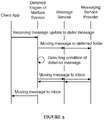
- Managing a deferred message S130 preferably includes receiving a message update that indicates a deferral action, updating message to reflect the deferred state of the message, and upon satisfying the condition invoking a selected action on the message as shown in FIGURE 5 .
- the deferral action message updates originate from client applications, preferably in response to active user selection of a message deferring option (e.g., moving the item to a deferred message stream). Once received, the message is preferably moved to a new location. There is preferably a special message folder, list or stream that contains all messages that have been deferred.
- a folder or label may be created to more finely segment deferred messages (e.g., folders deferred until tomorrow, messages deferred to next week, messages deferred greater than a year).
- the message may be archived, unaltered, or handled in any suitable manner.
- the reorganization of the message, if any, is preferably communicated and synchronized with the messaging service provider.
- the deferral action is preferably transparent to that of the message service provider. The message service provider only notices the message being moved into a new folder.
- a deferred data engine preferably updates a deferred datasource to store references to the message and the conditions upon which the condition will be triggered.
- Managing a deferred message can additionally include monitoring the condition variables of the deferred message. If the condition is a time condition, a time alert or scheduling system can be used to set a service to alert the deferred data engine to act on a deferred message action. If the condition is based on less predictable or dynamic properties, the system may actively monitor those conditions continuously. Once the condition is satisfied, the service invokes the conditional action on the message. Invoking the action preferably synchronizes the change with the message service provider and the client application.
- the action is preferably a notification action that includes moving the message to the inbox. More preferably, moving the message to the inbox includes moving the message to the inbox with heightened priority.
- Heightened priority can include setting the message to appear at the top of the inbox, flagging the message, marking as unread, increasing urgency of the message, or any suitable alteration to the message and/or message thread to draw attention to the message.
- the deferred data engine creates a message update request to move the message. Through operation of the system, this update is propagated to the message service provider. Either simultaneously or in response of the update to the message service provider, a client application is notified of the request to move the message to the inbox.
- Block S140 which includes at a client application, natively interpreting messages in client message format, functions to display and receive message updates and interactions.
- Messages are preferably received from the mailbox service in a native message format.
- the message preferably encodes any message formatting in a manner so that native application view tools may be used in creating natively rendered versions of the message content.
- formatting from incoming HTML emails may be completely removed.
- at least a subset of the formatting may be preserved but rendered through native view formatting. Relying on native rendering enables more efficient rendering of display elements, as a benefit the client application appears more responsive.
- Interactions on the client application preferably aggressively respond to user input and defer communication to connection services.
- the client application preferably depends on a robust asynchronous data, message, and message update communication. For example, the client application may be able to avoid any progress indicator visual elements (e.g., a spinner) for downloading content or content upload.
- progress indicator visual elements e.g., a spinner
- Block S150 which includes cooperatively relaying messages amongst the message service, the mailbox service, and the client application, functions to coordinate message distribution of messages between client device and a message service.
- Relaying messages preferably includes queuing messages inbound to client application, queuing messages outbound from client application, queuing message data to the mailbox service, and queuing message updates for the message service.
- a queue manages the data and message communication for one direction of communication.
- Data and message communications are preferably communicated with real-time communication protocols. In one implementation node.js and websockets are used in facilitating the real-time communication.
- a client application may establish a connection with a connection service that manages connection and data streaming. Additionally messages are preferably windowed in communicating with the client application. As opposed to sending every message in a particular folder or stream, only messages/threads within a particular window are transferred. For example, when a user views a folder on a client application, the mailbox service preferably relays only the 50 most recent messages of the folder. Additionally when relaying messages, a specialized network communication protocol may be used that is designed for message communication; alternatively HTTP or any suitable protocols may be used.
- the method may include resolving conflicts of relayed messages, which functions to bring messages to a state of eventual consistency.
- the method is preferably implemented with a plurality of components distributed between different devices.
- Asynchronous and queued communication can bring considerable speed and responsiveness to the client application, but at times, the state of messages may be inconsistent between different modules.
- the state of any one component of the message platform preferably maintains internally consistent state.
- the client application can perform any number of message interactions while maintaining the state of mail on the client application. If for example, the client application has no access to a network, a user can preferably continue to read, send, delete, and organize messages. These changes are preferably communicated through the mailbox service to the message service provider once the client application has network access.
- Message actions and data are preferably marked with a revisioning number. Inconsistency of state is preferably resolved according the revisioning number. There may additionally be state priority between different components of the message system. For example, in many cases, message state set by a message service server preferably has priority over other components due to the fact that the message service communicates directly with the message provider.
- a method of a preferred embodiment may include converting message data attachments to internally routed data files, which functions to handle attachments as accessible resources as opposed to message content.
- An email or other message attachment is preferably converted to an inline attachment. Attachments are preferably uploaded to an attachment server, and a reference to the attachment resources is included in the message.
- superfluous attachments e.g., email signature images
- the attachment may be removed or hidden from the message altogether.
- the user will activate a link or button, which will result in the retrieval of the attachment on the attachment server.
- the attachment may be unmodified, but can additionally be a modified version of the original file.
- images may be reduced in size for mobile viewing, or other media types may be converted for viewing on the device.
- the attachment server/service may automatically generate modified forms of the original file. Pictures may have a set of various sizes generated for use within an application. Text documents may be converted to another format more readily used within email. Music or video files may be converted for streaming to the client application.
- the attachments can be synchronized with a user account of a file hosting service. For example, a user may authenticate an account for a cloud file synchronization platform such as Dropbox, and attachments can be synchronized with the cloud files system of the user account.
- a method S200 for synchronizing messages between client applications and a message service provider of a preferred embodiment includes maintaining a plurality of real-time connections between the connection service and a client application S210; receiving a message update through a connection with a client application S220; transmitting the message update through an inbound queue of a first transfer layer to a messaging service layer S230; temporarily storing the message update S240; transmitting the message update through a message service queue of a second transfer layer to a mailbox service layer S250; translating the message update to a message format compatible with a message service provider S260; and transmitting the translated message update to the message service provider S270.
- the method S200 functions to deliver a message update from the client application to a message service provider.
- the message update can include a new message, a reply to a message, a forwarded message, a deletion of the message, the archival of message, the sorting or organization of message to a folder/list/category, starring the message marking as read/unread, and/or any suitable message action or change.
- the method enables a client application to interface with an existing message provider, such as an email provider, while providing several modern application features.
- the method S200 affords an application with real-time connection capabilities, responsive online/off-line message handling, native rendering of the message, and the like. While the method S200 describes the transmission of a message to a message service provider, the method S200 preferably implemented then or alongside the other described methods and/or their variations.
- Block S210 which includes maintaining a plurality of real-time connections between the connection service and a client application, functions to establish communication channels with applications operable on a multitude of remote user devices.
- Block S210 is preferably implemented at a connection service with managed connections.
- the client application calls out to a host of the backend infrastructure.
- the connection service then creates an open communication channel.
- the connection service creates a web socket connection.
- the backend infrastructure is preferably implemented to serve the accounts on shared resources, and thus the connection service preferably maintains the connections for multiple accounts. Additionally, multiple instances of a client application for one account may have two or more connections established. Message updates can be received on any of the connections.
- Block S210 can additionally include managing version control of the client application.
- the connection service verifies the version number of the client application. Based on the version number, client applications can be disabled, features can be disabled/enabled, upgrade notifications can be delivered, or any suitable action can be taken.
- Block S220 which includes receiving a message update through a connection with a client application, functions to receive a change to a message, message thread, message organization, or messaging account that was initiated by a client application.
- the initiated message update is transmitted to the backend infrastructure in response to a user action.
- a single message update is delivered to the backend infrastructure at a particular time.
- a client application can be configured to enable off-line message interactions. Within the offline client application, the user can seemingly modify messages, organize messages, delete messages, send or edit messages, or make any suitable message updates without a connection to a network.
- the client application preferably maintains message state and will mark message updates internally with revision identifiers.
- a batch of message updates can be uploaded through a connection to the connection service.
- the revision identifiers are preferably included in the message update to infrastructure and can be used in conflict resolution with message updates that were issued by the message service provider while the client application was off-line. As discussed, messages on the client application and the message service provider are eventually consistent.
- Block S230 which includes transmitting the message update through an inbound queue of a first transfer layer to a mailbox service layer, functions to transfer message updates to the mailbox service layer in a scalable manner.
- the message queue handles the influx of message updates from various accounts and over client application instances.
- a single inbound queue is used for all accounts, but alternatively multiple peers can be dynamically delivered message updates to load balance or distribute processing load.
- the inbound queue can use rabbitMQ or any suitable queuing service.
- the message updates are preferably dequeued from the inbound queue at a rate based on the available capacity of the mailbox service layer.
- Block S240 which includes temporarily storing the message update, functions to cache the message update and perform preliminary processing.
- Block S230 is preferably performed at the mailbox service, and the mailbox service layer preferably translates message updates into message service instructions.
- a message update to archive a message can be translated into an email service update that signifies a specific email thread to be archived.
- Mailbox service can additionally obfuscate the email message, such that the message is in the format substantially unreadable by humans.
- block S250 which includes transmitting the message update through a message service queue of a second transfer layer to a messaging service layer, functions to transfer message updates to the message service layer.
- Block S240 is substantially similar to Block S220.
- the queue preferably holds the message update as translated by the mailbox service layer.
- the queue can alternatively hold any suitable form of the message update.
- Block S260 which includes translating the message update to a message format compatible with a message service provider, functions to prepare the message for transmission to the message service provider.
- the translation is substantially similar to that described above.
- the message update includes new message content
- any native message formatting is preferably converted to suitable html elements or plain text content.
- the translation preferably occurs at the message service layer upon a message update dequeuing and being received at the message service layer.
- the message service layer may additionally translate the message update to a sequence of instructions that should be relayed to the message service provider to complete the update. This further translation is preferably customized to the particular message service provider that is being used.
- IMAP instructions may be selected or generated. For example, to move an email message to a folder, the instructions may include a copy, store, and expunge IMAP commands to achieve the effects of moving the message.
- Block S260 may additionally include selecting an appropriate message service module in the scenario where multiple message providers are used.
- Block S270 which includes transmitting the translated message update to the message service provider, functions to synchronize the message update with the message service provider.
- the message service layer preferably transmits the translated message update.
- An IMAP connection is preferably used to connect with the message service provider, but any suitable connection may alternatively be used.
- the message update is preferably made on behalf of an account configured on an originating client application. Preferably, a single IMAP connection is maintained. Message updates originating from different client application instances but with the same account can share the IMAP connection. In some scenarios, this can avoid enforcement of an IMAP connection limit.
- a method S300 for synchronizing messages between client applications and a message service provider of a preferred embodiment can include receiving a message update from a message service provider S310; translating the message update to message thread format compatible with native rendering on a client application S320; transmitting the translated message update through a mailbox service queue to a mailbox service layer S330; caching the message update until message update can be communicated to a client application S340; transmitting the message update through an outbound queue to a connection service S350; and communicating the message update to at least one client application S360.
- the method S300 is a contrasting message synchronization scenario compared to S200 - a message update originating from the message service provider is delivered to at least one client application connected to the system.
- Method S300 can share many commonalities with method S200.
- blocks S330 and S350 can be substantially similar to blocks S250 and S230 respectively, except in that the transmission is in the opposite direction.
- methods S200 and S300 preferably occur simultaneously with general operation of method S100.
- Block S310 which includes receiving a message update from a message service provider, functions to transfer the state of a messaging account to the system.
- the message update from the message service provider can include any changes on the message service provider. These changes may be based on new incoming messages sent by other entities or changes made by a user of a message account on an outside client device. For example, if the user moves an email to a new folder on a web interface of the outside message service provider, that change can be communicated down to the client application.
- the client application is preferably kept in a state that is eventually consistent with the message service provider, which can be treated as a definitive source of the state of the messages.
- Such message updates may be initiated on-demand after a client application requests to access portions of content. In this way, information of the state of the messages is only delivered to the client application as the information is required.
- Block S320 which includes translating the message update to message thread format compatible with native rendering on a client application, functions to convert the message update to an internal representation of the message update.
- the message service layer preferably includes a module or at least a set of rules that determines message translation. Translating the message update preferably normalizes the communication from the message service provider to a format that can be natively interpreted by a client application.
- the received message update may additionally have a revision identifier assigned. The revision identifier is preferably based on a time stamp of a received message or the time an instruction was received.
- the message update may be a new message with an attachment.
- translating the message update to a message thread format may include changing a file attachment to an inline attachment. The attachment file is preferably uploaded and hosted on an attachment service, and an attachment inline reference is inserted or added to the message.
- Block S340 which includes caching the message update until the message update can be communicated to a client application, functions to hold message updates until the client application is ready to receive the message update.
- the client application may or may not have an active connection to the connection service. For example, the user may not have the application open, or the application may be in a sleep mode.
- a connection is established, and cached message updates can be delivered.
- the resources used to deliver the message update may be at capacity, and the mailbox service layer holds the message updates until the content is ready for delivery.
- the message updates can be temporarily cached at the mailbox service layer. This preferably occurs upon dequeuing a message update from the message service queue and receiving the message update at the mailbox service layer.
- the mailbox service layer or alternatively the message service layer can cache a model of the messages of an account, but only deliver relevant portions to the client application, which would reduce latency when needing to pull load content from the message service provider.
- the messages contained within a rarely accessed folder may be maintained on the backend infrastructure.
- the folder can be populated with the content without having to request the folder contents from the message service provider.
- the messages are preferably windowed/paginated so that only relevant messages are transmitted to the client application.
- the account may have over one hundred new messages, but instead of transferring all the messages to the client application, the first fifty messages are transmitted. Windows/batches of fifty messages can be dynamically transmitted as the user scrolls or requests more messages.
- Block S360 includes communicating the message update to at least one client application.
- the connection preferably uses a realtime communication protocol such as using node.js and compressed websockets.
- the connection service preferably implements size-selective data compression to enable rapid delivery to the client application.
- the connection service may include multiple connections to different account instances on a client application (i.e., same account being used on multiple devices).
- the communicating the message update can include multiplexing the message update to multiple client application instances.
- method S300 and similarly method S200 can include resolving conflicts.
- message updates can be assigned a revision identifier.
- the revision identifier can be used to determine race conditions.
- different layers e.g., mailbox service layer or the message service layer
- different sources e.g., initiated by the client application or initiated by a message service provider
- a conflict resolution engine preferably identifies the conflicting actions, and responds. The conflict may detected if two message updates conflict, alternatively, the conflict may occur when contacting either the message service provider or the client application.
- An alternative embodiment preferably implements the above methods in a computer-readable medium storing computer-readable instructions.
- the instructions are preferably executed by computer-executable components preferably integrated with a message delivery system.
- the computer-readable medium may be stored on any suitable non-transitory computer readable storage media such as RAMs, ROMs, flash memory, EEPROMs, optical devices (CD or DVD), hard drives, floppy drives, or any suitable device.
- the computer-executable component is preferably a processor but the instructions may alternatively or additionally be executed by any suitable dedicated hardware device.
Landscapes
- Engineering & Computer Science (AREA)
- Computer Networks & Wireless Communication (AREA)
- Signal Processing (AREA)
- Information Transfer Between Computers (AREA)
- Computer And Data Communications (AREA)
- Data Exchanges In Wide-Area Networks (AREA)
Claims (13)
- System, umfassend:einen Verbindungsdienst, der zum Kommunizieren mit einer Mehrzahl von Client-Nachrichtenübermittlungsanwendungsinstanzen (130) ausgelegt ist;eine Mailbox-Dienstschicht (120), die zum temporären Speichern und Verarbeiten von Nachrichtenaktualisierungen ausgelegt ist, die von einer oder mehreren der Client-Nachrichtenübermittlungsanwendungsinstanzen eingehen und an diese abgehen, wobei die Nachrichtenaktualisierungen Synchronisation zwischen den Client-Nachrichtenübermittlungsanwendungsinstanzen und einem oder mehreren äußeren Nachrichtenübermittlungsdienstanbietern ermöglichen;eine Nachrichtendienstschicht (110), die zum Kommunizieren mit dem einen oder den mehreren äußeren Nachrichtenübermittlungsdienstanbietern und Übersetzen von Nachrichtenaktualisierungen in ein Nachrichtenformat ausgelegt ist, das mit nativer Wiedergabe durch eine Client-Nachrichtenübermittlungsanwendungsinstanz kompatibel ist, wobei eine der Nachrichtenaktualisierungen eine Nachricht mit einer Anlage umfasst, und dadurch gekennzeichnet, dasseine übersetzte Nachrichtenaktualisierung, die einer der Nachrichtenaktualisierungen entspricht, einen Inline-Verweis zum Abruf der Anlage umfasst, die auf einem Anlagenserver gespeichert wird, wobei die Anlage der einen der Nachrichtenaktualisierungen auf dem Anlagenserver gespeichert wird, wenn die eine der Nachrichtenaktualisierungen in ihre entsprechende übersetzte Nachrichtenaktualisierung übersetzt ist;eine erste Zwischenübertragungsschicht (140a), die kommunikativ zwischen den Verbindungsdienst und die Mailbox-Dienstschicht (120) gekoppelt ist, wobei die erste Zwischenübertragungsschicht (140a) eine erste eingehende Nachrichtendatenwarteschlange zum Übertragen von Nachrichtenaktualisierungen von der Mehrzahl von Client-Nachrichtenübermittlungsanwendungsinstanzen (130) an die Mailbox-Dienstschicht (120) und eine erste ausgehende Nachrichtendatenwarteschlange zum Übertragen von Nachrichtenaktualisierungen von der Mailbox-Dienstschicht (120) an den Verbindungsdienst zur Kommunikation an eine oder mehrere der Client-Nachrichtenübermittlungsanwendungsinstanzen (130) umfasst; undeine zweite Zwischenübertragungsschicht (140b), die kommunikativ zwischen die Mailbox-Dienstschicht (120) und die Nachrichtendienstschicht (110) gekoppelt ist, wobei die zweite Zwischenübertragungsschicht (140b) eine zweite eingehende Nachrichtendatenwarteschlange zum Übertragen von übersetzten Nachrichtenaktualisierungen von der Nachrichtendienstschicht (110) an die Mailbox-Dienstschicht (120) und eine zweite ausgehende Nachrichtendatenwarteschlange zum Übertragen von Nachrichtenaktualisierungen von der Mailbox-Dienstschicht (120) an die Nachrichtendienstschicht (110) umfasst; undein Konfliktauflösungsmodul, das zum Auflösen eines Nachrichtenzustandskonsistenzkonflikts zwischen zwei oder mehr Nachrichtenaktualisierungen innerhalb einer oder beider der Mailbox-Dienstschicht und der Nachrichtendienstschicht ausgelegt ist, wobei die Nachrichtenaktualisierungen, die von der Nachrichtendienstschicht stammen, eine höhere Priorität gegenüber anderen Nachrichtenaktualisierungen aufweisen.
- System nach Anspruch 1, wobei die Nachrichtendienstschicht (110) zum Kommunizieren mit einem oder mehreren äußeren Nachrichtendienstanbietern ausgelegt ist, die mindestens einen E-Mail-Nachrichtendienstanbieter umfassen.
- System nach Anspruch 2, wobei die Nachrichtendienstschicht (110) zum Aufrechterhalten einer IMAP-Verbindung mit einem Konto ausgelegt ist, das an einem äußeren E-Mail-Nachrichtendienstanbieter geführt wird, und wobei die Mehrzahl von Client-Nachrichtenübermittlungsanwendungsinstanzen mindestens zwei Nachrichtenübermittlungsanwendungsinstanzen umfasst, die zum Interagieren mit dem Konto ausgelegt sind.
- System nach Anspruch 2, wobei die Nachrichtendienstschicht (110) einen Nachrichtenprozessor umfasst, der zum Konvertieren von E-Mail-Nachrichten in ein natives Client-Format ausgelegt ist.
- System nach Anspruch 4, ferner umfassend einen Anlagenserver, der zum Speichern von Ressourcen ausgelegt ist, die E-Mail-Anlagen entsprechen, wobei der Nachrichtenprozessor zum Umwandeln einer E-Mail-Anlage in einer E-Mail-Nachricht in einen Verweis auf eine Ressource ausgelegt ist, die durch den Anlagenserver gespeichert wird.
- System nach Anspruch 1, wobei die Nachrichtendienstschicht (110) eine Mehrzahl von Dienstanbietermodulen umfasst, wobei jedes der Dienstanbietermodule zum Interagieren mit einem verschiedenen einer Mehrzahl von äußeren Nachrichtendienstanbietern ausgelegt ist.
- System nach Anspruch 1, wobei die Mailbox-Dienstschicht (120) eine Maschine für verzögerte Daten umfasst, die zum vorbehaltlichen Anwenden einer Nachrichtenaktualisierung auf eine Nachricht ausgelegt ist.
- System nach Anspruch 1, wobei der Verbindungsdienst zum Kommunizieren mit einer Mehrzahl von Client-Nachrichtenübermittlungsanwendungsinstanzen unter Verwendung einer Echtzeitprotokollverbindung ausgelegt ist.
- System nach Anspruch 8, wobei die Echtzeitprotokollverbindung eine komprimierte WebSocket-Verbindung umfasst.
- Verfahren, umfassend:Empfangen (S310) einer Nachrichtenaktualisierung an einer Nachrichtendienstschicht (110) von einem Nachrichtendienstanbieter, wobei die Nachrichtenaktualisierung mit einem Konto assoziiert ist und Synchronisation zwischen einer Client-Anwendungsinstanz und dem Nachrichtendienstanbieter ermöglicht;Übersetzen (S320) der Nachrichtenaktualisierung an der Nachrichtendienstschicht (110) in ein Nachrichtenformat, das mit nativer Wiedergabe durch die Client-Anwendungsinstanz kompatibel ist, wobei eine der Nachrichtenaktualisierungen eine Nachricht mit einer Anlage umfasst, und dadurch gekennzeichnet, dass eine übersetzte Nachrichtenaktualisierung, die einer der Nachrichtenaktualisierungen entspricht, einen Inline-Verweis zum Abruf der Anlage umfasst, die auf einem Anlagenserver gespeichert wird, wobei die Anlage der einen der Nachrichtenaktualisierungen auf dem Anlagenserver gespeichert wird, wenn die eine der Nachrichtenaktualisierungen in ihre entsprechende übersetzte Nachrichtenaktualisierung übersetzt ist;Senden (S330) der übersetzten Nachrichtenaktualisierung durch eine Nachrichtendienstwarteschlange an eine Mailbox-Dienstschicht (120);Zwischenspeichern (S340) der Nachrichtenaktualisierung an der Mailbox-Dienstschicht (120) zur Kommunikation an eine Client-Anwendungsinstanz, die mit dem Konto assoziiert ist;Senden (S350) der Nachrichtenaktualisierung durch eine ausgehende Warteschlange an einen Verbindungsdienst; undKommunizieren (S360) der Nachrichtenaktualisierung vom Verbindungsdienst an die Client-Anwendungsinstanz (130), die mit dem Konto assoziiert ist; undAuflösen eines Nachrichtenzustandskonsistenzkonflikts zwischen zwei oder mehr Nachrichtenaktualisierungen innerhalb einer oder beider der Mailbox-Dienstschicht und der Nachrichtendienstschicht, wobei die Nachrichtenaktualisierungen, die von der Nachrichtendienstschicht stammen, eine höhere Priorität gegenüber anderen Nachrichtenaktualisierungen aufweisen.
- Verfahren nach Anspruch 10, wobei das Auflösen des Nachrichtenzustandskonsistenzkonflikts umfasst:Zuordnen einer Revisionskennung zu jeder der Nachrichtenaktualisierungen; undAuflösen des Nachrichtenzustandskonsistenzkonflikts basierend auf der Revisionskennung.
- Verfahren nach Anspruch 10, wobei das Übersetzen der Nachrichtenaktualisierung in ein Nachrichtenformat, das mit nativer Wiedergabe auf einer Client-Anwendungsinstanz kompatibel ist, umfasst:Konvertieren einer Nachrichtenanlage in eine Datei;Hochladen der Datei auf einen Anlagendienst; undEinfügen eines Verweises auf einen Speicherort der Datei auf dem Anlagendienst in die übersetzte Nachrichtenaktualisierung.
- Verfahren nach Anspruch 10, wobei das Kommunizieren der Nachrichtenaktualisierung an die Client-Anwendungsinstanz (130) ein Kommunizieren der Nachrichtenaktualisierung als Teil eines Satzes von gefensterten Nachrichtenaktualisierungen an die Client-Anwendungsinstanz (130) umfasst.
Applications Claiming Priority (3)
| Application Number | Priority Date | Filing Date | Title |
|---|---|---|---|
| US201261728635P | 2012-11-20 | 2012-11-20 | |
| US14/084,142 US9935907B2 (en) | 2012-11-20 | 2013-11-19 | System and method for serving a message client |
| PCT/US2013/071066 WO2014081863A1 (en) | 2012-11-20 | 2013-11-20 | System and method for serving a message client |
Publications (2)
| Publication Number | Publication Date |
|---|---|
| EP2909979A1 EP2909979A1 (de) | 2015-08-26 |
| EP2909979B1 true EP2909979B1 (de) | 2021-10-06 |
Family
ID=50729006
Family Applications (1)
| Application Number | Title | Priority Date | Filing Date |
|---|---|---|---|
| EP13805647.8A Active EP2909979B1 (de) | 2012-11-20 | 2013-11-20 | System und verfahren zur versorgung eines nachrichten-client |
Country Status (4)
| Country | Link |
|---|---|
| US (2) | US9935907B2 (de) |
| EP (1) | EP2909979B1 (de) |
| JP (1) | JP6101359B2 (de) |
| CN (1) | CN104823414A (de) |
Families Citing this family (38)
| Publication number | Priority date | Publication date | Assignee | Title |
|---|---|---|---|---|
| US9729695B2 (en) | 2012-11-20 | 2017-08-08 | Dropbox Inc. | Messaging client application interface |
| US9654426B2 (en) | 2012-11-20 | 2017-05-16 | Dropbox, Inc. | System and method for organizing messages |
| US20140280071A1 (en) * | 2013-03-15 | 2014-09-18 | Nevada Funding Group Inc. | Systems, methods and apparatus for providing access to online search results |
| US9680782B2 (en) | 2013-07-29 | 2017-06-13 | Dropbox, Inc. | Identifying relevant content in email |
| US20150067066A1 (en) * | 2013-08-27 | 2015-03-05 | Saurabh Radhakrishnan | Provisioning Communication Services using Proxy Server in a Cloud |
| RU2013144681A (ru) * | 2013-10-03 | 2015-04-10 | Общество С Ограниченной Ответственностью "Яндекс" | Система обработки электронного сообщения для определения его классификации |
| WO2015143682A1 (zh) * | 2014-03-27 | 2015-10-01 | 宇龙计算机通信科技(深圳)有限公司 | 信息发送方法及装置和信息接收方法及装置 |
| US9930391B1 (en) * | 2014-09-11 | 2018-03-27 | Harmonic, Inc. | Network personal video recorder utilizing personal digital storage |
| CN105700784A (zh) * | 2014-11-28 | 2016-06-22 | 神讯电脑(昆山)有限公司 | 触控输入方法及其电子装置 |
| US10277549B2 (en) * | 2015-06-04 | 2019-04-30 | Apple Inc. | Prioritized email synchronization with server |
| US10454872B2 (en) * | 2015-06-22 | 2019-10-22 | Microsoft Technology Licensing, Llc | Group email management |
| US10313455B2 (en) | 2015-08-31 | 2019-06-04 | Ayla Networks, Inc. | Data streaming service for an internet-of-things platform |
| CN105488162B (zh) * | 2015-11-30 | 2019-04-16 | 用友优普信息技术有限公司 | 数据处理方法及装置 |
| US10263927B2 (en) * | 2015-12-08 | 2019-04-16 | International Business Machines Corporation | Decluttering general communication message for specific audience |
| US10599676B2 (en) | 2015-12-15 | 2020-03-24 | Microsoft Technology Licensing, Llc | Replication control among redundant data centers |
| US10235406B2 (en) | 2015-12-15 | 2019-03-19 | Microsoft Technology Licensing, Llc | Reminder processing of structured data records among partitioned data storage spaces |
| US11226985B2 (en) | 2015-12-15 | 2022-01-18 | Microsoft Technology Licensing, Llc | Replication of structured data records among partitioned data storage spaces |
| US10248709B2 (en) | 2015-12-15 | 2019-04-02 | Microsoft Technology Licensing, Llc | Promoted properties in relational structured data |
| US11863509B2 (en) * | 2015-12-18 | 2024-01-02 | Amazon Technologies, Inc. | Publish-subscribe message transformation |
| CN105578431B (zh) * | 2016-01-20 | 2019-09-06 | 北京智驾互联信息服务有限公司 | 提醒消息发送装置及方法 |
| CN106385382B (zh) * | 2016-09-05 | 2020-06-23 | 福州佳软软件技术有限公司 | 一种数据同步方法、装置和系统 |
| US10469424B2 (en) * | 2016-10-07 | 2019-11-05 | Google Llc | Network based data traffic latency reduction |
| US10560404B2 (en) * | 2017-06-14 | 2020-02-11 | Citrix Systems, Inc. | Real-time cloud-based messaging system |
| US11088975B2 (en) * | 2017-08-03 | 2021-08-10 | Aon Global Operations Se, Singapore Branch | Systems and methods for coordinating real-time messaging for data sharing and updating between participants using disparate message data formats |
| CN109246239A (zh) * | 2018-10-19 | 2019-01-18 | 行吟信息科技(上海)有限公司 | 一种私信处理方法及系统 |
| US11126784B2 (en) | 2018-11-13 | 2021-09-21 | Illumy Inc. | Methods, systems, and apparatus for email to persistent messaging |
| US10855761B1 (en) | 2018-12-31 | 2020-12-01 | Facebook, Inc. | Techniques for in-place directive execution |
| US11055314B1 (en) | 2018-12-31 | 2021-07-06 | Facebook, Inc. | Techniques for a database-driven messaging user interface |
| US11025576B1 (en) * | 2018-12-31 | 2021-06-01 | Facebook, Inc. | Techniques for backend-specific cursor tracking |
| US10979500B1 (en) * | 2018-12-31 | 2021-04-13 | Facebook, Inc. | Techniques for directive-based messaging synchronization |
| EP3938877A4 (de) * | 2019-03-11 | 2022-11-23 | Supported Patient, LLC | System, verfahren und benutzerschnittstelle für aufgezeichnete informationen |
| KR102130005B1 (ko) * | 2020-04-17 | 2020-07-03 | 국방과학연구소 | 응용프로그램 간 데이터 전송 지원 방법 및 이를 위한 서버 |
| FR3110317A1 (fr) * | 2020-05-12 | 2021-11-19 | Orange | Smart Message Renderer |
| CN112035277B (zh) * | 2020-08-14 | 2024-07-16 | 深圳市亿源通供应链管理有限公司 | 基于跨境电商平台的邮件处理方法、装置、设备及介质 |
| US11991188B2 (en) | 2021-06-11 | 2024-05-21 | Bank Of America Corporation | Cognitive auditing of client bound data |
| CN113901066B (zh) * | 2021-09-18 | 2025-01-28 | 浪潮云信息技术股份公司 | 一种更新实例操作后状态的方法 |
| US12166737B2 (en) * | 2022-06-07 | 2024-12-10 | Snap Inc. | Automatically incremented read-watermark |
| CN117271152B (zh) * | 2023-09-04 | 2024-07-26 | 中电金信软件有限公司 | 应用实例信息的注册和查询方法 |
Citations (3)
| Publication number | Priority date | Publication date | Assignee | Title |
|---|---|---|---|---|
| US6411684B1 (en) * | 1994-09-16 | 2002-06-25 | Avaya Technology Corp. | Network-based multimedia communications and directory system and method of operation |
| EP2055059A1 (de) * | 2006-06-27 | 2009-05-06 | Teamon Systems, Inc. | E-mail-kommunikationssystem mit polling-anwendung des client-e-mail-internetanbieters (isp) und diesbezügliche verfahren |
| US20100070594A1 (en) * | 2006-10-25 | 2010-03-18 | Shin Yoshimura | Electronic mail transmission/reception system |
Family Cites Families (148)
| Publication number | Priority date | Publication date | Assignee | Title |
|---|---|---|---|---|
| US7525691B2 (en) * | 1991-02-12 | 2009-04-28 | Catch Curve, Inc. | Facsimile telecommunications system and method |
| US5754178A (en) | 1993-03-03 | 1998-05-19 | Apple Computer, Inc. | Method and apparatus for improved feedback during manipulation of data on a computer controlled display system |
| US5822526A (en) | 1996-06-03 | 1998-10-13 | Microsoft Corporation | System and method for maintaining and administering email address names in a network |
| US20050081059A1 (en) | 1997-07-24 | 2005-04-14 | Bandini Jean-Christophe Denis | Method and system for e-mail filtering |
| US6545669B1 (en) | 1999-03-26 | 2003-04-08 | Husam Kinawi | Object-drag continuity between discontinuous touch-screens |
| US7953671B2 (en) | 1999-08-31 | 2011-05-31 | American Express Travel Related Services Company, Inc. | Methods and apparatus for conducting electronic transactions |
| US8073477B2 (en) * | 2000-04-11 | 2011-12-06 | Telecommunication Systems, Inc. | Short message distribution center |
| WO2001063875A2 (en) | 2000-02-25 | 2001-08-30 | Mshift, Inc. | System for automatic data retrieval on an internet protocol network |
| US8701027B2 (en) | 2000-03-16 | 2014-04-15 | Microsoft Corporation | Scope user interface for displaying the priorities and properties of multiple informational items |
| US6839562B2 (en) * | 2000-04-11 | 2005-01-04 | Telecommunication Systems, Inc. | Intelligent delivery agent for short message distribution center |
| US7272662B2 (en) * | 2000-11-30 | 2007-09-18 | Nms Communications Corporation | Systems and methods for routing messages to communications devices over a communications network |
| GB0117543D0 (en) | 2001-07-18 | 2001-09-12 | Hewlett Packard Co | Document viewing device |
| WO2003013080A1 (en) * | 2001-07-31 | 2003-02-13 | Comverse Ltd. | Email protocol for a mobile environment and gateway using same |
| WO2003071390A2 (en) | 2002-02-19 | 2003-08-28 | Postini Corporation | E-mail management services |
| US7363345B2 (en) | 2002-08-27 | 2008-04-22 | Aol Llc, A Delaware Limited Liability Company | Electronic notification delivery mechanism selection based on recipient presence information and notification content |
| WO2004025913A2 (en) | 2002-09-12 | 2004-03-25 | Navin Communications, Inc. | Communications systems and methods for exchanging messages between users |
| JP4240973B2 (ja) | 2002-09-26 | 2009-03-18 | ソニー株式会社 | 画像処理システム、画像処理装置および方法、記録媒体、並びにプログラム |
| GB0226596D0 (en) * | 2002-11-14 | 2002-12-24 | Commtag Ltd | Data communication systems |
| US7154901B2 (en) * | 2003-02-07 | 2006-12-26 | Mobile 365, Inc. | Intermediary network system and method for facilitating message exchange between wireless networks |
| US7886236B2 (en) | 2003-03-28 | 2011-02-08 | Microsoft Corporation | Dynamic feedback for gestures |
| US7483947B2 (en) | 2003-05-02 | 2009-01-27 | Microsoft Corporation | Message rendering for identification of content features |
| WO2004102858A2 (en) | 2003-05-13 | 2004-11-25 | Cohen Hunter C | Deriving contact information from emails |
| JP2005056233A (ja) | 2003-08-06 | 2005-03-03 | Nec Corp | 移動体通信装置、移動体通信装置の電子メールの受信動作方法及びその電子メールの受信動作プログラム |
| US7685302B2 (en) * | 2003-08-11 | 2010-03-23 | Teamon Systems, Inc. | Communications system providing extensible protocol translation and configuration features and related methods |
| US8135759B2 (en) * | 2003-08-07 | 2012-03-13 | Teamon Systems, Inc. | Communications system including protocol interface device for use with multiple operating protocols and related methods |
| US7447219B2 (en) * | 2003-09-29 | 2008-11-04 | Redknee Inc. | System and method for implementing a universal messaging gateway (UMG) |
| US7895537B2 (en) | 2003-12-29 | 2011-02-22 | International Business Machines Corporation | Method and apparatus for setting attributes and initiating actions through gestures |
| US8005462B2 (en) | 2004-02-17 | 2011-08-23 | Teamon Systems, Inc. | System and method of retrieving electronic mail |
| US7912904B2 (en) | 2004-03-31 | 2011-03-22 | Google Inc. | Email system with conversation-centric user interface |
| US8683351B2 (en) | 2004-10-26 | 2014-03-25 | International Business Machines Corporation | Chat user interface for threaded text chat systems |
| US20060101064A1 (en) * | 2004-11-08 | 2006-05-11 | Sharpcast, Inc. | Method and apparatus for a file sharing and synchronization system |
| US20060129633A1 (en) * | 2004-12-14 | 2006-06-15 | International Business Machines Corporation | Mechanism to facilitate customization of real time messaging using mobile devices |
| US8849919B2 (en) | 2005-02-04 | 2014-09-30 | International Business Machines Corporation | Space-efficient mail storing and archiving based on communication structure |
| US8195746B2 (en) * | 2005-03-11 | 2012-06-05 | International Business Machines Corporation | Automatic off-line availability for document content linked in electronic mail messages |
| JP4928821B2 (ja) * | 2005-04-28 | 2012-05-09 | オセ−テクノロジーズ ビーブイ | ネットワークシステムにおけるデジタル文書の取り扱い |
| US7565347B2 (en) | 2005-08-10 | 2009-07-21 | International Business Machines Corporation | Indexing and searching of electronic message transmission thread sets |
| CN101273591B (zh) * | 2005-09-29 | 2013-06-12 | 捷讯研究有限公司 | 协调无线通信设备与电子邮箱的电子邮件的系统及方法 |
| US8775520B1 (en) * | 2005-09-30 | 2014-07-08 | Google Inc. | Systems and methods for viewing non-HTML email attachments |
| ATE503323T1 (de) * | 2005-12-02 | 2011-04-15 | Microsoft Corp | Nachrichtendienst |
| CN100450108C (zh) | 2006-03-23 | 2009-01-07 | 华为技术有限公司 | 一种采用数据同步处理电子邮件的系统、装置及方法 |
| US8054294B2 (en) | 2006-03-31 | 2011-11-08 | Sony Corporation | Touch screen remote control system for use in controlling one or more devices |
| KR20070113025A (ko) | 2006-05-24 | 2007-11-28 | 엘지전자 주식회사 | 터치스크린 장치 및 이의 작동방법 |
| US20090278806A1 (en) | 2008-05-06 | 2009-11-12 | Matias Gonzalo Duarte | Extended touch-sensitive control area for electronic device |
| CA2646015C (en) | 2006-04-21 | 2015-01-20 | Anand Agarawala | System for organizing and visualizing display objects |
| US7734705B1 (en) * | 2006-06-21 | 2010-06-08 | Wheeler Jr Roland E | System and method for flexibly managing heterogeneous message delivery |
| US20080059590A1 (en) | 2006-09-05 | 2008-03-06 | Ecole Polytechnique Federale De Lausanne (Epfl) | Method to filter electronic messages in a message processing system |
| US8253695B2 (en) | 2006-09-06 | 2012-08-28 | Apple Inc. | Email client for a portable multifunction device |
| KR100774927B1 (ko) | 2006-09-27 | 2007-11-09 | 엘지전자 주식회사 | 이동통신 단말기, 메뉴 및 아이템 선택방법 |
| CN100502572C (zh) * | 2006-11-30 | 2009-06-17 | 华为技术有限公司 | 增大多媒体消息业务系统容量的方法及系统 |
| AU2011253700B2 (en) | 2007-01-05 | 2013-08-29 | Apple Inc. | Gestures for controlling, manipulating, and editing of media files using touch sensitive devices |
| US7956847B2 (en) | 2007-01-05 | 2011-06-07 | Apple Inc. | Gestures for controlling, manipulating, and editing of media files using touch sensitive devices |
| US20080165145A1 (en) | 2007-01-07 | 2008-07-10 | Scott Herz | Portable Multifunction Device, Method, and Graphical User Interface for Interpreting a Finger Swipe Gesture |
| EP2115974B1 (de) * | 2007-02-15 | 2012-12-19 | Research in Motion Limited | E-mail-kommunikationssystem mit elektronischer dateianhangs-ordnerhierarchie und entsprechende verfahren |
| US20080208980A1 (en) * | 2007-02-26 | 2008-08-28 | Michael Ruarri Champan | Email aggregation system with supplemental processing information addition/removal and related methods |
| US20080222540A1 (en) | 2007-03-05 | 2008-09-11 | Apple Inc. | Animating thrown data objects in a project environment |
| ES2353225T3 (es) * | 2007-04-13 | 2011-02-28 | Research In Motion Limited | Sistema de distribuciã“n y sincronizaciã“n de correo electrã“nico (e-mail) de acceso directo con notificaciã“n de fuera de cobertura. |
| US20080270548A1 (en) | 2007-04-24 | 2008-10-30 | Danger, Inc. | Apparatus and method for caching email messages within a wireless data service |
| PL2165029T3 (pl) | 2007-06-21 | 2013-05-31 | Woodstock Percussion Pty Ltd | Zwalniane wieszadło |
| US9619143B2 (en) | 2008-01-06 | 2017-04-11 | Apple Inc. | Device, method, and graphical user interface for viewing application launch icons |
| US20090079699A1 (en) | 2007-09-24 | 2009-03-26 | Motorola, Inc. | Method and device for associating objects |
| KR101397080B1 (ko) | 2007-10-05 | 2014-05-21 | 엘지전자 주식회사 | 멀티 기능 실행능력을 갖는 휴대 단말기 및 그 방법 |
| US20090150905A1 (en) * | 2007-12-11 | 2009-06-11 | Nortel Networks, Limited | Integrating non-xml protocols into web browsing applications |
| JP2009151638A (ja) | 2007-12-21 | 2009-07-09 | Canon Inc | 情報処理装置及びその制御方法 |
| US8032894B2 (en) * | 2007-12-28 | 2011-10-04 | Aetna Inc. | Service bus architecture |
| US8019863B2 (en) | 2008-03-28 | 2011-09-13 | Ianywhere Solutions, Inc. | Synchronizing events between mobile devices and servers |
| US8077157B2 (en) | 2008-03-31 | 2011-12-13 | Intel Corporation | Device, system, and method of wireless transfer of files |
| US20090254624A1 (en) | 2008-04-08 | 2009-10-08 | Jeff Baudin | E-mail message management system |
| US20090276701A1 (en) | 2008-04-30 | 2009-11-05 | Nokia Corporation | Apparatus, method and computer program product for facilitating drag-and-drop of an object |
| KR101461954B1 (ko) | 2008-05-08 | 2014-11-14 | 엘지전자 주식회사 | 단말기 및 그 제어 방법 |
| US8037280B2 (en) | 2008-06-11 | 2011-10-11 | Vmware, Inc. | System and method for improving memory locality of virtual machines |
| KR101477743B1 (ko) | 2008-06-16 | 2014-12-31 | 삼성전자 주식회사 | 단말 및 그의 기능 수행 방법 |
| US8390577B2 (en) | 2008-07-25 | 2013-03-05 | Intuilab | Continuous recognition of multi-touch gestures |
| US8195540B2 (en) * | 2008-07-25 | 2012-06-05 | Mongonet | Sponsored facsimile to e-mail transmission methods and apparatus |
| US20100031202A1 (en) | 2008-08-04 | 2010-02-04 | Microsoft Corporation | User-defined gesture set for surface computing |
| US9248376B2 (en) | 2008-09-30 | 2016-02-02 | Nintendo Co., Ltd. | Computer-readable storage medium having stored game program therein, and game apparatus |
| US20100199226A1 (en) | 2009-01-30 | 2010-08-05 | Nokia Corporation | Method and Apparatus for Determining Input Information from a Continuous Stroke Input |
| US8255468B2 (en) | 2009-02-11 | 2012-08-28 | Microsoft Corporation | Email management based on user behavior |
| US8068786B2 (en) | 2009-02-18 | 2011-11-29 | Clear Wireless Llc | Method for reducing time of flight interference in a wireless communication network |
| WO2010094105A1 (en) | 2009-02-23 | 2010-08-26 | Research In Motion Limited | Touch-sensitive display and method of controlling same |
| US8839155B2 (en) | 2009-03-16 | 2014-09-16 | Apple Inc. | Accelerated scrolling for a multifunction device |
| US9250788B2 (en) | 2009-03-18 | 2016-02-02 | IdentifyMine, Inc. | Gesture handlers of a gesture engine |
| US20100257241A1 (en) * | 2009-04-02 | 2010-10-07 | Demandforce, Inc. | System and method for adaptive delivery of electronic comminucations |
| KR101640463B1 (ko) | 2009-05-19 | 2016-07-18 | 삼성전자 주식회사 | 휴대 단말기의 운용 방법 및 이를 지원하는 휴대 단말기 |
| KR101597553B1 (ko) | 2009-05-25 | 2016-02-25 | 엘지전자 주식회사 | 기능 실행 방법 및 그 장치 |
| US10410222B2 (en) * | 2009-07-23 | 2019-09-10 | DISH Technologies L.L.C. | Messaging service for providing updates for multimedia content of a live event delivered over the internet |
| US8619100B2 (en) | 2009-09-25 | 2013-12-31 | Apple Inc. | Device, method, and graphical user interface for touch-based gestural input on an electronic canvas |
| US8312392B2 (en) | 2009-10-02 | 2012-11-13 | Qualcomm Incorporated | User interface gestures and methods for providing file sharing functionality |
| KR101623783B1 (ko) | 2009-10-08 | 2016-05-24 | 엘지전자 주식회사 | 이동 단말기 및 이것의 데이터 추출 방법 |
| WO2011079408A1 (en) | 2009-12-28 | 2011-07-07 | Motorola Mobility, Inc. | Methods for associating objects on a touch screen using input gestures |
| US8692780B2 (en) | 2010-01-06 | 2014-04-08 | Apple Inc. | Device, method, and graphical user interface for manipulating information items in folders |
| US8769443B2 (en) | 2010-02-11 | 2014-07-01 | Apple Inc. | Touch inputs interacting with user interface items |
| JP5537181B2 (ja) * | 2010-02-17 | 2014-07-02 | 株式会社日立製作所 | メッセージシステム |
| WO2011103385A1 (en) * | 2010-02-22 | 2011-08-25 | Avaya Inc. | Secure, policy-based communications security and file sharing across mixed media, mixed-communications modalities and extensible to cloud computing such as soa |
| EP2362592A1 (de) | 2010-02-26 | 2011-08-31 | Research In Motion Limited | Automatisches Löschen von elektronischen Nachrichten |
| JP2011188327A (ja) | 2010-03-10 | 2011-09-22 | Nomura Research Institute Ltd | メッセージ収集システムおよびメッセージ収集プログラム |
| US20110289162A1 (en) * | 2010-04-02 | 2011-11-24 | Furlong Wesley J | Method and system for adaptive delivery of digital messages |
| US20110295958A1 (en) | 2010-05-26 | 2011-12-01 | Research In Motion Limited | Email system providing conversation update features and related methods |
| US20110296351A1 (en) | 2010-05-26 | 2011-12-01 | T-Mobile Usa, Inc. | User Interface with Z-axis Interaction and Multiple Stacks |
| KR101677029B1 (ko) | 2010-06-07 | 2016-11-17 | 엘지전자 주식회사 | 휴대 단말기 및 그 동작 제어방법 |
| US8738970B2 (en) | 2010-07-23 | 2014-05-27 | Salesforce.Com, Inc. | Generating performance alerts |
| KR20120013727A (ko) | 2010-08-06 | 2012-02-15 | 삼성전자주식회사 | 디스플레이장치 및 그 제어방법 |
| JP5616739B2 (ja) | 2010-10-01 | 2014-10-29 | 新日鉄住金マテリアルズ株式会社 | 複層銅ボンディングワイヤの接合構造 |
| US9203796B2 (en) | 2010-11-12 | 2015-12-01 | Facebook, Inc. | Messaging system with multiple messaging channels |
| US9189773B2 (en) | 2010-11-17 | 2015-11-17 | Z124 | Email client display transitions between portrait and landscape in a smartpad device |
| US10303357B2 (en) | 2010-11-19 | 2019-05-28 | TIVO SOLUTIONS lNC. | Flick to send or display content |
| EP2641256A1 (de) | 2010-11-19 | 2013-09-25 | Compact Particle Acceleration Corporation | Rfq-linearbeschleunigersystem mit subnanosekunden-ionenstrahlimpuls |
| US8429542B2 (en) | 2010-11-23 | 2013-04-23 | Microsoft Corporation | Switching of emails in a conversation thread |
| US9824314B2 (en) | 2011-01-14 | 2017-11-21 | Apple Inc. | Grouping email messages into conversations |
| US8689116B2 (en) | 2011-01-14 | 2014-04-01 | Apple Inc. | Email user interface |
| US8291349B1 (en) | 2011-01-19 | 2012-10-16 | Google Inc. | Gesture-based metadata display |
| US9015639B2 (en) | 2011-02-11 | 2015-04-21 | Linkedin Corporation | Methods and systems for navigating a list with gestures |
| US8375400B2 (en) * | 2011-02-11 | 2013-02-12 | Research In Motion Limited | Communication device and method for coherent updating of collated message listings |
| US8782566B2 (en) | 2011-02-22 | 2014-07-15 | Cisco Technology, Inc. | Using gestures to schedule and manage meetings |
| US9632688B2 (en) | 2011-03-31 | 2017-04-25 | France Telecom | Enhanced user interface to transfer media content |
| US9049259B2 (en) | 2011-05-03 | 2015-06-02 | Onepatont Software Limited | System and method for dynamically providing visual action or activity news feed |
| US20120304074A1 (en) | 2011-05-23 | 2012-11-29 | Microsoft Corporation | Device user interface to input emoji and other symbols |
| US9891800B2 (en) | 2011-06-17 | 2018-02-13 | Nokia Technologies Oy | Method and apparatus for providing a notification mechanism |
| US8793591B1 (en) | 2011-06-21 | 2014-07-29 | Google Inc. | Presentation of messages in multi-sectioned views |
| KR101948645B1 (ko) | 2011-07-11 | 2019-02-18 | 삼성전자 주식회사 | 그래픽 오브젝트를 이용한 컨텐츠 제어 방법 및 장치 |
| US20130054335A1 (en) | 2011-08-29 | 2013-02-28 | Ebay Inc. | Mobile platform for generating and distributing deals |
| US20130067392A1 (en) | 2011-09-12 | 2013-03-14 | Microsoft Corporation | Multi-Input Rearrange |
| KR101860342B1 (ko) | 2011-09-15 | 2018-05-23 | 엘지전자 주식회사 | 이동 단말기 및 그 제어방법 |
| US9594405B2 (en) | 2011-10-19 | 2017-03-14 | Facebook, Inc. | Composite touch gesture control with touch screen input device and secondary touch input device |
| US20130104089A1 (en) | 2011-10-20 | 2013-04-25 | Fuji Xerox Co., Ltd. | Gesture-based methods for interacting with instant messaging and event-based communication applications |
| US9360998B2 (en) | 2011-11-01 | 2016-06-07 | Paypal, Inc. | Selection and organization based on selection of X-Y position |
| US8869041B2 (en) | 2011-11-11 | 2014-10-21 | Apollo Education Group, Inc. | Dynamic and local management of hierarchical discussion thread data |
| JP5927872B2 (ja) | 2011-12-01 | 2016-06-01 | ソニー株式会社 | 情報処理装置、情報処理方法およびプログラム |
| CN102495692A (zh) | 2011-12-08 | 2012-06-13 | 青岛海信移动通信技术股份有限公司 | 一种识别用户手势操作的方法及电子产品 |
| WO2013095393A1 (en) | 2011-12-20 | 2013-06-27 | Intel Corporation | Augmented reality representations across multiple devices |
| KR101882724B1 (ko) | 2011-12-21 | 2018-08-27 | 삼성전자 주식회사 | 카테고리 검색 방법 및 이를 지원하는 단말기 |
| CA2801661A1 (en) | 2012-01-10 | 2013-07-10 | Mathieu Audet | Method of associating attributes and systems and apparatus thereof |
| US8886734B2 (en) | 2012-02-03 | 2014-11-11 | Apple Inc. | Email mailbox management with sender-specific message lists |
| US8635561B1 (en) | 2012-02-17 | 2014-01-21 | Google Inc. | System and method for sorting electronic documents |
| US20130290879A1 (en) | 2012-04-30 | 2013-10-31 | Research In Motion Tat Ab | Displaying notification messages and messages on a portable electronic device |
| US8451246B1 (en) | 2012-05-11 | 2013-05-28 | Google Inc. | Swipe gesture classification |
| US9196125B2 (en) | 2012-05-29 | 2015-11-24 | Zitro IP S.ar.l. | Gaming machine and methods of playing a game including a skill-based target game |
| US20140123043A1 (en) | 2012-10-31 | 2014-05-01 | Intel Mobile Communications GmbH | Selecting Devices for Data Transactions |
| US9729695B2 (en) | 2012-11-20 | 2017-08-08 | Dropbox Inc. | Messaging client application interface |
| US9654426B2 (en) | 2012-11-20 | 2017-05-16 | Dropbox, Inc. | System and method for organizing messages |
| KR101328202B1 (ko) | 2012-12-03 | 2013-11-20 | 김정수 | 제스처 입력을 통한 기능 수행 명령실행 방법 및 장치 |
| US20140165012A1 (en) | 2012-12-12 | 2014-06-12 | Wenbo Shen | Single - gesture device unlock and application launch |
| US20150169068A1 (en) | 2013-02-20 | 2015-06-18 | Google Inc. | Gestural Sorting of Content |
| US9304665B2 (en) | 2013-04-05 | 2016-04-05 | Yahoo! Inc. | Method and apparatus for facilitating message selection and organization |
| US9680782B2 (en) | 2013-07-29 | 2017-06-13 | Dropbox, Inc. | Identifying relevant content in email |
| US20150112749A1 (en) | 2013-10-22 | 2015-04-23 | Abdullah Celik Erdal | Method and system for processing actionable messages of an integrated communication and collaboration platform |
| US9690910B2 (en) | 2013-11-11 | 2017-06-27 | Dropbox, Inc. | Systems and methods for monitoring and applying statistical data related to shareable links associated with content items stored in an online content management service |
| US20150277717A1 (en) | 2014-03-28 | 2015-10-01 | Smart Technologies Ulc | Interactive input system and method for grouping graphical objects |
| EP3007117A1 (de) | 2014-10-08 | 2016-04-13 | Deutsche Post AG | Handhabung von Daten über ein unternehmensspezifisches Versorgungskettennetzwerk |
-
2013
- 2013-11-19 US US14/084,142 patent/US9935907B2/en active Active
- 2013-11-20 EP EP13805647.8A patent/EP2909979B1/de active Active
- 2013-11-20 JP JP2015543143A patent/JP6101359B2/ja active Active
- 2013-11-20 CN CN201380060702.2A patent/CN104823414A/zh active Pending
-
2018
- 2018-02-21 US US15/901,025 patent/US10178063B2/en active Active
Patent Citations (3)
| Publication number | Priority date | Publication date | Assignee | Title |
|---|---|---|---|---|
| US6411684B1 (en) * | 1994-09-16 | 2002-06-25 | Avaya Technology Corp. | Network-based multimedia communications and directory system and method of operation |
| EP2055059A1 (de) * | 2006-06-27 | 2009-05-06 | Teamon Systems, Inc. | E-mail-kommunikationssystem mit polling-anwendung des client-e-mail-internetanbieters (isp) und diesbezügliche verfahren |
| US20100070594A1 (en) * | 2006-10-25 | 2010-03-18 | Shin Yoshimura | Electronic mail transmission/reception system |
Also Published As
| Publication number | Publication date |
|---|---|
| JP6101359B2 (ja) | 2017-03-22 |
| EP2909979A1 (de) | 2015-08-26 |
| US20140143358A1 (en) | 2014-05-22 |
| US20180191661A1 (en) | 2018-07-05 |
| JP2016502806A (ja) | 2016-01-28 |
| US10178063B2 (en) | 2019-01-08 |
| CN104823414A (zh) | 2015-08-05 |
| US9935907B2 (en) | 2018-04-03 |
Similar Documents
| Publication | Publication Date | Title |
|---|---|---|
| US10178063B2 (en) | System and method for serving a message client | |
| WO2014081863A1 (en) | System and method for serving a message client | |
| CN101711386B (zh) | 在外部和/或本地电子邮件服务器和/或无线设备之间同步电子邮件消息 | |
| US7644125B2 (en) | Method, system, and computer program product for synchronization of similar data objects with event information | |
| US9264393B2 (en) | Mail server-based dynamic workflow management | |
| US10122665B2 (en) | Distributed synchronization data in a message management service | |
| US9055417B2 (en) | Notification infrastructure for sending device-specific wireless notifications | |
| CN102750266B (zh) | 管理文件转换的技术 | |
| US9723460B1 (en) | Device message management system | |
| US20090086278A1 (en) | Electronic facsimile delivery systems and methods | |
| US8166112B2 (en) | Virtual mail storage for mail distributed using corporate distribution lists | |
| US20060013368A1 (en) | Apparatus and method for providing a unified messaging integration tool | |
| US20080235335A1 (en) | Method, system, and computer program product for changing the status of an existing email in a recipient email client inbox | |
| JP2010525740A (ja) | ワイヤレス・データ・サービス内において電子メール・メッセージをキャッシュする装置および方法 | |
| CN100592333C (zh) | 用于在用户侧处理具有文件附件的电子消息的装置和方法 | |
| JP2000156704A (ja) | リモ―ト及びロ―カルメ―ルシステムのメ―ル同期 | |
| US20130091227A1 (en) | Syncronization of conversation data | |
| US10237223B2 (en) | Deferring messages using control codes in messages | |
| US20080077672A1 (en) | Online messaging architecture | |
| US20120296981A1 (en) | Method for Reduction of Disk Space Usage of Electronic Messages in a Network | |
| Smoak et al. | South Carolina 2023 ARPA ADGP Grant Application-Comporium | |
| US20120296990A1 (en) | Shared content server for electronic messages | |
| CN101273591B (zh) | 协调无线通信设备与电子邮箱的电子邮件的系统及方法 | |
| JP2013092850A (ja) | オフラインで利用可能な電子メールクライアントシステム | |
| WO2008005010A1 (en) | System and method for multi-channel email communication |
Legal Events
| Date | Code | Title | Description |
|---|---|---|---|
| PUAI | Public reference made under article 153(3) epc to a published international application that has entered the european phase |
Free format text: ORIGINAL CODE: 0009012 |
|
| 17P | Request for examination filed |
Effective date: 20150511 |
|
| AK | Designated contracting states |
Kind code of ref document: A1 Designated state(s): AL AT BE BG CH CY CZ DE DK EE ES FI FR GB GR HR HU IE IS IT LI LT LU LV MC MK MT NL NO PL PT RO RS SE SI SK SM TR |
|
| AX | Request for extension of the european patent |
Extension state: BA ME |
|
| DAX | Request for extension of the european patent (deleted) | ||
| STAA | Information on the status of an ep patent application or granted ep patent |
Free format text: STATUS: EXAMINATION IS IN PROGRESS |
|
| 17Q | First examination report despatched |
Effective date: 20161207 |
|
| GRAP | Despatch of communication of intention to grant a patent |
Free format text: ORIGINAL CODE: EPIDOSNIGR1 |
|
| STAA | Information on the status of an ep patent application or granted ep patent |
Free format text: STATUS: GRANT OF PATENT IS INTENDED |
|
| INTG | Intention to grant announced |
Effective date: 20200612 |
|
| GRAJ | Information related to disapproval of communication of intention to grant by the applicant or resumption of examination proceedings by the epo deleted |
Free format text: ORIGINAL CODE: EPIDOSDIGR1 |
|
| STAA | Information on the status of an ep patent application or granted ep patent |
Free format text: STATUS: EXAMINATION IS IN PROGRESS |
|
| INTC | Intention to grant announced (deleted) | ||
| GRAS | Grant fee paid |
Free format text: ORIGINAL CODE: EPIDOSNIGR3 |
|
| STAA | Information on the status of an ep patent application or granted ep patent |
Free format text: STATUS: GRANT OF PATENT IS INTENDED |
|
| GRAP | Despatch of communication of intention to grant a patent |
Free format text: ORIGINAL CODE: EPIDOSNIGR1 |
|
| INTG | Intention to grant announced |
Effective date: 20210616 |
|
| GRAA | (expected) grant |
Free format text: ORIGINAL CODE: 0009210 |
|
| STAA | Information on the status of an ep patent application or granted ep patent |
Free format text: STATUS: THE PATENT HAS BEEN GRANTED |
|
| AK | Designated contracting states |
Kind code of ref document: B1 Designated state(s): AL AT BE BG CH CY CZ DE DK EE ES FI FR GB GR HR HU IE IS IT LI LT LU LV MC MK MT NL NO PL PT RO RS SE SI SK SM TR |
|
| REG | Reference to a national code |
Ref country code: GB Ref legal event code: FG4D |
|
| REG | Reference to a national code |
Ref country code: CH Ref legal event code: EP Ref country code: AT Ref legal event code: REF Ref document number: 1437186 Country of ref document: AT Kind code of ref document: T Effective date: 20211015 |
|
| REG | Reference to a national code |
Ref country code: IE Ref legal event code: FG4D |
|
| REG | Reference to a national code |
Ref country code: DE Ref legal event code: R096 Ref document number: 602013079563 Country of ref document: DE |
|
| REG | Reference to a national code |
Ref country code: DE Ref legal event code: R079 Ref document number: 602013079563 Country of ref document: DE Free format text: PREVIOUS MAIN CLASS: H04L0012580000 Ipc: H04L0051000000 |
|
| REG | Reference to a national code |
Ref country code: LT Ref legal event code: MG9D |
|
| REG | Reference to a national code |
Ref country code: NL Ref legal event code: MP Effective date: 20211006 |
|
| REG | Reference to a national code |
Ref country code: AT Ref legal event code: MK05 Ref document number: 1437186 Country of ref document: AT Kind code of ref document: T Effective date: 20211006 |
|
| PG25 | Lapsed in a contracting state [announced via postgrant information from national office to epo] |
Ref country code: RS Free format text: LAPSE BECAUSE OF FAILURE TO SUBMIT A TRANSLATION OF THE DESCRIPTION OR TO PAY THE FEE WITHIN THE PRESCRIBED TIME-LIMIT Effective date: 20211006 Ref country code: LT Free format text: LAPSE BECAUSE OF FAILURE TO SUBMIT A TRANSLATION OF THE DESCRIPTION OR TO PAY THE FEE WITHIN THE PRESCRIBED TIME-LIMIT Effective date: 20211006 Ref country code: FI Free format text: LAPSE BECAUSE OF FAILURE TO SUBMIT A TRANSLATION OF THE DESCRIPTION OR TO PAY THE FEE WITHIN THE PRESCRIBED TIME-LIMIT Effective date: 20211006 Ref country code: BG Free format text: LAPSE BECAUSE OF FAILURE TO SUBMIT A TRANSLATION OF THE DESCRIPTION OR TO PAY THE FEE WITHIN THE PRESCRIBED TIME-LIMIT Effective date: 20220106 Ref country code: AT Free format text: LAPSE BECAUSE OF FAILURE TO SUBMIT A TRANSLATION OF THE DESCRIPTION OR TO PAY THE FEE WITHIN THE PRESCRIBED TIME-LIMIT Effective date: 20211006 |
|
| PG25 | Lapsed in a contracting state [announced via postgrant information from national office to epo] |
Ref country code: IS Free format text: LAPSE BECAUSE OF FAILURE TO SUBMIT A TRANSLATION OF THE DESCRIPTION OR TO PAY THE FEE WITHIN THE PRESCRIBED TIME-LIMIT Effective date: 20220206 Ref country code: SE Free format text: LAPSE BECAUSE OF FAILURE TO SUBMIT A TRANSLATION OF THE DESCRIPTION OR TO PAY THE FEE WITHIN THE PRESCRIBED TIME-LIMIT Effective date: 20211006 Ref country code: PT Free format text: LAPSE BECAUSE OF FAILURE TO SUBMIT A TRANSLATION OF THE DESCRIPTION OR TO PAY THE FEE WITHIN THE PRESCRIBED TIME-LIMIT Effective date: 20220207 Ref country code: PL Free format text: LAPSE BECAUSE OF FAILURE TO SUBMIT A TRANSLATION OF THE DESCRIPTION OR TO PAY THE FEE WITHIN THE PRESCRIBED TIME-LIMIT Effective date: 20211006 Ref country code: NO Free format text: LAPSE BECAUSE OF FAILURE TO SUBMIT A TRANSLATION OF THE DESCRIPTION OR TO PAY THE FEE WITHIN THE PRESCRIBED TIME-LIMIT Effective date: 20220106 Ref country code: NL Free format text: LAPSE BECAUSE OF FAILURE TO SUBMIT A TRANSLATION OF THE DESCRIPTION OR TO PAY THE FEE WITHIN THE PRESCRIBED TIME-LIMIT Effective date: 20211006 Ref country code: LV Free format text: LAPSE BECAUSE OF FAILURE TO SUBMIT A TRANSLATION OF THE DESCRIPTION OR TO PAY THE FEE WITHIN THE PRESCRIBED TIME-LIMIT Effective date: 20211006 Ref country code: HR Free format text: LAPSE BECAUSE OF FAILURE TO SUBMIT A TRANSLATION OF THE DESCRIPTION OR TO PAY THE FEE WITHIN THE PRESCRIBED TIME-LIMIT Effective date: 20211006 Ref country code: GR Free format text: LAPSE BECAUSE OF FAILURE TO SUBMIT A TRANSLATION OF THE DESCRIPTION OR TO PAY THE FEE WITHIN THE PRESCRIBED TIME-LIMIT Effective date: 20220107 Ref country code: ES Free format text: LAPSE BECAUSE OF FAILURE TO SUBMIT A TRANSLATION OF THE DESCRIPTION OR TO PAY THE FEE WITHIN THE PRESCRIBED TIME-LIMIT Effective date: 20211006 |
|
| REG | Reference to a national code |
Ref country code: CH Ref legal event code: PL |
|
| REG | Reference to a national code |
Ref country code: DE Ref legal event code: R097 Ref document number: 602013079563 Country of ref document: DE |
|
| PG25 | Lapsed in a contracting state [announced via postgrant information from national office to epo] |
Ref country code: SM Free format text: LAPSE BECAUSE OF FAILURE TO SUBMIT A TRANSLATION OF THE DESCRIPTION OR TO PAY THE FEE WITHIN THE PRESCRIBED TIME-LIMIT Effective date: 20211006 Ref country code: SK Free format text: LAPSE BECAUSE OF FAILURE TO SUBMIT A TRANSLATION OF THE DESCRIPTION OR TO PAY THE FEE WITHIN THE PRESCRIBED TIME-LIMIT Effective date: 20211006 Ref country code: RO Free format text: LAPSE BECAUSE OF FAILURE TO SUBMIT A TRANSLATION OF THE DESCRIPTION OR TO PAY THE FEE WITHIN THE PRESCRIBED TIME-LIMIT Effective date: 20211006 Ref country code: MC Free format text: LAPSE BECAUSE OF FAILURE TO SUBMIT A TRANSLATION OF THE DESCRIPTION OR TO PAY THE FEE WITHIN THE PRESCRIBED TIME-LIMIT Effective date: 20211006 Ref country code: LU Free format text: LAPSE BECAUSE OF NON-PAYMENT OF DUE FEES Effective date: 20211120 Ref country code: EE Free format text: LAPSE BECAUSE OF FAILURE TO SUBMIT A TRANSLATION OF THE DESCRIPTION OR TO PAY THE FEE WITHIN THE PRESCRIBED TIME-LIMIT Effective date: 20211006 Ref country code: DK Free format text: LAPSE BECAUSE OF FAILURE TO SUBMIT A TRANSLATION OF THE DESCRIPTION OR TO PAY THE FEE WITHIN THE PRESCRIBED TIME-LIMIT Effective date: 20211006 Ref country code: CZ Free format text: LAPSE BECAUSE OF FAILURE TO SUBMIT A TRANSLATION OF THE DESCRIPTION OR TO PAY THE FEE WITHIN THE PRESCRIBED TIME-LIMIT Effective date: 20211006 Ref country code: BE Free format text: LAPSE BECAUSE OF NON-PAYMENT OF DUE FEES Effective date: 20211130 |
|
| REG | Reference to a national code |
Ref country code: BE Ref legal event code: MM Effective date: 20211130 |
|
| PLBE | No opposition filed within time limit |
Free format text: ORIGINAL CODE: 0009261 |
|
| STAA | Information on the status of an ep patent application or granted ep patent |
Free format text: STATUS: NO OPPOSITION FILED WITHIN TIME LIMIT |
|
| PG25 | Lapsed in a contracting state [announced via postgrant information from national office to epo] |
Ref country code: LI Free format text: LAPSE BECAUSE OF NON-PAYMENT OF DUE FEES Effective date: 20211130 Ref country code: CH Free format text: LAPSE BECAUSE OF NON-PAYMENT OF DUE FEES Effective date: 20211130 |
|
| 26N | No opposition filed |
Effective date: 20220707 |
|
| PG25 | Lapsed in a contracting state [announced via postgrant information from national office to epo] |
Ref country code: AL Free format text: LAPSE BECAUSE OF FAILURE TO SUBMIT A TRANSLATION OF THE DESCRIPTION OR TO PAY THE FEE WITHIN THE PRESCRIBED TIME-LIMIT Effective date: 20211006 |
|
| PG25 | Lapsed in a contracting state [announced via postgrant information from national office to epo] |
Ref country code: SI Free format text: LAPSE BECAUSE OF FAILURE TO SUBMIT A TRANSLATION OF THE DESCRIPTION OR TO PAY THE FEE WITHIN THE PRESCRIBED TIME-LIMIT Effective date: 20211006 |
|
| PG25 | Lapsed in a contracting state [announced via postgrant information from national office to epo] |
Ref country code: IT Free format text: LAPSE BECAUSE OF FAILURE TO SUBMIT A TRANSLATION OF THE DESCRIPTION OR TO PAY THE FEE WITHIN THE PRESCRIBED TIME-LIMIT Effective date: 20211006 Ref country code: HU Free format text: LAPSE BECAUSE OF FAILURE TO SUBMIT A TRANSLATION OF THE DESCRIPTION OR TO PAY THE FEE WITHIN THE PRESCRIBED TIME-LIMIT; INVALID AB INITIO Effective date: 20131120 |
|
| P01 | Opt-out of the competence of the unified patent court (upc) registered |
Effective date: 20230420 |
|
| PG25 | Lapsed in a contracting state [announced via postgrant information from national office to epo] |
Ref country code: CY Free format text: LAPSE BECAUSE OF FAILURE TO SUBMIT A TRANSLATION OF THE DESCRIPTION OR TO PAY THE FEE WITHIN THE PRESCRIBED TIME-LIMIT Effective date: 20211006 |
|
| PG25 | Lapsed in a contracting state [announced via postgrant information from national office to epo] |
Ref country code: MK Free format text: LAPSE BECAUSE OF FAILURE TO SUBMIT A TRANSLATION OF THE DESCRIPTION OR TO PAY THE FEE WITHIN THE PRESCRIBED TIME-LIMIT Effective date: 20211006 |
|
| PG25 | Lapsed in a contracting state [announced via postgrant information from national office to epo] |
Ref country code: MT Free format text: LAPSE BECAUSE OF FAILURE TO SUBMIT A TRANSLATION OF THE DESCRIPTION OR TO PAY THE FEE WITHIN THE PRESCRIBED TIME-LIMIT Effective date: 20211006 |
|
| PG25 | Lapsed in a contracting state [announced via postgrant information from national office to epo] |
Ref country code: TR Free format text: LAPSE BECAUSE OF FAILURE TO SUBMIT A TRANSLATION OF THE DESCRIPTION OR TO PAY THE FEE WITHIN THE PRESCRIBED TIME-LIMIT Effective date: 20211006 |
|
| PGFP | Annual fee paid to national office [announced via postgrant information from national office to epo] |
Ref country code: DE Payment date: 20251010 Year of fee payment: 13 |
|
| PGFP | Annual fee paid to national office [announced via postgrant information from national office to epo] |
Ref country code: GB Payment date: 20251104 Year of fee payment: 13 |
|
| PGFP | Annual fee paid to national office [announced via postgrant information from national office to epo] |
Ref country code: FR Payment date: 20251118 Year of fee payment: 13 |
|
| PGFP | Annual fee paid to national office [announced via postgrant information from national office to epo] |
Ref country code: IE Payment date: 20251120 Year of fee payment: 13 |