EP2900802B1 - Einwegbehälter für gesamtkeimzahlprobenentnahme und -detektion - Google Patents
Einwegbehälter für gesamtkeimzahlprobenentnahme und -detektion Download PDFInfo
- Publication number
- EP2900802B1 EP2900802B1 EP12885481.7A EP12885481A EP2900802B1 EP 2900802 B1 EP2900802 B1 EP 2900802B1 EP 12885481 A EP12885481 A EP 12885481A EP 2900802 B1 EP2900802 B1 EP 2900802B1
- Authority
- EP
- European Patent Office
- Prior art keywords
- container
- cap
- fluid
- recited
- top cap
- Prior art date
- Legal status (The legal status is an assumption and is not a legal conclusion. Google has not performed a legal analysis and makes no representation as to the accuracy of the status listed.)
- Active
Links
Images



Classifications
-
- C—CHEMISTRY; METALLURGY
- C12—BIOCHEMISTRY; BEER; SPIRITS; WINE; VINEGAR; MICROBIOLOGY; ENZYMOLOGY; MUTATION OR GENETIC ENGINEERING
- C12Q—MEASURING OR TESTING PROCESSES INVOLVING ENZYMES, NUCLEIC ACIDS OR MICROORGANISMS; COMPOSITIONS OR TEST PAPERS THEREFOR; PROCESSES OF PREPARING SUCH COMPOSITIONS; CONDITION-RESPONSIVE CONTROL IN MICROBIOLOGICAL OR ENZYMOLOGICAL PROCESSES
- C12Q1/00—Measuring or testing processes involving enzymes, nucleic acids or microorganisms; Compositions therefor; Processes of preparing such compositions
- C12Q1/02—Measuring or testing processes involving enzymes, nucleic acids or microorganisms; Compositions therefor; Processes of preparing such compositions involving viable microorganisms
- C12Q1/24—Methods of sampling, or inoculating or spreading a sample; Methods of physically isolating an intact microorganisms
-
- B—PERFORMING OPERATIONS; TRANSPORTING
- B01—PHYSICAL OR CHEMICAL PROCESSES OR APPARATUS IN GENERAL
- B01L—CHEMICAL OR PHYSICAL LABORATORY APPARATUS FOR GENERAL USE
- B01L3/00—Containers or dishes for laboratory use, e.g. laboratory glassware; Droppers
- B01L3/50—Containers for the purpose of retaining a material to be analysed, e.g. test tubes
- B01L3/508—Rigid containers without fluid transport within
-
- B—PERFORMING OPERATIONS; TRANSPORTING
- B01—PHYSICAL OR CHEMICAL PROCESSES OR APPARATUS IN GENERAL
- B01L—CHEMICAL OR PHYSICAL LABORATORY APPARATUS FOR GENERAL USE
- B01L3/00—Containers or dishes for laboratory use, e.g. laboratory glassware; Droppers
- B01L3/52—Containers specially adapted for storing or dispensing a reagent
- B01L3/523—Containers specially adapted for storing or dispensing a reagent with means for closing or opening
-
- C—CHEMISTRY; METALLURGY
- C12—BIOCHEMISTRY; BEER; SPIRITS; WINE; VINEGAR; MICROBIOLOGY; ENZYMOLOGY; MUTATION OR GENETIC ENGINEERING
- C12Q—MEASURING OR TESTING PROCESSES INVOLVING ENZYMES, NUCLEIC ACIDS OR MICROORGANISMS; COMPOSITIONS OR TEST PAPERS THEREFOR; PROCESSES OF PREPARING SUCH COMPOSITIONS; CONDITION-RESPONSIVE CONTROL IN MICROBIOLOGICAL OR ENZYMOLOGICAL PROCESSES
- C12Q1/00—Measuring or testing processes involving enzymes, nucleic acids or microorganisms; Compositions therefor; Processes of preparing such compositions
- C12Q1/02—Measuring or testing processes involving enzymes, nucleic acids or microorganisms; Compositions therefor; Processes of preparing such compositions involving viable microorganisms
- C12Q1/04—Determining presence or kind of microorganism; Use of selective media for testing antibiotics or bacteriocides; Compositions containing a chemical indicator therefor
-
- G—PHYSICS
- G01—MEASURING; TESTING
- G01N—INVESTIGATING OR ANALYSING MATERIALS BY DETERMINING THEIR CHEMICAL OR PHYSICAL PROPERTIES
- G01N1/00—Sampling; Preparing specimens for investigation
- G01N1/28—Preparing specimens for investigation including physical details of (bio-)chemical methods covered elsewhere, e.g. G01N33/50, C12Q
- G01N1/30—Staining; Impregnating ; Fixation; Dehydration; Multistep processes for preparing samples of tissue, cell or nucleic acid material and the like for analysis
-
- G—PHYSICS
- G01—MEASURING; TESTING
- G01N—INVESTIGATING OR ANALYSING MATERIALS BY DETERMINING THEIR CHEMICAL OR PHYSICAL PROPERTIES
- G01N15/00—Investigating characteristics of particles; Investigating permeability, pore-volume or surface-area of porous materials
- G01N15/10—Investigating individual particles
- G01N15/14—Optical investigation techniques, e.g. flow cytometry
- G01N15/1429—Signal processing
- G01N15/1433—Signal processing using image recognition
-
- B—PERFORMING OPERATIONS; TRANSPORTING
- B01—PHYSICAL OR CHEMICAL PROCESSES OR APPARATUS IN GENERAL
- B01L—CHEMICAL OR PHYSICAL LABORATORY APPARATUS FOR GENERAL USE
- B01L2300/00—Additional constructional details
- B01L2300/04—Closures and closing means
- B01L2300/041—Connecting closures to device or container
- B01L2300/042—Caps; Plugs
-
- B—PERFORMING OPERATIONS; TRANSPORTING
- B01—PHYSICAL OR CHEMICAL PROCESSES OR APPARATUS IN GENERAL
- B01L—CHEMICAL OR PHYSICAL LABORATORY APPARATUS FOR GENERAL USE
- B01L2300/00—Additional constructional details
- B01L2300/04—Closures and closing means
- B01L2300/041—Connecting closures to device or container
- B01L2300/044—Connecting closures to device or container pierceable, e.g. films, membranes
-
- B—PERFORMING OPERATIONS; TRANSPORTING
- B01—PHYSICAL OR CHEMICAL PROCESSES OR APPARATUS IN GENERAL
- B01L—CHEMICAL OR PHYSICAL LABORATORY APPARATUS FOR GENERAL USE
- B01L2300/00—Additional constructional details
- B01L2300/06—Auxiliary integrated devices, integrated components
- B01L2300/0672—Integrated piercing tool
-
- B—PERFORMING OPERATIONS; TRANSPORTING
- B01—PHYSICAL OR CHEMICAL PROCESSES OR APPARATUS IN GENERAL
- B01L—CHEMICAL OR PHYSICAL LABORATORY APPARATUS FOR GENERAL USE
- B01L2300/00—Additional constructional details
- B01L2300/06—Auxiliary integrated devices, integrated components
- B01L2300/0681—Filter
-
- B—PERFORMING OPERATIONS; TRANSPORTING
- B01—PHYSICAL OR CHEMICAL PROCESSES OR APPARATUS IN GENERAL
- B01L—CHEMICAL OR PHYSICAL LABORATORY APPARATUS FOR GENERAL USE
- B01L2300/00—Additional constructional details
- B01L2300/08—Geometry, shape and general structure
- B01L2300/0832—Geometry, shape and general structure cylindrical, tube shaped
-
- B—PERFORMING OPERATIONS; TRANSPORTING
- B01—PHYSICAL OR CHEMICAL PROCESSES OR APPARATUS IN GENERAL
- B01L—CHEMICAL OR PHYSICAL LABORATORY APPARATUS FOR GENERAL USE
- B01L2300/00—Additional constructional details
- B01L2300/12—Specific details about materials
- B01L2300/123—Flexible; Elastomeric
Definitions
- the present invention pertains to a disposable container that is useful in the collection and detection of fluid samples containing analyte microbes for a variety of microbial detection methods. Also, the invention relates to microbial measurement methods that are performed using the container as a receptacle for the fluid sample.
- Bioburden testing has taken an increasingly important role in evaluating the microbial content of a variety of samples in the health care, food, cosmetic, and other industries. Bioburden testing is known by many names including microbial count, viable count, total count, plate count, colony count, heterotrophic count, and mesophilic count. Basically, bioburden is an assessment of the microbiological population associated with a variety of products and components. Obviously, this population is related to cleanliness of raw materials used, the production environment, and the handling of products during various manufacturing stages.
- counting of the captured microbes on the MF can be made directly without the need to cultivate the microbes such as by employment of a nutrient medium.
- microscopic or camera detection of the microbes can be made directly by operative association of the detector, such as a microscope or camera with the MF.
- the microbes are contacted with a staining or luminescence reagent that reacts with the microbes to facilitate microbe detection.
- US application 2009/238725 discloses a filter vial and piston with a cup which holds a filter in position on the piston during use so that all the fluid passes through the filter and none passes around the edges of the filter.
- the parts are integrally molded so there is no contamination from ultrasonic welding.
- the parts snap-fit together, but appropriates seals are provided to prevent wicking or leakage at the location of the snap-locks.
- US 2010/297691 A1 and EP 1089800 A1 disclose disposable devices for membrane filtration.
- the present invention is devoted toward a container that can be used to collect the fluid sample and facilitate deposit of the microbes in the sample on a MF for subsequent colony detection by a detection mechanism such as a microscope or camera or the like.
- the invention pertains to a disposable container for bioburden sample selection and detection in which the container has a regular clear plastic bottle body, a special structure cap with draining holes at the center area covered by a filtration membrane and sealed by a protective film.
- the container also has a removable bottom cap with rubber plate.
- the system discloses a method in which the container functions as a normal bottle with cap for selecting the water sample.
- the container may be placed upside down on a stage or platform assembly connected with a draining pump during the sample preparation process.
- the container is positioned and secured by a clamping mechanism on the platform which holds the special cap of the container.
- the water sample in the container will be drained out through the filtration membrane and the draining holes on the special cap to the waste.
- the bacteria of the sample will be left on the filtration membrane and the pump is turned off.
- a needle mechanism is pointed down through the rubber plate on the bottom cap and injects staining or other reagent into the container. The reagent is drained out by the standard staining process.
- the container After sample preparation process, the container will be moved to another stage with the same clamping mechanism for holding the special cap. Another mechanism will remove the bottle body and the bottom cap but the special cap with filtration membrane will be left on the platform, and the membrane is facing upwardly. A microscope mechanism will be positioned close to the membrane for detection process. After the process is completed, the disposable container can be discharged from the analytical system.
- a sample container for microbial detection processes.
- the container has a top opening and an opposed bottom opening.
- a top cap seals the top opening with the top cap comprising a sealing lid including a recessed lid portion.
- This recessed lid portion comprises a multiplicity of fluid flow apertures therein.
- a membrane filtration (MF) layer underlies the flow apertures on one side of the recessed lid.
- a bottom cap assembly seals the bottom opening of the container.
- the bottom cap assembly comprises an outer cap member and a fluid impervious elastomeric layer underlying the outer cap.
- the elastomeric layer is penetrable by a needle syringe or other sharp object.
- the top cap comprises a protective film layer overlying the sealing lid.
- the sealing lid comprises an annular raised land area surrounding the recessed lid portion.
- the recessed lid portion may comprise a generally planar surface.
- the container comprises a cylindrically cross sectioned body member and a neck portion having a smaller diameter than the body portion. Further, a tapered section is provided, intermediate the body portion and the neck portion. In certain embodiments, the tapered section has a cross section similar to a truncated cone.
- the top cap is detachably fit over the neck portion, and the bottom cap assembly is detachably fit over the bottom opening.
- At least a portion of the collection bottle is filled with a fluid sample containing desired analyte microbes therein.
- a first cap member is provided on one of the openings of the container with this first cap having a first surface comprising fluid flow apertures therein and a membrane filter (MF) layer underlying said first surface.
- a second cap member is provided on the other of the openings in the container with the second cap member comprising a fluid impervious but needle penetratable surface. The fluid sample is drained through the first cap member, thereby depositing analyte microbes on the MF layer of the first cap.
- a reagent is injected into the fluid sample through the fluid impervious, needle penetrable second cap surface.
- the reagent is adapted to react with the analyte microbes in the fluid sample to form a detectable presence on the MF layer.
- a detector is placed in operative association with the MF layer to detect the presence of analyte microbes on the MF layer.
- the reagent comprises a staining agent or, in certain instances, the reagent comprises a luminescent agent adapted to yield luminescent microbes on the MF layer.
- the detector may, in certain instances, be a microscope or a camera or the like. Additionally, the detector may be CCD (cooled solid state camera device) having an optical detection element that can be inserted into the MF directly.
- the collection bottle is placed in a bottle holding assembly. After the reagent has been injected into the fluid sample, the first cap member is separated from the collection bottle.
- the first cap member is disposed in a gripping member carried by a platform. The platform and the holding assembly are displaced relative to each other, such as by twisting or the like, to thereby separate the first cap member from the collection bottle.
- a fluid conduit is connected to the first cap member, and the fluid sample is drained through the first cap member and into the fluid conduit.
- a vacuum or pump means can be attached to the conduit to provide a draining, vacuum source through the conduit to help ensure complete and prompt fluid draining through the cap member and its associated MF layer.
- a disposable container 2 for bioburden sample selection and detection is composed of a clear plastic material such as polycarbonate, polyethyleneterephlate, polypropylene, or other plastic material.
- the container comprises cylindrically cross sectioned body section 8 and a tapered or decreasing diameter section 10 in the general form of a truncated conical shape superposed over the body 8.
- the top most section of the container is defined by a narrowed neck portion 9 over which the cap sections are adapted for engagement by threaded engagement, snap fit, or other like attachment means.
- a protective film 14 is provided on the top of the container and is, for example, shrink fit over the top of the container for easy removal.
- the top cap 12 also includes an annular sealing lid portion 17. The top cap assembly fits over and seals top opening 5 of the container.
- a removable cap 20 is provided over the bottom or base of the bottle.
- a fluid impervious rubber diaphragm 26 or similar surface is provided along the inside lower extremity of the bottle, and this may be secured to the bottom of the bottle via sealing cap 24 that can be threaded or snap fit over the bottle base.
- the cap 20 seals the bottom opening 7 of the container.
- annular sealing lid 17 that, in turn, is preferably friction fit within the circumference of the neck 9.
- Annular sealing lid 17 comprises a raised annular land area surrounding a recessed, planar section having a multiplicity of apertures 16 therein to facilitate fluid flow through sealing lid 17.
- a filtration membrane 18 that may be composed of polyester, polycarbonate, polypropylene, polytetrafluorethylene, nylon, and poly(vinylidene difluoride). This membrane functions to retain the microbial species thereon as shall be referred to in detail later.
- Fig. 3 shows the container in inverted disposition. This is the orientation in which, in one embodiment, the bottle will be positioned in order to facilitate bioburden sampling and detection.
- removable outer cap 20 has been removed, revealing the annular securing cap 24 and underlying fluid impenetrable rubber layer 26.
- the layer 26 is adapted to act as a barrier to fluid flow therethrough, but this layer may be penetrated by a sharp object such as a hypodermic needle or the like.
- layer 26 is formed of an elastomeric material such as EPDM rubber, styrene butadiene, acrylonitrile/butadiene, polychloroprene, or natural rubber.
- the protective film 14 has been removed from the now inverted top of the bottle, revealing filtration membrane 18 on the bottom side of annular snap lid 17 with the recessed aperture side 16 of lid now disposed under the filtration membrane 18.
- the bottle 2 is filled with aqueous or other fluid sample containing the analyte microbial species.
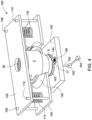
- the bottle 2 may be placed in a bottle holding assembly 100 such as the type shown in Fig. 4 .
- assembly 100 comprises two opposed platen members 102, 104, with the top platen 102 joined to platen 104 via connectors 106, 108, 110, 112 which can all be adjusted through the spring tension supplied by coil spring 114 and 116.
- a retainer member 120 such as composed of a rubber diaphragm or similar resilient material depends downwardly from the platen 102 and has a general shape that is congruent to the shape of bottle 2 to securely grasp and hold same in the assembly 100.
- platform 140 is positioned underneath the platen 104 and the annular sealing lid 17 is engaged between yoke members 142, 144 carried on the platform, which together, encircle the lid 17.
- Set screws or the like may be used to vary the tension of springs 146, 148 to provide for secure grasping of lid 17 by the yoke members.
- the protective film 14 has been removed from the tap 12, so that the membrane 18 ( Fig. 3 ) is in direct fluid communication with the contents of the bottle 2.
- a conduit 150 is connected via a funneling type connector or other device (not shown) to the now inverted top section of the bottle.
- a vacuum source 154 or pump communicates with the bottle 2 via the provision of valve member 152.
- a hypodermic rubber needle or the like is inserted through the penetratable rubber layer of the bottle to inject staining, luminescence, cleaning, or other reagent or purified water to the fluid sample within bottle 2.
- a disposable container for bioburden sample selection and detection is provided.
- This container works as a normal bottle to select the fluid sample and is sealed by a cap.
- the container is then placed upside down on stages for sample preparation (filtration, staining) and detection (imaging).
- the bioburden measurement process may involve any one of many conventional techniques such as a colormetric measurement technique in which a staining reagent is injected into the fluid sample in container 2 via a syringe or the like that penetrates the layer 26. A microscope or the like is used to count the microbial colonies on the membrane 18 to assess bioburden level.
- another exemplary bioburden test method may comprise injection of a luminescent or fluorescent reagent into the sample in the container 2 through the penetrable layer 24.
- the desired analyte microbial species captured on the surface of membrane 18 can then be detected via a camera or the like placed proximate the membrane 18.
- Another bioburden testing procedures that may be utilized involves the "in situ cell division” method.
- This method is a direct growth rapid method for living target cell detection before the cells become visible to the naked eye.
- the sample is filtered through the MF to capture the microorganism thereon.
- the MF is transferred to a nutrient agar plate and the target cells are allowed to form microcolonies by in situ respiration. (This usually takes about a three-hour incubation time.)
- the microcolonies are illuminated with a blue light LED (Ex 450-500 nm, Em 510-560 nm).
- a CCD chip is used to detect cellular autofluorescence and analysis software is used to automatically count the photosensitive pixels overlying each microcolony.
- SPC solid phase cytometry
- This method is a rapid method for detection of total viable cells (TVC) by the sequential steps of: (a) filtering a sample over a black polyester or polycarbonate MF to capture microorganisms; (b) transferring the MF to a pad comprising fluorocarbon dye, incubating, to label metabolically active cells only; (c) detecting fluorescence emitted by labeled cells with argon laser scanning (Ex 480 nm, Em 515nm); (d) processing signals by computer to differentiate valid signals from fluorescent particles; and (e) quantifying total viable cells.
- the pore size of the filter membrane is chosen to capture the secured microbial analyte thereon. This pore size can vary over a wide range such as to encompass pore sizes from about 0.05 ⁇ m to about 0.65 ⁇ m.
- Exemplary membrane filters (MF) include the following: 1) 25 mm diameter, 7-20 ⁇ m thickness, 0.4 ⁇ m pore size; 2) 25 mm diameter, 6-11 ⁇ m thickness, 0.2 ⁇ m pore size; and 3) 47 mm diameter, 7-22 ⁇ m thickness, 0.45 ⁇ m pore size. The selection of the appropriate filter membrane 18 is within the skill of the artisan.
- bioburden testing can be conducted to determine presence and count levels of a variety of microbes. For example, counts of a variety of bacteria, fungi, mold, yeast, and spores can be conducted using the container and methods of the present invention.
Landscapes
- Chemical & Material Sciences (AREA)
- Health & Medical Sciences (AREA)
- Life Sciences & Earth Sciences (AREA)
- Organic Chemistry (AREA)
- Engineering & Computer Science (AREA)
- General Health & Medical Sciences (AREA)
- Analytical Chemistry (AREA)
- Zoology (AREA)
- Proteomics, Peptides & Aminoacids (AREA)
- Wood Science & Technology (AREA)
- Biochemistry (AREA)
- Immunology (AREA)
- Physics & Mathematics (AREA)
- Molecular Biology (AREA)
- Microbiology (AREA)
- Biotechnology (AREA)
- Biophysics (AREA)
- Bioinformatics & Cheminformatics (AREA)
- General Engineering & Computer Science (AREA)
- Chemical Kinetics & Catalysis (AREA)
- Genetics & Genomics (AREA)
- Clinical Laboratory Science (AREA)
- Pathology (AREA)
- Toxicology (AREA)
- Hematology (AREA)
- General Physics & Mathematics (AREA)
- Medicinal Chemistry (AREA)
- Biomedical Technology (AREA)
- Signal Processing (AREA)
- Dispersion Chemistry (AREA)
- Apparatus Associated With Microorganisms And Enzymes (AREA)
- Measuring Or Testing Involving Enzymes Or Micro-Organisms (AREA)
- Computer Vision & Pattern Recognition (AREA)
- Sampling And Sample Adjustment (AREA)
- Investigating Or Analysing Biological Materials (AREA)
Claims (11)
- Probenbehälter für mikrobielle Nachweisprozesse, umfassend:a. einen Behälter (2) mit einer oberen Öffnung (5) und einer gegenüberliegenden unteren Öffnung (7);b. eine obere Kappe (12), die die obere Öffnung abdichtet, wobei die obere Kappe einen Dichtungsdeckel umfasst, der einen vertieften Deckelabschnitt umfasst, der eine Vielzahl von Flüssigkeitsströmungsöffnungen (16) darin umfasst, und eine Membranfiltrationsschicht (18), die den Strömungsöffnungen zugrunde liegt;c. eine untere Kappenanordnung, die die untere Öffnung abdichtet, wobei die untere Kappenanordnung ein abnehmbares äußeres Kappenelement (20) und eine flüssigkeitsundurchlässige Elastomerschicht (26) umfasst, die die abnehmbare äußere Kappe unterstreicht; undden Behälter mit einem zylindrisch quer geschnittenen Körper (8), einem Halsabschnitt (9) mit einem kleineren Durchmesser als der Körper und einem konischen Durchmesser (10), wobei der Körperabschnitt und der Halsabschnitt dazwischen liegen, wobei die obere Kappe abnehmbar über dem Halsabschnitt angebracht ist und die untere Kappenanordnung lösbar über der unteren Öffnung angebracht ist,wobei der Behälter (2) Einwegartikel ist.
- Probenbehälter nach Anspruch 1, wobei die Elastomerschicht durch eine Nadelspritze durchdringbar ist.
- Probenbehälter nach Anspruch 1, wobei die obere Kappe eine Schutzfolienschicht (14) aufweist, die über dem Dichtungsdeckel liegt.
- Probenbehälter nach Anspruch 1, wobei der Dichtungsdeckel eine ringförmig erhöhte Landfläche umfasst, die den vertieften Deckelabschnitt umgibt, wobei der vertiefte Deckelabschnitt planar ist.
- Verfahren zum Nachweis des Vorhandenseins von Mikroben in einer flüssigen Probe, umfassend:i. Füllen zumindest eines Teils eines Behälters (2) mit einer flüssigen Probe, die Analytmikroben enthält, wobei der Behälter gegenüberliegende obere und untere Öffnungen (5, 7) aufweist, wobei die untere Öffnung (7) während des Füllschritts mit einer unteren Kappenanordnung (20) an der unteren Öffnung (7) abgedichtet wird, wobei die untere Kappenanordnung eine flüssigkeitsundurchlässige, nadeldurchdringbare Oberfläche (26) umfasst;ii. Bereitstellen einer oberen Kappe (12) an der oberen Öffnung (5), wobei die obere Kappe (12) eine erste Oberfläche aufweist, die darin Flüssigkeitsströmungsöffnungen (16) umfasst, und eine Membranfilterschicht (18), die der ersten Oberfläche zugrunde liegt;iii. Umkehren des Behälters (2), um die Flüssigkeitsprobe durch die obere Kappe mit einer Vakuumquelle oder Pumpe abzulassen, die mit dem Behälter (2) kommuniziert, wodurch die Analytmikroben auf der Membranfilterschicht abgelagert werden;iv. Injizieren eines Reagenzes in die flüssige Probe durch die flüssigkeitsundurchlässige nadeldurchdringbare Oberfläche, wobei das Reagenz so konfiguriert ist, dass es mit den Analytmikroben reagiert, um eine nachweisbare Präsenz auf der Membranfilterschicht zu bilden, wobei das Reagenz ein Färbereagenz oder ein Lumineszenzmittel umfasst, das so konfiguriert ist, dass es lumineszierende Mikroben auf der Membranfilterschicht erzeugt;v. Ablassen des Reagenzes durch die Filtrationsmembran; undvi. Platzieren eines Detektors in operativer Verbindung mit der Membranfilterschicht, um die Analytmikroben zu detektieren.
- Verfahren nach Anspruch 5, wobei der Detektor ein Mikroskop ist.
- Verfahren nach Anspruch 5, wobei der Detektor eine Kamera umfasst.
- Verfahren, wie es in Anspruch 5 angeführt ist, umfasst ferner das Platzieren des Behälters in eine Behälterhalteanordnung (100) und nach dem Schritt des Injizierens des Reagenzes in die Flüssigkeitsprobe, das Trennen der oberen Kappe von dem Behälter.
- Verfahren, wie es in Anspruch 8 angeführt ist, umfasst ferner das Befestigen der oberen Kappe in einem Greifelement (142, 144), das von einer Plattform (140) getragen wird, wobei die Plattform und die Halteanordnung relativ zueinander verschoben sind, um dadurch die obere Kappe von dem Behälter zu trennen.
- Verfahren nach Anspruch 5, umfassend das Verbinden einer Flüssigkeitsleitung mit der oberen Kappe und das Entleeren der Flüssigkeitsprobe durch die Flüssigkeitsleitung.
- Verfahren, wie es in Anspruch 10 angeführt ist, umfasst ferner das Anlegen einer Vakuumquelle an die Leitung.
Applications Claiming Priority (1)
| Application Number | Priority Date | Filing Date | Title |
|---|---|---|---|
| PCT/CN2012/081889 WO2014047770A1 (en) | 2012-09-25 | 2012-09-25 | Disposable container for bioburden sample collection and detection |
Publications (3)
| Publication Number | Publication Date |
|---|---|
| EP2900802A1 EP2900802A1 (de) | 2015-08-05 |
| EP2900802A4 EP2900802A4 (de) | 2016-05-25 |
| EP2900802B1 true EP2900802B1 (de) | 2025-07-09 |
Family
ID=50386763
Family Applications (1)
| Application Number | Title | Priority Date | Filing Date |
|---|---|---|---|
| EP12885481.7A Active EP2900802B1 (de) | 2012-09-25 | 2012-09-25 | Einwegbehälter für gesamtkeimzahlprobenentnahme und -detektion |
Country Status (8)
| Country | Link |
|---|---|
| US (1) | US9790535B2 (de) |
| EP (1) | EP2900802B1 (de) |
| JP (1) | JP6027684B2 (de) |
| CN (1) | CN104662144B (de) |
| CA (1) | CA2884671C (de) |
| DK (1) | DK2900802T3 (de) |
| ES (1) | ES3036904T3 (de) |
| WO (1) | WO2014047770A1 (de) |
Families Citing this family (4)
| Publication number | Priority date | Publication date | Assignee | Title |
|---|---|---|---|---|
| CN109097261B (zh) * | 2018-07-12 | 2021-08-03 | 江苏大学 | 一种作物病害孢子空中悬浮富集检测装置与方法 |
| WO2020045053A1 (ja) * | 2018-08-31 | 2020-03-05 | 株式会社堀場アドバンスドテクノ | 試料前処理機、及び、分析システム |
| US12265005B2 (en) | 2022-06-10 | 2025-04-01 | Loyola Marymount University | Environmental DNA sample collector |
| CN115880726B (zh) * | 2023-01-30 | 2023-07-14 | 深圳市水务科技有限公司 | 一种剑水蚤实时监测装置及方法 |
Citations (1)
| Publication number | Priority date | Publication date | Assignee | Title |
|---|---|---|---|---|
| US20090238725A1 (en) * | 2008-03-21 | 2009-09-24 | Ellis Samuel A | Filter vial |
Family Cites Families (20)
| Publication number | Priority date | Publication date | Assignee | Title |
|---|---|---|---|---|
| US3295686A (en) * | 1965-05-20 | 1967-01-03 | Rockridge Lab | Filter unit |
| US3929583A (en) | 1975-08-14 | 1975-12-30 | Canadian Patents Dev | Apparatus for enumerating microorganisms |
| US4317726A (en) | 1981-02-12 | 1982-03-02 | The United States Of America As Represented By The Secretary Of The Army | Microbial filter assembly |
| US5202262A (en) | 1984-01-31 | 1993-04-13 | Millipore Corporation | Apparatus for microbiological testing of liquids |
| US4871662A (en) | 1986-08-11 | 1989-10-03 | Watertest Corporation | Device for shipping microbiology test samples |
| EP0529084B1 (de) | 1991-02-13 | 1997-05-28 | Nihon Millipore Kogyo Kabushiki Kaisha | Verfahren zur bestimmung der zahl lebender mikroorganismen |
| WO1998032875A1 (en) | 1997-01-29 | 1998-07-30 | Pall Corporation | Filtration assembly |
| US6090572A (en) | 1998-06-26 | 2000-07-18 | Biostar, Incorporated | Filtration and extraction device and method of using the same |
| US6329165B1 (en) | 1999-12-30 | 2001-12-11 | Nalco Chemical Company | Measurement and control of sessile and planktonic microbiological activity in industrial water systems |
| US7803608B2 (en) | 2001-02-28 | 2010-09-28 | Biomerieux, Inc. | Integrated filtration and detection device |
| US8663909B2 (en) | 2002-05-09 | 2014-03-04 | Nanologix, Inc. | Device for rapid detection and identification of single microorganisms without preliminary growth |
| US6699684B2 (en) | 2002-07-23 | 2004-03-02 | Nalco Company | Method of monitoring biofouling in membrane separation systems |
| US7118857B2 (en) | 2004-02-27 | 2006-10-10 | Baxter International Inc. | Methods and compositions for detection of microbial contaminants in peritoneal dialysis solutions |
| JP4535436B2 (ja) * | 2004-10-13 | 2010-09-01 | 静岡県 | 微生物回収方法および微生物回収キット |
| CA2635268C (en) | 2006-01-18 | 2021-02-16 | Argos Therapeutics, Inc. | Systems and methods for processing samples in a closed container, and related devices |
| WO2008130445A2 (en) | 2006-11-10 | 2008-10-30 | Advanced Analytical Technologies, Inc. | Rapid detection microorganisms in fluids |
| US8557539B2 (en) * | 2006-11-10 | 2013-10-15 | Biolumix Inc. | Optical method and device for the detection and enumeration of microorganisms |
| BRPI0811355A2 (pt) | 2007-05-31 | 2014-10-29 | 3M Innovative Properties Co | Dispositivos, processo e kit destinados a coletar e concentrar amostras para análise microbiológica |
| JP5218153B2 (ja) | 2009-02-26 | 2013-06-26 | 株式会社日立プラントテクノロジー | 微生物検出装置、検出方法、及びそれに用いられる試料容器 |
| CN202047070U (zh) * | 2011-04-26 | 2011-11-23 | 杭州泰林生物技术设备有限公司 | 一种用于微生物检测的培养器 |
-
2012
- 2012-09-25 CN CN201280076011.7A patent/CN104662144B/zh active Active
- 2012-09-25 JP JP2015532268A patent/JP6027684B2/ja active Active
- 2012-09-25 CA CA2884671A patent/CA2884671C/en active Active
- 2012-09-25 EP EP12885481.7A patent/EP2900802B1/de active Active
- 2012-09-25 DK DK12885481.7T patent/DK2900802T3/da active
- 2012-09-25 WO PCT/CN2012/081889 patent/WO2014047770A1/en not_active Ceased
- 2012-09-25 ES ES12885481T patent/ES3036904T3/es active Active
- 2012-09-25 US US14/431,020 patent/US9790535B2/en active Active
Patent Citations (1)
| Publication number | Priority date | Publication date | Assignee | Title |
|---|---|---|---|---|
| US20090238725A1 (en) * | 2008-03-21 | 2009-09-24 | Ellis Samuel A | Filter vial |
Also Published As
| Publication number | Publication date |
|---|---|
| CA2884671C (en) | 2019-05-07 |
| JP2015533492A (ja) | 2015-11-26 |
| DK2900802T3 (da) | 2025-09-15 |
| CN104662144B (zh) | 2018-05-01 |
| CA2884671A1 (en) | 2014-04-03 |
| WO2014047770A1 (en) | 2014-04-03 |
| EP2900802A4 (de) | 2016-05-25 |
| ES3036904T3 (en) | 2025-09-25 |
| CN104662144A (zh) | 2015-05-27 |
| EP2900802A1 (de) | 2015-08-05 |
| US20150240284A1 (en) | 2015-08-27 |
| US9790535B2 (en) | 2017-10-17 |
| JP6027684B2 (ja) | 2016-11-16 |
Similar Documents
| Publication | Publication Date | Title |
|---|---|---|
| US20230416663A1 (en) | Cassette for sterility testing | |
| US12091703B2 (en) | Cell culturing device | |
| US10465228B2 (en) | Filtration system and use thereof | |
| JP5160428B2 (ja) | 増殖培地を含むカセット | |
| JP6572219B2 (ja) | サンプル調製ユニットおよびサンプル調製デバイス | |
| JPH06141890A (ja) | 加圧液体の微生物試験のための方法及び装置 | |
| EP2900802B1 (de) | Einwegbehälter für gesamtkeimzahlprobenentnahme und -detektion | |
| HK1255233B (en) | Cassette for sterility testing | |
| HK1204649B (en) | Cassette for sterility testing |
Legal Events
| Date | Code | Title | Description |
|---|---|---|---|
| PUAI | Public reference made under article 153(3) epc to a published international application that has entered the european phase |
Free format text: ORIGINAL CODE: 0009012 |
|
| 17P | Request for examination filed |
Effective date: 20150428 |
|
| AK | Designated contracting states |
Kind code of ref document: A1 Designated state(s): AL AT BE BG CH CY CZ DE DK EE ES FI FR GB GR HR HU IE IS IT LI LT LU LV MC MK MT NL NO PL PT RO RS SE SI SK SM TR |
|
| AX | Request for extension of the european patent |
Extension state: BA ME |
|
| DAX | Request for extension of the european patent (deleted) | ||
| RA4 | Supplementary search report drawn up and despatched (corrected) |
Effective date: 20160425 |
|
| RIC1 | Information provided on ipc code assigned before grant |
Ipc: C12M 1/24 20060101AFI20160419BHEP Ipc: C12Q 1/24 20060101ALI20160419BHEP Ipc: C12Q 1/04 20060101ALI20160419BHEP Ipc: G01N 15/14 20060101ALI20160419BHEP Ipc: G01N 1/40 20060101ALI20160419BHEP Ipc: B01D 61/18 20060101ALI20160419BHEP Ipc: G01N 1/30 20060101ALI20160419BHEP Ipc: B01L 3/00 20060101ALI20160419BHEP |
|
| STAA | Information on the status of an ep patent application or granted ep patent |
Free format text: STATUS: EXAMINATION IS IN PROGRESS |
|
| 17Q | First examination report despatched |
Effective date: 20170919 |
|
| RAP1 | Party data changed (applicant data changed or rights of an application transferred) |
Owner name: BL TECHNOLOGIES, INC. |
|
| P01 | Opt-out of the competence of the unified patent court (upc) registered |
Effective date: 20230521 |
|
| GRAP | Despatch of communication of intention to grant a patent |
Free format text: ORIGINAL CODE: EPIDOSNIGR1 |
|
| STAA | Information on the status of an ep patent application or granted ep patent |
Free format text: STATUS: GRANT OF PATENT IS INTENDED |
|
| INTG | Intention to grant announced |
Effective date: 20250218 |
|
| GRAS | Grant fee paid |
Free format text: ORIGINAL CODE: EPIDOSNIGR3 |
|
| GRAA | (expected) grant |
Free format text: ORIGINAL CODE: 0009210 |
|
| STAA | Information on the status of an ep patent application or granted ep patent |
Free format text: STATUS: THE PATENT HAS BEEN GRANTED |
|
| AK | Designated contracting states |
Kind code of ref document: B1 Designated state(s): AL AT BE BG CH CY CZ DE DK EE ES FI FR GB GR HR HU IE IS IT LI LT LU LV MC MK MT NL NO PL PT RO RS SE SI SK SM TR |
|
| REG | Reference to a national code |
Ref country code: GB Ref legal event code: FG4D |
|
| REG | Reference to a national code |
Ref country code: CH Ref legal event code: EP |
|
| REG | Reference to a national code |
Ref country code: IE Ref legal event code: FG4D |
|
| REG | Reference to a national code |
Ref country code: DE Ref legal event code: R096 Ref document number: 602012081614 Country of ref document: DE |
|
| REG | Reference to a national code |
Ref country code: SE Ref legal event code: TRGR |
|
| REG | Reference to a national code |
Ref country code: DK Ref legal event code: T3 Effective date: 20250912 |
|
| REG | Reference to a national code |
Ref country code: ES Ref legal event code: FG2A Ref document number: 3036904 Country of ref document: ES Kind code of ref document: T3 Effective date: 20250925 |
|
| PGFP | Annual fee paid to national office [announced via postgrant information from national office to epo] |
Ref country code: DK Payment date: 20250925 Year of fee payment: 14 Ref country code: DE Payment date: 20250929 Year of fee payment: 14 |
|
| PGFP | Annual fee paid to national office [announced via postgrant information from national office to epo] |
Ref country code: GB Payment date: 20250929 Year of fee payment: 14 |
|
| PGFP | Annual fee paid to national office [announced via postgrant information from national office to epo] |
Ref country code: FR Payment date: 20250925 Year of fee payment: 14 |
|
| PGFP | Annual fee paid to national office [announced via postgrant information from national office to epo] |
Ref country code: SE Payment date: 20250927 Year of fee payment: 14 |
|
| REG | Reference to a national code |
Ref country code: NL Ref legal event code: MP Effective date: 20250709 |
|
| PG25 | Lapsed in a contracting state [announced via postgrant information from national office to epo] |
Ref country code: PT Free format text: LAPSE BECAUSE OF FAILURE TO SUBMIT A TRANSLATION OF THE DESCRIPTION OR TO PAY THE FEE WITHIN THE PRESCRIBED TIME-LIMIT Effective date: 20251110 |
|
| PG25 | Lapsed in a contracting state [announced via postgrant information from national office to epo] |
Ref country code: NL Free format text: LAPSE BECAUSE OF FAILURE TO SUBMIT A TRANSLATION OF THE DESCRIPTION OR TO PAY THE FEE WITHIN THE PRESCRIBED TIME-LIMIT Effective date: 20250709 |
|
| REG | Reference to a national code |
Ref country code: AT Ref legal event code: MK05 Ref document number: 1811858 Country of ref document: AT Kind code of ref document: T Effective date: 20250709 |
|
| PG25 | Lapsed in a contracting state [announced via postgrant information from national office to epo] |
Ref country code: IS Free format text: LAPSE BECAUSE OF FAILURE TO SUBMIT A TRANSLATION OF THE DESCRIPTION OR TO PAY THE FEE WITHIN THE PRESCRIBED TIME-LIMIT Effective date: 20251109 |
|
| PG25 | Lapsed in a contracting state [announced via postgrant information from national office to epo] |
Ref country code: NO Free format text: LAPSE BECAUSE OF FAILURE TO SUBMIT A TRANSLATION OF THE DESCRIPTION OR TO PAY THE FEE WITHIN THE PRESCRIBED TIME-LIMIT Effective date: 20251009 |
|
| REG | Reference to a national code |
Ref country code: LT Ref legal event code: MG9D |
|
| PG25 | Lapsed in a contracting state [announced via postgrant information from national office to epo] |
Ref country code: AT Free format text: LAPSE BECAUSE OF FAILURE TO SUBMIT A TRANSLATION OF THE DESCRIPTION OR TO PAY THE FEE WITHIN THE PRESCRIBED TIME-LIMIT Effective date: 20250709 |
|
| PG25 | Lapsed in a contracting state [announced via postgrant information from national office to epo] |
Ref country code: FI Free format text: LAPSE BECAUSE OF FAILURE TO SUBMIT A TRANSLATION OF THE DESCRIPTION OR TO PAY THE FEE WITHIN THE PRESCRIBED TIME-LIMIT Effective date: 20250709 |
|
| PG25 | Lapsed in a contracting state [announced via postgrant information from national office to epo] |
Ref country code: HR Free format text: LAPSE BECAUSE OF FAILURE TO SUBMIT A TRANSLATION OF THE DESCRIPTION OR TO PAY THE FEE WITHIN THE PRESCRIBED TIME-LIMIT Effective date: 20250709 |
|
| PG25 | Lapsed in a contracting state [announced via postgrant information from national office to epo] |
Ref country code: GR Free format text: LAPSE BECAUSE OF FAILURE TO SUBMIT A TRANSLATION OF THE DESCRIPTION OR TO PAY THE FEE WITHIN THE PRESCRIBED TIME-LIMIT Effective date: 20251010 |
|
| PG25 | Lapsed in a contracting state [announced via postgrant information from national office to epo] |
Ref country code: LV Free format text: LAPSE BECAUSE OF FAILURE TO SUBMIT A TRANSLATION OF THE DESCRIPTION OR TO PAY THE FEE WITHIN THE PRESCRIBED TIME-LIMIT Effective date: 20250709 |
|
| PG25 | Lapsed in a contracting state [announced via postgrant information from national office to epo] |
Ref country code: BG Free format text: LAPSE BECAUSE OF FAILURE TO SUBMIT A TRANSLATION OF THE DESCRIPTION OR TO PAY THE FEE WITHIN THE PRESCRIBED TIME-LIMIT Effective date: 20250709 Ref country code: PL Free format text: LAPSE BECAUSE OF FAILURE TO SUBMIT A TRANSLATION OF THE DESCRIPTION OR TO PAY THE FEE WITHIN THE PRESCRIBED TIME-LIMIT Effective date: 20250709 |
|
| PG25 | Lapsed in a contracting state [announced via postgrant information from national office to epo] |
Ref country code: RS Free format text: LAPSE BECAUSE OF FAILURE TO SUBMIT A TRANSLATION OF THE DESCRIPTION OR TO PAY THE FEE WITHIN THE PRESCRIBED TIME-LIMIT Effective date: 20251009 |
|
| PGFP | Annual fee paid to national office [announced via postgrant information from national office to epo] |
Ref country code: ES Payment date: 20251001 Year of fee payment: 14 |
|
| PG25 | Lapsed in a contracting state [announced via postgrant information from national office to epo] |
Ref country code: RO Free format text: LAPSE BECAUSE OF FAILURE TO SUBMIT A TRANSLATION OF THE DESCRIPTION OR TO PAY THE FEE WITHIN THE PRESCRIBED TIME-LIMIT Effective date: 20250709 |
|
| PG25 | Lapsed in a contracting state [announced via postgrant information from national office to epo] |
Ref country code: SM Free format text: LAPSE BECAUSE OF FAILURE TO SUBMIT A TRANSLATION OF THE DESCRIPTION OR TO PAY THE FEE WITHIN THE PRESCRIBED TIME-LIMIT Effective date: 20250709 |
|
| PG25 | Lapsed in a contracting state [announced via postgrant information from national office to epo] |
Ref country code: IT Free format text: LAPSE BECAUSE OF FAILURE TO SUBMIT A TRANSLATION OF THE DESCRIPTION OR TO PAY THE FEE WITHIN THE PRESCRIBED TIME-LIMIT Effective date: 20250709 |
|
| PG25 | Lapsed in a contracting state [announced via postgrant information from national office to epo] |
Ref country code: CZ Free format text: LAPSE BECAUSE OF FAILURE TO SUBMIT A TRANSLATION OF THE DESCRIPTION OR TO PAY THE FEE WITHIN THE PRESCRIBED TIME-LIMIT Effective date: 20250709 |
|
| PG25 | Lapsed in a contracting state [announced via postgrant information from national office to epo] |
Ref country code: SK Free format text: LAPSE BECAUSE OF FAILURE TO SUBMIT A TRANSLATION OF THE DESCRIPTION OR TO PAY THE FEE WITHIN THE PRESCRIBED TIME-LIMIT Effective date: 20250709 Ref country code: EE Free format text: LAPSE BECAUSE OF FAILURE TO SUBMIT A TRANSLATION OF THE DESCRIPTION OR TO PAY THE FEE WITHIN THE PRESCRIBED TIME-LIMIT Effective date: 20250709 |