EP2888116B1 - Sicherheits- und/oder wertdokument enthaltend ein visuell schaltbares fenster mit einem hologramm - Google Patents
Sicherheits- und/oder wertdokument enthaltend ein visuell schaltbares fenster mit einem hologramm Download PDFInfo
- Publication number
- EP2888116B1 EP2888116B1 EP13750059.1A EP13750059A EP2888116B1 EP 2888116 B1 EP2888116 B1 EP 2888116B1 EP 13750059 A EP13750059 A EP 13750059A EP 2888116 B1 EP2888116 B1 EP 2888116B1
- Authority
- EP
- European Patent Office
- Prior art keywords
- layer
- security
- transparent
- document
- thermoplastic
- Prior art date
- Legal status (The legal status is an assumption and is not a legal conclusion. Google has not performed a legal analysis and makes no representation as to the accuracy of the status listed.)
- Active
Links
Images

Classifications
-
- G—PHYSICS
- G03—PHOTOGRAPHY; CINEMATOGRAPHY; ANALOGOUS TECHNIQUES USING WAVES OTHER THAN OPTICAL WAVES; ELECTROGRAPHY; HOLOGRAPHY
- G03H—HOLOGRAPHIC PROCESSES OR APPARATUS
- G03H1/00—Holographic processes or apparatus using light, infrared or ultraviolet waves for obtaining holograms or for obtaining an image from them; Details peculiar thereto
- G03H1/0005—Adaptation of holography to specific applications
- G03H1/0011—Adaptation of holography to specific applications for security or authentication
-
- B—PERFORMING OPERATIONS; TRANSPORTING
- B32—LAYERED PRODUCTS
- B32B—LAYERED PRODUCTS, i.e. PRODUCTS BUILT-UP OF STRATA OF FLAT OR NON-FLAT, e.g. CELLULAR OR HONEYCOMB, FORM
- B32B37/00—Methods or apparatus for laminating, e.g. by curing or by ultrasonic bonding
- B32B37/14—Methods or apparatus for laminating, e.g. by curing or by ultrasonic bonding characterised by the properties of the layers
- B32B37/142—Laminating of sheets, panels or inserts, e.g. stiffeners, by wrapping in at least one outer layer, or inserting into a preformed pocket
-
- B—PERFORMING OPERATIONS; TRANSPORTING
- B32—LAYERED PRODUCTS
- B32B—LAYERED PRODUCTS, i.e. PRODUCTS BUILT-UP OF STRATA OF FLAT OR NON-FLAT, e.g. CELLULAR OR HONEYCOMB, FORM
- B32B37/00—Methods or apparatus for laminating, e.g. by curing or by ultrasonic bonding
- B32B37/14—Methods or apparatus for laminating, e.g. by curing or by ultrasonic bonding characterised by the properties of the layers
- B32B37/16—Methods or apparatus for laminating, e.g. by curing or by ultrasonic bonding characterised by the properties of the layers with all layers existing as coherent layers before laminating
- B32B37/18—Methods or apparatus for laminating, e.g. by curing or by ultrasonic bonding characterised by the properties of the layers with all layers existing as coherent layers before laminating involving the assembly of discrete sheets or panels only
- B32B37/182—Methods or apparatus for laminating, e.g. by curing or by ultrasonic bonding characterised by the properties of the layers with all layers existing as coherent layers before laminating involving the assembly of discrete sheets or panels only one or more of the layers being plastic
- B32B37/185—Laminating sheets, panels or inserts between two discrete plastic layers
-
- B—PERFORMING OPERATIONS; TRANSPORTING
- B32—LAYERED PRODUCTS
- B32B—LAYERED PRODUCTS, i.e. PRODUCTS BUILT-UP OF STRATA OF FLAT OR NON-FLAT, e.g. CELLULAR OR HONEYCOMB, FORM
- B32B38/00—Ancillary operations in connection with laminating processes
- B32B38/0004—Cutting, tearing or severing, e.g. bursting; Cutter details
-
- B—PERFORMING OPERATIONS; TRANSPORTING
- B32—LAYERED PRODUCTS
- B32B—LAYERED PRODUCTS, i.e. PRODUCTS BUILT-UP OF STRATA OF FLAT OR NON-FLAT, e.g. CELLULAR OR HONEYCOMB, FORM
- B32B38/00—Ancillary operations in connection with laminating processes
- B32B38/04—Punching, slitting or perforating
-
- B—PERFORMING OPERATIONS; TRANSPORTING
- B42—BOOKBINDING; ALBUMS; FILES; SPECIAL PRINTED MATTER
- B42D—BOOKS; BOOK COVERS; LOOSE LEAVES; PRINTED MATTER CHARACTERISED BY IDENTIFICATION OR SECURITY FEATURES; PRINTED MATTER OF SPECIAL FORMAT OR STYLE NOT OTHERWISE PROVIDED FOR; DEVICES FOR USE THEREWITH AND NOT OTHERWISE PROVIDED FOR; MOVABLE-STRIP WRITING OR READING APPARATUS
- B42D25/00—Information-bearing cards or sheet-like structures characterised by identification or security features; Manufacture thereof
- B42D25/20—Information-bearing cards or sheet-like structures characterised by identification or security features; Manufacture thereof characterised by a particular use or purpose
- B42D25/29—Securities; Bank notes
-
- B—PERFORMING OPERATIONS; TRANSPORTING
- B42—BOOKBINDING; ALBUMS; FILES; SPECIAL PRINTED MATTER
- B42D—BOOKS; BOOK COVERS; LOOSE LEAVES; PRINTED MATTER CHARACTERISED BY IDENTIFICATION OR SECURITY FEATURES; PRINTED MATTER OF SPECIAL FORMAT OR STYLE NOT OTHERWISE PROVIDED FOR; DEVICES FOR USE THEREWITH AND NOT OTHERWISE PROVIDED FOR; MOVABLE-STRIP WRITING OR READING APPARATUS
- B42D25/00—Information-bearing cards or sheet-like structures characterised by identification or security features; Manufacture thereof
- B42D25/30—Identification or security features, e.g. for preventing forgery
- B42D25/328—Diffraction gratings; Holograms
-
- B—PERFORMING OPERATIONS; TRANSPORTING
- B42—BOOKBINDING; ALBUMS; FILES; SPECIAL PRINTED MATTER
- B42D—BOOKS; BOOK COVERS; LOOSE LEAVES; PRINTED MATTER CHARACTERISED BY IDENTIFICATION OR SECURITY FEATURES; PRINTED MATTER OF SPECIAL FORMAT OR STYLE NOT OTHERWISE PROVIDED FOR; DEVICES FOR USE THEREWITH AND NOT OTHERWISE PROVIDED FOR; MOVABLE-STRIP WRITING OR READING APPARATUS
- B42D25/00—Information-bearing cards or sheet-like structures characterised by identification or security features; Manufacture thereof
- B42D25/30—Identification or security features, e.g. for preventing forgery
- B42D25/36—Identification or security features, e.g. for preventing forgery comprising special materials
-
- B—PERFORMING OPERATIONS; TRANSPORTING
- B42—BOOKBINDING; ALBUMS; FILES; SPECIAL PRINTED MATTER
- B42D—BOOKS; BOOK COVERS; LOOSE LEAVES; PRINTED MATTER CHARACTERISED BY IDENTIFICATION OR SECURITY FEATURES; PRINTED MATTER OF SPECIAL FORMAT OR STYLE NOT OTHERWISE PROVIDED FOR; DEVICES FOR USE THEREWITH AND NOT OTHERWISE PROVIDED FOR; MOVABLE-STRIP WRITING OR READING APPARATUS
- B42D25/00—Information-bearing cards or sheet-like structures characterised by identification or security features; Manufacture thereof
- B42D25/30—Identification or security features, e.g. for preventing forgery
- B42D25/36—Identification or security features, e.g. for preventing forgery comprising special materials
- B42D25/378—Special inks
-
- B—PERFORMING OPERATIONS; TRANSPORTING
- B42—BOOKBINDING; ALBUMS; FILES; SPECIAL PRINTED MATTER
- B42D—BOOKS; BOOK COVERS; LOOSE LEAVES; PRINTED MATTER CHARACTERISED BY IDENTIFICATION OR SECURITY FEATURES; PRINTED MATTER OF SPECIAL FORMAT OR STYLE NOT OTHERWISE PROVIDED FOR; DEVICES FOR USE THEREWITH AND NOT OTHERWISE PROVIDED FOR; MOVABLE-STRIP WRITING OR READING APPARATUS
- B42D25/00—Information-bearing cards or sheet-like structures characterised by identification or security features; Manufacture thereof
- B42D25/30—Identification or security features, e.g. for preventing forgery
- B42D25/36—Identification or security features, e.g. for preventing forgery comprising special materials
- B42D25/378—Special inks
- B42D25/387—Special inks absorbing or reflecting ultraviolet light
-
- B—PERFORMING OPERATIONS; TRANSPORTING
- B42—BOOKBINDING; ALBUMS; FILES; SPECIAL PRINTED MATTER
- B42D—BOOKS; BOOK COVERS; LOOSE LEAVES; PRINTED MATTER CHARACTERISED BY IDENTIFICATION OR SECURITY FEATURES; PRINTED MATTER OF SPECIAL FORMAT OR STYLE NOT OTHERWISE PROVIDED FOR; DEVICES FOR USE THEREWITH AND NOT OTHERWISE PROVIDED FOR; MOVABLE-STRIP WRITING OR READING APPARATUS
- B42D25/00—Information-bearing cards or sheet-like structures characterised by identification or security features; Manufacture thereof
- B42D25/40—Manufacture
- B42D25/405—Marking
- B42D25/415—Marking using chemicals
- B42D25/42—Marking using chemicals by photographic processes
-
- G—PHYSICS
- G03—PHOTOGRAPHY; CINEMATOGRAPHY; ANALOGOUS TECHNIQUES USING WAVES OTHER THAN OPTICAL WAVES; ELECTROGRAPHY; HOLOGRAPHY
- G03H—HOLOGRAPHIC PROCESSES OR APPARATUS
- G03H1/00—Holographic processes or apparatus using light, infrared or ultraviolet waves for obtaining holograms or for obtaining an image from them; Details peculiar thereto
- G03H1/02—Details of features involved during the holographic process; Replication of holograms without interference recording
-
- G—PHYSICS
- G03—PHOTOGRAPHY; CINEMATOGRAPHY; ANALOGOUS TECHNIQUES USING WAVES OTHER THAN OPTICAL WAVES; ELECTROGRAPHY; HOLOGRAPHY
- G03H—HOLOGRAPHIC PROCESSES OR APPARATUS
- G03H1/00—Holographic processes or apparatus using light, infrared or ultraviolet waves for obtaining holograms or for obtaining an image from them; Details peculiar thereto
- G03H1/02—Details of features involved during the holographic process; Replication of holograms without interference recording
- G03H1/024—Hologram nature or properties
- G03H1/0248—Volume holograms
-
- G—PHYSICS
- G03—PHOTOGRAPHY; CINEMATOGRAPHY; ANALOGOUS TECHNIQUES USING WAVES OTHER THAN OPTICAL WAVES; ELECTROGRAPHY; HOLOGRAPHY
- G03H—HOLOGRAPHIC PROCESSES OR APPARATUS
- G03H1/00—Holographic processes or apparatus using light, infrared or ultraviolet waves for obtaining holograms or for obtaining an image from them; Details peculiar thereto
- G03H1/02—Details of features involved during the holographic process; Replication of holograms without interference recording
- G03H1/0252—Laminate comprising a hologram layer
-
- G—PHYSICS
- G03—PHOTOGRAPHY; CINEMATOGRAPHY; ANALOGOUS TECHNIQUES USING WAVES OTHER THAN OPTICAL WAVES; ELECTROGRAPHY; HOLOGRAPHY
- G03H—HOLOGRAPHIC PROCESSES OR APPARATUS
- G03H1/00—Holographic processes or apparatus using light, infrared or ultraviolet waves for obtaining holograms or for obtaining an image from them; Details peculiar thereto
- G03H1/02—Details of features involved during the holographic process; Replication of holograms without interference recording
- G03H1/0252—Laminate comprising a hologram layer
- G03H1/0256—Laminate comprising a hologram layer having specific functional layer
-
- G—PHYSICS
- G11—INFORMATION STORAGE
- G11B—INFORMATION STORAGE BASED ON RELATIVE MOVEMENT BETWEEN RECORD CARRIER AND TRANSDUCER
- G11B7/00—Recording or reproducing by optical means, e.g. recording using a thermal beam of optical radiation by modifying optical properties or the physical structure, reproducing using an optical beam at lower power by sensing optical properties; Record carriers therefor
- G11B7/24—Record carriers characterised by shape, structure or physical properties, or by the selection of the material
- G11B7/2403—Layers; Shape, structure or physical properties thereof
- G11B7/24035—Recording layers
- G11B7/24044—Recording layers for storing optical interference patterns, e.g. holograms; for storing data in three dimensions, e.g. volume storage
-
- B—PERFORMING OPERATIONS; TRANSPORTING
- B32—LAYERED PRODUCTS
- B32B—LAYERED PRODUCTS, i.e. PRODUCTS BUILT-UP OF STRATA OF FLAT OR NON-FLAT, e.g. CELLULAR OR HONEYCOMB, FORM
- B32B38/00—Ancillary operations in connection with laminating processes
- B32B38/04—Punching, slitting or perforating
- B32B2038/042—Punching
-
- B—PERFORMING OPERATIONS; TRANSPORTING
- B32—LAYERED PRODUCTS
- B32B—LAYERED PRODUCTS, i.e. PRODUCTS BUILT-UP OF STRATA OF FLAT OR NON-FLAT, e.g. CELLULAR OR HONEYCOMB, FORM
- B32B2307/00—Properties of the layers or laminate
- B32B2307/40—Properties of the layers or laminate having particular optical properties
-
- B—PERFORMING OPERATIONS; TRANSPORTING
- B32—LAYERED PRODUCTS
- B32B—LAYERED PRODUCTS, i.e. PRODUCTS BUILT-UP OF STRATA OF FLAT OR NON-FLAT, e.g. CELLULAR OR HONEYCOMB, FORM
- B32B2307/00—Properties of the layers or laminate
- B32B2307/40—Properties of the layers or laminate having particular optical properties
- B32B2307/412—Transparent
-
- B—PERFORMING OPERATIONS; TRANSPORTING
- B32—LAYERED PRODUCTS
- B32B—LAYERED PRODUCTS, i.e. PRODUCTS BUILT-UP OF STRATA OF FLAT OR NON-FLAT, e.g. CELLULAR OR HONEYCOMB, FORM
- B32B2307/00—Properties of the layers or laminate
- B32B2307/40—Properties of the layers or laminate having particular optical properties
- B32B2307/416—Reflective
-
- B—PERFORMING OPERATIONS; TRANSPORTING
- B32—LAYERED PRODUCTS
- B32B—LAYERED PRODUCTS, i.e. PRODUCTS BUILT-UP OF STRATA OF FLAT OR NON-FLAT, e.g. CELLULAR OR HONEYCOMB, FORM
- B32B2398/00—Unspecified macromolecular compounds
- B32B2398/20—Thermoplastics
-
- B—PERFORMING OPERATIONS; TRANSPORTING
- B32—LAYERED PRODUCTS
- B32B—LAYERED PRODUCTS, i.e. PRODUCTS BUILT-UP OF STRATA OF FLAT OR NON-FLAT, e.g. CELLULAR OR HONEYCOMB, FORM
- B32B2554/00—Paper of special types, e.g. banknotes
-
- B42D2033/04—
-
- B42D2033/08—
-
- B42D2033/14—
-
- B42D2033/22—
-
- B42D2033/30—
-
- B—PERFORMING OPERATIONS; TRANSPORTING
- B42—BOOKBINDING; ALBUMS; FILES; SPECIAL PRINTED MATTER
- B42D—BOOKS; BOOK COVERS; LOOSE LEAVES; PRINTED MATTER CHARACTERISED BY IDENTIFICATION OR SECURITY FEATURES; PRINTED MATTER OF SPECIAL FORMAT OR STYLE NOT OTHERWISE PROVIDED FOR; DEVICES FOR USE THEREWITH AND NOT OTHERWISE PROVIDED FOR; MOVABLE-STRIP WRITING OR READING APPARATUS
- B42D25/00—Information-bearing cards or sheet-like structures characterised by identification or security features; Manufacture thereof
- B42D25/40—Manufacture
- B42D25/45—Associating two or more layers
- B42D25/455—Associating two or more layers using heat
-
- B—PERFORMING OPERATIONS; TRANSPORTING
- B42—BOOKBINDING; ALBUMS; FILES; SPECIAL PRINTED MATTER
- B42D—BOOKS; BOOK COVERS; LOOSE LEAVES; PRINTED MATTER CHARACTERISED BY IDENTIFICATION OR SECURITY FEATURES; PRINTED MATTER OF SPECIAL FORMAT OR STYLE NOT OTHERWISE PROVIDED FOR; DEVICES FOR USE THEREWITH AND NOT OTHERWISE PROVIDED FOR; MOVABLE-STRIP WRITING OR READING APPARATUS
- B42D25/00—Information-bearing cards or sheet-like structures characterised by identification or security features; Manufacture thereof
- B42D25/40—Manufacture
- B42D25/45—Associating two or more layers
- B42D25/46—Associating two or more layers using pressure
-
- B—PERFORMING OPERATIONS; TRANSPORTING
- B42—BOOKBINDING; ALBUMS; FILES; SPECIAL PRINTED MATTER
- B42D—BOOKS; BOOK COVERS; LOOSE LEAVES; PRINTED MATTER CHARACTERISED BY IDENTIFICATION OR SECURITY FEATURES; PRINTED MATTER OF SPECIAL FORMAT OR STYLE NOT OTHERWISE PROVIDED FOR; DEVICES FOR USE THEREWITH AND NOT OTHERWISE PROVIDED FOR; MOVABLE-STRIP WRITING OR READING APPARATUS
- B42D25/00—Information-bearing cards or sheet-like structures characterised by identification or security features; Manufacture thereof
- B42D25/40—Manufacture
- B42D25/475—Cutting cards
-
- G—PHYSICS
- G03—PHOTOGRAPHY; CINEMATOGRAPHY; ANALOGOUS TECHNIQUES USING WAVES OTHER THAN OPTICAL WAVES; ELECTROGRAPHY; HOLOGRAPHY
- G03H—HOLOGRAPHIC PROCESSES OR APPARATUS
- G03H1/00—Holographic processes or apparatus using light, infrared or ultraviolet waves for obtaining holograms or for obtaining an image from them; Details peculiar thereto
- G03H1/0005—Adaptation of holography to specific applications
- G03H1/0011—Adaptation of holography to specific applications for security or authentication
- G03H2001/0016—Covert holograms or holobjects requiring additional knowledge to be perceived, e.g. holobject reconstructed only under IR illumination
-
- G—PHYSICS
- G03—PHOTOGRAPHY; CINEMATOGRAPHY; ANALOGOUS TECHNIQUES USING WAVES OTHER THAN OPTICAL WAVES; ELECTROGRAPHY; HOLOGRAPHY
- G03H—HOLOGRAPHIC PROCESSES OR APPARATUS
- G03H1/00—Holographic processes or apparatus using light, infrared or ultraviolet waves for obtaining holograms or for obtaining an image from them; Details peculiar thereto
- G03H1/02—Details of features involved during the holographic process; Replication of holograms without interference recording
- G03H2001/026—Recording materials or recording processes
- G03H2001/0264—Organic recording material
-
- G—PHYSICS
- G03—PHOTOGRAPHY; CINEMATOGRAPHY; ANALOGOUS TECHNIQUES USING WAVES OTHER THAN OPTICAL WAVES; ELECTROGRAPHY; HOLOGRAPHY
- G03H—HOLOGRAPHIC PROCESSES OR APPARATUS
- G03H2210/00—Object characteristics
- G03H2210/63—Environment affecting the recording, e.g. underwater
-
- G—PHYSICS
- G03—PHOTOGRAPHY; CINEMATOGRAPHY; ANALOGOUS TECHNIQUES USING WAVES OTHER THAN OPTICAL WAVES; ELECTROGRAPHY; HOLOGRAPHY
- G03H—HOLOGRAPHIC PROCESSES OR APPARATUS
- G03H2250/00—Laminate comprising a hologram layer
- G03H2250/12—Special arrangement of layers
-
- G—PHYSICS
- G03—PHOTOGRAPHY; CINEMATOGRAPHY; ANALOGOUS TECHNIQUES USING WAVES OTHER THAN OPTICAL WAVES; ELECTROGRAPHY; HOLOGRAPHY
- G03H—HOLOGRAPHIC PROCESSES OR APPARATUS
- G03H2250/00—Laminate comprising a hologram layer
- G03H2250/33—Absorbing layer
-
- G—PHYSICS
- G03—PHOTOGRAPHY; CINEMATOGRAPHY; ANALOGOUS TECHNIQUES USING WAVES OTHER THAN OPTICAL WAVES; ELECTROGRAPHY; HOLOGRAPHY
- G03H—HOLOGRAPHIC PROCESSES OR APPARATUS
- G03H2250/00—Laminate comprising a hologram layer
- G03H2250/37—Enclosing the photosensitive material
-
- G—PHYSICS
- G03—PHOTOGRAPHY; CINEMATOGRAPHY; ANALOGOUS TECHNIQUES USING WAVES OTHER THAN OPTICAL WAVES; ELECTROGRAPHY; HOLOGRAPHY
- G03H—HOLOGRAPHIC PROCESSES OR APPARATUS
- G03H2260/00—Recording materials or recording processes
- G03H2260/12—Photopolymer
-
- G—PHYSICS
- G03—PHOTOGRAPHY; CINEMATOGRAPHY; ANALOGOUS TECHNIQUES USING WAVES OTHER THAN OPTICAL WAVES; ELECTROGRAPHY; HOLOGRAPHY
- G03H—HOLOGRAPHIC PROCESSES OR APPARATUS
- G03H2260/00—Recording materials or recording processes
- G03H2260/50—Reactivity or recording processes
- G03H2260/52—Photochromic reactivity wherein light induces a reversible transformation between two states having different absorption spectra
-
- Y—GENERAL TAGGING OF NEW TECHNOLOGICAL DEVELOPMENTS; GENERAL TAGGING OF CROSS-SECTIONAL TECHNOLOGIES SPANNING OVER SEVERAL SECTIONS OF THE IPC; TECHNICAL SUBJECTS COVERED BY FORMER USPC CROSS-REFERENCE ART COLLECTIONS [XRACs] AND DIGESTS
- Y10—TECHNICAL SUBJECTS COVERED BY FORMER USPC
- Y10T—TECHNICAL SUBJECTS COVERED BY FORMER US CLASSIFICATION
- Y10T156/00—Adhesive bonding and miscellaneous chemical manufacture
- Y10T156/10—Methods of surface bonding and/or assembly therefor
-
- Y—GENERAL TAGGING OF NEW TECHNOLOGICAL DEVELOPMENTS; GENERAL TAGGING OF CROSS-SECTIONAL TECHNOLOGIES SPANNING OVER SEVERAL SECTIONS OF THE IPC; TECHNICAL SUBJECTS COVERED BY FORMER USPC CROSS-REFERENCE ART COLLECTIONS [XRACs] AND DIGESTS
- Y10—TECHNICAL SUBJECTS COVERED BY FORMER USPC
- Y10T—TECHNICAL SUBJECTS COVERED BY FORMER US CLASSIFICATION
- Y10T156/00—Adhesive bonding and miscellaneous chemical manufacture
- Y10T156/10—Methods of surface bonding and/or assembly therefor
- Y10T156/1052—Methods of surface bonding and/or assembly therefor with cutting, punching, tearing or severing
- Y10T156/108—Flash, trim or excess removal
Definitions
- the present invention relates to a security and / or value document with a hologram in a visually switchable window as a novel security element and a method for its production.
- identification documents In the market of security and / or value documents, in particular identification documents (ID documents), there is a need for continuous improvement of the security features used as well as the development of new security features to always be one step ahead of potential counterfeiters.
- the security features should be designed so that a forgery is technically difficult and purely visually easy to identify.
- Level 1 security features can be perceived quickly, they are disadvantageous in that sufficiently complex counterfeits can result with limited effort.
- Level 3 security features can only be counterfeited at extremely high cost, but for their identification, at least partial destruction of the secure document can not be avoided.
- holograms in security and / or value documents has for many years been a popular means of increasing the counterfeit security of these documents.
- the holograms are usually glued by means of hot stamping on the documents.
- the holgrams used are mostly embossed holograms, which are provided on the back with a heat-activated adhesive. In the hot stamping process, the adhesive is activated by the heat of the stamping die, the hologram bonds to the document and can then be released from its carrier film.
- Embossed holograms themselves are formed in a stamping step from a precision mold (Nickelshim) in a thermoplastic material.
- Such surface holograms typically have an embossing thickness of less than one micron.
- the nature of these holograms limits their light efficiency to about 30%, i. A maximum of 30% of the incident light is diffracted by the hologram in the direction of the viewer. For this reason, these are usually metallized subsequently or immediately imprinted in metallized films in order to increase their visual visibility.
- these holograms show a "rainbow" -like polychromatic color image.
- holograms are also laminated in plastic documents. The holograms are impressed on the internal foils, and then covered with transparent films to ensure their visibility.
- volume holograms because their diffractive structure was inscribed in the total layer thickness (usually 10-20 ⁇ m). Volume holograms show a pronounced angle-dependent light diffraction behavior. So they are transparent at certain angles (off Bragg) and among others clearly visible (on Bragg).
- some security and / or value documents especially in card form, contain a transparent window at one point, eg the current driver's license from Sweden.
- a transparent window has the security function that in an attempt to delaminate the card or open in any way, the film composite in the transparent Window is disturbed and there is a clouding or other visible error, which is easily recognizable by the lack of clarity in the window.
- thermochromic and / or photochromic materials have been used.
- thermochromic materials in conjunction with embossed holograms for better authentication is disclosed in the applications JP 2012008313 A such as JP 2012008315 A known. Nevertheless, such holograms are not suitable for use in security and / or value documents due to their low counterfeit security.
- WO 2005/121450 A1 discloses a safety element having a window formed of a multi-layer composite having a hologram
- This object was surprisingly achieved in that a visually switchable window containing a hologram was introduced into a security and / or value document, in which the hologram is poorly visible in one state and the window is virtually transparent, whereas in another state it is significantly higher recognize.
- the window in the security and / or value document according to the invention provides both a security feature of level 1, since the transparency of the window is tarnished in a counterfeiting attempt, as well as a security feature of level 2, since the use of tools for switching the optically switchable layer is required.
- the hologram (H) is preferably a volume hologram, particularly preferably a reflection hologram.
- Such preferred holograms have the advantage that they are completely transparent at certain angles (off Bragg) due to their angle-dependent light diffraction behavior, so that the window appears completely transparent in itself. At other angles, such holograms are then at least so clearly visible that they can be perceived as security features of level 1 at least visually without aids (on Bragg).
- an optically switchable layer (O) is to be understood as meaning that the layer (O) changes in such a way when an auxiliary device is used that it can be clearly perceived by the naked eye from all angles of view.
- the layer (O) is switchable by irradiation or the action of heat between completely transparent and a clearly visible hologram with preferably dark background, particularly preferably under the action of UV radiation, heat or other radiation, most preferably under the action of UV radiation or heat.
- the layer (P) and the optically switchable layer (O) are preferably positioned in the window so that they are located at the same location in the document and largely overlap in the viewing direction of a viewer, so show a combined optical function.
- the transparent optically switchable layer (O) is preferably a layer containing at least one photochromic and / or thermochromic material, the same being of photochromic and / or thermochromic pigments, photochromic and / or thermochromic dyes, liquid crystalline materials, thermochromic gels or thermochromic paints or inks.
- thermochromic materials change their light absorption properties with exposure to UV light or visible light. With the change in the light absorption properties in the irradiation by infrared light (heat radiation) is called i.d.R. of thermochromic substances. However, thermochromic substances additionally include the systems which also change the color by heating / cooling.
- 3d transition metal complexes especially those based on cobalt, copper, nickel, e.g. Dichlorobisethanol cobalt (II), bis (dialkylamino) copper tetrachlor
- Silver disulfide mixed samarium lanthanum sulfide Sm (1-x) Ln (x) S, vanadium dioxide, divanadium trioxide. Furthermore, europium, terbium, gadolinium and neodymium complexes of trifluoroaceteonates, betadiketonates and benzoylacetonates can be used.
- thermochromic and partly also photochromic organic substances may be mentioned, which are in K. Nassau "The Physics and Chemistry of Color", John Wiley & Sons Inc., New York 1983, pp. 77 et seq mentioned.
- spiropyranes, spirooxazines which are switchable between a colorless spiroheterocyclic form and a colored merocyanine form are suitable; for example, spiro [indoline-naphtopyran], spiro [indoline-napthooxazine], spiro [indolino-quinoxazine], spiro [indoline-benzopyran], spiropyrane of 2-oxaindane, azaindanone with chromenes, of 5 ', 7'-dimethoxybenzooxazine; Spiropyrane of dithiolane, perimididine spirocyclohexadienone.
- Schiff bases of salicylaldehydes and aromatic amines, aminopyridines, aryl and alkylthienylamines can be used.
- bianthrones, bianthrylidenes and other sterically hindered ethenes such as dixantheneylidene, bithioxanthrylidenes, 9,9'-fluorenylideneanthrones, 9-diphenylmethylene anthrones, xanthylideneanthrones and (2- (thioxanthen-9-ylidene) indan-1,3-dione, Indano [1,2-b] azirines, 4,6,7-tri (alkoxyphenyl) -1,2,5-thiadiazolo [3,4-c] pyridines, substituted Bullvalene and Barbaralanes, 3,3-diaryl 3H naphtho [2,1-b] pyrans, 2,2-diaryl 2H naph-to [1,2-b] pyrans; Azame
- thermochromic compositions based on pH indicators that respond to a thermally induced pH change, wherein reversibly thermochromic leuco dyes in which a melted at a temperature capsule forms the color and can be used solidified again on cooling in such a capsule
- leuco dyes are e.g. Spirolactones, fluorans (such as eosin), spiropyrans and fulgides.
- Weak acids include phenols (bisphenol A), parabens, 1,2,3-triazoles and 4-hydroxycoumarins. It is also possible to provide gel-like systems with pH indicators that change color when the temperature changes.
- Suitable are polyvinyl alcohol / borax / surfactant or polyalkoxide / lithium chloride / (water) systems.
- Thermochromic layer structures based on liquid crystal compositions can be applied by using pure liquid crystals, liquid crystal slurries or microencapsulated liquid crystals.
- optically switchable layer (O) contains organic thermochromic substances, compositions containing liquid crystal compositions and pH indicator compositions.
- photochromic dyes are certain spiro compounds, e.g. Spiro [indoline-napthooxazine], e.g. 1,3,3-trimethyl-sprio [indoline-2,3- [3H] -napth [2,1-b] [1,4] oxazine (NISO), spiro [indolino-quinoxazine], spiro [indoline-naphthopyrane] , Spiro [indoline-benzopyran], in particular 2-substituted adamantylpyran-spiro compounds, spiro [1,8a] dihydroindolizines (DHIs), 6-nitro-1 ', 33'-trimethylspiro [2H-1-benzopyran-2,2'indoline ] (6-nitro-BIPS), fulgides (Aberchrome 540, Aberchrome 670, Aberchrome 850) and fulg
- Benzofuranly, indonyl, benzothienyl, with 4-position substitution by alkyl e.g., isopropylidene, adamantylidene.
- diarylethene BFTT
- 2-H-chromene and its derivatives e.g. 2,2-diphenylchromene, 6,6-diphenylnaphtho (2,1: 2,3) pyran-4-d
- diarylnaphthopyrans azobenzenes
- benzotriazoles e.g. 2- (2'-hydroxy-5'-methylphenyl) benzotriazole can be used.
- Thermoplastic plastics selected from polymers of ethylenically unsaturated monomers and / or polycondensates of bifunctional reactive compounds are suitable as transparent thermoplastic materials for the layer (O).
- Particularly suitable transparent thermoplastics are polycarbonates or copolycarbonates based on diphenols, poly- or copolyacrylates and poly- or co-polyethacrylates such as, by way of example and by way of preference, polymethylmethacrylate, poly- or copolymers with styrene such as, by way of example and preferably, transparent polystyrene or polystyrene-acrylonitrile (SAN), transparent thermoplastic polyurethanes , as well as polyolefins, such as by way of example and preferably transparent Polypropylentypen or polyolefins based on cyclic olefins (eg TOPAS ® , Hoechst), poly- or copolycondensates of terephthalic acid or naphthalenedicarboxylic acid, such as by way of example and preferably poly- or copolyethylene terephthalate (PET or CoPET), glycol modified PET (PETG) or poly- or copoly
- thermoplastic polyurethanes are thermoplastic polyurethanes.
- thermoplastic polyurethanes are for example composed of linear polyols (macrodiols), such as polyester, polyether or polycarbonate diols, organic diisocyanates and optionally short-chain, usually difunctional alcohols (chain extenders). They can be produced continuously or discontinuously.
- linear polyols such as polyester, polyether or polycarbonate diols, organic diisocyanates and optionally short-chain, usually difunctional alcohols (chain extenders).
- chain extenders optionally short-chain, usually difunctional alcohols (chain extenders).
- the best known production methods are the strip method ( GB-A 1 057 018 ) and the extruder process ( DE-A 19 64 834 ).
- the transparent optically switchable layer (O) is particularly preferably a layer of at least one transparent thermoplastic material comprising at least one photochromic or thermochromic material or composition, very particularly preferably at least one transparent thermoplastic polyurethane containing at least one photochromic or thermochromic one Material or composition.
- diisocyanates As diisocyanates a) it is possible to use aromatic, aliphatic, araliphatic, heterocyclic and cycloaliphatic diisocyanates or mixtures of these diisocyanates (cf. HOUBEN-WEYL "Methods of Organic Chemistry", Volume E20 “Macromolecular Materials”, Georg Thieme Verlag, Stuttgart, New York 1987, pp. 1587-1593 or Justus Liebigs Annalen der Chemie, 562, pages 75 to 136 ).
- aliphatic diisocyanates such as hexamethylene diisocyanate
- cycloaliphatic diisocyanates such as isophorone diisocyanate, 1,4-cyclohexane diisocyanate, 1-methyl-2,4-cyclohexane diisocyanate and 1-methyl-2,6-cyclohexane diisocyanate and the corresponding isomer mixtures
- 4,4'-dicyclohexylmethane diisocyanate 2,4'-dicyclohexylmethane diisocyanate and 2,2'-dicyclohexylmethane diisocyanate and the corresponding isomer mixtures
- aromatic diisocyanates such as 2,4-tolylene diisocyanate, mixtures of 2,4 Toluene diisocyanate and 2,6-tolylene diisocyanate, 4,4'-diphenylmethane diisocyanate, 2,4'-diphenylmethane diis
- diisocyanates mentioned can be used individually or in the form of mixtures with one another. They may also be used together with up to 15% by weight (calculated on the total amount of diisocyanate) of a polyisocyanate, for example triphenylmethane-4,4 ', 4 "-triisocyanate or polyphenyl-polymethylene-polyisocyanates.
- a polyisocyanate for example triphenylmethane-4,4 ', 4 "-triisocyanate or polyphenyl-polymethylene-polyisocyanates.
- thermoplastic polyurethanes are distinguished by high lightfastness. Therefore, the use of aliphatic or cycloaliphatic diisocyanates and aliphatic polydiols, more preferably polyether diols is preferred.
- Preferred organic diisocyanates a) are aliphatic or cycloaliphatic diisocyanates such as hexamethylene diisocyanate, 2,2,5-trimethylene-hexamethylene diisocyanate (TMDI) and its isomers, isophorone diisocyanate, 1,4-cyclohexane diisocyanate, 1-methyl-2,4-cyclohexane diisocyanate and 1-methyl-2,6-cyclohexane diisocyanate and the corresponding isomer mixtures, 4,4'-dicyclohexylmethane diisocyanate, 2,4'-dicyclohexylmethane diisocyanate and 2,2'-dicyclohexylmethane diisocyanate and the corresponding isomer mixtures.
- TMDI 2,2,5-trimethylene-hexamethylene diisocyanate
- isophorone diisocyanate 1,4-cyclohexane diisocyan
- Preferred polyether diols b) preferably have number-average molecular weights M n from 500 to 10,000 g / mol, more preferably 500 to 6000 g / mol. They can be used both individually and in the form of mixtures with one another.
- Number average molecular weights can be determined by OH number determination according to ASTM D 4274.
- Suitable polyether diols can be prepared by reacting one or more alkylene oxides having 2 to 4 carbon atoms in the alkylene radical with a starter molecule containing two active hydrogen atoms bound.
- alkylene oxides e.g. called: ethylene oxide, 1,2-propylene oxide, epichlorohydrin, 1,2-butylene oxide and 2,3-butylene oxide.
- the alkylene oxides can be used individually, alternately in succession or as mixtures.
- starter molecules are: water, amino alcohols, such as N-alkyldiethanolamines, for example N-methyldiethanolamine and diols, such as ethylene glycol, diethylene glycol, 1,3-propylene glycol, 1,4-butanediol and 1,6-hexanediol.
- Suitable polyether diols are also the hydroxyl-containing polymerization of tetrahydrofuran and / or of 1,3-propylene glycol. It is also possible to use trifunctional polyethers in proportions of from 0 to 30% by weight, based on the bifunctional polyethers, but at most in such an amount that a product which is still melt-processible is formed.
- Preferred polyether diols are Zerewitinoff-active polyether diols having on average at least 1.8 to at most 3.0, preferably from 1.8 to 2.2, Zerewitinoff-active hydrogen atoms.
- Zerewitinoff-active hydrogen atoms all hydrogen atoms bound to N, O or S are referred to, which supply methane by reaction with methylmagnesium halide according to a method discovered by Zerewitinoff. The determination is carried out after the Zerewitinoff reaction, wherein methylmagnesium iodide is reacted with the compound to be tested and reacts with acidic hydrogen to a magnesium salt and the corresponding hydrocarbon. The resulting methane is determined gas volumetric.
- Preferred chain extenders c) are Zerewitinoff-active chain extenders, which have on average 1.8 to 3.0 Zerewitinoff-active hydrogen atoms. By these is meant, in addition to amino groups, thiol groups or carboxyl-containing compounds, those having two to three, preferably two hydroxyl groups. HxdroxylENSen having two to three, preferably two hydroxyl groups are particularly preferred as chain extenders.
- chain extenders for example, and preferably diols or diamines having a molecular weight of 60 to 500 g / mol, preferably aliphatic diols having 2 to 14 carbon atoms are used, such as 1,2-ethanediol (ethylene glycol), 1,2-propanediol, 1.3 Propanediol, 1,4-butanediol, 2,3-butanediol, 1,5-pentanediol, 1,6-hexanediol, diethylene glycol and dipropylene glycol.
- 1,2-ethanediol ethylene glycol
- 1,2-propanediol 1,2-propanediol
- Propanediol, 1,4-butanediol, 2,3-butanediol, 1,5-pentanediol, 1,6-hexanediol, diethylene glycol and dipropylene glycol preferably 1,2-
- diesters of terephthalic acid with diols having 2 to 4 carbon atoms for example terephthalic acid-bis-ethylene glycol or terephthalic acid-bis-1,4-butanediol, hydroxyalkylene ethers of Hydroquinones, eg 1,4-di ( ⁇ -bydroxyethyl) hydroquinone, ethoxylated bisphenols, eg 1,4-di ( ⁇ -hydroxyethyl) bisphenol A, (cyclo) aliphatic diamines, such as isophoronediamine, ethylenediamine, 1,2-propylenediamine , 1,3-propylenediamine, N-methyl-propylene-1,3-diamine, N, N'-dimethylethylenediamine and aromatic diamines, such as 2,4-toluenediamine, 2,6-toluenediamine, 3,5-diethyl-2, 4-toluylenediamine or 3,5-
- Particularly preferred chain extenders are ethanediol, 1,2-propanediol, 1,3-propanediol, 1,4-butanediol, 1,6-hexanediol, 1,4-di ( ⁇ -hydroxyethyl) hydroquinone or 1,4-di ( ⁇ -hydroxyethyl) bisphenol A used. It is also possible to use mixtures of the abovementioned chain extenders. In addition, smaller amounts of triols can be added.
- Particularly preferred chain extenders c) are, for example, diols, such as ethylene glycol, 1,4-butanediol, 1,6-hexanediol or mixtures thereof.
- the relative amounts of the compounds b) and c) are preferably chosen such that the ratio of the sum of the isocyanate groups in a) to the sum of the Zerewitinoff-active hydrogen atoms in b) and c) is 0.85: 1 to 1.2: 1 is more preferably 0.9: 1 to 1.1: 1.
- the thermoplastic polyurethanes may optionally contain catalysts d).
- Suitable catalysts are the tertiary amines known and customary in the art, e.g. Triethylamine, dimethylcyclohexylamine, N-methylmorpholine, N, N'-dimethylpiperazine, 2- (dimethylaminoethoxy) ethanol, diazabicyclo [2,2,2] octane and the like, and in particular organic metal compounds such as titanic acid esters, iron compounds or tin compounds such as tin diacetate, tin dioctoate, Tin dilaurate or the tin dialkyl salts of aliphatic carboxylic acids such as dibutyltin diacetate or dibutyltin dilaurate or the like.
- Preferred catalysts are organic metal compounds, in particular titanic acid esters, iron and tin compounds.
- the total amount of catalysts in the thermoplastic polyurethanes is generally about 0 to 5 wt .-%, preferably 0 to 2 wt .-%, based on the total weight of the TPU.
- the thermoplastic polyurethanes may optionally contain as auxiliaries and additives e) 0 up to a maximum of 20% by weight, preferably 0 to 10% by weight, based on the total weight of the TPU, of customary auxiliaries and additives.
- auxiliaries and additives are pigments, dyes, flame retardants, stabilizers against aging and weathering, plasticizers, lubricants and mold release agents, chain terminators, fungistatic and bacteriostatic substances, as well as fillers and mixtures thereof.
- monoamines such as butyl and dibutylamine, octylamine, stearylamine, N-methylstearylamine, pyrrolidine, piperidine or cyclohexylamine, monoalcohols such as butanol, 2-ethylhexanol, octanol, dodecanol, stearyl alcohol, the various amyl alcohols, cyclohexanol and ethylene glycol monomethyl ether.
- monoamines such as butyl and dibutylamine, octylamine, stearylamine, N-methylstearylamine, pyrrolidine, piperidine or cyclohexylamine, monoalcohols such as butanol, 2-ethylhexanol, octanol, dodecanol, stearyl alcohol, the various amyl alcohols, cyclohexanol and ethylene glycol monomethyl ether.
- lubricants such as fatty acid esters, their metal soaps, fatty acid amides, Fettklareesteramide and silicone compounds, antiblocking agents, inhibitors, hydrolysis stabilizers, light, heat and discoloration, flame retardants, dyes, pigments, inorganic and / or organic fillers, such as polycarbonates, and Plasticizer and reinforcing agent.
- Reinforcing agents are, in particular, fibrous reinforcing materials, for example inorganic fibers, which are produced according to the prior art and can also be treated with a sizing agent.
- TPU is a hot-melt adhesive and therefore both sufficient adhesion to the layer (P) and to any further outer layers in the window or can be produced in the security and / or valuable document according to the invention, which - among other things, due to the integrated photo or thermochromic materials in this layer can not be solved without destruction.
- Transparency in the context of this invention means a transmission for light of the wavelength of 380 nm to 800 nm of more than 70%, preferably of more than 80%, particularly preferably of more than 85%.
- the transmission can be measured with a BYK Haze-gard plus from BYK Additives & Instruments according to ASTM D 1003.
- the photopolymer in the layer (P) is preferably one prepared from a photopolymer formulation comprising an isocyanate-reactive component A), a polyisocyanate component B), a writing monomer C) and a photoinitiator D).
- the polyisocyanate component A) comprises at least one organic compound having at least two NCO groups (polyisocyanate).
- polyisocyanate it is possible to use all compounds which are well known to the person skilled in the art or mixtures thereof. These compounds may be aromatic, araliphatic, aliphatic or cycloaliphatic. In minor amounts, the polyisocyanate component A) also monoisocyanates, ie organic compounds having an NCO group, and / or unsaturated group-containing polyisocyanates include ..
- polyisocyanates examples include butylene diisocyanate, hexamethylene diisocyanate (HDI), 2,2,4-trimethylhexamethylene diisocyanate and its isomers (TMDI), isophorone diisocyanate (IPDI), 1,8-diisocyanato-4- (isocyanatomethyl) octane, the isomeric bis ( 4,4'-isocyanatocyclohexyl) methanes and mixtures thereof of any isomer content, isocyanatomethyl-1,8-octane diisocyanate, 1,4-cyclohexylene diisocyanate, the isomeric cyclohexanedimethylene diisocyanates, 1,4-phenylene diisocyanate, 2,4- and / or 2,6-toluene diisocyanate , 1,5-Naphthylendiisocyanat, 2,4'- and / or 4,4'-diphen
- Monomeric di- or triisocyanates having urethane, urea, carbodiimide, acylurea, isocyanurate, allophanate, biuret, oxadiazinetrione, uretdione and / or iminooxadiazinedione structures can also be used.
- the polyisocyanates are di- or oligomerized aliphatic and / or cycloaliphatic di- or triisocyanates.
- Very particularly preferred polyisocyanates are isocyanurates, uretdiones and / or iminooxadiazinediones based on HDI, TMDI, 1,8-diisocyanato-4- (isocyanatomethyl) octane or mixtures thereof.
- the polyisocyanate component A) may also comprise or consist of NCO-functional prepolymers.
- the prepolymers may have urethane, allophanate, biuret and / or amide groups. Such prepolymers are obtainable, for example, by reacting polyisocyanates A1) with isocyanate-reactive compounds A2).
- Suitable polyisocyanates A1) are all known aliphatic, cycloaliphatic, aromatic or araliphatic di- and triisocyanate.
- the known higher molecular weight derivatives of monomeric di- and / or triisocyanates with urethane, urea, carbodiimide, acylurea, isocyanurate, allophanate, biuret, oxadiazinetrione, uretdione, iminooxadiazinedione structure can also be used individually or in any desired mixtures with one another be used.
- Suitable monomeric di- or triisocyanates which can be used as polyisocyanate a1) are butylene diisocyanate, hexamethylene diisocyanate, isophorone diisocyanate, trimethylhexamethylene diisocyanate (TMDI), 1,8-diisocyanato-4- (isocyanatomethyl) octane, isocyanatomethyl-1,8-octane diisocyanate (TIN), 2,4- and / or 2,6-toluene diisocyanate.
- TMDI trimethylhexamethylene diisocyanate
- TMDI trimethylhexamethylene diisocyanate
- TIN isocyanatomethyl-1,8-octane diisocyanate
- 2,4- and / or 2,6-toluene diisocyanate 2,4- and / or 2,6-toluene diisocyanate.
- isocyanate-reactive compounds A2 it is possible with preference to use OH-functional compounds. These may in particular be polyols. With very particular preference as isocyanate-reactive compound A2), the polyols of component B) described below can be used.
- amines as isocyanate-reactive compounds A2).
- suitable amines are ethylenediamine, diethylenetriamine, triethylenetetramine, propylenediamine, diaminocyclohexane, diaminobenzene, Diaminobisphenyl, difunctional polyamines such as Jeffamine ®, amine-terminated polymers, especially with number average molar masses up to 10000 g / mol. Mixtures of the aforementioned amines can also be used.
- the isocyanate-reactive compounds A2) have a number-average molecular weight of ⁇ 200 and ⁇ 10000 g / mol, more preferably ⁇ 500 and ⁇ 8500 g / mol, and very particularly preferably ⁇ 1000 and ⁇ 8200 g / mol.
- the prepolymers of polyisocyanate component A) may in particular have a residual content of free monomeric isocyanate ⁇ 1% by weight, more preferably ⁇ 0.5% by weight and most preferably ⁇ 0.2% by weight.
- the polyisocyanate component A) may also comprise mixtures of the aforementioned polyisocyanates and prepolymers.
- the polyisocyanate component A) contains proportionally polyisocyanates which are partially reacted with isocyanate-reactive, ethylenically unsaturated compounds.
- isocyanate-reactive, ethylenically unsaturated compounds ⁇ ⁇ -unsaturated carboxylic acid derivatives such as acrylates, methacrylates, maleates, fumarates, maleimides, acrylamides, and vinyl ethers, propenyl ethers, allyl ethers and dicyclopentadienyl units containing compounds containing at least one isocyanate-reactive group have used.
- Particularly preferred are acrylates and methacrylates having at least one isocyanate-reactive group.
- the proportion of polyisocyanates in the polyisocyanate component A), which is partially reacted with isocyanate-reactive, ethylenically unsaturated compounds, can be 0 to 99 wt .-%, preferably 0 to 50 wt .-%, particularly preferably 0 to 25 wt. -% and most preferably 0 to 15 wt .-% amount.
- the polyisocyanate component A) contains polyisocyanates which are wholly or partly known from coating technology Blocking agents are implemented.
- blocking agents are alcohols, lactams, oximes, malonic esters, alkylacetoacetates, triazoles, phenols, imidazoles, pyrazoles and amines, such as butanone oxime, diisopropylamine, 1,2,4-triazole, dimethyl-1,2,4-triazole, imidazole, Diethyl malonate, acetoacetic ester, acetone oxime, 3,5-dimethylpyrazole, ⁇ -caprolactam, N-tert-butylbenzylamine, cyclopentanonecarboxyethyl ester or mixtures thereof.
- the polyisocyanate component A) comprises or consists of an aliphatic polyisocyanate or an aliphatic prepolymer and preferably an aliphatic polyisocyanate or aliphatic prepolymer having primary NCO groups.
- the isocyanate-reactive component B) comprises at least one organic compound which has at least two isocyanate-reactive groups (isocyanate-reactive compound).
- isocyanate-reactive compound comprises at least one organic compound which has at least two isocyanate-reactive groups (isocyanate-reactive compound).
- hydroxy, amino or thio groups are considered as isocyanate-reactive groups. Hydroxy and amino groups are preferred as isocyanate-reactive groups, and hydroxyl groups are particularly preferably used as isocyanate-reactive groups.
- isocyanate-reactive component it is possible to use all systems which have on average at least 1.5 and preferably from 2 to 3 isocyanate-reactive groups.
- Suitable isocyanate-reactive compounds are, for example, polyester, polyether, polycarbonate, poly (meth) acrylate and / or polyurethane polyols.
- polyester polyols are, for example, linear or branched polyester polyols which are obtainable from aliphatic, cycloaliphatic or aromatic di- or polycarboxylic acids or their anhydrides by reaction with polyhydric alcohols having an OH functionality ⁇ 2.
- the polyester polyols can also be based on natural raw materials such as castor oil. It is also possible that the polyester polyols are based on homopolymers or copolymers of lactones. These can preferably be obtained by addition of lactones or lactone mixtures such as butyrolactone, ⁇ -caprolactone and / or methyl- ⁇ -caprolactone to hydroxy-functional compounds such as polyhydric alcohols having an OH functionality ⁇ 2, for example of the abovementioned type.
- the polyester polyols preferably have number-average molar masses of ⁇ 400 and ⁇ 4000 g / mol, more preferably of ⁇ 500 and ⁇ 2000 g / mol.
- the OH functionality of the polyester polyols is preferably 1.5 to 3.5, more preferably 1.8 to 3.0.
- Alcohols which are particularly suitable for the preparation of the polyesters are, for example, ethanediol, di-, tri-, tetraethylene glycol, 1,2-propanediol, di-, tri-, tetrapropylene glycol, 1,3-propanediol, 1,4-butanediol, 1,3-butanediol , Butanediol-2,3, pentanediol-1,5, hexanediol-1,6, 2,2-dimethyl-1,3-propanediol, 1,4-dihydroxycyclohexane, 1,4-dimethylolcyclohexane, octanediol-1,8, decanediol -1,10, dodecanediol-1,12, trimethylolpropane, glycerol or mixtures thereof.
- Suitable polycarbonate polyols are obtainable in a manner known per se by reacting organic carbonates or phosgene with diols or diol mixtures.
- Suitable organic carbonates are dimethyl, diethyl and diphenyl carbonate.
- Suitable polyhydric alcohols include the polyhydric alcohols of an OH functionality ⁇ 2 mentioned above in the discussion of the polyester polyols. Preference is given to using 1,4-butanediol, 1,6-hexanediol and / or 3-methylpentanediol.
- Polyester polyols can also be converted to polycarbonate polyols. Particular preference is given to using dimethyl or diethyl carbonate in the reaction of the stated alcohols to form polycarbonate polyols.
- the polycarbonate polyols preferably have number-average molar masses of ⁇ 400 and ⁇ 4000 g / mol, more preferably of ⁇ 500 and ⁇ 2000 g / mol.
- the OH functionality of the polycarbonate polyols is preferably 1.8 to 3.2, more preferably 1.9 to 3.0.
- Suitable polyether polyols are optionally block-formed polyaddition of cyclic ethers to OH or NH-functional starter molecules.
- Suitable cyclic ethers are, for example, styrene oxides, ethylene oxide, propylene oxide, tetrahydrofuran, butylene oxide, epichlorohydrin, and any desired mixtures thereof.
- starter molecules the polyhydric alcohols of an OH functionality ⁇ 2 mentioned above in the discussion of the polyesterpolyols and primary or secondary amines and amino alcohols can be used.
- Preferred polyether polyols are those of the aforementioned type which are based exclusively on propylene oxide. Preference is likewise given to polyether polyols of the abovementioned type which are random copolymers or block copolymers based on propylene oxide with further 1-alkylene oxides, the 1-alkylene oxide fraction being in particular not higher than 80% by weight.
- propylene oxide homopolymers and random copolymers or block copolymers which have oxyethylene, oxypropylene and / or oxybutylene units, the proportion of oxypropylene units based on the total amount of all oxyethylene, oxypropylene and oxybutylene units in particular ⁇ 20 wt .-%, preferably ⁇ 45 wt. -% is.
- Oxypropylene and oxybutylene here include all linear and branched C3 and C4 isomers.
- the polyether polyols preferably have number average molar masses of ⁇ 250 and ⁇ 10000 g / mol, more preferably of ⁇ 500 and ⁇ 8500 g / mol and most preferably of ⁇ 600 and ⁇ 4500 g / mol. Its OH functionality is preferably 1.5 to 4.0, and more preferably 1.8 to 3.1.
- the radical R may preferably be a hydrogen, methyl, butyl, hexyl, octyl or an ether group-containing alkyl radical.
- Preferred ether group-containing alkyl radicals are based on oxyalkylene units.
- N is preferably an integer from 2 to 6, more preferably 2 or 3 and most preferably equal to 2.
- i is an integer from 1 to 6, more preferably from 1 to 3, and most preferably equal to 1.
- the proportion of the segments X i based on the total amount of the segments Xi and Y,> 50 wt .-% and preferably ⁇ 66 wt .-% is.
- the proportion of the segments Y is ⁇ 50% by weight and preferably ⁇ 34% by weight.
- the multiblock copolymers Y (X i -H) n preferably have number-average molecular weights of> 1200 g / mol, more preferably> 1950 g / mol, but preferably ⁇ 12 000 g / mol, particularly preferably ⁇ 8000 g / mol.
- the blocks X i may be homopolymers consisting solely of the same oxyalkylene repeat units. They can also be constructed statistically from different oxyalkylene units or in turn blockwise from different oxyalkylene units.
- Preferred X i segments are only based on propylene oxide or random or blockwise mixtures of propylene with other 1-alkylene oxides, wherein the proportion of further 1-Alykenoxiden preferably not> 80 wt .-%.
- Particularly preferred segments X i are propylene oxide homopolymers as well as random copolymers or block copolymers having oxyethylene and / or oxypropylene units.
- the proportion of oxypropylene units, based on the total amount of all oxyethylene and oxypropylene units, is very particularly preferably ⁇ 20% by weight and even more preferably ⁇ 40% by weight.
- the blocks X i can be added by ring-opening polymerization of the above-described alkylene oxides onto an n-fold hydroxy- or amino-functional starter Y (H) n .
- the starter Y (H) n may consist of di- and / or higher hydroxy-functional polymer structures based on cyclic ethers or of di- and / or higher hydroxy-functional polycarbonate, polyester, poly (meth) acrylate, epoxy resin and / or polyurethane structural units or corresponding hybrids exist.
- Suitable starters Y (H) n are the abovementioned polyester, polycarbonate and polyether polyols.
- the polyester polyols preferably have number-average molar masses of from 200 to 2000 g / mol, more preferably from 400 to 1400 g / mol.
- the polycarbonate polyols preferably have number average molecular weights of from 400 to 2000 g / mol, particularly preferably from 500 to 1400 g / mol and very particularly preferably from 650 to 1000 g / mol.
- the polyether polyols preferably have number-average molar masses of from 200 to 2000 g / mol, more preferably from 400 to 1400 g / mol and very particularly preferably from 650 to 1000 g / mol.
- Particularly preferred starters Y (H) n are, in particular, difunctional polymers of tetrahydrofuran, in particular difunctional aliphatic polycarbonate polyols and polyester polyols, and polymers of ⁇ -caprolactone, in particular having number-average molecular weights ⁇ 3100 g / mol, preferably ⁇ 500 g / mol and ⁇ 2100 g / mol.
- the writing monomer C) comprises at least one mono- and / or one multifunctional writing monomer, which may in particular be mono- and multi-functional acrylate writing monomers. More preferably, the writing monomer may comprise at least one monofunctional and one multifunctional urethane (meth) acrylate.
- the acrylate writing monomers may in particular be compounds of the general formula (II) in which n ⁇ 1 and n ⁇ 4 and R 1 , R 2 are independently hydrogen, linear, branched, cyclic or heterocyclic unsubstituted or optionally also substituted by hetero atoms organic radicals.
- R 2 is particularly preferably hydrogen or methyl and / or R 1 is a linear, branched, cyclic or heterocyclic unsubstituted or optionally also substituted by hetero atoms organic radical.
- unsaturated compounds such as ⁇ , ⁇ -unsaturated carboxylic acid derivatives such as acrylates, methacrylates, maleinates, fumarates, maleimides, acrylamides, further vinyl ethers, propenyl ethers, allyl ethers and dicyclopentadienyl units containing compounds and olefinically unsaturated compounds such.
- acrylates and methacrylates are preferred are acrylates and methacrylates.
- Acrylates or methacrylates are generally esters of acrylic acid or methacrylic acid.
- useful acrylates and methacrylates are methyl acrylate, methyl methacrylate, ethyl acrylate, ethyl methacrylate, ethoxyethyl acrylate, ethoxyethyl methacrylate, n-butyl acrylate, n-butyl methacrylate, tert-butyl acrylate, tert-butyl methacrylate, hexyl acrylate, hexyl methacrylate, 2-ethylhexyl acrylate, 2-ethylhexyl methacrylate, butoxyethyl acrylate, Butoxyethyl methacrylate, lauryl acrylate, lauryl methacrylate, isobornyl acrylate, isobornyl methacrylate, phenyl acrylate, phenyl methacrylate,
- Urethane acrylates are understood as meaning compounds having at least one acrylic acid ester group which additionally have at least one urethane bond. It is known that such compounds can be obtained by reacting a hydroxy-functional acrylic ester with an isocyanate-functional compound.
- isocyanate-functional compounds which can be used are aromatic, araliphatic, aliphatic and cycloaliphatic di-, tri- or polyisocyanates. It is also possible to use mixtures of such di-, tri- or polyisocyanates.
- di-, tri- or polyisocyanates examples include butylene diisocyanate, hexamethylene diisocyanate (HDI), isophorone diisocyanate (IPDI), 1,8-diisocyanato-4- (isocyanatomethyl) octane, 2,2,4- and / or 2,4,4- Trimethylhexamethylene diisocyanate, the isomeric bis (4,4'-isocyanatocyclohexyl) methanes and mixtures thereof of any isomer content, isocyanatomethyl-1,8-octane diisocyanate, 1,4-cyclohexylene diisocyanate, the isomeric cyclohexanedimethylene diisocyanates, 1,4-phenylene diisocyanate, 2,4- and / or or 2,6-tolylene diisocyanate, 1,5-naphthylene diisocyanate, 2,4'- or 4,4'-dipheny
- Suitable hydroxy-functional acrylates or methacrylates for the preparation of urethane acrylates are, for example, compounds such as 2-hydroxyethyl (meth) acrylate, polyethylene oxide mono (meth) acrylates, polypropylene oxide mono (meth) acrylates, polyalkylene oxide mono (meth) acrylates, poly ( ⁇ -caprolactone) mono (meth) acrylates such as Tone® M100 (Dow, Schwalbach, DE), 2-hydroxypropyl (meth) acrylate, 4-hydroxybutyl (meth) acrylate, 3-hydroxy-2,2-dimethylpropyl (meth) acrylate, hydroxypropyl (meth) acrylate, acrylic acid (2-hydroxy-3-phenoxypropyl ester), the hydroxy-functional mono-, di- or tetraacrylates of polyhydric alcohols, such as trimethylolpropane, glycerol, pentaerythritol, Dipentaerythritol,
- isocyanate-reactive oligomeric or polymeric unsaturated acrylate and / or methacrylate groups containing compounds alone or in combination with the aforementioned monomeric compounds are suitable.
- hydroxyl-containing epoxy (meth) acrylates known per se with OH contents of 20 to 300 mg KOH / g or hydroxyl-containing polyurethane (meth) acrylates with OH contents of 20 to 300 mg KOH / g or acrylated polyacrylates with OH Contents of 20 to 300 mg KOH / g and mixtures thereof and mixtures with hydroxyl-containing unsaturated polyesters and mixtures with polyester (meth) acrylates or mixtures of hydroxyl-containing unsaturated polyester with polyester (meth) acrylates.
- urethane acrylates are obtainable from the reaction of tris (p-isocyanatophenyl) thiophosphate and m-methylthiophenyl isocyanate with alcohol-functional acrylates such as hydroxyethyl (meth) acrylate, hydroxypropyl (meth) acrylate and hydroxybutyl (meth) acrylate.
- the photopolymer formulation additionally contains urethanes as additives, wherein the urethanes may be substituted in particular with at least one fluorine atom.
- the urethanes may preferably have the general formula (III) have in which m ⁇ 1 and m ⁇ 8 and R 3 , R 4 , R 5 are independently hydrogen, linear, branched, cyclic or heterocyclic unsubstituted or optionally substituted with hetero atoms organic radicals, preferably wherein at least one of the radicals R is 3 , R 4 , R 5 is substituted with at least one fluorine atom and more preferably R 3 is an organic radical having at least one fluorine atom.
- R 4 is particularly preferably a linear, branched, cyclic or heterocyclic unsubstituted or optionally also substituted by hetero atoms such as fluorine organic radical.
- the photoinitiators D) used are usually activatable by actinic radiation compounds which can initiate a polymerization of the corresponding groups.
- photoinitiators In the photoinitiators, a distinction can be made between unimolecular (type I) and bimolecular (type II) initiators. Furthermore, depending on their chemical nature, they are distinguished in photoinitiators for radical, anionic, cationic or mixed type of polymerization.
- type 1 photoinitiators are triazines, such as. Tris (trichloromethyl) triazine, oximes, benzoin ethers, benzil ketals, alpha-alpha-dialkoxyacetophenone, phenylglyoxylic acid esters, bis-imidazoles, aroylphosphine oxides, e.g. 2,4,6-trimethyl-benzoyl-diphenylphosphine oxide, sulfonium and iodonium salts.
- Tris (trichloromethyl) triazine such as. Tris (trichloromethyl) triazine, oximes, benzoin ethers, benzil ketals, alpha-alpha-dialkoxyacetophenone, phenylglyoxylic acid esters, bis-imidazoles, aroylphosphine oxides, e.g. 2,4,6-trimethyl-benzoyl-diphenylphosphine oxide
- Radical polymerization type II photoinitiators undergo a bimolecular reaction upon irradiation, the excited state photoinitiator reacting with a second molecule, the coinitiator, and the polymerization initiating radicals by electron or proton transfer or direct hydrogen abstraction forms.
- type II photoinitiators are quinones, such as. B. camphorquinone, aromatic keto compounds, such as. Benzophenones in combination with tertiary amines, alkylbenzophenones, halogenated benzophenones, 4,4'-bis (dimethylamino) benzophenone (Michler's ketone), anthrone, methyl p- (dimethylamino) benzoate, thioxanthone, ketocoumarine, alpha-aminoalkylphenone, alpha Hydroxyalkylphenone and cationic dyes, such as e.g. As methylene blue, in combination with tertiary amines.
- aromatic keto compounds such as. Benzophenones in combination with tertiary amines, alkylbenzophenones, halogenated benzophenones, 4,4'-bis (dimethylamino) benzophenone (Michler's ketone),
- a described photoinitiator systems consisting of a mixture of a Ammoniumalkylarylborat and one or more dyes, can be used as a photoinitiator type II for the radical polymerization.
- Suitable as ammonium alkylarylborate For example, tetrabutylammonium triphenylhexylborate, tetrabutylammonium triphenylbutylborate, tetrabutylammonium trinapthylhexylborate, tetrabutylammonium tris (4-tert-butyl) -phenylbutylborate, tetrabutylammonium tris (3-fluorophenyl) hexylborate, tetramethylammonium triphenylbenzylborate, tetra (n-hexyl) ammonium (sec-butyl) triphenylborate , 1-methyl-3-
- the photoinitiators used for anionic polymerization are typically Type 1 systems and are derived from transition metal complexes of the first series.
- chromium salts such as trans-Cr (NH 3 ) 2 (NCS) 4 - ( Kutal et al, Macromolecules 1991, 24, 6872 ) or ferrocenyl compounds ( Yamaguchi et al. Macromolecules 2000, 33, 1152 ) to call.
- anionic polymerization is the use of dyes, such as crystal violet leuconitrile or malachite green leuconitrile, which can polymerize cyanoacrylates by photolytic decomposition ( Neckers et al. Macromolecules 2000, 33, 7761 ).
- the chromophore is incorporated into the polymers, so that the resulting polymers are colored through.
- the photoinitiators which can be used for the cationic polymerization essentially consist of three classes: aryldiazonium salts, onium salts (in particular: iodonium, sulfonium and selenonium salts) and organometallic compounds.
- Phenyldiazonium salts upon irradiation in both the presence and absence of a hydrogen donor, can produce a cation that initiates polymerization.
- the efficiency of the overall system is determined by the nature of the counterion used to form the diazonium compound. Preference is given here to the less reactive but rather expensive SbF 6 - , AsF 6 - or PF 6 - .
- these compounds are generally less suitable since the surface quality is reduced by the nitrogen released after the exposure (pinholes) ( Li et al., Polymeric Materials Science and Engineering, 2001, 84, 139 ).
- onium salts especially sulfonium and iodonium salts.
- the photochemistry of these compounds has been extensively studied. Initially, the iodonium salts decompose homolytically after excitation and thus generate a radical and a radical cation which initially undergoes H abstraction to form a cation which finally releases a proton and thereby initiates cationic polymerization ( Dektar et al. J. Org. Chem. 1990, 55, 639 ; J. Org. Chem., 1991, 56, 1838 ). This mechanism also allows the use of iodonium salts for radical photopolymerization. Here, the election of the counter-ion is again of great importance.
- SbF 6 - , AsF 6 - or PF 6 - are used.
- the choice of the substitution of the aromatic is quite free and essentially determined by the availability of suitable starting units for the synthesis.
- the sulfonium salts are compounds which decompose to Norrish type II ( Crivello et al., Macromolecules, 2000, 33, 825 ).
- the choice of counterion has a critical importance, which manifests itself essentially in the curing rate of the polymers. The best results are usually with SbF 6 - salts obtained.
- iodonium and sulfonium salts are ⁇ 300 nm, these compounds should be appropriately sensitized for photopolymerization with near UV or short wavelength visible light. This is achieved by the use of longer-wavelength absorbing aromatics such as anthracene and derivatives ( Gu et al., Am. Chem. Soc. Polymer Preprints, 2000, 41 (2), 1266 ) or phenothiazine or its derivatives ( Hua et al, Macromolecules 2001, 34, 2488-2494 ).
- Preferred photoinitiators are mixtures of tetrabutylammonium tetrahexylborate, tetrabutylammonium triphenylhexylborate, tetrabutylammonium triphenylbutylborate, tetrabutylammonium tris (3-fluorophenyl) hexylborate ([191726-69-9], CGI 7460, product of BASF SE, Basel, Switzerland) and tetrabutylammonium tris ( 3-chloro-4-methylphenyl) hexyl borate ([1147315-11-4], CGI 909, product of BASF SE, Basel, Switzerland) with cationic dyes, as described, for example, in US Pat H. Berneth in Ullmann's Encyclopedia of Industrial Chemistry, Cationic Dyes, Wiley-VCH Verlag, 2008 are described.
- cationic dyes are Astrazon Orange G, Basic Blue 3, Basic Orange 22, Basic Red 13, Basic Violet 7, Methylene Blue, New Methylene Blue, Azure A, Pyrillium I, Safranine O, Cyanine, Gallocyanine, Brilliant Green, Crystal Violet, Ethyl Violet and thionine.
- the photopolymer formulation according to the invention contains a cationic dye of the formula F + An - .
- Cationic dyes of the formula F + are preferably understood to mean those of the following classes: acridine dyes, xanthene dyes, thioxanthene dyes, phenazine dyes, phenoxazine dyes, phenothiazine dyes, tri (het) arylmethane dyes - in particular diamino dyes. and triamino (het) arylmethane dyes, mono-, di- and trimethycyanine dyes, hemicyanine dyes, externally cationic merocyanine dyes, externally cationic neutrocyanine dyes, zero methine dyes - especially naphtholactam dyes, streptocyanine dyes.
- Such dyes are for example in H. Berneth in Ullmann's Encyclopedia of Industrial Chemistry, Azine Dyes, Wiley-VCH Verlag, 2008 . H. Berneth in Ullmann's Encyclopedia of Industrial Chemistry, Methine Dyes and Pigments, Wiley-VCH Verlag, 2008 . T. Gessner, U. Mayer in Ullmann's Encyclopedia of Industrial Chemistry, Triarylmethane and Diarylmethane Dyes, Wiley-VCH Verlag, 2000 described.
- An - means an anion.
- Preferred anions An - are in particular C 8 - to C 25 -alkanesulfonate, preferably C 13 - to C 25 -alkanesulfonate, C 3 - to C 18 perfluoroalkanesulfonate, C 4 - to C 18 perfluoroalkanesulfonate which in the alkyl chain has at least 3 hydrogen atoms C 9 - to C 25 alkanoate, C 9 - to C 25 alkenoate, C 8 - to C 25 -alkyl sulfate, preferably C 13 - to C 25 -alkyl sulfate, C 8 - to C 25 -alkenyl sulfate, preferably C 13 to C 25 alkenyl sulfate, C 3 to C 18 perfluoroalkyl sulfate, C 4 to C 18 perfluoroalkyl sulfate bearing at least 3 hydrogen atoms in
- Particularly preferred anions are sec-C 11 - to C 18 -alkanesulfonate, C 13 - to C 25 -alkyl sulfate, branched C 8 - to C 25 -alkyl sulfate, optionally branched bis-C 6 - to C 25 -alkylsulfosuccinat, sec- or tert.-C 4 - to C 25 -alkylbenzenesulfonate, sulfonated or sulfated, optionally at least monounsaturated C 8 -bis C 25 -fatty acid esters of aliphatic C 1 - to C 8 -alcohols or glycerol, bis (sulfo-C 2 - to C 6 -alkyl) -C 3 - to C 12 -alkandicarbonklaer, (sulfo-C 2 - to C 6 -alkyl) -C 6 - to C 18 -alkan
- the anion An - of the dye has an AClogP in the range of 1-30, more preferably in the range of 1-12 and particularly preferably in the range of 1-6.5.
- the AClogP will be after J. Comput. Aid. Mol. Des. 2005, 19, 453 ; Calculated Virtual Computational Chemistry Laboratory, http://www.vcclab.org.
- Dyes F + An are particularly preferred - with a water absorption ⁇ 5 wt .-%.
- the photoinitiator comprises a combination of dyes whose absorption spectra at least partially cover the spectral range from 400 to 800 nm with at least one co-initiator adapted to the dyes.
- the layer (P) may preferably have a layer thickness of 5 ⁇ m to 100 ⁇ m, more preferably of 5 ⁇ m to 30 ⁇ m, most preferably of 10 ⁇ m to 25 ⁇ m.
- the window preferably contains at least one further transparent layer containing at least one thermoplastic which is located on the side of the layer (P) facing away from the layer (O).
- this layer can improve the adhesion between the layer (P) and optionally present outer cover layers and prevent separation of the security and / or value document according to the invention without destruction of the transparent window.
- the layer (P) can be applied in preferred embodiments of the invention to a substrate layer (S), which is incorporated as a just such additional transparent layer in the window of the security and / or value document according to the invention.
- the substrate layer (S) is preferably one containing at least one transparent thermoplastic, more preferably at least one transparent polycarbonate or copolycarbonate.
- a substrate layer (S) which consists of comparable thermoplastic materials to that of the transparent outer layers offers the following advantage: After lamination forms the layer S and an inseparable connection to the cover layers, which further increases the security against forgery of the document.
- the layer (P) is located between the layer (O) and a substrate layer (S), wherein the substrate layer (S) preferably contains a similar or the same thermoplastic as the transparent cover layer, which is applied to the substrate layer (S). borders.
- a similar plastic is to be understood as one which, when laminated, forms an inseparable, preferably monolithic layer composite with the other plastic.
- At least the transparent cover layer adjoining the substrate layer (S), most preferably both transparent cover layers, and the substrate layer (S) comprise at least one polycarbonate or copolycarbonate.
- the window may also include further transparent layers of at least one thermoplastic.
- the window contains at least two further transparent layers containing at least one thermoplastic material, one of which is on the side facing away from the layer O side of the layer P and preferably a TPU film (K) and the other on the is located from the layer P side facing away from the layer O and also a TPU film (K).
- the function of the TPU films is to increase the adhesion between the outer layers D and the layer P or the O layer.
- the cover layers containing at least one thermoplastic material and in the other transparent layers containing at least one thermoplastic material in the multi-layer composite of the window to those containing at least one poly- or copolycarbonate.
- the security and / or value document according to the invention may preferably have a total thickness of 150 ⁇ m to 1500 ⁇ m, more preferably of 500 ⁇ m to 1000 ⁇ m.
- the security and / or value document according to the invention may have, in addition to the layers mentioned above, further thermoplastic synthetic layers, preferably layers containing at least one polycarbonate or copolycarbonate.
- the security and / or value documents according to the invention can be produced in a simple manner by forming the multilayer composite by means of lamination of a corresponding layer stack.
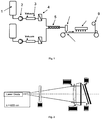
- FIG. 2 shows an apparatus for forming a hologram in a photopolymer film for exposure wavelengths of 633 nm (red).
- the function of the apparatus is described in the section "Preparation of reflection holograms in the photopolymer”.
- FIG. 3 shows by way of example with the apparatus of FIG. 2 generated hologram.
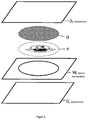
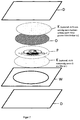
- FIG. 4 schematically a first inventive security document is shown.
- This comprises two cover layers (D), a white core layer (W), a photopolymer layer (P) and a transparent optically switchable layer (O).
- the two outer layers (D) are transparent.
- a hologram is imprinted in the photopolymer layer (P).
- the white core layer (K) is arranged, which has an oval recess.
- the photopolymer layer (P) and the optically switchable layer (O) are arranged.
- the layers are laminated together.
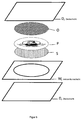
- FIG. 5 shows a further security document according to the invention. This differs deviating from the embodiment of FIG. 4 additionally a further transparent layer (K), which is arranged in the drawing below the photopolymer layer (P) in the recess of the white core layer (K).
- the layer (K) effects better adhesion between the photopolymer layer (P) and the lower cover layer (D).
- FIG. 6 an embodiment of a security document according to the invention is shown, in which additionally a substrate layer (S) is present. This is arranged in the drawing below the photopolymer layer (P) in the recess of the white core layer (K).
- FIG. 7 Finally, still another embodiment of a security document according to the invention is dar. This includes in addition to the embodiment of FIG. 5 yet another transparent layer (K), which is arranged in the drawing above the transparent optically switchable layer (O) in the recess of the white core layer.
- K transparent layer
- O transparent optically switchable layer
- Photopolymer film prepared as described below to produce holographic media on a film coater.
- Component D Fascat 4102 0.07%, urethanization catalyst, butyltin tris (2-ethylhexanoate), product of Arkema GmbH, Dusseldorf, Germany.
- Component E CI Basic Blue 3 (resalted as bis (2-ethylhexyl) sulfosuccinate) 0.26%, safranine O (resalted as bis (2-ethylhexyl) sulfosuccinate) 0.13%, and Astrazon Orange G (resalted as Bis - (2-ethylhexyl) sulfosuccinate) 0.13% with CGI 909 (test product of the Fa.BASF SE, Basel, Switzerland) 1.5%, dissolved as a solution in 5.8% ethyl acetate. Percentages refer to the overall formulation of the medium.
- Component F ethyl acetate (CAS No. 141-78-6).
- Component G Desmodur ® N 3900, a product of Bayer MaterialScience AG, Leverkusen, Germany, hexane diisocyanate-based polyisocyanate, proportion of iminooxadiazinedione at least 30%, NCO content: 23.5%.
- Carrier substrate Makrofol ® DE 1-1 CC 125 microns (Bayer MaterialScience AG, Leverkusen, Germany).
- the photopolymer formulation B (polyol) gradually 2,55g BYK ® offset 310 and 101g component F with a Schreibmonomermischung from 138g 138g C1 and C2, with 191g additive, 0.60 g of component D in a stirred vessel and mixed. Then, 66.5 g of Component E was added to the mixture in the dark and mixed to give a clear solution. If necessary, the formulation was heated at 60 ° C for a short time in order to dissolve the feeds more quickly. This mixture was introduced into one of the two reservoirs 1 of the coating system. In the second reservoir 1, the component A (polyisocyanate) was filled.
- Both components were then each conveyed through the metering devices 2 in the ratio of 942.2 to 57.8 to the vacuum degassing device 3 and degassed. From here they were then each passed through the filter 4 in the static mixer 5, in which the mixing of the components was carried out for photopolymer formulation. The resulting liquid mass was then fed to the coater 6 in the dark.
- the coating device 6 in the present case was a slot nozzle known to the person skilled in the art. Alternatively, however, a doctor blade system (Doctor Blade). be used. With the aid of the coating device 6, the photopolymer formulation was at a processing temperature of 20 ° C on a support substrate (Makrofol 1-1 DE, 125 microns) applied and dried for 5.8 minutes at a crosslinking temperature of 80 ° C in a convection dryer 7. In this case, a medium in the form of a film was obtained, which was then provided with a 40 micron thick polyethylene film as the cover layer 9 and wound up.
- a support substrate Mokrofol 1-1 DE, 125 microns
- the achieved layer thickness of the film was 18 ⁇ m.
- a hologram was imprinted into the holgraphic medium according to II. These were monochromatic holograms with 633 nm laser wavelength. For this purpose, pieces of the film were cut off in the dark, the laminating film removed and the films with the photopolymer side down on a glass of size 50 x 75 mm and 1 mm bubble-free laminated.
- the glasses used were Corning glasses from Schott AG, Mainz, Germany.
- the beam of a laser (emission wavelength 633 nm) is widened to a diameter of ⁇ 3 - 4 cm by means of an optional expansion lens (AF) and the collimation lens (CL) placed after the shutter S.
- the diameter of the expanded laser beam is determined by the aperture of the opened shutter. It is consciously paid attention to an inhomogeneous intensity distribution of the expanded laser beam.
- the edge intensity P R ⁇ is only half of the intensity Pz in the center of the expanded laser beam. P is to be understood here as performance / area.
- the expanded laser beam first passes through an obliquely inclined glass plate, which serves as a shearing plate (SP).
- the single mode can be achieved by adjusting the pumping current.
- the expanded beam passes through the approximately 15 ° inclined holographic medium (P), this part forms the reference beam, and then from the parallel to P object (O) to be reflected back into P. This part then forms the signal beam of the Denisyuk arrangement.
- O consists of a metal plate covered with white paper with the paper side facing P. On the paper is a square grid created by black lines. The edge length of a square is 0.5 cm. This raster is imaged by the holographic exposure of P in the hologram.
- the average exposure dose E ave is set by the opening time t of S. Therefore, at fixed laser power I , t represents the quantity proportional to E ave . Since the expanded laser beam has an inhomogeneous (bell-shaped) intensity distribution, the local dose E varies to produce the hologram in P. This, together with the skew of P and O, optical axis, that the written hologram has elliptical shape, as in Fig. 5 shown.
- the hologram can be easily reconstructed by illuminating with a point light source (eg flashlight or LED light).
- a point light source eg flashlight or LED light
- the hologram When viewing the finished laminate, a transparent window was visible in the area of the film piece from b), which was seamlessly connected to the rest of the laminate. Looking at the Window under normal room light, the hologram was very faintly visible. When lighting the window with a UV flashlight WF 501 B from Ultrafire the window darkens and the visibility of the hologram has been significantly improved. In the optically switched, darkened state, the hologram was seen only from the side from which it was directly facing the viewer, so when viewed through the film 1. From the other side with a direct view of the film 3, the hologram was not visible, noticeable. A few minutes after the UV irradiation, the photochromic effect lost its effect and the window was again transparent.
Landscapes
- Physics & Mathematics (AREA)
- General Physics & Mathematics (AREA)
- Engineering & Computer Science (AREA)
- Computer Security & Cryptography (AREA)
- Manufacturing & Machinery (AREA)
- General Chemical & Material Sciences (AREA)
- Chemical Kinetics & Catalysis (AREA)
- Chemical & Material Sciences (AREA)
- Business, Economics & Management (AREA)
- Accounting & Taxation (AREA)
- Finance (AREA)
- Laminated Bodies (AREA)
- Credit Cards Or The Like (AREA)
- Holo Graphy (AREA)
Priority Applications (1)
| Application Number | Priority Date | Filing Date | Title |
|---|---|---|---|
| EP13750059.1A EP2888116B1 (de) | 2012-08-23 | 2013-08-15 | Sicherheits- und/oder wertdokument enthaltend ein visuell schaltbares fenster mit einem hologramm |
Applications Claiming Priority (3)
| Application Number | Priority Date | Filing Date | Title |
|---|---|---|---|
| EP12181440 | 2012-08-23 | ||
| EP13750059.1A EP2888116B1 (de) | 2012-08-23 | 2013-08-15 | Sicherheits- und/oder wertdokument enthaltend ein visuell schaltbares fenster mit einem hologramm |
| PCT/EP2013/067075 WO2014029686A1 (de) | 2012-08-23 | 2013-08-15 | Sicherheits- und/oder wertdokument enthaltend ein visuell schaltbares fenster mit einem hologramm |
Publications (2)
| Publication Number | Publication Date |
|---|---|
| EP2888116A1 EP2888116A1 (de) | 2015-07-01 |
| EP2888116B1 true EP2888116B1 (de) | 2016-09-21 |
Family
ID=46939492
Family Applications (1)
| Application Number | Title | Priority Date | Filing Date |
|---|---|---|---|
| EP13750059.1A Active EP2888116B1 (de) | 2012-08-23 | 2013-08-15 | Sicherheits- und/oder wertdokument enthaltend ein visuell schaltbares fenster mit einem hologramm |
Country Status (8)
| Country | Link |
|---|---|
| US (1) | US9658595B2 (enExample) |
| EP (1) | EP2888116B1 (enExample) |
| JP (1) | JP6309953B2 (enExample) |
| KR (1) | KR102089118B1 (enExample) |
| CN (1) | CN104540685B (enExample) |
| RU (1) | RU2015109872A (enExample) |
| TW (1) | TW201427841A (enExample) |
| WO (1) | WO2014029686A1 (enExample) |
Families Citing this family (11)
| Publication number | Priority date | Publication date | Assignee | Title |
|---|---|---|---|---|
| EP2700510B1 (de) * | 2012-08-23 | 2015-09-16 | Bayer MaterialScience AG | Polycarbonatbasierte Sicherheits- und/oder Wertdokumente mit Hologramm im Kartenkörper |
| EP3063762B1 (de) * | 2013-10-30 | 2018-07-04 | Covestro Deutschland AG | Verbund umfassend ein substrat und einen photopolymerfilm |
| US11214689B2 (en) | 2016-06-27 | 2022-01-04 | Viavi Solutions Inc. | High chroma flakes |
| US12187900B2 (en) | 2016-06-27 | 2025-01-07 | Viavi Solutions Inc. | High chromaticity pigment flakes and foils |
| US10928579B2 (en) | 2016-06-27 | 2021-02-23 | Viavi Solutions Inc. | Optical devices |
| US20200122448A1 (en) * | 2017-05-22 | 2020-04-23 | Covestro Deutschland Ag | Films having a scratch-resistant coating as a cover layer and layered composites comprising such films |
| PL3421253T3 (pl) | 2017-06-28 | 2020-01-31 | Hid Global Rastede Gmbh | Okno termochromowe |
| US10668765B2 (en) * | 2018-05-07 | 2020-06-02 | Goldnote Corporation | Self-authenticating articles incorporating precious metals |
| DE102019104380A1 (de) * | 2019-02-21 | 2020-08-27 | Bundesdruckerei Gmbh | Verfahren zur Herstellung eines Wert- oder Sicherheitsdokumentes sowie Sicherheitsdokument mit einem Sicherheitshologramm |
| US20230013578A1 (en) * | 2019-11-11 | 2023-01-19 | Sony Group Corporation | Composition for hologram recording, hologram recording medium, hologram, and optical device and optical member using same |
| EP4477426A1 (en) * | 2023-06-12 | 2024-12-18 | Linxens Holding | Structure for a security document with photochromic features and method of forming same |
Family Cites Families (43)
| Publication number | Priority date | Publication date | Assignee | Title |
|---|---|---|---|---|
| BE673744A (enExample) | 1964-12-14 | |||
| DE1964834A1 (de) | 1969-12-24 | 1971-07-01 | Bayer Ag | Verfahren zur Herstellung von Polyurethan-Elastomeren |
| DE2853953A1 (de) * | 1978-12-14 | 1980-07-03 | Hoechst Ag | Identifikationskarte |
| JPS5790085A (en) * | 1980-11-27 | 1982-06-04 | Pilot Ink Co Ltd | Thermochromic material |
| JPS58200275A (ja) * | 1982-05-18 | 1983-11-21 | Dainippon Printing Co Ltd | パタ−ン状フレネルホログラムの製造方法 |
| EP0389067B1 (en) | 1985-11-20 | 1994-10-19 | The Mead Corporation | Ionic dye compounds |
| JPH03248189A (ja) * | 1990-02-26 | 1991-11-06 | Dainippon Printing Co Ltd | サーモクロミックホログラムシート |
| JPH03248188A (ja) * | 1990-02-26 | 1991-11-06 | Dainippon Printing Co Ltd | フォトクロミックホログラムシート |
| DE4236563A1 (de) * | 1992-10-29 | 1994-05-05 | Basf Magnetics Gmbh | Anti-Kopier-Film oder -Schicht |
| TW325477B (en) | 1992-12-23 | 1998-01-21 | Ciba Sc Holding Ag | Thermochromic compounds, their preparation and the use thereof |
| GB2274428B (en) * | 1993-01-20 | 1996-08-21 | Portals | Security threads |
| EP0608019A1 (en) | 1993-01-21 | 1994-07-27 | Akzo Nobel N.V. | Thermochromic infrared dyes |
| JP3440334B2 (ja) * | 1993-04-21 | 2003-08-25 | 大日本印刷株式会社 | 記録媒体、記録媒体の使用方法 |
| JPH0876674A (ja) * | 1994-08-31 | 1996-03-22 | Toppan Printing Co Ltd | ホログラム転写箔とホログラムラベル |
| EP0919961B1 (de) * | 1997-11-27 | 2003-06-11 | BUNDESDRUCKEREI GmbH | Sicherheitselement für Dokumente und Verfahren zu seiner Herstellung |
| US6482489B1 (en) * | 1998-10-20 | 2002-11-19 | Dai Nippon Printing Co., Ltd. | Hologram laminates |
| GB2347646B (en) * | 1999-03-12 | 2001-01-31 | Rue De Int Ltd | Improvements in security elements |
| EP1183645A1 (en) * | 1999-06-01 | 2002-03-06 | De La Rue International Limited | Security device |
| DE19941295A1 (de) * | 1999-08-31 | 2001-03-01 | Giesecke & Devrient Gmbh | Sicherheitselement |
| DE10013410B4 (de) * | 2000-03-17 | 2011-05-05 | Ovd Kinegram Ag | Laminat, insbesondere in Form von Karten, und Verfahren zu dessen Herstellung |
| DE10129939B4 (de) * | 2001-06-20 | 2006-06-22 | Ovd Kinegram Ag | Optisch variables Flächenmuster |
| ATE503789T1 (de) | 2002-06-28 | 2011-04-15 | Rhode Island Education | Thermochrome indikatormaterialien mit kontrollierter reversibilität |
| EP1645943B2 (en) * | 2003-07-14 | 2021-01-13 | Dai Nippon Printing Co., Ltd. | Forgery preventing label and method of manufacturing the same |
| EP1734417A4 (en) * | 2004-03-31 | 2009-05-27 | Pioneer Corp | HOLOGRAPHY REPRODUCTION AND HOLOGRAM PLAYER PROCESS |
| GB0412981D0 (en) | 2004-06-10 | 2004-07-14 | Rue De Int Ltd | Improvements in security devices |
| GB0425831D0 (en) * | 2004-11-24 | 2004-12-29 | Ver Tec Security Systems Ltd | Security holograms |
| WO2006131465A1 (en) | 2005-06-10 | 2006-12-14 | Ciba Specialty Chemicals Holding Inc. | Reversibly thermochromic compositions |
| ES2365358T3 (es) | 2006-01-30 | 2011-09-30 | Basf Se | Composiciones termocrómicas reversibles. |
| JP5204767B2 (ja) | 2006-06-23 | 2013-06-05 | チバ ホールディング インコーポレーテッド | 可逆熱変色性組成物 |
| US8740253B2 (en) * | 2006-09-15 | 2014-06-03 | Innovia Security Pty Ltd | Radiation curable embossed ink security devices for security documents |
| JP4985137B2 (ja) * | 2007-06-19 | 2012-07-25 | 大日本印刷株式会社 | 体積ホログラム転写箔、体積ホログラム積層体およびこれらの製造方法 |
| IL200997A0 (en) | 2008-10-01 | 2010-06-30 | Bayer Materialscience Ag | Special polyether-based polyurethane formulations for the production of holographic media |
| ES2381808T3 (es) * | 2009-11-03 | 2012-05-31 | Bayer Materialscience Ag | Formulaciones de fotopolímeros con módulo mecánico ajustable Guv |
| US20100194093A1 (en) * | 2009-12-23 | 2010-08-05 | Bank Of Canada | Security devices, their production and use |
| US20120286504A1 (en) * | 2010-01-19 | 2012-11-15 | Dai Nippon Printing Co., Ltd. | Volume hologram sheet to be embedded, forgery prevention paper, and card |
| EP2372454A1 (de) * | 2010-03-29 | 2011-10-05 | Bayer MaterialScience AG | Photopolymer-Formulierung zur Herstellung sichtbarer Hologramme |
| JP2011248014A (ja) * | 2010-05-25 | 2011-12-08 | Dainippon Printing Co Ltd | ホログラムシート |
| JP2012008313A (ja) | 2010-06-24 | 2012-01-12 | Dainippon Printing Co Ltd | ホログラムシート |
| JP5533333B2 (ja) | 2010-06-24 | 2014-06-25 | 大日本印刷株式会社 | ホログラムシート |
| JP2012022413A (ja) * | 2010-07-12 | 2012-02-02 | Canon Inc | 画像処理装置、画像処理方法、およびプログラム |
| DE102010031923A1 (de) * | 2010-07-22 | 2012-01-26 | Giesecke & Devrient Gmbh | Sicherheitsfaden für Datenträger sowie Datenträger und deren Herstellung |
| US9195215B2 (en) * | 2011-11-29 | 2015-11-24 | Bayer Intellectual Property Gmbh | Holographic medium having a protective layer |
| EP2613319A1 (de) * | 2012-01-05 | 2013-07-10 | Bayer MaterialScience AG | Schichtverbund aus einem Photopolymerfilm und einer Klebstoffschicht |
-
2013
- 2013-08-15 EP EP13750059.1A patent/EP2888116B1/de active Active
- 2013-08-15 CN CN201380044418.6A patent/CN104540685B/zh not_active Expired - Fee Related
- 2013-08-15 US US14/422,768 patent/US9658595B2/en active Active
- 2013-08-15 KR KR1020157003895A patent/KR102089118B1/ko not_active Expired - Fee Related
- 2013-08-15 WO PCT/EP2013/067075 patent/WO2014029686A1/de not_active Ceased
- 2013-08-15 RU RU2015109872A patent/RU2015109872A/ru unknown
- 2013-08-15 JP JP2015527865A patent/JP6309953B2/ja not_active Expired - Fee Related
- 2013-08-22 TW TW102130033A patent/TW201427841A/zh unknown
Also Published As
| Publication number | Publication date |
|---|---|
| KR102089118B1 (ko) | 2020-03-13 |
| WO2014029686A1 (de) | 2014-02-27 |
| EP2888116A1 (de) | 2015-07-01 |
| US20150220057A1 (en) | 2015-08-06 |
| RU2015109872A (ru) | 2016-10-10 |
| KR20150047487A (ko) | 2015-05-04 |
| CN104540685B (zh) | 2017-09-26 |
| JP6309953B2 (ja) | 2018-04-11 |
| US9658595B2 (en) | 2017-05-23 |
| JP2015531705A (ja) | 2015-11-05 |
| CN104540685A (zh) | 2015-04-22 |
| TW201427841A (zh) | 2014-07-16 |
Similar Documents
| Publication | Publication Date | Title |
|---|---|---|
| EP2888116B1 (de) | Sicherheits- und/oder wertdokument enthaltend ein visuell schaltbares fenster mit einem hologramm | |
| EP2700510B1 (de) | Polycarbonatbasierte Sicherheits- und/oder Wertdokumente mit Hologramm im Kartenkörper | |
| EP2531892B1 (de) | Verwendung einer photopolymer-formulierung mit triazin-basierten schreibmonomeren | |
| EP3230261B1 (de) | Naphthylacrylate als schreibmonomere für photopolymere | |
| EP2497080B1 (de) | Verfahren zur herstellung eines holographischen films | |
| EP2531889B1 (de) | Verwendung einer photopolymer-formulierung mit ester-basierten schreibmonomeren zur herstellung holographischer medien | |
| EP2372454A1 (de) | Photopolymer-Formulierung zur Herstellung sichtbarer Hologramme | |
| WO2011067057A1 (de) | Verfahren zur herstellung eines holographischen films | |
| EP2396359A1 (de) | Photopolymerzusammensetzungen als verdruckbare formulierungen | |
| EP3058423A1 (de) | Photopolymer-formulierung zur herstellung holographischer medien mit boraten mit niedriger tg | |
| EP2354845B1 (de) | Photopolymer-Formulierung zur Herstellung holographischer Medien | |
| EP3134446A1 (de) | Aromatische glykolether als schreibmonomere in holographischen photopolymer-formulierungen | |
| EP2772917A1 (de) | Schutzlacke auf Basis von strahlenvernetzbaren Polyurethandispersionen | |
| WO2014131795A1 (de) | Schutzlacke und klebstoffe auf acrylatbasis | |
| EP2766902A1 (de) | Schwefelhaltige kettenübertragungsreagenzien in polyurethan-basierten photopolymer-formulierungen | |
| EP2801867A1 (de) | Holografisches Aufzeichnungsmedium mit Anti-Halo-Schicht und Verfahren zu seiner Herstellung | |
| EP3175297B1 (de) | Schichtaufbau umfassend eine photopolymer- und eine substratschicht | |
| EP4483366A1 (de) | Photopolymerzusammensetzungen für thermostabile photopolymere im sichtbaren spektralbereich | |
| EP4483365A1 (de) | Thermostabile photopolymere im sichtbaren spektralbereich und photopolymer-zusammensetzungen damit | |
| WO2023156485A1 (de) | Triarylalkylboratsalze als coinitiatoren in nir-photopolymerzusammensetzungen |
Legal Events
| Date | Code | Title | Description |
|---|---|---|---|
| PUAI | Public reference made under article 153(3) epc to a published international application that has entered the european phase |
Free format text: ORIGINAL CODE: 0009012 |
|
| 17P | Request for examination filed |
Effective date: 20150323 |
|
| AK | Designated contracting states |
Kind code of ref document: A1 Designated state(s): AL AT BE BG CH CY CZ DE DK EE ES FI FR GB GR HR HU IE IS IT LI LT LU LV MC MK MT NL NO PL PT RO RS SE SI SK SM TR |
|
| AX | Request for extension of the european patent |
Extension state: BA ME |
|
| RAP1 | Party data changed (applicant data changed or rights of an application transferred) |
Owner name: COVESTRO DEUTSCHLAND AG |
|
| DAX | Request for extension of the european patent (deleted) | ||
| REG | Reference to a national code |
Ref country code: DE Ref legal event code: R079 Ref document number: 502013004692 Country of ref document: DE Free format text: PREVIOUS MAIN CLASS: B42D0015000000 Ipc: B42D0025290000 |
|
| RIC1 | Information provided on ipc code assigned before grant |
Ipc: B32B 37/18 20060101ALI20160129BHEP Ipc: B42D 25/29 20140101AFI20160129BHEP Ipc: B32B 38/04 20060101ALI20160129BHEP Ipc: B42D 25/42 20140101ALI20160129BHEP Ipc: G03H 1/02 20060101ALI20160129BHEP Ipc: B32B 37/14 20060101ALI20160129BHEP Ipc: B32B 38/00 20060101ALI20160129BHEP Ipc: G03H 1/00 20060101ALI20160129BHEP |
|
| RIC1 | Information provided on ipc code assigned before grant |
Ipc: B32B 37/14 20060101ALI20160218BHEP Ipc: G03H 1/00 20060101ALI20160218BHEP Ipc: B32B 37/18 20060101ALI20160218BHEP Ipc: B42D 25/328 20140101ALI20160218BHEP Ipc: B32B 38/00 20060101ALI20160218BHEP Ipc: G03H 1/02 20060101ALI20160218BHEP Ipc: G11B 7/24044 20130101ALI20160218BHEP Ipc: B42D 25/29 20140101AFI20160218BHEP Ipc: B42D 25/42 20140101ALI20160218BHEP Ipc: B32B 38/04 20060101ALI20160218BHEP |
|
| GRAP | Despatch of communication of intention to grant a patent |
Free format text: ORIGINAL CODE: EPIDOSNIGR1 |
|
| INTG | Intention to grant announced |
Effective date: 20160330 |
|
| GRAS | Grant fee paid |
Free format text: ORIGINAL CODE: EPIDOSNIGR3 |
|
| GRAA | (expected) grant |
Free format text: ORIGINAL CODE: 0009210 |
|
| AK | Designated contracting states |
Kind code of ref document: B1 Designated state(s): AL AT BE BG CH CY CZ DE DK EE ES FI FR GB GR HR HU IE IS IT LI LT LU LV MC MK MT NL NO PL PT RO RS SE SI SK SM TR |
|
| REG | Reference to a national code |
Ref country code: GB Ref legal event code: FG4D Free format text: NOT ENGLISH |
|
| REG | Reference to a national code |
Ref country code: CH Ref legal event code: EP |
|
| REG | Reference to a national code |
Ref country code: AT Ref legal event code: REF Ref document number: 830724 Country of ref document: AT Kind code of ref document: T Effective date: 20161015 |
|
| REG | Reference to a national code |
Ref country code: IE Ref legal event code: FG4D Free format text: LANGUAGE OF EP DOCUMENT: GERMAN |
|
| REG | Reference to a national code |
Ref country code: DE Ref legal event code: R096 Ref document number: 502013004692 Country of ref document: DE |
|
| REG | Reference to a national code |
Ref country code: LT Ref legal event code: MG4D Ref country code: NL Ref legal event code: MP Effective date: 20160921 |
|
| PG25 | Lapsed in a contracting state [announced via postgrant information from national office to epo] |
Ref country code: RS Free format text: LAPSE BECAUSE OF FAILURE TO SUBMIT A TRANSLATION OF THE DESCRIPTION OR TO PAY THE FEE WITHIN THE PRESCRIBED TIME-LIMIT Effective date: 20160921 Ref country code: NO Free format text: LAPSE BECAUSE OF FAILURE TO SUBMIT A TRANSLATION OF THE DESCRIPTION OR TO PAY THE FEE WITHIN THE PRESCRIBED TIME-LIMIT Effective date: 20161221 Ref country code: FI Free format text: LAPSE BECAUSE OF FAILURE TO SUBMIT A TRANSLATION OF THE DESCRIPTION OR TO PAY THE FEE WITHIN THE PRESCRIBED TIME-LIMIT Effective date: 20160921 Ref country code: LT Free format text: LAPSE BECAUSE OF FAILURE TO SUBMIT A TRANSLATION OF THE DESCRIPTION OR TO PAY THE FEE WITHIN THE PRESCRIBED TIME-LIMIT Effective date: 20160921 |
|
| PG25 | Lapsed in a contracting state [announced via postgrant information from national office to epo] |
Ref country code: NL Free format text: LAPSE BECAUSE OF FAILURE TO SUBMIT A TRANSLATION OF THE DESCRIPTION OR TO PAY THE FEE WITHIN THE PRESCRIBED TIME-LIMIT Effective date: 20160921 Ref country code: LV Free format text: LAPSE BECAUSE OF FAILURE TO SUBMIT A TRANSLATION OF THE DESCRIPTION OR TO PAY THE FEE WITHIN THE PRESCRIBED TIME-LIMIT Effective date: 20160921 Ref country code: GR Free format text: LAPSE BECAUSE OF FAILURE TO SUBMIT A TRANSLATION OF THE DESCRIPTION OR TO PAY THE FEE WITHIN THE PRESCRIBED TIME-LIMIT Effective date: 20161222 Ref country code: SE Free format text: LAPSE BECAUSE OF FAILURE TO SUBMIT A TRANSLATION OF THE DESCRIPTION OR TO PAY THE FEE WITHIN THE PRESCRIBED TIME-LIMIT Effective date: 20160921 |
|
| PG25 | Lapsed in a contracting state [announced via postgrant information from national office to epo] |
Ref country code: EE Free format text: LAPSE BECAUSE OF FAILURE TO SUBMIT A TRANSLATION OF THE DESCRIPTION OR TO PAY THE FEE WITHIN THE PRESCRIBED TIME-LIMIT Effective date: 20160921 Ref country code: RO Free format text: LAPSE BECAUSE OF FAILURE TO SUBMIT A TRANSLATION OF THE DESCRIPTION OR TO PAY THE FEE WITHIN THE PRESCRIBED TIME-LIMIT Effective date: 20160921 |
|
| PG25 | Lapsed in a contracting state [announced via postgrant information from national office to epo] |
Ref country code: PT Free format text: LAPSE BECAUSE OF FAILURE TO SUBMIT A TRANSLATION OF THE DESCRIPTION OR TO PAY THE FEE WITHIN THE PRESCRIBED TIME-LIMIT Effective date: 20170123 Ref country code: BG Free format text: LAPSE BECAUSE OF FAILURE TO SUBMIT A TRANSLATION OF THE DESCRIPTION OR TO PAY THE FEE WITHIN THE PRESCRIBED TIME-LIMIT Effective date: 20161221 Ref country code: PL Free format text: LAPSE BECAUSE OF FAILURE TO SUBMIT A TRANSLATION OF THE DESCRIPTION OR TO PAY THE FEE WITHIN THE PRESCRIBED TIME-LIMIT Effective date: 20160921 Ref country code: SM Free format text: LAPSE BECAUSE OF FAILURE TO SUBMIT A TRANSLATION OF THE DESCRIPTION OR TO PAY THE FEE WITHIN THE PRESCRIBED TIME-LIMIT Effective date: 20160921 Ref country code: SK Free format text: LAPSE BECAUSE OF FAILURE TO SUBMIT A TRANSLATION OF THE DESCRIPTION OR TO PAY THE FEE WITHIN THE PRESCRIBED TIME-LIMIT Effective date: 20160921 Ref country code: ES Free format text: LAPSE BECAUSE OF FAILURE TO SUBMIT A TRANSLATION OF THE DESCRIPTION OR TO PAY THE FEE WITHIN THE PRESCRIBED TIME-LIMIT Effective date: 20160921 Ref country code: CZ Free format text: LAPSE BECAUSE OF FAILURE TO SUBMIT A TRANSLATION OF THE DESCRIPTION OR TO PAY THE FEE WITHIN THE PRESCRIBED TIME-LIMIT Effective date: 20160921 Ref country code: IS Free format text: LAPSE BECAUSE OF FAILURE TO SUBMIT A TRANSLATION OF THE DESCRIPTION OR TO PAY THE FEE WITHIN THE PRESCRIBED TIME-LIMIT Effective date: 20170121 |
|
| REG | Reference to a national code |
Ref country code: DE Ref legal event code: R097 Ref document number: 502013004692 Country of ref document: DE |
|
| PG25 | Lapsed in a contracting state [announced via postgrant information from national office to epo] |
Ref country code: IT Free format text: LAPSE BECAUSE OF FAILURE TO SUBMIT A TRANSLATION OF THE DESCRIPTION OR TO PAY THE FEE WITHIN THE PRESCRIBED TIME-LIMIT Effective date: 20160921 |
|
| PLBE | No opposition filed within time limit |
Free format text: ORIGINAL CODE: 0009261 |
|
| REG | Reference to a national code |
Ref country code: FR Ref legal event code: PLFP Year of fee payment: 5 |
|
| STAA | Information on the status of an ep patent application or granted ep patent |
Free format text: STATUS: NO OPPOSITION FILED WITHIN TIME LIMIT |
|
| PG25 | Lapsed in a contracting state [announced via postgrant information from national office to epo] |
Ref country code: DK Free format text: LAPSE BECAUSE OF FAILURE TO SUBMIT A TRANSLATION OF THE DESCRIPTION OR TO PAY THE FEE WITHIN THE PRESCRIBED TIME-LIMIT Effective date: 20160921 |
|
| 26N | No opposition filed |
Effective date: 20170622 |
|
| PG25 | Lapsed in a contracting state [announced via postgrant information from national office to epo] |
Ref country code: SI Free format text: LAPSE BECAUSE OF FAILURE TO SUBMIT A TRANSLATION OF THE DESCRIPTION OR TO PAY THE FEE WITHIN THE PRESCRIBED TIME-LIMIT Effective date: 20160921 |
|
| PG25 | Lapsed in a contracting state [announced via postgrant information from national office to epo] |
Ref country code: MC Free format text: LAPSE BECAUSE OF FAILURE TO SUBMIT A TRANSLATION OF THE DESCRIPTION OR TO PAY THE FEE WITHIN THE PRESCRIBED TIME-LIMIT Effective date: 20160921 |
|
| REG | Reference to a national code |
Ref country code: IE Ref legal event code: MM4A |
|
| REG | Reference to a national code |
Ref country code: BE Ref legal event code: MM Effective date: 20170831 |
|
| PG25 | Lapsed in a contracting state [announced via postgrant information from national office to epo] |
Ref country code: LU Free format text: LAPSE BECAUSE OF NON-PAYMENT OF DUE FEES Effective date: 20170815 |
|
| REG | Reference to a national code |
Ref country code: FR Ref legal event code: PLFP Year of fee payment: 6 |
|
| PG25 | Lapsed in a contracting state [announced via postgrant information from national office to epo] |
Ref country code: IE Free format text: LAPSE BECAUSE OF NON-PAYMENT OF DUE FEES Effective date: 20170815 |
|
| PG25 | Lapsed in a contracting state [announced via postgrant information from national office to epo] |
Ref country code: BE Free format text: LAPSE BECAUSE OF NON-PAYMENT OF DUE FEES Effective date: 20170831 |
|
| PG25 | Lapsed in a contracting state [announced via postgrant information from national office to epo] |
Ref country code: MT Free format text: LAPSE BECAUSE OF FAILURE TO SUBMIT A TRANSLATION OF THE DESCRIPTION OR TO PAY THE FEE WITHIN THE PRESCRIBED TIME-LIMIT Effective date: 20160921 |
|
| PG25 | Lapsed in a contracting state [announced via postgrant information from national office to epo] |
Ref country code: AL Free format text: LAPSE BECAUSE OF FAILURE TO SUBMIT A TRANSLATION OF THE DESCRIPTION OR TO PAY THE FEE WITHIN THE PRESCRIBED TIME-LIMIT Effective date: 20160921 |
|
| PG25 | Lapsed in a contracting state [announced via postgrant information from national office to epo] |
Ref country code: HU Free format text: LAPSE BECAUSE OF FAILURE TO SUBMIT A TRANSLATION OF THE DESCRIPTION OR TO PAY THE FEE WITHIN THE PRESCRIBED TIME-LIMIT; INVALID AB INITIO Effective date: 20130815 |
|
| REG | Reference to a national code |
Ref country code: AT Ref legal event code: MM01 Ref document number: 830724 Country of ref document: AT Kind code of ref document: T Effective date: 20180815 |
|
| PG25 | Lapsed in a contracting state [announced via postgrant information from national office to epo] |
Ref country code: CY Free format text: LAPSE BECAUSE OF FAILURE TO SUBMIT A TRANSLATION OF THE DESCRIPTION OR TO PAY THE FEE WITHIN THE PRESCRIBED TIME-LIMIT Effective date: 20160921 |
|
| PG25 | Lapsed in a contracting state [announced via postgrant information from national office to epo] |
Ref country code: MK Free format text: LAPSE BECAUSE OF FAILURE TO SUBMIT A TRANSLATION OF THE DESCRIPTION OR TO PAY THE FEE WITHIN THE PRESCRIBED TIME-LIMIT Effective date: 20160921 |
|
| PG25 | Lapsed in a contracting state [announced via postgrant information from national office to epo] |
Ref country code: AT Free format text: LAPSE BECAUSE OF NON-PAYMENT OF DUE FEES Effective date: 20180815 |
|
| PGFP | Annual fee paid to national office [announced via postgrant information from national office to epo] |
Ref country code: GB Payment date: 20190816 Year of fee payment: 7 |
|
| PGFP | Annual fee paid to national office [announced via postgrant information from national office to epo] |
Ref country code: CH Payment date: 20190819 Year of fee payment: 7 |
|
| PG25 | Lapsed in a contracting state [announced via postgrant information from national office to epo] |
Ref country code: TR Free format text: LAPSE BECAUSE OF FAILURE TO SUBMIT A TRANSLATION OF THE DESCRIPTION OR TO PAY THE FEE WITHIN THE PRESCRIBED TIME-LIMIT Effective date: 20160921 |
|
| PG25 | Lapsed in a contracting state [announced via postgrant information from national office to epo] |
Ref country code: HR Free format text: LAPSE BECAUSE OF FAILURE TO SUBMIT A TRANSLATION OF THE DESCRIPTION OR TO PAY THE FEE WITHIN THE PRESCRIBED TIME-LIMIT Effective date: 20160921 |
|
| REG | Reference to a national code |
Ref country code: CH Ref legal event code: PL |
|
| GBPC | Gb: european patent ceased through non-payment of renewal fee |
Effective date: 20200815 |
|
| PG25 | Lapsed in a contracting state [announced via postgrant information from national office to epo] |
Ref country code: CH Free format text: LAPSE BECAUSE OF NON-PAYMENT OF DUE FEES Effective date: 20200831 Ref country code: LI Free format text: LAPSE BECAUSE OF NON-PAYMENT OF DUE FEES Effective date: 20200831 |
|
| PG25 | Lapsed in a contracting state [announced via postgrant information from national office to epo] |
Ref country code: GB Free format text: LAPSE BECAUSE OF NON-PAYMENT OF DUE FEES Effective date: 20200815 |
|
| PGFP | Annual fee paid to national office [announced via postgrant information from national office to epo] |
Ref country code: FR Payment date: 20220721 Year of fee payment: 10 |
|
| PG25 | Lapsed in a contracting state [announced via postgrant information from national office to epo] |
Ref country code: FR Free format text: LAPSE BECAUSE OF NON-PAYMENT OF DUE FEES Effective date: 20230831 |
|
| PGFP | Annual fee paid to national office [announced via postgrant information from national office to epo] |
Ref country code: DE Payment date: 20250722 Year of fee payment: 13 |