EP2882452B1 - Verfahren zur verminderung der viskosität hochkonzentrierter proteinlösungen - Google Patents
Verfahren zur verminderung der viskosität hochkonzentrierter proteinlösungen Download PDFInfo
- Publication number
- EP2882452B1 EP2882452B1 EP13747842.6A EP13747842A EP2882452B1 EP 2882452 B1 EP2882452 B1 EP 2882452B1 EP 13747842 A EP13747842 A EP 13747842A EP 2882452 B1 EP2882452 B1 EP 2882452B1
- Authority
- EP
- European Patent Office
- Prior art keywords
- carbon atoms
- compound
- chain
- group
- formula
- Prior art date
- Legal status (The legal status is an assumption and is not a legal conclusion. Google has not performed a legal analysis and makes no representation as to the accuracy of the status listed.)
- Active
Links
- 0 CC1C(C2)C2(C2)*2C*1 Chemical compound CC1C(C2)C2(C2)*2C*1 0.000 description 3
Classifications
-
- A—HUMAN NECESSITIES
- A61—MEDICAL OR VETERINARY SCIENCE; HYGIENE
- A61K—PREPARATIONS FOR MEDICAL, DENTAL OR TOILETRY PURPOSES
- A61K47/00—Medicinal preparations characterised by the non-active ingredients used, e.g. carriers or inert additives; Targeting or modifying agents chemically bound to the active ingredient
- A61K47/06—Organic compounds, e.g. natural or synthetic hydrocarbons, polyolefins, mineral oil, petrolatum or ozokerite
- A61K47/16—Organic compounds, e.g. natural or synthetic hydrocarbons, polyolefins, mineral oil, petrolatum or ozokerite containing nitrogen, e.g. nitro-, nitroso-, azo-compounds, nitriles, cyanates
- A61K47/18—Amines; Amides; Ureas; Quaternary ammonium compounds; Amino acids; Oligopeptides having up to five amino acids
- A61K47/186—Quaternary ammonium compounds, e.g. benzalkonium chloride or cetrimide
-
- A—HUMAN NECESSITIES
- A61—MEDICAL OR VETERINARY SCIENCE; HYGIENE
- A61K—PREPARATIONS FOR MEDICAL, DENTAL OR TOILETRY PURPOSES
- A61K39/00—Medicinal preparations containing antigens or antibodies
- A61K39/395—Antibodies; Immunoglobulins; Immune serum, e.g. antilymphocytic serum
-
- A—HUMAN NECESSITIES
- A61—MEDICAL OR VETERINARY SCIENCE; HYGIENE
- A61K—PREPARATIONS FOR MEDICAL, DENTAL OR TOILETRY PURPOSES
- A61K39/00—Medicinal preparations containing antigens or antibodies
- A61K39/395—Antibodies; Immunoglobulins; Immune serum, e.g. antilymphocytic serum
- A61K39/39591—Stabilisation, fragmentation
-
- A—HUMAN NECESSITIES
- A61—MEDICAL OR VETERINARY SCIENCE; HYGIENE
- A61K—PREPARATIONS FOR MEDICAL, DENTAL OR TOILETRY PURPOSES
- A61K47/00—Medicinal preparations characterised by the non-active ingredients used, e.g. carriers or inert additives; Targeting or modifying agents chemically bound to the active ingredient
- A61K47/06—Organic compounds, e.g. natural or synthetic hydrocarbons, polyolefins, mineral oil, petrolatum or ozokerite
- A61K47/16—Organic compounds, e.g. natural or synthetic hydrocarbons, polyolefins, mineral oil, petrolatum or ozokerite containing nitrogen, e.g. nitro-, nitroso-, azo-compounds, nitriles, cyanates
- A61K47/18—Amines; Amides; Ureas; Quaternary ammonium compounds; Amino acids; Oligopeptides having up to five amino acids
-
- C—CHEMISTRY; METALLURGY
- C07—ORGANIC CHEMISTRY
- C07K—PEPTIDES
- C07K16/00—Immunoglobulins [IG], e.g. monoclonal or polyclonal antibodies
- C07K16/18—Immunoglobulins [IG], e.g. monoclonal or polyclonal antibodies against material from animals or humans
- C07K16/22—Immunoglobulins [IG], e.g. monoclonal or polyclonal antibodies against material from animals or humans against growth factors ; against growth regulators
-
- C—CHEMISTRY; METALLURGY
- C07—ORGANIC CHEMISTRY
- C07K—PEPTIDES
- C07K16/00—Immunoglobulins [IG], e.g. monoclonal or polyclonal antibodies
- C07K16/18—Immunoglobulins [IG], e.g. monoclonal or polyclonal antibodies against material from animals or humans
- C07K16/24—Immunoglobulins [IG], e.g. monoclonal or polyclonal antibodies against material from animals or humans against cytokines, lymphokines or interferons
- C07K16/241—Tumor Necrosis Factors
-
- C—CHEMISTRY; METALLURGY
- C07—ORGANIC CHEMISTRY
- C07K—PEPTIDES
- C07K16/00—Immunoglobulins [IG], e.g. monoclonal or polyclonal antibodies
- C07K16/18—Immunoglobulins [IG], e.g. monoclonal or polyclonal antibodies against material from animals or humans
- C07K16/28—Immunoglobulins [IG], e.g. monoclonal or polyclonal antibodies against material from animals or humans against receptors, cell surface antigens or cell surface determinants
- C07K16/2887—Immunoglobulins [IG], e.g. monoclonal or polyclonal antibodies against material from animals or humans against receptors, cell surface antigens or cell surface determinants against CD20
-
- A—HUMAN NECESSITIES
- A61—MEDICAL OR VETERINARY SCIENCE; HYGIENE
- A61K—PREPARATIONS FOR MEDICAL, DENTAL OR TOILETRY PURPOSES
- A61K9/00—Medicinal preparations characterised by special physical form
- A61K9/0012—Galenical forms characterised by the site of application
- A61K9/0019—Injectable compositions; Intramuscular, intravenous, arterial, subcutaneous administration; Compositions to be administered through the skin in an invasive manner
Definitions
- the invention relates to a method comprising the use of viscosity reducing compounds (hereinafter referred to as RV) for lowering the viscosity of solutions comprising at least one protein comprising at least one antibody fragment.
- RV viscosity reducing compounds
- Monoclonal antibodies are a class of therapeutic proteins that are rapidly expanding to treat serious diseases such as certain cancers, infectious diseases and autoimmune diseases. To date, more than 20 mAbs have been approved by the FDA, and about 20% of the therapeutic proteins currently in development are antibodies.
- the antibodies can be administered parenterally such as intravenous (IV), subcutaneous (SC) or intramuscular (IM) injection.
- IV intravenous
- SC subcutaneous
- IM intramuscular
- the SC and IM pathways reduce the cost of treatment and improve patient comfort.
- the small volume that can be injected (0.5-2 mL) requires the development of concentrated antibody formulations since the doses required are typically from 100 mg to 1 g to achieve a therapeutic effect.
- concentrations above 100 mg / mL mAbs solutions are often unstable and viscous making the manufacturing steps (purification, concentration and distribution steps) difficult as described in the publication of Shire, Current Opinion in Biotechnology 2009, 20, 708-714 .
- the viscosity of the formulations causes injectability problems and renders the administrations painful for the patient as described in the publication of Cilurzo et al., AAPS PharmSciTech, 2011, 12 (2), 604-9 .
- Amino acids US Patent 7,666,413
- amino acid derivatives patent application WO2011 / 139718
- the arginine hydrochloride salt a compound commonly used in protein purification and formulation processes, see for example the publication of Frokjaer S., Nat Rev Drug Discov 2005, 4 (4), 298-306 , can be considered as one of the references to appreciate the lowering of viscosity.
- the arginine hydrochloride salt is commonly used at a concentration of the order of 200 mM as reported in the patent. US 7,666,413 or the publication of Galush & al., J Pharm Sci 2012, 101 (3), 1012-20 .
- Patent applications WO2012 / 138958 and WO2012 / 141978 describe a method for reducing the viscosity of a formulation containing a therapeutic polypeptide and citrate ( WO2012 / 138958 ) or acetate ( WO2012 / 141978 ), the method of adding to said formulation one or more amino acids.
- these applications are especially exempted the uses of phenylalanine and tyrosine to lower the viscosity of anti-IL5 or anti-ELR antibody solutions.
- tyrosine 0.004% w / v is 0.2 mM
- the patent application WO2013 / 063510 discloses a pharmaceutically stable formulation comprising one or more amino acids for stabilizing a protein of the formulation, and one or more amino acids for reducing the viscosity of the formulation.
- phenylalanine (0.2% or 12 mM) on the contrary increases the viscosity of a 300 mg / mL trastuzumab formulation (+ 83% increase).
- the Applicant has identified compounds bearing a phenyl group and an ammonium group which are capable of remarkably reducing the viscosity of hardly injectable solutions of at least one protein comprising at least one antibody fragment.
- hard-to-inject solution of at least one protein comprising at least one antibody fragment means a solution of at least one protein comprising at least one antibody fragment whose viscosity is at least 15 cP. It is generally accepted that such a solution whose viscosity is at least 15 cP is difficult to inject subcutaneously using a needle of a caliber of at least 29 g. The applicant has retained as limits the caliber by at least 29 G because it is the highest acceptable caliber so that the comfort of injection is not too degraded.
- protein comprising at least one antibody fragment means a protein chosen from monoclonal antibodies (mAbs), polyclonal antibodies, fusion proteins, nanobodies, bispecific antibodies and antibodies coupled to cytotoxic active principles ( ADC).
- mAbs monoclonal antibodies
- ADC cytotoxic active principles
- monoclonal antibody means a "complete antibody”, an “antibody fragment” or an “antibody derivative” which has an identical and unique specificity ie that recognizes only one type of epitope on an antigen given.
- an antibody may also be called immunoglobulin.
- complete antibody an antibody composed of two identical heavy chains (“CH”) and two identical light chains (“CL”) which are linked by a disulfide bridge.
- CH heavy chains
- CL light chains
- Each chain consists, in the N-terminal position, of a variable region (or domain) (encoded by the VJ rearranged genes for the light chains and VDJ for the heavy chains) specific for the antigen against which the antibody is directed.
- a constant region consisting of a single CL domain for light chains or several domains for heavy chains.
- Each variable region comprises three segments called “complementarity determining regions"("CDRs") or “hypervariable regions", which are primarily responsible for binding to the epitope of an antigen.
- the two heavy chains (H, Heavy) and the two light chains (L, Light) are identical to each other.
- the light chain is composed of 2 domains, a variable domain V and a constant domain C, folded independently of each other in space. They are called VL and CL.
- the heavy chain also comprises a V domain denoted VH and 3 or 4 C domains denoted from CH 1 to CH 4 . Each domain comprises about 110 amino acids and is structurally comparable.
- the 2 heavy chains are linked by disulfide bridges and each heavy chain is linked to a light chain by a disulfide bridge as well.
- variable parts The region that determines the specificity of the antibody for the antigen is carried by the variable parts, whereas the constant parts can interact with the Fc receptors of the effector cells or molecules as complement to mediate different functional properties.
- VH refers to the variable regions of an immunoglobulin heavy chain of an antibody, including the heavy chains of an Fv, scFv, dsFv, Fab, Fab 'or F (ab)' fragment.
- VL refers to the variable regions of an immunoglobulin light chain of an antibody, including the light chains of an Fv, scFv, dsFv, Fab, Fab 'or F (ab)' fragment.
- CDR or CDR regions is meant the hypervariable regions of immunoglobulin heavy and light chains as defined by Kabat et al. ( Kabat et al., Sequences of the proteins of immunological interest, 5th ed., US Department of Health and Human Services, NIH, 1991, and later editions, XV ). There are 3 heavy chain CDRs and 3 light chain CDRs. The term CDR or CDRs is used herein to designate, as appropriate, one or more of these regions, or all, of these regions which contain the majority of the amino acid residues responsible for the affine binding of the antibody. for the antigen or epitope that it recognizes. The most conserved regions of the variable domains are called regions or FR sequences for "framework" or "framework” regions of 4 (FR 1 to FR4).
- the antibodies are subdivided into 5 classes or isotypes: IgG, IgA, IgM, IgE and IgD according to the structure of the constant domains of the heavy chains, i.e. respectively chains ⁇ , ⁇ , ⁇ , ⁇ and ⁇ .
- the classes of IgG and IgA are further subdivided according to the size of the hinge regions as well as the number and position of disulfide bridges between heavy chains.
- IgG The class of IgG is subdivided into 4 subclasses ie IgG1, IgG2, IgG3 and IgG4.
- IgA The class of IgA is subdivided into 2 subclasses i.e. IgA1 and IgA2.
- the protein comprising at least one antibody fragment is a monoclonal antibody.
- the monoclonal antibody is an IgG.
- the monoclonal antibody is an IgA.
- the monoclonal antibody is an IgM.
- the monoclonal antibody is IgE.
- the monoclonal antibody is an IgD.
- the monoclonal antibody is IgG1.
- the monoclonal antibody is IgG2.
- the monoclonal antibody is IgG3.
- the monoclonal antibody is IgG4.
- the monoclonal antibody is an IgA1.
- the monoclonal antibody is IgA2.
- antibody fragment any functional fragment of antibodies eg Fab (Fragment antigen binding), Fv, scFv (single chain Fv), Fc (Fragment crystallizable), F (ab ') 2, Fab', scFv- Fc, synthetic polypeptides containing the sequences of one or CDRs, which generally have the same binding specificity as the antibody from which they originate.
- antibody fragments of the invention can be obtained from antibodies by methods such as digestion with enzymes, such as pepsin or papain and / or by cleavage of the disulfide bridges by chemical reduction.
- enzymes such as pepsin or papain and / or by cleavage of the disulfide bridges by chemical reduction.
- the enzymatic digestion of the antibodies by papain generates 2 identical fragments, which we call "fragment Fab (Fragment Antigen Binding), and an Fc fragment (crystallizable fragment).
- the Fc fragment is the support for the effector functions of immunoglobulins.
- pepsin digestion an F (ab ') 2 fragment is generated, where the two Fab fragments remain linked by two disulfide bridges, and the Fc fragment is split into several peptides. .
- the F (ab ') 2 fragment is formed of two Fab' fragments, linked by interchain disulfide bridges to form an F (ab ') 2.
- the "monoclonal antibody” according to the invention may advantageously contain one or more of these fragments, all combinations between the aforementioned fragments are part of the invention.
- antibody derivative any antibody, this antibody possibly comprising one or more mutations, substitutions, deletions and / or additions of one or more amino acid residues. Such an addition, substitution or deletion may be located at any position in the molecule. In the case where several amino acids have been added, substituted or deleted, any combination of addition, substitution or deletion can be considered, provided that the resulting antibody always has at least the advantageous properties of the antibody of the invention. 'invention.
- the "monoclonal antibody” may advantageously be a “chimeric antibody” or a “humanized antibody”.
- chimeric antibody is meant an antibody whose light and heavy chain variable regions, or at least one domain or fragment thereof, belong to a species different from the constant regions of the light and heavy chains.
- humanized antibody is meant an antibody that contains mainly human immunoglobulin sequences. This term generally refers to a non-human immunoglobulin that has been modified by incorporation of human sequences or residues found in human sequences.
- the antibodies according to the invention may be constituted using standard techniques of recombinant DNA, which are well known to those skilled in the art, for example using the "chimeric" antibody construction techniques described for example in Morrison et al., Proc. Natl. Acad. Sci. USA, 1984, 81 (21) 6851-55 , where the recombinant DNA technology is used to replace the constant region of a heavy chain and / or the constant region of a light chain of an antibody from a non-human mammal with the corresponding regions of a human immunoglobulin.
- Such antibodies and their method of preparation have also been described in the patent application.
- muromonab-CD3 (marketed under the name ORTHOCLONE OKT3 ®), abciximab (marketed as ReoPro ®), rituximab (sold under the names MabThera ® and Rituxan ® ), basiliximab (marketed under the name Simulect ® ), daclizumab (marketed as Zenapax ® ), palivizumab (marketed as Synagis ® ), infliximab (marketed as Remicade ®), trastuzumab (marketed as Herceptin ®), alemtuzumab (marketed under the names of MabCampath ®, Campath-1H ®), adalimumab (marketed as Humira ® ), tositumomab-I131 (marketed under the name Bexxar ®), efalizumab (available under the tradename Raptiva ®),
- polyclonal antibody is meant a mixture of “complete antibodies”, a mixture of “antibody fragments” or a mixture of “antibody derivatives” recognizing different types of epitopes on a given antigen.
- the protein comprising at least one antibody fragment is a polyclonal antibody.
- fusion proteins means a construct that contains several proteins or polypeptides of different origin. This fusion protein is encoded by a nucleic acid obtained by recombinant DNA technologies well known to those skilled in the art. According to the present invention, the fusion protein consists of a fragment of "monoclonal antibody" as previously described and a fragment of a "protein of interest”.
- the protein comprising at least one antibody fragment is a fusion protein.
- fusion protein constituted by a monoclonal antibody fragment which is the Fc region of an IgG1 immunoglobulin and a fragment of a protein of interest which is the extracellular domain of the protein receptor.
- CTLA-4 Cytotoxic T-Lymphocyte Antigen 4
- this fusion protein ie abatacept, being marketed under the name of Orencia ® .
- fusion protein consisting of a monoclonal antibody fragment which is the Fc region of an IgG1 and a fragment of a protein of interest which is the P75 fraction of the soluble TNF-receptor. alpha, this etanercept fusion protein being marketed under the name Enbrel ® .
- fusion protein consisting of a monoclonal antibody fragment which is the Fc region of an IgG1 and a fragment of a protein of interest which are the extracellular portions of IL-1R1.
- IL-1R1 interleukin-1 receptor component
- IL-1RAcP IL-1 receptor accessory protein
- fusion protein consisting of a monoclonal antibody fragment which are the IgG1 hinge, C (H) 2 and C (H) 3 domain regions, and a fragment of a protein of interest. which is the extracellular domain of LFA-3, this amevive fusion protein being marketed under the name of Alefacept®.
- Nanobody any single variable domain of immunoglobulin heavy chains. Nanobodies are more widely described in the publication C. Vincke and S. Muyldermans, in D. Saerens and S. Muyldermans (eds.) Single Domain Antibodies: Methods and Protocols, Methods in Molecular Biology, vol. 911, Springer Science + Business Media, LLC 2012, 15-26 ; and, Wesolowski et al., Med Microbiol Immunol (2009), 198 (3), 157-174 .
- the protein comprising at least one antibody fragment is a nanobody.
- bispecific antibody also called “bifunctional antibody” or “diabody” any immunoglobulin fragment comprising 2 sites antigen presentation.
- bifunctional antibodies are more widely described in the publication Hollinger et al., Proc. Natl. Acad. Sci. USA 90 (4): 6444-6448 (1993) ).
- the protein comprising at least one antibody fragment is a bispecific antibody.
- antibody coupled to a cytotoxic active ingredient means a "monoclonal antibody” as previously described coupled to a cytotoxic active principle.
- cytotoxic active principles include ozogamicin and vedotin.
- the protein comprising at least one antibody fragment is an antibody coupled to a cytotoxic active principle.
- the antibody coupled to a cytotoxic active ingredient is the brentuximab antibody coupled to the cytotoxic active ingredient vedotin.
- This antibody coupled to this cytotoxic active ingredient is marketed under the name of Adcetris ® .
- the invention also relates to the use of a compound of formula I at a concentration in the final formulation of between 10 and 250 mM in order to lower the viscosity of a solution which is difficult to inject with at least one protein comprising at least one antibody fragment whose concentration is between 50 and 350 mg / ml and whose pH is between 5 and 8, a value of at least 15% relative to the viscosity of a solution of at least one protein comprising at least one antibody fragment of the same concentration and of the same pH that does not contain said compound.
- the invention also relates to the use of a compound of formula I at a concentration in the final formulation of between 10 and 250 mM in order to lower the viscosity of a solution which is difficult to inject with at least one protein comprising at least one antibody fragment whose concentration is between 50 and 350 mg / ml and whose pH is between 5 and 8, a value of between 15 and 95% relative to the viscosity of a solution of at least one protein comprising at least one antibody fragment of the same concentration and of the same pH not containing said compound.
- the invention also relates to the use of a compound of formula I at a concentration in the final formulation of between 100 and 200 mM for lowering the viscosity of a solution that is difficult to inject with at least one protein comprising at least one antibody fragment whose concentration is between 50 and 350 mg / mL and whose pH is between 5 and 8, a value of at least 15% relative to the viscosity of a solution of at least one protein comprising at least one antibody fragment of the same concentration and the same pH not containing said compound.
- the invention also relates to the use of a compound of formula I at a concentration in the final formulation of between 100 and 200 mM for lowering the viscosity of a solution that is difficult to inject with at least one protein comprising at least one antibody fragment whose concentration is between 50 and 350 mg / ml and whose pH is between 5 and 8, a value of between 15 and 95% relative to the viscosity of a solution of at least one protein comprising at least one antibody fragment of the same concentration and of the same pH not containing said compound.
- It also relates to the method of lowering the viscosity of preparing a solution comprising a compound of formula I and a protein comprising at least one antibody fragment whose concentration is between 50 and 350 mg / ml and whose pH is between 5 and 8.
- the method according to the invention is characterized in that a solution comprising a compound of formula I and a protein comprising at least one antibody fragment whose concentration is between 50 and 350 mg is prepared. / ml and whose pH is between 5 and 8 to lower the viscosity of this solution by at least 15% relative to the viscosity of a solution of at least one protein comprising at least one fragment of antibodies of the same concentration and of the same pH not containing said compound.
- the method according to the invention is characterized in that a solution comprising a compound of formula I and a protein comprising at least one antibody fragment whose concentration is between 50 and 350 mg is prepared. / ml and whose pH is between 5 and 8 to lower the viscosity of this solution by a value of between 15 and 95% relative to the viscosity of a solution of at least one protein comprising at least one fragment of antibodies of the same concentration and of the same pH not containing said compound.
- the process according to the invention is characterized in that the final solution has a concentration of compound of formula I of between 10 and 250 mM.
- the process according to the invention is characterized in that the final solution has a concentration of compound of formula I of between 100 and 200 mM.
- G is a phenyl group.
- G is a phenyl group substituted with one or more hydroxyl groups.
- R 4 and R 6 which are identical or different, are either a hydrogen atom or a chain comprising 1 to 6 carbon atoms, said chain possibly comprising one or more functions chosen from the group consisting of the functions hydroxyl, amide or ester.
- R 5 and R 7 which are identical or different, are either a hydrogen atom or a chain comprising 1 to 6 carbon atoms, said chain possibly comprising one or more functions chosen from the group consisting of the functions hydroxyl, amide or ester.
- At least one R 4, R 5, R 6 or R 7 is not a hydrogen atom and includes an amine-N-oxide function.
- At least one R 4 , R 5 , R 6 or R 7 group is not a hydrogen atom and includes an amine-N-oxide function and an amide function.
- the amine-N-oxide functions are salified, for example in the form of the hydrochloride salt:
- the pH is between 5 and 6.5.
- the pH is between 5.5 and 6.5.
- the pH is between 6 and 8.
- the pH is between 6 and 7.5.
- the pH is between 6 and 7.
- a concentration expressed in M is a mol / L concentration.
- a concentration expressed in mM is a concentration in mmol / L.
- the concentration of the compound of formula I in the final formulation is between 10 and 200 mM.
- the concentration of the compound of formula I in the final formulation is between 25 and 200 mM.
- the concentration of the compound of formula I in the final formulation is between 50 and 200 mM.
- the concentration of the compound of formula I in the final formulation is between 50 and 175 mM.
- the concentration of the compound of formula I in the final formulation is between 100 and 250 mM.
- the concentration of the compound of formula I in the final formulation is between 100 and 200 mM.
- the concentration of the compound of formula I in the final formulation is between 100 and 175 mM.
- the concentration of protein comprising at least one antibody fragment in the final formulation is between 100 and 350 mg / ml.
- the protein concentration comprising at least one antibody fragment in the final formulation is between 100 and 300 mg / mL.
- the concentration of protein comprising at least one antibody fragment in the final formulation is between 100 and 250 mg / mL.
- the concentration of protein comprising at least one antibody fragment in the final formulation is between 150 and 300 mg / ml.
- the concentration of protein comprising at least one antibody fragment in the final formulation is between 150 and 250 mg / mL.
- the viscosity is lowered by at least 15%.
- the viscosity is lowered by between 15 and 95%.
- the viscosity is lowered by between 15 and 90%.
- the viscosity is lowered by between 20 and 80%.
- the viscosity is lowered by a value between 30 and 70%.
- the viscosity is lowered by between 35 and 65%.
- the viscosity is lowered by a value between 30 and 65%.
- the viscosity is lowered by between 25 and 65%.
- the viscosity is lowered by a value between 20 and 65%.
- the compound of formula I is selected from compounds wherein the X - anion is a carboxylate selected from the group consisting of acetates, succinates or citrates.
- the compound of formula I is selected from compounds whose anion X - is selected from the group of halides.
- the compound of formula I is selected from the compounds of which the anion X - is a hydrochloride.
- the compound is chosen from the compounds of formula I in which the groups R 1 , R 2 and R 3 , which are identical or different, are not a hydrogen atom.
- the groups R 1 , R 2 and R 3 which are identical or different, are chosen from the group consisting of the hydrogen atom, methyl, ethyl, propyl and n- butyl, sec- butyl, isobutyl, 2-hydroxyethyl, 3-hydroxypropyl, 4-hydroxybutyl and 1-methoxypropyl.
- G is a phenyl group.
- G is a phenyl group substituted with one or more hydroxyl groups.
- R 4 is either a hydrogen atom or a chain comprising 1 to 6 carbon atoms, said chain may comprise one or more functions selected from the group consisting of hydroxyl, amide or ester functions.
- R 4 is a chain comprising 1 to 6 carbon atoms, said chain may comprise one or more functions selected from the group consisting of hydroxyl, amide or ester functions.
- R 4 is not a hydrogen atom and includes an amine-N-oxide function.
- R 4 is not a hydrogen atom and includes an amine-N-oxide function and an amide function.
- G is a phenyl group.
- G is a phenyl group substituted with one or more hydroxyl groups.
- R 6 is either a hydrogen atom or a chain comprising 1 to 6 carbon atoms, said chain may comprise one or more functions chosen from the group consisting of the hydroxyl, amide or ester functions.
- R 6 is a chain comprising 1 to 6 carbon atoms, said chain may comprise one or more functions chosen from the group consisting of the hydroxyl, amide or ester functions.
- R 6 is not a hydrogen atom and includes an amine-N-oxide function.
- R 6 is not a hydrogen atom and includes an amine-N-oxide function and an amide function.
- G is phenyl or C6-C10 alkylphenyl wherein the phenyl group is unsubstituted.
- G is a phenyl group.
- G is a phenyl group substituted with one or more hydroxyl groups.
- R 4 is either a hydrogen atom or a chain comprising 1 to 6 carbon atoms, said chain may comprise one or more functions selected from the group consisting of hydroxyl, amide or ester functions.
- R 4 is a chain comprising 1 to 6 carbon atoms, said chain may comprise one or more functions selected from the group consisting of hydroxyl, amide or ester functions.
- R 4 is not a hydrogen atom and includes an amine-N-oxide function.
- At least one R 4 group is not a hydrogen atom and includes an amine-N-oxide function and an amide function.
- G is a phenyl group.
- R 4 is either a hydrogen atom or a chain comprising 1 to 6 carbon atoms, said chain may comprise one or more functions selected from the group consisting of hydroxyl, amide or ester functions.
- R 4 is a chain comprising 1 to 6 carbon atoms, said chain may comprise one or more functions selected from the group consisting of hydroxyl, amide or ester functions.
- R 4 is not a hydrogen atom and includes an amine-N-oxide function.
- At least one R 4 group is not a hydrogen atom and includes an amine-N-oxide function and an amide function.
- G is a phenyl group.
- G is a phenyl group substituted with one or more hydroxyl groups.
- R 4 is a chain comprising 1 to 6 carbon atoms, said chain may comprise one or more functions selected from the group consisting of hydroxyl, amide or ester functions.
- R 4 comprises an amine-N-oxide function.
- R 4 comprises an amine-N-oxide function and an amide function.
- R 4
- R 4 -CH 2 OH
- R 4
- R 4
- R 4
- G is a phenyl group.
- G is a phenyl group substituted with one or more hydroxyl groups.
- R 4 is a chain comprising 1 to 6 carbon atoms, said chain having an amine-N-oxide function and may comprise one or more functions chosen from the group consisting of hydroxyl, amide or ester functions.
- R 4
- G is a phenyl group.
- G is a phenyl group substituted with one or more hydroxyl groups.
- R 6 is either a hydrogen atom or a chain comprising 1 to 6 carbon atoms, said chain may comprise one or more functions chosen from the group consisting of the hydroxyl, amide or ester functions.
- R 6 is a chain comprising 1 to 6 carbon atoms, said chain may comprise one or more functions chosen from the group consisting of the hydroxyl, amide or ester functions.
- R 6 is not a hydrogen atom and includes an amine-N-oxide function.
- R 6 is not a hydrogen atom and includes an amine-N-oxide function and an amide function.
- G is a phenyl group.
- R 6 is either a hydrogen atom or a chain comprising 1 to 6 carbon atoms, said chain may comprise one or more functions chosen from the group consisting of the hydroxyl, amide or ester functions.
- R 6 is a chain comprising 1 to 6 carbon atoms, said chain may comprise one or more functions chosen from the group consisting of the hydroxyl, amide or ester functions.
- R 6 is not a hydrogen atom and includes an amine-N-oxide function.
- At least one R 6 group is not a hydrogen atom and includes an amine-N-oxide function and an amide function.
- G is a phenyl group.
- G is a phenyl group substituted with one or more hydroxyl groups.
- n 1.
- n 1.
- G is a phenyl group.
- G is a phenyl group substituted with one or more hydroxyl groups.
- R 4 and R 6 which are identical or different, are either a hydrogen atom or a chain comprising 1 to 6 carbon atoms, said chain possibly comprising one or more functions chosen from the group consisting of the functions hydroxyl, amide or ester.
- At least one R 4 , R 5 , R 6 or R 7 group is not a hydrogen atom and includes an amine-N-oxide function.
- At least one R 4 , R 5 , R 6 or R 7 group is not a hydrogen atom and includes an amine-N-oxide function and an amide function.
- the compound of formula I is the racemic salt of the phenylalaninamide hydrochloride salt.
- the compound of formula I is the hydrochloride salt of L-phenylalaninamide.
- the compound of formula I is the hydrochloride salt of D-phenylalaninamide.
- the compound of formula I is the racemic salt of 2-amino-3-phenyl-1-propanol hydrochloride salt.
- the compound of formula I is (S) - (-) - 2-amino-3-phenyl-1-propanol hydrochloride salt.
- the compound of formula I is (R) - (+) - 2-amino-3-phenyl-1-propanol hydrochloride salt.
- the compound of formula I is the racemic salt of the hydrochloride salt of the methyl ester of phenylalanine.
- the compound of formula I is the hydrochloride salt of L-phenylalanine methyl ester.
- the compound of formula I is the hydrochloride salt of the methyl ester of D-phenylalanine.
- the compound of formula I is the racemic benzyl alpha-amino-N- [2- (N-hydroxy-N, N-dimethylaminium) ethyl] dihydrochloride salt. propanamide.
- the compound of formula I is alpha-amino-N- [2- (N-hydroxy-N, N-dimethylaminium) ethyl] dihydrochloride benzenepropanamide.
- the compound of formula I is alpha-amino-N- [2- (N-hydroxy-N, N-dimethylaminium) ethyl] dihydrochloride benzenepropanamide.
- the compound of formula I is the racemic salt of (2S-2-amino- (3-phenylpropanoyl) amino) ethanol hydrochloride.
- the compound of formula I is (2S-2-amino- (3-phenylpropanoyl) amino) ethanol hydrochloride salt.
- the compound of formula I is (2S-2-amino- (3-phenylpropanoyl) amino) ethanol hydrochloride salt.
- the present invention also relates to an aqueous composition (reduced viscosity) comprising a compound of formula XIV and a protein comprising at least one antibody fragment whose concentration is between 50 and 350 mg / mL and whose pH is between 5 and 8.
- the concentration of the compound of formula XIV is between 10 and 200 mM.
- the concentration of the compound of formula XIV is between 25 and 200 mM.
- the concentration of the compound of formula XIV is between 50 and 200 mM.
- the concentration of the compound of formula XIV is between 50 and 175 mM.
- the concentration of the compound of formula XIV is between 100 and 250 mM.
- the concentration of the compound of formula XIV is between 100 and 200 mM.
- the concentration of the compound of formula XIV is between 100 and 175 mM.
- the present invention also relates to an aqueous composition (reduced viscosity) comprising a compound of formula XV at a concentration of between 10 and 250 mM and a protein comprising at least one antibody fragment whose concentration is between 50 and 350 mg / ml. mL and whose pH is between 5 and 8.
- the concentration of the compound of formula XV is between 10 and 200 mM.
- the concentration of the compound of formula XV is between 25 and 200 mM.
- the concentration of the compound of formula XV is between 50 and 200 mM.
- the concentration of the compound of formula XV is between 50 and 175 mM.
- the concentration of the compound of formula XV is between 100 and 250 mM.
- the concentration of the compound of formula XV is between 100 and 200 mM.
- the concentration of the compound of formula XV is between 100 and 175 mM.
- the concentration of protein comprising at least one antibody fragment is between 100 and 350 mg / ml.
- the concentration of protein comprising at least one antibody fragment is between 100 and 300 mg / ml.
- the concentration of protein comprising at least one antibody fragment is between 100 and 250 mg / ml.
- the concentration of protein comprising at least one antibody fragment is between 150 and 300 mg / ml.
- the concentration of protein comprising at least one antibody fragment is between 150 and 250 mg / ml.
- RV code X or an abbreviated name Arg or a NaCl name.
- hydrochloride salt of L-arginine was obtained from Sigma-Aldrich (Ref Sigma 11039, CAS # 1119-34-2) and was solubilized in Milli-Q ® water so as to obtain a 994 mM solution. hydrochloride salt of L-arginine.
- RV 2 (2S-2-amino- (3-phenylpropanoyl) amino) hydrochloride salt solution ethanol
- reaction medium is washed with half-saturated NH 4 Cl solution, saturated NaHCO 3 solution, water and then, after drying with MgSO 4 , the organic phase is concentrated to give 11.6 g of (2S- 2 - [(tert-butoxycarbonyl) amino] -3-phenylpropanoyl) amino) ethanol.
- the product is recrystallized from ethanol to give a white solid.
- This salt was then solubilized in Milli-Q ® water so as to obtain a 1019 mM solution in (2S-2-amino- (3-phenylpropanoyl) amino) ethanol hydrochloride salt.
- RV 3 Hydrochloride Salt Solution of L-Phenylalanine Methyl Ester
- the hydrochloride salt of the methyl ester of L-phenylalanine (RV 3) was obtained from Bachem (Ref E-2270, CAS # 7524-50-7) and was solubilized in Milli-Q ® water so to obtain a 998 mM solution in the hydrochloride salt of the methyl ester of L-phenylalanine.
- RV 4 (S) - (-) - 2-amino-3-phenyl-1-propanol hydrochloride salt solution
- the hydrochloride salt of (S) - (-) - 2-amino-3-phenyl-1-propanol (RV 4) was obtained by solubilizing (S) - (-) - 2-amino-3-phenyl-1 -propanol obtained from Sigma-Aldrich (Aldrich Ref 190438, CAS # 3182-95-4) in Milli-Q ® water and adding hydrochloric acid (HCl) so as to obtain a 992 mM solution of the (S) - (-) - 2-amino-3-phenyl-1-propanol hydrochloride salt.
- RV 5 benzyltrimethylammonium chloride
- Benzyltrimethylammonium chloride (RV 5) was obtained from Sigma-Aldrich (Ref Aldrich 228982, CAS # 56-93-9) and was solubilized in Milli-Q ® water to obtain a 1030 mM solution. benzyltrimethylammonium chloride.
- the hydrochloride salt of 2-phenylethylamine was obtained by solubilizing 2-phenylethylamine obtained from Sigma-Aldrich (Ref Sigma 241008, CAS # 64-04-0) in Milli-Q ® water and adding hydrochloric acid so as to obtain a 881 mM solution in the hydrochloride salt of 2-phenylethylamine.
- the dopamine hydrochloride salt (RV 7) was obtained from Sigma-Aldrich (Ref Sigma H8502, CAS # 62-31-7) and was solubilized in Milli-Q ® water to obtain a 1071 solution. mM salt dopamine hydrochloride.
- the hydrochloride salt of 2-phenoxyethylamine was obtained by solubilizing the 2-phenoxyethylamine obtained in Sigma-Aldrich (Ref Aldrich 448400, CAS # 1758-46-9) in hydrochloric acid so as to obtain a solution at 826 mM in 2-phenoxyethylamine hydrochloride salt.
- the hydrochloride salt of L-phenylalaninamide was obtained by solubilizing the L-phenylalaninamide obtained from Bachem (Ref E-2235, CAS # 5241-58-7) in Milli-Q ® water and adding hydrochloric acid so as to obtain a 955 mM solution of the hydrochloride salt of L-phenylalaninamide.
- RV 9a L-phenylalaninamide acetate salt solution
- the acetate salt of L-phenylalaninamide was obtained by solubilizing L-phenylalaninamide obtained from Bachem (Ref E-2235, CAS # 5241-58-7) in Milli-Q ® water and adding acetic acid so as to obtain a solution at 1196 mM in acetate salt of L-phenylalaninamide.
- RV 9b L-phenylalaninamide sulfate salt solution
- the sulfate salt of L-phenylalaninamide (RV 9b) was obtained by solubilizing the L-phenylalaninamide obtained from Bachem (Ref E-2235, CAS # 5241-58-7) in Milli-Q ® water and adding sulfuric acid so as to obtain a 1250 mM solution of L-phenylalaninamide sulfate salt.
- RV 9c Phosphate salt solution of L-phenylalaninamide
- the phosphate salt of L-phenylalaninamide was obtained by solubilizing L-phenylalaninamide obtained from Bachem (Ref E-2235, CAS # 5241-58-7) in Milli-Q ® water and adding phosphoric acid so as to obtain a 1250 mM solution of the phosphate salt of L-phenylalaninamide.
- RV 11 Solution of alpha-amino-N- [2- (N, N-dimethylamine-N-oxide) ethyl] hydrochloride salt of benzene propanamide
- N- (3-dimethylaminopropyl) -N'-ethylcarbodiimide hydrochloride 21.7 g (113 mmol), 17.3 g (113 mmol) of 1-hydroxybenzotriazole and 20 g (75.4 mmol) were added.
- N-tert-butoxycarbonyl-L-phenylalanine in DMF are added at room temperature 10 g (113 mmol) of N, N'-dimethyl-ethylene-1,2-diamine and 15.25 g (150.8 mmol). N-methylmorpholine.
- the mixture is stirred at room temperature for 24 h, concentrated under reduced pressure and extracted with ethyl acetate.
- the pH of the aqueous phase is brought to 12 and extracted 3 times with ethyl acetate.
- the organic phases are combined, dried over Na 2 SO 4 and, after concentration, a white solid is obtained.
- This solid is engaged as such in the next step of deprotection of the primary amine function.
- a solution of the white solid (10.8 g) in dichloromethane (150 mL) is added 54 mL of HCl (4N) in dioxane. After stirring for 3 h at 0 ° C., the medium is extracted with 3 ⁇ 100 mL of a solution of HCl (1N).
- the combined aqueous phases are washed with 60 ml of dichloromethane, filtered and concentrated under reduced pressure.
- the yellow oil obtained is taken up in 50 ml of absolute ethanol and the precipitated NaCl is removed by sinter filtration.
- the white solid obtained after concentration under reduced pressure is purified by recrystallization in ethanol to give white crystals.
- the product is taken up in 30 ml of water and freeze-dried.
- the lyophilizate of the salt of alpha-amino-N- [2- (N-hydroxy-N, N-dimethylaminium) ethyl] benzene-propanamide dihydrochloride thus obtained is solubilized in Milli-Q ® water and adding sodium hydroxide so as to obtain a 1223 mM solution of alpha-amino-N- [2- (N-hydroxy-N, N-dimethylaminium) ethyl] dihydrochloride of benzenepropanamide.
- This example illustrates how two of the RVs belonging to the family of RVs used according to the invention, RV 2 and RV 9, reduce the viscosity of three monoclonal antibody formulations and a fusion protein formulation as compared to reference such as Arg and NaCl.
- the protein concentration of each concentrated solution was measured by UV spectroscopy (absorbance at 280 nm) after gravimetric dilution of the samples.
- rituximab (10mg / mL) and bevacizumab (25mg / mL) solutions were concentrated at 320mg / mL and 240mg / mL, respectively.
- Infliximab and abatacept marketed as lyophilizates, were reconstituted with water for injection at the concentration suggested by the manufacturer (ie 10 mg / mL for infliximab and 25 mg / mL for abatacept) and then mg / mL and 280 mg / mL.
- RVs 2 and 9 The effect of RVs 2 and 9 on the viscosity of these four solutions of highly concentrated therapeutic proteins was then evaluated compared to that of Arg and NaCl.
- the viscosity was measured using a cone / plane rheometer (TA Instrument, AR 2000 Ex, 20 mm diameter geometry, 0.5131 ° cone, water-filled solvent trap) at a temperature of 21 ° C and in Sweep mode with shear rates between 5000 and 50 s -1 (3 points per decade - steady-state sensing).
- the formulations "Protein + RV”, “Protein + Arg” and “Protein + NaCl” were prepared by mixing one of the RV, Arg or NaCl solutions prepared in Example 1 and one of the protein solutions. concentrate prepared previously to reach a final concentration of RV, Arg or NaCl of 150 mM and a final protein concentration of 250 mg / mL for bevacizumab, 196 mg / mL for rituximab, 230 mg / mL for abataceptet 107 mg / mL for infliximab. The samples thus prepared were stored at room temperature and analyzed with the rheometer within 24 hours of their preparation.
- control solutions are prepared by dilution in Milli-Q ® water , so as to reach a final protein concentration of 250 mg / mL for bevacizumab, 196 mg / mL for rituximab, 230 mg / mL for abataceptet 107 mg / mL for infliximab.
- the pH of these formulations is the same as that of the commercial formulation of the corresponding therapeutic protein.
- This example illustrates how different RVs used according to the invention lower the viscosity of highly concentrated solutions of infliximab and rituximab in comparison with reference such as Arg and NaCl.
- infliximab and rituximabhagently concentrated solutions used are the same as those previously prepared and used.
- "Protein + RV" formulations were prepared in the presence of 150 mM of different RVs used according to the invention. The viscosity of these formulations was then measured as described in Example 2 and compared with that obtained in the presence of 150 mM Arg. The pH of these formulations is the same as that of the corresponding therapeutic protein formulation, that is 7.2 ⁇ 0.2 for infliximab, and 6.5 ⁇ 0.2 for rituximab.
- the highly concentrated infliximab solution used is the same as that prepared and used previously.
- the "Protein + RV" formulations were prepared in the presence of increasing concentrations of 0 to 200 mM Arg or RV 9.
- the pH of these formulations is the same as that of the commercial formulation of infliximab, ie ie 7.2 ⁇ 0.2.
- the purpose of this example is to compare the efficiency for reducing RV 9 viscosity to that of Arg, as a function of antibody concentration.
- the pH of these formulations is the same as that of the commercial formulation of infliximab, that is, 7.2 ⁇ 0.2.
- the objective of this example is to evaluate the impact of counter-ion (counter-anion in this case) on the viscosity lowering of an infliximab solution at 115 mg / mL in the presence of modified RV 9 , where HCl has been replaced by different counterions.
- the counter-anions tested are: chlorine (RV 9), acetate (RV 9a), phosphate (RV 9b), and sulfate (RV 9c).
- the highly concentrated infliximab solution used was prepared in the same manner as that used previously.
- the "Protein + RV" formulations were prepared by adding an RV solution (9, 9a, 9b or 9c) prepared in Example 2 (to about 1.2 M) and Milli-Q ® water to the infliximab solution concentrated to reach a final RV concentration of 150 mM and a final protein concentration of 115 mg / mL.
- the pH of these formulations is the same as that of the commercial formulation of infliximab, that is, 7.2 ⁇ 0.2.
- the viscosity of the formulations thus prepared was measured as described in Example 2. The results of the measurements relating to this sixth example are shown in the table.
- RV9, RV9a, RV9b and RV9c all reduce the viscosity of infliximab to 115 mg / mL by at least 54%.
- This example illustrates how RV 2 and RV 11 belonging to the family of RVs used according to the invention reduce the viscosity of two monoclonal antibody formulations compared to reference compounds such as Arg and NaCl.
- two monoclonal antibody formulations ie infliximab and trastuzumab were concentrated by ultrafiltration on Amicon ® Ultra-50 centrifuge filtration units with a threshold 50 kDa cutoff.
- the protein concentration of each concentrated solution was measured by UV spectroscopy (absorbance at 280 nm) after gravimetric dilution of the samples.
- infliximab and trastuzumab marketed as lyophilizates, were reconstituted with water for injection at the concentration suggested by the manufacturers (ie 10 mg / mL for infliximab and 21 mg / mL for trastuzumab). Once reconstituted, infliximab and trastuzumab formulations were concentrated at 212 mg / mL and 277 mg / mL, respectively.
- RVs 2 and 11 The effect of RVs 2 and 11 on the viscosity of these two highly concentrated therapeutic protein formulations was then evaluated compared to that of Arg and NaCl.
- the viscosity was measured using a cone / plane rheometer (TA Instrument, AR 2000 Ex, 20 mm diameter geometry, 0.5131 ° cone, water-filled solvent trap) at a temperature of 25 ° C and in Sweep mode with shear rates between 5000 and 50 s -1 (3 points per decade - steady-state sensing).
- the "Protein + RV" formulations were prepared by mixing an approximately 1M RV solution obtained in Example 1 with one of the previously prepared concentrated infliximab and trastuzumab formulations and the corresponding buffer of to reach a final RV concentration of 150 mM and a final protein concentration of 125 mg / mL for infliximab and 200 mg / mL for trastuzumab.
- the samples thus prepared were stored at room temperature and analyzed with the rheometer within 72 hours of their preparation.
- control solutions are prepared by dilution in Milli-Q ® water , so as to reach a final protein concentration of 125 mg / ml for infliximab and 200 mg / ml for trastuzumab.
- the pH of these formulations is the same as that of the commercial formulation of the corresponding therapeutic protein.
- Composition in the form of a highly concentrated solution of infliximab with a pH of 7.2 including RV 11.
- Composition 1 Ingredient: Concentration: infliximab 125 mg / mL Sodium phosphate 30 mM sucrose 86 mM Polysorbate 80 474 ⁇ M benzylpropanamide alpha-amino-N- [2- (N, N-dimethylamine-N-oxide) ethyl] hydrochloride salt (RV 11) 150 mM Water for injection, USP qs 8.2 Composition as a highly concentrated solution of trastuzumab with a pH of 6.0 including RV 11 Composition 2 Ingredient: Concentration: trastuzumab 200 mg / mL L-histidine 1.7 mM ⁇ , ⁇ -trehalose dihydrate 38 mM Polysorbate 20 653 ⁇ M benzylpropanamide alpha-amino-N- [2- (N, N-dimethylamine-N-oxide)
Landscapes
- Health & Medical Sciences (AREA)
- Chemical & Material Sciences (AREA)
- Life Sciences & Earth Sciences (AREA)
- Medicinal Chemistry (AREA)
- General Health & Medical Sciences (AREA)
- Organic Chemistry (AREA)
- Immunology (AREA)
- Proteomics, Peptides & Aminoacids (AREA)
- Animal Behavior & Ethology (AREA)
- Veterinary Medicine (AREA)
- Epidemiology (AREA)
- Engineering & Computer Science (AREA)
- Pharmacology & Pharmacy (AREA)
- Public Health (AREA)
- Molecular Biology (AREA)
- Biochemistry (AREA)
- Biophysics (AREA)
- Genetics & Genomics (AREA)
- Chemical Kinetics & Catalysis (AREA)
- General Chemical & Material Sciences (AREA)
- Oil, Petroleum & Natural Gas (AREA)
- Bioinformatics & Cheminformatics (AREA)
- Mycology (AREA)
- Microbiology (AREA)
- Medicines Containing Antibodies Or Antigens For Use As Internal Diagnostic Agents (AREA)
- Peptides Or Proteins (AREA)
Claims (17)
- Verwendung einer Verbindung der Formel I mit einer Konzentration in der finalen Formulierung zwischen 10 und 250 mM:
 • G eine Phenyl- oder Alkylphenylgruppe aus C6 bis C10 ist, wobei die Phenylgruppe mit einer oder mehreren Hydroxylgruppen substituiert sein kann,• L eine Bindung oder eine Funktion ist, die ausgewählt ist aus der Gruppe bestehend aus der Etherfunktion, der Carbamatfunktion und der Amidfunktion,• m und n identische oder verschiedene ganze Zahlen zwischen 0 und 2 sind, so dass 0 < m + n ≤ 3 ist,• R1, R2, und R3, die identisch oder verschieden sein können, entweder ein Wasserstoffatom oder eine Kette umfassend 1 bis 4 Kohlenstoffatome sind, wobei die Kette ein oder mehrere Heteroatome N oder O umfassen kann,• R4, R5, R6, und R7, die identisch oder verschieden sein können, entweder ein Wasserstoffatom oder eine Kette umfassend 1 bis 6 Kohlenstoffatome sind, aber keine Carbonsäurefunktion tragen,• X- ein Anion ist, das aus der Gruppe ausgewählt ist bestehend aus Haliden, Carboxylaten, Sulfaten, Phosphaten und Sulfonaten,• die asymmetrischen Kohlenstoffatome eine R- oder S-Konfiguration aufweisen.wobei die Verbindung eine Löslichkeit in Wasser von ≥ 20 mM bei einem pH-Wert zwischen 5 und 8 aufweist,
zum Verringern der Viskosität einer schwer injizierbaren Lösung von mindestens einem Protein umfasssend wenigstens ein Antikörperfragment, dessen Konzentration zwischen 50 und 350 mg/ml und dessen pH-Wert zwischen 5 und 8 beträgt, um einen Wert von mindestens 15% bezogen auf die Viskosität einer Lösung von mindestens einem Protein umfassend wenigstens ein Antikörperfragment der gleichen Konzentration und des gleichen pH-Wertes, die nicht die Verbindung umfasst. - Verwendung nach Anspruch 1, dadurch gekennzeichnet, dass das wenigstens ein Antikörperfragment umfassende Protein ein monoklonaler Antikörper ist.
- Verwendung nach Anspruch 1, dadurch gekennzeichnet, dass die Verbindung ausgewählt ist aus den Verbindungen der Formel I, in der wenigstens eine der Gruppen R4, R5, R6 oder R7 kein Wasserstoffatom ist und eine Amin-N-Oxid-Funktion umfasst.
- Verwendung nach einem der Ansprüche 1 bis 3, dadurch gekennzeichnet, dass die Verbindung ausgewählt ist aus den Verbindungen der Formel II:
 • G eine Phenyl- oder Alkylphenylgruppe aus C6 bis C10 ist, wobei die Phenylgruppe mit einer oder mehreren Hydroxylgruppen substituiert sein kann,• m eine ganze Zahl von 0 oder 1 ist,• R1, R2, und R3, die identisch oder verschieden sein können, entweder ein Wasserstoffatom oder eine Kette umfassend 1 bis 4 Kohlenstoffatome sind, wobei die Kette ein oder mehrere Heteroatome N oder O umfassen kann,• R4 eine Kette ist umfassend 1 bis 6 Kohlenstoffatome, wobei die Kette ein oder mehrere Heteroatome N oder O umfassen kann, aber keine Carbonsäurefunktion trägt,• R5 ein Wasserstoffatom oder eine Kette umfassend 1 bis 6 Kohlenstoffatome ist, wobei die Kette ein oder mehrere Heteroatome N oder O umfassen kann, aber keine Carbonsäurefunktion trägt,• X- ein Anion ist, das ausgewählt ist aus der Gruppe bestehend aus Haliden, Carboxylaten, Sulfaten, Phosphaten und Sulfonaten,• die asymmetrischen Kohlenstoffatome eine R- oder S-Konfiguration aufweisen.
 - Verwendung nach einem der Ansprüche 1 bis 3, dadurch gekennzeichnet, dass die Verbindung ausgewählt ist aus den Verbindungen der Formel V:
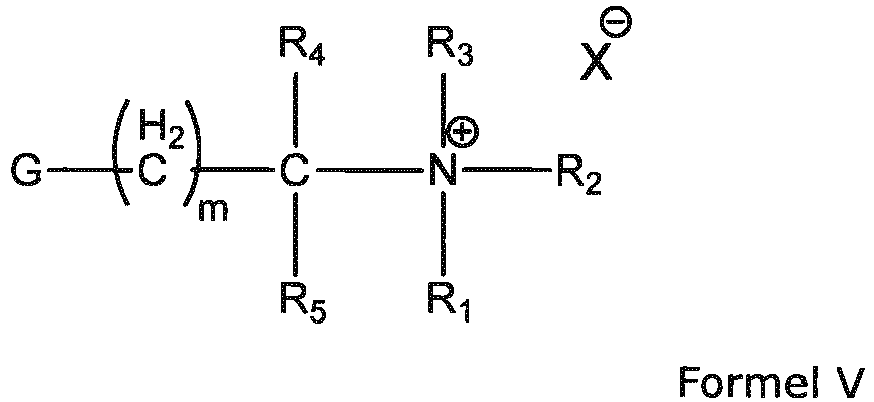 • G eine Phenylgruppe oder Alkylphenylgrupp aus C6 bis C10 ist,• m eine ganze Zahl von 0 oder 1 ist,• R1, R2, und R3, die identisch oder verschieden sein können, entweder ein Wasserstoffatom oder eine Kette umfassend 1 bis 4 Kohlenstoffatome sind, wobei die Kette ein oder mehrere Heteroatome N oder O umfassen kann,• R4 eine Kette umfassend 1 bis 6 Kohlenstoffatome ist, wobei die Kette ein oder mehrere Heteroatome N oder O umfassen kann, aber keine Carbonsäurefunktion trägt,• R5 ein Wasserstoffatom oder eine Kette umfassend 1 bis 6 Kohlenstoffatome ist, wobei die Kette ein oder mehrere Heteroatome N oder O tragen kann, aber keine Carbonsäurefunktion trägt,• X- ein Anion ist, das ausgewählt ist aus der Gruppe bestehend aus Haliden, Acetaten, Sulfaten, Phosphaten und Sulfonaten,• die asymmetrischen Kohlenstoffatome eine R- oder S-Konfiguration aufweisen.
 - Verwendung nach einem der Ansprüche 1 bis 3, dadurch gekennzeichnet, dass die Verbindung ausgewählt ist aus den Verbindungen der Formel XII:
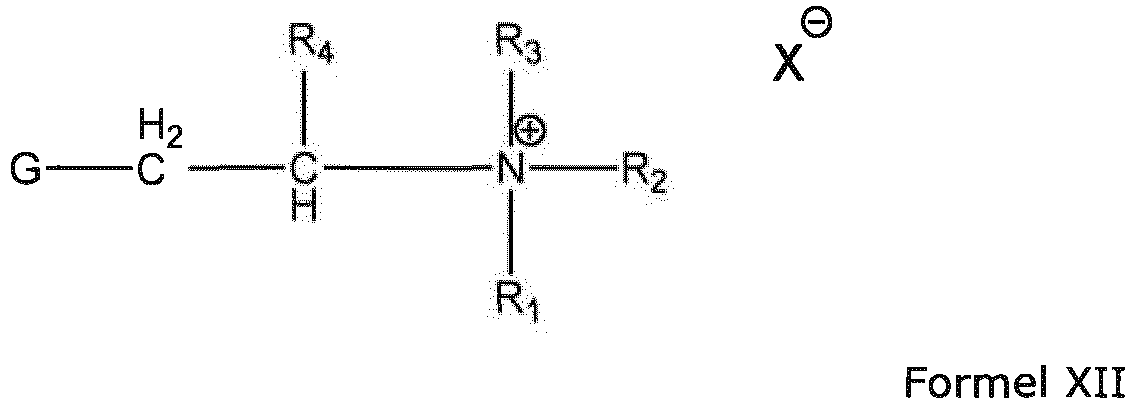 • G eine Phenyl- oder Alkylphenylgruppe aus C6 bis C10 ist, wobei die Phenylgruppe mit einer oder mehreren Hydroxylgruppen substituiert sein kann,• R1, R2, und R3, die identisch oder verschieden sein können, entweder ein Wasserstoffatom oder eine Kette umfassend 1 bis 4 Kohlenstoffatome sind, wobei die Kette ein oder mehrere Heteroatome N oder O umfassen kann,• R4 eine Kette umfassend 1 bis 6 Kohlenstoffatome ist, wobei die Kette ein oder mehrere Heteroatome N oder O umfassen kann, aber keine Carbonsäurefunktion trägt,• X- wenigstens ein Anion ist, das ausgewählt ist aus der Gruppe bestehend aus Haliden Carboxylaten, Sulfaten, Phosphaten und Sulfonaten,• die asymmetrischen Kohlenstoffatome eine R- oder S-Konfiguration aufweisen.
 - Verwendung nach einem der Ansprüche 1 bis 3, dadurch gekennzeichnet, dass die Verbindung ausgewählt ist aus den Verbindungen der Formel XIII:
 • G eine Phenyl- oder Alkylphenylgruppe aus C6 bis C10 ist, wobei die Phenylgruppe mit einer oder mehreren Hydroxylgruppen substituiert sein kann,• R1, R2, und R3, die identisch oder verschieden sein können, entweder ein Wasserstoffatom oder eine Kette umfassend 1 bis 4 Kohlenstoffatome sind, wobei die Kette ein oder mehrere Heteroatome N oder O umfassen kann,• R4 eine Kette umfassend 1 bis 6 Kohlenstoffatome ist, wobei die Kette ein oder mehrere Heteroatome N oder O, eine Amin-N-Oxid-Funktion umfassen kann, aber keine Carbonsäurefunktion trägt,• X- wenigstens ein Anion ist, das ausgewählt ist aus der Gruppe bestehend aus Haliden, Carboxylaten, Sulfaten, Phosphaten und Sulfonaten,• die asymmetrischen Kohlenstoffatome eine R- oder S-Konfiguration aufweisen.
 - Verwendung nach einem der Ansprüche 1 bis 3, dadurch gekennzeichnet, dass die Verbindung ausgewählt ist aus den Verbindungen der Formel XIV:
 • G eine Phenyl- oder Alkylphenylgruppe aus C6 bis C10 ist, wobei die Phenylgruppe mit einer oder mehreren Hydroxylgruppen substituiert sein kann,• R1, R2, und R3, die identisch oder verschieden sein können, entweder ein Wasserstoffatom oder eine Kette umfassend 1 bis 4 Kohlenstoffatome sind, wobei die Kette ein oder mehrere Heteroatome N oder O umfassen kann,• X- wenigstens ein Anion ist, das ausgewählt ist aus der Gruppe bestehend aus Haliden, Carboxylaten, Sulfaten, Phosphaten und Sulfonaten,• die asymmetrischen Kohlenstoffatome eine R- oder S-Konfiguration aufweisen.
 - Verwendung nach einem der Ansprüche 1 bis 3, dadurch gekennzeichnet, dass die Verbindung ausgewählt ist aus den Verbindungen der Formel XV:
 • die asymmetrischen Kohlenstoffatome eine R- oder S-Konfiguration aufweisen.
 - Verwendung nach einem der Ansprüche 1 bis 3, dadurch gekennzeichnet, dass die Verbindung ausgewählt ist aus den Verbindungen der Formel VII:
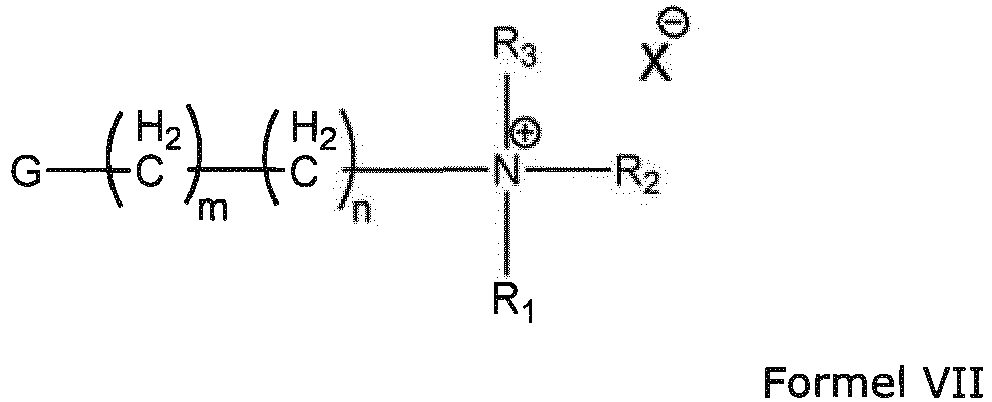 • G eine Phenyl- oder Alkylphenylgruppe aus C6 bis C10 ist, wobei die Phenylgruppe mit einer oder mehreren Hydroxylgruppen substituiert sein kann,• m und n identische oder verschiedene ganze Zahlen zwischen 0 und 2 sind, so dass 0 < m + n ≤ 3,• R1, R2, und R3, die identisch oder verschieden sein können, entweder ein Wasserstoffatom oder eine Kette umfassend 1 bis 4 Kohlenstoffatome sind, wobei die Kette ein oder mehrere Heteroatome N oder O umfassen kann,• X- ein Anion ist, das ausgewählt ist aus der Gruppe bestehend aus Haliden, Carboxylaten, Sulfaten, Phosphaten und Sulfonaten,• die asymmetrischen Kohlenstoffatome eine R- oder S-Konfiguration aufweisen.
 - Verfahren zur Verringerung von Viskosität, dadurch gekennzeichnet, dass eine Lösung hergestellt wird, die eine Verbindung der Formel I und ein Protein umfassend wenigstens ein Antikörperfragment umfasst, dessen Konzentration zwischen 50 und 350 mg/ml und dessen pH-Wert zwischen 5 und 8 beträgt.
- Verfahren nach dem vorhergehenden Anspruch, dadurch gekennzeichnet, dass zu einer schwer injizierbaren Lösung eine Verbindung der Formel I und ein wenigstens ein Antikörperfragment umfassendes Protein hinzugegeben wird, dessen Konzentration zwischen 50 und 350 mg/ml und dessen pH-Wert zwischen 5 und 8 beträgt, die die Viskosität dieser Lösung um einen Wert von wenigstens 15 % verringert bezogen auf die Viskosität einer Lösung wenigstens eines, wenigstens ein Antikörperfragment umfassenden Proteins der gleichen Konzentration und des gleich pH-Wertes, die nicht die Verbindung enthält.
- Verfahren nach Anspruch 11 oder 12, dadurch gekennzeichnet, dass die Konzentration der Verbindung nach Formel I in der finalen Formulierung zwischen 100 und 200 mM beträgt.
- Viskositätsverringernde Verbindung der Formel XIV:
 • G eine Phenyl- oder Alkylphenylgruppe aus C6 bis C10 ist, wobei die Phenylgruppe mit einer oder mehreren Hydroxylgruppen substituiert sein kann,• R1, R2, und R3, die identisch oder verschieden sein können, entweder ein Wasserstoffatom oder eine Kette umfassend 1 bis 4 Kohlenstoffatome sind, wobei die Kette ein oder mehrere Heteroatome N oder O umfassen kann,• X- wenigstens ein Anion ist, das ausgewählt ist aus der Gruppe bestehend aus Haliden, Carboxylaten, Sulfaten, Phosphaten und Sulfonaten,• die asymmetrischen Kohlenstoffatome eine R- oder S-Konfiguration aufweisen.
 - Viskositätsverringernde Verbindung der Formel XV:
 • die asymmetrischen Kohlenstoffatome eine R- oder S-Konfiguration aufweisen.
 - Wässrige Zusammensetzung (mit veringerter Viskosität), dadurch gekennzeichnet, dass sie eine Verbindung der Formel XIV, wie in Anspruch 14 definiert, und ein wenigstens ein Antikörperfragment umfassendes Protein enthält, dessen Konzentration zwischen 50 und 350 mg/ml und dessen pH-Wert zwischen 5 und 8 beträgt.
- Wässrige Zusammensetzung (mit verringerter Viskosität), dadurch gekennzeichnet, dass sie eine Verbindung der Formel XV, wie in Anspruch 15 definiert, und ein wenigstens ein Antikörperfragment umfassendes Protein enthält, dessen Konzentration 50 bis 350 mg/ml und dessen pH-Wert 5 bis 8 beträgt.
Applications Claiming Priority (3)
| Application Number | Priority Date | Filing Date | Title |
|---|---|---|---|
| US201261682003P | 2012-08-10 | 2012-08-10 | |
| FR1257775A FR2994390B1 (fr) | 2012-08-10 | 2012-08-10 | Procede d'abaissement de la viscosite de solutions de proteines a concentration elevee |
| PCT/EP2013/066685 WO2014023816A1 (fr) | 2012-08-10 | 2013-08-09 | Procédé d'abaissement de la viscosité de solutions de protéines à concentration élevée |
Publications (2)
| Publication Number | Publication Date |
|---|---|
| EP2882452A1 EP2882452A1 (de) | 2015-06-17 |
| EP2882452B1 true EP2882452B1 (de) | 2017-04-26 |
Family
ID=46889319
Family Applications (1)
| Application Number | Title | Priority Date | Filing Date |
|---|---|---|---|
| EP13747842.6A Active EP2882452B1 (de) | 2012-08-10 | 2013-08-09 | Verfahren zur verminderung der viskosität hochkonzentrierter proteinlösungen |
Country Status (4)
| Country | Link |
|---|---|
| US (1) | US9278131B2 (de) |
| EP (1) | EP2882452B1 (de) |
| FR (1) | FR2994390B1 (de) |
| WO (1) | WO2014023816A1 (de) |
Families Citing this family (13)
| Publication number | Priority date | Publication date | Assignee | Title |
|---|---|---|---|---|
| UA117466C2 (uk) | 2012-12-13 | 2018-08-10 | Мерк Шарп Енд Доме Корп. | СТАБІЛЬНИЙ СКЛАД У ВИГЛЯДІ РОЗЧИНУ АНТИТІЛА ДО IL-23p19 |
| IL312865B2 (en) | 2013-09-11 | 2025-06-01 | Eagle Biologics Inc | Liquid protein formulations containing viscosity-lowering agents |
| EP3125928A4 (de) * | 2014-04-02 | 2017-11-29 | Intas Pharmaceuticals Ltd. | Flüssige pharmazeutische zusammensetzung aus adalimumab |
| SG11201702614SA (en) | 2014-10-01 | 2017-04-27 | Eagle Biolog Inc | Polysaccharide and nucleic acid formulations containing viscosity-lowering agents |
| PH12018502670B1 (en) | 2016-06-30 | 2023-03-24 | Celltrion Inc | Stable liquid pharmaceutical preparation |
| RU2019138507A (ru) | 2017-05-02 | 2021-06-02 | Мерк Шарп И Доум Корп. | Составы антител против lag3 и совместные составы антител против lag3 и антител против pd-1 |
| JOP20190260A1 (ar) | 2017-05-02 | 2019-10-31 | Merck Sharp & Dohme | صيغ ثابتة لأجسام مضادة لمستقبل الموت المبرمج 1 (pd-1) وطرق استخدامها |
| WO2018211517A1 (en) | 2017-05-16 | 2018-11-22 | Bhami's Research Laboratory, Pvt. Ltd. | High concentration protein formulations with reduced viscosity |
| WO2019050780A1 (en) | 2017-09-05 | 2019-03-14 | Merck Sharp & Dohme Corp. | COMPOUNDS FOR REDUCING THE VISCOSITY OF BIOLOGICAL FORMULATIONS |
| EP3628683A1 (de) * | 2018-09-28 | 2020-04-01 | Zealand Pharma A/S | Formulierungen von analoga des glucagon-like-peptid-2 (glp-2) |
| CN113056482A (zh) | 2018-10-18 | 2021-06-29 | 默沙东公司 | 抗rsv抗体的制剂及其使用方法 |
| CN120842406A (zh) | 2018-10-31 | 2025-10-28 | 默沙东有限责任公司 | 抗人pd-1抗体晶体及其使用方法 |
| KR20210089215A (ko) | 2018-11-07 | 2021-07-15 | 머크 샤프 앤드 돔 코포레이션 | 항-lag3 항체 및 항-pd-1 항체의 공동-제제 |
Family Cites Families (65)
| Publication number | Priority date | Publication date | Assignee | Title |
|---|---|---|---|---|
| WO1981001145A1 (en) | 1979-10-18 | 1981-04-30 | Univ Illinois | Hydrolytic enzyme-activatible pro-drugs |
| US4399216A (en) | 1980-02-25 | 1983-08-16 | The Trustees Of Columbia University | Processes for inserting DNA into eucaryotic cells and for producing proteinaceous materials |
| US4816567A (en) | 1983-04-08 | 1989-03-28 | Genentech, Inc. | Recombinant immunoglobin preparations |
| EP0173494A3 (de) | 1984-08-27 | 1987-11-25 | The Board Of Trustees Of The Leland Stanford Junior University | Chimäre Rezeptoren durch Verbindung und Expression von DNS |
| US4676980A (en) | 1985-09-23 | 1987-06-30 | The United States Of America As Represented By The Secretary Of The Department Of Health And Human Services | Target specific cross-linked heteroantibodies |
| IL85035A0 (en) | 1987-01-08 | 1988-06-30 | Int Genetic Eng | Polynucleotide molecule,a chimeric antibody with specificity for human b cell surface antigen,a process for the preparation and methods utilizing the same |
| GB8705477D0 (en) | 1987-03-09 | 1987-04-15 | Carlton Med Prod | Drug delivery systems |
| US4975278A (en) | 1988-02-26 | 1990-12-04 | Bristol-Myers Company | Antibody-enzyme conjugates in combination with prodrugs for the delivery of cytotoxic agents to tumor cells |
| DE3850542T2 (de) | 1987-09-23 | 1994-11-24 | Bristol Myers Squibb Co | Antikörper-Heterokonjugate zur Töting von HIV-infizierten Zellen. |
| KR0154872B1 (ko) | 1987-12-21 | 1998-10-15 | 로버트 에이. 아미테이지 | 발아하는 식물종자의 아크로박테리움 매개된 형질전환 |
| US5078997A (en) | 1988-07-13 | 1992-01-07 | Cetus Corporation | Pharmaceutical composition for interleukin-2 containing physiologically compatible stabilizers |
| GB8823869D0 (en) | 1988-10-12 | 1988-11-16 | Medical Res Council | Production of antibodies |
| DE3920358A1 (de) | 1989-06-22 | 1991-01-17 | Behringwerke Ag | Bispezifische und oligospezifische, mono- und oligovalente antikoerperkonstrukte, ihre herstellung und verwendung |
| EP0479909B1 (de) | 1989-06-29 | 1996-10-30 | Medarex, Inc. | Bispezifische reagenzien für die aids-therapie |
| ATE204902T1 (de) | 1990-06-29 | 2001-09-15 | Large Scale Biology Corp | Melaninproduktion durch transformierte mikroorganismen |
| US5633425A (en) | 1990-08-29 | 1997-05-27 | Genpharm International, Inc. | Transgenic non-human animals capable of producing heterologous antibodies |
| US5661016A (en) | 1990-08-29 | 1997-08-26 | Genpharm International Inc. | Transgenic non-human animals capable of producing heterologous antibodies of various isotypes |
| US5545806A (en) | 1990-08-29 | 1996-08-13 | Genpharm International, Inc. | Ransgenic non-human animals for producing heterologous antibodies |
| US5625126A (en) | 1990-08-29 | 1997-04-29 | Genpharm International, Inc. | Transgenic non-human animals for producing heterologous antibodies |
| AU8507191A (en) | 1990-08-29 | 1992-03-30 | Genpharm International, Inc. | Transgenic non-human animals capable of producing heterologous antibodies |
| ATE255131T1 (de) | 1991-06-14 | 2003-12-15 | Genentech Inc | Humanisierter heregulin antikörper |
| WO1993008829A1 (en) | 1991-11-04 | 1993-05-13 | The Regents Of The University Of California | Compositions that mediate killing of hiv-infected cells |
| DE69233528T2 (de) | 1991-11-25 | 2006-03-16 | Enzon, Inc. | Verfahren zur Herstellung von multivalenten antigenbindenden Proteinen |
| EP0656064B1 (de) | 1992-08-17 | 1997-03-05 | Genentech, Inc. | Bispezifische immunoadhesine |
| DE4344824C1 (de) | 1993-12-28 | 1995-08-31 | Immuno Ag | Hochkonzentriertes Immunglobulin-Präparat und Verfahren zu seiner Herstellung |
| US5731168A (en) | 1995-03-01 | 1998-03-24 | Genentech, Inc. | Method for making heteromultimeric polypeptides |
| US5641870A (en) | 1995-04-20 | 1997-06-24 | Genentech, Inc. | Low pH hydrophobic interaction chromatography for antibody purification |
| CA2226575C (en) | 1995-07-27 | 2011-10-18 | Genentech, Inc. | Stabile isotonic lyophilized protein formulation |
| US5994511A (en) | 1997-07-02 | 1999-11-30 | Genentech, Inc. | Anti-IgE antibodies and methods of improving polypeptides |
| US8703126B2 (en) | 2000-10-12 | 2014-04-22 | Genentech, Inc. | Reduced-viscosity concentrated protein formulations |
| JP4340062B2 (ja) | 2000-10-12 | 2009-10-07 | ジェネンテック・インコーポレーテッド | 粘度の減少した濃縮タンパク質製剤 |
| JP4241041B2 (ja) | 2000-12-07 | 2009-03-18 | ニコメッド ゲゼルシャフト ミット ベシュレンクテル ハフツング | 酸分解性活性成分を含有するペースト形の医薬品製造物 |
| GB0113179D0 (en) | 2001-05-31 | 2001-07-25 | Novartis Ag | Organic compounds |
| ES2392073T3 (es) | 2001-11-08 | 2012-12-04 | Abbott Biotherapeutics Corp. | Formulación farmacéutica líquida estable de anticuerpos IGG |
| US7425618B2 (en) | 2002-06-14 | 2008-09-16 | Medimmune, Inc. | Stabilized anti-respiratory syncytial virus (RSV) antibody formulations |
| US20040033228A1 (en) | 2002-08-16 | 2004-02-19 | Hans-Juergen Krause | Formulation of human antibodies for treating TNF-alpha associated disorders |
| WO2004060343A1 (en) | 2002-12-31 | 2004-07-22 | Nektar Therapeutics | Antibody-containing particles and compositions |
| US20050158303A1 (en) | 2003-04-04 | 2005-07-21 | Genentech, Inc. | Methods of treating IgE-mediated disorders comprising the administration of high concentration anti-IgE antibody formulations |
| AU2004229335C1 (en) | 2003-04-04 | 2010-06-17 | Genentech, Inc. | High concentration antibody and protein formulations |
| JP4762717B2 (ja) | 2003-10-09 | 2011-08-31 | 中外製薬株式会社 | IgM高濃度安定化溶液 |
| US20050136055A1 (en) | 2003-12-22 | 2005-06-23 | Pfizer Inc | CD40 antibody formulation and methods |
| WO2005072772A1 (en) | 2004-01-30 | 2005-08-11 | Suomen Punainen Risti Veripalvelu | Pharmaceutical compositions |
| EP1768650B1 (de) | 2004-06-04 | 2008-07-16 | Camurus Ab | Flüssige depotformulierungen |
| MX2007000891A (es) | 2004-07-23 | 2007-04-18 | Genentech Inc | Cristalizacion de anticuerpos o fragmentos de ellos. |
| JO3000B1 (ar) | 2004-10-20 | 2016-09-05 | Genentech Inc | مركبات أجسام مضادة . |
| EP1909824B1 (de) | 2005-04-08 | 2011-05-18 | Amylin Pharmaceuticals, Inc. | Pharmazeutische formulierungen mit incretin-peptid und aprotisch-polarem lösungsmittel |
| EP1877075A4 (de) | 2005-04-25 | 2008-07-30 | Pfizer | Antikörper gegen myostatin |
| AU2006295340B2 (en) | 2005-08-05 | 2010-11-11 | Amgen Inc. | Stable aqueous protein or antibody pharmaceutical formulations and their preparation |
| US7910708B2 (en) | 2005-10-21 | 2011-03-22 | Novartis Ag | Anti-IL13 human antibodies |
| JP5405122B2 (ja) | 2005-12-21 | 2014-02-05 | ワイス・エルエルシー | 低粘度のタンパク質製剤およびその用途 |
| JP5231810B2 (ja) | 2005-12-28 | 2013-07-10 | 中外製薬株式会社 | 抗体含有安定化製剤 |
| JP5623743B2 (ja) | 2006-10-20 | 2014-11-12 | アムジエン・インコーポレーテツド | 安定なポリペプチド製剤 |
| AU2008304111B2 (en) | 2007-09-27 | 2014-04-24 | Amgen Inc. | Pharmaceutical formulations |
| BRPI0911048A2 (pt) | 2008-04-14 | 2015-12-29 | Atrm Llc | formulações líquidas tamponadas de gdf-5 |
| BRPI1006519A2 (pt) | 2009-03-06 | 2016-08-09 | Genentech Inc | formulação de anticorpos |
| WO2011017330A1 (en) | 2009-08-04 | 2011-02-10 | Genentech Inc | Concentrated polypeptide formulations with reduced viscosity |
| EP3409289B1 (de) | 2010-02-26 | 2020-09-30 | Novo Nordisk A/S | Stabile, antikörperhaltige zusammensetzungen |
| WO2011109415A2 (en) | 2010-03-02 | 2011-09-09 | Amgen Inc. | Reducing viscosity of pharmaceutical formulations |
| CN102958538A (zh) * | 2010-05-03 | 2013-03-06 | 弗·哈夫曼-拉罗切有限公司 | 用于降低含有蛋白质的制剂的粘度的组合物和方法 |
| SMT202000095T1 (it) | 2010-05-14 | 2020-03-13 | Amgen Inc | Formulazioni di anticorpi anti-sclerostina ad alta concentrazione |
| WO2012138958A1 (en) | 2011-04-07 | 2012-10-11 | Glaxosmithkline Llc | Formulations with reduced viscosity |
| SG193964A1 (en) | 2011-04-07 | 2013-11-29 | Glaxosmithkline Llc | Formulations with reduced viscosity |
| JP2014527528A (ja) * | 2011-08-19 | 2014-10-16 | イー・エム・デイー・ミリポア・コーポレイシヨン | 生体分子の精製方法のための小分子の使用 |
| WO2013063510A1 (en) | 2011-10-28 | 2013-05-02 | Integritybio Inc. | Protein formulations containing amino acids |
| RS53135B (sr) | 2011-11-24 | 2014-06-30 | Quimera Ingenieria Biomedica, S.L. | Kompleks dobijen iz hijaluronske kiseline ili njene soli i smeša hondroitin sulfata |
-
2012
- 2012-08-10 FR FR1257775A patent/FR2994390B1/fr active Active
-
2013
- 2013-08-08 US US13/962,324 patent/US9278131B2/en active Active
- 2013-08-09 EP EP13747842.6A patent/EP2882452B1/de active Active
- 2013-08-09 WO PCT/EP2013/066685 patent/WO2014023816A1/fr not_active Ceased
Non-Patent Citations (1)
| Title |
|---|
| None * |
Also Published As
| Publication number | Publication date |
|---|---|
| US9278131B2 (en) | 2016-03-08 |
| US20140044708A1 (en) | 2014-02-13 |
| FR2994390B1 (fr) | 2014-08-15 |
| WO2014023816A1 (fr) | 2014-02-13 |
| EP2882452A1 (de) | 2015-06-17 |
| FR2994390A1 (fr) | 2014-02-14 |
Similar Documents
| Publication | Publication Date | Title |
|---|---|---|
| EP2882452A1 (de) | Verfahren zur verminderung der viskosität hochkonzentrierter proteinlösungen | |
| EP2892504B1 (de) | Hochkonzentrierte wässrige proteinlösung mit reduzierter viskosität | |
| CN104998269B (zh) | 对于稳定含有蛋白质的制剂有用的组合物和方法 | |
| JP2025133878A (ja) | 可溶性タンパク質に対する親和性物質、切断性部分および反応性基を有する化合物またはその塩 | |
| EP3811978A1 (de) | Substanz mit affinität für antikörper und verbindung oder salz davon mit bioorthogonaler funktioneller gruppe | |
| EP2430049B1 (de) | Für die protofibrillenform des beta-amyloid-peptids spezifische antikörper | |
| DK1698640T3 (en) | PROCEDURE FOR STABILIZING ANTIBODY AND STABILIZED SOLUTION TYPE OF ANTIBODY COMPOSITION. | |
| EP4110405A1 (de) | Anti-cd56-antikörper-wirkstoff-konjugate und ihre verwendung in der therapie | |
| EP4008313A1 (de) | Zusammensetzungen und verfahren zur stabilisierung von proteinhaltigen formulierungen | |
| RS63513B1 (sr) | Anti-transtiretin antitela | |
| JP2019532617A (ja) | 抗トランスサイレチン抗体 | |
| US20220125928A1 (en) | Compositions and methods for stabilizing protein-containing formulations | |
| JP2019530428A (ja) | 抗トランスサイレチン抗体 | |
| TW201029661A (en) | Compounds | |
| BR112012002819B1 (pt) | Anticorpo humanizado antioligômero de amiloide-b, seus usos, e formulação farmacêutica | |
| CN1723034A (zh) | 治疗糖尿病的组合物和方法 | |
| CN120569222A (zh) | 包含bcl-2家族蛋白降解剂的抗体药物偶联物及其制备方法和用途 | |
| US20250099604A1 (en) | Pharmaceutical compositions comprising anti-tissue factor antibody-drug conjugates | |
| US10525133B2 (en) | Aqueous composition comprising at least one protein and one solubilizing agent, preparation thereof and uses thereof | |
| JP2002530354A (ja) | 移植の拒絶反応の出現の処置に使用するためのcd25結合分子 | |
| EP1386608B1 (de) | Mittel zur behandlung von glomerulopathie | |
| JPWO2014010586A1 (ja) | 注射用製剤 | |
| TW202527994A (zh) | 一種抗病毒偶聯物 | |
| RU2575095C2 (ru) | Гуманизированное антитело против олигомера бета-амилоида | |
| FR3075603A1 (fr) | Composition pharmaceutique pour administration orale d'anticorps pour le traitement des maladies du tractus gastro-intestinal |
Legal Events
| Date | Code | Title | Description |
|---|---|---|---|
| PUAI | Public reference made under article 153(3) epc to a published international application that has entered the european phase |
Free format text: ORIGINAL CODE: 0009012 |
|
| 17P | Request for examination filed |
Effective date: 20150309 |
|
| AK | Designated contracting states |
Kind code of ref document: A1 Designated state(s): AL AT BE BG CH CY CZ DE DK EE ES FI FR GB GR HR HU IE IS IT LI LT LU LV MC MK MT NL NO PL PT RO RS SE SI SK SM TR |
|
| AX | Request for extension of the european patent |
Extension state: BA ME |
|
| DAX | Request for extension of the european patent (deleted) | ||
| RIN1 | Information on inventor provided before grant (corrected) |
Inventor name: BALLET, THOMAS Inventor name: SOULA, REMI Inventor name: DAUTY, EMMANUEL |
|
| RIN1 | Information on inventor provided before grant (corrected) |
Inventor name: DAUTY, EMMANUEL Inventor name: BALLET, THOMAS Inventor name: SOULA, REMI |
|
| REG | Reference to a national code |
Ref country code: DE Ref legal event code: R079 Ref document number: 602013020325 Country of ref document: DE Free format text: PREVIOUS MAIN CLASS: A61K0039000000 Ipc: A61K0039395000 |
|
| GRAP | Despatch of communication of intention to grant a patent |
Free format text: ORIGINAL CODE: EPIDOSNIGR1 |
|
| INTG | Intention to grant announced |
Effective date: 20161116 |
|
| RIC1 | Information provided on ipc code assigned before grant |
Ipc: C07K 16/24 20060101ALI20161107BHEP Ipc: A61K 39/395 20060101AFI20161107BHEP Ipc: C07K 16/22 20060101ALI20161107BHEP Ipc: C07K 16/28 20060101ALI20161107BHEP Ipc: A61K 9/00 20060101ALI20161107BHEP Ipc: A61K 47/18 20060101ALI20161107BHEP |
|
| GRAS | Grant fee paid |
Free format text: ORIGINAL CODE: EPIDOSNIGR3 |
|
| GRAA | (expected) grant |
Free format text: ORIGINAL CODE: 0009210 |
|
| AK | Designated contracting states |
Kind code of ref document: B1 Designated state(s): AL AT BE BG CH CY CZ DE DK EE ES FI FR GB GR HR HU IE IS IT LI LT LU LV MC MK MT NL NO PL PT RO RS SE SI SK SM TR |
|
| REG | Reference to a national code |
Ref country code: GB Ref legal event code: FG4D Free format text: NOT ENGLISH |
|
| REG | Reference to a national code |
Ref country code: CH Ref legal event code: EP |
|
| REG | Reference to a national code |
Ref country code: AT Ref legal event code: REF Ref document number: 887305 Country of ref document: AT Kind code of ref document: T Effective date: 20170515 |
|
| REG | Reference to a national code |
Ref country code: IE Ref legal event code: FG4D Free format text: LANGUAGE OF EP DOCUMENT: FRENCH |
|
| REG | Reference to a national code |
Ref country code: DE Ref legal event code: R096 Ref document number: 602013020325 Country of ref document: DE |
|
| REG | Reference to a national code |
Ref country code: FR Ref legal event code: PLFP Year of fee payment: 5 |
|
| REG | Reference to a national code |
Ref country code: NL Ref legal event code: MP Effective date: 20170426 |
|
| REG | Reference to a national code |
Ref country code: LT Ref legal event code: MG4D |
|
| REG | Reference to a national code |
Ref country code: AT Ref legal event code: MK05 Ref document number: 887305 Country of ref document: AT Kind code of ref document: T Effective date: 20170426 |
|
| PG25 | Lapsed in a contracting state [announced via postgrant information from national office to epo] |
Ref country code: NL Free format text: LAPSE BECAUSE OF FAILURE TO SUBMIT A TRANSLATION OF THE DESCRIPTION OR TO PAY THE FEE WITHIN THE PRESCRIBED TIME-LIMIT Effective date: 20170426 |
|
| PG25 | Lapsed in a contracting state [announced via postgrant information from national office to epo] |
Ref country code: FI Free format text: LAPSE BECAUSE OF FAILURE TO SUBMIT A TRANSLATION OF THE DESCRIPTION OR TO PAY THE FEE WITHIN THE PRESCRIBED TIME-LIMIT Effective date: 20170426 Ref country code: GR Free format text: LAPSE BECAUSE OF FAILURE TO SUBMIT A TRANSLATION OF THE DESCRIPTION OR TO PAY THE FEE WITHIN THE PRESCRIBED TIME-LIMIT Effective date: 20170727 Ref country code: HR Free format text: LAPSE BECAUSE OF FAILURE TO SUBMIT A TRANSLATION OF THE DESCRIPTION OR TO PAY THE FEE WITHIN THE PRESCRIBED TIME-LIMIT Effective date: 20170426 Ref country code: LT Free format text: LAPSE BECAUSE OF FAILURE TO SUBMIT A TRANSLATION OF THE DESCRIPTION OR TO PAY THE FEE WITHIN THE PRESCRIBED TIME-LIMIT Effective date: 20170426 Ref country code: AT Free format text: LAPSE BECAUSE OF FAILURE TO SUBMIT A TRANSLATION OF THE DESCRIPTION OR TO PAY THE FEE WITHIN THE PRESCRIBED TIME-LIMIT Effective date: 20170426 Ref country code: ES Free format text: LAPSE BECAUSE OF FAILURE TO SUBMIT A TRANSLATION OF THE DESCRIPTION OR TO PAY THE FEE WITHIN THE PRESCRIBED TIME-LIMIT Effective date: 20170426 Ref country code: NO Free format text: LAPSE BECAUSE OF FAILURE TO SUBMIT A TRANSLATION OF THE DESCRIPTION OR TO PAY THE FEE WITHIN THE PRESCRIBED TIME-LIMIT Effective date: 20170726 |
|
| PG25 | Lapsed in a contracting state [announced via postgrant information from national office to epo] |
Ref country code: PL Free format text: LAPSE BECAUSE OF FAILURE TO SUBMIT A TRANSLATION OF THE DESCRIPTION OR TO PAY THE FEE WITHIN THE PRESCRIBED TIME-LIMIT Effective date: 20170426 Ref country code: BG Free format text: LAPSE BECAUSE OF FAILURE TO SUBMIT A TRANSLATION OF THE DESCRIPTION OR TO PAY THE FEE WITHIN THE PRESCRIBED TIME-LIMIT Effective date: 20170726 Ref country code: RS Free format text: LAPSE BECAUSE OF FAILURE TO SUBMIT A TRANSLATION OF THE DESCRIPTION OR TO PAY THE FEE WITHIN THE PRESCRIBED TIME-LIMIT Effective date: 20170426 Ref country code: LV Free format text: LAPSE BECAUSE OF FAILURE TO SUBMIT A TRANSLATION OF THE DESCRIPTION OR TO PAY THE FEE WITHIN THE PRESCRIBED TIME-LIMIT Effective date: 20170426 Ref country code: IS Free format text: LAPSE BECAUSE OF FAILURE TO SUBMIT A TRANSLATION OF THE DESCRIPTION OR TO PAY THE FEE WITHIN THE PRESCRIBED TIME-LIMIT Effective date: 20170826 Ref country code: SE Free format text: LAPSE BECAUSE OF FAILURE TO SUBMIT A TRANSLATION OF THE DESCRIPTION OR TO PAY THE FEE WITHIN THE PRESCRIBED TIME-LIMIT Effective date: 20170426 |
|
| REG | Reference to a national code |
Ref country code: DE Ref legal event code: R097 Ref document number: 602013020325 Country of ref document: DE |
|
| PG25 | Lapsed in a contracting state [announced via postgrant information from national office to epo] |
Ref country code: CZ Free format text: LAPSE BECAUSE OF FAILURE TO SUBMIT A TRANSLATION OF THE DESCRIPTION OR TO PAY THE FEE WITHIN THE PRESCRIBED TIME-LIMIT Effective date: 20170426 Ref country code: DK Free format text: LAPSE BECAUSE OF FAILURE TO SUBMIT A TRANSLATION OF THE DESCRIPTION OR TO PAY THE FEE WITHIN THE PRESCRIBED TIME-LIMIT Effective date: 20170426 Ref country code: EE Free format text: LAPSE BECAUSE OF FAILURE TO SUBMIT A TRANSLATION OF THE DESCRIPTION OR TO PAY THE FEE WITHIN THE PRESCRIBED TIME-LIMIT Effective date: 20170426 Ref country code: SK Free format text: LAPSE BECAUSE OF FAILURE TO SUBMIT A TRANSLATION OF THE DESCRIPTION OR TO PAY THE FEE WITHIN THE PRESCRIBED TIME-LIMIT Effective date: 20170426 Ref country code: RO Free format text: LAPSE BECAUSE OF FAILURE TO SUBMIT A TRANSLATION OF THE DESCRIPTION OR TO PAY THE FEE WITHIN THE PRESCRIBED TIME-LIMIT Effective date: 20170426 |
|
| PG25 | Lapsed in a contracting state [announced via postgrant information from national office to epo] |
Ref country code: SM Free format text: LAPSE BECAUSE OF FAILURE TO SUBMIT A TRANSLATION OF THE DESCRIPTION OR TO PAY THE FEE WITHIN THE PRESCRIBED TIME-LIMIT Effective date: 20170426 Ref country code: IT Free format text: LAPSE BECAUSE OF FAILURE TO SUBMIT A TRANSLATION OF THE DESCRIPTION OR TO PAY THE FEE WITHIN THE PRESCRIBED TIME-LIMIT Effective date: 20170426 |
|
| PLBE | No opposition filed within time limit |
Free format text: ORIGINAL CODE: 0009261 |
|
| STAA | Information on the status of an ep patent application or granted ep patent |
Free format text: STATUS: NO OPPOSITION FILED WITHIN TIME LIMIT |
|
| REG | Reference to a national code |
Ref country code: CH Ref legal event code: PL |
|
| PG25 | Lapsed in a contracting state [announced via postgrant information from national office to epo] |
Ref country code: MC Free format text: LAPSE BECAUSE OF FAILURE TO SUBMIT A TRANSLATION OF THE DESCRIPTION OR TO PAY THE FEE WITHIN THE PRESCRIBED TIME-LIMIT Effective date: 20170426 |
|
| 26N | No opposition filed |
Effective date: 20180129 |
|
| PG25 | Lapsed in a contracting state [announced via postgrant information from national office to epo] |
Ref country code: CH Free format text: LAPSE BECAUSE OF NON-PAYMENT OF DUE FEES Effective date: 20170831 Ref country code: LI Free format text: LAPSE BECAUSE OF NON-PAYMENT OF DUE FEES Effective date: 20170831 |
|
| REG | Reference to a national code |
Ref country code: IE Ref legal event code: MM4A |
|
| PG25 | Lapsed in a contracting state [announced via postgrant information from national office to epo] |
Ref country code: SI Free format text: LAPSE BECAUSE OF FAILURE TO SUBMIT A TRANSLATION OF THE DESCRIPTION OR TO PAY THE FEE WITHIN THE PRESCRIBED TIME-LIMIT Effective date: 20170426 |
|
| REG | Reference to a national code |
Ref country code: BE Ref legal event code: MM Effective date: 20170831 |
|
| PG25 | Lapsed in a contracting state [announced via postgrant information from national office to epo] |
Ref country code: LU Free format text: LAPSE BECAUSE OF NON-PAYMENT OF DUE FEES Effective date: 20170809 |
|
| PG25 | Lapsed in a contracting state [announced via postgrant information from national office to epo] |
Ref country code: IE Free format text: LAPSE BECAUSE OF NON-PAYMENT OF DUE FEES Effective date: 20170809 |
|
| REG | Reference to a national code |
Ref country code: FR Ref legal event code: PLFP Year of fee payment: 6 |
|
| PG25 | Lapsed in a contracting state [announced via postgrant information from national office to epo] |
Ref country code: BE Free format text: LAPSE BECAUSE OF NON-PAYMENT OF DUE FEES Effective date: 20170831 |
|
| PG25 | Lapsed in a contracting state [announced via postgrant information from national office to epo] |
Ref country code: MT Free format text: LAPSE BECAUSE OF FAILURE TO SUBMIT A TRANSLATION OF THE DESCRIPTION OR TO PAY THE FEE WITHIN THE PRESCRIBED TIME-LIMIT Effective date: 20170426 |
|
| PG25 | Lapsed in a contracting state [announced via postgrant information from national office to epo] |
Ref country code: HU Free format text: LAPSE BECAUSE OF FAILURE TO SUBMIT A TRANSLATION OF THE DESCRIPTION OR TO PAY THE FEE WITHIN THE PRESCRIBED TIME-LIMIT; INVALID AB INITIO Effective date: 20130809 |
|
| PG25 | Lapsed in a contracting state [announced via postgrant information from national office to epo] |
Ref country code: CY Free format text: LAPSE BECAUSE OF FAILURE TO SUBMIT A TRANSLATION OF THE DESCRIPTION OR TO PAY THE FEE WITHIN THE PRESCRIBED TIME-LIMIT Effective date: 20170426 |
|
| PG25 | Lapsed in a contracting state [announced via postgrant information from national office to epo] |
Ref country code: MK Free format text: LAPSE BECAUSE OF FAILURE TO SUBMIT A TRANSLATION OF THE DESCRIPTION OR TO PAY THE FEE WITHIN THE PRESCRIBED TIME-LIMIT Effective date: 20170426 |
|
| PG25 | Lapsed in a contracting state [announced via postgrant information from national office to epo] |
Ref country code: TR Free format text: LAPSE BECAUSE OF FAILURE TO SUBMIT A TRANSLATION OF THE DESCRIPTION OR TO PAY THE FEE WITHIN THE PRESCRIBED TIME-LIMIT Effective date: 20170426 |
|
| PG25 | Lapsed in a contracting state [announced via postgrant information from national office to epo] |
Ref country code: PT Free format text: LAPSE BECAUSE OF FAILURE TO SUBMIT A TRANSLATION OF THE DESCRIPTION OR TO PAY THE FEE WITHIN THE PRESCRIBED TIME-LIMIT Effective date: 20170426 |
|
| PG25 | Lapsed in a contracting state [announced via postgrant information from national office to epo] |
Ref country code: AL Free format text: LAPSE BECAUSE OF FAILURE TO SUBMIT A TRANSLATION OF THE DESCRIPTION OR TO PAY THE FEE WITHIN THE PRESCRIBED TIME-LIMIT Effective date: 20170426 |
|
| P01 | Opt-out of the competence of the unified patent court (upc) registered |
Effective date: 20230514 |
|
| PGFP | Annual fee paid to national office [announced via postgrant information from national office to epo] |
Ref country code: FR Payment date: 20230830 Year of fee payment: 11 |
|
| PG25 | Lapsed in a contracting state [announced via postgrant information from national office to epo] |
Ref country code: FR Free format text: LAPSE BECAUSE OF NON-PAYMENT OF DUE FEES Effective date: 20240831 |
|
| PGFP | Annual fee paid to national office [announced via postgrant information from national office to epo] |
Ref country code: DE Payment date: 20250731 Year of fee payment: 13 |
|
| PGFP | Annual fee paid to national office [announced via postgrant information from national office to epo] |
Ref country code: GB Payment date: 20250718 Year of fee payment: 13 |