EP2879753B1 - Systeme für perkutanen intravaskulären zugang für eine arteriovenösen fistel - Google Patents
Systeme für perkutanen intravaskulären zugang für eine arteriovenösen fistel Download PDFInfo
- Publication number
- EP2879753B1 EP2879753B1 EP13824823.2A EP13824823A EP2879753B1 EP 2879753 B1 EP2879753 B1 EP 2879753B1 EP 13824823 A EP13824823 A EP 13824823A EP 2879753 B1 EP2879753 B1 EP 2879753B1
- Authority
- EP
- European Patent Office
- Prior art keywords
- jaw member
- elements
- recited
- jaw
- disposed
- Prior art date
- Legal status (The legal status is an assumption and is not a legal conclusion. Google has not performed a legal analysis and makes no representation as to the accuracy of the status listed.)
- Active
Links
Images



Classifications
-
- A—HUMAN NECESSITIES
- A61—MEDICAL OR VETERINARY SCIENCE; HYGIENE
- A61B—DIAGNOSIS; SURGERY; IDENTIFICATION
- A61B18/00—Surgical instruments, devices or methods for transferring non-mechanical forms of energy to or from the body
- A61B18/04—Surgical instruments, devices or methods for transferring non-mechanical forms of energy to or from the body by heating
- A61B18/12—Surgical instruments, devices or methods for transferring non-mechanical forms of energy to or from the body by heating by passing a current through the tissue to be heated, e.g. high-frequency current
- A61B18/14—Probes or electrodes therefor
- A61B18/1442—Probes having pivoting end effectors, e.g. forceps
- A61B18/1445—Probes having pivoting end effectors, e.g. forceps at the distal end of a shaft, e.g. forceps or scissors at the end of a rigid rod
-
- A—HUMAN NECESSITIES
- A61—MEDICAL OR VETERINARY SCIENCE; HYGIENE
- A61B—DIAGNOSIS; SURGERY; IDENTIFICATION
- A61B18/00—Surgical instruments, devices or methods for transferring non-mechanical forms of energy to or from the body
- A61B18/04—Surgical instruments, devices or methods for transferring non-mechanical forms of energy to or from the body by heating
- A61B18/08—Surgical instruments, devices or methods for transferring non-mechanical forms of energy to or from the body by heating by means of electrically-heated probes
- A61B18/082—Probes or electrodes therefor
- A61B18/085—Forceps, scissors
-
- A—HUMAN NECESSITIES
- A61—MEDICAL OR VETERINARY SCIENCE; HYGIENE
- A61B—DIAGNOSIS; SURGERY; IDENTIFICATION
- A61B18/00—Surgical instruments, devices or methods for transferring non-mechanical forms of energy to or from the body
- A61B18/04—Surgical instruments, devices or methods for transferring non-mechanical forms of energy to or from the body by heating
- A61B18/12—Surgical instruments, devices or methods for transferring non-mechanical forms of energy to or from the body by heating by passing a current through the tissue to be heated, e.g. high-frequency current
- A61B18/14—Probes or electrodes therefor
- A61B18/148—Probes or electrodes therefor having a short, rigid shaft for accessing the inner body transcutaneously, e.g. for neurosurgery or arthroscopy
-
- A—HUMAN NECESSITIES
- A61—MEDICAL OR VETERINARY SCIENCE; HYGIENE
- A61B—DIAGNOSIS; SURGERY; IDENTIFICATION
- A61B18/00—Surgical instruments, devices or methods for transferring non-mechanical forms of energy to or from the body
- A61B18/04—Surgical instruments, devices or methods for transferring non-mechanical forms of energy to or from the body by heating
- A61B18/12—Surgical instruments, devices or methods for transferring non-mechanical forms of energy to or from the body by heating by passing a current through the tissue to be heated, e.g. high-frequency current
- A61B18/14—Probes or electrodes therefor
- A61B18/1492—Probes or electrodes therefor having a flexible, catheter-like structure, e.g. for heart ablation
-
- A—HUMAN NECESSITIES
- A61—MEDICAL OR VETERINARY SCIENCE; HYGIENE
- A61B—DIAGNOSIS; SURGERY; IDENTIFICATION
- A61B18/00—Surgical instruments, devices or methods for transferring non-mechanical forms of energy to or from the body
- A61B18/18—Surgical instruments, devices or methods for transferring non-mechanical forms of energy to or from the body by applying electromagnetic radiation, e.g. microwaves
- A61B18/20—Surgical instruments, devices or methods for transferring non-mechanical forms of energy to or from the body by applying electromagnetic radiation, e.g. microwaves using laser
- A61B18/22—Surgical instruments, devices or methods for transferring non-mechanical forms of energy to or from the body by applying electromagnetic radiation, e.g. microwaves using laser the beam being directed along or through a flexible conduit, e.g. an optical fibre; Couplings or hand-pieces therefor
- A61B18/24—Surgical instruments, devices or methods for transferring non-mechanical forms of energy to or from the body by applying electromagnetic radiation, e.g. microwaves using laser the beam being directed along or through a flexible conduit, e.g. an optical fibre; Couplings or hand-pieces therefor with a catheter
-
- A—HUMAN NECESSITIES
- A61—MEDICAL OR VETERINARY SCIENCE; HYGIENE
- A61B—DIAGNOSIS; SURGERY; IDENTIFICATION
- A61B18/00—Surgical instruments, devices or methods for transferring non-mechanical forms of energy to or from the body
- A61B2018/00315—Surgical instruments, devices or methods for transferring non-mechanical forms of energy to or from the body for treatment of particular body parts
- A61B2018/00345—Vascular system
- A61B2018/00404—Blood vessels other than those in or around the heart
-
- A—HUMAN NECESSITIES
- A61—MEDICAL OR VETERINARY SCIENCE; HYGIENE
- A61B—DIAGNOSIS; SURGERY; IDENTIFICATION
- A61B18/00—Surgical instruments, devices or methods for transferring non-mechanical forms of energy to or from the body
- A61B2018/00571—Surgical instruments, devices or methods for transferring non-mechanical forms of energy to or from the body for achieving a particular surgical effect
- A61B2018/00601—Cutting
-
- A—HUMAN NECESSITIES
- A61—MEDICAL OR VETERINARY SCIENCE; HYGIENE
- A61B—DIAGNOSIS; SURGERY; IDENTIFICATION
- A61B18/00—Surgical instruments, devices or methods for transferring non-mechanical forms of energy to or from the body
- A61B2018/00571—Surgical instruments, devices or methods for transferring non-mechanical forms of energy to or from the body for achieving a particular surgical effect
- A61B2018/00619—Welding
-
- A—HUMAN NECESSITIES
- A61—MEDICAL OR VETERINARY SCIENCE; HYGIENE
- A61B—DIAGNOSIS; SURGERY; IDENTIFICATION
- A61B18/00—Surgical instruments, devices or methods for transferring non-mechanical forms of energy to or from the body
- A61B2018/00982—Surgical instruments, devices or methods for transferring non-mechanical forms of energy to or from the body combined with or comprising means for visual or photographic inspections inside the body, e.g. endoscopes
-
- A—HUMAN NECESSITIES
- A61—MEDICAL OR VETERINARY SCIENCE; HYGIENE
- A61B—DIAGNOSIS; SURGERY; IDENTIFICATION
- A61B18/00—Surgical instruments, devices or methods for transferring non-mechanical forms of energy to or from the body
- A61B18/04—Surgical instruments, devices or methods for transferring non-mechanical forms of energy to or from the body by heating
- A61B18/12—Surgical instruments, devices or methods for transferring non-mechanical forms of energy to or from the body by heating by passing a current through the tissue to be heated, e.g. high-frequency current
- A61B18/14—Probes or electrodes therefor
- A61B18/1442—Probes having pivoting end effectors, e.g. forceps
- A61B2018/146—Scissors
Definitions
- Bile ducts carry bile from the liver to the duodenum.
- Ureters carry urine from the kidneys to the bladder.
- the intestines carry nutrients and waste products from the mouth to the anus.
- conduits In medical practice, there is often a need to connect conduits to one another or to a replacement conduit to treat disease or dysfunction of the existing conduits.
- the connection created between conduits is called an anastomosis.
- anastomoses are made between veins and arteries, arteries and arteries, or veins and veins.
- the purpose of these connections is to create either a high flow connection, or fistula, between an artery and a vein, or to carry blood around an obstruction in a replacement conduit, or bypass.
- the conduit for a bypass is a vein, artery, or prosthetic graft.
- An anastomosis is created during surgery by bringing two vessels or a conduit into direct contact, and to create a leak-free blood flow path between them.
- the vessels are joined together with suture or clips, in an open surgical procedure.
- the anastomosis can be end-to-end, end-to-side, or side-to-side.
- the anastomosis is elliptical in shape and is most commonly sewn by hand with a continuous suture.
- Other methods for anastomosis creation have been used including carbon dioxide laser, and a number of methods using various connecting prosthesis, clips, and stents. Such procedures are time consuming, clinician dependent (open to surgical error), and often result in strictures, or clotting of the vein or artery.
- An arterio-venous fistula is created by connecting an artery to a vein. This type of connection is used for hemodialysis, to increase exercise tolerance, to keep an artery or vein open, or to provide reliable access for chemotherapy.
- An alternative is to connect a prosthetic graft from an artery to a vein for the same purpose of creating a high flow connection between artery and vein.
- This is called an arterio-venous graft, and requires two anastomoses. One is between artery and graft, and the second is between graft and vein.
- a bypass is similar to an arteriovenous graft.
- two anastomoses and a conduit are required.
- a proximal anastomosis is created from a blood vessel to a conduit.
- the conduit extends around the obstruction, and a second distal anastomosis is created between the conduit and vessel beyond the obstruction.
- Fistulas for hemodialysis are required by patients with kidney failure.
- the fistula provides a high flow of blood that can be withdrawn from the body into a dialysis machine to remove waste products and then returned to the body.
- the blood is withdrawn through a large access needle near the artery and returned to the fistula through a second large return needle.
- These fistulas are typically created in the forearm, upper arm, less frequently in the thigh, and in rare cases, elsewhere in the body. It is important that the fistula be able to achieve a flow rate of 500 ml per minute or greater.
- Dialysis fistulas have to be close to the skin ( ⁇ 6 mm), and large enough (> 4 mm) to access with a large needle.
- the fistula needs to be long enough (> 6 cm) to allow adequate separation of the access and return needle to prevent recirculation of dialysed and non-dialysed blood between the needles inserted in the fistula.
- Fistulas are created in anesthetized patients by carefully dissecting an artery and vein from their surrounding tissue, and sewing the vessels together with fine suture or clips.
- the connection thus created is an anastomosis. It is highly desirable to be able to make the anastomosis quickly, reliably, with less dissection, and with less pain. It is important that the anastomosis is the correct size, is smooth, and that the artery and vein are not twisted.
- US 2009/023985 , US 6139508 & US 2005/143763 all disclose devices for carrying out intraluminal surgical procedures comprising a control handle, an elongate body portion and instrumentation located at the end of the body portion for carrying out the procedure.
- US 6443973 discloses an electromechanical device for carrying out surgical procedures comprising an elongate drive shaft, a motor located within a handle actuated by a trigger and instrumentation located at one end of the drive shaft.
- US 5,626,608 A describes a surgical instrument having a locking handle.
- JP H10 277050 A describes a high-frequency treatment tool for an endoscope.
- US 5,571,136 A describes forceps with a guide wire.
- the present invention comprises a device to allow extension, elongation or repair of a previously created arteriovenous fistula between a first blood vessel and an adjacent second blood vessel which comprises a main body having a primary lumen and an articulating jaw member disposed at the distal end of the main body and configured with two elements to allow rotation of one element about a pivot point to grasp tissue while being rotated.
- the jaw member is also configured to allow thermal energy delivery to one or both elements of the jaw member that allow tissue welding and cutting with DC, RF, Laser or Ultrasonic energy.
- a second lumen located within one element of the jaw member is configured to allow advancement over a guidewire into the second vessel while the other element of the jaw member remains within the first blood vessel at the position where the arteriovenous fistula, or aperture, exists between the first and second blood vessel.
- a method (not claimed) of elongation of the passage between adjacent first and second blood vessels comprises a step of positioning a main body of the device within the first vessel and advancing one element of the jaw member through the aperture between the vessels, and into the second vessel, so that the jaw element is disposed within the second vessel.
- the articulating element is actuated to rotate about the pivot point of the jaw member for grasping and compressing tissue adjacent to the aperture between the first blood vessel and the adjacent second blood vessel.
- the method further comprises the step of applying thermal energy to one or both elements of the jaw member to cut an extension to the aperture and weld the adjacent first and second blood vessel using DC, RF, Laser or ultrasonic energy.
- a device for elongating, extending, or repairing a tissue aperture which comprises a handle, a body connected to and extending distally from the handle, comprised of a flexible material and having a primary lumen, a rigid jaw member connected to and extending distally from the flexible body, and a tissue cutting element disposed on the jaw member.
- the flexible material comprising the body is a polymer having a Shore A hardness of 70-90.
- the rigid jaw member is preferably fabricated of a rigid material comprising either a metal or a rigid polymer having a Shore A hardness greater than 90, though, of course, other equivalent materials may be utilized alternatively, in both instances.
- the jaw member comprises two elements, each having distal ends, wherein one of the elements is pivotable relative to the other element to create a spacing of varying sizes between the two elements at their respective distal ends.
- one of the elements is a stationary element and the other element is an articulating element, the articulating element being pivotable about a pivot point disposed on a proximal end thereof.
- both of the elements are articulating elements.
- a lever is provided on the handle for moving at least one of the jaw member elements relative to the other one to increase or decrease the spacing between the distal ends of the elements, thereby opening or closing the jaws of the jaw member.
- a wire connects the lever to the jaw member for opening or closing the jaw member.
- a ratcheting mechanism is provided on the lever for applying variable incremental pressure to the jaw member.
- a conductor connects the power supply and activation switch to the electrode.
- the electrode may be comprised of aluminum or other suitable conductive material.
- a secondary lumen is disposed in one of the jaw elements.
- the jaw member has a closed orientation wherein both jaw elements are substantially aligned with a longitudinal axis of the primary lumen, and open orientations wherein at least one of the jaw elements is disposed at a substantial angle of varying sizes from the longitudinal axis of the primary lumen.
- a method (not claimed) of extending, elongating, or repairing a fistula between adjacent first and second vessels.
- the method comprises a step of inserting a main body of a device into the first vessel so that a distal end thereof lies within a blood flow passage of the first vessel.
- a jaw member disposed at a distal end of the main body is opened, and the open jaw member is disposed so that a portion of tissue adjacent to the fistula is disposed between elements thereof.
- the elements of the jaw member are closed to clamp the portion of tissue therebetween.
- An electrode on the jaw member is energized to cut and weld the tissue to extend the fistula.
- the device is then withdrawn from the site.
- the inserting step may further comprise a step of aligning a lumen in the main body over a guidewire, and sliding the device over the guidewire to the desired location.
- the energizing step may comprise applying thermal energy of about 10-50 watts to the clamped tissue. During the energizing step, the tissue temperature is increased to about 100-400 degrees C to cut and weld an extended aperture of about 1-5 mm from the primary blood vessel to the secondary blood vessel.
- Imaging guidance is preferably used to insert the device into a procedural site and monitor the cutting and welding step.
- a device 1 comprises a handle 2 with an activation switch 4, an electrical connector 6, and a jaw lever 8.
- the main body is attached to the handle 2 at the proximal end and the jaw member 20 at the distal end.
- the electrical connector 6 allows connection to temperature display and power supply devices for temperature feedback and DC thermal energy delivery, though other modalities such as Radio Frequency (RF) or laser are can be employed.
- RF Radio Frequency
- Lever 8 is constructed with a ratcheting mechanism to allow variable incremental pressure (approximately 100 mN/mm 2 - 500 mN/mm 2 ) to electrodes 22 on jaw member 20 ( Fig. 2 ) as desired by the practitioner.
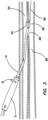
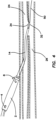
- the practitioner selects an appropriate procedural site having each of a first blood vessel 24 and a second blood vessel 26 in close proximity to one another and having a previously created arteriovenous fistula 28 disposed therebetween ( Fig. 3 ).
- the first blood vessel 24 comprises a vein
- the second blood vessel 26 comprises an artery, but the invention is not limited to this arrangement.
- the jaw member 20 comprises an articulating element 34 and a stationary element 36, including a secondary lumen 38.
- the articulating element 34 is movable about a pivot point 40, and is attached to a tendon wire 42, as illustrated. It should be noted that the invention is not limited to a single articulating element 34, pivot point 40, and tendon wire 42, though only one of each is shown in this particular embodiment.
- Articulating element 34 and stationary element 36 are preferably constructed of a rigid material such as metal or rigid (>90 Shore A) polymer, with 1-5 mm elongate electrodes 44 attached to the opposing surfaces.
- Electrodes 44 preferably constructed of an electrically and thermally conductive material, such as aluminum, are attached to the electrical connector 6 on handle 2 via conductors 46, which are preferably constructed of an electrically and thermally conductive material such as copper.
- a temperature sensor 48 such as a thermocouple or thermistor, is attached to the stationary element 36 on one end and the electrical connector 6 on the opposite end.
- Tendon wire 42 preferably constructed of 18-24 Ga (Gauge) wire, is attached to the articulating element 34 on one end and to the jaw lever 8 on the other end.
- Stationary element 36 includes the secondary lumen 38, as noted above. These elements, including the primary lumen 14 of the main body shaft 12, provide an externally communicating passage to allow advancement of the device 1 over a guidewire 50.
- the orientation of the articulating element 34 of the jaw member 20 can be rotationally adjustable between a range of rotation about the pivot point 40.
- a first, or closed, position is illustrated in Fig. 2 where the articulating element 34 is substantially aligned with the longitudinal axis 52 of the primary lumen 14 and the secondary lumen 38.
- the closed orientation is utilized during the initial device insertion steps, as well as the device withdrawal steps, while variable rotated orientations are the operative for creating the extension or elongation of the arteriovenous fistula 28.
- This variable orientation may be desirable by the practitioner to incrementally adjust the opening of the jaw member 20 to achieve an optimal size extension of the aperture 28 between primary vessel 24 and secondary vessel 26.
- the jaw member 20 is configured to have echogenic and radiopaque properties to allow the practitioner to visualize the orientation under real time imaging guidance, this will allow the practitioner to more effectively adjust the opening of jaw member 20 through direct visualization as it is advanced into the desired position in the arteriovenous fistula aperture 28 between the primary blood vessel 24 and the secondary blood vessel 26 to achieve the desired length of extension of the aperture.
- This step may be repeated as desired by the practitioner rotating lever 8 of main body handle 2 to adjust the open position of articulating element 34, until the desired arteriovenous fistula aperture extension has been achieved.
- Activation switch 4 is activated to deliver thermal energy of between about 10 -50 W to the jaws 20, sufficient to raise the tissue temperature to about 100-400 degrees C to cut and weld an extended aperture 28 of 1-5mm from the primary blood vessel 24 to the secondary blood vessel 26.
- This may be done under direct imaging guidance to verify energy delivery in the area desired by the practitioner, due to the creation of micro bubbles visible under transcutaneous ultrasound in the area of direct thermal energy.
- the practitioner may also verify acceptable extension of the aperture through direct visualization of the larger opening in the aperture under imaging guidance.
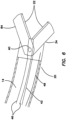
- Fig. 6 illustrates a detail view of an alternate embodiment of jaw member 20 that is configured with two articulating elements 34, rather than a stationary element and an articulating element, as in the embodiment of Figs. 1-5 .
- an advantage of this embodiment is the ability to open the jaws 34 to a substantially wider extent than is the case with the first embodiment.
- the embodiment of Fig. 6 is utilized in the same manner as is the embodiment of Figs. 1-5 .
Landscapes
- Health & Medical Sciences (AREA)
- Surgery (AREA)
- Life Sciences & Earth Sciences (AREA)
- Engineering & Computer Science (AREA)
- Heart & Thoracic Surgery (AREA)
- Medical Informatics (AREA)
- Otolaryngology (AREA)
- Plasma & Fusion (AREA)
- Physics & Mathematics (AREA)
- Biomedical Technology (AREA)
- Veterinary Medicine (AREA)
- Nuclear Medicine, Radiotherapy & Molecular Imaging (AREA)
- Molecular Biology (AREA)
- Animal Behavior & Ethology (AREA)
- General Health & Medical Sciences (AREA)
- Public Health (AREA)
- Cardiology (AREA)
- Neurology (AREA)
- Neurosurgery (AREA)
- Surgical Instruments (AREA)
Claims (9)
- Vorrichtung (1) zum Verlängern, Erweitern oder Reparieren einer arteriovenösen Fistel zwischen einem ersten Blutgefäß und einem benachbarten zweiten Blutgefäß, umfassend:einen Griff (2);einen Körper (12), der mit dem Griff (2) verbunden ist und sich von diesem aus distal erstreckt, bestehend aus einem flexiblen Material und mit einem primärem Lumen (14);ein starres Backenglied (20), das mit dem flexiblen Körper (12) verbunden ist und sich von diesem aus distal erstreckt, wobei das Backenglied (20) zwei Elemente (34, 36) mit jeweils distalen Enden aufweist, wobei eines der Elemente (34, 36) relativ zu dem anderen Element (34, 36) drehbar ist, um einen Abstand variierender Größe zwischen den zwei Elementen an ihren jeweiligen distalen Enden zu erzeugen;ein Gewebeschneidelement (22), das an dem Backenglied (20) angeordnet ist;ein Hebel (8) an dem Griff (2) zum Bewegen wenigstens eines der Backengliedelemente (34, 36) relativ zu dem anderen, um den Abstand zwischen den distalen Enden der Elemente (34, 36) zu vergrößern oder verringern, wodurch die Backen des Backenglieds (20) geöffnet oder geschlossen werden;ein Ratschenmechanismus an dem Hebel (8) zum Anwenden eines variablen zunehmenden Drucks auf das Backenglied (20);gekennzeichnet durcheinen Draht (42), der den Hebel (8) mit dem Backenglied (20) zum Öffnen oder Schließen des Backenglieds (20) verbindet; undein zweites Lumen (38), das in einem der Backenelemente (20) angeordnet ist.
- Vorrichtung nach Anspruch 1, wobei das flexible Material, welches den Körper (12) umfasst, ein Polymer ist.
- Vorrichtung nach Anspruch 2, wobei das Polymer, welches den Körper (12) umfasst, eine Shore-A-Härte von 70-90 aufweist.
- Vorrichtung nach Anspruch 1, wobei das starre Backenglied (20) aus einem starren Material gefertigt ist, das entweder ein Metall oder ein starres Polymer mit einer Shore-A-Härte von mehr als 90 umfasst.
- Vorrichtung nach Anspruch 1, wobei eines der Elemente ein stationäres Element (36) ist und das andere Element ein Gelenkelement (14) ist, wobei das Gelenkelement (34) um einen Drehpunkt (40) drehbar ist, der an einem proximalen Ende davon angeordnet ist.
- Vorrichtung nach Anspruch 1, wobei das Gewebeschneidelement eine Elektrode (22) zum Energetisieren des zu schneidenden Gewebes umfasst.
- Vorrichtung nach Anspruch 6, und ferner umfassend eine Stromversorgung und einen Aktivierungsschalter (4), der am Griff (2) zum Aktivieren der Elektrode (22) angeordnet ist.
- Vorrichtung nach Anspruch 7, und ferner umfassend einen Leiter (46) zum elektrischen Verbinden der Stromversorgung und des Aktivierungsschalters (4) mit der Elektrode (22).
- Vorrichtung nach Anspruch 1, wobei das Backenglied (20) eine geschlossene Orientierung aufweist, in der beide Backenelemente im Wesentlichen an einer Längsachse des primären Lumens (14) ausgerichtet sind, und offene Orientierungen, in denen wenigstens eines der Backenelemente in einem erheblichen Winkel mit variierenden Größen zur Längsachse des primären Lumens (14) angeordnet ist.
Applications Claiming Priority (2)
| Application Number | Priority Date | Filing Date | Title |
|---|---|---|---|
| US201261678240P | 2012-08-01 | 2012-08-01 | |
| PCT/US2013/053070 WO2014022585A1 (en) | 2012-08-01 | 2013-07-31 | Systems and methods for percutaneous intravascular access for arteriovenous fistula |
Publications (3)
| Publication Number | Publication Date |
|---|---|
| EP2879753A1 EP2879753A1 (de) | 2015-06-10 |
| EP2879753A4 EP2879753A4 (de) | 2016-05-04 |
| EP2879753B1 true EP2879753B1 (de) | 2025-04-16 |
Family
ID=50026191
Family Applications (1)
| Application Number | Title | Priority Date | Filing Date |
|---|---|---|---|
| EP13824823.2A Active EP2879753B1 (de) | 2012-08-01 | 2013-07-31 | Systeme für perkutanen intravaskulären zugang für eine arteriovenösen fistel |
Country Status (6)
| Country | Link |
|---|---|
| US (2) | US20140039478A1 (de) |
| EP (1) | EP2879753B1 (de) |
| JP (1) | JP6634288B2 (de) |
| AU (1) | AU2013296428B2 (de) |
| CA (1) | CA2880253C (de) |
| WO (1) | WO2014022585A1 (de) |
Families Citing this family (6)
| Publication number | Priority date | Publication date | Assignee | Title |
|---|---|---|---|---|
| US10292708B1 (en) | 2014-02-13 | 2019-05-21 | Avenu Medical, Inc. | Externally supported anastomosis |
| US10772672B2 (en) | 2014-03-06 | 2020-09-15 | Avenu Medical, Inc. | Systems and methods for percutaneous access and formation of arteriovenous fistulas |
| US10499919B2 (en) | 2015-08-21 | 2019-12-10 | Avenu Medical, Inc. | Systems and methods for percutaneous access and formation of arteriovenous fistulas |
| CA3060869A1 (en) | 2017-05-17 | 2018-11-22 | Avenu Medical, Inc. | Single catheter electrode tissue cutting system for creating anastomoses |
| CN111714189B (zh) * | 2020-06-30 | 2022-08-12 | 十堰市太和医院(湖北医药学院附属医院) | 血管内瘘手术开口器 |
| EP4074352A1 (de) | 2021-04-12 | 2022-10-19 | Mallios Consulting | Vorrichtungen zur herstellung einer perkutanen vaskulären anastomose, insbesondere einer perkutanen arteriovenösen fistel für die hämodialyse |
Citations (5)
| Publication number | Priority date | Publication date | Assignee | Title |
|---|---|---|---|---|
| US5571136A (en) * | 1994-08-15 | 1996-11-05 | Medical Innovations Corporation | Forceps with guide wire |
| US5626608A (en) * | 1996-03-29 | 1997-05-06 | United States Surgical Corporation | Surgical instrument having locking handle |
| JPH10277050A (ja) * | 1997-04-04 | 1998-10-20 | Olympus Optical Co Ltd | 内視鏡用高周波処置具 |
| JP2002011019A (ja) * | 2000-06-27 | 2002-01-15 | Inprest Co Ltd | ラチェット機構付鉗子 |
| US20060217706A1 (en) * | 2005-03-25 | 2006-09-28 | Liming Lau | Tissue welding and cutting apparatus and method |
Family Cites Families (25)
| Publication number | Priority date | Publication date | Assignee | Title |
|---|---|---|---|---|
| US4251310A (en) * | 1977-11-25 | 1981-02-17 | Baxter Travenol Laboratories, Inc. | Method for rebonding tubing elements used in needle assemblies |
| US4863441A (en) * | 1987-07-17 | 1989-09-05 | Minnesota Mining And Manufacturing Company | Venous return catheter |
| US6066102A (en) * | 1998-03-09 | 2000-05-23 | Spectrascience, Inc. | Optical biopsy forceps system and method of diagnosing tissue |
| US6139508A (en) * | 1998-08-04 | 2000-10-31 | Endonetics, Inc. | Articulated medical device |
| US6443973B1 (en) * | 1999-06-02 | 2002-09-03 | Power Medical Interventions, Inc. | Electromechanical driver device for use with anastomosing, stapling, and resecting instruments |
| US7892246B2 (en) * | 1999-07-28 | 2011-02-22 | Bioconnect Systems, Inc. | Devices and methods for interconnecting conduits and closing openings in tissue |
| CA2395246A1 (en) * | 2000-01-04 | 2001-07-12 | Pablo G. Acosta, Jr. | Apparatus for creating a channel between adjacent body lumens |
| US6361540B1 (en) * | 2000-04-06 | 2002-03-26 | Michael W. L. Gauderer | Apparatus for removal of esophageal coins and similarly shaped objects |
| US7367939B2 (en) * | 2004-06-14 | 2008-05-06 | Ethicon Endo-Surgery, Inc. | Rotational, translational and torqueing control members for an endoscopic instrument |
| JP4459814B2 (ja) * | 2002-10-04 | 2010-04-28 | コヴィディエン アクチェンゲゼルシャフト | 組織をシールし、そして切断するための電極アセンブリおよび組織をシールし、そして切断することを実施するための方法 |
| AU2003297755A1 (en) * | 2002-12-04 | 2004-06-23 | Angiodynamics, Inc. | Variable characteristic venous access catheter |
| US7618427B2 (en) * | 2003-12-29 | 2009-11-17 | Ethicon Endo-Surgery, Inc. | Device and method for intralumenal anastomosis |
| US7955332B2 (en) * | 2004-10-08 | 2011-06-07 | Covidien Ag | Mechanism for dividing tissue in a hemostat-style instrument |
| US7892208B2 (en) * | 2006-07-28 | 2011-02-22 | Dsu Medical Corporation | Medical tubing set sheath |
| US20080051626A1 (en) * | 2006-08-28 | 2008-02-28 | Olympus Medical Systems Corp. | Fistulectomy method between first duct and second duct, ultrasonic endoscope, catheter with balloon, magnet retaining device, and magnet set |
| US20090023985A1 (en) * | 2007-06-14 | 2009-01-22 | Usgi Medical, Inc. | Endoluminal instrument management system |
| GB0804688D0 (en) * | 2008-03-13 | 2008-04-16 | Gyrus Group Plc | Surgical instrument |
| US7875029B1 (en) * | 2009-05-04 | 2011-01-25 | Cardica, Inc. | Surgical device switchable between clip application and coagulation modes |
| US20100324446A1 (en) * | 2009-06-18 | 2010-12-23 | Vance Products Incorporated, D/B/A Cook Orolgoical Incorporated | Telescoping Biopsy Device |
| US8591459B2 (en) * | 2009-12-21 | 2013-11-26 | Ethicon Endo-Surgery, Inc. | Use of biomarkers and therapeutic agents with surgical devices |
| US9452015B2 (en) * | 2010-06-15 | 2016-09-27 | Avenu Medical, Inc. | Intravascular arterial to venous anastomosis and tissue welding catheter |
| US8663222B2 (en) * | 2010-09-07 | 2014-03-04 | Covidien Lp | Dynamic and static bipolar electrical sealing and cutting device |
| US9463269B2 (en) * | 2010-09-10 | 2016-10-11 | W. L. Gore & Associates, Inc. | Anastomotic devices and methods |
| EP2589405B1 (de) * | 2010-09-23 | 2017-01-25 | Olympus Corporation | Biegbarer katheter |
| US8690902B2 (en) * | 2010-11-04 | 2014-04-08 | Ethicon Endo-Surgery, Inc. | Method of enlarging an anastomosis fistula into a larger anastomosis |
-
2013
- 2013-07-31 EP EP13824823.2A patent/EP2879753B1/de active Active
- 2013-07-31 CA CA2880253A patent/CA2880253C/en active Active
- 2013-07-31 AU AU2013296428A patent/AU2013296428B2/en active Active
- 2013-07-31 WO PCT/US2013/053070 patent/WO2014022585A1/en not_active Ceased
- 2013-07-31 US US13/956,221 patent/US20140039478A1/en not_active Abandoned
- 2013-07-31 JP JP2015525567A patent/JP6634288B2/ja active Active
-
2015
- 2015-11-17 US US14/944,090 patent/US10238449B2/en active Active
Patent Citations (5)
| Publication number | Priority date | Publication date | Assignee | Title |
|---|---|---|---|---|
| US5571136A (en) * | 1994-08-15 | 1996-11-05 | Medical Innovations Corporation | Forceps with guide wire |
| US5626608A (en) * | 1996-03-29 | 1997-05-06 | United States Surgical Corporation | Surgical instrument having locking handle |
| JPH10277050A (ja) * | 1997-04-04 | 1998-10-20 | Olympus Optical Co Ltd | 内視鏡用高周波処置具 |
| JP2002011019A (ja) * | 2000-06-27 | 2002-01-15 | Inprest Co Ltd | ラチェット機構付鉗子 |
| US20060217706A1 (en) * | 2005-03-25 | 2006-09-28 | Liming Lau | Tissue welding and cutting apparatus and method |
Also Published As
| Publication number | Publication date |
|---|---|
| AU2013296428A1 (en) | 2015-02-19 |
| US20160135873A1 (en) | 2016-05-19 |
| US10238449B2 (en) | 2019-03-26 |
| WO2014022585A1 (en) | 2014-02-06 |
| CA2880253A1 (en) | 2014-02-06 |
| US20140039478A1 (en) | 2014-02-06 |
| AU2013296428B2 (en) | 2017-05-25 |
| CA2880253C (en) | 2020-07-28 |
| EP2879753A1 (de) | 2015-06-10 |
| JP6634288B2 (ja) | 2020-01-22 |
| EP2879753A4 (de) | 2016-05-04 |
| JP2015524313A (ja) | 2015-08-24 |
Similar Documents
| Publication | Publication Date | Title |
|---|---|---|
| US20230302214A1 (en) | Systems and methods for creating arteriovenous (av) fistulas | |
| US11950828B2 (en) | Intravascular arterial to venous anastomosis and tissue welding catheter | |
| US11083518B2 (en) | Intravascular arterial to venous anastomosis and tissue welding catheter and methods | |
| US9955972B1 (en) | Systems and methods for creating arteriovenous (AV) fistulas | |
| US10238449B2 (en) | Systems and methods for percutaneous intravascular access for arteriovenous fistula | |
| AU2019275514A1 (en) | Devices and methods for fistula formation | |
| AU2015200498B2 (en) | Systems and methods for creating arteriovenous (AV) fistulas |
Legal Events
| Date | Code | Title | Description |
|---|---|---|---|
| PUAI | Public reference made under article 153(3) epc to a published international application that has entered the european phase |
Free format text: ORIGINAL CODE: 0009012 |
|
| 17P | Request for examination filed |
Effective date: 20150219 |
|
| AK | Designated contracting states |
Kind code of ref document: A1 Designated state(s): AL AT BE BG CH CY CZ DE DK EE ES FI FR GB GR HR HU IE IS IT LI LT LU LV MC MK MT NL NO PL PT RO RS SE SI SK SM TR |
|
| AX | Request for extension of the european patent |
Extension state: BA ME |
|
| DAX | Request for extension of the european patent (deleted) | ||
| RA4 | Supplementary search report drawn up and despatched (corrected) |
Effective date: 20160404 |
|
| RIC1 | Information provided on ipc code assigned before grant |
Ipc: A61M 25/14 20060101AFI20160329BHEP Ipc: A61M 25/09 20060101ALI20160329BHEP |
|
| STAA | Information on the status of an ep patent application or granted ep patent |
Free format text: STATUS: EXAMINATION IS IN PROGRESS |
|
| 17Q | First examination report despatched |
Effective date: 20201027 |
|
| GRAP | Despatch of communication of intention to grant a patent |
Free format text: ORIGINAL CODE: EPIDOSNIGR1 |
|
| STAA | Information on the status of an ep patent application or granted ep patent |
Free format text: STATUS: GRANT OF PATENT IS INTENDED |
|
| INTG | Intention to grant announced |
Effective date: 20241120 |
|
| GRAS | Grant fee paid |
Free format text: ORIGINAL CODE: EPIDOSNIGR3 |
|
| GRAA | (expected) grant |
Free format text: ORIGINAL CODE: 0009210 |
|
| STAA | Information on the status of an ep patent application or granted ep patent |
Free format text: STATUS: THE PATENT HAS BEEN GRANTED |
|
| AK | Designated contracting states |
Kind code of ref document: B1 Designated state(s): AL AT BE BG CH CY CZ DE DK EE ES FI FR GB GR HR HU IE IS IT LI LT LU LV MC MK MT NL NO PL PT RO RS SE SI SK SM TR |
|
| REG | Reference to a national code |
Ref country code: GB Ref legal event code: FG4D |
|
| REG | Reference to a national code |
Ref country code: CH Ref legal event code: EP |
|
| REG | Reference to a national code |
Ref country code: IE Ref legal event code: FG4D |
|
| REG | Reference to a national code |
Ref country code: DE Ref legal event code: R096 Ref document number: 602013086684 Country of ref document: DE |
|
| PGFP | Annual fee paid to national office [announced via postgrant information from national office to epo] |
Ref country code: FR Payment date: 20250620 Year of fee payment: 13 |
|
| REG | Reference to a national code |
Ref country code: NL Ref legal event code: MP Effective date: 20250416 |
|
| PG25 | Lapsed in a contracting state [announced via postgrant information from national office to epo] |
Ref country code: NL Free format text: LAPSE BECAUSE OF FAILURE TO SUBMIT A TRANSLATION OF THE DESCRIPTION OR TO PAY THE FEE WITHIN THE PRESCRIBED TIME-LIMIT Effective date: 20250416 |
|
| REG | Reference to a national code |
Ref country code: AT Ref legal event code: MK05 Ref document number: 1785145 Country of ref document: AT Kind code of ref document: T Effective date: 20250416 |
|
| PG25 | Lapsed in a contracting state [announced via postgrant information from national office to epo] |
Ref country code: PT Free format text: LAPSE BECAUSE OF FAILURE TO SUBMIT A TRANSLATION OF THE DESCRIPTION OR TO PAY THE FEE WITHIN THE PRESCRIBED TIME-LIMIT Effective date: 20250818 Ref country code: FI Free format text: LAPSE BECAUSE OF FAILURE TO SUBMIT A TRANSLATION OF THE DESCRIPTION OR TO PAY THE FEE WITHIN THE PRESCRIBED TIME-LIMIT Effective date: 20250416 Ref country code: ES Free format text: LAPSE BECAUSE OF FAILURE TO SUBMIT A TRANSLATION OF THE DESCRIPTION OR TO PAY THE FEE WITHIN THE PRESCRIBED TIME-LIMIT Effective date: 20250416 |
|
| PGFP | Annual fee paid to national office [announced via postgrant information from national office to epo] |
Ref country code: DE Payment date: 20250620 Year of fee payment: 13 |
|
| REG | Reference to a national code |
Ref country code: LT Ref legal event code: MG9D |
|
| PG25 | Lapsed in a contracting state [announced via postgrant information from national office to epo] |
Ref country code: GR Free format text: LAPSE BECAUSE OF FAILURE TO SUBMIT A TRANSLATION OF THE DESCRIPTION OR TO PAY THE FEE WITHIN THE PRESCRIBED TIME-LIMIT Effective date: 20250717 Ref country code: NO Free format text: LAPSE BECAUSE OF FAILURE TO SUBMIT A TRANSLATION OF THE DESCRIPTION OR TO PAY THE FEE WITHIN THE PRESCRIBED TIME-LIMIT Effective date: 20250716 |
|
| PG25 | Lapsed in a contracting state [announced via postgrant information from national office to epo] |
Ref country code: PL Free format text: LAPSE BECAUSE OF FAILURE TO SUBMIT A TRANSLATION OF THE DESCRIPTION OR TO PAY THE FEE WITHIN THE PRESCRIBED TIME-LIMIT Effective date: 20250416 |
|
| PG25 | Lapsed in a contracting state [announced via postgrant information from national office to epo] |
Ref country code: BG Free format text: LAPSE BECAUSE OF FAILURE TO SUBMIT A TRANSLATION OF THE DESCRIPTION OR TO PAY THE FEE WITHIN THE PRESCRIBED TIME-LIMIT Effective date: 20250416 |
|
| PG25 | Lapsed in a contracting state [announced via postgrant information from national office to epo] |
Ref country code: HR Free format text: LAPSE BECAUSE OF FAILURE TO SUBMIT A TRANSLATION OF THE DESCRIPTION OR TO PAY THE FEE WITHIN THE PRESCRIBED TIME-LIMIT Effective date: 20250416 |
|
| PG25 | Lapsed in a contracting state [announced via postgrant information from national office to epo] |
Ref country code: AT Free format text: LAPSE BECAUSE OF FAILURE TO SUBMIT A TRANSLATION OF THE DESCRIPTION OR TO PAY THE FEE WITHIN THE PRESCRIBED TIME-LIMIT Effective date: 20250416 |
|
| PG25 | Lapsed in a contracting state [announced via postgrant information from national office to epo] |
Ref country code: RS Free format text: LAPSE BECAUSE OF FAILURE TO SUBMIT A TRANSLATION OF THE DESCRIPTION OR TO PAY THE FEE WITHIN THE PRESCRIBED TIME-LIMIT Effective date: 20250716 |
|
| PG25 | Lapsed in a contracting state [announced via postgrant information from national office to epo] |
Ref country code: IS Free format text: LAPSE BECAUSE OF FAILURE TO SUBMIT A TRANSLATION OF THE DESCRIPTION OR TO PAY THE FEE WITHIN THE PRESCRIBED TIME-LIMIT Effective date: 20250816 |
|
| PG25 | Lapsed in a contracting state [announced via postgrant information from national office to epo] |
Ref country code: LV Free format text: LAPSE BECAUSE OF FAILURE TO SUBMIT A TRANSLATION OF THE DESCRIPTION OR TO PAY THE FEE WITHIN THE PRESCRIBED TIME-LIMIT Effective date: 20250416 |
|
| PG25 | Lapsed in a contracting state [announced via postgrant information from national office to epo] |
Ref country code: SM Free format text: LAPSE BECAUSE OF FAILURE TO SUBMIT A TRANSLATION OF THE DESCRIPTION OR TO PAY THE FEE WITHIN THE PRESCRIBED TIME-LIMIT Effective date: 20250416 Ref country code: DK Free format text: LAPSE BECAUSE OF FAILURE TO SUBMIT A TRANSLATION OF THE DESCRIPTION OR TO PAY THE FEE WITHIN THE PRESCRIBED TIME-LIMIT Effective date: 20250416 |
|
| REG | Reference to a national code |
Ref country code: DE Ref legal event code: R097 Ref document number: 602013086684 Country of ref document: DE |
|
| PG25 | Lapsed in a contracting state [announced via postgrant information from national office to epo] |
Ref country code: CZ Free format text: LAPSE BECAUSE OF FAILURE TO SUBMIT A TRANSLATION OF THE DESCRIPTION OR TO PAY THE FEE WITHIN THE PRESCRIBED TIME-LIMIT Effective date: 20250416 |
|
| PG25 | Lapsed in a contracting state [announced via postgrant information from national office to epo] |
Ref country code: EE Free format text: LAPSE BECAUSE OF FAILURE TO SUBMIT A TRANSLATION OF THE DESCRIPTION OR TO PAY THE FEE WITHIN THE PRESCRIBED TIME-LIMIT Effective date: 20250416 |
|
| PG25 | Lapsed in a contracting state [announced via postgrant information from national office to epo] |
Ref country code: SK Free format text: LAPSE BECAUSE OF FAILURE TO SUBMIT A TRANSLATION OF THE DESCRIPTION OR TO PAY THE FEE WITHIN THE PRESCRIBED TIME-LIMIT Effective date: 20250416 Ref country code: RO Free format text: LAPSE BECAUSE OF FAILURE TO SUBMIT A TRANSLATION OF THE DESCRIPTION OR TO PAY THE FEE WITHIN THE PRESCRIBED TIME-LIMIT Effective date: 20250416 |
|
| PG25 | Lapsed in a contracting state [announced via postgrant information from national office to epo] |
Ref country code: IT Free format text: LAPSE BECAUSE OF FAILURE TO SUBMIT A TRANSLATION OF THE DESCRIPTION OR TO PAY THE FEE WITHIN THE PRESCRIBED TIME-LIMIT Effective date: 20250416 |
|
| PLBE | No opposition filed within time limit |
Free format text: ORIGINAL CODE: 0009261 |
|
| STAA | Information on the status of an ep patent application or granted ep patent |
Free format text: STATUS: NO OPPOSITION FILED WITHIN TIME LIMIT |
|
| REG | Reference to a national code |
Ref country code: CH Ref legal event code: H13 Free format text: ST27 STATUS EVENT CODE: U-0-0-H10-H13 (AS PROVIDED BY THE NATIONAL OFFICE) Effective date: 20260224 |
|
| REG | Reference to a national code |
Ref country code: CH Ref legal event code: L10 Free format text: ST27 STATUS EVENT CODE: U-0-0-L10-L00 (AS PROVIDED BY THE NATIONAL OFFICE) Effective date: 20260225 |
|
| PG25 | Lapsed in a contracting state [announced via postgrant information from national office to epo] |
Ref country code: LU Free format text: LAPSE BECAUSE OF NON-PAYMENT OF DUE FEES Effective date: 20250731 |
|
| 26N | No opposition filed |
Effective date: 20260119 |
|
| GBPC | Gb: european patent ceased through non-payment of renewal fee |
Effective date: 20250731 |
|
| REG | Reference to a national code |
Ref country code: BE Ref legal event code: MM Effective date: 20250731 |
|
| PG25 | Lapsed in a contracting state [announced via postgrant information from national office to epo] |
Ref country code: GB Free format text: LAPSE BECAUSE OF NON-PAYMENT OF DUE FEES Effective date: 20250731 |
|
| PG25 | Lapsed in a contracting state [announced via postgrant information from national office to epo] |
Ref country code: BE Free format text: LAPSE BECAUSE OF NON-PAYMENT OF DUE FEES Effective date: 20250731 |
|
| PG25 | Lapsed in a contracting state [announced via postgrant information from national office to epo] |
Ref country code: CH Free format text: LAPSE BECAUSE OF NON-PAYMENT OF DUE FEES Effective date: 20250731 |