EP2873805B1 - Cooling system for gas turbine - Google Patents
Cooling system for gas turbine Download PDFInfo
- Publication number
- EP2873805B1 EP2873805B1 EP14193906.6A EP14193906A EP2873805B1 EP 2873805 B1 EP2873805 B1 EP 2873805B1 EP 14193906 A EP14193906 A EP 14193906A EP 2873805 B1 EP2873805 B1 EP 2873805B1
- Authority
- EP
- European Patent Office
- Prior art keywords
- turbine
- cooling
- cooling system
- holes
- compressor
- Prior art date
- Legal status (The legal status is an assumption and is not a legal conclusion. Google has not performed a legal analysis and makes no representation as to the accuracy of the status listed.)
- Active
Links
Images


Classifications
-
- F—MECHANICAL ENGINEERING; LIGHTING; HEATING; WEAPONS; BLASTING
- F02—COMBUSTION ENGINES; HOT-GAS OR COMBUSTION-PRODUCT ENGINE PLANTS
- F02C—GAS-TURBINE PLANTS; AIR INTAKES FOR JET-PROPULSION PLANTS; CONTROLLING FUEL SUPPLY IN AIR-BREATHING JET-PROPULSION PLANTS
- F02C7/00—Features, components parts, details or accessories, not provided for in, or of interest apart form groups F02C1/00 - F02C6/00; Air intakes for jet-propulsion plants
- F02C7/12—Cooling of plants
- F02C7/16—Cooling of plants characterised by cooling medium
- F02C7/18—Cooling of plants characterised by cooling medium the medium being gaseous, e.g. air
-
- F—MECHANICAL ENGINEERING; LIGHTING; HEATING; WEAPONS; BLASTING
- F01—MACHINES OR ENGINES IN GENERAL; ENGINE PLANTS IN GENERAL; STEAM ENGINES
- F01D—NON-POSITIVE DISPLACEMENT MACHINES OR ENGINES, e.g. STEAM TURBINES
- F01D5/00—Blades; Blade-carrying members; Heating, heat-insulating, cooling or antivibration means on the blades or the members
- F01D5/02—Blade-carrying members, e.g. rotors
- F01D5/08—Heating, heat-insulating or cooling means
- F01D5/081—Cooling fluid being directed on the side of the rotor disc or at the roots of the blades
-
- F—MECHANICAL ENGINEERING; LIGHTING; HEATING; WEAPONS; BLASTING
- F01—MACHINES OR ENGINES IN GENERAL; ENGINE PLANTS IN GENERAL; STEAM ENGINES
- F01D—NON-POSITIVE DISPLACEMENT MACHINES OR ENGINES, e.g. STEAM TURBINES
- F01D5/00—Blades; Blade-carrying members; Heating, heat-insulating, cooling or antivibration means on the blades or the members
- F01D5/12—Blades
- F01D5/14—Form or construction
- F01D5/18—Hollow blades, i.e. blades with cooling or heating channels or cavities; Heating, heat-insulating or cooling means on blades
- F01D5/187—Convection cooling
-
- F—MECHANICAL ENGINEERING; LIGHTING; HEATING; WEAPONS; BLASTING
- F05—INDEXING SCHEMES RELATING TO ENGINES OR PUMPS IN VARIOUS SUBCLASSES OF CLASSES F01-F04
- F05D—INDEXING SCHEME FOR ASPECTS RELATING TO NON-POSITIVE-DISPLACEMENT MACHINES OR ENGINES, GAS-TURBINES OR JET-PROPULSION PLANTS
- F05D2220/00—Application
- F05D2220/30—Application in turbines
- F05D2220/32—Application in turbines in gas turbines
- F05D2220/321—Application in turbines in gas turbines for a special turbine stage
- F05D2220/3212—Application in turbines in gas turbines for a special turbine stage the first stage of a turbine
-
- F—MECHANICAL ENGINEERING; LIGHTING; HEATING; WEAPONS; BLASTING
- F05—INDEXING SCHEMES RELATING TO ENGINES OR PUMPS IN VARIOUS SUBCLASSES OF CLASSES F01-F04
- F05D—INDEXING SCHEME FOR ASPECTS RELATING TO NON-POSITIVE-DISPLACEMENT MACHINES OR ENGINES, GAS-TURBINES OR JET-PROPULSION PLANTS
- F05D2260/00—Function
- F05D2260/20—Heat transfer, e.g. cooling
- F05D2260/201—Heat transfer, e.g. cooling by impingement of a fluid
-
- Y—GENERAL TAGGING OF NEW TECHNOLOGICAL DEVELOPMENTS; GENERAL TAGGING OF CROSS-SECTIONAL TECHNOLOGIES SPANNING OVER SEVERAL SECTIONS OF THE IPC; TECHNICAL SUBJECTS COVERED BY FORMER USPC CROSS-REFERENCE ART COLLECTIONS [XRACs] AND DIGESTS
- Y02—TECHNOLOGIES OR APPLICATIONS FOR MITIGATION OR ADAPTATION AGAINST CLIMATE CHANGE
- Y02T—CLIMATE CHANGE MITIGATION TECHNOLOGIES RELATED TO TRANSPORTATION
- Y02T50/00—Aeronautics or air transport
- Y02T50/60—Efficient propulsion technologies, e.g. for aircraft
Definitions
- the present invention relates to cooling systems for gas turbines and more particularly to a cooling system for cooling a turbine wheel of a gas turbine and the attachment portions of turbine blades.
- Main components of a gas turbine include a compressor for compressing air, a combustor for combusting the compressed air with fuel, and a turbine for converting the thermal energy of the resultant combustion gas into rotational energy.
- Air is suctioned into the compressor where it is compressed, and the compressed air is sent to the combustor where it is combusted with fuel, turning into a high-temperature combustion gas.
- the combustion gas is then fed to the turbine where it expands.
- the turbine drives the compressor, and the rest of the output of the turbine is used to drive a load such as a power generator or the like.
- the temperature of such combustion gas exceeds 1,000 degrees Celsius; thus, the turbine blades and vanes located at the combustion gas passage and the nearby surfaces of the casing and rotor also have high temperatures. Since the temperatures of the turbine blades and the rotor become high when exposed to high-temperature gas, the turbine wheels to which the turbine blades are attached via their attachment portions also become high in temperature, necessitating cooling of these components. However, the turbine rotor that includes the turbine wheels is a rotary component, which means that difficulties are involved in supplying cooling air to the turbine rotor from its outer circumferential side.
- JP-2005-320875-A discloses a method for cooling a turbine wheel of a gas turbine and the attachment portions of turbine blades.
- an adjusting unit for adjusting the flow rate or pressure of compressed air is detachably disposed at the entrance of a cooling air passage that directs the compressed air bled from a compressor toward a turbine rotor via the central hole provided in an intermediate shaft that connects a compressor rotor and the turbine rotor.
- compressed air with the appropriate flow rate and pressure is directed into the wheel space of the turbine and into the turbine rotor and can be used as sealing air as well as cooling air.
- JP 2011 208561 A a gas turbine having a compressor, a burner and a turbine is described. It is thereby an object to provide a gas turbine which can adjust the quantity of the compressed air supplied to a cavity.
- cooling air is fed to the wheel space of the turbine, and by cooling that space, the turbine wheel and the attachment portions of the turbine blades are cooled indirectly.
- the heat transfer rate is low, and the turbine wheel and the attachment portions of the turbine blades are not cooled efficiently.
- This in turn requires a larger amount of compressed air to be bled from the compressor as cooling air, which is one of the factors lowering gas turbine performance.
- the present invention has been contrived to solve the above problems, and one of the objects of the invention is to provide a gas turbine cooling system that efficiently cools a first-stage turbine wheel and the attachment portions of first-stage turbine blades.
- a cooling system for a gas turbine comprising: a compressor for compressing air; a combustor for combusting the air compressed by the compressor with fuel; and/or a turbine driven by a combustion gas generated by the combustor, the turbine including at least one turbine wheel having turbine blades on an outer circumferential section thereof, the turbine blades each having an attachment portion to be connected to the turbine wheel, the cooling system comprising at least one group of impingement cooling holes, provided such that the compressed air from the compressor flows through a partition wall that separates an exit space of the compressor from a wheel space located upstream of the turbine wheel, for ejecting the compressed air in the exit space of the compressor toward the turbine wheel and/or the attachment portions of the turbine blades.
- part of the compressed air flowing from the compressor is directly ejected onto the first-stage turbine wheel and the attachment portions of the first-stage turbine blades via the group of impingement cooling holes.
- the first-stage turbine wheel and the attachment portions of the first-stage turbine blades can be cooled efficiently.
- FIGS. 1 through 3 illustrate a gas turbine cooling system according to Embodiment 1 of the invention.
- FIG. 1 is a vertical cross section illustrating essential parts of a gas turbine to which the cooling system according to Embodiment 1 is applied.
- FIG. 2 is an enlarged view of Area A in FIG. 1 , illustrating one of the cooling structures constituting the cooling system according to Embodiment 1.
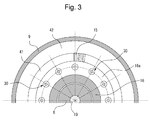
- FIG. 3 is a cross section as viewed from the direction of Arrows III in FIG. 1 , illustrating essential parts of the gas turbine to which the cooling system according to Embodiment 1 is applied.
- the lower half of the gas turbine is not illustrated, and the dashed arrows represent the flows of compressed air and cooling air.
- impingement cooling holes are provided in a partition wall located between the exit space of a compressor and the wheel space located upstream of a first-stage turbine wheel so that compressed air in the exit of the compressor jets through the impingement cooling holes toward the first-stage turbine wheel and the attachment portions of first-stage turbine blades.
- first-stage turbine wheel and the attachment portions of the first-stage turbine blades are cooled directly by the compressed air.
- the gas turbine includes the following components: a compressor 1 for compressing air; a combustor 2 for combusting the air compressed by the compressor 1 with fuel; and a turbine 3 driven by the combustion gas generated by the combustor 2.
- the compressor rotor 4 of the compressor 1 and the turbine rotor 5 of the turbine 3 are coaxially connected by an intermediate shaft 6, thereby constituting a gas turbine rotor that rotates as a single unit.
- This gas turbine rotor is covered with a casing 9.
- the compressor rotor 4 is formed by stacking in an axial direction multiple compressor wheels 8 each having multiple compressor rotor blades 7 on its outer circumferential section (only the last-stage compressor wheel is shown in FIG. 1 ).
- a main compressor passage 40 is formed between the compressor wheels 8 and the casing 9.
- compressor stator vanes 10 fixed to the inner wall of the casing 9 are alternately arranged with the compressor rotor blades 7 in an axial direction.
- the turbine rotor 5 is formed by multiple turbine wheels 12 and multiple spacers 13.
- Each of the turbine wheels 12 has multiple turbine rotor blades 11 on its outer circumferential section.
- the turbine wheels 12 and spacers 13 are alternately stacked in an axial direction. In FIG. 1 , only a first-stage turbine wheel 12a and a first-stage turbine blade 11a are shown. It should be noted, however, that at least one turbine wheel 12 and a spacer 13 are necessary.
- These turbine wheels 12 and spacers 13 are fastened by stacking bolts 14 to the intermediate shaft 6. As illustrated in FIG. 1 , the first-stage turbine wheel 12a has a central hole 18 at its rotational center.
- attachment grooves are formed at particular intervals on the outer circumferential section of each of the turbine wheels 12, and each of the turbine blades 11 has an attachment portion to be connected to a turbine wheel 12.
- the turbine blades 11 are fixed to the turbine wheels 12.
- Located between the turbine wheels 12 and the casing 9 is a passage 41 through which the combustion gas generated by the combustor 2 passes.
- turbine stator vanes 15 fixed to the inner wall of the casing 9 are alternately arranged with the turbine blades 11 in an axial direction.
- the intermediate shaft 6 has a central hole 19 that extends in an axial direction. This central hole 19 communicates with the central hole 18 of the first-stage turbine wheel 12a.
- the intermediate shaft 6 is covered with an inner casing 16 with a space provided therebetween.
- the inner casing 16 includes a partition wall 16a that separates the exit space 42 of the compressor 1 from the wheel space 43a located upstream of the first-stage turbine wheel 12a, and the inner casing 16 is fixed to the casing 9 and other parts via struts 17 and the like.
- Formed between the intermediate shaft 6 and the inner casing 16 is a cooling air passage 44.
- the intermediate shaft 6 also has inflow holes 20 that communicate with both of the cooling air passage 44 and the central hole 19 of the intermediate shaft 6.
- the inflow holes 20 extend in radial directions of the intermediate shaft 6 and are disposed at particular intervals in a circumferential direction of the intermediate shaft 6.
- a seal 21 is disposed in an inner circumferential space of the inner casing 16 such that it is located downstream of the inflow holes 20.
- the seal 21 separates the cooling air passage 44 from the wheel space 43a located upstream of the first-stage turbine wheel 12a, thereby preventing the compressed air flowing inside the cooling air passage 44 from entering the wheel space 43a.
- part of the compressed air 101 flowing inside the main compressor passage 40 flows through the space between the compressor rotor 4 and the inner casing 16 into the inner circumferential space of the inner casing 16.
- This compressed air 101 then flows through the cooling air passage 44, through the inflow holes 20 and central hole 19 of the intermediate shaft 6, and through the central hole 18 of the first-stage turbine wheel 12a and eventually enters the turbine rotor 5, where the compressed air 101 is used as sealing air and cooling air 102.
- the seal 21 prevents the compressed air 101 from flowing into the wheel space 43a located upstream of the first-stage turbine wheel 12a.
- impingement cooling structures 30 are formed in the partition wall 16a of the inner casing 16, that is, between the exit space 42 of the compressor 1 and the wheel space 43a.
- the impingement cooling structures 30 constitute a gas turbine cooling system.
- FIGS. 2 and 3 the structure of the cooling system according to Embodiment 1 is described in detail.
- the dashed arrows in FIG. 2 represent the flows of compressed air and cooling air, and in FIG. 3 , the lower half of the gas turbine is not shown.
- FIG. 3 only several of the stator vanes 15 are illustrated, which are in fact concentrically fixed to the inner wall of the casing 9 at particular intervals.
- the same components as used in FIG. 1 are assigned the same reference numerals and will not be discussed further in detail.
- Each of the impingement cooling structures 30 includes a stepped hole 31 on the surface of the partition wall 16a of the inner casing 16 that faces the exit space 42 of the compressor 1 (see also FIG. 1 ).
- the stepped hole 31 does not penetrate the partition wall 16a toward the wheel space 43a located upstream of the first-stage turbine wheel 12a and includes a large-diameter section closer to the exit space 42 and a small-diameter section closer to the wheel space 43a.
- Each of the impingement cooling structures 30 also includes a group of impingement cooling holes 32 on the bottom surface of the stepped hole 31 (i.e., on a surface of the partition wall 16a).
- the impingement cooling holes 32 connect the stepped hole 31 and the wheel space 43a.
- the exits of the impingement cooling holes 32 face a surface of the first-stage turbine wheel 12a and surfaces of the attachment portions of the first-stage turbine blades 11a.
- the impingement cooling holes 32 are designed to eject the compressed air 101 in the exit space 42 of the compressor 1 toward the surface of the first-stage turbine wheel 12a and the surfaces of the attachment portions of the first-stage turbine blades 11a.
- Each of the impingement cooling structures 30 further includes a detachable orifice plate 33 on the bottom surface of the large-diameter section of the stepped hole 31 (i.e., on the side of the partition wall 16a from which compressed air is extracted toward the impingement cooling holes 32).
- the orifice plate 33 acts as an adjusting unit that adjusts the flow rate or pressure of compressed air (cooling air) 103 flowing into the impingement cooling holes 32 and is fixed with bolts or screws (not illustrated).
- the orifice plate 33 other plates having different orifice diameters are also prepared in advance so that the orifice plate 33 can be replaced by one of them.
- the orifice plate 33 and the small-diameter section of the stepped hole 31 constitute a cooling air header 34 that distributes the compressed air (cooling air) 103 to each of the impingement cooling holes 32.
- the gas turbine cooling system includes the multiple impingement cooling structures 30.
- the multiple impingement cooling structures 30 are concentrically arranged on the partition wall 16a of the inner casing 16 at particular intervals (in the example of FIG. 3 , seven impingement cooling structures 30 are provided for the upper half of the partition wall 16a).
- Embodiment 1 The function of the gas turbine cooling system according to Embodiment 1 are described below with reference to FIGS. 1 through 3 .
- the compressed air 101 flows through the main compressor passage 40 and reaches the exit space 42 of the compressor 1, and as illustrated in FIG. 2 , part of the air 101 reaching the exit space 42 then flows through the orifice plate 33, where the pressure or flow rate of the air 101 is adjusted.
- the pressure- or flowrate-adjusted air is supplied to the cooling air header 34 as cooling air 103.
- the cooling air 103 supplied to the cooling air header 34 jets from the impingement cooling holes 32 into the wheel space 43a located upstream of the first-stage turbine wheel 12a.
- the air ejected from the impingement cooling holes 32 collides with an outer surface of the first-stage turbine wheel 12a and with outer surfaces of the attachment portions of the first-stage turbine blades 11a.
- the resultant impingement jets directly cool the first-stage turbine wheel 12a and the attachment portions of the first-stage turbine blades 11a.
- the impingement cooling air 104 also cools the wheel space 43a, reducing the temperature within the wheel space 43a.
- the first-stage turbine wheel 12a and the attachment portions of the first-stage turbine blades 11a are also cooled indirectly by the cooling air circulating in the wheel space 43a.
- the air that has cooled the first-stage turbine wheel 12a and the attachment portions of the first-stage turbine blades 11a then flows through the space between the attachment portions of the first-stage turbine blades 11a and the inner casing 16 into the passage 41, where the air joins the combustion gas flowing through the passage 41.
- the exits of the impingement cooling holes 32 of the impingement cooling structures 30 are provided on the surface of the partition wall 16a of the inner casing 16 that faces the first-stage turbine wheel 12a and the first-stage turbine blades 11a, so that the impingement cooling air 104 is ejected directly to the first-stage turbine wheel 12a and the attachment portions of the first-stage turbine blades 11a.
- the first-stage turbine wheel 12a and the attachment portions of the first-stage turbine blades 11a are cooled directly by the impingement cooling air 104.
- This method achieves a higher heat transfer rate and reduces metal temperature more efficiently than a conventional method in which metal temperature is reduced by cooling the wheel space upstream of the first-stage turbine wheel using the compressed air bled from the compressor and by indirectly cooling the first-stage turbine wheel and the attachment portions of the first-stage turbine blades. Accordingly, the amount of compressed air to be bled from the compressor 1 as cooling air can be reduced, which in turn increases the efficiency and output of the gas turbine.
- the multiple impingement cooling structures 30 are arranged in a circumferential direction of the partition wall 16a, the first-stage turbine wheel 12a and the attachment portions of the first-stage turbine blades 11a can be cooled uniformly. Further, the concentric arrangement of the impingement cooling structures 30 at particular intervals allows more uniform and efficient cooling.
- the temperature of the wheel space tends to vary depending on radial or circumferential positions, which requires adjustment of the flow rate of cooling air using a higher-temperature spot as a reference point.
- orifice plates having different orifice diameters are prepared in advance as the orifice plates 33 of the impingement cooling structures 30.
- the orifice plate 33 of each of the impingement cooling structures 30 can be replaced by one with the appropriate orifice diameter. The replacement can be done by removing the combustor 2 even after the installation of the gas turbine.
- the flow rate or pressure of the cooling air 103 entering the cooling air header 34 of each of the impingement cooling structures 30 can be adjusted independently and with ease, whereby the first-stage turbine wheel 12a and the attachment portions of the first-stage turbine blades 11a can be cooled more uniformly.
- the flow rate of cooling air does not need to be adjusted based on a higher-temperature reference spot, and the amount of compressed air to be bled from the compressor 1 as cooling air can be further reduced, leading to increased efficiency and output of the gas turbine.
- adjustment of the flow rate or pressure of the impingement cooling air 104 can be done by replacing the orifice plates 33 by one with the appropriate orifice diameter. Therefore, the adjustment can be easily done without disassembly, refabrication, and reassembly of the inner casing 16 and the intermediate shaft 6. In other words, disassembly and assembly during replacement of the orifice plates 33 requires less effort, time, and cost.
- the seal 21 is disposed within the inner casing 16 such that it is located downstream of the inflow holes 20, the compressed air 102 (cooling air) flowing in the cooling air passage 44 is prevented from entering the wheel space 43a located upstream of the first-stage turbine wheel 12a.
- the flow of the impingement cooling air 104 ejected from the impingement cooling holes 32 is not disturbed by the compressed air 102 from the cooling air passage 44, and the impingement cooling air 104 can reliably be ejected onto the first-stage turbine wheel 12a and the attachment portions of the first-stage turbine blades 11a.
- part of the compressed air flowing from the compressor 1 is directly ejected onto the first-stage turbine wheel 12a and the attachment portions of the first-stage turbine blades 11a via the group of impingement cooling holes 32. Therefore, the first-stage turbine wheel 12a and the attachment portions of the first-stage turbine blades 11a can be cooled efficiently.
- FIGS. 4 and 5 illustrate one of the cooling structures constituting the cooling system according to Embodiment 2.
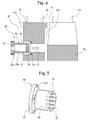
- FIG. 4 is a cross section illustrating the cooling structure while FIG. 5 is a perspective view of the cartridge constituting the cooling structure illustrated in FIG. 4 .
- the cartridge, designated by 60 is shown detached from the inner casing 16, and the arrow of FIG. 4 represents the direction of installing the cartridge 60 into the inner casing 16.
- the same components as used in FIGS. 1 through 3 are assigned the same reference numerals and will not be discussed further in detail.
- Embodiment 1 is designed such that the group of impingement cooling holes 32 are formed in the partition wall 16a of the inner casing
- Embodiment 2 is designed such that each cartridge 60 having a group of impingement cooling holes 62 is attached to the partition wall 16a and can be detached if necessary.
- a stepped installation hole 51 is formed in the partition wall 16a of the inner casing 16.
- the stepped installation hole 51 connects the exit space 42 of the compressor 1 (see FIG. 1 ) and the wheel space 43a located upstream of the first-stage turbine wheel 12a.
- the stepped installation hole 51 includes a large-diameter section closer to the exit space 42 and a small-diameter section closer to the wheel space 43a.
- the opening of the installation hole 51 on the side of the wheel space 43a is provided at the place of the partition wall 16a that faces the first-stage turbine wheel 12a and the attachment portions of the first-stage turbine blades 11a.
- multiple installation holes 51 are concentrically arranged on the partition wall 16a at particular intervals.
- each of the cartridges 60 includes a cartridge body 61 shaped like a cylinder with a bottom surface and an orifice plate 33.
- the cartridge body 61 has an opening 61a on one side, into which the compressed air in the exist space 42 flows, and impingement cooling holes 62 on the opposite-side bottom surface.
- the orifice plate 33 is attached to the opening 61a of the cartridge body 61 and acts as an adjusting unit that adjusts the flow rate or pressure of compressed air (cooling air) flowing into the impingement cooling holes 62 of the cartridge 60.
- the cartridge body 61 and the orifice plate 33 constitute a cooling air header 64.
- Each of the cartridges 60 can independently be attached to and detached from each of the installation holes 51.
- different types of cartridges are prepared beforehand in which the orifice plates 33 differ in orifice diameter and the groups of impingement cooling holes 62 differ in diameter, position, or number.
- Each of the cartridges 60 is fixed such that its orifice plate 33 faces the exit space 42 while the bottom surface of its cartridge body 61 on which the impingement cooling holes 62 are formed faces the wheel space 42a.
- Each of the cartridges 60 can be fixed, for example, by forming bolt holes 33a in its orifice plate 33 and screw holes 51a on the bottom surface of the large-diameter section of its associated installation hole 51 and then screwing bolts, screws, or the like (not illustrated).
- each of the cartridges 60 having the group of impingement cooling holes 62 is installed into each of the installation holes 51 provided at the place of the partition wall 16a of the inner casing 16 that face the first-stage turbine wheel 12a and the attachment portions of the first-stage turbine blades 11a. Accordingly, the same advantageous effects as those of Embodiment 1 can be obtained.
- the group of impingement cooling holes 62 are formed at the bottom section of the cartridge body 61 of the cartridge 60, not in the partition wall 16a of the inner casing 16, the time, effort, and cost involved in fabrication of the inner casing 16 can be reduced.
- each of the cartridges 60 can independently be attached to and detached from each of the installation holes 51 of the inner casing 16.
- any of the installed cartridges 60 can be replaced by different cartridges in which the orifice plates 33 differ in orifice diameter and the group of impingement cooling holes 62 differ in diameter, position, or number.
- Such replacement can be done as desired, depending on the operating conditions of the gas turbine, on the metal temperatures of the first-stage turbine wheel 12a and the attachment portions of the first-stage turbine blades 11a, or on the ambient temperature of the wheel space 43a located upstream of the first-stage turbine wheel 12a.
- each of the installed cartridges 60 can independently be replaced by the appropriate one depending on various conditions and states of the gas turbine.
- Embodiment 1 This allows not only finer adjustment of the flow rate or pressure of the impingement cooling air 104 than in Embodiment 1 but also adjustment of the cooling areas in which impingement cooling is performed.
- the first-stage turbine wheel 12a and the attachment portions of the first-stage turbine blades 11a can be cooled much more uniformly.
- the amount of compressed air to be bled from the compressor 1 as cooling air can be further reduced, which in turn further increases the efficiency and output of the gas turbine.
- the flow rate or pressure of the impingement cooling air 104 can be adjusted with ease by simply removing the combustor 2 and replacing the cartridges 60 with the appropriate ones. Also, when the flow rate or pressure of the impingement cooling air 104 or the cooling areas need to be adjusted by changing the positions, number and diameter of the groups of impingement cooling holes 62, it is only necessary to replace the cartridges 60. Thus, such adjustment can be done much more easily than in Embodiment 1 in which the inner casing 16 needs to be refabricated to adjust the impingement cooling holes 32.
- cooling structures having impingement cooling holes are provided in the inner casing 16.
- one of the essential effects achieved by the invention is the efficient cooling in which the impingement cooling holes are provided in a partition located between the exit space 42 of the compressor 1 and the wheel space 43a located upstream of the first-stage turbine wheel 12a, thereby directly ejecting compressed air toward the first-stage turbine wheel 12a and the attachment portions of the first-stage turbine blades 11a.
- the cooling structures do not necessarily need to be provided in the inner casing 16.
- the support ring for the first-stage stator vanes is positioned between the exit space 42 and the wheel space 43a, the cooling structures can instead be provided on that support ring.
- the foregoing embodiments illustrate examples where the orifice plates 33 are used to adjust the flow rate or pressure of the compressed air 103 (cooling air) entering the groups of impingement cooling holes 32 and 62.
- one of the essential effects achieved by the invention is the adjustment of the flow rate or pressure of cooling air to be ejected toward the first-stage turbine wheel 12a and the attachment portions of the first-stage turbine blades 11a.
- the invention is not necessarily limited to the orifice plates 33.
- the foregoing embodiments further illustrate examples where multiple cooling structures having impingement cooling holes are concentrically arranged on the partition wall 16a.
- one of the essential effects achieved by the invention is the uniform cooling in which multiple groups of impingement cooling holes are provided in a partition that separates the exit space 42 from the wheel space 43a, thereby uniformly cooling the first-stage turbine wheel 12a and the attachment portions of the first-stage turbine blades 11a.
- the invention is not limited to the concentric arrangement.
- cooling structures include the orifice plates 33
- one of the essential effects achieved by the invention is the efficient cooling in which cooling air is directly ejected toward the first-stage turbine wheel 12a and the attachment portions of the first-stage turbine blades 11a via impingement cooling holes.
- the orifice plates 33 are not necessarily needed. For instance, by appropriately selecting the positions, number, and diameter of the groups of impingement cooling holes 62, the flow rate or pressure of cooling air to be ejected toward the first-stage turbine wheel 12a and the attachment portions of the first-stage turbine blades 11a or the cooling areas can be adjusted well to achieve efficient cooling.
- Embodiment 1 illustrates an example where the orifice plates 33 are fastened to the bottom surfaces of the large-diameter sections of the stepped holes 31 on the inner casing 16 with fasters such as bolts, screws, or the like.
- threads can instead be cut in the side surfaces of the orifice plates 33 and in the side surfaces of the large-diameter sections of the stepped holes 31 so that the orifice plates 33 can be screwed into the large-diameter sections.
- Embodiment 2 illustrates an example where the cartridges 60 are fastened to the installation holes 51 of the inner casing 16 with fasters such as bolts, screws, or the like, threads can instead be cut in the outer surfaces of the cartridges 60 and in the side surfaces of the installation holes 51 so that the cartridges 60 can be screwed into the installation holes 51.
- Embodiment 2 illustrates an example where each of the cartridges 60 includes a cartridge body 61 shaped like a cylinder with a bottom surface and an orifice plate 33 attached to the cartridge body 61.
- each of the cartridges 60 can instead be composed of only a cartridge body 61 without an orifice plate 33.
- an orifice plate 33 is attached on the side of an installation hole 51 from which compressed air is extracted, and a cartridge 60 is installed into the installation hole 51 such that the cartridge 60 is located downstream of the orifice plate 33.
- the same advantageous effects as those of Embodiment 2 can be achieved.
- the flow rate or pressure of the impingement cooling air 104 can be adjusted more finely because the orifice plates and the cartridges can be replaced independently depending on various conditions and states of the gas turbine.
- the cooling systems each include multiple impingement cooling structures.
- one of the essential effects achieved by the invention is the efficient cooling. It should be noted that at least one impingement cooling structure is necessary in order to efficiently cool the first-stage turbine wheel 12a and the attachment portions of the first-stage turbine blades 11a.
- the invention is not limited to the above embodiments disclosed, but allows various modifications.
- the foregoing embodiments are only meant to be illustrative, and the invention is not necessarily limited to structures having all the components disclosed. For instance, part of the components of one embodiment can be replaced by part of the components of another, or part of the components of one embodiment can be added to the components of another. Further, each of the foregoing embodiments allows addition, removal, and replacement of certain components.
Landscapes
- Engineering & Computer Science (AREA)
- Mechanical Engineering (AREA)
- General Engineering & Computer Science (AREA)
- Chemical & Material Sciences (AREA)
- Combustion & Propulsion (AREA)
- Turbine Rotor Nozzle Sealing (AREA)
- Structures Of Non-Positive Displacement Pumps (AREA)
Applications Claiming Priority (1)
| Application Number | Priority Date | Filing Date | Title |
|---|---|---|---|
| JP2013238983A JP6245739B2 (ja) | 2013-11-19 | 2013-11-19 | ガスタービンの冷却構造 |
Publications (2)
| Publication Number | Publication Date |
|---|---|
| EP2873805A1 EP2873805A1 (en) | 2015-05-20 |
| EP2873805B1 true EP2873805B1 (en) | 2016-07-20 |
Family
ID=52020937
Family Applications (1)
| Application Number | Title | Priority Date | Filing Date |
|---|---|---|---|
| EP14193906.6A Active EP2873805B1 (en) | 2013-11-19 | 2014-11-19 | Cooling system for gas turbine |
Country Status (4)
| Country | Link |
|---|---|
| US (1) | US10072576B2 (enExample) |
| EP (1) | EP2873805B1 (enExample) |
| JP (1) | JP6245739B2 (enExample) |
| CN (1) | CN104653295B (enExample) |
Families Citing this family (3)
| Publication number | Priority date | Publication date | Assignee | Title |
|---|---|---|---|---|
| CN114198153B (zh) * | 2020-09-17 | 2024-05-03 | 中国航发商用航空发动机有限责任公司 | 涡轮叶片冷却系统及航空发动机 |
| CN112710870B (zh) * | 2020-12-21 | 2022-07-08 | 成都成发泰达航空科技有限公司 | 一种apu转速传感器性能检测装置 |
| CN116422723A (zh) * | 2023-03-22 | 2023-07-14 | 南南铝业股份有限公司 | 一种适用于不同铝挤压模具在线液氮冷却方法 |
Family Cites Families (16)
| Publication number | Priority date | Publication date | Assignee | Title |
|---|---|---|---|---|
| US4242045A (en) * | 1979-06-01 | 1980-12-30 | General Electric Company | Trap seal for open circuit liquid cooled turbines |
| US4456427A (en) * | 1981-06-11 | 1984-06-26 | General Electric Company | Cooling air injector for turbine blades |
| DE3603350A1 (de) | 1986-02-04 | 1987-08-06 | Walter Prof Dipl Ph Sibbertsen | Verfahren zur kuehlung thermisch belasteter bauelemente von stroemungsmaschinen, vorrichtung zur durchfuehrung des verfahrens sowie ausbildung thermisch belasteter schaufeln |
| US5413463A (en) | 1991-12-30 | 1995-05-09 | General Electric Company | Turbulated cooling passages in gas turbine buckets |
| JP3337393B2 (ja) * | 1997-04-23 | 2002-10-21 | 三菱重工業株式会社 | ガスタービン冷却動翼 |
| US6234746B1 (en) * | 1999-08-04 | 2001-05-22 | General Electric Co. | Apparatus and methods for cooling rotary components in a turbine |
| JP3889727B2 (ja) | 2003-07-01 | 2007-03-07 | 株式会社日立製作所 | ガスタービン及び冷却空気導入方法 |
| JP4319087B2 (ja) * | 2004-05-06 | 2009-08-26 | 株式会社日立製作所 | ガスタービン |
| GB0513468D0 (en) * | 2005-07-01 | 2005-08-10 | Rolls Royce Plc | A mounting arrangement for turbine blades |
| JP2007146787A (ja) * | 2005-11-29 | 2007-06-14 | Mitsubishi Heavy Ind Ltd | ガスタービン |
| GB2457427A (en) * | 2007-12-14 | 2009-08-19 | Rolls Royce Plc | Gas turbine engine cooling flow modulation arrangement comprising fluidic valves |
| US20090226327A1 (en) * | 2008-03-07 | 2009-09-10 | Siemens Power Generation, Inc. | Gas Turbine Engine Including Temperature Control Device and Method Using Memory Metal |
| JP5495893B2 (ja) * | 2010-03-30 | 2014-05-21 | 三菱重工業株式会社 | ガスタービンおよびその改造方法 |
| US8677766B2 (en) * | 2010-04-12 | 2014-03-25 | Siemens Energy, Inc. | Radial pre-swirl assembly and cooling fluid metering structure for a gas turbine engine |
| JP4841678B2 (ja) * | 2010-04-15 | 2011-12-21 | 川崎重工業株式会社 | ガスタービンのタービン静翼 |
| US8529195B2 (en) | 2010-10-12 | 2013-09-10 | General Electric Company | Inducer for gas turbine system |
-
2013
- 2013-11-19 JP JP2013238983A patent/JP6245739B2/ja active Active
-
2014
- 2014-11-14 CN CN201410647462.2A patent/CN104653295B/zh active Active
- 2014-11-18 US US14/546,138 patent/US10072576B2/en active Active
- 2014-11-19 EP EP14193906.6A patent/EP2873805B1/en active Active
Also Published As
| Publication number | Publication date |
|---|---|
| JP2015098826A (ja) | 2015-05-28 |
| US10072576B2 (en) | 2018-09-11 |
| JP6245739B2 (ja) | 2017-12-13 |
| US20150135715A1 (en) | 2015-05-21 |
| CN104653295A (zh) | 2015-05-27 |
| CN104653295B (zh) | 2017-04-26 |
| EP2873805A1 (en) | 2015-05-20 |
Similar Documents
| Publication | Publication Date | Title |
|---|---|---|
| EP2834498B1 (en) | Cooling system for a turbine vane | |
| US7094027B2 (en) | Row of long and short chord length and high and low temperature capability turbine airfoils | |
| CN106567749B (zh) | 燃气涡轮冷却系统和方法 | |
| US10605168B2 (en) | Interdigitated turbine engine air bearing cooling structure and method of thermal management | |
| US10718265B2 (en) | Interdigitated turbine engine air bearing and method of operation | |
| US20120057968A1 (en) | Ring segment with serpentine cooling passages | |
| EP3447384B1 (en) | Combustor panel cooling arrangements | |
| US10669852B2 (en) | Gas turbine | |
| US20130084162A1 (en) | Gas Turbine | |
| US10787931B2 (en) | Method and structure of interdigitated turbine engine thermal management | |
| JP2011163344A (ja) | ヒートシールド | |
| EP1130237B1 (en) | Closed circuit cooled turbine blading | |
| US10139108B2 (en) | D5/D5A DF-42 integrated exit cone and splash plate | |
| JP2012013080A (ja) | ガスタービンエンジンに用いるロータ組立体、およびそれを組み立てる方法 | |
| US20130011238A1 (en) | Cooled ring segment | |
| EP3284904B1 (en) | Inter-stage cooling for a turbomachine | |
| US10072576B2 (en) | Cooling system for gas turbine | |
| EP3132121A1 (en) | Controlling cooling flow in a cooled turbine vane or blade using an impingement tube | |
| CN115680791B (zh) | 间隙控制组件 | |
| EP3390780B1 (en) | Cooling system for mid-frame torque discs downstream from a compressor assembly in a gas turbine engine | |
| US11371438B2 (en) | Machine component, particularly a turbomachine component, with cooling features and a method for manufacturing and of operation | |
| US20190264578A1 (en) | Turbine shroud assembly | |
| WO2019035178A1 (ja) | タービン静翼列及びタービン | |
| US9745894B2 (en) | Compressor air provided to combustion chamber plenum and turbine guide vane | |
| RU2352788C1 (ru) | Высокотемпературная газовая турбина |
Legal Events
| Date | Code | Title | Description |
|---|---|---|---|
| PUAI | Public reference made under article 153(3) epc to a published international application that has entered the european phase |
Free format text: ORIGINAL CODE: 0009012 |
|
| 17P | Request for examination filed |
Effective date: 20141219 |
|
| AK | Designated contracting states |
Kind code of ref document: A1 Designated state(s): AL AT BE BG CH CY CZ DE DK EE ES FI FR GB GR HR HU IE IS IT LI LT LU LV MC MK MT NL NO PL PT RO RS SE SI SK SM TR |
|
| AX | Request for extension of the european patent |
Extension state: BA ME |
|
| GRAP | Despatch of communication of intention to grant a patent |
Free format text: ORIGINAL CODE: EPIDOSNIGR1 |
|
| INTG | Intention to grant announced |
Effective date: 20160126 |
|
| GRAS | Grant fee paid |
Free format text: ORIGINAL CODE: EPIDOSNIGR3 |
|
| GRAA | (expected) grant |
Free format text: ORIGINAL CODE: 0009210 |
|
| AK | Designated contracting states |
Kind code of ref document: B1 Designated state(s): AL AT BE BG CH CY CZ DE DK EE ES FI FR GB GR HR HU IE IS IT LI LT LU LV MC MK MT NL NO PL PT RO RS SE SI SK SM TR |
|
| REG | Reference to a national code |
Ref country code: GB Ref legal event code: FG4D |
|
| REG | Reference to a national code |
Ref country code: CH Ref legal event code: EP |
|
| REG | Reference to a national code |
Ref country code: IE Ref legal event code: FG4D |
|
| REG | Reference to a national code |
Ref country code: AT Ref legal event code: REF Ref document number: 814272 Country of ref document: AT Kind code of ref document: T Effective date: 20160815 |
|
| REG | Reference to a national code |
Ref country code: DE Ref legal event code: R096 Ref document number: 602014002767 Country of ref document: DE |
|
| REG | Reference to a national code |
Ref country code: LT Ref legal event code: MG4D |
|
| REG | Reference to a national code |
Ref country code: NL Ref legal event code: MP Effective date: 20160720 |
|
| REG | Reference to a national code |
Ref country code: FR Ref legal event code: PLFP Year of fee payment: 3 |
|
| REG | Reference to a national code |
Ref country code: AT Ref legal event code: MK05 Ref document number: 814272 Country of ref document: AT Kind code of ref document: T Effective date: 20160720 |
|
| PG25 | Lapsed in a contracting state [announced via postgrant information from national office to epo] |
Ref country code: LT Free format text: LAPSE BECAUSE OF FAILURE TO SUBMIT A TRANSLATION OF THE DESCRIPTION OR TO PAY THE FEE WITHIN THE PRESCRIBED TIME-LIMIT Effective date: 20160720 Ref country code: IS Free format text: LAPSE BECAUSE OF FAILURE TO SUBMIT A TRANSLATION OF THE DESCRIPTION OR TO PAY THE FEE WITHIN THE PRESCRIBED TIME-LIMIT Effective date: 20161120 Ref country code: NO Free format text: LAPSE BECAUSE OF FAILURE TO SUBMIT A TRANSLATION OF THE DESCRIPTION OR TO PAY THE FEE WITHIN THE PRESCRIBED TIME-LIMIT Effective date: 20161020 Ref country code: HR Free format text: LAPSE BECAUSE OF FAILURE TO SUBMIT A TRANSLATION OF THE DESCRIPTION OR TO PAY THE FEE WITHIN THE PRESCRIBED TIME-LIMIT Effective date: 20160720 Ref country code: FI Free format text: LAPSE BECAUSE OF FAILURE TO SUBMIT A TRANSLATION OF THE DESCRIPTION OR TO PAY THE FEE WITHIN THE PRESCRIBED TIME-LIMIT Effective date: 20160720 Ref country code: IT Free format text: LAPSE BECAUSE OF FAILURE TO SUBMIT A TRANSLATION OF THE DESCRIPTION OR TO PAY THE FEE WITHIN THE PRESCRIBED TIME-LIMIT Effective date: 20160720 Ref country code: RS Free format text: LAPSE BECAUSE OF FAILURE TO SUBMIT A TRANSLATION OF THE DESCRIPTION OR TO PAY THE FEE WITHIN THE PRESCRIBED TIME-LIMIT Effective date: 20160720 Ref country code: NL Free format text: LAPSE BECAUSE OF FAILURE TO SUBMIT A TRANSLATION OF THE DESCRIPTION OR TO PAY THE FEE WITHIN THE PRESCRIBED TIME-LIMIT Effective date: 20160720 |
|
| PG25 | Lapsed in a contracting state [announced via postgrant information from national office to epo] |
Ref country code: PL Free format text: LAPSE BECAUSE OF FAILURE TO SUBMIT A TRANSLATION OF THE DESCRIPTION OR TO PAY THE FEE WITHIN THE PRESCRIBED TIME-LIMIT Effective date: 20160720 Ref country code: AT Free format text: LAPSE BECAUSE OF FAILURE TO SUBMIT A TRANSLATION OF THE DESCRIPTION OR TO PAY THE FEE WITHIN THE PRESCRIBED TIME-LIMIT Effective date: 20160720 Ref country code: SE Free format text: LAPSE BECAUSE OF FAILURE TO SUBMIT A TRANSLATION OF THE DESCRIPTION OR TO PAY THE FEE WITHIN THE PRESCRIBED TIME-LIMIT Effective date: 20160720 Ref country code: LV Free format text: LAPSE BECAUSE OF FAILURE TO SUBMIT A TRANSLATION OF THE DESCRIPTION OR TO PAY THE FEE WITHIN THE PRESCRIBED TIME-LIMIT Effective date: 20160720 Ref country code: ES Free format text: LAPSE BECAUSE OF FAILURE TO SUBMIT A TRANSLATION OF THE DESCRIPTION OR TO PAY THE FEE WITHIN THE PRESCRIBED TIME-LIMIT Effective date: 20160720 Ref country code: BE Free format text: LAPSE BECAUSE OF NON-PAYMENT OF DUE FEES Effective date: 20160720 Ref country code: PT Free format text: LAPSE BECAUSE OF FAILURE TO SUBMIT A TRANSLATION OF THE DESCRIPTION OR TO PAY THE FEE WITHIN THE PRESCRIBED TIME-LIMIT Effective date: 20161121 Ref country code: GR Free format text: LAPSE BECAUSE OF FAILURE TO SUBMIT A TRANSLATION OF THE DESCRIPTION OR TO PAY THE FEE WITHIN THE PRESCRIBED TIME-LIMIT Effective date: 20161021 |
|
| REG | Reference to a national code |
Ref country code: DE Ref legal event code: R097 Ref document number: 602014002767 Country of ref document: DE |
|
| PG25 | Lapsed in a contracting state [announced via postgrant information from national office to epo] |
Ref country code: EE Free format text: LAPSE BECAUSE OF FAILURE TO SUBMIT A TRANSLATION OF THE DESCRIPTION OR TO PAY THE FEE WITHIN THE PRESCRIBED TIME-LIMIT Effective date: 20160720 Ref country code: RO Free format text: LAPSE BECAUSE OF FAILURE TO SUBMIT A TRANSLATION OF THE DESCRIPTION OR TO PAY THE FEE WITHIN THE PRESCRIBED TIME-LIMIT Effective date: 20160720 |
|
| PLBE | No opposition filed within time limit |
Free format text: ORIGINAL CODE: 0009261 |
|
| STAA | Information on the status of an ep patent application or granted ep patent |
Free format text: STATUS: NO OPPOSITION FILED WITHIN TIME LIMIT |
|
| PG25 | Lapsed in a contracting state [announced via postgrant information from national office to epo] |
Ref country code: DK Free format text: LAPSE BECAUSE OF FAILURE TO SUBMIT A TRANSLATION OF THE DESCRIPTION OR TO PAY THE FEE WITHIN THE PRESCRIBED TIME-LIMIT Effective date: 20160720 Ref country code: BG Free format text: LAPSE BECAUSE OF FAILURE TO SUBMIT A TRANSLATION OF THE DESCRIPTION OR TO PAY THE FEE WITHIN THE PRESCRIBED TIME-LIMIT Effective date: 20161020 Ref country code: CZ Free format text: LAPSE BECAUSE OF FAILURE TO SUBMIT A TRANSLATION OF THE DESCRIPTION OR TO PAY THE FEE WITHIN THE PRESCRIBED TIME-LIMIT Effective date: 20160720 Ref country code: SK Free format text: LAPSE BECAUSE OF FAILURE TO SUBMIT A TRANSLATION OF THE DESCRIPTION OR TO PAY THE FEE WITHIN THE PRESCRIBED TIME-LIMIT Effective date: 20160720 Ref country code: SM Free format text: LAPSE BECAUSE OF FAILURE TO SUBMIT A TRANSLATION OF THE DESCRIPTION OR TO PAY THE FEE WITHIN THE PRESCRIBED TIME-LIMIT Effective date: 20160720 |
|
| 26N | No opposition filed |
Effective date: 20170421 |
|
| REG | Reference to a national code |
Ref country code: IE Ref legal event code: MM4A |
|
| PG25 | Lapsed in a contracting state [announced via postgrant information from national office to epo] |
Ref country code: SI Free format text: LAPSE BECAUSE OF FAILURE TO SUBMIT A TRANSLATION OF THE DESCRIPTION OR TO PAY THE FEE WITHIN THE PRESCRIBED TIME-LIMIT Effective date: 20160720 |
|
| PG25 | Lapsed in a contracting state [announced via postgrant information from national office to epo] |
Ref country code: LU Free format text: LAPSE BECAUSE OF NON-PAYMENT OF DUE FEES Effective date: 20161130 |
|
| REG | Reference to a national code |
Ref country code: FR Ref legal event code: PLFP Year of fee payment: 4 |
|
| PG25 | Lapsed in a contracting state [announced via postgrant information from national office to epo] |
Ref country code: IE Free format text: LAPSE BECAUSE OF NON-PAYMENT OF DUE FEES Effective date: 20161119 |
|
| PG25 | Lapsed in a contracting state [announced via postgrant information from national office to epo] |
Ref country code: HU Free format text: LAPSE BECAUSE OF FAILURE TO SUBMIT A TRANSLATION OF THE DESCRIPTION OR TO PAY THE FEE WITHIN THE PRESCRIBED TIME-LIMIT; INVALID AB INITIO Effective date: 20141119 |
|
| PG25 | Lapsed in a contracting state [announced via postgrant information from national office to epo] |
Ref country code: MC Free format text: LAPSE BECAUSE OF FAILURE TO SUBMIT A TRANSLATION OF THE DESCRIPTION OR TO PAY THE FEE WITHIN THE PRESCRIBED TIME-LIMIT Effective date: 20160720 Ref country code: MK Free format text: LAPSE BECAUSE OF FAILURE TO SUBMIT A TRANSLATION OF THE DESCRIPTION OR TO PAY THE FEE WITHIN THE PRESCRIBED TIME-LIMIT Effective date: 20160720 Ref country code: CY Free format text: LAPSE BECAUSE OF FAILURE TO SUBMIT A TRANSLATION OF THE DESCRIPTION OR TO PAY THE FEE WITHIN THE PRESCRIBED TIME-LIMIT Effective date: 20160720 |
|
| PG25 | Lapsed in a contracting state [announced via postgrant information from national office to epo] |
Ref country code: LI Free format text: LAPSE BECAUSE OF NON-PAYMENT OF DUE FEES Effective date: 20171130 Ref country code: CH Free format text: LAPSE BECAUSE OF NON-PAYMENT OF DUE FEES Effective date: 20171130 |
|
| PG25 | Lapsed in a contracting state [announced via postgrant information from national office to epo] |
Ref country code: MT Free format text: LAPSE BECAUSE OF NON-PAYMENT OF DUE FEES Effective date: 20161119 |
|
| REG | Reference to a national code |
Ref country code: FR Ref legal event code: PLFP Year of fee payment: 5 |
|
| PG25 | Lapsed in a contracting state [announced via postgrant information from national office to epo] |
Ref country code: AL Free format text: LAPSE BECAUSE OF FAILURE TO SUBMIT A TRANSLATION OF THE DESCRIPTION OR TO PAY THE FEE WITHIN THE PRESCRIBED TIME-LIMIT Effective date: 20160720 Ref country code: TR Free format text: LAPSE BECAUSE OF FAILURE TO SUBMIT A TRANSLATION OF THE DESCRIPTION OR TO PAY THE FEE WITHIN THE PRESCRIBED TIME-LIMIT Effective date: 20160720 |
|
| REG | Reference to a national code |
Ref country code: DE Ref legal event code: R082 Ref document number: 602014002767 Country of ref document: DE Representative=s name: MERH-IP MATIAS ERNY REICHL HOFFMANN PATENTANWA, DE Ref country code: DE Ref legal event code: R081 Ref document number: 602014002767 Country of ref document: DE Owner name: MITSUBISHI POWER, LTD., JP Free format text: FORMER OWNER: MITSUBISHI HITACHI POWER SYSTEMS, LTD., YOKOHAMA, KANAGAWA, JP |
|
| PGFP | Annual fee paid to national office [announced via postgrant information from national office to epo] |
Ref country code: FR Payment date: 20250930 Year of fee payment: 12 |
|
| PGFP | Annual fee paid to national office [announced via postgrant information from national office to epo] |
Ref country code: DE Payment date: 20250930 Year of fee payment: 12 |
|
| PGFP | Annual fee paid to national office [announced via postgrant information from national office to epo] |
Ref country code: GB Payment date: 20251001 Year of fee payment: 12 |