EP2870599B1 - Verwendung einer chemisch-mechanische polierzusammensetzung mit einem nicht ionischen tensid und einer aromatischen verbindung mit mindestens einer säuregruppe - Google Patents
Verwendung einer chemisch-mechanische polierzusammensetzung mit einem nicht ionischen tensid und einer aromatischen verbindung mit mindestens einer säuregruppe Download PDFInfo
- Publication number
- EP2870599B1 EP2870599B1 EP13812480.5A EP13812480A EP2870599B1 EP 2870599 B1 EP2870599 B1 EP 2870599B1 EP 13812480 A EP13812480 A EP 13812480A EP 2870599 B1 EP2870599 B1 EP 2870599B1
- Authority
- EP
- European Patent Office
- Prior art keywords
- acid
- group
- cmp composition
- cmp
- particles
- Prior art date
- Legal status (The legal status is an assumption and is not a legal conclusion. Google has not performed a legal analysis and makes no representation as to the accuracy of the status listed.)
- Active
Links
Images

Classifications
-
- C—CHEMISTRY; METALLURGY
- C09—DYES; PAINTS; POLISHES; NATURAL RESINS; ADHESIVES; COMPOSITIONS NOT OTHERWISE PROVIDED FOR; APPLICATIONS OF MATERIALS NOT OTHERWISE PROVIDED FOR
- C09G—POLISHING COMPOSITIONS; SKI WAXES
- C09G1/00—Polishing compositions
- C09G1/02—Polishing compositions containing abrasives or grinding agents
-
- C—CHEMISTRY; METALLURGY
- C09—DYES; PAINTS; POLISHES; NATURAL RESINS; ADHESIVES; COMPOSITIONS NOT OTHERWISE PROVIDED FOR; APPLICATIONS OF MATERIALS NOT OTHERWISE PROVIDED FOR
- C09K—MATERIALS FOR MISCELLANEOUS APPLICATIONS, NOT PROVIDED FOR ELSEWHERE
- C09K3/00—Materials not provided for elsewhere
- C09K3/14—Anti-slip materials; Abrasives
- C09K3/1409—Abrasive particles per se
-
- C—CHEMISTRY; METALLURGY
- C09—DYES; PAINTS; POLISHES; NATURAL RESINS; ADHESIVES; COMPOSITIONS NOT OTHERWISE PROVIDED FOR; APPLICATIONS OF MATERIALS NOT OTHERWISE PROVIDED FOR
- C09K—MATERIALS FOR MISCELLANEOUS APPLICATIONS, NOT PROVIDED FOR ELSEWHERE
- C09K3/00—Materials not provided for elsewhere
- C09K3/14—Anti-slip materials; Abrasives
- C09K3/1436—Composite particles, e.g. coated particles
-
- C—CHEMISTRY; METALLURGY
- C09—DYES; PAINTS; POLISHES; NATURAL RESINS; ADHESIVES; COMPOSITIONS NOT OTHERWISE PROVIDED FOR; APPLICATIONS OF MATERIALS NOT OTHERWISE PROVIDED FOR
- C09K—MATERIALS FOR MISCELLANEOUS APPLICATIONS, NOT PROVIDED FOR ELSEWHERE
- C09K3/00—Materials not provided for elsewhere
- C09K3/14—Anti-slip materials; Abrasives
- C09K3/1454—Abrasive powders, suspensions and pastes for polishing
- C09K3/1463—Aqueous liquid suspensions
-
- H—ELECTRICITY
- H10—SEMICONDUCTOR DEVICES; ELECTRIC SOLID-STATE DEVICES NOT OTHERWISE PROVIDED FOR
- H10P—GENERIC PROCESSES OR APPARATUS FOR THE MANUFACTURE OR TREATMENT OF DEVICES COVERED BY CLASS H10
- H10P52/00—Grinding, lapping or polishing of wafers, substrates or parts of devices
- H10P52/40—Chemomechanical polishing [CMP]
- H10P52/402—Chemomechanical polishing [CMP] of semiconductor materials
-
- H—ELECTRICITY
- H10—SEMICONDUCTOR DEVICES; ELECTRIC SOLID-STATE DEVICES NOT OTHERWISE PROVIDED FOR
- H10P—GENERIC PROCESSES OR APPARATUS FOR THE MANUFACTURE OR TREATMENT OF DEVICES COVERED BY CLASS H10
- H10P52/00—Grinding, lapping or polishing of wafers, substrates or parts of devices
- H10P52/40—Chemomechanical polishing [CMP]
- H10P52/403—Chemomechanical polishing [CMP] of conductive or resistive materials
Definitions
- This invention essentially relates to a chemical mechanical polishing (abbreviated as CMP in the following) CMP composition
- CMP chemical mechanical polishing
- This invention essentially relates to a chemical mechanical polishing (abbreviated as CMP in the following) CMP composition
- CMP composition comprising a non-ionic surfactant and an aromatic compound comprising at least one acid group.
- chemical mechanical polishing is a well-known technology applied in fabricating advanced photonic, microelectromechanical, and microelectronic materials and devices, such as semiconductor wafers.
- CMP is employed to planarize metal and/or oxide surfaces.
- CMP utilizes the interplay of chemical and mechanical action to achieve the planarity of the to-be-polished surfaces.
- Chemical action is provided by a chemical composition, also referred to as CMP composition or CMP slurry.
- Mechanical action is usually carried out by a polishing pad which is typically pressed onto the to-be-polished surface and mounted on a moving platen. The movement of the platen is usually linear, rotational or orbital.
- a rotating wafer holder brings the to-be-polished wafer in contact with a polishing pad.
- the CMP composition is usually applied between the to-be-polished wafer and the polishing pad.
- CMP compositions comprising a surfactant and an aromatic compound comprising at least one acid group are known and described, for instance, in the following references.
- US 2009/032765 A1 discloses an aqueous slurry useful for chemical mechanical polishing a semiconductor substrate having copper interconnects comprising by weight percent: 0 to 25 oxidizing agent, 0.1 to 30 abrasive particles, 0.001 to 5 benzenecarboxylic acid, 0.00002 to 5 multi-component surfactant, the multi-component surfactant having a hydrophobic tail, a nonionic hydrophilic portion and an anionic hydrophilic portion, the hydrophobic tail having 6 to 30 carbon atoms and the nonionic hydrophilic portion having 10 to 300 carbon atoms, 0.001 to 10 inhibitor for decreasing static etch of the copper interconnects, 0 to 5 phosphorus-containing compound for increasing removal rate of the copper interconnects, 0 to 10 complexing agent
- US 2009/311864 A1 discloses a polishing slurry used in chemical mechanical polishing of a barrier layer and an interlayer dielectric film in a semiconductor integrated circuit, the polishing slurry comprising: an abrasive; an oxidizer; an anticorrosive; an acid; a surfactant; and an inclusion compound, wherein the polishing slurry has a pH of less than 5.
- Examples EX 17 and EX comprising
- Document WO 2004/033574 discloses a CMP composition for polishing a copper and tantalum containing substrate comprising a) a silica or a polystyrene sulfonic acid-coated alumina abrasive, b) an organic acid selected from phthalic acid, c) an amphiphilic non-ionic surfactant containing polyoxyethylene alkyl moieties, d) optionally an alcohol, e) an oxidising agent, f) a corrosion inhibitor and m) an aqueous medium.
- the pH of the composition is 7-12.
- WO 2004/033574 further discloses a method of polishing a substrate comprising: (i) contacting a substrate comprising at least a first metal layer and a second, different metal layer, with a first chemical-mechanical polishing composition set out above.
- the first metal layer comprises copper
- the second metal layer comprises tantalum, titanium, an alloy thereof, or combination thereof.
- One of the objects of the present invention was to provide a CMP composition and a CMP process appropriate for the chemical-mechanical polishing of substrates used in the semiconductor industry, particularly substrates comprising
- the CMP composition should be a stable formulation or dispersion where no phase separation should occur. Moreover, a CMP process was sought that is easy to apply and requires as few steps as possible.
- the CMP composition of the invention should preferably remove the barrier layers and maintain the integrity of the low-k and ultra-low-k materials, i.e., it should have a particularly high selectivity of barrier layer over low-k or ultra-low-k materials with regard to the MRRs.
- the CMP composition of the invention should show the combination of as many as possible of the following properties: (a) high MRR of barrier layer, (b) low MRR of copper layer, (c) low MRR of low-k or ultra-low-k materials, (d) high selectivity of barrier layer over copper layer with regard to MRR, (e) high selectivity of barrier layer over low-k and ultra-low-k materials with regard to MRR.
- the CMP composition of the invention should show the combination of as many as possible of the following properties: (a') high MRR of tantalum or tantalum nitride, (b') low MRR of copper layer, (c') low MRR of low-k or ultra-low-k materials, (d') high selectivity of tantalum or tantalum nitride over copper with regard to MRR, and (e') high selectivity of tantalum nitride over low-k or ultra-low-k materials with regard to MRR. Furthermore, the CMP composition of the invention should show a long shelf life, while high MRR of barrier layer is maintained.
- the present invention pertains to the use of a chemical mechanical polishing (CMP) composition (Q) for chemical mechanical polishing of a substrate (S) comprising (i) copper, and/or (ii) tantalum, tantalum nitride, titanium, titanium nitride, ruthenium, cobalt, or alloys thereof, wherein the CMP composition (Q) comprises (A) inorganic particles, organic particles, or a mixture or composite thereof, wherein the particles are cocoon-shaped, (B) a non-ionic surfactant, (C) an aromatic compound comprising per aromatic ring at least one acid group (Y) and at least one further functional group (Z) which is different from acid group (Y) and (M) an aqueous medium.
- CMP chemical mechanical polishing
- CMP chemical mechanical polishing
- a process for the manufacture of semiconductor devices comprising the chemical mechanical polishing of a substrate in the presence of the CMP composition (Q) was found.
- a further process of the invention is a process for chemical mechanical polishing of a substrate (S) used in the semiconductor industry in the presence of the CMP composition (Q).
- the CMP composition (Q) is used for chemical-mechanical polishing of a substrate (S) used in the semiconductor industry.
- Said substrate (S) is a substrate comprising
- the cocoon-shaped particles (A) can be contained in varying amounts in the CMP composition (Q).
- the amount of (A) is not more than 10 wt.% (wt.% stands for "percent by weight”), more preferably not more than 7 wt.%, most preferably not more than 5 wt.%, particularly not more than 3 wt.%, for example not more than 2.2 wt.%, based on the total weight of the composition (Q).
- the amount of (A) is at least 0.002 wt.%, more preferably at least 0.01 wt.%, most preferably at least 0.08 wt.%, particularly at least 0.5 wt.%, for example at least 1 wt.%, based on the total weight of the composition (Q).
- the cocoon-shaped particles (A) can be contained in varying particle size distributions.
- the particle size distributions of the cocoon-shaped particles (A) can be monomodal or multimodal. In case of multimodal particle size distributions, bimodal is often preferred. In order to have an easily reproducible property profile and easily reproducible conditions during the CMP process of the invention, a monomodal particle size distribution is preferred for (A). It is most preferred for (A) to have a monomodal particle size distribution.
- the mean particle size of the cocoon-shaped particles (A) can vary within a wide range.
- the mean particle size is the d 50 value of the particle size distribution of (A) in the aqueous medium (M) and can be determined using dynamic light scattering techniques. Then, the d 50 values are calculated under the assumption that particles are essentially spherical.
- the width of the mean particle size distribution is the distance (given in units of the x-axis) between the two intersection points, where the particle size distribution curve crosses the 50% height of the relative particle counts, wherein the height of the maximal particle counts is standardized as 100% height.
- the mean particle size of the cocoon-shaped particles (A) is in the range of from 5 to 500 nm, more preferably in the range of from 10 to 400 nm, most preferably in the range of from 20 to 300 nm, in particular in the range of from 30 to 160 nm, for example in the range of from 35 to 135 nm, as measured with dynamic light scattering techniques using instruments such as High Performance Particle Sizer (HPPS) from Malvern Instruments, Ltd. or Horiba LB550.
- HPPS High Performance Particle Sizer
- the particles (A) are cocoon-shaped.
- the cocoons may be with or without protrusions or indentations
- Cocoon-shaped particles are particles with a minor axis of from 10 to 200 nm, a ratio of major/minor axis of 1.4 to 2.2, more preferably of 1.6 to 2.0.
- they Preferably they have an averaged shape factor of from 0.7 to 0.97, more preferably of from 0.77 to 0.92, preferably an averaged sphericity of from 0.4 to 0.9, more preferably of from 0.5 to 0.7 and preferably an averaged equivalent circle diameter of from 41 to 66 nm, more preferably of from 48 to 60 nm, which can be determined by scanning electron microscopy.
- the equivalent circle diameter (also abbreviated as ECD in the following) gives information on the diameter of a circle which has the same area as the non-circular particle ( figure 3 ).
- the average shape factor, average sphericity and average ECD are the arithmetic averages of the respective property related to the analyzed number of particles.
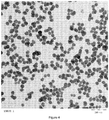
- cocoon-shaped particles are FUSO PL-3 manufactured by Fuso Chemical Corporation having an average primary particle size (d1) of 35 nm and an average secondary particle size (d2) of 70 nm ( figure 4 ).
- cocoon-shaped particles (A) The chemical nature of the cocoon-shaped particles (A) is not particularly limited.
- (A) may be of the same chemical nature or a mixture or composite of particles of different chemical nature. As a rule, cocoon-shaped particles (A) of the same chemical nature are preferred.
- (A) can be
- colloidal silica particles are produced by a wet precipitation process.
- (A) are cocoon-shaped organic particles, or a mixture or composite of cocoon-shaped inorganic and cocoon-shaped organic particles
- polymer particles are preferred as cocoon-shaped organic particles.
- cocoon-shaped inorganic particles are preferred.
- the particles (A) are cocoon-shaped silica particles.
- the CMP composition (Q) comprises a non-ionic surfactant (B).
- a surfactant used in a CMP composition is a surface-active compound which decreases the surface tension of a liquid, the interfacial tension between two liquids, or that between a liquid and a solid.
- any non-ionic surfactant (B) can be used.
- the non-ionic surfactant (B) is preferably water-soluble and/or water-dispersible, more preferably water-soluble.
- Water-soluble means that the relevant component or ingredient of the composition of the invention can be dissolved in the aqueous phase on the molecular level.
- Water-dispersible means that the relevant component or ingredient of the composition of the invention can be dispersed in the aqueous phase and forms a stable emulsion or suspension.
- the non-ionic surfactant (B) is preferably an amphiphilic non-ionic surfactant, i.e. a surfactant which comprises at least one hydrophobic group (b1) and at least one hydrophilic group (b2).
- a surfactant which comprises at least one hydrophobic group (b1) and at least one hydrophilic group (b2).
- the nonionic surfactant (B) can comprise more than one hydrophobic group (b1), e.g., 2, 3 or more groups (b1), which are separated from each other by at least one hydrophilic group (b2) as hereinbelow described.
- the nonionic surfactant (B) can comprise more than one hydrophilic group (b2), e.g., 2, 3 or more groups (b2) which are separated from each other by hydrophobic groups (b1) as hereinbelow described.
- the nonionic surfactant (B) can have different blocklike general structures. Examples of such general blocklike structures are:
- the non-ionic surfactant (B) is more preferably an amphiphilic non-ionic surfactant comprising a polyoxyalkylene group.
- the hydrophobic group (b1) is preferably an alkyl group, more preferably an alkyl group having 4 to 40, most preferably 5 to 20, particularly preferably 7 to 18, in particular 10 to 16, for example 11 to 14 carbon atoms.
- the hydrophilic group (b2) is preferably a polyoxyalkylene group. Said polyoxyalkylene groups can be oligomeric or polymeric. More preferably, the hydrophilic group (b2) is a hydrophilic group selected from the group consisting of polyoxyalkylene groups comprising
- the hydrophilic group (b2) is a hydrophilic group selected from the group consisting of polyoxyalkylene groups comprising
- the oxyalkylene monomer units other than oxyethylene monomer units (b22) are substituted oxyalkylene monomer units wherein the substituents are selected from the group consisting of alkyl, cycloalkyl, aryl, alkyl-cycloalkyl, alkyl-aryl, cycloalkyl-aryl and alkyl-cycloalkyl-aryl groups.
- the oxyalkylene monomer units other than oxyethylene monomer units (b22) are
- the substituents of the substituted oxiranes (X) themselves can also carry inert substituents, i.e., substituents which do not adversely affect the copolymerization of the oxiranes (X) and the surface activity of the non-ionic surfactants (B).
- inert substituents are fluorine and chlorine atoms, nitro groups and nitrile groups. If such inert substituents are present, they are used in such amounts that they do not adversely affect the hydrophilic-hydrophobic balance of the non-ionic surfactant (B).
- the substituents of the substituted oxiranes (X) do not carry such inert substituents.
- the substituents of the substituted oxiranes (X) are preferably selected from the group consisting of alkyl groups having 1 to 10 carbon atoms, cycloalkyl groups having 5 to 10 carbon atoms in spirocyclic, exocyclic and/or annealed configuration, aryl groups having 6 to 10 carbon atoms, alkyl-cycloalkyl groups having 6 to 20 carbon atoms, alkyl-aryl groups having 7 to 20 carbon atoms, cycloalkyl-arylgroup 11 to 20 carbon atoms, and alkyl-cycloalkyl-aryl groups having 12 to 30 carbon atoms.
- the substituents of the substituted oxiranes (X) are selected from the group consisting of alkyl groups having 1 to 10 carbon atoms. Particularly, the substituents of the substituted oxiranes (X) are selected from the group consisting of alkyl groups having 1 to 6 carbon atoms.
- Examples for the most preferred substituted oxiranes (X) are methyl oxirane (propyleneoxide) and/or ethyl oxirane (butylene oxide), particularly methyl oxirane.
- the hydrophilic group (b2) consists of the monomer units (b21) and (b22).
- the hydrophilic group (b2) is preferably a polyoxyethylene, polyoxypropylene or polyoxybutylene group, more preferably a polyoxyethylene group.
- the hydrophilic group (b2) comprises or consists of the monomer units (b21) and (b22)
- the polyoxyalkylene group - acting as hydrophilic group (b2) - contains the monomer units (b21) and (b22) in random, alternating, gradient and/or blocklike distribution. This means, that one hydrophilic group (b2) can have only one type of distribution, i.e.,
- the hydrophilic group (b2) can also contain at least two types of distributions, e.g., an oligomeric or polymeric segment having a random distribution and an oligomeric or polymeric segment having alternating distribution. Most preferably, the hydrophilic group (b2) preferably has only one type of distribution, and most preferably, said distribution is random or blocklike.
- the molar ratio of (b21) to (b22) can vary broadly and, therefore, can be adjusted most advantageously to the particular requirements of the composition, the process and the use of the invention.
- the molar ratio (b21):(b22) is from 100:1 to 1:1, more preferably, from 60:1 to 1.5:1 and, most preferably, from 50:1 to 1.5:1, and particularly preferably, from 25:1 to 1.5:1, and particularly, from 15:1 to 2:1, and for example, from 9:1 to 2:1.
- the degree of polymerization of the oligomeric and polymeric polyoxyalkylene groups - acting as hydrophilic groups (b2) - can vary broadly and, therefore, can be adjusted most advantageously to the particular requirements of the composition, the process and the use of the invention.
- the degree of polymerization is in the range of from 5 to 100, preferably 5 to 90, and most preferably, 5 to 80.
- the non-ionic surfactant (B) is an amphiphilic non-ionic polyoxyethylene-polyoxypropylene alkyl ether surfactant which is a mixture of molecules containing, on the average, an alkyl group having 10 to 16 carbon atoms and 5 to 20 oxyethylene monomer units (b21) and 2 to 8 oxypropylene monomer units in random distribution.
- the non-ionic surfactant (B) is an amphiphilic non-ionic polyoxyethylene-polyoxypropylene alkyl ether surfactant which is a mixture of molecules containing, on the average, an alkyl group having 11 to 14 carbon atoms and 12 to 20 oxyethylene monomer units and 3 to 5 oxypropylene monomer units in random distribution.
- the non-ionic surfactant (B) can be contained in varying amounts in the CMP composition (Q).
- the amount of (B) is not more than 10 wt.%, more preferably not more than 3 wt.%, most preferably not more than 1 wt.%, particularly preferably not more than 0.5 wt.%, particularly not more than 0.1 wt.%, for example not more than 0.05 wt.%, based on the total weight of the composition (Q).
- the amount of (B) is at least 0.00001 wt.%, more preferably at least 0.0001 wt.%, most preferably at least 0.0008 wt.%, particularly preferably at least 0.002 wt.%, particularly at least 0.005 wt.%, for example at least 0.008 wt.%, based on the total weight of the composition (Q).
- the non-ionic surfactant (B) can have different weight average molecular weights.
- the weight average molecular weight of (B) is preferably at least 300, more preferably at least 500, most preferably at least 700, particularly at least 800, for example at least 900.
- the weight average molecular weight of (B) is preferably not more than 15,000, more preferably not more than 6,000, most preferably not more than 3,000, particularly not more than 2,000, for example not more than 1,400 [g/mol], as determined by gel permeation chromatography (abbreviated as "GPC" in the following).
- GPC gel permeation chromatography
- the weight average molecular weight of (B) is from 900 to 1,400 [g/mol] as determined by GPC.
- Said GPC are standard GPC techniques known to the person skilled of the art.
- the solubility of non-ionic surfactant (B) in an aqueous medium can vary within a wide range.
- the solubility of (B) in water at pH 7 at 25°C under atmospheric pressure is preferably at least 1 g/L, more preferably at least 5 g/L, most preferably at least 20 g/L, particularly at least 50 g/L, for example at least 150 g/L.
- Said solubility can be determined by evaporating the solvent and measuring the remaining mass in the saturated solution.
- the CMP composition (Q) comprises (C) an aromatic compound comprising at least one acid group (Y), or a salt thereof.
- aromatic compounds comprising at least one acid group (Y), or a salt thereof.
- any of such aromatic compounds can be used.
- the acid group (Y) is defined as being (Y) as such and its deprotonated form.
- the acid group (Y) comprised in aromatic compound (C) is preferably any acid group so that the pK a value (logarithmic measure of the acid dissociation constant) of the reaction H-(C) ⁇ (C) - + H + or the reaction [H-(C)] + ⁇ (C) + H + is not more than 7, more preferably not more than 6, most preferably not more than 5.5, particularly preferably not more than 5, as measured in de-ionized water at 25°C and atmospheric pressure .
- said acid group (Y) is a carboxylic acid (-COOH), or a sulfonic acid (-SO 3 H) moiety, or their deprotonated forms. Most preferably, said acid group (Y) is a carboxylic acid (-COOH) moiety, or its deprotonated form. Preferably, the acid group (Y) is directly covalently bound to the aromatic ring system of the aromatic compound (C).
- the aromatic compound (C) comprises at least one, preferably 1 to 2, more preferably exactly one further functional group (Z) which is different from the acid group (Y).
- the further functional group (Z) is any functional group other than the acid group (Y), and is
- the aromatic compound (C) comprises at least one benzene ring, and (C) preferably comprises - per benzene ring - at least one, more preferably at least two, most preferably 2 to 4, for example 2 carboxylic acid (-COOH) groups or their deprotonated form.
- the aromatic compound (C) comprises at least one benzene ring, and (C) preferably comprises per benzene ring at least one acid group (Y), for example one carboxylic acid (-COOH) and at least one further functional group (Z) which is different from acid group (Y).
- the aromatic compound (C) comprises at least one benzene ring, and (C) preferably comprises per benzene ring at least one acid group (Y), more preferably at least two, most preferably 2 to 4, for example two carboxylic acid (-COOH) and at least one further functional group (Z) which is different from acid group (Y).
- the aromatic compound (C) is a benzenecarboxylic acid comprising at least one, more preferably at least two, most preferably 2 to 4, for example 2 carboxylic acid (-COOH) groups, or a salt thereof.
- the aromatic compound (C) is a benzenecarboxylic acid comprising at least one, more preferably at least two, most preferably 2 to 4, for example 2 carboxylic acid (-COOH) groups which are directly covalently bound to the benzene ring, or a salt thereof.
- the aromatic compound (C) is a benzenecarboxylic acid comprising at least one carboxylic acid (-COOH) group which is directly covalently bound to the benzene ring, or a salt thereof, and at least one further functional group (Z) which is different from the acidic (-COOH) group, preferably the functional group (Z) is a hydroxyl group.
- the aromatic compound (C) is a benzenecarboxylic acid comprising at least one carboxylic acid (-COOH) group, more preferably at least two, most preferably 2 to 4, for example two carboxylic acid (-COOH) which are directly covalently bound to the benzene ring, or a salt thereof, and at least one further functional group (Z) which is different from the acidic (-COOH) group, preferably the functional group (Z) is a hydroxyl group.
- the aromatic compound (C) is most preferably phthalic acid, terephthalic acid, isophthalic acid, 3-hydroxy-benzoic acid, 4-hydroxy-benzoic acid, 5-hydroxy-isophthalic acid, benzene-1,2,3-tricarboxylic acid, benzene-1,2,3,4-tetracarboxylic acid, or a derivative thereof, or a salt thereof, particularly terephthalic acid, isophthalic acid, 3-hydroxy-benzoic acid, 4-hydroxy-benzoic acid, 5-hydroxy-isophthalic acid, benzene-1,2,3,4-tetracarboxylic acid, or a derivative thereof, or a salt thereof, for example terephthalic acid, isophthalic acid or 5-hydroxy-isophthalic acid.
- the aromatic compound (C) can be contained in varying amounts in the CMP composition (Q).
- the amount of (C) is not more than 10 wt.%, more preferably not more than 6 wt.%, most preferably not more than 4 wt.%, particularly preferably not more than 3 wt.%, particularly not more than 2 wt.%, for example not more than 1.3 wt.%, based on the total weight of the composition (Q).
- the amount of (C) is at least 0.001 wt.%, more preferably at least 0.01 wt.%, most preferably at least 0.05 wt.%, particularly preferably at least 0.1 wt.%, particularly at least 0.4 wt.%, for example at least 0.7 wt.%, based on the total weight of the composition (Q).
- the solubility of the aromatic compound (C) in an aqueous medium can vary within a wide range.
- the solubility of (C) in water at pH 7 at 25°C under atmospheric pressure is preferably at least 1 g/L, more preferably at least 5 g/L, most preferably at least 20 g/L, particularly at least 50 g/L, for example at least 150 g/L.
- Said solubility can be determined by evaporating the solvent and measuring the remaining mass in the saturated solution.
- the CMP composition (Q) contains an aqueous medium (M).
- M can be of one type or a mixture of different types of aqueous media.
- the aqueous medium (M) can be any medium which contains water.
- the aqueous medium (M) is a mixture of water and an organic solvent miscible with water (e.g. an alcohol, preferably a C 1 to C 3 alcohol, or an alkylene glycol derivative). More preferably, the aqueous medium (M) is water. Most preferably, aqueous medium (M) is de-ionized water.
- the amount of (M) is (100-y) % by weight of the CMP composition.
- the aqueous medium (M) can be contained in varying amounts in the CMP composition (Q).
- the amount of (M) is not more than 99.9 wt.%, more preferably not more than 99.6 wt.%, most preferably not more than 99 wt.%, particularly preferably not more than 98 wt.%, particularly not more than 97 wt.%, for example not more than 95 wt.%, based on the total weight of the composition (Q).
- the amount of (M) is at least 60 wt.%, more preferably at least 70 wt.%, most preferably at least 80 wt.%, particularly preferably at least 85 wt.%, particularly at least 90 wt.%, for example at least 93 wt.%, based on the total weight of the composition (Q).
- the CMP composition (Q) can further optionally comprise an alcohol (D).
- any alcohol can be used as (D).
- the alcohol (D) is different from the components (A), (B), (C) and (M).
- the alcohol (D) is preferably an alcohol having at least two hydroxyl groups which are not dissociable in the aqueous medium. More preferably (D) is an alcohol having two hydroxyl groups which are not dissociable in the aqueous medium.
- “Not dissociable” means that the pK a value (logarithmic measure of the acid dissociation constant) for the reaction alcohol (D) ⁇ deprotonated alcohol (D) + H + of the hydroxyl group in the neutral aqueous phase is more than 9.9, more preferably more than 11, most preferably more than 12, particularly preferably more than 13, for example more than 14 as measured in de-ionized water at 25°C and atmospheric pressure.
- propane-1,2-diol alpha-propylene glycol
- the alcohol (D) is a diol, triol, tetraol, pentaol, hexaol, heptaol, octaol, nonaol, decaol, or a polyol.
- (D) is a diol, triol, tetraol, pentaol, or hexaol.
- (D) is a diol.
- (D) is ethanediol (ethylene glycol), propanediol (propylene glycol), or butanediol (butylene glycol).
- (D) is propanediol (propylene glycol).
- (D) is propane-1,2-diol (alpha-propylene glycol).
- the alcohol (D) is preferably an alcohol having 2 to 50 carbon atoms, more preferably an alcohol having 2 to 20 carbon atoms, most preferably an alcohol having 2 to 11 carbon atoms, particularly preferably an alcohol having 2 to 7 carbon atoms, in particular an alcohol having 2 to 4 carbon atoms, for example an alcohol having 3 carbon atoms.
- the alcohol (D) can be contained in varying amounts in the CMP composition (Q).
- the amount of (D) is not more than 10 wt.%, more preferably not more than 5 wt.%, most preferably not more than 3 wt.%, particularly preferably not more than 2 wt.%, particularly not more than 1.2 wt.%, for example not more than 0.8 wt.%, based on the total weight of the composition (Q).
- the amount of (D) is at least 0.001 wt.%, more preferably at least 0.01 wt.%, most preferably at least 0.05 wt.%, particularly preferably at least 0.1 wt.%, particularly at least 0.3 wt.%, for example at least 0.5 wt.%, based on the total weight of the composition (Q).
- the solubility of alcohol (D) in an aqueous medium can vary within a wide range.
- the solubility of (D) in water at pH 7 at 25°C under atmospheric pressure is preferably at least 1 g/L, more preferably at least 5 g/L, most preferably at least 20 g/L, particularly at least 50 g/L, for example at least 150 g/L.
- Said solubility can be determined by evaporating the solvent and measuring the remaining mass in the saturated solution.
- the CMP composition (Q) can further optionally comprise at least one type of oxidizing agent (E), preferably one to two types of oxidizing agent (E), more preferably one type of oxidizing agent (E).
- the oxidizing agent (E) is different from the components (A), (B), (C) and (M).
- the oxidizing agent is a compound which is capable of oxidizing the to-be-polished substrate or one of its layers.
- (E) is a per-type oxidizer. More preferably, (E) is a peroxide, persulfate, perchlorate, perbromate, periodate, permanganate, or a derivative thereof. Most preferably, (E) is a peroxide or persulfate. Particularly, (E) is a peroxide.
- (E) is hydrogen peroxide.
- the oxidizing agent (E) can be contained in varying amounts in the CMP composition (Q).
- the amount of (E) is not more than 20 wt.%, more preferably not more than 10 wt.%, most preferably not more than 5 wt.%, particularly not more than 2.5 wt.%, for example not more than 1.5 wt.%, based on the total weight of the composition (Q).
- the amount of (E) is at least 0.01 wt.%, more preferably at least 0.08 wt.%, most preferably at least 0.4 wt.%, particularly at least 0.75 wt.%, for example at least 1 wt.%, based on the total weight of the composition (Q).
- the amount of (E) is preferably 0.5 wt.% to 4 wt.%, more preferably 1 wt.% to 2 wt.%, for instance 1.2 to 1.3 wt.%, based on the total weight of the composition (Q).
- the CMP composition (Q) can further optionally contain at least one corrosion inhibitor (F), for example one corrosion inhibitor.
- the corrosion inhibitor (F) is different from the components (A), (B), (C) and (M).
- all compounds forming a protective molecular layer on the surface of a metal - for example copper - can be used as corrosion inhibitor.
- Preferred corrosion inhibitors (F) are thiols, film forming polymers, polyols, diazoles, triazoles, tetrazoles, and their derivatives, most preferably imidazole, 1,2,4-triazole, benzotriazole, tolyltriazole, and derivatives thereof, for example benzotriazole.
- the corrosion inhibitor (F) can be contained in varying amounts. If present, the amount of (F) is preferably not more than 10 wt.%, more preferably not more than 2 wt.%, most preferably not more than 0.5 wt.%, particularly not more than 0.15 wt.%, for example not more than 0.04 wt.%, based on the total weight of the corresponding composition. If present, the amount of (F) is preferably at least 0.0001 wt.%, more preferably at least 0.001 wt.%, most preferably at least 0.005 wt.%, particularly at least 0.01 wt.%, for example at least 0.02 wt.%, based on the total weight of the corresponding composition (Q).
- the CMP composition (Q) can further optionally contain at least one chelating agent (G), preferably one chelating agent (G).
- a chelating agent used in a CMP composition is a chemical compound that forms soluble, complex molecules with certain metal ions, inactivating the ions so that they cannot normally react with other elements or ions to produce precipitates or scale.
- the chelating agent (G) is different from the components (A), (B), (C) and (M).
- the chelating agent (G) can be contained in varying amounts. If present, the amount of (G) is preferably not more than 10 wt.%, more preferably not more than 5 wt.%, most preferably not more than 3 wt.%, particularly not more than 2 wt.%, for example not more than 1.5 wt.%, based on the total weight of the corresponding composition. If present, the amount of (G) is preferably at least 0.001 wt.%, more preferably at least 0.01 wt.%, most preferably at least 0.07 wt.%, particularly at least 0.2 wt.%, for example at least 0.7 wt.%, based on the total weight of the corresponding composition (Q).
- the chelating agent (G) is an inorganic or organic acid. More preferably, the chelating agent (G) is a compound comprising at least two carboxylic acid (-COOH) or carboxylate (-COO-) groups. Most preferably, the chelating agent (G) is selected from the group consisting of malonic acid, citric acid, acetic acid, adipic acid, butyric acid, glutaric acid, glycolic acid, formic acid, fumaric acid, lactic acid, lauric acid, malic acid, maleic acid, myristic acid, oxalic acid, palmitic acid, propionic acid, pyruvic acid, stearic acid, succinic acid, tartaric acid, valeric acid, 2-methylburyric acid, n-hexanoic acid, 3,3-dimethylbutyric acid, 2-ethylbutyric acid, 4-methylpentanoic acid, n-heptanoic acid, 2-methylhexanoic acid
- (G) is selected from the group consisting of malonic acid, citric acid, adipic acid, propane-1,2,3-tricarboxylic acid, butane-1,2,3,4-tetracarboxylic acid, and pentane-1,2,3,4,5-pentacarboxylic acid.
- (G) is selected from the group consisting of malonic acid and citric acid.
- (G) is malonic acid.
- the properties of the CMP composition (Q), such as stability and polishing performance, may depend on the pH of the corresponding composition.
- the CMP composition (Q) can have any pH value.
- the pH value of the composition (Q) is preferably not more than 14, more preferably not more than 13, most preferably not more than 12, particularly preferably not more than 11.5, particularly most preferably not more than 11, particularly not more than 10.5, for example not more than 10.2.
- the pH value of the composition (Q) is preferably at least 6, more preferably at least 7, most preferably at least 8, particularly preferably at least 8.5, particularly most preferably at least 9, particularly at least 9.5, for example at least 9.7.
- the pH value of the composition (Q) is preferably in the range of from 6 to 14, more preferably from 7 to 13, most preferably from 8 to 12, particularly preferably from 8.5 to 11.5, particularly most preferably from 9 to 11, particularly from 9.5 to 10.5, for example from 9.7 to 10.2.
- the CMP composition (Q) can further optionally contain at least one pH adjusting agent (H).
- the pH adjusting agent (H) is different from the components (A), (B), (C) and (M).
- the pH adjusting agent (H) is a compound which is added to the CMP composition (Q) to have its pH value adjusted to the required value.
- the CMP composition (Q) contains at least one pH adjusting agent (H).
- Preferred pH adjusting agents are inorganic acids, carboxylic acids, amine bases, alkali hydroxides, ammonium hydroxides, including tetraalkylammonium hydroxides.
- the pH adjusting agent (H) is nitric acid, sulfuric acid, ammonia, sodium hydroxide, or potassium hydroxide.
- the pH adjusting agent (H) is potassium hydroxide.
- the pH adjusting agent (H) can be contained in varying amounts. If present, the amount of (H) is preferably not more than 10 wt.%, more preferably not more than 2 wt.%, most preferably not more than 0.5 wt.%, particularly not more than 0.1 wt.%, for example not more than 0.05 wt.%, based on the total weight of the corresponding composition.
- the amount of (H) is preferably at least 0.0005 wt.%, more preferably at least 0.005 wt.%, most preferably at least 0.025 wt.%, particularly at least 0.1 wt.%, for example at least 0.4 wt.%, based on the total weight of the corresponding composition (Q).
- the CMP composition (Q) can further optionally contain at least one biocide (J), for example one biocide.
- the biocide (J) is different from the components (A), (B), (C) and (M).
- the biocide is a compound which deters, renders harmless, or exerts a controlling effect on any harmful organism by chemical or biological means.
- (J) is an quaternary ammonium compound, an isothiazolinone-based compound, an N -substituted diazenium dioxide, or an N- hydroxy-diazenium oxide salt.
- (J) is an N -substituted diazenium dioxide, or an N -hydroxy-diazenium oxide salt
- the biocide (J) can be contained in varying amounts. If present, the amount of (J) is preferably not more than 0.5 wt.%, more preferably not more than 0.1 wt.%, most preferably not more than 0.05 wt.%, particularly not more than 0.02 wt.%, for example not more than 0.008 wt.%, based on the total weight of the corresponding composition.
- the amount of (J) is preferably at least 0.0001 wt.%, more preferably at least 0.0005 wt.%, most preferably at least 0.001 wt.%, particularly at least 0.003 wt.%, for example at least 0.006 wt.%, based on the total weight of the corresponding composition (Q).
- the CMP composition (Q) may also contain, if necessary, at least one other additive, including but not limited to stabilizers, friction reducing agents, etc. Said other additive is different from the components (A), (B), (C) and (M). Said other additives are for instance those commonly employed in CMP compositions and thus known to the person skilled in the art.
- Such addition can for example stabilize the dispersion, or improve the polishing performance, or the selectivity between different layers.
- said other additive can be contained in varying amounts. If present, the total amount of said other additives is preferably not more than 10 wt.%, more preferably not more than 2 wt.%, most preferably not more than 0.5 wt.%, particularly not more than 0.1 wt.%, for example not more than 0.01 wt.%, based on the total weight of the corresponding CMP composition.
- the total amount of said other additives is preferably at least 0.0001 wt.%, more preferably at least 0.001 wt.%, most preferably at least 0.008 wt.%, particularly at least 0.05 wt.%, for example at least 0.3 wt.%, based on the total weight of the corresponding composition (Q).
- composition (Q) comprises
- composition (Q) comprises
- composition (Q) comprises
- composition (Q) comprises
- composition (Q) comprises
- Processes for preparing CMP compositions are generally known. These processes may be applied to the preparation of the CMP composition (Q). This can be carried out by dispersing or dissolving the above-described components (A), (B), (C) and optionally other components in the aqueous medium (M), preferably water, and optionally by adjusting the pH value through adding an acid, a base, a buffer or an pH adjusting agent.
- the CMP composition (Q) can be prepared by mixing an aqueous dispersion comprising not less than 6 wt. % particles (A), for example cocoon-shaped silica, an aqueous dispersion comprising not less than 1 wt.% non-ionic surfactant (B), 5 wt.
- % aromatic compound (C) and diluting with de-ionized water.
- customary and standard mixing processes and mixing apparatuses such as agitated vessels, high shear impellers, ultrasonic mixers, homogenizer nozzles or counterflow mixers, can be used.
- the CMP composition (Q) is preferably prepared by dispersing the cocoon-shaped particles (A), dispersing and/or dissolving the non-ionic surfactant (B), the aromatic compound (C) and optionally other additives in the aqueous medium (M).
- the polishing process is generally known and can be carried out with the processes and the equipment under the conditions customarily used for the CMP in the fabrication of wafers with integrated circuits. There is no restriction on the equipment with which the polishing process can be carried out.
- typical equipment for the CMP process consists of a rotating platen which is covered with a polishing pad. Also orbital polishers have been used.
- the wafer is mounted on a carrier or chuck. The side of the wafer being processed is facing the polishing pad (single side polishing process).
- a retaining ring secures the wafer in the horizontal position.
- Below the carrier the larger diameter platen is also generally horizontally positioned and presents a surface parallel to that of the wafer to be polished. The polishing pad on the platen contacts the wafer surface during the planarization process.
- the wafer is pressed onto the polishing pad.
- Both the carrier and the platen are usually caused to rotate around their respective shafts extending perpendicular from the carrier and the platen.
- the rotating carrier shaft may remain fixed in position relative to the rotating platen or may oscillate horizontally relative to the platen.
- the direction of rotation of the carrier is typically, though not necessarily, the same as that of the platen.
- the speeds of rotation for the carrier and the platen are generally, though not necessarily, set at different values.
- the CMP composition (Q) is usually applied onto the polishing pad as a continuous stream or in dropwise fashion. Customarily, the temperature of the platen is set at temperatures of from 10 to 70°C.
- the load on the wafer can be applied by a flat plate made of steel for example, covered with a soft pad that is often called backing film. If more advanced equipment is being used a flexible membrane that is loaded with air or nitrogen pressure presses the wafer onto the pad. Such a membrane carrier is preferred for low down force processes when a hard polishing pad is used, because the down pressure distribution on the wafer is more uniform compared to that of a carrier with a hard platen design. Carriers with the option to control the pressure distribution on the wafer may also be used according to the invention. They are usually designed with a number of different chambers that can be loaded to a certain degree independently from each other.
- wafers with integrated circuits comprising a dielectric layer can be obtained which have an excellent functionality.
- the CMP composition (Q) can be used in the CMP process as ready-to-use slurry, they have a long shelf-life and show a stable particle size distribution over long time. Thus, they are easy to handle and to store. They show an excellent polishing performance, particularly with regard to (a') high MRR of tantalum nitride, (b') low MRR of copper layer, (c') low MRR of low-k or ultra-low-k materials, (d') high selectivity of tantalum nitride over copper with regard to MRR, and (e') high selectivity of tantalum nitride over low-k or ultra-low-k materials with regard to MRR.
- the CMP composition of the invention shows a longer shelf life, agglomeration within the CMP composition of the invention can be avoided, while high MRR of barrier layer was maintained. Since the amounts of its components are held down to a minimum, the CMP composition (Q) and the CMP process according to the invention can be used or applied in a cost-effective way.
- the pad is conditioned by two sweeps, before a new type of slurry is used for CMP.
- the slurry is stirred in the local supply station.
- Removal rate is determined by Filmmetrics F50 reflectometer as mean of diffential 49 point diameter scan (5 mm ee) pre and post CMP.
- the radial non-unifomity of removal rate is assessed by relative standard deviation of differential 49 point diameter scan pre and post CMP using Filmmetrics F50 (5 mm ee).
- PETEOS plasma-enhanced tetraethyl orthosilicate
- Tantalum nitride CVD
- Low k material black diamond 1 st generation (referred to as "BD1” in the following)
- Copper electro plated
- Cocoon-shaped particles used in the examples according to the invention (A): Silica particles used as particles (A) are of Fuso PL-3 type. Fuso PL-3 are cocoon-shaped colloidal silica particles having an average primary particle size (d1) of 35 nm and an average secondary particle size (d2) of 70 nm.
- Table 1 Experimental results of particle shape analysis of cocoon-shaped silica particles (A) statistical function ECD shericity shape factor unit nm number of particles 475 475 475 average 53.67 0.631 0.881 minimum 33.68 0.150 0.513 maximum 99.78 0.997 0.978 standard deviation 11.69 0.199 0.083 median d50 51.32 0.662 0.911 d90 0.955
- Silica particles used in the comparative examples 3 to 5 were spherical potassium-stabilized colloidal silica particles having a typical particle size of 50 nm and a typical surface area of 55 m 2 /g (e.g. NexSilTM 85K).
- (B1) is an amphiphilic non-ionic polyoxyethylene-polyoxypropylene alkyl ether surfactant which is a mixture of molecules containing, on the average, an alkyl group having 11 to 14 carbon atoms and 12 to 20 oxyethylene monomer units and 3 to 5 oxypropylene monomer units in random distribution.
- the weight average molecular weight of (B1) is from 900 to 1,500 [g/mol].
- aqueous cocoon-shaped silica particle dispersion with 20 wt.% solid content was dispersed on a carbon foil and was dried.
- the dried dispersion was analyzed by using Energy Filtered-Transmission Electron Microscopy (EF-TEM) (120 kilo volts) and Scanning Electron Microscopy secondary electron image (SEM-SE) (5 kilo volts).
- EF-TEM Energy Filtered-Transmission Electron Microscopy
- SEM-SE Scanning Electron Microscopy secondary electron image
- the EF-TEM image with a resolution of 2k, 16 Bit, 0.6851 nm/pixel ( figure 4 ) was used for the analysis.
- the images were binary coded using the threshold after noise suppression. Afterwards the particles were manually separated. Overlying and edge particles were discriminated and not used for the analysis. ECD, shape factor and sphericity as defined before were calculated and statistically classified.
- chelating agent (G) or aromatic compound (C) are dissolved in 380 g water (M), followed by the slow addition of 3.21 g alcohol (D), 0.50 g nonionic surfactant (B) (10 wt.% aqueous solution) and 12.5 g corrosion inhibitor (F) (1 wt.% aqueous solution).
- KOH is used to adjust the pH to 10.5, followed by the addition of 20.0 g of the abrasive particles (A) (20 wt.% aqueous dispersion). Water is added to yield 480 g, pH is adjusted again to 10.5 and monitored for 1 h. 20.0 g of oxidizer (E) (31 wt.% aqueous solution) is added prior to polishing, and the pH values as indicated in Table 1 are obtained.
- the final CMP composition contains the components (A), (B), (C), (D), (E), (F) and optionally (G) or other additives in the amounts as indicated in Table 2.
- Examples 1-3 are reference examples, examples 4 to 6 (Compositions according to the invention) and Comparative Examples V1, V2, V3, V4 and V5 (comparative composition).
- the CMP compositions of the Examples 1 to 6 show an improved polishing performance and improved shelf life, particularly shows high MRR of tantalum nitride, high selectivity of tantalum nitride over copper with regard to MRR, and high selectivity of tantalum nitride over black diamond 1 st generation material with regard to MRR.
- CMP compositions of the examples 4 to 6 with aromatic compounds (C) comprising a hydroxyl group show very stable behaviour as indicated by the stability-, pot life test and the decreased pH drift.
Landscapes
- Chemical & Material Sciences (AREA)
- Organic Chemistry (AREA)
- Engineering & Computer Science (AREA)
- Materials Engineering (AREA)
- Composite Materials (AREA)
- Mechanical Treatment Of Semiconductor (AREA)
- Finish Polishing, Edge Sharpening, And Grinding By Specific Grinding Devices (AREA)
Claims (12)
- Verwendung einer chemisch-mechanischen Polier-(CMP-)Zusammensetzung (Q) zum chemisch-mechanischen Polieren eines Substrats (S), umfassend (i) Kupfer und/oder (ii) Tantal, Tantalnitrid, Titan, Titannitrid, Ruthenium, Kobalt oder Legierungen davon, wobei die CMP-Zusammensetzung (Q) umfasst(A) anorganische Teilchen, organische Teilchen oder eine Mischung oder einen Verbund davon, wobei die Teilchen kokonförmig sind,(B) ein nicht-ionisches Tensid,(C) eine aromatische Verbindung, die pro aromatischem Ring mindestens eine Säuregruppe (Y) und mindestens eine weitere funktionelle Gruppe (Z) enthält, die sich von der Säuregruppe (Y) unterscheidet, und(M) ein wässriges Medium.
- Verwendung einer CMP-Zusammensetzung nach Anspruch 1, wobei die aromatische Verbindung (C) mindestens einen Benzolring und pro Benzolring mindestens eine Carbonsäuregruppe (-COOH) oder deren deprotonierte Form und mindestens eine weitere funktionelle Gruppe (Z) umfasst, die sich von der Säuregruppe (Y) unterscheidet.
- Verwendung einer CMP-Zusammensetzung nach Anspruch 1, wobei die aromatische Verbindung (C) eine Benzolcarbonsäure ist, die mindestens zwei Carbonsäuregruppen (-COOH) umfasst, oder ein Salz davon und mindestens eine weitere funktionelle Gruppe (Z), die sich von der sauren Gruppe (-COOH) unterscheidet.
- Verwendung einer CMP-Zusammensetzung nach Anspruch 1, wobei die weitere funktionelle Gruppe (Z) ein Ester (-COOR3), eine Hydroxyl-, Alkoxy-, Alkyl-, Aryl-, Alkylaryl-, Arylalkyl-, Nitro-, Amino-, Thio- oder Halogeneinheit und anders als die Säuregruppe (Y) ist, wobei R3 für Alkyl, Aryl, Alkylaryl oder Arylalkyl steht.
- Verwendung einer CMP-Zusammensetzung nach einem der Ansprüche 1 bis 4, wobei die CMP-Zusammensetzung (Q) ferner (E) ein Oxidationsmittel umfasst.
- Verwendung einer CMP-Zusammensetzung nach einem der Ansprüche 1 bis 5, wobei die CMP-Zusammensetzung (Q) ferner (D) einen Alkohol umfasst.
- Verwendung einer CMP-Zusammensetzung nach einem der Ansprüche 1 bis 6, wobei die CMP-Zusammensetzung (Q) ferner (F) einen Korrosionsinhibitor umfasst.
- Verwendung einer CMP-Zusammensetzung nach einem der Ansprüche 1 bis 7, wobei die Teilchen (A) kokonförmige Siliziumdioxidteilchen sind.
- Verwendung einer CMP-Zusammensetzung nach einem der Ansprüche 1 bis 8, wobei das nichtionische Tensid (B) ein amphiphiles nichtionisches Tensid ist, das eine Polyoxyalkylengruppe umfasst.
- Verwendung einer CMP-Zusammensetzung nach einem der Ansprüche 1 bis 9, wobei der pH-Wert der Zusammensetzung im Bereich von pH 8 bis 12 liegt.
- CMP-Zusammensetzung (Q), die umfasst(A) kokonförmige Siliziumdioxidteilchen,(B) ein amphiphiles nichtionisches Tensid, das eine Polyoxyalkylengruppe enthält,(C) eine Benzolcarbonsäure, umfassend mindestens eine Carbonsäuregruppe (-COOH), die direkt kovalent an den Benzolring gebunden ist, und mindestens eine weitere funktionelle Gruppe (Z), die sich von der sauren Gruppe (-COOH) unterscheidet, wobei die funktionelle Gruppe (Z) eine Hydroxylgruppe oder ein Salz davon ist,(D) einen Alkohol mit mindestens zwei Hydroxylgruppen, die in dem wässrigen Medium nicht dissoziierbar sind,(E) ein Oxidationsmittel,(F) einen Korrosionsinhibitor, und(M) ein wässriges Medium.
- Verfahren zur Herstellung von Halbleiterbauelementen, umfassend das chemische mechanische Polieren eines Substrats (S) in Gegenwart einer CMP-Zusammensetzung, wie sie in einem der Ansprüche 1 bis 11 definiert ist.
Priority Applications (1)
| Application Number | Priority Date | Filing Date | Title |
|---|---|---|---|
| EP13812480.5A EP2870599B1 (de) | 2012-07-06 | 2013-06-27 | Verwendung einer chemisch-mechanische polierzusammensetzung mit einem nicht ionischen tensid und einer aromatischen verbindung mit mindestens einer säuregruppe |
Applications Claiming Priority (3)
| Application Number | Priority Date | Filing Date | Title |
|---|---|---|---|
| EP12175333.9A EP2682441A1 (de) | 2012-07-06 | 2012-07-06 | Chemisch-mechanische Polierzusammensetzung mit einem nicht ionischen Tensid und einer Aromaverbindung mit mindestens einer Säuregruppe |
| PCT/IB2013/055273 WO2014006546A2 (en) | 2012-07-06 | 2013-06-27 | A chemical mechanical polishing (cmp) composition comprising a non-ionic surfactant and an aromatic compound comprising at least one acid group |
| EP13812480.5A EP2870599B1 (de) | 2012-07-06 | 2013-06-27 | Verwendung einer chemisch-mechanische polierzusammensetzung mit einem nicht ionischen tensid und einer aromatischen verbindung mit mindestens einer säuregruppe |
Publications (3)
| Publication Number | Publication Date |
|---|---|
| EP2870599A2 EP2870599A2 (de) | 2015-05-13 |
| EP2870599A4 EP2870599A4 (de) | 2016-03-30 |
| EP2870599B1 true EP2870599B1 (de) | 2018-10-17 |
Family
ID=46458354
Family Applications (2)
| Application Number | Title | Priority Date | Filing Date |
|---|---|---|---|
| EP12175333.9A Withdrawn EP2682441A1 (de) | 2012-07-06 | 2012-07-06 | Chemisch-mechanische Polierzusammensetzung mit einem nicht ionischen Tensid und einer Aromaverbindung mit mindestens einer Säuregruppe |
| EP13812480.5A Active EP2870599B1 (de) | 2012-07-06 | 2013-06-27 | Verwendung einer chemisch-mechanische polierzusammensetzung mit einem nicht ionischen tensid und einer aromatischen verbindung mit mindestens einer säuregruppe |
Family Applications Before (1)
| Application Number | Title | Priority Date | Filing Date |
|---|---|---|---|
| EP12175333.9A Withdrawn EP2682441A1 (de) | 2012-07-06 | 2012-07-06 | Chemisch-mechanische Polierzusammensetzung mit einem nicht ionischen Tensid und einer Aromaverbindung mit mindestens einer Säuregruppe |
Country Status (10)
| Country | Link |
|---|---|
| EP (2) | EP2682441A1 (de) |
| JP (1) | JP6185578B2 (de) |
| KR (1) | KR102147073B1 (de) |
| CN (1) | CN104412316B (de) |
| IL (1) | IL236194B (de) |
| MY (1) | MY170292A (de) |
| RU (1) | RU2636511C2 (de) |
| SG (1) | SG11201408785VA (de) |
| TW (1) | TWI601794B (de) |
| WO (1) | WO2014006546A2 (de) |
Families Citing this family (10)
| Publication number | Priority date | Publication date | Assignee | Title |
|---|---|---|---|---|
| TWI775722B (zh) * | 2014-12-22 | 2022-09-01 | 德商巴斯夫歐洲公司 | 化學機械拋光(cmp)組成物用於拋光含鈷及/或鈷合金之基材的用途 |
| EP3475375B1 (de) * | 2016-06-22 | 2023-11-15 | CMC Materials, Inc. | Polierzusammensetzung mit einem aminhaltigen tensid |
| CN109251672B (zh) * | 2017-07-13 | 2022-02-18 | 安集微电子科技(上海)股份有限公司 | 一种化学机械抛光液 |
| US10170335B1 (en) | 2017-09-21 | 2019-01-01 | Rohm And Haas Electronic Materials Cmp Holdings, Inc. | Chemical mechanical polishing method for cobalt |
| CN113122143B (zh) * | 2019-12-31 | 2024-03-08 | 安集微电子(上海)有限公司 | 一种化学机械抛光液及其在铜抛光中的应用 |
| CN113122144A (zh) * | 2019-12-31 | 2021-07-16 | 安集微电子(上海)有限公司 | 一种化学机械抛光液 |
| CN112801973B (zh) * | 2021-01-27 | 2022-06-14 | 山东大学 | 一种金刚石线锯表面磨粒分布均匀性评价方法 |
| JP2022131199A (ja) * | 2021-02-26 | 2022-09-07 | 株式会社フジミインコーポレーテッド | 研磨用組成物及び研磨方法 |
| KR20250066153A (ko) | 2023-11-06 | 2025-05-13 | 에스케이엔펄스 주식회사 | 반도체 공정용 연마 조성물 및 이를 이용한 기판의 제조방법 |
| KR20250066152A (ko) | 2023-11-06 | 2025-05-13 | 에스케이엔펄스 주식회사 | 반도체 공정용 연마 조성물 및 이를 이용한 기판의 제조방법 |
Family Cites Families (24)
| Publication number | Priority date | Publication date | Assignee | Title |
|---|---|---|---|---|
| US5738800A (en) * | 1996-09-27 | 1998-04-14 | Rodel, Inc. | Composition and method for polishing a composite of silica and silicon nitride |
| US6646348B1 (en) * | 2000-07-05 | 2003-11-11 | Cabot Microelectronics Corporation | Silane containing polishing composition for CMP |
| JP3563017B2 (ja) * | 2000-07-19 | 2004-09-08 | ロデール・ニッタ株式会社 | 研磨組成物、研磨組成物の製造方法及びポリシング方法 |
| US6936543B2 (en) * | 2002-06-07 | 2005-08-30 | Cabot Microelectronics Corporation | CMP method utilizing amphiphilic nonionic surfactants |
| US20040175942A1 (en) | 2003-01-03 | 2004-09-09 | Chang Song Y. | Composition and method used for chemical mechanical planarization of metals |
| US7514363B2 (en) * | 2003-10-23 | 2009-04-07 | Dupont Air Products Nanomaterials Llc | Chemical-mechanical planarization composition having benzenesulfonic acid and per-compound oxidizing agents, and associated method for use |
| US20050126588A1 (en) * | 2003-11-04 | 2005-06-16 | Carter Melvin K. | Chemical mechanical polishing slurries and cleaners containing salicylic acid as a corrosion inhibitor |
| JP2006100538A (ja) * | 2004-09-29 | 2006-04-13 | Fuji Photo Film Co Ltd | 研磨用組成物及びそれを用いた研磨方法 |
| JP2006179845A (ja) * | 2004-11-26 | 2006-07-06 | Fuji Photo Film Co Ltd | 金属用研磨液及び研磨方法 |
| US7678702B2 (en) * | 2005-08-31 | 2010-03-16 | Air Products And Chemicals, Inc. | CMP composition of boron surface-modified abrasive and nitro-substituted sulfonic acid and method of use |
| JP2007103463A (ja) * | 2005-09-30 | 2007-04-19 | Sumitomo Electric Ind Ltd | ポリシングスラリー、GaxIn1−xAsyP1−y結晶の表面処理方法およびGaxIn1−xAsyP1−y結晶基板 |
| JP2007194593A (ja) * | 2005-12-20 | 2007-08-02 | Fujifilm Corp | 金属用研磨液及びそれを用いた研磨方法 |
| US20090209103A1 (en) * | 2006-02-03 | 2009-08-20 | Freescale Semiconductor, Inc. | Barrier slurry compositions and barrier cmp methods |
| JP2007227670A (ja) * | 2006-02-23 | 2007-09-06 | Fujifilm Corp | 化学的機械的研磨方法 |
| US20080148649A1 (en) * | 2006-12-21 | 2008-06-26 | Zhendong Liu | Ruthenium-barrier polishing slurry |
| CN101016438A (zh) * | 2007-02-09 | 2007-08-15 | 孙韬 | 碱性计算机硬盘抛光液及其生产方法 |
| JP2008288398A (ja) * | 2007-05-18 | 2008-11-27 | Nippon Chem Ind Co Ltd | 半導体ウェハーの研磨用組成物、その製造方法、及び研磨加工方法 |
| US20090032765A1 (en) * | 2007-08-03 | 2009-02-05 | Jinru Bian | Selective barrier polishing slurry |
| WO2009056491A1 (en) * | 2007-10-29 | 2009-05-07 | Basf Se | Cmp slurry composition and process for planarizing copper containing surfaces provided with a diffusion barrier layer |
| JP5314329B2 (ja) | 2008-06-12 | 2013-10-16 | 富士フイルム株式会社 | 研磨液 |
| WO2011005456A2 (en) * | 2009-06-22 | 2011-01-13 | Cabot Microelectronics Corporation | Cmp compositions and methods for suppressing polysilicon removal rates |
| JP2011171689A (ja) * | 2009-07-07 | 2011-09-01 | Kao Corp | シリコンウエハ用研磨液組成物 |
| EP2499210B1 (de) * | 2009-11-13 | 2017-01-11 | Basf Se | Chemisch-mechanische polierzusammensetzung mit anorganischen partikeln und polymerpartikeln |
| US8273142B2 (en) * | 2010-09-02 | 2012-09-25 | Cabot Microelectronics Corporation | Silicon polishing compositions with high rate and low defectivity |
-
2012
- 2012-07-06 EP EP12175333.9A patent/EP2682441A1/de not_active Withdrawn
-
2013
- 2013-06-27 CN CN201380036022.7A patent/CN104412316B/zh active Active
- 2013-06-27 KR KR1020157003200A patent/KR102147073B1/ko active Active
- 2013-06-27 EP EP13812480.5A patent/EP2870599B1/de active Active
- 2013-06-27 WO PCT/IB2013/055273 patent/WO2014006546A2/en not_active Ceased
- 2013-06-27 RU RU2015103812A patent/RU2636511C2/ru not_active IP Right Cessation
- 2013-06-27 MY MYPI2014003626A patent/MY170292A/en unknown
- 2013-06-27 JP JP2015519449A patent/JP6185578B2/ja active Active
- 2013-06-27 SG SG11201408785VA patent/SG11201408785VA/en unknown
- 2013-07-05 TW TW102124293A patent/TWI601794B/zh active
-
2014
- 2014-12-11 IL IL236194A patent/IL236194B/en active IP Right Grant
Non-Patent Citations (1)
| Title |
|---|
| None * |
Also Published As
| Publication number | Publication date |
|---|---|
| WO2014006546A2 (en) | 2014-01-09 |
| EP2682441A1 (de) | 2014-01-08 |
| CN104412316B (zh) | 2018-04-20 |
| CN104412316A (zh) | 2015-03-11 |
| IL236194A0 (en) | 2015-01-29 |
| SG11201408785VA (en) | 2015-01-29 |
| KR102147073B1 (ko) | 2020-08-25 |
| KR20150036422A (ko) | 2015-04-07 |
| JP2015530420A (ja) | 2015-10-15 |
| RU2636511C2 (ru) | 2017-11-23 |
| EP2870599A4 (de) | 2016-03-30 |
| RU2015103812A (ru) | 2016-08-27 |
| WO2014006546A3 (en) | 2014-02-27 |
| EP2870599A2 (de) | 2015-05-13 |
| TWI601794B (zh) | 2017-10-11 |
| JP6185578B2 (ja) | 2017-08-23 |
| MY170292A (en) | 2019-07-17 |
| TW201406889A (zh) | 2014-02-16 |
| IL236194B (en) | 2020-07-30 |
Similar Documents
| Publication | Publication Date | Title |
|---|---|---|
| US8980750B2 (en) | Chemical mechanical polishing (CMP) composition comprising a non-ionic surfactant and a carbonate salt | |
| EP2870599B1 (de) | Verwendung einer chemisch-mechanische polierzusammensetzung mit einem nicht ionischen tensid und einer aromatischen verbindung mit mindestens einer säuregruppe | |
| US11168239B2 (en) | Chemical-mechanical polishing composition comprising benzotriazole derivatives as corrosion inhibitors | |
| US20140011362A1 (en) | Chemical mechanical polishing (cmp) composition comprising a non-ionic surfactant and an aromatic compound comprising at least one acid group | |
| EP2870212B1 (de) | Chemisch-mechanische polierzusammensetzung mit einem nichtionischen tensid und einem carbonatsalz | |
| EP2688966B1 (de) | Zusammensetzung für chemisch-mechanisches polieren (cmp) mit zwei arten von korrosionshemmern | |
| US9416298B2 (en) | Process for the manufacture of semiconductor devices comprising the chemical mechanical polishing (CMP) of III-V material in the presence of a CMP composition comprising a specific non-ionic surfactant | |
| US20150099361A1 (en) | Process for the manufacture of semiconductor devices comprising the chemical mechanical polishing (cmp) of iii-v material in the presence of a cmp composition comprising a compound containing an n-heterocycle | |
| EP2684213A1 (de) | Verfahren zur herstellung von basiskontaktlöchern für wafer | |
| EP2662885A1 (de) | Verfahren zur Herstellung von Halbleiterbauelementen mit chemisch-mechanischer Polierung (CMP) von iii-v-Material in Gegenwart einer CMP-Zusammensetzung mit einer Verbindung mit einem n-Heterozyklus | |
| US8927429B2 (en) | Chemical mechanical polishing (CMP) composition comprising a specific heteropolyacid | |
| EP2666833A1 (de) | Prozess zur Herstellung von Halbleitervorrichtungen mit chemisch-mechanischem Polieren (CMP) von III-V-Material bei Vorhandensein einer CMP-Zusammensetzung mit einem spezifischen nichtionischem Tensid |
Legal Events
| Date | Code | Title | Description |
|---|---|---|---|
| PUAI | Public reference made under article 153(3) epc to a published international application that has entered the european phase |
Free format text: ORIGINAL CODE: 0009012 |
|
| 17P | Request for examination filed |
Effective date: 20150206 |
|
| AK | Designated contracting states |
Kind code of ref document: A2 Designated state(s): AL AT BE BG CH CY CZ DE DK EE ES FI FR GB GR HR HU IE IS IT LI LT LU LV MC MK MT NL NO PL PT RO RS SE SI SK SM TR |
|
| AX | Request for extension of the european patent |
Extension state: BA ME |
|
| RAP1 | Party data changed (applicant data changed or rights of an application transferred) |
Owner name: BASF (CHINA) COMPANY LTD. Owner name: BASF SE |
|
| RIN1 | Information on inventor provided before grant (corrected) |
Inventor name: LI, YUZHUO Inventor name: REICHARDT, ROBERT Inventor name: LAUTER, MICHAEL |
|
| RAP1 | Party data changed (applicant data changed or rights of an application transferred) |
Owner name: BASF SE |
|
| DAX | Request for extension of the european patent (deleted) | ||
| REG | Reference to a national code |
Ref country code: DE Ref legal event code: R079 Ref document number: 602013045318 Country of ref document: DE Free format text: PREVIOUS MAIN CLASS: G09G0001020000 Ipc: C09G0001020000 |
|
| A4 | Supplementary search report drawn up and despatched |
Effective date: 20160301 |
|
| RIC1 | Information provided on ipc code assigned before grant |
Ipc: H01L 21/321 20060101ALI20160224BHEP Ipc: C09G 1/02 20060101AFI20160224BHEP |
|
| GRAP | Despatch of communication of intention to grant a patent |
Free format text: ORIGINAL CODE: EPIDOSNIGR1 |
|
| STAA | Information on the status of an ep patent application or granted ep patent |
Free format text: STATUS: GRANT OF PATENT IS INTENDED |
|
| INTG | Intention to grant announced |
Effective date: 20180517 |
|
| GRAS | Grant fee paid |
Free format text: ORIGINAL CODE: EPIDOSNIGR3 |
|
| GRAA | (expected) grant |
Free format text: ORIGINAL CODE: 0009210 |
|
| STAA | Information on the status of an ep patent application or granted ep patent |
Free format text: STATUS: THE PATENT HAS BEEN GRANTED |
|
| AK | Designated contracting states |
Kind code of ref document: B1 Designated state(s): AL AT BE BG CH CY CZ DE DK EE ES FI FR GB GR HR HU IE IS IT LI LT LU LV MC MK MT NL NO PL PT RO RS SE SI SK SM TR |
|
| REG | Reference to a national code |
Ref country code: GB Ref legal event code: FG4D |
|
| REG | Reference to a national code |
Ref country code: CH Ref legal event code: EP |
|
| REG | Reference to a national code |
Ref country code: IE Ref legal event code: FG4D |
|
| REG | Reference to a national code |
Ref country code: DE Ref legal event code: R096 Ref document number: 602013045318 Country of ref document: DE Ref country code: AT Ref legal event code: REF Ref document number: 1054003 Country of ref document: AT Kind code of ref document: T Effective date: 20181115 |
|
| REG | Reference to a national code |
Ref country code: NL Ref legal event code: MP Effective date: 20181017 |
|
| REG | Reference to a national code |
Ref country code: LT Ref legal event code: MG4D |
|
| REG | Reference to a national code |
Ref country code: AT Ref legal event code: MK05 Ref document number: 1054003 Country of ref document: AT Kind code of ref document: T Effective date: 20181017 |
|
| PG25 | Lapsed in a contracting state [announced via postgrant information from national office to epo] |
Ref country code: NL Free format text: LAPSE BECAUSE OF FAILURE TO SUBMIT A TRANSLATION OF THE DESCRIPTION OR TO PAY THE FEE WITHIN THE PRESCRIBED TIME-LIMIT Effective date: 20181017 |
|
| PG25 | Lapsed in a contracting state [announced via postgrant information from national office to epo] |
Ref country code: IS Free format text: LAPSE BECAUSE OF FAILURE TO SUBMIT A TRANSLATION OF THE DESCRIPTION OR TO PAY THE FEE WITHIN THE PRESCRIBED TIME-LIMIT Effective date: 20190217 Ref country code: FI Free format text: LAPSE BECAUSE OF FAILURE TO SUBMIT A TRANSLATION OF THE DESCRIPTION OR TO PAY THE FEE WITHIN THE PRESCRIBED TIME-LIMIT Effective date: 20181017 Ref country code: HR Free format text: LAPSE BECAUSE OF FAILURE TO SUBMIT A TRANSLATION OF THE DESCRIPTION OR TO PAY THE FEE WITHIN THE PRESCRIBED TIME-LIMIT Effective date: 20181017 Ref country code: LT Free format text: LAPSE BECAUSE OF FAILURE TO SUBMIT A TRANSLATION OF THE DESCRIPTION OR TO PAY THE FEE WITHIN THE PRESCRIBED TIME-LIMIT Effective date: 20181017 Ref country code: BG Free format text: LAPSE BECAUSE OF FAILURE TO SUBMIT A TRANSLATION OF THE DESCRIPTION OR TO PAY THE FEE WITHIN THE PRESCRIBED TIME-LIMIT Effective date: 20190117 Ref country code: PL Free format text: LAPSE BECAUSE OF FAILURE TO SUBMIT A TRANSLATION OF THE DESCRIPTION OR TO PAY THE FEE WITHIN THE PRESCRIBED TIME-LIMIT Effective date: 20181017 Ref country code: ES Free format text: LAPSE BECAUSE OF FAILURE TO SUBMIT A TRANSLATION OF THE DESCRIPTION OR TO PAY THE FEE WITHIN THE PRESCRIBED TIME-LIMIT Effective date: 20181017 Ref country code: LV Free format text: LAPSE BECAUSE OF FAILURE TO SUBMIT A TRANSLATION OF THE DESCRIPTION OR TO PAY THE FEE WITHIN THE PRESCRIBED TIME-LIMIT Effective date: 20181017 Ref country code: NO Free format text: LAPSE BECAUSE OF FAILURE TO SUBMIT A TRANSLATION OF THE DESCRIPTION OR TO PAY THE FEE WITHIN THE PRESCRIBED TIME-LIMIT Effective date: 20190117 Ref country code: AT Free format text: LAPSE BECAUSE OF FAILURE TO SUBMIT A TRANSLATION OF THE DESCRIPTION OR TO PAY THE FEE WITHIN THE PRESCRIBED TIME-LIMIT Effective date: 20181017 |
|
| PG25 | Lapsed in a contracting state [announced via postgrant information from national office to epo] |
Ref country code: PT Free format text: LAPSE BECAUSE OF FAILURE TO SUBMIT A TRANSLATION OF THE DESCRIPTION OR TO PAY THE FEE WITHIN THE PRESCRIBED TIME-LIMIT Effective date: 20190217 Ref country code: AL Free format text: LAPSE BECAUSE OF FAILURE TO SUBMIT A TRANSLATION OF THE DESCRIPTION OR TO PAY THE FEE WITHIN THE PRESCRIBED TIME-LIMIT Effective date: 20181017 Ref country code: RS Free format text: LAPSE BECAUSE OF FAILURE TO SUBMIT A TRANSLATION OF THE DESCRIPTION OR TO PAY THE FEE WITHIN THE PRESCRIBED TIME-LIMIT Effective date: 20181017 Ref country code: GR Free format text: LAPSE BECAUSE OF FAILURE TO SUBMIT A TRANSLATION OF THE DESCRIPTION OR TO PAY THE FEE WITHIN THE PRESCRIBED TIME-LIMIT Effective date: 20190118 Ref country code: SE Free format text: LAPSE BECAUSE OF FAILURE TO SUBMIT A TRANSLATION OF THE DESCRIPTION OR TO PAY THE FEE WITHIN THE PRESCRIBED TIME-LIMIT Effective date: 20181017 |
|
| REG | Reference to a national code |
Ref country code: DE Ref legal event code: R097 Ref document number: 602013045318 Country of ref document: DE |
|
| PG25 | Lapsed in a contracting state [announced via postgrant information from national office to epo] |
Ref country code: CZ Free format text: LAPSE BECAUSE OF FAILURE TO SUBMIT A TRANSLATION OF THE DESCRIPTION OR TO PAY THE FEE WITHIN THE PRESCRIBED TIME-LIMIT Effective date: 20181017 Ref country code: DK Free format text: LAPSE BECAUSE OF FAILURE TO SUBMIT A TRANSLATION OF THE DESCRIPTION OR TO PAY THE FEE WITHIN THE PRESCRIBED TIME-LIMIT Effective date: 20181017 |
|
| PLBE | No opposition filed within time limit |
Free format text: ORIGINAL CODE: 0009261 |
|
| STAA | Information on the status of an ep patent application or granted ep patent |
Free format text: STATUS: NO OPPOSITION FILED WITHIN TIME LIMIT |
|
| PG25 | Lapsed in a contracting state [announced via postgrant information from national office to epo] |
Ref country code: RO Free format text: LAPSE BECAUSE OF FAILURE TO SUBMIT A TRANSLATION OF THE DESCRIPTION OR TO PAY THE FEE WITHIN THE PRESCRIBED TIME-LIMIT Effective date: 20181017 Ref country code: SK Free format text: LAPSE BECAUSE OF FAILURE TO SUBMIT A TRANSLATION OF THE DESCRIPTION OR TO PAY THE FEE WITHIN THE PRESCRIBED TIME-LIMIT Effective date: 20181017 Ref country code: SM Free format text: LAPSE BECAUSE OF FAILURE TO SUBMIT A TRANSLATION OF THE DESCRIPTION OR TO PAY THE FEE WITHIN THE PRESCRIBED TIME-LIMIT Effective date: 20181017 Ref country code: EE Free format text: LAPSE BECAUSE OF FAILURE TO SUBMIT A TRANSLATION OF THE DESCRIPTION OR TO PAY THE FEE WITHIN THE PRESCRIBED TIME-LIMIT Effective date: 20181017 |
|
| 26N | No opposition filed |
Effective date: 20190718 |
|
| PG25 | Lapsed in a contracting state [announced via postgrant information from national office to epo] |
Ref country code: SI Free format text: LAPSE BECAUSE OF FAILURE TO SUBMIT A TRANSLATION OF THE DESCRIPTION OR TO PAY THE FEE WITHIN THE PRESCRIBED TIME-LIMIT Effective date: 20181017 |
|
| PG25 | Lapsed in a contracting state [announced via postgrant information from national office to epo] |
Ref country code: MC Free format text: LAPSE BECAUSE OF FAILURE TO SUBMIT A TRANSLATION OF THE DESCRIPTION OR TO PAY THE FEE WITHIN THE PRESCRIBED TIME-LIMIT Effective date: 20181017 |
|
| REG | Reference to a national code |
Ref country code: CH Ref legal event code: PL |
|
| REG | Reference to a national code |
Ref country code: BE Ref legal event code: MM Effective date: 20190630 |
|
| PG25 | Lapsed in a contracting state [announced via postgrant information from national office to epo] |
Ref country code: TR Free format text: LAPSE BECAUSE OF FAILURE TO SUBMIT A TRANSLATION OF THE DESCRIPTION OR TO PAY THE FEE WITHIN THE PRESCRIBED TIME-LIMIT Effective date: 20181017 |
|
| PG25 | Lapsed in a contracting state [announced via postgrant information from national office to epo] |
Ref country code: CH Free format text: LAPSE BECAUSE OF NON-PAYMENT OF DUE FEES Effective date: 20190630 Ref country code: BE Free format text: LAPSE BECAUSE OF NON-PAYMENT OF DUE FEES Effective date: 20190630 Ref country code: LU Free format text: LAPSE BECAUSE OF NON-PAYMENT OF DUE FEES Effective date: 20190627 Ref country code: LI Free format text: LAPSE BECAUSE OF NON-PAYMENT OF DUE FEES Effective date: 20190630 |
|
| PG25 | Lapsed in a contracting state [announced via postgrant information from national office to epo] |
Ref country code: CY Free format text: LAPSE BECAUSE OF FAILURE TO SUBMIT A TRANSLATION OF THE DESCRIPTION OR TO PAY THE FEE WITHIN THE PRESCRIBED TIME-LIMIT Effective date: 20181017 |
|
| PG25 | Lapsed in a contracting state [announced via postgrant information from national office to epo] |
Ref country code: HU Free format text: LAPSE BECAUSE OF FAILURE TO SUBMIT A TRANSLATION OF THE DESCRIPTION OR TO PAY THE FEE WITHIN THE PRESCRIBED TIME-LIMIT; INVALID AB INITIO Effective date: 20130627 Ref country code: MT Free format text: LAPSE BECAUSE OF FAILURE TO SUBMIT A TRANSLATION OF THE DESCRIPTION OR TO PAY THE FEE WITHIN THE PRESCRIBED TIME-LIMIT Effective date: 20181017 |
|
| PG25 | Lapsed in a contracting state [announced via postgrant information from national office to epo] |
Ref country code: MK Free format text: LAPSE BECAUSE OF FAILURE TO SUBMIT A TRANSLATION OF THE DESCRIPTION OR TO PAY THE FEE WITHIN THE PRESCRIBED TIME-LIMIT Effective date: 20181017 |
|
| PGFP | Annual fee paid to national office [announced via postgrant information from national office to epo] |
Ref country code: GB Payment date: 20220621 Year of fee payment: 10 Ref country code: IT Payment date: 20220622 Year of fee payment: 10 |
|
| GBPC | Gb: european patent ceased through non-payment of renewal fee |
Effective date: 20230627 |
|
| PG25 | Lapsed in a contracting state [announced via postgrant information from national office to epo] |
Ref country code: GB Free format text: LAPSE BECAUSE OF NON-PAYMENT OF DUE FEES Effective date: 20230627 |
|
| PG25 | Lapsed in a contracting state [announced via postgrant information from national office to epo] |
Ref country code: IT Free format text: LAPSE BECAUSE OF NON-PAYMENT OF DUE FEES Effective date: 20230627 |
|
| PGFP | Annual fee paid to national office [announced via postgrant information from national office to epo] |
Ref country code: DE Payment date: 20250626 Year of fee payment: 13 |
|
| PGFP | Annual fee paid to national office [announced via postgrant information from national office to epo] |
Ref country code: FR Payment date: 20250624 Year of fee payment: 13 |
|
| PGFP | Annual fee paid to national office [announced via postgrant information from national office to epo] |
Ref country code: IE Payment date: 20250617 Year of fee payment: 13 |