EP2853279A1 - Verschluss für ein Tracheostoma - Google Patents
Verschluss für ein Tracheostoma Download PDFInfo
- Publication number
- EP2853279A1 EP2853279A1 EP14186142.7A EP14186142A EP2853279A1 EP 2853279 A1 EP2853279 A1 EP 2853279A1 EP 14186142 A EP14186142 A EP 14186142A EP 2853279 A1 EP2853279 A1 EP 2853279A1
- Authority
- EP
- European Patent Office
- Prior art keywords
- air cushion
- tracheostoma
- air
- patient
- piece
- Prior art date
- Legal status (The legal status is an assumption and is not a legal conclusion. Google has not performed a legal analysis and makes no representation as to the accuracy of the status listed.)
- Granted
Links
Images

Classifications
-
- A—HUMAN NECESSITIES
- A61—MEDICAL OR VETERINARY SCIENCE; HYGIENE
- A61M—DEVICES FOR INTRODUCING MEDIA INTO, OR ONTO, THE BODY; DEVICES FOR TRANSDUCING BODY MEDIA OR FOR TAKING MEDIA FROM THE BODY; DEVICES FOR PRODUCING OR ENDING SLEEP OR STUPOR
- A61M16/00—Devices for influencing the respiratory system of patients by gas treatment, e.g. ventilators; Tracheal tubes
- A61M16/04—Tracheal tubes
- A61M16/0465—Tracheostomy tubes; Devices for performing a tracheostomy; Accessories therefor, e.g. masks, filters
- A61M16/047—Masks, filters, surgical pads, devices for absorbing secretions, specially adapted therefor
-
- A—HUMAN NECESSITIES
- A61—MEDICAL OR VETERINARY SCIENCE; HYGIENE
- A61F—FILTERS IMPLANTABLE INTO BLOOD VESSELS; PROSTHESES; DEVICES PROVIDING PATENCY TO, OR PREVENTING COLLAPSING OF, TUBULAR STRUCTURES OF THE BODY, e.g. STENTS; ORTHOPAEDIC, NURSING OR CONTRACEPTIVE DEVICES; FOMENTATION; TREATMENT OR PROTECTION OF EYES OR EARS; BANDAGES, DRESSINGS OR ABSORBENT PADS; FIRST-AID KITS
- A61F13/00—Bandages or dressings; Absorbent pads
- A61F13/12—Bandages or dressings; Absorbent pads specially adapted for the head or neck
-
- A—HUMAN NECESSITIES
- A61—MEDICAL OR VETERINARY SCIENCE; HYGIENE
- A61M—DEVICES FOR INTRODUCING MEDIA INTO, OR ONTO, THE BODY; DEVICES FOR TRANSDUCING BODY MEDIA OR FOR TAKING MEDIA FROM THE BODY; DEVICES FOR PRODUCING OR ENDING SLEEP OR STUPOR
- A61M16/00—Devices for influencing the respiratory system of patients by gas treatment, e.g. ventilators; Tracheal tubes
- A61M16/04—Tracheal tubes
- A61M16/0488—Mouthpieces; Means for guiding, securing or introducing the tubes
- A61M16/0497—Tube stabilizer
-
- A—HUMAN NECESSITIES
- A61—MEDICAL OR VETERINARY SCIENCE; HYGIENE
- A61M—DEVICES FOR INTRODUCING MEDIA INTO, OR ONTO, THE BODY; DEVICES FOR TRANSDUCING BODY MEDIA OR FOR TAKING MEDIA FROM THE BODY; DEVICES FOR PRODUCING OR ENDING SLEEP OR STUPOR
- A61M39/00—Tubes, tube connectors, tube couplings, valves, access sites or the like, specially adapted for medical use
- A61M39/02—Access sites
- A61M39/0247—Semi-permanent or permanent transcutaneous or percutaneous access sites to the inside of the body
-
- A—HUMAN NECESSITIES
- A61—MEDICAL OR VETERINARY SCIENCE; HYGIENE
- A61M—DEVICES FOR INTRODUCING MEDIA INTO, OR ONTO, THE BODY; DEVICES FOR TRANSDUCING BODY MEDIA OR FOR TAKING MEDIA FROM THE BODY; DEVICES FOR PRODUCING OR ENDING SLEEP OR STUPOR
- A61M1/00—Suction or pumping devices for medical purposes; Devices for carrying-off, for treatment of, or for carrying-over, body-liquids; Drainage systems
- A61M1/90—Negative pressure wound therapy devices, i.e. devices for applying suction to a wound to promote healing, e.g. including a vacuum dressing
- A61M1/94—Negative pressure wound therapy devices, i.e. devices for applying suction to a wound to promote healing, e.g. including a vacuum dressing with gas supply means
-
- A—HUMAN NECESSITIES
- A61—MEDICAL OR VETERINARY SCIENCE; HYGIENE
- A61M—DEVICES FOR INTRODUCING MEDIA INTO, OR ONTO, THE BODY; DEVICES FOR TRANSDUCING BODY MEDIA OR FOR TAKING MEDIA FROM THE BODY; DEVICES FOR PRODUCING OR ENDING SLEEP OR STUPOR
- A61M16/00—Devices for influencing the respiratory system of patients by gas treatment, e.g. ventilators; Tracheal tubes
- A61M16/06—Respiratory or anaesthetic masks
- A61M16/0683—Holding devices therefor
- A61M16/0688—Holding devices therefor by means of an adhesive
-
- A—HUMAN NECESSITIES
- A61—MEDICAL OR VETERINARY SCIENCE; HYGIENE
- A61M—DEVICES FOR INTRODUCING MEDIA INTO, OR ONTO, THE BODY; DEVICES FOR TRANSDUCING BODY MEDIA OR FOR TAKING MEDIA FROM THE BODY; DEVICES FOR PRODUCING OR ENDING SLEEP OR STUPOR
- A61M39/00—Tubes, tube connectors, tube couplings, valves, access sites or the like, specially adapted for medical use
- A61M39/02—Access sites
- A61M39/0247—Semi-permanent or permanent transcutaneous or percutaneous access sites to the inside of the body
- A61M2039/0252—Semi-permanent or permanent transcutaneous or percutaneous access sites to the inside of the body for access to the lungs
-
- A—HUMAN NECESSITIES
- A61—MEDICAL OR VETERINARY SCIENCE; HYGIENE
- A61M—DEVICES FOR INTRODUCING MEDIA INTO, OR ONTO, THE BODY; DEVICES FOR TRANSDUCING BODY MEDIA OR FOR TAKING MEDIA FROM THE BODY; DEVICES FOR PRODUCING OR ENDING SLEEP OR STUPOR
- A61M39/00—Tubes, tube connectors, tube couplings, valves, access sites or the like, specially adapted for medical use
- A61M39/02—Access sites
- A61M39/0247—Semi-permanent or permanent transcutaneous or percutaneous access sites to the inside of the body
- A61M2039/027—Semi-permanent or permanent transcutaneous or percutaneous access sites to the inside of the body having a particular valve, seal or septum
-
- A—HUMAN NECESSITIES
- A61—MEDICAL OR VETERINARY SCIENCE; HYGIENE
- A61M—DEVICES FOR INTRODUCING MEDIA INTO, OR ONTO, THE BODY; DEVICES FOR TRANSDUCING BODY MEDIA OR FOR TAKING MEDIA FROM THE BODY; DEVICES FOR PRODUCING OR ENDING SLEEP OR STUPOR
- A61M39/00—Tubes, tube connectors, tube couplings, valves, access sites or the like, specially adapted for medical use
- A61M39/02—Access sites
- A61M39/06—Haemostasis valves, i.e. gaskets sealing around a needle, catheter or the like, closing on removal thereof
- A61M2039/0673—Haemostasis valves, i.e. gaskets sealing around a needle, catheter or the like, closing on removal thereof comprising means actively pressing on the device passing through the seal, e.g. inflatable seals, diaphragms, clamps
Definitions
- the present invention relates to a device for temporarily closing a tracheal stoma of a patient with at least one means for holding the device on the neck of the patient.
- a tracheostomy is a surgical procedure that provides access to a patient's trachea, for example, to insert a tracheostomy tube. This creates a tracheostoma.
- Surgical methods include, for example, a percutaneous puncture and dilation tracheotomy, in which only a comparatively small tracheostoma is produced, or a surgical tracheostomy, in which a clear access to the trachea is created.
- a tracheostoma can close and heal itself. In cases where this is not possible or is not possible from the outset, the tracheostoma must be surgically closed.
- the tracheostoma Before the tracheostoma closes again or is closed surgically, it may be necessary or at least useful to check whether the patient can breathe without symptoms in a closed tracheostomy.
- the tracheostoma is sealed by means of a device. It is also advisable to prevent air from escaping through the stoma when breathing, speaking or coughing, as the air leakage can hinder independent growth of the tracheostoma. This can also be done with a device for temporarily closing the tracheostoma.
- a device suitable for this purpose is known from US 2009/0025730 A1 known. It has a curved plate, which is fastened to the neck of the patient with a band, which is guided by lateral lugs of the plate. On the proximal, ie the tracheostoma facing side of the plate, an annular cushion is provided, which is glued to the plate temporarily or permanently and the tracheostoma not directly contacted, but the skin around the tracheostoma around.
- this device does not optimally cover the tracheostomy, so that a closure of the tracheostoma is not always guaranteed safe, for example, because the plate is not properly attached to the tracheostoma or the ring shape of the pad does not optimally abut the skin surrounding the tracheostoma.
- the object of the present invention is to provide a device of the type mentioned, which allows a secure sealing of the tracheostomy.
- an inflatable air cushion in conjunction with the means for holding the device to the neck of the patient, it is possible to tailor the pressure of the pad on a patient's skin surrounding a tracheostoma so that the tracheostoma remains securely closed even when coughing.
- the air cushion has a dimensionally stable cap on its proximal side, the shape of which is adapted to the shape of the skin adjoining the tracheostoma, so that the cap is supported against the skin on the outer edge of the tracheostoma. If the surface of the cap is elastic, a tight closure of the tracheostoma can be ensured, wherein the contact pressure is adjusted by the pressure in the air cushion.
- the air cushion is flexibly formed on its proximal side, ie the side facing the tracheostoma when the device is applied to the neck of the patient, so that the shape of the air cushion can adapt to the shape of the skin adjoining the tracheostoma.
- the pressure of the air cushion at all contact points to the skin is even.
- the cushion adapts to the shape of the skin around the tracheostoma and thus to the size of the tracheostoma.
- the device provides a secure, airtight seal for a variety of tracheostomas different shape and size.
- the air cushion has a round, in particular circular, cross-section.
- the basic shape of the air cushion is optimally adapted to the shape of a large number of occlusive stomata.
- cross-sectional shapes such as ovals, possible.
- an angular cross section is also conceivable, since the corners of the cross section do not continue in the inflated flexible or elastic cushion cover.
- a closable with a valve supply line for air or other fluid is provided, via which the air cushion can be inflated or filled.
- the valve may be formed as a check valve, but also manually operable.
- a manually operable valve, with the air can be discharged controlled from the air cushion may be advantageous because it is possible by the controlled deflation of air to adjust the contact pressure of the applied to a tracheostoma, inflated air cushion targeted.
- the valve can also be designed so that it opens by inserting the nozzle of a syringe, so that with the syringe targeted air can be pressed or sucked into the air cushion.
- the air cushion can be designed to be self-inflatable, for example, in which an elastic, open-cell foam is contained within the air cushion, which is initially compressed and which can expand within the wall of the air cushion after opening a valve. If this occurs, when the air cushion is already applied to the tracheostoma, the air cushion can adapt to the shape of the skin adjacent to the tracheostoma.
- the air cushion On its distal side, the air cushion is preferably rigid. So it is possible to fix the position of the air cushion on the tracheostomy with the holding means exactly.
- at least one adhesive plaster is provided as a holding means, a stiff part of the air cushion provides a good adhesive surface for the adhesive plaster. If the adhesive surface on the pad were flexible and in particular elastic, the adhesive plaster could possibly become loose when the adhesive surface expands.
- the patch preferably has on at least two opposite sides of the air cushion on a lug extending away from the pad.
- the air cushion can be securely attached to the neck.
- the holding forces of the adhesive plaster counteract directly against the pressure applied by the air cushion.
- a patch once stuck to the skin does not easily slip. This way, the air cushion can be held much better in position to close the tracheostomy.
- At least three tabs are preferably provided, which are arranged offset in the circumferential direction of the air cushion by 90 ° to each other.
- the device according to the invention may comprise at least one duct, which is guided in the region of the air cushion from the distal side of the device to its proximal side, and with which a fluid can be discharged from the proximal side of the airbag.
- the conduit is formed with a channel piece guided through a flange-like edge of the air cushion and an adjoining piece of hose.
- the tube piece is advantageously releasably connected to the channel piece, and / or it is at the free end of the hose piece a connection for connecting the hose piece with a device for generating a negative pressure, in particular a syringe or a pump provided.
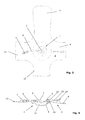
- the device according to the invention for the temporary closure of a tracheostoma consists essentially of an air cushion 1 and an adhesive plaster 2 holding it.
- the air cushion 1 has on its distal, ie the side facing away from the tracheostoma when the device is applied to the neck of a patient a comparatively rigid, circular base plate 3, on the proximal side of a flexible film-like layer 4 is applied.
- the film-like layer is glued to the edge of the base plate 3 for this purpose.
- the base plate has on its distal side a connection 5 for an air supply hose 6, at whose free end a valve 7 is provided. Below the terminal 5, a passage opening 8 is provided in the base plate 3, through which air supplied via the hose 6 can be introduced between the base plate 3 and the film-like layer 4.
- the valve 7 is preferably designed so that the closure part of the valve can be pressed with the nozzle of a syringe, so that air can be introduced by means of the syringe into the air cushion or sucked out of it.
- the plaster 2 is provided on its side facing the neck of the patient with an adhesive layer and is fully adhered to the distal side of the base plate 3.
- the adhesive plaster 2 has a central, circular hole through which the connection 5 together with the air supply hose 6 can be pushed through before the adhesive is applied.
- the adhesive plaster has three circumferentially offset by 90 ° to each other, short tabs 9, 10, 12, while a fourth, also offset by 90 ° tab 11 is formed significantly longer.
- the tabs 9, 10 disposed on opposite sides of the air bag 1 serve to secure the air bag to opposite sides of the neck of a patient, while the long tab 11 is glued to the neck at the neck toward the chin and the opposite tab 12 at the neck toward the patient's chest becomes.
- the base plate 3 and the film-like layer 4 are preferably made of plastic, wherein different plastics can be used for both parts. Particularly suitable plastics PVC plastics and silicones have proven. Also, in particular for the film-like layer, rubbery or rubber-containing materials can be used.
- FIG. 2 the air cushion partially shown filled with air.
- the space 13 between the base plate 3 and the sheet-like layer 4 can be completed disappear when it is completely evacuated and the layer 4 then fully applied to the base plate 3.
- the in the FIGS. 3 and 4 shown closure device differs from that in the Figures 1 and 2 shown merely in that an additional line is provided, which is guided from the distal side of the air cushion to the proximal side of the air cushion.
- the line consists of a through a flange-like edge (21) of the air cushion (1) guided channel piece (22) and an adjoining piece of tubing (23).
- the channel piece (22) extends substantially perpendicular to the flange piece (21) through this and forms a rectangular angled channel, so that the hose piece (23) can be guided approximately parallel to the plaster (9).
- a connection (24) for connecting the hose piece (23) with a device for generating a negative pressure, in particular a syringe or a pump, is provided at the free end of the hose piece (23).
Landscapes
- Health & Medical Sciences (AREA)
- Pulmonology (AREA)
- Heart & Thoracic Surgery (AREA)
- Life Sciences & Earth Sciences (AREA)
- Veterinary Medicine (AREA)
- Public Health (AREA)
- Biomedical Technology (AREA)
- General Health & Medical Sciences (AREA)
- Engineering & Computer Science (AREA)
- Animal Behavior & Ethology (AREA)
- Hematology (AREA)
- Anesthesiology (AREA)
- Emergency Medicine (AREA)
- Otolaryngology (AREA)
- Vascular Medicine (AREA)
- Biophysics (AREA)
- Gastroenterology & Hepatology (AREA)
- Media Introduction/Drainage Providing Device (AREA)
- Prostheses (AREA)
Abstract
Description
- Die vorliegende Erfindung betrifft eine Vorrichtung zum temporären Verschließen eines Trachoestomas eines Patienten mit mindestens einem Mittel zum Halten der Vorrichtung am Hals des Patienten.
- Eine Tracheotomie ist eine chirurgische Maßnahme, mit dem ein Zugang zur Luftröhre eines Patienten gesetzt wird, um beispielsweise eine Trachealkanüle einzusetzen. Hierdurch entsteht ein Tracheostoma. Operationsmethoden sind beispielsweise eine perkutane Punktions- und Dilatationstracheotomie, bei der nur ein vergleichsweise kleines Tracheostoma erzeugt wird, oder eine chirurgische Tracheotomie, bei der ein übersichtlicher Zugang zur Luftröhre geschaffen wird.
- In vielen Fällen wird der Zugang zur Luftröhre nach beispielsweise einem operativen Eingriff nicht mehr benötigt. Ein Tracheostoma kann sich unter Umständen von allein verschließen und verheilen. In den Fällen, in denen dies nicht gelingt oder von vorneherein nicht möglich ist, muss das Tracheostoma chirurgisch geschlossen werden.
- Bevor das Tracheostoma sich wieder verschließt oder operativ geschlossen wird, kann es notwendig oder zumindest sinnvoll sein zu prüfen, ob der Patient bei verschlossenem Tracheostoma beschwerdefrei Atmen kann. Hierzu wird das Tracheostoma mittels einer Vorrichtung dicht verschlossen. Auch ist es sinnvoll, ein Austreten von Luft durch das Stoma beim Atmen, Sprechen oder Husten zu verhindern, da der Luftaustritt ein eigenständiges Zusammenwachsen des Tracheostomas behindern kann. Dies kann ebenfalls mit einer Vorrichtung zum temporären Verschließen des Tracheostomas erfolgen.
- Eine hierfür geeignete Vorrichtung ist aus der
US 2009/0025730 A1 bekannt. Sie weist eine gewölbte Platte auf, die mit einem Band, das durch seitliche Ösen der Platte geführt ist, am Hals des Patienten befestigt wird. Auf der proximalen, also dem Tracheostoma zugewandten Seite der Platte ist ein ringförmiges Kissen vorgesehen, das an der Platte temporär oder dauerhaft angeklebt ist und das Tracheostoma nicht unmittelbar kontaktiert, sondern die Haut um das Tracheostoma herum. Allerdings kann es vorkommen, dass diese Vorrichtung das Tracheostoma nicht optimal abdeckt, so dass ein Verschluss des Tracheostomas nicht immer sicher gewährleistet ist, beispielsweise, weil die Platte nicht richtig an das Tracheostoma angesetzt wird oder sich die Ringform des Kissens nicht optimal an die das Tracheostoma umgebende Haut anlegt. - Die Aufgabe der vorliegenden Erfindung besteht darin, eine Vorrichtung der eingangs genannten Art bereitzustellen, die ein sicheres Abdichten des Tracheostomas ermöglicht.
- Diese Aufgabe wird gelöst mit einer Vorrichtung mit den Merkmalen des Anspruchs 1.
- Mit einem aufblasbaren Luftkissen ist es in Verbindung mit dem Mittel zum Halten der Vorrichtung am Hals des Patienten möglich, den Druck des Kissens auf die ein Tracheostoma umgebende Haut eines Patienten gezielt so anzupassen, dass das Tracheostoma selbst bei Husten sicher verschlossen bleibt.
- Es ist denkbar, dass das Luftkissen auf seiner proximalen Seite eine formstabile Kappe aufweist, deren Form an die Form der an das Tracheostoma angrenzenden Haut angepasst ist, so dass sich die Kappe gegen die Haut am äußeren Rand des Tracheostomas abstützt. Ist die Oberfläche der Kappe elastisch, kann ein dichter Verschluss des Tracheostomas gewährleistet werden, wobei der Anpressdruck durch den Druck im Luftkissen angepasst wird.
- Vorzugsweise ist aber das Luftkissen an seiner proximalen, also der beim Anlegen der Vorrichtung an den Hals des Patienten dem Tracheostoma zugewandten Seite flexibel ausgebildet, so dass sich die Form des Luftkissens an die Form der an das Tracheostoma angrenzenden Haut anpassen kann. Dabei wirkt der Druck des Luftkissens an allen Kontaktstellen zur Haut gleichmäßig. Gleichzeitig passt sich das Kissen an die Form der Haut um das Tracheostoma herum und damit an die Größe des Tracheostomas an. Damit bietet die Vorrichtung für eine Vielzahl von Tracheostomas unterschiedlicher Form und Größe einen sicheren, luftdichten Verschluss.
- In einer bevorzugten Ausgestaltung der Erfindung hat das Luftkissen einen runden, insbesondere kreisrunden, Querschnitt. Hierdurch ist die Grundform des Luftkissens optimal an die Form einer Vielzahl von verschließenden Stomata angepasst. Es sind aber auch andere Querschnittsformen, beispielsweise Ovale, möglich. Bei einer sehr elastischen bzw. flexiblen Außenhaut des Luftkissens ist auch ein eckiger Querschnitt denkbar, da sich die Ecken des Querschnitts nicht in der aufgeblasenen flexiblen bzw. elastischen Kissenhülle fortsetzen.
- In einer weiteren bevorzugten Ausführungsform der Erfindung ist an der distalen, also der beim Anlegen der Vorrichtung an den Hals des Patienten vom Tracheostoma abgewandten Seite des Luftkissens eine mit einem Ventil verschließbare Zuleitung für Luft oder ein anderes Fluid vorgesehen ist, über die das Luftkissen aufgeblasen bzw. befüllt werden kann. Das Ventil kann als Rückschlagventil, aber auch manuell betätigbar ausgebildet sein. Ein manuell betätigbares Ventil, mit dem Luft aus dem Luftkissen kontrolliert abgelassen werden kann, kann von Vorteil sein, da es durch das kontrollierte Ablassen von Luft möglich ist, den Anpressdruck des an einem Tracheostoma anliegenden, aufgeblasenen Luftkissens gezielt einzustellen. Das Ventil kann auch so ausgebildet sein, dass es durch Einsetzen der Düse einer Spritze öffnet, so dass mit der Spritze gezielt Luft in das Luftkissen hineingedrückt oder herausgesogen werden kann.
- In einer weiteren Variante der Erfindung kann das Luftkissen selbstaufblasbar ausgebildet sein, beispielsweise in dem innerhalb des Luftkissens ein elastischer, offenzelliger Schaumstoff enthalten ist, der zunächst zusammengedrückt ist und der sich nach Öffnen eines Ventils innerhalb der Wandung des Luftkissens ausdehnen kann. Erfolgt dies, wenn das Luftkissen bereits an das Tracheostoma angelegt ist, kann sich das Luftkissen an die Form der an das Tracheostoma angrenzenden Haut anpassen.
- Auf seiner distalen Seite ist das Luftkissen vorzugsweise steif ausgebildet. So ist es möglich, die Position des Luftkissens am Tracheostoma mit den Haltemitteln genau zu fixieren. Insbesondere dann, wenn in einer weiteren bevorzugten Ausgestaltung der Erfindung mindestens ein Heftpflaster als Haltemittel vorgesehen ist, bietet ein steifer Teil des Luftkissens eine gute Haftfläche für das Heftpflaster. Wäre die Haftfläche am Kissen flexibel und insbesondere elastisch, könnte sich das Heftpflaster möglicherweise bei Ausdehnen der Haftfläche lösen.
- Das Pflaster weist vorzugsweise an mindestens zwei gegenüberliegenden Seiten des Luftkissens jeweils eine sich vom Kissen weg erstreckende Lasche auf. Damit kann das Luftkissen sicher am Hals befestigt werden. Anders als bei einer Befestigung des Luftkissens über ein Band wirken die Haltekräfte des Haftpflasters unmittelbar dem vom Luftkissen aufgebrachten Druck entgegen. Außerdem verrutscht ein einmal auf die Haut aufgeklebtes Pflaster nicht mehr ohne weiteres. So kann das Luftkissen deutlich besser zum Verschließen des Tracheostomas in Position gehalten werden. Bevorzugt sind dabei mindestens drei Laschen vorgesehen, die in Umfangsrichtung des Luftkissens um 90° zueinander versetzt angeordnet sind. Insbesondere wenn eine der Laschen, die bei einem an das Tracheostoma angelegten Luftkissen in Längsrichtung des Halses verläuft, vergleichsweise lang ausgebildet ist, kann diese bis unter das Kinn des Patienten am Hals angeklebt werden. Hiermit kann ein ganz besonders sicherer Halt des Luftkissens in seiner Position gewährleistet werden.
- Zusätzlich kann die erfindungsgemäße Vorrichtung mindestens eine Leitung aufweisen, die im Bereich des Luftkissens von der distalen Seite der Vorrichtung zu seiner proximalen Seite geführt ist, und mit der ein Fluid von der proximalen Seite des Luftkissens abgeführt werden kann. So ist es möglich, ohne die Mittel zum Halten des Pflasters zu lösen, Wundsekret abzusaugen, beispielsweise dann, wenn ein tracheotomierter Patient nach einer Operation noch nicht kräftig genug ist, sich bildendes Wundsekret abzuhusten. Es ist auch denkbar, dem operierten Tracheostoma über eine solche Leitung Wirkstoffe zur Wundversorgung zuzuführen.
- In einer einfachen und insoweit bevorzugten Ausführungsform ist die Leitung mit einem durch einen flanschartigen Rand des Luftkissens hindurchgeführten Kanalstück und einem sich daran anschließenden Schlauchstück gebildet. Das Schlauchstück ist dabei vorteilhafterweise lösbar mit dem Kanalstück verbunden, und/oder es ist am freien Ende des Schlauchstücks ein Anschluss zum Verbinden des Schlauchstücks mit einer Vorrichtung zum Erzeugen eines Unterdrucks, insbesondere eine Spritze oder eine Pumpe, vorgesehen. Im Folgenden wird die Erfindung anhand von Figuren, in denen ein bevorzugtes erfindungsgemäßes Ausführungsbeispiel dargestellt ist, näher erläutert.
- Es zeigen:
- Figur 1
- eine Aufsicht auf die erfindungsgemäße Verschlussvorrichtung;
- Figur 2
- eine Schnittansicht durch die in
Figur 1 dargestellte Verschlussvorrichtung; - Figur 3
- eine Aufsicht einer ähnlichen erfindungsgemäßen Verschlussvorrichtung; und
- Figur 4
- eine Schnittansicht durch die in
Figur 3 dargestellte Verschlussvorrichtung. - Die erfindungsgemäße Vorrichtung zum temporären Verschließen eines Tracheostomas besteht im Wesentlichen aus einem Luftkissen 1 und ein dieses haltende Heftpflaster 2.
- Das Luftkissen 1 weist auf seiner distalen, also der bei Anlegen der Vorrichtung an den Hals eines Patienten vom Tracheostoma abgewandten Seite eine vergleichsweise steife, kreisrunde Basisplatte 3 auf, auf dessen proximaler Seite eine flexible, folienartige Schicht 4 aufgebracht ist. Die folienartige Schicht ist hierzu am Rand der Basisplatte 3 aufgeklebt.
- Die Basisplatte weist auf seiner distalen Seite einen Anschluss 5 für einen Luftzufuhrschlauch 6 auf, an dessen freiem Ende ein Ventil 7 vorgesehen ist. Unterhalb des Anschlusses 5 ist in der Basisplatte 3 eine Durchgangsöffnung 8 vorgesehen, durch die über den Schlauch 6 zugeführte Luft zwischen die Basisplatte 3 und die folienartige Schicht 4 eingebracht werden kann.
- Das Ventil 7 ist vorzugsweise so ausgebildet, dass das Verschlussteil des Ventils mit der Düse einer Spritze eingedrückt werden kann, so dass Luft mithilfe der Spritze in das Luftkissen eingebracht oder aus diesem herausgesogen werden kann.
- Das Pflaster 2 ist an seiner dem Hals des Patienten zugewandten Seite mit einer Klebeschicht versehen und ist vollumfänglich auf die distale Seite der Basisplatte 3 aufgeklebt. Das Heftpflaster 2 weist ein zentrales, kreisrundes Loch auf, durch das der Anschluss 5 samt Luftzufuhrschlauch 6 vor dem Aufkleben des Pflasters hindurchgesteckt werden können. Das Heftpflaster weist drei in Umfangsrichtung um jeweils 90° zueinander versetzte, kurze Laschen 9, 10, 12 auf, während eine vierte, ebenso um 90° versetzte Lasche 11 deutlich länger ausgebildet ist. Die an gegenüberliegenden Seiten des Luftkissens 1 angeordneten Laschen 9, 10 dienen zur Befestigung des Luftkissens an gegenüberliegenden Seiten des Halses eines Patienten, während die lange Lasche 11 am Hals in Richtung zum Kinn und die gegenüberliegende Lasche 12 am Hals in Richtung zur Brust des Patienten angeklebt wird.
- Die Basisplatte 3 und die folienartige Schicht 4 bestehen vorzugsweise aus Kunststoff, wobei für beide Teile verschiedene Kunststoffe verwendet werden können. Als besonders geeignete Kunststoffe haben sich PVC-Kunststoffe und Silikone erwiesen. Auch können insbesondere für die folienartige Schicht gummiartige oder gummihaltige Werkstoffe verwendet werden.
- Die Darstellungen der
Figuren 1 und 2 sind nicht maßstabsgetreu. Insbesondere sind die Dicken von Pflaster und Basisplatte sowie folienartiger Schicht des Luftkissens zum Zweck der besseren Veranschaulichung deutlich dicker dargestellt. - Im Übrigen ist in
Figur 2 das Luftkissen teilweise luftgefüllt dargestellt. Der Raum 13 zwischen der Basisplatte 3 und der folienartigen Schicht 4 kann vollständig verschwinden, wenn er vollständig evakuiert wird und die Schicht 4 dann vollflächig an der Basisplatte 3 anliegt. - Die in den
Figuren 3 und 4 dargestellte Verschlussvorrichtung unterscheidet sich von der in denFiguren 1 und 2 dargestellten lediglich dadurch, dass eine zusätzliche Leitung vorgesehen ist, die von der distalen Seite des Luftkissens zur proximalen Seite des Luftkissens geführt ist. Die Leitung besteht aus einem durch einen flanschartigen Rand (21) des Luftkissens (1) hindurchgeführten Kanalstück (22) und einem sich daran anschließenden Schlauchstück (23). Das Kanalstück (22) erstreckt sich im Wesentlichen senkrecht zum Flanschstück (21) durch dieses hindurch und bildet einen rechtwinklig abgewinkelten Kanal, so dass das Schlauchstück (23) in etwa parallel zum Pflaster (9) geführt werden kann. Am freien Ende des Schlauchstücks (23) ist ein Anschluss (24) zum Verbinden des Schlauchstücks (23) mit einer Vorrichtung zum Erzeugen eines Unterdrucks, insbesondere eine Spritze oder eine Pumpe, vorgesehen.
Claims (13)
- Vorrichtung zum temporären Verschließen eines Trachoestomas eines Patienten mit mindestens einem Mittel zum Halten der Vorrichtung am Hals des Patienten, gekennzeichnet durch ein aufblasbares Luftkissen (1), das mit dem mindestens einen Haltemittel verbunden und geeignet ist, das Tracheostoma luftdicht zu verschließen.
- Vorrichtung nach Anspruch 1, dadurch gekennzeichnet, dass das Luftkissen (1) auf seiner proximalen Seite eine flexible Wandung (4) aufweist.
- Vorrichtung nach Anspruch 1 oder 2, dadurch gekennzeichnet, dass das Luftkissen (1) einen runden, insbesondere kreisrunden, Querschnitt hat.
- Vorrichtung nach einem der Ansprüche 1 bis 3, gekennzeichnet durch eine mit einem Ventil (7) verschließbare Zuleitung (6) für Luft oder ein anderes Fluid an der distalen Seite des Luftkissens (1) zum Befüllen des Luftkissens (1).
- Vorrichtung nach einem der Ansprüche 1 bis 4, dadurch gekennzeichnet, dass das Luftkissen selbstaufblasbar ausgebildet ist.
- Vorrichtung einem der Ansprüche 1 bis 5, dadurch gekennzeichnet, dass das Luftkissen (1) auf seiner distalen Seite steif ausgebildet ist.
- Vorrichtung nach einem der Ansprüche 1 bis 6, dadurch gekennzeichnet, dass als Haltemittel mindestens ein Heftpflaster (2) vorgesehen ist.
- Vorrichtung nach Anspruch 7, dadurch gekennzeichnet, dass das Heftpflaster (2) an mindestens zwei gegenüberliegenden Seiten des Luftkissens (1) jeweils eine sich vom Luftkissen (1) weg erstreckende Lasche (9, 10, 11, 12) aufweist.
- Vorrichtung nach Anspruch 8, gekennzeichnet durch mindestens drei in Umfangsrichtung des Luftkissens um jeweils 90° versetzt zueinander angeordnete Laschen (9, 10, 11, 12).
- Vorrichtung nach einem der Ansprüche 1 bis 9, gekennzeichnet durch mindestens eine Leitung, die im Bereich des Luftkissens (1) von der distalen Seite der Vorrichtung zu ihrer proximalen Seite geführt ist, und mit der ein Fluid, insbesondere Wundsekret, von der proximalen Seite der Vorrichtung abgeführt werden kann.
- Vorrichtung nach Anspruch 10, dadurch gekennzeichnet, dass die Leitung mit einem durch einen flanschartigen Rand (24) des Luftkissens (1) hindurchgeführten Kanalstück (22) und einem sich daran anschließenden Schlauchstück (23) gebildet ist.
- Vorrichtung nach Anspruch 11, dadurch gekennzeichnet, dass das Schlauchstück (23) mit einem distalen Ende des Kanals lösbar verbunden werden kann.
- Vorrichtung nach Anspruch 11 oder 12, dadurch gekennzeichnet, dass am freien Ende des Schlauchstücks (23) ein Anschluss (24) zum Verbinden des Schlauchstücks mit einer Vorrichtung zum Erzeugen eines Unterdrucks, insbesondere eine Spritze oder eine Pumpe, vorgesehen ist.
Applications Claiming Priority (3)
| Application Number | Priority Date | Filing Date | Title |
|---|---|---|---|
| DE201310110694 DE102013110694A1 (de) | 2013-09-27 | 2013-09-27 | Verschluss für ein Tracheostoma |
| DE201320104415 DE202013104415U1 (de) | 2013-09-27 | 2013-09-27 | Verschluss für ein Tracheostoma |
| DE201420101628 DE202014101628U1 (de) | 2013-09-27 | 2014-04-07 | Verschluss für ein Tracheostoma |
Publications (2)
| Publication Number | Publication Date |
|---|---|
| EP2853279A1 true EP2853279A1 (de) | 2015-04-01 |
| EP2853279B1 EP2853279B1 (de) | 2018-08-08 |
Family
ID=51626392
Family Applications (1)
| Application Number | Title | Priority Date | Filing Date |
|---|---|---|---|
| EP14186142.7A Active EP2853279B1 (de) | 2013-09-27 | 2014-09-24 | Verschluss für ein Tracheostoma |
Country Status (1)
| Country | Link |
|---|---|
| EP (1) | EP2853279B1 (de) |
Citations (6)
| Publication number | Priority date | Publication date | Assignee | Title |
|---|---|---|---|---|
| DE3524126A1 (de) * | 1984-07-31 | 1986-02-13 | Smiths Industries P.L.C., London | Luftroehrenkatheter |
| EP1454601A2 (de) * | 2003-03-06 | 2004-09-08 | bess medizintechnik gmbh | Anordnung zur externen Tracheostomastabilisierung |
| US20090025730A1 (en) | 2007-07-24 | 2009-01-29 | Pinel Lloyd J | Post decannulation stoma cover |
| US20130047993A1 (en) * | 2011-08-31 | 2013-02-28 | Nellcor Puritan Bennett Llc | Tracheal tube having a flange with a variable volume |
| US20130096520A1 (en) * | 2001-12-26 | 2013-04-18 | Kci Medical Resources | Vacuum bandage packing |
| US20130192603A1 (en) * | 2010-10-14 | 2013-08-01 | Primed Halberstadt Medizintechnik Gmbh | Breathing device comprising a support for speech valves and/or heat and moisture exchange devices without fixing to the cannula |
Family Cites Families (1)
| Publication number | Priority date | Publication date | Assignee | Title |
|---|---|---|---|---|
| DE10148572B4 (de) * | 2001-04-17 | 2007-07-05 | Bergmann, Dirk, Dipl.-Ing. | Stoma-Ventil |
-
2014
- 2014-09-24 EP EP14186142.7A patent/EP2853279B1/de active Active
Patent Citations (6)
| Publication number | Priority date | Publication date | Assignee | Title |
|---|---|---|---|---|
| DE3524126A1 (de) * | 1984-07-31 | 1986-02-13 | Smiths Industries P.L.C., London | Luftroehrenkatheter |
| US20130096520A1 (en) * | 2001-12-26 | 2013-04-18 | Kci Medical Resources | Vacuum bandage packing |
| EP1454601A2 (de) * | 2003-03-06 | 2004-09-08 | bess medizintechnik gmbh | Anordnung zur externen Tracheostomastabilisierung |
| US20090025730A1 (en) | 2007-07-24 | 2009-01-29 | Pinel Lloyd J | Post decannulation stoma cover |
| US20130192603A1 (en) * | 2010-10-14 | 2013-08-01 | Primed Halberstadt Medizintechnik Gmbh | Breathing device comprising a support for speech valves and/or heat and moisture exchange devices without fixing to the cannula |
| US20130047993A1 (en) * | 2011-08-31 | 2013-02-28 | Nellcor Puritan Bennett Llc | Tracheal tube having a flange with a variable volume |
Also Published As
| Publication number | Publication date |
|---|---|
| EP2853279B1 (de) | 2018-08-08 |
Similar Documents
| Publication | Publication Date | Title |
|---|---|---|
| DE69913170T2 (de) | Intubationsvorrichtung | |
| WO2009070905A1 (de) | Wundabdeckungs-verbindungsvorrichtung | |
| DE3524126A1 (de) | Luftroehrenkatheter | |
| EP0461518A1 (de) | Ventilpflaster zur Notfallbehandlung offener Thoraxverletzungen | |
| DE2142546A1 (de) | Vorrichtung zum Fordern eines Stro mungsmittels innerhalb eines Korperkanals | |
| DE3205827A1 (de) | Sauginjektionsvorrichtungen mit unterdruckspeicherung | |
| DE202009016034U1 (de) | Trachealkanüle | |
| DE202010001611U1 (de) | Trachealkanüle | |
| DE202008017361U1 (de) | Fisteleinsatz | |
| CH709183A1 (de) | Thoraxdrainagevorrichtung. | |
| DE102010048316A1 (de) | Beatmungseinrichtung mit einer Halterung für Sprechventile und/oder Wärme- Feuchtigkeitstauscher ohne Kanülenbefestigung | |
| DE20303669U1 (de) | Anordnung zur externen Tracheostomastabilisierung | |
| DE20100176U1 (de) | Eine über den Kehlkopf einsetzbare Luftwegsanordnung | |
| DE202014101628U1 (de) | Verschluss für ein Tracheostoma | |
| EP2931135B1 (de) | Ballonkatheter zur behandlung enteroatmosphärischer fisteln bei offenen abdomen | |
| EP2853279B1 (de) | Verschluss für ein Tracheostoma | |
| DE202007016874U1 (de) | Haltevorrichtung für ein Penisextensionsgerät | |
| DE102013110694A1 (de) | Verschluss für ein Tracheostoma | |
| DE202017003068U1 (de) | Tracheostomiekanüle mit Niederdruckmanschette und Absaugvorrichtung | |
| EP3727539B1 (de) | Tracheostomievorrichtung | |
| DE202017003898U1 (de) | Beatmungsfilter für ein Tracheostoma | |
| DE202017004647U1 (de) | Absaugkanüle für ein Tracheostoma | |
| WO2021023480A1 (de) | Anordnung und verfahren zum aufnehmen von abgesogenem sekret umfassend eine rückflusssperre | |
| EP1719535B1 (de) | Tracheostomaplatzhalter | |
| DE202018000926U1 (de) | Filter mit Dichtung für ein Tracheostoma |
Legal Events
| Date | Code | Title | Description |
|---|---|---|---|
| PUAI | Public reference made under article 153(3) epc to a published international application that has entered the european phase |
Free format text: ORIGINAL CODE: 0009012 |
|
| 17P | Request for examination filed |
Effective date: 20140924 |
|
| AK | Designated contracting states |
Kind code of ref document: A1 Designated state(s): AL AT BE BG CH CY CZ DE DK EE ES FI FR GB GR HR HU IE IS IT LI LT LU LV MC MK MT NL NO PL PT RO RS SE SI SK SM TR |
|
| AX | Request for extension of the european patent |
Extension state: BA ME |
|
| R17P | Request for examination filed (corrected) |
Effective date: 20150930 |
|
| RBV | Designated contracting states (corrected) |
Designated state(s): AL AT BE BG CH CY CZ DE DK EE ES FI FR GB GR HR HU IE IS IT LI LT LU LV MC MK MT NL NO PL PT RO RS SE SI SK SM TR |
|
| 17Q | First examination report despatched |
Effective date: 20170215 |
|
| GRAP | Despatch of communication of intention to grant a patent |
Free format text: ORIGINAL CODE: EPIDOSNIGR1 |
|
| INTG | Intention to grant announced |
Effective date: 20171026 |
|
| RAP1 | Party data changed (applicant data changed or rights of an application transferred) |
Owner name: BMV BENDER MEDICAL VERTRIEB GMBH |
|
| GRAJ | Information related to disapproval of communication of intention to grant by the applicant or resumption of examination proceedings by the epo deleted |
Free format text: ORIGINAL CODE: EPIDOSDIGR1 |
|
| GRAS | Grant fee paid |
Free format text: ORIGINAL CODE: EPIDOSNIGR3 |
|
| INTC | Intention to grant announced (deleted) | ||
| GRAP | Despatch of communication of intention to grant a patent |
Free format text: ORIGINAL CODE: EPIDOSNIGR1 |
|
| INTG | Intention to grant announced |
Effective date: 20180307 |
|
| GRAA | (expected) grant |
Free format text: ORIGINAL CODE: 0009210 |
|
| AK | Designated contracting states |
Kind code of ref document: B1 Designated state(s): AL AT BE BG CH CY CZ DE DK EE ES FI FR GB GR HR HU IE IS IT LI LT LU LV MC MK MT NL NO PL PT RO RS SE SI SK SM TR |
|
| REG | Reference to a national code |
Ref country code: GB Ref legal event code: FG4D Free format text: NOT ENGLISH |
|
| REG | Reference to a national code |
Ref country code: AT Ref legal event code: REF Ref document number: 1026279 Country of ref document: AT Kind code of ref document: T Effective date: 20180815 Ref country code: CH Ref legal event code: EP |
|
| REG | Reference to a national code |
Ref country code: FR Ref legal event code: PLFP Year of fee payment: 5 |
|
| REG | Reference to a national code |
Ref country code: IE Ref legal event code: FG4D Free format text: LANGUAGE OF EP DOCUMENT: GERMAN |
|
| REG | Reference to a national code |
Ref country code: DE Ref legal event code: R096 Ref document number: 502014009119 Country of ref document: DE |
|
| REG | Reference to a national code |
Ref country code: NL Ref legal event code: FP |
|
| REG | Reference to a national code |
Ref country code: LT Ref legal event code: MG4D |
|
| PG25 | Lapsed in a contracting state [announced via postgrant information from national office to epo] |
Ref country code: PL Free format text: LAPSE BECAUSE OF FAILURE TO SUBMIT A TRANSLATION OF THE DESCRIPTION OR TO PAY THE FEE WITHIN THE PRESCRIBED TIME-LIMIT Effective date: 20180808 Ref country code: LT Free format text: LAPSE BECAUSE OF FAILURE TO SUBMIT A TRANSLATION OF THE DESCRIPTION OR TO PAY THE FEE WITHIN THE PRESCRIBED TIME-LIMIT Effective date: 20180808 Ref country code: FI Free format text: LAPSE BECAUSE OF FAILURE TO SUBMIT A TRANSLATION OF THE DESCRIPTION OR TO PAY THE FEE WITHIN THE PRESCRIBED TIME-LIMIT Effective date: 20180808 Ref country code: NO Free format text: LAPSE BECAUSE OF FAILURE TO SUBMIT A TRANSLATION OF THE DESCRIPTION OR TO PAY THE FEE WITHIN THE PRESCRIBED TIME-LIMIT Effective date: 20181108 Ref country code: IS Free format text: LAPSE BECAUSE OF FAILURE TO SUBMIT A TRANSLATION OF THE DESCRIPTION OR TO PAY THE FEE WITHIN THE PRESCRIBED TIME-LIMIT Effective date: 20181208 Ref country code: RS Free format text: LAPSE BECAUSE OF FAILURE TO SUBMIT A TRANSLATION OF THE DESCRIPTION OR TO PAY THE FEE WITHIN THE PRESCRIBED TIME-LIMIT Effective date: 20180808 Ref country code: BG Free format text: LAPSE BECAUSE OF FAILURE TO SUBMIT A TRANSLATION OF THE DESCRIPTION OR TO PAY THE FEE WITHIN THE PRESCRIBED TIME-LIMIT Effective date: 20181108 Ref country code: SE Free format text: LAPSE BECAUSE OF FAILURE TO SUBMIT A TRANSLATION OF THE DESCRIPTION OR TO PAY THE FEE WITHIN THE PRESCRIBED TIME-LIMIT Effective date: 20180808 Ref country code: GR Free format text: LAPSE BECAUSE OF FAILURE TO SUBMIT A TRANSLATION OF THE DESCRIPTION OR TO PAY THE FEE WITHIN THE PRESCRIBED TIME-LIMIT Effective date: 20181109 |
|
| PG25 | Lapsed in a contracting state [announced via postgrant information from national office to epo] |
Ref country code: HR Free format text: LAPSE BECAUSE OF FAILURE TO SUBMIT A TRANSLATION OF THE DESCRIPTION OR TO PAY THE FEE WITHIN THE PRESCRIBED TIME-LIMIT Effective date: 20180808 Ref country code: LV Free format text: LAPSE BECAUSE OF FAILURE TO SUBMIT A TRANSLATION OF THE DESCRIPTION OR TO PAY THE FEE WITHIN THE PRESCRIBED TIME-LIMIT Effective date: 20180808 Ref country code: AL Free format text: LAPSE BECAUSE OF FAILURE TO SUBMIT A TRANSLATION OF THE DESCRIPTION OR TO PAY THE FEE WITHIN THE PRESCRIBED TIME-LIMIT Effective date: 20180808 |
|
| PG25 | Lapsed in a contracting state [announced via postgrant information from national office to epo] |
Ref country code: EE Free format text: LAPSE BECAUSE OF FAILURE TO SUBMIT A TRANSLATION OF THE DESCRIPTION OR TO PAY THE FEE WITHIN THE PRESCRIBED TIME-LIMIT Effective date: 20180808 Ref country code: IT Free format text: LAPSE BECAUSE OF FAILURE TO SUBMIT A TRANSLATION OF THE DESCRIPTION OR TO PAY THE FEE WITHIN THE PRESCRIBED TIME-LIMIT Effective date: 20180808 Ref country code: RO Free format text: LAPSE BECAUSE OF FAILURE TO SUBMIT A TRANSLATION OF THE DESCRIPTION OR TO PAY THE FEE WITHIN THE PRESCRIBED TIME-LIMIT Effective date: 20180808 Ref country code: CZ Free format text: LAPSE BECAUSE OF FAILURE TO SUBMIT A TRANSLATION OF THE DESCRIPTION OR TO PAY THE FEE WITHIN THE PRESCRIBED TIME-LIMIT Effective date: 20180808 Ref country code: ES Free format text: LAPSE BECAUSE OF FAILURE TO SUBMIT A TRANSLATION OF THE DESCRIPTION OR TO PAY THE FEE WITHIN THE PRESCRIBED TIME-LIMIT Effective date: 20180808 |
|
| REG | Reference to a national code |
Ref country code: DE Ref legal event code: R097 Ref document number: 502014009119 Country of ref document: DE |
|
| PG25 | Lapsed in a contracting state [announced via postgrant information from national office to epo] |
Ref country code: DK Free format text: LAPSE BECAUSE OF FAILURE TO SUBMIT A TRANSLATION OF THE DESCRIPTION OR TO PAY THE FEE WITHIN THE PRESCRIBED TIME-LIMIT Effective date: 20180808 Ref country code: SM Free format text: LAPSE BECAUSE OF FAILURE TO SUBMIT A TRANSLATION OF THE DESCRIPTION OR TO PAY THE FEE WITHIN THE PRESCRIBED TIME-LIMIT Effective date: 20180808 Ref country code: SK Free format text: LAPSE BECAUSE OF FAILURE TO SUBMIT A TRANSLATION OF THE DESCRIPTION OR TO PAY THE FEE WITHIN THE PRESCRIBED TIME-LIMIT Effective date: 20180808 |
|
| REG | Reference to a national code |
Ref country code: BE Ref legal event code: MM Effective date: 20180930 |
|
| PLBE | No opposition filed within time limit |
Free format text: ORIGINAL CODE: 0009261 |
|
| STAA | Information on the status of an ep patent application or granted ep patent |
Free format text: STATUS: NO OPPOSITION FILED WITHIN TIME LIMIT |
|
| REG | Reference to a national code |
Ref country code: IE Ref legal event code: MM4A |
|
| PG25 | Lapsed in a contracting state [announced via postgrant information from national office to epo] |
Ref country code: MC Free format text: LAPSE BECAUSE OF FAILURE TO SUBMIT A TRANSLATION OF THE DESCRIPTION OR TO PAY THE FEE WITHIN THE PRESCRIBED TIME-LIMIT Effective date: 20180808 Ref country code: LU Free format text: LAPSE BECAUSE OF NON-PAYMENT OF DUE FEES Effective date: 20180924 |
|
| 26N | No opposition filed |
Effective date: 20190509 |
|
| PG25 | Lapsed in a contracting state [announced via postgrant information from national office to epo] |
Ref country code: IE Free format text: LAPSE BECAUSE OF NON-PAYMENT OF DUE FEES Effective date: 20180924 |
|
| PG25 | Lapsed in a contracting state [announced via postgrant information from national office to epo] |
Ref country code: SI Free format text: LAPSE BECAUSE OF FAILURE TO SUBMIT A TRANSLATION OF THE DESCRIPTION OR TO PAY THE FEE WITHIN THE PRESCRIBED TIME-LIMIT Effective date: 20180808 Ref country code: BE Free format text: LAPSE BECAUSE OF NON-PAYMENT OF DUE FEES Effective date: 20180930 |
|
| PG25 | Lapsed in a contracting state [announced via postgrant information from national office to epo] |
Ref country code: MT Free format text: LAPSE BECAUSE OF FAILURE TO SUBMIT A TRANSLATION OF THE DESCRIPTION OR TO PAY THE FEE WITHIN THE PRESCRIBED TIME-LIMIT Effective date: 20180808 |
|
| PG25 | Lapsed in a contracting state [announced via postgrant information from national office to epo] |
Ref country code: TR Free format text: LAPSE BECAUSE OF FAILURE TO SUBMIT A TRANSLATION OF THE DESCRIPTION OR TO PAY THE FEE WITHIN THE PRESCRIBED TIME-LIMIT Effective date: 20180808 |
|
| PG25 | Lapsed in a contracting state [announced via postgrant information from national office to epo] |
Ref country code: HU Free format text: LAPSE BECAUSE OF FAILURE TO SUBMIT A TRANSLATION OF THE DESCRIPTION OR TO PAY THE FEE WITHIN THE PRESCRIBED TIME-LIMIT; INVALID AB INITIO Effective date: 20140924 Ref country code: PT Free format text: LAPSE BECAUSE OF FAILURE TO SUBMIT A TRANSLATION OF THE DESCRIPTION OR TO PAY THE FEE WITHIN THE PRESCRIBED TIME-LIMIT Effective date: 20180808 |
|
| PG25 | Lapsed in a contracting state [announced via postgrant information from national office to epo] |
Ref country code: CY Free format text: LAPSE BECAUSE OF FAILURE TO SUBMIT A TRANSLATION OF THE DESCRIPTION OR TO PAY THE FEE WITHIN THE PRESCRIBED TIME-LIMIT Effective date: 20180808 Ref country code: MK Free format text: LAPSE BECAUSE OF NON-PAYMENT OF DUE FEES Effective date: 20180808 |
|
| P01 | Opt-out of the competence of the unified patent court (upc) registered |
Effective date: 20230530 |
|
| REG | Reference to a national code |
Ref country code: CH Ref legal event code: U11 Free format text: ST27 STATUS EVENT CODE: U-0-0-U10-U11 (AS PROVIDED BY THE NATIONAL OFFICE) Effective date: 20251001 |
|
| PGFP | Annual fee paid to national office [announced via postgrant information from national office to epo] |
Ref country code: NL Payment date: 20250925 Year of fee payment: 12 |
|
| PGFP | Annual fee paid to national office [announced via postgrant information from national office to epo] |
Ref country code: GB Payment date: 20250925 Year of fee payment: 12 |
|
| PGFP | Annual fee paid to national office [announced via postgrant information from national office to epo] |
Ref country code: AT Payment date: 20250926 Year of fee payment: 12 Ref country code: FR Payment date: 20250925 Year of fee payment: 12 |
|
| PGFP | Annual fee paid to national office [announced via postgrant information from national office to epo] |
Ref country code: DE Payment date: 20251028 Year of fee payment: 12 |
|
| PGFP | Annual fee paid to national office [announced via postgrant information from national office to epo] |
Ref country code: CH Payment date: 20251001 Year of fee payment: 12 |