EP2848119B1 - Unwanted plant removal system having variable optics laser - Google Patents
Unwanted plant removal system having variable optics laser Download PDFInfo
- Publication number
- EP2848119B1 EP2848119B1 EP14183824.3A EP14183824A EP2848119B1 EP 2848119 B1 EP2848119 B1 EP 2848119B1 EP 14183824 A EP14183824 A EP 14183824A EP 2848119 B1 EP2848119 B1 EP 2848119B1
- Authority
- EP
- European Patent Office
- Prior art keywords
- plant
- laser
- unwanted
- dimensional
- unwanted plant
- Prior art date
- Legal status (The legal status is an assumption and is not a legal conclusion. Google has not performed a legal analysis and makes no representation as to the accuracy of the status listed.)
- Not-in-force
Links
Images





Classifications
-
- A—HUMAN NECESSITIES
- A01—AGRICULTURE; FORESTRY; ANIMAL HUSBANDRY; HUNTING; TRAPPING; FISHING
- A01M—CATCHING, TRAPPING OR SCARING OF ANIMALS; APPARATUS FOR THE DESTRUCTION OF NOXIOUS ANIMALS OR NOXIOUS PLANTS
- A01M21/00—Apparatus for the destruction of unwanted vegetation, e.g. weeds
- A01M21/04—Apparatus for destruction by steam, chemicals, burning, or electricity
- A01M21/046—Apparatus for destruction by steam, chemicals, burning, or electricity by electricity
-
- A—HUMAN NECESSITIES
- A01—AGRICULTURE; FORESTRY; ANIMAL HUSBANDRY; HUNTING; TRAPPING; FISHING
- A01D—HARVESTING; MOWING
- A01D34/00—Mowers; Mowing apparatus of harvesters
- A01D34/01—Mowers; Mowing apparatus of harvesters characterised by features relating to the type of cutting apparatus
- A01D34/015—Cutting mechanisms not covered by another group
-
- A—HUMAN NECESSITIES
- A01—AGRICULTURE; FORESTRY; ANIMAL HUSBANDRY; HUNTING; TRAPPING; FISHING
- A01D—HARVESTING; MOWING
- A01D34/00—Mowers; Mowing apparatus of harvesters
- A01D34/835—Mowers; Mowing apparatus of harvesters specially adapted for particular purposes
-
- A—HUMAN NECESSITIES
- A01—AGRICULTURE; FORESTRY; ANIMAL HUSBANDRY; HUNTING; TRAPPING; FISHING
- A01M—CATCHING, TRAPPING OR SCARING OF ANIMALS; APPARATUS FOR THE DESTRUCTION OF NOXIOUS ANIMALS OR NOXIOUS PLANTS
- A01M21/00—Apparatus for the destruction of unwanted vegetation, e.g. weeds
-
- G—PHYSICS
- G01—MEASURING; TESTING
- G01N—INVESTIGATING OR ANALYSING MATERIALS BY DETERMINING THEIR CHEMICAL OR PHYSICAL PROPERTIES
- G01N21/00—Investigating or analysing materials by the use of optical means, i.e. using sub-millimetre waves, infrared, visible or ultraviolet light
- G01N21/17—Systems in which incident light is modified in accordance with the properties of the material investigated
- G01N21/25—Colour; Spectral properties, i.e. comparison of effect of material on the light at two or more different wavelengths or wavelength bands
- G01N21/29—Colour; Spectral properties, i.e. comparison of effect of material on the light at two or more different wavelengths or wavelength bands using visual detection
-
- G—PHYSICS
- G01—MEASURING; TESTING
- G01N—INVESTIGATING OR ANALYSING MATERIALS BY DETERMINING THEIR CHEMICAL OR PHYSICAL PROPERTIES
- G01N21/00—Investigating or analysing materials by the use of optical means, i.e. using sub-millimetre waves, infrared, visible or ultraviolet light
- G01N21/84—Systems specially adapted for particular applications
-
- G—PHYSICS
- G06—COMPUTING OR CALCULATING; COUNTING
- G06F—ELECTRIC DIGITAL DATA PROCESSING
- G06F18/00—Pattern recognition
- G06F18/20—Analysing
- G06F18/24—Classification techniques
-
- A—HUMAN NECESSITIES
- A01—AGRICULTURE; FORESTRY; ANIMAL HUSBANDRY; HUNTING; TRAPPING; FISHING
- A01D—HARVESTING; MOWING
- A01D2101/00—Lawn-mowers
-
- G—PHYSICS
- G01—MEASURING; TESTING
- G01N—INVESTIGATING OR ANALYSING MATERIALS BY DETERMINING THEIR CHEMICAL OR PHYSICAL PROPERTIES
- G01N21/00—Investigating or analysing materials by the use of optical means, i.e. using sub-millimetre waves, infrared, visible or ultraviolet light
- G01N21/84—Systems specially adapted for particular applications
- G01N2021/8466—Investigation of vegetal material, e.g. leaves, plants, fruits
-
- G—PHYSICS
- G01—MEASURING; TESTING
- G01N—INVESTIGATING OR ANALYSING MATERIALS BY DETERMINING THEIR CHEMICAL OR PHYSICAL PROPERTIES
- G01N2201/00—Features of devices classified in G01N21/00
- G01N2201/06—Illumination; Optics
- G01N2201/061—Sources
- G01N2201/06113—Coherent sources; lasers
Definitions
- Embodied is a system for removing unwanted or undesirable plants that includes an imager, image processor, laser device, and guidance system.
- Removal of undesirable plants or weeds is a problem that has been plaguing agriculture and horticulture for a long period of time.
- unwanted plants or vegetation can be removed physically, for example, by a hoe or cultivator; chemically, for example, by the use of herbicides; or biologically, for example, by a bio-agent such as an introduced insect or fungus that can target the unwanted vegetation.
- Physical removal of unwanted plants or vegetation can require human intervention which can be expensive or time-consuming.
- Chemical removal of unwanted plants or vegetation can require the use of chemical agents that can contaminate drinking water, have long term environmental consequences, and can be otherwise unfriendly to the environment. Biological removal of unwanted plants and vegetation can be hard to control and is not always effective and efficacious.
- WO2008/014553A1 discloses an optical sensing system comprising a light source, a sensor for measuring reflectance, and an identifier for identifying an object from the measured reflectance.
- JP 2001 275541 A1 discloses an apparatus comprising: a three-dimensional imager configured to capture plant images; an image processor; at least one laser device configured to emit a laser beam having power sufficient to damage a target on the unwanted plant; a guidance system configured to direct the laser beam towards the target on the unwanted plant; and a chassis configured to support the three-dimensional imager, the at least one laser device and, optionally, the guidance system,wherein the chassis is configured to be moved across an area.
- the system includes a three-dimensional imager configured to capture plant images and locate plants, an image processor configured to distinguish between a wanted plant and an unwanted plant based on the captured plant images, a laser device configured to emit a laser beam having power sufficient to damage a target on the unwanted plant, and a guidance system configured to direct the laser beam towards the target of the unwanted plant.
- the laser device has a variable depth of field, a variable width of field, a variable focal length, or a combination thereof
- the system also includes a chassis configured to support the three-dimensional imager the at least one laser device, and, optionally, the guidance system.
- the chassis is configured to be moved across an area.
- a lawn weeding system in another aspect embodiments include a lawn mower that includes a cutting means and an unwanted plant removal apparatus.
- the cutting means can include a mechanical blade, a flame, or can be electro-optical and include, for example, a laser cutting system.
- the lawn mower can generate power to energize at least one of the three-dimensional imager, the image processor, the at least one laser device, and the guidance system.
- a method of removing unwanted plants includes capturing plant images using a three-dimensional imager, distinguishing between a wanted plant and an unwanted plant after capturing plant images, and locating a target on the unwanted plant.
- the method also includes guiding at least one laser device configured to emit a laser beam to the target of the unwanted plant, adjusting a depth of field, a width of field, or a focal length of the laser beam; directing the adjusted laser beam to the target of the unwanted plant; and damaging the target of unwanted plant with the laser beam.
- the embodied methods also can include moving the chassis across a designated area.
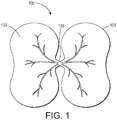
- FIG. 1 is a schematic drawing showing parts of emerging seedling 100. Seedling 100 has two cotyledons 103 that are attached to each other and to the emerging stem by meristem 105.
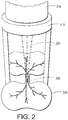
- FIG. 2 is a schematic drawing of a laser focused on the meristem of an emerging seedling.
- FIG. 2 shows laser 210 mounted on stand 215 having laser beam 220 focused on meristem region 205 of unwanted plant 203.
- the most effective position to target for laser destruction of a weed or unwanted plant is the small meristem region.
- the meristem region contains stem cells that can promote further growth of the weed or unwanted plant.
- Typical unwanted plants or weeds have a target meristem region on the order of 1 mm or less available for laser destruction in order to stop growth.
- CO 2 laser emissions have high optical absorption in the carbon hydrovibrational bands of plant matter. In the early stage of growth a CO 2 laser (wavelength of 10.6 ⁇ m) can kill an emerging seedling with an effective dose of 0.1 J/mm.
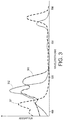
- FIG. 3 is a graph of absorptions vs. wavelength (nm) of plant pigments, chlorophyll A 301, chlorophyll B 302, and carotenoids 303 that are typically present in plants.
- the optimum wavelengths for energy absorption in the visible wavelength range for plant pigments can be in the 430 nm - 475 nm range or in the 650 nm - 675 nm range.
- High power red and blue diode bars and single mode semiconductor sources have been commercialized that can have powers over 1 Watt in each of these wavelength ranges.
- semiconductor laser diodes or diode bars that can reach powers of greater than about 300 mW or up to about 5 Watts (or greater) in the blue range (430 nm - 475 nm) and up to about 20 Watts (or greater) in the red range (650 nm - 675 nm) are suitable for applications disclosed herein.
- Devices and methods disclosed herein use a three-dimensional imager to locate and identify unwanted plans, a laser device useful to damage and kill unwanted plants, and a guidance system to direct a beam from the laser device towards the unwanted plant.
- the three-dimensional imager, laser device, and guidance system can be supported by a chassis that can be configured to be moved across an area such as an agricultural field or a lawn.
- Unwanted plant removal systems that include advanced imaging systems are disclosed in co-filed and co-owned U. S. Pat. Appl. No. 14/027,116 , filed the same day herewith.
- Unwanted plant removal systems that include stabilization systems are disclosed in co-filed and co-owned U. S. Pat. Appl. No., 14/027,120 , identified by Attorney Docket No. 20130143US03, filed the same day herewith.
- An apparatus in accordance with some embodiment includes a three-dimensional imager configured to capture plant images and locate plants, an image processor configured to distinguish between a wanted plant and an unwanted plant based on the captured plant images, a laser device configured to emit a laser beam having power sufficient to damage the unwanted plant, and a guidance system configured to direct the laser beam towards the unwanted plant.
- the laser device has at least one of a variable depth of field, a variable width of field, a variable focal length, or a combination thereof.
- Embodiments of the apparatus also include a chassis configured to support the three-dimensional imager and the laser subsystem. The chassis is also configured to be moved across an area.
- an apparatus utilizes a three-dimensional imager that can be configured to work at focal lengths between about 10 cm and 1 m and that allow the apparatus to capture plant images and locate plants that have characteristics of unwanted plants.
- the imager e.g., three-dimensional imager
- the imager can take advantage of color information for plant identification.
- a three-dimensional imager and guidance system can capture the three-dimensional position of the meristem of unwanted plants and use this data to direct the laser beam so as to better target laser absorption by the meristem of the unwanted plant.
- the three-dimensional imager can include stabilization lenses for low light stabilization.
- a three-dimensional imager can provide positioning (location) of objects such as unwanted plants and the location of targets on unwanted plants by the use of geometric systems (triangulation) or electronic systems (utilizing time-of-flight (TOF) measurements).
- a triangulation-based imager can include a three-dimensional stereo camera system that includes two camera separated by a known distance or baseline.
- the triangulation-based imager can include a single or multiple beam laser scanner and a single camera separated by a known distance or baseline.
- the triangulation-based imager can include a single or multiple beam laser scanner and a stereo camera wherein the stereo camera includes two cameras separated by a known distance or baseline.
- the triangulation-based imager can include a structured light illuminator and a camera separated by a known distance or baseline.
- Some embodiments involve a digital light projector (DLP) configured to project light that may be used in conjunction with three-dimensional imaging.
- DLP digital light projector
- the depth (z-direction) accuracy of the three-dimensional imager increases as the baseline distance increases.
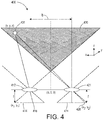
- FIG. 4 is a schematic drawing of a stereoscopic three-dimensional imaging system useful in an embodiment of the disclosed apparatus that includes two cameras separated by a known distance or baseline.
- a planar section of stereoscopic three-dimensional imaging system 400 is shown in FIG. 4 along the x, z plane with two stereo cameras spaced apart along the x direction at a distance of b.
- the first camera is illustrated by camera aperture 412 having a lens with a focal length "f' distant from two-dimensional sensor array 414 which is in the x, y plane.
- Two-dimensional sensor array 414 can be, for example, a charge-coupled device array (CCD) which lies in the x, y plane.
- CCD charge-coupled device array
- the second camera is illustrated by camera aperture 422 having a lens with a focal length "f' away from two-dimensional sensor array 424 which is in the x, y plane.
- Point or volumetric picture element (voxel) 401 with coordinates (x, y, z) is located in space within conical three-dimensional field of view 430, an x, z planar slice of which is shown in FIG. 4 .
- Point or voxel 401 is mapped to locations 416 on two-dimensional sensor array 414 and 426 on two-dimensional sensor array 424.
- FIG. 5 is a schematic drawing of a three-dimensional imaging system useful in an embodiment of the apparatus that includes a multiple beam laser scanner and one camera.
- Three-dimensional imaging system 500 includes laser scanner 520 and one camera illustrated by camera aperture 512 having a lens with a focal length "f' distant from two-dimensional sensor array 514 which is in the x, y plane.
- Laser scanner 520 can illuminate a three-dimensional location of two voxels 501 and 502.
- laser scanner 530 maps each voxel 501 and 502 to two different locations on two-dimensional sensor array 514 depending on the angle of incidence between the laser scanner and the voxel. From this information the position and dimensions of the voxel can be determined.
- FIG. 6 is a schematic drawing of a stereoscopic three-dimensional imaging system useful in an embodiment of the apparatus that includes a laser scanner and a stereo camera.
- Three-dimensional imaging system 600 includes laser scanner 620 that can scan a range of solid angles as shown in the illustration. Points or voxels 601 and 602 are, thus, optically mapped by two cameras, the first one depicted by aperture 612 and two-dimensional sensor array 614 and the second one depicted by aperture 621 and two-dimensional sensor array 624.
- the relative positions of the image of voxel 601 on two-dimensional sensor arrays 614 and 624 illuminated by laser scanner 620 can be used to determine three-dimensional coordinates of that voxel.
- the relative positions of the image voxel 602 on two-dimensional sensor arrays 614 and 624 illuminated by laser scanner 620 can be used to determine three-dimensional coordinates of that voxel. If voxel 601 and 602 are different points on the same object such as, for example, the base and height of an unwanted plant, the location and height of that plant can be determined. In this way multiple points on a three-dimensional object can be mapped to give a mathematical location of that object in three-dimensional space.
- Cameras in each of the illustrated embodiments can be placed in an array that can then be used to image an entire row of, for example, crops in an agricultural field using one pass of the imaging system.
- Laser scanning can also be accomplished with a light source having one or more scanning beams in combination with collection optics and one or more detectors.
- TOF three-dimensional imaging is based upon the indirect estimation of arrival time by measuring the phase shift between a transmitted and received signal.
- TOF three-dimensional imaging systems include a light source that can emit modulated or coded illumination and a detector or detector array (two-dimensional sensor array) that can measure the phase difference or the time difference between the emitted light and the light captured by the detector or detector array after being backscattered from an object in an image field.
- Typical TOF sensors employ incoherent, near-infrared, amplitude-modulated, continuous-wave light.
- the signal phase shift or time difference can be used to generate a three-dimensional map or a three-dimensional point cloud of objects in the field of view.
- lasers can be used to generate this information, using coherent, near-infrared, amplitude-modulated, pulsed light.
- the light used for TOF imaging can be discriminated from ambient or background light. For this reason, TOF imaging systems can be insensitive to variations in lighting conditions such as, for example, shading, obscurations, surface textures and colors, and unwanted specular reflections.
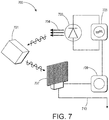
- FIG. 7 is a schematic drawing of a TOF three-dimensional imager useful in an embodiment of the apparatus.
- TOF three-dimensional imager 700 includes a photonic mixer device (PMD) based range imaging camera.
- PMD camera includes modulator 705 that modulates IR light source 703 so as to produce a modulated IR beam that can be transmitted to each voxel of three-dimensional object 701 as shown.
- Each voxel of three-dimensional object 701 can create a phase shift as the modulated IR beam is reflected off of its surfaces.
- the phase shifted IR beam is then captured by CCD array 707.
- phase shift is measured by comparison to phase shifted signal 709 for each voxel and can produce data 710 that can then be used to produce a three-dimensional map of object 701.
- TOF cameras have dramatically come down in cost as hands free gesture recognization systems are starting to become a popular for computer gaming.
- One such example is the Camboard pico 3D, with a TOF camera made by PMD technologies located Germany.
- Such a camera can subtract out background light and has improved near-field depth sensing accuracy with the ability to sense objects at distances as close as 15 cm.
- Another time-of-flight three-dimensional measurement system is based upon light detection and ranging (LIDAR) which is an optical remote sensing technology that can measure the distance to, or other properties of target objects by illuminating the object with laser light and then analyzing the backscattered light.
- LIDAR light detection and ranging
- Three-dimensional information about the shape and position of a three-dimensional object can be obtained from direct measurements of pulses from a scanning laser or the measurement of phase differences from a scanning laser.
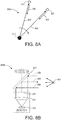
- FIGS. 8A and 8B are schematic drawings illustrating an embodiment of LIDAR.
- FIG. 8A is a schematic drawing of LIDAR scanner 800A.
- LIDAR scanner 800A produces modulated scanning spots or scanning lines 805 from laser scanner 810 as it sweeps through space in a direction shown by the arrow in FIG. 8A . Some of the scanning spots or scanning lines 805 are reflected back as reflected return pulses 806 when they hit a pixel (pixel 801 or 801, for example) as shown by the reflection arrows.
- FIG. 8B is an illustration of an embodiment of a detection system that can measure reflected return pulses that can be used to determine object shape and position by TOF.
- Detection system 800B includes a laser scanner (laser source 812 and scanning mirror 815) that emits scanning lines 805 over a scanned area. If light from a scanning line 805 hits a pixel (such as pixel 801 or 802), a reflected return pulse 806 can be reflected back to scanning mirror 815, through optional focusing element 820 onto detector 830.
- Signal processing can determine shape and position of pixel 801 or pixel 802 (which can be part, for example, of an object or a point in time of a moving object).
- FIGS. 9A and 9B are schematic drawings of a TOF three-dimensional imager based upon LIDAR useful in an embodiment of the apparatus.
- FIG. 9A depicts the operation of TOF imager 900 in the transmit mode.
- FIG. 9B depicts the operation of TOF imager 900 when it received the backscattered light from a transmission.
- LIDAR components shown in box 920
- the backscattered light then goes through lensing component 905 that directs the light to an array of receivers 903 and then the data from the array is fed into digital image processor 901.
- a three-dimensional map or point cloud of objects can be generated from the data 902.
- An additional approach to locating the three-dimensional position of unwanted plants as well as the meristem of emerging seedlings can be the use of a light-field or plenoptic camera.
- Plenoptic cameras contain light path information by putting low cost microlens arrays near the focus of a typical low cost CCD digital camera. Such cameras limit lateral resolution but have enhanced depth of field.
- Plenoptic cameras can generate a three-dimensional image by using computer processing in, for example, an image processor, to find the optimum focus for each position within a field of view. The resolution of plenoptic cameras is sufficient to image and precisely locate the meristem of an emerging unwanted seedling provided that the line of sight is not obstructed.
- the z-depth of focus can be improved and the height of the unwanted seedling and the location of its meristem can be estimated from computational imaging calculations in the image processor which can extract depths (in the z-direction) from information encoded in the plenoptic camera's microlens array.
- Embodiments of the three-dimensional imager can collect full frame images during a short acquisition time or can utilize raster scanning.
- Full frame image collection requires the use of an imaging lens and a two-dimensional sensor array as discussed above.
- Raster scanning can be accomplished with a light source with one or more scanning beams in combination with collection optics and one or more detectors. Raster scanning requires more time than full frame image collection to cover the entire field of view.
- the apparatus includes an image processor configured to distinguish between a wanted plant and an unwanted plant based upon captured plant images from the three-dimensional imager.
- the image processor can take data (for example, plant images and plant locations) gathered by the three-dimensional imager and use that data to distinguish between an unwanted plant and a wanted plant.
- the image processor can also assist in the location of a target on the unwanted plant.
- the image processor can use digital comparison of collected digitalized plant image information with stored image information.
- Imaging algorithms are able to exploit RGB camera signals to discriminate foliage from ground soil and image processing algorithms are used to extract plant features, such as leaf shape and texture.
- multispectral imaging or hyperspectral imaging also allows different types of plants to be distinguished from their RGB and near-infrared (NIR) camera channel signals by comparing ratios of these various spectral channels. Both hyperspectral imaging and multispectral imaging collect and process information from across the electromagnetic spectrum. Based upon the size and species of weeds and crop, various combinations of image feature algorithms and multispectral or hyperspectral algorithms for imagers, e.g., three-dimensional imaging, may be employed.
- Weed species typically have different growth characteristics from that of the mainline crop. These differences including differences in growth rates and seasonal variations when the seedlings develop through the top soil layer.
- three-dimensional imaging using stereoscopic and structured light approaches to measure plant height characteristics above the soil ground level can be used to identify weeds from crops independent of leaf shape and other plant morphology characteristics.
- weeds can be identified using a combination of imaging morphology as well as multispectral resolution.
- Multispectral imaging provides additional information as different plants seem to have different ratios of visible and near infrared absorption. Also, plant heights as measured by a three-dimensional camera give good distinction as weeds tend to grow at a different rate. The location of the weeds can also be used for their identification.
- the apparatus include a removal device for removing or damaging an unwanted plant.
- the removal device can include an herbicide applicator, a torch head for flame weeding, or a laser device.
- the removal device can include a laser device configured to emit a laser beam having power sufficient to damage the unwanted plant. The amount of power sufficient to fatally damage an unwanted plant is dependent upon the wavelength of impinging radiation, the dose of that radiation delivered to the unwanted plant, the stage of development of the unwanted plant, and the part of the unwanted plant (target or area near the target) that is exposed to the impinging radiation.
- the at least one laser device can include a laser diode capable of emitting light that can be absorbed by plant pigments, such as chlorophyll A, chlorophyll B, and/or carotenoids.
- plant pigments such as chlorophyll A, chlorophyll B, and/or carotenoids.
- blue-emitting or red-emitting semiconductor laser diodes can be used since they can be configured to emit a laser beam having a wavelength of from about 430 nm to about 475 nm or from about 650 nm to about 675 nm.
- the removal device can have an adjustable wavelength based upon information from the image processor.
- Laser devices can include individual laser diodes in an array such as in a laser diode bar.
- Laser diode bars can be combined with FAST axis lenses and commercially available beam combiners to produce sources that have, in some instances, produced emissions as high as 20 Watts using 19 individual multimode laser emitters.
- FAST axis direction single mode beam quality can be achieved.
- lateral SLOW axis direction diffraction quality may not be achieved.
- a lenslet (multilens) array can be used to collimate each beam individually. Spot sizes of 1-2 mm x 100 ⁇ m can result from such combined beams from laser diode arrays.
- This type of beam shape can be good for articulating a cut near the meristem of an unwanted plant as long as several different laser positions and angles can be selected.
- the best angles for laser impingement on a particular unwanted plant can be chosen from many different laser diodes available on the laser diode bar.
- the Rayleigh range for collimated light can be several meters along the FAST axis, which has high beam quality.
- MEMS microelectricalmechanical systems
- Embodiments of the apparatus include a guidance system configured to direct a laser beam towards the target of the unwanted plant.
- the guidance system can take information from the image processor and use beam direction changing devices such as, for example, galvo mirrors, to redirect and, in some embodiments, focus the laser beam on the target of the unwanted plant.
- the laser beam can be directed to a particular part of the plant such as, for example, the meristem of the plant.
- the guidance system can include a high power laser actuator array such as one illustrated in FIG. 9 .
- the laser beam controller can include a two-axis MEMS galvo mirror.
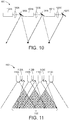
- FIG. 10 is a schematic drawing of an array of laser diodes useful in an embodiment of a laser guidance system for the disclosed apparatus.
- Array 1000 is a laser device that includes an array of laser diodes 1001 A - 1001C that can be part of a laser diode bar. Although array 1000 as illustrated includes three laser diodes this is for illustrative purposes only and typical laser diode bars or arrays can have many more laser diodes than illustrated.
- Array 1000 includes a collection of collimation optics 1003A - 1003C.
- a series of MEMS electrostatic mirrors 1005A - 1005C take information from the image processor and direct one or more beams to a target unwanted plant.
- the guidance system includes one or more adaptive optical elements such as a MEMS adaptive optical mirror that can be used to enhance the range of depth of focus of the laser beams.
- the mirrors can have reflective coatings compatible with the lasers used, e.g., blue or red semiconductor lasers.
- the laser may be activated after is it directed to a specific target location, at a specified angle of impingement and/or at a specified depth of focus.
- a laser diode array can be combined with an array of three-dimensional imagers (cameras) to allow for accurate pointing and optimal angular position of laser beams.
- the laser array and three-dimensional imagers can be adapted to provide width scalable, single pass weeding.
- FIG. 11 One embodiment of a laser array and imager is illustrated in FIG. 11 .
- Array 1100 includes array of three-dimensional cameras 1110A - 1110D and array of laser diodes 1120A - 1120C. Cameras 1110A - 1110D cover an overlapping stereoscopic field of view as illustrated. They can be used to direct an array of laser diodes (such as that depicted in FIG. 10 ) across field of view 1130 to locate and direct laser beams to targets on unwanted plants in an array of wanted and unwanted plants.
- the apparatus include a guidance system configured to direct at least one laser beam towards a target on the unwanted plant. Additionally, the guidance system can be configured to adapt the optics of the at least one laser device to provide for accurate and efficient use of the components of the embodied apparatus to remove unwanted plants. In some embodiments, the guidance system can provide feedback to the three-dimensional imaging system so as to change at least one of the depth of field, the width of field, or the focal length.
- Each of the lasers 1120A - 1120C can be directed and/or controlled independently of each other with regard to position, angle, spot size, and/or focal length, etc.
- the power, wavelength, and/or beam type (continuous wave (CW) or pulsed) of each laser can be independently controlled based on the targeted plant type.
- the spot size of the laser beam can be less than about 100 ⁇ m and the collimation diameter of the beam less than about 1 mm.
- laser scanning e.g., +/- 30 degrees in both x and y directions
- MEMS-based mirror scanners and/or adaptive optical elements Some implementations include variable reprogramming of the focus position on the fly so as to target weeds of different heights on the fly.
- the laser subsystem and/or components thereof may be designed so that they do not mechanically resonate at frequencies less than about 500 Hz.
- the lowest order resonance mechanical frequency of the laser subsystem and/or components thereof may be greater than 500 Hz or even greater than 1 kHz.
- the apparatus also include a chassis configured to support the three-dimensional imager, the laser device, and the guidance system.
- the chassis can be configured to move across an area that includes wanted and unwanted plants, such as an agricultural plot or a lawn.
- the chassis can be any frame on which the three-dimensional imager, the at least one laser device, and the guidance system are mounted.
- the three-dimensional imager, the at least one laser device, and the guidance system that are supported by the chassis can sense and, utilizing the guidance system, adjust adaptable optics of the at least one laser device in all three-dimensions including vertical.
- the chassis can be part of a motorized tractor or motorized vehicle.
- the chassis can be separate from the motorized tractor or vehicle and can be, for example, the frame of a trailer that can be attached to a motorized vehicle.
- the chassis can be part of an aircraft that is designed to fly over the area that includes wanted and unwanted plants.
- the image processor can also be mounted on the chassis. In other embodiments, the image processor can be located remotely and can communicate with the guidance system via wire or remotely via, for example, a Wi-Fi connection.
- Some embodiments of the apparatus can scan wide swaths of an area such as an agricultural field or lawn and can use the guidance system to distinguish between a wanted plant and an unwanted plant, locate an unwanted plant, locate targets on the unwanted plant, select a laser beam emitted from at least one laser device, adjust the optical properties of the laser beam, direct the laser beam with adjusted properties to the target of the unwanted plant, and damage the target of the unwanted plant with the laser beam.
- the laser device includes a plurality of laser diodes
- the guidance system can select one or more laser diodes of the plurality of laser diodes so as to enhance the ability of the laser beam to hit the target on the unwanted plant with sufficient precision and energy to impart fatal damage to the plant.
- the guidance system can have a high bandwidth that allows it to correct for environmental vibrations to which the apparatus may be subjected.
- the guidance system can have the capacity to scale over a wide area without compromising laser spot intensity.
- the laser device may include many directly modulated semiconductor lasers that can be independently directed and focused on targets of unwanted plants at various different angles.
- the guidance system can control which lasers in a laser device with a plurality of lasers can be selected, focused, and energized to damage targets of a plurality of unwanted plants as the apparatus is moved across an area.
- the guidance system can adjust, based upon the position of the apparatus in the area, vibrations caused by steering the apparatus as it is moved across the area, unevenness of the area in the depth, or z-direction, and the three-dimensional location of the target of each unwanted plant as determined by the image processor.
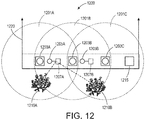
- FIG. 12 is a schematic drawing of an embodiment of an apparatus that includes a guidance system that can adjust an array of semiconductor laser diodes.
- Apparatus 1200 includes a laser diode bar that, in the illustrated apparatus, includes three three-dimensional imagers 1203A, 1203B, and 1203C.
- Three-dimensional imager 1203A has field of view 1201A as shown (defined by depth of field, width of field, and focal length).
- three-dimensional imagers 1203B and 1203C have respective fields of view 1201B, and 1201C. Fields of view 1201A, 1201B, and 1201C overlap as shown in FIG. 12 .
- Three-dimensional imagers 1203 A-C are configured to distinguish between a wanted plant and an unwanted plant.
- Apparatus 1200 is moved across a field that contains wanted and unwanted plants in the direction shown by arrow 1220.
- Apparatus 1200 also includes three-axis gyro accelerometer sensor 1215 that can sense mechanical vibrations such as those produced by an uneven field in the z-direction.
- the three-axis accelerometer sensor can be configured to sense low frequency mechanical vibrations having a frequency of less than about 500 Hz.
- Apparatus 1200 has a guidance system that can take information from fields of view 1201A-C (via the image processor), and accelerometer sensor 1215.
- adaptive optics 1205A and 1205B that control the direction, depth of field, width of field, and focal length of laser beams emitted from laser diodes 1207A and 1207B respectively to that laser beams are directed at unwanted plants 1210A and 1210B as apparatus 1201 is moved across an area.
- two laser beams from laser diode 1207A are directed at both unwanted plant 1210A and 1210B although various combinations of lasers and adapted optics can be used to cover the whole area across which apparatus 1200 is traversed.
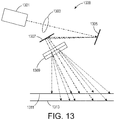
- FIG. 13 is an illustration of an embodiment of the apparatus that includes non-mechanical phased array beam steering of a diode bar array.
- Non-mechanical phased array steering module 1300 includes one or more arrays of single mode semiconductor lasers 1301 that are first collimated into one-dimensional optical phase modulators 1305 by collimating optics 1303.
- Each phase modulator 1305 has the power to change the direction and the focus point of the output light along one axis by reprogramming the phase of each individual phase modulation element.
- the one-dimensional phase modulator has a large square aperture so that high power pulsed laser light has low enough intensity to not cause thermal heating issues inside the modulator.
- the phase modulator can be used to dynamically adjust the focus of the light by creating phase curvature.
- phase modulator can correct for field curvature along one axis thereby enabling a wider scan angle to refocus onto a flat plane using adaptive optics 1307.
- Phase grating 1309 can operate at about 600 Hz and can redirect the laser in an instantaneous point and shoot fashion-it does not require continuous scanning through angles.
- the beam can be redirected along x-axis 1311 as it is moved along a y-axis by a tractor, and can be refocused to different z-positions 1313.
- the response time is limited by the liquid crystal elements themselves and some adjustment can improve the speed to about 500 Hz refresh rates.
- discrete large aperture transparent polarization grating switches can be used to instantaneously switch the laser through discrete large angles if the laser light is polarized. This allows the laser to be steered over a wide field and with high precision along one or two dimensions. When combined with a phase grating modulator, a large field of regard can be achieved with precision control over the scan angle.
- Non-mechanical steering module 1300 can be moved in a y-direction when mounted on a chassis that is part of a tractor.
- a tractor is any vehicle that can move steering module 1300 in a y-axis direction. Tractor systems typically run at speeds of 1.5 m/sec to 2.5 m/sec. Assuming a 2 msec reprograming time between laser shooting events, a tractor will move a linear distance of only 3 mm to 5 mm. During this time the laser can severely damage an unwanted plant with multiple laser firings. As long as the unwanted plant density is less than about 1 plant/cm 2 the laser steering system has enough time to be reconfigured to fire at the target of the next unwanted plant. With such a non-mechanical phased array beam steering module along the length of a tractor cultivator, a wide row of crops can be "weeded" in a single pass.
- the one-dimensional modulator can only compensate for focal variation along one dimension.
- a cylindrical adaptive optics MEMS mirror element shown as 1307 in FIG. 13
- Such a MEMS adaptive mirror can be made using a silicon- nitride gold sputtered membrane that is electrostatically actuated to produce a small change in curvature.
- Such MEMS structures due to their small size, can be very vibration insensitive having resonant frequencies well above 1 kHz.
- a lawn weeding system described herein includes an embodiment of an apparatus as described above.
- the lawn weeding system may also include a lawn mower.
- the lawn mower can be a hand or tractor-propelled lawn mower or a self-propelled motorized lawn mower (gasoline, diesel, electric, solar, or electric). If the lawn mower is hand-propelled it may include a power source to power the three-dimensional imager, the image processor, the at least one laser device, and the guidance system. If the lawn mower is tractor-propelled, it can, in some embodiments, generate power to energize at least one of the three-dimensional imager, the image processor, the at least one laser device, and the guidance system.
- the lawn mower can include cutting means.
- the cutting means can include, for example, a rotating reel of lateral blades, a rotating single blade, or a laser cutter (electro-optical).
- the cutting means include electro-optical cutting means, such as a laser cutting apparatus that can utilize a plurality of rotating laser beams for cutting vegetation such as, for example, grass growing in a lawn.
- the at least one laser device configured to emit a laser beam having power sufficient to damage the unwanted plant can also be used to cut vegetation, such as grass, in a lawn.
- the laser device can distinguish between an unwanted plant (weed) and a wanted plant (grass lawn) and can both damage the unwanted plant and cut the wanted plant (mow the lawn).
- the electro-optical cutting means and the laser beam can have sufficient power to both be able to damage an unwanted plant and also to cut vegetation.
- FIG. 14 is a schematic drawing of an embodiment of an apparatus that includes a laser weeding module.
- Apparatus 1400 includes tractor 1401 to which is attached trailer 1403.
- Trailer 1403 includes a three-dimensional imager, an array of laser devices and a laser beam controller.
- Apparatus 1400 also can include an image processor configured to distinguish between a wanted plant and an unwanted plant.
- Apparatus 1400 can be moved across an agricultural field or a lawn and can identify and locate unwanted plants.
- the array of laser devices on trailer 1403 can produce a plurality of laser beams 1405 that can be directed to one or more unwanted plants.
- some embodiments of a method for removing unwanted plants include capturing plant images using a three-dimensional imager. Such processes and apparatuses are discussed above. Embodiments of the method also include distinguishing between a wanted plant and an unwanted plant after capturing plant images. Embodiments of the method also include directing a laser beam from at least one laser device towards the unwanted plant, and damaging the unwanted plant with the laser beam. Some embodiments of the method can also include a guidance system configured to direct at least one laser beam towards the unwanted plant. In other embodiments, the chassis can be moved across an agricultural field or lawn.
- Process 1500 includes capturing plant images using a three-dimensional imager as shown in step 1501. The captured plant images are used to distinguish a wanted plant from an unwanted plant as shown in step 1510. If the plant is a wanted plant 1505, the three-dimensional imager is configured to search for more plants as shown in step 1503. If the plant is an unwanted plant, a target can be located on the unwanted plant as shown in step 1520. If desired or necessary, optical properties of the three-dimensional imager can be adjusted to help distinguish between a wanted plant and an unwanted plant as shown in step 1504. If the plant is a desired or wanted plant, no further action from the apparatus is forthcoming.
- step 1520 If the plant is an unwanted plant that needs to be damaged, destroyed, or removed, it is located as shown in step 1520.
- a guidance system is used to select and to focus at least one laser beam on the unwanted plant as shown in step 1530. Optics associated with the at least one laser beam can be adjusted (step 1540) and the adjusted laser beam can be directed to target of the unwanted plant as shown in step 1550. Finally, the unwanted plant can be damaged as shown in step 1560 and, hopefully dies and disintegrates.
Landscapes
- Life Sciences & Earth Sciences (AREA)
- Engineering & Computer Science (AREA)
- Environmental Sciences (AREA)
- Physics & Mathematics (AREA)
- Zoology (AREA)
- Wood Science & Technology (AREA)
- Pest Control & Pesticides (AREA)
- Insects & Arthropods (AREA)
- General Physics & Mathematics (AREA)
- Pathology (AREA)
- Chemical & Material Sciences (AREA)
- Immunology (AREA)
- General Health & Medical Sciences (AREA)
- Biochemistry (AREA)
- Analytical Chemistry (AREA)
- Health & Medical Sciences (AREA)
- Theoretical Computer Science (AREA)
- Data Mining & Analysis (AREA)
- Spectroscopy & Molecular Physics (AREA)
- Bioinformatics & Computational Biology (AREA)
- Evolutionary Computation (AREA)
- Bioinformatics & Cheminformatics (AREA)
- General Engineering & Computer Science (AREA)
- Computer Vision & Pattern Recognition (AREA)
- Evolutionary Biology (AREA)
- Artificial Intelligence (AREA)
- Length Measuring Devices By Optical Means (AREA)
- Electromagnetism (AREA)
- Radar, Positioning & Navigation (AREA)
- Remote Sensing (AREA)
- Computer Networks & Wireless Communication (AREA)
- Catching Or Destruction (AREA)
- Image Processing (AREA)
Applications Claiming Priority (1)
| Application Number | Priority Date | Filing Date | Title |
|---|---|---|---|
| US14/027,117 US9609858B2 (en) | 2013-09-13 | 2013-09-13 | Unwanted plant removal system having variable optics |
Publications (2)
| Publication Number | Publication Date |
|---|---|
| EP2848119A1 EP2848119A1 (en) | 2015-03-18 |
| EP2848119B1 true EP2848119B1 (en) | 2016-12-07 |
Family
ID=51494136
Family Applications (1)
| Application Number | Title | Priority Date | Filing Date |
|---|---|---|---|
| EP14183824.3A Not-in-force EP2848119B1 (en) | 2013-09-13 | 2014-09-05 | Unwanted plant removal system having variable optics laser |
Country Status (3)
| Country | Link |
|---|---|
| US (2) | US9609858B2 (enExample) |
| EP (1) | EP2848119B1 (enExample) |
| JP (1) | JP6230976B2 (enExample) |
Cited By (5)
| Publication number | Priority date | Publication date | Assignee | Title |
|---|---|---|---|---|
| US12219948B1 (en) | 2019-09-17 | 2025-02-11 | Carbon Autonomous Robotic Systems Inc. | Autonomous laser weed eradication |
| US12240372B2 (en) | 2021-11-02 | 2025-03-04 | Carbon Autonomous Robotic Systems Inc. | High intensity illumination systems and methods of use thereof |
| US12270903B2 (en) | 2021-03-17 | 2025-04-08 | Carbon Autonomous Robotic Systems Inc. | Systems and methods for point to point object matching and targeting |
| US12517518B2 (en) | 2022-04-29 | 2026-01-06 | Carbon Autonomous Robotic Systems Inc. | Systems and methods for autonomous field navigation |
| US12597161B2 (en) | 2022-01-19 | 2026-04-07 | Carbon Autonomous Robotic Systems Inc. | Systems and methods for object tracking and location prediction |
Families Citing this family (42)
| Publication number | Priority date | Publication date | Assignee | Title |
|---|---|---|---|---|
| US20150027041A1 (en) * | 2013-03-07 | 2015-01-29 | Blue River Technology, Inc. | System and method for plant cauterization |
| US9609858B2 (en) | 2013-09-13 | 2017-04-04 | Palo Alto Research Center Incorporated | Unwanted plant removal system having variable optics |
| US10772316B2 (en) * | 2014-01-21 | 2020-09-15 | Jason J Henderson | Apparatus, system and method for mechanical, selective weed control in mature and establishing crops including turfgrasses |
| US9648863B2 (en) * | 2014-01-21 | 2017-05-16 | Jason Jeffrey HENDERSON | Apparatus, system and method for mechanical, selective weed control in mature and establishing crops including turfgrasses |
| US9576215B2 (en) * | 2014-05-09 | 2017-02-21 | Raven Industries, Inc. | Image filter based on row identification |
| US9510586B2 (en) * | 2014-07-31 | 2016-12-06 | Elwha Llc | Systems and methods for deactivating plant material outside of a growing region |
| US9648864B1 (en) * | 2014-09-12 | 2017-05-16 | Hugh C. Kent | Electrically powered infrared based thermal weed control system |
| US10010067B2 (en) | 2014-09-12 | 2018-07-03 | Stw, Llc | Electrically powered infrared based thermal weed control system |
| DE102014115292A1 (de) * | 2014-10-21 | 2016-04-21 | Connaught Electronics Ltd. | Verfahren zum Bereitstellen von Bilddateien von einem Kamerasystem, Kamerasystem und Kraftfahrzeug |
| US20160267669A1 (en) * | 2015-03-12 | 2016-09-15 | James W. Justice | 3D Active Warning and Recognition Environment (3D AWARE): A low Size, Weight, and Power (SWaP) LIDAR with Integrated Image Exploitation Processing for Diverse Applications |
| DE102015209879A1 (de) * | 2015-05-29 | 2016-12-01 | Robert Bosch Gmbh | Unkrautregulierungsvorrichtung |
| US10067263B2 (en) * | 2015-08-26 | 2018-09-04 | Pgs Geophysical As | Biofouling target removal |
| US11266056B2 (en) * | 2015-10-23 | 2022-03-08 | Deere & Company | System and method for residue detection and implement control |
| FR3046023B1 (fr) * | 2015-12-23 | 2017-12-22 | Pellenc Sa | Tondeuse electrique anticipative et procede de pilotage d'une telle tondeuse. |
| US10451740B2 (en) | 2016-04-26 | 2019-10-22 | Cepton Technologies, Inc. | Scanning lidar systems for three-dimensional sensing |
| US10554881B2 (en) | 2016-12-06 | 2020-02-04 | Microsoft Technology Licensing, Llc | Passive and active stereo vision 3D sensors with variable focal length lenses |
| US10469758B2 (en) | 2016-12-06 | 2019-11-05 | Microsoft Technology Licensing, Llc | Structured light 3D sensors with variable focal length lenses and illuminators |
| DE102017204158A1 (de) * | 2017-03-14 | 2018-09-20 | Robert Bosch Gmbh | Verfahren zum Erkennen mindestens eines Fortpflanzungsorgans einer Pflanze |
| KR102648117B1 (ko) * | 2017-07-06 | 2024-03-18 | 디스커버리 퍼체이서 코퍼레이션 | 잡초 방제 장치 |
| US10561063B2 (en) | 2018-01-10 | 2020-02-18 | Honda Motor Co., Ltd. | Autonomous lawnmower using laser scanner |
| US20210051836A1 (en) * | 2018-01-25 | 2021-02-25 | Eleos Robotics Inc. | Autonomous unmanned ground vehicle for pest control |
| ES3033460T3 (en) | 2018-05-17 | 2025-08-04 | Morgan Perry | A system for damaging and/or destroying a crop of plants, and related methods |
| EP3824282A4 (en) * | 2018-07-17 | 2022-03-23 | Photonic Detection Systems Pty Ltd | DETECTION SYSTEM FOR DETECTING SUBSTANCES AND DISTINGUISHING CERTAIN SUBSTANCES FROM OTHER SUBSTANCES |
| US10921189B2 (en) * | 2018-08-23 | 2021-02-16 | Trimble Inc. | Detecting the presence of plants on the ground |
| US10656133B2 (en) * | 2018-10-19 | 2020-05-19 | Trimble Inc. | Controlling plant detection systems using phase delay analysis |
| US10775299B2 (en) * | 2019-01-08 | 2020-09-15 | Trimble Inc. | Optical tuning for plant detection |
| US11532155B1 (en) * | 2019-07-09 | 2022-12-20 | ACME Atronomatic, LLC | Methods and devices for earth remote sensing using stereoscopic hyperspectral imaging in the visible (VIS) and infrared (IR) bands |
| GB2589121A (en) * | 2019-11-21 | 2021-05-26 | Bae Systems Plc | Imaging apparatus |
| DE102019220349A1 (de) * | 2019-12-20 | 2021-06-24 | Robert Bosch Gesellschaft mit beschränkter Haftung | Landwirtschaftliche Vorrichtung zur Beschädigung einer Pflanze |
| RU2737607C1 (ru) * | 2020-04-13 | 2020-12-01 | Федеральное государственное бюджетное образовательное учреждение высшего образования "Тамбовский государственный технический университет" (ФГБОУ ВО "ТГТУ") | Способ оптического контроля качества сельскохозяйственной продукции шарообразной формы при сортировке на конвейере |
| US12702085B2 (en) * | 2020-07-06 | 2026-08-11 | Luiz Alexandre CORDEIRO | Laser system for agricultural use |
| LV15634B (lv) * | 2020-11-11 | 2023-02-20 | Weedbot, Sia | Tehnoloģija un iekārta lāzera pozicionēšanai |
| WO2022183222A1 (en) | 2021-02-26 | 2022-09-01 | Laudando & Associates | Cultivating methods and apparatuses |
| AU2021107451A4 (en) * | 2021-03-09 | 2021-12-23 | Stealth Technologies Pty Ltd | Weed Detector and Method of Weed Detection |
| TWI770909B (zh) * | 2021-03-29 | 2022-07-11 | 亞東學校財團法人亞東科技大學 | 除雜草裝置及除雜草方法 |
| US12272134B2 (en) | 2021-06-16 | 2025-04-08 | Cnh Industrial America Llc | System and method for identifying weeds within a field during an agricultural spraying operation |
| JP7506103B2 (ja) * | 2022-02-09 | 2024-06-25 | フタバ産業株式会社 | 除草装置及び植物の分裂組織の位置を推定する方法 |
| JP7758591B2 (ja) * | 2022-02-09 | 2025-10-22 | フタバ産業株式会社 | 移動式除草装置 |
| JP2023116307A (ja) * | 2022-02-09 | 2023-08-22 | フタバ産業株式会社 | 除草装置 |
| WO2023164633A1 (en) * | 2022-02-24 | 2023-08-31 | Auburn University | Tree seedling inventory system |
| DE102022122512A1 (de) | 2022-09-06 | 2024-03-07 | Futonics Laser GmbH | Verfahren und Vorrichtung zur energieeffizienten Unkrautbekämpfung mit Laserlicht |
| JP7869162B2 (ja) * | 2023-02-07 | 2026-06-02 | フタバ産業株式会社 | 移動式除草装置 |
Family Cites Families (46)
| Publication number | Priority date | Publication date | Assignee | Title |
|---|---|---|---|---|
| US3652844A (en) | 1970-02-09 | 1972-03-28 | Ralph A Scott Jr | Laser plant control |
| DE4039797A1 (de) | 1990-12-13 | 1991-09-26 | Manfred Prof Dr Hoffmann | Sensorgesteuerte pflegetechnik und unkrautregulation |
| WO1992013443A1 (en) | 1991-02-01 | 1992-08-20 | Plant Production Systems B.V. | A method for use in a multiplication process of plants and a device for carrying out said method |
| US5220307A (en) | 1992-01-23 | 1993-06-15 | Zexel-Gleason Usa, Inc. | Warning system distinguishing wheel skidding and wheel slipping |
| US5296702A (en) * | 1992-07-28 | 1994-03-22 | Patchen California | Structure and method for differentiating one object from another object |
| US5278423A (en) | 1992-12-30 | 1994-01-11 | Schwartz Electro-Optics, Inc. | Object sensor and method for use in controlling an agricultural sprayer |
| DE4339329C2 (de) | 1993-11-19 | 1996-05-30 | Holzapfel Klaus Dipl Ing Fh | Vorrichtung zur gezielten Vernichtung bzw. Eindämmung von Unkraut |
| US5606821A (en) | 1994-07-25 | 1997-03-04 | Loral Corporation | Smart weed recognition/classification system |
| WO1997017830A1 (en) | 1995-11-13 | 1997-05-22 | The Regents Of The University Of California | Method of controlling pests and pathogens in growing media with pulsed electromagnetic energy |
| DE69709482T2 (de) | 1996-04-19 | 2002-11-07 | Carnegie Mellon University, Pittsburgh | Erntegutlinie-Ortungsvorrichtung mit Bildverarbeitung |
| US6178253B1 (en) | 1997-10-10 | 2001-01-23 | Case Corporation | Method of determining and treating the health of a crop |
| WO1999030133A1 (en) * | 1997-12-08 | 1999-06-17 | Weed Control Australia Pty. Ltd. | Discriminating ground vegetation in agriculture |
| LU90186B1 (fr) * | 1997-12-22 | 1999-06-24 | Communaute Europ Ce Batiment E | Dispositif d'analyse non destructive de plantes et véhicule comportant un tel dispositif embarqué |
| DE69905370T2 (de) | 1998-07-17 | 2003-12-18 | Torsana Laser Technologies A/S, Kvistgaard | Verfahren und vorrichtung zum trennen oder beschädigen von unerwünschtem pflanzenwuchs |
| US6795568B1 (en) | 1998-07-17 | 2004-09-21 | Torsana Laser Technologies A/S | Method and an apparatus for severing or damaging unwanted plants |
| US6374584B1 (en) | 2000-05-19 | 2002-04-23 | Daniel R. Blanchard | Reel type laser lawn mower |
| US6269617B1 (en) | 2000-05-19 | 2001-08-07 | Daniel R. Blanchard | Lawn mower with laser cutting apparatus |
| US6556598B1 (en) | 2000-07-21 | 2003-04-29 | Self-Guided Systems, Llc | Laser guidance assembly for a vehicle |
| WO2002017705A1 (de) | 2000-08-31 | 2002-03-07 | Wolf-Garten Gmbh & Co. Kg | Verfahren und vorrichtung zur garten- und landschaftspflege |
| AUPR457401A0 (en) | 2001-04-26 | 2001-05-24 | Weed Control Australia Pty Ltd | Selective weed discrimination |
| DE10221948B4 (de) | 2001-05-14 | 2004-03-11 | Kümmel, Knut, Dipl., -Ing. | Verfahren und System zum volumenspezifischen Beeinflussen von Boden und Pflanzen |
| US8792531B2 (en) * | 2003-02-25 | 2014-07-29 | Finisar Corporation | Optical beam steering for tunable laser applications |
| US7916898B2 (en) * | 2003-09-15 | 2011-03-29 | Deere & Company | Method and system for identifying an edge of a crop |
| DE102004011462B4 (de) | 2004-03-09 | 2006-11-23 | Michael Schmutzenhofer | Vorrichtung zur Beseitigung von Schnee, Eis und Unkraut |
| DK176273B1 (da) | 2004-05-10 | 2007-05-21 | Frank Poulsen | Selektiv behandling af planter i række |
| KR100594121B1 (ko) | 2004-12-17 | 2006-06-28 | 삼성전자주식회사 | 카메라 렌즈 어셈블리의 손떨림 보정 장치 |
| ITPI20050122A1 (it) | 2005-11-14 | 2007-05-15 | Corrado Nuti | Macchina diserbatrice ecologica multiuso funzionante per mezzo di un laser |
| ES2395062T3 (es) | 2006-08-01 | 2013-02-07 | Photonic Detection Systems Pty Ltd | Sistema y método de detección óptica para discriminación de plantas |
| JP4800163B2 (ja) | 2006-09-29 | 2011-10-26 | 株式会社トプコン | 位置測定装置及びその方法 |
| US7919723B2 (en) | 2007-04-03 | 2011-04-05 | Renewable Thermodynamics, Llc | Apparatus and method for cutting lawns using lasers |
| DE102007036222A1 (de) | 2007-08-02 | 2009-02-05 | Mulag Fahrzeugwerk Heinz Wössner GmbH u. Co KG | Mähen mit Laser |
| TW201007208A (en) | 2008-08-05 | 2010-02-16 | E Pin Optical Industry Co Ltd | Two optical elements fθ lens of MEMS laser scanning unit 3 |
| US8705017B2 (en) | 2009-01-15 | 2014-04-22 | Tokitae Llc | Photonic fence |
| US8150554B2 (en) | 2009-04-21 | 2012-04-03 | Deere & Company | Resource use management in yards and gardens |
| DE102009023896B4 (de) | 2009-06-04 | 2015-06-18 | Fraunhofer-Gesellschaft zur Förderung der angewandten Forschung e.V. | Vorrichtung und Verfahren zum Erfassen einer Pflanze |
| US20110211733A1 (en) | 2009-08-27 | 2011-09-01 | Schwarz Michael W | Crop thinning systems |
| US8666550B2 (en) | 2010-01-05 | 2014-03-04 | Deere & Company | Autonomous cutting element for sculpting grass |
| FI20115654A7 (fi) | 2011-06-23 | 2012-12-24 | Holum Miracus Oy | Valaistus valoherkkien biologisten prosessien aktivoimiseksi |
| US8638989B2 (en) | 2012-01-17 | 2014-01-28 | Leap Motion, Inc. | Systems and methods for capturing motion in three-dimensional space |
| US20130182079A1 (en) | 2012-01-17 | 2013-07-18 | Ocuspec | Motion capture using cross-sections of an object |
| US9070019B2 (en) | 2012-01-17 | 2015-06-30 | Leap Motion, Inc. | Systems and methods for capturing motion in three-dimensional space |
| US8693731B2 (en) | 2012-01-17 | 2014-04-08 | Leap Motion, Inc. | Enhanced contrast for object detection and characterization by optical imaging |
| EP2620050B1 (en) * | 2012-01-25 | 2016-07-27 | Honda Research Institute Europe GmbH | System, method and apparatus for unsupervised adaptation of the perception of an autonomous mower |
| US9565848B2 (en) | 2013-09-13 | 2017-02-14 | Palo Alto Research Center Incorporated | Unwanted plant removal system |
| US9609858B2 (en) | 2013-09-13 | 2017-04-04 | Palo Alto Research Center Incorporated | Unwanted plant removal system having variable optics |
| US9609859B2 (en) | 2013-09-13 | 2017-04-04 | Palo Alto Research Center Incorporated | Unwanted plant removal system having a stabilization system |
-
2013
- 2013-09-13 US US14/027,117 patent/US9609858B2/en not_active Expired - Fee Related
-
2014
- 2014-09-02 JP JP2014178174A patent/JP6230976B2/ja not_active Expired - Fee Related
- 2014-09-05 EP EP14183824.3A patent/EP2848119B1/en not_active Not-in-force
-
2017
- 2017-03-24 US US15/468,855 patent/US10051854B2/en active Active
Non-Patent Citations (1)
| Title |
|---|
| None * |
Cited By (7)
| Publication number | Priority date | Publication date | Assignee | Title |
|---|---|---|---|---|
| US12219948B1 (en) | 2019-09-17 | 2025-02-11 | Carbon Autonomous Robotic Systems Inc. | Autonomous laser weed eradication |
| US12433286B2 (en) | 2019-09-17 | 2025-10-07 | Carbon Autonomous Robotic Systems Inc. | Autonomous laser weed eradication |
| US12270903B2 (en) | 2021-03-17 | 2025-04-08 | Carbon Autonomous Robotic Systems Inc. | Systems and methods for point to point object matching and targeting |
| US12240372B2 (en) | 2021-11-02 | 2025-03-04 | Carbon Autonomous Robotic Systems Inc. | High intensity illumination systems and methods of use thereof |
| US12365284B2 (en) | 2021-11-02 | 2025-07-22 | Carbon Autonomous Robotic Systems Inc. | High intensity illumination systems and methods of use thereof |
| US12597161B2 (en) | 2022-01-19 | 2026-04-07 | Carbon Autonomous Robotic Systems Inc. | Systems and methods for object tracking and location prediction |
| US12517518B2 (en) | 2022-04-29 | 2026-01-06 | Carbon Autonomous Robotic Systems Inc. | Systems and methods for autonomous field navigation |
Also Published As
| Publication number | Publication date |
|---|---|
| US9609858B2 (en) | 2017-04-04 |
| JP6230976B2 (ja) | 2017-11-15 |
| US20170188564A1 (en) | 2017-07-06 |
| EP2848119A1 (en) | 2015-03-18 |
| JP2015053941A (ja) | 2015-03-23 |
| US20150075066A1 (en) | 2015-03-19 |
| US10051854B2 (en) | 2018-08-21 |
Similar Documents
| Publication | Publication Date | Title |
|---|---|---|
| US10051854B2 (en) | Unwanted plant removal system having variable optics | |
| US9609859B2 (en) | Unwanted plant removal system having a stabilization system | |
| US9565848B2 (en) | Unwanted plant removal system | |
| CN114641666B (zh) | 自主激光杂草根除 | |
| EP2775827B1 (en) | Pest control system, pest control method and pest control program | |
| AU2007281027B2 (en) | Optical sensing system and optical devices therefor | |
| CN112702910A (zh) | 用于喷洒杀虫剂的设备 | |
| JP2015062412A5 (enExample) |
Legal Events
| Date | Code | Title | Description |
|---|---|---|---|
| PUAI | Public reference made under article 153(3) epc to a published international application that has entered the european phase |
Free format text: ORIGINAL CODE: 0009012 |
|
| 17P | Request for examination filed |
Effective date: 20140905 |
|
| AK | Designated contracting states |
Kind code of ref document: A1 Designated state(s): AL AT BE BG CH CY CZ DE DK EE ES FI FR GB GR HR HU IE IS IT LI LT LU LV MC MK MT NL NO PL PT RO RS SE SI SK SM TR |
|
| AX | Request for extension of the european patent |
Extension state: BA ME |
|
| R17P | Request for examination filed (corrected) |
Effective date: 20150918 |
|
| RBV | Designated contracting states (corrected) |
Designated state(s): AL AT BE BG CH CY CZ DE DK EE ES FI FR GB GR HR HU IE IS IT LI LT LU LV MC MK MT NL NO PL PT RO RS SE SI SK SM TR |
|
| GRAP | Despatch of communication of intention to grant a patent |
Free format text: ORIGINAL CODE: EPIDOSNIGR1 |
|
| INTG | Intention to grant announced |
Effective date: 20160811 |
|
| GRAS | Grant fee paid |
Free format text: ORIGINAL CODE: EPIDOSNIGR3 |
|
| GRAA | (expected) grant |
Free format text: ORIGINAL CODE: 0009210 |
|
| AK | Designated contracting states |
Kind code of ref document: B1 Designated state(s): AL AT BE BG CH CY CZ DE DK EE ES FI FR GB GR HR HU IE IS IT LI LT LU LV MC MK MT NL NO PL PT RO RS SE SI SK SM TR |
|
| REG | Reference to a national code |
Ref country code: GB Ref legal event code: FG4D |
|
| REG | Reference to a national code |
Ref country code: CH Ref legal event code: EP Ref country code: AT Ref legal event code: REF Ref document number: 850905 Country of ref document: AT Kind code of ref document: T Effective date: 20161215 |
|
| REG | Reference to a national code |
Ref country code: IE Ref legal event code: FG4D |
|
| REG | Reference to a national code |
Ref country code: DE Ref legal event code: R096 Ref document number: 602014005300 Country of ref document: DE |
|
| PG25 | Lapsed in a contracting state [announced via postgrant information from national office to epo] |
Ref country code: LV Free format text: LAPSE BECAUSE OF FAILURE TO SUBMIT A TRANSLATION OF THE DESCRIPTION OR TO PAY THE FEE WITHIN THE PRESCRIBED TIME-LIMIT Effective date: 20161207 |
|
| REG | Reference to a national code |
Ref country code: LT Ref legal event code: MG4D |
|
| REG | Reference to a national code |
Ref country code: NL Ref legal event code: MP Effective date: 20161207 |
|
| PG25 | Lapsed in a contracting state [announced via postgrant information from national office to epo] |
Ref country code: LT Free format text: LAPSE BECAUSE OF FAILURE TO SUBMIT A TRANSLATION OF THE DESCRIPTION OR TO PAY THE FEE WITHIN THE PRESCRIBED TIME-LIMIT Effective date: 20161207 Ref country code: GR Free format text: LAPSE BECAUSE OF FAILURE TO SUBMIT A TRANSLATION OF THE DESCRIPTION OR TO PAY THE FEE WITHIN THE PRESCRIBED TIME-LIMIT Effective date: 20170308 Ref country code: NO Free format text: LAPSE BECAUSE OF FAILURE TO SUBMIT A TRANSLATION OF THE DESCRIPTION OR TO PAY THE FEE WITHIN THE PRESCRIBED TIME-LIMIT Effective date: 20170307 Ref country code: SE Free format text: LAPSE BECAUSE OF FAILURE TO SUBMIT A TRANSLATION OF THE DESCRIPTION OR TO PAY THE FEE WITHIN THE PRESCRIBED TIME-LIMIT Effective date: 20161207 |
|
| REG | Reference to a national code |
Ref country code: AT Ref legal event code: MK05 Ref document number: 850905 Country of ref document: AT Kind code of ref document: T Effective date: 20161207 |
|
| PG25 | Lapsed in a contracting state [announced via postgrant information from national office to epo] |
Ref country code: FI Free format text: LAPSE BECAUSE OF FAILURE TO SUBMIT A TRANSLATION OF THE DESCRIPTION OR TO PAY THE FEE WITHIN THE PRESCRIBED TIME-LIMIT Effective date: 20161207 Ref country code: HR Free format text: LAPSE BECAUSE OF FAILURE TO SUBMIT A TRANSLATION OF THE DESCRIPTION OR TO PAY THE FEE WITHIN THE PRESCRIBED TIME-LIMIT Effective date: 20161207 Ref country code: RS Free format text: LAPSE BECAUSE OF FAILURE TO SUBMIT A TRANSLATION OF THE DESCRIPTION OR TO PAY THE FEE WITHIN THE PRESCRIBED TIME-LIMIT Effective date: 20161207 Ref country code: ES Free format text: LAPSE BECAUSE OF FAILURE TO SUBMIT A TRANSLATION OF THE DESCRIPTION OR TO PAY THE FEE WITHIN THE PRESCRIBED TIME-LIMIT Effective date: 20161207 |
|
| PG25 | Lapsed in a contracting state [announced via postgrant information from national office to epo] |
Ref country code: NL Free format text: LAPSE BECAUSE OF FAILURE TO SUBMIT A TRANSLATION OF THE DESCRIPTION OR TO PAY THE FEE WITHIN THE PRESCRIBED TIME-LIMIT Effective date: 20161207 |
|
| PG25 | Lapsed in a contracting state [announced via postgrant information from national office to epo] |
Ref country code: RO Free format text: LAPSE BECAUSE OF FAILURE TO SUBMIT A TRANSLATION OF THE DESCRIPTION OR TO PAY THE FEE WITHIN THE PRESCRIBED TIME-LIMIT Effective date: 20161207 Ref country code: IS Free format text: LAPSE BECAUSE OF FAILURE TO SUBMIT A TRANSLATION OF THE DESCRIPTION OR TO PAY THE FEE WITHIN THE PRESCRIBED TIME-LIMIT Effective date: 20170407 Ref country code: CZ Free format text: LAPSE BECAUSE OF FAILURE TO SUBMIT A TRANSLATION OF THE DESCRIPTION OR TO PAY THE FEE WITHIN THE PRESCRIBED TIME-LIMIT Effective date: 20161207 Ref country code: SK Free format text: LAPSE BECAUSE OF FAILURE TO SUBMIT A TRANSLATION OF THE DESCRIPTION OR TO PAY THE FEE WITHIN THE PRESCRIBED TIME-LIMIT Effective date: 20161207 Ref country code: EE Free format text: LAPSE BECAUSE OF FAILURE TO SUBMIT A TRANSLATION OF THE DESCRIPTION OR TO PAY THE FEE WITHIN THE PRESCRIBED TIME-LIMIT Effective date: 20161207 |
|
| REG | Reference to a national code |
Ref country code: FR Ref legal event code: PLFP Year of fee payment: 4 |
|
| PG25 | Lapsed in a contracting state [announced via postgrant information from national office to epo] |
Ref country code: PT Free format text: LAPSE BECAUSE OF FAILURE TO SUBMIT A TRANSLATION OF THE DESCRIPTION OR TO PAY THE FEE WITHIN THE PRESCRIBED TIME-LIMIT Effective date: 20170407 Ref country code: PL Free format text: LAPSE BECAUSE OF FAILURE TO SUBMIT A TRANSLATION OF THE DESCRIPTION OR TO PAY THE FEE WITHIN THE PRESCRIBED TIME-LIMIT Effective date: 20161207 Ref country code: BE Free format text: LAPSE BECAUSE OF FAILURE TO SUBMIT A TRANSLATION OF THE DESCRIPTION OR TO PAY THE FEE WITHIN THE PRESCRIBED TIME-LIMIT Effective date: 20161207 Ref country code: IT Free format text: LAPSE BECAUSE OF FAILURE TO SUBMIT A TRANSLATION OF THE DESCRIPTION OR TO PAY THE FEE WITHIN THE PRESCRIBED TIME-LIMIT Effective date: 20161207 Ref country code: BG Free format text: LAPSE BECAUSE OF FAILURE TO SUBMIT A TRANSLATION OF THE DESCRIPTION OR TO PAY THE FEE WITHIN THE PRESCRIBED TIME-LIMIT Effective date: 20170307 Ref country code: SM Free format text: LAPSE BECAUSE OF FAILURE TO SUBMIT A TRANSLATION OF THE DESCRIPTION OR TO PAY THE FEE WITHIN THE PRESCRIBED TIME-LIMIT Effective date: 20161207 Ref country code: AT Free format text: LAPSE BECAUSE OF FAILURE TO SUBMIT A TRANSLATION OF THE DESCRIPTION OR TO PAY THE FEE WITHIN THE PRESCRIBED TIME-LIMIT Effective date: 20161207 |
|
| REG | Reference to a national code |
Ref country code: DE Ref legal event code: R097 Ref document number: 602014005300 Country of ref document: DE |
|
| PLBE | No opposition filed within time limit |
Free format text: ORIGINAL CODE: 0009261 |
|
| STAA | Information on the status of an ep patent application or granted ep patent |
Free format text: STATUS: NO OPPOSITION FILED WITHIN TIME LIMIT |
|
| PGFP | Annual fee paid to national office [announced via postgrant information from national office to epo] |
Ref country code: DE Payment date: 20170821 Year of fee payment: 4 Ref country code: FR Payment date: 20170822 Year of fee payment: 4 |
|
| 26N | No opposition filed |
Effective date: 20170908 |
|
| PG25 | Lapsed in a contracting state [announced via postgrant information from national office to epo] |
Ref country code: DK Free format text: LAPSE BECAUSE OF FAILURE TO SUBMIT A TRANSLATION OF THE DESCRIPTION OR TO PAY THE FEE WITHIN THE PRESCRIBED TIME-LIMIT Effective date: 20161207 Ref country code: SI Free format text: LAPSE BECAUSE OF FAILURE TO SUBMIT A TRANSLATION OF THE DESCRIPTION OR TO PAY THE FEE WITHIN THE PRESCRIBED TIME-LIMIT Effective date: 20161207 |
|
| REG | Reference to a national code |
Ref country code: CH Ref legal event code: PL |
|
| PG25 | Lapsed in a contracting state [announced via postgrant information from national office to epo] |
Ref country code: MC Free format text: LAPSE BECAUSE OF FAILURE TO SUBMIT A TRANSLATION OF THE DESCRIPTION OR TO PAY THE FEE WITHIN THE PRESCRIBED TIME-LIMIT Effective date: 20161207 |
|
| REG | Reference to a national code |
Ref country code: IE Ref legal event code: MM4A |
|
| PG25 | Lapsed in a contracting state [announced via postgrant information from national office to epo] |
Ref country code: LU Free format text: LAPSE BECAUSE OF NON-PAYMENT OF DUE FEES Effective date: 20170905 |
|
| PG25 | Lapsed in a contracting state [announced via postgrant information from national office to epo] |
Ref country code: LI Free format text: LAPSE BECAUSE OF NON-PAYMENT OF DUE FEES Effective date: 20170930 Ref country code: CH Free format text: LAPSE BECAUSE OF NON-PAYMENT OF DUE FEES Effective date: 20170930 Ref country code: IE Free format text: LAPSE BECAUSE OF NON-PAYMENT OF DUE FEES Effective date: 20170905 |
|
| PG25 | Lapsed in a contracting state [announced via postgrant information from national office to epo] |
Ref country code: MT Free format text: LAPSE BECAUSE OF NON-PAYMENT OF DUE FEES Effective date: 20170905 |
|
| REG | Reference to a national code |
Ref country code: DE Ref legal event code: R119 Ref document number: 602014005300 Country of ref document: DE |
|
| GBPC | Gb: european patent ceased through non-payment of renewal fee |
Effective date: 20180905 |
|
| PG25 | Lapsed in a contracting state [announced via postgrant information from national office to epo] |
Ref country code: HU Free format text: LAPSE BECAUSE OF FAILURE TO SUBMIT A TRANSLATION OF THE DESCRIPTION OR TO PAY THE FEE WITHIN THE PRESCRIBED TIME-LIMIT; INVALID AB INITIO Effective date: 20140905 |
|
| PG25 | Lapsed in a contracting state [announced via postgrant information from national office to epo] |
Ref country code: DE Free format text: LAPSE BECAUSE OF NON-PAYMENT OF DUE FEES Effective date: 20190402 |
|
| PG25 | Lapsed in a contracting state [announced via postgrant information from national office to epo] |
Ref country code: FR Free format text: LAPSE BECAUSE OF NON-PAYMENT OF DUE FEES Effective date: 20180930 |
|
| PG25 | Lapsed in a contracting state [announced via postgrant information from national office to epo] |
Ref country code: GB Free format text: LAPSE BECAUSE OF NON-PAYMENT OF DUE FEES Effective date: 20180905 Ref country code: CY Free format text: LAPSE BECAUSE OF FAILURE TO SUBMIT A TRANSLATION OF THE DESCRIPTION OR TO PAY THE FEE WITHIN THE PRESCRIBED TIME-LIMIT Effective date: 20161207 |
|
| PG25 | Lapsed in a contracting state [announced via postgrant information from national office to epo] |
Ref country code: MK Free format text: LAPSE BECAUSE OF FAILURE TO SUBMIT A TRANSLATION OF THE DESCRIPTION OR TO PAY THE FEE WITHIN THE PRESCRIBED TIME-LIMIT Effective date: 20161207 |
|
| PG25 | Lapsed in a contracting state [announced via postgrant information from national office to epo] |
Ref country code: TR Free format text: LAPSE BECAUSE OF FAILURE TO SUBMIT A TRANSLATION OF THE DESCRIPTION OR TO PAY THE FEE WITHIN THE PRESCRIBED TIME-LIMIT Effective date: 20161207 |
|
| PG25 | Lapsed in a contracting state [announced via postgrant information from national office to epo] |
Ref country code: AL Free format text: LAPSE BECAUSE OF FAILURE TO SUBMIT A TRANSLATION OF THE DESCRIPTION OR TO PAY THE FEE WITHIN THE PRESCRIBED TIME-LIMIT Effective date: 20161207 |