EP2845189B1 - Universelles neukonfigurierbares echokompensationssystem - Google Patents
Universelles neukonfigurierbares echokompensationssystem Download PDFInfo
- Publication number
- EP2845189B1 EP2845189B1 EP13784615.0A EP13784615A EP2845189B1 EP 2845189 B1 EP2845189 B1 EP 2845189B1 EP 13784615 A EP13784615 A EP 13784615A EP 2845189 B1 EP2845189 B1 EP 2845189B1
- Authority
- EP
- European Patent Office
- Prior art keywords
- echo
- signal
- output signal
- residual
- nonlinear
- Prior art date
- Legal status (The legal status is an assumption and is not a legal conclusion. Google has not performed a legal analysis and makes no representation as to the accuracy of the status listed.)
- Active
Links
Images



Classifications
-
- H—ELECTRICITY
- H04—ELECTRIC COMMUNICATION TECHNIQUE
- H04M—TELEPHONIC COMMUNICATION
- H04M3/00—Automatic or semi-automatic exchanges
- H04M3/002—Applications of echo suppressors or cancellers in telephonic connections
-
- G—PHYSICS
- G10—MUSICAL INSTRUMENTS; ACOUSTICS
- G10L—SPEECH ANALYSIS TECHNIQUES OR SPEECH SYNTHESIS; SPEECH RECOGNITION; SPEECH OR VOICE PROCESSING TECHNIQUES; SPEECH OR AUDIO CODING OR DECODING
- G10L21/00—Speech or voice signal processing techniques to produce another audible or non-audible signal, e.g. visual or tactile, in order to modify its quality or its intelligibility
- G10L21/02—Speech enhancement, e.g. noise reduction or echo cancellation
- G10L21/0208—Noise filtering
-
- H—ELECTRICITY
- H04—ELECTRIC COMMUNICATION TECHNIQUE
- H04B—TRANSMISSION
- H04B3/00—Line transmission systems
- H04B3/02—Details
- H04B3/20—Reducing echo effects or singing; Opening or closing transmitting path; Conditioning for transmission in one direction or the other
-
- H—ELECTRICITY
- H04—ELECTRIC COMMUNICATION TECHNIQUE
- H04M—TELEPHONIC COMMUNICATION
- H04M9/00—Arrangements for interconnection not involving centralised switching
- H04M9/08—Two-way loud-speaking telephone systems with means for conditioning the signal, e.g. for suppressing echoes for one or both directions of traffic
- H04M9/082—Two-way loud-speaking telephone systems with means for conditioning the signal, e.g. for suppressing echoes for one or both directions of traffic using echo cancellers
-
- G—PHYSICS
- G10—MUSICAL INSTRUMENTS; ACOUSTICS
- G10L—SPEECH ANALYSIS TECHNIQUES OR SPEECH SYNTHESIS; SPEECH RECOGNITION; SPEECH OR VOICE PROCESSING TECHNIQUES; SPEECH OR AUDIO CODING OR DECODING
- G10L21/00—Speech or voice signal processing techniques to produce another audible or non-audible signal, e.g. visual or tactile, in order to modify its quality or its intelligibility
- G10L21/02—Speech enhancement, e.g. noise reduction or echo cancellation
- G10L21/0208—Noise filtering
- G10L2021/02082—Noise filtering the noise being echo, reverberation of the speech
-
- H—ELECTRICITY
- H04—ELECTRIC COMMUNICATION TECHNIQUE
- H04B—TRANSMISSION
- H04B3/00—Line transmission systems
- H04B3/02—Details
- H04B3/20—Reducing echo effects or singing; Opening or closing transmitting path; Conditioning for transmission in one direction or the other
- H04B3/23—Reducing echo effects or singing; Opening or closing transmitting path; Conditioning for transmission in one direction or the other using a replica of transmitted signal in the time domain, e.g. echo cancellers
Definitions
- the present invention relates to processing signals. More particularly, the present invention relates to a system and method for processing signals to reduce echo or noise.
- goals of this invention include addressing the above problems by providing an effective and robust echo cancellation system and its real-time implementation.
- US7672445 discloses techniques for suppressing large echo due to non-linearity and unstable adaptive filters.
- this invention proposes an effective, simple and robust echo cancellation (EC) scheme with good audio quality and double talk performance. More importantly, the proposed scheme can automatically reconfigure in real-time the system settings, processing structures and parameters to deal with any practical application environment while continually maintaining good performance.
- EC echo cancellation
- a system for processing signals includes an echo cancellation processing module, a nonlinear echo processing module, and an echo leakage prevention module.
- the echo cancellation linear processing module is operable to generate a first output signal by adaptively filtering an input signal.
- the echo cancellation linear processing module comprises an echo cancellation operator for generating a residual echo signal by subtracting an estimated echo signal from the input signal, and a first complex adaptive filter configured for generating a first estimated echo signal based on a first reference signal and the residual echo signal, wherein the estimated echo signal is the first estimated echo signal.
- the first output signal is the input signal with any linear echo reduced.
- the nonlinear echo processing module is operable to generate a second output signal based on the first output signal.
- the nonlinear echo processing module comprises a nonlinear echo determination module configured for determining whether nonlinear echo is present in the first output signal, a nonlinear echo gain module configured for assigning a nonlinear echo gain for reducing nonlinear echo based on whether nonlinear echo is present in the first output signal; and a nonlinear echo operator configured for applying the nonlinear echo gain to the first output signal in generating the second output signal.
- the second output signal is the first output signal with any residual linear echo or nonlinear echo reduced.
- the echo leakage prevention module is operable to generate a third output signal based on the second output signal.
- the echo leakage prevention module comprises an echo leakage determination module configured for determining whether a root mean square value of the input signal is below a minimum input threshold, an echo leakage gain module configured for assigning an echo leakage gain for reducing echo leakage based on whether the root mean square value of the input signal is below the minimum input threshold and an echo leakage operator configured for applying the echo leakage gain to the second output signal in generating the third output signal.
- the third output signal is the second output signal with echo leakage reduced.
- the system may include a first residual echo suppression module operable to generate a fourth output signal based on the third output signal with any additional residual echo reduced.
- the system may also include a second residual echo suppression module operable to generate a fifth output signal based on the fourth output signal with any additional residual echo reduced.
- the first residual echo suppression module is based in the time-domain and the second residual echo suppression module is based in the frequency-domain.
- the system may include a HPF operable to reduce low frequency residual echo or noise. The HPF is typically positioned inline with the input signal.
- a method for an echo cancellation system to process signals includes: 1) generating a first output signal by adaptively filtering an input signal such that the first output signal is the input signal with any linear echo reduced, by generating a residual echo signal by subtracting an estimated echo signal from the input signal and generating a first estimated echo signal based on a first reference signal, the residual echo signal, and filter weights, wherein the estimated echo signal is the first estimated echo signal, and wherein the filter weights are updated automatically by coherence values based on the input signal and the first reference signal in real time; 2) generating a second output signal based on the first output signal such that the second output signal is the first output signal with any residual linear echo or nonlinear echo reduced by determining whether nonlinear echo is present in the first output signal, assigning a nonlinear echo gain for reducing nonlinear echo based on whether nonlinear echo is present in the first output signal, and applying the nonlinear echo gain to the first output signal in generating the second output signal; and
- the nonlinear echo caused by the nonlinearity, instable adaptive filter, and so on can be effectively reduced.
- the proposed nonlinear processors NLPs
- the residual echo can be greatly reduced so as to avoid the howling effect which is highly undesired.
- the proposed echo leakage prevention the system output will not result in echo caused by the linear EC unit when the microphone is taken off or muted in the acoustic echo cancellation (AEC) system.
- each unit is independent of the levels of the input audio signal and the EC reference signal.
- the proposed scheme can provide the users with good audio quality, good full-duplex performance, and an effective solution for any acoustic EC and electrical EC applications.
- the invention extends to a machine readable medium embodying a sequence of instructions that, when executed by a machine, cause the machine to carry out any of the methods described herein.
- Hands-free communication systems, speakerphones, laptops with internal or external speakers, and videoconference setting-ups involve the use of loudspeakers and microphones. They allow users to talk more naturally without using a handset. This new type of use leads to new problems, namely the superposition of acoustical echo presented together with the target speech signal. It results in the other site hearing his/her own voice with a delay, but will not be noticed at the local site.
- Electrical echo may also be caused by signal reflection in a hybrid circuit that converts between 4-wire and 2-wire circuits. Users in this situation will also hear their own voice with a delay which is very annoying.
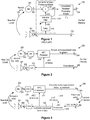
- FIG. 1 is a schematic block diagram illustrating a conventional system for acoustic echo cancellation.
- Conventional system 100 includes a linear processing module 110 and a nonlinear processing module 112 as shown in Figure 1 .
- a Delay 118 typically compensates for the pure delay resulting from a digital to analog (D/A) converter (not shown), the distance between the microphone 103 and the loudspeaker 107, buffering scheme, and an analog to digital (A/D) converter (not shown).
- An adaptive linear filter 116 attempts to model the transfer function between the loudspeaker signal 108 and the microphone signal 102.
- the adaptive linear filter 116 constantly monitors the transfer function and tracks changes in the acoustic echo path 109 with commonly employed least mean-squared (LMS) based algorithms.
- LMS least mean-squared
- the adaptive linear filter 116 can be implemented in either time domain (TD) or frequency-domain (FD).
- the output 122 of the adaptive linear filter 116 is very close to the echo portion of the microphone signal 102. Subtracting the adaptive linear filter output 122 from the microphone signal 102 reduces the echo. Since there is always a residual echo after the linear adaptive subtraction due to the fact that the adaptive linear filter 116 can neither be 100% accurate nor exactly model the transfer function, the nonlinear processing module 112 implements a nonlinear processor (NLP) technique that is necessary to further reduce the residual echo.
- NLP nonlinear processor
- the adaptive linear filter 116 would not be able to remove the nonlinear echo caused by any instability of the adaptive filter and non-linearity in the AEC system 100 circuitry, such as from the loudspeaker 107, A/D converter, D/A converter due to an overdriven speaker, microphone saturation, mechanical vibration, and so on.
- the linear adaptive filter 116 would not have exactly zero values for all the filter weights, which will result in the echo at the output and is a kind of echo leakage problem. Similarly, this condition occurs in the electrical EC system for the case of no electrical echo.
- an echo cancellation system includes (1) an adaptive linear filter implemented in either time-domain or frequency-domain; (2) a nonlinear echo suppression; (3) echo leakage prevention; (4) direct current (DC), low frequency residual echo and noise reduction; (5) time-domain nonlinear processor (NLP) to reduce the residual echo; and (6) frequency-domain NLP to further reduce the residual echo.
- the echo cancellation system is universally applicable to acoustic echo cancellation (AEC) and/or electrical echo cancellation applications.
- AEC acoustic echo cancellation
- this invention is reconfigurable for one or more microphones and/or one or more reference channels. The numbers of microphones and reference channels are user configurable.
- FIG. 2 is a schematic block diagram illustrating a system 200 for acoustic echo cancellation according to various embodiments of the present invention.
- Fig.2 shows an application setting of AEC system 200.
- System 200 includes components such as a converter 212, loudspeaker 207, microphone 203, converter 210, AEC processor 214, and wired or wireless network/circuitry interconnecting the various system components.
- Converter 212 is configured for receiving a signal 206 from a network coupled to a far-end (remote) site, converting signal 206 with converter 212 (e.g., D/A converter), and outputting a converted signal 208 of signal 206 to loudspeaker 207 for reproduction at a near-end (local) site.
- converter 212 e.g., D/A converter
- the reproduced converted signal 208 includes an acoustic echo along acoustic echo path 209.
- Microphone 203 is configured for receiving the acoustic echo along acoustic echo path 209 and outputting it as a microphone signal 202 to converter 210.
- Converter 210 is configured for receiving microphone signal 202, converting microphone signal 202 with converter 210 (e.g., A/D converter), and outputting a converted signal of microphone signal 202 to AEC processor 214.
- AEC processor 214 may include any portion of conventional linear processing module 110, conventional nonlinear processing module 112, and any other improvements discussed herein (e.g., See Figures 4 and 5 for further details).
- AEC processor 214 is configured for generating and outputting an acoustic echo-suppressed voice signal 204 to the network coupled to the far-end (remote) site. Acoustic echo-suppressed voice signal 204 is generated based on the converted microphone signal 202 of the acoustic echo along acoustic echo path 209 and an AEC reference signal (e.g., signal 206).
- FIG. 3 is a schematic block diagram illustrating a system 300 for acoustic and electrical echo cancellations according to various embodiments of the present invention.
- Fig. 3 shows the application setting of acoustic and electrical echo cancellations system 300.
- System 300 includes similar components as System 200 such as a converter 212, loudspeaker 207, microphone 203, converter 210, AEC processor 214, and wired or wireless network/circuitry interconnecting the various system components.
- System 300 also includes a local/line/electrical echo cancellation (LEC) processor 316. Similar to AEC processor 214, LEC processor 316 may include any portion of conventional linear processing module 110, conventional nonlinear processing module 112, and any other improvements discussed herein (e.g., See Figures 4 and 5 for further details).
- LEC local/line/electrical echo cancellation
- LEC processor 316 is configured for generating and outputting a local echo-suppressed far-end voice signal 320 to converter 212 and as the AEC reference to AEC processor 214.
- Local echo-suppressed far-end voice signal 320 is generated based on a signal 306 representative of the electrical echo along electrical echo path 305 and a LEC reference signal 318.
- LEC reference signal 318 is an acoustic echo-suppressed voice signal 304 generated from AEC Processor 214 to the network coupled to the far-end (remote) site.
- the proposed "nonlinear echo suppression" component applies for AEC while the rest of the components apply for both AEC and LEC. Therefore, the present invention relates more specifically to the techniques for AEC.
- FIG. 4 is a schematic block diagram illustrating a system 400 for acoustic echo cancellation according to various embodiments of the present invention.
- the proposed system 400 mainly includes six processing units: (1) AEC Linear Processing 410, i.e., an adaptive linear filter (See Sec. 2.1 and Figures 6, 7 , and 8 for further details); (2) nonlinear echo suppression 412 (See Sec. 2.2 and Figure 9 for further details); (3) echo leakage prevention 414 (See Sec. 2.3 and Figure 10 for further details); (4) high pass filter (HPF) 416, i.e., low frequency residual echo and noise reduction (See Sec. 2.4 and Figures 11 and 12 for further details); (5) TD REC 418, i.e., time-domain residual echo suppression (See Sec.
- AEC Linear Processing 410 i.e., an adaptive linear filter (See Sec. 2.1 and Figures 6, 7 , and 8 for further details);
- nonlinear echo suppression 412 See Sec. 2.2 and Figure 9 for further details
- FD REC 420 i.e., frequency-domain residual echo suppression (See Sec. 2.6 for further details).
- any combination of the six processing units may be used depending on the specific application. That is, any of the six processing units may be included, omitted, or reordered depending on the application.
- Sin 402 and Rin 406 are the inputs to the AEC system 400 whereas Sout 404 and Rout 408 are the outputs of the AEC system 400.
- the send path is from Sin 402 to Sout 404 and the receive path is from Rin 406 to Rout 408.
- Sin 402 is the microphone signal (e.g., 202) which includes near-end (NE) voice, NE environment noise, and acoustic echo.
- Rin 406 e.g., 206, 306) is the far-end (FE) voice, i.e., input of the receive path.
- Sout 404 e.g., 204, 304) is the echo-suppressed signal sent to the network for FE people to listen to.
- Rout 408 goes to the NE loudspeaker (e.g., 207) for NE people to listen to.
- FD REC 420 is configured for "50% STFT", which means short-time Fourier transform (STFT) with input 50% overlap.
- FIG. 5 is a schematic block diagram illustrating a system 500 for acoustic echo cancellation with integrated noise reduction according to various embodiments of the present invention.
- System 500 includes similar elements as those in system 400.
- elements 502, 504, 506, 508, 510, 511, 512, 514, 516, 518, 520 are similar to elements 402, 404, 406, 408, 410, 411, 412, 414, 416, 418, 420.
- this proposed AEC system 500 has been integrated with a noise reduction (NR) technology such as FD NR 522, which is a frequency-domain NR.
- NR noise reduction
- System 400 or 500 can be incorporated into either system 200 or 300, especially in AEC Processor 214 and/or LEC 316 Processor, and modified accordingly to their specific application. It will be appreciated by those skilled in the art that any combination of the seven processing units in system 500 may be used depending on the specific application.
- AEC Linear Processing (e.g., 410, 510) includes an adaptive linear filter that can be implemented in either time-domain or frequency-domain.
- Figure 6 is a schematic block diagram illustrating a system/module 600 for frequency-domain adaptive linear filtering according to various embodiments of the present invention.
- An example of the FD least mean-squared (LMS) based algorithms is shown as in Figure 6 .
- STFT 610 and ISTFT 622 denote short-time Fourier transform and inverse STFT, respectively.
- Delay 618 compensates for any pure delay resulting from one or more of the following factors: a D/A converter (e.g., 212), the distance between the microphone (e.g., 203) and the loudspeaker (e.g., 207), buffering scheme, and an A/D converter (e.g., 210).
- the frequency domain (FD) filtering i.e., Complex Adaptive Filter 616, is implemented by a complex multiply.
- the index n and k are for sample index and the frame index, respectively.
- the output of the FD filtering, Y(k) 613 is the estimated echo.
- STFT 610 receives input signal Sin 602 and generates output signal 612.
- Sin 602 is shown as a time-domain d(n) and output signal 612 as frequency-domain D(k).
- Sin 602 may correspond to a microphone signal (e.g., Sin 202, 402, 502) and be formatted by a converter (e.g., 210) into a useable format.
- STFT 620 receives input signal 619 as a time-domain x(n) reference data and generates output signal 621 as a frequency-domain X(k) reference data.
- Input signal x(n) 619 is generated by Delay 618 based on input Rin 606, which may correspond to a AEC/LEC reference signal (e.g., 406, 506, 206, 318, 320).
- Complex Adaptive Filter 616 generates Y(k) estimated echo signal 613 based on X(k) reference data signal 621 and E(k) residual echo signal 611, which is determined by comparing D(k) microphone signal 612 and Y(k) estimated echo signal 613 with operator 614 (e.g., adder, subtractor, etc.).
- E(k) residual echo signal 611 is then processed by ISTFT 622 to generate output signal 624 as a time-domain e(n) residual echo signal.
- Time-domain e(n) residual echo signal may correspond to output signals 411 and 511 in Figures 4 and 5 respectively.
- FIG. 7 is a schematic block diagram illustrating a system/module 700 for acoustic echo cancellation with two or more reference channels according to various embodiments of the present invention.
- Fig. 7 shows the AEC system with the m reference channels.
- Y(k) estimated echo signal 713 is based on adding together estimated echo signals for m reference channels.
- Y(k) estimated echo signal 713 is the result of adding Y1(k) estimated echo signal 715 and Ym(k) estimated echo signal 717 based on process modules 707 and 709 respectively.
- process modules 707 and 709 are similar to corresponding elements in Figure 6 (e.g., 606, 618, 619, 620, 621, 616, 613). Further, elements 702, 710, 712, 714, 711, 722, and 724 are similar to corresponding elements 602, 610, 612, 614, 611, 622, and 624.
- Figure 8 is a schematic block diagram illustrating a system/module 800 for frequency-domain adaptive linear filtering according to various embodiments of the present invention.
- the block of "75% STFT” 830 means STFT with input 75% overlap
- the block of "75% Overlap” 832 means that the output has 75% overlap
- the FFT 834 is the Fast Fourier transform.
- the u(n) 811 is the time-domain echo-reduced output.
- u(n) 811 corresponds to output signals 411 and 511 in Figures 4 and 5 respectively
- the block of Filter Weights Update 836 is based on the FD normalized LMS, which is described in detail as follows:
- the adaptation step size ⁇ is automatically adjusted by the coherence between D(k) and X(k). The higher is the coherence, the larger the adaptation step size ⁇ is. When the coherence gets low enough, the adaptation is frozen. As such, the proposed scheme can automatically reconfigure in real-time the system settings, processing structures and parameters to deal with any practical application environment while continually maintaining good performance.
- each reference channel has its own Complex Adaptive Filter processing.
- the Y(k) in Fig. 8 will be the summation of the outputs of all the Complex Adaptive Filters.
- Figure 9 is a flow diagram 900 for nonlinear echo processing according to various embodiments of the present invention.
- the constants FirOutOverDesLarge, ErrThreshold, NonLinGainSmall, and NonLinGainStep are 0.99, 0.02, 0.40, and 0.002, respectively.
- an Abs() block processes the energy level of its input signal, which is the absolute value of the corresponding input signal (e.g., u(n) 950, microphone signal d(n), estimated echo signal y(n))
- a determination 941 is made as to whether non-linear echo is present. The determination is based on the estimated echo signal (e.g., FirOutLev), microphone signal (e.g., DesiredLev, Temp), and echo-reduced signal u(n) 950 (e.g., Err_Abs).
- a gain (e.g., 943, 945) is then assigned based on the determination 941.
- v(n) 948 The nonlinear echo reduced output v(n) 948 is then generated, which is based on applying the appropriate gain 943, 945 after smoother 946 to the echo-reduced signal u(n) 950.
- v(n) 948 corresponds to output signals of 412 and 512 in Figures 4 and 5 respectively
- u(n) 950 corresponds to output signals 411 and 511 in Figures 4 and 5 respectively.
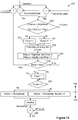
- FIG 10 is a flow diagram 1000 for echo leakage prevention according to various embodiments of the present invention.
- the process flow of Echo Leakage Prevention 414, 514 in Figures 4 or 5 is illustrated as shown in Figure 10 .
- the root-mean-square (RMS) value of the microphone signal e.g., D(k)
- a determination module 1062 is configured for determining whether the RMS value (e.g., RMSDes) of the microphone signal is less than a minimum input threshold (e.g., AEC_MIC_RMS_THRESHOLD).
- a gain module 1063, 1064 is configured for assigning a gain (e.g., 1, AEC_noMic_Atten) for reducing echo leakage based on whether the RMS value of the microphone signal is less than the minimum input threshold.
- a gain e.g., 1, AEC_noMic_Atten
- the RMSDes is very small. Therefore, by applying a reduction gain to the voice signal v(n) 1060 (e.g., 411, 511, 948) in this situation, the board noise floor could be suppressed in generating an echo leakage prevention output signal w(n) (e.g., output of Echo Leakage Prevention 414, 514).
- the AEC_MIC_RMS_THRESHOLD and AEC_noMic_Atten are 0.0005 and 0.25, respectively. It should be appreciated by those skilled in the art that the constant values and processes noted are for exemplary purposes only and that other values and processes may be substituted for achieving echo leakage prevention.
- FIG 11 is a schematic block diagram illustrating a system 1100 for acoustic echo cancellation with integrated HPFs 1170, 1172 according to various embodiments of the present invention.
- a HPF is applied for both the microphone signal and the reference signal as shown in Figure 11 ; therefore, for the proposed AEC system with N microphones and m loudspeakers, there are (N + m) HPFs.
- N HPFs are needed so that the MIPS and memory are reduced.
- HPFs can be integrated into systems 400 and 500 accordingly.
- Figure 12 is a diagram 1200 illustrating a frequency response of an HPF according to various embodiments of the present invention. Specifically, Figure 12 is the frequency response of the designed HPF according to a preferred embodiment of the present invention.
- the lower portion 1280 of diagram 1200 is the frequency response of the designed HPF for 0-8000 Hz.
- the upper portion 1282 of diagram 1200 is an enlargement of the lower portion 1280 of diagram 1200 for the frequency response between 0-600 Hz.
- Figure 13 is a flow diagram 1300 for time-domain residual echo suppression according to various embodiments of the present invention.
- the FirOutLev, ErrLev, and DesiredLev have been calculated in Section 2.2 as shown in Figure 9 .
- a determination 1396 of far end voice activity detection is performed and then an application 1398 of suppressing the residual echo is performed based on the determination.
- the determination of FEvad is based on one or more factors: 1) a ratio/comparison 1390 between the microphone signal (e.g., DesiredLev) and estimated echo level (e.g, FirOutLev); 2) the adaptation step size ⁇ in AEC Linear Processing (e.g., finding Max ⁇ in all frequency bins or bands 1392; comparision between Max ⁇ and predefined thresholds AdapSmall and AdapBig 1393); and 3) a ratio/comparison 1394 between the microphone signal (e.g., Desired Lev) and reduced echo level (e.g., ErrLev).
- a ratio/comparison 1390 between the microphone signal (e.g., DesiredLev) and estimated echo level (e.g, FirOutLev)
- the adaptation step size ⁇ in AEC Linear Processing e.g., finding
- a residual echo suppression output signal z(n) 1399 is generated (e.g., output of TD REC 418, 518).
- HPF output may correspond to the output of HPF 416, 516 or any other component (e.g., 412, 512) of system 400, 500. It should be appreciated by those skilled in the art that the constant values and processes noted are for exemplary purposes only and that other values and processes may be substituted for achieving residual echo suppression.
- the reference signal X(k), error signal E(k), adaptive filter weight W(k), and the coherence C(k) have been calculated in Section 2.1 as shown in Figure 8 .
- the coherence C(k) gets high enough, there is no NE voice.
- the FD REC will further reduce the residual echo based on the ratio between the residual echo level IE(k)1 and the level of the estimated echo
- the binary mask approach (either bin-by-bin scheme, or band-by-band scheme) is adopted for the reduction.
- this proposed scheme can be adopted by both AEC and electrical echo cancellation.
- this invention supports one or more microphones and one or more reference channels.
- the numbers of microphones and reference channels are user configurable.
- FIG. 14 illustrates a typical computer system that can be used in connection with one or more embodiments of the present invention.
- the computer system 1400 includes one or more processors 1402 (also referred to as central processing units, or CPUs) that are coupled to storage devices including primary storage 1406 (typically a random access memory, or RAM) and another primary storage 1404 (typically a read only memory, or ROM).
- primary storage 1404 acts to transfer data and instructions uni-directionally to the CPU and primary storage 1406 is used typically to transfer data and instructions in a bi-directional manner.
- Both of these primary storage devices may include any suitable computer-readable media, including a computer program product comprising a machine readable medium on which is provided program instructions according to one or more embodiments of the present invention.
- a mass storage device 1408 also is coupled bi-directionally to CPU 1402 and provides additional data storage capacity and may include any of the computer-readable media, including a computer program product comprising a machine readable medium on which is provided program instructions according to one or more embodiments of the present invention.
- the mass storage device 1408 may be used to store programs, data and the like and is typically a secondary storage medium such as a hard disk that is slower than primary storage. It will be appreciated that the information retained within the mass storage device 1408, may, in appropriate cases, be incorporated in standard fashion as part of primary storage 1406 as virtual memory.
- a specific mass storage device such as a CD-ROM may also pass data uni-directionally to the CPU.
- CPU 1402 also is coupled to an interface 1410 that includes one or more input/output devices such as such as video monitors, track balls, mice, keyboards, microphones, touch-sensitive displays, transducer card readers, magnetic or paper tape readers, tablets, styluses, voice or handwriting recognizers, or other well-known input devices such as, of course, other computers.
- CPU 1402 optionally may be coupled to a computer or telecommunications network using a network connection as shown generally at 1412. With such a network connection, it is contemplated that the CPU might receive information from the network, or might output information to the network in the course of performing the above-described method steps.
- the above-described devices and materials will be familiar to those of skill in the computer hardware and software arts.
Landscapes
- Engineering & Computer Science (AREA)
- Signal Processing (AREA)
- Computer Networks & Wireless Communication (AREA)
- Human Computer Interaction (AREA)
- Health & Medical Sciences (AREA)
- Audiology, Speech & Language Pathology (AREA)
- Quality & Reliability (AREA)
- Physics & Mathematics (AREA)
- Acoustics & Sound (AREA)
- Multimedia (AREA)
- Computational Linguistics (AREA)
- Cable Transmission Systems, Equalization Of Radio And Reduction Of Echo (AREA)
- Circuit For Audible Band Transducer (AREA)
- Telephone Function (AREA)
- Soundproofing, Sound Blocking, And Sound Damping (AREA)
Claims (9)
- System zum Verarbeiten von Signalen, umfassend:ein Echokompensation-Linearverarbeitungsmodul (410, 510), das zum Erzeugen eines ersten Ausgangssignals durch adaptives Filtern eines Eingangssignals konfiguriert ist, wobei das erste Ausgangssignal das Eingangssignal ist, bei dem jegliches lineare Echo vermindert ist, wobei das Echokompensation-Linearverarbeitungsmodul umfasst: einen Echokompensationsoperator zum Erzeugen eines Restechosignals durch Subtrahieren eines geschätzten Echosignals vom Eingangssignal und ein erstes komplexes adaptives Filter, das zum Erzeugen eines ersten geschätzten Echosignals auf der Grundlage eines ersten Referenzsignals und des Restechosignals konfiguriert ist, worin das geschätzte Echosignal das erste geschätzte Echosignal ist;ein Nichtlinearecho-Verarbeitungsmodul (412, 512), das zum Erzeugen eines zweiten Ausgangssignals auf der Grundlage des ersten Ausgangssignals konfiguriert ist, wobei das zweite Ausgangssignal das erste Ausgangssignal ist, bei dem jegliches lineare Restecho oder nichtlineare Echo vermindert ist, wobei das Nichtlinearecho-Verarbeitungsmodul umfasst: ein Nichtlinearecho-Bestimmungsmodul, das konfiguriert ist zum Bestimmen, ob nichtlineares Echo im ersten Ausgangssignal vorhanden ist, ein Nichtlinearecho-Verstärkungsmodul, das zum Zuweisen einer Nichtlinearecho-Verstärkung zum Vermindern von nichtlinearem Echo konfiguriert ist, und zwar darauf beruhend, ob nichtlineares Echo im ersten Ausgangssignal vorhanden ist, und einen Nichtlinearecho-Operator, der zum Anwenden der Nichtlinearecho-Verstärkung auf das erste Ausgangssignal beim Erzeugen des zweiten Ausgangssignals konfiguriert ist; undein Echoleckverhinderungsmodul (414, 514), das zum Erzeugen eines dritten Ausgangssignals auf der Grundlage des zweiten Ausgangssignals konfiguriert ist, wobei das dritte Ausgangssignal das zweite Ausgangssignal ist, bei dem Echoleck vermindert ist, worin das Echoleckverhinderungsmodul umfasst: ein Echoleckbestimmungsmodul, das konfiguriert ist zum Bestimmen, ob ein quadratischer Mittelwert des Eingangssignals unterhalb eines minimalen Eingangsschwellenwerts liegt, ein Echoleckverstärkungsmodul, das zum Zuweisen einer Echoleckverstärkung zum Vermindern von Echolecks konfiguriert ist, und zwar darauf beruhend, ob der quadratische Mittelwert des Eingangssignals unter dem minimalen Eingangsschwellenwert liegt, und einen Echoleckoperator, der zum Anwenden der Echoleckverstärkung auf das zweite Ausgangssignal beim Erzeugen des dritten Ausgangssignals konfiguriert ist.
- System nach Anspruch 1, worin das Echokompensation-Linearverarbeitungsmodul umfasst:
ein zweites komplexes adaptives Filter, das zum Erzeugen eines zweiten geschätzten Echosignals auf der Grundlage eines zweiten Referenzsignals und des Restechosignals konfiguriert ist, worin das geschätzte Echosignal das erste geschätzte Echosignal plus das zweite geschätzte Echosignal ist. - System nach Anspruch 1 oder 2, worin die komplexen adaptiven Filter Filtergewichte verwenden, die automatisch durch auf dem Eingangssignal und dem ersten Referenzsignal beruhende Kohärenzwerte in Echtzeit aktualisiert werden.
- System nach einem der vorhergehenden Ansprüche, ferner eines oder beide von einem ersten Restechounterdrückungsmodul, das im Zeitbereich arbeitet, und einem zweiten Restechounterdrückungsmodul, das im Frequenzbereich arbeitet, umfassend, worin das erste und/oder zweite Restechounterdrückungsmodul umfasst:ein Restechobestimmungsmodul zum Bestimmen, ob Restecho vorhanden ist, und zwar durch Subtrahieren eines geschätzten Echosignals vom Eingangssignal;ein Restechoverstärkungsmodul, das zum Zuweisen einer Restechoverstärkung zum Vermindern des Restechos konfiguriert ist, und zwar darauf beruhend, ob ein Restecho vorhanden ist, wobei die Verstärkung auf einem Verhältnis zwischen dem Restecho und dem Pegel des geschätzten Echos beruht; undeinen Restechooperator, der zum Anwenden der Restechoverstärkung auf das dritte Ausgangssignal, um ein viertes Ausgangssignal zu erzeugen, oder auf das vierte Ausgangssignal, um ein fünftes Ausgangssignal zu erzeugen, konfiguriert ist.
- System nach einem der vorhergehenden Ansprüche, ferner umfassend:
ein Hochpassfilter, das zum Vermindern von niederfrequentem Restecho oder Rauschen konfiguriert ist, wobei das Hochpassfilter in Reihe mit dem Eingangssignal angeordnet ist. - System nach einem der vorhergehenden Ansprüche, worin das Eingangssignal einem Sprachsignal entspricht und das System zum Verarbeiten von Signalen dient, um akustisches Echo zu vermindern, oder einem elektrischen Signal entspricht und das System zum Verarbeiten von Signalen dient, um elektrisches Echo zu vermindern.
- Verfahren für ein Echokompensationssystem, um Signale zu verarbeiten, umfassend:Erzeugen eines ersten Ausgangssignals durch adaptives Filtern eines Eingangssignals, wobei das erste Ausgangssignal das Eingangssignal ist, bei dem jegliches lineare Echo vermindert ist, und zwar durch Erzeugen eines Restechosignals durch Subtrahieren eines geschätzten Echosignals vom Eingangssignal und Erzeugen eines ersten geschätzten Echosignals beruhend auf einem ersten Bezugssignal, dem Restechosignal und Filtergewichten, worin das geschätzte Echosignal das erste geschätzte Echosignal ist und worin die Filtergewichte automatisch durch auf dem Eingangssignal und dem ersten Referenzsignal beruhende Kohärenzwerte in Echtzeit aktualisiert werden;Erzeugen eines zweiten Ausgangssignals auf der Grundlage des ersten Ausgangssignals, wobei das zweite Ausgangssignal das erste Ausgangssignal ist, bei dem jegliches lineare Restecho oder nichtlineare Echo vermindert ist, und zwar durch Bestimmen, ob nichtlineares Echo im ersten Ausgangssignal vorhanden ist, Zuweisen einer Nichtlinearecho-Verstärkung zum Vermindern von nichtlinearem Echo, und zwar darauf beruhend, ob nichtlineares Echo im ersten Ausgangssignal vorhanden ist, und Anwenden der Nichtlinearecho-Verstärkung auf das erste Ausgangssignal beim Erzeugen des zweiten Ausgangssignals; undErzeugen eines dritten Ausgangssignals auf der Grundlage des zweiten Ausgangssignals, wobei das dritte Ausgangssignal das zweite Ausgangssignal ist, bei dem Echoleck vermindert ist, und zwar durch Bestimmen, ob ein quadratischer Mittelwert des Eingangssignals unterhalb eines minimalen Eingangsschwellenwerts liegt, Zuweisen einer Echoleckverstärkung zum Vermindern von Echolecks, und zwar darauf beruhend, ob der quadratische Mittelwert des Eingangssignals unter dem minimalen Eingangsschwellenwert liegt, und Anwenden der Echoleckverstärkung auf das zweite Ausgangssignal beim Erzeugen des dritten Ausgangssignals.
- Verfahren nach Anspruch 7, ferner umfassend:
Anwenden von Restechounterdrückung in einem oder beiden des Zeitbereichs und des Frequenzbereichs, worin das Anwenden von Restechounterdrückung umfasst:Bestimmen, ob Restecho vorhanden ist;Zuweisen einer Restechoverstärkung zum Vermindern des Restechos, darauf beruhend, ob Restecho vorhanden ist; undAnwenden der Restechoverstärkung auf das dritte Ausgangssignal, um ein viertes Ausgangssignal zu erzeugen, oder auf das vierte Ausgangssignal, um ein fünftes Ausgangssignal zu erzeugen. - Computerprogrammprodukt zum Verarbeiten von Signalen, um entweder akustisches oder elektrisches Echo zu vermindern, wobei das Computerprogrammprodukt in einem nichtflüchtigen computerlesbaren Medium verkörpert ist und computerausführbare Anweisungen zum Implementieren eines Verfahrens nach Anspruch 7 oder Anspruch 8 umfasst.
Applications Claiming Priority (2)
| Application Number | Priority Date | Filing Date | Title |
|---|---|---|---|
| US201261640681P | 2012-04-30 | 2012-04-30 | |
| PCT/US2013/038958 WO2013166080A1 (en) | 2012-04-30 | 2013-04-30 | A universal reconfigurable echo cancellation system |
Publications (3)
| Publication Number | Publication Date |
|---|---|
| EP2845189A1 EP2845189A1 (de) | 2015-03-11 |
| EP2845189A4 EP2845189A4 (de) | 2016-01-13 |
| EP2845189B1 true EP2845189B1 (de) | 2018-09-05 |
Family
ID=49514835
Family Applications (1)
| Application Number | Title | Priority Date | Filing Date |
|---|---|---|---|
| EP13784615.0A Active EP2845189B1 (de) | 2012-04-30 | 2013-04-30 | Universelles neukonfigurierbares echokompensationssystem |
Country Status (5)
| Country | Link |
|---|---|
| US (1) | US9451078B2 (de) |
| EP (1) | EP2845189B1 (de) |
| CN (1) | CN104395957B (de) |
| SG (1) | SG11201407085UA (de) |
| WO (1) | WO2013166080A1 (de) |
Families Citing this family (111)
| Publication number | Priority date | Publication date | Assignee | Title |
|---|---|---|---|---|
| US9084058B2 (en) | 2011-12-29 | 2015-07-14 | Sonos, Inc. | Sound field calibration using listener localization |
| US9106192B2 (en) | 2012-06-28 | 2015-08-11 | Sonos, Inc. | System and method for device playback calibration |
| WO2014184866A1 (ja) * | 2013-05-14 | 2014-11-20 | 三菱電機株式会社 | エコー消去装置 |
| CN104754157B (zh) * | 2013-12-26 | 2017-06-16 | 联芯科技有限公司 | 一种残留回声抑制方法和系统 |
| GB2527865B (en) * | 2014-10-30 | 2016-12-14 | Imagination Tech Ltd | Controlling operational characteristics of an acoustic echo canceller |
| CN107210777B (zh) * | 2015-01-05 | 2019-09-13 | 美国莱迪思半导体公司 | 全双工收发器、执行全双工通信的方法以及计算机可读存储介质 |
| WO2016130459A1 (en) | 2015-02-09 | 2016-08-18 | Dolby Laboratories Licensing Corporation | Nearby talker obscuring, duplicate dialogue amelioration and automatic muting of acoustically proximate participants |
| US9554207B2 (en) | 2015-04-30 | 2017-01-24 | Shure Acquisition Holdings, Inc. | Offset cartridge microphones |
| US9565493B2 (en) | 2015-04-30 | 2017-02-07 | Shure Acquisition Holdings, Inc. | Array microphone system and method of assembling the same |
| JP6343585B2 (ja) * | 2015-05-14 | 2018-06-13 | 日本電信電話株式会社 | 未知伝達系推定装置、未知伝達系推定方法、およびプログラム |
| CN104994249B (zh) * | 2015-05-19 | 2017-03-15 | 百度在线网络技术(北京)有限公司 | 声回波消除方法和装置 |
| KR101715198B1 (ko) * | 2015-11-18 | 2017-03-10 | 광주과학기술원 | 가변 전력 예산을 이용한 음성 강화 방법 |
| US9811314B2 (en) | 2016-02-22 | 2017-11-07 | Sonos, Inc. | Metadata exchange involving a networked playback system and a networked microphone system |
| US10095470B2 (en) | 2016-02-22 | 2018-10-09 | Sonos, Inc. | Audio response playback |
| US9820039B2 (en) | 2016-02-22 | 2017-11-14 | Sonos, Inc. | Default playback devices |
| US10264030B2 (en) | 2016-02-22 | 2019-04-16 | Sonos, Inc. | Networked microphone device control |
| US9947316B2 (en) | 2016-02-22 | 2018-04-17 | Sonos, Inc. | Voice control of a media playback system |
| US9763018B1 (en) | 2016-04-12 | 2017-09-12 | Sonos, Inc. | Calibration of audio playback devices |
| US9978390B2 (en) | 2016-06-09 | 2018-05-22 | Sonos, Inc. | Dynamic player selection for audio signal processing |
| US20170365271A1 (en) * | 2016-06-15 | 2017-12-21 | Adam Kupryjanow | Automatic speech recognition de-reverberation |
| US10134399B2 (en) | 2016-07-15 | 2018-11-20 | Sonos, Inc. | Contextualization of voice inputs |
| US10372406B2 (en) | 2016-07-22 | 2019-08-06 | Sonos, Inc. | Calibration interface |
| US10115400B2 (en) | 2016-08-05 | 2018-10-30 | Sonos, Inc. | Multiple voice services |
| US9942678B1 (en) | 2016-09-27 | 2018-04-10 | Sonos, Inc. | Audio playback settings for voice interaction |
| US10129408B1 (en) * | 2016-10-11 | 2018-11-13 | Google Llc | Residual echo detection based on non-causality |
| US10181323B2 (en) | 2016-10-19 | 2019-01-15 | Sonos, Inc. | Arbitration-based voice recognition |
| US10264116B2 (en) | 2016-11-02 | 2019-04-16 | Nokia Technologies Oy | Virtual duplex operation |
| CN106782504B (zh) * | 2016-12-29 | 2019-01-22 | 百度在线网络技术(北京)有限公司 | 语音识别方法和装置 |
| US9881632B1 (en) * | 2017-01-04 | 2018-01-30 | 2236008 Ontario Inc. | System and method for echo suppression for in-car communications |
| US10367948B2 (en) | 2017-01-13 | 2019-07-30 | Shure Acquisition Holdings, Inc. | Post-mixing acoustic echo cancellation systems and methods |
| KR102580418B1 (ko) * | 2017-02-07 | 2023-09-20 | 삼성에스디에스 주식회사 | 어쿠스틱 에코 제거 장치 및 방법 |
| CN106601266A (zh) * | 2017-02-24 | 2017-04-26 | 喜大(上海)网络科技有限公司 | 回声消除方法、装置及系统 |
| US11183181B2 (en) | 2017-03-27 | 2021-11-23 | Sonos, Inc. | Systems and methods of multiple voice services |
| US10475449B2 (en) | 2017-08-07 | 2019-11-12 | Sonos, Inc. | Wake-word detection suppression |
| KR102478951B1 (ko) * | 2017-09-04 | 2022-12-20 | 삼성전자주식회사 | 비선형 특성을 갖는 오디오 필터를 이용하여 오디오 신호를 처리하는 방법 및 장치 |
| US10048930B1 (en) | 2017-09-08 | 2018-08-14 | Sonos, Inc. | Dynamic computation of system response volume |
| CN107610714A (zh) * | 2017-09-13 | 2018-01-19 | 西南交通大学 | 基于一范数零吸引的最小均三次方绝对值的回声消除方法 |
| US10446165B2 (en) * | 2017-09-27 | 2019-10-15 | Sonos, Inc. | Robust short-time fourier transform acoustic echo cancellation during audio playback |
| US10051366B1 (en) | 2017-09-28 | 2018-08-14 | Sonos, Inc. | Three-dimensional beam forming with a microphone array |
| US10621981B2 (en) | 2017-09-28 | 2020-04-14 | Sonos, Inc. | Tone interference cancellation |
| US10482868B2 (en) | 2017-09-28 | 2019-11-19 | Sonos, Inc. | Multi-channel acoustic echo cancellation |
| US10466962B2 (en) | 2017-09-29 | 2019-11-05 | Sonos, Inc. | Media playback system with voice assistance |
| US10880650B2 (en) | 2017-12-10 | 2020-12-29 | Sonos, Inc. | Network microphone devices with automatic do not disturb actuation capabilities |
| US10818290B2 (en) | 2017-12-11 | 2020-10-27 | Sonos, Inc. | Home graph |
| CN108055417B (zh) * | 2017-12-26 | 2020-09-29 | 杭州叙简科技股份有限公司 | 一种基于语音检测回音抑制切换音频处理系统及方法 |
| US11343614B2 (en) | 2018-01-31 | 2022-05-24 | Sonos, Inc. | Device designation of playback and network microphone device arrangements |
| US11175880B2 (en) | 2018-05-10 | 2021-11-16 | Sonos, Inc. | Systems and methods for voice-assisted media content selection |
| CN108831497B (zh) * | 2018-05-22 | 2020-06-09 | 出门问问信息科技有限公司 | 一种回声压缩方法及装置、存储介质、电子设备 |
| US10959029B2 (en) | 2018-05-25 | 2021-03-23 | Sonos, Inc. | Determining and adapting to changes in microphone performance of playback devices |
| EP3804356A1 (de) | 2018-06-01 | 2021-04-14 | Shure Acquisition Holdings, Inc. | Musterbildende mikrofonanordnung |
| US11297423B2 (en) | 2018-06-15 | 2022-04-05 | Shure Acquisition Holdings, Inc. | Endfire linear array microphone |
| US10681460B2 (en) | 2018-06-28 | 2020-06-09 | Sonos, Inc. | Systems and methods for associating playback devices with voice assistant services |
| CN109040498B (zh) * | 2018-08-12 | 2022-01-07 | 瑞声科技(南京)有限公司 | 一种提升回声抵消效果的方法及其系统 |
| US11076035B2 (en) | 2018-08-28 | 2021-07-27 | Sonos, Inc. | Do not disturb feature for audio notifications |
| US10461710B1 (en) | 2018-08-28 | 2019-10-29 | Sonos, Inc. | Media playback system with maximum volume setting |
| US10878811B2 (en) | 2018-09-14 | 2020-12-29 | Sonos, Inc. | Networked devices, systems, and methods for intelligently deactivating wake-word engines |
| US10587430B1 (en) | 2018-09-14 | 2020-03-10 | Sonos, Inc. | Networked devices, systems, and methods for associating playback devices based on sound codes |
| EP3854108B1 (de) | 2018-09-20 | 2025-10-22 | Shure Acquisition Holdings, Inc. | Einstellbare keulenform für array-mikrofone |
| US11024331B2 (en) | 2018-09-21 | 2021-06-01 | Sonos, Inc. | Voice detection optimization using sound metadata |
| US10811015B2 (en) | 2018-09-25 | 2020-10-20 | Sonos, Inc. | Voice detection optimization based on selected voice assistant service |
| US11100923B2 (en) | 2018-09-28 | 2021-08-24 | Sonos, Inc. | Systems and methods for selective wake word detection using neural network models |
| US10692518B2 (en) | 2018-09-29 | 2020-06-23 | Sonos, Inc. | Linear filtering for noise-suppressed speech detection via multiple network microphone devices |
| US11899519B2 (en) | 2018-10-23 | 2024-02-13 | Sonos, Inc. | Multiple stage network microphone device with reduced power consumption and processing load |
| EP3654249A1 (de) | 2018-11-15 | 2020-05-20 | Snips | Erweiterte konvolutionen und takt zur effizienten schlüsselwortauffindung |
| US11183183B2 (en) | 2018-12-07 | 2021-11-23 | Sonos, Inc. | Systems and methods of operating media playback systems having multiple voice assistant services |
| US11132989B2 (en) | 2018-12-13 | 2021-09-28 | Sonos, Inc. | Networked microphone devices, systems, and methods of localized arbitration |
| US10602268B1 (en) | 2018-12-20 | 2020-03-24 | Sonos, Inc. | Optimization of network microphone devices using noise classification |
| KR102517975B1 (ko) * | 2019-01-29 | 2023-04-04 | 삼성전자주식회사 | 시간 상관 관계에 기초하여 잔여 에코를 추정하는 잔여 에코 추정기, 잔여 에코를 추정하는 프로그램 코드를 저장하는 비일시적 컴퓨터 판독 가능한 매체, 그리고 어플리케이션 프로세서 |
| US10867604B2 (en) | 2019-02-08 | 2020-12-15 | Sonos, Inc. | Devices, systems, and methods for distributed voice processing |
| EP3942842B1 (de) | 2019-03-21 | 2026-03-11 | Shure Acquisition Holdings, Inc. | Gehäuse und zugehörige konstruktionsmerkmale für mikrofone einer deckenanordnung |
| JP7572964B2 (ja) | 2019-03-21 | 2024-10-24 | シュアー アクイジッション ホールディングス インコーポレイテッド | 阻止機能を伴うビーム形成マイクロフォンローブの自動集束、領域内自動集束、および自動配置 |
| US11558693B2 (en) | 2019-03-21 | 2023-01-17 | Shure Acquisition Holdings, Inc. | Auto focus, auto focus within regions, and auto placement of beamformed microphone lobes with inhibition and voice activity detection functionality |
| US11120794B2 (en) | 2019-05-03 | 2021-09-14 | Sonos, Inc. | Voice assistant persistence across multiple network microphone devices |
| CN114051738B (zh) | 2019-05-23 | 2024-10-01 | 舒尔获得控股公司 | 可操纵扬声器阵列、系统及其方法 |
| US11302347B2 (en) | 2019-05-31 | 2022-04-12 | Shure Acquisition Holdings, Inc. | Low latency automixer integrated with voice and noise activity detection |
| US11200894B2 (en) | 2019-06-12 | 2021-12-14 | Sonos, Inc. | Network microphone device with command keyword eventing |
| US10871943B1 (en) | 2019-07-31 | 2020-12-22 | Sonos, Inc. | Noise classification for event detection |
| US11138969B2 (en) | 2019-07-31 | 2021-10-05 | Sonos, Inc. | Locally distributed keyword detection |
| EP4018680B1 (de) | 2019-08-23 | 2026-04-29 | Shure Acquisition Holdings, Inc. | Zweidimensionale mikrofonanordnung mit verbesserter richtcharakteristik |
| US11189286B2 (en) | 2019-10-22 | 2021-11-30 | Sonos, Inc. | VAS toggle based on device orientation |
| US12028678B2 (en) | 2019-11-01 | 2024-07-02 | Shure Acquisition Holdings, Inc. | Proximity microphone |
| CN110931032B (zh) * | 2019-11-19 | 2022-08-02 | 西安合谱声学科技有限公司 | 一种动态回声消除方法及装置 |
| KR102782171B1 (ko) * | 2019-11-25 | 2025-03-19 | 삼성전자주식회사 | 무선 통신을 수행하는 전자 장치 및 무선 통신 방법 |
| US11200900B2 (en) | 2019-12-20 | 2021-12-14 | Sonos, Inc. | Offline voice control |
| CN111091846B (zh) * | 2019-12-26 | 2022-07-26 | 江亨湖 | 一种降噪方法及应用该方法的回声消除系统 |
| US11562740B2 (en) | 2020-01-07 | 2023-01-24 | Sonos, Inc. | Voice verification for media playback |
| US11556307B2 (en) | 2020-01-31 | 2023-01-17 | Sonos, Inc. | Local voice data processing |
| US11308958B2 (en) | 2020-02-07 | 2022-04-19 | Sonos, Inc. | Localized wakeword verification |
| US11552611B2 (en) | 2020-02-07 | 2023-01-10 | Shure Acquisition Holdings, Inc. | System and method for automatic adjustment of reference gain |
| USD944776S1 (en) | 2020-05-05 | 2022-03-01 | Shure Acquisition Holdings, Inc. | Audio device |
| US11308962B2 (en) | 2020-05-20 | 2022-04-19 | Sonos, Inc. | Input detection windowing |
| US11482224B2 (en) | 2020-05-20 | 2022-10-25 | Sonos, Inc. | Command keywords with input detection windowing |
| WO2021243368A2 (en) | 2020-05-29 | 2021-12-02 | Shure Acquisition Holdings, Inc. | Transducer steering and configuration systems and methods using a local positioning system |
| US12387716B2 (en) | 2020-06-08 | 2025-08-12 | Sonos, Inc. | Wakewordless voice quickstarts |
| CN111696569B (zh) * | 2020-06-29 | 2023-12-15 | 美的集团武汉制冷设备有限公司 | 家电设备的回声消除方法、家电设备、终端和存储介质 |
| US11698771B2 (en) | 2020-08-25 | 2023-07-11 | Sonos, Inc. | Vocal guidance engines for playback devices |
| US12283269B2 (en) | 2020-10-16 | 2025-04-22 | Sonos, Inc. | Intent inference in audiovisual communication sessions |
| US11984123B2 (en) | 2020-11-12 | 2024-05-14 | Sonos, Inc. | Network device interaction by range |
| US11785380B2 (en) | 2021-01-28 | 2023-10-10 | Shure Acquisition Holdings, Inc. | Hybrid audio beamforming system |
| US12452584B2 (en) | 2021-01-29 | 2025-10-21 | Shure Acquisition Holdings, Inc. | Scalable conferencing systems and methods |
| US12542123B2 (en) | 2021-08-31 | 2026-02-03 | Shure Acquisition Holdings, Inc. | Mask non-linear processor for acoustic echo cancellation |
| CN117940995A (zh) | 2021-09-16 | 2024-04-26 | 谷歌有限责任公司 | 基于stft的回声静音器 |
| US11875810B1 (en) | 2021-09-29 | 2024-01-16 | Amazon Technologies, Inc. | Echo cancellation using neural networks for environments with unsynchronized devices for audio capture and rendering |
| WO2023056026A1 (en) | 2021-09-30 | 2023-04-06 | Sonos, Inc. | Enabling and disabling microphones and voice assistants |
| US12322390B2 (en) | 2021-09-30 | 2025-06-03 | Sonos, Inc. | Conflict management for wake-word detection processes |
| CN118216161A (zh) | 2021-10-04 | 2024-06-18 | 舒尔获得控股公司 | 联网自动混合器系统及方法 |
| EP4427465A1 (de) | 2021-11-05 | 2024-09-11 | Shure Acquisition Holdings, Inc. | Verteilter algorithmus zur automatischen mischung von sprache über drahtlose netzwerke |
| WO2023133513A1 (en) | 2022-01-07 | 2023-07-13 | Shure Acquisition Holdings, Inc. | Audio beamforming with nulling control system and methods |
| US12327549B2 (en) | 2022-02-09 | 2025-06-10 | Sonos, Inc. | Gatekeeping for voice intent processing |
| US12598261B2 (en) | 2022-09-28 | 2026-04-07 | Shure Acquisition Holdings, Inc. | Wideband doubletalk detection for optimization of acoustic echo cancellation |
| CN115641864A (zh) * | 2022-10-24 | 2023-01-24 | 展讯通信(上海)有限公司 | 回声处理方法及装置、计算机可读存储介质 |
Citations (1)
| Publication number | Priority date | Publication date | Assignee | Title |
|---|---|---|---|---|
| US5937060A (en) * | 1996-02-09 | 1999-08-10 | Texas Instruments Incorporated | Residual echo suppression |
Family Cites Families (9)
| Publication number | Priority date | Publication date | Assignee | Title |
|---|---|---|---|---|
| JP2853455B2 (ja) * | 1992-05-15 | 1999-02-03 | ケイディディ株式会社 | エコーキャンセラ |
| US7035396B1 (en) * | 1999-01-22 | 2006-04-25 | Agere Systems Inc. | Configurable echo canceller |
| US7672445B1 (en) * | 2002-11-15 | 2010-03-02 | Fortemedia, Inc. | Method and system for nonlinear echo suppression |
| EP2171714B1 (de) * | 2007-06-21 | 2012-08-15 | Koninklijke Philips Electronics N.V. | Vorrichtung und verfahren zur verarbeitung von audio-signalen |
| US20090003586A1 (en) * | 2007-06-28 | 2009-01-01 | Fortemedia, Inc. | Signal processor and method for canceling echo in a communication device |
| JP4410819B2 (ja) * | 2007-10-23 | 2010-02-03 | Okiセミコンダクタ株式会社 | エコーキャンセラ |
| GB2457986A (en) * | 2008-03-06 | 2009-09-09 | Cambridge Silicon Radio Ltd | Acoustic echo cancellation |
| US8320553B2 (en) * | 2008-10-27 | 2012-11-27 | Apple Inc. | Enhanced echo cancellation |
| US8625775B2 (en) * | 2009-08-06 | 2014-01-07 | Hti Ip, L.L.C. | Method and system for reducing echo and noise in a vehicle passenger compartment environment |
-
2013
- 2013-04-30 WO PCT/US2013/038958 patent/WO2013166080A1/en not_active Ceased
- 2013-04-30 EP EP13784615.0A patent/EP2845189B1/de active Active
- 2013-04-30 US US14/398,102 patent/US9451078B2/en active Active
- 2013-04-30 CN CN201380034895.4A patent/CN104395957B/zh active Active
- 2013-04-30 SG SG11201407085UA patent/SG11201407085UA/en unknown
Patent Citations (1)
| Publication number | Priority date | Publication date | Assignee | Title |
|---|---|---|---|---|
| US5937060A (en) * | 1996-02-09 | 1999-08-10 | Texas Instruments Incorporated | Residual echo suppression |
Also Published As
| Publication number | Publication date |
|---|---|
| US9451078B2 (en) | 2016-09-20 |
| US20150126255A1 (en) | 2015-05-07 |
| CN104395957B (zh) | 2018-02-13 |
| EP2845189A1 (de) | 2015-03-11 |
| CN104395957A (zh) | 2015-03-04 |
| SG11201407085UA (en) | 2014-12-30 |
| EP2845189A4 (de) | 2016-01-13 |
| WO2013166080A1 (en) | 2013-11-07 |
Similar Documents
| Publication | Publication Date | Title |
|---|---|---|
| EP2845189B1 (de) | Universelles neukonfigurierbares echokompensationssystem | |
| US11297178B2 (en) | Method, apparatus, and computer-readable media utilizing residual echo estimate information to derive secondary echo reduction parameters | |
| EP3295681B1 (de) | Akustisches echokompensationssystem und verfahren | |
| US6968064B1 (en) | Adaptive thresholds in acoustic echo canceller for use during double talk | |
| JP4955228B2 (ja) | ラウンドロビン正則化を用いたマルチチャネルエコーキャンセレーション | |
| CN108376548B (zh) | 一种基于麦克风阵列的回声消除方法与系统 | |
| US20130129100A1 (en) | Processing audio signals | |
| CN103945076B (zh) | 用于移动设备的实时音频回声和背景噪声的减小 | |
| CN104158990A (zh) | 用于处理音频信号的方法和音频接收电路 | |
| US10117021B1 (en) | Audio feedback reduction utilizing adaptive filters and nonlinear processing | |
| JP2004537219A (ja) | 高調波計算のための非線形エコーサプレッサを備えたエコーキャンセラ | |
| CN111524532B (zh) | 回声抑制方法、装置、设备及存储介质 | |
| JP3507020B2 (ja) | 反響抑圧方法、反響抑圧装置及び反響抑圧プログラム記憶媒体 | |
| US9491306B2 (en) | Signal processing control in an audio device | |
| US10938992B1 (en) | Advanced audio feedback reduction utilizing adaptive filters and nonlinear processing | |
| CN109215672B (zh) | 一种声音信息的处理方法、装置及设备 | |
| WO2019239977A1 (ja) | エコー抑圧装置、エコー抑圧方法およびエコー抑圧プログラム | |
| US6694020B1 (en) | Frequency domain stereophonic acoustic echo canceller utilizing non-linear transformations | |
| Yang | Multilayer adaptation based complex echo cancellation and voice enhancement | |
| KR101182017B1 (ko) | 휴대 단말기에서 복수의 마이크들로 입력된 신호들의잡음을 제거하는 방법 및 장치 | |
| JP4413205B2 (ja) | エコー抑圧方法、装置、エコー抑圧プログラム、記録媒体 | |
| Wallin et al. | Perceptual quality of hybrid echo canceler/suppressor | |
| JP3403655B2 (ja) | サブバンド適応フィルタを用いた未知システムの同定方法および装置 | |
| JP2013005106A (ja) | 場内拡声装置、場内拡声方法、及びそのプログラム | |
| WO2026039307A1 (en) | Echo cancellation |
Legal Events
| Date | Code | Title | Description |
|---|---|---|---|
| PUAI | Public reference made under article 153(3) epc to a published international application that has entered the european phase |
Free format text: ORIGINAL CODE: 0009012 |
|
| 17P | Request for examination filed |
Effective date: 20141125 |
|
| AK | Designated contracting states |
Kind code of ref document: A1 Designated state(s): AL AT BE BG CH CY CZ DE DK EE ES FI FR GB GR HR HU IE IS IT LI LT LU LV MC MK MT NL NO PL PT RO RS SE SI SK SM TR |
|
| AX | Request for extension of the european patent |
Extension state: BA ME |
|
| DAX | Request for extension of the european patent (deleted) | ||
| REG | Reference to a national code |
Ref country code: DE Ref legal event code: R079 Ref document number: 602013043216 Country of ref document: DE Free format text: PREVIOUS MAIN CLASS: G10L0021020000 Ipc: G10L0021020800 |
|
| RA4 | Supplementary search report drawn up and despatched (corrected) |
Effective date: 20151215 |
|
| RIC1 | Information provided on ipc code assigned before grant |
Ipc: H04M 9/08 20060101ALI20151209BHEP Ipc: G10L 21/0208 20130101AFI20151209BHEP |
|
| STAA | Information on the status of an ep patent application or granted ep patent |
Free format text: STATUS: EXAMINATION IS IN PROGRESS |
|
| 17Q | First examination report despatched |
Effective date: 20161202 |
|
| GRAP | Despatch of communication of intention to grant a patent |
Free format text: ORIGINAL CODE: EPIDOSNIGR1 |
|
| STAA | Information on the status of an ep patent application or granted ep patent |
Free format text: STATUS: GRANT OF PATENT IS INTENDED |
|
| INTG | Intention to grant announced |
Effective date: 20180326 |
|
| GRAS | Grant fee paid |
Free format text: ORIGINAL CODE: EPIDOSNIGR3 |
|
| GRAA | (expected) grant |
Free format text: ORIGINAL CODE: 0009210 |
|
| STAA | Information on the status of an ep patent application or granted ep patent |
Free format text: STATUS: THE PATENT HAS BEEN GRANTED |
|
| AK | Designated contracting states |
Kind code of ref document: B1 Designated state(s): AL AT BE BG CH CY CZ DE DK EE ES FI FR GB GR HR HU IE IS IT LI LT LU LV MC MK MT NL NO PL PT RO RS SE SI SK SM TR |
|
| REG | Reference to a national code |
Ref country code: GB Ref legal event code: FG4D |
|
| REG | Reference to a national code |
Ref country code: CH Ref legal event code: EP |
|
| REG | Reference to a national code |
Ref country code: AT Ref legal event code: REF Ref document number: 1038781 Country of ref document: AT Kind code of ref document: T Effective date: 20180915 |
|
| REG | Reference to a national code |
Ref country code: IE Ref legal event code: FG4D |
|
| REG | Reference to a national code |
Ref country code: DE Ref legal event code: R096 Ref document number: 602013043216 Country of ref document: DE |
|
| REG | Reference to a national code |
Ref country code: NL Ref legal event code: FP |
|
| REG | Reference to a national code |
Ref country code: LT Ref legal event code: MG4D |
|
| PG25 | Lapsed in a contracting state [announced via postgrant information from national office to epo] |
Ref country code: BG Free format text: LAPSE BECAUSE OF FAILURE TO SUBMIT A TRANSLATION OF THE DESCRIPTION OR TO PAY THE FEE WITHIN THE PRESCRIBED TIME-LIMIT Effective date: 20181205 Ref country code: LT Free format text: LAPSE BECAUSE OF FAILURE TO SUBMIT A TRANSLATION OF THE DESCRIPTION OR TO PAY THE FEE WITHIN THE PRESCRIBED TIME-LIMIT Effective date: 20180905 Ref country code: NO Free format text: LAPSE BECAUSE OF FAILURE TO SUBMIT A TRANSLATION OF THE DESCRIPTION OR TO PAY THE FEE WITHIN THE PRESCRIBED TIME-LIMIT Effective date: 20181205 Ref country code: RS Free format text: LAPSE BECAUSE OF FAILURE TO SUBMIT A TRANSLATION OF THE DESCRIPTION OR TO PAY THE FEE WITHIN THE PRESCRIBED TIME-LIMIT Effective date: 20180905 Ref country code: GR Free format text: LAPSE BECAUSE OF FAILURE TO SUBMIT A TRANSLATION OF THE DESCRIPTION OR TO PAY THE FEE WITHIN THE PRESCRIBED TIME-LIMIT Effective date: 20181206 Ref country code: FI Free format text: LAPSE BECAUSE OF FAILURE TO SUBMIT A TRANSLATION OF THE DESCRIPTION OR TO PAY THE FEE WITHIN THE PRESCRIBED TIME-LIMIT Effective date: 20180905 Ref country code: SE Free format text: LAPSE BECAUSE OF FAILURE TO SUBMIT A TRANSLATION OF THE DESCRIPTION OR TO PAY THE FEE WITHIN THE PRESCRIBED TIME-LIMIT Effective date: 20180905 |
|
| REG | Reference to a national code |
Ref country code: AT Ref legal event code: MK05 Ref document number: 1038781 Country of ref document: AT Kind code of ref document: T Effective date: 20180905 |
|
| PG25 | Lapsed in a contracting state [announced via postgrant information from national office to epo] |
Ref country code: LV Free format text: LAPSE BECAUSE OF FAILURE TO SUBMIT A TRANSLATION OF THE DESCRIPTION OR TO PAY THE FEE WITHIN THE PRESCRIBED TIME-LIMIT Effective date: 20180905 Ref country code: AL Free format text: LAPSE BECAUSE OF FAILURE TO SUBMIT A TRANSLATION OF THE DESCRIPTION OR TO PAY THE FEE WITHIN THE PRESCRIBED TIME-LIMIT Effective date: 20180905 Ref country code: HR Free format text: LAPSE BECAUSE OF FAILURE TO SUBMIT A TRANSLATION OF THE DESCRIPTION OR TO PAY THE FEE WITHIN THE PRESCRIBED TIME-LIMIT Effective date: 20180905 |
|
| PG25 | Lapsed in a contracting state [announced via postgrant information from national office to epo] |
Ref country code: IT Free format text: LAPSE BECAUSE OF FAILURE TO SUBMIT A TRANSLATION OF THE DESCRIPTION OR TO PAY THE FEE WITHIN THE PRESCRIBED TIME-LIMIT Effective date: 20180905 Ref country code: EE Free format text: LAPSE BECAUSE OF FAILURE TO SUBMIT A TRANSLATION OF THE DESCRIPTION OR TO PAY THE FEE WITHIN THE PRESCRIBED TIME-LIMIT Effective date: 20180905 Ref country code: CZ Free format text: LAPSE BECAUSE OF FAILURE TO SUBMIT A TRANSLATION OF THE DESCRIPTION OR TO PAY THE FEE WITHIN THE PRESCRIBED TIME-LIMIT Effective date: 20180905 Ref country code: RO Free format text: LAPSE BECAUSE OF FAILURE TO SUBMIT A TRANSLATION OF THE DESCRIPTION OR TO PAY THE FEE WITHIN THE PRESCRIBED TIME-LIMIT Effective date: 20180905 Ref country code: IS Free format text: LAPSE BECAUSE OF FAILURE TO SUBMIT A TRANSLATION OF THE DESCRIPTION OR TO PAY THE FEE WITHIN THE PRESCRIBED TIME-LIMIT Effective date: 20190105 Ref country code: ES Free format text: LAPSE BECAUSE OF FAILURE TO SUBMIT A TRANSLATION OF THE DESCRIPTION OR TO PAY THE FEE WITHIN THE PRESCRIBED TIME-LIMIT Effective date: 20180905 Ref country code: AT Free format text: LAPSE BECAUSE OF FAILURE TO SUBMIT A TRANSLATION OF THE DESCRIPTION OR TO PAY THE FEE WITHIN THE PRESCRIBED TIME-LIMIT Effective date: 20180905 Ref country code: PL Free format text: LAPSE BECAUSE OF FAILURE TO SUBMIT A TRANSLATION OF THE DESCRIPTION OR TO PAY THE FEE WITHIN THE PRESCRIBED TIME-LIMIT Effective date: 20180905 |
|
| PG25 | Lapsed in a contracting state [announced via postgrant information from national office to epo] |
Ref country code: SK Free format text: LAPSE BECAUSE OF FAILURE TO SUBMIT A TRANSLATION OF THE DESCRIPTION OR TO PAY THE FEE WITHIN THE PRESCRIBED TIME-LIMIT Effective date: 20180905 Ref country code: PT Free format text: LAPSE BECAUSE OF FAILURE TO SUBMIT A TRANSLATION OF THE DESCRIPTION OR TO PAY THE FEE WITHIN THE PRESCRIBED TIME-LIMIT Effective date: 20190105 Ref country code: SM Free format text: LAPSE BECAUSE OF FAILURE TO SUBMIT A TRANSLATION OF THE DESCRIPTION OR TO PAY THE FEE WITHIN THE PRESCRIBED TIME-LIMIT Effective date: 20180905 |
|
| REG | Reference to a national code |
Ref country code: DE Ref legal event code: R097 Ref document number: 602013043216 Country of ref document: DE |
|
| PLBE | No opposition filed within time limit |
Free format text: ORIGINAL CODE: 0009261 |
|
| STAA | Information on the status of an ep patent application or granted ep patent |
Free format text: STATUS: NO OPPOSITION FILED WITHIN TIME LIMIT |
|
| PG25 | Lapsed in a contracting state [announced via postgrant information from national office to epo] |
Ref country code: DK Free format text: LAPSE BECAUSE OF FAILURE TO SUBMIT A TRANSLATION OF THE DESCRIPTION OR TO PAY THE FEE WITHIN THE PRESCRIBED TIME-LIMIT Effective date: 20180905 |
|
| 26N | No opposition filed |
Effective date: 20190606 |
|
| PG25 | Lapsed in a contracting state [announced via postgrant information from national office to epo] |
Ref country code: SI Free format text: LAPSE BECAUSE OF FAILURE TO SUBMIT A TRANSLATION OF THE DESCRIPTION OR TO PAY THE FEE WITHIN THE PRESCRIBED TIME-LIMIT Effective date: 20180905 |
|
| REG | Reference to a national code |
Ref country code: CH Ref legal event code: PL |
|
| REG | Reference to a national code |
Ref country code: BE Ref legal event code: MM Effective date: 20190430 |
|
| PG25 | Lapsed in a contracting state [announced via postgrant information from national office to epo] |
Ref country code: MC Free format text: LAPSE BECAUSE OF FAILURE TO SUBMIT A TRANSLATION OF THE DESCRIPTION OR TO PAY THE FEE WITHIN THE PRESCRIBED TIME-LIMIT Effective date: 20180905 Ref country code: LU Free format text: LAPSE BECAUSE OF NON-PAYMENT OF DUE FEES Effective date: 20190430 |
|
| PG25 | Lapsed in a contracting state [announced via postgrant information from national office to epo] |
Ref country code: CH Free format text: LAPSE BECAUSE OF NON-PAYMENT OF DUE FEES Effective date: 20190430 Ref country code: LI Free format text: LAPSE BECAUSE OF NON-PAYMENT OF DUE FEES Effective date: 20190430 |
|
| PG25 | Lapsed in a contracting state [announced via postgrant information from national office to epo] |
Ref country code: BE Free format text: LAPSE BECAUSE OF NON-PAYMENT OF DUE FEES Effective date: 20190430 |
|
| PG25 | Lapsed in a contracting state [announced via postgrant information from national office to epo] |
Ref country code: TR Free format text: LAPSE BECAUSE OF FAILURE TO SUBMIT A TRANSLATION OF THE DESCRIPTION OR TO PAY THE FEE WITHIN THE PRESCRIBED TIME-LIMIT Effective date: 20180905 |
|
| PG25 | Lapsed in a contracting state [announced via postgrant information from national office to epo] |
Ref country code: IE Free format text: LAPSE BECAUSE OF NON-PAYMENT OF DUE FEES Effective date: 20190430 |
|
| PG25 | Lapsed in a contracting state [announced via postgrant information from national office to epo] |
Ref country code: CY Free format text: LAPSE BECAUSE OF FAILURE TO SUBMIT A TRANSLATION OF THE DESCRIPTION OR TO PAY THE FEE WITHIN THE PRESCRIBED TIME-LIMIT Effective date: 20180905 |
|
| PG25 | Lapsed in a contracting state [announced via postgrant information from national office to epo] |
Ref country code: MT Free format text: LAPSE BECAUSE OF FAILURE TO SUBMIT A TRANSLATION OF THE DESCRIPTION OR TO PAY THE FEE WITHIN THE PRESCRIBED TIME-LIMIT Effective date: 20180905 Ref country code: HU Free format text: LAPSE BECAUSE OF FAILURE TO SUBMIT A TRANSLATION OF THE DESCRIPTION OR TO PAY THE FEE WITHIN THE PRESCRIBED TIME-LIMIT; INVALID AB INITIO Effective date: 20130430 |
|
| PG25 | Lapsed in a contracting state [announced via postgrant information from national office to epo] |
Ref country code: MK Free format text: LAPSE BECAUSE OF FAILURE TO SUBMIT A TRANSLATION OF THE DESCRIPTION OR TO PAY THE FEE WITHIN THE PRESCRIBED TIME-LIMIT Effective date: 20180905 |
|
| P01 | Opt-out of the competence of the unified patent court (upc) registered |
Effective date: 20230520 |
|
| PGFP | Annual fee paid to national office [announced via postgrant information from national office to epo] |
Ref country code: NL Payment date: 20250427 Year of fee payment: 13 |
|
| PGFP | Annual fee paid to national office [announced via postgrant information from national office to epo] |
Ref country code: DE Payment date: 20250429 Year of fee payment: 13 |
|
| PGFP | Annual fee paid to national office [announced via postgrant information from national office to epo] |
Ref country code: GB Payment date: 20250428 Year of fee payment: 13 |
|
| PGFP | Annual fee paid to national office [announced via postgrant information from national office to epo] |
Ref country code: FR Payment date: 20250425 Year of fee payment: 13 |