EP2842243B1 - Systeme und verfahren zur reduzierung von thermischen rückständen bei messungen mit optischem zeitbereichsreflektometer (otdr) - Google Patents
Systeme und verfahren zur reduzierung von thermischen rückständen bei messungen mit optischem zeitbereichsreflektometer (otdr) Download PDFInfo
- Publication number
- EP2842243B1 EP2842243B1 EP13757706.0A EP13757706A EP2842243B1 EP 2842243 B1 EP2842243 B1 EP 2842243B1 EP 13757706 A EP13757706 A EP 13757706A EP 2842243 B1 EP2842243 B1 EP 2842243B1
- Authority
- EP
- European Patent Office
- Prior art keywords
- optical
- optical transmitter
- transmitter
- return signal
- returns
- Prior art date
- Legal status (The legal status is an assumption and is not a legal conclusion. Google has not performed a legal analysis and makes no representation as to the accuracy of the status listed.)
- Active
Links
Images



Classifications
-
- H—ELECTRICITY
- H04—ELECTRIC COMMUNICATION TECHNIQUE
- H04B—TRANSMISSION
- H04B10/00—Transmission systems employing electromagnetic waves other than radio-waves, e.g. infrared, visible or ultraviolet light, or employing corpuscular radiation, e.g. quantum communication
- H04B10/07—Arrangements for monitoring or testing transmission systems; Arrangements for fault measurement of transmission systems
- H04B10/071—Arrangements for monitoring or testing transmission systems; Arrangements for fault measurement of transmission systems using a reflected signal, e.g. using optical time domain reflectometers [OTDR]
-
- G—PHYSICS
- G01—MEASURING; TESTING
- G01M—TESTING STATIC OR DYNAMIC BALANCE OF MACHINES OR STRUCTURES; TESTING OF STRUCTURES OR APPARATUS, NOT OTHERWISE PROVIDED FOR
- G01M11/00—Testing of optical apparatus; Testing structures by optical methods not otherwise provided for
- G01M11/30—Testing of optical devices, constituted by fibre optics or optical waveguides
- G01M11/31—Testing of optical devices, constituted by fibre optics or optical waveguides with a light emitter and a light receiver being disposed at the same side of a fibre or waveguide end-face, e.g. reflectometers
- G01M11/3109—Reflectometers detecting the back-scattered light in the time-domain, e.g. OTDR
- G01M11/3118—Reflectometers detecting the back-scattered light in the time-domain, e.g. OTDR using coded light-pulse sequences
-
- G—PHYSICS
- G01—MEASURING; TESTING
- G01M—TESTING STATIC OR DYNAMIC BALANCE OF MACHINES OR STRUCTURES; TESTING OF STRUCTURES OR APPARATUS, NOT OTHERWISE PROVIDED FOR
- G01M11/00—Testing of optical apparatus; Testing structures by optical methods not otherwise provided for
- G01M11/30—Testing of optical devices, constituted by fibre optics or optical waveguides
- G01M11/31—Testing of optical devices, constituted by fibre optics or optical waveguides with a light emitter and a light receiver being disposed at the same side of a fibre or waveguide end-face, e.g. reflectometers
- G01M11/3109—Reflectometers detecting the back-scattered light in the time-domain, e.g. OTDR
- G01M11/3154—Details of the opto-mechanical connection, e.g. connector or repeater
Definitions
- Optical time domain reflectometers for detecting fiber anomalies have been developed and successfully used.
- An OTDR typically transmits light along an optical fiber, and portions of the light are returned toward the transmitter from points along the optical fiber. Such returns are produced by scattering of the light (Rayleigh backscatter) all along the length of the fiber and in some cases by localized reflections (Fresnel reflections) at particular points along the fiber.
- Rayleigh backscatter scattering of the light
- Fresnel reflections localized reflections
- the OTDR measures the light returned from points along the length of the fiber and creates a display of the intensity of slight reflected from each point of the fiber. This display allows users to detect anomalies.
- OTDR One type of OTDR is a correlation OTDR, which transmits a pseudo noise (PN) sequence, such as an M sequence, along the optical fiber.
- PN pseudo noise
- the returns from the optical fiber are correlated with a delayed version of the transmitted PN sequence to provide correlation values that correspond to points along the fiber and indicate whether an anomaly exists at each corresponding fiber location.
- samples of the optical returns and a delayed PN sequence are input into a bank of correlators for which each correlator corresponds to a discrete delay and, hence, location on the fiber.
- the delayed PN sequence is stepped through a delay line, and for each step, each correlator correlates ( i .
- the return signals measured by the OTDR should have a relatively high signal-to-noise ratio (SNR).
- SNR signal-to-noise ratio
- the OTDR return signals typically have small amplitudes and, thus, are susceptible to being obscured by relatively small amounts of noise.
- Techniques for improving the SNR of OTDR signals without significantly degrading the performance or increasing the cost of the OTDR are generally desirable.
- thermal tail In a correlation optical time domain reflectometer (OTDR) system, the temperature fluctuations of the transmitter have been observed to produce a tail on measurements, referred to herein as "thermal tail,” that reduces the signal-to-noise ratio (SNR) and obscures quick drops (attenuation events) in the OTDR channel.
- SNR signal-to-noise ratio
- thermal tail is dependent on the correlation sequence used by the OTDR and, thus, is deterministic. Accordingly, averaging is generally ineffective for suppressing the thermal tail, which fundamentally limits OTDR performance by imposing a coiling on OTDR dynamic range.
- an optical communication system has a power dissipating element, such as a diode, resistive element, or light source (e.g., laser), that is thermally coupled to an optical transmitter.
- the currents supplied to the transmitter and the power dissipating element are controlled such that the sum of such currents is constant. Accordingly, temperature fluctuations in the transmitter due to patterns in the transmitted data are prevented or at least reduced, thereby reducing thermal tails on measurements.
- a light source is used as the power dissipating element, and the output of such light source is beneficially used to probe another optical fiber or to enhance the OTDR performance or analysis.
- FIG. 1 depicts an exemplary embodiment of an optical communication system 10.
- the system 10 comprises an optical transmission system 12 coupled to an optical receiver 14 via an optical fiber 15.
- the optical transmission system 12 is configured to transmit optical signals to the optical receiver 14 via the fiber 15 and to receive optical signals (e.g., optical returns) from the fiber 15.
- the system 10 also comprises an optical time domain reflectometer (OTDR) module 17 coupled to the optical transmission system 12.
- the OTDR module 17 is configured to receive measurements of optical returns from the optical transmission system 12 and to facilitate detection of anomalies, such as, for example, degraded splices, along the optical fiber 15 based on the returns.
- anomalies such as, for example, degraded splices
- a line anomaly such as a degraded splice, depending on anomaly type.
- more attenuation may occur at locations of some anomalies, and more light may be reflected at locations of other anomalies.
- PN pseudo-random
- the OTDR module 17 correlates samples of the optical returns with a delayed version of the transmitted sequence for facilitating identification of points along the fiber 15 that return unexpected amounts of light.
- Exemplary embodiments of OTDRs are described in commonly-assigned U.S. Patent Application No. 12/783,999 , entitled "Systems and Methods for Unobtrusively Testing Optical Fibers" and filed on May 20, 201.
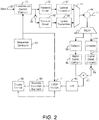
- FIG. 2 depicts an exemplary embodiment of the optical transmission system 12 and the OTDR module 17.
- a sequence generator 22 is coupled to a transmission control element 25 that receives a digital data stream 27 for transmission to the optical receiver 14 ( FIG. 1 ).
- the sequence generator 22 generates a PN sequence, such as an M-sequence, that is used to probe the fiber 15 for anomalies.
- PN sequence such as an M-sequence
- Such sequence is provided to the OTDR module 17, which correlates the transmitted sequence with measurements of optical returns to provide correlation values indicative of locations of anomalies along the fiber 15 through techniques known in the art.
- the transmission control element 25 transmits digital data to transmit drivers 31 and 32 that are used to drive optical transmitters 33 and 34 ( e . g ., lasers), respectively.
- the element 25 may control the data transmitted to the drivers 31 and 32 in various ways.
- the element 25 may selectively transmit the sequence from the generator 22 or the digital data stream 27 such that only one of the correlation sequence or the stream 27 is transmitted at a time in either a data mode or testing mode.
- the element 25 combines the sequence and the data stream 27 such that they are both simultaneously transmitted through the fiber 15.
- the data stream may be amplitude modulated with the sequence, as described in U.S. Patent Application No. 12/783,999 . Yet other techniques may be used for controlling the data output by the element 25.
- the data transmitted by the element 25 passes through an inverter 38 before being received by the transmit driver 32.
- the binary value transmitted by the transmitter 34 should be opposite to the binary value transmitted by the transmitter 33. That is, the digital signal transmitted by the transmitter 34 is inverted with respect to the signal transmitted by the transmitter 33.
- the transmitter 33 when the transmitter 33 is transmitting a logical 1, the transmitter 34 should be transmitting a logical 0 and vice versa .
- the sum of the currents through the transmitters 33 and 34 and, hence, the total power dissipated by both transmitters 33 and 34 should be constant, assuming that the transmitters 33 and 34 have similar power dissipation characteristics.
- the transmitter 34 is thermally coupled to the transmitter 33.
- the transmitters 33 and 34 may reside on the same thermally conductive chip.
- the transmitters 33 and 34 may reside on separate chips provided that they are thermally coupled.
- the transmitters 33 and 34 may reside on separate chips with thermally conductive material extending from one transmitter 33 to the other 34.
- the wavelength of light emitted by the transmitter 33 is different than the wavelength of light emitted by the transmitter 34 so that light from both transmitters 33 and 34 can simultaneously probe the same fiber 15 and then later be separated for analysis, as will be described in more detail hereafter.
- the transmitters 33 and 34 are optically coupled to the fiber 15 through a combiner 42 and a directional coupler 44.
- the combiner 42 combines the light from the transmitter 33 with the light from the transmitter 34 so that light from both transmitters 33 and 34 propagate along the fiber 15 at the same time.
- the directional coupler 44 allows light from the combiner 42 to pass to the fiber 15.
- the light backscatters and reflects at points all along the fiber 15 and returns to the directional coupler 44, which directs such returns to the wave division multiplexer 49 while blocking the returns from reaching the combiner 42 and transmitters 33 and 34.
- the wave division multiplexer 49 is configured to separate, based on wavelength, the returns for light transmitted by the transmitter 33 from the returns for light transmitted by the transmitter 34.
- the optical returns for the transmitter 33 are received and detected by a detector 53 ( e . g ., a photodiode), and the optical returns for the transmitter 34 are received and detected by a detector 54 ( e.g. , a photodiode).
- the detector 53 converts the received optical returns into an electrical signal that is conditioned ( e . g ., amplified and filtered) by a signal conditioning element 56 in an effort to enhance signal quality
- the detector 54 converts the received optical returns into an electrical signal that is conditioned by a signal conditioning element 57 in an effort to enhance signal quality.
- the electrical signals output by the detectors 53 and 54 are indicative of the optical returns and shall be referred to herein as "return signals.”
- An inverter 59 receives and inverts the return signal output by the signal conditioning element 57.
- a signal combiner 63 receives and combines (e.g., sums) the return signal from the inverter 59 with the return signal from the signal conditioning element 56.
- the signal transmitted by the transmitter 34 should be inverted with respect to the signal transmitted by the transmitter 33, as described above.
- the inverter 59 reverses this inversion so that the output of the inverter 59 should correspond to the output of the signal conditioning element 56. That is, the output of the inverter 59 should vary proportionally to the output of the signal conditioning element 56, though there may be a small amount of skew introduced in the optical path.
- light at different wavelengths propagates at slightly different speeds through the fiber 15 thereby introducing a small amount of skew in the optical signal transmitted by the transmitter 34 relative to the optical signal transmitted by the transmitter 33.
- Such skew can generally be reduced by reducing the wavelength separation of such signals.
- the inverter 59 inverts the return signal from the signal conditioning element 57 so that the operation performed by the signal combiner 63 increases signal power.
- the signal combiner 63 constructively superimposes the return signal from the inverter 59 with the return signal from the element 56 such that the power of the combined signal output from the combiner 63 is increased. Therefore, the power of such combined signal should be higher than the power of either of the return signals input to the signal combiner 63.
- This combined signal is essentially a high-power return signal indicative of the optical returns detected by the detectors 56 and 57 and having a higher signal-to-noise ratio (SNR) relative to either of the return signals input to the combiner 63.
- SNR signal-to-noise ratio
- the high-power return signal from the signal combiner 63 is converted from an analog signal to a digital signal by a digital-to-analog (A/D) converter 66, and this digital signal is received for processing by the OTDR module 17.
- the OTDR module 17 correlates (e.g., multipliers and accumulates) samples of the digital signal from the A/D 66 with a delayed version of the correlation sequence generated by the sequence generator 22 to provide correlation values that can be analyzed to identify locations of anomalies along the fiber 15. If desired, the correlation values may be displayed by a display device 68 for viewing by a user who can identify an anomaly location based on the displayed values.
- an anomaly detection element 69 is configured to receive the correlation values from the OTDR module 17 and to analyze such values to automatically detect anomalies along the fiber 15.
- Such anomaly, detection element 69 can be implemented in hardware, software, firmware, or any combination thereof.
- the anomaly detection element 69 is implemented in software and stored in memory (not shown) for execution by an execution apparatus (not shown), such as a digital signal processor (DSP).
- DSP digital signal processor
- the anomaly detection element 69 displays via the display device 68 an indication of the anomaly including its estimated distance from the transmission system 12.
- the power dissipated by the transmitter 34 for preventing or reducing temperature fluctuations in the transmitter 33 is beneficially used to probe the fiber 15 with a signal of a different wavelength so that the returns from the transmitter 34 can be combined with the returns from the transmitter 33 in order to enhance the SNR of the return signal analyzed by the OTDR module 17.
- the power dissipated by the transmitter 34 can be beneficially used in other ways.
- FIG. 3 depicts an exemplary embodiment that is used to provide additional data for improving the anomaly detection analysis performed by an anomaly, detection element 77.
- the embodiment of FIG. 3 is configured the same and operates the same as the embodiment of FIG. 2 except as is otherwise described below.
- the transmitter 34 in the embodiment of FIG. 3 like the transmitter 34 in the embodiment of FIG. 2 , transmits an optical signal that is inverted and of a different wavelength relative to the optical signal transmitted by the transmitter 33, which is thermally coupled to the transmitter 34.
- temperature fluctuations in the transmitters 33 and 34 due to patterns in the transmitted data are prevented or at least reduced thereby reducing thermal tails on measurements.
- the return signals are kept separate prior to correlation by an OTDR module.
- the return signal from the signal conditioning element 56 is converted to a digital signal by an A/D converter 81 before being received by an OTDR module 83.
- the OTDR module 83 is configured the same and operates the same as the OTDR 17 of FIG. 2 .
- the OTDR module 83 correlates samples of the digital signal from the A/D converter 81 with a delayed version of the sequence from the sequence generator 22 in order to provide correlation values that can be analyzed to detect fiber anomalies.
- the return signal from the signal conditioning element 57 is converted to a digital signal by an A/D converter 85 before being received by an OTDR module 88.
- the OTDR module 88 is configured the same and operates the same as the OTDR module 17 of FIG. 2 .
- the OTDR module 88 correlates samples of the digital signal from the A/D converter 85 with a delayed version of the sequence from the sequence generator 22 in order to provide correlation values that can be analyzed to detect fiber anomalies.
- the anomaly detection element 77 employs an algorithm that takes into account data from both the OTDR module 83 and the OTDR module 88 to more accurately detect anomalies along the fiber 15 relative to an embodiment that analyzes the data from only one of the OTDR modules 83 or 88.
- the OTDR results can be dependent on the wavelength of the light used to probe the fiber 15, and it is possible that some anomalies are more easily detected at certain wavelengths.
- probing the fiber 15 with more than one wavelength and then analyzing the results separately and/or averaging the results increases in some cases the accuracy of the decisions made by the anomaly detection element 77.
- FIG. 4 depicts an exemplary embodiment in which the power dissipated by the transmitter 34 is beneficially used to probe a second optical fiber 95 that is coupled to the transmitter 34 through a directional coupler 96.
- the transmitter 33 transmits a sequence through the fiber 15, and the transmitter 34 transmits an inverted version of the same sequence through the fiber 95.
- the transmitter 33 is thermally coupled to the transmitter 34.
- temperature fluctuations in the transmitters 33 and 34 due to data patterns are prevented or at least reduced thereby preventing or at least reducing thermal tails on the measurement data.
- optical returns from the fiber 15 are converted to an electrical signal by the detector 53, and the OTDR module 88 correlates samples from such signal with a delayed version of the transmitted sequence to determine correlation values indicative of any anomalies along the fiber 15.
- An anomaly detection element 98 analyzes such correlation values to detect at least one anomaly along the fiber 15, and the anomaly detection element 98 displays data indicative of such anomaly via the display device 68.
- optical returns from the fiber 95 are converted to an electrical signal by the detector 54, and the OTDR module 83 correlates samples from such signal with a delayed version of the transmitted sequence to determine correlation values indicative of any anomalies along the fiber 95.
- the anomaly, detection element 98 analyzes such correlation values to detect at least one anomaly along the fiber 95, and the anomaly detection element 98 displays data indicative of such anomaly via the display device 68.
- the transmitters 33 and 34 have similar power dissipation characteristics such that driving the transmitter 34 with an inverse of the current used to drive the transmitter 33 results in constant power dissipation.
- mismatches in actual power dissipation may cause differences in power dissipation, thereby resulting in temperature fluctuations that are dependent on transmission patterns.
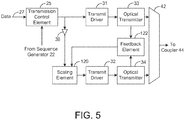
- FIG. 5 depicts an exemplary embodiment of an optical transmission system 12 for which a scaling element 120 is used to adjust the current that passes through the transmitter 34 in an effort to keep the total power dissipated by the transmitters 33 and 34 constant despite differences in their actual power dissipation characteristics.
- the element 120 scales the current passing through it based on feedback from a feedback element 122.
- the feedback element 122 is configured to measure a parameter for each of the optical transmitters 122 and to compare the measured parameters in order to determine how to adjust the scaling by the scalping element 120 in order to keep the total power dissipation by the transmitters 33 and 34 constant.
- the feedback element 122 comprises a thermistor (not shown) that is thermally coupled to and measures the temperature of the transmitter 33.
- the feedback element 122 also comprises a thermistor (not shown) that is thermally coupled to and measures the temperature of the transmitter 34. Based on the sensed temperatures, the feedback element 122 determines whether to adjust the scalping performed by the scaling element 120 and transmits a feedback signal to the element 120 for so adjusting the scaling.
- One way to adjust the scaling is based on empirical data.
- the proper adjustments based on temperature may be empirically determined, and a table indicating how the scaling should be changed based on the temperature readings may be stored by the feedback element 122.
- the feedback element 122 determines how to adjust the scaling by comparing the measured temperature readings to the table.
- the feedback element 122 may implement an algorithm for calculating or otherwise determining the appropriate scalping adjustment based on temperature.
- the light output by the transmitters 33 and 34 may be sensed and used to determine scaling.
- the feedback element has a detector (not shown), such as a photodiode, for sensing a portion of the light transmitted by the transmitter 33, and the feedback element also has a detector (not shown), such as a photodiode, for sensing a portion of the light transmitted by the transmitter 34.
- the intensity of the measured light generally indicates the power dissipated by the transmitter 33 or 34 that is transmitting it. Similar to the embodiment described above for thermistors, an empirically-determined table may be used to determine how the scaling should be adjusted based on the intensity of the measured light.
- the feedback element 122 may implement an algorithm for calculating or otherwise determining the appropriate scalping adjustment based on intensity.
- the transmitters 33 and 34 are placed in a first output state, and the die temperature for the transmitters 33 and 34 are measured. The transmitters 33 and 34 are then placed in a second output state, and the die temperature for the transmitters 33 and 34 is again measured. From those measurements, the relative currents for the transmitters 33 and 34 are adjusted (e.g., the desired scaling is established) to minimize the temperature difference between the two states.
- the scaling element 120 may be set to a desired scaling level during manufacturing without dynamically adjusting the scaling during operation.
- the transmitters 33 and 34 could be tested during manufacturing to determine their respective power dissipation characteristics, and a desired scaling level for the scaling element 120 could be selected and established based on the test results. Yet other techniques for determining the appropriate scaling are possible in other embodiments.
- the scalping element 120 as shown by FIG. 5 , may be implemented in any of the embodiments described herein.
- the various embodiments described above are exemplary, and various changes and modifications to the described embodiments are possible.
- the transmitter 34 could be replaced with a diode having similar voltage and current characteristics as the transmitter 33, or the transmitter 34 could be replaced with a resistive element that dissipates the same amount of power as the transmitter 33 during the application of complementary currents to the transmitter and resistive element.
- the transmitter 34 could be replaced with a diode having similar voltage and current characteristics as the transmitter 33, or the transmitter 34 could be replaced with a resistive element that dissipates the same amount of power as the transmitter 33 during the application of complementary currents to the transmitter and resistive element.
Landscapes
- Physics & Mathematics (AREA)
- Optics & Photonics (AREA)
- Chemical & Material Sciences (AREA)
- Analytical Chemistry (AREA)
- General Physics & Mathematics (AREA)
- Electromagnetism (AREA)
- Engineering & Computer Science (AREA)
- Computer Networks & Wireless Communication (AREA)
- Signal Processing (AREA)
- Optical Communication System (AREA)
Claims (12)
- Optisches Kommunikationssystem, welches aufweist:einen ersten Sender (33), der optisch mit mindestens einer optischen Faser (15) gekoppelt ist,einen ersten Sendertreiber (31), der ausgestaltet ist, den ersten optischen Sender mit einer Korrelationssequenz auf eine solche Weise zu treiben, dass der erste optische Sender die Korrelationssequenz über die erste optische Faser überträgt,einen zweiten optischen Sender (34), der optisch mit der mindestens einen optischen Faser gekoppelt ist und der thermisch mit dem ersten optischen Sender gekoppelt ist,einen zweiten Sendertreiber (31), der ausgestaltet ist, den zweiten Sender basierend auf der Korrelationssequenz auf eine solche Weise zu treiben, dass die Temperaturschwankungen in dem ersten Sender verringert sind,einen ersten Detektor (53), der optisch mit der mindestens einem optischen Faser gekoppelt ist und der ausgestaltet ist, Rückläufe des Lichtes von dem ersten optischen Sender zu erfassen, wobei der erste Detektor ausgestaltet ist, ein erstes elektrisches Rücklaufsignal zu übertragen, das den Rücklauf des Lichtes von dem ersten optischen Sender anzeigt, undein Modul (88) eines optischen Zeitbereichsreflektormeters - OTDR -, das ausgestaltet ist, basierend auf dem ersten elektrischen Rücklaufsignal die Werte zu bestimmen, die mindestens eine Anomalie entlang der mindestens einen optischen Faser anzeigen.
- System nach Anspruch 1, wobei die mindestens eine optische Faser eine erste optische Faser und eine zweite optische Faser aufweist, wobei der erste optische Sender optisch mit der ersten optischen Faser gekoppelt ist und wobei der zweite optische Sender mit der zweiten optischen Faser gekoppelt ist.
- System nach Anspruch 1, wobei der zweite Treiber ausgestaltet ist, den zweiten optischen Sender mit einer Korrelationssequenz zu treiben, die in Bezug auf die Korrelationssequenz invertiert ist, die verwendet wird, um den ersten optischen Sender zu treiben.
- System nach Anspruch 1, wobei der zweite Treiber ausgestaltet ist, den zweiten optischen Sender auf eine solche Weise zu treiben, dass die gesamte Leistung, die von dem ersten Sender und dem zweiten Sender verbraucht wird, konstant ist.
- System nach Anspruch 1, welches ferner aufweist:ein Skalierungselement, das mit dem zweiten Sendertreiber gekoppelt ist, wobei das Skalierungselement ausgestaltet ist, einen Strom zu skalieren, der an den zweiten Sendertreiber zugeführt wird, undein Rückkopplungselement, das ausgestaltet ist, mindestens einen Parameter zu messen, der den ersten optischen Sender und den zweiten optischen Sender anzeigt, und das basierend auf dem Parameter ein Rückkopplungssignal an das Skalierungselement überträgt.
- System nach Anspruch 1, welches ferner einen zweiten Detektor aufweist, der optisch mit der mindestens einen optischen Faser gekoppelt ist und der ausgestaltet ist, Rückläufe des Lichtes von dem zweiten optischen Sender zu erfassen, wobei der zweite optische Detektor ausgestaltet ist, ein zweites elektrisches Rücklaufsignal zu übertragen, das die Rückläufe des Lichtes von dem zweiten optischen Sender anzeigt.
- System nach Anspruch 6, welches ferner einen Signal-Kombinator aufweist, der ausgestaltet ist, das erste elektrische Rücklaufsignal mit dem zweiten elektrischen Rücklaufsignal zu kombinieren und dadurch ein kombiniertes Rücklaufsignal zu bestimmen, wobei das OTDR-Modul ausgestaltet ist, die Werte basierend auf dem. kombinierten Rücklaufsignal zu bestimmen.
- System nach Anspruch 6, welches ferner ein OTDR-Modul aufweist, das ausgestaltet ist, die Werte zu bestimmen, die mindestens eine Anomalie basierend auf dem zweiten elektrischen Rücklaufsignal anzeigen.
- Verfahren, welches aufweist:ein Treiben eines ersten optischen Senders, der optisch mit mindestens einer optischen Faser auf eine solche Weise gekoppelt ist, dass der erste optische Sender eine Korrelationssequenz über die erste optische Faser überträgt,ein Treiben eines zweiten optischen Senders basierend auf der Korrelationssequenz auf eine solche Weise, dass Temperaturschwankungen in dem ersten optischen Sender verringert sind, wobei der erste optische Sender thermisch mit dem zweiten optischen Sender gekoppelt ist,ein Erfassen von Rückläufen des Lichts, das von dem ersten optischen Sender übertragen wird, undein Erfassen von mindestens einer Anomalie entlang der mindestens einen optischen Faser basierend auf den Rückläufen.
- Verfahren nach Anspruch 9, wobei das Treiben des zweiten optischen Senders auf eine solche Weise durchgeführt wird, dass die gesamte Leistung, die von dem ersten Sender und dem zweiten Sender verbraucht wird, konstant ist.
- Verfahren nach Anspruch 9, welches ferner ein Invertieren der Korrelationssequenz aufweist, wodurch eine invertierte Korrelationssequenz gebildet wird, wobei das Treiben des zweiten optischen Senders ein Treiben des zweiten optischen Senders mit der invertierten Korrelationssequenz aufweist.
- Verfahren nach Anspruch 9, welches ferner aufweist:ein Bereitstellen eines ersten elektrischen Signals, das die Rückläufe des Lichts anzeigt, das von dem ersten optischen Sender übertragen worden ist,ein Erfassen der Rückläufe des Lichts, das von dem zweiten optischen Sender übertragen worden ist, undein Kombinieren des ersten elektrischen Rücklaufsignals mit dem zweiten elektrischen Rücklaufsignal, wodurch ein kombiniertes Rücklaufsignal bestimmt wird,wobei das Erfassen der mindestens einen Anomalie auf dem kombinierten Rücklaufsignal basiert.
Applications Claiming Priority (2)
| Application Number | Priority Date | Filing Date | Title |
|---|---|---|---|
| US201261607374P | 2012-03-06 | 2012-03-06 | |
| PCT/US2013/029385 WO2013134394A1 (en) | 2012-03-06 | 2013-03-06 | Systems and methods for reducing thermal tails on optical time domain reflectometer (otdr) measurements |
Publications (3)
| Publication Number | Publication Date |
|---|---|
| EP2842243A1 EP2842243A1 (de) | 2015-03-04 |
| EP2842243A4 EP2842243A4 (de) | 2016-01-13 |
| EP2842243B1 true EP2842243B1 (de) | 2017-06-07 |
Family
ID=49117296
Family Applications (1)
| Application Number | Title | Priority Date | Filing Date |
|---|---|---|---|
| EP13757706.0A Active EP2842243B1 (de) | 2012-03-06 | 2013-03-06 | Systeme und verfahren zur reduzierung von thermischen rückständen bei messungen mit optischem zeitbereichsreflektometer (otdr) |
Country Status (3)
| Country | Link |
|---|---|
| US (1) | US9191102B2 (de) |
| EP (1) | EP2842243B1 (de) |
| WO (1) | WO2013134394A1 (de) |
Families Citing this family (10)
| Publication number | Priority date | Publication date | Assignee | Title |
|---|---|---|---|---|
| US9438335B2 (en) * | 2013-12-26 | 2016-09-06 | Texas Instruments Incorporated | Optical fiber defect detection |
| CN106105062B (zh) * | 2014-03-07 | 2019-04-16 | 日本电气株式会社 | 光传输装置、光通信装置、光通信系统和光传输方法 |
| US9341543B2 (en) | 2014-10-16 | 2016-05-17 | Texas Instruments Incorporated | Method and OTDR apparatus for optical cable defect location with reduced memory requirement |
| KR102068559B1 (ko) * | 2015-02-05 | 2020-02-24 | 한국전자통신연구원 | 트레이스 기반 자동 이득 제어 가능한 광 선로 감시 장치 및 방법 |
| US9960845B2 (en) * | 2016-06-30 | 2018-05-01 | Alcatel-Lucent Usa Inc. | In-band optical-link monitoring for a WDM network |
| WO2018131242A1 (ja) * | 2017-01-16 | 2018-07-19 | ソニーセミコンダクタソリューションズ株式会社 | 送信制御装置、受信制御装置および送受信制御システム |
| US20180259422A1 (en) * | 2017-03-10 | 2018-09-13 | Panduit Corp. | High Resolution Correlation Optical Time Domain Reflectometer |
| US10135531B1 (en) | 2017-07-20 | 2018-11-20 | Adtran, Inc. | Systems and methods for cancellation of undesired reflections in testing of optical fibers |
| US11296786B2 (en) * | 2020-04-07 | 2022-04-05 | Nec Corporation | Constant amplitude coded DFOS using out-of-band signaling |
| CN119945541A (zh) * | 2023-11-02 | 2025-05-06 | 福州高意通讯有限公司 | 光学时域反射系统和方法 |
Family Cites Families (36)
| Publication number | Priority date | Publication date | Assignee | Title |
|---|---|---|---|---|
| US5185635A (en) * | 1990-04-25 | 1993-02-09 | Tektronix, Inc. | Method of calibrating and controlling the optical power output of an OTDR |
| JPH09321701A (ja) * | 1996-05-31 | 1997-12-12 | Fujitsu Ltd | 光通信システム及び光増幅器 |
| US5872624A (en) * | 1997-06-05 | 1999-02-16 | Gn Nettest (New York) | Method and apparatus for retroreflectively reducing coherence/polarization noise in reflectometers |
| JP2904131B2 (ja) * | 1996-07-04 | 1999-06-14 | 日本電気株式会社 | 波長多重光増幅装置と波長多重光伝送装置 |
| US5966206A (en) * | 1996-10-10 | 1999-10-12 | Tyco Submarine Systems Ltd. | Interlocked high power fiber system using OTDR |
| US6128111A (en) * | 1996-12-19 | 2000-10-03 | Nortel Networks Corporation | Monitoring of nonlinear effects |
| JP2914334B2 (ja) * | 1997-01-20 | 1999-06-28 | 日本電気株式会社 | 光波長多重通信システムの光増幅器出力レベル制御方式 |
| JP2001141830A (ja) * | 1999-11-16 | 2001-05-25 | Hitachi Ltd | 温度補償型光伝送式放射線計測装置及びその計測システム |
| WO2002035665A1 (en) * | 2000-10-19 | 2002-05-02 | Fujitsu Limited | Optical transmitter, optical repeater and optical receiver, and optical transmitting method |
| US6522796B1 (en) * | 2000-10-24 | 2003-02-18 | Jds Uniphase Corporation | Depolarizing polarization mode combiner |
| JP2002168733A (ja) * | 2000-11-29 | 2002-06-14 | Ando Electric Co Ltd | 光ファイバ波長分散分布測定器及び測定方法 |
| JP3587176B2 (ja) * | 2001-04-02 | 2004-11-10 | 日本電気株式会社 | ラマン増幅器及びラマン増幅方法 |
| US6842586B2 (en) * | 2003-01-23 | 2005-01-11 | Red Sky Systems, Inc. | OTDR arrangement for detecting faults in an optical transmission system employing two pairs of unidirectional optical fibers |
| US8655166B2 (en) * | 2003-03-03 | 2014-02-18 | Alexander I Soto | System and method for performing in-service optical fiber network certification |
| US6784746B1 (en) | 2003-04-17 | 2004-08-31 | Agilent Technologies, Inc. | Circuit and method for correcting thermal deviations of one or more output signals from an amplifier with early effect compensation |
| JP2005354032A (ja) | 2004-05-12 | 2005-12-22 | Canon Inc | 分布ブラッグ反射型半導体レーザの制御方法および画像投影装置 |
| US7489626B2 (en) * | 2005-02-16 | 2009-02-10 | Dell Products L.P. | Method of using cable test to modify teaming failover algorithm |
| US20070086495A1 (en) | 2005-08-12 | 2007-04-19 | Sprague Randall B | Method and apparatus for stable laser drive |
| US7864717B2 (en) * | 2006-01-09 | 2011-01-04 | Flextronics Automotive Inc. | Modem for communicating data over a voice channel of a communications system |
| US20070197169A1 (en) * | 2006-02-01 | 2007-08-23 | Viss Marlin E | Systems and methods for transmitter and channel characterization |
| JP4860751B2 (ja) * | 2006-04-26 | 2012-01-25 | ミンテラ・コーポレイション | 部分dpsk(pdpsk)伝送システム |
| EP2037250A4 (de) * | 2006-07-03 | 2015-03-25 | Anritsu Corp | Optisches zeitbereichsreflektometer und verfahren zum testen einer glasfaser mittels optischen impulses |
| US7715718B2 (en) * | 2006-08-01 | 2010-05-11 | Alcatel Lucent | Passive optical network optical time-domain reflectometry |
| US7504886B2 (en) | 2006-09-11 | 2009-03-17 | Lecroy Corporation | Thermal tail compensation |
| US7514997B2 (en) | 2006-09-11 | 2009-04-07 | Lecroy Corporation | Common mode regulation for thermal tail compensation |
| GB2443661B (en) | 2006-11-08 | 2011-08-31 | Polarmetrix Ltd | Detecting a disturbance in the phase of light propogating in an optical waveguide |
| TWI378661B (en) * | 2008-01-04 | 2012-12-01 | Amtran Technology Co Ltd | Data transmission system using optical fiber and home entertainment system using hdcp |
| ES2656788T3 (es) * | 2008-05-09 | 2018-02-28 | Afl Telecommunications Llc | Reflectómetro óptico en el dominio del tiempo |
| US7859654B2 (en) * | 2008-07-17 | 2010-12-28 | Schlumberger Technology Corporation | Frequency-scanned optical time domain reflectometry |
| CN101790111B (zh) * | 2009-01-23 | 2014-09-17 | 华为技术有限公司 | 一种光分布网检测方法、装置及系统 |
| JP5652889B2 (ja) * | 2009-07-15 | 2015-01-14 | ピーエムシー−シエラ イスラエル,エルティディ. | 受動的光ネットワーク(pon)インバンド光学的時間範囲反射率測定器(otdr) |
| KR101095590B1 (ko) * | 2009-10-30 | 2011-12-19 | 동의대학교 산학협력단 | 라만 otdr 온도센서에서의 온도 분포 측정 방법 |
| US9036991B2 (en) * | 2009-10-30 | 2015-05-19 | Hewlett-Packard Development Company, L.P. | Optical transceiver having an OTDR mode, and a method of obtaining test data for testing an optical fiber |
| US9008515B2 (en) * | 2010-10-07 | 2015-04-14 | Alcatel Lucent | Direct laser modulation |
| US9544668B2 (en) * | 2010-12-13 | 2017-01-10 | Neophotonics Corporation | Optical network communication system with optical line terminal transceiver and method of operation thereof |
| CN102170309B (zh) * | 2011-03-24 | 2014-06-11 | 索尔思光电(成都)有限公司 | 一种集成otdr监测功能的olt光模块 |
-
2013
- 2013-03-06 EP EP13757706.0A patent/EP2842243B1/de active Active
- 2013-03-06 US US13/786,636 patent/US9191102B2/en active Active
- 2013-03-06 WO PCT/US2013/029385 patent/WO2013134394A1/en not_active Ceased
Non-Patent Citations (1)
| Title |
|---|
| None * |
Also Published As
| Publication number | Publication date |
|---|---|
| US9191102B2 (en) | 2015-11-17 |
| EP2842243A4 (de) | 2016-01-13 |
| EP2842243A1 (de) | 2015-03-04 |
| WO2013134394A1 (en) | 2013-09-12 |
| US20130251363A1 (en) | 2013-09-26 |
Similar Documents
| Publication | Publication Date | Title |
|---|---|---|
| EP2842243B1 (de) | Systeme und verfahren zur reduzierung von thermischen rückständen bei messungen mit optischem zeitbereichsreflektometer (otdr) | |
| US10014935B2 (en) | Multiple-acquisition OTDR method and device | |
| CN102292621B (zh) | 分布式光纤感测中的改进 | |
| EP3407049B1 (de) | Messung von polarität, leistung und verlust eines optischen arrays mit einem positionserfassungsdetektor und optische prüfvorrichtung mit einem photodetektor | |
| CN108627317A (zh) | 光纤测试方法、设备及系统 | |
| CN101743460A (zh) | 分布式温度系统中的双源自动校正 | |
| JP6060099B2 (ja) | 光ファイバ特性解析装置および光ファイバ特性解析方法 | |
| JP2006505791A (ja) | 偏光光学時間領域反射率測定を用いたファイバpmdの評価方法 | |
| JP7088611B2 (ja) | 標準化出力による高分解能ラインモニタリングのための技術及びそれを用いる光通信システム | |
| US20250175250A1 (en) | Optical time-domain reflectometer (otdr) event detection and light power level measurement-based fiber optic link certification | |
| JP6896354B2 (ja) | 光パルス試験装置及び光パルス試験方法 | |
| JP2007024881A (ja) | 部分応答を時間調整する光反射測定解析 | |
| US7411666B2 (en) | Optical time domain reflectometry system at different wavelengths | |
| WO2009092436A1 (en) | Distributed temperature sensing using two wavelengths differing by a raman shift of a waveguide | |
| CN101228427B (zh) | 使用复合potdr踪迹来评估光纤pmd的方法 | |
| US10887012B1 (en) | Systems and methods for tuning lasers using reflected optical signals | |
| CN107014409A (zh) | 一种长距离光频域反射光纤分布式多点扰动传感方法 | |
| KR101210465B1 (ko) | 고장점 탐지기 일체형 광 파워메타 | |
| US7016023B2 (en) | Chromatic dispersion measurement | |
| Bogachkov et al. | Improvement of devices for early diagnostics of the optical fibers state of telecommunications systems | |
| EP0998662B1 (de) | Wellenlängenmesssystem | |
| CN116707628A (zh) | 一种传输信号的方法和装置 | |
| WO2007016976A1 (en) | Optical reflectometry analysis based on first order and second order scatter signals | |
| Parkes | Data Signal-Based Distributed Fibre Optic Sensing Techniques for Detecting and Locating Eavesdropping Attacks | |
| JPH11183135A (ja) | 分布型歪計測装置 |
Legal Events
| Date | Code | Title | Description |
|---|---|---|---|
| PUAI | Public reference made under article 153(3) epc to a published international application that has entered the european phase |
Free format text: ORIGINAL CODE: 0009012 |
|
| 17P | Request for examination filed |
Effective date: 20141006 |
|
| AK | Designated contracting states |
Kind code of ref document: A1 Designated state(s): AL AT BE BG CH CY CZ DE DK EE ES FI FR GB GR HR HU IE IS IT LI LT LU LV MC MK MT NL NO PL PT RO RS SE SI SK SM TR |
|
| AX | Request for extension of the european patent |
Extension state: BA ME |
|
| DAX | Request for extension of the european patent (deleted) | ||
| RA4 | Supplementary search report drawn up and despatched (corrected) |
Effective date: 20151214 |
|
| RIC1 | Information provided on ipc code assigned before grant |
Ipc: H04B 10/25 20130101ALI20151208BHEP Ipc: H04B 10/071 20130101AFI20151208BHEP Ipc: G01M 11/00 20060101ALI20151208BHEP |
|
| GRAP | Despatch of communication of intention to grant a patent |
Free format text: ORIGINAL CODE: EPIDOSNIGR1 |
|
| STAA | Information on the status of an ep patent application or granted ep patent |
Free format text: STATUS: GRANT OF PATENT IS INTENDED |
|
| INTG | Intention to grant announced |
Effective date: 20161121 |
|
| GRAS | Grant fee paid |
Free format text: ORIGINAL CODE: EPIDOSNIGR3 |
|
| GRAJ | Information related to disapproval of communication of intention to grant by the applicant or resumption of examination proceedings by the epo deleted |
Free format text: ORIGINAL CODE: EPIDOSDIGR1 |
|
| GRAL | Information related to payment of fee for publishing/printing deleted |
Free format text: ORIGINAL CODE: EPIDOSDIGR3 |
|
| STAA | Information on the status of an ep patent application or granted ep patent |
Free format text: STATUS: REQUEST FOR EXAMINATION WAS MADE |
|
| GRAR | Information related to intention to grant a patent recorded |
Free format text: ORIGINAL CODE: EPIDOSNIGR71 |
|
| STAA | Information on the status of an ep patent application or granted ep patent |
Free format text: STATUS: GRANT OF PATENT IS INTENDED |
|
| INTC | Intention to grant announced (deleted) | ||
| AK | Designated contracting states |
Kind code of ref document: B1 Designated state(s): AL AT BE BG CH CY CZ DE DK EE ES FI FR GB GR HR HU IE IS IT LI LT LU LV MC MK MT NL NO PL PT RO RS SE SI SK SM TR |
|
| INTG | Intention to grant announced |
Effective date: 20170428 |
|
| REG | Reference to a national code |
Ref country code: GB Ref legal event code: FG4D |
|
| GRAA | (expected) grant |
Free format text: ORIGINAL CODE: 0009210 |
|
| REG | Reference to a national code |
Ref country code: CH Ref legal event code: EP Ref country code: AT Ref legal event code: REF Ref document number: 899927 Country of ref document: AT Kind code of ref document: T Effective date: 20170615 |
|
| STAA | Information on the status of an ep patent application or granted ep patent |
Free format text: STATUS: THE PATENT HAS BEEN GRANTED |
|
| REG | Reference to a national code |
Ref country code: IE Ref legal event code: FG4D |
|
| REG | Reference to a national code |
Ref country code: DE Ref legal event code: R096 Ref document number: 602013022003 Country of ref document: DE |
|
| REG | Reference to a national code |
Ref country code: NL Ref legal event code: MP Effective date: 20170607 |
|
| REG | Reference to a national code |
Ref country code: LT Ref legal event code: MG4D |
|
| PG25 | Lapsed in a contracting state [announced via postgrant information from national office to epo] |
Ref country code: GR Free format text: LAPSE BECAUSE OF FAILURE TO SUBMIT A TRANSLATION OF THE DESCRIPTION OR TO PAY THE FEE WITHIN THE PRESCRIBED TIME-LIMIT Effective date: 20170908 Ref country code: NO Free format text: LAPSE BECAUSE OF FAILURE TO SUBMIT A TRANSLATION OF THE DESCRIPTION OR TO PAY THE FEE WITHIN THE PRESCRIBED TIME-LIMIT Effective date: 20170907 Ref country code: LT Free format text: LAPSE BECAUSE OF FAILURE TO SUBMIT A TRANSLATION OF THE DESCRIPTION OR TO PAY THE FEE WITHIN THE PRESCRIBED TIME-LIMIT Effective date: 20170607 Ref country code: HR Free format text: LAPSE BECAUSE OF FAILURE TO SUBMIT A TRANSLATION OF THE DESCRIPTION OR TO PAY THE FEE WITHIN THE PRESCRIBED TIME-LIMIT Effective date: 20170607 Ref country code: ES Free format text: LAPSE BECAUSE OF FAILURE TO SUBMIT A TRANSLATION OF THE DESCRIPTION OR TO PAY THE FEE WITHIN THE PRESCRIBED TIME-LIMIT Effective date: 20170607 Ref country code: FI Free format text: LAPSE BECAUSE OF FAILURE TO SUBMIT A TRANSLATION OF THE DESCRIPTION OR TO PAY THE FEE WITHIN THE PRESCRIBED TIME-LIMIT Effective date: 20170607 |
|
| REG | Reference to a national code |
Ref country code: AT Ref legal event code: MK05 Ref document number: 899927 Country of ref document: AT Kind code of ref document: T Effective date: 20170607 |
|
| PG25 | Lapsed in a contracting state [announced via postgrant information from national office to epo] |
Ref country code: SE Free format text: LAPSE BECAUSE OF FAILURE TO SUBMIT A TRANSLATION OF THE DESCRIPTION OR TO PAY THE FEE WITHIN THE PRESCRIBED TIME-LIMIT Effective date: 20170607 Ref country code: RS Free format text: LAPSE BECAUSE OF FAILURE TO SUBMIT A TRANSLATION OF THE DESCRIPTION OR TO PAY THE FEE WITHIN THE PRESCRIBED TIME-LIMIT Effective date: 20170607 Ref country code: NL Free format text: LAPSE BECAUSE OF FAILURE TO SUBMIT A TRANSLATION OF THE DESCRIPTION OR TO PAY THE FEE WITHIN THE PRESCRIBED TIME-LIMIT Effective date: 20170607 Ref country code: BG Free format text: LAPSE BECAUSE OF FAILURE TO SUBMIT A TRANSLATION OF THE DESCRIPTION OR TO PAY THE FEE WITHIN THE PRESCRIBED TIME-LIMIT Effective date: 20170907 Ref country code: LV Free format text: LAPSE BECAUSE OF FAILURE TO SUBMIT A TRANSLATION OF THE DESCRIPTION OR TO PAY THE FEE WITHIN THE PRESCRIBED TIME-LIMIT Effective date: 20170607 |
|
| PG25 | Lapsed in a contracting state [announced via postgrant information from national office to epo] |
Ref country code: SK Free format text: LAPSE BECAUSE OF FAILURE TO SUBMIT A TRANSLATION OF THE DESCRIPTION OR TO PAY THE FEE WITHIN THE PRESCRIBED TIME-LIMIT Effective date: 20170607 Ref country code: AT Free format text: LAPSE BECAUSE OF FAILURE TO SUBMIT A TRANSLATION OF THE DESCRIPTION OR TO PAY THE FEE WITHIN THE PRESCRIBED TIME-LIMIT Effective date: 20170607 Ref country code: EE Free format text: LAPSE BECAUSE OF FAILURE TO SUBMIT A TRANSLATION OF THE DESCRIPTION OR TO PAY THE FEE WITHIN THE PRESCRIBED TIME-LIMIT Effective date: 20170607 Ref country code: RO Free format text: LAPSE BECAUSE OF FAILURE TO SUBMIT A TRANSLATION OF THE DESCRIPTION OR TO PAY THE FEE WITHIN THE PRESCRIBED TIME-LIMIT Effective date: 20170607 Ref country code: CZ Free format text: LAPSE BECAUSE OF FAILURE TO SUBMIT A TRANSLATION OF THE DESCRIPTION OR TO PAY THE FEE WITHIN THE PRESCRIBED TIME-LIMIT Effective date: 20170607 |
|
| PG25 | Lapsed in a contracting state [announced via postgrant information from national office to epo] |
Ref country code: IS Free format text: LAPSE BECAUSE OF FAILURE TO SUBMIT A TRANSLATION OF THE DESCRIPTION OR TO PAY THE FEE WITHIN THE PRESCRIBED TIME-LIMIT Effective date: 20171007 Ref country code: PL Free format text: LAPSE BECAUSE OF FAILURE TO SUBMIT A TRANSLATION OF THE DESCRIPTION OR TO PAY THE FEE WITHIN THE PRESCRIBED TIME-LIMIT Effective date: 20170607 Ref country code: SM Free format text: LAPSE BECAUSE OF FAILURE TO SUBMIT A TRANSLATION OF THE DESCRIPTION OR TO PAY THE FEE WITHIN THE PRESCRIBED TIME-LIMIT Effective date: 20170607 Ref country code: IT Free format text: LAPSE BECAUSE OF FAILURE TO SUBMIT A TRANSLATION OF THE DESCRIPTION OR TO PAY THE FEE WITHIN THE PRESCRIBED TIME-LIMIT Effective date: 20170607 |
|
| REG | Reference to a national code |
Ref country code: DE Ref legal event code: R097 Ref document number: 602013022003 Country of ref document: DE |
|
| REG | Reference to a national code |
Ref country code: FR Ref legal event code: PLFP Year of fee payment: 6 |
|
| PLBE | No opposition filed within time limit |
Free format text: ORIGINAL CODE: 0009261 |
|
| STAA | Information on the status of an ep patent application or granted ep patent |
Free format text: STATUS: NO OPPOSITION FILED WITHIN TIME LIMIT |
|
| PG25 | Lapsed in a contracting state [announced via postgrant information from national office to epo] |
Ref country code: DK Free format text: LAPSE BECAUSE OF FAILURE TO SUBMIT A TRANSLATION OF THE DESCRIPTION OR TO PAY THE FEE WITHIN THE PRESCRIBED TIME-LIMIT Effective date: 20170607 |
|
| 26N | No opposition filed |
Effective date: 20180308 |
|
| PG25 | Lapsed in a contracting state [announced via postgrant information from national office to epo] |
Ref country code: SI Free format text: LAPSE BECAUSE OF FAILURE TO SUBMIT A TRANSLATION OF THE DESCRIPTION OR TO PAY THE FEE WITHIN THE PRESCRIBED TIME-LIMIT Effective date: 20170607 |
|
| REG | Reference to a national code |
Ref country code: CH Ref legal event code: PL |
|
| PG25 | Lapsed in a contracting state [announced via postgrant information from national office to epo] |
Ref country code: MC Free format text: LAPSE BECAUSE OF FAILURE TO SUBMIT A TRANSLATION OF THE DESCRIPTION OR TO PAY THE FEE WITHIN THE PRESCRIBED TIME-LIMIT Effective date: 20170607 |
|
| REG | Reference to a national code |
Ref country code: BE Ref legal event code: MM Effective date: 20180331 |
|
| REG | Reference to a national code |
Ref country code: IE Ref legal event code: MM4A |
|
| PG25 | Lapsed in a contracting state [announced via postgrant information from national office to epo] |
Ref country code: LU Free format text: LAPSE BECAUSE OF NON-PAYMENT OF DUE FEES Effective date: 20180306 |
|
| PG25 | Lapsed in a contracting state [announced via postgrant information from national office to epo] |
Ref country code: IE Free format text: LAPSE BECAUSE OF NON-PAYMENT OF DUE FEES Effective date: 20180306 |
|
| PG25 | Lapsed in a contracting state [announced via postgrant information from national office to epo] |
Ref country code: LI Free format text: LAPSE BECAUSE OF NON-PAYMENT OF DUE FEES Effective date: 20180331 Ref country code: CH Free format text: LAPSE BECAUSE OF NON-PAYMENT OF DUE FEES Effective date: 20180331 Ref country code: BE Free format text: LAPSE BECAUSE OF NON-PAYMENT OF DUE FEES Effective date: 20180331 |
|
| PG25 | Lapsed in a contracting state [announced via postgrant information from national office to epo] |
Ref country code: MT Free format text: LAPSE BECAUSE OF NON-PAYMENT OF DUE FEES Effective date: 20180306 |
|
| PG25 | Lapsed in a contracting state [announced via postgrant information from national office to epo] |
Ref country code: TR Free format text: LAPSE BECAUSE OF FAILURE TO SUBMIT A TRANSLATION OF THE DESCRIPTION OR TO PAY THE FEE WITHIN THE PRESCRIBED TIME-LIMIT Effective date: 20170607 |
|
| PG25 | Lapsed in a contracting state [announced via postgrant information from national office to epo] |
Ref country code: PT Free format text: LAPSE BECAUSE OF FAILURE TO SUBMIT A TRANSLATION OF THE DESCRIPTION OR TO PAY THE FEE WITHIN THE PRESCRIBED TIME-LIMIT Effective date: 20170607 |
|
| PG25 | Lapsed in a contracting state [announced via postgrant information from national office to epo] |
Ref country code: HU Free format text: LAPSE BECAUSE OF FAILURE TO SUBMIT A TRANSLATION OF THE DESCRIPTION OR TO PAY THE FEE WITHIN THE PRESCRIBED TIME-LIMIT; INVALID AB INITIO Effective date: 20130306 Ref country code: MK Free format text: LAPSE BECAUSE OF NON-PAYMENT OF DUE FEES Effective date: 20170607 Ref country code: CY Free format text: LAPSE BECAUSE OF FAILURE TO SUBMIT A TRANSLATION OF THE DESCRIPTION OR TO PAY THE FEE WITHIN THE PRESCRIBED TIME-LIMIT Effective date: 20170607 |
|
| PG25 | Lapsed in a contracting state [announced via postgrant information from national office to epo] |
Ref country code: AL Free format text: LAPSE BECAUSE OF FAILURE TO SUBMIT A TRANSLATION OF THE DESCRIPTION OR TO PAY THE FEE WITHIN THE PRESCRIBED TIME-LIMIT Effective date: 20170607 |
|
| P01 | Opt-out of the competence of the unified patent court (upc) registered |
Effective date: 20230630 |
|
| PGFP | Annual fee paid to national office [announced via postgrant information from national office to epo] |
Ref country code: GB Payment date: 20260327 Year of fee payment: 14 |
|
| PGFP | Annual fee paid to national office [announced via postgrant information from national office to epo] |
Ref country code: DE Payment date: 20260327 Year of fee payment: 14 |
|
| PGFP | Annual fee paid to national office [announced via postgrant information from national office to epo] |
Ref country code: FR Payment date: 20260325 Year of fee payment: 14 |