EP2840646A1 - Optical power generation system and electrical storage apparatus - Google Patents
Optical power generation system and electrical storage apparatus Download PDFInfo
- Publication number
- EP2840646A1 EP2840646A1 EP13778045.8A EP13778045A EP2840646A1 EP 2840646 A1 EP2840646 A1 EP 2840646A1 EP 13778045 A EP13778045 A EP 13778045A EP 2840646 A1 EP2840646 A1 EP 2840646A1
- Authority
- EP
- European Patent Office
- Prior art keywords
- section
- power storage
- power
- power generation
- electrode section
- Prior art date
- Legal status (The legal status is an assumption and is not a legal conclusion. Google has not performed a legal analysis and makes no representation as to the accuracy of the status listed.)
- Withdrawn
Links
Images



Classifications
-
- H—ELECTRICITY
- H01—ELECTRIC ELEMENTS
- H01M—PROCESSES OR MEANS, e.g. BATTERIES, FOR THE DIRECT CONVERSION OF CHEMICAL ENERGY INTO ELECTRICAL ENERGY
- H01M10/00—Secondary cells; Manufacture thereof
- H01M10/42—Methods or arrangements for servicing or maintenance of secondary cells or secondary half-cells
- H01M10/46—Accumulators structurally combined with charging apparatus
- H01M10/465—Accumulators structurally combined with charging apparatus with solar battery as charging system
-
- H—ELECTRICITY
- H02—GENERATION; CONVERSION OR DISTRIBUTION OF ELECTRIC POWER
- H02S—GENERATION OF ELECTRIC POWER BY CONVERSION OF INFRARED RADIATION, VISIBLE LIGHT OR ULTRAVIOLET LIGHT, e.g. USING PHOTOVOLTAIC [PV] MODULES
- H02S40/00—Components or accessories in combination with PV modules, not provided for in groups H02S10/00 - H02S30/00
- H02S40/30—Electrical components
- H02S40/38—Energy storage means, e.g. batteries, structurally associated with PV modules
-
- H—ELECTRICITY
- H01—ELECTRIC ELEMENTS
- H01G—CAPACITORS; CAPACITORS, RECTIFIERS, DETECTORS, SWITCHING DEVICES, LIGHT-SENSITIVE OR TEMPERATURE-SENSITIVE DEVICES OF THE ELECTROLYTIC TYPE
- H01G9/00—Electrolytic capacitors, rectifiers, detectors, switching devices, light-sensitive or temperature-sensitive devices; Processes of their manufacture
- H01G9/20—Light-sensitive devices
- H01G9/2068—Panels or arrays of photoelectrochemical cells, e.g. photovoltaic modules based on photoelectrochemical cells
- H01G9/2081—Serial interconnection of cells
-
- H—ELECTRICITY
- H02—GENERATION; CONVERSION OR DISTRIBUTION OF ELECTRIC POWER
- H02J—ELECTRIC POWER NETWORKS; CIRCUIT ARRANGEMENTS OR SYSTEMS FOR SUPPLYING OR DISTRIBUTING ELECTRIC POWER; SYSTEMS FOR STORING ELECTRIC ENERGY
- H02J7/00—Circuit arrangements for charging or discharging batteries or for supplying loads from batteries
- H02J7/34—Parallel operation in networks using both storage and other DC sources, e.g. providing buffering
- H02J7/35—Parallel operation in networks using both storage and other DC sources, e.g. providing buffering with light sensitive cells
-
- H—ELECTRICITY
- H10—SEMICONDUCTOR DEVICES; ELECTRIC SOLID-STATE DEVICES NOT OTHERWISE PROVIDED FOR
- H10F—INORGANIC SEMICONDUCTOR DEVICES SENSITIVE TO INFRARED RADIATION, LIGHT, ELECTROMAGNETIC RADIATION OF SHORTER WAVELENGTH OR CORPUSCULAR RADIATION
- H10F19/00—Integrated devices, or assemblies of multiple devices, comprising at least one photovoltaic cell covered by group H10F10/00, e.g. photovoltaic modules
- H10F19/90—Structures for connecting between photovoltaic cells, e.g. interconnections or insulating spacers
- H10F19/902—Structures for connecting between photovoltaic cells, e.g. interconnections or insulating spacers for series or parallel connection of photovoltaic cells
-
- H—ELECTRICITY
- H10—SEMICONDUCTOR DEVICES; ELECTRIC SOLID-STATE DEVICES NOT OTHERWISE PROVIDED FOR
- H10W—GENERIC PACKAGES, INTERCONNECTIONS, CONNECTORS OR OTHER CONSTRUCTIONAL DETAILS OF DEVICES COVERED BY CLASS H10
- H10W72/00—Interconnections or connectors in packages
-
- H—ELECTRICITY
- H01—ELECTRIC ELEMENTS
- H01G—CAPACITORS; CAPACITORS, RECTIFIERS, DETECTORS, SWITCHING DEVICES, LIGHT-SENSITIVE OR TEMPERATURE-SENSITIVE DEVICES OF THE ELECTROLYTIC TYPE
- H01G9/00—Electrolytic capacitors, rectifiers, detectors, switching devices, light-sensitive or temperature-sensitive devices; Processes of their manufacture
- H01G9/20—Light-sensitive devices
- H01G9/2027—Light-sensitive devices comprising an oxide semiconductor electrode
- H01G9/2031—Light-sensitive devices comprising an oxide semiconductor electrode comprising titanium oxide, e.g. TiO2
-
- H—ELECTRICITY
- H01—ELECTRIC ELEMENTS
- H01G—CAPACITORS; CAPACITORS, RECTIFIERS, DETECTORS, SWITCHING DEVICES, LIGHT-SENSITIVE OR TEMPERATURE-SENSITIVE DEVICES OF THE ELECTROLYTIC TYPE
- H01G9/00—Electrolytic capacitors, rectifiers, detectors, switching devices, light-sensitive or temperature-sensitive devices; Processes of their manufacture
- H01G9/20—Light-sensitive devices
- H01G9/2059—Light-sensitive devices comprising an organic dye as the active light absorbing material, e.g. adsorbed on an electrode or dissolved in solution
-
- H—ELECTRICITY
- H01—ELECTRIC ELEMENTS
- H01M—PROCESSES OR MEANS, e.g. BATTERIES, FOR THE DIRECT CONVERSION OF CHEMICAL ENERGY INTO ELECTRICAL ENERGY
- H01M4/00—Electrodes
- H01M4/02—Electrodes composed of, or comprising, active material
- H01M4/36—Selection of substances as active materials, active masses, active liquids
- H01M4/48—Selection of substances as active materials, active masses, active liquids of inorganic oxides or hydroxides
-
- Y—GENERAL TAGGING OF NEW TECHNOLOGICAL DEVELOPMENTS; GENERAL TAGGING OF CROSS-SECTIONAL TECHNOLOGIES SPANNING OVER SEVERAL SECTIONS OF THE IPC; TECHNICAL SUBJECTS COVERED BY FORMER USPC CROSS-REFERENCE ART COLLECTIONS [XRACs] AND DIGESTS
- Y02—TECHNOLOGIES OR APPLICATIONS FOR MITIGATION OR ADAPTATION AGAINST CLIMATE CHANGE
- Y02E—REDUCTION OF GREENHOUSE GAS [GHG] EMISSIONS, RELATED TO ENERGY GENERATION, TRANSMISSION OR DISTRIBUTION
- Y02E10/00—Energy generation through renewable energy sources
- Y02E10/50—Photovoltaic [PV] energy
-
- Y—GENERAL TAGGING OF NEW TECHNOLOGICAL DEVELOPMENTS; GENERAL TAGGING OF CROSS-SECTIONAL TECHNOLOGIES SPANNING OVER SEVERAL SECTIONS OF THE IPC; TECHNICAL SUBJECTS COVERED BY FORMER USPC CROSS-REFERENCE ART COLLECTIONS [XRACs] AND DIGESTS
- Y02—TECHNOLOGIES OR APPLICATIONS FOR MITIGATION OR ADAPTATION AGAINST CLIMATE CHANGE
- Y02E—REDUCTION OF GREENHOUSE GAS [GHG] EMISSIONS, RELATED TO ENERGY GENERATION, TRANSMISSION OR DISTRIBUTION
- Y02E10/00—Energy generation through renewable energy sources
- Y02E10/50—Photovoltaic [PV] energy
- Y02E10/542—Dye sensitized solar cells
-
- Y—GENERAL TAGGING OF NEW TECHNOLOGICAL DEVELOPMENTS; GENERAL TAGGING OF CROSS-SECTIONAL TECHNOLOGIES SPANNING OVER SEVERAL SECTIONS OF THE IPC; TECHNICAL SUBJECTS COVERED BY FORMER USPC CROSS-REFERENCE ART COLLECTIONS [XRACs] AND DIGESTS
- Y02—TECHNOLOGIES OR APPLICATIONS FOR MITIGATION OR ADAPTATION AGAINST CLIMATE CHANGE
- Y02E—REDUCTION OF GREENHOUSE GAS [GHG] EMISSIONS, RELATED TO ENERGY GENERATION, TRANSMISSION OR DISTRIBUTION
- Y02E10/00—Energy generation through renewable energy sources
- Y02E10/50—Photovoltaic [PV] energy
- Y02E10/56—Power conversion systems, e.g. maximum power point trackers
-
- Y—GENERAL TAGGING OF NEW TECHNOLOGICAL DEVELOPMENTS; GENERAL TAGGING OF CROSS-SECTIONAL TECHNOLOGIES SPANNING OVER SEVERAL SECTIONS OF THE IPC; TECHNICAL SUBJECTS COVERED BY FORMER USPC CROSS-REFERENCE ART COLLECTIONS [XRACs] AND DIGESTS
- Y02—TECHNOLOGIES OR APPLICATIONS FOR MITIGATION OR ADAPTATION AGAINST CLIMATE CHANGE
- Y02E—REDUCTION OF GREENHOUSE GAS [GHG] EMISSIONS, RELATED TO ENERGY GENERATION, TRANSMISSION OR DISTRIBUTION
- Y02E60/00—Enabling technologies; Technologies with a potential or indirect contribution to GHG emissions mitigation
- Y02E60/10—Energy storage using batteries
-
- Y—GENERAL TAGGING OF NEW TECHNOLOGICAL DEVELOPMENTS; GENERAL TAGGING OF CROSS-SECTIONAL TECHNOLOGIES SPANNING OVER SEVERAL SECTIONS OF THE IPC; TECHNICAL SUBJECTS COVERED BY FORMER USPC CROSS-REFERENCE ART COLLECTIONS [XRACs] AND DIGESTS
- Y02—TECHNOLOGIES OR APPLICATIONS FOR MITIGATION OR ADAPTATION AGAINST CLIMATE CHANGE
- Y02E—REDUCTION OF GREENHOUSE GAS [GHG] EMISSIONS, RELATED TO ENERGY GENERATION, TRANSMISSION OR DISTRIBUTION
- Y02E70/00—Other energy conversion or management systems reducing GHG emissions
- Y02E70/30—Systems combining energy storage with energy generation of non-fossil origin
Definitions
- Embodiments described herein relate generally to a photovoltaic system and power storage device.
- the output of a solar cell is varied with the intensity of received light.
- a solar cell as a stand-alone power supply. Accordingly, a solar cell having power storage capability has been proposed.
- the solar cell having power storage capability can supply the stored electrical power for a certain period of time after irradiation of the solar cell with light is stopped.
- the solar cell simply having power storage capability may have poorer I-V characteristics (current-voltage characteristics) than the solar cell having no power storage capability. Furthermore, when irradiation of the solar cell with light is stopped, a sharp drop of output voltage may occur.
- a problem to be solved by the invention is to provide a photovoltaic system and a power storage device having superior I-V characteristics and being capable of suppressing the drop of output voltage upon stoppage of irradiation with light.
- a photovoltaic system including: a power generation module including at least one power generation section configured to convert energy of light to electrical power, and a power storage module including a plurality of power storage devices configured to store the electrical power converted by the power generation section.
- the power generation module and the power storage module are connected in parallel.
- the plurality of power storage devices is connected in series. And, number of the power storage devices is larger than number of the power generation sections.
- FIG. 1 is a schematic view for illustrating a photovoltaic system 1 according to this embodiment.
- FIG. 2 is a schematic sectional view for illustrating a power storage device 11 according to this embodiment.
- the photovoltaic system 1 includes a power generation module 2 including at least one power generation section 4, and a power storage module 3 including a plurality of power storage devices 11.
- the power generation section 4 converts energy of light L such as sunlight to electrical power by utilizing the photovoltaic effect.
- the power generation section 4 can be e.g. a solar cell (also referred as photovoltaic cell and the like).
- the kind of the solar cell is not particularly limited.
- the power generation section 4 is a solar cell
- a solar cell panel formed on one transparent substrate such as glass plate
- the power generation section 4 can be a silicon-based solar cell, a compound-based solar cell, an organic solar cell or the like.
- Examples of the silicon-based solar cell can be based on e.g. crystalline silicon or amorphous silicon.
- Examples based on crystalline silicon can be based on monocrystalline silicon (monocrystalline silicon type), polycrystalline silicon (polycrystalline silicon type), microcrystalline silicon (microcrystalline silicon type) or the like.
- crystalline silicon and amorphous silicon can be stacked (hybrid type), or silicon layers different in absorption wavelength range can be stacked (multijunction type).
- Examples of the compound-based solar cell can be based on e.g. InGaAs (indium gallium arsenic), GaAs (gallium arsenic), or group I-III-VI compound referred to as chalcopyrite.
- InGaAs indium gallium arsenic
- GaAs gallium arsenic
- group I-III-VI compound referred to as chalcopyrite.
- Examples of the organic solar cell can include e.g. a solar cell for obtaining photovoltaic power using organic pigments (pigment-sensitized solar cell) and a solar cell for obtaining photovoltaic power using organic thin film semiconductor (organic thin film solar cell).
- a solar cell for obtaining photovoltaic power using organic pigments pigment-sensitized solar cell
- organic thin film semiconductor organic thin film solar cell
- the power generation section 4 is not limited to those illustrated, but only needs to be able to convert energy of light L such as sunlight to electrical power by utilizing the photovoltaic effect.
- the power storage device 11 stores the electrical power converted by the power generation section 4.
- the power storage device 11 includes an electrode section 12 (corresponding to an example of the first electrode section), an electrode section 13 (corresponding to an example of the second electrode section), a sealing section 14, a power storage section 15, an electrolyte 16, a protecting section 17, and a reducing section 18.
- the electrode section 12 is shaped like a plate and formed form a conductive material.
- the electrode section 12 can be formed from e.g. a metal such as aluminum, copper, and stainless steel.
- the electrode section 13 is shaped like a plate and provided opposite to the electrode section 12.
- the electrode section 13 is formed form a conductive material.
- the electrode section 13 can be formed from e.g. a metal such as aluminum, copper, and stainless steel.
- the electrode section 12 and the electrode section 13 can be formed from the same material.
- the electrode section 12 and the electrode section 13 can be formed from different materials.
- the material of the electrode section 12 and the electrode section 13 may be translucent as long as being conductive.
- the electrode section 12 and the electrode section 13 can also be such that e.g. a film made of ITO, IZO (indium zinc oxide), FTO (fluorine-doped tin oxide), SnO 2 , InO 3 or the like is formed on a translucent plate-like body.
- the electrode section 12 and the electrode section 13 can also be configured so that one of the electrode section 12 and the electrode section 13 is translucent and the other is not translucent.
- the electrode section 13 on the side provided with the power storage section 15 serves as a negative electrode.
- the electrode section 12 opposed to the electrode section 13 serving as a negative electrode serves as a positive electrode.
- the sealing section 14 is provided between the electrode section 12 and the electrode section 13.
- the sealing section 14 seals the peripheral portion of the electrode section 12 and the peripheral portion of the electrode section 13.
- the sealing section 14 is provided so as to surround the interior of the power storage device 11 along the periphery of the electrode section 12 and the electrode section 13. By joining the electrode section 12 side and the electrode section 13 side, the sealing section 14 hermetically seals the interior of the power storage device 11.
- the sealing section 14 can include a glass material.
- the sealing section 14 can be formed from e.g. a paste-like glass frit in which powder glass, a binder such as acrylic resin, an organic solvent and the like are mixed.
- Examples of the material of the powder glass can include e.g. vanadate-based glass and bismuth oxide-based glass.
- the sealing section 14 can be formed by applying the paste-like glass frit to the to-be-sealed portion and sintering the glass frit. Then, by heating the sealing section 14, the sealing section 14 can be melted to perform sealing. For instance, the formed sealing section 14 can be irradiated with laser light. Thus, sealing can be performed by melting the portion of the sealing section 14 irradiated with laser light.
- the sealing section 14 is not limited to those including a glass material.
- the sealing section 14 can include a resin material and can be bonded between the electrode section 12 and the electrode section 13.
- the power storage section 15 is provided inside the sealing section 14 on the surface of the electrode section 13 on the side opposed to the electrode section 12.
- the power storage section 15 is provided on the electrode section 13 via the protecting section 17.
- the power storage section 15 is formed from a material having power storage capability.
- the power storage section 15 can be formed from e.g. WO 3 (tungsten oxide).
- the power storage section 15 can have a porous structure.
- the contact area with the electrolyte 16 can be increased. This facilitates power storage in the power storage section 15.
- the thickness dimension of the power storage section 15 can be set to e.g. approximately 30 ⁇ m.
- the power storage section 15 can be formed from particles of WO 3 having a diameter dimension of approximately 20 nm stacked to a thickness of approximately 30 ⁇ m.
- the thickness of the power storage section 15 is not particularly limited as long as having power storage capability, but preferably 1-100 ⁇ m.
- the electrolyte 16 is provided inside the sealing section 14.
- the electrolyte 16 is packed in the space defined by the electrode section 12, the electrode section 13, and the sealing section 14.
- the electrolyte 16 can be e.g. an electrolyte containing iodine.
- the electrolyte 16 can be made of e.g. lithium iodide and iodine dissolved in a solvent such as acetonitrile.
- the protecting section 17 is shaped like a film and provided between the power storage section 15 and the electrode section 13.
- the protecting section 17 is provided so as to cover the surface of the electrode section 13 defined by the sealing section 14.
- the protecting section 17 is provided in order to suppress corrosion of the electrode section 13 by the electrolyte 16.
- the protecting section 17 is formed from a material having conductivity and chemical resistance to the electrolyte 16.
- the protecting section 17 can be formed from e.g. carbon, platinum or the like.
- the thickness dimension of the protecting section 17 can be set to e.g. approximately 100 nm.
- the protecting section 17 is not necessarily needed.
- the reducing section 18 is shaped like a film and provided so as to cover the surface of the electrode section 12 defined by the sealing section 14.
- the reducing section 18 is provided in order to reduce ions contained in the electrolyte 16. For instance, the reducing section 18 reduces I 3 - ions (triiodide ions) contained in the electrolyte 16 to I - ions (iodide ions).
- the reducing section 18 is formed from a material with conductivity, chemical resistance to the electrolyte 16, and reduction of ions contained in the electrolyte 16 taken into consideration.
- the reducing section 18 can be formed from e.g. carbon, platinum or the like.
- the thickness dimension of the reducing section 18 can be set to e.g. approximately 80 nm.
- the plurality of power generation sections 4 are connected in series.
- the plurality of power storage devices 11 provided in the power storage module 3 are connected in series.
- the power generation module 2 and the power storage module 3 are connected in parallel.
- a load 100 can be connected to the photovoltaic system 1 in which the power generation module 2 and the power storage module 3 are connected in parallel.
- the layout of the power generation module 2 and the power storage module 3 is not particularly limited.
- light L such as sunlight only needs to be applied to at least the power generation section 4 provided in the power generation module 2.
- the power generation module 2 and the power storage module 3 can be stacked, with the power generation module 2 provided on the side irradiated with light L such as sunlight. This can reduce the footprint of the photovoltaic system 1.
- the power generation section 4 provided in the power generation module 2 is irradiated with light L such as sunlight, energy of the light L such as sunlight is converted to electrical power by the power generation section 4.
- Part of the electrical power thus converted is supplied to the load 100 and consumed.
- part of the converted electrical power is supplied to the power storage device 11 provided in the power storage module 3.
- the electrical power supplied to the power storage device 11 is electrochemically stored in the power storage section 15.
- the electrical power electrochemically stored in the power storage section 15 starts to be supplied to the load 100.
- the load 100 can be supplied with electrical power for a certain period of time.
- the I-V characteristics may be deteriorated. Furthermore, when the irradiation of the power generation module with light L such as sunlight is stopped, a sharp drop of output voltage may occur.
- FIG. 3 is a schematic view for illustrating a photovoltaic system 201 according to a comparative example.
- the photovoltaic system 201 includes a power generation module 2 including two power generation sections 4, and a power storage module 203 including two power storage devices 11.
- the two power generation sections 4 provided in the power generation module 2 are connected in series.
- the two power storage devices 11 provided in the power storage module 203 are connected in series.
- the power generation module 2 and the power storage module 203 are connected in parallel.
- a load 100 can be connected to the photovoltaic system 201 in which the power generation module 2 and the power storage module 203 are connected in parallel.
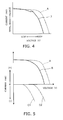
- FIG. 4 is a schematic graph for illustrating I-V characteristics of the photovoltaic system 201 according to the comparative example.
- Symbol A in FIG. 4 refers to the I-V characteristic of only the power generation module 2 in which two power generation sections 4 are connected in series.
- Symbol B in FIG. 4 refers to the I-V characteristic of the photovoltaic system 201 in which the power generation module 2 and the power storage module 203 are connected in parallel.
- symbols A and B refer to the I-V characteristics in the case where the power generation section 4 is irradiated with light L such as sunlight.
- the I-V characteristic B of the photovoltaic system 201 according to the comparative example is poorer than the I-V characteristic A of only the power generation module 2.
- the factor of the deterioration of the I-V characteristic can be explained as follows.
- FIG. 5 is a schematic graph for explaining the factor of the deterioration of the I-V characteristic.
- Symbol A in FIG. 5 refers to the I-V characteristic of only the power generation module 2 in which two power generation sections 4 are connected in series.
- Symbol C1 in FIG. 5 refers to the I-V characteristic of one power storage device 11.
- Symbol C2 in FIG. 5 refers to the I-V characteristic of only the power storage module 203 in which two power storage devices 11 are connected in series. That is, symbol C2 in FIG. 5 refers to the case where two C1 are added.
- the I-V characteristic B of the photovoltaic system 201 in which the power generation module 2 and the power storage module 203 are connected in parallel is the addition of A in FIG. 5 and C2 in FIG. 5 .
- the I-V characteristic B of the photovoltaic system 201 according to the comparative example is poorer than the I-V characteristic A of only the power generation module 2.
- FIG. 6 is a schematic graph for illustrating the variation of output voltage in the photovoltaic system 201 according to the comparative example.
- FIG. 6 shows the variation of the output voltage of the photovoltaic system 201 in which the power generation module 2 and the power storage module 203 are connected in parallel.
- FIG. 7 is a schematic graph for illustrating I-V characteristics of the photovoltaic system 1 according to this embodiment.
- Symbol A in FIG. 7 refers to the I-V characteristic of only the power generation module 2 in which two power generation sections 4 are connected in series.
- Symbol D in FIG. 7 refers to the I-V characteristic of the photovoltaic system 1 in which the power generation module 2 and the power storage module 3 are connected in parallel.
- symbols A and D refer to the I-V characteristics in the case where the power generation section 4 is irradiated with light L such as sunlight.
- the I-V characteristic D of the photovoltaic system 1 according to this embodiment is poorer than the I-V characteristic A of only the power generation module 2.
- FIG. 8 is a schematic graph for explaining the factor of the improvement of the I-V characteristic.
- Symbol A in FIG. 8 refers to the I-V characteristic of only the power generation module 2 in which two power generation sections 4 are connected in series.
- Symbol C1 in FIG. 8 refers to the I-V characteristic of one power storage device 11.
- Symbol C2 in FIG. 8 refers to the I-V characteristic in the case where two power storage devices 11 are connected in series.
- Symbol C3 in FIG. 8 refers to the I-V characteristic of only the power storage module 3 in which three power storage devices 11 are connected in series. That is, symbol C3 in FIG. 8 refers to the case where three C1 are added.
- the I-V characteristic D of the photovoltaic system 1 in which the power generation module 2 and the power storage module 3 are connected in parallel is the addition of A in FIG. 8 and C3 in FIG. 8 .
- the I-V characteristic D of the photovoltaic system 1 according to this embodiment can be significantly improved over the I-V characteristic B of the photovoltaic system 201 according to the comparative example.
- FIG. 9 is a schematic graph for illustrating the variation of output voltage in the photovoltaic system 1 according to this embodiment.
- the drop of output voltage ( ⁇ V2) is smaller than the drop of output voltage ( ⁇ V1) of the photovoltaic system 201 illustrated in FIG. 6 .
- the reason for this is as follows.
- the number of power storage devices 11 connected in series is larger by one in the power storage module 3 than in the power storage module 203.
- the voltage applied to the power storage module 3 can be made higher.
- the number of power storage devices 11 provided in the power storage module 3 is preferably made larger than the number of power generation sections 4 provided in the power generation module 2.
- n power generation sections 4 are series connected.
- the voltage of the electrical power generated by one power generation section 4 is denoted by V.
- the voltage generated in the power generation module 2 is n ⁇ V.
- the power storage device 11 may include the electrode section 12, the electrode section 13, the sealing section 14, the power storage section 15, the electrolyte 16, and the reducing section 18.
- the power storage section 15 may include a material having power storage capability such as WO 3 . In this case, the voltage required to store electrical power in the power storage section 15 is typically lower than the voltage of the electrical power converted by the power generation section 4.
- the number m of power storage devices 11 provided in the power storage module 3 can be made larger than the number n of power generation sections 4 provided in the power generation module 2 (m>n). Then, the voltage applied to the power storage device 11 (n ⁇ V/m) can be made lower than V.
- the voltage applied to the power storage device 11 can be made lower than the voltage of the electrical power converted by the power generation section 4. This can optimize the voltage applied to the power storage device 11.
- the output voltage of the power storage device 11 upon stoppage of irradiation with light L such as sunlight is made comparable to the voltage required to store electrical power in the power storage section 15.
- the voltage applied to the power storage device 11 is made slightly larger than the voltage required to store electrical power in the power storage section 15.
- the voltage applied to the power storage device 11 is preferably lower than the voltage of the electrical power generated by the power generation section 4.
- the power storage function can be achieved irrespective of m>n.
- the power storage device 11 illustrated above electrochemically stores the electrical power converted in the power generation section 4.
- the power storage device provided in the power storage module is not limited thereto.
- a power storage device 11a capable of storing and generating electrical power can also be realized.
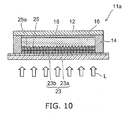
- FIG. 10 is a schematic sectional view for illustrating a power storage device 11a capable of storing and generating electrical power.
- the power storage device 11a includes an electrode section 12, an electrode section 23, a sealing section 14, a power storage section 25, an electrolyte 16, and a reducing section 18.
- the electrode section 23 includes a substrate 23a and a conductive section 23b.
- the substrate 23a is shaped like a plate and provided opposite to the electrode section 12.
- the substrate 23a is formed from a material having translucency and chemical resistance to the electrolyte 16.
- the substrate 23a can be formed from e.g. glass.
- the conductive section 23b is shaped like a film and provided on the major surface of the substrate 23a on the side opposed to the electrode section 12.
- the conductive section 23b is formed from a material having translucency, conductivity, and chemical resistance to the electrolyte 16.
- the conductive section 23b can be formed from e.g. ITO, IZO, FTO, SnO 2 , InO 3 or the like.
- the power storage section 25 is provided on the substrate 23a via the conductive section 23b.
- the power storage section 25 carries sensitizing pigments 25a and has power storage capability.
- the power storage section 25 is formed from a material having power storage capability.
- the power storage section 25 can be formed from e.g. WO 3 .
- the power storage section 25 can have a porous structure.
- the power storage section 25 can have a configuration similar to that of the aforementioned power storage section 15 and carry sensitizing pigments 25a on the surface.
- the thickness dimension of the power storage section 25 can be set to e.g. approximately 30 ⁇ m.
- the power storage section 25 can be formed from particles of WO 3 having a diameter dimension of approximately 20 nm stacked to a thickness of approximately 30 ⁇ m.
- the sensitizing pigment 25a can be appropriately selected so as to have a desired optical absorption band and absorption spectrum.
- the sensitizing pigment 25a can be e.g. an inorganic pigment such as Ru (ruthenium)-based pigment, or an organic pigment such as coumarin-based pigment.
- the storage battery device 11a as described above, like the aforementioned power storage device 11, part of the electrical power converted in the power generation module 2 can be stored in the power storage section 25.
- the power storage device 11 is irradiated with light L such as sunlight, electrons in the sensitizing pigment 25a are excited. The excited electrons are extracted as a DC current through the power storage section 25 and the conductive section 23b.
- the power storage device 11a can perform power storage and power generation.
- Such a power storage device 11a capable of storing and generating electrical power can be provided in the photovoltaic system 1 instead of the power storage device 11.
- the power generation module and the power storage module are laid out so as to be irradiated with light L such as sunlight.
- the embodiments described above can realize a photovoltaic system and a power storage device having superior I-V characteristics and being capable of suppressing the drop of output voltage upon stoppage of irradiation with light.
Landscapes
- Engineering & Computer Science (AREA)
- Power Engineering (AREA)
- Chemical Kinetics & Catalysis (AREA)
- Chemical & Material Sciences (AREA)
- Electrochemistry (AREA)
- Sustainable Energy (AREA)
- Manufacturing & Machinery (AREA)
- Life Sciences & Earth Sciences (AREA)
- General Chemical & Material Sciences (AREA)
- Sustainable Development (AREA)
- Microelectronics & Electronic Packaging (AREA)
- Photovoltaic Devices (AREA)
- Charge And Discharge Circuits For Batteries Or The Like (AREA)
- Hybrid Cells (AREA)
Abstract
According to an aspect of the invention, there is provided a photovoltaic system including: a power generation module including at least one power generation section configured to convert energy of light to electrical power, and a power storage module including a plurality of power storage devices configured to store the electrical power converted by the power generation section. The power generation module and the power storage module are connected in parallel. In the power storage module, the plurality of power storage devices is connected in series. And, number of the power storage devices is larger than number of the power generation sections.
Description
- Embodiments described herein relate generally to a photovoltaic system and power storage device.
- The output of a solar cell is varied with the intensity of received light. Thus, there is a limit to the use of a solar cell as a stand-alone power supply. Accordingly, a solar cell having power storage capability has been proposed.
- The solar cell having power storage capability can supply the stored electrical power for a certain period of time after irradiation of the solar cell with light is stopped.
- However, the solar cell simply having power storage capability may have poorer I-V characteristics (current-voltage characteristics) than the solar cell having no power storage capability. Furthermore, when irradiation of the solar cell with light is stopped, a sharp drop of output voltage may occur.
- [Patent Document 1]
JP-A 2009-135025 - A problem to be solved by the invention is to provide a photovoltaic system and a power storage device having superior I-V characteristics and being capable of suppressing the drop of output voltage upon stoppage of irradiation with light.
- According to an aspect of the invention, there is provided a photovoltaic system including: a power generation module including at least one power generation section configured to convert energy of light to electrical power, and a power storage module including a plurality of power storage devices configured to store the electrical power converted by the power generation section. The power generation module and the power storage module are connected in parallel. In the power storage module, the plurality of power storage devices is connected in series. And, number of the power storage devices is larger than number of the power generation sections.
-
- [
FIG. 1 ]
FIG. 1 is a schematic view for illustrating a photovoltaic system 1 according to this embodiment. - [
FIG. 2 ]
FIG. 2 is a schematic sectional view for illustrating apower storage device 11 according to this embodiment. - [
FIG. 3 ]
FIG. 3 is a schematic view for illustrating aphotovoltaic system 201 according to a comparative example. - [
FIG. 4 ]
FIG. 4 is a schematic graph for illustrating I-V characteristics of thephotovoltaic system 201 according to the comparative example. - [
FIG. 5 ]
FIG. 5 is a schematic graph for explaining the factor of the deterioration of the I-V characteristic. - [
FIG. 6 ]
FIG. 6 is a schematic graph for illustrating the variation of output voltage in thephotovoltaic system 201 according to the comparative example. - [
FIG. 7 ]
FIG. 7 is a schematic graph for illustrating I-V characteristics of the photovoltaic system 1 according to this embodiment. - [
FIG. 8 ]
FIG. 8 is a schematic graph for explaining the factor of the improvement of the I-V characteristic. - [
FIG. 9 ]
FIG. 9 is a schematic graph for illustrating the variation of output voltage in the photovoltaic system 1 according to this embodiment. - [
FIG. 10 ]
FIG. 10 is a schematic sectional view for illustrating apower storage device 11a capable of storing and generating electrical power. - Embodiments will now be illustrated with reference to the drawings. In the drawings, similar components are labeled with like reference numerals, and the detailed description thereof is omitted appropriately.
-
FIG. 1 is a schematic view for illustrating a photovoltaic system 1 according to this embodiment. -
FIG. 2 is a schematic sectional view for illustrating apower storage device 11 according to this embodiment. - As shown in
FIG. 1 , the photovoltaic system 1 according to this embodiment includes apower generation module 2 including at least onepower generation section 4, and apower storage module 3 including a plurality ofpower storage devices 11. - The
power generation section 4 converts energy of light L such as sunlight to electrical power by utilizing the photovoltaic effect. - The
power generation section 4 can be e.g. a solar cell (also referred as photovoltaic cell and the like). - In the case where the
power generation section 4 is a solar cell, the kind of the solar cell is not particularly limited. - Here, in the case where the
power generation section 4 is a solar cell, a solar cell panel formed on one transparent substrate (such as glass plate) is counted as one power generation section. - For instance, the
power generation section 4 can be a silicon-based solar cell, a compound-based solar cell, an organic solar cell or the like. - Examples of the silicon-based solar cell can be based on e.g. crystalline silicon or amorphous silicon.
- Examples based on crystalline silicon can be based on monocrystalline silicon (monocrystalline silicon type), polycrystalline silicon (polycrystalline silicon type), microcrystalline silicon (microcrystalline silicon type) or the like.
- Furthermore, crystalline silicon and amorphous silicon can be stacked (hybrid type), or silicon layers different in absorption wavelength range can be stacked (multijunction type).
- Examples of the compound-based solar cell can be based on e.g. InGaAs (indium gallium arsenic), GaAs (gallium arsenic), or group I-III-VI compound referred to as chalcopyrite.
- Examples of the organic solar cell can include e.g. a solar cell for obtaining photovoltaic power using organic pigments (pigment-sensitized solar cell) and a solar cell for obtaining photovoltaic power using organic thin film semiconductor (organic thin film solar cell).
- The
power generation section 4 is not limited to those illustrated, but only needs to be able to convert energy of light L such as sunlight to electrical power by utilizing the photovoltaic effect. - Next, the
power storage device 11 is described with reference toFIG. 2 . - The
power storage device 11 stores the electrical power converted by thepower generation section 4. - As shown in
FIG. 2 , thepower storage device 11 includes an electrode section 12 (corresponding to an example of the first electrode section), an electrode section 13 (corresponding to an example of the second electrode section), asealing section 14, apower storage section 15, anelectrolyte 16, a protectingsection 17, and a reducingsection 18. - The
electrode section 12 is shaped like a plate and formed form a conductive material. - The
electrode section 12 can be formed from e.g. a metal such as aluminum, copper, and stainless steel. - The
electrode section 13 is shaped like a plate and provided opposite to theelectrode section 12. - The
electrode section 13 is formed form a conductive material. - The
electrode section 13 can be formed from e.g. a metal such as aluminum, copper, and stainless steel. - In this case, the
electrode section 12 and theelectrode section 13 can be formed from the same material. Alternatively, theelectrode section 12 and theelectrode section 13 can be formed from different materials. The material of theelectrode section 12 and theelectrode section 13 may be translucent as long as being conductive. Theelectrode section 12 and theelectrode section 13 can also be such that e.g. a film made of ITO, IZO (indium zinc oxide), FTO (fluorine-doped tin oxide), SnO2, InO3 or the like is formed on a translucent plate-like body. Here, theelectrode section 12 and theelectrode section 13 can also be configured so that one of theelectrode section 12 and theelectrode section 13 is translucent and the other is not translucent. - The
electrode section 13 on the side provided with thepower storage section 15 serves as a negative electrode. Theelectrode section 12 opposed to theelectrode section 13 serving as a negative electrode serves as a positive electrode. - The sealing
section 14 is provided between theelectrode section 12 and theelectrode section 13. The sealingsection 14 seals the peripheral portion of theelectrode section 12 and the peripheral portion of theelectrode section 13. - That is, the sealing
section 14 is provided so as to surround the interior of thepower storage device 11 along the periphery of theelectrode section 12 and theelectrode section 13. By joining theelectrode section 12 side and theelectrode section 13 side, the sealingsection 14 hermetically seals the interior of thepower storage device 11. - The sealing
section 14 can include a glass material. - The sealing
section 14 can be formed from e.g. a paste-like glass frit in which powder glass, a binder such as acrylic resin, an organic solvent and the like are mixed. - Examples of the material of the powder glass can include e.g. vanadate-based glass and bismuth oxide-based glass.
- In this case, the sealing
section 14 can be formed by applying the paste-like glass frit to the to-be-sealed portion and sintering the glass frit. Then, by heating thesealing section 14, the sealingsection 14 can be melted to perform sealing. For instance, the formed sealingsection 14 can be irradiated with laser light. Thus, sealing can be performed by melting the portion of the sealingsection 14 irradiated with laser light. - Here, the sealing
section 14 is not limited to those including a glass material. - For instance, the sealing
section 14 can include a resin material and can be bonded between theelectrode section 12 and theelectrode section 13. - The
power storage section 15 is provided inside the sealingsection 14 on the surface of theelectrode section 13 on the side opposed to theelectrode section 12. - The
power storage section 15 is provided on theelectrode section 13 via the protectingsection 17. - The
power storage section 15 is formed from a material having power storage capability. - The
power storage section 15 can be formed from e.g. WO3 (tungsten oxide). - The
power storage section 15 can have a porous structure. - If the
power storage section 15 has a porous structure, the contact area with theelectrolyte 16 can be increased. This facilitates power storage in thepower storage section 15. - The thickness dimension of the
power storage section 15 can be set to e.g. approximately 30 µm. - For instance, the
power storage section 15 can be formed from particles of WO3 having a diameter dimension of approximately 20 nm stacked to a thickness of approximately 30 µm. - The thickness of the
power storage section 15 is not particularly limited as long as having power storage capability, but preferably 1-100 µm. - The
electrolyte 16 is provided inside the sealingsection 14. - That is, the
electrolyte 16 is packed in the space defined by theelectrode section 12, theelectrode section 13, and the sealingsection 14. - The
electrolyte 16 can be e.g. an electrolyte containing iodine. Theelectrolyte 16 can be made of e.g. lithium iodide and iodine dissolved in a solvent such as acetonitrile. - The protecting
section 17 is shaped like a film and provided between thepower storage section 15 and theelectrode section 13. - The protecting
section 17 is provided so as to cover the surface of theelectrode section 13 defined by the sealingsection 14. - The protecting
section 17 is provided in order to suppress corrosion of theelectrode section 13 by theelectrolyte 16. - Thus, the protecting
section 17 is formed from a material having conductivity and chemical resistance to theelectrolyte 16. - The protecting
section 17 can be formed from e.g. carbon, platinum or the like. - The thickness dimension of the protecting
section 17 can be set to e.g. approximately 100 nm. - Here, in the case where the
electrode section 13 is formed from a material having chemical resistance to theelectrolyte 16, the protectingsection 17 is not necessarily needed. - The reducing
section 18 is shaped like a film and provided so as to cover the surface of theelectrode section 12 defined by the sealingsection 14. - The reducing
section 18 is provided in order to reduce ions contained in theelectrolyte 16. For instance, the reducingsection 18 reduces I3 - ions (triiodide ions) contained in theelectrolyte 16 to I- ions (iodide ions). - Thus, the reducing
section 18 is formed from a material with conductivity, chemical resistance to theelectrolyte 16, and reduction of ions contained in theelectrolyte 16 taken into consideration. - The reducing
section 18 can be formed from e.g. carbon, platinum or the like. - The thickness dimension of the reducing
section 18 can be set to e.g. approximately 80 nm. - Next, returning to
FIG. 1 , the configuration of the photovoltaic system 1 is further illustrated. - As shown in
FIG. 1 , in the case where a plurality ofpower generation sections 4 are provided in thepower generation module 2, the plurality ofpower generation sections 4 are connected in series. - Furthermore, the plurality of
power storage devices 11 provided in thepower storage module 3 are connected in series. - Furthermore, the
power generation module 2 and thepower storage module 3 are connected in parallel. - To the photovoltaic system 1 in which the
power generation module 2 and thepower storage module 3 are connected in parallel, aload 100 can be connected. - The layout of the
power generation module 2 and thepower storage module 3 is not particularly limited. - In this case, light L such as sunlight only needs to be applied to at least the
power generation section 4 provided in thepower generation module 2. - Thus, as shown in
FIG. 1 , thepower generation module 2 and thepower storage module 3 can be stacked, with thepower generation module 2 provided on the side irradiated with light L such as sunlight. This can reduce the footprint of the photovoltaic system 1. - Next, the function of the photovoltaic system 1 is illustrated.
- If the
power generation section 4 provided in thepower generation module 2 is irradiated with light L such as sunlight, energy of the light L such as sunlight is converted to electrical power by thepower generation section 4. - Part of the electrical power thus converted is supplied to the
load 100 and consumed. - Furthermore, part of the converted electrical power is supplied to the
power storage device 11 provided in thepower storage module 3. - The electrical power supplied to the
power storage device 11 is electrochemically stored in thepower storage section 15. - When the irradiation of the
power generation module 2 with light L such as sunlight is stopped, the conversion of energy of the light L by thepower generation section 4 is made inactive. - Then, the electrical power electrochemically stored in the
power storage section 15 starts to be supplied to theload 100. - Thus, even when the irradiation of the
power generation module 2 with light L such as sunlight is stopped, theload 100 can be supplied with electrical power for a certain period of time. - Here, in the photovoltaic system including the power generation module and the power storage module, the I-V characteristics may be deteriorated. Furthermore, when the irradiation of the power generation module with light L such as sunlight is stopped, a sharp drop of output voltage may occur.
-
FIG. 3 is a schematic view for illustrating aphotovoltaic system 201 according to a comparative example. - As shown in
FIG. 3 , thephotovoltaic system 201 according to the comparative example includes apower generation module 2 including twopower generation sections 4, and apower storage module 203 including twopower storage devices 11. - Furthermore, the two
power generation sections 4 provided in thepower generation module 2 are connected in series. - Furthermore, the two
power storage devices 11 provided in thepower storage module 203 are connected in series. - Furthermore, the
power generation module 2 and thepower storage module 203 are connected in parallel. - To the
photovoltaic system 201 in which thepower generation module 2 and thepower storage module 203 are connected in parallel, aload 100 can be connected. -
FIG. 4 is a schematic graph for illustrating I-V characteristics of thephotovoltaic system 201 according to the comparative example. - Symbol A in
FIG. 4 refers to the I-V characteristic of only thepower generation module 2 in which twopower generation sections 4 are connected in series. - Symbol B in
FIG. 4 refers to the I-V characteristic of thephotovoltaic system 201 in which thepower generation module 2 and thepower storage module 203 are connected in parallel. - Here, symbols A and B refer to the I-V characteristics in the case where the
power generation section 4 is irradiated with light L such as sunlight. - As seen from
FIG. 4 , the I-V characteristic B of thephotovoltaic system 201 according to the comparative example is poorer than the I-V characteristic A of only thepower generation module 2. - In this case, the factor of the deterioration of the I-V characteristic can be explained as follows.
-
FIG. 5 is a schematic graph for explaining the factor of the deterioration of the I-V characteristic. - Symbol A in
FIG. 5 refers to the I-V characteristic of only thepower generation module 2 in which twopower generation sections 4 are connected in series. - Symbol C1 in
FIG. 5 refers to the I-V characteristic of onepower storage device 11. - Symbol C2 in
FIG. 5 refers to the I-V characteristic of only thepower storage module 203 in which twopower storage devices 11 are connected in series. That is, symbol C2 inFIG. 5 refers to the case where two C1 are added. - Thus, the I-V characteristic B of the
photovoltaic system 201 in which thepower generation module 2 and thepower storage module 203 are connected in parallel is the addition of A inFIG. 5 and C2 inFIG. 5 . As a result, the I-V characteristic B of thephotovoltaic system 201 according to the comparative example is poorer than the I-V characteristic A of only thepower generation module 2. -
FIG. 6 is a schematic graph for illustrating the variation of output voltage in thephotovoltaic system 201 according to the comparative example. - Here,
FIG. 6 shows the variation of the output voltage of thephotovoltaic system 201 in which thepower generation module 2 and thepower storage module 203 are connected in parallel. - As seen from
FIG. 6 , in thephotovoltaic system 201, when the irradiation of thepower generation module 2 with light L such as sunlight is stopped, a sharp drop of output voltage (ΔV1) occurs. -
FIG. 7 is a schematic graph for illustrating I-V characteristics of the photovoltaic system 1 according to this embodiment. - Symbol A in
FIG. 7 refers to the I-V characteristic of only thepower generation module 2 in which twopower generation sections 4 are connected in series. - Symbol D in
FIG. 7 refers to the I-V characteristic of the photovoltaic system 1 in which thepower generation module 2 and thepower storage module 3 are connected in parallel. - Here, symbols A and D refer to the I-V characteristics in the case where the
power generation section 4 is irradiated with light L such as sunlight. - As seen from
FIG. 7 , the I-V characteristic D of the photovoltaic system 1 according to this embodiment is poorer than the I-V characteristic A of only thepower generation module 2. - However, a significant improvement can be achieved over the I-V characteristic B of the
photovoltaic system 201 illustrated inFIG. 4 . - In this case, the factor of the improvement of the I-V characteristic can be explained as follows.
-
FIG. 8 is a schematic graph for explaining the factor of the improvement of the I-V characteristic. - Symbol A in
FIG. 8 refers to the I-V characteristic of only thepower generation module 2 in which twopower generation sections 4 are connected in series. - Symbol C1 in
FIG. 8 refers to the I-V characteristic of onepower storage device 11. - Symbol C2 in
FIG. 8 refers to the I-V characteristic in the case where twopower storage devices 11 are connected in series. - Symbol C3 in
FIG. 8 refers to the I-V characteristic of only thepower storage module 3 in which threepower storage devices 11 are connected in series. That is, symbol C3 inFIG. 8 refers to the case where three C1 are added. - Thus, the I-V characteristic D of the photovoltaic system 1 in which the
power generation module 2 and thepower storage module 3 are connected in parallel is the addition of A inFIG. 8 and C3 inFIG. 8 . - As a result, the I-V characteristic D of the photovoltaic system 1 according to this embodiment can be significantly improved over the I-V characteristic B of the
photovoltaic system 201 according to the comparative example. -
FIG. 9 is a schematic graph for illustrating the variation of output voltage in the photovoltaic system 1 according to this embodiment. - As seen from
FIG. 9 , in the photovoltaic system 1, when the irradiation of thepower generation module 2 with light L such as sunlight is stopped, a drop of output voltage (ΔV2) occurs. - However, the drop of output voltage (ΔV2) is smaller than the drop of output voltage (ΔV1) of the
photovoltaic system 201 illustrated inFIG. 6 . - The reason for this is as follows. The number of
power storage devices 11 connected in series is larger by one in thepower storage module 3 than in thepower storage module 203. Thus, the voltage applied to thepower storage module 3 can be made higher. - As described above, in the case where the
power generation module 2 and thepower storage module 3 are connected in parallel, the number ofpower storage devices 11 provided in thepower storage module 3 is preferably made larger than the number ofpower generation sections 4 provided in thepower generation module 2. - Next, the relationship between the number n of
power generation sections 4 provided in thepower generation module 2 and the number m ofpower storage devices 11 provided in thepower storage module 3 is further illustrated. - In the
power generation module 2, npower generation sections 4 are series connected. The voltage of the electrical power generated by onepower generation section 4 is denoted by V. Then, the voltage generated in thepower generation module 2 is n·V. - On the other hand, a voltage of n·V is applied to the
power storage module 3. Thus, if mpower storage devices 11 are series connected, the voltage applied to onepower storage device 11 is n·V/m. - Here, the
power storage device 11 may include theelectrode section 12, theelectrode section 13, the sealingsection 14, thepower storage section 15, theelectrolyte 16, and the reducingsection 18. Thepower storage section 15 may include a material having power storage capability such as WO3. In this case, the voltage required to store electrical power in thepower storage section 15 is typically lower than the voltage of the electrical power converted by thepower generation section 4. - Furthermore, if an excessive voltage is applied to the
power storage device 11, the current flowing through the series connectedpower storage devices 11 is made larger. This contrarily deteriorates the efficiency of the photovoltaic system 1. - In this case, the number m of
power storage devices 11 provided in thepower storage module 3 can be made larger than the number n ofpower generation sections 4 provided in the power generation module 2 (m>n). Then, the voltage applied to the power storage device 11 (n·V/m) can be made lower than V. - That is, the voltage applied to the
power storage device 11 can be made lower than the voltage of the electrical power converted by thepower generation section 4. This can optimize the voltage applied to thepower storage device 11. - Furthermore, the output voltage of the
power storage device 11 upon stoppage of irradiation with light L such as sunlight is made comparable to the voltage required to store electrical power in thepower storage section 15. - Thus, preferably, the voltage applied to the
power storage device 11 is made slightly larger than the voltage required to store electrical power in thepower storage section 15. - In the case where the number m of
power storage devices 11 provided in thepower storage module 3 is made larger than the number n ofpower generation sections 4 provided in the power generation module 2 (m>n), specific values of the number m ofpower storage devices 11 and the number n ofpower generation sections 4 may be determined by considering the I-V characteristics illustrated inFIG. 8 and the drop of output voltage illustrated inFIG. 9 . - In other words, the voltage applied to the
power storage device 11 is preferably lower than the voltage of the electrical power generated by thepower generation section 4. In the case of satisfying such relationship, the power storage function can be achieved irrespective of m>n. - The
power storage device 11 illustrated above electrochemically stores the electrical power converted in thepower generation section 4. However, the power storage device provided in the power storage module is not limited thereto. - For instance, a
power storage device 11a capable of storing and generating electrical power can also be realized. -
FIG. 10 is a schematic sectional view for illustrating apower storage device 11a capable of storing and generating electrical power. - As shown in
FIG. 10 , thepower storage device 11a includes anelectrode section 12, anelectrode section 23, a sealingsection 14, apower storage section 25, anelectrolyte 16, and a reducingsection 18. - The
electrode section 23 includes asubstrate 23a and aconductive section 23b. - The
substrate 23a is shaped like a plate and provided opposite to theelectrode section 12. - The
substrate 23a is formed from a material having translucency and chemical resistance to theelectrolyte 16. - The
substrate 23a can be formed from e.g. glass. - The
conductive section 23b is shaped like a film and provided on the major surface of thesubstrate 23a on the side opposed to theelectrode section 12. - The
conductive section 23b is formed from a material having translucency, conductivity, and chemical resistance to theelectrolyte 16. - The
conductive section 23b can be formed from e.g. ITO, IZO, FTO, SnO2, InO3 or the like. - The
power storage section 25 is provided on thesubstrate 23a via theconductive section 23b. - The
power storage section 25carries sensitizing pigments 25a and has power storage capability. - Thus, the
power storage section 25 is formed from a material having power storage capability. - The
power storage section 25 can be formed from e.g. WO3. - The
power storage section 25 can have a porous structure. - That is, the
power storage section 25 can have a configuration similar to that of the aforementionedpower storage section 15 and carry sensitizingpigments 25a on the surface. - The thickness dimension of the
power storage section 25 can be set to e.g. approximately 30 µm. - For instance, the
power storage section 25 can be formed from particles of WO3 having a diameter dimension of approximately 20 nm stacked to a thickness of approximately 30 µm. - The sensitizing
pigment 25a can be appropriately selected so as to have a desired optical absorption band and absorption spectrum. The sensitizingpigment 25a can be e.g. an inorganic pigment such as Ru (ruthenium)-based pigment, or an organic pigment such as coumarin-based pigment. - By the
storage battery device 11a as described above, like the aforementionedpower storage device 11, part of the electrical power converted in thepower generation module 2 can be stored in thepower storage section 25. - Furthermore, if the
power storage device 11 is irradiated with light L such as sunlight, electrons in the sensitizingpigment 25a are excited. The excited electrons are extracted as a DC current through thepower storage section 25 and theconductive section 23b. - That is, the
power storage device 11a can perform power storage and power generation. - Such a
power storage device 11a capable of storing and generating electrical power can be provided in the photovoltaic system 1 instead of thepower storage device 11. - In this case, even if the
power storage device 11a is used, a photovoltaic system having superior I-V characteristics and being capable of suppressing the drop of output voltage upon stoppage of irradiation with light can be realized. - In the case where the
power storage device 11a capable of storing and generating electrical power is provided in the power storage module, the power generation module and the power storage module are laid out so as to be irradiated with light L such as sunlight. - The embodiments described above can realize a photovoltaic system and a power storage device having superior I-V characteristics and being capable of suppressing the drop of output voltage upon stoppage of irradiation with light.
- While certain embodiments have been described, these embodiments have been presented by way of example only, and are not intended to limit the scope of the inventions. Indeed, the novel embodiments described herein may be embodied in a variety of other forms; furthermore, various omissions, substitutions and changes in the form of the embodiments described herein may be made without departing from the spirit of the inventions. The accompanying claims and their equivalents are intended to cover such forms or modifications as would fall within the scope and spirit of the invention. Moreover, above-mentioned embodiments can be combined mutually and can be carried out.
Claims (11)
- A photovoltaic system comprising:a power generation module including at least one power generation section configured to convert energy of light to electrical power; anda power storage module including a plurality of power storage devices configured to store the electrical power converted by the power generation section,the power generation module and the power storage module being connected in parallel,in the power storage module, the plurality of power storage devices being connected in series, andnumber of the power storage devices being larger than number of the power generation sections.
- The system according to claim 1, wherein the power storage device includes:a first electrode section;a second electrode section provided opposite to the first electrode section;a sealing section provided between the first electrode section and the second electrode section and configured to seal a peripheral portion of the first electrode section and a peripheral portion of the second electrode section;an electrolyte provided inside the sealing section; anda power storage section provided inside the sealing section on a surface of the second electrode section on a side opposed to the first electrode section.
- The system according to claim 2, wherein the power storage section includes tungsten oxide.
- The system according to claim 1, wherein the power generation module includes a plurality of power generation sections, and the plurality of power generation sections are connected in series.
- The system according to claim 1, wherein voltage applied to the power storage device is lower than voltage of the electrical power converted by the power generation section.
- The system according to claim 1, wherein
the power generation module and the power storage module are stacked, and
the power generation module is provided on a side irradiated with light. - The system according to claim 2, further comprising:a sensitizing pigment carried on the power storage section.
- The system according to claim 7, wherein the power generation module and the power storage module are irradiated with light.
- The system according to claim 2, wherein the power storage section has a porous structure.
- A power storage device comprising:a first electrode section;a second electrode section provided opposite to the first electrode section;a sealing section provided between the first electrode section and the second electrode section and configured to seal a peripheral portion of the first electrode section and a peripheral portion of the second electrode section;an electrolyte provided inside the sealing section;a power storage section provided inside the sealing section on a surface of the second electrode section on a side opposed to the first electrode section; anda protecting section provided between the power storage section and the second electrode section,the power storage section including tungsten oxide, andthe protecting section including carbon.
- A photovoltaic system comprising:a power generation module including at least one power generation section configured to convert energy of light to electrical power; anda power storage module including a plurality of power storage devices configured to store the electrical power converted by the power generation section,the power generation module and the power storage module being connected in parallel,in the power storage module, the plurality of power storage devices being connected in series, andvoltage applied to the power storage device being lower than voltage of the electrical power converted by the power generation section.
Applications Claiming Priority (2)
| Application Number | Priority Date | Filing Date | Title |
|---|---|---|---|
| JP2012094981A JP2013222661A (en) | 2012-04-18 | 2012-04-18 | Photovoltaic power generation system and power storage device |
| PCT/JP2013/061428 WO2013157589A1 (en) | 2012-04-18 | 2013-04-17 | Optical power generation system and electrical storage apparatus |
Publications (1)
| Publication Number | Publication Date |
|---|---|
| EP2840646A1 true EP2840646A1 (en) | 2015-02-25 |
Family
ID=49383544
Family Applications (1)
| Application Number | Title | Priority Date | Filing Date |
|---|---|---|---|
| EP13778045.8A Withdrawn EP2840646A1 (en) | 2012-04-18 | 2013-04-17 | Optical power generation system and electrical storage apparatus |
Country Status (7)
| Country | Link |
|---|---|
| US (1) | US20150042261A1 (en) |
| EP (1) | EP2840646A1 (en) |
| JP (1) | JP2013222661A (en) |
| KR (1) | KR20140053255A (en) |
| CN (1) | CN103782512A (en) |
| TW (1) | TWI500203B (en) |
| WO (1) | WO2013157589A1 (en) |
Family Cites Families (18)
| Publication number | Priority date | Publication date | Assignee | Title |
|---|---|---|---|---|
| JPH0583880A (en) * | 1991-09-18 | 1993-04-02 | Mitsubishi Electric Corp | Power device |
| JPH0583881A (en) * | 1991-09-19 | 1993-04-02 | Hitachi Ltd | Solar energy utilization system |
| JPH09306553A (en) * | 1996-05-08 | 1997-11-28 | Kagaku Gijutsu Shinko Jigyodan | Photoelectric conversion secondary battery |
| EP1521328B1 (en) * | 2002-07-09 | 2013-03-06 | Fujikura Ltd. | Solar cell |
| JP4473541B2 (en) * | 2003-09-02 | 2010-06-02 | 学校法人桐蔭学園 | Photochargeable secondary battery and electrochemical capacitor |
| DE102006062514A1 (en) * | 2006-01-17 | 2007-08-02 | I-Long Wu | Solar power system |
| JP4201035B2 (en) * | 2006-09-05 | 2008-12-24 | セイコーエプソン株式会社 | Battery element and electronic device |
| JP2008288102A (en) * | 2007-05-18 | 2008-11-27 | Fujifilm Corp | Transparent conductive film, method for producing transparent conductive film, transparent electrode film, dye-sensitized solar cell, electroluminescence element and electronic paper |
| JP5288368B2 (en) * | 2007-11-30 | 2013-09-11 | 独立行政法人物質・材料研究機構 | Solar cell |
| JP2010113905A (en) * | 2008-11-05 | 2010-05-20 | Sony Corp | Dye-sensitized solar cell and process for producing the same |
| TWM358418U (en) * | 2008-12-11 | 2009-06-01 | Epoch Energy Technology Corp | Eco-power supply with high efficiency of power generation |
| CN201739935U (en) * | 2010-03-04 | 2011-02-09 | 西东控制集团(沈阳)有限公司 | LED illuminating lamp of solar system supplied with power by direct current wide input voltage |
| FR2960705B1 (en) * | 2010-05-27 | 2012-08-17 | Batscap Sa | LITHIUM BATTERY PROTECTED AGAINST INTRUSION OF SHARP ELEMENTS |
| WO2011154862A1 (en) * | 2010-06-06 | 2011-12-15 | Ramot At Tel-Aviv University Ltd | Three-dimensional microbattery having a porous silicon anode |
| CN103190027B (en) * | 2010-10-29 | 2015-11-25 | 旭化成电子材料株式会社 | Non-aqueous electrolyte and non-aqueous secondary battery |
| KR101251554B1 (en) * | 2010-12-17 | 2013-04-08 | 주식회사 케이티 | Charging/discharging system for solar light power generator in smart grid environment with real-time price, duplex convertor of charging/discharging system, and charging/discharging method for solar light power generator |
| CN102223111B (en) * | 2011-06-17 | 2013-08-21 | 英利能源(中国)有限公司 | Device for controlling photovoltaic cell to generate power along with environment illumination change in a stage way and power generating system |
| US9373959B2 (en) * | 2011-06-21 | 2016-06-21 | Lg Electronics Inc. | Photovoltaic module |
-
2012
- 2012-04-18 JP JP2012094981A patent/JP2013222661A/en active Pending
-
2013
- 2013-04-17 EP EP13778045.8A patent/EP2840646A1/en not_active Withdrawn
- 2013-04-17 KR KR1020147005416A patent/KR20140053255A/en not_active Ceased
- 2013-04-17 WO PCT/JP2013/061428 patent/WO2013157589A1/en not_active Ceased
- 2013-04-17 CN CN201380003024.6A patent/CN103782512A/en active Pending
- 2013-04-17 US US14/343,527 patent/US20150042261A1/en not_active Abandoned
- 2013-04-18 TW TW102113847A patent/TWI500203B/en active
Non-Patent Citations (1)
| Title |
|---|
| See references of WO2013157589A1 * |
Also Published As
| Publication number | Publication date |
|---|---|
| US20150042261A1 (en) | 2015-02-12 |
| CN103782512A (en) | 2014-05-07 |
| KR20140053255A (en) | 2014-05-07 |
| TW201351754A (en) | 2013-12-16 |
| WO2013157589A1 (en) | 2013-10-24 |
| JP2013222661A (en) | 2013-10-28 |
| TWI500203B (en) | 2015-09-11 |
Similar Documents
| Publication | Publication Date | Title |
|---|---|---|
| Gurung et al. | Solar charging batteries: advances, challenges, and opportunities | |
| Liu et al. | A photo-rechargeable aqueous zinc–tellurium battery enabled by the janus-jointed perovskite/te photocathode | |
| Iqbal et al. | Recent progress in graphene incorporated solar cell devices | |
| US6887728B2 (en) | Hybrid solid state/electrochemical photoelectrode for hydrogen production | |
| US20120216854A1 (en) | Surface-Passivated Regenerative Photovoltaic and Hybrid Regenerative Photovoltaic/Photosynthetic Electrochemical Cell | |
| US20170358398A1 (en) | Photovoltaic device | |
| CN102543972A (en) | Solar battery module | |
| JP5489621B2 (en) | Photoelectric conversion element and photovoltaic device using the photoelectric conversion element | |
| EP1724838A1 (en) | Tandem photovoltaic conversion device | |
| CN103426645B (en) | Utilize metal flexible DSSC and the manufacture method thereof of the metal substrate of dual coating | |
| KR102123988B1 (en) | Solar-seawater battery system and unbiased spontaneous photo-charging method | |
| EP2840646A1 (en) | Optical power generation system and electrical storage apparatus | |
| KR101192981B1 (en) | Metal flexible dye-sensitized solar cell and manufacturing method thereof | |
| Malik et al. | Nanotechnology for perovskite solar cells: Solving efficiency, stability, and energy storage challenges | |
| KR101462356B1 (en) | Dye sensitized solar cell and method of fabricating the same | |
| Kalyanasundaram | Photochemical and photoelectrochemical approaches to energy conversion | |
| JP2009135395A (en) | Photoelectric conversion device, photovoltaic device and photoelectric conversion module | |
| JP2014079126A (en) | Optical power generating system | |
| Ibrahim et al. | Quaternary chalcogenides as transport layers in solid-state DSSC: a feasibility study. | |
| Sankir et al. | Solar Capacitors and Batteries | |
| Mahesh et al. | TiO2 microstructure, fabrication of thin film solar cells and introduction to dye sensitized solar cells | |
| Ramanathan et al. | Dye Sensitized Solar Cells Behaviors of TCO Materials | |
| Yang et al. | From Photo-Assisted to Photo-Rechargeable: Advancing Zn-Ion Batteries with Light-Driven Energy Storage | |
| Hamza et al. | Solar-Rechargeable Energy Conversion/Storage Systems: Overview of 2D Nanomaterials | |
| Jadhav et al. | Nanotechnology for powerful solar energy |
Legal Events
| Date | Code | Title | Description |
|---|---|---|---|
| PUAI | Public reference made under article 153(3) epc to a published international application that has entered the european phase |
Free format text: ORIGINAL CODE: 0009012 |
|
| 17P | Request for examination filed |
Effective date: 20140306 |
|
| AK | Designated contracting states |
Kind code of ref document: A1 Designated state(s): AL AT BE BG CH CY CZ DE DK EE ES FI FR GB GR HR HU IE IS IT LI LT LU LV MC MK MT NL NO PL PT RO RS SE SI SK SM TR |
|
| AX | Request for extension of the european patent |
Extension state: BA ME |
|
| STAA | Information on the status of an ep patent application or granted ep patent |
Free format text: STATUS: THE APPLICATION HAS BEEN WITHDRAWN |
|
| 18W | Application withdrawn |
Effective date: 20150519 |