EP2833990B1 - Method of preparation of a thin film composite reverse osmosis membrane with antifouling properties - Google Patents
Method of preparation of a thin film composite reverse osmosis membrane with antifouling properties Download PDFInfo
- Publication number
- EP2833990B1 EP2833990B1 EP13725484.3A EP13725484A EP2833990B1 EP 2833990 B1 EP2833990 B1 EP 2833990B1 EP 13725484 A EP13725484 A EP 13725484A EP 2833990 B1 EP2833990 B1 EP 2833990B1
- Authority
- EP
- European Patent Office
- Prior art keywords
- membrane
- thin film
- amine
- reverse osmosis
- acid chloride
- Prior art date
- Legal status (The legal status is an assumption and is not a legal conclusion. Google has not performed a legal analysis and makes no representation as to the accuracy of the status listed.)
- Not-in-force
Links
Images
Classifications
-
- B—PERFORMING OPERATIONS; TRANSPORTING
- B01—PHYSICAL OR CHEMICAL PROCESSES OR APPARATUS IN GENERAL
- B01D—SEPARATION
- B01D67/00—Processes specially adapted for manufacturing semi-permeable membranes for separation processes or apparatus
- B01D67/0002—Organic membrane manufacture
- B01D67/0006—Organic membrane manufacture by chemical reactions
-
- B—PERFORMING OPERATIONS; TRANSPORTING
- B01—PHYSICAL OR CHEMICAL PROCESSES OR APPARATUS IN GENERAL
- B01D—SEPARATION
- B01D65/00—Accessories or auxiliary operations, in general, for separation processes or apparatus using semi-permeable membranes
- B01D65/08—Prevention of membrane fouling or of concentration polarisation
-
- B—PERFORMING OPERATIONS; TRANSPORTING
- B01—PHYSICAL OR CHEMICAL PROCESSES OR APPARATUS IN GENERAL
- B01D—SEPARATION
- B01D69/00—Semi-permeable membranes for separation processes or apparatus characterised by their form, structure or properties; Manufacturing processes specially adapted therefor
- B01D69/12—Composite membranes; Ultra-thin membranes
- B01D69/125—In situ manufacturing by polymerisation, polycondensation, cross-linking or chemical reaction
- B01D69/1251—In situ manufacturing by polymerisation, polycondensation, cross-linking or chemical reaction by interfacial polymerisation
-
- B—PERFORMING OPERATIONS; TRANSPORTING
- B01—PHYSICAL OR CHEMICAL PROCESSES OR APPARATUS IN GENERAL
- B01D—SEPARATION
- B01D71/00—Semi-permeable membranes for separation processes or apparatus characterised by the material; Manufacturing processes specially adapted therefor
- B01D71/06—Organic material
- B01D71/56—Polyamides, e.g. polyester-amides
-
- B—PERFORMING OPERATIONS; TRANSPORTING
- B01—PHYSICAL OR CHEMICAL PROCESSES OR APPARATUS IN GENERAL
- B01D—SEPARATION
- B01D2323/00—Details relating to membrane preparation
- B01D2323/12—Specific ratios of components used
-
- B—PERFORMING OPERATIONS; TRANSPORTING
- B01—PHYSICAL OR CHEMICAL PROCESSES OR APPARATUS IN GENERAL
- B01D—SEPARATION
- B01D2325/00—Details relating to properties of membranes
- B01D2325/48—Antimicrobial properties
-
- B—PERFORMING OPERATIONS; TRANSPORTING
- B01—PHYSICAL OR CHEMICAL PROCESSES OR APPARATUS IN GENERAL
- B01D—SEPARATION
- B01D61/00—Processes of separation using semi-permeable membranes, e.g. dialysis, osmosis or ultrafiltration; Apparatus, accessories or auxiliary operations specially adapted therefor
- B01D61/02—Reverse osmosis; Hyperfiltration ; Nanofiltration
- B01D61/025—Reverse osmosis; Hyperfiltration
-
- Y—GENERAL TAGGING OF NEW TECHNOLOGICAL DEVELOPMENTS; GENERAL TAGGING OF CROSS-SECTIONAL TECHNOLOGIES SPANNING OVER SEVERAL SECTIONS OF THE IPC; TECHNICAL SUBJECTS COVERED BY FORMER USPC CROSS-REFERENCE ART COLLECTIONS [XRACs] AND DIGESTS
- Y02—TECHNOLOGIES OR APPLICATIONS FOR MITIGATION OR ADAPTATION AGAINST CLIMATE CHANGE
- Y02A—TECHNOLOGIES FOR ADAPTATION TO CLIMATE CHANGE
- Y02A20/00—Water conservation; Efficient water supply; Efficient water use
- Y02A20/124—Water desalination
- Y02A20/131—Reverse-osmosis
Definitions
- the present invention relates to the preparation of thin film composite reverse osmosis (TFC-RO) membranes with enhanced anti-biofouling property.
- TFC-RO thin film composite reverse osmosis
- the invention relates to the preparation of such membranes wherein nitrogen-bearing aromatic ring structures known to impart biocidal activity are incorporated in full or in part in one or both reactants, namely the amine-bearing and acid chloride bearing comonomers. More particularly, such enhanced anti-biofouling activity is achieved without compromising the salt rejection efficiency and flux of the membranes.
- TFC membrane A thin selective (selective to ions) semipermeable film when formed over a porous support.
- Most of the TFC membranes are prepared by rapid reaction between monomers via interfacial polymerization. For example, reaction between diamine which is taken in water and multifunctional acid chloride which is taken in water immiscible solvent such as hexane. Thus due to diffusion of monomers in the interfacial zone rapid reaction takes place. Because of limited diffusion of monomer towards interfacial zone, a thin film is formed on the top of a support comprising a layer of polysulfone (PSf) cast on a non-woven fabric support.
- PSf polysulfone
- TFC-RO membranes are prepared by interfacial polymerization between suitably suitably benzene ring structures, typically three acid chloride groups substituted in a benzene ring as one monomer and two primary amine groups substituted in another benzene ring as a second monomer. It is also important that such substitution must be regiospecific, i.e., the three add chloride groups at 1,3,5 positions and the two amine groups at m-position to one another. For the improvement of performance, dimethylsulfoxide (DMSO), camphor sulfonic acid, and N-methyl pyrrolidone (NMP) are employed as additives.
- DMSO dimethylsulfoxide
- NMP N-methyl pyrrolidone
- Patent No. WO/2007/035019 describes the preparation of TFC RO membrane with polyamide active layer.
- the polymide layer was prepared through interfacial polymerization of an aqueous polyfunctional amine solution with organic solution containing polyfunctional acyl halide.
- the post-treatment of the resulting polyamide membrane was performed with 0.1 to 100 wt% of polyfunctional tertiary alcohol amine like N,N-dialkyl ethanolamine, N,N-dimethylethanolamine; tetraalkylammonium hydroxide, tetra-methyl ammonium hydroxide, tetra-ethyl-ammonium hydroxide, and tetra-propyl ammonium hydroxide and so on.
- the main limitation of the method is that it involves an additional step of treatment of the composite membrane with highly carcinogenic amines.
- US patent 7081202 assigned to Nitto Denko Corporation discloses the preparation of TFC RO membrane by interfacial polymerization of polyfunctional amine monomers containing heteroatom like O, N, S in the chain with different aliphatic carboxylic acid chlorides.
- US patent no. 682727 describes the TFC RO membrane having antifouling coating over the top of polyamide active layer.
- the method involves the preparation of polyamide TFC membrane according to interfacial polymerization of multifunctional amine with multifunctional acid chloride and subsequent modification with compounds containing antifouling properties.
- US patent 5254261 discloses the method for the preparation of TFC RO membranes containing polyamide active layer of the reaction product of polyfunctional amine with cycloaliphatic acyl chlorides such as 1-cis, 2-trans, 3-cis, 4-trans-cyclopentane tetracarboxylic acid chloride, 1-cis, 2-trans, 3-cis, 4-trans-cyclobutane tetracarboxylic acid chloride and 1-cis, 2-trans, 4-cis-cyclopentane tri-carboxylic acid chloride.
- a trifunctional amine such as Melamine was used for the interfacial polymerization with conventional trimesoyl chloride (TMC) for the preparation of nanofiltration membrane.
- TMC trimesoyl chloride
- US patent 5876602 discloses the process for making high flux TFC RO membrane involving the preparation of polyamide active layer over polysulfone support according to the usual interfacial polymerization technique followed by the treatment of the polyamide active layer with oxidising agents.
- US patent 4913816 discloses the method for the preparation of chlorine tolerant composite semipermeable membrane using secondary amine group to obtain chlorine resistant nature.
- US patent 5693227 discloses the preparation of TFC membranes by the interfacial polymerization between amines and acid chlorides in presence of tertiary aminopyridines as catalysts. This patent application listed several amines and acid chlorides for the preparation of polyamide films in presence of catalyst. Melamine and pyridine tricarboxylic acid chloride are also included among the various monomers listed in this patent. Akin to US patent 5693227 , US20070039874A1 also lists melamine and pyridine tricarboxylic acid chloride among a large number of monomers that were employed in the subject matter of the invention. Both of the above prior art do not bring out any specific advantages or disadvantages from the use of such monomers and how they are deployed. Neither is there any information provided on critically important membrane properties such as flux, salt rejection efficiency and anti-biofouling activity. US patent 5693227 also does not disclose whether membranes containing such monomers can be prepared without deliberate addition of any catalyst.
- membranes including TFC membranes, undergo undesirable fouling by abiotic and biotic materials. These materials deposit on the membrane surface and reduce the system efficiency over time [ Flemming, Exp. Therm. Fluid Sci.14 (1997) 382-391 ; Ahmad et.al. Desalination 132 (2000)173-179 ]. Indeed, membrane biofouling is one of the major problems resulting in the decline of flux and rejection efficiency and the eventual discarding of the modules [ Schneider et,al. J. Membr. Sci. 261 (2005) 152-162 ; Herzberg, et.al. J. Membr. Sci. 295 (2007) 11-20 ].
- Biofouling phenomenon on membrane surfaces may occur through a two-step process: (1) initial adhesion of microorganisms and (2) formation of biofilm by reproduction of attached cells [ Herzberg et.al. J. Membr. Sci. 295 (2007) 11-20 ]. Disinfection and removal of formed bio-film in NF or RO systems is difficult with chlorine as it may damage the polymer, and back washing is ineffective beyond a point [ Eshed et.al. Appl. Environ. Microbiol. 74 (2008) 7338-7347 ]. Therefore, membrane with anti-fouling and bactericidal properties is desirable with self-cleaning attribute and, consequently, long-term usability. Surface modification of membranes is an attractive approach to mitigating of biofouling.
- AU 2012 00036 discloses the use of MPD and TMC.
- US5160619 discloses further melamine as a substitute for MPD.
- the main object of the present invention is to provide thin film composite TFC RO membrane with inherent antimicrobial property.
- Another object of the present invention is to provide a process for the preparation of TFC RO membrane with inherent antimicrobial property.
- Another object of the present invention is to use the monomer constituents themselves to impart such property.
- Still another object of the present invention is to use a monomer which has a quaternizable site.
- Still another object of the present invention is to use pyridine tricarboxylic acid chloride as one such monomer with or without trimesoyl chloride, and prepare polyamide membranes through reaction with m-phenylene diamine (MPD).
- MPD m-phenylene diamine
- Still another object of the present invention is to use melamine or mixture of melamine and MPD as the amine source.
- Still another object of the present invention is to prepare TFC wherein both the acid chloride and amine monomers contain in part or in full pyridine tricarboxylic acid chloride and melamine along with conventionally used monomers.
- Still another object of the present invention is to prepare such membrane without compromising on the flux and salt rejection properties of the membrane.
- Still another object of the present invention of the present invention is to utilise conventional hardware and process for the purpose of preparing the membrane.
- present invention provides thin film composite (TFC) reverse osmosis (RO) membrane on a support wherein membrane comprises polyfunctional acid chloride(s) and polyfunctional amine(s) in the ratio ranging between 3:1 to 1:1 with enhanced antibiofouling property according to claim 1,
- the polyfunctional amine(s) is/are selected from m -phenylene diamine (MPD) or melamine or combination thereof.
- the polyfunctional acid chloride(s) is/are selected from trimesoyl chloride (TMC) or acid chloride of pyridine tricarboxylic acid (PTC) or combination thereof.
- support used is polysulfone membrane of overall thickness 140-160 micrometer, polysulfone thickness in the range of 30-40 micrometer, water flux in the range of 300-500 LM -2 h -1 and molecular weight cut off in the range of 120000-150000 g/mol.
- thickness, water flux and molecular weight cut off of polysulfone membrane used is in the range of 30-40 micrometer, 300-500 LM -2 h -1 and 120000-150000 g/mol respectively.
- total concentration of amine(s) taken in the bath is in the range of 1.5-2.5% (w/v).
- the glycerol and DMSO concentrations in the amine bath are in the range of 0.4-0.6% (w/v) and 0.8-1.2% (w/v) respectively.
- total concentration of acid chloride(s) taken in the bath is in the range of 0.10-0.15% (w/v).
- the temperature of the amine bath is in the range of 50-70°C when melamine was incorporated as one of the amines and the bath temperature was ambient in other cases.
- the temperature of the acid chloride bath is in the range of 25-35 °C in all cases.
- the bacteria which exhibited reduced attachment in the membranes of the present invention include E. coli, B. subtilis and the marine bacteria Vibrio harveyi.
- the present invention relates to the preparation of novel antibiofouling TFC RO membrane on porous polysulfone (PSf) support for water purification.
- PSf porous support having about 30-40 micron thickness was prepared on a non-woven polyester fabric using a semi-automated casting unit.
- TFC-RO membranes with different composition of polyamide network were then prepared by interfacial polymerization between neat m-phenylenediamine (MPD) and a mixture of pyridine tricarboxylic acid chloride (PTC) and trimesoyl chloride (TMC).
- the resultant TFC membrane exhibited lower tendency towards bacterial attachment in comparison to the membrane prepared with TMC alone.
- the best results were obtained with 2:3-1:1 molar ratio of PTC to TMC, in as much as the flux was also enhanced and the salt rejection efficiency remained almost unaffected.
- the developed membranes exhibited range of NaCl rejections depending on the compositions: TFC membranes prepared by mixtures of PTC + TMC exhibited NaCl rejection of 92% with 51 LM -2 h -1 flux when tested under brackish water desalination conditions.
- the surface of TFC membrane, prepared with PTC can be derivatized by reacting with alkyl halide to induce permanent positive charge on the membrane surface for further enhancement of antibacterial properties.
- the present invention also relates to the preparation of antibiofouling TFC membranes by the interfacial polymerization between mixture of Melamine + MPD with TMC.
- the mixture MPD + melamine was dissolved in hot water (50 -60 °C) whereas the TMC was dissolved in neat hexane for the interfacial polymerization.
- the best results in terms of antibiofouling property, NaCl rejection and flux was obtained with 1:1 wt ratio of MPD to melamine.
- the resultant TFC exhibited flux and NaCl rejection of 40 LM -2 h -1 and 95%, respectively.
- the main preassumption are the following:
- the present invention relates to the process for the preparation of antibiofouling TFC-RO membrane for water desalination/purification by in situ interfacial polymerization between two monomers namely diamine (MPD) which was taken in water and two different acid chloride (PTC+TMC) taken in mixture of hexane and dichloromethane.
- the present invention also relates to the preparation TFC membranes by the interfacial polymerization between mixtures of monomers such as melamine + MPD and TMC.
- Dimethylsulfoxide (DMSO) and glycerol were extraneously added to the amine solution for the interfacial polymerization.
- PSf support membrane employed in the invention was prepared on non-woven fabric of 100-110 micrometer thickness by phase inversion method using semi-automated casting machine. Briefly, PSf was dissolved in DMF at concentration of 14 wt% under stirring at 70 °C to prepare the casting solution. The solution was settled for 12 h at room temperature (25-35°C) to allow complete release of bubbles. After that, the PSf solution was cast on the non-woven fabric by semiautomatic blade casting machine at 4 m/min. The gap of the blade from the platform surface was adjusted such that the thickness of the membranes was 30-40 ⁇ m excluding fabric thickness.
- H 2 O:DMF 96:4 v/v.
- the cast PSf was then washed with water and stored in RO-filtered water. Thickness of the resultant PSf layer was 30-40 micron, the molecular weight cutoff was 120000-150000 g/mol and the water flux was 300-500 LM -2 h -1 .
- the performance of the membranes was evaluated in a reverse osmosis test kit for brackish water desalination using 1500 ppm NaCl feed solution and 2000 ppm NaCl feed solution.
- the test kit consisted of four SS361 cells connected in series. The cell could accommodate circular membrane coupons of 3.5 cm dia (15 cm 2 ).
- the kit was additionally equipped with high pressure pump, pressure gauge, pressure-control valve and conductivity meter. The feed flow occurred in the cross-flow mode in the test kit. After fixing the membrane circles in the test cells, pure water was permeated initially at 250 psi for 30 min., to obtain steady flux. Then, the permeation of the salt solution was undertaken at 200 psi and the flux and rejection were measured.
- the salt concentrations in the feed and permeate were determined by measuring the electrical conductivity of the solutions using digital conductivity meter.
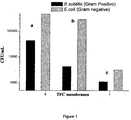
- the prevention of biofilm formation or antimicrobial activity of various TFC membranes was quantitatively determined in terms of CFU/mL by counting the number of bacteria attached on membranes or film surfaces.
- the antimicrobial activity of various TFC membranes was determined by submerging the membranes in diluted sea water (7500 ppm) containing bacteria.
- One gram-positive bacteria Bacillus subtilis, NCIM2920
- one gram-negative bacteria Escherichia coli, NCIM2065
- Single colonies of both strains were cultured in Luria Bertani (LB) broth (Himedia, India) at 37 °C in constant shaking condition at 80 rpm overnight.
- optical density (OD) was adjusted to 1 (OD 600 ) with physiological saline (0.9 wt % NaCl) and 10 ⁇ L each of these bacterial cultures were inoculated into 7 pairs of conical flasks with 50 mL freshly prepared LB broth in each flask. Approximately 25 cm 2 size of each membrane and film were autoclaved and dipped completely into the broth culture in sterile condition. One set of flasks was inoculated with B subtilis and the other set with E. coli . Inoculated flasks were initially kept in incubator shaker at 80 rpm for 48 hrs and then in stationary condition up to 7 days. All the experiments were carried out in sterile conditions.
- the bacterial count on the surrounding medium was determined to be 7.8X10 9 CFU/mL and 4.3X10 11 CFU/mL for B. subtilis and E. Coli, respectively.
- membranes were taken out with sterile forceps and loosely attached bacteria were removed by gentle washing with autoclaved physiological saline. Subsequently, 1cm 2 area from each membrane was scraped with sterile cotton swabs and was plated in LB agar plate with suitable dilution by physiological saline. Bacterial counts in 1 cm 2 area in each membrane were determined.
- Examples 1-3 are comparative examples not falling under the invention.
- polyamide active layer on the top of the porous PSf support was prepared by in situ interfacial polymerization of MPD with TMC.
- a 2 % (w/v) aqueous MPD solution was prepared in RO filtered water.
- TMC 0.5 g was dissolved in 1 L of a mixed solvent comprising 93:7 (v/v) hexane : dichloromethane under stirring. The solution was then filtered to remove un-dissolved matter, if any.
- the water wetted microporous PSf supporting membrane was carefully attached on a glass slide, and was dipped into the aqueous solution of MPD (2 % w/v) containing DMSO (1 wt%) and glycerol (0.5 wt%) at 35°C.
- the membrane was allowed to soak for at least 20s.
- the attached MPD-soaked membrane was then removed from the solution.
- the surface of the membrane was then gently rolled with a rubber roller to eliminate small bubbles which may have formed form during the process of soaking: Excess solution was drained from the surface by standing till no liquid remained.
- the MPD absorbed membrane was dipped into the solution of TMC and kept for 40 s which resulted in the formation of a thin film over the PSf support.
- the membrane was heat cured at 70 °C for 2 minutes.
- the TFC membrane was then washed with cold water, cold citric acid (0.1 wt%) solution and cold water, respectively, for about 5 min in each solution for the removal of un-reacted MPD which may be present in the polysulfone support.
- the membrane was treated with the solution of 10 wt% aqueous glycerol and then dried at 50 °C.
- Example 1 The experiment of Example 1 was repeated with double (1.0 g) the amount of TMC.
- the average flux and NaCl rejection were 42 LM -2 h -1 and 94%, respectively.
- Example 1 teaches us that the concentration of 0.05% (w/v) of acid chloride is too low to obtain a membrane with good flux and salt rejection efficiency whereas Example 2 teaches us that satisfactory performance is obtained when the acid chloride concentration is raised to 0.1% (w/v).
- Example 2 The experiment of Example 2 was repeated with PTC in place of TMC. The only minor difference was that the PTC (1 g) was first dissolved in 70 mL DCM and then added into 970 mL hexane to obtain the same final 93:7 hexane : DCM ratio. The average flux and NaCl rejection were 34 LM -2 h -1 and 78% respectively.
- Example 3 teaches us that when PTC is used as the sole acid chloride, an inferior quality of membrane is obtained compared to the one in Example 2.
- Example 2 The experiment of Example 2 was repeated using a 1:1 (w/w) mixture of TMC and PTC in place of TMC.
- the total weight of acid chloride was maintained at 1 g.
- the PTC was dissolved in 70 mL DCM while the TMC was dissolved in 970 mL hexane and the two solutions then mixed to obtain the same final 93:7 hexane : DCM ratio as in Examples 1-3 above.
- the average flux and NaCl rejection were 51 LM -2 h -1 and 92%, respectively.
- Example 4 teaches us that a combination of TMC and PTC yields a membrane having similar performance as the one in Example 2.
- the membrane of Example 4 was quaternized by first dipping it in 0.01 % (w/v) NaOH solution for 5 minutes, washed with water and drying in air. The air dried TFC was then submerged in 98:2 (v/v) hexane-DMF containing methyl iodide (2% w/v). The contact time was 10 minutes. The membrane was then removed and dried in air. Next the membrane was washed several times with water and stored in water. The average flux and NaCl rejection were 42 LM -2 h -1 and 92%, respectively.
- Figure 1 shows a bar chart of bacterial attachment on the membrane surfaces of Examples 2, 4 and 5 when the membranes were immersed in diluted natural seawater (7500 ppm) containing bacteria.
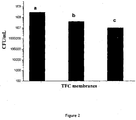
- Figure 2 shows a similar bar chart of bacterial attachment with marine bacteria taken in natural seawater. It can be seen from the Figures that the membrane of Example 4 is superior to the one of Example 2 in as much as bacterial attachment is reduced. It can also be seen that the effect is more pronounced with the membrane of Example 5, i.e., when the pyridyl nitrogen in PTC is quaterinized.
- Examples 2-5 teach us that the anti-biofouling property of TFC membrane can be enhanced by substituting half the amount of TMC with PTC without adverse effect on the flux and salt rejection efficiency.
- Example 2 The experiment of Example 2 was repeated except that half the amount of MPD was substituted with Melamine and neat hexane was used for solubilisation of TMC. Additionally, the dissolution of the mixed amine was carried out at 70 °C and PSf membrane was dipped into the amine batch at 50 °C instead of at room temperature. The average flux and NaCl rejection were 37 LM -2 h -1 and 93%, respectively, when the TMC concentration was 0.1% (w/v).
- Example 7 The experiment of Example 7 was repeated raising the TMC concentration to 0.15% (w/v) to compensate for the lower reactivity of melamine. The average flux and NaCl rejection rose to 40 LM -2 h -1 and 95%, respectively.
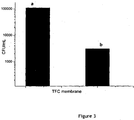
- Example 6 The bacterial attachment experiment of Example 6 was repeated with the membranes of Example 2 and Example 8.
- the bacterial attachment trend of Figure 3 was obtained. It can be seen that as in the case of a blend of PTC and TMC, a blend of MPD and melamine also gave superior anti-biofouling property compared to the conventionally prepared TFC membrane of Example 2.
Landscapes
- Chemical & Material Sciences (AREA)
- Chemical Kinetics & Catalysis (AREA)
- Engineering & Computer Science (AREA)
- Manufacturing & Machinery (AREA)
- Separation Using Semi-Permeable Membranes (AREA)
- Polyamides (AREA)
Applications Claiming Priority (2)
| Application Number | Priority Date | Filing Date | Title |
|---|---|---|---|
| IN1027DE2012 IN2012DE01027A (enExample) | 2012-04-03 | 2013-04-03 | |
| PCT/IN2013/000222 WO2013150548A1 (en) | 2012-04-03 | 2013-04-03 | Thin film composite reverse osmosis membrane with antifouling properties and method of preparation of the same |
Publications (2)
| Publication Number | Publication Date |
|---|---|
| EP2833990A1 EP2833990A1 (en) | 2015-02-11 |
| EP2833990B1 true EP2833990B1 (en) | 2016-03-30 |
Family
ID=48534461
Family Applications (1)
| Application Number | Title | Priority Date | Filing Date |
|---|---|---|---|
| EP13725484.3A Not-in-force EP2833990B1 (en) | 2012-04-03 | 2013-04-03 | Method of preparation of a thin film composite reverse osmosis membrane with antifouling properties |
Country Status (4)
| Country | Link |
|---|---|
| US (1) | US20150328592A1 (enExample) |
| EP (1) | EP2833990B1 (enExample) |
| IN (1) | IN2012DE01027A (enExample) |
| WO (1) | WO2013150548A1 (enExample) |
Families Citing this family (7)
| Publication number | Priority date | Publication date | Assignee | Title |
|---|---|---|---|---|
| CN104474928B (zh) * | 2014-12-30 | 2016-09-07 | 喻慧 | 一种聚酰胺海水淡化复合膜及其制备方法 |
| CN111298663B (zh) * | 2020-02-21 | 2022-07-19 | 郑州大学 | 一种光催化自清洁型疏松纳滤膜及其制备方法和应用 |
| CN111420561B (zh) * | 2020-04-30 | 2022-04-22 | 万华化学集团股份有限公司 | 一种抗菌水软化纳滤膜的制备方法和由其制备的抗菌水软化纳滤膜 |
| WO2022125741A1 (en) * | 2020-12-09 | 2022-06-16 | Red Bank Technologies Llc | Graphene oxide-like membranes for reverse osmosis |
| CN113967415B (zh) * | 2021-10-25 | 2023-11-28 | 湖南澳维膜科技有限公司 | 一种耐氯型反渗透膜及其制备方法 |
| CN115417961A (zh) * | 2022-08-24 | 2022-12-02 | 中科检测技术服务(广州)股份有限公司 | 一种可疏水、高透明的热固性密胺树脂、制备方法及涂层 |
| CN120827804B (zh) * | 2025-09-15 | 2025-12-23 | 泰和新材集团股份有限公司 | 一种芳香族聚酰胺超滤膜及其制备方法 |
Family Cites Families (11)
| Publication number | Priority date | Publication date | Assignee | Title |
|---|---|---|---|---|
| US682727A (en) | 1901-02-01 | 1901-09-17 | Lawrence W Luellen | Voting-booth. |
| US4913816A (en) | 1988-05-04 | 1990-04-03 | Ionics Incorporated | Chlorine tolerant composite semipermeable membrane |
| JP3031763B2 (ja) * | 1990-09-14 | 2000-04-10 | 日東電工株式会社 | 複合逆浸透膜およびその製造方法 |
| US5254261A (en) | 1991-08-12 | 1993-10-19 | Hydranautics | Interfacially synthesized reverse osmosis membranes and processes for preparing the same |
| US5693227A (en) | 1994-11-17 | 1997-12-02 | Ionics, Incorporated | Catalyst mediated method of interfacial polymerization on a microporous support, and polymers, fibers, films and membranes made by such method |
| US5876602A (en) | 1997-11-04 | 1999-03-02 | The Dow Chemical Company | Treatment of composite polyamide membranes to improve performance |
| US7081202B2 (en) | 2001-03-19 | 2006-07-25 | Nitto Denko Corporation | Composite semipermeable membrane, production method thereof, and water treatment method using the same |
| AU2012200036B2 (en) * | 2005-03-09 | 2014-02-13 | The Regents Of The University Of California | Nanocomposite membranes and methods of making and using same |
| US7727434B2 (en) * | 2005-08-16 | 2010-06-01 | General Electric Company | Membranes and methods of treating membranes |
| KR100716210B1 (ko) | 2005-09-20 | 2007-05-10 | 웅진코웨이주식회사 | 폴리아미드 역삼투 복합막 제조방법 및 이로부터 제조된폴리아미드 역삼투 복합막 |
| US8147735B2 (en) * | 2008-07-09 | 2012-04-03 | Eltron Research & Development, Inc. | Semipermeable polymers and method for producing same |
-
2013
- 2013-04-03 IN IN1027DE2012 patent/IN2012DE01027A/en unknown
- 2013-04-03 US US14/390,293 patent/US20150328592A1/en not_active Abandoned
- 2013-04-03 WO PCT/IN2013/000222 patent/WO2013150548A1/en not_active Ceased
- 2013-04-03 EP EP13725484.3A patent/EP2833990B1/en not_active Not-in-force
Also Published As
| Publication number | Publication date |
|---|---|
| WO2013150548A4 (en) | 2013-12-12 |
| WO2013150548A1 (en) | 2013-10-10 |
| US20150328592A1 (en) | 2015-11-19 |
| IN2012DE01027A (enExample) | 2015-07-31 |
| EP2833990A1 (en) | 2015-02-11 |
Similar Documents
| Publication | Publication Date | Title |
|---|---|---|
| Ping et al. | Surface modification of polyvinylidene fluoride membrane by atom-transfer radical-polymerization of quaternary ammonium compound for mitigating biofouling | |
| US8567612B2 (en) | Hybrid TFC RO membranes with nitrogen additives | |
| US20150328592A1 (en) | Thin film composite reserve osmosis membrane with antifouling properties and method of preparation of the same | |
| JP6420339B2 (ja) | 耐久性に優れたポリアミド系水処理分離膜およびその製造方法 | |
| Setiawan et al. | Dual layer composite nanofiltration hollow fiber membranes for low-pressure water softening | |
| JP5863140B2 (ja) | 耐汚染性に優れたポリアミド系水処理分離膜、これを含む水処理モジュール、水処理装置、及び水処理分離膜の製造方法 | |
| AU2014218788B2 (en) | Universal scalable and cost-effective surface modifications | |
| EP2929928B1 (en) | Polyamide-based water treatment separation membrane having improved fouling resistance and method for manufacturing same | |
| CN104023830B (zh) | 具有高耐氯性和高渗透性的水处理膜及其制备方法 | |
| Jewrajka et al. | Use of 2, 4, 6-pyridinetricarboxylic acid chloride as a novel co-monomer for the preparation of thin film composite polyamide membrane with improved bacterial resistance | |
| WO2010123518A1 (en) | Improved tfc memberanes with nanoparticles and other additives | |
| KR101103384B1 (ko) | 친수성 및 내염소성이 우수한 역삼투 분리막 및 이의 제조방법 | |
| Zhang et al. | High hydrophilic antifouling membrane modified with capsaicin-mimic moieties via microwave assistance (MWA) for efficient water purification | |
| Bera et al. | PEGylation and incorporation of triazine ring into thin film composite reverse osmosis membranes for enhancement of anti-organic and anti-biofouling properties | |
| US9687792B2 (en) | Additives for boron rejection enhancement of a membrane | |
| JP2016517797A (ja) | 膜の化学安定性の改善 | |
| WO2010042250A2 (en) | Semipermeable polymers and method for producing same | |
| JP6642860B2 (ja) | 水処理分離膜およびその製造方法 | |
| KR102085402B1 (ko) | 수처리 분리막의 제조방법, 이를 이용하여 제조된 수처리 분리막, 및 수처리 분리막을 포함하는 수처리 모듈 | |
| RU2717512C2 (ru) | Устойчивые к хлору гидрофильные фильтрационные мембраны на основе полианилина | |
| KR20130076498A (ko) | 초친수층을 포함하는 역삼투막 및 그 제조방법 | |
| KR20190050496A (ko) | 폴리아미드 계면중합용 조성물, 이를 이용한 수처리 분리막의 제조 방법 및 수처리 분리막 | |
| Wang et al. | Biguanidine functional chitooligosaccharide modified reverse osmosis membrane with improved anti-biofouling property | |
| WO2014095717A1 (en) | Mixed matrix membranes comprising vanadium pentoxide nanoparticles and methods for their preparation | |
| KR102878288B1 (ko) | 폴리아미드 계면중합용 조성물 및 이를 이용한 수처리 분리막의 제조 방법 |
Legal Events
| Date | Code | Title | Description |
|---|---|---|---|
| PUAI | Public reference made under article 153(3) epc to a published international application that has entered the european phase |
Free format text: ORIGINAL CODE: 0009012 |
|
| 17P | Request for examination filed |
Effective date: 20140930 |
|
| AK | Designated contracting states |
Kind code of ref document: A1 Designated state(s): AL AT BE BG CH CY CZ DE DK EE ES FI FR GB GR HR HU IE IS IT LI LT LU LV MC MK MT NL NO PL PT RO RS SE SI SK SM TR |
|
| AX | Request for extension of the european patent |
Extension state: BA ME |
|
| DAX | Request for extension of the european patent (deleted) | ||
| GRAP | Despatch of communication of intention to grant a patent |
Free format text: ORIGINAL CODE: EPIDOSNIGR1 |
|
| RIC1 | Information provided on ipc code assigned before grant |
Ipc: B01D 65/08 20060101ALI20150930BHEP Ipc: B01D 69/12 20060101ALI20150930BHEP Ipc: B01D 67/00 20060101AFI20150930BHEP Ipc: B01D 71/56 20060101ALI20150930BHEP |
|
| INTG | Intention to grant announced |
Effective date: 20151016 |
|
| GRAS | Grant fee paid |
Free format text: ORIGINAL CODE: EPIDOSNIGR3 |
|
| GRAA | (expected) grant |
Free format text: ORIGINAL CODE: 0009210 |
|
| AK | Designated contracting states |
Kind code of ref document: B1 Designated state(s): AL AT BE BG CH CY CZ DE DK EE ES FI FR GB GR HR HU IE IS IT LI LT LU LV MC MK MT NL NO PL PT RO RS SE SI SK SM TR |
|
| REG | Reference to a national code |
Ref country code: GB Ref legal event code: FG4D |
|
| REG | Reference to a national code |
Ref country code: CH Ref legal event code: EP |
|
| REG | Reference to a national code |
Ref country code: AT Ref legal event code: REF Ref document number: 784757 Country of ref document: AT Kind code of ref document: T Effective date: 20160415 |
|
| REG | Reference to a national code |
Ref country code: IE Ref legal event code: FG4D |
|
| REG | Reference to a national code |
Ref country code: DE Ref legal event code: R096 Ref document number: 602013005993 Country of ref document: DE |
|
| REG | Reference to a national code |
Ref country code: LT Ref legal event code: MG4D |
|
| PG25 | Lapsed in a contracting state [announced via postgrant information from national office to epo] |
Ref country code: NO Free format text: LAPSE BECAUSE OF FAILURE TO SUBMIT A TRANSLATION OF THE DESCRIPTION OR TO PAY THE FEE WITHIN THE PRESCRIBED TIME-LIMIT Effective date: 20160630 Ref country code: HR Free format text: LAPSE BECAUSE OF FAILURE TO SUBMIT A TRANSLATION OF THE DESCRIPTION OR TO PAY THE FEE WITHIN THE PRESCRIBED TIME-LIMIT Effective date: 20160330 Ref country code: FI Free format text: LAPSE BECAUSE OF FAILURE TO SUBMIT A TRANSLATION OF THE DESCRIPTION OR TO PAY THE FEE WITHIN THE PRESCRIBED TIME-LIMIT Effective date: 20160330 Ref country code: GR Free format text: LAPSE BECAUSE OF FAILURE TO SUBMIT A TRANSLATION OF THE DESCRIPTION OR TO PAY THE FEE WITHIN THE PRESCRIBED TIME-LIMIT Effective date: 20160701 |
|
| REG | Reference to a national code |
Ref country code: NL Ref legal event code: MP Effective date: 20160330 |
|
| REG | Reference to a national code |
Ref country code: AT Ref legal event code: MK05 Ref document number: 784757 Country of ref document: AT Kind code of ref document: T Effective date: 20160330 |
|
| PG25 | Lapsed in a contracting state [announced via postgrant information from national office to epo] |
Ref country code: SE Free format text: LAPSE BECAUSE OF FAILURE TO SUBMIT A TRANSLATION OF THE DESCRIPTION OR TO PAY THE FEE WITHIN THE PRESCRIBED TIME-LIMIT Effective date: 20160330 Ref country code: BE Free format text: LAPSE BECAUSE OF NON-PAYMENT OF DUE FEES Effective date: 20160430 Ref country code: RS Free format text: LAPSE BECAUSE OF FAILURE TO SUBMIT A TRANSLATION OF THE DESCRIPTION OR TO PAY THE FEE WITHIN THE PRESCRIBED TIME-LIMIT Effective date: 20160330 Ref country code: LV Free format text: LAPSE BECAUSE OF FAILURE TO SUBMIT A TRANSLATION OF THE DESCRIPTION OR TO PAY THE FEE WITHIN THE PRESCRIBED TIME-LIMIT Effective date: 20160330 Ref country code: LT Free format text: LAPSE BECAUSE OF FAILURE TO SUBMIT A TRANSLATION OF THE DESCRIPTION OR TO PAY THE FEE WITHIN THE PRESCRIBED TIME-LIMIT Effective date: 20160330 |
|
| PG25 | Lapsed in a contracting state [announced via postgrant information from national office to epo] |
Ref country code: NL Free format text: LAPSE BECAUSE OF FAILURE TO SUBMIT A TRANSLATION OF THE DESCRIPTION OR TO PAY THE FEE WITHIN THE PRESCRIBED TIME-LIMIT Effective date: 20160330 |
|
| PG25 | Lapsed in a contracting state [announced via postgrant information from national office to epo] |
Ref country code: PL Free format text: LAPSE BECAUSE OF FAILURE TO SUBMIT A TRANSLATION OF THE DESCRIPTION OR TO PAY THE FEE WITHIN THE PRESCRIBED TIME-LIMIT Effective date: 20160330 Ref country code: IS Free format text: LAPSE BECAUSE OF FAILURE TO SUBMIT A TRANSLATION OF THE DESCRIPTION OR TO PAY THE FEE WITHIN THE PRESCRIBED TIME-LIMIT Effective date: 20160730 Ref country code: EE Free format text: LAPSE BECAUSE OF FAILURE TO SUBMIT A TRANSLATION OF THE DESCRIPTION OR TO PAY THE FEE WITHIN THE PRESCRIBED TIME-LIMIT Effective date: 20160330 |
|
| REG | Reference to a national code |
Ref country code: DE Ref legal event code: R119 Ref document number: 602013005993 Country of ref document: DE |
|
| PG25 | Lapsed in a contracting state [announced via postgrant information from national office to epo] |
Ref country code: PT Free format text: LAPSE BECAUSE OF FAILURE TO SUBMIT A TRANSLATION OF THE DESCRIPTION OR TO PAY THE FEE WITHIN THE PRESCRIBED TIME-LIMIT Effective date: 20160801 Ref country code: ES Free format text: LAPSE BECAUSE OF FAILURE TO SUBMIT A TRANSLATION OF THE DESCRIPTION OR TO PAY THE FEE WITHIN THE PRESCRIBED TIME-LIMIT Effective date: 20160330 Ref country code: CZ Free format text: LAPSE BECAUSE OF FAILURE TO SUBMIT A TRANSLATION OF THE DESCRIPTION OR TO PAY THE FEE WITHIN THE PRESCRIBED TIME-LIMIT Effective date: 20160330 Ref country code: AT Free format text: LAPSE BECAUSE OF FAILURE TO SUBMIT A TRANSLATION OF THE DESCRIPTION OR TO PAY THE FEE WITHIN THE PRESCRIBED TIME-LIMIT Effective date: 20160330 Ref country code: SM Free format text: LAPSE BECAUSE OF FAILURE TO SUBMIT A TRANSLATION OF THE DESCRIPTION OR TO PAY THE FEE WITHIN THE PRESCRIBED TIME-LIMIT Effective date: 20160330 Ref country code: RO Free format text: LAPSE BECAUSE OF FAILURE TO SUBMIT A TRANSLATION OF THE DESCRIPTION OR TO PAY THE FEE WITHIN THE PRESCRIBED TIME-LIMIT Effective date: 20160330 Ref country code: SK Free format text: LAPSE BECAUSE OF FAILURE TO SUBMIT A TRANSLATION OF THE DESCRIPTION OR TO PAY THE FEE WITHIN THE PRESCRIBED TIME-LIMIT Effective date: 20160330 |
|
| REG | Reference to a national code |
Ref country code: CH Ref legal event code: PL |
|
| PG25 | Lapsed in a contracting state [announced via postgrant information from national office to epo] |
Ref country code: BE Free format text: LAPSE BECAUSE OF FAILURE TO SUBMIT A TRANSLATION OF THE DESCRIPTION OR TO PAY THE FEE WITHIN THE PRESCRIBED TIME-LIMIT Effective date: 20160330 Ref country code: IT Free format text: LAPSE BECAUSE OF FAILURE TO SUBMIT A TRANSLATION OF THE DESCRIPTION OR TO PAY THE FEE WITHIN THE PRESCRIBED TIME-LIMIT Effective date: 20160330 |
|
| REG | Reference to a national code |
Ref country code: IE Ref legal event code: MM4A |
|
| PG25 | Lapsed in a contracting state [announced via postgrant information from national office to epo] |
Ref country code: DK Free format text: LAPSE BECAUSE OF FAILURE TO SUBMIT A TRANSLATION OF THE DESCRIPTION OR TO PAY THE FEE WITHIN THE PRESCRIBED TIME-LIMIT Effective date: 20160330 Ref country code: LI Free format text: LAPSE BECAUSE OF NON-PAYMENT OF DUE FEES Effective date: 20160430 Ref country code: DE Free format text: LAPSE BECAUSE OF NON-PAYMENT OF DUE FEES Effective date: 20161101 Ref country code: CH Free format text: LAPSE BECAUSE OF NON-PAYMENT OF DUE FEES Effective date: 20160430 |
|
| PLBE | No opposition filed within time limit |
Free format text: ORIGINAL CODE: 0009261 |
|
| STAA | Information on the status of an ep patent application or granted ep patent |
Free format text: STATUS: NO OPPOSITION FILED WITHIN TIME LIMIT |
|
| 26N | No opposition filed |
Effective date: 20170103 |
|
| REG | Reference to a national code |
Ref country code: FR Ref legal event code: ST Effective date: 20170215 |
|
| PG25 | Lapsed in a contracting state [announced via postgrant information from national office to epo] |
Ref country code: FR Free format text: LAPSE BECAUSE OF NON-PAYMENT OF DUE FEES Effective date: 20160530 |
|
| PG25 | Lapsed in a contracting state [announced via postgrant information from national office to epo] |
Ref country code: SI Free format text: LAPSE BECAUSE OF FAILURE TO SUBMIT A TRANSLATION OF THE DESCRIPTION OR TO PAY THE FEE WITHIN THE PRESCRIBED TIME-LIMIT Effective date: 20160330 Ref country code: IE Free format text: LAPSE BECAUSE OF NON-PAYMENT OF DUE FEES Effective date: 20160403 |
|
| PGFP | Annual fee paid to national office [announced via postgrant information from national office to epo] |
Ref country code: GB Payment date: 20170410 Year of fee payment: 5 |
|
| PG25 | Lapsed in a contracting state [announced via postgrant information from national office to epo] |
Ref country code: HU Free format text: LAPSE BECAUSE OF FAILURE TO SUBMIT A TRANSLATION OF THE DESCRIPTION OR TO PAY THE FEE WITHIN THE PRESCRIBED TIME-LIMIT; INVALID AB INITIO Effective date: 20130403 |
|
| PG25 | Lapsed in a contracting state [announced via postgrant information from national office to epo] |
Ref country code: MK Free format text: LAPSE BECAUSE OF FAILURE TO SUBMIT A TRANSLATION OF THE DESCRIPTION OR TO PAY THE FEE WITHIN THE PRESCRIBED TIME-LIMIT Effective date: 20160330 Ref country code: MC Free format text: LAPSE BECAUSE OF FAILURE TO SUBMIT A TRANSLATION OF THE DESCRIPTION OR TO PAY THE FEE WITHIN THE PRESCRIBED TIME-LIMIT Effective date: 20160330 Ref country code: MT Free format text: LAPSE BECAUSE OF NON-PAYMENT OF DUE FEES Effective date: 20160430 Ref country code: LU Free format text: LAPSE BECAUSE OF NON-PAYMENT OF DUE FEES Effective date: 20160403 Ref country code: CY Free format text: LAPSE BECAUSE OF FAILURE TO SUBMIT A TRANSLATION OF THE DESCRIPTION OR TO PAY THE FEE WITHIN THE PRESCRIBED TIME-LIMIT Effective date: 20160330 |
|
| PG25 | Lapsed in a contracting state [announced via postgrant information from national office to epo] |
Ref country code: BG Free format text: LAPSE BECAUSE OF FAILURE TO SUBMIT A TRANSLATION OF THE DESCRIPTION OR TO PAY THE FEE WITHIN THE PRESCRIBED TIME-LIMIT Effective date: 20160330 |
|
| PG25 | Lapsed in a contracting state [announced via postgrant information from national office to epo] |
Ref country code: AL Free format text: LAPSE BECAUSE OF FAILURE TO SUBMIT A TRANSLATION OF THE DESCRIPTION OR TO PAY THE FEE WITHIN THE PRESCRIBED TIME-LIMIT Effective date: 20160330 Ref country code: TR Free format text: LAPSE BECAUSE OF FAILURE TO SUBMIT A TRANSLATION OF THE DESCRIPTION OR TO PAY THE FEE WITHIN THE PRESCRIBED TIME-LIMIT Effective date: 20160330 |
|
| GBPC | Gb: european patent ceased through non-payment of renewal fee |
Effective date: 20180403 |
|
| PG25 | Lapsed in a contracting state [announced via postgrant information from national office to epo] |
Ref country code: GB Free format text: LAPSE BECAUSE OF NON-PAYMENT OF DUE FEES Effective date: 20180403 |