EP2832811A1 - Haftklebemasse - Google Patents
Haftklebemasse Download PDFInfo
- Publication number
- EP2832811A1 EP2832811A1 EP14179533.6A EP14179533A EP2832811A1 EP 2832811 A1 EP2832811 A1 EP 2832811A1 EP 14179533 A EP14179533 A EP 14179533A EP 2832811 A1 EP2832811 A1 EP 2832811A1
- Authority
- EP
- European Patent Office
- Prior art keywords
- acrylate
- meth
- poly
- pressure
- sensitive adhesive
- Prior art date
- Legal status (The legal status is an assumption and is not a legal conclusion. Google has not performed a legal analysis and makes no representation as to the accuracy of the status listed.)
- Granted
Links
Images
Classifications
-
- C—CHEMISTRY; METALLURGY
- C09—DYES; PAINTS; POLISHES; NATURAL RESINS; ADHESIVES; COMPOSITIONS NOT OTHERWISE PROVIDED FOR; APPLICATIONS OF MATERIALS NOT OTHERWISE PROVIDED FOR
- C09J—ADHESIVES; NON-MECHANICAL ASPECTS OF ADHESIVE PROCESSES IN GENERAL; ADHESIVE PROCESSES NOT PROVIDED FOR ELSEWHERE; USE OF MATERIALS AS ADHESIVES
- C09J133/00—Adhesives based on homopolymers or copolymers of compounds having one or more unsaturated aliphatic radicals, each having only one carbon-to-carbon double bond, and at least one being terminated by only one carboxyl radical, or of salts, anhydrides, esters, amides, imides, or nitriles thereof; Adhesives based on derivatives of such polymers
- C09J133/04—Homopolymers or copolymers of esters
- C09J133/06—Homopolymers or copolymers of esters of esters containing only carbon, hydrogen and oxygen, the oxygen atom being present only as part of the carboxyl radical
- C09J133/08—Homopolymers or copolymers of acrylic acid esters
-
- C—CHEMISTRY; METALLURGY
- C09—DYES; PAINTS; POLISHES; NATURAL RESINS; ADHESIVES; COMPOSITIONS NOT OTHERWISE PROVIDED FOR; APPLICATIONS OF MATERIALS NOT OTHERWISE PROVIDED FOR
- C09J—ADHESIVES; NON-MECHANICAL ASPECTS OF ADHESIVE PROCESSES IN GENERAL; ADHESIVE PROCESSES NOT PROVIDED FOR ELSEWHERE; USE OF MATERIALS AS ADHESIVES
- C09J133/00—Adhesives based on homopolymers or copolymers of compounds having one or more unsaturated aliphatic radicals, each having only one carbon-to-carbon double bond, and at least one being terminated by only one carboxyl radical, or of salts, anhydrides, esters, amides, imides, or nitriles thereof; Adhesives based on derivatives of such polymers
- C09J133/04—Homopolymers or copolymers of esters
- C09J133/06—Homopolymers or copolymers of esters of esters containing only carbon, hydrogen and oxygen, the oxygen atom being present only as part of the carboxyl radical
-
- C—CHEMISTRY; METALLURGY
- C08—ORGANIC MACROMOLECULAR COMPOUNDS; THEIR PREPARATION OR CHEMICAL WORKING-UP; COMPOSITIONS BASED THEREON
- C08L—COMPOSITIONS OF MACROMOLECULAR COMPOUNDS
- C08L53/00—Compositions of block copolymers containing at least one sequence of a polymer obtained by reactions only involving carbon-to-carbon unsaturated bonds; Compositions of derivatives of such polymers
- C08L53/02—Compositions of block copolymers containing at least one sequence of a polymer obtained by reactions only involving carbon-to-carbon unsaturated bonds; Compositions of derivatives of such polymers of vinyl-aromatic monomers and conjugated dienes
-
- C—CHEMISTRY; METALLURGY
- C09—DYES; PAINTS; POLISHES; NATURAL RESINS; ADHESIVES; COMPOSITIONS NOT OTHERWISE PROVIDED FOR; APPLICATIONS OF MATERIALS NOT OTHERWISE PROVIDED FOR
- C09J—ADHESIVES; NON-MECHANICAL ASPECTS OF ADHESIVE PROCESSES IN GENERAL; ADHESIVE PROCESSES NOT PROVIDED FOR ELSEWHERE; USE OF MATERIALS AS ADHESIVES
- C09J121/00—Adhesives based on unspecified rubbers
-
- C—CHEMISTRY; METALLURGY
- C09—DYES; PAINTS; POLISHES; NATURAL RESINS; ADHESIVES; COMPOSITIONS NOT OTHERWISE PROVIDED FOR; APPLICATIONS OF MATERIALS NOT OTHERWISE PROVIDED FOR
- C09J—ADHESIVES; NON-MECHANICAL ASPECTS OF ADHESIVE PROCESSES IN GENERAL; ADHESIVE PROCESSES NOT PROVIDED FOR ELSEWHERE; USE OF MATERIALS AS ADHESIVES
- C09J133/00—Adhesives based on homopolymers or copolymers of compounds having one or more unsaturated aliphatic radicals, each having only one carbon-to-carbon double bond, and at least one being terminated by only one carboxyl radical, or of salts, anhydrides, esters, amides, imides, or nitriles thereof; Adhesives based on derivatives of such polymers
- C09J133/04—Homopolymers or copolymers of esters
- C09J133/06—Homopolymers or copolymers of esters of esters containing only carbon, hydrogen and oxygen, the oxygen atom being present only as part of the carboxyl radical
- C09J133/062—Copolymers with monomers not covered by C09J133/06
Definitions
- the invention relates to the technical field of pressure-sensitive adhesives as used in adhesive tapes.
- the invention proposes a pressure-sensitive adhesive based on polyacrylate and synthetic rubber as well as a specific tackifier.
- US 4,107,233 A describes an improvement in the adhesion and the printability to or from styrene-butadiene copolymers (SBC) by addition of polyacrylate.
- EP 0 349 216 A1 discloses an improvement in the cold impact strength of polyacrylate PSAs by the addition of SBC, blending 95 to 65 parts of polyacrylate with 5 to 35 parts of SBC.
- EP 0 352 901 A1 relates to pressure-sensitive adhesives containing 60 to 95 parts of a UV-polymerized polyacrylate and 35 to 5 parts of a synthetic rubber. This formulation improves the cold impact resistance and the adhesion to colors.
- EP 0 437 068 A2 discloses cellular tack-adhesive membranes based on polyacrylate / SBC blends with improved cold impact resistance.
- WO 95/19393 A1 a blend of a modified with a carboxyl group styrene block copolymer and a polyacrylate containing at least one nitrogen-containing monomer type.
- One goal of this technology is to improve the adhesive properties on low-energy substrates.
- WO 2008/070386 A1 describes polymer blends containing at least 92 parts of an SBC-based adhesive and up to 10 parts of a polyacrylate component.
- WO 2000/006637 A1 discloses blends of polyacrylates and SBC as the basis of foamed adhesive layers.
- the object of the invention is therefore to provide a pressure-sensitive adhesive with good adhesive performance in a temperature range of -30 ° C to 70 ° C and especially at room temperature.
- a "pressure-sensitive adhesive” is understood to mean, in accordance with the general understanding of the person skilled in the art, a viscoelastic adhesive whose set, dry film is permanently tacky at room temperature and remains tacky and can be adhered to a plurality of substrates by light contact pressure.
- a "poly (meth) acrylate” is understood as meaning a polymer whose monomer base consists of at least 60% by weight of acrylic acid, methacrylic acid, acrylic acid esters and / or methacrylic acid esters, acrylic esters and / or methacrylates being at least partly, preferably at least 50% by weight. %, based on the total monomer base of the polymer in question.
- a "poly (meth) acrylate” is understood to mean a polymer which can be obtained by free-radical polymerization of acrylic and / or methacrylic monomers and optionally further copolymerizable monomers.
- the poly (meth) acrylate or poly (meth) acrylates to 40 to 70 wt .-%, based on the total weight of the PSA included.
- the pressure-sensitive adhesive of the invention preferably contains from 45 to 60% by weight, based on the total weight of the PSA, of at least one poly (meth) acrylate.
- the glass transition temperature of the poly (meth) acrylates which can be used according to the invention is preferably ⁇ 0 ° C., more preferably between -20 and -50 ° C.
- the glass transition temperature of polymers or of polymer blocks in block copolymers is determined in the context of this invention by means of dynamic scanning calorimetry (DSC). For this, approx. 5 mg of an untreated polymer sample are weighed into an aluminum crucible (volume 25 ⁇ L) and closed with a perforated lid. For measurement, a DSC 204 F1 from Netzsch is used. It is worked for the purpose of inertization under nitrogen.
- the sample is first cooled to -150 ° C, then heated at a heating rate of 10 K / min to +150 ° C and cooled again to-150 ° C.
- the subsequent second heating curve is again at 10 K / min drove and recorded the change in heat capacity. Glass transitions are recognized as steps in the thermogram.
- the poly (meth) acrylates of the PSA of the invention are preferably obtainable by at least partial incorporation of functional monomers which are preferably crosslinkable with epoxide groups.
- functional monomers which are preferably crosslinkable with epoxide groups.
- monomers having acid groups especially carboxylic acid, sulfonic acid or phosphonic acid groups
- acid groups especially carboxylic acid, sulfonic acid or phosphonic acid groups
- monomers containing carboxylic acid groups especially carboxylic acid groups
- the polyacrylate comprises copolymerized acrylic acid and / or methacrylic acid. All of these groups have a crosslinking ability with epoxide groups, whereby the polyacrylate is advantageously accessible to thermal crosslinking with incorporated epoxides.
- monomers which can be used as comonomers for the poly (meth) acrylates in addition to acrylic acid and / or methacrylic acid esters having up to 30 carbon atoms per molecule, for example vinyl esters of carboxylic acids containing up to 20 carbon atoms, vinyl aromatic compounds with up to 20 C atoms, ethylenically unsaturated nitriles, vinyl halides, vinyl ethers of alcohols containing 1 to 10 carbon atoms, aliphatic hydrocarbons having 2 to 8 carbon atoms and one or two double bonds or mixtures of these monomers.
- the proportions of the respective components (a), (b), and (c) are preferably selected such that the polymerization product has a glass transition temperature of ⁇ 0 ° C, more preferably between -20 and -50 ° C (DSC). It is particularly advantageous, the monomers of component (a) in a proportion of 45 to 99 wt .-%, the monomers of component (b) in a proportion of 1 to 15 wt .-% and the monomers of component (c) with a proportion of 0 to 40 wt .-% to choose (the data are based on the monomer mixture for the "base polymer", ie without additions of any additives to the finished polymer, such as resins etc).
- the monomers of component (a) are, in particular, plasticizing and / or nonpolar monomers.
- Preferably used as monomers (a) are acrylic and methacrylic acid esters having alkyl groups consisting of 4 to 14 C atoms, particularly preferably 4 to 9 C atoms.
- Examples of such monomers are n-butyl acrylate, n-butyl methacrylate, n-pentyl acrylate, n-pentyl methacrylate, n-amyl acrylate, n-hexyl acrylate, n-hexyl methacrylate, n-heptyl acrylate, n-octyl acrylate, n-octyl methacrylate, n-nonyl acrylate and their branched isomers such as isobutyl acrylate, isooctyl acrylate, isooctyl methacrylate, 2-ethylhexyl acrylate or 2-ethylhexyl methacrylate.
- the monomers of component (b) are, in particular, olefinically unsaturated monomers having functional groups, in particular having functional groups capable of undergoing reaction with epoxide groups.
- component (b) preference is given to using monomers having functional groups which are selected from the group comprising: hydroxyl, carboxy, sulfonic or phosphonic acid groups, acid anhydrides, epoxides, amines.
- monomers of component (b) are acrylic acid, methacrylic acid, itaconic acid, maleic acid, fumaric acid, crotonic acid, aconitic acid, dimethylacrylic acid, ⁇ -acryloyloxypropionic acid, trichloroacrylic acid, vinylacetic acid, vinylphosphonic acid, maleic anhydride, hydroxyethyl acrylate, in particular 2-hydroxyethyl acrylate, hydroxypropyl acrylate, in particular 3 Hydroxypropyl acrylate, hydroxybutyl acrylate, especially 4-hydroxybutyl acrylate, hydroxyhexyl acrylate, especially 6-hydroxyhexyl acrylate, hydroxyethyl methacrylate, especially 2-hydroxyethyl methyl
- component (c) all vinylically functionalized compounds which are copolymerizable with component (a) and / or component (b) can be used as component (c).
- the monomers of component (c) can serve to adjust the properties of the resulting PSA.
- Monomers of component (c) may advantageously also be chosen such that they contain functional groups which promote a subsequent radiation-chemical crosslinking (for example by electron beams, UV).
- Suitable copolymerizable photoinitiators are, for example, benzoin acrylate and acrylate-functionalized benzophenone derivatives.
- Monomers which promote electron beam crosslinking are, for example, tetrahydrofurfuryl acrylate, N-tert- butylacrylamide and allyl acrylate.
- polyacrylates is understood in the context of the invention to be synonymous with “poly (meth) acrylates"
- poly (meth) acrylates can be carried out by methods familiar to the person skilled in the art, in particular advantageously by conventional free-radical polymerizations or controlled free-radical polymerizations.
- the polyacrylates can be prepared by copolymerization of the monomeric components using the usual polymerization initiators and optionally regulators, being polymerized at the usual temperatures in bulk, in emulsion, for example in water or liquid hydrocarbons, or in solution.
- the polyacrylates are prepared by polymerization of the monomers in solvents, in particular in solvents having a boiling range of 50 to 150 ° C, preferably from 60 to 120 ° C using the usual amounts of polymerization initiators, generally at 0.01 to 5, in particular at 0.1 to 2 wt .-% (based on the total weight of the monomers) are prepared.
- radical sources are peroxides, hydroperoxides, and azo compounds, such as dibenzoyl peroxide, cumene hydroperoxide, cyclohexanone peroxide, di-t-butyl peroxide, cyclohexylsulfonyl, diisopropyl, -Butylperoktoat, benzpinacol t.
- the radical initiator used is 2,2'-azobis (2-methylbutyronitrile) (Vazo® 67 TM from DuPont) or 2,2'-azobis (2-methylpropionitrile) (2,2'-azobisisobutyronitrile; AlBN Vazo® 64 TM from DuPont).
- Suitable solvents for the preparation of the poly (meth) acrylates are alcohols such as methanol, ethanol, n- and iso-propanol, n- and iso-butanol, preferably isopropanol and / or isobutanol, and hydrocarbons such as toluene and in particular gasoline having a boiling range of 60 up to 120 ° C in question.
- alcohols such as methanol, ethanol, n- and iso-propanol, n- and iso-butanol, preferably isopropanol and / or isobutanol
- hydrocarbons such as toluene and in particular gasoline having a boiling range of 60 up to 120 ° C in question.
- ketones such as, preferably, acetone, methyl ethyl ketone, methyl isobutyl ketone and esters, such as ethyl acetate, and mixtures of solvents of the type mentioned, with mixtures containing isopropanol, in particular in amounts of from 2 to 15% by weight, preferably from 3 to 10% by weight. , based on the solvent mixture used, are preferred.
- concentration of the polymer can be done in the absence of crosslinker and accelerator substances.
- concentration it is also possible to add one of these classes of compounds to the polymer even before the concentration, so that the concentration then takes place in the presence of this substance (s).
- the polymers can be converted into a compounder after the concentration step.
- concentration and the compounding can also take place in the same reactor.
- the weight-average molecular weights Mw of the polyacrylates are preferably in a range of 20,000 to 2,000,000 g / mol; more preferably in a range of 100,000 to 1,500,000 g / mol, most preferably in a range of 150,000 to 1,000,000 g / mol.
- the data of the average molecular weight M W and the polydispersity PD in this document relate to the determination by gel permeation chromatography. For this purpose, it may be advantageous to carry out the polymerization in the presence of suitable polymerization regulators such as thiols, halogen compounds and / or alcohols in order to set the desired average molecular weight.
- the statements of the number-average molar mass Mn and the weight-average molar mass Mw in this document refer to the determination by gel permeation chromatography (GPC). The determination is made on 100 ⁇ l of clear filtered sample (sample concentration 4 g / l). The eluent used is tetrahydrofuran with 0.1% by volume of trifluoroacetic acid. The measurement takes place at 25 ° C.
- a combination of PSS-SDV, 5 ⁇ m, 10 3 ⁇ and 10 5 ⁇ and 10 6 ⁇ columns of 8.0 mm * 300 mm each is used (Polymer Standards Service columns, Shodex RI71 differential refractometer detection ). The flow rate is 1.0 ml per minute. Calibration is carried out with polyacrylates against PMMA standards (polymethyl methacrylate calibration) and otherwise (resins, elastomers) against PS standards (polystyrene calibration).
- the polyacrylates preferably have a K value of 30 to 90, particularly preferably 40 to 70, measured in toluene (1% solution, 21 ° C).
- the K value according to Fikentscher is a measure of the molecular weight and the viscosity of the polymer.
- the principle of the method is based on the capillary-viscometric determination of the relative solution viscosity.
- the test substance is dissolved in toluene by shaking for 30 minutes, so that a 1% solution is obtained.
- polyacrylates which have a narrow molecular weight distribution (polydispersity PD ⁇ 4).
- polydispersity PD ⁇ 4 a narrow molecular weight distribution
- these compositions have a particularly good shear strength.
- the lower polydispersity allows for easier melt processing, since the flow viscosity is lower compared to a more widely dispersed polyacrylate with largely similar application properties.
- Narrowly distributed poly (meth) acrylates can be advantageously prepared by anionic polymerization or by controlled radical polymerization, the latter being particularly well suited. It is also possible to prepare corresponding polyacrylates via N- oxyls.
- ATRP atom transfer radical polymerization
- the monomers for preparing the poly (meth) acrylates preferably contain proportionally functional groups which are suitable for entering into linking reactions with epoxide groups. This advantageously allows thermal crosslinking of the polyacrylates by reaction with epoxides.
- linking reactions are meant in particular addition and substitution reactions.
- the epoxide group-containing substances are preferably multifunctional epoxides, ie those having at least two epoxide groups; Accordingly, it is preferable in total to an indirect linkage of the blocks carrying the functional groups.
- the poly (meth) acrylates of the PSA of the invention are preferably crosslinked by linking reactions - in particular in the context of addition or substitution reactions - of functional groups contained in them with thermal crosslinkers. It is possible to use all thermal crosslinkers which ensure both a sufficiently long processing time, so that there is no gelling during the processing process, in particular the extrusion process, as well as a rapid post-crosslinking of the polymer to the desired degree of crosslinking at temperatures lower than the processing temperature , especially at room temperature, lead. For example, a combination of polymers containing carboxyl, amine and / or hydroxyl groups and isocyanates, in particular aliphatic or amine-deactivated trimerized isocyanates, as crosslinkers is possible.
- Suitable isocyanates are in particular trimerized derivatives of MDI [4,4-methylene-di (phenyl isocyanate)], HDI [hexamethylene diisocyanate, 1,6-hexylene diisocyanate] and / or IPDI [isophorone diisocyanate, 5-isocyanato-1-isocyanatomethyl-1,3, 3-trimethylcyclohexane], for example the types Desmodur® N3600 and XP2410 (in each case BAYER AG: aliphatic polyisocyanates, low-viscosity HDI trimers). Also suitable is the surface-deactivated dispersion of micronized trimerized IPDI BUEJ 339®, now HF9® (BAYER AG).
- isocyanates such as Desmodur VL 50 (polyisocyanates based on MDI, Bayer AG), Basonat F200WD (aliphatic polyisocyanate, BASF AG), Basonat HW100 (water-emulsifiable polyfunctional isocyanate based on HDI, BASF AG), Basonat HA 300 (allophanate-modified polyisocyanate on isocyanurate, HDI-based, BASF) or Bayhydur VPLS2150 / 1 (hydrophilic modified IPDI, Bayer AG).
- Desmodur VL 50 polyisocyanates based on MDI, Bayer AG
- Basonat F200WD aliphatic polyisocyanate, BASF AG
- Basonat HW100 water-emulsifiable polyfunctional isocyanate based on HDI, BASF AG
- Basonat HA 300 allophanate-modified polyisocyanate on isocyanurate, HDI-based, BASF
- thermal crosslinkers Preference is given to using thermal crosslinkers at from 0.1 to 5% by weight, in particular from 0.2 to 1% by weight, based on the total amount of the polymer to be crosslinked.
- the poly (meth) acrylates of the PSA of the invention are preferably crosslinked by means of epoxide (s) or by means of one or more epoxide group-containing substance (s).
- the epoxide group-containing substances are in particular multifunctional epoxides, ie those having at least two epoxide groups; corresponding Overall, there is an indirect linkage of the building blocks carrying the functional groups of the poly (meth) acrylates.
- the epoxide group-containing substances can be both aromatic and aliphatic compounds.
- Highly suitable multifunctional epoxides are oligomers of epichlorohydrin, polyether polyhydric alcohols (especially ethylene, propylene and butylene glycols, polyglycols, thiodiglycols, glycerol, pentaerythritol, sorbitol, polyvinyl alcohol, polyallylalcohol and the like), epoxy ethers of polyhydric phenols [especially resorcinol, hydroquinone, bis - (4-hydroxyphenyl) -methane, bis (4-hydroxy-3-methylphenyl) -methane, bis (4-hydroxy-3,5-dibromophenyl) -methane, bis- (4-hydroxy-3,5- difluorophenyl) methane, 1,1-bis (4-hydroxyphenyl) ethane, 2,2-bis (4-hydroxyphenyl) propane, 2,2-bis (4-hydroxy-3-methylphenyl) -propane, 2 , 2-bis- (4
- Very suitable ethers are, for example, 1,4-butanediol diglycidyl ether, polyglycerol-3-glycidyl ether, cyclohexanedimethanol diglycidyl ether, glycerol triglycidyl ether, neopentyl glycol diglycidyl ether, pentaerythritol tetraglycidyl ether, 1,6-hexanediol diglycidyl ether, polypropylene glycol diglycidyl ether, trimethylolpropane triglycidyl ether, pentaerythritol tetraglycidyl ether, bisphenol A diglycidyl ether and bisphenol F -diglycidether.
- crosslinking system particularly preferred for the poly (meth) acrylates as polymers to be crosslinked is the use of an example in the EP 1 978 069 A1 crosslinker-accelerator system ("crosslinking system") described in order to obtain better control over both processing time, crosslinking kinetics and degree of crosslinking.
- the crosslinker-accelerator system comprises at least one substance containing epoxide groups as crosslinker and at least one substance accelerating at a temperature below the melting temperature of the polymer to be crosslinked for crosslinking reactions by means of compounds containing epoxide groups as accelerator.
- amines (formally as substitution products of ammonia, in the following formulas these substituents are represented by "R" and include in particular alkyl and / or aryl radicals and / or other organic radicals), particularly preferably such amines, which undergo no or only minor reactions with the building blocks of the polymers to be crosslinked.
- accelerators In principle, it is possible to select both primary (NRH 2 ), secondary (NR 2 H) and tertiary amines (NR 3 ) as accelerators, of course also those which have a plurality of primary and / or secondary and / or tertiary amine groups.
- particularly preferred accelerators are tertiary amines such as triethylamine, triethylenediamine, benzyldimethylamine, dimethylamino-methylphenol, 2,4,6-tris (N, N-dimethylaminomethyl) phenol, N, N'-bis (3- (dimethylamino ) propyl) urea.
- multifunctional amines such as diamines, triamines and / or tetramines can also be used as accelerators.
- diethylenetriamine, triethylenetetramine, trimethylhexamethylenediamine are excellent.
- amino alcohols are preferably used as accelerators.
- Secondary and / or tertiary amino alcohols are particularly preferably used, wherein in the case of several amine functionalities per molecule, preferably at least one, preferably all amine functionalities are secondary and / or tertiary.
- triethanolamine N, N-bis (2-hydroxypropyl) ethanolamine, N-methyldiethanolamine, N-ethyldiethanolamine, 2-aminocyclohexanol, bis (2-hydroxycyclohexyl) methylamine, 2- (diisopropylamino) ethanol, 2- ( Dibutylamino) ethanol, N-butyldiethanolamine, N-butylethanolamine, 2- [bis (2-hydroxyethyl) amino] -2- (hydroxymethyl) -1,3-propanediol, 1- [bis (2-hydroxyethyl) amino] -2- propanol, Triisopropanolamine, 2- (dimethylamino) ethanol, 2- (diethylamino) ethanol, 2- (2-dimethylaminoethoxy) ethanol, N, N, N'-trimethyl-N'-hydroxyethyl bisaminoethyl ether, N, N, N, N
- accelerators are pyridine, imidazoles (such as 2-methylimidazole) and 1,8-diazabicyclo [5.4.0] undec-7-ene. Cycloaliphatic polyamines can also be used as accelerators. Also suitable are phosphate-based accelerators, such as phosphines and / or phosphonium compounds, for example triphenylphosphine or tetraphenylphosphonium tetraphenylborate.
- the PSA of the invention further contains at least one synthetic rubber.
- the synthetic rubber or synthetic rubbers in the PSA are present at from 15 to 50% by weight, based on the total weight of the PSA.
- the PSA preferably contains from 20 to 40% by weight, based on the total weight of the PSA, of at least one synthetic rubber.
- Suitable block copolymers thus comprise one or more rubbery blocks B (soft blocks) and one or more glassy blocks A (hard blocks). More preferably, at least one synthetic rubber of the PSA according to the invention is a block copolymer having a structure AB, ABA, (AB) 3 X or (AB) 4 X, where A, B and X are as defined above. Very particular preference is given to all synthetic rubbers of the PSA block copolymers of the invention having a structure AB, ABA, (AB) 3 X or (AB) 4 X, where A, B and X are as defined above.
- the synthetic rubber of the pressure-sensitive adhesive of the invention is a mixture of block copolymers having a structure AB, ABA, (AB) 3 X or (AB) 4 X, which preferably contains at least diblock copolymers AB and / or triblock copolymers ABA.
- Block A is generally a vitreous block having a preferred glass transition temperature (Tg, DSC) above room temperature. More preferably, the Tg of the glassy block is at least 40 ° C, especially at least 60 ° C, most preferably at least 80 ° C and most preferably at least 100 ° C.
- the proportion of vinylaromatic blocks A in the total block copolymers is preferably from 10 to 40% by weight, particularly preferably from 20 to 33% by weight.
- Vinylaromatics for the construction of block A preferably comprise styrene, ⁇ -methylstyrene and / or other styrene derivatives. The block A can thus be present as a homo- or copolymer. More preferably, block A is a polystyrene.
- the vinyl aromatic block copolymer further generally has a rubbery block B or soft block having a preferred Tg of less than room temperature.
- the Tg of the soft block is particularly preferably less than 0 ° C, in particular less than -10 ° C, for example less than -40 ° C and most preferably less than -60 ° C.
- Preferred conjugated dienes as monomers for soft block B are in particular selected from the group consisting of butadiene, isoprene, ethylbutadiene, phenylbutadiene, piperylene, pentadiene, hexadiene, ethylhexadiene, dimethylbutadiene and the Farnese isomers and any desired mixtures of these monomers.
- Block B can also be present as a homopolymer or as a copolymer.
- the conjugated dienes are particularly preferred as monomers for the soft block B selected from butadiene and isoprene.
- the soft block B is a polyisoprene, a polybutadiene or a partially or fully hydrogenated derivative of one of these two polymers, in particular polybutylene-butadiene; or a polymer of a mixture of butadiene and isoprene.
- the block B is a polybutadiene.
- the PSA according to the invention additionally contains at least one tackifier which is compatible with the poly (meth) acrylate (s) and which can also be referred to as an adhesion promoter or adhesive resin.
- a "tackifier” is understood, according to the general expert understanding, to be an oligomeric or polymeric resin which increases the auto-adhesion (tack, inherent tack) of the PSA in comparison to the otherwise non-tackifier-containing, otherwise identical PSA.
- a "tackifier compatible with the poly (meth) acrylate” is understood to mean a tackifier which alters the glass transition temperature of the system obtained after thorough mixing of poly (meth) acrylate and tackifier in comparison to the pure poly (meth) acrylate the mixture of poly (meth) acrylate and tackifier only one Tg can be assigned.
- a tackifier incompatible with the poly (meth) acrylate (s) would result in two Tg's in the system obtained after thorough mixing of poly (meth) acrylate and tackifier, one of which would be the poly (meth) acrylate and the other the Attributable to resin domains.
- the determination of the Tg is carried out in this context calorimetrically by means of DSC (differential scanning calorimetry).
- the poly (meth) acrylate-compatible resins of the composition of the invention preferably have a DACP of less than 0 ° C, more preferably of at most -20 ° C, and / or preferably a MMAP of less than 40 ° C preferably of at most 20 ° C, on.
- DACP and MMAP values open C. Donker, PSTC Annual Technical Seminar, Proceedings, pp. 149-164, May 2001 directed.
- the tackifier compatible with the poly (meth) acrylates is preferably a terpene-phenolic resin or a rosin derivative, more preferably a terpene-phenolic resin.
- the PSA of the invention may also contain mixtures of several tackifiers. Among the rosin derivatives, rosin esters are preferred.
- the pressure-sensitive adhesive of the invention preferably contains from 7 to 25% by weight, based on the total weight of the PSA, of at least one tackifier compatible with the poly (meth) acrylates.
- the tackifier compatible with the poly (meth) acrylates is particularly preferred or tackifiers compatible with the poly (meth) acrylates are present at from 12 to 20% by weight, based on the total weight of the PSA.
- the tackifier (s) compatible with the poly (meth) acrylates is / are also compatible with the synthetic rubber, in particular with its soft block B, or at least partially compatible, the above definition of the term "compatible" correspondingly applying ,
- Polymer / resin compatibility is u. a. depends on the molecular weight of the polymers or resins. The compatibility is better when the molecular weight (s) are lower. For a given polymer, it may be possible that the low molecular weight components of the resin molecular weight distribution are compatible with the polymer, but not the higher molecular weight. This is an example of partial compatibility.
- the weight ratio of poly (meth) acrylates to synthetic rubbers in the pressure-sensitive adhesive of the invention is preferably from 1: 1 to 3: 1, in particular from 1.8: 1 to 2.2: 1.
- the weight ratio of tackifiers which are compatible with the poly (meth) acrylates to synthetic rubbers in the pressure-sensitive adhesive of the invention is preferably not more than 2: 1, in particular not more than 1: 1. At least this weight ratio is preferably 1: 4.
- the synthetic rubber is preferably dispersed in the PSA according to the invention in the poly (meth) acrylate.
- poly (meth) acrylate and synthetic rubber are preferably in each case homogeneous phases.
- the poly (meth) acrylates and synthetic rubbers contained in the pressure-sensitive adhesive are preferably chosen so that they are not miscible to homogeneity at 23 ° C.
- the PSA of the invention is thus at least microscopically and at least preferably at least at least at room temperature in at least two-phase Morphology before.
- poly (meth) acrylate (e) and synthetic rubber (e) are not homogeneously miscible with one another in a temperature range from 0 ° C. to 50 ° C., in particular from -30 ° C. to 80 ° C., so that the pressure-sensitive adhesive in these temperature ranges at least microscopically present at least two phases.
- components are defined as "not homogeneously miscible with one another", even if the formation of at least two stable phases can be detected physically and / or chemically, at least microscopically, with one phase rich in one component and the second Phase is rich in the other component.
- small amounts of synthetic rubber and / or small amounts of poly (meth) acrylate component may be present in the synthetic rubber phase, provided that these are not essential amounts which influence the phase separation.
- phase separation may in particular be realized in such a way that discrete regions ("domains") which are rich in synthetic rubber - ie essentially formed of synthetic rubber - in a continuous matrix which is rich in poly (meth) acrylate - thus substantially is formed from poly (meth) acrylate - present.
- a suitable analysis system for a phase separation is, for example, scanning electron microscopy.
- phase separation can also be recognized, for example, by the fact that the different phases have two mutually independent glass transition temperatures in differential scanning calorimetry (DDK, DSC). Phase separation according to the invention is present if it can be clearly demonstrated by at least one of the analytical methods.
- the fine structure may also have additional multiphase, with the A blocks forming one phase and the B blocks forming a second phase.
- the pressure-sensitive adhesive of the invention may comprise, in addition to the constituents listed above, one or more hydrocarbon resins which are not compatible with the poly (meth) acrylate.
- hydrocarbon resins which are also tackifiers, preferably comprise hydrogenated polymers of dicyclopentadiene; Not, partially, selectively or completely hydrogenated hydrocarbon resins based on C5, C5 / C9 or C9 monomer streams and polyterpene resins based on ⁇ - pinene and / or of ⁇ - pinene and / or of ⁇ -imimoniums.
- the hydrocarbon resins preferably have a DACP value of at least 0 ° C, more preferably at least 20 ° C, and / or preferably a MMAP value of at least 40 ° C, more preferably at least 60 ° C.
- DACP and MMAP values open C. Donker, PSTC Annual Technical Seminar, Proceedings, pp. 149-164, May 2001 directed.
- the abovementioned hydrocarbon resins may be present either individually or as a mixture in the PSA.
- Particularly preferred hydrocarbon resins are polyterpene resins based on ⁇ - pinene and / or of ⁇ - pinene and / or of ⁇ - limes.
- the PSA according to the invention is preferably foamed.
- the foaming can be carried out by means of any chemical and / or physical methods.
- a foamed PSA according to the invention is preferably obtained by introducing and subsequently expanding microballoons.
- microballoons is meant elastic and thus expandable in its ground state hollow microspheres having a thermoplastic polymer shell. These balls are filled with low-boiling liquids or liquefied gas.
- shell material find in particular polyacrylonitrile, PVDC, PVC or polyacrylates use. Hydrocarbons of the lower alkanes, for example isobutane or isopentane, which are enclosed in the polymer shell as a liquefied gas under pressure, are particularly suitable as the low-boiling liquid.
- microballoons By acting on the microballoons, in particular by a heat, softens the outer polymer shell. At the same time, the liquid propellant gas in the casing changes into its gaseous state. The microballoons expand irreversibly and expand in three dimensions. The expansion is completed when the internal and external pressures equalize. As the polymeric shell is preserved, this results in a closed-cell foam.
- the microballoons can be fed to the formulation as a batch, paste or as uncut or blended powder. Dosing points are conceivable, for example, before or after the addition point of the poly (meth) acrylate, for example together as a powder with the synthetic rubber or as a paste at a later time.
- microballoons there are a variety of types of microballoons available commercially, which differ essentially by their size (6 to 45 microns in diameter in the unexpanded state) and their required for expansion starting temperatures (75 to 220 ° C).
- Unexpanded microballoon types are also obtainable as aqueous dispersion with a solids or microballoon fraction of about 40 to 45% by weight, furthermore also as polymer-bound microballoons (masterbatches), for example in ethylvinyl acetate with a microballoon concentration of about 65% by weight.
- masterbatches polymer-bound microballoons
- Both the microballoon dispersions and the masterbatches, like the DU types, are suitable for producing a foamed PSA according to the invention.
- a foamed PSA according to the invention can also be produced with so-called pre-expanded microballoons.
- pre-expanded microballoons are commercially available, for example under the designation Dualite ® or with the type designation DE (Dry Expanded).
- the density of a foamed PSA of the invention is preferably from 200 to 1000 kg / m 3 , more preferably from 300 to 900 kg / m 3 , in particular from 400 to 800 kg / m 3 .
- the PSA of the invention for example, powder and granular, especially abrasive and reinforcing, fillers, dyes and pigments such.
- fillers for example, powder and granular, especially abrasive and reinforcing, fillers, dyes and pigments such.
- chalks CaCO 3
- titanium dioxide titanium dioxide
- zinc oxides and / or carbon blacks.
- the PSA contains one or more chalk form (s) as a filler, more preferably microseal chalk (Söhlde). With preferred proportions of up to 20% by weight, the adhesive properties (shear strength at room temperature, instant adhesion to steel and PE) virtually do not change as a result of the filler addition.
- various organic fillers may be included.
- Suitable additives for the PSA according to the invention are also - independently selected from other additives - non-expandable polymer hollow spheres, polymer solid spheres, glass hollow spheres, glass solid spheres, ceramic hollow spheres, ceramic solid spheres and / or full carbon carbon spheres ("Carbon Micro Balloons").
- the pressure-sensitive adhesive of the invention may comprise flame-retardant fillers, for example ammonium polyphosphate; electrically conductive fillers, such as Leitruß, carbon fibers and / or silver-coated balls; thermally conductive materials such as boron nitride, alumina, silicon carbide; ferromagnetic additives, for example, iron (III) oxides; organic, renewable raw materials such as wood flour, organic and / or inorganic nanoparticles, fibers; Contain compounding agents, anti-aging agents, light stabilizers and / or antiozonants.
- flame-retardant fillers for example ammonium polyphosphate
- electrically conductive fillers such as Leitruß, carbon fibers and / or silver-coated balls
- thermally conductive materials such as boron nitride, alumina, silicon carbide
- ferromagnetic additives for example, iron (III) oxides
- organic, renewable raw materials such as wood flour, organic and / or in
- plasticizers may be included.
- plasticizers e.g. (Meth) acrylate oligomers, phthalates, Cyclohexandicarbonklareester, water-soluble plasticizers, soft resins, phosphates or polyphosphates are added.
- silicas advantageously precipitated silica modified with dimethyldichlorosilane, can be used to adjust the thermal resistance of the PSA.
- a process for the preparation of a pressure-sensitive adhesive of the invention may initially comprise a concentration of the polyacrylate solution or dispersion resulting from the polymer preparation.
- the concentration of the polymer can be done in the absence of crosslinker and accelerator substances. However, it is also possible to add at most one of these substances to the polymer before the concentration, so that the concentration then takes place in the presence of this substance (s).
- the synthetic rubber may be added to a compounder along with the poly (meth) acrylate-compatible resin via a solids meter. Via a sidefeeder, the concentrated and possibly already melted poly (meth) acrylate can be introduced into the compounder. In particular embodiments of the method is it is also possible that concentration and compounding take place in the same reactor.
- the poly (meth) acrylate-compatible resins may also have a resin melt and another sidefeeder at a different process position, for. B. after input of synthetic rubber and poly (meth) acrylate, are supplied.
- additives and / or plasticizers may also be supplied as solids or melt or as a batch in combination with another formulation component.
- an extruder can be used as the compounder.
- the polymers are preferably present in the melt in the compounder, either because they are already introduced in the melt state or by being heated to melt in the compounder.
- the polymers are held in the compounder by heating in the melt.
- accelerator substances are used for the crosslinking of the poly (meth) acrylate, they are preferably added to the polymers only shortly before further processing, in particular a coating or other shaping.
- the time window of the addition before the coating depends in particular on the available pot life, ie the processing time in the melt, without the properties of the resulting product being adversely affected.
- crosslinkers for example epoxides
- the accelerators can also both be added shortly before the further processing of the composition, that is advantageous in the phase, as shown above for the accelerators.
- crosslinkers and accelerators are simultaneously introduced into the process at one and the same point, optionally as an epoxide-accelerator mixture.
- the compounding of the composition After the compounding of the composition, it can be further processed, in particular the coating on a permanent or on a temporary support.
- a permanent carrier remains bonded to the layer of adhesive in use while the temporary carrier is removed in the further processing, for example, packaging of the adhesive tape or application of the layer of adhesive.
- the coating of the self-adhesive compositions can be carried out using hotmelt coating nozzles known to the person skilled in the art or preferably using roller applicators, also called coating calenders.
- the coating calenders can advantageously consist of two, three, four or more rolls.
- At least one of the rolls is provided with an anti-adhesive roll surface.
- an anti-adhesive roll surface a steel-ceramic-silicone composite is preferably used. Such roll surfaces are resistant to thermal and mechanical stress.
- roller surfaces which have a surface structure, in particular in such a way that the surface does not make complete contact with the mass layer to be processed, but that the contact surface - compared to a smooth roller - is lower.
- Structured rolls such as metal anilox rolls, for example steel lathing rolls, are particularly favorable.
- Another object of the invention is an adhesive tape containing at least one layer of a pressure-sensitive adhesive of the invention.
- the PSAs according to the invention are particularly suitable for the formation of high layer thicknesses.
- the thickness of the above layer of a pressure-sensitive adhesive according to the invention is therefore preferably 100 ⁇ m to 5000 ⁇ m, more preferably 150 ⁇ m to 3000 ⁇ m, in particular 200 ⁇ m to 2500 ⁇ m, for example 500 ⁇ m to 2000 ⁇ m.
- the adhesive tape according to the invention preferably consists of a layer of a pressure-sensitive adhesive of the invention. In this case, it is a so-called transfer adhesive tape.
- the PSA may also be present as a carrier layer of a single- or double-sided adhesive tape or at least one of form pressure-sensitively adhesive outer layers of a carrier-containing single- or double-sided adhesive tape.
- a release liner as it is usually applied for the (temporary) protection of PSAs on this, is not considered in the present case as part of an adhesive tape. Accordingly, the adhesive tape according to the invention may consist only of one layer of a PSA according to the invention, even if it is covered with a release liner.
- the determination of the bond strength to steel was carried out at a test climate of 23 ° C +/- 1 ° C temperature and 50% +/- 5% rel. Humidity.
- the samples were cut to 20 mm width and glued to a steel plate.
- the test plate was cleaned and conditioned before the measurement. For this purpose, the steel plate was first wiped with acetone and then left for 5 minutes in the air, so that the solvent could evaporate.
- the side of the single-layer adhesive tape facing away from the test substrate was then covered with 36 .mu.m of etched PET film, which prevented the pattern from stretching during the measurement. After that, the test pattern was rolled up on the steel substrate.
- the tape was rolled over with a 4 kg roller five times back and forth at a winding speed of 10 m / min. Twenty minutes after rolling up, the steel plate was pushed into a special holder, which makes it possible to pull the pattern at an angle of 90 ° vertically upwards.
- the bond strength was measured with a Zwick tensile testing machine. The measurement results are given in N / cm and are averaged out of three individual measurements.
- Adhesive forces of more than 15 N / cm are to be regarded as good values, values from 20 N / cm are preferred. Values from 25 N / cm are very good.
- Test 2 Static shear test at 70 ° C
- a transfer tape measuring 13 x 20 mm was bonded between two cleaned steel plates. The bond was pressed at 0.260 kN for one minute. After storage for 3 days, the composite was suspended on a shear test bench combined with a heating cabinet. The load was 5 N. The test was considered completed when the bond failed or the specified test time had expired. The result is given in minutes and is the average of 3 individual measurements.
- Test 3 dynamic L-jig at room temperature and -30 ° C
- the detachment force of double-sided adhesive tapes with one-sided edge load was determined.
- An L-shaped steel sheet angle (L-jig) was adhered to a square cut specimen (25 mm edge length) on a cleaned and conditioned ABS sheet. The composite was pressed at 60 N for 5 seconds. After a suspension time of 24 h at 23 ° C and 50% rel. Humidity was the L-jig withdrawn with a tensile tester at a speed of 300 mm / min. For the test temperature of -30 ° C, the tensile testing machine was covered with a suitable climatic chamber. The test pieces were tempered for at least 30 minutes at -30 ° C before the measurement was carried out. The result is the mean of 3 individual measurements.
- a conventional reactor for radical polymerizations was charged with 72.0 kg of 2-ethyl-hexyl acrylate, 20.0 kg of methyl acrylate, 8.0 kg of acrylic acid and 66.6 kg of acetone / isopropanol (94: 6). After passing nitrogen gas for 45 minutes with stirring, the reactor was heated to 58 ° C and 50 g of AIBN dissolved in 500 g of acetone was added. Subsequently, the outer heating bath was heated to 75 ° C and the reaction was carried out constantly at this external temperature. After 1 h, 50 g of AIBN dissolved in 500 g of acetone were again added and after 4 h, diluted with 10 kg of acetone / isopropanol mixture (94: 6).
- the melt was mixed and coated via a two-roll calender between two release films (siliconized PET film). This resulted in a single-layer adhesive tape with a layer thickness of 1000 microns and a density of 550 kg / m 3 .
- the synthetic rubber Kraton D1118 was melted as granules via a solids meter. Via a sidefeeder, the polyacrylate base polymer was fed, which was pre-melted in a single-screw extruder. Subsequently, a terpene phenolic resin (Dertophen DT105) was added. The mixture was transferred to a twin-screw extruder where it was treated with a crosslinker (Polypox R16 30% in Rheofos RDP) and accelerator (30% Epicure 925 in Rheofos RDP) solution.
- a crosslinker Polypox R16 30% in Rheofos RDP
- accelerator 30% Epicure 925 in Rheofos RDP
- microballoon paste 50% Expancel 051DU40 in Ethomeen C25.
- the melt was mixed and coated via a two-roll calender between two release films (siliconized PET film). This resulted in a single-layer adhesive tape with a layer thickness of 1200 microns and a density of 730 kg / m 3 .
- Example 2 The procedure was analogous to Example 1. This resulted in a single-layer adhesive tape with a layer thickness of 1000 microns and a density of 540 kg / m 3 .
- Example 2 The procedure was analogous to Example 1. This resulted in a single-layer adhesive tape with a layer thickness of 1000 microns and a density of 570 kg / m 3 .
- Example 2 The procedure was analogous to Example 1. This resulted in a single-layer adhesive tape with a layer thickness of 1000 microns and a density of 570 kg / m 3 .
- Example 2 The procedure was analogous to Example 2. This resulted in a single-layer adhesive tape with a layer thickness of 1000 microns and a density of 750 kg / m 3 .
- Example 2 The procedure was analogous to Example 1. This resulted in a single-layer adhesive tape with a layer thickness of 1000 microns and a density of 570 kg / m 3 .
- the result was a single-layer adhesive tape with a layer thickness of 1200 microns and a density of 870 kg / m 3 .
- the composition was 71% polyacrylate, 29% DTT10 DTT10, 0.3% crosslinker / accelerator, 2% microballon paste (% by weight).
- Example 2 The procedure was analogous to Example 1. This resulted in a single-layer adhesive tape with a layer thickness of 1000 microns and a density of 600 kg / m 3 .
- Example 2 The procedure was analogous to Example 1. This resulted in a single-layer adhesive tape with a layer thickness of 1000 microns and a density of 650 kg / m 3 .
Landscapes
- Chemical & Material Sciences (AREA)
- Organic Chemistry (AREA)
- Health & Medical Sciences (AREA)
- Chemical Kinetics & Catalysis (AREA)
- Medicinal Chemistry (AREA)
- Polymers & Plastics (AREA)
- Adhesives Or Adhesive Processes (AREA)
- Laminated Bodies (AREA)
- Adhesive Tapes (AREA)
- Addition Polymer Or Copolymer, Post-Treatments, Or Chemical Modifications (AREA)
Abstract
Description
- Die Erfindung betrifft das technische Gebiet der Haftklebemassen, wie sie in Klebebändern eingesetzt werden. Insbesondere schlägt die Erfindung eine Haftklebemasse auf Basis von Polyacrylat und Synthesekautschuk sowie eines bestimmten Tackifiers vor.
- In vielen Technologiebereichen werden zunehmend Klebebänder zur Verbindung von Bauteilen eingesetzt. Häufig ist es wichtig, dass die derart erzeugten Materialverbunde auch dann in gleichbleibender Qualität erhalten bleiben, wenn sie extremeren Temperaturen ausgesetzt werden. Die Temperatureinflüsse umfassen dabei sowohl Hitze als auch Kälte. So ist es denkbar, dass auf den Oberflächen von Autos angebrachte Verklebungen, beispielsweise von Zierleisten oder Markensymbolen, winterlichen Frosttemperaturen ebenso standhalten müssen wie sommerlicher Hitze.
- Gerade im Falle von Verklebungen auf den Oberflächen von Autos tritt eine weitere Schwierigkeit auf, die aus der unpolaren Natur von Automobiloberflächen resultiert. Bekanntlich sind hohe Verklebungsfestigkeiten auf unpolaren Untergründen, beispielsweise auf Polyethylen- oder Polypropylenoberflächen, häufig gar nicht oder nur sehr schwierig zu realisieren. Im Stand der Technik werden zu diesem Zweck oft Klebstoffzusammensetzungen eingesetzt, die auf Polymergemischen basieren.
-
US 4,107,233 A beschreibt eine Verbesserung der Adhäsion und der Bedruckbarkeit zu bzw. von Styrol-Butadien-Copolymeren (SBC) durch Zusatz von Polyacrylat. -
EP 0 349 216 A1 offenbart eine Verbesserung der Kälteschlagfestigkeit von Polyacrylat-Haftklebemassen durch den Zusatz von SBC, wobei 95 bis 65 Teile Polyacrylat mit 5 bis 35 Teilen SBC abgemischt werden. -
EP 0 352 901 A1 betrifft Haftklebemassen, die 60 bis 95 Teile eines UV-polymerisierten Polyacrylats und 35 bis 5 Teile eines Synthesekautschuks enthalten. Durch diese Rezeptierung werden die Kaltschlagfestigkeit und die Verklebung auf Farben verbessert. -
EP 0 437 068 A2 offenbart zelluläre haftklebrige Membranen basierend auf Polyacrylat/SBC-Blends mit verbesserter Kälteschlagfestigkeit. - In
WO 95/19393 A1 -
WO 2008/070386 A1 beschreibt Polymerblends, die mindestens 92 Teile einer SBCbasierten Klebmasse und bis zu 10 Teile einer Polyacrylat-Komponente enthalten. -
WO 2000/006637 A1 offenbart Blends aus Polyacrylaten und SBC als Basis geschäumter Klebmasseschichten. - Es besteht trotz des im Stand der Technik dokumentierten vorangeschrittenen Erkenntnisgewinns ein anhaltender Bedarf an Haftklebemassen mit ausgeprägter Leistungsfähigkeit in einem möglichst weiten Temperaturintervall, das sowohl den Tief- als auch den Hochtemperaturbereich umfasst.
- Aufgabe der Erfindung ist es daher, eine Haftklebemasse mit guter Klebleistung in einem Temperaturbereich von -30 °C bis 70 °C und insbesondere auch bei Raumtemperatur zur Verfügung zu stellen.
- Der Lösung der Aufgabe liegt der Gedanke zugrunde, als Basis der Haftklebemasse ein Gemisch aus Polyacrylat und Synthesekautschuk sowie einem mit dem Polyacrylat verträglichen Tackifier zu verwenden. Ein erster Gegenstand der Erfindung ist daher eine Haftklebemasse, die
- a) 40 - 70 Gew.-%, bezogen auf das Gesamtgewicht der Haftklebemasse, mindestens eines Poly(meth)acrylats;
- b) 15 - 50 Gew.-%, bezogen auf das Gesamtgewicht der Haftklebemasse, mindestens eines Synthesekautschuks; und
- c) mindestens einen mit dem/den Poly(meth)acrylat(en) verträglichen Tackifier enthält. Eine derartige Haftklebemasse zeigt sehr gute Klebkraft sowohl bei Raumtemperatur als auch bei -30 °C und bei 70 °C, wie durch statische bzw. dynamische Tests gezeigt werden konnte.
- Unter einer "Haftklebemasse" wird entsprechend dem allgemeinen Verständnis des Fachmanns ein viskoelastischer Klebstoff verstanden, dessen abgebundener, trockener Film bei Raumtemperatur permanent klebrig ist und klebfähig bleibt sowie durch leichten Anpressdruck auf einer Vielzahl von Substraten verklebt werden kann.
- Unter einem "Poly(meth)acrylat" wird ein Polymer verstanden, dessen Monomerbasis zu mindestens 60 Gew.-% aus Acrylsäure, Methacrylsäure, Acrylsäureestern und/oder Methacrylsäureestern besteht, wobei Acrylsäureester und/oder Methacrylsäureester zumindest anteilig, bevorzugt zu mindestens 50 Gew.-%, bezogen auf die gesamte Monomerbasis des betreffenden Polymers, enthalten sind. Insbesondere wird unter einem "Poly(meth)acrylat" ein Polymerisat verstanden, welches durch radikalische Polymerisation von Acryl- und/oder Methacrylmonomeren sowie gegebenenfalls weiteren, copolymerisierbaren Monomeren erhältlich ist.
- Erfindungsgemäß ist das Poly(meth)acrylat bzw. sind Poly(meth)acrylate zu 40 bis 70 Gew.-%, bezogen auf das Gesamtgewicht der Haftklebemasse, enthalten. Bevorzugt enthält die erfindungsgemäße Haftklebemasse 45 bis 60 Gew.-%, bezogen auf das Gesamtgewicht der Haftklebemasse, mindestens eines Poly(meth)acrylats.
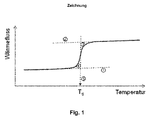
- Die Glasübergangstemperatur der erfindungsgemäß einsetzbaren Poly(meth)acrylate beträgt bevorzugt < 0 °C, stärker bevorzugt zwischen -20 und -50 °C. Die Glasübergangstemperatur von Polymeren oder von Polymerblöcken in Blockcopolymeren wird im Rahmen dieser Erfindung mittels dynamischer Scanning Kalorimetrie (DSC) bestimmt. Dazu werden ca. 5 mg einer unbehandelten Polymerprobe in ein Aluminiumtiegelchen (Volumen 25 µL) eingewogen und mit einem gelochten Deckel verschlossen. Zur Messung wird ein DSC 204 F1 der Firma Netzsch verwendet. Es wird zwecks Inertisierung unter Stickstoff gearbeitet. Die Probe wird zunächst auf -150 °C abgekühlt, dann mit einer Heizrate von 10 K/min bis +150 °C aufgeheizt und erneut auf-150 °C abgekühlt. Die sich anschließende zweite Heizkurve wird erneut bei 10 K/min gefahren und die Änderung der Wärmekapazität aufgenommen. Glasübergänge werden als Stufen im Thermogramm erkannt.
- Die Glasübergangstemperatur wird folgendermaßen erhalten (siehe
Figur 1 ): - Der jeweils linear verlaufende Bereich der Messkurve vor und nach der Stufe wird in Richtung steigender (Bereich vor der Stufe) bzw. fallender (Bereich nach der Stufe) Temperaturen verlängert. Im Bereich der Stufe wird eine Ausgleichsgerade ⑤ parallel zur Ordinate so gelegt, dass sie die beiden Verlängerungslinien schneidet, und zwar so, dass zwei Flächen ③ und ④ (zwischen der jeweils einen Verlängerungslinie, der Ausgleichsgeraden und der Messkurve) gleichen Inhalts entstehen. Der Schnittpunkt der so positionierten Ausgleichsgeraden mit der Messkurve ergibt die Glasübergangstemperatur.
- Vorzugsweise sind die Poly(meth)acrylate der erfindungsgemäßen Haftklebemasse erhältlich durch zumindest anteiliges Einpolymerisieren von funktionellen, bevorzugt mit Epoxidgruppen vernetzungsfähigen Monomeren. Besonders bevorzugt handelt es sich dabei um Monomere mit Säuregruppen (besonders Carbonsäure-, Sulfonsäure oder Phosphonsäuregruppen) und/oder Hydroxygruppen und/oder Säureanhydridgruppen und/oder Epoxidgruppen und/oder Amingruppen; insbesondere bevorzugt sind carbonsäuregruppenhaltige Monomere. Es ist ganz besonders vorteilhaft, wenn das Polyacrylat einpolymerisierte Acrylsäure und/oder Methacrylsäure aufweist. All diese Gruppen weisen eine Vernetzungsfähigkeit mit Epoxidgruppen auf, wodurch das Polyacrylat vorteilhaft einer thermischen Vernetzung mit eingebrachten Epoxiden zugänglich wird.
- Weitere Monomere, die als Comonomere für die Poly(meth)acrylate verwendet werden können, sind neben Acrylsäure- und/oder Methacrylsäureestern mit bis zu 30 C-Atomen pro Molekül beispielsweise Vinylester von bis zu 20 C-Atome enthaltenden Carbonsäuren, Vinylaromaten mit bis zu 20 C-Atomen, ethylenisch ungesättigte Nitrile, Vinylhalogenide, Vinylether von 1 bis 10 C-Atome enthaltenden Alkoholen, aliphatische Kohlenwasserstoffe mit 2 bis 8 C-Atomen und einer oder zwei Doppelbindungen oder Mischungen dieser Monomere.
- Die Eigenschaften des betreffenden Poly(meth)acrylats lassen sich insbesondere über eine Variation der Glasübergangstemperatur des Polymers durch unterschiedliche Gewichtsanteile der einzelnen Monomere beeinflussen. Das beziehungsweise die Poly(meth)acrylat(e) der Erfindung können vorzugsweise auf die folgende Monomerzusammensetzung zurückgeführt werden:
- a) Acrylsäureester und/oder Methacrylsäureester der folgenden Formel
CH2 = C(RI)(COORII)
wobei RI = H oder CH3 und R" ein Alkylrest mit 4 bis 14 C-Atomen ist, - b) olefinisch ungesättigte Monomere mit funktionellen Gruppen der für eine Reaktivität mit bevorzugt Epoxidgruppen bereits definierten Art,
- c) optional weitere Acrylate und/oder Methacrylate und/oder olefinisch ungesättigte Monomere, die mit der Komponente (a) copolymerisierbar sind.
- Die Anteile der entsprechenden Komponenten (a), (b), und (c) werden bevorzugt derart gewählt, dass das Polymerisationsprodukt eine Glasübergangstemperatur von < 0 °C, stärker bevorzugt zwischen -20 und -50 °C (DSC) aufweist. Es ist besonders vorteilhaft, die Monomere der Komponente (a) mit einem Anteil von 45 bis 99 Gew.-%, die Monomere der Komponente (b) mit einem Anteil von 1 bis 15 Gew.-% und die Monomere der Komponente (c) mit einem Anteil von 0 bis 40 Gew.-% zu wählen (die Angaben sind bezogen auf die Monomermischung für das "Basispolymer", also ohne Zusätze eventueller Additive zu dem fertigen Polymer, wie Harze etc).
- Die Monomere der Komponente (a) sind insbesondere weichmachende und/oder unpolare Monomere. Vorzugsweise werden als Monomere (a) Acryl- und Methacrylsäureester mit Alkylgruppen bestehend aus 4 bis 14 C-Atomen, besonders bevorzugt 4 bis 9 C-Atomen, eingesetzt. Beispiele für derartige Monomere sind n-Butylacrylat, n-Butylmethacrylat, n-Pentylacrylat, n-Pentylmethacrylat, n-Amylacrylat, n-Hexylacrylat, n-Hexylmethacrylat, n-Heptylacrylat, n-Octylacrylat, n-Octylmethacrylat, n-Nonylacrylat und deren verzweigte Isomere, wie zum Beispiel Isobutylacrylat, Isooctylacrylat, Isooctylmethacrylat, 2-Ethylhexylacrylat oder 2-Ethylhexylmethacrylat.
- Die Monomere der Komponente (b) sind insbesondere olefinisch ungesättigte Monomere mit funktionellen Gruppen, insbesondere mit funktionellen Gruppen, die eine Reaktion mit Epoxidgruppen eingehen können.
- Bevorzugt werden für die Komponente (b) Monomere mit funktionellen Gruppen eingesetzt, die ausgewählt sind aus der Gruppe umfassend: Hydroxy-, Carboxy-, Sulfonsäure- oder Phosphonsäuregruppen, Säureanhydride, Epoxide, Amine. Besonders bevorzugte Beispiele für Monomere der Komponente (b) sind Acrylsäure, Methacrylsäure, Itaconsäure, Maleinsäure, Fumarsäure, Crotonsäure, Aconitsäure, Dimethylacrylsäure, β-Acryloyloxypropionsäure, Trichloracrylsäure, Vinylessigsäure, Vinylphosphonsäure, Maleinsäureanhydrid, Hydroxyethylacrylat, insbesondere 2-Hydroxyethylacrylat, Hydroxypropylacrylat, insbesondere 3-Hydroxypropylacrylat, Hydroxybutylacrylat, insbesondere 4-Hydroxybutylacrylat, Hydroxyhexylacrylat, insbesondere 6-Hydroxyhexylacrylat, Hydroxyethylmethacrylat, insbesondere 2-Hydroxyethylmethacrylat, Hydroxypropylmethacrylat, insbesondere 3-Hydroxypropylmethacrylat, Hydroxybutylmethacrylat, insbesondere 4-Hydroxybutylmethacrylat, Hydroxyhexylmethacrylat, insbesondere 6-Hydroxy-hexylmethacrylat, Allylalkohol, Glycidylacrylat, Glycidylmethacrylat.
- Prinzipiell können als Komponente (c) alle vinylisch funktionalisierten Verbindungen eingesetzt werden, die mit der Komponente (a) und/oder der Komponente (b) copolymerisierbar sind. Die Monomere der Komponente (c) können zur Einstellung der Eigenschaften der resultierenden Haftklebemasse dienen.
- Beispielhafte Monomere der Komponente (c) sind:
- Methylacrylat, Ethylacrylat, Propylacrylat, Methylmethacrylat, Ethylmethacrylat, Benzylacrylat, Benzylmethacrylat, sec-Butylacrylat, tert-Butylacrylat, Phenylacrylat, Phenylmethacrylat, Isobornylacrylat, Isobornylmethacrylat, tert-Butylphenylacrylat, tert-Butylaphenylmethacrylat, Dodecylmethacrylat, Isodecylacrylat, Laurylacrylat, n-Undecylacrylat, Stearylacrylat, Tridecylacrylat, Behenylacrylat, Cyclohexylmethacrylat, Cyclopentylmethacrylat, Phenoxyethylacrlylat, Phenoxyethylmethacrylat, 2-Butoxyethyl-methacrylat, 2-Butoxyethylacrylat, 3,3,5-Trimethylcyclohexylacrylat, 3,5-Dimethyl-adamantylacrylat, 4-Cumylphenylmethacrylat, Cyanoethylacrylat, Cyanoethylmethacrylat, 4-Biphenylacrylat, 4-Biphenylmethacrylat, 2-Naphthylacrylat, 2-Naphthylmethacrylat, Tetrahydrofufurylacrylat, Diethylaminoethylacrylat, Diethylaminoethylmethacrylat, Dimethylaminoethylacrylat, Dimethylaminoethylmethacrylat, 2-Butoxyethylacrylat, 2-Butoxyethylmethacrylat, 3-Methoxyacrylsäuremethylester, 3-Methoxybutylacrylat, Phenoxyethylacrlylat, Phenoxyethylmethacrylat, 2-Phenoxyethylmethacrylat, Butyldiglykolmethacrylat, Ethylenglycolacrylat, Ethylenglycolmonomethylacrylat, Methoxy Polyethylenglykolmethacrylat 350, Methoxy Polyethylenglykolmethacrylat 500, Propylenglycolmonomethacrylat, Butoxydiethylenglykolmethacrylat, Ethoxytriethylenglykolmethacrylat, Octafluoropentylacrylat, Octafluoropentylmethacrylat, 2,2,2-Trifluoroethylmethacrylat, 1,1,1,3,3,3-Hexafluoroisopropylacrylat, 1,1,1,3,3,3-Hexafluoroisopropylmethacrylat, 2,2,3,3,3-Pentafluoropropylmethacrylat, 2,2,3,4,4,4-Hexafluorobutylmethacrylat, 2,2,3,3,4,4,4-Heptafluorobutylacrylat, 2,2,3,3,4,4,4-Heptafluorobutylmethacrylat, 2,2,3,3,4,4,5,5,6,6,7,7,8,8,8-Pentadecafluorooctylmethacrylat, Dimethylaminopropylacrylamid, Dimethylaminopropylmethacrylamid, N-(1Methylundecyl)acrylamid, N-(n-Butoxymethyl)acrylamid, N-(Butoxymethyl)methacrylamid, N-(Ethoxymethyl)acrylamid, N-(n-Octadecyl)acrylamid, weiterhin N,N-Dialkyl-substituierte Amide, wie beispielsweise N,N-Dimethylacrylamid, N,N-Dimethylmethacrylamid, N-Benzylacrylamide, N-Isopropylacrylamid, N-tert-Butylacrylamid, N-tert-Octylacrylamid, N-Methylolacrylamid, N-Methylolmethacrylamid, Acrylnitril, Methacrylnitril, Vinylether, wie Vinylmethylether, Ethylvinylether, Vinylisobutylether, Vinylester, wie Vinylacetat, Vinylchlorid, Vinylhalogenide, Vinylidenchlorid, Vinylidenhalogenide, Vinylpyridin, 4-Vinylpyridin, N-Vinylphthalimid, N-Vinyllactam, N-Vinylpyrrolidon, Styrol, α- und p-Methylstyrol, α-Butylstyrol, 4-n-Butylstyrol, 4-n-Decylstyrol, 3,4-Dimethoxystyrol. Makromonomere wie 2-Polystyrolethylmethacrylat (gewichtsmittleres Molekulargewicht Mw, bestimmt mittels GPC, von 4000 bis 13000 g/mol), Poly(methylmethacrylat)ethylmethacrylat (Mw von 2000 bis 8000 g/mol).
- Monomere der Komponente (c) können vorteilhaft auch derart gewählt werden, dass sie funktionelle Gruppen enthalten, die eine nachfolgende strahlenchemische Vernetzung (beispielsweise durch Elektronenstrahlen, UV) unterstützen. Geeignete copolymerisierbare Photoinitiatoren sind zum Beispiel Benzoinacrylat und acrylatfunktionalisierte Benzophenonderivate. Monomere, die eine Vernetzung durch Elektronenbestrahlung unterstützen, sind zum Beispiel Tetrahydrofurfurylacrylat, N-tert-Butylacrylamid und Allylacrylat.
- Die Herstellung der Polyacrylate ("Polyacrylate" wird im Rahmen der Erfindung als synonym mit "Poly(meth)acrylate" verstanden) kann nach dem Fachmann geläufigen Verfahren geschehen, insbesondere vorteilhaft durch konventionelle radikalische Polymerisationen oder kontrollierte radikalische Polymerisationen. Die Polyacrylate können durch Copolymerisation der monomeren Komponenten unter Verwendung der üblichen Polymerisationsinitiatoren sowie gegebenenfalls von Reglern hergestellt werden, wobei bei den üblichen Temperaturen in Substanz, in Emulsion, zum Beispiel in Wasser oder flüssigen Kohlenwasserstoffen, oder in Lösung polymerisiert wird.
- Vorzugsweise werden die Polyacrylate durch Polymerisation der Monomere in Lösungsmitteln, insbesondere in Lösungsmitteln mit einem Siedebereich von 50 bis 150 °C, bevorzugt von 60 bis 120 °C unter Verwendung der üblichen Mengen an Polymerisationsinitiatoren, die im allgemeinen bei 0,01 bis 5, insbesondere bei 0,1 bis 2 Gew.-% (bezogen auf das Gesamtgewicht der Monomeren) liegen, hergestellt.
- Prinzipiell eignen sich alle dem Fachmann geläufigen, üblichen Initiatoren. Beispiele für Radikalquellen sind Peroxide, Hydroperoxide und Azoverbindungen, zum Beispiel Dibenzoylperoxid, Cumolhydroperoxid, Cyclohexanonperoxid, Di-t-butylperoxid, Cyclohexylsulfonylacetylperoxid, Diisopropylpercarbonat, t-Butylperoktoat, Benzpinacol. In einer sehr bevorzugten Vorgehensweise wird als radikalischer Initiator 2,2'-Azobis(2-methylbutyronitril) (Vazo® 67™ der Firma DuPont) oder 2,2'-Azobis(2-methylpropionitril) (2,2'-Azobisisobutyronitril; AlBN; Vazo® 64™ der Firma DuPont) verwendet.
- Als Lösungsmittel für die Herstellung der Poly(meth)acrylate kommen Alkohole wie Methanol, Ethanol, n- und iso-Propanol, n- und iso-Butanol, vorzugsweise Isopropanol und/oder Isobutanol, sowie Kohlenwasserstoffe wie Toluol und insbesondere Benzine eines Siedebereichs von 60 bis 120 °C in Frage. Ferner können Ketone wie vorzugsweise Aceton, Methylethylketon, Methylisobutylketon und Ester wie Essigsäureethylester sowie Gemische von Lösungsmitteln der genannten Art eingesetzt werden, wobei Gemische, die Isopropanol, insbesondere in Mengen von 2 bis 15 Gew.-%, bevorzugt 3 bis 10 Gew.-%, bezogen auf das eingesetzte Lösungsmittelgemisch, enthalten, vorgezogen werden.
- Bevorzugt erfolgt nach der Herstellung (Polymerisation) der Polyacrylate eine Aufkonzentration, und die weitere Verarbeitung der Polyacrylate erfolgt im Wesentlichen lösemittelfrei. Die Aufkonzentration des Polymerisats kann in Abwesenheit von Vernetzer- und Beschleunigersubstanzen geschehen. Es ist aber auch möglich, eine dieser Verbindungsklassen dem Polymerisat bereits vor der Aufkonzentration zuzusetzen, so dass die Aufkonzentration dann in Gegenwart dieser Substanz(en) erfolgt.
- Die Polymerisate können nach dem Aufkonzentrationsschritt in einen Compounder überführt werden. Gegebenenfalls können die Aufkonzentration und die Compoundierung auch im selben Reaktor stattfinden.
- Die gewichtsmittleren Molekulargewichte Mw der Polyacrylate liegen bevorzugt in einem Bereich von 20.000 bis 2.000.000 g/mol; sehr bevorzugt in einem Bereich von 100.000 bis 1.500.000 g/mol, äußerst bevorzugt in einem Bereich von 150.000 bis 1.000.000 g/mol. Die Angaben des mittleren Molekulargewichtes MW und der Polydisperistät PD in dieser Schrift beziehen sich auf die Bestimmung per Gelpermeationschromatographie. Dazu kann es vorteilhaft sein, die Polymerisation in Gegenwart geeigneter Polymerisationsregler wie Thiole, Halogenverbindungen und/oder Alkohole durchzuführen, um das gewünschte mittlere Molekulargewicht einzustellen.
- Die Angaben der zahlenmittleren Molmasse Mn und der gewichtsmittleren Molmasse Mw in dieser Schrift beziehen sich auf die Bestimmung per Gelpermeationschromatographie (GPC). Die Bestimmung erfolgt an 100 µl klarfiltrierter Probe (Probenkonzentration 4 g/l). Als Eluent wird Tetrahydrofuran mit 0,1 Vol.-% Trifluoressigsäure eingesetzt. Die Messung erfolgt bei 25 °C.
- Als Vorsäule wird eine Säule Typ PSS-SDV, 5 µm, 103 Å, 8,0 mm * 50 mm (Angaben hier und im Folgenden in der Reihenfolge: Typ, Partikelgrösse, Porosität, Innendurchmesser * Länge; 1 Å = 10-11 m) verwendet. Zur Auftrennung wird eine Kombination der Säulen des Typs PSS-SDV, 5 µm, 103 Å sowie 105 Å und 106 Å mit jeweils 8,0 mm * 300 mm eingesetzt (Säulen der Firma Polymer Standards Service; Detektion mittels Differentialrefraktometer Shodex RI71). Die Durchflussmenge beträgt 1,0 ml pro Minute. Die Kalibrierung erfolgt bei Polyacrylaten gegen PMMA-Standards (Polymethylmethacrylat-Kalibrierung) und sonst (Harze, Elastomere) gegen PS-Standards (Polystyrol-Kalibrierung).
- Die Polyacrylate haben vorzugsweise einen K-Wert von 30 bis 90, besonders bevorzugt von 40 bis 70, gemessen in Toluol (1%ige Lösung, 21 °C). Der K-Wert nach Fikentscher ist ein Maß für das Molekulargewicht und die Viskosität des Polymerisats.
- Das Prinzip der Methode beruht auf der kapillarviskosimetrischen Bestimmung der relativen Lösungsviskosität. Hierzu wird die Testsubstanz in Toluol durch dreißigminütiges Schütteln aufgelöst, so dass man eine 1 %-ige Lösung erhält. In einem Vogel-Ossag-Viskosimeter wird bei 25 °C die Auslaufzeit gemessen und daraus in Bezug auf die Viskosität des reinen Lösungsmittels die relative Viskosität der Probenlösung bestimmt. Aus Tabellen kann nach Fikentscher [P. E. Hinkamp, Polymer, 1967, 8, 381] der K-Wert abgelesen werden (K = 1000 k).
- Erfindungsgemäß besonders geeignet sind Polyacrylate, die eine enge Molekulargewichtsverteilung (Polydispersität PD < 4) haben. Diese Massen haben trotz eines relativ niedrigen Molekulargewichts nach dem Vernetzen eine besonders gute Scherfestigkeit. Zudem ermöglicht die niedrigere Polydispersität eine leichtere Verarbeitung aus der Schmelze, da die Fließviskosität gegenüber einem breiter verteilten Polyacrylat bei weitgehend gleichen Anwendungseigenschaften geringer ist. Eng verteilte Poly(meth)acrylate können vorteilhaft durch anionische Polymerisation oder durch kontrollierte radikalische Polymerisationsmethoden hergestellt werden, wobei letzteres besonders gut geeignet ist. Auch über N-Oxyle lassen sich entsprechende Polyacrylate herstellen. Ferner lässt sich in vorteilhafter Weise die Atom Transfer Radical Polymerization (ATRP) zur Synthese eng verteilter Polyacrylate einsetzen, wobei als Initiator bevorzugt monofunktionelle oder difunktionelle sekundäre oder tertiäre Halogenide und zur Abstraktion des(r) Halogenids(e) Cu-, Ni-, Fe-, Pd-, Pt-, Ru-, Os-, Rh-, Co-, Ir-, Ag- oder Au-Komplexe eingesetzt werden.
- Die Monomere zur Herstellung der Poly(meth)acrylate enthalten bevorzugt anteilig funktionelle Gruppen, die geeignet sind, mit Epoxidgruppen Verknüpfungsreaktionen einzugehen. Dies ermöglicht vorteilhaft eine thermische Vernetzung der Polyacrylate durch Reaktion mit Epoxiden. Unter Verknüpfungsreaktionen werden insbesondere Additions- und Substitutionsreaktionen verstanden. Bevorzugt kommt es also zu einer Verknüpfung der die funktionellen Gruppen tragenden Bausteine mit Epoxidgruppen tragenden Bausteinen, insbesondere im Sinne einer Vernetzung der die funktionellen Gruppen tragenden Polymerbausteine über Epoxidgruppen tragende Vernetzermoleküle als Verknüpfungsbrücken. Bei den epoxidgruppenhaltigen Substanzen handelt es sich bevorzugt um multifunktionelle Epoxide, also solche mit mindestens zwei Epoxidgruppen; entsprechend kommt es bevorzugt insgesamt zu einer mittelbaren Verknüpfung der die funktionellen Gruppen tragenden Bausteine.
- Die Poly(meth)acrylate der erfindungsgemäßen Haftklebemasse sind bevorzugt durch Verknüpfungsreaktionen - insbesondere im Sinne von Additions- oder Substitutionsreaktionen - von in ihnen enthaltenen funktionellen Gruppen mit thermischen Vernetzern vernetzt. Es können alle thermischen Vernetzer verwendet werden, die sowohl eine ausreichend lange Verarbeitungszeit gewährleisten, sodass es nicht zu einer Vergelung während des Verarbeitungsprozesses, insbesondere des Extrusionsprozesses, kommt, als auch zu einer schnellen Nachvernetzung des Polymers auf den gewünschten Vernetzungsgrad bei niedrigeren Temperaturen als der Verarbeitungstemperatur, insbesondere bei Raumtemperatur, führen. Möglich ist beispielsweise eine Kombination aus Carboxyl-, Amin- und/oder Hydroxygruppen enthaltenden Polymeren und Isocyanaten, insbesondere aliphatischen oder mit Aminen deaktivierten trimerisierten Isocyanaten, als Vernetzer.
- Geeignete Isocyanate sind insbesondere trimerisierte Derivate von MDI [4,4-Methylen-di(phenylisocyanat)], HDI [Hexamethylendiisocyanat, 1,6-Hexylendiisocyanat] und/oder IPDI [Isophorondiisocyanat, 5-Isocyanato-1-isocyanatomethyl-1,3,3-trimethylcyclohexan], beispielsweise die Typen Desmodur® N3600 und XP2410 (jeweils BAYER AG: Aliphatische Polyisocyanate, niedrigviskose HDI-Trimerisate). Ebenfalls geeignet ist die oberflächendeaktivierte Dispersion von mikronisiertem trimerisiertem IPDI BUEJ 339®, jetzt HF9 ® (BAYER AG).
- Grundsätzlich zur Vernetzung geeignet sind aber auch andere Isocyanate wie Desmodur VL 50 (Polyisocyanate am MDI-Basis, Bayer AG), Basonat F200WD (aliphatisches Polyisocyanat, BASF AG), Basonat HW100 (wasseremulgierbares polyfunktionelles Isocyanat auf HDI-Basis, BASF AG), Basonat HA 300 (allophanatmodifiziertes Polyisocyanat auf Isocyanurat. HDI-Basis, BASF) oder Bayhydur VPLS2150/1 (hydrophil modifiziertes IPDI, Bayer AG).
- Bevorzugt werden thermische Vernetzer zu 0,1 bis 5 Gew.-%, insbesondere zu 0,2 bis 1 Gew.-%, bezogen auf die Gesamtmenge des zu vernetzenden Polymers, eingesetzt.
- Bevorzugt sind die Poly(meth)acrylate der erfindungsgemäßen Haftklebemasse mittels Epoxid(en) bzw. mittels einer oder mehrerer epoxidgruppenhaltigen Substanz(en) vernetzt. Bei den epoxidgruppenhaltigen Substanzen handelt es sich insbesondere um multifunktionelle Epoxide, also solche mit zumindest zwei Epoxidgruppen; entsprechend kommt es insgesamt zu einer mittelbaren Verknüpfung der die funktionellen Gruppen tragenden Bausteine der Poly(meth)acrylate. Die epoxidgruppenhaltigen Substanzen können sowohl aromatische als auch aliphatische Verbindungen sein.
- Hervorragend geeignete multifunktionelle Epoxide sind Oligomere des Epichlorhydrins, Epoxyether mehrwertiger Alkohole (insbesondere Ethylen-, Propylen-, und Butylenglycole, Polyglycole, Thiodiglycole, Glycerin, Pentaerythrit, Sorbit, Polyvinylalkohol, Polyallylalkohol und ähnliche), Epoxyether mehrwertiger Phenole [insbesondere Resorcin, Hydrochinon, Bis-(4-hydroxyphenyl)-methan, Bis-(4-hydroxy-3-methylphenyl)-methan, Bis-(4-hydroxy-3,5-dibromphenyl)-methan, Bis-(4-hydroxy-3,5-difluorphenyl)-methan, 1,1-Bis-(4-hydroxyphenyl)ethan, 2,2-Bis-(4-hydroxyphenyl)propan, 2,2-Bis-(4-hydroxy-3-methylphenyl)-propan, 2,2-Bis-(4-hydroxy-3-chlorphenyl)-propan, 2,2-Bis-(4-hydroxy-3,5-dichlorphenyl)-propan, 2,2-Bis-(4-hydroxy-3,5-dichlorphenyl)-propan, Bis-(4-hydroxyphenyl)-phenylmethan, Bis-(4-hydroxyphenyl)-phenylmethan, Bis-(4-hydroxyphenyl)diphenylmethan, Bis (4-hydroxyphenyl)-4'-methylphenylmethan, 1,1-Bis-(4-hydroxyphenyl)-2,2,2-trichlorethan, Bis-(4-hydroxyphenyl)-(4-chlorphenyl)-methan, 1,1-Bis-(4-hydroxyphenyl)-cyclohexan, Bis-(4-hydroxyphenyl)-cyclohexylmethan, 4,4'-Dihydroxydiphenyl, 2,2'-Dihydroxydiphenyl, 4,4'-Dihydroxydiphenylsulfon] sowie deren Hydroxyethylether, Phenol-Formaldehyd-Kondensationsprodukte, wie Phenolalkohole, Phenolaldehydharze und ähnliche, S- und N-haltige Epoxide (zum Beispiel N,N-Diglycidylanilin, N,N'-Dimethyldiglycidyl-4,4-Diaminodiphenylmethan) sowie Epoxide, welche nach üblichen Verfahren aus mehrfach ungesättigten Carbonsäuren oder einfach ungesättigten Carbonsäureestern ungesättigter Alkohole hergestellt worden sind, Glycidylester, Polyglycidylester, die durch Polymerisation oder Mischpolymerisation von Glycidylestern ungesättigter Säuren gewonnen werden können oder aus anderen sauren Verbindungen (Cyanursäure, Diglycidylsulfid, cyclischem Trimethylentrisulfon bzw. dessen Derivaten und anderen) erhältlich sind.
- Sehr geeignete Ether sind beispielsweise 1,4-Butandioldiglycidether, Polyglycerol-3-glycidether, Cyclohexandimethanoldiglycidether, Glycerintriglycidether, Neopentylglykol-diglycidether, Pentaerythrittetraglycidether, 1,6-Hexandioldiglycidether, Polypropylen-glykoldiglycidether, Trimethylolpropantriglycidether, Pentaerythrittetraglycidether, Bisphenol-A-diglycidether und Bisphenol-F-diglycidether.
- Besonders bevorzugt für die Poly(meth)acrylate als zu vernetzende Polymere ist die Verwendung eines beispielsweise in der
EP 1 978 069 A1 beschriebenen Vernetzer-Beschleuniger-Systems ("Vernetzungssystem"), um eine bessere Kontrolle sowohl über die Verarbeitungszeit, Vernetzungskinetik sowie den Vernetzungsgrad zu erhalten. Das Vernetzer-Beschleuniger-System umfasst zumindest eine epoxidgruppenhaltige Substanz als Vernetzer und zumindest eine bei einer Temperatur unterhalb der Schmelztemperatur des zu vernetzenden Polymers für Vernetzungsreaktionen mittels epoxidgruppenhaltigen Verbindungen beschleunigend wirkende Substanz als Beschleuniger. - Als Beschleuniger werden erfindungsgemäß besonders bevorzugt Amine (formell als Substitutionsprodukte des Ammoniaks aufzufassen; in den folgenden Formeln sind diese Substituenten durch "R" dargestellt und umfassen insbesondere Alkyl- und/oder Arylreste und/oder andere organische Reste) eingesetzt, insbesondere bevorzugt solche Amine, die mit den Bausteinen der zu vernetzenden Polymere keine oder nur geringfügige Reaktionen eingehen.
- Prinzipiell können als Beschleuniger sowohl primäre (NRH2), sekundäre (NR2H) als auch tertiäre Amine (NR3) gewählt werden, selbstverständlich auch solche, die mehrere primäre und/oder sekundäre und/oder tertiäre Amingruppen aufweisen. Besonders bevorzugte Beschleuniger sind aber tertiäre Amine wie beispielweise Triethylamin, Triethylendiamin, Benzyldimethylamin, Dimethylamino-methylphenol, 2,4,6-Tris-(N,N-dimethylaminomethyl)-phenol, N,N'-Bis(3-(dimethyl-amino)propyl)harnstoff. Als Beschleuniger können vorteilhaft auch multifunktionelle Amine wie Diamine, Triamine und/oder Tetramine eingesetzt werden. Hervorragend geeignet sind zum Beispiel Diethylentriamin, Triethylentetramin, Trimethylhexamethylendiamin.
- Als Beschleuniger werden darüber hinaus bevorzugt Aminoalkohole verwendet. Besonders bevorzugt werden sekundäre und/oder tertiäre Aminoalkohole eingesetzt, wobei im Falle mehrerer Aminfunktionalitäten pro Molekül bevorzugt mindestens eine, bevorzugt alle Aminfunktionalitäten sekundär und/oder tertiär sind. Als bevorzugte Aminoalkohol-Beschleuniger können Triethanolamin, N,N-Bis(2-hydroxypropyl)ethanolamin, N-Methyldiethanolamin, N-Ethyldiethanolamin, 2-Aminocyclohexanol, Bis(2-hydroxycyclohexyl)methylamin, 2-(Diisopropylamino)ethanol, 2-(Dibutylamino)ethanol, N-Butyldiethanolamin, N-Butylethanolamin, 2-[Bis(2-hydroxyethyl)amino]-2-(hydroxymethyl)-1,3-propandiol, 1-[Bis(2-hydroxyethyl)amino]-2-propanol, Triisopropanolamin, 2-(Dimethylamino)ethanol, 2-(Diethylamino)ethanol, 2-(2-Dimethylaminoethoxy)ethanol, N,N,N'-Trimethyl-N'-hydroxyethylbisaminoethylether, N,N,N'-Trimethylaminoethylethanolamin und/oder N,N,N'-Trimethylaminopropylethanolamin eingesetzt werden.
- Weitere geeignete Beschleuniger sind Pyridin, Imidazole (wie beispielsweise 2-Methylimidazol) und 1,8-Diazabicyclo[5.4.0]undec-7-en. Auch cycloaliphatische Polyamine können als Beschleuniger eingesetzt werden. Geeignet sind auch Beschleuniger auf Phosphatbasis wie Phosphine und/oder Phosphoniumverbindungen, wie beispielsweise Triphenylphosphin oder Tetraphenylphosphoniumtetraphenylborat.
- Die erfindungsgemäße Haftklebemasse enthält ferner mindestens einen Synthesekautschuk. Erfindungsgemäß ist der Synthesekautschuk bzw. sind Synthesekautschuke in der Haftklebemasse zu 15 bis 50 Gew.-%, bezogen auf das Gesamtgewicht der Haftklebemasse, enthalten. Bevorzugt enthält die Haftklebemasse 20 bis 40 Gew.-%, bezogen auf das Gesamtgewicht der Haftklebemasse, mindestens eines Synthesekautschuks.
- Bevorzugt ist mindestens ein Synthesekautschuk der erfindungsgemäßen Haftklebemasse ein Blockcopolymer mit einem Aufbau A-B, A-B-A, (A-B)n, (A-B)nX oder (A-B-A)nX, worin
- die Blöcke A unabhängig voneinander für ein Polymer, gebildet durch Polymerisation mindestens eines Vinylaromaten;
- die Blöcke B unabhängig voneinander für ein Polymer, gebildet durch Polymerisation von konjugierten Dienen mit 4 bis 18 C-Atomen und/oder Isobutylen, oder für ein teil- oder vollhydriertes Derivat eines solchen Polymers;
- X für den Rest eines Kopplungsreagenzes oder Initiators und
- n für eine ganze Zahl ≥ 2 stehen.
- Geeignete Blockcopolymere (Vinylaromatenblockcopolymere) umfassen also einen oder mehrere gummiartige Blöcke B (Weichblöcke) und einen oder mehrere glasartige Blöcke A (Hartblöcke). Besonders bevorzugt ist mindestens ein Synthesekautschuk der erfindungsgemäßen Haftklebemasse ein Blockcopolymer mit einem Aufbau A-B, A-B-A, (A-B)3X oder (A-B)4X, wobei für A, B und X die vorstehenden Bedeutungen gelten. Ganz besonders bevorzugt sind alle Synthesekautschuke der erfindungsgemäßen Haftklebemasse Blockcopolymere mit einem Aufbau A-B, A-B-A, (A-B)3X oder (A-B)4X, wobei für A, B und X die vorstehenden Bedeutungen gelten. Insbesondere ist der Synthesekautschuk der erfindungsgemäßen Haftklebemasse ein Gemisch aus Blockcopolymeren mit einem Aufbau A-B, A-B-A, (A-B)3X oder (A-B)4X, das bevorzugt mindestens Diblockcopolymere A-B und/oder Triblockcopolymere A-B-A enthält.
- Der Block A ist generell ein glasartiger Block mit einer bevorzugten Glasübergangstemperatur (Tg, DSC), die oberhalb der Raumtemperatur liegt. Besonders bevorzugt liegt die Tg des glasartigen Blockes bei mindestens 40 °C, insbesondere bei mindestens 60 °C, ganz besonders bevorzugt bei mindestens 80 °C und äußerst bevorzugt bei mindestens 100 °C. Der Anteil an Vinylaromatenblöcken A an den gesamten Blockcopolymeren beträgt bevorzugt 10 bis 40 Gew.-%, besonders bevorzugt 20 bis 33 Gew.-%. Vinylaromaten zum Aufbau des Blocks A umfassen bevorzugt Styrol, α-Methylstyrol und/oder andere Styrol-Derivate. Der Block A kann somit als Homo- oder Copolymer vorliegen. Besonders bevorzugt ist der Block A ein Polystyrol.
- Das Vinylaromatenblockcopolymer weist weiterhin generell einen gummiartigen Block B bzw. Weichblock mit einer bevorzugten Tg von kleiner als Raumtemperatur auf. Die Tg des Weichblocks ist besonders bevorzugt kleiner als 0 °C, insbesondere kleiner als -10 °C, beispielsweise kleiner als -40 °C und ganz besonders bevorzugt kleiner als -60 °C.
- Bevorzugte konjugierte Diene als Monomere für den Weichblock B sind insbesondere ausgewählt aus der Gruppe bestehend aus Butadien, Isopren, Ethylbutadien, Phenylbutadien, Piperylen, Pentadien, Hexadien, Ethylhexadien, Dimethylbutadien und den Farnesen-Isomeren sowie beliebigen Mischungen dieser Monomere. Auch der Block B kann als Homopolymer oder als Copolymer vorliegen.
Besonders bevorzugt sind die konjugierten Diene als Monomere für den Weichblock B ausgewählt aus Butadien und Isopren. Beispielsweise ist der Weichblock B ein Polyisopren, ein Polybutadien oder ein teil- oder vollhydriertes Derivat eines dieser beiden Polymere wie insbesondere Polybutylenbutadien; oder ein Polymer aus einem Gemisch aus Butadien und Isopren. Ganz besonders bevorzugt ist der Block B ein Polybutadien. - Die erfindungsgemäße Haftklebemasse enthält darüber hinaus mindestens einen mit dem/den Poly(meth)acrylaten verträglichen Tackifier, der auch als Klebkraftverstärker oder Klebharz bezeichnet werden kann. Unter einem "Tackifier" wird entsprechend dem allgemeinem Fachmannverständnis ein oligomeres oder polymeres Harz verstanden, das die Autohäsion (den Tack, die Eigenklebrigkeit) der Haftklebemasse im Vergleich zu der keinen Tackifier enthaltenden, ansonsten aber identischen Haftklebemasse erhöht.
- Unter einem "mit dem/den Poly(meth)acrylaten verträglichen Tackifier" wird ein Tackifier verstanden, der die Glasübergangstemperatur des nach gründlichem Mischen von Poly(meth)acrylat und Tackifier erhaltenen Systems im Vergleich zum reinen Poly(meth)acrylat verändert, wobei auch der Mischung aus Poly(meth)acrylat und Tackifier nur eine Tg zugeordnet werden kann. Ein nicht mit dem/den Poly(meth)acrylat(en) verträglicher Tackifier würde in dem nach gründlichem Mischen von Poly(meth)acrylat und Tackifier erhaltenen System zu zwei Tg führen, von denen eine dem Poly(meth)acrylat und die andere den Harz-Domänen zuzuordnen wäre. Die Bestimmung der Tg erfolgt in diesem Zusammenhang kalorimetrisch mittels DSC (differential scanning calorimetry).
- Die Poly(meth)acrylat-verträglichen Harze der erfindungsgemäßen Zusammensetzung weisen bevorzugt einen DACP-Wert von weniger als 0 °C, sehr bevorzugt von höchstens -20 °C, und/oder bevorzugt einen MMAP-Wert von weniger als 40 °C, sehr bevorzugt von höchstens 20 °C, auf. Zur Bestimmung von DACP- und MMAP-Werten wird auf C. Donker, PSTC Annual Technical Seminar, Proceedings, S. 149-164, Mai 2001 verwiesen.
- Erfindungsgemäß bevorzugt ist der mit den Poly(meth)acrylaten verträgliche Tackifier ein Terpenphenolharz oder ein Kolophoniumderivat, besonders bevorzugt ein Terpenphenolharz. Die erfindungsgemäße Haftklebemasse kann auch Mischungen mehrerer Tackifier enthalten. Unter den Kolophoniumderivaten sind Kolophoniumester bevorzugt.
- Die erfindungsgemäße Haftklebemasse enthält bevorzugt 7 bis 25 Gew.-%, bezogen auf das Gesamtgewicht der Haftklebemasse, mindestens eines mit den Poly(meth)acrylaten verträglichen Tackifiers. Besonders bevorzugt ist der mit den Poly(meth)acrylaten verträgliche Tackifier bzw. sind mit den Poly(meth)acrylaten verträgliche Tackifier zu 12 bis 20 Gew.-%, bezogen auf das Gesamtgewicht der Haftklebemasse, enthalten.
- Bevorzugt ist/sind der bzw. die mit den Poly(meth)acrylaten verträgliche(n) Tackifier der erfindungsgemäßen Haftklebemasse auch mit dem Synthesekautschuk, insbesondere mit dessen Weichblock B, verträglich oder zumindest teilverträglich, wobei die vorstehende Definition des Begriffs "verträglich" entsprechend gilt. Polymer/Harz-Verträglichkeit ist u. a. von der Molmasse der Polymere bzw. Harze abhängig. Die Verträglichkeit ist besser, wenn die Molmasse(n) niedriger liegen. Für ein gegebenes Polymer kann es möglich sein, dass die niedermolekularen Bestandteile der Harzmolmassenverteilung mit dem Polymer verträglich sind, die höhermolekularen aber nicht. Dies ist ein Beispiel für Teilverträglichkeit.
- Das Gewichtsverhältnis von Poly(meth)acrylaten zu Synthesekautschuken in der erfindungsgemäßen Haftklebemasse beträgt bevorzugt von 1:1 bis 3:1, insbesondere von 1,8:1 bis 2,2:1.
- Das Gewichtsverhältnis von mit den Poly(meth)acrylaten verträglichen Tackifieren zu Synthesekautschuken in der erfindungsgemäßen Haftklebemasse beträgt bevorzugt maximal 2:1, insbesondere maximal 1:1. Mindestens beträgt dieses Gewichtsverhältnis bevorzugt 1:4.
- Besonders bevorzugt enthält die erfindungsgemäße Haftklebemasse
- a) 50 - 60 Gew.-%, bezogen auf das Gesamtgewicht der Haftklebemasse, mindestens eines Poly(meth)acrylats;
- b) 20 - 40 Gew.-%, bezogen auf das Gesamtgewicht der Haftklebemasse, mindestens eines Synthesekautschuks; und
- c) 7 - 25 Gew.-% mindestens eines mit dem/den Poly(meth)acrylat(en) verträglichen Tackifiers.
- Bevorzugt liegt der Synthesekautschuk in der erfindungsgemäßen Haftklebemasse im Poly(meth)acrylat dispergiert vor. Poly(meth)acrylat und Synthesekautschuk sind dementsprechend bevorzugt für sich jeweils homogene Phasen. Die in der Haftklebemasse enthaltenen Poly(meth)acrylate und Synthesekautschuke sind vorzugsweise so gewählt, dass sie bei 23 °C nicht bis zur Homogenität miteinander mischbar sind. Die erfindungsgemäße Haftklebemasse liegt somit zumindest mikroskopisch und zumindest bei Raumtemperatur bevorzugt in mindestens zweiphasiger Morphologie vor. Besonders bevorzugt sind Poly(meth)acrylat(e) und Synthesekautschuk(e) in einem Temperaturbereich von 0 °C bis 50 °C, insbesondere von -30 °C bis 80 °C nicht homogen miteinander mischbar, so dass die Haftklebemasse in diesen Temperaturbereichen zumindest mikroskopisch mindestens zweiphasig vorliegt.
- Komponenten sind im Sinne dieser Schrift als dann "nicht homogen miteinander mischbar" definiert, wenn sich auch nach innigem Vermischen die Ausbildung zumindest zweier stabiler Phasen physikalisch und/oder chemisch zumindest mikroskopisch nachweisen lässt, wobei die eine Phase reich an der einen Komponente und die zweite Phase reich an der anderen Komponente ist. Ein Vorliegen vernachlässigbar geringer Mengen der einen Komponente in der anderen, das einer Ausbildung der Mehrphasigkeit nicht entgegensteht, wird dabei als unbeachtlich angesehen. So können in der Poly(meth)acrylatphase geringe Mengen an Synthesekautschuk und/oder in der Synthesekautschukphase geringe Mengen an Poly(meth)acrylat-Komponente vorliegen, sofern es sich nicht um wesentliche Mengen handelt, welche die Phasenseparation beeinflussen.
- Die Phasentrennung kann insbesondere derart realisiert sein, dass diskrete Bereiche ("Domänen"), die reich an Synthesekautschuk sind - also im Wesentlichen aus Synthesekautschuk gebildet sind -, in einer kontinuierlichen Matrix, die reich an Poly(meth)acrylat ist - also im Wesentlichen aus Poly(meth)acrylat gebildet ist -, vorliegen. Ein geeignetes Analysesystem für eine Phasentrennung ist beispielweise die Raster-Elektronenmikroskopie. Phasenseparation kann sich aber beispielweise auch dadurch erkennen lassen, dass die unterschiedlichen Phasen zwei voneinander unabhängige Glasübergangstemperaturen bei der dynamischen Differenzkalorimetrie (DDK, DSC) aufweisen. Phasentrennung liegt erfindungsgemäß dann vor, wenn sie sich durch mindestens eine der Analysenmethoden eindeutig zeigen lässt.
- Innerhalb der Synthesekautschuk-reichen Domänen kann als Feinstruktur zudem zusätzliche Mehrphasigkeit vorliegen, wobei die A-Blöcke eine Phase und die B-Blöcke eine zweite Phase bilden.
- Die erfindungsgemäße Haftklebemasse kann über die bisher aufgeführten Bestandteile hinaus ein oder mehrere Kohlenwasserstoffharz(e) enthalten, die nicht mit dem Poly(meth)acrylat verträglich sind. Derartige Kohlenwasserstoffharze, die ebenfalls Tackifier sind, umfassen bevorzugt hydrierte Polymerisate des Dicyclopentadiens; nicht, partiell, selektiv oder vollständig hydrierte Kohlenwasserstoffharze auf Basis von C5-, C5/C9- oder C9-Monomerströmen und Polyterpenharze auf Basis von α-Pinen und/oder von ß-Pinen und/oder von δ-Limonen. Die Kohlenwasserstoffharze weisen bevorzugt einen DACP-Wert von mindestens 0 °C, sehr bevorzugt von mindestens 20 °C, und/oder bevorzugt einen MMAP-Wert von mindestens 40 °C, sehr bevorzugt von mindestens 60 °C, auf. Zur Bestimmung von DACP- und MMAP-Werten wird auf C. Donker, PSTC Annual Technical Seminar, Proceedings, S. 149-164, Mai 2001 verwiesen. Die vorgenannten Kohlenwasserstoffharze können sowohl einzeln als auch im Gemisch in der Haftklebemasse enthalten sein. Besonders bevorzugte Kohlenwasserstoffharze sind Polyterpenharze auf Basis von α-Pinen und/oder von ß-Pinen und/oder von δ-Limonen.
- Bevorzugt ist die erfindungsgemäße Haftklebemasse geschäumt. Die Schäumung kann mittels beliebiger chemischer und/oder physikalischer Methoden erfolgen. Bevorzugt wird eine geschäumte erfindungsgemäße Haftklebemasse jedoch durch das Einbringen und nachfolgende Expandieren von Mikroballons erhalten. Unter "Mikroballons" werden elastische und somit in ihrem Grundzustand expandierbare Mikrohohlkugeln verstanden, die eine thermoplastische Polymerhülle aufweisen. Diese Kugeln sind mit niedrigsiedenden Flüssigkeiten oder verflüssigtem Gas gefüllt. Als Hüllenmaterial finden insbesondere Polyacrylnitril, PVDC, PVC oder Polyacrylate Verwendung. Als niedrigsiedende Flüssigkeit sind insbesondere Kohlenwasserstoffe der niederen Alkane, beispielsweise Isobutan oder Isopentan geeignet, die als verflüssigtes Gas unter Druck in der Polymerhülle eingeschlossen sind.
- Durch ein Einwirken auf die Mikroballons, insbesondere durch eine Wärmeeinwirkung, erweicht die äußere Polymerhülle. Gleichzeitig geht das in der Hülle befindliche flüssige Treibgas in seinen gasförmigen Zustand über. Dabei dehnen sich die Mikroballons irreversibel aus und expandieren dreidimensional. Die Expansion ist beendet, wenn sich der Innen- und der Außendruck ausgleichen. Da die polymere Hülle erhalten bleibt, erzielt man so einen geschlossenzelligen Schaum.
- Wird mittels Mikroballons geschäumt, dann können die Mikroballons als Batch, Paste oder als unverschnittenes oder verschnittenes Pulver der Formulierung zugeführt werden. Dosierpunkte sind beispielsweise vor oder nach dem Zugabepunkt des Poly(meth)acrylats denkbar, etwa gemeinsam als Pulver mit dem Synthesekautschuk oder als Paste zu einem späteren Zeitpunkt.
- Es ist eine Vielzahl an Mikroballontypen kommerziell erhältlich, welche sich im Wesentlichen über ihre Größe (6 bis 45 µm Durchmesser im unexpandierten Zustand) und ihre zur Expansion benötigten Starttemperaturen (75 bis 220 °C) differenzieren. Ein Beispiel für kommerziell erhältliche Mikroballons sind die Expancel® DU-Typen (DU = dry unexpanded) von der Firma Akzo Nobel. Unexpandierte Mikroballontypen sind auch als wässrige Dispersion mit einem Feststoff- beziehungsweise Mikroballonanteil von ca. 40 bis 45 Gew.-% erhältlich, weiterhin auch als polymergebundende Mikroballons (Masterbatche), zum Beispiel in Ethylvinylacetat mit einer Mikroballonkonzentration von ca. 65 Gew.-%. Sowohl die Mikroballon-Dispersionen als auch die Masterbatche sind wie die DU-Typen zur Herstellung einer geschäumten erfindungsgemäßen Haftklebemasse geeignet.
- Eine geschäumte erfindungsgemäße Haftklebemasse kann auch mit sogenannten vorexpandierten Mikroballons erzeugt werden. Bei dieser Gruppe findet die Expansion schon vor der Einmischung in die Polymermatrix statt. Vorexpandierte Mikroballons sind beispielsweise unter der Bezeichnung Dualite® oder mit der Typenbezeichnung DE (Dry Expanded) kommerziell erhältlich.
- Die Dichte einer geschäumten erfindungsgemäßen Haftklebemasse beträgt bevorzugt 200 bis 1000 kg/m3, stärker bevorzugt 300 bis 900 kg/m3, insbesondere 400 bis 800 kg/m3.
- Je nach Anwendungsgebiet und gewünschten Eigenschaften der erfindungsgemäßen Haftklebemasse können dieser weitere Komponenten und/oder Additive zugesetzt sein, und zwar jeweils allein oder in Kombination mit einem oder mehreren anderen Additiven oder Komponenten.
- So kann die erfindungsgemäße Haftklebemasse beispielsweise Pulver- und granulatförmige, insbesondere auch abrasive und verstärkende, Füllstoffe, Farbstoffe und Pigmente wie z. B. Kreiden (CaCO3), Titandioxid, Zinkoxide und/oder Ruße, enthalten. Bevorzugt enthält die Haftklebemasse eine oder mehrere Kreideform(en) als Füllstoff, besonders bevorzugt Mikrosöhl-Kreide (Fa. Söhlde). Bei bevorzugten Anteilen bis zu 20 Gew.-% verändern sich die klebtechnischen Eigenschaften (Scherfestigkeit bei Raumtemperatur, Sofortklebkraft auf Stahl und PE) durch den Füllstoffzusatz praktisch nicht. Darüber hinaus können verschiedene organische Füllstoffe enthalten sein. Geeignete Additive für die erfindungsgemäße Haftklebemasse sind außerdem - unabhängig gewählt von anderen Additiven - nicht expandierbare Polymerhohlkugeln, Polymervollkugeln, Glashohlkugeln, Glasvollkugeln, keramische Hohlkugeln, keramische Vollkugeln und/oder Kohlenstoffvollkugeln ("Carbon Micro Balloons").
- Weiterhin kann die erfindungsgemäße Haftklebemasse schwerentflammbare Füllstoffe, beispielsweise Ammoniumpolyphosphat; elektrisch leitfähige Füllstoffe, beispielsweise Leitruß, Kohlenstofffasern und/oder silberbeschichtete Kugeln; thermisch leitfähige Materialien wie beispielsweise Bornitrid, Aluminiumoxid, Siliciumcarbid; ferromagnetische Additive, beispielsweise Eisen-(III)-Oxide; organische, nachwachsende Rohstoffe wie beispielsweise Holzmehl, organische und/oder anorganische Nanopartikel, Fasern; Compoundierungsmittel, Alterungsschutzmittel, Lichtschutzmittel und/oder Ozonschutzmittel enthalten.
- Optional können Weichmacher enthalten sein. Als Weichmacher können z.B. (Meth)Acrylat-Oligomere, Phthalate, Cyclohexandicarbonsäureester, wasserlösliche Weichmacher, Weichharze, Phosphate oder Polyphosphate zudosiert werden.
- Die Beigabe von Kieselsäuren, vorteilhaft von gefällter, mit Dimethyldichlorsilan oberflächenmodifizierter Kieselsäure, kann genutzt werden, um die Wärmescherfestigkeit der Haftklebemasse einzustellen.
- Ein Verfahren zur Herstellung einer erfindungsgemäßen Haftklebemasse kann zunächst eine Aufkonzentration der aus der Polymerherstellung resultierenden Polyacrylat-Lösung oder -Dispersion umfassen. Die Aufkonzentration des Polymerisats kann in Abwesenheit von Vernetzer- und Beschleunigersubstanzen geschehen. Es ist aber auch möglich, maximal eine dieser Substanzen dem Polymerisat bereits vor der Aufkonzentration zuzusetzen, so dass die Aufkonzentration dann in Gegenwart dieser Substanz(en) erfolgt.
- Der Synthesekautschuk kann zusammen mit dem Poly(meth)acrylat-verträglichen Harz über einen Feststoffdosierer in einen Compounder gegeben werden. Über einen Sidefeeder kann das aufkonzentrierte und ggf. schon aufgeschmolzene Poly(meth)acrylat in den Compounder eingebracht werden. In besonderen Ausführungen des Verfahrens ist es auch möglich, dass Aufkonzentration und Compoundierung im selben Reaktor stattfinden. Die Poly(meth)acrylat-verträglichen Harze können auch über eine Harzschmelze und einen weiteren Sidefeeder an anderer Verfahrensposition, z. B. nach Eingabe von Synthesekautschuk und Poly(meth)acrylat, zugeführt werden.
- Weitere Additive und/oder Weichmacher können ebenfalls als Feststoffe oder Schmelze oder auch als Batch in Kombination mit einer anderen Formulierungskomponente zugeführt werden.
- Insbesondere kann als Compounder ein Extruder eingesetzt werden. Die Polymere liegen im Compounder bevorzugt in der Schmelze vor, entweder weil sie bereits im Schmelzezustand eingegeben werden oder indem sie im Compounder bis zur Schmelze erhitzt werden. Vorteilhafterweise werden die Polymerisate im Compounder durch Beheizung in der Schmelze gehalten.
- Sofern Beschleunigersubstanzen für die Vernetzung des Poly(meth)acrylats eingesetzt werden, werden diese den Polymerisaten bevorzugt erst kurz vor der Weiterverarbeitung, insbesondere einer Beschichtung oder anderweitigen Ausformung, zugesetzt. Das Zeitfenster der Zugabe vor der Beschichtung richtet sich insbesondere nach der zur Verfügung stehenden Topfzeit, also der Verarbeitungszeit in der Schmelze, ohne dass die Eigenschaften des resultierenden Produktes nachteilig verändert werden.
- Die Vernetzer, beispielsweise Epoxide, und die Beschleuniger können auch beide kurz vor der Weiterverarbeitung der Zusammensetzung zugesetzt werden, also vorteilhaft in der Phase, wie sie vorstehend für die Beschleuniger dargestellt ist. Hierzu ist es vorteilhaft, wenn Vernetzer und Beschleuniger an ein- und derselben Stelle gleichzeitig in den Prozess eingebracht werden, gegebenenfalls als Epoxid-Beschleuniger-Abmischung. Grundsätzlich ist es auch möglich, die Zugabezeitpunkte bzw. Zugabestellen für Vernetzer und Beschleuniger in den oben dargestellten Ausführungen zu vertauschen, so dass der Beschleuniger vor den Vernetzersubstanzen zugesetzt werden kann.
- Nach der Compoundierung der Masse kann ihre Weiterverarbeitung, insbesondere die Beschichtung auf einen permanenten oder auf einen temporären Träger, erfolgen. Ein permanenter Träger bleibt bei der Anwendung mit der Klebemassenschicht verbunden, während der temporäre Träger in dem weiteren Verarbeitungsprozess, zum Beispiel der Konfektionierung des Klebebandes, oder bei der Anwendung von der Klebemassenschicht entfernt wird.
- Die Beschichtung der Selbstklebemassen kann mit dem Fachmann bekannten Hotmelt-Beschichtungsdüsen oder bevorzugt mit Walzenauftragswerken, auch Beschichtungskalander genannt, erfolgen. Die Beschichtungskalander können vorteilhaft aus zwei, drei, vier oder mehr Walzen bestehen.
- Bevorzugt ist zumindest eine der Walzen mit einer anti-adhäsiven Walzenoberfläche versehen. Bevorzugt sind alle Walzen des Kalanders, die mit der Haftklebemasse in Berührung kommen, anti-adhäsiv ausgerüstet. Als anti-adhäsive Walzenoberfläche wird bevorzugt ein Stahl-Keramik-Silikon-Verbundwerkstoff eingesetzt. Derartige Walzenoberflächen sind gegen thermische und mechanische Belastungen resistent.
- Es hat sich als besonders vorteilhaft herausgestellt, wenn Walzenoberflächen eingesetzt werden, die eine Oberflächenstruktur aufweisen, insbesondere in der Art, dass die Fläche keinen vollständigen Kontakt zur zu verarbeitenden Masseschicht herstellt, sondern dass die Kontaktfläche - verglichen mit einer glatten Walze - geringer ist. Besonders günstig sind strukturierte Walzen wie Metall-Rasterwalzen, beispielsweise Stahlrasterwalzen.
- Ein weiterer Gegenstand der Erfindung ist ein Klebeband, das mindestens eine Schicht einer erfindungsgemäßen Haftklebemasse enthält. Die erfindungsgemäßen Haftklebemassen eignen sich besonders für die Ausbildung hoher Schichtdicken. Die Dicke der vorstehenden Schicht einer erfindungsgemäßen Haftklebemasse beträgt daher bevorzugt 100 µm bis 5000 µm, besonders bevorzugt 150 µm bis 3000 µm, insbesondere 200 µm bis 2500 µm, beispielsweise 500 µm bis 2000 µm.
- Bevorzugt besteht das erfindungsgemäße Klebeband aus einer Schicht einer erfindungsgemäßen Haftklebemasse. In diesem Fall handelt es sich also um ein sogenanntes Transferklebeband. Die Haftklebemasse kann aber auch als Trägerschicht eines ein- oder doppelseitigen Klebebands vorliegen oder mindestens eine der haftklebrigen äußeren Schichten eines trägerhaltigen ein- oder doppelseitigen Klebebands bilden. Ein Releaseliner, wie er üblicherweise zum (temporären) Schutz von Haftklebemassen auf diesen aufgebracht wird, wird vorliegend nicht als Bestandteil eines Klebebands angesehen. Dementsprechend kann das erfindungsgemäße Klebeband lediglich aus einer Schicht einer erfindungsgemäßen Haftklebemasse bestehen, auch wenn diese mit einem Releaseliner abgedeckt ist.
- Die Bestimmung der Klebkraft auf Stahl erfolgte bei einem Prüfklima von 23 °C +/- 1 °C Temperatur und 50 % +/- 5 % rel. Luftfeuchte. Die Muster wurden auf 20 mm Breite zugeschnitten und auf eine Stahlplatte geklebt. Die Prüfplatte wurde vor der Messung gereinigt und konditioniert. Dazu wurde die Stahlplatte zunächst mit Aceton abgewischt und danach 5 Minuten an der Luft liegen gelassen, damit das Lösungsmittel abdampfen konnte. Die dem Prüfuntergrund abgewandte Seite des einschichtigen Klebebands wurde dann mit 36 µm geätzter PET-Folie abgedeckt, wodurch verhindert wurde, dass sich das Muster bei der Messung dehnt. Danach erfolgte das Anrollen des Prüfmusters auf den Stahluntergrund. Hierzu wurde das Tape mit einer 4 kg - Rolle fünfmal hin und her mit einer Aufrollgeschwindigkeit von 10 m/min überrollt. 20 min nach dem Anrollen wurde die Stahlplatte in eine spezielle Halterung geschoben, die es ermöglicht, das Muster in einem Winkel von 90 ° senkrecht nach oben abzuziehen. Die Klebkraftmessung erfolgte mit einer Zwick-Zugprüfmaschine. Die Messergebnisse sind in N/cm angegeben und sind gemittelt aus drei Einzelmessungen.
- Als gute Werte sind Klebkräfte ab 15 N/cm anzusehen, bevorzugt werden Werte ab 20 N/cm. Als sehr gut sind Werte ab 25 N/cm anzusehen.
- Ein Transferklebeband mit den Maßen 13 x 20 mm wurde zwischen zwei gereinigte Stahlplatten verklebt. Die Verklebung wurde eine Minute lang mit 0,260 kN angedrückt. Nach einer Lagerung von 3 d wurde der Verbund an einem Schertestmessplatz, der mit einem Wärmeschrank kombiniert ist, aufgehängt. Die Belastung erfolgte mit 5 N. Der Test galt als beendet, wenn die Verklebung versagte oder die vorgegebene Prüfzeit abgelaufen war. Das Ergebnis wird in min angegeben und ist der Mittelwert aus 3 Einzelmessungen.
- Als gute Werte sind Zeiten ab 200 min anzusehen, bevorzugt werden Werte ab 1000 min. Als sehr gut sind Werte ab 5000 min anzusehen.
- Mit folgender Methode wurde die Ablösekraft von doppelseitigen Klebebändern bei einseitiger Kantenbelastung ermittelt. Ein L-förmiger Stahlblechwinkel (L-jig) wurde mit einem quadratisch zugeschnittenen Prüfmuster (25 mm Kantenlänge) auf einer gereinigten und konditionierten ABS-Platte verklebt. Der Verbund wurde 5 Sekunden mit 60 N angedrückt. Nach einer Aufziehzeit von 24 h bei 23 °C und 50 % rel. Luftfeuchte wurde der L-jig mit einer Zugprüfmaschine bei einer Geschwindigkeit von 300 mm/min abgezogen. Für die Prüftemperatur von -30 °C wurde die Zugprüfmaschine mit einer geeigneten Klimakammer umhüllt. Die Prüfkörper wurden mindestens 30 min bei -30 °C temperiert, bevor die Messung durchgeführt wurde.
Das Ergebnis ist der Mittelwert aus 3 Einzelmessungen. - Als gute Werte werden sowohl bei Raumtemperatur als auch bei -30 °C Kräfte ab 60 N/cm angesehen, bevorzugt werden Werte ab 75 N/cm. Als sehr gut sind Werte ab 100 N/cm anzusehen.
- Ein für radikalische Polymerisationen konventioneller Reaktor wurde mit 72,0 kg 2-Ethyl-hexylacrylat, 20,0 kg Methylacrylat, 8,0 kg Acrylsäure und 66,6 kg Aceton/ Isopropanol (94:6) befüllt. Nach 45minütiger Durchleitung von Stickstoffgas unter Rühren wurde der Reaktor auf 58 °C hochgeheizt und 50 g AIBN, gelöst in 500 g Aceton, hinzugegeben. Anschließend wurde das äußere Heizbad auf 75 °C erwärmt und die Reaktion konstant bei dieser Außentemperatur durchgeführt. Nach 1 h wurden erneut 50 g AIBN, gelöst in 500 g Aceton, zugegeben, und nach 4 h wurde mit 10 kg Aceton/Isopropanol-Gemisch (94:6) verdünnt.
- Nach 5 h sowie nach 7 h wurde jeweils mit 150 g Bis-(4-tert-butylcyclohexyl)-peroxydicarbonat, jeweils gelöst in 500 g Aceton, nachinitiiert. Nach 22 h Reaktionszeit wurde die Polymerisation abgebrochen und auf Raumtemperatur abgekühlt. Das Produkt hatte einen Feststoffgehalt von 55,8 % und wurde getrocknet. Das resultierende Polyacrylat hatte einen K-Wert von 58,9, ein mittleres Molekulargewicht von Mw = 748.000 g/mol, eine Polydispersität von D (Mw/Mn) = 8,9 und eine statische Glasübergangstemperatur von Tg = - 35,2 °C.
- In einem Planetwalzenextruder wurde über einen Feststoffdosierer der Synthesekautschuk Kraton D1118 als Granulat aufgeschmolzen. Es folgte die Zugabe einer Mikroballonpaste (50 % Expancel 051DU40 in Ethomeen C25). Über einen Sidefeeder wurde das Polyacrylat-Basispolymer zugeführt, das in einem Einschneckenextruder vorgeschmolzen wurde, und ein Terpenphenolharz (Dertophen DT105) zudosiert. Der Mischung wurden Vernetzer- (Polypox R16 15 % in Rheofos RDP) und Beschleuniger- (15 % Epicure 925 in Rheofos RDP) Lösung zugegeben. Die Schmelze wurde durchmischt und über einen Zweiwalzenkalander zwischen zwei Trennfolien (silikonisierte PET-Folie) beschichtet. Es resultierte ein einschichtiges Klebeband mit einer Schichtdicke von 1000 µm und einer Dichte von 550 kg/m3. Die Zusammensetzung lag bei 48 % Polyacrylat, 25 % Kraton D1118, 18 % Dertophen DT105, 4 % Vernetzer-/Beschleuniger-Lösung (Vernetzer:Beschleuniger = 1:1), 5 % Mikroballonpaste (Angaben in Gew.-%).
- In einem Planetwalzenextruder wurde über einen Feststoffdosierer der Synthesekautschuk Kraton D1118 als Granulat aufgeschmolzen. Über einen Sidefeeder wurde das Polyacrylat-Basispolymer zugeführt, das in einem Einschneckenextruder vorgeschmolzen wurde. Anschließend wurde ein Terpenphenolharz (Dertophen DT105) zudosiert. Die Mischung wurde in einen Doppelschneckenextruder überführt und dort mit einer Vernetzer- (Polypox R16 30 % in Rheofos RDP) und Beschleuniger- (30 % Epicure 925 in Rheofos RDP) Lösung versetzt. Es folgte die Zugabe einer Mikroballonpaste (50 % Expancel 051DU40 in Ethomeen C25). Die Schmelze wurde durchmischt und über einen Zweiwalzenkalander zwischen zwei Trennfolien (silikonisierte PET-Folie) beschichtet. Es resultierte ein einschichtiges Klebeband mit einer Schichtdicke von 1200 µm und einer Dichte von 730 kg/m3. Die Zusammensetzung lag bei 41 % Polyacrylat, 35 % Kraton D1118, 15 % Dertophen DT105, 4 % Vernetzer-/Beschleuniger-Lösung (Vernetzer:Beschleuniger= 1:1), 5 % Mikroballonpaste (Angaben in Gew.-%).
- Es wurde analog Beispiel 1 vorgegangen. Es resultierte ein einschichtiges Klebeband mit einer Schichtdicke von 1000 µm und einer Dichte von 540 kg/m3. Die Zusammensetzung lag bei 53 % Polyacrylat, 23 % Kraton D1118, 15 % Dertophen T105, 4 % Vernetzer-/Beschleuniger-Lösung (Vernetzer:Beschleuniger = 1:1), 5 % Mikroballonpaste (Angaben in Gew.-%).
- Es wurde analog Beispiel 1 vorgegangen. Es resultierte ein einschichtiges Klebeband mit einer Schichtdicke von 1000 µm und einer Dichte von 570 kg/m3. Die Zusammensetzung lag bei 45,5 % Polyacrylat, 28 % Kraton D1102, 15 % Dertophen T105, 2,5 % Piccolyte A115, 4 % Vernetzer-/Beschleuniger-Lösung (Vernetzer:Beschleuniger = 1:1), 5 % Mikroballonpaste (Angaben in Gew.-%).
- Es wurde analog Beispiel 1 vorgegangen. Es resultierte ein einschichtiges Klebeband mit einer Schichtdicke von 1000 µm und einer Dichte von 570 kg/m3. Die Zusammensetzung lag bei 48 % Polyacrylat, 28 % Kraton D1118, 7,5 % Dertophen T105, 7,5 % Piccolyte A115, 4 % Vernetzer-/Beschleuniger-Lösung (Vernetzer:Beschleuniger = 1:1), 5 % Mikroballonpaste (Angaben in Gew.-%).
- Es wurde analog Beispiel 2 vorgegangen. Es resultierte ein einschichtiges Klebeband mit einer Schichtdicke von 1000 µm und einer Dichte von 750 kg/m3. Die Zusammensetzung lag bei 43 % Polyacrylat, 28 % Kraton D1118, 20 % Dertophen T105, 4 % Vernetzer-/Beschleuniger-Lösung (Vernetzer:Beschleuniger = 1:1), 5 % Mikroballonpaste (Angaben in Gew.-%).
- Es wurde analog Beispiel 1 vorgegangen. Es resultierte ein einschichtiges Klebeband mit einer Schichtdicke von 1000 µm und einer Dichte von 570 kg/m3. Die Zusammensetzung lag bei 45,5 % Polyacrylat, 28 % Kraton D1102, 17,5 % Dertophen T105, 4 % Vernetzer-/Beschleuniger-Lösung (Vernetzer:Beschleuniger = 1:1), 5 % Mikroballonpaste (Angaben in Gew.-%).
- In einen Planetwalzenextruder wurde über einen Sidefeeder das Polyacrylat-Basispolymer zugeführt, das in einem Einschneckenextruder vorgeschmolzen wurde. Anschließend wurde ein Terpenphenolharz (Dertophen DT110) zudosiert. Die Mischung wurde in einen Doppelschneckenextruder überführt und dort mit Vernetzer- und Beschleunigerkomponenten (Polypox R16/ Epicure 925) versetzt. Es folgte die Zugabe einer Mikroballonpaste (50 % Expancel 051DU40 in Ethomeen C25). Die Schmelze wurde über einen Zweiwalzenkalander zwischen zwei Trennfolien (silikonisierte PET-Folie) beschichtet. Es resultierte ein einschichtiges Klebeband mit einer Schichtdicke von 1200 µm und einer Dichte von 870 kg/m3. Die Zusammensetzung lag bei 71 % Polyacrylat, 29 % Dertophen DT110, 0,3 % Vernetzer-/Beschleuniger, 2 % Mikroballonpaste (Angaben in Gew.-%).
- Es wurde analog Beispiel 1 vorgegangen. Es resultierte ein einschichtiges Klebeband mit einer Schichtdicke von 1000 µm und einer Dichte von 600 kg/m3. Die Zusammensetzung lag bei 48,5 % Polyacrylat, 7,5 % Kraton D1118, 16 % Dertophen T105, 19 % Piccolyte A115, 4 % Vernetzer-/Beschleuniger-Lösung (Vernetzer:Beschleuniger = 1:1), 5 % Mikroballonpaste (Angaben in Gew.-%).
- Es wurde analog Beispiel 1 vorgegangen. Es resultierte ein einschichtiges Klebeband mit einer Schichtdicke von 1000 µm und einer Dichte von 650 kg/m3. Die Zusammensetzung lag bei 49 % Acrylat, 27 % Kraton D1118, 15 % Piccolyte A115, 4 % Vernetzer-/Beschleuniger-Lösung (Vernetzer:Beschleuniger = 1:1), 5 % Mikroballonpaste (Angaben in Gew.-%).
Tabelle 1: Testergebnisse Klebkraft (Stahl, 90 °) L-jig (Raumtemperatur) L-jig (-30 °C) Statischer Schertest (5 N, 70 °C) Beispiel 1 28 N/cm 89 N/cm 96 N/cm > 5000 min Beispiel 2 29 N/cm 75 N/cm 91 N/cm > 5000 min Beispiel 3 30 N/cm 93 N/cm 91 N/cm 2355 min Beispiel 4 18 N/cm 107 N/cm 148 N/cm 250 min Beispiel 5 30 N/cm 75 N/cm 106 N/cm > 5000 min Beispiel 6 27 N/cm 95 N/cm 62 N/cm 1150 min Beispiel 7 18 N/cm 79 N/cm 79 N/cm 455 min Vergleichsbeispiel 1 31 N/cm 137 N/cm 7 N/cm 114 min Vergleichsbeispiel 2 35 N/cm 125 N/cm 22 N/cm 31 min Vergleichsbeispiel 3 23 N/cm 73 N/cm 54 N/cm > 5000 min
Claims (11)
- Haftklebemasse, enthaltend:a) 40 - 70 Gew.-%, bezogen auf das Gesamtgewicht der Haftklebemasse, mindestens eines Poly(meth)acrylats;b) 15 - 50 Gew.-%, bezogen auf das Gesamtgewicht der Haftklebemasse, mindestens eines Synthesekautschuks; undc) mindestens einen mit dem/den Poly(meth)acrylat(en) verträglichen Tackifier.
- Haftklebemasse gemäß Anspruch 1, dadurch gekennzeichnet, dass das Gewichtsverhältnis von Poly(meth)acrylaten zu Synthesekautschuken von 1:1 bis 3:1 beträgt.
- Haftklebemasse gemäß mindestens einem der vorstehenden Ansprüche, dadurch gekennzeichnet, dass das Gewichtsverhältnis von mit den Poly(meth)acrylaten verträglichen Tackifiern zu Synthesekautschuken maximal 2:1 beträgt.
- Haftklebemasse gemäß mindestens einem der vorstehenden Ansprüche, dadurch gekennzeichnet, dass das Gewichtsverhältnis von mit den Poly(meth)acrylaten verträglichen Tackifiern zu Synthesekautschuken mindestens 1:4 beträgt.
- Haftklebmasse gemäß mindestens einem der vorstehenden Ansprüche, dadurch gekennzeichnet, dass der Synthesekautschuk ein Blockcopolymer mit einem Aufbau A-B, A-B-A, (A-B)n, (A-B)nX oder (A-B-A)nX ist,
worin- die Blöcke A unabhängig voneinander für ein Polymer, gebildet durch Polymerisation mindestens eines Vinylaromaten;- die Blöcke B unabhängig voneinander für ein Polymer, gebildet durch Polymerisation von konjugierten Dienen mit 4 bis 18 C-Atomen und/oder Isobutylen, oder für ein teil- oder vollhydriertes Derivat eines solchen Polymers;- X für den Rest eines Kopplungsreagenzes oder Initiators und- n für eine ganze Zahl ≥ 2 stehen. - Haftklebemasse gemäß Anspruch 5, dadurch gekennzeichnet, dass der Gewichtsanteil der Blöcke A, bezogen auf sämtliche in der Haftklebemasse enthaltenen Blockcopolymere, 10 bis 40 Gew.-% beträgt.
- Haftklebemasse gemäß mindestens einem der vorstehenden Ansprüche, dadurch gekennzeichnet, dass der mit den Poly(meth)acrylaten verträgliche Tackifier ein Terpenphenolharz oder ein Kolophoniumderivat ist.
- Haftklebemasse gemäß mindestens einem der vorstehenden Ansprüche, dadurch gekennzeichnet, dass die Haftklebemasse geschäumt ist.
- Klebeband, enthaltend mindestens eine Schicht einer Haftklebemasse gemäß mindestens einem der vorstehenden Ansprüche.
- Klebeband gemäß Anspruch 9, dadurch gekennzeichnet, dass die Dicke der Schicht 100 µm bis 5000 µm beträgt.
- Klebeband gemäß mindestens einem der Ansprüche 9 und 10, dadurch gekennzeichnet, dass das Klebeband aus einer Schicht einer Haftklebemasse gemäß mindestens einem der Ansprüche 1 bis 8 besteht.
Applications Claiming Priority (1)
| Application Number | Priority Date | Filing Date | Title |
|---|---|---|---|
| DE102013215297.3A DE102013215297A1 (de) | 2013-08-02 | 2013-08-02 | Haftklebemasse |
Publications (3)
| Publication Number | Publication Date |
|---|---|
| EP2832811A1 true EP2832811A1 (de) | 2015-02-04 |
| EP2832811B1 EP2832811B1 (de) | 2024-03-20 |
| EP2832811C0 EP2832811C0 (de) | 2024-03-20 |
Family
ID=51260725
Family Applications (1)
| Application Number | Title | Priority Date | Filing Date |
|---|---|---|---|
| EP14179533.6A Active EP2832811B1 (de) | 2013-08-02 | 2014-08-01 | Haftklebemasse |
Country Status (9)
| Country | Link |
|---|---|
| US (1) | US20150037560A1 (de) |
| EP (1) | EP2832811B1 (de) |
| JP (1) | JP6530895B2 (de) |
| KR (1) | KR102230249B1 (de) |
| CN (1) | CN104371609A (de) |
| CA (1) | CA2858029A1 (de) |
| DE (1) | DE102013215297A1 (de) |
| MX (1) | MX2014009229A (de) |
| TW (1) | TW201510141A (de) |
Cited By (12)
| Publication number | Priority date | Publication date | Assignee | Title |
|---|---|---|---|---|
| EP3091059A1 (de) * | 2015-05-05 | 2016-11-09 | tesa SE | Klebeband mit klebemasse mit kontinuierlicher polymerphase |
| WO2018108387A1 (de) * | 2016-12-12 | 2018-06-21 | Tesa Se | Verfahren zur herstellung einer klebverbindung zwischen einer klebmasseschicht und einer lse-substratoberfläche |
| WO2018130496A1 (de) * | 2017-01-12 | 2018-07-19 | Tesa Se | Verfahren zur verklebung von profilen auf substratoberflächen |
| WO2019020363A1 (de) * | 2017-07-26 | 2019-01-31 | Tesa Se | Bahnförmige, mit mikroballons geschäumte haftklebmasse |
| US10308845B2 (en) | 2015-05-05 | 2019-06-04 | Tesa Se | Adhesive tape featuring adhesive with continuous polymer phase |
| DE102021206697A1 (de) | 2021-06-28 | 2022-12-29 | Tesa Se | Schockresistente Haftklebmasse |
| DE102021208045A1 (de) | 2021-07-26 | 2023-01-26 | Tesa Se | Bahnförmige, Polyurethan und/oder Silikon basierten Füllstoff enthaltende Haftklebmasse |
| EP4242277A1 (de) | 2022-03-11 | 2023-09-13 | tesa SE | Aushärtbare klebemasse mit verbesserter stanzbarkeit und verbesserten schockeigenschaften |
| DE102022105738A1 (de) | 2022-03-11 | 2023-09-14 | Tesa Se | Aushärtbare Klebemasse mit verbesserter Stanzbarkeit |
| WO2025131424A1 (de) | 2023-12-18 | 2025-06-26 | Tesa Se | Aushärtbare haftklebemasse mit hoher verklebungsfestigkeit und guter klebkraft im ausgehärteten zustand |
| WO2025195674A1 (de) | 2024-03-19 | 2025-09-25 | Tesa Se | Chemikalienbeständige, reaktiv aushärtbare klebemasse und klebeband |
| WO2026022391A1 (de) | 2024-07-26 | 2026-01-29 | Tesa Se | Haftklebmasse |
Families Citing this family (12)
| Publication number | Priority date | Publication date | Assignee | Title |
|---|---|---|---|---|
| EP3581630B1 (de) | 2015-04-02 | 2021-07-14 | tesa SE | Wiederablösbarer haftklebestreifen |
| DE102016223550A1 (de) * | 2016-03-10 | 2017-09-14 | Tesa Se | Verbundsystem mit schwach klebendem Abdeckmaterial |
| DE102016209707A1 (de) * | 2016-06-02 | 2017-12-07 | Tesa Se | Haftklebestreifen |
| SG11202003310XA (en) * | 2017-10-12 | 2020-05-28 | Avery Dennison Corp | Low outgassing clean adhesive |
| DE102017218519A1 (de) * | 2017-10-17 | 2019-04-18 | Tesa Se | Härtbarer Haftklebestreifen auf Basis von Vinylaromatenblockcopolymer |
| US20190161653A1 (en) * | 2017-11-28 | 2019-05-30 | Tesa Se | Sealing tape and methods of making the same |
| DE102018218283A1 (de) | 2018-09-11 | 2020-03-12 | Tesa Se | Verfahren zum Aufbringen von Stanzteilen auf Oberflächen sowie Testverfahren dafür |
| KR102853200B1 (ko) * | 2019-06-25 | 2025-08-29 | 주식회사 두산 | 접착 조성물 및 이를 포함하는 커버레이 필름 및 인쇄회로기판 |
| CN110307929B (zh) * | 2019-07-08 | 2020-08-25 | 上海交通大学 | 一种基于压力敏感薄膜的流体压力测量系统及方法 |
| CN110791205A (zh) * | 2019-11-25 | 2020-02-14 | 新纶科技(常州)有限公司 | 胶黏剂、uv固化一体成型的自粘性泡棉胶带及制备方法 |
| DE102020207783A1 (de) | 2020-06-23 | 2021-12-23 | Tesa Se | Leitfähiger doppelseitiger Haftklebestreifen |
| CN113401520B (zh) * | 2021-04-06 | 2022-07-26 | 巢进化学(上海)有限公司 | 一种psa在冷藏集装箱的应用 |
Citations (9)
| Publication number | Priority date | Publication date | Assignee | Title |
|---|---|---|---|---|
| US4107233A (en) | 1976-08-30 | 1978-08-15 | Shell Oil Company | Block copolymer blend with certain acrylics |
| EP0349216A1 (de) | 1988-06-28 | 1990-01-03 | Minnesota Mining And Manufacturing Company | Druckempfindlicher Klebstoff |
| EP0352901A1 (de) | 1988-06-28 | 1990-01-31 | Minnesota Mining And Manufacturing Company | Druckempfindliche Klebebänder |
| EP0437068A2 (de) | 1990-01-03 | 1991-07-17 | Minnesota Mining And Manufacturing Company | Zellular druckempfindliche Klebemembran |
| WO1995019393A1 (en) | 1994-01-14 | 1995-07-20 | Minnesota Mining And Manufacturing Company | Acrylate-containing polymer blends |
| WO2000006637A1 (en) | 1998-07-31 | 2000-02-10 | 3M Innovative Properties Company | Articles that include a polymer foam and method for preparing same |
| WO2001059024A1 (en) * | 2000-02-08 | 2001-08-16 | 3M Innovative Properties Company | Compatibilized pressure-sensitive adhesives |
| WO2008070386A1 (en) | 2006-12-07 | 2008-06-12 | 3M Innovative Properties Company | Blends of block copolymer and acrylic adhesives |
| EP1978069A1 (de) | 2007-04-05 | 2008-10-08 | Tesa AG | Thermisch vernetzende Polyacrylate und Verfahren zu deren Herstellung |
Family Cites Families (19)
| Publication number | Priority date | Publication date | Assignee | Title |
|---|---|---|---|---|
| US4243500A (en) * | 1978-12-04 | 1981-01-06 | International Coatings, Co., Inc. | Pressure sensitive adhesives |
| US5876855A (en) * | 1995-12-22 | 1999-03-02 | Minnesota Mining And Manufacturing Company | Pressure-sensitive adhesive suitable for skin and method of preparing |
| DE19820858A1 (de) * | 1998-05-09 | 1999-11-18 | Beiersdorf Ag | Klebeband |
| US6503621B1 (en) * | 2000-02-08 | 2003-01-07 | 3M Innovative Properties Company | Pressure sensitive adhesives and articles including radial block and acrylic polymers |
| US6497949B1 (en) * | 2000-08-11 | 2002-12-24 | 3M Innovative Properties Company | Adhesive blends comprising hydrophilic and hydrophobic pressure sensitive adhesives |
| DE10221092A1 (de) * | 2002-05-11 | 2003-12-11 | Tesa Ag | Geschäumte Haftklebemassen |
| DE102005054032A1 (de) * | 2005-11-10 | 2007-05-16 | Tesa Ag | Verfahren zur Herstellung von Haftklebemassen hoher Anisotropie |
| JP5386780B2 (ja) * | 2006-12-27 | 2014-01-15 | Dic株式会社 | エマルジョン型粘着剤および粘着シート |
| AU2008228842B2 (en) * | 2007-03-21 | 2014-01-16 | Avery Dennison Corporation | Pressure sensitive adhesives |
| DE102008037845A1 (de) * | 2008-08-15 | 2010-02-18 | Tesa Se | Haftklebemasse |
| DE102008062368A1 (de) * | 2008-12-17 | 2010-06-24 | Tesa Se | Haftklebemassen auf Basis von Naturkautschuk und Polyacrylaten |
| CN102471656A (zh) * | 2009-08-04 | 2012-05-23 | 3M创新有限公司 | 非卤化聚异丁烯热塑性弹性体共混物压敏粘合剂 |
| DE102009048036A1 (de) * | 2009-10-02 | 2011-04-07 | Tesa Se | Montageklebebänder |
| KR20120089343A (ko) * | 2009-11-19 | 2012-08-09 | 쓰리엠 이노베이티브 프로퍼티즈 컴파니 | 아크릴 중합체에 결합된 작용화 합성 고무와 합성 고무의 블렌드를 포함하는 감압 접착제 |
| KR101293785B1 (ko) * | 2009-12-29 | 2013-08-06 | 제일모직주식회사 | 열가소성 고무 조성물 및 이를 이용한 성형품 |
| JP5896636B2 (ja) * | 2011-07-22 | 2016-03-30 | 日東電工株式会社 | 水分散型粘着剤組成物、粘着剤および粘着シート |
| JP5964073B2 (ja) * | 2011-05-26 | 2016-08-03 | 日東電工株式会社 | 水分散型粘着剤組成物、粘着剤および粘着シート |
| JP2013253136A (ja) * | 2012-06-05 | 2013-12-19 | Nitto Denko Corp | 粘着剤層、及び粘着シート |
| DE102013000995A1 (de) * | 2012-08-16 | 2014-02-20 | Lohmann Gmbh & Co. Kg | Klebemittel mit Klebstoffblend aus Acrylat und Styrol-Block-Copolymer |
-
2013
- 2013-08-02 DE DE102013215297.3A patent/DE102013215297A1/de not_active Withdrawn
-
2014
- 2014-07-30 MX MX2014009229A patent/MX2014009229A/es unknown
- 2014-07-31 TW TW103126201A patent/TW201510141A/zh unknown
- 2014-07-31 JP JP2014156065A patent/JP6530895B2/ja not_active Expired - Fee Related
- 2014-07-31 CA CA2858029A patent/CA2858029A1/en not_active Abandoned
- 2014-08-01 US US14/449,660 patent/US20150037560A1/en not_active Abandoned
- 2014-08-01 KR KR1020140099090A patent/KR102230249B1/ko active Active
- 2014-08-01 CN CN201410539643.3A patent/CN104371609A/zh active Pending
- 2014-08-01 EP EP14179533.6A patent/EP2832811B1/de active Active
Patent Citations (9)
| Publication number | Priority date | Publication date | Assignee | Title |
|---|---|---|---|---|
| US4107233A (en) | 1976-08-30 | 1978-08-15 | Shell Oil Company | Block copolymer blend with certain acrylics |
| EP0349216A1 (de) | 1988-06-28 | 1990-01-03 | Minnesota Mining And Manufacturing Company | Druckempfindlicher Klebstoff |
| EP0352901A1 (de) | 1988-06-28 | 1990-01-31 | Minnesota Mining And Manufacturing Company | Druckempfindliche Klebebänder |
| EP0437068A2 (de) | 1990-01-03 | 1991-07-17 | Minnesota Mining And Manufacturing Company | Zellular druckempfindliche Klebemembran |
| WO1995019393A1 (en) | 1994-01-14 | 1995-07-20 | Minnesota Mining And Manufacturing Company | Acrylate-containing polymer blends |
| WO2000006637A1 (en) | 1998-07-31 | 2000-02-10 | 3M Innovative Properties Company | Articles that include a polymer foam and method for preparing same |
| WO2001059024A1 (en) * | 2000-02-08 | 2001-08-16 | 3M Innovative Properties Company | Compatibilized pressure-sensitive adhesives |
| WO2008070386A1 (en) | 2006-12-07 | 2008-06-12 | 3M Innovative Properties Company | Blends of block copolymer and acrylic adhesives |
| EP1978069A1 (de) | 2007-04-05 | 2008-10-08 | Tesa AG | Thermisch vernetzende Polyacrylate und Verfahren zu deren Herstellung |
Non-Patent Citations (2)
| Title |
|---|
| C. DONKER, PSTC ANNUAL TECHNICAL SEMINAR, PROCEEDINGS, May 2001 (2001-05-01), pages 149 - 164 |
| P. E. HINKAMP, POLYMER, vol. 8, 1967, pages 381 |
Cited By (16)
| Publication number | Priority date | Publication date | Assignee | Title |
|---|---|---|---|---|
| EP3091059A1 (de) * | 2015-05-05 | 2016-11-09 | tesa SE | Klebeband mit klebemasse mit kontinuierlicher polymerphase |
| US10308845B2 (en) | 2015-05-05 | 2019-06-04 | Tesa Se | Adhesive tape featuring adhesive with continuous polymer phase |
| WO2018108387A1 (de) * | 2016-12-12 | 2018-06-21 | Tesa Se | Verfahren zur herstellung einer klebverbindung zwischen einer klebmasseschicht und einer lse-substratoberfläche |
| WO2018130496A1 (de) * | 2017-01-12 | 2018-07-19 | Tesa Se | Verfahren zur verklebung von profilen auf substratoberflächen |
| WO2019020363A1 (de) * | 2017-07-26 | 2019-01-31 | Tesa Se | Bahnförmige, mit mikroballons geschäumte haftklebmasse |
| DE102021206697A1 (de) | 2021-06-28 | 2022-12-29 | Tesa Se | Schockresistente Haftklebmasse |
| WO2023274961A1 (de) | 2021-06-28 | 2023-01-05 | Tesa Se | Schockresistente haftklebmasse |
| WO2023006629A1 (de) | 2021-07-26 | 2023-02-02 | Tesa Se | Bahnförmige, polyurethan und/oder silikon basierten füllstoff enthaltende haftklebmasse |
| DE102021208045A1 (de) | 2021-07-26 | 2023-01-26 | Tesa Se | Bahnförmige, Polyurethan und/oder Silikon basierten Füllstoff enthaltende Haftklebmasse |
| EP4242277A1 (de) | 2022-03-11 | 2023-09-13 | tesa SE | Aushärtbare klebemasse mit verbesserter stanzbarkeit und verbesserten schockeigenschaften |
| DE102022105738A1 (de) | 2022-03-11 | 2023-09-14 | Tesa Se | Aushärtbare Klebemasse mit verbesserter Stanzbarkeit |
| WO2023169893A1 (de) | 2022-03-11 | 2023-09-14 | Tesa Se | Aushärtbare klebemasse mit verbesserter stanzbarkeit |
| DE102022105737A1 (de) | 2022-03-11 | 2023-09-14 | Tesa Se | Aushärtbare Klebemasse mit verbesserter Stanzbarkeit und verbesserten Schockeigenschaften |
| WO2025131424A1 (de) | 2023-12-18 | 2025-06-26 | Tesa Se | Aushärtbare haftklebemasse mit hoher verklebungsfestigkeit und guter klebkraft im ausgehärteten zustand |
| WO2025195674A1 (de) | 2024-03-19 | 2025-09-25 | Tesa Se | Chemikalienbeständige, reaktiv aushärtbare klebemasse und klebeband |
| WO2026022391A1 (de) | 2024-07-26 | 2026-01-29 | Tesa Se | Haftklebmasse |
Also Published As
| Publication number | Publication date |
|---|---|
| KR102230249B1 (ko) | 2021-03-18 |
| CA2858029A1 (en) | 2015-02-02 |
| US20150037560A1 (en) | 2015-02-05 |
| JP2015042741A (ja) | 2015-03-05 |
| CN104371609A (zh) | 2015-02-25 |
| TW201510141A (zh) | 2015-03-16 |
| MX2014009229A (es) | 2015-05-27 |
| DE102013215297A1 (de) | 2015-02-05 |
| KR20150016160A (ko) | 2015-02-11 |
| EP2832811B1 (de) | 2024-03-20 |
| JP6530895B2 (ja) | 2019-06-12 |
| EP2832811C0 (de) | 2024-03-20 |
Similar Documents
| Publication | Publication Date | Title |
|---|---|---|
| EP2883926B1 (de) | Haftklebemasse | |
| EP2832811B1 (de) | Haftklebemasse | |
| EP2677012A2 (de) | Hitzebeständiges Klebeband | |
| EP2690147A2 (de) | Geschäumtes Klebeband zur Verklebung auf unpolaren Oberflächen | |
| WO2008122489A1 (de) | Thermisch vernetzende polyacrylate und verfahren zu deren herstellung | |
| EP3633002A2 (de) | Verfahren zum aufbringen von stanzteilen auf oberflächen sowie testverfahren dafür | |
| EP3093322A1 (de) | Haftklebemasse für geschäumte klebebänder enthaltend eines poly(meth)acrylats, anorganischen mikrokugeln und expandierte mikroballons. | |
| WO2019229150A1 (de) | Mehrschichtiges klebeband mit harz-modifizierter haftklebmasse | |
| EP4253493A1 (de) | Klebeband zur verklebung auf lacken | |
| EP3568446A1 (de) | Verfahren zur verklebung von profilen auf substratoberflächen | |
| WO2019020363A1 (de) | Bahnförmige, mit mikroballons geschäumte haftklebmasse | |
| DE102022100562A1 (de) | Poly(meth)acrylat-basierte Haftklebemassen enthaltend mindestens einen Acrylnitril-Butadien-Kautschuk | |
| EP3636720A1 (de) | Verwendung einer verdickten alkoholischen zusammensetzung zur vertikalen, blasenfreien verklebung von substraten sowie verfahren zur vertikalen fügung zweier substrate | |
| DE102022131231B4 (de) | Wiederablösbares Haftklebeband und Verwendung | |
| WO2018108387A1 (de) | Verfahren zur herstellung einer klebverbindung zwischen einer klebmasseschicht und einer lse-substratoberfläche | |
| DE102020205793B4 (de) | Harzseife-modifizierte Haftklebmasse | |
| EP4377409A1 (de) | Bahnförmige, polyurethan und/oder silikon basierten füllstoff enthaltende haftklebmasse | |
| DE102017218264A1 (de) | Gefüllte Haftklebmasse |
Legal Events
| Date | Code | Title | Description |
|---|---|---|---|
| 17P | Request for examination filed |
Effective date: 20140801 |
|
| AK | Designated contracting states |
Kind code of ref document: A1 Designated state(s): AL AT BE BG CH CY CZ DE DK EE ES FI FR GB GR HR HU IE IS IT LI LT LU LV MC MK MT NL NO PL PT RO RS SE SI SK SM TR |
|
| AX | Request for extension of the european patent |
Extension state: BA ME |
|
| PUAI | Public reference made under article 153(3) epc to a published international application that has entered the european phase |
Free format text: ORIGINAL CODE: 0009012 |
|
| R17P | Request for examination filed (corrected) |
Effective date: 20150804 |
|
| RBV | Designated contracting states (corrected) |
Designated state(s): AL AT BE BG CH CY CZ DE DK EE ES FI FR GB GR HR HU IE IS IT LI LT LU LV MC MK MT NL NO PL PT RO RS SE SI SK SM TR |
|
| RAP1 | Party data changed (applicant data changed or rights of an application transferred) |
Owner name: TESA SE |
|
| STAA | Information on the status of an ep patent application or granted ep patent |
Free format text: STATUS: EXAMINATION IS IN PROGRESS |
|
| 17Q | First examination report despatched |
Effective date: 20180323 |
|
| GRAP | Despatch of communication of intention to grant a patent |
Free format text: ORIGINAL CODE: EPIDOSNIGR1 |
|
| STAA | Information on the status of an ep patent application or granted ep patent |
Free format text: STATUS: GRANT OF PATENT IS INTENDED |
|
| INTG | Intention to grant announced |
Effective date: 20231002 |
|
| GRAS | Grant fee paid |
Free format text: ORIGINAL CODE: EPIDOSNIGR3 |
|
| GRAA | (expected) grant |
Free format text: ORIGINAL CODE: 0009210 |
|
| STAA | Information on the status of an ep patent application or granted ep patent |
Free format text: STATUS: THE PATENT HAS BEEN GRANTED |
|
| AK | Designated contracting states |
Kind code of ref document: B1 Designated state(s): AL AT BE BG CH CY CZ DE DK EE ES FI FR GB GR HR HU IE IS IT LI LT LU LV MC MK MT NL NO PL PT RO RS SE SI SK SM TR |
|
| REG | Reference to a national code |
Ref country code: GB Ref legal event code: FG4D Free format text: NOT ENGLISH |
|
| REG | Reference to a national code |
Ref country code: CH Ref legal event code: EP |
|
| REG | Reference to a national code |
Ref country code: IE Ref legal event code: FG4D Free format text: LANGUAGE OF EP DOCUMENT: GERMAN |
|
| REG | Reference to a national code |
Ref country code: DE Ref legal event code: R096 Ref document number: 502014016784 Country of ref document: DE |
|
| U01 | Request for unitary effect filed |
Effective date: 20240419 |
|
| U07 | Unitary effect registered |
Designated state(s): AT BE BG DE DK EE FI FR IT LT LU LV MT NL PT SE SI Effective date: 20240425 |
|
| PG25 | Lapsed in a contracting state [announced via postgrant information from national office to epo] |
Ref country code: GR Free format text: LAPSE BECAUSE OF FAILURE TO SUBMIT A TRANSLATION OF THE DESCRIPTION OR TO PAY THE FEE WITHIN THE PRESCRIBED TIME-LIMIT Effective date: 20240621 |
|
| PG25 | Lapsed in a contracting state [announced via postgrant information from national office to epo] |
Ref country code: RS Free format text: LAPSE BECAUSE OF FAILURE TO SUBMIT A TRANSLATION OF THE DESCRIPTION OR TO PAY THE FEE WITHIN THE PRESCRIBED TIME-LIMIT Effective date: 20240620 Ref country code: HR Free format text: LAPSE BECAUSE OF FAILURE TO SUBMIT A TRANSLATION OF THE DESCRIPTION OR TO PAY THE FEE WITHIN THE PRESCRIBED TIME-LIMIT Effective date: 20240320 |
|
| PG25 | Lapsed in a contracting state [announced via postgrant information from national office to epo] |
Ref country code: RS Free format text: LAPSE BECAUSE OF FAILURE TO SUBMIT A TRANSLATION OF THE DESCRIPTION OR TO PAY THE FEE WITHIN THE PRESCRIBED TIME-LIMIT Effective date: 20240620 Ref country code: NO Free format text: LAPSE BECAUSE OF FAILURE TO SUBMIT A TRANSLATION OF THE DESCRIPTION OR TO PAY THE FEE WITHIN THE PRESCRIBED TIME-LIMIT Effective date: 20240620 Ref country code: HR Free format text: LAPSE BECAUSE OF FAILURE TO SUBMIT A TRANSLATION OF THE DESCRIPTION OR TO PAY THE FEE WITHIN THE PRESCRIBED TIME-LIMIT Effective date: 20240320 Ref country code: GR Free format text: LAPSE BECAUSE OF FAILURE TO SUBMIT A TRANSLATION OF THE DESCRIPTION OR TO PAY THE FEE WITHIN THE PRESCRIBED TIME-LIMIT Effective date: 20240621 |
|
| U20 | Renewal fee for the european patent with unitary effect paid |
Year of fee payment: 11 Effective date: 20240827 |
|
| PG25 | Lapsed in a contracting state [announced via postgrant information from national office to epo] |
Ref country code: IS Free format text: LAPSE BECAUSE OF FAILURE TO SUBMIT A TRANSLATION OF THE DESCRIPTION OR TO PAY THE FEE WITHIN THE PRESCRIBED TIME-LIMIT Effective date: 20240720 |
|
| PG25 | Lapsed in a contracting state [announced via postgrant information from national office to epo] |
Ref country code: SM Free format text: LAPSE BECAUSE OF FAILURE TO SUBMIT A TRANSLATION OF THE DESCRIPTION OR TO PAY THE FEE WITHIN THE PRESCRIBED TIME-LIMIT Effective date: 20240320 |
|
| PG25 | Lapsed in a contracting state [announced via postgrant information from national office to epo] |
Ref country code: ES Free format text: LAPSE BECAUSE OF FAILURE TO SUBMIT A TRANSLATION OF THE DESCRIPTION OR TO PAY THE FEE WITHIN THE PRESCRIBED TIME-LIMIT Effective date: 20240320 |
|
| PG25 | Lapsed in a contracting state [announced via postgrant information from national office to epo] |
Ref country code: CZ Free format text: LAPSE BECAUSE OF FAILURE TO SUBMIT A TRANSLATION OF THE DESCRIPTION OR TO PAY THE FEE WITHIN THE PRESCRIBED TIME-LIMIT Effective date: 20240320 |
|
| PG25 | Lapsed in a contracting state [announced via postgrant information from national office to epo] |
Ref country code: PL Free format text: LAPSE BECAUSE OF FAILURE TO SUBMIT A TRANSLATION OF THE DESCRIPTION OR TO PAY THE FEE WITHIN THE PRESCRIBED TIME-LIMIT Effective date: 20240320 |
|
| PG25 | Lapsed in a contracting state [announced via postgrant information from national office to epo] |
Ref country code: SK Free format text: LAPSE BECAUSE OF FAILURE TO SUBMIT A TRANSLATION OF THE DESCRIPTION OR TO PAY THE FEE WITHIN THE PRESCRIBED TIME-LIMIT Effective date: 20240320 |
|
| PG25 | Lapsed in a contracting state [announced via postgrant information from national office to epo] |
Ref country code: SM Free format text: LAPSE BECAUSE OF FAILURE TO SUBMIT A TRANSLATION OF THE DESCRIPTION OR TO PAY THE FEE WITHIN THE PRESCRIBED TIME-LIMIT Effective date: 20240320 Ref country code: SK Free format text: LAPSE BECAUSE OF FAILURE TO SUBMIT A TRANSLATION OF THE DESCRIPTION OR TO PAY THE FEE WITHIN THE PRESCRIBED TIME-LIMIT Effective date: 20240320 Ref country code: RO Free format text: LAPSE BECAUSE OF FAILURE TO SUBMIT A TRANSLATION OF THE DESCRIPTION OR TO PAY THE FEE WITHIN THE PRESCRIBED TIME-LIMIT Effective date: 20240320 Ref country code: PL Free format text: LAPSE BECAUSE OF FAILURE TO SUBMIT A TRANSLATION OF THE DESCRIPTION OR TO PAY THE FEE WITHIN THE PRESCRIBED TIME-LIMIT Effective date: 20240320 Ref country code: IS Free format text: LAPSE BECAUSE OF FAILURE TO SUBMIT A TRANSLATION OF THE DESCRIPTION OR TO PAY THE FEE WITHIN THE PRESCRIBED TIME-LIMIT Effective date: 20240720 Ref country code: ES Free format text: LAPSE BECAUSE OF FAILURE TO SUBMIT A TRANSLATION OF THE DESCRIPTION OR TO PAY THE FEE WITHIN THE PRESCRIBED TIME-LIMIT Effective date: 20240320 Ref country code: CZ Free format text: LAPSE BECAUSE OF FAILURE TO SUBMIT A TRANSLATION OF THE DESCRIPTION OR TO PAY THE FEE WITHIN THE PRESCRIBED TIME-LIMIT Effective date: 20240320 |
|
| REG | Reference to a national code |
Ref country code: DE Ref legal event code: R097 Ref document number: 502014016784 Country of ref document: DE |
|
| PLBE | No opposition filed within time limit |
Free format text: ORIGINAL CODE: 0009261 |
|
| STAA | Information on the status of an ep patent application or granted ep patent |
Free format text: STATUS: NO OPPOSITION FILED WITHIN TIME LIMIT |
|
| 26N | No opposition filed |
Effective date: 20241223 |
|
| REG | Reference to a national code |
Ref country code: CH Ref legal event code: PL |
|
| PG25 | Lapsed in a contracting state [announced via postgrant information from national office to epo] |
Ref country code: MC Free format text: LAPSE BECAUSE OF FAILURE TO SUBMIT A TRANSLATION OF THE DESCRIPTION OR TO PAY THE FEE WITHIN THE PRESCRIBED TIME-LIMIT Effective date: 20240320 Ref country code: CH Free format text: LAPSE BECAUSE OF NON-PAYMENT OF DUE FEES Effective date: 20240831 |
|
| PG25 | Lapsed in a contracting state [announced via postgrant information from national office to epo] |
Ref country code: IE Free format text: LAPSE BECAUSE OF NON-PAYMENT OF DUE FEES Effective date: 20240801 |
|
| U20 | Renewal fee for the european patent with unitary effect paid |
Year of fee payment: 12 Effective date: 20250827 |
|
| PGFP | Annual fee paid to national office [announced via postgrant information from national office to epo] |
Ref country code: GB Payment date: 20250820 Year of fee payment: 12 |
|
| PG25 | Lapsed in a contracting state [announced via postgrant information from national office to epo] |
Ref country code: CY Free format text: LAPSE BECAUSE OF FAILURE TO SUBMIT A TRANSLATION OF THE DESCRIPTION OR TO PAY THE FEE WITHIN THE PRESCRIBED TIME-LIMIT; INVALID AB INITIO Effective date: 20140801 |
|
| PG25 | Lapsed in a contracting state [announced via postgrant information from national office to epo] |
Ref country code: HU Free format text: LAPSE BECAUSE OF FAILURE TO SUBMIT A TRANSLATION OF THE DESCRIPTION OR TO PAY THE FEE WITHIN THE PRESCRIBED TIME-LIMIT; INVALID AB INITIO Effective date: 20140801 |