EP2830438B1 - N-acyl derivatives of gamma amino-butyric acid as food flavouring compounds, powder compositions containing them - Google Patents
N-acyl derivatives of gamma amino-butyric acid as food flavouring compounds, powder compositions containing them Download PDFInfo
- Publication number
- EP2830438B1 EP2830438B1 EP13716123.8A EP13716123A EP2830438B1 EP 2830438 B1 EP2830438 B1 EP 2830438B1 EP 13716123 A EP13716123 A EP 13716123A EP 2830438 B1 EP2830438 B1 EP 2830438B1
- Authority
- EP
- European Patent Office
- Prior art keywords
- flavour
- gaba
- powder
- compositions
- edible
- Prior art date
- Legal status (The legal status is an assumption and is not a legal conclusion. Google has not performed a legal analysis and makes no representation as to the accuracy of the status listed.)
- Active
Links
- 0 CC(CC(*)CNC(*)=O)CC(O)=O Chemical compound CC(CC(*)CNC(*)=O)CC(O)=O 0.000 description 1
Classifications
-
- A—HUMAN NECESSITIES
- A23—FOODS OR FOODSTUFFS; TREATMENT THEREOF, NOT COVERED BY OTHER CLASSES
- A23F—COFFEE; TEA; THEIR SUBSTITUTES; MANUFACTURE, PREPARATION, OR INFUSION THEREOF
- A23F5/00—Coffee; Coffee substitutes; Preparations thereof
- A23F5/46—Coffee flavour; Coffee oil; Flavouring of coffee or coffee extract
- A23F5/465—Flavouring with flavours other than natural coffee flavour or coffee oil
-
- A—HUMAN NECESSITIES
- A23—FOODS OR FOODSTUFFS; TREATMENT THEREOF, NOT COVERED BY OTHER CLASSES
- A23C—DAIRY PRODUCTS, e.g. MILK, BUTTER OR CHEESE; MILK OR CHEESE SUBSTITUTES; PREPARATION THEREOF
- A23C19/00—Cheese; Cheese preparations; Making thereof
- A23C19/06—Treating cheese curd after whey separation; Products obtained thereby
- A23C19/09—Other cheese preparations; Mixtures of cheese with other foodstuffs
- A23C19/0925—Addition, to cheese or curd, of colours, synthetic flavours or artificial sweeteners, including sugar alcohols
-
- A—HUMAN NECESSITIES
- A23—FOODS OR FOODSTUFFS; TREATMENT THEREOF, NOT COVERED BY OTHER CLASSES
- A23F—COFFEE; TEA; THEIR SUBSTITUTES; MANUFACTURE, PREPARATION, OR INFUSION THEREOF
- A23F5/00—Coffee; Coffee substitutes; Preparations thereof
- A23F5/24—Extraction of coffee; Coffee extracts; Making instant coffee
- A23F5/243—Liquid, semi-liquid or non-dried semi-solid coffee extract preparations; Coffee gels; Liquid coffee in solid capsules
-
- A—HUMAN NECESSITIES
- A23—FOODS OR FOODSTUFFS; TREATMENT THEREOF, NOT COVERED BY OTHER CLASSES
- A23L—FOODS, FOODSTUFFS OR NON-ALCOHOLIC BEVERAGES, NOT OTHERWISE PROVIDED FOR; PREPARATION OR TREATMENT THEREOF
- A23L11/00—Pulses, i.e. fruits of leguminous plants, for production of food; Products from legumes; Preparation or treatment thereof
- A23L11/50—Fermented pulses or legumes; Fermentation of pulses or legumes based on the addition of microorganisms
-
- A—HUMAN NECESSITIES
- A23—FOODS OR FOODSTUFFS; TREATMENT THEREOF, NOT COVERED BY OTHER CLASSES
- A23L—FOODS, FOODSTUFFS OR NON-ALCOHOLIC BEVERAGES, NOT OTHERWISE PROVIDED FOR; PREPARATION OR TREATMENT THEREOF
- A23L19/00—Products from fruits or vegetables; Preparation or treatment thereof
- A23L19/10—Products from fruits or vegetables; Preparation or treatment thereof of tuberous or like starch containing root crops
- A23L19/12—Products from fruits or vegetables; Preparation or treatment thereof of tuberous or like starch containing root crops of potatoes
- A23L19/18—Roasted or fried products, e.g. snacks or chips
-
- A—HUMAN NECESSITIES
- A23—FOODS OR FOODSTUFFS; TREATMENT THEREOF, NOT COVERED BY OTHER CLASSES
- A23L—FOODS, FOODSTUFFS OR NON-ALCOHOLIC BEVERAGES, NOT OTHERWISE PROVIDED FOR; PREPARATION OR TREATMENT THEREOF
- A23L19/00—Products from fruits or vegetables; Preparation or treatment thereof
- A23L19/20—Products from fruits or vegetables; Preparation or treatment thereof by pickling, e.g. sauerkraut or pickles
-
- A—HUMAN NECESSITIES
- A23—FOODS OR FOODSTUFFS; TREATMENT THEREOF, NOT COVERED BY OTHER CLASSES
- A23L—FOODS, FOODSTUFFS OR NON-ALCOHOLIC BEVERAGES, NOT OTHERWISE PROVIDED FOR; PREPARATION OR TREATMENT THEREOF
- A23L2/00—Non-alcoholic beverages; Dry compositions or concentrates therefor; Preparation or treatment thereof
- A23L2/52—Adding ingredients
- A23L2/56—Flavouring or bittering agents
-
- A—HUMAN NECESSITIES
- A23—FOODS OR FOODSTUFFS; TREATMENT THEREOF, NOT COVERED BY OTHER CLASSES
- A23L—FOODS, FOODSTUFFS OR NON-ALCOHOLIC BEVERAGES, NOT OTHERWISE PROVIDED FOR; PREPARATION OR TREATMENT THEREOF
- A23L23/00—Soups; Sauces; Preparation or treatment thereof
- A23L23/10—Soup concentrates, e.g. powders or cakes
-
- A—HUMAN NECESSITIES
- A23—FOODS OR FOODSTUFFS; TREATMENT THEREOF, NOT COVERED BY OTHER CLASSES
- A23L—FOODS, FOODSTUFFS OR NON-ALCOHOLIC BEVERAGES, NOT OTHERWISE PROVIDED FOR; PREPARATION OR TREATMENT THEREOF
- A23L27/00—Spices; Flavouring agents or condiments; Artificial sweetening agents; Table salts; Dietetic salt substitutes; Preparation or treatment thereof
- A23L27/20—Synthetic spices, flavouring agents or condiments
- A23L27/202—Aliphatic compounds
-
- A—HUMAN NECESSITIES
- A23—FOODS OR FOODSTUFFS; TREATMENT THEREOF, NOT COVERED BY OTHER CLASSES
- A23L—FOODS, FOODSTUFFS OR NON-ALCOHOLIC BEVERAGES, NOT OTHERWISE PROVIDED FOR; PREPARATION OR TREATMENT THEREOF
- A23L27/00—Spices; Flavouring agents or condiments; Artificial sweetening agents; Table salts; Dietetic salt substitutes; Preparation or treatment thereof
- A23L27/20—Synthetic spices, flavouring agents or condiments
- A23L27/203—Alicyclic compounds
-
- A—HUMAN NECESSITIES
- A23—FOODS OR FOODSTUFFS; TREATMENT THEREOF, NOT COVERED BY OTHER CLASSES
- A23L—FOODS, FOODSTUFFS OR NON-ALCOHOLIC BEVERAGES, NOT OTHERWISE PROVIDED FOR; PREPARATION OR TREATMENT THEREOF
- A23L27/00—Spices; Flavouring agents or condiments; Artificial sweetening agents; Table salts; Dietetic salt substitutes; Preparation or treatment thereof
- A23L27/20—Synthetic spices, flavouring agents or condiments
- A23L27/205—Heterocyclic compounds
- A23L27/2054—Heterocyclic compounds having nitrogen as the only hetero atom
-
- A—HUMAN NECESSITIES
- A23—FOODS OR FOODSTUFFS; TREATMENT THEREOF, NOT COVERED BY OTHER CLASSES
- A23L—FOODS, FOODSTUFFS OR NON-ALCOHOLIC BEVERAGES, NOT OTHERWISE PROVIDED FOR; PREPARATION OR TREATMENT THEREOF
- A23L27/00—Spices; Flavouring agents or condiments; Artificial sweetening agents; Table salts; Dietetic salt substitutes; Preparation or treatment thereof
- A23L27/20—Synthetic spices, flavouring agents or condiments
- A23L27/21—Synthetic spices, flavouring agents or condiments containing amino acids
-
- A—HUMAN NECESSITIES
- A23—FOODS OR FOODSTUFFS; TREATMENT THEREOF, NOT COVERED BY OTHER CLASSES
- A23L—FOODS, FOODSTUFFS OR NON-ALCOHOLIC BEVERAGES, NOT OTHERWISE PROVIDED FOR; PREPARATION OR TREATMENT THEREOF
- A23L27/00—Spices; Flavouring agents or condiments; Artificial sweetening agents; Table salts; Dietetic salt substitutes; Preparation or treatment thereof
- A23L27/50—Soya sauce
-
- A—HUMAN NECESSITIES
- A23—FOODS OR FOODSTUFFS; TREATMENT THEREOF, NOT COVERED BY OTHER CLASSES
- A23L—FOODS, FOODSTUFFS OR NON-ALCOHOLIC BEVERAGES, NOT OTHERWISE PROVIDED FOR; PREPARATION OR TREATMENT THEREOF
- A23L27/00—Spices; Flavouring agents or condiments; Artificial sweetening agents; Table salts; Dietetic salt substitutes; Preparation or treatment thereof
- A23L27/60—Salad dressings; Mayonnaise; Ketchup
-
- A—HUMAN NECESSITIES
- A23—FOODS OR FOODSTUFFS; TREATMENT THEREOF, NOT COVERED BY OTHER CLASSES
- A23L—FOODS, FOODSTUFFS OR NON-ALCOHOLIC BEVERAGES, NOT OTHERWISE PROVIDED FOR; PREPARATION OR TREATMENT THEREOF
- A23L7/00—Cereal-derived products; Malt products; Preparation or treatment thereof
- A23L7/10—Cereal-derived products
- A23L7/161—Puffed cereals, e.g. popcorn or puffed rice
-
- C—CHEMISTRY; METALLURGY
- C12—BIOCHEMISTRY; BEER; SPIRITS; WINE; VINEGAR; MICROBIOLOGY; ENZYMOLOGY; MUTATION OR GENETIC ENGINEERING
- C12C—BEER; PREPARATION OF BEER BY FERMENTATION; PREPARATION OF MALT FOR MAKING BEER; PREPARATION OF HOPS FOR MAKING BEER
- C12C5/00—Other raw materials for the preparation of beer
- C12C5/02—Additives for beer
- C12C5/026—Beer flavouring preparations
-
- A—HUMAN NECESSITIES
- A23—FOODS OR FOODSTUFFS; TREATMENT THEREOF, NOT COVERED BY OTHER CLASSES
- A23V—INDEXING SCHEME RELATING TO FOODS, FOODSTUFFS OR NON-ALCOHOLIC BEVERAGES AND LACTIC OR PROPIONIC ACID BACTERIA USED IN FOODSTUFFS OR FOOD PREPARATION
- A23V2002/00—Food compositions, function of food ingredients or processes for food or foodstuffs
-
- C—CHEMISTRY; METALLURGY
- C12—BIOCHEMISTRY; BEER; SPIRITS; WINE; VINEGAR; MICROBIOLOGY; ENZYMOLOGY; MUTATION OR GENETIC ENGINEERING
- C12G—WINE; PREPARATION THEREOF; ALCOHOLIC BEVERAGES; PREPARATION OF ALCOHOLIC BEVERAGES NOT PROVIDED FOR IN SUBCLASSES C12C OR C12H
- C12G2200/00—Special features
- C12G2200/21—Wine additives, e.g. flavouring or colouring agents
Definitions
- the present invention is concerned with flavour compostions in the form of powders, edible compositions containing said flavour compositions and methods of forming same.
- the invention is also concerned with methods of retaining the organoleptic quality of flavour oils, even as they are converted into powder form.
- Spray drying is a commonly employed industrial method, along with freeze-drying, vacuum continuous bed drying, and reduced-pressure low temperature drying methods employing vacuum dryers.
- Spray drying involves presenting a flavour oil in a liquid form, such as in the form of a neat liquid, a solution, an emulsion or a slurry of dispersed particles.
- the flavour oil is then introduced into a stream of carrier gas, which then feeds feeds it into a dispersive unit, such as a pressure nozzle, rotary disk or the like, which breaks up the liquid into tiny droplets and discharges them into a drying chamber wherein the tiny droplets are dried within a very short time scale (in the order of 5 to 30 seconds) to form a powder.
- Spray drying is a very convenient method for the mass production of powders.
- flavour oils are processed in this way, the conventional high processing temperatures can result in loss of key flavour oil components through evaporation, or degradation of the key components of the oil, which ultimately will negatively impact the quality of the powdered flavour.
- flavour powders that retain good flavour oil quality and thereby deliver intense, fresh and authentic flavours that are desired by consumers, irrespective of the methods used to form them.
- the invention provides in a first aspect a powder flavour composition
- a powder flavour composition comprising a compound according to the formula (I) represented by the formula and edible salts thereof, wherein m is 1 and R 1 is an alkyl residue containing from 6 to 20 carbon atoms, or an alkylene residue containing from 9 to 25 carbon atoms with from 1 to 3 double bonds, and at least one flavor co-ingredient.
- GABA gamma amino butyric acid
- These compounds are particularly useful to incorporate into an edible product to impart a remarkable mouthfeel, body and enhanced fat perception; or an enhanced umami or salt taste; or a cooling and richness. They are particularly useful in applications low in fat, salt and umami. They are also useful in fat-free formualtions such as beverages and oral care applications. They also find use in dairy applications and in vanilla, cocoa and chocolate.
- the compounds include C8-GABA, C9- GABA, C10- GABA, C12- GABA, C14- GABA, C16-GABA, C18- GABA, C20- GABA and C22- GABA.
- the compounds include C8-GABA, C9- GABA, C10- GABA, C12- GABA, C14- GABA, C16-GABA, C18- GABA, and C20-GABA, wherein the carboxylic acid residue is saturated.
- the compounds include C8-GABA, C9- GABA, C10- GABA, C12- GABA, C14- GABA, C16-GABA, C18- GABA, C20- GABA and C22- GABA, wherein the carboxylic acid residue is unsaturated and contains 1, 2 or 3 double bonds.
- the double bonds may be in cis-configuration, trans-configuration or a mixture of cis- and trans-configuration.
- Particularly preferred compounds include C10-GABA, C12-GABA, more particularly C12:1-GABA, C14-GABA, C16-GABA, more particularly C16:1-GABA, C18-GABA, more particularly C18:1-GABA, still more particularly C18:1c-GABA and C18:1t-GABA.
- Most preferred is a compound C18:2-GABA.
- the powder flavour compositions comprising compounds of formula (I) impart remarkable organoleptic properties to edible compositions to which they are added. In particular, they impart highly intense, authentic and harmonious flavour, and a roundness and fullness to edible compositions containing them.
- the invention provides in another of its aspects, a method of conferring flavour and/or mouthfeel to, or improving taste and/or mouthfeel of an edible composition, which method comprises adding to said composition a compound of formula (I) defined herein.
- the flavour co-ingredients may be sugars, fats, salt (e.g. sodium chloride), MSG, calcium ions, phosphate ions, organic acids, proteins, purines and mixtures thereof.
- sugars are present in amounts of 0.001 % to 90 %, more particularly 0.001 % to 50 %, still more particularly 0.001 % to 20 % based on the total weight of an edible composition.
- fats are present in amounts of 0.001 % to 100 %, more particularly 0.001 % to 80 %, more particularly 0.001 % to 30 %, still more particularly 0.001 % to 5 % based on the total weight of an edible composition.
- salt e.g. sodium chloride
- salt is present in amounts of 0.001 % to 20 %, more particularly 0.001 % to 5 % based on the total weight of an edible composition.
- MSG is present in amounts of 0.001 % to 2 % based on the total weight of an edible composition.
- calcium is present in amounts of 0.001% to 50% more particularly 0.001 % to 20 %, still more particularly 0.001 % to 1 % based on the total weight of an edible composition.
- organic acids are present in amounts of 0.001 % to 10 %, more particularly 0.001 % to 7 % based on the total weight of an edible composition.
- Types of organic acids include citric, malic, tartaric, fumaric, lactic, acetic and succinic.
- Types of edible compositions containing organic acids include beverages, such as carbonated soft drink beverages, still beverages, Juices, powdered soft drinks, liquid concentrates, alcoholic beverages and functional beverages.
- phosphorus is present in an amount up to 0.5 % by weight of an edible composition.
- phosphorus will be present as a phosphate or as phosphoric acid.
- purines are present in an amount up to 0.5 % by weight of an edible composition.
- purines include ribonucleotides such as IMP and GMP.
- Applicant found that an at least about 0.01 % stock solution, more particularly about 0.01 - 1 % stock solution of a compound of formula (I) achieved a balance regarding acceptable solvent levels for ease of handling and mixing, and the desire to limit the amount of solvent that would have to be removed from the stock solution when further processing of the compounds in flavour compositions and edible products for reasons of palatability, efficiency, cost and the like.
- suitable solvents for the stock solution include ethanol, triacetine, glycerol and miglyol.
- the compounds of formula (I) may be employed in any physical form. They may be used in a powder form. If the compounds of formula (I) are presented in the form of a powder, the powder form can be produced by a dispersive evaporation process, such as a spray drying process as is more fully described below.
- the powder form may be prepared by subjecting a liquid formulation containing a compound of formula (I) to a dispersive evaporation process.
- a powder composition comprising a compound of formula (I) forms another aspect of the present invention.
- the compounds of formula (I) may in incorporated into an edible composition alone, or in the form of a powder flavour composition comprising one or more flavour co-ingredients.
- a powder flavour composition comprising a compound according to the formula (I) and at least one flavour co-ingredient forms another aspect of the present invention.
- flavour co-ingredient is an ingredient that is able to contribute or impart or modify in a positive or pleasant way the taste of an edible composition.
- flavour co-ingredients may be employed in a composition according to the present invention, including, but not limited to natural flavours, artificial flavours, spices, seasonings.
- Flavour co-ingredients include synthetic flavour oils and flavouring aromatics and/or oils, oleoresins, essences, distillates, and extracts derived from plants, leaves, flowers, fruits, and so forth, and combinations comprising at least one of the foregoing.
- Flavour oils include spearmint oil, cinnamon oil, oil of wintergreen (methyl salicylate), peppermint oil, Japanese mint oil, clove oil, bay oil, anise oil, eucalyptus oil, thyme oil, cedar leaf oil, oil of nutmeg, allspice, oil of sage, mace, oil of bitter almonds, and cassia oil; useful flavouring agents include artificial, natural and synthetic fruit flavours such as vanilla, and citrus oils including lemon, orange, lime, grapefruit, yazu, sudachi, and fruit essences including apple, pear, peach, grape, blueberry, strawberry, raspberry, cherry, plum, prune, raisin, cola, guarana, neroli, pineapple, apricot, banana, melon, apricot, ume, cherry, raspberry, blackberry, tropical fruit, mango, mangosteen, pomegranate, papaya.
- useful flavouring agents include artificial, natural and synthetic fruit flavours such as vanilla, and citrus oils including lemon, orange,
- Additional exemplary flavours imparted by a flavouring agent include a milk flavour, a butter flavour, a cheese flavour, a cream flavour, and a yogurt flavour; a vanilla flavour; tea or coffee flavours, such as a green tea flavour, an oolong tea flavour, a tea flavour, a cocoa flavour, a chocolate flavour, and a coffee flavour; mint flavours, such as a peppermint flavour, a spearmint flavour, and a Japanese mint flavour; spicy flavours, such as an asafetida flavour, an ajowan flavour, an anise flavour, an angelica flavour, a fennel flavour, an allspice flavour, a cinnamon flavour, a chamomile flavour, a mustard flavour, a cardamom flavour, a caraway flavour, a cumin flavour, a clove flavour, a pepper flavour, a coriander flavour, a sassafras flavour, a savoury flavour, a Zanthoxyli Fructus flavour
- said flavour co-ingredients include aldehydes and esters such as cinnamyl acetate, cinnamaldehyde, citral diethylacetal, dihydrocarvyl acetate, eugenyl 49 formate, p-methylamisol, and so forth can be used.
- aldehyde flavourings include acetaldehyde (apple), benzaldehyde (cherry, almond), anisic aldehyde (licorice, anise), cinnamic aldehyde (cinnamon), citral, i.e., alpha-citral (lemon, lime), neral, i.e., beta-citral (lemon, lime), decanal (orange, lemon), ethyl vanillin (vanilla, cream), heliotrope, i.e., piperonal (vanilla, cream), vanillin (vanilla, cream), alpha-amyl cinnamaldehyde (spicy fruity flavours), butyraldehyde (butter, cheese), valeraldehyde (butter, cheese), citronellal (modifies, many types), decanal (citrus fruits), aldehyde C-8 (citrus fruits), aldehyde (
- flavour co- ingredients can be found in " Chemicals Used in Food Processing", publication 1274, pages 63-258, by the National Academy of Sciences .
- Flavour co-ingredients can also include salt tastants, umami tastants, and savoury flavour compounds.
- Non limiting examples include: NaCl, KCl, MSG, guanosine monophosphate (GMP), inosin monophospahte (IMP), ribonucleotides such as disodium inosinate, disodium guanylate, N-(2-hydroxyethyl)-lactamide, N-lactoyl -GMP, N-lactoyl tyramine, gamma amino butyric acid, allyl cysteine, 1-(2-hydroxy-4-methoxylphenyl)-3-(pyridine-2-yl)propan-1-one, arginine, potassium chloride, ammonium chloride, succinic acid, N-(2-methoxy-4-methyl benzyl)-N'-(2-(pyridin-2-yl)ethyl) oxalamide, N-
- the flavour co-ingredient is selected from the compounds and compositions disclosed in WO2005102701 , WO2006009425 , WO2005096843 , WO2006046853 and WO2005096844 .
- Flavour co-ingredients may include known salt tastants, umami tastants, and savoury flavour compounds.
- Non limiting examples include: NaCl, KCl, MSG, guanosine monophosphate (GMP), inosin monophospahte (IMP), ribonucleotides such as disodium inosinate, disodium guanylate, N-(2-hydroxyethyl)-lactamide, N-lactoyl -GMP, N-lactoyl tyramine, gamma amino butyric acid, allyl cysteine, 1-(2-hydroxy-4-methoxylphenyl)-3-(pyridine-2-yl)propan-1-one, arginine, potassium chloride, ammonium chloride, succinic acid, N-(2-methoxy-4-methyl benzyl)-N'-(2-(pyridin-2-yl)ethyl) oxalamide, N-
- the carrier material may be employed in compositions according to the invention to encapsulate or to entrap in a matrix the other components of the composition.
- the role of the carrier material may be merely that of a processing aid or a bulking agent, or it might be employed to shield or protect the other components from the effects of moisture or oxygen or any other aggressive media.
- the carrier material might also act as a means of controlling the release of flavour from edible compositions.
- Carrier materials may include mono, di- or trisaccharides, natural or modified starches, hydrocolloids, cellulose derivatives, polyvinyl acetates, polyvinylalcohols, proteins or pectins.
- Example of particular carrier materials include sucrose, glucose, lactose, levulose, fructose, maltose, ribose, dextrose, isomalt, sorbitol, mannitol, xylitol, lactitol, maltitol, pentatol, arabinose, pentose, xylose, galactose, maltodextrin, dextrin, chemically modified starch, hydrogenated starch hydrolysate, succinylated or hydrolysed starch, agar, carrageenan, gum arabic, gum accacia, tragacanth, alginates, methyl cellulose, carboxymethyl cellulose, hydroxyethyl cellulose, hydroxy
- flavour adjuvant an ingredient capable of imparting additional added benefit to compositions of the present invention such as a colour, light resistance, chemical stability.
- Suitable adjuvants include solvents (including water, alcohol, ethanol, triacetine, oils, fats, vegetable oil and miglyol), binders, diluents, disintegrating agents, lubricants, colouring agents, preservatives, antioxidants, emulsifiers, stabilisers, anti-caking agents.
- the flavour composition comprises an anti-oxidant.
- Said anti-oxidants may include vitamin C, vitamin E, rosemary extract, antrancine, butylated hydroxyanisole (BHA) and butylated hydroxytoluene (BHT).
- flavour compositions examples include " Perfume and Flavour Materials of Natural Origin”, S. Arctander, Ed., Elizabeth, N.J., 1960 ; in “ Perfume and Flavour Chemicals”, S. Arctander, Ed., Vol. I & II, Allured Publishing Corporation, Carol Stream, USA, 1994 ; in “ Flavourings”, E. Ziegler and H. Ziegler (ed.), Wiley-VCH Weinheim, 1998 , and " CTFA Cosmetic Ingredient Handbook", J.M. Nikitakis (ed.), 1st ed., The Cosmetic, Toiletry and Fragrance Association, Inc., Washington, 1988 .
- flavour compositions are described in standard texts, such as " Handbook of Industrial Chemical Additives", ed. M. and I. Ash, 2nd Ed., (Synapse 2000 ).
- the powder flavour compositions are prepared by any dispersive evaporation techniques generally known in the art.
- An example of such a technique is spray drying.
- flavour co-ingredients may be formed into a powder, before the compound of formula (I) is mixed into the powder.
- the compounds of formula (I), flavour co-ingredients and any optional ingredients can be mixed to form a liquid composition the the whole is then subjected to a dispersive evaporation process.
- the liquid composition used in the preparation of the powder may be in the form of a solution, emulsion, dispersion or slurry.
- the liquid may contain water, and/or an organic liquid, such as ethanol, glycerol, triacetine, miglyol (MCT) that is acceptable for use in edible compositions.
- a powder flavour composition comprising:
- a compound of formula (I) forms part of said liquid composition.
- a compound of formula (I) is added to the powder formed during step II).
- Powder flavour compositions according to the present invention may be prepared according to methods and apparatus known in the art for producing powders on an industrial scale.
- a particularly suitable method is spray drying.
- Spray drying techniques and apparatus are well known in the art and need no detailed discussion herein.
- the spray drying techniques, apparatus and methods described in US2005/0031769 and US2013/0022728 , as well as those techniques, apparatus and methods described in those documents are suitable for producing powder compositions of the present invention.
- flavour co-ingredients described herein above are volatile and/or may be sensitive to oxidative degradation, particularly when subjected to elevated temperature, and under humid conditions. Accordingly, particular problems can arise when subjecting flavour co-ingredients described above to dispersive evaporation processes such as spray drying.
- a non-exhaustive list of ingredients that can be particularly susceptible include, those ingredients containing artificial, natural or synthetic fruit flavours such as vanilla, chocolate, coffee, cocoa and citrus oil, including lemon, orange, grape, lime and grapefruit, and fruit essences including apple, pear, peach, strawberry, raspberry, cherry, plum, pineapple, apricot.
- flavour co-ingredients may include, but are not limited to, acetaldehyde, dimethyl sulfide, ethyl acetate, ethyl propionate, methyl butyrate, and ethyl butyrate.
- Flavour co-ingredients containing volatile aldehydes or esters include, e.g., cinnamyl acetate, cinnamaldehyde, citral, diethylacetal, dihydrocarvyl acetate, eugenyl formate, and p-methylanisole.
- volatile compounds that may be present as co-ingredients include acetaldehyde (apple); benzaldehyde (cherry, almond); cinnamic aldehyde (cinnamon); citral, i.e., alpha citral (lemon, lime); neral, i.e., beta citral (lemon, lime); decanal (orange, lemon); ethyl vanillin (vanilla, cream); heliotropine, i.e., piperonal (vanilla, cream); vanillin (vanilla, cream); alpha-amyl cinnamaldehyde (spicy fruity flavors); butyraldehyde (butter, cheese); valeraldehyde (butter, cheese); citronellal (modifies, many types); decanal (citrus fruits); aldehyde C-8 (citrus fruits); aldehyde C-9 (citrus fruits); aldehyde C-12
- the invention provides in another of its aspects a method of maintaining flavour quality of a powder flavour composition comprising the step of including in said powder flavour composition a compound of formula (I).
- Powder flavour compositions of the present invention can be incorporated into edible compositions.
- An edible composition containing a powder flavour composition forms another aspect of the present invention.
- Powder flavour compositions may be added in the form of a powder, to an edible composition.
- the powder flavour composition may be reconstituted in a suitable liquid and added to an edible composition in the form of a solution, dispersion, emulsion or paste.
- Flavour compositions according to the present invention may be provided in any suitable physical form.
- they may be in the form of oils, emulsions or dispersions in a hydrous liquid or organic liquid suitable for use in edible compositions, or solid form, such as powders.
- Edible composition refers to products for consumption by a subject, typically via the oral cavity (although consumption may occur via non-oral means such as inhalation), for at least one of the purposes of enjoyment, nourishment, or health and wellness benefits.
- Edible compositions may be present in any form including, but not limited to, liquids, solids, semi-solids, tablets, capsules, lozenges, strips, powders, gels, gums, pastes, slurries, syrups, aerosols and sprays.
- the term also refers to, for example, dietary and nutritional supplements.
- Edible compositions include compositions that are placed within the oral cavity for a period of time before being discarded but not swallowed.
- An edible composition as herein above defined includes compositions whose taste is modified in the manner described herein by the addition of compounds of formula (I) or whose taste is so modified by processing such that it is enriched in a compound of formula (I).
- the edible composition includes, but is not limited to foodstuffs of all kinds, confectionery products, baked products, sweet products, savoury products, fermented products, dairy products, beverages and oral care products.
- the term "edible compositions” refers to products for consumption by a subject, typically via the oral cavity (although consumption may occur via non-oral means such as inhalation), for one of the purposes of enjoyment or nourishment.
- the term "edible compositions” refers to products for consumption by a subject, typically via the oral cavity (although consumption may occur via non-oral means such as inhalation), for the purpose of enjoyment. Still more particularly, the term refers to foodstuffs and beverages.
- the term "edible composition” does not relate to pharmaceutical compositions.
- the term "edible composition” does not relate to nutritional supplements.
- Exemplary foodstuffs include, but are not limited to, chilled snacks, sweet and savoury snacks, fruit snacks, chips/crisps, extruded snacks, tortilla/corn chips, popcorn, pretzels, nuts, other sweet and savoury snacks, snack bars, granola bars, breakfast bars, energy bars, fruit bars, other snack bars, meal replacement products, slimming products, convalescence drinks, ready meals, canned ready meals, frozen ready meals, dried ready meals, chilled ready meals, dinner mixes, frozen pizza, chilled pizza, soup, canned soup, dehydrated soup, instant soup, chilled soup, uht soup, frozen soup, pasta, canned pasta, dried pasta, chilled/fresh pasta, noodles, plain noodles, instant noodles, cups/bowl instant noodles, pouch instant noodles, chilled noodles, snack noodles, dried food, dessert mixes, sauces, dressings and condiments, herbs and spices, spreads, jams and preserves, honey, chocolate spreads, nut-based spreads, and yeast-based spreads.
- Exemplary confectionery products include, but are not limited to, chewing gum (which includes sugarized gum, sugar-free gum, functional gum and bubble gum), centerfill confections, chocolate and other chocolate confectionery, medicated confectionery, lozenges, tablets, pastilles, mints, standard mints, power mints, chewy candies, hard candies, boiled candies, breath and other oral care films or strips, candy canes, lollipops, gummies, jellies, fudge, caramel, hard and soft panned goods, toffee, taffy, liquorice, gelatin candies, gum drops, jelly beans, nougats, fondants, combinations of one or more of the above, and edible flavour compositions incorporating one or more of the above.
- chewing gum which includes sugarized gum, sugar-free gum, functional gum and bubble gum
- centerfill confections chocolate and other chocolate confectionery
- medicated confectionery lozenges
- tablets pastilles, mints, standard mints, power mints
- chewy candies hard candies, boiled candies, breath and
- Exemplary baked products include, but are not limited to, alfajores, bread, packaged/industrial bread, unpackaged/artisanal bread, pastries, cakes, packaged/industrial cakes, unpackaged/artisanal cakes, cookies, chocolate coated biscuits, sandwich biscuits, filled biscuits, savoury biscuits and crackers, bread substitutes,
- Exemplary sweet products include, but are not limited to, breakfast cereals, ready-to-eat (“rte”) cereals, family breakfast cereals, flakes, muesli, other ready to eat cereals, children's breakfast cereals, hot cereals,
- Exemplary savoury products include, but are not limited to, salty snacks (potato chips, crisps, nuts, tortilla-tostada, pretzels, cheese snacks, corn snacks, potato-snacks, ready-to-eat popcorn, microwaveable popcorn, pork rinds, nuts, crackers, cracker snacks, breakfast cereals, meats, aspic, cured meats (ham, bacon), luncheon/breakfast meats (hotdogs, cold cuts, sausage), tomato products, margarine, peanut butter, soup (clear, canned, cream, instant, UHT),canned vegetables, pasta sauces.
- salty snacks potato chips, crisps, nuts, tortilla-tostada, pretzels, cheese snacks, corn snacks, potato-snacks, ready-to-eat popcorn, microwaveable popcorn, pork rinds, nuts, crackers, cracker snacks, breakfast cereals, meats, aspic, cured meats (ham, bacon), luncheon/breakfast meats (hotdogs, cold cuts, sausage), tomato products, margar
- Exemplary dairy products include, but are not limited to, cheese, cheese sauces, cheese-based products, ice cream, impulse ice cream, single portion dairy ice cream, single portion water ice cream, multi-pack dairy ice cream, multi-pack water ice cream, take-home ice cream, take-home dairy ice cream, ice cream desserts, bulk ice cream, take-home water ice cream, frozen yoghurt, artisanal ice cream, dairy products, milk, fresh/pasteurized milk, full fat fresh/pasteurized milk, semi skimmed fresh/pasteurized milk, long-life/uht milk, full fat long life/uht milk, semi skimmed long life/uht milk, fat-free long life/uht milk, goat milk, condensed/evaporated milk, plain condensed/evaporated milk, flavoured, functional and other condensed milk, flavoured milk drinks, dairy only flavoured milk drinks, flavoured milk drinks with fruit juice, soy milk, sour milk drinks, fermented dairy
- Exemplary beverages include, but are not limited to, flavoured water, soft drinks, fruit drinks, coffee-based drinks, tea-based drinks, juice-based drinks (includes fruit and vegetable), milk-based drinks, gel drinks, carbonated or non-carbonated drinks, powdered drinks, alcoholic or non-alcoholic drinks.
- Exemplary fermented foods include, but are not limited to, Cheese and cheese products, meat and meat products, soy and soy products, fish and fish products, grain and grain products, fruit and fruit products.
- the consumable product is selected from the group consisting of soy sauce, cheese, soup, hot and cold sauces, fruits, vegetables, ketchups, tea, coffee, snacks such as potato chips or extruded snacks.
- the powder flavour compositions comprising compounds of formula (I), when added to a flavour composition and/or an edible composition act on a composition to complement its flavour and/or mouthfeel to render it more delicious and authentic.
- the effects may be temporal or related to intensity, for example the compounds may act by enhancing, strengthening, softening, sharpening a flavour, or making more salivating.
- the compounds of formula (I) may also affect the temporal profile of a flavour, that is, they may affect the initial impact of a flavour, the body of a flavour, or its lingering effect.
- the powder flavour compositions comprising compounds of formula (I) may modify any aspect of the temporal profile of taste or flavour of an edible composition.
- the compounds improve mouthfeel and impart more creamy and fatty sensations.
- flavour composition should be employed in amounts such that the compounds of formula (I) are present in amounts of 1 part per billion to 10 parts per million based on the total weight of the edible composition. Whereas amounts higher than this can be employed, the beneficial effects are considerably less apparent and undesirable off-notes can become increasingly apparent.
- organoleptic effects e.g. salt, alcohol or coolant boosting effects
- edible compositions containing salt or alcohol or coolant compounds can be achieved when compounds of the formula (I) are employed at levels of 1 to 100 ppb.
- umami boosting effects in edible compositions containing umami tastants can be achieved when powder flavour compositions comprising compounds of the formula (I) are employed at levels of 100 to 250 ppb.
- organoleptic effects e.g. fat boosting effects
- edible compositions containing fats can be achieved when powder flavour compositions comprising compounds of the formula (I) are employed at levels of 500 to 1000 ppb.
- powder flavour compositions comprising compounds of formula (I) into edible compositions that are formed under conditions of high temperature, such as baking, frying or which are processed by heat treatments such as pasteurization or under UHT conditions. Under high preparation or processing temperatures, volatile flavour ingredients may be lost or degraded with the result that flavour intensity can be reduced and the essential and authentic flavour characteristics can be diminished.
- Such edible products include dairy products, snack foods, baked products, powdered soft drinks and similar dry mixes, fats and condiments, mayonnaise, dressings, soups and bouillons, and beverages.
- a particularly preferred class of edible composition according to the present invention are powdered soft drinks and similar dry mix applications. Dry mix applications are known in the art and included products in powder form that are intended to be reconstituted before consumption. They include powdered soups, powdered cake mixes, powdered chocolate drinks, instant coffees, seasonings and fonds.
- Dry powders formed by dispersive evaporation processes represent a very convenient vehicle to deliver flavour oil quality flavours to edible compositions.
- flavour oils and in particular citrus flavour oils can be particularly sensitive to dispersive evaporation processes, especially processes carried out at high temperature.
- Flavour oils tend to evaporate or degrade to form products having unfavourable off-notes.
- Powdered flavour compositions, particularly those containing citrus oils, can be of poor quality and exhibit relatively short self-life, as a result.
- the invention provides in another aspect a powder flavour composition
- a powder flavour composition comprising a compound according to formula (I) and at least one additional flavour co-ingredient.
- a powder soft drink composition or other dry mix composition comprising a compound according to formula (I).
- a powder soft drink composition or other dry mix composition comprising a powder flavour composition comprising a compound of formula (I).
- the compound of formula (I) may be added to the formed powder flavour composition, or it may be added to flavour composition before forming the powder.
- Another particularly preferred class of edible composition according to the present invention are snack foods.
- Snack foods are a category of product well known to the skilled person in the food industry. These products are described above and include, without limitation, pretzels, corn chips, potato chips, puffed products, extruded products, tortilla chips. Still more particularly, the invention is concerned with low fat snack food compositions. Low fat snack food compositions contain less that 30 % by weight fat, more particularly between 5 to 25 % by weight of fat.
- a problem with reducing fat in a snack food composition is the loss in taste and texture. Fats play an important role in the way that dough behaves during processing and greatly affect the quality, flavor and texture of ready-to-eat products. As the fat content in snack products is reduced or replaced with other ingredients (e.g., non-digestible fat, protein, fiber, gums), adverse organoleptic effects (e.g., mouth coating, drying, lack of crispness and lack of flavour) are increased. The adverse organoleptic effects result in products having reduced palatability.
- other ingredients e.g., non-digestible fat, protein, fiber, gums
- adverse organoleptic effects e.g., mouth coating, drying, lack of crispness and lack of flavour
- flavour compositions may be applied to a snack food as topical coatings in the form of dry powders and/or as liquids (e.g., oil-based, water-based). Another approach has been to add flavour to the dough.
- Compounds according to formula (I) or powder flavour compositions containing same can be incorporated into snack foods to impart an impactful flavour and a mouthfeel with a remarkable roundness and fullness. Furthermore, the taste and mouthfeel effects can be achieved even in low fat snack foods.
- the invention provides in another of its aspects a snack food comprising a flavour composition as hereinabove described.
- the snack food has a fat content of about 40 % or less by weight based on the total weight of the snack food, more particularly about 30 % or less, still more particularly 25 % or less, more particularly still about 10 % or less, still more particularly about 5 % or less, still more particularly about 3 % or less.
- snack foods examples include products processed by oven baking, extrusion or frying, and which are made from potato and/or corn and/or various grains such as rice or wheat.
- Another particularly preferred class of edible composition according to the present invention is alcoholic beverages.
- the invention provides in another of its aspects an alcoholic beverage comprising a powder flavour compositions comprising compound according to formula (I).
- Powder flavour compositions comprising-compounds of formula (I) may be incorporated into said alcoholic beverage in amounts of 1 ppb to 1 ppm.
- compositions are products taken orally in the form of tablets, capsules, powders, multiparticulates. Such compounds may include pharmaceutical dosage forms or nutraceutical dosage forms.
- the invention provides in another of its aspects an orally administrable dosage form, in particular in the form of tablets capsules, powders or multiparticulates comprising a compound according to the formula (I).
- compositions of the formula (I) may be incorporated topically or in-dough. Incorporated at levels of 1 ppb to 1 ppm, the compounds of formula (I) render baked products less dry and more succulent.
- compositions are caloric or non-caloric beverages containing carbohydrate sweeteners, such as sucrose, high fructose corn syrup, fructose and glucose, or high intensity, non-nutritive sweeteners such as aspartame, acesulfame K, sucralose, cyclamate, sodium saccharin, neotame, rebaudioside A, and/or other stevia-based sweeteners; as well as other optional ingredients such as juices, organic acids such as citric acid, alcohol and functional ingredients.
- carbohydrate sweeteners such as sucrose, high fructose corn syrup, fructose and glucose, or high intensity
- non-nutritive sweeteners such as aspartame, acesulfame K, sucralose, cyclamate, sodium saccharin, neotame, rebaudioside A, and/or other stevia-based sweeteners
- other optional ingredients such as juices, organic acids such as citric acid, alcohol and functional ingredients
- powder flavour compositions comprising compounds of formula (I) impart to said beverages containing sweeteners at levels of less than 1 % and up to about 20 %, an upfront sweetness and mouthfeel that is reminiscent of sugar.
- compositions are savoury compositions, in particular those that are soy-based or fish-based.
- compositions are found to exhibit strong umami tastes that are long-lasting and rich.
- Another preferred edible composition is a clouded beverage composition.
- Clouded beverages are usually formed by means of a clouding agent. Clouding agents are usually supplied in the form of emulsions, or the clouding agent may be part of a powdered beverage that upon reconstitution will formed an emulsion providing a permanent cloud to the beverage.
- Powder flavour compositions comprising compounds of the formula (I), in addition to their remarkable organoleptic properties, can lend stability to clouding agents and to beverage compositions containing same.
- the invention provides in another of its aspects a composition comprising a beverage clouding composition and powder flavour compositions comprising a compound of formula (I).
- compositions that are formed by a process of ripening.
- Ripening is well known in the processing of certain types of cheese, meat, soy-sauce and wine, as well as beer sausage, sauerkraut, tempeh and tofu.
- steps that are carried out for specific reasons (such as water-removal, or off-note removal) that have beneficial effects on the food products. Examples of this are the conching of chocolate and the drying of noodles, vegetables and fruits.
- the transformations that improve the quality of the food are induced by chemical conversions, enzymatically catalysed conversions or fermentative transformations. All of these conversions are slow and therefore expensive; they are also not fully predictable or controllable.
- the powder flavour compositions comprising compounds of formula (I), having regard to their remarkable property of adding to the authentic taste characteristics of the edible compositions in which they are incorporated, may be added to an edible product during its ripening process in order to reduce storage time without adversely influencing the taste quality of the ripened product.
- a method of ripening a product selected from the group consisting of cheese, meat, soy-sauce and wine, beer, sausage, sauerkraut, tempeh and tofu comprising the step of ripening the product in the presence of a compound according to the formula (I).
- a method of conching chocolate comprising the step of adding to the chocolate a compound according to the formula (I), or a flavour composition containing same.
- Dioxane was evaporated and the aqueous residue was further diluted with water, acidified with a diluted hydrochloric acid solution and extracted with ethylacetate. Organic layers were combined, washed with brine, dried and evaporated to yield 1.3 g of a white solid. Product was purified by flash column chromatography, eluent DCM/methanol. 1 g of 85-90% pure product could be obtained.
- the O-methylated N-acyl-amino-acid (4.91 mmol) was dissolved in a mixture of Ethanol (8.00 ml) and water (8 ml). To this mixture was added a 32% solution of sodiumhydroxide (2.453 g, 19.63 mmol) and mixture was stirred at room temperature for three hours. Mixture stand over for 14 hours.
- Tetrahydrofuran 60 ml was added. Fatty acid chloride (18.18 mmol) was added dropwise at room temperature. Stirring was continued for 2 hours. Mixture was diluted with water, acidified with a 37% solution of hydrochloric acid (2.99 ml, 36.4 mmol) and extracted with ethylacetate.
- the residue contains about 20% free fatty acid according NMR.
- the solids were stirred with heptane for 30 minutes, filtered and dried. This resulted in 2.4 g of the title compound as a creamy colored solid. (purity 95%).
- Table 1 List of synthesized compounds Structure Amino acid Carboxylic acid Structure Route 1 GABA C10:0 C 2 GABA C12:0 C 3 GABA C12:1 C 4 GABA C10:2 C 5 GABA C14:0 C 6 GABA C16:0 C 7 GABA C16:1 A 8 GABA C18:0 C 9 GABA C18:1 c C 10 GABA C18:1 t C 11 GABA C18:2 A 12 GABA C18:3 A 13 GABA C22:1 C
- a snack product consisting of a fried potato base, containing 35% fat and flavored with cheese seasoning containing salt, MSG, dairy, organic acids, sugars, and a flavour formulation.
- the following compounds were added to the snack product at the indicated levels and the tasting results are reported:
- Samples were evaluated by expert tasters. Tasters were asked to describe the samples focusing on authentic taste, mouthfeel, fullness, salivation, sweetness, juiciness, richness, long lastingness and fattiness.
- Base is 3-in-1 Coffee beverage (market product) sweetened with sucrose and containing creamer with fat
- Base sweet, orange, licorice, and lingering high intensity sweetener offnotes, bitter, thin Base plus C18:2-gaba at 0.5 ppm: enhances sweet juicy orange notes, enhanced mouthfeel. Additionally, the off-notes of the high intensity sweetener were suppressed.
- Mango flavoured still beverage containing different levels of juice Mango flavoured still beverage containing different levels of juice.
- Base is water, 8% sucrose, 0.1% citric acid, 1% clear mango juice (very low juice %), flavoured with Mango flavor, dosed at 0.05%
- Base sweet, fruity, mango, thin
- Base is water, 8% sucrose, 0.1% citric acid, 4% clear mango juice (30% reduced juice), flavoured with Mango flavor, dosed at 0.05%
- Base sweet, fruity, mango, some low mouthfeel
- Base is water, 8% sucrose, 0.1% citric acid, 6% clear mango juice (full juice), flavoured with Mango flavor, dosed at 0.05%.
- Base Sweet, fruity mango, full mouthfeel
Landscapes
- Life Sciences & Earth Sciences (AREA)
- Engineering & Computer Science (AREA)
- Chemical & Material Sciences (AREA)
- Food Science & Technology (AREA)
- Polymers & Plastics (AREA)
- Health & Medical Sciences (AREA)
- Nutrition Science (AREA)
- Organic Chemistry (AREA)
- Proteomics, Peptides & Aminoacids (AREA)
- Botany (AREA)
- Agronomy & Crop Science (AREA)
- Microbiology (AREA)
- Biotechnology (AREA)
- Biochemistry (AREA)
- Wood Science & Technology (AREA)
- Bioinformatics & Cheminformatics (AREA)
- Genetics & Genomics (AREA)
- General Health & Medical Sciences (AREA)
- General Engineering & Computer Science (AREA)
- Zoology (AREA)
- Seasonings (AREA)
- Coloring Foods And Improving Nutritive Qualities (AREA)
- Fats And Perfumes (AREA)
- Confectionery (AREA)
- Organic Low-Molecular-Weight Compounds And Preparation Thereof (AREA)
- Tea And Coffee (AREA)
- Dairy Products (AREA)
Description
- The present invention is concerned with flavour compostions in the form of powders, edible compositions containing said flavour compositions and methods of forming same. The invention is also concerned with methods of retaining the organoleptic quality of flavour oils, even as they are converted into powder form.
- In the field of food technology, it is conventional to convert flavour oils into powdered form, and there are many procedures currently available. Spray drying is a commonly employed industrial method, along with freeze-drying, vacuum continuous bed drying, and reduced-pressure low temperature drying methods employing vacuum dryers.
- Spray drying involves presenting a flavour oil in a liquid form, such as in the form of a neat liquid, a solution, an emulsion or a slurry of dispersed particles. The flavour oil is then introduced into a stream of carrier gas, which then feeds feeds it into a dispersive unit, such as a pressure nozzle, rotary disk or the like, which breaks up the liquid into tiny droplets and discharges them into a drying chamber wherein the tiny droplets are dried within a very short time scale (in the order of 5 to 30 seconds) to form a powder.
- Spray drying is a very convenient method for the mass production of powders. However, when flavour oils are processed in this way, the conventional high processing temperatures can result in loss of key flavour oil components through evaporation, or degradation of the key components of the oil, which ultimately will negatively impact the quality of the powdered flavour.
- Retention of flavour quality can be particularly problematic for flavours that are relatively volatile, or which are prone to degradation at high temperatures. A particular problem arises in this regard with citrus oils.
US2005/0031769 (Ajinomoto ) andUS 2013/0022728 (IFF) address this problem and both propose the use of low temperature spray drying procedures. Whereas both described processes claim improved flavour quality, nevertheless, low temperature procedures are less efficient and add to processing time and costs. - There remains a need to provide flavour powders that retain good flavour oil quality and thereby deliver intense, fresh and authentic flavours that are desired by consumers, irrespective of the methods used to form them.
- The applicant addressed the problems of the prior art and has found a simple and elegant solution to the problem that can retain the quality of flavour oils used in the formation of powders, irrespective of the process used to form the powders, the solution residing in the incorporation of particular amino acid-fatty acid conjugates into the powder compositions.
- Accordingly, the invention provides in a first aspect a powder flavour composition comprising a compound according to the formula (I)
represented by the formula
wherein m is 1 and R1 is an alkyl residue containing from 6 to 20 carbon atoms, or an alkylene residue containing from 9 to 25 carbon atoms with from 1 to 3 double bonds, and at least one flavor co-ingredient. - It will be apparent to the person skilled in the art that when m is 1, the amino acid residue is a residue of gamma amino butyric acid (GABA). GABA itself is disclosed as flavourant in
US4479974 (together with other amino acids). - These compounds are particularly useful to incorporate into an edible product to impart a remarkable mouthfeel, body and enhanced fat perception; or an enhanced umami or salt taste; or a cooling and richness. They are particularly useful in applications low in fat, salt and umami. They are also useful in fat-free formualtions such as beverages and oral care applications. They also find use in dairy applications and in vanilla, cocoa and chocolate.
- The compounds include C8-GABA, C9- GABA, C10- GABA, C12- GABA, C14- GABA, C16-GABA, C18- GABA, C20- GABA and C22- GABA.
- The compounds include C8-GABA, C9- GABA, C10- GABA, C12- GABA, C14- GABA, C16-GABA, C18- GABA, and C20-GABA, wherein the carboxylic acid residue is saturated.
- The compounds include C8-GABA, C9- GABA, C10- GABA, C12- GABA, C14- GABA, C16-GABA, C18- GABA, C20- GABA and C22- GABA, wherein the carboxylic acid residue is unsaturated and contains 1, 2 or 3 double bonds. The double bonds may be in cis-configuration, trans-configuration or a mixture of cis- and trans-configuration.
- Particularly preferred compounds include C10-GABA, C12-GABA, more particularly C12:1-GABA, C14-GABA, C16-GABA, more particularly C16:1-GABA, C18-GABA, more particularly C18:1-GABA, still more particularly C18:1c-GABA and C18:1t-GABA. Most preferred is a compound C18:2-GABA.
- The powder flavour compositions comprising compounds of formula (I) impart remarkable organoleptic properties to edible compositions to which they are added. In particular, they impart highly intense, authentic and harmonious flavour, and a roundness and fullness to edible compositions containing them.
- This finding was all the more surprising considering that when applicant tasted the compounds in dilute aqueous solution, they exhibited a disappointing, faintly fatty taste profile. As such, they appeared to be quite unsuitable for use in flavour applications. Only their combination with flavour co-ingredients and the judicious selection of their usage levels was it possible to discover the remarkable organoleptic properties of these compounds. Their effect on edible compositions is quite unusual in that rather than exerting a characteristic flavour profile to a foodstuff or a beverage, they actually complement, lift or accentuate the essential or authentic flavour and mouth feel characteristics of the foods or beverages in which they are incorporated. Accordingly, the compounds of the present invention find utility in a broad spectrum of applications in the food and beverage industry, as well as in health and wellness.
- Accordingly, the invention provides in another of its aspects, a method of conferring flavour and/or mouthfeel to, or improving taste and/or mouthfeel of an edible composition, which method comprises adding to said composition a compound of formula (I) defined herein.
- The remarkable organoleptic effects are observed when the powder flavour compositions comprising compounds of formula (I) are incorporated into an edible composition containing one or more flavour co-ingredients.
- The flavour co-ingredients may be sugars, fats, salt (e.g. sodium chloride), MSG, calcium ions, phosphate ions, organic acids, proteins, purines and mixtures thereof.
- In a particular embodiment, sugars are present in amounts of 0.001 % to 90 %, more particularly 0.001 % to 50 %, still more particularly 0.001 % to 20 % based on the total weight of an edible composition.
- In a particular embodiment, fats are present in amounts of 0.001 % to 100 %, more particularly 0.001 % to 80 %, more particularly 0.001 % to 30 %, still more particularly 0.001 % to 5 % based on the total weight of an edible composition.
- In a particular embodiment, salt (e.g. sodium chloride) is present in amounts of 0.001 % to 20 %, more particularly 0.001 % to 5 % based on the total weight of an edible composition.
- In a particular embodiment, MSG is present in amounts of 0.001 % to 2 % based on the total weight of an edible composition.
- In a particular embodiment, calcium is present in amounts of 0.001% to 50% more particularly 0.001 % to 20 %, still more particularly 0.001 % to 1 % based on the total weight of an edible composition.
- In a particular embodiment, organic acids are present in amounts of 0.001 % to 10 %, more particularly 0.001 % to 7 % based on the total weight of an edible composition.
- Types of organic acids include citric, malic, tartaric, fumaric, lactic, acetic and succinic. Types of edible compositions containing organic acids include beverages, such as carbonated soft drink beverages, still beverages, Juices, powdered soft drinks, liquid concentrates, alcoholic beverages and functional beverages.
- In a particular embodiment, phosphorus is present in an amount up to 0.5 % by weight of an edible composition. Typically phosphorus will be present as a phosphate or as phosphoric acid.
- In a particular embodiment, purines are present in an amount up to 0.5 % by weight of an edible composition. The term "purines" include ribonucleotides such as IMP and GMP.
- Despite their interesting organoleptic properties, nevertheless, applicant found that formulating the powder flavour compositions comprising compounds of formula (I) was not a trivial matter. The discovered potency of the compounds suggested that they could be employed at very low levels in flavour applications, and so for ease of handling, mixing and processing with other ingredients, although it is possible to use the compounds in neat form, it is desirable to extend or add volume to the physical form of the compounds by incorporating them into a suitable vehicle, for example a diluent, such as a solvent. However, the compounds are solids or viscous oils at ambient temperatures, and have very limited solubility in water. Applicant found that an at least about 0.01 % stock solution, more particularly about 0.01 - 1 % stock solution of a compound of formula (I) achieved a balance regarding acceptable solvent levels for ease of handling and mixing, and the desire to limit the amount of solvent that would have to be removed from the stock solution when further processing of the compounds in flavour compositions and edible products for reasons of palatability, efficiency, cost and the like. Applicant found that suitable solvents for the stock solution include ethanol, triacetine, glycerol and miglyol.
- In order to aid in the process of solubilization and produce a stock solution and minimize the amount of solvent, it is preferred to use compounds of the formula (I) formed from a mixture of carboxylic acids, rather than a pure carboxylic acid.
- In preparing the powder flavour compositions of the present invention, the compounds of formula (I) may be employed in any physical form. They may be used in a powder form. If the compounds of formula (I) are presented in the form of a powder, the powder form can be produced by a dispersive evaporation process, such as a spray drying process as is more fully described below. The powder form may be prepared by subjecting a liquid formulation containing a compound of formula (I) to a dispersive evaporation process.
- A powder composition comprising a compound of formula (I) forms another aspect of the present invention.
- The compounds of formula (I) may in incorporated into an edible composition alone, or in the form of a powder flavour composition comprising one or more flavour co-ingredients.
- A powder flavour composition comprising a compound according to the formula (I) and at least one flavour co-ingredient forms another aspect of the present invention.
- In a particular embodiment of the present invention the powder flavour composition comprises:
- i) a compound according to formula (I);
- ii) at least one flavour co-ingredient;
- iii) optionally a carrier material; and
- iv) optionally at least one adjuvant.
- By the term "flavour co-ingredient" is an ingredient that is able to contribute or impart or modify in a positive or pleasant way the taste of an edible composition.
- All manner of flavour co-ingredients may be employed in a composition according to the present invention, including, but not limited to natural flavours, artificial flavours, spices, seasonings. Flavour co-ingredients include synthetic flavour oils and flavouring aromatics and/or oils, oleoresins, essences, distillates, and extracts derived from plants, leaves, flowers, fruits, and so forth, and combinations comprising at least one of the foregoing.
- Flavour oils include spearmint oil, cinnamon oil, oil of wintergreen (methyl salicylate), peppermint oil, Japanese mint oil, clove oil, bay oil, anise oil, eucalyptus oil, thyme oil, cedar leaf oil, oil of nutmeg, allspice, oil of sage, mace, oil of bitter almonds, and cassia oil; useful flavouring agents include artificial, natural and synthetic fruit flavours such as vanilla, and citrus oils including lemon, orange, lime, grapefruit, yazu, sudachi, and fruit essences including apple, pear, peach, grape, blueberry, strawberry, raspberry, cherry, plum, prune, raisin, cola, guarana, neroli, pineapple, apricot, banana, melon, apricot, ume, cherry, raspberry, blackberry, tropical fruit, mango, mangosteen, pomegranate, papaya.
- Additional exemplary flavours imparted by a flavouring agent include a milk flavour, a butter flavour, a cheese flavour, a cream flavour, and a yogurt flavour; a vanilla flavour; tea or coffee flavours, such as a green tea flavour, an oolong tea flavour, a tea flavour, a cocoa flavour, a chocolate flavour, and a coffee flavour; mint flavours, such as a peppermint flavour, a spearmint flavour, and a Japanese mint flavour; spicy flavours, such as an asafetida flavour, an ajowan flavour, an anise flavour, an angelica flavour, a fennel flavour, an allspice flavour, a cinnamon flavour, a chamomile flavour, a mustard flavour, a cardamom flavour, a caraway flavour, a cumin flavour, a clove flavour, a pepper flavour, a coriander flavour, a sassafras flavour, a savoury flavour, a Zanthoxyli Fructus flavour, a perilla flavour, a juniper berry flavour, a ginger flavour, a star anise flavour, a horseradish flavour, a thyme flavour, a tarragon flavour, a dill flavour, a capsicum flavour, a nutmeg flavour, a basil flavour, a marjoram flavour, a rosemary flavour, a bayleaf flavour, and a wasabi (Japanese horseradish) flavour; a nut flavour such as an almond flavour, a hazelnut flavour, a macadamia nut flavour, a peanut flavour, a pecan flavour, a pistachio flavour, and a walnut flavour; alcoholic flavours, such as a wine flavour, a whisky flavour, a brandy flavour, a rum flavour, a gin flavour, and a liqueur flavour; floral flavours; and vegetable flavours, such as an onion flavour, a garlic flavour, a cabbage flavour, a carrot flavour, a celery flavour, mushroom flavour, and a tomato flavour.
- In some embodiments, said flavour co-ingredients include aldehydes and esters such as cinnamyl acetate, cinnamaldehyde, citral diethylacetal, dihydrocarvyl acetate, eugenyl 49 formate, p-methylamisol, and so forth can be used. Further examples of aldehyde flavourings include acetaldehyde (apple), benzaldehyde (cherry, almond), anisic aldehyde (licorice, anise), cinnamic aldehyde (cinnamon), citral, i.e., alpha-citral (lemon, lime), neral, i.e., beta-citral (lemon, lime), decanal (orange, lemon), ethyl vanillin (vanilla, cream), heliotrope, i.e., piperonal (vanilla, cream), vanillin (vanilla, cream), alpha-amyl cinnamaldehyde (spicy fruity flavours), butyraldehyde (butter, cheese), valeraldehyde (butter, cheese), citronellal (modifies, many types), decanal (citrus fruits), aldehyde C-8 (citrus fruits), aldehyde C-9 (citrus fruits), aldehyde C- 12 (citrus fruits), 2-ethyl butyraldehyde (berry fruits), hexenal, i.e., trans-2 (berry fruits), tolyl aldehyde (cherry, almond), veratraldehyde (vanilla), 2,6-dimethyl-5-heptenal, i.e., melonal (melon), 2,6-dimethyloctanal (green fruit), and 2-dodecenal (citrus, mandarin).
- Further examples of other flavour co- ingredients can be found in "Chemicals Used in Food Processing", publication 1274, pages 63-258, by the National Academy of Sciences.
- Flavour co-ingredients can also include salt tastants, umami tastants, and savoury flavour compounds. Non limiting examples include: NaCl, KCl, MSG, guanosine monophosphate (GMP), inosin monophospahte (IMP), ribonucleotides such as disodium inosinate, disodium guanylate, N-(2-hydroxyethyl)-lactamide, N-lactoyl -GMP, N-lactoyl tyramine, gamma amino butyric acid, allyl cysteine, 1-(2-hydroxy-4-methoxylphenyl)-3-(pyridine-2-yl)propan-1-one, arginine, potassium chloride, ammonium chloride, succinic acid, N-(2-methoxy-4-methyl benzyl)-N'-(2-(pyridin-2-yl)ethyl) oxalamide, N-(heptan-4-yl)benzo(D)(1,3)dioxole-5-carboxamide, N-(2,4-dimethoxybenzyl)-N'-(2-(pyridin-2-yl)ethyl) oxalamide, N-(2-methoxy-4-methyl benzyl)-N'-2(2-(5-methyl pyridin-2-yl)ethyl) oxalamide, cyclopropyl-E,Z-2,6-nonadienamide.
- In particular embodiments of the present invention, the flavour co-ingredient is selected from the compounds and compositions disclosed in
WO2005102701 ,WO2006009425 ,WO2005096843 ,WO2006046853 andWO2005096844 . - Flavour co-ingredients may include known salt tastants, umami tastants, and savoury flavour compounds. Non limiting examples include: NaCl, KCl, MSG, guanosine monophosphate (GMP), inosin monophospahte (IMP), ribonucleotides such as disodium inosinate, disodium guanylate, N-(2-hydroxyethyl)-lactamide, N-lactoyl -GMP, N-lactoyl tyramine, gamma amino butyric acid, allyl cysteine, 1-(2-hydroxy-4-methoxylphenyl)-3-(pyridine-2-yl)propan-1-one, arginine, potassium chloride, ammonium chloride, succinic acid, N-(2-methoxy-4-methyl benzyl)-N'-(2-(pyridin-2-yl)ethyl) oxalamide, N-(heptan-4-yl)benzo(D) (1,3)dioxole-5-carboxamide, N-(2,4-dimethoxybenzyl)-N'-(2-(pyridin-2-yl)ethyl) oxalamide, N-(2-methoxy-4-methyl benzyl)-N'-2(2-(5-methyl pyridin-2-yl)ethyl) oxalamide, cyclopropyl-E,Z-2,6-nonadienamide.
- The carrier material may be employed in compositions according to the invention to encapsulate or to entrap in a matrix the other components of the composition. The role of the carrier material may be merely that of a processing aid or a bulking agent, or it might be employed to shield or protect the other components from the effects of moisture or oxygen or any other aggressive media. The carrier material might also act as a means of controlling the release of flavour from edible compositions.
- Carrier materials may include mono, di- or trisaccharides, natural or modified starches, hydrocolloids, cellulose derivatives, polyvinyl acetates, polyvinylalcohols, proteins or pectins. Example of particular carrier materials include sucrose, glucose, lactose, levulose, fructose, maltose, ribose, dextrose, isomalt, sorbitol, mannitol, xylitol, lactitol, maltitol, pentatol, arabinose, pentose, xylose, galactose, maltodextrin, dextrin, chemically modified starch, hydrogenated starch hydrolysate, succinylated or hydrolysed starch, agar, carrageenan, gum arabic, gum accacia, tragacanth, alginates, methyl cellulose, carboxymethyl cellulose, hydroxyethyl cellulose, hydroxypropylmethyl cellulose, derivatives and mixtures thereof. Of course, the skilled addresse with appreciate that the cited materials are hereby given by way of example and are not to be interpreted as limiting the invention.
- By "flavour adjuvant" is meant an ingredient capable of imparting additional added benefit to compositions of the present invention such as a colour, light resistance, chemical stability. Suitable adjuvants include solvents (including water, alcohol, ethanol, triacetine, oils, fats, vegetable oil and miglyol), binders, diluents, disintegrating agents, lubricants, colouring agents, preservatives, antioxidants, emulsifiers, stabilisers, anti-caking agents. In a particular embodiment, the flavour composition comprises an anti-oxidant. Said anti-oxidants may include vitamin C, vitamin E, rosemary extract, antrancine, butylated hydroxyanisole (BHA) and butylated hydroxytoluene (BHT).
- Examples of such carriers or adjuvants for flavour compositions may be found in for example, "Perfume and Flavour Materials of Natural Origin", S. Arctander, Ed., Elizabeth, N.J., 1960; in "Perfume and Flavour Chemicals", S. Arctander, Ed., Vol. I & II, Allured Publishing Corporation, Carol Stream, USA, 1994; in "Flavourings", E. Ziegler and H. Ziegler (ed.), Wiley-VCH Weinheim, 1998, and "CTFA Cosmetic Ingredient Handbook", J.M. Nikitakis (ed.), 1st ed., The Cosmetic, Toiletry and Fragrance Association, Inc., Washington, 1988.
- Other suitable and desirable ingredients of flavour compositions are described in standard texts, such as "Handbook of Industrial Chemical Additives", ed. M. and I. Ash, 2nd Ed., (Synapse 2000).
- The powder flavour compositions are prepared by any dispersive evaporation techniques generally known in the art. An example of such a technique is spray drying.
- The manner in which the compounds of formula (I) are incorporated into powder flavour compositions of the invention is not critical. For example, the flavour co-ingredients, and any additional optional ingredients, may be formed into a powder, before the compound of formula (I) is mixed into the powder. Alternatively, the compounds of formula (I), flavour co-ingredients and any optional ingredients can be mixed to form a liquid composition the the whole is then subjected to a dispersive evaporation process.
- The liquid composition used in the preparation of the powder may be in the form of a solution, emulsion, dispersion or slurry. The liquid may contain water, and/or an organic liquid, such as ethanol, glycerol, triacetine, miglyol (MCT) that is acceptable for use in edible compositions.
- Accordingly, in one embodiment of the invention, there is provided a method of producing a powder flavour composition comprising:
- I) providing a liquid composition comprising at least one flavour co-ingredient, and any optional ingredients including a carrier material or an adjuvant in the form of droplets dispersed in a gas atmosphere; and
- II) drying said droplets to form a powder.
- In one particular embodiment, a compound of formula (I) forms part of said liquid composition.
- In another particular embodiment, a compound of formula (I) is added to the powder formed during step II).
- Powder flavour compositions according to the present invention may be prepared according to methods and apparatus known in the art for producing powders on an industrial scale. A particularly suitable method is spray drying. Spray drying techniques and apparatus are well known in the art and need no detailed discussion herein. The spray drying techniques, apparatus and methods described in
US2005/0031769 andUS2013/0022728 , as well as those techniques, apparatus and methods described in those documents are suitable for producing powder compositions of the present invention. - Many of the flavour co-ingredients described herein above are volatile and/or may be sensitive to oxidative degradation, particularly when subjected to elevated temperature, and under humid conditions. Accordingly, particular problems can arise when subjecting flavour co-ingredients described above to dispersive evaporation processes such as spray drying. A non-exhaustive list of ingredients that can be particularly susceptible include, those ingredients containing artificial, natural or synthetic fruit flavours such as vanilla, chocolate, coffee, cocoa and citrus oil, including lemon, orange, grape, lime and grapefruit, and fruit essences including apple, pear, peach, strawberry, raspberry, cherry, plum, pineapple, apricot. The volatile components of these flavour co-ingredients may include, but are not limited to, acetaldehyde, dimethyl sulfide, ethyl acetate, ethyl propionate, methyl butyrate, and ethyl butyrate. Flavour co-ingredients containing volatile aldehydes or esters include, e.g., cinnamyl acetate, cinnamaldehyde, citral, diethylacetal, dihydrocarvyl acetate, eugenyl formate, and p-methylanisole. Further examples of volatile compounds that may be present as co-ingredients include acetaldehyde (apple); benzaldehyde (cherry, almond); cinnamic aldehyde (cinnamon); citral, i.e., alpha citral (lemon, lime); neral, i.e., beta citral (lemon, lime); decanal (orange, lemon); ethyl vanillin (vanilla, cream); heliotropine, i.e., piperonal (vanilla, cream); vanillin (vanilla, cream); alpha-amyl cinnamaldehyde (spicy fruity flavors); butyraldehyde (butter, cheese); valeraldehyde (butter, cheese); citronellal (modifies, many types); decanal (citrus fruits); aldehyde C-8 (citrus fruits); aldehyde C-9 (citrus fruits); aldehyde C-12 (citrus fruits); 2-ethyl butyraldehyde (berry fruits); hexenal, i.e., trans-2 (berry fruits); tolyl aldehyde (cherry, almond); veratraldehyde (vanilla); 2,6-dimethyl-5-heptenal, i.e., melonal (melon); 2-6-dimethyloctanal (green fruit); and 2-dodecenal (citrus, mandarin); cherry; or grape and mixtures thereof.
- By means of incorporation of a compound of formula (I) in a powder flavour composition, it is possible to obtain flavour quality reminiscent of flavour oils used in forming the powders.
- Accordingly, the invention provides in another of its aspects a method of maintaining flavour quality of a powder flavour composition comprising the step of including in said powder flavour composition a compound of formula (I).
- Powder flavour compositions of the present invention can be incorporated into edible compositions. An edible composition containing a powder flavour composition forms another aspect of the present invention.
- Powder flavour compositions may be added in the form of a powder, to an edible composition. Alternatively, the powder flavour composition may be reconstituted in a suitable liquid and added to an edible composition in the form of a solution, dispersion, emulsion or paste. Flavour compositions according to the present invention may be provided in any suitable physical form. For example, they may be in the form of oils, emulsions or dispersions in a hydrous liquid or organic liquid suitable for use in edible compositions, or solid form, such as powders.
- The term "edible composition" refers to products for consumption by a subject, typically via the oral cavity (although consumption may occur via non-oral means such as inhalation), for at least one of the purposes of enjoyment, nourishment, or health and wellness benefits. Edible compositions may be present in any form including, but not limited to, liquids, solids, semi-solids, tablets, capsules, lozenges, strips, powders, gels, gums, pastes, slurries, syrups, aerosols and sprays. The term also refers to, for example, dietary and nutritional supplements. Edible compositions include compositions that are placed within the oral cavity for a period of time before being discarded but not swallowed. It may be placed in the mouth before being consumed, or it may be held in the mouth for a period of time before being discarded. An edible composition as herein above defined includes compositions whose taste is modified in the manner described herein by the addition of compounds of formula (I) or whose taste is so modified by processing such that it is enriched in a compound of formula (I).
- Broadly, the edible composition includes, but is not limited to foodstuffs of all kinds, confectionery products, baked products, sweet products, savoury products, fermented products, dairy products, beverages and oral care products.
- In a particular embodiment the term "edible compositions" refers to products for consumption by a subject, typically via the oral cavity (although consumption may occur via non-oral means such as inhalation), for one of the purposes of enjoyment or nourishment.
- In a more particular embodiment the term "edible compositions" refers to products for consumption by a subject, typically via the oral cavity (although consumption may occur via non-oral means such as inhalation), for the purpose of enjoyment. Still more particularly, the term refers to foodstuffs and beverages.
- In a particular embodiment, the term "edible composition" does not relate to pharmaceutical compositions.
- In a particular embodiment, the term "edible composition" does not relate to nutritional supplements.
- Exemplary foodstuffs include, but are not limited to, chilled snacks, sweet and savoury snacks, fruit snacks, chips/crisps, extruded snacks, tortilla/corn chips, popcorn, pretzels, nuts, other sweet and savoury snacks, snack bars, granola bars, breakfast bars, energy bars, fruit bars, other snack bars, meal replacement products, slimming products, convalescence drinks, ready meals, canned ready meals, frozen ready meals, dried ready meals, chilled ready meals, dinner mixes, frozen pizza, chilled pizza, soup, canned soup, dehydrated soup, instant soup, chilled soup, uht soup, frozen soup, pasta, canned pasta, dried pasta, chilled/fresh pasta, noodles, plain noodles, instant noodles, cups/bowl instant noodles, pouch instant noodles, chilled noodles, snack noodles, dried food, dessert mixes, sauces, dressings and condiments, herbs and spices, spreads, jams and preserves, honey, chocolate spreads, nut-based spreads, and yeast-based spreads.
- Exemplary confectionery products include, but are not limited to, chewing gum (which includes sugarized gum, sugar-free gum, functional gum and bubble gum), centerfill confections, chocolate and other chocolate confectionery, medicated confectionery, lozenges, tablets, pastilles, mints, standard mints, power mints, chewy candies, hard candies, boiled candies, breath and other oral care films or strips, candy canes, lollipops, gummies, jellies, fudge, caramel, hard and soft panned goods, toffee, taffy, liquorice, gelatin candies, gum drops, jelly beans, nougats, fondants, combinations of one or more of the above, and edible flavour compositions incorporating one or more of the above.
- Exemplary baked products include, but are not limited to, alfajores, bread, packaged/industrial bread, unpackaged/artisanal bread, pastries, cakes, packaged/industrial cakes, unpackaged/artisanal cakes, cookies, chocolate coated biscuits, sandwich biscuits, filled biscuits, savoury biscuits and crackers, bread substitutes,
- Exemplary sweet products include, but are not limited to, breakfast cereals, ready-to-eat ("rte") cereals, family breakfast cereals, flakes, muesli, other ready to eat cereals, children's breakfast cereals, hot cereals,
- Exemplary savoury products include, but are not limited to, salty snacks (potato chips, crisps, nuts, tortilla-tostada, pretzels, cheese snacks, corn snacks, potato-snacks, ready-to-eat popcorn, microwaveable popcorn, pork rinds, nuts, crackers, cracker snacks, breakfast cereals, meats, aspic, cured meats (ham, bacon), luncheon/breakfast meats (hotdogs, cold cuts, sausage), tomato products, margarine, peanut butter, soup (clear, canned, cream, instant, UHT),canned vegetables, pasta sauces.
- Exemplary dairy products include, but are not limited to, cheese, cheese sauces, cheese-based products, ice cream, impulse ice cream, single portion dairy ice cream, single portion water ice cream, multi-pack dairy ice cream, multi-pack water ice cream, take-home ice cream, take-home dairy ice cream, ice cream desserts, bulk ice cream, take-home water ice cream, frozen yoghurt, artisanal ice cream, dairy products, milk, fresh/pasteurized milk, full fat fresh/pasteurized milk, semi skimmed fresh/pasteurized milk, long-life/uht milk, full fat long life/uht milk, semi skimmed long life/uht milk, fat-free long life/uht milk, goat milk, condensed/evaporated milk, plain condensed/evaporated milk, flavoured, functional and other condensed milk, flavoured milk drinks, dairy only flavoured milk drinks, flavoured milk drinks with fruit juice, soy milk, sour milk drinks, fermented dairy drinks, coffee whiteners, powder milk, flavoured powder milk drinks, cream, yoghurt, plain/natural yoghurt, flavoured yoghurt, fruited yoghurt, probiotic yoghurt, drinking yoghurt, regular drinking yoghurt, probiotic drinking yoghurt, chilled and shelf-stable desserts, dairy-based desserts, soy-based desserts.
- Exemplary beverages include, but are not limited to, flavoured water, soft drinks, fruit drinks, coffee-based drinks, tea-based drinks, juice-based drinks (includes fruit and vegetable), milk-based drinks, gel drinks, carbonated or non-carbonated drinks, powdered drinks, alcoholic or non-alcoholic drinks.
- Exemplary fermented foods include, but are not limited to, Cheese and cheese products, meat and meat products, soy and soy products, fish and fish products, grain and grain products, fruit and fruit products.
- In a particular embodiment the consumable product is selected from the group consisting of soy sauce, cheese, soup, hot and cold sauces, fruits, vegetables, ketchups, tea, coffee, snacks such as potato chips or extruded snacks.
- The powder flavour compositions comprising compounds of formula (I), when added to a flavour composition and/or an edible composition act on a composition to complement its flavour and/or mouthfeel to render it more delicious and authentic. The effects may be temporal or related to intensity, for example the compounds may act by enhancing, strengthening, softening, sharpening a flavour, or making more salivating. The compounds of formula (I) may also affect the temporal profile of a flavour, that is, they may affect the initial impact of a flavour, the body of a flavour, or its lingering effect.
- The powder flavour compositions comprising compounds of formula (I) may modify any aspect of the temporal profile of taste or flavour of an edible composition. In particular, the compounds improve mouthfeel and impart more creamy and fatty sensations.
- Compounds of formula (I) or powder flavour compositions containing same may be added to edible compositions in widely carrying amounts. The amount will depend on the nature of the edible composition to be flavoured, and on the desired effect, as well as on the nature of the ingredients present in said flavour composition. In order to obtain the remarkable beneficial effects attributed to the presence of the compounds of formula (I), the flavour composition should be employed in amounts such that the compounds of formula (I) are present in amounts of 1 part per billion to 10 parts per million based on the total weight of the edible composition. Whereas amounts higher than this can be employed, the beneficial effects are considerably less apparent and undesirable off-notes can become increasingly apparent.
- Interesting organoleptic effects, e.g. salt, alcohol or coolant boosting effects, in edible compositions containing salt or alcohol or coolant compounds can be achieved when compounds of the formula (I) are employed at levels of 1 to 100 ppb.
- Interesting organoleptic effects, for example umami boosting effects, in edible compositions containing umami tastants can be achieved when powder flavour compositions comprising compounds of the formula (I) are employed at levels of 100 to 250 ppb.
- Interesting organoleptic effects, in particular mouthfeel boosting effects, in edible compositions can be achieved when powder flavour compositions comprising compounds of the formula (I) are employed at levels of 250 to 500 ppb.
- Interesting organoleptic effects, e.g. fat boosting effects, in edible compositions containing fats can be achieved when powder flavour compositions comprising compounds of the formula (I) are employed at levels of 500 to 1000 ppb.
- It is particularly advantageous to incorporate powder flavour compositions comprising compounds of formula (I) into edible compositions that are formed under conditions of high temperature, such as baking, frying or which are processed by heat treatments such as pasteurization or under UHT conditions. Under high preparation or processing temperatures, volatile flavour ingredients may be lost or degraded with the result that flavour intensity can be reduced and the essential and authentic flavour characteristics can be diminished. Such edible products include dairy products, snack foods, baked products, powdered soft drinks and similar dry mixes, fats and condiments, mayonnaise, dressings, soups and bouillons, and beverages.
- A particularly preferred class of edible composition according to the present invention are powdered soft drinks and similar dry mix applications. Dry mix applications are known in the art and included products in powder form that are intended to be reconstituted before consumption. They include powdered soups, powdered cake mixes, powdered chocolate drinks, instant coffees, seasonings and fonds.
- Dry powders formed by dispersive evaporation processes, such as spray drying, represent a very convenient vehicle to deliver flavour oil quality flavours to edible compositions.
- Unfortunately, flavour oils, and in particular citrus flavour oils can be particularly sensitive to dispersive evaporation processes, especially processes carried out at high temperature. Flavour oils tend to evaporate or degrade to form products having unfavourable off-notes. Powdered flavour compositions, particularly those containing citrus oils, can be of poor quality and exhibit relatively short self-life, as a result.
- Surprisingly, the incorporation of compounds of formula (I) or powder flavour compositions containing same into powder compositions, results in powder compositions that exhibit the impact and authenticity of the flavour oils used in their preparation, essentially maintaining flavour oil quality in a powdered flavour formulations.
- Accordingly, the invention provides in another aspect a powder flavour composition comprising a compound according to formula (I) and at least one additional flavour co-ingredient.
- In another aspect of the invention there is provided a powder soft drink composition or other dry mix composition comprising a compound according to formula (I).
- In yet another aspect of the present invention there is provided a powder soft drink composition or other dry mix composition comprising a powder flavour composition comprising a compound of formula (I).
- In a particular embodiment of the compound of formula (I) may be added to the formed powder flavour composition, or it may be added to flavour composition before forming the powder.
- Another particularly preferred class of edible composition according to the present invention are snack foods. Snack foods are a category of product well known to the skilled person in the food industry. These products are described above and include, without limitation, pretzels, corn chips, potato chips, puffed products, extruded products, tortilla chips. Still more particularly, the invention is concerned with low fat snack food compositions. Low fat snack food compositions contain less that 30 % by weight fat, more particularly between 5 to 25 % by weight of fat.
- A problem with reducing fat in a snack food composition is the loss in taste and texture. Fats play an important role in the way that dough behaves during processing and greatly affect the quality, flavor and texture of ready-to-eat products. As the fat content in snack products is reduced or replaced with other ingredients (e.g., non-digestible fat, protein, fiber, gums), adverse organoleptic effects (e.g., mouth coating, drying, lack of crispness and lack of flavour) are increased. The adverse organoleptic effects result in products having reduced palatability.
- Considerable efforts have been expended in devising flavour compositions to overcome the problems associated with low fat snack food products. Flavours may be applied to a snack food as topical coatings in the form of dry powders and/or as liquids (e.g., oil-based, water-based). Another approach has been to add flavour to the dough.
- Despite these various approaches which have been taken to improve consumer appeal and palatability of snack foods, and particularly low fat snack foods, there is still a need for improved low-fat snack foods having coatings applied thereto with the visual appeal, flavor, and texture of full-fat snack foods.
- Compounds according to formula (I) or powder flavour compositions containing same can be incorporated into snack foods to impart an impactful flavour and a mouthfeel with a remarkable roundness and fullness. Furthermore, the taste and mouthfeel effects can be achieved even in low fat snack foods.
- Accordingly, the invention provides in another of its aspects a snack food comprising a flavour composition as hereinabove described. In a particular embodiment of the invention the snack food has a fat content of about 40 % or less by weight based on the total weight of the snack food, more particularly about 30 % or less, still more particularly 25 % or less, more particularly still about 10 % or less, still more particularly about 5 % or less, still more particularly about 3 % or less.
- Examples of snack foods are described above and include products processed by oven baking, extrusion or frying, and which are made from potato and/or corn and/or various grains such as rice or wheat.
- Another particularly preferred class of edible composition according to the present invention is alcoholic beverages.
- Applicant surprisingly found that powder flavour compositions comprising compounds according to formula (I) incorporated into an alcoholic beverage had the effect of increasing the alcohol impact of the beverage.
- Accordingly, the invention provides in another of its aspects an alcoholic beverage comprising a powder flavour compositions comprising compound according to formula (I).
- In yet another aspect of the invention there is provided a method of producing a heightened alcoholic impression in an alcoholic beverage by incorporating into said beverage a powder flavour compositions comprising compound according to formula (I).
- Powder flavour compositions comprising-compounds of formula (I) may be incorporated into said alcoholic beverage in amounts of 1 ppb to 1 ppm.
- Another class of edible compositions are products taken orally in the form of tablets, capsules, powders, multiparticulates. Such compounds may include pharmaceutical dosage forms or nutraceutical dosage forms.
- Certain groups of people have problems swallowing tablets or capsules, powders, multi-particulates. This problem can be particularly pronounced in certain consumer groups, such as children and the very old or infirm. Applicant surprisingly found that compounds according to the formula (I) when taken into the oral cavity produce a pronounced salivating effect. Incorporating the compounds into these forms, particularly as part of a coating around said dosage forms can ease the swallowing process for consumers, in particular children and the old or infirm.
- Accordingly, the invention provides in another of its aspects an orally administrable dosage form, in particular in the form of tablets capsules, powders or multiparticulates comprising a compound according to the formula (I).
- Another preferred class of edible composition is baked goods. Compounds of the formula (I) may be incorporated topically or in-dough. Incorporated at levels of 1 ppb to 1 ppm, the compounds of formula (I) render baked products less dry and more succulent.
- Other preferred class of edible compositions are caloric or non-caloric beverages containing carbohydrate sweeteners, such as sucrose, high fructose corn syrup, fructose and glucose, or high intensity, non-nutritive sweeteners such as aspartame, acesulfame K, sucralose, cyclamate, sodium saccharin, neotame, rebaudioside A, and/or other stevia-based sweeteners; as well as other optional ingredients such as juices, organic acids such as citric acid, alcohol and functional ingredients.
- Incorporated at levels of 1 ppb to 10 ppm, powder flavour compositions comprising compounds of formula (I) impart to said beverages containing sweeteners at levels of less than 1 % and up to about 20 %, an upfront sweetness and mouthfeel that is reminiscent of sugar.
- Other preferred edible compositions are savoury compositions, in particular those that are soy-based or fish-based.
- Incorporated at levels of 1 ppb to 10 ppm, in a soy-based composition (such as soy sauce) or a fish-based composition (such as fish sauce) containing 5 to 40 % salt, the compositions are found to exhibit strong umami tastes that are long-lasting and rich.
- Another preferred edible composition is a clouded beverage composition.
- Certain beverages such as juices have relatively higher turbidity and thus have an opaque appearance. Often, it is desired that the beverage have a relatively high turbidity. This might be desirable to provide a more natural appearance to beverages with low juice content, or it might be for reasons related to masking sedimentation or "ringing" (where flavour or colour oils rise to the surface of a container during storage). Clouded beverages are usually formed by means of a clouding agent. Clouding agents are usually supplied in the form of emulsions, or the clouding agent may be part of a powdered beverage that upon reconstitution will formed an emulsion providing a permanent cloud to the beverage.
- Powder flavour compositions comprising compounds of the formula (I), in addition to their remarkable organoleptic properties, can lend stability to clouding agents and to beverage compositions containing same.
- Accordingly, the invention provides in another of its aspects a composition comprising a beverage clouding composition and powder flavour compositions comprising a compound of formula (I).
- Other preferred edible compositions are those compositions that are formed by a process of ripening.
- In food processing, it frequently occurs that a food needs to remain for a prolonged period of time and under well-defined conditions to obtain the food with the requisite and recognised quality. A commonly used term for this process is ripening. Ripening is well known in the processing of certain types of cheese, meat, soy-sauce and wine, as well as beer sausage, sauerkraut, tempeh and tofu. There are also specific steps that are carried out for specific reasons (such as water-removal, or off-note removal) that have beneficial effects on the food products. Examples of this are the conching of chocolate and the drying of noodles, vegetables and fruits. The transformations that improve the quality of the food are induced by chemical conversions, enzymatically catalysed conversions or fermentative transformations. All of these conversions are slow and therefore expensive; they are also not fully predictable or controllable.
- The powder flavour compositions comprising compounds of formula (I), having regard to their remarkable property of adding to the authentic taste characteristics of the edible compositions in which they are incorporated, may be added to an edible product during its ripening process in order to reduce storage time without adversely influencing the taste quality of the ripened product.
- Accordingly, in another aspect of the invention there is provided a method of ripening a product selected from the group consisting of cheese, meat, soy-sauce and wine, beer, sausage, sauerkraut, tempeh and tofu, comprising the step of ripening the product in the presence of a compound according to the formula (I).
- In another aspect of the invention there is provided a method of conching chocolate, said method comprising the step of adding to the chocolate a compound according to the formula (I), or a flavour composition containing same.
- There now follows a series of examples that serve to illustrate the invention.
- In a 250 mL round-bottomed flask was mixed fatty acid (3.93 mmol) with 1-hydroxypyrrolidine-2,5-dione (0.498 g, 4.32 mmol) in dioxane (50 ml) to give a colorless solution. The solution was cooled to 10°C and DCC (0.892 g, 4.32 mmol) was added while stirring. Stirring was continued for three hours at room temperature. The formed solids were filtered (dicyclohexylurea) and the filtrate was added to a solution of amino acid (6.48 mmol) in a 2% solution of sodiumbicarbonate (0.363 g, 4.32 mmol) in water. The reaction mixture was stirred for 4 hours at 50°C. Dioxane was evaporated and the aqueous residue was further diluted with water, acidified with a diluted hydrochloric acid solution and extracted with ethylacetate. Organic layers were combined, washed with brine, dried and evaporated to yield 1.3 g of a white solid. Product was purified by flash column chromatography, eluent DCM/methanol.
1 g of 85-90% pure product could be obtained. - To a solution of an O-methylated amino acid (16.51 mmol) in DCM (100 ml) was added triethylamine (1.519 g, 15.01 mmol) at minus 15°C.A fatty acid (.01 mmol) was added while stirring. A solution of DCC (15.01 mmol) in 10 mL of DCM was added dropwise at 0°C. The reaction mixture was stirred at 0°C for 1 hour and stirring was continued at room temperature for 3 hours. The dicyclohexylurea was removed by filtration from the reaction mixture. Filtrate was washed with a saturated sodiumbicarbonate solution, diluted hydrochloric acid solution and water. Organic layer was separated, dried and evaporated to yield 3 g of an oil. This oil was purified by flash column chromatography, eluent DCM/methanol The intermediate ester compound could be isolated in a purity of 95%.
- The O-methylated N-acyl-amino-acid (4.91 mmol) was dissolved in a mixture of Ethanol (8.00 ml) and water (8 ml). To this mixture was added a 32% solution of sodiumhydroxide (2.453 g, 19.63 mmol) and mixture was stirred at room temperature for three hours. Mixture stand over for 14 hours.
- After 14 hours the mixture was acidified with a concentrated hydrochloric acid solution (1.612 ml, 19.63 mmol), diluted with water and extracted with mtbe. Organic layer was separated, dried and evaporated. 1.3 g of a half solid yellow residue was obtained.NMR confirmed the structure of the title compound, purity 95%
- An amino acid (20 mmol) was dissolved in a solution of sodiumhydroxide (54.5 mmol) in water (40 ml).
- Tetrahydrofuran (60 ml) was added. Fatty acid chloride (18.18 mmol) was added dropwise at room temperature. Stirring was continued for 2 hours. Mixture was diluted with water, acidified with a 37% solution of hydrochloric acid (2.99 ml, 36.4 mmol) and extracted with ethylacetate.
- Organic layers were combined, dried and evaporated.
- The residue contains about 20% free fatty acid according NMR. The solids were stirred with heptane for 30 minutes, filtered and dried. This resulted in 2.4 g of the title compound as a creamy colored solid. (purity 95%).
-
Table 1: List of synthesized compounds Structure Amino acid Carboxylic acid Structure Route 1 GABA C10:0 
C 2 GABA C12:0 
C 3 GABA C12:1 
C 4 GABA C10:2 
C 5 GABA C14:0 
C 6 GABA C16:0 
C 7 GABA C16:1 
A 8 GABA C18:0 
C 9 GABA C18:1c 
C 10 GABA C18:1t 
C 11 GABA C18:2 
A 12 GABA C18:3 
A 13 GABA C22:1 
C -

- 1H NMR (600 MHz, DMSO-d 6)ppm 0.83 - 0.87 (m, 3 H, H-C(10)) 1.18 - 1.29 (m, 12 H, H-C(4, 5, 6, 7, 8, 9) 1.46 (quin, J=7.22 Hz, 2 H, H-C(14)) 1.59 (quin, J=7.22 Hz, 2 H, H-C(3)) 2.02 (t, J=7.39 Hz, 2 H, H-C(2)) 2.19 (t, J=7.39 Hz, 2 H, H-C(13)) 3.00 - 3.05 (m, 2 H, H-C(15)) 7.77 (t, J=5.50 Hz, 1 H, H-N(15)

- 13C NMR (150 MHz, DMSO-d 6)ppm 13.95 (C(10)) 22.09 (C(9)) 24.64 (C(14)) 25.29 (C(3)) 28.64 (C(5)) 28.66 (C(7)) 28.78 (C(6)) 28.90 (C(4)) 31.07 (C(13)) 31.27 (C(8)) 35.38 (C(2)) 35.77 (C(15)) 172.03 (C(1)) 174.21 (C(12))
-

- 1H NMR (600 MHz, DMSO-d 6)ppm 0.85 (t, J=6.87 Hz, 3 H, H-C(12)) 1.15 - 1.33 (m, 16 H, H-C(4, 5, 6, 7, 8, 9, 10, 11) 1.41 - 1.51 (m, 2 H, H-C(3)) 1.59 (quin, J=7.22 Hz, 2 H, H-C(16)) 2.02 (t, J=7.56 Hz, 2 H, H-C(2)) 2.19 (t, J=7.56 Hz, 2 H, H-C(15)) 3.02 (q, J=6.53 Hz, 2 H, (H-C(17)) 7.77 (t, J=5.33 Hz, 1 H, H-N(13))
- 13C NMR (150 MHz, DMSO-d 6)ppm 13.95 (C(12)) 22.09 (C(11)) 24.64 (C(16((25.29 (C(3)) 28.64 (C(9)) 28.71 (C(15)) 28.77 (C(6)) 28.95 (C(8)) 29.00 (C(5)) 29.02 (C(4)) 31.06 (C(7)) 31.29 (C(10)) 35.77 (C(17)) 172.02 (C(1)) 174.20 (C14))
-

- 1H NMR (600 MHz, CHLOROFORM-d)ppm 0.89 (t, J=6.87 Hz, 3 H, H-C(18)) 1.26 - 1.39 (m, 14 H, H-C(4, 5, 6, 7, 15, 16, 17) 1.57 - 1.65 (m, 2 H, H-C(3)) 1.84 (quin, J=6.96 Hz, 2 H, H-C(22)) 2.05 (q, J=7.22 Hz, 4 H, H-C(8), H-C(14)) 2.19 (t, J=7.73 Hz, 2 H, H-C(2)) 2.40 (t, J=7.05 Hz, 2 H, H-C(21)) 2.77 (t, J=6.87 Hz, 2 H, H-C(11)) 3.33 (q, J=6.53 Hz, 2 H, H-C(23)) 5.30 - 5.41 (m, 4 H, H-C(9, 10, 12,13) 5.96 (br. s., 1 H, H-N(19))
- 13C NMR (150 MHz, CHLOROFORM-d)ppm 14.08 (C(18) 22.58 C(17)) 24.74 (C3)) 25.63 (C(22)) 25.75 (C(11)) 27.20 (C 8, 14)) 29.15 (C(6)) 29.26 (C(5, 21)) 29.35 (C(15)) 29.62 (C(4)) 31.49 C(7)) 31.52 C(16)) 36.73 C(2)) 38.84 (C23)) 127.90 (C12)) 128.06 (C(10)) 130.03 (C(9) 130.25 (C(13)), 174.17 (C(1) 177.43 (C(20))
- A snack product consisting of a fried potato base, containing 35% fat and flavored with cheese seasoning containing salt, MSG, dairy, organic acids, sugars, and a flavour formulation. The following compounds were added to the snack product at the indicated levels and the tasting results are reported:
- C18:2 gaba 1ppm: Fatty full, cheesy, cheese crust, long lasting,
- C18:2 gaba 0.5ppm: increased dairy, cheesy.
- An air expanded base (Rice, wheat, Tapioca, potato, salt, sugar, modified starch), containing 3% fat and flavored with cheese seasoning containing salt, MSG, dairy, organic acids, sugars and flavor. The following compounds were added to the base at the indicated levels and the tasting results are reported:
- C18:2 gaba 1ppm: Fatty full, cheesy, cheese crust, long lasting, cover base
- C18:2 gaba 0.5ppm: Increased dairy, cheese.
- In a 3 in 1 Coffee beverage from Nestle (market product) sweetened with sucrose 13.2% and containing creamer (2.1% fat) C18:2-gaba was added.
- Samples were evaluated by expert tasters. Tasters were asked to describe the samples focusing on authentic taste, mouthfeel, fullness, salivation, sweetness, juiciness, richness, long lastingness and fattiness.
- Base is 3-in-1 Coffee beverage (market product) sweetened with sucrose and containing creamer with fat
- Base: coffee, sweet, mild dairy
- Base plus C18:2-gaba at 1 ppm: very nice mouthfeel effect, creamy as if coffee creamer is added, more sweet.
- In an orange flavoured Tang powdered soft drink (market product) sweetened with sucrose plus high intensity sweetener and containing citric acid, C18:2-gaba was tested.
- All samples were evaluated by expert tasters. Tasters were asked to describe the samples focusing on authentic taste, mouthfeel & body, enhancement, richness, juiciness, long lastingness, salivation, sweetness, masking off notes of high intensity sweetener
- Base: sweet, orange, licorice, and lingering high intensity sweetener offnotes, bitter, thin Base plus C18:2-gaba at 0.5 ppm: enhances sweet juicy orange notes, enhanced mouthfeel. Additionally, the off-notes of the high intensity sweetener were suppressed.
- In a Mango flavoured still beverage, sweetened with 8% sucrose and containing 0.1% citric acid and 1%, 4% and 6% clear mango juice flavoured with a proprietary Mango flavour @ 0.05%, C18:2-gaba was added, as such (separate) and in combination.
- All samples were evaluated by expert tasters. Tasters were asked to describe the samples focusing on authentic taste, juicy mouthfeel, enhancement, richness, juiciness, long lastingness, salivation, sweetness.
- In a Mango flavoured still beverage, sweetened with 8% sucrose & containing 0.1% citric acid and 1% clear mango juice flavoured with proprietary Mango flavour @ 0.05%, C18:2-gaba was added, as such (separate) and in combination.
- Base is water, 8% sucrose, 0.1% citric acid, 1% clear mango juice (very low juice %), flavoured with Mango flavor, dosed at 0.05%
- Base plus C18:2-gaba at 1 ppm: fatty skin-like, very juicy, authentic mango, much more mouthfeel, long lasting mango taste, mouthfeel is close to the full juice product
- In a Mango flavoured still beverage, sweetened with 8% sucrose & containing 0.1% citric acid and 4% clear mango juice flavoured with Mango flavour @ 0.05% , C18:2-gaba was added, as such (separate) and in combination.
- Base is water, 8% sucrose, 0.1% citric acid, 4% clear mango juice (30% reduced juice), flavoured with Mango flavor, dosed at 0.05%
- Base plus C18:2-gaba at 1 ppm: fatty skin-like, very juicy, authentic mango, long lasting mango taste, more mouthfeel than the full juice product
- In a Mango-flavoured still beverage, sweetened with 8% sucrose & containing 0.1% citric acid and 6% clear mango juice flavoured with Mango flavour @ 0.05%, C18:2-gaba was added, as such (separate) and in combination.
- Base is water, 8% sucrose, 0.1% citric acid, 6% clear mango juice (full juice), flavoured with Mango flavor, dosed at 0.05%.
- Base plus C18:2-gaba at 1ppm: fatty skin-like, very thick juicy, authentic mango, long lasting mango taste, rich.
Claims (7)
- A powder flavour composition comprising a compound according to the formula I
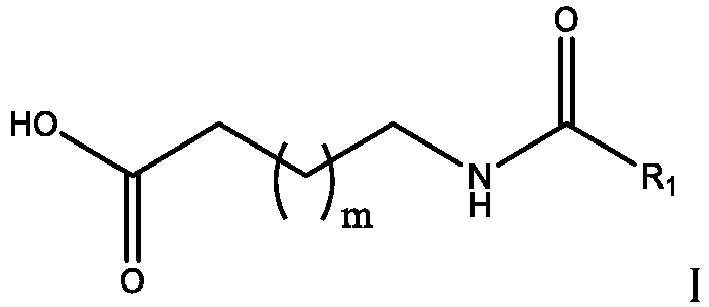 and edible salts thereof, wherein m is 1, that is, a derivative of gamma-aminobutyric acid (GABA), and R1 is an alkyl residue containing from 6 to 20 carbon atoms, or an alkene residue containing from 9 to 25 carbon atoms with from 1 to 3 double bonds and,at least one flavour co-ingredient.
 - A powder flavour composition according to claim 1, in which the compound according to claim 1 is selected from the group consisting ofC10-GABA,C12-GABA,C14-GABA,C16-GABA,C18-GABA,more particularly,C12:1-GABAC16:1-GABAC18:1-GABAeven more particularlyC18:1c-GABAC18:1t-GABA,and most particularly
C18:2-GABA. - A powder flavour composition according to claim 1, wherein the flavour co-ingredient contains: vanilla, chocolate, coffee, cocoa, citrus oil, selected from lemon, orange, grape, lime and grapefruit; fruit essences selected from apple, pear, peach, strawberry, raspberry, cherry, plum, pineapple and apricot; ingredients containing the components acetaldehyde, dimethyl sulfide, ethyl acetate, ethyl propionate, methyl butyrate, and ethyl butyrate; ingredients containing volatile aldehydes or esters selected from cinnamyl acetate, cinnamaldehyde, citral, diethylacetal, dihydrocarvyl acetate, eugenyl formate, and p-methylanisole; or acetaldehyde; benzaldehyde; cinnamic aldehyde; alpha citral; beta citral; decanal; ethyl vanillin; piperonal; vanillin; alpha-amyl cinnamaldehyde; butyraldehyde; valeraldehyde; citronellal; decanal; aldehyde C-8; aldehyde C-9; aldehyde C-12; 2-ethyl butyraldehyde; trans-2 hexenal, tolyl aldehyde; veratraldehyde; 2,6-dimethyl-5-heptenal; 2-6-dimethyloctanal; and 2-dodecenal; cherry; or grape and mixtures thereof.
- A powder flavour composition according to claim 1 wherein the at least one flavour co-ingredient selected from the group consisting of sugars, fats, salt, MSG, calcium ions, phosphate ions, organic acids, proteins, purines and mixtures thereof, optionally a carrier material and optionally an anti-oxidant.
- An edible composition comprising a powder flavour composition according to claim 1.
- An edible composition according to claim 5 in the form of a caloric or non-caloric beverage containing carbohydrate sweeteners, selected from sucrose, high fructose corn syrup, fructose and glucose, or high intensity, non-nutritive sweeteners selected from aspartame, acesulfame K, sucralose, cyclamate, sodium saccharin, neotame, rebaudioside A, and/or other stevia-based sweeteners.
- An edible composition according to claim 5 in the form of a soy-based composition.
Applications Claiming Priority (2)
| Application Number | Priority Date | Filing Date | Title |
|---|---|---|---|
| US201261617796P | 2012-03-30 | 2012-03-30 | |
| PCT/US2013/034395 WO2013149031A2 (en) | 2012-03-30 | 2013-03-28 | Powder flavour composition |
Publications (2)
| Publication Number | Publication Date |
|---|---|
| EP2830438A2 EP2830438A2 (en) | 2015-02-04 |
| EP2830438B1 true EP2830438B1 (en) | 2019-09-04 |
Family
ID=50928323
Family Applications (1)
| Application Number | Title | Priority Date | Filing Date |
|---|---|---|---|
| EP13716123.8A Active EP2830438B1 (en) | 2012-03-30 | 2013-03-28 | N-acyl derivatives of gamma amino-butyric acid as food flavouring compounds, powder compositions containing them |
Country Status (9)
| Country | Link |
|---|---|
| US (1) | US10582715B2 (en) |
| EP (1) | EP2830438B1 (en) |
| JP (1) | JP6452201B2 (en) |
| KR (1) | KR102125587B1 (en) |
| CN (1) | CN104219963B (en) |
| BR (1) | BR112014023941B1 (en) |
| CA (1) | CA2868077C (en) |
| SG (1) | SG11201405188XA (en) |
| WO (1) | WO2013149031A2 (en) |
Families Citing this family (31)
| Publication number | Priority date | Publication date | Assignee | Title |
|---|---|---|---|---|
| JP6248091B2 (en) * | 2012-03-30 | 2017-12-13 | ジボダン エス エー | N-acyl derivatives of gamma aminobutyric acid and beta alanine as food flavoring compounds |
| KR102045590B1 (en) | 2012-03-30 | 2019-11-15 | 지보당 에스아 | N-acylated 1-aminocycloalkyl carboxylic acids as food flavouring compounds |
| EP2830438B1 (en) | 2012-03-30 | 2019-09-04 | Givaudan SA | N-acyl derivatives of gamma amino-butyric acid as food flavouring compounds, powder compositions containing them |
| SG11201405340XA (en) * | 2012-03-30 | 2014-10-30 | Givaudan Sa | N-acylated methionine derivatives as food flavouring compounds |
| BR112014023016B1 (en) | 2012-03-30 | 2020-10-27 | Givaudan Sa | flavor composition and edible composition |
| KR102045592B1 (en) | 2012-03-30 | 2019-11-15 | 지보당 에스아 | N-acyl proline derivatives as food flavouring compounds |
| CN108567129B (en) * | 2012-03-30 | 2021-10-29 | 奇华顿股份有限公司 | N-acyl-amino acid derivatives for improving flavor profile of edible compositions |
| SG11201405295WA (en) * | 2012-03-30 | 2014-11-27 | Givaudan Sa | N-acyl-amino acid derivatives for improvement of the flavour profile edible|compositions |
| WO2015050538A1 (en) | 2013-10-02 | 2015-04-09 | Givaudan S.A. | Organic compounds |
| GB201317424D0 (en) | 2013-10-02 | 2013-11-13 | Givaudan Sa | Improvements in or relating to organic compounds |
| EP3052472B1 (en) | 2013-10-02 | 2019-02-27 | Givaudan S.A. | N-acylated 2-aminoisobutyric acid compounds and flavour compositions containing them |
| US10834943B2 (en) | 2013-10-02 | 2020-11-17 | Givaudan S.A. | Organic compounds having taste-modifying properties |
| EP3057444B1 (en) | 2013-10-02 | 2017-12-06 | Givaudan SA | Organic compounds having taste-modifying properties |
| WO2015050535A1 (en) | 2013-10-02 | 2015-04-09 | Givaudan S.A. | Organic compounds |
| CN105636459A (en) | 2013-10-02 | 2016-06-01 | 奇华顿股份有限公司 | Organic compounds |
| EP3057446B1 (en) | 2013-10-02 | 2017-12-06 | Givaudan S.A. | Organic compounds having taste-modifying properties |
| JP6275460B2 (en) * | 2013-11-26 | 2018-02-07 | 株式会社ファンケル | Cocoa drink |
| CN105001119B (en) * | 2015-07-06 | 2017-05-31 | 湖北中烟工业有限责任公司 | A kind of preparation method of aldehyde perfume derivative and the application in cigarette blending |
| CN105077270A (en) * | 2015-07-16 | 2015-11-25 | 上海冬泽特医食品有限公司 | Nutrient supplemented composite powder as well as preparation method and use thereof |
| US10385015B2 (en) | 2015-09-30 | 2019-08-20 | Givaudan S.A. | N-acylated methionine sulfoxides as food flavouring compounds |
| US20180070614A1 (en) * | 2016-09-15 | 2018-03-15 | Givaudan, S.A. | Flavored beverages |
| MX2019010638A (en) | 2017-04-07 | 2019-10-17 | Givaudan Sa | Flavor modifiers for meat analog products. |
| US20220104524A1 (en) * | 2017-06-02 | 2022-04-07 | Givaudan, S.A. | Compositions |
| CN108244689A (en) * | 2017-12-12 | 2018-07-06 | 河南中烟工业有限责任公司 | A kind of fragrance module formula for improving burnt fragrant and sweet leaf group odor characteristic and its application in cigarette |
| EP3575283A1 (en) | 2018-05-28 | 2019-12-04 | Université de Bourgogne | Linoleic acid derivatives, pharmaceutical composition or food composition comprising said linoleic acid derivatives, and their uses |
| CA3106844A1 (en) * | 2018-07-25 | 2020-01-30 | Givaudan Sa | Citrus flavour compositions, their use and method of improving organoleptic properties |
| US20210161187A1 (en) * | 2018-07-25 | 2021-06-03 | Givaudan Sa | Herb flavour compositions, their use and method of improving organoleptic properties |
| CN110577480B (en) * | 2019-07-16 | 2021-07-23 | 成都医学院 | A kind of preparation method and application of compound with anti-beta amyloid activity |
| CA3155748A1 (en) * | 2019-09-30 | 2021-04-08 | Givaudan Sa | Improvements in or relating to organic compounds |
| WO2021070941A1 (en) * | 2019-10-10 | 2021-04-15 | 味の素株式会社 | Surfactant and composition |
| WO2025125392A1 (en) * | 2023-12-15 | 2025-06-19 | Givaudan Sa | Improvements in or relating to organic compounds |
Family Cites Families (111)
| Publication number | Priority date | Publication date | Assignee | Title |
|---|---|---|---|---|
| US2835590A (en) | 1954-09-21 | 1958-05-20 | Gen Foods Corp | Process of producing an artificial chocolate flavor and the resulting product |
| US3024272A (en) | 1958-04-22 | 1962-03-06 | Du Pont | Organic acid salts of basic amino acids and their use |
| DE1262216B (en) * | 1966-04-15 | 1968-03-07 | Roehm & Haas Gmbh | Surface-active compounds as detergents and cleaning agents and as wetting, dispersing, emulsifying and leveling agents |
| JPS4614357Y1 (en) | 1967-06-06 | 1971-05-20 | ||
| FR1603799A (en) | 1968-12-20 | 1971-05-24 | Acyl methionic acids composns | |
| NL7013043A (en) | 1969-09-06 | 1971-03-09 | ||
| US3624114A (en) | 1969-12-18 | 1971-11-30 | Jean V Morelle | Fatty acid amido-methionine products |
| US3947589A (en) | 1971-01-23 | 1976-03-30 | Rikagaku Kenkyusho | Fungicidal methods employing amino acid derivatives |
| DE2111361B2 (en) | 1971-03-10 | 1973-02-15 | USE OF N-ACYLAMINO ACIDS, THEIR SALT AND / OR ESTERS AS EMULSIFIERS | |
| US3878305A (en) * | 1972-05-25 | 1975-04-15 | Procter & Gamble | Fortification of foodstuffs with n-acyl derivatives of sulphur-containing l-amino acids |
| US4016287A (en) | 1972-07-17 | 1977-04-05 | Boehringer Ingelheim Gmbh | Dermatological compositions containing an acylamino-carboxylic acid or an alkyl ester thereof |
| DE2234399A1 (en) * | 1972-07-17 | 1974-01-31 | Thomae Gmbh Dr K | SKIN PROTECTION PRODUCTS |
| US4093740A (en) | 1973-02-16 | 1978-06-06 | Deutsche Gold- Und Silber-Scheideanstalt Vormals Roessier | Fodder for ruminants |
| US3940500A (en) | 1973-08-10 | 1976-02-24 | Sortwell Iii Daniel Richard | Flavoring seafood with S-methyl methionine salt |
| JPS5247022B2 (en) | 1973-09-14 | 1977-11-29 | ||
| GB1471894A (en) | 1973-12-12 | 1977-04-27 | Wilkinson Sword Ltd | Compositions for application to or consumption by the body and containing a compound having a physiological cooling effect |
| CA1078664A (en) | 1975-12-10 | 1980-06-03 | The Procter And Gamble Company | Fortification of foodstuffs with amino acids and derivatives |
| US4066799A (en) | 1975-12-22 | 1978-01-03 | Miles Laboratories, Inc. | Sodium chloride flavor substitute composition and use thereof |
| JPS53118516A (en) | 1977-03-24 | 1978-10-17 | Ajinomoto Co Inc | Inactivation disinfectant of hepatitis-b virus |
| US4448785A (en) | 1978-01-09 | 1984-05-15 | Sandoz, Inc. | N-Unsaturated fatty acid amides of tryptophan ester homologues and anti-cholesteric use thereof |
| EP0030448B1 (en) | 1979-12-06 | 1985-04-10 | THE PROCTER & GAMBLE COMPANY | A method for making a stabilized sulfur-containing amino acid fortified foodstuff |
| JPS5690046A (en) | 1979-12-21 | 1981-07-21 | Ajinomoto Co Inc | Lysine derivative |
| JPS56123910A (en) | 1980-03-05 | 1981-09-29 | Lion Corp | Dentifrice composition |
| US4442090A (en) | 1980-11-09 | 1984-04-10 | Kyoto Yakuhin Kogyo Kabushiki Kaisha | Absorption-promoting compounds, compositions thereof with pharmaceuticals and/or bases for rectal administration and method of use |
| US4479974A (en) | 1982-10-19 | 1984-10-30 | General Foods Corporation | Amino acids as dry beverage mix ingredients |
| US4757066A (en) * | 1984-10-15 | 1988-07-12 | Sankyo Company Limited | Composition containing a penem or carbapenem antibiotic and the use of the same |
| WO1986003944A1 (en) | 1985-01-03 | 1986-07-17 | Joyce Patrick J | Heat stabilized peptide table salt substitutes |
| CA1249842A (en) | 1985-04-15 | 1989-02-07 | Paul F. Corey | Method for preparing ( )s-2-hydroxy-2-methyl-hexanoic acid |
| US4649147A (en) | 1985-07-08 | 1987-03-10 | G. D. Searle & Co. | Treating elastin degradation with 1-(alkenoyl)azacycloalkyl carboxylic acids and derivatives |
| US4837026A (en) | 1985-10-03 | 1989-06-06 | Rajakhyaksha Vithal J | Transdermal and systemic preparation and method |
| DE3643007A1 (en) | 1986-12-17 | 1988-06-30 | Basf Ag | CURABLE POLYESTER MOLDING MATERIALS |
| FR2609998B1 (en) | 1987-01-26 | 1994-04-15 | Morelle Jean | NOVEL ANTIOXIDANT SUBSTANCES DERIVED FROM AMINO ACIDS |
| US5000877A (en) | 1988-08-12 | 1991-03-19 | Mitsubishi Petrochemical Co., Ltd. | Aqueous liquid detergent containing an N-acylaspartate and a betaine or imidazoline surfactant |
| JP2845245B2 (en) | 1988-10-20 | 1999-01-13 | 味の素株式会社 | Toothpaste composition |
| JPH03236315A (en) | 1989-12-05 | 1991-10-22 | Nippon Oil & Fats Co Ltd | Antipsychotic agent |
| FR2657259A1 (en) | 1990-01-25 | 1991-07-26 | Adir | USE OF N-MYRISTOYL- (S) -PHENYLALANINE FOR THE PRODUCTION OF MEDICAMENTS FOR THE TREATMENT OF DISEASES INVOLVING MYRISTOYLATION |
| JP2824158B2 (en) | 1990-06-05 | 1998-11-11 | 花王株式会社 | Detergent composition |
| MY107820A (en) * | 1990-06-05 | 1996-06-29 | Ajinomoto Kk | Detergent composition. |
| EP0500332B1 (en) | 1991-02-19 | 1998-05-27 | National Food Research Institute Ministry Of Agriculture, Forestry And Fisheries | Novel acylamino acid compounds and a method for their production |
| HUT68764A (en) | 1991-11-27 | 1995-07-28 | Bioresearch Inc | Eatable taste modifiers |
| US5176934A (en) | 1991-12-12 | 1993-01-05 | Kraft General Foods, Inc. | Seasoned food product with a salt enhancer |
| US5286480A (en) | 1992-06-29 | 1994-02-15 | The Procter & Gamble Company | Use of N-acetylated amino acid complexes in oral care compositions |
| JP3025725B2 (en) | 1992-11-24 | 2000-03-27 | 花王株式会社 | Method for separating and purifying N-long-chain acylamino acids |
| US5312831A (en) | 1993-05-12 | 1994-05-17 | American Cyanamid Company | Urethanes and ureas that induce cytokine production |
| JPH08103242A (en) | 1994-10-06 | 1996-04-23 | T Hasegawa Co Ltd | Persistent aroma and flavor enhancer or modulator |
| JP2977750B2 (en) | 1994-10-26 | 1999-11-15 | 鐘紡株式会社 | Anti-aging skin cosmetics |
| ES2185782T3 (en) | 1995-07-26 | 2003-05-01 | Firmenich & Cie | AROMATIZED PRODUCTS AND PROCEDURE FOR PREPARATION. |
| EP0904072A4 (en) | 1996-04-12 | 2003-07-30 | Peptide Technology Pty Ltd | METHODS FOR TREATING IMMUNOPATHOLOGIES USING POLYUNSATURATED FATTY ACIDS |
| JP3654710B2 (en) | 1996-05-28 | 2005-06-02 | 太陽化学株式会社 | Flavor improving composition |
| FR2765109B1 (en) | 1997-06-25 | 2001-02-09 | Seppic Sa | COMPOSITION COMPRISING A LIPOAMINOACID AND THE CONSTITUENTS OF A TANNIN-RICH PLANT EXTRACT AND USE IN COSMETICS |
| KR19990013817A (en) | 1997-07-14 | 1999-02-25 | 후쿠다 다케지 | N-acylamino acid and cosmetic material using the same |
| DE19842416A1 (en) | 1998-09-16 | 2000-04-13 | Max Planck Gesellschaft | Secondary amines for the prevention and therapy of diseases caused or intensified by oxidation processes |
| US6251931B1 (en) | 1998-11-24 | 2001-06-26 | The Scripps Research Institute | Inhibitors of gap junction communication |
| AU4038800A (en) | 1999-03-29 | 2000-10-16 | Nutrasweet Company, The | Nutraceuticals having |
| EP1263286B1 (en) | 1999-10-28 | 2006-02-22 | University of North Texas | Methods for extending the freshness of cut flowers |
| JP2003523975A (en) | 2000-02-07 | 2003-08-12 | ヤン、ツェンファ | Anticancer compounds having a specific structure and production method thereof |
| US7320807B2 (en) | 2001-04-12 | 2008-01-22 | Sorrento Lactalis, Inc. | Co-extruded cheese snacks |
| GB0112324D0 (en) | 2001-05-21 | 2001-07-11 | Croda Int Plc | Compounds |
| US20030099722A1 (en) | 2001-10-09 | 2003-05-29 | Baxter Jeffrey H. | Methods and compositions for providing glutamine |
| MXPA04003855A (en) | 2001-10-25 | 2004-07-08 | Miret Lab | USE OF CATIONIC CONSERVERS IN FOOD PRODUCTS. |
| EP2399899B1 (en) | 2002-01-11 | 2013-08-07 | Ohgen Research Laboratories Ltd. | Geranyl compounds |
| EP1477073A4 (en) | 2002-02-18 | 2006-03-08 | Ajinomoto Kk | DRY POWDER CONTAINING TASTE AND AROMA COMPONENTS AND PROCESS FOR PRODUCING THE POWDER |
| EP1356744B1 (en) | 2002-04-22 | 2008-02-20 | Société des Produits Nestlé S.A. | Flavouring compositions containing N-acetylglycine |
| DE10227462A1 (en) | 2002-06-20 | 2004-01-08 | Symrise Gmbh & Co. Kg | Production of cis-pellitor and use as a flavoring |
| WO2004045307A2 (en) | 2002-11-18 | 2004-06-03 | Natural Asa | Dietry supplements and foods product comprising oleylethanolamide |
| JP2006519289A (en) * | 2003-02-26 | 2006-08-24 | フイルメニツヒ ソシエテ アノニム | Amino acid derivatives of dicarboxylic acids as flavor components |
| KR101116923B1 (en) | 2003-06-10 | 2012-03-12 | 교와 핫코 푸드 가부시키가이샤 | Seasoning |
| US7018560B2 (en) | 2003-08-05 | 2006-03-28 | Rohm And Haas Electronic Materials Cmp Holdings, Inc. | Composition for polishing semiconductor layers |
| US7329767B2 (en) | 2003-10-03 | 2008-02-12 | International Flavors & Fragrances Inc. | Conjugated dienamides, methods of production thereof, compositions containing same and uses thereof |
| DE602005012071D1 (en) | 2004-04-06 | 2009-02-12 | Quest Int Serv Bv | METHOD FOR PRODUCING MAILLARD TASTE PREPARATIONS |
| WO2005096843A1 (en) | 2004-04-06 | 2005-10-20 | Quest International B.V. | Taste improving substances |
| MXPA06012151A (en) | 2004-04-20 | 2007-03-28 | Quest Int Serv Bv | Taste improving substances. |
| EP1588854A1 (en) | 2004-04-22 | 2005-10-26 | Kba-Giori S.A. | Ink supply device for printing machine |
| CN101022736B (en) | 2004-07-20 | 2012-03-21 | 奎斯特国际服务公司 | Taste improving substances |
| ITMI20041567A1 (en) | 2004-07-30 | 2004-10-30 | Maycos Italiana Di Comini Miro | "N-ACYLATED DERIVATIVES OF BICARBOXYLIC ACIDS WITH AMINO ACIDS AND WITH HYDROLYZED VEGETABLE PROTEINS AND THEIR APPLICATION IN COSMETIC, DERMO-PHARMACEUTICAL AND PHARMACEUTICAL PRODUCTS" |
| WO2006046853A1 (en) | 2004-10-29 | 2006-05-04 | Quest International Services B.V. | Flavour modulating substances |
| FR2878439B1 (en) | 2004-11-26 | 2007-07-20 | Seppic Sa | NOVEL N-ACYL DERIVATIVES OF AMINOACIDS AND THEIR USE IN COSMETICS AND PHARMACY |
| JP4679132B2 (en) | 2004-12-20 | 2011-04-27 | 小川香料株式会社 | Carbonated beverage additive |
| JP2008105945A (en) | 2005-02-07 | 2008-05-08 | Ajinomoto Co Inc | Acylamide compound having action of promoting or inducing secretion of adiponectin |
| JP4530906B2 (en) | 2005-04-25 | 2010-08-25 | 小川香料株式会社 | Flavor enhancer for food and drink |
| CN101597239B (en) | 2005-12-15 | 2012-08-08 | 天津药业研究院有限公司 | Method for synthesizing theanine |
| EP2091523A1 (en) | 2006-10-05 | 2009-08-26 | DSMIP Assets B.V. | Anandamide |
| WO2008081519A1 (en) | 2006-12-27 | 2008-07-10 | Japan Tobacco Inc. | Sweet-type seasoning compositions containing high proportion of amino acid and yeast for obtaining the same |
| RU2335926C1 (en) | 2007-01-18 | 2008-10-20 | Василий Михайлович Григорьев | Food vitamin-mineral supplement |
| US20100273887A1 (en) | 2007-08-16 | 2010-10-28 | Symrise Gmbh & Co. Kg | Mixtures comprising pellitorin and uses thereof |
| DE102007041217B3 (en) | 2007-08-31 | 2009-04-30 | Clariant International Limited | Use of compositions as corrosion inhibitors containing amphoteric surfactants and the compositions |
| EP2058297B1 (en) | 2007-11-08 | 2015-05-20 | Symrise AG | Use of alkamides for masking an unpleasant flavor |
| EP2140770A1 (en) | 2008-07-04 | 2010-01-06 | Nestec S.A. | Acylamino acid compounds and food preparations containing same |
| US9560876B2 (en) * | 2008-05-20 | 2017-02-07 | Nestec S.A. | Acylamino acid compounds and food preparations containing same |
| GB2463013A (en) | 2008-08-27 | 2010-03-03 | Barry Callebaut Ag | Extruded inclusion product |
| EP2184051A1 (en) | 2008-11-11 | 2010-05-12 | KPSS-Kao Professional Salon Services GmbH | Cleansing composition |
| JP5223664B2 (en) | 2008-12-25 | 2013-06-26 | 味の素株式会社 | Production method of flavor raw materials |
| CN102028176A (en) | 2009-10-01 | 2011-04-27 | 悠哈味觉糖有限公司 | Food ingredient having milk taste-enhancing action, production method thereof, method of enhancing milk taste of food or seasoning and milk taste-enhanced milk-based hard candy |
| WO2011105985A1 (en) | 2010-02-27 | 2011-09-01 | Colorado Synthetics, Inc. | Controlled release biocidal salts |
| FR2959936B1 (en) * | 2010-05-14 | 2012-08-03 | Physica Pharma | NASAL COMPOSITION WITH A SYSTEMIC VIEW BASED ON COCOYL PROLINE OR AT LEAST ONE OF ITS COMPONENTS |
| JP2012029616A (en) | 2010-07-30 | 2012-02-16 | Ogawa & Co Ltd | Flavor enhancer |
| US20120292022A1 (en) | 2010-11-22 | 2012-11-22 | E. I. Du Pont De Nemours And Company | Composition for improving oil recovery including n-lauroyl amino acid-based compounds and microbes |
| US20130022728A1 (en) | 2011-03-04 | 2013-01-24 | International Flavor & Fragrances Inc. | Spray-Dried Compositions Capable of Retaining Volatile Compounds and Methods of Producing the Same |
| BR112014000834A2 (en) | 2011-07-15 | 2017-02-21 | Givaudan Sa | flavor modifying compounds |
| EP2597082A1 (en) * | 2011-11-24 | 2013-05-29 | Symrise AG | Compounds for masking an unpleasant taste |
| JP6248091B2 (en) * | 2012-03-30 | 2017-12-13 | ジボダン エス エー | N-acyl derivatives of gamma aminobutyric acid and beta alanine as food flavoring compounds |
| EP2830438B1 (en) | 2012-03-30 | 2019-09-04 | Givaudan SA | N-acyl derivatives of gamma amino-butyric acid as food flavouring compounds, powder compositions containing them |
| SG11201405340XA (en) * | 2012-03-30 | 2014-10-30 | Givaudan Sa | N-acylated methionine derivatives as food flavouring compounds |
| KR102045590B1 (en) | 2012-03-30 | 2019-11-15 | 지보당 에스아 | N-acylated 1-aminocycloalkyl carboxylic acids as food flavouring compounds |
| BR112014023016B1 (en) * | 2012-03-30 | 2020-10-27 | Givaudan Sa | flavor composition and edible composition |
| WO2013149008A2 (en) | 2012-03-30 | 2013-10-03 | Givaudan, S.A. | Improvements in or relating to organic compounds |
| KR102045592B1 (en) | 2012-03-30 | 2019-11-15 | 지보당 에스아 | N-acyl proline derivatives as food flavouring compounds |
| SG11201405295WA (en) | 2012-03-30 | 2014-11-27 | Givaudan Sa | N-acyl-amino acid derivatives for improvement of the flavour profile edible|compositions |
| WO2013149025A1 (en) | 2012-03-30 | 2013-10-03 | Givaudan, S., A. | N-acyl serine derivatives as food flavouring compounds |
| WO2013149012A1 (en) | 2012-03-30 | 2013-10-03 | Givaudan S.A. | N-acyl amino acid derivatives as food flavouring compounds |
| US9560846B2 (en) | 2012-08-10 | 2017-02-07 | Paragonix Technologies, Inc. | System for hypothermic transport of biological samples |
-
2013
- 2013-03-28 EP EP13716123.8A patent/EP2830438B1/en active Active
- 2013-03-28 CA CA2868077A patent/CA2868077C/en active Active
- 2013-03-28 JP JP2015503583A patent/JP6452201B2/en active Active
- 2013-03-28 WO PCT/US2013/034395 patent/WO2013149031A2/en not_active Ceased
- 2013-03-28 US US14/386,112 patent/US10582715B2/en active Active
- 2013-03-28 SG SG11201405188XA patent/SG11201405188XA/en unknown
- 2013-03-28 BR BR112014023941-0A patent/BR112014023941B1/en active IP Right Grant
- 2013-03-28 KR KR1020147030389A patent/KR102125587B1/en active Active
- 2013-03-28 CN CN201380017825.8A patent/CN104219963B/en active Active
Non-Patent Citations (1)
| Title |
|---|
| None * |
Also Published As
| Publication number | Publication date |
|---|---|
| WO2013149031A3 (en) | 2014-01-03 |
| BR112014023941B1 (en) | 2020-07-14 |
| US20150050408A1 (en) | 2015-02-19 |
| SG11201405188XA (en) | 2014-11-27 |
| KR102125587B1 (en) | 2020-06-23 |
| EP2830438A2 (en) | 2015-02-04 |
| CN104219963A (en) | 2014-12-17 |
| US10582715B2 (en) | 2020-03-10 |
| JP2015523055A (en) | 2015-08-13 |
| CA2868077A1 (en) | 2013-10-03 |
| KR20140146152A (en) | 2014-12-24 |
| WO2013149031A2 (en) | 2013-10-03 |
| JP6452201B2 (en) | 2019-01-16 |
| CA2868077C (en) | 2020-09-29 |
| CN104219963B (en) | 2018-08-14 |
Similar Documents
| Publication | Publication Date | Title |
|---|---|---|
| EP2830440B1 (en) | N-acyl-aminocyclopropyl carboxylic acids as food flavouring compounds | |
| EP2830439B1 (en) | N-acyl-gaba derivatives for the improvement of the flavour profile of edible compositions | |
| EP2833739B1 (en) | N-acyl proline derivatives as food flavouring compounds | |
| EP2830441B1 (en) | N-acyl derivatives of gamma amino-butyric acid as food flavouring compounds | |
| EP2830437B1 (en) | N-acylated 1-aminocycloalkyl carboxylic acids as food flavouring compounds | |
| CA2868058C (en) | N-acylated methionine derivatives as food flavouring compounds | |
| CA2868077C (en) | Powder flavour composition | |
| WO2013149025A1 (en) | N-acyl serine derivatives as food flavouring compounds | |
| WO2013149012A1 (en) | N-acyl amino acid derivatives as food flavouring compounds | |
| WO2013149008A2 (en) | Improvements in or relating to organic compounds | |
| US11319285B2 (en) | N-acylated methionine sulfoxides as food flavouring compounds | |
| US11834393B2 (en) | Organic compounds having taste-modifying properties | |
| EP3052472B1 (en) | N-acylated 2-aminoisobutyric acid compounds and flavour compositions containing them | |
| EP3057446B1 (en) | Organic compounds having taste-modifying properties | |
| EP3057447B1 (en) | Organic compounds having taste-modifying properties |
Legal Events
| Date | Code | Title | Description |
|---|---|---|---|
| PUAI | Public reference made under article 153(3) epc to a published international application that has entered the european phase |
Free format text: ORIGINAL CODE: 0009012 |
|
| 17P | Request for examination filed |
Effective date: 20141009 |
|
| AK | Designated contracting states |
Kind code of ref document: A2 Designated state(s): AL AT BE BG CH CY CZ DE DK EE ES FI FR GB GR HR HU IE IS IT LI LT LU LV MC MK MT NL NO PL PT RO RS SE SI SK SM TR |
|
| AX | Request for extension of the european patent |
Extension state: BA ME |
|
| DAX | Request for extension of the european patent (deleted) | ||
| STAA | Information on the status of an ep patent application or granted ep patent |
Free format text: STATUS: EXAMINATION IS IN PROGRESS |
|
| 17Q | First examination report despatched |
Effective date: 20170113 |
|
| REG | Reference to a national code |
Ref country code: DE Ref legal event code: R079 Ref document number: 602013060005 Country of ref document: DE Free format text: PREVIOUS MAIN CLASS: A23L0001227000 Ipc: A23L0027210000 |
|
| GRAP | Despatch of communication of intention to grant a patent |
Free format text: ORIGINAL CODE: EPIDOSNIGR1 |
|
| STAA | Information on the status of an ep patent application or granted ep patent |
Free format text: STATUS: GRANT OF PATENT IS INTENDED |
|
| RIC1 | Information provided on ipc code assigned before grant |
Ipc: C07C 233/47 20060101ALI20190301BHEP Ipc: A23L 27/21 20160101AFI20190301BHEP Ipc: C07C 233/49 20060101ALI20190301BHEP |
|
| INTG | Intention to grant announced |
Effective date: 20190402 |
|
| GRAS | Grant fee paid |
Free format text: ORIGINAL CODE: EPIDOSNIGR3 |
|
| GRAA | (expected) grant |
Free format text: ORIGINAL CODE: 0009210 |
|
| STAA | Information on the status of an ep patent application or granted ep patent |
Free format text: STATUS: THE PATENT HAS BEEN GRANTED |
|
| AK | Designated contracting states |
Kind code of ref document: B1 Designated state(s): AL AT BE BG CH CY CZ DE DK EE ES FI FR GB GR HR HU IE IS IT LI LT LU LV MC MK MT NL NO PL PT RO RS SE SI SK SM TR |
|
| REG | Reference to a national code |
Ref country code: GB Ref legal event code: FG4D |
|
| REG | Reference to a national code |
Ref country code: CH Ref legal event code: EP |
|
| REG | Reference to a national code |
Ref country code: AT Ref legal event code: REF Ref document number: 1174116 Country of ref document: AT Kind code of ref document: T Effective date: 20190915 |
|
| REG | Reference to a national code |
Ref country code: DE Ref legal event code: R096 Ref document number: 602013060005 Country of ref document: DE |
|
| REG | Reference to a national code |
Ref country code: IE Ref legal event code: FG4D |
|
| REG | Reference to a national code |
Ref country code: CH Ref legal event code: NV Representative=s name: GIVAUDAN INTERNATIONAL SA GLOBAL PATENTS, CH |
|
| REG | Reference to a national code |
Ref country code: NL Ref legal event code: FP |
|
| REG | Reference to a national code |
Ref country code: LT Ref legal event code: MG4D |
|
| PG25 | Lapsed in a contracting state [announced via postgrant information from national office to epo] |
Ref country code: FI Free format text: LAPSE BECAUSE OF FAILURE TO SUBMIT A TRANSLATION OF THE DESCRIPTION OR TO PAY THE FEE WITHIN THE PRESCRIBED TIME-LIMIT Effective date: 20190904 Ref country code: LT Free format text: LAPSE BECAUSE OF FAILURE TO SUBMIT A TRANSLATION OF THE DESCRIPTION OR TO PAY THE FEE WITHIN THE PRESCRIBED TIME-LIMIT Effective date: 20190904 Ref country code: SE Free format text: LAPSE BECAUSE OF FAILURE TO SUBMIT A TRANSLATION OF THE DESCRIPTION OR TO PAY THE FEE WITHIN THE PRESCRIBED TIME-LIMIT Effective date: 20190904 Ref country code: HR Free format text: LAPSE BECAUSE OF FAILURE TO SUBMIT A TRANSLATION OF THE DESCRIPTION OR TO PAY THE FEE WITHIN THE PRESCRIBED TIME-LIMIT Effective date: 20190904 Ref country code: BG Free format text: LAPSE BECAUSE OF FAILURE TO SUBMIT A TRANSLATION OF THE DESCRIPTION OR TO PAY THE FEE WITHIN THE PRESCRIBED TIME-LIMIT Effective date: 20191204 Ref country code: NO Free format text: LAPSE BECAUSE OF FAILURE TO SUBMIT A TRANSLATION OF THE DESCRIPTION OR TO PAY THE FEE WITHIN THE PRESCRIBED TIME-LIMIT Effective date: 20191204 |
|
| PG25 | Lapsed in a contracting state [announced via postgrant information from national office to epo] |
Ref country code: ES Free format text: LAPSE BECAUSE OF FAILURE TO SUBMIT A TRANSLATION OF THE DESCRIPTION OR TO PAY THE FEE WITHIN THE PRESCRIBED TIME-LIMIT Effective date: 20190904 Ref country code: AL Free format text: LAPSE BECAUSE OF FAILURE TO SUBMIT A TRANSLATION OF THE DESCRIPTION OR TO PAY THE FEE WITHIN THE PRESCRIBED TIME-LIMIT Effective date: 20190904 Ref country code: LV Free format text: LAPSE BECAUSE OF FAILURE TO SUBMIT A TRANSLATION OF THE DESCRIPTION OR TO PAY THE FEE WITHIN THE PRESCRIBED TIME-LIMIT Effective date: 20190904 Ref country code: GR Free format text: LAPSE BECAUSE OF FAILURE TO SUBMIT A TRANSLATION OF THE DESCRIPTION OR TO PAY THE FEE WITHIN THE PRESCRIBED TIME-LIMIT Effective date: 20191205 Ref country code: RS Free format text: LAPSE BECAUSE OF FAILURE TO SUBMIT A TRANSLATION OF THE DESCRIPTION OR TO PAY THE FEE WITHIN THE PRESCRIBED TIME-LIMIT Effective date: 20190904 |
|
| REG | Reference to a national code |
Ref country code: AT Ref legal event code: MK05 Ref document number: 1174116 Country of ref document: AT Kind code of ref document: T Effective date: 20190904 |
|
| PG25 | Lapsed in a contracting state [announced via postgrant information from national office to epo] |
Ref country code: PL Free format text: LAPSE BECAUSE OF FAILURE TO SUBMIT A TRANSLATION OF THE DESCRIPTION OR TO PAY THE FEE WITHIN THE PRESCRIBED TIME-LIMIT Effective date: 20190904 Ref country code: EE Free format text: LAPSE BECAUSE OF FAILURE TO SUBMIT A TRANSLATION OF THE DESCRIPTION OR TO PAY THE FEE WITHIN THE PRESCRIBED TIME-LIMIT Effective date: 20190904 Ref country code: AT Free format text: LAPSE BECAUSE OF FAILURE TO SUBMIT A TRANSLATION OF THE DESCRIPTION OR TO PAY THE FEE WITHIN THE PRESCRIBED TIME-LIMIT Effective date: 20190904 Ref country code: RO Free format text: LAPSE BECAUSE OF FAILURE TO SUBMIT A TRANSLATION OF THE DESCRIPTION OR TO PAY THE FEE WITHIN THE PRESCRIBED TIME-LIMIT Effective date: 20190904 Ref country code: IT Free format text: LAPSE BECAUSE OF FAILURE TO SUBMIT A TRANSLATION OF THE DESCRIPTION OR TO PAY THE FEE WITHIN THE PRESCRIBED TIME-LIMIT Effective date: 20190904 Ref country code: PT Free format text: LAPSE BECAUSE OF FAILURE TO SUBMIT A TRANSLATION OF THE DESCRIPTION OR TO PAY THE FEE WITHIN THE PRESCRIBED TIME-LIMIT Effective date: 20200106 |
|
| PG25 | Lapsed in a contracting state [announced via postgrant information from national office to epo] |
Ref country code: SK Free format text: LAPSE BECAUSE OF FAILURE TO SUBMIT A TRANSLATION OF THE DESCRIPTION OR TO PAY THE FEE WITHIN THE PRESCRIBED TIME-LIMIT Effective date: 20190904 Ref country code: SM Free format text: LAPSE BECAUSE OF FAILURE TO SUBMIT A TRANSLATION OF THE DESCRIPTION OR TO PAY THE FEE WITHIN THE PRESCRIBED TIME-LIMIT Effective date: 20190904 Ref country code: IS Free format text: LAPSE BECAUSE OF FAILURE TO SUBMIT A TRANSLATION OF THE DESCRIPTION OR TO PAY THE FEE WITHIN THE PRESCRIBED TIME-LIMIT Effective date: 20200224 Ref country code: CZ Free format text: LAPSE BECAUSE OF FAILURE TO SUBMIT A TRANSLATION OF THE DESCRIPTION OR TO PAY THE FEE WITHIN THE PRESCRIBED TIME-LIMIT Effective date: 20190904 |
|
| REG | Reference to a national code |
Ref country code: DE Ref legal event code: R097 Ref document number: 602013060005 Country of ref document: DE |
|
| PLBE | No opposition filed within time limit |
Free format text: ORIGINAL CODE: 0009261 |
|
| STAA | Information on the status of an ep patent application or granted ep patent |
Free format text: STATUS: NO OPPOSITION FILED WITHIN TIME LIMIT |
|
| PG2D | Information on lapse in contracting state deleted |
Ref country code: IS |
|
| PG25 | Lapsed in a contracting state [announced via postgrant information from national office to epo] |
Ref country code: DK Free format text: LAPSE BECAUSE OF FAILURE TO SUBMIT A TRANSLATION OF THE DESCRIPTION OR TO PAY THE FEE WITHIN THE PRESCRIBED TIME-LIMIT Effective date: 20190904 Ref country code: IS Free format text: LAPSE BECAUSE OF FAILURE TO SUBMIT A TRANSLATION OF THE DESCRIPTION OR TO PAY THE FEE WITHIN THE PRESCRIBED TIME-LIMIT Effective date: 20200105 |
|
| 26N | No opposition filed |
Effective date: 20200605 |
|
| PG25 | Lapsed in a contracting state [announced via postgrant information from national office to epo] |
Ref country code: SI Free format text: LAPSE BECAUSE OF FAILURE TO SUBMIT A TRANSLATION OF THE DESCRIPTION OR TO PAY THE FEE WITHIN THE PRESCRIBED TIME-LIMIT Effective date: 20190904 |
|
| PG25 | Lapsed in a contracting state [announced via postgrant information from national office to epo] |
Ref country code: MC Free format text: LAPSE BECAUSE OF FAILURE TO SUBMIT A TRANSLATION OF THE DESCRIPTION OR TO PAY THE FEE WITHIN THE PRESCRIBED TIME-LIMIT Effective date: 20190904 |
|
| REG | Reference to a national code |
Ref country code: BE Ref legal event code: MM Effective date: 20200331 |
|
| PG25 | Lapsed in a contracting state [announced via postgrant information from national office to epo] |
Ref country code: LU Free format text: LAPSE BECAUSE OF NON-PAYMENT OF DUE FEES Effective date: 20200328 |
|
| PG25 | Lapsed in a contracting state [announced via postgrant information from national office to epo] |
Ref country code: IE Free format text: LAPSE BECAUSE OF NON-PAYMENT OF DUE FEES Effective date: 20200328 |
|
| PG25 | Lapsed in a contracting state [announced via postgrant information from national office to epo] |
Ref country code: BE Free format text: LAPSE BECAUSE OF NON-PAYMENT OF DUE FEES Effective date: 20200331 |
|
| PG25 | Lapsed in a contracting state [announced via postgrant information from national office to epo] |
Ref country code: TR Free format text: LAPSE BECAUSE OF FAILURE TO SUBMIT A TRANSLATION OF THE DESCRIPTION OR TO PAY THE FEE WITHIN THE PRESCRIBED TIME-LIMIT Effective date: 20190904 Ref country code: MT Free format text: LAPSE BECAUSE OF FAILURE TO SUBMIT A TRANSLATION OF THE DESCRIPTION OR TO PAY THE FEE WITHIN THE PRESCRIBED TIME-LIMIT Effective date: 20190904 Ref country code: CY Free format text: LAPSE BECAUSE OF FAILURE TO SUBMIT A TRANSLATION OF THE DESCRIPTION OR TO PAY THE FEE WITHIN THE PRESCRIBED TIME-LIMIT Effective date: 20190904 |
|
| PG25 | Lapsed in a contracting state [announced via postgrant information from national office to epo] |
Ref country code: MK Free format text: LAPSE BECAUSE OF FAILURE TO SUBMIT A TRANSLATION OF THE DESCRIPTION OR TO PAY THE FEE WITHIN THE PRESCRIBED TIME-LIMIT Effective date: 20190904 |
|
| PGFP | Annual fee paid to national office [announced via postgrant information from national office to epo] |
Ref country code: CH Payment date: 20250401 Year of fee payment: 13 |
|
| REG | Reference to a national code |
Ref country code: CH Ref legal event code: U11 Free format text: ST27 STATUS EVENT CODE: U-0-0-U10-U11 (AS PROVIDED BY THE NATIONAL OFFICE) Effective date: 20260401 |
|
| PGFP | Annual fee paid to national office [announced via postgrant information from national office to epo] |
Ref country code: GB Payment date: 20260324 Year of fee payment: 14 |
|
| PGFP | Annual fee paid to national office [announced via postgrant information from national office to epo] |
Ref country code: DE Payment date: 20260319 Year of fee payment: 14 |
|
| PGFP | Annual fee paid to national office [announced via postgrant information from national office to epo] |
Ref country code: NL Payment date: 20260319 Year of fee payment: 14 |
|
| PGFP | Annual fee paid to national office [announced via postgrant information from national office to epo] |
Ref country code: FR Payment date: 20260320 Year of fee payment: 14 |