EP2829250A1 - Dentalimplantat, Abutment, Implantatsystem und Implantationsset - Google Patents
Dentalimplantat, Abutment, Implantatsystem und Implantationsset Download PDFInfo
- Publication number
- EP2829250A1 EP2829250A1 EP13178279.9A EP13178279A EP2829250A1 EP 2829250 A1 EP2829250 A1 EP 2829250A1 EP 13178279 A EP13178279 A EP 13178279A EP 2829250 A1 EP2829250 A1 EP 2829250A1
- Authority
- EP
- European Patent Office
- Prior art keywords
- abutment
- implant
- dental implant
- section
- cone
- Prior art date
- Legal status (The legal status is an assumption and is not a legal conclusion. Google has not performed a legal analysis and makes no representation as to the accuracy of the status listed.)
- Granted
Links
Images





Classifications
-
- A—HUMAN NECESSITIES
- A61—MEDICAL OR VETERINARY SCIENCE; HYGIENE
- A61C—DENTISTRY; APPARATUS OR METHODS FOR ORAL OR DENTAL HYGIENE
- A61C8/00—Means to be fixed to the jaw-bone for consolidating natural teeth or for fixing dental prostheses thereon; Dental implants; Implanting tools
- A61C8/0048—Connecting the upper structure to the implant, e.g. bridging bars
- A61C8/005—Connecting devices for joining an upper structure with an implant member, e.g. spacers
- A61C8/0066—Connecting devices for joining an upper structure with an implant member, e.g. spacers with positioning means
-
- A—HUMAN NECESSITIES
- A61—MEDICAL OR VETERINARY SCIENCE; HYGIENE
- A61C—DENTISTRY; APPARATUS OR METHODS FOR ORAL OR DENTAL HYGIENE
- A61C8/00—Means to be fixed to the jaw-bone for consolidating natural teeth or for fixing dental prostheses thereon; Dental implants; Implanting tools
- A61C8/0001—Impression means for implants, e.g. impression coping
-
- A—HUMAN NECESSITIES
- A61—MEDICAL OR VETERINARY SCIENCE; HYGIENE
- A61C—DENTISTRY; APPARATUS OR METHODS FOR ORAL OR DENTAL HYGIENE
- A61C8/00—Means to be fixed to the jaw-bone for consolidating natural teeth or for fixing dental prostheses thereon; Dental implants; Implanting tools
- A61C8/0018—Means to be fixed to the jaw-bone for consolidating natural teeth or for fixing dental prostheses thereon; Dental implants; Implanting tools characterised by the shape
- A61C8/0022—Self-screwing
-
- A—HUMAN NECESSITIES
- A61—MEDICAL OR VETERINARY SCIENCE; HYGIENE
- A61C—DENTISTRY; APPARATUS OR METHODS FOR ORAL OR DENTAL HYGIENE
- A61C8/00—Means to be fixed to the jaw-bone for consolidating natural teeth or for fixing dental prostheses thereon; Dental implants; Implanting tools
- A61C8/0048—Connecting the upper structure to the implant, e.g. bridging bars
- A61C8/005—Connecting devices for joining an upper structure with an implant member, e.g. spacers
- A61C8/0068—Connecting devices for joining an upper structure with an implant member, e.g. spacers with an additional screw
-
- A—HUMAN NECESSITIES
- A61—MEDICAL OR VETERINARY SCIENCE; HYGIENE
- A61C—DENTISTRY; APPARATUS OR METHODS FOR ORAL OR DENTAL HYGIENE
- A61C8/00—Means to be fixed to the jaw-bone for consolidating natural teeth or for fixing dental prostheses thereon; Dental implants; Implanting tools
- A61C8/0048—Connecting the upper structure to the implant, e.g. bridging bars
- A61C8/005—Connecting devices for joining an upper structure with an implant member, e.g. spacers
- A61C8/0069—Connecting devices for joining an upper structure with an implant member, e.g. spacers tapered or conical connection
-
- A—HUMAN NECESSITIES
- A61—MEDICAL OR VETERINARY SCIENCE; HYGIENE
- A61C—DENTISTRY; APPARATUS OR METHODS FOR ORAL OR DENTAL HYGIENE
- A61C8/00—Means to be fixed to the jaw-bone for consolidating natural teeth or for fixing dental prostheses thereon; Dental implants; Implanting tools
- A61C8/0048—Connecting the upper structure to the implant, e.g. bridging bars
- A61C8/005—Connecting devices for joining an upper structure with an implant member, e.g. spacers
- A61C8/0069—Connecting devices for joining an upper structure with an implant member, e.g. spacers tapered or conical connection
- A61C8/0071—Connecting devices for joining an upper structure with an implant member, e.g. spacers tapered or conical connection with a self-locking taper, e.g. morse taper
-
- A—HUMAN NECESSITIES
- A61—MEDICAL OR VETERINARY SCIENCE; HYGIENE
- A61C—DENTISTRY; APPARATUS OR METHODS FOR ORAL OR DENTAL HYGIENE
- A61C8/00—Means to be fixed to the jaw-bone for consolidating natural teeth or for fixing dental prostheses thereon; Dental implants; Implanting tools
- A61C8/008—Healing caps or the like
Definitions
- the invention relates to a dental implant for insertion into a jawbone, having a receiving opening for an abutment disposed at the coronal end of the implant, the receiving opening having a cone section and an indexing section as viewed from the coronal end, the indexing section being at least one along a circumference having outwardly extending groove. It further relates to an abutment, an implant system and an implementation set.
- a dental implant is used as artificial denture, it is inserted into the resulting gap in the jawbone, in particular screwed in, where it grows as firmly as possible with the bone. An abutment is received by the implant, which then carries the visible dentures, such as a crown.
- the interface between abutment and implant is usually made conical in a first part or section.
- An adjoining rotation-secured area for example a hexagon socket of the implant, which receives an external hexagon of the abutment to form a positive connection, prevents the abutment from becoming blocked in the course of time by the abutment Mouth forces (especially due to chewing movements) against the implant twisted.
- An indexing or indexing also facilitates a precise transfer of the implantation orientation to a master model and thus also the exact modeling and fitting of the dental prosthesis.
- a dental implant which has a conical part and an adjoining indexing part.
- the total cone angle is 6 ° to 20 °.
- a disadvantage of a total cone angle in this size range is that, on the one hand, only a relatively short tensioning path is provided in the lowering of the abutment into the implant during insertion of the function, in particular during fixed screwing. On the other hand reduces a shallow angle due to the low surface pressure the adhesion and thus the support of the abutment and possibly leads to a tilting of the abutment in relation to the implant.
- the invention is therefore based on the object to provide a dental implant, which has a high overall stability, reliability and durability. Furthermore, a corresponding abutment, an implant system and an implantation set are to be provided.
- the cone section has a cone angle of less than 3 ° or a total cone angle of less than 6 °.
- the invention is based on the consideration that the longevity and reliability of the dental implant are of crucial importance in a dental care of a patient with dentures. Fundamental to this is the overall stability of the system consisting of implant and abutment.
- the forces arising in the mouth from chewing, grinding or biting movements are over transfer the abutment to the implant and from there to the bone.
- the interfaces or transitions from abutment to implant and from implant to bone are particularly relevant for stability.
- the chewing forces introduced via the abutment in particular thrust loads, should be introduced as deeply as possible into the implant in the vertical direction.
- the dynamic elastic load on the bone should be kept as low as possible.
- a groove defines a preferred direction and an orientation. If several grooves are provided at a regular distance from each other, a multiple symmetry is thereby defined. Due to the large cross-section and at least one groove creates a large contact surface, can be passed through the forces. This comparatively large contact area between abutment outer and implant internal geometry and the implant volume resulting over the implant cross section reduce the bulge of the implant body. Thereby, the elastic deformation of the implant body is reduced, whereby the above-mentioned load on the bone is reduced.
- a now proposed embodiment of the implant opens the possibility, without additional fasteners, such as a fixing screw, to achieve a particularly strong permanent load connection to an abutment due to the self-locking or cold welding of the Morse cone, without relying on a defined selection of indexing directions must be omitted.
- the fixation of the abutment and implant can be carried out or supported by a connecting element, whereby the continuous load resistance can be increased.
- implant refers to the component which is anchored directly in the bone and receives an abutment which is inserted into the implant and in particular screwed to it.
- the implant system is the combination of implant, associated abutment and optionally other components, eg. B. a fixing screw.
- the indexing section preferably follows, viewed from the coronal end, in particular to form a step, directly to the cone section.
- a conical or cylindrical intermediate portion may be provided, which may serve as a guide portion, for example.
- the cone angle is between 1 ° and 3 °, in particular 1.4 °.
- Such a steep cone promotes the tendency for cold welding and thus for mechanical consolidation of the connection between the abutment and implant in the assembled state. As a result, a particularly high density against bacteria is achieved.
- the respective groove has two side surfaces, each of which is perpendicular to a common end face which is perpendicular to an imaginary line extending radially from an implant central axis.
- the grooves are preferably formed as parallel-walled prisms, wherein the side surfaces extend substantially parallel to the central axis of the implant. If an abutment is inserted into the implant with at least one cam, which can be brought into engagement with the groove formed in this way, rotational friction movements of the implant and abutment do not produce any frictional friction, as occurs, for example, when the interface consists of an internal hexagon of the implant and formed in a form-fitting outer hexagon of the abutment is formed. Due to the intended shape of the groove, in the case of a mutual rotation of abutment and implant, the resulting forces are introduced substantially perpendicularly into the surfaces, so that deformations of the surfaces are avoided. At high applied torques and the pressure of the outer surfaces of the abutment on the inner surfaces of the implant is due to the vertical and uniform introduction of forces the - unwanted in this section - tendency for cold welding greatly reduced.
- exactly four grooves are arranged at regular intervals along the circumference.
- Such an embodiment corresponds in shape to the grooves, so to speak, the "Swiss Cross".
- the ratio of a clearance angle, along the circumference of the circumference swept area no groove is arranged and a groove angle along the circumference of the circumference swept area a groove is located between 1.0 and 0.5, in particular between 0.61 and 0.84.
- a ratio of 1.0 means for the four grooves provided that the two angles clearance angle and groove angle are the same size and thus the amounts of the respectively swept circle circumference sections or respectively the corresponding arc length of this circumference section are the same size. If the ratio is less than 1.0, the arc length of the circumference along a groove is greater than that without a groove. The smaller the ratio, the wider the grooves are while the circumference remains the same.
- a ratio in the range of 0.61 and 0.84 is particularly advantageous, since thereby the ratio of depth of the grooves or side surface and total distance the grooves to each other is mechanically favorable. Due to the relatively large face width increases proportionally the side surface. The side surface should be as large as possible to transfer the necessary insertion torque and to avoid cold welding. On the other hand, the total distance of the grooves should be as far as possible, so that the cross-sectional area of the implant body and the area moment of inertia under bending and torsional load are as large as possible.
- the enclosed cavity which is the volume of enclosed arc length of the circumference of the circle, lies between two grooves and results in the connecting straight line of the surface of the abutment and the side surface length. This minimizes the possible contamination of the implant interior with liquids and bacteria.
- a circular bearing surface is advantageously formed to support the threading for an abutment. This makes it easier for the doctor or dental technician to insert and fit the abutment, since the insertion and the orientation are two movements that can be carried out separately from one another and one behind the other.
- the abutment can first be pushed into the implant until it rests on the support surface. Thereafter, by turning the abutment in one or the other direction, the engagement with the grooves can be achieved. The abutment is then pushed further into or pushed into the implant in the now defined orientation.
- an internal screw thread adjoins the indexing section in a preferred embodiment. This then takes for screwing the abutment with the implant or for fixing the abutment on a fixing screw.
- the implant in the described implant, however, can also be dispensed with a mecanical winde, so that the mechanical connection between the implant body and an abutment is ensured only by the cold welding of the contact surface of the Morse cone.
- a permanent load-resistant connection can be achieved due to the selected cone angle solely due to the self-locking of the steep Morse cone.
- the implant thus has no internal screw thread. However, a defined indexing does not have to be abandoned.
- the above object is achieved according to the invention with an abutment for insertion into a dental implant, in particular a dental implant described above, with a conical section and an indexing section, wherein the conical section has a cone angle of less than 3 °.
- the indexing section has a number of circumferentially disposed cams which are engageable with grooves of a dental implant. Cam and grooves form a rotation-secured connection.
- the abutment can be inserted into the implant in a number of defined orientations, the orientations being determined by the cam and groove (s) interlocking to form a positive connection.
- cams are provided, which are arranged at regular intervals along a circumference.
- the cams have a rectangular contour conforming to the circumference and are formed as prims extending along a central axis of the abutment.
- a réelleschraubgewinde is advantageously provided in the region of the screw channel.
- the above object is achieved according to the invention with a dental implant described above and an abutment described above, wherein the conical sections of dental implant and abutment are dimensioned so that they touch at least partially, in particular form a self-locking compound in the assembled state.
- the respective cone sections and indexing sections of implant and abutment are advantageously dimensioned and tuned to one another in terms of their shape such that as large a contact surface as possible is created in the conical section and that at the same time the indexing sections overlap as far as possible.
- the cone angles in the case of the implant and abutment are preferably identical in each case or correspond largely as far as possible. Such a configuration is made possible by the lowest possible manufacturing tolerances of the inner or outer geometry of the implant or abutment.
- the abutment instead of an indexing section, has a cylindrical guide section which can be inserted into the indexing section of the dental implant. That is, the implant still has an indexing section with at least one groove.
- this indexing section is used only partially by the abutment, namely not to establish a defined indexing, but as a guide in the introduction of the abutment in the implant, which leads to strong strength in the inserted state.
- a passageway for the implementation of a fixing screw is preferably provided.
- the fixing screw is in the inserted state through the abutment into the implant, where it is tightened in the réelleschraubgewinde of the implant.
- the permanent connection of the two components is realized not only by the cold welding of the cone sections, but also by the screw used.
- the above-mentioned object is achieved with an above-mentioned dental implant and at least one auxiliary element from the group: impression posts, gingiva formers, placement posts.
- the implantation set furthermore preferably comprises an abutment described above.
- the advantages of the invention are, in particular, that an implant and an implant system with high reliability and service life are created by connecting a Morse taper with a subsequent indexing section and the resulting possibilities of deep introduction of forces acting on the abutment.
- the design of the cone section as Morse cone or Morse taper a high self-locking by frictional engagement and the tendency to cold welding are realized. This creates a positive and non-positive connection between the abutment and the implant. Due to the cold welding, a maximum functional seal against contamination is realized. Especially with an implant interface, which is anchored over a length of 4 mm in the implant, even under dynamic load only a minimal widening and bulging of the contact surfaces should occur. This ensures maximum tightness against incoming fluids and bacteria.
- the abutment By a subsequent to the cone circular bearing surface, the abutment can be supported during insertion, without that it can come to a Vernes in an intermediate position.
- the attending dental technician or physician can find the index of the interface by turning the abutment in any direction.
- the abutment slides smoothly and almost automatically with the cams into the inner contour of the implant interface.
- dental implant 2 has a substantially pure titanium Grade 4 existing implant body 8 on with an external thread 10.
- Other preferred materials include titanium grade 5 or titanium alloys.
- the dental implant 2 has a receiving opening for receiving an abutment.
- the receiving opening 20 has a cone-shaped section 26 that is rotationally symmetrical about a central axis M and an indexing section 32 that substantially adjoins to form a step 28.
- a screw thread 38 which is designed as mecanicschraubgewinde and serves to receive a fixing screw, through which an abutment can be screwed to the implant.
- the dental implant 2 is designed to dissipate the forces acting on the abutment or the artificial denture, which is attached to the abutment, in particular as a result of chewing, grinding and biting movements as uniformly and deeply as possible into the implant.
- a deep conical connection with a tendency to cold welding is combined with a rotation-secured connection.
- a cone angle ⁇ of the cone section 26 (ie the angle between an imaginary line parallel to the central axis of the dental implant 2 and an imaginary line through the outer surface of the implant) is 1.4 °, so that the cone section 26 is thus formed as Morse cone.
- the cone angle ⁇ corresponds to half of the so-called total cone angle.
- Such a steeply formed cone allows a comparatively long conical section, enter into the abutment and implant both a positive and non-positive connection. Due to the large contact surface, forces from the abutment can be transmitted deep into the implant. Due to the subsequent rotation-secured part forces can be introduced even deeper, where there are also intercepted rotational forces. All in all, a very deep transition of power is possible.
- the cone section 26 has a cone length l k of 3 mm in the present embodiment.
- the radius of the cone section 26 tapers in a transition section 34, which is adjacent to the indexing section 32, in the manner of a convex contour. This radially tapered region forms the rounded step 28 between the cone section 26 and the indexing section 32.
- An indexing length l i indicating the length of the indexing section 32 is 1 mm, so that a total length l g , the sum of the cone length l k and the indexing length l i is 4 mm.
- the screw thread 38 has a screw thread length l s of 2.3 mm.
- the indexing section 32 is in a cross section in FIG FIG. 3 shown.
- four grooves 56 are arranged in a configuration reminiscent of the "Swiss Cross".
- Each of the four grooves has respective side surfaces 62, which are each perpendicular to a common end face 68.
- the side surfaces 62 preferably have - in the direction of the center axis M - a length l f of 0.8 mm to 1.5 mm, in particular and in the present embodiment, 1 mm.
- the length l f here corresponds to the length l i of the indexing section 32.
- An end face width a is preferably 0.7 mm to 1.0 mm, depending on the interface diameter, and the depth of the grooves or side face depth b is preferably 0.1 mm, depending on the interface diameter up to 0.4 mm.
- the length l f is 1.0 mm
- the end face width a is 1.0 mm
- the side face depth b is 0.30 mm.
- the indexing section 32 comprises to a certain extent four parallel-walled prisms arranged along the circumference 50, which are each 1 mm high in the axial direction.
- the grooves 56 extend over the entire indexing length l i .
- Such a configuration is suitable for highest torques and has no tendency to cold welding, if an abutment or screwing tool is used, which has a shape-matching outer contour, ie, which has four cams arranged on a circumference, which are engageable in the grooves 56.
- this interface is a minimal Given rotation game.
- the interface between implant and abutment is designed as a groove-cam connection.
- abutment which has an outer contour with four cams conforming to the inner shape of the indexing region 32 can first be placed on the bearing surface 74 before it is slid into the dental implant 2 for final fixation. Turn the abutment clockwise or counterclockwise to find the desired orientation of the abutment. Once this is found, the abutment can then be pushed into the implant.
- the support surface 74 an intermediate or intermediate position is defined when inserting the abutment.
- the side surfaces 62 and the end face 68 serve as guide surfaces for the abutment during insertion.
- FIG. 4 An abutment 80 in a first preferred embodiment is shown in FIG FIG. 4 shown in perspective and has a cone portion 86 and an indexing section 92.
- the cone section 86 has a cone angle ⁇ , which corresponds to the cone angle ⁇ of the dental implant 2.
- a self-locking connection with a tendency to cold welding between the conical section 86 of the abutment 80 and the conical section 26 of the dental implant 2 is realized due to the small cone angle ⁇ .
- the indexing section 92 of the abutment 80 has four cams 98 formed as parallel-walled prisms, which can be brought into engagement with the grooves 56 of the dental implant 2 in the assembled state, whereby a rotationally secured connection between the dental implant 2 and the abutment 80 is produced by positive locking.
- the abutment 80 has a functional part 100 for the attachment of artificial dentures, in particular for the cementing of a crown.
- the cams 98 have a contour that matches the shape of the grooves 56 of the dental implant 2.
- the cams 98 have each an end face 106 and two side surfaces 108 perpendicular thereto and are arranged along an imaginary circle circumference.
- the abutment 80 has a gingiva section 104, which has an emergence profile for shaping the gingiva.
- a cross section through the abutment 80 is in FIG FIG. 6 shown.
- the abutment 80 has an internal thread 114 or réelleschraubgewinde for insertion of a special tool. This makes it possible to disengage the abutment 80 from a dental implant 2, even if the two cone sections 26, 86 are already in the cold-welded state with one another.
- FIG. 7 An abutment 80 in a second preferred embodiment is shown in FIG FIG. 7 shown in perspective.
- the abutment 80 according to FIG. 7 has in contrast to the abutment 80 according to FIG. 4 no indexing section. Instead, it comprises a cylindrical guide section 112.
- An outer diameter u is dimensioned such that it corresponds to the diameter of the circular circumference 50 of the dental implant 2.
- the guide section 112 alone serves to guide the abutment 80 while it is lowered into the dental implant 2.
- An indexing is not effected here.
- the attending physician or dental technician can thus freely choose the orientation of the abutment 80 with respect to the dental implant 2 during the insertion process.
- FIG. 9 and 10 show an implant system 126 in a first preferred embodiment with a dental implant 2 shown above and an abutment 80 according to the FIG. 7 and 8 which has a guide section 112 instead of an indexing section.
- the abutment 80 is completely inserted into the dental implant 2 and can be pressed onto the crown by firmly biting the patient or screwed with a fixing screw (not shown).
- FIG. 11 and 12 show an implant system 126 in a second preferred embodiment, in which the abutment 80, which in the FIG. 4, 5 and 6 , an indexing section 92 with four cams 98, so that four different orientations in the indexing section 32 of the dental implant 32 result.
- One in the FIG. 13 to 15 illustrated impression post 150 in a first preferred embodiment has a conically shaped insertion portion 152, which is inserted during the molding process in the cone portion 26 of the dental implant 2.
- This special impression post 150 several implants or dental implants 2, which are also highly divergent or skewed, can be molded. These implants are grouped in the dental reconstruction and thus locked together. Due to the blocking, the position and position of the index of the implants is not required.
- the connection design starts from the support shoulder with a short (0.3 mm long) cone 151 whose angle follows the cone angle of the dental implant 2. This is followed by another cone 155 whose angle is considerably larger. An angle of 25 ° to 35 ° has proven particularly advantageous.
- the shallow cone 155 facilitates the removal of the impression tray by a resulting common withdrawal direction and offers correspondingly sufficient opportunities to pull each other angled Einbringpfosten from the implants without the impression material deformed noticeably.
- Illustrated impression post 150 in a second preferred embodiment has an indexing section 158 with four cams 162 adjoining an insertion section designed as a cylindrical transitional area 153, which can be engaged with the grooves 56 of the dental implant during the impression in order to form a positive connection, so that the orientation or indexing of the implant in the human jaw can be transferred to a (master) model.
- the connection design starts from the support shoulder with a short (0.3 mm long) cone 151, the angle of which follows the cone angle of the implant. This is followed by another cone 155 whose angle is considerably larger. An angle of 25 ° to 35 ° has proven particularly advantageous.
- the second cone opens into a cylindrical transition region 153, which represents the transition to the indexing region 158.
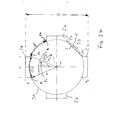
- FIG. 27 the cross section of the dental implant 2 is shown schematically.
- the radius of the circle 50 defining the circle is denoted by r.
- the respective groove 56 has two points of contact p 1 , p 2 with the circumference 50.
- the circle section lying between these contact points p 1 , p 2 and the angle sweeping it over is a groove angle ⁇ or opening angle which is correspondingly swept groove arc length of the circle c.
- ⁇ a portion of the circumference 50 whose free-space length is denoted d is swept over, an associated clearance angle being designated by ⁇ .
- the groove angle ⁇ or the opening angle is the angle between the two through the center m of the circumference 50 defining circuit and the contact points p 1, p 2 extending imaginary lines L 1 and L2.
- the units of ⁇ and ⁇ are degrees (°), c and d are each expressed as arc lengths.
- the ratio of clearance angle to groove angle, ie ⁇ / ⁇ and d / c, is in the in FIG. 1 ff. shown dental implant 2 0.61.
- a ratio in the range of 0.61 and 0.84 is particularly advantageous, since thereby the ratio of depth of the grooves or side surface b and total distance of the grooves to each other is mechanically favorable. Due to the relatively wide face width a increases proportionally the side surface depth b. The side surface depth b should be as large as possible to transfer the necessary insertion torque and to avoid cold welding. On the other hand, the total distance of the grooves e should be as far as possible, so that the cross-sectional area of the implant body and the area moment of inertia under bending and torsional load are as large as possible.
- the enclosed cavity or volume f reduces, to a certain extent the cavity of the index intermediate region, which is spanned by the area between an arc length of the circumference of the circle between two grooves which is delimited by a contact point p 2 of a groove and Contact point p 1 of an adjacent groove, and extending through these two points secant s, and a perpendicular line with the side surface length l f .
Landscapes
- Health & Medical Sciences (AREA)
- Oral & Maxillofacial Surgery (AREA)
- Orthopedic Medicine & Surgery (AREA)
- Dentistry (AREA)
- Epidemiology (AREA)
- Life Sciences & Earth Sciences (AREA)
- Animal Behavior & Ethology (AREA)
- General Health & Medical Sciences (AREA)
- Public Health (AREA)
- Veterinary Medicine (AREA)
- Dental Prosthetics (AREA)
Abstract
Description
- Die Erfindung betrifft ein Dentalimplantat zum Einsetzen in einen Kieferknochen, mit einer am koronalen Ende des Implantats angeordneten Aufnahmeöffnung für ein Abutment, wobei die Aufnahmeöffnung vom koronalen Ende her gesehen einen Konusabschnitt und einen Indexierungsabschnitt aufweist, wobei der Indexierungsabschnitt wenigstens eine entlang eines Kreisumfanges angeordnete, sich nach außen erstreckende Nut aufweist. Sie betrifft weiterhin ein Abutment, ein Implantatsystem und ein Implementationsset.
- Die Versorgung eines Patienten mit künstlichem Zahnersatz, der anstelle des oder der vormals vorhandenen natürlichen Zähne tritt, hat gewöhnlich sowohl ästhetische als auch medizinische Hintergründe. Einerseits kann optisch der Eindruck eines vollständigen Gebisses hergestellt werden. Andererseits kann das Fehlen von Zähnen auch zu körperlichen Veränderungen wie Knochenabbau im Bereich des Kiefers, Verschiebungen bzw. "Wandern" der noch vorhandenen Zähne in Richtung der entstandenen Lücke, oder Extrudierungen der gegenüberliegenden Zähne führen.
- Wird als künstlicher Zahnersatz ein Dentalimplantat verwendet, wird dieses in der entstandenen Lücke in den Kieferknochen eingesetzt, insbesondere eingeschraubt, wo es möglichst fest mit dem Knochen verwächst. Von dem Implantat wird ein Abutment aufgenommen, welches dann den sichtbaren Zahnersatz, wie beispielsweise eine Krone, trägt.
- Die Schnittstelle zwischen Abutment und Implantat ist gewöhnlich in einem ersten Teil bzw. Teilabschnitt konisch ausgeführt. Ein sich daran anschließender rotationsgesicherter Bereich, beispielsweise ein Innensechskant des Implantats, der einen Außensechskant des Abutments zur Bildung einer formschlüssigen Verbindung aufnimmt, verhindert, dass sich das Abutment im Laufe der Zeit durch die im Mund auftretenden Kräfte (insbesondere aufgrund von Kaubewegungen) gegenüber dem Implantat verdreht. Eine Indizierung bzw. Indexierung erleichtert zudem eine präzise Übertragung der Implantatorientierung auf ein Meistermodell und somit auch die genaue Modellierung und Einpassung des Zahnersatzes.
- Aus der
WO 2011/089057 A1 ist ein Dentalimplantat bekannt, welches einen konischen Teil und einen sich daran anschließenden Indexierungsteil aufweist. Der Gesamtkonuswinkel beträgt dabei 6° bis 20°. - Nachteilig bei einem Gesamtkonuswinkel in diesem Größenbereich ist, dass zum einen nur ein relativ geringer Spannweg bei der Absenkung des Abutments in das Implantat bei der Infunktionsnahme, insbesondere beim festen Verschrauben, zur Verfügung gestellt wird. Zum anderen vermindert ein flacher Winkel aufgrund der geringen Flächenpressung den Kraftschluss und damit den Halt des Abutments und führt gegebenenfalls zu einer Abkippung des Abutments im Verhältnis zum Implantat.
- Der Erfindung liegt daher die Aufgabe zugrunde, ein Dentalimplantat bereitzustellen, welches eine hohe Gesamtstabilität, Zuverlässigkeit und Lebensdauer aufweist. Weiterhin sollen ein entsprechendes Abutment, ein Implantatsystem und ein Implantationsset bereitgestellt werden.
- In Bezug auf das Implantat wird diese Aufgabe erfindungsgemäß dadurch gelöst, dass der Konusabschnitt einen Konuswinkel von weniger als 3° bzw. einen Gesamtkonuswinkel von weniger als 6° aufweist.
- Vorteilhafte Ausgestaltungen der Erfindung sind Gegenstand der Unteransprüche.
- Die Erfindung geht von der Überlegung aus, dass bei einer zahntechnischen Versorgung eines Patienten mit Zahnersatz die Langlebigkeit und Zuverlässigkeit des Dentalimplantates von entscheidender Bedeutung sind. Grundlegend dafür ist die Gesamtstabilität des Systems bestehend aus Implantat und Abutment. Die im Mund durch Kau-, Mahl oder Beißbewegungen entstehenden Kräfte werden über das Abutment an das Implantat und von dort in den Knochen übertragen. Aus diesem Grund sind für die Stabilität insbesondere auch die Schnittstellen bzw. Übergänge von Abutment zu Implantat und von Implantat zu Knochen relevant. Zur Erfüllung der oben genannten Anforderungen sollten die über das Abutment eingeleiteten Kaukräfte, insbesondere Schubbelastungen, in vertikaler Richtung möglichst tief in das Implantat eingeleitet werden. Zudem sollte die dynamische elastische Lasteinwirkung auf den Knochen möglichst gering gehalten werden.
- Die tiefe Übertragung von Schubbelastungen lässt sich mit einem eher flachen Konus nicht erreichen, da dieser aufgrund des vorgegebenen Implantataußendurchmessers nicht weit genug in vertikaler Richtung in das Implantat hinreicht. Wie aber nunmehr erkannt wurde, wird diese Aufgabe von einem steilen Konus mit Konuswinkeln im Bereich von 1° bis 3°, dem so genannten Morsekegel, erreicht. Der steile Winkel erlaubt bei vorgegebener Implantatlänge und Dicke die Realisierung einer vergleichsweise langen Schnittstelle. Durch einen sich an den steilen, konusförmigen Abschnitt anschließendes Indexierungs- bzw. Retentionsabschnitt können Kräfte noch tiefer in das Implantat eingeleitet werden. Der steile Winkel führt zudem zu einem gleichmäßigen und vergleichsweise langsamen Zuwachs der Implantatwandstärke. Daraus folgt, dass der Querschnitt mit steigender Tiefe vergleichsweise langsam abnimmt. Dadurch wird ein Retentionsabschnitt mit vergleichsweise großem Querschnitt ermöglicht, der naturgemäß nicht größer sein darf als der kleinste Durchmesser des Konusabschnittes, da ansonsten das Abutment nicht durchgeführt werden könnte.
- Eine Nut definiert eine Vorzugsrichtung und eine Ausrichtung. Sind mehrere Nuten in regelmäßigem Abstand voneinander vorgesehen, wird dadurch eine mehrzählige Symmetrie definiert. Durch den großen Querschnitt und wenigstens eine Nut entsteht eine große Kontaktfläche, über die Kräfte weitergeleitet werden können. Diese vergleichsweise große Kontaktfläche zwischen Abutmentaußen- und Implantatinnengeometrie und das sich über den Implantatquerschnitt ergebene Implantatvolumen reduzieren die Auswölbung des Implantatkörpers. Dadurch wird die elastische Verformung des Implantatkörpers verringert, wodurch die oben genannte Lasteinwirkung auf den Knochen reduziert wird.
- Wie darüber hinaus erkannt wurde, eröffnet eine nunmehr vorgeschlagene Ausgestaltung des Implantats die Möglichkeit, ohne zusätzliche Verbindungselemente, wie beispielsweise eine Fixierschraube, eine besonders starke dauerlastfeste Verbindung zu einem Abutment aufgrund der Selbsthemmung bzw. Kaltverschweißung des Morsekonus zu erreichen, ohne dass auf eine definierte Auswahl von Indexierungsrichtungen verzichtet werden muss. Natürlich kann zusätzlich auch die Fixierung von Abutment und Implantat durch ein Verbindungselement erfolgen bzw. unterstützt werden, wodurch die Dauerlastfestigkeit noch erhöht werden kann.
- Durch die Möglichkeit, auch ohne zusätzliches Verbindungselement eine dauerlastfeste Implantat - Abutment Verbindung herzustellen, ist die Herstellung besonders kurzer Implantate möglich, bei denen auf das Innengewinde im Implantat verzichtet wird. Diese kurzen Implantatformen sind besonders vorteilhaft im Einsatz bei geringem vertikalem Knochenangebot und zur Vermeidung von invasiven knochenaufbauenden chirurgischen Maßnahmen.
- Die dentale Zahntechnik erfordert in der Herstellung von zahntechnischen Konstruktionen eine hohe vertikale Präzision, da im menschlichen Kiefer die Kauebenen fein aufeinander abgestimmt sind. Diese hohen Anforderungen an die vertikale Toleranz standen bisher oft der Verwendung des so genannten Morsetapers bzw. Morsekegels entgegen, da die herkömmliche Auffassung besagte, dass sich diese Bauart nicht ohne weiteres mit einem daran anschließenden Indexierungsteil kombinieren lässt. Insbesondere wenn das Abutment im konischen Abschnitt zu tief in das Implantat eindringt bzw. in ihm versinkt, kann es im rotationsgesicherten Bereich an dessen Ende stoßen, so dass die gewollte Kaltverschweißung im Konusbereich nicht eintritt. Andererseits führt eine zu wenig starke Eindringung des Abutments in den rotationsgesicherten Bereich zu ungenügender Verdrehsicherheit.
- Es wurde nun aber überaschenderweise erkannt, dass sich die Anforderung an geringe vertikale Toleranzen fertigungstechnisch meistern lässt und dass sich diese vertikalen Toleranzen in wirtschaftlich sinnvollen Bereichen (d. h., der Ausschuss kann klein genug gehalten werden) so gering halten lassen, dass die erfindungsgemäße Ausgestaltung technisch realisierbar ist.
- Im Rahmen dieser Anmeldung bezeichnet "Implantat" die Komponente, die unmittelbar im Knochen verankert wird und ein Abutment aufnimmt, welches in das Implantat eingesetzt und insbesondere mit ihm verschraubt wird. Als Implantatsystem wird die Kombination aus Implantat, zugehörigem Abutment und gegebenenfalls weiteren Komponenten, z. B. einer Fixierschraube, bezeichnet.
- Der Indexierungsabschnitt schließt sich bevorzugt vom koronalen Ende gesehen, insbesondere unter Bildung einer Stufe, direkt an den Konusabschnitt an. Alternativ dazu kann auch ein konischer oder zylindrischer Zwischenabschnitt vorgesehen sein, der beispielsweise als Führungsabschnitt dienen kann.
- Vorteilhafterweise beträgt der Konuswinkel zwischen 1° und 3°, insbesondere 1,4°. Ein derart steiler Konus fördert die Neigung zur Kaltverschweißung und damit zur mechanischen Festigung der Verbindung zwischen Abutment und Implantat im zusammengesetzten Zustand. Dadurch wird auch eine besonders hohe Dichtigkeit gegenüber Bakterien erzielt.
- In einer bevorzugten Ausführungsform weist die jeweilige Nut zwei Seitenflächen auf, die jeweils senkrecht zu einer gemeinsamen Stirnfläche stehen, welche senkrecht auf einer radial von einer Implantatmittelachse ausgehenden gedachten Linie steht. Bei einem Eingriff einer zu dieser Nut formkongruenten Nocke eines Abutments entstehen bei gegenseitigen Verdrehungen keine Seitenreibungskräfte, und die Kräfte werden von den Flächen des Abutments im Wesentlichen in Normalrichtung an das Implantat weitergeleitet.
- Die Nuten sind vorzugsweise als parallelwandige Prismen ausgebildet, wobei die Seitenflächen im Wesentlichen parallel zur Mittelachse des Implantats verlaufen. Wird ein Abutment in das Implantat eingeführt mit wenigstens einer Nocke, die mit der auf diese Weise ausgestalteten Nut in Eingriff bringbar ist, entstehen bei rotatorischen Gegenbewegungen von Implantat und Abutment keine Schubreibungen, wie sie beispielsweise entstehen, wenn die Schnittstelle aus einem Innensechskant des Implantats und einem darin in Formschluss bringbaren Außensechskant des Abutments gebildet ist. Durch die vorgesehene Form der Nut werden bei einer gegenseitigen Verdrehung von Abutment und Implantat die dabei entstehenden Kräfte im Wesentlichen senkrecht in die Flächen eingeleitet, so dass Verformungen der Flächen vermieden werden. Bei hohen anliegenden Drehmomenten und den Anpressungen der Außenflächen des Abutments an die Innenflächen des Implantats wird aufgrund der senkrechten und gleichmäßigen Einleitung der Kräfte die - in diesem Abschnitt ungewollte - Tendenz zur Kaltverschweißung stark verringert.
- In einer bevorzugten Ausführungsform sind genau vier Nuten im regelmäßigen Abstand entlang des Kreisumfangs angeordnet sind. Eine derartige Ausführung entspricht in ihrer Formgestaltung der Nuten gewissermaßen dem "Schweizer Kreuz".
- Bevorzugt liegt das Verhältnis eines Freiwinkels, entlang dessen am Kreisumfang überstrichenen Bereiches keine Nut angeordnet ist und eines Nutwinkels, entlang dessen am Kreisumfang überstrichenen Bereiches eine Nut angeordnet ist, zwischen 1,0 und 0,5 insbesondere zwischen 0,61 und 0,84. Ein Verhältnis von 1,0 bedeutet bei den vier vorgesehen Nuten, dass die beiden Winkel Freiwinkel und Nutwinkel gleich groß sind und damit die Beträge der jeweils überstrichenen Kreisumfangsabschnitte beziehungsweise jeweils die entsprechende Bogenlänge dieses Kreisumfangabschnittes gleich groß sind. Ist das Verhältnis geringer als 1,0, so ist die Bogenlänge des Kreisumfanges entlang einer Nut größer als diejenige ohne Nut. Umso kleiner das Verhältnis ist, umso breiter sind die Nuten bei gleichbleibendem Kreisumfang.
- Ein Verhältnis im Bereich von 0,61 und 0,84 ist dabei besonders vorteilhaft, da dadurch das Verhältnis aus Tiefe der Nuten bzw. Seitenfläche und Gesamtabstand der Nuten zueinander mechanisch günstig ist. Durch die relativ große Stirnflächenbreite erhöht sich proportional die Seitenfläche. Die Seitenfläche soll zur Übertragung der notwendigen Eindrehmomente und zur Vermeidung von einer Kaltverschweißung möglichst groß sein. Andererseits soll der Gesamtabstand der Nuten möglichst kein sein, damit die Querschnittfläche des Implantatkörpers und das Flächenträgheitsmoment unter Biege- und Torsionsbelastung möglichst groß sind.
- Weiterhin ist fertigungstechnisch die Herstellung einer breiten Nut mit geringer Nutentiefe mit höchster Präzision besser zu gewährleisten als eine schmale tiefe Nut.
- Abschließend reduziert sich bei einer breiten Nut der eingeschlossene Hohlraum, der als Volumen aus eingeschlossener Bogenlänge des Kreisumfanges zwischen zwei Nuten liegt und der verbindenden Geraden der Fläche des Abutments und der Seitenflächenlänge resultiert. Damit minimiert sich die mögliche Kontamination des Implantatinnenraums mit Flüssigkeiten und Bakterien.
- Die drei grundsätzlichen Überlegungen sowie praktische Versuchsreihen haben zu der Feststellung geführt, dass das Verhältnis geringer als 1,0, wobei also die Bogenlänge des Kreisumfanges entlang einer Nut größer ist als diejenige ohne Nut, vorteilhaft für die Ausgestaltung des Indexierungsabschnittes der Implantat-Abutment-Schnittstelle ist.
- Am Indexierungsabschnitt ist vorteilhafterweise eine zirkuläre Auflagefläche zur Unterstützung des Einfädelns für ein Abutment gebildet. Dies erleichtert dem Arzt oder Zahntechniker das Einbringen und das Einpassen des Abutments, da das Einbringen und das Orientieren zwei getrennt voneinander und hintereinander ausführbare Bewegungsabläufe sind. Das Abutment kann zunächst soweit in das Implantat geschoben werden, bis es auf der Auflagefläche aufliegt. Danach kann durch Drehen des Abutments in die eine oder andere Richtung der Eingriff mit den Nuten erzielt werden. Daraufhin wird das Abutment in der nun festgelegten Orientierung in das Implantat weiter hineingeschoben bzw. hineingedrückt.
- Vom koronalen Ende des Implantates her gesehen schließt sich an den Indexierungsabschnitt in einer bevorzugten Ausgestaltung ein Innenschraubgewinde an. Dieses nimmt dann zum Verschrauben des Abutments mit dem Implantat bzw. zum Fixieren des Abutments eine Fixierschraube auf.
- Bei dem beschriebenen Implantat kann allerdings auch auf ein Innenschraubgewinde verzichtet werden, so dass die mechanische Verbindung zwischen dem Implantatkörper und einem Abutment nur über die Kaltverschweißung der Kontaktfläche des Morsekonus gewährleistet wird. Eine dauerlastfeste Verbindung lässt sich aufgrund des gewählten Konuswinkel erreichen allein aufgrund der Selbsthemmung des steilen Morsekonus. In einer alternativen Ausführungsform weist das Implantat also kein Innenschraubgewinde auf. Auf eine definierte Indexierung muss aber dennoch nicht verzichtet werden.
- In Bezug auf das Abutment wird die oben genannte Aufgabe erfindungsgemäß gelöst mit einem Abutment zum Einsetzen in ein Dentalimplantat, insbesondere ein oben beschriebenes Dentalimplantat, mit einem Konusabschnitt und einem Indexierungsabschnitt, wobei der Konusabschnitt einen Konuswinkel von weniger als 3° aufweist.
- Vorteilhafterweise weist der Indexierungsabschnitt eine Anzahl an einem Kreisumfang angeordneter Nocken auf, die mit Nuten eines Dentalimplantats in Eingriff bringbar sind. Nocken und Nuten bilden dabei eine rotationsgesicherte Verbindung. In einer derartigen Konfiguration lässt sich das Abutment in einer Anzahl von definierten Orientierungen in das Implantat einsetzten, wobei die Orientierungen dadurch bestimmt sind, dass Nocke(n) und Nut(en) zur Bildung einer formschlüssigen Verbindung jeweils ineinander greifen.
- In einer bevorzugten Ausführungsform sind genau vier Nocken vorgesehen, die im regelmäßigen Abstand entlang eines Kreisumfanges angeordnet sind. Die Nocken weisen vorzugsweise eine sich an den Kreisumfang anschmiegende rechteckige Kontur auf und sind als Primen ausgebildet, die sich entlang einer Mittelachse des Abutments erstrecken.
- Im Abutment ist vorteilhafterweise im Bereich des Schraubenkanals ein Innenschraubgewinde vorgesehen. Durch Einschrauben eines Spezialwerkzeuges in das Abutment kann das Abutment - trotz möglicherweise erfolgter Kaltverschweißung im konischen Bereich - wieder aus dem Implantat gelöst werden.
- In Bezug auf das Implantatsystem wird die oben genannte Aufgabe erfindungsgemäß gelöst mit einem oben beschriebenen Dentalimplantat und einem oben beschriebenen Abutment, wobei die Konusabschnitte von Dentalimplantat und Abutment derart bemessen sind, dass sie sich wenigstens teilweise berühren, insbesondere im zusammengesetzten Zustand eine selbsthemmende Verbindung eingehen.
- Die jeweiligen Konusabschnitte und Indexierungsabschnitte von Implantat und Abutment sind dabei vorteilhafterweise derart bemessen und aufeinander in ihrer Formgebung abgestimmt, dass im konischen Teil eine möglichst große Berührungsfläche geschaffen wird und dass sich gleichzeitig die Indexierungsabschnitte möglichst weit überlappen. Insbesondere sind dabei vorzugsweise jeweils die Konuswinkel bei Implantat und Abutment identisch bzw. stimmen weitestgehend überein. Eine derartige Konfiguration wird ermöglicht durch möglichst geringe Fertigungstoleranzen der Innen- bzw. Außengeometrie von Implantat bzw. Abutment.
- In einer alternativen Ausführungsform weist das Abutment statt eines Indexierungsabschnittes einen zylindrischen Führungsabschnitt auf, der in den Indexierungsabschnitt des Dentalimplantats einsetzbar ist. Das heißt, das Implantat weist zwar weiterhin einen Indexierungsabschnitt mit wenigstens einer Nut auf. Dieser Indexierungsabschnitt wird aber durch das Abutment nur partiell genutzt, nämlich nicht zur Festlegung einer definierten Indexierung, sondern als Führungsbereich bei der Einführung des Abutments in das Implantat, was in eingesetztem Zustand zu einer starken Festigkeit führt.
- In dem Abutment ist bevorzugt ein Durchgangskanal für die Durchführung einer Fixierschraube vorgesehen ist. Die Fixierschraube wird in eingesetztem Zustand durch das Abutment in das Implantat geführt, wo sie in dem Innenschraubgewinde des Implantates festgedreht wird. In einer derartigen Konfiguration wird die dauerhafte Verbindung der beiden Komponenten nicht nur durch die Kaltverschweißung der Konusabschnitte, sondern auch durch die eingesetzte Schraube realisiert.
- In Bezug auf das Implantationsset wird die oben genannte Aufgabe gelöst mit einem oben genannten Dentalimplantat und wenigstens einem Hilfselement aus der Gruppe: Abformpfosten, Gingiva-Former, Einbringpfosten. Das Implantationsset umfasst weiterhin bevorzugt ein oben beschriebenes Abutment.
- Die Vorteile der Erfindung liegen insbesondere darin, dass durch eine Verbindung eines Morsekegels mit einem sich anschließenden Indexierungsabschnitt und die sich daraus ergebende Möglichkeiten der tiefen Einleitung von auf das Abutment wirkenden Kräften ein Implantat und ein Implantatsystem mit hoher Zuverlässigkeit und Lebensdauer geschaffen werden.
- Durch die Ausgestaltung des Konusabschnittes als Morsekonus bzw. Morsekegel werden eine hohe Selbsthemmung durch Reibschluss und die Neigung zur Kaltverschweißung realisiert. Dadurch wird eine form- und kraftschlüssige Verbindung zwischen Abutment und Implantat hergestellt. Aufgrund der Kaltverschweißung wird auch eine maximale funktionale Abdichtung gegen Kontamination realisiert. Insbesondere bei einer Implantatschnittstelle, welche über eine Länge von 4 mm im Implantat verankert ist, sollten auch unter dynamischer Belastung nur eine minimale Aufweitung und Ausstulpung der Kontaktflächen auftreten. Damit ist eine maximale Dichtigkeit gegen eintretende Flüssigkeiten und Bakterien gewährleistet.
- Durch die aufgrund der Innengeometrie reduzierte elastische Verformung und damit reduzierte Lasteinwirkung auf den Knochen wird die Tendenz zum Knochenabbau verringert.
- Durch parallelwandige Seitenflächen der Nuten zur Rotationssicherung mit ihrer Ausrichtung von 0° auf eingeleitete Drehmomente wird eine besonders vorteilhafte Formgestaltung realisiert, bei der keine Schubreibungen entstehen, die beispielsweise durch eine schräge Krafteinleitung bei einem Sechskant entstehen würden. Somit besteht nicht die Neigung, dass hohe Drehmomente beim Einschrauben des Implantates mit hohen Flächenpressungen auf die Übertragungsflächen zu einer Kaltverschweißung der Retentionsflächen führen. Das heißt, im Konusteil kann eine gewollte Kaltverschweißung zielgerichtet umgesetzt werden, während gleichzeitig eine unerwünschte Kaltverschweißung im Indexierungsteil vermieden werden kann.
- Durch eine sich an den Konus anschließende zirkuläre Auflagefläche kann sich das Abutment beim Eingliedern abstützen, ohne dass es zu einem Verkannten in einer Zwischenposition kommen kann. Der behandelnde Zahntechniker oder Arzt kann durch Drehen des Abutments in eine beliebige Richtung den Index der Schnittstelle finden. Dabei gleitet das Abutment sanft und quasi automatisch mit den Nocken in die Innenkontur der Implantatschnittstelle.
- Ein Ausführungsbeispiel der Erfindung wird anhand einer Zeichnung näher erläutert. Darin zeigen in stark schematischer Darstellung:
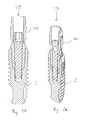
- FIG. 1
- ein Dentalimplantat mit einem Konusabschnitt und einem Indexierungsabschnitt in einer bevorzugten Ausführungsform in einem seitlichen Schnitt,
- FIG. 2
- das Dentalimplantat gemäß
FIG. 1 in einem perspektivischen Schnitt, - FIG. 3
- den Innenbereich des Dentalimplantat gemäß
FIG. 1 und 2 in einem Querschnitt, - FIG. 4
- ein Abutment in einer ersten bevorzugten Ausführungsform in einer perspektivischen Darstellung,
- FIG. 5
- das Abutment gemäß
FIG. 4 in einem seitlichen Schnitt, - FIG. 6
- das Abutment gemäß
FIG. 4 und 5 in einem Querschnitt, - FIG. 7
- ein Abutment in einer zweiten bevorzugten Ausführungsform in einer perspektivischen Darstellung,
- FIG. 8
- das Abutment gemäß
FIG. 7 in einem seitlichen Schnitt, - FIG. 9
- ein Implantatsystem mit einem Dentalimplantat gemäß der
FIG. 1 bis 3 und einem Abutment gemäß derFIG. 7 und 8 , - FIG. 10
- das Implantatsystem nach
FIG. 9 in einem seitlich-perspektivischen Schnitt, - FIG. 11
- ein Implantatsystem mit einem Dentalimplantat gemäß der
FIG. 1 bis 3 und einem Abutment gemäß derFIG. 4 bis 6 in einer perspektivischen Darstellung von außen, - FIG. 12
- das Implantatsystem gemäß
FIG. 11 in einem perspektivischen Schnitt, - FIG. 13
- einen Abformpfosten für ein Implantationsset in einer ersten bevorzugten Ausführungsform in einer perspektivischen Darstellung,
- FIG. 14
- den Abformpfosten gemäß
FIG. 13 in einem seitlichen Schnitt, - FIG. 15
- den Abformpfosten gemäß
FIG. 13 und 14 in einem Querschnitt, - FIG. 16
- einen Abformpfosten für ein Implantationsset in einer zweiten bevorzugten Ausführungsform in einer perspektivischen Darstellung,
- FIG. 17
- den Abformpfosten gemäß
FIG. 16 in einem seitlichen Schnitt, - FIG. 18
- den Abformpfosten gemäß
FIG. 16 und 17 in einem Querschnitt, - FIG. 19
- ein Implantationsset mit einem Abformpfosten gemäß der
FIG. 16 bis 18 , einer Fixierungsschraube und einem Dentalimplantat gemäß derFIG. 1 bis 3 in einer bevorzugten Ausführungsform in einem seitlichen Schnitt, - FIG. 20
- das Implantationsset gemäß
FIG. 19 in einem perspektivischen Schnitt, - FIG. 21
- einen Gingiva-Former für ein Implantations-Set in einer bevorzugten Ausführungsform in einem seitlichen Schnitt,
- FIG. 22
- den Gingiva-Former gemäß
FIG. 21 in einer perspektivischen Darstellung, - FIG. 23
- ein Implantationsset mit einem Gingiva-Former gemäß der
FIG. 21 und 22 und einem Dentalimplantat gemäß derFIG. 1 bis 3 in einer bevorzugten Ausführungsform in einem seitlichen Schnitt, - FIG. 24
- das Implantationsset gemäß
FIG. 23 in einem perspektivischen Schnitt, - FIG. 25
- ein Implantationsset mit einem Einbringpfosten und einem Dentalimplantat gemäß der
FIG. 1 bis 3 in einer bevorzugten Ausführungsform in einem seitlichen Schnitt, - FIG. 26
- das Implantationsset gemäß
FIG. 25 in einem perspektivischen Schnitt, und - FIG. 27
- eine Darstellung des Querschnitts eines Dentalimplantats zur Erläuterung des Freiwinkels und des Nutwinkels.
- Gleiche Teile sind in allen Figuren mit denselben Bezugszeichen versehen.
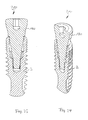
- Ein in
FIG. 1 in einem seitlichen Schnitt und inFIG. 1 in einem perspektivischen Schnitt dargestelltes Dentalimplantat 2 weist einen aus im Wesentlichen Reintitan Grade 4 bestehenden Implantatkörper 8 auf mit einem Außengewinde 10. Andere bevorzugte Materialien sind beispielsweise Titan Grade 5 oder Titanlegierungen. - An einem koronalen Ende 14 weist das Dentalimplantat 2 eine 20 Aufnahmeöffnung zur Aufnahme eines Abutments auf. Aus Richtung des koronalen Endes 14 gesehen weist die Aufnahmeöffnung 20 einen um eine Mittelachse M rotationssymmetrischen Konusabschnitt 26 und einen - unter Bildung einer Stufe 28 - sich im Wesentlichen anschließenden Indexierungsabschnitt 32 auf. Daran schließt sich ein Schraubgewinde 38 an, welches als Innenschraubgewinde ausgebildet ist und zur Aufnahme einer Fixierschraube dient, durch die ein Abutment mit dem Implantat verschraubt werden kann.
- Das Dentalimplantat 2 ist dazu ausgebildet, die auf das Abutment bzw. den künstlichen Zahnersatz, welcher an dem Abutment befestigt wird, wirkenden Kräfte, die insbesondere durch Kau-, Mahl- und Beißbewegungen entstehen, möglichst gleichmäßig und tief in das Implantat abzuleiten. Dazu wird gleichzeitig eine tiefe konische Verbindung mit Neigung zur Kaltverschweißung kombiniert mit einer rotationsgesicherten Verbindung.
- Ein Konuswinkel α des Konusabschnittes 26 (d. h. der Winkel zwischen einer gedachten Linie parallel zur Mittelachse des Dentalimplantats 2 und einer gedachten Linie durch die Außenfläche des Implantats) beträgt 1,4°, so dass der Konusabschnitt 26 somit als Morsekonus ausgebildet ist. Der Konuswinkel α entspricht dabei der Hälfte des so genannten Gesamtkonuswinkels. Ein derart steil ausgebildeter Konus erlaubt einen vergleichsweise lang ausgebildeten konischen Abschnitt, in dem Abutment und Implantat eine sowohl form- als auch kraftschlüssige Verbindung eingehen. Aufgrund der großen Berührungsfläche können Kräfte vom Abutment tief in das Implantat weitergeleitet werden. Aufgrund des sich anschließenden rotationsgesicherten Teils können Kräfte noch tiefer eingeleitet werden, wobei dort auch Drehkräfte abgefangen werden. Es ist insgesamt also ein sehr tiefer Kraftübergang möglich.
- Der Konusabschnitt 26 hat im vorliegenden Ausführungsbeispiel eine Konuslänge lk von 3 mm. Der Radius des Konusabschnittes 26 verjüngt sich in einem an den Indexierungsabschnitt 32 angrenzenden Übergangsabschnitt 34 in der Art einer konvexen Kontur. Dieser sich radial verjüngende Bereich bildet die abgerundete Stufe 28 zwischen dem Konusabschnitt 26 und dem Indexierungsabschnitt 32.
- Eine Indexierungslänge li, die die Länge des Indexierungsabschnittes 32 angibt, beträgt 1 mm, so dass eine Gesamtlänge lg, die Summe aus Konuslänge lk und Indexierungslänge li, 4 mm beträgt. Das Schraubgewinde 38 weist eine Schraubgewindenlänge ls von 2,3 mm auf.
- Der Indexierungsabschnitt 32 ist in einem Querschnitt in
FIG. 3 dargestellt. Entlang eines Kreisumfanges 50 sind vier Nuten 56 angeordnet in einer Konfiguration, die an das "Schweizer Kreuz" erinnert. Jede der vier Nuten weist jeweils Seitenflächen 62 auf, die jeweils senkrecht zu einer gemeinsamen Stirnfläche 68 stehen. - Die Seitenflächen 62 haben bevorzugt - in Richtung der Mittelachse M - eine Länge lf von 0,8 mm bis 1,5 mm, insbesondere und im vorliegenden Ausführungsbeispiel 1 mm. Die Länge lf entspricht hierbei der Länge li des Indexierungsabschnittes 32. Eine Stirnflächenbreite a beträgt bevorzugt je nach Schnittstellendurchmesser 0,7 mm bis 1,0 mm, und die Tiefe der Nuten bzw. Seitenflächentiefe b beträgt bevorzugt je nach Schnittstellendurchmesser 0,1 mm bis 0,4 mm. Im dargestellten Ausführungsbeispiel beträgt die Länge lf 1,0 mm, Die Stirnflächenbreite a ist 1,0 mm und die Seitenflächentiefe b beträgt 0,30 mm.
- Der Indexierungsabschnitt 32 umfasst gewissermaßen vier entlang des Kreisumfanges 50 angeordnete parallelwandige Prismen, die in axialer Richtung jeweils 1 mm hoch sind. Die Nuten 56 erstrecken sich dabei über die ganze Indexierungslänge li. Eine derartige Konfiguration ist geeignet für höchste Drehmomente und zeitigt keine Neigung zur Kaltverschweißung, sofern ein Abutment oder Eindrehwerkzeug eingesetzt wird, welches eine formkongruente Außenkontur aufweist, d. h., welches vier an einem Kreisumfang angeordnete Nocken aufweist, welche in die Nuten 56 in Eingriff bringbar sind. Zudem ist durch diese Schnittstelle ein minimales Rotationsspiel gegeben. Die Schnittstelle zwischen Implantat und Abutment ist als Nut-Nockenverbindung ausgebildet.
- Durch die Ausnehmung von parallelwandigen Prismen bzw. Nuten 56 ist vom koronalen Ende 14 des Dentalimplantats 2 aus gesehen eine Auflagefläche 74 für ein Abutment gebildet. Ein Abutment, welches eine zur Innenform des Indexierungsbereiches 32 formkongruente Außenkontur mit vier Nocken aufweist, kann, bevor es zur endgültigen Fixierung in das Dentalimplantat 2 hingeschoben wird, auf der Auflagefläche 74 zunächst aufgesetzt werden. Durch Drehen des Abutments im oder entgegen zum Uhrzeigersinn kann die gewünschte Orientierung des Abutments gesucht werden. Sobald diese gefunden wurde, kann das Abutment dann in das Implantat geschoben werden. Durch die Auflagefläche 74 wird beim Einsetzen des Abutments eine intermediäre bzw. Zwischenposition definiert. Die Seitenflächen 62 und die Stirnfläche 68 dienen beim Einsetzen als Führungsflächen für das Abutment.
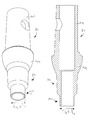
- Ein Abutment 80 in einer ersten bevorzugten Ausführungsform ist in
FIG. 4 perspektivisch dargestellt und weist einen Konusabschnitt 86 und einen Indexierungsabschnitt 92 auf. Der Konusabschnitt 86 weist einen Konuswinkel α auf, der dem Konuswinkel α des Dentalimplantates 2 entspricht. Bei Einführung des Abutments 80 in das Dentalimplantat 2 wird aufgrund des geringen Konuswinkel α eine selbsthemmende Verbindung mit Neigung zur Kaltverschweißung zwischen dem Konusabschnitt 86 des Abutments 80 und dem Konusabschnitt 26 des Dentalimplantats 2 realisiert. - Der Indexierungsabschnitt 92 des Abutments 80 weist vier als parallelwandige Prismen ausgebildete Nocken 98 auf, die mit den Nuten 56 des Dentalimplantats 2 im zusammengesetzten Zustand in Eingriff bringbar sind, wodurch durch Formschluss eine rotationsgesicherte Verbindung zwischen Dentalimplantat 2 und Abutment 80 hergestellt wird. Das Abutment 80 weist in einem koronalen Bereich ein Funktionsteil 100 zur Befestigung von künstlichem Zahnersatz, insbesondere zur Zementierung einer Krone, auf. Die Nocken 98 weisen eine zu den Nuten 56 des Dentalimplantats 2 formkongruente Kontur auf. Die Nocken 98 haben jeweils eine Stirnfläche 106 und zwei dazu senkrechte Seitenflächen 108 und sind entlang eines gedachten Kreisumfanges angeordnet. Zwischen dem Funktionsteil 100 und dem Konusabschnitt 86 weist das Abutment 80 einen Gingivaabschnitt 104 auf, welcher ein Emergenzprofil zur Ausformung der Gingiva aufweist. Ein Querschnitt durch das Abutment 80 ist in
FIG. 6 dargestellt. Das Abutment 80 weist ein Innengewinde 114 bzw. Innenschraubgewinde zum Einführen eines Spezialwerkzeuges auf. Dadurch ist es möglich, das Abutment 80 von einem Dentalimplantat 2 wieder zu lösen, auch wenn die beiden Konusabschnitte 26, 86 bereits miteinander im kaltverschweißten Zustand sind. - Ein Abutment 80 in einer zweiten bevorzugten Ausführungsform ist in
FIG. 7 perspektivisch dargestellt. Das Abutment 80 gemäßFIG. 7 weist im Gegensatz zum Abutment 80 gemäßFIG. 4 keinen Indexierungsabschnitt auf. Stattdessen umfasst es einen zylindrischen Führungsabschnitt 112. Ein äußerer Durchmesser u ist derartig dimensioniert, dass er dem Durchmesser des Kreisumfanges 50 des Dentalimplantats 2 entspricht. Beim Einführen des hier gezeigten Abutments 80 in das Dentalimplantat 2 dient der Führungsabschnitt 112 allein zur Führung des Abutments 80, während es in das Dentalimplantat 2 abgesenkt wird. Eine Indizierung wird hierbei nicht bewirkt. Der behandelnde Arzt oder Zahntechniker kann somit die Ausrichtung des Abutments 80 in Bezug auf das Dentalimplantat 2 während des Einsetzvorganges frei wählen. - Die
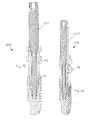
FIG. 9 und 10 zeigen ein Implantatsystem 126 in einer ersten bevorzugten Ausführung mit einem oben dargestellten Dentalimplantat 2 und einem Abutment 80 gemäß derFIG. 7 und 8 , welches statt einem Indexierungsabschnitt einen Führungsabschnitt 112 aufweist. Das Abutment 80 ist vorliegend vollständig in das Dentalimplantat 2 eingesetzt und kann durch festes Zubeißen des Patienten auf die Krone verpresst werden oder mit einer - nicht dargestellten - Fixierschraube verschraubt werden. - Die
FIG. 11 und 12 zeigen ein Implantatsystem 126 in einer zweiten bevorzugten Ausführungsform, bei der das Abutment 80, welches in denFIG. 4, 5 und 6 dargestellt ist, einen Indexierungsabschnitt 92 mit vier Nocken 98 umfasst, so dass sich vier verschiedene Orientierungen in dem Indexierungsabschnitt 32 des Dentalimplantats 32 ergeben. - Ein in den
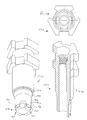
FIG. 13 bis 15 dargestellter Abformpfosten 150 in einer ersten bevorzugten Ausführung weist einen konisch ausgebildeten Einsetzabschnitt 152 auf, welcher während des Abformungsprozesses in den Konusabschnitt 26 des Dentalimplantates 2 eingesetzt wird. Mit diesem speziellen Abformpfosten 150 können mehrere und auch untereinander stark divergent bzw. windschief stehende Implantate bzw. Dentalimplantate 2 abgeformt werden. Diese Implantate werden in der zahntechnischen Rekonstruktion als Gruppe zusammengefasst und somit untereinander verblockt. Aufgrund der Verblockung ist die Position und Lage des Indexes der Implantate nicht erforderlich. Das Anschlussdesign beginnt ab der Auflageschulter mit einem kurzen (0,3 mm langen) Konus 151, dessen Winkel mit dem Konuswinkel des Dentalimplantates 2 folgt. Darauf folgt ein weiterer Konus 155, dessen Winkel erheblich größer ist. Als besonders vorteilhaft hat sich ein Winkel von 25° bis 35 ° erwiesen. Der flache Konus 155 erleichtert das Abziehen des Abformlöffels durch eine sich ergebende gemeinsame Abzugsrichtung und bietet entsprechend genügende Möglichkeiten, zueinander angulierte Einbringpfosten aus den Implantaten zu ziehen, ohne dass sich die Abformmasse merklich verformt. - Ein in den
FIG. 16 bis 18 dargestellter Abformpfosten 150 in einer zweiten bevorzugten Ausführung weist einen sich an einen als zylindrischer Übergangsbereich 153 ausgebildeten Einbringabschnitt anschließenden Indexierungsabschnitt 158 mit vier Nocken 162 auf, die bei der Abformung mit den Nuten 56 des Dentalimplantates zur Bildung einer formschlüssigen Verbindung in Eingriff bringbar sind, so dass die Orientierung bzw. Indizierung des Implantates im menschlichen Kiefer auf ein (Meister-)Modell übertragen werden kann. Das Anschlussdesign beginnt ab der Auflageschulter mit einem kurzen (0,3 mm langen) Konus 151, dessen Winkel mit dem Konuswinkel des Implantates folgt. Darauf folgt ein weiterer Konus 155, dessen Winkel erheblich größer ist. Als besonders vorteilhaft hat sich ein Winkel von 25° bis 35 ° erwiesen. Der zweite Konus mündet in einen zylindrischen Übergangsbereich 153, der den Übergang zum Indexierungsbereich 158 darstellt. - In
FIG. 27 ist der Querschnitt des Dentalimplantats 2 schematisch dargestellt. Entlang des Kreisumfanges 50 sind vier Nuten 56 angeordnet. Der Radius des den Kreisumfang 50 definierenden Kreises ist mit r bezeichnet. Die jeweilige Nut 56 hat mit dem Kreisumfang 50 zwei Berührungspunkte p1, p2. Der den zwischen diesen Berührungspunkten p1, p2 liegende Kreisabschnitt bzw. der ihn überstreichende Winkel ist ein Nutwinkel γ bzw. Öffnungswinkel, die entsprechend überstrichene Nutbogenlänge des Kreises ist c. Zwischen den Berührungspunkt p2 und einem den Berührungspunkt p1 einer benachbarten Nut 56 wird ein Abschnitt des Kreisumfanges 50, dessen Freibogenlänge mit d bezeichnet wird, überstrichen, wobei ein zugehöriger Freiwinkel mit δ bezeichnet wird. Der Nutwinkel γ bzw. der Öffnungswinkel ist der Winkel zwischen zwei durch den Mittelpunkt m des den Kreisumfang 50 definierenden Kreises und den Berührungspunkten p1, p2 verlaufenden gedachten Linien l1 und l2. Es gilt:

- Dabei sind die Einheiten von γ und δ Grad (°), c und d sind jeweils als Bogenlängen ausgedrückt. Das Verhältnis von Freiwinkel zu Nutwinkel, also δ/γ bzw. d/c, beträgt bei dem in
FIG. 1 ff. dargestellten Dentalimplantat 2 0,61. - Ein Verhältnis im Bereich von 0,61 und 0,84 ist dabei besonders vorteilhaft, da dadurch das Verhältnis aus Tiefe der Nuten bzw. Seitenfläche b und Gesamtabstand der Nuten zueinander mechanisch günstig ist. Durch die relativ breite Stirnflächenbreite a erhöht sich proportional die Seitenflächentiefe b. Die Seitenflächentiefe b soll zur Übertragung der notwendigen Eindrehmomente und zur Vermeidung von einer Kaltverschweißung möglichst groß sein. Andererseits soll der Gesamtabstand der Nuten e möglichst kein sein, damit die Querschnittfläche des Implantatkörpers und das Flächenträgheitsmoment unter Biege- und Torsionsbelastung möglichst groß sind.
- Weiterhin ist fertigungstechnisch die Herstellung einer breiten Nut (Stirnflächenbreite a) mit geringer Nutentiefe (Seitenflächentiefe b) mit höchster Präzision besser zu gewährleisten als eine schmale tiefe Nut.
- Abschließend reduziert sich bei einer breiten Nut der eingeschlossene Hohlraum bzw. ein Volumen f, nämlich gewissermaßen der Hohlraum des Indexzwischenbereichs, der aufgespannt wird von der Fläche zwischen einer Bogenlänge des Kreisumfanges zwischen zwei Nuten, die begrenzt wird von einem Berührungspunkt p2 einer Nut und dem Berührungspunkt p1 einer benachbarten Nut, und einer durch diese beiden Punkte verlaufenden Sekante s, und einer dazu senkrecht stehenden Linie mit der Seitenflächenlänge lf. Damit minimiert sich die mögliche Kontamination des Implantatinnenraums mit Flüssigkeiten und Bakterien.
-
- 2
- Dentalimplantat
- 8
- Implantatkörper
- 10
- Außengewinde
- 14
- koronales Ende
- 20
- Aufnahmeöffnung
- 26
- Konusabschnitt
- 28
- Stufe
- 32
- Indexierungsabschnitt
- 34
- Übergangsabschnitt
- 38
- Schraubgewinde
- 50
- Kreisumfang
- 56
- Nut
- 62
- Seitenfläche
- 68
- Stirnfläche
- 74
- Auflagefläche
- 80
- Abutment
- 86
- Konusabschnitt
- 92
- Indexierungsabschnitt
- 98
- Nocken
- 100
- Funktionsteil
- 104
- Gingivaabschnitt
- 106
- Stirnfläche
- 108
- Seitenfläche
- 110
- Kreisumfang
- 112
- Führungsabschnitt
- 114
- Innengewinde
- 126
- Implantatsystem
- 150
- Abformpfosten
- 151
- Konus
- 152
- Einsetzabschnitt
- 153
- zylindrischer Übergangsbereich
- 155
- Konus
- 158
- Indexierungsabschnitt
- 162
- Nocken
- 152
- Einsetzabschnitt
- 171
- Fixierungsschraube
- 180
- Gingiva-Former
- 210
- Implementationsset
- 240
- Einbringpfosten
- α
- Konuswinkel
- lk
- Konuslänge
- li
- Indexierungslänge
- lg
- Gesamtlänge
- ls
- Schraubengewindelänge
- M
- Mittelachse
- lf
- Seitenflächenlänge
- a
- Stirnflächenbreite
- b
- Seitenflächentiefe
- u
- Durchmesser
- c
- Nutbogenlänge
- d
- Freibogenlänge
- e
- Gesamtabstand der Nuten
- f
- Volumen
- γ
- Nutwinkel
- δ
- Freiwinkel
- r
- Radius
- p1
- Berührungspunkt
- p2
- Berührungspunkt
- l1
- Linie
- l2
- Linie
- m
- Mittelpunkt
- s
- Sekante
Claims (15)
- Dentalimplantat (2) zum Einsetzen in einen Kieferknochen, mit einer am koronalen Ende (14) des Dentalimplantats (2) angeordneten Aufnahmeöffnung (20) für ein Abutment, wobei die Aufnahmeöffnung (20) vom koronalen Ende (14) her gesehen einen Konusabschnitt (26) und einen Indexierungsabschnitt (32) aufweist, wobei der Indexierungsabschnitt (32) wenigstens eine entlang eines Kreisumfanges (50) angeordnete, sich nach außen erstreckende Nut (56) aufweist, dadurch gekennzeichnet, dass der Konusabschnitt (26) einen Konuswinkel (α) von weniger als 3° aufweist.
- Dentalimplantat (2) nach Anspruch 1, wobei der Konuswinkel (α) zwischen 1° und 2°, insbesondere 1,4° beträgt.
- Dentalimplantat (2) nach Anspruch 1 oder 2, wobei die jeweilige Nut (56) zwei Seitenflächen (62) aufweist, die jeweils senkrecht zu einer gemeinsamen Stirnfläche (68) stehen, welche senkrecht auf einer radial von einer Mittelachse (M) des Dentalimplantats (2) ausgehenden gedachten Linie steht.
- Dentalimplantat (2) nach Anspruch 3, wobei die Seitenflächen (62) eine Länge von 0,8 mm bis 1,5 mm, insbesondere 1 mm, aufweisen.
- Dentalimplantat (2) nach Anspruch 3 oder 4, wobei genau vier Nuten (56) im regelmäßigen Abstand entlang des Kreisumfangs (50) angeordnet sind.
- Dentalimplantat (2) nach Anspruch 5, wobei das Verhältnis eines Freiwinkels (δ), entlang dessen am Kreisumfang (50) überstrichenen Bereiches keine Nut (56) angeordnet ist, und eines Nutwinkels (γ), entlang dessen am Kreisumfang überstrichenen Bereiches eine Nut (56) angeordnet ist, zwischen 1,0 und 0,5 insbesondere zwischen 0,61 und 0,84 liegt.
- Dentalimplantat (2) nach einem der Ansprüche 1 bis 6, wobei am Indexierungsabschnitt (32) eine zirkuläre Auflagefläche (74) zur Unterstützung des Einfädelns für ein Abutment gebildet ist.
- Dentalimplantat (2) nach einem der Ansprüche 1 bis 7, wobei sich vom koronalen Ende (14) her gesehen an den Indexierungsabschnitt (32) ein Innenschraubgewinde (38) anschließt.
- Abutment (80) zum Einsetzen in ein Dentalimplantat (2), insbesondere ein Dentalimplantat (2) nach einem der Ansprüche 1 bis 8, mit einem Konusabschnitt (86) und einem Indexierungsabschnitt (92), dadurch gekennzeichnet, dass der Konusabschnitt (86) einen Konuswinkel (α) von weniger als 3° aufweist.
- Abutment (80) nach Anspruch 9, wobei der Indexierungsabschnitt (92) eine Anzahl von an einem Kreisumfang (110) angeordneten Nocken (98) aufweist, die mit Nuten (56) eines Dentalimplantats (2) in Eingriff bringbar sind.
- Abutment (80) nach Anspruch 10, mit genau vier Nocken (98), die im regelmäßigen Abstand entlang eines Kreisumfanges (110) angeordnet sind.
- Implantatsystem (126), umfassend ein Dentalimplantat (2) nach einem der Ansprüche 1 bis 8 und ein Abutment (80) nach einem der Ansprüche 9 bis 11, wobei die Konusabschnitte (26, 86) derart bemessen sind, dass sie sich wenigstens teilweise berühren, insbesondere im zusammengesetzten Zustand eine selbsthemmende Verbindung eingehen.
- Implantatsystem (126) nach Anspruch 12, wobei das Abutment (80) statt des Indexierungsabschnittes (92) einen zylindrischen Führungsabschnitt (112) aufweist, der in den Indexierungsabschnitt (32) des Dentalimplantats (2) einsetzbar ist.
- Implantatsystem (126) nach einem der Ansprüche 12 bis 14, wobei in dem Abutment (80) ein Durchgangskanal für die Durchführung einer Fixierschraube vorgesehen ist.
- Implantationsset (210) mit wenigstens einem Dentalimplantat (2) nach einem der Ansprüche 1 bis 8 und mit wenigstens einem Hilfselement aus der Gruppe: Abformpfosten (150), Gingiva-Former (180), Einbringpfosten (240).
Priority Applications (5)
| Application Number | Priority Date | Filing Date | Title |
|---|---|---|---|
| PT131782799T PT2829250T (pt) | 2013-07-26 | 2013-07-26 | Implante dentário, pilar, sistema de implante e conjunto de implantação |
| HUE13178279A HUE050729T2 (hu) | 2013-07-26 | 2013-07-26 | Fogászati implantátum, felépítmény, implantátum rendszer és implantációs készlet |
| ES13178279T ES2809470T3 (es) | 2013-07-26 | 2013-07-26 | Implante dental, pilar, sistema de implante y juego de implantación |
| EP13178279.9A EP2829250B1 (de) | 2013-07-26 | 2013-07-26 | Dentalimplantat, Abutment, Implantatsystem und Implantationsset |
| US14/341,237 US10695149B2 (en) | 2013-07-26 | 2014-07-25 | Dental implant, abutment, implant system and implant set |
Applications Claiming Priority (1)
| Application Number | Priority Date | Filing Date | Title |
|---|---|---|---|
| EP13178279.9A EP2829250B1 (de) | 2013-07-26 | 2013-07-26 | Dentalimplantat, Abutment, Implantatsystem und Implantationsset |
Publications (2)
| Publication Number | Publication Date |
|---|---|
| EP2829250A1 true EP2829250A1 (de) | 2015-01-28 |
| EP2829250B1 EP2829250B1 (de) | 2020-05-13 |
Family
ID=48874216
Family Applications (1)
| Application Number | Title | Priority Date | Filing Date |
|---|---|---|---|
| EP13178279.9A Active EP2829250B1 (de) | 2013-07-26 | 2013-07-26 | Dentalimplantat, Abutment, Implantatsystem und Implantationsset |
Country Status (5)
| Country | Link |
|---|---|
| US (1) | US10695149B2 (de) |
| EP (1) | EP2829250B1 (de) |
| ES (1) | ES2809470T3 (de) |
| HU (1) | HUE050729T2 (de) |
| PT (1) | PT2829250T (de) |
Cited By (5)
| Publication number | Priority date | Publication date | Assignee | Title |
|---|---|---|---|---|
| EP3095409A1 (de) * | 2015-05-21 | 2016-11-23 | Epiphanostics GmbH | Insertionsset für ein enossales einzelzahnimplantat |
| WO2017036929A1 (de) * | 2015-08-31 | 2017-03-09 | Jochen Rosbach | Gingivaformer |
| WO2017072171A1 (de) * | 2015-10-27 | 2017-05-04 | Heraeus Kulzer Gmbh | Scanabutment mit vergrösserter scanfläche |
| DE102017012134B3 (de) | 2017-12-28 | 2019-03-07 | Ljubinko Petrovic | Knochen-Implantat mit einem Verankerungsteil aus einem biokompatiblen Kunststoff |
| IT201800009288A1 (it) * | 2018-10-09 | 2020-04-09 | Ennio Calabria | Sistema di impianto dentale |
Families Citing this family (9)
| Publication number | Priority date | Publication date | Assignee | Title |
|---|---|---|---|---|
| BR112017025452B1 (pt) * | 2015-07-24 | 2021-05-04 | Nobel Biocare Services Ag | adaptador para ligar um primeiro componente dentário a um segundo componente dentário, e conjunto dentário que compreende o adaptador |
| GB2547191B (en) * | 2016-02-05 | 2020-01-08 | Advanced Risc Mach Ltd | An apparatus and method for supporting multiple cache features |
| ITUA20161638A1 (it) * | 2016-03-14 | 2017-09-14 | Sweden & Martina Spa | Sistema migliorato di impianto dentale |
| US10449019B2 (en) | 2016-07-20 | 2019-10-22 | Natural Dental Implants Ag | Systems and methods for securing a dental implant |
| IT201700068034A1 (it) * | 2017-06-19 | 2018-12-19 | Plan 1 Health Srl | Impianto dentale endosseo |
| WO2019122354A1 (en) * | 2017-12-22 | 2019-06-27 | Elos Medtech Pinol A/S | A dental implant analog |
| US11963829B2 (en) * | 2020-02-06 | 2024-04-23 | Patrick C. Bell | Fiducial markers for analyzing human jaws |
| USD1091822S1 (en) * | 2021-06-23 | 2025-09-02 | DDS Company, Inc. | Fixation article |
| US12502256B2 (en) * | 2023-03-14 | 2025-12-23 | Imam Abdulrahman Bin Faisal University | Intraoral scanning body |
Citations (8)
| Publication number | Priority date | Publication date | Assignee | Title |
|---|---|---|---|---|
| CN201160908Y (zh) * | 2008-03-12 | 2008-12-10 | 威海威高生物技术有限公司 | 口腔种植体装置 |
| US20090111072A1 (en) * | 2007-10-30 | 2009-04-30 | Alan Lombardo | Dental implant and abutment mating system |
| CN101732097A (zh) * | 2008-11-19 | 2010-06-16 | 威海威高生物技术有限公司 | 圆锥面加矩形键结构的口腔种植体 |
| US20100248181A1 (en) * | 2006-12-14 | 2010-09-30 | Egbert Kremer | Arrangement for insertion of implants |
| WO2011089057A1 (de) | 2010-01-21 | 2011-07-28 | Camlog Biotechnologies Ag | Zahnimplantat, abutment für ein zahnimplantat und kombination davon sowie ein implantations-set |
| US20120077151A1 (en) * | 2010-09-24 | 2012-03-29 | Nary Filho Hugo | Morse Taper Dental Implant |
| WO2012123654A1 (fr) * | 2011-03-15 | 2012-09-20 | Biotech International | Implant dentaire |
| US20120270180A1 (en) * | 2011-04-20 | 2012-10-25 | Dentsply International Inc. | Set of dental components |
Family Cites Families (16)
| Publication number | Priority date | Publication date | Assignee | Title |
|---|---|---|---|---|
| USRE38945E1 (en) * | 1995-01-30 | 2006-01-24 | Paula S. Fried | Dental implants and methods for extending service life |
| US6672871B2 (en) * | 2000-06-19 | 2004-01-06 | Nobel Biocare Ab | Coping with standoffs |
| GB0108551D0 (en) * | 2001-04-05 | 2001-05-23 | Osseobiotek Ltd | Implant |
| EP2260788B1 (de) * | 2005-06-03 | 2024-03-13 | Straumann Holding AG | Verbesserte Kupplung für mehrteiliges Zahnimplantatsystem |
| US8469710B2 (en) * | 2006-08-01 | 2013-06-25 | Vitali Bondar | Dental implant system and method |
| US8828066B2 (en) * | 2007-02-01 | 2014-09-09 | Sargon Lazarof | Securing mechanism with dual expandable ends |
| US8038442B2 (en) * | 2007-04-23 | 2011-10-18 | Nobel Biocare Services Ag | Dental implant and dental component connection |
| US8398400B2 (en) * | 2007-09-12 | 2013-03-19 | Vitali Bondar | Pick-up implant abutment and method |
| US9055988B2 (en) * | 2007-11-09 | 2015-06-16 | Southern Implants (Pty) Ltd. | Dental implant adaptor |
| US8029284B2 (en) * | 2008-09-29 | 2011-10-04 | Maxillent Ltd. | Implants, tools, and methods for sinus lift and lateral ridge augmentation |
| DK2215989T3 (da) * | 2009-02-05 | 2019-09-23 | Ivoclar Vivadent Ag | Konstruktionsdel til et tandimplantat |
| CA2764079A1 (en) * | 2011-01-20 | 2012-07-20 | Straumann Holding Ag | Assembly of a dental implant and an insertion tool |
| WO2012115969A2 (en) * | 2011-02-21 | 2012-08-30 | Aeton Medical Llc | Abutment and abutment systems for use with implants |
| EP2736446B1 (de) * | 2011-07-27 | 2020-09-02 | Abracadabra Implants Ltd | System zur restauration von zahnprothesen |
| EP2570097A1 (de) * | 2011-09-14 | 2013-03-20 | Dentsply IH AB | Zahnkomponente, Zahnimplantatanker und Zahnimplantat |
| US8684735B2 (en) * | 2011-12-06 | 2014-04-01 | Straumann Holding Ag | Abutment inlay |
-
2013
- 2013-07-26 ES ES13178279T patent/ES2809470T3/es active Active
- 2013-07-26 HU HUE13178279A patent/HUE050729T2/hu unknown
- 2013-07-26 EP EP13178279.9A patent/EP2829250B1/de active Active
- 2013-07-26 PT PT131782799T patent/PT2829250T/pt unknown
-
2014
- 2014-07-25 US US14/341,237 patent/US10695149B2/en active Active
Patent Citations (8)
| Publication number | Priority date | Publication date | Assignee | Title |
|---|---|---|---|---|
| US20100248181A1 (en) * | 2006-12-14 | 2010-09-30 | Egbert Kremer | Arrangement for insertion of implants |
| US20090111072A1 (en) * | 2007-10-30 | 2009-04-30 | Alan Lombardo | Dental implant and abutment mating system |
| CN201160908Y (zh) * | 2008-03-12 | 2008-12-10 | 威海威高生物技术有限公司 | 口腔种植体装置 |
| CN101732097A (zh) * | 2008-11-19 | 2010-06-16 | 威海威高生物技术有限公司 | 圆锥面加矩形键结构的口腔种植体 |
| WO2011089057A1 (de) | 2010-01-21 | 2011-07-28 | Camlog Biotechnologies Ag | Zahnimplantat, abutment für ein zahnimplantat und kombination davon sowie ein implantations-set |
| US20120077151A1 (en) * | 2010-09-24 | 2012-03-29 | Nary Filho Hugo | Morse Taper Dental Implant |
| WO2012123654A1 (fr) * | 2011-03-15 | 2012-09-20 | Biotech International | Implant dentaire |
| US20120270180A1 (en) * | 2011-04-20 | 2012-10-25 | Dentsply International Inc. | Set of dental components |
Cited By (10)
| Publication number | Priority date | Publication date | Assignee | Title |
|---|---|---|---|---|
| EP3095409A1 (de) * | 2015-05-21 | 2016-11-23 | Epiphanostics GmbH | Insertionsset für ein enossales einzelzahnimplantat |
| WO2016185045A1 (de) * | 2015-05-21 | 2016-11-24 | Epiphanostics GmbH | Insertionsset für ein enossales einzelzahnimplantat |
| CN107820413A (zh) * | 2015-05-21 | 2018-03-20 | 艾皮法诺斯蒂克斯公司 | 用于骨内单齿植入物的插入套件 |
| EP3685795A1 (de) * | 2015-05-21 | 2020-07-29 | Nobel Biocare Services AG | Enossales einzelzahnimplantat |
| WO2017036929A1 (de) * | 2015-08-31 | 2017-03-09 | Jochen Rosbach | Gingivaformer |
| WO2017072171A1 (de) * | 2015-10-27 | 2017-05-04 | Heraeus Kulzer Gmbh | Scanabutment mit vergrösserter scanfläche |
| US11213371B2 (en) | 2015-10-27 | 2022-01-04 | Kulzer Gmbh | Scan abutment having an enlarged scan surface |
| DE102017012134B3 (de) | 2017-12-28 | 2019-03-07 | Ljubinko Petrovic | Knochen-Implantat mit einem Verankerungsteil aus einem biokompatiblen Kunststoff |
| WO2019129324A1 (de) | 2017-12-28 | 2019-07-04 | Ljubinko Petrovic | Knochen-implantat mit einem verankerungsteil aus einem biokompatiblen kunststoff |
| IT201800009288A1 (it) * | 2018-10-09 | 2020-04-09 | Ennio Calabria | Sistema di impianto dentale |
Also Published As
| Publication number | Publication date |
|---|---|
| US20150030993A1 (en) | 2015-01-29 |
| PT2829250T (pt) | 2020-08-20 |
| US10695149B2 (en) | 2020-06-30 |
| HUE050729T2 (hu) | 2021-01-28 |
| ES2809470T3 (es) | 2021-03-04 |
| EP2829250B1 (de) | 2020-05-13 |
Similar Documents
| Publication | Publication Date | Title |
|---|---|---|
| EP2829250B1 (de) | Dentalimplantat, Abutment, Implantatsystem und Implantationsset | |
| EP3248566B1 (de) | Aufbauteil für ein dentalimplantat, pfostenteil für ein dentalimplantat sowie dentalimplantat | |
| EP2667820B1 (de) | Zahnersatz-system | |
| EP3143961B1 (de) | Dentalimplantat | |
| EP2525737B2 (de) | Abutment für ein Zahnimplantat und Kombination aus Abutment und Implantat | |
| EP1843717B1 (de) | Dentalimplantat | |
| EP2874564B1 (de) | Zahnimplantataufbausystem | |
| EP3449869B1 (de) | Implantat-teil | |
| EP3685795B1 (de) | Enossales einzelzahnimplantat | |
| EP2674127A1 (de) | Implantat | |
| DE102014106076A1 (de) | Zahnmedizinisches Implantat | |
| EP3666224B1 (de) | Zahnersatz mit verbindungshülse und bausatz | |
| EP2108330A1 (de) | Temporäres Zahnimplantat | |
| DE20304755U1 (de) | Kieferimplantat, insbesondere ein einphasiges Dental (definitiv)-Implantat mit geradem und abgewinkeltem Pfostenverlauf | |
| DE102008028132A1 (de) | Mehrteiliges Zahnimplantatsystem | |
| DE202010015755U1 (de) | Dentalimplantatsystem | |
| EP2964133B1 (de) | Zahnimplantat | |
| EP2724686A2 (de) | Dentalimplantat und dentales Implantatsystem | |
| WO2021013376A1 (de) | Abdruckpfosten zum verbinden mit einem zahnimplantat | |
| DE102012002112A1 (de) | Dentalimplantat | |
| CH703012A1 (de) | Dentalimplantat. | |
| DE102016014348B4 (de) | Implantatsystem | |
| EP3449868A1 (de) | Anordnung von einen aufsatzelement auf einem implantatkörper | |
| EP3275395A1 (de) | Dentalschraubimplantat mit axial von knochen durchsetzbarem ansatz | |
| DE102016000167A1 (de) | Zahnimplantat mit einem Mehrfachgewinde |
Legal Events
| Date | Code | Title | Description |
|---|---|---|---|
| 17P | Request for examination filed |
Effective date: 20130726 |
|
| AK | Designated contracting states |
Kind code of ref document: A1 Designated state(s): AL AT BE BG CH CY CZ DE DK EE ES FI FR GB GR HR HU IE IS IT LI LT LU LV MC MK MT NL NO PL PT RO RS SE SI SK SM TR |
|
| AX | Request for extension of the european patent |
Extension state: BA ME |
|
| PUAI | Public reference made under article 153(3) epc to a published international application that has entered the european phase |
Free format text: ORIGINAL CODE: 0009012 |
|
| R17P | Request for examination filed (corrected) |
Effective date: 20150728 |
|
| RBV | Designated contracting states (corrected) |
Designated state(s): AL AT BE BG CH CY CZ DE DK EE ES FI FR GB GR HR HU IE IS IT LI LT LU LV MC MK MT NL NO PL PT RO RS SE SI SK SM TR |
|
| STAA | Information on the status of an ep patent application or granted ep patent |
Free format text: STATUS: EXAMINATION IS IN PROGRESS |
|
| 17Q | First examination report despatched |
Effective date: 20190524 |
|
| GRAP | Despatch of communication of intention to grant a patent |
Free format text: ORIGINAL CODE: EPIDOSNIGR1 |
|
| STAA | Information on the status of an ep patent application or granted ep patent |
Free format text: STATUS: GRANT OF PATENT IS INTENDED |
|
| INTG | Intention to grant announced |
Effective date: 20191204 |
|
| GRAS | Grant fee paid |
Free format text: ORIGINAL CODE: EPIDOSNIGR3 |
|
| GRAA | (expected) grant |
Free format text: ORIGINAL CODE: 0009210 |
|
| STAA | Information on the status of an ep patent application or granted ep patent |
Free format text: STATUS: THE PATENT HAS BEEN GRANTED |
|
| AK | Designated contracting states |
Kind code of ref document: B1 Designated state(s): AL AT BE BG CH CY CZ DE DK EE ES FI FR GB GR HR HU IE IS IT LI LT LU LV MC MK MT NL NO PL PT RO RS SE SI SK SM TR |
|
| REG | Reference to a national code |
Ref country code: GB Ref legal event code: FG4D Free format text: NOT ENGLISH |
|
| REG | Reference to a national code |
Ref country code: CH Ref legal event code: EP |
|
| REG | Reference to a national code |
Ref country code: DE Ref legal event code: R096 Ref document number: 502013014705 Country of ref document: DE |
|
| REG | Reference to a national code |
Ref country code: AT Ref legal event code: REF Ref document number: 1269249 Country of ref document: AT Kind code of ref document: T Effective date: 20200615 |
|
| REG | Reference to a national code |
Ref country code: PT Ref legal event code: SC4A Ref document number: 2829250 Country of ref document: PT Date of ref document: 20200820 Kind code of ref document: T Free format text: AVAILABILITY OF NATIONAL TRANSLATION Effective date: 20200806 |
|
| REG | Reference to a national code |
Ref country code: LT Ref legal event code: MG4D |
|
| REG | Reference to a national code |
Ref country code: NL Ref legal event code: MP Effective date: 20200513 |
|
| PG25 | Lapsed in a contracting state [announced via postgrant information from national office to epo] |
Ref country code: IS Free format text: LAPSE BECAUSE OF FAILURE TO SUBMIT A TRANSLATION OF THE DESCRIPTION OR TO PAY THE FEE WITHIN THE PRESCRIBED TIME-LIMIT Effective date: 20200913 Ref country code: NO Free format text: LAPSE BECAUSE OF FAILURE TO SUBMIT A TRANSLATION OF THE DESCRIPTION OR TO PAY THE FEE WITHIN THE PRESCRIBED TIME-LIMIT Effective date: 20200813 Ref country code: SE Free format text: LAPSE BECAUSE OF FAILURE TO SUBMIT A TRANSLATION OF THE DESCRIPTION OR TO PAY THE FEE WITHIN THE PRESCRIBED TIME-LIMIT Effective date: 20200513 Ref country code: FI Free format text: LAPSE BECAUSE OF FAILURE TO SUBMIT A TRANSLATION OF THE DESCRIPTION OR TO PAY THE FEE WITHIN THE PRESCRIBED TIME-LIMIT Effective date: 20200513 Ref country code: GR Free format text: LAPSE BECAUSE OF FAILURE TO SUBMIT A TRANSLATION OF THE DESCRIPTION OR TO PAY THE FEE WITHIN THE PRESCRIBED TIME-LIMIT Effective date: 20200814 Ref country code: LT Free format text: LAPSE BECAUSE OF FAILURE TO SUBMIT A TRANSLATION OF THE DESCRIPTION OR TO PAY THE FEE WITHIN THE PRESCRIBED TIME-LIMIT Effective date: 20200513 |
|
| PG25 | Lapsed in a contracting state [announced via postgrant information from national office to epo] |
Ref country code: BG Free format text: LAPSE BECAUSE OF FAILURE TO SUBMIT A TRANSLATION OF THE DESCRIPTION OR TO PAY THE FEE WITHIN THE PRESCRIBED TIME-LIMIT Effective date: 20200813 Ref country code: RS Free format text: LAPSE BECAUSE OF FAILURE TO SUBMIT A TRANSLATION OF THE DESCRIPTION OR TO PAY THE FEE WITHIN THE PRESCRIBED TIME-LIMIT Effective date: 20200513 Ref country code: LV Free format text: LAPSE BECAUSE OF FAILURE TO SUBMIT A TRANSLATION OF THE DESCRIPTION OR TO PAY THE FEE WITHIN THE PRESCRIBED TIME-LIMIT Effective date: 20200513 Ref country code: HR Free format text: LAPSE BECAUSE OF FAILURE TO SUBMIT A TRANSLATION OF THE DESCRIPTION OR TO PAY THE FEE WITHIN THE PRESCRIBED TIME-LIMIT Effective date: 20200513 |
|
| PG25 | Lapsed in a contracting state [announced via postgrant information from national office to epo] |
Ref country code: AL Free format text: LAPSE BECAUSE OF FAILURE TO SUBMIT A TRANSLATION OF THE DESCRIPTION OR TO PAY THE FEE WITHIN THE PRESCRIBED TIME-LIMIT Effective date: 20200513 Ref country code: NL Free format text: LAPSE BECAUSE OF FAILURE TO SUBMIT A TRANSLATION OF THE DESCRIPTION OR TO PAY THE FEE WITHIN THE PRESCRIBED TIME-LIMIT Effective date: 20200513 |
|
| REG | Reference to a national code |
Ref country code: HU Ref legal event code: AG4A Ref document number: E050729 Country of ref document: HU |
|
| PG25 | Lapsed in a contracting state [announced via postgrant information from national office to epo] |
Ref country code: EE Free format text: LAPSE BECAUSE OF FAILURE TO SUBMIT A TRANSLATION OF THE DESCRIPTION OR TO PAY THE FEE WITHIN THE PRESCRIBED TIME-LIMIT Effective date: 20200513 Ref country code: SM Free format text: LAPSE BECAUSE OF FAILURE TO SUBMIT A TRANSLATION OF THE DESCRIPTION OR TO PAY THE FEE WITHIN THE PRESCRIBED TIME-LIMIT Effective date: 20200513 Ref country code: DK Free format text: LAPSE BECAUSE OF FAILURE TO SUBMIT A TRANSLATION OF THE DESCRIPTION OR TO PAY THE FEE WITHIN THE PRESCRIBED TIME-LIMIT Effective date: 20200513 Ref country code: CZ Free format text: LAPSE BECAUSE OF FAILURE TO SUBMIT A TRANSLATION OF THE DESCRIPTION OR TO PAY THE FEE WITHIN THE PRESCRIBED TIME-LIMIT Effective date: 20200513 Ref country code: RO Free format text: LAPSE BECAUSE OF FAILURE TO SUBMIT A TRANSLATION OF THE DESCRIPTION OR TO PAY THE FEE WITHIN THE PRESCRIBED TIME-LIMIT Effective date: 20200513 |
|
| REG | Reference to a national code |
Ref country code: DE Ref legal event code: R097 Ref document number: 502013014705 Country of ref document: DE |
|
| PG25 | Lapsed in a contracting state [announced via postgrant information from national office to epo] |
Ref country code: MC Free format text: LAPSE BECAUSE OF FAILURE TO SUBMIT A TRANSLATION OF THE DESCRIPTION OR TO PAY THE FEE WITHIN THE PRESCRIBED TIME-LIMIT Effective date: 20200513 Ref country code: PL Free format text: LAPSE BECAUSE OF FAILURE TO SUBMIT A TRANSLATION OF THE DESCRIPTION OR TO PAY THE FEE WITHIN THE PRESCRIBED TIME-LIMIT Effective date: 20200513 Ref country code: SK Free format text: LAPSE BECAUSE OF FAILURE TO SUBMIT A TRANSLATION OF THE DESCRIPTION OR TO PAY THE FEE WITHIN THE PRESCRIBED TIME-LIMIT Effective date: 20200513 |
|
| REG | Reference to a national code |
Ref country code: ES Ref legal event code: FG2A Ref document number: 2809470 Country of ref document: ES Kind code of ref document: T3 Effective date: 20210304 |
|
| PLBE | No opposition filed within time limit |
Free format text: ORIGINAL CODE: 0009261 |
|
| STAA | Information on the status of an ep patent application or granted ep patent |
Free format text: STATUS: NO OPPOSITION FILED WITHIN TIME LIMIT |
|
| 26N | No opposition filed |
Effective date: 20210216 |
|
| REG | Reference to a national code |
Ref country code: BE Ref legal event code: MM Effective date: 20200731 |
|
| PG25 | Lapsed in a contracting state [announced via postgrant information from national office to epo] |
Ref country code: LU Free format text: LAPSE BECAUSE OF NON-PAYMENT OF DUE FEES Effective date: 20200726 |
|
| PG25 | Lapsed in a contracting state [announced via postgrant information from national office to epo] |
Ref country code: BE Free format text: LAPSE BECAUSE OF NON-PAYMENT OF DUE FEES Effective date: 20200731 Ref country code: SI Free format text: LAPSE BECAUSE OF FAILURE TO SUBMIT A TRANSLATION OF THE DESCRIPTION OR TO PAY THE FEE WITHIN THE PRESCRIBED TIME-LIMIT Effective date: 20200513 |
|
| PG25 | Lapsed in a contracting state [announced via postgrant information from national office to epo] |
Ref country code: IE Free format text: LAPSE BECAUSE OF NON-PAYMENT OF DUE FEES Effective date: 20200726 |
|
| PG25 | Lapsed in a contracting state [announced via postgrant information from national office to epo] |
Ref country code: MT Free format text: LAPSE BECAUSE OF FAILURE TO SUBMIT A TRANSLATION OF THE DESCRIPTION OR TO PAY THE FEE WITHIN THE PRESCRIBED TIME-LIMIT Effective date: 20200513 Ref country code: CY Free format text: LAPSE BECAUSE OF FAILURE TO SUBMIT A TRANSLATION OF THE DESCRIPTION OR TO PAY THE FEE WITHIN THE PRESCRIBED TIME-LIMIT Effective date: 20200513 |
|
| PG25 | Lapsed in a contracting state [announced via postgrant information from national office to epo] |
Ref country code: MK Free format text: LAPSE BECAUSE OF FAILURE TO SUBMIT A TRANSLATION OF THE DESCRIPTION OR TO PAY THE FEE WITHIN THE PRESCRIBED TIME-LIMIT Effective date: 20200513 |
|
| PGFP | Annual fee paid to national office [announced via postgrant information from national office to epo] |
Ref country code: TR Payment date: 20220722 Year of fee payment: 10 |
|
| P01 | Opt-out of the competence of the unified patent court (upc) registered |
Effective date: 20230526 |
|
| PGFP | Annual fee paid to national office [announced via postgrant information from national office to epo] |
Ref country code: PT Payment date: 20250630 Year of fee payment: 13 |
|
| PGFP | Annual fee paid to national office [announced via postgrant information from national office to epo] |
Ref country code: HU Payment date: 20250722 Year of fee payment: 13 |
|
| PGFP | Annual fee paid to national office [announced via postgrant information from national office to epo] |
Ref country code: ES Payment date: 20250819 Year of fee payment: 13 |
|
| PGFP | Annual fee paid to national office [announced via postgrant information from national office to epo] |
Ref country code: DE Payment date: 20250724 Year of fee payment: 13 |
|
| PGFP | Annual fee paid to national office [announced via postgrant information from national office to epo] |
Ref country code: IT Payment date: 20250731 Year of fee payment: 13 |
|
| PGFP | Annual fee paid to national office [announced via postgrant information from national office to epo] |
Ref country code: GB Payment date: 20250724 Year of fee payment: 13 |
|
| PGFP | Annual fee paid to national office [announced via postgrant information from national office to epo] |
Ref country code: FR Payment date: 20250723 Year of fee payment: 13 Ref country code: AT Payment date: 20250721 Year of fee payment: 13 |
|
| PGFP | Annual fee paid to national office [announced via postgrant information from national office to epo] |
Ref country code: CH Payment date: 20250801 Year of fee payment: 13 |