EP2829000B1 - Verfahren mit harq-ack-codebüchern für multi-flow-kommunikation und zugehörige drahtlose endgeräte sowie funknetzwerkknoten - Google Patents
Verfahren mit harq-ack-codebüchern für multi-flow-kommunikation und zugehörige drahtlose endgeräte sowie funknetzwerkknoten Download PDFInfo
- Publication number
- EP2829000B1 EP2829000B1 EP13763730.2A EP13763730A EP2829000B1 EP 2829000 B1 EP2829000 B1 EP 2829000B1 EP 13763730 A EP13763730 A EP 13763730A EP 2829000 B1 EP2829000 B1 EP 2829000B1
- Authority
- EP
- European Patent Office
- Prior art keywords
- sector
- transport data
- data block
- harq
- ack
- Prior art date
- Legal status (The legal status is an assumption and is not a legal conclusion. Google has not performed a legal analysis and makes no representation as to the accuracy of the status listed.)
- Not-in-force
Links
Images





Classifications
-
- H—ELECTRICITY
- H04—ELECTRIC COMMUNICATION TECHNIQUE
- H04L—TRANSMISSION OF DIGITAL INFORMATION, e.g. TELEGRAPHIC COMMUNICATION
- H04L1/00—Arrangements for detecting or preventing errors in the information received
- H04L1/004—Arrangements for detecting or preventing errors in the information received by using forward error control
- H04L1/0072—Error control for data other than payload data, e.g. control data
- H04L1/0073—Special arrangements for feedback channel
-
- H—ELECTRICITY
- H04—ELECTRIC COMMUNICATION TECHNIQUE
- H04L—TRANSMISSION OF DIGITAL INFORMATION, e.g. TELEGRAPHIC COMMUNICATION
- H04L1/00—Arrangements for detecting or preventing errors in the information received
- H04L1/12—Arrangements for detecting or preventing errors in the information received by using return channel
- H04L1/16—Arrangements for detecting or preventing errors in the information received by using return channel in which the return channel carries supervisory signals, e.g. repetition request signals
- H04L1/1607—Details of the supervisory signal
-
- H—ELECTRICITY
- H04—ELECTRIC COMMUNICATION TECHNIQUE
- H04L—TRANSMISSION OF DIGITAL INFORMATION, e.g. TELEGRAPHIC COMMUNICATION
- H04L1/00—Arrangements for detecting or preventing errors in the information received
- H04L1/12—Arrangements for detecting or preventing errors in the information received by using return channel
- H04L1/16—Arrangements for detecting or preventing errors in the information received by using return channel in which the return channel carries supervisory signals, e.g. repetition request signals
- H04L1/18—Automatic repetition systems, e.g. Van Duuren systems
- H04L1/1812—Hybrid protocols; Hybrid automatic repeat request [HARQ]
Definitions
- the present disclosure is directed to wireless communications and, more particularly, to Multi-Flow (MF) wireless communications and related network nodes and wireless terminals.
- MF Multi-Flow
- wireless terminals also referred to as user equipment unit nodes, UEs, and/or mobile stations communicate via a radio access network (RAN) with one or more core networks.
- the RAN covers a geographical area which is divided into cell areas, with each cell area being served by a radio base station (also referred to as a RAN node, a "NodeB", and/or enhanced NodeB "eNodeB").
- a cell area is a geographical area where radio coverage is provided by the base station equipment at a base station site.
- the base stations communicate through radio communication channels with UEs within range of the base stations.
- a cell area for a base station may be divided into a plurality of sectors surrounding the base station.
- a base station may service three 120 degree sectors surrounding the base station, when the base station providing a respective directional transceiver and sector antenna array for each sector.
- a base station may include three directional sector antenna arrays servicing respective 120 degree base station sectors surrounding the base station.
- Multi-antenna techniques can significantly increase capacity, data rates, and/or reliability of a wireless communication system as discussed, for example, by Telatar in "Capacity Of Multi-Antenna Gaussian Channels" (European Transactions On Telecommunications, Vol. 10, pp. 585-595, Nov. 1999 ). Performance can be improved if both the transmitter and the receiver for a base station sector are equipped with multiple antennas (e.g., an sector antenna array) to provide a multiple-input multiple-output (MIMO) communication channel(s) for the base station sector.
- MIMO Multiple-Input-Multiple-Output
- the HSPA (High Speed Packet Access) standard is currently evolving with enhanced MIMO support and MIMO antenna deployments.
- a spatial multiplexing mode is provided for relatively high data rates in more favorable channel conditions, and a transmit diversity mode is provided for relatively high reliability (at lower data rates) in less favorable channel conditions.
- a downlink (DL) from a base station transmitting from a sector antenna array over a MIMO channel to a wireless terminal in the sector for example, spatial multiplexing (or SM) allows the simultaneous transmission of multiple symbol streams over the same frequency from the base station sector antenna array for the sector. Stated in other words, multiple symbol streams are transmitted from the base station sector antenna array for the sector to the wireless terminal over the same downlink time/frequency resource element (TFRE) to provide an increased data rate.
- TFRE downlink time/frequency resource element
- TFRE downlink time/frequency resource element
- a time/frequency resource element may also be referred to as a transmission time interval or TTI.
- transmit diversity is the simultaneous transmission of the same symbol stream over the same frequency from different antennas of the base station sector antenna array.
- the same symbol stream is transmitted from different antennas of the base station sector antenna array to the wireless terminal over the same time/frequency resource element (TFRE) to provide increased reliability of reception at the wireless terminal due to transmit diversity gain.
- TFRE time/frequency resource element
- MF-HSDPA Multi-Flow-HSDPA
- 3GPP 3 rd Generation Partnership Project
- Intra NodeB aggregation (also referred to as intra node Multi-Flow communications) occurs when different transport data blocks of a data stream are transmitted from two different sectors of a same base station to a wireless terminal
- Inter NodeB aggregation (also referred to as inter node Multi-Flow communications) occurs when different transport data blocks of a data stream are transmitted from sectors/cells of different base stations to a wireless terminal.
- MF-HSDPA may thus provide advantages of parallel data streams like MIMO where the spatially separated antennas are taken from different sectors/cells.
- MF-HSDPA When MF-HSDPA is used to transmit transport data blocks from different base stations to a wireless terminal during a same time resource element (also referred to as a transmission time interval or TTI), neither base station may be aware of how many transport data blocks were transmitted by the other base station. Accordingly, it may be difficult to provide efficient feedback from the wireless terminal to the network regarding the transport data blocks of a multi-flow transmission.
- TTI transmission time interval
- 3rd Generation Partnership Project 3rd Generation Partnership Project
- R1-114174 Uplink control channel structure and timing
- HSDPA Multiflow Data XP050562130, 2011-11-08 , describe a multi-flow HSDPA transmission, with inter-site multi-flow transmission where cells (sectors) resides in different NodeBs.
- 3rd Generation Partnership Project 3rd Generation Partnership Project
- a wireless terminal can include any device that receives data from a communication network, and may include, but is not limited to, a mobile telephone ("cellular" telephone), laptop/portable computer, pocket computer, hand-held computer, and/or desktop computer.
- cellular mobile telephone
- a radio network controller also sometimes termed a base station controller (BSC) supervises and coordinates various activities of the plural base stations connected thereto.
- the radio network controller is typically connected to one or more core networks.
- the Universal Mobile Telecommunications System is a third generation mobile communication system, which evolved from the Global System for Mobile Communications (GSM), and is intended to provide improved mobile communication services based on Wideband Code Division Multiple Access (WCDMA) technology.
- GSM Global System for Mobile Communications
- WCDMA Wideband Code Division Multiple Access
- UTRAN short for UMTS Terrestrial Radio Access Network, is a collective term for the NodeB's and Radio Network Controllers which make up the UMTS radio access network.
- UTRAN is essentially a radio access network using wideband code division multiple access for UEs.
- the Third Generation Partnership Project (3GPP) has undertaken to further evolve the UTRAN and GSM based radio access network technologies.
- specifications for the Evolved Universal Terrestrial Radio Access Network (E-UTRAN) are ongoing within 3GPP.
- the Evolved Universal Terrestrial Radio Access Network (E-UTRAN) comprises the Long Term Evolution (LTE) and System Architecture Evolution (SAE).
- HSDPA High-Speed Downlink Packet Access
- WCDMA Wideband Code Division Multiple Access
- WiMax Worldwide Interoperability for Microwave Access
- UMB User Mobile Broadband
- 3GPP 3 rd Generation Partnership Project
- LTE Long Term Evolution
- GSM Global System for Mobile Communications
- base station e.g., a NodeB and/or eNodeB
- wireless terminal also referred to as UE or User Equipment
- a base station e.g., a NodeB and/or eNodeB
- a wireless terminal e.g., a "UE”
- UE User Equipment
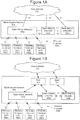
- FIG. 1A is a block diagram of a communication system that is configured to operate according to some embodiments of inventive concepts.
- An example RAN 60 is shown that may be a Long Term Evolution (LTE) RAN.
- Radio base stations (e.g., eNodeBs) 100a are connected directly to one or more core networks 70a.
- functionality of radio network controller(s) (RNC) 100a may be performed by radio base stations 100a.
- Radio base stations 100a communicate over wireless channels 300 with wireless terminals (also referred to as user equipment nodes or UEs) 200a that are within their respective communication service cells (also referred to as coverage areas).
- the radio base stations 100a may be eNodeB's that may communicate with one another through an X2 interface(s) and with the core network(s) 70a through S1 interfaces, as is well known to one who is skilled in the art.
- FIG. 1B is a block diagram of a communication system that is configured to operate according to some other embodiments of present inventive concepts.
- An example RAN 60b is shown that may be a WCDMA RAN.
- Radio base stations (e.g., NodeBs) 100b may be coupled to core network(s) 70b through one or more radio network controllers (RNCs) 65b.
- RNCs radio network controllers
- functionality of a radio network controller(s) may be performed by radio base stations 100b.
- Radio base stations 100b communicate over wireless channels 300b with wireless terminals (also referred to as user equipment nodes or UEs) 200b that are within their respective communication service cells (also referred to as coverage areas).
- the radio base stations 100b can communicate with one another and with the core network(s) 70b, as is well known to one who is skilled in the art.
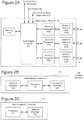
- FIG 2A is a block diagram of a base station 100 (e.g., base station 100a of Figure 1A or base station 100b of Figure 1B ) configured to provide service over three 120 degree sectors (sectors A, B, and C) surrounding the base station according to some embodiments.
- base station 100 includes three transceivers 109a, 109b, and 109c coupled between base station controller 101 and respective sector antenna arrays 117a, 117b, and 117c (each of which includes multiple MIMO antennas), and memory 118 coupled to processor 101.
- each transceiver 109 includes a receiver and a transmitter.
- Each receiver is configured to generate digital data streams corresponding to one or more transport data blocks received through the respective sector antenna array 117 from wireless terminals 200 located in a sector serviced by the respective sector antenna array.
- Each transmitter is configured to transmit one or more transport data blocks through the respective sector antenna array 117 to wireless terminals 200 located in the sector serviced by the sector antenna array responsive to a digital data stream from processor 101.
- base station 100 of Figure 1 defines three 120 degree sectors A, B, and C surrounding the base station, transceiver 109a and sector antenna array 117a support MIMO communications for wireless terminals 200 in sector A of base station 100, transceiver 109b and sector antenna array 117b support MIMO communications for wireless terminals 200 in sector B of base station 100, and transceiver 109c and sector antenna array 117c support MIMO communications for wireless terminals 200 in sector C of base station 100.
- FIG. 2B is a block diagram of base station controller 101 of Figure 2A according to some embodiments.
- base station controller 101 includes processor 141, network interface 143, and transceiver interface 145.
- Network interface 143 provides a communications interface between processor 141 and core network 70, between processor 141 and RNC 121, and/or between processor 141 and other base stations 100.
- Transceiver interface 145 is configured to provide a communications interface between processor 141 and each of transceivers 109a, 109b, and 109c.
- FIG 2C is a block diagram of radio network controller (RNC) 121 of Figure 1B according to some embodiments.
- RCN 121 includes processor 131 and network interface 135.
- Network interface 143 provides a communications interface between processor 131 and base stations 100 and/or between processor 131 and core network 70.
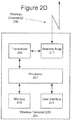
- FIG 2D is a block diagram of a wireless terminal (UE) 200 (e.g., wireless terminal 200a of Figure 1A or wireless terminal 200b of Figure 1B ) according to some embodiments.
- Wireless terminal 200 may be a cellular radiotelephone, a smart phone, a laptop/netbook/tablet/handheld computer, or any other device providing wireless communications.
- Wireless terminal 200 includes processor 201, user interface 211 (e.g., including a visual display such as an liquid crystal display, a touch sensitive visual display, a keypad, a speaker, a microphone, etc.), memory 218, transceiver 209, and sector antenna array 217 (including a plurality of antenna elements).
- transceiver 209 includes a receiver allowing processor 201 to receive data from radio access network 60 over one or more wireless channels 300 through sector antenna array 217 and transceiver 209, and transceiver 209 includes a transmitter allowing processor 201 to transmit data through transceiver 209 and sector antenna array 217 over one or more wireless channels 300 to radio access network 60.
- wireless terminal 200 can receive MIMO communications allowing spatial multiplexing and/or diversity gain as discussed above.
- a maximum number of downlink MIMO channels that can be received simultaneously during multi-flow and/or single-flow MIMO by wireless terminal 200 is equal to the number of antenna elements included in antenna array 217.
- wireless terminal antenna array 217 includes two antenna elements, and wireless terminal 200 is thus limited to receiving no more that 2 MIMO downlink steams simultaneously.
- wireless terminal antenna array 217 may include four antenna elements, and wireless terminal 200 may be limited to receiving no more than 4 MIMO downlink streams simultaneously.
- wireless terminal 200 can receive up to two MIMO downlink data streams simultaneously from a same sector antenna array of RAN.
- wireless terminal antenna array 217 including 4 antenna elements wireless terminal 200 can receive up to four MIMO downlink data streams simultaneously from a same sector antenna array of RAN 60.
- wireless terminal 200 can receive a first MIMO downlink data stream from a first sector antenna array of RAN 60 and a second MIMO downlink data stream from a second sector antenna array of RAN 60 of a same base station or of different base stations.
- wireless terminal 200 can receive first and second MIMO downlink data stream from a first sector antenna array of RAN 60 and third and fourth MIMO downlink data stream from a second sector antenna array of RAN 60; wireless terminal 200 can receive one MIMO downlink data stream from a first sector antenna array of RAN 60 and up to three MIMO downlink data streams from a second sector antenna array of RAN 60; wireless terminal 200 can receive one MIMO downlink data stream from a first sector antenna array of RAN 60 and two MIMO downlink data stream from a second sector antenna array of RAN 60; etc.
- RNC 121 (or processor 131 thereof) can split out different downlink data streams from core network 70 to respective base stations 100 for transmission to wireless terminals 200 in communication with the respective base stations 100.
- the base station controller 101 (or processor 141 thereof) can split out different ones of the downlink data streams for transmission through the transceivers and sector antenna arrays of the respective sectors A, B, and C to wireless terminals 200 communicating through the respective sectors of the base station.
- base station controller 101 (or processor 141 thereof) can combine the different uplink data streams received through the sector antenna arrays of sectors A, B, and C.
- RNC 121 (or processor 135 thereof) can combine the uplink data streams from the different base stations 100, and transmit the combined uplink data streams to core network 70.
- a downlink data stream for a particular wireless terminal 200 can thus include a plurality of transport data blocks provided from core network 70 through radio network controller 121, through base station controller 101 of the base station 100 with which the wireless terminal 200 is communicating, and through the transceiver 109 and sector antenna array 117 for the sector in which the wireless terminal 200 is located.
- processor 131 of RNC 121 directs the downlink transport data block to a respective base station 100
- processor 141 of base station controller 101 directs the downlink transport data block to a respective transceiver and sector antenna array for transmission over the appropriate sector.
- transport data blocks from the same downlink stream can be transmitted from sector antenna arrays of the two different sectors to the wireless terminal to provide increased throughput using multi-flow communications (e.g., using MF-HSDPA).
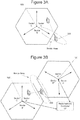
- processor 141 of base station controller 101 can split the transport data blocks of the downlink data stream to the different transceivers 109 supporting the different sectors to provide intra node aggregation as discussed in greater detail below with respect to Figure 3A .
- processor 131 of RNC 121 can split the transport data blocks of the downlink data stream to the different base stations 100 supporting the different sectors to provide inter node aggregation as discussed in greater detail below with respect to Figure 3B .
- base station 100 of Figure 2A supports communications with wireless terminals in three different 120 degree sectors A, B, and C. More particularly, transceiver 109a and sector antenna array 117a support MIMO communications with wireless terminals located in Sector A, transceiver 109b and sector antenna array 117b support MIMO communications with wireless terminals located in Sector B, and transceiver 109c and sector antenna array 117c support MIMO communications with wireless terminals located in Sector C. Stated in other words, each of sector antenna arrays 117a, 117b, and 117c (together with respective transceivers 109a, 109b, and 109c) defines a respective 120 degree sector A, B, and C.
- RAN 60 provides wireless communications for a downlink data stream (made up of transport data blocks) by transmitting transport data blocks of the downlink data stream through transceiver 109a and sector antenna array 117a over a wireless channel 300 to wireless terminal 200.
- intra node Multi-Flow communications are be used to transmit different transport data blocks of the downlink data stream in parallel through transceiver 109a and sector antenna array 117a and through transceiver 109b and sector antenna array 117b to wireless terminal 200 (e.g., using MF-HSDPA).
- MF-HSDPA frequency division multiple access
- first and second transport data blocks of the same data stream are respectively transmitted from sector antenna arrays 117a and 117b using a same time/frequency resource element (TFRE) to increase downlink throughput for the wireless terminal in the border area (also referred to as a soft handover region).
- TFRE time/frequency resource element
- a time/frequency resource element may also be referred to as a transmission time interval or TTI.
- first and second transport data blocks are transmitted from sector antenna array 117a and third and fourth transport data blocks are transmitted from sector antenna array 117b using a same TFRE.
- first and second transport data blocks are transmitted from one sector antenna array and a third transport data block is transmitted from the other sector antenna array using a same TFRE.
- processor 141 of base station controller 101 may decide whether to provide Multi-Flow communications for wireless terminal 200.
- the decision to provide Multi-Flow communications may be based on a communication load(s) in sector A and/or sector B.
- two base stations identified as base stations 100' and 100" support communications with wireless terminals, with each of base stations 100' and 100" separately having the structure of Figure 2A (using prime and double prime notation to separately identify elements of the different base stations 100' and 100").
- each base station 100' and 100" is coupled to RNC 121.
- base station 100' supports MIMO communications with wireless terminals located in 120 degree sectors A', B', and C' surrounding base station 100'
- base station 100" supports MIMO communications with wireless terminals located in 120 degree sectors A", B", and C" surrounding base station 100".
- transceiver 109a' and sector antenna array 117a' support MIMO communications with wireless terminals located in Sector A'
- transceiver 109b' and sector antenna array 117b' support MIMO communications with wireless terminals located in Sector B'
- transceiver 109c' and sector antenna array 117c' support MIMO communications with wireless terminals located in Sector C'
- transceiver 109a" and sector antenna array 117a' support MIMO communications with wireless terminals located in Sector A
- transceiver 109b” and sector antenna array 117b” support MIMO communications with wireless terminals located in Sector B
- transceiver 109c" and sector antenna array 117c” support MIMO communications with wireless terminals located in Sector C".
- RAN 60 When wireless terminal 200 is initially located in a central portion of sector A' as shown in Figure 3B , RAN 60 provides wireless communications for a downlink data stream made up of transport data blocks by transmitting the downlink data stream through transceiver 109a' and sector antenna array 117a' over a wireless channel 300 to wireless terminal 200.
- inter node Multi-Flow communications can be used to transmit different transport data blocks of the downlink data stream in parallel through transceiver 109a' and sector antenna array 117a' of base station 100' and through transceiver 109b" and sector antenna array 117b" of base station 100" to wireless terminal 200 (e.g., using MF-HSDPA).
- first and second transport data blocks of the same data stream are respectively transmitted from sector antenna arrays 117a' and 117b" using a same time/frequency resource element (TFRE) to increase downlink throughput for the wireless terminal in the border area (also referred to as a soft handover region).
- TFRE time/frequency resource element
- first and second transport data blocks are transmitted from sector antenna array 117a' and third and fourth transport data blocks are transmitted from sector antenna array 117b" using a same TFRE.
- first and second transport data blocks are transmitted from one sector antenna array and a third transport data block is transmitted from the other sector antenna array using a same TFRE.
- Multi-Flow communications are used to transmit the same transport data block from sector antenna arrays 117a' and 117b" using a same TFRE to provide increased reliability of reception due to diversity gain.
- timing mismatch may occur because schedulers of base stations 100' and 100" act independently and/or because transmission delays between wireless terminal 200 and base stations 100' and 100" are different (due to different distances between wireless terminal 200 and base stations 100' and 100").
- processor 131 of radio network controller 121 decides whether to provide Multi-Flow communications based on a load of sector B".
- processor 131 of radio network controller 121 decides whether to provide Multi-Flow communications based on a load of sector B".
- a load of sector B As discussed, for example, in U.S. Patent Application US 2013/157710 A1 (entitled “Methods Providing Multiflow Communications Based on Sector Loads and Related Network Nodes") to Nammi et al. and filed December 16, 2011, the decision to provide Multi-Flow communications can be based on a communication load in sector A' and/or sector B".
- the primary sector also referred to as a serving cell/sector antenna array (e.g., sector antenna array 117a or 117a') transmits transport data blocks for first data and control channels (e.g., a first high speed shared control channel or HS-SCCH and a first high speed physical downlink shared channel or HS-PDSCH) to wireless terminal 200
- first data and control channels e.g., a first high speed shared control channel or HS-SCCH and a first high speed physical downlink shared channel or HS-PDSCH
- the secondary sector also referred to as an assisting cell/sector antenna array (e.g., sector antenna array 117b or 117b") transmits transport data blocks for second data and control channels (e.g., a second high speed shared control channel or HS-SCCH and a second high speed physical downlink shared channel or HS-PDSCH) to wireless terminal 200.
- wireless terminal 200 transmits a high speed dedicated physical control channel (HS-DPCCH) that is received by both primary and secondary
- a work item on multi-flow (MF) HSDPA High Speed Downlink Packet Access
- MF Multi-flow
- a UE User Equipment, also referred to as a mobile and/or wireless terminal
- TFRE time-frequency-resource-element
- a multi-flow UE can simultaneously receive data from different base station sectors (using a same TFRE) possibly belonging to different base station sites.
- HARQ-ACK Hybrid-Automatic-Repeat-Request-Acknowledge
- HARQ-NACK Hybrid-Automatic-Repeat-Request-Negative-Acknowledge
- MF-HSDPA may be supported for the following configurations: (1) Two sectors/cells without MIMO (multiple-input-multiple-output) configured (SF-DC or Single-Frequency-Dual-Cell, no MIMO); (2) Two sectors/cells with MIMO configured (SF-DC, with MIMO); (3) Four sectors/cells without MIMO configured (DF-QC or Dual-Frequency-Quad-Cell, no MIMO); and (4) Four sectors/cells with MIMO configured (DF-QC, with MIMO).
- MIMO multiple-input-multiple-output
- DC-HSDPA Dual-Carrier-HSDPA
- 4C-HSDPA Four-Carrier-HSDPA
- DC-HSDPA and 4C-HSDPA it was assumed that all cells reside in the same sector/cell and/or base station. This assumption may not necessarily be true in MF-HSDPA, as the cells can belong to different sectors which in turn can belong to different base station (e.g., NodeB and/or eNodeB) sites.
- the different sites e.g., different base stations, NodeBs, eNodeBs, etc.
- the different sites may be unaware of schedules of the other site(s).
- care may need to be taken developing HARQ-ACK/NACK codebooks to be used for multi-flow.
- codebook designs are disclosed for the four supported configurations outlined above, and further codebook designs are disclosed for configurations with two sectors/cells and MIMO configured.
- An issue related to MF-HSDPA is how the HARQ acknowledgment messages should be transmitted in the uplink from one UE to several cells/sectors or base stations (NodeBs). According to some embodiments, this information is carried on the HS-DPCCH.
- the HS-DPCCH carries downlink related feedback information when HSDPA (High Speed Downlink Packet Access) is configured.
- This feedback information can include and/or consist of: HARQ-ACK messages whereby the UE can indicate whether the reception of packet(s) scheduled on the downlink was successful; and CQI whereby the UE informs the NodeB scheduler about the maximum transport data block size that it could receive with a 10 percent block error ratio (BLER).
- BLER block error ratio
- Figure 4 illustrates a structure of an HS-DPCCH sub-frame slot format according to some embodiments.
- the HARQ-ACK message is transmitted during the first slot (including 10 bits), and the encoded CQI information/message is transmitted during the last 2 slots of the sub-frame (including 20 bits).
- a design principle for MF-HSDPA HARQ-ACK codebooks may be to re-use existing multicarrier alternatives/codebooks.
- a difference between multicarrier operation and inter-cell (also referred to as inter-NodeB) MF-HSDPA is that for inter-cell MF-HSDPA configurations, each site may be unaware of schedules of other sites transmitting to the same UE using a same TFRE (e.g., the number of streams scheduled by the other site or sites).
- multicarrier codebook design makes use of knowledge of a number of streams that are scheduled during a decoding process. Accordingly, directly applying multicarrier codebooks for MF-HSDPA may be difficult in some scenarios.
- Some embodiments of inventive concepts may address HARQ-ACK designs for MF-HSDPA configurations with two cells/sectors and MIMO, a scenario where it can be difficult to directly re-use multicarrier codebooks due to issues noted above.
- an SF256 spreading factor 256, i.e. the HS-DPCCH may use a channelization code with spreading factor of 256
- HARQ-ACK codebook solution is provided for MF-HSDPA with two cells and MIMO configured.
- a maximum of four streams may need to be acknowledged (i.e. one acknowledgment message for each stream and sector/cell).
- Three different HARQ-ACK messages are possible for each stream; ACK(A) or acknowledge, NACK(N) or negative acknowledge, and DTX(D) or discontinuous transmission.
- Each site e.g., each base station, NodeB, eNodeB, etc.
- Each base station or NodeB can use knowledge about the number of its own scheduled streams in the decoding process, but each base station and/or NodeB may be unaware of the number of streams scheduled by the other base station and/or NodeB in an inter-cell configuration.
- Two solutions for the HARQ-ACK design are to: (1) use an SF128 solution similar to multicarrier Rel-10 where each site is coded independently using the Rel-8 codebook; and/or (2) use an SF256 solution similar to multicarrier Rel-9.
- Use of an SF256 solution may be desired because an SF256 solution may be more in line with the multicarrier evolution and, in general, an SF256 solution may provide improved performance relative to an SF128 solution.
- a difference between MF-HSDPA and Rel-9 multicarrier is that, for inter-cell MF-HSDPA, each site and/or base station may be unaware of scheduling at the other base station and/or site transmitting to the same UE using a same TFRE. Accordingly, re-use of the Rel-9 multicarrier HARQ-ACK codebook directly for MF-HSDPA may be difficult, and a new codebook may need to be designed.
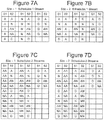
- Figures 5A, 5B, 5C, and 5D provide tables showing different codeword combinations used in a decoding process for different scheduling options according to some embodiments of inventive concepts.
- S1 denotes site 1
- S2 denotes site 2
- X/X represents single stream transmission from both cells/sectors A' and B" (e.g., from both radio base stations 100' and 100" for sectors/cells A' and B")
- XX/X represents dual stream transmission from cell/sector A' (e.g., from radio base station 100' for sector/cell A') and single stream transmission from cell/sector B" (e.g., from radio base station 100" for sector/cell B"
- X/XX represents single stream transmission from cell/sector A' (e.g., from radio base station 100' for sector/cell A') and dual stream transmission from cell/sector B" (e.g., from radio base station 100"
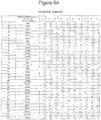
- FIG. 6A and 6B An example of a HARQ-ACK codebook according to some embodiments of inventive concepts is given in the table of Figures 6A and 6B , and the codebook of Figures 6A and 6B can be saved in memory 218 of each wireless terminal 200 and in memory 118 of each base station 100.
- A represents an ACK
- N represents a NACK
- D represents a DTX.
- Design principles for the codebook of Figures 6A and 6B may include:
- X/X represents single stream transmission from both cells/sectors A' and B" (e.g., from both radio base stations 100' and 100" for sectors/cells A' and B");
- XX/X represents dual stream transmission from cell/sector A' (e.g., from radio base station 100' for sector/cell A') and single stream transmission from cell/sector B" (e.g., from radio base station 100" for sector/cell B");
- X/XX represents single stream transmission from cell/sector A' (e.g., from radio base station 100' for sector/cell A') and dual stream transmission from cell/sector B" (e.g., from radio base station 100" for cell/sector B”);
- XX/XX represents dual stream transmission from both cells/sectors A' and B" (e.g.
- codebooks can be considered that can be obtained through these operations starting from a proposed codebook according to embodiments of inventive concepts. Such operations, however, may change individual distance properties between different codewords.
- HARQ-ACK information for MF-HSDPA configured with two cells and MIMO may be acknowledged using a SF256 approach.
- operations of Figure 9 may be performed simultaneously for two different sectors/cells of the same or different base stations (e.g., sectors/cells A and B of Figure 3A , or sectors/cells A' and B" of Figure 3B ).
- sectors/cells A and B of Figure 3A e.g., sectors/cells A and B of Figure 3A , or sectors/cells A' and B" of Figure 3B .
- operations of Figure 9 will be discussed with respect to base station operations for a primary sector/cell A or A' for ease of discussion, and it will be understood that operations of Figure 9 may be performed simultaneously for a secondary sector/cell B or B" at the same or different base stations.
- base station controller 101 may determine at block 701 that the time has arrived for a next downlink (DL) transmission to wireless terminal 200, and at block 703, base station controller 101 may select either single stream (transmitting only a single transport data block) or dual stream (transmitting two transport data blocks simultaneously) for transmission from primary cell/sector A or A' to wireless terminal 200 during a current time resource element (also referred to as a transmission time interval or TTI).
- a current time resource element also referred to as a transmission time interval or TTI.
- the same or adjacent base station for the secondary cell/sector B or B" may also separately select single or dual stream transmission for transmission from secondary cell/sector B or B" during the same time resource element.
- Primary base station controller 101 may then transmit (through sector transceiver 109a or 109a' and sector antenna array 117a or 117a') either one transport data block to wireless terminal 200 for the current time resource element at block 707 for single stream transmission, or two transport data blocks to wireless terminal 200 for the current time resource element at block 709 for dual stream transmission.
- Secondary base station controller 101 may similarly transmit (through sector transceiver 109b or 109b" and sector antenna array 117b or 117b") either one transport data block to wireless terminal 200 for the current time resource element at block 707 for single stream transmission, or two transport data blocks to wireless terminal 200 for the current time resource element at block 709 for dual stream transmission.
- wireless terminal processor 201 may receive transport data blocks from primary and secondary cells/sectors at block 803 (through antenna array 217 and transceiver array 209).
- wireless terminal 200 may simultaneously receive one transport data block from the primary cell/sector and one transport data block from the secondary cell/sector, one transport data block from the primary cell/sector and two transport data blocks from the secondary cell/sector, two transport data blocks from the primary cell/sector and one transport data block from the secondary cell/sector, or two transport data blocks from the primary cell/sector and two transport data blocks from the secondary cell/sector.
- the base station controllers of the primary and secondary cells/sectors may be unaware of the number of transport data blocks transmitted by the other cell/sector during the current time resource element if the primary and secondary cells/sectors belong to different base stations.
- wireless terminal processor 201 prepares a feedback message for the downlink transmission based on the transport data block(s) received simultaneously from the primary and secondary cells/sectors during the current time resource element. More particularly, the feedback message can include a codeword from the HARQ-ACK codebook of Figures 6A and 6B (or from the HARQ-ACK codebook of Figure 8 ) discussed above, wherein the codeword provides acknowledgement information for each transport data block received during the current time resource element. As discussed above, some codewords may have different interpretations, and the correct one of the different interpretations may be selected at the base station(s) for each transport data block transmitted from the respective cell/sector based on whether single or dual stream transmission was selected for the respective cell/sector.
- the feedback message can be prepared according to a HS-DPCCH format (of Figure 4 ) with a 10 bit codeword (e.g., selected from the codebook of Figures 6A and 6B or selected from the codebook of Figure 8 ) and with 20 bits of CQI information.
- the feedback message is transmitted by wireless terminal processor 201 through transceiver 209 and antenna array 217 over wireless channel(s) 300 to the primary cell/sector A or A' and the secondary cell/sector B or B". More particularly, the same feedback message is transmitted according to an HS-DPCCH format to both primary and secondary cells/sectors.
- the respective base station controller(s) Upon receiving the feedback message at block 711 at the primary and secondary cells/sectors, the respective base station controller(s) proceeds to interpret the codeword of the feedback message for each transport data block transmitted from each cell/sector for the time resource element at block 715 based on whether a single or dual stream transmission was provided from the respective cell/sector for the time resource element and based on the status of the respective cell/sector as the primary or secondary cell/sector for the multi-flow downlink transmission.
- base station controller(s) 101 for the primary cell/sector A or A' and for secondary cell/sector B and B" interprets the codeword "0010100001" (codebook entries 13 and 33) as an acknowledgement for one transport data block when a single stream transmission was provided, and as an acknowledgement for two transport data blocks when a dual stream transmission was provided.
- the codebook of Figure 8 can be used in a similar way.
- base station controller 101 for the primary cell/sector A or A' interprets the codeword "0111000110" (codebook entries 14 and 44) as an acknowledgement for one transport data block when a single stream transmission was provided, and as a negative acknowledgement for a first transport data block and an acknowledgement for a second transport data block when a dual stream transmission was provided.
- base station controller 101 for the secondary cell/sector B or B may interpret the same codeword "0111000110" (codebook entries 14 and 44) as a negative acknowledgement for one transport data block when a single stream transmission was provided from the secondary cell/sector, and as a negative acknowledgement for both transport data blocks when a dual stream transmission was provided.
- codebook entries 13 and 33 Different interpretations of the codewords "0010100001" (codebook entries 13 and 33), “0111000110” (codebook entries 14 and 44), “1000111111” (codebook entries 15 and 43), and “1101001010” (codebook entries 16 and 35) may be determined as discussed above with respect to codebook entries 13, 14, 15, 16, 33, 35, 43, and 44 of Figures 6A and 6B .
- codebook entries 1-2, 5-6, and 9-20 from the codebook of Figure 8 may have different interpretations for the primary sector and/or for the secondary sector depending on the number of transport data blocks that were transmitted by the respective sector during the respective time resource element.
- codebook entries may have only one interpretation for the primary sector and only one interpretation for the secondary sector.
- the base station controller(s) 101 for the primary and secondary cells/sectors may determine if retransmission of one or more of the transport data blocks is required responsive to the codeword received with the feedback message. If retransmission is required at block 717, the appropriate transport data block(s) may be re-queued for retransmission at block 719.
- base station controller(s) 101 may wait for a next time resource element for transmission to wireless terminal before repeating operations of Figure 9 for a next multi-flow transmission to wireless terminal 200.
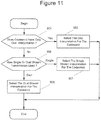
- base station controller 101 may determine if the codeword has only one interpretation or if two different interpretations are possible. If the codeword has only one interpretation for the respective cell/sector, then base station processor 101 selects the one interpretation for the codeword at block 903 and proceeds to block 717 using the only available interpretation of the codeword.
- each of codebook entries 1-12, 17-32, 34, 36-42, and 45-48 is assigned a unique codeword so that further interpretation is not required.
- each of codebook entries 3-4, 7-8, and 21-24 has only a single interpretation for the primary cell/sector and only a single interpretation for the secondary cell/sector.
- base station processor 101 determines if the codeword corresponds to a single or dual stream transmission for that base station cell/sector at block 905.
- codeword 1 st Interpretation Single Stream
- 2 nd Interpretation Double Stream
- 0010100001 A/A Entry 13
- AA/AA Entry 33
- 0111000110 A/N Entry 14
- NA/NN Entry 44
- 1000111111 N/A Entry 15
- NA/NA Entry 43
- 110100101010 N/N Entry 16
- AA/NA Entry 35
- sixteen codewords for codebook entries 1-2, 5-6, and 9-20 of Figure 8 ) have at least two possible interpretation
- an acknowledge is interpreted for the transport data block transmitted from the primary sector (A or A') and for the transport data block transmitted from the secondary sector (B or B") as shown by codebook entry 13.
- an acknowledge is interpreted for both transport data blocks transmitted from the primary sector (A or A') and for both transport data blocks transmitted from the secondary sector (B or B") as shown by codebook entry 33.
- an acknowledge (A or ACK) is interpreted for the transport data block transmitted from the primary sector (A or A') and a negative acknowledge (N or NACK) is interpreted for the transport data block transmitted from the secondary sector (B or B") as shown by codebook entry 14.
- N or NACK negative acknowledge
- a or ACK acknowledge
- N or NACK negative acknowledge
- N or NACK negative acknowledge
- a or ACK acknowledge
- a negative acknowledge is interpreted for a first transport data block transmitted from the primary sector (A or A')
- an acknowledge is interpreted for a second transport data block transmitted from the primary sector (A or A')
- a negative acknowledge is interpreted for a first transport data block transmitted from the secondary sector (B or B)
- an acknowledge is interpreted for a second transport data block transmitted from the secondary sector (B or B) as shown by codebook entry 43.
- NACK negative acknowledge
- an acknowledge is interpreted for both transport data blocks transmitted from the primary sector (A or A')
- a negative acknowledge is interpreted for a first transport data block transmitted from the secondary sector (B or B)
- an acknowledge is interpreted for a second transport data block transmitted from the secondary sector (B or B) as shown by codebook entry 35.
- the codebook of Figure 8 can be used in a similar way to that described above with respect to the codebook of Figures 6A and 6B .
- codeword "0001101101" entity 11 of the codebook of Figure 8
- a negative acknowledge (N or NACK) is interpreted for the transport data block from the primary sector (A or A') and an acknowledge (A or ACK) is interpreted for the transport data block transmitted from the secondary sector (B or B").
- a negative acknowledge (N or NACK) is interpreted for both transport data blocks from the primary sector (A or A') and an acknowledge (A or ACK) is interpreted for both transport data blocks transmitted from the secondary sector (B or B").
- N or NACK negative acknowledge
- a or ACK acknowledge
- N or NACK negative acknowledge
- a or ACK acknowledge
- the base station controller(s) for the primary sector A/A' and the secondary sector B/B" may determine at block 701 that the time has arrived for a next downlink (DL) multi-flow transmission to wireless terminal 200, and at block 703, the base station controller(s) may select single stream transmission for each of the primary and secondary sectors A/A' and B/B". According to some embodiments, only single stream transmission from each of the primary and secondary sectors may be supported for multi-flow downlink transmission to reduce a processing burden at the receiving wireless terminal 200.
- a first downlink stream may be transmitted from primary sector A/A' and a second downlink stream may be transmitted for secondary sector B/B" so that wireless terminal 200 receives only the first downlink stream from the primary cell/sector and the second downlink stream from the secondary cell/sector.
- the base station controller(s) may transmit a first transport data block from primary sector A/A' of the network and a second transport data block from secondary sector B/B" over a downlink during a time resource element for the multi-flow downlink transmission to wireless terminal 200 at block 707.
- wireless terminal processor 201 may receive the first and second transport data blocks from the respective primary and secondary sectors A/A' and B/B" at block 803 (through antenna array 217 and transceiver array 209). At block 805, wireless terminal processor 201 prepares a feedback message based on the first and second transport data blocks received simultaneously from the primary secondary cells/sectors during the current time resource element.
- the feedback message may be prepared using codewords selected from codebook entries 1-2, 5-6, and 9-12 of Figure 8 (i.e., using a reduced HARQ-ACK codebook) as set forth in the table of Figure 12 .
- the codeword "1110000101” is thus interpreted as ACK for the single transport data block transmitted from primary sector A/A' and as Discontinuous Transmission DTX for the single transport data block transmitted from secondary sector B/B".
- the codeword "1100101001” is interpreted as NACK for the single transport data block transmitted from primary sector A/A' and as Discontinuous Transmission DTX for the single transport data block transmitted from the secondary sector B/B".
- the codeword "0111101011” is interpreted as Discontinuous Transmission DTX for the single transport data block transmitted from primary sector A/A' and as ACK for the single transport data block transmitted from secondary sector B/B".
- the codeword "0010100001” is interpreted as Discontinuous Transmission DTX for the single transport data block transmitted from primary sector A/A' and as NACK for the single transport data block transmitted from secondary sector B/B".
- the codeword "1001010110” is interpreted as ACK for the single transport data block transmitted from primary sector A/A' and as ACK for the single transport data block transmitted from secondary sector B/B”.
- the codeword "1010011001” is interpreted as ACK for the single transport data block transmitted from primary sector A/A' and as NACK for the single transport data block transmitted from secondary sector B/B".
- the codeword "0001101101” is interpreted as NACK for the single transport data block transmitted from primary sector A/A' and as ACK for the single transport data block transmitted from secondary sector B/B".
- the codeword "0111110000” is interpreted as NACK for the single transport data block transmitted from primary sector A/A' and as NACK for the single transport data block transmitted from secondary sector B/B".
- some codewords can have different interpretations, and the correct one of the different interpretations may be selected at the base station(s) for each transport data block transmitted from the respective cell/sector based on whether the respective cell/sector is the primary cell/sector for the multi-flow downlink transmission or the secondary cell/sector for the multi-flow downlink transmission.
- the feedback message can be prepared according to a HS-DPCCH format (of Figure 4 ) using the 10 bit codewords noted above.
- the feedback message is transmitted by wireless terminal processor 201 through transceiver 209 and antenna array 217 over wireless channel(s) 300 to primary cell/sector A/A' and secondary cell/sector B/B". More particularly, the same feedback message is transmitted according to an HS-DPCCH format to both primary and secondary cells/sectors.
- the respective base station controller(s) Upon receiving the feedback message at primary cell/sector A/A' and secondary cell/sector B/B" at block 711, the respective base station controller(s) proceeds to interpret the codeword of the feedback message for each transport data block transmitted from each cell/sector for the time resource element at block 715 based on whether the respective transport data block was transmitted from the primary or secondary cell/sector.
- the HARQ-ACK codeword "1010011001" is interpreted as an ACK for the transport data block transmitted from primary cell/sector A/A', and as a NACK for the transport data block transmitted from the secondary cell/sector B/B".
- the HARQ-ACK codeword "0001101101” is interpreted as an NACK for the transport data block transmitted from primary cell/sector A/A', and as a ACK for the transport data block transmitted from the secondary cell/sector B/B".
- the HARQ-ACK codeword "1110000101” is interpreted as an ACK for the transport data block transmitted from primary cell/sector A/A', and as a Discontinuous Transmission DTX for the transport data block transmitted from the secondary cell/sector B/B".
- the HARQ-ACK codeword "1100101001” is interpreted as an NACK for the transport data block transmitted from primary cell/sector A/A', and as a Discontinuous Transmission DTX for the transport data block transmitted from the secondary cell/sector B/B".
- the HARQ-ACK codeword "0111101011” is interpreted as an Discontinuous Transmission DTX for the transport data block transmitted from primary cell/sector A/A', and as an ACK for the transport data block transmitted from the secondary cell/sector B/B".
- the HARQ-ACK codeword "0010100001" is interpreted as a Discontinuous Transmission DTX for the transport data block transmitted from primary cell/sector A/A', and as a NACK for the transport data block transmitted from the secondary cell/sector B/B".
- the base station controller(s) 101 for the primary cell/sector A/A' and for the secondary cell/sector B/B" may determine if retransmission of the first transport data block transmitted from primary cell/sector A/A' or the second transport data block transmitted from the secondary cell/sector B/B" is required responsive to the codeword received with the feedback message. If retransmission is required for either of the first and/or second transport data blocks at block 717, the appropriate transport data block(s) may be re-queued for retransmission at block 719.
- base station controller(s) 101 may wait for a next time resource element for transmission to wireless terminal before repeating operations of Figure 9 for a next multi-flow transmission to wireless terminal 200.
- Operations of Figures 9 and 10 discussed above with respect to the reduced codebook of Figure 12 may be performed for intra-node multi-flow transmissions when primary and secondary cells/sectors A and B are provided at a same base station 100, and/or for inter-node multi-flow transmission when primary and secondary cells/sectors A' and B" are provided at different and spaced apart base stations 100' and 100".
- the codebook of Figures 6A and 6B , the codebook of Figure 8 , and the reduced codebook of Figure 12 are examples of different embodiments of codebooks that may be used according to different embodiments of inventive concepts. Embodiments of inventive concepts, however, are not limited to these codebooks, and other codebooks may be used according to other embodiments of inventive concepts.
- the terms “comprise”, “comprising”, “comprises”, “include”, “including”, “includes”, “have”, “has”, “having”, or variants thereof are open-ended, and include one or more stated features, integers, elements, steps, components or functions but do not preclude the presence or addition of one or more other features, integers, elements, steps, components, functions or groups thereof.
- the common abbreviation “e.g.” which derives from the Latin phrase “exempli gratia,” may be used to introduce or specify a general example or examples of a previously mentioned item, and is not intended to be limiting of such item.
- the common abbreviation “i.e.”, which derives from the Latin phrase “id est,” may be used to specify a particular item from a more general recitation.
- Example embodiments are described herein with reference to block diagrams and/or flowchart illustrations of computer-implemented methods, apparatus (systems and/or devices) and/or computer program products. It is understood that a block of the block diagrams and/or flowchart illustrations, and combinations of blocks in the block diagrams and/or flowchart illustrations, can be implemented by computer program instructions that are performed by one or more computer circuits.
- These computer program instructions can be provided to a processor circuit of a general purpose computer circuit, special purpose computer circuit, and/or other programmable data processing circuit to produce a machine, such that the instructions, which execute via the processor of the computer and/or other programmable data processing apparatus, transform and control transistors, values stored in memory locations, and other hardware components within such circuitry to implement the functions/acts specified in the block diagrams and/or flowchart block or blocks, and thereby create means (functionality) and/or structure for implementing the functions/acts specified in the block diagrams and/or flowchart block(s).
- These computer program instructions may also be stored in a tangible computer-readable medium that can direct a computer or other programmable data processing apparatus to function in a particular manner, such that the instructions stored in the computer-readable medium produce an article of manufacture including instructions which implement the functions/acts specified in the block diagrams and/or flowchart block or blocks.
- a tangible, non-transitory computer-readable medium may include an electronic, magnetic, optical, electromagnetic, or semiconductor data storage system, apparatus, or device. More specific examples of the computer-readable medium would include the following: a portable computer diskette, a random access memory (RAM) circuit, a read-only memory (ROM) circuit, an erasable programmable read-only memory (EPROM or Flash memory) circuit, a portable compact disc read-only memory (CD-ROM), and a portable digital video disc read-only memory (DVD/BlueRay).
- RAM random access memory
- ROM read-only memory
- EPROM or Flash memory erasable programmable read-only memory
- CD-ROM compact disc read-only memory
- DVD/BlueRay portable digital video disc read-only memory
- the computer program instructions may also be loaded onto a computer and/or other programmable data processing apparatus to cause a series of operational steps to be performed on the computer and/or other programmable apparatus to produce a computer-implemented process such that the instructions which execute on the computer or other programmable apparatus provide steps for implementing the functions/acts specified in the block diagrams and/or flowchart block or blocks.
- inventive concepts may be embodied in hardware and/or in software (including firmware, resident software, micro-code, etc.) that runs on a processor such as a digital signal processor, which may collectively be referred to as "circuitry," "a module” or variants thereof.
Landscapes
- Engineering & Computer Science (AREA)
- Computer Networks & Wireless Communication (AREA)
- Signal Processing (AREA)
- Mobile Radio Communication Systems (AREA)
- Detection And Prevention Of Errors In Transmission (AREA)
Claims (19)
- Verfahren zur Kommunikation in einem drahtlosen Kommunikationsnetzwerk, das eine Vielzahl von Basisstationen beinhaltet, die Multiflow-Abwärtsübertragungen unterstützen, wobei das Verfahren Folgendes umfasst:Übertragen (707, 709) von einem einzelnen oder zwei Transportdatenblöcken von einem ersten Sektor (A, A') des Netzwerks über eine Abwärtsverbindung zu einem drahtlosen Endgerät (200) während eines Zeitressourcenelements für eine Multiflow-Abwärtsübertragung zum drahtlosen Endgerät (200), wobei der erste Sektor (A, A') ein bedienender Sektor für die Multiflow-Abwärtsübertragung zum drahtlosen Endgerät (200) ist;Übertragen (707, 709) von einem einzelnen oder zwei Transportdatenblöcken von einem zweiten Sektor (B, B") des Netzwerks über eine Abwärtsverbindung zum drahtlosen Endgerät (200) während des Zeitressourcenelements für die Multiflow-Abwärtsübertragung, wobei der zweite Sektor (B, B") ein assistierender Sektor für die Multiflow-Abwärtsübertragung zum drahtlosen Endgerät (200) ist;wobei das Verfahren dadurch gekennzeichnet ist, dass es ferner Folgendes umfasst:Empfangen (711) einer Rückmeldungsnachricht für das Zeitressourcenelement vom drahtlosen Endgerät (200), wobei die Rückmeldungsnachricht ein HARQ-ACK-Codewort (Hybrid Automatic Repeat Request Acknowledge) beinhaltet, das aus einem HARQ-ACK-Codebuch ausgewählt wird, das unterschiedliche Interpretationen aufweist, die für den Transportdatenblock bzw. die Transportdatenblöcke, die vom ersten Sektor (A, A') übertragen werden, und für den Transportdatenblock bzw. die Transportdatenblöcke, die vom zweiten Sektor (B, B") übertragen werden, eine HARQ-ACK-Rückmeldung bereitstellen, wobei das HARQ-ACK-Codewort eine erste Interpretation für den bedienenden Sektor hat, wenn ein einzelner Transportdatenblock vom bedienenden Sektor übertragen wird, und eine zweite Interpretation, wenn zwei Transportdatenblöcke vom bedienenden Sektor übertragen werden;Interpretieren (715) des HARQ-ACK-Codeworts für den Transportdatenblock bzw. die Transportdatenblöcke, die vom ersten Sektor (A, A') übertragen werden, darauf basierend, dass der erste Sektor ein bedienender Sektor für die Multiflow-Abwärtsübertragung ist, sowie auf Basis einer Anzahl von dem Transportdatenblock bzw. den Transportdatenblöcken, die während des Zeitressourcenelements vom ersten Sektor (A, A') über die Abwärtsverbindung zum drahtlosen Endgerät (200) übertragen werden; undBestimmen (717) in Reaktion auf das Interpretieren des HARQ-ACK-Codeworts, ob ein oder mehrere der Transportdatenblöcke, die vom ersten Sektor (A, A') übertragen werden, erneut übertragen werden sollen.
- Verfahren nach Anspruch 1, das ferner Folgendes umfasst:Interpretieren (715) des HARQ-ACK-Codeworts für den Transportdatenblock bzw. die Transportdatenblöcke, die vom zweiten Sektor (B, B") übertragen werden, darauf basierend, dass der zweite Sektor ein assistierender Sektor für die Multiflow-Abwärtsübertragung ist; undBestimmen (717) in Reaktion auf das Interpretieren des HARQ-ACK-Codeworts, ob ein oder mehrere der Transportdatenblöcke, die vom zweiten Sektor (B, B") übertragen werden, erneut übertragen werden sollen.
- Verfahren nach Anspruch 2, wobei das Interpretieren (715) des HARQ-ACK-Codeworts für den Transportdatenblock bzw. die Transportdatenblöcke, die vom ersten Sektor (A, A') übertragen werden, darauf basierend, dass der erste Sektor ein bedienender Sektor für die Multiflow-Abwärtsübertragung ist, das Interpretieren des HARQ-ACK-Codeworts derart umfasst, dass es eine erste Bedeutung für den Transportdatenblock bzw. die Transportdatenblöcke, die vom ersten Sektor übertragen werden, aufweist, und wobei das Interpretieren (715) des HARQ-ACK-Codeworts für den Transportdatenblock bzw. die Transportdatenblöcke, die vom zweiten Sektor (B, B") übertragen werden, darauf basierend, dass der zweite Sektor ein assistierender Sektor für die Multiflow-Abwärtsübertragung ist, das Interpretieren des HARQ-ACK-Codeworts derart umfasst, dass es eine zweite Bedeutung für den Transportdatenblock bzw. die Transportdatenblöcke, die vom zweiten Sektor übertragen werden, aufweist, und wobei die erste und zweite Bedeutung sich unterscheiden.
- Verfahren nach Anspruch 3, wobei das Übertragen des Transportdatenblocks bzw. der Transportdatenblöcke vom ersten Sektor das Übertragen eines einzelnen Transportdatenblocks vom ersten Sektor zum drahtlosen Endgerät während des Zeitressourcenelements umfasst, wobei das Übertragen des Transportdatenblocks bzw. der Transportdatenblöcke vom zweiten Sektor das Übertragen eines einzelnen Transportdatenblocks vom zweiten Sektor zum drahtlosen Endgerät während des Zeitressourcenelements umfasst, wobei das HARQ-ACK-Codewort "1010011001" ist, wobei das Interpretieren des HARQ-ACK-Codeworts das Interpretieren des HARQ-ACK-Codeworts für den einzelnen Transportdatenblock umfasst, der vom ersten Sektor als ein ACK übertragen wird, und wobei das Interpretieren des HARQ-ACK-Codeworts das Interpretieren des HARQ-ACK-Codeworts für den Signaltransportdatenblock umfasst, der vom zweiten Sektor als ein NACK übertragen wird.
- Verfahren nach Anspruch 3, wobei das Übertragen des Transportdatenblocks bzw. der Transportdatenblöcke vom ersten Sektor das Übertragen eines einzelnen Transportdatenblocks vom ersten Sektor zum drahtlosen Endgerät während des Zeitressourcenelements umfasst, wobei das Übertragen des Transportdatenblocks bzw. der Transportdatenblöcke vom zweiten Sektor das Übertragen eines einzelnen Transportdatenblocks vom zweiten Sektor zum drahtlosen Endgerät während des Zeitressourcenelements umfasst, wobei das HARQ-ACK-Codewort "0001101101" ist, wobei das Interpretieren des HARQ-ACK-Codeworts das Interpretieren des HARQ-ACK-Codeworts für den einzelnen Transportdatenblock umfasst, der vom ersten Sektor als ein NACK übertragen wird, und wobei das Interpretieren des HARQ-ACK-Codeworts das Interpretieren des HARQ-ACK-Codeworts für den Signaltransportdatenblock umfasst, der vom zweiten Sektor als ein ACK übertragen wird.
- Verfahren nach Anspruch 3, wobei das Übertragen des Transportdatenblocks bzw. der Transportdatenblöcke vom ersten Sektor das Übertragen eines einzelnen Transportdatenblocks vom ersten Sektor zum drahtlosen Endgerät während des Zeitressourcenelements umfasst, wobei das Übertragen des Transportdatenblocks bzw. der Transportdatenblöcke vom zweiten Sektor das Übertragen eines einzelnen Transportdatenblocks vom zweiten Sektor zum drahtlosen Endgerät während des Zeitressourcenelements umfasst, wobei das HARQ-ACK-Codewort "1110000101" ist, wobei das Interpretieren des HARQ-ACK-Codeworts das Interpretieren des HARQ-ACK-Codeworts für den einzelnen Transportdatenblock umfasst, der vom ersten Sektor als ein ACK übertragen wird, und wobei das Interpretieren des HARQ-ACK-Codeworts das Interpretieren des HARQ-ACK-Codeworts für den Signaltransportdatenblock umfasst, der vom zweiten Sektor als eine diskontinuierliche Übertragung übertragen wird.
- Verfahren nach Anspruch 3, wobei das Übertragen des Transportdatenblocks bzw. der Transportdatenblöcke vom ersten Sektor das Übertragen eines einzelnen Transportdatenblocks vom ersten Sektor zum drahtlosen Endgerät während des Zeitressourcenelements umfasst, wobei das Übertragen des Transportdatenblocks bzw. der Transportdatenblöcke vom zweiten Sektor das Übertragen eines einzelnen Transportdatenblocks vom zweiten Sektor zum drahtlosen Endgerät während des Zeitressourcenelements umfasst, wobei das HARQ-ACK-Codewort "1100101001" ist, wobei das Interpretieren des HARQ-ACK-Codeworts das Interpretieren des HARQ-ACK-Codeworts für den einzelnen Transportdatenblock umfasst, der vom ersten Sektor als ein NACK übertragen wird, und wobei das Interpretieren des HARQ-ACK-Codeworts das Interpretieren des HARQ-ACK-Codeworts für den Signaltransportdatenblock umfasst, der vom zweiten Sektor als eine diskontinuierliche Übertragung übertragen wird.
- Verfahren nach Anspruch 3, wobei das Übertragen des Transportdatenblocks bzw. der Transportdatenblöcke vom ersten Sektor das Übertragen eines einzelnen Transportdatenblocks vom ersten Sektor zum drahtlosen Endgerät während des Zeitressourcenelements umfasst, wobei das Übertragen des Transportdatenblocks bzw. der Transportdatenblöcke vom zweiten Sektor das Übertragen eines einzelnen Transportdatenblocks vom zweiten Sektor zum drahtlosen Endgerät während des Zeitressourcenelements umfasst, wobei das HARQ-ACK-Codewort "0111101011" ist, wobei das Interpretieren des HARQ-ACK-Codeworts das Interpretieren des HARQ-ACK-Codeworts für den einzelnen Transportdatenblock umfasst, der vom ersten Sektor als eine diskontinuierliche Übertragung übertragen wird, und wobei das Interpretieren des HARQ-ACK-Codeworts das Interpretieren des HARQ-ACK-Codeworts für den Signaltransportdatenblock umfasst, der vom zweiten Sektor als ein ACK übertragen wird.
- Verfahren nach Anspruch 3, wobei das Übertragen des Transportdatenblocks bzw. der Transportdatenblöcke vom ersten Sektor das Übertragen eines einzelnen Transportdatenblocks vom ersten Sektor zum drahtlosen Endgerät während des Zeitressourcenelements umfasst, wobei das Übertragen des Transportdatenblocks bzw. der Transportdatenblöcke vom zweiten Sektor das Übertragen eines einzelnen Transportdatenblocks vom zweiten Sektor zum drahtlosen Endgerät während des Zeitressourcenelements umfasst, wobei das HARQ-ACK-Codewort "0010100001" ist, wobei das Interpretieren des HARQ-ACK-Codeworts das Interpretieren des HARQ-ACK-Codeworts für den einzelnen Transportdatenblock umfasst, der vom ersten Sektor als eine diskontinuierliche Übertragung übertragen wird, und wobei das Interpretieren des HARQ-ACK-Codeworts das Interpretieren des HARQ-ACK-Codeworts für den Signaltransportdatenblock umfasst, der vom zweiten Sektor als ein NACK übertragen wird.
- Verfahren nach einem der Ansprüche 1-3, wobei das Übertragen des Transportdatenblocks bzw. der Transportdatenblöcke vom ersten Sektor das Übertragen eines einzelnen Transportdatenblocks vom ersten Sektor zum drahtlosen Endgerät während des Zeitressourcenelements umfasst, wobei das Übertragen des Transportdatenblocks bzw. der Transportdatenblöcke vom zweiten Sektor das Übertragen eines einzelnen Transportdatenblocks vom zweiten Sektor zum drahtlosen Endgerät während des Zeitressourcenelements umfasst, und wobei das Interpretieren des HARQ-ACK-Codeworts das Interpretieren des HARQ-ACK-Codeworts unter Verwendung des HARQ-ACK-Codebuchs umfasst, das Folgendes beinhaltet:Codewort "1110000101", das für den einzelnen Transportdatenblock, der vom ersten Sektor übertragen wird, als ACK und für den einzelnen Transportdatenblock, der vom zweiten Sektor übertragen wird, als diskontinuierliche Übertragung interpretiert wird;Codewort "1100101001", das für den einzelnen Transportdatenblock, der vom ersten Sektor übertragen wird, als NACK und für den einzelnen Transportdatenblock, der vom zweiten Sektor übertragen wird, als diskontinuierliche Übertragung interpretiert wird;Codewort "0111101011", das für den einzelnen Transportdatenblock, der vom ersten Sektor übertragen wird, als diskontinuierliche Übertragung und für den einzelnen Transportdatenblock, der vom zweiten Sektor übertragen wird, als ACK interpretiert wird;Codewort "0010100001", das für den einzelnen Transportdatenblock, der vom ersten Sektor übertragen wird, als diskontinuierliche Übertragung und für den einzelnen Transportdatenblock, der vom zweiten Sektor übertragen wird, als NACK interpretiert wird;Codewort "1001010110", das für den einzelnen Transportdatenblock, der vom ersten Sektor übertragen wird, als ACK und für den einzelnen Transportdatenblock, der vom zweiten Sektor übertragen wird, als ACK interpretiert wird;Codewort "1010011001", das für den einzelnen Transportdatenblock, der vom ersten Sektor übertragen wird, als ACK und für den einzelnen Transportdatenblock, der vom zweiten Sektor übertragen wird, als NACK interpretiert wird;Codewort "0001101101", das für den einzelnen Transportdatenblock, der vom ersten Sektor übertragen wird, als NACK und für den einzelnen Transportdatenblock, der vom zweiten Sektor übertragen wird, als ACK interpretiert wird; undCodewort "0111110000", das für den einzelnen Transportdatenblock, der vom ersten Sektor übertragen wird, als NACK und für den einzelnen Transportdatenblock, der vom zweiten Sektor übertragen wird, als NACK interpretiert wird.
- Verfahren nach einem der Ansprüche 1-10, wobei der erste und der zweite Sektor ein erster und ein zweiter Sektor (A und B) einer selben Basisstation (100) sind.
- Verfahren nach einem der Ansprüche 1-10, wobei der erste Sektor (A') an einer ersten Basisstation (100') bereitgestellt ist und wobei der zweite Sektor (B") an einer zweiten Basisstation (100") bereitgestellt ist, die von der ersten Basisstation (100') beabstandet ist.
- Verfahren nach einem der Ansprüche 1-12, wobei das Interpretieren des HARQ-ACK-Codeworts für den Transportdatenblock bzw. die Transportdatenblöcke, die vom ersten Sektor übertragen werden, das Interpretieren des HARQ-ACK-Codeworts darauf basierend umfasst, dass der erste Sektor ein bedienender Sektor für die Multiflow-Abwärtsübertragung ist, sowie auf Basis einer Anzahl von dem Transportdatenblock bzw. den Transportdatenblöcken, die während des Zeitressourcenelements vom ersten Sektor (A, A') über die Abwärtsverbindung zum drahtlosen Endgerät (200) übertragen werden.
- Verfahren nach einem der Ansprüche 1-13, wobei die Rückmeldungsnachricht ein HS-DPCCH-Format (High-Speed Physical Dedicated Physical Control Channel) aufweist, das das HARQ-ACK-Codewort beinhaltet.
- Netzwerkknoten (100) in einem drahtlosen Kommunikationsnetzwerk, das Multiflow-Abwärtsübertragungen unterstützt, wobei der Netzwerkknoten Folgendes umfasst:einen ersten Sendeempfänger (109a), der dazu ausgelegt ist, Kommunikationen in einem ersten Sektor (A) bereitzustellen;einen zweiten Sendeempfänger (109b), der dazu ausgelegt ist, Kommunikationen in einem zweiten Sektor (B) bereitzustellen, der dem ersten Sektor (A) benachbart ist; undeinen Prozessor (101), der an den ersten und zweiten Sendeempfänger (109a und 109b) gekoppelt ist, wobei der Prozessor dazu ausgelegt ist, für eine Multiflow-Abwärtsübertragung zu einem drahtlosen Endgerät (200) während eines Zeitressourcenelements einen einzelnen oder zwei Transportdatenblöcke durch den ersten Sendeempfänger (109a) zum ersten Sektor (A) über eine Abwärtsverbindung zum drahtlosen Endgerät (200) zu übertragen, wobei der erste Sektor ein bedienender Sektor für die Multiflow-Abwärtsübertragung zum drahtlosen Endgerät (200) ist, für die Multiflow-Abwärtsübertragung während des Zeitressourcenelements einen einzelnen oder zwei Transportdatenblöcke durch den zweiten Sendeempfänger (109b) zum zweiten Sektor (B) über eine Abwärtsverbindung zum drahtlosen Endgerät (200) zu übertragen, wobei der zweite Sektor ein assistierender Sektor für die Multiflow-Abwärtsübertragung zum drahtlosen Endgerät (200) ist,wobei der Netzwerkknoten dadurch gekennzeichnet ist, dass:der Prozessor (101) ferner dazu ausgelegt ist, durch mindestens den ersten Sendeempfänger (109a) und/oder den zweiten Sendeempfänger (109b) eine Rückmeldungsnachricht für das Zeitressourcenelement vom drahtlosen Endgerät (200) zu empfangen, wobei die Rückmeldungsnachricht ein HARQ-ACK-Codewort (Hybrid Automatic Repeat Request Acknowledge) beinhaltet, das aus einem HARQ-ACK-Codebuch ausgewählt wird und unterschiedliche Interpretationen aufweist, die eine HARQ-ACK-Rückmeldung für den Transportdatenblock bzw. die Transportdatenblöcke, die vom ersten Sektor (A) übertragen werden, und für den Transportdatenblock bzw. die Transportdatenblöcke, die vom zweiten Sektor (B) übertragen werden, bereitstellen, wobei das HARQ-ACK-Codewort eine erste Interpretation für den bedienenden Sektor hat, wenn ein einzelner Transportdatenblock vom bedienenden Sektor übertragen wird, und eine zweite Interpretation, wenn zwei Transportdatenblöcke vom bedienenden Sektor übertragen werden, das HARQ-ACK-Codewort für den Transportdatenblock bzw. die Transportdatenblöcke zu interpretieren, die vom ersten Sektor (A) übertragen werden, darauf basierend, dass der erste Sektor ein bedienender Sektor für die Multiflow-Abwärtsübertragung ist, sowie auf Basis einer Anzahl von Transportdatenblöcken, die während des Zeitressourcenelements vom ersten Sektor über die Abwärtsverbindung zum drahtlosen Endgerät übertragen werden, und in Reaktion auf das Interpretieren des HARQ-ACK-Codeworts zu bestimmen, ob ein oder mehrere der Transportdatenblöcke, die vom ersten Sektor (A) übertragen werden, erneut übertragen werden sollen.
- Netzwerkknoten (100) nach Anspruch 15, wobei der Prozessor (101) ferner dazu ausgelegt ist, das HARQ-ACK-Codewort für den Transportdatenblock bzw. die Transportdatenblöcke, die vom zweiten Sektor (B) übertragen werden, darauf basierend zu interpretieren, dass der zweite Sektor ein assistierender Sektor für die Multiflow-Abwärtsübertragung ist, und in Reaktion auf das Interpretieren des HARQ-ACK-Codeworts zu bestimmen, ob ein oder mehrere der Transportdatenblöcke, die zum zweiten Sektor (B) übertragen werden, erneut übertragen werden sollen.
- Verfahren zum Betreiben eines drahtlosen Endgeräts (200), das in einem drahtlosen Kommunikationsnetzwerk (60) kommuniziert, das eine Vielzahl von Basisstationen (100) beinhaltet, die Multiflow-Abwärtskommunikationen unterstützen, wobei das Verfahren Folgendes umfasst:Empfangen (803) von einem einzelnen oder zwei Transportdatenblöcken von einem ersten Sektor (A, A') des drahtlosen Kommunikationsnetzwerks während eines Zeitressourcenelements für eine Multiflow-Abwärtskommunikation, wobei der erste Sektor ein bedienender Sektor für die Multiflow-Abwärtsübertragung zum drahtlosen Endgerät (200) ist;Empfangen (803) von einem einzelnen oder zwei Transportdatenblöcken von einem zweiten Sektor (B, B") des drahtlosen Kommunikationsnetzwerks während des Zeitressourcenelements für die Multiflow-Abwärtskommunikation, wobei der zweite Sektor ein assistierender Sektor für die Multiflow-Abwärtsübertragung zum drahtlosen Endgerät (200) ist;wobei das Verfahren dadurch gekennzeichnet ist, dass es ferner Folgendes umfasst:Vorbereiten (805) einer Rückmeldungsnachricht, die ein HARQ-ACK-Codewort (Hybrid Automatic Repeat Request Acknowledge) aus einem HARQ-ACK-Codebuch beinhaltet, wobei mindestens ein Codewort aus dem HARQ-ACK-Codebuch für den Transportdatenblock bzw. die Transportdatenblöcke vom ersten Sektor (A, A') und für den Transportdatenblock bzw. die Transportdatenblöcke vom zweiten Sektor (B, B") unterschiedliche Interpretationen aufweist, darauf basierend, dass der erste Sektor ein bedienender Sektor für die Multiflow-Abwärtskommunikation und der zweite Sektor ein assistierender Sektor für die Multiflow-Abwärtskommunikation ist, wobei das HARQ-ACK-Codewort eine erste Interpretation für den bedienenden Sektor hat, wenn ein einzelner Transportdatenblock vom bedienenden Sektor übertragen wird, und eine zweite Interpretation, wenn zwei Transportdatenblöcke vom bedienenden Sektor übertragen werden; undÜbertragen (807) der Rückmeldungsnachricht zum ersten und zweiten Sektor.
- Verfahren nach Anspruch 17, wobei das Empfangen des Transportdatenblocks bzw. der Transportdatenblöcke vom ersten Sektor das Empfangen eines einzelnen Transportdatenblocks vom ersten Sektor während des Zeitressourcenelements umfasst, wobei das Empfangen des Transportdatenblocks bzw. der Transportdatenblöcke vom zweiten Sektor das Empfangen eines einzelnen Transportdatenblocks vom zweiten Sektor während des Zeitressourcenelements umfasst, und wobei das HARQ-ACK-Codebuch Folgendes beinhaltet:Codewort "1110000101", das für den einzelnen Transportdatenblock, der vom ersten Sektor empfangen wird, als ACK und für den einzelnen Transportdatenblock, der vom zweiten Sektor empfangen wird, als diskontinuierliche Übertragung interpretiert wird;Codewort "1100101001", das für den einzelnen Transportdatenblock, der vom ersten Sektor empfangen wird, als NACK und für den einzelnen Transportdatenblock, der vom zweiten Sektor empfangen wird, als diskontinuierliche Übertragung interpretiert wird;Codewort "0111101011", das für den einzelnen Transportdatenblock, der vom ersten Sektor empfangen wird, als diskontinuierliche Übertragung und für den einzelnen Transportdatenblock, der vom zweiten Sektor empfangen wird, als ACK interpretiert wird;Codewort "0010100001", das für den einzelnen Transportdatenblock, der vom ersten Sektor empfangen wird, als diskontinuierliche Übertragung und für den einzelnen Transportdatenblock, der vom zweiten Sektor empfangen wird, als NACK interpretiert wird;Codewort "1001010110", das für den einzelnen Transportdatenblock, der vom ersten Sektor empfangen wird, als ACK und für den einzelnen Transportdatenblock, der vom zweiten Sektor empfangen wird, als ACK interpretiert wird;Codewort "1010011001", das für den einzelnen Transportdatenblock, der vom ersten Sektor empfangen wird, als ACK und für den einzelnen Transportdatenblock, der vom zweiten Sektor empfangen wird, als NACK interpretiert wird;Codewort "0001101101", das für den einzelnen Transportdatenblock, der vom ersten Sektor empfangen wird, als NACK und für den einzelnen Transportdatenblock, der vom zweiten Sektor empfangen wird, als ACK interpretiert wird; undCodewort "0111110000", das für den einzelnen Transportdatenblock, der vom ersten Sektor empfangen wird, als NACK und für den einzelnen Transportdatenblock, der vom zweiten Sektor empfangen wird, als NACK interpretiert wird.
- Drahtloses Endgerät (200), das in einem drahtlosen Kommunikationsnetzwerk (60) kommuniziert, das eine Vielzahl von Basisstationen (100) beinhaltet, die Multiflow-Abwärtskommunikationen unterstützen, wobei das drahtlose Endgerät (200) Folgendes umfasst:einen Sendeempfänger (209), der dazu ausgelegt ist, Kommunikationen mit dem drahtlosen Kommunikationsnetzwerk (60) bereitzustellen; undeinen Prozessor (201), der an den Sendeempfänger gekoppelt ist, wobei der Prozessor dazu ausgelegt ist, für eine Multiflow-Abwärtskommunikation während eines Zeitressourcenelements einen einzelnen oder zwei Transportdatenblöcke von einem ersten Sektor (A, A') des drahtlosen Kommunikationsnetzwerks zu empfangen, wobei der erste Sektor ein bedienender Sektor für die Multiflow-Abwärtsübertragung zum drahtlosen Endgerät (200) ist, für die Multiflow-Abwärtskommunikation während des Zeitressourcenelements einen einzelnen oder zwei Transportdatenblöcke von einem zweiten Sektor (B, B") des drahtlosen Kommunikationsnetzwerks zu empfangen, wobei der zweite Sektor ein assistierender Sektor für die Multiflow-Abwärtsübertragung zum drahtlosen Endgerät (200) ist,wobei das drahtloses Endgerät (200) dadurch gekennzeichnet ist, dass:der Prozessor (201) ferner dazu ausgelegt ist, eine Rückmeldungsnachricht vorzubereiten, die ein HARQ-ACK-Codewort (Hybrid Automatic Repeat Request Acknowledge) aus einem HARQ-ACK-Codebuch beinhaltet, wobei mindestens ein Codewort aus dem HARQ-ACK-Codebuch für den Transportdatenblock bzw. die Transportdatenblöcke vom ersten Sektor (A, A') und für den Transportdatenblock bzw. die Transportdatenblöcke vom zweiten Sektor (B, B") unterschiedliche Interpretationen aufweist, darauf basierend, dass der erste Sektor ein bedienender Sektor für die Multiflow-Abwärtskommunikation und der zweite Sektor ein assistierender Sektor für die Multiflow-Abwärtskommunikation ist, wobei das HARQ-ACK-Codewort eine erste Interpretation für den bedienenden Sektor hat, wenn ein einzelner Transportdatenblock vom bedienenden Sektor übertragen wird, und eine zweite Interpretation, wenn zwei Transportdatenblöcke vom bedienenden Sektor übertragen werden, und die Rückmeldungsnachricht zum ersten und zweiten Sektor zu übertragen.
Applications Claiming Priority (3)
| Application Number | Priority Date | Filing Date | Title |
|---|---|---|---|
| US201261612610P | 2012-03-19 | 2012-03-19 | |
| US201261638673P | 2012-04-26 | 2012-04-26 | |
| PCT/SE2013/050285 WO2013141790A2 (en) | 2012-03-19 | 2013-03-15 | Methods using harq-ack codebooks for multi-flow communications and related wireless terminals and radio network nodes |
Publications (3)
| Publication Number | Publication Date |
|---|---|
| EP2829000A2 EP2829000A2 (de) | 2015-01-28 |
| EP2829000A4 EP2829000A4 (de) | 2015-03-18 |
| EP2829000B1 true EP2829000B1 (de) | 2017-05-31 |
Family
ID=49223425
Family Applications (1)
| Application Number | Title | Priority Date | Filing Date |
|---|---|---|---|
| EP13763730.2A Not-in-force EP2829000B1 (de) | 2012-03-19 | 2013-03-15 | Verfahren mit harq-ack-codebüchern für multi-flow-kommunikation und zugehörige drahtlose endgeräte sowie funknetzwerkknoten |
Country Status (3)
| Country | Link |
|---|---|
| US (1) | US9198199B2 (de) |
| EP (1) | EP2829000B1 (de) |
| WO (1) | WO2013141790A2 (de) |
Families Citing this family (13)
| Publication number | Priority date | Publication date | Assignee | Title |
|---|---|---|---|---|
| US20140335882A1 (en) * | 2013-05-10 | 2014-11-13 | Electronics & Telecommunications Research Institute | Method for configuring dual connectivity |
| WO2015077964A1 (en) | 2013-11-28 | 2015-06-04 | Telefonaktiebolaget L M Ericsson (Publ) | Methods, apparatuses and user equipment for hybrid automatic repeat request transmission |
| CN106256101B (zh) * | 2014-05-08 | 2019-10-25 | 华为技术有限公司 | 用于联合解码的网络设备及其方法 |
| WO2017081207A1 (en) * | 2015-11-10 | 2017-05-18 | Fraunhofer-Gesellschaft zur Förderung der angewandten Forschung e.V. | System and method for providing a wireless communication with a mobile device |
| WO2018076350A1 (zh) * | 2016-10-31 | 2018-05-03 | 华为技术有限公司 | 确定接收状态的方法和装置 |
| KR102386305B1 (ko) * | 2017-07-25 | 2022-04-14 | 삼성전자주식회사 | 무선 네트워크 시스템에서 트래픽을 처리하는 방법 및 장치 |
| WO2019099469A1 (en) * | 2017-11-15 | 2019-05-23 | Idac Holdings, Inc. | New radio transmissions with low-density parity-check codes |
| CN110475359A (zh) | 2018-05-10 | 2019-11-19 | 北京三星通信技术研究有限公司 | 传输上行控制信息的方法及设备 |
| CN113194544B (zh) * | 2018-05-10 | 2023-10-31 | 北京三星通信技术研究有限公司 | 传输上行控制信息的方法及设备 |
| US11196514B2 (en) * | 2018-08-10 | 2021-12-07 | Qualcomm Incorporated | Hybrid automatic repeat request-acknowledgement (HARQ-ACK) history feedback channel |
| CN110943806B (zh) * | 2018-09-21 | 2021-10-26 | 大唐移动通信设备有限公司 | 一种混合自动重传请求确认码本的传输方法和设备 |
| US11121823B2 (en) * | 2018-12-10 | 2021-09-14 | Electronics And Telecommunications Research Institute | Method and apparatus for hybrid automatic repeat request in non-terrestrial network |
| US11871419B2 (en) * | 2019-11-19 | 2024-01-09 | Intel Corporation | Multi-transmission time interval (TTI) scheduling for data transmission |
Family Cites Families (11)
| Publication number | Priority date | Publication date | Assignee | Title |
|---|---|---|---|---|
| US7864738B2 (en) | 2006-10-02 | 2011-01-04 | Nokia Corporation | Apparatus, method and computer program product providing hybrid ARQ feedback for HSDPA MIMO |
| US8345620B2 (en) * | 2007-02-08 | 2013-01-01 | Qualcomm Incorporated | Method and apparatus for frequency hopping with frequency fraction reuse |
| KR101728834B1 (ko) | 2008-04-29 | 2017-04-20 | 애플 인크. | 다중 안테나 빔 형성 셀룰러 네트워크의 성능 향상 |
| EP2194740A1 (de) | 2008-12-03 | 2010-06-09 | Nokia Siemens Network Oy | Verfahren und Vorrichtung zur Datenverarbeitung in einem mobilen Kommunikationsnetzwerk |
| US8345614B2 (en) | 2009-03-17 | 2013-01-01 | Qualcomm Incorporated | Single channelization code HARQ feedback for DC-HSDPA +MIMO |
| KR101664421B1 (ko) | 2009-08-19 | 2016-10-10 | 엘지전자 주식회사 | 무선 통신 시스템에서의 코드북을 생성하는 장치 및 방법 |
| TWI497936B (zh) | 2009-10-05 | 2015-08-21 | 皇家飛利浦電子股份有限公司 | 在合作式波束形成傳輸模式下為預編碼發信號之方法 |
| CN107070604A (zh) * | 2010-10-01 | 2017-08-18 | 交互数字专利控股公司 | 无线发射/接收单元以及用于提供上行链路反馈的方法 |
| US8824307B2 (en) * | 2010-10-13 | 2014-09-02 | Qualcomm Incorporated | Communicating between user equipment (UE) and independent serving sectors in a wireless communications system |
| EP2656676B1 (de) * | 2010-12-20 | 2018-11-21 | Nokia Technologies Oy | Vorrichtung und verfahren zur einstellung einer steuerkanalkonfiguration in einem kommunikationssystem |
| US20120281779A1 (en) | 2011-01-14 | 2012-11-08 | Goeransson Bo | Methods and entities for modulation symbol transport |
-
2013
- 2013-03-15 US US13/885,319 patent/US9198199B2/en not_active Expired - Fee Related
- 2013-03-15 WO PCT/SE2013/050285 patent/WO2013141790A2/en not_active Ceased
- 2013-03-15 EP EP13763730.2A patent/EP2829000B1/de not_active Not-in-force
Also Published As
| Publication number | Publication date |
|---|---|
| US9198199B2 (en) | 2015-11-24 |
| WO2013141790A2 (en) | 2013-09-26 |
| EP2829000A4 (de) | 2015-03-18 |
| US20140293884A1 (en) | 2014-10-02 |
| WO2013141790A9 (en) | 2014-02-20 |
| WO2013141790A3 (en) | 2013-12-19 |
| EP2829000A2 (de) | 2015-01-28 |
Similar Documents
| Publication | Publication Date | Title |
|---|---|---|
| EP2829000B1 (de) | Verfahren mit harq-ack-codebüchern für multi-flow-kommunikation und zugehörige drahtlose endgeräte sowie funknetzwerkknoten | |
| US11218428B2 (en) | Method and device for communication in a communications network | |
| RU2519409C2 (ru) | Обратная связь посылки многочисленных несущих нисходящей линии связи | |
| US10716116B2 (en) | Method and device for determining a number of MIMO layers | |
| US9276707B2 (en) | Methods of communicating data including shared ACK/NACK messages and related wireless terminals and network nodes | |
| EP3461047B1 (de) | Übertragung von informationen in einem drahtloskommunikationssystem | |
| US9713125B2 (en) | Method and apparatus providing fast control channel feedback for multiple downlink carrier operations | |
| US9350498B2 (en) | Encoding hybrid automatic repeat request acknowledgements in a multi-antenna wireless communications system | |
| US20160359647A1 (en) | Selective codeword-to-layer mapping for mimo transmissions | |
| JP2014506437A (ja) | マルチセル高速ダウンリンクパケットアクセス動作に関するフィードバックを送信するための方法および装置 | |
| EP3272024B1 (de) | Verfahren zur übertragung von signalisierungsfunkträgernachrichten in einem drahtloskommunikationssystem mit mehreren antennen | |
| EP3387806B1 (de) | Netwerkknoten, netzwerkapparat und verfahren zur reduzierung von signalisierungsoverhead | |
| EP2880775B1 (de) | Bereitstellung von offset-werten zur definition von unterschieden zwischen mimo-datenströmen | |
| HK40002854A (en) | Transmission of information in a wireless communication system | |
| HK40002854B (en) | Transmission of information in a wireless communication system |
Legal Events
| Date | Code | Title | Description |
|---|---|---|---|
| PUAI | Public reference made under article 153(3) epc to a published international application that has entered the european phase |
Free format text: ORIGINAL CODE: 0009012 |
|
| 17P | Request for examination filed |
Effective date: 20140730 |
|
| AK | Designated contracting states |
Kind code of ref document: A2 Designated state(s): AL AT BE BG CH CY CZ DE DK EE ES FI FR GB GR HR HU IE IS IT LI LT LU LV MC MK MT NL NO PL PT RO RS SE SI SK SM TR |
|
| AX | Request for extension of the european patent |
Extension state: BA ME |
|
| A4 | Supplementary search report drawn up and despatched |
Effective date: 20150217 |
|
| RIC1 | Information provided on ipc code assigned before grant |
Ipc: H04L 1/16 20060101ALI20150211BHEP Ipc: H04L 1/00 20060101AFI20150211BHEP |
|
| 17Q | First examination report despatched |
Effective date: 20150306 |
|
| DAX | Request for extension of the european patent (deleted) | ||
| REG | Reference to a national code |
Ref country code: DE Ref legal event code: R079 Ref document number: 602013021740 Country of ref document: DE Free format text: PREVIOUS MAIN CLASS: H04L0001180000 Ipc: H04L0001000000 |
|
| RIC1 | Information provided on ipc code assigned before grant |
Ipc: H04L 1/16 20060101ALI20161111BHEP Ipc: H04L 1/18 20060101ALN20161111BHEP Ipc: H04L 1/00 20060101AFI20161111BHEP |
|
| GRAP | Despatch of communication of intention to grant a patent |
Free format text: ORIGINAL CODE: EPIDOSNIGR1 |
|
| INTG | Intention to grant announced |
Effective date: 20170102 |
|
| GRAS | Grant fee paid |
Free format text: ORIGINAL CODE: EPIDOSNIGR3 |
|
| GRAA | (expected) grant |
Free format text: ORIGINAL CODE: 0009210 |
|
| AK | Designated contracting states |
Kind code of ref document: B1 Designated state(s): AL AT BE BG CH CY CZ DE DK EE ES FI FR GB GR HR HU IE IS IT LI LT LU LV MC MK MT NL NO PL PT RO RS SE SI SK SM TR |
|
| REG | Reference to a national code |
Ref country code: CH Ref legal event code: EP Ref country code: GB Ref legal event code: FG4D |
|
| REG | Reference to a national code |
Ref country code: AT Ref legal event code: REF Ref document number: 898315 Country of ref document: AT Kind code of ref document: T Effective date: 20170615 |
|
| REG | Reference to a national code |
Ref country code: IE Ref legal event code: FG4D |
|
| REG | Reference to a national code |
Ref country code: DE Ref legal event code: R096 Ref document number: 602013021740 Country of ref document: DE |
|
| REG | Reference to a national code |
Ref country code: NL Ref legal event code: MP Effective date: 20170531 |
|
| REG | Reference to a national code |
Ref country code: LT Ref legal event code: MG4D |
|
| REG | Reference to a national code |
Ref country code: AT Ref legal event code: MK05 Ref document number: 898315 Country of ref document: AT Kind code of ref document: T Effective date: 20170531 |
|
| PG25 | Lapsed in a contracting state [announced via postgrant information from national office to epo] |
Ref country code: AT Free format text: LAPSE BECAUSE OF FAILURE TO SUBMIT A TRANSLATION OF THE DESCRIPTION OR TO PAY THE FEE WITHIN THE PRESCRIBED TIME-LIMIT Effective date: 20170531 Ref country code: HR Free format text: LAPSE BECAUSE OF FAILURE TO SUBMIT A TRANSLATION OF THE DESCRIPTION OR TO PAY THE FEE WITHIN THE PRESCRIBED TIME-LIMIT Effective date: 20170531 Ref country code: LT Free format text: LAPSE BECAUSE OF FAILURE TO SUBMIT A TRANSLATION OF THE DESCRIPTION OR TO PAY THE FEE WITHIN THE PRESCRIBED TIME-LIMIT Effective date: 20170531 Ref country code: ES Free format text: LAPSE BECAUSE OF FAILURE TO SUBMIT A TRANSLATION OF THE DESCRIPTION OR TO PAY THE FEE WITHIN THE PRESCRIBED TIME-LIMIT Effective date: 20170531 Ref country code: GR Free format text: LAPSE BECAUSE OF FAILURE TO SUBMIT A TRANSLATION OF THE DESCRIPTION OR TO PAY THE FEE WITHIN THE PRESCRIBED TIME-LIMIT Effective date: 20170901 Ref country code: FI Free format text: LAPSE BECAUSE OF FAILURE TO SUBMIT A TRANSLATION OF THE DESCRIPTION OR TO PAY THE FEE WITHIN THE PRESCRIBED TIME-LIMIT Effective date: 20170531 Ref country code: NO Free format text: LAPSE BECAUSE OF FAILURE TO SUBMIT A TRANSLATION OF THE DESCRIPTION OR TO PAY THE FEE WITHIN THE PRESCRIBED TIME-LIMIT Effective date: 20170831 |
|
| PG25 | Lapsed in a contracting state [announced via postgrant information from national office to epo] |
Ref country code: IS Free format text: LAPSE BECAUSE OF FAILURE TO SUBMIT A TRANSLATION OF THE DESCRIPTION OR TO PAY THE FEE WITHIN THE PRESCRIBED TIME-LIMIT Effective date: 20170930 Ref country code: BG Free format text: LAPSE BECAUSE OF FAILURE TO SUBMIT A TRANSLATION OF THE DESCRIPTION OR TO PAY THE FEE WITHIN THE PRESCRIBED TIME-LIMIT Effective date: 20170831 Ref country code: NL Free format text: LAPSE BECAUSE OF FAILURE TO SUBMIT A TRANSLATION OF THE DESCRIPTION OR TO PAY THE FEE WITHIN THE PRESCRIBED TIME-LIMIT Effective date: 20170531 Ref country code: RS Free format text: LAPSE BECAUSE OF FAILURE TO SUBMIT A TRANSLATION OF THE DESCRIPTION OR TO PAY THE FEE WITHIN THE PRESCRIBED TIME-LIMIT Effective date: 20170531 Ref country code: LV Free format text: LAPSE BECAUSE OF FAILURE TO SUBMIT A TRANSLATION OF THE DESCRIPTION OR TO PAY THE FEE WITHIN THE PRESCRIBED TIME-LIMIT Effective date: 20170531 Ref country code: SE Free format text: LAPSE BECAUSE OF FAILURE TO SUBMIT A TRANSLATION OF THE DESCRIPTION OR TO PAY THE FEE WITHIN THE PRESCRIBED TIME-LIMIT Effective date: 20170531 |
|
| PG25 | Lapsed in a contracting state [announced via postgrant information from national office to epo] |
Ref country code: DK Free format text: LAPSE BECAUSE OF FAILURE TO SUBMIT A TRANSLATION OF THE DESCRIPTION OR TO PAY THE FEE WITHIN THE PRESCRIBED TIME-LIMIT Effective date: 20170531 Ref country code: CZ Free format text: LAPSE BECAUSE OF FAILURE TO SUBMIT A TRANSLATION OF THE DESCRIPTION OR TO PAY THE FEE WITHIN THE PRESCRIBED TIME-LIMIT Effective date: 20170531 Ref country code: EE Free format text: LAPSE BECAUSE OF FAILURE TO SUBMIT A TRANSLATION OF THE DESCRIPTION OR TO PAY THE FEE WITHIN THE PRESCRIBED TIME-LIMIT Effective date: 20170531 Ref country code: SK Free format text: LAPSE BECAUSE OF FAILURE TO SUBMIT A TRANSLATION OF THE DESCRIPTION OR TO PAY THE FEE WITHIN THE PRESCRIBED TIME-LIMIT Effective date: 20170531 Ref country code: RO Free format text: LAPSE BECAUSE OF FAILURE TO SUBMIT A TRANSLATION OF THE DESCRIPTION OR TO PAY THE FEE WITHIN THE PRESCRIBED TIME-LIMIT Effective date: 20170531 |
|
| PG25 | Lapsed in a contracting state [announced via postgrant information from national office to epo] |
Ref country code: PL Free format text: LAPSE BECAUSE OF FAILURE TO SUBMIT A TRANSLATION OF THE DESCRIPTION OR TO PAY THE FEE WITHIN THE PRESCRIBED TIME-LIMIT Effective date: 20170531 Ref country code: SM Free format text: LAPSE BECAUSE OF FAILURE TO SUBMIT A TRANSLATION OF THE DESCRIPTION OR TO PAY THE FEE WITHIN THE PRESCRIBED TIME-LIMIT Effective date: 20170531 Ref country code: IT Free format text: LAPSE BECAUSE OF FAILURE TO SUBMIT A TRANSLATION OF THE DESCRIPTION OR TO PAY THE FEE WITHIN THE PRESCRIBED TIME-LIMIT Effective date: 20170531 |
|
| REG | Reference to a national code |
Ref country code: DE Ref legal event code: R097 Ref document number: 602013021740 Country of ref document: DE |
|
| REG | Reference to a national code |
Ref country code: FR Ref legal event code: PLFP Year of fee payment: 6 |
|
| PLBE | No opposition filed within time limit |
Free format text: ORIGINAL CODE: 0009261 |
|
| STAA | Information on the status of an ep patent application or granted ep patent |
Free format text: STATUS: NO OPPOSITION FILED WITHIN TIME LIMIT |
|
| 26N | No opposition filed |
Effective date: 20180301 |
|
| PG25 | Lapsed in a contracting state [announced via postgrant information from national office to epo] |
Ref country code: SI Free format text: LAPSE BECAUSE OF FAILURE TO SUBMIT A TRANSLATION OF THE DESCRIPTION OR TO PAY THE FEE WITHIN THE PRESCRIBED TIME-LIMIT Effective date: 20170531 |
|
| REG | Reference to a national code |
Ref country code: CH Ref legal event code: PL |
|
| PG25 | Lapsed in a contracting state [announced via postgrant information from national office to epo] |
Ref country code: MC Free format text: LAPSE BECAUSE OF FAILURE TO SUBMIT A TRANSLATION OF THE DESCRIPTION OR TO PAY THE FEE WITHIN THE PRESCRIBED TIME-LIMIT Effective date: 20170531 |
|
| REG | Reference to a national code |
Ref country code: BE Ref legal event code: MM Effective date: 20180331 |
|
| REG | Reference to a national code |
Ref country code: IE Ref legal event code: MM4A |
|
| PG25 | Lapsed in a contracting state [announced via postgrant information from national office to epo] |
Ref country code: LU Free format text: LAPSE BECAUSE OF NON-PAYMENT OF DUE FEES Effective date: 20180315 |
|
| PG25 | Lapsed in a contracting state [announced via postgrant information from national office to epo] |
Ref country code: IE Free format text: LAPSE BECAUSE OF NON-PAYMENT OF DUE FEES Effective date: 20180315 |
|
| PG25 | Lapsed in a contracting state [announced via postgrant information from national office to epo] |
Ref country code: LI Free format text: LAPSE BECAUSE OF NON-PAYMENT OF DUE FEES Effective date: 20180331 Ref country code: BE Free format text: LAPSE BECAUSE OF NON-PAYMENT OF DUE FEES Effective date: 20180331 Ref country code: CH Free format text: LAPSE BECAUSE OF NON-PAYMENT OF DUE FEES Effective date: 20180331 |
|
| PG25 | Lapsed in a contracting state [announced via postgrant information from national office to epo] |
Ref country code: MT Free format text: LAPSE BECAUSE OF NON-PAYMENT OF DUE FEES Effective date: 20180315 |
|
| PG25 | Lapsed in a contracting state [announced via postgrant information from national office to epo] |
Ref country code: TR Free format text: LAPSE BECAUSE OF FAILURE TO SUBMIT A TRANSLATION OF THE DESCRIPTION OR TO PAY THE FEE WITHIN THE PRESCRIBED TIME-LIMIT Effective date: 20170531 |
|
| PG25 | Lapsed in a contracting state [announced via postgrant information from national office to epo] |
Ref country code: HU Free format text: LAPSE BECAUSE OF FAILURE TO SUBMIT A TRANSLATION OF THE DESCRIPTION OR TO PAY THE FEE WITHIN THE PRESCRIBED TIME-LIMIT; INVALID AB INITIO Effective date: 20130315 Ref country code: PT Free format text: LAPSE BECAUSE OF FAILURE TO SUBMIT A TRANSLATION OF THE DESCRIPTION OR TO PAY THE FEE WITHIN THE PRESCRIBED TIME-LIMIT Effective date: 20170531 |
|
| PG25 | Lapsed in a contracting state [announced via postgrant information from national office to epo] |
Ref country code: CY Free format text: LAPSE BECAUSE OF FAILURE TO SUBMIT A TRANSLATION OF THE DESCRIPTION OR TO PAY THE FEE WITHIN THE PRESCRIBED TIME-LIMIT Effective date: 20170531 Ref country code: MK Free format text: LAPSE BECAUSE OF NON-PAYMENT OF DUE FEES Effective date: 20170531 |
|
| PG25 | Lapsed in a contracting state [announced via postgrant information from national office to epo] |
Ref country code: AL Free format text: LAPSE BECAUSE OF FAILURE TO SUBMIT A TRANSLATION OF THE DESCRIPTION OR TO PAY THE FEE WITHIN THE PRESCRIBED TIME-LIMIT Effective date: 20170531 |
|
| PGFP | Annual fee paid to national office [announced via postgrant information from national office to epo] |
Ref country code: GB Payment date: 20220328 Year of fee payment: 10 Ref country code: DE Payment date: 20220329 Year of fee payment: 10 |
|
| PGFP | Annual fee paid to national office [announced via postgrant information from national office to epo] |
Ref country code: FR Payment date: 20220325 Year of fee payment: 10 |
|
| REG | Reference to a national code |
Ref country code: DE Ref legal event code: R119 Ref document number: 602013021740 Country of ref document: DE |
|
| GBPC | Gb: european patent ceased through non-payment of renewal fee |
Effective date: 20230315 |
|
| PG25 | Lapsed in a contracting state [announced via postgrant information from national office to epo] |
Ref country code: GB Free format text: LAPSE BECAUSE OF NON-PAYMENT OF DUE FEES Effective date: 20230315 |
|
| PG25 | Lapsed in a contracting state [announced via postgrant information from national office to epo] |
Ref country code: GB Free format text: LAPSE BECAUSE OF NON-PAYMENT OF DUE FEES Effective date: 20230315 Ref country code: FR Free format text: LAPSE BECAUSE OF NON-PAYMENT OF DUE FEES Effective date: 20230331 Ref country code: DE Free format text: LAPSE BECAUSE OF NON-PAYMENT OF DUE FEES Effective date: 20231003 |