EP2828636B1 - Verfahren zur messung einer eigenschaft einer krepphaftfolie und verfahren zur modifizierung der krepphaftfolie - Google Patents
Verfahren zur messung einer eigenschaft einer krepphaftfolie und verfahren zur modifizierung der krepphaftfolie Download PDFInfo
- Publication number
- EP2828636B1 EP2828636B1 EP13765203.8A EP13765203A EP2828636B1 EP 2828636 B1 EP2828636 B1 EP 2828636B1 EP 13765203 A EP13765203 A EP 13765203A EP 2828636 B1 EP2828636 B1 EP 2828636B1
- Authority
- EP
- European Patent Office
- Prior art keywords
- adhesive film
- creping adhesive
- sensor substrate
- creping
- film
- Prior art date
- Legal status (The legal status is an assumption and is not a legal conclusion. Google has not performed a legal analysis and makes no representation as to the accuracy of the status listed.)
- Not-in-force
Links
Images


Classifications
-
- G—PHYSICS
- G01—MEASURING; TESTING
- G01H—MEASUREMENT OF MECHANICAL VIBRATIONS OR ULTRASONIC, SONIC OR INFRASONIC WAVES
- G01H13/00—Measuring resonant frequency
-
- G—PHYSICS
- G01—MEASURING; TESTING
- G01N—INVESTIGATING OR ANALYSING MATERIALS BY DETERMINING THEIR CHEMICAL OR PHYSICAL PROPERTIES
- G01N5/00—Analysing materials by weighing, e.g. weighing small particles separated from a gas or liquid
- G01N5/02—Analysing materials by weighing, e.g. weighing small particles separated from a gas or liquid by absorbing or adsorbing components of a material and determining change of weight of the adsorbent, e.g. determining moisture content
-
- G—PHYSICS
- G01—MEASURING; TESTING
- G01N—INVESTIGATING OR ANALYSING MATERIALS BY DETERMINING THEIR CHEMICAL OR PHYSICAL PROPERTIES
- G01N29/00—Investigating or analysing materials by the use of ultrasonic, sonic or infrasonic waves; Visualisation of the interior of objects by transmitting ultrasonic or sonic waves through the object
- G01N29/02—Analysing fluids
- G01N29/036—Analysing fluids by measuring frequency or resonance of acoustic waves
-
- D—TEXTILES; PAPER
- D21—PAPER-MAKING; PRODUCTION OF CELLULOSE
- D21H—PULP COMPOSITIONS; PREPARATION THEREOF NOT COVERED BY SUBCLASSES D21C OR D21D; IMPREGNATING OR COATING OF PAPER; TREATMENT OF FINISHED PAPER NOT COVERED BY CLASS B31 OR SUBCLASS D21G; PAPER NOT OTHERWISE PROVIDED FOR
- D21H21/00—Non-fibrous material added to the pulp, characterised by its function, form or properties; Paper-impregnating or coating material, characterised by its function, form or properties
- D21H21/14—Non-fibrous material added to the pulp, characterised by its function, form or properties; Paper-impregnating or coating material, characterised by its function, form or properties characterised by function or properties in or on the paper
- D21H21/18—Reinforcing agents
-
- G—PHYSICS
- G01—MEASURING; TESTING
- G01N—INVESTIGATING OR ANALYSING MATERIALS BY DETERMINING THEIR CHEMICAL OR PHYSICAL PROPERTIES
- G01N2291/00—Indexing codes associated with group G01N29/00
- G01N2291/02—Indexing codes associated with the analysed material
- G01N2291/023—Solids
- G01N2291/0237—Thin materials, e.g. paper, membranes, thin films
-
- G—PHYSICS
- G01—MEASURING; TESTING
- G01N—INVESTIGATING OR ANALYSING MATERIALS BY DETERMINING THEIR CHEMICAL OR PHYSICAL PROPERTIES
- G01N2291/00—Indexing codes associated with group G01N29/00
- G01N2291/04—Wave modes and trajectories
- G01N2291/042—Wave modes
- G01N2291/0426—Bulk waves, e.g. quartz crystal microbalance, torsional waves
Definitions
- the present embodiments relate to measuring creping adhesive film characteristics.
- a conventional creping process generally includes scraping a dried paper web from a drying cylinder (e.g., a Yankee dryer), such as by the use of a creping doctor blade.
- the creping action puts very small folds or accordions in the sheet which impart a fine, rippled texture to the sheet, which can increase the bulk, softness and absorbency of the sheet.
- Adhesion of the sheet to the drying cylinder is one factor that contributes to how the sheet crepes at the doctor blade.
- Sheet adhesion may be controlled through application of an adhesive formulation onto the Yankee dryer surface.
- the creping process typically involves applying the creping adhesive, such as in the form of an aqueous solution or dispersion, to a drying surface for the web. Typically, this surface is the surface of a rotating heated creping cylinder, such as the Yankee dryer.
- the paper web is then adhered to the indicated surface and later dislodged from the surface with a creping device, e.g ., a doctor blade.
- the impact of the web against the creping device ruptures some of the fiber-to-fiber bonds within the web, causing the web to wrinkle or pucker.
- fibrous webs are conventionally subjected to the creping process in order to give them desirable textual characteristics, such as softness and bulk.
- Adhesive formulations can improve product quality and control of the papermaking process.
- Document US 4883564 A discloses the addition of a phosphate salt to the creping adhesive formulation to reduce the problem of the hard film build-up on the creping surface.
- Drying cylinders such as the Yankee dryer are often operated at a variety of temperature conditions, for example, ranging from about 90°C to 130°C. Recent trends have the creping conditions moving towards high temperature and/or low sheet moisture. Under high temperature conditions, "rewettability" of the applied adhesive may affect adhesion of the sheet to the Yankee dryer. Rewettability refers to the ability of a dry adhesive film on the dryer to absorb water, e . g ., once in contact with the wet paper sheet. The adhesive is typically sprayed on the Yankee coating continuously. However, the majority of the adhesion occurs by means of the adhesive deposited in previous passes. If the adhesive absorbs greater amounts of water in contact with the sheet, the adhesive will be softer, resulting in a more intimate contact with the sheet and providing increased adhesion between the sheet and the dryer.
- the solubility of the adhesive film in water is another property affecting adhesion.
- the wet sheet before the Yankee dryer typically contains 60% or more water. During the contact between the wet sheet and the Yankee dryer, water from the sheet may wash off a portion of the deposited adhesive coating, which can decrease the efficiency of the creping process. It is often desirable to use an adhesive with low water solubility (high insolubility) so that the adhesive film can withstand wash-off at the point of contact with the wet sheet, and form a more durable coating on the Yankee surface.
- Adhesion is a complex phenomenon that can be affected by various parameters.
- the adhesion development starts in the pressure roll nip at the point of the sheet transfer from the carrying fabric or felt onto the Yankee dryer cylinder.
- the moisture from the wet sheet can rewet the partially or completely dried adhesive coating, making it soft and pliable enough to form a good contact with the sheet but ideally not too soft that it is washed off the Yankee dryer surface.
- Water is an effective plasticizer of the creping adhesive film, and can affect the adhesive film softness.
- the rewet phenomenon affects the adhesion development. At the same time water can solubilize the adhesive film, and potentially render it useless and inefficient.
- a certain level of insolubility is desirable for the adhesion development. Therefore, characterization of film solubility, rewetting and softness characteristics can help develop an understanding of the adhesion development on the Yankee dryer and for predicting performance of creping adhesives.
- test time for many of these characterizations is greater than 10 hours, some test times are longer than 40 hours. Thus, it is difficult to use these tests to make real time adjustments.
- these methods require a preparation of thick films (a few millimeter thickness); whereas, in comparison the thickness of typical adhesive films on the Yanke dryer are about a few micrometers. The wetting and solubilization phenomena often depend on the thickness of the film and therefore the correlation of results of conventional test methods to process conditions may be relatively poor.
- one or more embodiments include methods of modifying the creping adhesive film, and the like
- At least one embodiment provides a method for modifying the creping adhesive film disposed on a Yankee dryer, including obtaining a sensor substrate having a creping adhesive film disposed thereon, where the creping adhesive film has a composition that is the same as a creping adhesive film disposed on a Yankee dryer, measuring an oscillation frequency of the sensor substrate having the creping adhesive film disposed thereon using a Quartz Crystal Microbalance (QCM) technique, determining a characteristic of the creping adhesive film, and modifying a composition of the creping adhesive film disposed on the Yankee dryer based on the determination of the characteristic.
- QCM Quartz Crystal Microbalance
- Embodiments of the present disclosure will employ, unless otherwise indicated, techniques of chemistry, synthetic organic chemistry, paper chemistry, and the like, which are within the skill of the art. Such techniques are explained fully in the literature.
- paper or “paper product” (these two terms can be used interchangeably herein) are understood to include a sheet material that contains paper fibers, which may also contain other materials.
- Suitable paper fibers include natural and synthetic fibers, for example, cellulosic fibers, wood fibers of all varieties used in papermaking, other plant fibers, such as cotton fibers, fibers derived from recycled paper; and the synthetic fibers, such as rayon, nylon, fiberglass, or polyolefin fibers.
- the paper product may be composed only of synthetic fibers. Natural fibers may be mixed with synthetic fibers.
- the paper web, or paper material may be reinforced with synthetic fibers, such as nylon or fiberglass, or impregnated with nonfibrous materials, such as plastics, polymers, resins, or lotions.
- synthetic fibers such as nylon or fiberglass
- nonfibrous materials such as plastics, polymers, resins, or lotions.
- the terms "paper web” and “web” are understood to include both forming and formed paper sheet materials, papers, and paper materials containing paper fibers.
- the paper product may be a coated, laminated, or composite paper material.
- the paper product can be bleached or unbleached.
- Paper can include, but is not limited to, writing papers and printing papers (e.g ., uncoated mechanical, total coated paper, coated free sheet, coated mechanical, uncoated free sheet, and the like), industrial papers, tissue papers of all varieties, paperboards, cardboards, packaging papers (e . g ., unbleached kraft paper, bleached kraft paper), wrapping papers, paper adhesive tapes, paper bags, paper cloths, toweling, wallpapers, carpet backings, paper filters, paper mats, decorative papers, disposable linens and garments, and the like.
- writing papers and printing papers e.g ., uncoated mechanical, total coated paper, coated free sheet, coated mechanical, uncoated free sheet, and the like
- industrial papers e.g ., uncoated mechanical, total coated paper, coated free sheet, coated mechanical, uncoated free sheet, and the like
- tissue papers of all varieties, paperboards, cardboards
- packaging papers e. g ., unbleached kraft paper, bleached kraft paper
- Tissue paper products include sanitary tissues, household tissues, industrial tissues, facial tissues, cosmetic tissues, soft tissues, absorbent tissues, medicated tissues, toilet papers, paper towels, paper napkins, paper cloths, paper linens, and the like.
- Common paper products include printing grade (e . g ., newsprint, catalog, rotogravure, publication, banknote, document, bible, bond, ledger, stationery), industrial grade (e.g ., bag, linerboard, corrugating medium, construction paper, greaseproof, glassine), and tissue grade (sanitary, toweling, condenser, wrapping).
- tissue paper may be a felt pressed tissue paper, a pattern densified tissue paper, or a high bulk, uncompacted tissue paper.
- the tissue paper may be creped or uncreped, of a homogeneous or multilayered construction, layered or non-layered (blended), and one-ply, two-ply, or three or more plies.
- tissue paper includes soft and absorbent paper tissue products that are consumer tissue products.
- Paperboard is a paper that is thicker, heavier, and less flexible than conventional paper. Many hardwood and softwood tree species are used to produce paper pulp by mechanical and chemical processes that separate the fibers from the wood matrix. Paperboard can include, but is not limited to, semi-chemical paperboard, linerboards, containerboards, corrugated medium, folding boxboard, and cartonboards.
- paper refers to a paper product such as dry paper board, fine paper, towel, tissue, and newsprint products.
- Dry paper board applications include liner, corrugated medium, bleached, and unbleached dry paper board.
- paper can include carton board, container board, and special board/paper.
- Paper can include boxboard, folding boxboard, unbleached kraft board, recycled board, food packaging board, white lined chipboard, solid bleached board, solid unbleached board, liquid paper board, linerboard, corrugated board, core board, wallpaper base, plaster board, book bindery board, woodpulp board, sack board, coated board, gypsum board and the like.
- Pulp refers to a fibrous cellulosic material. Suitable fibers for the production of the pulps are all conventional grades, for example mechanical pulp, bleached and unbleached chemical pulp, recycled pulp, and paper stocks obtained from all annuals.
- Mechanical pulp includes, for example, groundwood, thermomechanical pulp (TMP), chemothermochemical pulp (CTMP), groundwood pulp produced by pressurized grinding, semi-chemical pulp, high-yield chemical pulp and refiner mechanical pulp (RMP).
- suitable chemical pulps are sulfate, sulfite, and soda pulps.
- the unbleached chemical pulps which are also referred to as unbleached kraft pulp, can be particularly used.
- Pulp slurry refers to a mixture of pulp and water.
- the pulp slurry is prepared in practice using water, which can be partially or completely recycled from the paper machine. It can be either treated or untreated white water or a mixture of such water qualities.
- the pulp slurry may contain interfering substances ( e . g ., fillers).
- the filler content of paper may be up to about 40% by weight. Suitable fillers are, for example, clay, kaolin, natural and precipitated chalk, titanium dioxide, talc, calcium sulfate, barium sulfate, alumina, satin white or mixtures of the stated fillers.
- Papermaking process is a method of making paper products from pulp comprising, inter alia, forming an aqueous pulp slurry that can include a cellulosic fiber, draining the pulp slurry to form a sheet, and drying the sheet.
- the steps of forming the papermaking furnish, draining, and drying may be carried out in any conventional manner generally known to those skilled in the art.
- quartz crystal microbalance (QCM) and quartz crystal microbalance with dissipation (QCMD) techniques can be used for measuring characteristics of a creping adhesive film similar to the creping adhesive film that is formed on a Yankee dryer during the tissue and towel manufacturing process.
- exemplary embodiments discussed herein may use these techniques to predict performance of creping aids utilized to form a creping adhesive film.
- exemplary embodiments of the present disclosure can predict performance of creping aids utilized to form a creping adhesive film based on conditions ( e . g . temperature, humidity, and the like) present in tissue and towel manufacturing processes.
- exemplary embodiments described herein can be used to modify one or more characteristics of the creping adhesive film in real time to enhance and improve the tissue and towel manufacturing process.
- the Quartz Crystal Microbalance is a mass sensing device with the ability to measure very small mass changes on a quartz crystal resonator in real-time.
- the sensitivity of the QCM is approximately 100 times higher than an electronic fine balance with a sensitivity of 0.1 mg. This means that QCM's are capable of measuring mass changes as small as a fraction of a monolayer or single layer of molecules.
- QCM uses a voltage being applied to a quartz crystal causing it to oscillate at a specific frequency, where different voltages correspond to different frequencies. Changes in mass on the quartz surface are related to changes in frequency of the oscillating crystal through the Sauerbrey relationship. Further theory and practical aspects of QCM can be found in Applications of Piezoelectric Quartz Crystal Microbalances; C. Lu, A. W.
- the Sauerbrey relation is valid for rigid, evenly distributed, and sufficiently thin adsorbed layers (e.g., dry creping adhesive film). However, for soft or viscoelastic films (e.g ., wet creping adhesive film) that do not fully couple to the oscillating crystal, the Sauerbrey relationship may underestimate the mass.
- Quartz Crystal Microbalance with Dissipation may be more appropriate.
- QCMD measures both frequency and dissipation of the quartz crystal. Dissipation occurs when the driving voltage to the crystal is shut off and the energy from the oscillating crystal dissipates from the system. The frequency of the oscillating quartz crystal changes with the mass on the sensor.
- water or other liquid couples to the adsorbed material (e . g ., the creping adhesive layer) as an additional dynamic mass via direct hydration and/or entrapment within the adsorbed film.
- the layer is sensed as a viscoelastic "hydrogel" composed of the molecules and the coupled water.
- Dissipation measurements enable qualitative analysis of the structural properties of adsorbed molecular layers. Different materials can easily be compared and one can ascertain if the Sauerbrey relation will accurately approximate the adsorbed mass or not. Furthermore, the QCMD technology allows quantitative analysis of the mass, thickness, viscosity and complex shear modulus, for example, of the adsorbed films (e.g ., the creping adhesive layer) whereas these measurements are well beyond the Sauerbrey regime. This is achieved by combining frequency and dissipation measurements from multiple harmonics (overtones) and applying simulations using a Voigt-based viscoelastic model. QCMD enables real-time measurements of both mass and structural properties of molecular layers.
- QCM and/or QCMD techniques can be used to characterize one or more properties of a creping adhesive film. Creping adhesive films tend to be rigid when they are completely dry but when the films absorb moisture they become soft (viscoelastic). QCM, QCMD, or a combination of thereof can provide valuable information on the interaction of moisture with the adhesive films and their viscoelastic characteristics. In an exemplary embodiment, QCM techniques can be used to measure rigid films and QCMD techniques can be used to measure soft films. This information can be used to modify one or more components or properties of the creping adhesive films, the temperature of the environment around the creping adhesive films, the humidity of the environment around the creping adhesive films, or the like, or a combination thereof.
- the creping adhesive film can be disposed ( e . g ., cast) on a quartz crystal sensor using any of various known or later-developed techniques.
- Exemplary film deposition techniques include, for example, dip coating, sputtering, thermal evaporation, spin coating, and/or other appropriate method.
- the creping adhesive film can have a thickness of about 1 nanometer to 1000 micrometers, which is consistent with the creping adhesive film thickness on a Yankee dryer.
- the length and/or width of the creping adhesive film can vary depending on the dimensions of the sensor.
- the quartz crystal sensor can have a diameter of about 14 mm and a thickness of about 0.3 mm.
- the sensor can have a metal, metal oxide layer, and/or polymer layer disposed on portions of and/or around the sensor.
- the metal oxide can include: SiO 2 , Al 2 O 3 , Ti, Pt, Ag, W, Cu, Cr, Ir, Ta, FeC 3 , TaN, CeO 2 , Fe, Zn, ZnO 2 , FeO 3 , ZnS, FeS, stainless steel, and the like.
- the polymer can include PS, PC, PMMA, a fluoropolymer, PE, PP, and the like.
- the quartz crystal sensor includes appropriate contacts to connect with a device to drive and control the frequency and to measure the oscillation frequency change.
- the oscillation frequency data can be communicated to a device such as a computer, where the data can be subsequently analyzed and various characteristics determined about the creping adhesive film.
- the creping adhesive film can be cast on a quartz crystal using a spin coating technique.
- the spin coating technique can be used to form a thickness of about a few nanometers or less of the creping adhesive film on the sensor.
- these ultrathin films can be prepared within minutes, significantly accelerating the film preparation process compared to conventional methods described above.
- the creping adhesive film can be analyzed using a QCM and/or QCMD at one or more frequencies.
- the creping adhesive film can be exposed either to a water flow (also referred to as the flow module in the Example) or humid air (also referred to as the humidity module in the Example) in a QCM and/or QCMD chamber and changes in oscillation frequency can be recorded at one or more frequencies.
- the frequency data can be further analyzed using established models. In an exemplary embodiment, the frequency data can be used to generate one or more characteristics of the creping adhesive film ( e .
- g . weight change, percent solubility, rewet ratio, film viscosity, film elasticity, shear modulus, percent insolubility, swelling ratio, film softness, film rigidity, and a combination thereof can be calculated), each of which can be analyzed as a function of moisture exposure (e . g ., flow module and/or humidity module), temperature ( e.g ., about 10 to 100° C), water flow rate, relative humidity ( e.g ., about 0 to 100%), film preparation conditions (cure time, cure temperature, film thickness, etc.), and a combination thereof.
- moisture exposure e . g ., flow module and/or humidity module
- temperature e.g ., about 10 to 100° C
- water flow rate e.g ., about 0 to 100%
- film preparation conditions cure time, cure temperature, film thickness, etc.
- the variables of temperature and/or water exposure can be designed to resemble the actual conditions that the crepe adhesive film is experiencing during paper processing so modifications can be made in real time if desired.
- film solubility, rewet ratio, weight change, and/or shear modulus of creping adhesive films can be measured separately or simultaneously depending on the crepe adhesive type and the instrument configuration.
- the data and characteristics can be used to predict adhesive performance and can be used to modify, in real time, the composition of the components in the creping adhesive layer to improve the characteristics of the creping adhesive layer.
- the method of measuring a characteristic of a creping adhesive film includes disposing a creping adhesive film on a sensor substrate using one of the techniques described herein.
- One or more frequencies can be applied to the sensor substrate and the oscillation frequency of the sensor substrate can be measured using a QCM and/or QCMD technique.
- the data acquired can be used to determine one or more characteristics of the creping adhesive film.
- one or more frequencies can be applied using the QCM and/or QCMD techniques to the sensor substrate under various conditions (e . g ., modification of the temperature, exposure to humidity (before and after), exposure to water (before and after), and the like), where the conditions can be designed to resemble the actual processing conditions that the creping adhesion film is experiencing during tissue and towel production.
- the exemplary embodiments may be used to characterize any creping adhesive.
- the creping adhesive film can be made using one or more of the following components: a creping adhesive, a release aid, a modifier, a plasticizer, a humectant, a phosphate, a creping additive, a mineral, hemicellulose, a fiber, a fine, a fiber fragment, a softener, a debonder, a defoamer, wet strength resin, a dry strength resin, a charge control agent, a retention aid, a biocide, a dye, and a combination thereof.
- the creping adhesive can include a polyvinyl alcohol, polyamine/epihalohydrin resin (e .g ., PAE), polyacrylamide, carboxymethylcellulose, polyvinyl acetate, and the like.
- a polyvinyl alcohol polyamine/epihalohydrin resin
- PAE polyamine/epihalohydrin resin
- PAE polyacrylamide
- carboxymethylcellulose polyvinyl acetate
- Embodiments of the present disclosure are not limited by the components of the creping adhesive film.
- An exemplary embodiment of the present disclosure allows for the measurement of characteristics of the creping adhesive film as a function of one or more of the components that are used to make the creping adhesive film and/or that may become in contact (e . g ., fibers, chemicals from the pulp slurry, and the like), and possible part of, the creping adhesive film.
- an exemplary embodiment of the present disclosure provides one of skill in the art information about the characteristics of the creping adhesive film so that the amounts and/or types of components of the creping adhesive film can be modified to achieve desired results.
- the modification can occur in real time (e.g ., less than about 1 hour) or near real time ( e.g ., about 1 to 8 hours or about 1 to 4 hours) unlike other methods.
- the modification can be made prior to being implemented in the manufacturing process and measured using the QCM and/or QCMD technique to ensure that the desired characteristics are realized using the modified creping adhesive film.
- the creping adhesive film can be designed and tested prior to implementation.
- an exemplary embodiment of the present disclosure includes a method for modifying the creping adhesive film disposed on a Yankee dryer (e.g ., in real time or near real time).
- the method includes obtaining a sensor substrate having a creping adhesive film disposed thereon.
- the creping adhesive film has a composition that is the same or similar to a creping adhesive film disposed on a Yankee dryer.
- one or more frequencies can be applied to the sensor substrate and the oscillation frequency of the sensor substrate can be measured using a QCM and/or QCMD technique.
- the data acquired can be used to determine one or more characteristics of the creping adhesive film.
- one or more frequencies can be applied using the QCM and/or QCMD techniques to the sensor substrate under various conditions (e . g ., modification of the temperature, exposure to humidity (before and after), exposure to water (before and after), and the like), where the conditions can be designed to resemble the actual processing conditions that the creping adhesion film is experiencing.
- the composition of the creping adhesive film disposed on the Yankee dryer can be modified ( e.g ., as described herein) based on the analysis of the characteristic(s) of the creping adhesive film. This process can be repeated as needed to obtain the desired creping adhesive film and resulting tissue or towel product.
- the analysis may include modifying the composition of the creping adhesion film and testing it prior to implementing the modified creping adhesion film in the manufacturing process.
- an exemplary embodiment of the present disclosure enables the creping adhesive film to be designed and tested prior to implementation, which can be conducted in real time or near real time.
- the present disclosure discloses a method of measuring a characteristic of a creping adhesive film, comprising: disposing a creping adhesive film on a sensor substrate; measuring an oscillation frequency of the sensor substrate having the creping adhesive film disposed thereon using a Quartz Crystal Microbalance (QCM) technique; and determining a characteristic of the creping adhesive film, wherein the creping adhesive film includes one or more creping adhesives, and wherein the creping adhesive film includes a component selected from the group consisting of: a release aid, a modifier, a plasticizer, a humectant, a phosphate, a creping additive, and a combination thereof.
- QCM Quartz Crystal Microbalance
- the present disclosure discloses a method of measuring a characteristic of a creping adhesive film, comprising: disposing a creping adhesive film on a sensor substrate; measuring an oscillation frequency of the sensor substrate having the creping adhesive film disposed thereon using a Quartz Crystal Microbalance (QCM) technique; and determining a characteristic of the creping adhesive film, wherein the creping adhesive film includes one or more creping adhesives and wherein the creping adhesive film includes a component selected from the group consisting of: a mineral, a hemicellulose, a fiber, a fine, a fiber fragment, and a combination thereof.
- QCM Quartz Crystal Microbalance
- the present disclosure discloses a method of measuring a characteristic of a creping adhesive film, comprising: disposing a creping adhesive film on a sensor substrate; measuring an oscillation frequency of the sensor substrate having the creping adhesive film disposed thereon using a Quartz Crystal Microbalance (QCM) technique; and determining a characteristic of the creping adhesive film, wherein the QCM technique includes Quartz Crystal Microbalance with Dissipation (QCMD).
- QCM Quartz Crystal Microbalance with Dissipation
- a method for modifying the creping adhesive film disposed on a Yankee dryer comprising: obtaining a sensor substrate having a creping adhesive film disposed thereon, wherein the creping adhesive film has a composition that is the same as a creping adhesive film disposed on a Yankee dryer; measuring an oscillation frequency of the sensor substrate having the creping adhesive film disposed thereon using a Quartz Crystal Microbalance (QCM) technique; determining a characteristic of the creping adhesive film; and modifying a composition of the creping adhesive film disposed on the Yankee dryer based on the determination of the characteristic, wherein the characteristic is selected from the group consisting of: percent solubility, percent insolubility, rewet ratio, swelling ratio, film viscosity, film elasticity, film softness, film rigidity, shear modulus, and a combination thereof.
- QCM Quartz Crystal Microbalance
- a method for modifying the creping adhesive film disposed on a Yankee dryer comprising: obtaining a sensor substrate having a creping adhesive film disposed thereon, wherein the creping adhesive film has a composition that is the same as a creping adhesive film disposed on a Yankee dryer; measuring an oscillation frequency of the sensor substrate having the creping adhesive film disposed thereon using a Quartz Crystal Microbalance (QCM) technique; determining a characteristic of the creping adhesive film; and modifying a composition of the creping adhesive film disposed on the Yankee dryer based on the determination of the characteristic, further comprising: determining how to adjust one or more components of the composition of the creping adhesive film to achieve adjustment of a characteristic of the creping adhesive film, wherein the components are selected from the group consisting of: a creping adhesive, a release aid, a modifier, a plasticizer, a humectant, a phosphate, a creping additive, a mineral, a hemicellulose, a fiber, a fine, a softener,
- Film insolubility and rewettability were measured in a combined test.
- an adhesive film of a fixed thickness was prepared in a beaker by drying at 90°C for 1 hr followed by 4 hr drying at 110°C.
- the dry film was weighed ( initial dry film weight ), covered with distilled water and agitated in a shaker at room temperature.
- the undissolved solids were separated, weighed ( wet film weight after agitation in water ), dried and weighed again ( dry film weight after solubilization ).
- Film shear modulus was measured using an Anton Paar MCR 300 Rheometer. Adhesive films (1 mm thickness) were cast by drying at 90°C for 5-8 hrs. Small disks having 8-mm in diameter were punched out of the adhesive films using a die. The disks were re-dried at 90°C prior to testing. The geometry used for the oscillation test was parallel plates. The shear storage and the shear loss modulus were determined at 110°C, 100Hz and 1% strain. The complex shear modulus referred to as "shear modulus" was calculated from the shear storage and shear loss moduli.
- a creping adhesive solution was spin coated on a gold coated quartz crystal sensor.
- the adhesive coated sensors was dried and cured in an oven at 110°C for 15 min.
- the film thickness of dry films ranged from about 20-150 nm.
- a Q-Sense E4 system (Biolin Scientific AB, Västra Frolunda, Sweden) was used to make QCMD measurements for real-time studies of mass or thickness changes and viscoelastic properties of creping adhesive films exposed to moisture.
- Two QCMD modules were used.
- a flow module was used for measuring the film insolubility and rewet ratio parameters. In this module, water flows over the creping adhesive film.
- a humidity module was used for measuring the rewet ratio and shear modulus. In the humidity module, creping adhesive films were exposed to a controlled level of humid air. Relative humidity levels were generated by using various salt solutions that pass through a cell separated by a gas permeable membrane.
- the membrane prevented the coated sensor from contact with the liquid, but allowed humid air to penetrate and create a controlled relative humidity (RH) level over the sensor.
- RH relative humidity
- the temperature can be controlled from room temperature to 50°C.
- all the QCMD measurements were carried out at room temperature.
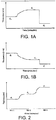
- the film thickness of the dry adhesive film was first measured using QCMD. Then water was passed through the chamber where an adhesive coated sensor was placed. The oscillating frequency change was recorded until equilibrium reached, which took approximately 1 hr. The modeling within the Q-Sense software allowed calculation of the film thickness and weight changes. After the QCMD run, the sensor with the remaining coating film was re-dried and the film thickness was measured again. Two typical curves shown in Figures 1A and 1B have been constructed based on the QCMD results, one for a relatively insoluble film such as Sample A and another for a soluble adhesive film such as Sample B.
- a liquid with a salt solution was passed through the cell to generate the predetermined relative humidity level (e.g ., RH1, RH2, RH3, etc.).
- the predetermined relative humidity level e.g ., RH1, RH2, RH3, etc.
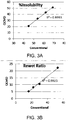
- a thickness change as shown in Figure 2 was calculated using the Q-sense modeling software. A typical curve was observed for tested adhesive as the RH was changing.
- the humidity module rewet ratio is different from the flow module rewet ratio since one is measured in humid air and another in water, but both can be useful indicators of the creping adhesive performance.
- a shear modulus corresponding to each RH level was also calculated using the Q-sense modeling software.
- An adhesive film was cast on a hot metal plate using a wire-wound rod. The film was cured for a set time before a wet cotton strip was pressed into the film. After the strip and the film were dried for a set time, the peel force was measured in a 180° peel test under controlled temperature and peel speed. Two temperature conditions were used to simulate extreme curing conditions: (1) Low temperature (LT) - 90°C for 30 sec and (2) High temperature (HT) - 110°C for 5 min.
- LT Low temperature
- HT High temperature
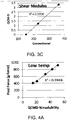
- Table 1 summarizes characteristics of two commercial adhesives, Sample A and Sample B, and their blends measured using both conventional and QCMD methods.
- the results in Figures 3A to 3C show excellent linear correlations between % insolubility, rewet ratio, and shear modulus, measured by conventional and QCMD methods.
- Table 1 Characteristics of creping adhesives measured by conventional and QCMD techniques.
- Sample A/Sample B blends dry basis ratio
- Conventional methods QCMD methods %Insolubility Rewet ratio Shear Modulus (kPa) % Insolubility Rewet ratio (flow module) Shear Modulus (Pa) (humidity module) 100/0 69 16 365 51 5.2 3.3 75/25 62 22 43 8.1 50/50 54 30 230 33 10.4 1.2 25/75 45 53 21 22.3 0/100 0 n/a* 150 15 6.5 0.02
- Table 2 shows that the time required for QCMD measurements was significantly shorter than for conventional methods.
- Table 2 Time required for measuring crepe adhesive characteristics using conventional and QCMD methods. Measured characteristics Test Time for Conventional methods (hr) Test Time for QCM-D methods (hr) %Insolubility 10 5 Rewet ratio 10 5 Shear modulus 10 3
- QCMD data can be used to predict adhesion performance of creping adhesives.
- Table 3 summarizes the data for creping adhesive characteristics measured by QCMD method and corresponding peel adhesion data at two test temperatures. The two peel test temperatures exemplify extreme conditions on the Yankee dryer, which would require different film adhesive characteristics with regard to insolubility, rewet, and shear modulus.
- Table 3 Film characteristics measured using QCMD and corresponding peel adhesion.
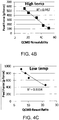
- Figures 4A to 4F illustrate the correlation between peel force and the characteristics measured by QCMD.
- the QCMD methods predict that an adhesive producing a highly insoluble film with a low rewet ratio and high shear modulus (hard film) should provide high adhesion when the Yankee dryer temperature runs on a low side. This is consistent with practical observations that require a harder and less moisture sensitive coating to perform well under low temperature creping operations.
- the QCMD method predicts that a more soluble, highly rewettable and soft film (low shear modulus) is preferred to provide high adhesion. Again, this is consistent with a desire for soft and rewetable coating for high temperature creping operations.
- ratios, concentrations, amounts, and other numerical data may be expressed herein in a range format. It is to be understood that such a range format is used for convenience and brevity, and thus, should be interpreted in a flexible manner to include not only the numerical values explicitly recited as the limits of the range, but also to include all the individual numerical values or sub-ranges encompassed within that range as if each numerical value and sub-range is explicitly recited.
- a concentration range of "about 0.1% to about 5%” should be interpreted to include not only the explicitly recited concentration of about 0.1 wt% to about 5 wt%, but also include individual concentrations ( e.g ., 1%, 2%, 3%, and 4%) and the sub-ranges ( e.g ., 0.5%, 1.1%, 2.2%, 3.3%, and 4.4%) within the indicated range.
- the term "about” can include traditional rounding according to the numerical value and what is being measured.
- the phrase “about 'x' to 'y'” includes “about 'x' to about 'y"'.
Landscapes
- Physics & Mathematics (AREA)
- General Physics & Mathematics (AREA)
- Biochemistry (AREA)
- Life Sciences & Earth Sciences (AREA)
- Chemical & Material Sciences (AREA)
- Analytical Chemistry (AREA)
- Health & Medical Sciences (AREA)
- General Health & Medical Sciences (AREA)
- Immunology (AREA)
- Pathology (AREA)
- Acoustics & Sound (AREA)
- Paper (AREA)
- Adhesives Or Adhesive Processes (AREA)
- Investigating Strength Of Materials By Application Of Mechanical Stress (AREA)
Claims (14)
- Verfahren zum Modifizieren einer Kreppklebefolie, der auf einem Yankee-Trockner angeordnet ist, umfassend:Erhalten eines Sensorsubstrats mit einer darauf angeordneten Kreppklebefolie, wobei die Kreppklebefolie eine Zusammensetzung aufweist, die der Kreppklebefolie entspricht, die auf dem Yankee-Trockner angeordnet ist;Messen einer Schwingungsfrequenz des Sensorsubstrats mit der darauf angeordneten Kreppklebefolie unter Verwendung einer Quarzkristall-Mikrowaage (QCM) -Technik;Bestimmen einer Eigenschaft der Kreppklebefolie; undModifizieren einer Zusammensetzung der Kreppklebefolie, die auf dem Yankee-Trockner angeordnet ist, basierend auf der Bestimmung der Eigenschaft.
- Verfahren nach Anspruch 1, wobei der auf dem Sensor angeordnete Kreppklebstoff von einer Vorrichtung erhalten wird, die die Komponenten der Kreppklebefolie dem Yankee-Trockner bereitstellt.
- Verfahren nach Anspruch 1, ferner umfassend: Bestimmen, wie eine oder mehrere Komponenten der Zusammensetzung der Kreppklebefolie eingestellt werden sollen, um eine Einstellung einer Eigenschaft der Kreppklebefolie zu erreichen.
- Verfahren nach Anspruch 1, ferner umfassend: Messen einer Schwingungsfrequenzdissipation des Sensorsubstrats, nachdem das Antriebspotential von dem Sensorsubstrat entfernt wurde.
- Verfahren nach Anspruch 1, ferner umfassend:Aussetzen des Sensorsubstrats einer feuchten Umgebung, wobei die Kreppklebefolie Wasser aus der feuchten Umgebung absorbiert; undMessen einer Schwingungsfrequenz des Sensorsubstrats unter Verwendung der QCM-Technik.
- Verfahren nach Anspruch 5, ferner umfassend: Messen einer Schwingungsfrequenzdissipation des Sensorsubstrats, nachdem das Antriebspotential von dem Sensorsubstrat entfernt wurde.
- Verfahren nach Anspruch 1, ferner umfassend:Aufbringen einer Menge Wasser auf die Kreppklebefolie, wobei die Kreppklebefolie das Wasser absorbiert; undMessen einer Schwingungsfrequenz des Sensorsubstrats unter Verwendung der QCM-Technik.
- Verfahren nach Anspruch 7, ferner umfassend: Messen einer Schwingungsfrequenzdissipation des Sensorsubstrats, nachdem das Antriebspotential von dem Sensorsubstrat entfernt wurde.
- Verfahren nach Anspruch 1, wobei die Eigenschaft ausgewählt ist aus der Gruppe bestehend aus: prozentualer Löslichkeit, prozentualer Unlöslichkeit, Wiederbenetzungsverhältnis, Quellverhältnis, Filmviskosität, Filmelastizität, Filmweichheit, Filmsteifigkeit, Schermodul und einer Kombination davon.
- Verfahren nach Anspruch 1, wobei das Messen einer Schwingungsfrequenz das Messen bei zwei oder mehr Frequenzen umfasst, die auf das Sensorsubstrat angewendet werden.
- Verfahren nach Anspruch 1, wobei das Aussetzen des Sensorsubstrats das Aussetzen des Sensorsubstrats bei einer ersten Temperatur umfasst, wobei die erste Temperatur eine Temperatur von etwa 10 bis 100 °C ist.
- Verfahren nach Anspruch 11, ferner umfassend:
Messen einer Schwingungsfrequenz des Sensorsubstrats bei zwei oder mehr Temperaturen unter Verwendung der QCM-Technik. - Verfahren nach Anspruch 1, wobei die Kreppklebefolie einen oder mehrere Kreppklebstoffe enthält.
- Verfahren nach Anspruch 11, wobei die Kreppklebefolie eine Komponente umfasst, die ausgewählt ist aus der Gruppe bestehend aus: einem Weichmacher, einem Debonder, einem Entschäumer, einem nassfesten Harz, einem trockenfesten Harz, einem Ladungskontrollmittel, einem Retentionshilfsmittel, einem Biozid, einem Farbstoff und einer Kombination davon.
Applications Claiming Priority (2)
| Application Number | Priority Date | Filing Date | Title |
|---|---|---|---|
| US201261612645P | 2012-03-19 | 2012-03-19 | |
| PCT/US2013/031275 WO2013142244A1 (en) | 2012-03-19 | 2013-03-14 | Methods of measuring a characteristic of a creping adhesive film and methods of modifying the creping adhesive film |
Publications (3)
| Publication Number | Publication Date |
|---|---|
| EP2828636A1 EP2828636A1 (de) | 2015-01-28 |
| EP2828636A4 EP2828636A4 (de) | 2015-11-04 |
| EP2828636B1 true EP2828636B1 (de) | 2020-12-16 |
Family
ID=49158210
Family Applications (1)
| Application Number | Title | Priority Date | Filing Date |
|---|---|---|---|
| EP13765203.8A Not-in-force EP2828636B1 (de) | 2012-03-19 | 2013-03-14 | Verfahren zur messung einer eigenschaft einer krepphaftfolie und verfahren zur modifizierung der krepphaftfolie |
Country Status (7)
| Country | Link |
|---|---|
| US (2) | US20130245158A1 (de) |
| EP (1) | EP2828636B1 (de) |
| KR (1) | KR102038169B1 (de) |
| CN (1) | CN104204764B (de) |
| CA (1) | CA2867353C (de) |
| RU (1) | RU2615640C2 (de) |
| WO (1) | WO2013142244A1 (de) |
Families Citing this family (13)
| Publication number | Priority date | Publication date | Assignee | Title |
|---|---|---|---|---|
| US9266301B2 (en) * | 2005-06-30 | 2016-02-23 | Nalco Company | Method to adhere and dislodge crepe paper |
| EP2828636B1 (de) | 2012-03-19 | 2020-12-16 | Kemira Oyj | Verfahren zur messung einer eigenschaft einer krepphaftfolie und verfahren zur modifizierung der krepphaftfolie |
| US9254504B2 (en) * | 2014-01-24 | 2016-02-09 | Kemira Oyj | Arrangement and method for simulating creping of tissue paper |
| CN103940694A (zh) * | 2014-04-15 | 2014-07-23 | 金堆城钼业股份有限公司 | 测定钼粉溶解性的方法 |
| US10329715B2 (en) | 2017-07-20 | 2019-06-25 | Buckman Laboratories International, Inc. | Real time regulation of yankee dryer coating based on predicted natural coating transfer |
| CN109053172A (zh) * | 2018-09-13 | 2018-12-21 | 丁杨洋 | 一种中频感应电炉用干振料及其制备方法和使用方法 |
| CN109430956A (zh) * | 2018-11-08 | 2019-03-08 | 昆山莎美娜制衣有限公司 | 一种局部立体织物 |
| CN111272866A (zh) * | 2020-02-28 | 2020-06-12 | 江苏大学 | 一种提高石英晶体微天平灵敏度的方法及应用 |
| EP4204627B1 (de) * | 2020-08-27 | 2025-11-26 | Buckman Laboratories International, Inc. | Prädiktive regelung der chemischen trockenchemie eines yankee-trockners und der qualität eines gekreppten produkts |
| JP2022185815A (ja) * | 2021-06-03 | 2022-12-15 | 大王製紙株式会社 | ティシューペーパー及びティシューペーパーの製造方法 |
| JP2022185816A (ja) * | 2021-06-03 | 2022-12-15 | 大王製紙株式会社 | ティシューペーパー及びティシューペーパーの製造方法 |
| CN114184513B (zh) * | 2021-12-02 | 2024-02-27 | 华鼎国联四川动力电池有限公司 | 一种锂离子电池负极极片中粘接剂分布的检测方法 |
| CA3254076A1 (en) | 2022-03-24 | 2023-09-28 | Buckman Laboratories International, Inc. | SYSTEM AND METHOD FOR AUTOMATED RETROACTIVE VALIDATION OR CORRECTION OF ONLINE SENSORS |
Family Cites Families (33)
| Publication number | Priority date | Publication date | Assignee | Title |
|---|---|---|---|---|
| CN1003575B (zh) * | 1984-11-22 | 1989-03-15 | 琼-皮埃尔·莱伯特 | 一种使卷筒纸起皱的装置 |
| US4883564A (en) * | 1988-06-01 | 1989-11-28 | Scott Paper Company | Creping device adhesive formulation |
| US5201215A (en) * | 1991-10-17 | 1993-04-13 | The United States Of America As Represented By The United States Department Of Energy | Method for simultaneous measurement of mass loading and fluid property changes using a quartz crystal microbalance |
| US5869763A (en) * | 1995-10-19 | 1999-02-09 | The United States Of America As Represented By The Secretary Of The Army | Method for measuring mass change using a quartz crystal microbalance |
| US5734098A (en) * | 1996-03-25 | 1998-03-31 | Nalco/Exxon Energy Chemicals, L.P. | Method to monitor and control chemical treatment of petroleum, petrochemical and processes with on-line quartz crystal microbalance sensors |
| US6247354B1 (en) * | 1998-05-13 | 2001-06-19 | The United States Of America As Represented By The Secretary Of The Army | Techniques for sensing the properties of fluids with resonators |
| US6649208B2 (en) * | 2001-04-17 | 2003-11-18 | Wayne E. Rodgers | Apparatus and method for thin film deposition onto substrates |
| US6668618B2 (en) * | 2001-04-23 | 2003-12-30 | Agilent Technologies, Inc. | Systems and methods of monitoring thin film deposition |
| US6918993B2 (en) * | 2002-07-10 | 2005-07-19 | Kimberly-Clark Worldwide, Inc. | Multi-ply wiping products made according to a low temperature delamination process |
| US7585389B2 (en) * | 2005-06-24 | 2009-09-08 | Georgia-Pacific Consumer Products Lp | Method of making fabric-creped sheet for dispensers |
| ITMI20030514A1 (it) * | 2003-03-18 | 2004-09-19 | Uni Degli Studi Brescia | Metodo e dispositivo per determinare la frequenza di |
| JP4213061B2 (ja) * | 2003-03-28 | 2009-01-21 | シチズンホールディングス株式会社 | Qcmセンサーおよびqcmセンサー装置 |
| JP2008513772A (ja) * | 2004-09-15 | 2008-05-01 | エイジェンシー フォー サイエンス, テクノロジー アンド リサーチ | 表面プラズモン共鳴とクォーツクリスタルマイクロバランスセンサ |
| US7828929B2 (en) * | 2004-12-30 | 2010-11-09 | Research Electro-Optics, Inc. | Methods and devices for monitoring and controlling thin film processing |
| CN2808608Y (zh) * | 2005-03-22 | 2006-08-23 | 张海荣 | 一种覆膜机上的胶膜自动紧张装置 |
| CN100513504C (zh) * | 2005-05-27 | 2009-07-15 | 庄廷生 | 一种双面热熔胶膜及其制备工艺 |
| US20060281191A1 (en) * | 2005-06-09 | 2006-12-14 | Prasad Duggirala | Method for monitoring organic deposits in papermaking |
| US20120073775A1 (en) * | 2005-06-09 | 2012-03-29 | Prasad Duggirala | Method for monitoring organic deposits in papermaking |
| US9266301B2 (en) * | 2005-06-30 | 2016-02-23 | Nalco Company | Method to adhere and dislodge crepe paper |
| US7785443B2 (en) * | 2006-12-07 | 2010-08-31 | Kimberly-Clark Worldwide, Inc. | Process for producing tissue products |
| US7842165B2 (en) * | 2007-08-29 | 2010-11-30 | Nalco Company | Enhanced method for monitoring the deposition of organic materials in a papermaking process |
| US8500957B2 (en) * | 2007-08-29 | 2013-08-06 | Nalco Company | Enhanced method for monitoring the deposition of organic materials in a papermaking process |
| WO2009070108A1 (en) * | 2007-11-28 | 2009-06-04 | Q-Sense Ab | Optical reflectometry setup |
| US8160305B2 (en) * | 2007-11-30 | 2012-04-17 | Hercules Incorporated | Method and apparatus for measuring deposition of particulate contaminants in pulp and paper slurries |
| WO2009119796A1 (ja) * | 2008-03-28 | 2009-10-01 | 財団法人北九州産業学術推進機構 | 複合薄膜及びそれを備えた雰囲気センサ並びに光導波路センサ |
| CN102027349A (zh) * | 2008-05-14 | 2011-04-20 | 株式会社爱发科 | 晶体振子以及使用了该晶体振子的测定方法 |
| CN101756396A (zh) * | 2008-11-06 | 2010-06-30 | 邓龙兴 | 起皱橡胶手套的制备方法 |
| WO2011046130A1 (ja) * | 2009-10-14 | 2011-04-21 | 日本製紙株式会社 | 異物の沈積度合いを測定する方法 |
| JP5641296B2 (ja) * | 2010-06-16 | 2014-12-17 | セイコーエプソン株式会社 | 周波数計測装置、並びに同装置を備えるニオイセンサー及び電子機器 |
| WO2012044402A1 (en) * | 2010-09-29 | 2012-04-05 | Conocophillips Company-Ip Services Group | High-pressure quartz crystal microbalance |
| EP2828636B1 (de) | 2012-03-19 | 2020-12-16 | Kemira Oyj | Verfahren zur messung einer eigenschaft einer krepphaftfolie und verfahren zur modifizierung der krepphaftfolie |
| US9856563B2 (en) * | 2012-08-22 | 2018-01-02 | Uchicago Argonne, Llc | Micro-balance sensor integrated with atomic layer deposition chamber |
| US8945371B2 (en) * | 2013-03-14 | 2015-02-03 | Ecolab Usa Inc. | Device and methods of using a piezoelectric microbalance sensor |
-
2013
- 2013-03-14 EP EP13765203.8A patent/EP2828636B1/de not_active Not-in-force
- 2013-03-14 CA CA2867353A patent/CA2867353C/en active Active
- 2013-03-14 RU RU2014142011A patent/RU2615640C2/ru active
- 2013-03-14 KR KR1020147028720A patent/KR102038169B1/ko active Active
- 2013-03-14 US US13/804,005 patent/US20130245158A1/en not_active Abandoned
- 2013-03-14 WO PCT/US2013/031275 patent/WO2013142244A1/en not_active Ceased
- 2013-03-14 CN CN201380014948.6A patent/CN104204764B/zh not_active Expired - Fee Related
-
2014
- 2014-12-18 US US14/575,216 patent/US9182271B2/en active Active
Non-Patent Citations (1)
| Title |
|---|
| None * |
Also Published As
| Publication number | Publication date |
|---|---|
| RU2615640C2 (ru) | 2017-04-06 |
| US20150101410A1 (en) | 2015-04-16 |
| KR102038169B1 (ko) | 2019-10-29 |
| RU2014142011A (ru) | 2016-05-10 |
| US9182271B2 (en) | 2015-11-10 |
| CA2867353A1 (en) | 2013-09-26 |
| EP2828636A1 (de) | 2015-01-28 |
| CA2867353C (en) | 2020-11-24 |
| US20130245158A1 (en) | 2013-09-19 |
| WO2013142244A1 (en) | 2013-09-26 |
| CN104204764A (zh) | 2014-12-10 |
| CN104204764B (zh) | 2018-07-20 |
| EP2828636A4 (de) | 2015-11-04 |
| KR20140148416A (ko) | 2014-12-31 |
Similar Documents
| Publication | Publication Date | Title |
|---|---|---|
| EP2828636B1 (de) | Verfahren zur messung einer eigenschaft einer krepphaftfolie und verfahren zur modifizierung der krepphaftfolie | |
| US11959229B2 (en) | Sanitary tissue products | |
| US11015297B2 (en) | Sanitary tissue products | |
| US11767641B2 (en) | Sanitary tissue products |
Legal Events
| Date | Code | Title | Description |
|---|---|---|---|
| PUAI | Public reference made under article 153(3) epc to a published international application that has entered the european phase |
Free format text: ORIGINAL CODE: 0009012 |
|
| 17P | Request for examination filed |
Effective date: 20141008 |
|
| AK | Designated contracting states |
Kind code of ref document: A1 Designated state(s): AL AT BE BG CH CY CZ DE DK EE ES FI FR GB GR HR HU IE IS IT LI LT LU LV MC MK MT NL NO PL PT RO RS SE SI SK SM TR |
|
| AX | Request for extension of the european patent |
Extension state: BA ME |
|
| DAX | Request for extension of the european patent (deleted) | ||
| RA4 | Supplementary search report drawn up and despatched (corrected) |
Effective date: 20151001 |
|
| RIC1 | Information provided on ipc code assigned before grant |
Ipc: G01N 5/02 20060101AFI20150925BHEP Ipc: G01N 29/036 20060101ALI20150925BHEP |
|
| RAP1 | Party data changed (applicant data changed or rights of an application transferred) |
Owner name: KEMIRA OYJ |
|
| STAA | Information on the status of an ep patent application or granted ep patent |
Free format text: STATUS: EXAMINATION IS IN PROGRESS |
|
| 17Q | First examination report despatched |
Effective date: 20190916 |
|
| GRAP | Despatch of communication of intention to grant a patent |
Free format text: ORIGINAL CODE: EPIDOSNIGR1 |
|
| STAA | Information on the status of an ep patent application or granted ep patent |
Free format text: STATUS: GRANT OF PATENT IS INTENDED |
|
| INTG | Intention to grant announced |
Effective date: 20200707 |
|
| GRAS | Grant fee paid |
Free format text: ORIGINAL CODE: EPIDOSNIGR3 |
|
| GRAA | (expected) grant |
Free format text: ORIGINAL CODE: 0009210 |
|
| STAA | Information on the status of an ep patent application or granted ep patent |
Free format text: STATUS: THE PATENT HAS BEEN GRANTED |
|
| RIN1 | Information on inventor provided before grant (corrected) |
Inventor name: GRIGORIEV, VLADIMIR Inventor name: NGUYEN, DANNY Inventor name: ROSENCRANCE, SCOTT Inventor name: LU, CHEN |
|
| AK | Designated contracting states |
Kind code of ref document: B1 Designated state(s): AL AT BE BG CH CY CZ DE DK EE ES FI FR GB GR HR HU IE IS IT LI LT LU LV MC MK MT NL NO PL PT RO RS SE SI SK SM TR |
|
| REG | Reference to a national code |
Ref country code: GB Ref legal event code: FG4D |
|
| REG | Reference to a national code |
Ref country code: IE Ref legal event code: FG4D |
|
| REG | Reference to a national code |
Ref country code: DE Ref legal event code: R096 Ref document number: 602013074747 Country of ref document: DE |
|
| REG | Reference to a national code |
Ref country code: AT Ref legal event code: REF Ref document number: 1346045 Country of ref document: AT Kind code of ref document: T Effective date: 20210115 |
|
| PG25 | Lapsed in a contracting state [announced via postgrant information from national office to epo] |
Ref country code: FI Free format text: LAPSE BECAUSE OF FAILURE TO SUBMIT A TRANSLATION OF THE DESCRIPTION OR TO PAY THE FEE WITHIN THE PRESCRIBED TIME-LIMIT Effective date: 20201216 Ref country code: RS Free format text: LAPSE BECAUSE OF FAILURE TO SUBMIT A TRANSLATION OF THE DESCRIPTION OR TO PAY THE FEE WITHIN THE PRESCRIBED TIME-LIMIT Effective date: 20201216 Ref country code: NO Free format text: LAPSE BECAUSE OF FAILURE TO SUBMIT A TRANSLATION OF THE DESCRIPTION OR TO PAY THE FEE WITHIN THE PRESCRIBED TIME-LIMIT Effective date: 20210316 Ref country code: GR Free format text: LAPSE BECAUSE OF FAILURE TO SUBMIT A TRANSLATION OF THE DESCRIPTION OR TO PAY THE FEE WITHIN THE PRESCRIBED TIME-LIMIT Effective date: 20210317 |
|
| REG | Reference to a national code |
Ref country code: AT Ref legal event code: MK05 Ref document number: 1346045 Country of ref document: AT Kind code of ref document: T Effective date: 20201216 |
|
| REG | Reference to a national code |
Ref country code: NL Ref legal event code: MP Effective date: 20201216 |
|
| PG25 | Lapsed in a contracting state [announced via postgrant information from national office to epo] |
Ref country code: LV Free format text: LAPSE BECAUSE OF FAILURE TO SUBMIT A TRANSLATION OF THE DESCRIPTION OR TO PAY THE FEE WITHIN THE PRESCRIBED TIME-LIMIT Effective date: 20201216 Ref country code: SE Free format text: LAPSE BECAUSE OF FAILURE TO SUBMIT A TRANSLATION OF THE DESCRIPTION OR TO PAY THE FEE WITHIN THE PRESCRIBED TIME-LIMIT Effective date: 20201216 Ref country code: BG Free format text: LAPSE BECAUSE OF FAILURE TO SUBMIT A TRANSLATION OF THE DESCRIPTION OR TO PAY THE FEE WITHIN THE PRESCRIBED TIME-LIMIT Effective date: 20210316 |
|
| PG25 | Lapsed in a contracting state [announced via postgrant information from national office to epo] |
Ref country code: NL Free format text: LAPSE BECAUSE OF FAILURE TO SUBMIT A TRANSLATION OF THE DESCRIPTION OR TO PAY THE FEE WITHIN THE PRESCRIBED TIME-LIMIT Effective date: 20201216 Ref country code: HR Free format text: LAPSE BECAUSE OF FAILURE TO SUBMIT A TRANSLATION OF THE DESCRIPTION OR TO PAY THE FEE WITHIN THE PRESCRIBED TIME-LIMIT Effective date: 20201216 |
|
| REG | Reference to a national code |
Ref country code: LT Ref legal event code: MG9D |
|
| PG25 | Lapsed in a contracting state [announced via postgrant information from national office to epo] |
Ref country code: LT Free format text: LAPSE BECAUSE OF FAILURE TO SUBMIT A TRANSLATION OF THE DESCRIPTION OR TO PAY THE FEE WITHIN THE PRESCRIBED TIME-LIMIT Effective date: 20201216 Ref country code: RO Free format text: LAPSE BECAUSE OF FAILURE TO SUBMIT A TRANSLATION OF THE DESCRIPTION OR TO PAY THE FEE WITHIN THE PRESCRIBED TIME-LIMIT Effective date: 20201216 Ref country code: SK Free format text: LAPSE BECAUSE OF FAILURE TO SUBMIT A TRANSLATION OF THE DESCRIPTION OR TO PAY THE FEE WITHIN THE PRESCRIBED TIME-LIMIT Effective date: 20201216 Ref country code: PT Free format text: LAPSE BECAUSE OF FAILURE TO SUBMIT A TRANSLATION OF THE DESCRIPTION OR TO PAY THE FEE WITHIN THE PRESCRIBED TIME-LIMIT Effective date: 20210416 Ref country code: CZ Free format text: LAPSE BECAUSE OF FAILURE TO SUBMIT A TRANSLATION OF THE DESCRIPTION OR TO PAY THE FEE WITHIN THE PRESCRIBED TIME-LIMIT Effective date: 20201216 Ref country code: EE Free format text: LAPSE BECAUSE OF FAILURE TO SUBMIT A TRANSLATION OF THE DESCRIPTION OR TO PAY THE FEE WITHIN THE PRESCRIBED TIME-LIMIT Effective date: 20201216 Ref country code: SM Free format text: LAPSE BECAUSE OF FAILURE TO SUBMIT A TRANSLATION OF THE DESCRIPTION OR TO PAY THE FEE WITHIN THE PRESCRIBED TIME-LIMIT Effective date: 20201216 |
|
| PG25 | Lapsed in a contracting state [announced via postgrant information from national office to epo] |
Ref country code: PL Free format text: LAPSE BECAUSE OF FAILURE TO SUBMIT A TRANSLATION OF THE DESCRIPTION OR TO PAY THE FEE WITHIN THE PRESCRIBED TIME-LIMIT Effective date: 20201216 Ref country code: AT Free format text: LAPSE BECAUSE OF FAILURE TO SUBMIT A TRANSLATION OF THE DESCRIPTION OR TO PAY THE FEE WITHIN THE PRESCRIBED TIME-LIMIT Effective date: 20201216 |
|
| REG | Reference to a national code |
Ref country code: DE Ref legal event code: R097 Ref document number: 602013074747 Country of ref document: DE |
|
| PG25 | Lapsed in a contracting state [announced via postgrant information from national office to epo] |
Ref country code: IS Free format text: LAPSE BECAUSE OF FAILURE TO SUBMIT A TRANSLATION OF THE DESCRIPTION OR TO PAY THE FEE WITHIN THE PRESCRIBED TIME-LIMIT Effective date: 20210416 |
|
| REG | Reference to a national code |
Ref country code: DE Ref legal event code: R119 Ref document number: 602013074747 Country of ref document: DE |
|
| PLBE | No opposition filed within time limit |
Free format text: ORIGINAL CODE: 0009261 |
|
| STAA | Information on the status of an ep patent application or granted ep patent |
Free format text: STATUS: NO OPPOSITION FILED WITHIN TIME LIMIT |
|
| PG25 | Lapsed in a contracting state [announced via postgrant information from national office to epo] |
Ref country code: MC Free format text: LAPSE BECAUSE OF FAILURE TO SUBMIT A TRANSLATION OF THE DESCRIPTION OR TO PAY THE FEE WITHIN THE PRESCRIBED TIME-LIMIT Effective date: 20201216 Ref country code: AL Free format text: LAPSE BECAUSE OF FAILURE TO SUBMIT A TRANSLATION OF THE DESCRIPTION OR TO PAY THE FEE WITHIN THE PRESCRIBED TIME-LIMIT Effective date: 20201216 Ref country code: IT Free format text: LAPSE BECAUSE OF FAILURE TO SUBMIT A TRANSLATION OF THE DESCRIPTION OR TO PAY THE FEE WITHIN THE PRESCRIBED TIME-LIMIT Effective date: 20201216 |
|
| REG | Reference to a national code |
Ref country code: CH Ref legal event code: PL |
|
| 26N | No opposition filed |
Effective date: 20210917 |
|
| GBPC | Gb: european patent ceased through non-payment of renewal fee |
Effective date: 20210316 |
|
| PG25 | Lapsed in a contracting state [announced via postgrant information from national office to epo] |
Ref country code: DK Free format text: LAPSE BECAUSE OF FAILURE TO SUBMIT A TRANSLATION OF THE DESCRIPTION OR TO PAY THE FEE WITHIN THE PRESCRIBED TIME-LIMIT Effective date: 20201216 Ref country code: ES Free format text: LAPSE BECAUSE OF FAILURE TO SUBMIT A TRANSLATION OF THE DESCRIPTION OR TO PAY THE FEE WITHIN THE PRESCRIBED TIME-LIMIT Effective date: 20201216 |
|
| REG | Reference to a national code |
Ref country code: BE Ref legal event code: MM Effective date: 20210331 |
|
| PG25 | Lapsed in a contracting state [announced via postgrant information from national office to epo] |
Ref country code: DE Free format text: LAPSE BECAUSE OF NON-PAYMENT OF DUE FEES Effective date: 20211001 Ref country code: IE Free format text: LAPSE BECAUSE OF NON-PAYMENT OF DUE FEES Effective date: 20210314 Ref country code: FR Free format text: LAPSE BECAUSE OF NON-PAYMENT OF DUE FEES Effective date: 20210331 Ref country code: GB Free format text: LAPSE BECAUSE OF NON-PAYMENT OF DUE FEES Effective date: 20210316 Ref country code: CH Free format text: LAPSE BECAUSE OF NON-PAYMENT OF DUE FEES Effective date: 20210331 Ref country code: LU Free format text: LAPSE BECAUSE OF NON-PAYMENT OF DUE FEES Effective date: 20210314 Ref country code: LI Free format text: LAPSE BECAUSE OF NON-PAYMENT OF DUE FEES Effective date: 20210331 |
|
| PG25 | Lapsed in a contracting state [announced via postgrant information from national office to epo] |
Ref country code: SI Free format text: LAPSE BECAUSE OF FAILURE TO SUBMIT A TRANSLATION OF THE DESCRIPTION OR TO PAY THE FEE WITHIN THE PRESCRIBED TIME-LIMIT Effective date: 20201216 |
|
| PG25 | Lapsed in a contracting state [announced via postgrant information from national office to epo] |
Ref country code: IS Free format text: LAPSE BECAUSE OF FAILURE TO SUBMIT A TRANSLATION OF THE DESCRIPTION OR TO PAY THE FEE WITHIN THE PRESCRIBED TIME-LIMIT Effective date: 20210416 |
|
| PG25 | Lapsed in a contracting state [announced via postgrant information from national office to epo] |
Ref country code: BE Free format text: LAPSE BECAUSE OF NON-PAYMENT OF DUE FEES Effective date: 20210331 |
|
| PG25 | Lapsed in a contracting state [announced via postgrant information from national office to epo] |
Ref country code: HU Free format text: LAPSE BECAUSE OF FAILURE TO SUBMIT A TRANSLATION OF THE DESCRIPTION OR TO PAY THE FEE WITHIN THE PRESCRIBED TIME-LIMIT; INVALID AB INITIO Effective date: 20130314 |
|
| PG25 | Lapsed in a contracting state [announced via postgrant information from national office to epo] |
Ref country code: CY Free format text: LAPSE BECAUSE OF FAILURE TO SUBMIT A TRANSLATION OF THE DESCRIPTION OR TO PAY THE FEE WITHIN THE PRESCRIBED TIME-LIMIT Effective date: 20201216 |
|
| PG25 | Lapsed in a contracting state [announced via postgrant information from national office to epo] |
Ref country code: MK Free format text: LAPSE BECAUSE OF FAILURE TO SUBMIT A TRANSLATION OF THE DESCRIPTION OR TO PAY THE FEE WITHIN THE PRESCRIBED TIME-LIMIT Effective date: 20201216 |
|
| PG25 | Lapsed in a contracting state [announced via postgrant information from national office to epo] |
Ref country code: TR Free format text: LAPSE BECAUSE OF FAILURE TO SUBMIT A TRANSLATION OF THE DESCRIPTION OR TO PAY THE FEE WITHIN THE PRESCRIBED TIME-LIMIT Effective date: 20201216 |
|
| PG25 | Lapsed in a contracting state [announced via postgrant information from national office to epo] |
Ref country code: MT Free format text: LAPSE BECAUSE OF FAILURE TO SUBMIT A TRANSLATION OF THE DESCRIPTION OR TO PAY THE FEE WITHIN THE PRESCRIBED TIME-LIMIT Effective date: 20201216 |