EP2828046B1 - Shaver having adaptive skin engaging surface - Google Patents
Shaver having adaptive skin engaging surface Download PDFInfo
- Publication number
- EP2828046B1 EP2828046B1 EP13720578.7A EP13720578A EP2828046B1 EP 2828046 B1 EP2828046 B1 EP 2828046B1 EP 13720578 A EP13720578 A EP 13720578A EP 2828046 B1 EP2828046 B1 EP 2828046B1
- Authority
- EP
- European Patent Office
- Prior art keywords
- skin
- shaver
- force
- attraction
- engaging portion
- Prior art date
- Legal status (The legal status is an assumption and is not a legal conclusion. Google has not performed a legal analysis and makes no representation as to the accuracy of the status listed.)
- Active
Links
- 230000003044 adaptive effect Effects 0.000 title 1
- 239000000853 adhesive Substances 0.000 claims description 14
- 238000000034 method Methods 0.000 claims description 12
- 210000004209 hair Anatomy 0.000 claims description 9
- 230000004044 response Effects 0.000 claims description 6
- 238000001514 detection method Methods 0.000 claims description 2
- 230000000694 effects Effects 0.000 description 7
- 239000011888 foil Substances 0.000 description 5
- 230000003287 optical effect Effects 0.000 description 5
- 230000008901 benefit Effects 0.000 description 3
- 238000005259 measurement Methods 0.000 description 3
- 238000012545 processing Methods 0.000 description 2
- OKTJSMMVPCPJKN-UHFFFAOYSA-N Carbon Chemical compound [C] OKTJSMMVPCPJKN-UHFFFAOYSA-N 0.000 description 1
- 230000006978 adaptation Effects 0.000 description 1
- 230000008859 change Effects 0.000 description 1
- 239000002131 composite material Substances 0.000 description 1
- 239000004020 conductor Substances 0.000 description 1
- 230000007423 decrease Effects 0.000 description 1
- 238000005516 engineering process Methods 0.000 description 1
- 239000000945 filler Substances 0.000 description 1
- 239000006260 foam Substances 0.000 description 1
- 229910002804 graphite Inorganic materials 0.000 description 1
- 239000010439 graphite Substances 0.000 description 1
- 239000012212 insulator Substances 0.000 description 1
- 230000003993 interaction Effects 0.000 description 1
- 239000004922 lacquer Substances 0.000 description 1
- 239000000463 material Substances 0.000 description 1
- 238000000691 measurement method Methods 0.000 description 1
- 238000012986 modification Methods 0.000 description 1
- 230000004048 modification Effects 0.000 description 1
- 230000008447 perception Effects 0.000 description 1
- 230000005855 radiation Effects 0.000 description 1
- 230000009467 reduction Effects 0.000 description 1
- 239000000523 sample Substances 0.000 description 1
- 229920003169 water-soluble polymer Polymers 0.000 description 1
- 238000004804 winding Methods 0.000 description 1
Images


Classifications
-
- B—PERFORMING OPERATIONS; TRANSPORTING
- B26—HAND CUTTING TOOLS; CUTTING; SEVERING
- B26B—HAND-HELD CUTTING TOOLS NOT OTHERWISE PROVIDED FOR
- B26B19/00—Clippers or shavers operating with a plurality of cutting edges, e.g. hair clippers, dry shavers
- B26B19/38—Details of, or accessories for, hair clippers, or dry shavers, e.g. housings, casings, grips, guards
-
- B—PERFORMING OPERATIONS; TRANSPORTING
- B26—HAND CUTTING TOOLS; CUTTING; SEVERING
- B26B—HAND-HELD CUTTING TOOLS NOT OTHERWISE PROVIDED FOR
- B26B19/00—Clippers or shavers operating with a plurality of cutting edges, e.g. hair clippers, dry shavers
- B26B19/38—Details of, or accessories for, hair clippers, or dry shavers, e.g. housings, casings, grips, guards
- B26B19/3873—Electric features; Charging; Computing devices
- B26B19/388—Sensors; Control
-
- B—PERFORMING OPERATIONS; TRANSPORTING
- B26—HAND CUTTING TOOLS; CUTTING; SEVERING
- B26B—HAND-HELD CUTTING TOOLS NOT OTHERWISE PROVIDED FOR
- B26B19/00—Clippers or shavers operating with a plurality of cutting edges, e.g. hair clippers, dry shavers
- B26B19/38—Details of, or accessories for, hair clippers, or dry shavers, e.g. housings, casings, grips, guards
- B26B19/42—Details of, or accessories for, hair clippers, or dry shavers, e.g. housings, casings, grips, guards providing for straightening the hair to be cut, e.g. by means of bristles; providing for tensioning the skin, e.g. by means of rollers, ledges
-
- B—PERFORMING OPERATIONS; TRANSPORTING
- B26—HAND CUTTING TOOLS; CUTTING; SEVERING
- B26B—HAND-HELD CUTTING TOOLS NOT OTHERWISE PROVIDED FOR
- B26B19/00—Clippers or shavers operating with a plurality of cutting edges, e.g. hair clippers, dry shavers
- B26B19/38—Details of, or accessories for, hair clippers, or dry shavers, e.g. housings, casings, grips, guards
- B26B19/48—Accessory implements for carrying out a function other than cutting hair, e.g. attachable appliances for manicuring
-
- B—PERFORMING OPERATIONS; TRANSPORTING
- B26—HAND CUTTING TOOLS; CUTTING; SEVERING
- B26B—HAND-HELD CUTTING TOOLS NOT OTHERWISE PROVIDED FOR
- B26B21/00—Razors of the open or knife type; Safety razors or other shaving implements of the planing type; Hair-trimming devices involving a razor-blade; Equipment therefor
- B26B21/40—Details or accessories
- B26B21/405—Electric features; Charging; Computing devices
- B26B21/4056—Sensors or controlling means
-
- B—PERFORMING OPERATIONS; TRANSPORTING
- B26—HAND CUTTING TOOLS; CUTTING; SEVERING
- B26B—HAND-HELD CUTTING TOOLS NOT OTHERWISE PROVIDED FOR
- B26B21/00—Razors of the open or knife type; Safety razors or other shaving implements of the planing type; Hair-trimming devices involving a razor-blade; Equipment therefor
- B26B21/40—Details or accessories
-
- Y—GENERAL TAGGING OF NEW TECHNOLOGICAL DEVELOPMENTS; GENERAL TAGGING OF CROSS-SECTIONAL TECHNOLOGIES SPANNING OVER SEVERAL SECTIONS OF THE IPC; TECHNICAL SUBJECTS COVERED BY FORMER USPC CROSS-REFERENCE ART COLLECTIONS [XRACs] AND DIGESTS
- Y10—TECHNICAL SUBJECTS COVERED BY FORMER USPC
- Y10T—TECHNICAL SUBJECTS COVERED BY FORMER US CLASSIFICATION
- Y10T83/00—Cutting
- Y10T83/04—Processes
- Y10T83/0405—With preparatory or simultaneous ancillary treatment of work
- Y10T83/0419—By distorting within elastic limit
- Y10T83/0424—By stretching
Definitions
- the present invention relates to shavers and more specifically to shavers capable of adapting in use to improve the shaving effect.
- the invention applies to shavers having both stationary and moveable cutting elements and further relates to methods of operation of such devices.
- doming The degree to which the skin bulges ahead of a blade or cutting element is termed doming. Increasing the shaving pressure may improve the shaving closeness but can also increase doming. As doming increases, the likelihood that the cutting element will damage the skin also increases. The doming of the skin in a shaving system is therefore of fundamental importance to a shaving experience.
- Skin doming for a particular shaving system depends on the system geometry and materials used. It additionally varies due to changes in shaving pressure, speed, direction, area of the body and individual variation of a person's skin properties. There is thus considerable variation in terms of the risk of cutting and the shaving closeness that can be achieved without damaging skin or causing discomfort.
- skin doming is generally controlled by adding a rubbery skin stretcher that increases skin friction. This is located in front of the cutting element, the wet-shaving razor usually having one clear direction of use over the skin. By stretching the skin taut, its ability to dome ahead of the cutting element or blade is reduced. A lubricity strip may also be placed behind the cutting element or blade, which further enhances the stretching effect on the skin. Devices have also been proposed that actively seek to stretch the skin as described in EP1697095 .
- the shaver In dry shaving, the shaver is frequently moved in multiple directions over the skin. This means that in rotary dry shaving or in linear foil electric shaving the guard or skin engaging surface is limited by having to allow for movement over the skin in any direction.
- the guard member a foil or a shaving cap
- a skin engaging surface of the shaving head may be provided with stretching elements in the form of rings or protrusions which assist in supporting the skin and controlling the pressure and angle at which it comes into contact with the cutting element.
- a rotary shaver provided with a skin stretching element is disclosed in WO02051598 .
- DE605623 discloses a shaving device having a rotating hair-cutting disc accommodated in a housing.
- the housing has a hair-entry opening in the form of an annular segment, via which hairs can be exposed to the rotating hair-cutting disc.
- a suction opening is arranged concentrically with the hair-entry opening.
- the suction force stretches the skin to prevent the skin from being cut by the rotating hair-cutting disc.
- the pressure in the suction opening can be controlled by the user by means of an operating member which is coupled to a piston.
- a shaver comprising a skin engaging portion and a cutting element
- the skin engaging portion comprises a force-generating member configured and arranged to generate a force of attraction to the skin of a user
- the shaver further comprising a control element that can selectively adjust said force of attraction during use
- the control element comprises a sensor for measuring a parameter associated with the skin and a controller for selectively adapting the force of attraction in response to a measured property of the parameter.
- the frictional force between the skin-engaging surface and the skin will depend upon the coefficient of friction and upon the force applied by the user. Nevertheless, selectively increasing the frictional force in one region relative to other regions can take place independently of the overall force applied by the user.
- the sensor and the controller provide direct feedback based on real time measurements at the skin surface, which allows the force of attraction to be varied in order to improve the shaving effect.
- the force-generating member comprises an electro-adhesive element, which is attracted to the skin surface by electrostatic attraction.
- electrostatic attraction and electro-adhesion are well known and may be embodied in different forms according to the desired configuration and operation of the shaver.
- the basic principle of an electrostatic effect on the skin has been discovered and described by Mallinckrodt et al. in 1950 and published in "Perception by the skin of electrically induced vibrations", Science 118(3062: 277-278, 1953 ). More recently commercial embodiments have been developed allowing electro-adhesion to be used for various purposes including wall-climbing robots and the like.
- the electro-adhesive element may comprise charge-holding conductors or electrodes shielded from the skin by a thin insulator.
- the electrodes can be moulded into an otherwise non-conductive skin-engaging portion e.g. using a graphite or conducting filler within a composite body. Alternatively, they may be applied onto the skin engaging portion with an insulating lacquer layer (widely known for e.g. wire windings) applied to cover the electrodes. The arrangement can thus be made economically within the shape and constraints of the shaving system
- the electrodes are charged with an alternating voltage, preferably to between 70V and 200V.
- the switching frequency may be adjusted according to the desired result and may typically be from 50 to 200Hz. Any leak current to the skin is in the micro Ampere range or below and not noticeable to the user.
- the electro-adhesive element comprises adjacent first and second electrodes connected to a DC source such that the first and second electrodes may be oppositely charged with respect to each other. This enables a DC voltage, not requiring switching, to induce a change in attraction to the surface by the skin
- the parameter may be indicative of a direction of movement of the skin-engaging portion with respect to the skin. This can allow the controller to adapt the force of attraction to ensure that a high force is present ahead of the cutting element compared to a force of attraction behind the cutting element.
- An electrical switch may be provided, actuated by the friction and motion of the skin-engaging portion across the skin.
- an optical sensor may be provided, arranged in the manner as commonly used in a computer mouse. The sensor takes images at a frequency of around 30Hz and calculates a motion vector from the deltas between successive images. The net motion vector is evaluated by or provided to the controller.
- Another parameter that may preferably be measured is a parameter indicative of a degree of doming of the skin ahead of the cutting element.
- a robust method of detecting the skin doming is to measure the actual doming or doming pressure directly. This can be achieved by placing a sensing probe in a relevant position between the skin-engaging portion and cutting element.
- the measuring device may be capable of distinguishing between two states of skin doming, e.g. high and low.
- the controller may be arranged to increase the force of attraction on detection of the degree of doming exceeding a predetermined value. This enables the skin stretcher to switch to high-friction or low-friction depending on the detected state.
- a sufficient steady-zone between the two states, either in time or in measured values, will avoid hysteresis and enable the system to be practical and have an actual benefit in reducing skin doming variations by attenuating extreme cases of doming.
- a higher resolution sensing arrangement will enable more optimal control systems, as are widely known from the field of feedback control technology.
- the actual sensor can be a piezo element that is in contact with the skin during shaving. This enables a force measurement even in a wet environment in a wet shaving system.
- An alternative, optical system may use a close-range IR proximity sensor. Even in the case of wet shaving using foam, this may provide a usable proxy value of skin doming.
- skin doming may be measured in a recess in a face plate or alternatively through the slots formed in a foil or cap.
- a further alternative is a mechanical element, arranged to touch and trace over the skin just ahead of the blade, between the skin engaging portion (guard) and cutting element. This may be coupled to a potentiometer element to measure a skin doming value.
- the benefit of electrical measurement methods is that they enable direct feedback to the force-generating member.
- the skin-engaging portion comprises a plurality of force-generating members and the force of attraction of each force-generating member or group of force-generating members can be selectively adapted independently of the other force-generating members.
- shavers that can be advanced in different directions during cutting, such as rotary or reciprocating shavers as it specifically allows those portions to be adapted that are ahead of the cutting element.
- Such shavers may be characterized as those where the cutting element is moveable with respect to the skin-engaging portion to perform cutting of hairs during shaving.
- a controller and direction sensor as described above may be arranged to selectively adjust the force of attraction of those force-generating members located ahead of the cutting element in a measured direction of movement of the shaver across the skin.
- the shaver comprises a plurality of cutting elements, each comprising a rotary shaving head having a rotating cutter.
- the heads may be mounted to a face plate and the force-generating members that can be selectively activated are located in regions of the face plate surrounding the rotary shaving heads. It will however also be understood that skin engaging regions of the cap or head of a rotary shaver may also be provided with such force-generating members.
- the skin engaging portion of the shaver comprises a face plate in which a plurality of cutting elements are located, each comprising a rotary shaving head having a rotating cutter, and a plurality of force-generating members are provided, distributed around a periphery of the face plate, wherein the controller is operable in response to a direction of movement measured by the sensor to selectively increase the force of attraction of those force generating members located ahead of the rotary shaving heads with respect to the measured direction of movement.
- the shaver may also be a wet-shaver having one or more elongate blades mounted in a guard.
- the regions that can be selectively activated may be located on the skin-engaging portion of the guard.
- the invention also relates to a method of controlling operation of a shaver comprising moving a skin engaging portion of the shaver across the skin of a user in a direction of motion, whereby the skin engaging portion engages the skin and a cutting element engages hairs to be cut, and adjusting a force of attraction between the skin and at least a region of the skin engaging portion during said movement, in order to adjust a degree of stretching of the skin ahead of the cutting element, wherein the method further comprises measuring a parameter associated with the skin, and selectively adapting the force of attraction in response to a measured property of the parameter.
- a parameter associated with the skin and selectively adapting the force of attraction in response to a measured property of the parameter.
- the method comprises measuring a parameter indicative of skin doming ahead of the cutting element and selectively adjusting the force of attraction to adjust such skin doming.
- the method may also or alternatively comprise measuring a parameter indicative of the direction of motion and selectively increasing the force of attraction ahead of the cutting element, whereby doming may controlled irrespective of a direction of movement of the shaver.
- Figure 1 shows a schematic cross-sectional view of a conventional wet shaver 1 comprising a handle 2, a guard 4 and a pair of cutting blades 6 mounted within the guard 4.
- the guard has a skin-engaging portion 8 and the cutting edges 10 of the blades 6 lie approximately in the plane of the skin-engaging portion 8.
- the skin-engaging portion 8 of the shaver 1 is pressed against the user's skin S and moved in a direction M. Due to the pressure exerted by the blades 6 and its inherent elasticity, the skin S is caused to form a bulge B extending towards the guard 4 in those areas where it is unsupported, such as between the blades 6 and between the blades 6 and the guard 4.
- This effect is known as doming.
- the guard is provided with a skin-stretcher 12 ahead of the blades 6 and a lubricity strip 14 behind the blades 6.
- the skin-stretcher 12 is a region of increased friction comprising a ribbed rubberlike portion.
- the lubricity strip 14 comprises a lubricious water-soluble polymer and provides a region of reduced friction. The net effect of these regions is to cause the skin to be stretched or held taut in the area of the blades, thus reducing the amount of doming.
- FIG. 2 shows a wet shaver 20A according to a first embodiment of the present invention in a schematic cross-sectional view similar to that of Figure 1 , in which like elements are given similar references.
- the shaver 20 is generally similar to the conventional shaver 1, with the exception of the skin-stretcher 12, which is replaced by an electro-adhesive element 22.
- the electro-adhesive element 22 comprises a plurality of electrodes 24 embedded in an insulating layer 26. Alternate electrodes 24', 24" are connected to +ive and - ive terminals of a DC voltage source 28. By connecting the voltage source 28, the electrodes 24 become charged and induce a local charge onto the skin S, which is thus attracted by electrostatic force towards the element 22.
- Figure 2 also shows a sensor 30 located on the guard 4 for determining the degree of skin doming ahead of the blades 6.
- the sensor 30 is an infrared (IR) photodiode capable of detecting IR radiation.
- An IR light source in the form of an LED 32 is also located within the guard 4 at a slight distance from the sensor 30.
- the sensor 30 and LED 32 are both connected to a controller 34, which includes appropriate circuitry for processing their signals.
- the LED 32 emits IR light, which is reflected by the skin S.
- the controller 34 is set to determine when a bulge B is formed. At this point, a signal is given to the voltage source 28 to increase the applied voltage to the electrodes 24 in order to increase the electro-adhesive force.
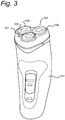
- FIG 3 illustrates a conventional rotary electric shaver 100 used for "dry" shaving.
- the shaver 100 comprises a body 101 and three heads 102 mounted in a face plate 104.
- Each of the heads comprises an outer cap 106, having a plurality of hair receiving slots 108 by which hairs may enter into the cap 106 and be cut by a rotating cutter beneath (see below).
- Figure 4 shows a detail through one of the heads 102 taken on line IV-IV in Figure 3 . Showing a hair H protruding through slot 108 of cap 106. Cutter 110 is shown moving in direction X to cut hair H by interaction with the slot 108 as is otherwise conventional. Figure 4 also shows the manner in which the skin S bulges into the slots 108 at B. In this view, the head 102 is moving in the direction M which corresponds to the direction X. The bulge B is therefore pushed against one side of the slot 108. It will however be understood that the cutter 110 rotates and its local direction of movement X does not therefore always correspond to the direction of movement M of the head 102 across the skin S.
- the skin S may become damaged by contact with the cutter 110. This damage may be reduced by various means, including increasing the thickness of the cap 106 and reducing the width of the slots 108. Most of these adaptations have a negative effect on the closeness of the ultimate shave that can be achieved.
- Figure 5 shows a schematic cross section through part of a rotary shaver 100A according to an embodiment of the present invention. Like elements to those of Figures 3 and 4 will be designated with like numerals.
- the face plate 104 is provided with electro-adhesive elements 122.
- the electro-adhesive elements 122 each comprise a plurality of electrodes 124 embedded in an insulating layer 126 in the same manner as those described above in relation to Figure 2 .
- Alternate electrodes 124', 124" are connected to +ive and -ive terminals of a DC voltage source 128. By connecting the voltage source 128, the electrodes 24 become charged and induce a local charge onto the skin S, which is thus attracted by electrostatic force towards the element 122.
- a sensor 130 is located on the face plate 104 for determining the degree of skin doming.
- the sensor 130 is an IR photodiode which operates together with an IR LED 132 to determine the bulging of the skin S through the slots 108 in the cap 106.
- the sensor 130 and LED 132 are both connected to a controller 134, which includes appropriate circuitry for processing their signals.
- the LED 132 emits IR light, which is reflected by the skin S.
- the controller 134 is set to determine an amount of bulge B and issue a signal to the voltage source 128 to increase the applied voltage to the electrodes 124 in order to adjust the electro-adhesive force as required.
- bulging is measured through the cap but it is understood that this may be measured at various positions including at a recess formed in the face plate, ahead of the face plate or between the face plate and the cap or foil.
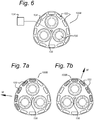
- Figure 6 shows a schematic frontal view of the face plate 104 of a rotary shaver 100B according to a further embodiment of the invention. Like elements to those of Figures 3 and 5 are given like references.
- Figure 6 differs from the embodiment of Figure 5 by the presence of a plurality of electro-adhesive elements 122 distributed around the periphery of the face plate 104 and an optical direction sensor 138 which in this embodiment is located at the centre of the face plate.
- the optical sensor 138 is operatively connected to the controller 134.
- Figures 7A and 7B illustrate frontal views of the face plate 104 of Figure 6 during operation of the shaver 100B.
- the optical sensor 138 takes images at a frequency of around 30Hz and the controller 134 calculates a motion vector from the differences between successive images.
- the controller 134 uses the motion vector to determine the direction and speed of movement M. Based on this measurement, it increases the attractive force of the electro-adhesive elements 122 that are located ahead of the heads 102 and it decreases the attractive force of the elements 122 that are located behind the heads 102, relative to the direction of movement M. The skin is thus held tight and skin doming is reduced.
Landscapes
- Life Sciences & Earth Sciences (AREA)
- Forests & Forestry (AREA)
- Engineering & Computer Science (AREA)
- Mechanical Engineering (AREA)
- Dry Shavers And Clippers (AREA)
- Cosmetics (AREA)
Priority Applications (1)
| Application Number | Priority Date | Filing Date | Title |
|---|---|---|---|
| PL13720578T PL2828046T3 (pl) | 2012-03-22 | 2013-03-13 | Golarka mająca dostosowującą się zapewniającą styk ze skórą powierzchnię |
Applications Claiming Priority (2)
| Application Number | Priority Date | Filing Date | Title |
|---|---|---|---|
| US201261614147P | 2012-03-22 | 2012-03-22 | |
| PCT/IB2013/051988 WO2013140309A1 (en) | 2012-03-22 | 2013-03-13 | Shaver having adaptive surface |
Publications (2)
| Publication Number | Publication Date |
|---|---|
| EP2828046A1 EP2828046A1 (en) | 2015-01-28 |
| EP2828046B1 true EP2828046B1 (en) | 2018-10-03 |
Family
ID=48289542
Family Applications (1)
| Application Number | Title | Priority Date | Filing Date |
|---|---|---|---|
| EP13720578.7A Active EP2828046B1 (en) | 2012-03-22 | 2013-03-13 | Shaver having adaptive skin engaging surface |
Country Status (9)
| Country | Link |
|---|---|
| US (1) | US9821479B2 (enExample) |
| EP (1) | EP2828046B1 (enExample) |
| JP (1) | JP6113825B2 (enExample) |
| CN (1) | CN104185537B (enExample) |
| BR (1) | BR112014023001B1 (enExample) |
| ES (1) | ES2702037T3 (enExample) |
| PL (1) | PL2828046T3 (enExample) |
| RU (1) | RU2635502C2 (enExample) |
| WO (1) | WO2013140309A1 (enExample) |
Families Citing this family (23)
| Publication number | Priority date | Publication date | Assignee | Title |
|---|---|---|---|---|
| US10131061B2 (en) * | 2013-05-30 | 2018-11-20 | Koninklijke Philips N.V. | Device and system for treating hair and/or skin |
| RU2700885C2 (ru) | 2014-09-26 | 2019-09-23 | Конинклейке Филипс Н.В. | Бритвенный прибор для волос |
| WO2016087253A1 (en) * | 2014-12-01 | 2016-06-09 | Koninklijke Philips N.V. | Hair removal apparatus |
| JP6588550B2 (ja) * | 2014-12-11 | 2019-10-09 | コーニンクレッカ フィリップス エヌ ヴェKoninklijke Philips N.V. | スキントリートメントデバイス |
| PL3245030T3 (pl) * | 2015-01-15 | 2021-11-15 | Koninklijke Philips N.V. | Urządzenie do cięcia włosów |
| CN107921650B (zh) * | 2015-08-24 | 2021-02-05 | 皇家飞利浦有限公司 | 用于剃刮设备的最佳使用的分阶段建议 |
| AT518027A1 (de) * | 2015-12-01 | 2017-06-15 | Payer Int Tech Gmbh | Haarschneidegerät |
| EP3472874B1 (en) * | 2016-06-20 | 2019-10-09 | Koninklijke Philips N.V. | Friction control device and method |
| EP3546149B1 (en) | 2018-03-27 | 2021-05-12 | Braun GmbH | Hair removal device |
| EP3546148B1 (en) | 2018-03-27 | 2022-01-12 | Braun GmbH | Personal care device |
| EP3546151B1 (en) | 2018-03-27 | 2025-04-30 | Braun GmbH | PERSONAL CARE DEVICE |
| EP3546150B1 (en) | 2018-03-27 | 2021-10-27 | Braun GmbH | Personal care device |
| EP3800644A1 (en) * | 2019-10-02 | 2021-04-07 | Koninklijke Philips N.V. | Determining a location of a device |
| CN110802640B (zh) * | 2019-11-15 | 2025-06-03 | 深圳素士科技股份有限公司 | 刀头组件、手柄组件及感应式剃须刀 |
| US11673282B2 (en) * | 2020-07-02 | 2023-06-13 | The Gillette Company Llc | Sensor-based shaving systems and methods of analyzing a user's shave event for determining a unique threshold value of the user |
| US20220063117A1 (en) * | 2020-08-25 | 2022-03-03 | Moses Brown | Hair Cutting System and Methods of Use |
| EP3978212A1 (en) * | 2020-09-30 | 2022-04-06 | Koninklijke Philips N.V. | Shaving unit and electric shaver comprising a main body and a shaving unit |
| JP7641562B2 (ja) * | 2021-02-04 | 2025-03-07 | パナソニックIpマネジメント株式会社 | 毛切断用理美容機器および理美容システム |
| WO2023006635A1 (en) * | 2021-07-27 | 2023-02-02 | Koninklijke Philips N.V. | Shaving unit and electric shaver comprising the same |
| KR20240035934A (ko) * | 2021-07-27 | 2024-03-19 | 코닌클리케 필립스 엔.브이. | 면도 유닛 및 이를 포함하는 전기 면도기 |
| EP4124422B1 (en) * | 2021-07-29 | 2025-12-10 | Braun GmbH | Personal care device |
| EP4183535A1 (en) * | 2021-11-23 | 2023-05-24 | Koninklijke Philips N.V. | Hair-cutting head and hair-cutting device |
| EP4360831A1 (en) | 2022-10-25 | 2024-05-01 | BIC Violex Single Member S.A. | Shaver head |
Family Cites Families (30)
| Publication number | Priority date | Publication date | Assignee | Title |
|---|---|---|---|---|
| DE605623C (de) | 1933-07-04 | 1935-03-23 | Otto Beuth | Vorrichtung zum Ansaugen der Haut an Rasiermaschinen |
| US3316633A (en) * | 1965-10-14 | 1967-05-02 | Gen Medical Co | Electrical hair-erector shaver |
| US3373747A (en) * | 1967-04-28 | 1968-03-19 | Gen Medical Co | Electrical muscle stimulator device and razor attachment therefor |
| DE2133113A1 (de) | 1971-07-02 | 1973-01-18 | Braun Ag | Fangelektrode fuer einrichtungen zur haarstaubbindung in trockenrasierapparaten |
| US4089110A (en) | 1976-03-08 | 1978-05-16 | Rasco Darius K | Shaving means |
| JPS6041960B2 (ja) * | 1980-09-30 | 1985-09-19 | 松下電工株式会社 | 皮膚面伸張用ヘツド付き電気かみそり |
| JPS57206477A (en) | 1981-06-15 | 1982-12-17 | Matsushita Electric Works Ltd | Electric razor |
| US4896420A (en) * | 1987-10-07 | 1990-01-30 | Remington Products, Inc. | Electric shaver |
| WO1996001171A1 (en) * | 1994-07-01 | 1996-01-18 | The Gillette Company | Skin engaging member for razor blade assembly |
| US6125542A (en) * | 1998-04-30 | 2000-10-03 | Somma; Dante | Self-powered razor head |
| US6070327A (en) * | 1999-02-19 | 2000-06-06 | Taso; Selim | Manual shaving apparatus |
| CN1293998C (zh) | 2000-12-22 | 2007-01-10 | 皇家菲利浦电子有限公司 | 电动剃须刀的辅助部件 |
| DE20115818U1 (de) * | 2001-09-26 | 2002-04-18 | Merlaku, Kastriot, 80807 München | Rasierhilfsgerät |
| US8627573B2 (en) * | 2002-10-05 | 2014-01-14 | Braun Gmbh | Hair-removing device |
| EP1697095B1 (en) | 2003-12-10 | 2008-08-27 | Koninklijke Philips Electronics N.V. | Shaving head with skin stretching member |
| JP2006289098A (ja) | 2005-04-12 | 2006-10-26 | Inolase 2002 Ltd | 皮膚の真空援用式光ベース治療用の装置 |
| DE102006004675A1 (de) | 2006-02-02 | 2007-08-09 | Braun Gmbh | Elektrisch betriebener Rasierer |
| US7551419B2 (en) | 2006-06-05 | 2009-06-23 | Sri International | Electroadhesion |
| WO2008091625A2 (en) * | 2007-01-22 | 2008-07-31 | Syneron Medical Ltd. | Hair removal devices and methods |
| AU2009205297A1 (en) * | 2008-01-17 | 2009-07-23 | Syneron Medical Ltd. | A hair removal apparatus for personal use and the method of using same |
| DE102008032389A1 (de) * | 2008-07-09 | 2010-01-14 | Richard Seidenbusch | E-Flux-Rasierer |
| DE102008048725A1 (de) | 2008-09-24 | 2010-03-25 | Braun Gmbh | Haarentfernungsgerät mit Vorrichtung zur Vorbereitung der Haut |
| FR2939633B1 (fr) | 2008-12-11 | 2011-01-21 | Seb Sa | Appareil a main de soins corporels a detection de presence. |
| BR112012001213B8 (pt) | 2009-07-23 | 2021-12-21 | Koninklijke Philips Electronics Nv | Aparelho de cortar cabelo e método de ultilização do aparelho de cortar cabelo |
| JP5701887B2 (ja) | 2009-10-05 | 2015-04-15 | コーニンクレッカ フィリップス エヌ ヴェ | 安全なかみそり刃ユニットを持つシェービング装置 |
| AU2010325682B2 (en) * | 2009-12-06 | 2014-09-11 | Gilead Bar - Ilan | A method and apparatus for personal skin treatment |
| JP2011125410A (ja) * | 2009-12-15 | 2011-06-30 | Takao Ikeda | 電気かみそり |
| CN201941027U (zh) * | 2011-03-02 | 2011-08-24 | 钱叶亮 | 安全智能剃须刀 |
| BR112014014921A2 (pt) * | 2011-12-22 | 2017-06-13 | Koninklijke Philips Nv | dispositivo de corte de pelos |
| US9084891B2 (en) * | 2012-02-06 | 2015-07-21 | David Aberizk | Pilomotor effect stimulating device and method |
-
2013
- 2013-03-13 BR BR112014023001-3A patent/BR112014023001B1/pt not_active IP Right Cessation
- 2013-03-13 ES ES13720578T patent/ES2702037T3/es active Active
- 2013-03-13 RU RU2014142553A patent/RU2635502C2/ru active
- 2013-03-13 WO PCT/IB2013/051988 patent/WO2013140309A1/en not_active Ceased
- 2013-03-13 JP JP2015501022A patent/JP6113825B2/ja active Active
- 2013-03-13 PL PL13720578T patent/PL2828046T3/pl unknown
- 2013-03-13 CN CN201380015523.7A patent/CN104185537B/zh active Active
- 2013-03-13 US US14/383,592 patent/US9821479B2/en active Active
- 2013-03-13 EP EP13720578.7A patent/EP2828046B1/en active Active
Non-Patent Citations (1)
| Title |
|---|
| None * |
Also Published As
| Publication number | Publication date |
|---|---|
| JP2015510808A (ja) | 2015-04-13 |
| ES2702037T3 (es) | 2019-02-27 |
| US20150128776A1 (en) | 2015-05-14 |
| EP2828046A1 (en) | 2015-01-28 |
| WO2013140309A1 (en) | 2013-09-26 |
| BR112014023001B1 (pt) | 2020-09-29 |
| US9821479B2 (en) | 2017-11-21 |
| RU2635502C2 (ru) | 2017-11-13 |
| JP6113825B2 (ja) | 2017-04-12 |
| PL2828046T3 (pl) | 2019-03-29 |
| CN104185537B (zh) | 2016-08-24 |
| RU2014142553A (ru) | 2016-05-20 |
| CN104185537A (zh) | 2014-12-03 |
Similar Documents
| Publication | Publication Date | Title |
|---|---|---|
| EP2828046B1 (en) | Shaver having adaptive skin engaging surface | |
| EP1556191B1 (en) | Razor system having razor sensors | |
| EP3230020B1 (en) | Skin treatment device | |
| US11097437B2 (en) | Personal care device | |
| US11910901B2 (en) | Hair removal apparatus | |
| EP3065920B2 (en) | A system for treating a part of a body | |
| US7913393B2 (en) | Safety razor with multi-pivot blade unit | |
| EP3003652B1 (en) | Device and system for treating hair and/or skin | |
| JP5377980B2 (ja) | 電動式髭剃器 | |
| RU2017114354A (ru) | Бритвенный прибор для волос | |
| CN105899336B (zh) | 用于处理身体部分的系统和方法 | |
| JP2015510808A5 (enExample) | ||
| EP2227360A1 (en) | Safety razor with multi-pivot blade unit | |
| DE602004019155D1 (de) | Verbesserter elektrischer rasierapparat | |
| EP4311637A1 (en) | Shaving head | |
| WO2022168782A1 (ja) | 電気かみそり | |
| CN117062698A (zh) | 毛发切割系统中的毛发检测 |
Legal Events
| Date | Code | Title | Description |
|---|---|---|---|
| PUAI | Public reference made under article 153(3) epc to a published international application that has entered the european phase |
Free format text: ORIGINAL CODE: 0009012 |
|
| 17P | Request for examination filed |
Effective date: 20141022 |
|
| AK | Designated contracting states |
Kind code of ref document: A1 Designated state(s): AL AT BE BG CH CY CZ DE DK EE ES FI FR GB GR HR HU IE IS IT LI LT LU LV MC MK MT NL NO PL PT RO RS SE SI SK SM TR |
|
| AX | Request for extension of the european patent |
Extension state: BA ME |
|
| DAX | Request for extension of the european patent (deleted) | ||
| GRAP | Despatch of communication of intention to grant a patent |
Free format text: ORIGINAL CODE: EPIDOSNIGR1 |
|
| STAA | Information on the status of an ep patent application or granted ep patent |
Free format text: STATUS: GRANT OF PATENT IS INTENDED |
|
| INTG | Intention to grant announced |
Effective date: 20180425 |
|
| GRAS | Grant fee paid |
Free format text: ORIGINAL CODE: EPIDOSNIGR3 |
|
| GRAA | (expected) grant |
Free format text: ORIGINAL CODE: 0009210 |
|
| STAA | Information on the status of an ep patent application or granted ep patent |
Free format text: STATUS: THE PATENT HAS BEEN GRANTED |
|
| AK | Designated contracting states |
Kind code of ref document: B1 Designated state(s): AL AT BE BG CH CY CZ DE DK EE ES FI FR GB GR HR HU IE IS IT LI LT LU LV MC MK MT NL NO PL PT RO RS SE SI SK SM TR |
|
| REG | Reference to a national code |
Ref country code: GB Ref legal event code: FG4D |
|
| REG | Reference to a national code |
Ref country code: CH Ref legal event code: EP Ref country code: AT Ref legal event code: REF Ref document number: 1048113 Country of ref document: AT Kind code of ref document: T Effective date: 20181015 |
|
| REG | Reference to a national code |
Ref country code: IE Ref legal event code: FG4D Ref country code: DE Ref legal event code: R096 Ref document number: 602013044454 Country of ref document: DE |
|
| REG | Reference to a national code |
Ref country code: NL Ref legal event code: FP |
|
| REG | Reference to a national code |
Ref country code: LT Ref legal event code: MG4D |
|
| REG | Reference to a national code |
Ref country code: ES Ref legal event code: FG2A Ref document number: 2702037 Country of ref document: ES Kind code of ref document: T3 Effective date: 20190227 |
|
| REG | Reference to a national code |
Ref country code: AT Ref legal event code: MK05 Ref document number: 1048113 Country of ref document: AT Kind code of ref document: T Effective date: 20181003 |
|
| PG25 | Lapsed in a contracting state [announced via postgrant information from national office to epo] |
Ref country code: LT Free format text: LAPSE BECAUSE OF FAILURE TO SUBMIT A TRANSLATION OF THE DESCRIPTION OR TO PAY THE FEE WITHIN THE PRESCRIBED TIME-LIMIT Effective date: 20181003 Ref country code: NO Free format text: LAPSE BECAUSE OF FAILURE TO SUBMIT A TRANSLATION OF THE DESCRIPTION OR TO PAY THE FEE WITHIN THE PRESCRIBED TIME-LIMIT Effective date: 20190103 Ref country code: CZ Free format text: LAPSE BECAUSE OF FAILURE TO SUBMIT A TRANSLATION OF THE DESCRIPTION OR TO PAY THE FEE WITHIN THE PRESCRIBED TIME-LIMIT Effective date: 20181003 Ref country code: AT Free format text: LAPSE BECAUSE OF FAILURE TO SUBMIT A TRANSLATION OF THE DESCRIPTION OR TO PAY THE FEE WITHIN THE PRESCRIBED TIME-LIMIT Effective date: 20181003 Ref country code: IS Free format text: LAPSE BECAUSE OF FAILURE TO SUBMIT A TRANSLATION OF THE DESCRIPTION OR TO PAY THE FEE WITHIN THE PRESCRIBED TIME-LIMIT Effective date: 20190203 Ref country code: FI Free format text: LAPSE BECAUSE OF FAILURE TO SUBMIT A TRANSLATION OF THE DESCRIPTION OR TO PAY THE FEE WITHIN THE PRESCRIBED TIME-LIMIT Effective date: 20181003 Ref country code: BG Free format text: LAPSE BECAUSE OF FAILURE TO SUBMIT A TRANSLATION OF THE DESCRIPTION OR TO PAY THE FEE WITHIN THE PRESCRIBED TIME-LIMIT Effective date: 20190103 Ref country code: HR Free format text: LAPSE BECAUSE OF FAILURE TO SUBMIT A TRANSLATION OF THE DESCRIPTION OR TO PAY THE FEE WITHIN THE PRESCRIBED TIME-LIMIT Effective date: 20181003 Ref country code: LV Free format text: LAPSE BECAUSE OF FAILURE TO SUBMIT A TRANSLATION OF THE DESCRIPTION OR TO PAY THE FEE WITHIN THE PRESCRIBED TIME-LIMIT Effective date: 20181003 |
|
| PG25 | Lapsed in a contracting state [announced via postgrant information from national office to epo] |
Ref country code: RS Free format text: LAPSE BECAUSE OF FAILURE TO SUBMIT A TRANSLATION OF THE DESCRIPTION OR TO PAY THE FEE WITHIN THE PRESCRIBED TIME-LIMIT Effective date: 20181003 Ref country code: AL Free format text: LAPSE BECAUSE OF FAILURE TO SUBMIT A TRANSLATION OF THE DESCRIPTION OR TO PAY THE FEE WITHIN THE PRESCRIBED TIME-LIMIT Effective date: 20181003 Ref country code: SE Free format text: LAPSE BECAUSE OF FAILURE TO SUBMIT A TRANSLATION OF THE DESCRIPTION OR TO PAY THE FEE WITHIN THE PRESCRIBED TIME-LIMIT Effective date: 20181003 Ref country code: PT Free format text: LAPSE BECAUSE OF FAILURE TO SUBMIT A TRANSLATION OF THE DESCRIPTION OR TO PAY THE FEE WITHIN THE PRESCRIBED TIME-LIMIT Effective date: 20190203 Ref country code: GR Free format text: LAPSE BECAUSE OF FAILURE TO SUBMIT A TRANSLATION OF THE DESCRIPTION OR TO PAY THE FEE WITHIN THE PRESCRIBED TIME-LIMIT Effective date: 20190104 |
|
| REG | Reference to a national code |
Ref country code: DE Ref legal event code: R097 Ref document number: 602013044454 Country of ref document: DE |
|
| PG25 | Lapsed in a contracting state [announced via postgrant information from national office to epo] |
Ref country code: DK Free format text: LAPSE BECAUSE OF FAILURE TO SUBMIT A TRANSLATION OF THE DESCRIPTION OR TO PAY THE FEE WITHIN THE PRESCRIBED TIME-LIMIT Effective date: 20181003 |
|
| PLBE | No opposition filed within time limit |
Free format text: ORIGINAL CODE: 0009261 |
|
| STAA | Information on the status of an ep patent application or granted ep patent |
Free format text: STATUS: NO OPPOSITION FILED WITHIN TIME LIMIT |
|
| PG25 | Lapsed in a contracting state [announced via postgrant information from national office to epo] |
Ref country code: RO Free format text: LAPSE BECAUSE OF FAILURE TO SUBMIT A TRANSLATION OF THE DESCRIPTION OR TO PAY THE FEE WITHIN THE PRESCRIBED TIME-LIMIT Effective date: 20181003 Ref country code: SM Free format text: LAPSE BECAUSE OF FAILURE TO SUBMIT A TRANSLATION OF THE DESCRIPTION OR TO PAY THE FEE WITHIN THE PRESCRIBED TIME-LIMIT Effective date: 20181003 Ref country code: EE Free format text: LAPSE BECAUSE OF FAILURE TO SUBMIT A TRANSLATION OF THE DESCRIPTION OR TO PAY THE FEE WITHIN THE PRESCRIBED TIME-LIMIT Effective date: 20181003 Ref country code: SK Free format text: LAPSE BECAUSE OF FAILURE TO SUBMIT A TRANSLATION OF THE DESCRIPTION OR TO PAY THE FEE WITHIN THE PRESCRIBED TIME-LIMIT Effective date: 20181003 |
|
| 26N | No opposition filed |
Effective date: 20190704 |
|
| PG25 | Lapsed in a contracting state [announced via postgrant information from national office to epo] |
Ref country code: SI Free format text: LAPSE BECAUSE OF FAILURE TO SUBMIT A TRANSLATION OF THE DESCRIPTION OR TO PAY THE FEE WITHIN THE PRESCRIBED TIME-LIMIT Effective date: 20181003 Ref country code: MC Free format text: LAPSE BECAUSE OF FAILURE TO SUBMIT A TRANSLATION OF THE DESCRIPTION OR TO PAY THE FEE WITHIN THE PRESCRIBED TIME-LIMIT Effective date: 20181003 |
|
| REG | Reference to a national code |
Ref country code: CH Ref legal event code: PL |
|
| PG25 | Lapsed in a contracting state [announced via postgrant information from national office to epo] |
Ref country code: LU Free format text: LAPSE BECAUSE OF NON-PAYMENT OF DUE FEES Effective date: 20190313 |
|
| PG25 | Lapsed in a contracting state [announced via postgrant information from national office to epo] |
Ref country code: IE Free format text: LAPSE BECAUSE OF NON-PAYMENT OF DUE FEES Effective date: 20190313 Ref country code: CH Free format text: LAPSE BECAUSE OF NON-PAYMENT OF DUE FEES Effective date: 20190331 Ref country code: LI Free format text: LAPSE BECAUSE OF NON-PAYMENT OF DUE FEES Effective date: 20190331 |
|
| PG25 | Lapsed in a contracting state [announced via postgrant information from national office to epo] |
Ref country code: MT Free format text: LAPSE BECAUSE OF NON-PAYMENT OF DUE FEES Effective date: 20190313 |
|
| PGFP | Annual fee paid to national office [announced via postgrant information from national office to epo] |
Ref country code: NL Payment date: 20210325 Year of fee payment: 9 Ref country code: IT Payment date: 20210323 Year of fee payment: 9 |
|
| PG25 | Lapsed in a contracting state [announced via postgrant information from national office to epo] |
Ref country code: CY Free format text: LAPSE BECAUSE OF FAILURE TO SUBMIT A TRANSLATION OF THE DESCRIPTION OR TO PAY THE FEE WITHIN THE PRESCRIBED TIME-LIMIT Effective date: 20181003 |
|
| PGFP | Annual fee paid to national office [announced via postgrant information from national office to epo] |
Ref country code: TR Payment date: 20210310 Year of fee payment: 9 Ref country code: BE Payment date: 20210326 Year of fee payment: 9 |
|
| PG25 | Lapsed in a contracting state [announced via postgrant information from national office to epo] |
Ref country code: HU Free format text: LAPSE BECAUSE OF FAILURE TO SUBMIT A TRANSLATION OF THE DESCRIPTION OR TO PAY THE FEE WITHIN THE PRESCRIBED TIME-LIMIT; INVALID AB INITIO Effective date: 20130313 |
|
| PGFP | Annual fee paid to national office [announced via postgrant information from national office to epo] |
Ref country code: ES Payment date: 20210414 Year of fee payment: 9 |
|
| PG25 | Lapsed in a contracting state [announced via postgrant information from national office to epo] |
Ref country code: MK Free format text: LAPSE BECAUSE OF FAILURE TO SUBMIT A TRANSLATION OF THE DESCRIPTION OR TO PAY THE FEE WITHIN THE PRESCRIBED TIME-LIMIT Effective date: 20181003 |
|
| PGFP | Annual fee paid to national office [announced via postgrant information from national office to epo] |
Ref country code: PL Payment date: 20210303 Year of fee payment: 9 |
|
| REG | Reference to a national code |
Ref country code: NL Ref legal event code: MM Effective date: 20220401 |
|
| REG | Reference to a national code |
Ref country code: BE Ref legal event code: MM Effective date: 20220331 |
|
| PG25 | Lapsed in a contracting state [announced via postgrant information from national office to epo] |
Ref country code: NL Free format text: LAPSE BECAUSE OF NON-PAYMENT OF DUE FEES Effective date: 20220401 |
|
| PG25 | Lapsed in a contracting state [announced via postgrant information from national office to epo] |
Ref country code: BE Free format text: LAPSE BECAUSE OF NON-PAYMENT OF DUE FEES Effective date: 20220331 |
|
| REG | Reference to a national code |
Ref country code: ES Ref legal event code: FD2A Effective date: 20230529 |
|
| PG25 | Lapsed in a contracting state [announced via postgrant information from national office to epo] |
Ref country code: IT Free format text: LAPSE BECAUSE OF NON-PAYMENT OF DUE FEES Effective date: 20220313 |
|
| PG25 | Lapsed in a contracting state [announced via postgrant information from national office to epo] |
Ref country code: ES Free format text: LAPSE BECAUSE OF NON-PAYMENT OF DUE FEES Effective date: 20220314 |
|
| PG25 | Lapsed in a contracting state [announced via postgrant information from national office to epo] |
Ref country code: PL Free format text: LAPSE BECAUSE OF NON-PAYMENT OF DUE FEES Effective date: 20220313 |
|
| PGFP | Annual fee paid to national office [announced via postgrant information from national office to epo] |
Ref country code: DE Payment date: 20250327 Year of fee payment: 13 |
|
| PGFP | Annual fee paid to national office [announced via postgrant information from national office to epo] |
Ref country code: FR Payment date: 20250324 Year of fee payment: 13 |
|
| PGFP | Annual fee paid to national office [announced via postgrant information from national office to epo] |
Ref country code: GB Payment date: 20250325 Year of fee payment: 13 |