EP2827137A1 - Hydrogen measurement sensor having junction structure of solid oxygen ion conductor and solid hydrogen ion conductor in molten metal - Google Patents
Hydrogen measurement sensor having junction structure of solid oxygen ion conductor and solid hydrogen ion conductor in molten metal Download PDFInfo
- Publication number
- EP2827137A1 EP2827137A1 EP12871533.1A EP12871533A EP2827137A1 EP 2827137 A1 EP2827137 A1 EP 2827137A1 EP 12871533 A EP12871533 A EP 12871533A EP 2827137 A1 EP2827137 A1 EP 2827137A1
- Authority
- EP
- European Patent Office
- Prior art keywords
- hydrogen
- ion conductor
- solid
- molten metal
- measurement sensor
- Prior art date
- Legal status (The legal status is an assumption and is not a legal conclusion. Google has not performed a legal analysis and makes no representation as to the accuracy of the status listed.)
- Granted
Links
Images


Classifications
-
- G—PHYSICS
- G01—MEASURING; TESTING
- G01N—INVESTIGATING OR ANALYSING MATERIALS BY DETERMINING THEIR CHEMICAL OR PHYSICAL PROPERTIES
- G01N27/00—Investigating or analysing materials by the use of electric, electrochemical, or magnetic means
- G01N27/26—Investigating or analysing materials by the use of electric, electrochemical, or magnetic means by investigating electrochemical variables; by using electrolysis or electrophoresis
- G01N27/403—Cells and electrode assemblies
- G01N27/406—Cells and probes with solid electrolytes
- G01N27/411—Cells and probes with solid electrolytes for investigating or analysing of liquid metals
- G01N27/4112—Composition or fabrication of the solid electrolyte
-
- G—PHYSICS
- G01—MEASURING; TESTING
- G01N—INVESTIGATING OR ANALYSING MATERIALS BY DETERMINING THEIR CHEMICAL OR PHYSICAL PROPERTIES
- G01N27/00—Investigating or analysing materials by the use of electric, electrochemical, or magnetic means
- G01N27/02—Investigating or analysing materials by the use of electric, electrochemical, or magnetic means by investigating impedance
-
- G—PHYSICS
- G01—MEASURING; TESTING
- G01N—INVESTIGATING OR ANALYSING MATERIALS BY DETERMINING THEIR CHEMICAL OR PHYSICAL PROPERTIES
- G01N27/00—Investigating or analysing materials by the use of electric, electrochemical, or magnetic means
- G01N27/26—Investigating or analysing materials by the use of electric, electrochemical, or magnetic means by investigating electrochemical variables; by using electrolysis or electrophoresis
- G01N27/403—Cells and electrode assemblies
- G01N27/406—Cells and probes with solid electrolytes
- G01N27/407—Cells and probes with solid electrolytes for investigating or analysing gases
- G01N27/4073—Composition or fabrication of the solid electrolyte
- G01N27/4074—Composition or fabrication of the solid electrolyte for detection of gases other than oxygen
-
- G—PHYSICS
- G01—MEASURING; TESTING
- G01N—INVESTIGATING OR ANALYSING MATERIALS BY DETERMINING THEIR CHEMICAL OR PHYSICAL PROPERTIES
- G01N27/00—Investigating or analysing materials by the use of electric, electrochemical, or magnetic means
- G01N27/26—Investigating or analysing materials by the use of electric, electrochemical, or magnetic means by investigating electrochemical variables; by using electrolysis or electrophoresis
- G01N27/403—Cells and electrode assemblies
- G01N27/406—Cells and probes with solid electrolytes
- G01N27/411—Cells and probes with solid electrolytes for investigating or analysing of liquid metals
- G01N27/4112—Composition or fabrication of the solid electrolyte
- G01N27/4114—Composition or fabrication of the solid electrolyte for detection of gases other than oxygen
-
- G—PHYSICS
- G01—MEASURING; TESTING
- G01N—INVESTIGATING OR ANALYSING MATERIALS BY DETERMINING THEIR CHEMICAL OR PHYSICAL PROPERTIES
- G01N33/00—Investigating or analysing materials by specific methods not covered by groups G01N1/00 - G01N31/00
- G01N33/20—Metals
- G01N33/202—Constituents thereof
- G01N33/2022—Non-metallic constituents
-
- G—PHYSICS
- G01—MEASURING; TESTING
- G01N—INVESTIGATING OR ANALYSING MATERIALS BY DETERMINING THEIR CHEMICAL OR PHYSICAL PROPERTIES
- G01N33/00—Investigating or analysing materials by specific methods not covered by groups G01N1/00 - G01N31/00
- G01N33/20—Metals
- G01N33/205—Metals in liquid state, e.g. molten metals
Definitions
- the present invention relates to a hydrogen measurement sensor capable of monitoring a content of hydrogen within molten metal in real-time using an aluminum or magnesium alloy casting method, and more particularly, to a hydrogen measurement sensor having a junction structure of a solid oxygen ion conductor and a solid hydrogen ion conductor in molten metal capable of measuring a content of hydrogen within aluminum-magnesium alloy-molten metal using a new method which generates a fixed concentration of oxygen gas from a solid reference material at a high temperature by replacing a reference material of a standard gas method which is difficult to handle with a solid reference material or external air which is easy to handle or has the same effect as that of the gas reference material by using a feature in which the external air contains a predetermined pressure (about 0.21 atm) of oxygen.
- a casting method for making a desired shape by melting metal and a method for mixing and sintering powder type raw materials.
- a high temperature melting casting technology is most frequently used in the method.
- one of the main factors of determining a quality of products in the aluminum or magnesium casting process is an amount of dissolved hydrogen which is generated by penetrating moisture decomposed in the atmosphere into molten metal. Since the dissolved hydrogen has a difference in solubility of about 10 to 20 times in a liquid state and a solid state, the hydrogen is agglomerated at the time of coagulation of a molten aluminum-magnesium alloy and thus pores are formed.
- a technology which is mainly used to measure the content of hydrogen within the molten metal in producing the aluminum or magnesium products uses a method for cutting the product coming out after coagulating the molten metal and observing pores within the product to calculate the content of hydrogen; however, for the measurement of the content of hydrogen based on the method, may not avoid a breakage of a final product.
- another method uses a hydrogen sensor which measures the content of hydrogen within the aluminum or magnesium molten metal and uses only a hydrogen ion solid electrolyte and therefore blows gas having a standard hydrogen concentration into one surface of an electrode (reference electrode) to fix a hydrogen concentration of the reference electrode and putting the other surface of the electrode into the molten metal to measure an electromotive force generated due to a difference between a hydrogen partial pressure within the molten metal and a hydrogen pressure of the standard gas, thereby measuring the content of hydrogen within the molten metal.
- a hydrogen sensor which measures the content of hydrogen within the aluminum or magnesium molten metal and uses only a hydrogen ion solid electrolyte and therefore blows gas having a standard hydrogen concentration into one surface of an electrode (reference electrode) to fix a hydrogen concentration of the reference electrode and putting the other surface of the electrode into the molten metal to measure an electromotive force generated due to a difference between a hydrogen partial pressure within the molten metal and a hydrogen pressure of the standard gas, thereby measuring the content
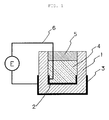
- a hydrogen sensor for aluminum (alloy) molten metal (Korean Patent No. 10-0499044 ) configured to include a hydrogen ion conductor 1, a solid reference material 4 filled in the hydrogen ion conductor 1, a ceramic cover 5 formed on the solid reference material, a reference electrode 2 formed between the solid reference material 4 and the hydrogen ion conductor 1, a measurement electrode 3 formed outside the hydrogen ion conductor 1, and a wire 6 connecting the reference electrode 2 to the measurement electrode 3.
- the hydrogen sensor for aluminum molten metal may be configured to measure the concentration of hydrogen by fixing the hydrogen partial pressure of hydrogen which becomes a reference using Ti/TiH 2 /TiO, Ca/CaH 2/ CaO, or the like which is the solid reference material 4 but requires a high temperature sealing technology of sealing gas at a high temperature and therefore may cause a problem of making a structure of packaging complex.
- An object of the present invention is to provide a hydrogen measurement sensor having a junction structure of a solid oxygen ion conductor and a solid hydrogen ion conductor in molten metal based on a new method capable of monitoring a content of dissolved hydrogen within the molten metal in real-time to control the content of hydrogen within the molten metal which dominates a quality of products at the time of producing a casting products of an aluminum-magnesium alloy and generating a fixed concentration of oxygen gas from a solid reference material at a high temperature by replacing a reference material of a standard gas method which is difficult to handle with a solid reference material or external air which is easy to handle or having the same effect as that of the gas reference material by using a feature in which the external air contains a predetermined pressure (0.21 atm) of oxygen.
- a hydrogen measurement sensor having a junction structure of a solid oxygen ion conductor and a solid hydrogen ion conductor in molten metal includes an oxygen ion conductor 100 whose inside is hollow and one portion is open; a hydrogen ion conductor 200 coupled with an outer side of the oxygen ion conductor 100; a measurement metal electrode 300 formed at an outer side of the hydrogen ion conductor 200; a reference metal electrode 400 formed inside the oxygen ion conductor 100; and voltage measurement wires 600 connected to the measurement metal electrode 300 and the reference metal electrode 400, respectively.
- the oxygen ion conductor 100 may be made of a solid electrolyte including zirconia ZrO 2 or any one selected from materials in which GdO 3 is added to CeO 2 -based materials.
- the zirconia ZrO 2 may be any one selected from yttria stabilized zirconia (YSZ), calcium stabilized zirconia (CSZ), and magnesium stabilized zirconia (MSZ).
- YSZ yttria stabilized zirconia
- CSZ calcium stabilized zirconia
- MSZ magnesium stabilized zirconia
- the hydrogen ion conductor 200 may be made of any one selected from CaZrO 3 -based compounds including CaZr 0.9 In 0.1 O 3-X , SrZrO 3 -based compounds including SrZr 0.95 Y 0.05 O 3-X , SrCeO 3 -based compounds including SrCe 0.95 Yb 0.05 O 3-X . and BaCeO 3 -based compounds including BaCe 0.9 Nd 0.1 O 3-X as a compound in which other materials are substituted into place B of a material having an ABO 3 type perovskite structure or any one selected from Ti-based compounds including BaTiO 3 , SrTiO 3 , or PbTiO 3 .
- the hydrogen measurement sensor may further include: a ceramic tube 700 which is coupled with an upper portion of the hydrogen ion conductor 200 and has both sides opened.
- the hydrogen measurement sensor having a junction structure of a solid oxygen ion conductor and a solid hydrogen ion conductor in molten metal replaces the reference material of the standard gas method which is difficult to handle with the solid reference material or the external air which is easy to handle to obtain the same effect as that of the gas reference material, thereby simplifying the measurement apparatus.
- the hydrogen gas barrel is not required and thus the costs may be saved and the safety may be improved.
- the content of hydrogen within the molten metal may be accurately measured and thus the quality of the final aluminum or magnesium product may be improved and the high reproducibility may be made in the manufacturing process.
- FIG. 2 is a cross-sectional view schematically illustrating a hydrogen measurement sensor having a junction structure of a solid oxygen ion conductor and a solid hydrogen ion conductor in molten metal according to an exemplary embodiment of the present invention.
- FIG. 3 is a diagram illustrating an application example in which an oxygen ion conductor and a hydrogen ion conductor have a tube type and
- FIG. 4 is a diagram illustrating an application structure in which the hydrogen ion conductor is buried into the oxygen ion conductor in a pellet form.
- the hydrogen measurement sensor having a junction structure of a solid oxygen ion conductor and a solid hydrogen ion conductor in molten metal is configured to include: an oxygen ion conductor 100 whose inside is hollow and one portion is open; a hydrogen ion conductor 200 coupled with an outer side of the oxygen ion conductor 100; a measurement metal electrode 300 formed at an outer side of the hydrogen ion conductor 200; a reference metal electrode 400 formed inside the oxygen ion conductor 100; and voltage measurement wires 600 connected to the measurement metal electrode 300 and the reference metal electrode 400, respectively.
- the oxygen ion conductor 100 has a cup form in which an inside is hollow, a lower portion stops, and an upper portion is open.
- the oxygen ion conductor 100 may be made of a solid electrolyte including zirconia ZrO 2 or any one selected from materials in which GdO 3 is added to CeO 2 -based materials.
- the zirconia ZrO 2 may be any one selected from yttria stabilized zirconia (YSZ), calcium stabilized zirconia (CSZ), and magnesium stabilized zirconia (MSZ).
- the hydrogen ion conductor 200 is coupled with the outer side of the oxygen ion conductor 100. That is, the hydrogen ion conductor 200 also has a cup form and is thus formed to have the opened upper portion by having the oxygen ion conductor 100 foldably coupled with the inner side thereof.
- the hydrogen ion conductor 200 may be made of any one selected from CaZrO 3 -based compounds including CaZr 0.9 In 0.1 O 3-X , SrZrO 3 -based compounds including SrZr 0.95 Y 0.05 O 3-X , SrCeO 3 -based compounds including SrCe 0.95 Yb 0.05 O 3-X , and BaCeO 3 -based compounds including BaCe 0.9 Nd 0.1 O 3-X as a compound in which other materials are substituted into place B of a material having an ABO 3 type perovskite structure or any one selected from Ti-based compounds including BaTiO 3 , SrTiO 3 , or PbTiO 3 .
- the oxygen ion conductor 100 and the hydrogen ion conductor 200 may be formed to have the same thickness and a thickness of each portion thereof may be formed uniformly.
- the measurement metal electrode 300 may be formed at the outer side of the hydrogen ion conductor 200 and the measurement metal electrode 300 may be formed at a lower end or a side of the hydrogen ion conductor 200.
- the reference metal electrode 400 may be formed at the inner side of the oxygen ion conductor 100 and the reference metal electrode 400 may be formed at a lower end or a side of the oxygen ion conductor 100.
- platinum may be used and the measurement metal electrode 300 and the reference metal electrode 400 are each connected to the voltage measurement wires 600 and the voltage measurement wires 600 are configured to be connected to a separate voltage measurement apparatus E to measure a voltage of a hydrogen measurement sensor 1000 according to the exemplary embodiment of the present invention.
- the measurement metal electrode 300 is a contact portion with aluminum or magnesium molten metal (molten metal) and the reference metal electrode 400 contacts air 500.
- the hydrogen measurement sensor 1000 generally has a structure in which a conductive material such as porous carbon blocks an middle portion between the aluminum or magnesium molten metal and the measurement metal electrode 300 so as to prevent the aluminum or magnesium molten metal from directly contacting the measurement metal electrode 300, thereby passing through electrons for measuring a voltage and blocking the molten metal.
- the hydrogen measurement sensor 1000 may be configured to further include a ceramic tube 700 which is coupled with an upper portion of the hydrogen ion conductor 200 and has both sides opened. That is, as illustrated in FIG. 3 , the ceramic tube 700 has an inside hollowed and both sides opened and thus a lower end thereof is coupled with the upper portion of the hydrogen ion conductor 200 to be lengthily formed in a height direction.
- the hydrogen measurement sensor 1000 is put into the aluminum or magnesium molten metal and an opened portion of an upper end of the ceramic tube 700 is positioned in the air to measure the content of hydrogen within molten metal 800.
- the upper end of the ceramic tube 700 is formed to be opened and therefore the insides of the ceramic tube 700 and the oxygen ion conductor 100 are introduced with air in the atmosphere and are fully filled with the air 500.
- the reference metal electrode 400 is connected to voltage measurement wires 610 and 600 and is thus connected to the separate voltage measurement apparatus E and the measurement metal electrode 300 is connected to voltage measurement wires 620 and 600 through the molten metal 800. That is, electricity is conducted to the molten metal 800 and therefore the voltage measurement wires 620 and 600 may be configured to have one portion connected to the voltage measurement apparatus E and the other portion put into the molten metal.
- the hydrogen ion conductor 200 may be formed to be buried into the oxygen ion conductor 100.
- the hydrogen ion conductor 200 may be coupled with the oxygen ion conductor 100 so that one portion of the ceramic tube 700 is inserted into the outer side of the oxygen ion conductor 100.
- an alumina tube may be used as the ceramic tube 700.
- a cover of a porous material such as graphite may be coupled with the outer side of the measurement metal electrode 300, in which the cover may be electrically conducted while preventing a loss of the measurement metal electrode 300 to make hydrogen gas freely be input and discharged and therefore may act as a physical filter.
- the hydrogen measurement sensor is configured to largely include the oxygen ion conductor 100, the hydrogen ion conductor 200, the measurement metal electrode 300, and the reference metal electrode 400 and is applied with a principle of an electrochemical hydrogen sensor.
- the hydrogen measurement sensor 1000 according to the exemplary embodiment of the present invention having the above structure may be shown by a Galvanic cell structure which is represented by the following Equation (1). air , O 2 , Pt O 2 - ⁇ H +
- Equation (1) the air is air 500
- the melt is the molten metal 800
- Equation (2) a chemical reaction contributing to a voltage
- the H 2 is the hydrogen partial pressure of the molten metal
- the oxygen is the oxygen partial pressure (0.21 atm) in the air
- E - ⁇ ⁇ G ° 2 ⁇ F - RT 2 ⁇ F ⁇ ln ⁇ p H 2 ⁇ o p H 2 ⁇ p O 2 1 / 2
- the E is a voltage
- the ⁇ G0 is a difference of standard free energy of the above Equation (2)
- the F is a Faraday constant
- R is a gas constant
- P H2 is the hydrogen partial pressure of the molten metal
- P O2 corresponds to 0.21 as the oxygen partial pressure in the air
- the P H2O has a predetermined constant value. Therefore, we may calculate the hydrogen partial pressure by measuring a voltage value E at a temperature T of the molten metal and therefore may understand the concentration of hydrogen existing within the molten metal from a solubility curve corresponding to the hydrogen partial pressure.
- FIG. 5 is a graph measuring voltage characteristics of the sensor by dipping the hydrogen measurement sensor 1000 according to the exemplary embodiment of the present invention in the aluminum molten metal and blowing the specific concentration of hydrogen into the molten metal.
- the reference metal electrode 400 side uses the oxygen partial pressure in the air and as illustrated, when the concentration of hydrogen is changed, the voltage value is changed well in response to the change.
- the hydrogen measurement sensor according to the exemplary embodiment of the present invention may have the same effect as the gas reference material by replacing the reference material of the standard gas method which is difficult to handle with the external air which is easy to handle and therefore the measurement apparatus may be simple.
- the hydrogen gas barrel is not required and thus the costs may be saved and the safety may be improved.
- the content of hydrogen within the molten metal may be accurately measured and thus the quality of the final aluminum or magnesium product may be improved and the high reproducibility may be made in the manufacturing process.
Landscapes
- Chemical & Material Sciences (AREA)
- Life Sciences & Earth Sciences (AREA)
- Health & Medical Sciences (AREA)
- Pathology (AREA)
- General Physics & Mathematics (AREA)
- Immunology (AREA)
- Physics & Mathematics (AREA)
- Analytical Chemistry (AREA)
- Biochemistry (AREA)
- General Health & Medical Sciences (AREA)
- Chemical Kinetics & Catalysis (AREA)
- Electrochemistry (AREA)
- Molecular Biology (AREA)
- Engineering & Computer Science (AREA)
- Food Science & Technology (AREA)
- Medicinal Chemistry (AREA)
- Measuring Oxygen Concentration In Cells (AREA)
Abstract
Description
- The present invention relates to a hydrogen measurement sensor capable of monitoring a content of hydrogen within molten metal in real-time using an aluminum or magnesium alloy casting method, and more particularly, to a hydrogen measurement sensor having a junction structure of a solid oxygen ion conductor and a solid hydrogen ion conductor in molten metal capable of measuring a content of hydrogen within aluminum-magnesium alloy-molten metal using a new method which generates a fixed concentration of oxygen gas from a solid reference material at a high temperature by replacing a reference material of a standard gas method which is difficult to handle with a solid reference material or external air which is easy to handle or has the same effect as that of the gas reference material by using a feature in which the external air contains a predetermined pressure (about 0.21 atm) of oxygen.
- Generally, as a method for producing products in aluminum or magnesium industries, there are various methods such as a casting method for making a desired shape by melting metal and a method for mixing and sintering powder type raw materials. A high temperature melting casting technology is most frequently used in the method. However, one of the main factors of determining a quality of products in the aluminum or magnesium casting process is an amount of dissolved hydrogen which is generated by penetrating moisture decomposed in the atmosphere into molten metal. Since the dissolved hydrogen has a difference in solubility of about 10 to 20 times in a liquid state and a solid state, the hydrogen is agglomerated at the time of coagulation of a molten aluminum-magnesium alloy and thus pores are formed. These pores not only degrade strength of products but also damage appearance, which is emerging as an important issue in the aluminum or magnesium industries. To solve the problem, a degassing process of forcibly extracting the hydrogen within the molten metal using argon or chloride gas has been carried out in the industrial site. However, the degassing process has a considerable difficulty in making products having a constant content of hydrogen since time required for the degassing process is changed due to the surrounding environment in which the molten metal is melted, a content of impurities within the molten metal, and weather effects of humidity, temperature, or the like. Therefore, a need exists for a development of a hydrogen sensor which may control a quality of molten metal with a constant content of hydrogen by monitoring the content of hydrogen within the molten metal in real time, independent of the surrounding factors.
- However, a technology which is mainly used to measure the content of hydrogen within the molten metal in producing the aluminum or magnesium products uses a method for cutting the product coming out after coagulating the molten metal and observing pores within the product to calculate the content of hydrogen; however, for the measurement of the content of hydrogen based on the method, may not avoid a breakage of a final product.
- Further, another method uses a hydrogen sensor which measures the content of hydrogen within the aluminum or magnesium molten metal and uses only a hydrogen ion solid electrolyte and therefore blows gas having a standard hydrogen concentration into one surface of an electrode (reference electrode) to fix a hydrogen concentration of the reference electrode and putting the other surface of the electrode into the molten metal to measure an electromotive force generated due to a difference between a hydrogen partial pressure within the molten metal and a hydrogen pressure of the standard gas, thereby measuring the content of hydrogen within the molten metal. However, due to the standard hydrogen gas of the reference electrode used to fix the hydrogen partial pressure, a gas barrel is accompanied at all time at the time of the measurement and therefore the measurement apparatus becomes huge and a gas demand is continuously generated, such that the inconvenience of measurement and the problem of costs and safety due to transportation and frequent replacement of the reference hydrogen gas barrel occur.
- Further, to solve the problem, as illustrated in
FIG. 1 , there is a hydrogen sensor for aluminum (alloy) molten metal (Korean Patent No.10-0499044 hydrogen ion conductor 1, asolid reference material 4 filled in thehydrogen ion conductor 1, a ceramic cover 5 formed on the solid reference material, areference electrode 2 formed between thesolid reference material 4 and thehydrogen ion conductor 1, ameasurement electrode 3 formed outside thehydrogen ion conductor 1, and awire 6 connecting thereference electrode 2 to themeasurement electrode 3. The hydrogen sensor for aluminum molten metal may be configured to measure the concentration of hydrogen by fixing the hydrogen partial pressure of hydrogen which becomes a reference using Ti/TiH2/TiO, Ca/CaH2/CaO, or the like which is thesolid reference material 4 but requires a high temperature sealing technology of sealing gas at a high temperature and therefore may cause a problem of making a structure of packaging complex. - [Related Art Document]
- [Patent Document]
-
KR 10-0499044 B1 (June 23, 2005 - An object of the present invention is to provide a hydrogen measurement sensor having a junction structure of a solid oxygen ion conductor and a solid hydrogen ion conductor in molten metal based on a new method capable of monitoring a content of dissolved hydrogen within the molten metal in real-time to control the content of hydrogen within the molten metal which dominates a quality of products at the time of producing a casting products of an aluminum-magnesium alloy and generating a fixed concentration of oxygen gas from a solid reference material at a high temperature by replacing a reference material of a standard gas method which is difficult to handle with a solid reference material or external air which is easy to handle or having the same effect as that of the gas reference material by using a feature in which the external air contains a predetermined pressure (0.21 atm) of oxygen.
- In one general aspect, a hydrogen measurement sensor having a junction structure of a solid oxygen ion conductor and a solid hydrogen ion conductor in molten metal, includes an
oxygen ion conductor 100 whose inside is hollow and one portion is open; ahydrogen ion conductor 200 coupled with an outer side of theoxygen ion conductor 100; ameasurement metal electrode 300 formed at an outer side of thehydrogen ion conductor 200; areference metal electrode 400 formed inside theoxygen ion conductor 100; andvoltage measurement wires 600 connected to themeasurement metal electrode 300 and thereference metal electrode 400, respectively. - The
oxygen ion conductor 100 may be made of a solid electrolyte including zirconia ZrO2 or any one selected from materials in which GdO3 is added to CeO2-based materials. - The zirconia ZrO2 may be any one selected from yttria stabilized zirconia (YSZ), calcium stabilized zirconia (CSZ), and magnesium stabilized zirconia (MSZ).
- The
hydrogen ion conductor 200 may be made of any one selected from CaZrO3-based compounds including CaZr0.9In0.1O3-X, SrZrO3-based compounds including SrZr0.95Y0.05O3-X, SrCeO3-based compounds including SrCe0.95Yb0.05O3-X. and BaCeO3-based compounds including BaCe0.9Nd0.1O3-X as a compound in which other materials are substituted into place B of a material having an ABO3 type perovskite structure or any one selected from Ti-based compounds including BaTiO3, SrTiO3, or PbTiO3. - The hydrogen measurement sensor may further include: a
ceramic tube 700 which is coupled with an upper portion of thehydrogen ion conductor 200 and has both sides opened. - According to the exemplary embodiments of the present invention, the hydrogen measurement sensor having a junction structure of a solid oxygen ion conductor and a solid hydrogen ion conductor in molten metal replaces the reference material of the standard gas method which is difficult to handle with the solid reference material or the external air which is easy to handle to obtain the same effect as that of the gas reference material, thereby simplifying the measurement apparatus.
- Further, the hydrogen gas barrel is not required and thus the costs may be saved and the safety may be improved.
- In addition, the content of hydrogen within the molten metal may be accurately measured and thus the quality of the final aluminum or magnesium product may be improved and the high reproducibility may be made in the manufacturing process.
-
-
FIG. 1 is a schematic diagram illustrating a hydrogen sensor according to the related art; -
FIG. 2 is a cross-sectional view schematically illustrating a hydrogen measurement sensor according to an exemplary embodiment of the present invention. -
FIG. 3 is a cross-sectional view schematically illustrating a state in which the hydrogen measurement sensor according to the exemplary embodiment of the present invention is equipped within molten metal. -
FIG. 4 is a cross-sectional view schematically illustrating a hydrogen measurement sensor according to another exemplary embodiment of the present invention. -
FIG. 5 is a graph illustrating response characteristics of a sensor depending on a concentration of hydrogen gas. - Hereinafter, a hydrogen measurement sensor having a junction structure of a solid oxygen ion conductor and a solid hydrogen ion conductor in molten metal according to exemplary embodiments of the present invention will be described in detail with reference to the accompanying drawings.
-
FIG. 2 is a cross-sectional view schematically illustrating a hydrogen measurement sensor having a junction structure of a solid oxygen ion conductor and a solid hydrogen ion conductor in molten metal according to an exemplary embodiment of the present invention.FIG. 3 is a diagram illustrating an application example in which an oxygen ion conductor and a hydrogen ion conductor have a tube type andFIG. 4 is a diagram illustrating an application structure in which the hydrogen ion conductor is buried into the oxygen ion conductor in a pellet form. - As illustrated, the hydrogen measurement sensor having a junction structure of a solid oxygen ion conductor and a solid hydrogen ion conductor in molten metal according to the exemplary embodiment of the present invention is configured to include: an
oxygen ion conductor 100 whose inside is hollow and one portion is open; ahydrogen ion conductor 200 coupled with an outer side of theoxygen ion conductor 100; ameasurement metal electrode 300 formed at an outer side of thehydrogen ion conductor 200; areference metal electrode 400 formed inside theoxygen ion conductor 100; andvoltage measurement wires 600 connected to themeasurement metal electrode 300 and thereference metal electrode 400, respectively. - First, the
oxygen ion conductor 100 has a cup form in which an inside is hollow, a lower portion stops, and an upper portion is open. In this case, theoxygen ion conductor 100 may be made of a solid electrolyte including zirconia ZrO2 or any one selected from materials in which GdO3 is added to CeO2-based materials. Further, the zirconia ZrO2 may be any one selected from yttria stabilized zirconia (YSZ), calcium stabilized zirconia (CSZ), and magnesium stabilized zirconia (MSZ). - Further, the
hydrogen ion conductor 200 is coupled with the outer side of theoxygen ion conductor 100. That is, thehydrogen ion conductor 200 also has a cup form and is thus formed to have the opened upper portion by having theoxygen ion conductor 100 foldably coupled with the inner side thereof. In this case, thehydrogen ion conductor 200 may be made of any one selected from CaZrO3-based compounds including CaZr0.9In0.1O3-X, SrZrO3-based compounds including SrZr0.95Y0.05O3-X, SrCeO3-based compounds including SrCe0.95Yb0.05O3-X, and BaCeO3-based compounds including BaCe0.9Nd0.1O3-X as a compound in which other materials are substituted into place B of a material having an ABO3 type perovskite structure or any one selected from Ti-based compounds including BaTiO3, SrTiO3, or PbTiO3. - In this case, the
oxygen ion conductor 100 and thehydrogen ion conductor 200 may be formed to have the same thickness and a thickness of each portion thereof may be formed uniformly. - Here, the
measurement metal electrode 300 may be formed at the outer side of thehydrogen ion conductor 200 and themeasurement metal electrode 300 may be formed at a lower end or a side of thehydrogen ion conductor 200. - Further, the
reference metal electrode 400 may be formed at the inner side of theoxygen ion conductor 100 and thereference metal electrode 400 may be formed at a lower end or a side of theoxygen ion conductor 100. - Further, as the
measurement metal electrode 300 and thereference metal electrode 400, platinum (Pt) may be used and themeasurement metal electrode 300 and thereference metal electrode 400 are each connected to thevoltage measurement wires 600 and thevoltage measurement wires 600 are configured to be connected to a separate voltage measurement apparatus E to measure a voltage of ahydrogen measurement sensor 1000 according to the exemplary embodiment of the present invention. - Here, the
measurement metal electrode 300 is a contact portion with aluminum or magnesium molten metal (molten metal) and thereference metal electrode 400contacts air 500. In this case, thehydrogen measurement sensor 1000 generally has a structure in which a conductive material such as porous carbon blocks an middle portion between the aluminum or magnesium molten metal and themeasurement metal electrode 300 so as to prevent the aluminum or magnesium molten metal from directly contacting themeasurement metal electrode 300, thereby passing through electrons for measuring a voltage and blocking the molten metal. - Further, the
hydrogen measurement sensor 1000 according to the exemplary embodiment of the present invention may be configured to further include aceramic tube 700 which is coupled with an upper portion of thehydrogen ion conductor 200 and has both sides opened. That is, as illustrated inFIG. 3 , theceramic tube 700 has an inside hollowed and both sides opened and thus a lower end thereof is coupled with the upper portion of thehydrogen ion conductor 200 to be lengthily formed in a height direction. - Therefore, the
hydrogen measurement sensor 1000 is put into the aluminum or magnesium molten metal and an opened portion of an upper end of theceramic tube 700 is positioned in the air to measure the content of hydrogen withinmolten metal 800. - In this case, the upper end of the
ceramic tube 700 is formed to be opened and therefore the insides of theceramic tube 700 and theoxygen ion conductor 100 are introduced with air in the atmosphere and are fully filled with theair 500. Further, thereference metal electrode 400 is connected tovoltage measurement wires measurement metal electrode 300 is connected tovoltage measurement wires molten metal 800. That is, electricity is conducted to themolten metal 800 and therefore thevoltage measurement wires - Further, as illustrated in
FIG. 4 , thehydrogen ion conductor 200 may be formed to be buried into theoxygen ion conductor 100. In this case, thehydrogen ion conductor 200 may be coupled with theoxygen ion conductor 100 so that one portion of theceramic tube 700 is inserted into the outer side of theoxygen ion conductor 100. Further, as theceramic tube 700, an alumina tube may be used. - Further, a cover of a porous material such as graphite may be coupled with the outer side of the
measurement metal electrode 300, in which the cover may be electrically conducted while preventing a loss of themeasurement metal electrode 300 to make hydrogen gas freely be input and discharged and therefore may act as a physical filter. - Hereinafter, a principle of the hydrogen measurement sensor configured as described above will be described.
- First, the hydrogen measurement sensor according to the exemplary embodiment of the present invention is configured to largely include the
oxygen ion conductor 100, thehydrogen ion conductor 200, themeasurement metal electrode 300, and thereference metal electrode 400 and is applied with a principle of an electrochemical hydrogen sensor. Thehydrogen measurement sensor 1000 according to the exemplary embodiment of the present invention having the above structure may be shown by a Galvanic cell structure which is represented by the following Equation (1).
- In the above Equation (1), the air is
air 500, the melt is themolten metal 800, and a chemical reaction contributing to a voltage is as the following Equation (2).
- In the above Equation (2), the H2 is the hydrogen partial pressure of the molten metal, the oxygen is the oxygen partial pressure (0.21 atm) in the air, and it may be assumed that the H2O is constant as a vapor partial pressure at the junction of the hydrogen ion conductor and the oxygen ion conductor. Therefore, the voltage of the above Equation (1) may be represented by the following Equation (3) based on the relationship of ΔG = - 2FE.

- In the above Equation (3), the E is a voltage, the ΔG0 is a difference of standard free energy of the above Equation (2), the F is a Faraday constant, R is a gas constant, PH2 is the hydrogen partial pressure of the molten metal, PO2 corresponds to 0.21 as the oxygen partial pressure in the air, and the PH2O has a predetermined constant value. Therefore, we may calculate the hydrogen partial pressure by measuring a voltage value E at a temperature T of the molten metal and therefore may understand the concentration of hydrogen existing within the molten metal from a solubility curve corresponding to the hydrogen partial pressure.
-
FIG. 5 is a graph measuring voltage characteristics of the sensor by dipping thehydrogen measurement sensor 1000 according to the exemplary embodiment of the present invention in the aluminum molten metal and blowing the specific concentration of hydrogen into the molten metal. In this case, it may be confirmed that thereference metal electrode 400 side uses the oxygen partial pressure in the air and as illustrated, when the concentration of hydrogen is changed, the voltage value is changed well in response to the change. - As such, the hydrogen measurement sensor according to the exemplary embodiment of the present invention may have the same effect as the gas reference material by replacing the reference material of the standard gas method which is difficult to handle with the external air which is easy to handle and therefore the measurement apparatus may be simple.
- Further, the hydrogen gas barrel is not required and thus the costs may be saved and the safety may be improved.
- In addition, the content of hydrogen within the molten metal may be accurately measured and thus the quality of the final aluminum or magnesium product may be improved and the high reproducibility may be made in the manufacturing process.
- The present invention is not limited to the above-mentioned exemplary embodiments but may be variously applied, and may be variously modified by those skilled in the art to which the present invention pertains without departing from the gist of the present invention claimed in the claims.
-
- 1000:
- (The Inventive) Hydrogen measurement sensor
- 100:
- Oxygen ion conductor
- 200:
- Hydrogen ion conductor
- 300:
- Measurement metal electrode
- 400:
- Reference metal electrode
- 500:
- Air
- 600, 610, 620:
- Voltage measurement wire
- 700:
- Ceramic tube
- 800:
- Molten metal
Claims (5)
- A hydrogen measurement sensor having a junction structure of a solid oxygen ion conductor and a solid hydrogen ion conductor in molten metal, comprising:an oxygen ion conductor 100 whose inside is hollow and one portion is open;a hydrogen ion conductor 200 coupled with an outer side of the oxygen ion conductor 100;a measurement metal electrode 300 formed at an outer side of the hydrogen ion conductor 200;a reference metal electrode 400 formed inside the oxygen ion conductor 100; andvoltage measurement wires 600 connected to the measurement metal electrode 300 and the reference metal electrode 400, respectively.
- The hydrogen measurement sensor of claim 1, wherein the oxygen ion conductor 100 is made of a solid electrolyte including zirconia ZrO2 or any one selected from materials in which GdO3 is added to CeO2-based materials.
- The hydrogen measurement sensor of claim 2, wherein the zirconia ZrO2 is any one selected from yttria stabilized zirconia (YSZ), calcium stabilized zirconia (CSZ), and magnesium stabilized zirconia (MSZ).
- The hydrogen measurement sensor of claim 1, wherein the hydrogen ion conductor 200 is made of any one selected from CaZrO3-based compounds including CaZr0.9In0.1O3-X, SrZrO3-based compounds including SrZr0.95Y0.05O3-X, SrCeO3-based compounds including SrCe0.95Yb0.05O3-X, and BaCeO3-based compounds including BaCe0.9Nd0.1O3-X as a compound in which other materials are substituted into place B of a material having an ABO3 type perovskite structure or any one selected from Ti-based compounds including BaTiO3, SrTiO3, or PbTiO3.
- The hydrogen measurement sensor of any one of claims 1 to 4, further comprising:a ceramic tube 700 which is coupled with an upper portion of the hydrogen ion conductor 200 and has both sides opened.
Applications Claiming Priority (2)
| Application Number | Priority Date | Filing Date | Title |
|---|---|---|---|
| KR1020120025979A KR101325508B1 (en) | 2012-03-14 | 2012-03-14 | Hetero junction hydrogen sensor |
| PCT/KR2012/010502 WO2013137543A1 (en) | 2012-03-14 | 2012-12-06 | Hydrogen measurement sensor having junction structure of solid oxygen ion conductor and solid hydrogen ion conductor in molten metal |
Publications (3)
| Publication Number | Publication Date |
|---|---|
| EP2827137A1 true EP2827137A1 (en) | 2015-01-21 |
| EP2827137A4 EP2827137A4 (en) | 2015-11-18 |
| EP2827137B1 EP2827137B1 (en) | 2018-04-25 |
Family
ID=49161408
Family Applications (1)
| Application Number | Title | Priority Date | Filing Date |
|---|---|---|---|
| EP12871533.1A Not-in-force EP2827137B1 (en) | 2012-03-14 | 2012-12-06 | Hydrogen measurement sensor having junction structure of solid oxygen ion conductor and solid hydrogen ion conductor in molten metal |
Country Status (6)
| Country | Link |
|---|---|
| US (1) | US9366646B2 (en) |
| EP (1) | EP2827137B1 (en) |
| JP (1) | JP5922804B2 (en) |
| KR (1) | KR101325508B1 (en) |
| CN (1) | CN104160267B (en) |
| WO (1) | WO2013137543A1 (en) |
Cited By (1)
| Publication number | Priority date | Publication date | Assignee | Title |
|---|---|---|---|---|
| EP3372998A4 (en) * | 2015-11-12 | 2018-09-19 | Northeastern University | Sensor and method for measuring content of hydrogen in metal melt |
Families Citing this family (11)
| Publication number | Priority date | Publication date | Assignee | Title |
|---|---|---|---|---|
| KR101581941B1 (en) * | 2014-01-17 | 2016-01-04 | 한국과학기술원 | The hydrogen sensor device for measurement of dissolved in the liquid |
| KR101646183B1 (en) * | 2014-02-10 | 2016-08-08 | 한국과학기술원 | The sensor device for measurement of dissolved carbon monoxide in the liquid and the sensing method |
| JP6149008B2 (en) * | 2014-06-30 | 2017-06-14 | 東京窯業株式会社 | Hydrogen sensor |
| JP6494023B2 (en) * | 2014-06-30 | 2019-04-03 | 東京窯業株式会社 | Gas sensor and gas sensor manufacturing method |
| KR102315252B1 (en) * | 2015-04-14 | 2021-10-21 | 한국과학기술원 | Hydrogen gas sensor |
| CN109115857A (en) * | 2018-09-14 | 2019-01-01 | 东北大学 | Humidity detection sensor and its preparation method and application under a kind of high temperature |
| CN114072665B (en) * | 2019-07-01 | 2024-03-12 | 东京窑业株式会社 | Solid reference materials and hydrogen sensors |
| CN110937897B (en) * | 2019-12-24 | 2022-02-01 | 东北大学 | Mixed solid electrolyte proton conductor material and preparation method thereof |
| KR102654353B1 (en) * | 2021-02-09 | 2024-04-03 | 피에스에스 주식회사 | Hetero-juction solid electroyte hydrogen sensor comprising gold reference electrode |
| JP7629172B2 (en) * | 2021-06-11 | 2025-02-13 | 東京窯業株式会社 | Hydrogen sensor and method for detecting hydrogen concentration |
| CN115856055B (en) * | 2022-12-06 | 2024-07-16 | 东北大学 | A device and method for measuring hydrogen content in magnesium melt |
Family Cites Families (14)
| Publication number | Priority date | Publication date | Assignee | Title |
|---|---|---|---|---|
| KR840001154Y1 (en) * | 1980-12-23 | 1984-06-30 | 제네랄 일렉트릭 캄파니 | Hydrogen ion sensor having a membrance sheath of an oxygen ion conducting ceramic |
| FR2511369A1 (en) | 1981-08-11 | 1983-02-18 | Rhone Poulenc Sante | Antiulcer 1,2-di:thiol-3-ylidene ammonium derivs. - where the di:thiol is 5-substd. by alkyl-thio or phenacyl-thio |
| JP3775704B2 (en) | 1996-10-18 | 2006-05-17 | フィガロ技研株式会社 | Solid electrolyte hydrogen sensor |
| JPH11211717A (en) * | 1998-01-23 | 1999-08-06 | Tokyo Yogyo Co Ltd | Sensor probe for measuring the amount of dissolved hydrogen in molten metal |
| JP2000019152A (en) * | 1998-07-01 | 2000-01-21 | Tokyo Yogyo Co Ltd | Hydrogen gas sensor |
| JP4155632B2 (en) * | 1998-09-08 | 2008-09-24 | 東京窯業株式会社 | Dissolved hydrogen sensor in molten metal |
| JP3981715B2 (en) * | 1998-11-11 | 2007-09-26 | 独立行政法人産業技術総合研究所 | Gas sensor |
| JP2002202281A (en) | 2000-10-25 | 2002-07-19 | National Institute Of Advanced Industrial & Technology | Gas sensor and hydrocarbon gas sensor |
| GB0107724D0 (en) * | 2001-03-28 | 2001-05-16 | Foseco Int | Electrochemical sensor |
| JPWO2002082068A1 (en) * | 2001-04-03 | 2004-07-29 | 東京窯業株式会社 | Concentration cell type hydrogen sensor and method for producing solid electrolyte having proton conductivity |
| GB0221393D0 (en) | 2002-09-14 | 2002-10-23 | Univ Cambridge Tech | Hydrogen sensing apparatus and method |
| KR100499044B1 (en) | 2003-01-23 | 2005-07-01 | 황정숙 | a |
| US7396443B2 (en) | 2003-02-17 | 2008-07-08 | Dongsub Park | Solid-state electrochemical hydrogen probe for the measurement of hydrogen content in the molten aluminum |
| KR100631276B1 (en) * | 2004-09-15 | 2006-10-02 | 한국원자력연구소 | Hydrogen ion sensor electrode with solid electrolyte layer and pH measurement system using the same |
-
2012
- 2012-03-14 KR KR1020120025979A patent/KR101325508B1/en active Active
- 2012-12-06 US US14/382,606 patent/US9366646B2/en active Active
- 2012-12-06 CN CN201280071406.8A patent/CN104160267B/en active Active
- 2012-12-06 WO PCT/KR2012/010502 patent/WO2013137543A1/en not_active Ceased
- 2012-12-06 EP EP12871533.1A patent/EP2827137B1/en not_active Not-in-force
- 2012-12-06 JP JP2014560842A patent/JP5922804B2/en active Active
Cited By (1)
| Publication number | Priority date | Publication date | Assignee | Title |
|---|---|---|---|---|
| EP3372998A4 (en) * | 2015-11-12 | 2018-09-19 | Northeastern University | Sensor and method for measuring content of hydrogen in metal melt |
Also Published As
| Publication number | Publication date |
|---|---|
| CN104160267B (en) | 2016-11-23 |
| JP5922804B2 (en) | 2016-05-24 |
| CN104160267A (en) | 2014-11-19 |
| KR101325508B1 (en) | 2013-11-07 |
| EP2827137A4 (en) | 2015-11-18 |
| KR20130104469A (en) | 2013-09-25 |
| US9366646B2 (en) | 2016-06-14 |
| EP2827137B1 (en) | 2018-04-25 |
| WO2013137543A1 (en) | 2013-09-19 |
| JP2015509604A (en) | 2015-03-30 |
| US20150021181A1 (en) | 2015-01-22 |
Similar Documents
| Publication | Publication Date | Title |
|---|---|---|
| EP2827137B1 (en) | Hydrogen measurement sensor having junction structure of solid oxygen ion conductor and solid hydrogen ion conductor in molten metal | |
| Janke | Oxygen probes based on calcia-doped hafnia or calcium zirconate for use in metallic melts | |
| US9028671B2 (en) | Hydrogen sensing apparatus and method | |
| EP3372998B1 (en) | Sensor and method for measuring content of hydrogen in metal melt | |
| Steil et al. | Surface exchange polarization vs. gas concentration polarization in permeation through mixed ionic-electronic membranes | |
| Hinojo et al. | A novel solution for hydrogen monitoring in fusion processes: 3D printed BaCe0. 6Zr0. 3Y0. 1O3-α sensors | |
| IT9022485A1 (en) | SOLID STATE SENSOR FOR DETERMINING THE CONCENTRATION OF GAS THAT CAN REACT WITH HYDROGEN | |
| KR101581941B1 (en) | The hydrogen sensor device for measurement of dissolved in the liquid | |
| KR100499044B1 (en) | a | |
| Niedrig et al. | High-Temperature p O2 Stability of Metal Oxides Determined by Amperometric Oxygen Titration | |
| JP7265007B2 (en) | Solid reference material and hydrogen gas sensor | |
| US20050029100A1 (en) | Solid-state electrochemical hydrogen probe for the measurement of hydrogen content in the molten aluminum | |
| JP7721356B2 (en) | Hydrogen sensor for molten steel and hydrogen sensor probe for molten steel | |
| Breitwieser et al. | Return of the solid-state coulometric titration: A new hope to expand the p (O2) range | |
| Kumar et al. | Solid state electrochemical sensors in metal processing | |
| Kumar et al. | Ion conductors and their applications in chemical sensors | |
| JP7726761B2 (en) | Oxygen sensor for molten copper, oxygen sensor device for molten copper, method for detecting oxygen concentration in molten copper, and method for manufacturing copper wire | |
| AU5836994A (en) | Sensors for the analysis of molten metals | |
| EP4113096B1 (en) | Gas sensing device including housing having connection passage | |
| KR20180004490A (en) | Electrochemical type sensor module using reference gas | |
| Hills et al. | Accurate measurement of hydrogen in molten aluminium using current reversal mode | |
| SE535412C2 (en) | An oxygen concentration sensor, a method for preparing such and a method for measuring the oxygen concentration in high temperature and high pressure water | |
| Abella et al. | Evaluation of High-Temperature Hydrogen Sensors Based on BaCe0. 6Zr0. 3Y0. 1O3-α and Sr (Ce0. 9Zr0. 1) 0.95 Yb0. 05O3-α Perovskites for Industrial Applications | |
| González-López et al. | Analysis of the deoxidation process of copper with manganese using a platinum electrode-based sensor prepared by MOCVD | |
| Niedrig et al. | Investigation of MIEC Materials using an Amperometric Oxygen Titration Method |
Legal Events
| Date | Code | Title | Description |
|---|---|---|---|
| PUAI | Public reference made under article 153(3) epc to a published international application that has entered the european phase |
Free format text: ORIGINAL CODE: 0009012 |
|
| 17P | Request for examination filed |
Effective date: 20140904 |
|
| AK | Designated contracting states |
Kind code of ref document: A1 Designated state(s): AL AT BE BG CH CY CZ DE DK EE ES FI FR GB GR HR HU IE IS IT LI LT LU LV MC MK MT NL NO PL PT RO RS SE SI SK SM TR |
|
| AX | Request for extension of the european patent |
Extension state: BA ME |
|
| DAX | Request for extension of the european patent (deleted) | ||
| RA4 | Supplementary search report drawn up and despatched (corrected) |
Effective date: 20151020 |
|
| RIC1 | Information provided on ipc code assigned before grant |
Ipc: G01N 27/411 20060101ALI20151014BHEP Ipc: G01N 27/02 20060101AFI20151014BHEP Ipc: G01N 33/20 20060101ALI20151014BHEP |
|
| GRAP | Despatch of communication of intention to grant a patent |
Free format text: ORIGINAL CODE: EPIDOSNIGR1 |
|
| INTG | Intention to grant announced |
Effective date: 20171117 |
|
| GRAA | (expected) grant |
Free format text: ORIGINAL CODE: 0009210 |
|
| GRAS | Grant fee paid |
Free format text: ORIGINAL CODE: EPIDOSNIGR3 |
|
| AK | Designated contracting states |
Kind code of ref document: B1 Designated state(s): AL AT BE BG CH CY CZ DE DK EE ES FI FR GB GR HR HU IE IS IT LI LT LU LV MC MK MT NL NO PL PT RO RS SE SI SK SM TR |
|
| REG | Reference to a national code |
Ref country code: GB Ref legal event code: FG4D |
|
| REG | Reference to a national code |
Ref country code: CH Ref legal event code: EP |
|
| REG | Reference to a national code |
Ref country code: AT Ref legal event code: REF Ref document number: 993449 Country of ref document: AT Kind code of ref document: T Effective date: 20180515 |
|
| REG | Reference to a national code |
Ref country code: IE Ref legal event code: FG4D |
|
| REG | Reference to a national code |
Ref country code: DE Ref legal event code: R096 Ref document number: 602012045771 Country of ref document: DE |
|
| REG | Reference to a national code |
Ref country code: NL Ref legal event code: MP Effective date: 20180425 |
|
| REG | Reference to a national code |
Ref country code: LT Ref legal event code: MG4D |
|
| PG25 | Lapsed in a contracting state [announced via postgrant information from national office to epo] |
Ref country code: NL Free format text: LAPSE BECAUSE OF FAILURE TO SUBMIT A TRANSLATION OF THE DESCRIPTION OR TO PAY THE FEE WITHIN THE PRESCRIBED TIME-LIMIT Effective date: 20180425 |
|
| PG25 | Lapsed in a contracting state [announced via postgrant information from national office to epo] |
Ref country code: PL Free format text: LAPSE BECAUSE OF FAILURE TO SUBMIT A TRANSLATION OF THE DESCRIPTION OR TO PAY THE FEE WITHIN THE PRESCRIBED TIME-LIMIT Effective date: 20180425 Ref country code: LT Free format text: LAPSE BECAUSE OF FAILURE TO SUBMIT A TRANSLATION OF THE DESCRIPTION OR TO PAY THE FEE WITHIN THE PRESCRIBED TIME-LIMIT Effective date: 20180425 Ref country code: ES Free format text: LAPSE BECAUSE OF FAILURE TO SUBMIT A TRANSLATION OF THE DESCRIPTION OR TO PAY THE FEE WITHIN THE PRESCRIBED TIME-LIMIT Effective date: 20180425 Ref country code: FI Free format text: LAPSE BECAUSE OF FAILURE TO SUBMIT A TRANSLATION OF THE DESCRIPTION OR TO PAY THE FEE WITHIN THE PRESCRIBED TIME-LIMIT Effective date: 20180425 Ref country code: NO Free format text: LAPSE BECAUSE OF FAILURE TO SUBMIT A TRANSLATION OF THE DESCRIPTION OR TO PAY THE FEE WITHIN THE PRESCRIBED TIME-LIMIT Effective date: 20180725 Ref country code: BG Free format text: LAPSE BECAUSE OF FAILURE TO SUBMIT A TRANSLATION OF THE DESCRIPTION OR TO PAY THE FEE WITHIN THE PRESCRIBED TIME-LIMIT Effective date: 20180725 Ref country code: SE Free format text: LAPSE BECAUSE OF FAILURE TO SUBMIT A TRANSLATION OF THE DESCRIPTION OR TO PAY THE FEE WITHIN THE PRESCRIBED TIME-LIMIT Effective date: 20180425 |
|
| PG25 | Lapsed in a contracting state [announced via postgrant information from national office to epo] |
Ref country code: LV Free format text: LAPSE BECAUSE OF FAILURE TO SUBMIT A TRANSLATION OF THE DESCRIPTION OR TO PAY THE FEE WITHIN THE PRESCRIBED TIME-LIMIT Effective date: 20180425 Ref country code: RS Free format text: LAPSE BECAUSE OF FAILURE TO SUBMIT A TRANSLATION OF THE DESCRIPTION OR TO PAY THE FEE WITHIN THE PRESCRIBED TIME-LIMIT Effective date: 20180425 Ref country code: HR Free format text: LAPSE BECAUSE OF FAILURE TO SUBMIT A TRANSLATION OF THE DESCRIPTION OR TO PAY THE FEE WITHIN THE PRESCRIBED TIME-LIMIT Effective date: 20180425 Ref country code: GR Free format text: LAPSE BECAUSE OF FAILURE TO SUBMIT A TRANSLATION OF THE DESCRIPTION OR TO PAY THE FEE WITHIN THE PRESCRIBED TIME-LIMIT Effective date: 20180726 |
|
| REG | Reference to a national code |
Ref country code: AT Ref legal event code: MK05 Ref document number: 993449 Country of ref document: AT Kind code of ref document: T Effective date: 20180425 |
|
| PG25 | Lapsed in a contracting state [announced via postgrant information from national office to epo] |
Ref country code: PT Free format text: LAPSE BECAUSE OF FAILURE TO SUBMIT A TRANSLATION OF THE DESCRIPTION OR TO PAY THE FEE WITHIN THE PRESCRIBED TIME-LIMIT Effective date: 20180827 |
|
| REG | Reference to a national code |
Ref country code: DE Ref legal event code: R097 Ref document number: 602012045771 Country of ref document: DE |
|
| PG25 | Lapsed in a contracting state [announced via postgrant information from national office to epo] |
Ref country code: DK Free format text: LAPSE BECAUSE OF FAILURE TO SUBMIT A TRANSLATION OF THE DESCRIPTION OR TO PAY THE FEE WITHIN THE PRESCRIBED TIME-LIMIT Effective date: 20180425 Ref country code: SK Free format text: LAPSE BECAUSE OF FAILURE TO SUBMIT A TRANSLATION OF THE DESCRIPTION OR TO PAY THE FEE WITHIN THE PRESCRIBED TIME-LIMIT Effective date: 20180425 Ref country code: RO Free format text: LAPSE BECAUSE OF FAILURE TO SUBMIT A TRANSLATION OF THE DESCRIPTION OR TO PAY THE FEE WITHIN THE PRESCRIBED TIME-LIMIT Effective date: 20180425 Ref country code: EE Free format text: LAPSE BECAUSE OF FAILURE TO SUBMIT A TRANSLATION OF THE DESCRIPTION OR TO PAY THE FEE WITHIN THE PRESCRIBED TIME-LIMIT Effective date: 20180425 Ref country code: CZ Free format text: LAPSE BECAUSE OF FAILURE TO SUBMIT A TRANSLATION OF THE DESCRIPTION OR TO PAY THE FEE WITHIN THE PRESCRIBED TIME-LIMIT Effective date: 20180425 Ref country code: AT Free format text: LAPSE BECAUSE OF FAILURE TO SUBMIT A TRANSLATION OF THE DESCRIPTION OR TO PAY THE FEE WITHIN THE PRESCRIBED TIME-LIMIT Effective date: 20180425 |
|
| PG25 | Lapsed in a contracting state [announced via postgrant information from national office to epo] |
Ref country code: IT Free format text: LAPSE BECAUSE OF FAILURE TO SUBMIT A TRANSLATION OF THE DESCRIPTION OR TO PAY THE FEE WITHIN THE PRESCRIBED TIME-LIMIT Effective date: 20180425 Ref country code: SM Free format text: LAPSE BECAUSE OF FAILURE TO SUBMIT A TRANSLATION OF THE DESCRIPTION OR TO PAY THE FEE WITHIN THE PRESCRIBED TIME-LIMIT Effective date: 20180425 |
|
| PLBE | No opposition filed within time limit |
Free format text: ORIGINAL CODE: 0009261 |
|
| STAA | Information on the status of an ep patent application or granted ep patent |
Free format text: STATUS: NO OPPOSITION FILED WITHIN TIME LIMIT |
|
| 26N | No opposition filed |
Effective date: 20190128 |
|
| PG25 | Lapsed in a contracting state [announced via postgrant information from national office to epo] |
Ref country code: SI Free format text: LAPSE BECAUSE OF FAILURE TO SUBMIT A TRANSLATION OF THE DESCRIPTION OR TO PAY THE FEE WITHIN THE PRESCRIBED TIME-LIMIT Effective date: 20180425 |
|
| REG | Reference to a national code |
Ref country code: CH Ref legal event code: PL |
|
| GBPC | Gb: european patent ceased through non-payment of renewal fee |
Effective date: 20181206 |
|
| PG25 | Lapsed in a contracting state [announced via postgrant information from national office to epo] |
Ref country code: MC Free format text: LAPSE BECAUSE OF FAILURE TO SUBMIT A TRANSLATION OF THE DESCRIPTION OR TO PAY THE FEE WITHIN THE PRESCRIBED TIME-LIMIT Effective date: 20180425 Ref country code: LU Free format text: LAPSE BECAUSE OF NON-PAYMENT OF DUE FEES Effective date: 20181206 |
|
| REG | Reference to a national code |
Ref country code: IE Ref legal event code: MM4A |
|
| REG | Reference to a national code |
Ref country code: BE Ref legal event code: MM Effective date: 20181231 |
|
| PG25 | Lapsed in a contracting state [announced via postgrant information from national office to epo] |
Ref country code: IE Free format text: LAPSE BECAUSE OF NON-PAYMENT OF DUE FEES Effective date: 20181206 |
|
| PG25 | Lapsed in a contracting state [announced via postgrant information from national office to epo] |
Ref country code: AL Free format text: LAPSE BECAUSE OF FAILURE TO SUBMIT A TRANSLATION OF THE DESCRIPTION OR TO PAY THE FEE WITHIN THE PRESCRIBED TIME-LIMIT Effective date: 20180425 Ref country code: BE Free format text: LAPSE BECAUSE OF NON-PAYMENT OF DUE FEES Effective date: 20181231 |
|
| PG25 | Lapsed in a contracting state [announced via postgrant information from national office to epo] |
Ref country code: CH Free format text: LAPSE BECAUSE OF NON-PAYMENT OF DUE FEES Effective date: 20181231 Ref country code: LI Free format text: LAPSE BECAUSE OF NON-PAYMENT OF DUE FEES Effective date: 20181231 Ref country code: GB Free format text: LAPSE BECAUSE OF NON-PAYMENT OF DUE FEES Effective date: 20181206 |
|
| PG25 | Lapsed in a contracting state [announced via postgrant information from national office to epo] |
Ref country code: MT Free format text: LAPSE BECAUSE OF NON-PAYMENT OF DUE FEES Effective date: 20181206 |
|
| PG25 | Lapsed in a contracting state [announced via postgrant information from national office to epo] |
Ref country code: TR Free format text: LAPSE BECAUSE OF FAILURE TO SUBMIT A TRANSLATION OF THE DESCRIPTION OR TO PAY THE FEE WITHIN THE PRESCRIBED TIME-LIMIT Effective date: 20180425 |
|
| PG25 | Lapsed in a contracting state [announced via postgrant information from national office to epo] |
Ref country code: HU Free format text: LAPSE BECAUSE OF FAILURE TO SUBMIT A TRANSLATION OF THE DESCRIPTION OR TO PAY THE FEE WITHIN THE PRESCRIBED TIME-LIMIT; INVALID AB INITIO Effective date: 20121206 Ref country code: CY Free format text: LAPSE BECAUSE OF FAILURE TO SUBMIT A TRANSLATION OF THE DESCRIPTION OR TO PAY THE FEE WITHIN THE PRESCRIBED TIME-LIMIT Effective date: 20180425 Ref country code: MK Free format text: LAPSE BECAUSE OF NON-PAYMENT OF DUE FEES Effective date: 20180425 |
|
| PG25 | Lapsed in a contracting state [announced via postgrant information from national office to epo] |
Ref country code: IS Free format text: LAPSE BECAUSE OF FAILURE TO SUBMIT A TRANSLATION OF THE DESCRIPTION OR TO PAY THE FEE WITHIN THE PRESCRIBED TIME-LIMIT Effective date: 20180825 |
|
| PGFP | Annual fee paid to national office [announced via postgrant information from national office to epo] |
Ref country code: DE Payment date: 20211206 Year of fee payment: 10 Ref country code: FR Payment date: 20211208 Year of fee payment: 10 |
|
| REG | Reference to a national code |
Ref country code: DE Ref legal event code: R119 Ref document number: 602012045771 Country of ref document: DE |
|
| PG25 | Lapsed in a contracting state [announced via postgrant information from national office to epo] |
Ref country code: DE Free format text: LAPSE BECAUSE OF NON-PAYMENT OF DUE FEES Effective date: 20230701 |
|
| PG25 | Lapsed in a contracting state [announced via postgrant information from national office to epo] |
Ref country code: FR Free format text: LAPSE BECAUSE OF NON-PAYMENT OF DUE FEES Effective date: 20221231 |