EP2823716B1 - Aqueous starch-containing compositions for coating food products - Google Patents
Aqueous starch-containing compositions for coating food products Download PDFInfo
- Publication number
- EP2823716B1 EP2823716B1 EP13191830.2A EP13191830A EP2823716B1 EP 2823716 B1 EP2823716 B1 EP 2823716B1 EP 13191830 A EP13191830 A EP 13191830A EP 2823716 B1 EP2823716 B1 EP 2823716B1
- Authority
- EP
- European Patent Office
- Prior art keywords
- coated
- fried
- potato
- starch
- articles
- Prior art date
- Legal status (The legal status is an assumption and is not a legal conclusion. Google has not performed a legal analysis and makes no representation as to the accuracy of the status listed.)
- Active
Links
Images


Classifications
-
- A—HUMAN NECESSITIES
- A23—FOODS OR FOODSTUFFS; TREATMENT THEREOF, NOT COVERED BY OTHER CLASSES
- A23P—SHAPING OR WORKING OF FOODSTUFFS, NOT FULLY COVERED BY A SINGLE OTHER SUBCLASS
- A23P20/00—Coating of foodstuffs; Coatings therefor; Making laminated, multi-layered, stuffed or hollow foodstuffs
- A23P20/10—Coating with edible coatings, e.g. with oils or fats
- A23P20/12—Apparatus or processes for applying powders or particles to foodstuffs, e.g. for breading; Such apparatus combined with means for pre-moistening or battering
-
- A—HUMAN NECESSITIES
- A23—FOODS OR FOODSTUFFS; TREATMENT THEREOF, NOT COVERED BY OTHER CLASSES
- A23L—FOODS, FOODSTUFFS OR NON-ALCOHOLIC BEVERAGES, NOT OTHERWISE PROVIDED FOR; PREPARATION OR TREATMENT THEREOF
- A23L19/00—Products from fruits or vegetables; Preparation or treatment thereof
- A23L19/10—Products from fruits or vegetables; Preparation or treatment thereof of tuberous or like starch containing root crops
- A23L19/105—Sweet potatoes
-
- A—HUMAN NECESSITIES
- A23—FOODS OR FOODSTUFFS; TREATMENT THEREOF, NOT COVERED BY OTHER CLASSES
- A23L—FOODS, FOODSTUFFS OR NON-ALCOHOLIC BEVERAGES, NOT OTHERWISE PROVIDED FOR; PREPARATION OR TREATMENT THEREOF
- A23L19/00—Products from fruits or vegetables; Preparation or treatment thereof
- A23L19/10—Products from fruits or vegetables; Preparation or treatment thereof of tuberous or like starch containing root crops
- A23L19/12—Products from fruits or vegetables; Preparation or treatment thereof of tuberous or like starch containing root crops of potatoes
- A23L19/18—Roasted or fried products, e.g. snacks or chips
-
- A—HUMAN NECESSITIES
- A23—FOODS OR FOODSTUFFS; TREATMENT THEREOF, NOT COVERED BY OTHER CLASSES
- A23L—FOODS, FOODSTUFFS OR NON-ALCOHOLIC BEVERAGES, NOT OTHERWISE PROVIDED FOR; PREPARATION OR TREATMENT THEREOF
- A23L29/00—Foods or foodstuffs containing additives; Preparation or treatment thereof
- A23L29/20—Foods or foodstuffs containing additives; Preparation or treatment thereof containing gelling or thickening agents
- A23L29/206—Foods or foodstuffs containing additives; Preparation or treatment thereof containing gelling or thickening agents of vegetable origin
- A23L29/212—Starch; Modified starch; Starch derivatives, e.g. esters or ethers
- A23L29/219—Chemically modified starch; Reaction or complexation products of starch with other chemicals
-
- A—HUMAN NECESSITIES
- A23—FOODS OR FOODSTUFFS; TREATMENT THEREOF, NOT COVERED BY OTHER CLASSES
- A23L—FOODS, FOODSTUFFS OR NON-ALCOHOLIC BEVERAGES, NOT OTHERWISE PROVIDED FOR; PREPARATION OR TREATMENT THEREOF
- A23L5/00—Preparation or treatment of foods or foodstuffs, in general; Food or foodstuffs obtained thereby; Materials therefor
- A23L5/10—General methods of cooking foods, e.g. by roasting or frying
- A23L5/11—General methods of cooking foods, e.g. by roasting or frying using oil
-
- A—HUMAN NECESSITIES
- A23—FOODS OR FOODSTUFFS; TREATMENT THEREOF, NOT COVERED BY OTHER CLASSES
- A23V—INDEXING SCHEME RELATING TO FOODS, FOODSTUFFS OR NON-ALCOHOLIC BEVERAGES AND LACTIC OR PROPIONIC ACID BACTERIA USED IN FOODSTUFFS OR FOOD PREPARATION
- A23V2002/00—Food compositions, function of food ingredients or processes for food or foodstuffs
Definitions
- the present disclosure relates to an aqueous composition for coating food products such as French fries and to a process for preparing fried, coated food products such as fried, coated potato articles.
- PCT Application Publication No. 99/21444 discloses a method for producing a reheatable food product comprising a step of adjusting the water binding capacity of the coating, a coating suitable for application to such a food product and a food product coated with such a coating.
- a preferred coating composition comprises gelatinised starch obtainable from at least two sources, preferably potato and pea.
- Melvej US Patent No. 5,997,918 discloses starch-containing coating materials for food products such as potato strips as well as food products coated with such a material.
- the coating materials may include a chemically cross-linked and stabilized modified tapioca starch and a modified high amylose corn starch.
- Melvej teaches that chemically cross-linked modified corn starch is preferred over high amylose corn starch or modified high amylose corn starch for providing viscosity in the aqueous slurry and uniform structure and crispness in the finished product.
- the exemplary formulations contain a maximum of 1.25 wt% of modified high amylose corn starch.
- Woerman et al. discloses aqueous starch enrobing slurries for coating the outer surface of a potato product which contain an ungelatinized cross-linked tapioca starch, processes for preparing such slurries, frozen potato products with a film-like coating on their outer surface and processes for their preparation.
- the coatings are taught to form a discontinuous film which is preferably somewhat brittle. While other starches such as corn starch may optionally be used in the aqueous starch enrobing slurries, Woerman et al. teaches that certain improved properties are provided in the absence of corn starch.
- compositions for coating food products such as potato articles and processes for preparing fried, coated food products such as fried, coated potato articles that would at least partially solve one of the problems mentioned or that would be an alternative to the known compositions for coating food products such as potato articles and processes for preparing fried, coated food products such as fried, coated potato articles.
- aqueous compositions for coating food products such as potato articles, for example French fries and processes for preparing fried, coated food products such as fried, coated potato articles, for example fried, coated French fries have been developed.
- Food products such as fried, coated potato articles, for example fried, coated French fries have been prepared using such aqueous compositions and processes.
- the present disclosure includes an aqueous composition for coating a food product, the aqueous composition comprising:
- the aqueous composition further comprises xanthan gum present in an amount of from about 0.025 wt% to about 1 wt% on a dry weight basis.
- the aqueous composition further comprises a flour selected from rice flour and an ancient grain flour, present in an amount of e.g. from about 10 wt% to about 30 wt% on a dry weight basis.
- the ratio by weight of the hydroxypropylated, cross-linked tapioca starch to the acetylated, high amylose maize starch on a dry weight basis is about 70:30.
- the present disclosure also includes a process for preparing fried, coated food products, the process comprising:
- the process is a process for preparing fried, coated vegetable articles, the process comprising:
- the vegetable articles are potato articles.
- blanched potato articles are prepared by a process comprising:
- the fried, coated potato article is a fried, coated French fry.
- the coating provides a continuous film over an individual blanched vegetable article that remains continuous through the frying step.
- a fried, coated food product prepared according to a process for preparing fried, coated food products of the present disclosure.
- the fried, coated food product is a fried, coated French fry.
- a fried food product comprising a coating prepared from an aqueous composition for coating food products of the present disclosure.
- the fried food product is a fried French fry.
- the second component as used herein is different from the other components or first component.
- a “third” component is different from the other, first, and second components, and further enumerated or “additional” components are similarly different.
- the term “comprising” and its derivatives, as used herein, are intended to be open ended terms that specify the presence of the stated features, elements, components, groups, integers, and/or steps, but do not exclude the presence of other unstated features, elements, components, groups, integers and/or steps.
- the foregoing also applies to words having similar meanings such as the terms, “including”, “having” and their derivatives.
- the term “consisting” and its derivatives, as used herein, are intended to be closed terms that specify the presence of the stated features, elements, components, groups, integers, and/or steps, but exclude the presence of other unstated features, elements, components, groups, integers and/or steps.
- dry weight basis includes the moisture content naturally present in a starch.
- actual solids ratio refers to a solids ratio obtained using instrumentation for measuring solids such as a Sartorious, which measures the actual solids % in a slurry.
- native starch refers to a starch extracted from a starch-bearing crop in its natural form, i.e. the starch has not been chemically, enzymatically and/or physically modified, and includes a starch extracted from a starch-bearing crop that has been bred and/or genetically engineered to have a different amylose content in its starch.
- modified starch refers to a starch that has been prepared by chemically treating a native starch and may also be referred to herein as being a "chemically modified starch", as being “chemically modified” or as having “chemical modifications” and the like.
- the chemically modified starch is substituted and/or cross-linked.
- the chemically modified starch is substituted and cross-linked.
- the chemically modified starch is substituted.
- substituted and the like as used herein in reference to a starch means that the starch has been chemically modified via the addition of at least one type of chemical blocking group to the starch polymer backbone. Substitution may, for example lower the gelatinization temperature of a starch and/or stabilize a starch, which may, for example inhibit retrogradation. The effect that this has on process stability is useful to its function. It will be appreciated that retrogradation is a process occurring after starch gelatinization, when the paste is subject to cooling. During cooling, the linear portions of amylose and amylopectin chains realign themselves, as the starch is crystalizing.
- Retrogradation of the long chain amylose occurs at a rate which is more rapid than amylopectin retrogradation.
- Amylopectin retrogradation happens at a rate which is dependent, for example on the temperature, moisture content and chain lengths of the amylopectin side branches. It will be appreciated that water repulsion, commonly known as “syneresis” can occur during retrogradation. Substitution is useful for amylose-containing starches to prevent the re-association of amylose molecules, as the blocking agents inhibit this, giving, for example, a more freeze/thaw stable product.
- the chemical blocking group is a hydroxypropyl group, in which case the starch is referred to herein as being "hydroxypropylated”.
- the chemical blocking group i.e. the substitution
- Acetylated starches are generally less freeze thaw stable than hydroxypropylated starches.
- Substituted starches may be commercially available and/or they may be prepared by a suitable synthetic route. Regulatory agencies such as the United States Food and Drug Administration (FDA) may set limits on the amount of substitution in starches used for food applications.
- FDA United States Food and Drug Administration
- cross-linked starches and the like as used herein in reference to a starch means that the starch has been chemically modified via the introduction of covalent bonds within the starch so that inter- and/or intramolecular bridges (i.e. cross-links) are formed between starch polymer backbones.
- Cross-linking may, for example control granular swelling and/or inhibit viscosity breakdown through processing. As the number of cross-links is increased, the starch generally becomes more tolerant to conditions such as heat, acid and shears.
- Cross-linked starches may be commercially available and/or they may be prepared by a suitable synthetic route.
- a cross-linked starch can be obtained from a process comprising the reaction of a starch with a suitable cross-linking agent under conditions to form the cross-linked starch.
- Regulatory agencies such as the United States Food and Drug Administration (FDA) may set limits on the amount of cross-links in starches used for food applications.
- FDA United States Food and Drug Administration
- the selection of a starch having a cross-linking level meeting the regulatory standards for a food application can be made by a person skilled in the art.
- cross-linking agent refers to a reagent that reacts with a starch to form cross-links within the starch under conditions to form a cross-linked starch.
- the cross-linking agent is phosphorous oxychloride (POCl 3 ).
- aqueous compositions for coating food products such as potato articles, for example French fries have been developed.
- Food products such as fried, coated potato articles, for example fried, coated French fries have been prepared using such aqueous compositions.
- Compositions comprising various ratios of a substituted, cross-linked starch such as a hydroxypropylated, cross-linked tapioca starch and a high amylose maize starch such as an acetylated, high amylose maize starch were studied in the studies of the present disclosure.
- Finish-fried, 9.5 mm (3/8 inch) cut French fries coated with a composition comprising a substituted, cross-linked starch and a high amylose maize starch were observed in the present studies to have higher values for fat reduction in comparison to conventional batters.
- Finish-fried, 9.5 mm (3/8 inch) cut French fries coated with a composition comprising a ratio by weight of a tapioca starch with a hydroxypropyl di-starch phosphate modification to an acetylated, high amylose maize starch of 70:30 on a dry weight basis were observed to have values for average fat that were reproducible; i.e. had a low standard deviation between trials. Consistency of result is very advantageous for a commercial food product. Food service restaurants often attempt to achieve consistent product quality and attributes. Low fat food products should also be reliably produced so that low-fat claims made to the public and any regulatory authorities can be substantiated upon testing of the food product, even though different batches of the composition were used.
- the present disclosure includes an aqueous composition for coating a food product, the aqueous composition comprising:
- the hydroxypropylated, cross-linked starch has cross-links comprising phosphate esters.
- the hydroxypropylated, cross-linked tapioca starch is a hydroxypropyl di-starch phosphate having a tapioca base such as PurityTM 4.
- Other hydroxypropyl di-starch phosphates having a tapioca base are also known such as PurityTM 87 or National FrigexTM HV.
- the acetylated, high amylose maize starch is a starch acetate such as CrispfilmTM.
- the hydroxypropylated, cross-linked tapioca starch has a viscosity of about 300 to about 400 BU at a solids ratio of about 13.5%.
- the hydroxypropylated, cross-linked starch has been prepared from a native starch in a one stage process.
- the hydroxypropylated, cross-linked starch has been prepared from a native starch in a two stage process, the first stage comprising a substitution of the native starch, for example with propylene oxide under conditions to give a hydroxypropylated starch and the second stage comprising a cross-linking of the hydroxypropylated starch with a cross-linking agent under conditions to give the hydroxypropylated, cross-linked starch.
- the cross-linking agent is phosphorous oxychloride.
- the first substitution stage of such a two-stage process opens up the starch granule so that a cross-linking agent used in the second stage may gain greater access into the starch granule and may penetrate deeper within the matrix.
- Starches prepared by such a two stage process may, for example be more stable at frying temperatures and/or may have useful moisture management properties such as binding water which may allow better function of the starches upon frying than substituted, cross-linked starches such as hydroxypropylated, cross-linked starches prepared by a one-stage process.
- amylose content of the substituted, cross-linked starch will depend, for example on the source of the starch.
- the hydroxypropylated, cross-linked tapioca starch has an amylose content of from about 15 wt% to about 19 wt%.
- the hydroxypropylated, cross-linked tapioca starch has an amylose content of about 17 wt%.
- the high amylose maize starch is a native high amylose maize starch.
- the native high amylose maize starch has an amylose content of about 50 wt% to about 80 wt%.
- the native high amylose maize starch has an amylose content of at least about: 50 wt%, 70 wt% or 80 wt%, optionally about: 50 wt%, 70 wt% or 80 wt%.
- amylose content of the acetylated, high amylose maize starch will depend, for example on the particular native high amylose maize starch used in the preparation of the acetylated, high amylose maize starch.
- High amylose maize starches are those having an amylose content of at least about 50 wt%.
- the acetylated, high amylose maize starch has an amylose content of from about 50 wt% to about 80 wt%.
- the acetylated, high amylose maize starch has an amylose content of from about 50 wt% to about 70 wt%.
- the acetylated, high amylose maize starch has an amylose content of at least about: 50 wt% or 70 wt%, optionally about: 50 wt% or 70 wt%. In a further embodiment of the present disclosure, the acetylated, high amylose maize starch has an amylose content of about 68 wt%.
- the high amylose content of the high amylose maize starch is useful, for example to create a strong linear film in, for example a par-fry stage of the processes of the present disclosure and/or to inhibit re-absorption of oil when a food product coated with a coating prepared from the aqueous compositions of the present disclosure exits an operator's fryer. It will also be appreciated that there are other sources of useful high amylose starches.
- the amylose content of the aqueous composition is from about 20 wt% to about 40 wt%, about 27 wt% to about 32 wt%, about 25 wt% to about 29 wt%, about 30 wt% to about 34 wt%, about 27 wt% or about 32 wt%.
- the amylose content of the aqueous composition is about 27 wt%.
- the amylose content of the aqueous composition is about 33 wt%.
- the ratio by weight of the hydroxypropylated, cross-linked starch to the acetylated, high amylose maize starch on a dry weight basis is about 70:30.
- the hydroxypropylated, cross-linked starch is present in an amount of from about 50 wt% to about 60 wt% on a dry weight basis.
- the acetylated, high amylose maize starch is present in an amount of from about 20 wt% to about 30 wt% on a dry weight basis.
- the aqueous composition has an actual solids ratio of about 20 wt% to about 70 wt%, about 30 wt% to about 45 wt% or about 36 wt% based on the total weight of the aqueous composition.
- the addition of suitable amounts of a flour such as rice flour may, for example be useful in film formation as it may at least partially fill in holes in the film.
- Rice flour may also be useful for color blending and/or final crispness in a fried food product coated with a coating comprising rice flour.
- Flours made from ancient grains such as quinoa and spelt may also be useful in the aqueous compositions of the present disclosure.
- the aqueous composition optionally further comprises one or more flours selected from a rice flour and an ancient grain flour such as quinoa flour or spelt flour.
- the aqueous composition further comprises rice flour in an amount of from about 10 wt% to about 30 wt%, about 15 wt% to about 25 wt% or about 20 wt% on a dry weight basis.
- the aqueous composition optionally further comprises a salt suitable for use in food applications.
- a salt suitable for use in food applications may set limits on the amount and/or types of salt used in foods. The selection of a suitable salt and amount thereof to meet the regulatory standards for a food application can be made by a person skilled in the art.
- salt may contribute, for example to flavor, to starch order, and may hold onto some available moisture in a coating, thereby lowering a starch gelatinization temperature.
- the salt comprises, consists essentially of or consists of one or more of sodium chloride (NaCl), potassium chloride (KCl) and calcium chloride (CaCl 2 ).
- the salt comprises, consists essentially of or consists of sodium chloride.
- the aqueous composition comprises a salt such as sodium chloride in an amount of about 5 wt% to about 10 wt% on a dry weight basis.
- the aqueous composition comprises a salt such as sodium chloride in an amount of about 7.4 wt% on a dry weight basis.
- the aqueous composition optionally further comprises a stabilizer, for example an agent that assists in keeping starches in suspension in their cold state.
- a stabilizer for example an agent that assists in keeping starches in suspension in their cold state.
- the agent that assists in keeping starches in suspension in their cold state comprises, consists essentially of or consists of xanthan gum.
- the aqueous composition comprises xanthan gum in an amount of from about 0 wt% to about 5 wt% or about 0 wt% to about 1 wt% on a dry weight basis. In another embodiment, the aqueous composition comprises xanthan gum in an amount of less than about 5 wt% or less than about 1 wt% on a dry weight basis. In another embodiment, the xanthan gum is present in an amount of about 0.025 wt% to about 1 wt% on a dry weight basis. In a further embodiment, the aqueous composition comprises xanthan gum in an amount of from about 0.05 wt% to about 0.5 wt% on a dry weight basis.
- the aqueous composition optionally further comprises at least one coloring agent.
- Coloring agents are known in the art and the selection of a suitable coloring agent for a particular aqueous composition of the present disclosure can be made by a person skilled in the art. For example, for at least some uses, it would be useful to select a coloring agent which may give a substantially smooth, even color through a fried, coated food product that has an absence of visual pieces as would be observed for coatings comprising ground colors such as those comprising brown spices.
- the at least one coloring agent comprises, consists essentially of or consists of at least one oil soluble extract having at least one coloring compound therein.
- the at least one coloring agent comprises, consists essentially of or consists of at least one of paprika extract (also known as paprika oleoresin) and turmeric extract.
- the at least one coloring agent comprises, consists essentially of or consists of paprika extract and turmeric extract.
- an extract such as turmeric extract or paprika extract may also be used as a flavoring agent as well as a coloring agent.
- an extract is added to the aqueous composition as a coloring agent.
- the aqueous composition comprises turmeric extract in an amount of from about 0 wt% to about 5 wt% or about 0 wt% to about 1 wt% on a dry weight basis. In another embodiment, the aqueous composition comprises turmeric extract in an amount of less than about 5 wt% or less than about 1 wt% on a dry weight basis. In another embodiment, the aqueous composition comprises turmeric extract in an amount of from about 0.05 wt% to about 5 wt% or about 0.1 wt% to about 1 wt% on a dry weight basis.
- the aqueous composition comprises paprika extract in an amount of from about 0 wt% to about 5 wt% or about 0 wt% to about 1 wt% on a dry weight basis. In another embodiment, the aqueous composition comprises paprika extract in an amount of less than about 5 wt% or less than about 1 wt% on a dry weight basis. In another embodiment, the aqueous composition comprises paprika extract in an amount of from about 0.05 wt% to about 5 wt% or about 0.1 wt% to about 1 wt% on a dry weight basis. Coloring agents such as paprika extract and turmeric extract are available from commercial sources.
- the aqueous composition optionally further comprises an anti-caking agent such as silicon dioxide in a fine powder form.
- an anti-caking agent such as silicon dioxide in a fine powder form.
- an anti-caking agent may be useful as a processing aid, for example in a plant environment. It will also be appreciated that whether or not silicon dioxide would be useful as a processing aid will depend, for example on the particular plant.
- the aqueous composition comprises silicon dioxide in an amount of less than about 1 wt% or less than about 0.1 wt% on a dry weight basis. In another embodiment, the aqueous composition comprises from about 0.01 wt% to about 0.1 wt% silicon dioxide.
- the aqueous composition comprises, consists essentially of or consists of:
- the aqueous composition comprises, consists essentially of or consists of:
- the substituted, cross-linked starch and the high amylose maize starch together comprise about 70 wt% of dry ingredients in the aqueous composition.
- the present disclosure also includes a composition for use in an aqueous starch-containing batter for coating a food product, the composition comprising:
- composition for use in an aqueous starch-containing batter for coating a food product of the present disclosure may be varied as discussed above in relation to a corresponding embodiment for an aqueous composition for coating a food product of the present disclosure except in so far as those embodiments which relate specifically to an aqueous composition, for example solids ratios.
- a person skilled in the art would readily understand which embodiments relate specifically to an aqueous composition.
- a person skilled in the art would also be able to, for example convert values given on a dry weight basis in embodiments relating to the aqueous compositions for coating a food product of the present disclosure to wt% of a composition for use in an aqueous starch-containing batter for coating a food product of the present disclosure.
- an aqueous starch-containing batter for coating a food product using a composition for use in an aqueous starch-containing batter for coating a food product of the present disclosure.
- the dry ingredients of the composition for use in an aqueous starch-containing batter for coating a food product are mixed with water according to proportions described in the present disclosure.
- the present disclosure also includes a kit for making batter, the kit comprising the substituted, cross-linked starch and the high amylose maize starch as dry ingredients for a kit user to mix according to proportions described in the present disclosure, and optionally with written instructions for making a batter.
- the food product is a fried, coated food product.
- the food product is a fried, coated vegetable article.
- the fried, coated vegetable article optionally further comprises additional food components such as non-vegetable components.
- the food product is a fried, coated root vegetable article.
- the food product is a fried, coated tuberous root vegetable article. It is an embodiment that the food product is a fried, coated potato article.
- the fried, coated potato article is prepared from a potato article comprising at least a portion of any processing variety of potato or any processing variety of sweet potato.
- the potato article is selected from a whole potato, a potato half, a potato quarter, a potato wedge, a potato strip or stick, a potato cube, a potato slice and a novelty cut of potato such as but not limited to a spiral shape.
- the potato article is selected from a potato wedge and a potato strip or stick.
- the potato article is a potato strip or stick. It is an embodiment that the food product is a fried, coated French fry or a fried, coated sweet potato fry. In another embodiment, the food product is a fried, coated French fry. In an embodiment, the food product is a fried, coated sweet potato fry.
- the food product is a fried, coated shoestring French fry or a fried, coated square cut French fry.
- Example cut sizes are 7.1 to 7.5 mm (9/32 to 19/64 inch) shoestring cut French fries or 4.8 to 38 mm (3/16 inch to 1.5 inch) square cut French fries.
- the French fries are sliced as 9.5 mm (3/8 inch) cut French fries.
- the potato article is a 7.1 to 7.5 mm (9/32 to 19/64 inch) cut for shoestring cut French fries or a 4.8 to 38 mm (3/16 inch to 1.5 inch) cut for square cut French fries.
- the potato articles are sliced for 9.5 mm (3/8 inch) cut French fries.
- processes for preparing fried, coated food products such as fried, coated potato articles, for example fried, coated French fries have been developed.
- Food products such as fried, coated potato articles, for example fried, coated French fries have been prepared using such processes.
- Such processes have been observed in the present disclosure to produce a fried, coated French fry having a coating that is a continuous film.
- Such processes have also been observed in the present disclosure to produce a finish-fried, coated French fry having a reduced percentage of fat in comparison to a finish-fried, uncoated French fry prepared by the same process.
- Such processes have also been observed in the present disclosure to produce a finish-fried, coated French fry having a higher value of fat reduction in comparison to conventional batters.
- Processes comprising coating blanched 9.5 mm (3/8 inch) cut potato strips with an aqueous starch-containing batter comprising a tapioca starch with a hydroxypropyl di-starch phosphate modification and an acetylated, high amylose maize starch in a ratio by weight of about 70:30 on a dry weight basis were observed to have values for average fat that were reproducible; i.e. had a low standard deviation between trials.
- the exemplified process 10 is a process for preparing fried, coated food products such as fried, coated potato articles.
- food products such as blanched potato articles (not shown) are coated in a coating step 12 with an aqueous starch-containing batter of the present disclosure to obtain batter-coated food products such as batter-coated potato articles (not shown).
- the batter-coated food products such as batter-coated potato articles (not shown) are then fried in a frying step 14 to obtain the fried, coated food products such as fried, coated potato articles (not shown).
- the present disclosure includes a process for preparing fried, coated food products, the process comprising:
- the present disclosure also includes a process for preparing fried, coated food products, the process comprising:
- the fried, coated food product is a fried, coated vegetable article.
- the vegetable article optionally further comprises additional food components such as non-vegetable components.
- the fried, coated food product is a fried, coated root vegetable article.
- the fried, coated food product is a fried, coated tuberous root vegetable article. It is an embodiment that the fried, coated food product is a fried, coated potato article.
- the present disclosure also includes a process for preparing fried, coated vegetable articles, the process comprising:
- the present disclosure also includes a process for preparing fried, coated vegetable articles, the process comprising:
- the present disclosure further includes a process for preparing fried, coated potato articles, the process comprising:
- the present disclosure further includes a process for preparing fried, coated potato articles, the process comprising:
- FIG 2 shows an embodiment of a process for preparing fried, coated potato articles of the present disclosure.
- potatoes (not shown) are prepared in a preparation step 22 to obtain potato articles (not shown).
- the potato articles (not shown) are then blanched in a blanching step 24 to obtain blanched potato articles (not shown).
- the blanched potato articles (not shown) optionally undergo a dipping step 26 and/or a drying step 28 prior to being coated with an aqueous starch-containing batter of the present disclosure in coating step 30 to obtain batter-coated potato articles (not shown).
- the batter-coated potato articles then optionally undergo a setting step 32 prior to being fried in one or two frying steps (34, 36) to obtain fried, coated potato articles (not shown).
- the fried, coated potato articles are then optionally frozen in a freezing step 38.
- the process is described herein with respect to potatoes for illustrative purposes. The most common par-fried vegetable products are made from potatoes.
- the operations carried out in the preparation step 22 will depend on the desired fried, coated potato article to be prepared in the process.
- the preparation step 22 can include but is not limited to operations such as grading the potatoes to select potatoes of a desired shape and/or size, washing the potatoes, for example to remove soil, peeling the potatoes to remove at least a portion of the peel on the potatoes, pre-heating the potatoes, for example using a hot water bath and cutting and/or processing the potatoes to a desired shape and/or size.
- suitable operations to be carried out in the preparation step 22 for a particular fried, coated potato article can be made by a person skilled in the art. For example, if potato skin is to be retained on the fried, coated potato article, the preparation step 22 includes washing the potatoes.
- the potatoes used in the processes for preparing fried, coated potato articles of the present disclosure can be of any processing variety including, but not limited to, Maris Piper, Pentland Dell, Markies, Shepody, Premiere, Russet Burbank, Bintje, Innovator and Morene.
- the potatoes used in the processes can also be of any processing variety of sweet potatoes. It will be readily apparent that parameters may be adapted depending on the type of potato variety used, since different varieties can, for example have different contents of sugars and other solids, and depending on whether a potato or a sweet potato is used in the processes. It will also be readily apparent that one can adapt the potato methods and apparatus to other root vegetables such as but not limited to yams, carrots and beets.
- the potatoes are cut into a desired shape and/or size to obtain the potato articles.
- the process for preparing fried, coated potato articles is a process for preparing fried, coated French fries or fried, coated sweet potato fries
- the potatoes can be cut into shapes that are commonly referred to in the art as sticks or strips, for example longitudinal sticks or strips.
- the selection of a suitable cut of potato for a fried, coated French fry or a fried, coated sweet potato fry can be made by a person skilled in the art.
- the potatoes are cut into, for example but not limited to halves, quarters, wedges, cubes, slices or a novelty cut such as but not limited to a spiral shape.
- the potatoes are not cut after washing and optionally peeling, and the potato articles comprise the whole, washed and optionally peeled potatoes.
- the potato article is selected from a whole potato, a potato half, a potato quarter, a potato wedge, a potato strip or stick, a potato cube, a potato slice and a novelty cut of potato such as but not limited to a spiral shape.
- the potato article is selected from a potato wedge and a potato strip or stick.
- the potato article is a potato strip or stick.
- the potato article is a 7.1 to 7.5 mm (9/32 to 19/64 inch) cut for shoestring cut French fries or a 4.8 to 38 mm (3/16 inch to 1.5 inch) cut for square cut French fries.
- the potato articles are sliced for 9.5 mm (3/8 inch) cut French fries. It will be appreciated that the shape and/or size of the potato article can have an influence on the fat content of the fried, coated potato article.
- enzymes can be inactivated and/or sugars removed from the surface of the potato articles which, if not removed, may cause discoloration of the potato articles.
- potato articles are blanched for a time and at a temperature under conditions to obtain the blanched potato articles.
- the conditions to obtain the blanched potato articles may vary, for example based on the size and the shape of the potato articles.
- the selection of suitable conditions to obtain the desired blanched potato articles can be made by a person skilled in the art.
- the potato articles are blanched by immersing the potato articles in heated water, for example in a hot water bath for a time and at a temperature to obtain the blanched potato articles.
- the time to obtain the blanched potato articles is from about 8 to about 20 minutes at a temperature of from about 70°C to about 90°C.
- the potato articles are blanched by exposing the potato articles to heated steam for a time and at a temperature to obtain the blanched potato articles.
- the time to obtain the blanched potato articles is from about 5 minutes to about 10 minutes at a temperature of about 100°C. It will be appreciated that shorter blanching times may reduce cell damage and/or rupture.
- the potato articles are blanched for a minimal blanching time. In an embodiment, the minimal blanching time is a time of less than about 10 minutes.
- blanched potato articles may undergo a discoloration that is commonly referred to as after-cooking darkening (ACD) due to a reaction comprising the oxidation of an iron-containing complex. While this discoloration has not been observed to significantly influence the coating of a fried, coated potato article, it will be appreciated that a consumer may, for example find a fried, coated potato article comprising a discolored potato to be cosmetically unappealing. Accordingly, in the optional dipping step 26, the blanched potato articles are immersed in a solution that inhibits discoloration of the potato articles due to iron oxidation. The selection of a suitable solution that inhibits discoloration of the potato articles due to iron oxidation can be made by a person skilled in the art.
- the solution that inhibits discoloration of the potato articles due to iron oxidation comprises sodium acid pyrophosphate (SAPP).
- the solution that inhibits discoloration of the potato articles due to iron oxidation comprises sodium acid pyrophosphate (SAPP) in an amount of about 0.6 wt% to about 1 wt%.
- the blanched, optionally dipped potato articles are partially dried under conditions to obtain a desired moisture reduction in the blanched potato articles.
- Partially drying the potato articles equilibrates the moisture content of the blanched, optionally dipped potato articles, controlling the moisture loss in the fryer and/or creates a thin, partially gelatinized layer of starch on the surface of the blanched, optionally dipped potato articles. It will be appreciated that this surface layer will, for example allow better adhesion of a batter to the potato article and/or inhibit a further depth of oil penetration when frying.
- the conditions to obtain a desired moisture reduction in the potato articles may vary, for example based on the size and the shape of the blanched, optionally dipped potato articles, and the incoming solids.
- the drying step 28 comprises placing the blanched, optionally dipped potato articles in an elevated temperature environment such as a drying oven at a temperature and for a time to obtain the desired moisture reduction.
- the time to obtain the desired moisture reduction is from about 5 minutes to about 15 minutes at a temperature of about 30°C to about 70°C.
- the drying step 28 comprises drying the blanched, optionally dipped potato articles at ambient temperature for a time to obtain the desired moisture reduction. It is an embodiment of the present disclosure that the moisture reduction is about 6 wt% to about 10 wt% based on the total weight of the potato articles. In another embodiment, the moisture reduction is about 8 wt% to about 10 wt% or about 8 wt% to about 9 wt%.
- the blanched, optionally dipped, optionally partially dried potato articles are coated with an aqueous starch-containing batter of the present disclosure to obtain batter-coated potato articles.
- Conditions for coating blanched, optionally dipped, optionally partially dried potato articles are known in the art, for example those that comprise conventional coating equipment. In an embodiment, the conditions comprise using, for example but not limited to a waterfall enrober, a submerger enrober, spraying or dipping.
- suitable conditions for coating blanched, optionally dipped, optionally partially dried potato articles can be made by a person skilled in the art.
- the process comprises coating the blanched, optionally dipped, optionally partially dried potato articles with a submerger enrober such as a submerger enrober with an overflow curtain.
- a submerger enrober such as a submerger enrober with an overflow curtain.
- the batter-coated potato articles are passed before a blower subsequent to the coating step 30.
- the blower can remove, for example at least a portion of excess batter.
- the aqueous starch-containing batter is an aqueous composition for coating a food product of the present disclosure.
- the batter-coated potato articles are set under conditions to obtain a desired adherence of the batter coating to the blanched, optionally dipped, optionally partially dried potato article.
- Conditions to obtain the desired adherence of the batter coating to the potato article may vary, for example based on the shape, size and/or surface area of the potato article. The selection of suitable conditions to obtain the desired adherence of the batter coating for a particular potato article can be made by a person skilled in the art.
- the conditions comprise setting the batter-coated potato articles for a time and at a temperature to obtain the desired adherence. A time of at least about 20 seconds is useful to allow sufficient adherence of the batter coating to the potato article.
- the temperature is an ambient temperature, for example from about 18°C to about 25°C.
- the conditions to obtain the desired adherence comprise conveying the batter-coated potato articles from a batter-coating location to a frying location in the process of the present disclosure at an ambient temperature, for example from about 18°C to about 25°C.
- the conditions to obtain the desired adherence comprise setting the batter-coated potato articles for a time and at a temperature to obtain a desired moisture reduction.
- the desired moisture reduction will depend, for example, on the shape, size and/or surface area of the potato article. In an embodiment, the moisture reduction is from about 3 wt% to about 10 wt% based on the total weight of the batter-coated potato articles.
- the fat content of a fried, coated potato article such as a fried, coated French fry may also depend, for example on the batter pick-up. It will be appreciated that a useful batter pick-up for a particular fried, coated potato article may depend, for example on the cut size of a potato article such as a potato strip or stick.
- the potato article is an about 9.5 mm (3/8 inch) cut potato strip or stick that is coated with an aqueous starch-containing batter of the present disclosure under conditions to obtain a batter-coated 9.5 mm (3/8 inch) cut potato strip or stick having a batter pick-up of about 11 wt% to about 13 wt% (measured after setting step 32, if the process comprises a setting step) based on the total weight of the batter-coated 9.5 mm (3/8 inch) cut potato strip or stick.
- the batter-coated potato article is a batter-coated 9.5 mm (3/8 inch) cut potato strip or stick having a batter pick-up of about 12 wt% (measured after setting step 32, if the process comprises a setting step) based on the total weight of the batter-coated 9.5 mm (3/8 inch) cut potato strip or stick.
- the batter-coated potato articles are fried in oil under conditions to obtain the fried, coated potato articles.
- the conditions to obtain the fried, coated potato articles may vary, for example based on the size and shape of the potato articles.
- the selection of suitable conditions to obtain the desired fried, coated potato articles can be made by a person skilled in the art.
- the step of frying comprises one step.
- the step of frying comprises two steps.
- the batter-coated potato articles can be fried in a two stage fryer under conditions to obtain the fried, coated potato articles.
- the step of frying comprises par-frying the batter-coated potato articles to obtain par-fried, coated potato articles. In another embodiment, the step of frying comprises par-frying the batter-coated potato articles in a two stage fryer under conditions to obtain the par-fried, coated potato articles.
- the conditions to obtain the par-fried potato articles comprise frying the batter-coated potato articles in a first stage at a temperature and for a time so that the batter coating sets to a sufficient extent, for example at a temperature of at least about 160°C, for example about 160°C to about 175°C or about 172°C for a time of at least about 8 seconds, for example about 8 seconds to about 20 seconds or about 13 seconds, then frying in a second stage at a temperature and for a time that is sufficient to cook the batter and remove further moisture so as to obtain the par-fried, coated potato articles, for example at a temperature of at least about 170°C, for example about 170°C to about 185°C or about 176°C for a time of at least about 15 seconds, for example about 12 seconds to about 24 seconds or about 17 seconds.
- the total time for frying is from about 19 seconds to about 44 seconds or about 30 seconds.
- the potato articles are 9.5 mm (3/8 inch) cut potato strips, the time of the first stage is about 13 seconds at a temperature of about 172°C, and the time of the second stage is about 17 seconds at a temperature of about 176°C.
- Such a time and temperature can minimize moisture removal and/or reduce cook-out and damage of the starch. It will be appreciated that conventional frying processes expel moisture from the batter then draw moisture from inside the product into the batter as the moisture originally in the batter is expelled.
- a hydroxypropylated, cross-linked starch such as a tapioca starch in the aqueous starch-containing batters of the present disclosure binds the moisture in the first stage of the fryer and continues to function in the second stage.
- a substituted, high amylose maize starch then sets down in this matrix and has a minimal function in the par-fry stage.
- Oils used to fry batter-coated potato articles are known in the art such as but not limited to sunflower oil, non-hydrogenated canola oil and vegetable oil blends.
- the oil comprises, consists essentially of or consists of sunflower oil, non-hydrogenated canola oil or a vegetable oil blend.
- the oil comprises, consists essentially of or consists of sunflower oil or non-hydrogenated canola oil.
- the fried, coated potato articles are removed from the fryer and optionally excess surface oil is removed, for example using an air blower.
- the optional step of removing excess surface oil from the fried, coated potato articles comprises blowing air on the fried, coated potato articles for a time of about 2-3 seconds at ambient temperature.
- the process optionally comprises a freezing step 38.
- the fried, coated potato articles are optionally chilled and then subsequently frozen under conditions to obtain frozen, fried, coated potato articles.
- Such conditions are known in the art and the selection of suitable conditions to obtain the frozen, fried, coated potato articles can be made by a person skilled in the art.
- the frozen, fried, coated potato articles have a temperature of a maximum of about -10°C. It will be appreciated that the frozen, fried, coated potato articles can be packaged using techniques that are well known in the art.
- the processes of the present disclosure optionally comprise a reconstitution frying step.
- the frozen, fried, coated potato articles are fried under conditions to obtain finish-fried, coated potato articles such as finish-fried, coated French fries.
- finish-fried, coated French fries Such conditions may vary, for example based on the size and/or the shape of the potato articles.
- the selection of suitable conditions to obtain the finish-fried, coated potato articles can be made by a person skilled in the art.
- the finish-fried, coated potato articles are finish-fried, coated 9.5 mm (3/8 inch) cut French fries and the conditions to obtain the finished-fried, coated potato articles comprise frying in a suitable oil for a time of about 3 minutes at a temperature of about 175°C.
- the fried, coated potato articles have a coating that is a continuous film.
- the coating provides a continuous layer over an individual blanched vegetable article such as an individual blanched potato article that remains continuous through the frying step.
- the process for preparing fried, coated vegetable articles comprises:
- the process for preparing fried, coated vegetable articles is a process for preparing frozen, fried, coated vegetable articles, comprising:
- aqueous compositions for coating food products such as potato articles, for example French fries and processes for preparing fried, coated food products such as fried, coated potato articles, for example fried, coated French fries have been developed.
- Food products such as fried, coated potato articles, for example fried, coated French fries have been prepared using such aqueous compositions and processes.
- Such compositions and processes have been observed in the present disclosure to produce a fried, coated French fry having a coating that is a continuous film.
- Such compositions and processes have also been observed in the present disclosure to produce a finish-fried, coated French fry having a reduced percentage of fat in comparison to a finish-fried, uncoated French fry prepared by the same process.
- Such processes and compositions have also been observed in the present disclosure to produce a finish-fried, coated French fry having a higher value of fat reduction in comparison to conventional batters.
- Processes comprising coating blanched 9.5 mm (3/8 inch) cut potato strips with a starch-containing batter consisting of an aqueous composition comprising a tapioca starch with a hydroxypropyl di-starch phosphate modification and an acetylated, high amylose maize starch in a ratio by weight of about 70:30 on a dry weight basis were observed to have values for average fat that were reproducible; i.e. had a low standard deviation between trials.
- a fried food product comprising a coating prepared from an aqueous composition for coating a food product of the present disclosure.
- the fried food product is a fried vegetable article.
- the vegetable article optionally further comprises additional food components such as non-vegetable components.
- the fried food product is a fried root vegetable article.
- the fried food product is a fried tuberous root vegetable article. It is an embodiment that the fried food product is a fried potato article.
- the fried potato article is prepared from a potato article comprising at least a portion of any processing variety of potato or any processing variety of sweet potato.
- the potato article is selected from a whole potato, a potato half, a potato quarter, a potato wedge, a potato strip or stick, a potato cube, a potato slice and a novelty cut of potato such as but not limited to a spiral shape.
- the potato article is selected from a potato wedge and a potato strip or stick.
- the potato article is a potato strip or stick.
- the potato article is a 7.1 to 7.5 mm (9/32 to 19/64 inch) cut for shoestring cut French fries or a 4.8 to 38 mm (3/16 inch to 1.5 inch) cut for square cut French fries.
- the potato articles are sliced for 9.5 mm (3/8 inch) cut French fries.
- the fried food product is a fried French fry or a fried sweet potato fry.
- the fried food product is a fried French fry.
- the fried food product is a fried sweet potato fry. The selection of a suitable cut of potato for a fried French fry or a fried sweet potato fry can be made by a person skilled in the art.
- the fried food product is a finish-fried, coated 9.5 mm (3/8 inch) cut French fry having a fat content that is reduced by about 23 wt% to about 33 wt%, about 25 wt% to about 30 wt% or about 30 wt% in comparison to a finish-fried, uncoated 9.5 mm (3/8 inch) cut French fry having a fat content of 11.55g/100g that has been prepared using the same process.
- the coating is a continuous film.
- the fried food product is a par-fried food product. In another embodiment, the par-fried food product has been frozen. In a further embodiment, the fried food product is a finish-fried food product.
- a fried, coated food product prepared according to a process for preparing fried, coated food products of the present disclosure.
- a pilot scale process based on a Stein pilot line was used in the studies of the present disclosure. Potatoes were placed in a rumbler, and excess skin was peeled by hand using a peeler. Potatoes were then cut with a pneumatic cutter to obtain potato strips having a 9.5 mm (3/8 inch) cut. The potato strips were blanched at 85°C in 6 kg batches for a typical time of about 7-9 minutes. The blanched potato strips were then dipped at a temperature of 65°C in a solution with a 1 wt% SAPP addition for a time of 1 minute.
- the blanched, dipped potato strips were then placed in a dryer at a temperature of 105°C for a typical time of about 12-14 minutes to achieve a moisture loss of 8-10 wt% based on the total weight of the potato article or as otherwise noted in results below.
- the blanched, dipped, partially dried potato strips were enrobed in the batter being tested in a submerger belt enrober with a curtain overflow.
- the batter pick-up was checked, and blowers were used, if required.
- the batter pick-up was targeted at 12 ⁇ 1 wt% for the batter-coated potato strips of the present studies.
- a Stein APB was used for a set belt and fryer infeed belt.
- the batter-coated potato strips were fried in a one stage fryer, a Stein FA-5 (16" line) in sunflower oil at a temperature of 185°C for 30 seconds.
- the par-fried, coated potato strips were placed onto mesh racks, cooled and blast frozen to a temperature of -18°C.
- the fat content of the par-fried, coated potato strips was then analyzed using the method detailed below.
- Table 1 details some of the properties of the following water-binding starches used in the present studies: PurityTM 87, PurityTM NCSA, PurityTM SCSA, National FrigexTM HV and PurityTM 4.
- PURITY NCSA and PURITY SCSA are acetylated distarch phosphates of maize and waxy maize starches, respectively. The other starches are hydroxypropyl distarch phosphates of tapioca starch.
- PURITY 4 is typically used in sauce applications, as it has a low hot viscosity, and is a fat mimetic which is typically used in dairy products. Starches having the modification type of PURITY 4 are commonly used for applications such as gravies, dips, sauces and fruit pie fillings, for example when a smooth, viscous, clear thickener with freeze-thaw stability would be useful.
- CRISPFILM is a high amylose maize starch which has been chemically modified (stabilized) by acetylation.
- the other starches are native high amylose starches.
- amylose contents reported for the starches are taken from a Brabender curve, where viscosity is plotted and moisture content adjusted accordingly, typically based on solids on a dry weight basis.
- the formulations contained: rice flour, 10-30%; salt, 7.4%; spice extract (turmeric extract), 0-5%; stabilizer (xanthan gum), 0-5%; color (paprika extract), 0-5%; and an anticaking agent (silicon dioxide) ⁇ 1%.
- Par-fried, coated potato strips prepared in the present studies were frozen at a maximum temperature of -18°C for at least 24 hours then fried in sunflower oil preheated to 175°C for a time of 3 minutes in a fryer basket that was shaken under the oil twice, halfway through the time.
- the French fries obtained were placed onto a plastic tray, cooled for 10 minutes then frozen at a temperature of -18°C for at least 24 hours. These steps were repeated until 5 batches of frozen French fries were obtained, then the 5 batches of frozen French fries were combined, ground in a mincer having a 3mm screen, and returned to the freezer.
- the frozen French fries were defrosted prior to commencing analysis.
- the fat content was analyzed using either the standard protocol for the Smart Trac Rapid Fat Analyzer manufactured by CEM or the standard Soxhlet process ISO 1442/1446.
- the moisture content was analyzed using the standard CEM protocol. Five replicates were tested for each sample. Samples tested had an average length specification of >80% >2" and >20% >3". Values for fat reduction in the tables are given in g/100g (wt%) in relation to an internal control having a fat content of 11.55g/100g and optionally the actual control that was tested on the day of the trials listed in the table.
- Example 1 Fat content of French fries coated with starch-containing batters
- the water binding starches listed in Table 1 were screened initially before inclusion in the ratio trials (i.e. those trials in which the batter contained more than one type of starch) to study the effect on fat absorption of different modifications and/or botanical sources.
- the amount of the E1442 chemically modified tapioca starch PURITY 4 in batter formulations was also tested.
- the results show that an amount of this starch greater than or equal to 70% in a batter formulation gave an increased amount of fat reduction than amounts less than 70% in a formulation in comparison to a fried, uncoated French fry control.
- PURITY 4 was then used in batters in combination with the different high amylose maize starches listed in Table 6 in a ratio of PURITY 4 to the high amylose maize starch of 70:30.
- the ratio of the chemically modified tapioca starch to CRISPFILM was then further studied against HYLON VII to investigate the strength of the amylose gels.
- a strong amylose gel is useful when trying to create a strong film that would stand up through a frying process such as the one described above which was used in the present studies.
- the 70:30 ratio does not have the highest amylose content.
- the CRISPFILM had an amylose content of 50 wt%.
- Table 9 shows the average fat content of finish-fried 9.5 mm (3/8 inch) cut French fries and the standard deviation for each of the trials. The first three trials each had approximately 60 samples, the fourth trial had 10 samples, and the fifth trial had approximately 20 samples. Each of the trials was very consistent. The fifth trial had a lower average fat than the other trials. The fifth trial used new potatoes, which have a different starch make-up. The length of the finished fries in the fifth trial was also longer than the other trials.
- Example 2 Microscopy of coated and uncoated fried French fries
- the uncoated control ( Figure 3A ) shows a high percentage of oil penetrated through the coating and then into the first few cell layers of the potato. Damaged potato cells are also visible and oil would get into these very easily.
- the image of the fried, coated French fry in Figure 3B shows the minimal penetration of the oil. The oil is visible on the surface and not really penetrating into the batter or potato cells. The potato cells also appear less damaged than those of the fried, uncoated French fry control shown in Figure 3A .
- Nile red dye used for the confocal microscopy images highlights the oil as yellow in color images. However, the oil appears as light grey in the greyscale images of Figure 4 .
- the scale bar (white line) shown in Figure 4A and Figure 4B correlates to a length of 1.0 mm.
- the text located towards the right hand side of Figure 4A and Figure 4B , from bottom to top reads "normal cells”, “collapsed cells” and "coating".
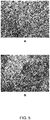
- Exemplary stereomicrograph images of fried coatings comprising a hydroxypropylated, cross-linked tapioca starch (Purity 4) and an acetylated high amylose maize starch (Crispfilm) in a ratio by weight of the hydroxypropylated, cross-linked tapioca starch to the acetylated high amylose maize starch of about 70:30 and about 30:70 are shown in Figure 5A and Figure 5B , respectively.
- the film having a 30:70 ratio between the hydroxypropylated, cross-linked tapioca starch and the acetylated high amylose maize starch shows larger air bubbles and pores, flared voids where large amounts of water has escaped.
- the film having a 70:30 ratio between the hydroxypropylated, cross-linked tapioca starch and the acetylated high amylose maize starch shows small pores of even shape and size, indicating less moisture loss.
- the continuous batters of the present disclosure have reduced permeability to oil.
- the continuous films of the product and processes disclosed herein are typically substantially intact through frying, optionally through multiple frying stages and into a post cooking stage where the food products are held after cooking.
- the continuous surface optionally shows pores of substantially even shape and size under stereomicroscopy, typically with an absence of flared voids in the surface.
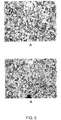
- Exemplary hot stage microscopy images (10°C per minute) are shown in Figure 6A and Figure 6B .
- Both hot stage images show a mixture comprising a hydroxypropylated, cross-linked tapioca starch (Purity 4) and an acetylated, high amylose maize starch (Crispfilm) in a ratio by weight of the hydroxypropylated, cross-linked tapioca starch to the acetylated high amylose maize starch of about 70:30 in excess water.
- the formulation also includes rice flour, xanthan gum, colors and salt.
- the tapioca starch begins to swell at 55°C and is shown in Figure 6A as the swollen granules.
- the small, round granules shown in Figure 6A are granules of the high amylose maize starch.
- the tapioca starch shows a larger swelling power at 80°C and the high amylose maize starch shows minimal and restricted swelling ( Figure 6B ).
- a continuous film is formed.
- a working theory has been developed for starch synergy and/or function in a step comprising par-frying a food product, for example a potato article such as a potato strip coated with an aqueous starch-containing batter of the present disclosure containing a water-binding starch, such as a hydroxypropylated, cross-linked starch, for example a tapioca starch, and a substituted high amylose maize starch.
- the water-binding starch such as a hydroxypropylated, cross-linked starch, for example a tapioca starch binds water and the substituted, high amylose maize starch sets down within the starch matrix in the first portion of the par-frying process.
- the water-binding starch continues to hold onto the water throughout the frying time of, for example about 30 seconds, controlling and avoiding its release, which inhibits oil penetration at this stage.
- the water-binding starch binds the moisture in the first stage of frying and continues to function in the second stage.
- the moisture loss profile i.e. the manner in which the coating is dehydrated during heating and phase transition
- the moisture loss profile i.e. the manner in which the coating is dehydrated during heating and phase transition
- the starch-containing coating goes from liquid to viscous to sticky and rubbery to partly dry and glassy but still functional throughout the par-frying time of, for example about 30 seconds.
- Table 1 Selected properties of water-binding starches Brand Name Base Amylose (wt%) Modification(s) Tolerance to Processing 2 PURITY 4 tapioca 17 E1442: hydroxypropyl di-starch phosphate 1 moderate PURITY 87 tapioca 17 E1442: hydroxypropyl di-starch phosphate 1 high PURITY NCSA maize 25 E1412: acetylated di-starch phosphate high PURITY SCSA waxy maize ⁇ 1 E1412: acetylated di-starch phosphate high NATIONAL FRIGEX HV tapioca 17 E1442: hydroxypropyl di-starch phosphate 1 low-moderate 1 PURITY 4, PURITY 87 and NATIONAL
- Table 2 Includes how tolerant the starch is to break down, shear and pH stability.
- Table 2 Selected properties of high amylose maize starches Brand Name Base Amylose (wt%) Modification(s) Tolerance to Processing 1 CRISPFILM high amylose maize 50 or 68 E1420: acetylated starch moderate HYLON V high amylose maize 50 none high HYLON VII high amylose maize 70 none high HYLON VIII high amylose maize 80 none high 1 Includes how tolerant the starch is to break down, shear and pH stability.
- Table 3 Trial Starch(es) 1 Ratio Fat Reduction vs.
Landscapes
- Chemical & Material Sciences (AREA)
- Polymers & Plastics (AREA)
- Life Sciences & Earth Sciences (AREA)
- Engineering & Computer Science (AREA)
- Food Science & Technology (AREA)
- Health & Medical Sciences (AREA)
- Nutrition Science (AREA)
- Oil, Petroleum & Natural Gas (AREA)
- Chemical Kinetics & Catalysis (AREA)
- Dispersion Chemistry (AREA)
- Grain Derivatives (AREA)
- General Preparation And Processing Of Foods (AREA)
- Preparation Of Fruits And Vegetables (AREA)
Priority Applications (1)
| Application Number | Priority Date | Filing Date | Title |
|---|---|---|---|
| PL13191830T PL2823716T3 (pl) | 2013-07-11 | 2013-11-06 | Wodne kompozycje zawierające skrobię do powlekania produktów żywnościowych |
Applications Claiming Priority (1)
| Application Number | Priority Date | Filing Date | Title |
|---|---|---|---|
| US201361845164P | 2013-07-11 | 2013-07-11 |
Publications (2)
| Publication Number | Publication Date |
|---|---|
| EP2823716A1 EP2823716A1 (en) | 2015-01-14 |
| EP2823716B1 true EP2823716B1 (en) | 2018-03-28 |
Family
ID=49552207
Family Applications (1)
| Application Number | Title | Priority Date | Filing Date |
|---|---|---|---|
| EP13191830.2A Active EP2823716B1 (en) | 2013-07-11 | 2013-11-06 | Aqueous starch-containing compositions for coating food products |
Country Status (7)
| Country | Link |
|---|---|
| US (2) | US20160150810A1 (pl) |
| EP (1) | EP2823716B1 (pl) |
| AR (1) | AR096899A1 (pl) |
| AU (1) | AU2013207547B2 (pl) |
| CA (1) | CA2820991C (pl) |
| PL (1) | PL2823716T3 (pl) |
| WO (1) | WO2015004628A1 (pl) |
Families Citing this family (10)
| Publication number | Priority date | Publication date | Assignee | Title |
|---|---|---|---|---|
| JP2017514006A (ja) * | 2014-04-16 | 2017-06-01 | プランチック テクノロジーズ リミテッド | デンプン組成物及びその使用 |
| EP3273806B1 (en) * | 2015-03-23 | 2025-05-21 | Lamb Weston B.V. | Coating for a potato product for finish-frying, a potato product provided therewith and method therefor |
| NL2014504B1 (nl) * | 2015-03-23 | 2017-01-17 | Fries4All B V | Coating voor een te frituren aardappelproduct, een aardappelproduct voorzien daarvan en werkwijze daarvoor. |
| BR112017020381B1 (pt) | 2015-03-23 | 2023-01-24 | Fries4All B.V | Método para preparação de um produto de batata para fritura final e produto de batata para fritura final |
| CN107242454B (zh) * | 2017-06-29 | 2020-11-24 | 河南恒瑞淀粉科技股份有限公司 | 一种冷冻预油炸食品用裹粉、冷冻预油炸食品及其制备方法 |
| CA3106831C (en) * | 2019-01-23 | 2021-08-17 | Mizkan Holdings Co., Ltd. | Dried powder of edible plant, food and beverage, and production method therefor |
| CN109938628B (zh) * | 2019-03-20 | 2020-11-24 | 苏州慧泽农业科技有限公司 | 一种抽拉式洗菜篮 |
| CN109924463A (zh) * | 2019-04-17 | 2019-06-25 | 无锡威尔森淀粉工业有限公司 | 一种水晶蒸饺预拌粉 |
| ES3032838T3 (en) | 2019-04-26 | 2025-07-28 | Startchy Inc | Starch-based edible coating compositions and uses thereof |
| NL2029585B1 (en) * | 2021-11-02 | 2023-06-01 | De Winter Leon | Method for producing a fried potato product |
Family Cites Families (6)
| Publication number | Priority date | Publication date | Assignee | Title |
|---|---|---|---|---|
| CA2052969A1 (en) * | 1990-10-12 | 1992-04-13 | James Zallie | Foods containing soluble high amylose starch |
| US5750168A (en) | 1995-06-06 | 1998-05-12 | Penwest Foods Co. | Tapioca starch containing french fry formulations and method of making |
| US5997918A (en) * | 1996-09-27 | 1999-12-07 | Bunge Foods Corporation | Corn starch based coating compositions |
| GB2330759A (en) | 1997-10-29 | 1999-05-05 | Danisco | Reheatable coated foods |
| IT1318597B1 (it) * | 2000-06-23 | 2003-08-27 | A C R Applied Coating Res S A | Uso di un amido ad alto contenuto di amilosio acetilato epregelatinizzato. |
| US20090311408A1 (en) * | 2008-06-17 | 2009-12-17 | Brunob Ii B.V. | Low swelling starch |
-
2013
- 2013-07-15 AU AU2013207547A patent/AU2013207547B2/en active Active
- 2013-07-15 CA CA2820991A patent/CA2820991C/en active Active
- 2013-11-06 PL PL13191830T patent/PL2823716T3/pl unknown
- 2013-11-06 EP EP13191830.2A patent/EP2823716B1/en active Active
-
2014
- 2014-07-10 US US14/904,241 patent/US20160150810A1/en not_active Abandoned
- 2014-07-10 WO PCT/IB2014/063006 patent/WO2015004628A1/en not_active Ceased
- 2014-07-11 AR ARP140102584A patent/AR096899A1/es unknown
-
2019
- 2019-06-06 US US16/433,340 patent/US20190350248A1/en not_active Abandoned
Non-Patent Citations (1)
| Title |
|---|
| None * |
Also Published As
| Publication number | Publication date |
|---|---|
| AU2013207547A1 (en) | 2015-01-29 |
| WO2015004628A1 (en) | 2015-01-15 |
| CA2820991A1 (en) | 2015-01-11 |
| AU2013207547B2 (en) | 2017-09-07 |
| EP2823716A1 (en) | 2015-01-14 |
| AR096899A1 (es) | 2016-02-03 |
| US20190350248A1 (en) | 2019-11-21 |
| US20160150810A1 (en) | 2016-06-02 |
| PL2823716T3 (pl) | 2018-08-31 |
| CA2820991C (en) | 2020-10-06 |
Similar Documents
| Publication | Publication Date | Title |
|---|---|---|
| EP2823716B1 (en) | Aqueous starch-containing compositions for coating food products | |
| Baldwin et al. | Use of edible coatings to preserve quality of lightly (and slightly) processed products | |
| EP3170405B1 (en) | Tempura batter mix | |
| AU2013340472B2 (en) | Process for making coated vegetables | |
| WO1997042827A9 (en) | Process and batter for coating vegetable pieces | |
| AU2004248905B2 (en) | Stabiized fruit pulp composition and a puree composition comprising the same | |
| WO1997042827A1 (en) | Process and batter for coating vegetable pieces | |
| US6953597B2 (en) | Batter coating for potato pieces | |
| Daraei Garmakhany et al. | Use of hydrocolloids as edible covers to produce low fat French fries | |
| EP1343392B1 (en) | Batter composition comprising starch, dextrin and rice flour for fried food products | |
| WO2000028828A1 (en) | Clear coat batter for french fried potato strips | |
| DE60315242T2 (de) | Fritierte fettarme Nahrungsmittel enthaltend eine vernetzte Hydrokolloidschicht und eine Nasspanadeschicht | |
| TW201642766A (zh) | 加熱食物基材穩定 | |
| US7709043B2 (en) | Method of preparing processed root vegetables or fruit vegetables | |
| DE602005000161T3 (de) | Verfahren zum Beschichten von Lebensmitteln mit vernetzter Leguminosenstärke | |
| AU2002334080B2 (en) | Method of preparing a potato based food product | |
| AU2002334080A1 (en) | Method of preparing a potato based food product | |
| JP2007054067A (ja) | 油揚げ食品の脂肪含有率低減のための油改質剤 | |
| ES2604832B1 (es) | Recubrimiento comestible de patata de IV gama, procedimiento para su aplicación y patatas recubiertas con el mismo | |
| WO2025165631A1 (en) | Fry coating systems using long branch chain waxy starch | |
| EP2901869A1 (en) | Microwaveable batter | |
| CZ437299A3 (cs) | Způsob výroby mražených bramborových hranolků |
Legal Events
| Date | Code | Title | Description |
|---|---|---|---|
| 17P | Request for examination filed |
Effective date: 20131106 |
|
| AK | Designated contracting states |
Kind code of ref document: A1 Designated state(s): AL AT BE BG CH CY CZ DE DK EE ES FI FR GB GR HR HU IE IS IT LI LT LU LV MC MK MT NL NO PL PT RO RS SE SI SK SM TR |
|
| AX | Request for extension of the european patent |
Extension state: BA ME |
|
| PUAI | Public reference made under article 153(3) epc to a published international application that has entered the european phase |
Free format text: ORIGINAL CODE: 0009012 |
|
| R17P | Request for examination filed (corrected) |
Effective date: 20150714 |
|
| RBV | Designated contracting states (corrected) |
Designated state(s): AL AT BE BG CH CY CZ DE DK EE ES FI FR GB GR HR HU IE IS IT LI LT LU LV MC MK MT NL NO PL PT RO RS SE SI SK SM TR |
|
| 17Q | First examination report despatched |
Effective date: 20151001 |
|
| STAA | Information on the status of an ep patent application or granted ep patent |
Free format text: STATUS: EXAMINATION IS IN PROGRESS |
|
| REG | Reference to a national code |
Ref country code: DE Ref legal event code: R079 Ref document number: 602013035001 Country of ref document: DE Free format text: PREVIOUS MAIN CLASS: A23L0001052200 Ipc: A23L0029219000 |
|
| GRAP | Despatch of communication of intention to grant a patent |
Free format text: ORIGINAL CODE: EPIDOSNIGR1 |
|
| STAA | Information on the status of an ep patent application or granted ep patent |
Free format text: STATUS: GRANT OF PATENT IS INTENDED |
|
| RIC1 | Information provided on ipc code assigned before grant |
Ipc: A23P 20/12 20160101ALI20170905BHEP Ipc: A23L 19/18 20160101ALI20170905BHEP Ipc: A23L 29/219 20160101AFI20170905BHEP |
|
| INTG | Intention to grant announced |
Effective date: 20171009 |
|
| GRAS | Grant fee paid |
Free format text: ORIGINAL CODE: EPIDOSNIGR3 |
|
| GRAA | (expected) grant |
Free format text: ORIGINAL CODE: 0009210 |
|
| STAA | Information on the status of an ep patent application or granted ep patent |
Free format text: STATUS: THE PATENT HAS BEEN GRANTED |
|
| AK | Designated contracting states |
Kind code of ref document: B1 Designated state(s): AL AT BE BG CH CY CZ DE DK EE ES FI FR GB GR HR HU IE IS IT LI LT LU LV MC MK MT NL NO PL PT RO RS SE SI SK SM TR |
|
| REG | Reference to a national code |
Ref country code: GB Ref legal event code: FG4D |
|
| REG | Reference to a national code |
Ref country code: CH Ref legal event code: EP |
|
| REG | Reference to a national code |
Ref country code: AT Ref legal event code: REF Ref document number: 982555 Country of ref document: AT Kind code of ref document: T Effective date: 20180415 |
|
| REG | Reference to a national code |
Ref country code: IE Ref legal event code: FG4D |
|
| REG | Reference to a national code |
Ref country code: DE Ref legal event code: R096 Ref document number: 602013035001 Country of ref document: DE |
|
| REG | Reference to a national code |
Ref country code: NL Ref legal event code: FP |
|
| PG25 | Lapsed in a contracting state [announced via postgrant information from national office to epo] |
Ref country code: FI Free format text: LAPSE BECAUSE OF FAILURE TO SUBMIT A TRANSLATION OF THE DESCRIPTION OR TO PAY THE FEE WITHIN THE PRESCRIBED TIME-LIMIT Effective date: 20180328 Ref country code: HR Free format text: LAPSE BECAUSE OF FAILURE TO SUBMIT A TRANSLATION OF THE DESCRIPTION OR TO PAY THE FEE WITHIN THE PRESCRIBED TIME-LIMIT Effective date: 20180328 Ref country code: NO Free format text: LAPSE BECAUSE OF FAILURE TO SUBMIT A TRANSLATION OF THE DESCRIPTION OR TO PAY THE FEE WITHIN THE PRESCRIBED TIME-LIMIT Effective date: 20180628 Ref country code: LT Free format text: LAPSE BECAUSE OF FAILURE TO SUBMIT A TRANSLATION OF THE DESCRIPTION OR TO PAY THE FEE WITHIN THE PRESCRIBED TIME-LIMIT Effective date: 20180328 |
|
| REG | Reference to a national code |
Ref country code: LT Ref legal event code: MG4D |
|
| PG25 | Lapsed in a contracting state [announced via postgrant information from national office to epo] |
Ref country code: GR Free format text: LAPSE BECAUSE OF FAILURE TO SUBMIT A TRANSLATION OF THE DESCRIPTION OR TO PAY THE FEE WITHIN THE PRESCRIBED TIME-LIMIT Effective date: 20180629 Ref country code: BG Free format text: LAPSE BECAUSE OF FAILURE TO SUBMIT A TRANSLATION OF THE DESCRIPTION OR TO PAY THE FEE WITHIN THE PRESCRIBED TIME-LIMIT Effective date: 20180628 Ref country code: RS Free format text: LAPSE BECAUSE OF FAILURE TO SUBMIT A TRANSLATION OF THE DESCRIPTION OR TO PAY THE FEE WITHIN THE PRESCRIBED TIME-LIMIT Effective date: 20180328 Ref country code: SE Free format text: LAPSE BECAUSE OF FAILURE TO SUBMIT A TRANSLATION OF THE DESCRIPTION OR TO PAY THE FEE WITHIN THE PRESCRIBED TIME-LIMIT Effective date: 20180328 Ref country code: LV Free format text: LAPSE BECAUSE OF FAILURE TO SUBMIT A TRANSLATION OF THE DESCRIPTION OR TO PAY THE FEE WITHIN THE PRESCRIBED TIME-LIMIT Effective date: 20180328 |
|
| PG25 | Lapsed in a contracting state [announced via postgrant information from national office to epo] |
Ref country code: EE Free format text: LAPSE BECAUSE OF FAILURE TO SUBMIT A TRANSLATION OF THE DESCRIPTION OR TO PAY THE FEE WITHIN THE PRESCRIBED TIME-LIMIT Effective date: 20180328 Ref country code: AL Free format text: LAPSE BECAUSE OF FAILURE TO SUBMIT A TRANSLATION OF THE DESCRIPTION OR TO PAY THE FEE WITHIN THE PRESCRIBED TIME-LIMIT Effective date: 20180328 Ref country code: RO Free format text: LAPSE BECAUSE OF FAILURE TO SUBMIT A TRANSLATION OF THE DESCRIPTION OR TO PAY THE FEE WITHIN THE PRESCRIBED TIME-LIMIT Effective date: 20180328 Ref country code: IT Free format text: LAPSE BECAUSE OF FAILURE TO SUBMIT A TRANSLATION OF THE DESCRIPTION OR TO PAY THE FEE WITHIN THE PRESCRIBED TIME-LIMIT Effective date: 20180328 Ref country code: ES Free format text: LAPSE BECAUSE OF FAILURE TO SUBMIT A TRANSLATION OF THE DESCRIPTION OR TO PAY THE FEE WITHIN THE PRESCRIBED TIME-LIMIT Effective date: 20180328 |
|
| PG25 | Lapsed in a contracting state [announced via postgrant information from national office to epo] |
Ref country code: CZ Free format text: LAPSE BECAUSE OF FAILURE TO SUBMIT A TRANSLATION OF THE DESCRIPTION OR TO PAY THE FEE WITHIN THE PRESCRIBED TIME-LIMIT Effective date: 20180328 Ref country code: SK Free format text: LAPSE BECAUSE OF FAILURE TO SUBMIT A TRANSLATION OF THE DESCRIPTION OR TO PAY THE FEE WITHIN THE PRESCRIBED TIME-LIMIT Effective date: 20180328 Ref country code: SM Free format text: LAPSE BECAUSE OF FAILURE TO SUBMIT A TRANSLATION OF THE DESCRIPTION OR TO PAY THE FEE WITHIN THE PRESCRIBED TIME-LIMIT Effective date: 20180328 |
|
| PG25 | Lapsed in a contracting state [announced via postgrant information from national office to epo] |
Ref country code: PT Free format text: LAPSE BECAUSE OF FAILURE TO SUBMIT A TRANSLATION OF THE DESCRIPTION OR TO PAY THE FEE WITHIN THE PRESCRIBED TIME-LIMIT Effective date: 20180730 |
|
| REG | Reference to a national code |
Ref country code: DE Ref legal event code: R097 Ref document number: 602013035001 Country of ref document: DE |
|
| PG25 | Lapsed in a contracting state [announced via postgrant information from national office to epo] |
Ref country code: DK Free format text: LAPSE BECAUSE OF FAILURE TO SUBMIT A TRANSLATION OF THE DESCRIPTION OR TO PAY THE FEE WITHIN THE PRESCRIBED TIME-LIMIT Effective date: 20180328 |
|
| PLBE | No opposition filed within time limit |
Free format text: ORIGINAL CODE: 0009261 |
|
| STAA | Information on the status of an ep patent application or granted ep patent |
Free format text: STATUS: NO OPPOSITION FILED WITHIN TIME LIMIT |
|
| 26N | No opposition filed |
Effective date: 20190103 |
|
| PG25 | Lapsed in a contracting state [announced via postgrant information from national office to epo] |
Ref country code: SI Free format text: LAPSE BECAUSE OF FAILURE TO SUBMIT A TRANSLATION OF THE DESCRIPTION OR TO PAY THE FEE WITHIN THE PRESCRIBED TIME-LIMIT Effective date: 20180328 |
|
| REG | Reference to a national code |
Ref country code: CH Ref legal event code: PL |
|
| PG25 | Lapsed in a contracting state [announced via postgrant information from national office to epo] |
Ref country code: LU Free format text: LAPSE BECAUSE OF NON-PAYMENT OF DUE FEES Effective date: 20181106 Ref country code: MC Free format text: LAPSE BECAUSE OF FAILURE TO SUBMIT A TRANSLATION OF THE DESCRIPTION OR TO PAY THE FEE WITHIN THE PRESCRIBED TIME-LIMIT Effective date: 20180328 |
|
| REG | Reference to a national code |
Ref country code: IE Ref legal event code: MM4A |
|
| PG25 | Lapsed in a contracting state [announced via postgrant information from national office to epo] |
Ref country code: LI Free format text: LAPSE BECAUSE OF NON-PAYMENT OF DUE FEES Effective date: 20181130 Ref country code: CH Free format text: LAPSE BECAUSE OF NON-PAYMENT OF DUE FEES Effective date: 20181130 |
|
| PG25 | Lapsed in a contracting state [announced via postgrant information from national office to epo] |
Ref country code: IE Free format text: LAPSE BECAUSE OF NON-PAYMENT OF DUE FEES Effective date: 20181106 |
|
| PG25 | Lapsed in a contracting state [announced via postgrant information from national office to epo] |
Ref country code: MT Free format text: LAPSE BECAUSE OF NON-PAYMENT OF DUE FEES Effective date: 20181106 |
|
| PG25 | Lapsed in a contracting state [announced via postgrant information from national office to epo] |
Ref country code: TR Free format text: LAPSE BECAUSE OF FAILURE TO SUBMIT A TRANSLATION OF THE DESCRIPTION OR TO PAY THE FEE WITHIN THE PRESCRIBED TIME-LIMIT Effective date: 20180328 |
|
| PG25 | Lapsed in a contracting state [announced via postgrant information from national office to epo] |
Ref country code: CY Free format text: LAPSE BECAUSE OF FAILURE TO SUBMIT A TRANSLATION OF THE DESCRIPTION OR TO PAY THE FEE WITHIN THE PRESCRIBED TIME-LIMIT Effective date: 20180328 Ref country code: MK Free format text: LAPSE BECAUSE OF NON-PAYMENT OF DUE FEES Effective date: 20180328 Ref country code: HU Free format text: LAPSE BECAUSE OF FAILURE TO SUBMIT A TRANSLATION OF THE DESCRIPTION OR TO PAY THE FEE WITHIN THE PRESCRIBED TIME-LIMIT; INVALID AB INITIO Effective date: 20131106 |
|
| PG25 | Lapsed in a contracting state [announced via postgrant information from national office to epo] |
Ref country code: IS Free format text: LAPSE BECAUSE OF FAILURE TO SUBMIT A TRANSLATION OF THE DESCRIPTION OR TO PAY THE FEE WITHIN THE PRESCRIBED TIME-LIMIT Effective date: 20180728 |
|
| REG | Reference to a national code |
Ref country code: AT Ref legal event code: UEP Ref document number: 982555 Country of ref document: AT Kind code of ref document: T Effective date: 20180328 |
|
| PGFP | Annual fee paid to national office [announced via postgrant information from national office to epo] |
Ref country code: NL Payment date: 20251028 Year of fee payment: 13 |
|
| PGFP | Annual fee paid to national office [announced via postgrant information from national office to epo] |
Ref country code: DE Payment date: 20251031 Year of fee payment: 13 |
|
| PGFP | Annual fee paid to national office [announced via postgrant information from national office to epo] |
Ref country code: GB Payment date: 20251028 Year of fee payment: 13 |
|
| PGFP | Annual fee paid to national office [announced via postgrant information from national office to epo] |
Ref country code: AT Payment date: 20251031 Year of fee payment: 13 |
|
| PGFP | Annual fee paid to national office [announced via postgrant information from national office to epo] |
Ref country code: FR Payment date: 20251029 Year of fee payment: 13 |
|
| PGFP | Annual fee paid to national office [announced via postgrant information from national office to epo] |
Ref country code: BE Payment date: 20251029 Year of fee payment: 13 |
|
| PGFP | Annual fee paid to national office [announced via postgrant information from national office to epo] |
Ref country code: PL Payment date: 20251028 Year of fee payment: 13 |