EP2821440A1 - Resin modifier, polycarbonate resin composition and molded body thereof - Google Patents
Resin modifier, polycarbonate resin composition and molded body thereof Download PDFInfo
- Publication number
- EP2821440A1 EP2821440A1 EP13755928.2A EP13755928A EP2821440A1 EP 2821440 A1 EP2821440 A1 EP 2821440A1 EP 13755928 A EP13755928 A EP 13755928A EP 2821440 A1 EP2821440 A1 EP 2821440A1
- Authority
- EP
- European Patent Office
- Prior art keywords
- mass
- parts
- polymer
- resin composition
- polycarbonate resin
- Prior art date
- Legal status (The legal status is an assumption and is not a legal conclusion. Google has not performed a legal analysis and makes no representation as to the accuracy of the status listed.)
- Granted
Links
- 229920005989 resin Polymers 0.000 title claims abstract description 106
- 239000011347 resin Substances 0.000 title claims abstract description 106
- 229920005668 polycarbonate resin Polymers 0.000 title claims abstract description 95
- 239000004431 polycarbonate resin Substances 0.000 title claims abstract description 95
- 239000003607 modifier Substances 0.000 title claims abstract description 89
- 239000000203 mixture Substances 0.000 title claims abstract description 50
- 229920002554 vinyl polymer Polymers 0.000 claims abstract description 92
- 239000011342 resin composition Substances 0.000 claims abstract description 66
- 239000000178 monomer Substances 0.000 claims abstract description 64
- 229920000642 polymer Polymers 0.000 claims abstract description 64
- 239000003995 emulsifying agent Substances 0.000 claims abstract description 58
- 229920000126 latex Polymers 0.000 claims abstract description 57
- 239000004816 latex Substances 0.000 claims abstract description 53
- 150000003839 salts Chemical class 0.000 claims abstract description 49
- 229910052751 metal Inorganic materials 0.000 claims abstract description 46
- 239000002184 metal Substances 0.000 claims abstract description 46
- 125000000391 vinyl group Chemical group [H]C([*])=C([H])[H] 0.000 claims abstract description 31
- NBIIXXVUZAFLBC-UHFFFAOYSA-N Phosphoric acid Chemical compound OP(O)(O)=O NBIIXXVUZAFLBC-UHFFFAOYSA-N 0.000 claims abstract description 26
- BFKJFAAPBSQJPD-UHFFFAOYSA-N tetrafluoroethene Chemical group FC(F)=C(F)F BFKJFAAPBSQJPD-UHFFFAOYSA-N 0.000 claims abstract description 22
- 229910000147 aluminium phosphate Inorganic materials 0.000 claims abstract description 13
- 238000006116 polymerization reaction Methods 0.000 claims abstract description 13
- 150000003467 sulfuric acid derivatives Chemical class 0.000 claims abstract description 13
- 150000001732 carboxylic acid derivatives Chemical class 0.000 claims abstract description 12
- 239000012875 nonionic emulsifier Substances 0.000 claims abstract description 11
- -1 acrylate ester Chemical class 0.000 claims description 58
- 238000000034 method Methods 0.000 claims description 29
- 239000003963 antioxidant agent Substances 0.000 claims description 28
- 230000003078 antioxidant effect Effects 0.000 claims description 26
- 239000000243 solution Substances 0.000 claims description 15
- 238000000465 moulding Methods 0.000 claims description 14
- 239000000155 melt Substances 0.000 claims description 13
- YMWUJEATGCHHMB-UHFFFAOYSA-N Dichloromethane Chemical compound ClCCl YMWUJEATGCHHMB-UHFFFAOYSA-N 0.000 claims description 12
- 125000000217 alkyl group Chemical group 0.000 claims description 11
- 238000001746 injection moulding Methods 0.000 claims description 11
- 125000003118 aryl group Chemical group 0.000 claims description 8
- 150000002148 esters Chemical group 0.000 claims description 7
- LSNNMFCWUKXFEE-UHFFFAOYSA-M Bisulfite Chemical compound OS([O-])=O LSNNMFCWUKXFEE-UHFFFAOYSA-M 0.000 claims description 6
- ISWSIDIOOBJBQZ-UHFFFAOYSA-N Phenol Chemical compound OC1=CC=CC=C1 ISWSIDIOOBJBQZ-UHFFFAOYSA-N 0.000 claims description 6
- OJMIONKXNSYLSR-UHFFFAOYSA-N phosphorous acid Chemical compound OP(O)O OJMIONKXNSYLSR-UHFFFAOYSA-N 0.000 claims description 6
- LVTHXRLARFLXNR-UHFFFAOYSA-M potassium;1,1,2,2,3,3,4,4,4-nonafluorobutane-1-sulfonate Chemical compound [K+].[O-]S(=O)(=O)C(F)(F)C(F)(F)C(F)(F)C(F)(F)F LVTHXRLARFLXNR-UHFFFAOYSA-M 0.000 claims description 5
- 238000004519 manufacturing process Methods 0.000 claims description 4
- 238000000691 measurement method Methods 0.000 claims description 4
- 230000000379 polymerizing effect Effects 0.000 claims description 4
- 238000009877 rendering Methods 0.000 claims 1
- NIXOWILDQLNWCW-UHFFFAOYSA-M Acrylate Chemical compound [O-]C(=O)C=C NIXOWILDQLNWCW-UHFFFAOYSA-M 0.000 description 48
- 229920001343 polytetrafluoroethylene Polymers 0.000 description 44
- 239000004810 polytetrafluoroethylene Substances 0.000 description 44
- 238000002360 preparation method Methods 0.000 description 36
- 238000005204 segregation Methods 0.000 description 35
- 235000006708 antioxidants Nutrition 0.000 description 26
- 239000003795 chemical substances by application Substances 0.000 description 25
- VVQNEPGJFQJSBK-UHFFFAOYSA-N Methyl methacrylate Chemical compound COC(=O)C(C)=C VVQNEPGJFQJSBK-UHFFFAOYSA-N 0.000 description 24
- PPBRXRYQALVLMV-UHFFFAOYSA-N Styrene Chemical compound C=CC1=CC=CC=C1 PPBRXRYQALVLMV-UHFFFAOYSA-N 0.000 description 22
- KCIDZIIHRGYJAE-YGFYJFDDSA-L dipotassium;[(2r,3r,4s,5r,6r)-3,4,5-trihydroxy-6-(hydroxymethyl)oxan-2-yl] phosphate Chemical compound [K+].[K+].OC[C@H]1O[C@H](OP([O-])([O-])=O)[C@H](O)[C@@H](O)[C@H]1O KCIDZIIHRGYJAE-YGFYJFDDSA-L 0.000 description 19
- VSGNNIFQASZAOI-UHFFFAOYSA-L calcium acetate Chemical compound [Ca+2].CC([O-])=O.CC([O-])=O VSGNNIFQASZAOI-UHFFFAOYSA-L 0.000 description 18
- 239000001639 calcium acetate Substances 0.000 description 18
- 235000011092 calcium acetate Nutrition 0.000 description 18
- 229960005147 calcium acetate Drugs 0.000 description 18
- 238000002156 mixing Methods 0.000 description 15
- 150000001875 compounds Chemical class 0.000 description 14
- 230000000052 comparative effect Effects 0.000 description 12
- 238000012360 testing method Methods 0.000 description 12
- XLYOFNOQVPJJNP-UHFFFAOYSA-N water Substances O XLYOFNOQVPJJNP-UHFFFAOYSA-N 0.000 description 11
- IJGRMHOSHXDMSA-UHFFFAOYSA-N Atomic nitrogen Chemical compound N#N IJGRMHOSHXDMSA-UHFFFAOYSA-N 0.000 description 9
- 239000012153 distilled water Substances 0.000 description 9
- 239000008188 pellet Substances 0.000 description 9
- 229920003171 Poly (ethylene oxide) Polymers 0.000 description 8
- 230000000694 effects Effects 0.000 description 8
- 239000000843 powder Substances 0.000 description 8
- 239000000126 substance Substances 0.000 description 8
- 238000011156 evaluation Methods 0.000 description 7
- 239000007788 liquid Substances 0.000 description 7
- 239000000047 product Substances 0.000 description 7
- 229920006358 Fluon Polymers 0.000 description 6
- IISBACLAFKSPIT-UHFFFAOYSA-N bisphenol A Chemical compound C=1C=C(O)C=CC=1C(C)(C)C1=CC=C(O)C=C1 IISBACLAFKSPIT-UHFFFAOYSA-N 0.000 description 6
- CQEYYJKEWSMYFG-UHFFFAOYSA-N butyl acrylate Chemical compound CCCCOC(=O)C=C CQEYYJKEWSMYFG-UHFFFAOYSA-N 0.000 description 6
- USIUVYZYUHIAEV-UHFFFAOYSA-N diphenyl ether Chemical class C=1C=CC=CC=1OC1=CC=CC=C1 USIUVYZYUHIAEV-UHFFFAOYSA-N 0.000 description 6
- 239000004417 polycarbonate Substances 0.000 description 6
- 238000003756 stirring Methods 0.000 description 6
- WKBOTKDWSSQWDR-UHFFFAOYSA-N Bromine atom Chemical compound [Br] WKBOTKDWSSQWDR-UHFFFAOYSA-N 0.000 description 5
- UXVMQQNJUSDDNG-UHFFFAOYSA-L Calcium chloride Chemical compound [Cl-].[Cl-].[Ca+2] UXVMQQNJUSDDNG-UHFFFAOYSA-L 0.000 description 5
- LYCAIKOWRPUZTN-UHFFFAOYSA-N Ethylene glycol Chemical compound OCCO LYCAIKOWRPUZTN-UHFFFAOYSA-N 0.000 description 5
- DGAQECJNVWCQMB-PUAWFVPOSA-M Ilexoside XXIX Chemical compound C[C@@H]1CC[C@@]2(CC[C@@]3(C(=CC[C@H]4[C@]3(CC[C@@H]5[C@@]4(CC[C@@H](C5(C)C)OS(=O)(=O)[O-])C)C)[C@@H]2[C@]1(C)O)C)C(=O)O[C@H]6[C@@H]([C@H]([C@@H]([C@H](O6)CO)O)O)O.[Na+] DGAQECJNVWCQMB-PUAWFVPOSA-M 0.000 description 5
- 229910019142 PO4 Inorganic materials 0.000 description 5
- OAICVXFJPJFONN-UHFFFAOYSA-N Phosphorus Chemical compound [P] OAICVXFJPJFONN-UHFFFAOYSA-N 0.000 description 5
- GDTBXPJZTBHREO-UHFFFAOYSA-N bromine Substances BrBr GDTBXPJZTBHREO-UHFFFAOYSA-N 0.000 description 5
- 229910052794 bromium Inorganic materials 0.000 description 5
- 239000001110 calcium chloride Substances 0.000 description 5
- 229910001628 calcium chloride Inorganic materials 0.000 description 5
- 125000002496 methyl group Chemical group [H]C([H])([H])* 0.000 description 5
- 239000010452 phosphate Substances 0.000 description 5
- 239000011574 phosphorus Substances 0.000 description 5
- 229910052698 phosphorus Inorganic materials 0.000 description 5
- 229940096992 potassium oleate Drugs 0.000 description 5
- MLICVSDCCDDWMD-KVVVOXFISA-M potassium;(z)-octadec-9-enoate Chemical compound [K+].CCCCCCCC\C=C/CCCCCCCC([O-])=O MLICVSDCCDDWMD-KVVVOXFISA-M 0.000 description 5
- 239000002002 slurry Substances 0.000 description 5
- 229910052708 sodium Inorganic materials 0.000 description 5
- 239000011734 sodium Substances 0.000 description 5
- 238000005979 thermal decomposition reaction Methods 0.000 description 5
- NIXOWILDQLNWCW-UHFFFAOYSA-N 2-Propenoic acid Natural products OC(=O)C=C NIXOWILDQLNWCW-UHFFFAOYSA-N 0.000 description 4
- CSNNHWWHGAXBCP-UHFFFAOYSA-L Magnesium sulfate Chemical compound [Mg+2].[O-][S+2]([O-])([O-])[O-] CSNNHWWHGAXBCP-UHFFFAOYSA-L 0.000 description 4
- QAOWNCQODCNURD-UHFFFAOYSA-N Sulfuric acid Chemical compound OS(O)(=O)=O QAOWNCQODCNURD-UHFFFAOYSA-N 0.000 description 4
- 239000007864 aqueous solution Substances 0.000 description 4
- 238000007720 emulsion polymerization reaction Methods 0.000 description 4
- 150000003460 sulfonic acids Chemical class 0.000 description 4
- SMZOUWXMTYCWNB-UHFFFAOYSA-N 2-(2-methoxy-5-methylphenyl)ethanamine Chemical compound COC1=CC=C(C)C=C1CCN SMZOUWXMTYCWNB-UHFFFAOYSA-N 0.000 description 3
- QSRJVOOOWGXUDY-UHFFFAOYSA-N 2-[2-[2-[3-(3-tert-butyl-4-hydroxy-5-methylphenyl)propanoyloxy]ethoxy]ethoxy]ethyl 3-(3-tert-butyl-4-hydroxy-5-methylphenyl)propanoate Chemical compound CC(C)(C)C1=C(O)C(C)=CC(CCC(=O)OCCOCCOCCOC(=O)CCC=2C=C(C(O)=C(C)C=2)C(C)(C)C)=C1 QSRJVOOOWGXUDY-UHFFFAOYSA-N 0.000 description 3
- LQJBNNIYVWPHFW-UHFFFAOYSA-N 20:1omega9c fatty acid Natural products CCCCCCCCCCC=CCCCCCCCC(O)=O LQJBNNIYVWPHFW-UHFFFAOYSA-N 0.000 description 3
- 239000004677 Nylon Substances 0.000 description 3
- 239000000654 additive Substances 0.000 description 3
- 230000000996 additive effect Effects 0.000 description 3
- 238000004040 coloring Methods 0.000 description 3
- 238000000354 decomposition reaction Methods 0.000 description 3
- 235000014113 dietary fatty acids Nutrition 0.000 description 3
- 229910001873 dinitrogen Inorganic materials 0.000 description 3
- 125000001495 ethyl group Chemical group [H]C([H])([H])C([H])([H])* 0.000 description 3
- 239000000194 fatty acid Substances 0.000 description 3
- 229930195729 fatty acid Natural products 0.000 description 3
- 239000003999 initiator Substances 0.000 description 3
- 229910052757 nitrogen Inorganic materials 0.000 description 3
- 229920001778 nylon Polymers 0.000 description 3
- KZCOBXFFBQJQHH-UHFFFAOYSA-N octane-1-thiol Chemical compound CCCCCCCCS KZCOBXFFBQJQHH-UHFFFAOYSA-N 0.000 description 3
- 125000001997 phenyl group Chemical group [H]C1=C([H])C([H])=C(*)C([H])=C1[H] 0.000 description 3
- 239000002244 precipitate Substances 0.000 description 3
- 238000010526 radical polymerization reaction Methods 0.000 description 3
- 239000007787 solid Substances 0.000 description 3
- HVLLSGMXQDNUAL-UHFFFAOYSA-N triphenyl phosphite Chemical compound C=1C=CC=CC=1OP(OC=1C=CC=CC=1)OC1=CC=CC=C1 HVLLSGMXQDNUAL-UHFFFAOYSA-N 0.000 description 3
- PUPZLCDOIYMWBV-UHFFFAOYSA-N (+/-)-1,3-Butanediol Chemical compound CC(O)CCO PUPZLCDOIYMWBV-UHFFFAOYSA-N 0.000 description 2
- YWWVWXASSLXJHU-AATRIKPKSA-N (9E)-tetradecenoic acid Chemical compound CCCC\C=C\CCCCCCCC(O)=O YWWVWXASSLXJHU-AATRIKPKSA-N 0.000 description 2
- GVJHHUAWPYXKBD-UHFFFAOYSA-N (±)-α-Tocopherol Chemical compound OC1=C(C)C(C)=C2OC(CCCC(C)CCCC(C)CCCC(C)C)(C)CCC2=C1C GVJHHUAWPYXKBD-UHFFFAOYSA-N 0.000 description 2
- MYRTYDVEIRVNKP-UHFFFAOYSA-N 1,2-Divinylbenzene Chemical compound C=CC1=CC=CC=C1C=C MYRTYDVEIRVNKP-UHFFFAOYSA-N 0.000 description 2
- GNHVCDAPMWHFKG-UHFFFAOYSA-N 1-ethenyl-2,4-dimethoxybenzene Chemical compound COC1=CC=C(C=C)C(OC)=C1 GNHVCDAPMWHFKG-UHFFFAOYSA-N 0.000 description 2
- UAJRSHJHFRVGMG-UHFFFAOYSA-N 1-ethenyl-4-methoxybenzene Chemical compound COC1=CC=C(C=C)C=C1 UAJRSHJHFRVGMG-UHFFFAOYSA-N 0.000 description 2
- QEDJMOONZLUIMC-UHFFFAOYSA-N 1-tert-butyl-4-ethenylbenzene Chemical compound CC(C)(C)C1=CC=C(C=C)C=C1 QEDJMOONZLUIMC-UHFFFAOYSA-N 0.000 description 2
- RNFJDJUURJAICM-UHFFFAOYSA-N 2,2,4,4,6,6-hexaphenoxy-1,3,5-triaza-2$l^{5},4$l^{5},6$l^{5}-triphosphacyclohexa-1,3,5-triene Chemical compound N=1P(OC=2C=CC=CC=2)(OC=2C=CC=CC=2)=NP(OC=2C=CC=CC=2)(OC=2C=CC=CC=2)=NP=1(OC=1C=CC=CC=1)OC1=CC=CC=C1 RNFJDJUURJAICM-UHFFFAOYSA-N 0.000 description 2
- SSADPHQCUURWSW-UHFFFAOYSA-N 3,9-bis(2,6-ditert-butyl-4-methylphenoxy)-2,4,8,10-tetraoxa-3,9-diphosphaspiro[5.5]undecane Chemical compound CC(C)(C)C1=CC(C)=CC(C(C)(C)C)=C1OP1OCC2(COP(OC=3C(=CC(C)=CC=3C(C)(C)C)C(C)(C)C)OC2)CO1 SSADPHQCUURWSW-UHFFFAOYSA-N 0.000 description 2
- JLBJTVDPSNHSKJ-UHFFFAOYSA-N 4-Methylstyrene Chemical compound CC1=CC=C(C=C)C=C1 JLBJTVDPSNHSKJ-UHFFFAOYSA-N 0.000 description 2
- NLHHRLWOUZZQLW-UHFFFAOYSA-N Acrylonitrile Chemical compound C=CC#N NLHHRLWOUZZQLW-UHFFFAOYSA-N 0.000 description 2
- 0 CC(*)Oc1ccc(C(C)(C)c(cc2)ccc2OC(C)=O)cc1 Chemical compound CC(*)Oc1ccc(C(C)(C)c(cc2)ccc2OC(C)=O)cc1 0.000 description 2
- VTYYLEPIZMXCLO-UHFFFAOYSA-L Calcium carbonate Chemical compound [Ca+2].[O-]C([O-])=O VTYYLEPIZMXCLO-UHFFFAOYSA-L 0.000 description 2
- 229920000742 Cotton Polymers 0.000 description 2
- GHKOFFNLGXMVNJ-UHFFFAOYSA-N Didodecyl thiobispropanoate Chemical compound CCCCCCCCCCCCOC(=O)CCSCCC(=O)OCCCCCCCCCCCC GHKOFFNLGXMVNJ-UHFFFAOYSA-N 0.000 description 2
- QXNVGIXVLWOKEQ-UHFFFAOYSA-N Disodium Chemical compound [Na][Na] QXNVGIXVLWOKEQ-UHFFFAOYSA-N 0.000 description 2
- YCKRFDGAMUMZLT-UHFFFAOYSA-N Fluorine atom Chemical compound [F] YCKRFDGAMUMZLT-UHFFFAOYSA-N 0.000 description 2
- WHXSMMKQMYFTQS-UHFFFAOYSA-N Lithium Chemical compound [Li] WHXSMMKQMYFTQS-UHFFFAOYSA-N 0.000 description 2
- TWRXJAOTZQYOKJ-UHFFFAOYSA-L Magnesium chloride Chemical compound [Mg+2].[Cl-].[Cl-] TWRXJAOTZQYOKJ-UHFFFAOYSA-L 0.000 description 2
- 239000004594 Masterbatch (MB) Substances 0.000 description 2
- CERQOIWHTDAKMF-UHFFFAOYSA-N Methacrylic acid Chemical compound CC(=C)C(O)=O CERQOIWHTDAKMF-UHFFFAOYSA-N 0.000 description 2
- ZQPPMHVWECSIRJ-UHFFFAOYSA-N Oleic acid Natural products CCCCCCCCC=CCCCCCCCC(O)=O ZQPPMHVWECSIRJ-UHFFFAOYSA-N 0.000 description 2
- YGYAWVDWMABLBF-UHFFFAOYSA-N Phosgene Chemical compound ClC(Cl)=O YGYAWVDWMABLBF-UHFFFAOYSA-N 0.000 description 2
- ZLMJMSJWJFRBEC-UHFFFAOYSA-N Potassium Chemical compound [K] ZLMJMSJWJFRBEC-UHFFFAOYSA-N 0.000 description 2
- WCUXLLCKKVVCTQ-UHFFFAOYSA-M Potassium chloride Chemical compound [Cl-].[K+] WCUXLLCKKVVCTQ-UHFFFAOYSA-M 0.000 description 2
- FAPWRFPIFSIZLT-UHFFFAOYSA-M Sodium chloride Chemical compound [Na+].[Cl-] FAPWRFPIFSIZLT-UHFFFAOYSA-M 0.000 description 2
- NINIDFKCEFEMDL-UHFFFAOYSA-N Sulfur Chemical compound [S] NINIDFKCEFEMDL-UHFFFAOYSA-N 0.000 description 2
- BGYHLZZASRKEJE-UHFFFAOYSA-N [3-[3-(3,5-ditert-butyl-4-hydroxyphenyl)propanoyloxy]-2,2-bis[3-(3,5-ditert-butyl-4-hydroxyphenyl)propanoyloxymethyl]propyl] 3-(3,5-ditert-butyl-4-hydroxyphenyl)propanoate Chemical compound CC(C)(C)C1=C(O)C(C(C)(C)C)=CC(CCC(=O)OCC(COC(=O)CCC=2C=C(C(O)=C(C=2)C(C)(C)C)C(C)(C)C)(COC(=O)CCC=2C=C(C(O)=C(C=2)C(C)(C)C)C(C)(C)C)COC(=O)CCC=2C=C(C(O)=C(C=2)C(C)(C)C)C(C)(C)C)=C1 BGYHLZZASRKEJE-UHFFFAOYSA-N 0.000 description 2
- 239000002253 acid Substances 0.000 description 2
- 229910052784 alkaline earth metal Inorganic materials 0.000 description 2
- 150000001336 alkenes Chemical class 0.000 description 2
- 150000005215 alkyl ethers Chemical class 0.000 description 2
- MBMBGCFOFBJSGT-KUBAVDMBSA-N all-cis-docosa-4,7,10,13,16,19-hexaenoic acid Chemical compound CC\C=C/C\C=C/C\C=C/C\C=C/C\C=C/C\C=C/CCC(O)=O MBMBGCFOFBJSGT-KUBAVDMBSA-N 0.000 description 2
- XYLMUPLGERFSHI-UHFFFAOYSA-N alpha-Methylstyrene Chemical compound CC(=C)C1=CC=CC=C1 XYLMUPLGERFSHI-UHFFFAOYSA-N 0.000 description 2
- DIZPMCHEQGEION-UHFFFAOYSA-H aluminium sulfate (anhydrous) Chemical compound [Al+3].[Al+3].[O-]S([O-])(=O)=O.[O-]S([O-])(=O)=O.[O-]S([O-])(=O)=O DIZPMCHEQGEION-UHFFFAOYSA-H 0.000 description 2
- YZXBAPSDXZZRGB-DOFZRALJSA-N arachidonic acid Chemical compound CCCCC\C=C/C\C=C/C\C=C/C\C=C/CCCC(O)=O YZXBAPSDXZZRGB-DOFZRALJSA-N 0.000 description 2
- 239000012752 auxiliary agent Substances 0.000 description 2
- 125000001797 benzyl group Chemical group [H]C1=C([H])C([H])=C(C([H])=C1[H])C([H])([H])* 0.000 description 2
- PXKLMJQFEQBVLD-UHFFFAOYSA-N bisphenol F Chemical compound C1=CC(O)=CC=C1CC1=CC=C(O)C=C1 PXKLMJQFEQBVLD-UHFFFAOYSA-N 0.000 description 2
- 239000004566 building material Substances 0.000 description 2
- 239000006227 byproduct Substances 0.000 description 2
- 238000006243 chemical reaction Methods 0.000 description 2
- 239000003638 chemical reducing agent Substances 0.000 description 2
- 238000002425 crystallisation Methods 0.000 description 2
- 230000008025 crystallization Effects 0.000 description 2
- GHVNFZFCNZKVNT-UHFFFAOYSA-N decanoic acid Chemical compound CCCCCCCCCC(O)=O GHVNFZFCNZKVNT-UHFFFAOYSA-N 0.000 description 2
- UKMSUNONTOPOIO-UHFFFAOYSA-N docosanoic acid Chemical compound CCCCCCCCCCCCCCCCCCCCCC(O)=O UKMSUNONTOPOIO-UHFFFAOYSA-N 0.000 description 2
- POULHZVOKOAJMA-UHFFFAOYSA-N dodecanoic acid Chemical compound CCCCCCCCCCCC(O)=O POULHZVOKOAJMA-UHFFFAOYSA-N 0.000 description 2
- GVGUFUZHNYFZLC-UHFFFAOYSA-N dodecyl benzenesulfonate;sodium Chemical compound [Na].CCCCCCCCCCCCOS(=O)(=O)C1=CC=CC=C1 GVGUFUZHNYFZLC-UHFFFAOYSA-N 0.000 description 2
- ZQPPMHVWECSIRJ-MDZDMXLPSA-N elaidic acid Chemical compound CCCCCCCC\C=C\CCCCCCCC(O)=O ZQPPMHVWECSIRJ-MDZDMXLPSA-N 0.000 description 2
- 229920001971 elastomer Polymers 0.000 description 2
- 239000000806 elastomer Substances 0.000 description 2
- FJKIXWOMBXYWOQ-UHFFFAOYSA-N ethenoxyethane Chemical compound CCOC=C FJKIXWOMBXYWOQ-UHFFFAOYSA-N 0.000 description 2
- 239000012847 fine chemical Substances 0.000 description 2
- 239000003063 flame retardant Substances 0.000 description 2
- 229910052731 fluorine Inorganic materials 0.000 description 2
- 239000011737 fluorine Substances 0.000 description 2
- 229920000578 graft copolymer Polymers 0.000 description 2
- 238000010438 heat treatment Methods 0.000 description 2
- KEMQGTRYUADPNZ-UHFFFAOYSA-N heptadecanoic acid Chemical compound CCCCCCCCCCCCCCCCC(O)=O KEMQGTRYUADPNZ-UHFFFAOYSA-N 0.000 description 2
- XMHIUKTWLZUKEX-UHFFFAOYSA-N hexacosanoic acid Chemical compound CCCCCCCCCCCCCCCCCCCCCCCCCC(O)=O XMHIUKTWLZUKEX-UHFFFAOYSA-N 0.000 description 2
- IPCSVZSSVZVIGE-UHFFFAOYSA-N hexadecanoic acid Chemical compound CCCCCCCCCCCCCCCC(O)=O IPCSVZSSVZVIGE-UHFFFAOYSA-N 0.000 description 2
- 229920005669 high impact polystyrene Polymers 0.000 description 2
- 239000004797 high-impact polystyrene Substances 0.000 description 2
- 229920001519 homopolymer Polymers 0.000 description 2
- VKOBVWXKNCXXDE-UHFFFAOYSA-N icosanoic acid Chemical compound CCCCCCCCCCCCCCCCCCCC(O)=O VKOBVWXKNCXXDE-UHFFFAOYSA-N 0.000 description 2
- QXJSBBXBKPUZAA-UHFFFAOYSA-N isooleic acid Natural products CCCCCCCC=CCCCCCCCCC(O)=O QXJSBBXBKPUZAA-UHFFFAOYSA-N 0.000 description 2
- 238000004898 kneading Methods 0.000 description 2
- 229910052744 lithium Inorganic materials 0.000 description 2
- 229910052943 magnesium sulfate Inorganic materials 0.000 description 2
- 235000019341 magnesium sulphate Nutrition 0.000 description 2
- 239000000463 material Substances 0.000 description 2
- 150000007522 mineralic acids Chemical class 0.000 description 2
- FBUKVWPVBMHYJY-UHFFFAOYSA-N nonanoic acid Chemical compound CCCCCCCCC(O)=O FBUKVWPVBMHYJY-UHFFFAOYSA-N 0.000 description 2
- UTOPWMOLSKOLTQ-UHFFFAOYSA-N octacosanoic acid Chemical compound CCCCCCCCCCCCCCCCCCCCCCCCCCCC(O)=O UTOPWMOLSKOLTQ-UHFFFAOYSA-N 0.000 description 2
- SSDSCDGVMJFTEQ-UHFFFAOYSA-N octadecyl 3-(3,5-ditert-butyl-4-hydroxyphenyl)propanoate Chemical compound CCCCCCCCCCCCCCCCCCOC(=O)CCC1=CC(C(C)(C)C)=C(O)C(C(C)(C)C)=C1 SSDSCDGVMJFTEQ-UHFFFAOYSA-N 0.000 description 2
- WWZKQHOCKIZLMA-UHFFFAOYSA-N octanoic acid Chemical compound CCCCCCCC(O)=O WWZKQHOCKIZLMA-UHFFFAOYSA-N 0.000 description 2
- 150000007524 organic acids Chemical class 0.000 description 2
- 235000005985 organic acids Nutrition 0.000 description 2
- 150000001451 organic peroxides Chemical class 0.000 description 2
- 229920000620 organic polymer Polymers 0.000 description 2
- SECPZKHBENQXJG-FPLPWBNLSA-N palmitoleic acid Chemical compound CCCCCC\C=C/CCCCCCCC(O)=O SECPZKHBENQXJG-FPLPWBNLSA-N 0.000 description 2
- JRKICGRDRMAZLK-UHFFFAOYSA-L peroxydisulfate Chemical compound [O-]S(=O)(=O)OOS([O-])(=O)=O JRKICGRDRMAZLK-UHFFFAOYSA-L 0.000 description 2
- 239000000049 pigment Substances 0.000 description 2
- 229920002863 poly(1,4-phenylene oxide) polymer Polymers 0.000 description 2
- 229920000515 polycarbonate Polymers 0.000 description 2
- 239000003505 polymerization initiator Substances 0.000 description 2
- 229910052700 potassium Inorganic materials 0.000 description 2
- 239000011591 potassium Substances 0.000 description 2
- SCVFZCLFOSHCOH-UHFFFAOYSA-M potassium acetate Chemical compound [K+].CC([O-])=O SCVFZCLFOSHCOH-UHFFFAOYSA-M 0.000 description 2
- XAEFZNCEHLXOMS-UHFFFAOYSA-M potassium benzoate Chemical compound [K+].[O-]C(=O)C1=CC=CC=C1 XAEFZNCEHLXOMS-UHFFFAOYSA-M 0.000 description 2
- USHAGKDGDHPEEY-UHFFFAOYSA-L potassium persulfate Chemical compound [K+].[K+].[O-]S(=O)(=O)OOS([O-])(=O)=O USHAGKDGDHPEEY-UHFFFAOYSA-L 0.000 description 2
- HGJYOHAIVZXUML-UHFFFAOYSA-M potassium;3-(benzenesulfonyl)benzenesulfonate Chemical compound [K+].[O-]S(=O)(=O)C1=CC=CC(S(=O)(=O)C=2C=CC=CC=2)=C1 HGJYOHAIVZXUML-UHFFFAOYSA-M 0.000 description 2
- 230000009467 reduction Effects 0.000 description 2
- FSYKKLYZXJSNPZ-UHFFFAOYSA-N sarcosine Chemical class C[NH2+]CC([O-])=O FSYKKLYZXJSNPZ-UHFFFAOYSA-N 0.000 description 2
- 150000004671 saturated fatty acids Chemical class 0.000 description 2
- 229940080264 sodium dodecylbenzenesulfonate Drugs 0.000 description 2
- 239000011593 sulfur Substances 0.000 description 2
- 229910052717 sulfur Inorganic materials 0.000 description 2
- LWIHDJKSTIGBAC-UHFFFAOYSA-K tripotassium phosphate Chemical compound [K+].[K+].[K+].[O-]P([O-])([O-])=O LWIHDJKSTIGBAC-UHFFFAOYSA-K 0.000 description 2
- RSJKGSCJYJTIGS-UHFFFAOYSA-N undecane Chemical compound CCCCCCCCCCC RSJKGSCJYJTIGS-UHFFFAOYSA-N 0.000 description 2
- DTGKSKDOIYIVQL-WEDXCCLWSA-N (+)-borneol Chemical group C1C[C@@]2(C)[C@@H](O)C[C@@H]1C2(C)C DTGKSKDOIYIVQL-WEDXCCLWSA-N 0.000 description 1
- BITHHVVYSMSWAG-KTKRTIGZSA-N (11Z)-icos-11-enoic acid Chemical compound CCCCCCCC\C=C/CCCCCCCCCC(O)=O BITHHVVYSMSWAG-KTKRTIGZSA-N 0.000 description 1
- XSXIVVZCUAHUJO-AVQMFFATSA-N (11e,14e)-icosa-11,14-dienoic acid Chemical compound CCCCC\C=C\C\C=C\CCCCCCCCCC(O)=O XSXIVVZCUAHUJO-AVQMFFATSA-N 0.000 description 1
- GWHCXVQVJPWHRF-KTKRTIGZSA-N (15Z)-tetracosenoic acid Chemical compound CCCCCCCC\C=C/CCCCCCCCCCCCCC(O)=O GWHCXVQVJPWHRF-KTKRTIGZSA-N 0.000 description 1
- BBWMTEYXFFWPIF-CJBMEHDJSA-N (2e,4e,6e)-icosa-2,4,6-trienoic acid Chemical compound CCCCCCCCCCCCC\C=C\C=C\C=C\C(O)=O BBWMTEYXFFWPIF-CJBMEHDJSA-N 0.000 description 1
- KXVFBCSUGDNXQF-DZDBOGACSA-N (2z,4z,6z,8z,10z)-tetracosa-2,4,6,8,10-pentaenoic acid Chemical compound CCCCCCCCCCCCC\C=C/C=C\C=C/C=C\C=C/C(O)=O KXVFBCSUGDNXQF-DZDBOGACSA-N 0.000 description 1
- AVKOENOBFIYBSA-WMPRHZDHSA-N (4Z,7Z,10Z,13Z,16Z)-docosa-4,7,10,13,16-pentaenoic acid Chemical compound CCCCC\C=C/C\C=C/C\C=C/C\C=C/C\C=C/CCC(O)=O AVKOENOBFIYBSA-WMPRHZDHSA-N 0.000 description 1
- UNSRRHDPHVZAHH-YOILPLPUSA-N (5Z,8Z,11Z)-icosatrienoic acid Chemical compound CCCCCCCC\C=C/C\C=C/C\C=C/CCCC(O)=O UNSRRHDPHVZAHH-YOILPLPUSA-N 0.000 description 1
- HXQHFNIKBKZGRP-URPRIDOGSA-N (5Z,9Z,12Z)-octadecatrienoic acid Chemical compound CCCCC\C=C/C\C=C/CC\C=C/CCCC(O)=O HXQHFNIKBKZGRP-URPRIDOGSA-N 0.000 description 1
- YHGJECVSSKXFCJ-KUBAVDMBSA-N (6Z,9Z,12Z,15Z,18Z,21Z)-tetracosahexaenoic acid Chemical compound CC\C=C/C\C=C/C\C=C/C\C=C/C\C=C/C\C=C/CCCCC(O)=O YHGJECVSSKXFCJ-KUBAVDMBSA-N 0.000 description 1
- TWSWSIQAPQLDBP-CGRWFSSPSA-N (7e,10e,13e,16e)-docosa-7,10,13,16-tetraenoic acid Chemical compound CCCCC\C=C\C\C=C\C\C=C\C\C=C\CCCCCC(O)=O TWSWSIQAPQLDBP-CGRWFSSPSA-N 0.000 description 1
- CUXYLFPMQMFGPL-UHFFFAOYSA-N (9Z,11E,13E)-9,11,13-Octadecatrienoic acid Natural products CCCCC=CC=CC=CCCCCCCCC(O)=O CUXYLFPMQMFGPL-UHFFFAOYSA-N 0.000 description 1
- OYHQOLUKZRVURQ-NTGFUMLPSA-N (9Z,12Z)-9,10,12,13-tetratritiooctadeca-9,12-dienoic acid Chemical compound C(CCCCCCC\C(=C(/C\C(=C(/CCCCC)\[3H])\[3H])\[3H])\[3H])(=O)O OYHQOLUKZRVURQ-NTGFUMLPSA-N 0.000 description 1
- WRIDQFICGBMAFQ-UHFFFAOYSA-N (E)-8-Octadecenoic acid Natural products CCCCCCCCCC=CCCCCCCC(O)=O WRIDQFICGBMAFQ-UHFFFAOYSA-N 0.000 description 1
- HVGRZDASOHMCSK-UHFFFAOYSA-N (Z,Z)-13,16-docosadienoic acid Natural products CCCCCC=CCC=CCCCCCCCCCCCC(O)=O HVGRZDASOHMCSK-UHFFFAOYSA-N 0.000 description 1
- HCNHNBLSNVSJTJ-UHFFFAOYSA-N 1,1-Bis(4-hydroxyphenyl)ethane Chemical compound C=1C=C(O)C=CC=1C(C)C1=CC=C(O)C=C1 HCNHNBLSNVSJTJ-UHFFFAOYSA-N 0.000 description 1
- OQUIVULXSAMWTI-UHFFFAOYSA-N 1,1-bis(2,6-ditert-butyl-4-methylphenyl)-2,2-bis(hydroxymethyl)henicosane-1,3-diol phosphorous acid Chemical compound P(O)(O)O.C(CCCCCCCCCCCCCCCCC)C(C(C(O)(C1=C(C=C(C=C1C(C)(C)C)C)C(C)(C)C)C1=C(C=C(C=C1C(C)(C)C)C)C(C)(C)C)(CO)CO)O OQUIVULXSAMWTI-UHFFFAOYSA-N 0.000 description 1
- UVHXEHGUEKARKZ-UHFFFAOYSA-N 1-ethenylanthracene Chemical compound C1=CC=C2C=C3C(C=C)=CC=CC3=CC2=C1 UVHXEHGUEKARKZ-UHFFFAOYSA-N 0.000 description 1
- IGGDKDTUCAWDAN-UHFFFAOYSA-N 1-vinylnaphthalene Chemical compound C1=CC=C2C(C=C)=CC=CC2=C1 IGGDKDTUCAWDAN-UHFFFAOYSA-N 0.000 description 1
- FEUFEGJTJIHPOF-UHFFFAOYSA-N 2-butyl acrylic acid Chemical compound CCCCC(=C)C(O)=O FEUFEGJTJIHPOF-UHFFFAOYSA-N 0.000 description 1
- SBYMUDUGTIKLCR-UHFFFAOYSA-N 2-chloroethenylbenzene Chemical compound ClC=CC1=CC=CC=C1 SBYMUDUGTIKLCR-UHFFFAOYSA-N 0.000 description 1
- 125000000954 2-hydroxyethyl group Chemical group [H]C([*])([H])C([H])([H])O[H] 0.000 description 1
- 125000003903 2-propenyl group Chemical group [H]C([*])([H])C([H])=C([H])[H] 0.000 description 1
- PIFPCDRPHCQLSJ-WYIJOVFWSA-N 4,8,12,15,19-Docosapentaenoic acid Chemical compound CC\C=C\CC\C=C\C\C=C\CC\C=C\CC\C=C\CCC(O)=O PIFPCDRPHCQLSJ-WYIJOVFWSA-N 0.000 description 1
- RSSGMIIGVQRGDS-UHFFFAOYSA-N 4-[(4-hydroxyphenyl)-phenylmethyl]phenol Chemical compound C1=CC(O)=CC=C1C(C=1C=CC(O)=CC=1)C1=CC=CC=C1 RSSGMIIGVQRGDS-UHFFFAOYSA-N 0.000 description 1
- LHWZLUXODWUHLZ-UHFFFAOYSA-N 4-methyl-n-(4-methylphenyl)sulfonylbenzenesulfonamide Chemical compound C1=CC(C)=CC=C1S(=O)(=O)NS(=O)(=O)C1=CC=C(C)C=C1 LHWZLUXODWUHLZ-UHFFFAOYSA-N 0.000 description 1
- UNSRRHDPHVZAHH-UHFFFAOYSA-N 6beta,11alpha-Dihydroxy-3alpha,5alpha-cyclopregnan-20-on Natural products CCCCCCCCC=CCC=CCC=CCCCC(O)=O UNSRRHDPHVZAHH-UHFFFAOYSA-N 0.000 description 1
- QSBYPNXLFMSGKH-UHFFFAOYSA-N 9-Heptadecensaeure Natural products CCCCCCCC=CCCCCCCCC(O)=O QSBYPNXLFMSGKH-UHFFFAOYSA-N 0.000 description 1
- YWWVWXASSLXJHU-UHFFFAOYSA-N 9E-tetradecenoic acid Natural products CCCCC=CCCCCCCCC(O)=O YWWVWXASSLXJHU-UHFFFAOYSA-N 0.000 description 1
- 235000021357 Behenic acid Nutrition 0.000 description 1
- HTVITOHKHWFJKO-UHFFFAOYSA-N Bisphenol B Chemical compound C=1C=C(O)C=CC=1C(C)(CC)C1=CC=C(O)C=C1 HTVITOHKHWFJKO-UHFFFAOYSA-N 0.000 description 1
- QQXWWCIEPUFZQL-YAJBEHDUSA-N Bosseopentaenoic acid Natural products CCCCCC=C/C=C/C=C/C=CCC=C/CCCC(=O)O QQXWWCIEPUFZQL-YAJBEHDUSA-N 0.000 description 1
- DPUOLQHDNGRHBS-UHFFFAOYSA-N Brassidinsaeure Natural products CCCCCCCCC=CCCCCCCCCCCCC(O)=O DPUOLQHDNGRHBS-UHFFFAOYSA-N 0.000 description 1
- XNRODYOCQDMZAE-UHFFFAOYSA-N C(CCCCCCCCCCC)C=1C=C2C(=CC1)O2.[Na].[Na] Chemical compound C(CCCCCCCCCCC)C=1C=C2C(=CC1)O2.[Na].[Na] XNRODYOCQDMZAE-UHFFFAOYSA-N 0.000 description 1
- CBOCVOKPQGJKKJ-UHFFFAOYSA-L Calcium formate Chemical compound [Ca+2].[O-]C=O.[O-]C=O CBOCVOKPQGJKKJ-UHFFFAOYSA-L 0.000 description 1
- 239000005632 Capric acid (CAS 334-48-5) Substances 0.000 description 1
- 239000005635 Caprylic acid (CAS 124-07-2) Substances 0.000 description 1
- 229920000049 Carbon (fiber) Polymers 0.000 description 1
- PIFPCDRPHCQLSJ-UHFFFAOYSA-N Clupanodonic acid Natural products CCC=CCCC=CCC=CCCC=CCCC=CCCC(O)=O PIFPCDRPHCQLSJ-UHFFFAOYSA-N 0.000 description 1
- 239000003508 Dilauryl thiodipropionate Substances 0.000 description 1
- 239000003109 Disodium ethylene diamine tetraacetate Substances 0.000 description 1
- 235000021292 Docosatetraenoic acid Nutrition 0.000 description 1
- SNRUBQQJIBEYMU-UHFFFAOYSA-N Dodecane Natural products CCCCCCCCCCCC SNRUBQQJIBEYMU-UHFFFAOYSA-N 0.000 description 1
- ZGTMUACCHSMWAC-UHFFFAOYSA-L EDTA disodium salt (anhydrous) Chemical compound [Na+].[Na+].OC(=O)CN(CC([O-])=O)CCN(CC(O)=O)CC([O-])=O ZGTMUACCHSMWAC-UHFFFAOYSA-L 0.000 description 1
- 235000021297 Eicosadienoic acid Nutrition 0.000 description 1
- URXZXNYJPAJJOQ-UHFFFAOYSA-N Erucic acid Natural products CCCCCCC=CCCCCCCCCCCCC(O)=O URXZXNYJPAJJOQ-UHFFFAOYSA-N 0.000 description 1
- 239000005977 Ethylene Substances 0.000 description 1
- PNVJTZOFSHSLTO-UHFFFAOYSA-N Fenthion Chemical compound COP(=S)(OC)OC1=CC=C(SC)C(C)=C1 PNVJTZOFSHSLTO-UHFFFAOYSA-N 0.000 description 1
- 206010016654 Fibrosis Diseases 0.000 description 1
- OPGOLNDOMSBSCW-CLNHMMGSSA-N Fursultiamine hydrochloride Chemical compound Cl.C1CCOC1CSSC(\CCO)=C(/C)N(C=O)CC1=CN=C(C)N=C1N OPGOLNDOMSBSCW-CLNHMMGSSA-N 0.000 description 1
- 239000004420 Iupilon Substances 0.000 description 1
- 239000005639 Lauric acid Substances 0.000 description 1
- 235000021353 Lignoceric acid Nutrition 0.000 description 1
- CQXMAMUUWHYSIY-UHFFFAOYSA-N Lignoceric acid Natural products CCCCCCCCCCCCCCCCCCCCCCCC(=O)OCCC1=CC=C(O)C=C1 CQXMAMUUWHYSIY-UHFFFAOYSA-N 0.000 description 1
- BACYUWVYYTXETD-UHFFFAOYSA-N N-Lauroylsarcosine Chemical compound CCCCCCCCCCCC(=O)N(C)CC(O)=O BACYUWVYYTXETD-UHFFFAOYSA-N 0.000 description 1
- XJXROGWVRIJYMO-SJDLZYGOSA-N Nervonic acid Natural products O=C(O)[C@@H](/C=C/CCCCCCCC)CCCCCCCCCCCC XJXROGWVRIJYMO-SJDLZYGOSA-N 0.000 description 1
- 239000005642 Oleic acid Substances 0.000 description 1
- 235000021314 Palmitic acid Nutrition 0.000 description 1
- 235000021319 Palmitoleic acid Nutrition 0.000 description 1
- 239000005643 Pelargonic acid Substances 0.000 description 1
- JKIJEFPNVSHHEI-UHFFFAOYSA-N Phenol, 2,4-bis(1,1-dimethylethyl)-, phosphite (3:1) Chemical compound CC(C)(C)C1=CC(C(C)(C)C)=CC=C1OP(OC=1C(=CC(=CC=1)C(C)(C)C)C(C)(C)C)OC1=CC=C(C(C)(C)C)C=C1C(C)(C)C JKIJEFPNVSHHEI-UHFFFAOYSA-N 0.000 description 1
- 239000004696 Poly ether ether ketone Substances 0.000 description 1
- 229920001235 Poly(2,6-diphenylphenylene oxide) Polymers 0.000 description 1
- 229930182556 Polyacetal Natural products 0.000 description 1
- 239000004962 Polyamide-imide Substances 0.000 description 1
- 239000004695 Polyether sulfone Substances 0.000 description 1
- 239000004697 Polyetherimide Substances 0.000 description 1
- 239000004698 Polyethylene Substances 0.000 description 1
- 229920006361 Polyflon Polymers 0.000 description 1
- 239000004734 Polyphenylene sulfide Substances 0.000 description 1
- 239000004743 Polypropylene Substances 0.000 description 1
- 229920001214 Polysorbate 60 Polymers 0.000 description 1
- 239000004793 Polystyrene Substances 0.000 description 1
- HXQHFNIKBKZGRP-UHFFFAOYSA-N Ranuncelin-saeure-methylester Natural products CCCCCC=CCC=CCCC=CCCCC(O)=O HXQHFNIKBKZGRP-UHFFFAOYSA-N 0.000 description 1
- VMHLLURERBWHNL-UHFFFAOYSA-M Sodium acetate Chemical compound [Na+].CC([O-])=O VMHLLURERBWHNL-UHFFFAOYSA-M 0.000 description 1
- 239000004280 Sodium formate Substances 0.000 description 1
- 235000021355 Stearic acid Nutrition 0.000 description 1
- GWEVSGVZZGPLCZ-UHFFFAOYSA-N Titan oxide Chemical compound O=[Ti]=O GWEVSGVZZGPLCZ-UHFFFAOYSA-N 0.000 description 1
- 239000007983 Tris buffer Substances 0.000 description 1
- UWHZIFQPPBDJPM-FPLPWBNLSA-M Vaccenic acid Natural products CCCCCC\C=C/CCCCCCCCCC([O-])=O UWHZIFQPPBDJPM-FPLPWBNLSA-M 0.000 description 1
- 235000021322 Vaccenic acid Nutrition 0.000 description 1
- XTXRWKRVRITETP-UHFFFAOYSA-N Vinyl acetate Chemical compound CC(=O)OC=C XTXRWKRVRITETP-UHFFFAOYSA-N 0.000 description 1
- QYKIQEUNHZKYBP-UHFFFAOYSA-N Vinyl ether Chemical compound C=COC=C QYKIQEUNHZKYBP-UHFFFAOYSA-N 0.000 description 1
- 229930003427 Vitamin E Natural products 0.000 description 1
- LWZFANDGMFTDAV-BURFUSLBSA-N [(2r)-2-[(2r,3r,4s)-3,4-dihydroxyoxolan-2-yl]-2-hydroxyethyl] dodecanoate Chemical compound CCCCCCCCCCCC(=O)OC[C@@H](O)[C@H]1OC[C@H](O)[C@H]1O LWZFANDGMFTDAV-BURFUSLBSA-N 0.000 description 1
- YMOONIIMQBGTDU-VOTSOKGWSA-N [(e)-2-bromoethenyl]benzene Chemical compound Br\C=C\C1=CC=CC=C1 YMOONIIMQBGTDU-VOTSOKGWSA-N 0.000 description 1
- CGRTZESQZZGAAU-UHFFFAOYSA-N [2-[3-[1-[3-(3-tert-butyl-4-hydroxy-5-methylphenyl)propanoyloxy]-2-methylpropan-2-yl]-2,4,8,10-tetraoxaspiro[5.5]undecan-9-yl]-2-methylpropyl] 3-(3-tert-butyl-4-hydroxy-5-methylphenyl)propanoate Chemical compound CC(C)(C)C1=C(O)C(C)=CC(CCC(=O)OCC(C)(C)C2OCC3(CO2)COC(OC3)C(C)(C)COC(=O)CCC=2C=C(C(O)=C(C)C=2)C(C)(C)C)=C1 CGRTZESQZZGAAU-UHFFFAOYSA-N 0.000 description 1
- VWIUJRUTUZSAAA-UHFFFAOYSA-M [K+].[O-]S(=O)(=O)c1cc(ccc1F)-c1ccc(F)cc1 Chemical compound [K+].[O-]S(=O)(=O)c1cc(ccc1F)-c1ccc(F)cc1 VWIUJRUTUZSAAA-UHFFFAOYSA-M 0.000 description 1
- XEQJKDQFZOPFMN-UHFFFAOYSA-M [K+].[O-]S(=O)(=O)c1ccc(F)c(F)c1 Chemical compound [K+].[O-]S(=O)(=O)c1ccc(F)c(F)c1 XEQJKDQFZOPFMN-UHFFFAOYSA-M 0.000 description 1
- HWYPMMGUMIUQDG-UHFFFAOYSA-M [K+].[O-]S(=O)(=O)c1ccc(F)cc1F Chemical compound [K+].[O-]S(=O)(=O)c1ccc(F)cc1F HWYPMMGUMIUQDG-UHFFFAOYSA-M 0.000 description 1
- 239000002250 absorbent Substances 0.000 description 1
- 230000002745 absorbent Effects 0.000 description 1
- 239000004676 acrylonitrile butadiene styrene Substances 0.000 description 1
- 239000004480 active ingredient Substances 0.000 description 1
- TWSWSIQAPQLDBP-UHFFFAOYSA-N adrenic acid Natural products CCCCCC=CCC=CCC=CCC=CCCCCCC(O)=O TWSWSIQAPQLDBP-UHFFFAOYSA-N 0.000 description 1
- 125000001931 aliphatic group Chemical group 0.000 description 1
- 229910052783 alkali metal Inorganic materials 0.000 description 1
- 125000005907 alkyl ester group Chemical group 0.000 description 1
- 125000005037 alkyl phenyl group Chemical group 0.000 description 1
- JAZBEHYOTPTENJ-JLNKQSITSA-N all-cis-5,8,11,14,17-icosapentaenoic acid Chemical compound CC\C=C/C\C=C/C\C=C/C\C=C/C\C=C/CCCC(O)=O JAZBEHYOTPTENJ-JLNKQSITSA-N 0.000 description 1
- CUXYLFPMQMFGPL-SUTYWZMXSA-N all-trans-octadeca-9,11,13-trienoic acid Chemical compound CCCC\C=C\C=C\C=C\CCCCCCCC(O)=O CUXYLFPMQMFGPL-SUTYWZMXSA-N 0.000 description 1
- DTOSIQBPPRVQHS-PDBXOOCHSA-N alpha-linolenic acid Chemical compound CC\C=C/C\C=C/C\C=C/CCCCCCCC(O)=O DTOSIQBPPRVQHS-PDBXOOCHSA-N 0.000 description 1
- 235000020661 alpha-linolenic acid Nutrition 0.000 description 1
- 239000002216 antistatic agent Substances 0.000 description 1
- 238000013459 approach Methods 0.000 description 1
- 235000021342 arachidonic acid Nutrition 0.000 description 1
- 229940114079 arachidonic acid Drugs 0.000 description 1
- ITHZDDVSAWDQPZ-UHFFFAOYSA-L barium acetate Chemical compound [Ba+2].CC([O-])=O.CC([O-])=O ITHZDDVSAWDQPZ-UHFFFAOYSA-L 0.000 description 1
- 229940112016 barium acetate Drugs 0.000 description 1
- WDIHJSXYQDMJHN-UHFFFAOYSA-L barium chloride Chemical compound [Cl-].[Cl-].[Ba+2] WDIHJSXYQDMJHN-UHFFFAOYSA-L 0.000 description 1
- 229910001626 barium chloride Inorganic materials 0.000 description 1
- UXFOSWFWQAUFFZ-UHFFFAOYSA-L barium(2+);diformate Chemical compound [Ba+2].[O-]C=O.[O-]C=O UXFOSWFWQAUFFZ-UHFFFAOYSA-L 0.000 description 1
- 239000002585 base Substances 0.000 description 1
- 229940116226 behenic acid Drugs 0.000 description 1
- 238000000071 blow moulding Methods 0.000 description 1
- QQXWWCIEPUFZQL-JMFSJNRSSA-N bosseopentaenoic acid Chemical compound CCCCC\C=C/C=C/C=C/C=C\C\C=C/CCCC(O)=O QQXWWCIEPUFZQL-JMFSJNRSSA-N 0.000 description 1
- 125000004799 bromophenyl group Chemical group 0.000 description 1
- 125000000484 butyl group Chemical group [H]C([*])([H])C([H])([H])C([H])([H])C([H])([H])[H] 0.000 description 1
- 229910000019 calcium carbonate Inorganic materials 0.000 description 1
- 235000019255 calcium formate Nutrition 0.000 description 1
- 239000004281 calcium formate Substances 0.000 description 1
- 229940044172 calcium formate Drugs 0.000 description 1
- 239000001506 calcium phosphate Substances 0.000 description 1
- 229910000389 calcium phosphate Inorganic materials 0.000 description 1
- 235000011010 calcium phosphates Nutrition 0.000 description 1
- 159000000007 calcium salts Chemical class 0.000 description 1
- TYFWBWKPUPIPDV-UHFFFAOYSA-L calcium;4-methoxynaphthalene-1-sulfonate Chemical compound [Ca+2].C1=CC=C2C(OC)=CC=C(S([O-])(=O)=O)C2=C1.C1=CC=C2C(OC)=CC=C(S([O-])(=O)=O)C2=C1 TYFWBWKPUPIPDV-UHFFFAOYSA-L 0.000 description 1
- 239000006229 carbon black Substances 0.000 description 1
- 239000004917 carbon fiber Substances 0.000 description 1
- 125000003178 carboxy group Chemical group [H]OC(*)=O 0.000 description 1
- 125000000068 chlorophenyl group Chemical group 0.000 description 1
- SECPZKHBENQXJG-UHFFFAOYSA-N cis-palmitoleic acid Natural products CCCCCCC=CCCCCCCCC(O)=O SECPZKHBENQXJG-UHFFFAOYSA-N 0.000 description 1
- GWHCXVQVJPWHRF-UHFFFAOYSA-N cis-tetracosenoic acid Natural products CCCCCCCCC=CCCCCCCCCCCCCCC(O)=O GWHCXVQVJPWHRF-UHFFFAOYSA-N 0.000 description 1
- 239000003086 colorant Substances 0.000 description 1
- 238000000748 compression moulding Methods 0.000 description 1
- 229920001577 copolymer Polymers 0.000 description 1
- 239000011258 core-shell material Substances 0.000 description 1
- 125000000113 cyclohexyl group Chemical group [H]C1([H])C([H])([H])C([H])([H])C([H])(*)C([H])([H])C1([H])[H] 0.000 description 1
- 125000004188 dichlorophenyl group Chemical group 0.000 description 1
- 238000004455 differential thermal analysis Methods 0.000 description 1
- 235000019304 dilauryl thiodipropionate Nutrition 0.000 description 1
- ROORDVPLFPIABK-UHFFFAOYSA-N diphenyl carbonate Chemical compound C=1C=CC=CC=1OC(=O)OC1=CC=CC=C1 ROORDVPLFPIABK-UHFFFAOYSA-N 0.000 description 1
- NJLLQSBAHIKGKF-UHFFFAOYSA-N dipotassium dioxido(oxo)titanium Chemical compound [K+].[K+].[O-][Ti]([O-])=O NJLLQSBAHIKGKF-UHFFFAOYSA-N 0.000 description 1
- 235000019301 disodium ethylene diamine tetraacetate Nutrition 0.000 description 1
- 239000006185 dispersion Substances 0.000 description 1
- CVCXSNONTRFSEH-UHFFFAOYSA-N docosa-2,4-dienoic acid Chemical compound CCCCCCCCCCCCCCCCCC=CC=CC(O)=O CVCXSNONTRFSEH-UHFFFAOYSA-N 0.000 description 1
- 235000020669 docosahexaenoic acid Nutrition 0.000 description 1
- 229940090949 docosahexaenoic acid Drugs 0.000 description 1
- TVACALAUIQMRDF-UHFFFAOYSA-N dodecyl dihydrogen phosphate Chemical compound CCCCCCCCCCCCOP(O)(O)=O TVACALAUIQMRDF-UHFFFAOYSA-N 0.000 description 1
- 125000003438 dodecyl group Chemical group [H]C([H])([H])C([H])([H])C([H])([H])C([H])([H])C([H])([H])C([H])([H])C([H])([H])C([H])([H])C([H])([H])C([H])([H])C([H])([H])C([H])([H])* 0.000 description 1
- RUZYUOTYCVRMRZ-UHFFFAOYSA-N doxazosin Chemical compound C1OC2=CC=CC=C2OC1C(=O)N(CC1)CCN1C1=NC(N)=C(C=C(C(OC)=C2)OC)C2=N1 RUZYUOTYCVRMRZ-UHFFFAOYSA-N 0.000 description 1
- 238000001035 drying Methods 0.000 description 1
- 239000000975 dye Substances 0.000 description 1
- 235000020673 eicosapentaenoic acid Nutrition 0.000 description 1
- 229960005135 eicosapentaenoic acid Drugs 0.000 description 1
- JAZBEHYOTPTENJ-UHFFFAOYSA-N eicosapentaenoic acid Natural products CCC=CCC=CCC=CCC=CCC=CCCCC(O)=O JAZBEHYOTPTENJ-UHFFFAOYSA-N 0.000 description 1
- IQLUYYHUNSSHIY-HZUMYPAESA-N eicosatetraenoic acid Chemical compound CCCCCCCCCCC\C=C\C=C\C=C\C=C\C(O)=O IQLUYYHUNSSHIY-HZUMYPAESA-N 0.000 description 1
- 229940108623 eicosenoic acid Drugs 0.000 description 1
- BITHHVVYSMSWAG-UHFFFAOYSA-N eicosenoic acid Natural products CCCCCCCCC=CCCCCCCCCCC(O)=O BITHHVVYSMSWAG-UHFFFAOYSA-N 0.000 description 1
- 239000000839 emulsion Substances 0.000 description 1
- 229920006351 engineering plastic Polymers 0.000 description 1
- 230000007613 environmental effect Effects 0.000 description 1
- DPUOLQHDNGRHBS-KTKRTIGZSA-N erucic acid Chemical compound CCCCCCCC\C=C/CCCCCCCCCCCC(O)=O DPUOLQHDNGRHBS-KTKRTIGZSA-N 0.000 description 1
- MEGHWIAOTJPCHQ-UHFFFAOYSA-N ethenyl butanoate Chemical compound CCCC(=O)OC=C MEGHWIAOTJPCHQ-UHFFFAOYSA-N 0.000 description 1
- RTZKZFJDLAIYFH-UHFFFAOYSA-N ether Substances CCOCC RTZKZFJDLAIYFH-UHFFFAOYSA-N 0.000 description 1
- FARYTWBWLZAXNK-WAYWQWQTSA-N ethyl (z)-3-(methylamino)but-2-enoate Chemical compound CCOC(=O)\C=C(\C)NC FARYTWBWLZAXNK-WAYWQWQTSA-N 0.000 description 1
- 238000001125 extrusion Methods 0.000 description 1
- 239000011790 ferrous sulphate Substances 0.000 description 1
- 235000003891 ferrous sulphate Nutrition 0.000 description 1
- 239000000835 fiber Substances 0.000 description 1
- 230000004761 fibrosis Effects 0.000 description 1
- 239000000945 filler Substances 0.000 description 1
- 238000001914 filtration Methods 0.000 description 1
- 239000007850 fluorescent dye Substances 0.000 description 1
- 239000006081 fluorescent whitening agent Substances 0.000 description 1
- 125000000524 functional group Chemical group 0.000 description 1
- LQJBNNIYVWPHFW-QXMHVHEDSA-N gadoleic acid Chemical compound CCCCCCCCCC\C=C/CCCCCCCC(O)=O LQJBNNIYVWPHFW-QXMHVHEDSA-N 0.000 description 1
- WIGCFUFOHFEKBI-UHFFFAOYSA-N gamma-tocopherol Natural products CC(C)CCCC(C)CCCC(C)CCCC1CCC2C(C)C(O)C(C)C(C)C2O1 WIGCFUFOHFEKBI-UHFFFAOYSA-N 0.000 description 1
- 239000003365 glass fiber Substances 0.000 description 1
- 230000009477 glass transition Effects 0.000 description 1
- 125000003055 glycidyl group Chemical group C(C1CO1)* 0.000 description 1
- 230000020169 heat generation Effects 0.000 description 1
- 150000002430 hydrocarbons Chemical group 0.000 description 1
- 230000007062 hydrolysis Effects 0.000 description 1
- 238000006460 hydrolysis reaction Methods 0.000 description 1
- 125000002887 hydroxy group Chemical group [H]O* 0.000 description 1
- WGCNASOHLSPBMP-UHFFFAOYSA-N hydroxyacetaldehyde Natural products OCC=O WGCNASOHLSPBMP-UHFFFAOYSA-N 0.000 description 1
- 230000006872 improvement Effects 0.000 description 1
- 238000010348 incorporation Methods 0.000 description 1
- 230000000977 initiatory effect Effects 0.000 description 1
- 150000002500 ions Chemical class 0.000 description 1
- BAUYGSIQEAFULO-UHFFFAOYSA-L iron(2+) sulfate (anhydrous) Chemical compound [Fe+2].[O-]S([O-])(=O)=O BAUYGSIQEAFULO-UHFFFAOYSA-L 0.000 description 1
- 229910000359 iron(II) sulfate Inorganic materials 0.000 description 1
- ZFSLODLOARCGLH-UHFFFAOYSA-N isocyanuric acid Chemical compound OC1=NC(O)=NC(O)=N1 ZFSLODLOARCGLH-UHFFFAOYSA-N 0.000 description 1
- 239000004611 light stabiliser Substances 0.000 description 1
- 229960004488 linolenic acid Drugs 0.000 description 1
- KQQKGWQCNNTQJW-UHFFFAOYSA-N linolenic acid Natural products CC=CCCC=CCC=CCCCCCCCC(O)=O KQQKGWQCNNTQJW-UHFFFAOYSA-N 0.000 description 1
- 239000000314 lubricant Substances 0.000 description 1
- UEGPKNKPLBYCNK-UHFFFAOYSA-L magnesium acetate Chemical compound [Mg+2].CC([O-])=O.CC([O-])=O UEGPKNKPLBYCNK-UHFFFAOYSA-L 0.000 description 1
- 239000011654 magnesium acetate Substances 0.000 description 1
- 229940069446 magnesium acetate Drugs 0.000 description 1
- 235000011285 magnesium acetate Nutrition 0.000 description 1
- 229910001629 magnesium chloride Inorganic materials 0.000 description 1
- 159000000003 magnesium salts Chemical class 0.000 description 1
- GMDNUWQNDQDBNQ-UHFFFAOYSA-L magnesium;diformate Chemical compound [Mg+2].[O-]C=O.[O-]C=O GMDNUWQNDQDBNQ-UHFFFAOYSA-L 0.000 description 1
- VNWKTOKETHGBQD-UHFFFAOYSA-N methane Chemical compound C VNWKTOKETHGBQD-UHFFFAOYSA-N 0.000 description 1
- XJRBAMWJDBPFIM-UHFFFAOYSA-N methyl vinyl ether Chemical compound COC=C XJRBAMWJDBPFIM-UHFFFAOYSA-N 0.000 description 1
- 239000010445 mica Substances 0.000 description 1
- 229910052618 mica group Inorganic materials 0.000 description 1
- 239000006082 mold release agent Substances 0.000 description 1
- 235000021290 n-3 DPA Nutrition 0.000 description 1
- 235000021288 n-6 DPA Nutrition 0.000 description 1
- WQEPLUUGTLDZJY-UHFFFAOYSA-N n-Pentadecanoic acid Natural products CCCCCCCCCCCCCCC(O)=O WQEPLUUGTLDZJY-UHFFFAOYSA-N 0.000 description 1
- 125000001280 n-hexyl group Chemical group C(CCCCC)* 0.000 description 1
- 125000004123 n-propyl group Chemical group [H]C([H])([H])C([H])([H])C([H])([H])* 0.000 description 1
- SFBTTWXNCQVIEC-UHFFFAOYSA-N o-Vinylanisole Chemical compound COC1=CC=CC=C1C=C SFBTTWXNCQVIEC-UHFFFAOYSA-N 0.000 description 1
- QIQXTHQIDYTFRH-UHFFFAOYSA-N octadecanoic acid Chemical compound CCCCCCCCCCCCCCCCCC(O)=O QIQXTHQIDYTFRH-UHFFFAOYSA-N 0.000 description 1
- OQCDKBAXFALNLD-UHFFFAOYSA-N octadecanoic acid Natural products CCCCCCCC(C)CCCCCCCCC(O)=O OQCDKBAXFALNLD-UHFFFAOYSA-N 0.000 description 1
- 229960002446 octanoic acid Drugs 0.000 description 1
- JRZJOMJEPLMPRA-UHFFFAOYSA-N olefin Natural products CCCCCCCC=C JRZJOMJEPLMPRA-UHFFFAOYSA-N 0.000 description 1
- 238000006864 oxidative decomposition reaction Methods 0.000 description 1
- 125000005010 perfluoroalkyl group Chemical group 0.000 description 1
- 229920001643 poly(ether ketone) Polymers 0.000 description 1
- 229920003229 poly(methyl methacrylate) Polymers 0.000 description 1
- 229920002492 poly(sulfone) Polymers 0.000 description 1
- 229920002312 polyamide-imide Polymers 0.000 description 1
- 229920001230 polyarylate Polymers 0.000 description 1
- 229920001748 polybutylene Polymers 0.000 description 1
- 229920001707 polybutylene terephthalate Polymers 0.000 description 1
- 229920001225 polyester resin Polymers 0.000 description 1
- 229920006393 polyether sulfone Polymers 0.000 description 1
- 229920002530 polyetherether ketone Polymers 0.000 description 1
- 229920001601 polyetherimide Polymers 0.000 description 1
- 229920000573 polyethylene Polymers 0.000 description 1
- 229920000139 polyethylene terephthalate Polymers 0.000 description 1
- 239000005020 polyethylene terephthalate Substances 0.000 description 1
- 239000004926 polymethyl methacrylate Substances 0.000 description 1
- 229920005672 polyolefin resin Polymers 0.000 description 1
- 229920006324 polyoxymethylene Polymers 0.000 description 1
- 229920001955 polyphenylene ether Polymers 0.000 description 1
- 229920000069 polyphenylene sulfide Polymers 0.000 description 1
- 229920001155 polypropylene Polymers 0.000 description 1
- 235000011056 potassium acetate Nutrition 0.000 description 1
- 229960004109 potassium acetate Drugs 0.000 description 1
- 239000001103 potassium chloride Substances 0.000 description 1
- 235000011164 potassium chloride Nutrition 0.000 description 1
- WFIZEGIEIOHZCP-UHFFFAOYSA-M potassium formate Chemical compound [K+].[O-]C=O WFIZEGIEIOHZCP-UHFFFAOYSA-M 0.000 description 1
- 229910000160 potassium phosphate Inorganic materials 0.000 description 1
- 235000011009 potassium phosphates Nutrition 0.000 description 1
- WFRUBUQWJYMMRQ-UHFFFAOYSA-M potassium;1,1,2,2,3,3,4,4,5,5,6,6,7,7,8,8,8-heptadecafluorooctane-1-sulfonate Chemical compound [K+].[O-]S(=O)(=O)C(F)(F)C(F)(F)C(F)(F)C(F)(F)C(F)(F)C(F)(F)C(F)(F)C(F)(F)F WFRUBUQWJYMMRQ-UHFFFAOYSA-M 0.000 description 1
- YMZUKGOWUROXET-UHFFFAOYSA-M potassium;2-(trifluoromethyl)benzenesulfonate Chemical compound [K+].[O-]S(=O)(=O)C1=CC=CC=C1C(F)(F)F YMZUKGOWUROXET-UHFFFAOYSA-M 0.000 description 1
- RYDSCANGUMBFRB-UHFFFAOYSA-M potassium;fluoromethanesulfonate Chemical compound [K+].[O-]S(=O)(=O)CF RYDSCANGUMBFRB-UHFFFAOYSA-M 0.000 description 1
- GLGXXYFYZWQGEL-UHFFFAOYSA-M potassium;trifluoromethanesulfonate Chemical compound [K+].[O-]S(=O)(=O)C(F)(F)F GLGXXYFYZWQGEL-UHFFFAOYSA-M 0.000 description 1
- HJWLCRVIBGQPNF-UHFFFAOYSA-N prop-2-enylbenzene Chemical compound C=CCC1=CC=CC=C1 HJWLCRVIBGQPNF-UHFFFAOYSA-N 0.000 description 1
- 125000001436 propyl group Chemical group [H]C([*])([H])C([H])([H])C([H])([H])[H] 0.000 description 1
- WBHHMMIMDMUBKC-XLNAKTSKSA-N ricinelaidic acid Chemical compound CCCCCC[C@@H](O)C\C=C\CCCCCCCC(O)=O WBHHMMIMDMUBKC-XLNAKTSKSA-N 0.000 description 1
- FEUQNCSVHBHROZ-UHFFFAOYSA-N ricinoleic acid Natural products CCCCCCC(O[Si](C)(C)C)CC=CCCCCCCCC(=O)OC FEUQNCSVHBHROZ-UHFFFAOYSA-N 0.000 description 1
- 229960003656 ricinoleic acid Drugs 0.000 description 1
- XWGJFPHUCFXLBL-UHFFFAOYSA-M rongalite Chemical compound [Na+].OCS([O-])=O XWGJFPHUCFXLBL-UHFFFAOYSA-M 0.000 description 1
- 108700004121 sarkosyl Proteins 0.000 description 1
- 229920006395 saturated elastomer Polymers 0.000 description 1
- 239000012748 slip agent Substances 0.000 description 1
- 239000000344 soap Substances 0.000 description 1
- VYGMKJRCQSPVAI-UHFFFAOYSA-M sodium 2,4-difluorobenzenesulfonate Chemical compound [Na+].[O-]S(=O)(=O)c1ccc(F)cc1F VYGMKJRCQSPVAI-UHFFFAOYSA-M 0.000 description 1
- CVNHZWQQZUXFDE-UHFFFAOYSA-M sodium 2-(trifluoromethyl)benzenesulfonate Chemical compound [Na+].[O-]S(=O)(=O)c1ccccc1C(F)(F)F CVNHZWQQZUXFDE-UHFFFAOYSA-M 0.000 description 1
- VKSARNSXVFRHCH-UHFFFAOYSA-M sodium 3,4-difluorobenzenesulfonate Chemical compound [Na+].[O-]S(=O)(=O)c1ccc(F)c(F)c1 VKSARNSXVFRHCH-UHFFFAOYSA-M 0.000 description 1
- 239000001632 sodium acetate Substances 0.000 description 1
- 235000017281 sodium acetate Nutrition 0.000 description 1
- 229960004249 sodium acetate Drugs 0.000 description 1
- 239000011780 sodium chloride Substances 0.000 description 1
- HLBBKKJFGFRGMU-UHFFFAOYSA-M sodium formate Chemical compound [Na+].[O-]C=O HLBBKKJFGFRGMU-UHFFFAOYSA-M 0.000 description 1
- 235000019254 sodium formate Nutrition 0.000 description 1
- 239000001488 sodium phosphate Substances 0.000 description 1
- 229910000162 sodium phosphate Inorganic materials 0.000 description 1
- 235000011008 sodium phosphates Nutrition 0.000 description 1
- 159000000000 sodium salts Chemical class 0.000 description 1
- HSHFKGVNYJYBCJ-UHFFFAOYSA-M sodium;1,1,2,2,2-pentafluoroethanesulfonate Chemical compound [Na+].[O-]S(=O)(=O)C(F)(F)C(F)(F)F HSHFKGVNYJYBCJ-UHFFFAOYSA-M 0.000 description 1
- VJZDBZOTAGNXCT-UHFFFAOYSA-M sodium;2-fluoro-5-(4-fluorophenyl)benzenesulfonate Chemical compound [Na+].C1=C(F)C(S(=O)(=O)[O-])=CC(C=2C=CC(F)=CC=2)=C1 VJZDBZOTAGNXCT-UHFFFAOYSA-M 0.000 description 1
- KVCGISUBCHHTDD-UHFFFAOYSA-M sodium;4-methylbenzenesulfonate Chemical compound [Na+].CC1=CC=C(S([O-])(=O)=O)C=C1 KVCGISUBCHHTDD-UHFFFAOYSA-M 0.000 description 1
- QTKQPIOWDCRUHR-UHFFFAOYSA-M sodium;fluoromethanesulfonate Chemical compound [Na+].[O-]S(=O)(=O)CF QTKQPIOWDCRUHR-UHFFFAOYSA-M 0.000 description 1
- 239000002904 solvent Substances 0.000 description 1
- 238000003892 spreading Methods 0.000 description 1
- 230000007480 spreading Effects 0.000 description 1
- 239000008117 stearic acid Substances 0.000 description 1
- JIWBIWFOSCKQMA-UHFFFAOYSA-N stearidonic acid Natural products CCC=CCC=CCC=CCC=CCCCCC(O)=O JIWBIWFOSCKQMA-UHFFFAOYSA-N 0.000 description 1
- 125000004079 stearyl group Chemical group [H]C([*])([H])C([H])([H])C([H])([H])C([H])([H])C([H])([H])C([H])([H])C([H])([H])C([H])([H])C([H])([H])C([H])([H])C([H])([H])C([H])([H])C([H])([H])C([H])([H])C([H])([H])C([H])([H])C([H])([H])C([H])([H])[H] 0.000 description 1
- QAOWNCQODCNURD-UHFFFAOYSA-L sulfate group Chemical group S(=O)(=O)([O-])[O-] QAOWNCQODCNURD-UHFFFAOYSA-L 0.000 description 1
- BDHFUVZGWQCTTF-UHFFFAOYSA-M sulfonate Chemical compound [O-]S(=O)=O BDHFUVZGWQCTTF-UHFFFAOYSA-M 0.000 description 1
- 239000000454 talc Substances 0.000 description 1
- 229910052623 talc Inorganic materials 0.000 description 1
- CIHOLLKRGTVIJN-UHFFFAOYSA-N tert‐butyl hydroperoxide Chemical compound CC(C)(C)OO CIHOLLKRGTVIJN-UHFFFAOYSA-N 0.000 description 1
- TUNFSRHWOTWDNC-HKGQFRNVSA-N tetradecanoic acid Chemical compound CCCCCCCCCCCCC[14C](O)=O TUNFSRHWOTWDNC-HKGQFRNVSA-N 0.000 description 1
- LVEOKSIILWWVEO-UHFFFAOYSA-N tetradecyl 3-(3-oxo-3-tetradecoxypropyl)sulfanylpropanoate Chemical compound CCCCCCCCCCCCCCOC(=O)CCSCCC(=O)OCCCCCCCCCCCCCC LVEOKSIILWWVEO-UHFFFAOYSA-N 0.000 description 1
- 125000000383 tetramethylene group Chemical group [H]C([H])([*:1])C([H])([H])C([H])([H])C([H])([H])[*:2] 0.000 description 1
- 229920005992 thermoplastic resin Polymers 0.000 description 1
- OGIDPMRJRNCKJF-UHFFFAOYSA-N titanium oxide Inorganic materials [Ti]=O OGIDPMRJRNCKJF-UHFFFAOYSA-N 0.000 description 1
- UWHZIFQPPBDJPM-BQYQJAHWSA-N trans-vaccenic acid Chemical compound CCCCCC\C=C\CCCCCCCCCC(O)=O UWHZIFQPPBDJPM-BQYQJAHWSA-N 0.000 description 1
- 238000005809 transesterification reaction Methods 0.000 description 1
- 238000001721 transfer moulding Methods 0.000 description 1
- 238000013519 translation Methods 0.000 description 1
- QORWJWZARLRLPR-UHFFFAOYSA-H tricalcium bis(phosphate) Chemical compound [Ca+2].[Ca+2].[Ca+2].[O-]P([O-])([O-])=O.[O-]P([O-])([O-])=O QORWJWZARLRLPR-UHFFFAOYSA-H 0.000 description 1
- QQBLOZGVRHAYGT-UHFFFAOYSA-N tris-decyl phosphite Chemical compound CCCCCCCCCCOP(OCCCCCCCCCC)OCCCCCCCCCC QQBLOZGVRHAYGT-UHFFFAOYSA-N 0.000 description 1
- RYFMWSXOAZQYPI-UHFFFAOYSA-K trisodium phosphate Chemical compound [Na+].[Na+].[Na+].[O-]P([O-])([O-])=O RYFMWSXOAZQYPI-UHFFFAOYSA-K 0.000 description 1
- 235000021122 unsaturated fatty acids Nutrition 0.000 description 1
- 150000004670 unsaturated fatty acids Chemical class 0.000 description 1
- KOZCZZVUFDCZGG-UHFFFAOYSA-N vinyl benzoate Chemical compound C=COC(=O)C1=CC=CC=C1 KOZCZZVUFDCZGG-UHFFFAOYSA-N 0.000 description 1
- 235000019165 vitamin E Nutrition 0.000 description 1
- 229940046009 vitamin E Drugs 0.000 description 1
- 239000011709 vitamin E Substances 0.000 description 1
- 238000005406 washing Methods 0.000 description 1
- 239000013585 weight reducing agent Substances 0.000 description 1
Classifications
-
- C—CHEMISTRY; METALLURGY
- C08—ORGANIC MACROMOLECULAR COMPOUNDS; THEIR PREPARATION OR CHEMICAL WORKING-UP; COMPOSITIONS BASED THEREON
- C08F—MACROMOLECULAR COMPOUNDS OBTAINED BY REACTIONS ONLY INVOLVING CARBON-TO-CARBON UNSATURATED BONDS
- C08F2/00—Processes of polymerisation
- C08F2/12—Polymerisation in non-solvents
- C08F2/16—Aqueous medium
- C08F2/22—Emulsion polymerisation
- C08F2/24—Emulsion polymerisation with the aid of emulsifying agents
-
- C—CHEMISTRY; METALLURGY
- C08—ORGANIC MACROMOLECULAR COMPOUNDS; THEIR PREPARATION OR CHEMICAL WORKING-UP; COMPOSITIONS BASED THEREON
- C08K—Use of inorganic or non-macromolecular organic substances as compounding ingredients
- C08K5/00—Use of organic ingredients
- C08K5/0008—Organic ingredients according to more than one of the "one dot" groups of C08K5/01 - C08K5/59
- C08K5/0066—Flame-proofing or flame-retarding additives
-
- C—CHEMISTRY; METALLURGY
- C08—ORGANIC MACROMOLECULAR COMPOUNDS; THEIR PREPARATION OR CHEMICAL WORKING-UP; COMPOSITIONS BASED THEREON
- C08K—Use of inorganic or non-macromolecular organic substances as compounding ingredients
- C08K5/00—Use of organic ingredients
- C08K5/04—Oxygen-containing compounds
- C08K5/13—Phenols; Phenolates
-
- C—CHEMISTRY; METALLURGY
- C08—ORGANIC MACROMOLECULAR COMPOUNDS; THEIR PREPARATION OR CHEMICAL WORKING-UP; COMPOSITIONS BASED THEREON
- C08K—Use of inorganic or non-macromolecular organic substances as compounding ingredients
- C08K5/00—Use of organic ingredients
- C08K5/36—Sulfur-, selenium-, or tellurium-containing compounds
- C08K5/41—Compounds containing sulfur bound to oxygen
- C08K5/42—Sulfonic acids; Derivatives thereof
-
- C—CHEMISTRY; METALLURGY
- C08—ORGANIC MACROMOLECULAR COMPOUNDS; THEIR PREPARATION OR CHEMICAL WORKING-UP; COMPOSITIONS BASED THEREON
- C08K—Use of inorganic or non-macromolecular organic substances as compounding ingredients
- C08K5/00—Use of organic ingredients
- C08K5/49—Phosphorus-containing compounds
- C08K5/51—Phosphorus bound to oxygen
- C08K5/52—Phosphorus bound to oxygen only
-
- C—CHEMISTRY; METALLURGY
- C08—ORGANIC MACROMOLECULAR COMPOUNDS; THEIR PREPARATION OR CHEMICAL WORKING-UP; COMPOSITIONS BASED THEREON
- C08K—Use of inorganic or non-macromolecular organic substances as compounding ingredients
- C08K5/00—Use of organic ingredients
- C08K5/56—Organo-metallic compounds, i.e. organic compounds containing a metal-to-carbon bond
-
- C—CHEMISTRY; METALLURGY
- C08—ORGANIC MACROMOLECULAR COMPOUNDS; THEIR PREPARATION OR CHEMICAL WORKING-UP; COMPOSITIONS BASED THEREON
- C08L—COMPOSITIONS OF MACROMOLECULAR COMPOUNDS
- C08L25/00—Compositions of, homopolymers or copolymers of compounds having one or more unsaturated aliphatic radicals, each having only one carbon-to-carbon double bond, and at least one being terminated by an aromatic carbocyclic ring; Compositions of derivatives of such polymers
- C08L25/02—Homopolymers or copolymers of hydrocarbons
- C08L25/04—Homopolymers or copolymers of styrene
- C08L25/08—Copolymers of styrene
-
- C—CHEMISTRY; METALLURGY
- C08—ORGANIC MACROMOLECULAR COMPOUNDS; THEIR PREPARATION OR CHEMICAL WORKING-UP; COMPOSITIONS BASED THEREON
- C08L—COMPOSITIONS OF MACROMOLECULAR COMPOUNDS
- C08L27/00—Compositions of homopolymers or copolymers of compounds having one or more unsaturated aliphatic radicals, each having only one carbon-to-carbon double bond, and at least one being terminated by a halogen; Compositions of derivatives of such polymers
- C08L27/02—Compositions of homopolymers or copolymers of compounds having one or more unsaturated aliphatic radicals, each having only one carbon-to-carbon double bond, and at least one being terminated by a halogen; Compositions of derivatives of such polymers not modified by chemical after-treatment
- C08L27/12—Compositions of homopolymers or copolymers of compounds having one or more unsaturated aliphatic radicals, each having only one carbon-to-carbon double bond, and at least one being terminated by a halogen; Compositions of derivatives of such polymers not modified by chemical after-treatment containing fluorine atoms
- C08L27/18—Homopolymers or copolymers or tetrafluoroethene
-
- C—CHEMISTRY; METALLURGY
- C08—ORGANIC MACROMOLECULAR COMPOUNDS; THEIR PREPARATION OR CHEMICAL WORKING-UP; COMPOSITIONS BASED THEREON
- C08L—COMPOSITIONS OF MACROMOLECULAR COMPOUNDS
- C08L33/00—Compositions of homopolymers or copolymers of compounds having one or more unsaturated aliphatic radicals, each having only one carbon-to-carbon double bond, and only one being terminated by only one carboxyl radical, or of salts, anhydrides, esters, amides, imides or nitriles thereof; Compositions of derivatives of such polymers
- C08L33/04—Homopolymers or copolymers of esters
- C08L33/06—Homopolymers or copolymers of esters of esters containing only carbon, hydrogen and oxygen, which oxygen atoms are present only as part of the carboxyl radical
- C08L33/10—Homopolymers or copolymers of methacrylic acid esters
- C08L33/12—Homopolymers or copolymers of methyl methacrylate
-
- C—CHEMISTRY; METALLURGY
- C08—ORGANIC MACROMOLECULAR COMPOUNDS; THEIR PREPARATION OR CHEMICAL WORKING-UP; COMPOSITIONS BASED THEREON
- C08L—COMPOSITIONS OF MACROMOLECULAR COMPOUNDS
- C08L69/00—Compositions of polycarbonates; Compositions of derivatives of polycarbonates
Definitions
- This invention relates to a resin modifier, a polycarbonate resin composition containing the resin modifier, and a molded article of the resin composition.
- the polycarbonate resin Due to its good mechanical properties, dimensional accuracy and electrical properties, etc., the polycarbonate resin is used in a variety of applications ranging from industrial fields, such as the electrical/electronic equipment field, the office automation (OA) equipment field and the automotive field, to groceries, medical supplies, security products and entertainment products.
- industrial fields such as the electrical/electronic equipment field, the office automation (OA) equipment field and the automotive field
- OA office automation
- higher flame retardance is needed for the polycarbonate resin.
- the molding temperature of the polycarbonate resin composition is set at a high temperature.
- Polytetrafluoroethylene (sometimes called "PTFE” hereinafter) has the characteristic of fibrosis through a minor stress due to its high crystallinity and low intermolecular force. Therefore, by mixing PTFE in a resin and fiberizing the same, melt tension can be provided to the resin. As a result, falling of flame drops when the resin is burnt is suppressed to supress spreading of the burning. Therefore, previously, PTFE and a flame retardant were used together as an additive for various resins represented by polycarbonate resin.
- a polycarbonate resin composition still having good flame retardance in a molded article having a thin wall without use of the prior bromine-based compound or phosphorus-based compound used as the flame retardant is also in strong demand.
- Patent Document 1 In a method without using a bromine-based or phosphorus-based compound, a resin composition (Patent Document 1) in which a mixture of an organic sulfonate metal salt, an acrylic acid-based resin, and PTFE is prepared and used in a polycarbonate resin is proposed.
- Patent Document 1 since the acrylic acid-based resin does not contain an aromatic vinyl monomer unit, the thermal stability of the resin composition may be insufficient when molded under high temperature.
- Patent Document 2 a resin composition obtained by mixing in a polycarbonate resin a rubber-modified graft polymer that is formed with polymerization in the presence of an alkali metal salt of a saturated fatty acid.
- Patent Document 2 since a sulfate salt is used in the latex of the rubber-modified graft polymer when the polymer solid content is recycled as a powder, the thermal stability of the resin composition may be insufficient when molded under high temperature.
- this invention provides a polycarbonate resin composition having good flame retardance and high thermal stability when molded under high temperature without using a bromine-based or phosphorus-based compound, and a molded article of the same.
- This invention also provides a resin modifier capable of being mixed with a polycarbonate resin to obtain a polycarbonate resin composition having good flame retardance and good thermal stability when molded under high temperature.
- Item [1] is a resin modifier (B) containing a tetrafluoroethylene-based polymer (p1) and a vinyl polymer (p2) other than the polymer, and making the following resin composition containing it meet the following conditions [1] and [2], wherein the resin composition comprises:
- Item [2] is the resin modifier (B) of item [1] which is obtained by using an alkaline (earth) metal salt other than a sulfate salt to segregate from a latex containing the tetrafluoroethylene-based polymer (p1) and the vinyl polymer (p2) other than the polymer (p1), wherein the vinyl polymer (p2) is obtained by performing polymerization on a vinyl monomer (X) containing at least 20 mass% of an aromatic vinyl monomer (x1) in the presence of at least one emulsifier selected from a phosphoric acid-based emulsifier, a carboxylic acid-based emulsifier, and a nonionic emulsifier.
- a vinyl monomer (X) containing at least 20 mass% of an aromatic vinyl monomer (x1) in the presence of at least one emulsifier selected from a phosphoric acid-based emulsifier, a carboxylic acid-based emulsifier, and a noni
- Item [3] is the resin modifier (B) of item [1] or [2] in which the vinyl monomer (X) contains a (meth)acrylate (x2) that has, in its ester moiety, an alkyl group having 1 to 20 carbons or an aromatic group.
- Item [4] is the resin modifier (B) of any one of items [1] to [3] in which the mass-average molecular weight of the tetrafluoroethylene-based polymer (p1) is 1 million to 50 million.
- Item [5] is the resin modifier (B) of any one of items [1] to [4] in which the content of the tetrafluoroethylene-based polymer (p1) is 30 mass% to 70 mass% based on a total of 100 mass% of the tetrafluoroethylene-based polymer (p1) and the vinyl polymer (p2).
- Item [6] is the resin modifier (B) of any one of items [1] to [5] in which the vinyl polymer (p2) is obtained by polymerizing 100 parts by mass of the vinyl monomer (X) in the presence of an emulsifier of more than 1.5 parts by mass and no more than 10 parts by mass.
- Item [7] is a polycarbonate resin composition containing a polycarbonate resin (A), an organic metal salt (C), and the resin modifier (B) of any one of items [1] to [6].
- Item [8] is the polycarbonate resin composition of item [7] in which the content of the organic metal salt (C) is 0.001 to 2 parts by mass and the content of the resin modifier (B) is 0.001 to 30 parts by mass based on 100 parts by mass of the polycarbonate resin (A).
- Item [9] is the polycarbonate resin composition of item [7] or [8] in which the organic metal salt (C) is a metal salt of a fluorine-free organic sulfonic acid.
- Item [10] is a molded article obtained by molding the polycarbonate resin composition of any one of items [7] to [9].
- Item [11] is a method for manufacturing a molded article which comprises molding the polycarbonate resin composition of any one of [7] to [9] at a temperature of 285°C to 340°C.
- Item [12] is a method for producing a resin modifier (B) which comprises using an alkaline (earth) metal salt other than a sulfate salt to segregate from a latex containing a tetrafluoroethylene-based polymer (p1) and a vinyl polymer (p2) other than the polymer (p1), wherein the vinyl polymer (p2) is obtained by polymerizing a vinyl monomer (X) containing at least 20 mass% of an aromatic vinyl monomer (x1) in the presence of at least one emulsifier selected from a phosphoric acid-based emulsifier, a carboxylic acid-based emulsifier, and a nonionic emulsifier.
- a resin modifier (B) which comprises using an alkaline (earth) metal salt other than a sulfate salt to segregate from a latex containing a tetrafluoroethylene-based polymer (p1) and a vinyl polymer (p2) other than the polymer
- a polycarbonate resin composition having good flame retardance and good thermal stability when molded under high temperature without use of a bromine-based or phosphorus-based compound, and a molded article thereof can be provided.
- a resin modifier that can be mixed with a polycarbonate resin to obtain a polycarbonate resin composition having good flame retardance and good thermal stability when molded under high temperature can be provided.
- the resin modifier (B) of this invention contains a tetrafluoroethylene-based polymer (p1) and a vinyl polymer (p2), is used and functions as an anti-dripping agent, and has the effect of increasing the flame retardance of a resin composition.
- the resin modifier (B) may further contain a small amount of a polymerization auxiliary agent or a segregation agent such as a polymerization initiator or an emulsifier.
- the amount of the polymerization auxiliary agent or the segregation agent is preferably 0.01 to 1 mass% based on a total of 100 mass% of the tetrafluoroethylene-based polymer (p1) and the vinyl polymer (p2).
- PTFE-based polymer (p1) used in this invention is a homopolymer only containing a tetrafluoroethylene monomer unit or a copolymer containing a tetrafluoroethylene monomer unit and other monomer unit(s).
- the other monomers used to copolymerize with tetrafluoroethylene can include, e.g., a fluorine-containing olefin such as hexafluoropropylene, chlorotrifluoroethylene and fluoroalkyl ethylene, and a fluorine-containing alkyl (meth)acrylate such as perfluoroalkyl (meth)acrylate.
- the "other monomers” can be used without compromise to the characteristic of the tetrafluoroethylene improving the melt tension of the resin composition, and the content thereof in 100 mass% of the PTFE-based polymer (p1) is preferably no more than 10 mass%.
- the mass-average molecular weight of the PTFE-based polymer (p1) is preferably 1 to 50 million, more preferably 3 to 30 million, and even more preferably 5 to 20 million. If the mass-average molecular weight is at least 1 million, then in a case that the resin modifier (B) is mixed in the polycarbonate resin (A), the melt tension of the obtained resin composition is sufficiently increased. As a result, falling of flame drops when the molded article made by the resin composition is burned can be prevented.
- the mass-average molecular weight is no more than 50 million, then in a case that the resin modifier (B) is mixed in the polycarbonate resin (A), the dispersibility of the PTFE-based polymer (p1) in the obtained resin composition is good, so a molded article with good surface appearance can be obtained.
- the content of the PTFE-based polymer (p1) in the resin modifier (B) is not particularly limited, but from the following perspective, the content of the PTFE-based polymer (p1) is preferably 30 to 70 mass% and more preferably 40 to 60 mass% based on a total of 100 mass% of the PTFE-based polymer (p1) and the vinyl polymer (p2). If the content of the PTFE-based polymer (p1) is at least 30 mass%, in a case that the PTFE-based polymer (p1) is prepared in the polycarbonate resin (A), the flame retardance of the obtained resin composition is good.
- the content of the PTFE-based polymer (p1) is no more than 70 mass%, the dispersibility of the PTFE-based polymer (p1) in the polycarbonate resin (A) is good, and the operability of the powder is good. As a result, a molded article having good surface appearance can be obtained.
- a latex formed by dissolving the polymer (p1) in water is preferably used for the polymer (p1).
- Specific examples of commercial products for the latex containing the polymer (p1) include, e.g., Fluon AD911L, Fluon AD912L, Fluon AD915E, and Fluon AD939E of Asahi Glass Co., Ltd., and Polyflon D-210C of Daikin Industries Co., Ltd.
- the latices can be used alone or in combination of two or more.
- the vinyl polymer (p2) can be obtained by polymerizing the vinyl monomer (X) containing at least 20 mass% of the aromatic vinyl monomer (x1).
- the content of the aromatic vinyl monomer (x1) in the vinyl monomer (X) is preferably 20 to 80 mass%, more preferably 25 to 75 mass%, even more preferably 30 to 70 mass%, and most preferably 40 to 60 mass%.
- the content of the aromatic vinyl monomer (x1) is at least 20 mass%, the thermal stability of the resin composition formed by mixing the obtained resin modifier (B) in the polycarbonate resin (A) is good.
- the content of the aromatic vinyl monomer (x1) is no more than 80 mass%, the dispersibility of the resin modifier (B) in the polycarbonate resin (A) is good. As a result, the appearance or the flame retardance of the obtained molded article is good.
- aromatic vinyl monomer (x1) examples include, for example, styrene, ⁇ -methylstyrene, p -methylstyrene, p - t -butylstyrene, p -methoxystyrene, o -methoxystyrene, 2,4-dimethoxystyrene, chlorostyrene, bromostyrene, vinyl toluene, vinylnaphthalene, vinylanthracene, and divinylbenzene.
- the monomers can be used alone or in combination of two or more.
- styrene from the perspective of increasing the polymerization rate of the vinyl monomer (X) and the perspective of making the index of refraction of the obtained vinyl polymer (p2) approach that of the polycarbonate resin (A), styrene, ⁇ -methylstyrene, p -methylstyrene, or p - t -butylstyrene is preferred, and styrene is more preferred.
- the vinyl monomer (X) preferably contains a (meth)acrylate (x2) that has, in its ester moiety, an alkyl group containing 1 to 20 carbons or an aromatic group.
- the content of the (meth)acrylate (x2) in the vinyl monomer (X) is preferably 20 to 80 mass%, more preferably 25 to 75 mass%, even more preferably 30 to 70 mass%, and most preferably 40 to 60 mass%. If the content is at least 20 mass%, dispersibility of the resin modifier (B) in the polycarbonate resin (A) is good, so the appearance or the flame retardance of the obtained molded article is good. Moreover, if the content is no more than 80 mass%, the thermal stability of the resin composition formed by mixing the resin modifier (B) in the polycarbonate resin (A) is good.
- the (meth)acrylate of which the ester moiety is an alkyl group having 1 to 20 carbons include, e.g., methyl (meth)acrylate, ethyl (meth)acrylate, propyl (meth)acrylate, butyl (meth)acrylate, n -hexyl (meth)acrylate, cyclohexyl (meth)acrylate, n -octyl (meth)acrylate, 2-ethylhexyl (meth)acrylate, dodecyl (meth)acrylate, stearyl (meth)acrylate, and isobornyl (meth)acrylate.
- the alkyl group can be a straight chain or a branched chain.
- the monomers can be used alone or in combination of 2 or more.
- a (meth)acrylate of which the ester moiety is an alkyl group of 1-8 carbons is preferred, a (meth)acrylate of which the ester moiety is an alkyl group of 1-4 carbons is more preferred, methyl (meth)acrylate, ethyl (meth)acrylate, or n -propyl (meth)acrylate is even more preferred, methyl (meth)acrylate or ethyl (meth)acrylate is still more preferred, methyl (meth)acrylate is most preferred.
- n -butyl acrylate having a low homopolymer glass transition temperature is preferred.
- methyl (meth)acrylate and n -butyl acrylate are used together.
- the (meth)acrylate of which the ester moiety is an aromatic group include, e.g., phenyl (meth)acrylate, 4- t -butylphenyl (meth)acrylate, bromophenyl (meth)acrylate, dibromophenyl (meth)acrylate, 2,4,6-tribromophenyl (meth)acrylate, chlorophenyl (meth)acrylate, dichlorophenyl (meth)acrylate, trichlorophenyl (meth)acrylate, and benzyl (meth)acrylate.
- the monomers can be used alone or in combination of two or more.
- phenyl (meth)acrylate or benzyl (meth)acrylate is preferred, and phenyl (meth)acrylate is more preferred.
- the vinyl monomer (X) may also contain copolymerizable "other monomer(s) (x3)" without compromise to the object of this invention.
- the monomer (x3) include, e.g., an alkyl ester of (meth)acrylic acid having at least 21 carbons; a carboxyl-containing monomer such as (meth)acrylic acid or carboxyethyl (meth)acrylate; a hydroxyl-containing monomer such as 2-hydroxyethyl (meth)acrylate or hydroxypropyl (meth)acrylate; a vinyl cyanide monomer such as (meth)acrylonitrile; a vinyl ether monomer such as vinyl methyl ether or vinyl ethyl ether; a vinyl carboxylate monomer such as vinyl benzoate, vinyl acetate, or vinyl butyrate; a (meth)acrylate having a reactive functional group such as glycidyl (meth)acrylate, allyl (meth)acrylate, 1,3-butan
- the content of the monomers (x3) in the vinyl monomer (X) is preferably 0 to 20 mass%.
- the vinyl monomer (X) is polymerized by emulsion polymerization or soap-free emulsion polymerization. Among them, in terms of ready segregation, emulsion polymerization is preferred.
- the polymerization initiator used to polymerize the vinyl monomer (X) is not particularly limited, and may be a known one. Specific examples are, e.g., a persulfate, an organic peroxide, an azo initiator, a redox-based initiator as a combination of a persulfate and a reducing agent, and a redox-based initiator as a combination of an organic peroxide and a reducing agent. These can be used alone or in combination of two or more.
- the emulsifier used in the emulsion polymerization of the vinyl monomer (X) is at least one selected from the group consisting of a phosphoric acid-based emulsifier, a carboxylic acid-based emulsifier, and a non-ionic emulsifier.
- a trace amount of the emulsifier remains in the resin modifier (B) in the state of an acid or a base, or a salt.
- the polycarbonate resin (A), the resin modifier (B), and an organic metal salt (C) are mixed, the polycarbonate resin (A) may be decomposed.
- a phosphoric acid-based or carboxylic acid-based emulsifier having low acidity when ionized, or a non-ionic emulsifier without ionization is preferred.
- a sulfonic acid-based emulsifier is unsatisfactory.
- phosphoric acid-based emulsifier examples include, e.g., polyoxyethylene phenyl ether phosphate, polyoxyethylene alkyl phenyl ether phosphate, polyoxyethylene alkyl ether phosphate, and alkyl phosphate.
- These phosphoric acid-based emulsifiers can be in the acid form, or in a salt form of sodium salt or potassium salt.
- phosphoric acid-based emulsifier examples include, e.g., Phosphanol ML-200, Phosphanol GF-199, Phosphanol RA-600, Phosphanol RS-610NA, Phosphanol SC-6103, and Phosphanol LP-700 produced by Toho Chemical Industry Co., Ltd.
- carboxylic acid-based emulsifier examples include, e.g., a metal salt of a saturated/ unsaturated fatty acid having an alkyl group having 8 to 28 carbons such as caprylic acid, pelargonic acid, capric acid, lauric acid, myristic acid, palmitic acid, margaric acid, stearic acid, arachidic acid, behenic acid, lignoceric acid, cerotic acid, montanic acid, myristoleic acid, palmitoleic acid, oleic acid, elaidic acid, vaccenic acid, ricinoleic acid, gadoleic acid, eicosenoic acid, erucic acid, nervonic acid, linoleic acid, eicosadienoic acid, docosadienoic acid, linolenic acid, pinolenic acid, eleostearic acid, mead acid, eicosatrienoic acid, stearid
- carboxylic acid-based emulsifier examples include, e.g., NS SOAP, SS-40N, FR-14, FR-25, and Latemul ASK produced by Kao Co. Ltd., and Diprosin K-25 and Neoscoap SLN-100 produced by Toho Chemical Industry Co. Ltd.
- non-ionic emulsifier examples include, e.g., polyoxyalkylene alkyl ether, polyoxyethylene alkylene alkyl ether, polyoxyethylene distyrenated phenyl ether, polyoxyethylene tribenzyl phenyl ether, sorbitan fatty acid ester, polyoxyethylene sorbitan fatty acid ester, and polyoxyethylene fatty acid ester, etc.
- non-ionic emulsifier examples include, e.g., Emulgen 120, Emulgen LS-114, Emulgen A-90, Rheodol SP-L10, Rheodol TW-L120, and Emanon 1112 produced by Kao Co. Ltd.
- the above phosphoric acid-based emulsifier, carboxylic acid-based emulsifier, and non-ionic emulsifier can be used alone or in combination of two or more. Moreover, for ready segregation, among the above emulsifiers, at least one of the phosphoric acid-based emulsifier and the carboxylic acid-based emulsifier is preferably selected.
- the usage amount of the emulsifier is not particularly limited. Based on 100 parts by mass of the vinyl monomer (X), the usage amount of the emulsifier is preferably 0.1 to 20.0 parts by mass, more preferably 0.1 to 15.0 parts by mass, and more preferably 0.1 to 10.0 parts by mass, even more preferably 0.1 to 8.0 parts by mass, and most preferably more than 1.5 parts by mass and no more than 10 parts by mass. If the usage amount of the emulsifier is at least 0.1 parts by mass, the emulsion stability is good. If the usage amount is no more than 20.0 parts by mass, the segregation from a latex containing the PTFE-based polymer (p1) is easy.
- the resin modifier (B) of this invention is obtained by preparing a latex (d) containing the PTFE-based polymer (p1) and the vinyl polymer (p2), using an alkaline (earth) metal salt other than a sulfate salt to segregate from the latex (d), and then converting the resultant precipitate into powder.
- the latex (d) can be obtained by, e.g., a method in which the vinyl monomer (X) is polymerized in a latex containing the PTFE-based polymer (p1), or a method in which a latex containing the PTFE-based polymer (p1) and a latex containing the vinyl polymer (p2) are mixed.
- the vinyl monomer (X) is polymerized in a latex containing the PTFE-based polymer (p1)
- the vinyl monomer (X) can be added to a reaction vessel all at once, successively, or dropwise in a continuous manner.
- a latex containing the PTFE-based polymer (p1) and a latex containing the vinyl polymer (p2) are mixed
- a known method can be used to perform the mixing of these latices. For instance, a specific amount of a latex containing the PTFE-based polymer (p1) and a specific amount of a latex containing the vinyl polymer (p2) can be added to a vessel and stirred.
- the mixing of the two latices can be performed in one step, successively, or dropwise in a continuous manner. Moreover, the mixing can also be performed under a heating condition.
- the vinyl monomer (X) can be polymerized in a solution in which two latices are mixed.
- the vinyl monomer (X) is polymerized in a latex containing the PTFE-based polymer (p1), the vinyl polymer (p2) is mixed therewith.
- the latex (d) containing the PTFE-based polymer (p1) and the vinyl polymer (p2) can also be subjected to segregation after being mixed with "other liquid substances (e)" as needed.
- the liquid substances (e) include, e.g., the aqueous dispersion of an antioxidant, and a liquid antioxidant.
- the liquid substances (e) can be used alone or in combination of two or more.
- the content (converted to amount of active ingredient) of the liquid substances (e) is, based on 100 parts by mass of the solid resin component in the latex, preferably 0 to 10 parts by mass, more preferably 0.01 to 5 parts by mass, and more preferably 0.1 to 3 parts by mass.
- a known method can be used to mix the liquid substances (e) and the latex (d). For instance, a specific amount of the liquid substances (e) and the latex (d) may be added to a vessel and then stirred at room temperature. The mixing can be performed in one step, successively, or dropwise in a continuous manner. Moreover, the mixing can be performed under a heating condition, and can also be performed in the segregation from a latex.
- the segregation method for the latex (d) containing the PTFE-based polymer (p1) and the vinyl polymer (p2) of this invention may be, e.g., a method in which the latex (d) is brought in contact with a hot water in which a segregation agent is dissolved, a slurry is formed by segregation on stirring, and then the resulting precipitate is dehydrated and dried.
- the segregation agent is a sulfate salt
- the sulfate salt remaining in a trace amount sourced from the segregation agent in the obtained resin modifier readily facilitates the decomposition of the polycarbonate resin (A).
- a sulfate salt is thus unsuitable as a segregation agent, so in this invention, an alkaline (earth) metal salt other than a sulfate salt is used as the segregation agent.
- alkaline (earth) metal salt other than a sulfate salt examples include, e.g., alkaline (earth) metal salts of organic acids, such as sodium formate, potassium formate, calcium formate, magnesium formate, barium formate, sodium acetate, potassium acetate, calcium acetate, magnesium acetate, and barium acetate; and alkaline (earth) metal salts of inorganic acids other than sulfuric acid, such as sodium chloride, potassium chloride, calcium chloride, magnesium chloride, barium chloride, sodium phosphate, potassium phosphate, or calcium phosphate.
- the segregation agents can be used alone or in combination of two or more.
- the segregation agents can be used in the form of aqueous solutions and are thus highly water-soluble. Further, the segregation agent preferably forms a salt not readily dissociated with the emulsifier contained in the latex containing the PTFE-based polymer (p1) during segregation. The reason is that, even if such segregation agent remains in a trace amount in the resin modifier (B), the thermal stability of the resin composition formed by mixing the resin modifier (B) in the polycarbonate resin (A) is still not readily reduced. From the above two perspectives, among the above segregation agents, alkaline earth metal salts of organic acids or alkaline earth metal salts of inorganic acids other than sulfuric acid are preferred. In particular, calcium salt and magnesium salt are more preferred, and calcium acetate or calcium chloride are even more preferred.
- the usage amount of the segregation agent is not particularly limited, provided the usage amount can sufficiently induce segregation from a latex. Based on 100 parts by mass of the resin solid content in the latex (d) containing the PTFE-based polymer (p1) and the vinyl polymer (p2), the usage amount is preferably 0.1 to 20 parts by mass, more preferably 0.1 to 12 parts by mass, even more preferably 0.5 to 10 parts by mass, and most preferably 0.5 to 8 parts by mass. If the usage amount of the segregation agent is at least 0.1 parts by mass, the powder recyclability and the power operability of the resin modifier (B) are good. If the usage amount of the segregation agent is no more than 20 mass%, the thermal stability of the resin composition formed by mixing the obtained resin modifier (B) in the polycarbonate resin (A) is good.
- the following resin composition containing the resin modifier (B) preferably meets the following condition [1] and condition [2].
- the resin composition comprises:
- ⁇ MFR MFR A - MFR B / MFR B ⁇ 100 % ⁇ 30 % , wherein MFR B is the melt mass-flow rate of the resin composition measured under the conditions of a cylinder temperature of 320°C and a load of 1.2 kg according to ISO1133, and
- MFR A is the melt mass-flow rate of the resin composition measured after being left in a cylinder at a temperature of 320°C for 15 minutes under the condition of a load of 1.2 kg according to ISO1133.
- the YI value of the slab is measured by a reflected-light measurement method under conditions of a C-light source and a viewing angle of 2° with a light-splitting colorimeter according to JIS K7105.
- the dimensions of the slab are a length of 100 mm, a width of 50 mm, and a thickness of 2 mm.
- the slab is made by performing injection molding after the resin composition is left in the cylinder of an injection molding machine at a cylinder temperature set at 300°C for 15 minutes.
- the vinyl monomer (X) containing at least 20 mass% of the aromatic vinyl monomer (x1) is polymerized in presence of at least one emulsifier selected from the group consisting of a phosphoric acid-based emulsifier, a carboxylic acid-based emulsifier, and a non-ionic emulsifier to obtain the vinyl polymer (p2).
- the vinyl monomer (X) is polymerized without a sulfonic acid-based emulsifier to obtain the vinyl polymer (p2).
- a latex containing the tetrafluoroethylene-based polymer (p1) and the vinyl polymer (p2) other than the polymer (p1) is subjected to segregation using an alkaline (earth) metal salt other than a sulfate salt to obtain the resin modifier (B).
- the polycarbonate resin composition of this invention contains the polycarbonate resin (A), the organic metal salt (C), and the resin modifier (B).
- any known polycarbonate resin can be used as the polycarbonate resin (A), that is, an aromatic polycarbonate resin, an aliphatic polycarbonate resin, or an aromatic-aliphatic polycarbonate resin can be used as the polycarbonate resin.
- an aromatic polycarbonate resin is preferred.
- the aromatic polycarbonate resin is a polymer obtained by, e.g., a phosgene method in which a dihydroxydiaryl compounds is reacted with phosgene, or a transesterification method in which a dihydroxydiaryl compound is reacted with a carbonate ester such as diphenyl carbonate.
- a phosgene method in which a dihydroxydiaryl compounds is reacted with phosgene
- a transesterification method in which a dihydroxydiaryl compound is reacted with a carbonate ester such as diphenyl carbonate.
- Specific examples of the representative polycarbonate include, e.g., a polycarbonate made from 2,2-bis(4-hydroxyphenyl)propane (bisphenol A).
- bisphenol A bis(4-hydroxyphenyl)methane, 1,1-bis(4-hydroxyphenyl)ethane, 2,2-bis(4-hydroxyphenyl)butane, and bis(4-hydroxyphenyl)phenylmethane, etc.
- the compounds can be used alone or in combination of two or more.
- the viscosity-average molecular weight of the polycarbonate resin (A) is a value converted from a solution viscosity measured at a temperature of 25°C by using methylene chloride as a solvent, and is preferably 10000 to 40000, more preferably 15000 to 30000. If the viscosity-average molecular weight of the polycarbonate resin (A) is at least 10000, the effect of preventing flame drops from falling when the molded article is burned is sufficient such that the flame retardance is good. Moreover, if the viscosity-average molecular weight is no more than 40000, the melt fluidity of the obtained polycarbonate resin composition is good. Moreover, the viscosity-average molecular weight is a molecular weight measured by the above method.
- the following reins can be mixed in an amount of no more than 50 parts by mass based on 100 parts by mass of the polycarbonate resin (A): styrene-based resins, such as acrylonitrile-butadiene-styrene (ABS), high-impact polystyrene (HIPS), polystyrene (PS), and poly(p-acetoxystyrene) (PAS); acrylic acid-based resins, such as polymethyl methacrylate; polyolefin-based resins, such as polyethylene and polypropylene; polyester-based resins, such as polyethylene terephthalate and polybutylene terephthalate; nylon-based resins, such as 6-nylon or 6,6-nylon; and elastomers, polyphenylene ether, polyarylate, polyphenylene
- various metal salts previously used to provide flame retardance to a polycarbonate resin can be used as the organic metal salt (C).
- metal salts of organic sulfonic acids are preferred.
- Specific examples of the metal salts of organic sulfonic acids include, e.g., metal salts of aliphatic sulfonic acids, metal salts of aromatic sulfonic acids, and metal salts of polymeric aromatic sulfonic acids.
- the metal salts of the above sulfonic acids can also have a hydrocarbon group that is partially or fully fluorinated.
- metal salts of organic sulfonic acids include, e.g., potassium salt of 4-methyl-N-(4-methylphenyl)sulfonyl-benzenesulfonamide, potassium diphenylsulfone-3-sulfonate, potassium diphenylsulfone-3,3'-disulfonate, sodium p-toluenesulfonate, disodium diphenylsulfide-4,4'-disulfonate, dipotassium diphenylsulfide-4,4'-disulfonate, calcium 1-methoxynaphthalene-4-sulfonate, disodium 4-dodecylphenylene oxide disulfonate, polysodium poly(2,6-dimethylphenylene oxide)polysulfonate, polysodium poly(1,3-phenylene oxide)polysulfonate, polysodium poly(1,4-phenylene oxide)pol
- the content of the organic metal salt (C) in the polycarbonate resin composition of this invention is decided according to the perspective of flame retardance performance of the resin composition and the addition efficiency of the organic metal salt (C). If the content is too low, the flame retardance effect is insufficient. On the other hand, if the content is too high, increase in the effect corresponding to an increase in content either cannot be expected. Therefore, the content thereof is, based on 100 parts by mass of the polycarbonate resin (A), preferably 0.001 to 2 parts by mass, more preferably 0.01 to 1 part by mass, and even more preferably 0.02 to 0.5 parts by mass.
- the content of the resin modifier (B) in the polycarbonate resin composition of this invention is, based on 100 parts by mass of the polycarbonate resin (A), preferably 0.001 to 30 parts by mass, more preferably 0.01 to 10 parts by mass, even more preferably 0.05 to 5 parts by mass, and most preferably 0.1 to 3 parts by mass. If the content of the resin modifier (B) is at least 0.001 parts by mass, the effect of increasing the melt tension of the resin composition is sufficient. As a result, falling of flame drops when the molded article is burned is readily prevented. If the content of the resin modifier (B) is no more than 30 parts by mass, the melt fluidity of the obtained polycarbonate resin composition is good.
- a known additive can be mixed in the polycarbonate resin composition of this invention to provide various functions to the molded article or improve characteristics of the same.
- the additive include, e.g., an antioxidant, a UV absorbent, a light stabilizer, a mold-release agent, a lubricant, a slip agent, a colorant (a pigment such as carbon black or titanium oxide, or a dye), a fluorescent whitening agent, a light-storing pigment, a fluorescent dye, and an antistatic agent.
- the molded article can contain a filler material such as talc, mica, calcium carbonate, glass fiber, carbon fiber, or potassium titanate fiber.
- a rubber-like elastomer containing a core-shell 2-layer structure can be mixed.
- the antioxidant is not particularly limited, as long as it is an antioxidant used during ordinary molding.
- Specific examples of the antioxidant are, e.g., a phenol-based antioxidant, a phosphite-based antioxidant, and a sulfur-based antioxidant.
- phenol-based antioxidant examples include, e.g., Vitamin E, tris[N-(3,5-di- t -butyl-4-hydroxybenzyl]isocyanurate (ADEKA Corporation; such as ADK Stab AO-20), tetrakis[3-(3,5-di- t -butyl-4-hydroxyphenyl)propionyl oxymethyl]methane (by Ciba Specialty Chemicals Co., Ltd.; such as Irganox 1010), triethylene glycol bis[3-(3- t -butyl-4-hydroxy-5-methylphenyl)propionate] (by Ciba Specialty Chemicals Co., Ltd.; such as Irganox 245), 3,9-bis[2-[3-(3- t -butyl-4-hydroxy-5-methylphenyl)propionyloxy]-1,1-dimethylethyl)-2,4,8,1 0-tetraoxaspiro[
- phosphite-based antioxidant examples include, e.g., triphenyl phosphite (by ADEKA Corporation; like ADK Stab TPP), tridecyl phosphite (by ADEKA Corporation; like ADK Stab 3010), octadecyl bis(2,6-di- t -butyl-4-methylphenyl)pentaerythritol phosphite (by ADEKA Corporation; like ADK Stab PEP-36), tris(2,4-di- t -butylphenyl)phosphite (by ADEKA Corporation, like ADK Stab 2112), 2,2-methylene-bis(4,6-di- t -butylphenyl)octyl phosphite (by ADEKA Corporation, like ADK Stab HP-10), and so on.
- triphenyl phosphite by ADEKA Corporation; like ADK Stab TPP
- sulfur-based antioxidant examples include, e.g., dilauryl thiodipropionate (by Yoshitomi Fine Chemicals, Ltd., such as Yoshinox DLTP) and dimyristyl 3,3'-thiodipropionate (by Yoshitomi Fine Chemicals, Ltd., such as Yoshinox DMTP), etc.
- the content of the antioxidant in the polycarbonate resin composition of this invention is decided in view of the antioxidant performance of the resin composition and the addition efficiency of the antioxidant. If the content is too low, the effect is insufficient. On the other hand, if the content is too high, an increase in the effect corresponding to the increase in content either cannot be expected. Hence, the content thereof is, based on 100 parts by mass of the polycarbonate resin (A), preferably 0 to 2 parts by mass, more preferably 0.001 to 2 parts by mass, and even more preferably 0.001 to 1 part by mass.
- the resin composition containing the polycarbonate resin (A), the organic metal salt (C), and the resin modifier (B) is prepared as a powder mixture or a melt-kneaded product.
- a Henschel mixer, a Banbury mixer, a single-screw extruder, a twin-screw extruder, a double-roller mill, a kneading machine, or a Brabender, etc. is used.
- the temperature of the mixing and/or kneading is not particularly limited, as long as it is properly selected and decided within the range of 240°C to 320°C.
- the molded article of this invention is made by molding the above polycarbonate resin composition.
- the molding method include, e.g., compression molding, transfer molding, injection molding, blow molding, extrusion molding, laminate molding, and roll molding.
- the molding temperature of the resin composition is not particularly limited. The higher the molding temperature, the better the fluidity of the molten mass of the resin composition. However, an excessive molding temperature facilitates the decomposition of the resin composition, so the molding temperature is preferably 285°C to 340°C, and more preferably 290°C to 320°C.
- the thickness of the molded article is preferably 0.1 to 2 mm.
- the molded article of this invention has characteristics such as good mechanical strength, heat resistance, electrical characteristics, and dimensional stability of polycarbonate resin, and also has good flame retardance and good thermal stability when molded under high temperature.
- the molded article of this invention can be used in representative fields such as the automotive field, the OA equipment field, the electrical/electronic equipment field and the building material field, and in a wide range of other fields.
- a pellet of polycarbonate resin composition was used for the resin composition.
- ⁇ MFR defined by the equation below was used as an indicator of thermal decomposition resistance of the resin composition. It can be determined that, the smaller the value, the better the thermal decomposition resistance of the resin composition.
- a melt indexer (model S-111, made by Toyo Seiki Co., Ltd.) was used to measure the melt mass-flow rate (MFR) of the pellet with the following steps.
- MFR melt mass-flow rate
- the MFR of the pellet was measured under the conditions of a cylinder temperature of 320°C and a load of 1.2 kg according to ISO1133, and the MFR was designated as MFR B .
- the MFR was measured under the condition of a load of 1.2 kg according to ISO1133, and the MFR was designated as MFR A .
- ⁇ MFR MFR A - MFR B / MFR B ⁇ 100 % .
- the evaluation of heat coloring resistance of the resin composition was performed with the yellowness index (YI) value of a slab made from the resin composition. It can be determined that, the smaller the value, the less the yellowness and the better the tone of the resin composition.
- YI yellowness index
- the YI value of the slab was measured by a reflected-light measurement method under the conditions of a C-light source and a viewing angle of 2° with a light-splitting colorimeter (model SE2000, made by Nippon Denshoku Industries, Co., Ltd.) according to JIS K7105. Dimensions of the slab were a length of 100 mm, a width of 50 mm, and a thickness of 2 mm.
- the pellet was provided to a 100 t injection molding machine (model SE-100DU, made by Sumitomo Heavy Industries Co., Ltd.) having a cylinder temperature set to 300°C such that injection molding was performed on the pellet after being left in the cylinder for 15 minutes.
- a slab having a length of 100 mm, a width of 50 mm, and a thickness of 2 mm was thus obtained. Then, the YI value of the obtained slab was measured.
- the evaluation was performed on the flame retardance of a test piece made from the resin composition.
- a pellet of the polycarbonate resin composition was provided to a 100 t injection molding machine (model SE-100DU, made by Sumitomo Heavy Industries Co., Ltd.) having a cylinder temperature set to 300°C, and a test piece having a thickness of 1/16 inches was obtained by injection molding.
- a perpendicular burn test was performed on the obtained test piece according to UL-94 specifications of Underwriters Laboratories Incorporation. The number of test pieces was set at 5, and each test piece was observed 10 seconds after contact with flame.
- a UL grade was provided with the following criteria.
- the temperature of the solution in the flask was raised to 70°C, and then a solution formed by dissolving 0.2 parts of potassium persulfate in 3 parts of distilled water was added to the flask. Then, a mixture containing 50 parts of methyl methacrylate, 40 parts of styrene, 10 parts of n -butyl acrylate, and 0.1 part of n -octyl mercaptan was added dropwise to the flask over 4 hours to perform a free-radical polymerization. After the dropwise addition, the mixture was stirred for 1 hour while the temperature of the solution in the flask was maintained at 70°C to obtain a latex (p2-1) containing the vinyl polymer (p2). The content of the vinyl polymer (p2) in the emulsifier was 30%.
- the temperature of the solution in the flask was raised to 70°C, and then a solution formed by dissolving a mixture containing 0.0005 parts of ferrous sulfate, 0.0015 parts of disodium ethylene diaminetetraacetate, and 0.2 parts of rongalite in 3 parts of distilled water was added to the flask. Then, a mixture containing 50 parts of methyl methacrylate, 40 parts of styrene, 10 parts of n -butyl acrylic acid, 0.1 parts of n -octyl mercaptan, and 0.2 parts of t -butyl hydroperoxide was added dropwise to the flask over 4 hours to perform a free-radical polymerization.
- a resin modifier (B-5) 100 parts was obtained with the same method of Preparation Example 2, except that the monomer component used in the polymerization of the vinyl polymer (p2) was changed to a mixture containing 60 parts of methyl methacrylate, 30 parts of styrene, and 10 parts of n -butyl acrylate, and the segregation agent was changed to 5.0 parts of calcium acetate.
- a resin modifier (B-6) 100 parts was obtained with the same method of Preparation Example 2, except that the emulsifier was changed to 1.0 part of sodium polyoxyethylene alkyl ether phosphate, and the segregation agent was changed to 5.0 parts of calcium acetate.
- a resin modifier (B-7) 100 parts was obtained with the same method of Preparation Example 5, except that the monomer component used in the polymerization of the vinyl polymer (p2) was changed to a mixture containing 50 parts of methyl methacrylate and 50 parts of styrene.
- a resin modifier (B-8) 100 parts was obtained with the same method of Preparation Example 5, except that the monomer component used in the polymerization of the vinyl polymer (p2) was changed to a mixture containing 30 parts of methyl methacrylate and 70 parts of styrene, and the emulsifier was changed to 3.0 parts of dipotassium alkenylsuccinate.
- a resin modifier (B-9) 100 parts was obtained with the same method of Preparation Example 1, except that the emulsifier was changed to 1.0 part of dipotassium alkenylsuccinate, and the latex containing the PTFE-based polymer (p1) was changed to 83.3 parts of "Fluon AD915E" (by Asahi Glass Co., Ltd., with a PTFE concentration of 60%, a ass-average molecular weight of PTFE of about 3 million, and a concentration of polyoxyalkylene alkyl ether: 3%).
- a resin modifier (B-13) 100 parts was obtained with the same method of Preparation Example 5, except that the monomer component used in the polymerization of the vinyl polymer (p2) was changed to a mixture containing 90 parts of methyl methacrylate and 10 parts of styrene.
- the temperature of the solution in the flask was raised to 50°C, and then a solution formed by dissolving 0.2 part of potassium persulfate in 3 parts of distilled water was added to the flask, thereby initiating free-radical polymerization. After the polymerization and heat generation, the mixture was stirred for 2 hours while the temperature of the solution in the flask was maintained at 60°C to obtain a latex (p2-14) containing the vinyl polymer (p2). The content of the vinyl polymer (p2) in the emulsifier was 30%.
- the resin modifiers made in Preparation Examples 1 to 15 are summarized in Table 2. Moreover, the symbols recited in the column of vinyl monomers in Table 2 refer to the compounds recited in Table 5.
- the parts by mass of the emulsifiers in Table 2 are amounts based on 100 parts by mass of the vinyl monomers.
- the parts by mass of the segregation agents are amounts based on 100 parts by mass of the polymer in the latex (d).
- Each material was prepared according to Table 3 or 4 to obtain the polycarbonate resin compositions.
- Each resin composition was provided to a unidirectional biaxial extruder (model: PCM-30, made by Ikegai Corp.) and then melted and kneaded at a barrel temperature of 280°C, thus obtaining a pellet.
- the obtained pellets were used to evaluate the characteristics of the resin compositions, and the evaluation results are shown in Table 3 or 4.
- the labels recited in the columns of the PC resin, the organic metal salts (C), and the antioxidants in Table 3 and Table 4 refer to the compounds shown in Table 5.
- a polycarbonate resin composition with good flame retardance and good thermal stability when molded under high temperature without use of a bromine-based or phosphorus-based compound can be provided.
- the molded article of this invention can be used in representative fields such as the automotive field, the OA equipment field, the electrical/electronic equipment field, and the building material field, and in a wide range of other fields.
Landscapes
- Chemical & Material Sciences (AREA)
- Health & Medical Sciences (AREA)
- Chemical Kinetics & Catalysis (AREA)
- Medicinal Chemistry (AREA)
- Polymers & Plastics (AREA)
- Organic Chemistry (AREA)
- Compositions Of Macromolecular Compounds (AREA)
Abstract
Description
- This invention relates to a resin modifier, a polycarbonate resin composition containing the resin modifier, and a molded article of the resin composition.
- Due to its good mechanical properties, dimensional accuracy and electrical properties, etc., the polycarbonate resin is used in a variety of applications ranging from industrial fields, such as the electrical/electronic equipment field, the office automation (OA) equipment field and the automotive field, to groceries, medical supplies, security products and entertainment products. In recent years, particularly in the fields centered on the electrical/ electronic equipment and the OA equipment, with wall thinning of the molded article for cost reduction or weight reduction, higher flame retardance is needed for the polycarbonate resin. Moreover, to obtain a molded article having a thin wall, the molding temperature of the polycarbonate resin composition is set at a high temperature.
- Polytetrafluoroethylene (sometimes called "PTFE" hereinafter) has the characteristic of fibrosis through a minor stress due to its high crystallinity and low intermolecular force. Therefore, by mixing PTFE in a resin and fiberizing the same, melt tension can be provided to the resin. As a result, falling of flame drops when the resin is burnt is suppressed to supress spreading of the burning. Therefore, previously, PTFE and a flame retardant were used together as an additive for various resins represented by polycarbonate resin.
- The compatibility of PTFE with almost all thermoplastic resins is poor, and if PTFE is only added in a resin composition and simply blended, the PTFE is not readily uniformly dispersed in the resin composition. As a result, PTFE aggregates are readily formed in the resin composition, causing the appearance of the formed article to be poor and increasing the addition amount needed for the flame retardance performance. If the content of PTFE is increased in the resin composition, mechanical properties such as impact resistance of the molded article are reduced. Thus, a resin modifier containing PTFE and an organic polymer is used such that the PTFE can be dispersed in the resin composition in a satisfactory manner.
- However, when the resin composition is molded under high temperature, the issue of compromise to the appearance or the flame retardance, etc. of the molded article due to byproducts remaining in the resin modifier or thermal decomposition of the organic polymer is present. As a result, improvement of thermal stability of the resin composition when molded under high temperature is an important topic.
- Moreover, from the perspective of reducing environmental burden, a polycarbonate resin composition still having good flame retardance in a molded article having a thin wall without use of the prior bromine-based compound or phosphorus-based compound used as the flame retardant is also in strong demand.
- In a method without using a bromine-based or phosphorus-based compound, a resin composition (Patent Document 1) in which a mixture of an organic sulfonate metal salt, an acrylic acid-based resin, and PTFE is prepared and used in a polycarbonate resin is proposed. However, in the method recited in Patent Document 1, since the acrylic acid-based resin does not contain an aromatic vinyl monomer unit, the thermal stability of the resin composition may be insufficient when molded under high temperature.
- Moreover, in a method in which the reduction of hydrolysis resistance or thermal stability of the polycarbonate resin composition caused by byproducts in the resin modifier is suppressed, a resin composition (Patent Document 2), which is obtained by mixing in a polycarbonate resin a rubber-modified graft polymer that is formed with polymerization in the presence of an alkali metal salt of a saturated fatty acid, is proposed. However, in the method recited in Patent Document 2, since a sulfate salt is used in the latex of the rubber-modified graft polymer when the polymer solid content is recycled as a powder, the thermal stability of the resin composition may be insufficient when molded under high temperature.
-
- [Patent Literature 1] Japanese Patent Laid-Open Publication No.
2004-75800 - [Patent Literature 2] Japanese Unexamined Patent Application Publication (Translation of PCT Application) No.
2011-515545 - Accordingly, this invention provides a polycarbonate resin composition having good flame retardance and high thermal stability when molded under high temperature without using a bromine-based or phosphorus-based compound, and a molded article of the same. This invention also provides a resin modifier capable of being mixed with a polycarbonate resin to obtain a polycarbonate resin composition having good flame retardance and good thermal stability when molded under high temperature.
- The above issues are addressed by the following items [1] to [10] of this invention.
- Item [1] is a resin modifier (B) containing a tetrafluoroethylene-based polymer (p1) and a vinyl polymer (p2) other than the polymer, and making the following resin composition containing it meet the following conditions [1] and [2], wherein
the resin composition comprises: - 1 part by mass of the resin modifier (B),
- 100 parts by mass of a polycarbonate resin represented by formula (1) and having a viscosity-average molecular weight (Mv) of 23000,
- 0.1 part by mass of a phenol-based antioxidant represented by formula (2),
- 0.1 part by mass of a phosphite-based antioxidant represented by formula (3), and
- 0.05 parts by mass of potassium perfluorobutanesulfonate;
- the viscosity-average molecular weight of the polycarbonate resin is obtained by measuring the limiting viscosity [η] of a 0.5 g/dL methylene chloride solution at 25°C with a Ubbelohde viscometer and the following equation:

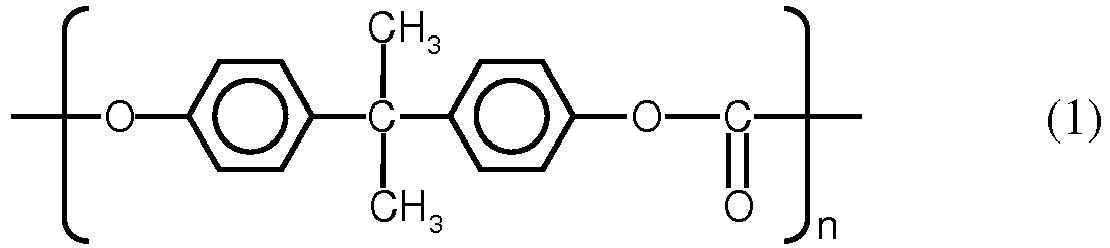


- YI (yellowness index) value of slab≤-20,
- Item [2] is the resin modifier (B) of item [1] which is obtained by using an alkaline (earth) metal salt other than a sulfate salt to segregate from a latex containing the tetrafluoroethylene-based polymer (p1) and the vinyl polymer (p2) other than the polymer (p1), wherein the vinyl polymer (p2) is obtained by performing polymerization on a vinyl monomer (X) containing at least 20 mass% of an aromatic vinyl monomer (x1) in the presence of at least one emulsifier selected from a phosphoric acid-based emulsifier, a carboxylic acid-based emulsifier, and a nonionic emulsifier.
- Item [3] is the resin modifier (B) of item [1] or [2] in which the vinyl monomer (X) contains a (meth)acrylate (x2) that has, in its ester moiety, an alkyl group having 1 to 20 carbons or an aromatic group.
- Item [4] is the resin modifier (B) of any one of items [1] to [3] in which the mass-average molecular weight of the tetrafluoroethylene-based polymer (p1) is 1 million to 50 million.
- Item [5] is the resin modifier (B) of any one of items [1] to [4] in which the content of the tetrafluoroethylene-based polymer (p1) is 30 mass% to 70 mass% based on a total of 100 mass% of the tetrafluoroethylene-based polymer (p1) and the vinyl polymer (p2).
- Item [6] is the resin modifier (B) of any one of items [1] to [5] in which the vinyl polymer (p2) is obtained by polymerizing 100 parts by mass of the vinyl monomer (X) in the presence of an emulsifier of more than 1.5 parts by mass and no more than 10 parts by mass.
- Item [7] is a polycarbonate resin composition containing a polycarbonate resin (A), an organic metal salt (C), and the resin modifier (B) of any one of items [1] to [6].
- Item [8] is the polycarbonate resin composition of item [7] in which the content of the organic metal salt (C) is 0.001 to 2 parts by mass and the content of the resin modifier (B) is 0.001 to 30 parts by mass based on 100 parts by mass of the polycarbonate resin (A).
- Item [9] is the polycarbonate resin composition of item [7] or [8] in which the organic metal salt (C) is a metal salt of a fluorine-free organic sulfonic acid.
- Item [10] is a molded article obtained by molding the polycarbonate resin composition of any one of items [7] to [9].
- Item [11] is a method for manufacturing a molded article which comprises molding the polycarbonate resin composition of any one of [7] to [9] at a temperature of 285°C to 340°C.
- Item [12] is a method for producing a resin modifier (B) which comprises using an alkaline (earth) metal salt other than a sulfate salt to segregate from a latex containing a tetrafluoroethylene-based polymer (p1) and a vinyl polymer (p2) other than the polymer (p1), wherein the vinyl polymer (p2) is obtained by polymerizing a vinyl monomer (X) containing at least 20 mass% of an aromatic vinyl monomer (x1) in the presence of at least one emulsifier selected from a phosphoric acid-based emulsifier, a carboxylic acid-based emulsifier, and a nonionic emulsifier.
- According to this invention, a polycarbonate resin composition having good flame retardance and good thermal stability when molded under high temperature without use of a bromine-based or phosphorus-based compound, and a molded article thereof can be provided. Moreover, according to this invention, a resin modifier that can be mixed with a polycarbonate resin to obtain a polycarbonate resin composition having good flame retardance and good thermal stability when molded under high temperature can be provided.
- In the following, embodiments of this invention are described in detail.
- The resin modifier (B) of this invention contains a tetrafluoroethylene-based polymer (p1) and a vinyl polymer (p2), is used and functions as an anti-dripping agent, and has the effect of increasing the flame retardance of a resin composition. The resin modifier (B) may further contain a small amount of a polymerization auxiliary agent or a segregation agent such as a polymerization initiator or an emulsifier. The amount of the polymerization auxiliary agent or the segregation agent is preferably 0.01 to 1 mass% based on a total of 100 mass% of the tetrafluoroethylene-based polymer (p1) and the vinyl polymer (p2).
- The tetrafluoroethylene-based polymer (p1) (hereinafter "PTFE-based polymer (p1)") used in this invention is a homopolymer only containing a tetrafluoroethylene monomer unit or a copolymer containing a tetrafluoroethylene monomer unit and other monomer unit(s). Specific examples of the other monomers used to copolymerize with tetrafluoroethylene can include, e.g., a fluorine-containing olefin such as hexafluoropropylene, chlorotrifluoroethylene and fluoroalkyl ethylene, and a fluorine-containing alkyl (meth)acrylate such as perfluoroalkyl (meth)acrylate. The "other monomers" can be used without compromise to the characteristic of the tetrafluoroethylene improving the melt tension of the resin composition, and the content thereof in 100 mass% of the PTFE-based polymer (p1) is preferably no more than 10 mass%.
- The mass-average molecular weight of the PTFE-based polymer (p1) is preferably 1 to 50 million, more preferably 3 to 30 million, and even more preferably 5 to 20 million. If the mass-average molecular weight is at least 1 million, then in a case that the resin modifier (B) is mixed in the polycarbonate resin (A), the melt tension of the obtained resin composition is sufficiently increased. As a result, falling of flame drops when the molded article made by the resin composition is burned can be prevented. Moreover, if the mass-average molecular weight is no more than 50 million, then in a case that the resin modifier (B) is mixed in the polycarbonate resin (A), the dispersibility of the PTFE-based polymer (p1) in the obtained resin composition is good, so a molded article with good surface appearance can be obtained.
- Moreover, the "mass-average molecular weight" is calculated according to the following equation after the crystallization heat of a polymer sample cooled from 370°C to 20°C is measured by using a differential thermal analysis apparatus:

wherein M is the mass-average molecular weight and ΔHc is the crystallization heat (cal/g). - In this invention, the content of the PTFE-based polymer (p1) in the resin modifier (B) is not particularly limited, but from the following perspective, the content of the PTFE-based polymer (p1) is preferably 30 to 70 mass% and more preferably 40 to 60 mass% based on a total of 100 mass% of the PTFE-based polymer (p1) and the vinyl polymer (p2). If the content of the PTFE-based polymer (p1) is at least 30 mass%, in a case that the PTFE-based polymer (p1) is prepared in the polycarbonate resin (A), the flame retardance of the obtained resin composition is good. Moreover, if the content of the PTFE-based polymer (p1) is no more than 70 mass%, the dispersibility of the PTFE-based polymer (p1) in the polycarbonate resin (A) is good, and the operability of the powder is good. As a result, a molded article having good surface appearance can be obtained.
- In producing the resin modifier (B), from the perspective of ready mixing of the PTFE- based polymer (p1) and the vinyl polymer (p2), a latex formed by dissolving the polymer (p1) in water is preferably used for the polymer (p1). Specific examples of commercial products for the latex containing the polymer (p1) include, e.g., Fluon AD911L, Fluon AD912L, Fluon AD915E, and Fluon AD939E of Asahi Glass Co., Ltd., and Polyflon D-210C of Daikin Industries Co., Ltd. The latices can be used alone or in combination of two or more.
- In this invention, the vinyl polymer (p2) can be obtained by polymerizing the vinyl monomer (X) containing at least 20 mass% of the aromatic vinyl monomer (x1).
- The content of the aromatic vinyl monomer (x1) in the vinyl monomer (X) is preferably 20 to 80 mass%, more preferably 25 to 75 mass%, even more preferably 30 to 70 mass%, and most preferably 40 to 60 mass%. In a case that the content of the aromatic vinyl monomer (x1) is at least 20 mass%, the thermal stability of the resin composition formed by mixing the obtained resin modifier (B) in the polycarbonate resin (A) is good. Moreover, in a case that the content of the aromatic vinyl monomer (x1) is no more than 80 mass%, the dispersibility of the resin modifier (B) in the polycarbonate resin (A) is good. As a result, the appearance or the flame retardance of the obtained molded article is good.
- Specific examples of the aromatic vinyl monomer (x1) include, for example, styrene, α-methylstyrene, p-methylstyrene, p-t-butylstyrene, p-methoxystyrene, o-methoxystyrene, 2,4-dimethoxystyrene, chlorostyrene, bromostyrene, vinyl toluene, vinylnaphthalene, vinylanthracene, and divinylbenzene. The monomers can be used alone or in combination of two or more. Among them, from the perspective of increasing the polymerization rate of the vinyl monomer (X) and the perspective of making the index of refraction of the obtained vinyl polymer (p2) approach that of the polycarbonate resin (A), styrene, α-methylstyrene, p-methylstyrene, or p-t-butylstyrene is preferred, and styrene is more preferred.
- The vinyl monomer (X) preferably contains a (meth)acrylate (x2) that has, in its ester moiety, an alkyl group containing 1 to 20 carbons or an aromatic group. The content of the (meth)acrylate (x2) in the vinyl monomer (X) is preferably 20 to 80 mass%, more preferably 25 to 75 mass%, even more preferably 30 to 70 mass%, and most preferably 40 to 60 mass%. If the content is at least 20 mass%, dispersibility of the resin modifier (B) in the polycarbonate resin (A) is good, so the appearance or the flame retardance of the obtained molded article is good. Moreover, if the content is no more than 80 mass%, the thermal stability of the resin composition formed by mixing the resin modifier (B) in the polycarbonate resin (A) is good.
- Specific examples of the (meth)acrylate of which the ester moiety is an alkyl group having 1 to 20 carbons include, e.g., methyl (meth)acrylate, ethyl (meth)acrylate, propyl (meth)acrylate, butyl (meth)acrylate, n-hexyl (meth)acrylate, cyclohexyl (meth)acrylate, n-octyl (meth)acrylate, 2-ethylhexyl (meth)acrylate, dodecyl (meth)acrylate, stearyl (meth)acrylate, and isobornyl (meth)acrylate. The alkyl group can be a straight chain or a branched chain. The monomers can be used alone or in combination of 2 or more. Among them, from the perspective of dispersibility of the resin modifier (B) in the polycarbonate resin (A), a (meth)acrylate of which the ester moiety is an alkyl group of 1-8 carbons is preferred, a (meth)acrylate of which the ester moiety is an alkyl group of 1-4 carbons is more preferred, methyl (meth)acrylate, ethyl (meth)acrylate, or n-propyl (meth)acrylate is even more preferred, methyl (meth)acrylate or ethyl (meth)acrylate is still more preferred, methyl (meth)acrylate is most preferred. From the perspective of powder recyclability and powder operability of the resin modifier (B), n-butyl acrylate having a low homopolymer glass transition temperature is preferred. Hence, preferably, methyl (meth)acrylate and n-butyl acrylate are used together.
- Specific examples of the (meth)acrylate of which the ester moiety is an aromatic group include, e.g., phenyl (meth)acrylate, 4-t-butylphenyl (meth)acrylate, bromophenyl (meth)acrylate, dibromophenyl (meth)acrylate, 2,4,6-tribromophenyl (meth)acrylate, chlorophenyl (meth)acrylate, dichlorophenyl (meth)acrylate, trichlorophenyl (meth)acrylate, and benzyl (meth)acrylate. The monomers can be used alone or in combination of two or more. Among them, from the perspective of obtaining the resin modifier (B) having good dispersibility in the polycarbonate resin (A) and the perspective of obtaining a molded article having good appearance or flame retardance, phenyl (meth)acrylate or benzyl (meth)acrylate is preferred, and phenyl (meth)acrylate is more preferred.
- The vinyl monomer (X) may also contain copolymerizable "other monomer(s) (x3)" without compromise to the object of this invention. Specific examples of the monomer (x3) include, e.g., an alkyl ester of (meth)acrylic acid having at least 21 carbons; a carboxyl-containing monomer such as (meth)acrylic acid or carboxyethyl (meth)acrylate; a hydroxyl-containing monomer such as 2-hydroxyethyl (meth)acrylate or hydroxypropyl (meth)acrylate; a vinyl cyanide monomer such as (meth)acrylonitrile; a vinyl ether monomer such as vinyl methyl ether or vinyl ethyl ether; a vinyl carboxylate monomer such as vinyl benzoate, vinyl acetate, or vinyl butyrate; a (meth)acrylate having a reactive functional group such as glycidyl (meth)acrylate, allyl (meth)acrylate, 1,3-butanediol di(meth)acrylate, ethylene glycol di(meth)acrylate, or polybutylene glycol di(meth)acrylate; and an alkene such as ethylene, propylene, or butylene. The monomers (x3) can be used alone or in combination of two or more.
- In a case that the monomer (x3) is used, the content of the monomers (x3) in the vinyl monomer (X) is preferably 0 to 20 mass%.
- In this invention, the vinyl monomer (X) is polymerized by emulsion polymerization or soap-free emulsion polymerization. Among them, in terms of ready segregation, emulsion polymerization is preferred.
- The polymerization initiator used to polymerize the vinyl monomer (X) is not particularly limited, and may be a known one. Specific examples are, e.g., a persulfate, an organic peroxide, an azo initiator, a redox-based initiator as a combination of a persulfate and a reducing agent, and a redox-based initiator as a combination of an organic peroxide and a reducing agent. These can be used alone or in combination of two or more.
- The emulsifier used in the emulsion polymerization of the vinyl monomer (X) is at least one selected from the group consisting of a phosphoric acid-based emulsifier, a carboxylic acid-based emulsifier, and a non-ionic emulsifier. After a latex containing the vinyl polymer (p2) is subjected to segregation, a trace amount of the emulsifier remains in the resin modifier (B) in the state of an acid or a base, or a salt. As a result, when the polycarbonate resin (A), the resin modifier (B), and an organic metal salt (C) are mixed, the polycarbonate resin (A) may be decomposed. In particular, the higher the acidity of the organic metal salt (C), the more readily ions get free from the remnant of the emulsifier, thus facilitating decomposition of the polycarbonate resin (A). Hence, a phosphoric acid-based or carboxylic acid-based emulsifier having low acidity when ionized, or a non-ionic emulsifier without ionization is preferred. Moreover, a sulfonic acid-based emulsifier is unsatisfactory.
- Specific examples of the phosphoric acid-based emulsifier include, e.g., polyoxyethylene phenyl ether phosphate, polyoxyethylene alkyl phenyl ether phosphate, polyoxyethylene alkyl ether phosphate, and alkyl phosphate. These phosphoric acid-based emulsifiers can be in the acid form, or in a salt form of sodium salt or potassium salt.
- Specific examples of commercial products for the phosphoric acid-based emulsifier include, e.g., Phosphanol ML-200, Phosphanol GF-199, Phosphanol RA-600, Phosphanol RS-610NA, Phosphanol SC-6103, and Phosphanol LP-700 produced by Toho Chemical Industry Co., Ltd.
- Examples of the carboxylic acid-based emulsifier are, e.g., a metal salt of a saturated/ unsaturated fatty acid having an alkyl group having 8 to 28 carbons such as caprylic acid, pelargonic acid, capric acid, lauric acid, myristic acid, palmitic acid, margaric acid, stearic acid, arachidic acid, behenic acid, lignoceric acid, cerotic acid, montanic acid, myristoleic acid, palmitoleic acid, oleic acid, elaidic acid, vaccenic acid, ricinoleic acid, gadoleic acid, eicosenoic acid, erucic acid, nervonic acid, linoleic acid, eicosadienoic acid, docosadienoic acid, linolenic acid, pinolenic acid, eleostearic acid, mead acid, eicosatrienoic acid, stearidonic acid, arachidonic acid, eicosatetraenoic acid, adrenic acid, bosseopentaenoic acid, eicosapentaenoic acid, osbond acid, clupanodonic acid, tetracosapentaenoic acid, docosahexaenoic acid, or nisinic acid; a metal salt of an oligo-carboxylic acid compound such as alkenylsuccinate; and a metal salt of a sarcosine derivative such as N-lauroyl sarcosine or N-cocoyl sarcosine.
- Specific examples of commercial products for the carboxylic acid-based emulsifier include, e.g., NS SOAP, SS-40N, FR-14, FR-25, and Latemul ASK produced by Kao Co. Ltd., and Diprosin K-25 and Neoscoap SLN-100 produced by Toho Chemical Industry Co. Ltd.
- Examples of the non-ionic emulsifier include, e.g., polyoxyalkylene alkyl ether, polyoxyethylene alkylene alkyl ether, polyoxyethylene distyrenated phenyl ether, polyoxyethylene tribenzyl phenyl ether, sorbitan fatty acid ester, polyoxyethylene sorbitan fatty acid ester, and polyoxyethylene fatty acid ester, etc.
- Specific examples of commercial products for the non-ionic emulsifier include, e.g., Emulgen 120, Emulgen LS-114, Emulgen A-90, Rheodol SP-L10, Rheodol TW-L120, and Emanon 1112 produced by Kao Co. Ltd.
- The above phosphoric acid-based emulsifier, carboxylic acid-based emulsifier, and non-ionic emulsifier can be used alone or in combination of two or more. Moreover, for ready segregation, among the above emulsifiers, at least one of the phosphoric acid-based emulsifier and the carboxylic acid-based emulsifier is preferably selected.
- The usage amount of the emulsifier is not particularly limited. Based on 100 parts by mass of the vinyl monomer (X), the usage amount of the emulsifier is preferably 0.1 to 20.0 parts by mass, more preferably 0.1 to 15.0 parts by mass, and more preferably 0.1 to 10.0 parts by mass, even more preferably 0.1 to 8.0 parts by mass, and most preferably more than 1.5 parts by mass and no more than 10 parts by mass. If the usage amount of the emulsifier is at least 0.1 parts by mass, the emulsion stability is good. If the usage amount is no more than 20.0 parts by mass, the segregation from a latex containing the PTFE-based polymer (p1) is easy.
- The resin modifier (B) of this invention is obtained by preparing a latex (d) containing the PTFE-based polymer (p1) and the vinyl polymer (p2), using an alkaline (earth) metal salt other than a sulfate salt to segregate from the latex (d), and then converting the resultant precipitate into powder. The latex (d) can be obtained by, e.g., a method in which the vinyl monomer (X) is polymerized in a latex containing the PTFE-based polymer (p1), or a method in which a latex containing the PTFE-based polymer (p1) and a latex containing the vinyl polymer (p2) are mixed.
- In the case that the vinyl monomer (X) is polymerized in a latex containing the PTFE-based polymer (p1), the vinyl monomer (X) can be added to a reaction vessel all at once, successively, or dropwise in a continuous manner. In the case that a latex containing the PTFE-based polymer (p1) and a latex containing the vinyl polymer (p2) are mixed, a known method can be used to perform the mixing of these latices. For instance, a specific amount of a latex containing the PTFE-based polymer (p1) and a specific amount of a latex containing the vinyl polymer (p2) can be added to a vessel and stirred. The mixing of the two latices can be performed in one step, successively, or dropwise in a continuous manner. Moreover, the mixing can also be performed under a heating condition.
- Moreover, in the case that 2 kinds of vinyl polymers are used, the vinyl monomer (X) can be polymerized in a solution in which two latices are mixed. Alternatively, after the vinyl monomer (X) is polymerized in a latex containing the PTFE-based polymer (p1), the vinyl polymer (p2) is mixed therewith.
- The latex (d) containing the PTFE-based polymer (p1) and the vinyl polymer (p2) can also be subjected to segregation after being mixed with "other liquid substances (e)" as needed. Specific examples of the liquid substances (e) include, e.g., the aqueous dispersion of an antioxidant, and a liquid antioxidant. The liquid substances (e) can be used alone or in combination of two or more. The content (converted to amount of active ingredient) of the liquid substances (e) is, based on 100 parts by mass of the solid resin component in the latex, preferably 0 to 10 parts by mass, more preferably 0.01 to 5 parts by mass, and more preferably 0.1 to 3 parts by mass.
- A known method can be used to mix the liquid substances (e) and the latex (d). For instance, a specific amount of the liquid substances (e) and the latex (d) may be added to a vessel and then stirred at room temperature. The mixing can be performed in one step, successively, or dropwise in a continuous manner. Moreover, the mixing can be performed under a heating condition, and can also be performed in the segregation from a latex.
- The segregation method for the latex (d) containing the PTFE-based polymer (p1) and the vinyl polymer (p2) of this invention may be, e.g., a method in which the latex (d) is brought in contact with a hot water in which a segregation agent is dissolved, a slurry is formed by segregation on stirring, and then the resulting precipitate is dehydrated and dried.
- At this moment, if the segregation agent is a sulfate salt, when the polycarbonate resin (A) and the resin modifier are mixed, the sulfate salt remaining in a trace amount sourced from the segregation agent in the obtained resin modifier readily facilitates the decomposition of the polycarbonate resin (A). A sulfate salt is thus unsuitable as a segregation agent, so in this invention, an alkaline (earth) metal salt other than a sulfate salt is used as the segregation agent.
- Specific examples of the alkaline (earth) metal salt other than a sulfate salt are, e.g., alkaline (earth) metal salts of organic acids, such as sodium formate, potassium formate, calcium formate, magnesium formate, barium formate, sodium acetate, potassium acetate, calcium acetate, magnesium acetate, and barium acetate; and alkaline (earth) metal salts of inorganic acids other than sulfuric acid, such as sodium chloride, potassium chloride, calcium chloride, magnesium chloride, barium chloride, sodium phosphate, potassium phosphate, or calcium phosphate. The segregation agents can be used alone or in combination of two or more. The segregation agents can be used in the form of aqueous solutions and are thus highly water-soluble. Further, the segregation agent preferably forms a salt not readily dissociated with the emulsifier contained in the latex containing the PTFE-based polymer (p1) during segregation. The reason is that, even if such segregation agent remains in a trace amount in the resin modifier (B), the thermal stability of the resin composition formed by mixing the resin modifier (B) in the polycarbonate resin (A) is still not readily reduced. From the above two perspectives, among the above segregation agents, alkaline earth metal salts of organic acids or alkaline earth metal salts of inorganic acids other than sulfuric acid are preferred. In particular, calcium salt and magnesium salt are more preferred, and calcium acetate or calcium chloride are even more preferred.
- The usage amount of the segregation agent is not particularly limited, provided the usage amount can sufficiently induce segregation from a latex. Based on 100 parts by mass of the resin solid content in the latex (d) containing the PTFE-based polymer (p1) and the vinyl polymer (p2), the usage amount is preferably 0.1 to 20 parts by mass, more preferably 0.1 to 12 parts by mass, even more preferably 0.5 to 10 parts by mass, and most preferably 0.5 to 8 parts by mass. If the usage amount of the segregation agent is at least 0.1 parts by mass, the powder recyclability and the power operability of the resin modifier (B) are good. If the usage amount of the segregation agent is no more than 20 mass%, the thermal stability of the resin composition formed by mixing the obtained resin modifier (B) in the polycarbonate resin (A) is good.
- For the resin modifier (B), the following resin composition containing the resin modifier (B) preferably meets the following condition [1] and condition [2].
- The resin composition comprises:
- 1 part by mass of the resin modifier (B),
- 100 parts by mass of a polycarbonate resin represented by the following formula (1) and having a viscosity-average molecular weight (Mv) of 23000,
- 0.1 parts by mass of a phenol-based antioxidant represented by the following formula (2),
- 0.1 parts by mass of a phosphite-based antioxidant represented by the following formula (3), and,
- 0.05 parts by mass of potassium perfluorobutanesulfonate.
- The viscosity-average molecular weight of the above polycarbonate resin is obtained by measuring the limiting viscosity [η] of a 0.5 g/dL methylene chloride solution at 25°C with a Ubbelohde viscometer and the following equation:


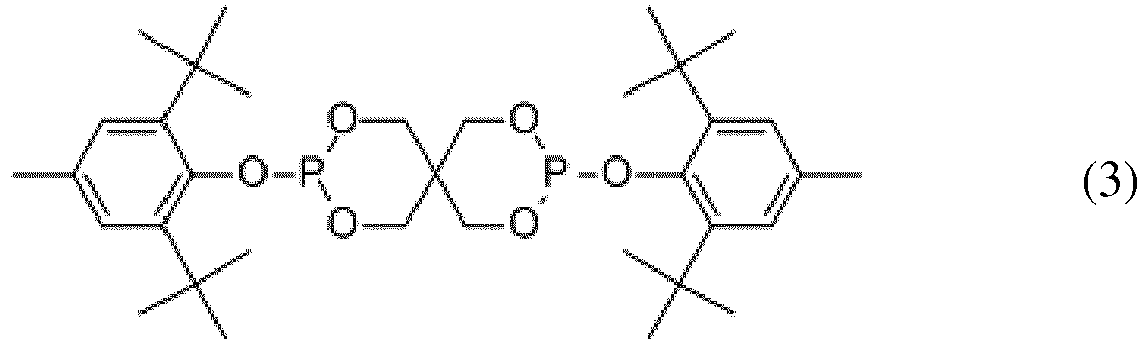
- The condition [1] is:

wherein MFRB is the melt mass-flow rate of the resin composition measured under the conditions of a cylinder temperature of 320°C and a load of 1.2 kg according to ISO1133, and - MFRA is the melt mass-flow rate of the resin composition measured after being left in a cylinder at a temperature of 320°C for 15 minutes under the condition of a load of 1.2 kg according to ISO1133.
- The condition [2] is:
- YI (yellowness index) value of slab≤-20.
- In particular, the YI value of the slab is measured by a reflected-light measurement method under conditions of a C-light source and a viewing angle of 2° with a light-splitting colorimeter according to JIS K7105. The dimensions of the slab are a length of 100 mm, a width of 50 mm, and a thickness of 2 mm. The slab is made by performing injection molding after the resin composition is left in the cylinder of an injection molding machine at a cylinder temperature set at 300°C for 15 minutes.
- To make the resin composition containing the resin modifier (B) meet the above conditions [1] and [2], preferably, when the resin modifier (B) is made, the vinyl monomer (X) containing at least 20 mass% of the aromatic vinyl monomer (x1) is polymerized in presence of at least one emulsifier selected from the group consisting of a phosphoric acid-based emulsifier, a carboxylic acid-based emulsifier, and a non-ionic emulsifier to obtain the vinyl polymer (p2). Moreover, preferably, the vinyl monomer (X) is polymerized without a sulfonic acid-based emulsifier to obtain the vinyl polymer (p2).
- Furthermore, preferably, a latex containing the tetrafluoroethylene-based polymer (p1) and the vinyl polymer (p2) other than the polymer (p1) is subjected to segregation using an alkaline (earth) metal salt other than a sulfate salt to obtain the resin modifier (B).
- The polycarbonate resin composition of this invention contains the polycarbonate resin (A), the organic metal salt (C), and the resin modifier (B).
- In this invention, any known polycarbonate resin can be used as the polycarbonate resin (A), that is, an aromatic polycarbonate resin, an aliphatic polycarbonate resin, or an aromatic-aliphatic polycarbonate resin can be used as the polycarbonate resin. In terms of good impact strength or thermal stability, an aromatic polycarbonate resin is preferred.
- The aromatic polycarbonate resin is a polymer obtained by, e.g., a phosgene method in which a dihydroxydiaryl compounds is reacted with phosgene, or a transesterification method in which a dihydroxydiaryl compound is reacted with a carbonate ester such as diphenyl carbonate. Specific examples of the representative polycarbonate include, e.g., a polycarbonate made from 2,2-bis(4-hydroxyphenyl)propane (bisphenol A).
- In addition to bisphenol A, the following compounds can also be used as the above dihydroxydiaryl compound: bis(4-hydroxyphenyl)methane, 1,1-bis(4-hydroxyphenyl)ethane, 2,2-bis(4-hydroxyphenyl)butane, and bis(4-hydroxyphenyl)phenylmethane, etc. The compounds can be used alone or in combination of two or more.
- In this invention, the viscosity-average molecular weight of the polycarbonate resin (A) is a value converted from a solution viscosity measured at a temperature of 25°C by using methylene chloride as a solvent, and is preferably 10000 to 40000, more preferably 15000 to 30000. If the viscosity-average molecular weight of the polycarbonate resin (A) is at least 10000, the effect of preventing flame drops from falling when the molded article is burned is sufficient such that the flame retardance is good. Moreover, if the viscosity-average molecular weight is no more than 40000, the melt fluidity of the obtained polycarbonate resin composition is good. Moreover, the viscosity-average molecular weight is a molecular weight measured by the above method.
- In the polycarbonate resin composition of this invention, other resins can be mixed without compromise to the good heat resistance, impact resistance, and flame retardance, etc. inherent to the polycarbonate resin. Specifically, the following reins can be mixed in an amount of no more than 50 parts by mass based on 100 parts by mass of the polycarbonate resin (A): styrene-based resins, such as acrylonitrile-butadiene-styrene (ABS), high-impact polystyrene (HIPS), polystyrene (PS), and poly(p-acetoxystyrene) (PAS); acrylic acid-based resins, such as polymethyl methacrylate; polyolefin-based resins, such as polyethylene and polypropylene; polyester-based resins, such as polyethylene terephthalate and polybutylene terephthalate; nylon-based resins, such as 6-nylon or 6,6-nylon; and elastomers, polyphenylene ether, polyarylate, polyphenylene sulfide, polyether ketone, polyether ether ketone, polysulfone, polyethersulfone, polyamide-imide, polyetherimide, and polyacetal, etc.
- In this invention, various metal salts previously used to provide flame retardance to a polycarbonate resin can be used as the organic metal salt (C). In particular, metal salts of organic sulfonic acids are preferred. Specific examples of the metal salts of organic sulfonic acids include, e.g., metal salts of aliphatic sulfonic acids, metal salts of aromatic sulfonic acids, and metal salts of polymeric aromatic sulfonic acids. Moreover, the metal salts of the above sulfonic acids can also have a hydrocarbon group that is partially or fully fluorinated.
- Specific examples of the metal salts of organic sulfonic acids include, e.g., potassium salt of 4-methyl-N-(4-methylphenyl)sulfonyl-benzenesulfonamide, potassium diphenylsulfone-3-sulfonate, potassium diphenylsulfone-3,3'-disulfonate, sodium p-toluenesulfonate, disodium diphenylsulfide-4,4'-disulfonate, dipotassium diphenylsulfide-4,4'-disulfonate, calcium 1-methoxynaphthalene-4-sulfonate, disodium 4-dodecylphenylene oxide disulfonate, polysodium poly(2,6-dimethylphenylene oxide)polysulfonate, polysodium poly(1,3-phenylene oxide)polysulfonate, polysodium poly(1,4-phenylene oxide)polysulfonate, polypotassium poly(2,6-diphenylphenylene oxide)polysulfonate, lithium poly(2-fluoro-6-butylphenylene oxide)polysulfonate, potassium trifluoromethanesulfonate, potassium perfluorobutanesulfonate, potassium perfluorooctanesulfonate, sodium pentafluoroethanesulfonate, potassium monofluoromethanesulfonate, sodium monofluoromethanesulfonate, sodium 2,4-difluorobenzenesulfonate, potassium 2,4-difluorobenzenesulfonate, sodium 3,4-difluorobenzenesulfonate, potassium 3,4-difluorobenzenesulfonate, sodium 2-trifluoromethylbenzenesulfonate, potassium 2-trifluoromethylbenzenesulfonate, sodium 4,4'-difluorobiphenyl-3-sulfonate, potassium 4,4'-difluorobiphenyl-3-sulfonate, sodium 4,4'-difluorodiphenylsulfide-3-sulfonate, potassium 4,4'-difluorodiphenylsulfide-3-sulfonate, disodium tetrafluorodiphenylene oxide disulfonate, dipotassium tetrafluorodiphenylene oxide disulfonate, and lithium poly(2-fluoro-6-butylphenylene oxide)polysulfonate. Among them, from the perspective of good thermal stability of the resin composition obtained by mixing the metal salt in the polycarbonate resin (A), a metal salt of a fluorine-free organic sulfonic acid is preferred.
- The content of the organic metal salt (C) in the polycarbonate resin composition of this invention is decided according to the perspective of flame retardance performance of the resin composition and the addition efficiency of the organic metal salt (C). If the content is too low, the flame retardance effect is insufficient. On the other hand, if the content is too high, increase in the effect corresponding to an increase in content either cannot be expected. Therefore, the content thereof is, based on 100 parts by mass of the polycarbonate resin (A), preferably 0.001 to 2 parts by mass, more preferably 0.01 to 1 part by mass, and even more preferably 0.02 to 0.5 parts by mass.
- The content of the resin modifier (B) in the polycarbonate resin composition of this invention is, based on 100 parts by mass of the polycarbonate resin (A), preferably 0.001 to 30 parts by mass, more preferably 0.01 to 10 parts by mass, even more preferably 0.05 to 5 parts by mass, and most preferably 0.1 to 3 parts by mass. If the content of the resin modifier (B) is at least 0.001 parts by mass, the effect of increasing the melt tension of the resin composition is sufficient. As a result, falling of flame drops when the molded article is burned is readily prevented. If the content of the resin modifier (B) is no more than 30 parts by mass, the melt fluidity of the obtained polycarbonate resin composition is good.
- Moreover, if required, a known additive can be mixed in the polycarbonate resin composition of this invention to provide various functions to the molded article or improve characteristics of the same. Specific examples of the additive include, e.g., an antioxidant, a UV absorbent, a light stabilizer, a mold-release agent, a lubricant, a slip agent, a colorant (a pigment such as carbon black or titanium oxide, or a dye), a fluorescent whitening agent, a light-storing pigment, a fluorescent dye, and an antistatic agent. Moreover, to increase the strength and the rigidity of the molded article to increase flame retardance, the molded article can contain a filler material such as talc, mica, calcium carbonate, glass fiber, carbon fiber, or potassium titanate fiber. Moreover, to increase the impact resistance of the molded article, a rubber-like elastomer containing a core-shell 2-layer structure can be mixed.
- The antioxidant is not particularly limited, as long as it is an antioxidant used during ordinary molding. Specific examples of the antioxidant are, e.g., a phenol-based antioxidant, a phosphite-based antioxidant, and a sulfur-based antioxidant. By mixing these antioxidants, oxidative decomposition of the resin when the molded article is made by the polycarbonate resin composition, or tone variation of the molded article when exposed to heat or light, etc. can be suppressed.
- Specific examples of the phenol-based antioxidant are, e.g., Vitamin E, tris[N-(3,5-di-t-butyl-4-hydroxybenzyl]isocyanurate (ADEKA Corporation; such as ADK Stab AO-20), tetrakis[3-(3,5-di-t-butyl-4-hydroxyphenyl)propionyl oxymethyl]methane (by Ciba Specialty Chemicals Co., Ltd.; such as Irganox 1010), triethylene glycol bis[3-(3-t-butyl-4-hydroxy-5-methylphenyl)propionate] (by Ciba Specialty Chemicals Co., Ltd.; such as Irganox 245), 3,9-bis[2-[3-(3-t-butyl-4-hydroxy-5-methylphenyl)propionyloxy]-1,1-dimethylethyl)-2,4,8,1 0-tetraoxaspiro[5.5]undecane (by ADEKA Corporation; such as ADK Stab AO-80), octadecyl 3-(3,5-di-t-butyl-4-hydroxyphenyl)propionate (by Ciba Specialty Chemicals Co., Ltd.; such as Irganox 1076), and so on.
- Specific examples of the phosphite-based antioxidant include, e.g., triphenyl phosphite (by ADEKA Corporation; like ADK Stab TPP), tridecyl phosphite (by ADEKA Corporation; like ADK Stab 3010), octadecyl bis(2,6-di-t-butyl-4-methylphenyl)pentaerythritol phosphite (by ADEKA Corporation; like ADK Stab PEP-36), tris(2,4-di-t-butylphenyl)phosphite (by ADEKA Corporation, like ADK Stab 2112), 2,2-methylene-bis(4,6-di-t-butylphenyl)octyl phosphite (by ADEKA Corporation, like ADK Stab HP-10), and so on.
- Specific examples of the sulfur-based antioxidant are, e.g., dilauryl thiodipropionate (by Yoshitomi Fine Chemicals, Ltd., such as Yoshinox DLTP) and dimyristyl 3,3'-thiodipropionate (by Yoshitomi Fine Chemicals, Ltd., such as Yoshinox DMTP), etc.
- The content of the antioxidant in the polycarbonate resin composition of this invention is decided in view of the antioxidant performance of the resin composition and the addition efficiency of the antioxidant. If the content is too low, the effect is insufficient. On the other hand, if the content is too high, an increase in the effect corresponding to the increase in content either cannot be expected. Hence, the content thereof is, based on 100 parts by mass of the polycarbonate resin (A), preferably 0 to 2 parts by mass, more preferably 0.001 to 2 parts by mass, and even more preferably 0.001 to 1 part by mass.
- The resin composition containing the polycarbonate resin (A), the organic metal salt (C), and the resin modifier (B) is prepared as a powder mixture or a melt-kneaded product. At this point, a Henschel mixer, a Banbury mixer, a single-screw extruder, a twin-screw extruder, a double-roller mill, a kneading machine, or a Brabender, etc., is used. Moreover, it is also possible to firstly prepare a master batch in which the content of the resin modifier (B) and/or the organic metal salt (C) is large and the resin modifier (B) and/or the organic metal salt (C) and the polycarbonate resin (A) are mixed, and then mix the master batch with the polycarbonate resin (A) again, so as to obtain the desired resin composition. The temperature of the mixing and/or kneading is not particularly limited, as long as it is properly selected and decided within the range of 240°C to 320°C.
- The molded article of this invention is made by molding the above polycarbonate resin composition. Examples of the molding method include, e.g., compression molding, transfer molding, injection molding, blow molding, extrusion molding, laminate molding, and roll molding. The molding temperature of the resin composition is not particularly limited. The higher the molding temperature, the better the fluidity of the molten mass of the resin composition. However, an excessive molding temperature facilitates the decomposition of the resin composition, so the molding temperature is preferably 285°C to 340°C, and more preferably 290°C to 320°C. The thickness of the molded article is preferably 0.1 to 2 mm.
- The molded article of this invention has characteristics such as good mechanical strength, heat resistance, electrical characteristics, and dimensional stability of polycarbonate resin, and also has good flame retardance and good thermal stability when molded under high temperature. The molded article of this invention can be used in representative fields such as the automotive field, the OA equipment field, the electrical/electronic equipment field and the building material field, and in a wide range of other fields.
- This invention is further described with the examples below. Before the examples are described, the evaluation methods of Preparation Example 1 to Preparation Example 15 for resin modifier (B-1) to resin modifier (B-15) and the resin compositions are described. In the following description, "parts" refers to "parts by mass" and "%" refers to "mass%".
- A pellet of polycarbonate resin composition was used for the resin composition.
- In this evaluation, "ΔMFR" defined by the equation below was used as an indicator of thermal decomposition resistance of the resin composition. It can be determined that, the smaller the value, the better the thermal decomposition resistance of the resin composition.
- A melt indexer (model S-111, made by Toyo Seiki Co., Ltd.) was used to measure the melt mass-flow rate (MFR) of the pellet with the following steps. First, the MFR of the pellet was measured under the conditions of a cylinder temperature of 320°C and a load of 1.2 kg according to ISO1133, and the MFR was designated as MFRB. Moreover, after the other pellets were left in the cylinder at a temperature of 320°C, the MFR was measured under the condition of a load of 1.2 kg according to ISO1133, and the MFR was designated as MFRA.

- The evaluation of heat coloring resistance of the resin composition was performed with the yellowness index (YI) value of a slab made from the resin composition. It can be determined that, the smaller the value, the less the yellowness and the better the tone of the resin composition.
- The YI value of the slab was measured by a reflected-light measurement method under the conditions of a C-light source and a viewing angle of 2° with a light-splitting colorimeter (model SE2000, made by Nippon Denshoku Industries, Co., Ltd.) according to JIS K7105. Dimensions of the slab were a length of 100 mm, a width of 50 mm, and a thickness of 2 mm.
- The pellet was provided to a 100 t injection molding machine (model SE-100DU, made by Sumitomo Heavy Industries Co., Ltd.) having a cylinder temperature set to 300°C such that injection molding was performed on the pellet after being left in the cylinder for 15 minutes. A slab having a length of 100 mm, a width of 50 mm, and a thickness of 2 mm was thus obtained. Then, the YI value of the obtained slab was measured.
- The evaluation was performed on the flame retardance of a test piece made from the resin composition.
- A pellet of the polycarbonate resin composition was provided to a 100 t injection molding machine (model SE-100DU, made by Sumitomo Heavy Industries Co., Ltd.) having a cylinder temperature set to 300°C, and a test piece having a thickness of 1/16 inches was obtained by injection molding. A perpendicular burn test was performed on the obtained test piece according to UL-94 specifications of Underwriters Laboratories Incorporation. The number of test pieces was set at 5, and each test piece was observed 10 seconds after contact with flame. A UL grade was provided with the following criteria.
Table 1 UL-grade V-0 V-1 V-2 Burn time T1 (sec) of each test piece ≤10 ≤30 ≤30 Total burn time T2 (sec) of all test pieces ≤50 ≤250 ≤250 Burning of absorbent cotton caused by flame drops falling from all test pieces Not burnt Not burnt - Burning of absorbent cotton caused by flame drops falling from 1 to 4 test pieces Not burnt Not burnt Burnt - 6.0 parts of dipotassium alkenylsuccinate used as the emulsifier and 230 parts of distilled water were added to a detachable flask having a volume of 2 L provided with a stirring blade, a condenser, a thermocouple, and a nitrogen inlet. Then, the components were stirred in nitrogen gas at room temperature for 30 minutes. The above dipotassium alkenylsuccinate was used in the form of being dissolved in a portion of the above distilled water.
- Then, the temperature of the solution in the flask was raised to 70°C, and then a solution formed by dissolving 0.2 parts of potassium persulfate in 3 parts of distilled water was added to the flask. Then, a mixture containing 50 parts of methyl methacrylate, 40 parts of styrene, 10 parts of n-butyl acrylate, and 0.1 part of n-octyl mercaptan was added dropwise to the flask over 4 hours to perform a free-radical polymerization. After the dropwise addition, the mixture was stirred for 1 hour while the temperature of the solution in the flask was maintained at 70°C to obtain a latex (p2-1) containing the vinyl polymer (p2). The content of the vinyl polymer (p2) in the emulsifier was 30%.
- 166.7 parts of the latex (p2-1) and 83.3 parts of a latex "Fluon AD939E" (by Asahi Glass Co., Ltd., with a PTFE concentration of 60%, a mass-average molecular weight of PTFE of ∼15 million, and a concentration of polyoxy alkylene alkyl ether of 3%) containing the PTFE-based polymer (p1) were added to a reaction vessel having a stirring apparatus. The components were then stirred for 5 minutes to obtain a latex (d-1). In the latex, the content of the PTFE was 50 parts, the content of the polyoxy alkylene alkyl ether was 2.5 parts, and the content of the vinyl polymer (p2) was 50 parts.
- Then, 325 parts of an aqueous solution of calcium acetate containing 5.0 parts of calcium acetate as the segregation agent was added to a flask having a volume of 10 L, and then the aqueous solution was heated to a temperature of 80°C. Then, the latex (d-1) was slowly added dropwise to the aqueous solution under stirring, such that the polymer was segregated and a slurry was obtained. Then, after the temperature of the slurry was raised to 90°C, the slurry was continuously stirred for 5 minutes. Then, the obtained precipitate was separated from the slurry, and then filtration, water-washing and drying were performed, so as to obtain 100 parts of a powder resin modifier (B-1).
- 1.0 part of dipotassium alkenylsuccinate and 230 parts of distilled water were added to a detachable flask provided with a stirring blade, a condenser, a thermocouple, and a nitrogen inlet. Then, the components were stirred in nitrogen gas at room temperature for 30 minutes. The above dipotassium alkenylsuccinate was used in the form of being dissolved in a portion of the above distilled water.
- Then, the temperature of the solution in the flask was raised to 70°C, and then a solution formed by dissolving a mixture containing 0.0005 parts of ferrous sulfate, 0.0015 parts of disodium ethylene diaminetetraacetate, and 0.2 parts of rongalite in 3 parts of distilled water was added to the flask. Then, a mixture containing 50 parts of methyl methacrylate, 40 parts of styrene, 10 parts of n-butyl acrylic acid, 0.1 parts of n-octyl mercaptan, and 0.2 parts of t-butyl hydroperoxide was added dropwise to the flask over 4 hours to perform a free-radical polymerization. After the dropwise addition, the mixture was stirred for 1 hour while the temperature of the solution in the flask was maintained at 70°C to obtain a latex (p2-2) containing the vinyl polymer (p2). The content of (p2) in the emulsifier was 30%.
- Then, 100 parts of a resin modifier (B-2) was obtained with the same method of Preparation Example 1, except that the latex (p2-2) was used instead of the latex (p2-1) obtained in Preparation Example 1 and calcium chloride was used instead of calcium acetate.
- 100 parts of a resin modifier (B-3) was obtained with the same method of Preparation Example 1, except that the emulsifier was changed to 6.0 parts of potassium oleate.
- 100 parts of a resin modifier (B-4) was obtained with the same method of Preparation Example 2, except that the emulsifier was changed to 1.0 part of potassium oleate.
- 100 parts of a resin modifier (B-5) was obtained with the same method of Preparation Example 2, except that the monomer component used in the polymerization of the vinyl polymer (p2) was changed to a mixture containing 60 parts of methyl methacrylate, 30 parts of styrene, and 10 parts of n-butyl acrylate, and the segregation agent was changed to 5.0 parts of calcium acetate.
- 100 parts of a resin modifier (B-6) was obtained with the same method of Preparation Example 2, except that the emulsifier was changed to 1.0 part of sodium polyoxyethylene alkyl ether phosphate, and the segregation agent was changed to 5.0 parts of calcium acetate.
- 100 parts of a resin modifier (B-7) was obtained with the same method of Preparation Example 5, except that the monomer component used in the polymerization of the vinyl polymer (p2) was changed to a mixture containing 50 parts of methyl methacrylate and 50 parts of styrene.
- 100 parts of a resin modifier (B-8) was obtained with the same method of Preparation Example 5, except that the monomer component used in the polymerization of the vinyl polymer (p2) was changed to a mixture containing 30 parts of methyl methacrylate and 70 parts of styrene, and the emulsifier was changed to 3.0 parts of dipotassium alkenylsuccinate.
- 100 parts of a resin modifier (B-9) was obtained with the same method of Preparation Example 1, except that the emulsifier was changed to 1.0 part of dipotassium alkenylsuccinate, and the latex containing the PTFE-based polymer (p1) was changed to 83.3 parts of "Fluon AD915E" (by Asahi Glass Co., Ltd., with a PTFE concentration of 60%, a ass-average molecular weight of PTFE of about 3 million, and a concentration of polyoxyalkylene alkyl ether: 3%).
- 100 parts of a resin modifier (B-10) was obtained with the same method of Preparation Example 1, except that the segregation agent was changed to 0.3 parts of aluminum sulfate.
- 100 parts of a resin modifier (B-11) was obtained with the same method of Preparation Example 4, except that the segregation agent was changed to 5.0 parts of magnesium sulfate.
- 100 parts of a resin modifier (B-12) was obtained with the same method of Preparation Example 1, except that the emulsifier was changed to 6.0 parts of sodium dodecylbenzenesulfonate.
- 100 parts of a resin modifier (B-13) was obtained with the same method of Preparation Example 5, except that the monomer component used in the polymerization of the vinyl polymer (p2) was changed to a mixture containing 90 parts of methyl methacrylate and 10 parts of styrene.
- 6.0 parts of dipotassium alkenylsuccinate, 80 parts of methyl methacrylate, 20 parts of n-butyl acrylate, 0.1 parts of n-octyl mercaptan, and 230 parts of distilled water were added to a detachable flask having a volume of 2 L provided with a stirring blade, a condenser, a thermocouple, and a nitrogen inlet. Then, the components were stirred in nitrogen gas at room temperature for 30 minutes. The above dipotassium alkenylsuccinate was used in the form of being dissolved in a portion of the above distilled water.
- Then, the temperature of the solution in the flask was raised to 50°C, and then a solution formed by dissolving 0.2 part of potassium persulfate in 3 parts of distilled water was added to the flask, thereby initiating free-radical polymerization. After the polymerization and heat generation, the mixture was stirred for 2 hours while the temperature of the solution in the flask was maintained at 60°C to obtain a latex (p2-14) containing the vinyl polymer (p2). The content of the vinyl polymer (p2) in the emulsifier was 30%.
- 100 parts of a resin modifier (B-14) was obtained with the same method of Preparation Example 1, except that the latex (p2-14) was used instead of the latex (p2-1) obtained in Preparation Example 1.
- 100 parts of a resin modifier (B-15) was obtained with the same method of Preparation Example 5, except that the emulsifier was changed to 1.5 parts of sodium alkyl diphenyl ether disulfonate.
Table 2 Preparation Example Resin modifier (B) Latex (p1) Preparation conditions of latex (p2) Segregation agent PTFE (%) Molecular weight Mass composition ratio of vinyl monomer Emulsifier Type Parts by mass Type Parts by mass 1 B-1 60 150 million MMA/St/BA = 50/40/10 Dipotassium alkenylsuccinate 6.0 Calcium acetate 5.0 2 B-2 60 150 million MMA/St/BA = 50/40/10 Dipotassium alkenylsuccinate 1.0 Calcium chloride 5.0 3 B-3 60 150 million MMA/St/BA = 50/40/10 Potassium oleate 6.0 Calcium acetate 5.0 4 B-4 60 150 million MMA/St/BA = 50/40/10 Potassium oleate 1.0 Calcium chloride 5.0 5 B-5 60 150 million MMA/St/BA = 60/30/10 Dipotassium alkenylsuccinate 1.0 Calcium acetate 5.0 6 B-6 60 150 million MMA/St/BA = 50/40/10 Sodium polyoxyethylene alkyl ether phosphate 1.0 Calcium acetate 5.0 7 B-7 60 150 million MMA/St = 50/50 Dipotassium alkenylsuccinate 1.0 Calcium acetate 5.0 8 B-8 60 150 million MMA/St = 30/70 Dipotassium alkenylsuccinate 3.0 Calcium acetate 5.0 9 B-9 60 30 million MMA/St/BA = 50/40/10 Dipotassium alkenylsuccinate 1.0 Calcium acetate 5.0 10 B-10 60 150 million MMA/St/BA = 50/40/10 Dipotassium alkenylsuccinate 6.0 Aluminum sulfate 0.3 11 B-11 60 150 million MMA/St/BA = 50/40/10 Potassium oleate 1.0 Magnesium sulfate 5.0 12 B-12 60 150 million MMA/St/BA = 50/40/10 Sodium dodecylbenzenesulfonate 6.0 Calcium acetate 5.0 13 B-13 60 150 million MMA/St = 90/10 Dipotassium alkenylsuccinate 1.0 Calcium acetate 5.0 14 B-14 60 150 million MMA/BA = 80/20 Dipotassium alkenylsuccinate 6.0 Calcium acetate 5.0 15 B-15 60 150 million MMA/St/BA = 50/40/10 Sodium alkyl diphenyl ether disulfonate 1.5 Calcium acetate 5.0 Latex (p1): latex containing the PTFE-based polymer (p1)
Latex (p2): latex containing the vinyl polymer (p2) - The resin modifiers made in Preparation Examples 1 to 15 are summarized in Table 2. Moreover, the symbols recited in the column of vinyl monomers in Table 2 refer to the compounds recited in Table 5. The parts by mass of the emulsifiers in Table 2 are amounts based on 100 parts by mass of the vinyl monomers. Moreover, the parts by mass of the segregation agents are amounts based on 100 parts by mass of the polymer in the latex (d).
- Each material was prepared according to Table 3 or 4 to obtain the polycarbonate resin compositions. Each resin composition was provided to a unidirectional biaxial extruder (model: PCM-30, made by Ikegai Corp.) and then melted and kneaded at a barrel temperature of 280°C, thus obtaining a pellet. The obtained pellets were used to evaluate the characteristics of the resin compositions, and the evaluation results are shown in Table 3 or 4. Moreover, the labels recited in the columns of the PC resin, the organic metal salts (C), and the antioxidants in Table 3 and Table 4 refer to the compounds shown in Table 5.
Table 3 Resin composition Thermal stability Flame retardance PC resin (A) (parts by mass) Resin modifier (B) Organic metal salt (C) (parts by mass) Antioxidant (parts by mass) ΔMFR (%) YI value Longest burn time (sec) of one test piece Total burn time (sec) Flame drops UL-grade Type Parts by mass F-114 KSS Irg245 PEP36 Example 1 100 B-1 1 0.05 - 0.1 0.1 26 -23 2 6 Not burnt V-0 Example 2 100 B-2 1 0.05 - 0.1 0.1 22 -27 5 12 Not burnt V-0 Example 3 100 B-3 1 0.05 - 0.1 0.1 27 -24 5 20 Not burnt V-0 Example 4 100 B-4 1 0.05 - 0.1 0.1 15 -27 2 10 Not burnt V-0 Example 5 100 B-5 1 0.05 - 0.1 0.1 22 -27 2 8 Not burnt V-0 Example 6 100 B-6 1 0.05 - 0.1 0.1 19 -24 3 12 Not burnt V-0 Example 7 100 B-7 1 0.05 - 0.1 0.1 22 -25 2 10 Not burnt V-0 Example 8 100 B-8 1 0.05 - 0.1 0.1 13 -27 2 7 Not burnt V-0 Example 9 100 B-9 1 0.05 - 0.1 0.1 21 -26 7 20 Not burnt V-0 Comparative Example 1 100 B-10 1 0.05 - 0.1 0.1 45 -8 5 17 Not burnt V-0 Comparative Example 2 100 B-11 1 0.05 - 0.1 0.1 41 -15 12 42 Not burnt V-1 Comparative Example 3 100 B-12 1 0.05 - 0.1 0.1 87 -4 16 49 Not burnt V-1 Comparative Example 4 100 B-13 1 0.05 - 0.1 0.1 37 -19 3 14 Not burnt V-0 Comparative Example 5 100 B-14 1 0.05 - 0.1 0.1 47 -17 3 19 Not burnt V-0 Table 4 Resin composition Thermal stability Flame retardance PC resin (A) (parts by mass) Resin modifier (B) Organic metal salt (C) (parts by mass) Antioxidant (parts by mass) ΔMFR (%) YI value Longest burn time (sec) of one test piece Total burn time (sec) Flame drops UL-grade Type Parts by mass F-114 KSS Irg245 PEP36 Example 10 100 B-1 1 - 0.3 0.1 0.1 13 -23 2 8 Not burnt V-0 Example 11 100 B-2 1 - 0.3 0.1 0.1 13 -27 6 20 Not burnt V-0 Example 12 100 B-4 1 - 0.3 0.1 0.1 10 -27 3 10 Not burnt V-0 Example 13 100 B-5 1 - 0.3 0.1 0.1 14 -25 5 19 Not burnt V-0 Example 14 100 B-6 1 - 0.3 0.1 0.1 11 -24 4 15 Not burnt V-0 Example 15 100 B-7 1 - 0.3 0.1 0.1 17 -23 8 21 Not burnt V-0 Example 16 100 B-9 1 - 0.3 0.1 0.1 14 -24 8 23 Not burnt V-0 Comparative Example 6 100 B-11 1 - 0.3 0.1 0.1 34 -22 16 65 Not burnt V-1 Comparative Example 7 100 B-15 1 - 0.3 0.1 0.1 45 -14 30 128 Burnt V-2 Comparative Example 8 100 B-13 1 - 0.3 0.1 0.1 32 -19 7 25 Not burnt V-0 Table 5 Symbol Compound MMA Methyl methacrylate St Styrene BA n-butyl acrylate PC resin Aromatic polycarbonate resin "Iupilon S-2000F", viscosity-average molecular weight: 23000, made by Mitsubishi Engineering Plastics Corporation F-114 Potassium perfluorobutanesulfonate "Megafac F-114", by DIC Corporation KSS Potassium diphenylsulfone-3-sulfonate "ChemGuard-KSS", by Chembridge International Corporation Irg245 Phenol-based antioxidant "Irganox 245", by Ciba Specialty Chemicals Co., Ltd. PEP36 Phosphite-based antioxidant "ADK Stab PEP-36", made by ADEKA - It is clear from Examples 1 to 16 that, the thermal decomposition resistance of the polycarbonate resin composition of this invention is good, and even if the polycarbonate resin composition is molded after being left under high temperature, coloring is still difficult, and flame retardance is still good.
- In Comparative Examples 1, 2 and 6, since a sulfate salt was used as the segregation agent, the thermal stability and/or the flame retardance of the resin compositions is poor. Since the content of the aromatic vinyl monomer unit in the vinyl polymer of the resin compositions of Comparative Examples 4, 5 and 8 is small, the thermal stability thereof is poor. Since the vinyl polymer of the resin compositions of Comparative Examples 3 and 7 were polymerized in the presence of a sulfonic acid-based emulsifier, the thermal stability and flame retardance thereof are poor.
- With the resin modifier of this invention, a polycarbonate resin composition with good flame retardance and good thermal stability when molded under high temperature without use of a bromine-based or phosphorus-based compound can be provided.
- The molded article of this invention can be used in representative fields such as the automotive field, the OA equipment field, the electrical/electronic equipment field, and the building material field, and in a wide range of other fields.

wherein MFRB is the melt mass-flow rate of the resin composition measured under the conditions of a cylinder temperature of 320°C and a load of 1.2 kg according to ISO1133, and
MFRA is the melt mass-flow rate of the resin composition measured after being left in a cylinder at a temperature of 320°C for 15 minutes under the condition of a load of 1.2 kg according to ISO1133; and
the condition [2] is:
Claims (12)
- A resin modifier (B) containing a tetrafluoroethylene-based polymer (p1) and a vinyl polymer (p2) other than the polymer, and rendering the following resin composition containing the resin modifier meet the following conditions [1] and [2], wherein
the resin composition comprises:1 part by mass of the resin modifier (B),100 parts by mass of a polycarbonate resin represented by formula (1) and having a viscosity-average molecular weight (Mv) of 23000,0.1 part by mass of a phenol-based antioxidant represented by formula (2),0.1 part by mass of a phosphite-based antioxidant represented by formula (3), and0.05 parts by mass of potassium perfluorobutanesulfonate;the viscosity-average molecular weight of the polycarbonate resin is obtained by measuring a limiting viscosity [η] of a 0.5 g/dL methylene chloride solution at 25°C with a Ubbelohde viscometer and the following equation:


 the condition [1] is:wherein the YI value of the slab is measured by a reflected-light measurement method under conditions of a C-light source and a viewing angle of 2 degrees with a light-splitting colorimeter according to JIS K7105, dimensions of the slab are a length of 100 mm, a width of 50 mm, and a thickness of 2 mm, and the slab is made by performing an injection molding after the resin composition is left in a cylinder of an injection molding machine at a cylinder temperature set at 300°C for 15 minutes.
wherein MFRB is a melt mass-flow rate of the resin composition measured under conditions of a cylinder temperature of 320°C and a load of 1.2 kg according to ISO1133, and
MFRA is a melt mass-flow rate of the resin composition measured, after being left in a cylinder at a temperature of 320°C for 15 minutes, under a condition of a load of 1.2 kg according to ISO1133; and
the condition [2] is:YI (yellowness index) value of a slab≤-20; - The resin modifier (B) of claim 1, which is obtained by using an alkaline (earth) metal salt other than a sulfate salt to segregate from a latex containing the tetrafluoroethylene-based polymer (p1) and the vinyl polymer (p2) other than the polymer (p1), wherein the vinyl polymer (p2) is obtained by performing a polymerization on a vinyl monomer (X) containing at least 20 mass% of an aromatic vinyl monomer (x1) in presence of at least one emulsifier selected from a phosphoric acid-based emulsifier, a carboxylic acid-based emulsifier, and a nonionic emulsifier.
- The resin modifier (B) of claim 2, wherein the vinyl monomer (X) contains a (meth)acrylate ester (x2) that has, in its ester moiety, an alkyl group having 1 to 20 carbons or an aromatic group.
- The resin modifier (B) of claim 1, wherein a mass-average molecular weight of the tetrafluoroethylene-based polymer (p1) is 1 million to 50 million.
- The resin modifier (B) of claim 1, wherein a content of the tetrafluoroethylene-based polymer (p1) is 30 mass% to 70 mass% based on a total of 100 mass% of the tetrafluoroethylene-based polymer (p1) and the vinyl polymer (p2).
- The resin modifier (B) of claim 2, wherein the vinyl polymer (p2) is obtained by polymerizing 100 parts by mass of the vinyl monomer (X) in presence of an emulsifier of more than 1.5 parts by mass and no more than 10 parts by mass.
- A polycarbonate resin composition containing a polycarbonate resin (A), an organic metal salt (C), and the resin modifier (B) of any one of claim 1 to claim 3.
- The polycarbonate resin composition of claim 7, wherein a content of the organic metal salt (C) is 0.001 to 2 parts by mass, and a content of the resin modifier (B) is 0.001 to 30 parts by mass, based on 100 parts by mass of the polycarbonate resin (A).
- The polycarbonate resin composition of claim 7, wherein the organic metal salt (C) is a metal salt of a fluorine-free organic sulfonic acid.
- A molded article obtained by molding the polycarbonate resin composition of claim 7.
- A method for manufacturing a molded article, comprising molding the polycarbonate resin composition of claim 7 at a temperature of 285°C to 340°C.
- A method for producing a resin modifier (B), comprising using an alkaline (earth) metal salt other than a sulfate salt to segregate from a latex containing a tetrafluoroethylene-based polymer (p1) and a vinyl polymer (p2) other than the polymer (p1), wherein the vinyl polymer (p2) is obtained by performing a polymerization on a vinyl monomer (X) containing at least 20 mass% of an aromatic vinyl monomer (x1) in presence of at least one emulsifier selected from a phosphoric acid-based emulsifier, a carboxylic acid-based emulsifier, and a nonionic emulsifier.
Applications Claiming Priority (2)
| Application Number | Priority Date | Filing Date | Title |
|---|---|---|---|
| JP2012043529 | 2012-02-29 | ||
| PCT/JP2013/054755 WO2013129310A1 (en) | 2012-02-29 | 2013-02-25 | Resin modifier, polycarbonate resin composition and molded body thereof |
Publications (3)
| Publication Number | Publication Date |
|---|---|
| EP2821440A1 true EP2821440A1 (en) | 2015-01-07 |
| EP2821440A4 EP2821440A4 (en) | 2015-05-06 |
| EP2821440B1 EP2821440B1 (en) | 2019-06-12 |
Family
ID=49082508
Family Applications (1)
| Application Number | Title | Priority Date | Filing Date |
|---|---|---|---|
| EP13755928.2A Active EP2821440B1 (en) | 2012-02-29 | 2013-02-25 | Resin modifier, polycarbonate resin composition and molded body thereof |
Country Status (7)
| Country | Link |
|---|---|
| US (1) | US9902849B2 (en) |
| EP (1) | EP2821440B1 (en) |
| JP (1) | JP6307880B2 (en) |
| KR (1) | KR101674780B1 (en) |
| CN (1) | CN104136536B (en) |
| TW (1) | TWI573836B (en) |
| WO (1) | WO2013129310A1 (en) |
Families Citing this family (6)
| Publication number | Priority date | Publication date | Assignee | Title |
|---|---|---|---|---|
| JP6693127B2 (en) * | 2014-03-20 | 2020-05-13 | 三菱ケミカル株式会社 | Method for producing vinyl polymer powder |
| KR102049577B1 (en) | 2016-10-31 | 2019-11-27 | 주식회사 엘지화학 | Polycarbonate resin composition and optical product composed thereof |
| JP7252727B2 (en) * | 2018-09-14 | 2023-04-05 | 出光興産株式会社 | Polycarbonate resin composition |
| EP3670595A1 (en) * | 2018-12-19 | 2020-06-24 | Covestro Deutschland AG | Thermoplastic compositions with good thermal stability |
| KR102685429B1 (en) * | 2019-03-18 | 2024-07-15 | 우베 마테리알즈 가부시키가이샤 | Polycarbonate resin composition and method for producing the same, masterbatch pellets, and molded body |
| WO2025126968A1 (en) * | 2023-12-14 | 2025-06-19 | Agc株式会社 | Liquid composition, laminate using said liquid composition, and method for producing prepreg |
Family Cites Families (11)
| Publication number | Priority date | Publication date | Assignee | Title |
|---|---|---|---|---|
| JP2002060612A (en) * | 2000-08-21 | 2002-02-26 | Teijin Chem Ltd | Flame retardant aromatic polycarbonate resin composition |
| JP2002275366A (en) * | 2001-03-16 | 2002-09-25 | Mitsubishi Rayon Co Ltd | Highly reflective aromatic polycarbonate resin composition and molded article thereof |
| JP2003261875A (en) * | 2002-03-08 | 2003-09-19 | Mitsubishi Rayon Co Ltd | Flame retardant, flame-retardant resin composition using the same, and molded article |
| JP2004075800A (en) | 2002-08-14 | 2004-03-11 | Mitsubishi Rayon Co Ltd | Flame retardant polycarbonate resin composition and molded article thereof |
| JP2005281486A (en) * | 2004-03-30 | 2005-10-13 | Toray Ind Inc | Resin composition |
| JP2007106953A (en) * | 2005-10-17 | 2007-04-26 | Mitsubishi Rayon Co Ltd | Drip prevention powder and flame retardant resin composition |
| JP2008208317A (en) * | 2007-02-28 | 2008-09-11 | Teijin Chem Ltd | Flame retardant polycarbonate resin composition |
| JP4872771B2 (en) * | 2007-04-12 | 2012-02-08 | 村田機械株式会社 | Document separation and supply apparatus and image reading apparatus having the same |
| JP5357019B2 (en) * | 2008-03-11 | 2013-12-04 | 三菱レイヨン株式会社 | Fluidity improver for aromatic polycarbonate resin and method for producing the same, aromatic polycarbonate resin composition, and molded article |
| CN101977978B (en) | 2008-03-22 | 2014-03-19 | 拜尔材料科学股份公司 | Impact-modified polycarbonate compositions having a good combination of initial hue, hydrolytic stability and melt stability |
| US9475935B2 (en) * | 2010-09-30 | 2016-10-25 | Daikin Industries, Ltd. | Dripping inhibitor and resin compound |
-
2013
- 2013-02-23 TW TW102106410A patent/TWI573836B/en not_active IP Right Cessation
- 2013-02-25 CN CN201380011466.5A patent/CN104136536B/en active Active
- 2013-02-25 EP EP13755928.2A patent/EP2821440B1/en active Active
- 2013-02-25 WO PCT/JP2013/054755 patent/WO2013129310A1/en not_active Ceased
- 2013-02-25 US US14/381,791 patent/US9902849B2/en not_active Expired - Fee Related
- 2013-02-25 KR KR1020147023090A patent/KR101674780B1/en not_active Expired - Fee Related
- 2013-02-25 JP JP2013510380A patent/JP6307880B2/en active Active
Also Published As
| Publication number | Publication date |
|---|---|
| US20150045483A1 (en) | 2015-02-12 |
| WO2013129310A1 (en) | 2013-09-06 |
| TW201343783A (en) | 2013-11-01 |
| TWI573836B (en) | 2017-03-11 |
| CN104136536B (en) | 2016-09-07 |
| CN104136536A (en) | 2014-11-05 |
| JP6307880B2 (en) | 2018-04-11 |
| JPWO2013129310A1 (en) | 2015-07-30 |
| US9902849B2 (en) | 2018-02-27 |
| EP2821440A4 (en) | 2015-05-06 |
| EP2821440B1 (en) | 2019-06-12 |
| KR101674780B1 (en) | 2016-11-09 |
| KR20140117570A (en) | 2014-10-07 |
Similar Documents
| Publication | Publication Date | Title |
|---|---|---|
| EP2821440B1 (en) | Resin modifier, polycarbonate resin composition and molded body thereof | |
| TWI359839B (en) | Flame retardant polycarbonate resin composition | |
| CN105636997B (en) | Graft copolymer containing polyorganosiloxane, resin composition, molded article, slidability improving agent, and sliding part | |
| EP3351588A1 (en) | Resin composition exhibiting good heat resistance and insulation properties, and product using same | |
| JP5247765B2 (en) | Flame retardant polycarbonate resin composition and molded article using the same | |
| DE102010013991A1 (en) | Flame retardant polycarbonate compositions | |
| JP2003049076A (en) | Titanium oxide-containing flame-retardant resin composition and production method | |
| JP5520910B2 (en) | Flame retardant polycarbonate resin composition and molded product comprising the same | |
| JP2000290487A (en) | Flame retardant polycarbonate resin composition and molded article using the same | |
| JP4674254B2 (en) | Rubber-modified styrene flame retardant resin composition | |
| KR101847249B1 (en) | Flame retardant thermoplastic resin composition and article comprising the same | |
| JP2002194100A (en) | Translucent/transparent flame-retardant thin walled resin molding and use thereof | |
| JP7845848B2 (en) | Flame-retardant polycarbonate resin composition | |
| JP4902664B2 (en) | Weather resistant high modulus polymer composition and method | |
| KR100798015B1 (en) | Flame retardant polycarbonate thermoplastic resin composition with excellent wear resistance | |
| JP2025008470A (en) | Resin composition, pellets, and molded products | |
| JP2007153983A (en) | Bending product of flame retardant resin composition | |
| KR100722146B1 (en) | Flame-retardant polycarbonate-based plastic resin composition excellent in extrusion processability and heat and moisture resistance | |
| KR100989908B1 (en) | Low gloss flame retardant polycarbonate resin composition and molded article using same | |
| JP2025129810A (en) | Resin composition, pellets, and molded products | |
| TWI832823B (en) | Flame retardant polycarbonate resin composition | |
| JP2025129811A (en) | Resin composition, pellets, and molded products | |
| JP2005068380A (en) | Flame-retardant polycarbonate resin composition | |
| JP2005068379A (en) | Flame-retardant polycarbonate resin composition | |
| JP2006232876A (en) | Flame-retardant polycarbonate resin composition |
Legal Events
| Date | Code | Title | Description |
|---|---|---|---|
| PUAI | Public reference made under article 153(3) epc to a published international application that has entered the european phase |
Free format text: ORIGINAL CODE: 0009012 |
|
| 17P | Request for examination filed |
Effective date: 20140829 |
|
| AK | Designated contracting states |
Kind code of ref document: A1 Designated state(s): AL AT BE BG CH CY CZ DE DK EE ES FI FR GB GR HR HU IE IS IT LI LT LU LV MC MK MT NL NO PL PT RO RS SE SI SK SM TR |
|
| AX | Request for extension of the european patent |
Extension state: BA ME |
|
| RA4 | Supplementary search report drawn up and despatched (corrected) |
Effective date: 20150410 |
|
| RIC1 | Information provided on ipc code assigned before grant |
Ipc: C08L 27/18 20060101ALI20150405BHEP Ipc: C08L 69/00 20060101AFI20150405BHEP Ipc: C08L 33/12 20060101ALI20150405BHEP Ipc: C08L 25/08 20060101ALI20150405BHEP Ipc: C08F 2/24 20060101ALI20150405BHEP Ipc: C08K 5/42 20060101ALN20150405BHEP |
|
| DAX | Request for extension of the european patent (deleted) | ||
| RAP1 | Party data changed (applicant data changed or rights of an application transferred) |
Owner name: MITSUBISHI CHEMICAL CORPORATION |
|
| STAA | Information on the status of an ep patent application or granted ep patent |
Free format text: STATUS: EXAMINATION IS IN PROGRESS |
|
| 17Q | First examination report despatched |
Effective date: 20180613 |
|
| GRAP | Despatch of communication of intention to grant a patent |
Free format text: ORIGINAL CODE: EPIDOSNIGR1 |
|
| STAA | Information on the status of an ep patent application or granted ep patent |
Free format text: STATUS: GRANT OF PATENT IS INTENDED |
|
| RIC1 | Information provided on ipc code assigned before grant |
Ipc: C08L 27/18 20060101ALI20181029BHEP Ipc: C08F 2/24 20060101ALI20181029BHEP Ipc: C08L 25/08 20060101ALI20181029BHEP Ipc: C08L 33/12 20060101ALI20181029BHEP Ipc: C08K 5/42 20060101ALN20181029BHEP Ipc: C08L 69/00 20060101AFI20181029BHEP |
|
| INTG | Intention to grant announced |
Effective date: 20181123 |
|
| RIN1 | Information on inventor provided before grant (corrected) |
Inventor name: UEDA, MASAHIRO Inventor name: KASAI, TOSHIHIRO |
|
| GRAS | Grant fee paid |
Free format text: ORIGINAL CODE: EPIDOSNIGR3 |
|
| RIN1 | Information on inventor provided before grant (corrected) |
Inventor name: KASAI, TOSHIHIRO Inventor name: UEDA, MASAHIRO |
|
| GRAA | (expected) grant |
Free format text: ORIGINAL CODE: 0009210 |
|
| STAA | Information on the status of an ep patent application or granted ep patent |
Free format text: STATUS: THE PATENT HAS BEEN GRANTED |
|
| AK | Designated contracting states |
Kind code of ref document: B1 Designated state(s): AL AT BE BG CH CY CZ DE DK EE ES FI FR GB GR HR HU IE IS IT LI LT LU LV MC MK MT NL NO PL PT RO RS SE SI SK SM TR |
|
| REG | Reference to a national code |
Ref country code: GB Ref legal event code: FG4D |
|
| REG | Reference to a national code |
Ref country code: CH Ref legal event code: EP |
|
| REG | Reference to a national code |
Ref country code: AT Ref legal event code: REF Ref document number: 1142491 Country of ref document: AT Kind code of ref document: T Effective date: 20190615 |
|
| REG | Reference to a national code |
Ref country code: DE Ref legal event code: R096 Ref document number: 602013056534 Country of ref document: DE |
|
| REG | Reference to a national code |
Ref country code: IE Ref legal event code: FG4D |
|
| REG | Reference to a national code |
Ref country code: NL Ref legal event code: MP Effective date: 20190612 |
|
| REG | Reference to a national code |
Ref country code: LT Ref legal event code: MG4D |
|
| PG25 | Lapsed in a contracting state [announced via postgrant information from national office to epo] |
Ref country code: SE Free format text: LAPSE BECAUSE OF FAILURE TO SUBMIT A TRANSLATION OF THE DESCRIPTION OR TO PAY THE FEE WITHIN THE PRESCRIBED TIME-LIMIT Effective date: 20190612 Ref country code: LT Free format text: LAPSE BECAUSE OF FAILURE TO SUBMIT A TRANSLATION OF THE DESCRIPTION OR TO PAY THE FEE WITHIN THE PRESCRIBED TIME-LIMIT Effective date: 20190612 Ref country code: FI Free format text: LAPSE BECAUSE OF FAILURE TO SUBMIT A TRANSLATION OF THE DESCRIPTION OR TO PAY THE FEE WITHIN THE PRESCRIBED TIME-LIMIT Effective date: 20190612 Ref country code: AL Free format text: LAPSE BECAUSE OF FAILURE TO SUBMIT A TRANSLATION OF THE DESCRIPTION OR TO PAY THE FEE WITHIN THE PRESCRIBED TIME-LIMIT Effective date: 20190612 Ref country code: NO Free format text: LAPSE BECAUSE OF FAILURE TO SUBMIT A TRANSLATION OF THE DESCRIPTION OR TO PAY THE FEE WITHIN THE PRESCRIBED TIME-LIMIT Effective date: 20190912 Ref country code: HR Free format text: LAPSE BECAUSE OF FAILURE TO SUBMIT A TRANSLATION OF THE DESCRIPTION OR TO PAY THE FEE WITHIN THE PRESCRIBED TIME-LIMIT Effective date: 20190612 |
|
| PG25 | Lapsed in a contracting state [announced via postgrant information from national office to epo] |
Ref country code: GR Free format text: LAPSE BECAUSE OF FAILURE TO SUBMIT A TRANSLATION OF THE DESCRIPTION OR TO PAY THE FEE WITHIN THE PRESCRIBED TIME-LIMIT Effective date: 20190913 Ref country code: LV Free format text: LAPSE BECAUSE OF FAILURE TO SUBMIT A TRANSLATION OF THE DESCRIPTION OR TO PAY THE FEE WITHIN THE PRESCRIBED TIME-LIMIT Effective date: 20190612 Ref country code: BG Free format text: LAPSE BECAUSE OF FAILURE TO SUBMIT A TRANSLATION OF THE DESCRIPTION OR TO PAY THE FEE WITHIN THE PRESCRIBED TIME-LIMIT Effective date: 20190912 Ref country code: RS Free format text: LAPSE BECAUSE OF FAILURE TO SUBMIT A TRANSLATION OF THE DESCRIPTION OR TO PAY THE FEE WITHIN THE PRESCRIBED TIME-LIMIT Effective date: 20190612 |
|
| REG | Reference to a national code |
Ref country code: AT Ref legal event code: MK05 Ref document number: 1142491 Country of ref document: AT Kind code of ref document: T Effective date: 20190612 |
|
| PG25 | Lapsed in a contracting state [announced via postgrant information from national office to epo] |
Ref country code: AT Free format text: LAPSE BECAUSE OF FAILURE TO SUBMIT A TRANSLATION OF THE DESCRIPTION OR TO PAY THE FEE WITHIN THE PRESCRIBED TIME-LIMIT Effective date: 20190612 Ref country code: EE Free format text: LAPSE BECAUSE OF FAILURE TO SUBMIT A TRANSLATION OF THE DESCRIPTION OR TO PAY THE FEE WITHIN THE PRESCRIBED TIME-LIMIT Effective date: 20190612 Ref country code: RO Free format text: LAPSE BECAUSE OF FAILURE TO SUBMIT A TRANSLATION OF THE DESCRIPTION OR TO PAY THE FEE WITHIN THE PRESCRIBED TIME-LIMIT Effective date: 20190612 Ref country code: NL Free format text: LAPSE BECAUSE OF FAILURE TO SUBMIT A TRANSLATION OF THE DESCRIPTION OR TO PAY THE FEE WITHIN THE PRESCRIBED TIME-LIMIT Effective date: 20190612 Ref country code: CZ Free format text: LAPSE BECAUSE OF FAILURE TO SUBMIT A TRANSLATION OF THE DESCRIPTION OR TO PAY THE FEE WITHIN THE PRESCRIBED TIME-LIMIT Effective date: 20190612 Ref country code: PT Free format text: LAPSE BECAUSE OF FAILURE TO SUBMIT A TRANSLATION OF THE DESCRIPTION OR TO PAY THE FEE WITHIN THE PRESCRIBED TIME-LIMIT Effective date: 20191014 Ref country code: SK Free format text: LAPSE BECAUSE OF FAILURE TO SUBMIT A TRANSLATION OF THE DESCRIPTION OR TO PAY THE FEE WITHIN THE PRESCRIBED TIME-LIMIT Effective date: 20190612 |
|
| PG25 | Lapsed in a contracting state [announced via postgrant information from national office to epo] |
Ref country code: IS Free format text: LAPSE BECAUSE OF FAILURE TO SUBMIT A TRANSLATION OF THE DESCRIPTION OR TO PAY THE FEE WITHIN THE PRESCRIBED TIME-LIMIT Effective date: 20191012 Ref country code: ES Free format text: LAPSE BECAUSE OF FAILURE TO SUBMIT A TRANSLATION OF THE DESCRIPTION OR TO PAY THE FEE WITHIN THE PRESCRIBED TIME-LIMIT Effective date: 20190612 Ref country code: SM Free format text: LAPSE BECAUSE OF FAILURE TO SUBMIT A TRANSLATION OF THE DESCRIPTION OR TO PAY THE FEE WITHIN THE PRESCRIBED TIME-LIMIT Effective date: 20190612 Ref country code: IT Free format text: LAPSE BECAUSE OF FAILURE TO SUBMIT A TRANSLATION OF THE DESCRIPTION OR TO PAY THE FEE WITHIN THE PRESCRIBED TIME-LIMIT Effective date: 20190612 |
|
| REG | Reference to a national code |
Ref country code: DE Ref legal event code: R097 Ref document number: 602013056534 Country of ref document: DE |
|
| PG25 | Lapsed in a contracting state [announced via postgrant information from national office to epo] |
Ref country code: TR Free format text: LAPSE BECAUSE OF FAILURE TO SUBMIT A TRANSLATION OF THE DESCRIPTION OR TO PAY THE FEE WITHIN THE PRESCRIBED TIME-LIMIT Effective date: 20190612 |
|
| PLBE | No opposition filed within time limit |
Free format text: ORIGINAL CODE: 0009261 |
|
| STAA | Information on the status of an ep patent application or granted ep patent |
Free format text: STATUS: NO OPPOSITION FILED WITHIN TIME LIMIT |
|
| PG25 | Lapsed in a contracting state [announced via postgrant information from national office to epo] |
Ref country code: DK Free format text: LAPSE BECAUSE OF FAILURE TO SUBMIT A TRANSLATION OF THE DESCRIPTION OR TO PAY THE FEE WITHIN THE PRESCRIBED TIME-LIMIT Effective date: 20190612 Ref country code: PL Free format text: LAPSE BECAUSE OF FAILURE TO SUBMIT A TRANSLATION OF THE DESCRIPTION OR TO PAY THE FEE WITHIN THE PRESCRIBED TIME-LIMIT Effective date: 20190612 |
|
| 26N | No opposition filed |
Effective date: 20200313 |
|
| PG25 | Lapsed in a contracting state [announced via postgrant information from national office to epo] |
Ref country code: IS Free format text: LAPSE BECAUSE OF FAILURE TO SUBMIT A TRANSLATION OF THE DESCRIPTION OR TO PAY THE FEE WITHIN THE PRESCRIBED TIME-LIMIT Effective date: 20200224 Ref country code: SI Free format text: LAPSE BECAUSE OF FAILURE TO SUBMIT A TRANSLATION OF THE DESCRIPTION OR TO PAY THE FEE WITHIN THE PRESCRIBED TIME-LIMIT Effective date: 20190612 |
|
| PG2D | Information on lapse in contracting state deleted |
Ref country code: IS |
|
| REG | Reference to a national code |
Ref country code: DE Ref legal event code: R119 Ref document number: 602013056534 Country of ref document: DE |
|
| REG | Reference to a national code |
Ref country code: CH Ref legal event code: PL |
|
| GBPC | Gb: european patent ceased through non-payment of renewal fee |
Effective date: 20200225 |
|
| REG | Reference to a national code |
Ref country code: BE Ref legal event code: MM Effective date: 20200229 |
|
| PG25 | Lapsed in a contracting state [announced via postgrant information from national office to epo] |
Ref country code: LU Free format text: LAPSE BECAUSE OF NON-PAYMENT OF DUE FEES Effective date: 20200225 Ref country code: MC Free format text: LAPSE BECAUSE OF FAILURE TO SUBMIT A TRANSLATION OF THE DESCRIPTION OR TO PAY THE FEE WITHIN THE PRESCRIBED TIME-LIMIT Effective date: 20190612 |
|
| PG25 | Lapsed in a contracting state [announced via postgrant information from national office to epo] |
Ref country code: LI Free format text: LAPSE BECAUSE OF NON-PAYMENT OF DUE FEES Effective date: 20200229 Ref country code: CH Free format text: LAPSE BECAUSE OF NON-PAYMENT OF DUE FEES Effective date: 20200229 |
|
| PG25 | Lapsed in a contracting state [announced via postgrant information from national office to epo] |
Ref country code: IE Free format text: LAPSE BECAUSE OF NON-PAYMENT OF DUE FEES Effective date: 20200225 Ref country code: FR Free format text: LAPSE BECAUSE OF NON-PAYMENT OF DUE FEES Effective date: 20200229 Ref country code: GB Free format text: LAPSE BECAUSE OF NON-PAYMENT OF DUE FEES Effective date: 20200225 Ref country code: DE Free format text: LAPSE BECAUSE OF NON-PAYMENT OF DUE FEES Effective date: 20200901 |
|
| PG25 | Lapsed in a contracting state [announced via postgrant information from national office to epo] |
Ref country code: BE Free format text: LAPSE BECAUSE OF NON-PAYMENT OF DUE FEES Effective date: 20200229 |
|
| PG25 | Lapsed in a contracting state [announced via postgrant information from national office to epo] |
Ref country code: MT Free format text: LAPSE BECAUSE OF FAILURE TO SUBMIT A TRANSLATION OF THE DESCRIPTION OR TO PAY THE FEE WITHIN THE PRESCRIBED TIME-LIMIT Effective date: 20190612 Ref country code: CY Free format text: LAPSE BECAUSE OF FAILURE TO SUBMIT A TRANSLATION OF THE DESCRIPTION OR TO PAY THE FEE WITHIN THE PRESCRIBED TIME-LIMIT Effective date: 20190612 |
|
| PG25 | Lapsed in a contracting state [announced via postgrant information from national office to epo] |
Ref country code: MK Free format text: LAPSE BECAUSE OF FAILURE TO SUBMIT A TRANSLATION OF THE DESCRIPTION OR TO PAY THE FEE WITHIN THE PRESCRIBED TIME-LIMIT Effective date: 20190612 |