EP2818113B1 - Röntgenbildvorrichtung und Betriebsverfahren dafür - Google Patents
Röntgenbildvorrichtung und Betriebsverfahren dafür Download PDFInfo
- Publication number
- EP2818113B1 EP2818113B1 EP14173870.8A EP14173870A EP2818113B1 EP 2818113 B1 EP2818113 B1 EP 2818113B1 EP 14173870 A EP14173870 A EP 14173870A EP 2818113 B1 EP2818113 B1 EP 2818113B1
- Authority
- EP
- European Patent Office
- Prior art keywords
- ray
- generator
- photographing apparatus
- ray generator
- anode electrode
- Prior art date
- Legal status (The legal status is an assumption and is not a legal conclusion. Google has not performed a legal analysis and makes no representation as to the accuracy of the status listed.)
- Not-in-force
Links
Images








Classifications
-
- G—PHYSICS
- G01—MEASURING; TESTING
- G01N—INVESTIGATING OR ANALYSING MATERIALS BY DETERMINING THEIR CHEMICAL OR PHYSICAL PROPERTIES
- G01N23/00—Investigating or analysing materials by the use of wave or particle radiation, e.g. X-rays or neutrons, not covered by groups G01N3/00 – G01N17/00, G01N21/00 or G01N22/00
- G01N23/02—Investigating or analysing materials by the use of wave or particle radiation, e.g. X-rays or neutrons, not covered by groups G01N3/00 – G01N17/00, G01N21/00 or G01N22/00 by transmitting the radiation through the material
- G01N23/04—Investigating or analysing materials by the use of wave or particle radiation, e.g. X-rays or neutrons, not covered by groups G01N3/00 – G01N17/00, G01N21/00 or G01N22/00 by transmitting the radiation through the material and forming images of the material
- G01N23/046—Investigating or analysing materials by the use of wave or particle radiation, e.g. X-rays or neutrons, not covered by groups G01N3/00 – G01N17/00, G01N21/00 or G01N22/00 by transmitting the radiation through the material and forming images of the material using tomography, e.g. computed tomography [CT]
-
- H—ELECTRICITY
- H01—ELECTRIC ELEMENTS
- H01J—ELECTRIC DISCHARGE TUBES OR DISCHARGE LAMPS
- H01J35/00—X-ray tubes
- H01J35/02—Details
- H01J35/04—Electrodes ; Mutual position thereof; Constructional adaptations therefor
- H01J35/08—Anodes; Anti cathodes
- H01J35/112—Non-rotating anodes
-
- A—HUMAN NECESSITIES
- A61—MEDICAL OR VETERINARY SCIENCE; HYGIENE
- A61B—DIAGNOSIS; SURGERY; IDENTIFICATION
- A61B6/00—Apparatus or devices for radiation diagnosis; Apparatus or devices for radiation diagnosis combined with radiation therapy equipment
- A61B6/50—Apparatus or devices for radiation diagnosis; Apparatus or devices for radiation diagnosis combined with radiation therapy equipment specially adapted for specific body parts; specially adapted for specific clinical applications
- A61B6/502—Apparatus or devices for radiation diagnosis; Apparatus or devices for radiation diagnosis combined with radiation therapy equipment specially adapted for specific body parts; specially adapted for specific clinical applications for diagnosis of breast, i.e. mammography
-
- A—HUMAN NECESSITIES
- A61—MEDICAL OR VETERINARY SCIENCE; HYGIENE
- A61B—DIAGNOSIS; SURGERY; IDENTIFICATION
- A61B6/00—Apparatus or devices for radiation diagnosis; Apparatus or devices for radiation diagnosis combined with radiation therapy equipment
- A61B6/02—Arrangements for diagnosis sequentially in different planes; Stereoscopic radiation diagnosis
-
- A—HUMAN NECESSITIES
- A61—MEDICAL OR VETERINARY SCIENCE; HYGIENE
- A61B—DIAGNOSIS; SURGERY; IDENTIFICATION
- A61B6/00—Apparatus or devices for radiation diagnosis; Apparatus or devices for radiation diagnosis combined with radiation therapy equipment
- A61B6/04—Positioning of patients; Tiltable beds or the like
- A61B6/0407—Supports, e.g. tables or beds, for the body or parts of the body
- A61B6/0414—Supports, e.g. tables or beds, for the body or parts of the body with compression means
-
- A—HUMAN NECESSITIES
- A61—MEDICAL OR VETERINARY SCIENCE; HYGIENE
- A61B—DIAGNOSIS; SURGERY; IDENTIFICATION
- A61B6/00—Apparatus or devices for radiation diagnosis; Apparatus or devices for radiation diagnosis combined with radiation therapy equipment
- A61B6/08—Auxiliary means for directing the radiation beam to a particular spot, e.g. using light beams
-
- A—HUMAN NECESSITIES
- A61—MEDICAL OR VETERINARY SCIENCE; HYGIENE
- A61B—DIAGNOSIS; SURGERY; IDENTIFICATION
- A61B6/00—Apparatus or devices for radiation diagnosis; Apparatus or devices for radiation diagnosis combined with radiation therapy equipment
- A61B6/40—Arrangements for generating radiation specially adapted for radiation diagnosis
- A61B6/4007—Arrangements for generating radiation specially adapted for radiation diagnosis characterised by using a plurality of source units
-
- A—HUMAN NECESSITIES
- A61—MEDICAL OR VETERINARY SCIENCE; HYGIENE
- A61B—DIAGNOSIS; SURGERY; IDENTIFICATION
- A61B6/00—Apparatus or devices for radiation diagnosis; Apparatus or devices for radiation diagnosis combined with radiation therapy equipment
- A61B6/40—Arrangements for generating radiation specially adapted for radiation diagnosis
- A61B6/4007—Arrangements for generating radiation specially adapted for radiation diagnosis characterised by using a plurality of source units
- A61B6/4014—Arrangements for generating radiation specially adapted for radiation diagnosis characterised by using a plurality of source units arranged in multiple source-detector units
-
- A—HUMAN NECESSITIES
- A61—MEDICAL OR VETERINARY SCIENCE; HYGIENE
- A61B—DIAGNOSIS; SURGERY; IDENTIFICATION
- A61B6/00—Apparatus or devices for radiation diagnosis; Apparatus or devices for radiation diagnosis combined with radiation therapy equipment
- A61B6/40—Arrangements for generating radiation specially adapted for radiation diagnosis
- A61B6/405—Source units specially adapted to modify characteristics of the beam during the data acquisition process
-
- A—HUMAN NECESSITIES
- A61—MEDICAL OR VETERINARY SCIENCE; HYGIENE
- A61B—DIAGNOSIS; SURGERY; IDENTIFICATION
- A61B6/00—Apparatus or devices for radiation diagnosis; Apparatus or devices for radiation diagnosis combined with radiation therapy equipment
- A61B6/42—Arrangements for detecting radiation specially adapted for radiation diagnosis
- A61B6/4208—Arrangements for detecting radiation specially adapted for radiation diagnosis characterised by using a particular type of detector
- A61B6/4233—Arrangements for detecting radiation specially adapted for radiation diagnosis characterised by using a particular type of detector using matrix detectors
-
- A—HUMAN NECESSITIES
- A61—MEDICAL OR VETERINARY SCIENCE; HYGIENE
- A61B—DIAGNOSIS; SURGERY; IDENTIFICATION
- A61B6/00—Apparatus or devices for radiation diagnosis; Apparatus or devices for radiation diagnosis combined with radiation therapy equipment
- A61B6/42—Arrangements for detecting radiation specially adapted for radiation diagnosis
- A61B6/4266—Arrangements for detecting radiation specially adapted for radiation diagnosis characterised by using a plurality of detector units
-
- A—HUMAN NECESSITIES
- A61—MEDICAL OR VETERINARY SCIENCE; HYGIENE
- A61B—DIAGNOSIS; SURGERY; IDENTIFICATION
- A61B6/00—Apparatus or devices for radiation diagnosis; Apparatus or devices for radiation diagnosis combined with radiation therapy equipment
- A61B6/44—Constructional features of apparatus for radiation diagnosis
- A61B6/4429—Constructional features of apparatus for radiation diagnosis related to the mounting of source units and detector units
- A61B6/4452—Constructional features of apparatus for radiation diagnosis related to the mounting of source units and detector units the source unit and the detector unit being able to move relative to each other
-
- A—HUMAN NECESSITIES
- A61—MEDICAL OR VETERINARY SCIENCE; HYGIENE
- A61B—DIAGNOSIS; SURGERY; IDENTIFICATION
- A61B6/00—Apparatus or devices for radiation diagnosis; Apparatus or devices for radiation diagnosis combined with radiation therapy equipment
- A61B6/54—Control of apparatus or devices for radiation diagnosis
- A61B6/542—Control of apparatus or devices for radiation diagnosis involving control of exposure
- A61B6/544—Control of apparatus or devices for radiation diagnosis involving control of exposure dependent on patient size
-
- H—ELECTRICITY
- H01—ELECTRIC ELEMENTS
- H01J—ELECTRIC DISCHARGE TUBES OR DISCHARGE LAMPS
- H01J1/00—Details of electrodes, of magnetic control means, of screens, or of the mounting or spacing thereof, common to two or more basic types of discharge tubes or lamps
- H01J1/02—Main electrodes
- H01J1/30—Cold cathodes, e.g. field-emissive cathode
- H01J1/304—Field-emissive cathodes
-
- H—ELECTRICITY
- H01—ELECTRIC ELEMENTS
- H01J—ELECTRIC DISCHARGE TUBES OR DISCHARGE LAMPS
- H01J35/00—X-ray tubes
- H01J35/02—Details
- H01J35/14—Arrangements for concentrating, focusing, or directing the cathode ray
-
- A—HUMAN NECESSITIES
- A61—MEDICAL OR VETERINARY SCIENCE; HYGIENE
- A61B—DIAGNOSIS; SURGERY; IDENTIFICATION
- A61B6/00—Apparatus or devices for radiation diagnosis; Apparatus or devices for radiation diagnosis combined with radiation therapy equipment
- A61B6/40—Arrangements for generating radiation specially adapted for radiation diagnosis
- A61B6/4021—Arrangements for generating radiation specially adapted for radiation diagnosis involving movement of the focal spot
-
- H—ELECTRICITY
- H01—ELECTRIC ELEMENTS
- H01J—ELECTRIC DISCHARGE TUBES OR DISCHARGE LAMPS
- H01J2235/00—X-ray tubes
- H01J2235/08—Targets (anodes) and X-ray converters
- H01J2235/081—Target material
-
- H—ELECTRICITY
- H01—ELECTRIC ELEMENTS
- H01J—ELECTRIC DISCHARGE TUBES OR DISCHARGE LAMPS
- H01J2235/00—X-ray tubes
- H01J2235/08—Targets (anodes) and X-ray converters
- H01J2235/086—Target geometry
-
- H—ELECTRICITY
- H01—ELECTRIC ELEMENTS
- H01J—ELECTRIC DISCHARGE TUBES OR DISCHARGE LAMPS
- H01J35/00—X-ray tubes
- H01J35/02—Details
- H01J35/04—Electrodes ; Mutual position thereof; Constructional adaptations therefor
- H01J35/08—Anodes; Anti cathodes
- H01J35/112—Non-rotating anodes
- H01J35/116—Transmissive anodes
Definitions
- One or more exemplary embodiments relate to an X-ray photographing apparatus using an X-ray and a method of operating the X-ray photographing apparatus.
- X-rays are used in non-destructive testing, structural and physical properties testing, image diagnosis, security inspection, and the like in the fields of industry, science, medical treatment, etc.
- an imaging system using X-rays for such purposes includes an X-ray generator for radiating an X-ray and an X-ray detector for detecting X-rays that have passed through an object.
- the X-ray detector is being rapidly converted from a film device to a digital device, whereas the X-ray generator uses an electron generation device having a tungsten filament type cathode.
- a single electron generation device is mounted in a single X-ray photographing apparatus.
- the X-ray detector is generally implemented as a flat panel type, which is problematic in that there is a distance between the X-ray generator and the object when obtaining an image using the single electron generation device.
- the object needs to be photographed by using a single X-ray generator, which may make it impossible to select and photograph a specific part of the object.
- One or more exemplary embodiments provide an X-ray photographing apparatus including a flat panel type X-ray generator and a method of operating the X-ray photographing apparatus.
- One or more exemplary embodiments further provide an X-ray photographing apparatus capable of obtaining a tomography image and a method of operating the X-ray photographing apparatus.
- One or more exemplary embodiments further provide an X-ray generator capable of adjusting a radiation angle of an X-ray, an X-ray photographing apparatus including the X-ray generator, and a method of operating the X-ray photographing apparatus.
- One or more exemplary embodiments further provide an X-ray photographing apparatus for detecting an object and radiating an X-ray only to the object and a method of operating the X-ray photographing apparatus.
- an X-ray photographing apparatus including: an X-ray generator configured to generate an X-ray; an X-ray detector configured to detect the X-ray that is transmitted to an object; and a panel provided between the X-ray generator and the X-ray detector and configured to contact the object, wherein a distance between a center axis of the X-ray generator and the X-ray detector is maintained to be uniform during a time period, and a radiation angle of the X-ray generated by the X-ray generator with respect to the object changes over the time period.
- the X-ray generator may be configured to radiate the X-ray to the object in an inclined fashion at a first time and vertically at a second time.
- the center axis of the X-ray generator may be configured to move in parallel to the panel over time.
- the X-ray generator may be configured to rotate along the center axis thereof and radiate the X-ray to the object in an inclined fashion.
- the X-ray detector may be disposed to be parallel to the X-ray generator.
- a center axis of the X-ray detector may be configured to move in parallel to the panel over time.
- the X-ray generator may include: a plurality of X-ray generation devices provided in one dimension; and a rotator configured to support the plurality of X-ray generation devices, wherein the rotator is configured to rotate over time so that the radiation angle is changed.
- the X-ray generator may include: a plurality of electron emission devices configured to emit electrons; and an anode electrode configured to generate the X-ray by using the emitted electrons, wherein the radiation angle differs according to a thickness of the anode electrode.
- the anode electrode includes a region having a regular thickness and a region having an irregular thickness, the X-ray generated in the region of the anode electrode having the regular thickness may be vertically radiated to the object, and the X-ray generated in the region of the anode electrode having the irregular thickness is radiated to the object in an inclined fashion.
- a center axis of the X-ray detector and the panel may be configured to maintain a uniform distance.
- the panel may be compressible to the object.
- the X-ray photographing apparatus may further include: a gantry including the X-ray generator, the X-ray detector, and the panel.
- the X-ray generator may be movable in a direction away from or closer to the object.
- the X-ray generator may include a plurality of X-ray generation devices provided in two dimensions.
- the X-ray photographing apparatus may further include: a processor configured to generate a tomography image by using a detection result obtained by the X-ray detector according to the detected X-ray.
- an X-ray photographing method including: pressing an object by using a panel; radiating an X-ray to the object at a first radiation angle at a first time by using an X-ray generator; and radiating the X-ray to the object at a second radiation angle different from the first radiation angle at a second time different from the first time by using the X-ray generator, wherein a center axis of the X-ray detector and the panel maintain a uniform distance during the first time and the second time.
- the center axis of the X-ray generator may move in parallel to the panel over time between the first time and the second time.
- the first radiation angle may be inclined with respect to the object, and the second radiation angle may be vertical with respect to the object.
- the X-ray photographing method may further include: detecting, using the X-ray detector, the X-ray transmitted to the object by radiating the X-ray to the object at the first radiation angle; and detecting, using the X-ray detector, the X-ray transmitted to the object by radiating the X-ray to the object at the second radiation angle.
- the X-ray photographing method may further include: generating a tomography image by using a detection result obtained by the X-ray detector according to the detected X-ray.
- an X-ray apparatus including: an electron emission device configured to emit electrons; and an anode electrode configured to emit an X-ray in response to the emitted electrons colliding with the anode electrode, wherein the anode electrode comprises a region having an irregular thickness to thereby control a radiation angle of the emitted X-ray.
- the region comprises a surface of the anode electrode from which the X-ray is emitted.
- the surface decreases in thickness in directions moving away from a center axis of the anode electrode.
- the surface comprises curved surfaces in the directions moving away from the center axis of the anode electrode.
- the surface comprises planar surfaces in the directions moving away from the center axis of the anode electrode.
- the surface increases in thickness in directions moving away from a center axis of the anode electrode.
- the surface comprises curved surfaces in the directions moving away from the center axis of the anode electrode.
- the surface comprises planar surfaces in the directions moving away from the center axis of the anode electrode.
- the region comprises a surface of the anode electrode from which the X-ray is emitted and another surface opposite the surface.
- the region comprises portions of a surface of the anode electrode provided between other portions of the surface having a regular thickness.
- an object may include a human being or an animal, or a part of the human being or the animal.
- the object may include organs, such as the liver, the heart, the uterus, the brain, breasts, the abdomen, or blood vessels.
- a "user" is a medical expert, for example, a doctor, a nurse, a medical specialist, and a medical imaging expert, or an engineer managing medical apparatuses; however, the exemplary embodiments are not limited thereto.
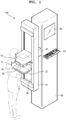
- FIG. 1 is a schematic perspective view of an X-ray photographing apparatus 100 according to an exemplary embodiment.
- the X-ray photographing apparatus 100 of FIG. 1 is exemplarily shown as a mammography apparatus that photographs a breast, but the X-ray photographing apparatus 100 is not limited thereto.
- the X-ray photographing apparatus 100 may be applied to an X-ray photographing apparatus that contacts an object and generates an X-ray.
- the X-ray photographing apparatus 100 includes an X-ray generator 10 that generates the X-ray, an X-ray detector 20 that detects the X-ray that is transmitted to an object 200, and panels 32 and 34 that may contact the object 200.
- the X-ray photographing apparatus 100 may further include a gantry 40 that supports the X-ray generator 10, the X-ray detector 20, and the panels 32 and 34, and a main body 50 that supports the gantry 40.
- the main body 50 may include a user input device 52 that may input a user command to operate the X-ray photographing apparatus 100, a processor (not shown) that generates an image corresponding to the transmitted X-ray, a display 54 that displays the generated image, and a controller (not shown) that controls general operations of the X-ray photographing apparatus 100.
- the user input device 52, the processor (not shown), the display 54, and the controller (not shown) may not be necessarily included in the main body 50, and may instead be implemented as external devices that may communicate with the X-ray photographing apparatus 100 by wire or wirelessly.
- the gantry 40 may be fixed to the main body 50 via a gantry driver 42.
- the gantry 40 may be disposed in one side surface of the main body 50 longitudinally.
- the gantry driver 42 may rotate the gantry 40 by 360° or at an angle.
- the gantry driver 42 may operate to move the gantry 40 up and down longitudinally with respect to the main body 50.
- the gantry driver 42 may move the gantry 40 up or down longitudinally with respect to the main body 50 so that a height of the gantry 40 may be adjusted in accordance with the object 200.
- the gantry driver 42 may rotate the gantry 40.
- the panels 32 and 34 that may contact the object 200 may be disposed on the front of the gantry 40.
- the first and second panels 32 and 34 may move up and down by using a guide groove 44 that is longitudinally included in the front of the gantry 40.
- the object 200 for example, breasts of a patient
- at least one of the first and second panels 32 and 34 may press the object 200 to compress the object 200.
- the second panel 34 may be moved up or down to allow the object 200 to be seated on the second panel 34 and then the first panel 32 may be moved down to press the object 200 and compress the object 200.
- the X-ray generator 10 that generates the X-ray may be disposed on the first panel 32.
- the X-ray generator 10 may be moved far away from or closer to the object 200 while maintaining a distance d with the first panel 32.
- the X-ray generator 10 may be integrated with the first panel 32 so that the X-ray generator 10 and the first panel 32 may move along the guide groove 44.
- the X-ray generator 10 when the first panel 32 presses the object 200, since the X-ray generator 10 radiates the X-ray to the object 200, a distance between the X-ray generator 10 and the object 200 may be minimized.
- the distance between the X-ray generator 10 and the object 200 may be about 10 cm.
- the X-ray generator 10 may be disposed to contact a top side of the object 200.
- the X-ray generator 10 includes a plurality of X-ray generation units 300, which will be described later.
- the X-ray detector 20 that detects the X-ray that is transmitted to the object 200 may be provided under the second panel 34.
- the X-ray detector 20 may be moved far away from or closer to the object 200 while maintaining a distance d with the second panel 34.
- the X-ray detector 20 may be integrated with the second panel 34 so that the X-ray detector 20 and the second panel 34 may move along the guide groove 44.
- the X-ray detector 20 detects the X-ray that is transmitted to the object 200, a distance between the X-ray detector 20 and the object 200 may be minimized. Thus, the X-ray may be more precisely detected. To minimize the distance between the X-ray detector 20 and the object 200, the X-ray detector 20 may be disposed to contact a bottom side of the object 200.
- the X-ray detector 20 includes a plurality of X-ray detection units, which will be described later.
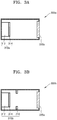
- FIGS. 2A and 2B are schematic diagrams of X-ray generators 10a and 10b including the plurality of X-ray generation units 300 according to an exemplary embodiment.
- the X-ray generator 10a may include the X-ray generation units 300 provided in one dimension.
- the X-ray generator 10b may include the X-ray generation units 300 provided in two dimensions.
- Each of the X-ray generation units 300 may be independently driven to generate an X-ray. Accordingly, all of the X-ray generation units 300 may be driven to radiate X-rays to the object 200 or, alternatively, some of the X-ray generation units 300 may be driven to radiate X-rays to the object 200. At least one of the X-ray generation units 300 may radiate X-rays to all regions of the object 200 or a specific region. In addition, at least one of the X-ray generation units 300 may be simultaneously or sequentially driven. In this case, only some X-ray detection units corresponding to the X-ray generation units 300 that are being driven may be driven.
- the X-ray generation units 300 are respectively formed on a single substrate 11 and 12 as shown in FIGS. 2A and 2B , the exemplary embodiments are not limited thereto.
- Each of the X-ray generation units 300 may be separately manufactured and the X-ray generation units 300 may be assembled into the X-ray generators 10a and 10b.
- some of the X-ray generation units 300 may be formed on a single substrate and then assembled together with other X-ray generation units 300 formed on other substrates.
- an X-ray generator in two dimensions may be manufactured by generating X-ray generators in one dimension on a single substrate and providing the X-ray generators in one dimension.
- an X-ray controller for controlling a proceeding path of an X-ray generated by each of the X-ray generation units 300 such that the X-ray does not interfere with a neighboring X-ray may be provided.
- an opening is formed in an area corresponding to each of the X-ray generation units 300 and an X-ray absorbing material may be formed in a grid type device in the other area (for example, a boundary area between the neighboring X-ray generation units 300).
- FIGS. 3A to 3D are schematic diagrams of X-ray generation units (e.g., X-ray generation devices) 300a, 300b, 300c, and 300d according to exemplary embodiments.
- the X-ray generation unit 300a may include an electron emission device 310a that may emit electrons and an anode electrode 320a that may emit an X-ray by collision of the emitted electrons.
- the anode electrode 320a may include metal or a metal alloy such as W, Mo, Ag, Cr, Fe, Co, Cu, etc.
- the electron emission device 310a may include a cathode electrode 312 and an electron emission source 314 that emits electrons and that is provided on the cathode electrode 312.
- the cathode electrode 312 may be metal such as Ti, Pt, Ru, Au, Ag, Mo, Al, W, or Cu, or a metal oxide such as indium tin oxide (ITO), aluminum zinc oxide (AZO), indium zinc oxide (IZO), tin oxide (SnO 2 ), or In 2 O 3 .
- the electron emission source 314 may be formed of a material capable of emitting electrons.
- the electron emission source 314 may be formed of metal, silicon, an oxide, diamond, diamond like carbon (DLC), a carbide compound, a nitrogen compound, carbon nanotubes, carbon nanofibers, etc.
- the cathode electrode 312 applies a voltage to the electron emission source 314.
- a voltage difference occurs between the electron emission source 314 and the anode electrode 320a, that is, the cathode electrode 312 and the anode electrode 320a
- the electron emission source 314 emits electrons and the electrons collide with the anode electrode 320a. Accordingly, the anode electrode 320a radiates an X-ray due to the collision of electrodes.
- an electron emission device 310b of the X-ray generation unit 300b may further include a gate electrode 316 between the electron emission source 314 and the anode electrode 320a.
- the gate electrode 316 may be formed of the same material as the cathode electrode 312.
- the electron emission source 314 may emit electrons based on the voltage difference between the gate electrode 316 and the cathode electrode 312.
- the gate electrode 316 is provided between the cathode electrode 312 and the anode electrode 320a, the electrons induced by the electron emission source 314 based on the voltage applied to the gate electrode 316 may be controlled. Accordingly, the X-ray generation unit 300b may more stably control the emission of electrons.
- an electron emission device 310c of the X-ray generation unit 300c may further include a focusing electrode 318 provided between the electron emission source 314 and an anode electrode 320b.
- the focusing electrode 318 may be formed of the same material as the cathode electrode 312.
- the focusing electrode 318 focuses the electrons emitted from the electron emission source 314 on an area of the anode electrode 320b so as to collide the electrons therewith.
- a voltage applied to the focusing electrode 318 may be the same as or similar to the voltage applied to the gate electrode 316 so that an optimal focusing performance may be maintained.
- an electron emission device 310d of the X-ray generation unit 300d may include the cathode electrode 312, the electron emission source 314 that emits electrons and that is provided on the cathode electrode 312, the gate electrode 316 spaced apart from the cathode electrode 312, and the focusing electrode 318 which focuses the emitted electrons.
- FIG. 4 illustrates an electron emission device 400 including a gate electrode 420, according to an exemplary embodiment.
- the electron emission device 400 may include a cathode electrode 410, the gate electrode 420 having a mesh structure spaced apart from the cathode electrode 410, a plurality of insulation layers 430 and a plurality of electron emission sources 440 that extend in a first direction between the cathode electrode 410 and the gate electrode 420 and are spaced apart from each other.
- a substrate 450 for supporting the electron emission device 400 may be formed of an insulation material such as glass. The substrate 450 may support a single electron emission device 400 or the electron emission sources 440.
- the cathode electrode 410 and the gate electrode 420 may be formed of a conductive material.
- the cathode electrode 410 may apply a voltage to each of the electron emission sources 440 and may have a flat panel shape.
- the substrate 450 may not be necessary.
- the gate electrode 420 may have a mesh structure including a plurality of openings H.
- the gate electrode 420 may include a plurality of gate lines 422 separated from each other and provided on the insulation layers 430, and may further include a plurality of gate bridges 424 connecting the gate lines 422. Accordingly, the two neighboring gate lines 422 and the two neighboring gate bridges 424 form the openings H.
- the openings H may be provided to expose at least a part of the electron emission sources 440 between the insulation layers 430. As described above, since the gate electrode 420 has a mesh structure, a large electron emission device 400 may be manufactured. Although the openings H of the gate electrode 420 are each shown as being rectangular in FIG. 4 , the exemplary embodiments are not limited thereto. Shapes of the openings H may be various other types of shapes, such as at least one of circles, ovals, and polygons. The sizes of the openings H may be identical or different from each other.
- the insulation layers 430 are provided between the cathode electrode 410 and the gate electrode 420 and prevent electrical connection between the cathode electrode 410 and the gate electrode 420.
- the insulation layers 430 are provided in multiple numbers and at least three insulation layers 430 may be provided.
- the insulation layers 430 may have a linear shape.
- the insulation layers 430 extend in one direction and are separate from one another and support the gate electrode 420.
- the insulation layers 430 may each include a first insulation layer 432 supporting an edge area of the gate electrode 420 and a second insulation layer 434 supporting a middle area of the gate electrode 420.
- the insulation layers 430 may be formed of an insulation material used for a semiconductor device.
- the insulation layers 430 may be formed of HfO 2 , Al 2 O 3 , or Si 3 N 4 , which is a high-K material having a higher dielectric rate than SiO 2 or SiO 2 , or a mixture thereof.
- the insulation layers 430 are shown as having a linear shape in FIG. 4 , the exemplary embodiments are not limited thereto.
- the insulation layers 430 may have a different shape that prevents an electrical connection between the cathode electrode 410 and the gate electrode 420 and supports the gate electrode 420.
- the second insulation layer 434 may have a column shape and may be provided under the gate lines 422.
- the electron emission sources 440 emit electrons due to the voltage applied to the cathode electrode 410 and the gate electrode 420.
- the electron emission device 400 of FIG. 4 may include the electron emission sources 440.
- the electron emission sources 440 may be alternately provided with the insulation layers 430.
- the electron emission sources 440 may be spaced apart from one another with the second insulation layer 434 interposed between the neighboring electron emission sources 440.
- the electron emission sources 440 may be shaped as strips extending in the first direction, similar to the second insulation layer 434.
- the gate electrode 420 Since the gate electrode 420 has a mesh structure, the gate electrode 420 is provided above the electron emission sources 440.
- the electron emission sources 440 may be spaced apart from the gate electrode 420 to prevent the electron emission sources 440 and the gate electrode 420 from being short-circuited.
- the electron emission sources 440 may be formed of a material capable of emitting electrons. As an area occupied by the electron emission sources 440 in the electron emission device 400 increases, the electron emission device 400 may emit a large amount of electrons. However, the electron emission device 400 may endure an electrostatic force due to a difference in the voltages applied between the electron emission sources 440 and the gate electrode 420. Accordingly, the insulation layers 430 and the electron emission sources 440 are alternately provided, and the gate electrode 420 having the openings H is provided over an area where each of the electron emission sources 440 is provided, thereby implementing the large area electron emission device 400.
- the gate electrode 420 includes the gate bridges 424 provided in a direction crossing the lengthwise direction of the electron emission sources 440, a uniform electric field may be formed on surfaces of the electron emission sources 440.
- the electron emission sources 440 are shown as being formed in strips in FIG. 4 , the exemplary embodiments are not limited thereto.
- the electron emission sources 440 may be formed as a point type in an area corresponding to the openings H above the cathode electrode 410.
- the point-type electron emission sources 440 may be provided in a two dimensional array, that is, in a matrix format.
- the electron emission sources 440 are shown as being provided in the single electron emission device 400 in FIG. 4 , the exemplary embodiments are not limited thereto. Also, only one electron emission source may be provided in the electron emission device 400 or two or more electron emission sources may be provided therein.
- a proceeding path of the X-ray may be controlled by the shape of an anode electrode.
- the thickness of the anode electrode is provided to be irregular, the proceeding path of the X-ray radiated from the anode electrode may be controlled.
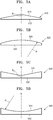
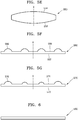
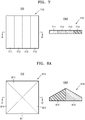
- FIGS. 5A to 5G illustrate anode electrodes having irregular thicknesses according to exemplary embodiments.
- the anode electrode illustrated in each of FIGS. 5A to 5G corresponds to a single X-ray generator.
- the exemplary embodiments are not limited thereto.
- One anode electrode may correspond to one electron emission device.
- one anode electrode corresponding to a single X-ray generator will be described below.
- the anode electrode may be symmetrically provided about a center axis X of the X-ray generator 10 so that an X-ray may be symmetrically radiated.
- the thicknesses of anode electrodes 510 and 520 gradually decrease from the center axis X of the X-ray generator 10 toward edges thereof, as illustrated in FIGS. 5A and 5B .
- X-rays radiated from the anode electrodes 510 and 520 may propagate to be focused at the center axis X of the X-ray generator 10.
- the X-ray generator 10 may efficiently radiate an X-ray in a partial area of the object.
- surfaces 512 and 522 of the anode electrodes 510 and 520, on which electrons are incident may be flat surfaces
- surfaces 514 and 524 from which X-rays are emitted may be convex surfaces.
- the surfaces 514 and 524 from which X-rays are emitted may be convexly curved surfaces or convex surfaces obtained by combining flat surfaces.
- a position where the X-ray is focused may be determined by levels, ⁇ and R, of the convex shape.
- 5A and 5B illustrate that the surfaces 512 and 522 of the anode electrodes 510 and 520 on which electrons are incident are flat and the surfaces 514 and 524 from which X-rays are emitted are convex
- the exemplary embodiments are not limited thereto. That is, the surfaces on which electrons are incident may be convex, whereas the surfaces from which X-rays are emitted may be flat.
- the thicknesses of anode electrodes 530 and 540 gradually increase from the center axis X of the X-ray generator 10 toward edges thereof, as illustrated in FIGS. 5C and 5D .
- the X-rays radiated from each of the anode electrodes 530 and 540 may propagate toward an area larger than a sectional area of each of the anode electrodes 530 and 540.
- the X-ray generator 10 may radiate an X-ray to a relatively large area of an object.
- surfaces 532 and 542 of the anode electrode 530 and 540, on which electrons are incident may be flat surfaces
- surfaces 534 and 544 from which X-rays are emitted may be concave surfaces.
- the surfaces 534 and 544 from which X-rays are emitted may be concavely curved surfaces or concave surfaces obtained by combining flat surfaces.
- a size of an area where the X-ray is radiated may be determined by levels, ⁇ and R, of the concave shape.
- 5C and 5D illustrate that the surfaces 532 and 542 of the anode electrodes 530 and 540 on which electrons are incident are flat and the surfaces 534 and 544 from which X-rays are emitted are concave
- the exemplary embodiments are not limited thereto. That is, the surfaces on which electrons are incident may be concave, whereas the surfaces from which X-rays are emitted may be flat.
- both surfaces of an anode electrode 550 may be convex. In this case, a focal distance of an X-ray may become shorter. Additionally, both surfaces on which electrons are incident and from which X-rays are emitted may be concave. Alternatively, while one of the surfaces on which electrons are incident and from which X-rays are emitted may be concave, the other surface may be convex.
- anode electrode may be partially irregular.
- anode electrodes 560 and 570 may have a shape in which only some parts are convex.
- a convex shape 566 may be identical to others or a convex shape 576 may be different from others according to an area. Nevertheless, the thicknesses of the anode electrodes 560 and 570 may be symmetrical with respect to the center axis X of the X-ray generator 10.
- FIGS. 5F and 5G illustrate only a convex shape, the exemplary embodiments are not limited thereto.
- the anode electrode may have a concave shape or both a concave shape and a convex shape.
- the X-ray generator 10 may not only efficiently radiate an X-ray to the object but may also reduce an unnecessary X-ray radiation dose.
- the X-ray photographing apparatus 100 may use an anode electrode having a uniform thickness.
- FIG. 6 illustrates an anode electrode 580 having a uniform thickness, according to an exemplary embodiment.
- the propagating path of an X-ray may be controlled by using a separate constituent element such as a collimator (not shown).
- the anode electrode may include a plurality of layers formed of different materials and capable of radiating X-rays of different wavelengths.
- FIG. 7 illustrates an anode electrode 710 formed of different materials, according to an exemplary embodiment.
- the anode electrode 710 may include a plurality of layers 711, 712, 713, and 714 formed of different materials.
- the layers 711, 712, 713, and 714 may be provided in a parallel fashion with respect to an electron emission device.
- the anode electrode 710 may radiate X-rays of different wavelengths according to the layers 711, 712, 713, and 714 with which electrons collide.
- FIGS. 8A and 8B illustrate anode electrodes 810 and 820 formed of different materials, according to exemplary embodiments.
- Each of the anode electrodes 810 and 820 may include a plurality of layers formed of different materials and at least one of the layers may have an irregular thickness.
- the anode electrode 810 may include a plurality of layers 811, 812, 813, and 814 that are formed of different materials.
- the layers 811, 812, 813, and 814 have thicknesses that gradually decrease from the center axis X of the X-ray generator 10 toward edges thereof. Accordingly, the anode electrode 810 may focus the radiated X-rays. Since the X-rays having different wavelengths are focused on different areas, a single linear X-ray generator may photograph many different areas at different depths of the object at one time.
- the anode electrode 820 may include a plurality of layers 821, 822, and 823 that are formed of different materials.
- the anode electrode 820 may have a change in the thickness thereof according to the layers 821, 822, and 823.
- the first layer 821 may have a thickness that gradually decreases from the center axis X of the X-ray generator 10 toward an edge thereof
- the second layer 822 may have a uniform thickness
- the third layer 823 may have a thickness that gradually increases from the center axis X of the X-ray generator 10 toward the edge thereof.
- the anode electrode 820 may radiate an X-ray to a larger surrounding area while focusing on an area of interest of the object.
- the X-ray generator 10 may simultaneously or selectively generate X-rays of different wavelengths.
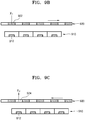
- FIGS. 9A to 9C illustrate an X-ray generator generating an X-ray of a short wavelength or simultaneously generating X-rays of a plurality of wavelength bands, according to exemplary embodiments.
- a plurality of electron emission devices 910 each having an electron emission source 912, are provided and an anode electrode 920 may be provided separately from the electron emission devices 910.
- first and second layers 922 and 924 that are formed of different materials may be alternately provided.
- electrons emitted by the electron emission devices 910 may collide with the first and second layers 922 and 924. Accordingly, the anode electrode 920 may simultaneously radiate a first X-ray X1 and a second X-ray X2.
- the anode electrode 920 makes a translational movement in parallel with the electron emission devices 910 such that the first layer 922 of the anode electrode 920 may be arranged to overlap with the electron emission source 912. Then, the electrons emitted by the electron emission devices 910 collide with the first layer 922, and thus the first X-ray X1 may be radiated from the anode electrode 920.
- the anode electrode 920 makes a translational movement in parallel with the electron emission devices 910 such that the second layer 924 of the anode electrode 920 may be arranged to overlap with the electron emission source 912. Then, the electrons emitted by the electron emission devices 910 collide with the second layer 924, and thus the second X-ray X2 may be radiated from the anode electrode 920.
- the anode electrode 920 simultaneously radiates a plurality of X-rays or selectively radiates a single X-ray, usability of the X-ray generator 10 may be improved.
- X-ray generation units are provided in an X-ray generator 10.
- Each of the X-ray generation units is separately manufactured as one unit and then the X-ray generation units are assembled, thereby forming the X-ray generator 10.
- a plurality of electron emission devices and an anode electrode may be integrally manufactured on a single substrate.
- a plurality of electron emission devices may be manufactured on a single substrate and then an anode electrode may be assembled, thereby forming a linear X-ray generator.
- the linear X-ray generator may be formed by a variety of different methods.
- the X-ray generator may further include a collimator (not shown) for controlling a proceeding direction of an X-ray. Accordingly, an unnecessary X-ray radiation dose may be reduced, and an X-ray may be also more accurately detected.
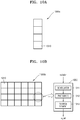
- FIGS. 10A and 10B schematically illustrate X-ray detectors 1000a and 1000b that may be used as the X-ray detector 20 of FIG. 1 .
- the X-ray detector 1000a may be configured as a plurality of X-ray detection units 1010 provided in one dimension.
- the X-ray detector 1000b may be configured as the plurality of X-ray detection units 1010 provided in two dimensions.
- Each of the X-ray detection units 1010 is a light-receiving element that receives an X-ray and converts a received X-ray into an electric signal, and may include, for example, a scintillator 1011, a photodiode 1012, and a storage element 1013.
- the scintillator 1011 receives an X-ray and outputs photons, in particular visible photons, that is, a visible ray, according to a received X-ray.
- the photodiode 1012 receives the photons output from the scintillator 1011 and converts the received photons into electric signals.
- the storage element 1013 is electrically connected to the photodiode 1012 and stores the electric signal output from the photodiode 1012.
- the storage element 1013 may be, for example, a storage capacitor.
- the electric signal stored in the storage element 1013 of each of the X-ray detection units 1010 is transmitted to a processor (not shown) where the signal is processed into an X-ray image.
- the X-ray detectors 1000a and 1000b may detect an X-ray by using a photoconductor configured to directly convert an X-ray into an electric signal.
- the X-ray detection units 1010 may be provided to correspond to the X-ray generation units 300 of an X-ray generator.
- the X-ray generation units 300 and the X-ray detection units 1010 may have a one-to-one correspondence.
- each of the X-ray generation units 300 may correspond to two or more X-ray detection units 1010, or two or more X-ray generation units 300 may correspond to one X-ray detection unit 1010.
- the X-ray detection units 1010 may be simultaneously or independently driven to detect an X-ray. Accordingly, an X-ray passing through the entire area of the object may be detected as all of the X-ray detection units 1010 are driven, or an X-ray passing through a particular area of the object may be detected as some of the X-ray detection units 1010 are driven. Also, at least one of the X-ray detection units 1010 may be simultaneously or sequentially driven.
- the X-ray detection units 1010 are shown as being formed on a single substrate, the exemplary embodiments are not limited thereto. Each of the X-ray detection units 1010 may be separately manufactured, and the X-ray detection units 1010 may be assembled into the X-ray detectors 1000a and 1000b. Alternatively, some of the X-ray detection units 1010 may be formed on a single substrate and then assembled together with the other X-ray detection units 1010 formed on other substrates. For example, X-ray detectors in one dimension may be provided on a single substrate and then arranged, and thus, X-ray detectors in two dimensions may be manufactured.
- the linear X-ray generator and the X-ray detectors 1000a and 1000b may photograph the object by performing one operation.
- the X-ray photographing apparatus 100 may photograph the whole object at one time or a partial area of the object.
- only some of the X-ray generation units 300 of the X-ray generator may operate to generate an X-ray, and only some of the X-ray detection units 1010 corresponding to the operating X-ray generation units 300 may be synchronized to detect the X-ray.
- At least one of the X-ray generation area of the X-ray generator and the X-ray detection areas of the X-ray detectors 1000a and 1000b is smaller than the test area of the object, at least one of the X-ray generator and the X-ray detectors 1000a and 1000b may be moved and driven two times or more.
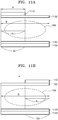
- FIGS. 11A and 11B are diagrams for explaining an X-ray photographing method when an X-ray generation area A is smaller than a test area B of the object 200 according to an exemplary embodiment.
- the X-ray generator 1110 may move along a first panel 1132 to generate an X-ray, thereby generating the X-ray in the entire test area B of the object 200.
- the X-ray generator 1110 radiates an X-ray to a first area B1 of the object 200. Then, a first detector 1122 of an X-ray detector 1120 detects an X-ray that was transmitted to the first area B1. Referring to FIG. 11B , the X-ray generator 1110 horizontally moves along the first panel 1132 and then radiates an X-ray to a second area B2 of the object 200. In this regard, the second area B2 and the first area B1 may not overlap with each other. Thus, an X-ray radiation dose of the object 200 may be minimized.
- a second detector 1124 of the X-ray detector 1120 corresponding to the second area B2 detects an X-ray of the second area B2.
- the X-ray generation area A of the X-ray generator 1110 is 1/2 the test area B in FIGS. 11A and 11B , the exemplary embodiments are not limited thereto.
- the X-ray generation area A may be 1/n (where n is a natural number equal to or greater than 2) the test area B.
- FIGS. 12A and 12B are diagrams for explaining an X-ray photographing method when an X-ray detection area C is smaller than the test area B of an object according to an exemplary embodiment.
- the X-ray detector 1120 may move along a second panel 1234 to detect an X-ray, thereby detecting the X-ray that is transmitted to the entire test area B of the object 200.
- a first X-ray generator 1212 of an X-ray generator 1210 generates X-rays to be transmitted to the first area B1 of the object 200. Then, an X-ray detector 1220 detects an X-ray of the first area B1. Referring to FIG. 12B , the X-ray detector 1220 horizontally moves along the second panel 1234. Then, a second X-ray generator 1214 of the X-ray generator 1210 generates X-rays to be transmitted to the second area B2 of the object 200. The X-ray detector 1220 detects an X-ray of the second area B2. In this regard, the second area B2 and the first area B1 may not overlap with each other.
- an X-ray radiation dose of the object 200 may be minimized.
- the X-ray detection area C of the X-ray detector 1120 is 1/2 the test area B in FIGS. 12A and 12B , the exemplary embodiments are not limited thereto.
- the X-ray detection area C may be 1/n (where n is a natural number equal to or greater than 2) the test area B.
- the X-ray generators 1110 and 1210 and the X-ray detectors 1120 and 1220 may be synchronized to photograph a partial region of the test area B.
- Each of the X-ray generators 1110 and 1210 and the X-ray detectors 1120 and 1220 may horizontally move along the first and second panels 1132 and 1234 and photograph other regions of the test area B.
- the X-ray photographing method of FIGS. 12A and 12B may be applied to photograph a partial region of the test area B.
- Each of the X-ray generators 1110 and 1210 and the X-ray detectors 1120 and 1220 may horizontally move along the first and second panels 1132 and 1234 and photograph other regions of the test area B.
- the X-ray photographing method of FIGS. 12A and 12B may be applied to photograph a partial region of the test area B.
- the X-ray generators 1110 and 1210 and the X-ray detectors 1120 and 1220 may horizontally move along the first and second panels 1132 and 1234 and photograph other regions of the test area B.
- Each of the X-ray generators 1110 and 1210 and the X-ray detectors 1120 and 1220 may horizontally move along the first and second panels 1132 and 1234 and photograph other regions of the test area B.
- the X-ray photographing apparatus 100 may acquire a tomography image of the object 200.
- the X-ray generators may radiate an X-ray to the object by varying a radiation angle to the object.
- the X-ray generators according to an exemplary embodiment may vary the radiation angle to the object by horizontally moving with respect to the object.
- horizontal moving refers to horizontal moving of center axes of the X-ray generators.
- the X-ray generators may radiate an X-ray to the object at multiple locations.
- the center axes of the X-ray generators may move in parallel to the object.
- the X-ray generators may radiate an X-ray by varying a radiation angle according to locations thereof.
- the X-ray generators may radiate an X-ray to the object vertically at a first location and in an inclined fashion at a second location.
- the X-ray detectors may be disposed under the object. The X-ray detectors may be fixed, although are not limited thereto.
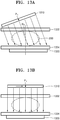
- FIGS. 13A through 13C are diagrams for explaining an X-ray photographing method which may be used to acquire a tomography image according to an exemplary embodiment.
- the X-ray generator 1310 when an X-ray generator 1310 is disposed on a left upper portion of the object 200, the X-ray generator 1310 may rotate with respect to a center axis P1 thereof such that an X-ray radiation direction is changed from the left upper portion to a right lower portion.
- the X-ray generator 1310 radiates an X-ray at a first radiation angle ⁇ 3 toward the object 200, and thus, an X-ray photographing apparatus may photograph a first image of the object 200.
- the X-ray generator 1310 may move to the right. When the X-ray generator 1310 moves, the center axis P1 of the X-ray generator 1310 may move in parallel to the object 200. When the X-ray generator 1310 is disposed on the object 200, the X-ray generator 1310 may adjust its posture to allow an X-ray to face the object 200. For example, the X-ray generator 1310 may rotate in a clockwise direction with respect to the center axis P1 of the X-ray generator 1310, and thus, as shown in FIG. 13B , the X-ray generator 1310 may be disposed in parallel to the object 200. The X-ray generator 1310 may vertically radiate an X-ray to the object 200. The X-ray photographing apparatus may photograph a second image of the object 200.
- the X-ray generator 1310 may move in parallel to the right until the X-ray generator 1310 is disposed on a right upper portion of the object 200.
- the X-ray generator 1310 may adjust its posture to allow an X-ray generated by the X-ray generator 1310 to be radiated in an inclined fashion to the object 200.
- the X-ray generator 1310 may rotate in a clockwise direction with respect to the center axis P1 of the X-ray generator 1310.
- the X-ray generator 1310 may radiate an X-ray at a second radiation angle ⁇ 4 toward the object 200, and thus, the X-ray photographing apparatus may photograph a third image of the object 200.
- the X-ray generator 1310 moves in a horizontal direction with respect to an X-ray detector 1320, the X-ray generator 1310 rotates with respect to the center axis P1 thereof according to a location.
- An order of horizontal movement and rotational movement may be switched, and the second image of the object 200 may be photographed in advance and the first image or the third image may be photographed.
- the X-ray detector 1320 may detect an X-ray by moving to correspond to a position of the X-ray generator 1310.
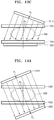
- FIGS. 14A through 14C are diagrams for explaining an X-ray photographing method which may be used to acquire a tomography image according to another exemplary embodiment.
- the X-ray generator 1310 when the X-ray generator 1310 is disposed on a left upper portion of the object 200, the X-ray generator 1310 may rotate with respect to the center axis P1 thereof such that an X-ray may be radiated in an inclined fashion to the object 200.
- the X-ray detector 1320 may also move to face the X-ray generator 1310.
- the X-ray detector 1320 may move to be disposed on a right lower portion of the object 200 and rotate with respect to a center axis P2 of the X-ray detector 1320 such that the X-ray generator 1310 and the X-ray detector 1320 may be disposed in parallel to each other.
- the X-ray generator 1310 may radiate an X-ray at a first radiation angle ⁇ 3 to the object 200, and thus, an X-ray photographing apparatus may photograph a first image of the object 200.
- the X-ray generator 1310 may move to be disposed on the object 200. Furthermore, the X-ray generator 1310 may adjust its posture such that the X-ray generator 1310 may be disposed in parallel to the object 200. In this regard, the X-ray detector 1320 may also move. For example, the X-ray detector 1320 may move to be disposed under the object 200 and rotate with respect to the center axis P2 thereof such that the X-ray generator 1310, the object 200, and the X-ray detector 1320 may be disposed in parallel to each other. The X-ray generator 1310 may vertically radiate an X-ray to the object 200, and thus, the X-ray photographing apparatus may acquire a second image of the object 200.
- the X-ray generator 1310 may move to a right upper portion of the object 200 and adjust its posture such that an X-ray is radiated in an inclined fashion to the object 200.
- the X-ray detector 1320 may also move to be disposed in parallel to the X-ray generator 1310.
- the X-ray detector 1320 may move to be disposed on a left lower portion of the object 200 and rotate with respect to the center axis P2 thereof such that the X-ray generator 1310, the object, 200, and the X-ray detector 1320 may be disposed in parallel to each other.
- the X-ray generator 1310 may radiate an X-ray at a second radiation angle ⁇ 4 to the object 200, and thus, the X-ray photographing apparatus may acquire a third image of the object 200.
- the X-ray generator 1310 may move to vary a radiation angle of an X-ray and radiate the X-ray to the object 200, thereby simplifying a photographing process for acquiring a tomography image.
- the X-ray generator 1310 and the X-ray detector 1320 may rotate, and thus, photographing may be performed to acquire the tomography image.
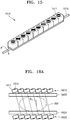
- FIG. 15 is a schematic diagram of an X-ray generator 1510 according to an exemplary embodiment.
- the X-ray generator 1510 may include a plurality of X-ray generation units 1511 provided in one dimension and a rotation unit (e.g., rotator) 1513 that supports and rotates the X-ray generation units 1511.
- the X-ray generator 1510 may include a driver (not shown) that drives the rotation unit 1513. If the rotation unit 1513 rotates at a predetermined time interval, the X-ray generation units 1511 disposed on the rotation unit 1513 may radiate an X-ray to an object at different radiation angles at the predetermined time interval.
- An X-ray detector may include a rotation unit, similar to the X-ray generator 1510.
- FIGS. 16A through 16C are diagrams for explaining an X-ray photographing method so as to acquire a tomography image according to another exemplary embodiment.
- a rotation unit 1613 may rotate such that each X-ray generation unit 1613 of an X-ray generator 1610 may radiate an X-ray to the object 200 at the first radiation angle ⁇ 3 at a first time.
- the rotation unit 1613 may rotate in a counterclockwise direction at the first time.
- the X-ray generator 1610 may radiate the X-ray to the object 200 at the first radiation angle ⁇ 3, and thus, an X-ray photographing apparatus may acquire a first image of the object 200.
- each X-ray generation unit 1611 rotates in a clockwise direction at a second time after a predetermined time elapses and then the X-ray generator 1610 may vertically radiate an X-ray to the object 200.
- the X-ray photographing apparatus may acquire a second image of the object 200.
- each of the X-ray generation units 1611 rotates in a clockwise direction at a third time after a predetermined time elapses and then the X-ray generator 1610 may vertically radiate an X-ray to the object 200 at the second radiation angle ⁇ 4.
- the X-ray photographing apparatus may acquire a third image of the object 200.
- X-ray detection units 1621 may rotate similar to the X-ray generation units 1611 to detect an X-ray.
- an X-ray radiation angle may be changed by rotating only the X-ray generation units 1611, thereby simplifying a photographing process for acquiring the tomography image.
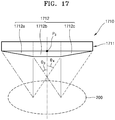
- FIG. 17 is a schematic diagram of an X-ray generator 1710 used to acquire a tomography image according to an exemplary embodiment.
- the X-ray generator 1710 may include an anode electrode 1712 that emits an X-ray due to collisions between a plurality of electron emission devices 1711 that are independently driven and electrons.
- the anode electrode 1712 may have a different thickness with respect to a center axis P3 of the X-ray generator 1710.
- a thickness of the first region 1712a increases in a direction moving from an edge towards the center axis P3 of the X-ray generator 1710
- a thickness of a second region 1712b is uniform
- a thickness of a third region 1712c decreases in a direction moving away from the center axis P3 of the X-ray generator 1710 towards an edge.
- an X-ray from the first region 1712a is radiated to the object 200 at the first radiation angle ⁇ 3
- an X-ray from the second region 1712b may be vertically radiated to the object 200
- an X-ray from the third region 1712c may be radiated to the object 200 at the second radiation angle ⁇ 4.
- an X-ray photographing apparatus may perform X-ray photographing to acquire the tomography image by using a shape of the anode electrode 1712.
- the X-ray photographing to acquire the tomography image may be performed three times, according to an exemplary embodiment. However, this example is simply for convenience of description, and X-ray photographing may be performed two or more times to acquire the tomography image according to other exemplary embodiments.
- the X-ray photographing apparatus may further include a sensing unit that senses the object 200.
- the sensing unit may include a plurality of sensors. Each sensor may sense an existence of the object 200 and determine a location of the object 200 based on results of sensing by all the sensors.
- the sensors may be light sensors (in particular, illumination sensors), touch sensors, etc. In particular, when the sensors are touch sensors, the sensors may be formed as a single pad, e.g., a touch pad.
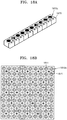
- FIGS. 18A and 18B are schematic diagrams of X-ray generators 1810a and 1810b including a plurality of sensors 1871 according to an exemplary embodiment.
- the sensors 1871 may be provided to be integrated with the X-ray generators 1810a and 1810b.
- a one dimensional sensor array 1870 is provided at a side of the one dimensional X-ray generator 1810a so that the one dimensional X-ray generator 1810a and the one dimensional sensor array 1870 may be integrated.
- the sensors 1871 may be provided to be spaced apart from each other on a two dimensional X-ray generator 1810b.
- the sensors 1871 may be disposed not to overlap with X-ray generation units 1811.
- the sensors 1871 are disposed on regions in which four X-ray generation units 1811 are adjacent.
- the sensors 1871 may be disposed on the same plane of the X-ray generators 1810a and 1810b as an anode electrode (not shown).
- an X-ray traveling path may not be influenced by the sensors 1871.
- the exemplary embodiments are not limited thereto. Locations of the sensors 1871 may be varied in many different ways, as long as the X-ray traveling path and the sensors 1871 do not overlap with each other.
- the sensors 1871 are exemplarily shown as being disposed on the entire regions in which the X-ray generators 1810a and 1810b are disposed, the exemplary embodiments are not limited thereto. When a size and location of an object are generally known, the sensors 1871 may not be provided in a region in which the object is necessarily disposed or in a region in which there is no possibility that the object is to be disposed. The sensors 1871 may be focused in a region corresponding to a boundary of the object.
- the sensors 1871 provided on the X-ray generators 1810a and 1810b may be light sensors.
- the sensors 1871 are exemplarily shown as being integrally formed with the X-ray generators 1810a and 1810b in FIGS. 18A and 18B , the exemplary embodiments are not limited thereto.
- the sensors 1871 may be integrally formed with X-ray detectors.
- the sensors 1871 may be disposed to contact the X-ray detectors.
- the sensors 1871 may be disposed between the X-ray detectors.
- FIGS. 19A and 19B illustrate a panel 1932 on which sensors 1971 are disposed according to an exemplary embodiment.
- the sensors 1971 may be disposed on the panel 1932. If the sensors 1971 are disposed on an X-ray generator, when the X-ray generator does not cover an object, the X-ray generator should be moved in a horizontal direction to detect a location of the object. However, since the panel 1932 covers the object, when the sensors 1971 are disposed on the panel 1932, the object may be more easily detected.
- the sensors 1971 may be disposed on a surface of the panel 1932 facing the X-ray generator or on a surface of the panel 1932 facing the object.
- the sensors 1971 disposed on the panel 1932 may be light sensors, touch sensors, etc.
- the sensors 1971 When the sensors 1971 are disposed on the panel 1932, the sensors 1971 may be formed of a transparent material so as to minimize diffusion of an X-ray or absorption by the sensors 1971. In particular, when the sensors 1971 are touch sensors, the sensors 1971 may be implemented as a touch pad 1980.
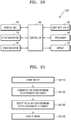
- FIG. 20 is a block diagram of the X-ray photographing apparatus 100 of FIG. 1 according to an exemplary embodiment.
- the X-ray photographing apparatus 100 may include an X-ray generator 10, an X-ray detector 20, the user input device 52, a display 54, a processor 56, and a controller 60.
- the X-ray photographing apparatus 100 may further include a sensing unit 70 that senses an object.
- the X-ray generator 10 radiates an appropriate X-ray to the object as described above. Since the X-ray generator 10 has been described above, a description thereof will not be repeated here.
- the X-ray detector 20 detects the X-ray that is transmitted to the object. Since the process of the X-ray detector 20 detecting the X-ray has been described above, a description thereof will not be repeated here.
- the user input device 52 receives input of an X-ray photographing command from a user such as a medical expert.
- Information regarding a command to change a location of the X-ray generator 10, a parameter adjustment command to vary an X-ray spectrum, a command regarding a main body of the X-ray photographing apparatus 100 or a movement of the X-ray generator 10, and many other types of commands received from the user, may be transmitted to the controller 60.
- the controller 60 controls elements included in the X-ray photographing apparatus 100 according to a user command.
- the processor 56 receives an electrical signal corresponding to the X-ray detected by the X-ray detector 20.
- the processor 56 may preprocess the electrical signal to acquire an image.
- preprocessing may include at least one of offset compensation, algebra conversion, X-ray dose compensation, sensitivity compensation, and beam hardening.
- the image may be a tomography image.
- the processor 56 may preprocess the electrical signal corresponding to the detected X-ray to acquire the image.
- the processor 56 may preprocess an electrical signal corresponding to the detected X-ray to acquire transparent data and reconfigure the acquired transparent data for each radiation angle to acquire the tomography image.
- Each sensor included in the sensing unit 70 may sense an existence of the object and transmit a result of the sensing to the controller 60.
- the controller 60 may determine a location of the object by using results of the sensing by the sensors.
- the controller 60 may control the X-ray generator 10 to enable an X-ray generation unit of the X-ray generator 10 corresponding to the location of the object to generate an X-ray.
- the controller 60 may control the X-ray detector 20 to enable an X-ray detection unit of the X-ray detector 20 corresponding to the location of the object to detect an X-ray that is transmitted to the object.
- only some of the X-ray generation units operate to photograph the object, thereby reducing an X-ray radiation dose.
- only some of the X-ray detection units operate, and thus, a lifetime of the X-ray detector 20 may be increased, thereby simplifying signal processing.
- FIG. 21 is a flowchart of an X-ray photographing method according to an exemplary embodiment.
- the sensing unit 70 senses the object 200 at operation S2110. If the object 200 is disposed between the first panel 32 and the second panel 34 of the X-ray photographing apparatus 100 of FIG. 1 , the X-ray photographing apparatus 100 may move at least one of the first panel 32 and the second panel 34 according to a user command to compress the object 200. If the object 200 contacts the first panel 32 and the second panel 34 or is pressed by the first panel 32 and the second panel 34, each sensor included in the sensing unit 70 may sense an existence of the object 200.
- sensors when sensors are illumination sensors, the sensors may sense whether the object 200 exists based on an illumination change, and when the sensors are touch sensors, the sensors may sense whether the object 200 exists according to whether the touch sensors are touched. A result of the sensing by each sensor is transmitted to the controller 60.
- the controller 60 may control the X-ray generator 10 to enable an X-ray generation unit of the X-ray generator 10 corresponding to a location of the object 200 to generate an X-ray by using results of the sensing by the sensing unit 70 at operation S2120.
- the controller 60 may determine the location of the object 200 from the result of the sensing by each sensor. For example, the location of the object 200 may be determined from locations of the sensors that detect the illumination change and whether the sensors are touched. The location of the object 200 may be determined to be slightly greater than locations of the sensors.
- the controller 60 may control the X-ray generation unit of the X-ray generator 10 corresponding to the location of the object 200 to generate the X-ray.
- An X-ray generation method may vary according to sizes of an X-ray test area and an X-ray generation area, and according to whether an image that is to be photographed is a simple image or a tomography image. Since these features have been described above, a detailed description thereof will not be repeated here.
- the controller 60 may control the X-ray detector 20 to enable an X-ray detection unit of the X-ray detector 20 corresponding to the location of the object to detect the X-ray at operation S2130.
- An X-ray detection method may vary according to sizes of the X-ray test area and the X-ray generation area, and according to whether the image that is to be photographed is the simple image or the tomography image. Since these features have been described above, a detailed description thereof will not be repeated here. If only the X-ray detection unit of the X-ray detector 20 corresponding to the location of the object detects the X-ray, the X-ray diffused by being transmitted to the object 200 is detected, thereby blocking noise.
- the processor 56 may receive an electrical signal corresponding to the X-ray detected by the X-ray detection unit to acquire an image at operation S2140.
- the acquired image may be displayed on the display 54.
- the exemplary embodiments are not limited thereto.
- the sensing unit 70 when the sensing unit 70 is not included in the X-ray photographing apparatus 100, the X-ray photographing apparatus 100 may perform photographing as described with reference to FIGS. 11A through 16C .
Landscapes
- Health & Medical Sciences (AREA)
- Life Sciences & Earth Sciences (AREA)
- Engineering & Computer Science (AREA)
- Medical Informatics (AREA)
- Physics & Mathematics (AREA)
- Nuclear Medicine, Radiotherapy & Molecular Imaging (AREA)
- General Health & Medical Sciences (AREA)
- Radiology & Medical Imaging (AREA)
- Pathology (AREA)
- Heart & Thoracic Surgery (AREA)
- Veterinary Medicine (AREA)
- High Energy & Nuclear Physics (AREA)
- Biophysics (AREA)
- Biomedical Technology (AREA)
- Optics & Photonics (AREA)
- Molecular Biology (AREA)
- Surgery (AREA)
- Animal Behavior & Ethology (AREA)
- Public Health (AREA)
- Dentistry (AREA)
- Oral & Maxillofacial Surgery (AREA)
- Pulmonology (AREA)
- Theoretical Computer Science (AREA)
- Chemical & Material Sciences (AREA)
- Analytical Chemistry (AREA)
- Biochemistry (AREA)
- General Physics & Mathematics (AREA)
- Immunology (AREA)
- Mathematical Physics (AREA)
- Apparatus For Radiation Diagnosis (AREA)
- Analysing Materials By The Use Of Radiation (AREA)
Claims (13)
- Röntgenbildgebungsvorrichtung, die umfasst:einen Röntgengenerator (10), der dazu konfiguriert ist, Röntgenstrahlen zu erzeugen; undeinen Röntgendetektor (20), der dazu konfiguriert ist, Röntgenstrahlen, die durch ein Objekt (200) hindurch übertragen werden, zu erfassen; undeine Platte (32; 34), die zwischen dem Röntgengenerator und dem Röntgendetektor angeordnet ist und dazu konfiguriert ist, mit dem Objekt in Kontakt zu kommen,wobei die Röntgenbildgebungsvorrichtung derart konfiguriert ist, dass ein Abstand zwischen einer Mittelachse des Röntgengenerators und des Röntgendetektors während eines Zeitraums als gleich bleibend beibehalten wird, und derart, dass ein Strahlungswinkel der von dem Röntgengenerator erzeugten Röntgenstrahlen in Bezug auf das Objekt sich im Laufe des Zeitraums ändert,dadurch gekennzeichnet, dass der Röntgengenerator umfasst:eine Mehrzahl von Elektronenemissionseinrichtungen, die dazu konfiguriert sind, Elektronen zu emittieren; undeine Anodenelektrode, die dazu konfiguriert ist, die Röntgenstrahlen mit Hilfe der emittierten Elektronen zu erzeugen,wobei der Strahlungswinkel sich je nach einer Dicke der Anodenelektrode unterscheidet, wobei:die Anodenelektrode einen Bereich, der eine regelmäßige Dicke hat, und einen Bereich, der eine unregelmäßige Dicke hat, aufweist,die Röntgenstrahlen, die in dem Bereich der Anode erzeugt worden sind, der eine regelmäßige Dicke hat, vertikal auf das Objekt ausgestrahlt werden, unddie Röntgenstrahlen, die in dem Bereich der Anode erzeugt worden sind, der eine unregelmäßige Dicke hat, in einer abgewinkelten Weise auf das Objekt ausgestrahlt werden.
- Röntgenbildgebungsvorrichtung gemäß Anspruch 1, wobei der Röntgengenerator dazu konfiguriert ist, bei einem ersten Zeitpunkt die Röntgenstrahlen in einer abgewinkelten Weise auf das Objekt auszustrahlen, und bei einem zweiten Zeitpunkt vertikal auszustrahlen.
- Röntgenbildgebungsvorrichtung gemäß Anspruch 1 oder 2, wobei die Mittelachse des Röntgengenerators dazu konfiguriert ist, sich im Laufe der Zeit parallel zu der Platte zu bewegen.
- Röntgenbildgebungsvorrichtung gemäß einem der Ansprüche 1 bis 3, wobei der Röntgengenerator dazu konfiguriert ist, sich entlang der Mittelachse desselben zu drehen und die Röntgenstrahlen in einer abgewinkelten Weise auf das Objekt auszustrahlen.
- Röntgenbildgebungsvorrichtung gemäß einem der Ansprüche 1 bis 4, wobei, wenn der Röntgengenerator die Röntgenstrahlen in einer abgewinkelten Weise auf das Objekt ausstrahlt, der Röntgendetektor derart angeordnet ist, dass er parallel zu dem Röntgengenerator ist.
- Röntgenbildgebungsvorrichtung gemäß einem der Ansprüche 1 bis 5, wobei die Mittelachse des Röntgendetektors dazu konfiguriert ist, sich im Laufe der Zeit parallel zu der Platte zu bewegen.
- Röntgenbildgebungsvorrichtung gemäß einem der Ansprüche 1 bis 6, wobei die Röntgenbildgebungsvorrichtung umfasst:eine Mehrzahl von Röntgengeneratoreinrichtungen, die in einer Dimension bereit gestellt sind; undeine Dreheinrichtung, die dazu konfiguriert ist, die Mehrzahl von Röntgengeneratoreinrichtungen zu tragen,wobei die Dreheinrichtung dazu konfiguriert ist, sich im Laufe der Zeit zu drehen, so dass der Strahlungswinkel sich ändert.
- Röntgenbildgebungsvorrichtung gemäß einem der Ansprüche 1 bis 7, wobei die Mittelachse des Röntgendetektors und die Platte dazu konfiguriert sind, einen gleich bleibenden Abstand einzuhalten.
- Röntgenbildgebungsvorrichtung gemäß einem der Ansprüche 1 bis 8, wobei der Röntgengenerator in einer Richtung auf das Objekt zu oder von dem Objekt weg bewegt werden kann.
- Röntgenbildgebungsverfahren, das umfasst:Zusammendrücken eines Objektes mit Hilfe einer Platte;Ausstrahlen, unter Verwendung eines Röntgengenerators, von Röntgenstrahlen auf das Objekt in einem ersten Strahlungswinkel bei einem ersten Zeitpunkt; undAusstrahlen, unter Verwendung des Röntgengenerators, von Röntgenstrahlen auf das Objekt in einem zweiten Strahlungswinkel, der sich von dem ersten Strahlungswinkel unterscheidet, bei einem zweiten Zeitpunkt, der sich von dem ersten Zeitpunkt unterscheidet,wobei die Mittelachse des Röntgendetektors und die Platte während des ersten Zeitpunkts und des zweiten Zeitpunkts unter Verwendung der Vorrichtung gemäß einem der Ansprüche 1 bis 9 einen gleich bleibenden Abstand einhalten.
- Röntgenbildgebungsverfahren gemäß Anspruch 10, wobei die Mittelachse des Röntgengenerators sich im Laufe der Zeit zwischen dem ersten Zeitpunkt und dem zweiten Zeitpunkt parallel zu der Platte bewegt.
- Röntgenbildgebungsverfahren gemäß Anspruch 10 oder 11, wobei der erste Strahlungswinkel in Bezug auf das Objekt abgewinkelt ist, und der zweite Strahlungswinkel in Bezug auf das Objekt vertikal ist.
- Röntgenbildgebungsverfahren gemäß einem der Ansprüche 10 bis 12, das weiterhin umfasst:Erfassen, unter Verwendung des Röntgendetektors, der Röntgenstrahlen, die durch Ausstrahlen der Röntgenstrahlen auf das Objekt in einem ersten Strahlungswinkel auf das Objekt übertragen werden; undErfassen, unter Verwendung des Röntgendetektors, der Röntgenstrahlen, die durch Ausstrahlen der Röntgenstrahlen auf das Objekt in dem zweiten Strahlungswinkel auf das Objekt übertragen werden.
Applications Claiming Priority (1)
| Application Number | Priority Date | Filing Date | Title |
|---|---|---|---|
| KR1020130073968A KR20150001180A (ko) | 2013-06-26 | 2013-06-26 | 엑스선 촬영 장치 및 그 동작 방법 |
Publications (2)
| Publication Number | Publication Date |
|---|---|
| EP2818113A1 EP2818113A1 (de) | 2014-12-31 |
| EP2818113B1 true EP2818113B1 (de) | 2018-04-18 |
Family
ID=50980975
Family Applications (1)
| Application Number | Title | Priority Date | Filing Date |
|---|---|---|---|
| EP14173870.8A Not-in-force EP2818113B1 (de) | 2013-06-26 | 2014-06-25 | Röntgenbildvorrichtung und Betriebsverfahren dafür |
Country Status (3)
| Country | Link |
|---|---|
| US (1) | US9506877B2 (de) |
| EP (1) | EP2818113B1 (de) |
| KR (1) | KR20150001180A (de) |
Families Citing this family (6)
| Publication number | Priority date | Publication date | Assignee | Title |
|---|---|---|---|---|
| KR20150001184A (ko) * | 2013-06-26 | 2015-01-06 | 삼성전자주식회사 | 엑스선 촬영 장치 및 그 동작 방법 |
| JP6441015B2 (ja) * | 2014-10-06 | 2018-12-19 | キヤノンメディカルシステムズ株式会社 | X線診断装置及びx線管制御方法 |
| GB2531326B (en) * | 2014-10-16 | 2020-08-05 | Adaptix Ltd | An X-Ray emitter panel and a method of designing such an X-Ray emitter panel |
| KR102126510B1 (ko) * | 2015-04-22 | 2020-06-24 | 삼성전자주식회사 | 엑스선 장치 및 시스템 |
| CN112512196B (zh) * | 2019-09-16 | 2024-12-13 | 清华大学 | 阵列式x射线源和x射线成像设备 |
| AU2020392235A1 (en) * | 2019-11-26 | 2022-06-02 | Sail Sv Llc | X-ray imaging system |
Family Cites Families (21)
| Publication number | Priority date | Publication date | Assignee | Title |
|---|---|---|---|---|
| BE791850A (fr) * | 1971-11-26 | 1973-05-24 | Cfc Products | Procede et dispositif de tomographie |
| DE19953613A1 (de) * | 1999-11-08 | 2001-05-17 | Siemens Ag | CT-Gerät sowie Verfahren zum Betrieb eines CT-Geräts |
| US6480565B1 (en) | 1999-11-18 | 2002-11-12 | University Of Rochester | Apparatus and method for cone beam volume computed tomography breast imaging |
| US6980627B2 (en) | 2000-10-06 | 2005-12-27 | Xintek, Inc. | Devices and methods for producing multiple x-ray beams from multiple locations |
| US7831296B2 (en) * | 2002-11-27 | 2010-11-09 | Hologic, Inc. | X-ray mammography with tomosynthesis |
| US7431500B2 (en) | 2003-04-01 | 2008-10-07 | Analogic Corporation | Dynamic exposure control in radiography |
| US6975703B2 (en) * | 2003-08-01 | 2005-12-13 | General Electric Company | Notched transmission target for a multiple focal spot X-ray source |
| SE528366C2 (sv) | 2004-02-13 | 2006-10-31 | Sectra Mamea Ab | Metod och anordning avseende röntgenbildtagning |
| WO2007088497A1 (en) | 2006-02-02 | 2007-08-09 | Philips Intellectual Property & Standards Gmbh | Imaging apparatus using distributed x-ray sources and method thereof |
| CN102512192B (zh) | 2006-11-09 | 2015-06-03 | 佳能株式会社 | 控制多放射线生成设备的控制设备及其控制方法 |
| US8005184B2 (en) * | 2007-04-24 | 2011-08-23 | Wisconsin Alumni Research Foundation | Ultra low radiation dose X-ray CT scanner |
| KR100933118B1 (ko) | 2007-05-23 | 2009-12-21 | 경희대학교 산학협력단 | 조합형 평면 엑스레이 장치 |
| JP5268340B2 (ja) * | 2007-12-07 | 2013-08-21 | キヤノン株式会社 | X線撮影装置及びx線撮影方法 |
| JP5294653B2 (ja) * | 2008-02-28 | 2013-09-18 | キヤノン株式会社 | マルチx線発生装置及びx線撮影装置 |
| DE102008030698B3 (de) * | 2008-06-27 | 2010-02-18 | Siemens Aktiengesellschaft | Mammographieanlage |
| JP2010068929A (ja) * | 2008-09-17 | 2010-04-02 | Fujifilm Corp | 乳房x線透過平面画像断層画像撮影装置 |
| DE102009043420B4 (de) | 2009-09-29 | 2016-07-21 | Siemens Healthcare Gmbh | Verfahren und Vorrichtung zur Aufnahme eines Projektionsdatensatzes eines Aufnahmeobjekts |
| JP5645449B2 (ja) * | 2010-04-14 | 2014-12-24 | キヤノン株式会社 | X線源及びx線撮影装置 |
| DE102010026434B4 (de) | 2010-07-08 | 2019-02-21 | Siemens Healthcare Gmbh | Mammographiegerät und Mammographieverfahren |
| DE102010033511A1 (de) * | 2010-08-05 | 2012-02-09 | Siemens Aktiengesellschaft | Verfahren und Vorrichtung zum Erzeugen einer Mehrzahl von projektiven Röntgenbildern von einem Untersuchungsobjekt aus unterschiedlichen Richtungen |
| KR101601299B1 (ko) | 2010-08-24 | 2016-03-10 | 현대자동차주식회사 | 자동차용 정션박스 |
-
2013
- 2013-06-26 KR KR1020130073968A patent/KR20150001180A/ko not_active Abandoned
-
2014
- 2014-06-25 EP EP14173870.8A patent/EP2818113B1/de not_active Not-in-force
- 2014-06-26 US US14/316,091 patent/US9506877B2/en not_active Expired - Fee Related
Non-Patent Citations (1)
| Title |
|---|
| None * |
Also Published As
| Publication number | Publication date |
|---|---|
| US20150003590A1 (en) | 2015-01-01 |
| US9506877B2 (en) | 2016-11-29 |
| KR20150001180A (ko) | 2015-01-06 |
| EP2818113A1 (de) | 2014-12-31 |
Similar Documents
| Publication | Publication Date | Title |
|---|---|---|
| US9748069B2 (en) | X-ray generator and X-ray imaging apparatus including the same | |
| EP2818113B1 (de) | Röntgenbildvorrichtung und Betriebsverfahren dafür | |
| KR101234670B1 (ko) | 방사선 촬영장치 | |
| US9380990B2 (en) | Apparatus and method for X-ray imaging of breast | |
| CN104248444A (zh) | 用于控制x射线成像设备的x射线放射场的设备和方法 | |
| CN103081024B (zh) | 利用像素化探测器的x射线成像 | |
| KR20130011822A (ko) | 엑스선 촬영 장치 및 방법 | |
| EP2818112B1 (de) | Röntgen-Fotografievorrichtung und Betriebsverfahren | |
| US20150276939A1 (en) | Imaging detector | |
| CN103943443A (zh) | 具有运动阳极或阴极的x射线源 | |
| CN111031917B (zh) | X射线系统以及用于运行所述x射线系统的方法 | |
| US9603575B2 (en) | X-ray imaging apparatus and method of operating the same | |
| EP3103394B1 (de) | Röntgenbildgebungsvorrichtung | |
| WO2014171487A1 (ja) | X線ct装置 | |
| US9799109B2 (en) | Radiographic imaging apparatus and control method thereof | |
| US10024984B2 (en) | Radiation detector, detector module, and medical image diagnosis apparatus | |
| JP2017225522A (ja) | コリメータ装置、放射線検出器及び放射線撮影装置 | |
| JP2023074957A (ja) | 直接変換型x線検出器、x線検出方法、およびx線コンピュータ断層撮影装置 | |
| EP3066987A1 (de) | Biopsienadelführungsvorrichtung für stereotaktische biopsien, bildgebungsvorrichtung damit und biopsieentnahmeverfahren damit | |
| JP7094808B2 (ja) | X線検出器及びx線ct装置 | |
| US20230106633A1 (en) | Detector module, x-ray computed tomography apparatus and x-ray detection device | |
| JP2022011724A (ja) | X線ct装置 | |
| JP2014090984A (ja) | 乳房x線撮影装置 |
Legal Events
| Date | Code | Title | Description |
|---|---|---|---|
| PUAI | Public reference made under article 153(3) epc to a published international application that has entered the european phase |
Free format text: ORIGINAL CODE: 0009012 |
|
| 17P | Request for examination filed |
Effective date: 20140625 |
|
| AK | Designated contracting states |
Kind code of ref document: A1 Designated state(s): AL AT BE BG CH CY CZ DE DK EE ES FI FR GB GR HR HU IE IS IT LI LT LU LV MC MK MT NL NO PL PT RO RS SE SI SK SM TR |
|
| AX | Request for extension of the european patent |
Extension state: BA ME |
|
| R17P | Request for examination filed (corrected) |
Effective date: 20150630 |
|
| RBV | Designated contracting states (corrected) |
Designated state(s): AL AT BE BG CH CY CZ DE DK EE ES FI FR GB GR HR HU IE IS IT LI LT LU LV MC MK MT NL NO PL PT RO RS SE SI SK SM TR |
|
| 17Q | First examination report despatched |
Effective date: 20161201 |
|
| GRAP | Despatch of communication of intention to grant a patent |
Free format text: ORIGINAL CODE: EPIDOSNIGR1 |
|
| INTG | Intention to grant announced |
Effective date: 20171129 |
|
| GRAS | Grant fee paid |
Free format text: ORIGINAL CODE: EPIDOSNIGR3 |
|
| GRAJ | Information related to disapproval of communication of intention to grant by the applicant or resumption of examination proceedings by the epo deleted |
Free format text: ORIGINAL CODE: EPIDOSDIGR1 |
|
| GRAL | Information related to payment of fee for publishing/printing deleted |
Free format text: ORIGINAL CODE: EPIDOSDIGR3 |
|
| GRAR | Information related to intention to grant a patent recorded |
Free format text: ORIGINAL CODE: EPIDOSNIGR71 |
|
| GRAA | (expected) grant |
Free format text: ORIGINAL CODE: 0009210 |
|
| INTC | Intention to grant announced (deleted) | ||
| INTG | Intention to grant announced |
Effective date: 20180308 |
|
| AK | Designated contracting states |
Kind code of ref document: B1 Designated state(s): AL AT BE BG CH CY CZ DE DK EE ES FI FR GB GR HR HU IE IS IT LI LT LU LV MC MK MT NL NO PL PT RO RS SE SI SK SM TR |
|
| REG | Reference to a national code |
Ref country code: GB Ref legal event code: FG4D |
|
| REG | Reference to a national code |
Ref country code: CH Ref legal event code: EP |
|
| REG | Reference to a national code |
Ref country code: AT Ref legal event code: REF Ref document number: 989550 Country of ref document: AT Kind code of ref document: T Effective date: 20180515 |
|
| REG | Reference to a national code |
Ref country code: IE Ref legal event code: FG4D |
|
| REG | Reference to a national code |
Ref country code: DE Ref legal event code: R096 Ref document number: 602014023997 Country of ref document: DE |
|
| REG | Reference to a national code |
Ref country code: FR Ref legal event code: PLFP Year of fee payment: 5 |
|
| REG | Reference to a national code |
Ref country code: NL Ref legal event code: MP Effective date: 20180418 |
|
| REG | Reference to a national code |
Ref country code: LT Ref legal event code: MG4D |
|
| PG25 | Lapsed in a contracting state [announced via postgrant information from national office to epo] |
Ref country code: NL Free format text: LAPSE BECAUSE OF FAILURE TO SUBMIT A TRANSLATION OF THE DESCRIPTION OR TO PAY THE FEE WITHIN THE PRESCRIBED TIME-LIMIT Effective date: 20180418 |
|
| PG25 | Lapsed in a contracting state [announced via postgrant information from national office to epo] |
Ref country code: PL Free format text: LAPSE BECAUSE OF FAILURE TO SUBMIT A TRANSLATION OF THE DESCRIPTION OR TO PAY THE FEE WITHIN THE PRESCRIBED TIME-LIMIT Effective date: 20180418 Ref country code: LT Free format text: LAPSE BECAUSE OF FAILURE TO SUBMIT A TRANSLATION OF THE DESCRIPTION OR TO PAY THE FEE WITHIN THE PRESCRIBED TIME-LIMIT Effective date: 20180418 Ref country code: ES Free format text: LAPSE BECAUSE OF FAILURE TO SUBMIT A TRANSLATION OF THE DESCRIPTION OR TO PAY THE FEE WITHIN THE PRESCRIBED TIME-LIMIT Effective date: 20180418 Ref country code: BG Free format text: LAPSE BECAUSE OF FAILURE TO SUBMIT A TRANSLATION OF THE DESCRIPTION OR TO PAY THE FEE WITHIN THE PRESCRIBED TIME-LIMIT Effective date: 20180718 Ref country code: NO Free format text: LAPSE BECAUSE OF FAILURE TO SUBMIT A TRANSLATION OF THE DESCRIPTION OR TO PAY THE FEE WITHIN THE PRESCRIBED TIME-LIMIT Effective date: 20180718 Ref country code: SE Free format text: LAPSE BECAUSE OF FAILURE TO SUBMIT A TRANSLATION OF THE DESCRIPTION OR TO PAY THE FEE WITHIN THE PRESCRIBED TIME-LIMIT Effective date: 20180418 Ref country code: AL Free format text: LAPSE BECAUSE OF FAILURE TO SUBMIT A TRANSLATION OF THE DESCRIPTION OR TO PAY THE FEE WITHIN THE PRESCRIBED TIME-LIMIT Effective date: 20180418 Ref country code: FI Free format text: LAPSE BECAUSE OF FAILURE TO SUBMIT A TRANSLATION OF THE DESCRIPTION OR TO PAY THE FEE WITHIN THE PRESCRIBED TIME-LIMIT Effective date: 20180418 |
|
| PG25 | Lapsed in a contracting state [announced via postgrant information from national office to epo] |
Ref country code: LV Free format text: LAPSE BECAUSE OF FAILURE TO SUBMIT A TRANSLATION OF THE DESCRIPTION OR TO PAY THE FEE WITHIN THE PRESCRIBED TIME-LIMIT Effective date: 20180418 Ref country code: RS Free format text: LAPSE BECAUSE OF FAILURE TO SUBMIT A TRANSLATION OF THE DESCRIPTION OR TO PAY THE FEE WITHIN THE PRESCRIBED TIME-LIMIT Effective date: 20180418 Ref country code: GR Free format text: LAPSE BECAUSE OF FAILURE TO SUBMIT A TRANSLATION OF THE DESCRIPTION OR TO PAY THE FEE WITHIN THE PRESCRIBED TIME-LIMIT Effective date: 20180719 Ref country code: HR Free format text: LAPSE BECAUSE OF FAILURE TO SUBMIT A TRANSLATION OF THE DESCRIPTION OR TO PAY THE FEE WITHIN THE PRESCRIBED TIME-LIMIT Effective date: 20180418 |
|
| REG | Reference to a national code |
Ref country code: AT Ref legal event code: MK05 Ref document number: 989550 Country of ref document: AT Kind code of ref document: T Effective date: 20180418 |
|
| PG25 | Lapsed in a contracting state [announced via postgrant information from national office to epo] |
Ref country code: PT Free format text: LAPSE BECAUSE OF FAILURE TO SUBMIT A TRANSLATION OF THE DESCRIPTION OR TO PAY THE FEE WITHIN THE PRESCRIBED TIME-LIMIT Effective date: 20180820 |
|
| REG | Reference to a national code |
Ref country code: DE Ref legal event code: R097 Ref document number: 602014023997 Country of ref document: DE |
|
| PG25 | Lapsed in a contracting state [announced via postgrant information from national office to epo] |
Ref country code: AT Free format text: LAPSE BECAUSE OF FAILURE TO SUBMIT A TRANSLATION OF THE DESCRIPTION OR TO PAY THE FEE WITHIN THE PRESCRIBED TIME-LIMIT Effective date: 20180418 Ref country code: DK Free format text: LAPSE BECAUSE OF FAILURE TO SUBMIT A TRANSLATION OF THE DESCRIPTION OR TO PAY THE FEE WITHIN THE PRESCRIBED TIME-LIMIT Effective date: 20180418 Ref country code: SK Free format text: LAPSE BECAUSE OF FAILURE TO SUBMIT A TRANSLATION OF THE DESCRIPTION OR TO PAY THE FEE WITHIN THE PRESCRIBED TIME-LIMIT Effective date: 20180418 Ref country code: RO Free format text: LAPSE BECAUSE OF FAILURE TO SUBMIT A TRANSLATION OF THE DESCRIPTION OR TO PAY THE FEE WITHIN THE PRESCRIBED TIME-LIMIT Effective date: 20180418 Ref country code: EE Free format text: LAPSE BECAUSE OF FAILURE TO SUBMIT A TRANSLATION OF THE DESCRIPTION OR TO PAY THE FEE WITHIN THE PRESCRIBED TIME-LIMIT Effective date: 20180418 Ref country code: CZ Free format text: LAPSE BECAUSE OF FAILURE TO SUBMIT A TRANSLATION OF THE DESCRIPTION OR TO PAY THE FEE WITHIN THE PRESCRIBED TIME-LIMIT Effective date: 20180418 |
|
| REG | Reference to a national code |
Ref country code: CH Ref legal event code: PL |
|
| PLBE | No opposition filed within time limit |
Free format text: ORIGINAL CODE: 0009261 |
|
| STAA | Information on the status of an ep patent application or granted ep patent |
Free format text: STATUS: NO OPPOSITION FILED WITHIN TIME LIMIT |
|
| PG25 | Lapsed in a contracting state [announced via postgrant information from national office to epo] |
Ref country code: SM Free format text: LAPSE BECAUSE OF FAILURE TO SUBMIT A TRANSLATION OF THE DESCRIPTION OR TO PAY THE FEE WITHIN THE PRESCRIBED TIME-LIMIT Effective date: 20180418 Ref country code: IT Free format text: LAPSE BECAUSE OF FAILURE TO SUBMIT A TRANSLATION OF THE DESCRIPTION OR TO PAY THE FEE WITHIN THE PRESCRIBED TIME-LIMIT Effective date: 20180418 |
|
| REG | Reference to a national code |
Ref country code: BE Ref legal event code: MM Effective date: 20180630 |
|
| REG | Reference to a national code |
Ref country code: IE Ref legal event code: MM4A |
|
| 26N | No opposition filed |
Effective date: 20190121 |
|
| GBPC | Gb: european patent ceased through non-payment of renewal fee |
Effective date: 20180718 |
|
| PG25 | Lapsed in a contracting state [announced via postgrant information from national office to epo] |
Ref country code: LU Free format text: LAPSE BECAUSE OF NON-PAYMENT OF DUE FEES Effective date: 20180625 Ref country code: MC Free format text: LAPSE BECAUSE OF FAILURE TO SUBMIT A TRANSLATION OF THE DESCRIPTION OR TO PAY THE FEE WITHIN THE PRESCRIBED TIME-LIMIT Effective date: 20180418 |
|
| PG25 | Lapsed in a contracting state [announced via postgrant information from national office to epo] |
Ref country code: LI Free format text: LAPSE BECAUSE OF NON-PAYMENT OF DUE FEES Effective date: 20180630 Ref country code: CH Free format text: LAPSE BECAUSE OF NON-PAYMENT OF DUE FEES Effective date: 20180630 Ref country code: GB Free format text: LAPSE BECAUSE OF NON-PAYMENT OF DUE FEES Effective date: 20180718 Ref country code: IE Free format text: LAPSE BECAUSE OF NON-PAYMENT OF DUE FEES Effective date: 20180625 |
|
| PG25 | Lapsed in a contracting state [announced via postgrant information from national office to epo] |
Ref country code: SI Free format text: LAPSE BECAUSE OF FAILURE TO SUBMIT A TRANSLATION OF THE DESCRIPTION OR TO PAY THE FEE WITHIN THE PRESCRIBED TIME-LIMIT Effective date: 20180418 Ref country code: BE Free format text: LAPSE BECAUSE OF NON-PAYMENT OF DUE FEES Effective date: 20180630 |
|
| PG25 | Lapsed in a contracting state [announced via postgrant information from national office to epo] |
Ref country code: MT Free format text: LAPSE BECAUSE OF NON-PAYMENT OF DUE FEES Effective date: 20180625 |
|
| PG25 | Lapsed in a contracting state [announced via postgrant information from national office to epo] |
Ref country code: TR Free format text: LAPSE BECAUSE OF FAILURE TO SUBMIT A TRANSLATION OF THE DESCRIPTION OR TO PAY THE FEE WITHIN THE PRESCRIBED TIME-LIMIT Effective date: 20180418 |
|
| PG25 | Lapsed in a contracting state [announced via postgrant information from national office to epo] |
Ref country code: HU Free format text: LAPSE BECAUSE OF FAILURE TO SUBMIT A TRANSLATION OF THE DESCRIPTION OR TO PAY THE FEE WITHIN THE PRESCRIBED TIME-LIMIT; INVALID AB INITIO Effective date: 20140625 |
|
| PG25 | Lapsed in a contracting state [announced via postgrant information from national office to epo] |
Ref country code: CY Free format text: LAPSE BECAUSE OF FAILURE TO SUBMIT A TRANSLATION OF THE DESCRIPTION OR TO PAY THE FEE WITHIN THE PRESCRIBED TIME-LIMIT Effective date: 20180418 Ref country code: MK Free format text: LAPSE BECAUSE OF NON-PAYMENT OF DUE FEES Effective date: 20180418 |
|
| PG25 | Lapsed in a contracting state [announced via postgrant information from national office to epo] |
Ref country code: IS Free format text: LAPSE BECAUSE OF FAILURE TO SUBMIT A TRANSLATION OF THE DESCRIPTION OR TO PAY THE FEE WITHIN THE PRESCRIBED TIME-LIMIT Effective date: 20180818 |
|
| PGFP | Annual fee paid to national office [announced via postgrant information from national office to epo] |
Ref country code: FR Payment date: 20220527 Year of fee payment: 9 Ref country code: DE Payment date: 20220520 Year of fee payment: 9 |
|
| REG | Reference to a national code |
Ref country code: DE Ref legal event code: R119 Ref document number: 602014023997 Country of ref document: DE |
|
| PG25 | Lapsed in a contracting state [announced via postgrant information from national office to epo] |
Ref country code: DE Free format text: LAPSE BECAUSE OF NON-PAYMENT OF DUE FEES Effective date: 20240103 |
|
| PG25 | Lapsed in a contracting state [announced via postgrant information from national office to epo] |
Ref country code: FR Free format text: LAPSE BECAUSE OF NON-PAYMENT OF DUE FEES Effective date: 20230630 |