EP2817247B1 - Containers for agitation of liquid samples and methods of use thereof - Google Patents
Containers for agitation of liquid samples and methods of use thereof Download PDFInfo
- Publication number
- EP2817247B1 EP2817247B1 EP13751876.7A EP13751876A EP2817247B1 EP 2817247 B1 EP2817247 B1 EP 2817247B1 EP 13751876 A EP13751876 A EP 13751876A EP 2817247 B1 EP2817247 B1 EP 2817247B1
- Authority
- EP
- European Patent Office
- Prior art keywords
- container
- radius
- substantially linear
- central axis
- nucleic acid
- Prior art date
- Legal status (The legal status is an assumption and is not a legal conclusion. Google has not performed a legal analysis and makes no representation as to the accuracy of the status listed.)
- Active
Links
Images







Classifications
-
- B—PERFORMING OPERATIONS; TRANSPORTING
- B01—PHYSICAL OR CHEMICAL PROCESSES OR APPARATUS IN GENERAL
- B01F—MIXING, e.g. DISSOLVING, EMULSIFYING OR DISPERSING
- B01F29/00—Mixers with rotating receptacles
- B01F29/30—Mixing the contents of individual packages or containers, e.g. by rotating tins or bottles
-
- B—PERFORMING OPERATIONS; TRANSPORTING
- B01—PHYSICAL OR CHEMICAL PROCESSES OR APPARATUS IN GENERAL
- B01F—MIXING, e.g. DISSOLVING, EMULSIFYING OR DISPERSING
- B01F33/00—Other mixers; Mixing plants; Combinations of mixers
- B01F33/25—Mixers with loose mixing elements, e.g. loose balls in a receptacle
- B01F33/251—Mixers with loose mixing elements, e.g. loose balls in a receptacle using balls as loose mixing element
-
- B—PERFORMING OPERATIONS; TRANSPORTING
- B01—PHYSICAL OR CHEMICAL PROCESSES OR APPARATUS IN GENERAL
- B01F—MIXING, e.g. DISSOLVING, EMULSIFYING OR DISPERSING
- B01F35/00—Accessories for mixers; Auxiliary operations or auxiliary devices; Parts or details of general application
- B01F35/50—Mixing receptacles
- B01F35/53—Mixing receptacles characterised by the configuration of the interior, e.g. baffles for facilitating the mixing of components
-
- B—PERFORMING OPERATIONS; TRANSPORTING
- B01—PHYSICAL OR CHEMICAL PROCESSES OR APPARATUS IN GENERAL
- B01F—MIXING, e.g. DISSOLVING, EMULSIFYING OR DISPERSING
- B01F35/00—Accessories for mixers; Auxiliary operations or auxiliary devices; Parts or details of general application
- B01F35/50—Mixing receptacles
- B01F35/53—Mixing receptacles characterised by the configuration of the interior, e.g. baffles for facilitating the mixing of components
- B01F35/531—Mixing receptacles characterised by the configuration of the interior, e.g. baffles for facilitating the mixing of components with baffles, plates or bars on the wall or the bottom
- B01F35/5312—Mixing receptacles characterised by the configuration of the interior, e.g. baffles for facilitating the mixing of components with baffles, plates or bars on the wall or the bottom with vertical baffles mounted on the walls
-
- B—PERFORMING OPERATIONS; TRANSPORTING
- B65—CONVEYING; PACKING; STORING; HANDLING THIN OR FILAMENTARY MATERIAL
- B65D—CONTAINERS FOR STORAGE OR TRANSPORT OF ARTICLES OR MATERIALS, e.g. BAGS, BARRELS, BOTTLES, BOXES, CANS, CARTONS, CRATES, DRUMS, JARS, TANKS, HOPPERS, FORWARDING CONTAINERS; ACCESSORIES, CLOSURES, OR FITTINGS THEREFOR; PACKAGING ELEMENTS; PACKAGES
- B65D1/00—Rigid or semi-rigid containers having bodies formed in one piece, e.g. by casting metallic material, by moulding plastics, by blowing vitreous material, by throwing ceramic material, by moulding pulped fibrous material or by deep-drawing operations performed on sheet material
- B65D1/40—Details of walls
- B65D1/42—Reinforcing or strengthening parts or members
- B65D1/46—Local reinforcements, e.g. adjacent closures
-
- C—CHEMISTRY; METALLURGY
- C12—BIOCHEMISTRY; BEER; SPIRITS; WINE; VINEGAR; MICROBIOLOGY; ENZYMOLOGY; MUTATION OR GENETIC ENGINEERING
- C12M—APPARATUS FOR ENZYMOLOGY OR MICROBIOLOGY; APPARATUS FOR CULTURING MICROORGANISMS FOR PRODUCING BIOMASS, FOR GROWING CELLS OR FOR OBTAINING FERMENTATION OR METABOLIC PRODUCTS, i.e. BIOREACTORS OR FERMENTERS
- C12M47/00—Means for after-treatment of the produced biomass or of the fermentation or metabolic products, e.g. storage of biomass
- C12M47/06—Hydrolysis; Cell lysis; Extraction of intracellular or cell wall material
-
- C—CHEMISTRY; METALLURGY
- C12—BIOCHEMISTRY; BEER; SPIRITS; WINE; VINEGAR; MICROBIOLOGY; ENZYMOLOGY; MUTATION OR GENETIC ENGINEERING
- C12N—MICROORGANISMS OR ENZYMES; COMPOSITIONS THEREOF; PROPAGATING, PRESERVING, OR MAINTAINING MICROORGANISMS; MUTATION OR GENETIC ENGINEERING; CULTURE MEDIA
- C12N1/00—Microorganisms; Compositions thereof; Processes of propagating, maintaining or preserving microorganisms or compositions thereof; Processes of preparing or isolating a composition containing a microorganism; Culture media therefor
- C12N1/06—Lysis of microorganisms
- C12N1/066—Lysis of microorganisms by physical processes
-
- C—CHEMISTRY; METALLURGY
- C12—BIOCHEMISTRY; BEER; SPIRITS; WINE; VINEGAR; MICROBIOLOGY; ENZYMOLOGY; MUTATION OR GENETIC ENGINEERING
- C12Q—MEASURING OR TESTING PROCESSES INVOLVING ENZYMES, NUCLEIC ACIDS OR MICROORGANISMS; COMPOSITIONS OR TEST PAPERS THEREFOR; PROCESSES OF PREPARING SUCH COMPOSITIONS; CONDITION-RESPONSIVE CONTROL IN MICROBIOLOGICAL OR ENZYMOLOGICAL PROCESSES
- C12Q1/00—Measuring or testing processes involving enzymes, nucleic acids or microorganisms; Compositions therefor; Processes of preparing such compositions
- C12Q1/68—Measuring or testing processes involving enzymes, nucleic acids or microorganisms; Compositions therefor; Processes of preparing such compositions involving nucleic acids
- C12Q1/6813—Hybridisation assays
- C12Q1/6816—Hybridisation assays characterised by the detection means
-
- C—CHEMISTRY; METALLURGY
- C12—BIOCHEMISTRY; BEER; SPIRITS; WINE; VINEGAR; MICROBIOLOGY; ENZYMOLOGY; MUTATION OR GENETIC ENGINEERING
- C12Q—MEASURING OR TESTING PROCESSES INVOLVING ENZYMES, NUCLEIC ACIDS OR MICROORGANISMS; COMPOSITIONS OR TEST PAPERS THEREFOR; PROCESSES OF PREPARING SUCH COMPOSITIONS; CONDITION-RESPONSIVE CONTROL IN MICROBIOLOGICAL OR ENZYMOLOGICAL PROCESSES
- C12Q1/00—Measuring or testing processes involving enzymes, nucleic acids or microorganisms; Compositions therefor; Processes of preparing such compositions
- C12Q1/68—Measuring or testing processes involving enzymes, nucleic acids or microorganisms; Compositions therefor; Processes of preparing such compositions involving nucleic acids
- C12Q1/6844—Nucleic acid amplification reactions
- C12Q1/686—Polymerase chain reaction [PCR]
-
- G—PHYSICS
- G01—MEASURING; TESTING
- G01N—INVESTIGATING OR ANALYSING MATERIALS BY DETERMINING THEIR CHEMICAL OR PHYSICAL PROPERTIES
- G01N27/00—Investigating or analysing materials by the use of electric, electrochemical, or magnetic means
- G01N27/72—Investigating or analysing materials by the use of electric, electrochemical, or magnetic means by investigating magnetic variables
- G01N27/74—Investigating or analysing materials by the use of electric, electrochemical, or magnetic means by investigating magnetic variables of fluids
- G01N27/745—Investigating or analysing materials by the use of electric, electrochemical, or magnetic means by investigating magnetic variables of fluids for detecting magnetic beads used in biochemical assays
-
- G—PHYSICS
- G01—MEASURING; TESTING
- G01N—INVESTIGATING OR ANALYSING MATERIALS BY DETERMINING THEIR CHEMICAL OR PHYSICAL PROPERTIES
- G01N33/00—Investigating or analysing materials by specific methods not covered by groups G01N1/00 - G01N31/00
- G01N33/48—Biological material, e.g. blood, urine; Haemocytometers
- G01N33/483—Physical analysis of biological material
- G01N33/487—Physical analysis of biological material of liquid biological material
- G01N33/49—Blood
- G01N33/492—Determining multiple analytes
-
- B—PERFORMING OPERATIONS; TRANSPORTING
- B01—PHYSICAL OR CHEMICAL PROCESSES OR APPARATUS IN GENERAL
- B01F—MIXING, e.g. DISSOLVING, EMULSIFYING OR DISPERSING
- B01F2215/00—Auxiliary or complementary information in relation with mixing
- B01F2215/04—Technical information in relation with mixing
- B01F2215/0413—Numerical information
- B01F2215/0418—Geometrical information
- B01F2215/0431—Numerical size values, e.g. diameter of a hole or conduit, area, volume, length, width, or ratios thereof
-
- B—PERFORMING OPERATIONS; TRANSPORTING
- B65—CONVEYING; PACKING; STORING; HANDLING THIN OR FILAMENTARY MATERIAL
- B65D—CONTAINERS FOR STORAGE OR TRANSPORT OF ARTICLES OR MATERIALS, e.g. BAGS, BARRELS, BOTTLES, BOXES, CANS, CARTONS, CRATES, DRUMS, JARS, TANKS, HOPPERS, FORWARDING CONTAINERS; ACCESSORIES, CLOSURES, OR FITTINGS THEREFOR; PACKAGING ELEMENTS; PACKAGES
- B65D2221/00—Small packaging specially adapted for product samples, single-use packages or échantillons
Definitions
- Standard biochemical and molecular biological assays often require that a liquid sample is mixed and/or that its cellular contents are lysed at one or more steps in the assay.
- the sample is placed in a container, which is then positioned on an agitation device.
- the agitation device shakes the container, thereby mixing the liquid contents of the container. Lysing of cells in a liquid sample may involve the addition of micron-sized, rigid particles to the sample prior to the mixing step. In this agitation process, known as bead beating, the rigid particles disrupt the cell wall with productive collisions, thereby lysing the cells.
- EP 0 224 650 A2 discloses a blood collection assembly incorporating a microcollection container, wherein a separate or integral elongated blood flow inducing member is provided which serves as a guide for inducing blood flow passage along a surface, and as a bridge, inducing blood flow across a transition point between two parts in a blood collection assembly.
- Representative blood flow inducing members include, for example, an elongated rod or strip arrangement incorporated into a blood microcollection assembly in such a way that the collected blood is guided from the collector continuously into the associated collection container.
- the invention induces flow of the sample back and forth to enhance mixing of the collected sample with other components in the tube.
- US 7 377 027 B2 describes an apparatus which can be part of an automated system for processing multiple liquid-based specimens, and a method for handling a container having a removable cover, e.g., a vial for holding a biological fluid specimen.
- the container may have therein an internal element that is releasably coupled to the cover, such as an assembly for processing the specimen in the container.
- the method involves applying an external force to the covered container sufficient to release the internal element from the cover, and then dislodging the cover from the container, wherein the external force can be an acceleration force applied to the container, such as an impact force to the bottom of the container, or direct contact with the cover with sufficient force to deflect the cover inwardly.
- a method for lysing cells includes stirring cells with a magnetic stir element in the presence of a plurality of cell lysis beads at a speed sufficient to lyse the cells.
- a device for lysing cells is described, which device includes a container having a magnetic stir element and a plurality of cell lysis beads disposed therein, wherein the container is dimensioned to allow rotation of the magnetic stir element inside the container.
- a sample container has a circular interior chamber with a smooth surface.
- the smooth surface may hinder efficient mixing or lysing.
- the rigid particles used in bead beating may primarily travel in a circle in the interior diameter of the container, generating few productive collisions. Therefore, there is an unmet need in the field to develop methods for increasing the efficiency with which a liquid sample can be mixed and/or its cellular components can be lysed.
- containers for mixing and cell lysis operations in a laboratory environment such as a container (e.g., a tube) including an interior chamber with a central axis, a top including an opening, and a substantially circular cross section, wherein the surface of the interior chamber includes one or more substantially linear protrusions substantially parallel to the central axis.
- a container e.g., a tube
- the surface of the interior chamber includes one or more substantially linear protrusions substantially parallel to the central axis.
- a container e.g., a tube
- a container including an interior chamber with a central axis, a top including an opening, and a substantially polygonal cross section having a radius, wherein the radius is the distance from the central axis to a corner point.
- the surface of the interior chamber includes one or more substantially linear protrusions substantially parallel to the central axis.
- the substantially polygonal cross section can be substantially triangular, quadrilateral, pentagonal, hexagonal, heptagonal, octagonal, nonagonal, decagonal, or dodecagonal.
- the above-containers can have, e.g., a volume less than 5 mL (e.g., 4, 3, 2, 1.5, 1, 0.5 mL, or less).
- the container can have a volume of 2.8 mL.
- the above-containers can have one or more protrusions with a length parallel to the central axis, a depth substantially parallel to the radius of the substantially circular or polygonal cross section, and a width substantially perpendicular to the radius.
- the depth and/or width are constant or vary along the length of the substantially linear protrusion.
- the depth and/or width increases from top to bottom of the substantially linear protrusion.
- the depth can be greater than 10% of the radius (e.g., 11%, 12%, 13%, 14%, 15%, 16%, 17%, 18%, 19%, 20%, 30%, 40%, 50%, or 60% of the radius) at some point along the length of the substantially linear protrusion.
- the depth can be greater than 20% of the radius (e.g., 21%, 22%, 23%, 24%, 25%, 26%, 27%, 28%, 29%, 30%, 40%, 50%, 60%, or 70% of the radius) at some point along the length of the substantially linear protrusion. Furthermore, the depth can be greater than 30% of the radius (e.g., 31%, 32%, 33%, 34%, 35%, 36%, 37%, 38%, 39%, 40%, 50%, 60%, 70%, or 80% of the radius) at some point along the length of the substantially linear protrusion.
- the depths of the top and bottom of the substantially linear protrusion are at least between 0.3 to 0.5 millimeters (mm) (e.g., at least between 0.3 to 0.35 mm, at least between 0.35 to 0.4 mm, at least between 0.4 to 0.45 mm, or at least between 0.45 to 0.5 mm) and 0.75 to 1 mm (e.g., at least between 0.75 to 0.8 mm, at least between 0.8 to 0.85 mm, at least between 0.85 to 0.9 mm, at least between 0.9 to 0.95 mm, or at least between 0.95 to 1 mm), respectively.
- mm millimeters
- the depths of the top and bottom of the substantially linear protrusion can be at least between 0.75 to 1.25 mm (e.g., at least between 0.75 to 0.9 mm, at least between 0.9 to 1 mm, at least between 1 to 1.1 mm, or at least between 1.1 to 1.25 mm) and 1.75 to 2.25 mm (e.g., at least between 1.75 to 1.9 mm, at least between 1.9 to 2 mm, at least between 2 to 2.1 mm, or at least between 2.1 to 2.25 mm), respectively.
- 0.75 to 1.25 mm e.g., at least between 0.75 to 0.9 mm, at least between 0.9 to 1 mm, at least between 1 to 1.1 mm, or at least between 1.1 to 1.25 mm
- 1.75 to 2.25 mm e.g., at least between 1.75 to 1.9 mm, at least between 1.9 to 2 mm, at least between 2 to 2.1 mm, or at least between 2.1 to 2.25 mm
- the foregoing described exemplary containers may have protrusions with a distal length and a proximal length relative to the central axis, wherein the distal and proximal lengths are each between 40-95% of the height of the container (e.g., 40-50%, 50-60%, 60-70%, 70-80%, 80-90%, or 90-95% the height of the container).
- the proximal length may be equal to or greater than the distal length.
- the one or more substantially linear protrusions can be substantially trapezoidal.
- the distal and proximal lengths are each at least around 15 mm.
- the distal and proximal lengths can be each at least around 30 mm.
- any of the foregoing containers may have protrusions with a width greater than 5% of the radius (e.g., 6%, 7%, 8%, 9%, 10%, or 25% of the radius) at some point along the length of the substantially linear protrusion.
- the width can be greater than 10% of the radius (e.g., 11%, 12%, 13%, 14%, 15%, or 30% of the radius) at some point along the length of the substantially linear protrusion.
- the width can be greater than 15% of the radius (e.g., 16%, 17%, 18%, 19%, 20%, or 35% of the radius) at some point along the length of the substantially linear protrusion.
- the width can be at least between 0.025 to 0.175 mm (e.g., at least between 0.025 to 0.075 mm, at least between 0.075 to 0.1 mm, at least between 0.1 to 0.15 mm, or at least between 0.15 to 0.175 mm) at some point along the length of the substantially linear protrusion.
- the width is at least between 0.175 to 0.375 mm (e.g., at least between 0.175 to 0.225 mm, at least between 0.225 to 0.275 mm, at least between 0.275 to 0.325 mm, or at least between 0.325 to 0.375 mm) at some point along the length of the substantially linear protrusion.
- the width can be at least between 0.5 to 0.7 mm (e.g., at least between 0.5 to 0.55 mm, at least between 0.55 to 0.6 mm, at least between 0.6 to 0.65 mm, or at least between 0.65 to 0.7 mm) at some point along the length of the substantially linear protrusion.
- the foregoing described exemplary containers may have protrusions that are angled towards the bottom of the container and away from the radius of the substantially circular or polygonal cross section by between about 10° to 50°, for example, between about 10° to 25°, between about 25° to 35°, or between about 35° to 50°.
- compositions may have an interior chamber including 2 to 6 substantially linear protrusions (e.g., 2, 3, 4, 5, or 6 substantially linear protrusions).
- the interior chamber can include 2 to 4 substantially linear protrusions.
- the substantially linear protrusions can be evenly spaced within the interior chamber of the container.
- the foregoing described exemplary containers may further include a cover (e.g., a cap, lid, or top).
- the cover can include a passage that extends from its exterior surface to its interior surface.
- the passage can include three evenly spaced slits (e.g., a tri-slit) that converge at a central axis of the cover.
- the exterior surface of the cover can include one or more protuberances (e.g., 2, 3, 4, 5, or 6 protuberances) between each of the three evenly spaced slits.
- the interior surface can include a weighted ring that encircles the three evenly spaced slits.
- the one or more protuberances of the exterior surface and the weighted ring of the interior surface can promote closure of the passage (e.g., closure upon breaching of the passage by, e.g., a pipette tip or a needle). Also, the interior chamber of the container can be accessed through the passage.
- the covers can, e.g., prevent escape of liquid from the container during agitation.
- any of the foregoing described exemplary containers can be constructed out of a non-polystyrene material (e.g., polycarbonate).
- a non-polystyrene material e.g., polycarbonate
- an exemplary method of mixing liquid in a container including agitating the liquid in any of the foregoing containers with, e.g., an agitation device (e.g., a vortexer, e.g., a vortexer agitating in a pulsed motion, e.g. vortexer agitating in a modified circular manner (e.g. planetary orbital)), thereby mixing the liquid in the container.
- an agitation device e.g., a vortexer, e.g., a vortexer agitating in a pulsed motion, e.g. vortexer agitating in a modified circular manner (e.g. planetary orbital)
- an exemplary method of mixing liquid in a container including (i) providing liquid in any of the foregoing containers of the invention, where the container comprises inert rigid particles (e.g., beads, shards, glass rods, and glass disks), and (ii) agitating the liquid in the container with, e.g., an agitation device (e.g., a vortexer, e.g., a vortexer agitating in a pulsed motion), thereby mixing the liquid in the container.
- an agitation device e.g., a vortexer, e.g., a vortexer agitating in a pulsed motion
- the present invention features a method of lysing cells in a liquid sample, the method including providing liquid in a container having a volume of less than 5 ml, the container comprising an interior chamber with a central axis, a top comprising an opening, and a substantially circular or a substantially polygonal cross section, wherein the surface of said interior chamber comprises one or more substantially linear protrusions substantially parallel to said central axis, where the liquid includes rigid particles and cells (e.g., fungal or yeast cells), and agitating the liquid in the container with, e.g., an agitation device (e.g., a vortexer, e.g., a vortexer agitating in a pulsed motion, e.g. vortexer agitating in a modified circular manner (e.g., planetary orbital), wherein the agitation is of a sufficient force and duration to lyse the cells.
- an agitation device e.g., a vortexer, e.g.
- the invention features a method for detecting the presence of a target nucleic acid in a whole blood sample, the method including: (i) providing an extract produced by lysing the red blood cells in a whole blood sample from a subject (e.g., a human), centrifuging the sample to form a supernatant and a pellet, discarding some or all of the supernatant, and resuspending the pellet; (ii) lysing cells in the extract, the lysing including combining the extract with rigid particles to form a mixture in a container having a volume of less than 5 ml, the container comprising an interior chamber with a central axis, a top comprising an opening, and a substantially circular or a substantially polygonal cross section, wherein the surface of said interior chamber comprises one or more substantially linear protrusions substantially parallel to said central axis, and agitating the mixture with, e.g., an agitation device (e.g., a vortexer,
- the invention also features a method of amplifying a target nucleic acid in a whole blood sample by (i) providing an extract produced by lysing the red blood cells in a whole blood sample from a subject (e.g., a human), centrifuging the sample to form a supernatant and a pellet, discarding some or all of the supernatant, and resuspending the pellet; (ii) lysing cells in the extract, the lysing including combining the extract with rigid particles to form a mixture in invention container having a volume of less than 5 ml, the container comprising an interior chamber with a central axis, a top comprising an opening, and a substantially circular or a substantially polygonal cross section, wherein the surface of said interior chamber comprises one or more substantially linear protrusions substantially parallel to said central axis, and agitating the mixture with, e.g., an agitation device (e.g., a vortexer, e.g., a vortexer
- the foregoing method can further comprise: (iv) following step (iii), providing from 1 ⁇ 10 6 to 1 ⁇ 10 13 magnetic particles per milliliter (e.g., from 1 ⁇ 10 6 to 1 ⁇ 10 8 , 1 ⁇ 10 7 to 1 ⁇ 10 8 , 1 ⁇ 10 7 to 1 ⁇ 10 9 , 1 ⁇ 10 8 to 1 ⁇ 10 10 , 1 ⁇ 10 9 to 1 ⁇ 10 11 , or 1 ⁇ 10 10 to 1 ⁇ 10 13 magnetic particles per milliliter) of the amplified lysate solution, wherein the magnetic particles have a mean diameter of from 700 nm to 1200 nm (e.g., from 700 to 850, 800 to 950, 900 to 1050, or from 1000 to 1200 nm) and binding moieties on their surface, the binding moieties operative to alter aggregation of the magnetic particles in the presence of the target nucleic acid or a multivalent binding agent; (v) placing the detection tube in a device, the device including a support defining a well for holding the detection tube
- the rigid particles e.g., beads, shards, glass rods, and glass disks
- the rigid particles have a diameter of between about 0.1 mm to 1 mm (e.g, between about 0.1 to 0.3 mm, between about 0.3 to 0.5 mm, between about 0.5 to 0.7 mm, between about 0.7 to 0.9 mm, or between about 0.9 to 1 mm).
- the rigid particles have a diameter of about 0.8 mm.
- the agitation device is a vortexer.
- the vortexer agitates in a linear, planetary, vertical orbit, or pulsed motion.
- aggregation means the binding of two or more magnetic particles to one another, e.g., via a multivalent analyte, multimeric form of analyte, antibody, nucleic acid molecule, or other binding molecule or entity.
- magnetic particle agglomeration is reversible.
- container is meant a rigid shaped article with a top, bottom, and sides, wherein the top optionally contains an opening for access to an interior that is able to contain liquid, gaseous, and/or solid samples. It is not limited to any particular shape, and may, for example, have a cross-section with a square, rectangular, triangular, circular, or oval shape. In some embodiments, the container may have an openable top surface, for example, a lid, cover, or cap.
- magnetic particle refers to particles including materials of high positive magnetic susceptibility such as paramagnetic compounds, superparamagnetic compounds, and magnetite, gamma ferric oxide, or metallic iron.
- pulse sequence or "RF pulse sequence” is meant one or more radio frequency pulses to be applied to a sample and designed to measure, e.g., certain NMR relaxation rates, such as spin echo sequences.
- a pulse sequence may also include the acquisition of a signal following one or more pulses to minimize noise and improve accuracy in the resulting signal value.
- signal refers to an NMR relaxation rate, frequency shift, susceptibility measurement, diffusion measurement, or correlation measurements.
- a container may have an interior chamber with one or more (e.g., three, four, or five) substantially linear protrusions, which promote the mixing or lysing process.
- rigid particles e.g., beads
- a container may also include a cover with a passage (e.g., a slit, e.g., a tri-slit) that can allow access to the interior chamber of the container while securely sealing the container top opening.
- the interior chambers of the containers may have substantially circular cross sections with protrusions or substantially polygonal cross sections which optionally have protrusions. Both containers are particularly suited for efficiently mixing a liquid sample or lysing cells in a liquid sample.
- a container may include an interior chamber with a central axis, a top with an opening, and a substantially circular cross section, wherein the interior chamber includes one or more substantially linear protrusions (e.g., 2, 3, 4, 5, or 6 substantially linear protrusions) that are substantially parallel to the central axis.
- the container may be used to increase the efficiency of mixing a liquid sample or lysing cells in a liquid sample compared to a container without any linear protrusions.
- the one or more substantially linear protrusions can promote the productive collisions of the rigid particles used in bead beating and prevent them from travelling in a circle during the agitation process, thereby increasing the efficiency of cell lysis.
- the containers with substantially circular cross sections have one or more substantially linear protrusions with a length parallel to the central axis, a depth substantially parallel to the radius of the substantially circular cross section, and a width substantially perpendicular to the radius.
- the depth and/or width may vary along the length of the linear protrusion. In some embodiments, the depth and/or width increases from top to bottom of the linear protrusion.
- the depth of the substantially linear protrusion may, for example, be greater than 10% of the radius (e.g., 11%, 12%, 13%, 14%, 15%, 16%, 17%, 18%, 19%, 20%, 30%, 40%, 50%, or 60% of the radius), greater than 20% of the radius (e.g., 21%, 22%, 23%, 24%, 25%, 26%, 27%, 28%, 29%, 30%, 40%, 50%, 60%, or 70% of the radius), or greater than 30% of the radius (e.g., 31%, 32%, 33%, 34%, 35%, 36%, 37%, 38%, 39%, 40%, 50%, 60%, 70%, or 80% of the radius) at some point along the length of the substantially linear protrusion.
- 10% of the radius e.g., 11%, 12%, 13%, 14%, 15%, 16%, 17%, 18%, 19%, 20%, 30%, 40%, 50%, or 60% of the radius
- 20% of the radius e.g., 21%,
- the depths of the top and bottom of the substantially linear protrusions are at least between 0.3 to 0.5 millimeters (mm) (e.g., at least between 0.3 to 0.35 mm, at least between 0.35 to 0.4 mm, at least between 0.4 to 0.45 mm, or at least between 0.45 to 0.5 mm) and 0.75 to 1 mm (e.g., at least between 0.75 to 0.8 mm, at least between 0.8 to 0.85 mm, at least between 0.85 to 0.9 mm, at least between 0.9 to 0.95 mm, or at least between 0.95 to 1 mm), respectively; or at least between 0.75 to 1.25 mm (e.g., at least between 0.75 to 0.9 mm, at least between 0.9 to 1 mm, at least between 1 to 1.1 mm, or at least between 1.1 to 1.25 mm) and 1.75 to 2.25 mm (e.g., at least between 1.75 to 1.9 mm, at least between 1.9 to 2 mm, at least
- a substantially linear protrusion may, for example, have a top and bottom depth of around 1 and 1.92 mm, respectively, which corresponds to around 18% and 35% of the radius of the container for a container with a radius of 5.5 mm.
- the containers with substantially circular cross sections may have one or more substantially linear protrusions which can vary in length.
- the containers with substantially circular cross sections have one or more substantially linear protrusions with a distal length and a proximal length relative to the central axis, wherein the distal and proximal lengths are each between 40-95% of the height of the container (e.g., 40-50%, 50-60%, 60-70%, 70-80%, 80-90%, or 90-95% the height of the container).
- the proximal length may be greater than the distal length.
- the one or more substantially linear protrusions may thus be trapezoidal, whereby the edges that govern the depth of the protrusion are parallel, but the lengths are not.
- the distal and proximal lengths are each at least 15 mm. In other embodiments, the distal and proximal lengths are each at least 30 mm. As depicted in Figures 1B , 3A , 3B , 5A , and 5B , the substantially linear protrusions may, for example, have lengths that span almost the entire height of the container, from near the top opening to close to the bottom of the container.
- the one or more substantially linear protrusions may have protrusions with a width greater than 5% of the radius (e.g., 6%, 7%, 8%, 9%, 10%, or 25% of the radius), greater than 10% of the radius (e.g., 11%, 12%, 13%, 14%, 15%, or 30% of the radius), or greater than 15% of the radius (e.g., 16%, 17%, 18%, 19%, 20%, or 35% of the radius) at some point along the length of the substantially linear protrusion.
- 5% of the radius e.g., 6%, 7%, 8%, 9%, 10%, or 25% of the radius
- 10% of the radius e.g., 11%, 12%, 13%, 14%, 15%, or 30% of the radius
- 15% of the radius e.g., 16%, 17%, 18%, 19%, 20%, or 35% of the radius
- the width is at least between 0.025 to 0.175 mm (e.g., at least between 0.025 to 0.075 mm, at least between 0.075 to 0.1 mm, at least between 0.1 to 0.15 mm, or at least between 0.15 to 0.175 mm), at least between 0.175 to 0.375 mm (e.g., at least between 0.175 to 0.225 mm, at least between 0.225 to 0.275 mm, at least between 0.275 to 0.325 mm, or at least between 0.325 to 0.375 mm), or at least between 0.5 to 0.7 mm (e.g., at least between 0.5 to 0.55 mm, at least between 0.55 to 0.6 mm, at least between 0.6 to 0.65 mm, or at least between 0.65 to 0.7 mm) at some point along the length of the substantially linear protrusion.
- a substantially linear protrusion may, for example, have a width which increases along the length of the protrusion to a maximum width of 0.635 mm, or around 11.5% of the radius of the container for a container with a radius of 5.5 mm.
- the substantially linear protrusions of the depicted containers are angled down towards the bottom of the container and away from the radius of the substantially circular cross section by between about 10° to 50° (e.g., between about 10° to 25°, between about 25° to 35°, or between about 35° to 50°).
- a substantially linear protrusion may, for example, be angled downward by 30°, which is reflected in a 60° angle formed by the top depth and distal length of the linear protrusion rather than a 90° angle, in the case in which a protrusion is not angled.
- the containers with substantially circular cross sections may have an interior chamber including 2 to 6 substantially linear protrusions (e.g., 2, 3, 4, 5, or 6 substantially linear protrusions).
- the interior chamber includes 2 to 4 substantially linear protrusions.
- the protrusions may, in some cases, be evenly spaced within the interior chamber of the container.
- An example of a container with a substantially circular cross section and three evenly spaced substantially linear protrusions is depicted in Figures 1A and 1B .
- the containers may additionally include a cover (e.g., a cap, lid, or top).
- the cover may be completely closed or include a passage that extends from its exterior surface to its interior surface.
- the passage may include, for example, three evenly spaced slits (e.g., a tri-slit) that converge at a central axis of the cover.
- the tri-slit may, for example, include short radial cuts, which stop short of reaching the edge of the cover.
- the tri-slit may, for example, stretch less and open less by a force acting to open the passage (e.g., insertion of a pipette tip).
- the cover additionally includes one or more protuberances (e.g., 2, 3, 4, 5, or 6 protuberances), or bumps, between the around or about the slit or slits (e.g., three evenly spaced slits).
- the interior surface may include a weighted ring that encircles the slit or slits.
- the one or more protuberances of the exterior surface and the weighted ring of the interior surface promote closure of the passage (e.g., closure upon breaching of the passage to gain access to the interior chamber by, e.g., a pipette tip or a needle).
- Figures 10A and 10B depict one example of a cover for a container.
- the cover is circular and includes a tri-slit passage, two protuberances between each slit (six total), and a weighted ring to reduce stretching of the interior surface of the cover.
- the containers may alternatively include an interior chamber with a central axis, a top with an opening, and a substantially polygonal cross section, wherein the radius of the cross section is the distance from the central axis to a corner point.
- the containers may, for example, have substantially angular corners within the interior chamber that support efficient mixing of a liquid sample and/or cell lysis in a liquid sample. For example, in a bead beating lysis procedure, the angular corners may prevent the rigid particles (e.g., beads) from unproductively circulating around the diameter of the tube under the force of the agitation unit (e.g., the vortexer).
- the containers with polygonal cross sections may optionally include the substantially linear protrusions on the polygon sides, as described above for the containers with substantially circular cross sections.
- the substantially polygonal cross sections may, for example, be substantially triangular, quadrilateral, pentagonal, hexagonal, heptagonal, octagonal, nonagonal, decagonal, or dodecagonal.
- the sides of the polygonal cross section may be curved (see, e.g., Figures 9F and 9G ).
- the interior chamber includes a region with a substantially polygonal cross section
- all or a portion of the exterior of the tube may be substantially circular (e.g., for use with traditional cylindrical and/or conical tube holders in, e.g., a centrifuge unit).
- the containers with polygonal cross sections may, for example, retain a top half with a circular opening. This feature enables all containers to potentially have uniform circular openings, thus enabling the containers to be easily handled by an automated robotic arm (e.g., a gripper).
- the containers with polygonal cross sections may additionally include a cover, which securely seals the top opening of the container. In embodiments in which the top of the container is polygonal, the cover will typically have the same general cross-sectional shape.
- the present invention includes methods for mixing a liquid sample or lysing cells (e.g., fungal cells) in a liquid sample using the containers of the invention.
- a liquid sample may be mixed by agitating the liquid in a container (e.g., a container with a substantially circular or polygonal cross section, as described above) using an agitation device (e.g., a vortexer), thereby mixing the liquid sample.
- a container e.g., a container with a substantially circular or polygonal cross section, as described above
- an agitation device e.g., a vortexer
- a liquid sample may be mixed by (i) providing liquid in a container (e.g., a container with a substantially circular or polygonal cross section, as described above), where the liquid comprises rigid particles (e.g., beads), and (ii) agitating the liquid in the container with an agitation device (e.g., a vortexer), thereby mixing the liquid sample.
- a container e.g., a container with a substantially circular or polygonal cross section, as described above
- an agitation device e.g., a vortexer
- cells in a liquid sample may be lysed by providing the liquid sample in a container (e.g., a container with a substantially circular or polygonal cross section, as described above), where the liquid includes rigid particles (e.g., beads) and cells (e.g., fungal cells), and agitating the liquid in the container with an agitation device (e.g., a vortexer), wherein the agitation is of a sufficient force and duration to lyse the cells.
- a container e.g., a container with a substantially circular or polygonal cross section, as described above
- the liquid includes rigid particles (e.g., beads) and cells (e.g., fungal cells)
- an agitation device e.g., a vortexer
- the rigid particles may have a diameter of between about 0.2 mm to 1 mm (e.g, between about 0.1 to 0.3 mm, between about 0.3 to 0.5 mm, between about 0.5 to 0.7 mm, between about 0.7 to 0.9 mm, or between about 0.9 to 1 mm). In some embodiments, the rigid particles have a diameter of 0.8 mm.
- the rigid particles may, for example, be 0.5-mm glass beads, 0.1-mm silica beads, 0.7-mm silica beads, or a mixture of differently sized beads (e.g., beads, shards, glass rods, and glass disks).
- the agitation device e.g., vortexer used to facilitate mixing or lysing cells may, for example, agitate in a linear, planetary, vertical orbit, or pulsed motion.
- a biological analyte e.g., a nucleic acid
- the detection of a biological analyte (e.g., a nucleic acid) in a sample may require that the analyte is first extracted from a biological organism in the sample.
- a biological organism with particularly filamentous cell walls (e.g., yeast, bacteria, and algae)
- a robust method of cellular disruption e.g., bead beating
- the biological analyte may be present at a low concentration in the sample due to the sample having a low concentration of the biological organism.
- the concentration of the microorganism in a blood sample from the subject may be low. Accordingly, the ability to efficiently lyse the biological organism and detect the target analyte with high sensitivity is critically important.
- the present invention features a method for detecting the presence of a target nucleic acid (e.g., a target nucleic acid from a fungus, e.g., a Candida genus fungus) in a whole blood sample, the method including: (i) providing an extract produced by lysing the red blood cells in a whole blood sample from a subject (e.g., a human), centrifuging the sample to form a supernatant and a pellet, discarding some or all of the supernatant, and resuspending the pellet (e.g., the pellet containing the fungal cells); (ii) lysing cells in the extract, the lysing including combining the extract with rigid particles (e.g., beads or shards as described above) to form a mixture in a container (e.g., a container with a substantially circular or polygonal cross section, as described above), and agitating the mixture with an agitation device (e.g., a vor
- the invention also features a method for detecting the presence of a target nucleic acid (e.g., a target nucleic acid from a fungus, e.g., a Candida genus fungus) in a whole blood sample, the method including: (i) providing an extract produced by lysing the red blood cells in a whole blood sample from a subject (e.g., a human), centrifuging the sample to form a supernatant and a pellet, discarding some or all of the supernatant, and resuspending the pellet (e.g., the pellet containing the fungal cells) to form an extract; (ii) lysing cells in the extract, the lysing including combining the extract with rigid particles (e.g., the beads, as described above) to form a mixture in a container (e.g., a container with a substantially circular or polygonal cross section, as described above), and agitating the mixture with an agitation device (e.g.,
- compositions described herein enable methods of monitoring and diagnosing infectious disease in a multiplexed, automated, no sample preparation system.
- Such systems and methods could be used to monitor, for example, fungal infection, such as candidemia.
- fungal infection such as candidemia.
- Early diagnosis of candidemia is clinically important as this type of infection, if left untreated, can lead to a variety of different symptoms (depending on the area of the body affected) including, but not limited to, lesions and sores of the mouth, bleeding gums, burning with urination, vaginal irritation, vaginal itching, diarrhea, nausea, and vomiting.
- Candida infections are increasingly important pathogens in the NICU.
- Risk factors for the development of candidemia in neonates include gestational age less than 32 weeks, 5-min Apgar scores of less than 5, shock, disseminated intravascular coagulopathy, prior use of intralipids, parenteral nutrition administration, CVL use, H2 blocker administration, intubation, or length of stay longer than 7 days.
- a whole blood sample may be taken from a suspected candidemia subject, and the presence of, for example, a targeted conserved Candida genomic region may be detected by use of the methods of the invention described in detail above.
- Example 1 Increased cell lysis using containers with substantially linear protrusions
- the efficiency of fungal cell lysis using 2.8-ml containers including three evenly spaced substantially linear protrusions (“fins”) was compared to the efficiency achieved with standard 2.8-ml containers.
- Eight isolates of fungal cells (at a concentration of 3 cells/mL) were tested in duplicate in the two types of containers.
- 0.7-mm Zirconia beads were added and the containers were agitated with a vortexer at 2800 rpm (+/- 400 rpm) for 8 minutes for the containers including the three protrusions or 2000 rpm (+/- 400 rpm) for 5 minutes for the standard 2.8-ml containers.
- primers specific for Candida forward primer in 4 ⁇ excess to allow for asymmetric single-strand production in the final product
- thermostable polymerase HemoKlenTaq (New England Biolabs)
- Magnetic particles conjugated to nucleic acids each with sequence complementary to a portion of the amplified target such that the magnetic particles aggregate in the presence of the target nucleic acid, were added to the PCR amplification reaction.
- the amplified target Candida nucleic acid was then detected by measuring T2 relaxation times (msec). If all other variables in the detection assay have approximately equal contributions, then the difference in detection of the target nucleic acid may be directly correlated with the efficiency of cell lysis.
- the data indicate that increased detection of the target nucleic acid is observed for Candida cells lysed in containers having three protrusions compared to that obtained from standard containers without protrusions.
- the data show that T2 relaxation times measuring target nucleic acid levels from the former group were uniformly higher than the T2 measurements obtained from the latter group. Both groups showed T2 signals significantly higher than that obtained from the four control experiments in each group.
- the data indicate that the containers increase the efficiency of cell lysis (e.g., in a bead beating assay) relative to standard containers known in the art.
Landscapes
- Chemical & Material Sciences (AREA)
- Life Sciences & Earth Sciences (AREA)
- Health & Medical Sciences (AREA)
- Engineering & Computer Science (AREA)
- Organic Chemistry (AREA)
- Zoology (AREA)
- Wood Science & Technology (AREA)
- Chemical Kinetics & Catalysis (AREA)
- General Health & Medical Sciences (AREA)
- Biotechnology (AREA)
- Bioinformatics & Cheminformatics (AREA)
- Biochemistry (AREA)
- Genetics & Genomics (AREA)
- Biomedical Technology (AREA)
- Physics & Mathematics (AREA)
- Molecular Biology (AREA)
- General Engineering & Computer Science (AREA)
- Immunology (AREA)
- Proteomics, Peptides & Aminoacids (AREA)
- Microbiology (AREA)
- Analytical Chemistry (AREA)
- Biophysics (AREA)
- Medicinal Chemistry (AREA)
- General Physics & Mathematics (AREA)
- Pathology (AREA)
- Hematology (AREA)
- Urology & Nephrology (AREA)
- Ecology (AREA)
- Food Science & Technology (AREA)
- Electrochemistry (AREA)
- Ceramic Engineering (AREA)
- Mechanical Engineering (AREA)
- Mycology (AREA)
- Tropical Medicine & Parasitology (AREA)
- Virology (AREA)
- Cell Biology (AREA)
- Sustainable Development (AREA)
- Apparatus Associated With Microorganisms And Enzymes (AREA)
Description
- This application claims benefit of
U.S. provisional application no. 61/601,842, filed February 22, 2012 - Standard biochemical and molecular biological assays often require that a liquid sample is mixed and/or that its cellular contents are lysed at one or more steps in the assay. Previously, in order to mix a liquid sample, the sample is placed in a container, which is then positioned on an agitation device. The agitation device shakes the container, thereby mixing the liquid contents of the container. Lysing of cells in a liquid sample may involve the addition of micron-sized, rigid particles to the sample prior to the mixing step. In this agitation process, known as bead beating, the rigid particles disrupt the cell wall with productive collisions, thereby lysing the cells.
- As an example of such prior art,
EP 0 224 650 A2 - As further example,
US 7 377 027 B2 describes an apparatus which can be part of an automated system for processing multiple liquid-based specimens, and a method for handling a container having a removable cover, e.g., a vial for holding a biological fluid specimen. The container may have therein an internal element that is releasably coupled to the cover, such as an assembly for processing the specimen in the container. The method involves applying an external force to the covered container sufficient to release the internal element from the cover, and then dislodging the cover from the container, wherein the external force can be an acceleration force applied to the container, such as an impact force to the bottom of the container, or direct contact with the cover with sufficient force to deflect the cover inwardly. - In another example of prior art in the present technical field, i.e. in
WO 2011/034621 A2 , a method for lysing cells is described, which method includes stirring cells with a magnetic stir element in the presence of a plurality of cell lysis beads at a speed sufficient to lyse the cells. Furthermore, inWO 2011/034621 A2 , a device for lysing cells is described, which device includes a container having a magnetic stir element and a plurality of cell lysis beads disposed therein, wherein the container is dimensioned to allow rotation of the magnetic stir element inside the container. - Conventionally, a sample container has a circular interior chamber with a smooth surface. Although ideal for some uses, the smooth surface may hinder efficient mixing or lysing. For example, rather than making numerous productive collisions with the cellular components of the liquid sample, the rigid particles used in bead beating may primarily travel in a circle in the interior diameter of the container, generating few productive collisions. Therefore, there is an unmet need in the field to develop methods for increasing the efficiency with which a liquid sample can be mixed and/or its cellular components can be lysed.
- As a descriptive example only, containers for mixing and cell lysis operations in a laboratory environment are described, such as a container (e.g., a tube) including an interior chamber with a central axis, a top including an opening, and a substantially circular cross section, wherein the surface of the interior chamber includes one or more substantially linear protrusions substantially parallel to the central axis.
- As a further descriptive example, a container (e.g., a tube) is described, including an interior chamber with a central axis, a top including an opening, and a substantially polygonal cross section having a radius, wherein the radius is the distance from the central axis to a corner point. Here, the surface of the interior chamber includes one or more substantially linear protrusions substantially parallel to the central axis. Further, the substantially polygonal cross section can be substantially triangular, quadrilateral, pentagonal, hexagonal, heptagonal, octagonal, nonagonal, decagonal, or dodecagonal.
- The above-containers can have, e.g., a volume less than 5 mL (e.g., 4, 3, 2, 1.5, 1, 0.5 mL, or less). Exemplary, the container can have a volume of 2.8 mL.
- The above-containers can have one or more protrusions with a length parallel to the central axis, a depth substantially parallel to the radius of the substantially circular or polygonal cross section, and a width substantially perpendicular to the radius. Exemplary, the depth and/or width are constant or vary along the length of the substantially linear protrusion. Alternatively, the depth and/or width increases from top to bottom of the substantially linear protrusion. Furthermore, the depth can be greater than 10% of the radius (e.g., 11%, 12%, 13%, 14%, 15%, 16%, 17%, 18%, 19%, 20%, 30%, 40%, 50%, or 60% of the radius) at some point along the length of the substantially linear protrusion. Moreover, the depth can be greater than 20% of the radius (e.g., 21%, 22%, 23%, 24%, 25%, 26%, 27%, 28%, 29%, 30%, 40%, 50%, 60%, or 70% of the radius) at some point along the length of the substantially linear protrusion. Furthermore, the depth can be greater than 30% of the radius (e.g., 31%, 32%, 33%, 34%, 35%, 36%, 37%, 38%, 39%, 40%, 50%, 60%, 70%, or 80% of the radius) at some point along the length of the substantially linear protrusion. It is also described that the depths of the top and bottom of the substantially linear protrusion are at least between 0.3 to 0.5 millimeters (mm) (e.g., at least between 0.3 to 0.35 mm, at least between 0.35 to 0.4 mm, at least between 0.4 to 0.45 mm, or at least between 0.45 to 0.5 mm) and 0.75 to 1 mm (e.g., at least between 0.75 to 0.8 mm, at least between 0.8 to 0.85 mm, at least between 0.85 to 0.9 mm, at least between 0.9 to 0.95 mm, or at least between 0.95 to 1 mm), respectively. The depths of the top and bottom of the substantially linear protrusion can be at least between 0.75 to 1.25 mm (e.g., at least between 0.75 to 0.9 mm, at least between 0.9 to 1 mm, at least between 1 to 1.1 mm, or at least between 1.1 to 1.25 mm) and 1.75 to 2.25 mm (e.g., at least between 1.75 to 1.9 mm, at least between 1.9 to 2 mm, at least between 2 to 2.1 mm, or at least between 2.1 to 2.25 mm), respectively.
- The foregoing described exemplary containers may have protrusions with a distal length and a proximal length relative to the central axis, wherein the distal and proximal lengths are each between 40-95% of the height of the container (e.g., 40-50%, 50-60%, 60-70%, 70-80%, 80-90%, or 90-95% the height of the container). Here, the proximal length may be equal to or greater than the distal length. Further, the one or more substantially linear protrusions can be substantially trapezoidal. For example, the distal and proximal lengths are each at least around 15 mm. Alternatively, the distal and proximal lengths can be each at least around 30 mm.
- Any of the foregoing containers may have protrusions with a width greater than 5% of the radius (e.g., 6%, 7%, 8%, 9%, 10%, or 25% of the radius) at some point along the length of the substantially linear protrusion. Alternatively, the width can be greater than 10% of the radius (e.g., 11%, 12%, 13%, 14%, 15%, or 30% of the radius) at some point along the length of the substantially linear protrusion. Moreover, the width can be greater than 15% of the radius (e.g., 16%, 17%, 18%, 19%, 20%, or 35% of the radius) at some point along the length of the substantially linear protrusion. Exemplary, the width can be at least between 0.025 to 0.175 mm (e.g., at least between 0.025 to 0.075 mm, at least between 0.075 to 0.1 mm, at least between 0.1 to 0.15 mm, or at least between 0.15 to 0.175 mm) at some point along the length of the substantially linear protrusion. In other embodiments, the width is at least between 0.175 to 0.375 mm (e.g., at least between 0.175 to 0.225 mm, at least between 0.225 to 0.275 mm, at least between 0.275 to 0.325 mm, or at least between 0.325 to 0.375 mm) at some point along the length of the substantially linear protrusion. Alternatively, the width can be at least between 0.5 to 0.7 mm (e.g., at least between 0.5 to 0.55 mm, at least between 0.55 to 0.6 mm, at least between 0.6 to 0.65 mm, or at least between 0.65 to 0.7 mm) at some point along the length of the substantially linear protrusion.
- The foregoing described exemplary containers may have protrusions that are angled towards the bottom of the container and away from the radius of the substantially circular or polygonal cross section by between about 10° to 50°, for example, between about 10° to 25°, between about 25° to 35°, or between about 35° to 50°.
- The previously described compositions may have an interior chamber including 2 to 6 substantially linear protrusions (e.g., 2, 3, 4, 5, or 6 substantially linear protrusions). Alternatively, the interior chamber can include 2 to 4 substantially linear protrusions. Also, the substantially linear protrusions can be evenly spaced within the interior chamber of the container.
- The foregoing described exemplary containers may further include a cover (e.g., a cap, lid, or top). Here, the cover can include a passage that extends from its exterior surface to its interior surface. Further, the passage can include three evenly spaced slits (e.g., a tri-slit) that converge at a central axis of the cover. Moreover, the exterior surface of the cover can include one or more protuberances (e.g., 2, 3, 4, 5, or 6 protuberances) between each of the three evenly spaced slits. Furthermore, the interior surface can include a weighted ring that encircles the three evenly spaced slits. The one or more protuberances of the exterior surface and the weighted ring of the interior surface can promote closure of the passage (e.g., closure upon breaching of the passage by, e.g., a pipette tip or a needle). Also, the interior chamber of the container can be accessed through the passage. The covers can, e.g., prevent escape of liquid from the container during agitation.
- Any of the foregoing described exemplary containers can be constructed out of a non-polystyrene material (e.g., polycarbonate).
- also described is an exemplary method of mixing liquid in a container, the method including agitating the liquid in any of the foregoing containers with, e.g., an agitation device (e.g., a vortexer, e.g., a vortexer agitating in a pulsed motion, e.g. vortexer agitating in a modified circular manner (e.g. planetary orbital)), thereby mixing the liquid in the container.
- Further described is an exemplary method of mixing liquid in a container, the method including (i) providing liquid in any of the foregoing containers of the invention, where the container comprises inert rigid particles (e.g., beads, shards, glass rods, and glass disks), and (ii) agitating the liquid in the container with, e.g., an agitation device (e.g., a vortexer, e.g., a vortexer agitating in a pulsed motion), thereby mixing the liquid in the container.
- Now, the present invention features a method of lysing cells in a liquid sample, the method including providing liquid in a container having a volume of less than 5 ml, the container comprising an interior chamber with a central axis, a top comprising an opening, and a substantially circular or a substantially polygonal cross section, wherein the surface of said interior chamber comprises one or more substantially linear protrusions substantially parallel to said central axis, where the liquid includes rigid particles and cells (e.g., fungal or yeast cells), and agitating the liquid in the container with, e.g., an agitation device (e.g., a vortexer, e.g., a vortexer agitating in a pulsed motion, e.g. vortexer agitating in a modified circular manner (e.g., planetary orbital), wherein the agitation is of a sufficient force and duration to lyse the cells.
- In yet another aspect, the invention features a method for detecting the presence of a target nucleic acid in a whole blood sample, the method including: (i) providing an extract produced by lysing the red blood cells in a whole blood sample from a subject (e.g., a human), centrifuging the sample to form a supernatant and a pellet, discarding some or all of the supernatant, and resuspending the pellet; (ii) lysing cells in the extract, the lysing including combining the extract with rigid particles to form a mixture in a container having a volume of less than 5 ml, the container comprising an interior chamber with a central axis, a top comprising an opening, and a substantially circular or a substantially polygonal cross section, wherein the surface of said interior chamber comprises one or more substantially linear protrusions substantially parallel to said central axis, and agitating the mixture with, e.g., an agitation device (e.g., a vortexer, e.g., a vortexer agitating in a pulsed motion) to form a lysate; (iii) providing the lysate of step (ii) in a detection tube and amplifying the nucleic acids therein to form an amplified lysate solution including from 40% (w/w) to 95% (w/w) the target nucleic acid (e.g., from 40% to 60%, 60% to 80%, 80% to 90%, or 90% to 95% (w/w) target nucleic acid) and from 5% (w/w) to 60% (w/w) nontarget nucleic acid (e.g., from 5% to 20%, 20% to 35%, 35% to 40%, or 40% to 60% (w/w) target nucleic acid); and, optionally, (iv) detecting the amplified target nucleic acid.
- The invention also features a method of amplifying a target nucleic acid in a whole blood sample by (i) providing an extract produced by lysing the red blood cells in a whole blood sample from a subject (e.g., a human), centrifuging the sample to form a supernatant and a pellet, discarding some or all of the supernatant, and resuspending the pellet; (ii) lysing cells in the extract, the lysing including combining the extract with rigid particles to form a mixture in invention container having a volume of less than 5 ml, the container comprising an interior chamber with a central axis, a top comprising an opening, and a substantially circular or a substantially polygonal cross section, wherein the surface of said interior chamber comprises one or more substantially linear protrusions substantially parallel to said central axis, and agitating the mixture with, e.g., an agitation device (e.g., a vortexer, e.g., a vortexer agitating in a pulsed motion) to form a lysate; (iii) providing the lysate of step (ii) in a detection tube and amplifying the nucleic acids therein to form an amplified lysate solution including from 40% (w/w) to 95% (w/w) the target nucleic acid (e.g., from 40% to 60%, 60% to 80%, 80% to 90%, or 90% to 95% (w/w) target nucleic acid) and from 5% (w/w) to 60% (w/w) nontarget nucleic acid (e.g., from 5% to 20%, 20% to 35%, 35% to 40%, or 40% to 60% (w/w) target nucleic acid). In a related aspect, the invention features a method of preparing an amplified lysate solution by the above-method.
- The foregoing method can further comprise: (iv) following step (iii), providing from 1×10⁶ to 1×10¹³ magnetic particles per milliliter (e.g., from 1×10⁶ to 1×10⁸, 1×10⁷ to 1×10⁸, 1×10⁷ to 1×10⁹, 1×10⁸ to 1×10¹⁰, 1×10⁹ to 1×10¹¹, or 1×10¹⁰ to 1×10¹³ magnetic particles per milliliter) of the amplified lysate solution, wherein the magnetic particles have a mean diameter of from 700 nm to 1200 nm (e.g., from 700 to 850, 800 to 950, 900 to 1050, or from 1000 to 1200 nm) and binding moieties on their surface, the binding moieties operative to alter aggregation of the magnetic particles in the presence of the target nucleic acid or a multivalent binding agent; (v) placing the detection tube in a device, the device including a support defining a well for holding the detection tube including the magnetic particles and the target nucleic acid, and having an RF coil disposed about the well, the RF coil configured to detect a signal produced by exposing the liquid sample to a bias magnetic field created using one or more magnets and an RF pulse sequence; (vi) exposing the sample to a bias magnetic field and an RF pulse sequence; (vii) following step (vi), measuring the signal from the detection tube; and (viii) on the basis of the result of step (vii), detecting the target nucleic acid, wherein step (vii) is, e.g., carried out without any prior purification of the amplified lysate solution.
- In some embodiments of the methods of the invention which use rigid inert particles for mixing or lysing, the rigid particles (e.g., beads, shards, glass rods, and glass disks) have a diameter of between about 0.1 mm to 1 mm (e.g, between about 0.1 to 0.3 mm, between about 0.3 to 0.5 mm, between about 0.5 to 0.7 mm, between about 0.7 to 0.9 mm, or between about 0.9 to 1 mm). In other embodiments, the rigid particles have a diameter of about 0.8 mm.
- In any of the methods of the invention, the agitation device is a vortexer. In another embodiment, the vortexer agitates in a linear, planetary, vertical orbit, or pulsed motion.
- The terms "aggregation," "agglomeration," and "clustering" are used interchangeably in the context of the magnetic particles described herein and mean the binding of two or more magnetic particles to one another, e.g., via a multivalent analyte, multimeric form of analyte, antibody, nucleic acid molecule, or other binding molecule or entity. In some instances, magnetic particle agglomeration is reversible.
- By "container" is meant a rigid shaped article with a top, bottom, and sides, wherein the top optionally contains an opening for access to an interior that is able to contain liquid, gaseous, and/or solid samples. It is not limited to any particular shape, and may, for example, have a cross-section with a square, rectangular, triangular, circular, or oval shape. In some embodiments, the container may have an openable top surface, for example, a lid, cover, or cap.
- The term "magnetic particle" refers to particles including materials of high positive magnetic susceptibility such as paramagnetic compounds, superparamagnetic compounds, and magnetite, gamma ferric oxide, or metallic iron.
- By "pulse sequence" or "RF pulse sequence" is meant one or more radio frequency pulses to be applied to a sample and designed to measure, e.g., certain NMR relaxation rates, such as spin echo sequences. A pulse sequence may also include the acquisition of a signal following one or more pulses to minimize noise and improve accuracy in the resulting signal value.
- As used herein, the term "signal" refers to an NMR relaxation rate, frequency shift, susceptibility measurement, diffusion measurement, or correlation measurements.
- Other features and advantages of the invention will be apparent from the following detailed description, the drawings, and the claims.
-
-
Figure 1A is a schematic top perspective view of one example of a container, showing the relative position of each substantially linear protrusion within the interior chamber of the container. The three linear protrusions are shaded gray for contrast. The container is depicted as semi-transparent. -
Figure 1B is an angled schematic top perspective view of the container inFigure 1A . The three linear protrusions are shaded gray for contrast. The container is depicted as semi-transparent. -
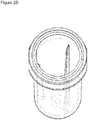
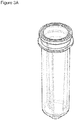
Figure 2A is an enlarged schematic top perspective view of one example of a container, showing the relative position of each substantially linear protrusion within the interior chamber of the container. -
Figure 2B is an enlarged angled schematic top perspective view of the container inFigure 2A . The container is depicted as semi-transparent. -
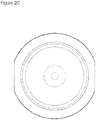
Figure 2C is an enlarged schematic bottom perspective view of the container inFigure 2A . -
Figure 3A is an angled schematic side perspective view of one example of a container. The container is depicted as semi-transparent. -
Figure 3B is an angled cut-away side perspective view of the container inFigure 3A . -
Figure 4A is a schematic side perspective view of one example of a container. The container is not depicted as semi-transparent. -
Figure 4B is a schematic side perspective view of the container inFigure 4A , rotated by 90° along a vertical axis. -
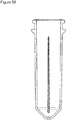
Figure 5A is a cut-away side perspective view of one example of a container. -
Figure 5B is a cut-away side perspective view of the container inFigure 5A , rotated about a vertical axis. -
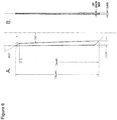
Figure 6A is a drawing showing the relative length, depth, and tilt dimensions of one example of a substantially linear protrusion. -
Figure 6B is a drawing depicting width dimensions of one example of a substantially linear protrusion, viewed directly along the length of the protrusion. -
Figure 7A is a schematic top perspective view of one example of a container with a substantially square cross section. -
Figure 7B is a schematic side perspective view of the container inFigure 7A . -
Figure 7C is a schematic bottom perspective view of the container inFigure 7A . -
Figure 7D is an angled schematic side perspective view of the container inFigure 7A . -
Figure 7E is an angled schematic side perspective view of the container inFigure 7A . -
Figure 8A is a cut-away top perspective view of one example of a container with a substantially square cross section. -
Figure 8B is a cut-away side perspective view of the container inFigure 8A , rotated by 90° along a vertical axis. -
Figure 8C is a cut-away top perspective view of the container inFigure 8A , rotated by 45° along a horizontal axis. -
Figure 8D is a cut-away side perspective view of the container inFigure 8C , rotated by 90° along a vertical axis. -
Figure 9A is a schematic bottom perspective view of a bottom-half of a container with a substantially square cross section. -
Figure 9B is a schematic side perspective view of the bottom-half of a container inFigure 9A , rotated by 90° along a vertical axis. -
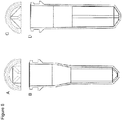
Figures 9C and 9D are schematic bottom perspective views of bottom-halves of containers with substantially circular cross sections having one or two indentations, respectively. -
Figures 9E and 9F are schematic bottom perspective views of bottom-halves of containers with substantially triangular cross sections having straight or curved sides, respectively. -
Figure 9G is a schematic bottom perspective view of a bottom-half of a container with a substantially square cross section having curved sides. -
Figures 9H-9J are schematic bottom perspective views of bottom-halves of containers with substantially pentagonal, hexagonal, and octagonal sides. -
Figure 10A is a cut-away side perspective view of a cover for a container, depicting the relative size and position of a weighted ring in the interior surface of the cover. -
Figure 10B is a schematic top perspective view of a cover for a container, showing the relative position of a tri-slit passage and six protuberances. -
Figure 11 is a graph showing the amount of Candida cell lysis in a standard bead beating assay is consistently higher using containers including three substantially linear protrusions, or "fins," compared to standard containers without linear protrusions. - While the invention is amenable to various modifications and alternative forms, specifics thereof have been shown by way of example in the drawings and will be described in detail. It should be understood, however, that the intention is not to limit the invention to the particular embodiments described. On the contrary, the intention is to cover all modifications, equivalents, and alternatives falling within the scope of the claims of the present invention.
- The present invention is based, at least in part, on containers for use in mixing or lysing cells in a liquid sample. A container may have an interior chamber with one or more (e.g., three, four, or five) substantially linear protrusions, which promote the mixing or lysing process. In some embodiments, rigid particles (e.g., beads) may be added to the liquid sample in the container (or be present in the container prior to the addition of a liquid) to additionally promote the mixing or lysing process. A container may also include a cover with a passage (e.g., a slit, e.g., a tri-slit) that can allow access to the interior chamber of the container while securely sealing the container top opening.
- The interior chambers of the containers may have substantially circular cross sections with protrusions or substantially polygonal cross sections which optionally have protrusions. Both containers are particularly suited for efficiently mixing a liquid sample or lysing cells in a liquid sample.
- A container may include an interior chamber with a central axis, a top with an opening, and a substantially circular cross section, wherein the interior chamber includes one or more substantially linear protrusions (e.g., 2, 3, 4, 5, or 6 substantially linear protrusions) that are substantially parallel to the central axis. The container may be used to increase the efficiency of mixing a liquid sample or lysing cells in a liquid sample compared to a container without any linear protrusions. For example, the one or more substantially linear protrusions can promote the productive collisions of the rigid particles used in bead beating and prevent them from travelling in a circle during the agitation process, thereby increasing the efficiency of cell lysis.
- In some embodiments, the containers with substantially circular cross sections have one or more substantially linear protrusions with a length parallel to the central axis, a depth substantially parallel to the radius of the substantially circular cross section, and a width substantially perpendicular to the radius. The depth and/or width may vary along the length of the linear protrusion. In some embodiments, the depth and/or width increases from top to bottom of the linear protrusion. The depth of the substantially linear protrusion may, for example, be greater than 10% of the radius (e.g., 11%, 12%, 13%, 14%, 15%, 16%, 17%, 18%, 19%, 20%, 30%, 40%, 50%, or 60% of the radius), greater than 20% of the radius (e.g., 21%, 22%, 23%, 24%, 25%, 26%, 27%, 28%, 29%, 30%, 40%, 50%, 60%, or 70% of the radius), or greater than 30% of the radius (e.g., 31%, 32%, 33%, 34%, 35%, 36%, 37%, 38%, 39%, 40%, 50%, 60%, 70%, or 80% of the radius) at some point along the length of the substantially linear protrusion. In other embodiments, the depths of the top and bottom of the substantially linear protrusions are at least between 0.3 to 0.5 millimeters (mm) (e.g., at least between 0.3 to 0.35 mm, at least between 0.35 to 0.4 mm, at least between 0.4 to 0.45 mm, or at least between 0.45 to 0.5 mm) and 0.75 to 1 mm (e.g., at least between 0.75 to 0.8 mm, at least between 0.8 to 0.85 mm, at least between 0.85 to 0.9 mm, at least between 0.9 to 0.95 mm, or at least between 0.95 to 1 mm), respectively; or at least between 0.75 to 1.25 mm (e.g., at least between 0.75 to 0.9 mm, at least between 0.9 to 1 mm, at least between 1 to 1.1 mm, or at least between 1.1 to 1.25 mm) and 1.75 to 2.25 mm (e.g., at least between 1.75 to 1.9 mm, at least between 1.9 to 2 mm, at least between 2 to 2.1 mm, or at least between 2.1 to 2.25 mm), respectively. Examples of containers with a circular cross section and three substantially linear protrusions, each with depth and width increasing from top to bottom of the protrusion, are depicted in detail in
Figures 1A-5B .Figures 9C and 9D depict examples of containers with substantially circular cross sections. As depicted inFigure 6A , a substantially linear protrusion may, for example, have a top and bottom depth of around 1 and 1.92 mm, respectively, which corresponds to around 18% and 35% of the radius of the container for a container with a radius of 5.5 mm. - The containers with substantially circular cross sections may have one or more substantially linear protrusions which can vary in length. In some embodiments, the containers with substantially circular cross sections have one or more substantially linear protrusions with a distal length and a proximal length relative to the central axis, wherein the distal and proximal lengths are each between 40-95% of the height of the container (e.g., 40-50%, 50-60%, 60-70%, 70-80%, 80-90%, or 90-95% the height of the container). In some embodiments, the proximal length may be greater than the distal length. The one or more substantially linear protrusions may thus be trapezoidal, whereby the edges that govern the depth of the protrusion are parallel, but the lengths are not. In some embodiments, the distal and proximal lengths are each at least 15 mm. In other embodiments, the distal and proximal lengths are each at least 30 mm. As depicted in
Figures 1B ,3A ,3B ,5A , and5B , the substantially linear protrusions may, for example, have lengths that span almost the entire height of the container, from near the top opening to close to the bottom of the container. - In some embodiments, the one or more substantially linear protrusions may have protrusions with a width greater than 5% of the radius (e.g., 6%, 7%, 8%, 9%, 10%, or 25% of the radius), greater than 10% of the radius (e.g., 11%, 12%, 13%, 14%, 15%, or 30% of the radius), or greater than 15% of the radius (e.g., 16%, 17%, 18%, 19%, 20%, or 35% of the radius) at some point along the length of the substantially linear protrusion. In other embodiments, the width is at least between 0.025 to 0.175 mm (e.g., at least between 0.025 to 0.075 mm, at least between 0.075 to 0.1 mm, at least between 0.1 to 0.15 mm, or at least between 0.15 to 0.175 mm), at least between 0.175 to 0.375 mm (e.g., at least between 0.175 to 0.225 mm, at least between 0.225 to 0.275 mm, at least between 0.275 to 0.325 mm, or at least between 0.325 to 0.375 mm), or at least between 0.5 to 0.7 mm (e.g., at least between 0.5 to 0.55 mm, at least between 0.55 to 0.6 mm, at least between 0.6 to 0.65 mm, or at least between 0.65 to 0.7 mm) at some point along the length of the substantially linear protrusion. As depicted in
Figure 6B , a substantially linear protrusion may, for example, have a width which increases along the length of the protrusion to a maximum width of 0.635 mm, or around 11.5% of the radius of the container for a container with a radius of 5.5 mm. - In some embodiments, e.g., as depicted in
Figures 1B ,3A ,3B ,5A , and5B , the substantially linear protrusions of the depicted containers are angled down towards the bottom of the container and away from the radius of the substantially circular cross section by between about 10° to 50° (e.g., between about 10° to 25°, between about 25° to 35°, or between about 35° to 50°). As depicted inFigure 6A , a substantially linear protrusion may, for example, be angled downward by 30°, which is reflected in a 60° angle formed by the top depth and distal length of the linear protrusion rather than a 90° angle, in the case in which a protrusion is not angled. - The containers with substantially circular cross sections may have an interior chamber including 2 to 6 substantially linear protrusions (e.g., 2, 3, 4, 5, or 6 substantially linear protrusions). In some embodiments, the interior chamber includes 2 to 4 substantially linear protrusions. The protrusions may, in some cases, be evenly spaced within the interior chamber of the container. An example of a container with a substantially circular cross section and three evenly spaced substantially linear protrusions is depicted in
Figures 1A and 1B . - The containers may additionally include a cover (e.g., a cap, lid, or top). The cover may be completely closed or include a passage that extends from its exterior surface to its interior surface. The passage may include, for example, three evenly spaced slits (e.g., a tri-slit) that converge at a central axis of the cover. The tri-slit may, for example, include short radial cuts, which stop short of reaching the edge of the cover. Compared to a single side-to-side slit, the tri-slit may, for example, stretch less and open less by a force acting to open the passage (e.g., insertion of a pipette tip). In some embodiments, the cover additionally includes one or more protuberances (e.g., 2, 3, 4, 5, or 6 protuberances), or bumps, between the around or about the slit or slits (e.g., three evenly spaced slits). In other embodiments, the interior surface may include a weighted ring that encircles the slit or slits. The one or more protuberances of the exterior surface and the weighted ring of the interior surface promote closure of the passage (e.g., closure upon breaching of the passage to gain access to the interior chamber by, e.g., a pipette tip or a needle).
Figures 10A and 10B depict one example of a cover for a container. In this example, the cover is circular and includes a tri-slit passage, two protuberances between each slit (six total), and a weighted ring to reduce stretching of the interior surface of the cover. - As depicted in
Figures 7A-9B and9E-9J , the containers may alternatively include an interior chamber with a central axis, a top with an opening, and a substantially polygonal cross section, wherein the radius of the cross section is the distance from the central axis to a corner point. The containers may, for example, have substantially angular corners within the interior chamber that support efficient mixing of a liquid sample and/or cell lysis in a liquid sample. For example, in a bead beating lysis procedure, the angular corners may prevent the rigid particles (e.g., beads) from unproductively circulating around the diameter of the tube under the force of the agitation unit (e.g., the vortexer). - The containers with polygonal cross sections may optionally include the substantially linear protrusions on the polygon sides, as described above for the containers with substantially circular cross sections. The substantially polygonal cross sections may, for example, be substantially triangular, quadrilateral, pentagonal, hexagonal, heptagonal, octagonal, nonagonal, decagonal, or dodecagonal. In some instances, the sides of the polygonal cross section may be curved (see, e.g.,
Figures 9F and 9G ). Although the interior chamber includes a region with a substantially polygonal cross section, all or a portion of the exterior of the tube may be substantially circular (e.g., for use with traditional cylindrical and/or conical tube holders in, e.g., a centrifuge unit). As depicted inFigures 7A-8D , the containers with polygonal cross sections may, for example, retain a top half with a circular opening. This feature enables all containers to potentially have uniform circular openings, thus enabling the containers to be easily handled by an automated robotic arm (e.g., a gripper). As described above for the containers with circular cross sections, the containers with polygonal cross sections may additionally include a cover, which securely seals the top opening of the container. In embodiments in which the top of the container is polygonal, the cover will typically have the same general cross-sectional shape. - The present invention includes methods for mixing a liquid sample or lysing cells (e.g., fungal cells) in a liquid sample using the containers of the invention. In one aspect, a liquid sample may be mixed by agitating the liquid in a container (e.g., a container with a substantially circular or polygonal cross section, as described above) using an agitation device (e.g., a vortexer), thereby mixing the liquid sample. In another aspect, a liquid sample may be mixed by (i) providing liquid in a container (e.g., a container with a substantially circular or polygonal cross section, as described above), where the liquid comprises rigid particles (e.g., beads), and (ii) agitating the liquid in the container with an agitation device (e.g., a vortexer), thereby mixing the liquid sample. The substantially linear protrusions and/or substantially angular corners within the interior chambers of the containers support efficient mixing of a liquid sample.
- In other aspects, cells in a liquid sample may be lysed by providing the liquid sample in a container (e.g., a container with a substantially circular or polygonal cross section, as described above), where the liquid includes rigid particles (e.g., beads) and cells (e.g., fungal cells), and agitating the liquid in the container with an agitation device (e.g., a vortexer), wherein the agitation is of a sufficient force and duration to lyse the cells.
- In any of the methods for mixing or lysing cells, the rigid particles (e.g., beads) may have a diameter of between about 0.2 mm to 1 mm (e.g, between about 0.1 to 0.3 mm, between about 0.3 to 0.5 mm, between about 0.5 to 0.7 mm, between about 0.7 to 0.9 mm, or between about 0.9 to 1 mm). In some embodiments, the rigid particles have a diameter of 0.8 mm. The rigid particles may, for example, be 0.5-mm glass beads, 0.1-mm silica beads, 0.7-mm silica beads, or a mixture of differently sized beads (e.g., beads, shards, glass rods, and glass disks). The agitation device (e.g., vortexer) used to facilitate mixing or lysing cells may, for example, agitate in a linear, planetary, vertical orbit, or pulsed motion.
- The detection of a biological analyte (e.g., a nucleic acid) in a sample may require that the analyte is first extracted from a biological organism in the sample. For biological organisms with particularly filamentous cell walls (e.g., yeast, bacteria, and algae), a robust method of cellular disruption (e.g., bead beating) must be employed to extract an intracellular target analyte. In some instances, the biological analyte may be present at a low concentration in the sample due to the sample having a low concentration of the biological organism. For example, if a subject was recently infected with a biological organism, such as the fungus Candida albicans, the concentration of the microorganism in a blood sample from the subject may be low. Accordingly, the ability to efficiently lyse the biological organism and detect the target analyte with high sensitivity is critically important.
- The present invention features a method for detecting the presence of a target nucleic acid (e.g., a target nucleic acid from a fungus, e.g., a Candida genus fungus) in a whole blood sample, the method including: (i) providing an extract produced by lysing the red blood cells in a whole blood sample from a subject (e.g., a human), centrifuging the sample to form a supernatant and a pellet, discarding some or all of the supernatant, and resuspending the pellet (e.g., the pellet containing the fungal cells); (ii) lysing cells in the extract, the lysing including combining the extract with rigid particles (e.g., beads or shards as described above) to form a mixture in a container (e.g., a container with a substantially circular or polygonal cross section, as described above), and agitating the mixture with an agitation device (e.g., a vortexer) to form a lysate; (iii) providing the lysate of step (ii) in a detection tube and amplifying the nucleic acids therein to form an amplified lysate solution including from 40% (w/w) to 95% (w/w) the target nucleic acid (e.g., from 40% to 60%, 60% to 80%, 80% to 90%, or 90% to 95% (w/w) target nucleic acid) and from 5% (w/w) to 60% (w/w) nontarget nucleic acid (e.g., from 5% to 20%, 20% to 35%, 35% to 40%, or 40% to 60% (w/w) target nucleic acid); and (iv) detecting the amplified target nucleic acid.
- The invention also features a method for detecting the presence of a target nucleic acid (e.g., a target nucleic acid from a fungus, e.g., a Candida genus fungus) in a whole blood sample, the method including: (i) providing an extract produced by lysing the red blood cells in a whole blood sample from a subject (e.g., a human), centrifuging the sample to form a supernatant and a pellet, discarding some or all of the supernatant, and resuspending the pellet (e.g., the pellet containing the fungal cells) to form an extract; (ii) lysing cells in the extract, the lysing including combining the extract with rigid particles (e.g., the beads, as described above) to form a mixture in a container (e.g., a container with a substantially circular or polygonal cross section, as described above), and agitating the mixture with an agitation device (e.g., a vortexer) to form a lysate; (iii) placing the lysate of step (ii) in a detection tube and amplifying nucleic acids therein to form an amplified lysate solution comprising from 40% (w/w) to 95% (w/w) the target nucleic acid (e.g., from 40% to 60%, 60% to 80%, 80% to 90%, or 90% to 95% (w/w) target nucleic acid) and from 5% (w/w) to 60% (w/w) nontarget nucleic acid (e.g., from 5% to 20%, 20% to 35%, 35% to 40%, or 40% to 60% (w/w) target nucleic acid); (iv) following step (iii), providing from 1 × 10⁶ to 1×10¹³ magnetic particles per milliliter (e.g., from 1×10⁶ to 1×10⁸, 1×10⁷ to 1×10⁸, 1×10⁷ to 1×10⁹, 1×10⁸ to 1×10¹⁰, 1×10⁹ to 1×10¹¹, or 1×10¹⁰ to 1×10¹³ magnetic particles per milliliter) of the amplified lysate solution, wherein the magnetic particles have a mean diameter of from 700 nm to 1200 nm (e.g., from 700 to 850, 800 to 950, 900 to 1050, or from 1000 to 1200 nm) and binding moieties on their surface, the binding moieties operative to alter aggregation of the magnetic particles in the presence of the target nucleic acid or a multivalent binding agent; (v) placing the detection tube in a device, the device including a support defining a well for holding the detection tube including the magnetic particles and the target nucleic acid, and having an RF coil disposed about the well, the RF coil configured to detect a signal produced by exposing the liquid sample to a bias magnetic field created using one or more magnets and an RF pulse sequence; (vi) exposing the sample to a bias magnetic field and an RF pulse sequence; (vii) following step (vi), measuring the signal from the detection tube; and (viii) on the basis of the result of step (vii), detecting the target nucleic acid, wherein step (vii) is carried out without any prior purification of the amplified lysate solution. Additional methods and reagents (e.g., probes specific for Candida) are described in
U.S. Patent Application No. 13/363,916 . - The compositions described herein enable methods of monitoring and diagnosing infectious disease in a multiplexed, automated, no sample preparation system. Such systems and methods could be used to monitor, for example, fungal infection, such as candidemia. Early diagnosis of candidemia is clinically important as this type of infection, if left untreated, can lead to a variety of different symptoms (depending on the area of the body affected) including, but not limited to, lesions and sores of the mouth, bleeding gums, burning with urination, vaginal irritation, vaginal itching, diarrhea, nausea, and vomiting. Candida infections are increasingly important pathogens in the NICU. Risk factors for the development of candidemia in neonates include gestational age less than 32 weeks, 5-min Apgar scores of less than 5, shock, disseminated intravascular coagulopathy, prior use of intralipids, parenteral nutrition administration, CVL use, H2 blocker administration, intubation, or length of stay longer than 7 days.
- In general, a whole blood sample may be taken from a suspected candidemia subject, and the presence of, for example, a targeted conserved Candida genomic region may be detected by use of the methods of the invention described in detail above.
- The following example is provided for the purpose of illustrating the invention and is not meant to limit the invention in any way.
- The efficiency of fungal cell lysis using 2.8-ml containers including three evenly spaced substantially linear protrusions ("fins") was compared to the efficiency achieved with standard 2.8-ml containers. Eight isolates of fungal cells (at a concentration of 3 cells/mL) were tested in duplicate in the two types of containers. To each of the containers, 0.7-mm Zirconia beads were added and the containers were agitated with a vortexer at 2800 rpm (+/- 400 rpm) for 8 minutes for the containers including the three protrusions or 2000 rpm (+/- 400 rpm) for 5 minutes for the standard 2.8-ml containers. Following the bead beating procedure, an aliquot of each lysate was then subjected to PCR amplification by addition of the lysate to a PCR master mix including nucleotides; buffer (5mM (NH4)SO4, 3.5 mM MgCl2, 6% glycerol, 60mM Tricine, pH = 8.7); primers specific for Candida (forward primer in 4× excess to allow for asymmetric single-strand production in the final product); and thermostable polymerase (HemoKlenTaq (New England Biolabs)). Magnetic particles conjugated to nucleic acids, each with sequence complementary to a portion of the amplified target such that the magnetic particles aggregate in the presence of the target nucleic acid, were added to the PCR amplification reaction. The amplified target Candida nucleic acid was then detected by measuring T2 relaxation times (msec). If all other variables in the detection assay have approximately equal contributions, then the difference in detection of the target nucleic acid may be directly correlated with the efficiency of cell lysis.
- As depicted in
Figure 11 , the data indicate that increased detection of the target nucleic acid is observed for Candida cells lysed in containers having three protrusions compared to that obtained from standard containers without protrusions. The data show that T2 relaxation times measuring target nucleic acid levels from the former group were uniformly higher than the T2 measurements obtained from the latter group. Both groups showed T2 signals significantly higher than that obtained from the four control experiments in each group. In sum, the data indicate that the containers increase the efficiency of cell lysis (e.g., in a bead beating assay) relative to standard containers known in the art. - Various modifications and variations of the described method of the invention will be apparent to those skilled in the art without departing from the scope of the claims of the present invention. Although the invention has been described in connection with specific embodiments, it should be understood that the invention as claimed should not be unduly limited to such specific embodiments. Other embodiments are in the claims.
Claims (13)
- A method of lysing cells in a liquid sample, said method comprising
providing liquid in a container having a volume of less than 5 ml, the container comprising an interior chamber with a central axis, a top comprising an opening, and a substantially circular or a substantially polygonal cross section, wherein the surface of said interior chamber comprises one or more substantially linear protrusions substantially parallel to said central axis, wherein said liquid comprises rigid particles and cells; and
agitating said liquid in said container, wherein said agitation is of a sufficient force and duration to lyse said cells. - A method for detecting the presence of a target nucleic acid in a whole blood sample, the method comprising:(a) providing an extract produced by lysing red blood cells in a whole blood sample from a subject, centrifuging the sample to form a supernatant and a pellet, discarding some or all of the supernatant, and resuspending the pellet;(b) lysing cells in said extract, said lysing comprising combining the extract with rigid particles to form a mixture in a container having a volume of less than 5 ml, the container comprising an interior chamber with a central axis, a top comprising an opening, and a substantially circular or a substantially polygonal cross section, wherein the surface of said interior chamber comprises one or more substantially linear protrusions substantially parallel to said central axis, and agitating the mixture to form a lysate;(c) providing the lysate of step (b) in a detection tube and amplifying nucleic acids therein to form an amplified lysate solution comprising from 40% (w/ w) to 95% (w/w) the target nucleic acid and from 5% (w/w) to 60% (w/w) nontarget nucleic acid; and(d) detecting the amplified target nucleic acid.
- The method of any one of claims 1 or 2, wherein said rigid particles have a diameter of between 0.1 mm to 1 mm, preferably 0.8 mm.
- A method of amplifying a target nucleic acid in a whole blood sample, the method comprising:(a) providing an extract produced by lysing red blood cells in a whole blood sample from a subject, centrifuging the sample to form a supernatant and a pellet, discarding some or all of the supernatant, and resuspending the pellet;(b) lysing cells in said extract, said lysing comprising combining the extract with rigid particles to form a mixture in a container having a volume of less than 5 ml, the container comprising an interior chamber with a central axis, a top comprising an opening, and a substantially circular or a substantially polygonal cross section, wherein the surface of said interior chamber comprises one or more substantially linear protrusions substantially parallel to said central axis, and agitating the mixture to form a lysate; and(c) providing the lysate of step (b) in a detection tube and amplifying nucleic acids therein to form an amplified lysate comprising from 40% (w/w) to 95% (w/w) the target nucleic acid and from 5% (w/w) to 60% (w/w) nontarget nucleic acid.
- The method of any one of claims 1 to 4, wherein the container has a substantially circular cross section.
- The method of claim 5, wherein the substantially linear protrusions are evenly spaced within the interior chamber of the container.
- The method of claim 5, wherein the container has a radius and a central axis, wherein said substantially linear protrusions have a length parallel to said central axis, a depth substantially parallel to the radius, and a width substantially perpendicular to said radius, and wherein the depth and/or width increases from top to bottom of said substantially linear protrusions.
- The method of claim 7, wherein the depth of said substantially linear protrusions is greater than 10% of the radius at some point along the length of said substantially linear protrusions.
- The method of any one of claims 1 to 4, wherein the container has a substantially polygonal cross section.
- The method of claim 9, wherein said substantially polygonal cross section is substantially triangular, quadrilateral, pentagonal, hexagonal, heptagonal, octagonal, nonagonal, decagonal, or dodecagonal.
- The method of any one of claims 1 to 4, wherein the container has (x) a substantially circular cross section having a radius or (y) a substantially polygonal cross section having a radius, wherein said radius is the distance from said central axis to a corner point, and said one or more substantially linear protrusions have a length parallel to said central axis, a depth substantially parallel to the radius of said substantially circular or polygonal cross section, and a width substantially perpendicular to said radius.
- The method of claim 11, wherein said depth and/or width increases from top to bottom of said substantially linear protrusion.
- The method of any one of claims 1 to 4, wherein said interior chamber comprises 2 to 6 substantially linear protrusions.
Applications Claiming Priority (2)
| Application Number | Priority Date | Filing Date | Title |
|---|---|---|---|
| US201261601842P | 2012-02-22 | 2012-02-22 | |
| PCT/US2013/027068 WO2013126526A1 (en) | 2012-02-22 | 2013-02-21 | Containers for agitation of liquid samples and methods of use thereof |
Publications (3)
| Publication Number | Publication Date |
|---|---|
| EP2817247A1 EP2817247A1 (en) | 2014-12-31 |
| EP2817247A4 EP2817247A4 (en) | 2015-11-25 |
| EP2817247B1 true EP2817247B1 (en) | 2018-04-11 |
Family
ID=48982540
Family Applications (1)
| Application Number | Title | Priority Date | Filing Date |
|---|---|---|---|
| EP13751876.7A Active EP2817247B1 (en) | 2012-02-22 | 2013-02-21 | Containers for agitation of liquid samples and methods of use thereof |
Country Status (4)
| Country | Link |
|---|---|
| US (3) | US9707528B2 (en) |
| EP (1) | EP2817247B1 (en) |
| ES (1) | ES2677146T3 (en) |
| WO (1) | WO2013126526A1 (en) |
Families Citing this family (31)
| Publication number | Priority date | Publication date | Assignee | Title |
|---|---|---|---|---|
| FR2986956B1 (en) * | 2012-02-21 | 2014-03-28 | Santos | FOOD PROCESSING BOWL FOR A MIXER |
| US9707528B2 (en) * | 2012-02-22 | 2017-07-18 | T2 Biosystems, Inc. | Containers for agitation of liquid samples and methods of use thereof |
| US10399083B2 (en) | 2014-01-06 | 2019-09-03 | Omni International, Inc. | Flow disrupters for use with homogenization tubes for beadless interrupted flow |
| JP6649380B2 (en) | 2014-07-30 | 2020-02-19 | ノース アメリカン ロボティクス コーポレーションNorth American Robotics Corporation | Automatic food processing system and method |
| US10624499B2 (en) | 2014-07-30 | 2020-04-21 | North American Robotics Corporation | Systems and methods for pressure control in automated blending devices |
| US9629503B2 (en) | 2014-07-30 | 2017-04-25 | North American Robotics Corporation | Blending container for use with blending apparatus |
| CA3187726A1 (en) | 2014-08-08 | 2016-02-11 | Fremon Scientific, Inc. | Smart bag used in sensing physiological and/or physical parameters of bags containing biological substance |
| CN107110748A (en) * | 2014-11-18 | 2017-08-29 | 和光纯药工业株式会社 | Detect the breaker and its method of body |
| USD779269S1 (en) * | 2015-06-05 | 2017-02-21 | Airlite Plastics Co. | Container rib |
| US9366617B1 (en) * | 2015-07-10 | 2016-06-14 | David E. Doggett | Self-stirring container |
| US9677988B1 (en) | 2015-07-10 | 2017-06-13 | David E. Doggett | Integrating radiation collection and detection apparatus |
| DE102015221671B3 (en) * | 2015-11-04 | 2016-08-04 | Bob Kosier | Vessel for laboratory use |
| EP3202293A1 (en) * | 2016-02-04 | 2017-08-09 | Tsann Kuen (Zhangzhou) Enterprise Co., Ltd. | Container and blender having the same |
| USD808796S1 (en) * | 2016-05-06 | 2018-01-30 | Cotapaxi Custom Design And Manufacturing Llc | Powder container |
| US20170341825A1 (en) * | 2016-05-27 | 2017-11-30 | Richard Charles Russett, III | Structured Shake |
| US20190151810A1 (en) * | 2016-05-27 | 2019-05-23 | Richard Charles Russett, III | Structured Shake |
| USD838586S1 (en) * | 2017-04-13 | 2019-01-22 | Cotapaxi Custom Design And Manufacturing Llc | Container |
| US20180324900A1 (en) | 2017-05-04 | 2018-11-08 | Fremon Scientific, Inc. | Dry Heat Thawing of Biological Substances |
| US12005436B2 (en) | 2017-05-26 | 2024-06-11 | Stemcell Technologies Inc. | Devices and methods for separating particles from a liquid |
| WO2019217488A1 (en) | 2018-05-07 | 2019-11-14 | Fremon Scientific, Inc. | Thawing biological substances |
| JP2021527410A (en) * | 2018-06-14 | 2021-10-14 | コーニング インコーポレイテッド | Baffle insert device and how to use it |
| WO2020047070A1 (en) * | 2018-08-28 | 2020-03-05 | Roche Diagnostics Hematology, Inc. | Striated test tube and method of fluid transfer using the same |
| USD877930S1 (en) * | 2018-12-06 | 2020-03-10 | Unipharma, Llc | Container |
| CN109735437B (en) * | 2019-01-28 | 2022-04-19 | 长春长光辰英生物科学仪器有限公司 | Vessel and method for collecting and processing cells after ejection sorting of cells |
| WO2020159992A1 (en) | 2019-01-29 | 2020-08-06 | Instrumentation Laboratory Company | Hematocrit level detection using ir laser refraction |
| US11053473B2 (en) * | 2019-06-25 | 2021-07-06 | Hemex Health, Inc. | External sonication |
| DE102019126201A1 (en) * | 2019-09-27 | 2021-04-01 | Bruker Daltonik Gmbh | Mass spectrometric sample preparation for matrix-assisted ionization (e.g. MALDI) |
| USD996801S1 (en) * | 2021-05-13 | 2023-08-29 | Osman Yusuf | Pill bottle container insert |
| JP7649149B2 (en) * | 2021-01-29 | 2025-03-19 | グラドコフ・アレクセイ | Cell Culture Vessels |
| US12618774B2 (en) | 2022-04-15 | 2026-05-05 | Instrumentation Laboratory Co. | Fluid testing system |
| USD1014780S1 (en) | 2022-04-15 | 2024-02-13 | Instrumentation Laboratory Co. | Cuvette |
Family Cites Families (13)
| Publication number | Priority date | Publication date | Assignee | Title |
|---|---|---|---|---|
| US2794627A (en) | 1954-10-21 | 1957-06-04 | Silex Co | Blender |
| US4295613A (en) * | 1979-10-03 | 1981-10-20 | Vpi Educational Foundation | Apparatus for breaking bacterial cells |
| US4690153A (en) * | 1985-11-29 | 1987-09-01 | Becton, Dickinson And Company | Flow inducing means for small volume containers |
| CA1296604C (en) * | 1986-03-20 | 1992-03-03 | Kathleen Murphy | Method for releasing rna and dna from cells |
| US5422273A (en) | 1993-03-23 | 1995-06-06 | Baal Medical Products, Inc. | Cell collection apparatus |
| WO2003034076A1 (en) | 2001-10-19 | 2003-04-24 | Monogen, Inc. | Article handling system and method |
| US20110107855A1 (en) * | 2008-03-28 | 2011-05-12 | Pelican Group Holdings, Inc. | Sample preparation devices and methods for processing analytes |
| EP2429704A2 (en) | 2009-05-14 | 2012-03-21 | Streck Inc. | Sample processing cassette, system, and method |
| IN2012DN03431A (en) | 2009-09-21 | 2015-10-23 | Akonni Biosystems | |
| CA2815085C (en) | 2010-10-22 | 2022-06-21 | T2 Biosystems, Inc. | Nmr systems and methods for the rapid detection of analytes |
| US9039636B2 (en) | 2011-01-27 | 2015-05-26 | Resolution Biomedical, Inc. | Devices and methods for enhanced cellular sample transfer |
| USD696398S1 (en) | 2012-02-22 | 2013-12-24 | T2 Biosystems, Inc. | Finned tube |
| US9707528B2 (en) * | 2012-02-22 | 2017-07-18 | T2 Biosystems, Inc. | Containers for agitation of liquid samples and methods of use thereof |
-
2012
- 2012-10-12 US US13/650,734 patent/US9707528B2/en active Active
-
2013
- 2013-02-21 EP EP13751876.7A patent/EP2817247B1/en active Active
- 2013-02-21 ES ES13751876.7T patent/ES2677146T3/en active Active
- 2013-02-21 WO PCT/US2013/027068 patent/WO2013126526A1/en not_active Ceased
-
2017
- 2017-03-08 US US15/453,356 patent/US10486118B2/en active Active
-
2019
- 2019-10-21 US US16/659,215 patent/US11666872B2/en active Active
Non-Patent Citations (1)
| Title |
|---|
| None * |
Also Published As
| Publication number | Publication date |
|---|---|
| ES2677146T3 (en) | 2018-07-30 |
| HK1205494A1 (en) | 2015-12-18 |
| US20130217010A1 (en) | 2013-08-22 |
| US20170246599A1 (en) | 2017-08-31 |
| US10486118B2 (en) | 2019-11-26 |
| WO2013126526A1 (en) | 2013-08-29 |
| US9707528B2 (en) | 2017-07-18 |
| US20200261873A1 (en) | 2020-08-20 |
| EP2817247A4 (en) | 2015-11-25 |
| US11666872B2 (en) | 2023-06-06 |
| EP2817247A1 (en) | 2014-12-31 |
Similar Documents
| Publication | Publication Date | Title |
|---|---|---|
| US11666872B2 (en) | Containers for agitation of liquid samples and methods of use thereof | |
| JP5595415B2 (en) | Automated system for lysis of microorganisms present in samples intended for analysis and extraction and purification of nucleic acids of these microorganisms | |
| EP1774341B1 (en) | Reaction vessel and method for separating, mixing and concentrating magnetic particles with a fluid and use thereof in purification methods | |
| ES2294287T3 (en) | USE OF A SILICONE MATERIAL IN AN AMPLIFICATION REACTION. | |
| EP3067112A1 (en) | Magnetic lysis method and device | |
| EP3535058B1 (en) | Systems and method for sequestering substances in bulk liquids | |
| US20100075313A1 (en) | Device for the lysis of microorganisms present in an environmental or clinical sample and the extraction of nucleic acids from said microorganisms for analysis | |
| JP2014221061A (en) | Operation tube for operating target component in tube | |
| US11845978B2 (en) | Detecting and characterizing a microorganism | |
| EP3800268A1 (en) | Analyte enrichment methods and compositions | |
| CN210796462U (en) | Integrated reagent cup for sample treatment and detection | |
| EP4426475A1 (en) | Devices for improving sample preparation and processing | |
| EP3570030B1 (en) | Analyzer device for in vitro diagnostics | |
| JPWO2008075501A1 (en) | Rotary extraction container, cell type identification method, gene detection method, and automatic nucleic acid extraction apparatus using the same | |
| KR101948873B1 (en) | Paper-based colorimtric sensor for high efficient, rapid and visual detection of bacterial pathogen and high efficient, rapid and visual detection of bacterial pathogen | |
| HK1205494B (en) | Containers for agitation of liquid samples and methods of use thereof | |
| CN214496301U (en) | Nucleic acid extraction amplification detection test tube | |
| US20200088615A1 (en) | Systems and methods for rapid detection of an analyte of interest | |
| US20150219637A1 (en) | Analytical processing and detection device | |
| Schumacher et al. | System development for generating homogeneous cell suspensions and transporting them in microfluidic components | |
| CN115184313B (en) | A carbon-nitrogen fluorescent quantum dot tumor cell detection kit and its usage method | |
| US20260002201A1 (en) | Apparatus and method for testing of a biological or environmental sample | |
| Buhler et al. | Genome-wide mapping of meiotic DNA double-strand breaks in Saccharomyces cerevisiae | |
| CN202705346U (en) | Solid-liquid multi-phase co-culturing and detecting device | |
| Ishak et al. | THE STRUCTURES, PROPERTIES, SYNTHESIS, AND INNOVATIVE APPLICATIONS OF GOLD NANOPARTICLES IN LABORATORY MEDICINE: A REVIEW: Received 2023-01-07; Accepted 2023-04-10; Published 2023-06-06 |
Legal Events
| Date | Code | Title | Description |
|---|---|---|---|
| PUAI | Public reference made under article 153(3) epc to a published international application that has entered the european phase |
Free format text: ORIGINAL CODE: 0009012 |
|
| 17P | Request for examination filed |
Effective date: 20140919 |
|
| AK | Designated contracting states |
Kind code of ref document: A1 Designated state(s): AL AT BE BG CH CY CZ DE DK EE ES FI FR GB GR HR HU IE IS IT LI LT LU LV MC MK MT NL NO PL PT RO RS SE SI SK SM TR |
|
| AX | Request for extension of the european patent |
Extension state: BA ME |
|
| RIN1 | Information on inventor provided before grant (corrected) |
Inventor name: DEMAS, VASILIKI Inventor name: AUDEH, MARK, JOHN Inventor name: LOWERY, THOMAS, JAY Inventor name: BLANCO, MATTHEW Inventor name: WANG, HWA-TANG Inventor name: CHEPIN, JAMES, FRANKLIN Inventor name: NEELY, LORI, ANNE Inventor name: MIN, MICHAEL Inventor name: SUCHOCKI, ADAM Inventor name: RITTERSHAUS, CHARLES, WILLIAM Inventor name: WELLMAN, PARRIS, S. Inventor name: FRITZEMEIER, MARILYN, LEE |
|
| RIN1 | Information on inventor provided before grant (corrected) |
Inventor name: FRITZEMEIER, MARILYN, LEE Inventor name: DEMAS, VASILIKI Inventor name: NEELY, LORI, ANNE Inventor name: AUDEH, MARK, JOHN Inventor name: RITTERSHAUS, CHARLES, WILLIAM Inventor name: BLANCO, MATTHEW Inventor name: WELLMAN, PARRIS, S. Inventor name: CHEPIN, JAMES, FRANKLIN Inventor name: LOWERY, THOMAS, JAY Inventor name: MIN, MICHAEL Inventor name: WANG, HWA-TANG Inventor name: SUCHOCKI, ADAM |
|
| DAX | Request for extension of the european patent (deleted) | ||
| RA4 | Supplementary search report drawn up and despatched (corrected) |
Effective date: 20151028 |
|
| RIC1 | Information provided on ipc code assigned before grant |
Ipc: B65D 90/02 20060101AFI20151019BHEP |
|
| REG | Reference to a national code |
Ref country code: HK Ref legal event code: DE Ref document number: 1205494 Country of ref document: HK |
|
| STAA | Information on the status of an ep patent application or granted ep patent |
Free format text: STATUS: EXAMINATION IS IN PROGRESS |
|
| 17Q | First examination report despatched |
Effective date: 20170207 |
|
| GRAP | Despatch of communication of intention to grant a patent |
Free format text: ORIGINAL CODE: EPIDOSNIGR1 |
|
| STAA | Information on the status of an ep patent application or granted ep patent |
Free format text: STATUS: GRANT OF PATENT IS INTENDED |
|
| GRAJ | Information related to disapproval of communication of intention to grant by the applicant or resumption of examination proceedings by the epo deleted |
Free format text: ORIGINAL CODE: EPIDOSDIGR1 |
|
| GRAP | Despatch of communication of intention to grant a patent |
Free format text: ORIGINAL CODE: EPIDOSNIGR1 |
|
| STAA | Information on the status of an ep patent application or granted ep patent |
Free format text: STATUS: EXAMINATION IS IN PROGRESS |
|
| GRAJ | Information related to disapproval of communication of intention to grant by the applicant or resumption of examination proceedings by the epo deleted |
Free format text: ORIGINAL CODE: EPIDOSDIGR1 |
|
| INTG | Intention to grant announced |
Effective date: 20170807 |
|
| INTC | Intention to grant announced (deleted) | ||
| GRAP | Despatch of communication of intention to grant a patent |
Free format text: ORIGINAL CODE: EPIDOSNIGR1 |
|
| STAA | Information on the status of an ep patent application or granted ep patent |
Free format text: STATUS: GRANT OF PATENT IS INTENDED |
|
| INTG | Intention to grant announced |
Effective date: 20170919 |
|
| GRAS | Grant fee paid |
Free format text: ORIGINAL CODE: EPIDOSNIGR3 |
|
| RIN1 | Information on inventor provided before grant (corrected) |
Inventor name: DEMAS, VASILIKI Inventor name: WANG, HWA-TANG Inventor name: LOWERY, THOMAS, JAY Inventor name: RITTERSHAUS, CHARLES, WILLIAM Inventor name: AUDEH, MARK, JOHN Inventor name: SUCHOCKI, ADAM Inventor name: NEELY, LORI, ANNE Inventor name: BLANCO, MATTHEW Inventor name: WELLMAN, PARRIS, S. Inventor name: CHEPIN, JAMES, FRANKLIN Inventor name: FRITZEMEIER, MARILYN, LEE Inventor name: MIN, MICHAEL |
|
| GRAA | (expected) grant |
Free format text: ORIGINAL CODE: 0009210 |
|
| STAA | Information on the status of an ep patent application or granted ep patent |
Free format text: STATUS: THE PATENT HAS BEEN GRANTED |
|
| AK | Designated contracting states |
Kind code of ref document: B1 Designated state(s): AL AT BE BG CH CY CZ DE DK EE ES FI FR GB GR HR HU IE IS IT LI LT LU LV MC MK MT NL NO PL PT RO RS SE SI SK SM TR |
|
| REG | Reference to a national code |
Ref country code: GB Ref legal event code: FG4D |
|
| REG | Reference to a national code |
Ref country code: CH Ref legal event code: EP |
|
| REG | Reference to a national code |
Ref country code: AT Ref legal event code: REF Ref document number: 987786 Country of ref document: AT Kind code of ref document: T Effective date: 20180415 |
|
| REG | Reference to a national code |
Ref country code: IE Ref legal event code: FG4D |
|
| REG | Reference to a national code |
Ref country code: DE Ref legal event code: R096 Ref document number: 602013035757 Country of ref document: DE |
|
| REG | Reference to a national code |
Ref country code: ES Ref legal event code: FG2A Ref document number: 2677146 Country of ref document: ES Kind code of ref document: T3 Effective date: 20180730 |
|
| REG | Reference to a national code |
Ref country code: NL Ref legal event code: FP |
|
| REG | Reference to a national code |
Ref country code: LT Ref legal event code: MG4D |
|
| PG25 | Lapsed in a contracting state [announced via postgrant information from national office to epo] |
Ref country code: AL Free format text: LAPSE BECAUSE OF FAILURE TO SUBMIT A TRANSLATION OF THE DESCRIPTION OR TO PAY THE FEE WITHIN THE PRESCRIBED TIME-LIMIT Effective date: 20180411 Ref country code: SE Free format text: LAPSE BECAUSE OF FAILURE TO SUBMIT A TRANSLATION OF THE DESCRIPTION OR TO PAY THE FEE WITHIN THE PRESCRIBED TIME-LIMIT Effective date: 20180411 Ref country code: PL Free format text: LAPSE BECAUSE OF FAILURE TO SUBMIT A TRANSLATION OF THE DESCRIPTION OR TO PAY THE FEE WITHIN THE PRESCRIBED TIME-LIMIT Effective date: 20180411 Ref country code: LT Free format text: LAPSE BECAUSE OF FAILURE TO SUBMIT A TRANSLATION OF THE DESCRIPTION OR TO PAY THE FEE WITHIN THE PRESCRIBED TIME-LIMIT Effective date: 20180411 Ref country code: FI Free format text: LAPSE BECAUSE OF FAILURE TO SUBMIT A TRANSLATION OF THE DESCRIPTION OR TO PAY THE FEE WITHIN THE PRESCRIBED TIME-LIMIT Effective date: 20180411 Ref country code: NO Free format text: LAPSE BECAUSE OF FAILURE TO SUBMIT A TRANSLATION OF THE DESCRIPTION OR TO PAY THE FEE WITHIN THE PRESCRIBED TIME-LIMIT Effective date: 20180711 Ref country code: BG Free format text: LAPSE BECAUSE OF FAILURE TO SUBMIT A TRANSLATION OF THE DESCRIPTION OR TO PAY THE FEE WITHIN THE PRESCRIBED TIME-LIMIT Effective date: 20180711 |
|
| PG25 | Lapsed in a contracting state [announced via postgrant information from national office to epo] |
Ref country code: GR Free format text: LAPSE BECAUSE OF FAILURE TO SUBMIT A TRANSLATION OF THE DESCRIPTION OR TO PAY THE FEE WITHIN THE PRESCRIBED TIME-LIMIT Effective date: 20180712 Ref country code: RS Free format text: LAPSE BECAUSE OF FAILURE TO SUBMIT A TRANSLATION OF THE DESCRIPTION OR TO PAY THE FEE WITHIN THE PRESCRIBED TIME-LIMIT Effective date: 20180411 Ref country code: LV Free format text: LAPSE BECAUSE OF FAILURE TO SUBMIT A TRANSLATION OF THE DESCRIPTION OR TO PAY THE FEE WITHIN THE PRESCRIBED TIME-LIMIT Effective date: 20180411 Ref country code: HR Free format text: LAPSE BECAUSE OF FAILURE TO SUBMIT A TRANSLATION OF THE DESCRIPTION OR TO PAY THE FEE WITHIN THE PRESCRIBED TIME-LIMIT Effective date: 20180411 |
|
| REG | Reference to a national code |
Ref country code: AT Ref legal event code: MK05 Ref document number: 987786 Country of ref document: AT Kind code of ref document: T Effective date: 20180411 |
|
| PG25 | Lapsed in a contracting state [announced via postgrant information from national office to epo] |
Ref country code: PT Free format text: LAPSE BECAUSE OF FAILURE TO SUBMIT A TRANSLATION OF THE DESCRIPTION OR TO PAY THE FEE WITHIN THE PRESCRIBED TIME-LIMIT Effective date: 20180813 |
|
| REG | Reference to a national code |
Ref country code: DE Ref legal event code: R097 Ref document number: 602013035757 Country of ref document: DE |
|
| PG25 | Lapsed in a contracting state [announced via postgrant information from national office to epo] |
Ref country code: SK Free format text: LAPSE BECAUSE OF FAILURE TO SUBMIT A TRANSLATION OF THE DESCRIPTION OR TO PAY THE FEE WITHIN THE PRESCRIBED TIME-LIMIT Effective date: 20180411 Ref country code: DK Free format text: LAPSE BECAUSE OF FAILURE TO SUBMIT A TRANSLATION OF THE DESCRIPTION OR TO PAY THE FEE WITHIN THE PRESCRIBED TIME-LIMIT Effective date: 20180411 Ref country code: EE Free format text: LAPSE BECAUSE OF FAILURE TO SUBMIT A TRANSLATION OF THE DESCRIPTION OR TO PAY THE FEE WITHIN THE PRESCRIBED TIME-LIMIT Effective date: 20180411 Ref country code: AT Free format text: LAPSE BECAUSE OF FAILURE TO SUBMIT A TRANSLATION OF THE DESCRIPTION OR TO PAY THE FEE WITHIN THE PRESCRIBED TIME-LIMIT Effective date: 20180411 Ref country code: RO Free format text: LAPSE BECAUSE OF FAILURE TO SUBMIT A TRANSLATION OF THE DESCRIPTION OR TO PAY THE FEE WITHIN THE PRESCRIBED TIME-LIMIT Effective date: 20180411 Ref country code: CZ Free format text: LAPSE BECAUSE OF FAILURE TO SUBMIT A TRANSLATION OF THE DESCRIPTION OR TO PAY THE FEE WITHIN THE PRESCRIBED TIME-LIMIT Effective date: 20180411 |
|
| PLBE | No opposition filed within time limit |
Free format text: ORIGINAL CODE: 0009261 |
|
| STAA | Information on the status of an ep patent application or granted ep patent |
Free format text: STATUS: NO OPPOSITION FILED WITHIN TIME LIMIT |
|
| PG25 | Lapsed in a contracting state [announced via postgrant information from national office to epo] |
Ref country code: SM Free format text: LAPSE BECAUSE OF FAILURE TO SUBMIT A TRANSLATION OF THE DESCRIPTION OR TO PAY THE FEE WITHIN THE PRESCRIBED TIME-LIMIT Effective date: 20180411 |
|
| 26N | No opposition filed |
Effective date: 20190114 |
|
| PG25 | Lapsed in a contracting state [announced via postgrant information from national office to epo] |
Ref country code: SI Free format text: LAPSE BECAUSE OF FAILURE TO SUBMIT A TRANSLATION OF THE DESCRIPTION OR TO PAY THE FEE WITHIN THE PRESCRIBED TIME-LIMIT Effective date: 20180411 |
|
| PG25 | Lapsed in a contracting state [announced via postgrant information from national office to epo] |
Ref country code: LU Free format text: LAPSE BECAUSE OF NON-PAYMENT OF DUE FEES Effective date: 20190221 Ref country code: MC Free format text: LAPSE BECAUSE OF FAILURE TO SUBMIT A TRANSLATION OF THE DESCRIPTION OR TO PAY THE FEE WITHIN THE PRESCRIBED TIME-LIMIT Effective date: 20180411 |
|
| PG25 | Lapsed in a contracting state [announced via postgrant information from national office to epo] |
Ref country code: TR Free format text: LAPSE BECAUSE OF FAILURE TO SUBMIT A TRANSLATION OF THE DESCRIPTION OR TO PAY THE FEE WITHIN THE PRESCRIBED TIME-LIMIT Effective date: 20180411 |
|
| PG25 | Lapsed in a contracting state [announced via postgrant information from national office to epo] |
Ref country code: MT Free format text: LAPSE BECAUSE OF NON-PAYMENT OF DUE FEES Effective date: 20190221 |
|
| PG25 | Lapsed in a contracting state [announced via postgrant information from national office to epo] |
Ref country code: CY Free format text: LAPSE BECAUSE OF FAILURE TO SUBMIT A TRANSLATION OF THE DESCRIPTION OR TO PAY THE FEE WITHIN THE PRESCRIBED TIME-LIMIT Effective date: 20180411 |
|
| PG25 | Lapsed in a contracting state [announced via postgrant information from national office to epo] |
Ref country code: IS Free format text: LAPSE BECAUSE OF FAILURE TO SUBMIT A TRANSLATION OF THE DESCRIPTION OR TO PAY THE FEE WITHIN THE PRESCRIBED TIME-LIMIT Effective date: 20180811 |
|
| PG25 | Lapsed in a contracting state [announced via postgrant information from national office to epo] |
Ref country code: HU Free format text: LAPSE BECAUSE OF FAILURE TO SUBMIT A TRANSLATION OF THE DESCRIPTION OR TO PAY THE FEE WITHIN THE PRESCRIBED TIME-LIMIT; INVALID AB INITIO Effective date: 20130221 |
|
| REG | Reference to a national code |
Ref country code: DE Ref legal event code: R082 Ref document number: 602013035757 Country of ref document: DE Representative=s name: SIMMONS & SIMMONS LLP, DE |
|
| PG25 | Lapsed in a contracting state [announced via postgrant information from national office to epo] |
Ref country code: MK Free format text: LAPSE BECAUSE OF FAILURE TO SUBMIT A TRANSLATION OF THE DESCRIPTION OR TO PAY THE FEE WITHIN THE PRESCRIBED TIME-LIMIT Effective date: 20180411 |
|
| P01 | Opt-out of the competence of the unified patent court (upc) registered |
Effective date: 20230421 |
|
| PGFP | Annual fee paid to national office [announced via postgrant information from national office to epo] |
Ref country code: NL Payment date: 20240821 Year of fee payment: 12 |
|
| PGFP | Annual fee paid to national office [announced via postgrant information from national office to epo] |
Ref country code: DE Payment date: 20240902 Year of fee payment: 12 Ref country code: IE Payment date: 20240820 Year of fee payment: 12 |
|
| PGFP | Annual fee paid to national office [announced via postgrant information from national office to epo] |
Ref country code: GB Payment date: 20240820 Year of fee payment: 12 |
|
| PGFP | Annual fee paid to national office [announced via postgrant information from national office to epo] |
Ref country code: BE Payment date: 20240828 Year of fee payment: 12 |
|
| PGFP | Annual fee paid to national office [announced via postgrant information from national office to epo] |
Ref country code: FR Payment date: 20240822 Year of fee payment: 12 |
|
| PGFP | Annual fee paid to national office [announced via postgrant information from national office to epo] |
Ref country code: CH Payment date: 20240821 Year of fee payment: 12 Ref country code: ES Payment date: 20240902 Year of fee payment: 12 |
|
| PGFP | Annual fee paid to national office [announced via postgrant information from national office to epo] |
Ref country code: IT Payment date: 20240820 Year of fee payment: 12 |
|
| REG | Reference to a national code |
Ref country code: DE Ref legal event code: R119 Ref document number: 602013035757 Country of ref document: DE |
|
| REG | Reference to a national code |
Ref country code: CH Ref legal event code: PL |
|
| REG | Reference to a national code |
Ref country code: NL Ref legal event code: MM Effective date: 20250301 |
|
| PG25 | Lapsed in a contracting state [announced via postgrant information from national office to epo] |
Ref country code: CH Free format text: LAPSE BECAUSE OF NON-PAYMENT OF DUE FEES Effective date: 20250228 |
|
| GBPC | Gb: european patent ceased through non-payment of renewal fee |
Effective date: 20250221 |
|
| PG25 | Lapsed in a contracting state [announced via postgrant information from national office to epo] |
Ref country code: NL Free format text: LAPSE BECAUSE OF NON-PAYMENT OF DUE FEES Effective date: 20250301 |
|
| REG | Reference to a national code |
Ref country code: BE Ref legal event code: MM Effective date: 20250228 |
|
| PG25 | Lapsed in a contracting state [announced via postgrant information from national office to epo] |
Ref country code: DE Free format text: LAPSE BECAUSE OF NON-PAYMENT OF DUE FEES Effective date: 20250902 |
|
| PG25 | Lapsed in a contracting state [announced via postgrant information from national office to epo] |
Ref country code: GB Free format text: LAPSE BECAUSE OF NON-PAYMENT OF DUE FEES Effective date: 20250221 |
|
| PG25 | Lapsed in a contracting state [announced via postgrant information from national office to epo] |
Ref country code: IT Free format text: LAPSE BECAUSE OF NON-PAYMENT OF DUE FEES Effective date: 20250221 Ref country code: FR Free format text: LAPSE BECAUSE OF NON-PAYMENT OF DUE FEES Effective date: 20250228 |
|
| PG25 | Lapsed in a contracting state [announced via postgrant information from national office to epo] |
Ref country code: BE Free format text: LAPSE BECAUSE OF NON-PAYMENT OF DUE FEES Effective date: 20250228 |
|
| PG25 | Lapsed in a contracting state [announced via postgrant information from national office to epo] |
Ref country code: IE Free format text: LAPSE BECAUSE OF NON-PAYMENT OF DUE FEES Effective date: 20250221 |
|
| REG | Reference to a national code |
Ref country code: ES Ref legal event code: FD2A Effective date: 20260406 |
|
| PG25 | Lapsed in a contracting state [announced via postgrant information from national office to epo] |
Ref country code: ES Free format text: LAPSE BECAUSE OF NON-PAYMENT OF DUE FEES Effective date: 20250222 |